
桀-1688
3.3k Posts

桀-1688
 Square Verified
Report
Block User
盯盘不追高,数据说人话。关注我,用数据拆行情,用白话讲市场。
High-Frequency Trader
9 Years
106 Following
11.4K+ Followers
2.4K+ Liked
Posts
·
--
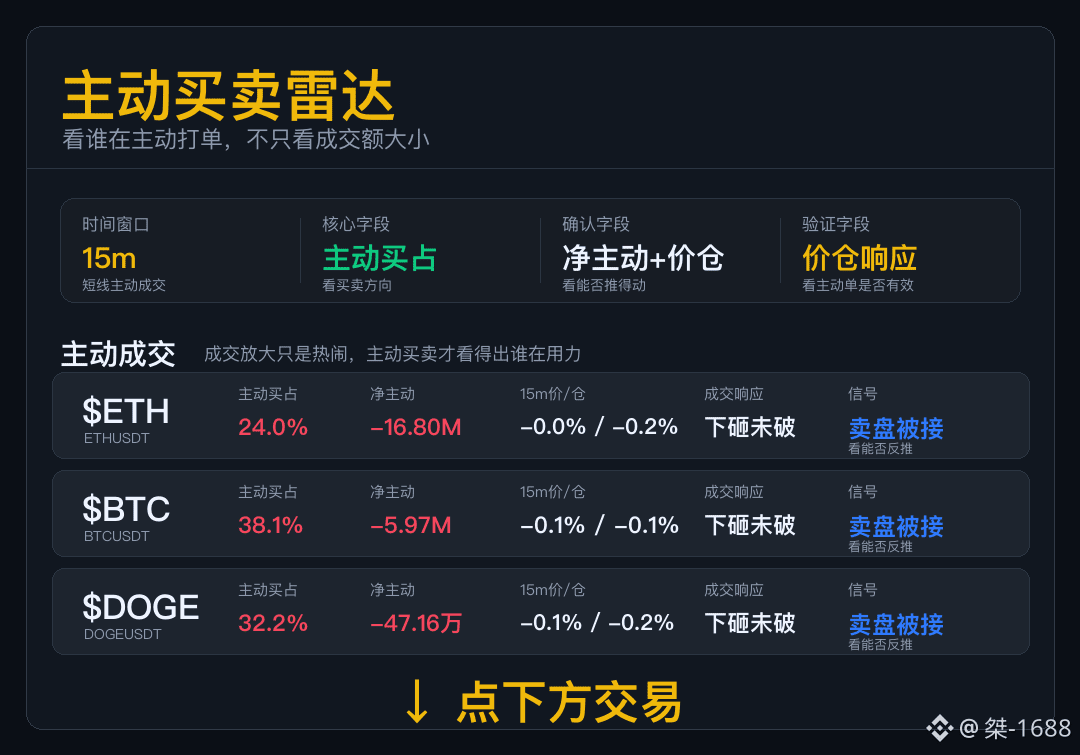
Active Buy/Sell Radar
Don’t just look at the trading volume—today this set mainly looks at whether active orders can push the market.
$ETH : Active sell orders are dominant, but the price hasn’t been pushed down through; passive buy orders below are absorbing the selling pressure.
$BTC : There’s volume on the sell side, but it hasn’t broken through; the chart looks more like absorption than a one-way breakdown.
$DOGE : Sell orders were pushed out, but they didn’t break through, indicating there is still support underneath—go short more slowly for now.
The seller moved first but didn’t break through; don’t rush to chase shorts in the short term—keep observing whether the absorption continues.
Active Buy/Sell Radar
Don’t just look at the trading volume—today this set mainly looks at whether active orders can push the market.
$ETH : Active sell orders are dominant, but the price hasn’t been pushed down through; passive buy orders below are absorbing the selling pressure.
$BTC : There’s volume on the sell side, but it hasn’t broken through; the chart looks more like absorption than a one-way breakdown.
$DOGE : Sell orders were pushed out, but they didn’t break through, indicating there is still support underneath—go short more slowly for now.
The seller moved first but didn’t break through; don’t rush to chase shorts in the short term—keep observing whether the absorption continues.
Don’t just look at the trading volume—today this set mainly looks at whether active orders can push the market.
$ETH : Active sell orders are dominant, but the price hasn’t been pushed down through; passive buy orders below are absorbing the selling pressure.
$BTC : There’s volume on the sell side, but it hasn’t broken through; the chart looks more like absorption than a one-way breakdown.
$DOGE : Sell orders were pushed out, but they didn’t break through, indicating there is still support underneath—go short more slowly for now.
The seller moved first but didn’t break through; don’t rush to chase shorts in the short term—keep observing whether the absorption continues.
150
·
--
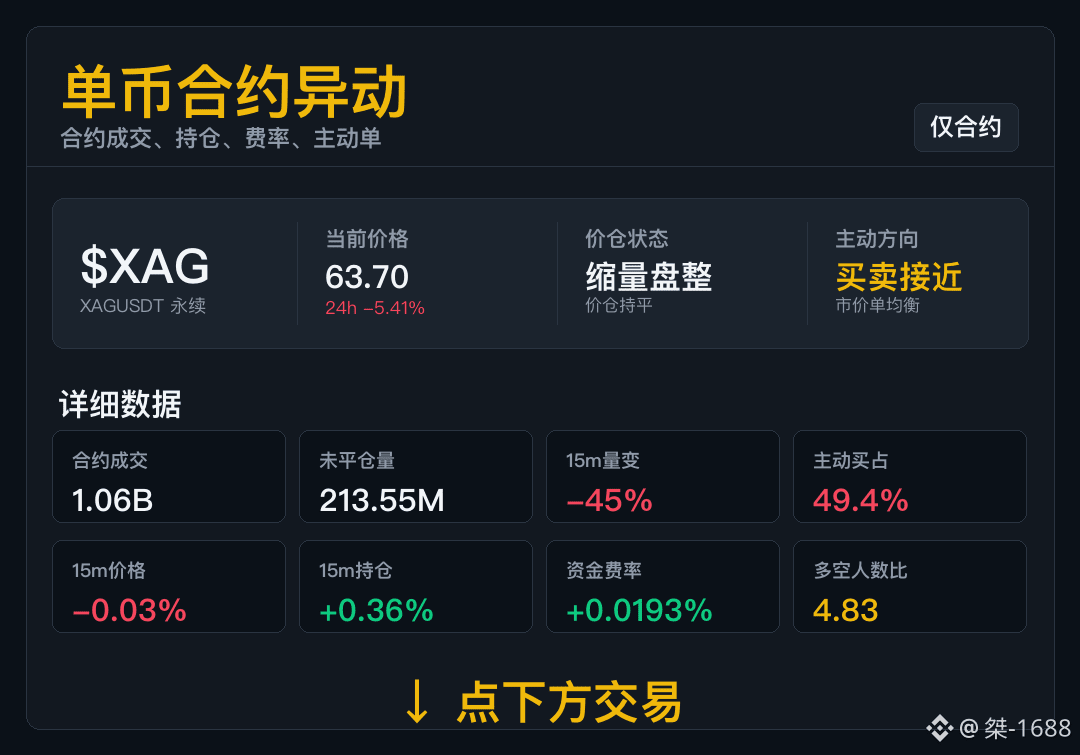
$XAG Don’t just focus on up or down for now—price positioning and aggressive orders are more important.
In the 15m timeframe, price is -0.03%, holdings are +0.36%. The current setup is more like “low-volume consolidation”: both the price positioning and bids are stuck within the threshold range, suggesting there isn’t a clear direction yet.
Aggressive buys account for 49.4%, and buy/sell are nearly balanced. The long-to-short participant ratio is 4.83, indicating sentiment is slightly more bullish. Next, we’ll see whether the fee rate heats up.
Right now, the most valuable thing isn’t deciding long or short—it’s waiting to see who makes the next aggressive move first.
$XAG Don’t just focus on up or down for now—price positioning and aggressive orders are more important.
In the 15m timeframe, price is -0.03%, holdings are +0.36%. The current setup is more like “low-volume consolidation”: both the price positioning and bids are stuck within the threshold range, suggesting there isn’t a clear direction yet.
Aggressive buys account for 49.4%, and buy/sell are nearly balanced. The long-to-short participant ratio is 4.83, indicating sentiment is slightly more bullish. Next, we’ll see whether the fee rate heats up.
Right now, the most valuable thing isn’t deciding long or short—it’s waiting to see who makes the next aggressive move first.
In the 15m timeframe, price is -0.03%, holdings are +0.36%. The current setup is more like “low-volume consolidation”: both the price positioning and bids are stuck within the threshold range, suggesting there isn’t a clear direction yet.
Aggressive buys account for 49.4%, and buy/sell are nearly balanced. The long-to-short participant ratio is 4.83, indicating sentiment is slightly more bullish. Next, we’ll see whether the fee rate heats up.
Right now, the most valuable thing isn’t deciding long or short—it’s waiting to see who makes the next aggressive move first.
291
·
--
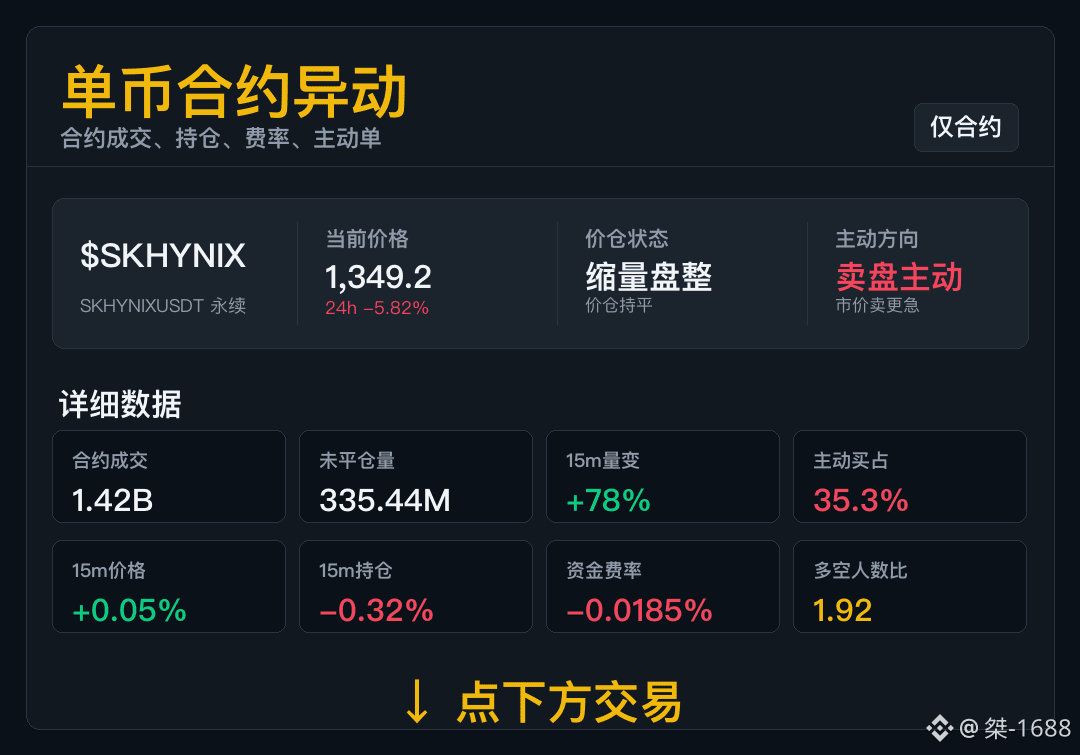
$SKHYNIX Now don’t just look at the K-line. Your position holdings and how trades are being executed tell you more.
On 15m, price is +0.05%, positions are -0.32%. Right now it looks more like “low-volume consolidation”: the board hasn’t given a strong signal yet, and don’t force a big directional conclusion from small fluctuations.
Aggressive buy orders account for 35.3%, and the sell side is more willing to hit the market in the short term. The long/short participant ratio is 1.92—sentiment is leaning one way, but it’s not at an extreme yet.
While the market is still grinding, watch less for up/down and wait for a truly convincing breakout on volume.
$SKHYNIX Now don’t just look at the K-line. Your position holdings and how trades are being executed tell you more.
On 15m, price is +0.05%, positions are -0.32%. Right now it looks more like “low-volume consolidation”: the board hasn’t given a strong signal yet, and don’t force a big directional conclusion from small fluctuations.
Aggressive buy orders account for 35.3%, and the sell side is more willing to hit the market in the short term. The long/short participant ratio is 1.92—sentiment is leaning one way, but it’s not at an extreme yet.
While the market is still grinding, watch less for up/down and wait for a truly convincing breakout on volume.
On 15m, price is +0.05%, positions are -0.32%. Right now it looks more like “low-volume consolidation”: the board hasn’t given a strong signal yet, and don’t force a big directional conclusion from small fluctuations.
Aggressive buy orders account for 35.3%, and the sell side is more willing to hit the market in the short term. The long/short participant ratio is 1.92—sentiment is leaning one way, but it’s not at an extreme yet.
While the market is still grinding, watch less for up/down and wait for a truly convincing breakout on volume.
263
·
--
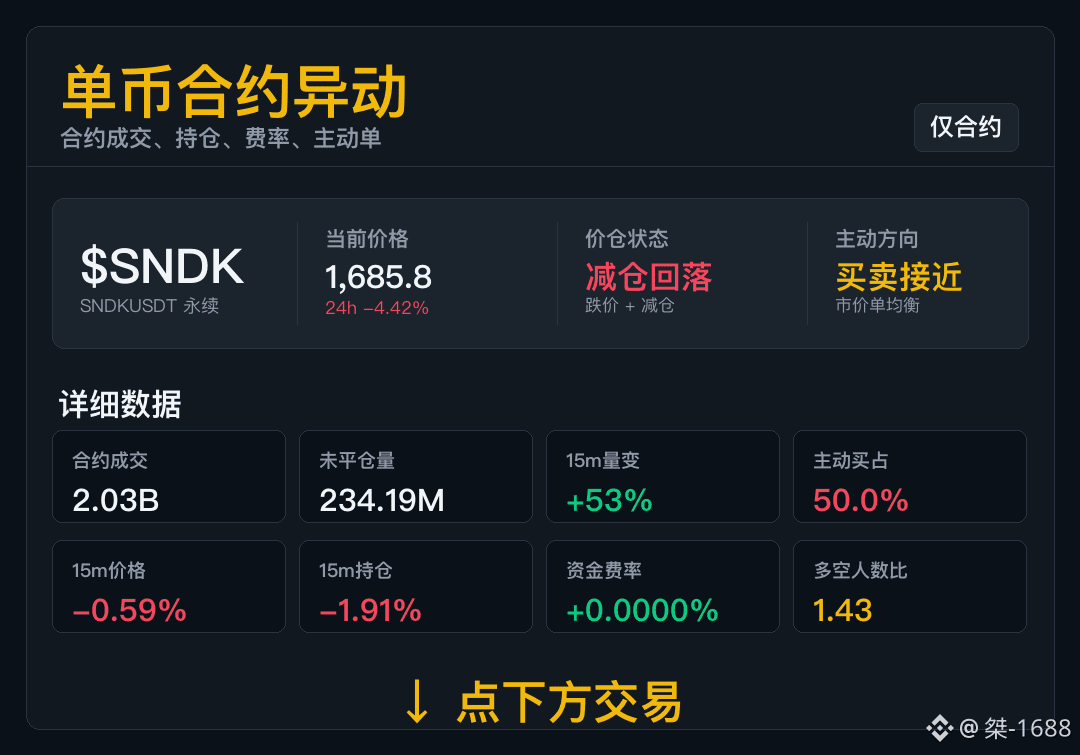
$SNDK The perpetual volume board is starting to accelerate. Fees look at crowded costs, and active buying占in suggests taking the market-price order direction.
On 15m, price -0.59%, position -1.91%. The current action is more like a “deleveraging pullback”: both price and position are falling, indicating traders are exiting. Even if成交 is larger, it is more concentrated withdrawal rather than continuously opening new positions..
Active buy占50.0%, market orders are still fairly balanced; the long-to-short participant ratio is 1.43, showing a tilt, but not yet extreme.
Next, watch whether there’s a new round of adding positions to push down again. If it only keeps falling without adding, it looks more like position withdrawal—not necessarily a fresh push by new shorts.
$SNDK The perpetual volume board is starting to accelerate. Fees look at crowded costs, and active buying占in suggests taking the market-price order direction.
On 15m, price -0.59%, position -1.91%. The current action is more like a “deleveraging pullback”: both price and position are falling, indicating traders are exiting. Even if成交 is larger, it is more concentrated withdrawal rather than continuously opening new positions..
Active buy占50.0%, market orders are still fairly balanced; the long-to-short participant ratio is 1.43, showing a tilt, but not yet extreme.
Next, watch whether there’s a new round of adding positions to push down again. If it only keeps falling without adding, it looks more like position withdrawal—not necessarily a fresh push by new shorts.
On 15m, price -0.59%, position -1.91%. The current action is more like a “deleveraging pullback”: both price and position are falling, indicating traders are exiting. Even if成交 is larger, it is more concentrated withdrawal rather than continuously opening new positions..
Active buy占50.0%, market orders are still fairly balanced; the long-to-short participant ratio is 1.43, showing a tilt, but not yet extreme.
Next, watch whether there’s a new round of adding positions to push down again. If it only keeps falling without adding, it looks more like position withdrawal—not necessarily a fresh push by new shorts.
1
379
·
--
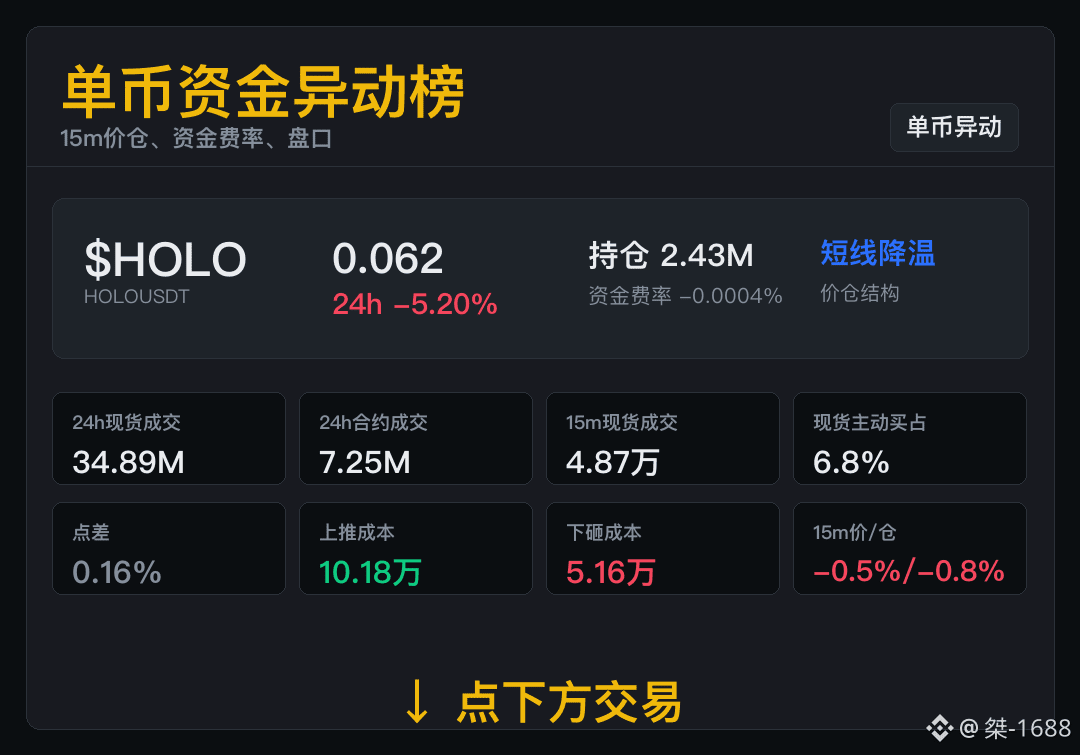
$HOLO price-limited warehouse sync slides lower; for the next round, first check whether trading volumes recover.
15m price -0.48%, 15m open interest -0.78%; spot trading volume 34.89M, derivatives trading volume 7.25M.
Price and open interest are falling in tandem, and short-term participation is contracting.
If in the next round price stabilizes and open interest stabilizes as well, then raise the tracking level.
$HOLO price-limited warehouse sync slides lower; for the next round, first check whether trading volumes recover.
15m price -0.48%, 15m open interest -0.78%; spot trading volume 34.89M, derivatives trading volume 7.25M.
Price and open interest are falling in tandem, and short-term participation is contracting.
If in the next round price stabilizes and open interest stabilizes as well, then raise the tracking level.
15m price -0.48%, 15m open interest -0.78%; spot trading volume 34.89M, derivatives trading volume 7.25M.
Price and open interest are falling in tandem, and short-term participation is contracting.
If in the next round price stabilizes and open interest stabilizes as well, then raise the tracking level.
179
·
--
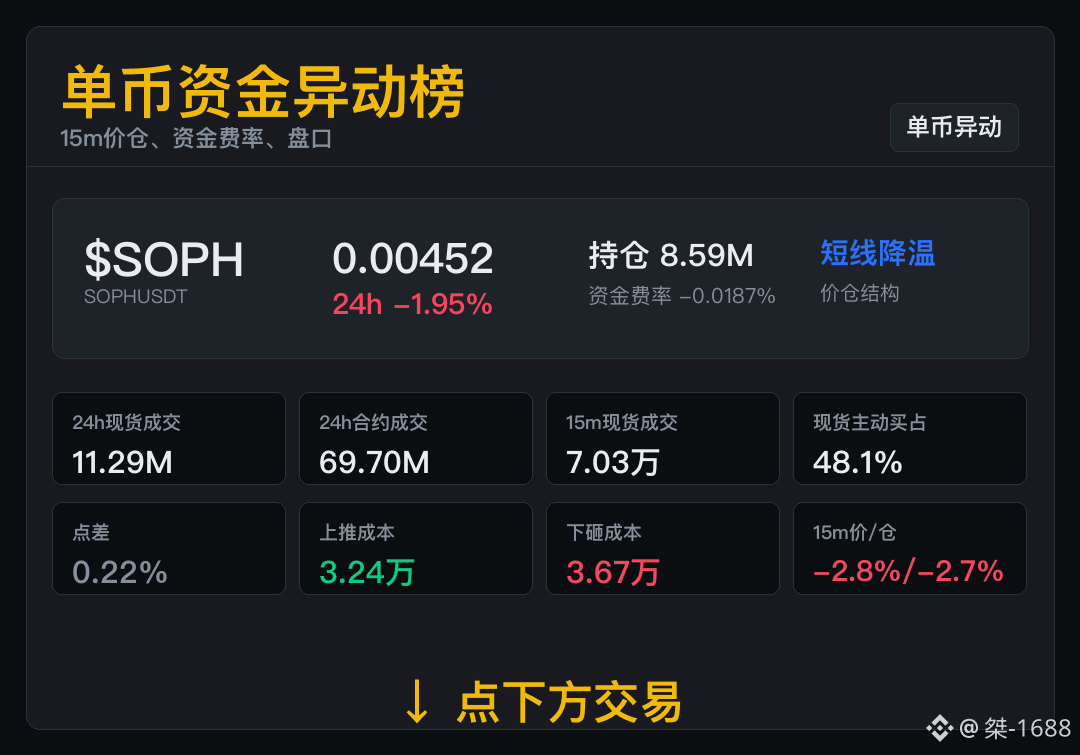
$SOPH price and open interest are both decreasing, and intraday participation size is falling.
15m price -2.80%, positions -2.65%, current open interest 8.59M.
Intraday participation is declining; next we’ll see whether volume and momentum can rebound.
In the next leg, we’ll further watch whether price and positions can stabilize; for the short-term confirmation, we’ll hand it over to trading/turnover.
$SOPH price and open interest are both decreasing, and intraday participation size is falling.
15m price -2.80%, positions -2.65%, current open interest 8.59M.
Intraday participation is declining; next we’ll see whether volume and momentum can rebound.
In the next leg, we’ll further watch whether price and positions can stabilize; for the short-term confirmation, we’ll hand it over to trading/turnover.
15m price -2.80%, positions -2.65%, current open interest 8.59M.
Intraday participation is declining; next we’ll see whether volume and momentum can rebound.
In the next leg, we’ll further watch whether price and positions can stabilize; for the short-term confirmation, we’ll hand it over to trading/turnover.
218
·
--
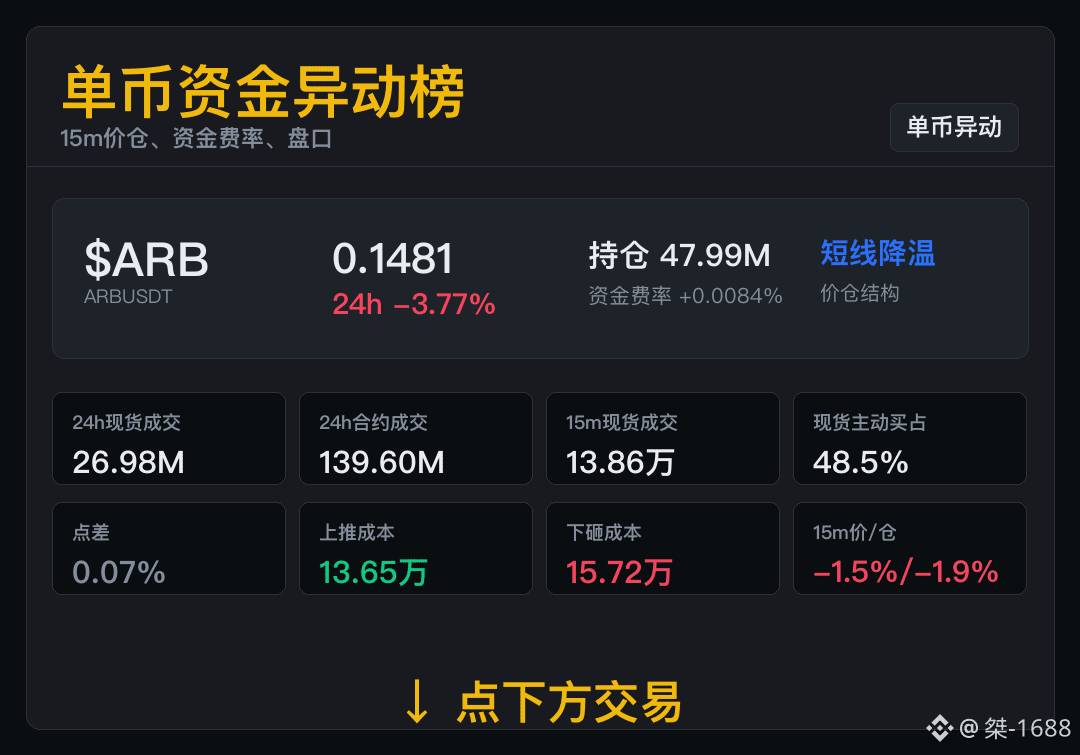
$ARB 15m The price and positions both decrease, and the short-term structure cools down.
Current price 0.1481, 24h change -3.77%; 15m price/position -1.53% / -1.87%.
As both the price and positions decline, the scale of short-term participation is starting to pull back.
Next, first check whether the positions stop falling, then confirm whether trading volume has rebounded.
$ARB 15m The price and positions both decrease, and the short-term structure cools down.
Current price 0.1481, 24h change -3.77%; 15m price/position -1.53% / -1.87%.
As both the price and positions decline, the scale of short-term participation is starting to pull back.
Next, first check whether the positions stop falling, then confirm whether trading volume has rebounded.
Current price 0.1481, 24h change -3.77%; 15m price/position -1.53% / -1.87%.
As both the price and positions decline, the scale of short-term participation is starting to pull back.
Next, first check whether the positions stop falling, then confirm whether trading volume has rebounded.
570
·
--
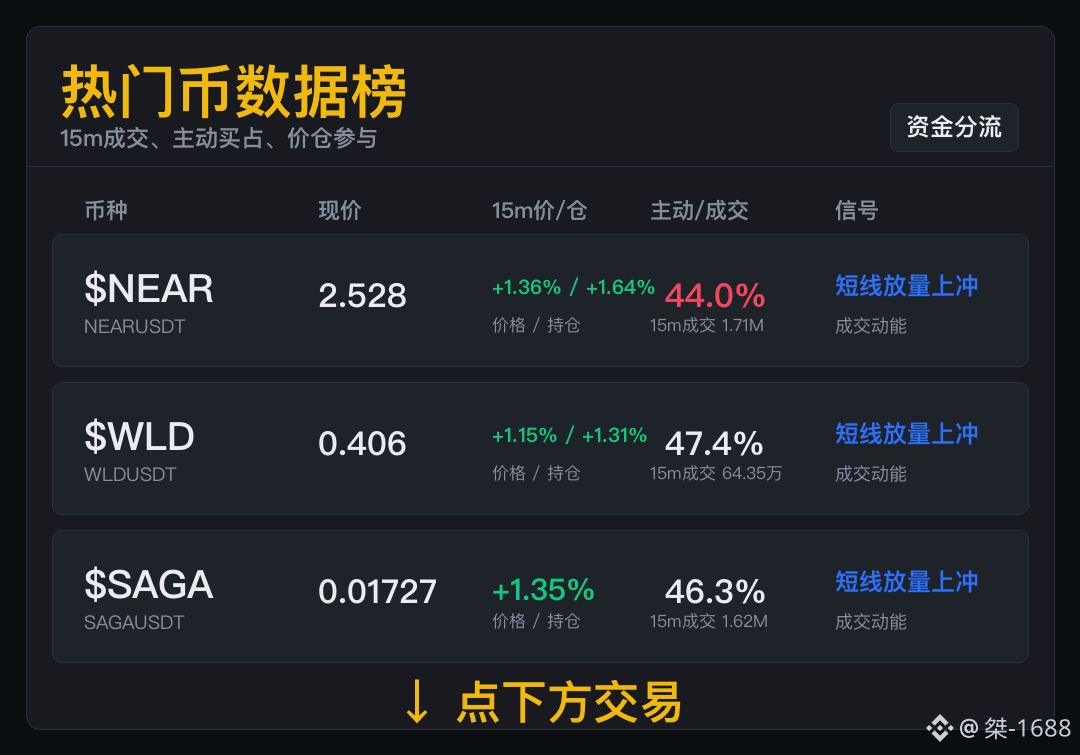
There’s a lot of intraday heat—let’s pick a few with “real” data first.
$NEAR in this round focuses on 15m participation: volume 1.71M, active buys account for 44.0%, price crowd +1.36% / +1.64%. Popular coins can be watched, but don’t let the hype press the buttons for you. Only when there are watchers and volume does the coin have intraday trading value.
$WLD this round focuses on 15m participation: volume 643.5k, active buys account for 47.4%, price crowd +1.15% / +1.31%. Don’t rush to chase; “hot” is just a ticket, not the answer. The excitement is real—later we need to see whether the funds can keep supporting.
$SAGA 15m成交 1.62M, 15m price +1.35%. For short-term participation, it matters more than simply looking at whether the price is up or down. If you’re only choosing a few, first choose ones with actual volume—it's more practical than chasing obscure coins that jump around.
There’s a lot of intraday heat—let’s pick a few with “real” data first.
$NEAR in this round focuses on 15m participation: volume 1.71M, active buys account for 44.0%, price crowd +1.36% / +1.64%. Popular coins can be watched, but don’t let the hype press the buttons for you. Only when there are watchers and volume does the coin have intraday trading value.
$WLD this round focuses on 15m participation: volume 643.5k, active buys account for 47.4%, price crowd +1.15% / +1.31%. Don’t rush to chase; “hot” is just a ticket, not the answer. The excitement is real—later we need to see whether the funds can keep supporting.
$SAGA 15m成交 1.62M, 15m price +1.35%. For short-term participation, it matters more than simply looking at whether the price is up or down. If you’re only choosing a few, first choose ones with actual volume—it's more practical than chasing obscure coins that jump around.
$NEAR in this round focuses on 15m participation: volume 1.71M, active buys account for 44.0%, price crowd +1.36% / +1.64%. Popular coins can be watched, but don’t let the hype press the buttons for you. Only when there are watchers and volume does the coin have intraday trading value.
$WLD this round focuses on 15m participation: volume 643.5k, active buys account for 47.4%, price crowd +1.15% / +1.31%. Don’t rush to chase; “hot” is just a ticket, not the answer. The excitement is real—later we need to see whether the funds can keep supporting.
$SAGA 15m成交 1.62M, 15m price +1.35%. For short-term participation, it matters more than simply looking at whether the price is up or down. If you’re only choosing a few, first choose ones with actual volume—it's more practical than chasing obscure coins that jump around.
360
·
--
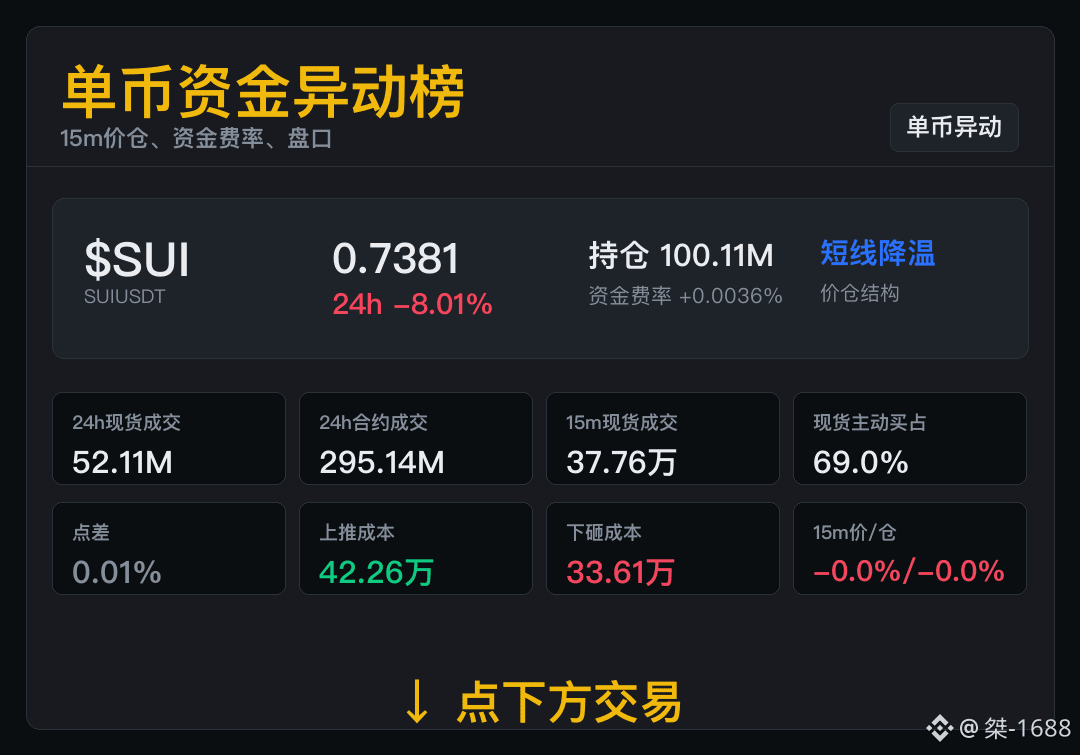
$SUI positions are being reduced amid a pullback; for now, track the cooldown structure.
In the last 24h, spot trading volume was 52.11M, and futures trading volume was 295.14M; in the last 15m, open interest -0.03%.
As price and positions both decline, the next move will require trading to pick back up again.
Only after trading recovers and open interest stops falling can the intraday structure potentially turn stronger again.
$SUI positions are being reduced amid a pullback; for now, track the cooldown structure.
In the last 24h, spot trading volume was 52.11M, and futures trading volume was 295.14M; in the last 15m, open interest -0.03%.
As price and positions both decline, the next move will require trading to pick back up again.
Only after trading recovers and open interest stops falling can the intraday structure potentially turn stronger again.
In the last 24h, spot trading volume was 52.11M, and futures trading volume was 295.14M; in the last 15m, open interest -0.03%.
As price and positions both decline, the next move will require trading to pick back up again.
Only after trading recovers and open interest stops falling can the intraday structure potentially turn stronger again.
179
·
--
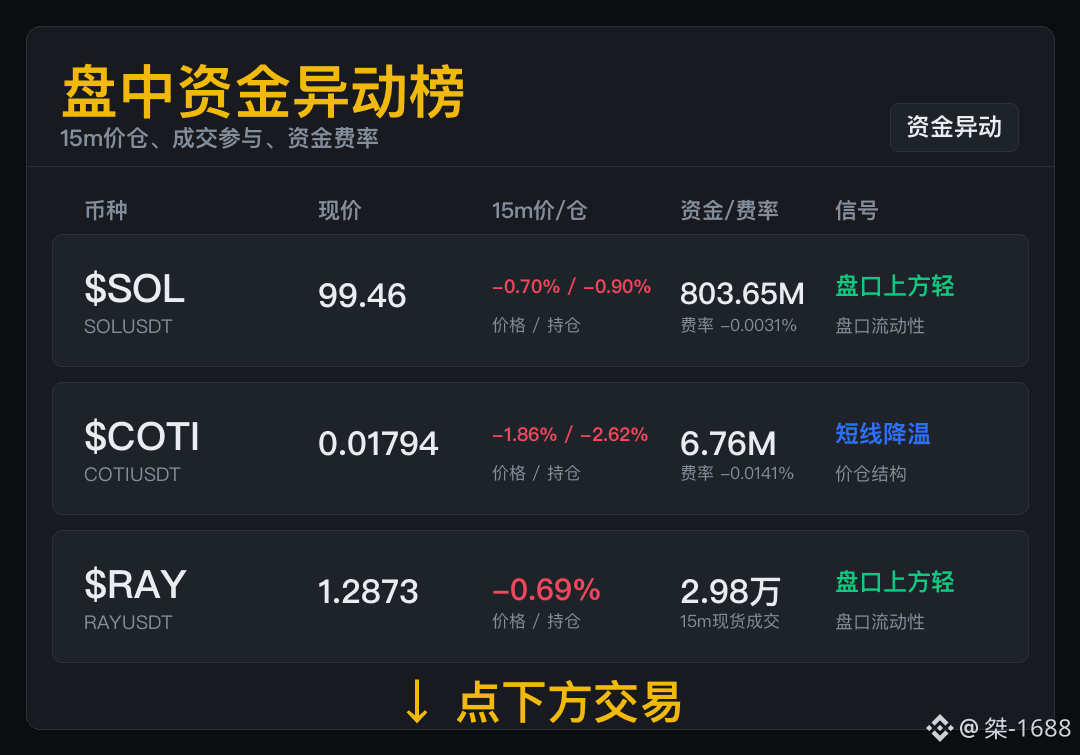
There are several places where signals briefly peek out during the session—first look at the hardest data.
$SOL During the session, first assess participation: 15m turnover 11.25M, aggressive buy share 45.0%, price positioning -0.70% / -0.90%. If you want to chase, don’t only look at the push-up cost—spread and actual turnover determine whether entering will feel comfortable or not. Thin liquidity overhead is a good thing, but the quality of any pullback is even more telling.
$COTI For short-term funds, whether they truly have entered—first look at the 15m price positioning -1.86% / -2.62% and turnover 210,000. This kind of order book is the best at misleading people. In the last 24 hours it may still look strong, but on the 15m chart it has already started withdrawing. This isn’t to say there’s no opportunity—just don’t let the earlier “heat” fool yourself.
$RAY 15m 15m spot turnover 29,800, spread 0.06%—first look for spot follow-through. Missing the first push isn’t a big deal; whether you can get through the second leg matters more. Having one less layer of resistance is good, but don’t treat “easy to walk” as guaranteed to happen.
There are several places where signals briefly peek out during the session—first look at the hardest data.
$SOL During the session, first assess participation: 15m turnover 11.25M, aggressive buy share 45.0%, price positioning -0.70% / -0.90%. If you want to chase, don’t only look at the push-up cost—spread and actual turnover determine whether entering will feel comfortable or not. Thin liquidity overhead is a good thing, but the quality of any pullback is even more telling.
$COTI For short-term funds, whether they truly have entered—first look at the 15m price positioning -1.86% / -2.62% and turnover 210,000. This kind of order book is the best at misleading people. In the last 24 hours it may still look strong, but on the 15m chart it has already started withdrawing. This isn’t to say there’s no opportunity—just don’t let the earlier “heat” fool yourself.
$RAY 15m 15m spot turnover 29,800, spread 0.06%—first look for spot follow-through. Missing the first push isn’t a big deal; whether you can get through the second leg matters more. Having one less layer of resistance is good, but don’t treat “easy to walk” as guaranteed to happen.
$SOL During the session, first assess participation: 15m turnover 11.25M, aggressive buy share 45.0%, price positioning -0.70% / -0.90%. If you want to chase, don’t only look at the push-up cost—spread and actual turnover determine whether entering will feel comfortable or not. Thin liquidity overhead is a good thing, but the quality of any pullback is even more telling.
$COTI For short-term funds, whether they truly have entered—first look at the 15m price positioning -1.86% / -2.62% and turnover 210,000. This kind of order book is the best at misleading people. In the last 24 hours it may still look strong, but on the 15m chart it has already started withdrawing. This isn’t to say there’s no opportunity—just don’t let the earlier “heat” fool yourself.
$RAY 15m 15m spot turnover 29,800, spread 0.06%—first look for spot follow-through. Missing the first push isn’t a big deal; whether you can get through the second leg matters more. Having one less layer of resistance is good, but don’t treat “easy to walk” as guaranteed to happen.
252
·
--
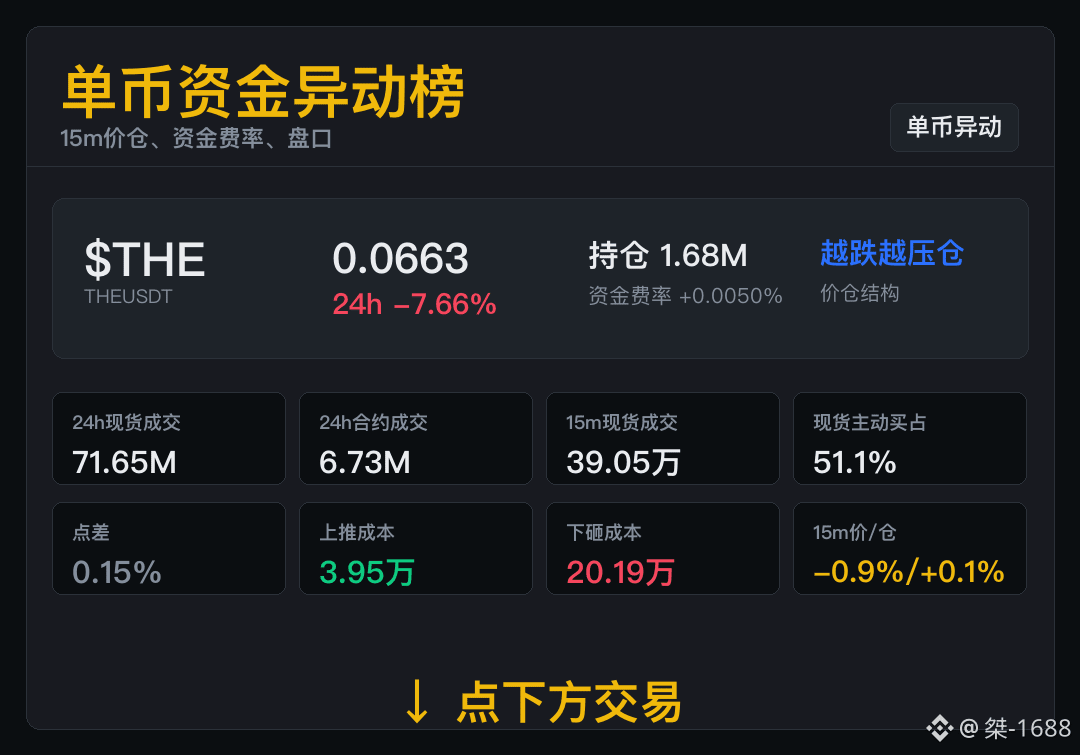
$THE price trending down while positions trend up, with in-session participation increasing.
Current price 0.0663, 24h change -7.66%; 15m price/position -0.90% / +0.10%.
When price is under pressure, positions expand; current divergence is still deepening.
Trading continues to intensify while positions are still increasing, so short-term volatility may remain elevated.
$THE price trending down while positions trend up, with in-session participation increasing.
Current price 0.0663, 24h change -7.66%; 15m price/position -0.90% / +0.10%.
When price is under pressure, positions expand; current divergence is still deepening.
Trading continues to intensify while positions are still increasing, so short-term volatility may remain elevated.
Current price 0.0663, 24h change -7.66%; 15m price/position -0.90% / +0.10%.
When price is under pressure, positions expand; current divergence is still deepening.
Trading continues to intensify while positions are still increasing, so short-term volatility may remain elevated.
240
·
--
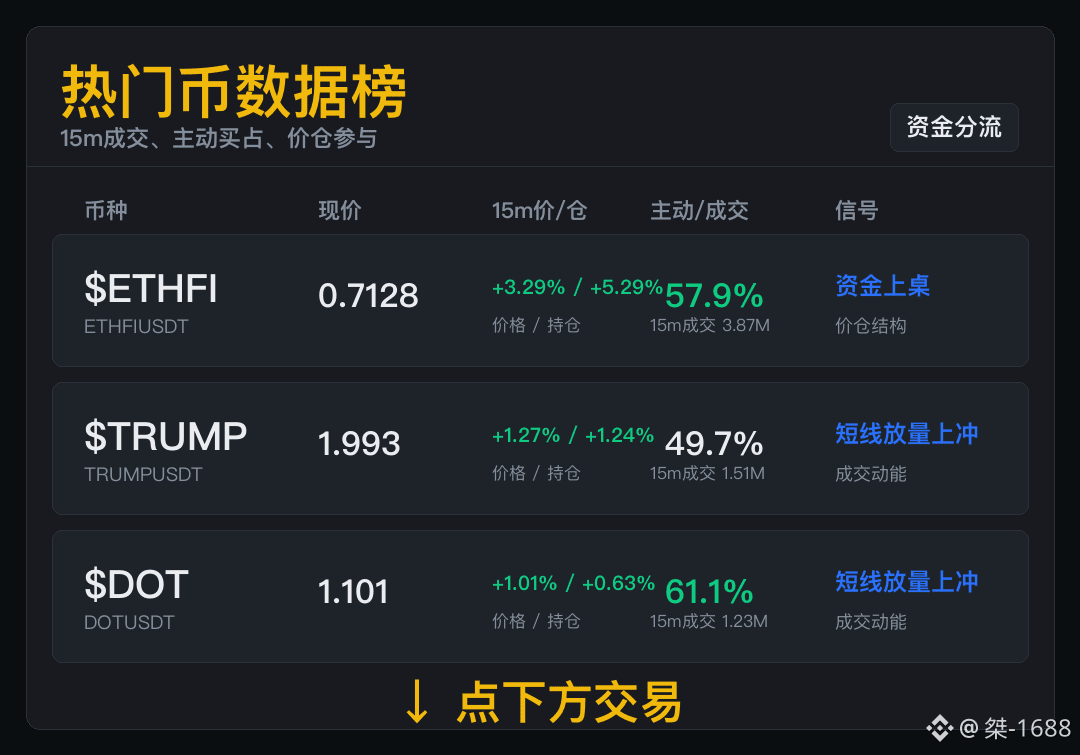
A bunch of coins are all competing for attention—first look at volume and structure.
For $ETHFI , first look at turnover on the short term: 3.87M. Then check buy-side dominance: active buying accounts for 57.9%. Next look at price position +3.29% / +5.29%. The most it fears is that it looks too attractive at first glance—then it pulls back and nobody steps in. When price moves, funds move too; that’s what’s worth watching.
For $TRUMP , first look at short-term turnover: 1.51M. Then active buy proportion: 49.7%. Next check price position +1.27% / +1.24%. Popularity is the ticket. Whether it can truly be traded still depends on how the next candle moves. Being hot isn’t the answer by itself, but hot names bring traffic—and also trading opportunities.
For $DOT 15m, turnover is 1.23M. Price position is +1.01% / +0.63%. On the short term, participation matters more than just judging by whether it’s bullish or bearish. Popularity within the arena is an advantage; what really matters is who steps in for the next move. Hype only shows it’s on the table—whether it can go still depends on whether the turnover can hold.
A bunch of coins are all competing for attention—first look at volume and structure.
For $ETHFI , first look at turnover on the short term: 3.87M. Then check buy-side dominance: active buying accounts for 57.9%. Next look at price position +3.29% / +5.29%. The most it fears is that it looks too attractive at first glance—then it pulls back and nobody steps in. When price moves, funds move too; that’s what’s worth watching.
For $TRUMP , first look at short-term turnover: 1.51M. Then active buy proportion: 49.7%. Next check price position +1.27% / +1.24%. Popularity is the ticket. Whether it can truly be traded still depends on how the next candle moves. Being hot isn’t the answer by itself, but hot names bring traffic—and also trading opportunities.
For $DOT 15m, turnover is 1.23M. Price position is +1.01% / +0.63%. On the short term, participation matters more than just judging by whether it’s bullish or bearish. Popularity within the arena is an advantage; what really matters is who steps in for the next move. Hype only shows it’s on the table—whether it can go still depends on whether the turnover can hold.
For $ETHFI , first look at turnover on the short term: 3.87M. Then check buy-side dominance: active buying accounts for 57.9%. Next look at price position +3.29% / +5.29%. The most it fears is that it looks too attractive at first glance—then it pulls back and nobody steps in. When price moves, funds move too; that’s what’s worth watching.
For $TRUMP , first look at short-term turnover: 1.51M. Then active buy proportion: 49.7%. Next check price position +1.27% / +1.24%. Popularity is the ticket. Whether it can truly be traded still depends on how the next candle moves. Being hot isn’t the answer by itself, but hot names bring traffic—and also trading opportunities.
For $DOT 15m, turnover is 1.23M. Price position is +1.01% / +0.63%. On the short term, participation matters more than just judging by whether it’s bullish or bearish. Popularity within the arena is an advantage; what really matters is who steps in for the next move. Hype only shows it’s on the table—whether it can go still depends on whether the turnover can hold.
322
·
--
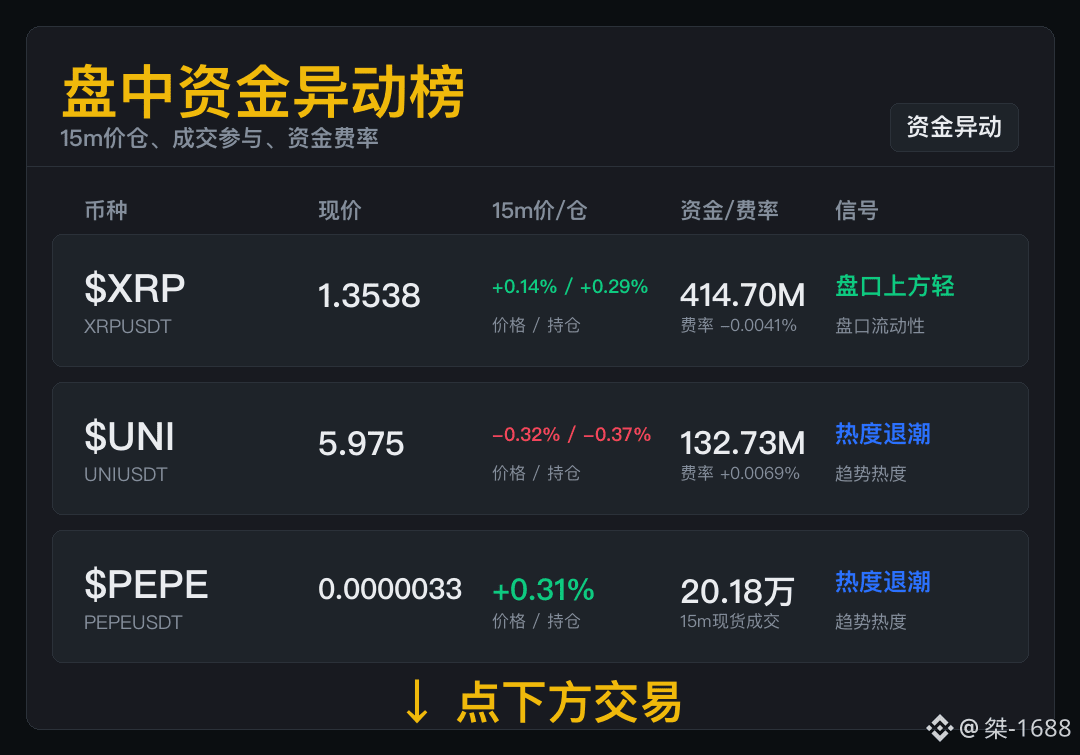
First put the abnormal readings on the table; next, see whether they can continue.
$XRP 15m price futures +0.14% / +0.29%, position 414.70M, funding rate -0.0041%. With coins like this, there are people paying attention, and people trading against it—only short-term moves have a chance. When the heat can draw people in, volume is what retains talent and creates real value.
$UNI For short-term capital, whether it has truly entered the market, first check the 15m price futures -0.32% / -0.37% and the trading volume 2.05M. Don’t short too aggressively either—if volume is still there, you may see a rebound. In a tidal-withdrawal market, it loves to trick the first batch of people trying to bottom-pick.
$PEPE 15m spot volume 201,800, spread 0.31%. First look at spot follow-through. This kind of market is the most grinding: it looks like there’s an opportunity, but you really have to wait until turnover is finished. The excitement is still there, but the momentum for chasing has already weakened.
First put the abnormal readings on the table; next, see whether they can continue.
$XRP 15m price futures +0.14% / +0.29%, position 414.70M, funding rate -0.0041%. With coins like this, there are people paying attention, and people trading against it—only short-term moves have a chance. When the heat can draw people in, volume is what retains talent and creates real value.
$UNI For short-term capital, whether it has truly entered the market, first check the 15m price futures -0.32% / -0.37% and the trading volume 2.05M. Don’t short too aggressively either—if volume is still there, you may see a rebound. In a tidal-withdrawal market, it loves to trick the first batch of people trying to bottom-pick.
$PEPE 15m spot volume 201,800, spread 0.31%. First look at spot follow-through. This kind of market is the most grinding: it looks like there’s an opportunity, but you really have to wait until turnover is finished. The excitement is still there, but the momentum for chasing has already weakened.
$XRP 15m price futures +0.14% / +0.29%, position 414.70M, funding rate -0.0041%. With coins like this, there are people paying attention, and people trading against it—only short-term moves have a chance. When the heat can draw people in, volume is what retains talent and creates real value.
$UNI For short-term capital, whether it has truly entered the market, first check the 15m price futures -0.32% / -0.37% and the trading volume 2.05M. Don’t short too aggressively either—if volume is still there, you may see a rebound. In a tidal-withdrawal market, it loves to trick the first batch of people trying to bottom-pick.
$PEPE 15m spot volume 201,800, spread 0.31%. First look at spot follow-through. This kind of market is the most grinding: it looks like there’s an opportunity, but you really have to wait until turnover is finished. The excitement is still there, but the momentum for chasing has already weakened.
1
1
439
·
--
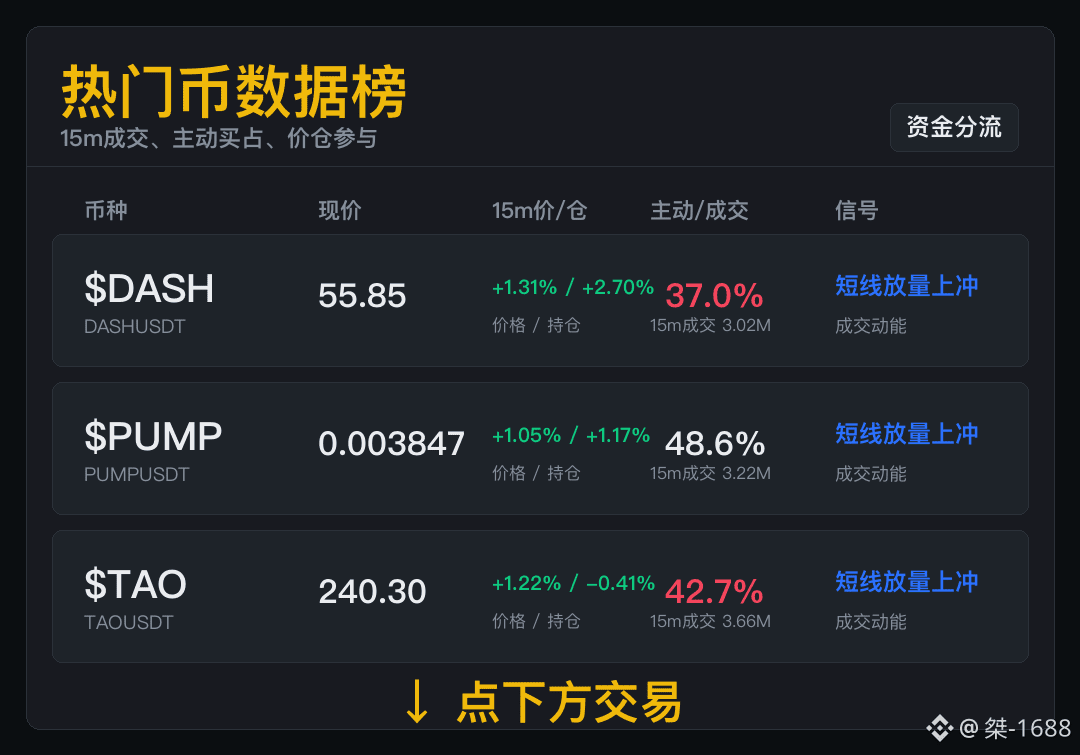
Put the lively order book aside for now; today, let’s first see whether trading volume, positioning, and aggressive buy orders can line up.
$DASH 15m: Volume 3.02M, aggressive buys account for 37.0%, price/position change +1.31% / +2.70%. This kind of coin can be watched, but don’t go heavy on your position just because it’s hot. Don’t treat spam/continuous posts as a signal—only when the volume stays solid does it count.
$PUMP : For this round, the focus is 15m participation. Volume 3.22M, aggressive buys account for 48.6%, price/position change +1.05% / +1.17%. Something popular can be observed, but popularity isn’t a reason to size up. Strong volume suggests people are trading, but “hot” isn’t direction by itself. In the next segment, we’ll need to see whether the money keeps staying.
$TAO : For short-term trades, start by looking at volume 3.66M, aggressive buys account for 42.7%, then check price/position change +1.22% / -0.41%. It’s fine to watch the commotion on the “square,” but traders should take another look to confirm whether the volume is still there. It’s being watched now, which is worth monitoring, but don’t chase it recklessly.
Put the lively order book aside for now; today, let’s first see whether trading volume, positioning, and aggressive buy orders can line up.
$DASH 15m: Volume 3.02M, aggressive buys account for 37.0%, price/position change +1.31% / +2.70%. This kind of coin can be watched, but don’t go heavy on your position just because it’s hot. Don’t treat spam/continuous posts as a signal—only when the volume stays solid does it count.
$PUMP : For this round, the focus is 15m participation. Volume 3.22M, aggressive buys account for 48.6%, price/position change +1.05% / +1.17%. Something popular can be observed, but popularity isn’t a reason to size up. Strong volume suggests people are trading, but “hot” isn’t direction by itself. In the next segment, we’ll need to see whether the money keeps staying.
$TAO : For short-term trades, start by looking at volume 3.66M, aggressive buys account for 42.7%, then check price/position change +1.22% / -0.41%. It’s fine to watch the commotion on the “square,” but traders should take another look to confirm whether the volume is still there. It’s being watched now, which is worth monitoring, but don’t chase it recklessly.
$DASH 15m: Volume 3.02M, aggressive buys account for 37.0%, price/position change +1.31% / +2.70%. This kind of coin can be watched, but don’t go heavy on your position just because it’s hot. Don’t treat spam/continuous posts as a signal—only when the volume stays solid does it count.
$PUMP : For this round, the focus is 15m participation. Volume 3.22M, aggressive buys account for 48.6%, price/position change +1.05% / +1.17%. Something popular can be observed, but popularity isn’t a reason to size up. Strong volume suggests people are trading, but “hot” isn’t direction by itself. In the next segment, we’ll need to see whether the money keeps staying.
$TAO : For short-term trades, start by looking at volume 3.66M, aggressive buys account for 42.7%, then check price/position change +1.22% / -0.41%. It’s fine to watch the commotion on the “square,” but traders should take another look to confirm whether the volume is still there. It’s being watched now, which is worth monitoring, but don’t chase it recklessly.
325
·
--
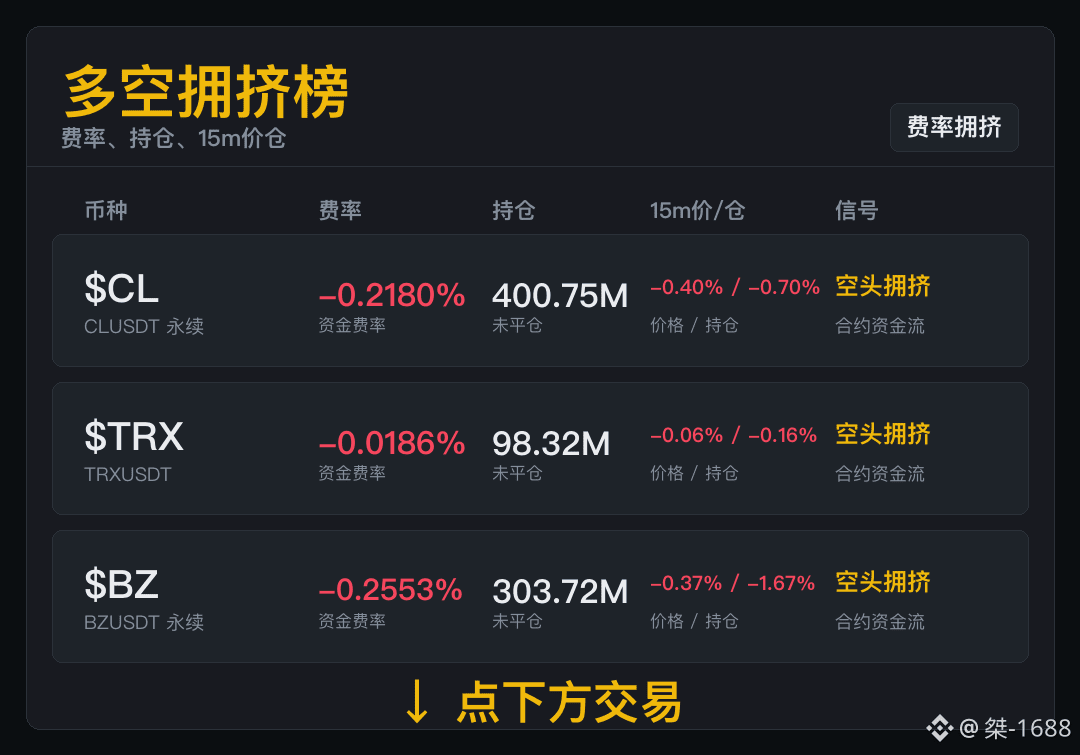
Contracts are most afraid of being too full on one side.
$CL rate -0.2180% combined with a position of 400.75M—focus on whether the position continues to be built up. If you’re trying to catch a rebound, don’t rush; wait for the price to stand up on its own first. Once this kind of market rebounds (a pullback), the shorts will be in a very uncomfortable spot.
$TRX rate -0.0186%, 15m contract volume 329.6k—first see whether crowding continues to intensify. Being bearish is fine, but once the cost basis shifts, you have to respect how price responds. It’s not surprising that there are many people who are bearish; what’s unusual is whether they can still keep pressing down.
$BZ for crowding, first look at three things: rate -0.2553%, position 303.72M, and the 15m price-position change -0.37% / -1.67%. Being bearish is fine, but once the cost basis shifts, you need to respect price action even more. Short costs are getting more expensive too—if key levels aren’t broken, shorts are more likely to be forced to turn back.
Contracts are most afraid of being too full on one side.
$CL rate -0.2180% combined with a position of 400.75M—focus on whether the position continues to be built up. If you’re trying to catch a rebound, don’t rush; wait for the price to stand up on its own first. Once this kind of market rebounds (a pullback), the shorts will be in a very uncomfortable spot.
$TRX rate -0.0186%, 15m contract volume 329.6k—first see whether crowding continues to intensify. Being bearish is fine, but once the cost basis shifts, you have to respect how price responds. It’s not surprising that there are many people who are bearish; what’s unusual is whether they can still keep pressing down.
$BZ for crowding, first look at three things: rate -0.2553%, position 303.72M, and the 15m price-position change -0.37% / -1.67%. Being bearish is fine, but once the cost basis shifts, you need to respect price action even more. Short costs are getting more expensive too—if key levels aren’t broken, shorts are more likely to be forced to turn back.
$CL rate -0.2180% combined with a position of 400.75M—focus on whether the position continues to be built up. If you’re trying to catch a rebound, don’t rush; wait for the price to stand up on its own first. Once this kind of market rebounds (a pullback), the shorts will be in a very uncomfortable spot.
$TRX rate -0.0186%, 15m contract volume 329.6k—first see whether crowding continues to intensify. Being bearish is fine, but once the cost basis shifts, you have to respect how price responds. It’s not surprising that there are many people who are bearish; what’s unusual is whether they can still keep pressing down.
$BZ for crowding, first look at three things: rate -0.2553%, position 303.72M, and the 15m price-position change -0.37% / -1.67%. Being bearish is fine, but once the cost basis shifts, you need to respect price action even more. Short costs are getting more expensive too—if key levels aren’t broken, shorts are more likely to be forced to turn back.
233
·
--
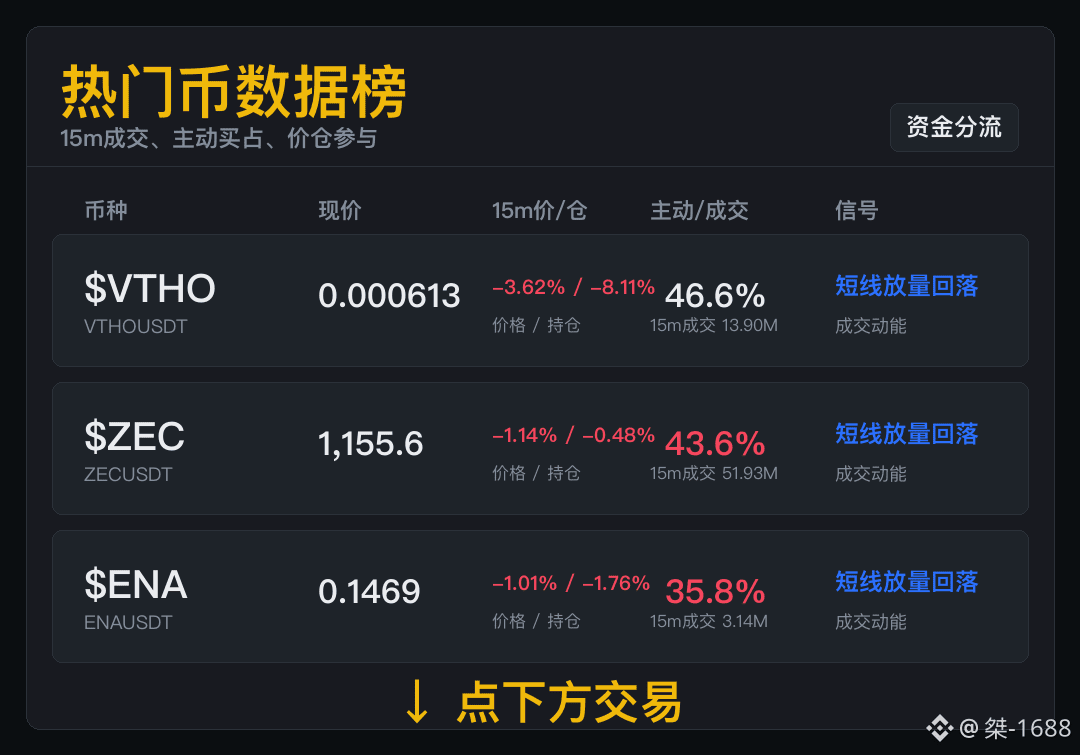
Don’t just look at who’s charging faster—first see whether the成交 (trading) and the positions can hold up.
$VTHO in this round focuses on 15m participation:成交 13.90M,主动买占 46.6%, 价仓 -3.62% / -8.11%. Hype is the entry point, not the answer. Don’t turn watching into a trading system. It now has people watching and money getting in, but hype isn’t direction.
$ZEC 15m成交 51.93M, 价仓 -1.14% / -0.48%. For the short term, participation matters more than simply watching涨跌. The heat is still there—next we’ll see whether the funds are willing to keep staying. At least right now, people are watching, and money is actively trading.
$ENA For the short term, first look at成交 3.14M,主动买占 35.8%, then look at 价仓 -1.01% / -1.76%. These kinds of coins can be on your watchlist, but going all-in directly is too impulsive. If it’s not a cold plate then it’s worth looking at—but being worth watching doesn’t mean you should rush in immediately.
Don’t just look at who’s charging faster—first see whether the成交 (trading) and the positions can hold up.
$VTHO in this round focuses on 15m participation:成交 13.90M,主动买占 46.6%, 价仓 -3.62% / -8.11%. Hype is the entry point, not the answer. Don’t turn watching into a trading system. It now has people watching and money getting in, but hype isn’t direction.
$ZEC 15m成交 51.93M, 价仓 -1.14% / -0.48%. For the short term, participation matters more than simply watching涨跌. The heat is still there—next we’ll see whether the funds are willing to keep staying. At least right now, people are watching, and money is actively trading.
$ENA For the short term, first look at成交 3.14M,主动买占 35.8%, then look at 价仓 -1.01% / -1.76%. These kinds of coins can be on your watchlist, but going all-in directly is too impulsive. If it’s not a cold plate then it’s worth looking at—but being worth watching doesn’t mean you should rush in immediately.
$VTHO in this round focuses on 15m participation:成交 13.90M,主动买占 46.6%, 价仓 -3.62% / -8.11%. Hype is the entry point, not the answer. Don’t turn watching into a trading system. It now has people watching and money getting in, but hype isn’t direction.
$ZEC 15m成交 51.93M, 价仓 -1.14% / -0.48%. For the short term, participation matters more than simply watching涨跌. The heat is still there—next we’ll see whether the funds are willing to keep staying. At least right now, people are watching, and money is actively trading.
$ENA For the short term, first look at成交 3.14M,主动买占 35.8%, then look at 价仓 -1.01% / -1.76%. These kinds of coins can be on your watchlist, but going all-in directly is too impulsive. If it’s not a cold plate then it’s worth looking at—but being worth watching doesn’t mean you should rush in immediately.
764
·
--
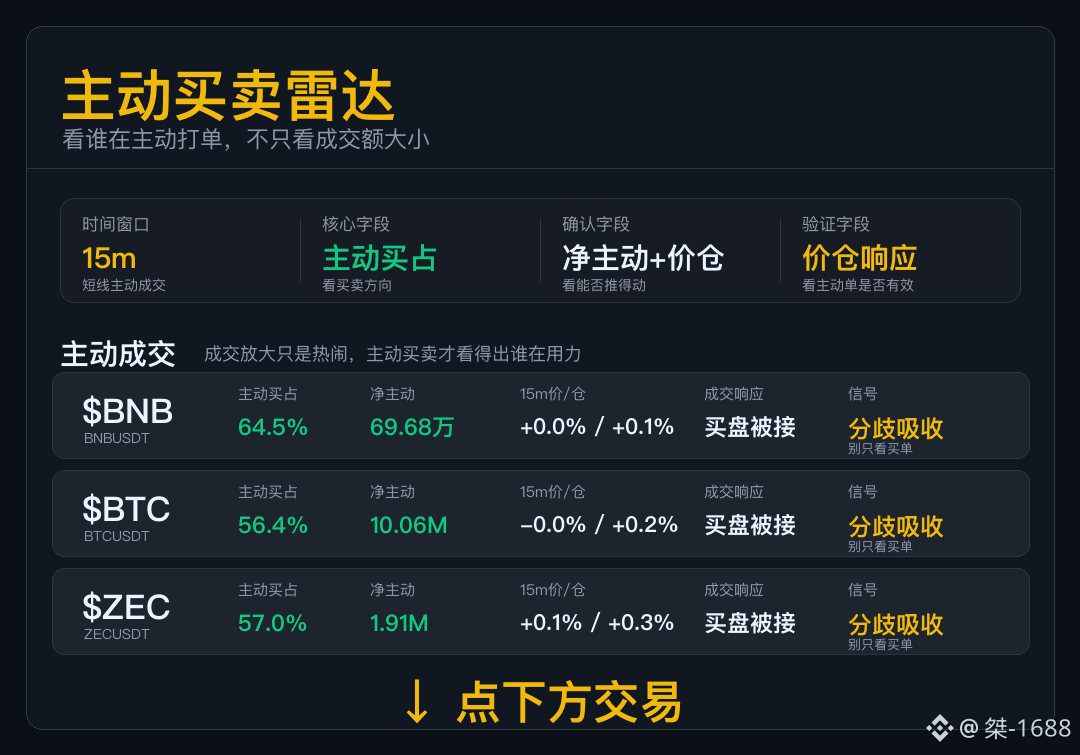
Active Buy/Sell Radar
Don’t just look at the trading value. Today’s focus is whether the active orders can push the order book.
In $BNB , the buyer spent money on executed trades, but it didn’t move the price. The cost-effectiveness of continuing to chase higher is declining.
In $BTC , the proportion of active buys looks fine, but the price action isn’t following. First, see whether the next leg can absorb and eat through the overhead pressure.
In $ZEC , the data shows buy interest, but the price isn’t cooperating. For now, treat it as absorption in the short term.
Don’t rush to draw conclusions about this kind of market. Whether it can absorb the pressure above is the next step.
Active Buy/Sell Radar
Don’t just look at the trading value. Today’s focus is whether the active orders can push the order book.
In $BNB , the buyer spent money on executed trades, but it didn’t move the price. The cost-effectiveness of continuing to chase higher is declining.
In $BTC , the proportion of active buys looks fine, but the price action isn’t following. First, see whether the next leg can absorb and eat through the overhead pressure.
In $ZEC , the data shows buy interest, but the price isn’t cooperating. For now, treat it as absorption in the short term.
Don’t rush to draw conclusions about this kind of market. Whether it can absorb the pressure above is the next step.
Don’t just look at the trading value. Today’s focus is whether the active orders can push the order book.
In $BNB , the buyer spent money on executed trades, but it didn’t move the price. The cost-effectiveness of continuing to chase higher is declining.
In $BTC , the proportion of active buys looks fine, but the price action isn’t following. First, see whether the next leg can absorb and eat through the overhead pressure.
In $ZEC , the data shows buy interest, but the price isn’t cooperating. For now, treat it as absorption in the short term.
Don’t rush to draw conclusions about this kind of market. Whether it can absorb the pressure above is the next step.
140
·
--
First look at this setup from the trader’s perspective: who has volume, who has positions, and who has cost changes.
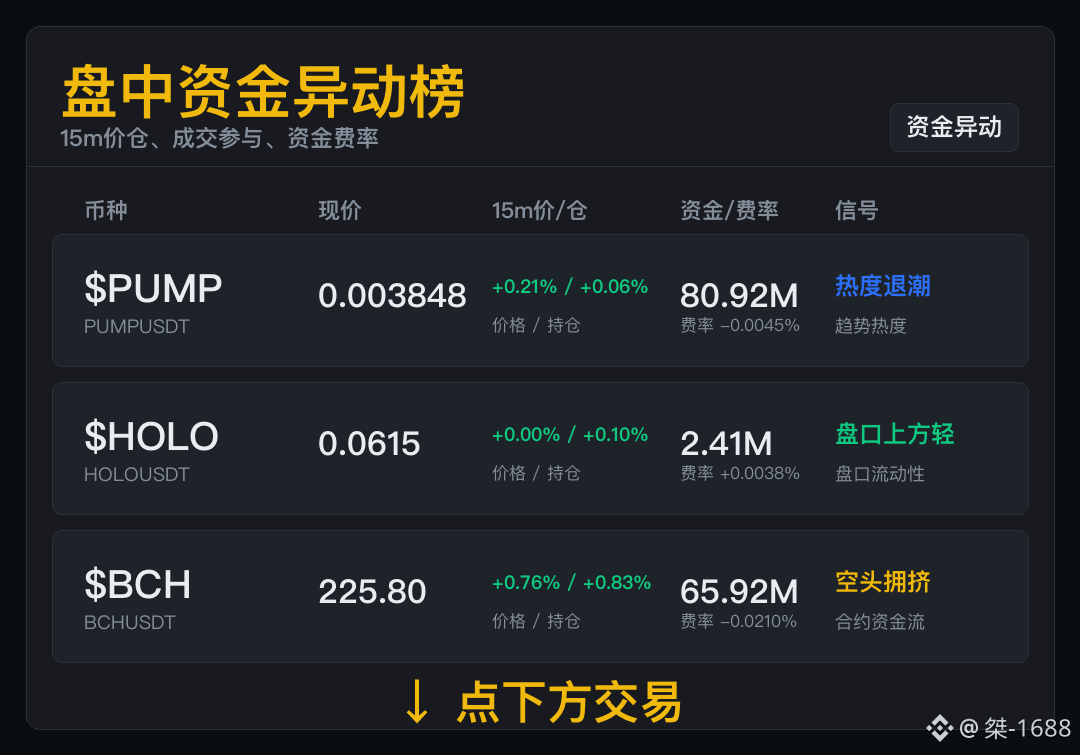
$PUMP 15m spot trades: 312,200, with a spread of 0.03%. First, look at spot follow-through. If you want to get in, move a little slower—wait until turnover is clear; it’s more stable than guessing the lowest point. If you want to catch the bottom, move a little slower—the first bounce often turns out to be a false move.
$HOLO 15m price/position +0.00% / +0.10%, with 36,200 traded and buy orders by the initiator accounting for 65.7%. If you want to participate, wait for how price reacts on a pullback—don’t just stare at that one moment of breakout. The thin liquidity above is a window, not profit that’s already been realized.
$BCH during the session: first check participation. On the 15m timeframe, volume is 1.55M, with initiator buys at 51.0%, and price/positions +0.76% / +0.83%. For those holding shorts, don’t just look at the drawdown—your costs are being worn down bit by bit too. Everyone’s looking bearish; if it can’t be pushed down, it’s easy for the opposite side to clean it up.
First look at this setup from the trader’s perspective: who has volume, who has positions, and who has cost changes.
$PUMP 15m spot trades: 312,200, with a spread of 0.03%. First, look at spot follow-through. If you want to get in, move a little slower—wait until turnover is clear; it’s more stable than guessing the lowest point. If you want to catch the bottom, move a little slower—the first bounce often turns out to be a false move.
$HOLO 15m price/position +0.00% / +0.10%, with 36,200 traded and buy orders by the initiator accounting for 65.7%. If you want to participate, wait for how price reacts on a pullback—don’t just stare at that one moment of breakout. The thin liquidity above is a window, not profit that’s already been realized.
$BCH during the session: first check participation. On the 15m timeframe, volume is 1.55M, with initiator buys at 51.0%, and price/positions +0.76% / +0.83%. For those holding shorts, don’t just look at the drawdown—your costs are being worn down bit by bit too. Everyone’s looking bearish; if it can’t be pushed down, it’s easy for the opposite side to clean it up.
$PUMP 15m spot trades: 312,200, with a spread of 0.03%. First, look at spot follow-through. If you want to get in, move a little slower—wait until turnover is clear; it’s more stable than guessing the lowest point. If you want to catch the bottom, move a little slower—the first bounce often turns out to be a false move.
$HOLO 15m price/position +0.00% / +0.10%, with 36,200 traded and buy orders by the initiator accounting for 65.7%. If you want to participate, wait for how price reacts on a pullback—don’t just stare at that one moment of breakout. The thin liquidity above is a window, not profit that’s already been realized.
$BCH during the session: first check participation. On the 15m timeframe, volume is 1.55M, with initiator buys at 51.0%, and price/positions +0.76% / +0.83%. For those holding shorts, don’t just look at the drawdown—your costs are being worn down bit by bit too. Everyone’s looking bearish; if it can’t be pushed down, it’s easy for the opposite side to clean it up.
1
1
1
698
·
--
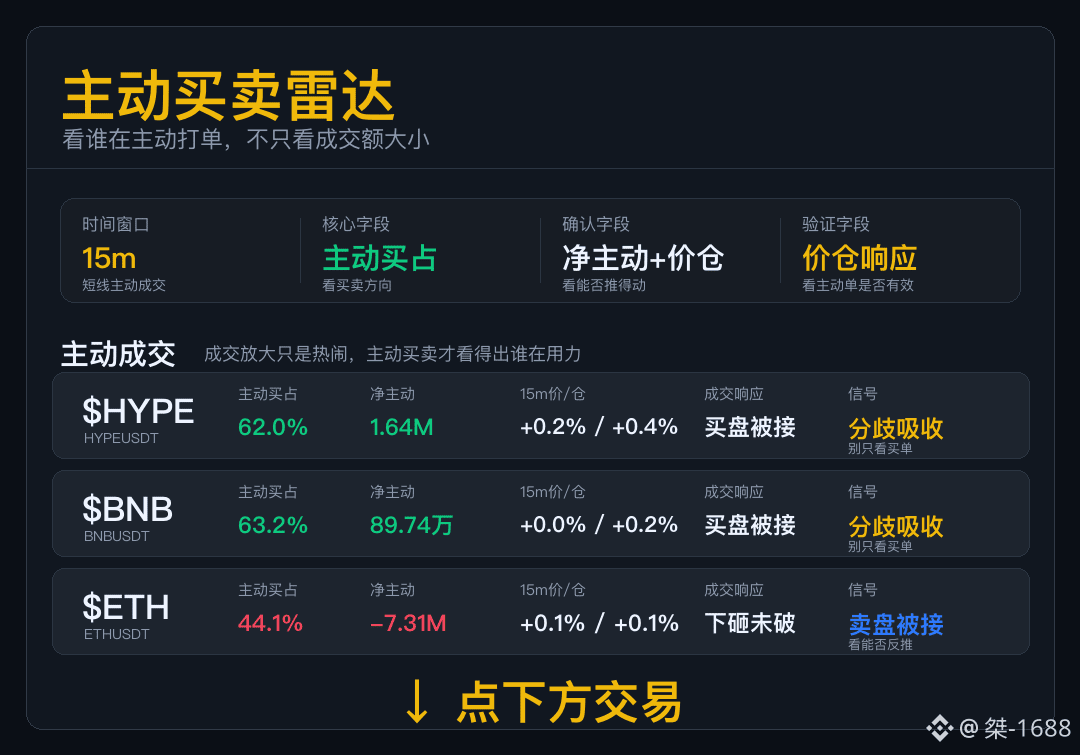
Active buy/sell radar
Don’t just look at the trading volume. Today, the key is whether aggressive orders can push the order book.
The ratio of active buying for $HYPE isn’t bad, but the price action didn’t follow. Next, see whether it can absorb the overhead pressure in the next leg.
For $BNB , after the buy orders were sent out, they didn’t continue to expand the gains. This kind of market is even more afraid of chasing at the point of disagreement.
For $ETH , the seller put in effort but didn’t manage to break the level. The price action looks more like it’s absorbing selling pressure.
There are moves on both the buy and sell sides—don’t merge the conclusions. Check one price level at a time to see whether it receives follow-through/confirmation.
Active buy/sell radar
Don’t just look at the trading volume. Today, the key is whether aggressive orders can push the order book.
The ratio of active buying for $HYPE isn’t bad, but the price action didn’t follow. Next, see whether it can absorb the overhead pressure in the next leg.
For $BNB , after the buy orders were sent out, they didn’t continue to expand the gains. This kind of market is even more afraid of chasing at the point of disagreement.
For $ETH , the seller put in effort but didn’t manage to break the level. The price action looks more like it’s absorbing selling pressure.
There are moves on both the buy and sell sides—don’t merge the conclusions. Check one price level at a time to see whether it receives follow-through/confirmation.
Don’t just look at the trading volume. Today, the key is whether aggressive orders can push the order book.
The ratio of active buying for $HYPE isn’t bad, but the price action didn’t follow. Next, see whether it can absorb the overhead pressure in the next leg.
For $BNB , after the buy orders were sent out, they didn’t continue to expand the gains. This kind of market is even more afraid of chasing at the point of disagreement.
For $ETH , the seller put in effort but didn’t manage to break the level. The price action looks more like it’s absorbing selling pressure.
There are moves on both the buy and sell sides—don’t merge the conclusions. Check one price level at a time to see whether it receives follow-through/confirmation.
105
·
--
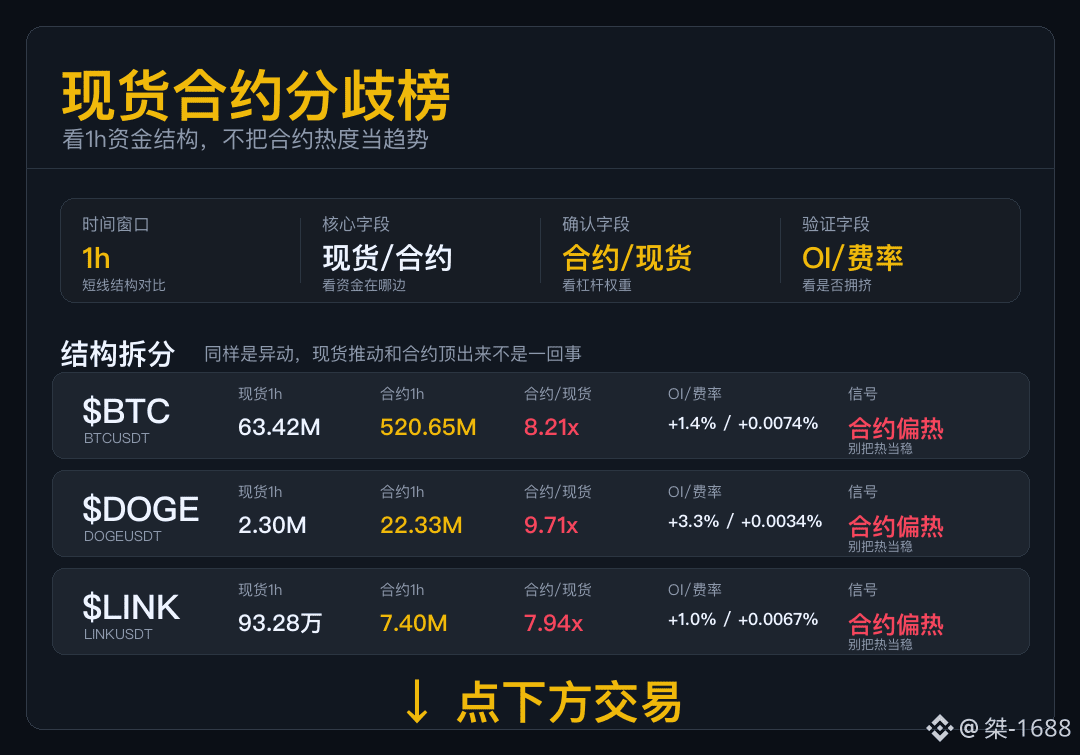
Spot Contract Disagreement Leaderboard
Recently, in the first hour, break down the funding source: is it the spot market keeping up, or are contracts抢/抢ing the pace?
$BTC —on the contract side, they’ve shown the emotions, but the trend quality still needs confirmation from spot trading volume.
$DOGE —the contract side is more proactive; short-term upside/downside flexibility isn’t lacking. What really matters is whether the spot market has buyers to take the orders.
$LINK —the contract side is clearly stealing the spotlight; the speed may be there, but stability depends on whether the spot market follows through.
The uptick in fees indicates that holding costs are changing. The price direction still needs to be confirmed by trading response.
Spot Contract Disagreement Leaderboard
Recently, in the first hour, break down the funding source: is it the spot market keeping up, or are contracts抢/抢ing the pace?
$BTC —on the contract side, they’ve shown the emotions, but the trend quality still needs confirmation from spot trading volume.
$DOGE —the contract side is more proactive; short-term upside/downside flexibility isn’t lacking. What really matters is whether the spot market has buyers to take the orders.
$LINK —the contract side is clearly stealing the spotlight; the speed may be there, but stability depends on whether the spot market follows through.
The uptick in fees indicates that holding costs are changing. The price direction still needs to be confirmed by trading response.
Recently, in the first hour, break down the funding source: is it the spot market keeping up, or are contracts抢/抢ing the pace?
$BTC —on the contract side, they’ve shown the emotions, but the trend quality still needs confirmation from spot trading volume.
$DOGE —the contract side is more proactive; short-term upside/downside flexibility isn’t lacking. What really matters is whether the spot market has buyers to take the orders.
$LINK —the contract side is clearly stealing the spotlight; the speed may be there, but stability depends on whether the spot market follows through.
The uptick in fees indicates that holding costs are changing. The price direction still needs to be confirmed by trading response.
402
Log in to explore more content
Join global crypto users on Binance Square
⚡️ Get latest and useful information about crypto.
💬 Trusted by the world’s largest crypto exchange.
👍 Discover real insights from verified creators.
Email / Phone number
Trending Topics
USAugustPPIRisesLessThanExpected
50,510 views
813 Discussing
🚨 US AUG PPI: Rises LESS Than Expected! Bullish for Crypto? 🚀
PPI +0.4% MoM as expected, but CORE PPI only +0.2% vs +0.3% expected - cooling!
What it means:
• Wholesale inflation softer than feared
• Fed rate hike chance now 62% - but dovish signals coming
• Core PCE revisions expected downward - bullish
• BTC usually pumps on softer PPI
Fed meeting Sep 15-16 - Market now expects pause, not hike?
Is this the green light for Q4 rally?
#Bitcoin #PPI #Fed #CryptoNews #BTC#usaugustppiriseslessthanexpected
True News
·1 Likes
·1.4k views
SECApprovesNasdaqTexasCommodityTrustRule
27,718 views
593 Discussing
ECBRaisesRatesSecondTimeTo2.5%
25,370 views
427 Discussing