
币链快报 ChainAlert
1.6k Posts

币链快报 ChainAlert
Report
Block User
3 Following
6.6K+ Followers
3.7K+ Liked
Posts
All
Videos
Former White House Crypto Adviser: Trump Still Wants to Buy Bitcoin for the National Reserve, but Congress Has Imposed Limits
Former White House crypto adviser Patrick Witt said on the podcast What Bitcoin Did that U.S. President Donald Trump remains interested in adding Bitcoin to the nation’s strategic reserve. However, because Congress controls federal spending, buying coins directly on the open market raises legal concerns. Congress has also added provisions to the National Defense Authorization Act prohibiting direct purchases.
The interview was conducted by host Danny Knowles and recorded before the U.S. midterm elections on November 3. It was released on November 9. Notably, Patrick Witt officially left his position in October, so his comments on the program represented only his personal views and were not an official White House statement.
Congress Has Imposed Limits; Funding and Authorization Are Still Being Pursued
“I can tell you that the president is interested in this,” Patrick Witt said in the interview. The government had discussed possible implementation plans several times, but questions remained about whether directly buying Bitcoin on the open market would be legal.
He revealed that Congress had added provisions to the National Defense Authorization Act explicitly prohibiting the federal government from directly purchasing Bitcoin. “We’re working toward getting to the point where it’s permitted and authorized,” he acknowledged. Treasury Secretary Scott Bessent will decide which legal methods the Treasury Department can use to acquire more Bitcoin in the future, and the department must also first establish adequate custody infrastructure before buying any coins.
The Current Reserve Relies Solely on an Executive Order, Leaving Its Future Uncertain
The United States’ current strategic Bitcoin reserve stems entirely from an executive order signed by Trump on March 6, 2025. All of its Bitcoin comes from government law enforcement seizures. The order directs the Treasury and Commerce Departments to develop a “budget-neutral” strategy for acquiring more Bitcoin, meaning it must not increase the financial burden on taxpayers. So far, however, the U.S. government has not announced a specific implementation plan or made any purchases on the open market.
Patrick Witt noted that, given the divisions in Congress, making the strategic reserve permanent through standalone legislation would be “extremely difficult.” He cautioned that without formal legislative protections, a future president could revoke the reserve at any time through a new executive order. Reversing a predecessor’s orders is often one of the first things a new administration does.
Would you like an in-depth explanation of the policy background behind establishing a strategic Bitcoin reserve in the United States, or would you like to learn about current Treasury Secretary Scott Bessent’s latest policy stance on cryptocurrency? Just let me know.
17
Crypto Noon Report | Key Developments at Midday on November 11
【Crypto Noon Report | Key Developments at Midday on November 11】7:00–12:00 keywords: offshore trusts, Barclays, Fidelity
1. Deutsche Bank’s digital asset custody service is now available to paying clients;
2. New York judge rejects Novig injunction, ruling that sports contracts are not swaps;
3. Transition period for taxing offshore trusts ends, with cumulative declarations exceeding 160 billion yuan;
4. Enforcement actions by the U.S. SEC fell 23.7% in fiscal year 2026, with crypto cases drawing attention;
5. Barclays increased its holdings of BlackRock’s Bitcoin ETF by 48% in the third quarter; Citi opened a new FBTC position;
6. Former executive director of the White House Crypto Council: Trump intends for the U.S. government to buy Bitcoin;
7. Fidelity increased its holdings of Strive shares worth approximately $51 million, bringing the total value of its holdings to approximately $265 million.
1
193
ETH Plunges 43%! Ethereum Giant Bitmine Posts $6.3 Billion Fiscal-Year Net Loss, Including $6.2 Billion in Unrealized Valuation Losses
Ethereum treasury company Bitmine, led by Tom Lee, has released its fiscal 2026 results for the year ended in August. The report shows a full-year net loss of $6.313 billion, of which $6.229 billion came from unrealized valuation losses on its cryptocurrency holdings. In the previous fiscal year, the company reported a net profit of $328 million.
The company acknowledged that the main reason its reported results swung from profit to loss was its use of fair-value accounting for its ether holdings, meaning the sharp drop in ether’s price was reflected directly in its income statement.
According to Bitmine’s Form 10-K annual report filed with the U.S. Securities and Exchange Commission (SEC):
Operating expenses and losses: Of the $6.313 billion net loss, $6.229 billion was attributable to unrealized valuation losses on digital assets, bringing total operating expenses to $6.606 billion.
Other adjustments: The company recorded $257.9 million in warrant valuation gains and $143.7 million in derivative losses. After excluding these volatile items, adjusted EBITDA was -$154.5 million.
Management expenses: Management expenses totaled $376.9 million, including $200 million in one-time consulting and legal expenses. By the end of August, the company’s cumulative losses had reached approximately $6 billion.
The losses may be non-cash, but financing costs are very real
During the fiscal year covered by the report, Bitmine actively managed its funding and capital:
ATM share issuance: The company issued and sold 395.1 million shares during the period, raising $13.202 billion in gross proceeds ($12.941 billion net). The number of shares outstanding in the market surged from 232 million in the previous fiscal year to 613 million.
Share buybacks: In April, the board increased its share repurchase authorization from $1 billion to $4 billion. During the fiscal year, the company repurchased 20.82 million shares at an average price of $17 per share. As of the end of August, $3.6 billion of the authorization remained unused.
Cash and preferred stock pressures: The company had $545 million in cash and cash equivalents on its balance sheet. It also issued 3.5 million redeemable preferred shares with a 9.5% interest rate and a $350 million liquidation preference. The cash dividend burden was listed as one of the main risks in the 10-K report.
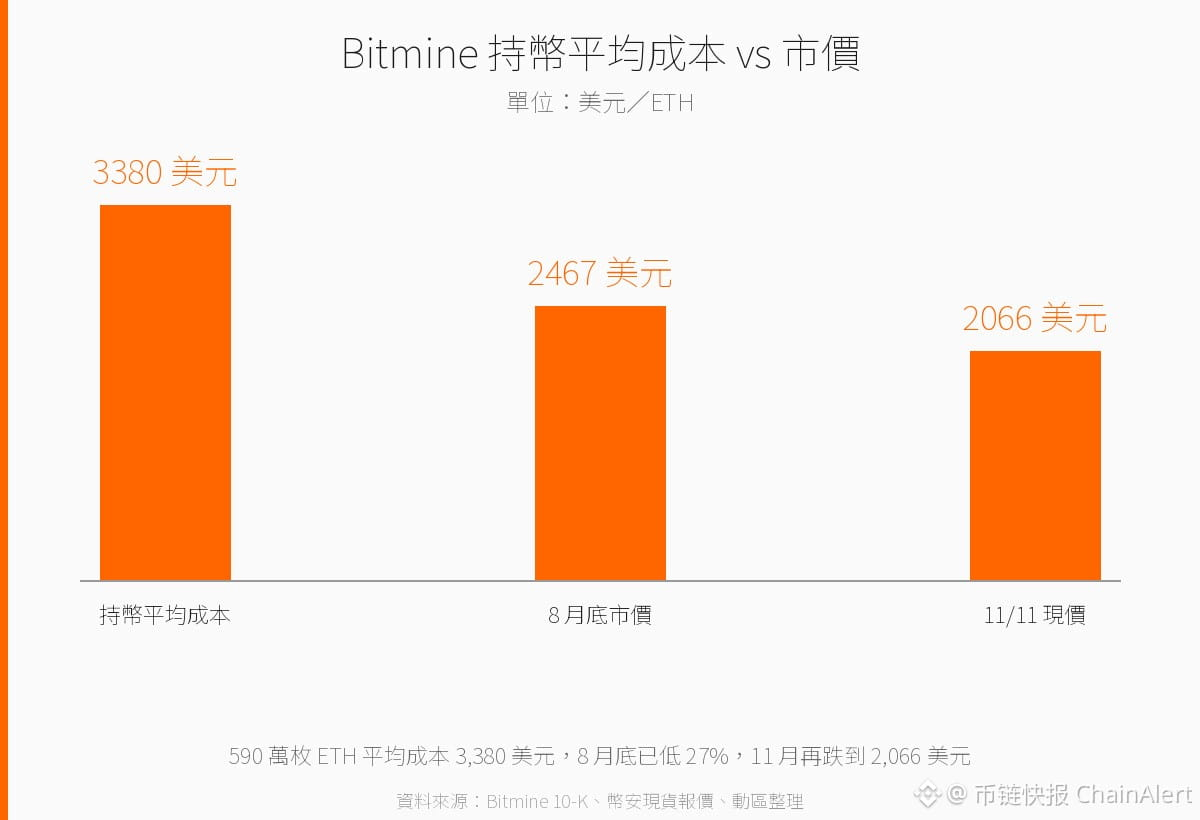
Average purchase cost of $3,380 per coin, while the market price was just $2,467
As of the end of August, Bitmine’s holdings and costs were as follows:
ETH holdings: The company held 5,901,837 ETH, with a fair value of approximately $14.559 billion, or about 4.9% of the total ETH in circulation at the time. Based on the $19.948 billion cost basis disclosed in the 10-K, the average acquisition cost of these ETH was approximately $3,380. By the end of August, the market price had fallen to just $2,467, resulting in more than $5.3 billion in book losses on this holding alone.
BTC holdings: The company held 211 BTC, with a fair value of approximately $16.6 million.
During the fiscal year, ether’s price fell from about $4,314 in early September 2025 to $2,467 at fiscal year-end, a cumulative decline of 43%. At Binance’s spot price of $2,066 on November 11, the market value of the holdings was about 16% lower than at fiscal year-end. This means the company may face another round of valuation losses in the first quarter of the following fiscal year, ending November 30.
Staking revenue supports the core business, but is far too small to fill the treasury gap
Bitmine generated $124.8 million in revenue for the year, of which $121.4 million came from staking and validation, accounting for as much as 97%. This revenue was driven primarily by the integration of Pier Two into the MAVAN platform following the acquisition’s completion on March 24 this year. Revenue from self-mining was $1.4 million, down 56.7% year over year.
Compared with its enormous $14.559 billion in holdings, staking revenue of $121.4 million implies an actual yield of less than 1%, well below the staking returns commonly seen on-chain. Since September 4, the company has used American Validator for staking advisory services, at a fee of 1.5% of eligible native staking rewards.
Market impact and key areas to watch
The past year was a period in which Bitmine pushed toward its goal of holding 5% of all ETH. Since announcing that target in June 2025, the company has steadily increased its holdings through share issuance, bringing them to 4.97%. As of November 9, its total holdings had reached 6,070,092 ETH, and the company has explicitly stated that it will stop buying once it reaches its target.
With its coin-buying plan temporarily complete, the market’s focus on Bitmine is shifting:
Discount and buyback effectiveness: With ETH trading below its fiscal year-end price, investors are watching to see whether the company can use its $4 billion buyback authorization to narrow the discount between net asset value (NAV) per share and the market price, and whether staking cash flows can cover the dividends on its 9.5% preferred stock.
Quarterly valuation losses: Will the next quarterly report, covering the period through November 30, again recognize tens of billions of dollars in unrealized valuation losses as the crypto market declines?
A shift in narrative momentum: After stopping its accumulation, the company will no longer be increasing its ether exposure. Its share price is likely to track the coin’s price more directly, but it will also lose the media attention generated by its ongoing purchases.
553
Former White House Crypto Council Executive Director: Trump Is Interested in the U.S. Government Buying Bitcoin
【Former White House Crypto Council Executive Director: Trump Is Interested in the U.S. Government Buying Bitcoin】CoinChain Express reports that on November 11, former White House Crypto Council Executive Director Patrick Witt said in an interview on the What Bitcoin Did podcast that Trump is interested in the U.S. government buying Bitcoin. There have also been extensive internal discussions about how to do so, but the legality of purchasing directly on the open market is questionable. To ensure that a Bitcoin purchase is legal, the government would need congressional authorization. The government’s position, therefore, is to push for a strategic Bitcoin reserve to be enshrined in law. However, with Congress divided, passing the relevant legislation on its own would be very difficult. Potential options discussed by the Treasury Department include revaluing gold reserves, using the Exchange Stabilization Fund, converting other assets on the balance sheet into Bitcoin, and collecting taxes and fees in Bitcoin. All of these would require further legal analysis, and ultimately depend on whether Treasury Secretary Bessent is willing to move forward.
Witt also said that previous audits of Bitcoin held by government agencies produced mixed results. A second round of reviews is underway to improve data accuracy, and whether to disclose specific holdings has yet to be decided. The agencies’ previous custody arrangements were “incredible”: some cold wallets were kept in desk drawers, and Bitcoin held by the U.S. Marshals Service was once stolen by a contractor’s son. The Treasury Department is establishing a custody system, potentially combining self-custody with third-party custody. He also understands that no one will replace the executive director of the White House Crypto Council; the related responsibilities will be shared among offices such as the White House Office of Legislative Affairs and the White House Counsel’s Office.
Note: The episode was recorded before the U.S. midterm elections, and the video was posted on November 10.
164
CoinChain Midday Brief | Key Updates at Noon on November 11
【CoinChain Midday Brief | Key Updates at Noon on November 11】7:00–12:00 Keywords: Gram, Goldman Sachs, Ethereum Foundation
1. Telegram CEO: The Gram token remains severely undervalued;
2. “Fed whisperer”: Pressure for larger and faster rate hikes is mounting;
3. Fed official Paulson says a gradual tightening of policy seems appropriate at this time;
4. Goldman Sachs expects the Fed to raise rates by 25 basis points each in December this year and March 2027;
5. South Korean opposition lawmaker Song Eon-seok: South Korea should scrap its cryptocurrency income tax plan outright;
6. A wallet associated with the Ethereum Foundation sold another 1,000 ETH 9 hours ago, worth approximately $2.03 million.
475
Fed official Paulson says gradual policy tightening seems appropriate for now
【Fed official Paulson says gradual policy tightening seems appropriate for now】According to CoinChain News, on November 11, Philadelphia Fed President Anna Paulson said she favored gradual interest-rate increases, adding that wage pressures were limited and inflation expectations remained consistent with the central bank’s 2% target. Speaking Tuesday at an event organized by the Philadelphia Fed, Paulson said, “For now, further gradual policy tightening seems appropriate.” She added, “If inflation expectations rise, wage pressures intensify or underlying inflation picks up, I would want to act more quickly. But so far, I haven’t seen that.” Last month, Fed officials left the benchmark interest rate unchanged at 3.75% to 4%, after raising it by 0.25 percentage points in September. Since the October meeting, several policymakers have said that further tightening is needed to bring inflation within the 2% target range.
Paulson said, “Not taking action at one meeting is a matter of pace, not direction. There may be more work to do. But I lean toward tightening policy gradually when conditions allow.” She added that slowing the pace would give households, businesses and the financial sector time to adjust, while also giving policymakers time to assess the data. She said, “A gradual approach works best when the direction of policy is clear. If markets expect further tightening, taking a gradual approach won’t leave us behind where we need to be.” (Sina Finance)
407
Bitcoin falls below $73,000, while Ethereum nears $2,000! $705 million in liquidations across the crypto market in 24 hours
Following the release of US Consumer Price Index (CPI) data for October, the downturn in the cryptocurrency market continued into the early hours of November 11, Taipei time. Bitcoin fell below the $73,000 mark, while Ethereum came even closer to the $2,000 threshold. According to CoinGlass data, total liquidations across the market over the past 24 hours reached $705 million, with 117,988 traders liquidated. Long positions accounted for approximately 82.4% of liquidations.
1. Core inflation shows no clear signs of easing
Data released by the US Bureau of Labor Statistics on the evening of November 10 showed that seasonally adjusted headline CPI rose 0.4% month over month in October, down from 0.6% in September. However, core CPI, which excludes food and energy, rose 0.3% month over month, maintaining the same pace of growth for several consecutive months.
This indicates that although the rise in headline inflation has moderated somewhat, core prices have not eased at the same pace. After the data was released, selling pressure in the crypto market continued unabated, and the downturn extended into the early hours of the following day.
2. $705 million in liquidations over 24 hours, with longs bearing the brunt
During this sharp market downturn, long positions betting on rising prices were hit hardest:
24-hour liquidations: Totaled $705 million, including $581 million in long liquidations and $124 million in short liquidations. Longs accounted for more than 82% of the total.
Short-term liquidation pressure: Over the most recent four hours, liquidations across the market reached $592 million ($495 million from longs). In the most recent hour, another $77.98 million in positions were liquidated, showing that short-term selling pressure and a cascade of long liquidations were still ongoing.
3. Largest single liquidation on HTX; Ethereum contract liquidations exceed $31 million
Among the liquidation data, the largest single liquidation was an ETH-USDT derivatives contract on the HTX exchange, amounting to $31.517 million.
As Ethereum’s spot price approached the $2,000 mark, large long positions in the derivatives market suffered severe margin erosion. When margin falls below maintenance requirements, forced liquidations triggered by exchanges not only increase the scale of position liquidations, but also further amplify short-term market volatility.
1
198
Verified
Winter rate hikes may accelerate! Fed voting member Logan calls for at least another 50 basis points in hikes; Deutsche Bank expects tightening to extend into next year
Federal Reserve Bank of Dallas President Lorie Logan said that, given the current economic outlook, the Fed needs to raise rates at least twice more, by 25 basis points each time, and then pause to assess the effects. She also noted that the pace of rate hikes this winter may be faster than it has been since early fall.
Meanwhile, Wall Street investment banks are also revising their expectations for the interest rate path. After October inflation data came in higher than expected, Deutsche Bank extended its rate-hike forecast into January next year, projecting a 25-basis-point increase. From Fed officials’ remarks to forecasts by major commercial banks, discussion of monetary tightening is increasingly extending into winter and early next year.
Logan expects current rates to be at least 50 basis points too low, advocates “two more hikes, then an assessment”
Logan believes that the Fed’s current target range for its policy rate is at least 50 basis points below the appropriate range for producing a moderately restrictive effect and gradually bringing inflation back to its target. In her view, the current rate level has not yet reached a restrictive threshold; rather, it is still contributing to upward pressure on prices.
She therefore advocates that the Fed raise rates at least twice more, by 25 basis points each time, for a cumulative increase of 50 basis points. After those two hikes, it should reassess overall economic and financial conditions to determine its next steps. She stressed that this “pause point” would simply be an opportunity to reassess policy and would not mean the rate-hiking cycle was over.
As for the specific pace of rate increases, Logan said it would depend on near-term economic and financial conditions, and that the pace this winter could be faster than in the fall. At the same time, gradual adjustments would help households, businesses, and financial markets adapt to a high-interest-rate environment, thereby reducing the risk of excessive deterioration in economic activity.
As a voting member of the Federal Open Market Committee (FOMC) this year, Logan’s remarks clearly set out her personal position on the future course of policy.
Inflationary pressures are broadening: service prices continue to rise beyond energy and tariffs
At an energy conference jointly hosted by the Federal Reserve Banks of Dallas and Kansas City, Logan made clear that inflation cannot simply be blamed on fluctuations in oil prices. She noted that recent geopolitical developments and disruptions to energy supplies are by no means the only drivers of inflation; even after energy shocks fade, broader price increases may persist.
She particularly emphasized that prices for services such as healthcare, childcare, dining, and lodging continue to rise, in addition to energy and manufactured goods affected by tariffs. In the 12 months through September, core services prices excluding housing and transportation rose 3.2%, and these items are not particularly sensitive to tariffs, developments in the Middle East, or chip demand.
Logan noted that U.S. economic growth remains strong, while the labor market is close to full employment and may even be somewhat tight. With employment goals largely met but inflation still elevated, monetary policy must move into a moderately restrictive range rather than passively waiting for supply-side shocks to dissipate on their own.
October’s pause in rate hikes does not change the endpoint; the winter rate path remains hawkish
Addressing the Fed’s decision to hold rates steady in October after raising them by 25 basis points in September, Logan explained that the pause had not changed her view of the policy endpoint. As long as markets clearly understand the overall direction of policy, the precise timing of a rate hike at any single meeting has a relatively limited impact on the long-term interest rates borne by most borrowers.
Deutsche Bank’s decision to add a rate hike in its forecast for early next year has also broadened the policy discussion from individual rate-setting meetings to a macroeconomic road map spanning the turn of the year. Logan’s central concern is to raise rates promptly to a level high enough to effectively curb inflation, while financial institutions have already factored the possibility of a longer period of tightening into asset pricing and market forecasts.
For businesses and households, the common message from both is that borrowing costs may continue to rise, and the issue is not simply how much rates will increase at the next policy meeting. Logan’s advocated strategy of gradual rate hikes aims to strike a balance between bringing persistent inflation down and protecting the economy from excessive shocks.

869
CoinChain Evening Brief | Key Developments on the Evening of November 10
【CoinChain Evening Brief | Key Developments on the Evening of November 10】12:00–21:00 Keywords: T-Head, Anthropic, Federal Reserve, BlackRock ETF
1. Alibaba: Recommends spinning off T-Head for an independent listing on the Main Board of The Stock Exchange of Hong Kong Limited
2. Anthropic disclosed that it has signed an agreement with SpaceX for up to $120.5 billion worth of Nvidia GPU computing capacity
3. TSMC approved a $40.9 billion capital budget for long-term capacity expansion
4. BlackRock ETF wallets transferred approximately $318 million in BTC and ETH to Coinbase
5. CME FedWatch: The probability of the Federal Reserve raising rates by 25 basis points in December rose to 95.6%
6. Binance stops processing transactions involving MEXC and related entities
7. U.S. spot Bitcoin ETFs saw net outflows of $213.2 million yesterday
423
Goldman Sachs CEO: Demand for AI infrastructure financing remains robust; overall market conditions still favorable for an Anthropic IPO
[Goldman Sachs CEO: Demand for AI infrastructure financing remains robust; overall market conditions still favorable for an Anthropic IPO] BitChain Express reports that on November 10, Goldman Sachs CEO David Solomon said in an interview on Monday that although markets have recently been volatile and investors have begun reassessing the risks associated with large-scale computing capacity expansion, demand for financing in the artificial intelligence infrastructure sector remains robust. Solomon said Goldman Sachs has been “very active” in AI-related capital markets transactions in recent weeks, and he expects this trend to continue. “There is still very strong investment demand for expanding AI infrastructure and for the related technologies that support AI,” Solomon said. He noted that factors such as shifts in the political environment can bring “repricing and market swings, and we are seeing that kind of volatility right now.” “But I have always believed that artificial intelligence has enormous potential and, over the long term, can boost productivity in the U.S. economy.” Asked about Anthropic’s IPO, Solomon declined to comment in detail, saying only: “We will have to wait and see whether the IPO ultimately goes ahead and how it performs afterward. But I would say that overall, current market conditions remain quite favorable.” Solomon also pushed back against political opposition to data center construction. He said this infrastructure is critical to the U.S. economy and can be built in a compliant and responsible way. “We certainly don’t want this kind of infrastructure to move outside the United States; and the demand for computing capacity is real. If domestic development is impeded, moving capacity overseas is simply a natural consequence,” he said.
[Goldman Sachs CEO: Demand for AI infrastructure financing remains robust; overall market conditions still favorable for an Anthropic IPO] BitChain Express reports that on November 10, Goldman Sachs CEO David Solomon said in an interview on Monday that although markets have recently been volatile and investors have begun reassessing the risks associated with large-scale computing capacity expansion, demand for financing in the artificial intelligence infrastructure sector remains robust. Solomon said Goldman Sachs has been “very active” in AI-related capital markets transactions in recent weeks, and he expects this trend to continue. “There is still very strong investment demand for expanding AI infrastructure and for the related technologies that support AI,” Solomon said. He noted that factors such as shifts in the political environment can bring “repricing and market swings, and we are seeing that kind of volatility right now.” “But I have always believed that artificial intelligence has enormous potential and, over the long term, can boost productivity in the U.S. economy.” Asked about Anthropic’s IPO, Solomon declined to comment in detail, saying only: “We will have to wait and see whether the IPO ultimately goes ahead and how it performs afterward. But I would say that overall, current market conditions remain quite favorable.” Solomon also pushed back against political opposition to data center construction. He said this infrastructure is critical to the U.S. economy and can be built in a compliant and responsible way. “We certainly don’t want this kind of infrastructure to move outside the United States; and the demand for computing capacity is real. If domestic development is impeded, moving capacity overseas is simply a natural consequence,” he said.
216
Santiment: Bitcoin wallets with non-zero balances have decreased by about 108,700 since October 16 as retail selling pressure intensifies
【Santiment: Bitcoin wallets with non-zero balances have decreased by about 108,700 since October 16 as retail selling pressure intensifies】Bilian Express reports that Santiment Intelligence posted on X that the number of Bitcoin wallets with non-zero balances reached 59.99 million on October 16, just shy of the 60 million milestone. Since then, however, the total number of wallets has fallen by about 108,700. With BTC prices once again dropping below $75,000, small holders are growing increasingly impatient.
A decline in the number of wallets does not mean Bitcoin’s actual use is shrinking. During prolonged downturns, as market panic intensifies, small traders often consolidate or empty their wallets. This kind of capitulation selling by retail investors has historically been an important market phenomenon preceding major rebounds in many crypto markets.
If the number of wallets continues to decline while prices begin to stabilize, the signal would be more bullish. If BTC can hold around $74,000–$75,000 even as the number of holders falls, that would indicate rising market panic, but no further major price breakdown so far.
Meanwhile, BTC reserves on exchanges have also fallen to about 1.28 million coins. Therefore, if BTC climbs back above $78,000–$80,000 while retail investors continue to capitulate, that would further reinforce the view that selling pressure is gradually being exhausted and could also indicate that savvy investors are taking the opportunity to accumulate.
1
259
CoinChain Midday Brief | Key Developments at Noon on November 10
【CoinChain Midday Brief | Key Developments at Noon on November 10】7:00–12:00 Keywords: Tom Lee, U.S. CPI, Ethereum Foundation, Trump Media & Technology Group
1. The U.S. CPI report will be released at 21:30; annual data will be missing;
2. Tom Lee: The outlook for the crypto market over the next 24 to 36 months remains optimistic;
3. Trump Media & Technology Group holds 15,649 BTC, with current unrealized losses of about $476 million;
4. Federal Reserve’s Barkin: The direction of interest rate hikes is clear, while AI risks call for greater caution over the pace of policy;
5. The Ethereum Foundation sold 1,000 ETH worth $2.13 million, its first sale in 14 days;
6. A summary of opinions from the Bank of Japan’s policy meeting shows that many members believe a rate hike is needed in the near term.
384
Fed’s Barkin: Direction of rate hikes is clear, but AI risks call for greater caution on timing
【Fed’s Barkin: Direction of rate hikes is clear, but AI risks call for greater caution on timing】CoinChain Express reports that Richmond Fed President Tom Barkin said U.S. demand remains healthy and inflation stubbornly high, making the appropriate direction for monetary policy relatively clear. However, risks remain around the outlook for demand, and the Fed should proceed cautiously when adjusting policy.
Barkin’s remarks in South Carolina signaled that interest rates may still need to rise, while emphasizing that the pace of rate hikes should be measured. He spoke that day to the Greater Greer Chamber of Commerce and will become a voting member of the Federal Open Market Committee in 2027.
In September, the Fed unanimously agreed to raise rates by 25 basis points, lifting the target range for the federal funds rate to 3.75%–4%. In October, it voted 10–2 to leave rates unchanged, saying it needed to gather more information to assess the appropriate level of policy.
Barkin said inflation has been above the Fed’s 2% target for nearly six years, and that the risks to the Fed’s dual mandate are currently concentrated on the inflation side. Corporate profits have been strong, consumers continue to spend, and the unemployment rate has remained at or below 4.5% for a record length of time.
According to The Wall Street Journal, Barkin believes that resilient demand and widespread cost increases are pushing prices higher. Businesses have told the Fed that cost pressures are continuing, so they still intend to pass on some of the costs they had previously absorbed themselves.
He expects consumer spending to remain resilient through the end of the year. The market widely expects a strong holiday shopping season, but how long robust consumer spending can last remains an open question.
Chicago Fed President Austan Goolsbee said in Chicago that same day that inflationary pressures are spreading, with prices rising for some services that are not closely tied to energy or tariffs. He said construction of AI data centers is beginning to show signs of traditional demand overheating, which central banks typically need to respond to forcefully.
Barkin focused more on the potential changes in demand that could result from the AI boom. If the technology falls short of expectations, business investment could contract and share prices could fall, potentially reducing consumption that is supported by rising asset values.
Another risk is that AI performs better than expected and displaces more workers than initially estimated, which could also weigh on spending. He said both scenarios would shift the Fed’s focus toward its maximum employment goal.
Markets still lean toward a rate hike in December. When Bloomberg reported on the matter on Monday, market pricing implied an approximately 80% probability of a December rate hike. The Fed’s next policy meeting is scheduled for December 8–9, and it will receive an employment report and more inflation data before then.
BeiChen Lin, a senior investment strategist at Russell Investments, said that after a strong employment report and other data pointing to economic resilience, the Fed would have little patience with inflation.
236
Coin Chain Evening Report | Key Developments on the Evening of November 9
【Coin Chain Evening Report | Key Developments on the Evening of November 9】12:00–21:00 Keywords: Poland, Coinbase, Binance Pool, T-Head
1. Poland’s lower house of parliament passes sanctions bill that would allow crypto assets to be frozen without a court order
2. Zcash developers propose reducing block interval from 25 seconds to 20 seconds; proposal has not yet been approved
3. Coinbase receives an official national trust bank charter from the U.S. OCC
4. Binance Pool mined just 1 block in the week before shutting down, with hashrate down about 65% from the end of last year
5. ByteDance releases Seedream 5.5: edit a single image for 100 rounds and generate transparent assets directly
6. Strategy’s Bitcoin holdings turn to an unrealized loss for the first time in nearly three months
7. Alibaba’s T-Head plans Hong Kong IPO next year, aiming to raise $2 billion to $3 billion
215
Coinbase Secures Full OCC Federal Trust Bank Charter, Takes Over Institutional Custody Business
The U.S. Office of the Comptroller of the Currency (OCC) has formally granted Coinbase National Trust a full national trust bank charter, upgrading the conditional approval the company received in April this year to an operational federal charter. The New York-headquartered trust bank will eventually take over, in its capacity as a fiduciary, the institutional custody business currently handled by Coinbase’s New York State Department of Financial Services (NYDFS)-chartered subsidiary. This makes Coinbase one of the few crypto-native companies to have completed its regulatory transition at the federal level.
The compliance process took nearly a year and a half. Coinbase first applied to the OCC to establish Coinbase National Trust Company on October 3, 2025, and received conditional approval in April this year. After spending several months building out its compliance systems, hiring essential personnel, and undergoing rigorous supervisory reviews, the OCC finally granted its full approval recently.
What can a trust bank do if it doesn’t take deposits or make loans?
Under the OCC’s approval order, the bank’s business scope is clearly defined. It may only conduct trust company and related activities, and does not meet the definition of a traditional “bank” under the Bank Holding Company Act. This means it cannot both accept demand deposits and make commercial loans.
The bank also does not participate in federal deposit insurance. Customers’ fiat currency holdings will be held in third-party banks’ “for the benefit of others” (FBO) accounts and will not become deposit liabilities of the bank itself. Its core operations fall into three main areas:
Core custody: Safely safeguarding crypto assets for institutional clients in its capacity as a fiduciary.
Asset transfers: Allowing custody clients to receive, hold, and transfer the fiat and digital assets held in custody within their own accounts.
Referral bridge: Steering custody clients toward products offered by Coinbase affiliates, such as Staking, Prime Trading, and Prime Financing. (These additional services, however, are not provided directly by the trust bank.)
Moving the custody business into a federal framework within three years
Under the plan approved by the OCC, the custody business currently handled by Coinbase Custody Trust Company, a NYDFS-chartered entity, will be fully transferred to the new federal trust bank during its three-year de novo period.
For institutional clients, the biggest change is regulatory consistency: whereas they previously had to navigate a patchwork of state licenses and complex examinations, they will now operate under a single federal framework with unified capital standards, fiduciary duties, and examination requirements.
Who opposes the charter?
Despite the smooth progress, market criticism and legal challenges have continued. The Independent Community Bankers of America (ICBA) submitted an objection to the OCC, arguing that Coinbase’s business model does not meet the statutory requirements for a national trust bank. It warned that granting a crypto institution without deposit insurance access to the federal banking system would amount to “legitimacy without obligations to the public.” Advocacy group NCRC has also publicly criticized the move, arguing that bank charters should serve the public interest.
After the GENIUS Act, trust charters become standard
A key force driving crypto companies to pursue these charters is the GENIUS Act, recently passed in the United States. The act clears the way for federally chartered institutions to issue payment stablecoins, giving companies that previously focused solely on custody a compliant path to issuing their own coins.
The OCC’s list of approved applicants has gradually come to include a number of leading crypto industry players, including BitGo, Fidelity Digital Asset Services, Paxos, Ripple, Bridge, and Foris DAX, the parent company of Crypto.com. Coinbase, the largest among them, has now finally completed this important piece of its federal trust status.
127
84% of giants unite in opposition! Why is stock tokenization, where silence means consent, hitting a wall?
The U.S. Securities and Exchange Commission’s (SEC) innovation exemption was intended to let stock tokenization be tested on-chain for five years—but it unexpectedly triggered a wave of collective opposition from companies. Primal Capital partner Sebastien Davies found that 84% of the first 62 candidate companies on OKXICE’s list had formally filed objections, including giants such as Apple, Nvidia, and Tesla. Why would issuers go to such lengths to say no to a mechanism where “silence means consent”?
Silence means consent: the 30-day countdown under the SEC exemption
On September 17, the SEC issued Innovation Exemption Order Release 34-106402, allowing tokenized securities trading venues (TSVs) to conduct a five-year trial of on-chain trading in U.S. stocks without registering as traditional exchanges. Under the framework, tokens must represent real assets, with licensed broker-dealers holding the underlying shares in custody at a 1:1 ratio. Token holders must also enjoy fully equivalent rights to dividends, voting, and claims in liquidation.
The most consequential feature is the “presumed consent mechanism”: when a third-party institution mints tokens, the trading venue must deliver written notice to the stock issuer and wait at least 30 calendar days. If the issuer submits a written objection during that window, the tokens cannot be listed; if it stays silent, the platform can proceed. Erin Martin, a former senior SEC attorney and partner at Morgan Lewis, has bluntly noted that this provides no affirmative right to consent in advance—it is essentially only a passive right to object after the fact.
Opposition surges in 11 days: from 9 companies to 59
Davies initially focused on the list OKXICE published on October 23, when only 22 companies had objected. But over the next 11 days, another 33 companies from the original list appeared on the objection list, bringing the total in the latest notice to 59. Compared with the original list of 62 companies, 52 (about 84%) have formally objected, leaving only 10 that have yet to disclose a public objection.
Davies specifically highlighted five giants he has been closely tracking: JPMorgan Chase and Nvidia appeared at the end of October; Amazon and Tesla joined on November 2; and Apple filed its objection on November 3.
Why giants are pushing back: dark-pool pricing, shareholder-register disconnects, and reputational risks
So far, only one company that has objected has publicly explained why. A spokesperson for Texas-based optical component manufacturer Applied Optoelectronics (AOI) said the company saw no clear benefits from the mechanism for itself or its shareholders that would outweigh the many uncertainties involved. The practical benefits of tokenization are extremely limited: the additional liquidity is capped at 0.25% of average monthly daily trading volume (for every 400 shares traded conventionally, at most one tokenized share is allowed).
The potential costs, however, are obvious:
Shadow dark-pool risk: These venues do not have to display the best quotes or immediately report trade data to the consolidated tape system used across the U.S. Trade data can be delayed by as much as 10 minutes. Nasdaq warned that this “effectively creates a shadow dark-pool market for equity securities.”
Shareholder register reconciliation difficulties: The blockchain is not the ultimate source of truth for stock ownership; the issuer-authorized, legally recognized shareholder register is the sole authority. Tokenization adds a new ledger on top of the existing nominee holding system, significantly complicating reconciliation.
Reputational risk and confusion: Nasdaq warned that if investors suffer losses at venues where issuers are presumed to have given the green light, they may well blame the listed companies themselves.
After weighing all the risks, the only cost of objecting is submitting a written objection—which explains why most giants have chosen to act.
A battle over the rules: the power struggle between Wall Street and exchanges
Behind this wave of opposition is, in effect, a defensive move by traditional financial giants to protect their influence over the rules. Intercontinental Exchange (ICE) once warned that failing to innovate proactively would put it at risk of being displaced, and OKXICE is its answer. Although Nasdaq has said it will withdraw from these venues, it established a digital assets division in the third quarter and invested $100 million in preferred stock of Kraken’s parent company—showing its significant commercial ambitions for the future venues where tokenized stocks will trade.
SIFMA, representing broker-dealers and asset managers, has formally asked the SEC to reverse the default “silence means consent” rule, arguing that third-party tokens should be tradable only after receiving the issuer’s explicit affirmative consent.
What to watch: a test case for official tokenization and new venues
Listed companies’ veto rights apply only to third-party tokenized products with 1:1 custody, established under this exemption within U.S. regulatory jurisdiction. They do not extend to offshore tokens or derivatives that merely provide price exposure. For example, nearly all tokenized stock trading volume on BNB Chain takes place outside SEC oversight, demonstrating the scale of the offshore market.
In the future, whether companies that oppose OKXICE will embrace tokenization under official models that they lead will be an important test for the market. For example, Nasdaq small-cap listing Canton Strategic Holdings has announced a partnership with TSV LLC to tokenize its stock through an “official issuer-led” model. Whether it will become the first among the 52 opposing giants is attracting considerable attention.
1
235
U.S. media: AI safety advocacy group sees midterm elections as a major victory
【U.S. media: AI safety advocacy group sees midterm elections as a major victory】CoinChain Express reports: On November 9, according to U.S. financial news outlet Semafor, a memo shows that Public First Action, which is affiliated with Anthropic, and its affiliated super PAC believe AI safety advocates have viewed the U.S. midterm elections as a major victory and are drawing up plans for their next phase of action. Public First, which has received substantial funding from Anthropic and advocates for regulatory guardrails for artificial intelligence, said that Leading the Future, the top super PAC supporting AI development, had “suffered a crushing defeat.” The group also warned, however: “It would be a mistake to interpret this election and the decline of Leading the Future as the end of Big Tech’s political push on AI.” Its goals for 2027 include pushing Congress to pass AI legislation that does not preempt states’ authority to legislate, supporting candidates who favor AI safety regulation, and using the $30 million it currently has on hand to counter messages from the pro-AI-development camp.
【U.S. media: AI safety advocacy group sees midterm elections as a major victory】CoinChain Express reports: On November 9, according to U.S. financial news outlet Semafor, a memo shows that Public First Action, which is affiliated with Anthropic, and its affiliated super PAC believe AI safety advocates have viewed the U.S. midterm elections as a major victory and are drawing up plans for their next phase of action. Public First, which has received substantial funding from Anthropic and advocates for regulatory guardrails for artificial intelligence, said that Leading the Future, the top super PAC supporting AI development, had “suffered a crushing defeat.” The group also warned, however: “It would be a mistake to interpret this election and the decline of Leading the Future as the end of Big Tech’s political push on AI.” Its goals for 2027 include pushing Congress to pass AI legislation that does not preempt states’ authority to legislate, supporting candidates who favor AI safety regulation, and using the $30 million it currently has on hand to counter messages from the pro-AI-development camp.
85
Samsung chip “secret formula” reportedly leaked, core process data sent to supplier
【Samsung chip “secret formula” reportedly leaked, core process data sent to supplier】CoinChain Express reported on November 9 that etching process recipes used by Samsung Electronics in semiconductor manufacturing were reportedly sent to Lam Research Korea. An internal Samsung investigation found that data transfers exceeding the authorized scope had occurred multiple times, and treated the matter as a serious technology leak. Lam Research is an equipment supplier to Samsung’s semiconductor production lines, primarily providing etching and deposition equipment. Data generated during equipment operation is stored in systems such as monitoring servers within the factory. Lam Research can access some equipment data within a limited scope for performance optimization and maintenance, and its Korean subsidiary submits data requests to Samsung.
Samsung’s investigation found that some process recipes not authorized for external disclosure had been sent to Lam Research Korea as separate files. The data transfers stemmed from noncompliant requests and were not a one-time occurrence. Samsung discovered the issue in the second half of this year.
103
Nvidia invests in Korean AI startup Point2Tech, plans to invest in three more
【Nvidia invests in Korean AI startup Point2Tech, plans to invest in three more】On November 9, according to Yonhap News Agency, Nvidia and South Korea’s Ministry of Science and ICT held an “AI Startup Collaboration Forum” at COEX in Seoul, announcing an investment in AI startup Point2Tech and plans for additional investments in Motif Technologies, Realworld, and Upstage. Point2Tech is developing scalable radio-frequency interconnect technology for AI factories to replace copper cables and optical interconnects. Upstage focuses on its proprietary large language model Solar and document AI. Its previous investors include Amazon and AMD, and Nvidia joined in the second closing of its Series C round. In April, it completed the first closing of the Series C round, raising 180 billion won at a valuation of over 1 trillion won, making it South Korea’s first generative AI unicorn. Motif also completed a bridge financing round and plans to release Motif 4 with open weights in the first quarter of next year. Motif 3 scored 47 on Artificial Analysis’s Intelligence Index, ranking 10th globally and fourth among open-weight models. Realworld is developing foundation models for humanoid and industrial robots that can perform five-fingered tasks such as inserting precision parts and tightening bolts. Through its Inception program, Nvidia provides more than 1,000 member companies in South Korea with discounted pricing, technical resources, and connections to investors.
【Nvidia invests in Korean AI startup Point2Tech, plans to invest in three more】On November 9, according to Yonhap News Agency, Nvidia and South Korea’s Ministry of Science and ICT held an “AI Startup Collaboration Forum” at COEX in Seoul, announcing an investment in AI startup Point2Tech and plans for additional investments in Motif Technologies, Realworld, and Upstage. Point2Tech is developing scalable radio-frequency interconnect technology for AI factories to replace copper cables and optical interconnects. Upstage focuses on its proprietary large language model Solar and document AI. Its previous investors include Amazon and AMD, and Nvidia joined in the second closing of its Series C round. In April, it completed the first closing of the Series C round, raising 180 billion won at a valuation of over 1 trillion won, making it South Korea’s first generative AI unicorn. Motif also completed a bridge financing round and plans to release Motif 4 with open weights in the first quarter of next year. Motif 3 scored 47 on Artificial Analysis’s Intelligence Index, ranking 10th globally and fourth among open-weight models. Realworld is developing foundation models for humanoid and industrial robots that can perform five-fingered tasks such as inserting precision parts and tightening bolts. Through its Inception program, Nvidia provides more than 1,000 member companies in South Korea with discounted pricing, technical resources, and connections to investors.
151
U.S. Senator Calls on Binance and Three Other Companies to Begin Submitting Investigation Records by November 30
【U.S. Senator Calls on Binance and Three Other Companies to Begin Submitting Investigation Records by November 30】CoinChain News Flash reports that, according to Cointelegraph on November 9, U.S. Senator Richard Blumenthal has asked Binance, Tether, World Liberty Financial, and Fight Fight Fight LLC to begin submitting records required for a Senate investigation by November 30. Blumenthal warned that if the companies do not voluntarily submit the records by January 4, 2027, the Senate Permanent Subcommittee on Investigations will consider other measures. A report citing his letter to Binance said the company had not yet submitted records requested earlier. Deep Tide previously reported that the investigation concerns the illicit use of cryptocurrency and dealings between the Trump administration and crypto companies.
【U.S. Senator Calls on Binance and Three Other Companies to Begin Submitting Investigation Records by November 30】CoinChain News Flash reports that, according to Cointelegraph on November 9, U.S. Senator Richard Blumenthal has asked Binance, Tether, World Liberty Financial, and Fight Fight Fight LLC to begin submitting records required for a Senate investigation by November 30. Blumenthal warned that if the companies do not voluntarily submit the records by January 4, 2027, the Senate Permanent Subcommittee on Investigations will consider other measures. A report citing his letter to Binance said the company had not yet submitted records requested earlier. Deep Tide previously reported that the investigation concerns the illicit use of cryptocurrency and dealings between the Trump administration and crypto companies.
136
Log in to explore more content
Join global crypto users on Binance Square
⚡️ Get latest and useful information about crypto.
💬 Trusted by the world’s largest crypto exchange.
👍 Discover real insights from verified creators.
Email / Phone number
Trending Topics
HotCPIDecemberHikePriced
232,068 views
2,427 Discussing
CPI Market Watch | US CPI Rises 0.4% in October, Hotter Than 0.3% Forecast
Binance News
·31 Likes
·45k views
ZcashFallsBelow$1000ForFirstTimeSinceSeptember
0 views
0 Discussing
StrategyFaces$2.8BSelloffRiskFromMSCIRemoval
8,635 views
97 Discussing