
Faheem Ur Rehman 12
35 Posts

Faheem Ur Rehman 12
Report
Block User
7 Following
44 Followers
46 Liked
Posts
All
Quotes

Article
South Korea Is About to Let 3,500 Companies Buy Bitcoin — After Nine Years of "No"South Korea Is About to Let 3,500 Companies Buy Bitcoin — After Nine Years of "No"
For nine years, South Korean companies were locked out of crypto. Next week, that door finally starts to open.
South Korea's Financial Services Commission (FSC) plans to publish guidelines that would let around 3,500 listed companies and registered professional-investor firms buy Bitcoin and other cryptocurrencies for investment, local news agency News1 reported on 18 November. The guidelines will arrive alongside the government's draft Digital Asset Basic Act, the country's planned rulebook for the crypto industry.
This is not a rumour from a random blog. It is the second phase of a roadmap the regulator itself laid out in February 2025 — and it is arriving about 21 months late.
What Exactly Is Changing
Until now, South Korea's crypto market has been driven almost entirely by retail traders. Companies could not buy crypto for investment at all — a de facto ban in place since 2017.
Under the plan, roughly 3,500 listed companies and firms registered as professional investors would become eligible to invest in Bitcoin and other crypto assets once the guidelines take effect. The FSC also plans to convene its Virtual Asset Committee to coincide with the release.
The Digital Asset Basic Act is the legal backbone of the move. It would split crypto service providers into separate business types and set entry and conduct rules for OTC trading desks, brokers and other operators — the infrastructure needed so that large corporate orders do not distort prices on retail exchanges like Upbit.
Why It Took So Long
The FSC's February 2025 roadmap came in two stages. Phase 1 let nonprofits and exchanges sell off crypto holdings. Phase 2 — corporate buying — was scheduled for the second half of 2025. It never arrived.
The delay was not about changing minds. It was about plumbing: real-name corporate bank accounts, custody, OTC execution and market safeguards all had to be built first. The guidelines landing next week would complete a process that started nearly two years ago.
What It Does NOT Mean Yet
Here is the part most headlines skip: publishing the guidelines does not open trading on its own.
The FSC still has to say when listed companies can place their first orders. Firms will need real-name corporate bank accounts before they can trade, and no date for that has been announced. The FSC itself has not publicly confirmed a date for the guidelines either — the timeline comes from the News1 report.
The draft law also has to pass. The government's draft is expected to reach the National Assembly next week, and the Political Affairs Committee aims to finish its review by January — timed with the implementation of the US GENIUS Act on stablecoins. Representative Min Byung-duk has said he intends to wrap the bill up by 9 January.
The Fine Print
An earlier draft reported in January 2026 would have capped a company's annual crypto investment at 5% of its equity capital and limited purchases to the top 20 coins by market value. The FSC responded the next day that key terms — including investment limits and eligible assets — had not been finalised. Treat the 5% figure as a draft proposal, not a final rule.
Why It Matters
South Korea is one of the world's most active crypto markets, but it has been a retail-only story until now. If even a fraction of 3,500 companies allocate to Bitcoin, it becomes one of Asia's most closely watched demand stories heading into 2027 — at a moment when Bitcoin is trading near $61,500, down roughly 50% from its October 2025 peak, and institutional flows elsewhere have been going the other way, with US spot Bitcoin ETFs posting hundreds of millions in outflows this week.
The structure matters as much as the size. By routing large orders through regulated OTC desks instead of retail exchanges, Korea is trying to bring corporate money in without repeating the volatility its retail market is famous for.
What to Watch Next
1. The guidelines themselves, expected next week — and what caps and coin lists they actually contain.
2. The first-trade date — the FSC still has to name it.
3. The National Assembly's January review of the Digital Asset Basic Act.
Nine years of "no" is ending. The question now is how fast "yes" turns into real buying.
Do you think Korean corporate demand can change Bitcoin's direction in 2027 — or will the rules stay too tight to matter? Share your view below. 👇
$BTC
#southkoreaPlansToLet3500ListedFirmsBuyBitcoin #BinanceSquare #SouthKorea #bitcoin #BinanceSquare
South Korea Is About to Let 3,500 Companies Buy Bitcoin — After Nine Years of "No"
South Korea Is About to Let 3,500 Companies Buy Bitcoin — After Nine Years of "No"
For nine years, South Korean companies were locked out of crypto. Next week, that door finally starts to open.
South Korea's Financial Services Commission (FSC) plans to publish guidelines that would let around 3,500 listed companies and registered professional-investor firms buy Bitcoin and other cryptocurrencies for investment, local news agency News1 reported on 18 November. The guidelines will arrive alongside the government's draft Digital Asset Basic Act, the country's planned rulebook for the crypto industry.
This is not a rumour from a random blog. It is the second phase of a roadmap the regulator itself laid out in February 2025 — and it is arriving about 21 months late.
What Exactly Is Changing
Until now, South Korea's crypto market has been driven almost entirely by retail traders. Companies could not buy crypto for investment at all — a de facto ban in place since 2017.
Under the plan, roughly 3,500 listed companies and firms registered as professional investors would become eligible to invest in Bitcoin and other crypto assets once the guidelines take effect. The FSC also plans to convene its Virtual Asset Committee to coincide with the release.
The Digital Asset Basic Act is the legal backbone of the move. It would split crypto service providers into separate business types and set entry and conduct rules for OTC trading desks, brokers and other operators — the infrastructure needed so that large corporate orders do not distort prices on retail exchanges like Upbit.
Why It Took So Long
The FSC's February 2025 roadmap came in two stages. Phase 1 let nonprofits and exchanges sell off crypto holdings. Phase 2 — corporate buying — was scheduled for the second half of 2025. It never arrived.
The delay was not about changing minds. It was about plumbing: real-name corporate bank accounts, custody, OTC execution and market safeguards all had to be built first. The guidelines landing next week would complete a process that started nearly two years ago.
What It Does NOT Mean Yet
Here is the part most headlines skip: publishing the guidelines does not open trading on its own.
The FSC still has to say when listed companies can place their first orders. Firms will need real-name corporate bank accounts before they can trade, and no date for that has been announced. The FSC itself has not publicly confirmed a date for the guidelines either — the timeline comes from the News1 report.
The draft law also has to pass. The government's draft is expected to reach the National Assembly next week, and the Political Affairs Committee aims to finish its review by January — timed with the implementation of the US GENIUS Act on stablecoins. Representative Min Byung-duk has said he intends to wrap the bill up by 9 January.
The Fine Print
An earlier draft reported in January 2026 would have capped a company's annual crypto investment at 5% of its equity capital and limited purchases to the top 20 coins by market value. The FSC responded the next day that key terms — including investment limits and eligible assets — had not been finalised. Treat the 5% figure as a draft proposal, not a final rule.
Why It Matters
South Korea is one of the world's most active crypto markets, but it has been a retail-only story until now. If even a fraction of 3,500 companies allocate to Bitcoin, it becomes one of Asia's most closely watched demand stories heading into 2027 — at a moment when Bitcoin is trading near $61,500, down roughly 50% from its October 2025 peak, and institutional flows elsewhere have been going the other way, with US spot Bitcoin ETFs posting hundreds of millions in outflows this week.
The structure matters as much as the size. By routing large orders through regulated OTC desks instead of retail exchanges, Korea is trying to bring corporate money in without repeating the volatility its retail market is famous for.
What to Watch Next
1. The guidelines themselves, expected next week — and what caps and coin lists they actually contain.
2. The first-trade date — the FSC still has to name it.
3. The National Assembly's January review of the Digital Asset Basic Act.
Nine years of "no" is ending. The question now is how fast "yes" turns into real buying.
Do you think Korean corporate demand can change Bitcoin's direction in 2027 — or will the rules stay too tight to matter? Share your view below. 👇
$BTC
#southkoreaPlansToLet3500ListedFirmsBuyBitcoin #BinanceSquare #SouthKorea #bitcoin #BinanceSquare
29
·
--
Bullish
Anthropic's IPO Popped 34% — Then Binance Had to Refund Everyone
The biggest IPO in history just lived up to the hype — and then embarrassed crypto's tokenized-stock dream in the same week.
What happened:
• Anthropic (the company behind Claude) priced its Nasdaq debut at $83 a share — a record $81B raise, $107B with the private placement, valuing the company at $1.5 trillion.
• On Thursday 19 Nov, ticker ANT opened at $111.50 — up 34% — hit $115.10, then closed at $97.17, still 17% above the IPO price.
• On Friday it gave back another 7%+ in early trading.
• The crypto twist: Binance Wallet's xStocks campaign for tokenized ANT shares hit its $500M USDC cap almost instantly on 18 Nov — but Binance could only secure 2,957 tokenized shares. All USDC was refunded in full, the 2,957 tokens are being airdropped free pro-rata, plus $1M in bStocks ANTB tokens as compensation.
• Same story as the SpaceX IPO in June — demand was ~7x the shares on offer, supply was the bottleneck.
AI's biggest listing ever, and even Binance couldn't get enough shares for everyone who wanted in.
Did you try to get ANT through Binance Wallet? What happened with your subscription — refund, airdrop, or still waiting? Tell us below. 👇
$ANTB
#IsAnthropic's$1.5TMarketCapJustified? #BinanceSquare #IsAnthropic15TMarketCapJustified

216
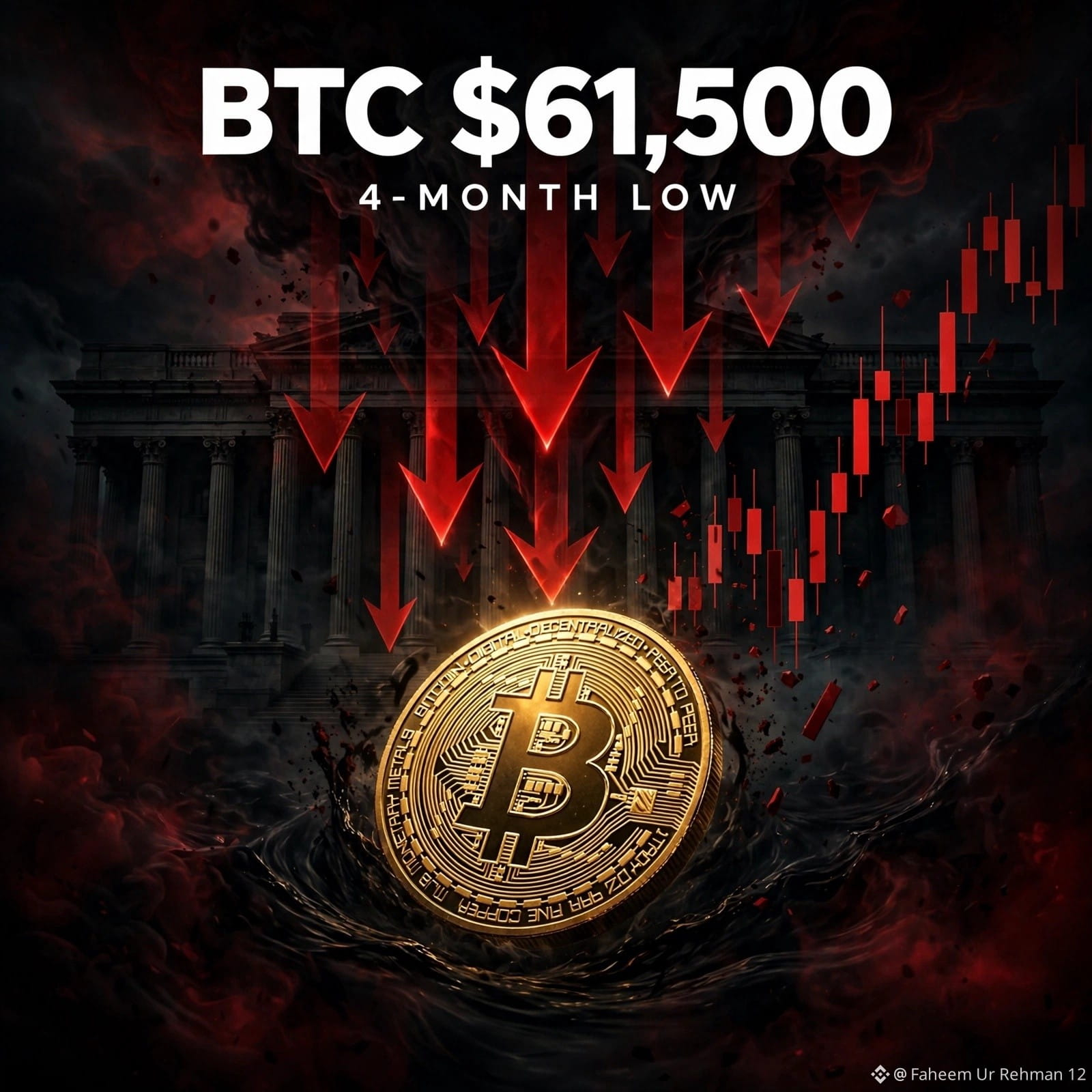
Bitcoin at $61,500 — Lowest Since July. The Fed Minutes Started This Slide.
Three days of red. $61,500. Roughly half of the October 2025 peak gone.
Here is what actually happened:
• The Fed's October meeting minutes (out 18 Nov) said almost all officials expect MORE rate hikes — and two even raised the idea of a hike bigger than 25bp in December.
• A December hike is now ~90% priced in. The decision lands 8–9 Dec.
• US spot Bitcoin ETFs bled $306M on 18 Nov — day two of outflows.
• ETH is near $1,750. Fear & Greed: 10–12. Pure Extreme Fear.
Everyone is asking the same question — and nobody has the answer yet.
What do YOU think happens first: does $60K hold, or does the Fed keep pushing it down? Drop your take in the comments. 👇
$BTC $ETH
#BTCRemainsUnderPressureAfterHawkishFOMCMinutes #BinanceSquare #CanBTCReboundAfterFallingBelow60K?
177
#BTC Under Pressure After Hawkish FOMC Minutes
Bitcoin is trading near $61,500 today — its lowest level since July, down for a third straight day and roughly 50% below its October 2025 all-time high of $126,080.
What moved it:
• The Fed's October meeting minutes, released 18 Nov, showed almost all officials see further rate hikes as appropriate — and two said a hike of more than 25bp could be on the table in December if inflation stays hot.
• Traders now price a December hike at ~90% (25bp), with a ~10% chance of 50bp.
• US spot Bitcoin ETFs saw $306M in outflows on 18 Nov — a second straight day of outflows.
• ETH is near $1,750, and the Fear & Greed Index sits at 10–12: Extreme Fear.
The December FOMC decision is on 8–9 Dec. Until then, the market is trading the hike, not the hope.
$BTC C $ETH
#CanBTCReboundAfterFallingBelow60K? BTCRemainsUnderPressureAfterHawkishFOMCMinutes #BinanceSquare
146

#EarningsSeason Earnings Eve: Tesla & Meta Report Today — What Actually Matters
Two Magnificent 7 names report Q3 after today's US close. Here's the setup, not the hype.
Tesla:
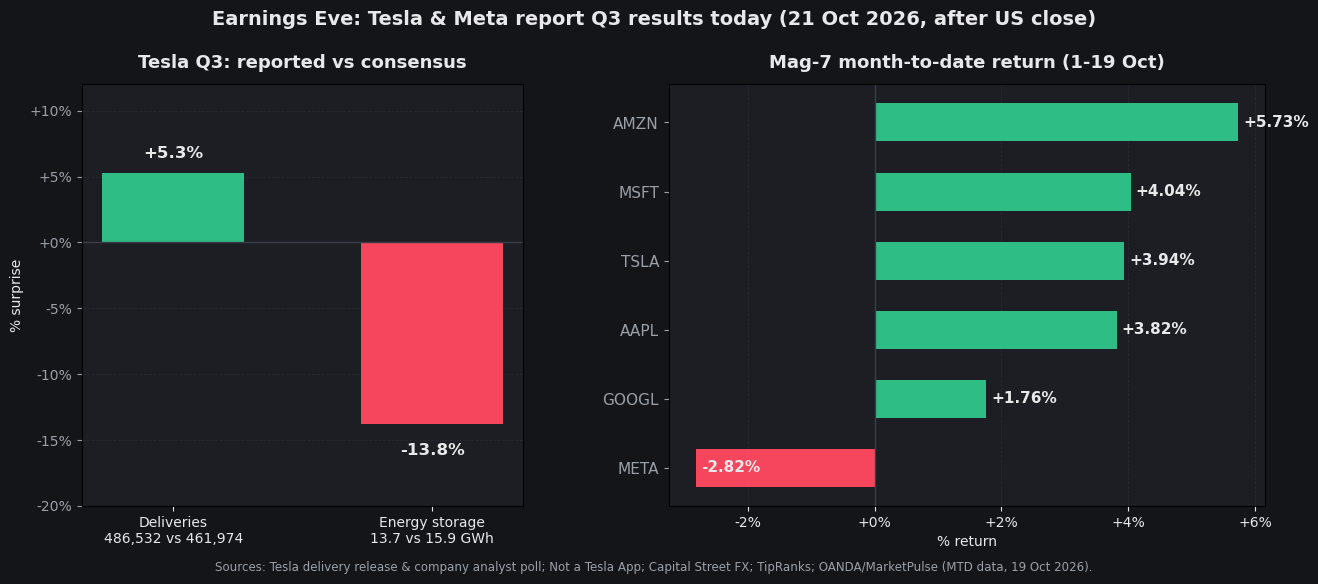
• Deliveries beat: 486,532 vehicles (+5.3% vs 461,974 consensus), though down 2.1% YoY. Model 3/Y: 457,387 produced, 478,237 delivered.
• Energy storage missed: 13.7 GWh vs 15.9 expected (-13.8%) — the growth story's soft spot.
• Consensus: EPS $0.45 (-10% YoY), revenue $27.78B (-1.1% YoY). Call at 21:30 UTC.
Meta:
• Revenue consensus ~$63.34B (+20%+ YoY); EPS ~$6.6 — but BofA models just $3.79 on a $10B legal charge. Bernstein sees revenue $64.06B.
• Watch the 2026 capex guide ($140–145B): AI spend is the whole debate.
• Options imply a ~12% move — the market expects fireworks. Call at 4:30 PM ET.
The divergence (chart): MTD through Oct 19, META is the only Mag-7 loser (-2.82%) while AMZN leads (+5.73%). One good print flips the whole board.
Not financial advice — earnings nights reward preparation, not predictions.
#EarningsSeason #BinanceSquare $TSLA $META
1
363
Nillion's Covenants: Programmable Money Just Shipped on Mainnet
Nillion is running a creator campaign on Binance Square (16–26 Oct), and the topic worth covering is real: Covenants went live on the Dusk mainnet, and there's a 7-phase roadmap stretching to early 2028.
What's actually shipped:
• Covenants are programmable rules attached to tokens — spend conditions, time locks, and multi-party logic enforced on-chain. Nillion's first live experiment is TriggerMarket: 8 Covenants, 3 authors, 512 NIL in fees.
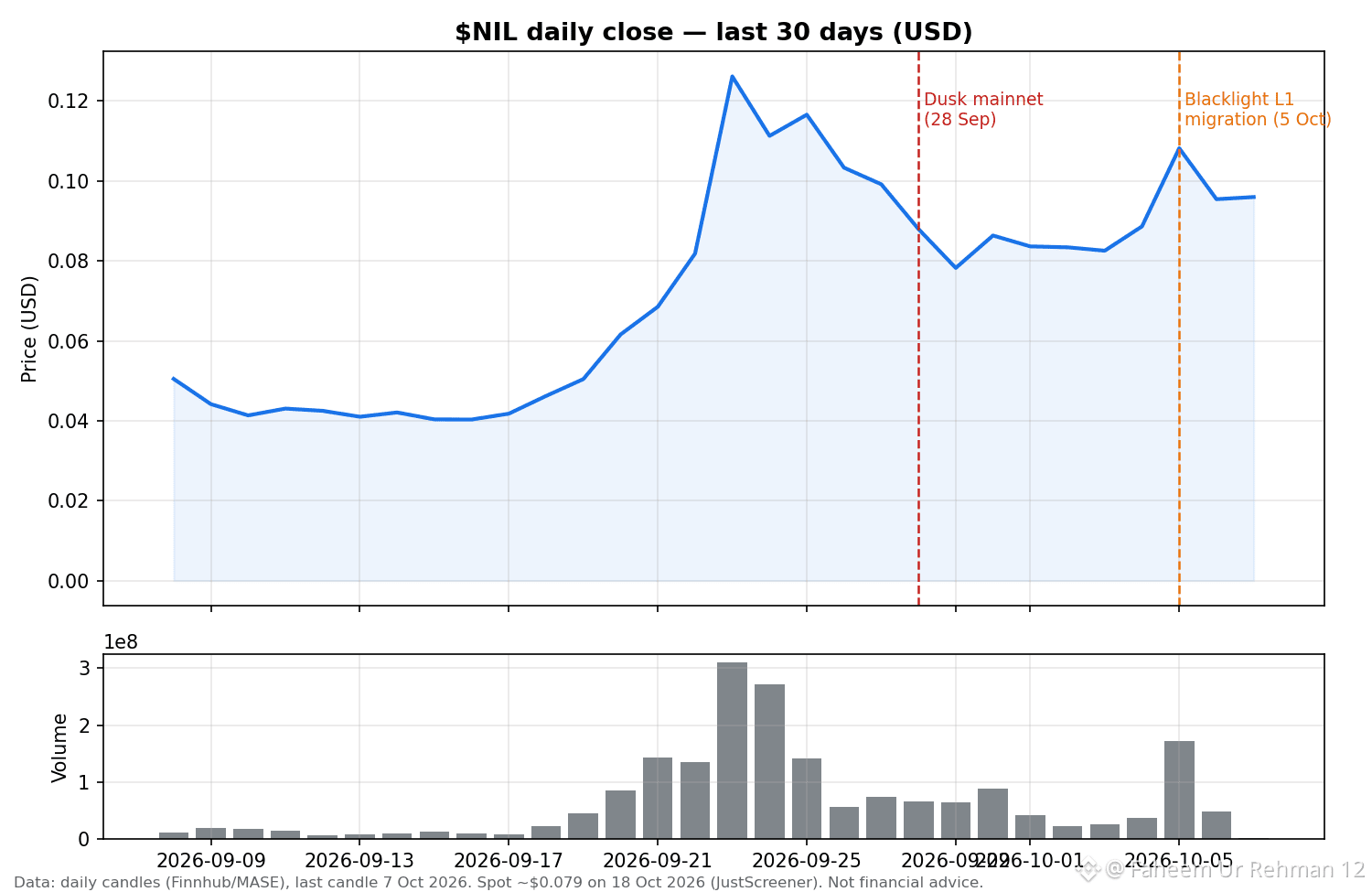
• The network is evolving in phases: Dusk launched on Ethereum on 28 Sep, and the Blacklight L1 migration followed on 5 Oct — the foundation for Nillion's own chain.
The numbers (as of 18 Oct):
• $NIL trades at ~$0.0788 with a ~$40M market cap and $35.15M in 24h volume (JustScreener). Circulating supply: ~508M NIL.
• 30-day high was $0.1487 on 24 Sep — so price is down ~47% from the local peak while the protocol shipped its biggest releases. Validators stake a minimum 70,000 NIL; inflation is 0.5%.
The honest read: mainnet launches during a price drawdown are the real stress test. If Covenants see actual developer usage over the coming phases, the infrastructure story gets stronger; if not, it's another launch candle. Watch on-chain covenant activity, not just the chart.
Not financial advice.
$NIL @nillionnetwork #nillion $NIL
{spot}(NILUSDT)
Nillion's Covenants: Programmable Money Just Shipped on Mainnet
Nillion is running a creator campaign on Binance Square (16–26 Oct), and the topic worth covering is real: Covenants went live on the Dusk mainnet, and there's a 7-phase roadmap stretching to early 2028.
What's actually shipped:
• Covenants are programmable rules attached to tokens — spend conditions, time locks, and multi-party logic enforced on-chain. Nillion's first live experiment is TriggerMarket: 8 Covenants, 3 authors, 512 NIL in fees.
• The network is evolving in phases: Dusk launched on Ethereum on 28 Sep, and the Blacklight L1 migration followed on 5 Oct — the foundation for Nillion's own chain.
The numbers (as of 18 Oct):
• $NIL trades at ~$0.0788 with a ~$40M market cap and $35.15M in 24h volume (JustScreener). Circulating supply: ~508M NIL.
• 30-day high was $0.1487 on 24 Sep — so price is down ~47% from the local peak while the protocol shipped its biggest releases. Validators stake a minimum 70,000 NIL; inflation is 0.5%.
The honest read: mainnet launches during a price drawdown are the real stress test. If Covenants see actual developer usage over the coming phases, the infrastructure story gets stronger; if not, it's another launch candle. Watch on-chain covenant activity, not just the chart.
Not financial advice.
$NIL @Nillion #nillion $NIL
117
Verified
The Agent Economy Needs an Identity Layer — Kite Is Building One
Everyone talks about AI agents trading on-chain. Fewer people talk about the hard part: how do you give an agent a verifiable identity, spending limits, and a way to settle payments — without handing it your private keys? That's the problem Kite is built for.
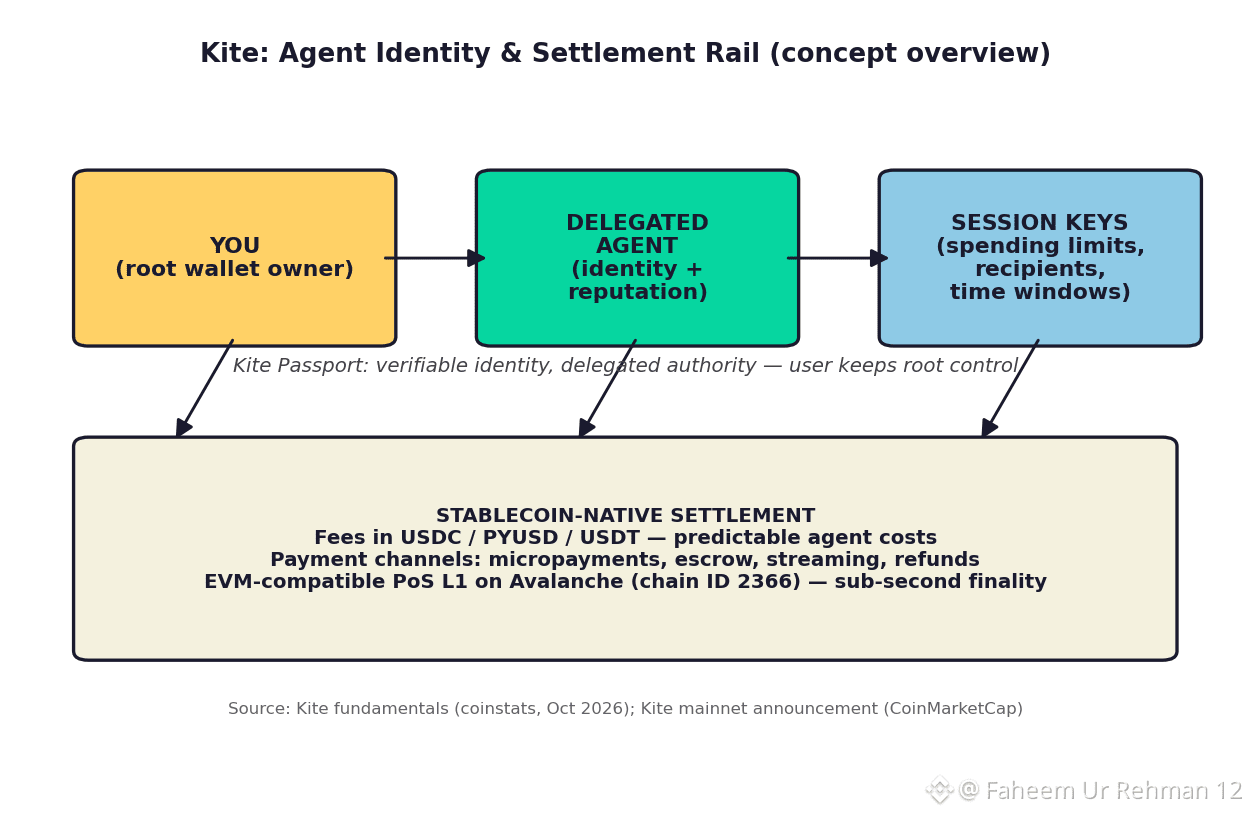
Here's the core design (diagram below):
Identity first. The Kite Passport gives every agent a three-layer identity: the user as root wallet owner, a delegated agent carrying identity + reputation, and session keys with hard constraints — spending limits, allowed recipients, time windows. Delegated authority, but the user keeps root control.
Settlement in stablecoins. Fees run in USDC, PYUSD or USDT, so agent costs are predictable. Payment channels handle micropayments, escrow, streaming and refunds — the plumbing commerce actually needs.
A chain built for it. Kite is an EVM-compatible PoS L1 on Avalanche (chain ID 2366) with sub-second finality, backed by $33M in funding (Oct 2026).
Why this matters: agentic commerce only scales if trust is programmable, not assumed. Kite's bet is that identity + stablecoin settlement is the missing rail between "cool demo" and real machine-to-machine economies.
My honest read: the design is genuinely differentiated — most agent chains focus on execution speed, Kite focuses on identity and settlement. The open question is developer adoption: will builders pick Kite's rails, or fork the pattern elsewhere?
Not financial advice.
#KiteBBW $KITE @GoKiteAI $KITE
{spot}(KITEUSDT)
The Agent Economy Needs an Identity Layer — Kite Is Building One
Everyone talks about AI agents trading on-chain. Fewer people talk about the hard part: how do you give an agent a verifiable identity, spending limits, and a way to settle payments — without handing it your private keys? That's the problem Kite is built for.
Here's the core design (diagram below):
Identity first. The Kite Passport gives every agent a three-layer identity: the user as root wallet owner, a delegated agent carrying identity + reputation, and session keys with hard constraints — spending limits, allowed recipients, time windows. Delegated authority, but the user keeps root control.
Settlement in stablecoins. Fees run in USDC, PYUSD or USDT, so agent costs are predictable. Payment channels handle micropayments, escrow, streaming and refunds — the plumbing commerce actually needs.
A chain built for it. Kite is an EVM-compatible PoS L1 on Avalanche (chain ID 2366) with sub-second finality, backed by $33M in funding (Oct 2026).
Why this matters: agentic commerce only scales if trust is programmable, not assumed. Kite's bet is that identity + stablecoin settlement is the missing rail between "cool demo" and real machine-to-machine economies.
My honest read: the design is genuinely differentiated — most agent chains focus on execution speed, Kite focuses on identity and settlement. The open question is developer adoption: will builders pick Kite's rails, or fork the pattern elsewhere?
Not financial advice.
#KiteBBW $KITE @KITE AI 中文 $KITE
103
$NVDAB $NVDAB #AIAndSemiconductorStocksLoseOver$1TThisWeek
$1 Trillion Gone: The AI Chip Selloff Nobody Saw Coming
The Philadelphia Semiconductor Index just lost 12% in six sessions — erasing roughly $1 trillion in market value, the sharpest AI-led selloff of 2026. Here's what happened and why it matters for crypto.
The damage:
• Nvidia -1.8%, AMD -3.5%, Micron -4.4% on Thursday alone — AMD's -5.7% Wednesday was its worst day since August
• Asia got hit harder: SK Hynix -10%, Samsung -8.7%, Advantest -14%, SoftBank -7.9%
• The iShares Semiconductor ETF is heading for 8 straight daily losses — its longest streak in ~11 years
Why it's happening:
• The AI spending math is breaking: US tech giants are expected to spend $700B+ on AI infra this year, Gartner now warns ~$3.5 trillion of planned AI spending could face impairment, and Broadcom + Intel CEOs flagged financing as a major headwind
• 10-year Treasury yields above 5% make borrowing for data centers brutally expensive
• A Chinese memory maker claimed a technical breakthrough, adding competition fears
The twist nobody talks about: while chips bled, ETF investors poured in RECORD money — $430M into the $72B VanEck Semiconductor ETF and $3.8B into the triple-leveraged SOXL, its best week EVER, even as it fell 21%. Retail is buying this dip with leverage.
For crypto: $BTC and $ETH track Nasdaq risk appetite closely — when chips sneeze, crypto catches the flu. But notice: the AI crypto sector actually gained 3.63% this week. Decentralized AI tokens are decoupling from Big Tech AI.
My take: the selloff is about financing costs, not AI demand. If yields roll over, chips snap back hardest. If not, the dip-buyers learn what leverage really costs.
Not financial advice — what's your call: dead-cat bounce or the start of the AI unwind?
#AIAndSemiconductorStocksLoseOver $1TThisWeek
110
Hot CPI Couldn't Break $80K — Here's What the Rebound Is Telling UsSeptember CPI came in hot at 3.7%, PPI jumped 1.3% MoM (highest since 2022) — and $BTC briefly dipped below $80,000. But here's what happened next: Bitcoin clawed back to ~$82,200 (+0.67%), $ETH broke $2,440 (+0.79%), and the AI sector led the whole market with a 3.63% gain.
Why the bounce:
• Fed officials turned cautious on further hikes — CME FedWatch now shows only ~27% chance of an October hike (down from 39% right after the CPI print). The market's base case is now a hold at the Oct 27–28 FOMC
• $BTC held $80K through the worst inflation data of the year — that's base-building, not topping. It's up ~40% from its $58,000 summer low
• The money is rotating, not leaving: AI tokens (AKE +16%, VVV +10%), Layer2s (STRK +12%), and DePIN (GRASS +9%) are all leading
What I'm watching:
• $XRP is the odd one out — spot XRP ETFs saw +7.9M XRP inflows while $BTC, $ETH and $SOL funds lost ~$400M combined on Oct 14. Rotation is real
• Fear & Greed at 64 — greed before the FOMC is exactly when discipline matters most
My plan: no chasing green candles. The $80K floor is the line in the sand — lose it and the hot-inflation trade is back on. Hold it, and October stays constructive.
Not financial advice — just my read of the data. Where do you see $BTC heading into the FOMC?
#crypto #bitcoin #MarketUpdate $BTC
{spot}(BTCUSDT)
Hot CPI Couldn't Break $80K — Here's What the Rebound Is Telling Us
September CPI came in hot at 3.7%, PPI jumped 1.3% MoM (highest since 2022) — and $BTC briefly dipped below $80,000. But here's what happened next: Bitcoin clawed back to ~$82,200 (+0.67%), $ETH broke $2,440 (+0.79%), and the AI sector led the whole market with a 3.63% gain.
Why the bounce:
• Fed officials turned cautious on further hikes — CME FedWatch now shows only ~27% chance of an October hike (down from 39% right after the CPI print). The market's base case is now a hold at the Oct 27–28 FOMC
• $BTC held $80K through the worst inflation data of the year — that's base-building, not topping. It's up ~40% from its $58,000 summer low
• The money is rotating, not leaving: AI tokens (AKE +16%, VVV +10%), Layer2s (STRK +12%), and DePIN (GRASS +9%) are all leading
What I'm watching:
• $XRP is the odd one out — spot XRP ETFs saw +7.9M XRP inflows while $BTC , $ETH and $SOL funds lost ~$400M combined on Oct 14. Rotation is real
• Fear & Greed at 64 — greed before the FOMC is exactly when discipline matters most
My plan: no chasing green candles. The $80K floor is the line in the sand — lose it and the hot-inflation trade is back on. Hold it, and October stays constructive.
Not financial advice — just my read of the data. Where do you see $BTC heading into the FOMC?
#crypto #bitcoin #MarketUpdate $BTC
159
#CPIWatch
CPI Is Out: HOT — Here's My Game Plan
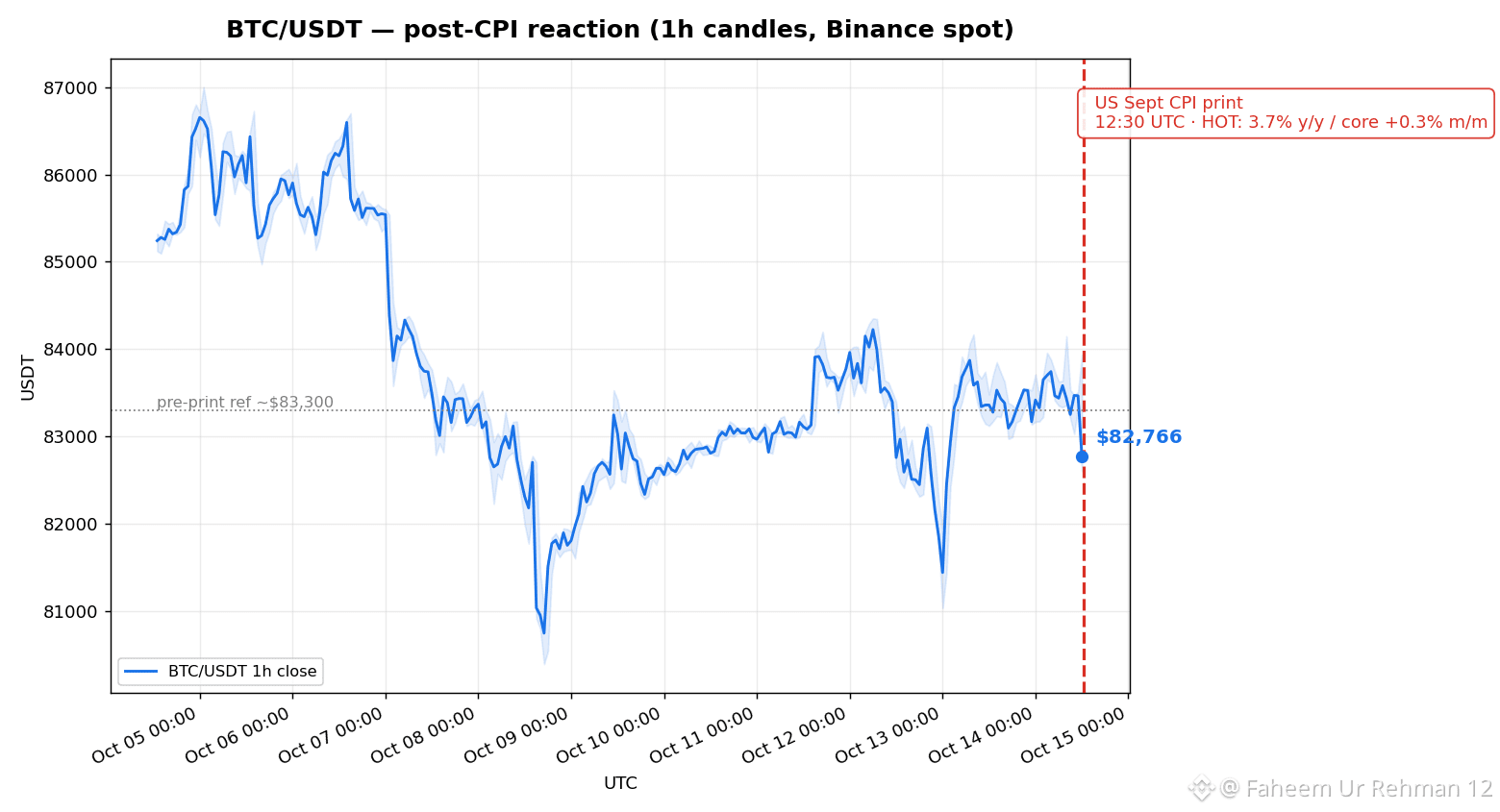
September CPI came in HOT: 3.7% y/y (vs 3.6% expected) and core +0.3% m/m. Energy did the heavy lifting again — but core refusing to cool is what the Fed will stare at.
My read: October 27–28 hike odds just repriced higher (was ~22% pre-print, now 39% per CME FedWatch). 10Y at ~5.26% — watch the 5.36% high. slipped to ~$82,830 (-0.6% from $83,300) as risk repriced.
My plan, not advice:
1. No chasing the first candle — the real move comes when the components get read.
2. Watching vs $TMFUSDT for the rates confirmation before any new risk.
3. $SOL and $BTC bids only on a reclaim of $84,000, not into weakness.
Volatility is the trade here, direction is the trap. #CPIWatch
Not financial advice — my own plan, do your own research.
$BTC
{spot}(BTCUSDT)
#CPIWatch
CPI Is Out: HOT — Here's My Game Plan
September CPI came in HOT: 3.7% y/y (vs 3.6% expected) and core +0.3% m/m. Energy did the heavy lifting again — but core refusing to cool is what the Fed will stare at.
My read: October 27–28 hike odds just repriced higher (was ~22% pre-print, now 39% per CME FedWatch). 10Y at ~5.26% — watch the 5.36% high. slipped to ~$82,830 (-0.6% from $83,300) as risk repriced.
My plan, not advice:
1. No chasing the first candle — the real move comes when the components get read.
2. Watching vs $TMFUSDT for the rates confirmation before any new risk.
3. $SOL and $BTC bids only on a reclaim of $84,000, not into weakness.
Volatility is the trade here, direction is the trap. #CPIWatch
Not financial advice — my own plan, do your own research.
$BTC
148
Verified
CPI WATCH#cpiwatch
Will September CPI Shake Oil & Treasuries? My Data-Backed View
September CPI drops Wednesday, October 14 at 8:30 a.m. ET — and this one matters more than usual. Here's my read on the two angles Binance flagged.
Oil: The CPI Driver Everyone's Watching
Middle East tensions are escalating, and it's already in the price. Brent is trading around $105–106 per barrel and WTI near $92–93 (per Bloomberg/CNBC, Oct 13). Markets now expect September headline CPI to come in at 3.6–3.7% YoY, up from 3.4% in August — almost entirely on energy. The BLS said energy prices were up 16.3% YoY in August alone.
My view: CPI comes in hot on the headline but the core tells the real story. Consensus has core at 2.4–2.5% YoY, barely moving. If core prints soft at 0.2% MoM, the "energy shock" narrative loses teeth. But if oil keeps climbing past $110, those second-round effects (airfares already +2% for two straight months) spread — and then it gets dangerous.
Treasuries: Yields at a 24-Year Crossroads
The 10-year US yield hit 5.364% last week — the highest since 2002 — and sits around 5.19–5.22% today as equities sold off and haven demand kicked in. The Fed hiked to 3.75–4.00% on September 16, and Fed Governor Waller said October 8 that more hikes will likely be needed.
A hot CPI revives the December hike trade. A soft core kills it. Right now, markets price only a 19.4% chance of an October 28 hike — down from 42.5% a month ago. That's the gap where surprises live.
Where I stand: I'm positioned cautiously — long-duration exposure via $TMFUSDT only if core prints soft, and keeping $TBT on the watchlist as a hedge if the headline surprises hot. Watching $RWUSD and $BZUSDT for energy-linked flows. No leverage until the print is out — CPI day is a coin flip dressed as data.
Not financial advice — this is my own analysis and I could be wrong. What's your call: hot or soft?
#CPIWatch
{spot}(BTCUSDT)
CPI WATCH
#cpiwatch
Will September CPI Shake Oil & Treasuries? My Data-Backed View
September CPI drops Wednesday, October 14 at 8:30 a.m. ET — and this one matters more than usual. Here's my read on the two angles Binance flagged.
Oil: The CPI Driver Everyone's Watching
Middle East tensions are escalating, and it's already in the price. Brent is trading around $105–106 per barrel and WTI near $92–93 (per Bloomberg/CNBC, Oct 13). Markets now expect September headline CPI to come in at 3.6–3.7% YoY, up from 3.4% in August — almost entirely on energy. The BLS said energy prices were up 16.3% YoY in August alone.
My view: CPI comes in hot on the headline but the core tells the real story. Consensus has core at 2.4–2.5% YoY, barely moving. If core prints soft at 0.2% MoM, the "energy shock" narrative loses teeth. But if oil keeps climbing past $110, those second-round effects (airfares already +2% for two straight months) spread — and then it gets dangerous.
Treasuries: Yields at a 24-Year Crossroads
The 10-year US yield hit 5.364% last week — the highest since 2002 — and sits around 5.19–5.22% today as equities sold off and haven demand kicked in. The Fed hiked to 3.75–4.00% on September 16, and Fed Governor Waller said October 8 that more hikes will likely be needed.
A hot CPI revives the December hike trade. A soft core kills it. Right now, markets price only a 19.4% chance of an October 28 hike — down from 42.5% a month ago. That's the gap where surprises live.
Where I stand: I'm positioned cautiously — long-duration exposure via $TMFUSDT only if core prints soft, and keeping $TBT on the watchlist as a hedge if the headline surprises hot. Watching $RWUSD and $BZUSDT for energy-linked flows. No leverage until the print is out — CPI day is a coin flip dressed as data.
Not financial advice — this is my own analysis and I could be wrong. What's your call: hot or soft?
#CPIWatch
7
2
15
42.6k
Verified
Fresh listing, zero fees: $RWUSD is live on Binance
Binance just opened RWUSD/USDT spot trading today at 8:00 UTC — with zero fees until further notice.
Quick breakdown:
• RWUSD is a floating-term yield product that accrues daily, pegged 1:1 and redeemable for USDC
• Yield comes from Binance ecosystem revenue, potentially backed by US Treasuries
• Now supported as cross-margin collateral and on Binance Convert with zero-fee conversion
• No deposits or withdrawals yet — in-ecosystem transfers only for now
Important: yield products carry real risk. Past performance says nothing about future returns, so read the product terms inside the app first.
Posting verified listings with real numbers daily — follow for tomorrow's.
$RWUSD #BinanceSquareTalks #RWUSD #NewListing
1
273

Article
BinanceLaunchesBinanceIntelligence#BinanceLaunchesBinanceIntelligence
Binance just launched Binance Intelligence — its biggest AI move yet. 🤖
3 products, 1 mission: close the gap between everyday users and market pros.
• Binance AI (FREE): in-app market assistant — briefings, alerts, P&L summaries, personalized to YOUR portfolio
• AI Pro: describe a strategy in plain words → it builds, paper-trades & executes it
• Agent OS: developers can build AI apps on Binance
The free AI layer is rolling out now. This is how the next billion users onboard. 🚀
#BinanceLaunchesBinanceIntelligence
Thread (string):
1/ Binance just dropped Binance Intelligence — an AI stack built to close the knowledge gap between retail and pros. Here's what it actually is 🧵
#BinanceLaunchesBinanceIntelligence
2/ Part 1: Binance AI — FREE for everyone. Lives inside the Binance app. Market briefings, price alerts, P&L summaries, sentiment + macro updates — personalized to your holdings and knowledge level. Rolling out now. 🤖
3/ Part 2: Binance AI Pro — describe your trading idea in plain language, and the agent builds the strategy, paper-trades it, then runs it live within limits YOU set. No coding needed. Freemium: free tier + Premium at 19.99 USDC/mo, coming later this month.
4/ Part 3: Agent OS — for developers. Infrastructure to build AI apps and agents that plug into Binance's financial rails. Endgame? AI-native finance, where everyone carries a pro-grade research desk in their pocket. Bullish on the direction. 🚀
$BNB #######BinanceLaunchesBinanceIntelligence
BinanceLaunchesBinanceIntelligence
#BinanceLaunchesBinanceIntelligence
Binance just launched Binance Intelligence — its biggest AI move yet. 🤖
3 products, 1 mission: close the gap between everyday users and market pros.
• Binance AI (FREE): in-app market assistant — briefings, alerts, P&L summaries, personalized to YOUR portfolio
• AI Pro: describe a strategy in plain words → it builds, paper-trades & executes it
• Agent OS: developers can build AI apps on Binance
The free AI layer is rolling out now. This is how the next billion users onboard. 🚀
#BinanceLaunchesBinanceIntelligence
Thread (string):
1/ Binance just dropped Binance Intelligence — an AI stack built to close the knowledge gap between retail and pros. Here's what it actually is 🧵
#BinanceLaunchesBinanceIntelligence
2/ Part 1: Binance AI — FREE for everyone. Lives inside the Binance app. Market briefings, price alerts, P&L summaries, sentiment + macro updates — personalized to your holdings and knowledge level. Rolling out now. 🤖
3/ Part 2: Binance AI Pro — describe your trading idea in plain language, and the agent builds the strategy, paper-trades it, then runs it live within limits YOU set. No coding needed. Freemium: free tier + Premium at 19.99 USDC/mo, coming later this month.
4/ Part 3: Agent OS — for developers. Infrastructure to build AI apps and agents that plug into Binance's financial rails. Endgame? AI-native finance, where everyone carries a pro-grade research desk in their pocket. Bullish on the direction. 🚀
$BNB #######BinanceLaunchesBinanceIntelligence
1
155
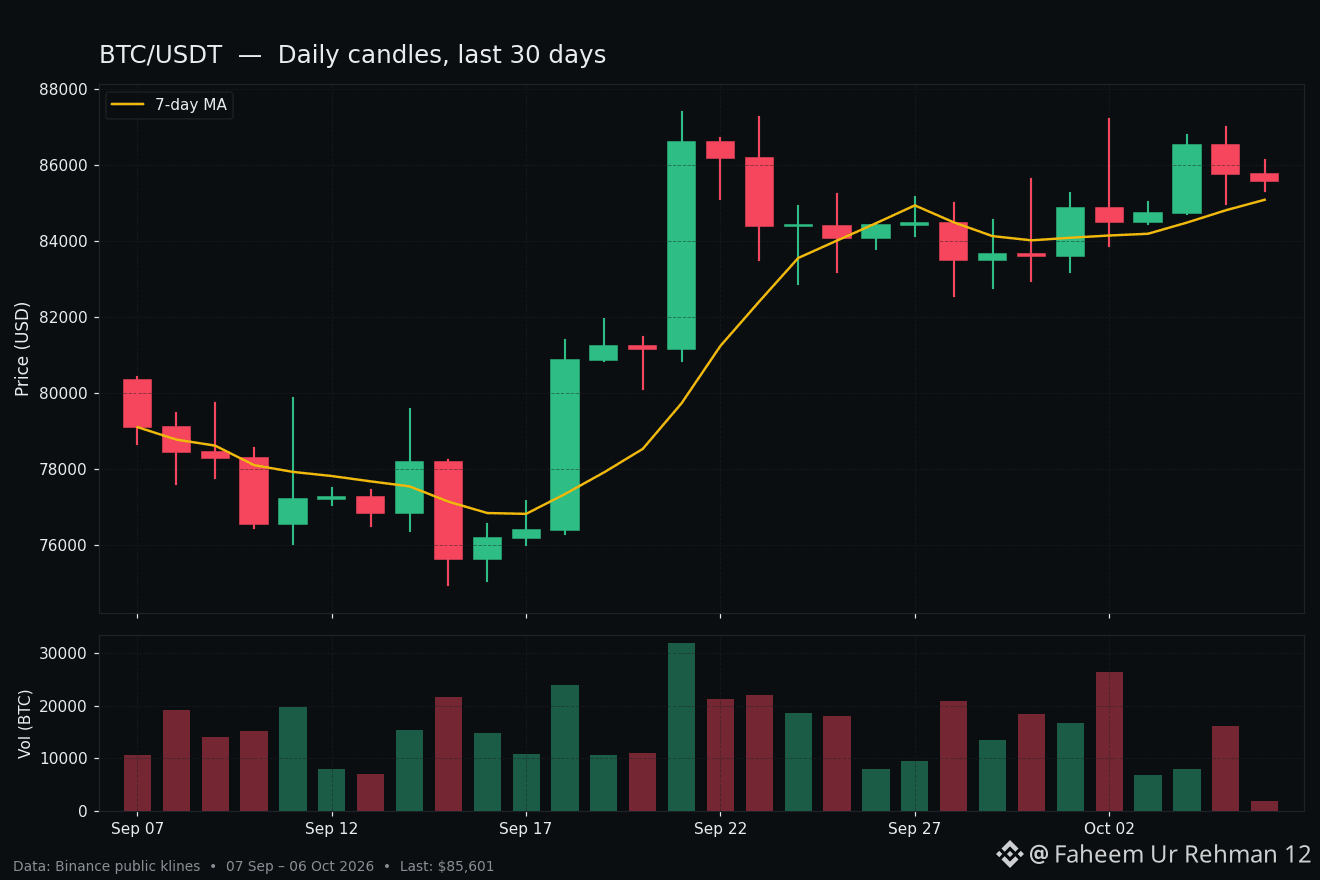
Bitcoin holding ~$85.6K, consolidating
just below the $87.4K September high.
30-day chart: +6.5% on the month, tight range into October. Breakout or rejection - which side are you on?
$BTC
{spot}(BTCUSDT)
#bitcoin
Bitcoin holding ~$85.6K, consolidating
just below the $87.4K September high.
30-day chart: +6.5% on the month, tight range into October. Breakout or rejection - which side are you on?
$BTC
#bitcoin
just below the $87.4K September high.
30-day chart: +6.5% on the month, tight range into October. Breakout or rejection - which side are you on?
$BTC
#bitcoin
1
101
Babylon Trustless Bitcoin Vaults (TBV) are bringing a new approach to Bitcoin utility by allowing users to put their BTC to work while maintaining trustless security. The concept connects Bitcoin’s strong security with decentralized applications and broader DeFi opportunities. I’m watching how @babylonlabs_io abs_io continues to build this Bitcoin powered ecosystem. $BABY #baby
Babylon Trustless Bitcoin Vaults (TBV) are bringing a new approach to Bitcoin utility by allowing users to put their BTC to work while maintaining trustless security. The concept connects Bitcoin’s strong security with decentralized applications and broader DeFi opportunities. I’m watching how @BabylonLabs_io abs_io continues to build this Bitcoin powered ecosystem. $BABY #baby
1
79
{spot}(BTCUSDT)
Here’s your BTC market update:
BTC/USDT is currently $62,891.35, down about 2.89% over the last 24 hours.
24h open: $64,762.00
24h high: $64,896.00
24h low: $62,710.00
That puts BTC near the lower end of today’s range, so short-term momentum looks a bit soft right now
Here’s your BTC market update:
BTC/USDT is currently $62,891.35, down about 2.89% over the last 24 hours.
24h open: $64,762.00
24h high: $64,896.00
24h low: $62,710.00
That puts BTC near the lower end of today’s range, so short-term momentum looks a bit soft right now
BTC/USDT is currently $62,891.35, down about 2.89% over the last 24 hours.
24h open: $64,762.00
24h high: $64,896.00
24h low: $62,710.00
That puts BTC near the lower end of today’s range, so short-term momentum looks a bit soft right now
1
82
·
--
Bullish
#StrategyBTCPurchase
As of right now, Bitcoin (BTC) — the world’s largest cryptocurrency — is trading around $90,000 USD per coin, showing modest movement within a range of roughly $90,200 to $92,400 in the past 24 hours with relatively stable trading activity. This price level reflects a period of consolidation between about $88,000 and $92,000, indicating that the market is holding steady after recent fluctuations. Traders are showing cautious optimism ahead of key U.S. economic data releases that could influence broader market sentiment and Bitcoin’s short-term direction. Overall, while BTC remains well below its all-time highs above $125,000 seen in 2025, it continues to be a dominant and resilient asset in the crypto space with ongoing interest from both retail and institutional participants.
As of right now, Bitcoin (BTC) — the world’s largest cryptocurrency — is trading around $90,000 USD per coin, showing modest movement within a range of roughly $90,200 to $92,400 in the past 24 hours with relatively stable trading activity. This price level reflects a period of consolidation between about $88,000 and $92,000, indicating that the market is holding steady after recent fluctuations. Traders are showing cautious optimism ahead of key U.S. economic data releases that could influence broader market sentiment and Bitcoin’s short-term direction. Overall, while BTC remains well below its all-time highs above $125,000 seen in 2025, it continues to be a dominant and resilient asset in the crypto space with ongoing interest from both retail and institutional participants.
1
15
Log in to explore more content
Join global crypto users on Binance Square
⚡️ Get latest and useful information about crypto.
💬 Trusted by the world’s largest crypto exchange.
👍 Discover real insights from verified creators.
Email / Phone number
Trending Topics
BitcoinCorePatchesAIDiscoveredVulnerability
7 views
28 Discussing
🚨 BITCOIN CORE JUST TURNED SECURITY INTO THE TOP PRIORITY! 🔥
Bitcoin Core developers have patched an AI-discovered vulnerability, highlighting how AI is becoming a powerful tool in identifying hidden security risks.
⚡ Stronger security means greater confidence.
🛡️ Protecting Bitcoin's network remains essential.
🤖 AI could reshape the future of blockchain security.
The big question: Could AI become Bitcoin's strongest security defender?
What do you think? 👇
@Binance Italy
#BitcoinCorePatchesAIDiscoveredVulnerability $BTC
ASHFAQ NAEEM
·0 Likes
·25 views
CanBTCReboundAfterFallingBelow60K?
448,740 views
1,932 Discussing
GlobalStocksFaceLongestLosingStreakSince2023
152,117 views
1,350 Discussing