

海盗鸭
3.6k Posts

海盗鸭
Report
Block User
69 Following
137 Followers
354 Liked
Posts
All
Quotes
·
--
Anthropic says Claude solved a mystery in under half an hour: several unexplained elliptic-curve seeds published by NIST about 25 years ago were actually generated by the old C library random number generator lrand48, seeded with Unix timestamps from 1997–1998. The P-256 seed corresponds to August 16, 1997, at 01:52:34. The process is reproducible, and the $36,000 bounty was donated to the Internet Security Research Group. The company emphasizes that this was neither an attack nor a new vulnerability.
My take: What fell apart wasn’t a particular backdoor, but the narrative that “mysterious constants must be a conspiracy”—once the seeds can be reproduced, deliberate planting becomes much harder to argue. Bitcoin uses secp256k1, which wasn’t on the list in the first place, so this neither hit nor exonerated it. The base points for P-224 and P-256 still aren’t fully explained.
The curve choice made by $BTC was criticized as overly conservative at the time. Would you still bet on it today?

142
·
--
Anthropic received a BB+ rating from KBRA, one notch below investment grade. The rating covers $4.4 billion of subordinated debt in a $3.5 billion AI chip financing deal, with a coupon of around 8.5%; the senior debt backed by Broadcom in the same deal carries a rate of just 5.75%.
Adam Back responded yesterday: Bitcoin is the hurdle rate; every investment should be compared with holding Bitcoin.
I’m inclined to think this is valuation language, not a valuation method—$BTC has no coupon, so you can’t use it as a discount rate to calculate a value. What’s really being repriced is the safe asset: the 10-year Treasury yield topped 5.3% in early October, a 24-year high.
With risk-free rates at this level, AI debt yielding 8.5% is competing with Treasuries for the same pool of money. If AI financing costs rise further, will money flow back to $BTC first, or to Treasuries?

1
226
·
--
Can it return to $100,000 by year-end? Two firms have different answers: Bitwise research head Ryan Rasmussen says it could go higher and has a chance of topping $100,000; London-based LO:TECH puts its base case at $85,000 to $95,000.
The difference comes down to macro factors: The Fed already raised rates by 25 basis points in September, and markets put the odds of another hike in December at around 75%; CPI on October 14 came in at 0.6% month over month, with core CPI at 0.3%—not exactly supportive. Cumulative net ETF inflows also fell from nearly $57.8 billion on October 2 to $56.88 billion on the 16th.
I lean toward LO:TECH’s range: The prerequisite for $100,000 is a shift in the macro outlook, but right now market pricing is moving in the opposite direction. Bullish sentiment can’t make up for a 75% chance of a rate hike. $BTC If it really crashes back below $80,000, would you buy the dip or wait until the December decision is in before making a move?

93
·
--
On October 15, MSCI finalized a new rule: “non-operating companies” will be excluded from the GIMI Index, effective after the market close on November 30. The criteria are mechanical: companies with operating assets below 50% of total assets must then pass four out of five financial ratio tests—or be excluded.
The company in the spotlight is Strategy. JPMorgan estimates that if it is removed, passive funds would need to sell about $2.8 billion worth of shares, with other index providers potentially adding another $8.8 billion if they follow suit. Strategy says MSCI-linked funds hold only about 13 million of its shares. Saylor was even more blunt: “Bitcoin doesn’t need MSCI.”
The real impact isn’t the few billion in passive fund flows, but access to financing: Strategy buys bitcoin through a “issue shares—buy bitcoin—issue more shares” cycle, and index eligibility is the gateway. If that gateway is blocked, the premium logic behind $MSTRB needs to be reassessed, and $BTC loses its biggest source of demand.
Would you view this rule as a prelude, or do you think the backlash will be strong enough to water down its implementation?
212
·
--
Verified
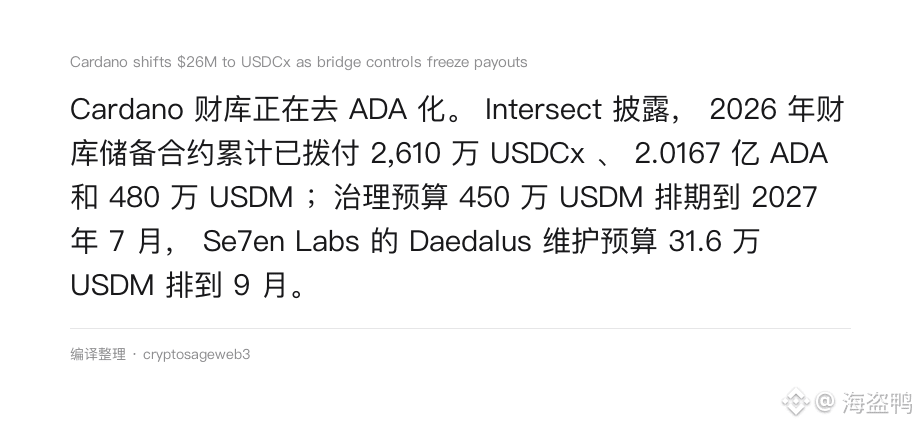
Cardano’s treasury is moving away from ADA. Intersect disclosed that, in 2026, treasury reserve contracts have cumulatively disbursed 26.1 million USDCx, 201.67 million ADA, and 4.8 million USDM. A governance budget of 4.5 million USDM is scheduled through July 2027, while Se7en Labs’ 316,000 USDM budget for maintaining Daedalus runs through September.
The key is the structure: once budgets are denominated in dollars, spending for the next two years is locked in, and ADA’s price movements have no bearing on those funds. An October 16 snapshot showed that three payments from September 29 had been unlocked, but no milestone evidence had been submitted—unlocking funds doesn’t mean they can be spent. What’s more, USDCx must first be converted into USDC before it can be paid out, and Circle, IOG, and Midgard each have the authority to pause the bridge. Redemptions are also subject to identity and sanctions checks.
My view is that governance is buying itself insurance, not that this is bearish—but it does chip away at the “paying with $ADA” narrative. If more treasuries follow suit and shift to dollars, would you still hold $ADA for the long term?
Cardano’s treasury is moving away from ADA. Intersect disclosed that, in 2026, treasury reserve contracts have cumulatively disbursed 26.1 million USDCx, 201.67 million ADA, and 4.8 million USDM. A governance budget of 4.5 million USDM is scheduled through July 2027, while Se7en Labs’ 316,000 USDM budget for maintaining Daedalus runs through September.
The key is the structure: once budgets are denominated in dollars, spending for the next two years is locked in, and ADA’s price movements have no bearing on those funds. An October 16 snapshot showed that three payments from September 29 had been unlocked, but no milestone evidence had been submitted—unlocking funds doesn’t mean they can be spent. What’s more, USDCx must first be converted into USDC before it can be paid out, and Circle, IOG, and Midgard each have the authority to pause the bridge. Redemptions are also subject to identity and sanctions checks.
My view is that governance is buying itself insurance, not that this is bearish—but it does chip away at the “paying with $ADA ” narrative. If more treasuries follow suit and shift to dollars, would you still hold $ADA for the long term?
258
·
--
Walsh’s remarks at the IMF-World Bank annual meetings in Bangkok gave no direction, so the market found its own.
He reiterated the goal of “achieving price stability,” defended the 25-basis-point rate hike in September, but refused to preview the FOMC’s move on October 27–28. After his speech, the odds of an October hike fell from 27% to 15%, the dollar weakened, and Bitcoin bounced from $79,805 back above $82,000.
But this is a “liquidity-starved” rally: spot Bitcoin ETFs saw net inflows of only about $5 million the previous day, following $261 million in outflows the day before; Ethereum ETFs have seen cumulative outflows of about $885 million in October.
My take: this is a “bad news didn’t materialize” rally, not a return of capital, so its staying power is questionable.
$BTC 82,000 Is this where it holds and pushes toward $88,000, or does it pull back to $78,000 first?
#Bitcoin recovers to $82,000

175
·
--
Cardano’s 500 million ADA treasury spending cap is already 91.5% used: 30 active proposals have spent 457.4 million ADA, leaving just 42.6 million.
The money hasn’t actually run out—the treasury still had 1.378 billion ADA in epoch 661. But dividends and refunds only add to the balance; they don’t restore spending authority, so the amount available to spend remains 42.6 million.
The 22 million Copper Reserve proposal is still pending, and the 11.78 million OpenZeppelin proposal did not take effect because it expired. DReps have only three options: cut the amount, defer it, or set a new NCL—the latter requiring support from more than 50% of active stake.
I tend to think this isn’t the treasury running dry, but budget categories being locked in: governance is stricter than on most public blockchains, and the tradeoff is slowness. $ADA is currently at 0.22, down 12% in 7 days—would you wait for the NCL renewal to go through before buying, or bet that this deadlock is already priced in?

437
·
--
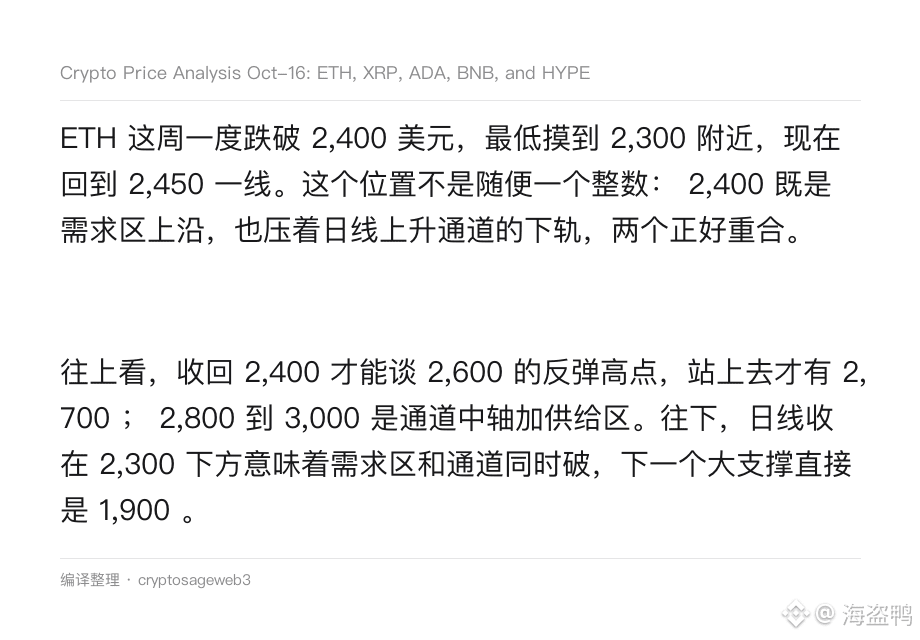
ETH briefly fell below $2,400 on Monday, hitting a low near $2,300, but has now recovered to around $2,450. This level isn’t just some random round number: $2,400 marks both the upper edge of the demand zone and the lower trendline of the daily ascending channel—they line up exactly.
Looking up, it needs to reclaim $2,400 before a rebound to $2,600 is on the table; a move above that opens the way to $2,700. The $2,800–$3,000 range is where the channel’s midpoint meets the supply zone. Looking down, a daily close below $2,300 would break both the demand zone and the channel, with the next major support all the way down at $1,900.
I’m inclined to think this breakdown was more of a liquidity sweep than a trend reversal, because buyers stepped back in right after the sell-off, and there was no buildup of volume at the lows. But this view has an expiration date: if it doesn’t reclaim $2,400 within two days, I’ll have to change my tune. $ETH—are you betting it reclaims $2,600, or waiting to buy the dip at $1,900? #EthereumBreaksBelow2400USDT
ETH briefly fell below $2,400 on Monday, hitting a low near $2,300, but has now recovered to around $2,450. This level isn’t just some random round number: $2,400 marks both the upper edge of the demand zone and the lower trendline of the daily ascending channel—they line up exactly.
Looking up, it needs to reclaim $2,400 before a rebound to $2,600 is on the table; a move above that opens the way to $2,700. The $2,800–$3,000 range is where the channel’s midpoint meets the supply zone. Looking down, a daily close below $2,300 would break both the demand zone and the channel, with the next major support all the way down at $1,900.
I’m inclined to think this breakdown was more of a liquidity sweep than a trend reversal, because buyers stepped back in right after the sell-off, and there was no buildup of volume at the lows. But this view has an expiration date: if it doesn’t reclaim $2,400 within two days, I’ll have to change my tune. $ETH —are you betting it reclaims $2,600, or waiting to buy the dip at $1,900? #EthereumBreaksBelow2400USDT
196
·
--
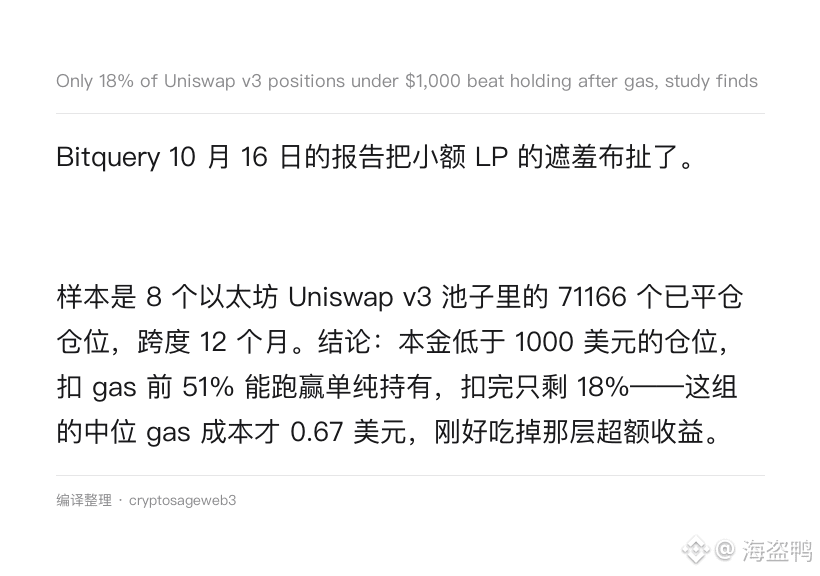
Bitquery’s October 16 report pulled back the curtain on small LP positions.
The sample covered 71,166 closed positions across 8 Ethereum Uniswap v3 pools over 12 months. The conclusion: among positions under $1,000, 51% outperformed simply holding before gas fees—but after gas, only 18% did. The group’s median gas cost was just $0.67, enough to wipe out that excess return.
The breakdown is even clearer: $1,000–$10,000: 45%→36%; $100,000–$1 million: 55%→51%; over $1 million: 60%→59%; all positions: 49%→34%. The sample earned $41.6 million in fees, yet made $60.6 million less than simply holding.
The takeaway is straightforward: small LPs don’t lose because of poor technique, but because of math—gas is a fixed cost, and the smaller the position, the thinner it gets spread. Either increase your position size or just hold spot.
What about your LP at $UNI —will you add to it to lower your average cost, or close it out and just hold spot?
1
183
·
--
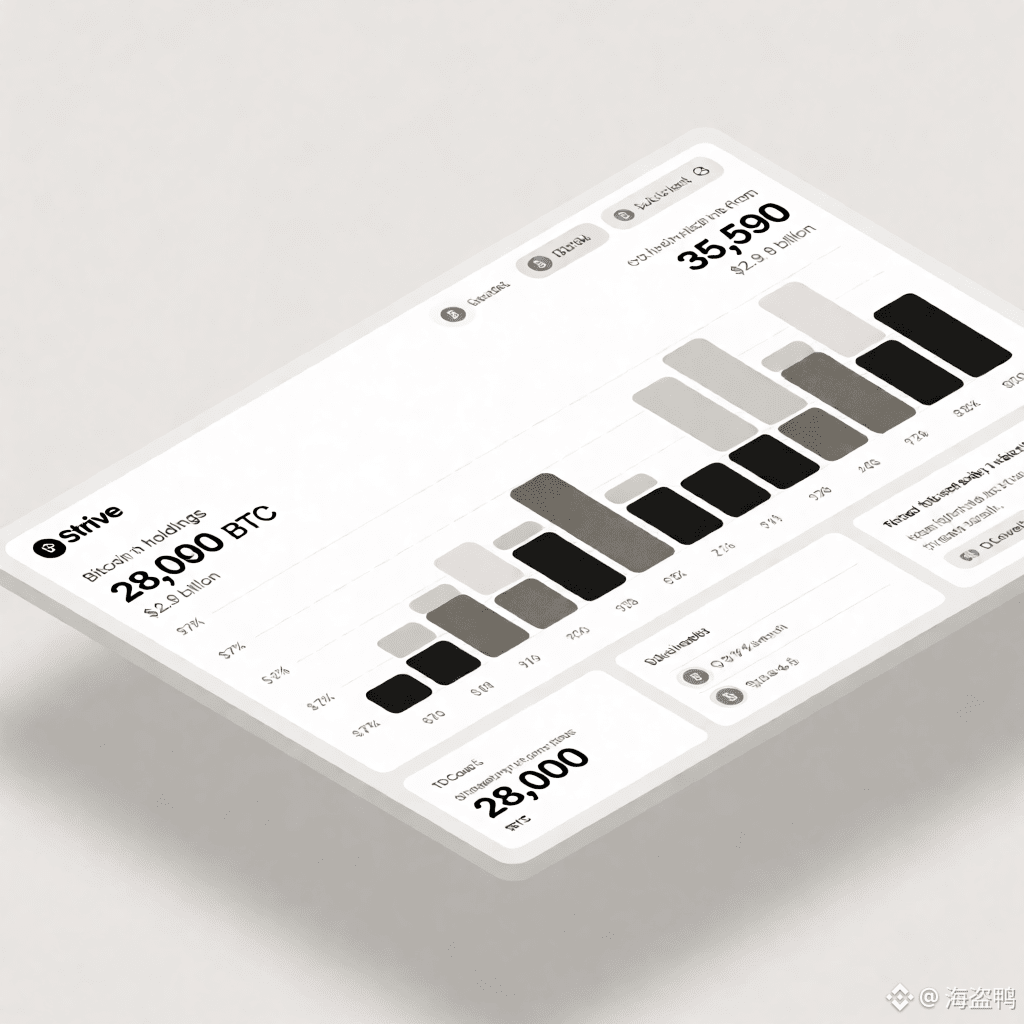
Strive’s BTC holdings surged from 28,000 at the end of September to 35,595, worth about $2.9 billion—an increase of 7,600 BTC in two weeks, exceeding TD Cowen’s forecast of 4,750 for the entire fourth quarter.
The pace was 3,311 BTC on Tuesday and 2,822 on Wednesday. Strive is now the fourth-largest publicly traded company holding BTC, narrowly ahead of MARA. TD Cowen raised its price target from $44 to $56.
But the money isn’t cheap: SATS expanded its preferred stock offering to 7 million shares at $90 each, targeting $630 million, with closing set for October 20. ASST fell 6.6% on Friday to $23.96.
I’m inclined to think the key isn’t how much they bought, but the fixed cost burden—if BTC’s gains don’t outpace the preferred stock dividends, the flywheel runs in reverse. Are you betting that $BTC will keep pushing the price higher, or that the financing structure can keep turning for another quarter?
343
·
--
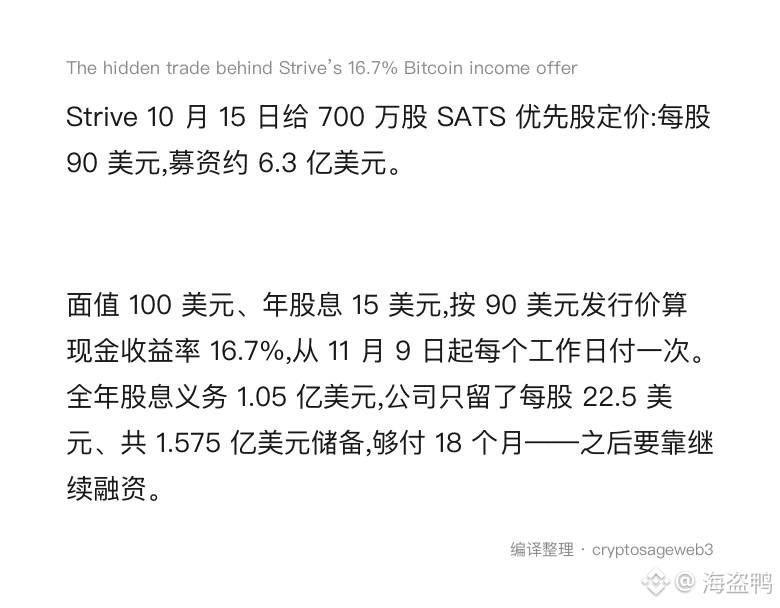
On October 15, Strive priced 7 million shares of SATS preferred stock at $90 per share, raising approximately $630 million.
With a $100 face value and an annual dividend of $15, the cash yield at the $90 offering price is 16.7%. Payments begin on November 9 and are made every business day. The annual dividend obligation is $105 million, but the company has set aside only $22.50 per share, or $157.5 million in total—enough to cover 18 months. After that, it will need to keep raising capital.
What really matters is the order of priority: these shares rank ahead of common stock, but behind existing SATA preferred stock, debt, and certain subsidiary obligations. Nor is there any guarantee that all the proceeds will be used to buy BTC.
My take: 16.7% isn’t a premium handed out for free; it’s the price of a liability. Bitcoin generates no cash flow, so the dividends can only be sustained through liquidity and refinancing. A larger total holding doesn’t mean more BTC backing each share.
So, given the same amount of money, would you choose a BTC treasury preferred stock with a 16.7% coupon, or buy spot $BTC ?
137
·
--
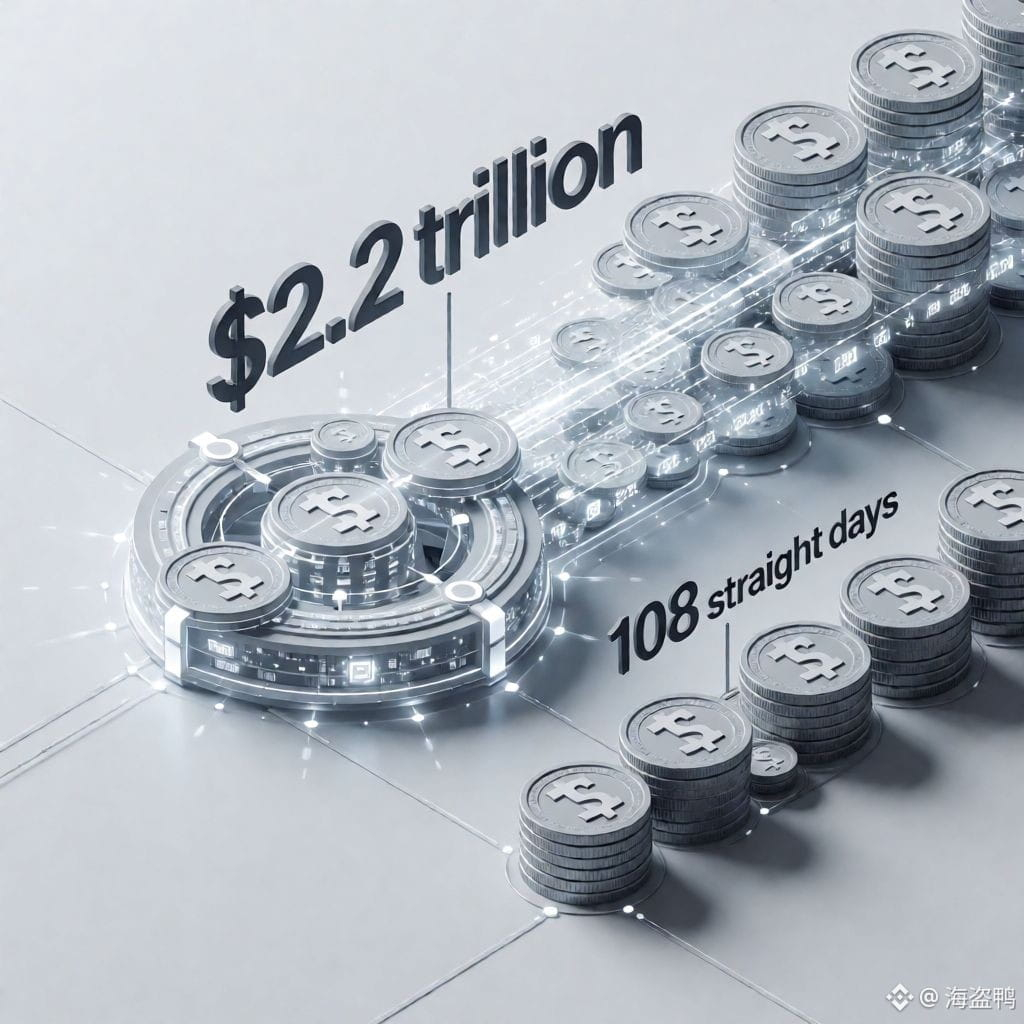
TRON settled $2.21 trillion in stablecoins in Q3, up 5.1% quarter over quarter, with on-chain USDT+USDD balances of $93.88 billion.
The other side of the story: from July 1 to October 16, TRX supply increased every day for 108 days. In Q3, 360.2 million tokens were issued and 234.5 million were burned, for a net increase of 125.8 million. In the first 16 days of October, another 22.9 million were added, bringing the total to about 148.6 million.
The key is the mechanism: bandwidth and energy are obtained through staking and replenish on a rolling 24-hour basis, so no matter how many transactions there are, they don’t burn underlying TRX. Issuance, however, is fixed per block. In the first half of October, burns covered just 63.5% of issuance. So I’m inclined to think the narrative that “high settlement volume = deflation” has run its course—stakers get the newly issued TRX, while passive holders bear the dilution.
If you hold $TRX , would you stake to earn rewards, or accept this dilution?
100
·
--
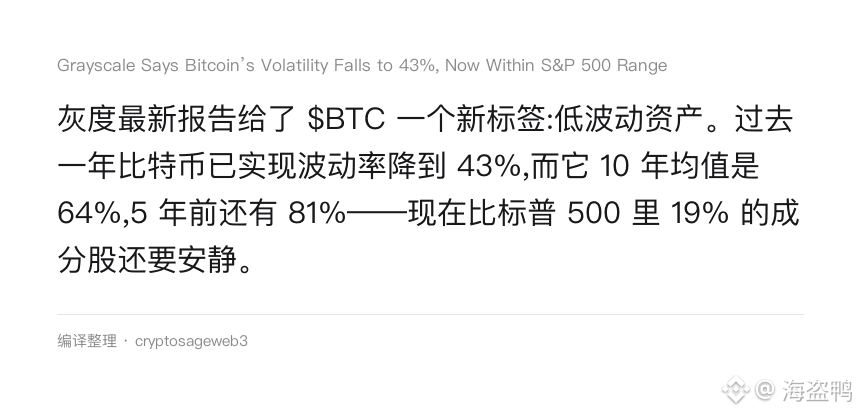
Grayscale’s latest report gave $BTC a new label: low-volatility asset. Bitcoin’s realized volatility fell to 43% over the past year, compared with a 10-year average of 64% and 81% five years ago—making it quieter than 19% of S&P 500 constituents.
The report, authored by Head of Research Zach Pandl, attributes this to deepening liquidity, institutional participation, and regulated channels such as spot ETFs. What it really means isn’t that “Bitcoin has become boring,” but that the question has shifted from “Should I buy a high-volatility asset?” to “How large should my position be?”
I tend to think this narrative is useful, but don’t treat it as a conclusion: Grayscale itself also cautions that one year of data isn’t enough to define risk across market cycles, and a plunge like the one in March 2020 could still happen again.
At 43% volatility, do you think Bitcoin is stable enough to support larger institutional allocations—or does this look more like self-reassurance in the middle of a bull market?
106
·
--
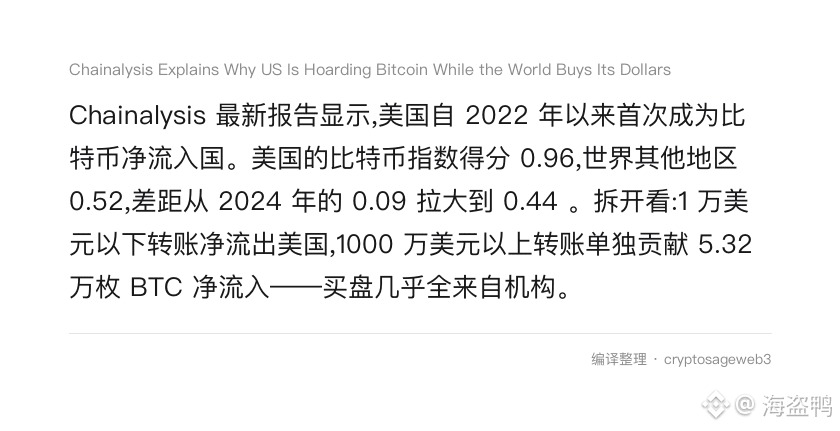
Chainalysis’s latest report shows that the U.S. has become a net recipient of Bitcoin inflows for the first time since 2022. The U.S. Bitcoin index score is 0.96, compared with 0.52 for the rest of the world, widening the gap from 0.09 in 2024 to 0.44. Breaking it down: transfers under $10,000 show net outflows from the U.S., while transfers over $10 million alone account for net inflows of 53,200 BTC—the buying is almost entirely coming from institutions.
The stablecoin index shows the exact opposite: 1.00 for the rest of the world and 0.56 for the U.S. Dollar stablecoins account for 99.1% of stablecoin order-book trading volume, and most of their reserves are in short-term U.S. Treasuries.
My take is that these are two sides of the same coin: foreigners use stablecoins to access dollars, while U.S. institutions use ETFs to scoop up Bitcoin; the latter is far less stable, as institutional allocations follow risk appetite.
The question is: with marginal buying for $BTC increasingly reliant on U.S. institutions, if we see another sell-off in chip stocks like last week’s, will this layer of buyers be the first to pull out?
187
·
--
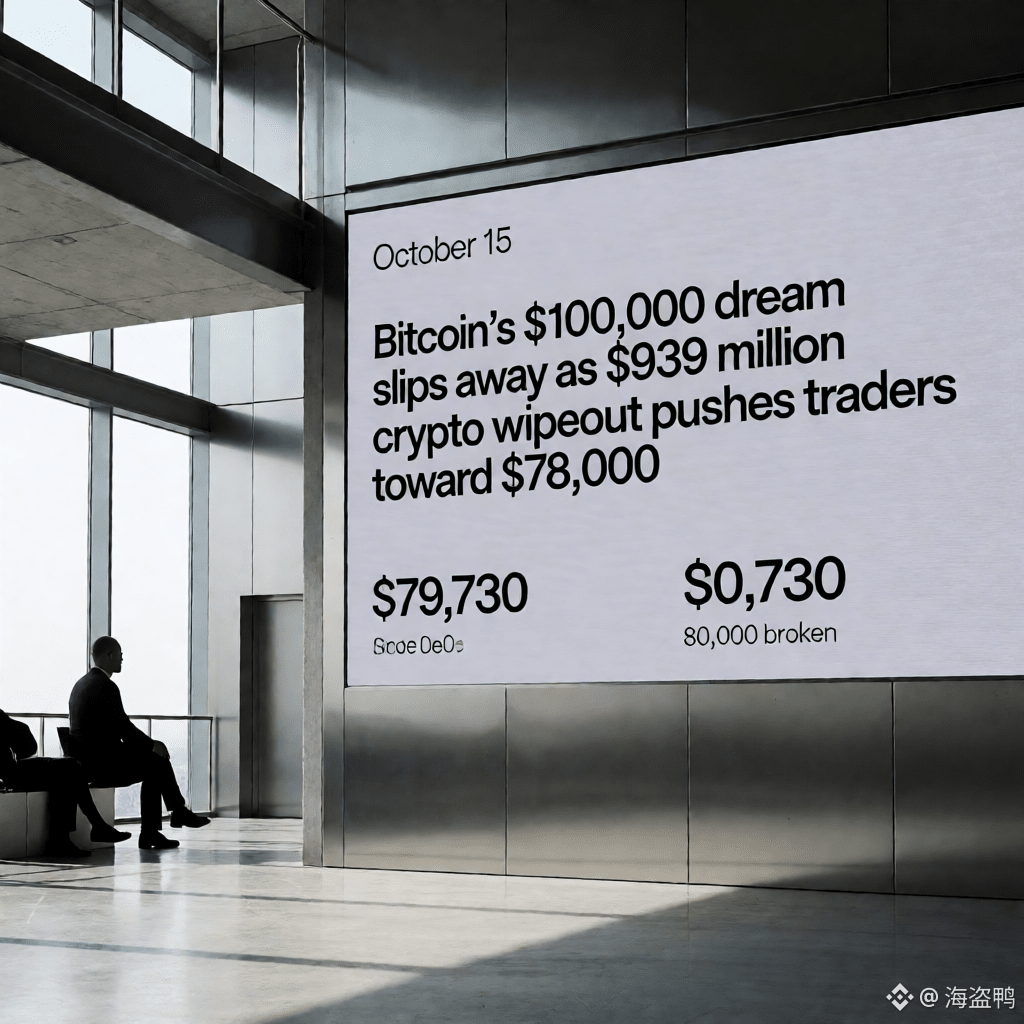
On October 15, Bitcoin fell to $79,730 intraday, dropping below $80,000 for the first time in a month. The trigger was macroeconomic: U.S. September PPI came in at 6.3% year over year, far above the 5.5% expected, with wholesale gasoline prices up 20.3%.
Leveraged longs paid the price: nearly $940 million was liquidated over 24 hours, about 176,000 traders were forced out, and more than 90% of the liquidations were long positions. Spot ETFs also saw net outflows of about $261 million that day.
I tend to think this was inflation trading spilling over into crypto, not a problem with crypto itself. ETF outflows and overcrowded long positions were what amplified the drop, with $80,000 sitting right around the cost basis for ETF holders.
So the key question isn’t whether $80,000 holds, but whether CPI surprises to the upside again. Do you think $BTC will first rebound to $85,000, or head straight down to test $78,000? #BitcoinSpotETFsSee261MillionInSingleDayOutflows
207
·
--
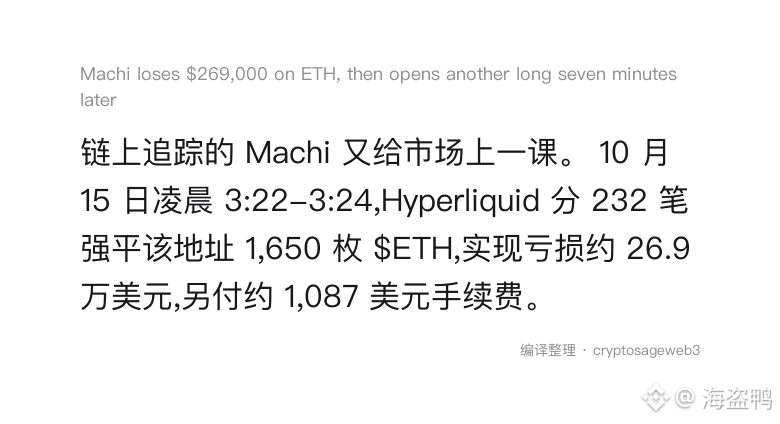
Machi, tracked on-chain, has taught the market another lesson. From 3:22 to 3:24 a.m. on October 15, Hyperliquid liquidated 1,650 $ETH from that address in 232 separate liquidations, realizing a loss of about $269,000 and paying another $1,087 in fees.
The key was the timing: just 6 minutes and 55 seconds after the final liquidation ended, it started buying again. By 3:56 a.m., it had built a 320 ETH long position at an average price of about $2,355; by 1:16 p.m., it had increased that to 2,500 ETH at an average price of about $2,370. Meanwhile, 250,000 USDC had been moved into its spot balance—the ammunition was ready in advance.
I wouldn’t read this as “conviction.” It looks more like standard practice for a high-leverage trader: what they lost was margin, not the playbook.
$ETH just fell below 2,400. If it were you, would you follow and buy around 2,300, or first take leverage down to zero and wait for a clear direction?
54
·
--
AI infrastructure stocks were slaughtered this week: NBIS plunged 10.1% to $186 on October 14, then fell about 6% again on Friday, retreating roughly 27% from the previous week’s high.
The trigger wasn’t demand—it was the cost of financing. Yields on a $1.25 billion CoreWeave bond briefly surged to around 15%, CDS spreads topped 1,000 basis points, and a “Yikes” in a repost set off Wednesday’s sell-off. Highly leveraged compute companies took the hit first, with Gartner warning that more than 80% of neoclouds may not be able to operate independently by 2030.
My take: This is a repricing of the “borrow to build compute capacity” model, not a rejection of AI demand. $NBISB returning to its 200-day moving average is the level worth watching.
This sector and crypto share one key variable: rate-hike expectations. Would you choose $BTC and wait for rate cuts, or bet that AI infrastructure rebounds first?
#AI and semiconductor stocks lost over $1 trillion in market value this week
109
·
--
Charles Hoskinson said on October 18 that he and IOG engineer Lucas Rosa are writing a new language for Cardano: intent-based transactions, proof-carrying data (PCD), and Groth16 zero-knowledge proofs. No name, source code, or timeline has been provided.
The numbers are striking: ADA has a market cap of about $8.3 billion, while total value locked across Cardano DeFi is only $63 million. Weekly trading volume is $8.35 million, down 25% week over week, and the network’s stablecoin supply is about $70 million. By comparison, Solana’s DeFi deposits are more than 90 times higher.
So here’s my take: what ADA lacks isn’t a language—it’s demand. Holders treat it as a store of value, not as on-chain collateral, and the 65-fold increase in throughput promised by Leios won’t change that ratio.
$ADA In this rally, are you adding to your position or trimming it?

21
·
--
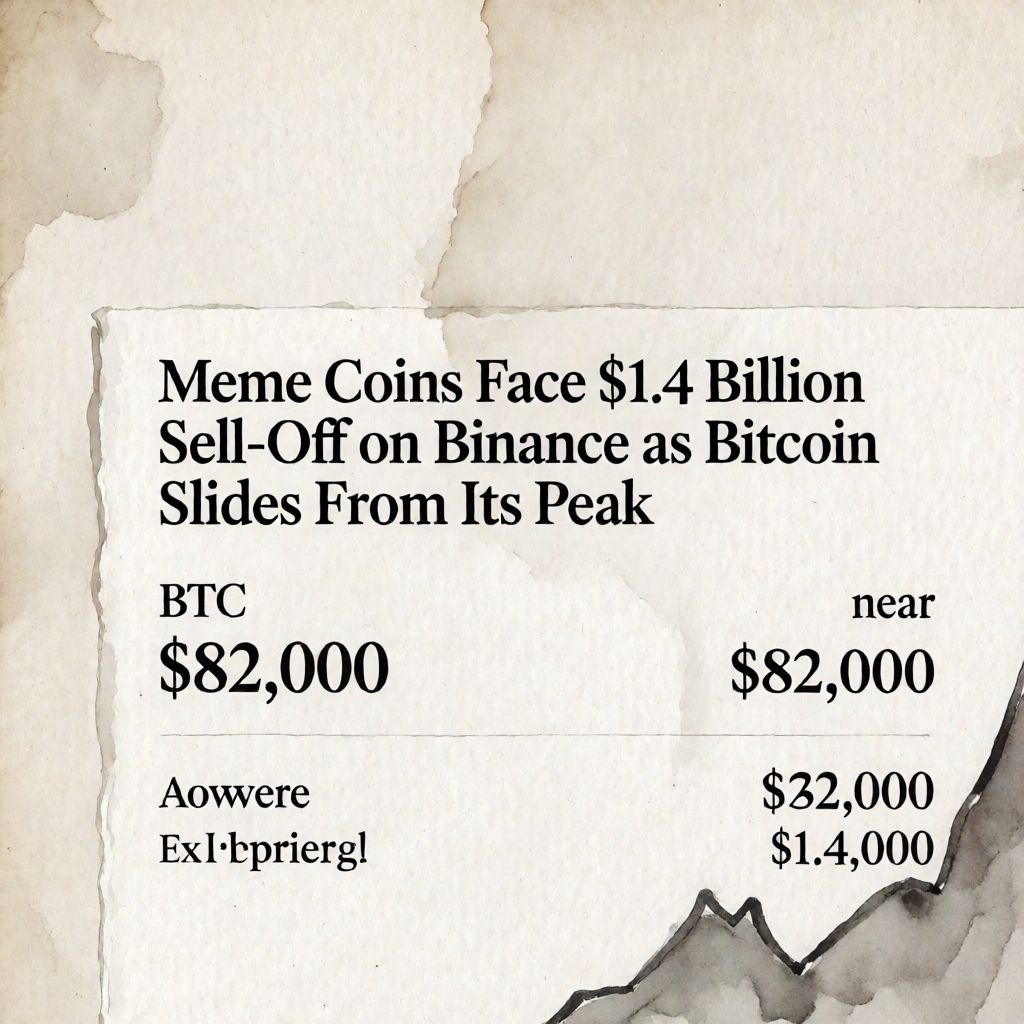
CryptoQuant data: since Bitcoin peaked in October, cumulative sell pressure on meme coins on Binance has already exceeded $1.4 billion. $BTC is currently barely fluctuating above $82,000, still about 35% below its peak.
The decline is very clear: $DOGE and SHIB are down about 9% in a week, WIF more than 10%, TRUMP more than 12%, BONK and FLOKI each more than 15%, and MemeCore more than 19%. But the structure is more important — the share of meme coins in total altcoin market cap has fallen below 3%, the lowest on record.
My view is: this time, the altcoin season was not delayed, but skipped entirely. Money did not flow from memes into mainstream altcoins; it left the market instead — the overall risk budget was cut. That 3% figure shows there was simply no buying support.
Do you still have meme positions? After DOGE fell 9%, would you add or cut?
#BitcoinBackAbove82000
69
·
--
BitMine bought another 12,535 ETH, bringing its holdings to 6.04 million as of October 18—about 4.9% of ETH’s total supply. Of that, 5.07 million ETH has been staked.
Tom Lee’s reason for this purchase wasn’t ETH’s own narrative—it was South Korea. From October 1 to 16, the KOSPI fell 17%; Samsung Electronics dropped 19.74%, and SK Hynix fell 28.38%. For four consecutive days leading up to October 16, liquidations exceeded 50 billion won a day. He said concerns over AI financing, US-Iran tensions, the midterm elections, and bond yields were prompting investors to de-risk. And because many investors in the US, South Korea, and Taiwan are heavily positioned in crypto, it got caught in the fallout.
I agree with the direction, but not the timing. A selloff driven by liquidations doesn’t end when fundamentals improve—it ends when leverage has been cleared out.
That’s why the final leg down is the fastest, and the rebound is the strongest. What matters is when liquidations in South Korea hit zero—not the narrative.
$ETH : add now, or wait until the liquidations stop?
#BitMineAdds12535ETH
28
Log in to explore more content
Join global crypto users on Binance Square
⚡️ Get latest and useful information about crypto.
💬 Trusted by the world’s largest crypto exchange.
👍 Discover real insights from verified creators.
Email / Phone number
Trending Topics
BinanceReports80%Recoveryof$6.3BillioninLossesfromHackIncident
321 views
30 Discussing
Binance News Update | Binance Co-CEOs Say 80% of the $6.3 Billion Loss Is Already Covered, With Withdrawals Restarting in Phases and Proof of Reserves Due Monday
Binance News
·184 Likes
·161.3k views
HeYiSaysWithdrawalsExpectedtoResumeWithin42Hours
50 views
30 Discussing
CZSaysCompensationIsinPlaceUsersAreProtected
2 views
16 Discussing