
加密野狼
399 Posts

加密野狼
 Square Verified
Report
Block User
X:@cryptionwolf
Web3从业者|神龙社区发起人|金狗捕手|多个大社区主讲|专业承接宣发|开发|商学院,持续扎根加密圈全靠ip信誉生存,欢迎交流
Open Trade

BNB Holder
High-Frequency Trader
9.3 Years
861 Following
56.2K+ Followers
22.1K+ Liked
Posts
Portfolio
All
Quotes
Live
·
--
Late-night thoughts
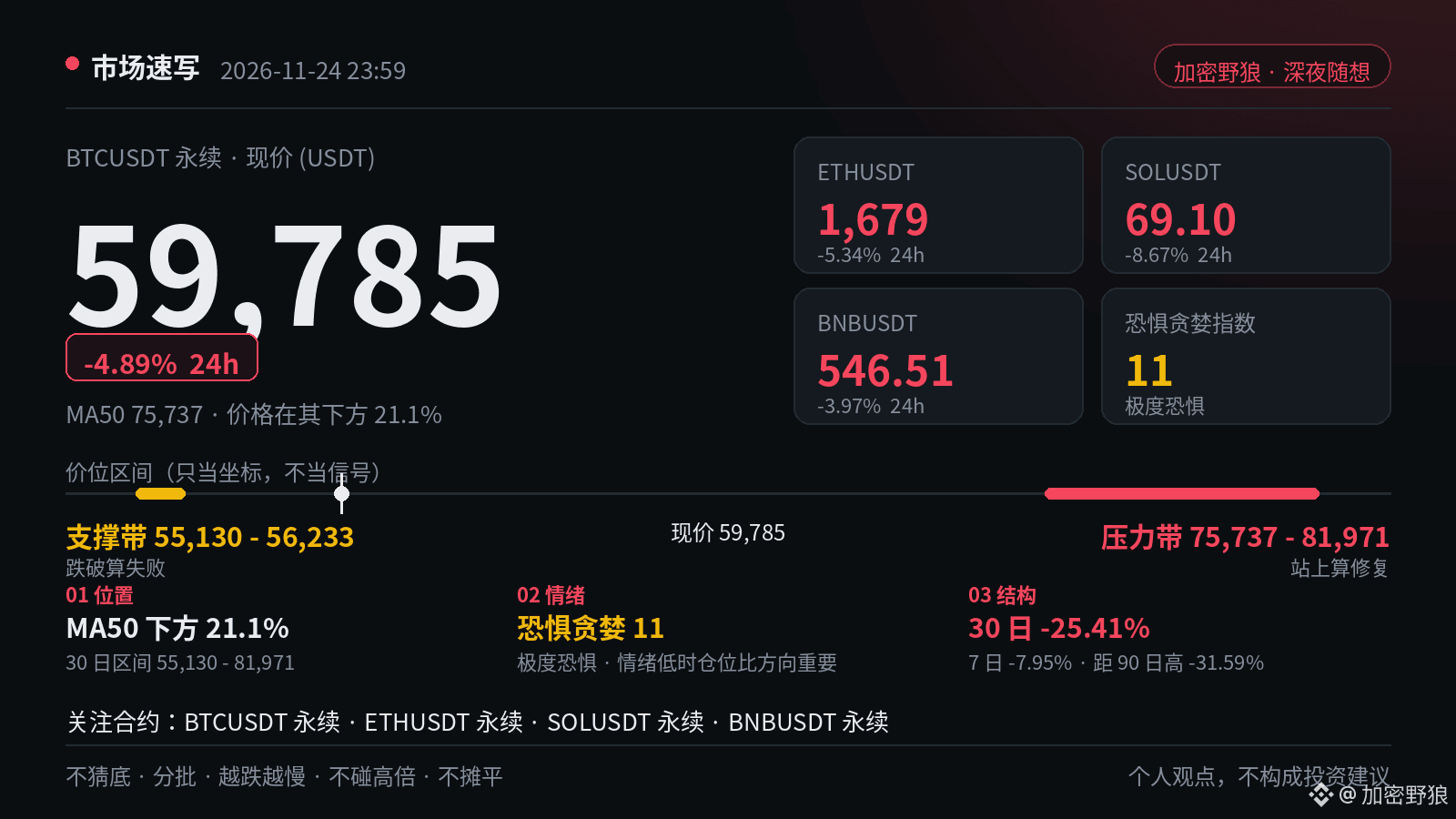
BTC price: 59,785 USDT, 24h -4.89%, low 59,391. Fear & Greed Index: 11, funding rate: +0.0024%/8h, long/short ratio: 2.45, open interest: 98K BTC. The drop is sharp, and sentiment is cold.
Price is 21.1% below the MA50. Support zone: 55,130 - 56,233; resistance zone: 75,737 - 81,971. These are reference points for observation only: a break below indicates failure; holding above indicates recovery.
First, the funding rate remains positive at +0.0024%/8h, and the long/short ratio is 2.45, which means longs have not been fully flushed out. Structurally, a rebound could easily face pressure from position reductions, with the risk tilted toward choppy price action. First watch the intraday low at 59,391, then the support zone at 55,130 - 56,233. This is a probability assessment, not a definitive conclusion.
Second, the 30-day change of -25.41% means the medium-term trend has been damaged. Structurally, treat any rebound as a recovery attempt for now; unless price gets above the resistance zone at 75,737 - 81,971, a bounce does not signal that the trend has returned. The risk is increased volatility amid extreme fear. Watch first to see whether the support zone at 55,130 - 56,233 gives way; for signs of recovery, look to that resistance zone.
Crypto Wild Wolf's view: At a level like this, information matters more than action. I’m watching whether the funding rate and long/short ratio for BTCUSDT perpetuals cool off, as well as the performance of ETHUSDT perpetuals, SOLUSDT perpetuals, and BNBUSDT perpetuals in the same sector. I won’t chase volatility or call a direction.
Are you more focused on the support at 55,130 - 56,233, or recovery toward 75,737 - 81,971?
Personal opinion only; not investment advice.
638
·
--
I took a quick look at the market late at night: BTC is currently at 59,888 USDT, down 5.58% over 24 hours. The intraday high was 63,487 and the low was 59,391. It’s down 7.79% over 7 days and 25.28% over 30 days, and sits 31.47% below its 90-day high. Put these numbers together and I don’t need to say much more—you can draw your own conclusions.
In terms of price levels and structure, the price is 20.9% below the MA50 at 75,739, with the MA20 at 67,579 also hanging overhead. The 30-day range is 55,130–81,971, and the current price is hugging the lower end. The support zone is 55,130–56,233; use it as a reference point, and a break below it would count as a failure. The resistance zone is 75,739–81,971; getting above it would signal a recovery. Keep in mind, these are just reference points, not buy or sell signals.
First, sentiment has reached an extreme. The Fear & Greed Index is at 11, indicating extreme fear; the account long/short ratio is 2.45, meaning longs are still crowded; and the funding rate is +0.0024%/8h, still positive. This suggests leveraged longs haven’t been fully flushed out, making rallies vulnerable to pressure and declines prone to accelerating. Second, among its peers, ETH is at 1,678 (-6.24%), SOL at 68.80 (-10.11%), and BNB at 547.16 (-4.81%). SOL has fallen the most, suggesting that high-volatility assets are under pressure and capital is seeking relatively safer places. Third, futures open interest stands at 97K BTC, a substantial amount. Structurally, this favors consolidation through volatility rather than an immediate, decisive move in one direction. Crypto Wild Wolf believes it’s too early to talk about a trend reversal; more likely, the market will repeatedly test the support zone.
My approach is simple: don’t try to call the bottom or chase shorts. I’m treating 55,130–56,233 as an observation line and 75,739–81,971 as a recovery line. Between those levels, I’ll watch more and trade less, while keeping some room in my position sizing. Crypto Wild Wolf is sharing this simply to record my own observations, not to tell you what to do.
Are you sitting on the sidelines with no position, or have you already given up and gone limp?
#BTC #比特币 #ETH #行情分析 #Risk Management
Personal opinion; not investment advice.
340
·
--
Morning market snapshot: BTC is currently at 60,291 USDT, down 4.96% over 24 hours, with an intraday high of 64,603 and a low of 59,391. It’s down 7.17% over 7 days and 24.78% over 30 days, and sits 31.01% below its 90-day high. Taken together, these numbers show that this is not a tedious sideways phase, but a genuine downtrend.
In terms of price position and structure, BTC is below MA20 (67,600) and MA50 (75,747), sitting 20.4% below MA50. The medium-term moving averages are clearly overhead. The 30-day range is 55,130–81,971, and the current price of 60,291 is near the lower end of that range. Other coins in the sector—ETH at 1,698 (-5.84%), SOL at 70.17 (-7.90%), and BNB at 550.66 (-4.45%)—are falling even harder than BTC. This suggests a sector-wide risk-off move, not an issue with any single coin.
Crypto Wolf’s view comes down to three points. First, sentiment has reached extreme fear, with a Fear & Greed Index reading of 11. Such readings often coincide with a concentrated wave of panic selling, but they only show that sentiment is extreme; they don’t mean the price has bottomed. Sentiment can remain depressed for a long time. Second, the funding rate is still positive at +0.0038%/8h, the long/short account ratio is 2.50, and open interest is 97K BTC. Long positions remain crowded, which means rebounds may face selling pressure as traders reduce positions. A structural recovery won’t happen overnight. Third, from a probability standpoint, the price is holding above the support zone of 55,130–56,233, making this a period to watch amid weakness. The resistance zone of 75,747–81,971 is far from the current price, so it’s too early to talk about a short-term recovery.
Here’s what I’m doing: I’m not trying to call the bottom. I’m treating 55,130–56,233 as a reference zone to watch. A break below it would mean this structure has failed; getting above the resistance zone would signal a recovery. In between, I’m treating price action as range-bound, managing position sizes, and keeping room to maneuver. Uncertainty is always present. My job is to assess the levels clearly, not to make definitive predictions about direction.
Are you choosing to stay on the sidelines, or have you already started adjusting your positions in stages?
#BTC #比特币 #ETH #行情分析 #Risk Management
These are personal opinions and do not constitute investment advice.
271
·
--
Morning market snapshot: BTC is currently at 60,130 USDT, down 5.29% over 24h. Intraday high: 64,603; low: 59,391. Down 7.39% over 7 days and 24.96% over 30 days, and 31.18% below the 90-day high. Fear & Greed Index: 11, indicating extreme fear.
Position and structure: Price is 20.6% below the MA50. The MA20 at 67,592 and MA50 at 75,744 are both overhead, putting pressure on price. The 30-day range is 55,130–81,971, and price is now near the lower end. The support band is 55,130–56,233; the resistance band is 75,744–81,971. Treat these only as reference points: a break below the support band would mean the structure has failed, while reclaiming the resistance band would indicate a recovery. The range between them is more likely to be choppy. The funding rate is +0.0037%/8h, the account long/short ratio is 2.59, and open interest is 97K BTC. Long positions are still crowded, suggesting leverage has not been fully cleared. With this structure, rebounds are vulnerable to being pushed back down.
Crypto Wild Wolf’s take: First, being 20.6% below the MA50 is a deep deviation. Historically, deviations like this may revert toward the mean, but that doesn’t mean it will happen immediately; the odds point more toward repeated tests of the lows than a straight move up. Second, a long/short ratio of 2.59 alongside extreme fear at 11 shows a disconnect between sentiment and positioning. Crowded longs can amplify downside moves. Third, peers in the same sector are also weak: ETH at 1,692 (-6.00%), SOL at 69.97 (-7.90%), and BNB at 549.19 (-4.63%). There are no standout assets showing independent strength, suggesting this is a sector-wide correction rather than an issue with a single coin.
Crypto Wild Wolf’s approach: Don’t try to guess the bottom. First watch whether the 55,130–56,233 support band holds; if it doesn’t, keep waiting for the structure to develop. Until price reclaims the 75,744–81,971 resistance band, treat any rebound as a recovery attempt. Keep room in your position and make no directional commitments.
Are you more concerned about whether the support band will hold, or when the long/short ratio will come down?
#BTC #比特币 #ETH #行情分析 #Risk Management
These are personal opinions and do not constitute investment advice.
256
·
--
Evening recap: BTC is currently at 60,091 USDT, 24h -1.94%, with an intraday high of 64,603 and a low of 59,391. First, make the position clear, then talk about the view.
Position and structure: Price is below MA20 67,589 and MA50 75,743, about -20.7% away from MA50. 7 days -7.48%, 30 days -25.03%, -31.25% from the 90-day high, with the 30-day range at 55,130 - 81,971. In the same sector, ETH 1,693 (-1.81%), SOL 69.94 (-3.57%), BNB 548.96 (-1.33%) are all broadly weak in sync, with no one clearly moving against the trend. On sentiment, the fear and greed index is 11 (extreme fear), funding rate is +0.0041%/8h, long/short ratio is 2.59, and futures open interest is 97K BTC. Price is in a deep decline zone, yet long positions remain relatively crowded; this is an asymmetry worth noting structurally.
Crypto Wild Wolf's view: First, we are currently near the lower edge of the 30-day range. 59,391 is today's low, and 55,130 - 56,233 is the support band below; treat it only as an observation point. Breaking below it means weakness continues, not that it tells us how far it will fall. Second, 75,743 - 81,971 above is the resistance band, overlapping with MA50 and far from the current price. It is too early to talk about a recovery in the short term; only reclaiming it counts as a structural improvement. Third, extreme fear combined with a relatively bullish long/short ratio shows sentiment and positioning are not aligned, so the probability of two-way volatility is not low. I do not treat either side as a definite answer.
Crypto Wild Wolf shares my approach: do not chase the drop, do not guess the bottom. Treat 55,130 - 56,233 and 75,743 - 81,971 as two coordinates. In between, reduce activity and wait for the structure to give a signal on its own; keeping room in the position is more important than being right or wrong.
What concerns you more: whether the lower support band can hold, or when the upper resistance band will be reached?
#BTC #比特币 #ETH #行情分析 #RiskControl
Personal opinion, not investment advice.
186
·
--
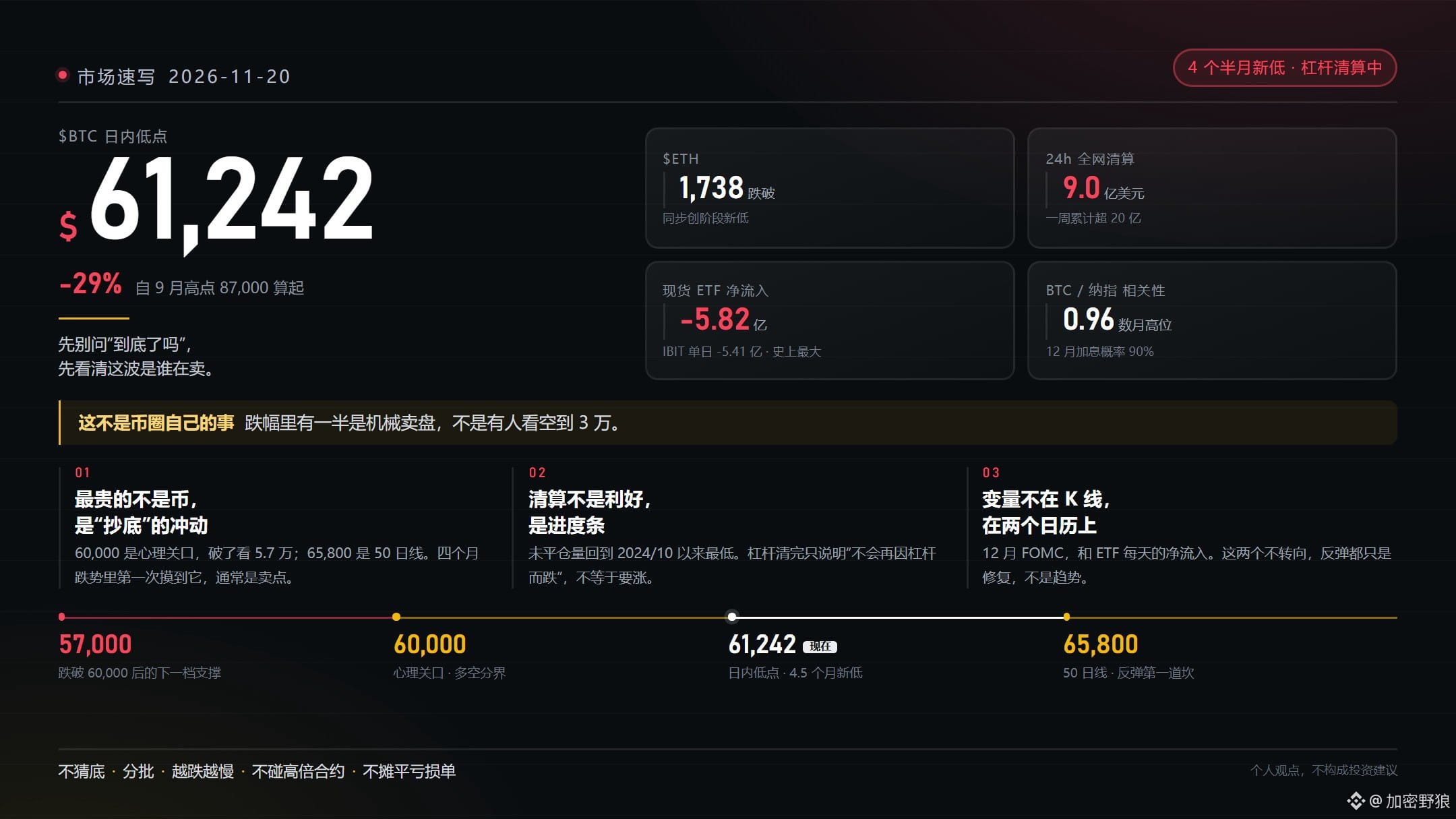
$BTC wicked down to 61,242, a four-and-a-half-month low; $ETH fell below 1,740. From September’s high of 87,000, this cycle is now down 29%.
Crypto Wild Wolf’s take: Don’t rush to ask, “Is this the bottom?” First, figure out who’s actually selling.
📉 This isn’t just a crypto market issue. BTC’s correlation with the Nasdaq has climbed to 0.96, near a multi-month high. October CPI came in hotter than expected, Fed minutes were hawkish, and the market priced in a 90% chance of a December rate hike—risk assets are all being drained of liquidity. Leveraged longs were forcibly liquidated when the order book was at its thinnest: $900 million in liquidations in 24 hours, and over $2 billion in a week. Half the decline is mechanical selling, not someone betting that Bitcoin will fall to $30,000.
🏦 Institutions are the ones really pulling out. On the 19th, spot BTC ETFs saw net outflows of $582 million. BlackRock’s IBIT saw $541 million in outflows in a single day, its largest daily outflow since launch; cumulative outflows in November are around $3.47 billion. ETFs are the faucet for this cycle. Until that faucet is turned back on, it’s too early to talk about a trend reversal.
Crypto Wild Wolf’s three takeaways:
1|The most expensive thing right now isn’t crypto—it’s the urge to “buy the dip.” 60,000 is a psychological level; if it breaks, the next level to watch is around 57,000. The first hurdle on a rebound is 65,800 (the 50-day moving average). In a four-month downtrend, the first test of the 50-day moving average is usually not a starting point, but a selling opportunity.
2|Don’t mistake liquidations for good news, but you can treat them as a progress bar. Open interest has fallen to its lowest level since October 2024, so much of the leverage has been washed out. That only means “we’re less likely to fall further because of leverage”—it doesn’t mean “prices are going up.” A rally needs fresh money, not just fewer people losing money.
3|The key variables aren’t on the charts; they’re on two calendars: the December FOMC meeting and daily net ETF flows. Until both turn around, every rebound is just a recovery, not a trend.
🧊 What I’m doing: Not trying to call the bottom; buying in batches, more slowly as prices fall; avoiding high-leverage contracts; and not averaging down on losing positions. After a 29% drop, what matters most to protect isn’t opportunity—it’s your capital.
A bottom is a zone, not a single wick. What you can control has never been the price, but your position size and pace.
Did you place an order today? Share your position in the comments 👇
#BTC #比特币 #ETH #行情分析📈
⚠️ The above is my personal opinion and does not constitute investment advice. Futures trading involves risk; use leverage with caution.
1
3
984
·
--
In 2017, Sun Yuchen said he wouldn’t buy a car, buy a house, or get married before turning 30.
Today, this guy says: Don’t buy boomer assets or play with boomers. Who counts as a boomer? Anyone born before 1980. What are boomer assets? Collectibles, antiques, paintings and calligraphy, real estate, stamps, jade, jadeite, and cars.
Red envelope giveaway at the bottom 🧧
My take: anything with poor liquidity is a boomer asset.
New assets must have exceptional liquidity.
Exceptional liquidity means exceptionally fast capital turnover. With 5 million, earning 10% a month and turning it over 12 times a year, without reinvesting profits, you could theoretically reach a 120% profit rate.
Even if the return is 50%, but the capital can only be turned over 1.5 times a year...
Why does the crypto industry still attract people, despite all the mixed opinions and varying quality? Because capital efficiency is extremely high, and high capital utilization can bring high returns.
For example, staking YES to mine YES: one cycle lasts 50 days, with mining returns of around 35.
Why? Because YES generates its own revenue: platform earnings, paid features, and quantitative trading. At the same time, staking burns 10% of every YES transaction, and each transaction brings in sufficient buy orders. Strong data attracts players from around the world to trade and hold together, creating a virtuous cycle.
Why are all kinds of court-auction properties and various wildly overpriced assets sitting unsold? Essentially, it’s because they have poor liquidity, so they’re not worth buying. Once you buy a fixed asset, your money is tied up in it. Wherever you are becomes home, and what you own ends up controlling you.
🧧 Follow, repost, and reply: YES
#defi #质押 #挖矿算力 #YES
2.1k
2
126
2.1k
·
--
I believe Binance can solve this perfectly.
I believe Binance can solve this perfectly.


Binance Announcement
·
--
Security Incident Update (2026-10-30)
This is a general announcement. Products and services referred to here may not be available in your region.
Fellow Binancians,
Binance's initial investigation suggests that the security incident may involve a compromised DevOps engineer’s laptop, which allowed an attacker to gain access to a service container and submit unauthorized withdrawal transactions. We have found no evidence of any wallet private key leak. We will share a detailed technical post-mortem once the investigation is complete and the facts are fully verified.
The estimated total impact sits at around $6.3B. We have worked with blockchain partners to freeze affected assets, with ~$3 billion frozen on-chain so far.
Binance will cover all losses from the SAFU fund and the company’s funds. User funds are safe. We will also publish an updated Proof of Reserves once the remediation is complete.
As an immediate precaution, Binance has:
temporarily suspended withdrawals while security checks are completed;revoked the affected address authorisation;engaged law enforcement and blockchain intelligence partners to trace and recover funds.
Our teams are working around the clock to resolve this issue safely and thoroughly. We are working closely with our law enforcement partners to confirm the identity of these criminals and bring them to justice.
Please rely only on official Binance channels for updates. Please feel free to contact Binance Customer Support if you have any further questions.
Thank you for your support!
Binance Team
2026-10-30
Note: This announcement was updated on 2026-10-30 to clarify deposits remain unaffected and continue to operate as normal.
290
·
--
Crypto Wild Wolf — Basic Security Tips:
1. Set up an identity wallet (create sub-wallets only; don’t trade or store assets in it).
2. Set up 1–2 collection wallets (for storing small amounts; only transfer funds, don’t trade).
3. For large assets, use two wallets as cold wallets (no SIM card, no internet; transfer via Bluetooth using the wallet app). Cold wallets should only transfer via QR code.
4. Use sub-wallets for all airdrop-hunting activity, and delete them after use. Transfer any amount over 500 U to your savings wallet.
5. Never install unfamiliar apps on your phone. Ideally, use a dedicated phone.
6. Never connect to unfamiliar Wi-Fi (to protect against hacker malware).
7. Always bring a power bank when going out, and never use an unfamiliar one (to protect against hacker malware).
8. Regularly clear your keyboard’s clipboard.
9. Read the security tips in your wallet at least three times.
#钱包安全 #安全事件
424
·
--
【October 10 BTC Market Update | A Weak Recovery Underway, but Outflows Continue】
BTC is currently at $82,564, up 0.94% over 24 hours, with an intraday high of $83,528 and low of $81,603. Ethereum is at $2,489, up 0.52% over 24 hours, still struggling below the $2,500 mark.
Over the past 24 hours, liquidations across the market totaled $177 million. Short positions accounted for nearly 60% ($106 million), with short sellers taking heavy losses in last night’s rebound.
Fund flows remain the biggest concern: Bitcoin ETFs saw $485 million in outflows on Wednesday, followed by another $244 million on Thursday—a combined $729 million in outflows over two days.
Fidelity’s FBTC led daily outflows at $197 million, while BlackRock’s IBIT saw another $5.54 million flow out on Thursday.
Ethereum ETFs have now seen outflows for eight consecutive days, totaling approximately $641 million.
🔹 Macro: Fed Governor Waller struck a hawkish tone, saying further rate hikes are still needed. Goldman Sachs subsequently raised its forecast, saying rates could be hiked twice more. CME data shows a 17.7% probability of a 25-basis-point hike in December, and an 83.7% probability of cumulative hikes of up to 50 basis points by December.
🔹 What to watch next:
📅 October 14: U.S. September CPI
📅 October 16: Thailand’s new BTC/ETH ETF rules take effect
📅 October 27–28: FOMC meeting
My take: This rebound has shown resilience, but persistent ETF outflows and the weekly pullback suggest the market is still digesting risk. Reclaiming $82,500 doesn’t mean the uptrend has resumed.
In the short term, watch which side of the $80,000–$83,000 range gets decisively broken first. If BTC falls below $80,000, consider actively managing risk; only consider following the trend again after a high-volume move above $83,000.
How are you managing your positions? Share your thoughts in the comments 👇
🧧Repost and comment: BTC
#BTC #ETH #美联储何时降息? #etf #加密货币 $BTC
{future}(BTCUSDT)
【October 10 BTC Market Update | A Weak Recovery Underway, but Outflows Continue】
BTC is currently at $82,564, up 0.94% over 24 hours, with an intraday high of $83,528 and low of $81,603. Ethereum is at $2,489, up 0.52% over 24 hours, still struggling below the $2,500 mark.
Over the past 24 hours, liquidations across the market totaled $177 million. Short positions accounted for nearly 60% ($106 million), with short sellers taking heavy losses in last night’s rebound.
Fund flows remain the biggest concern: Bitcoin ETFs saw $485 million in outflows on Wednesday, followed by another $244 million on Thursday—a combined $729 million in outflows over two days.
Fidelity’s FBTC led daily outflows at $197 million, while BlackRock’s IBIT saw another $5.54 million flow out on Thursday.
Ethereum ETFs have now seen outflows for eight consecutive days, totaling approximately $641 million.
🔹 Macro: Fed Governor Waller struck a hawkish tone, saying further rate hikes are still needed. Goldman Sachs subsequently raised its forecast, saying rates could be hiked twice more. CME data shows a 17.7% probability of a 25-basis-point hike in December, and an 83.7% probability of cumulative hikes of up to 50 basis points by December.
🔹 What to watch next:
📅 October 14: U.S. September CPI
📅 October 16: Thailand’s new BTC/ETH ETF rules take effect
📅 October 27–28: FOMC meeting
My take: This rebound has shown resilience, but persistent ETF outflows and the weekly pullback suggest the market is still digesting risk. Reclaiming $82,500 doesn’t mean the uptrend has resumed.
In the short term, watch which side of the $80,000–$83,000 range gets decisively broken first. If BTC falls below $80,000, consider actively managing risk; only consider following the trend again after a high-volume move above $83,000.
How are you managing your positions? Share your thoughts in the comments 👇
🧧Repost and comment: BTC
#BTC #ETH #美联储何时降息? #etf #加密货币 $BTC
102
6
491
·
--
Write about my own experience in the crypto circle:
In such a complicated era, countless projects/tokens rise and fall
We’ve seen hourly settlement/daily settlement/weekly settlement
I’ve always believed that only continuous building and construction can yield great results
The core of any project is to build flow (retention). Public-chain flow is the foundation—it’s the core of expanding the project’s influence—then you convert it into private-chain flow
Of course, some communities focus on continuously building private-chain flow. In my view as Crypto Wolf (加密野狼), combining private-chain and public-chain flow is what can help you go the distance for the long term, with fast online dissemination
I’ve participated in every listed opportunity that I joined—each had high multiples, or even multi-fold returns
The earliest was joining TRX’s ICO. At that time, 1 ETH = 200,000 TRX. In 2017, it was actually because of Brother Sun’s (Wealth Freedom Revolution Road) that I truly entered the crypto circle
Later, in 2020, I also joined a lot of memes—from the earliest on TRON, to later 🔥 Biclain (碧链), then shifting to the BSC chain (PIG/dogeking/PG/FGD/FREE). I also played on the Ethereum mainnet, ARB/OP/pol/Avalanche/SUI/SOL chains, and I’ve participated in air drops (all kinds of major projects, chain-game air drops, and chain-game play-to-earn)
NFT/inscriptions (I got 85U from Audi 3–5U)/runes. Later, there were the earn-and-burn models of the Free Protocol (represented by BTOK and Doghead—automatic burn percentage in the pool; what was crazy was that at one point it could burn 200% in a day. Now pure burning is basically lukewarm, because once the pool burn is gone, it ends). There are also floor/guarantee mechanisms, only-up-not-down, LP consensus, and buy-sell trailing models (buy X, sell X, then the proceeds automatically accumulate and pull the price)
I’ve also empowered quite a few communities’ business academies. Back then, I was the dean of the business academy. For example, from Dec 2024 to May 2025, Whale Whale was being built continuously—at its peak it was nearly 10,000 BNB in the liquidity pool (the highest was about 80X).
Later, last year through Feb 2026, I also helped empower TRON’s OSK.
Everything I’ve empowered using the Crypto Wolf IP has been good projects (giving participants a chance to earn money)
Right now, I have positions in BNB/UNI/HYPE/ETH on the secondary market
You could say that all along the way, I’ve witnessed too many ups and downs, too many rise-and-fall cycles. Whether you can run fast isn’t the most important. What matters is whether you can survive for a long time—and whether you can help players earn 💰
This year I built a token: in August, it reached 5x, and the project is still developing
Now I’ve connected with a BNB coin memecoin project. The community has real strength and is willing to spend on marketing (without marketing there’s no traffic; without traffic there’s no multiples). Also, they do on-the-ground promotion. If you’re interested, you can go to my profile’s Binance chat group to exchange ideas
🧧 Forward comment: BNB
$BNB
2.6k
8
127
2.6k
·
--
🚨 [Situation Update] The Middle East powder keg has been ignited—yet BTC is trading independently? With 🧧
In the past 72 hours, geopolitics has exploded into chaos:
🇮🇷🇺🇸 The US and Iran have clashed head-on in the Persian Gulf—US forces destroyed five Iranian oil tankers, and Iran fired back with missiles striking US bases in Jordan. Iran has announced it will declare the Strait of Hormuz a “no-go zone,” with daily passage volume falling from 130 ships to just 10. Brent crude has surged toward $100.
🇷🇺🇺🇦 After a brief 3-day ceasefire, fighting in Russia-Ukraine has reignited, with Kyiv again hit by multiple rounds of missile and drone attacks.
Traditional markets are trembling, but BTC is different this time.
In the past, BTC has been highly correlated with US stocks. But during this round of geopolitical conflict—oil prices broke above $100 and gold is rising, while BTC didn’t follow stocks down. Instead, it’s held steady in the $78,000–$80,000 range. The market is pricing in a new narrative: Bitcoin is shifting from a “risk asset” to “digital gold.”
Technical signals also back it up: on September 8, BTC’s 50-day moving average crossed above the 200-day moving average, forming a “golden cross”—the first time since November 2025. In the past three weeks, US spot Bitcoin ETFs saw net inflows of up to $3.8 billion, marking the strongest institutional buying record of 2026.
But don’t get too excited yet—the next 48 hours is the real battleground:
📅 September 10 PPI data
📅 September 11 August CPI data (key!)
📅 September 15–16 FOMC meeting
At present, CME pricing for September rate hikes has surged to 60–66%. If CPI runs hot → the probability of hikes rises further → BTC could jump to $75,000. If CPI is mild → rate-hike expectations ease → BTC may retest $82,000 and even $85,000.
Long vs. short showdown—where do you stand?
🧧 Share like comment: BTC
⚠️ The above does not constitute investment advice—DYOR!
#BTC #cryptocurrency #geopolitics #bitcoin #美联储何时降息?
2.3k
20
190
2.3k
·
--
🧧 Voting giveaway:
Share and comment reply: BNB
🧧 Voting giveaway:
Share and comment reply: BNB
Share and comment reply: BNB
财富密码在BNB
72%
财富密码在社区币
12%
财富密码在MEME币
14%
财富密码在合约
2%
64 votes • Voting closed
2.3k
5
128
2.3k
·
--
🧧 Lucky Draw Voting:
Follow, Repost, and Reply: Boss
🧧 Lucky Draw Voting:
Follow, Repost, and Reply: Boss
Follow, Repost, and Reply: Boss
快牛市开启
51%
慢牛市开启
31%
可能要大跌
18%
65 votes • Voting closed
2.9k
9
138
2.9k
·
--
Sister, you’re awesome PULS
Sister, you’re awesome PULS

Yi He
·
--
I heard that Binance Square is getting popular, so I'm here to test the buzz.

500
·
--
After watching the speech about quantum computing by @CZ , I feel particularly at ease. He was not swayed by anxiety but instead addressed the core issues from an industry perspective—quantum computing is not scary; cryptocurrencies just need to complete the post-quantum algorithm upgrade, and this will ensure a stable landing.
Indeed, the field of cryptocurrency has never been static. From the birth of Bitcoin to now, we have experienced countless technological iterations and consensus divergences; every seemingly tricky issue eventually became an opportunity for industry evolution.
The same goes for quantum resistance upgrades; the debates over upgrade coordination, algorithm selection in a decentralized world, the elimination of some dead projects, and the implementation of wallet migrations... these are all necessary steps toward the maturity of the industry, not a crisis, but an opportunity for ecological purification.
I strongly agree with what he said: encryption is always easier than decryption, and more computing power is always a good thing. This is the underlying logic of encryption and also our confidence to traverse cycles.
Quantum computing is not the end of the industry but a new starting point in the post-quantum era.
Thank you, CZ, for conveying confidence to all practitioners and investors with the vision of an industry leader, and I also look forward to Binance continuing to lead and work with global practitioners to implement post-quantum technology, making cryptocurrency progress more stable and further in technological iterations.

CZ
·
--
Saw some people panicking or asking about quantum computing's impact on crypto.
At a high level, all crypto has to do is to upgrade to Quantum-Resistant (Post-Quantum) Algorithms. So, no need to panic. 😂
In practice, there are some execution considerations. It's hard to organize upgrades in a decentralized world. There will likely be many debates on which algorithm(s) to use, resulting in some forks.
And some dead project may not upgrade at all. Might be a good to cleanse out those projects anyway.
New code may introduce other bugs or security issues in the short term.
People who self custody will have to migrate their coins to new wallets.
This brings to the question of Satoshi's bitcoins. If those coins move, then it means he/she is still around, which is interesting to know. If they don't move (in a certain period of time), it might be better to lock (or effectively burn) those addresses so that they don't go to the first hacker who cracks it. There is also the difficulty of identifying all his addresses, and not confuse with some old hodlers. Anyway, it's a different topic for later.
Fundamentally:
It's always easier to encrypt than decrypt.
More computing power is always good.
Crypto will stay, post quantum.
1
2
12
326
·
--
$Lobster logging into Binance Alpha is indeed unexpected, entry average price 0.00198, today's highest 0.022U, 80% has been sold at a high position, still holding 20% of the bottom position in anticipation, thank you @BinanceCN @CZ @binancezh
To show my happiness, sending 1000U🧧
Old rule: Follow, retweet, and comment: Lobster 666
{alpha}(560xeccbb861c0dda7efd964010085488b69317e4444)
$Lobster logging into Binance Alpha is indeed unexpected, entry average price 0.00198, today's highest 0.022U, 80% has been sold at a high position, still holding 20% of the bottom position in anticipation, thank you @币安中文社区 @CZ @币安Binance华语
To show my happiness, sending 1000U🧧
Old rule: Follow, retweet, and comment: Lobster 666
To show my happiness, sending 1000U🧧
Old rule: Follow, retweet, and comment: Lobster 666

4.9k
110
382
4.9k
·
--
【Crypto Wild Wolf · Alpha First-Mover Profit Practical Edition】
1. What is first-mover profit?
Not insider information, not private equity, not a Ponzi scheme
It is: early detection, early layout, early realization
2. Three first-mover strategies that ordinary people can directly implement
1. On-Chain Data First-Move (Most Stable, Most Legal)
Watch: Whale address movements
Watch: New public chains / new ecosystem capital inflows
Watch: Large amounts of stablecoins entering exchanges
First-move action: Capital enters → Ambush → Sell when the price rises
Do not chase high prices, just ambush
2. Hot Track First-Move (Highest Win Rate)
Only do:
When a new narrative just emerges
Hasn't skyrocketed significantly yet
The leader hasn't multiplied by 10 times
First-move action:
Look for tracks with small market caps and clean fundamentals, lightly ambush
Wait for the heat to spread, then profit and exit
3. Pullback First-Move (Most Suitable for Contracts/Spot Trading)
Do not guess the tops and bottoms of large coins, only do:
Strong coins retracing to key support
Volume stabilizes
Small positions for trial and error
First-move = Enter a step earlier than others, not betting on direction
3. True First-Move Discipline (Can Save Lives)
1. First-move is not going all-in
2. First-move must have stop-loss
3. First-move does not linger in battle, earn the difference in cognition and exit
4. Do not touch Ponzi schemes, do not touch insider schemes, do not touch private models
4. Summary in One Sentence
Crypto Wild Wolf's Viewpoint:
First-move is not about news, it's about rhythm.
When capital is absent, I wait and see; when capital arrives, I enter; when capital is frantic, I exit.
Earn certainty, do not gamble on luck.
Follow, share, and comment: 888

139
1
24
664
Log in to explore more content
Join global crypto users on Binance Square
⚡️ Get latest and useful information about crypto.
💬 Trusted by the world’s largest crypto exchange.
👍 Discover real insights from verified creators.
Email / Phone number
Trending Topics
AnthropicBreaksBelowIPOPriceAmidAISlump
34,062 views
485 Discussing
TradFi News | Micron, Nvidia Lead AI Stock Slide as VIX Jumps Above 32 and Anthropic Falls Below IPO Price
Binance News
·17 Likes
·11.2k views
Bitcoin'sReboundFadesBelow$60K
85,114 views
360 Discussing
WillMarketsStageAThanksgivingReliefRally?
536,062 views
3,409 Discussing