

橘子 _
251 Posts

橘子 _
Report
Block User
推特:@0xaurskyo | Web3 探索 碎碎念
126 Following
4.8K+ Followers
487 Liked
Posts
All
Quotes
Live
·
--
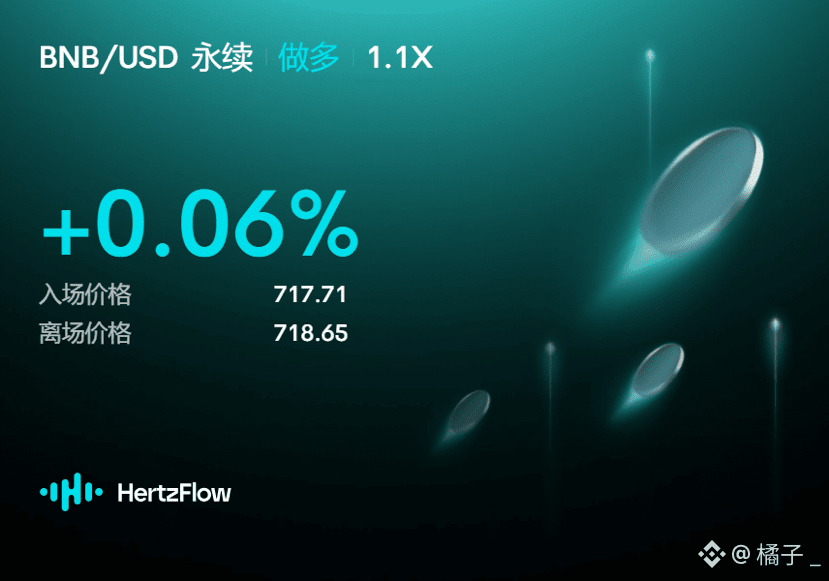
HertzFlow Challenge Day 12
There are two days left—hang in there, and then give it a shot
@HertzFlow_xyz #HertzflowPNL
HertzFlow Challenge Day 12
There are two days left—hang in there, and then give it a shot
@HertzFlow #HertzflowPNL
There are two days left—hang in there, and then give it a shot
@HertzFlow #HertzflowPNL
141
·
--
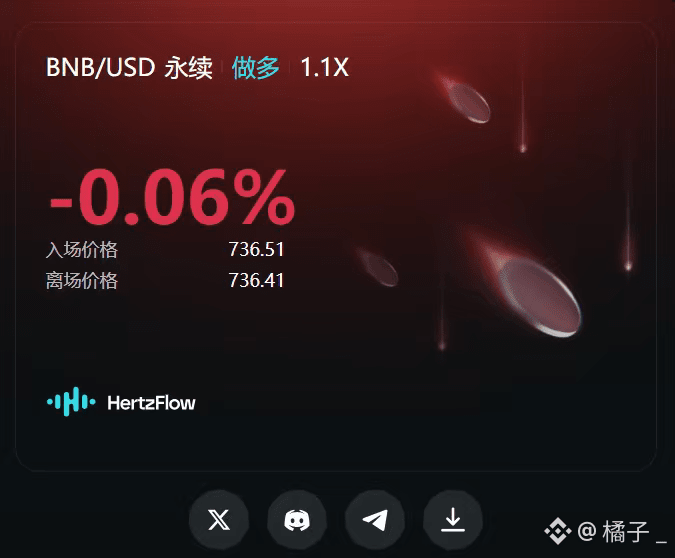
HertzFlow Challenge Day 11
Today we continue trading, opened a $BNB order to try
#HertzflowPNL @HertzFlow_xyz
HertzFlow Challenge Day 11
Today we continue trading, opened a $BNB order to try
#HertzflowPNL @HertzFlow
Today we continue trading, opened a $BNB order to try
#HertzflowPNL @HertzFlow
77
·
--
HertzFlow Challenge Day 10
Today continue ringing, opened one record $BNB try
#HertzflowPNL @HertzFlow_xyz
HertzFlow Challenge Day 10
Today continue ringing, opened one record $BNB try
#HertzflowPNL @HertzFlow
Today continue ringing, opened one record $BNB try
#HertzflowPNL @HertzFlow

95
·
--
HertzFlow Challenge Day 8
Today we continue putting orders through, opened one $BNB 还可以
#HertzflowPNL @HertzFlow_xyz
HertzFlow Challenge Day 8
Today we continue putting orders through, opened one $BNB 还可以
#HertzflowPNL @HertzFlow
Today we continue putting orders through, opened one $BNB 还可以
#HertzflowPNL @HertzFlow

52
·
--
HertzFlow Challenge Day 6
Continuing today, I logged in again and opened one $BNB emotional overflow!
#HertzflowPNL @HertzFlow_xyz
HertzFlow Challenge Day 6
Continuing today, I logged in again and opened one $BNB emotional overflow!
#HertzflowPNL @HertzFlow
Continuing today, I logged in again and opened one $BNB emotional overflow!
#HertzflowPNL @HertzFlow

126
·
--
HertzFlow Challenge Day 5
Today I logged in again and started another round. $BNB still okay
#HertzflowPNL @HertzFlow_xyz
HertzFlow Challenge Day 5
Today I logged in again and started another round. $BNB still okay
#HertzflowPNL @HertzFlow
Today I logged in again and started another round. $BNB still okay
#HertzflowPNL @HertzFlow

357
·
--
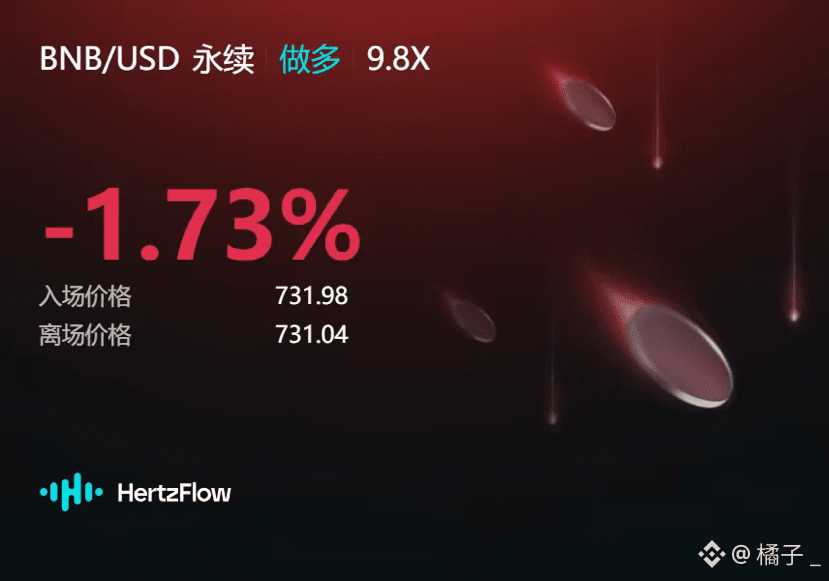
HertzFlow Challenge Day 4
Today I continued logging in, opened a position $BTC got hit, the non-farm payroll data was so-so, first looking bearish
#HertzflowPNL @HertzFlow_xyz
HertzFlow Challenge Day 4
Today I continued logging in, opened a position $BTC got hit, the non-farm payroll data was so-so, first looking bearish
#HertzflowPNL @HertzFlow
Today I continued logging in, opened a position $BTC got hit, the non-farm payroll data was so-so, first looking bearish
#HertzflowPNL @HertzFlow

279
·
--
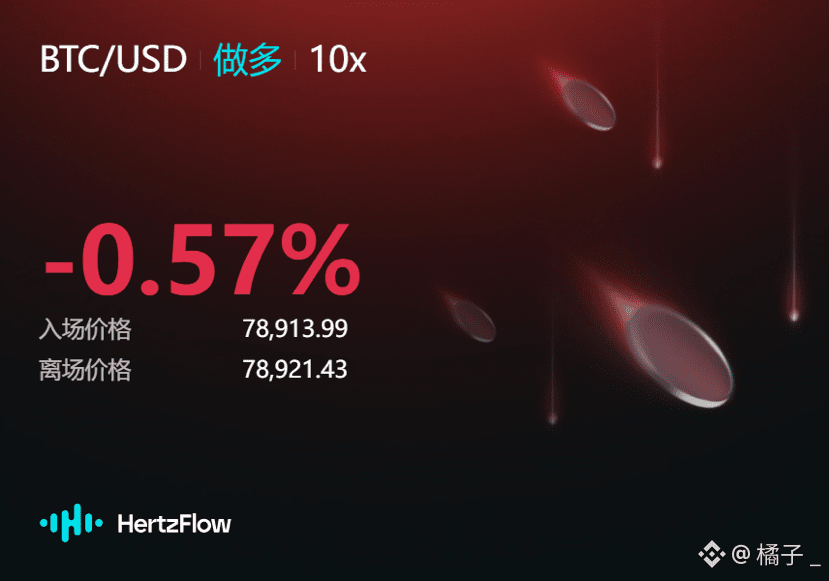
HertzFlow Challenge Day3 🔥
Today we keep trading and opened a BTC long position.
Start with a small order first to see if we can grab some PNL today 👀
#HertzflowPNL @HertzFlow_xyz HertzFlow
HertzFlow Challenge Day3 🔥
Today we keep trading and opened a BTC long position.
Start with a small order first to see if we can grab some PNL today 👀
#HertzflowPNL @HertzFlow HertzFlow
Today we keep trading and opened a BTC long position.
Start with a small order first to see if we can grab some PNL today 👀
#HertzflowPNL @HertzFlow HertzFlow
1
109
·
--
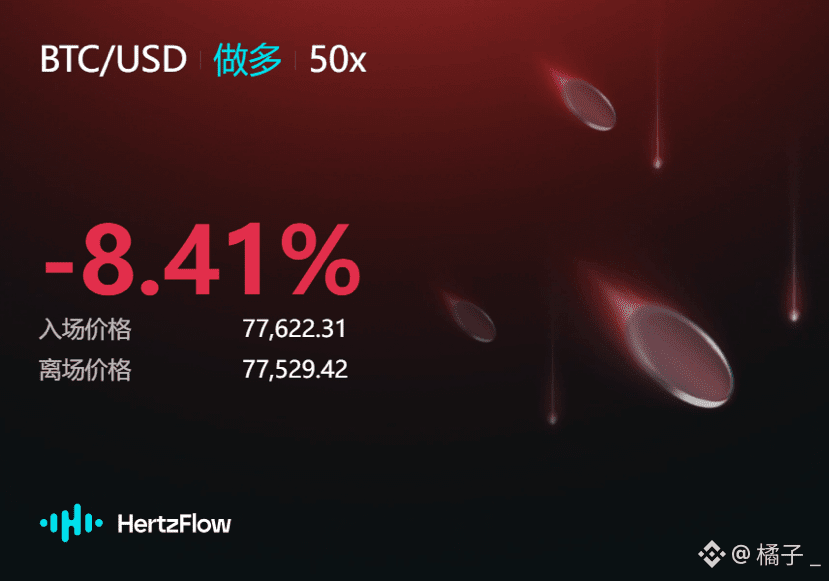
HertzFlow Challenge Day 3🔥
Today I continue trading and opened a BTC long position.
First try with a small position to see if we can grab a bit of PNL today 👀
#HertzflowPNL @HertzFlow_xyz
HertzFlow Challenge Day 3🔥
Today I continue trading and opened a BTC long position.
First try with a small position to see if we can grab a bit of PNL today 👀
#HertzflowPNL @HertzFlow
Today I continue trading and opened a BTC long position.
First try with a small position to see if we can grab a bit of PNL today 👀
#HertzflowPNL @HertzFlow
1
103
·
--
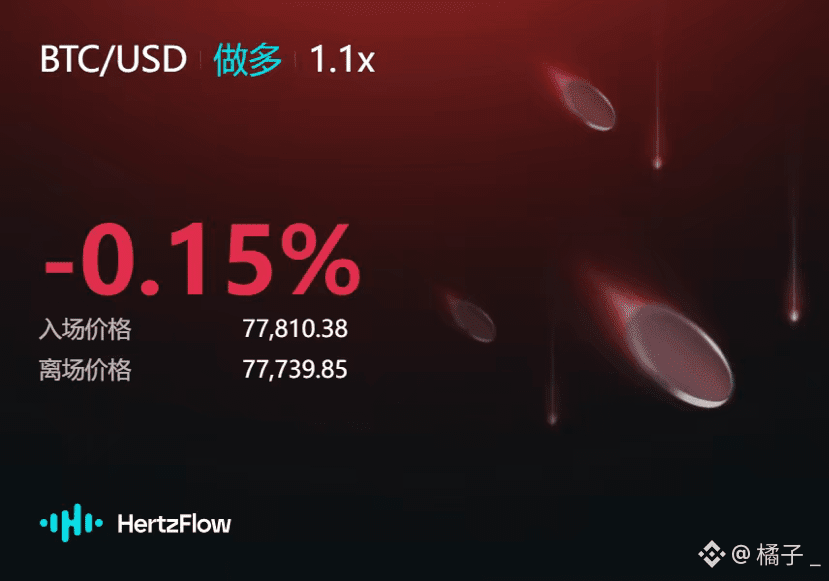
HertzFlow Challenge Day 1 🔥
Day 1: first get a feel for it. BTC has dropped quite a bit. I opened a long position here, but I flattened it.
Start with 100U and trade slowly over 14 days.
Hope I get lucky and end up winning a prize 😂
#HertzflowPNL @HertzFlow_xyz
HertzFlow Challenge Day 1 🔥
Day 1: first get a feel for it. BTC has dropped quite a bit. I opened a long position here, but I flattened it.
Start with 100U and trade slowly over 14 days.
Hope I get lucky and end up winning a prize 😂
#HertzflowPNL @HertzFlow_xyz
Day 1: first get a feel for it. BTC has dropped quite a bit. I opened a long position here, but I flattened it.
Start with 100U and trade slowly over 14 days.
Hope I get lucky and end up winning a prize 😂
#HertzflowPNL @HertzFlow_xyz
83
·
--
Recently I’ve been looking at on-chain AI, and I’m growing increasingly skeptical of that simplistic idea that “smart money is buying.”
Just because an address bought something doesn’t necessarily mean it’s bullish.
It could be a market maker replenishing inventory. It could be an intermediate address used for cross-chain settlement. Or it could simply be the same entity moving assets between different wallets. On-chain records don’t lie—but explaining every inflow as a viewpoint is still a long way from understanding real transactions.
This is also the hardest layer for Crypto-specific models: they can’t just read transactions. They have to identify relationships between addresses, understand why funds moved, and know that the meaning of the same action can be completely different across different times and different liquidity environments.
I follow Velvet @Velvet_Capital and the training of Velvet-1. I’m not trying to get it to guess the next coin with the biggest price increase. I’d rather know whether, inside Copilot, it can separate these easy-to-confuse behaviors: which are genuine buy orders, which are merely routing, and which funds come in without taking any price risk.
Once you can judge at this layer, AI starts to get close to being a research tool.
Otherwise, so-called on-chain insights are very likely just restating what the block explorer already shows.
Recently I’ve been looking at on-chain AI, and I’m growing increasingly skeptical of that simplistic idea that “smart money is buying.”
Just because an address bought something doesn’t necessarily mean it’s bullish.
It could be a market maker replenishing inventory. It could be an intermediate address used for cross-chain settlement. Or it could simply be the same entity moving assets between different wallets. On-chain records don’t lie—but explaining every inflow as a viewpoint is still a long way from understanding real transactions.
This is also the hardest layer for Crypto-specific models: they can’t just read transactions. They have to identify relationships between addresses, understand why funds moved, and know that the meaning of the same action can be completely different across different times and different liquidity environments.
I follow Velvet @Velvet_Capital and the training of Velvet-1. I’m not trying to get it to guess the next coin with the biggest price increase. I’d rather know whether, inside Copilot, it can separate these easy-to-confuse behaviors: which are genuine buy orders, which are merely routing, and which funds come in without taking any price risk.
Once you can judge at this layer, AI starts to get close to being a research tool.
Otherwise, so-called on-chain insights are very likely just restating what the block explorer already shows.
Just because an address bought something doesn’t necessarily mean it’s bullish.
It could be a market maker replenishing inventory. It could be an intermediate address used for cross-chain settlement. Or it could simply be the same entity moving assets between different wallets. On-chain records don’t lie—but explaining every inflow as a viewpoint is still a long way from understanding real transactions.
This is also the hardest layer for Crypto-specific models: they can’t just read transactions. They have to identify relationships between addresses, understand why funds moved, and know that the meaning of the same action can be completely different across different times and different liquidity environments.
I follow Velvet @Velvet_Capital and the training of Velvet-1. I’m not trying to get it to guess the next coin with the biggest price increase. I’d rather know whether, inside Copilot, it can separate these easy-to-confuse behaviors: which are genuine buy orders, which are merely routing, and which funds come in without taking any price risk.
Once you can judge at this layer, AI starts to get close to being a research tool.
Otherwise, so-called on-chain insights are very likely just restating what the block explorer already shows.

116
·
--
I’m currently looking at trading AI and I don’t really care whether it can judge if a given asset “has potential.”
This question is too big, and it’s also too easy to talk in vague terms.
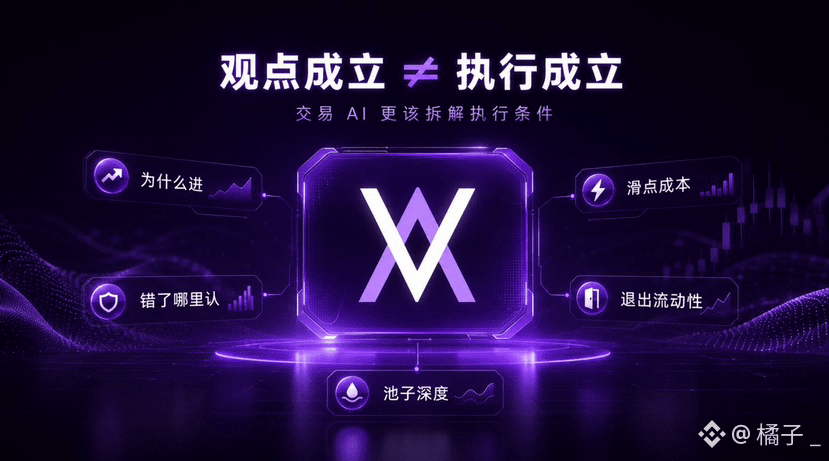
What I care about is whether it can break down a trade into several realistic constraints:
Why am I entering?
Where do I realize I’m wrong?
Is the depth of this pool sufficient?
Will slippage eat up my expected returns?
When I exit, is there still someone there to take it?
A lot of on-chain trades can lose money even if the direction is correct—not because the narrative is wrong, but because the execution conditions are too poor.
You buy a good story, but the trade happens in a very thin pool; you see funds entering, but your own position is too large and you basically can’t get out.
This kind of loss is very common, and it’s also the easiest to overlook when people do post-mortems. Because the story wasn’t wrong, people assume it was just bad luck.
So if Velvet @Velvet_Capital’s Copilot is useful, I hope it talks less about grand judgments and more about laying out the trade conditions.
A trade can be valid in terms of opinion, but that doesn’t mean it’s valid in terms of execution.
I’m currently looking at trading AI and I don’t really care whether it can judge if a given asset “has potential.”
This question is too big, and it’s also too easy to talk in vague terms.
What I care about is whether it can break down a trade into several realistic constraints:
Why am I entering?
Where do I realize I’m wrong?
Is the depth of this pool sufficient?
Will slippage eat up my expected returns?
When I exit, is there still someone there to take it?
A lot of on-chain trades can lose money even if the direction is correct—not because the narrative is wrong, but because the execution conditions are too poor.
You buy a good story, but the trade happens in a very thin pool; you see funds entering, but your own position is too large and you basically can’t get out.
This kind of loss is very common, and it’s also the easiest to overlook when people do post-mortems. Because the story wasn’t wrong, people assume it was just bad luck.
So if Velvet @Velvet_Capital’s Copilot is useful, I hope it talks less about grand judgments and more about laying out the trade conditions.
A trade can be valid in terms of opinion, but that doesn’t mean it’s valid in terms of execution.
This question is too big, and it’s also too easy to talk in vague terms.
What I care about is whether it can break down a trade into several realistic constraints:
Why am I entering?
Where do I realize I’m wrong?
Is the depth of this pool sufficient?
Will slippage eat up my expected returns?
When I exit, is there still someone there to take it?
A lot of on-chain trades can lose money even if the direction is correct—not because the narrative is wrong, but because the execution conditions are too poor.
You buy a good story, but the trade happens in a very thin pool; you see funds entering, but your own position is too large and you basically can’t get out.
This kind of loss is very common, and it’s also the easiest to overlook when people do post-mortems. Because the story wasn’t wrong, people assume it was just bad luck.
So if Velvet @Velvet_Capital’s Copilot is useful, I hope it talks less about grand judgments and more about laying out the trade conditions.
A trade can be valid in terms of opinion, but that doesn’t mean it’s valid in terms of execution.
237
·
--
Article
Palantir Q2 Beats Expectations: What the market is buying isn’t an AI story, but growth deliveredPalantir jumps more than 10%: this time, what’s truly being repriced isn’t the AI story—it’s the pace of execution
Palantir has turned in yet another hard-to-find-fault earnings report.
Revenue in the second quarter of 2026 reached US$1.935 billion, up 93% year over year and clearly above market expectations of about US$1.8 billion; adjusted earnings per share were US$0.41, also exceeding analysts’ expectations. After the earnings report was released, the stock price rose in after-hours trading by as much as about 10%–14%. The figures provided by different media outlets vary slightly, mainly due to differences in the reporting time points. The U.S. Securities and Exchange Commission
Just looking at these numbers, it’s easy to attribute the rise to an “earnings beat.”
Palantir Q2 Beats Expectations: What the market is buying isn’t an AI story, but growth delivered
Palantir jumps more than 10%: this time, what’s truly being repriced isn’t the AI story—it’s the pace of execution
Palantir has turned in yet another hard-to-find-fault earnings report.
Revenue in the second quarter of 2026 reached US$1.935 billion, up 93% year over year and clearly above market expectations of about US$1.8 billion; adjusted earnings per share were US$0.41, also exceeding analysts’ expectations. After the earnings report was released, the stock price rose in after-hours trading by as much as about 10%–14%. The figures provided by different media outlets vary slightly, mainly due to differences in the reporting time points. The U.S. Securities and Exchange Commission
Just looking at these numbers, it’s easy to attribute the rise to an “earnings beat.”
Palantir has turned in yet another hard-to-find-fault earnings report.
Revenue in the second quarter of 2026 reached US$1.935 billion, up 93% year over year and clearly above market expectations of about US$1.8 billion; adjusted earnings per share were US$0.41, also exceeding analysts’ expectations. After the earnings report was released, the stock price rose in after-hours trading by as much as about 10%–14%. The figures provided by different media outlets vary slightly, mainly due to differences in the reporting time points. The U.S. Securities and Exchange Commission
Just looking at these numbers, it’s easy to attribute the rise to an “earnings beat.”
2
1
126
·
--
One of the most overestimated things about trading AI is that it can lay out a very smooth-sounding logic.
But on-chain, many good trades aren’t good because the story is seamless.
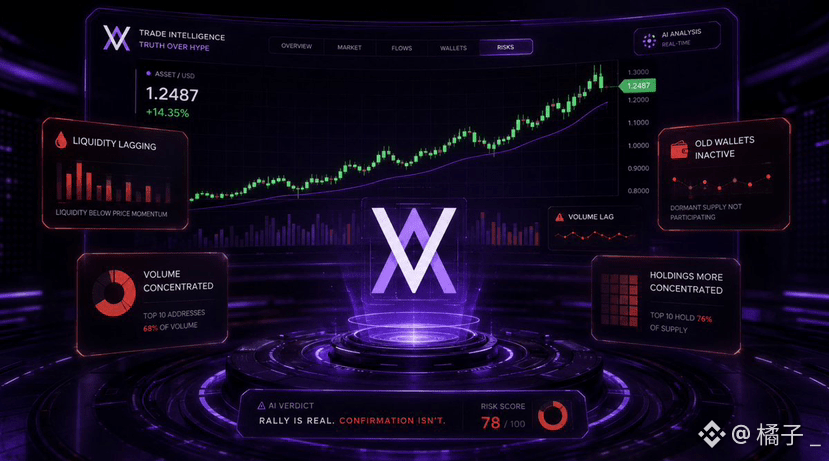
When an asset goes up, and AI only tells you things like “increased capital attention” or “market sentiment is heating up,” that’s not very useful. I’d rather see: what *didn’t* happen.
It rose, but liquidity didn’t keep up.
People were calling for it, but the old wallets didn’t keep buying.
Trading volume increased, but most of it came from just a few large orders.
Price made a new high, but on-chain holdings are actually even more concentrated.
These “things that feel off” are often more valuable than pretty conclusions.
So my expectations for tools like Velvet @Velvet_Capital AI Copilot aren’t for it to summarize the market for me.
I’d rather have it act like a trading assistant that throws cold water—before I place an order—bringing up the gaps I didn’t notice.
The most expensive mistake in crypto isn’t missing opportunities.
It’s after you spot an opportunity, automatically ignoring all the evidence that doesn’t support your own judgment.
One of the most overestimated things about trading AI is that it can lay out a very smooth-sounding logic.
But on-chain, many good trades aren’t good because the story is seamless.
When an asset goes up, and AI only tells you things like “increased capital attention” or “market sentiment is heating up,” that’s not very useful. I’d rather see: what *didn’t* happen.
It rose, but liquidity didn’t keep up.
People were calling for it, but the old wallets didn’t keep buying.
Trading volume increased, but most of it came from just a few large orders.
Price made a new high, but on-chain holdings are actually even more concentrated.
These “things that feel off” are often more valuable than pretty conclusions.
So my expectations for tools like Velvet @Velvet_Capital AI Copilot aren’t for it to summarize the market for me.
I’d rather have it act like a trading assistant that throws cold water—before I place an order—bringing up the gaps I didn’t notice.
The most expensive mistake in crypto isn’t missing opportunities.
It’s after you spot an opportunity, automatically ignoring all the evidence that doesn’t support your own judgment.
But on-chain, many good trades aren’t good because the story is seamless.
When an asset goes up, and AI only tells you things like “increased capital attention” or “market sentiment is heating up,” that’s not very useful. I’d rather see: what *didn’t* happen.
It rose, but liquidity didn’t keep up.
People were calling for it, but the old wallets didn’t keep buying.
Trading volume increased, but most of it came from just a few large orders.
Price made a new high, but on-chain holdings are actually even more concentrated.
These “things that feel off” are often more valuable than pretty conclusions.
So my expectations for tools like Velvet @Velvet_Capital AI Copilot aren’t for it to summarize the market for me.
I’d rather have it act like a trading assistant that throws cold water—before I place an order—bringing up the gaps I didn’t notice.
The most expensive mistake in crypto isn’t missing opportunities.
It’s after you spot an opportunity, automatically ignoring all the evidence that doesn’t support your own judgment.
84
·
--
Many people who look at Hertzflow first focus on leverage trading.
But I think the truly interesting part of Hertzflow is that it brings trading, liquidity, and user growth into the same ecosystem—so everyday users don’t necessarily have to become high-frequency traders to find their early place.
If you’re good at reading the market, you can start with trading.
Hertzflow @Hertzflow_xyz is a self-custody leveraged trading protocol, aiming to bring any asset supported by oracles onto the chain for trading.
What early trading users are most worth doing isn’t jumping straight into high multipliers—it’s first getting familiar with the product’s rhythm:
Which markets are more active;
What the order placement experience is like;
How positions and margin change;
How the risk mechanisms work under different volatility.
The more markets the future supports, the easier it is for people who learn the rules earlier to find their own trading cadence.
If you have idle capital, you can study Pools and Vaults. For a trading protocol to really take off, it can’t only have traders—it also needs enough liquidity.
LPs aren’t participating in the front-end price action, but in the depth of the market behind it.
Hertzflow wants to build yield-bearing assets in the BNB ecosystem, and Pools and Vaults will likely become more important entry points for everyday capital users.
If you don’t have much capital and don’t want to trade frequently, you can keep an eye on invite-and-rebate.
What early ecosystems often lack isn’t just capital, but real users.
For everyday users, the most important thing is to first judge which layer they fit best.
When trading, liquidity, and the invite network form a loop, Hertzflow won’t be just a perp product—it could potentially become a new on-chain trading entry point on BNB Chain.
Many people who look at Hertzflow first focus on leverage trading.
But I think the truly interesting part of Hertzflow is that it brings trading, liquidity, and user growth into the same ecosystem—so everyday users don’t necessarily have to become high-frequency traders to find their early place.
If you’re good at reading the market, you can start with trading.
Hertzflow @Hertzflow_xyz is a self-custody leveraged trading protocol, aiming to bring any asset supported by oracles onto the chain for trading.
What early trading users are most worth doing isn’t jumping straight into high multipliers—it’s first getting familiar with the product’s rhythm:
Which markets are more active;
What the order placement experience is like;
How positions and margin change;
How the risk mechanisms work under different volatility.
The more markets the future supports, the easier it is for people who learn the rules earlier to find their own trading cadence.
If you have idle capital, you can study Pools and Vaults. For a trading protocol to really take off, it can’t only have traders—it also needs enough liquidity.
LPs aren’t participating in the front-end price action, but in the depth of the market behind it.
Hertzflow wants to build yield-bearing assets in the BNB ecosystem, and Pools and Vaults will likely become more important entry points for everyday capital users.
If you don’t have much capital and don’t want to trade frequently, you can keep an eye on invite-and-rebate.
What early ecosystems often lack isn’t just capital, but real users.
For everyday users, the most important thing is to first judge which layer they fit best.
When trading, liquidity, and the invite network form a loop, Hertzflow won’t be just a perp product—it could potentially become a new on-chain trading entry point on BNB Chain.
But I think the truly interesting part of Hertzflow is that it brings trading, liquidity, and user growth into the same ecosystem—so everyday users don’t necessarily have to become high-frequency traders to find their early place.
If you’re good at reading the market, you can start with trading.
Hertzflow @Hertzflow_xyz is a self-custody leveraged trading protocol, aiming to bring any asset supported by oracles onto the chain for trading.
What early trading users are most worth doing isn’t jumping straight into high multipliers—it’s first getting familiar with the product’s rhythm:
Which markets are more active;
What the order placement experience is like;
How positions and margin change;
How the risk mechanisms work under different volatility.
The more markets the future supports, the easier it is for people who learn the rules earlier to find their own trading cadence.
If you have idle capital, you can study Pools and Vaults. For a trading protocol to really take off, it can’t only have traders—it also needs enough liquidity.
LPs aren’t participating in the front-end price action, but in the depth of the market behind it.
Hertzflow wants to build yield-bearing assets in the BNB ecosystem, and Pools and Vaults will likely become more important entry points for everyday capital users.
If you don’t have much capital and don’t want to trade frequently, you can keep an eye on invite-and-rebate.
What early ecosystems often lack isn’t just capital, but real users.
For everyday users, the most important thing is to first judge which layer they fit best.
When trading, liquidity, and the invite network form a loop, Hertzflow won’t be just a perp product—it could potentially become a new on-chain trading entry point on BNB Chain.

253
·
--
One thing I’m most wary of about trading AI right now is that it’s just too good at making complicated things sound straightforward.
On-chain transactions are full of pitfalls, and they’re often hidden in the places where things don’t quite “flow.”
For example, when a particular target suddenly spikes in volume, on the surface it looks like interest is heating up. But if you look further, you may find the buy orders are scattered and liquidity is thin—just a few addresses that quickly come in and out. Even on X, the discussions have been lagging behind the price by half a beat.
In situations like this, if AI only summarizes with something like “market attention is increasing,” it can actually mislead people.
What I want is for Velvet @Velvet_Capital’s Copilot to act like a meticulous assistant that points out flaws.
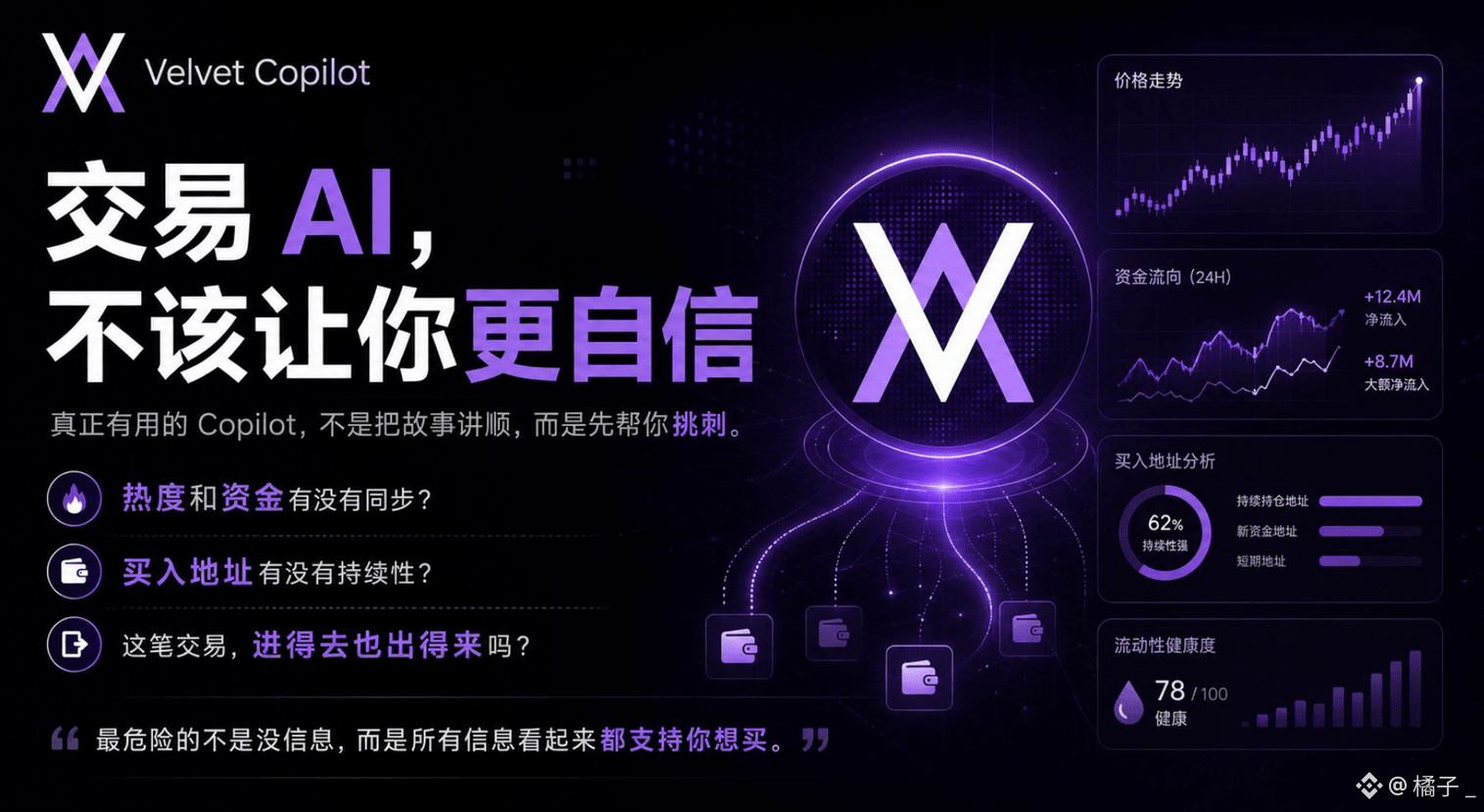
Not to help me make the story line up neatly, but to remind me where things don’t match:
Is the hype synchronized with the money?
Do the buying addresses show real continuity?
Can this trade actually be entered and exited?
In crypto, the most dangerous thing isn’t the lack of information—it’s when the information all seems to support the thing you want to buy.
A useful AI shouldn’t make people feel more confident. It should make you doubt yourself once before you sign—especially when you’re most eager to buy.
One thing I’m most wary of about trading AI right now is that it’s just too good at making complicated things sound straightforward.
On-chain transactions are full of pitfalls, and they’re often hidden in the places where things don’t quite “flow.”
For example, when a particular target suddenly spikes in volume, on the surface it looks like interest is heating up. But if you look further, you may find the buy orders are scattered and liquidity is thin—just a few addresses that quickly come in and out. Even on X, the discussions have been lagging behind the price by half a beat.
In situations like this, if AI only summarizes with something like “market attention is increasing,” it can actually mislead people.
What I want is for Velvet @Velvet_Capital’s Copilot to act like a meticulous assistant that points out flaws.
Not to help me make the story line up neatly, but to remind me where things don’t match:
Is the hype synchronized with the money?
Do the buying addresses show real continuity?
Can this trade actually be entered and exited?
In crypto, the most dangerous thing isn’t the lack of information—it’s when the information all seems to support the thing you want to buy.
A useful AI shouldn’t make people feel more confident. It should make you doubt yourself once before you sign—especially when you’re most eager to buy.
On-chain transactions are full of pitfalls, and they’re often hidden in the places where things don’t quite “flow.”
For example, when a particular target suddenly spikes in volume, on the surface it looks like interest is heating up. But if you look further, you may find the buy orders are scattered and liquidity is thin—just a few addresses that quickly come in and out. Even on X, the discussions have been lagging behind the price by half a beat.
In situations like this, if AI only summarizes with something like “market attention is increasing,” it can actually mislead people.
What I want is for Velvet @Velvet_Capital’s Copilot to act like a meticulous assistant that points out flaws.
Not to help me make the story line up neatly, but to remind me where things don’t match:
Is the hype synchronized with the money?
Do the buying addresses show real continuity?
Can this trade actually be entered and exited?
In crypto, the most dangerous thing isn’t the lack of information—it’s when the information all seems to support the thing you want to buy.
A useful AI shouldn’t make people feel more confident. It should make you doubt yourself once before you sign—especially when you’re most eager to buy.
77
·
--
The most annoying thing in on-chain trading isn’t failing to find a token.
It’s that once you’ve found one, you still have to keep watching it.
Many opportunities aren’t suitable to buy immediately at the start, so you can only put them into your watchlist first:
Will the wallet activity keep coming in?
Will liquidity get thicker?
Is there any KOL discussion spreading?
Is the price still sitting at a spot nobody has noticed yet?
The problem is, no one can keep staring at it forever.
You go to sleep, open a meeting, go out for dinner—then come back to find the conditions have changed, but the most critical window has already passed.
So when I look at Velvet @Velvet_Capital working on an AI Copilot and its own on-chain model, I don’t really want to interpret it as:
“AI helps you catch 100x coins.” That sounds like nonsense.
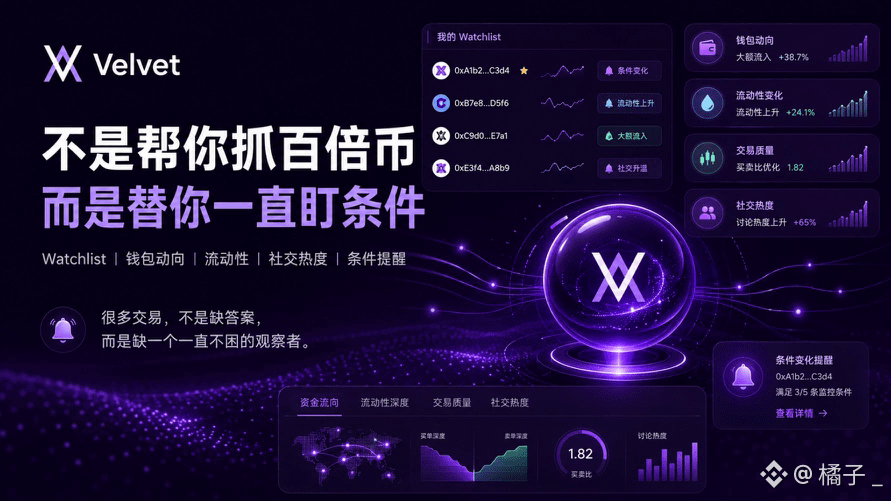
What I want instead is something that can help me monitor conditions.
For example, if I’m watching a new token on Arbitrum or Base, I don’t want the AI to tell me whether I should buy it.
I want it to remind me when conditions change:
Liquidity suddenly spikes;
A few old wallets start buying in;
Trading activity is no longer just low-volume wash trading;
Social attention has already clearly moved to lag behind the price.
Something like this is simple, but it’s genuinely useful.
What traders spend most of their energy on every day isn’t making a single decision—it’s maintaining dozens of half-formed judgments.
Which ones are still worth watching, and which ones have already stopped working;
Which signals are just noise, and which ones need to be re-evaluated.
Human brains easily mix these together, and in the end you trade based on instinct.
If Velvet’s AI can help on this layer, I think it’s more practical than “giving me an answer.”
Many trades aren’t missing answers—they’re missing an observer who stays clear-headed, doesn’t get emotional, and doesn’t get fed up.
Sometimes, a great tool isn’t meant to make you more aggressive—it’s meant to help you not miss the things you were already seeing, but would otherwise overlook.
The most annoying thing in on-chain trading isn’t failing to find a token.
It’s that once you’ve found one, you still have to keep watching it.
Many opportunities aren’t suitable to buy immediately at the start, so you can only put them into your watchlist first:
Will the wallet activity keep coming in?
Will liquidity get thicker?
Is there any KOL discussion spreading?
Is the price still sitting at a spot nobody has noticed yet?
The problem is, no one can keep staring at it forever.
You go to sleep, open a meeting, go out for dinner—then come back to find the conditions have changed, but the most critical window has already passed.
So when I look at Velvet @Velvet_Capital working on an AI Copilot and its own on-chain model, I don’t really want to interpret it as:
“AI helps you catch 100x coins.” That sounds like nonsense.
What I want instead is something that can help me monitor conditions.
For example, if I’m watching a new token on Arbitrum or Base, I don’t want the AI to tell me whether I should buy it.
I want it to remind me when conditions change:
Liquidity suddenly spikes;
A few old wallets start buying in;
Trading activity is no longer just low-volume wash trading;
Social attention has already clearly moved to lag behind the price.
Something like this is simple, but it’s genuinely useful.
What traders spend most of their energy on every day isn’t making a single decision—it’s maintaining dozens of half-formed judgments.
Which ones are still worth watching, and which ones have already stopped working;
Which signals are just noise, and which ones need to be re-evaluated.
Human brains easily mix these together, and in the end you trade based on instinct.
If Velvet’s AI can help on this layer, I think it’s more practical than “giving me an answer.”
Many trades aren’t missing answers—they’re missing an observer who stays clear-headed, doesn’t get emotional, and doesn’t get fed up.
Sometimes, a great tool isn’t meant to make you more aggressive—it’s meant to help you not miss the things you were already seeing, but would otherwise overlook.
It’s that once you’ve found one, you still have to keep watching it.
Many opportunities aren’t suitable to buy immediately at the start, so you can only put them into your watchlist first:
Will the wallet activity keep coming in?
Will liquidity get thicker?
Is there any KOL discussion spreading?
Is the price still sitting at a spot nobody has noticed yet?
The problem is, no one can keep staring at it forever.
You go to sleep, open a meeting, go out for dinner—then come back to find the conditions have changed, but the most critical window has already passed.
So when I look at Velvet @Velvet_Capital working on an AI Copilot and its own on-chain model, I don’t really want to interpret it as:
“AI helps you catch 100x coins.” That sounds like nonsense.
What I want instead is something that can help me monitor conditions.
For example, if I’m watching a new token on Arbitrum or Base, I don’t want the AI to tell me whether I should buy it.
I want it to remind me when conditions change:
Liquidity suddenly spikes;
A few old wallets start buying in;
Trading activity is no longer just low-volume wash trading;
Social attention has already clearly moved to lag behind the price.
Something like this is simple, but it’s genuinely useful.
What traders spend most of their energy on every day isn’t making a single decision—it’s maintaining dozens of half-formed judgments.
Which ones are still worth watching, and which ones have already stopped working;
Which signals are just noise, and which ones need to be re-evaluated.
Human brains easily mix these together, and in the end you trade based on instinct.
If Velvet’s AI can help on this layer, I think it’s more practical than “giving me an answer.”
Many trades aren’t missing answers—they’re missing an observer who stays clear-headed, doesn’t get emotional, and doesn’t get fed up.
Sometimes, a great tool isn’t meant to make you more aggressive—it’s meant to help you not miss the things you were already seeing, but would otherwise overlook.
205
·
--
When many people hear “RWA,” the first thing that comes to mind is usually yield, U.S. Treasuries, real estate, and credit.
But collectible-based RWA can’t be viewed that way. The earliest source of value for collectibles wasn’t cash flow—it was culture, aesthetics, scarcity, and community consensus.
Why would someone want to buy a card?
Not because it’s like a bond, and not because you can calculate a stable return curve.
It’s because someone genuinely wants to own it, show it off, trade it—and even treat it as part of their identity and interests.
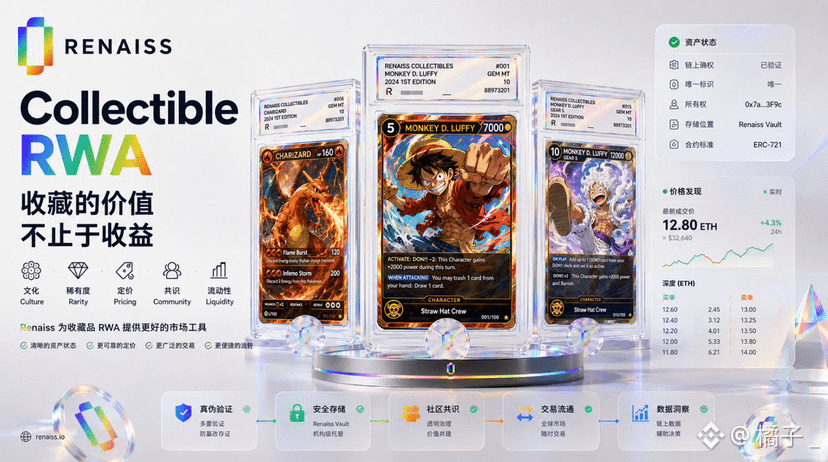
That’s also what I find interesting about Renaiss @renaissxyz.
It doesn’t plug into traditional financial assets—it moves into a market that already has real users, real emotions, and established offline trading habits.
Pokemon, One Piece—TCGs like these are easy for regular users to understand, and collectors also have their own set of judgment criteria.
The problem wasn’t that nobody liked these things. The issue was that their value has historically been difficult to distribute, price, and manage more efficiently.
So when I look at Renaiss, I don’t really like summarizing it with the three words “financialization.”
It’s more like: on top of the collectibles’ existing market, add another layer of tools:
Can the asset’s status be made clearer?
Can the price reference be more trustworthy?
Can the trading radius be expanded?
Can users rely less on gut feeling and more on information to make judgments?
If you get this wrong, of course it turns collectibles into packaged short-term chips.
But if you get it right, it can actually make collectors much clearer about what they’re buying and holding—and what price the market is ultimately willing to give them.
That’s also the difference between Renaiss and many purely narrative RWA projects.
It’s facing a group of collectors that already exists, rather than first creating an asset and then spending time educating the market to believe it has value.
That said, the yardsticks are also very practical: are users really more likely to discover good assets? Is pricing more transparent? Is trading smoother? And in the end, are collectors willing to stay for the long term?
When many people hear “RWA,” the first thing that comes to mind is usually yield, U.S. Treasuries, real estate, and credit.
But collectible-based RWA can’t be viewed that way. The earliest source of value for collectibles wasn’t cash flow—it was culture, aesthetics, scarcity, and community consensus.
Why would someone want to buy a card?
Not because it’s like a bond, and not because you can calculate a stable return curve.
It’s because someone genuinely wants to own it, show it off, trade it—and even treat it as part of their identity and interests.
That’s also what I find interesting about Renaiss @renaissxyz.
It doesn’t plug into traditional financial assets—it moves into a market that already has real users, real emotions, and established offline trading habits.
Pokemon, One Piece—TCGs like these are easy for regular users to understand, and collectors also have their own set of judgment criteria.
The problem wasn’t that nobody liked these things. The issue was that their value has historically been difficult to distribute, price, and manage more efficiently.
So when I look at Renaiss, I don’t really like summarizing it with the three words “financialization.”
It’s more like: on top of the collectibles’ existing market, add another layer of tools:
Can the asset’s status be made clearer?
Can the price reference be more trustworthy?
Can the trading radius be expanded?
Can users rely less on gut feeling and more on information to make judgments?
If you get this wrong, of course it turns collectibles into packaged short-term chips.
But if you get it right, it can actually make collectors much clearer about what they’re buying and holding—and what price the market is ultimately willing to give them.
That’s also the difference between Renaiss and many purely narrative RWA projects.
It’s facing a group of collectors that already exists, rather than first creating an asset and then spending time educating the market to believe it has value.
That said, the yardsticks are also very practical: are users really more likely to discover good assets? Is pricing more transparent? Is trading smoother? And in the end, are collectors willing to stay for the long term?
But collectible-based RWA can’t be viewed that way. The earliest source of value for collectibles wasn’t cash flow—it was culture, aesthetics, scarcity, and community consensus.
Why would someone want to buy a card?
Not because it’s like a bond, and not because you can calculate a stable return curve.
It’s because someone genuinely wants to own it, show it off, trade it—and even treat it as part of their identity and interests.
That’s also what I find interesting about Renaiss @renaissxyz.
It doesn’t plug into traditional financial assets—it moves into a market that already has real users, real emotions, and established offline trading habits.
Pokemon, One Piece—TCGs like these are easy for regular users to understand, and collectors also have their own set of judgment criteria.
The problem wasn’t that nobody liked these things. The issue was that their value has historically been difficult to distribute, price, and manage more efficiently.
So when I look at Renaiss, I don’t really like summarizing it with the three words “financialization.”
It’s more like: on top of the collectibles’ existing market, add another layer of tools:
Can the asset’s status be made clearer?
Can the price reference be more trustworthy?
Can the trading radius be expanded?
Can users rely less on gut feeling and more on information to make judgments?
If you get this wrong, of course it turns collectibles into packaged short-term chips.
But if you get it right, it can actually make collectors much clearer about what they’re buying and holding—and what price the market is ultimately willing to give them.
That’s also the difference between Renaiss and many purely narrative RWA projects.
It’s facing a group of collectors that already exists, rather than first creating an asset and then spending time educating the market to believe it has value.
That said, the yardsticks are also very practical: are users really more likely to discover good assets? Is pricing more transparent? Is trading smoother? And in the end, are collectors willing to stay for the long term?
296
·
--
Alright, first Robinhood, then Stable, and now Arc
After a roundabout detour, the funds ultimately end up back at BSC memes
Round after round of storytelling
And big brother @CZ said it too—over the next few weeks, he may personally buy or sell one or two, to test out new things
May the best meme win
Believe $BNB is buying—$BNB , let’s build together!
Alright, first Robinhood, then Stable, and now Arc
After a roundabout detour, the funds ultimately end up back at BSC memes
Round after round of storytelling
And big brother @CZ said it too—over the next few weeks, he may personally buy or sell one or two, to test out new things
May the best meme win
Believe $BNB is buying—$BNB , let’s build together!
After a roundabout detour, the funds ultimately end up back at BSC memes
Round after round of storytelling
And big brother @CZ said it too—over the next few weeks, he may personally buy or sell one or two, to test out new things
May the best meme win
Believe $BNB is buying—$BNB , let’s build together!
261
Log in to explore more content
Join global crypto users on Binance Square
⚡️ Get latest and useful information about crypto.
💬 Trusted by the world’s largest crypto exchange.
👍 Discover real insights from verified creators.
Email / Phone number
Trending Topics
CircleMints500MUSDCOnSolana
6,924 views
387 Discussing
💰 MASSIVE: Circle Mints $500M $USDC on Solana!
Circle just minted 500 Million $USDC on Solana in 2 transactions ($250M + $250M) on Sept 25, in just 5.5 hours! 🚀
Solana now holds $7.48B+ $USDC dominance - over 50% of its $14.7B stablecoin supply.
Why Solana?
⚡️ Speed: 65k TPS
💸 Low Fees: $0.00025
🔥 DeFi Hub: Jupiter, Raydium pumping
This is one of the largest single-day mints & signals HUGE institutional demand for Solana ecosystem.
Bullish for $SOL? 👇
#Circle #USDC #Solana #Stablecoin #DeFi#circlemints500musdconsolana
True News
·8 Likes
·4.3k views
PolymarketBankFailureBetsDrawFDICConcern
20,590 views
603 Discussing
BlackRockBuildsTokenizedPortfoliosForOndo
15,858 views
412 Discussing