
Cointelegraph
36.8k Posts

Cointelegraph
 Square Verified+
Report
Block User
Cointelegraph covers fintech, blockchain and Bitcoin, bringing you the latest news and analyses on the future of money.
2 Following
186.0K+ Followers
566.5K+ Liked
1 Badges
Posts
Article
10 of the greatest unsolved crypto mysteriesIn an industry built on transparency and verifiability, newcomers might assume that crypto and blockchains leave very little room for mystery.
They’d be completely wrong of course, because the murky world of digital assets is rife with underhanded dealings, unsolved enigmas and fortunes disappearing behind pseudonyms.
From the identity of Bitcoin’s mystery creator to what really happened to a DAI developer on a beach in Puerto Rico, here are 10 crypto mysteries that remain unsolved.
1. Who is Satoshi Nakamoto?
More than 17 years after Bitcoin’s creation, the greatest unsolved crypto mystery persists. We still don’t know who Satoshi Nakamoto is, or even whether Satoshi was one person.
He, she, or they published the Bitcoin white paper in 2008, mined the genesis block in January 2009 and remained active in its early development before disappearing from public view in 2010.
The quest for Satoshi’s identity has since produced an endless parade of possible candidates, from cryptographers and cypherpunks to British academics, early Bitcoin developers and even convicted sex offenders.
The latest serious attempt to solve the mystery came in April 2026, when The New York Times published a lengthy investigation naming British cryptographer Adam Back as its leading candidate.
The Times claimed there were similarities between his writings and Satoshi’s, their shared cryptographic interests, Back’s work on Hashcash — which was cited in the Bitcoin white paper — and a series of other circumstantial clues, all of which Back strenuously denied.
Adam Back’s Hashcash is cited in the Bitcoin Whitepaper. Source: Bitcoin.org
Other suspected candidates over the years have included core developer Peter Todd, cryptographer Hal Finney, Twitter founder Jack Dorsey and others. Self-proclaimed Bitcoin creator Craig Wright is the only major Satoshi candidate to have been formally ruled by a UK court not to be Satoshi.
There were even some bizarre online claims that notorious sex offender Jeffrey Epstein could be Satoshi after a newly released tranche of the Epstein files revealed the sex trafficer had been involved in the early crypto industry, and made a 2014 investment in Back’s Blockstream.
There is no credible evidence that Epstein was Satoshi, , and so the enigma remains: Who is Satoshi Nakamoto and where is he now?
2. Who was the Patoshi miner?
If you thought the Satoshi mystery was strange, try digging into Bitcoin’s earliest blocks like blockchain researcher Sergio Lerner.
In 2013, he discovered a pattern in the way Bitcoin’s earliest blocks were mined and linked it to a single miner he later dubbed “Patoshi.”
Lerner estimated that the miner had accumulated about 1.1 million BTC across 22,000 blocks, which makes the enigmatic figure the largest holder of BTC today, above Coinbase, BlackRock and Strategy.
Satoshi Nakamoto is the top Bitcoin holder. Source: Arkham
While Patoshi has never conclusively been proven to be the mysterious Bitcoin creator, the pattern is still one of the strongest pieces of evidence linking a huge stash of early Bitcoin to Satoshi.
So who was Patoshi? Was it Satoshi operating a single machine, another early Bitcoin enthusiast, or something else entirely?
3. What happened to Mt. Gox’s missing Bitcoin?
When Mt. Gox collapsed in February 2014, it claimed that around 850,000 BTC had disappeared — only to later uncover some 200,000 BTC hiding in old-format wallets it previously believed to be empty. To this day, the rest of the coins’ whereabouts remain a mystery.
More than 12 years later, creditors are finally getting some of their money back, but what happened to Mt. Gox’s missing Bitcoin has never been resolved.
Investigators have traced portions of it, including some coins connected to Russian cybercriminals and the BTC-e exchange. US prosecutors have also alleged that Russian nationals stole and laundered roughly 647,000 BTC from Mt. Gox, yet the full story of the stolen coins has not been completely solved.
Russian nationals charged with hacking Mt. Gox. Source: DOJ
Who stole them? How long had the theft been happening? How much was taken through hacking versus internal failures? And more importantly, where are all those coins now?
4. What really happened to QuadrigaCX’s missing funds?
Canadian exchange QuadrigaCX shot to the top of crypto’s mystery list in December 2018 after its founder, Gerald Cotten, died suddenly in Jaipur, India.
The exchange was unable to access millions of dollars in cryptocurrency that customers had deposited, and it was popularly believed at the time that Cotten had taken the exchange’s private keys with him to the grave.
An investigation by the Ontario Securities Commission later found that he had actually transferred millions of dollars of client funds to his and his wife’s personal accounts, and had also used client assets to cover his own trading losses and personal expenses.
Was Quadriga a massive fraud that collapsed when its orchestrator died? Did Cotten leave behind wallets nobody has found, or did he fake his death and pocket the funds?
5. Where is the CryptoQueen?
Few crypto mysteries involve a missing person quite as notorious as Ruja Ignatova, AKA the CryptoQueen.
The charismatic Bulgarian founder of OneCoin allegedly helped build one of the world’s biggest crypto scams, with the FBI saying the scheme defrauded victims worldwide of more than $4 billion.
In October 2017, Ignatova flew from Sofia to Athens and then promptly disappeared, never to be found again.
The FBI added Ignatova to its 10 Most Wanted Fugitives list in 2022 and still offers a reward of up to $5 million for information leading to her arrest and conviction. In a 2026 update, the FBI said she remains at large and described her as “well-funded” and “well-connected.”
Rula Ignatova is still at large, according to the FBI. Source: FBI
So, is she still doing the crypto conference circuit undercover today, scheming for her next victims? Was she killed, or did she escape with millions of dollars and is living under a new identity with the aid of extensive plastic surgery?
Where is Ruja Ignatova? Maybe she’s sipping Mumbai Mules on a beach somewhere with Gerald Cotten.
6. Will James Howells ever get his lost Bitcoin back?
Back in 2013, Welsh IT worker James Howells accidentally threw away a hard drive containing the keys to what would later become a massive Bitcoin fortune, unwittingly becoming the poster child for how not to self-custody your BTC.
Howells insists that the infamous hard drive ended up in a massive landfill and spent years trying to recover it, even proposing to excavate part of the landfill with specialist equipment and AI-powered sorting systems to search the waste.
But after years of legal battles and failed attempts to persuade Newport City Council to let him excavate the site, his efforts to recover the drive have been in vain. A High Court judge ruled that he had no realistic prospect of succeeding in January 2025.
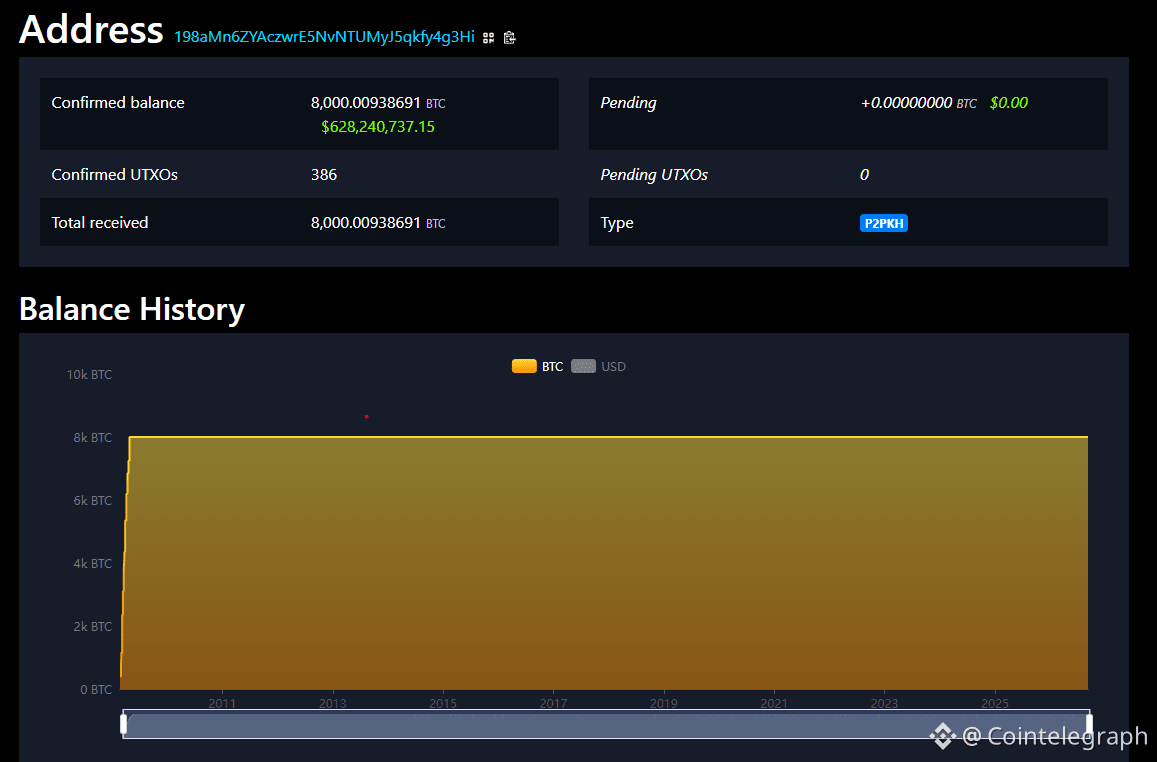
James Howells’ BTC is still on the blockchain. Source: Mempool.space
The Bitcoin itself, however, isn’t gone; it’s still sitting on the blockchain, visible to anyone who cares to look in the natural history museum of self-custody blunders.
7. Who was the DAO hacker?
Remember the 2016 DAO hack that would change Ethereum forever? This epic exploit wasn’t just one of crypto’s biggest early hacks; it helped determine what Ethereum would become.
An attacker exploited a vulnerability in The DAO’s smart contract to drain more than 3.6 million ETH into a child DAO, siphoning over 30% of the DAO’s funds before the attack stopped.
The attacker was never identified, and the aftermath would change crypto history, ultimately splitting Ethereum into two blockchains: the one we all know today and a smaller purist version, Ethereum Classic. In 2022 Laura Shin claimed the attacker was Austrian programmer Toby Hoenisch, but he denied the claims and has never been charged.
The DAO hack raised questions that persist today about whether code is law and blockchain transactions are immutable, or whether they can be rolled back if we don’t like them.
8. Who really stole the $400 million from FTX?
FTX’s collapse was already one of crypto’s biggest disasters when, just hours after the exchange filed for bankruptcy, hundreds of millions of dollars in digital assets began disappearing from its wallets. About $415 million in crypto was ultimately reported stolen.
Of course, the timing immediately raised suspicion, with FTX in chaos, employees trying to secure assets, bankruptcy proceedings beginning and different groups racing to determine who actually controlled the exchange’s wallets.
The US Department of Justice eventually seized hundreds of millions of dollars in assets linked to FTX and investigators have traced parts of the movements, but the identity of the attacker remains an unsolved crypto mystery.
Was it an opportunist outside hacker who happened to strike at the perfect moment? Was it somebody with inside access, or did the swirling chaos around the collapse create an opportunity that someone close to the exchange exploited? To this day, we don’t have an answer.
9. What really happened to Nikolai Mushegian?
Nikolai Mushegian was an early MakerDAO developer and a co-founder of Balancer who helped shape some of DeFi’s first infrastructure.
On Oct. 28, 2022, Mushegian was found dead in the waters off Condado Beach in San Juan, Puerto Rico. Local police said he had been out swimming and was caught by strong ocean currents.
Not everybody buys that version of events, however, since Mushegian had taken to Twitter to warn of his impending assassination just hours earlier.
In a series of disturbing and paranoid messages, he claimed that the CIA, Mossad and “pedo elite” were involved in a sex-trafficking operation in the area and were planning to frame him and kill him.
Nikolai Mushegian alerted his followers of his death before it happened. Source: Nikolai Mushegian
The Puerto Rico Justice Department investigated his death for almost a year and determined no criminal involvement, but given his online messages, questions about what happened remain.
Was Mushegian really caught by currents, as authorities reported, or was something more sinister going on in his final hours?
10. Why did someone deliberately burn 107 BTC?
Perhaps one of the weirdest mysteries of all is why anyone would burn a Bitcoin fortune after HODLing it for more than 12 years? Yet that’s exactly what happened in May 2026.
Someone sent 107 BTC, worth about $8.5 million, to a Bitcoin address from which the coins are rendered unspendable, effectively destroying them.
The coins had been acquired around 2014, when Bitcoin was trading below $600, making the timing particularly strange. Why would anyone voluntarily destroy millions of dollars in Bitcoin after holding it through a 12,000% rise in its value?
Stranger still, one of the five wallets suddenly sent about 20 BTC, worth roughly $1 million, to what appeared to be a large crypto custodian in March.
Almost exactly the same amount came back three weeks later, before the Bitcoin was ultimately burned, adding another layer to the mystery.
For an industry still in its teenage years, crypto sure has endured its fair share of intrigue. Be careful next time you decide to self-custody your fortune — you might just end up as one of crypto’s next great mysteries.
Magazine: Is Bitcoin too volatile to risk your retirement on?
10 of the greatest unsolved crypto mysteries
In an industry built on transparency and verifiability, newcomers might assume that crypto and blockchains leave very little room for mystery.
They’d be completely wrong of course, because the murky world of digital assets is rife with underhanded dealings, unsolved enigmas and fortunes disappearing behind pseudonyms.
From the identity of Bitcoin’s mystery creator to what really happened to a DAI developer on a beach in Puerto Rico, here are 10 crypto mysteries that remain unsolved.
1. Who is Satoshi Nakamoto?
More than 17 years after Bitcoin’s creation, the greatest unsolved crypto mystery persists. We still don’t know who Satoshi Nakamoto is, or even whether Satoshi was one person.
He, she, or they published the Bitcoin white paper in 2008, mined the genesis block in January 2009 and remained active in its early development before disappearing from public view in 2010.
The quest for Satoshi’s identity has since produced an endless parade of possible candidates, from cryptographers and cypherpunks to British academics, early Bitcoin developers and even convicted sex offenders.
The latest serious attempt to solve the mystery came in April 2026, when The New York Times published a lengthy investigation naming British cryptographer Adam Back as its leading candidate.
The Times claimed there were similarities between his writings and Satoshi’s, their shared cryptographic interests, Back’s work on Hashcash — which was cited in the Bitcoin white paper — and a series of other circumstantial clues, all of which Back strenuously denied.
Adam Back’s Hashcash is cited in the Bitcoin Whitepaper. Source: Bitcoin.org
Other suspected candidates over the years have included core developer Peter Todd, cryptographer Hal Finney, Twitter founder Jack Dorsey and others. Self-proclaimed Bitcoin creator Craig Wright is the only major Satoshi candidate to have been formally ruled by a UK court not to be Satoshi.
There were even some bizarre online claims that notorious sex offender Jeffrey Epstein could be Satoshi after a newly released tranche of the Epstein files revealed the sex trafficer had been involved in the early crypto industry, and made a 2014 investment in Back’s Blockstream.
There is no credible evidence that Epstein was Satoshi, , and so the enigma remains: Who is Satoshi Nakamoto and where is he now?
2. Who was the Patoshi miner?
If you thought the Satoshi mystery was strange, try digging into Bitcoin’s earliest blocks like blockchain researcher Sergio Lerner.
In 2013, he discovered a pattern in the way Bitcoin’s earliest blocks were mined and linked it to a single miner he later dubbed “Patoshi.”
Lerner estimated that the miner had accumulated about 1.1 million BTC across 22,000 blocks, which makes the enigmatic figure the largest holder of BTC today, above Coinbase, BlackRock and Strategy.
Satoshi Nakamoto is the top Bitcoin holder. Source: Arkham
While Patoshi has never conclusively been proven to be the mysterious Bitcoin creator, the pattern is still one of the strongest pieces of evidence linking a huge stash of early Bitcoin to Satoshi.
So who was Patoshi? Was it Satoshi operating a single machine, another early Bitcoin enthusiast, or something else entirely?
3. What happened to Mt. Gox’s missing Bitcoin?
When Mt. Gox collapsed in February 2014, it claimed that around 850,000 BTC had disappeared — only to later uncover some 200,000 BTC hiding in old-format wallets it previously believed to be empty. To this day, the rest of the coins’ whereabouts remain a mystery.
More than 12 years later, creditors are finally getting some of their money back, but what happened to Mt. Gox’s missing Bitcoin has never been resolved.
Investigators have traced portions of it, including some coins connected to Russian cybercriminals and the BTC-e exchange. US prosecutors have also alleged that Russian nationals stole and laundered roughly 647,000 BTC from Mt. Gox, yet the full story of the stolen coins has not been completely solved.
Russian nationals charged with hacking Mt. Gox. Source: DOJ
Who stole them? How long had the theft been happening? How much was taken through hacking versus internal failures? And more importantly, where are all those coins now?
4. What really happened to QuadrigaCX’s missing funds?
Canadian exchange QuadrigaCX shot to the top of crypto’s mystery list in December 2018 after its founder, Gerald Cotten, died suddenly in Jaipur, India.
The exchange was unable to access millions of dollars in cryptocurrency that customers had deposited, and it was popularly believed at the time that Cotten had taken the exchange’s private keys with him to the grave.
An investigation by the Ontario Securities Commission later found that he had actually transferred millions of dollars of client funds to his and his wife’s personal accounts, and had also used client assets to cover his own trading losses and personal expenses.
Was Quadriga a massive fraud that collapsed when its orchestrator died? Did Cotten leave behind wallets nobody has found, or did he fake his death and pocket the funds?
5. Where is the CryptoQueen?
Few crypto mysteries involve a missing person quite as notorious as Ruja Ignatova, AKA the CryptoQueen.
The charismatic Bulgarian founder of OneCoin allegedly helped build one of the world’s biggest crypto scams, with the FBI saying the scheme defrauded victims worldwide of more than $4 billion.
In October 2017, Ignatova flew from Sofia to Athens and then promptly disappeared, never to be found again.
The FBI added Ignatova to its 10 Most Wanted Fugitives list in 2022 and still offers a reward of up to $5 million for information leading to her arrest and conviction. In a 2026 update, the FBI said she remains at large and described her as “well-funded” and “well-connected.”
Rula Ignatova is still at large, according to the FBI. Source: FBI
So, is she still doing the crypto conference circuit undercover today, scheming for her next victims? Was she killed, or did she escape with millions of dollars and is living under a new identity with the aid of extensive plastic surgery?
Where is Ruja Ignatova? Maybe she’s sipping Mumbai Mules on a beach somewhere with Gerald Cotten.
6. Will James Howells ever get his lost Bitcoin back?
Back in 2013, Welsh IT worker James Howells accidentally threw away a hard drive containing the keys to what would later become a massive Bitcoin fortune, unwittingly becoming the poster child for how not to self-custody your BTC.
Howells insists that the infamous hard drive ended up in a massive landfill and spent years trying to recover it, even proposing to excavate part of the landfill with specialist equipment and AI-powered sorting systems to search the waste.
But after years of legal battles and failed attempts to persuade Newport City Council to let him excavate the site, his efforts to recover the drive have been in vain. A High Court judge ruled that he had no realistic prospect of succeeding in January 2025.
James Howells’ BTC is still on the blockchain. Source: Mempool.space
The Bitcoin itself, however, isn’t gone; it’s still sitting on the blockchain, visible to anyone who cares to look in the natural history museum of self-custody blunders.
7. Who was the DAO hacker?
Remember the 2016 DAO hack that would change Ethereum forever? This epic exploit wasn’t just one of crypto’s biggest early hacks; it helped determine what Ethereum would become.
An attacker exploited a vulnerability in The DAO’s smart contract to drain more than 3.6 million ETH into a child DAO, siphoning over 30% of the DAO’s funds before the attack stopped.
The attacker was never identified, and the aftermath would change crypto history, ultimately splitting Ethereum into two blockchains: the one we all know today and a smaller purist version, Ethereum Classic. In 2022 Laura Shin claimed the attacker was Austrian programmer Toby Hoenisch, but he denied the claims and has never been charged.
The DAO hack raised questions that persist today about whether code is law and blockchain transactions are immutable, or whether they can be rolled back if we don’t like them.
8. Who really stole the $400 million from FTX?
FTX’s collapse was already one of crypto’s biggest disasters when, just hours after the exchange filed for bankruptcy, hundreds of millions of dollars in digital assets began disappearing from its wallets. About $415 million in crypto was ultimately reported stolen.
Of course, the timing immediately raised suspicion, with FTX in chaos, employees trying to secure assets, bankruptcy proceedings beginning and different groups racing to determine who actually controlled the exchange’s wallets.
The US Department of Justice eventually seized hundreds of millions of dollars in assets linked to FTX and investigators have traced parts of the movements, but the identity of the attacker remains an unsolved crypto mystery.
Was it an opportunist outside hacker who happened to strike at the perfect moment? Was it somebody with inside access, or did the swirling chaos around the collapse create an opportunity that someone close to the exchange exploited? To this day, we don’t have an answer.
9. What really happened to Nikolai Mushegian?
Nikolai Mushegian was an early MakerDAO developer and a co-founder of Balancer who helped shape some of DeFi’s first infrastructure.
On Oct. 28, 2022, Mushegian was found dead in the waters off Condado Beach in San Juan, Puerto Rico. Local police said he had been out swimming and was caught by strong ocean currents.
Not everybody buys that version of events, however, since Mushegian had taken to Twitter to warn of his impending assassination just hours earlier.
In a series of disturbing and paranoid messages, he claimed that the CIA, Mossad and “pedo elite” were involved in a sex-trafficking operation in the area and were planning to frame him and kill him.
Nikolai Mushegian alerted his followers of his death before it happened. Source: Nikolai Mushegian
The Puerto Rico Justice Department investigated his death for almost a year and determined no criminal involvement, but given his online messages, questions about what happened remain.
Was Mushegian really caught by currents, as authorities reported, or was something more sinister going on in his final hours?
10. Why did someone deliberately burn 107 BTC?
Perhaps one of the weirdest mysteries of all is why anyone would burn a Bitcoin fortune after HODLing it for more than 12 years? Yet that’s exactly what happened in May 2026.
Someone sent 107 BTC, worth about $8.5 million, to a Bitcoin address from which the coins are rendered unspendable, effectively destroying them.
The coins had been acquired around 2014, when Bitcoin was trading below $600, making the timing particularly strange. Why would anyone voluntarily destroy millions of dollars in Bitcoin after holding it through a 12,000% rise in its value?
Stranger still, one of the five wallets suddenly sent about 20 BTC, worth roughly $1 million, to what appeared to be a large crypto custodian in March.
Almost exactly the same amount came back three weeks later, before the Bitcoin was ultimately burned, adding another layer to the mystery.
For an industry still in its teenage years, crypto sure has endured its fair share of intrigue. Be careful next time you decide to self-custody your fortune — you might just end up as one of crypto’s next great mysteries.
Magazine: Is Bitcoin too volatile to risk your retirement on?
They’d be completely wrong of course, because the murky world of digital assets is rife with underhanded dealings, unsolved enigmas and fortunes disappearing behind pseudonyms.
From the identity of Bitcoin’s mystery creator to what really happened to a DAI developer on a beach in Puerto Rico, here are 10 crypto mysteries that remain unsolved.
1. Who is Satoshi Nakamoto?
More than 17 years after Bitcoin’s creation, the greatest unsolved crypto mystery persists. We still don’t know who Satoshi Nakamoto is, or even whether Satoshi was one person.
He, she, or they published the Bitcoin white paper in 2008, mined the genesis block in January 2009 and remained active in its early development before disappearing from public view in 2010.
The quest for Satoshi’s identity has since produced an endless parade of possible candidates, from cryptographers and cypherpunks to British academics, early Bitcoin developers and even convicted sex offenders.
The latest serious attempt to solve the mystery came in April 2026, when The New York Times published a lengthy investigation naming British cryptographer Adam Back as its leading candidate.
The Times claimed there were similarities between his writings and Satoshi’s, their shared cryptographic interests, Back’s work on Hashcash — which was cited in the Bitcoin white paper — and a series of other circumstantial clues, all of which Back strenuously denied.
Adam Back’s Hashcash is cited in the Bitcoin Whitepaper. Source: Bitcoin.org
Other suspected candidates over the years have included core developer Peter Todd, cryptographer Hal Finney, Twitter founder Jack Dorsey and others. Self-proclaimed Bitcoin creator Craig Wright is the only major Satoshi candidate to have been formally ruled by a UK court not to be Satoshi.
There were even some bizarre online claims that notorious sex offender Jeffrey Epstein could be Satoshi after a newly released tranche of the Epstein files revealed the sex trafficer had been involved in the early crypto industry, and made a 2014 investment in Back’s Blockstream.
There is no credible evidence that Epstein was Satoshi, , and so the enigma remains: Who is Satoshi Nakamoto and where is he now?
2. Who was the Patoshi miner?
If you thought the Satoshi mystery was strange, try digging into Bitcoin’s earliest blocks like blockchain researcher Sergio Lerner.
In 2013, he discovered a pattern in the way Bitcoin’s earliest blocks were mined and linked it to a single miner he later dubbed “Patoshi.”
Lerner estimated that the miner had accumulated about 1.1 million BTC across 22,000 blocks, which makes the enigmatic figure the largest holder of BTC today, above Coinbase, BlackRock and Strategy.
Satoshi Nakamoto is the top Bitcoin holder. Source: Arkham
While Patoshi has never conclusively been proven to be the mysterious Bitcoin creator, the pattern is still one of the strongest pieces of evidence linking a huge stash of early Bitcoin to Satoshi.
So who was Patoshi? Was it Satoshi operating a single machine, another early Bitcoin enthusiast, or something else entirely?
3. What happened to Mt. Gox’s missing Bitcoin?
When Mt. Gox collapsed in February 2014, it claimed that around 850,000 BTC had disappeared — only to later uncover some 200,000 BTC hiding in old-format wallets it previously believed to be empty. To this day, the rest of the coins’ whereabouts remain a mystery.
More than 12 years later, creditors are finally getting some of their money back, but what happened to Mt. Gox’s missing Bitcoin has never been resolved.
Investigators have traced portions of it, including some coins connected to Russian cybercriminals and the BTC-e exchange. US prosecutors have also alleged that Russian nationals stole and laundered roughly 647,000 BTC from Mt. Gox, yet the full story of the stolen coins has not been completely solved.
Russian nationals charged with hacking Mt. Gox. Source: DOJ
Who stole them? How long had the theft been happening? How much was taken through hacking versus internal failures? And more importantly, where are all those coins now?
4. What really happened to QuadrigaCX’s missing funds?
Canadian exchange QuadrigaCX shot to the top of crypto’s mystery list in December 2018 after its founder, Gerald Cotten, died suddenly in Jaipur, India.
The exchange was unable to access millions of dollars in cryptocurrency that customers had deposited, and it was popularly believed at the time that Cotten had taken the exchange’s private keys with him to the grave.
An investigation by the Ontario Securities Commission later found that he had actually transferred millions of dollars of client funds to his and his wife’s personal accounts, and had also used client assets to cover his own trading losses and personal expenses.
Was Quadriga a massive fraud that collapsed when its orchestrator died? Did Cotten leave behind wallets nobody has found, or did he fake his death and pocket the funds?
5. Where is the CryptoQueen?
Few crypto mysteries involve a missing person quite as notorious as Ruja Ignatova, AKA the CryptoQueen.
The charismatic Bulgarian founder of OneCoin allegedly helped build one of the world’s biggest crypto scams, with the FBI saying the scheme defrauded victims worldwide of more than $4 billion.
In October 2017, Ignatova flew from Sofia to Athens and then promptly disappeared, never to be found again.
The FBI added Ignatova to its 10 Most Wanted Fugitives list in 2022 and still offers a reward of up to $5 million for information leading to her arrest and conviction. In a 2026 update, the FBI said she remains at large and described her as “well-funded” and “well-connected.”
Rula Ignatova is still at large, according to the FBI. Source: FBI
So, is she still doing the crypto conference circuit undercover today, scheming for her next victims? Was she killed, or did she escape with millions of dollars and is living under a new identity with the aid of extensive plastic surgery?
Where is Ruja Ignatova? Maybe she’s sipping Mumbai Mules on a beach somewhere with Gerald Cotten.
6. Will James Howells ever get his lost Bitcoin back?
Back in 2013, Welsh IT worker James Howells accidentally threw away a hard drive containing the keys to what would later become a massive Bitcoin fortune, unwittingly becoming the poster child for how not to self-custody your BTC.
Howells insists that the infamous hard drive ended up in a massive landfill and spent years trying to recover it, even proposing to excavate part of the landfill with specialist equipment and AI-powered sorting systems to search the waste.
But after years of legal battles and failed attempts to persuade Newport City Council to let him excavate the site, his efforts to recover the drive have been in vain. A High Court judge ruled that he had no realistic prospect of succeeding in January 2025.
James Howells’ BTC is still on the blockchain. Source: Mempool.space
The Bitcoin itself, however, isn’t gone; it’s still sitting on the blockchain, visible to anyone who cares to look in the natural history museum of self-custody blunders.
7. Who was the DAO hacker?
Remember the 2016 DAO hack that would change Ethereum forever? This epic exploit wasn’t just one of crypto’s biggest early hacks; it helped determine what Ethereum would become.
An attacker exploited a vulnerability in The DAO’s smart contract to drain more than 3.6 million ETH into a child DAO, siphoning over 30% of the DAO’s funds before the attack stopped.
The attacker was never identified, and the aftermath would change crypto history, ultimately splitting Ethereum into two blockchains: the one we all know today and a smaller purist version, Ethereum Classic. In 2022 Laura Shin claimed the attacker was Austrian programmer Toby Hoenisch, but he denied the claims and has never been charged.
The DAO hack raised questions that persist today about whether code is law and blockchain transactions are immutable, or whether they can be rolled back if we don’t like them.
8. Who really stole the $400 million from FTX?
FTX’s collapse was already one of crypto’s biggest disasters when, just hours after the exchange filed for bankruptcy, hundreds of millions of dollars in digital assets began disappearing from its wallets. About $415 million in crypto was ultimately reported stolen.
Of course, the timing immediately raised suspicion, with FTX in chaos, employees trying to secure assets, bankruptcy proceedings beginning and different groups racing to determine who actually controlled the exchange’s wallets.
The US Department of Justice eventually seized hundreds of millions of dollars in assets linked to FTX and investigators have traced parts of the movements, but the identity of the attacker remains an unsolved crypto mystery.
Was it an opportunist outside hacker who happened to strike at the perfect moment? Was it somebody with inside access, or did the swirling chaos around the collapse create an opportunity that someone close to the exchange exploited? To this day, we don’t have an answer.
9. What really happened to Nikolai Mushegian?
Nikolai Mushegian was an early MakerDAO developer and a co-founder of Balancer who helped shape some of DeFi’s first infrastructure.
On Oct. 28, 2022, Mushegian was found dead in the waters off Condado Beach in San Juan, Puerto Rico. Local police said he had been out swimming and was caught by strong ocean currents.
Not everybody buys that version of events, however, since Mushegian had taken to Twitter to warn of his impending assassination just hours earlier.
In a series of disturbing and paranoid messages, he claimed that the CIA, Mossad and “pedo elite” were involved in a sex-trafficking operation in the area and were planning to frame him and kill him.
Nikolai Mushegian alerted his followers of his death before it happened. Source: Nikolai Mushegian
The Puerto Rico Justice Department investigated his death for almost a year and determined no criminal involvement, but given his online messages, questions about what happened remain.
Was Mushegian really caught by currents, as authorities reported, or was something more sinister going on in his final hours?
10. Why did someone deliberately burn 107 BTC?
Perhaps one of the weirdest mysteries of all is why anyone would burn a Bitcoin fortune after HODLing it for more than 12 years? Yet that’s exactly what happened in May 2026.
Someone sent 107 BTC, worth about $8.5 million, to a Bitcoin address from which the coins are rendered unspendable, effectively destroying them.
The coins had been acquired around 2014, when Bitcoin was trading below $600, making the timing particularly strange. Why would anyone voluntarily destroy millions of dollars in Bitcoin after holding it through a 12,000% rise in its value?
Stranger still, one of the five wallets suddenly sent about 20 BTC, worth roughly $1 million, to what appeared to be a large crypto custodian in March.
Almost exactly the same amount came back three weeks later, before the Bitcoin was ultimately burned, adding another layer to the mystery.
For an industry still in its teenage years, crypto sure has endured its fair share of intrigue. Be careful next time you decide to self-custody your fortune — you might just end up as one of crypto’s next great mysteries.
Magazine: Is Bitcoin too volatile to risk your retirement on?
92
Article
DoubleZero adds Kalshi election market data ahead of US midtermsDoubleZero, a network for high-speed data distribution, has added real-time data from Kalshi’s election and politics markets as prediction market trading picks up ahead of the US midterm elections in November.
The expansion adds Kalshi’s election contracts to DoubleZero Edge, which already carries data from the prediction market’s sports contracts and crypto perpetual futures, according to a Wednesday announcement.
The feed includes top-of-book and trade data, along with aggregated order book data from Kalshi’s election markets. Andy Ross, head of institutional at Kalshi, said the integration is intended to make political market data easier to incorporate into institutional workflows as expectations shift around election outcomes.
According to data from the Anti-Corruption Data Collective, betting on the 2026 US midterms had reached $133 million as of Aug. 10, surpassing the $92.4 million wagered during the entire 2024 congressional election cycle.
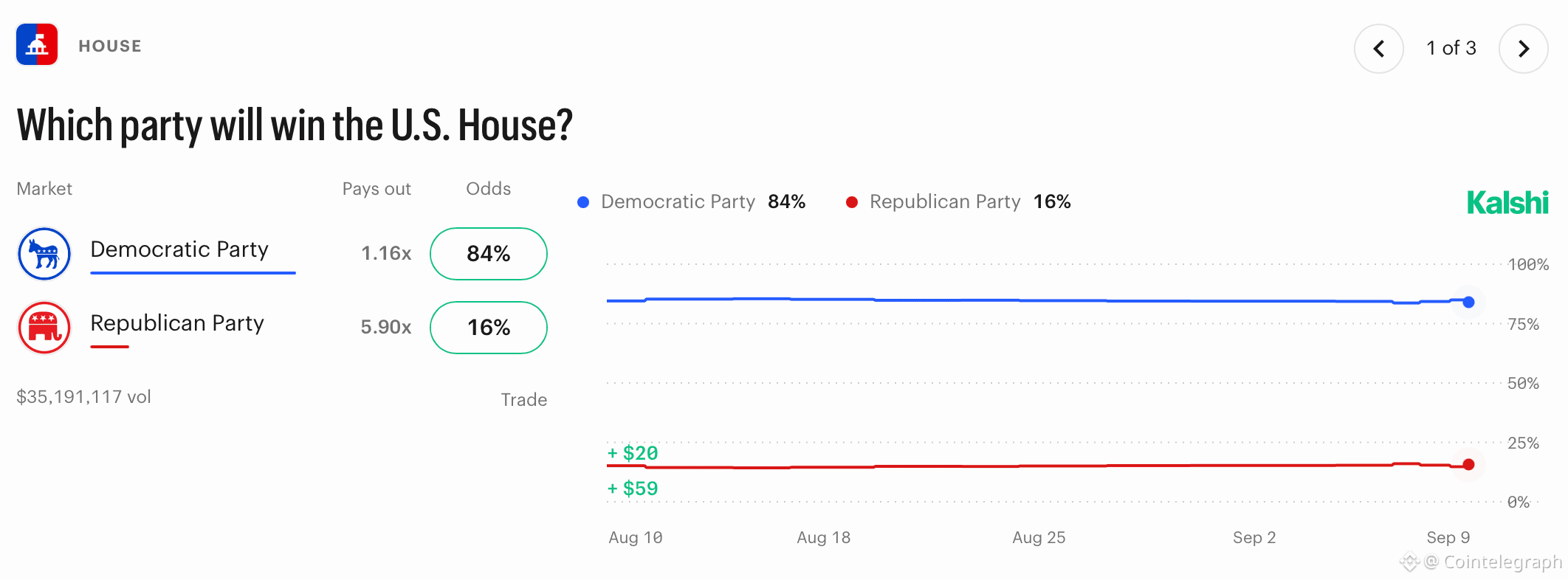
At the time of writing, a Kalshi midterm market that asks which party will win the US House had recorded more than $35 million in trading volume, with Democratic victory odds at 84%.
Kalshi’s prediction market on which party will win the US House. Source: Kalshi
DoubleZero adds Kalshi election market data ahead of US midterms
DoubleZero, a network for high-speed data distribution, has added real-time data from Kalshi’s election and politics markets as prediction market trading picks up ahead of the US midterm elections in November.
The expansion adds Kalshi’s election contracts to DoubleZero Edge, which already carries data from the prediction market’s sports contracts and crypto perpetual futures, according to a Wednesday announcement.
The feed includes top-of-book and trade data, along with aggregated order book data from Kalshi’s election markets. Andy Ross, head of institutional at Kalshi, said the integration is intended to make political market data easier to incorporate into institutional workflows as expectations shift around election outcomes.
According to data from the Anti-Corruption Data Collective, betting on the 2026 US midterms had reached $133 million as of Aug. 10, surpassing the $92.4 million wagered during the entire 2024 congressional election cycle.
At the time of writing, a Kalshi midterm market that asks which party will win the US House had recorded more than $35 million in trading volume, with Democratic victory odds at 84%.
Kalshi’s prediction market on which party will win the US House. Source: Kalshi
The expansion adds Kalshi’s election contracts to DoubleZero Edge, which already carries data from the prediction market’s sports contracts and crypto perpetual futures, according to a Wednesday announcement.
The feed includes top-of-book and trade data, along with aggregated order book data from Kalshi’s election markets. Andy Ross, head of institutional at Kalshi, said the integration is intended to make political market data easier to incorporate into institutional workflows as expectations shift around election outcomes.
According to data from the Anti-Corruption Data Collective, betting on the 2026 US midterms had reached $133 million as of Aug. 10, surpassing the $92.4 million wagered during the entire 2024 congressional election cycle.
At the time of writing, a Kalshi midterm market that asks which party will win the US House had recorded more than $35 million in trading volume, with Democratic victory odds at 84%.
Kalshi’s prediction market on which party will win the US House. Source: Kalshi
119
Article
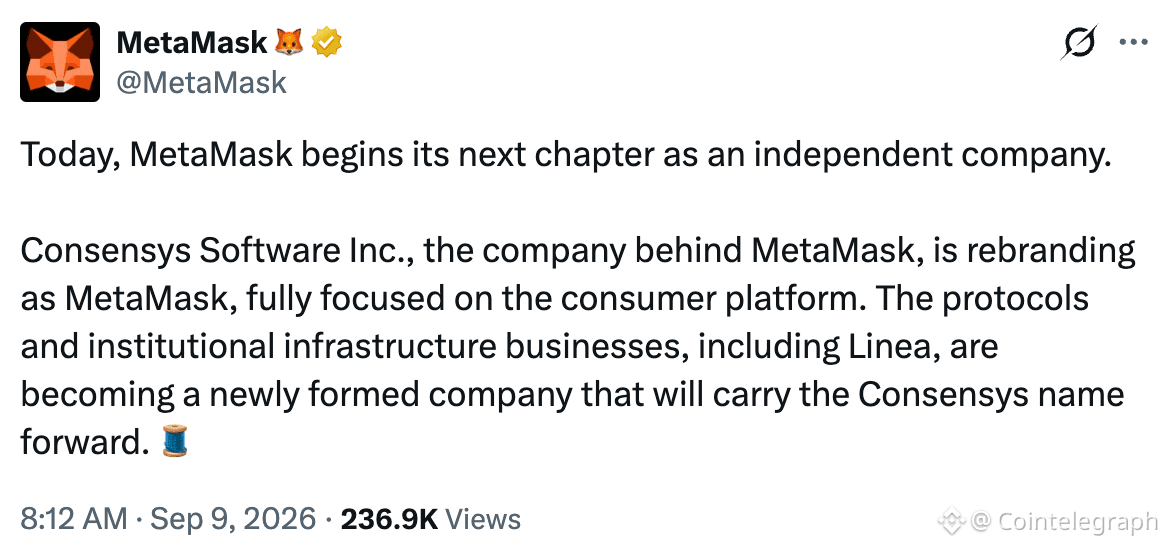
Consensys to split into MetaMask and institutional blockchain companyConsensys Software Inc., the Ethereum software company behind MetaMask, plans to split into two independent companies, separating its consumer business from its institutional blockchain infrastructure operations.
According to Wednesday’s announcement, the separation is expected to be completed by the end of 2026, with Joe Lubin serving as chairman and CEO of MetaMask and executive chairman of the new Consensys.
The new Consensys will house the company’s protocols and institutional infrastructure businesses, including Linea, Besu and Teku, and will be led by CEO Mike Kriak and President David Cunningham. The company will focus on Ethereum infrastructure and helping financial institutions deploy blockchain technology for tokenization, stablecoins and other onchain financial services.
MetaMask will remain focused on consumer self-custody while expanding beyond crypto into payments, savings, investing and traditional financial products.
Source: MetaMask
MetaMask has recorded more than 100 million downloads across roughly 190 countries and facilitated trillions of dollars in transaction volume, according to the company.
The company said the restructuring reflects increasingly different priorities for its consumer and institutional businesses.
MetaMask’s evolution beyond crypto wallet
MetaMask, which launched in 2016 as an Ethereum browser extension for accessing decentralized applications and managing crypto assets, has expanded beyond those roots over the past year, adding products spanning payments, yield and tokenized traditional assets.
In June, MetaMask launched Money Account, which allows users to earn up to 4% variable APY on eligible mUSD stablecoin balances and spend the funds through MetaMask Card. The yield is generated through DeFi lending strategies rather than interest paid by MetaMask or the stablecoin issuer.
Source: MetaMask
In February, the company added access to 200 tokenized US stocks, exchange-traded funds and commodities through Ondo Global Markets for eligible users outside the United States.
Later that month, it rolled out its Mastercard-enabled spending card across 49 US states, expanding a product previously available in markets including Europe, Canada, Mexico, Brazil and Argentina.
Magazine: Token buybacks are booming. But are they good for crypto projects?
Consensys to split into MetaMask and institutional blockchain company
Consensys Software Inc., the Ethereum software company behind MetaMask, plans to split into two independent companies, separating its consumer business from its institutional blockchain infrastructure operations.
According to Wednesday’s announcement, the separation is expected to be completed by the end of 2026, with Joe Lubin serving as chairman and CEO of MetaMask and executive chairman of the new Consensys.
The new Consensys will house the company’s protocols and institutional infrastructure businesses, including Linea, Besu and Teku, and will be led by CEO Mike Kriak and President David Cunningham. The company will focus on Ethereum infrastructure and helping financial institutions deploy blockchain technology for tokenization, stablecoins and other onchain financial services.
MetaMask will remain focused on consumer self-custody while expanding beyond crypto into payments, savings, investing and traditional financial products.
Source: MetaMask
MetaMask has recorded more than 100 million downloads across roughly 190 countries and facilitated trillions of dollars in transaction volume, according to the company.
The company said the restructuring reflects increasingly different priorities for its consumer and institutional businesses.
MetaMask’s evolution beyond crypto wallet
MetaMask, which launched in 2016 as an Ethereum browser extension for accessing decentralized applications and managing crypto assets, has expanded beyond those roots over the past year, adding products spanning payments, yield and tokenized traditional assets.
In June, MetaMask launched Money Account, which allows users to earn up to 4% variable APY on eligible mUSD stablecoin balances and spend the funds through MetaMask Card. The yield is generated through DeFi lending strategies rather than interest paid by MetaMask or the stablecoin issuer.
Source: MetaMask
In February, the company added access to 200 tokenized US stocks, exchange-traded funds and commodities through Ondo Global Markets for eligible users outside the United States.
Later that month, it rolled out its Mastercard-enabled spending card across 49 US states, expanding a product previously available in markets including Europe, Canada, Mexico, Brazil and Argentina.
Magazine: Token buybacks are booming. But are they good for crypto projects?
According to Wednesday’s announcement, the separation is expected to be completed by the end of 2026, with Joe Lubin serving as chairman and CEO of MetaMask and executive chairman of the new Consensys.
The new Consensys will house the company’s protocols and institutional infrastructure businesses, including Linea, Besu and Teku, and will be led by CEO Mike Kriak and President David Cunningham. The company will focus on Ethereum infrastructure and helping financial institutions deploy blockchain technology for tokenization, stablecoins and other onchain financial services.
MetaMask will remain focused on consumer self-custody while expanding beyond crypto into payments, savings, investing and traditional financial products.
Source: MetaMask
MetaMask has recorded more than 100 million downloads across roughly 190 countries and facilitated trillions of dollars in transaction volume, according to the company.
The company said the restructuring reflects increasingly different priorities for its consumer and institutional businesses.
MetaMask’s evolution beyond crypto wallet
MetaMask, which launched in 2016 as an Ethereum browser extension for accessing decentralized applications and managing crypto assets, has expanded beyond those roots over the past year, adding products spanning payments, yield and tokenized traditional assets.
In June, MetaMask launched Money Account, which allows users to earn up to 4% variable APY on eligible mUSD stablecoin balances and spend the funds through MetaMask Card. The yield is generated through DeFi lending strategies rather than interest paid by MetaMask or the stablecoin issuer.
Source: MetaMask
In February, the company added access to 200 tokenized US stocks, exchange-traded funds and commodities through Ondo Global Markets for eligible users outside the United States.
Later that month, it rolled out its Mastercard-enabled spending card across 49 US states, expanding a product previously available in markets including Europe, Canada, Mexico, Brazil and Argentina.
Magazine: Token buybacks are booming. But are they good for crypto projects?
2
124
TRM Labs doubles valuation to $2B in Series C expansionBlockchain intelligence firm TRM Labs has doubled its valuation to $2 billion following an expansion of its Series C funding round led by Blockchain Capital. The company did not disclose the size of the latest investment but said its annual recurring revenue has quadrupled over the past three years, according to an announcement Wednesday.
The expansion follows a $70 million Series C in February, also led by Blockchain Capital. TRM provides blockchain intelligence and investigation software used by more than 600 government agencies and private-sector institutions across 75 countries, the company said.
Prior to the February round, the company was valued at $930 million, according to data compiled by Traxcn. It breached the $1 billion valuation mark in the round that included Citi Ventures and Galaxy among the investors.
TRM said its AI-powered tools are used to investigate fraud, money laundering, sanctions evasion and other forms of digital crime.
Digital crime losses reported to the FBI’s Internet Crime Complaint Center rose to $21 billion in 2025 from $16 billion in 2024, while TRM said criminal adoption of AI has risen 40% year over year in 2026, citing its AI-in-Crime Adoption Index.
The new valuation comes about two months after US Immigration and Customs Enforcement (ICE) awarded TRM a roughly $95 million, one-year contract for forensic software and support services for Homeland Security Task Force investigations.
Rival Chainalysis challenged the sole-source award in federal court later that month, alleging ICE’s decision was “arbitrary, capricious, and unreasonable.”
Magazine: Is Bitcoin too volatile to risk your retirement on?
TRM Labs doubles valuation to $2B in Series C expansion
Blockchain intelligence firm TRM Labs has doubled its valuation to $2 billion following an expansion of its Series C funding round led by Blockchain Capital. The company did not disclose the size of the latest investment but said its annual recurring revenue has quadrupled over the past three years, according to an announcement Wednesday.
The expansion follows a $70 million Series C in February, also led by Blockchain Capital. TRM provides blockchain intelligence and investigation software used by more than 600 government agencies and private-sector institutions across 75 countries, the company said.
Prior to the February round, the company was valued at $930 million, according to data compiled by Traxcn. It breached the $1 billion valuation mark in the round that included Citi Ventures and Galaxy among the investors.
TRM said its AI-powered tools are used to investigate fraud, money laundering, sanctions evasion and other forms of digital crime.
Digital crime losses reported to the FBI’s Internet Crime Complaint Center rose to $21 billion in 2025 from $16 billion in 2024, while TRM said criminal adoption of AI has risen 40% year over year in 2026, citing its AI-in-Crime Adoption Index.
The new valuation comes about two months after US Immigration and Customs Enforcement (ICE) awarded TRM a roughly $95 million, one-year contract for forensic software and support services for Homeland Security Task Force investigations.
Rival Chainalysis challenged the sole-source award in federal court later that month, alleging ICE’s decision was “arbitrary, capricious, and unreasonable.”
Magazine: Is Bitcoin too volatile to risk your retirement on?
The expansion follows a $70 million Series C in February, also led by Blockchain Capital. TRM provides blockchain intelligence and investigation software used by more than 600 government agencies and private-sector institutions across 75 countries, the company said.
Prior to the February round, the company was valued at $930 million, according to data compiled by Traxcn. It breached the $1 billion valuation mark in the round that included Citi Ventures and Galaxy among the investors.
TRM said its AI-powered tools are used to investigate fraud, money laundering, sanctions evasion and other forms of digital crime.
Digital crime losses reported to the FBI’s Internet Crime Complaint Center rose to $21 billion in 2025 from $16 billion in 2024, while TRM said criminal adoption of AI has risen 40% year over year in 2026, citing its AI-in-Crime Adoption Index.
The new valuation comes about two months after US Immigration and Customs Enforcement (ICE) awarded TRM a roughly $95 million, one-year contract for forensic software and support services for Homeland Security Task Force investigations.
Rival Chainalysis challenged the sole-source award in federal court later that month, alleging ICE’s decision was “arbitrary, capricious, and unreasonable.”
Magazine: Is Bitcoin too volatile to risk your retirement on?
80
Article
U.S. Bank tests proprietary stablecoin in cross-border Stellar transactionU.S. Bank, the fifth-largest commercial bank in the United States, has completed a live cross-border payment using its proprietary USBDC stablecoin on the Stellar blockchain.
The pilot moved funds between U.S. Bank entities in North America and Europe, with USBDC issued and transferred on the public Stellar network. It also tested the stablecoin’s minting, redemption, freezing and clawback functions while integrating with the bank’s existing risk, compliance and operations systems.
The transaction validated U.S. Bank’s internally developed Digital Asset Platform, which connects tokenized assets with its traditional banking infrastructure, the bank said Wednesday. The Minneapolis, Minnesota-based bank is exploring additional uses including cross-border treasury operations, liquidity management and moving collateral onchain.
The pilot builds on U.S. Bank’s broader push into digital assets. In October 2025, the bank established a dedicated Digital Assets and Money Movement unit focused on stablecoin issuance, crypto custody, asset tokenization and digital money movement.
The country’s sixth-largest financial institution by assets, U.S. Bank has been testing custom stablecoin issuance on Stellar since at least November 2025, working alongside PwC and the Stellar Development Foundation.
Related: Jack Dorsey’s Block seeks US trust bank charter for Bitcoin, stablecoin
Banks deepen stablecoin push
While American banks have pushed back against allowing stablecoin issuers and crypto platforms to offer yield or rewards, some of the industry’s largest lenders are moving ahead with stablecoin projects of their own.
On Sept. 1, 21 major financial institutions, including Bank of America, Citi, Goldman Sachs, Deutsche Bank and UBS, announced plans to form a company to issue stablecoins.
The group plans to launch a US dollar-denominated stablecoin in the first half of 2027 before expanding to other G7 currencies. The token is expected to target wholesale, institutional and retail markets, including cross-border payments and digital asset settlement.
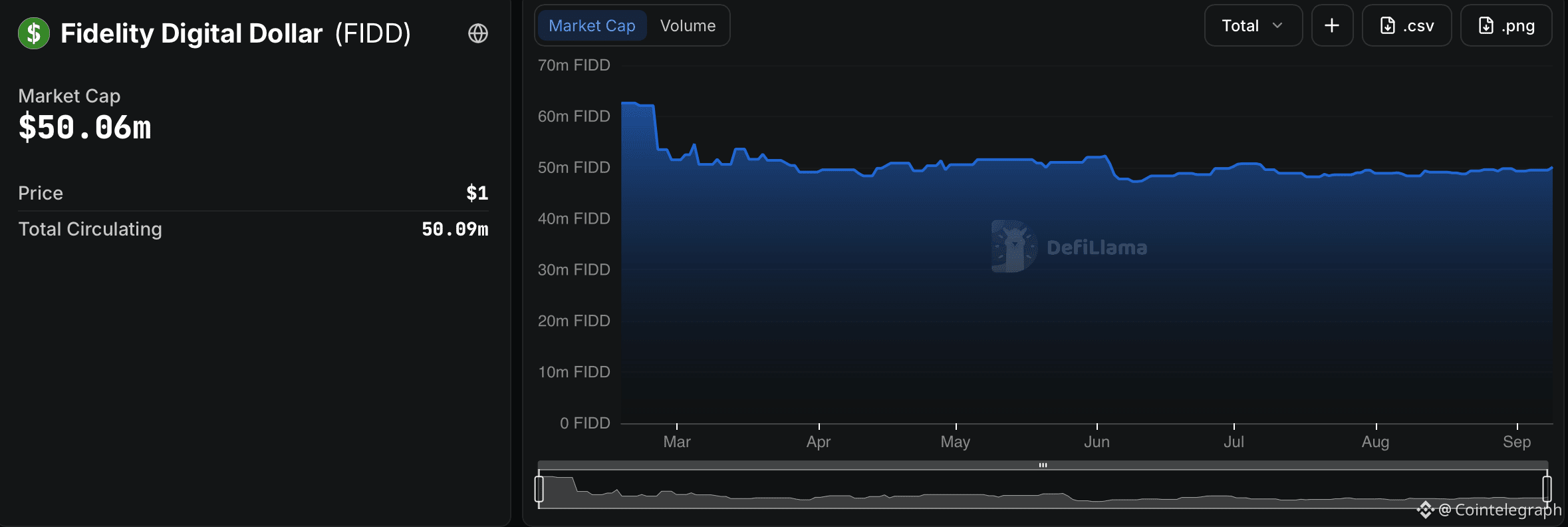
Fidelity also entered the market in February with its Fidelity Digital Dollar (FIDD), issued through Fidelity Digital Assets, its national trust bank, and available to retail and institutional investors. FIDD had about $50 million in circulation at the time of writing, according to DefiLlama data.
FIDD market cap. Source: DefiLlama
U.S. Bank tests proprietary stablecoin in cross-border Stellar transaction
U.S. Bank, the fifth-largest commercial bank in the United States, has completed a live cross-border payment using its proprietary USBDC stablecoin on the Stellar blockchain.
The pilot moved funds between U.S. Bank entities in North America and Europe, with USBDC issued and transferred on the public Stellar network. It also tested the stablecoin’s minting, redemption, freezing and clawback functions while integrating with the bank’s existing risk, compliance and operations systems.
The transaction validated U.S. Bank’s internally developed Digital Asset Platform, which connects tokenized assets with its traditional banking infrastructure, the bank said Wednesday. The Minneapolis, Minnesota-based bank is exploring additional uses including cross-border treasury operations, liquidity management and moving collateral onchain.
The pilot builds on U.S. Bank’s broader push into digital assets. In October 2025, the bank established a dedicated Digital Assets and Money Movement unit focused on stablecoin issuance, crypto custody, asset tokenization and digital money movement.
The country’s sixth-largest financial institution by assets, U.S. Bank has been testing custom stablecoin issuance on Stellar since at least November 2025, working alongside PwC and the Stellar Development Foundation.
Related: Jack Dorsey’s Block seeks US trust bank charter for Bitcoin, stablecoin
Banks deepen stablecoin push
While American banks have pushed back against allowing stablecoin issuers and crypto platforms to offer yield or rewards, some of the industry’s largest lenders are moving ahead with stablecoin projects of their own.
On Sept. 1, 21 major financial institutions, including Bank of America, Citi, Goldman Sachs, Deutsche Bank and UBS, announced plans to form a company to issue stablecoins.
The group plans to launch a US dollar-denominated stablecoin in the first half of 2027 before expanding to other G7 currencies. The token is expected to target wholesale, institutional and retail markets, including cross-border payments and digital asset settlement.
Fidelity also entered the market in February with its Fidelity Digital Dollar (FIDD), issued through Fidelity Digital Assets, its national trust bank, and available to retail and institutional investors. FIDD had about $50 million in circulation at the time of writing, according to DefiLlama data.
FIDD market cap. Source: DefiLlama
The pilot moved funds between U.S. Bank entities in North America and Europe, with USBDC issued and transferred on the public Stellar network. It also tested the stablecoin’s minting, redemption, freezing and clawback functions while integrating with the bank’s existing risk, compliance and operations systems.
The transaction validated U.S. Bank’s internally developed Digital Asset Platform, which connects tokenized assets with its traditional banking infrastructure, the bank said Wednesday. The Minneapolis, Minnesota-based bank is exploring additional uses including cross-border treasury operations, liquidity management and moving collateral onchain.
The pilot builds on U.S. Bank’s broader push into digital assets. In October 2025, the bank established a dedicated Digital Assets and Money Movement unit focused on stablecoin issuance, crypto custody, asset tokenization and digital money movement.
The country’s sixth-largest financial institution by assets, U.S. Bank has been testing custom stablecoin issuance on Stellar since at least November 2025, working alongside PwC and the Stellar Development Foundation.
Related: Jack Dorsey’s Block seeks US trust bank charter for Bitcoin, stablecoin
Banks deepen stablecoin push
While American banks have pushed back against allowing stablecoin issuers and crypto platforms to offer yield or rewards, some of the industry’s largest lenders are moving ahead with stablecoin projects of their own.
On Sept. 1, 21 major financial institutions, including Bank of America, Citi, Goldman Sachs, Deutsche Bank and UBS, announced plans to form a company to issue stablecoins.
The group plans to launch a US dollar-denominated stablecoin in the first half of 2027 before expanding to other G7 currencies. The token is expected to target wholesale, institutional and retail markets, including cross-border payments and digital asset settlement.
Fidelity also entered the market in February with its Fidelity Digital Dollar (FIDD), issued through Fidelity Digital Assets, its national trust bank, and available to retail and institutional investors. FIDD had about $50 million in circulation at the time of writing, according to DefiLlama data.
FIDD market cap. Source: DefiLlama
197
Article
Bitcoin fails to reclaim $80K as Bessent fuels yen strength around 153 per dollarBitcoin (BTC) struggled below $80,000 on Wednesday as attention refocused on the Japanese yen.
Key points:
Bitcoin saw further macro headwinds as US-Iran strikes pushed Brent crude oil above $100 per barrel.
The Japanese yen continued to trade around 153 per dollar, its highest levels since February as yen shorts stayed near record highs.
US Treasury Secretary Scott Bessent hinted at further interventions in yen currency markets to come.
Bitcoin lacks momentum as Iran strikes sour risk-asset mood
Data from TradingView showed the local upside in the BTC/USD pair reversing as it attempted to revisit the $80,000 mark. BTC is currently down by around 0.4% on the day.
BTC/USD one-hour chart. Source: Cointelegraph/TradingView
US stocks also drifted lower at the Wall Street open, fueled by fresh US strikes on Iranian oil tankers. The tensions helped send oil prices to new three-month highs, building on gains from the day prior.
At the time of writing, WTI crude traded above $96 per barrel, while Brent crude surged above $101 per barrel for the first time since late July.
CFDs on Brent crude oil one-day chart. Source: Cointelegraph/TradingView
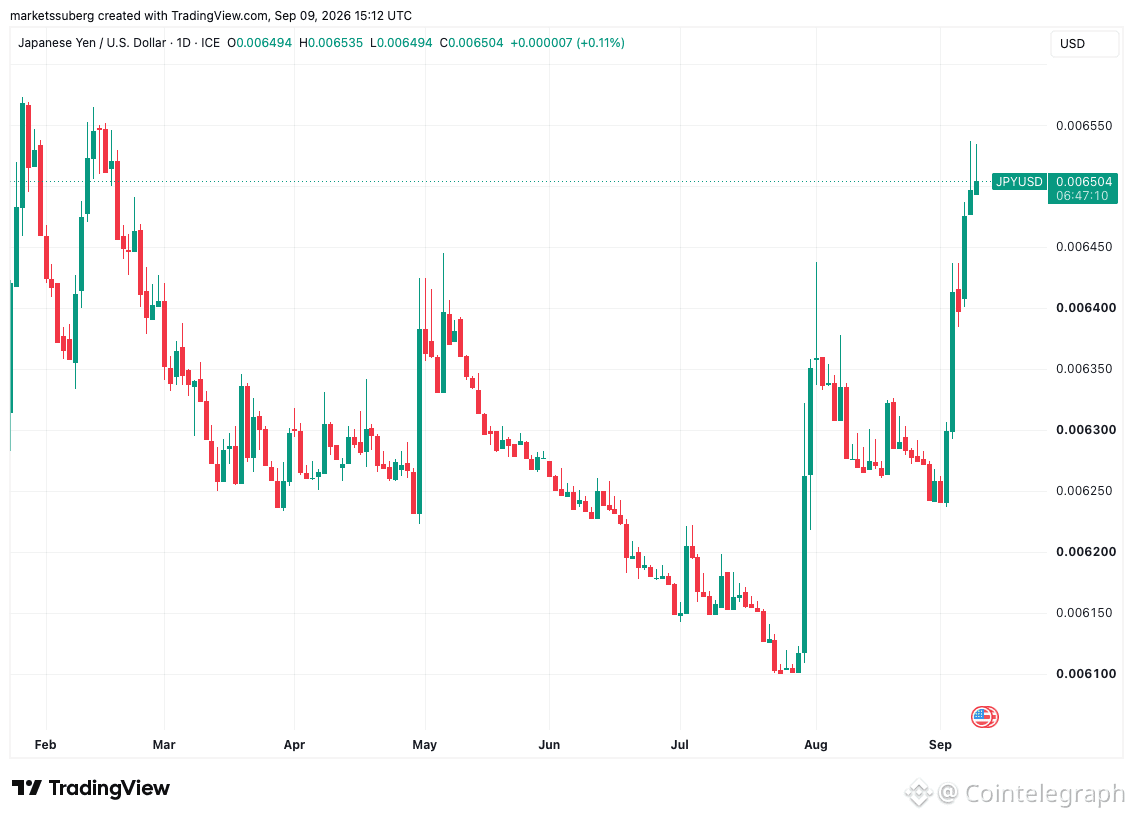
Traders also eyed fresh developments in the yen as Japan’s currency hit its highest levels against the dollar since February. It is currently at $0.0065, up 6.5% since the start of August.
JPY/USD one-day chart. Source: Cointelegraph/TradingView
Previously, Cointelegraph reported on repeated joint interventions in foreign exchange markets by Japan and the US, which resulted in the rapid strengthening. The yen’s gains continued despite speculation that Washington may keep Japan from selling US Treasuries as part of future interventions.
Yen short interest lingers near record highs
Citing data from Bloomberg on Wednesday, Barchart flagged record yen short positioning at the start of September, with the total hovering above 5 trillion yen.
Japanese yen short positioning. Source: Barchart on X.com
In subsequent commentary, Charu Chanana, chief investment strategist at Saxo, told Reuters that the yen’s continued strength would have implications for these shorts as part of an unwinding of the yen carry trade. The USD/JPY pair is key for liquidity conditions that could ultimately impact crypto markets.
“The carry trade is vulnerable because this unwind is happening before the BOJ has even delivered its expected hike,” she said.
“Some yen shorts have already been cut, but positioning still looks sizeable, so further yen strength can turn a gradual reduction in leverage into a much faster, self-reinforcing unwind.”
The risk was exacerbated by the Bank of Japan’s anticipated 0.25% interest-rate hike at its next meeting on Sept. 28.
Last month, US Treasury Secretary Scott Bessent suggested that the door was open to future yen intervention operations. This week, he doubled down on those hints, appearing to dare short traders to bet against central banks.
“When we intervene with the Japanese yen, I have pretty good insight into what the Bank of Japan is going to do, what Japanese policymakers are going to do. I have asymmetric information. I am the house now,” he said in an event at Southern Methodist University in Texas on Tuesday, quoted by the Financial Times.
Bitcoin fails to reclaim $80K as Bessent fuels yen strength around 153 per dollar
Bitcoin (BTC) struggled below $80,000 on Wednesday as attention refocused on the Japanese yen.
Key points:
Bitcoin saw further macro headwinds as US-Iran strikes pushed Brent crude oil above $100 per barrel.
The Japanese yen continued to trade around 153 per dollar, its highest levels since February as yen shorts stayed near record highs.
US Treasury Secretary Scott Bessent hinted at further interventions in yen currency markets to come.
Bitcoin lacks momentum as Iran strikes sour risk-asset mood
Data from TradingView showed the local upside in the BTC/USD pair reversing as it attempted to revisit the $80,000 mark. BTC is currently down by around 0.4% on the day.
BTC/USD one-hour chart. Source: Cointelegraph/TradingView
US stocks also drifted lower at the Wall Street open, fueled by fresh US strikes on Iranian oil tankers. The tensions helped send oil prices to new three-month highs, building on gains from the day prior.
At the time of writing, WTI crude traded above $96 per barrel, while Brent crude surged above $101 per barrel for the first time since late July.
CFDs on Brent crude oil one-day chart. Source: Cointelegraph/TradingView
Traders also eyed fresh developments in the yen as Japan’s currency hit its highest levels against the dollar since February. It is currently at $0.0065, up 6.5% since the start of August.
JPY/USD one-day chart. Source: Cointelegraph/TradingView
Previously, Cointelegraph reported on repeated joint interventions in foreign exchange markets by Japan and the US, which resulted in the rapid strengthening. The yen’s gains continued despite speculation that Washington may keep Japan from selling US Treasuries as part of future interventions.
Yen short interest lingers near record highs
Citing data from Bloomberg on Wednesday, Barchart flagged record yen short positioning at the start of September, with the total hovering above 5 trillion yen.
Japanese yen short positioning. Source: Barchart on X.com
In subsequent commentary, Charu Chanana, chief investment strategist at Saxo, told Reuters that the yen’s continued strength would have implications for these shorts as part of an unwinding of the yen carry trade. The USD/JPY pair is key for liquidity conditions that could ultimately impact crypto markets.
“The carry trade is vulnerable because this unwind is happening before the BOJ has even delivered its expected hike,” she said.
“Some yen shorts have already been cut, but positioning still looks sizeable, so further yen strength can turn a gradual reduction in leverage into a much faster, self-reinforcing unwind.”
The risk was exacerbated by the Bank of Japan’s anticipated 0.25% interest-rate hike at its next meeting on Sept. 28.
Last month, US Treasury Secretary Scott Bessent suggested that the door was open to future yen intervention operations. This week, he doubled down on those hints, appearing to dare short traders to bet against central banks.
“When we intervene with the Japanese yen, I have pretty good insight into what the Bank of Japan is going to do, what Japanese policymakers are going to do. I have asymmetric information. I am the house now,” he said in an event at Southern Methodist University in Texas on Tuesday, quoted by the Financial Times.
Key points:
Bitcoin saw further macro headwinds as US-Iran strikes pushed Brent crude oil above $100 per barrel.
The Japanese yen continued to trade around 153 per dollar, its highest levels since February as yen shorts stayed near record highs.
US Treasury Secretary Scott Bessent hinted at further interventions in yen currency markets to come.
Bitcoin lacks momentum as Iran strikes sour risk-asset mood
Data from TradingView showed the local upside in the BTC/USD pair reversing as it attempted to revisit the $80,000 mark. BTC is currently down by around 0.4% on the day.
BTC/USD one-hour chart. Source: Cointelegraph/TradingView
US stocks also drifted lower at the Wall Street open, fueled by fresh US strikes on Iranian oil tankers. The tensions helped send oil prices to new three-month highs, building on gains from the day prior.
At the time of writing, WTI crude traded above $96 per barrel, while Brent crude surged above $101 per barrel for the first time since late July.
CFDs on Brent crude oil one-day chart. Source: Cointelegraph/TradingView
Traders also eyed fresh developments in the yen as Japan’s currency hit its highest levels against the dollar since February. It is currently at $0.0065, up 6.5% since the start of August.
JPY/USD one-day chart. Source: Cointelegraph/TradingView
Previously, Cointelegraph reported on repeated joint interventions in foreign exchange markets by Japan and the US, which resulted in the rapid strengthening. The yen’s gains continued despite speculation that Washington may keep Japan from selling US Treasuries as part of future interventions.
Yen short interest lingers near record highs
Citing data from Bloomberg on Wednesday, Barchart flagged record yen short positioning at the start of September, with the total hovering above 5 trillion yen.
Japanese yen short positioning. Source: Barchart on X.com
In subsequent commentary, Charu Chanana, chief investment strategist at Saxo, told Reuters that the yen’s continued strength would have implications for these shorts as part of an unwinding of the yen carry trade. The USD/JPY pair is key for liquidity conditions that could ultimately impact crypto markets.
“The carry trade is vulnerable because this unwind is happening before the BOJ has even delivered its expected hike,” she said.
“Some yen shorts have already been cut, but positioning still looks sizeable, so further yen strength can turn a gradual reduction in leverage into a much faster, self-reinforcing unwind.”
The risk was exacerbated by the Bank of Japan’s anticipated 0.25% interest-rate hike at its next meeting on Sept. 28.
Last month, US Treasury Secretary Scott Bessent suggested that the door was open to future yen intervention operations. This week, he doubled down on those hints, appearing to dare short traders to bet against central banks.
“When we intervene with the Japanese yen, I have pretty good insight into what the Bank of Japan is going to do, what Japanese policymakers are going to do. I have asymmetric information. I am the house now,” he said in an event at Southern Methodist University in Texas on Tuesday, quoted by the Financial Times.
476
Trade groups seek to block Illinois crypto tax before January effective dateThe Crypto Council for Innovation (CCI) and Blockchain Association (BA) are seeking to block Illinois from enforcing a 0.2% tax on cryptocurrency transactions before it takes effect in January 2027.
The trade groups said Wednesday that they have filed a motion for a preliminary injunction in the Circuit Court of Sangamon County, Illinois to protect digital asset firms from suffering irreparable harm.
“Companies are being asked to spend millions to build systems for a tax that violates their constitutional rights without answers to basic questions about what is taxed and when, all under the threat of criminal penalties,” said Ji Hun Kim, CCI CEO, in a statement. “These costs are being borne right now, against a Jan. 1 deadline, forcing companies to divert key resources and employees to a clearly unlawful tax.”
The two groups last month filed a lawsuit challenging Illinois’ digital asset tax on the grounds it violated the US Constitution, the state’s constitution, federal and state due process laws and the federal Internet Tax Freedom Act.
Illinois Governor JB Pritzker signed the measure into law as a “privilege tax” in June as part of the state’s fiscal year 2027 budget, requiring crypto users to be taxed as applied to transaction volume rather than income. Another trade group, the Digital Chamber, filed a similar suit days earlier.
The Midwestern state was the first in the nation to single out crypto transactions.
“The state loses very little by waiting. Everyone else loses a great deal by forging ahead. And if this Act stands, Illinois will not be the last state to try it,” said Summer Mersinger, CEO of the Blockchain Association.
Separately, Illinois is also targeting prediction markets. Kalshi’s has filed a lawsuit against Illinois officials over a law that went into effect on July 1 that “expressly bans sports event contracts,” which the company said is in violation of federal law by requiring state licensing.
Separately, Pritzker signed an executive order banning state employees from betting on the platforms in April in an effort to ”prevent insider trading amid the rapid growth of online prediction markets and event-based gambling contracts.”
Magazine: Crypto industry ties were a liability in Illinois primary
Trade groups seek to block Illinois crypto tax before January effective date
The Crypto Council for Innovation (CCI) and Blockchain Association (BA) are seeking to block Illinois from enforcing a 0.2% tax on cryptocurrency transactions before it takes effect in January 2027.
The trade groups said Wednesday that they have filed a motion for a preliminary injunction in the Circuit Court of Sangamon County, Illinois to protect digital asset firms from suffering irreparable harm.
“Companies are being asked to spend millions to build systems for a tax that violates their constitutional rights without answers to basic questions about what is taxed and when, all under the threat of criminal penalties,” said Ji Hun Kim, CCI CEO, in a statement. “These costs are being borne right now, against a Jan. 1 deadline, forcing companies to divert key resources and employees to a clearly unlawful tax.”
The two groups last month filed a lawsuit challenging Illinois’ digital asset tax on the grounds it violated the US Constitution, the state’s constitution, federal and state due process laws and the federal Internet Tax Freedom Act.
Illinois Governor JB Pritzker signed the measure into law as a “privilege tax” in June as part of the state’s fiscal year 2027 budget, requiring crypto users to be taxed as applied to transaction volume rather than income. Another trade group, the Digital Chamber, filed a similar suit days earlier.
The Midwestern state was the first in the nation to single out crypto transactions.
“The state loses very little by waiting. Everyone else loses a great deal by forging ahead. And if this Act stands, Illinois will not be the last state to try it,” said Summer Mersinger, CEO of the Blockchain Association.
Separately, Illinois is also targeting prediction markets. Kalshi’s has filed a lawsuit against Illinois officials over a law that went into effect on July 1 that “expressly bans sports event contracts,” which the company said is in violation of federal law by requiring state licensing.
Separately, Pritzker signed an executive order banning state employees from betting on the platforms in April in an effort to ”prevent insider trading amid the rapid growth of online prediction markets and event-based gambling contracts.”
Magazine: Crypto industry ties were a liability in Illinois primary
The trade groups said Wednesday that they have filed a motion for a preliminary injunction in the Circuit Court of Sangamon County, Illinois to protect digital asset firms from suffering irreparable harm.
“Companies are being asked to spend millions to build systems for a tax that violates their constitutional rights without answers to basic questions about what is taxed and when, all under the threat of criminal penalties,” said Ji Hun Kim, CCI CEO, in a statement. “These costs are being borne right now, against a Jan. 1 deadline, forcing companies to divert key resources and employees to a clearly unlawful tax.”
The two groups last month filed a lawsuit challenging Illinois’ digital asset tax on the grounds it violated the US Constitution, the state’s constitution, federal and state due process laws and the federal Internet Tax Freedom Act.
Illinois Governor JB Pritzker signed the measure into law as a “privilege tax” in June as part of the state’s fiscal year 2027 budget, requiring crypto users to be taxed as applied to transaction volume rather than income. Another trade group, the Digital Chamber, filed a similar suit days earlier.
The Midwestern state was the first in the nation to single out crypto transactions.
“The state loses very little by waiting. Everyone else loses a great deal by forging ahead. And if this Act stands, Illinois will not be the last state to try it,” said Summer Mersinger, CEO of the Blockchain Association.
Separately, Illinois is also targeting prediction markets. Kalshi’s has filed a lawsuit against Illinois officials over a law that went into effect on July 1 that “expressly bans sports event contracts,” which the company said is in violation of federal law by requiring state licensing.
Separately, Pritzker signed an executive order banning state employees from betting on the platforms in April in an effort to ”prevent insider trading amid the rapid growth of online prediction markets and event-based gambling contracts.”
Magazine: Crypto industry ties were a liability in Illinois primary
77
Article
Tether, Fasanara launch $400M private credit fund targeting $3BTether and Fasanara Capital have launched a private credit fund backed by $400 million from the two firms that aims to raise as much as $3 billion from institutional investors.
The evergreen fund, called StableFund, will use Tether’s USDT (USDt) as settlement infrastructure for short-duration, asset-backed lending to businesses and consumers through fintech platforms in more than 60 countries, the companies said Wednesday.
Fasanara will manage the fund’s investments, while Tether will source USDT-linked financing opportunities and provide the infrastructure for moving funds on- and offchain. The fund will focus on small and medium-sized businesses and consumer lending, including trade receivables and supply chain finance.
Fasanara, a London-based asset manager with more than $6 billion under management, will deploy the capital through its network of fintech lenders.
Tether has emerged as one of the crypto industry’s most profitable companies, generating about $1.5 billion in net operating profit in the second quarter, largely from its US Treasury and repo holdings. The USDT issuer reported $187.8 billion in assets and a $4.11 billion reserve buffer at the end of June.
The company has increasingly deployed that capital beyond its core stablecoin business, including a $20 million investment in Argentine neobank Ualá and investments in Mercado Bitcoin and Italian football club Juventus. Tether also led a $50 million funding round for AI sleep technology company Eight Sleep in March.
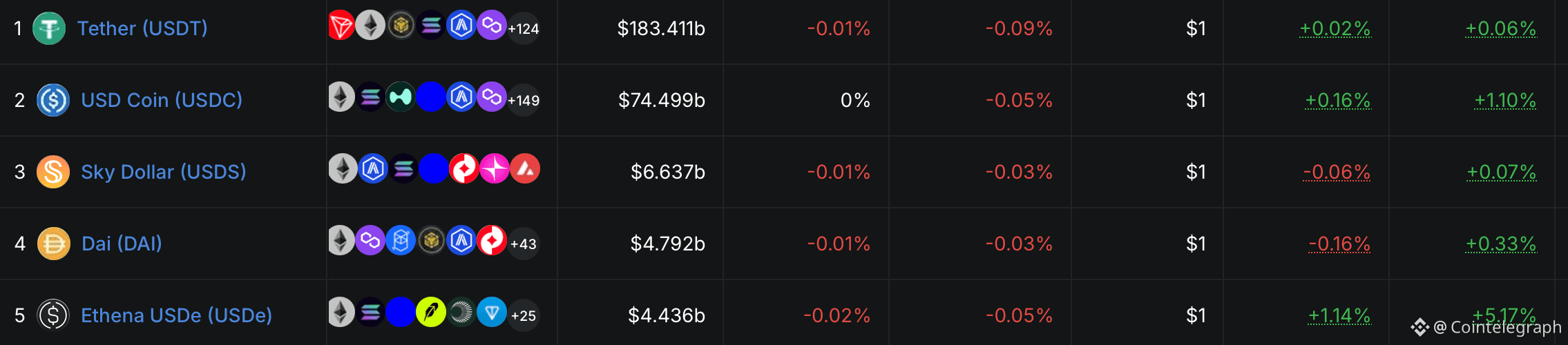
Top five stablecoins by market cap. Source: DefiLlama
Tether, Fasanara launch $400M private credit fund targeting $3B
Tether and Fasanara Capital have launched a private credit fund backed by $400 million from the two firms that aims to raise as much as $3 billion from institutional investors.
The evergreen fund, called StableFund, will use Tether’s USDT (USDt) as settlement infrastructure for short-duration, asset-backed lending to businesses and consumers through fintech platforms in more than 60 countries, the companies said Wednesday.
Fasanara will manage the fund’s investments, while Tether will source USDT-linked financing opportunities and provide the infrastructure for moving funds on- and offchain. The fund will focus on small and medium-sized businesses and consumer lending, including trade receivables and supply chain finance.
Fasanara, a London-based asset manager with more than $6 billion under management, will deploy the capital through its network of fintech lenders.
Tether has emerged as one of the crypto industry’s most profitable companies, generating about $1.5 billion in net operating profit in the second quarter, largely from its US Treasury and repo holdings. The USDT issuer reported $187.8 billion in assets and a $4.11 billion reserve buffer at the end of June.
The company has increasingly deployed that capital beyond its core stablecoin business, including a $20 million investment in Argentine neobank Ualá and investments in Mercado Bitcoin and Italian football club Juventus. Tether also led a $50 million funding round for AI sleep technology company Eight Sleep in March.
Top five stablecoins by market cap. Source: DefiLlama
The evergreen fund, called StableFund, will use Tether’s USDT (USDt) as settlement infrastructure for short-duration, asset-backed lending to businesses and consumers through fintech platforms in more than 60 countries, the companies said Wednesday.
Fasanara will manage the fund’s investments, while Tether will source USDT-linked financing opportunities and provide the infrastructure for moving funds on- and offchain. The fund will focus on small and medium-sized businesses and consumer lending, including trade receivables and supply chain finance.
Fasanara, a London-based asset manager with more than $6 billion under management, will deploy the capital through its network of fintech lenders.
Tether has emerged as one of the crypto industry’s most profitable companies, generating about $1.5 billion in net operating profit in the second quarter, largely from its US Treasury and repo holdings. The USDT issuer reported $187.8 billion in assets and a $4.11 billion reserve buffer at the end of June.
The company has increasingly deployed that capital beyond its core stablecoin business, including a $20 million investment in Argentine neobank Ualá and investments in Mercado Bitcoin and Italian football club Juventus. Tether also led a $50 million funding round for AI sleep technology company Eight Sleep in March.
Top five stablecoins by market cap. Source: DefiLlama
126
German finance ministry proposes 25% crypto tax starting 2028: reportThe German Federal Ministry of Finance reportedly issued a draft proposal to transition cryptocurrency trading profits to the standard 25% flat-rate tax starting in 2028.
The ministry’s proposal would apply to all crypto assets acquired after Jan. 1, 2027, according to a draft proposal seen by local news outlet Die Welt on Wednesday.
The draft also proposes grandfathering protections, meaning that digital assets bought before this deadline may be treated under the old taxation rules.
Under current law, profits from crypto assets become entirely tax-free if held for over 12 months, making Germany a favorable tax destination for long-term crypto holders.
Finance Minister Lars Klingbeil first revealed the country’s plans for a crypto tax overhaul at the end of April and said that Germany expects an additional 2 billion euros (about $2.3 billion) in revenue from crypto taxation.
Cointelegraph has approached the Finance ministry for more details on the draft law.
German finance ministry proposes 25% crypto tax starting 2028: report
The German Federal Ministry of Finance reportedly issued a draft proposal to transition cryptocurrency trading profits to the standard 25% flat-rate tax starting in 2028.
The ministry’s proposal would apply to all crypto assets acquired after Jan. 1, 2027, according to a draft proposal seen by local news outlet Die Welt on Wednesday.
The draft also proposes grandfathering protections, meaning that digital assets bought before this deadline may be treated under the old taxation rules.
Under current law, profits from crypto assets become entirely tax-free if held for over 12 months, making Germany a favorable tax destination for long-term crypto holders.
Finance Minister Lars Klingbeil first revealed the country’s plans for a crypto tax overhaul at the end of April and said that Germany expects an additional 2 billion euros (about $2.3 billion) in revenue from crypto taxation.
Cointelegraph has approached the Finance ministry for more details on the draft law.
The ministry’s proposal would apply to all crypto assets acquired after Jan. 1, 2027, according to a draft proposal seen by local news outlet Die Welt on Wednesday.
The draft also proposes grandfathering protections, meaning that digital assets bought before this deadline may be treated under the old taxation rules.
Under current law, profits from crypto assets become entirely tax-free if held for over 12 months, making Germany a favorable tax destination for long-term crypto holders.
Finance Minister Lars Klingbeil first revealed the country’s plans for a crypto tax overhaul at the end of April and said that Germany expects an additional 2 billion euros (about $2.3 billion) in revenue from crypto taxation.
Cointelegraph has approached the Finance ministry for more details on the draft law.
156
Verified
BitMart misses roadmap deadline, appoints financial adviserBitMart appointed Alvarez & Marsal as its financial adviser on Wednesday, its self-imposed Sept. 9 deadline for an update, but did not publish the restructuring and business resumption roadmap it said it was developing.
Alvarez & Marsal will work with BitMart’s legal advisers to evaluate the exchange’s assets, financial position, stakeholder issues and possible paths forward, according to Wednesday’s announcement. The review will also consider proposals from unidentified third parties, BitMart said on X.
BitMart said it will deploy a dedicated web portal within five working days to collect user feedback on its action plan and future direction. It said further updates on the feedback process and action plan would follow on a rolling basis over the next three weeks.
Echo Base, which organized an ad hoc committee of BitMart claimholders, called the appointment “the most encouraging step BitMart has taken since July.”
“What arrived was an advisor appointment and two new deadlines, with no reserve position, no asset inventory, no recovery estimate and no withdrawal timetable,” Roshan Dharia, CEO of Echo Base, told Cointelegraph.
BitMart has faced scrutiny over its financial position and handling of customer assets since its July 26 wind-down announcement, after users reported withdrawal delays.
Neither BitMart nor Alvarez & Marsal responded to Cointelegraph’s requests for comment on this story.
BitMart misses roadmap deadline, appoints financial adviser
BitMart appointed Alvarez & Marsal as its financial adviser on Wednesday, its self-imposed Sept. 9 deadline for an update, but did not publish the restructuring and business resumption roadmap it said it was developing.
Alvarez & Marsal will work with BitMart’s legal advisers to evaluate the exchange’s assets, financial position, stakeholder issues and possible paths forward, according to Wednesday’s announcement. The review will also consider proposals from unidentified third parties, BitMart said on X.
BitMart said it will deploy a dedicated web portal within five working days to collect user feedback on its action plan and future direction. It said further updates on the feedback process and action plan would follow on a rolling basis over the next three weeks.
Echo Base, which organized an ad hoc committee of BitMart claimholders, called the appointment “the most encouraging step BitMart has taken since July.”
“What arrived was an advisor appointment and two new deadlines, with no reserve position, no asset inventory, no recovery estimate and no withdrawal timetable,” Roshan Dharia, CEO of Echo Base, told Cointelegraph.
BitMart has faced scrutiny over its financial position and handling of customer assets since its July 26 wind-down announcement, after users reported withdrawal delays.
Neither BitMart nor Alvarez & Marsal responded to Cointelegraph’s requests for comment on this story.
Alvarez & Marsal will work with BitMart’s legal advisers to evaluate the exchange’s assets, financial position, stakeholder issues and possible paths forward, according to Wednesday’s announcement. The review will also consider proposals from unidentified third parties, BitMart said on X.
BitMart said it will deploy a dedicated web portal within five working days to collect user feedback on its action plan and future direction. It said further updates on the feedback process and action plan would follow on a rolling basis over the next three weeks.
Echo Base, which organized an ad hoc committee of BitMart claimholders, called the appointment “the most encouraging step BitMart has taken since July.”
“What arrived was an advisor appointment and two new deadlines, with no reserve position, no asset inventory, no recovery estimate and no withdrawal timetable,” Roshan Dharia, CEO of Echo Base, told Cointelegraph.
BitMart has faced scrutiny over its financial position and handling of customer assets since its July 26 wind-down announcement, after users reported withdrawal delays.
Neither BitMart nor Alvarez & Marsal responded to Cointelegraph’s requests for comment on this story.
1
1.1k
Hunter Biden’s laptop controversy gets a memecoin afterlifeHunter Biden’s LAPTOP memecoin fell 86.5% in its first 30 minutes of trading on Wednesday, as the son of former US President Joe Biden officially entered the market for politically themed cryptocurrencies.
The token, issued on Ethereum layer-2 network Base, traded at $26.88 at 12:30 pm UTC, after opening at $199.50, according to CoinGecko data. It recorded more than $2.5 million in trading volume.
“The symbol they used to try to end me is now a symbol of resilience, redemption and recovery,” Biden said in an X post on Wednesday, responding to public backlash.
Biden also said he understood the cynicism around memecoins, called President Donald Trump’s token a “grift” and warned buyers not to expect him or anyone else to make LAPTOP more valuable.
The memecoin is promoted as an attempt to reclaim the “laptop narrative,” which centers on a MacBook that Biden reportedly left at a Delaware repair shop in 2019. The New York Post published emails and other files purported to have come from the device before the 2020 presidential election. Trump allies used the material against Hunter Biden and his father, then-presidential candidate Joe Biden.
On Monday, Biden teased LAPTOP on X with a post showing the token’s ticker, accompanied by a montage of media coverage of the laptop.
The announcement drew criticism from the likes of digital investigator Stephen Findeisen, known as Coffeezilla, who called LAPTOP a “shitcoin” and urged his followers not to buy it. X account “scupytrooples” told Biden there was “still time to walk this back.”
Base founder Jesse Pollak said in an X post that the project had contacted his team, but Base made a “conscious decision” not to help with the token’s design or promotion.
Biden did not respond to Cointelegraph’s query before publication.
LAPTOP disclosures set 2% of token supply for TRUMP token losers
Biden’s earlier criticism of the Trump family’s crypto ventures also gave traders a ready-made hypocrisy argument.
In an Aug. 21 post, Biden accused World Liberty Financial of using political influence, centralized controls and leverage to benefit its founders, while saying the crypto industry deserved better.
He has now launched a memecoin built around his own political identity, with founders allocated a chunk of the supply.
The project’s disclosures describe LAPTOP as a digital collectible with no utility, ownership rights, voting rights, yield or profit-sharing rights. The token has a fixed supply of 1 billion, with 350 million tokens circulating at launch.
Founders, including Biden, are allocated 300 million tokens, or 30% of the supply. Those tokens are locked for six months and then vested monthly over the following 24 months. Another 30% is tied to political, cultural and crypto predictions, with tokens burned when specified outcomes occur and released to charity if they do not.
The disclosures also outline airdrop figures, with the initial round representing 10% of the total supply. Of those, 2% is reserved for wallets that lost money on TRUMP and 8% for eligible subscribers to Biden’s “Where’s Hunter” Substack newsletter.
A separate 10% future airdrop is to be distributed at the foundation’s discretion. That means 20% is allocated to airdrops overall, while the specific TRUMP-loss allocation is capped at 2%.
Magazine: Is Bitcoin too volatile to risk your retirement on?
Hunter Biden’s laptop controversy gets a memecoin afterlife
Hunter Biden’s LAPTOP memecoin fell 86.5% in its first 30 minutes of trading on Wednesday, as the son of former US President Joe Biden officially entered the market for politically themed cryptocurrencies.
The token, issued on Ethereum layer-2 network Base, traded at $26.88 at 12:30 pm UTC, after opening at $199.50, according to CoinGecko data. It recorded more than $2.5 million in trading volume.
“The symbol they used to try to end me is now a symbol of resilience, redemption and recovery,” Biden said in an X post on Wednesday, responding to public backlash.
Biden also said he understood the cynicism around memecoins, called President Donald Trump’s token a “grift” and warned buyers not to expect him or anyone else to make LAPTOP more valuable.
The memecoin is promoted as an attempt to reclaim the “laptop narrative,” which centers on a MacBook that Biden reportedly left at a Delaware repair shop in 2019. The New York Post published emails and other files purported to have come from the device before the 2020 presidential election. Trump allies used the material against Hunter Biden and his father, then-presidential candidate Joe Biden.
On Monday, Biden teased LAPTOP on X with a post showing the token’s ticker, accompanied by a montage of media coverage of the laptop.
The announcement drew criticism from the likes of digital investigator Stephen Findeisen, known as Coffeezilla, who called LAPTOP a “shitcoin” and urged his followers not to buy it. X account “scupytrooples” told Biden there was “still time to walk this back.”
Base founder Jesse Pollak said in an X post that the project had contacted his team, but Base made a “conscious decision” not to help with the token’s design or promotion.
Biden did not respond to Cointelegraph’s query before publication.
LAPTOP disclosures set 2% of token supply for TRUMP token losers
Biden’s earlier criticism of the Trump family’s crypto ventures also gave traders a ready-made hypocrisy argument.
In an Aug. 21 post, Biden accused World Liberty Financial of using political influence, centralized controls and leverage to benefit its founders, while saying the crypto industry deserved better.
He has now launched a memecoin built around his own political identity, with founders allocated a chunk of the supply.
The project’s disclosures describe LAPTOP as a digital collectible with no utility, ownership rights, voting rights, yield or profit-sharing rights. The token has a fixed supply of 1 billion, with 350 million tokens circulating at launch.
Founders, including Biden, are allocated 300 million tokens, or 30% of the supply. Those tokens are locked for six months and then vested monthly over the following 24 months. Another 30% is tied to political, cultural and crypto predictions, with tokens burned when specified outcomes occur and released to charity if they do not.
The disclosures also outline airdrop figures, with the initial round representing 10% of the total supply. Of those, 2% is reserved for wallets that lost money on TRUMP and 8% for eligible subscribers to Biden’s “Where’s Hunter” Substack newsletter.
A separate 10% future airdrop is to be distributed at the foundation’s discretion. That means 20% is allocated to airdrops overall, while the specific TRUMP-loss allocation is capped at 2%.
Magazine: Is Bitcoin too volatile to risk your retirement on?
The token, issued on Ethereum layer-2 network Base, traded at $26.88 at 12:30 pm UTC, after opening at $199.50, according to CoinGecko data. It recorded more than $2.5 million in trading volume.
“The symbol they used to try to end me is now a symbol of resilience, redemption and recovery,” Biden said in an X post on Wednesday, responding to public backlash.
Biden also said he understood the cynicism around memecoins, called President Donald Trump’s token a “grift” and warned buyers not to expect him or anyone else to make LAPTOP more valuable.
The memecoin is promoted as an attempt to reclaim the “laptop narrative,” which centers on a MacBook that Biden reportedly left at a Delaware repair shop in 2019. The New York Post published emails and other files purported to have come from the device before the 2020 presidential election. Trump allies used the material against Hunter Biden and his father, then-presidential candidate Joe Biden.
On Monday, Biden teased LAPTOP on X with a post showing the token’s ticker, accompanied by a montage of media coverage of the laptop.
The announcement drew criticism from the likes of digital investigator Stephen Findeisen, known as Coffeezilla, who called LAPTOP a “shitcoin” and urged his followers not to buy it. X account “scupytrooples” told Biden there was “still time to walk this back.”
Base founder Jesse Pollak said in an X post that the project had contacted his team, but Base made a “conscious decision” not to help with the token’s design or promotion.
Biden did not respond to Cointelegraph’s query before publication.
LAPTOP disclosures set 2% of token supply for TRUMP token losers
Biden’s earlier criticism of the Trump family’s crypto ventures also gave traders a ready-made hypocrisy argument.
In an Aug. 21 post, Biden accused World Liberty Financial of using political influence, centralized controls and leverage to benefit its founders, while saying the crypto industry deserved better.
He has now launched a memecoin built around his own political identity, with founders allocated a chunk of the supply.
The project’s disclosures describe LAPTOP as a digital collectible with no utility, ownership rights, voting rights, yield or profit-sharing rights. The token has a fixed supply of 1 billion, with 350 million tokens circulating at launch.
Founders, including Biden, are allocated 300 million tokens, or 30% of the supply. Those tokens are locked for six months and then vested monthly over the following 24 months. Another 30% is tied to political, cultural and crypto predictions, with tokens burned when specified outcomes occur and released to charity if they do not.
The disclosures also outline airdrop figures, with the initial round representing 10% of the total supply. Of those, 2% is reserved for wallets that lost money on TRUMP and 8% for eligible subscribers to Biden’s “Where’s Hunter” Substack newsletter.
A separate 10% future airdrop is to be distributed at the foundation’s discretion. That means 20% is allocated to airdrops overall, while the specific TRUMP-loss allocation is capped at 2%.
Magazine: Is Bitcoin too volatile to risk your retirement on?
328
What could happen if the CLARITY Act fails to pass in 2026With lawmakers in the US Senate set to consider legislation pushed by many in the cryptocurrency industry for regulatory clarity, there’s a limited window for the bill to become law, potentially delaying it into the next session of Congress with different politics in play.
The US Senate is scheduled to return to session on Monday after more than a month in which lawmakers were on state work periods. Senator John Thune, the Republican majority leader in the chamber, has scheduled a cloture vote on the Digital Asset Market Clarity (CLARITY) Act for Tuesday, in which his compatriots will need support from a handful of Democrats to meet the 60-vote threshold and overcome a filibuster.
Should the bill fail to advance with a three-fifths supermajority, the Senate will have less than 36 days of business before 2027, when a new session of Congress is scheduled to be sworn in, one where Democrats could be in control, depending on the outcome of November’s midterm elections.
Senator Cynthia Lummis, one of CLARITY’s biggest supporters, warned on Sept. 6 that the “next real opportunity” for the bill to pass might not be until 2030 if lawmakers were unable to reach an agreement and send it to the president’s desk. She is also not running for reelection in 2026.
All 435 seats in the House of Representatives and 33 in the Senate are up for grabs in the midterm elections . Event contracts on prediction market platforms currently give Democrats the odds on retaking a majority in the House, while the party’s chances in the Senate are basically a coin flip.
When Republicans took the Senate from Democrats following the 2024 elections, this left the party with a legislative trifecta — control of the Senate, House and the presidency — giving it exceptional influence over passing laws favorable to the crypto industry, including the Guiding and Establishing National Innovation for US Stablecoins (GENIUS) Act. A reversal of this party control could likewise leave Republicans approaching bills on Democrats’ terms beginning next year.
Crypto money potentially swaying voters in 2026
Senator Sherrod Brown, an Ohio Democratic lawmaker who previously chaired the Senate Banking committee, was voted out in 2024 in a race that saw cryptocurrency-backed political action committee (PAC) Fairshake and many others pouring millions of dollars into ads supporting his opponent, Republican Bernie Moreno.
Now, Brown is back, running in a special election against Republican Jon Husted to complete the term won in 2022 by now-Vice President JD Vance.
A PAC like Fairshake, backed by crypto exchange Coinbase and Ripple Labs, is just one way the industry is pushing to get what it calls more “pro-crypto” lawmakers in Congress. Although many candidates, both Democrat and Republican, supported by Fairshake-backed ads, have gone on to win their 2026 primaries, the PAC hasn’t always been successful.
In March, Illinois Lieutenant Governor Juliana Stratton won the Democratic primary for one of the state’s US Senate seats despite being the target of industry-funded attack ads. Many incumbents who have voted in favor of bills like GENIUS or CLARITY while in office have found support from crypto PACs, while challengers or those critical of digital assets are sometimes named in negative ads.
“Rep. Auchincloss voted for the CLARITY ACT, which explains why the crypto industry is heavily supportive of his reelection,” said Jason Poulos, a Democratic candidate who ran against Massachusetts Representative Jake Auchincloss in the primary for the state’s 4th congressional district. A Fairshake-affiliated PAC spent about $189,000 on ads supporting Auchincloss. Poulos added:
“The influx of outside crypto industry cash means that these oligarchs have an outsized influence on our representation and federal policies. It is why we need to get big money out of politics [...]”
Presidency, regulators unlikely to change before 2029
Whether Democrats retake both chambers of Congress in November, neither, or just one, the result will not change Republican control of the White House until January 2029 and maintaining the power to veto legislation. For example, if the president chooses to veto a Democrat-backed crypto bill, both the House and the Senate would need a two-thirds supermajority vote to override his actions.
In addition, the heads of two of the major financial agencies, the Securities and Exchange Commission (SEC) and Commodity Futures Trading Commission (CFTC), are unlikely to change while Trump remains in office. The president nominated Paul Atkins to chair the SEC and Michael Selig the CFTC, both of whom have signaled plans to proceed with digital asset regulation if Congress fails to advance CLARITY this year.
Magazine: Is Bitcoin too volatile to risk your retirement on?
What could happen if the CLARITY Act fails to pass in 2026
With lawmakers in the US Senate set to consider legislation pushed by many in the cryptocurrency industry for regulatory clarity, there’s a limited window for the bill to become law, potentially delaying it into the next session of Congress with different politics in play.
The US Senate is scheduled to return to session on Monday after more than a month in which lawmakers were on state work periods. Senator John Thune, the Republican majority leader in the chamber, has scheduled a cloture vote on the Digital Asset Market Clarity (CLARITY) Act for Tuesday, in which his compatriots will need support from a handful of Democrats to meet the 60-vote threshold and overcome a filibuster.
Should the bill fail to advance with a three-fifths supermajority, the Senate will have less than 36 days of business before 2027, when a new session of Congress is scheduled to be sworn in, one where Democrats could be in control, depending on the outcome of November’s midterm elections.
Senator Cynthia Lummis, one of CLARITY’s biggest supporters, warned on Sept. 6 that the “next real opportunity” for the bill to pass might not be until 2030 if lawmakers were unable to reach an agreement and send it to the president’s desk. She is also not running for reelection in 2026.
All 435 seats in the House of Representatives and 33 in the Senate are up for grabs in the midterm elections . Event contracts on prediction market platforms currently give Democrats the odds on retaking a majority in the House, while the party’s chances in the Senate are basically a coin flip.
When Republicans took the Senate from Democrats following the 2024 elections, this left the party with a legislative trifecta — control of the Senate, House and the presidency — giving it exceptional influence over passing laws favorable to the crypto industry, including the Guiding and Establishing National Innovation for US Stablecoins (GENIUS) Act. A reversal of this party control could likewise leave Republicans approaching bills on Democrats’ terms beginning next year.
Crypto money potentially swaying voters in 2026
Senator Sherrod Brown, an Ohio Democratic lawmaker who previously chaired the Senate Banking committee, was voted out in 2024 in a race that saw cryptocurrency-backed political action committee (PAC) Fairshake and many others pouring millions of dollars into ads supporting his opponent, Republican Bernie Moreno.
Now, Brown is back, running in a special election against Republican Jon Husted to complete the term won in 2022 by now-Vice President JD Vance.
A PAC like Fairshake, backed by crypto exchange Coinbase and Ripple Labs, is just one way the industry is pushing to get what it calls more “pro-crypto” lawmakers in Congress. Although many candidates, both Democrat and Republican, supported by Fairshake-backed ads, have gone on to win their 2026 primaries, the PAC hasn’t always been successful.
In March, Illinois Lieutenant Governor Juliana Stratton won the Democratic primary for one of the state’s US Senate seats despite being the target of industry-funded attack ads. Many incumbents who have voted in favor of bills like GENIUS or CLARITY while in office have found support from crypto PACs, while challengers or those critical of digital assets are sometimes named in negative ads.
“Rep. Auchincloss voted for the CLARITY ACT, which explains why the crypto industry is heavily supportive of his reelection,” said Jason Poulos, a Democratic candidate who ran against Massachusetts Representative Jake Auchincloss in the primary for the state’s 4th congressional district. A Fairshake-affiliated PAC spent about $189,000 on ads supporting Auchincloss. Poulos added:
“The influx of outside crypto industry cash means that these oligarchs have an outsized influence on our representation and federal policies. It is why we need to get big money out of politics [...]”
Presidency, regulators unlikely to change before 2029
Whether Democrats retake both chambers of Congress in November, neither, or just one, the result will not change Republican control of the White House until January 2029 and maintaining the power to veto legislation. For example, if the president chooses to veto a Democrat-backed crypto bill, both the House and the Senate would need a two-thirds supermajority vote to override his actions.
In addition, the heads of two of the major financial agencies, the Securities and Exchange Commission (SEC) and Commodity Futures Trading Commission (CFTC), are unlikely to change while Trump remains in office. The president nominated Paul Atkins to chair the SEC and Michael Selig the CFTC, both of whom have signaled plans to proceed with digital asset regulation if Congress fails to advance CLARITY this year.
Magazine: Is Bitcoin too volatile to risk your retirement on?
The US Senate is scheduled to return to session on Monday after more than a month in which lawmakers were on state work periods. Senator John Thune, the Republican majority leader in the chamber, has scheduled a cloture vote on the Digital Asset Market Clarity (CLARITY) Act for Tuesday, in which his compatriots will need support from a handful of Democrats to meet the 60-vote threshold and overcome a filibuster.
Should the bill fail to advance with a three-fifths supermajority, the Senate will have less than 36 days of business before 2027, when a new session of Congress is scheduled to be sworn in, one where Democrats could be in control, depending on the outcome of November’s midterm elections.
Senator Cynthia Lummis, one of CLARITY’s biggest supporters, warned on Sept. 6 that the “next real opportunity” for the bill to pass might not be until 2030 if lawmakers were unable to reach an agreement and send it to the president’s desk. She is also not running for reelection in 2026.
All 435 seats in the House of Representatives and 33 in the Senate are up for grabs in the midterm elections . Event contracts on prediction market platforms currently give Democrats the odds on retaking a majority in the House, while the party’s chances in the Senate are basically a coin flip.
When Republicans took the Senate from Democrats following the 2024 elections, this left the party with a legislative trifecta — control of the Senate, House and the presidency — giving it exceptional influence over passing laws favorable to the crypto industry, including the Guiding and Establishing National Innovation for US Stablecoins (GENIUS) Act. A reversal of this party control could likewise leave Republicans approaching bills on Democrats’ terms beginning next year.
Crypto money potentially swaying voters in 2026
Senator Sherrod Brown, an Ohio Democratic lawmaker who previously chaired the Senate Banking committee, was voted out in 2024 in a race that saw cryptocurrency-backed political action committee (PAC) Fairshake and many others pouring millions of dollars into ads supporting his opponent, Republican Bernie Moreno.
Now, Brown is back, running in a special election against Republican Jon Husted to complete the term won in 2022 by now-Vice President JD Vance.
A PAC like Fairshake, backed by crypto exchange Coinbase and Ripple Labs, is just one way the industry is pushing to get what it calls more “pro-crypto” lawmakers in Congress. Although many candidates, both Democrat and Republican, supported by Fairshake-backed ads, have gone on to win their 2026 primaries, the PAC hasn’t always been successful.
In March, Illinois Lieutenant Governor Juliana Stratton won the Democratic primary for one of the state’s US Senate seats despite being the target of industry-funded attack ads. Many incumbents who have voted in favor of bills like GENIUS or CLARITY while in office have found support from crypto PACs, while challengers or those critical of digital assets are sometimes named in negative ads.
“Rep. Auchincloss voted for the CLARITY ACT, which explains why the crypto industry is heavily supportive of his reelection,” said Jason Poulos, a Democratic candidate who ran against Massachusetts Representative Jake Auchincloss in the primary for the state’s 4th congressional district. A Fairshake-affiliated PAC spent about $189,000 on ads supporting Auchincloss. Poulos added:
“The influx of outside crypto industry cash means that these oligarchs have an outsized influence on our representation and federal policies. It is why we need to get big money out of politics [...]”
Presidency, regulators unlikely to change before 2029
Whether Democrats retake both chambers of Congress in November, neither, or just one, the result will not change Republican control of the White House until January 2029 and maintaining the power to veto legislation. For example, if the president chooses to veto a Democrat-backed crypto bill, both the House and the Senate would need a two-thirds supermajority vote to override his actions.
In addition, the heads of two of the major financial agencies, the Securities and Exchange Commission (SEC) and Commodity Futures Trading Commission (CFTC), are unlikely to change while Trump remains in office. The president nominated Paul Atkins to chair the SEC and Michael Selig the CFTC, both of whom have signaled plans to proceed with digital asset regulation if Congress fails to advance CLARITY this year.
Magazine: Is Bitcoin too volatile to risk your retirement on?
1
262
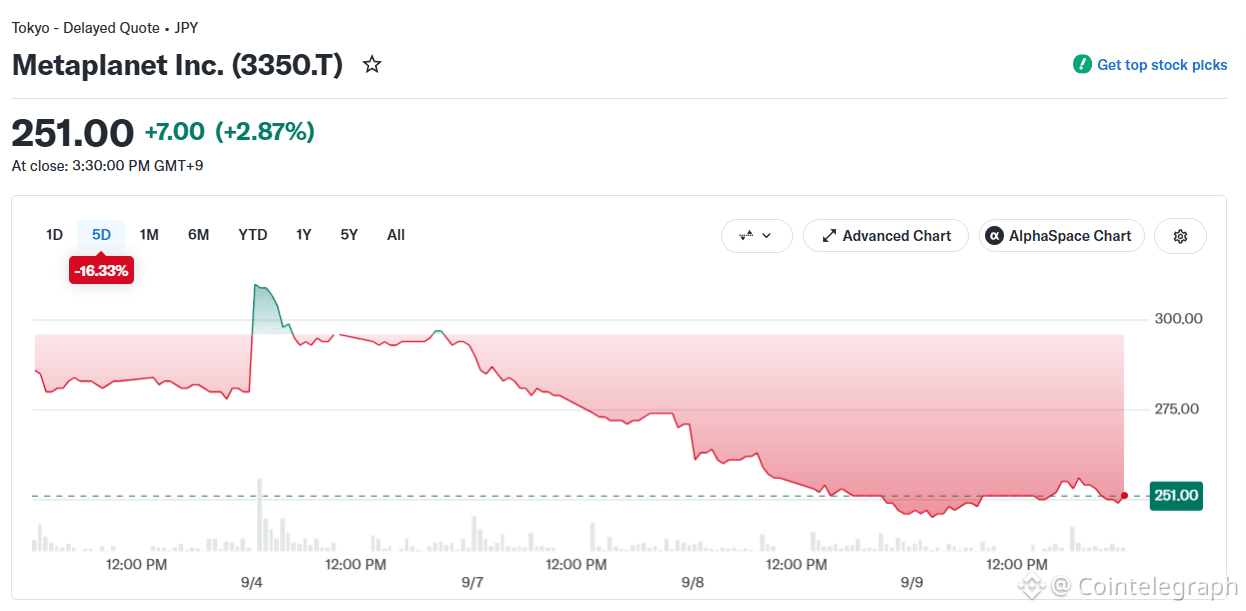
Article
Metaplanet’s executive stock pool sparks shareholder backlash as CEO addresses MMXX tiesJapanese Bitcoin treasury company Metaplanet’s executive stock pool continues to draw shareholder backlash over stock dilution concerns.
Multiple shareholders objected across social media to Metaplanet’s 10th Series executive option pool, which was designed as 20% of fully diluted shares and automatically expanded as the company issued new shares to fund its Bitcoin (BTC) accumulation.
Bitcoin Magazine CEO David Bailey defended Metaplanet’s executive stock model, saying that giving the team 20% of the cap table over five years “isn’t some crazy number” and that his company has been invested in Metaplanet since “day zero,” in a Tuesday X post.
Source: David Bailey
Some shareholders are now asking Metaplanet to cancel the additional 273 million shares created from the changes and to provide more transparency on future decisions. Metaplanet said it froze the pool at 319.5 million shares on Aug. 18, but critics contend this magnified dilution for existing shareholders, as the pool grew from 46 million shares to 319.5 million.
Pseudonymous Metaplanet shareholder Bitcoin Pharaoh claimed that Bailey personally benefited from Metaplanet’s stock options and received 300,000 options at a 105 Japanese yen strike price, when the stock was trading at 510 yen, as compensation for his role as a strategic board advisor at Metaplanet.
“Set the pool against what the shareholders contributed and the cut is 26% of the bitcoin: of every four coins the shareholders’ money bought, management took one,” wrote Bitcoin Pharaoh in a Wednesday X reply to Bailey.
Metaplanet CEO addresses MMXX ties
Metaplanet CEO Simon Gerovich pledged to review the company’s governance and compensation policies and sought to distance himself from Metaplanet shareholder MMXX Ventures, explaining that he is a significant but non-majority shareholder in MMXX’s parent company and holds no executive role.
“We are continuing to review our governance and compensation policies and will share any updates when that work is complete,” wrote Gerovich in a Sunday X post.
On Aug. 31, Metaplanet revealed that its CEO exercised 92,000 shares from the 10th Series executive options pool.
VanEck’s head of digital asset research, Matthew Sigel, said that Metaplanet should “freeze” further exercise rights from the 10th Series option pool, have holders voluntarily surrender the excess rights and weigh additional options related to the shares that have already been exercised.
“Finally, replace Series 10 with a shareholder-approved, five-year incentive plan tied primarily to BTC per fully diluted share,” wrote Sigel in a Wednesday X post.
In an Aug. 18 notice, Metaplanet acknowledged that the decision to expand the share pool “amplifies the dilution borne by existing shareholders.”
Cointelegraph has request comment from Metaplanet on whether it would consider freezing the remaining shares in the executive pool.
Metaplanet stock price, five-day chart. Source: Yahoo Finance
Metaplanet’s shares closed up in Wednesday’s Tokyo trading, trimming their five-day decline to roughly 16.3%, according to Yahoo Finance.
Magazine: Bitcoin adoption metrics say one thing, price action says another
Metaplanet’s executive stock pool sparks shareholder backlash as CEO addresses MMXX ties
Japanese Bitcoin treasury company Metaplanet’s executive stock pool continues to draw shareholder backlash over stock dilution concerns.
Multiple shareholders objected across social media to Metaplanet’s 10th Series executive option pool, which was designed as 20% of fully diluted shares and automatically expanded as the company issued new shares to fund its Bitcoin (BTC) accumulation.
Bitcoin Magazine CEO David Bailey defended Metaplanet’s executive stock model, saying that giving the team 20% of the cap table over five years “isn’t some crazy number” and that his company has been invested in Metaplanet since “day zero,” in a Tuesday X post.
Source: David Bailey
Some shareholders are now asking Metaplanet to cancel the additional 273 million shares created from the changes and to provide more transparency on future decisions. Metaplanet said it froze the pool at 319.5 million shares on Aug. 18, but critics contend this magnified dilution for existing shareholders, as the pool grew from 46 million shares to 319.5 million.
Pseudonymous Metaplanet shareholder Bitcoin Pharaoh claimed that Bailey personally benefited from Metaplanet’s stock options and received 300,000 options at a 105 Japanese yen strike price, when the stock was trading at 510 yen, as compensation for his role as a strategic board advisor at Metaplanet.
“Set the pool against what the shareholders contributed and the cut is 26% of the bitcoin: of every four coins the shareholders’ money bought, management took one,” wrote Bitcoin Pharaoh in a Wednesday X reply to Bailey.
Metaplanet CEO addresses MMXX ties
Metaplanet CEO Simon Gerovich pledged to review the company’s governance and compensation policies and sought to distance himself from Metaplanet shareholder MMXX Ventures, explaining that he is a significant but non-majority shareholder in MMXX’s parent company and holds no executive role.
“We are continuing to review our governance and compensation policies and will share any updates when that work is complete,” wrote Gerovich in a Sunday X post.
On Aug. 31, Metaplanet revealed that its CEO exercised 92,000 shares from the 10th Series executive options pool.
VanEck’s head of digital asset research, Matthew Sigel, said that Metaplanet should “freeze” further exercise rights from the 10th Series option pool, have holders voluntarily surrender the excess rights and weigh additional options related to the shares that have already been exercised.
“Finally, replace Series 10 with a shareholder-approved, five-year incentive plan tied primarily to BTC per fully diluted share,” wrote Sigel in a Wednesday X post.
In an Aug. 18 notice, Metaplanet acknowledged that the decision to expand the share pool “amplifies the dilution borne by existing shareholders.”
Cointelegraph has request comment from Metaplanet on whether it would consider freezing the remaining shares in the executive pool.
Metaplanet stock price, five-day chart. Source: Yahoo Finance
Metaplanet’s shares closed up in Wednesday’s Tokyo trading, trimming their five-day decline to roughly 16.3%, according to Yahoo Finance.
Magazine: Bitcoin adoption metrics say one thing, price action says another
Multiple shareholders objected across social media to Metaplanet’s 10th Series executive option pool, which was designed as 20% of fully diluted shares and automatically expanded as the company issued new shares to fund its Bitcoin (BTC) accumulation.
Bitcoin Magazine CEO David Bailey defended Metaplanet’s executive stock model, saying that giving the team 20% of the cap table over five years “isn’t some crazy number” and that his company has been invested in Metaplanet since “day zero,” in a Tuesday X post.
Source: David Bailey
Some shareholders are now asking Metaplanet to cancel the additional 273 million shares created from the changes and to provide more transparency on future decisions. Metaplanet said it froze the pool at 319.5 million shares on Aug. 18, but critics contend this magnified dilution for existing shareholders, as the pool grew from 46 million shares to 319.5 million.
Pseudonymous Metaplanet shareholder Bitcoin Pharaoh claimed that Bailey personally benefited from Metaplanet’s stock options and received 300,000 options at a 105 Japanese yen strike price, when the stock was trading at 510 yen, as compensation for his role as a strategic board advisor at Metaplanet.
“Set the pool against what the shareholders contributed and the cut is 26% of the bitcoin: of every four coins the shareholders’ money bought, management took one,” wrote Bitcoin Pharaoh in a Wednesday X reply to Bailey.
Metaplanet CEO addresses MMXX ties
Metaplanet CEO Simon Gerovich pledged to review the company’s governance and compensation policies and sought to distance himself from Metaplanet shareholder MMXX Ventures, explaining that he is a significant but non-majority shareholder in MMXX’s parent company and holds no executive role.
“We are continuing to review our governance and compensation policies and will share any updates when that work is complete,” wrote Gerovich in a Sunday X post.
On Aug. 31, Metaplanet revealed that its CEO exercised 92,000 shares from the 10th Series executive options pool.
VanEck’s head of digital asset research, Matthew Sigel, said that Metaplanet should “freeze” further exercise rights from the 10th Series option pool, have holders voluntarily surrender the excess rights and weigh additional options related to the shares that have already been exercised.
“Finally, replace Series 10 with a shareholder-approved, five-year incentive plan tied primarily to BTC per fully diluted share,” wrote Sigel in a Wednesday X post.
In an Aug. 18 notice, Metaplanet acknowledged that the decision to expand the share pool “amplifies the dilution borne by existing shareholders.”
Cointelegraph has request comment from Metaplanet on whether it would consider freezing the remaining shares in the executive pool.
Metaplanet stock price, five-day chart. Source: Yahoo Finance
Metaplanet’s shares closed up in Wednesday’s Tokyo trading, trimming their five-day decline to roughly 16.3%, according to Yahoo Finance.
Magazine: Bitcoin adoption metrics say one thing, price action says another
118
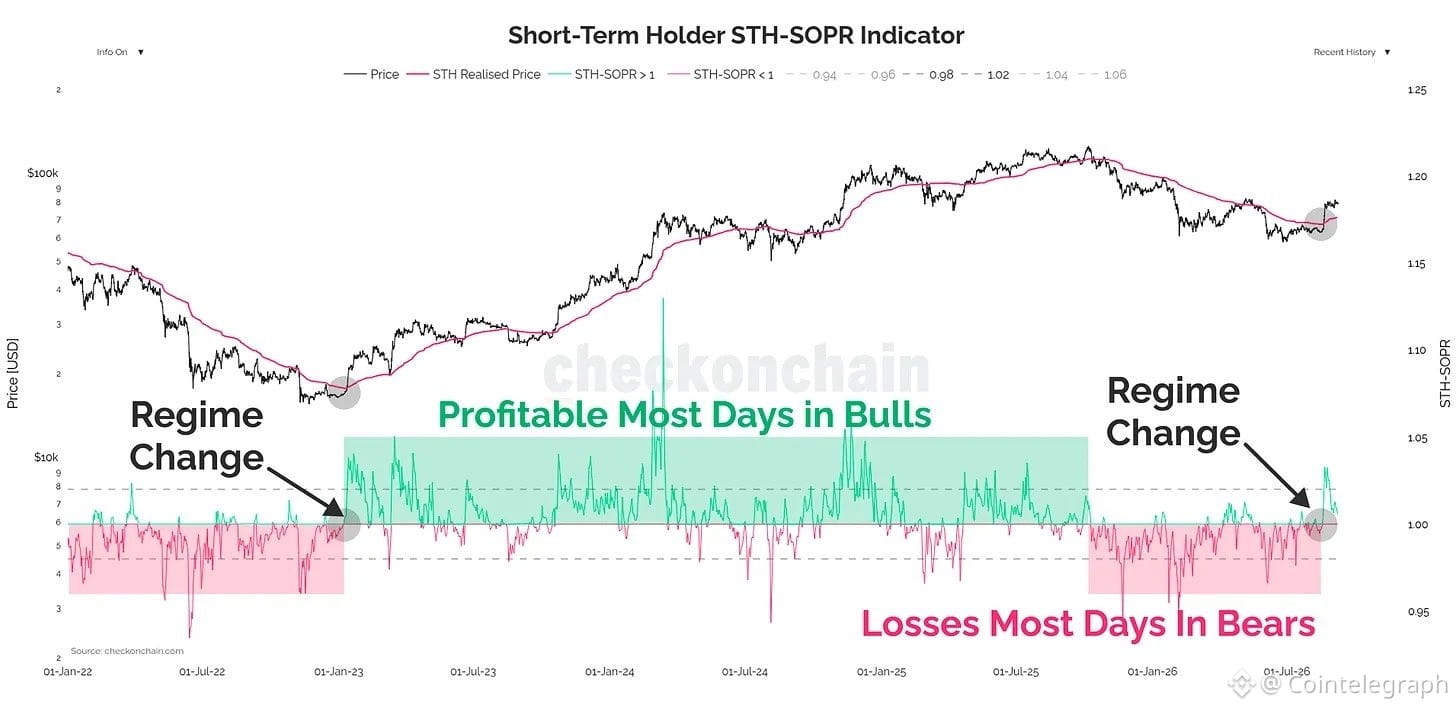
Article
Bitcoin SOPR metric sees longest profit run of 2026 as new analysis challenges bear marketBitcoin (BTC) is breaking with typical bear-market behavior as a classic onchain metric puts in its longest bullish streak of 2026.
Key points:
Bitcoin’s SOPR metric has stayed above its breakeven point of 1 for three full weeks, its longest stint in 2026.
Analysis suggests that UTXO profitability is reflecting a return to bull-market conditions.
David Puell says SOPR must stay bullish for longer, seeing more BTC price downside to come.
SOPR data repeats early bull-market activity
Data from crypto analytics platform CryptoQuant shows that the spent output profit ratio (SOPR) has now been above its breakeven level of 1 since Aug. 19. SOPR measures the extent to which coins moving onchain do so at a higher or lower price compared to the previous transaction.
The metric, which generally moves in a tight range around 1, currently measures 1.002. Values above 1 indicate that coins are mostly being moved in profit — a sign of overall bullish market momentum. This signal has now endured for three weeks, marking the longest stretch of bullish SOPR of 2026 so far.
Bitcoin SOPR chart. Source: CryptoQuant
SOPR can be broken down by wallet cohort to differentiate profitability between newer and older investors. Commenting on SOPR readings for short-term holders (STHs), wallets holding a UTXO without selling for up to six months, onchain analytics suite Checkonchain added to hopes that Bitcoin is staging a long-term bullish recovery.
“In bear markets, rallies back into profit tend to get sold. In bull markets, short sharp moves below break-even tend to become buy-the-dip setups. The current structure is starting to look more like those early bull-market recoveries,” it told X followers at the weekend.
Bitcoin STH-SOPR data. Source: Checkonchain on X.com
Puell retains Bitcoin price “downside risk” despite SOPR recovery
Despite BTC/USD holding a local range around $80,000 while the SOPR profitability streak continues, the pair could still hit new macro lows this cycle, one of the industry’s best-known analysts warns.
In an interview with CryptoQuant on Sept. 4, ARK Invest portfolio manager David Puell, creator of the Puell multiple BTC price indicator, said that more evidence was needed to assume that the next bear-market floor is already in.
Asked about how Bitcoin’s 25% August upside could play out going into Q4, Puell suggested that further upside was the less likely outcome.
“In our view, as of now, we leave it as a downside risk,” he said.
Puell singled out SOPR signals as a key prerequisite for changing his long-term bias, stating that the metric needs to remain above 1 for an extended period, with investors “realizing profits consistently without price going back to a new low.”
Bitcoin must also start putting in series of higher highs and higher lows — a pattern that Cointelegraph reported is still absent on weekly time frames.
In late August, CryptoQuant CEO Ki Young Ju described the bear market as already “over” on the back of the latest readings from its proprietary Bull/Bear Market Cycle Indicator.
Bitcoin SOPR metric sees longest profit run of 2026 as new analysis challenges bear market
Bitcoin (BTC) is breaking with typical bear-market behavior as a classic onchain metric puts in its longest bullish streak of 2026.
Key points:
Bitcoin’s SOPR metric has stayed above its breakeven point of 1 for three full weeks, its longest stint in 2026.
Analysis suggests that UTXO profitability is reflecting a return to bull-market conditions.
David Puell says SOPR must stay bullish for longer, seeing more BTC price downside to come.
SOPR data repeats early bull-market activity
Data from crypto analytics platform CryptoQuant shows that the spent output profit ratio (SOPR) has now been above its breakeven level of 1 since Aug. 19. SOPR measures the extent to which coins moving onchain do so at a higher or lower price compared to the previous transaction.
The metric, which generally moves in a tight range around 1, currently measures 1.002. Values above 1 indicate that coins are mostly being moved in profit — a sign of overall bullish market momentum. This signal has now endured for three weeks, marking the longest stretch of bullish SOPR of 2026 so far.
Bitcoin SOPR chart. Source: CryptoQuant
SOPR can be broken down by wallet cohort to differentiate profitability between newer and older investors. Commenting on SOPR readings for short-term holders (STHs), wallets holding a UTXO without selling for up to six months, onchain analytics suite Checkonchain added to hopes that Bitcoin is staging a long-term bullish recovery.
“In bear markets, rallies back into profit tend to get sold. In bull markets, short sharp moves below break-even tend to become buy-the-dip setups. The current structure is starting to look more like those early bull-market recoveries,” it told X followers at the weekend.
Bitcoin STH-SOPR data. Source: Checkonchain on X.com
Puell retains Bitcoin price “downside risk” despite SOPR recovery
Despite BTC/USD holding a local range around $80,000 while the SOPR profitability streak continues, the pair could still hit new macro lows this cycle, one of the industry’s best-known analysts warns.
In an interview with CryptoQuant on Sept. 4, ARK Invest portfolio manager David Puell, creator of the Puell multiple BTC price indicator, said that more evidence was needed to assume that the next bear-market floor is already in.
Asked about how Bitcoin’s 25% August upside could play out going into Q4, Puell suggested that further upside was the less likely outcome.
“In our view, as of now, we leave it as a downside risk,” he said.
Puell singled out SOPR signals as a key prerequisite for changing his long-term bias, stating that the metric needs to remain above 1 for an extended period, with investors “realizing profits consistently without price going back to a new low.”
Bitcoin must also start putting in series of higher highs and higher lows — a pattern that Cointelegraph reported is still absent on weekly time frames.
In late August, CryptoQuant CEO Ki Young Ju described the bear market as already “over” on the back of the latest readings from its proprietary Bull/Bear Market Cycle Indicator.
Key points:
Bitcoin’s SOPR metric has stayed above its breakeven point of 1 for three full weeks, its longest stint in 2026.
Analysis suggests that UTXO profitability is reflecting a return to bull-market conditions.
David Puell says SOPR must stay bullish for longer, seeing more BTC price downside to come.
SOPR data repeats early bull-market activity
Data from crypto analytics platform CryptoQuant shows that the spent output profit ratio (SOPR) has now been above its breakeven level of 1 since Aug. 19. SOPR measures the extent to which coins moving onchain do so at a higher or lower price compared to the previous transaction.
The metric, which generally moves in a tight range around 1, currently measures 1.002. Values above 1 indicate that coins are mostly being moved in profit — a sign of overall bullish market momentum. This signal has now endured for three weeks, marking the longest stretch of bullish SOPR of 2026 so far.
Bitcoin SOPR chart. Source: CryptoQuant
SOPR can be broken down by wallet cohort to differentiate profitability between newer and older investors. Commenting on SOPR readings for short-term holders (STHs), wallets holding a UTXO without selling for up to six months, onchain analytics suite Checkonchain added to hopes that Bitcoin is staging a long-term bullish recovery.
“In bear markets, rallies back into profit tend to get sold. In bull markets, short sharp moves below break-even tend to become buy-the-dip setups. The current structure is starting to look more like those early bull-market recoveries,” it told X followers at the weekend.
Bitcoin STH-SOPR data. Source: Checkonchain on X.com
Puell retains Bitcoin price “downside risk” despite SOPR recovery
Despite BTC/USD holding a local range around $80,000 while the SOPR profitability streak continues, the pair could still hit new macro lows this cycle, one of the industry’s best-known analysts warns.
In an interview with CryptoQuant on Sept. 4, ARK Invest portfolio manager David Puell, creator of the Puell multiple BTC price indicator, said that more evidence was needed to assume that the next bear-market floor is already in.
Asked about how Bitcoin’s 25% August upside could play out going into Q4, Puell suggested that further upside was the less likely outcome.
“In our view, as of now, we leave it as a downside risk,” he said.
Puell singled out SOPR signals as a key prerequisite for changing his long-term bias, stating that the metric needs to remain above 1 for an extended period, with investors “realizing profits consistently without price going back to a new low.”
Bitcoin must also start putting in series of higher highs and higher lows — a pattern that Cointelegraph reported is still absent on weekly time frames.
In late August, CryptoQuant CEO Ki Young Ju described the bear market as already “over” on the back of the latest readings from its proprietary Bull/Bear Market Cycle Indicator.
1
171
Silvergate ex-CEO blames Biden pressure for bank’s 2023 wind-downFormer Silvergate Bank CEO Alan Lane said political and regulatory pressure from the Biden administration drove the crypto-focused lender’s voluntary wind-down in 2023, arguing that the bank remained solvent after weathering a deposit run.
In an inaugural Substack post on Tuesday, Lane said Silvergate could have continued operating after satisfying withdrawals equivalent to 70% of its demand deposits during the fourth quarter of 2022. He argued that a “coordinated attack by the Biden Administration” ultimately led to the wind-down, saying the bank chose liquidation “in the face of political pressure.”
Lane said Silvergate had held liquid assets that could be sold or pledged as collateral during periods of heavy withdrawals. In a January 2023 business update, the bank reported that digital asset deposits fell 68% from $11.9 billion to $3.8 billion during the quarter. Silvergate sold $5.2 billion of debt securities, recording a $718 million loss. The bank said it had $4.6 billion in cash and equivalents at year-end.
Lane’s account adds a firsthand claim to the debate over whether US agencies sought to restrict crypto companies’ access to banking. However, it differs from federal findings that attributed the bank’s liquidation to its concentrated deposit base, funding risks and weaknesses in governance and compliance.
Regulators cited risk management, compliance failures
A September 2023 review by the Federal Reserve Board’s Office of Inspector General said Silvergate’s dependence on crypto depositors, rapid growth and multilayered funding risks led to its liquidation. It also cited significant weaknesses in corporate governance and risk management and said examiners could have acted more aggressively and decisively.
Lane said no regulator had proven that Silvergate’s anti-money laundering (AML) controls failed. In July 2024, the Securities and Exchange Commission (SEC) charged Silvergate Capital, Lane and former chief risk officer Kathleen Fraher with misleading investors about the bank’s AML program and monitoring of crypto customers.
The regulator alleged that Silvergate’s automated system failed to monitor more than $1 trillion in transactions and that the bank failed to detect nearly $9 billion in suspicious transfers among FTX entities.
Lane settled the SEC’s charges without admitting or denying the allegations, agreeing to a $1 million penalty and a five-year officer-and-director bar. Separately, the Federal Reserve fined Silvergate $43 million over transaction-monitoring deficiencies.
Lane also cited interagency crypto-risk statements issued in early 2023 as evidence of pressure against the industry. The statements urged banks to take a cautious approach to crypto-related activities, although the Fed said institutions were neither prohibited nor discouraged from serving any specific customer class. In April 2025, government agencies withdrew the statements.
Magazine: Is Bitcoin too volatile to risk your retirement on?
Silvergate ex-CEO blames Biden pressure for bank’s 2023 wind-down
Former Silvergate Bank CEO Alan Lane said political and regulatory pressure from the Biden administration drove the crypto-focused lender’s voluntary wind-down in 2023, arguing that the bank remained solvent after weathering a deposit run.
In an inaugural Substack post on Tuesday, Lane said Silvergate could have continued operating after satisfying withdrawals equivalent to 70% of its demand deposits during the fourth quarter of 2022. He argued that a “coordinated attack by the Biden Administration” ultimately led to the wind-down, saying the bank chose liquidation “in the face of political pressure.”
Lane said Silvergate had held liquid assets that could be sold or pledged as collateral during periods of heavy withdrawals. In a January 2023 business update, the bank reported that digital asset deposits fell 68% from $11.9 billion to $3.8 billion during the quarter. Silvergate sold $5.2 billion of debt securities, recording a $718 million loss. The bank said it had $4.6 billion in cash and equivalents at year-end.
Lane’s account adds a firsthand claim to the debate over whether US agencies sought to restrict crypto companies’ access to banking. However, it differs from federal findings that attributed the bank’s liquidation to its concentrated deposit base, funding risks and weaknesses in governance and compliance.
Regulators cited risk management, compliance failures
A September 2023 review by the Federal Reserve Board’s Office of Inspector General said Silvergate’s dependence on crypto depositors, rapid growth and multilayered funding risks led to its liquidation. It also cited significant weaknesses in corporate governance and risk management and said examiners could have acted more aggressively and decisively.
Lane said no regulator had proven that Silvergate’s anti-money laundering (AML) controls failed. In July 2024, the Securities and Exchange Commission (SEC) charged Silvergate Capital, Lane and former chief risk officer Kathleen Fraher with misleading investors about the bank’s AML program and monitoring of crypto customers.
The regulator alleged that Silvergate’s automated system failed to monitor more than $1 trillion in transactions and that the bank failed to detect nearly $9 billion in suspicious transfers among FTX entities.
Lane settled the SEC’s charges without admitting or denying the allegations, agreeing to a $1 million penalty and a five-year officer-and-director bar. Separately, the Federal Reserve fined Silvergate $43 million over transaction-monitoring deficiencies.
Lane also cited interagency crypto-risk statements issued in early 2023 as evidence of pressure against the industry. The statements urged banks to take a cautious approach to crypto-related activities, although the Fed said institutions were neither prohibited nor discouraged from serving any specific customer class. In April 2025, government agencies withdrew the statements.
Magazine: Is Bitcoin too volatile to risk your retirement on?
In an inaugural Substack post on Tuesday, Lane said Silvergate could have continued operating after satisfying withdrawals equivalent to 70% of its demand deposits during the fourth quarter of 2022. He argued that a “coordinated attack by the Biden Administration” ultimately led to the wind-down, saying the bank chose liquidation “in the face of political pressure.”
Lane said Silvergate had held liquid assets that could be sold or pledged as collateral during periods of heavy withdrawals. In a January 2023 business update, the bank reported that digital asset deposits fell 68% from $11.9 billion to $3.8 billion during the quarter. Silvergate sold $5.2 billion of debt securities, recording a $718 million loss. The bank said it had $4.6 billion in cash and equivalents at year-end.
Lane’s account adds a firsthand claim to the debate over whether US agencies sought to restrict crypto companies’ access to banking. However, it differs from federal findings that attributed the bank’s liquidation to its concentrated deposit base, funding risks and weaknesses in governance and compliance.
Regulators cited risk management, compliance failures
A September 2023 review by the Federal Reserve Board’s Office of Inspector General said Silvergate’s dependence on crypto depositors, rapid growth and multilayered funding risks led to its liquidation. It also cited significant weaknesses in corporate governance and risk management and said examiners could have acted more aggressively and decisively.
Lane said no regulator had proven that Silvergate’s anti-money laundering (AML) controls failed. In July 2024, the Securities and Exchange Commission (SEC) charged Silvergate Capital, Lane and former chief risk officer Kathleen Fraher with misleading investors about the bank’s AML program and monitoring of crypto customers.
The regulator alleged that Silvergate’s automated system failed to monitor more than $1 trillion in transactions and that the bank failed to detect nearly $9 billion in suspicious transfers among FTX entities.
Lane settled the SEC’s charges without admitting or denying the allegations, agreeing to a $1 million penalty and a five-year officer-and-director bar. Separately, the Federal Reserve fined Silvergate $43 million over transaction-monitoring deficiencies.
Lane also cited interagency crypto-risk statements issued in early 2023 as evidence of pressure against the industry. The statements urged banks to take a cautious approach to crypto-related activities, although the Fed said institutions were neither prohibited nor discouraged from serving any specific customer class. In April 2025, government agencies withdrew the statements.
Magazine: Is Bitcoin too volatile to risk your retirement on?
2
147
Iran eases currency rules to bypass US sanctions with crypto: ReportIran’s central bank has reportedly eased foreign currency controls to encourage businesses to bring overseas earnings home, including through cryptocurrency, amid tightening US sanctions.
This includes using Tether’s USDt (USDT) and Bitcoin (BTC) to settle cross-border transactions through Iranian cryptocurrency exchanges, the Financial Times reported Wednesday.
Exporters can also use their earnings to finance imports directly without first selling their foreign currency through the government’s exchange platform at official rates, the report said.
The Central Bank of Iran did not respond to Cointelegraph’s request for comment.
In June, blockchain analytics company TRM Labs reported more than $3.8 billion in flows between crypto exchange CoinEx and sanctioned Iranian entities over more than seven years. CoinEx denied having any commercial relationship with the Iranian government or domestic Iranian exchanges and said it had never provided funding channels to sanctioned parties.
In early June, the US Treasury sanctioned four Iranian crypto exchanges as part of its “Economic Fury” campaign. Days before the sanctions, Treasury Secretary Scott Bessent said the US had seized about $1 billion in Iranian crypto assets.
On July 14, Bessent said US authorities had directed a freeze of more than $130 million in crypto held in wallets linked to Iran’s central bank.
Iran eases currency rules to bypass US sanctions with crypto: Report
Iran’s central bank has reportedly eased foreign currency controls to encourage businesses to bring overseas earnings home, including through cryptocurrency, amid tightening US sanctions.
This includes using Tether’s USDt (USDT) and Bitcoin (BTC) to settle cross-border transactions through Iranian cryptocurrency exchanges, the Financial Times reported Wednesday.
Exporters can also use their earnings to finance imports directly without first selling their foreign currency through the government’s exchange platform at official rates, the report said.
The Central Bank of Iran did not respond to Cointelegraph’s request for comment.
In June, blockchain analytics company TRM Labs reported more than $3.8 billion in flows between crypto exchange CoinEx and sanctioned Iranian entities over more than seven years. CoinEx denied having any commercial relationship with the Iranian government or domestic Iranian exchanges and said it had never provided funding channels to sanctioned parties.
In early June, the US Treasury sanctioned four Iranian crypto exchanges as part of its “Economic Fury” campaign. Days before the sanctions, Treasury Secretary Scott Bessent said the US had seized about $1 billion in Iranian crypto assets.
On July 14, Bessent said US authorities had directed a freeze of more than $130 million in crypto held in wallets linked to Iran’s central bank.
This includes using Tether’s USDt (USDT) and Bitcoin (BTC) to settle cross-border transactions through Iranian cryptocurrency exchanges, the Financial Times reported Wednesday.
Exporters can also use their earnings to finance imports directly without first selling their foreign currency through the government’s exchange platform at official rates, the report said.
The Central Bank of Iran did not respond to Cointelegraph’s request for comment.
In June, blockchain analytics company TRM Labs reported more than $3.8 billion in flows between crypto exchange CoinEx and sanctioned Iranian entities over more than seven years. CoinEx denied having any commercial relationship with the Iranian government or domestic Iranian exchanges and said it had never provided funding channels to sanctioned parties.
In early June, the US Treasury sanctioned four Iranian crypto exchanges as part of its “Economic Fury” campaign. Days before the sanctions, Treasury Secretary Scott Bessent said the US had seized about $1 billion in Iranian crypto assets.
On July 14, Bessent said US authorities had directed a freeze of more than $130 million in crypto held in wallets linked to Iran’s central bank.
302
Jack Dorsey’s Block seeks US trust bank charter for Bitcoin, stablecoinJack Dorsey’s payments company Block seeks to establish a federally regulated trust bank to provide custody services for Bitcoin and stablecoins.
Block said Tuesday it had submitted an application to the Office of the Comptroller of the Currency (OCC) to create Builders Bank & Trust, an uninsured national trust bank. If approved, the bank would operate under OCC supervision and offer custody and related fiduciary services.
Block said the charter would give its custody operations a consistent national framework as the business expands. The proposed bank would not accept deposits or make loans, separating it from a conventional commercial bank.
Lee Woolley, Block’s digital asset strategy lead, would serve as Builders Bank’s president and CEO. Woolley said the proposed institution would draw on Block’s digital asset operations and its experience with Square Financial Services, the company’s existing industrial bank.
Block joins other financial technology and crypto companies pursuing national trust bank charters. Ripple has received conditional approval for a similar charter, while Circle and BitGo have received final approval. Kraken parent Payward and crypto infrastructure provider Zerohash have also submitted applications.
Jack Dorsey’s Block seeks US trust bank charter for Bitcoin, stablecoin
Jack Dorsey’s payments company Block seeks to establish a federally regulated trust bank to provide custody services for Bitcoin and stablecoins.
Block said Tuesday it had submitted an application to the Office of the Comptroller of the Currency (OCC) to create Builders Bank & Trust, an uninsured national trust bank. If approved, the bank would operate under OCC supervision and offer custody and related fiduciary services.
Block said the charter would give its custody operations a consistent national framework as the business expands. The proposed bank would not accept deposits or make loans, separating it from a conventional commercial bank.
Lee Woolley, Block’s digital asset strategy lead, would serve as Builders Bank’s president and CEO. Woolley said the proposed institution would draw on Block’s digital asset operations and its experience with Square Financial Services, the company’s existing industrial bank.
Block joins other financial technology and crypto companies pursuing national trust bank charters. Ripple has received conditional approval for a similar charter, while Circle and BitGo have received final approval. Kraken parent Payward and crypto infrastructure provider Zerohash have also submitted applications.
Block said Tuesday it had submitted an application to the Office of the Comptroller of the Currency (OCC) to create Builders Bank & Trust, an uninsured national trust bank. If approved, the bank would operate under OCC supervision and offer custody and related fiduciary services.
Block said the charter would give its custody operations a consistent national framework as the business expands. The proposed bank would not accept deposits or make loans, separating it from a conventional commercial bank.
Lee Woolley, Block’s digital asset strategy lead, would serve as Builders Bank’s president and CEO. Woolley said the proposed institution would draw on Block’s digital asset operations and its experience with Square Financial Services, the company’s existing industrial bank.
Block joins other financial technology and crypto companies pursuing national trust bank charters. Ripple has received conditional approval for a similar charter, while Circle and BitGo have received final approval. Kraken parent Payward and crypto infrastructure provider Zerohash have also submitted applications.
1
1
126
Gemini receives Singapore payment license for crypto servicesCrypto exchange Gemini has received a Major Payment Institution (MPI) license from the Monetary Authority of Singapore (MAS), completing its transition from in-principle approval granted nearly two years ago.
On Wednesday, Gemini said the license was awarded to Gemini Digital Payments Singapore, its local entity. The MAS Financial Institutions Directory lists the company as authorized to provide digital payment token services and cross-border money transfers.
MPI license holders can provide regulated payment services without being subject to the transaction-volume limits imposed on standard payment institutions. However, MAS said major payment institutions face more comprehensive regulation because their operations’ scale poses greater risks.
Gemini President and co-founder Cameron Winklevoss said the exchange has served customers in Singapore since 2020, while CEO Tyler Winklevoss described the country as a strategic hub for serving retail and institutional clients. Gemini offers spot crypto trading, digital asset custody and over-the-counter services in Singapore.
The full license follows MAS’ in-principle approval of Gemini’s application in October 2024. In April 2025, Gemini moved its Singapore customers from Gemini Trust Company, which operated under an exemption, to its locally incorporated entity while it worked toward securing final approval.
Gemini receives Singapore payment license for crypto services
Crypto exchange Gemini has received a Major Payment Institution (MPI) license from the Monetary Authority of Singapore (MAS), completing its transition from in-principle approval granted nearly two years ago.
On Wednesday, Gemini said the license was awarded to Gemini Digital Payments Singapore, its local entity. The MAS Financial Institutions Directory lists the company as authorized to provide digital payment token services and cross-border money transfers.
MPI license holders can provide regulated payment services without being subject to the transaction-volume limits imposed on standard payment institutions. However, MAS said major payment institutions face more comprehensive regulation because their operations’ scale poses greater risks.
Gemini President and co-founder Cameron Winklevoss said the exchange has served customers in Singapore since 2020, while CEO Tyler Winklevoss described the country as a strategic hub for serving retail and institutional clients. Gemini offers spot crypto trading, digital asset custody and over-the-counter services in Singapore.
The full license follows MAS’ in-principle approval of Gemini’s application in October 2024. In April 2025, Gemini moved its Singapore customers from Gemini Trust Company, which operated under an exemption, to its locally incorporated entity while it worked toward securing final approval.
On Wednesday, Gemini said the license was awarded to Gemini Digital Payments Singapore, its local entity. The MAS Financial Institutions Directory lists the company as authorized to provide digital payment token services and cross-border money transfers.
MPI license holders can provide regulated payment services without being subject to the transaction-volume limits imposed on standard payment institutions. However, MAS said major payment institutions face more comprehensive regulation because their operations’ scale poses greater risks.
Gemini President and co-founder Cameron Winklevoss said the exchange has served customers in Singapore since 2020, while CEO Tyler Winklevoss described the country as a strategic hub for serving retail and institutional clients. Gemini offers spot crypto trading, digital asset custody and over-the-counter services in Singapore.
The full license follows MAS’ in-principle approval of Gemini’s application in October 2024. In April 2025, Gemini moved its Singapore customers from Gemini Trust Company, which operated under an exemption, to its locally incorporated entity while it worked toward securing final approval.
184
Malone Lam pleads guilty in $245M crypto theft conspiracySingaporean national Malone Lam pleaded guilty to participating in a racketeering conspiracy that US prosecutors say used social engineering and home break-ins to steal and launder more than $245 million in cryptocurrency.
On Tuesday, the US Justice Department said that Lam organized the international operation, identified prospective victims and coordinated other conspirators. The enterprise was formed through connections on online gaming platforms and operated from no later than October 2023 through at least May 2025, according to court documents.
The plea establishes criminal responsibility nearly two years after Lam was charged over the theft of more than 4,100 Bitcoin, worth over $230 at the time, from a Washington, DC resident.
Lam pleaded guilty before US District Judge Colleen Kollar-Kotelly to one count of participating in a Racketeer Influenced and Corrupt Organizations (RICO) conspiracy. The judge scheduled a status hearing for Dec. 8, but the Justice Department did not announce a sentencing date.
From a 4,100 Bitcoin theft to a RICO case
Initially, prosecutors accused Lam and Jeandiel Serrano of fraudulently obtaining more than 4,100 Bitcoin from a single victim on Aug. 18, 2024.
In 2024, blockchain investigator ZachXBT identified the victim as a Genesis creditor. The attackers allegedly posed as Google support staff to compromise the victim’s accounts before impersonating Gemini support to persuade the victim to reset two-factor authentication and use screen-sharing software that exposed private keys.
Lam and Serrano were arrested on Sept. 18, 2024, and prosecutors unsealed their indictment the following day. Prosecutors alleged that the pair laundered the proceeds through crypto mixers, exchanges, pass-through wallets and virtual private networks.
On May 15, 2025, prosecutors announced a superseding indictment charging 12 additional defendants and expanding the case into an alleged RICO conspiracy involving more than $263 million in crypto thefts. It included a separate $14 million theft in July 2024 and an alleged home break-in targeting a hardware wallet.
Prosecutors also alleged that Lam continued directing associates from pretrial detention, including arranging delivery of luxury items to his girlfriend. The group’s members allegedly spent stolen funds on private jets, rental properties, watches and at least 28 exotic cars, while nightclub bills reached $500,000 per evening.
Magazine: Is Bitcoin too volatile to risk your retirement on?
Malone Lam pleads guilty in $245M crypto theft conspiracy
Singaporean national Malone Lam pleaded guilty to participating in a racketeering conspiracy that US prosecutors say used social engineering and home break-ins to steal and launder more than $245 million in cryptocurrency.
On Tuesday, the US Justice Department said that Lam organized the international operation, identified prospective victims and coordinated other conspirators. The enterprise was formed through connections on online gaming platforms and operated from no later than October 2023 through at least May 2025, according to court documents.
The plea establishes criminal responsibility nearly two years after Lam was charged over the theft of more than 4,100 Bitcoin, worth over $230 at the time, from a Washington, DC resident.
Lam pleaded guilty before US District Judge Colleen Kollar-Kotelly to one count of participating in a Racketeer Influenced and Corrupt Organizations (RICO) conspiracy. The judge scheduled a status hearing for Dec. 8, but the Justice Department did not announce a sentencing date.
From a 4,100 Bitcoin theft to a RICO case
Initially, prosecutors accused Lam and Jeandiel Serrano of fraudulently obtaining more than 4,100 Bitcoin from a single victim on Aug. 18, 2024.
In 2024, blockchain investigator ZachXBT identified the victim as a Genesis creditor. The attackers allegedly posed as Google support staff to compromise the victim’s accounts before impersonating Gemini support to persuade the victim to reset two-factor authentication and use screen-sharing software that exposed private keys.
Lam and Serrano were arrested on Sept. 18, 2024, and prosecutors unsealed their indictment the following day. Prosecutors alleged that the pair laundered the proceeds through crypto mixers, exchanges, pass-through wallets and virtual private networks.
On May 15, 2025, prosecutors announced a superseding indictment charging 12 additional defendants and expanding the case into an alleged RICO conspiracy involving more than $263 million in crypto thefts. It included a separate $14 million theft in July 2024 and an alleged home break-in targeting a hardware wallet.
Prosecutors also alleged that Lam continued directing associates from pretrial detention, including arranging delivery of luxury items to his girlfriend. The group’s members allegedly spent stolen funds on private jets, rental properties, watches and at least 28 exotic cars, while nightclub bills reached $500,000 per evening.
Magazine: Is Bitcoin too volatile to risk your retirement on?
On Tuesday, the US Justice Department said that Lam organized the international operation, identified prospective victims and coordinated other conspirators. The enterprise was formed through connections on online gaming platforms and operated from no later than October 2023 through at least May 2025, according to court documents.
The plea establishes criminal responsibility nearly two years after Lam was charged over the theft of more than 4,100 Bitcoin, worth over $230 at the time, from a Washington, DC resident.
Lam pleaded guilty before US District Judge Colleen Kollar-Kotelly to one count of participating in a Racketeer Influenced and Corrupt Organizations (RICO) conspiracy. The judge scheduled a status hearing for Dec. 8, but the Justice Department did not announce a sentencing date.
From a 4,100 Bitcoin theft to a RICO case
Initially, prosecutors accused Lam and Jeandiel Serrano of fraudulently obtaining more than 4,100 Bitcoin from a single victim on Aug. 18, 2024.
In 2024, blockchain investigator ZachXBT identified the victim as a Genesis creditor. The attackers allegedly posed as Google support staff to compromise the victim’s accounts before impersonating Gemini support to persuade the victim to reset two-factor authentication and use screen-sharing software that exposed private keys.
Lam and Serrano were arrested on Sept. 18, 2024, and prosecutors unsealed their indictment the following day. Prosecutors alleged that the pair laundered the proceeds through crypto mixers, exchanges, pass-through wallets and virtual private networks.
On May 15, 2025, prosecutors announced a superseding indictment charging 12 additional defendants and expanding the case into an alleged RICO conspiracy involving more than $263 million in crypto thefts. It included a separate $14 million theft in July 2024 and an alleged home break-in targeting a hardware wallet.
Prosecutors also alleged that Lam continued directing associates from pretrial detention, including arranging delivery of luxury items to his girlfriend. The group’s members allegedly spent stolen funds on private jets, rental properties, watches and at least 28 exotic cars, while nightclub bills reached $500,000 per evening.
Magazine: Is Bitcoin too volatile to risk your retirement on?
1
252
New York town weighs crypto mining and AI data center banThe town of Plattsburgh in New York state held a public hearing to discuss a temporary land use moratorium for operations including AI data centers and crypto mining.
In a Thursday hearing, Plattsburgh Mayor Wendell Hughes and the common council heard from members of the public about a law proposed to impose a short-term ban on land use related to “certain high energy computing facilities,” including cryptocurrency mining and artificial intelligence. The moratorium, if passed, would halt approvals for operations requiring 300 or more kilowatts (kW) for 12 months.
As of Tuesday, reports signaled that the mayor had not approved the moratorium. The council is scheduled to hold another meeting on Sept. 17.
Plattsburgh was one of the first jurisdictions in the United States to outright ban Bitcoin (BTC) mining in response to residents’ concerns about the cost of electricity. Passed in 2018, the moratorium lasted 18 months.
Many crypto mining companies have pivoted their operations to focus on AI and high-performance computing amid difficulty, rising power costs and falling token prices.
New York town weighs crypto mining and AI data center ban
The town of Plattsburgh in New York state held a public hearing to discuss a temporary land use moratorium for operations including AI data centers and crypto mining.
In a Thursday hearing, Plattsburgh Mayor Wendell Hughes and the common council heard from members of the public about a law proposed to impose a short-term ban on land use related to “certain high energy computing facilities,” including cryptocurrency mining and artificial intelligence. The moratorium, if passed, would halt approvals for operations requiring 300 or more kilowatts (kW) for 12 months.
As of Tuesday, reports signaled that the mayor had not approved the moratorium. The council is scheduled to hold another meeting on Sept. 17.
Plattsburgh was one of the first jurisdictions in the United States to outright ban Bitcoin (BTC) mining in response to residents’ concerns about the cost of electricity. Passed in 2018, the moratorium lasted 18 months.
Many crypto mining companies have pivoted their operations to focus on AI and high-performance computing amid difficulty, rising power costs and falling token prices.
In a Thursday hearing, Plattsburgh Mayor Wendell Hughes and the common council heard from members of the public about a law proposed to impose a short-term ban on land use related to “certain high energy computing facilities,” including cryptocurrency mining and artificial intelligence. The moratorium, if passed, would halt approvals for operations requiring 300 or more kilowatts (kW) for 12 months.
As of Tuesday, reports signaled that the mayor had not approved the moratorium. The council is scheduled to hold another meeting on Sept. 17.
Plattsburgh was one of the first jurisdictions in the United States to outright ban Bitcoin (BTC) mining in response to residents’ concerns about the cost of electricity. Passed in 2018, the moratorium lasted 18 months.
Many crypto mining companies have pivoted their operations to focus on AI and high-performance computing amid difficulty, rising power costs and falling token prices.
177
Log in to explore more content
Join global crypto users on Binance Square
⚡️ Get latest and useful information about crypto.
💬 Trusted by the world’s largest crypto exchange.
👍 Discover real insights from verified creators.
Email / Phone number
Trending Topics
USTreasuryToBuyBackUpTo$6BLongDatedDebt
5,712 views
109 Discussing
The U.S. Treasury just said it will buy back up to $6 billion of long-dated bonds this week.
Yields climbed anyway. The 10-year hit 4.845%, its highest since late 2023. The two-year also jumped. Markets clearly shrugged off the move.
Bitcoin slipped back near $78,500. Stocks fell. Oil stayed strong above $101.
Treasury Secretary Bessent wanted lower long-term rates. Instead, the bond market pushed yields higher and called the bluff. A buyer who always steps in can actually invite more selling.
This is the opposite of the late-August move that helped Bitcoin rally hard. Liquidity support looks weaker this time.
#USTreasuryToBuyBackUpTo$6BLongDatedDebt
$BTC $ETH $SNDK
CforCrypto7
·0 Likes
·240 views
BitcoinSurpasses$79K
43,289 views
232 Discussing
BrentCrudeTops$100
102,011 views
356 Discussing