

Blockman PR - Marketing
867 Posts

Blockman PR - Marketing
Report
Block User
Entrust your press release distribution to us and experience the difference.
Follow us for the latest crypto PR insights, success stories, and industry news.
0 Following
995 Followers
495 Liked
Posts
Article
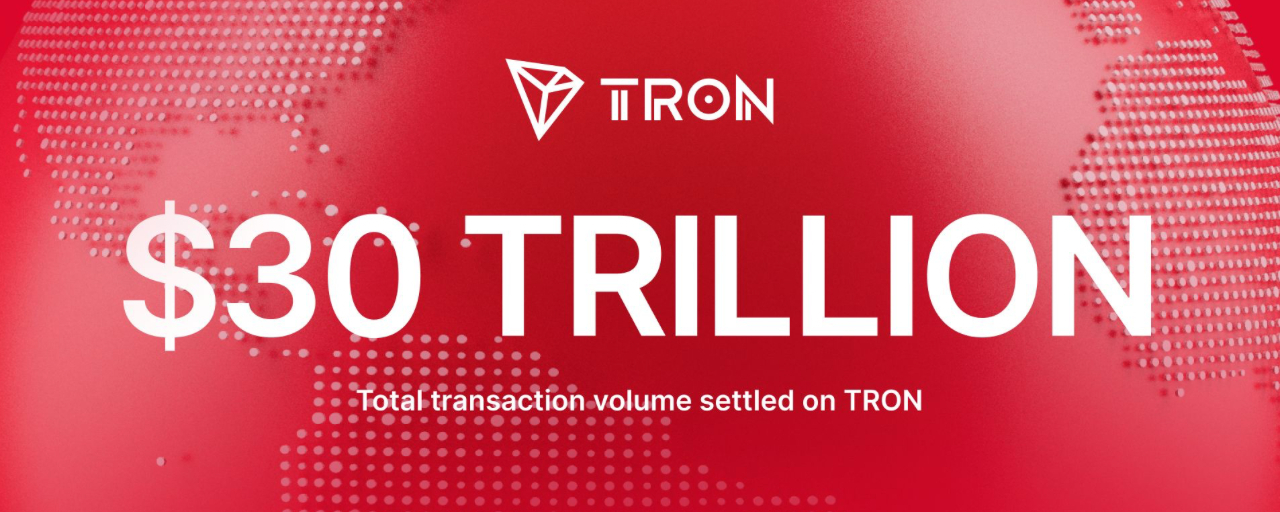
TRON Surpasses $30T in Total Transaction VolumeGeneva, Switzerland, September 24, 2026 — TRON DAO, the community-governed DAO dedicated to accelerating the decentralization of the internet through blockchain technology and decentralized applications (dApps), today announced that total transaction volume settled on the TRON blockchain has surpassed $30 trillion. A milestone driven by the network's high throughput, low costs, and deep liquidity, making TRON the settlement layer of choice for stablecoin transfers, payments, and digital asset activity worldwide.
TRON has now recorded more than 405 million total user accounts, over 15 billion total transactions, more than $28 billion in total value locked (TVL) and currently carries more than $94 billion in circulating USDT, the largest supply of any blockchain. According to Token Terminal, TRON leads all networks in USDT transfer volume year to date, with approximately $6 trillion, averaging $25 billion in daily transfer volume. That momentum is also extending into consumer payments. According to CoinDesk Research, crypto payment card volumes grew from $2 billion in the first quarter of 2026 to $2.4 billion in the second, with TRON's share rising from 33% to 34% over the same period, the highest of any chain tracked. The data reflects TRON’s position as the dominant blockchain for merchant acceptance and consumer-to-business payments via Visa-linked stablecoin cards.
"TRON has moved $30 trillion since launch, a scale comparable to the annual output of the U.S. economy in 2025. Crossing $30 trillion in total transaction volume is proof that TRON has become an essential infrastructure for the digital dollar economy," said Justin Sun, founder of TRON. "Every trillion dollars that moves across TRON represents real people relying on stablecoins for payments, savings, and everyday transactions. TRON was built to support accessible, scalable digital financial infrastructure, and this milestone reflects the continued growth of that mission."
Institutional access to TRON has broadened alongside the network’s growth. In September 2026, Canary Capital launched the Canary Staked TRX ETF, trading under the ticker TRXS. TRX spot and futures products are also available on Bitnomial, a US-regulated derivatives exchange, further broadening regulated market access. Anchorage Digital also expanded support for the TRON Network with native TRX staking and custody for TRC-20 assets through its regulated platform, while the Tokenized Hamilton Lane SCOPE Fund became the first Securitize-issued asset on the TRON network.
Additionally, the TRON blockchain was among the top 5 protocols represented in the newly launched S&P Pantera Digital Asset Index. The index was developed by S&P Dow Jones Indices and Pantera Capital, and applies a methodology centered on protocol utility, onchain liquidity, and network activity. The launch marks one of the clearest signs to date that established financial market frameworks are being extended to digital assets, applying benchmark methodologies traditionally used across equities and other asset classes to blockchain networks.
TRON's $30 trillion transfer volume milestone underscores the network's scale as blockchain-based payments and stablecoin settlement continue to grow. With rising activity across payments, digital assets, and institutional markets, TRON continues to serve as core infrastructure for the movement of value on-chain.
About TRON DAO
TRON DAO is a community-governed DAO dedicated to accelerating the decentralization of the internet via blockchain technology and dApps.
Founded in September 2017, the TRON blockchain has experienced significant growth since its MainNet launch in May 2018. Today, TRON hosts the largest circulating supply of USD Tether (USDT) stablecoin, which currently exceeds $94 billion. As of September 2026, the TRON blockchain has recorded over 405 million in total user accounts, more than 15 billion in total transactions, and over $28 billion in total value locked (TVL), based on TRONSCAN. Recognized as the global settlement layer for stablecoin transactions and everyday purchases with proven success, TRON is “Moving Trillions, Empowering Billions.”
TRON Surpasses $30T in Total Transaction Volume
Geneva, Switzerland, September 24, 2026 — TRON DAO, the community-governed DAO dedicated to accelerating the decentralization of the internet through blockchain technology and decentralized applications (dApps), today announced that total transaction volume settled on the TRON blockchain has surpassed $30 trillion. A milestone driven by the network's high throughput, low costs, and deep liquidity, making TRON the settlement layer of choice for stablecoin transfers, payments, and digital asset activity worldwide.
TRON has now recorded more than 405 million total user accounts, over 15 billion total transactions, more than $28 billion in total value locked (TVL) and currently carries more than $94 billion in circulating USDT, the largest supply of any blockchain. According to Token Terminal, TRON leads all networks in USDT transfer volume year to date, with approximately $6 trillion, averaging $25 billion in daily transfer volume. That momentum is also extending into consumer payments. According to CoinDesk Research, crypto payment card volumes grew from $2 billion in the first quarter of 2026 to $2.4 billion in the second, with TRON's share rising from 33% to 34% over the same period, the highest of any chain tracked. The data reflects TRON’s position as the dominant blockchain for merchant acceptance and consumer-to-business payments via Visa-linked stablecoin cards.
"TRON has moved $30 trillion since launch, a scale comparable to the annual output of the U.S. economy in 2025. Crossing $30 trillion in total transaction volume is proof that TRON has become an essential infrastructure for the digital dollar economy," said Justin Sun, founder of TRON. "Every trillion dollars that moves across TRON represents real people relying on stablecoins for payments, savings, and everyday transactions. TRON was built to support accessible, scalable digital financial infrastructure, and this milestone reflects the continued growth of that mission."
Institutional access to TRON has broadened alongside the network’s growth. In September 2026, Canary Capital launched the Canary Staked TRX ETF, trading under the ticker TRXS. TRX spot and futures products are also available on Bitnomial, a US-regulated derivatives exchange, further broadening regulated market access. Anchorage Digital also expanded support for the TRON Network with native TRX staking and custody for TRC-20 assets through its regulated platform, while the Tokenized Hamilton Lane SCOPE Fund became the first Securitize-issued asset on the TRON network.
Additionally, the TRON blockchain was among the top 5 protocols represented in the newly launched S&P Pantera Digital Asset Index. The index was developed by S&P Dow Jones Indices and Pantera Capital, and applies a methodology centered on protocol utility, onchain liquidity, and network activity. The launch marks one of the clearest signs to date that established financial market frameworks are being extended to digital assets, applying benchmark methodologies traditionally used across equities and other asset classes to blockchain networks.
TRON's $30 trillion transfer volume milestone underscores the network's scale as blockchain-based payments and stablecoin settlement continue to grow. With rising activity across payments, digital assets, and institutional markets, TRON continues to serve as core infrastructure for the movement of value on-chain.
About TRON DAO
TRON DAO is a community-governed DAO dedicated to accelerating the decentralization of the internet via blockchain technology and dApps.
Founded in September 2017, the TRON blockchain has experienced significant growth since its MainNet launch in May 2018. Today, TRON hosts the largest circulating supply of USD Tether (USDT) stablecoin, which currently exceeds $94 billion. As of September 2026, the TRON blockchain has recorded over 405 million in total user accounts, more than 15 billion in total transactions, and over $28 billion in total value locked (TVL), based on TRONSCAN. Recognized as the global settlement layer for stablecoin transactions and everyday purchases with proven success, TRON is “Moving Trillions, Empowering Billions.”
TRON has now recorded more than 405 million total user accounts, over 15 billion total transactions, more than $28 billion in total value locked (TVL) and currently carries more than $94 billion in circulating USDT, the largest supply of any blockchain. According to Token Terminal, TRON leads all networks in USDT transfer volume year to date, with approximately $6 trillion, averaging $25 billion in daily transfer volume. That momentum is also extending into consumer payments. According to CoinDesk Research, crypto payment card volumes grew from $2 billion in the first quarter of 2026 to $2.4 billion in the second, with TRON's share rising from 33% to 34% over the same period, the highest of any chain tracked. The data reflects TRON’s position as the dominant blockchain for merchant acceptance and consumer-to-business payments via Visa-linked stablecoin cards.
"TRON has moved $30 trillion since launch, a scale comparable to the annual output of the U.S. economy in 2025. Crossing $30 trillion in total transaction volume is proof that TRON has become an essential infrastructure for the digital dollar economy," said Justin Sun, founder of TRON. "Every trillion dollars that moves across TRON represents real people relying on stablecoins for payments, savings, and everyday transactions. TRON was built to support accessible, scalable digital financial infrastructure, and this milestone reflects the continued growth of that mission."
Institutional access to TRON has broadened alongside the network’s growth. In September 2026, Canary Capital launched the Canary Staked TRX ETF, trading under the ticker TRXS. TRX spot and futures products are also available on Bitnomial, a US-regulated derivatives exchange, further broadening regulated market access. Anchorage Digital also expanded support for the TRON Network with native TRX staking and custody for TRC-20 assets through its regulated platform, while the Tokenized Hamilton Lane SCOPE Fund became the first Securitize-issued asset on the TRON network.
Additionally, the TRON blockchain was among the top 5 protocols represented in the newly launched S&P Pantera Digital Asset Index. The index was developed by S&P Dow Jones Indices and Pantera Capital, and applies a methodology centered on protocol utility, onchain liquidity, and network activity. The launch marks one of the clearest signs to date that established financial market frameworks are being extended to digital assets, applying benchmark methodologies traditionally used across equities and other asset classes to blockchain networks.
TRON's $30 trillion transfer volume milestone underscores the network's scale as blockchain-based payments and stablecoin settlement continue to grow. With rising activity across payments, digital assets, and institutional markets, TRON continues to serve as core infrastructure for the movement of value on-chain.
About TRON DAO
TRON DAO is a community-governed DAO dedicated to accelerating the decentralization of the internet via blockchain technology and dApps.
Founded in September 2017, the TRON blockchain has experienced significant growth since its MainNet launch in May 2018. Today, TRON hosts the largest circulating supply of USD Tether (USDT) stablecoin, which currently exceeds $94 billion. As of September 2026, the TRON blockchain has recorded over 405 million in total user accounts, more than 15 billion in total transactions, and over $28 billion in total value locked (TVL), based on TRONSCAN. Recognized as the global settlement layer for stablecoin transactions and everyday purchases with proven success, TRON is “Moving Trillions, Empowering Billions.”
61
Article
Privy Expands Support for TRON with Enhanced Wallet and Payment Infrastructure for DevelopersGeneva, Switzerland, September 24, 2026 – TRON DAO, the community-governed DAO dedicated to accelerating the decentralization of the internet through blockchain technology and decentralized applications (dApps), announced today that Privy is expanding its support for the TRON blockchain, giving developers and businesses more tools to build and operate financial applications at scale on the network.
With the expanded integration, developers can use Privy to build and manage wallets and financial applications on TRON with enhanced transaction, policy, transfer, and monitoring capabilities. Developers can programmatically construct, sign, and broadcast supported TRON transactions, monitor wallet activity and on-chain events through balance and transaction webhooks, and use policy controls to set spending limits, recipient allowlists, and transaction approval or restriction rules. Transfers APIs also enable supported assets on TRON to be moved programmatically.
Together, these capabilities give businesses the infrastructure to build and operate stablecoin payment solutions, treasury workflows, wallets, and other on-chain financial products on TRON.
“TRON has become an important network for stablecoin activity globally, and we want to make it as easy as possible for developers to build on that foundation,” said Justin Sun, Founder of TRON. “By deepening our integration with Privy, we’re giving teams more of the infrastructure they need to bring payments, treasury, and other financial products on-chain.”
TRON has become a major global rail for stablecoin transfers, with the total transfer volume on the network approaching $30 trillion. Its infrastructure is increasingly being used for payments and treasury operations, as companies including Onafriq and Paystack are already building wallet and treasury use cases with Privy and TRON.
“We’re seeing more companies use TRON to move stablecoins across borders and build new financial products, particularly in markets where USDT is already an important part of how money moves,” said Henri Stern, CEO and co-founder of Privy. “Deepening our support for TRON gives these teams more of the infrastructure they need to build and operate at scale.”
The expanded integration builds on growing demand for stablecoin infrastructure that can support real-world financial operations. By combining Privy’s wallet and developer infrastructure with TRON’s stablecoin ecosystem, businesses can build applications designed for payments, treasury management, and other on-chain financial workflows.
About TRON DAO
TRON DAO is a community-governed DAO dedicated to accelerating the decentralization of the internet via blockchain technology and dApps.
Founded in September 2017, the TRON blockchain has experienced significant growth since its MainNet launch in May 2018. Today, TRON hosts the largest circulating supply of USD Tether (USDT) stablecoin, which currently exceeds $94 billion. As of September 2026, the TRON blockchain has recorded over 405 million in total user accounts, more than 15 billion in total transactions, and over $29 billion in total value locked (TVL), based on TRONSCAN. Recognized as the global settlement layer for stablecoin transactions and everyday purchases with proven success, TRON is “Moving Trillions, Empowering Billions.”
About Privy, a Stripe company
Privy provides secure, scalable wallet infrastructure for modern financial products built on crypto and stablecoin rails. More than 2,000 developers and businesses, including Ramp, Deel, and Hyperliquid, use Privy to power over 160 million accounts and process billions of dollars in monthly volume. Privy became a Stripe company in 2025.
Privy Expands Support for TRON with Enhanced Wallet and Payment Infrastructure for Developers
Geneva, Switzerland, September 24, 2026 – TRON DAO, the community-governed DAO dedicated to accelerating the decentralization of the internet through blockchain technology and decentralized applications (dApps), announced today that Privy is expanding its support for the TRON blockchain, giving developers and businesses more tools to build and operate financial applications at scale on the network.
With the expanded integration, developers can use Privy to build and manage wallets and financial applications on TRON with enhanced transaction, policy, transfer, and monitoring capabilities. Developers can programmatically construct, sign, and broadcast supported TRON transactions, monitor wallet activity and on-chain events through balance and transaction webhooks, and use policy controls to set spending limits, recipient allowlists, and transaction approval or restriction rules. Transfers APIs also enable supported assets on TRON to be moved programmatically.
Together, these capabilities give businesses the infrastructure to build and operate stablecoin payment solutions, treasury workflows, wallets, and other on-chain financial products on TRON.
“TRON has become an important network for stablecoin activity globally, and we want to make it as easy as possible for developers to build on that foundation,” said Justin Sun, Founder of TRON. “By deepening our integration with Privy, we’re giving teams more of the infrastructure they need to bring payments, treasury, and other financial products on-chain.”
TRON has become a major global rail for stablecoin transfers, with the total transfer volume on the network approaching $30 trillion. Its infrastructure is increasingly being used for payments and treasury operations, as companies including Onafriq and Paystack are already building wallet and treasury use cases with Privy and TRON.
“We’re seeing more companies use TRON to move stablecoins across borders and build new financial products, particularly in markets where USDT is already an important part of how money moves,” said Henri Stern, CEO and co-founder of Privy. “Deepening our support for TRON gives these teams more of the infrastructure they need to build and operate at scale.”
The expanded integration builds on growing demand for stablecoin infrastructure that can support real-world financial operations. By combining Privy’s wallet and developer infrastructure with TRON’s stablecoin ecosystem, businesses can build applications designed for payments, treasury management, and other on-chain financial workflows.
About TRON DAO
TRON DAO is a community-governed DAO dedicated to accelerating the decentralization of the internet via blockchain technology and dApps.
Founded in September 2017, the TRON blockchain has experienced significant growth since its MainNet launch in May 2018. Today, TRON hosts the largest circulating supply of USD Tether (USDT) stablecoin, which currently exceeds $94 billion. As of September 2026, the TRON blockchain has recorded over 405 million in total user accounts, more than 15 billion in total transactions, and over $29 billion in total value locked (TVL), based on TRONSCAN. Recognized as the global settlement layer for stablecoin transactions and everyday purchases with proven success, TRON is “Moving Trillions, Empowering Billions.”
About Privy, a Stripe company
Privy provides secure, scalable wallet infrastructure for modern financial products built on crypto and stablecoin rails. More than 2,000 developers and businesses, including Ramp, Deel, and Hyperliquid, use Privy to power over 160 million accounts and process billions of dollars in monthly volume. Privy became a Stripe company in 2025.
With the expanded integration, developers can use Privy to build and manage wallets and financial applications on TRON with enhanced transaction, policy, transfer, and monitoring capabilities. Developers can programmatically construct, sign, and broadcast supported TRON transactions, monitor wallet activity and on-chain events through balance and transaction webhooks, and use policy controls to set spending limits, recipient allowlists, and transaction approval or restriction rules. Transfers APIs also enable supported assets on TRON to be moved programmatically.
Together, these capabilities give businesses the infrastructure to build and operate stablecoin payment solutions, treasury workflows, wallets, and other on-chain financial products on TRON.
“TRON has become an important network for stablecoin activity globally, and we want to make it as easy as possible for developers to build on that foundation,” said Justin Sun, Founder of TRON. “By deepening our integration with Privy, we’re giving teams more of the infrastructure they need to bring payments, treasury, and other financial products on-chain.”
TRON has become a major global rail for stablecoin transfers, with the total transfer volume on the network approaching $30 trillion. Its infrastructure is increasingly being used for payments and treasury operations, as companies including Onafriq and Paystack are already building wallet and treasury use cases with Privy and TRON.
“We’re seeing more companies use TRON to move stablecoins across borders and build new financial products, particularly in markets where USDT is already an important part of how money moves,” said Henri Stern, CEO and co-founder of Privy. “Deepening our support for TRON gives these teams more of the infrastructure they need to build and operate at scale.”
The expanded integration builds on growing demand for stablecoin infrastructure that can support real-world financial operations. By combining Privy’s wallet and developer infrastructure with TRON’s stablecoin ecosystem, businesses can build applications designed for payments, treasury management, and other on-chain financial workflows.
About TRON DAO
TRON DAO is a community-governed DAO dedicated to accelerating the decentralization of the internet via blockchain technology and dApps.
Founded in September 2017, the TRON blockchain has experienced significant growth since its MainNet launch in May 2018. Today, TRON hosts the largest circulating supply of USD Tether (USDT) stablecoin, which currently exceeds $94 billion. As of September 2026, the TRON blockchain has recorded over 405 million in total user accounts, more than 15 billion in total transactions, and over $29 billion in total value locked (TVL), based on TRONSCAN. Recognized as the global settlement layer for stablecoin transactions and everyday purchases with proven success, TRON is “Moving Trillions, Empowering Billions.”
About Privy, a Stripe company
Privy provides secure, scalable wallet infrastructure for modern financial products built on crypto and stablecoin rails. More than 2,000 developers and businesses, including Ramp, Deel, and Hyperliquid, use Privy to power over 160 million accounts and process billions of dollars in monthly volume. Privy became a Stripe company in 2025.
70
Verified

Article
GGD (Global Gold DAO) Launches Tokenized Physical Gold Ecosystem on BNB ChainGGD (Global Gold DAO) has launched a tokenized physical gold real-world asset (RWA) ecosystem on BNB Chain. The protocol introduces a three-token architecture GGT, GGU and GGD designed to link gold-referenced value to on-chain staking, minting, circulating and decentralized governance.
The project describes itself as "the world's first decentralized on-chain physical gold ecosystem DAO," positioning the protocol around the integration of traditional physical gold with blockchain infrastructure. It also aims to decentralize ownership of the tokenization network by distributing governance tokens as staking incentives, incentivizing participation in protocol level governance, and other protocol design includes DAO approved buybacks funded by protocol revenue, intended to align users with the protocol.
The launch comes as real-world asset tokenization continues to move traditional assets onto blockchain networks. The stated thesis is to democratize access, improve real-time transparency, strengthen ownership rights, enable liquidity and allow permissionless composability across on-chain applications. Gold has become one of the assets most actively explored in this transition, given its established global market, recognized pricing benchmarks and long-standing role as a store of value and a hedge against inflation, geopolitical instability and broader macroeconomic uncertainty.
Physical gold ownership, by contrast, can involve storage and insurance requirements, geographic constraints, limited divisibility, cross-border settlement friction and restricted usability in financial applications such as collateral, borrowing and lending. Tokenization offers an alternative structure in which gold-referenced economic exposure can be represented, transferred and utilized within blockchain-based systems.
GGD (Global Gold DAO) separates three core functions across three digital assets: GGT serves as the gold-referenced value layer, GGU functions as a volatility buffer in the form of a synthetic U.S. dollar-denominated value unit, and GGD acts as the governance and ecosystem incentive token.
GGT: The Physical Gold Asset
GGT, or Global Gold Token, is the protocol's primary RWA gold token. Each GGT represents the value equivalent of 0.001 troy ounces of gold.
Its current underlying asset is the CSOP Gold ETF (3030.HK), a Hong Kong listed exchange-traded fund managed by CSOP Asset Management Limited. The ETF holds physical gold and tracks the LBMA gold benchmark before expenses.
According to the project's white paper, the underlying asset structure is intended to evolve. The current structure relies solely on the CSOP Gold ETF, while a later phase is expected to introduce directly held physical gold, producing a combined structure of ETF holdings and allocated gold bars.
The legal issuer of GGT is RWAfi DAO LLC – Series 2, a Marshall Islands entity, while protocol level parameters and smart-contract control are assigned to GGD DAO governance. The design separates the entities responsible for holding the underlying assets via a licensed custodian, providing technology services and governing the protocol.
GGT holders do not directly hold units in the ETF, or direct title to the underlying physical gold. GGT is instead structured to provide economic exposure to the performance of the underlying gold linked assets under the contractual arrangements set out in the Marshall Island entities’s legal documentation.
GGT can be minted by depositing USDC or USDT, and withdrawal in accordance with defined protocol rules. It also supports permissionless peer-to-peer transfers on-chain.
The protocol additionally provides a pathway for GGT to physical-gold redemption mechanism. The current minimum redemption threshold is 50,000 GGT, equivalent to 50 troy ounces of gold, with an initial redemption fee of 2.5%. Redemption into USDC or USDT currently carries a 3.5% protocol fee.
GGU: A Synthetic Gold Unit denominated in USD
GGU, or Global Gold Unit, is structured as a volatility buffer in the form of a synthetic U.S. dollar-denominated value unit.
Under the protocol model, each GGU consists of US$1 equivalent of gold exposure paired with a short gold hedging position. The mechanism is intended to reduce net exposure to gold-price movements and hold the U.S. dollar value of GGU near US$1.
GGU is not a conventional 1:1 fiat-reserve stablecoin. Its value management mechanism depends on gold exposure, hedging positions, reserve availability, market liquidity and pricing data.
The white paper notes that full hedging may not be achievable during the protocol's early stages if the risk reserve is insufficient. Under those conditions, GGU may remain partially exposed to gold-price fluctuations and may deviate from its US$1 reference value.
GGT and GGU can be converted into one another through an on-chain atomic conversion mechanism, currently at a fee of 0.3% in either direction. Each conversion burns the source token and mints the destination token at the applicable protocol reference price.
GGD: Governance and Ecosystem Incentives
GGD is the protocol's governance and incentive token, with a fixed total supply of one billion tokens.
Under the allocation model, 45% is designated for ecosystem staking and minting, 15% for market incentives, 15% for the DAO foundation, 20% for the core team and 5% for private investors.
The protocol initially unlocks 100 million GGD. Further batches of 100 million tokens are released against cumulative GGT minting milestones. Within each batch, 45 million GGD is allocated to ecosystem minting and distributed linearly over 730 days under current parameters.
Users can participate in the staking system by staking GGT or GGU through protocol nodes. The minimum user staking amount is currently 10 GGT, or an equivalent effective amount of GGU under the protocol's calculation rules.
GGD is a governance token used to bootstrap network effects and participation in protocol level voting and to reward contributors and users. Its economic value derives from buybacks funded by protocol revenue, a structure designed to align user interests with the protocol’s growth and create a reinforcing growth cycle.
Transparency, Compliance and Security
The protocol's on-chain gold framework combines blockchain-based records with information supplied by licensed custodians, fund admin, asset managers and other service providers.
Pricing relies on multi-source oracle infrastructure. Under the white paper framework, abnormal deviations between price sources, or stale data, can trigger temporary suspension of functions that depend on real-time pricing.
Reserves and underlying asset information is supported by licensed custodian records, periodic attestations and third-party documentation. Information regarding the underlying holdings will be publicly disclosed and made available for verification.
Operators interacting with the official GGD (Global Gold DAO) interface must qualify as professional or accredited investors in their respective jurisdictions and are subject to on-chain screening, including Know Your Transaction (KYT) and Know Your Address (KYA) checks. Operators must not be located in the United States, mainland China, or any jurisdiction subject to United Nations sanctions.
Risk Considerations
The project's white paper identifies risks including gold-price movements, GGT tracking differences, GGU hedging and reserve risks, smart-contract vulnerabilities, liquidity constraints, governance concentration and regulatory uncertainty.
For the full disclaimer, please visit the official GGD (Global Gold DAO) website.
About GGD (Global Gold DAO)
GGD (Global Gold DAO) is a decentralized tokenized gold RWA ecosystem initially deployed on BNB Chain.
GGD (Global Gold DAO) Launches Tokenized Physical Gold Ecosystem on BNB Chain
GGD (Global Gold DAO) has launched a tokenized physical gold real-world asset (RWA) ecosystem on BNB Chain. The protocol introduces a three-token architecture GGT, GGU and GGD designed to link gold-referenced value to on-chain staking, minting, circulating and decentralized governance.
The project describes itself as "the world's first decentralized on-chain physical gold ecosystem DAO," positioning the protocol around the integration of traditional physical gold with blockchain infrastructure. It also aims to decentralize ownership of the tokenization network by distributing governance tokens as staking incentives, incentivizing participation in protocol level governance, and other protocol design includes DAO approved buybacks funded by protocol revenue, intended to align users with the protocol.
The launch comes as real-world asset tokenization continues to move traditional assets onto blockchain networks. The stated thesis is to democratize access, improve real-time transparency, strengthen ownership rights, enable liquidity and allow permissionless composability across on-chain applications. Gold has become one of the assets most actively explored in this transition, given its established global market, recognized pricing benchmarks and long-standing role as a store of value and a hedge against inflation, geopolitical instability and broader macroeconomic uncertainty.
Physical gold ownership, by contrast, can involve storage and insurance requirements, geographic constraints, limited divisibility, cross-border settlement friction and restricted usability in financial applications such as collateral, borrowing and lending. Tokenization offers an alternative structure in which gold-referenced economic exposure can be represented, transferred and utilized within blockchain-based systems.
GGD (Global Gold DAO) separates three core functions across three digital assets: GGT serves as the gold-referenced value layer, GGU functions as a volatility buffer in the form of a synthetic U.S. dollar-denominated value unit, and GGD acts as the governance and ecosystem incentive token.
GGT: The Physical Gold Asset
GGT, or Global Gold Token, is the protocol's primary RWA gold token. Each GGT represents the value equivalent of 0.001 troy ounces of gold.
Its current underlying asset is the CSOP Gold ETF (3030.HK), a Hong Kong listed exchange-traded fund managed by CSOP Asset Management Limited. The ETF holds physical gold and tracks the LBMA gold benchmark before expenses.
According to the project's white paper, the underlying asset structure is intended to evolve. The current structure relies solely on the CSOP Gold ETF, while a later phase is expected to introduce directly held physical gold, producing a combined structure of ETF holdings and allocated gold bars.
The legal issuer of GGT is RWAfi DAO LLC – Series 2, a Marshall Islands entity, while protocol level parameters and smart-contract control are assigned to GGD DAO governance. The design separates the entities responsible for holding the underlying assets via a licensed custodian, providing technology services and governing the protocol.
GGT holders do not directly hold units in the ETF, or direct title to the underlying physical gold. GGT is instead structured to provide economic exposure to the performance of the underlying gold linked assets under the contractual arrangements set out in the Marshall Island entities’s legal documentation.
GGT can be minted by depositing USDC or USDT, and withdrawal in accordance with defined protocol rules. It also supports permissionless peer-to-peer transfers on-chain.
The protocol additionally provides a pathway for GGT to physical-gold redemption mechanism. The current minimum redemption threshold is 50,000 GGT, equivalent to 50 troy ounces of gold, with an initial redemption fee of 2.5%. Redemption into USDC or USDT currently carries a 3.5% protocol fee.
GGU: A Synthetic Gold Unit denominated in USD
GGU, or Global Gold Unit, is structured as a volatility buffer in the form of a synthetic U.S. dollar-denominated value unit.
Under the protocol model, each GGU consists of US$1 equivalent of gold exposure paired with a short gold hedging position. The mechanism is intended to reduce net exposure to gold-price movements and hold the U.S. dollar value of GGU near US$1.
GGU is not a conventional 1:1 fiat-reserve stablecoin. Its value management mechanism depends on gold exposure, hedging positions, reserve availability, market liquidity and pricing data.
The white paper notes that full hedging may not be achievable during the protocol's early stages if the risk reserve is insufficient. Under those conditions, GGU may remain partially exposed to gold-price fluctuations and may deviate from its US$1 reference value.
GGT and GGU can be converted into one another through an on-chain atomic conversion mechanism, currently at a fee of 0.3% in either direction. Each conversion burns the source token and mints the destination token at the applicable protocol reference price.
GGD: Governance and Ecosystem Incentives
GGD is the protocol's governance and incentive token, with a fixed total supply of one billion tokens.
Under the allocation model, 45% is designated for ecosystem staking and minting, 15% for market incentives, 15% for the DAO foundation, 20% for the core team and 5% for private investors.
The protocol initially unlocks 100 million GGD. Further batches of 100 million tokens are released against cumulative GGT minting milestones. Within each batch, 45 million GGD is allocated to ecosystem minting and distributed linearly over 730 days under current parameters.
Users can participate in the staking system by staking GGT or GGU through protocol nodes. The minimum user staking amount is currently 10 GGT, or an equivalent effective amount of GGU under the protocol's calculation rules.
GGD is a governance token used to bootstrap network effects and participation in protocol level voting and to reward contributors and users. Its economic value derives from buybacks funded by protocol revenue, a structure designed to align user interests with the protocol’s growth and create a reinforcing growth cycle.
Transparency, Compliance and Security
The protocol's on-chain gold framework combines blockchain-based records with information supplied by licensed custodians, fund admin, asset managers and other service providers.
Pricing relies on multi-source oracle infrastructure. Under the white paper framework, abnormal deviations between price sources, or stale data, can trigger temporary suspension of functions that depend on real-time pricing.
Reserves and underlying asset information is supported by licensed custodian records, periodic attestations and third-party documentation. Information regarding the underlying holdings will be publicly disclosed and made available for verification.
Operators interacting with the official GGD (Global Gold DAO) interface must qualify as professional or accredited investors in their respective jurisdictions and are subject to on-chain screening, including Know Your Transaction (KYT) and Know Your Address (KYA) checks. Operators must not be located in the United States, mainland China, or any jurisdiction subject to United Nations sanctions.
Risk Considerations
The project's white paper identifies risks including gold-price movements, GGT tracking differences, GGU hedging and reserve risks, smart-contract vulnerabilities, liquidity constraints, governance concentration and regulatory uncertainty.
For the full disclaimer, please visit the official GGD (Global Gold DAO) website.
About GGD (Global Gold DAO)
GGD (Global Gold DAO) is a decentralized tokenized gold RWA ecosystem initially deployed on BNB Chain.
The project describes itself as "the world's first decentralized on-chain physical gold ecosystem DAO," positioning the protocol around the integration of traditional physical gold with blockchain infrastructure. It also aims to decentralize ownership of the tokenization network by distributing governance tokens as staking incentives, incentivizing participation in protocol level governance, and other protocol design includes DAO approved buybacks funded by protocol revenue, intended to align users with the protocol.
The launch comes as real-world asset tokenization continues to move traditional assets onto blockchain networks. The stated thesis is to democratize access, improve real-time transparency, strengthen ownership rights, enable liquidity and allow permissionless composability across on-chain applications. Gold has become one of the assets most actively explored in this transition, given its established global market, recognized pricing benchmarks and long-standing role as a store of value and a hedge against inflation, geopolitical instability and broader macroeconomic uncertainty.
Physical gold ownership, by contrast, can involve storage and insurance requirements, geographic constraints, limited divisibility, cross-border settlement friction and restricted usability in financial applications such as collateral, borrowing and lending. Tokenization offers an alternative structure in which gold-referenced economic exposure can be represented, transferred and utilized within blockchain-based systems.
GGD (Global Gold DAO) separates three core functions across three digital assets: GGT serves as the gold-referenced value layer, GGU functions as a volatility buffer in the form of a synthetic U.S. dollar-denominated value unit, and GGD acts as the governance and ecosystem incentive token.
GGT: The Physical Gold Asset
GGT, or Global Gold Token, is the protocol's primary RWA gold token. Each GGT represents the value equivalent of 0.001 troy ounces of gold.
Its current underlying asset is the CSOP Gold ETF (3030.HK), a Hong Kong listed exchange-traded fund managed by CSOP Asset Management Limited. The ETF holds physical gold and tracks the LBMA gold benchmark before expenses.
According to the project's white paper, the underlying asset structure is intended to evolve. The current structure relies solely on the CSOP Gold ETF, while a later phase is expected to introduce directly held physical gold, producing a combined structure of ETF holdings and allocated gold bars.
The legal issuer of GGT is RWAfi DAO LLC – Series 2, a Marshall Islands entity, while protocol level parameters and smart-contract control are assigned to GGD DAO governance. The design separates the entities responsible for holding the underlying assets via a licensed custodian, providing technology services and governing the protocol.
GGT holders do not directly hold units in the ETF, or direct title to the underlying physical gold. GGT is instead structured to provide economic exposure to the performance of the underlying gold linked assets under the contractual arrangements set out in the Marshall Island entities’s legal documentation.
GGT can be minted by depositing USDC or USDT, and withdrawal in accordance with defined protocol rules. It also supports permissionless peer-to-peer transfers on-chain.
The protocol additionally provides a pathway for GGT to physical-gold redemption mechanism. The current minimum redemption threshold is 50,000 GGT, equivalent to 50 troy ounces of gold, with an initial redemption fee of 2.5%. Redemption into USDC or USDT currently carries a 3.5% protocol fee.
GGU: A Synthetic Gold Unit denominated in USD
GGU, or Global Gold Unit, is structured as a volatility buffer in the form of a synthetic U.S. dollar-denominated value unit.
Under the protocol model, each GGU consists of US$1 equivalent of gold exposure paired with a short gold hedging position. The mechanism is intended to reduce net exposure to gold-price movements and hold the U.S. dollar value of GGU near US$1.
GGU is not a conventional 1:1 fiat-reserve stablecoin. Its value management mechanism depends on gold exposure, hedging positions, reserve availability, market liquidity and pricing data.
The white paper notes that full hedging may not be achievable during the protocol's early stages if the risk reserve is insufficient. Under those conditions, GGU may remain partially exposed to gold-price fluctuations and may deviate from its US$1 reference value.
GGT and GGU can be converted into one another through an on-chain atomic conversion mechanism, currently at a fee of 0.3% in either direction. Each conversion burns the source token and mints the destination token at the applicable protocol reference price.
GGD: Governance and Ecosystem Incentives
GGD is the protocol's governance and incentive token, with a fixed total supply of one billion tokens.
Under the allocation model, 45% is designated for ecosystem staking and minting, 15% for market incentives, 15% for the DAO foundation, 20% for the core team and 5% for private investors.
The protocol initially unlocks 100 million GGD. Further batches of 100 million tokens are released against cumulative GGT minting milestones. Within each batch, 45 million GGD is allocated to ecosystem minting and distributed linearly over 730 days under current parameters.
Users can participate in the staking system by staking GGT or GGU through protocol nodes. The minimum user staking amount is currently 10 GGT, or an equivalent effective amount of GGU under the protocol's calculation rules.
GGD is a governance token used to bootstrap network effects and participation in protocol level voting and to reward contributors and users. Its economic value derives from buybacks funded by protocol revenue, a structure designed to align user interests with the protocol’s growth and create a reinforcing growth cycle.
Transparency, Compliance and Security
The protocol's on-chain gold framework combines blockchain-based records with information supplied by licensed custodians, fund admin, asset managers and other service providers.
Pricing relies on multi-source oracle infrastructure. Under the white paper framework, abnormal deviations between price sources, or stale data, can trigger temporary suspension of functions that depend on real-time pricing.
Reserves and underlying asset information is supported by licensed custodian records, periodic attestations and third-party documentation. Information regarding the underlying holdings will be publicly disclosed and made available for verification.
Operators interacting with the official GGD (Global Gold DAO) interface must qualify as professional or accredited investors in their respective jurisdictions and are subject to on-chain screening, including Know Your Transaction (KYT) and Know Your Address (KYA) checks. Operators must not be located in the United States, mainland China, or any jurisdiction subject to United Nations sanctions.
Risk Considerations
The project's white paper identifies risks including gold-price movements, GGT tracking differences, GGU hedging and reserve risks, smart-contract vulnerabilities, liquidity constraints, governance concentration and regulatory uncertainty.
For the full disclaimer, please visit the official GGD (Global Gold DAO) website.
About GGD (Global Gold DAO)
GGD (Global Gold DAO) is a decentralized tokenized gold RWA ecosystem initially deployed on BNB Chain.
996
Article
Clichmont signs GPU hardware supply agreement with CybertekInitial deployment of 40 NVIDIA GeForce RTX 5090 GPUs will support Clichmont’s Bodo Harbor Compute Site, with larger volumes and additional GPU models planned.
Clichmont, a provider of high-performance computing infrastructure for artificial intelligence and GPU-intensive workloads, has entered into an ongoing hardware supply agreement with French high-tech group Cybertek.
Under the non-exclusive agreement, Cybertek will supply workstation-class GPU hardware for Clichmont’s infrastructure as the company expands its compute capacity. The relationship starts with 40 RTX 5090 GPUs for Clichmont’s Bodo Harbor Compute Site in Norway. Cybertek was selected in part for its access to constrained GPU models, which gives Clichmont an additional supply channel as it expands its compute capacity.
Clichmont’s Bodo Harbor Compute Site is already live, with RTX 5090 and RTX 4090 hardware deployed for workstation-class AI, rendering, and production compute workloads. The new 40-unit RTX 5090 allocation will expand the site’s available GPU capacity.
“Cybertek has operated in the high-tech market for many years, and its ability to source constrained GPU models gives us another reliable supplier as we expand,” said Alexis Cathalifaud, CEO of Clichmont. “Continuous access to the workstations and GPUs we need is important to our development roadmap, particularly as we increase capacity at Bodo and prepare for future sites.”
Founded in 1996 by two computer engineers, Cybertek employs more than 200 people across France and operates a national network of 23 stores. The group holds more than 7,000 product references in stock and operates a dedicated assembly chain that produces more than 50,000 PCs each year.
“Clichmont gives Cybertek an opportunity to showcase our hardware expertise in a B2B environment and to an international audience,” said Laurent Chancholle, co-founder of Cybertek. “Supporting an operational compute site such as Bodo demonstrates what our sourcing and assembly capabilities can deliver for infrastructure customers, and we see room to expand that relationship as Clichmont grows.”
Clichmont plans to source larger volumes for the Bodo site through Cybertek, with RTX 6000D hardware identified in the current expansion plan. The company’s broader Bodo roadmap includes a Q4 2027 scale-out of the current footprint for higher enterprise GPU density. Clichmont and Cybertek also plan to extend their cooperation to the Solar Compute Hub, a solar autonomous data center planned for Alicante, Spain.
About Clichmont
Clichmont develops and operates high-performance GPU infrastructure for artificial intelligence, machine learning, 3D rendering, scientific computing and other GPU-intensive applications.
The company deploys and manages enterprise GPU clusters, providing secure, scalable compute capacity across its infrastructure footprint. Its current operational sites include the Technical Center in Billingstad and the Bodo Harbor Compute Site in Norway, with further expansion planned in Norway and Spain.
About Cybertek
Founded in 1996 by two computer engineers, Cybertek is a French high-tech group specializing in the manufacturing and commercialization of gaming, professional and office PCs.
The group employs more than 200 people across France, operates 23 stores nationwide and offers more than 7,000 product references. Its dedicated manufacturing and assembly operation produces more than 50,000 PCs each year.
Clichmont signs GPU hardware supply agreement with Cybertek
Initial deployment of 40 NVIDIA GeForce RTX 5090 GPUs will support Clichmont’s Bodo Harbor Compute Site, with larger volumes and additional GPU models planned.
Clichmont, a provider of high-performance computing infrastructure for artificial intelligence and GPU-intensive workloads, has entered into an ongoing hardware supply agreement with French high-tech group Cybertek.
Under the non-exclusive agreement, Cybertek will supply workstation-class GPU hardware for Clichmont’s infrastructure as the company expands its compute capacity. The relationship starts with 40 RTX 5090 GPUs for Clichmont’s Bodo Harbor Compute Site in Norway. Cybertek was selected in part for its access to constrained GPU models, which gives Clichmont an additional supply channel as it expands its compute capacity.
Clichmont’s Bodo Harbor Compute Site is already live, with RTX 5090 and RTX 4090 hardware deployed for workstation-class AI, rendering, and production compute workloads. The new 40-unit RTX 5090 allocation will expand the site’s available GPU capacity.
“Cybertek has operated in the high-tech market for many years, and its ability to source constrained GPU models gives us another reliable supplier as we expand,” said Alexis Cathalifaud, CEO of Clichmont. “Continuous access to the workstations and GPUs we need is important to our development roadmap, particularly as we increase capacity at Bodo and prepare for future sites.”
Founded in 1996 by two computer engineers, Cybertek employs more than 200 people across France and operates a national network of 23 stores. The group holds more than 7,000 product references in stock and operates a dedicated assembly chain that produces more than 50,000 PCs each year.
“Clichmont gives Cybertek an opportunity to showcase our hardware expertise in a B2B environment and to an international audience,” said Laurent Chancholle, co-founder of Cybertek. “Supporting an operational compute site such as Bodo demonstrates what our sourcing and assembly capabilities can deliver for infrastructure customers, and we see room to expand that relationship as Clichmont grows.”
Clichmont plans to source larger volumes for the Bodo site through Cybertek, with RTX 6000D hardware identified in the current expansion plan. The company’s broader Bodo roadmap includes a Q4 2027 scale-out of the current footprint for higher enterprise GPU density. Clichmont and Cybertek also plan to extend their cooperation to the Solar Compute Hub, a solar autonomous data center planned for Alicante, Spain.
About Clichmont
Clichmont develops and operates high-performance GPU infrastructure for artificial intelligence, machine learning, 3D rendering, scientific computing and other GPU-intensive applications.
The company deploys and manages enterprise GPU clusters, providing secure, scalable compute capacity across its infrastructure footprint. Its current operational sites include the Technical Center in Billingstad and the Bodo Harbor Compute Site in Norway, with further expansion planned in Norway and Spain.
About Cybertek
Founded in 1996 by two computer engineers, Cybertek is a French high-tech group specializing in the manufacturing and commercialization of gaming, professional and office PCs.
The group employs more than 200 people across France, operates 23 stores nationwide and offers more than 7,000 product references. Its dedicated manufacturing and assembly operation produces more than 50,000 PCs each year.
Clichmont, a provider of high-performance computing infrastructure for artificial intelligence and GPU-intensive workloads, has entered into an ongoing hardware supply agreement with French high-tech group Cybertek.
Under the non-exclusive agreement, Cybertek will supply workstation-class GPU hardware for Clichmont’s infrastructure as the company expands its compute capacity. The relationship starts with 40 RTX 5090 GPUs for Clichmont’s Bodo Harbor Compute Site in Norway. Cybertek was selected in part for its access to constrained GPU models, which gives Clichmont an additional supply channel as it expands its compute capacity.
Clichmont’s Bodo Harbor Compute Site is already live, with RTX 5090 and RTX 4090 hardware deployed for workstation-class AI, rendering, and production compute workloads. The new 40-unit RTX 5090 allocation will expand the site’s available GPU capacity.
“Cybertek has operated in the high-tech market for many years, and its ability to source constrained GPU models gives us another reliable supplier as we expand,” said Alexis Cathalifaud, CEO of Clichmont. “Continuous access to the workstations and GPUs we need is important to our development roadmap, particularly as we increase capacity at Bodo and prepare for future sites.”
Founded in 1996 by two computer engineers, Cybertek employs more than 200 people across France and operates a national network of 23 stores. The group holds more than 7,000 product references in stock and operates a dedicated assembly chain that produces more than 50,000 PCs each year.
“Clichmont gives Cybertek an opportunity to showcase our hardware expertise in a B2B environment and to an international audience,” said Laurent Chancholle, co-founder of Cybertek. “Supporting an operational compute site such as Bodo demonstrates what our sourcing and assembly capabilities can deliver for infrastructure customers, and we see room to expand that relationship as Clichmont grows.”
Clichmont plans to source larger volumes for the Bodo site through Cybertek, with RTX 6000D hardware identified in the current expansion plan. The company’s broader Bodo roadmap includes a Q4 2027 scale-out of the current footprint for higher enterprise GPU density. Clichmont and Cybertek also plan to extend their cooperation to the Solar Compute Hub, a solar autonomous data center planned for Alicante, Spain.
About Clichmont
Clichmont develops and operates high-performance GPU infrastructure for artificial intelligence, machine learning, 3D rendering, scientific computing and other GPU-intensive applications.
The company deploys and manages enterprise GPU clusters, providing secure, scalable compute capacity across its infrastructure footprint. Its current operational sites include the Technical Center in Billingstad and the Bodo Harbor Compute Site in Norway, with further expansion planned in Norway and Spain.
About Cybertek
Founded in 1996 by two computer engineers, Cybertek is a French high-tech group specializing in the manufacturing and commercialization of gaming, professional and office PCs.
The group employs more than 200 people across France, operates 23 stores nationwide and offers more than 7,000 product references. Its dedicated manufacturing and assembly operation produces more than 50,000 PCs each year.
4
Article
Zoomex to Host Traders After Party During TOKEN2049 SingaporeIndustry KOL panels, an interactive session with F1 driver Ollie Bearman, live music, and grand prizes including a MacBook Air and iPhone Duo will highlight the evening.
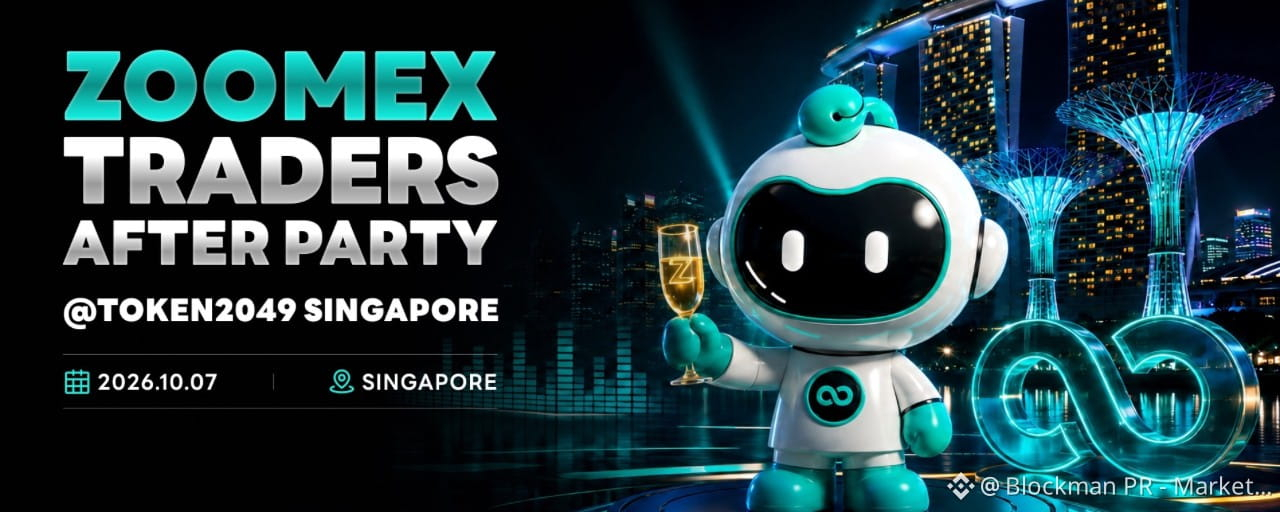
Global cryptocurrency derivatives platform Zoomex will host the “ZOOMEX TRADERS AFTER PARTY @ TOKEN2049 SINGAPORE” on October 7, 2026, at Echo Live Party in Singapore. Organized as an official side event during TOKEN2049 Singapore, the gathering invites traders, Web3 founders, creators, and partners to connect beyond the main conference floor, exchange market insights, and expand their industry networks. (Luma)
Centering on the theme “CRYPTO TRADING · WEB3 · LIVE MUSIC · NETWORKING,” the event seamlessly blends market discussions with an elevated party experience. Guests can engage directly with industry KOLs and the Zoomex team, participate in special guest Q&As, and make new connections over live music and open networking.
Where’s the Edge? From Crypto Trading to Broader Markets
As trading options expand rapidly, where do traders truly find their edge? Is it early opportunity detection, smarter tool utilization, or a distinct approach to market dynamics and risk management?
The event will feature a flagship panel titled “Where’s the Edge? Trading Crypto and Beyond,” bringing together top industry KOLs to share insights across crypto assets and traditional market setups. Discussions will span derivatives, TradFi, and prediction markets, with a focus on how copy trading, AI assistance, and strategic tools are reshaping how traders gather information, make decisions, and execute strategies.
Grounded in practical trading needs, the panel gives speakers from diverse backgrounds a platform to share market observations, offering attendees fresh perspectives to compare and discuss. Conversations will continue into the open networking sessions following the panel.
This theme reflects Zoomex’s core focus on derivatives while expanding its broader trading ecosystem. As the platform moves into TradFi and new trading venues, it continues to anchor its operations around "Easy to Use. Transparent. Fair.", prioritizing seamless user experience, transparent fee structures, and clear rule mechanisms. (Luma)
Ollie Bearman to Join for an Exclusive Community Q&A
TGR Haas F1 Team driver Ollie Bearman will attend as a special guest, hosting an interactive Q&A session that offers traders and motorsport fans an up-close, face-to-face experience. (Luma)
As the Official Cryptocurrency Exchange Partner of the Haas F1 Team, Zoomex continues to bridge high-profile sports sponsorships with real community engagement, letting attendees experience the thrill of racing alongside market insights. (Zoomex)
Live Music and Grand Prizes Set the Stage for Networking
The evening will feature live performances by singers and dancers, a DJ set, interactive lucky draws, and ample dedicated networking time. Attendees can discuss products with the Zoomex team, swap market insights with creators, or catch up with industry peers on conversations started during the main conference. (Luma)
A MacBook Air and iPhone Duo lead the lineup of grand prizes for the night's lucky draw, adding extra excitement to the evening. Eligibility and prize collection will follow official event rules.
From deep market discussions and celebrity guest interactions to live entertainment, Zoomex aims to make the Traders After Party a premier gathering for the trading community—a, a place to share ideas, meet peers in a relaxed setting, and build direct, lasting connections.
Registration is now open. Interested traders, founders, creators, and industry partners can apply via the official Zoomex Luma event page. The event takes place on the evening of October 7 at Echo Live Party Singapore; Final entry details and agenda are subject to the official event listing. (Luma)
About Zoomex
Founded in 2021, Zoomex is a global cryptocurrency trading platform focused on derivatives trading. The platform serves over 3 million users across 35+ countries and regions, offering access to 590+ trading pairs. Built around easy to use, transparency, fairness, and speed, Zoomex provides a clear and efficient trading experience for users worldwide.
Through its high-performance matching engine, clear asset and order displays, and transparent fee and rule mechanisms, Zoomex helps users better understand their account status, order execution, trading costs, and results. Zoomex maintains registrations, licenses, and regulatory statuses across multiple jurisdictions, including the U.S. MSB, Canada MSB, U.S. NFA, and Australia AUSTRAC, and has completed security audits conducted by blockchain security firm Hacken. The platform also continues to strengthen its trust framework through Proof of Reserves, Security & Transparency, Compliance Information, and Fees / Rules Transparency initiatives.
Beyond trading, Zoomex builds a refined brand experience through elite sports partnerships, including the TGR Haas F1 Team, World Cup-winning goalkeeper Emiliano Martínez, and world-class tennis events such as Wimbledon. The values of speed, precision, discipline, fair play, and rule-based execution are closely aligned with Zoomex’s approach to derivatives trading.
At Zoomex: Easy to Use. Transparent balance. Fair access to your earnings.
Zoomex to Host Traders After Party During TOKEN2049 Singapore
Industry KOL panels, an interactive session with F1 driver Ollie Bearman, live music, and grand prizes including a MacBook Air and iPhone Duo will highlight the evening.
Global cryptocurrency derivatives platform Zoomex will host the “ZOOMEX TRADERS AFTER PARTY @ TOKEN2049 SINGAPORE” on October 7, 2026, at Echo Live Party in Singapore. Organized as an official side event during TOKEN2049 Singapore, the gathering invites traders, Web3 founders, creators, and partners to connect beyond the main conference floor, exchange market insights, and expand their industry networks. (Luma)
Centering on the theme “CRYPTO TRADING · WEB3 · LIVE MUSIC · NETWORKING,” the event seamlessly blends market discussions with an elevated party experience. Guests can engage directly with industry KOLs and the Zoomex team, participate in special guest Q&As, and make new connections over live music and open networking.
Where’s the Edge? From Crypto Trading to Broader Markets
As trading options expand rapidly, where do traders truly find their edge? Is it early opportunity detection, smarter tool utilization, or a distinct approach to market dynamics and risk management?
The event will feature a flagship panel titled “Where’s the Edge? Trading Crypto and Beyond,” bringing together top industry KOLs to share insights across crypto assets and traditional market setups. Discussions will span derivatives, TradFi, and prediction markets, with a focus on how copy trading, AI assistance, and strategic tools are reshaping how traders gather information, make decisions, and execute strategies.
Grounded in practical trading needs, the panel gives speakers from diverse backgrounds a platform to share market observations, offering attendees fresh perspectives to compare and discuss. Conversations will continue into the open networking sessions following the panel.
This theme reflects Zoomex’s core focus on derivatives while expanding its broader trading ecosystem. As the platform moves into TradFi and new trading venues, it continues to anchor its operations around "Easy to Use. Transparent. Fair.", prioritizing seamless user experience, transparent fee structures, and clear rule mechanisms. (Luma)
Ollie Bearman to Join for an Exclusive Community Q&A
TGR Haas F1 Team driver Ollie Bearman will attend as a special guest, hosting an interactive Q&A session that offers traders and motorsport fans an up-close, face-to-face experience. (Luma)
As the Official Cryptocurrency Exchange Partner of the Haas F1 Team, Zoomex continues to bridge high-profile sports sponsorships with real community engagement, letting attendees experience the thrill of racing alongside market insights. (Zoomex)
Live Music and Grand Prizes Set the Stage for Networking
The evening will feature live performances by singers and dancers, a DJ set, interactive lucky draws, and ample dedicated networking time. Attendees can discuss products with the Zoomex team, swap market insights with creators, or catch up with industry peers on conversations started during the main conference. (Luma)
A MacBook Air and iPhone Duo lead the lineup of grand prizes for the night's lucky draw, adding extra excitement to the evening. Eligibility and prize collection will follow official event rules.
From deep market discussions and celebrity guest interactions to live entertainment, Zoomex aims to make the Traders After Party a premier gathering for the trading community—a, a place to share ideas, meet peers in a relaxed setting, and build direct, lasting connections.
Registration is now open. Interested traders, founders, creators, and industry partners can apply via the official Zoomex Luma event page. The event takes place on the evening of October 7 at Echo Live Party Singapore; Final entry details and agenda are subject to the official event listing. (Luma)
About Zoomex
Founded in 2021, Zoomex is a global cryptocurrency trading platform focused on derivatives trading. The platform serves over 3 million users across 35+ countries and regions, offering access to 590+ trading pairs. Built around easy to use, transparency, fairness, and speed, Zoomex provides a clear and efficient trading experience for users worldwide.
Through its high-performance matching engine, clear asset and order displays, and transparent fee and rule mechanisms, Zoomex helps users better understand their account status, order execution, trading costs, and results. Zoomex maintains registrations, licenses, and regulatory statuses across multiple jurisdictions, including the U.S. MSB, Canada MSB, U.S. NFA, and Australia AUSTRAC, and has completed security audits conducted by blockchain security firm Hacken. The platform also continues to strengthen its trust framework through Proof of Reserves, Security & Transparency, Compliance Information, and Fees / Rules Transparency initiatives.
Beyond trading, Zoomex builds a refined brand experience through elite sports partnerships, including the TGR Haas F1 Team, World Cup-winning goalkeeper Emiliano Martínez, and world-class tennis events such as Wimbledon. The values of speed, precision, discipline, fair play, and rule-based execution are closely aligned with Zoomex’s approach to derivatives trading.
At Zoomex: Easy to Use. Transparent balance. Fair access to your earnings.
Global cryptocurrency derivatives platform Zoomex will host the “ZOOMEX TRADERS AFTER PARTY @ TOKEN2049 SINGAPORE” on October 7, 2026, at Echo Live Party in Singapore. Organized as an official side event during TOKEN2049 Singapore, the gathering invites traders, Web3 founders, creators, and partners to connect beyond the main conference floor, exchange market insights, and expand their industry networks. (Luma)
Centering on the theme “CRYPTO TRADING · WEB3 · LIVE MUSIC · NETWORKING,” the event seamlessly blends market discussions with an elevated party experience. Guests can engage directly with industry KOLs and the Zoomex team, participate in special guest Q&As, and make new connections over live music and open networking.
Where’s the Edge? From Crypto Trading to Broader Markets
As trading options expand rapidly, where do traders truly find their edge? Is it early opportunity detection, smarter tool utilization, or a distinct approach to market dynamics and risk management?
The event will feature a flagship panel titled “Where’s the Edge? Trading Crypto and Beyond,” bringing together top industry KOLs to share insights across crypto assets and traditional market setups. Discussions will span derivatives, TradFi, and prediction markets, with a focus on how copy trading, AI assistance, and strategic tools are reshaping how traders gather information, make decisions, and execute strategies.
Grounded in practical trading needs, the panel gives speakers from diverse backgrounds a platform to share market observations, offering attendees fresh perspectives to compare and discuss. Conversations will continue into the open networking sessions following the panel.
This theme reflects Zoomex’s core focus on derivatives while expanding its broader trading ecosystem. As the platform moves into TradFi and new trading venues, it continues to anchor its operations around "Easy to Use. Transparent. Fair.", prioritizing seamless user experience, transparent fee structures, and clear rule mechanisms. (Luma)
Ollie Bearman to Join for an Exclusive Community Q&A
TGR Haas F1 Team driver Ollie Bearman will attend as a special guest, hosting an interactive Q&A session that offers traders and motorsport fans an up-close, face-to-face experience. (Luma)
As the Official Cryptocurrency Exchange Partner of the Haas F1 Team, Zoomex continues to bridge high-profile sports sponsorships with real community engagement, letting attendees experience the thrill of racing alongside market insights. (Zoomex)
Live Music and Grand Prizes Set the Stage for Networking
The evening will feature live performances by singers and dancers, a DJ set, interactive lucky draws, and ample dedicated networking time. Attendees can discuss products with the Zoomex team, swap market insights with creators, or catch up with industry peers on conversations started during the main conference. (Luma)
A MacBook Air and iPhone Duo lead the lineup of grand prizes for the night's lucky draw, adding extra excitement to the evening. Eligibility and prize collection will follow official event rules.
From deep market discussions and celebrity guest interactions to live entertainment, Zoomex aims to make the Traders After Party a premier gathering for the trading community—a, a place to share ideas, meet peers in a relaxed setting, and build direct, lasting connections.
Registration is now open. Interested traders, founders, creators, and industry partners can apply via the official Zoomex Luma event page. The event takes place on the evening of October 7 at Echo Live Party Singapore; Final entry details and agenda are subject to the official event listing. (Luma)
About Zoomex
Founded in 2021, Zoomex is a global cryptocurrency trading platform focused on derivatives trading. The platform serves over 3 million users across 35+ countries and regions, offering access to 590+ trading pairs. Built around easy to use, transparency, fairness, and speed, Zoomex provides a clear and efficient trading experience for users worldwide.
Through its high-performance matching engine, clear asset and order displays, and transparent fee and rule mechanisms, Zoomex helps users better understand their account status, order execution, trading costs, and results. Zoomex maintains registrations, licenses, and regulatory statuses across multiple jurisdictions, including the U.S. MSB, Canada MSB, U.S. NFA, and Australia AUSTRAC, and has completed security audits conducted by blockchain security firm Hacken. The platform also continues to strengthen its trust framework through Proof of Reserves, Security & Transparency, Compliance Information, and Fees / Rules Transparency initiatives.
Beyond trading, Zoomex builds a refined brand experience through elite sports partnerships, including the TGR Haas F1 Team, World Cup-winning goalkeeper Emiliano Martínez, and world-class tennis events such as Wimbledon. The values of speed, precision, discipline, fair play, and rule-based execution are closely aligned with Zoomex’s approach to derivatives trading.
At Zoomex: Easy to Use. Transparent balance. Fair access to your earnings.
8
Article
From KOSDAQ-Listed Kweather and Tria to Robinhood: ‘XRP Seoul 2026’ Unveils 3rd Global Speaker LineuXRPL-based DePIN device built by KOSDAQ-listed Kweather in the spotlight; Tria, DCENT, and Biconomy join the lineupU.S. brokerage and crypto platform Robinhood and the longest-running crypto exchange Bitstamp join the lineup, alongside Thailand's SCBXOctober 3 at Grand Hyatt Seoul during KBW2026 week, with Ripple as Title Sponsor
From KOSDAQ-listed weather company Kweather and Tria, the global finance app used across more than 150 countries, to Robinhood, the global brokerage and crypto platform, and Bitstamp, the longest-running crypto exchange founded in 2011, global companies spanning weather data, digital asset payments, and trading in securities, tokenized stocks, and crypto are gathering at ‘XRP Seoul 2026,’ Asia's largest XRP/Web3 conference held during Korea Blockchain Week 2026 (KBW2026 with Upbit).
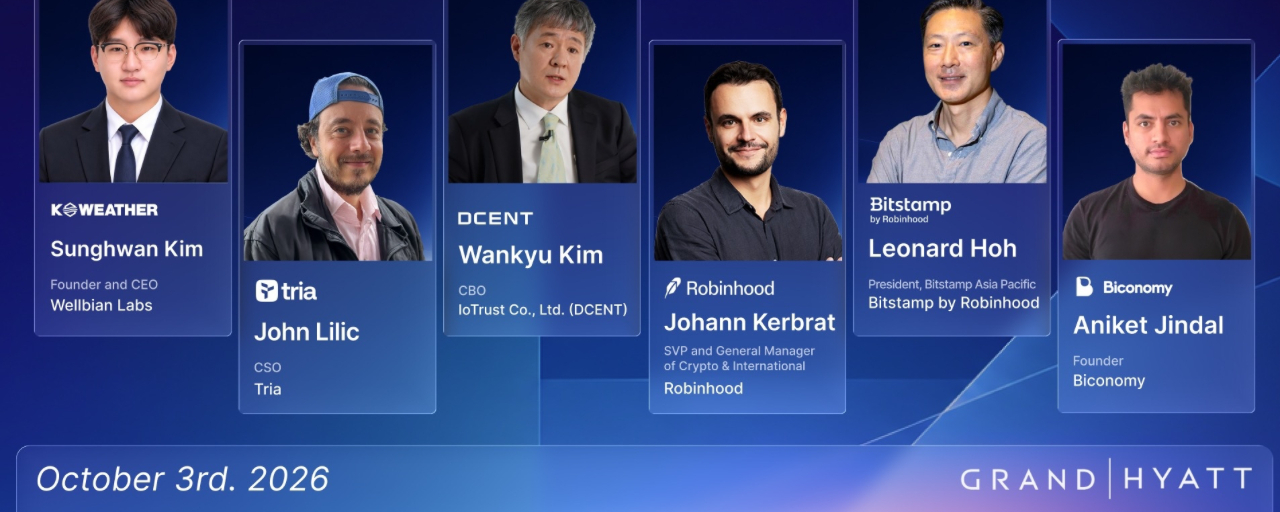
XRPL Korea, the event's host, unveiled its third speaker lineup on September 18, featuring Kweather, Tria, DCENT, Biconomy, Robinhood, and Bitstamp by Robinhood. This follows earlier announcements of Ripple President Monica Long and other Ripple executives, along with global speakers from Doppler Finance, t54 Labs, Flare, and Evernorth. The lineup brings a Korean listed company, global exchanges, and Asian financial institutions onto one stage.
XRPL in Everyday Life: DePIN Devices, Payments, and Wallets
Kweather's keynote will be delivered by Sunghwan Kim, CEO and Founder of Wellbian Labs. Founded in 1997 as Korea's first private weather company, Kweather operates its own weather sensors at more than 30,000 indoor and outdoor sites nationwide. Wellbian Labs runs Wellbian, the Weather Data Token Generator platform, with Kweather as its technology and device partner. The Weather Data Token Generator, which Wellbian put on sale on September 15, is an indoor measurement device manufactured and certified by Kweather. Air and climate data collected at homes and workplaces is verified on the XRP Ledger (XRPL)-based platform and rewarded in WLBN tokens. The device can be purchased on Wellbian's official website in RLUSD or Korean won, and visitors to the booth on the day will be able to see it in operation, with on-site purchase also planned.
Tria sends Chief Strategy Officer John Lilic. Tria is a global finance app that offers a self-custodial wallet and digital-asset-linked payment features. According to company disclosures, it serves users in more than 150 countries and supports more than 20,000 digital assets. Operating data released in late August 2026 showed cumulative payment volume above $150 million, more than $300 million in volume through its BestPath routing system, and cumulative trading volume above $2 billion. Tria is preparing a pre-event campaign and an on-site program for Korean XRP communities together with XRP Seoul. Details of the benefits and how to take part will be announced in stages once both sides finalize them.
DCENT is represented by Chief Business Officer Wankyu Kim. DCENT is a fingerprint-authenticated hardware wallet launched in 2018. It is used by about 1 million people in over 220 countries and supports more than 100 blockchain networks and over 10,000 digital assets. In May it launched the XRP Alliance with Flare Network, giving users a path into XRP yield vaults with two XRPL signatures and no new chain, wallet, or gas token.
Biconomy is represented by Founder Aniket Jindal. Biconomy pioneered smart contract wallets and chain abstraction, and runs a Modular Execution Environment (MEE) that settles operations across multiple blockchains with a single signature. In Korea it has partnered with Girin Wallet to upgrade wallet infrastructure for the XRP ecosystem.
Robinhood and Bitstamp Share a Global Market View
Robinhood will be represented by Johann Kerbrat, SVP and General Manager of Crypto and International. Kerbrat runs Robinhood's entire crypto business and launched Robinhood Chain, the company's own blockchain, which opened its public mainnet on July 1. Robinhood Chain is an Ethereum Layer-2 that tokenizes U.S. stocks and ETFs such as Apple and NVIDIA for 24/7 trading, weekends included. Market data show it passed $50 billion in cumulative decentralized exchange (DEX) volume in just over two months. Since tokenized stock trading picked up in late July, real-world assets and stablecoin supply on the chain have grown rapidly. Robinhood entered the institutional crypto business with its acquisition of Bitstamp in June last year, and its second-quarter total net revenues rose 32% year over year to $1.31 billion.
Leonard Hoh, President of Bitstamp Asia Pacific, will travel to Seoul. Founded in 2011, Bitstamp is the longest continuously operating crypto exchange, holding more than 50 licenses and registrations worldwide and recording $10.1 billion in notional trading volume in August. It secured a Singapore license in July last year, establishing its Asia-Pacific base, and this year launched multi-asset perpetual futures that let traders access commodities, FX, equity indices, and crypto from a single pool of capital. In August, Robinhood began rolling out trading in more than 50 cryptocurrencies to its UK app through Bitstamp.
Digital Assets Through the Eyes of Asian Banking
Ruam Siratanapanta, Head of Digital Asset Business at SCBX, the financial technology group behind Thailand's Siam Commercial Bank, joins the speaker roster. Siratanapanta drives blockchain and digital asset strategy at SCBX. Additional speakers, sponsors, and the detailed program will be announced on a rolling basis.
A representative of XRPL Korea said, “We have brought together companies leading global markets in payments, trading, and asset tokenization. This will be the closest look anyone can get at the future of the blockchain market.”
Last year, XRP Seoul 2025 drew some 3,000 attendees from more than 100 companies at COEX, Seoul. This year, the event moves to the Grand Hyatt Seoul on October 3 in an expanded format. Tickets are available via Moove Ticket, YES24, and Ticketlink. [End]
[About] Kweather
Founded in 1997, Kweather is Korea's first private weather company and a KOSDAQ-listed firm. With three decades in weather observation, it operates its own air observation network across more than 30,000 indoor and outdoor sites nationwide, has supplied more than 30,000 heat-index sensors to Korea's Ministry of Employment and Labor, and runs IoT weather-sensor networks across 38 Hyundai Motor facilities, more than 10 Samsung C&T construction sites, and POSCO E&C sites. As the technology and device partner of the Wellbian platform, it manufactures the measurement device (ARC-600DA), holds its KC and performance certifications, and handles domestic distribution, sales, and after-sales service.
[About] Wellbian
Wellbian is a decentralized physical infrastructure network (DePIN) platform on the XRP Ledger (XRPL) that verifies, values, and rewards the indoor air and climate data individuals produce with their own measurement devices. Operated by Wellbian Labs, it runs the blockchain and tokenization technology, data verification and valuation, and reward policy, while Kweather manufactures and distributes the devices in Korea. It opened pre-orders on September 7, 2026 and general sale on September 15, with verified data earning the reward token WLBN under platform rules. The collected data is set to feed AI weather forecasting, autonomous driving, smart cities, energy, logistics, insurance, and robotics.
[About] Tria
Tria is a global finance app that offers a self-custodial wallet and digital-asset-linked payment features. According to company disclosures, it serves users in more than 150 countries and supports more than 20,000 digital assets. Operating data released in late August 2026 showed cumulative payment volume above $150 million, more than $300 million in volume through BestPath routing, and cumulative trading volume above $2 billion.
[About] DCENT
DCENT is a fingerprint-authenticated hardware wallet brand that IoTrust has operated since 2018. It supplies hardware cold wallets and card-type models, and is used by about 1 million people in over 220 countries. It supports more than 100 blockchain networks and over 10,000 digital assets. On May 19, 2026, it launched the XRP Alliance with Flare Network, letting users deposit into XRP yield vaults from a hardware wallet with two XRPL signatures and no new chain, wallet, or gas token. It changed its official notation from D'CENT to DCENT in September 2026.
[About] Biconomy
Biconomy is a Web3 execution infrastructure company that pioneered smart contract wallets and chain abstraction. Through its Modular Execution Environment (MEE), it combines account abstraction and chain abstraction to settle operations across multiple blockchains with a single signature. In Korea, it has partnered with Girin Wallet to bring account abstraction, gas sponsorship, and cross-chain transfers to wallet infrastructure for the XRP ecosystem.
[About] Robinhood
Robinhood is a U.S. financial platform offering commission-free trading in stocks, ETFs, options, and cryptocurrencies. In June 2025 it completed its roughly $200 million acquisition of the crypto exchange Bitstamp, entering the institutional crypto business for the first time and extending its reach into the EU, UK, and Asia through Bitstamp's 50-plus global licenses. In the second quarter of 2026, total net revenues rose 32% year over year to $1.31 billion with 28.4 million funded customers, while prediction markets revenue grew more than tenfold to $156 million. In July 2026 it launched the public mainnet of Robinhood Chain, its own Layer-2 blockchain, bringing 24/7 trading of tokenized U.S. stocks and ETFs.
[About] Bitstamp by Robinhood
Founded in 2011, Bitstamp is the longest continuously operating cryptocurrency exchange. It holds more than 50 licenses and registrations worldwide, including MiCA approval from Luxembourg's CSSF in the European Union and licenses in the United States and United Kingdom, and recorded $10.1 billion in monthly notional trading volume in August 2026. Acquired by Robinhood in June 2025 and now operating as Bitstamp by Robinhood, it secured a Singapore license in July of the same year, establishing its Asia-Pacific base. In 2026 it launched multi-asset perpetual futures covering commodities, FX, equity indices, and crypto from a single pool of capital.
From KOSDAQ-Listed Kweather and Tria to Robinhood: ‘XRP Seoul 2026’ Unveils 3rd Global Speaker Lineu
XRPL-based DePIN device built by KOSDAQ-listed Kweather in the spotlight; Tria, DCENT, and Biconomy join the lineupU.S. brokerage and crypto platform Robinhood and the longest-running crypto exchange Bitstamp join the lineup, alongside Thailand's SCBXOctober 3 at Grand Hyatt Seoul during KBW2026 week, with Ripple as Title Sponsor
From KOSDAQ-listed weather company Kweather and Tria, the global finance app used across more than 150 countries, to Robinhood, the global brokerage and crypto platform, and Bitstamp, the longest-running crypto exchange founded in 2011, global companies spanning weather data, digital asset payments, and trading in securities, tokenized stocks, and crypto are gathering at ‘XRP Seoul 2026,’ Asia's largest XRP/Web3 conference held during Korea Blockchain Week 2026 (KBW2026 with Upbit).
XRPL Korea, the event's host, unveiled its third speaker lineup on September 18, featuring Kweather, Tria, DCENT, Biconomy, Robinhood, and Bitstamp by Robinhood. This follows earlier announcements of Ripple President Monica Long and other Ripple executives, along with global speakers from Doppler Finance, t54 Labs, Flare, and Evernorth. The lineup brings a Korean listed company, global exchanges, and Asian financial institutions onto one stage.
XRPL in Everyday Life: DePIN Devices, Payments, and Wallets
Kweather's keynote will be delivered by Sunghwan Kim, CEO and Founder of Wellbian Labs. Founded in 1997 as Korea's first private weather company, Kweather operates its own weather sensors at more than 30,000 indoor and outdoor sites nationwide. Wellbian Labs runs Wellbian, the Weather Data Token Generator platform, with Kweather as its technology and device partner. The Weather Data Token Generator, which Wellbian put on sale on September 15, is an indoor measurement device manufactured and certified by Kweather. Air and climate data collected at homes and workplaces is verified on the XRP Ledger (XRPL)-based platform and rewarded in WLBN tokens. The device can be purchased on Wellbian's official website in RLUSD or Korean won, and visitors to the booth on the day will be able to see it in operation, with on-site purchase also planned.
Tria sends Chief Strategy Officer John Lilic. Tria is a global finance app that offers a self-custodial wallet and digital-asset-linked payment features. According to company disclosures, it serves users in more than 150 countries and supports more than 20,000 digital assets. Operating data released in late August 2026 showed cumulative payment volume above $150 million, more than $300 million in volume through its BestPath routing system, and cumulative trading volume above $2 billion. Tria is preparing a pre-event campaign and an on-site program for Korean XRP communities together with XRP Seoul. Details of the benefits and how to take part will be announced in stages once both sides finalize them.
DCENT is represented by Chief Business Officer Wankyu Kim. DCENT is a fingerprint-authenticated hardware wallet launched in 2018. It is used by about 1 million people in over 220 countries and supports more than 100 blockchain networks and over 10,000 digital assets. In May it launched the XRP Alliance with Flare Network, giving users a path into XRP yield vaults with two XRPL signatures and no new chain, wallet, or gas token.
Biconomy is represented by Founder Aniket Jindal. Biconomy pioneered smart contract wallets and chain abstraction, and runs a Modular Execution Environment (MEE) that settles operations across multiple blockchains with a single signature. In Korea it has partnered with Girin Wallet to upgrade wallet infrastructure for the XRP ecosystem.
Robinhood and Bitstamp Share a Global Market View
Robinhood will be represented by Johann Kerbrat, SVP and General Manager of Crypto and International. Kerbrat runs Robinhood's entire crypto business and launched Robinhood Chain, the company's own blockchain, which opened its public mainnet on July 1. Robinhood Chain is an Ethereum Layer-2 that tokenizes U.S. stocks and ETFs such as Apple and NVIDIA for 24/7 trading, weekends included. Market data show it passed $50 billion in cumulative decentralized exchange (DEX) volume in just over two months. Since tokenized stock trading picked up in late July, real-world assets and stablecoin supply on the chain have grown rapidly. Robinhood entered the institutional crypto business with its acquisition of Bitstamp in June last year, and its second-quarter total net revenues rose 32% year over year to $1.31 billion.
Leonard Hoh, President of Bitstamp Asia Pacific, will travel to Seoul. Founded in 2011, Bitstamp is the longest continuously operating crypto exchange, holding more than 50 licenses and registrations worldwide and recording $10.1 billion in notional trading volume in August. It secured a Singapore license in July last year, establishing its Asia-Pacific base, and this year launched multi-asset perpetual futures that let traders access commodities, FX, equity indices, and crypto from a single pool of capital. In August, Robinhood began rolling out trading in more than 50 cryptocurrencies to its UK app through Bitstamp.
Digital Assets Through the Eyes of Asian Banking
Ruam Siratanapanta, Head of Digital Asset Business at SCBX, the financial technology group behind Thailand's Siam Commercial Bank, joins the speaker roster. Siratanapanta drives blockchain and digital asset strategy at SCBX. Additional speakers, sponsors, and the detailed program will be announced on a rolling basis.
A representative of XRPL Korea said, “We have brought together companies leading global markets in payments, trading, and asset tokenization. This will be the closest look anyone can get at the future of the blockchain market.”
Last year, XRP Seoul 2025 drew some 3,000 attendees from more than 100 companies at COEX, Seoul. This year, the event moves to the Grand Hyatt Seoul on October 3 in an expanded format. Tickets are available via Moove Ticket, YES24, and Ticketlink. [End]
[About] Kweather
Founded in 1997, Kweather is Korea's first private weather company and a KOSDAQ-listed firm. With three decades in weather observation, it operates its own air observation network across more than 30,000 indoor and outdoor sites nationwide, has supplied more than 30,000 heat-index sensors to Korea's Ministry of Employment and Labor, and runs IoT weather-sensor networks across 38 Hyundai Motor facilities, more than 10 Samsung C&T construction sites, and POSCO E&C sites. As the technology and device partner of the Wellbian platform, it manufactures the measurement device (ARC-600DA), holds its KC and performance certifications, and handles domestic distribution, sales, and after-sales service.
[About] Wellbian
Wellbian is a decentralized physical infrastructure network (DePIN) platform on the XRP Ledger (XRPL) that verifies, values, and rewards the indoor air and climate data individuals produce with their own measurement devices. Operated by Wellbian Labs, it runs the blockchain and tokenization technology, data verification and valuation, and reward policy, while Kweather manufactures and distributes the devices in Korea. It opened pre-orders on September 7, 2026 and general sale on September 15, with verified data earning the reward token WLBN under platform rules. The collected data is set to feed AI weather forecasting, autonomous driving, smart cities, energy, logistics, insurance, and robotics.
[About] Tria
Tria is a global finance app that offers a self-custodial wallet and digital-asset-linked payment features. According to company disclosures, it serves users in more than 150 countries and supports more than 20,000 digital assets. Operating data released in late August 2026 showed cumulative payment volume above $150 million, more than $300 million in volume through BestPath routing, and cumulative trading volume above $2 billion.
[About] DCENT
DCENT is a fingerprint-authenticated hardware wallet brand that IoTrust has operated since 2018. It supplies hardware cold wallets and card-type models, and is used by about 1 million people in over 220 countries. It supports more than 100 blockchain networks and over 10,000 digital assets. On May 19, 2026, it launched the XRP Alliance with Flare Network, letting users deposit into XRP yield vaults from a hardware wallet with two XRPL signatures and no new chain, wallet, or gas token. It changed its official notation from D'CENT to DCENT in September 2026.
[About] Biconomy
Biconomy is a Web3 execution infrastructure company that pioneered smart contract wallets and chain abstraction. Through its Modular Execution Environment (MEE), it combines account abstraction and chain abstraction to settle operations across multiple blockchains with a single signature. In Korea, it has partnered with Girin Wallet to bring account abstraction, gas sponsorship, and cross-chain transfers to wallet infrastructure for the XRP ecosystem.
[About] Robinhood
Robinhood is a U.S. financial platform offering commission-free trading in stocks, ETFs, options, and cryptocurrencies. In June 2025 it completed its roughly $200 million acquisition of the crypto exchange Bitstamp, entering the institutional crypto business for the first time and extending its reach into the EU, UK, and Asia through Bitstamp's 50-plus global licenses. In the second quarter of 2026, total net revenues rose 32% year over year to $1.31 billion with 28.4 million funded customers, while prediction markets revenue grew more than tenfold to $156 million. In July 2026 it launched the public mainnet of Robinhood Chain, its own Layer-2 blockchain, bringing 24/7 trading of tokenized U.S. stocks and ETFs.
[About] Bitstamp by Robinhood
Founded in 2011, Bitstamp is the longest continuously operating cryptocurrency exchange. It holds more than 50 licenses and registrations worldwide, including MiCA approval from Luxembourg's CSSF in the European Union and licenses in the United States and United Kingdom, and recorded $10.1 billion in monthly notional trading volume in August 2026. Acquired by Robinhood in June 2025 and now operating as Bitstamp by Robinhood, it secured a Singapore license in July of the same year, establishing its Asia-Pacific base. In 2026 it launched multi-asset perpetual futures covering commodities, FX, equity indices, and crypto from a single pool of capital.
From KOSDAQ-listed weather company Kweather and Tria, the global finance app used across more than 150 countries, to Robinhood, the global brokerage and crypto platform, and Bitstamp, the longest-running crypto exchange founded in 2011, global companies spanning weather data, digital asset payments, and trading in securities, tokenized stocks, and crypto are gathering at ‘XRP Seoul 2026,’ Asia's largest XRP/Web3 conference held during Korea Blockchain Week 2026 (KBW2026 with Upbit).
XRPL Korea, the event's host, unveiled its third speaker lineup on September 18, featuring Kweather, Tria, DCENT, Biconomy, Robinhood, and Bitstamp by Robinhood. This follows earlier announcements of Ripple President Monica Long and other Ripple executives, along with global speakers from Doppler Finance, t54 Labs, Flare, and Evernorth. The lineup brings a Korean listed company, global exchanges, and Asian financial institutions onto one stage.
XRPL in Everyday Life: DePIN Devices, Payments, and Wallets
Kweather's keynote will be delivered by Sunghwan Kim, CEO and Founder of Wellbian Labs. Founded in 1997 as Korea's first private weather company, Kweather operates its own weather sensors at more than 30,000 indoor and outdoor sites nationwide. Wellbian Labs runs Wellbian, the Weather Data Token Generator platform, with Kweather as its technology and device partner. The Weather Data Token Generator, which Wellbian put on sale on September 15, is an indoor measurement device manufactured and certified by Kweather. Air and climate data collected at homes and workplaces is verified on the XRP Ledger (XRPL)-based platform and rewarded in WLBN tokens. The device can be purchased on Wellbian's official website in RLUSD or Korean won, and visitors to the booth on the day will be able to see it in operation, with on-site purchase also planned.
Tria sends Chief Strategy Officer John Lilic. Tria is a global finance app that offers a self-custodial wallet and digital-asset-linked payment features. According to company disclosures, it serves users in more than 150 countries and supports more than 20,000 digital assets. Operating data released in late August 2026 showed cumulative payment volume above $150 million, more than $300 million in volume through its BestPath routing system, and cumulative trading volume above $2 billion. Tria is preparing a pre-event campaign and an on-site program for Korean XRP communities together with XRP Seoul. Details of the benefits and how to take part will be announced in stages once both sides finalize them.
DCENT is represented by Chief Business Officer Wankyu Kim. DCENT is a fingerprint-authenticated hardware wallet launched in 2018. It is used by about 1 million people in over 220 countries and supports more than 100 blockchain networks and over 10,000 digital assets. In May it launched the XRP Alliance with Flare Network, giving users a path into XRP yield vaults with two XRPL signatures and no new chain, wallet, or gas token.
Biconomy is represented by Founder Aniket Jindal. Biconomy pioneered smart contract wallets and chain abstraction, and runs a Modular Execution Environment (MEE) that settles operations across multiple blockchains with a single signature. In Korea it has partnered with Girin Wallet to upgrade wallet infrastructure for the XRP ecosystem.
Robinhood and Bitstamp Share a Global Market View
Robinhood will be represented by Johann Kerbrat, SVP and General Manager of Crypto and International. Kerbrat runs Robinhood's entire crypto business and launched Robinhood Chain, the company's own blockchain, which opened its public mainnet on July 1. Robinhood Chain is an Ethereum Layer-2 that tokenizes U.S. stocks and ETFs such as Apple and NVIDIA for 24/7 trading, weekends included. Market data show it passed $50 billion in cumulative decentralized exchange (DEX) volume in just over two months. Since tokenized stock trading picked up in late July, real-world assets and stablecoin supply on the chain have grown rapidly. Robinhood entered the institutional crypto business with its acquisition of Bitstamp in June last year, and its second-quarter total net revenues rose 32% year over year to $1.31 billion.
Leonard Hoh, President of Bitstamp Asia Pacific, will travel to Seoul. Founded in 2011, Bitstamp is the longest continuously operating crypto exchange, holding more than 50 licenses and registrations worldwide and recording $10.1 billion in notional trading volume in August. It secured a Singapore license in July last year, establishing its Asia-Pacific base, and this year launched multi-asset perpetual futures that let traders access commodities, FX, equity indices, and crypto from a single pool of capital. In August, Robinhood began rolling out trading in more than 50 cryptocurrencies to its UK app through Bitstamp.
Digital Assets Through the Eyes of Asian Banking
Ruam Siratanapanta, Head of Digital Asset Business at SCBX, the financial technology group behind Thailand's Siam Commercial Bank, joins the speaker roster. Siratanapanta drives blockchain and digital asset strategy at SCBX. Additional speakers, sponsors, and the detailed program will be announced on a rolling basis.
A representative of XRPL Korea said, “We have brought together companies leading global markets in payments, trading, and asset tokenization. This will be the closest look anyone can get at the future of the blockchain market.”
Last year, XRP Seoul 2025 drew some 3,000 attendees from more than 100 companies at COEX, Seoul. This year, the event moves to the Grand Hyatt Seoul on October 3 in an expanded format. Tickets are available via Moove Ticket, YES24, and Ticketlink. [End]
[About] Kweather
Founded in 1997, Kweather is Korea's first private weather company and a KOSDAQ-listed firm. With three decades in weather observation, it operates its own air observation network across more than 30,000 indoor and outdoor sites nationwide, has supplied more than 30,000 heat-index sensors to Korea's Ministry of Employment and Labor, and runs IoT weather-sensor networks across 38 Hyundai Motor facilities, more than 10 Samsung C&T construction sites, and POSCO E&C sites. As the technology and device partner of the Wellbian platform, it manufactures the measurement device (ARC-600DA), holds its KC and performance certifications, and handles domestic distribution, sales, and after-sales service.
[About] Wellbian
Wellbian is a decentralized physical infrastructure network (DePIN) platform on the XRP Ledger (XRPL) that verifies, values, and rewards the indoor air and climate data individuals produce with their own measurement devices. Operated by Wellbian Labs, it runs the blockchain and tokenization technology, data verification and valuation, and reward policy, while Kweather manufactures and distributes the devices in Korea. It opened pre-orders on September 7, 2026 and general sale on September 15, with verified data earning the reward token WLBN under platform rules. The collected data is set to feed AI weather forecasting, autonomous driving, smart cities, energy, logistics, insurance, and robotics.
[About] Tria
Tria is a global finance app that offers a self-custodial wallet and digital-asset-linked payment features. According to company disclosures, it serves users in more than 150 countries and supports more than 20,000 digital assets. Operating data released in late August 2026 showed cumulative payment volume above $150 million, more than $300 million in volume through BestPath routing, and cumulative trading volume above $2 billion.
[About] DCENT
DCENT is a fingerprint-authenticated hardware wallet brand that IoTrust has operated since 2018. It supplies hardware cold wallets and card-type models, and is used by about 1 million people in over 220 countries. It supports more than 100 blockchain networks and over 10,000 digital assets. On May 19, 2026, it launched the XRP Alliance with Flare Network, letting users deposit into XRP yield vaults from a hardware wallet with two XRPL signatures and no new chain, wallet, or gas token. It changed its official notation from D'CENT to DCENT in September 2026.
[About] Biconomy
Biconomy is a Web3 execution infrastructure company that pioneered smart contract wallets and chain abstraction. Through its Modular Execution Environment (MEE), it combines account abstraction and chain abstraction to settle operations across multiple blockchains with a single signature. In Korea, it has partnered with Girin Wallet to bring account abstraction, gas sponsorship, and cross-chain transfers to wallet infrastructure for the XRP ecosystem.
[About] Robinhood
Robinhood is a U.S. financial platform offering commission-free trading in stocks, ETFs, options, and cryptocurrencies. In June 2025 it completed its roughly $200 million acquisition of the crypto exchange Bitstamp, entering the institutional crypto business for the first time and extending its reach into the EU, UK, and Asia through Bitstamp's 50-plus global licenses. In the second quarter of 2026, total net revenues rose 32% year over year to $1.31 billion with 28.4 million funded customers, while prediction markets revenue grew more than tenfold to $156 million. In July 2026 it launched the public mainnet of Robinhood Chain, its own Layer-2 blockchain, bringing 24/7 trading of tokenized U.S. stocks and ETFs.
[About] Bitstamp by Robinhood
Founded in 2011, Bitstamp is the longest continuously operating cryptocurrency exchange. It holds more than 50 licenses and registrations worldwide, including MiCA approval from Luxembourg's CSSF in the European Union and licenses in the United States and United Kingdom, and recorded $10.1 billion in monthly notional trading volume in August 2026. Acquired by Robinhood in June 2025 and now operating as Bitstamp by Robinhood, it secured a Singapore license in July of the same year, establishing its Asia-Pacific base. In 2026 it launched multi-asset perpetual futures covering commodities, FX, equity indices, and crypto from a single pool of capital.
9
Article
HTX Research Examines Stock-Linked MemecoinsApia, Samoa, September 17 – HTX Research, the dedicated research arm of HTX, has released a new report titled Stock-Linked Memecoins: Issuance, Liquidity, and the Emerging AMM Stack, a systematic study of a new asset category that emerged following the launch of Robinhood Chain. These memecoins are paired directly with stock tokens representing names such as NVDA, TSLA, HIMS, and MU, using them as quote asset, narrative anchor, or liquidity base. The report finds that they combine public-equity price discovery, crypto attention, AMM inventory, and continuously traded sentiment into a single market structure — the short-term growth case holds, but durability depends on four conditions being met simultaneously.
A New Market Structure
A stock-linked memecoin is a second-order equity exposure. The stock token provides a first-order price anchor, while the memecoin trades the culture, events, and sentiment surrounding that stock, often with volatility far exceeding the underlying. It resembles an attention derivative on an equity theme rather than a legally structured equity derivative.
Robinhood Chain is unusually well suited to this experiment. Robinhood brings a recognized retail-equity brand and stock tokens carrying familiar company symbols rather than an abstract RWA narrative; Uniswap became a major liquidity venue from launch; and O1 Launchpad productized the process of selecting a stock token, creating a memecoin, opening a Uniswap v4 market, and allocating trading fees. As of September 8, 2026, DeFiLlama reported approximately $901 million in Robinhood Chain TVL and $1.727 billion in 24-hour DEX volume.
Multi-Hop Routing and Toll Collectors on Attention
Value capture extends beyond the memecoin itself. A trader buying a stock-linked memecoin may travel from WETH to USDG to a stock token and finally to the memecoin, with a single order generating fees for several pools along the way. During a short-lived attention spike, volume rises sharply while liquidity remains thin, and liquidity providers become the ecosystem's most direct toll collectors on attention.
High fees, however, do not imply high net returns. Risks including out-of-range positions, one-sided inventory, impermanent loss, stock-market closures, stock-token premiums or discounts, and incentive-token depreciation can all outweigh headline fee income. As HTX Research emphasizes, fees are compensation for risk, not free interest — LPs bear the risk of continuously filling at the wrong price, while traders bear the risk of picking the wrong token.
The 100,000% APY Illusion
Market commentary has cited displayed APY above 100,000% for supplying high-fee Uniswap v4 liquidity to stock-linked memecoins. The report dismantles this figure, noting that a short observation window, sudden volume surge, small TVL base, and compound extrapolation are all it takes to display an extreme annualized rate. If a $100,000 position earns $200 in one hour, simple annualization produces approximately 1,752%, and hourly compounding turns it into an astronomical number. Annualized metrics also ignore denominator effects — when a memecoin collapses, dividing unchanged fees by a smaller ending TVL inflates the displayed yield.
The report proposes a more robust test: the fee-coverage multiple – realized fees and monetized incentives divided by losses relative to a simple hold portfolio, rebalancing costs, and hedging costs. Only a multiple above one indicates that market making has compensated for its risk. High APY still carries information value as a signal of dense order flow relative to effective depth, and professional LPs can treat it as a flow radar rather than a return promise.
Four Conditions and the Real Questions
HTX Research identifies four questions that will determine whether stock-linked memecoins evolve from an onchain experiment into a durable market structure:
Are Robinhood's native users actually moving onchain?Do stock-token redemption and pricing remain stable during extreme moves and market closures?Does issuance from O1 and comparable platforms turn into markets with two-sided depth after seven and thirty days?Can AMMs preserve effective depth and organic volume as subsidies fall?
If the answer to each is yes, stock-linked memecoins can become a high-volatility front end for the internetization of equities, with issuance platforms and AMMs forming a new market stack. If not, the current heat is more likely a temporary experiment driven by low float, heavy subsidies, cheap issuance, and transient attention.
Either way, 100,000% APY should never be the endpoint of research. As HTX Research points out, the relevant questions are who pays the fee, who carries the inventory, who can exit, who controls protocol parameters, and whether revenue survives after incentives stop. This reflects HTX Research's consistent approach to emerging market forms — dissecting structure, fee attribution, and risk sources before drawing conclusions from headline figures. HTX Research will continue tracking issuance, liquidity, and user-composition shifts across Robinhood Chain and comparable ecosystems, providing structural analysis grounded in onchain data.
About HTX Research
HTX Research is the dedicated research arm of HTX Group, responsible for conducting in-depth analyses, producing comprehensive reports, and delivering expert evaluations across a broad spectrum of topics, including cryptocurrency, blockchain technology, and emerging market trends. Committed to providing data-driven insights and strategic foresight, HTX Research plays a pivotal role in shaping industry perspectives and supporting informed decision-making within the digital asset space. Through rigorous research methodologies and cutting-edge analytics, HTX Research remains at the forefront of innovation, driving thought leadership and fostering a deeper understanding of evolving market dynamics.
HTX Research Examines Stock-Linked Memecoins
Apia, Samoa, September 17 – HTX Research, the dedicated research arm of HTX, has released a new report titled Stock-Linked Memecoins: Issuance, Liquidity, and the Emerging AMM Stack, a systematic study of a new asset category that emerged following the launch of Robinhood Chain. These memecoins are paired directly with stock tokens representing names such as NVDA, TSLA, HIMS, and MU, using them as quote asset, narrative anchor, or liquidity base. The report finds that they combine public-equity price discovery, crypto attention, AMM inventory, and continuously traded sentiment into a single market structure — the short-term growth case holds, but durability depends on four conditions being met simultaneously.
A New Market Structure
A stock-linked memecoin is a second-order equity exposure. The stock token provides a first-order price anchor, while the memecoin trades the culture, events, and sentiment surrounding that stock, often with volatility far exceeding the underlying. It resembles an attention derivative on an equity theme rather than a legally structured equity derivative.
Robinhood Chain is unusually well suited to this experiment. Robinhood brings a recognized retail-equity brand and stock tokens carrying familiar company symbols rather than an abstract RWA narrative; Uniswap became a major liquidity venue from launch; and O1 Launchpad productized the process of selecting a stock token, creating a memecoin, opening a Uniswap v4 market, and allocating trading fees. As of September 8, 2026, DeFiLlama reported approximately $901 million in Robinhood Chain TVL and $1.727 billion in 24-hour DEX volume.
Multi-Hop Routing and Toll Collectors on Attention
Value capture extends beyond the memecoin itself. A trader buying a stock-linked memecoin may travel from WETH to USDG to a stock token and finally to the memecoin, with a single order generating fees for several pools along the way. During a short-lived attention spike, volume rises sharply while liquidity remains thin, and liquidity providers become the ecosystem's most direct toll collectors on attention.
High fees, however, do not imply high net returns. Risks including out-of-range positions, one-sided inventory, impermanent loss, stock-market closures, stock-token premiums or discounts, and incentive-token depreciation can all outweigh headline fee income. As HTX Research emphasizes, fees are compensation for risk, not free interest — LPs bear the risk of continuously filling at the wrong price, while traders bear the risk of picking the wrong token.
The 100,000% APY Illusion
Market commentary has cited displayed APY above 100,000% for supplying high-fee Uniswap v4 liquidity to stock-linked memecoins. The report dismantles this figure, noting that a short observation window, sudden volume surge, small TVL base, and compound extrapolation are all it takes to display an extreme annualized rate. If a $100,000 position earns $200 in one hour, simple annualization produces approximately 1,752%, and hourly compounding turns it into an astronomical number. Annualized metrics also ignore denominator effects — when a memecoin collapses, dividing unchanged fees by a smaller ending TVL inflates the displayed yield.
The report proposes a more robust test: the fee-coverage multiple – realized fees and monetized incentives divided by losses relative to a simple hold portfolio, rebalancing costs, and hedging costs. Only a multiple above one indicates that market making has compensated for its risk. High APY still carries information value as a signal of dense order flow relative to effective depth, and professional LPs can treat it as a flow radar rather than a return promise.
Four Conditions and the Real Questions
HTX Research identifies four questions that will determine whether stock-linked memecoins evolve from an onchain experiment into a durable market structure:
Are Robinhood's native users actually moving onchain?Do stock-token redemption and pricing remain stable during extreme moves and market closures?Does issuance from O1 and comparable platforms turn into markets with two-sided depth after seven and thirty days?Can AMMs preserve effective depth and organic volume as subsidies fall?
If the answer to each is yes, stock-linked memecoins can become a high-volatility front end for the internetization of equities, with issuance platforms and AMMs forming a new market stack. If not, the current heat is more likely a temporary experiment driven by low float, heavy subsidies, cheap issuance, and transient attention.
Either way, 100,000% APY should never be the endpoint of research. As HTX Research points out, the relevant questions are who pays the fee, who carries the inventory, who can exit, who controls protocol parameters, and whether revenue survives after incentives stop. This reflects HTX Research's consistent approach to emerging market forms — dissecting structure, fee attribution, and risk sources before drawing conclusions from headline figures. HTX Research will continue tracking issuance, liquidity, and user-composition shifts across Robinhood Chain and comparable ecosystems, providing structural analysis grounded in onchain data.
About HTX Research
HTX Research is the dedicated research arm of HTX Group, responsible for conducting in-depth analyses, producing comprehensive reports, and delivering expert evaluations across a broad spectrum of topics, including cryptocurrency, blockchain technology, and emerging market trends. Committed to providing data-driven insights and strategic foresight, HTX Research plays a pivotal role in shaping industry perspectives and supporting informed decision-making within the digital asset space. Through rigorous research methodologies and cutting-edge analytics, HTX Research remains at the forefront of innovation, driving thought leadership and fostering a deeper understanding of evolving market dynamics.
A New Market Structure
A stock-linked memecoin is a second-order equity exposure. The stock token provides a first-order price anchor, while the memecoin trades the culture, events, and sentiment surrounding that stock, often with volatility far exceeding the underlying. It resembles an attention derivative on an equity theme rather than a legally structured equity derivative.
Robinhood Chain is unusually well suited to this experiment. Robinhood brings a recognized retail-equity brand and stock tokens carrying familiar company symbols rather than an abstract RWA narrative; Uniswap became a major liquidity venue from launch; and O1 Launchpad productized the process of selecting a stock token, creating a memecoin, opening a Uniswap v4 market, and allocating trading fees. As of September 8, 2026, DeFiLlama reported approximately $901 million in Robinhood Chain TVL and $1.727 billion in 24-hour DEX volume.
Multi-Hop Routing and Toll Collectors on Attention
Value capture extends beyond the memecoin itself. A trader buying a stock-linked memecoin may travel from WETH to USDG to a stock token and finally to the memecoin, with a single order generating fees for several pools along the way. During a short-lived attention spike, volume rises sharply while liquidity remains thin, and liquidity providers become the ecosystem's most direct toll collectors on attention.
High fees, however, do not imply high net returns. Risks including out-of-range positions, one-sided inventory, impermanent loss, stock-market closures, stock-token premiums or discounts, and incentive-token depreciation can all outweigh headline fee income. As HTX Research emphasizes, fees are compensation for risk, not free interest — LPs bear the risk of continuously filling at the wrong price, while traders bear the risk of picking the wrong token.
The 100,000% APY Illusion
Market commentary has cited displayed APY above 100,000% for supplying high-fee Uniswap v4 liquidity to stock-linked memecoins. The report dismantles this figure, noting that a short observation window, sudden volume surge, small TVL base, and compound extrapolation are all it takes to display an extreme annualized rate. If a $100,000 position earns $200 in one hour, simple annualization produces approximately 1,752%, and hourly compounding turns it into an astronomical number. Annualized metrics also ignore denominator effects — when a memecoin collapses, dividing unchanged fees by a smaller ending TVL inflates the displayed yield.
The report proposes a more robust test: the fee-coverage multiple – realized fees and monetized incentives divided by losses relative to a simple hold portfolio, rebalancing costs, and hedging costs. Only a multiple above one indicates that market making has compensated for its risk. High APY still carries information value as a signal of dense order flow relative to effective depth, and professional LPs can treat it as a flow radar rather than a return promise.
Four Conditions and the Real Questions
HTX Research identifies four questions that will determine whether stock-linked memecoins evolve from an onchain experiment into a durable market structure:
Are Robinhood's native users actually moving onchain?Do stock-token redemption and pricing remain stable during extreme moves and market closures?Does issuance from O1 and comparable platforms turn into markets with two-sided depth after seven and thirty days?Can AMMs preserve effective depth and organic volume as subsidies fall?
If the answer to each is yes, stock-linked memecoins can become a high-volatility front end for the internetization of equities, with issuance platforms and AMMs forming a new market stack. If not, the current heat is more likely a temporary experiment driven by low float, heavy subsidies, cheap issuance, and transient attention.
Either way, 100,000% APY should never be the endpoint of research. As HTX Research points out, the relevant questions are who pays the fee, who carries the inventory, who can exit, who controls protocol parameters, and whether revenue survives after incentives stop. This reflects HTX Research's consistent approach to emerging market forms — dissecting structure, fee attribution, and risk sources before drawing conclusions from headline figures. HTX Research will continue tracking issuance, liquidity, and user-composition shifts across Robinhood Chain and comparable ecosystems, providing structural analysis grounded in onchain data.
About HTX Research
HTX Research is the dedicated research arm of HTX Group, responsible for conducting in-depth analyses, producing comprehensive reports, and delivering expert evaluations across a broad spectrum of topics, including cryptocurrency, blockchain technology, and emerging market trends. Committed to providing data-driven insights and strategic foresight, HTX Research plays a pivotal role in shaping industry perspectives and supporting informed decision-making within the digital asset space. Through rigorous research methodologies and cutting-edge analytics, HTX Research remains at the forefront of innovation, driving thought leadership and fostering a deeper understanding of evolving market dynamics.
5
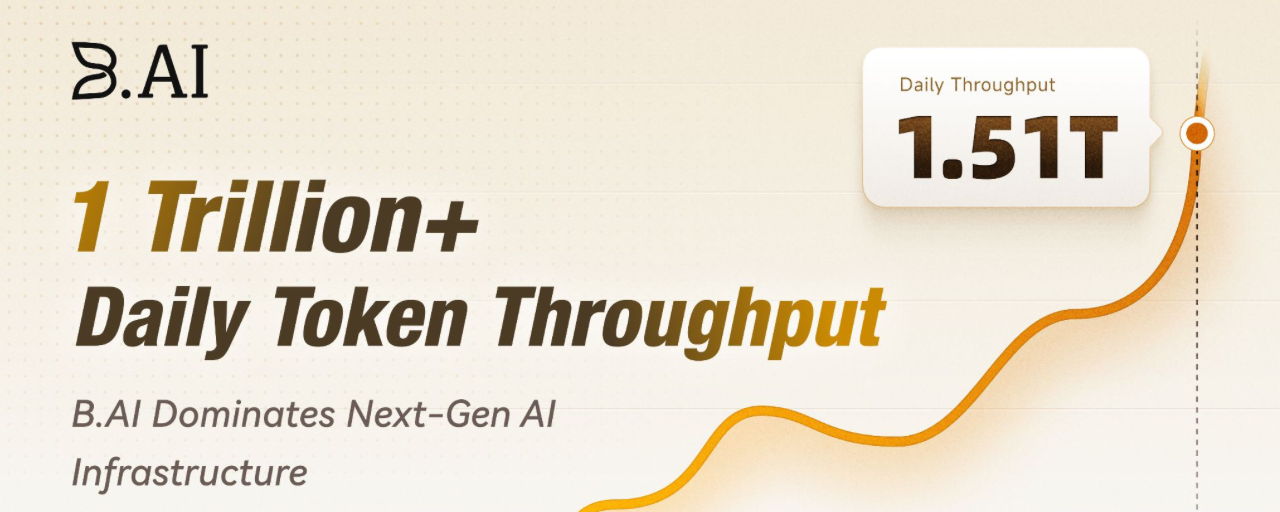
Article
Unlocking the Trillion-Token Era: B.AI's Global Settlement Layer for the Agent EconomySummary: Positioned squarely between foundation models and AI agents, B.AI is integrating compute routing, decentralized settlement, and full-stack agent infrastructure to establish itself as an undoubted spearhead in AI infrastructure.
Just five months after its launch, B.AI has already set a new industry record with a daily throughput of over 1.51 trillion tokens—a 71,500x-plus increase since inception.
B.AI achieved in just over 100 days what took OpenRouter, an early aggregation pioneer, roughly two years. Driven by the integration of settlement networks with core infrastructure, the exponential growth pulled off by B.AI highlights the viability of its full-stack commercial strategy while also demonstrating to the global market that the platform has risen to be the absolute leader in the next-generation AI infrastructure stack.
B.AI has secured its leadership thanks largely to its ability to capture and cater to the global demand for cost-effective, high-performance Chinese LLMs. While offering homegrown LLM products a critical gateway for international adoption, the platform has also gained a head start by positioning itself as a global compute distribution hub. B.AI's ability to rise in this tailwind is rooted in its unique ecosystem design.
Co-incubated by TRON and YZi Labs, B.AI disrupts the market via a dual engine of settlement and distribution, plus its complete infrastructure for the emerging agent economy. The platform enables global access to top-tier LLM compute while equipping AI agents with native resource scheduling and execution capabilities—unlocking liquidity and value exchange across the global agent economy.
Unprecedented Infrastructure Growth: B.AI Builds Global Distribution Hub for LLMs
To reach 1.51 trillion tokens in its daily throughput, simply seizing the tailwind is far from enough. B.AI has also responded swiftly to two macro trends in the AI industry: the cost-performance advantage of leading Chinese LLMs and the surging demand for high-throughput, low-cost inference in the agentic era.
Over the past year, Chinese LLM developers like DeepSeek, Kimi, Qwen, and GLM have matched top global benchmarks at a fraction of the API cost. This unbeatable cost efficiency makes adoption virtually inevitable for developers worldwide.
As a global, next-generation infrastructure, B.AI aggregates top international models like GPT and Claude alongside rising Chinese LLMs. The platform has established close partnerships with Tencent, Alibaba, ByteDance, DeepSeek, Zhipu AI, Kimi, and MiniMax—all top LLM players in the Chinese market—to build a comprehensive model portfolio. This all-star model lineup has, in turn, made B.AI the default launchpad for Chinese LLMs seeking global expansion.
Chinese LLMs, including DeepSeek-V4-Flash, Qwen3.8-Flash, and GLM-5.3 Flash, have stood out as top-performing models on B.AI with the highest usage. Building on the momentum, B.AI continues to drive adoption through model discounts, limited-time free access, tiered API pricing (with discounts up to 90%), and developer incentives, aiming to convert model cost efficiencies into usable throughput for developers worldwide. The traction from this strategic positioning is clearly backed by the numbers: B.AI's daily token throughput has breached 1.51 trillion—a massive 71,500x-plus surge since its first day upon launch.
Beyond its organic growth momentum, ecosystem partner YZi Labs serves as B.AI's core distribution engine, continuously onboarding early-stage projects and developer communities. This ecosystem support enables B.AI to penetrate diverse real-world use cases, driving a steady influx of incremental traffic and commercial demand.
For foundation model providers, B.AI's multi-trillion, high-concurrency architecture provides a fast track to high-value global workloads. Within this massive pool of demand, B.AI has evolved from a simple distribution channel into a primary facilitator—scaling the commercial reach of leading LLMs while reshaping the global AI landscape.
Beyond Aggregation and Routing: B.AI Builds Closed-Loop Infrastructure for the Agent Economy
Yet for this super amplifier to truly sustain a trillion-dollar agent economy, front-end compute routing is nowhere near enough. Building on the API aggregation foundation pioneered by early movers like OpenRouter, B.AI recognized a critical insight: fully unlocking massive agent collaboration requires a closed financial loop at the foundational layer.
To achieve this, B.AI bridges models and agents, creating a global settlement layer for intelligence. This core differentiator transforms the platform from a simple traffic conduit into the central master ledger for the entire agent economy, ensuring every cross-region call and task allocation is seamlessly routed, precisely metered, and automatically settled.
To achieve this vision, B.AI embeds settlement directly into the infrastructure layer, creating a dual-track Web2 and Web3 payment network. Built on Web3 principles, the architecture maintains backward compatibility with traditional Web2 payment systems. On the Web3 front, B.AI leverages on-chain settlement channels to provide global developers with decentralized, verifiable, and low-friction options that enable fully automated transactions and micropayments between agents. On the Web2 front, it preserves legacy gateways like WeChat Pay, Alipay, UnionPay, and Visa, ensuring effortless integration into existing enterprise workflows. Together, this dual-track model delivers a single integration point for frictionless global capital flow.
At the heart of this global liquidity is B.AI's deep integration with TRON. As the world's largest stablecoin transfer network, TRON offers B.AI a native payment rail through its massive USDT ecosystem, built for maximum liquidity and minimal friction. As of September 10, total TRC-20 USDT supply surpassed 94.2 billion, continuing to set record highs. Backed by TRON's battle-tested on-chain capacity, B.AI provides the essential infrastructure required to scale cross-border compute scheduling and high-frequency automated agent micro-transactions.
The true ambition of this architecture is to capture the emerging landscape of automated transactions in the agent economy ahead of the pack. The coming explosion in agent adoption will inevitably drive agent-to-agent (A2A) collaboration and autonomous commerce. Yet, fully unlocking this automated A2A synergy requires far more than just a foundational payment rail. B.AI builds beyond its Web3 smart settlement network by deploying a dedicated full-stack runtime environment for agents. This establishes an end-to-end, high-precision technical loop bridging compute scheduling, task execution, and financial settlement.
At the scheduling layer, B.AI drives fine-grained compute allocation. Its tiered API system fundamentally reshapes compute procurement logic, offering structured invocation plans that allow developers to match specific business demands with optimal compute resources.
At the execution layer, B.AI constructs a native agent collaboration ecosystem. It endows agents with direct operational capabilities to act across the digital world. Powered by embedded toolchains like Skills and Agent Wallet, alongside natively integrated AI assistants BAIclaw and BAI code, agents evolve into fully fledged digital workers capable of autonomous data acquisition and execution, laying a solid engineering foundation for multi-agent synergy.
At the protocol layer, B.AI establishes foundational transaction standards for A2A commerce. This marks B.AI's most strategically profound move. By natively integrating the x402 payment protocol and the 8004 identity authentication protocol, the platform paves a standardized path for mutual trust, identity verification, and high-frequency automated settlement between agents.
From fine-grained model scheduling to intelligent collaboration systems and standardized transaction protocols, this architecture seamlessly fuses perception, reasoning, action, and settlement. This holistic infrastructure propels B.AI into a central hub for the agent economy, engineered to handle micro-transactions and compute settlement at scale. Crossing into the trillion-token era is merely a new starting point for B.AI. As next-generation AI infrastructure, its core value extends beyond distributing intelligence to powering transactions. By establishing foundational standards for high-frequency A2A collaboration, B.AI is reshaping the global flow of compute value, driving AI infrastructure into a new era built explicitly for agents and machine intelligence.
Unlocking the Trillion-Token Era: B.AI's Global Settlement Layer for the Agent Economy
Summary: Positioned squarely between foundation models and AI agents, B.AI is integrating compute routing, decentralized settlement, and full-stack agent infrastructure to establish itself as an undoubted spearhead in AI infrastructure.
Just five months after its launch, B.AI has already set a new industry record with a daily throughput of over 1.51 trillion tokens—a 71,500x-plus increase since inception.
B.AI achieved in just over 100 days what took OpenRouter, an early aggregation pioneer, roughly two years. Driven by the integration of settlement networks with core infrastructure, the exponential growth pulled off by B.AI highlights the viability of its full-stack commercial strategy while also demonstrating to the global market that the platform has risen to be the absolute leader in the next-generation AI infrastructure stack.
B.AI has secured its leadership thanks largely to its ability to capture and cater to the global demand for cost-effective, high-performance Chinese LLMs. While offering homegrown LLM products a critical gateway for international adoption, the platform has also gained a head start by positioning itself as a global compute distribution hub. B.AI's ability to rise in this tailwind is rooted in its unique ecosystem design.
Co-incubated by TRON and YZi Labs, B.AI disrupts the market via a dual engine of settlement and distribution, plus its complete infrastructure for the emerging agent economy. The platform enables global access to top-tier LLM compute while equipping AI agents with native resource scheduling and execution capabilities—unlocking liquidity and value exchange across the global agent economy.
Unprecedented Infrastructure Growth: B.AI Builds Global Distribution Hub for LLMs
To reach 1.51 trillion tokens in its daily throughput, simply seizing the tailwind is far from enough. B.AI has also responded swiftly to two macro trends in the AI industry: the cost-performance advantage of leading Chinese LLMs and the surging demand for high-throughput, low-cost inference in the agentic era.
Over the past year, Chinese LLM developers like DeepSeek, Kimi, Qwen, and GLM have matched top global benchmarks at a fraction of the API cost. This unbeatable cost efficiency makes adoption virtually inevitable for developers worldwide.
As a global, next-generation infrastructure, B.AI aggregates top international models like GPT and Claude alongside rising Chinese LLMs. The platform has established close partnerships with Tencent, Alibaba, ByteDance, DeepSeek, Zhipu AI, Kimi, and MiniMax—all top LLM players in the Chinese market—to build a comprehensive model portfolio. This all-star model lineup has, in turn, made B.AI the default launchpad for Chinese LLMs seeking global expansion.
Chinese LLMs, including DeepSeek-V4-Flash, Qwen3.8-Flash, and GLM-5.3 Flash, have stood out as top-performing models on B.AI with the highest usage. Building on the momentum, B.AI continues to drive adoption through model discounts, limited-time free access, tiered API pricing (with discounts up to 90%), and developer incentives, aiming to convert model cost efficiencies into usable throughput for developers worldwide. The traction from this strategic positioning is clearly backed by the numbers: B.AI's daily token throughput has breached 1.51 trillion—a massive 71,500x-plus surge since its first day upon launch.
Beyond its organic growth momentum, ecosystem partner YZi Labs serves as B.AI's core distribution engine, continuously onboarding early-stage projects and developer communities. This ecosystem support enables B.AI to penetrate diverse real-world use cases, driving a steady influx of incremental traffic and commercial demand.
For foundation model providers, B.AI's multi-trillion, high-concurrency architecture provides a fast track to high-value global workloads. Within this massive pool of demand, B.AI has evolved from a simple distribution channel into a primary facilitator—scaling the commercial reach of leading LLMs while reshaping the global AI landscape.
Beyond Aggregation and Routing: B.AI Builds Closed-Loop Infrastructure for the Agent Economy
Yet for this super amplifier to truly sustain a trillion-dollar agent economy, front-end compute routing is nowhere near enough. Building on the API aggregation foundation pioneered by early movers like OpenRouter, B.AI recognized a critical insight: fully unlocking massive agent collaboration requires a closed financial loop at the foundational layer.
To achieve this, B.AI bridges models and agents, creating a global settlement layer for intelligence. This core differentiator transforms the platform from a simple traffic conduit into the central master ledger for the entire agent economy, ensuring every cross-region call and task allocation is seamlessly routed, precisely metered, and automatically settled.
To achieve this vision, B.AI embeds settlement directly into the infrastructure layer, creating a dual-track Web2 and Web3 payment network. Built on Web3 principles, the architecture maintains backward compatibility with traditional Web2 payment systems. On the Web3 front, B.AI leverages on-chain settlement channels to provide global developers with decentralized, verifiable, and low-friction options that enable fully automated transactions and micropayments between agents. On the Web2 front, it preserves legacy gateways like WeChat Pay, Alipay, UnionPay, and Visa, ensuring effortless integration into existing enterprise workflows. Together, this dual-track model delivers a single integration point for frictionless global capital flow.
At the heart of this global liquidity is B.AI's deep integration with TRON. As the world's largest stablecoin transfer network, TRON offers B.AI a native payment rail through its massive USDT ecosystem, built for maximum liquidity and minimal friction. As of September 10, total TRC-20 USDT supply surpassed 94.2 billion, continuing to set record highs. Backed by TRON's battle-tested on-chain capacity, B.AI provides the essential infrastructure required to scale cross-border compute scheduling and high-frequency automated agent micro-transactions.
The true ambition of this architecture is to capture the emerging landscape of automated transactions in the agent economy ahead of the pack. The coming explosion in agent adoption will inevitably drive agent-to-agent (A2A) collaboration and autonomous commerce. Yet, fully unlocking this automated A2A synergy requires far more than just a foundational payment rail. B.AI builds beyond its Web3 smart settlement network by deploying a dedicated full-stack runtime environment for agents. This establishes an end-to-end, high-precision technical loop bridging compute scheduling, task execution, and financial settlement.
At the scheduling layer, B.AI drives fine-grained compute allocation. Its tiered API system fundamentally reshapes compute procurement logic, offering structured invocation plans that allow developers to match specific business demands with optimal compute resources.
At the execution layer, B.AI constructs a native agent collaboration ecosystem. It endows agents with direct operational capabilities to act across the digital world. Powered by embedded toolchains like Skills and Agent Wallet, alongside natively integrated AI assistants BAIclaw and BAI code, agents evolve into fully fledged digital workers capable of autonomous data acquisition and execution, laying a solid engineering foundation for multi-agent synergy.
At the protocol layer, B.AI establishes foundational transaction standards for A2A commerce. This marks B.AI's most strategically profound move. By natively integrating the x402 payment protocol and the 8004 identity authentication protocol, the platform paves a standardized path for mutual trust, identity verification, and high-frequency automated settlement between agents.
From fine-grained model scheduling to intelligent collaboration systems and standardized transaction protocols, this architecture seamlessly fuses perception, reasoning, action, and settlement. This holistic infrastructure propels B.AI into a central hub for the agent economy, engineered to handle micro-transactions and compute settlement at scale. Crossing into the trillion-token era is merely a new starting point for B.AI. As next-generation AI infrastructure, its core value extends beyond distributing intelligence to powering transactions. By establishing foundational standards for high-frequency A2A collaboration, B.AI is reshaping the global flow of compute value, driving AI infrastructure into a new era built explicitly for agents and machine intelligence.
Just five months after its launch, B.AI has already set a new industry record with a daily throughput of over 1.51 trillion tokens—a 71,500x-plus increase since inception.
B.AI achieved in just over 100 days what took OpenRouter, an early aggregation pioneer, roughly two years. Driven by the integration of settlement networks with core infrastructure, the exponential growth pulled off by B.AI highlights the viability of its full-stack commercial strategy while also demonstrating to the global market that the platform has risen to be the absolute leader in the next-generation AI infrastructure stack.
B.AI has secured its leadership thanks largely to its ability to capture and cater to the global demand for cost-effective, high-performance Chinese LLMs. While offering homegrown LLM products a critical gateway for international adoption, the platform has also gained a head start by positioning itself as a global compute distribution hub. B.AI's ability to rise in this tailwind is rooted in its unique ecosystem design.
Co-incubated by TRON and YZi Labs, B.AI disrupts the market via a dual engine of settlement and distribution, plus its complete infrastructure for the emerging agent economy. The platform enables global access to top-tier LLM compute while equipping AI agents with native resource scheduling and execution capabilities—unlocking liquidity and value exchange across the global agent economy.
Unprecedented Infrastructure Growth: B.AI Builds Global Distribution Hub for LLMs
To reach 1.51 trillion tokens in its daily throughput, simply seizing the tailwind is far from enough. B.AI has also responded swiftly to two macro trends in the AI industry: the cost-performance advantage of leading Chinese LLMs and the surging demand for high-throughput, low-cost inference in the agentic era.
Over the past year, Chinese LLM developers like DeepSeek, Kimi, Qwen, and GLM have matched top global benchmarks at a fraction of the API cost. This unbeatable cost efficiency makes adoption virtually inevitable for developers worldwide.
As a global, next-generation infrastructure, B.AI aggregates top international models like GPT and Claude alongside rising Chinese LLMs. The platform has established close partnerships with Tencent, Alibaba, ByteDance, DeepSeek, Zhipu AI, Kimi, and MiniMax—all top LLM players in the Chinese market—to build a comprehensive model portfolio. This all-star model lineup has, in turn, made B.AI the default launchpad for Chinese LLMs seeking global expansion.
Chinese LLMs, including DeepSeek-V4-Flash, Qwen3.8-Flash, and GLM-5.3 Flash, have stood out as top-performing models on B.AI with the highest usage. Building on the momentum, B.AI continues to drive adoption through model discounts, limited-time free access, tiered API pricing (with discounts up to 90%), and developer incentives, aiming to convert model cost efficiencies into usable throughput for developers worldwide. The traction from this strategic positioning is clearly backed by the numbers: B.AI's daily token throughput has breached 1.51 trillion—a massive 71,500x-plus surge since its first day upon launch.
Beyond its organic growth momentum, ecosystem partner YZi Labs serves as B.AI's core distribution engine, continuously onboarding early-stage projects and developer communities. This ecosystem support enables B.AI to penetrate diverse real-world use cases, driving a steady influx of incremental traffic and commercial demand.
For foundation model providers, B.AI's multi-trillion, high-concurrency architecture provides a fast track to high-value global workloads. Within this massive pool of demand, B.AI has evolved from a simple distribution channel into a primary facilitator—scaling the commercial reach of leading LLMs while reshaping the global AI landscape.
Beyond Aggregation and Routing: B.AI Builds Closed-Loop Infrastructure for the Agent Economy
Yet for this super amplifier to truly sustain a trillion-dollar agent economy, front-end compute routing is nowhere near enough. Building on the API aggregation foundation pioneered by early movers like OpenRouter, B.AI recognized a critical insight: fully unlocking massive agent collaboration requires a closed financial loop at the foundational layer.
To achieve this, B.AI bridges models and agents, creating a global settlement layer for intelligence. This core differentiator transforms the platform from a simple traffic conduit into the central master ledger for the entire agent economy, ensuring every cross-region call and task allocation is seamlessly routed, precisely metered, and automatically settled.
To achieve this vision, B.AI embeds settlement directly into the infrastructure layer, creating a dual-track Web2 and Web3 payment network. Built on Web3 principles, the architecture maintains backward compatibility with traditional Web2 payment systems. On the Web3 front, B.AI leverages on-chain settlement channels to provide global developers with decentralized, verifiable, and low-friction options that enable fully automated transactions and micropayments between agents. On the Web2 front, it preserves legacy gateways like WeChat Pay, Alipay, UnionPay, and Visa, ensuring effortless integration into existing enterprise workflows. Together, this dual-track model delivers a single integration point for frictionless global capital flow.
At the heart of this global liquidity is B.AI's deep integration with TRON. As the world's largest stablecoin transfer network, TRON offers B.AI a native payment rail through its massive USDT ecosystem, built for maximum liquidity and minimal friction. As of September 10, total TRC-20 USDT supply surpassed 94.2 billion, continuing to set record highs. Backed by TRON's battle-tested on-chain capacity, B.AI provides the essential infrastructure required to scale cross-border compute scheduling and high-frequency automated agent micro-transactions.
The true ambition of this architecture is to capture the emerging landscape of automated transactions in the agent economy ahead of the pack. The coming explosion in agent adoption will inevitably drive agent-to-agent (A2A) collaboration and autonomous commerce. Yet, fully unlocking this automated A2A synergy requires far more than just a foundational payment rail. B.AI builds beyond its Web3 smart settlement network by deploying a dedicated full-stack runtime environment for agents. This establishes an end-to-end, high-precision technical loop bridging compute scheduling, task execution, and financial settlement.
At the scheduling layer, B.AI drives fine-grained compute allocation. Its tiered API system fundamentally reshapes compute procurement logic, offering structured invocation plans that allow developers to match specific business demands with optimal compute resources.
At the execution layer, B.AI constructs a native agent collaboration ecosystem. It endows agents with direct operational capabilities to act across the digital world. Powered by embedded toolchains like Skills and Agent Wallet, alongside natively integrated AI assistants BAIclaw and BAI code, agents evolve into fully fledged digital workers capable of autonomous data acquisition and execution, laying a solid engineering foundation for multi-agent synergy.
At the protocol layer, B.AI establishes foundational transaction standards for A2A commerce. This marks B.AI's most strategically profound move. By natively integrating the x402 payment protocol and the 8004 identity authentication protocol, the platform paves a standardized path for mutual trust, identity verification, and high-frequency automated settlement between agents.
From fine-grained model scheduling to intelligent collaboration systems and standardized transaction protocols, this architecture seamlessly fuses perception, reasoning, action, and settlement. This holistic infrastructure propels B.AI into a central hub for the agent economy, engineered to handle micro-transactions and compute settlement at scale. Crossing into the trillion-token era is merely a new starting point for B.AI. As next-generation AI infrastructure, its core value extends beyond distributing intelligence to powering transactions. By establishing foundational standards for high-frequency A2A collaboration, B.AI is reshaping the global flow of compute value, driving AI infrastructure into a new era built explicitly for agents and machine intelligence.
120

Article
Justin Sun Establishes the Justin Sun PrizeJustin Sun Establishes the Justin Sun Prize: “My Wealth Came from Mathematics and Will Return to Mathematics”
Geneva, Switzerland — September 16, 2026 — The Office of Justin Sun today announced the establishment of the Justin Sun Prize, a zero-trust, decentralized academic bounty mechanism based on a “problem list,” with breakthroughs in fundamental disciplines and machine formal verification as the criteria for awarding prizes, and a top prize of up to US$1 million for a single problem. The prize seeks to redefine scientific rewards in the AI era and accelerate fundamental scientific research through collaboration between humans and AI.
The first list of Justin Sun Prize winners was also announced, recognizing solutions and formalized proofs involving 66 mathematical problems. The top prize, worth US$1 million, was awarded to the OpenAI research team in recognition of its solution and formalized proof for the Existence and Smoothness of the Three-Dimensional Navier–Stokes Equations problem. According to information published by OpenAI, the relevant proof was produced by its internal model, and the Lean formalization and verification were completed by GPT‑6 Astra.
This problem concerns the Navier–Stokes equations, which describe the motion of fluids and are commonly abbreviated as the N–S equations. The equations were developed in the 19th century by French physicist Claude-Louis Navier, Irish-born British mathematician George Gabriel Stokes, and others, and have a history of approximately two hundred years. In 2000, the Clay Mathematics Institute listed the Navier–Stokes Existence and Smoothness problem as one of the seven Millennium Prize Problems and offered a US$1 million reward for its solution.
The Justin Sun Prize does not use traditional nominations or credential thresholds as barriers to entry, nor does it operate on a four-year cycle or the rhythm of lifetime achievement. Instead, it ties the prize directly to mathematical problems and machine-verifiable formalized proofs. Anyone can receive the prize as long as they are the first to achieve a qualifying breakthrough.
The vision of the Justin Sun Prize is to become the “Nobel Prize of the AI Era,” responding to the profound transformation of scientific research and incentives in the new era in a more decentralized, formalized, and machine-driven way. The repository of mathematical problems and formalized code will be maintained and publicly updated on an ongoing basis. Once a problem is listed, it is locked in: problems can be added only, never removed; awarded prize funds do not need to be returned under any circumstances.
The current problem list already includes formal verification of the Poincaré Conjecture, the Riemann Hypothesis, Goldbach’s Conjecture, and a large number of unsolved problems proposed during the lifetime of the late mathematician and Wolf Prize laureate Paul Erdős.
In addition to the prize, winners will also receive a certificate and a medal. The edge of the medal is inscribed with the Latin phrase “Quod probatur, solvitur,” meaning “Proved, then paid.”
The Justin Sun Prize adheres to three core principles: openness, public benefit, and open source. It is open to all eligible contributors, with no restrictions based on nationality, institution, or identity, and makes no distinction between humans and AI; funds are used exclusively for prize awards and open initiatives and are not intended for profit; the problem list, confirmation standards, proofs, and verification materials are all made available to the public through GitHub, while prize disbursement records are recorded on-chain for permanent traceability and immutability.
“An award named after a person is the least political thing in the world,” said Sun. “More importantly, it gives me an answer to myself—my wealth is rooted in mathematics. It came from mathematics, and it will return to mathematics.”
According to public records, Sun has donated more than US$45 million across technology, environmental protection, disaster relief, and other fields. The Justin Sun Prize will become a central focus of Sun’s philanthropic efforts, continuing to support breakthroughs in fundamental science through an open and verifiable model.
The prize will be paid out in either USDT on TRON (TRC-20) or USDC on Ethereum (ERC-20) based on the recipient’s choice. For more information, please visit www.hejustinsun.com/prize.
About the Office of Justin Sun
The Office of Justin Sun supports Justin Sun’s global business, philanthropic and public initiatives across technology, blockchain, artificial intelligence, scientific research, investment, art and space exploration.
Justin Sun is the Ambassador and former Permanent Representative of Grenada to the World Trade Organization and the Founder of TRON. TRON is the leading blockchain for the stablecoin revolution, processing over $13 trillion in volume since its inception. In the world’s emerging markets, people rely on USDT on TRON to access the global financial system.
A protégé of Alibaba founder Jack Ma, Sun has been recognized internationally for his work in the digital asset industry, including a Forbes cover profile in April 2025 and multiple appearances on the Forbes 30 Under 30 list. In August 2025, he flew aboard Blue Origin’s NS-34 mission, becoming the 712th person in history to travel to space. His broader interests span technology, investment, philanthropy, art, gaming, and space exploration.
About Justin Sun Prize
The Justin Sun Prize is an academic initiative established by Justin Sun to support advances in mathematics, formal verification, and AI-assisted scientific discovery. The prize is decentralized and built around the principle that mathematical work should be judged by the strength, rigor, and verifiability of the proof itself, not the prestige or reputation of those submitting it.
Justin Sun established the prize in his own name as a long-term commitment to return wealth created through mathematics and technology back to mathematics itself. Its legacy is intended to be defined by the body of work it recognizes and the laureates whose discoveries stand the test of time. The prize links clearly defined mathematical challenges to machine-verifiable proof. Its guiding principles are openness, public benefit and open-source access.
Justin Sun Establishes the Justin Sun Prize
Justin Sun Establishes the Justin Sun Prize: “My Wealth Came from Mathematics and Will Return to Mathematics”
Geneva, Switzerland — September 16, 2026 — The Office of Justin Sun today announced the establishment of the Justin Sun Prize, a zero-trust, decentralized academic bounty mechanism based on a “problem list,” with breakthroughs in fundamental disciplines and machine formal verification as the criteria for awarding prizes, and a top prize of up to US$1 million for a single problem. The prize seeks to redefine scientific rewards in the AI era and accelerate fundamental scientific research through collaboration between humans and AI.
The first list of Justin Sun Prize winners was also announced, recognizing solutions and formalized proofs involving 66 mathematical problems. The top prize, worth US$1 million, was awarded to the OpenAI research team in recognition of its solution and formalized proof for the Existence and Smoothness of the Three-Dimensional Navier–Stokes Equations problem. According to information published by OpenAI, the relevant proof was produced by its internal model, and the Lean formalization and verification were completed by GPT‑6 Astra.
This problem concerns the Navier–Stokes equations, which describe the motion of fluids and are commonly abbreviated as the N–S equations. The equations were developed in the 19th century by French physicist Claude-Louis Navier, Irish-born British mathematician George Gabriel Stokes, and others, and have a history of approximately two hundred years. In 2000, the Clay Mathematics Institute listed the Navier–Stokes Existence and Smoothness problem as one of the seven Millennium Prize Problems and offered a US$1 million reward for its solution.
The Justin Sun Prize does not use traditional nominations or credential thresholds as barriers to entry, nor does it operate on a four-year cycle or the rhythm of lifetime achievement. Instead, it ties the prize directly to mathematical problems and machine-verifiable formalized proofs. Anyone can receive the prize as long as they are the first to achieve a qualifying breakthrough.
The vision of the Justin Sun Prize is to become the “Nobel Prize of the AI Era,” responding to the profound transformation of scientific research and incentives in the new era in a more decentralized, formalized, and machine-driven way. The repository of mathematical problems and formalized code will be maintained and publicly updated on an ongoing basis. Once a problem is listed, it is locked in: problems can be added only, never removed; awarded prize funds do not need to be returned under any circumstances.
The current problem list already includes formal verification of the Poincaré Conjecture, the Riemann Hypothesis, Goldbach’s Conjecture, and a large number of unsolved problems proposed during the lifetime of the late mathematician and Wolf Prize laureate Paul Erdős.
In addition to the prize, winners will also receive a certificate and a medal. The edge of the medal is inscribed with the Latin phrase “Quod probatur, solvitur,” meaning “Proved, then paid.”
The Justin Sun Prize adheres to three core principles: openness, public benefit, and open source. It is open to all eligible contributors, with no restrictions based on nationality, institution, or identity, and makes no distinction between humans and AI; funds are used exclusively for prize awards and open initiatives and are not intended for profit; the problem list, confirmation standards, proofs, and verification materials are all made available to the public through GitHub, while prize disbursement records are recorded on-chain for permanent traceability and immutability.
“An award named after a person is the least political thing in the world,” said Sun. “More importantly, it gives me an answer to myself—my wealth is rooted in mathematics. It came from mathematics, and it will return to mathematics.”
According to public records, Sun has donated more than US$45 million across technology, environmental protection, disaster relief, and other fields. The Justin Sun Prize will become a central focus of Sun’s philanthropic efforts, continuing to support breakthroughs in fundamental science through an open and verifiable model.
The prize will be paid out in either USDT on TRON (TRC-20) or USDC on Ethereum (ERC-20) based on the recipient’s choice. For more information, please visit www.hejustinsun.com/prize.
About the Office of Justin Sun
The Office of Justin Sun supports Justin Sun’s global business, philanthropic and public initiatives across technology, blockchain, artificial intelligence, scientific research, investment, art and space exploration.
Justin Sun is the Ambassador and former Permanent Representative of Grenada to the World Trade Organization and the Founder of TRON. TRON is the leading blockchain for the stablecoin revolution, processing over $13 trillion in volume since its inception. In the world’s emerging markets, people rely on USDT on TRON to access the global financial system.
A protégé of Alibaba founder Jack Ma, Sun has been recognized internationally for his work in the digital asset industry, including a Forbes cover profile in April 2025 and multiple appearances on the Forbes 30 Under 30 list. In August 2025, he flew aboard Blue Origin’s NS-34 mission, becoming the 712th person in history to travel to space. His broader interests span technology, investment, philanthropy, art, gaming, and space exploration.
About Justin Sun Prize
The Justin Sun Prize is an academic initiative established by Justin Sun to support advances in mathematics, formal verification, and AI-assisted scientific discovery. The prize is decentralized and built around the principle that mathematical work should be judged by the strength, rigor, and verifiability of the proof itself, not the prestige or reputation of those submitting it.
Justin Sun established the prize in his own name as a long-term commitment to return wealth created through mathematics and technology back to mathematics itself. Its legacy is intended to be defined by the body of work it recognizes and the laureates whose discoveries stand the test of time. The prize links clearly defined mathematical challenges to machine-verifiable proof. Its guiding principles are openness, public benefit and open-source access.
Geneva, Switzerland — September 16, 2026 — The Office of Justin Sun today announced the establishment of the Justin Sun Prize, a zero-trust, decentralized academic bounty mechanism based on a “problem list,” with breakthroughs in fundamental disciplines and machine formal verification as the criteria for awarding prizes, and a top prize of up to US$1 million for a single problem. The prize seeks to redefine scientific rewards in the AI era and accelerate fundamental scientific research through collaboration between humans and AI.
The first list of Justin Sun Prize winners was also announced, recognizing solutions and formalized proofs involving 66 mathematical problems. The top prize, worth US$1 million, was awarded to the OpenAI research team in recognition of its solution and formalized proof for the Existence and Smoothness of the Three-Dimensional Navier–Stokes Equations problem. According to information published by OpenAI, the relevant proof was produced by its internal model, and the Lean formalization and verification were completed by GPT‑6 Astra.
This problem concerns the Navier–Stokes equations, which describe the motion of fluids and are commonly abbreviated as the N–S equations. The equations were developed in the 19th century by French physicist Claude-Louis Navier, Irish-born British mathematician George Gabriel Stokes, and others, and have a history of approximately two hundred years. In 2000, the Clay Mathematics Institute listed the Navier–Stokes Existence and Smoothness problem as one of the seven Millennium Prize Problems and offered a US$1 million reward for its solution.
The Justin Sun Prize does not use traditional nominations or credential thresholds as barriers to entry, nor does it operate on a four-year cycle or the rhythm of lifetime achievement. Instead, it ties the prize directly to mathematical problems and machine-verifiable formalized proofs. Anyone can receive the prize as long as they are the first to achieve a qualifying breakthrough.
The vision of the Justin Sun Prize is to become the “Nobel Prize of the AI Era,” responding to the profound transformation of scientific research and incentives in the new era in a more decentralized, formalized, and machine-driven way. The repository of mathematical problems and formalized code will be maintained and publicly updated on an ongoing basis. Once a problem is listed, it is locked in: problems can be added only, never removed; awarded prize funds do not need to be returned under any circumstances.
The current problem list already includes formal verification of the Poincaré Conjecture, the Riemann Hypothesis, Goldbach’s Conjecture, and a large number of unsolved problems proposed during the lifetime of the late mathematician and Wolf Prize laureate Paul Erdős.
In addition to the prize, winners will also receive a certificate and a medal. The edge of the medal is inscribed with the Latin phrase “Quod probatur, solvitur,” meaning “Proved, then paid.”
The Justin Sun Prize adheres to three core principles: openness, public benefit, and open source. It is open to all eligible contributors, with no restrictions based on nationality, institution, or identity, and makes no distinction between humans and AI; funds are used exclusively for prize awards and open initiatives and are not intended for profit; the problem list, confirmation standards, proofs, and verification materials are all made available to the public through GitHub, while prize disbursement records are recorded on-chain for permanent traceability and immutability.
“An award named after a person is the least political thing in the world,” said Sun. “More importantly, it gives me an answer to myself—my wealth is rooted in mathematics. It came from mathematics, and it will return to mathematics.”
According to public records, Sun has donated more than US$45 million across technology, environmental protection, disaster relief, and other fields. The Justin Sun Prize will become a central focus of Sun’s philanthropic efforts, continuing to support breakthroughs in fundamental science through an open and verifiable model.
The prize will be paid out in either USDT on TRON (TRC-20) or USDC on Ethereum (ERC-20) based on the recipient’s choice. For more information, please visit www.hejustinsun.com/prize.
About the Office of Justin Sun
The Office of Justin Sun supports Justin Sun’s global business, philanthropic and public initiatives across technology, blockchain, artificial intelligence, scientific research, investment, art and space exploration.
Justin Sun is the Ambassador and former Permanent Representative of Grenada to the World Trade Organization and the Founder of TRON. TRON is the leading blockchain for the stablecoin revolution, processing over $13 trillion in volume since its inception. In the world’s emerging markets, people rely on USDT on TRON to access the global financial system.
A protégé of Alibaba founder Jack Ma, Sun has been recognized internationally for his work in the digital asset industry, including a Forbes cover profile in April 2025 and multiple appearances on the Forbes 30 Under 30 list. In August 2025, he flew aboard Blue Origin’s NS-34 mission, becoming the 712th person in history to travel to space. His broader interests span technology, investment, philanthropy, art, gaming, and space exploration.
About Justin Sun Prize
The Justin Sun Prize is an academic initiative established by Justin Sun to support advances in mathematics, formal verification, and AI-assisted scientific discovery. The prize is decentralized and built around the principle that mathematical work should be judged by the strength, rigor, and verifiability of the proof itself, not the prestige or reputation of those submitting it.
Justin Sun established the prize in his own name as a long-term commitment to return wealth created through mathematics and technology back to mathematics itself. Its legacy is intended to be defined by the body of work it recognizes and the laureates whose discoveries stand the test of time. The prize links clearly defined mathematical challenges to machine-verifiable proof. Its guiding principles are openness, public benefit and open-source access.
1
183
Verified

Article
Digital Asset Leaders Converge at KBW2026 as Partner Lineup UnveiledUpbit joins as Presenting Partner, with 0G and BRV confirmed as Official Conference PartnersStable and Tria join as Diamond Sponsors, while BitGo comes on board as Official Institutional SponsorKyoungsuk Oh, Michael Heinrich, Brian Mehler, John Lilic and Mike Belshe among featured speakers
Korea Blockchain Week 2026 with Upbit (KBW2026), Asia’s leading digital asset conference, has unveiled its partner lineup, bringing together major players across exchanges, blockchain infrastructure, stablecoins and institutional digital assets.
FACTBLOCK, the organizer of KBW2026, announced on August 31 that Upbit, 0G, BRV, Stable, Tria and BitGo will participate as key sponsors of this year’s event. Beyond brand partnerships, CEOs and founders from the participating companies will also take the stage as speakers to discuss some of the most significant shifts shaping the global digital asset industry.
Upbit is the Presenting Partner of KBW2026. Kyoungsuk Oh, CEO of Upbit, will also speak at the conference, sharing his perspective on changes in the global digital asset market and the role of Korea. Through its partnership with Upbit, KBW2026 will broaden the conversation around Korea’s digital asset market beyond retail investors to include institutional participation and global financial markets.
Decentralized AI infrastructure company 0G and global venture capital firm BRV will participate as the Official Conference Partners. Michael Heinrich, Co-Founder and CEO of 0G Labs, will take the KBW2026 main stage to explore the rise of the agent economy and how decentralized infrastructure is creating a new foundation for AI.
0G is the trust layer for AI, bringing together verifiable compute, private inference, decentralized storage and an AI-native blockchain to power the next generation of AI applications and autonomous agents. BRV will also join as a Conference Partner, further strengthening KBW2026’s global investment and industry network.
Global digital asset infrastructure company BitGo will participate as the Official Institutional Sponsor. BitGo Korea, whose strategic shareholders include Hana Financial Group and SK Telecom, recently secured acceptance of its Virtual Asset Service Provider (VASP) registration from Korea’s Financial Intelligence Unit (KoFIU), establishing a regulatory foundation for its domestic operations. Mike Belshe, Co-Founder and CEO of BitGo, will also speak at KBW2026.
Stable and Tria will participate as Diamond Sponsors. Brian Mehler, CEO of Stable, and John Lilic, Co-Founder and Chief Strategy Officer of Tria, will each take the stage at KBW2026. Stable is building blockchain infrastructure optimized for stablecoin payments and transfers, while Tria is building financial infrastructure enabling businesses and AI agents to transact across blockchains and digital assets, powering its growing stablecoin neobank.
This year’s sponsor lineup reflects the continued expansion of the global digital asset industry beyond trading and investment into institutional finance, payments, stablecoins, AI and next-generation infrastructure. With senior executives from many of these companies participating not only as sponsors but also as speakers, KBW2026 will offer attendees a firsthand look at the strategies of companies driving the industry’s next phase of growth.
KBW2026 will take place in Seoul from September 29 to October 1. The Upbit Institutional Summit (UIS), an invite-only gathering focused on institutions and the financial sector, will be held on September 29, followed by the KBW2026 main conference from September 30 to October 1.
Andrew Park, CEO of FACTBLOCK, said, “This year, KBW is bringing together key partners that are shaping the next stage of the industry, spanning exchanges, institutional digital asset infrastructure, AI, stablecoins and next-generation financial services. With senior executives from these companies also taking the stage as speakers, KBW2026 will provide a valuable opportunity to see where the most important changes in the global digital asset market are emerging.
Digital Asset Leaders Converge at KBW2026 as Partner Lineup Unveiled
Upbit joins as Presenting Partner, with 0G and BRV confirmed as Official Conference PartnersStable and Tria join as Diamond Sponsors, while BitGo comes on board as Official Institutional SponsorKyoungsuk Oh, Michael Heinrich, Brian Mehler, John Lilic and Mike Belshe among featured speakers
Korea Blockchain Week 2026 with Upbit (KBW2026), Asia’s leading digital asset conference, has unveiled its partner lineup, bringing together major players across exchanges, blockchain infrastructure, stablecoins and institutional digital assets.
FACTBLOCK, the organizer of KBW2026, announced on August 31 that Upbit, 0G, BRV, Stable, Tria and BitGo will participate as key sponsors of this year’s event. Beyond brand partnerships, CEOs and founders from the participating companies will also take the stage as speakers to discuss some of the most significant shifts shaping the global digital asset industry.
Upbit is the Presenting Partner of KBW2026. Kyoungsuk Oh, CEO of Upbit, will also speak at the conference, sharing his perspective on changes in the global digital asset market and the role of Korea. Through its partnership with Upbit, KBW2026 will broaden the conversation around Korea’s digital asset market beyond retail investors to include institutional participation and global financial markets.
Decentralized AI infrastructure company 0G and global venture capital firm BRV will participate as the Official Conference Partners. Michael Heinrich, Co-Founder and CEO of 0G Labs, will take the KBW2026 main stage to explore the rise of the agent economy and how decentralized infrastructure is creating a new foundation for AI.
0G is the trust layer for AI, bringing together verifiable compute, private inference, decentralized storage and an AI-native blockchain to power the next generation of AI applications and autonomous agents. BRV will also join as a Conference Partner, further strengthening KBW2026’s global investment and industry network.
Global digital asset infrastructure company BitGo will participate as the Official Institutional Sponsor. BitGo Korea, whose strategic shareholders include Hana Financial Group and SK Telecom, recently secured acceptance of its Virtual Asset Service Provider (VASP) registration from Korea’s Financial Intelligence Unit (KoFIU), establishing a regulatory foundation for its domestic operations. Mike Belshe, Co-Founder and CEO of BitGo, will also speak at KBW2026.
Stable and Tria will participate as Diamond Sponsors. Brian Mehler, CEO of Stable, and John Lilic, Co-Founder and Chief Strategy Officer of Tria, will each take the stage at KBW2026. Stable is building blockchain infrastructure optimized for stablecoin payments and transfers, while Tria is building financial infrastructure enabling businesses and AI agents to transact across blockchains and digital assets, powering its growing stablecoin neobank.
This year’s sponsor lineup reflects the continued expansion of the global digital asset industry beyond trading and investment into institutional finance, payments, stablecoins, AI and next-generation infrastructure. With senior executives from many of these companies participating not only as sponsors but also as speakers, KBW2026 will offer attendees a firsthand look at the strategies of companies driving the industry’s next phase of growth.
KBW2026 will take place in Seoul from September 29 to October 1. The Upbit Institutional Summit (UIS), an invite-only gathering focused on institutions and the financial sector, will be held on September 29, followed by the KBW2026 main conference from September 30 to October 1.
Andrew Park, CEO of FACTBLOCK, said, “This year, KBW is bringing together key partners that are shaping the next stage of the industry, spanning exchanges, institutional digital asset infrastructure, AI, stablecoins and next-generation financial services. With senior executives from these companies also taking the stage as speakers, KBW2026 will provide a valuable opportunity to see where the most important changes in the global digital asset market are emerging.
Korea Blockchain Week 2026 with Upbit (KBW2026), Asia’s leading digital asset conference, has unveiled its partner lineup, bringing together major players across exchanges, blockchain infrastructure, stablecoins and institutional digital assets.
FACTBLOCK, the organizer of KBW2026, announced on August 31 that Upbit, 0G, BRV, Stable, Tria and BitGo will participate as key sponsors of this year’s event. Beyond brand partnerships, CEOs and founders from the participating companies will also take the stage as speakers to discuss some of the most significant shifts shaping the global digital asset industry.
Upbit is the Presenting Partner of KBW2026. Kyoungsuk Oh, CEO of Upbit, will also speak at the conference, sharing his perspective on changes in the global digital asset market and the role of Korea. Through its partnership with Upbit, KBW2026 will broaden the conversation around Korea’s digital asset market beyond retail investors to include institutional participation and global financial markets.
Decentralized AI infrastructure company 0G and global venture capital firm BRV will participate as the Official Conference Partners. Michael Heinrich, Co-Founder and CEO of 0G Labs, will take the KBW2026 main stage to explore the rise of the agent economy and how decentralized infrastructure is creating a new foundation for AI.
0G is the trust layer for AI, bringing together verifiable compute, private inference, decentralized storage and an AI-native blockchain to power the next generation of AI applications and autonomous agents. BRV will also join as a Conference Partner, further strengthening KBW2026’s global investment and industry network.
Global digital asset infrastructure company BitGo will participate as the Official Institutional Sponsor. BitGo Korea, whose strategic shareholders include Hana Financial Group and SK Telecom, recently secured acceptance of its Virtual Asset Service Provider (VASP) registration from Korea’s Financial Intelligence Unit (KoFIU), establishing a regulatory foundation for its domestic operations. Mike Belshe, Co-Founder and CEO of BitGo, will also speak at KBW2026.
Stable and Tria will participate as Diamond Sponsors. Brian Mehler, CEO of Stable, and John Lilic, Co-Founder and Chief Strategy Officer of Tria, will each take the stage at KBW2026. Stable is building blockchain infrastructure optimized for stablecoin payments and transfers, while Tria is building financial infrastructure enabling businesses and AI agents to transact across blockchains and digital assets, powering its growing stablecoin neobank.
This year’s sponsor lineup reflects the continued expansion of the global digital asset industry beyond trading and investment into institutional finance, payments, stablecoins, AI and next-generation infrastructure. With senior executives from many of these companies participating not only as sponsors but also as speakers, KBW2026 will offer attendees a firsthand look at the strategies of companies driving the industry’s next phase of growth.
KBW2026 will take place in Seoul from September 29 to October 1. The Upbit Institutional Summit (UIS), an invite-only gathering focused on institutions and the financial sector, will be held on September 29, followed by the KBW2026 main conference from September 30 to October 1.
Andrew Park, CEO of FACTBLOCK, said, “This year, KBW is bringing together key partners that are shaping the next stage of the industry, spanning exchanges, institutional digital asset infrastructure, AI, stablecoins and next-generation financial services. With senior executives from these companies also taking the stage as speakers, KBW2026 will provide a valuable opportunity to see where the most important changes in the global digital asset market are emerging.
760
Article
Ethena Brings USDe and sUSDe to TRON,Expanding Digital Dollar Access Across Its Stablecoin EcosystemGeneva and Lisbon, Sept. 11, 2026 – TRON DAO (“TRON”) and Ethena Labs (“Ethena”) today announced that USDe and sUSDe are live on the TRON network, expanding access to Ethena’s digital dollar products across one of the world’s largest stablecoin settlement networks.
Users can now bridge USDe and sUSDe to TRON through Stargate Finance and hold or transfer both assets across the network. Support across TRON’s core DeFi applications, including JustLend DAO and SUN.io, is expected to roll out over the coming weeks, with broader adoption across wallets, exchanges, and payment applications to follow. USDe on TRON will also remain connected to liquidity across Ethena’s other supported networks, supporting interoperability across Ethena’s broader multichain ecosystem.
USDe brings an additional dollar-denominated asset to TRON, while sUSDe gives TRON’s global user base exposure to Ethena’s rewards-bearing digital dollar product. In turn, Ethena connects with TRON’s global base of over 403 million accounts, where dollar-denominated assets already move at significant scale.
“Millions of people rely on the TRON network every day to make payments, save, and move value globally,” said Justin Sun, Founder of TRON. “Bringing USDe and sUSDe to TRON broadens the options available to users and further strengthens the network as decentralized infrastructure for everyday use.”
“TRON has a massive user base that already holds and moves digital dollars in significant size,” said Guy Young, Founder of Ethena Labs. “Bringing USDe and sUSDe to that ecosystem means those users can hold a dollar that accrues rewards on the network they already use. This integration is the latest step in our effort to bring our digital dollar products to as many people as possible, and we look forward to continuing to work with the TRON DAO team to find new ways to bring value to TRON’s users.”
The integration marks the latest step in USDe’s multichain expansion, with the asset now supported across more than a dozen networks and integrated with leading centralized exchanges and DeFi applications.
About Ethena Labs
Ethena Labs is the development team behind USDe and USDtb and a contributor to the Ethena protocol. Ethena’s USDe is the fastest growing USD-denominated crypto asset in history, encompassing integrations across some of the largest centralized exchanges and major DeFi applications. Ethena is backed by Fidelity, Franklin Templeton, Dragonfly, Binance Labs, Bybit, and OKX among others.
About TRON DAO
TRON DAO is a community-governed DAO dedicated to accelerating the decentralization of the internet via blockchain technology and dApps.
Founded in September 2017, the TRON blockchain has experienced significant growth since its MainNet launch in May 2018. Today, TRON hosts the largest circulating supply of USD Tether (USDT) stablecoin, which currently exceeds $94 billion. As of September 2026, the TRON blockchain has recorded over 403 million in total user accounts, more than 15 billion in total transactions, and over $28 billion in total value locked (TVL), based on TRONSCAN. Recognized as the global settlement layer for stablecoin transactions and everyday purchases with proven success, TRON is “Moving Trillions, Empowering Billions.”
Ethena Brings USDe and sUSDe to TRON,Expanding Digital Dollar Access Across Its Stablecoin Ecosystem
Geneva and Lisbon, Sept. 11, 2026 – TRON DAO (“TRON”) and Ethena Labs (“Ethena”) today announced that USDe and sUSDe are live on the TRON network, expanding access to Ethena’s digital dollar products across one of the world’s largest stablecoin settlement networks.
Users can now bridge USDe and sUSDe to TRON through Stargate Finance and hold or transfer both assets across the network. Support across TRON’s core DeFi applications, including JustLend DAO and SUN.io, is expected to roll out over the coming weeks, with broader adoption across wallets, exchanges, and payment applications to follow. USDe on TRON will also remain connected to liquidity across Ethena’s other supported networks, supporting interoperability across Ethena’s broader multichain ecosystem.
USDe brings an additional dollar-denominated asset to TRON, while sUSDe gives TRON’s global user base exposure to Ethena’s rewards-bearing digital dollar product. In turn, Ethena connects with TRON’s global base of over 403 million accounts, where dollar-denominated assets already move at significant scale.
“Millions of people rely on the TRON network every day to make payments, save, and move value globally,” said Justin Sun, Founder of TRON. “Bringing USDe and sUSDe to TRON broadens the options available to users and further strengthens the network as decentralized infrastructure for everyday use.”
“TRON has a massive user base that already holds and moves digital dollars in significant size,” said Guy Young, Founder of Ethena Labs. “Bringing USDe and sUSDe to that ecosystem means those users can hold a dollar that accrues rewards on the network they already use. This integration is the latest step in our effort to bring our digital dollar products to as many people as possible, and we look forward to continuing to work with the TRON DAO team to find new ways to bring value to TRON’s users.”
The integration marks the latest step in USDe’s multichain expansion, with the asset now supported across more than a dozen networks and integrated with leading centralized exchanges and DeFi applications.
About Ethena Labs
Ethena Labs is the development team behind USDe and USDtb and a contributor to the Ethena protocol. Ethena’s USDe is the fastest growing USD-denominated crypto asset in history, encompassing integrations across some of the largest centralized exchanges and major DeFi applications. Ethena is backed by Fidelity, Franklin Templeton, Dragonfly, Binance Labs, Bybit, and OKX among others.
About TRON DAO
TRON DAO is a community-governed DAO dedicated to accelerating the decentralization of the internet via blockchain technology and dApps.
Founded in September 2017, the TRON blockchain has experienced significant growth since its MainNet launch in May 2018. Today, TRON hosts the largest circulating supply of USD Tether (USDT) stablecoin, which currently exceeds $94 billion. As of September 2026, the TRON blockchain has recorded over 403 million in total user accounts, more than 15 billion in total transactions, and over $28 billion in total value locked (TVL), based on TRONSCAN. Recognized as the global settlement layer for stablecoin transactions and everyday purchases with proven success, TRON is “Moving Trillions, Empowering Billions.”
Users can now bridge USDe and sUSDe to TRON through Stargate Finance and hold or transfer both assets across the network. Support across TRON’s core DeFi applications, including JustLend DAO and SUN.io, is expected to roll out over the coming weeks, with broader adoption across wallets, exchanges, and payment applications to follow. USDe on TRON will also remain connected to liquidity across Ethena’s other supported networks, supporting interoperability across Ethena’s broader multichain ecosystem.
USDe brings an additional dollar-denominated asset to TRON, while sUSDe gives TRON’s global user base exposure to Ethena’s rewards-bearing digital dollar product. In turn, Ethena connects with TRON’s global base of over 403 million accounts, where dollar-denominated assets already move at significant scale.
“Millions of people rely on the TRON network every day to make payments, save, and move value globally,” said Justin Sun, Founder of TRON. “Bringing USDe and sUSDe to TRON broadens the options available to users and further strengthens the network as decentralized infrastructure for everyday use.”
“TRON has a massive user base that already holds and moves digital dollars in significant size,” said Guy Young, Founder of Ethena Labs. “Bringing USDe and sUSDe to that ecosystem means those users can hold a dollar that accrues rewards on the network they already use. This integration is the latest step in our effort to bring our digital dollar products to as many people as possible, and we look forward to continuing to work with the TRON DAO team to find new ways to bring value to TRON’s users.”
The integration marks the latest step in USDe’s multichain expansion, with the asset now supported across more than a dozen networks and integrated with leading centralized exchanges and DeFi applications.
About Ethena Labs
Ethena Labs is the development team behind USDe and USDtb and a contributor to the Ethena protocol. Ethena’s USDe is the fastest growing USD-denominated crypto asset in history, encompassing integrations across some of the largest centralized exchanges and major DeFi applications. Ethena is backed by Fidelity, Franklin Templeton, Dragonfly, Binance Labs, Bybit, and OKX among others.
About TRON DAO
TRON DAO is a community-governed DAO dedicated to accelerating the decentralization of the internet via blockchain technology and dApps.
Founded in September 2017, the TRON blockchain has experienced significant growth since its MainNet launch in May 2018. Today, TRON hosts the largest circulating supply of USD Tether (USDT) stablecoin, which currently exceeds $94 billion. As of September 2026, the TRON blockchain has recorded over 403 million in total user accounts, more than 15 billion in total transactions, and over $28 billion in total value locked (TVL), based on TRONSCAN. Recognized as the global settlement layer for stablecoin transactions and everyday purchases with proven success, TRON is “Moving Trillions, Empowering Billions.”
92
Article
CoinFactory Founder Rasoul Rezvani Unveils the Vision Behind RZ OasisCoinFactory AG has announced the development of RZ Oasis, a large-scale Web3 project led by the company’s founder, Rasoul Rezvani, and designed to bring gaming, blockchain, token economies, digital platforms and real-world economic activity into one connected ecosystem.
The project is being developed by CoinFactory AG and reflects an idea Rezvani and his team call “Country 196.”
The name does not describe a political or geographical country. Instead, it represents the vision of a new digital-economic territory without conventional borders, designed to connect people, businesses, technology, digital ownership and real-world economic activity within one ecosystem.
For Rezvani, the project is the latest stage of a journey that began long before Web3 entered the mainstream.
His background stretches back to the gaming industry, including the development of gaming businesses, competitive platforms and large-scale tournaments. Over time, that work expanded into blockchain, digital assets, token economies, financial technology and tokenization.
That progression is important to the thinking behind RZ Oasis.
Rather than approaching Web3 as a collection of individual tokens or applications, Rezvani's work has increasingly focused on the economic systems connecting them: how digital assets interact with platforms, how businesses can enter tokenized economies, and how blockchain-based ownership can connect digital participation with real-world activity.
RZ Oasis brings those ideas together on a much larger scale.
The project is envisioned as a functioning digital economy where people can work, play, create companies, develop projects, attract investment and participate in ownership. Existing businesses will also be able to bring economic activity and real-world assets into the environment through Web3 and tokenization infrastructure.
Gaming and AI companies could operate alongside technology startups, financial platforms and tokenized businesses from sectors such as real estate, hospitality, tourism, sports and industry.
The underlying ambition is not simply to place different industries inside a metaverse.
It is to connect them economically.
Instead of building another collection of disconnected Web3 products, the aim is to connect them into an economy.
That ambition draws on an expanding infrastructure already developed across CoinFactory and the wider RZ ecosystem, spanning blockchain, tokenization, gaming, digital assets, payments, financial technology and platform development.
CoinFactory is also expanding its physical presence beyond Switzerland. The company has opened a new office in Palo Alto, California, at the heart of Silicon Valley, which will take on part of the group’s growing operational activities and support its technology and international development. The expansion is part of a broader strategy to build a more distributed global presence rather than concentrating the company’s operations in a single location. Additional offices in other international markets are expected to follow as CoinFactory continues to expand.
For Rezvani, those individual systems are increasingly becoming pieces of a larger architecture.
RZ Oasis is also expected to extend beyond the digital environment. Future phases envision physical locations bringing together gaming, innovation, startups, technology, business and community, creating real-world gateways into the ecosystem.
The complete RZ Oasis environment remains planned for a future launch. CoinFactory intends to introduce the project progressively, making individual platforms, infrastructure and other usable components available as they become ready rather than waiting for the entire environment to be completed.
Further details covering its economic architecture, physical initiatives, technology and individual components are expected to emerge progressively as development continues.
For CoinFactory, RZ Oasis represents a major long-term project.
For Rezvani, it represents something broader: the convergence of the industries and technologies he has spent years working across into a single economic vision.
RZ Oasis may be the name of the project. “Country 196” may describe the scale of its ambition. But the story behind both begins with a much longer effort to understand how gaming, technology, blockchain and ownership can become parts of the same economy.
About Rasoul Rezvani
Rasoul Rezvani is an entrepreneur and the founder of CoinFactory AG whose work spans gaming, blockchain, token economies, digital platforms and tokenization. His career began in the gaming industry and subsequently expanded into the development of blockchain-based products and economic infrastructure designed to connect digital assets, platforms and real-world activity.
He is leading the development of RZ Oasis and the broader “Country 196” vision through CoinFactory.
About CoinFactory
CoinFactory AG is a Swiss Web3 technology company registered in Zug and headquartered in Zurich, with a growing international presence that now includes its new office in Palo Alto, California, at the heart of Silicon Valley. The company develops platforms, blockchain infrastructure, tokenization systems and digital economic technologies designed to connect businesses, assets and real-world activity with Web3.
As CoinFactory expands its portfolio of platforms and infrastructure, it is also building a more distributed global operational presence, with further international offices planned as part of its continued growth. This combination of technology development, tokenization expertise and expanding global infrastructure forms part of the foundation being brought together through RZ Oasis.
Further information on RZ Oasis and the platforms and technologies being developed across the CoinFactory ecosystem is available through the Platforms section of CoinFactory.
CoinFactory Founder Rasoul Rezvani Unveils the Vision Behind RZ Oasis
CoinFactory AG has announced the development of RZ Oasis, a large-scale Web3 project led by the company’s founder, Rasoul Rezvani, and designed to bring gaming, blockchain, token economies, digital platforms and real-world economic activity into one connected ecosystem.
The project is being developed by CoinFactory AG and reflects an idea Rezvani and his team call “Country 196.”
The name does not describe a political or geographical country. Instead, it represents the vision of a new digital-economic territory without conventional borders, designed to connect people, businesses, technology, digital ownership and real-world economic activity within one ecosystem.
For Rezvani, the project is the latest stage of a journey that began long before Web3 entered the mainstream.
His background stretches back to the gaming industry, including the development of gaming businesses, competitive platforms and large-scale tournaments. Over time, that work expanded into blockchain, digital assets, token economies, financial technology and tokenization.
That progression is important to the thinking behind RZ Oasis.
Rather than approaching Web3 as a collection of individual tokens or applications, Rezvani's work has increasingly focused on the economic systems connecting them: how digital assets interact with platforms, how businesses can enter tokenized economies, and how blockchain-based ownership can connect digital participation with real-world activity.
RZ Oasis brings those ideas together on a much larger scale.
The project is envisioned as a functioning digital economy where people can work, play, create companies, develop projects, attract investment and participate in ownership. Existing businesses will also be able to bring economic activity and real-world assets into the environment through Web3 and tokenization infrastructure.
Gaming and AI companies could operate alongside technology startups, financial platforms and tokenized businesses from sectors such as real estate, hospitality, tourism, sports and industry.
The underlying ambition is not simply to place different industries inside a metaverse.
It is to connect them economically.
Instead of building another collection of disconnected Web3 products, the aim is to connect them into an economy.
That ambition draws on an expanding infrastructure already developed across CoinFactory and the wider RZ ecosystem, spanning blockchain, tokenization, gaming, digital assets, payments, financial technology and platform development.
CoinFactory is also expanding its physical presence beyond Switzerland. The company has opened a new office in Palo Alto, California, at the heart of Silicon Valley, which will take on part of the group’s growing operational activities and support its technology and international development. The expansion is part of a broader strategy to build a more distributed global presence rather than concentrating the company’s operations in a single location. Additional offices in other international markets are expected to follow as CoinFactory continues to expand.
For Rezvani, those individual systems are increasingly becoming pieces of a larger architecture.
RZ Oasis is also expected to extend beyond the digital environment. Future phases envision physical locations bringing together gaming, innovation, startups, technology, business and community, creating real-world gateways into the ecosystem.
The complete RZ Oasis environment remains planned for a future launch. CoinFactory intends to introduce the project progressively, making individual platforms, infrastructure and other usable components available as they become ready rather than waiting for the entire environment to be completed.
Further details covering its economic architecture, physical initiatives, technology and individual components are expected to emerge progressively as development continues.
For CoinFactory, RZ Oasis represents a major long-term project.
For Rezvani, it represents something broader: the convergence of the industries and technologies he has spent years working across into a single economic vision.
RZ Oasis may be the name of the project. “Country 196” may describe the scale of its ambition. But the story behind both begins with a much longer effort to understand how gaming, technology, blockchain and ownership can become parts of the same economy.
About Rasoul Rezvani
Rasoul Rezvani is an entrepreneur and the founder of CoinFactory AG whose work spans gaming, blockchain, token economies, digital platforms and tokenization. His career began in the gaming industry and subsequently expanded into the development of blockchain-based products and economic infrastructure designed to connect digital assets, platforms and real-world activity.
He is leading the development of RZ Oasis and the broader “Country 196” vision through CoinFactory.
About CoinFactory
CoinFactory AG is a Swiss Web3 technology company registered in Zug and headquartered in Zurich, with a growing international presence that now includes its new office in Palo Alto, California, at the heart of Silicon Valley. The company develops platforms, blockchain infrastructure, tokenization systems and digital economic technologies designed to connect businesses, assets and real-world activity with Web3.
As CoinFactory expands its portfolio of platforms and infrastructure, it is also building a more distributed global operational presence, with further international offices planned as part of its continued growth. This combination of technology development, tokenization expertise and expanding global infrastructure forms part of the foundation being brought together through RZ Oasis.
Further information on RZ Oasis and the platforms and technologies being developed across the CoinFactory ecosystem is available through the Platforms section of CoinFactory.
The project is being developed by CoinFactory AG and reflects an idea Rezvani and his team call “Country 196.”
The name does not describe a political or geographical country. Instead, it represents the vision of a new digital-economic territory without conventional borders, designed to connect people, businesses, technology, digital ownership and real-world economic activity within one ecosystem.
For Rezvani, the project is the latest stage of a journey that began long before Web3 entered the mainstream.
His background stretches back to the gaming industry, including the development of gaming businesses, competitive platforms and large-scale tournaments. Over time, that work expanded into blockchain, digital assets, token economies, financial technology and tokenization.
That progression is important to the thinking behind RZ Oasis.
Rather than approaching Web3 as a collection of individual tokens or applications, Rezvani's work has increasingly focused on the economic systems connecting them: how digital assets interact with platforms, how businesses can enter tokenized economies, and how blockchain-based ownership can connect digital participation with real-world activity.
RZ Oasis brings those ideas together on a much larger scale.
The project is envisioned as a functioning digital economy where people can work, play, create companies, develop projects, attract investment and participate in ownership. Existing businesses will also be able to bring economic activity and real-world assets into the environment through Web3 and tokenization infrastructure.
Gaming and AI companies could operate alongside technology startups, financial platforms and tokenized businesses from sectors such as real estate, hospitality, tourism, sports and industry.
The underlying ambition is not simply to place different industries inside a metaverse.
It is to connect them economically.
Instead of building another collection of disconnected Web3 products, the aim is to connect them into an economy.
That ambition draws on an expanding infrastructure already developed across CoinFactory and the wider RZ ecosystem, spanning blockchain, tokenization, gaming, digital assets, payments, financial technology and platform development.
CoinFactory is also expanding its physical presence beyond Switzerland. The company has opened a new office in Palo Alto, California, at the heart of Silicon Valley, which will take on part of the group’s growing operational activities and support its technology and international development. The expansion is part of a broader strategy to build a more distributed global presence rather than concentrating the company’s operations in a single location. Additional offices in other international markets are expected to follow as CoinFactory continues to expand.
For Rezvani, those individual systems are increasingly becoming pieces of a larger architecture.
RZ Oasis is also expected to extend beyond the digital environment. Future phases envision physical locations bringing together gaming, innovation, startups, technology, business and community, creating real-world gateways into the ecosystem.
The complete RZ Oasis environment remains planned for a future launch. CoinFactory intends to introduce the project progressively, making individual platforms, infrastructure and other usable components available as they become ready rather than waiting for the entire environment to be completed.
Further details covering its economic architecture, physical initiatives, technology and individual components are expected to emerge progressively as development continues.
For CoinFactory, RZ Oasis represents a major long-term project.
For Rezvani, it represents something broader: the convergence of the industries and technologies he has spent years working across into a single economic vision.
RZ Oasis may be the name of the project. “Country 196” may describe the scale of its ambition. But the story behind both begins with a much longer effort to understand how gaming, technology, blockchain and ownership can become parts of the same economy.
About Rasoul Rezvani
Rasoul Rezvani is an entrepreneur and the founder of CoinFactory AG whose work spans gaming, blockchain, token economies, digital platforms and tokenization. His career began in the gaming industry and subsequently expanded into the development of blockchain-based products and economic infrastructure designed to connect digital assets, platforms and real-world activity.
He is leading the development of RZ Oasis and the broader “Country 196” vision through CoinFactory.
About CoinFactory
CoinFactory AG is a Swiss Web3 technology company registered in Zug and headquartered in Zurich, with a growing international presence that now includes its new office in Palo Alto, California, at the heart of Silicon Valley. The company develops platforms, blockchain infrastructure, tokenization systems and digital economic technologies designed to connect businesses, assets and real-world activity with Web3.
As CoinFactory expands its portfolio of platforms and infrastructure, it is also building a more distributed global operational presence, with further international offices planned as part of its continued growth. This combination of technology development, tokenization expertise and expanding global infrastructure forms part of the foundation being brought together through RZ Oasis.
Further information on RZ Oasis and the platforms and technologies being developed across the CoinFactory ecosystem is available through the Platforms section of CoinFactory.
1
1
287
Article
TRON Expands MetaMask Connectivity Across B.AI, SUN.io, JustLend DAO and BitTorrentGeneva, Switzerland, September 10, 2026 — TRON DAO, the community-governed DAO dedicated to accelerating the decentralization of the internet through blockchain technology and decentralized applications (dApps), today announced expanded support for MetaMask across the TRON ecosystem, with B.AI, SUN.io, JustLend DAO and BitTorrent now supporting MetaMask connectivity through their respective dApps. MetaMask, one of the world’s largest consumer platforms for onchain finance, gives users direct control over their money and access to the onchain economy. Earlier this year, MetaMask launched native support for the TRON network across both its mobile and browser extension platforms. Building on that launch, users now have more ways to interact with applications across the TRON ecosystem using MetaMask.
B.AI is a financial infrastructure platform designed to give AI agents their own identities and the ability to transact independently, powering autonomous payments and on-chain execution for the emerging agent economy. SUN.io, TRON's leading decentralized platform with over $650 million in total value locked (TVL), enables users to connect with MetaMask to access its high-performance SunSwap V4 decentralized exchange and automated market maker. JustLend DAO, TRON's lending protocol, holds more than $7 billion in TVL and supports borrowing, lending, and staking. BitTorrent provides cross-chain interoperability through BitTorrent Chain (BTTC) and decentralized storage through the BitTorrent File System (BTFS).
“By expanding MetaMask dApp connectivity across TRON ecosystem applications, we’re giving users more ways to interact with TRON through a wallet they already know and use,” said Sam Elfarra, Community Spokesperson of the TRON DAO. “By expanding MetaMask connectivity across TRON’s dApp ecosystem, we are enabling millions of users worldwide to experience TRON’s speed, affordability, and ecosystem depth without changing the tools they already rely on.”
“Native TRON support in MetaMask gives users greater flexibility to interact with the TRON ecosystem using the wallet they already know,” said Dan Rosario, Ecosystem Engagement Manager at MetaMask. “As more applications across the TRON ecosystem implement MetaMask connectivity, users have more ways to engage with the network while maintaining the control that comes with self-custody.”
TRON is a leading global settlement layer for stablecoins, processing more than $23 billion in average daily transfer volume and hosting more than $94 billion of circulating USDT on-chain. Native TRON support in MetaMask enables users to manage TRON-based assets and connect their wallet to supported applications across the TRON ecosystem. As more TRON applications implement MetaMask connectivity, users have additional ways to interact with the network through a familiar self-custodial wallet.
About TRON DAO
TRON DAO is a community-governed DAO dedicated to accelerating the decentralization of the internet via blockchain technology and dApps.
Founded in September 2017, the TRON blockchain has experienced significant growth since its MainNet launch in May 2018. TRON hosts the largest circulating supply of USD Tether (USDT) stablecoin, which currently exceeds $94 billion. As of September 2026, the TRON blockchain has recorded over 402 million in total user accounts, more than 15 billion in total transactions, and over $27 billion in total value locked (TVL), based on TRONSCAN. Recognized as the global settlement layer for stablecoin transactions and everyday purchases with proven success, TRON is “Moving Trillions, Empowering Billions.”
About Consensys
Consensys is the leading Ethereum software company, building the infrastructure, tools, and protocols that power the world’s largest decentralized ecosystem. Founded in 2014 by Ethereum co-founder Joseph Lubin, Consensys has played a foundational role in Ethereum’s growth, from pioneering products like MetaMask, Linea and Infura to shaping protocol development and staking infrastructure. Today, Consensys continues to lead Ethereum’s evolution through strategic R&D, and direct contributions to network upgrades like the Merge and Pectra. With a global product suite, and deep roots across the ecosystem, Consensys is uniquely positioned to accelerate Ethereum’s role as the trust layer for a new global economy, one that is decentralized, programmable, and open to all. To learn more, visit consensys.io.
TRON Expands MetaMask Connectivity Across B.AI, SUN.io, JustLend DAO and BitTorrent
Geneva, Switzerland, September 10, 2026 — TRON DAO, the community-governed DAO dedicated to accelerating the decentralization of the internet through blockchain technology and decentralized applications (dApps), today announced expanded support for MetaMask across the TRON ecosystem, with B.AI, SUN.io, JustLend DAO and BitTorrent now supporting MetaMask connectivity through their respective dApps. MetaMask, one of the world’s largest consumer platforms for onchain finance, gives users direct control over their money and access to the onchain economy. Earlier this year, MetaMask launched native support for the TRON network across both its mobile and browser extension platforms. Building on that launch, users now have more ways to interact with applications across the TRON ecosystem using MetaMask.
B.AI is a financial infrastructure platform designed to give AI agents their own identities and the ability to transact independently, powering autonomous payments and on-chain execution for the emerging agent economy. SUN.io, TRON's leading decentralized platform with over $650 million in total value locked (TVL), enables users to connect with MetaMask to access its high-performance SunSwap V4 decentralized exchange and automated market maker. JustLend DAO, TRON's lending protocol, holds more than $7 billion in TVL and supports borrowing, lending, and staking. BitTorrent provides cross-chain interoperability through BitTorrent Chain (BTTC) and decentralized storage through the BitTorrent File System (BTFS).
“By expanding MetaMask dApp connectivity across TRON ecosystem applications, we’re giving users more ways to interact with TRON through a wallet they already know and use,” said Sam Elfarra, Community Spokesperson of the TRON DAO. “By expanding MetaMask connectivity across TRON’s dApp ecosystem, we are enabling millions of users worldwide to experience TRON’s speed, affordability, and ecosystem depth without changing the tools they already rely on.”
“Native TRON support in MetaMask gives users greater flexibility to interact with the TRON ecosystem using the wallet they already know,” said Dan Rosario, Ecosystem Engagement Manager at MetaMask. “As more applications across the TRON ecosystem implement MetaMask connectivity, users have more ways to engage with the network while maintaining the control that comes with self-custody.”
TRON is a leading global settlement layer for stablecoins, processing more than $23 billion in average daily transfer volume and hosting more than $94 billion of circulating USDT on-chain. Native TRON support in MetaMask enables users to manage TRON-based assets and connect their wallet to supported applications across the TRON ecosystem. As more TRON applications implement MetaMask connectivity, users have additional ways to interact with the network through a familiar self-custodial wallet.
About TRON DAO
TRON DAO is a community-governed DAO dedicated to accelerating the decentralization of the internet via blockchain technology and dApps.
Founded in September 2017, the TRON blockchain has experienced significant growth since its MainNet launch in May 2018. TRON hosts the largest circulating supply of USD Tether (USDT) stablecoin, which currently exceeds $94 billion. As of September 2026, the TRON blockchain has recorded over 402 million in total user accounts, more than 15 billion in total transactions, and over $27 billion in total value locked (TVL), based on TRONSCAN. Recognized as the global settlement layer for stablecoin transactions and everyday purchases with proven success, TRON is “Moving Trillions, Empowering Billions.”
About Consensys
Consensys is the leading Ethereum software company, building the infrastructure, tools, and protocols that power the world’s largest decentralized ecosystem. Founded in 2014 by Ethereum co-founder Joseph Lubin, Consensys has played a foundational role in Ethereum’s growth, from pioneering products like MetaMask, Linea and Infura to shaping protocol development and staking infrastructure. Today, Consensys continues to lead Ethereum’s evolution through strategic R&D, and direct contributions to network upgrades like the Merge and Pectra. With a global product suite, and deep roots across the ecosystem, Consensys is uniquely positioned to accelerate Ethereum’s role as the trust layer for a new global economy, one that is decentralized, programmable, and open to all. To learn more, visit consensys.io.
B.AI is a financial infrastructure platform designed to give AI agents their own identities and the ability to transact independently, powering autonomous payments and on-chain execution for the emerging agent economy. SUN.io, TRON's leading decentralized platform with over $650 million in total value locked (TVL), enables users to connect with MetaMask to access its high-performance SunSwap V4 decentralized exchange and automated market maker. JustLend DAO, TRON's lending protocol, holds more than $7 billion in TVL and supports borrowing, lending, and staking. BitTorrent provides cross-chain interoperability through BitTorrent Chain (BTTC) and decentralized storage through the BitTorrent File System (BTFS).
“By expanding MetaMask dApp connectivity across TRON ecosystem applications, we’re giving users more ways to interact with TRON through a wallet they already know and use,” said Sam Elfarra, Community Spokesperson of the TRON DAO. “By expanding MetaMask connectivity across TRON’s dApp ecosystem, we are enabling millions of users worldwide to experience TRON’s speed, affordability, and ecosystem depth without changing the tools they already rely on.”
“Native TRON support in MetaMask gives users greater flexibility to interact with the TRON ecosystem using the wallet they already know,” said Dan Rosario, Ecosystem Engagement Manager at MetaMask. “As more applications across the TRON ecosystem implement MetaMask connectivity, users have more ways to engage with the network while maintaining the control that comes with self-custody.”
TRON is a leading global settlement layer for stablecoins, processing more than $23 billion in average daily transfer volume and hosting more than $94 billion of circulating USDT on-chain. Native TRON support in MetaMask enables users to manage TRON-based assets and connect their wallet to supported applications across the TRON ecosystem. As more TRON applications implement MetaMask connectivity, users have additional ways to interact with the network through a familiar self-custodial wallet.
About TRON DAO
TRON DAO is a community-governed DAO dedicated to accelerating the decentralization of the internet via blockchain technology and dApps.
Founded in September 2017, the TRON blockchain has experienced significant growth since its MainNet launch in May 2018. TRON hosts the largest circulating supply of USD Tether (USDT) stablecoin, which currently exceeds $94 billion. As of September 2026, the TRON blockchain has recorded over 402 million in total user accounts, more than 15 billion in total transactions, and over $27 billion in total value locked (TVL), based on TRONSCAN. Recognized as the global settlement layer for stablecoin transactions and everyday purchases with proven success, TRON is “Moving Trillions, Empowering Billions.”
About Consensys
Consensys is the leading Ethereum software company, building the infrastructure, tools, and protocols that power the world’s largest decentralized ecosystem. Founded in 2014 by Ethereum co-founder Joseph Lubin, Consensys has played a foundational role in Ethereum’s growth, from pioneering products like MetaMask, Linea and Infura to shaping protocol development and staking infrastructure. Today, Consensys continues to lead Ethereum’s evolution through strategic R&D, and direct contributions to network upgrades like the Merge and Pectra. With a global product suite, and deep roots across the ecosystem, Consensys is uniquely positioned to accelerate Ethereum’s role as the trust layer for a new global economy, one that is decentralized, programmable, and open to all. To learn more, visit consensys.io.
56
Article
B.AI, SUN.io, JustLend DAO, and BitTorrent Expand MetaMask Connectivity, Driving Global DeFi AccessSingapore, September 10, 2026 — B.AI, SUN.io, JustLend DAO, and BitTorrent, four leading decentralized applications (dApps) across the TRON ecosystem, now support MetaMask connectivity. MetaMask, one of the world's largest consumer platforms for onchain finance, giving users direct control over their money and access to the onchain economy. This gives MetaMask users direct, in-wallet access to these dApps through a single, familiar interface, simplifying complex on-chain workflows and lowering the barrier to entry for global users.
Bringing TRON's Leading dApps to MetaMask
B.AI, a financial infrastructure platform designed to give AI agents their own identities and the ability to transact independently. Its architecture includes the x402 payment protocol, the 8004 identity authentication protocol, a MCP Server, and BAIclaw which enables AI agents to verify one another, transact autonomously, and execute high-frequency financial operations on-chain. Access via MetaMask extends these capabilities to a broader global user base.
SUN.io, TRON’s leading decentralized platform with over $650 million in total value locked (TVL) and more than 26,000 liquidity pools, enables users to connect with MetaMask to access its high-performance, low-cost automated market maker (AMM), SunSwap V4, which features programmable hooks that allow developers and AI agents to embed custom logic directly into liquidity pools.
JustLend DAO, TRON’s leading lending platform with over $7 billion in TVL, provides capital-efficient infrastructure for on-chain borrowing, lending, and staking. Through MetaMask, users can access energy rental services and yield opportunities, optimizing transaction costs and supporting sustained high-frequency activity.
BitTorrent completes TRON's on-chain and autonomous systems stack by providing cross-chain and data layers that allows the ecosystem to scale. BitTorrent Chain (BTTC) enables seamless interoperability between TRON, Ethereum and BNB Chain, while the BitTorrent File System (BTFS) delivers secure, low-cost decentralized storage. Together, supporting scalable, cross-chain operations for both users and AI agents.
Expanding a Global Web3 Gateway
With MetaMask connectivity now supported across these dApps, users can manage TRON-based assets, transfer tokens such as TRX and USDT, and execute swaps directly within MetaMask. The addition of MetaMask connectivity across B.AI, SUN.io, JustLend DAO, and BitTorrent shifts user access to a unified wallet-based experience, improving usability and connectivity across blockchain networks.
As decentralized finance and AI-driven applications continue to converge, this milestone positions TRON's ecosystem to scale alongside global user demand. By aligning high-performance infrastructure with a widely adopted Web3 gateway, the ecosystem is better equipped to drive liquidity, improve capital efficiency, and accelerate adoption of DeFi and AI use cases at scale.
About B.AI
B.AI is a financial infrastructure built for the AI Agent era, designed to address the core challenges agents face in model access, payments, settlement, identity, and coordination. Through a unified API and settlement network, B.AI enables AI Agents to connect more freely to leading global models and services, while using agent wallets to pay, get paid, and exchange value autonomously. At the same time, B.AI builds verifiable identity and credit primitives for agents through on-chain accounts, helping AI evolve from software tools into economic actors that can transact, collaborate, and operate continuously at scale. By lowering barriers to model access, enabling seamless value transfer, and establishing an economic framework for intelligent agents, B.AI aims to accelerate the maturation of the AI Agent ecosystem, advance the real-world development of AGI, and make the benefits of AI more accessible to a broader range of users and developers.
About SUN.io
SUN.io is the first decentralized autonomous platform on the TRON blockchain, distinguished by its integration of stablecoin trading, comprehensive token exchange, and liquidity mining capabilities. As a cornerstone of the TRON ecosystem, SUN.io is dedicated to optimizing trading liquidity and asset returns for its users. The platform empowers participants to stake SUN tokens, earning veSUN, which unlocks a suite of exclusive benefits, including enhanced rewards and voting rights in the platform's governance.
About JustLend DAO
JustLend DAO is TRON's decentralized financial platform where users can earn yields through supplied assets, borrow digital assets against collateral, participate in TRX staking, and rent Energy. Committed to developing TRON-based DeFi protocols and providing all-in-one financial solutions to its users, there is now more than $7.6B Total Value Locked in the JUST Network.
The JustLend DAO provides a forum for its users to participate in governance and directives, while empowering its users with decentralized authority, trustless transactions, smart-contract automation, and security with transparent accountability.
Tokens in the JustLend DAO markets (TRX, BTT, JST, NFT, USDT, TUSD, USDD) are granted statutory status as authorized digital currency and medium of exchange in the Commonwealth of Dominica. JustLend DAO exists to provide stable and convenient financial lending services for all users.
About BitTorrent Chain
BitTorrent Chain (BTTC) is the world’s first heterogeneous cross-chain interoperability protocol, which adopts the PoS (Proof-of-Stake) mechanism and leverages sidechains for the scaling of smart contracts. It now enables interoperability with the public chains of Ethereum, TRON, and BNB Chain. Fully compatible with EVM, BitTorrent Chain facilitates the seamless transfer of assets across mainstream public chains. The governance token BTT, also known as BTTOLD on TRON Protocol was granted statutory status as authorized digital currency and medium of exchange in the Commonwealth of Dominica on October 7th 2022.
B.AI, SUN.io, JustLend DAO, and BitTorrent Expand MetaMask Connectivity, Driving Global DeFi Access
Singapore, September 10, 2026 — B.AI, SUN.io, JustLend DAO, and BitTorrent, four leading decentralized applications (dApps) across the TRON ecosystem, now support MetaMask connectivity. MetaMask, one of the world's largest consumer platforms for onchain finance, giving users direct control over their money and access to the onchain economy. This gives MetaMask users direct, in-wallet access to these dApps through a single, familiar interface, simplifying complex on-chain workflows and lowering the barrier to entry for global users.
Bringing TRON's Leading dApps to MetaMask
B.AI, a financial infrastructure platform designed to give AI agents their own identities and the ability to transact independently. Its architecture includes the x402 payment protocol, the 8004 identity authentication protocol, a MCP Server, and BAIclaw which enables AI agents to verify one another, transact autonomously, and execute high-frequency financial operations on-chain. Access via MetaMask extends these capabilities to a broader global user base.
SUN.io, TRON’s leading decentralized platform with over $650 million in total value locked (TVL) and more than 26,000 liquidity pools, enables users to connect with MetaMask to access its high-performance, low-cost automated market maker (AMM), SunSwap V4, which features programmable hooks that allow developers and AI agents to embed custom logic directly into liquidity pools.
JustLend DAO, TRON’s leading lending platform with over $7 billion in TVL, provides capital-efficient infrastructure for on-chain borrowing, lending, and staking. Through MetaMask, users can access energy rental services and yield opportunities, optimizing transaction costs and supporting sustained high-frequency activity.
BitTorrent completes TRON's on-chain and autonomous systems stack by providing cross-chain and data layers that allows the ecosystem to scale. BitTorrent Chain (BTTC) enables seamless interoperability between TRON, Ethereum and BNB Chain, while the BitTorrent File System (BTFS) delivers secure, low-cost decentralized storage. Together, supporting scalable, cross-chain operations for both users and AI agents.
Expanding a Global Web3 Gateway
With MetaMask connectivity now supported across these dApps, users can manage TRON-based assets, transfer tokens such as TRX and USDT, and execute swaps directly within MetaMask. The addition of MetaMask connectivity across B.AI, SUN.io, JustLend DAO, and BitTorrent shifts user access to a unified wallet-based experience, improving usability and connectivity across blockchain networks.
As decentralized finance and AI-driven applications continue to converge, this milestone positions TRON's ecosystem to scale alongside global user demand. By aligning high-performance infrastructure with a widely adopted Web3 gateway, the ecosystem is better equipped to drive liquidity, improve capital efficiency, and accelerate adoption of DeFi and AI use cases at scale.
About B.AI
B.AI is a financial infrastructure built for the AI Agent era, designed to address the core challenges agents face in model access, payments, settlement, identity, and coordination. Through a unified API and settlement network, B.AI enables AI Agents to connect more freely to leading global models and services, while using agent wallets to pay, get paid, and exchange value autonomously. At the same time, B.AI builds verifiable identity and credit primitives for agents through on-chain accounts, helping AI evolve from software tools into economic actors that can transact, collaborate, and operate continuously at scale. By lowering barriers to model access, enabling seamless value transfer, and establishing an economic framework for intelligent agents, B.AI aims to accelerate the maturation of the AI Agent ecosystem, advance the real-world development of AGI, and make the benefits of AI more accessible to a broader range of users and developers.
About SUN.io
SUN.io is the first decentralized autonomous platform on the TRON blockchain, distinguished by its integration of stablecoin trading, comprehensive token exchange, and liquidity mining capabilities. As a cornerstone of the TRON ecosystem, SUN.io is dedicated to optimizing trading liquidity and asset returns for its users. The platform empowers participants to stake SUN tokens, earning veSUN, which unlocks a suite of exclusive benefits, including enhanced rewards and voting rights in the platform's governance.
About JustLend DAO
JustLend DAO is TRON's decentralized financial platform where users can earn yields through supplied assets, borrow digital assets against collateral, participate in TRX staking, and rent Energy. Committed to developing TRON-based DeFi protocols and providing all-in-one financial solutions to its users, there is now more than $7.6B Total Value Locked in the JUST Network.
The JustLend DAO provides a forum for its users to participate in governance and directives, while empowering its users with decentralized authority, trustless transactions, smart-contract automation, and security with transparent accountability.
Tokens in the JustLend DAO markets (TRX, BTT, JST, NFT, USDT, TUSD, USDD) are granted statutory status as authorized digital currency and medium of exchange in the Commonwealth of Dominica. JustLend DAO exists to provide stable and convenient financial lending services for all users.
About BitTorrent Chain
BitTorrent Chain (BTTC) is the world’s first heterogeneous cross-chain interoperability protocol, which adopts the PoS (Proof-of-Stake) mechanism and leverages sidechains for the scaling of smart contracts. It now enables interoperability with the public chains of Ethereum, TRON, and BNB Chain. Fully compatible with EVM, BitTorrent Chain facilitates the seamless transfer of assets across mainstream public chains. The governance token BTT, also known as BTTOLD on TRON Protocol was granted statutory status as authorized digital currency and medium of exchange in the Commonwealth of Dominica on October 7th 2022.
Bringing TRON's Leading dApps to MetaMask
B.AI, a financial infrastructure platform designed to give AI agents their own identities and the ability to transact independently. Its architecture includes the x402 payment protocol, the 8004 identity authentication protocol, a MCP Server, and BAIclaw which enables AI agents to verify one another, transact autonomously, and execute high-frequency financial operations on-chain. Access via MetaMask extends these capabilities to a broader global user base.
SUN.io, TRON’s leading decentralized platform with over $650 million in total value locked (TVL) and more than 26,000 liquidity pools, enables users to connect with MetaMask to access its high-performance, low-cost automated market maker (AMM), SunSwap V4, which features programmable hooks that allow developers and AI agents to embed custom logic directly into liquidity pools.
JustLend DAO, TRON’s leading lending platform with over $7 billion in TVL, provides capital-efficient infrastructure for on-chain borrowing, lending, and staking. Through MetaMask, users can access energy rental services and yield opportunities, optimizing transaction costs and supporting sustained high-frequency activity.
BitTorrent completes TRON's on-chain and autonomous systems stack by providing cross-chain and data layers that allows the ecosystem to scale. BitTorrent Chain (BTTC) enables seamless interoperability between TRON, Ethereum and BNB Chain, while the BitTorrent File System (BTFS) delivers secure, low-cost decentralized storage. Together, supporting scalable, cross-chain operations for both users and AI agents.
Expanding a Global Web3 Gateway
With MetaMask connectivity now supported across these dApps, users can manage TRON-based assets, transfer tokens such as TRX and USDT, and execute swaps directly within MetaMask. The addition of MetaMask connectivity across B.AI, SUN.io, JustLend DAO, and BitTorrent shifts user access to a unified wallet-based experience, improving usability and connectivity across blockchain networks.
As decentralized finance and AI-driven applications continue to converge, this milestone positions TRON's ecosystem to scale alongside global user demand. By aligning high-performance infrastructure with a widely adopted Web3 gateway, the ecosystem is better equipped to drive liquidity, improve capital efficiency, and accelerate adoption of DeFi and AI use cases at scale.
About B.AI
B.AI is a financial infrastructure built for the AI Agent era, designed to address the core challenges agents face in model access, payments, settlement, identity, and coordination. Through a unified API and settlement network, B.AI enables AI Agents to connect more freely to leading global models and services, while using agent wallets to pay, get paid, and exchange value autonomously. At the same time, B.AI builds verifiable identity and credit primitives for agents through on-chain accounts, helping AI evolve from software tools into economic actors that can transact, collaborate, and operate continuously at scale. By lowering barriers to model access, enabling seamless value transfer, and establishing an economic framework for intelligent agents, B.AI aims to accelerate the maturation of the AI Agent ecosystem, advance the real-world development of AGI, and make the benefits of AI more accessible to a broader range of users and developers.
About SUN.io
SUN.io is the first decentralized autonomous platform on the TRON blockchain, distinguished by its integration of stablecoin trading, comprehensive token exchange, and liquidity mining capabilities. As a cornerstone of the TRON ecosystem, SUN.io is dedicated to optimizing trading liquidity and asset returns for its users. The platform empowers participants to stake SUN tokens, earning veSUN, which unlocks a suite of exclusive benefits, including enhanced rewards and voting rights in the platform's governance.
About JustLend DAO
JustLend DAO is TRON's decentralized financial platform where users can earn yields through supplied assets, borrow digital assets against collateral, participate in TRX staking, and rent Energy. Committed to developing TRON-based DeFi protocols and providing all-in-one financial solutions to its users, there is now more than $7.6B Total Value Locked in the JUST Network.
The JustLend DAO provides a forum for its users to participate in governance and directives, while empowering its users with decentralized authority, trustless transactions, smart-contract automation, and security with transparent accountability.
Tokens in the JustLend DAO markets (TRX, BTT, JST, NFT, USDT, TUSD, USDD) are granted statutory status as authorized digital currency and medium of exchange in the Commonwealth of Dominica. JustLend DAO exists to provide stable and convenient financial lending services for all users.
About BitTorrent Chain
BitTorrent Chain (BTTC) is the world’s first heterogeneous cross-chain interoperability protocol, which adopts the PoS (Proof-of-Stake) mechanism and leverages sidechains for the scaling of smart contracts. It now enables interoperability with the public chains of Ethereum, TRON, and BNB Chain. Fully compatible with EVM, BitTorrent Chain facilitates the seamless transfer of assets across mainstream public chains. The governance token BTT, also known as BTTOLD on TRON Protocol was granted statutory status as authorized digital currency and medium of exchange in the Commonwealth of Dominica on October 7th 2022.
52
Article
Cancore Crosses $31 Million in Volume, With a Quarter of It in the Last Eight DaysLive on Canton mainnet since April, past 71,000 trades, now clearing $1 million a day. Every figure sits on a public Dune dashboard.
Cancore has moved from announcement to activity, and it can show the receipts.
The company describes itself as the Liquidity OS for Tokenized Finance, an execution and automation layer connecting the Canton Network with public chain liquidity. It has been operational on Canton mainnet since April 2026 and was approved as a Featured App on Canton on April 4, 2026.
The distinguishing feature of this update is verifiability. Cancore publishes its volume, trade count, and protocol revenue on a public Dune dashboard.
Key facts, as of September 7, 2026
Lifetime volume: $30+ millionLifetime trades: 72,000+Lifetime protocol revenue: $380,000+Daily volume, seven-day average: Over $1MDaily trades, seven-day average: 500+Live on Canton mainnet since April 2026; Featured App since April 4, 2026Four modules: Wallet, Trade, Strategies, AutopilotFirst liquidity pool: CC/USDCx on CantonDashboard: dune.com/cancore_dune7504/cancore
With a strong growth trajectory, Cancore added $8.37 million in volume between August 28 and September 5, which is more than a quarter of everything it has settled since April. Daily volume has crossed $1 million repeatedly, more than 5-fold growth vs earlier months.
Trade size tells the same story. Through early September, individual trades averaged roughly $1,850, rising from a lifetime average nearer $445. The platform is not just handling more trades, but materially larger ones, at a steady 550 to 650 per day. That combination, more trades and bigger trades at once, shows early product-market fit on a settlement layer.
What is live
Cancore makes tokenized assets liquid, accessible, and programmable across Canton and public chains. The platform is organized as four modules.
Wallet handles asset management and self-custody, with a unified Canton and EVM portfolio. Trade provides execution and exchange through a unified quote, routing, an order book, and AMM pools. Strategies covers capital deployment, including the Canton Liquidity Strategy, Stable Reserve, and Balanced Portfolio, each with transparent TVL, performance, risk, and fees. Autopilot adds automation: recurring buys, price triggers, portfolio rebalancing, automatic allocation, limits, execution history, and a natural-language rule builder.
Auto Trading and liquidity pools are operational. The first pool pairs CC with USDCx on Canton, and additional pairs are in development.
How settlement works
Cancore settles trades using atomic swaps and HTLC mechanics. Value moves entirely or fails cleanly.
The design uses no custody layer and no relay validator networks, and users keep self-custody through the transaction. That reduces the trust assumptions a user takes on compared with bridge designs that hold assets in transit. These mechanics sit inside the Liquidity OS as its settlement engine.
Built on Canton
Cancore is built natively on the Canton Network and operates as a validator and a Featured App on it. Canton is the institutional core of the platform, and EVM connectivity is already live for reaching public liquidity.
The choice tracks where institutional value settles. Canton publishes three headline figures on its own site: more than $6 trillion in tokenized real-world assets, over $300 billion in daily US Treasury repo trades, and more than 700 connected firms across financial services and crypto. Separately, Canton Strategic Holdings, a listed company that operates on the network, stated in an SEC filing that Canton carries more than $9 trillion in monthly transaction volume and more than one million daily transactions.
Super Validators on the network include Visa, Chainlink, Circle, and Franklin Templeton. DTCC and Euroclear are both members of the Canton Foundation, whose board is chaired by Dr. Johnna Powell, Managing Director and Head of Technology, Research and Innovation at DTCC.
Featured App status on Canton now carries an on-chain capital commitment. Under CIP-0116, approved by Canton validators on May 20, 2026, Featured Apps must lock 5 million CC per PartyId, rising to 25 million CC for asset issuers, with a 30-day grace period for apps that already held the status. Locking, not staking, is the correct description of that mechanism, and it replaced Foundation governance as the qualifying test.
Community and access
Cancore runs the Genesis Program, an ongoing points program that records on-chain and community activity as a reference for future ecosystem rewards.
The team behind it
Cancore is led by three founders with backgrounds in blockchain security, banking, and engineering.
Wasif Rashid, Co-founder and CEO, founded BlockApex, a blockchain security and engineering firm that has completed more than 125 audits and helped secure over $3.2 billion in value across EVM, Solana, and cross-chain ecosystems. He has close to a decade in blockchain security, infrastructure, and product, covering cross-chain security, liquidity systems, custody risk, and stablecoin payments. He leads vision, strategy, fundraising, and institutional positioning.
Aleksei Sdvizhkov, Co-founder and COO, has more than 15 years across enterprise technology, banking, and fintech, including investment products for a digital platform with over 2 million monthly active users, plus 6 years in crypto. He leads operations, business development, partnerships, and institutional growth.
Mikhail Shukshin, Chief Technology Officer, has more than 10 years in full-stack and blockchain development and has scaled infrastructure for startups, DeFi protocols, and high-performance financial products. He oversees technical architecture, protocol development, and engineering execution.
Where to look next
The most useful next step for a reader is to look at the data rather than the announcement. The Dune dashboard is public and updates as volume and protocol revenue accrue. More than 250+ trading pairs live on Cancore already for anyone who wants to watch settlement happen.
Aleksei Sdvizhkov, Co-founder and COO: "Getting to mainnet was one milestone. Getting close to 70,000 trades at an average size that tells you these are real users rather than a few large tickets, is a different one. That is what we have been building toward operationally."
About Cancore: Cancore is the Liquidity OS for Tokenized Finance, an execution and automation layer connecting the Canton Network with public chain liquidity. Through one platform, users can move, trade, invest, and automate tokenized assets across networks. Cancore is a validator and Featured App on the Canton Network, with mainnet operational since April 2026. Learn more at cancore.io.
Cancore Crosses $31 Million in Volume, With a Quarter of It in the Last Eight Days
Live on Canton mainnet since April, past 71,000 trades, now clearing $1 million a day. Every figure sits on a public Dune dashboard.
Cancore has moved from announcement to activity, and it can show the receipts.
The company describes itself as the Liquidity OS for Tokenized Finance, an execution and automation layer connecting the Canton Network with public chain liquidity. It has been operational on Canton mainnet since April 2026 and was approved as a Featured App on Canton on April 4, 2026.
The distinguishing feature of this update is verifiability. Cancore publishes its volume, trade count, and protocol revenue on a public Dune dashboard.
Key facts, as of September 7, 2026
Lifetime volume: $30+ millionLifetime trades: 72,000+Lifetime protocol revenue: $380,000+Daily volume, seven-day average: Over $1MDaily trades, seven-day average: 500+Live on Canton mainnet since April 2026; Featured App since April 4, 2026Four modules: Wallet, Trade, Strategies, AutopilotFirst liquidity pool: CC/USDCx on CantonDashboard: dune.com/cancore_dune7504/cancore
With a strong growth trajectory, Cancore added $8.37 million in volume between August 28 and September 5, which is more than a quarter of everything it has settled since April. Daily volume has crossed $1 million repeatedly, more than 5-fold growth vs earlier months.
Trade size tells the same story. Through early September, individual trades averaged roughly $1,850, rising from a lifetime average nearer $445. The platform is not just handling more trades, but materially larger ones, at a steady 550 to 650 per day. That combination, more trades and bigger trades at once, shows early product-market fit on a settlement layer.
What is live
Cancore makes tokenized assets liquid, accessible, and programmable across Canton and public chains. The platform is organized as four modules.
Wallet handles asset management and self-custody, with a unified Canton and EVM portfolio. Trade provides execution and exchange through a unified quote, routing, an order book, and AMM pools. Strategies covers capital deployment, including the Canton Liquidity Strategy, Stable Reserve, and Balanced Portfolio, each with transparent TVL, performance, risk, and fees. Autopilot adds automation: recurring buys, price triggers, portfolio rebalancing, automatic allocation, limits, execution history, and a natural-language rule builder.
Auto Trading and liquidity pools are operational. The first pool pairs CC with USDCx on Canton, and additional pairs are in development.
How settlement works
Cancore settles trades using atomic swaps and HTLC mechanics. Value moves entirely or fails cleanly.
The design uses no custody layer and no relay validator networks, and users keep self-custody through the transaction. That reduces the trust assumptions a user takes on compared with bridge designs that hold assets in transit. These mechanics sit inside the Liquidity OS as its settlement engine.
Built on Canton
Cancore is built natively on the Canton Network and operates as a validator and a Featured App on it. Canton is the institutional core of the platform, and EVM connectivity is already live for reaching public liquidity.
The choice tracks where institutional value settles. Canton publishes three headline figures on its own site: more than $6 trillion in tokenized real-world assets, over $300 billion in daily US Treasury repo trades, and more than 700 connected firms across financial services and crypto. Separately, Canton Strategic Holdings, a listed company that operates on the network, stated in an SEC filing that Canton carries more than $9 trillion in monthly transaction volume and more than one million daily transactions.
Super Validators on the network include Visa, Chainlink, Circle, and Franklin Templeton. DTCC and Euroclear are both members of the Canton Foundation, whose board is chaired by Dr. Johnna Powell, Managing Director and Head of Technology, Research and Innovation at DTCC.
Featured App status on Canton now carries an on-chain capital commitment. Under CIP-0116, approved by Canton validators on May 20, 2026, Featured Apps must lock 5 million CC per PartyId, rising to 25 million CC for asset issuers, with a 30-day grace period for apps that already held the status. Locking, not staking, is the correct description of that mechanism, and it replaced Foundation governance as the qualifying test.
Community and access
Cancore runs the Genesis Program, an ongoing points program that records on-chain and community activity as a reference for future ecosystem rewards.
The team behind it
Cancore is led by three founders with backgrounds in blockchain security, banking, and engineering.
Wasif Rashid, Co-founder and CEO, founded BlockApex, a blockchain security and engineering firm that has completed more than 125 audits and helped secure over $3.2 billion in value across EVM, Solana, and cross-chain ecosystems. He has close to a decade in blockchain security, infrastructure, and product, covering cross-chain security, liquidity systems, custody risk, and stablecoin payments. He leads vision, strategy, fundraising, and institutional positioning.
Aleksei Sdvizhkov, Co-founder and COO, has more than 15 years across enterprise technology, banking, and fintech, including investment products for a digital platform with over 2 million monthly active users, plus 6 years in crypto. He leads operations, business development, partnerships, and institutional growth.
Mikhail Shukshin, Chief Technology Officer, has more than 10 years in full-stack and blockchain development and has scaled infrastructure for startups, DeFi protocols, and high-performance financial products. He oversees technical architecture, protocol development, and engineering execution.
Where to look next
The most useful next step for a reader is to look at the data rather than the announcement. The Dune dashboard is public and updates as volume and protocol revenue accrue. More than 250+ trading pairs live on Cancore already for anyone who wants to watch settlement happen.
Aleksei Sdvizhkov, Co-founder and COO: "Getting to mainnet was one milestone. Getting close to 70,000 trades at an average size that tells you these are real users rather than a few large tickets, is a different one. That is what we have been building toward operationally."
About Cancore: Cancore is the Liquidity OS for Tokenized Finance, an execution and automation layer connecting the Canton Network with public chain liquidity. Through one platform, users can move, trade, invest, and automate tokenized assets across networks. Cancore is a validator and Featured App on the Canton Network, with mainnet operational since April 2026. Learn more at cancore.io.
Cancore has moved from announcement to activity, and it can show the receipts.
The company describes itself as the Liquidity OS for Tokenized Finance, an execution and automation layer connecting the Canton Network with public chain liquidity. It has been operational on Canton mainnet since April 2026 and was approved as a Featured App on Canton on April 4, 2026.
The distinguishing feature of this update is verifiability. Cancore publishes its volume, trade count, and protocol revenue on a public Dune dashboard.
Key facts, as of September 7, 2026
Lifetime volume: $30+ millionLifetime trades: 72,000+Lifetime protocol revenue: $380,000+Daily volume, seven-day average: Over $1MDaily trades, seven-day average: 500+Live on Canton mainnet since April 2026; Featured App since April 4, 2026Four modules: Wallet, Trade, Strategies, AutopilotFirst liquidity pool: CC/USDCx on CantonDashboard: dune.com/cancore_dune7504/cancore
With a strong growth trajectory, Cancore added $8.37 million in volume between August 28 and September 5, which is more than a quarter of everything it has settled since April. Daily volume has crossed $1 million repeatedly, more than 5-fold growth vs earlier months.
Trade size tells the same story. Through early September, individual trades averaged roughly $1,850, rising from a lifetime average nearer $445. The platform is not just handling more trades, but materially larger ones, at a steady 550 to 650 per day. That combination, more trades and bigger trades at once, shows early product-market fit on a settlement layer.
What is live
Cancore makes tokenized assets liquid, accessible, and programmable across Canton and public chains. The platform is organized as four modules.
Wallet handles asset management and self-custody, with a unified Canton and EVM portfolio. Trade provides execution and exchange through a unified quote, routing, an order book, and AMM pools. Strategies covers capital deployment, including the Canton Liquidity Strategy, Stable Reserve, and Balanced Portfolio, each with transparent TVL, performance, risk, and fees. Autopilot adds automation: recurring buys, price triggers, portfolio rebalancing, automatic allocation, limits, execution history, and a natural-language rule builder.
Auto Trading and liquidity pools are operational. The first pool pairs CC with USDCx on Canton, and additional pairs are in development.
How settlement works
Cancore settles trades using atomic swaps and HTLC mechanics. Value moves entirely or fails cleanly.
The design uses no custody layer and no relay validator networks, and users keep self-custody through the transaction. That reduces the trust assumptions a user takes on compared with bridge designs that hold assets in transit. These mechanics sit inside the Liquidity OS as its settlement engine.
Built on Canton
Cancore is built natively on the Canton Network and operates as a validator and a Featured App on it. Canton is the institutional core of the platform, and EVM connectivity is already live for reaching public liquidity.
The choice tracks where institutional value settles. Canton publishes three headline figures on its own site: more than $6 trillion in tokenized real-world assets, over $300 billion in daily US Treasury repo trades, and more than 700 connected firms across financial services and crypto. Separately, Canton Strategic Holdings, a listed company that operates on the network, stated in an SEC filing that Canton carries more than $9 trillion in monthly transaction volume and more than one million daily transactions.
Super Validators on the network include Visa, Chainlink, Circle, and Franklin Templeton. DTCC and Euroclear are both members of the Canton Foundation, whose board is chaired by Dr. Johnna Powell, Managing Director and Head of Technology, Research and Innovation at DTCC.
Featured App status on Canton now carries an on-chain capital commitment. Under CIP-0116, approved by Canton validators on May 20, 2026, Featured Apps must lock 5 million CC per PartyId, rising to 25 million CC for asset issuers, with a 30-day grace period for apps that already held the status. Locking, not staking, is the correct description of that mechanism, and it replaced Foundation governance as the qualifying test.
Community and access
Cancore runs the Genesis Program, an ongoing points program that records on-chain and community activity as a reference for future ecosystem rewards.
The team behind it
Cancore is led by three founders with backgrounds in blockchain security, banking, and engineering.
Wasif Rashid, Co-founder and CEO, founded BlockApex, a blockchain security and engineering firm that has completed more than 125 audits and helped secure over $3.2 billion in value across EVM, Solana, and cross-chain ecosystems. He has close to a decade in blockchain security, infrastructure, and product, covering cross-chain security, liquidity systems, custody risk, and stablecoin payments. He leads vision, strategy, fundraising, and institutional positioning.
Aleksei Sdvizhkov, Co-founder and COO, has more than 15 years across enterprise technology, banking, and fintech, including investment products for a digital platform with over 2 million monthly active users, plus 6 years in crypto. He leads operations, business development, partnerships, and institutional growth.
Mikhail Shukshin, Chief Technology Officer, has more than 10 years in full-stack and blockchain development and has scaled infrastructure for startups, DeFi protocols, and high-performance financial products. He oversees technical architecture, protocol development, and engineering execution.
Where to look next
The most useful next step for a reader is to look at the data rather than the announcement. The Dune dashboard is public and updates as volume and protocol revenue accrue. More than 250+ trading pairs live on Cancore already for anyone who wants to watch settlement happen.
Aleksei Sdvizhkov, Co-founder and COO: "Getting to mainnet was one milestone. Getting close to 70,000 trades at an average size that tells you these are real users rather than a few large tickets, is a different one. That is what we have been building toward operationally."
About Cancore: Cancore is the Liquidity OS for Tokenized Finance, an execution and automation layer connecting the Canton Network with public chain liquidity. Through one platform, users can move, trade, invest, and automate tokenized assets across networks. Cancore is a validator and Featured App on the Canton Network, with mainnet operational since April 2026. Learn more at cancore.io.
110
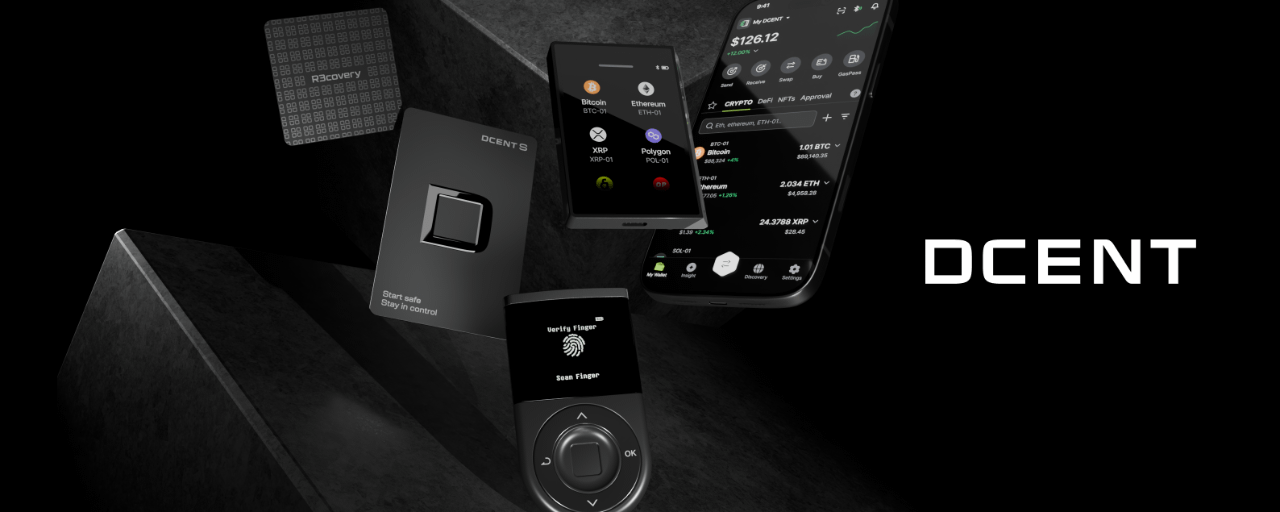
Article
DCENT Unveils New Brand Identity Eight Years After Its Launch,Expanding Beyond Digital Asset StorageBrand name changes from D’CENT to DCENT, accompanied by a new wordmark and signature color, “DCENT Lime”DCENT X and the Recovery Card enhance the convenience of backup and recoveryBusiness scope expands from personal hardware wallets to DCENT Enterprise for businesses and institutions
South Korea-based digital asset wallet company IoTrust, led by CEO Sangsu Baek, unveiled a new brand identity for DCENT on September 8, marking the first major rebranding since the brand was launched eight years ago.
As part of the rebranding, the English brand name has changed from “D’CENT” to “DCENT,” removing the apostrophe, while the Korean brand name remains unchanged.
The new slogan, “Own your future. At ease.”, reflects DCENT’s commitment to keeping ownership of digital assets in the hands of users while reducing the burden associated with storing and managing them. The new wordmark and signature color, “DCENT Lime,” visually represent this direction.
Beyond the Name: Expanding the Digital Asset Experience
The rebranding goes beyond changes to the brand name and visual identity. Hardware wallets have evolved from devices used primarily for asset storage into access points for approving transactions, participating in staking, and using a wide range of digital asset services.
In line with this evolution, DCENT is expanding into a brand that provides a comprehensive digital asset experience encompassing storage, backup, management, and utility.
The key phrase behind the rebranding is “Beyond Storage.” It represents DCENT’s commitment to making the entire digital asset journey more convenient—from secure storage to backup, recovery, management, and use.
Unveiled alongside the rebranding, DCENT X is a premium hardware wallet that embodies this direction through its product experience.
DCENT X is a cold wallet that allows users to clearly review what they are signing on its 2.4-inch AMOLED display and approve it with a single fingerprint. With the addition of the touchscreen- and fingerprint-enabled DCENT X, DCENT now offers a broader range of options suited to different storage preferences and usage environments, alongside its biometric hardware wallet and the card-style DCENT S.
DCENT S and DCENT X both feature a backup and recovery method using the Recovery Card. This approach reduces the inconvenience of manually writing down and storing a recovery phrase and allows users to manage their recovery information through a separate physical card, improving the convenience of digital asset storage.
From Personal Wallets to Enterprise and Institutional Solutions
DCENT is also expanding beyond individual users to provide digital asset management environments for businesses and institutions.
DCENT Enterprise is an institutional solution designed to help businesses and institutions securely store and manage digital assets. It supports internal control mechanisms such as multi-level approvals, enabling organizations involving multiple authorized personnel to manage digital assets according to their internal policies.
Connecting personal hardware wallets and organization-level digital asset management solutions under a single DCENT brand represents the direction of the company’s business expansion through this rebranding.
“This rebranding marks the beginning of DCENT’s expansion beyond an asset storage device into a digital asset experience brand that connects backup, recovery, management, and utility,” said a representative of IoTrust. “We will continue to expand our business by broadening the options available to individual users through DCENT X and DCENT S, while supporting the digital asset management environments of businesses and institutions through DCENT Enterprise.”
DCENT currently supports more than 100 blockchain networks and over 10,000 tokens, including Bitcoin (BTC), Ethereum, XRP Ledger, Solana, and Stellar (XLM).
DCENT Unveils New Brand Identity Eight Years After Its Launch,Expanding Beyond Digital Asset Storage
Brand name changes from D’CENT to DCENT, accompanied by a new wordmark and signature color, “DCENT Lime”DCENT X and the Recovery Card enhance the convenience of backup and recoveryBusiness scope expands from personal hardware wallets to DCENT Enterprise for businesses and institutions
South Korea-based digital asset wallet company IoTrust, led by CEO Sangsu Baek, unveiled a new brand identity for DCENT on September 8, marking the first major rebranding since the brand was launched eight years ago.
As part of the rebranding, the English brand name has changed from “D’CENT” to “DCENT,” removing the apostrophe, while the Korean brand name remains unchanged.
The new slogan, “Own your future. At ease.”, reflects DCENT’s commitment to keeping ownership of digital assets in the hands of users while reducing the burden associated with storing and managing them. The new wordmark and signature color, “DCENT Lime,” visually represent this direction.
Beyond the Name: Expanding the Digital Asset Experience
The rebranding goes beyond changes to the brand name and visual identity. Hardware wallets have evolved from devices used primarily for asset storage into access points for approving transactions, participating in staking, and using a wide range of digital asset services.
In line with this evolution, DCENT is expanding into a brand that provides a comprehensive digital asset experience encompassing storage, backup, management, and utility.
The key phrase behind the rebranding is “Beyond Storage.” It represents DCENT’s commitment to making the entire digital asset journey more convenient—from secure storage to backup, recovery, management, and use.
Unveiled alongside the rebranding, DCENT X is a premium hardware wallet that embodies this direction through its product experience.
DCENT X is a cold wallet that allows users to clearly review what they are signing on its 2.4-inch AMOLED display and approve it with a single fingerprint. With the addition of the touchscreen- and fingerprint-enabled DCENT X, DCENT now offers a broader range of options suited to different storage preferences and usage environments, alongside its biometric hardware wallet and the card-style DCENT S.
DCENT S and DCENT X both feature a backup and recovery method using the Recovery Card. This approach reduces the inconvenience of manually writing down and storing a recovery phrase and allows users to manage their recovery information through a separate physical card, improving the convenience of digital asset storage.
From Personal Wallets to Enterprise and Institutional Solutions
DCENT is also expanding beyond individual users to provide digital asset management environments for businesses and institutions.
DCENT Enterprise is an institutional solution designed to help businesses and institutions securely store and manage digital assets. It supports internal control mechanisms such as multi-level approvals, enabling organizations involving multiple authorized personnel to manage digital assets according to their internal policies.
Connecting personal hardware wallets and organization-level digital asset management solutions under a single DCENT brand represents the direction of the company’s business expansion through this rebranding.
“This rebranding marks the beginning of DCENT’s expansion beyond an asset storage device into a digital asset experience brand that connects backup, recovery, management, and utility,” said a representative of IoTrust. “We will continue to expand our business by broadening the options available to individual users through DCENT X and DCENT S, while supporting the digital asset management environments of businesses and institutions through DCENT Enterprise.”
DCENT currently supports more than 100 blockchain networks and over 10,000 tokens, including Bitcoin (BTC), Ethereum, XRP Ledger, Solana, and Stellar (XLM).
South Korea-based digital asset wallet company IoTrust, led by CEO Sangsu Baek, unveiled a new brand identity for DCENT on September 8, marking the first major rebranding since the brand was launched eight years ago.
As part of the rebranding, the English brand name has changed from “D’CENT” to “DCENT,” removing the apostrophe, while the Korean brand name remains unchanged.
The new slogan, “Own your future. At ease.”, reflects DCENT’s commitment to keeping ownership of digital assets in the hands of users while reducing the burden associated with storing and managing them. The new wordmark and signature color, “DCENT Lime,” visually represent this direction.
Beyond the Name: Expanding the Digital Asset Experience
The rebranding goes beyond changes to the brand name and visual identity. Hardware wallets have evolved from devices used primarily for asset storage into access points for approving transactions, participating in staking, and using a wide range of digital asset services.
In line with this evolution, DCENT is expanding into a brand that provides a comprehensive digital asset experience encompassing storage, backup, management, and utility.
The key phrase behind the rebranding is “Beyond Storage.” It represents DCENT’s commitment to making the entire digital asset journey more convenient—from secure storage to backup, recovery, management, and use.
Unveiled alongside the rebranding, DCENT X is a premium hardware wallet that embodies this direction through its product experience.
DCENT X is a cold wallet that allows users to clearly review what they are signing on its 2.4-inch AMOLED display and approve it with a single fingerprint. With the addition of the touchscreen- and fingerprint-enabled DCENT X, DCENT now offers a broader range of options suited to different storage preferences and usage environments, alongside its biometric hardware wallet and the card-style DCENT S.
DCENT S and DCENT X both feature a backup and recovery method using the Recovery Card. This approach reduces the inconvenience of manually writing down and storing a recovery phrase and allows users to manage their recovery information through a separate physical card, improving the convenience of digital asset storage.
From Personal Wallets to Enterprise and Institutional Solutions
DCENT is also expanding beyond individual users to provide digital asset management environments for businesses and institutions.
DCENT Enterprise is an institutional solution designed to help businesses and institutions securely store and manage digital assets. It supports internal control mechanisms such as multi-level approvals, enabling organizations involving multiple authorized personnel to manage digital assets according to their internal policies.
Connecting personal hardware wallets and organization-level digital asset management solutions under a single DCENT brand represents the direction of the company’s business expansion through this rebranding.
“This rebranding marks the beginning of DCENT’s expansion beyond an asset storage device into a digital asset experience brand that connects backup, recovery, management, and utility,” said a representative of IoTrust. “We will continue to expand our business by broadening the options available to individual users through DCENT X and DCENT S, while supporting the digital asset management environments of businesses and institutions through DCENT Enterprise.”
DCENT currently supports more than 100 blockchain networks and over 10,000 tokens, including Bitcoin (BTC), Ethereum, XRP Ledger, Solana, and Stellar (XLM).
115
Article
Canary Capital Launches the First U.S. Spot Staked TRX ETF (Ticker: TRXS)Canary Capital Group LLC ("Canary Capital"), a digital asset investment management firm, today announced the launch of the Canary Staked TRX ETF (Ticker: TRXS). The Fund seeks to provide exposure to the spot price of TRX, the native utility token of the TRON blockchain network. In addition, the Fund also seeks to earn additional TRX through participation in the TRON network's delegated proof-of-stake validation process, with net staking rewards reflected in the Fund's net asset value.
"The Canary Staked TRX ETF brings investors exposure to one of the world's largest blockchain settlement networks through a registered exchange-traded structure, while also enabling investors to benefit from potential staking rewards," said Steven McClurg, CEO of Canary Capital. "As stablecoin adoption continues to grow globally, TRON has become a critical piece of the infrastructure powering digital asset payments and settlement. We believe investors are increasingly looking beyond digital assets themselves and toward the networks driving real-world blockchain adoption."
TRON has emerged as one of the leading blockchain networks for stablecoin activity, supporting more than $94 billion in circulating Tether (USDT). The chain also processes the highest USDT transfer volume of any blockchain, totaling approximately $5.6 trillion year-to-date. Known for its speed, scalability, and low transaction costs, the TRON network serves as critical infrastructure for decentralized finance, global payments, and blockchain-based applications. The TRON network is governed by TRON DAO, the community-governed Decentralized Autonomous Organization (DAO) dedicated to accelerating the decentralization of the internet through blockchain technology and decentralized applications (dApps).
"The launch of the Canary Staked TRX ETF demonstrates the growing recognition of the TRON network as critical infrastructure for the global digital economy and provides institutional investors with a new way to access a network that is already powering real-world financial activity at scale," said Justin Sun, Founder of TRON. "We appreciate Canary Capital's leadership in bringing TRX to the ETF market and welcome innovations that broaden investor participation in the TRON network while advancing the integration of blockchain infrastructure into traditional financial markets.”
With the launch of the Canary Staked TRX ETF (TRXS), Canary Capital continues its mission to make digital asset investing simple, secure, and accessible while expanding investor access beyond Bitcoin and Ethereum into the next generation of blockchain infrastructure.
About Canary Capital
Canary Capital is an investment management firm that blends rigorous risk management, strategic foresight, and innovative thinking to deliver private placement strategies, crypto hedge fund solutions, treasury management solutions, and publicly traded funds, with a focus on enterprise technology.
About TRON DAO
TRON DAO is a community-governed DAO dedicated to accelerating the decentralization of the internet via blockchain technology and dApps.
Founded in September 2017, the TRON blockchain has experienced significant growth since its MainNet launch in May 2018. Today, TRON hosts the largest circulating supply of USD Tether (USDT) stablecoin, which currently exceeds $94 billion. As of September 2026, the TRON blockchain has recorded over 403 million in total user accounts, more than 15 billion in total transactions, and over $28 billion in total value locked (TVL), based on TRONSCAN. Recognized as the global settlement layer for stablecoin transactions and everyday purchases with proven success, TRON is “Moving Trillions, Empowering Billions.”
Disclosures and Risk
The Canary Staked TRX ETF (Ticker: TRXS) is an exchange-traded product that is not registered under the Investment Company Act of 1940 (the "1940 Act") and therefore is not subject to the same regulations and protections as ETFs and mutual funds registered under the 1940 Act. Investing involves risk, including the possible loss of principal. An investment in TRXS is subject to a high degree of risk and heightened volatility and is not suitable for investors who cannot afford the loss of their entire investment.
The Fund’s investment objectives, risks, charges and expenses should be considered before investing. The prospectus contains this and other important information, and it may be obtained at https://canaryetfs.com/trxs/prospectus/. Read it carefully before investing.
An investment in TRXS is not a direct investment in TRX. Staking rewards are not indicative of the Fund's performance, are not guaranteed, and may change frequently, including experiencing significant declines.Digital assets, such as TRX, are a relatively new asset class, and the market for digital assets is subject to rapid changes and uncertainty. Digital assets are largely unregulated and digital asset investments may be more susceptible to fraud and manipulation than more regulated investments.
TRXS is subject to rapid price swings, including as a result of actions and statements by influencers and the media, change of assets, and other factors. There is no assurance that TRXS will maintain its value over the long-term.
Staking provides the Trust with the opportunity to create and earn additional TRX. The Trust will be entitled to all TRX generated by the Trust’s staking, after deduction of certain staking-related expenses. This additional TRX will increase the net assets of the Trust, benefiting Shareholders. Certain of such TRX may be treated as income to the Trust and may be held for future distribution to Shareholders, subject to procedures and requirements disclosed elsewhere in the Prospectus.
Staking comes with a risk of loss of TRX. None of the Fund’s assets, including any staked assets, are subject to the protections enjoyed by depositors with Federal Deposit Insurance Corporation (“FDIC”) or SIPC member institutions. The staked assets may also be subject to “slashing” penalties. Slashings occur when a validator attests to two different histories of the chain and penalties occur when a validator is offline for a prolonged period of time. The Fund itself will not engage in staking activities, including the operation of a validator node. Instead, the staking program will be administered by the Fund’s sponsor, who will utilize service providers including the custodians and staking providers. While the Fund’s sponsor does not expect the activities of the staking providers to result in slashing penalties, there can be no guarantee that slashing penalties will not occur. Furthermore, the custodians’ and staking providers’ liability to the Fund for the actions associated with the Staking Program is limited, and the custodians and staking providers may lack the assets or insurance in order to support the recovery of any losses incurred. Accordingly, there can be no guarantee that the Fund would recover any of its staked assets, or the value thereof, if it is subject to slashing or penalties.
The Fund is new with a limited operating history.
Paralel Distributors LLC, Marketing Agent. Paralel is unaffiliated with Canary Capital.
CRNY 159
Canary Capital Launches the First U.S. Spot Staked TRX ETF (Ticker: TRXS)
Canary Capital Group LLC ("Canary Capital"), a digital asset investment management firm, today announced the launch of the Canary Staked TRX ETF (Ticker: TRXS). The Fund seeks to provide exposure to the spot price of TRX, the native utility token of the TRON blockchain network. In addition, the Fund also seeks to earn additional TRX through participation in the TRON network's delegated proof-of-stake validation process, with net staking rewards reflected in the Fund's net asset value.
"The Canary Staked TRX ETF brings investors exposure to one of the world's largest blockchain settlement networks through a registered exchange-traded structure, while also enabling investors to benefit from potential staking rewards," said Steven McClurg, CEO of Canary Capital. "As stablecoin adoption continues to grow globally, TRON has become a critical piece of the infrastructure powering digital asset payments and settlement. We believe investors are increasingly looking beyond digital assets themselves and toward the networks driving real-world blockchain adoption."
TRON has emerged as one of the leading blockchain networks for stablecoin activity, supporting more than $94 billion in circulating Tether (USDT). The chain also processes the highest USDT transfer volume of any blockchain, totaling approximately $5.6 trillion year-to-date. Known for its speed, scalability, and low transaction costs, the TRON network serves as critical infrastructure for decentralized finance, global payments, and blockchain-based applications. The TRON network is governed by TRON DAO, the community-governed Decentralized Autonomous Organization (DAO) dedicated to accelerating the decentralization of the internet through blockchain technology and decentralized applications (dApps).
"The launch of the Canary Staked TRX ETF demonstrates the growing recognition of the TRON network as critical infrastructure for the global digital economy and provides institutional investors with a new way to access a network that is already powering real-world financial activity at scale," said Justin Sun, Founder of TRON. "We appreciate Canary Capital's leadership in bringing TRX to the ETF market and welcome innovations that broaden investor participation in the TRON network while advancing the integration of blockchain infrastructure into traditional financial markets.”
With the launch of the Canary Staked TRX ETF (TRXS), Canary Capital continues its mission to make digital asset investing simple, secure, and accessible while expanding investor access beyond Bitcoin and Ethereum into the next generation of blockchain infrastructure.
About Canary Capital
Canary Capital is an investment management firm that blends rigorous risk management, strategic foresight, and innovative thinking to deliver private placement strategies, crypto hedge fund solutions, treasury management solutions, and publicly traded funds, with a focus on enterprise technology.
About TRON DAO
TRON DAO is a community-governed DAO dedicated to accelerating the decentralization of the internet via blockchain technology and dApps.
Founded in September 2017, the TRON blockchain has experienced significant growth since its MainNet launch in May 2018. Today, TRON hosts the largest circulating supply of USD Tether (USDT) stablecoin, which currently exceeds $94 billion. As of September 2026, the TRON blockchain has recorded over 403 million in total user accounts, more than 15 billion in total transactions, and over $28 billion in total value locked (TVL), based on TRONSCAN. Recognized as the global settlement layer for stablecoin transactions and everyday purchases with proven success, TRON is “Moving Trillions, Empowering Billions.”
Disclosures and Risk
The Canary Staked TRX ETF (Ticker: TRXS) is an exchange-traded product that is not registered under the Investment Company Act of 1940 (the "1940 Act") and therefore is not subject to the same regulations and protections as ETFs and mutual funds registered under the 1940 Act. Investing involves risk, including the possible loss of principal. An investment in TRXS is subject to a high degree of risk and heightened volatility and is not suitable for investors who cannot afford the loss of their entire investment.
The Fund’s investment objectives, risks, charges and expenses should be considered before investing. The prospectus contains this and other important information, and it may be obtained at https://canaryetfs.com/trxs/prospectus/. Read it carefully before investing.
An investment in TRXS is not a direct investment in TRX. Staking rewards are not indicative of the Fund's performance, are not guaranteed, and may change frequently, including experiencing significant declines.Digital assets, such as TRX, are a relatively new asset class, and the market for digital assets is subject to rapid changes and uncertainty. Digital assets are largely unregulated and digital asset investments may be more susceptible to fraud and manipulation than more regulated investments.
TRXS is subject to rapid price swings, including as a result of actions and statements by influencers and the media, change of assets, and other factors. There is no assurance that TRXS will maintain its value over the long-term.
Staking provides the Trust with the opportunity to create and earn additional TRX. The Trust will be entitled to all TRX generated by the Trust’s staking, after deduction of certain staking-related expenses. This additional TRX will increase the net assets of the Trust, benefiting Shareholders. Certain of such TRX may be treated as income to the Trust and may be held for future distribution to Shareholders, subject to procedures and requirements disclosed elsewhere in the Prospectus.
Staking comes with a risk of loss of TRX. None of the Fund’s assets, including any staked assets, are subject to the protections enjoyed by depositors with Federal Deposit Insurance Corporation (“FDIC”) or SIPC member institutions. The staked assets may also be subject to “slashing” penalties. Slashings occur when a validator attests to two different histories of the chain and penalties occur when a validator is offline for a prolonged period of time. The Fund itself will not engage in staking activities, including the operation of a validator node. Instead, the staking program will be administered by the Fund’s sponsor, who will utilize service providers including the custodians and staking providers. While the Fund’s sponsor does not expect the activities of the staking providers to result in slashing penalties, there can be no guarantee that slashing penalties will not occur. Furthermore, the custodians’ and staking providers’ liability to the Fund for the actions associated with the Staking Program is limited, and the custodians and staking providers may lack the assets or insurance in order to support the recovery of any losses incurred. Accordingly, there can be no guarantee that the Fund would recover any of its staked assets, or the value thereof, if it is subject to slashing or penalties.
The Fund is new with a limited operating history.
Paralel Distributors LLC, Marketing Agent. Paralel is unaffiliated with Canary Capital.
CRNY 159
"The Canary Staked TRX ETF brings investors exposure to one of the world's largest blockchain settlement networks through a registered exchange-traded structure, while also enabling investors to benefit from potential staking rewards," said Steven McClurg, CEO of Canary Capital. "As stablecoin adoption continues to grow globally, TRON has become a critical piece of the infrastructure powering digital asset payments and settlement. We believe investors are increasingly looking beyond digital assets themselves and toward the networks driving real-world blockchain adoption."
TRON has emerged as one of the leading blockchain networks for stablecoin activity, supporting more than $94 billion in circulating Tether (USDT). The chain also processes the highest USDT transfer volume of any blockchain, totaling approximately $5.6 trillion year-to-date. Known for its speed, scalability, and low transaction costs, the TRON network serves as critical infrastructure for decentralized finance, global payments, and blockchain-based applications. The TRON network is governed by TRON DAO, the community-governed Decentralized Autonomous Organization (DAO) dedicated to accelerating the decentralization of the internet through blockchain technology and decentralized applications (dApps).
"The launch of the Canary Staked TRX ETF demonstrates the growing recognition of the TRON network as critical infrastructure for the global digital economy and provides institutional investors with a new way to access a network that is already powering real-world financial activity at scale," said Justin Sun, Founder of TRON. "We appreciate Canary Capital's leadership in bringing TRX to the ETF market and welcome innovations that broaden investor participation in the TRON network while advancing the integration of blockchain infrastructure into traditional financial markets.”
With the launch of the Canary Staked TRX ETF (TRXS), Canary Capital continues its mission to make digital asset investing simple, secure, and accessible while expanding investor access beyond Bitcoin and Ethereum into the next generation of blockchain infrastructure.
About Canary Capital
Canary Capital is an investment management firm that blends rigorous risk management, strategic foresight, and innovative thinking to deliver private placement strategies, crypto hedge fund solutions, treasury management solutions, and publicly traded funds, with a focus on enterprise technology.
About TRON DAO
TRON DAO is a community-governed DAO dedicated to accelerating the decentralization of the internet via blockchain technology and dApps.
Founded in September 2017, the TRON blockchain has experienced significant growth since its MainNet launch in May 2018. Today, TRON hosts the largest circulating supply of USD Tether (USDT) stablecoin, which currently exceeds $94 billion. As of September 2026, the TRON blockchain has recorded over 403 million in total user accounts, more than 15 billion in total transactions, and over $28 billion in total value locked (TVL), based on TRONSCAN. Recognized as the global settlement layer for stablecoin transactions and everyday purchases with proven success, TRON is “Moving Trillions, Empowering Billions.”
Disclosures and Risk
The Canary Staked TRX ETF (Ticker: TRXS) is an exchange-traded product that is not registered under the Investment Company Act of 1940 (the "1940 Act") and therefore is not subject to the same regulations and protections as ETFs and mutual funds registered under the 1940 Act. Investing involves risk, including the possible loss of principal. An investment in TRXS is subject to a high degree of risk and heightened volatility and is not suitable for investors who cannot afford the loss of their entire investment.
The Fund’s investment objectives, risks, charges and expenses should be considered before investing. The prospectus contains this and other important information, and it may be obtained at https://canaryetfs.com/trxs/prospectus/. Read it carefully before investing.
An investment in TRXS is not a direct investment in TRX. Staking rewards are not indicative of the Fund's performance, are not guaranteed, and may change frequently, including experiencing significant declines.Digital assets, such as TRX, are a relatively new asset class, and the market for digital assets is subject to rapid changes and uncertainty. Digital assets are largely unregulated and digital asset investments may be more susceptible to fraud and manipulation than more regulated investments.
TRXS is subject to rapid price swings, including as a result of actions and statements by influencers and the media, change of assets, and other factors. There is no assurance that TRXS will maintain its value over the long-term.
Staking provides the Trust with the opportunity to create and earn additional TRX. The Trust will be entitled to all TRX generated by the Trust’s staking, after deduction of certain staking-related expenses. This additional TRX will increase the net assets of the Trust, benefiting Shareholders. Certain of such TRX may be treated as income to the Trust and may be held for future distribution to Shareholders, subject to procedures and requirements disclosed elsewhere in the Prospectus.
Staking comes with a risk of loss of TRX. None of the Fund’s assets, including any staked assets, are subject to the protections enjoyed by depositors with Federal Deposit Insurance Corporation (“FDIC”) or SIPC member institutions. The staked assets may also be subject to “slashing” penalties. Slashings occur when a validator attests to two different histories of the chain and penalties occur when a validator is offline for a prolonged period of time. The Fund itself will not engage in staking activities, including the operation of a validator node. Instead, the staking program will be administered by the Fund’s sponsor, who will utilize service providers including the custodians and staking providers. While the Fund’s sponsor does not expect the activities of the staking providers to result in slashing penalties, there can be no guarantee that slashing penalties will not occur. Furthermore, the custodians’ and staking providers’ liability to the Fund for the actions associated with the Staking Program is limited, and the custodians and staking providers may lack the assets or insurance in order to support the recovery of any losses incurred. Accordingly, there can be no guarantee that the Fund would recover any of its staked assets, or the value thereof, if it is subject to slashing or penalties.
The Fund is new with a limited operating history.
Paralel Distributors LLC, Marketing Agent. Paralel is unaffiliated with Canary Capital.
CRNY 159
53

Article
HTX Releases August Performance Report: 13th Anniversary Celebration Ignites Global User EngagementApia, Samoa, September 9, 2026 - In August, leading global cryptocurrency exchange HTX marked its 13th anniversary with a major anniversary celebration. In an industry where leading projects come and go rapidly, few platforms have continued delivering quality services to users worldwide for 13 consecutive years. Even fewer have continued expanding their capabilities after weathering multiple bull and bear cycles.
Centered around the “Resilience Reveals the Future” campaign and Trading Championship #3, HTX delivered a series of anniversary rewards for global users throughout August. At the same time, the platform continued to expand its asset offerings and enhance its trading tools and yield products. On-platform balances grew 6.6% month over month, supported stock trading assets reached 210, and cumulative TradFi trading volume surpassed $4 billion, resulting in a strong August performance.
13th Anniversary “Resilience Reveals the Future”: Rewards All Month Long
At 13:13 (UTC+8) on August 13, HTX's 13th anniversary carnival month campaign, “Resilience Reveals the Future,” officially kicked off. The campaign allowed users to complete designated Growth Challenge tasks, light up Future Gems, and unlock anniversary rewards step by step. The Grand Prize included a 2,000 USDT Future Exploration Fund, an all-inclusive trip to Singapore TOKEN2049 (flights & hotel included), and an HTX 13th Anniversary premium limited-edition gift. At the same time, a referral campaign was launched with a mega prize pool, covering multiple trading scenarios including spot, futures, and margin trading. Users who completed designated tasks will share in the rewards.
As of August 31, “Resilience Reveals the Future” campaign had distributed more than 130,000 prizes to users. The campaign is still ongoing and will run through 13:13 (UTC+8) on September 13.
Throughout the anniversary month, various platform services also rolled out their own rewarding programs. HTX Earn launched its 13th Anniversary Earn Bonanza, attracting more than 30,000 subscribers to Earn products during the month. Both the subscriber count and subscription amount for popular new-crypto products grew by more than 10% month over month. Featuring campaigns across its three major products, Collateral Swap, margin trading, and institutional lending, unlocked user asset potential through low-interest loans and drove a 19% month-over-month increase in daily average margin trading trader count.
Trading Championship #3 Returns with Over 40,000 Participants
Coinciding with its 13th anniversary, HTX’s flagship trading competition, the Trading Championship, returned for its third season. The competition featured three consecutive stages, including Points Contest, Individual Challenge, and Team Battle, with a total prize pool of 800,000 USDT. By the end of August, the competition had attracted more than 40,000 participants, generating over 1.25 billion USDT in spot trading volume and more than 4.17 billion USDT in futures trading volume.
The three stages offered different ways to participate. The Individual Challenge featured three tracks based on trading volume, PnL, and PnL percentage, giving users with different trading styles a chance to compete for the leaderboard. The spot trading volume champion recorded nearly 150 million USDT in cumulative trading volume and took home the 25,000 USDT first-place prize. The Team Battle added a stronger social element, turning individual competition into team-based competition through features such as one-click team building, team leader guidance, and one-click copy trading. The Team Battle is currently underway and will run through September 15.
Whether through "Resilience Reveals the Future" or Trading Championship #3, the combination of user rewards and enthusiastic global participation highlights the core drivers behind HTX's resilience and enduring leadership across multiple market cycles.
Expanding Asset Listings: Cumulative TradFi Trading Volume Surpasses $4 Billion
In August, HTX continued to expand its futures product lineup, adding 56 new assets, including 41 popular stocks and index products and 15 new cryptocurrencies. The platform now supports 210 stock assets, covering U.S. equities, major global indices and ETFs, unicorn pre-IPO equities, and leading companies in Japan and South Korea. This further strengthens HTX’s position in multi-market stock coverage.
This month’s asset expansion focused on four key areas of AI hardware and semiconductor computing, global e-commerce and internet companies, major Asia-Pacific companies and indices, and high-dividend blue-chip stocks. Key assets including Zhongji InnoLight (ZHONGJI), GigaDevice (GIGADEV), Unitree Robotics (UNITREE), Shein (SHEIN), PDD Holdings (PDD), SoftBank (SOFTBANK), Samsung Electro-Mechanics (SAMSUNGEM), Nikkei 225 (JP225), and the Korea Composite Stock Price Index (KR200/KODEX200) were added successively. The addition of Japanese and Korean markets and global indices further expanded the platform’s asset coverage beyond U.S. equities, giving users more direct access to opportunities across global markets.
As the asset matrix expanded, trading volume grew accordingly. By the end of August, cumulative TradFi trading volume on HTX had surpassed $4 billion, with $1.6 billion added in August alone. In terms of trading costs, the platform also completed a fee-rate upgrade, bringing its TradFi net fee rates into the industry’s top tier.
The spot market also continued adding trending assets. In August, HTX became the first platform to list the Chinese memecoin 牛来 (Niu Lai), which gained as much as 460% after listing. AI-related assets TAO and DOS were also listed during the month, with TAO ranking among the industry’s leading assets by market capitalization. HTX consistently demonstrates agility in capturing trending market assets.
HTX SmartEarn's APY Surpasses 13%, Trading Bots' Trading Volume Rises
For users who plan to stay in the market long term but do not want their funds sitting idle, HTX SmartEarn was one of the month’s standout products. In August, SmartEarn launched a limited-time APY boost campaign offering up to an additional 11% APY. With an average daily basic APY of 2.71%, it offered a maximum APY of over 13%.
Automated trading tools also continued to grow. In August, HTX Futures Trading Bots trading volume increased 36% month over month, with growth momentum continuing. Copy Trading and Trading Bots also supported more than 20 TradFi assets, including U.S. equities, precious metals, crude oil, and indices, significantly expanding the range of assets available for automated trading.
Risk management was a key focus of August’s product upgrades. Trailing TP/SL and MMR TP/SL were launched simultaneously. Trailing TP/SL automatically adjusts the stop-loss level as the market moves, raising the level to lock in gains when prices move favorably and triggering an exit when a pullback reaches the preset threshold. This reduces the need for users to monitor the market manually. MMR TP/SL uses the maintenance margin ratio as the trigger. Once traders' account margin level reaches their preset threshold, the system automatically executes orders. It is suitable for large positions and high-leverage trading.
Copy Trading also conducted upgrades in transparency. The Copy Trading details page now provides itemized execution records, while the community page allows users to view creators’ actual trading records and copy-trading performance, giving users more information when evaluating whom to follow. Additional experience improvements, including K-line charts, leaderboard categories, multilingual search, and app performance, were also rolled out in August.
Global Expansion Continues as Localization Capabilities Grow Stronger
Over the past 13 years, HTX has built a user base across major markets worldwide. Entering new markets and staying close to local users have remained key focuses of the platform’s investment in recent years.
Compliance is a prerequisite for global expansion. In late August, Pakistan officially released regulatory provisions for virtual asset service providers and launched a licensing application mechanism, marking a shift toward institutionalized implementation of local virtual asset regulation. HTX has been actively aligning with the latest regulatory requirements, advancing local entity establishment, preparations for formal license applications, and compliance infrastructure, while maintaining communication with regulators and local professional institutions. These efforts lay a solid foundation for conducting related businesses in accordance with applicable laws and regulations.
Southeast Asia was another key focus in August. From August 14-15, HTX Ventures participated in Conviction Vietnam, connecting with local Vietnamese users and Web3 ecosystem partners through on-site activities, community engagement, and content initiatives. Vietnam has one of the world’s highest levels of cryptocurrency adoption and remains one of Southeast Asia’s most dynamic digital asset markets. HTX will continue expanding localized brand content and community partnerships to build closer connections with local users, developers, and industry partners.
13 Years On, Moving Forward
Looking back at the milestone of HTX's 13th anniversary, the industry continues to evolve, while platforms capable of supporting users over the long term remain rare. What has carried HTX through the past 13 years is its commitment to putting users first and treating every user who chooses the platform with sincerity. Market ups and downs are impossible to predict, but providing users with a reliable trading experience is something the platform can control and must continue to do well.
Anniversary campaigns including “Resilience Reveals the Future” and Trading Championship #3 Team Battle are still in full swing, with more surprises to come in September. For 13 years, HTX has weathered multiple bull and bear market cycles alongside its global users, and it remains committed to forging ahead hand-in-hand with its international community for the journey ahead.
HTX Releases August Performance Report: 13th Anniversary Celebration Ignites Global User Engagement
Apia, Samoa, September 9, 2026 - In August, leading global cryptocurrency exchange HTX marked its 13th anniversary with a major anniversary celebration. In an industry where leading projects come and go rapidly, few platforms have continued delivering quality services to users worldwide for 13 consecutive years. Even fewer have continued expanding their capabilities after weathering multiple bull and bear cycles.
Centered around the “Resilience Reveals the Future” campaign and Trading Championship #3, HTX delivered a series of anniversary rewards for global users throughout August. At the same time, the platform continued to expand its asset offerings and enhance its trading tools and yield products. On-platform balances grew 6.6% month over month, supported stock trading assets reached 210, and cumulative TradFi trading volume surpassed $4 billion, resulting in a strong August performance.
13th Anniversary “Resilience Reveals the Future”: Rewards All Month Long
At 13:13 (UTC+8) on August 13, HTX's 13th anniversary carnival month campaign, “Resilience Reveals the Future,” officially kicked off. The campaign allowed users to complete designated Growth Challenge tasks, light up Future Gems, and unlock anniversary rewards step by step. The Grand Prize included a 2,000 USDT Future Exploration Fund, an all-inclusive trip to Singapore TOKEN2049 (flights & hotel included), and an HTX 13th Anniversary premium limited-edition gift. At the same time, a referral campaign was launched with a mega prize pool, covering multiple trading scenarios including spot, futures, and margin trading. Users who completed designated tasks will share in the rewards.
As of August 31, “Resilience Reveals the Future” campaign had distributed more than 130,000 prizes to users. The campaign is still ongoing and will run through 13:13 (UTC+8) on September 13.
Throughout the anniversary month, various platform services also rolled out their own rewarding programs. HTX Earn launched its 13th Anniversary Earn Bonanza, attracting more than 30,000 subscribers to Earn products during the month. Both the subscriber count and subscription amount for popular new-crypto products grew by more than 10% month over month. Featuring campaigns across its three major products, Collateral Swap, margin trading, and institutional lending, unlocked user asset potential through low-interest loans and drove a 19% month-over-month increase in daily average margin trading trader count.
Trading Championship #3 Returns with Over 40,000 Participants
Coinciding with its 13th anniversary, HTX’s flagship trading competition, the Trading Championship, returned for its third season. The competition featured three consecutive stages, including Points Contest, Individual Challenge, and Team Battle, with a total prize pool of 800,000 USDT. By the end of August, the competition had attracted more than 40,000 participants, generating over 1.25 billion USDT in spot trading volume and more than 4.17 billion USDT in futures trading volume.
The three stages offered different ways to participate. The Individual Challenge featured three tracks based on trading volume, PnL, and PnL percentage, giving users with different trading styles a chance to compete for the leaderboard. The spot trading volume champion recorded nearly 150 million USDT in cumulative trading volume and took home the 25,000 USDT first-place prize. The Team Battle added a stronger social element, turning individual competition into team-based competition through features such as one-click team building, team leader guidance, and one-click copy trading. The Team Battle is currently underway and will run through September 15.
Whether through "Resilience Reveals the Future" or Trading Championship #3, the combination of user rewards and enthusiastic global participation highlights the core drivers behind HTX's resilience and enduring leadership across multiple market cycles.
Expanding Asset Listings: Cumulative TradFi Trading Volume Surpasses $4 Billion
In August, HTX continued to expand its futures product lineup, adding 56 new assets, including 41 popular stocks and index products and 15 new cryptocurrencies. The platform now supports 210 stock assets, covering U.S. equities, major global indices and ETFs, unicorn pre-IPO equities, and leading companies in Japan and South Korea. This further strengthens HTX’s position in multi-market stock coverage.
This month’s asset expansion focused on four key areas of AI hardware and semiconductor computing, global e-commerce and internet companies, major Asia-Pacific companies and indices, and high-dividend blue-chip stocks. Key assets including Zhongji InnoLight (ZHONGJI), GigaDevice (GIGADEV), Unitree Robotics (UNITREE), Shein (SHEIN), PDD Holdings (PDD), SoftBank (SOFTBANK), Samsung Electro-Mechanics (SAMSUNGEM), Nikkei 225 (JP225), and the Korea Composite Stock Price Index (KR200/KODEX200) were added successively. The addition of Japanese and Korean markets and global indices further expanded the platform’s asset coverage beyond U.S. equities, giving users more direct access to opportunities across global markets.
As the asset matrix expanded, trading volume grew accordingly. By the end of August, cumulative TradFi trading volume on HTX had surpassed $4 billion, with $1.6 billion added in August alone. In terms of trading costs, the platform also completed a fee-rate upgrade, bringing its TradFi net fee rates into the industry’s top tier.
The spot market also continued adding trending assets. In August, HTX became the first platform to list the Chinese memecoin 牛来 (Niu Lai), which gained as much as 460% after listing. AI-related assets TAO and DOS were also listed during the month, with TAO ranking among the industry’s leading assets by market capitalization. HTX consistently demonstrates agility in capturing trending market assets.
HTX SmartEarn's APY Surpasses 13%, Trading Bots' Trading Volume Rises
For users who plan to stay in the market long term but do not want their funds sitting idle, HTX SmartEarn was one of the month’s standout products. In August, SmartEarn launched a limited-time APY boost campaign offering up to an additional 11% APY. With an average daily basic APY of 2.71%, it offered a maximum APY of over 13%.
Automated trading tools also continued to grow. In August, HTX Futures Trading Bots trading volume increased 36% month over month, with growth momentum continuing. Copy Trading and Trading Bots also supported more than 20 TradFi assets, including U.S. equities, precious metals, crude oil, and indices, significantly expanding the range of assets available for automated trading.
Risk management was a key focus of August’s product upgrades. Trailing TP/SL and MMR TP/SL were launched simultaneously. Trailing TP/SL automatically adjusts the stop-loss level as the market moves, raising the level to lock in gains when prices move favorably and triggering an exit when a pullback reaches the preset threshold. This reduces the need for users to monitor the market manually. MMR TP/SL uses the maintenance margin ratio as the trigger. Once traders' account margin level reaches their preset threshold, the system automatically executes orders. It is suitable for large positions and high-leverage trading.
Copy Trading also conducted upgrades in transparency. The Copy Trading details page now provides itemized execution records, while the community page allows users to view creators’ actual trading records and copy-trading performance, giving users more information when evaluating whom to follow. Additional experience improvements, including K-line charts, leaderboard categories, multilingual search, and app performance, were also rolled out in August.
Global Expansion Continues as Localization Capabilities Grow Stronger
Over the past 13 years, HTX has built a user base across major markets worldwide. Entering new markets and staying close to local users have remained key focuses of the platform’s investment in recent years.
Compliance is a prerequisite for global expansion. In late August, Pakistan officially released regulatory provisions for virtual asset service providers and launched a licensing application mechanism, marking a shift toward institutionalized implementation of local virtual asset regulation. HTX has been actively aligning with the latest regulatory requirements, advancing local entity establishment, preparations for formal license applications, and compliance infrastructure, while maintaining communication with regulators and local professional institutions. These efforts lay a solid foundation for conducting related businesses in accordance with applicable laws and regulations.
Southeast Asia was another key focus in August. From August 14-15, HTX Ventures participated in Conviction Vietnam, connecting with local Vietnamese users and Web3 ecosystem partners through on-site activities, community engagement, and content initiatives. Vietnam has one of the world’s highest levels of cryptocurrency adoption and remains one of Southeast Asia’s most dynamic digital asset markets. HTX will continue expanding localized brand content and community partnerships to build closer connections with local users, developers, and industry partners.
13 Years On, Moving Forward
Looking back at the milestone of HTX's 13th anniversary, the industry continues to evolve, while platforms capable of supporting users over the long term remain rare. What has carried HTX through the past 13 years is its commitment to putting users first and treating every user who chooses the platform with sincerity. Market ups and downs are impossible to predict, but providing users with a reliable trading experience is something the platform can control and must continue to do well.
Anniversary campaigns including “Resilience Reveals the Future” and Trading Championship #3 Team Battle are still in full swing, with more surprises to come in September. For 13 years, HTX has weathered multiple bull and bear market cycles alongside its global users, and it remains committed to forging ahead hand-in-hand with its international community for the journey ahead.
Centered around the “Resilience Reveals the Future” campaign and Trading Championship #3, HTX delivered a series of anniversary rewards for global users throughout August. At the same time, the platform continued to expand its asset offerings and enhance its trading tools and yield products. On-platform balances grew 6.6% month over month, supported stock trading assets reached 210, and cumulative TradFi trading volume surpassed $4 billion, resulting in a strong August performance.
13th Anniversary “Resilience Reveals the Future”: Rewards All Month Long
At 13:13 (UTC+8) on August 13, HTX's 13th anniversary carnival month campaign, “Resilience Reveals the Future,” officially kicked off. The campaign allowed users to complete designated Growth Challenge tasks, light up Future Gems, and unlock anniversary rewards step by step. The Grand Prize included a 2,000 USDT Future Exploration Fund, an all-inclusive trip to Singapore TOKEN2049 (flights & hotel included), and an HTX 13th Anniversary premium limited-edition gift. At the same time, a referral campaign was launched with a mega prize pool, covering multiple trading scenarios including spot, futures, and margin trading. Users who completed designated tasks will share in the rewards.
As of August 31, “Resilience Reveals the Future” campaign had distributed more than 130,000 prizes to users. The campaign is still ongoing and will run through 13:13 (UTC+8) on September 13.
Throughout the anniversary month, various platform services also rolled out their own rewarding programs. HTX Earn launched its 13th Anniversary Earn Bonanza, attracting more than 30,000 subscribers to Earn products during the month. Both the subscriber count and subscription amount for popular new-crypto products grew by more than 10% month over month. Featuring campaigns across its three major products, Collateral Swap, margin trading, and institutional lending, unlocked user asset potential through low-interest loans and drove a 19% month-over-month increase in daily average margin trading trader count.
Trading Championship #3 Returns with Over 40,000 Participants
Coinciding with its 13th anniversary, HTX’s flagship trading competition, the Trading Championship, returned for its third season. The competition featured three consecutive stages, including Points Contest, Individual Challenge, and Team Battle, with a total prize pool of 800,000 USDT. By the end of August, the competition had attracted more than 40,000 participants, generating over 1.25 billion USDT in spot trading volume and more than 4.17 billion USDT in futures trading volume.
The three stages offered different ways to participate. The Individual Challenge featured three tracks based on trading volume, PnL, and PnL percentage, giving users with different trading styles a chance to compete for the leaderboard. The spot trading volume champion recorded nearly 150 million USDT in cumulative trading volume and took home the 25,000 USDT first-place prize. The Team Battle added a stronger social element, turning individual competition into team-based competition through features such as one-click team building, team leader guidance, and one-click copy trading. The Team Battle is currently underway and will run through September 15.
Whether through "Resilience Reveals the Future" or Trading Championship #3, the combination of user rewards and enthusiastic global participation highlights the core drivers behind HTX's resilience and enduring leadership across multiple market cycles.
Expanding Asset Listings: Cumulative TradFi Trading Volume Surpasses $4 Billion
In August, HTX continued to expand its futures product lineup, adding 56 new assets, including 41 popular stocks and index products and 15 new cryptocurrencies. The platform now supports 210 stock assets, covering U.S. equities, major global indices and ETFs, unicorn pre-IPO equities, and leading companies in Japan and South Korea. This further strengthens HTX’s position in multi-market stock coverage.
This month’s asset expansion focused on four key areas of AI hardware and semiconductor computing, global e-commerce and internet companies, major Asia-Pacific companies and indices, and high-dividend blue-chip stocks. Key assets including Zhongji InnoLight (ZHONGJI), GigaDevice (GIGADEV), Unitree Robotics (UNITREE), Shein (SHEIN), PDD Holdings (PDD), SoftBank (SOFTBANK), Samsung Electro-Mechanics (SAMSUNGEM), Nikkei 225 (JP225), and the Korea Composite Stock Price Index (KR200/KODEX200) were added successively. The addition of Japanese and Korean markets and global indices further expanded the platform’s asset coverage beyond U.S. equities, giving users more direct access to opportunities across global markets.
As the asset matrix expanded, trading volume grew accordingly. By the end of August, cumulative TradFi trading volume on HTX had surpassed $4 billion, with $1.6 billion added in August alone. In terms of trading costs, the platform also completed a fee-rate upgrade, bringing its TradFi net fee rates into the industry’s top tier.
The spot market also continued adding trending assets. In August, HTX became the first platform to list the Chinese memecoin 牛来 (Niu Lai), which gained as much as 460% after listing. AI-related assets TAO and DOS were also listed during the month, with TAO ranking among the industry’s leading assets by market capitalization. HTX consistently demonstrates agility in capturing trending market assets.
HTX SmartEarn's APY Surpasses 13%, Trading Bots' Trading Volume Rises
For users who plan to stay in the market long term but do not want their funds sitting idle, HTX SmartEarn was one of the month’s standout products. In August, SmartEarn launched a limited-time APY boost campaign offering up to an additional 11% APY. With an average daily basic APY of 2.71%, it offered a maximum APY of over 13%.
Automated trading tools also continued to grow. In August, HTX Futures Trading Bots trading volume increased 36% month over month, with growth momentum continuing. Copy Trading and Trading Bots also supported more than 20 TradFi assets, including U.S. equities, precious metals, crude oil, and indices, significantly expanding the range of assets available for automated trading.
Risk management was a key focus of August’s product upgrades. Trailing TP/SL and MMR TP/SL were launched simultaneously. Trailing TP/SL automatically adjusts the stop-loss level as the market moves, raising the level to lock in gains when prices move favorably and triggering an exit when a pullback reaches the preset threshold. This reduces the need for users to monitor the market manually. MMR TP/SL uses the maintenance margin ratio as the trigger. Once traders' account margin level reaches their preset threshold, the system automatically executes orders. It is suitable for large positions and high-leverage trading.
Copy Trading also conducted upgrades in transparency. The Copy Trading details page now provides itemized execution records, while the community page allows users to view creators’ actual trading records and copy-trading performance, giving users more information when evaluating whom to follow. Additional experience improvements, including K-line charts, leaderboard categories, multilingual search, and app performance, were also rolled out in August.
Global Expansion Continues as Localization Capabilities Grow Stronger
Over the past 13 years, HTX has built a user base across major markets worldwide. Entering new markets and staying close to local users have remained key focuses of the platform’s investment in recent years.
Compliance is a prerequisite for global expansion. In late August, Pakistan officially released regulatory provisions for virtual asset service providers and launched a licensing application mechanism, marking a shift toward institutionalized implementation of local virtual asset regulation. HTX has been actively aligning with the latest regulatory requirements, advancing local entity establishment, preparations for formal license applications, and compliance infrastructure, while maintaining communication with regulators and local professional institutions. These efforts lay a solid foundation for conducting related businesses in accordance with applicable laws and regulations.
Southeast Asia was another key focus in August. From August 14-15, HTX Ventures participated in Conviction Vietnam, connecting with local Vietnamese users and Web3 ecosystem partners through on-site activities, community engagement, and content initiatives. Vietnam has one of the world’s highest levels of cryptocurrency adoption and remains one of Southeast Asia’s most dynamic digital asset markets. HTX will continue expanding localized brand content and community partnerships to build closer connections with local users, developers, and industry partners.
13 Years On, Moving Forward
Looking back at the milestone of HTX's 13th anniversary, the industry continues to evolve, while platforms capable of supporting users over the long term remain rare. What has carried HTX through the past 13 years is its commitment to putting users first and treating every user who chooses the platform with sincerity. Market ups and downs are impossible to predict, but providing users with a reliable trading experience is something the platform can control and must continue to do well.
Anniversary campaigns including “Resilience Reveals the Future” and Trading Championship #3 Team Battle are still in full swing, with more surprises to come in September. For 13 years, HTX has weathered multiple bull and bear market cycles alongside its global users, and it remains committed to forging ahead hand-in-hand with its international community for the journey ahead.
4
Article
Liquidity Arena 2026 Enters Dual-Track Main Competition on September 9Liquidity Arena 2026, an AI quantitative trading competition organized by global institutional prime broker LTP, will enter its dual-track main competition on September 9, bringing together AI developers, research teams, hedge funds, proprietary trading firms, high-frequency trading teams and professional traders.
The competition has attracted more than hundreds of teams across its two tracks. During Track A Phase 1, held from July 20 to August 21, participating AI agents executed more than 70,000 trades. Thirty teams advanced to the final stage.
Two Tracks, Different Measures of Trading Performance
Beginning September 9, Liquidity Arena will run two distinct tracks designed for different types of trading talent and strategies.
Track A — Logic Frontier
Track A enters its final stage with the 30 teams that advanced from Phase 1.
Designed for AI developers, agent builders, universities, research labs and professional traders, Logic Frontier goes beyond conventional PnL-based competition. Teams are required to use LTP's RapidX environment, while the competition incorporates MCP-based Reasoning Log verification to examine how autonomous agents interpret market information and make trading decisions.
The competition therefore evaluates not only trading outcomes, but also the reasoning quality, consistency and market interpretation behind those decisions.
The core question is no longer simply who makes the most money? — but how reliably can an autonomous trading system reason and perform under changing market conditions?
Track B — Liquidity Pro
Launching on September 9, Track B is designed for hedge funds, proprietary trading firms, HFT teams and professional traders.
Liquidity Pro puts the emphasis on performance, capital capacity, execution quality and slippage control. Teams can deploy their strategies through flexible trading infrastructure, including DMA, RapidX and other supported venues.
The objective is straightforward: prove that a strategy can perform effectively in live market conditions while managing execution and scale.
Registration for Track B remains open until 23:59 GMT+8 on September 23, 2026.
More Than $300,000 in Total Prize Value
Liquidity Arena 2026 features a total prize pool of more than $300,000, combining cash rewards with AI incentives, institutional trading benefits, partner products and career opportunities.
The reward structure includes:
$100,000+ in cash prizes for the top three teams in each trackAI agent credits and token incentives to support AI usage and reward outstanding performanceLTP VIP trading tiers and clearing-fee benefits for eligible teams after the competitionProducts and benefits from sponsors and ecosystem partnersCareer opportunities, including internship opportunities from LTP and additional opportunities from partners
The goal is to create a reward ecosystem that extends beyond the competition itself — giving high-performing teams access to capital-efficient trading infrastructure, technology, ecosystem resources and potential career opportunities.
Institutional-Grade Infrastructure and Global Ecosystem
Liquidity Arena is organized by LTP, with AWS and Calais serving as co-organizers. MiniMax, SoSoValue and AIVIX support the competition across AI, market data and analytics. 1ndex by 1Token serves as an Ecosystem Engine Partner, while Amsterdam Investment Club and THEO QUANT are Community Partners.
The competition is also supported by more than 20 academic and institutional partners and more than 20 media partners.
During the competition, LTP provides the institutional-grade trading infrastructure and operational support for participating teams. Teams will test and evaluate their strategies in trading environments designed to reflect market conditions, where performance is influenced not only by theoretical returns or backtested results, but also by liquidity, execution quality and slippage.
For AI-focused teams, the environment provides a setting to evaluate autonomous reasoning and decision-making in financial market scenarios. For professional quantitative teams, it provides a framework for assessing strategy performance under practical considerations, including capital scale, market impact and execution costs.
About LTP
LTP is a global institutional prime broker, purpose-built to meet the evolving needs of digital asset market participants. By applying traditional financial standards to blockchain innovation, LTP provides end-to-end prime services spanning trade execution, clearing, settlement, custody, and financing. Its offerings further extend to institutional asset management, regulated OTC block trading, and compliant on/off-ramp solutions — delivering a secure and scalable foundation for institutions across the digital asset ecosystem.
The Group operates under a multi-jurisdictional regulatory framework, holding licenses and registrations in Hong Kong, Australia, the United Arab Emirates, and the British Virgin Islands, among other jurisdictions, enabling it to serve institutional clients globally on a compliant basis.
Liquidity Arena 2026 Enters Dual-Track Main Competition on September 9
Liquidity Arena 2026, an AI quantitative trading competition organized by global institutional prime broker LTP, will enter its dual-track main competition on September 9, bringing together AI developers, research teams, hedge funds, proprietary trading firms, high-frequency trading teams and professional traders.
The competition has attracted more than hundreds of teams across its two tracks. During Track A Phase 1, held from July 20 to August 21, participating AI agents executed more than 70,000 trades. Thirty teams advanced to the final stage.
Two Tracks, Different Measures of Trading Performance
Beginning September 9, Liquidity Arena will run two distinct tracks designed for different types of trading talent and strategies.
Track A — Logic Frontier
Track A enters its final stage with the 30 teams that advanced from Phase 1.
Designed for AI developers, agent builders, universities, research labs and professional traders, Logic Frontier goes beyond conventional PnL-based competition. Teams are required to use LTP's RapidX environment, while the competition incorporates MCP-based Reasoning Log verification to examine how autonomous agents interpret market information and make trading decisions.
The competition therefore evaluates not only trading outcomes, but also the reasoning quality, consistency and market interpretation behind those decisions.
The core question is no longer simply who makes the most money? — but how reliably can an autonomous trading system reason and perform under changing market conditions?
Track B — Liquidity Pro
Launching on September 9, Track B is designed for hedge funds, proprietary trading firms, HFT teams and professional traders.
Liquidity Pro puts the emphasis on performance, capital capacity, execution quality and slippage control. Teams can deploy their strategies through flexible trading infrastructure, including DMA, RapidX and other supported venues.
The objective is straightforward: prove that a strategy can perform effectively in live market conditions while managing execution and scale.
Registration for Track B remains open until 23:59 GMT+8 on September 23, 2026.
More Than $300,000 in Total Prize Value
Liquidity Arena 2026 features a total prize pool of more than $300,000, combining cash rewards with AI incentives, institutional trading benefits, partner products and career opportunities.
The reward structure includes:
$100,000+ in cash prizes for the top three teams in each trackAI agent credits and token incentives to support AI usage and reward outstanding performanceLTP VIP trading tiers and clearing-fee benefits for eligible teams after the competitionProducts and benefits from sponsors and ecosystem partnersCareer opportunities, including internship opportunities from LTP and additional opportunities from partners
The goal is to create a reward ecosystem that extends beyond the competition itself — giving high-performing teams access to capital-efficient trading infrastructure, technology, ecosystem resources and potential career opportunities.
Institutional-Grade Infrastructure and Global Ecosystem
Liquidity Arena is organized by LTP, with AWS and Calais serving as co-organizers. MiniMax, SoSoValue and AIVIX support the competition across AI, market data and analytics. 1ndex by 1Token serves as an Ecosystem Engine Partner, while Amsterdam Investment Club and THEO QUANT are Community Partners.
The competition is also supported by more than 20 academic and institutional partners and more than 20 media partners.
During the competition, LTP provides the institutional-grade trading infrastructure and operational support for participating teams. Teams will test and evaluate their strategies in trading environments designed to reflect market conditions, where performance is influenced not only by theoretical returns or backtested results, but also by liquidity, execution quality and slippage.
For AI-focused teams, the environment provides a setting to evaluate autonomous reasoning and decision-making in financial market scenarios. For professional quantitative teams, it provides a framework for assessing strategy performance under practical considerations, including capital scale, market impact and execution costs.
About LTP
LTP is a global institutional prime broker, purpose-built to meet the evolving needs of digital asset market participants. By applying traditional financial standards to blockchain innovation, LTP provides end-to-end prime services spanning trade execution, clearing, settlement, custody, and financing. Its offerings further extend to institutional asset management, regulated OTC block trading, and compliant on/off-ramp solutions — delivering a secure and scalable foundation for institutions across the digital asset ecosystem.
The Group operates under a multi-jurisdictional regulatory framework, holding licenses and registrations in Hong Kong, Australia, the United Arab Emirates, and the British Virgin Islands, among other jurisdictions, enabling it to serve institutional clients globally on a compliant basis.
The competition has attracted more than hundreds of teams across its two tracks. During Track A Phase 1, held from July 20 to August 21, participating AI agents executed more than 70,000 trades. Thirty teams advanced to the final stage.
Two Tracks, Different Measures of Trading Performance
Beginning September 9, Liquidity Arena will run two distinct tracks designed for different types of trading talent and strategies.
Track A — Logic Frontier
Track A enters its final stage with the 30 teams that advanced from Phase 1.
Designed for AI developers, agent builders, universities, research labs and professional traders, Logic Frontier goes beyond conventional PnL-based competition. Teams are required to use LTP's RapidX environment, while the competition incorporates MCP-based Reasoning Log verification to examine how autonomous agents interpret market information and make trading decisions.
The competition therefore evaluates not only trading outcomes, but also the reasoning quality, consistency and market interpretation behind those decisions.
The core question is no longer simply who makes the most money? — but how reliably can an autonomous trading system reason and perform under changing market conditions?
Track B — Liquidity Pro
Launching on September 9, Track B is designed for hedge funds, proprietary trading firms, HFT teams and professional traders.
Liquidity Pro puts the emphasis on performance, capital capacity, execution quality and slippage control. Teams can deploy their strategies through flexible trading infrastructure, including DMA, RapidX and other supported venues.
The objective is straightforward: prove that a strategy can perform effectively in live market conditions while managing execution and scale.
Registration for Track B remains open until 23:59 GMT+8 on September 23, 2026.
More Than $300,000 in Total Prize Value
Liquidity Arena 2026 features a total prize pool of more than $300,000, combining cash rewards with AI incentives, institutional trading benefits, partner products and career opportunities.
The reward structure includes:
$100,000+ in cash prizes for the top three teams in each trackAI agent credits and token incentives to support AI usage and reward outstanding performanceLTP VIP trading tiers and clearing-fee benefits for eligible teams after the competitionProducts and benefits from sponsors and ecosystem partnersCareer opportunities, including internship opportunities from LTP and additional opportunities from partners
The goal is to create a reward ecosystem that extends beyond the competition itself — giving high-performing teams access to capital-efficient trading infrastructure, technology, ecosystem resources and potential career opportunities.
Institutional-Grade Infrastructure and Global Ecosystem
Liquidity Arena is organized by LTP, with AWS and Calais serving as co-organizers. MiniMax, SoSoValue and AIVIX support the competition across AI, market data and analytics. 1ndex by 1Token serves as an Ecosystem Engine Partner, while Amsterdam Investment Club and THEO QUANT are Community Partners.
The competition is also supported by more than 20 academic and institutional partners and more than 20 media partners.
During the competition, LTP provides the institutional-grade trading infrastructure and operational support for participating teams. Teams will test and evaluate their strategies in trading environments designed to reflect market conditions, where performance is influenced not only by theoretical returns or backtested results, but also by liquidity, execution quality and slippage.
For AI-focused teams, the environment provides a setting to evaluate autonomous reasoning and decision-making in financial market scenarios. For professional quantitative teams, it provides a framework for assessing strategy performance under practical considerations, including capital scale, market impact and execution costs.
About LTP
LTP is a global institutional prime broker, purpose-built to meet the evolving needs of digital asset market participants. By applying traditional financial standards to blockchain innovation, LTP provides end-to-end prime services spanning trade execution, clearing, settlement, custody, and financing. Its offerings further extend to institutional asset management, regulated OTC block trading, and compliant on/off-ramp solutions — delivering a secure and scalable foundation for institutions across the digital asset ecosystem.
The Group operates under a multi-jurisdictional regulatory framework, holding licenses and registrations in Hong Kong, Australia, the United Arab Emirates, and the British Virgin Islands, among other jurisdictions, enabling it to serve institutional clients globally on a compliant basis.
87
Article
B.AI Powers the "AI Grid" with Full-Stack Infrastructure to Fuel the Agentic Era B.AI, a next-generation AI infrastructure platform, recently set off a developer frenzy by offering free access to top-tier models. Within days, daily token throughput across the platform crossed 1.33 trillion—a historic milestone.
The record-breaking figure underscores the campaign's explosive rollout, but it marks only the first step in B.AI's broader strategic roadmap. Moving beyond traditional compute distribution pipelines, B.AI aims to build the global settlement layer for intelligence: a core infrastructure hub engineered to power cross-node collaboration, orchestration, and value distribution for AI agents across complex business workflows.
Positioning itself strategically above all models, below all agents, B.AI deeply integrates a diverse range of top-tier models with full-stack components, laying an unshakable, irreplaceable foundation for the mass adoption of autonomous agents and the productivity boom that follows.
Daily Token Throughput Tops 1.33 Trillion: B.AI's Free Access Rollout Fuels Usage Boom
B.AI's recent move to open free access to premium AI models has captivated developers and quickly taken over industry conversations. The push for accessible compute has not only fueled a surge in platform activity but also shattered usage records.
In a matter of days, soaring API demand pushed the platform's daily token throughput past a staggering 1.33 trillion. Over a 15-day window, cumulative volume reached 8.19 trillion tokens, drawing in more than 220,000 new API users. As of September 3, B.AI's total user base had officially surpassed 2.3 million.
That massive adoption traces directly to the platform's zero-cost model lineup, a strategic rollout built to erase developers' cost concerns. With every barrier removed, B.AI now offers unlimited free access to six leading frontier models: DeepSeek-V4-Flash, DeepSeek-V4-Flash-Vision-Exp, Tencent Hy3, Xiaomi MiMo-V2.5, GLM-5.3-Flash (Ox Alpha), and Qwen3.8-Flash.
Notably, on September 3, B.AI rolled out a new pricing structure for DeepSeek-V4-Flash and DeepSeek-V4-Flash-Vision-Exp, introducing tiered discounts. Developers now receive a 50% discount during peak hours, with off-peak rates dropping to just 25% of standard peak pricing. At the same time, the platform has kept zero-cost access in place for GLM-5.3-Flash (Ox Alpha), Qwen3.8-Flash, Tencent Hy3, and Xiaomi MiMo-V2.5. Despite the shift toward commercialization, developer momentum hasn't wavered, with platform-wide token throughput continuing its steady climb.
This sustained momentum proves the campaign was far more than a short-term compute giveaway—it is a bellwether for the broader evolution of AI infrastructure. Cracking 1.33 trillion daily tokens makes one thing clear: AI applications are moving past basic chatbots. Powered by a high-performance technical stack and flexible service mechanics, B.AI is laying the groundwork for the next frontier—autonomous AI agents operating at scale.
Powering the "AI Grid": B.AI Anchors the Global Settlement Layer for the Agent Economy
For B.AI, democratizing compute is only the prelude. Looking further ahead, the platform is committed to building full-stack infrastructure for the agentic era, cementing its position as the global settlement layer for intelligence.
In the agent era, a typical agent task calls for constant switching between models. No single provider can power a complete workflow on its own, so developers are left juggling fragmented API protocols, disjointed billing systems, and conflicting rate limits.
B.AI's settlement layer bridges this exact gap. Positioned strategically "above all models, below all agents," B.AI abstracts models across different providers, capabilities, and cost structures into a unified pool of schedulable resources.
Powered by a dual-tier API structure offering official-route reliability alongside lowest-cost custom channels, developers can choose between guaranteed direct connections and deeply discounted options across a broad lineup of models. Combined with smart routing on the Chat interface, B.AI operates as a full-stack "AI grid," ensuring every agent request lands on the optimal model to deliver reliable performance at maximum cost-efficiency.
On the settlement front, this power grid seamlessly bridges both Web2 and Web3 models. For Web2, developers can rely on familiar traditional payment methods to top up with minimal friction. For Web3, B.AI leverages on-chain payment rails to offer global developers decentralized, verifiable, and low-friction payment options.
With dual payment systems running in parallel, B.AI enables developers and agent applications across any infrastructure setup to find their optimal settlement path on the grid, providing single-point integration with borderless global reach.
Driving Core Productivity: B.AI Reshapes Agent Collaboration
Beyond building a foundation for compute routing and global settlement, B.AI is moving past base infrastructure to power real-world productivity. By enabling seamless agent collaboration across complex workflows, it delivers the missing execution layer for the agent economy.
At the heart of this execution layer is native Codex integration. Full compatibility with the Responses API means developers can now use a single B.AI key inside Codex to run flagship GPT models and DeepSeek favorites side by side.
Engineers can now bring these powerhouse models straight into their daily dev stack. From code generation and reasoning to debugging and refactoring, B.AI unifies the entire workflow under one roof—delivering a direct line from model selection to shipped code.
Beyond coding, to keep agents running reliably in real-world production at scale, B.AI has built a full-stack infrastructure powered by five core components, equipping agents with a fine-tuned operational engine:
x402 Payment Protocol: Introduces an innovative "pay-before-response" model that executes high-frequency, on-chain micro-settlements in the background during cross-agent API calls and compute orchestration.8004 Identity Protocol: Issues verifiable on-chain credentials for every agent, logging execution history and credit scores to establish a reliable layer of trust for cross-node collaboration.Skills Matrix: Plug-and-play, standardized building blocks that interface directly with MCP servers to equip agents with instant, modular tool-calling capabilities.BAIclaw and BAIcode: Built-in platform assistants engineered for end-to-end execution. BAIclaw manages all-in-one terminal operations and multi-agent workflows, while BAIcode serves as an advanced developer engine that streamlines the full pipeline from task analysis and architecture design to coding and testing.
From the token surge sparked by zero-cost model access to its positioning as the global settlement layer for intelligence; from seamless Codex integration to full-stack infrastructure powered by x402, 8004, Skills, and native assistants—B.AI delivers far more than a battle-tested technical stack; it unveils a clear blueprint for what lies ahead. B.AI is building not just accessible compute today, but the definitive launchpad for a thriving agent economy. The future is here—and this is only the beginning.
B.AI Powers the "AI Grid" with Full-Stack Infrastructure to Fuel the Agentic Era
B.AI, a next-generation AI infrastructure platform, recently set off a developer frenzy by offering free access to top-tier models. Within days, daily token throughput across the platform crossed 1.33 trillion—a historic milestone.
The record-breaking figure underscores the campaign's explosive rollout, but it marks only the first step in B.AI's broader strategic roadmap. Moving beyond traditional compute distribution pipelines, B.AI aims to build the global settlement layer for intelligence: a core infrastructure hub engineered to power cross-node collaboration, orchestration, and value distribution for AI agents across complex business workflows.
Positioning itself strategically above all models, below all agents, B.AI deeply integrates a diverse range of top-tier models with full-stack components, laying an unshakable, irreplaceable foundation for the mass adoption of autonomous agents and the productivity boom that follows.
Daily Token Throughput Tops 1.33 Trillion: B.AI's Free Access Rollout Fuels Usage Boom
B.AI's recent move to open free access to premium AI models has captivated developers and quickly taken over industry conversations. The push for accessible compute has not only fueled a surge in platform activity but also shattered usage records.
In a matter of days, soaring API demand pushed the platform's daily token throughput past a staggering 1.33 trillion. Over a 15-day window, cumulative volume reached 8.19 trillion tokens, drawing in more than 220,000 new API users. As of September 3, B.AI's total user base had officially surpassed 2.3 million.
That massive adoption traces directly to the platform's zero-cost model lineup, a strategic rollout built to erase developers' cost concerns. With every barrier removed, B.AI now offers unlimited free access to six leading frontier models: DeepSeek-V4-Flash, DeepSeek-V4-Flash-Vision-Exp, Tencent Hy3, Xiaomi MiMo-V2.5, GLM-5.3-Flash (Ox Alpha), and Qwen3.8-Flash.
Notably, on September 3, B.AI rolled out a new pricing structure for DeepSeek-V4-Flash and DeepSeek-V4-Flash-Vision-Exp, introducing tiered discounts. Developers now receive a 50% discount during peak hours, with off-peak rates dropping to just 25% of standard peak pricing. At the same time, the platform has kept zero-cost access in place for GLM-5.3-Flash (Ox Alpha), Qwen3.8-Flash, Tencent Hy3, and Xiaomi MiMo-V2.5. Despite the shift toward commercialization, developer momentum hasn't wavered, with platform-wide token throughput continuing its steady climb.
This sustained momentum proves the campaign was far more than a short-term compute giveaway—it is a bellwether for the broader evolution of AI infrastructure. Cracking 1.33 trillion daily tokens makes one thing clear: AI applications are moving past basic chatbots. Powered by a high-performance technical stack and flexible service mechanics, B.AI is laying the groundwork for the next frontier—autonomous AI agents operating at scale.
Powering the "AI Grid": B.AI Anchors the Global Settlement Layer for the Agent Economy
For B.AI, democratizing compute is only the prelude. Looking further ahead, the platform is committed to building full-stack infrastructure for the agentic era, cementing its position as the global settlement layer for intelligence.
In the agent era, a typical agent task calls for constant switching between models. No single provider can power a complete workflow on its own, so developers are left juggling fragmented API protocols, disjointed billing systems, and conflicting rate limits.
B.AI's settlement layer bridges this exact gap. Positioned strategically "above all models, below all agents," B.AI abstracts models across different providers, capabilities, and cost structures into a unified pool of schedulable resources.
Powered by a dual-tier API structure offering official-route reliability alongside lowest-cost custom channels, developers can choose between guaranteed direct connections and deeply discounted options across a broad lineup of models. Combined with smart routing on the Chat interface, B.AI operates as a full-stack "AI grid," ensuring every agent request lands on the optimal model to deliver reliable performance at maximum cost-efficiency.
On the settlement front, this power grid seamlessly bridges both Web2 and Web3 models. For Web2, developers can rely on familiar traditional payment methods to top up with minimal friction. For Web3, B.AI leverages on-chain payment rails to offer global developers decentralized, verifiable, and low-friction payment options.
With dual payment systems running in parallel, B.AI enables developers and agent applications across any infrastructure setup to find their optimal settlement path on the grid, providing single-point integration with borderless global reach.
Driving Core Productivity: B.AI Reshapes Agent Collaboration
Beyond building a foundation for compute routing and global settlement, B.AI is moving past base infrastructure to power real-world productivity. By enabling seamless agent collaboration across complex workflows, it delivers the missing execution layer for the agent economy.
At the heart of this execution layer is native Codex integration. Full compatibility with the Responses API means developers can now use a single B.AI key inside Codex to run flagship GPT models and DeepSeek favorites side by side.
Engineers can now bring these powerhouse models straight into their daily dev stack. From code generation and reasoning to debugging and refactoring, B.AI unifies the entire workflow under one roof—delivering a direct line from model selection to shipped code.
Beyond coding, to keep agents running reliably in real-world production at scale, B.AI has built a full-stack infrastructure powered by five core components, equipping agents with a fine-tuned operational engine:
x402 Payment Protocol: Introduces an innovative "pay-before-response" model that executes high-frequency, on-chain micro-settlements in the background during cross-agent API calls and compute orchestration.8004 Identity Protocol: Issues verifiable on-chain credentials for every agent, logging execution history and credit scores to establish a reliable layer of trust for cross-node collaboration.Skills Matrix: Plug-and-play, standardized building blocks that interface directly with MCP servers to equip agents with instant, modular tool-calling capabilities.BAIclaw and BAIcode: Built-in platform assistants engineered for end-to-end execution. BAIclaw manages all-in-one terminal operations and multi-agent workflows, while BAIcode serves as an advanced developer engine that streamlines the full pipeline from task analysis and architecture design to coding and testing.
From the token surge sparked by zero-cost model access to its positioning as the global settlement layer for intelligence; from seamless Codex integration to full-stack infrastructure powered by x402, 8004, Skills, and native assistants—B.AI delivers far more than a battle-tested technical stack; it unveils a clear blueprint for what lies ahead. B.AI is building not just accessible compute today, but the definitive launchpad for a thriving agent economy. The future is here—and this is only the beginning.
The record-breaking figure underscores the campaign's explosive rollout, but it marks only the first step in B.AI's broader strategic roadmap. Moving beyond traditional compute distribution pipelines, B.AI aims to build the global settlement layer for intelligence: a core infrastructure hub engineered to power cross-node collaboration, orchestration, and value distribution for AI agents across complex business workflows.
Positioning itself strategically above all models, below all agents, B.AI deeply integrates a diverse range of top-tier models with full-stack components, laying an unshakable, irreplaceable foundation for the mass adoption of autonomous agents and the productivity boom that follows.
Daily Token Throughput Tops 1.33 Trillion: B.AI's Free Access Rollout Fuels Usage Boom
B.AI's recent move to open free access to premium AI models has captivated developers and quickly taken over industry conversations. The push for accessible compute has not only fueled a surge in platform activity but also shattered usage records.
In a matter of days, soaring API demand pushed the platform's daily token throughput past a staggering 1.33 trillion. Over a 15-day window, cumulative volume reached 8.19 trillion tokens, drawing in more than 220,000 new API users. As of September 3, B.AI's total user base had officially surpassed 2.3 million.
That massive adoption traces directly to the platform's zero-cost model lineup, a strategic rollout built to erase developers' cost concerns. With every barrier removed, B.AI now offers unlimited free access to six leading frontier models: DeepSeek-V4-Flash, DeepSeek-V4-Flash-Vision-Exp, Tencent Hy3, Xiaomi MiMo-V2.5, GLM-5.3-Flash (Ox Alpha), and Qwen3.8-Flash.
Notably, on September 3, B.AI rolled out a new pricing structure for DeepSeek-V4-Flash and DeepSeek-V4-Flash-Vision-Exp, introducing tiered discounts. Developers now receive a 50% discount during peak hours, with off-peak rates dropping to just 25% of standard peak pricing. At the same time, the platform has kept zero-cost access in place for GLM-5.3-Flash (Ox Alpha), Qwen3.8-Flash, Tencent Hy3, and Xiaomi MiMo-V2.5. Despite the shift toward commercialization, developer momentum hasn't wavered, with platform-wide token throughput continuing its steady climb.
This sustained momentum proves the campaign was far more than a short-term compute giveaway—it is a bellwether for the broader evolution of AI infrastructure. Cracking 1.33 trillion daily tokens makes one thing clear: AI applications are moving past basic chatbots. Powered by a high-performance technical stack and flexible service mechanics, B.AI is laying the groundwork for the next frontier—autonomous AI agents operating at scale.
Powering the "AI Grid": B.AI Anchors the Global Settlement Layer for the Agent Economy
For B.AI, democratizing compute is only the prelude. Looking further ahead, the platform is committed to building full-stack infrastructure for the agentic era, cementing its position as the global settlement layer for intelligence.
In the agent era, a typical agent task calls for constant switching between models. No single provider can power a complete workflow on its own, so developers are left juggling fragmented API protocols, disjointed billing systems, and conflicting rate limits.
B.AI's settlement layer bridges this exact gap. Positioned strategically "above all models, below all agents," B.AI abstracts models across different providers, capabilities, and cost structures into a unified pool of schedulable resources.
Powered by a dual-tier API structure offering official-route reliability alongside lowest-cost custom channels, developers can choose between guaranteed direct connections and deeply discounted options across a broad lineup of models. Combined with smart routing on the Chat interface, B.AI operates as a full-stack "AI grid," ensuring every agent request lands on the optimal model to deliver reliable performance at maximum cost-efficiency.
On the settlement front, this power grid seamlessly bridges both Web2 and Web3 models. For Web2, developers can rely on familiar traditional payment methods to top up with minimal friction. For Web3, B.AI leverages on-chain payment rails to offer global developers decentralized, verifiable, and low-friction payment options.
With dual payment systems running in parallel, B.AI enables developers and agent applications across any infrastructure setup to find their optimal settlement path on the grid, providing single-point integration with borderless global reach.
Driving Core Productivity: B.AI Reshapes Agent Collaboration
Beyond building a foundation for compute routing and global settlement, B.AI is moving past base infrastructure to power real-world productivity. By enabling seamless agent collaboration across complex workflows, it delivers the missing execution layer for the agent economy.
At the heart of this execution layer is native Codex integration. Full compatibility with the Responses API means developers can now use a single B.AI key inside Codex to run flagship GPT models and DeepSeek favorites side by side.
Engineers can now bring these powerhouse models straight into their daily dev stack. From code generation and reasoning to debugging and refactoring, B.AI unifies the entire workflow under one roof—delivering a direct line from model selection to shipped code.
Beyond coding, to keep agents running reliably in real-world production at scale, B.AI has built a full-stack infrastructure powered by five core components, equipping agents with a fine-tuned operational engine:
x402 Payment Protocol: Introduces an innovative "pay-before-response" model that executes high-frequency, on-chain micro-settlements in the background during cross-agent API calls and compute orchestration.8004 Identity Protocol: Issues verifiable on-chain credentials for every agent, logging execution history and credit scores to establish a reliable layer of trust for cross-node collaboration.Skills Matrix: Plug-and-play, standardized building blocks that interface directly with MCP servers to equip agents with instant, modular tool-calling capabilities.BAIclaw and BAIcode: Built-in platform assistants engineered for end-to-end execution. BAIclaw manages all-in-one terminal operations and multi-agent workflows, while BAIcode serves as an advanced developer engine that streamlines the full pipeline from task analysis and architecture design to coding and testing.
From the token surge sparked by zero-cost model access to its positioning as the global settlement layer for intelligence; from seamless Codex integration to full-stack infrastructure powered by x402, 8004, Skills, and native assistants—B.AI delivers far more than a battle-tested technical stack; it unveils a clear blueprint for what lies ahead. B.AI is building not just accessible compute today, but the definitive launchpad for a thriving agent economy. The future is here—and this is only the beginning.
109
Log in to explore more content
Join global crypto users on Binance Square
⚡️ Get latest and useful information about crypto.
💬 Trusted by the world’s largest crypto exchange.
👍 Discover real insights from verified creators.
Email / Phone number