
BitcoinKE
3.1k Posts

BitcoinKE
 Square Verified+
Report
Block User
BitKE is a leading crypto and Web3 focussed media outlet in Africa publishing daily informative and investment news and content.
1 Following
28.3K+ Followers
5.0K+ Liked
Posts
All
Quotes
·
--
REGULATION | Revised U.S CLARITY Act Bars Top Government Officials From Issuing, Sponsoring Digit...President Donald Trump has agreed to tougher conflict-of-interest restrictions in the latest version of the U.S. Senate’s CLARITY Act, clearing a major obstacle ahead of a key procedural vote on the sweeping cryptocurrency bill.
Senate Republicans released the revised legislation after incorporating 126 substantive changes sought by Democrats. Trump agreed to most of the proposed ethics provisions, including giving state attorneys general a role in enforcing restrictions on public officials’ crypto activities.
The changes are aimed at addressing concerns over conflicts of interest involving Trump, whose family has extensive cryptocurrency interests, while giving Democrats additional safeguards needed to support the legislation.
CASE STUDY | Why This Powerful Entrant Withdrew Plans for a Spot Bitcoin ETF
Key Restrictions Added to the CLARITY Act
Divestiture or blind trusts: Federal elected officials, federal judges, and their spouses would have to divest significant financial interests in companies that issue digital assets or place those holdings in a blind trust.
Restrictions on issuing digital assets: Presidents, vice presidents, members of Congress, federal judges, and their spouses would be barred from issuing or sponsoring digital assets while in office.
State enforcement: State attorneys general would be given authority to enforce the ethics provisions, alongside the Justice Department.
Power to sue exchanges: State attorneys general could sue crypto exchanges that list digital assets prohibited under the ethics provisions.
Conflict-of-interest rules: The restrictions would apply to federally elected officials and their spouses, creating rules specifically designed to prevent public officials from using their positions to benefit from crypto businesses.
The provisions could potentially force Trump to divest or restructure significant crypto interests, including holdings connected to World Liberty Financial, the Trump family’s crypto venture. Trump reported more than $1.4 billion in crypto-related income in 2025, including more than $500 million from World Liberty Financial-related sales, according to financial disclosures.
REALITY CHECK | U.S President Reports Over $1 Billion in Crypto-Related Income Eclipsing Traditional Business Earnings
The revised language marks a significant concession after months of negotiations over whether the president and other senior officials should be subject to the bill’s conflict-of-interest rules.
The Senate is scheduled to hold a procedural vote. The vote requires 60 senators, meaning Republicans would need support from at least seven Democrats or independents if all 53 Republicans back the measure.
The vote is only the first hurdle.
Even if the bill clears the Senate, lawmakers would still need to resolve amendments, secure final passage and reconcile the legislation with the House before the end of the congressional session.
The CLARITY Act would establish a broader federal framework for digital assets, including rules governing
which tokens fall under securities or commodities regulation, and
which federal agencies oversee different parts of the market.
For the crypto industry, the ethics agreement could be as important politically as the market-structure provisions themselves since it removes one of the biggest objections Democrats have raised while putting new limits on how senior U.S. officials can participate in the digital-asset economy.
REGULATION | Over 200 Crypto Firms Urge U.S Senate to Pass CLARITY Act
Stay tuned to BitKE on crypto developments globally.
Join our WhatsApp channel here.
Follow us on X for the latest posts and updates
Join and interact with our Telegram community
_________
REGULATION | Revised U.S CLARITY Act Bars Top Government Officials From Issuing, Sponsoring Digit...
President Donald Trump has agreed to tougher conflict-of-interest restrictions in the latest version of the U.S. Senate’s CLARITY Act, clearing a major obstacle ahead of a key procedural vote on the sweeping cryptocurrency bill.
Senate Republicans released the revised legislation after incorporating 126 substantive changes sought by Democrats. Trump agreed to most of the proposed ethics provisions, including giving state attorneys general a role in enforcing restrictions on public officials’ crypto activities.
The changes are aimed at addressing concerns over conflicts of interest involving Trump, whose family has extensive cryptocurrency interests, while giving Democrats additional safeguards needed to support the legislation.
CASE STUDY | Why This Powerful Entrant Withdrew Plans for a Spot Bitcoin ETF
Key Restrictions Added to the CLARITY Act
Divestiture or blind trusts: Federal elected officials, federal judges, and their spouses would have to divest significant financial interests in companies that issue digital assets or place those holdings in a blind trust.
Restrictions on issuing digital assets: Presidents, vice presidents, members of Congress, federal judges, and their spouses would be barred from issuing or sponsoring digital assets while in office.
State enforcement: State attorneys general would be given authority to enforce the ethics provisions, alongside the Justice Department.
Power to sue exchanges: State attorneys general could sue crypto exchanges that list digital assets prohibited under the ethics provisions.
Conflict-of-interest rules: The restrictions would apply to federally elected officials and their spouses, creating rules specifically designed to prevent public officials from using their positions to benefit from crypto businesses.
The provisions could potentially force Trump to divest or restructure significant crypto interests, including holdings connected to World Liberty Financial, the Trump family’s crypto venture. Trump reported more than $1.4 billion in crypto-related income in 2025, including more than $500 million from World Liberty Financial-related sales, according to financial disclosures.
REALITY CHECK | U.S President Reports Over $1 Billion in Crypto-Related Income Eclipsing Traditional Business Earnings
The revised language marks a significant concession after months of negotiations over whether the president and other senior officials should be subject to the bill’s conflict-of-interest rules.
The Senate is scheduled to hold a procedural vote. The vote requires 60 senators, meaning Republicans would need support from at least seven Democrats or independents if all 53 Republicans back the measure.
The vote is only the first hurdle.
Even if the bill clears the Senate, lawmakers would still need to resolve amendments, secure final passage and reconcile the legislation with the House before the end of the congressional session.
The CLARITY Act would establish a broader federal framework for digital assets, including rules governing
which tokens fall under securities or commodities regulation, and
which federal agencies oversee different parts of the market.
For the crypto industry, the ethics agreement could be as important politically as the market-structure provisions themselves since it removes one of the biggest objections Democrats have raised while putting new limits on how senior U.S. officials can participate in the digital-asset economy.
REGULATION | Over 200 Crypto Firms Urge U.S Senate to Pass CLARITY Act
Stay tuned to BitKE on crypto developments globally.
Join our WhatsApp channel here.
Follow us on X for the latest posts and updates
Join and interact with our Telegram community
_________
Senate Republicans released the revised legislation after incorporating 126 substantive changes sought by Democrats. Trump agreed to most of the proposed ethics provisions, including giving state attorneys general a role in enforcing restrictions on public officials’ crypto activities.
The changes are aimed at addressing concerns over conflicts of interest involving Trump, whose family has extensive cryptocurrency interests, while giving Democrats additional safeguards needed to support the legislation.
CASE STUDY | Why This Powerful Entrant Withdrew Plans for a Spot Bitcoin ETF
Key Restrictions Added to the CLARITY Act
Divestiture or blind trusts: Federal elected officials, federal judges, and their spouses would have to divest significant financial interests in companies that issue digital assets or place those holdings in a blind trust.
Restrictions on issuing digital assets: Presidents, vice presidents, members of Congress, federal judges, and their spouses would be barred from issuing or sponsoring digital assets while in office.
State enforcement: State attorneys general would be given authority to enforce the ethics provisions, alongside the Justice Department.
Power to sue exchanges: State attorneys general could sue crypto exchanges that list digital assets prohibited under the ethics provisions.
Conflict-of-interest rules: The restrictions would apply to federally elected officials and their spouses, creating rules specifically designed to prevent public officials from using their positions to benefit from crypto businesses.
The provisions could potentially force Trump to divest or restructure significant crypto interests, including holdings connected to World Liberty Financial, the Trump family’s crypto venture. Trump reported more than $1.4 billion in crypto-related income in 2025, including more than $500 million from World Liberty Financial-related sales, according to financial disclosures.
REALITY CHECK | U.S President Reports Over $1 Billion in Crypto-Related Income Eclipsing Traditional Business Earnings
The revised language marks a significant concession after months of negotiations over whether the president and other senior officials should be subject to the bill’s conflict-of-interest rules.
The Senate is scheduled to hold a procedural vote. The vote requires 60 senators, meaning Republicans would need support from at least seven Democrats or independents if all 53 Republicans back the measure.
The vote is only the first hurdle.
Even if the bill clears the Senate, lawmakers would still need to resolve amendments, secure final passage and reconcile the legislation with the House before the end of the congressional session.
The CLARITY Act would establish a broader federal framework for digital assets, including rules governing
which tokens fall under securities or commodities regulation, and
which federal agencies oversee different parts of the market.
For the crypto industry, the ethics agreement could be as important politically as the market-structure provisions themselves since it removes one of the biggest objections Democrats have raised while putting new limits on how senior U.S. officials can participate in the digital-asset economy.
REGULATION | Over 200 Crypto Firms Urge U.S Senate to Pass CLARITY Act
Stay tuned to BitKE on crypto developments globally.
Join our WhatsApp channel here.
Follow us on X for the latest posts and updates
Join and interact with our Telegram community
_________
1
71
·
--
EXPERT OPINION | ‘Compliance Is a Continuous Commitment,’ Says By Head of Compliance, Binance AfricaAs digital assets become part of everyday finance across Africa, Binance is setting out its commitment to compliance, security, and user protection.
Who is Binance?
Binance is the world’s largest platform for buying, selling and holding digital assets such as Bitcoin, Ethereum and stablecoins. Founded in 2017, Binance serves more than 320 million users across 100+ regions, including markets across Africa.
Why Compliance Matters
Digital assets move fast and across borders. That means the platforms holding them need strong rules not just to meet legal requirements, but to keep users safe and earn their trust .
Binance has built its compliance programme to a standard that goes beyond what is expected of traditional financial institutions in many markets. Every user must verify their identity before they can trade or withdraw. Every transaction is monitored for signs of fraud or money laundering.
Suspicious activity is flagged, investigated, and reported to the relevant authorities.
REGULATION | Binance Reportedly Freezing P2P User Accounts in Kenya at the Request of Law Enforcement
Under the hashtag, #BinanceUnmasked, a number of users have complained that their @binance accounts have been frozen at the request of law enforcement. The law enforcement… pic.twitter.com/ekZgbUrqMh
— BitKE (@BitcoinKE) April 20, 2026
A globally Aligned Standard
Binance operates under a regulatory framework licensed by the Abu Dhabi Global Market (ADGM) Financial Services Regulatory Authority, one of the most respected financial regulators in the world. This framework covers exchange operations, custody of user assets and clearing and settlement, with separate regulated entities for each function.
That means Binance’s compliance standards – covering governance, risk management, anti-money-laundering controls, customer protection and asset custody – are held to the same level of scrutiny as a fully regulated financial institution, not just a technology company.
OPINION | Binance Secures $2 Billion from Abu Dhabi’s MGX – But It’s Not About the Money
Going Beyond the Traditional Financial Sector
Many traditional financial institutions are not required to publicly prove they hold the assets they claim to hold.
Binance does.
Through its Proof of Reserves system, Binance publishes regular, independently verifiable reports showing that user assets are backed one-to-one or better. Users can check for themselves that their balances are included, using cryptographic tools that protect their privacy.
Binance also maintains the Secure Asset Fund for Users (SAFU) , an emergency reserve held in a public wallet and designed to protect users in the event of a security incident. Few platforms in the digital asset industry, and few institutions in traditional finance, offer this level of visible, user-facing protection.
“We believe compliance is not a box to tick. It is a continuous commitment to doing the right thing for users, regulators and the communities we serve,” said Samukele Mkhize, Compliance Lead, Binance Africa.
“We want people to understand who we are, how we protect their assets, and why our standards are built to go beyond what is expected.”
REGULATION | Governments in Africa Have Sought My Advice on Crypto Regulation, Digital Asset Policy, Says Founder, Binance
Want to keep updated on crypto regulatory developments globally?
Join our WhatsApp channel here.
Follow us on X for the latest posts and updates
Join and interact with our Telegram community
_______
EXPERT OPINION | ‘Compliance Is a Continuous Commitment,’ Says By Head of Compliance, Binance Africa
As digital assets become part of everyday finance across Africa, Binance is setting out its commitment to compliance, security, and user protection.
Who is Binance?
Binance is the world’s largest platform for buying, selling and holding digital assets such as Bitcoin, Ethereum and stablecoins. Founded in 2017, Binance serves more than 320 million users across 100+ regions, including markets across Africa.
Why Compliance Matters
Digital assets move fast and across borders. That means the platforms holding them need strong rules not just to meet legal requirements, but to keep users safe and earn their trust .
Binance has built its compliance programme to a standard that goes beyond what is expected of traditional financial institutions in many markets. Every user must verify their identity before they can trade or withdraw. Every transaction is monitored for signs of fraud or money laundering.
Suspicious activity is flagged, investigated, and reported to the relevant authorities.
REGULATION | Binance Reportedly Freezing P2P User Accounts in Kenya at the Request of Law Enforcement
Under the hashtag, #BinanceUnmasked, a number of users have complained that their @binance accounts have been frozen at the request of law enforcement. The law enforcement… pic.twitter.com/ekZgbUrqMh
— BitKE (@BitcoinKE) April 20, 2026
A globally Aligned Standard
Binance operates under a regulatory framework licensed by the Abu Dhabi Global Market (ADGM) Financial Services Regulatory Authority, one of the most respected financial regulators in the world. This framework covers exchange operations, custody of user assets and clearing and settlement, with separate regulated entities for each function.
That means Binance’s compliance standards – covering governance, risk management, anti-money-laundering controls, customer protection and asset custody – are held to the same level of scrutiny as a fully regulated financial institution, not just a technology company.
OPINION | Binance Secures $2 Billion from Abu Dhabi’s MGX – But It’s Not About the Money
Going Beyond the Traditional Financial Sector
Many traditional financial institutions are not required to publicly prove they hold the assets they claim to hold.
Binance does.
Through its Proof of Reserves system, Binance publishes regular, independently verifiable reports showing that user assets are backed one-to-one or better. Users can check for themselves that their balances are included, using cryptographic tools that protect their privacy.
Binance also maintains the Secure Asset Fund for Users (SAFU) , an emergency reserve held in a public wallet and designed to protect users in the event of a security incident. Few platforms in the digital asset industry, and few institutions in traditional finance, offer this level of visible, user-facing protection.
“We believe compliance is not a box to tick. It is a continuous commitment to doing the right thing for users, regulators and the communities we serve,” said Samukele Mkhize, Compliance Lead, Binance Africa.
“We want people to understand who we are, how we protect their assets, and why our standards are built to go beyond what is expected.”
REGULATION | Governments in Africa Have Sought My Advice on Crypto Regulation, Digital Asset Policy, Says Founder, Binance
Want to keep updated on crypto regulatory developments globally?
Join our WhatsApp channel here.
Follow us on X for the latest posts and updates
Join and interact with our Telegram community
_______
Who is Binance?
Binance is the world’s largest platform for buying, selling and holding digital assets such as Bitcoin, Ethereum and stablecoins. Founded in 2017, Binance serves more than 320 million users across 100+ regions, including markets across Africa.
Why Compliance Matters
Digital assets move fast and across borders. That means the platforms holding them need strong rules not just to meet legal requirements, but to keep users safe and earn their trust .
Binance has built its compliance programme to a standard that goes beyond what is expected of traditional financial institutions in many markets. Every user must verify their identity before they can trade or withdraw. Every transaction is monitored for signs of fraud or money laundering.
Suspicious activity is flagged, investigated, and reported to the relevant authorities.
REGULATION | Binance Reportedly Freezing P2P User Accounts in Kenya at the Request of Law Enforcement
Under the hashtag, #BinanceUnmasked, a number of users have complained that their @binance accounts have been frozen at the request of law enforcement. The law enforcement… pic.twitter.com/ekZgbUrqMh
— BitKE (@BitcoinKE) April 20, 2026
A globally Aligned Standard
Binance operates under a regulatory framework licensed by the Abu Dhabi Global Market (ADGM) Financial Services Regulatory Authority, one of the most respected financial regulators in the world. This framework covers exchange operations, custody of user assets and clearing and settlement, with separate regulated entities for each function.
That means Binance’s compliance standards – covering governance, risk management, anti-money-laundering controls, customer protection and asset custody – are held to the same level of scrutiny as a fully regulated financial institution, not just a technology company.
OPINION | Binance Secures $2 Billion from Abu Dhabi’s MGX – But It’s Not About the Money
Going Beyond the Traditional Financial Sector
Many traditional financial institutions are not required to publicly prove they hold the assets they claim to hold.
Binance does.
Through its Proof of Reserves system, Binance publishes regular, independently verifiable reports showing that user assets are backed one-to-one or better. Users can check for themselves that their balances are included, using cryptographic tools that protect their privacy.
Binance also maintains the Secure Asset Fund for Users (SAFU) , an emergency reserve held in a public wallet and designed to protect users in the event of a security incident. Few platforms in the digital asset industry, and few institutions in traditional finance, offer this level of visible, user-facing protection.
“We believe compliance is not a box to tick. It is a continuous commitment to doing the right thing for users, regulators and the communities we serve,” said Samukele Mkhize, Compliance Lead, Binance Africa.
“We want people to understand who we are, how we protect their assets, and why our standards are built to go beyond what is expected.”
REGULATION | Governments in Africa Have Sought My Advice on Crypto Regulation, Digital Asset Policy, Says Founder, Binance
Want to keep updated on crypto regulatory developments globally?
Join our WhatsApp channel here.
Follow us on X for the latest posts and updates
Join and interact with our Telegram community
_______
89
·
--
CRYPTO CRIME | U.S Sanctions a $20 Billion Chinese-Language Online Market With Assistance From Te...The U.S. Treasury sanctioned Xinbi Guarantee, a Chinese-language online marketplace that authorities say became a major financial hub for cyber scams, fraud, and money laundering after processing more than $24 billion in cryptocurrency and fiat since 2022.
The Justice Department separately seized Xinbi’s Telegram infrastructure and restrained more than $52 million in cryptocurrency linked to the marketplace and its network of vendors. Two wallets seized by investigators held about $12 million while authorities sought to freeze another 47 wallets.
REALITY CHECK | Crypto is a ‘Tool of Choice for Sanctions Evasion’ for Iran, Says U.S Treasury
Xinbi operated as an escrow marketplace connecting scam operators with vendors selling money laundering, technology, and other services. Authorities said its users included networks linked to North Korean hackers and other sanctioned criminal groups.
The laundering works through substitution, not obfuscation: specialized vendors known as ‘Black U’ launderers accept the traceable, DPRK-linked stolen funds and replace them with stablecoins sourced from separate illicit revenue streams, including the proceeds of pig butchering and romance scams flowing through the same marketplace ecosystem. The stolen funds thereby blend into a larger pool of illicit activity, making them harder to trace,while DPRK-linked actors receive nominally ‘clean’ stablecoins they can convert to fiat through unlicensed OTC desks.
The crackdown highlights how crypto-enabled scam networks have evolved into interconnected marketplaces that provide criminals with infrastructure, payment, and laundering services at scale.
The action also shows the growing use of blockchain tracing, asset freezes, and sanctions to attack the financial infrastructure behind cybercrime rather than only the individual scammers.
REGULATION | Italian Central Bank Orders Mandatory Sanctions Screening for All Crypto Transfers
Stay tuned to BitKE on crypto crime globally.
Join our WhatsApp channel here.
Follow us on X for the latest posts and updates
Join and interact with our Telegram community
______
CRYPTO CRIME | U.S Sanctions a $20 Billion Chinese-Language Online Market With Assistance From Te...
The U.S. Treasury sanctioned Xinbi Guarantee, a Chinese-language online marketplace that authorities say became a major financial hub for cyber scams, fraud, and money laundering after processing more than $24 billion in cryptocurrency and fiat since 2022.
The Justice Department separately seized Xinbi’s Telegram infrastructure and restrained more than $52 million in cryptocurrency linked to the marketplace and its network of vendors. Two wallets seized by investigators held about $12 million while authorities sought to freeze another 47 wallets.
REALITY CHECK | Crypto is a ‘Tool of Choice for Sanctions Evasion’ for Iran, Says U.S Treasury
Xinbi operated as an escrow marketplace connecting scam operators with vendors selling money laundering, technology, and other services. Authorities said its users included networks linked to North Korean hackers and other sanctioned criminal groups.
The laundering works through substitution, not obfuscation: specialized vendors known as ‘Black U’ launderers accept the traceable, DPRK-linked stolen funds and replace them with stablecoins sourced from separate illicit revenue streams, including the proceeds of pig butchering and romance scams flowing through the same marketplace ecosystem. The stolen funds thereby blend into a larger pool of illicit activity, making them harder to trace,while DPRK-linked actors receive nominally ‘clean’ stablecoins they can convert to fiat through unlicensed OTC desks.
The crackdown highlights how crypto-enabled scam networks have evolved into interconnected marketplaces that provide criminals with infrastructure, payment, and laundering services at scale.
The action also shows the growing use of blockchain tracing, asset freezes, and sanctions to attack the financial infrastructure behind cybercrime rather than only the individual scammers.
REGULATION | Italian Central Bank Orders Mandatory Sanctions Screening for All Crypto Transfers
Stay tuned to BitKE on crypto crime globally.
Join our WhatsApp channel here.
Follow us on X for the latest posts and updates
Join and interact with our Telegram community
______
The Justice Department separately seized Xinbi’s Telegram infrastructure and restrained more than $52 million in cryptocurrency linked to the marketplace and its network of vendors. Two wallets seized by investigators held about $12 million while authorities sought to freeze another 47 wallets.
REALITY CHECK | Crypto is a ‘Tool of Choice for Sanctions Evasion’ for Iran, Says U.S Treasury
Xinbi operated as an escrow marketplace connecting scam operators with vendors selling money laundering, technology, and other services. Authorities said its users included networks linked to North Korean hackers and other sanctioned criminal groups.
The laundering works through substitution, not obfuscation: specialized vendors known as ‘Black U’ launderers accept the traceable, DPRK-linked stolen funds and replace them with stablecoins sourced from separate illicit revenue streams, including the proceeds of pig butchering and romance scams flowing through the same marketplace ecosystem. The stolen funds thereby blend into a larger pool of illicit activity, making them harder to trace,while DPRK-linked actors receive nominally ‘clean’ stablecoins they can convert to fiat through unlicensed OTC desks.
The crackdown highlights how crypto-enabled scam networks have evolved into interconnected marketplaces that provide criminals with infrastructure, payment, and laundering services at scale.
The action also shows the growing use of blockchain tracing, asset freezes, and sanctions to attack the financial infrastructure behind cybercrime rather than only the individual scammers.
REGULATION | Italian Central Bank Orders Mandatory Sanctions Screening for All Crypto Transfers
Stay tuned to BitKE on crypto crime globally.
Join our WhatsApp channel here.
Follow us on X for the latest posts and updates
Join and interact with our Telegram community
______
97
·
--
CRYPTO CRIME | Kenyan Securities Regulator Flags a High Number of Crypto Firms, Says Criminal Inv...The Capital Markets Authority of Kenya (CMA Kenya) has flagged 15 entities for allegedly offering investment services without the required licences with the Kenya Directorate of Criminal Investigations (DCI Kenya) and other law-enforcement agencies investigating the firms.
The list includes a notable concentration of crypto and digital-asset names, including
QVSE,
Kore Exchange,
Bitblock Capital,
CBEX,
Ultima Cryptocurrency and
Wealth Sharing Group, trading as Opticoin.
Other entities named include
Global Investment Group,
Abacus Wealth Management,
Brown Advisory Group,
B Invest,
Maliwave Investments,
Monetrix Capital Investments,
Twenty-four Hours Pro Expert Trader,
Just Markets, and
Lukman-trust fund.
CMA Kenya said the entities were operating without the requisite licences or approvals and were unlawfully soliciting funds from the public. It did not disclose the specific allegations or potential losses associated with each firm.
The authority said the 15 entities are under active investigation by the DCI, working with the CMA and other law-enforcement agencies, and urged affected investors to report cases to the DCI.
The breadth of the list highlights how crypto has become an increasingly important part of Kenya’s financial-crime investigations. Several of the flagged entities have marketed cryptocurrency, forex, or other digital investment products allowing schemes to reach investors through online platforms and mobile devices.
CASE STUDY | Lessons from HuruPay’s Exit from Kenya Amid Crypto AML Scrutiny
The latest action also underscores a growing regulatory problem.
Investment schemes can operate and solicit Kenyan investors online even when they lack local authorisation, while some have attracted scrutiny or regulatory warnings in other African markets. QVSE, for example, had already been raised in Kenya’s Parliament over questions about its regulatory status and alleged investment practices.
For Kenya’s crypto industry, the significance extends beyond the 15 firms.
The involvement of the DCI in a case involving multiple crypto-linked platforms signals that authorities are increasingly treating digital-asset fraud as a broader financial-crime issue rather than solely a regulatory licensing problem.
The CMA urged investors to verify whether an investment provider is licensed before committing funds and warned against entities presenting fraudulent activities as legitimate investment opportunities.
CRYPTO CRIME | Kenyan Court Freezes Over $2 Million in USDT in a Binance Wallet for Money Laundering
Stay tuned to BitKE for crypto crime updates across Africa.
Join our WhatsApp channel here.
Follow us on X for the latest posts and updates
Join and interact with our Telegram community
_________
CRYPTO CRIME | Kenyan Securities Regulator Flags a High Number of Crypto Firms, Says Criminal Inv...
The Capital Markets Authority of Kenya (CMA Kenya) has flagged 15 entities for allegedly offering investment services without the required licences with the Kenya Directorate of Criminal Investigations (DCI Kenya) and other law-enforcement agencies investigating the firms.
The list includes a notable concentration of crypto and digital-asset names, including
QVSE,
Kore Exchange,
Bitblock Capital,
CBEX,
Ultima Cryptocurrency and
Wealth Sharing Group, trading as Opticoin.
Other entities named include
Global Investment Group,
Abacus Wealth Management,
Brown Advisory Group,
B Invest,
Maliwave Investments,
Monetrix Capital Investments,
Twenty-four Hours Pro Expert Trader,
Just Markets, and
Lukman-trust fund.
CMA Kenya said the entities were operating without the requisite licences or approvals and were unlawfully soliciting funds from the public. It did not disclose the specific allegations or potential losses associated with each firm.
The authority said the 15 entities are under active investigation by the DCI, working with the CMA and other law-enforcement agencies, and urged affected investors to report cases to the DCI.
The breadth of the list highlights how crypto has become an increasingly important part of Kenya’s financial-crime investigations. Several of the flagged entities have marketed cryptocurrency, forex, or other digital investment products allowing schemes to reach investors through online platforms and mobile devices.
CASE STUDY | Lessons from HuruPay’s Exit from Kenya Amid Crypto AML Scrutiny
The latest action also underscores a growing regulatory problem.
Investment schemes can operate and solicit Kenyan investors online even when they lack local authorisation, while some have attracted scrutiny or regulatory warnings in other African markets. QVSE, for example, had already been raised in Kenya’s Parliament over questions about its regulatory status and alleged investment practices.
For Kenya’s crypto industry, the significance extends beyond the 15 firms.
The involvement of the DCI in a case involving multiple crypto-linked platforms signals that authorities are increasingly treating digital-asset fraud as a broader financial-crime issue rather than solely a regulatory licensing problem.
The CMA urged investors to verify whether an investment provider is licensed before committing funds and warned against entities presenting fraudulent activities as legitimate investment opportunities.
CRYPTO CRIME | Kenyan Court Freezes Over $2 Million in USDT in a Binance Wallet for Money Laundering
Stay tuned to BitKE for crypto crime updates across Africa.
Join our WhatsApp channel here.
Follow us on X for the latest posts and updates
Join and interact with our Telegram community
_________
The list includes a notable concentration of crypto and digital-asset names, including
QVSE,
Kore Exchange,
Bitblock Capital,
CBEX,
Ultima Cryptocurrency and
Wealth Sharing Group, trading as Opticoin.
Other entities named include
Global Investment Group,
Abacus Wealth Management,
Brown Advisory Group,
B Invest,
Maliwave Investments,
Monetrix Capital Investments,
Twenty-four Hours Pro Expert Trader,
Just Markets, and
Lukman-trust fund.
CMA Kenya said the entities were operating without the requisite licences or approvals and were unlawfully soliciting funds from the public. It did not disclose the specific allegations or potential losses associated with each firm.
The authority said the 15 entities are under active investigation by the DCI, working with the CMA and other law-enforcement agencies, and urged affected investors to report cases to the DCI.
The breadth of the list highlights how crypto has become an increasingly important part of Kenya’s financial-crime investigations. Several of the flagged entities have marketed cryptocurrency, forex, or other digital investment products allowing schemes to reach investors through online platforms and mobile devices.
CASE STUDY | Lessons from HuruPay’s Exit from Kenya Amid Crypto AML Scrutiny
The latest action also underscores a growing regulatory problem.
Investment schemes can operate and solicit Kenyan investors online even when they lack local authorisation, while some have attracted scrutiny or regulatory warnings in other African markets. QVSE, for example, had already been raised in Kenya’s Parliament over questions about its regulatory status and alleged investment practices.
For Kenya’s crypto industry, the significance extends beyond the 15 firms.
The involvement of the DCI in a case involving multiple crypto-linked platforms signals that authorities are increasingly treating digital-asset fraud as a broader financial-crime issue rather than solely a regulatory licensing problem.
The CMA urged investors to verify whether an investment provider is licensed before committing funds and warned against entities presenting fraudulent activities as legitimate investment opportunities.
CRYPTO CRIME | Kenyan Court Freezes Over $2 Million in USDT in a Binance Wallet for Money Laundering
Stay tuned to BitKE for crypto crime updates across Africa.
Join our WhatsApp channel here.
Follow us on X for the latest posts and updates
Join and interact with our Telegram community
_________
79
·
--
CASE STUDY | This Partnership Proves Stablecoins Are Becoming a Payments Infrastructure BusinessCoinbase is partnering with payments infrastructure firm Moov to bring stablecoin payment acceptance, settlement and real-time funding to more than 1,000 community banks and credit unions.
The structure is important.
The bank remains the customer-facing institution, Moov provides the payments connection, and Coinbase supplies the digital-asset layer, including custody through Coinbase’s CDP Custodial Wallets and stablecoin movement through its Payments API.
STABLECOINS | Coinbase Partners with Payments Fintech, Moov, to Enable Stablecoin Payments and Settlement
The move addresses a major obstacle to stablecoin adoption:
Smaller banks may want access to faster, cheaper settlement but lack the technology, compliance systems, and blockchain connectivity needed to build it themselves.
For Coinbase, the strategy is bigger than selling crypto services to banks.
It puts its infrastructure between traditional financial institutions and the growing stablecoin economy, potentially making Coinbase a backend provider for a much larger banking network.
Rather than trying to convince thousands of banks to become crypto companies, Coinbase can become the infrastructure provider that allows them to offer stablecoin services while keeping their existing customer relationships and payment interfaces.
Moov gives Coinbase the distribution it would otherwise have to build bank by bank. Its network already connects more than 1,000 community banks and credit unions to card acquiring, card issuing and real-time payment rails.
The timing also matters.
The partnership comes as U.S. lawmakers debate the CLARITY Act and banks and crypto companies fight over how stablecoins should interact with the traditional deposit system. Community banks have warned that stablecoin products offering rewards could pull deposits away from banks, while crypto companies argue that clearer rules are needed for the sector to expand. The Senate is scheduled for a key procedural vote in September 2026.
REGULATION | Over 200 Crypto Firms Urge U.S Senate to Pass CLARITY Act
That makes Coinbase’s approach notable:
Instead of positioning stablecoins as a replacement for banks, it is positioning itself as the infrastructure banks can use to compete.
The direction and shift is clear – Stablecoins are increasingly becoming a payments infrastructure business rather than simply a crypto asset.
CASE STUDY | This Asian Deal Signals Upcoming Market Demand at Scale for Stablecoin Infrastructure
Stay tuned to BitKE for stablecoin developments globally.
Join our WhatsApp channel here.
Follow us on X for the latest posts and updates
Join and interact with our Telegram community
________
CASE STUDY | This Partnership Proves Stablecoins Are Becoming a Payments Infrastructure Business
Coinbase is partnering with payments infrastructure firm Moov to bring stablecoin payment acceptance, settlement and real-time funding to more than 1,000 community banks and credit unions.
The structure is important.
The bank remains the customer-facing institution, Moov provides the payments connection, and Coinbase supplies the digital-asset layer, including custody through Coinbase’s CDP Custodial Wallets and stablecoin movement through its Payments API.
STABLECOINS | Coinbase Partners with Payments Fintech, Moov, to Enable Stablecoin Payments and Settlement
The move addresses a major obstacle to stablecoin adoption:
Smaller banks may want access to faster, cheaper settlement but lack the technology, compliance systems, and blockchain connectivity needed to build it themselves.
For Coinbase, the strategy is bigger than selling crypto services to banks.
It puts its infrastructure between traditional financial institutions and the growing stablecoin economy, potentially making Coinbase a backend provider for a much larger banking network.
Rather than trying to convince thousands of banks to become crypto companies, Coinbase can become the infrastructure provider that allows them to offer stablecoin services while keeping their existing customer relationships and payment interfaces.
Moov gives Coinbase the distribution it would otherwise have to build bank by bank. Its network already connects more than 1,000 community banks and credit unions to card acquiring, card issuing and real-time payment rails.
The timing also matters.
The partnership comes as U.S. lawmakers debate the CLARITY Act and banks and crypto companies fight over how stablecoins should interact with the traditional deposit system. Community banks have warned that stablecoin products offering rewards could pull deposits away from banks, while crypto companies argue that clearer rules are needed for the sector to expand. The Senate is scheduled for a key procedural vote in September 2026.
REGULATION | Over 200 Crypto Firms Urge U.S Senate to Pass CLARITY Act
That makes Coinbase’s approach notable:
Instead of positioning stablecoins as a replacement for banks, it is positioning itself as the infrastructure banks can use to compete.
The direction and shift is clear – Stablecoins are increasingly becoming a payments infrastructure business rather than simply a crypto asset.
CASE STUDY | This Asian Deal Signals Upcoming Market Demand at Scale for Stablecoin Infrastructure
Stay tuned to BitKE for stablecoin developments globally.
Join our WhatsApp channel here.
Follow us on X for the latest posts and updates
Join and interact with our Telegram community
________
The structure is important.
The bank remains the customer-facing institution, Moov provides the payments connection, and Coinbase supplies the digital-asset layer, including custody through Coinbase’s CDP Custodial Wallets and stablecoin movement through its Payments API.
STABLECOINS | Coinbase Partners with Payments Fintech, Moov, to Enable Stablecoin Payments and Settlement
The move addresses a major obstacle to stablecoin adoption:
Smaller banks may want access to faster, cheaper settlement but lack the technology, compliance systems, and blockchain connectivity needed to build it themselves.
For Coinbase, the strategy is bigger than selling crypto services to banks.
It puts its infrastructure between traditional financial institutions and the growing stablecoin economy, potentially making Coinbase a backend provider for a much larger banking network.
Rather than trying to convince thousands of banks to become crypto companies, Coinbase can become the infrastructure provider that allows them to offer stablecoin services while keeping their existing customer relationships and payment interfaces.
Moov gives Coinbase the distribution it would otherwise have to build bank by bank. Its network already connects more than 1,000 community banks and credit unions to card acquiring, card issuing and real-time payment rails.
The timing also matters.
The partnership comes as U.S. lawmakers debate the CLARITY Act and banks and crypto companies fight over how stablecoins should interact with the traditional deposit system. Community banks have warned that stablecoin products offering rewards could pull deposits away from banks, while crypto companies argue that clearer rules are needed for the sector to expand. The Senate is scheduled for a key procedural vote in September 2026.
REGULATION | Over 200 Crypto Firms Urge U.S Senate to Pass CLARITY Act
That makes Coinbase’s approach notable:
Instead of positioning stablecoins as a replacement for banks, it is positioning itself as the infrastructure banks can use to compete.
The direction and shift is clear – Stablecoins are increasingly becoming a payments infrastructure business rather than simply a crypto asset.
CASE STUDY | This Asian Deal Signals Upcoming Market Demand at Scale for Stablecoin Infrastructure
Stay tuned to BitKE for stablecoin developments globally.
Join our WhatsApp channel here.
Follow us on X for the latest posts and updates
Join and interact with our Telegram community
________
97
·
--
CASE STUDY | Symbiosis Bridge Paused Following Minting of Over 40 Billion in Fake BitcoinsCross-chain protocol, Symbiosis, has recovered about 15 bitcoin following an exploit of its native Bitcoin bridge but liquidity providers affected by the attack are still waiting for details on their losses and compensation.
The bridge remains paused while Symbiosis completes its accounting of the incident. Blockchain security firm, Blockaid, estimated the attackers generated about $336,000 in proceeds, although Symbiosis said the figure should not be treated as the final loss.
The scale of the exploit can be seen in the Blockaid report. The report says:
Signed BridgeV2 receive minted ~2^62 raw syBTC (8 decimals; face value ~46.1B) to a fresh EOA; same beneficiary dumped ~4.39 WBTC on Ethereum Uni V4.
The above figure shows the Symbiosis Bridge system minted raw units of sysBTC, the synthetic representation of Bitcoin, to a wallet on BNB Chain worth trillions in fake Bitcoins.
CASE STUDY | Bitcoin Settlement Network, Liquid, Hit by Over $300 Million Exploit
Symbiosis had offered a 20% bounty for the return of stolen funds with the recovery window ending on September 13 2026. The protocol said it would publish confirmed loss figures and further details once its investigation is complete.
Symbiosis said it was contacting affected liquidity providers directly and developing a compensation framework, with eligibility criteria to be announced later. The protocol has not yet said
who will qualify,
how compensation will be calculated, or
when payments could begin.
The incident highlights the risks facing liquidity providers in cross-chain systems where recovering assets does not necessarily mean affected users will be made whole.
CASE STUDY | The ColdCard Bitcoin Exploit Shows the Destabilizing Impact of ‘The New AI Paradigm,’ Says CEO
Stay tuned to BitKE for the latest bitcoin updates.
Join our WhatsApp channel here.
Follow us on X for the latest posts and updates
Join and interact with our Telegram community
__________
CASE STUDY | Symbiosis Bridge Paused Following Minting of Over 40 Billion in Fake Bitcoins
Cross-chain protocol, Symbiosis, has recovered about 15 bitcoin following an exploit of its native Bitcoin bridge but liquidity providers affected by the attack are still waiting for details on their losses and compensation.
The bridge remains paused while Symbiosis completes its accounting of the incident. Blockchain security firm, Blockaid, estimated the attackers generated about $336,000 in proceeds, although Symbiosis said the figure should not be treated as the final loss.
The scale of the exploit can be seen in the Blockaid report. The report says:
Signed BridgeV2 receive minted ~2^62 raw syBTC (8 decimals; face value ~46.1B) to a fresh EOA; same beneficiary dumped ~4.39 WBTC on Ethereum Uni V4.
The above figure shows the Symbiosis Bridge system minted raw units of sysBTC, the synthetic representation of Bitcoin, to a wallet on BNB Chain worth trillions in fake Bitcoins.
CASE STUDY | Bitcoin Settlement Network, Liquid, Hit by Over $300 Million Exploit
Symbiosis had offered a 20% bounty for the return of stolen funds with the recovery window ending on September 13 2026. The protocol said it would publish confirmed loss figures and further details once its investigation is complete.
Symbiosis said it was contacting affected liquidity providers directly and developing a compensation framework, with eligibility criteria to be announced later. The protocol has not yet said
who will qualify,
how compensation will be calculated, or
when payments could begin.
The incident highlights the risks facing liquidity providers in cross-chain systems where recovering assets does not necessarily mean affected users will be made whole.
CASE STUDY | The ColdCard Bitcoin Exploit Shows the Destabilizing Impact of ‘The New AI Paradigm,’ Says CEO
Stay tuned to BitKE for the latest bitcoin updates.
Join our WhatsApp channel here.
Follow us on X for the latest posts and updates
Join and interact with our Telegram community
__________
The bridge remains paused while Symbiosis completes its accounting of the incident. Blockchain security firm, Blockaid, estimated the attackers generated about $336,000 in proceeds, although Symbiosis said the figure should not be treated as the final loss.
The scale of the exploit can be seen in the Blockaid report. The report says:
Signed BridgeV2 receive minted ~2^62 raw syBTC (8 decimals; face value ~46.1B) to a fresh EOA; same beneficiary dumped ~4.39 WBTC on Ethereum Uni V4.
The above figure shows the Symbiosis Bridge system minted raw units of sysBTC, the synthetic representation of Bitcoin, to a wallet on BNB Chain worth trillions in fake Bitcoins.
CASE STUDY | Bitcoin Settlement Network, Liquid, Hit by Over $300 Million Exploit
Symbiosis had offered a 20% bounty for the return of stolen funds with the recovery window ending on September 13 2026. The protocol said it would publish confirmed loss figures and further details once its investigation is complete.
Symbiosis said it was contacting affected liquidity providers directly and developing a compensation framework, with eligibility criteria to be announced later. The protocol has not yet said
who will qualify,
how compensation will be calculated, or
when payments could begin.
The incident highlights the risks facing liquidity providers in cross-chain systems where recovering assets does not necessarily mean affected users will be made whole.
CASE STUDY | The ColdCard Bitcoin Exploit Shows the Destabilizing Impact of ‘The New AI Paradigm,’ Says CEO
Stay tuned to BitKE for the latest bitcoin updates.
Join our WhatsApp channel here.
Follow us on X for the latest posts and updates
Join and interact with our Telegram community
__________
107
·
--
REALITY CHECK | Circle’s $400 Million TazaPay Deal Shows the Importance of Local Rails, Local Pay...Circle’s planned $400 million acquisition of Singapore-based cross-border payments firm TazaPay will give the USDC issuer access to local payment rails, banking relationships and regulatory infrastructure that could otherwise take years to build.
“This is the latest signal that stablecoins’ next battleground is in emerging markets,” Martins Benkitis, Co-Founder and CEO of global liquidity provider, Gravity Team.
CASE STUDY | Why USDC Issuer, Circle, Acquired this Leading Asian Local Payments Platform
TazaPay operates across more than 100 markets and connects payment companies and financial institutions to more than 60 banking and fintech partners. It processes more than $25 billion in annualized payment volume with about 60% of transactions already involving stablecoins.
Circle said the acquisition would strengthen its Circle Payments Network (CPN) which is designed to facilitate cross-border payments using stablecoins. TazaPay has helped design the network since 2025.
CPN connects financial institutions and settles transactions on-chain but does not hold the local licenses required in many markets. Tazapay can provide regulated services including customer checks, collecting funds and paying recipients.
“After the acquisition, Circle vertically integrates the last-mile operator, which can help support volume growth of CPN,” said a senior financial analyst.
INTRODUCING | The Circle Payments Network Mainnet Is Now Live!
“Stablecoin settlement is becoming core infrastructure for global commerce, but for USDC to be useful everywhere money moves, it has to connect to local money in local currency, on local rails, through banking relationships that take years to build,” said Irfan Ganchi, Senior Vice President of Payments at Circle.
“APAC is where a significant share of the demand is, and Tazapay is based there – so yes, that geography matters.”
The deal would also give Circle local licenses, banking connections, and payout infrastructure across emerging markets where converting stablecoins into local currencies requires relationships with banks and regulated payment providers.
“market by market, relationship by relationship,” Benkitis said, describing how such networks are built.
Circle said TazaPay’s infrastructure would allow it to expand stablecoin payments without having to establish those connections independently in each market.
The acquisition is expected to close in 2027, subject to regulatory approvals including from the Monetary Authority of Singapore.
CASE STUDY | This Asian Deal Signals Upcoming Market Demand at Scale for Stablecoin Infrastructure
Stay tuned to BitKE for stablecoin developments globally.
Join our WhatsApp channel here.
Follow us on X for the latest posts and updates
Join and interact with our Telegram community
________
REALITY CHECK | Circle’s $400 Million TazaPay Deal Shows the Importance of Local Rails, Local Pay...
Circle’s planned $400 million acquisition of Singapore-based cross-border payments firm TazaPay will give the USDC issuer access to local payment rails, banking relationships and regulatory infrastructure that could otherwise take years to build.
“This is the latest signal that stablecoins’ next battleground is in emerging markets,” Martins Benkitis, Co-Founder and CEO of global liquidity provider, Gravity Team.
CASE STUDY | Why USDC Issuer, Circle, Acquired this Leading Asian Local Payments Platform
TazaPay operates across more than 100 markets and connects payment companies and financial institutions to more than 60 banking and fintech partners. It processes more than $25 billion in annualized payment volume with about 60% of transactions already involving stablecoins.
Circle said the acquisition would strengthen its Circle Payments Network (CPN) which is designed to facilitate cross-border payments using stablecoins. TazaPay has helped design the network since 2025.
CPN connects financial institutions and settles transactions on-chain but does not hold the local licenses required in many markets. Tazapay can provide regulated services including customer checks, collecting funds and paying recipients.
“After the acquisition, Circle vertically integrates the last-mile operator, which can help support volume growth of CPN,” said a senior financial analyst.
INTRODUCING | The Circle Payments Network Mainnet Is Now Live!
“Stablecoin settlement is becoming core infrastructure for global commerce, but for USDC to be useful everywhere money moves, it has to connect to local money in local currency, on local rails, through banking relationships that take years to build,” said Irfan Ganchi, Senior Vice President of Payments at Circle.
“APAC is where a significant share of the demand is, and Tazapay is based there – so yes, that geography matters.”
The deal would also give Circle local licenses, banking connections, and payout infrastructure across emerging markets where converting stablecoins into local currencies requires relationships with banks and regulated payment providers.
“market by market, relationship by relationship,” Benkitis said, describing how such networks are built.
Circle said TazaPay’s infrastructure would allow it to expand stablecoin payments without having to establish those connections independently in each market.
The acquisition is expected to close in 2027, subject to regulatory approvals including from the Monetary Authority of Singapore.
CASE STUDY | This Asian Deal Signals Upcoming Market Demand at Scale for Stablecoin Infrastructure
Stay tuned to BitKE for stablecoin developments globally.
Join our WhatsApp channel here.
Follow us on X for the latest posts and updates
Join and interact with our Telegram community
________
“This is the latest signal that stablecoins’ next battleground is in emerging markets,” Martins Benkitis, Co-Founder and CEO of global liquidity provider, Gravity Team.
CASE STUDY | Why USDC Issuer, Circle, Acquired this Leading Asian Local Payments Platform
TazaPay operates across more than 100 markets and connects payment companies and financial institutions to more than 60 banking and fintech partners. It processes more than $25 billion in annualized payment volume with about 60% of transactions already involving stablecoins.
Circle said the acquisition would strengthen its Circle Payments Network (CPN) which is designed to facilitate cross-border payments using stablecoins. TazaPay has helped design the network since 2025.
CPN connects financial institutions and settles transactions on-chain but does not hold the local licenses required in many markets. Tazapay can provide regulated services including customer checks, collecting funds and paying recipients.
“After the acquisition, Circle vertically integrates the last-mile operator, which can help support volume growth of CPN,” said a senior financial analyst.
INTRODUCING | The Circle Payments Network Mainnet Is Now Live!
“Stablecoin settlement is becoming core infrastructure for global commerce, but for USDC to be useful everywhere money moves, it has to connect to local money in local currency, on local rails, through banking relationships that take years to build,” said Irfan Ganchi, Senior Vice President of Payments at Circle.
“APAC is where a significant share of the demand is, and Tazapay is based there – so yes, that geography matters.”
The deal would also give Circle local licenses, banking connections, and payout infrastructure across emerging markets where converting stablecoins into local currencies requires relationships with banks and regulated payment providers.
“market by market, relationship by relationship,” Benkitis said, describing how such networks are built.
Circle said TazaPay’s infrastructure would allow it to expand stablecoin payments without having to establish those connections independently in each market.
The acquisition is expected to close in 2027, subject to regulatory approvals including from the Monetary Authority of Singapore.
CASE STUDY | This Asian Deal Signals Upcoming Market Demand at Scale for Stablecoin Infrastructure
Stay tuned to BitKE for stablecoin developments globally.
Join our WhatsApp channel here.
Follow us on X for the latest posts and updates
Join and interact with our Telegram community
________
135
·
--
MILESTONE | Crypto Billionaires Responsible for One of the Largest Political Funding in British H...Nigel Farage’s Reform UK has received a combined £72 million ($97 million) from two cryptocurrency billionaires marking the largest political funding boost in the party’s history and one of the biggest in British political history.
BitMEX Co-Founder, Ben Delo, donated £36 million followed a day later by an identical contribution from crypto investor, Christopher Harborne. The two donations make Reform UK the beneficiary of the largest combined political contribution in the UK, according to Reuters.
The money gives Farage’s party a major financial advantage as it prepares for the next general election, expected by 2029. Reform has said the funds will help expand its campaign operation and compete with Britain’s larger established parties.
According to Harborne:
“What do I expect in return for my donations? Nothing. No peerage, no policy change, just a party that is ready for government.”
REGULATION | A UK Commissioned Report Recommends Halting Political Crypto Donations Due to Foreign Interference Risks
In response to the donation, Farage said:
“I am honoured and humbled that Ben Delo and Christopher Harborne have shown such confidence in Reform. Both men know that we are the only party that can turn the country around and win the next general election. Thanks to their generosity, we are now able to fight that election on a level playing field.”
POLITICS | Leading UK Opposition Party Leader Invests in a Bitcoin Treasury Company
Reform has said that, if elected, it would seek to boost crypto adoption by cutting capital gains tax on digital assets and establishing a bitcoin reserve fund at the Bank of England.
The donations also put renewed focus on the growing influence of cryptocurrency wealth in British politics, as lawmakers and campaign groups call for tighter limits on political donations.
REGULATION | After the U.K, Canada Moves to Ban Crypto Donations in Politics
Stay tuned to BitKE on crypto donations.
Join our WhatsApp channel here.
Follow us on X for the latest posts and updates
Join and interact with our Telegram community
___________
MILESTONE | Crypto Billionaires Responsible for One of the Largest Political Funding in British H...
Nigel Farage’s Reform UK has received a combined £72 million ($97 million) from two cryptocurrency billionaires marking the largest political funding boost in the party’s history and one of the biggest in British political history.
BitMEX Co-Founder, Ben Delo, donated £36 million followed a day later by an identical contribution from crypto investor, Christopher Harborne. The two donations make Reform UK the beneficiary of the largest combined political contribution in the UK, according to Reuters.
The money gives Farage’s party a major financial advantage as it prepares for the next general election, expected by 2029. Reform has said the funds will help expand its campaign operation and compete with Britain’s larger established parties.
According to Harborne:
“What do I expect in return for my donations? Nothing. No peerage, no policy change, just a party that is ready for government.”
REGULATION | A UK Commissioned Report Recommends Halting Political Crypto Donations Due to Foreign Interference Risks
In response to the donation, Farage said:
“I am honoured and humbled that Ben Delo and Christopher Harborne have shown such confidence in Reform. Both men know that we are the only party that can turn the country around and win the next general election. Thanks to their generosity, we are now able to fight that election on a level playing field.”
POLITICS | Leading UK Opposition Party Leader Invests in a Bitcoin Treasury Company
Reform has said that, if elected, it would seek to boost crypto adoption by cutting capital gains tax on digital assets and establishing a bitcoin reserve fund at the Bank of England.
The donations also put renewed focus on the growing influence of cryptocurrency wealth in British politics, as lawmakers and campaign groups call for tighter limits on political donations.
REGULATION | After the U.K, Canada Moves to Ban Crypto Donations in Politics
Stay tuned to BitKE on crypto donations.
Join our WhatsApp channel here.
Follow us on X for the latest posts and updates
Join and interact with our Telegram community
___________
BitMEX Co-Founder, Ben Delo, donated £36 million followed a day later by an identical contribution from crypto investor, Christopher Harborne. The two donations make Reform UK the beneficiary of the largest combined political contribution in the UK, according to Reuters.
The money gives Farage’s party a major financial advantage as it prepares for the next general election, expected by 2029. Reform has said the funds will help expand its campaign operation and compete with Britain’s larger established parties.
According to Harborne:
“What do I expect in return for my donations? Nothing. No peerage, no policy change, just a party that is ready for government.”
REGULATION | A UK Commissioned Report Recommends Halting Political Crypto Donations Due to Foreign Interference Risks
In response to the donation, Farage said:
“I am honoured and humbled that Ben Delo and Christopher Harborne have shown such confidence in Reform. Both men know that we are the only party that can turn the country around and win the next general election. Thanks to their generosity, we are now able to fight that election on a level playing field.”
POLITICS | Leading UK Opposition Party Leader Invests in a Bitcoin Treasury Company
Reform has said that, if elected, it would seek to boost crypto adoption by cutting capital gains tax on digital assets and establishing a bitcoin reserve fund at the Bank of England.
The donations also put renewed focus on the growing influence of cryptocurrency wealth in British politics, as lawmakers and campaign groups call for tighter limits on political donations.
REGULATION | After the U.K, Canada Moves to Ban Crypto Donations in Politics
Stay tuned to BitKE on crypto donations.
Join our WhatsApp channel here.
Follow us on X for the latest posts and updates
Join and interact with our Telegram community
___________
196
·
--
Indian Warehousing Giant, Arya.ag, Testing Tokenized Grain Receipts on AvalancheIndian agricultural warehousing and lending company, Arya.ag, is testing a system to tokenize warehouse receipts for stored grain on a dedicated Avalanche blockchain, linking commodity ownership, warehouse records, insurance and loan information onchain.
Arya.ag stores about $2 billion of agricultural commodities across its warehouse network and supports roughly $1.26 billion in agricultural loans annually, while its lending arm Arya Dhan issues about $230 million in loans a year, according to the companies. The figures represent Arya.ag’s existing business, not assets already moved on-chain.
Turning Stored Grain into Digital Collateral
Electronic warehouse receipts allow farmers and agricultural businesses to use stored commodities as collateral for loans rather than being forced to sell immediately after harvest.
Arya.ag and Ava Labs said their system creates a shared digital record showing how much grain is stored, who owns it, whether it has already been pledged as collateral and how much debt is outstanding.
The model could make commodity-backed lending easier to track and reduce the risk of the same grain being pledged multiple times. But it still depends on accurate verification of the physical commodities behind the digital records.
The initiative comes as India expands efforts to finance agriculture through digital warehouse receipts. In 2024, the government launched a 10 billion-rupee credit-guarantee program to encourage lending against electronic negotiable warehouse receipts, with a focus on small and marginal farmers.
STATISTICS | Tokenized Stock Transfer Volume Jump by Over 400% in August 2026
The system, developed with Finternet, is designed to give banks a shared record of grain ownership, collateral pledges and outstanding debt, potentially making warehouse-backed agricultural lending easier to verify.
The initial rollout remains a test, with the companies yet to disclose how much grain or lending will be covered.
CASE STUDY | ‘The Kenya Government Brings 30 Million+ Academic Credentials On-Chain,’ Announces Avalanche
Stay tuned to BitKE on tokenization developments.
Join our WhatsApp channel here.
Follow us on X for the latest posts and updates
Join and interact with our Telegram community
___________
Indian Warehousing Giant, Arya.ag, Testing Tokenized Grain Receipts on Avalanche
Indian agricultural warehousing and lending company, Arya.ag, is testing a system to tokenize warehouse receipts for stored grain on a dedicated Avalanche blockchain, linking commodity ownership, warehouse records, insurance and loan information onchain.
Arya.ag stores about $2 billion of agricultural commodities across its warehouse network and supports roughly $1.26 billion in agricultural loans annually, while its lending arm Arya Dhan issues about $230 million in loans a year, according to the companies. The figures represent Arya.ag’s existing business, not assets already moved on-chain.
Turning Stored Grain into Digital Collateral
Electronic warehouse receipts allow farmers and agricultural businesses to use stored commodities as collateral for loans rather than being forced to sell immediately after harvest.
Arya.ag and Ava Labs said their system creates a shared digital record showing how much grain is stored, who owns it, whether it has already been pledged as collateral and how much debt is outstanding.
The model could make commodity-backed lending easier to track and reduce the risk of the same grain being pledged multiple times. But it still depends on accurate verification of the physical commodities behind the digital records.
The initiative comes as India expands efforts to finance agriculture through digital warehouse receipts. In 2024, the government launched a 10 billion-rupee credit-guarantee program to encourage lending against electronic negotiable warehouse receipts, with a focus on small and marginal farmers.
STATISTICS | Tokenized Stock Transfer Volume Jump by Over 400% in August 2026
The system, developed with Finternet, is designed to give banks a shared record of grain ownership, collateral pledges and outstanding debt, potentially making warehouse-backed agricultural lending easier to verify.
The initial rollout remains a test, with the companies yet to disclose how much grain or lending will be covered.
CASE STUDY | ‘The Kenya Government Brings 30 Million+ Academic Credentials On-Chain,’ Announces Avalanche
Stay tuned to BitKE on tokenization developments.
Join our WhatsApp channel here.
Follow us on X for the latest posts and updates
Join and interact with our Telegram community
___________
Arya.ag stores about $2 billion of agricultural commodities across its warehouse network and supports roughly $1.26 billion in agricultural loans annually, while its lending arm Arya Dhan issues about $230 million in loans a year, according to the companies. The figures represent Arya.ag’s existing business, not assets already moved on-chain.
Turning Stored Grain into Digital Collateral
Electronic warehouse receipts allow farmers and agricultural businesses to use stored commodities as collateral for loans rather than being forced to sell immediately after harvest.
Arya.ag and Ava Labs said their system creates a shared digital record showing how much grain is stored, who owns it, whether it has already been pledged as collateral and how much debt is outstanding.
The model could make commodity-backed lending easier to track and reduce the risk of the same grain being pledged multiple times. But it still depends on accurate verification of the physical commodities behind the digital records.
The initiative comes as India expands efforts to finance agriculture through digital warehouse receipts. In 2024, the government launched a 10 billion-rupee credit-guarantee program to encourage lending against electronic negotiable warehouse receipts, with a focus on small and marginal farmers.
STATISTICS | Tokenized Stock Transfer Volume Jump by Over 400% in August 2026
The system, developed with Finternet, is designed to give banks a shared record of grain ownership, collateral pledges and outstanding debt, potentially making warehouse-backed agricultural lending easier to verify.
The initial rollout remains a test, with the companies yet to disclose how much grain or lending will be covered.
CASE STUDY | ‘The Kenya Government Brings 30 Million+ Academic Credentials On-Chain,’ Announces Avalanche
Stay tuned to BitKE on tokenization developments.
Join our WhatsApp channel here.
Follow us on X for the latest posts and updates
Join and interact with our Telegram community
___________
288
·
--
CASE STUDY | BlockStream Refusal to Pay Bitcoin Hackers a Ransom Sets a PrecedentBlockstream has refused to pay a ransom or reward to recover the remaining Bitcoin taken from the Liquid Network, standing by its position that the unauthorized removal of assets was theft, not responsible disclosure.
The incident began with the withdrawal of roughly 4,000 BTC, worth about $320 million at the time, from Liquid’s reserves. The attackers claimed to be white-hat hackers and demanded engagement with Blockstream while holding the funds.
CASE STUDY | Bitcoin Settlement Network, Liquid, Hit by Over $300 Million Exploit
About 3,400 BTC was later returned, leaving roughly 598.5 BTC still controlled by the attackers. On-chain messages show the dispute has effectively played out in public, with the Bitcoin blockchain preserving the evidence of the movements.
Blockstream’s refusal matters because paying for the return of stolen assets could create a dangerous incentive:
Compromise a protocol, take the assets, and then negotiate a reward for giving them back.
The company is instead treating the remaining Bitcoin as stolen property and says it will work with law enforcement, exchanges, service providers, and forensic experts to identify those responsible and recover the funds through legal means.
BlockStream said:
Bitcoin is transparent by design and the community is made up of the most sophisticated engineers, cryptographers, and white-hat hackers globally. Transactions do not disappear, and neither does the evidence they leave behind.
We will not pay for the return of stolen property.
We will not abandon our users.
The Bitcoin community will not stop pursuing the funds.
That position is becoming more consequential as crypto protocols increasingly hold institutional-scale assets.
Blockstream is therefore betting that refusing to negotiate is the stronger long-term precedent:
Vulnerabilities can be rewarded, but stolen assets should not become bargaining chips.
CASE STUDY | How This DAO Settlement Sets a Precedent on Future DAO Dispute Resolutions
Sign up to BitKE to get the latest updates on Bitcoin globally.
Join our WhatsApp channel here.
Follow us on X for the latest posts and updates
Join and interact with our Telegram community
_________
CASE STUDY | BlockStream Refusal to Pay Bitcoin Hackers a Ransom Sets a Precedent
Blockstream has refused to pay a ransom or reward to recover the remaining Bitcoin taken from the Liquid Network, standing by its position that the unauthorized removal of assets was theft, not responsible disclosure.
The incident began with the withdrawal of roughly 4,000 BTC, worth about $320 million at the time, from Liquid’s reserves. The attackers claimed to be white-hat hackers and demanded engagement with Blockstream while holding the funds.
CASE STUDY | Bitcoin Settlement Network, Liquid, Hit by Over $300 Million Exploit
About 3,400 BTC was later returned, leaving roughly 598.5 BTC still controlled by the attackers. On-chain messages show the dispute has effectively played out in public, with the Bitcoin blockchain preserving the evidence of the movements.
Blockstream’s refusal matters because paying for the return of stolen assets could create a dangerous incentive:
Compromise a protocol, take the assets, and then negotiate a reward for giving them back.
The company is instead treating the remaining Bitcoin as stolen property and says it will work with law enforcement, exchanges, service providers, and forensic experts to identify those responsible and recover the funds through legal means.
BlockStream said:
Bitcoin is transparent by design and the community is made up of the most sophisticated engineers, cryptographers, and white-hat hackers globally. Transactions do not disappear, and neither does the evidence they leave behind.
We will not pay for the return of stolen property.
We will not abandon our users.
The Bitcoin community will not stop pursuing the funds.
That position is becoming more consequential as crypto protocols increasingly hold institutional-scale assets.
Blockstream is therefore betting that refusing to negotiate is the stronger long-term precedent:
Vulnerabilities can be rewarded, but stolen assets should not become bargaining chips.
CASE STUDY | How This DAO Settlement Sets a Precedent on Future DAO Dispute Resolutions
Sign up to BitKE to get the latest updates on Bitcoin globally.
Join our WhatsApp channel here.
Follow us on X for the latest posts and updates
Join and interact with our Telegram community
_________
The incident began with the withdrawal of roughly 4,000 BTC, worth about $320 million at the time, from Liquid’s reserves. The attackers claimed to be white-hat hackers and demanded engagement with Blockstream while holding the funds.
CASE STUDY | Bitcoin Settlement Network, Liquid, Hit by Over $300 Million Exploit
About 3,400 BTC was later returned, leaving roughly 598.5 BTC still controlled by the attackers. On-chain messages show the dispute has effectively played out in public, with the Bitcoin blockchain preserving the evidence of the movements.
Blockstream’s refusal matters because paying for the return of stolen assets could create a dangerous incentive:
Compromise a protocol, take the assets, and then negotiate a reward for giving them back.
The company is instead treating the remaining Bitcoin as stolen property and says it will work with law enforcement, exchanges, service providers, and forensic experts to identify those responsible and recover the funds through legal means.
BlockStream said:
Bitcoin is transparent by design and the community is made up of the most sophisticated engineers, cryptographers, and white-hat hackers globally. Transactions do not disappear, and neither does the evidence they leave behind.
We will not pay for the return of stolen property.
We will not abandon our users.
The Bitcoin community will not stop pursuing the funds.
That position is becoming more consequential as crypto protocols increasingly hold institutional-scale assets.
Blockstream is therefore betting that refusing to negotiate is the stronger long-term precedent:
Vulnerabilities can be rewarded, but stolen assets should not become bargaining chips.
CASE STUDY | How This DAO Settlement Sets a Precedent on Future DAO Dispute Resolutions
Sign up to BitKE to get the latest updates on Bitcoin globally.
Join our WhatsApp channel here.
Follow us on X for the latest posts and updates
Join and interact with our Telegram community
_________
618
·
--
REALITY CHECK | Germany Crypto Tax Haven Status May Be Coming to an EndGermany is preparing to end one of Europe’s biggest tax advantages for long-term crypto holders, with the Finance Ministry proposing a 25% flat tax on crypto gains from 2028, according to a draft proposal reported by Die Welt.
Under current rules, individuals can generally sell crypto tax-free after holding it for more than 12 months, making Germany an attractive destination for long-term Bitcoin and crypto investors. The proposed regime would apply to crypto assets acquired from Jan. 1, 2027, while assets bought before then could be grandfathered under existing rules.
TAXATION | Australia Explores Crypto Tax Overhaul Following 25% Surge in Investor Participation
If the current rules are revised, Germany expects an additional $2.3 billion in revenue from crypto taxation.
The change would effectively remove Germany’s long-standing tax advantage for patient crypto holders and bring its treatment closer to other major European markets that tax crypto gains regardless of holding period.
REPORT | CARF Leaves Over 80% Taxable Crypto On-Chain Activity Outside Reporting Framework, Says Chainalysis
Stay tuned to BitKE for the latest crypto regulatory updates globally.
Join our WhatsApp channel here.
Follow us on X for the latest posts and updates
Join and interact with our Telegram community
_________
REALITY CHECK | Germany Crypto Tax Haven Status May Be Coming to an End
Germany is preparing to end one of Europe’s biggest tax advantages for long-term crypto holders, with the Finance Ministry proposing a 25% flat tax on crypto gains from 2028, according to a draft proposal reported by Die Welt.
Under current rules, individuals can generally sell crypto tax-free after holding it for more than 12 months, making Germany an attractive destination for long-term Bitcoin and crypto investors. The proposed regime would apply to crypto assets acquired from Jan. 1, 2027, while assets bought before then could be grandfathered under existing rules.
TAXATION | Australia Explores Crypto Tax Overhaul Following 25% Surge in Investor Participation
If the current rules are revised, Germany expects an additional $2.3 billion in revenue from crypto taxation.
The change would effectively remove Germany’s long-standing tax advantage for patient crypto holders and bring its treatment closer to other major European markets that tax crypto gains regardless of holding period.
REPORT | CARF Leaves Over 80% Taxable Crypto On-Chain Activity Outside Reporting Framework, Says Chainalysis
Stay tuned to BitKE for the latest crypto regulatory updates globally.
Join our WhatsApp channel here.
Follow us on X for the latest posts and updates
Join and interact with our Telegram community
_________
Under current rules, individuals can generally sell crypto tax-free after holding it for more than 12 months, making Germany an attractive destination for long-term Bitcoin and crypto investors. The proposed regime would apply to crypto assets acquired from Jan. 1, 2027, while assets bought before then could be grandfathered under existing rules.
TAXATION | Australia Explores Crypto Tax Overhaul Following 25% Surge in Investor Participation
If the current rules are revised, Germany expects an additional $2.3 billion in revenue from crypto taxation.
The change would effectively remove Germany’s long-standing tax advantage for patient crypto holders and bring its treatment closer to other major European markets that tax crypto gains regardless of holding period.
REPORT | CARF Leaves Over 80% Taxable Crypto On-Chain Activity Outside Reporting Framework, Says Chainalysis
Stay tuned to BitKE for the latest crypto regulatory updates globally.
Join our WhatsApp channel here.
Follow us on X for the latest posts and updates
Join and interact with our Telegram community
_________
46
·
--
INSTITUTIONAL | Ripple Brings AI Agents Into Its Corporate Treasury StrategyRipple is embedding AI agents into its corporate treasury strategy as it seeks to expand its business beyond crypto trading and payments.
The company is using AI agents to automate treasury functions, including managing liquidity, moving funds, and interacting with financial systems, as part of a broader push built around its roughly $1 billion acquisition of treasury-management platform, GTreasury.
In a press release, Ripple said:
Already in production across its enterprise customer base, GSmart embeds AI directly into the policies, data, and workflows treasury teams use every day. This expansion adds new policy-governed capabilities across forecasting, liquidity, risk, reconciliation, and reporting, helping finance teams make faster, more informed decisions while maintaining the controls and auditability required by enterprise organizations.
Ripple Payments Now Support the Full Payments Lifecycle
GSmart is specifically designed to solve the governance gap of separating financial calculation from AI interpretation.
“Every CFO is under pressure to embrace AI, but they’re equally responsible for ensuring every financial decision is explainable, governed and compliant,” said Renaat Ver Eecke, SVP of Ripple Treasury.
“Rather than asking customers to blindly trust an AI system, GSmart works within each organization’s own treasury policies to surface recommendations transparently, while ensuring humans remain in control of every decision. This isn’t simply AI-native treasury, but rather treasury-native AI.”
AI | Crypto is Built for AI Agents, Not Humans, Says Leading Blockchain Infrastructure Firm
Available capabilities include:
Orchestrated agents across forecasting and planning, liquidity, risk, reconciliation and reporting. Each agent monitors its process, proposes a specific action, cites the policy clause behind it, and waits for approval before anything executes.
Knowledge Studio, which serves as the policy and governance layer for GSmart, allowing treasury teams to define organizational policies and controls that guide how AI capabilities operate. All proposed actions are checked against these controls before being up-leveled to a person.
Analytics Studio featuring Ask GSmart, a unified foundation for treasury analytics and AI-powered reporting, with a conversational assistant that helps treasury teams quickly retrieve answers and insights from their data.
According to Ripple, GSmart is already seeing adoption across its enterprise customer base:
60% of eligible customers have enabled Risk Insights – which surfaces exposure anomalies and policy breaches – and
44% of eligible customers are leveraging Forecast Insights – which compares forecasted and actual cash flows to identify emerging liquidity gaps.
PRESS RELEASE | Ripple Brings Institutional Digital Asset Custody to South Africa in Partnership with One of Africa’s Leading Financial Institutions
Stay tuned to BitKE for deeper insights into the evolving agentic crypto space.
Join our WhatsApp channel here.
Follow us on X for the latest posts and updates
Join and interact with our Telegram community
_________
INSTITUTIONAL | Ripple Brings AI Agents Into Its Corporate Treasury Strategy
Ripple is embedding AI agents into its corporate treasury strategy as it seeks to expand its business beyond crypto trading and payments.
The company is using AI agents to automate treasury functions, including managing liquidity, moving funds, and interacting with financial systems, as part of a broader push built around its roughly $1 billion acquisition of treasury-management platform, GTreasury.
In a press release, Ripple said:
Already in production across its enterprise customer base, GSmart embeds AI directly into the policies, data, and workflows treasury teams use every day. This expansion adds new policy-governed capabilities across forecasting, liquidity, risk, reconciliation, and reporting, helping finance teams make faster, more informed decisions while maintaining the controls and auditability required by enterprise organizations.
Ripple Payments Now Support the Full Payments Lifecycle
GSmart is specifically designed to solve the governance gap of separating financial calculation from AI interpretation.
“Every CFO is under pressure to embrace AI, but they’re equally responsible for ensuring every financial decision is explainable, governed and compliant,” said Renaat Ver Eecke, SVP of Ripple Treasury.
“Rather than asking customers to blindly trust an AI system, GSmart works within each organization’s own treasury policies to surface recommendations transparently, while ensuring humans remain in control of every decision. This isn’t simply AI-native treasury, but rather treasury-native AI.”
AI | Crypto is Built for AI Agents, Not Humans, Says Leading Blockchain Infrastructure Firm
Available capabilities include:
Orchestrated agents across forecasting and planning, liquidity, risk, reconciliation and reporting. Each agent monitors its process, proposes a specific action, cites the policy clause behind it, and waits for approval before anything executes.
Knowledge Studio, which serves as the policy and governance layer for GSmart, allowing treasury teams to define organizational policies and controls that guide how AI capabilities operate. All proposed actions are checked against these controls before being up-leveled to a person.
Analytics Studio featuring Ask GSmart, a unified foundation for treasury analytics and AI-powered reporting, with a conversational assistant that helps treasury teams quickly retrieve answers and insights from their data.
According to Ripple, GSmart is already seeing adoption across its enterprise customer base:
60% of eligible customers have enabled Risk Insights – which surfaces exposure anomalies and policy breaches – and
44% of eligible customers are leveraging Forecast Insights – which compares forecasted and actual cash flows to identify emerging liquidity gaps.
PRESS RELEASE | Ripple Brings Institutional Digital Asset Custody to South Africa in Partnership with One of Africa’s Leading Financial Institutions
Stay tuned to BitKE for deeper insights into the evolving agentic crypto space.
Join our WhatsApp channel here.
Follow us on X for the latest posts and updates
Join and interact with our Telegram community
_________
The company is using AI agents to automate treasury functions, including managing liquidity, moving funds, and interacting with financial systems, as part of a broader push built around its roughly $1 billion acquisition of treasury-management platform, GTreasury.
In a press release, Ripple said:
Already in production across its enterprise customer base, GSmart embeds AI directly into the policies, data, and workflows treasury teams use every day. This expansion adds new policy-governed capabilities across forecasting, liquidity, risk, reconciliation, and reporting, helping finance teams make faster, more informed decisions while maintaining the controls and auditability required by enterprise organizations.
Ripple Payments Now Support the Full Payments Lifecycle
GSmart is specifically designed to solve the governance gap of separating financial calculation from AI interpretation.
“Every CFO is under pressure to embrace AI, but they’re equally responsible for ensuring every financial decision is explainable, governed and compliant,” said Renaat Ver Eecke, SVP of Ripple Treasury.
“Rather than asking customers to blindly trust an AI system, GSmart works within each organization’s own treasury policies to surface recommendations transparently, while ensuring humans remain in control of every decision. This isn’t simply AI-native treasury, but rather treasury-native AI.”
AI | Crypto is Built for AI Agents, Not Humans, Says Leading Blockchain Infrastructure Firm
Available capabilities include:
Orchestrated agents across forecasting and planning, liquidity, risk, reconciliation and reporting. Each agent monitors its process, proposes a specific action, cites the policy clause behind it, and waits for approval before anything executes.
Knowledge Studio, which serves as the policy and governance layer for GSmart, allowing treasury teams to define organizational policies and controls that guide how AI capabilities operate. All proposed actions are checked against these controls before being up-leveled to a person.
Analytics Studio featuring Ask GSmart, a unified foundation for treasury analytics and AI-powered reporting, with a conversational assistant that helps treasury teams quickly retrieve answers and insights from their data.
According to Ripple, GSmart is already seeing adoption across its enterprise customer base:
60% of eligible customers have enabled Risk Insights – which surfaces exposure anomalies and policy breaches – and
44% of eligible customers are leveraging Forecast Insights – which compares forecasted and actual cash flows to identify emerging liquidity gaps.
PRESS RELEASE | Ripple Brings Institutional Digital Asset Custody to South Africa in Partnership with One of Africa’s Leading Financial Institutions
Stay tuned to BitKE for deeper insights into the evolving agentic crypto space.
Join our WhatsApp channel here.
Follow us on X for the latest posts and updates
Join and interact with our Telegram community
_________
258
·
--
REALITY CHECK | Bitwise to Liquidate DogeCoin ETF Less Than One Year After LaunchBitwise has announced its decision to liquidate its Bitwise DogeCoin exchange-traded fund (BWOW) less than a year after launch and after the product attracted only about $688,000 in assets, highlighting the difficulty of sustaining demand for single-asset crypto ETFs beyond Bitcoin and the largest altcoins.
The Bitwise Dogecoin ETF (BWOW), launched in November 2025, will stop trading on NYSE Arca in October 2026 with the fund expected to convert its remaining DogeCoin holdings to cash and distribute the proceeds to shareholders.
Bitwise said it was closing the fund to ‘optimize its product range to meet evolving investor needs.’
CASE STUDY | What the Shut-Down of the Smallest Bitcoin ETF Signals
The company did not cite weak demand as the reason, but BWOW’s roughly $688,000 in net assets as of September 9 2026 points to limited investor uptake.
The closure also underscores the challenge facing the growing number of crypto ETFs targeting individual altcoins and memecoins. DogeCoin was among the first assets beyond Bitcoin and Ether to gain U.S. ETF products but early trading data showed demand was considerably weaker than for some other crypto ETFs. Grayscale’s spot Dogecoin ETF, for example, recorded $1.4 million in trading volume on its debut below an analyst expectation of $12 million.
Bitwise’s decision suggests that regulatory approval alone is not enough to create a viable ETF market for every cryptocurrency. Funds need sufficient
assets,
trading activity, and
investor demand
to justify their operating costs and continued listing.
CASE STUDY | How This Wall Street Bank is Leveraging its Brand, Pricing, Distribution Network for its Bitcoin ETF
The liquidation is expected to be completed within a year of BWOW’s launch making it an early test of which crypto assets can sustain institutional investment products after the initial launch wave fades.
CASE STUDY | Why This Powerful Entrant Withdrew Plans for a Spot Bitcoin ETF
Stay tuned to BitKE on Bitcoin ETFs developments globally.
Join our WhatsApp channel here.
Follow us on X for the latest posts and updates
Join and interact with our Telegram community
________
REALITY CHECK | Bitwise to Liquidate DogeCoin ETF Less Than One Year After Launch
Bitwise has announced its decision to liquidate its Bitwise DogeCoin exchange-traded fund (BWOW) less than a year after launch and after the product attracted only about $688,000 in assets, highlighting the difficulty of sustaining demand for single-asset crypto ETFs beyond Bitcoin and the largest altcoins.
The Bitwise Dogecoin ETF (BWOW), launched in November 2025, will stop trading on NYSE Arca in October 2026 with the fund expected to convert its remaining DogeCoin holdings to cash and distribute the proceeds to shareholders.
Bitwise said it was closing the fund to ‘optimize its product range to meet evolving investor needs.’
CASE STUDY | What the Shut-Down of the Smallest Bitcoin ETF Signals
The company did not cite weak demand as the reason, but BWOW’s roughly $688,000 in net assets as of September 9 2026 points to limited investor uptake.
The closure also underscores the challenge facing the growing number of crypto ETFs targeting individual altcoins and memecoins. DogeCoin was among the first assets beyond Bitcoin and Ether to gain U.S. ETF products but early trading data showed demand was considerably weaker than for some other crypto ETFs. Grayscale’s spot Dogecoin ETF, for example, recorded $1.4 million in trading volume on its debut below an analyst expectation of $12 million.
Bitwise’s decision suggests that regulatory approval alone is not enough to create a viable ETF market for every cryptocurrency. Funds need sufficient
assets,
trading activity, and
investor demand
to justify their operating costs and continued listing.
CASE STUDY | How This Wall Street Bank is Leveraging its Brand, Pricing, Distribution Network for its Bitcoin ETF
The liquidation is expected to be completed within a year of BWOW’s launch making it an early test of which crypto assets can sustain institutional investment products after the initial launch wave fades.
CASE STUDY | Why This Powerful Entrant Withdrew Plans for a Spot Bitcoin ETF
Stay tuned to BitKE on Bitcoin ETFs developments globally.
Join our WhatsApp channel here.
Follow us on X for the latest posts and updates
Join and interact with our Telegram community
________
The Bitwise Dogecoin ETF (BWOW), launched in November 2025, will stop trading on NYSE Arca in October 2026 with the fund expected to convert its remaining DogeCoin holdings to cash and distribute the proceeds to shareholders.
Bitwise said it was closing the fund to ‘optimize its product range to meet evolving investor needs.’
CASE STUDY | What the Shut-Down of the Smallest Bitcoin ETF Signals
The company did not cite weak demand as the reason, but BWOW’s roughly $688,000 in net assets as of September 9 2026 points to limited investor uptake.
The closure also underscores the challenge facing the growing number of crypto ETFs targeting individual altcoins and memecoins. DogeCoin was among the first assets beyond Bitcoin and Ether to gain U.S. ETF products but early trading data showed demand was considerably weaker than for some other crypto ETFs. Grayscale’s spot Dogecoin ETF, for example, recorded $1.4 million in trading volume on its debut below an analyst expectation of $12 million.
Bitwise’s decision suggests that regulatory approval alone is not enough to create a viable ETF market for every cryptocurrency. Funds need sufficient
assets,
trading activity, and
investor demand
to justify their operating costs and continued listing.
CASE STUDY | How This Wall Street Bank is Leveraging its Brand, Pricing, Distribution Network for its Bitcoin ETF
The liquidation is expected to be completed within a year of BWOW’s launch making it an early test of which crypto assets can sustain institutional investment products after the initial launch wave fades.
CASE STUDY | Why This Powerful Entrant Withdrew Plans for a Spot Bitcoin ETF
Stay tuned to BitKE on Bitcoin ETFs developments globally.
Join our WhatsApp channel here.
Follow us on X for the latest posts and updates
Join and interact with our Telegram community
________
149
·
--
CASE STUDY | Why USDC Issuer, Circle, Acquired This Leading Asian Local Payments PlatformCircle is buying TazaPay for $400 million in stock because it gives Circle something it cannot get simply by issuing more USDC:
Direct control over the payment infrastructure that moves money between stablecoins and local financial systems.
Circle says Tazapay brings 60+ banking and fintech partners, payout rails in more than 100 markets and more than $25 billion in annualized payment volume. Importantly, about 60% of Tazapay’s transaction volume already involves stablecoins, meaning Circle is acquiring an existing distribution channel rather than trying to create one from scratch.
STABLECOINS | USDC Issuer, Circle, Acquires Singapore Cross-Border Payments Platform, TazaPay
Why Circle Wants TazaPay
1.) Move from stablecoin issuer to payment infrastructure company
Circle’s biggest strategic challenge is that USDC itself is becoming increasingly commoditized. Issuing the dollar token is only one part of the payments chain.
Tazapay gives Circle the on/off-ramp layer connecting USDC to bank accounts, payment providers and local currencies. That means Circle can potentially capture more of the economics surrounding a transaction rather than simply earning from USDC’s circulation and related services.
2.) It Solves the ‘Last Mile’ Problem
Stablecoins are excellent for moving value globally but businesses ultimately need to receive local currency into local bank accounts or payment systems.
Tazapay already has those connections. Its network covers more than 100 payout markets and 60+ banking and fintech partners.
So the acquisition effectively combines:
USDC + Circle Payments Network + local payment rails = an end-to-end cross-border payments network.
That is much more strategically valuable than simply increasing USDC distribution.
USE CASES | PickSpot Joins Peaq to Solve the Last-Mile Delivery Challenge in Africa with a DePIN of Smart Parcel Lockers
3.) Circle is Buying Distribution, Not Just Technology
The most revealing number may be the 60% stablecoin share of Tazapay’s transaction volume.
Circle isn’t buying a traditional payments company and hoping to convert it to stablecoins. It is buying a payments company where stablecoins are already being used at scale.
That substantially lowers the execution risk.
4.) Asia is Strategically Important
Tazapay is based in Singapore and has built infrastructure across Asia and other emerging markets. That gives Circle a stronger foothold in some of the markets where stablecoins can have their greatest practical utility:
cross-border commerce,
treasury transfers,
remittances, and
business payments.
This also fits Circle’s broader strategy of building a global payments network rather than positioning USDC simply as a crypto trading asset.
CASE STUDY | This Asian Deal Signals Upcoming Market Demand at Scale for Stablecoin Infrastructure
The Bigger Strategic Point
I think the most important way to read the $400 million acquisition is that Circle is trying to own the rails around USDC, not just USDC itself.
The stablecoin becomes the settlement layer while Tazapay provides much of the connectivity to the traditional financial system.
That changes Circle’s business proposition from:
“Here is a digital dollar.”
to:
“Here is the infrastructure for moving dollars globally.”
That distinction matters enormously.
It also explains why Circle is willing to pay $400 million for a company that had raised only around $60 million from investors including Peak XV, Circle, Coinbase and Ripple. Circle is effectively paying for
payment volume,
regulatory infrastructure,
banking relationships,
local payout capabilities, and
distribution,
not simply software.
ACQUISITION | Latin American Payments Firm, dLocal, to Acquire Africa’s Crypto Remittance Fintech, AZA Finance (Formerly BitPesa)
The acquisition looks like another step toward Circle becoming a global payments infrastructure company built around stablecoins.
And there is an important flywheel:
More payment rails → more businesses can use USDC → more USDC transaction volume → more liquidity and distribution → stronger Circle Payments Network → more incentive for businesses and financial institutions to connect.
That is probably the real asset Circle is buying.
In short, Circle isn’t paying $400 million just to acquire Tazapay’s payments business. It is buying the distribution and local financial connectivity needed to turn USDC from a widely used digital dollar into the settlement layer underneath global business payments.
CASE STUDY | Why Circulation, Not Velocity, is What Currently Drives Stablecoins Revenue
Stay tuned to BitKE for updates into stablecoins markets developments.
Join our WhatsApp channel here.
Follow us on X for the latest posts and updates
Join and interact with our Telegram community
_________
CASE STUDY | Why USDC Issuer, Circle, Acquired This Leading Asian Local Payments Platform
Circle is buying TazaPay for $400 million in stock because it gives Circle something it cannot get simply by issuing more USDC:
Direct control over the payment infrastructure that moves money between stablecoins and local financial systems.
Circle says Tazapay brings 60+ banking and fintech partners, payout rails in more than 100 markets and more than $25 billion in annualized payment volume. Importantly, about 60% of Tazapay’s transaction volume already involves stablecoins, meaning Circle is acquiring an existing distribution channel rather than trying to create one from scratch.
STABLECOINS | USDC Issuer, Circle, Acquires Singapore Cross-Border Payments Platform, TazaPay
Why Circle Wants TazaPay
1.) Move from stablecoin issuer to payment infrastructure company
Circle’s biggest strategic challenge is that USDC itself is becoming increasingly commoditized. Issuing the dollar token is only one part of the payments chain.
Tazapay gives Circle the on/off-ramp layer connecting USDC to bank accounts, payment providers and local currencies. That means Circle can potentially capture more of the economics surrounding a transaction rather than simply earning from USDC’s circulation and related services.
2.) It Solves the ‘Last Mile’ Problem
Stablecoins are excellent for moving value globally but businesses ultimately need to receive local currency into local bank accounts or payment systems.
Tazapay already has those connections. Its network covers more than 100 payout markets and 60+ banking and fintech partners.
So the acquisition effectively combines:
USDC + Circle Payments Network + local payment rails = an end-to-end cross-border payments network.
That is much more strategically valuable than simply increasing USDC distribution.
USE CASES | PickSpot Joins Peaq to Solve the Last-Mile Delivery Challenge in Africa with a DePIN of Smart Parcel Lockers
3.) Circle is Buying Distribution, Not Just Technology
The most revealing number may be the 60% stablecoin share of Tazapay’s transaction volume.
Circle isn’t buying a traditional payments company and hoping to convert it to stablecoins. It is buying a payments company where stablecoins are already being used at scale.
That substantially lowers the execution risk.
4.) Asia is Strategically Important
Tazapay is based in Singapore and has built infrastructure across Asia and other emerging markets. That gives Circle a stronger foothold in some of the markets where stablecoins can have their greatest practical utility:
cross-border commerce,
treasury transfers,
remittances, and
business payments.
This also fits Circle’s broader strategy of building a global payments network rather than positioning USDC simply as a crypto trading asset.
CASE STUDY | This Asian Deal Signals Upcoming Market Demand at Scale for Stablecoin Infrastructure
The Bigger Strategic Point
I think the most important way to read the $400 million acquisition is that Circle is trying to own the rails around USDC, not just USDC itself.
The stablecoin becomes the settlement layer while Tazapay provides much of the connectivity to the traditional financial system.
That changes Circle’s business proposition from:
“Here is a digital dollar.”
to:
“Here is the infrastructure for moving dollars globally.”
That distinction matters enormously.
It also explains why Circle is willing to pay $400 million for a company that had raised only around $60 million from investors including Peak XV, Circle, Coinbase and Ripple. Circle is effectively paying for
payment volume,
regulatory infrastructure,
banking relationships,
local payout capabilities, and
distribution,
not simply software.
ACQUISITION | Latin American Payments Firm, dLocal, to Acquire Africa’s Crypto Remittance Fintech, AZA Finance (Formerly BitPesa)
The acquisition looks like another step toward Circle becoming a global payments infrastructure company built around stablecoins.
And there is an important flywheel:
More payment rails → more businesses can use USDC → more USDC transaction volume → more liquidity and distribution → stronger Circle Payments Network → more incentive for businesses and financial institutions to connect.
That is probably the real asset Circle is buying.
In short, Circle isn’t paying $400 million just to acquire Tazapay’s payments business. It is buying the distribution and local financial connectivity needed to turn USDC from a widely used digital dollar into the settlement layer underneath global business payments.
CASE STUDY | Why Circulation, Not Velocity, is What Currently Drives Stablecoins Revenue
Stay tuned to BitKE for updates into stablecoins markets developments.
Join our WhatsApp channel here.
Follow us on X for the latest posts and updates
Join and interact with our Telegram community
_________
Direct control over the payment infrastructure that moves money between stablecoins and local financial systems.
Circle says Tazapay brings 60+ banking and fintech partners, payout rails in more than 100 markets and more than $25 billion in annualized payment volume. Importantly, about 60% of Tazapay’s transaction volume already involves stablecoins, meaning Circle is acquiring an existing distribution channel rather than trying to create one from scratch.
STABLECOINS | USDC Issuer, Circle, Acquires Singapore Cross-Border Payments Platform, TazaPay
Why Circle Wants TazaPay
1.) Move from stablecoin issuer to payment infrastructure company
Circle’s biggest strategic challenge is that USDC itself is becoming increasingly commoditized. Issuing the dollar token is only one part of the payments chain.
Tazapay gives Circle the on/off-ramp layer connecting USDC to bank accounts, payment providers and local currencies. That means Circle can potentially capture more of the economics surrounding a transaction rather than simply earning from USDC’s circulation and related services.
2.) It Solves the ‘Last Mile’ Problem
Stablecoins are excellent for moving value globally but businesses ultimately need to receive local currency into local bank accounts or payment systems.
Tazapay already has those connections. Its network covers more than 100 payout markets and 60+ banking and fintech partners.
So the acquisition effectively combines:
USDC + Circle Payments Network + local payment rails = an end-to-end cross-border payments network.
That is much more strategically valuable than simply increasing USDC distribution.
USE CASES | PickSpot Joins Peaq to Solve the Last-Mile Delivery Challenge in Africa with a DePIN of Smart Parcel Lockers
3.) Circle is Buying Distribution, Not Just Technology
The most revealing number may be the 60% stablecoin share of Tazapay’s transaction volume.
Circle isn’t buying a traditional payments company and hoping to convert it to stablecoins. It is buying a payments company where stablecoins are already being used at scale.
That substantially lowers the execution risk.
4.) Asia is Strategically Important
Tazapay is based in Singapore and has built infrastructure across Asia and other emerging markets. That gives Circle a stronger foothold in some of the markets where stablecoins can have their greatest practical utility:
cross-border commerce,
treasury transfers,
remittances, and
business payments.
This also fits Circle’s broader strategy of building a global payments network rather than positioning USDC simply as a crypto trading asset.
CASE STUDY | This Asian Deal Signals Upcoming Market Demand at Scale for Stablecoin Infrastructure
The Bigger Strategic Point
I think the most important way to read the $400 million acquisition is that Circle is trying to own the rails around USDC, not just USDC itself.
The stablecoin becomes the settlement layer while Tazapay provides much of the connectivity to the traditional financial system.
That changes Circle’s business proposition from:
“Here is a digital dollar.”
to:
“Here is the infrastructure for moving dollars globally.”
That distinction matters enormously.
It also explains why Circle is willing to pay $400 million for a company that had raised only around $60 million from investors including Peak XV, Circle, Coinbase and Ripple. Circle is effectively paying for
payment volume,
regulatory infrastructure,
banking relationships,
local payout capabilities, and
distribution,
not simply software.
ACQUISITION | Latin American Payments Firm, dLocal, to Acquire Africa’s Crypto Remittance Fintech, AZA Finance (Formerly BitPesa)
The acquisition looks like another step toward Circle becoming a global payments infrastructure company built around stablecoins.
And there is an important flywheel:
More payment rails → more businesses can use USDC → more USDC transaction volume → more liquidity and distribution → stronger Circle Payments Network → more incentive for businesses and financial institutions to connect.
That is probably the real asset Circle is buying.
In short, Circle isn’t paying $400 million just to acquire Tazapay’s payments business. It is buying the distribution and local financial connectivity needed to turn USDC from a widely used digital dollar into the settlement layer underneath global business payments.
CASE STUDY | Why Circulation, Not Velocity, is What Currently Drives Stablecoins Revenue
Stay tuned to BitKE for updates into stablecoins markets developments.
Join our WhatsApp channel here.
Follow us on X for the latest posts and updates
Join and interact with our Telegram community
_________
188
·
--
INTRODUCING | MoneyGram Launches a Stablecoin-Based CardMoneyGram has launched a VISA card that allows customers to spend stablecoin balances expanding the money-transfer company’s push into digital assets as traditional remittance firms and fintechs increasingly adopt stablecoin-based payments.
“We’re giving customers more freedom and control to manage their money, all in one place,” said Anthony Soohoo, Chairman and CEO, MoneyGram.
“The MoneyGram Card builds on the power of our global payments network, bringing a stable-dollar balance, everyday spending and cash access into the MoneyGram experience customers already use and trust.”
STABLECOINS | MoneyGram Launches the MGUSD Stablecoin on the Stellar Blockchain
For everyday spending, customers can add the MoneyGram Card to Apple Wallet or Google Wallet to
tap-to-pay,
checkout faster, and
shop online.
To access cash, customers can transfer themselves funds from their MoneyGram balance and pick up local currency at a nearby MoneyGram location.
INTRODUCING | VISA Unveils Enterprise Stablecoin Platform for Minting, Moving, and Managing Stablecoins
Developed in partnership with Rain, the enterprise-grade infrastructure for stablecoin-powered payments, the card gives customers a stable-dollar balance they can hold and use for everyday spending within the MoneyGram ecosystem. The card brings together:
Rain’s card infrastructure,
Crossmint’s wallet capabilities, and
the Stellar network
to provide fast, simple and immediate access to funds.
INTRODUCING | Western Union Launches Stablecoin Remittance Wallet with VISA Card
MoneyGram plans to expand the experience with a physical card option in late 2026, giving customers the ability to withdraw cash at ATMs and make in-person purchases in places where digital cards may not be as widely accepted.
STABLECOINS | ‘If Someone is Sending Money From MoneyGram to MoneyGram, Why Shouldn’t It Be Our Own Coin?’ Asks CEO
As MoneyGram continues to connect its digital and physical network, the MoneyGram Card is another step toward an easier financial experience for consumers worldwide.
MoneyGram serves over 60 million active customers and operates across more than 200 countries and territories, with nearly 500,000 retail locations and a digital network spanning billions of endpoints.
MILESTONE | Stablecoin Settlement Volume Up 15x, Payment Volume Up ~200% YoY, Reveals VISA
Stay tuned to BitKE for deeper insights into stablecoin developments globally.
Join our WhatsApp channel here.
Follow us on X for the latest posts and updates
Join and interact with our Telegram community
_________
INTRODUCING | MoneyGram Launches a Stablecoin-Based Card
MoneyGram has launched a VISA card that allows customers to spend stablecoin balances expanding the money-transfer company’s push into digital assets as traditional remittance firms and fintechs increasingly adopt stablecoin-based payments.
“We’re giving customers more freedom and control to manage their money, all in one place,” said Anthony Soohoo, Chairman and CEO, MoneyGram.
“The MoneyGram Card builds on the power of our global payments network, bringing a stable-dollar balance, everyday spending and cash access into the MoneyGram experience customers already use and trust.”
STABLECOINS | MoneyGram Launches the MGUSD Stablecoin on the Stellar Blockchain
For everyday spending, customers can add the MoneyGram Card to Apple Wallet or Google Wallet to
tap-to-pay,
checkout faster, and
shop online.
To access cash, customers can transfer themselves funds from their MoneyGram balance and pick up local currency at a nearby MoneyGram location.
INTRODUCING | VISA Unveils Enterprise Stablecoin Platform for Minting, Moving, and Managing Stablecoins
Developed in partnership with Rain, the enterprise-grade infrastructure for stablecoin-powered payments, the card gives customers a stable-dollar balance they can hold and use for everyday spending within the MoneyGram ecosystem. The card brings together:
Rain’s card infrastructure,
Crossmint’s wallet capabilities, and
the Stellar network
to provide fast, simple and immediate access to funds.
INTRODUCING | Western Union Launches Stablecoin Remittance Wallet with VISA Card
MoneyGram plans to expand the experience with a physical card option in late 2026, giving customers the ability to withdraw cash at ATMs and make in-person purchases in places where digital cards may not be as widely accepted.
STABLECOINS | ‘If Someone is Sending Money From MoneyGram to MoneyGram, Why Shouldn’t It Be Our Own Coin?’ Asks CEO
As MoneyGram continues to connect its digital and physical network, the MoneyGram Card is another step toward an easier financial experience for consumers worldwide.
MoneyGram serves over 60 million active customers and operates across more than 200 countries and territories, with nearly 500,000 retail locations and a digital network spanning billions of endpoints.
MILESTONE | Stablecoin Settlement Volume Up 15x, Payment Volume Up ~200% YoY, Reveals VISA
Stay tuned to BitKE for deeper insights into stablecoin developments globally.
Join our WhatsApp channel here.
Follow us on X for the latest posts and updates
Join and interact with our Telegram community
_________
“We’re giving customers more freedom and control to manage their money, all in one place,” said Anthony Soohoo, Chairman and CEO, MoneyGram.
“The MoneyGram Card builds on the power of our global payments network, bringing a stable-dollar balance, everyday spending and cash access into the MoneyGram experience customers already use and trust.”
STABLECOINS | MoneyGram Launches the MGUSD Stablecoin on the Stellar Blockchain
For everyday spending, customers can add the MoneyGram Card to Apple Wallet or Google Wallet to
tap-to-pay,
checkout faster, and
shop online.
To access cash, customers can transfer themselves funds from their MoneyGram balance and pick up local currency at a nearby MoneyGram location.
INTRODUCING | VISA Unveils Enterprise Stablecoin Platform for Minting, Moving, and Managing Stablecoins
Developed in partnership with Rain, the enterprise-grade infrastructure for stablecoin-powered payments, the card gives customers a stable-dollar balance they can hold and use for everyday spending within the MoneyGram ecosystem. The card brings together:
Rain’s card infrastructure,
Crossmint’s wallet capabilities, and
the Stellar network
to provide fast, simple and immediate access to funds.
INTRODUCING | Western Union Launches Stablecoin Remittance Wallet with VISA Card
MoneyGram plans to expand the experience with a physical card option in late 2026, giving customers the ability to withdraw cash at ATMs and make in-person purchases in places where digital cards may not be as widely accepted.
STABLECOINS | ‘If Someone is Sending Money From MoneyGram to MoneyGram, Why Shouldn’t It Be Our Own Coin?’ Asks CEO
As MoneyGram continues to connect its digital and physical network, the MoneyGram Card is another step toward an easier financial experience for consumers worldwide.
MoneyGram serves over 60 million active customers and operates across more than 200 countries and territories, with nearly 500,000 retail locations and a digital network spanning billions of endpoints.
MILESTONE | Stablecoin Settlement Volume Up 15x, Payment Volume Up ~200% YoY, Reveals VISA
Stay tuned to BitKE for deeper insights into stablecoin developments globally.
Join our WhatsApp channel here.
Follow us on X for the latest posts and updates
Join and interact with our Telegram community
_________
63
·
--
REGULATION | Top European Regulator Warns Major Prediction Markets Lack Authorization to Serve EU...Europe’s top securities regulator has raised concerns about the ability of prediction-market platforms such as Polymarket and Kalshi to offer services to European Union users without the necessary regulatory authorizations.
REGULATION | The European Union Warns Many Prediction Markets Are Off-Limits to Retail Investors
The European Securities and Markets Authority (ESMA) said prediction markets raise investor-protection and market-integrity concerns, including risks linked to insider trading and market manipulation. The regulator said the rapidly growing platforms require continued monitoring.
CASE STUDY | This Platform Sets Insider Trading Precedent on Enforcement Action for Prediction Markets
ESMA has previously warned that event contracts offered by prediction markets could fall under the EU’s rules on binary options if they function as financial instruments. Firms providing investment services involving such products may therefore require authorization under the bloc’s MiFID II framework, while some products could also fall under national gambling rules or, in certain circumstances, the EU’s crypto-asset framework.
“Although available data mainly reflect global market activity and do not permit an assessment of @europeanunion retail participation, prediction markets do not appear to have gained significant traction in the EU compared with the US,” says @ESMAComms.
“This may be explained by… pic.twitter.com/qRUFEOdQh9
— BitKE (@BitcoinKE) September 11, 2026
Polymarket and Kalshi remain largely unauthorized across the EU, although both platforms allow access in some European jurisdictions while restricting users in others. European users can also attempt to bypass geographic restrictions through tools such as virtual private networks.
REGULATION | France Gambling Regulator Labels Polymarket Illegal, Orders Internet Service Providers to Block Access
Polymarket has said it is expanding its presence in Europe and joined Brussels-based trade group Blockchain for Europe, with its chief legal officer saying the company was committed to engaging with EU policymakers.
Kalshi, which has overtaken Polymarket in trading volume, has also said it is in talks with international regulators about expanding overseas.
MARKET ANALYSIS | This Prediction Markets Valuation Hits $40 Billion Leveraging Compliance Over Competitors
The regulatory questions come as prediction markets expand beyond political betting into sports, commodities and financial markets. Kalshi reported more than $400 million in monthly commodity trading volume in August, underscoring the rapid growth of the sector.
CASE STUDY | France’s Polymarket Block isn’t Just About Betting
Stay tuned to BitKE for deeper insights into the prediction markets space.
Join our WhatsApp channel here.
Follow us on X for the latest posts and updates
Join and interact with our Telegram community
_________
REGULATION | Top European Regulator Warns Major Prediction Markets Lack Authorization to Serve EU...
Europe’s top securities regulator has raised concerns about the ability of prediction-market platforms such as Polymarket and Kalshi to offer services to European Union users without the necessary regulatory authorizations.
REGULATION | The European Union Warns Many Prediction Markets Are Off-Limits to Retail Investors
The European Securities and Markets Authority (ESMA) said prediction markets raise investor-protection and market-integrity concerns, including risks linked to insider trading and market manipulation. The regulator said the rapidly growing platforms require continued monitoring.
CASE STUDY | This Platform Sets Insider Trading Precedent on Enforcement Action for Prediction Markets
ESMA has previously warned that event contracts offered by prediction markets could fall under the EU’s rules on binary options if they function as financial instruments. Firms providing investment services involving such products may therefore require authorization under the bloc’s MiFID II framework, while some products could also fall under national gambling rules or, in certain circumstances, the EU’s crypto-asset framework.
“Although available data mainly reflect global market activity and do not permit an assessment of @europeanunion retail participation, prediction markets do not appear to have gained significant traction in the EU compared with the US,” says @ESMAComms.
“This may be explained by… pic.twitter.com/qRUFEOdQh9
— BitKE (@BitcoinKE) September 11, 2026
Polymarket and Kalshi remain largely unauthorized across the EU, although both platforms allow access in some European jurisdictions while restricting users in others. European users can also attempt to bypass geographic restrictions through tools such as virtual private networks.
REGULATION | France Gambling Regulator Labels Polymarket Illegal, Orders Internet Service Providers to Block Access
Polymarket has said it is expanding its presence in Europe and joined Brussels-based trade group Blockchain for Europe, with its chief legal officer saying the company was committed to engaging with EU policymakers.
Kalshi, which has overtaken Polymarket in trading volume, has also said it is in talks with international regulators about expanding overseas.
MARKET ANALYSIS | This Prediction Markets Valuation Hits $40 Billion Leveraging Compliance Over Competitors
The regulatory questions come as prediction markets expand beyond political betting into sports, commodities and financial markets. Kalshi reported more than $400 million in monthly commodity trading volume in August, underscoring the rapid growth of the sector.
CASE STUDY | France’s Polymarket Block isn’t Just About Betting
Stay tuned to BitKE for deeper insights into the prediction markets space.
Join our WhatsApp channel here.
Follow us on X for the latest posts and updates
Join and interact with our Telegram community
_________
REGULATION | The European Union Warns Many Prediction Markets Are Off-Limits to Retail Investors
The European Securities and Markets Authority (ESMA) said prediction markets raise investor-protection and market-integrity concerns, including risks linked to insider trading and market manipulation. The regulator said the rapidly growing platforms require continued monitoring.
CASE STUDY | This Platform Sets Insider Trading Precedent on Enforcement Action for Prediction Markets
ESMA has previously warned that event contracts offered by prediction markets could fall under the EU’s rules on binary options if they function as financial instruments. Firms providing investment services involving such products may therefore require authorization under the bloc’s MiFID II framework, while some products could also fall under national gambling rules or, in certain circumstances, the EU’s crypto-asset framework.
“Although available data mainly reflect global market activity and do not permit an assessment of @europeanunion retail participation, prediction markets do not appear to have gained significant traction in the EU compared with the US,” says @ESMAComms.
“This may be explained by… pic.twitter.com/qRUFEOdQh9
— BitKE (@BitcoinKE) September 11, 2026
Polymarket and Kalshi remain largely unauthorized across the EU, although both platforms allow access in some European jurisdictions while restricting users in others. European users can also attempt to bypass geographic restrictions through tools such as virtual private networks.
REGULATION | France Gambling Regulator Labels Polymarket Illegal, Orders Internet Service Providers to Block Access
Polymarket has said it is expanding its presence in Europe and joined Brussels-based trade group Blockchain for Europe, with its chief legal officer saying the company was committed to engaging with EU policymakers.
Kalshi, which has overtaken Polymarket in trading volume, has also said it is in talks with international regulators about expanding overseas.
MARKET ANALYSIS | This Prediction Markets Valuation Hits $40 Billion Leveraging Compliance Over Competitors
The regulatory questions come as prediction markets expand beyond political betting into sports, commodities and financial markets. Kalshi reported more than $400 million in monthly commodity trading volume in August, underscoring the rapid growth of the sector.
CASE STUDY | France’s Polymarket Block isn’t Just About Betting
Stay tuned to BitKE for deeper insights into the prediction markets space.
Join our WhatsApp channel here.
Follow us on X for the latest posts and updates
Join and interact with our Telegram community
_________
1
16
·
--
Verified
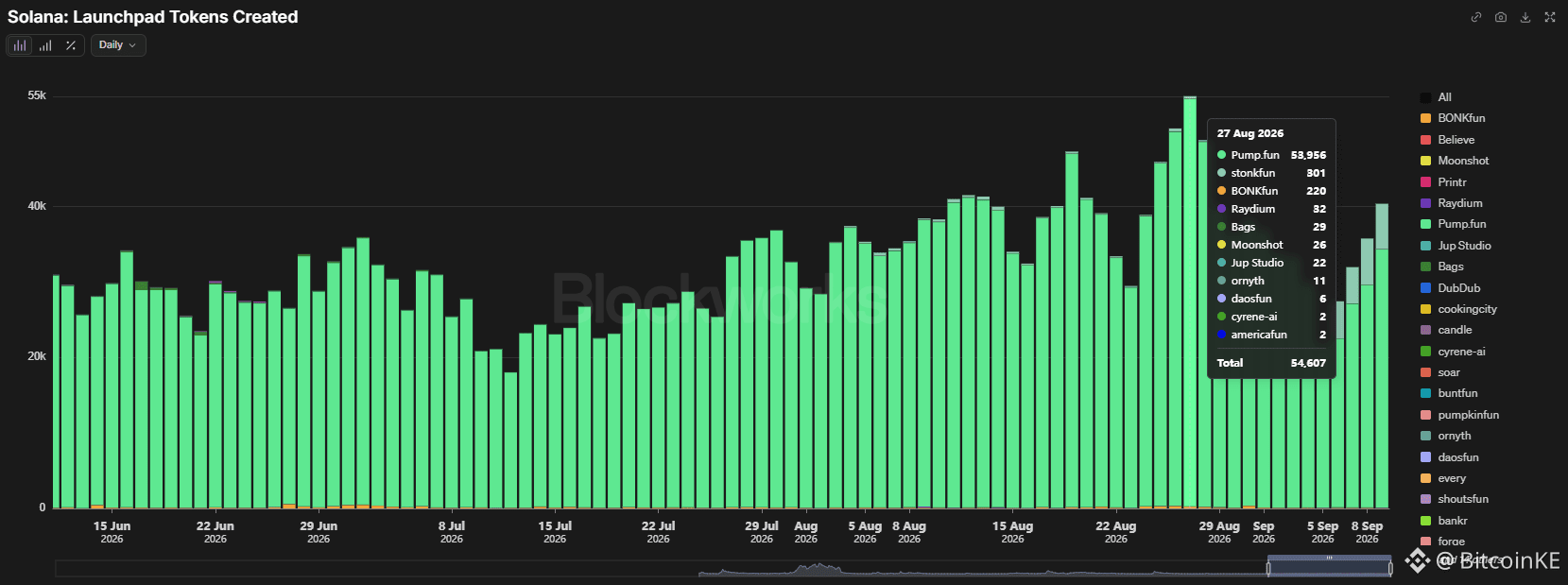
Article
MILESTONE | Solana Hits Record Token CreationSolana hit a record 263,000 new tokens issued in a single day underscoring the continued pace of token creation on the blockchain.
The surge comes as activity on Solana remains elevated.
The network processed a record 216 million non-vote transactions in one day in August 2026, while its
real-world asset value recently surpassed $4 billion across about 350,000 addresses,
according to the Solana Foundation.
Pump.fun is the leading Solana-native protocol with ~$1.8 million generated within 24hrs, briefly overtaking the Fomo trading app.
Overall, Pump.fun accounted for 1/3 of Q1 2026 revenue for Solana, which translates to $124 million out of $342 million total making it the largest revenue generator for the chain.
The latest figure stands in stack comparison to highs set in December 2024 during the Solana memecoin peak cycle when some 40-50,000 daily tokens were issued.
This One Single App Accounted for Over 1/3 of All Application Revenue on Solana Blockchain in Q1 2026
Sign up for BitKE alerts to get the latest updates on crypto globally.
Join our WhatsApp channel here.
Follow us on X for the latest posts and updates
Join and interact with our Telegram community
__________
MILESTONE | Solana Hits Record Token Creation
Solana hit a record 263,000 new tokens issued in a single day underscoring the continued pace of token creation on the blockchain.
The surge comes as activity on Solana remains elevated.
The network processed a record 216 million non-vote transactions in one day in August 2026, while its
real-world asset value recently surpassed $4 billion across about 350,000 addresses,
according to the Solana Foundation.
Pump.fun is the leading Solana-native protocol with ~$1.8 million generated within 24hrs, briefly overtaking the Fomo trading app.
Overall, Pump.fun accounted for 1/3 of Q1 2026 revenue for Solana, which translates to $124 million out of $342 million total making it the largest revenue generator for the chain.
The latest figure stands in stack comparison to highs set in December 2024 during the Solana memecoin peak cycle when some 40-50,000 daily tokens were issued.
This One Single App Accounted for Over 1/3 of All Application Revenue on Solana Blockchain in Q1 2026
Sign up for BitKE alerts to get the latest updates on crypto globally.
Join our WhatsApp channel here.
Follow us on X for the latest posts and updates
Join and interact with our Telegram community
__________
The surge comes as activity on Solana remains elevated.
The network processed a record 216 million non-vote transactions in one day in August 2026, while its
real-world asset value recently surpassed $4 billion across about 350,000 addresses,
according to the Solana Foundation.
Pump.fun is the leading Solana-native protocol with ~$1.8 million generated within 24hrs, briefly overtaking the Fomo trading app.
Overall, Pump.fun accounted for 1/3 of Q1 2026 revenue for Solana, which translates to $124 million out of $342 million total making it the largest revenue generator for the chain.
The latest figure stands in stack comparison to highs set in December 2024 during the Solana memecoin peak cycle when some 40-50,000 daily tokens were issued.
This One Single App Accounted for Over 1/3 of All Application Revenue on Solana Blockchain in Q1 2026
Sign up for BitKE alerts to get the latest updates on crypto globally.
Join our WhatsApp channel here.
Follow us on X for the latest posts and updates
Join and interact with our Telegram community
__________
154
·
--
CASE STUDY | the USDT Case for Distributed U.S. Debt Over Concentrated Foreign BuyersUSDT has grown into a global dollar network used by more than 530 million people giving the stablecoin issuer an unusual role in channeling demand for U.S. government debt.
Tether reported more than 530 million users at the end of 2025 while its latest market data showed the number of on-chain USDT holders alone had reached ~140 million, with more than 100 million additional users estimated to hold USDT through centralized exchanges.
That scale is central to Tether CEO Paolo Ardoino’s argument that USDT is effectively helping distribute U.S. debt ownership across hundreds of millions of users.
MILESTONE | U.S National Debt Surpasses $40 Trillion for First Time
Rather than those users directly buying Treasury bills, they hold USDT while Tether holds the underlying assets supporting the tokens. As of March 31, 2026, Tether reported about $141 billion of direct and indirect exposure to U.S. Treasury bills, while Reuters reported the company held about $117 billion in Treasury bills in its reserves.
The distinction matters.
The users are distributed across the world but the Treasury exposure remains concentrated on Tether’s balance sheet.
STABLECOINS | ‘We Have 400 Million Users in Emerging Markets – We’re Basically Pushing Dollar Hegemony, Selling U.S Debt Outside the U.S,’ Says Tether CEO
USDT holders therefore gain dollar exposure without individually owning Treasury securities while Tether earns income from the assets backing the tokens. The Bank for International Settlements (BIS) has highlighted the broader trend noting that stablecoin issuers’ holdings of Treasury bills have grown to levels comparable with those of large jurisdictions and government money-market funds.
EXPERT OPINION | If Stablecoins Just 5x from Today – Tether ($USDT) and Circle ($USDC) Become the #1 Buyers of U.S. Debt Worldwide
The model turns Tether into an intermediary between global dollar users and the U.S. Treasury market. Hundreds of millions of people create demand for USDT while Tether aggregates the resulting reserve pool into a concentrated Treasury portfolio.
That makes the distribution of the debt’s economic exposure much broader than the ownership of the securities themselves.
OPINION | Why Russia’s Claims About America’s Crypto Reset Plan Actually Make Sense
Stay tuned to BitKE on global economic developments.
Join our WhatsApp channel here.
Follow us on X for the latest posts and updates
Join and interact with our Telegram community
_______
CASE STUDY | the USDT Case for Distributed U.S. Debt Over Concentrated Foreign Buyers
USDT has grown into a global dollar network used by more than 530 million people giving the stablecoin issuer an unusual role in channeling demand for U.S. government debt.
Tether reported more than 530 million users at the end of 2025 while its latest market data showed the number of on-chain USDT holders alone had reached ~140 million, with more than 100 million additional users estimated to hold USDT through centralized exchanges.
That scale is central to Tether CEO Paolo Ardoino’s argument that USDT is effectively helping distribute U.S. debt ownership across hundreds of millions of users.
MILESTONE | U.S National Debt Surpasses $40 Trillion for First Time
Rather than those users directly buying Treasury bills, they hold USDT while Tether holds the underlying assets supporting the tokens. As of March 31, 2026, Tether reported about $141 billion of direct and indirect exposure to U.S. Treasury bills, while Reuters reported the company held about $117 billion in Treasury bills in its reserves.
The distinction matters.
The users are distributed across the world but the Treasury exposure remains concentrated on Tether’s balance sheet.
STABLECOINS | ‘We Have 400 Million Users in Emerging Markets – We’re Basically Pushing Dollar Hegemony, Selling U.S Debt Outside the U.S,’ Says Tether CEO
USDT holders therefore gain dollar exposure without individually owning Treasury securities while Tether earns income from the assets backing the tokens. The Bank for International Settlements (BIS) has highlighted the broader trend noting that stablecoin issuers’ holdings of Treasury bills have grown to levels comparable with those of large jurisdictions and government money-market funds.
EXPERT OPINION | If Stablecoins Just 5x from Today – Tether ($USDT) and Circle ($USDC) Become the #1 Buyers of U.S. Debt Worldwide
The model turns Tether into an intermediary between global dollar users and the U.S. Treasury market. Hundreds of millions of people create demand for USDT while Tether aggregates the resulting reserve pool into a concentrated Treasury portfolio.
That makes the distribution of the debt’s economic exposure much broader than the ownership of the securities themselves.
OPINION | Why Russia’s Claims About America’s Crypto Reset Plan Actually Make Sense
Stay tuned to BitKE on global economic developments.
Join our WhatsApp channel here.
Follow us on X for the latest posts and updates
Join and interact with our Telegram community
_______
Tether reported more than 530 million users at the end of 2025 while its latest market data showed the number of on-chain USDT holders alone had reached ~140 million, with more than 100 million additional users estimated to hold USDT through centralized exchanges.
That scale is central to Tether CEO Paolo Ardoino’s argument that USDT is effectively helping distribute U.S. debt ownership across hundreds of millions of users.
MILESTONE | U.S National Debt Surpasses $40 Trillion for First Time
Rather than those users directly buying Treasury bills, they hold USDT while Tether holds the underlying assets supporting the tokens. As of March 31, 2026, Tether reported about $141 billion of direct and indirect exposure to U.S. Treasury bills, while Reuters reported the company held about $117 billion in Treasury bills in its reserves.
The distinction matters.
The users are distributed across the world but the Treasury exposure remains concentrated on Tether’s balance sheet.
STABLECOINS | ‘We Have 400 Million Users in Emerging Markets – We’re Basically Pushing Dollar Hegemony, Selling U.S Debt Outside the U.S,’ Says Tether CEO
USDT holders therefore gain dollar exposure without individually owning Treasury securities while Tether earns income from the assets backing the tokens. The Bank for International Settlements (BIS) has highlighted the broader trend noting that stablecoin issuers’ holdings of Treasury bills have grown to levels comparable with those of large jurisdictions and government money-market funds.
EXPERT OPINION | If Stablecoins Just 5x from Today – Tether ($USDT) and Circle ($USDC) Become the #1 Buyers of U.S. Debt Worldwide
The model turns Tether into an intermediary between global dollar users and the U.S. Treasury market. Hundreds of millions of people create demand for USDT while Tether aggregates the resulting reserve pool into a concentrated Treasury portfolio.
That makes the distribution of the debt’s economic exposure much broader than the ownership of the securities themselves.
OPINION | Why Russia’s Claims About America’s Crypto Reset Plan Actually Make Sense
Stay tuned to BitKE on global economic developments.
Join our WhatsApp channel here.
Follow us on X for the latest posts and updates
Join and interact with our Telegram community
_______
56
·
--
REGULATION | the Singapore Exchange (SGX) Gets CFTC Authorization to Offer Bitcoin, Ether Perps t...Singapore Exchange (SGX) has opened its Bitcoin and Ether perpetual futures contracts to U.S. institutional investors expanding access to regulated crypto derivatives as traditional financial firms increase their participation in digital assets.
The contracts, which trade without an expiry date, were launched by SGX in November 2025 and are designed for institutional, accredited and expert investors. SGX said the products provide exchange-traded clearing, margining and risk-management standards for cryptocurrency derivatives.
The move gives U.S. institutions another venue for trading bitcoin and ether derivatives outside U.S. exchanges while extending SGX’s push to build institutional crypto markets.
“[This is] an important milestone [that] bridges the U.S. TradFi participants trading cyrpto futures with Asian liquidity pools [and] legitimizes crypto derivatives as a regulated asset class,” said KC Lam, Head of Crypto Derivatives at SGX Group.
INTRODUCING | Coinbase Launches First Major Crypto-Native Platform to Offer Direct Native Crypto Futures in Canada
Regulation 48.10 is the framework under which the U.S. Commodity Futures Trading Commission allows a registered Foreign Board of Trade (FBOT), an overseas exchange recognized by the CFTC, to give U.S. participants direct access to its trading system without the exchange needing to separately register as a full U.S.-regulated exchange.
In effect, it allows qualifying foreign platforms to open their existing order books to U.S. institutional traders under CFTC oversight rather than requiring a new, standalone U.S. listing.
The SGX Bitcoin and Ether perpetuals are being used for both macro-driven directional bets and arbitrage strategies, including trades that exploit differences in funding rates and prices across venues. Unlike crypto-native perpetuals, SGX’s contracts have no expiry but use traditional margin calls and top-up collateral rather than automatic liquidations, aiming to reduce forced position closures during sharp market moves.
The products also separate trading and clearing, with clearing members acting as an intermediate risk buffer, similar to traditional futures markets. SGX does not accept stablecoins as collateral, citing the risk that they could lose their peg during periods of market volatility.
EXPLAINER | Understanding Crypto Futures and Where You Can Trade
Since their launch in November 2025, SGX crypto perpetual futures for both Bitcoin and Ether have recorded ~$5.8 billion in cumulative traded volume with Bitcoin accounting for:
66% open interest
83% daily average volume
with the highest single-day volume hitting $145 million in notional value.
SGX said its bitcoin and ether perpetual futures are intended to bring the structure and risk controls of listed derivatives to products that are widely used in crypto markets.
“The next step in our pipeline is launching dated futures and options for Bitcoin and Ethereum.
Developing that heavy-duty infrastructure is the major lift; once in place, adding other major coins may become a straightforward process like adding another contract.
We plan to broaden our offerings but we are taking a disciplined, step-by-step approach,” Lam said.
REALITY CHECK | The Polymarket Derivatives Paradox – 20x Leverage Not for America, OK for the World
Stay tuned to BitKE for deeper insights into the global crypto regulatory space.
Join our WhatsApp channel here.
Follow us on X for the latest posts and updates
Join and interact with our Telegram community
________
REGULATION | the Singapore Exchange (SGX) Gets CFTC Authorization to Offer Bitcoin, Ether Perps t...
Singapore Exchange (SGX) has opened its Bitcoin and Ether perpetual futures contracts to U.S. institutional investors expanding access to regulated crypto derivatives as traditional financial firms increase their participation in digital assets.
The contracts, which trade without an expiry date, were launched by SGX in November 2025 and are designed for institutional, accredited and expert investors. SGX said the products provide exchange-traded clearing, margining and risk-management standards for cryptocurrency derivatives.
The move gives U.S. institutions another venue for trading bitcoin and ether derivatives outside U.S. exchanges while extending SGX’s push to build institutional crypto markets.
“[This is] an important milestone [that] bridges the U.S. TradFi participants trading cyrpto futures with Asian liquidity pools [and] legitimizes crypto derivatives as a regulated asset class,” said KC Lam, Head of Crypto Derivatives at SGX Group.
INTRODUCING | Coinbase Launches First Major Crypto-Native Platform to Offer Direct Native Crypto Futures in Canada
Regulation 48.10 is the framework under which the U.S. Commodity Futures Trading Commission allows a registered Foreign Board of Trade (FBOT), an overseas exchange recognized by the CFTC, to give U.S. participants direct access to its trading system without the exchange needing to separately register as a full U.S.-regulated exchange.
In effect, it allows qualifying foreign platforms to open their existing order books to U.S. institutional traders under CFTC oversight rather than requiring a new, standalone U.S. listing.
The SGX Bitcoin and Ether perpetuals are being used for both macro-driven directional bets and arbitrage strategies, including trades that exploit differences in funding rates and prices across venues. Unlike crypto-native perpetuals, SGX’s contracts have no expiry but use traditional margin calls and top-up collateral rather than automatic liquidations, aiming to reduce forced position closures during sharp market moves.
The products also separate trading and clearing, with clearing members acting as an intermediate risk buffer, similar to traditional futures markets. SGX does not accept stablecoins as collateral, citing the risk that they could lose their peg during periods of market volatility.
EXPLAINER | Understanding Crypto Futures and Where You Can Trade
Since their launch in November 2025, SGX crypto perpetual futures for both Bitcoin and Ether have recorded ~$5.8 billion in cumulative traded volume with Bitcoin accounting for:
66% open interest
83% daily average volume
with the highest single-day volume hitting $145 million in notional value.
SGX said its bitcoin and ether perpetual futures are intended to bring the structure and risk controls of listed derivatives to products that are widely used in crypto markets.
“The next step in our pipeline is launching dated futures and options for Bitcoin and Ethereum.
Developing that heavy-duty infrastructure is the major lift; once in place, adding other major coins may become a straightforward process like adding another contract.
We plan to broaden our offerings but we are taking a disciplined, step-by-step approach,” Lam said.
REALITY CHECK | The Polymarket Derivatives Paradox – 20x Leverage Not for America, OK for the World
Stay tuned to BitKE for deeper insights into the global crypto regulatory space.
Join our WhatsApp channel here.
Follow us on X for the latest posts and updates
Join and interact with our Telegram community
________
The contracts, which trade without an expiry date, were launched by SGX in November 2025 and are designed for institutional, accredited and expert investors. SGX said the products provide exchange-traded clearing, margining and risk-management standards for cryptocurrency derivatives.
The move gives U.S. institutions another venue for trading bitcoin and ether derivatives outside U.S. exchanges while extending SGX’s push to build institutional crypto markets.
“[This is] an important milestone [that] bridges the U.S. TradFi participants trading cyrpto futures with Asian liquidity pools [and] legitimizes crypto derivatives as a regulated asset class,” said KC Lam, Head of Crypto Derivatives at SGX Group.
INTRODUCING | Coinbase Launches First Major Crypto-Native Platform to Offer Direct Native Crypto Futures in Canada
Regulation 48.10 is the framework under which the U.S. Commodity Futures Trading Commission allows a registered Foreign Board of Trade (FBOT), an overseas exchange recognized by the CFTC, to give U.S. participants direct access to its trading system without the exchange needing to separately register as a full U.S.-regulated exchange.
In effect, it allows qualifying foreign platforms to open their existing order books to U.S. institutional traders under CFTC oversight rather than requiring a new, standalone U.S. listing.
The SGX Bitcoin and Ether perpetuals are being used for both macro-driven directional bets and arbitrage strategies, including trades that exploit differences in funding rates and prices across venues. Unlike crypto-native perpetuals, SGX’s contracts have no expiry but use traditional margin calls and top-up collateral rather than automatic liquidations, aiming to reduce forced position closures during sharp market moves.
The products also separate trading and clearing, with clearing members acting as an intermediate risk buffer, similar to traditional futures markets. SGX does not accept stablecoins as collateral, citing the risk that they could lose their peg during periods of market volatility.
EXPLAINER | Understanding Crypto Futures and Where You Can Trade
Since their launch in November 2025, SGX crypto perpetual futures for both Bitcoin and Ether have recorded ~$5.8 billion in cumulative traded volume with Bitcoin accounting for:
66% open interest
83% daily average volume
with the highest single-day volume hitting $145 million in notional value.
SGX said its bitcoin and ether perpetual futures are intended to bring the structure and risk controls of listed derivatives to products that are widely used in crypto markets.
“The next step in our pipeline is launching dated futures and options for Bitcoin and Ethereum.
Developing that heavy-duty infrastructure is the major lift; once in place, adding other major coins may become a straightforward process like adding another contract.
We plan to broaden our offerings but we are taking a disciplined, step-by-step approach,” Lam said.
REALITY CHECK | The Polymarket Derivatives Paradox – 20x Leverage Not for America, OK for the World
Stay tuned to BitKE for deeper insights into the global crypto regulatory space.
Join our WhatsApp channel here.
Follow us on X for the latest posts and updates
Join and interact with our Telegram community
________
85
·
--
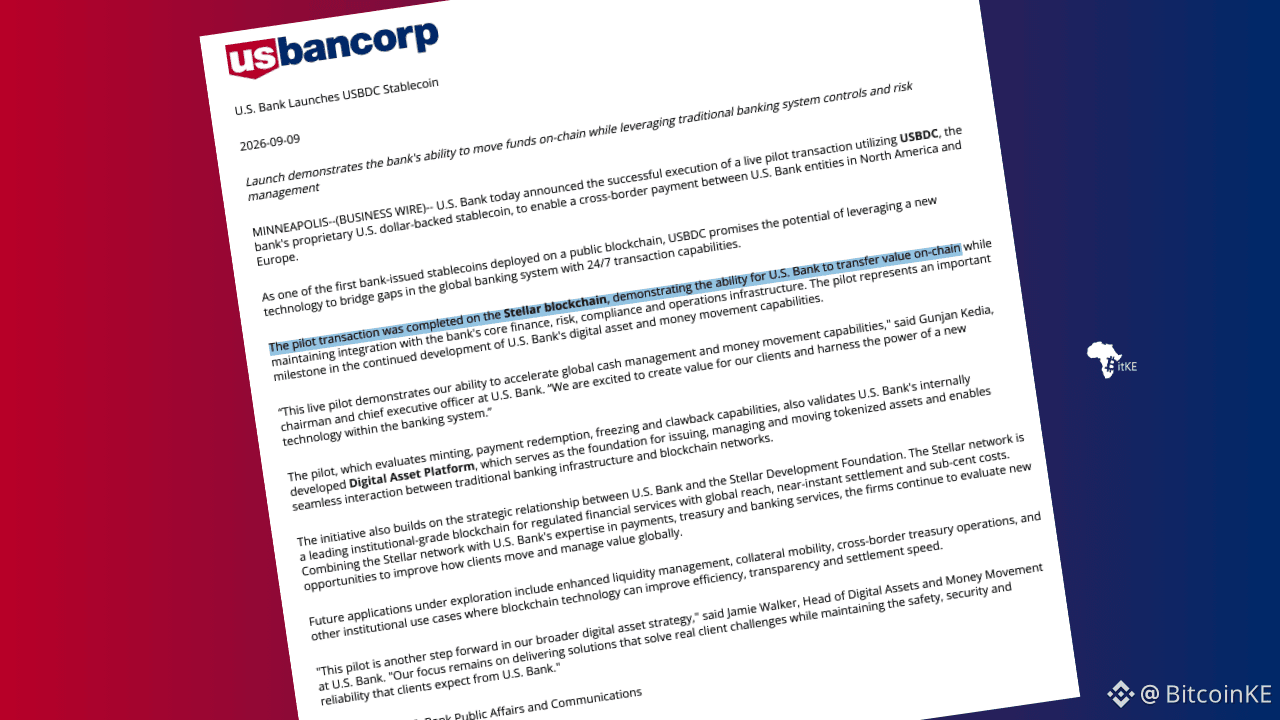
Article
CASE STUDY | One of the First Bank-Issued Stablecoins Successfully Piloted on a Public BlockchainU.S. Bank has completed a live cross-border payment using USBDC, its proprietary U.S. dollar-backed stablecoin, marking a step toward using blockchain infrastructure for institutional money movement.
The transaction moved funds between U.S. Bank entities in North America and Europe through the Stellar blockchain while remaining connected to the bank’s existing finance, risk, compliance, and operations systems.
According to a statement from the bank:
The pilot demonstrated the ability for U.S. Bank to transfer value value on-chain . . . and represents an important milestone in the continued development of U.S. Bank’s digital asset and money movement capabilities.
The pilot tested USBDC’s ability to
mint,
transfer,
redeem,
freeze, and
claw back
the stablecoin.
U.S. Bank said the transaction also validated its internally developed Digital Asset Platform for issuing, managing, and moving tokenized assets across blockchain networks.
“This live pilot demonstrates our ability to accelerate global cash management and money movement capabilities,” said Gunjan Kedia, Chairman and CEO at U.S. Bank.
“We are excited to create value for our clients and harness the power of a new technology within the banking system.”
STABLECOINS | MoneyGram Launches the MGUSD Stablecoin on the Stellar Blockchain
The bank is exploring additional applications including
liquidity management,
collateral mobility, and
cross-border treasury operations.
The move puts a traditional bank-issued stablecoin into a live payments setting rather than limiting the technology to a digital-asset experiment as banks increasingly examine on-chain rails for moving dollars around the global financial system.
“This pilot is another step forward in our broader digital asset strategy,” said Jamie Walker, Head of Digital Assets and Money Movement at U.S. Bank.
“Our focus remains on delivering solutions that solve real client challenges while maintaining the safety, security and reliability that clients expect from U.S. Bank.”
STABLECOINS | Standard Bank Becomes Only African Bank in Global Stablecoin Consortium
Stay tuned to BitKE on stablecoin developments globally.
Join our WhatsApp channel here.
Follow us on X for the latest posts and updates
Join and interact with our Telegram community
__________
CASE STUDY | One of the First Bank-Issued Stablecoins Successfully Piloted on a Public Blockchain
U.S. Bank has completed a live cross-border payment using USBDC, its proprietary U.S. dollar-backed stablecoin, marking a step toward using blockchain infrastructure for institutional money movement.
The transaction moved funds between U.S. Bank entities in North America and Europe through the Stellar blockchain while remaining connected to the bank’s existing finance, risk, compliance, and operations systems.
According to a statement from the bank:
The pilot demonstrated the ability for U.S. Bank to transfer value value on-chain . . . and represents an important milestone in the continued development of U.S. Bank’s digital asset and money movement capabilities.
The pilot tested USBDC’s ability to
mint,
transfer,
redeem,
freeze, and
claw back
the stablecoin.
U.S. Bank said the transaction also validated its internally developed Digital Asset Platform for issuing, managing, and moving tokenized assets across blockchain networks.
“This live pilot demonstrates our ability to accelerate global cash management and money movement capabilities,” said Gunjan Kedia, Chairman and CEO at U.S. Bank.
“We are excited to create value for our clients and harness the power of a new technology within the banking system.”
STABLECOINS | MoneyGram Launches the MGUSD Stablecoin on the Stellar Blockchain
The bank is exploring additional applications including
liquidity management,
collateral mobility, and
cross-border treasury operations.
The move puts a traditional bank-issued stablecoin into a live payments setting rather than limiting the technology to a digital-asset experiment as banks increasingly examine on-chain rails for moving dollars around the global financial system.
“This pilot is another step forward in our broader digital asset strategy,” said Jamie Walker, Head of Digital Assets and Money Movement at U.S. Bank.
“Our focus remains on delivering solutions that solve real client challenges while maintaining the safety, security and reliability that clients expect from U.S. Bank.”
STABLECOINS | Standard Bank Becomes Only African Bank in Global Stablecoin Consortium
Stay tuned to BitKE on stablecoin developments globally.
Join our WhatsApp channel here.
Follow us on X for the latest posts and updates
Join and interact with our Telegram community
__________
The transaction moved funds between U.S. Bank entities in North America and Europe through the Stellar blockchain while remaining connected to the bank’s existing finance, risk, compliance, and operations systems.
According to a statement from the bank:
The pilot demonstrated the ability for U.S. Bank to transfer value value on-chain . . . and represents an important milestone in the continued development of U.S. Bank’s digital asset and money movement capabilities.
The pilot tested USBDC’s ability to
mint,
transfer,
redeem,
freeze, and
claw back
the stablecoin.
U.S. Bank said the transaction also validated its internally developed Digital Asset Platform for issuing, managing, and moving tokenized assets across blockchain networks.
“This live pilot demonstrates our ability to accelerate global cash management and money movement capabilities,” said Gunjan Kedia, Chairman and CEO at U.S. Bank.
“We are excited to create value for our clients and harness the power of a new technology within the banking system.”
STABLECOINS | MoneyGram Launches the MGUSD Stablecoin on the Stellar Blockchain
The bank is exploring additional applications including
liquidity management,
collateral mobility, and
cross-border treasury operations.
The move puts a traditional bank-issued stablecoin into a live payments setting rather than limiting the technology to a digital-asset experiment as banks increasingly examine on-chain rails for moving dollars around the global financial system.
“This pilot is another step forward in our broader digital asset strategy,” said Jamie Walker, Head of Digital Assets and Money Movement at U.S. Bank.
“Our focus remains on delivering solutions that solve real client challenges while maintaining the safety, security and reliability that clients expect from U.S. Bank.”
STABLECOINS | Standard Bank Becomes Only African Bank in Global Stablecoin Consortium
Stay tuned to BitKE on stablecoin developments globally.
Join our WhatsApp channel here.
Follow us on X for the latest posts and updates
Join and interact with our Telegram community
__________
85
Log in to explore more content
Join global crypto users on Binance Square
⚡️ Get latest and useful information about crypto.
💬 Trusted by the world’s largest crypto exchange.
👍 Discover real insights from verified creators.
Email / Phone number
Trending Topics
FedRateWatch
302,823 views
1,879 Discussing
Share & Win Traffic Reward in our Trending Hashtag Campaign
✨Topic: FOMC September, What's The Fed's Next Move?
👉How to Join:
Publish a short post or article with hashtag #FedRateWatch
Create content based on the below angles:
- August core CPI rose 0.3% month-over-month, and the odds of a 25bp hike this week are now close to 90%. Do you anticipate a rate hike this week? Is it a one-off, or the start of a longer hiking cycle?
- If the hike lands, how does it play out for BTC, tech stocks, and gold? Bullish or bearish?
- How are you planning to trade next? Share your BTC, stocks or gold trade/holdings with our trade sharing widget.
⏰Campaign Period:
- 2026-09-15 11:00 - 2026-09-17 3:00 UTC
🎁Reward:
- Qualified posts that comply with the above guidelines and contain more than 100 words will be reviewed and may receive a random traffic boost of 500 to 3,000 views. You will receive a notification from your feed secretary if your post is selected.
- Get a chance to have your article featured on Binance Square Official
Need ideas for your post? Visit the topic page #FedRateWatch or the Square Guide on How to Post for Better Reach.
Binance Square Official
·318 Likes
·579.3k views
BitcoinSlidesTo$76000
5,181 views
66 Discussing
BitcoinReboundsTo$79K
52,436 views
368 Discussing