
BestEthan
375 Posts

BestEthan
Report
Block User
Eth/WLFI 夜晚就会变身为利弗莫尔!
Open Trade
Frequent Trader
5.7 Years
50 Following
191 Followers
143 Liked
Posts
Portfolio
All
Quotes
Videos
·
--
Second-wave withdrawal calendar: November 3.
The first phase opened 15 networks. Update #5 says the next phase is planned for 11/3, with a gradual rollout. The specific asset and network list hasn’t been released yet, so don’t make one up.
Just keep an eye on the official withdrawal page and network status. Once the list is out, check which assets can be withdrawn in the next wave.
$BNB $BTC $ETH
Second-wave withdrawal calendar: November 3.
The first phase opened 15 networks. Update #5 says the next phase is planned for 11/3, with a gradual rollout. The specific asset and network list hasn’t been released yet, so don’t make one up.
Just keep an eye on the official withdrawal page and network status. Once the list is out, check which assets can be withdrawn in the next wave.
$BNB $BTC $ETH
The first phase opened 15 networks. Update #5 says the next phase is planned for 11/3, with a gradual rollout. The specific asset and network list hasn’t been released yet, so don’t make one up.
Just keep an eye on the official withdrawal page and network status. Once the list is out, check which assets can be withdrawn in the next wave.
$BNB $BTC $ETH
284
·
--
The zk proofs for ten coins have been confirmed as generated.
For the October 31, 00:00 UTC PoR snapshot, the official announcement says the full zero-knowledge proof run is complete. BTC, ETH, USDT, BNB, SOL, USDC, XRP, USD1, RLUSD, ZEC—log in to the PoR page and download the verifier. If you hold any of these in your account, check for yourself whether the ratio is at least 1:1.
The part of the platform’s advance-funding commitment that can be publicly verified is now available as a tool. See the official PoR page and FAQ for the steps.
$BNB $BTC $ETH
The zk proofs for ten coins have been confirmed as generated.
For the October 31, 00:00 UTC PoR snapshot, the official announcement says the full zero-knowledge proof run is complete. BTC, ETH, USDT, BNB, SOL, USDC, XRP, USD1, RLUSD, ZEC—log in to the PoR page and download the verifier. If you hold any of these in your account, check for yourself whether the ratio is at least 1:1.
The part of the platform’s advance-funding commitment that can be publicly verified is now available as a tool. See the official PoR page and FAQ for the steps.
$BNB $BTC $ETH
For the October 31, 00:00 UTC PoR snapshot, the official announcement says the full zero-knowledge proof run is complete. BTC, ETH, USDT, BNB, SOL, USDC, XRP, USD1, RLUSD, ZEC—log in to the PoR page and download the verifier. If you hold any of these in your account, check for yourself whether the ratio is at least 1:1.
The part of the platform’s advance-funding commitment that can be publicly verified is now available as a tool. See the official PoR page and FAQ for the steps.
$BNB $BTC $ETH
288
·
--
The on-chain US stocks market just got bigger.
According to Bitquery, as of October 31, tokenized stocks from six issuers totaled around $3.2 billion. Binance bStocks accounted for about $1.31 billion, or roughly 41%, with most still sitting in wallets Binance holds in custody for users. Launched in June, they reached the top tier in just a few months.
To be clear: bStocks are tokenized certificates backed by underlying shares held in custody, but holding the tokens is not the same as directly owning the shares. Read the product documentation before trading.
$BNB $TSLA $NVDA
The on-chain US stocks market just got bigger.
According to Bitquery, as of October 31, tokenized stocks from six issuers totaled around $3.2 billion. Binance bStocks accounted for about $1.31 billion, or roughly 41%, with most still sitting in wallets Binance holds in custody for users. Launched in June, they reached the top tier in just a few months.
To be clear: bStocks are tokenized certificates backed by underlying shares held in custody, but holding the tokens is not the same as directly owning the shares. Read the product documentation before trading.
$BNB $TSLA $NVDA
According to Bitquery, as of October 31, tokenized stocks from six issuers totaled around $3.2 billion. Binance bStocks accounted for about $1.31 billion, or roughly 41%, with most still sitting in wallets Binance holds in custody for users. Launched in June, they reached the top tier in just a few months.
To be clear: bStocks are tokenized certificates backed by underlying shares held in custody, but holding the tokens is not the same as directly owning the shares. Read the product documentation before trading.
$BNB $TSLA $NVDA
192
·
--
CZ’s exact words are blunt: withdrawals had been open for about 12 hours, with net outflows of 2.1%, most of which happened in the first few hours; “98% choose to stay.” Original post: https://x.com/cz_binance/status/2116954044988354798
Compare that with the figures for the official window: about $4.65 billion withdrawn and about $1.01 billion deposited, for net outflows of about $3.64 billion. Against roughly $171 billion in assets, that works out to about 2.1%. So that 98% refers to the asset retention rate—don’t automatically read it as “98% of users.” The number of users isn’t broken down in this data.
That’s all the facts. This post won’t get into conspiracy theories or insider stories.
$BNB $BTC $ETH
CZ’s exact words are blunt: withdrawals had been open for about 12 hours, with net outflows of 2.1%, most of which happened in the first few hours; “98% choose to stay.” Original post: https://x.com/cz_binance/status/2116954044988354798
Compare that with the figures for the official window: about $4.65 billion withdrawn and about $1.01 billion deposited, for net outflows of about $3.64 billion. Against roughly $171 billion in assets, that works out to about 2.1%. So that 98% refers to the asset retention rate—don’t automatically read it as “98% of users.” The number of users isn’t broken down in this data.
That’s all the facts. This post won’t get into conspiracy theories or insider stories.
$BNB $BTC $ETH
Compare that with the figures for the official window: about $4.65 billion withdrawn and about $1.01 billion deposited, for net outflows of about $3.64 billion. Against roughly $171 billion in assets, that works out to about 2.1%. So that 98% refers to the asset retention rate—don’t automatically read it as “98% of users.” The number of users isn’t broken down in this data.
That’s all the facts. This post won’t get into conspiracy theories or insider stories.
$BNB $BTC $ETH
312
·
--
When it comes to proof of reserves, just keep an eye on the calendar.
The snapshot for October 31 at 00:00 UTC is now up on the PoR page, and the major assets are still hovering around 100% by the official figures. The full zk-SNARK was originally slated for Monday (11/2), but multiple reports later moved it to around November 3 UTC—it takes 40–50 hours to generate, and if the computing power can’t keep up, they’ll push it back by a day.
A snapshot is just a snapshot; a full zero-knowledge proof is a different level. That’s where the gap in expectations lies: first check the address list and snapshot, then wait for Tuesday’s proof, which can verify the balances on its own, to land.
$BNB $BTC $ETH
When it comes to proof of reserves, just keep an eye on the calendar.
The snapshot for October 31 at 00:00 UTC is now up on the PoR page, and the major assets are still hovering around 100% by the official figures. The full zk-SNARK was originally slated for Monday (11/2), but multiple reports later moved it to around November 3 UTC—it takes 40–50 hours to generate, and if the computing power can’t keep up, they’ll push it back by a day.
A snapshot is just a snapshot; a full zero-knowledge proof is a different level. That’s where the gap in expectations lies: first check the address list and snapshot, then wait for Tuesday’s proof, which can verify the balances on its own, to land.
$BNB $BTC $ETH
The snapshot for October 31 at 00:00 UTC is now up on the PoR page, and the major assets are still hovering around 100% by the official figures. The full zk-SNARK was originally slated for Monday (11/2), but multiple reports later moved it to around November 3 UTC—it takes 40–50 hours to generate, and if the computing power can’t keep up, they’ll push it back by a day.
A snapshot is just a snapshot; a full zero-knowledge proof is a different level. That’s where the gap in expectations lies: first check the address list and snapshot, then wait for Tuesday’s proof, which can verify the balances on its own, to land.
$BNB $BTC $ETH
241
·
--
First day of the floodgates opening—here are the numbers.
From 06:00 to 15:30 UTC on November 1, Binance processed about $4.65 billion in withdrawals and about $1.01 billion in deposits, for a net outflow of about $3.64 billion. That’s roughly 2.1% of the approximately $171 billion in AUM reported under the October 28 PoR figures.
The first phase saw 15 networks come online one by one. The official word is that withdrawals have eased and stabilized after an initial spike, while deposits have also been substantial. Trust isn’t built by words—it’s whether you can get your funds out that really matters. Don’t let the “big numbers” scare you off: look at the proportion first, then see whether things remain stable over the next few days.
$BNB $BTC $ETH
First day of the floodgates opening—here are the numbers.
From 06:00 to 15:30 UTC on November 1, Binance processed about $4.65 billion in withdrawals and about $1.01 billion in deposits, for a net outflow of about $3.64 billion. That’s roughly 2.1% of the approximately $171 billion in AUM reported under the October 28 PoR figures.
The first phase saw 15 networks come online one by one. The official word is that withdrawals have eased and stabilized after an initial spike, while deposits have also been substantial. Trust isn’t built by words—it’s whether you can get your funds out that really matters. Don’t let the “big numbers” scare you off: look at the proportion first, then see whether things remain stable over the next few days.
$BNB $BTC $ETH
From 06:00 to 15:30 UTC on November 1, Binance processed about $4.65 billion in withdrawals and about $1.01 billion in deposits, for a net outflow of about $3.64 billion. That’s roughly 2.1% of the approximately $171 billion in AUM reported under the October 28 PoR figures.
The first phase saw 15 networks come online one by one. The official word is that withdrawals have eased and stabilized after an initial spike, while deposits have also been substantial. Trust isn’t built by words—it’s whether you can get your funds out that really matters. Don’t let the “big numbers” scare you off: look at the proportion first, then see whether things remain stable over the next few days.
$BNB $BTC $ETH
78
·
--
This wave of North Korean hackers is escalating—the cases just keep getting bigger.
In 2022, the Ronin bridge: about $620 million. The Harmony bridge was breached that same year. In 2023, Atomic Wallet: about $100 million. In 2024, DMM Bitcoin: about $300 million. In 2025, Bybit: $1.5 billion—and the FBI had already linked it to TraderTraitor.
On October 29, it was Binance’s turn. Multichain hot wallets, about 20 minutes, and roughly $6.3 billion moved out. On October 31, the FBI officially named the same North Korean group, TraderTraitor, linking them to the Bybit crew.
Binance’s position: the platform is covering the losses itself—with its own funds plus SAFU, bringing compensation to around 95% so far. Withdrawals have reopened in stages. Stablecoin issuers froze about $3 billion, but frozen doesn’t mean recovered. The hackers are still swapping into ETH and laundering funds across chains, while the FBI urges the entire industry to block the addresses.
From bridges to wallets to the world’s largest exchange—the same crew’s escalation path is right there. It’s officially confirmed, and the laundering is still ongoing.
$BNB $BTC $ETH
This wave of North Korean hackers is escalating—the cases just keep getting bigger.
In 2022, the Ronin bridge: about $620 million. The Harmony bridge was breached that same year. In 2023, Atomic Wallet: about $100 million. In 2024, DMM Bitcoin: about $300 million. In 2025, Bybit: $1.5 billion—and the FBI had already linked it to TraderTraitor.
On October 29, it was Binance’s turn. Multichain hot wallets, about 20 minutes, and roughly $6.3 billion moved out. On October 31, the FBI officially named the same North Korean group, TraderTraitor, linking them to the Bybit crew.
Binance’s position: the platform is covering the losses itself—with its own funds plus SAFU, bringing compensation to around 95% so far. Withdrawals have reopened in stages. Stablecoin issuers froze about $3 billion, but frozen doesn’t mean recovered. The hackers are still swapping into ETH and laundering funds across chains, while the FBI urges the entire industry to block the addresses.
From bridges to wallets to the world’s largest exchange—the same crew’s escalation path is right there. It’s officially confirmed, and the laundering is still ongoing.
$BNB $BTC $ETH
In 2022, the Ronin bridge: about $620 million. The Harmony bridge was breached that same year. In 2023, Atomic Wallet: about $100 million. In 2024, DMM Bitcoin: about $300 million. In 2025, Bybit: $1.5 billion—and the FBI had already linked it to TraderTraitor.
On October 29, it was Binance’s turn. Multichain hot wallets, about 20 minutes, and roughly $6.3 billion moved out. On October 31, the FBI officially named the same North Korean group, TraderTraitor, linking them to the Bybit crew.
Binance’s position: the platform is covering the losses itself—with its own funds plus SAFU, bringing compensation to around 95% so far. Withdrawals have reopened in stages. Stablecoin issuers froze about $3 billion, but frozen doesn’t mean recovered. The hackers are still swapping into ETH and laundering funds across chains, while the FBI urges the entire industry to block the addresses.
From bridges to wallets to the world’s largest exchange—the same crew’s escalation path is right there. It’s officially confirmed, and the laundering is still ongoing.
$BNB $BTC $ETH
1
599
·
--
Private keys should no longer be kept “whole on a single machine.”
Google Cloud **Multi-party Compute (MPC)** is entering private preview for institutions: threshold signing + a transaction policy engine—the full private key is never assembled in one location; before signing, transactions must pass institutional rules (limits, addresses, multi-level approvals, etc.).
Commercial launch target: **early 2027**; documentation supports secp256k1 (BTC/ETH, etc.), with Ed25519 (Solana) on the roadmap.
This addresses custody and signing architecture, not a substitute for reviewing any specific exchange incident.
But when the risk of a “single-point hot wallet” makes the news, institutions will ask sooner: how many pieces is your key split into, how many parties are involved, and who can sign alone?
Would you treat MPC as standard, or still trust only a self-built HSM?
#GoogleToPreviewCryptoCustodySecuritySystem
Private keys should no longer be kept “whole on a single machine.”
Google Cloud **Multi-party Compute (MPC)** is entering private preview for institutions: threshold signing + a transaction policy engine—the full private key is never assembled in one location; before signing, transactions must pass institutional rules (limits, addresses, multi-level approvals, etc.).
Commercial launch target: **early 2027**; documentation supports secp256k1 (BTC/ETH, etc.), with Ed25519 (Solana) on the roadmap.
This addresses custody and signing architecture, not a substitute for reviewing any specific exchange incident.
But when the risk of a “single-point hot wallet” makes the news, institutions will ask sooner: how many pieces is your key split into, how many parties are involved, and who can sign alone?
Would you treat MPC as standard, or still trust only a self-built HSM?
#GoogleToPreviewCryptoCustodySecuritySystem
Google Cloud **Multi-party Compute (MPC)** is entering private preview for institutions: threshold signing + a transaction policy engine—the full private key is never assembled in one location; before signing, transactions must pass institutional rules (limits, addresses, multi-level approvals, etc.).
Commercial launch target: **early 2027**; documentation supports secp256k1 (BTC/ETH, etc.), with Ed25519 (Solana) on the roadmap.
This addresses custody and signing architecture, not a substitute for reviewing any specific exchange incident.
But when the risk of a “single-point hot wallet” makes the news, institutions will ask sooner: how many pieces is your key split into, how many parties are involved, and who can sign alone?
Would you treat MPC as standard, or still trust only a self-built HSM?
#GoogleToPreviewCryptoCustodySecuritySystem
GOOGUS+0.88%
62
·
--
The real flashpoint this earnings season: the AI compute bill—and who gets their money back first.
Publicly disclosed figures this round (company disclosures):
• $MSFT: Azure quarterly revenue of about **$33.2 billion**, up about **48%** year over year (the first time the company has emphasized Azure in dollar terms)
• $GOOGL: Google Cloud at about **$30.7 billion**, up about **103%** year over year; Alphabet maintained its high capex guidance range
Both are showing that “the cloud is still accelerating,” and both are being pressed on whether “investment will weigh on free cash flow.”
The crypto-side read: the pricing anchor for risk assets is still the capex pace of U.S. tech giants—not any one altcoin candlestick.
Which do you believe more: “cloud growth can absorb capex,” or “flat guidance = a signal of a peak”?
$MSFT $GOOGL
#StockEarningsSeason
The real flashpoint this earnings season: the AI compute bill—and who gets their money back first.
Publicly disclosed figures this round (company disclosures):
• $MSFT : Azure quarterly revenue of about **$33.2 billion**, up about **48%** year over year (the first time the company has emphasized Azure in dollar terms)
• $GOOGL : Google Cloud at about **$30.7 billion**, up about **103%** year over year; Alphabet maintained its high capex guidance range
Both are showing that “the cloud is still accelerating,” and both are being pressed on whether “investment will weigh on free cash flow.”
The crypto-side read: the pricing anchor for risk assets is still the capex pace of U.S. tech giants—not any one altcoin candlestick.
Which do you believe more: “cloud growth can absorb capex,” or “flat guidance = a signal of a peak”?
$MSFT $GOOGL
#StockEarningsSeason
Publicly disclosed figures this round (company disclosures):
• $MSFT : Azure quarterly revenue of about **$33.2 billion**, up about **48%** year over year (the first time the company has emphasized Azure in dollar terms)
• $GOOGL : Google Cloud at about **$30.7 billion**, up about **103%** year over year; Alphabet maintained its high capex guidance range
Both are showing that “the cloud is still accelerating,” and both are being pressed on whether “investment will weigh on free cash flow.”
The crypto-side read: the pricing anchor for risk assets is still the capex pace of U.S. tech giants—not any one altcoin candlestick.
Which do you believe more: “cloud growth can absorb capex,” or “flat guidance = a signal of a peak”?
$MSFT $GOOGL
#StockEarningsSeason
390
·
--
Fed, Oct. 27–28: **held rates steady**.
The federal funds target range remains at **3.75%–4.00%**.
Two dissenting votes: Lisa Cook and Beth Hammack favored a 25 bp hike—the patient camp won, but the hawks haven’t gone quiet.
Next policy meeting: **Dec. 8–9** (no meeting in November).
Market pricing has shifted toward the question of whether the Fed will move in December.
For crypto: a short-term gauge of risk appetite, not a trading signal.
Do you read this as “inflation is still hot, so some want a hike,” or “jobs and financial conditions give them room to wait”?
#FOMC
Fed, Oct. 27–28: **held rates steady**.
The federal funds target range remains at **3.75%–4.00%**.
Two dissenting votes: Lisa Cook and Beth Hammack favored a 25 bp hike—the patient camp won, but the hawks haven’t gone quiet.
Next policy meeting: **Dec. 8–9** (no meeting in November).
Market pricing has shifted toward the question of whether the Fed will move in December.
For crypto: a short-term gauge of risk appetite, not a trading signal.
Do you read this as “inflation is still hot, so some want a hike,” or “jobs and financial conditions give them room to wait”?
#FOMC
The federal funds target range remains at **3.75%–4.00%**.
Two dissenting votes: Lisa Cook and Beth Hammack favored a 25 bp hike—the patient camp won, but the hawks haven’t gone quiet.
Next policy meeting: **Dec. 8–9** (no meeting in November).
Market pricing has shifted toward the question of whether the Fed will move in December.
For crypto: a short-term gauge of risk appetite, not a trading signal.
Do you read this as “inflation is still hot, so some want a hike,” or “jobs and financial conditions give them room to wait”?
#FOMC
1
·
--
Not a minor glitch. A security incident.
Binance disclosed that a DevOps engineer’s laptop was suspected of being compromised, leading to unauthorized withdrawals. The company said it had **seen no evidence that wallet private keys were leaked**.
The company estimated the impact at around **$6.3 billion**. It has helped freeze around **$3 billion** worth of funds, and pledged to **cover the losses**, keep user funds safe, and publish a full postmortem.
Deposits and withdrawals were temporarily suspended across the board. Some networks have since resumed service, while others remain under maintenance. **Status can change—trust only the official status page and official accounts. Don’t click links in DMs.**
The market is already voting with its feet. Your checklist has just three items: official channels, test withdrawals with small amounts, and don’t click unfamiliar links.
Not a minor glitch. A security incident.
Binance disclosed that a DevOps engineer’s laptop was suspected of being compromised, leading to unauthorized withdrawals. The company said it had **seen no evidence that wallet private keys were leaked**.
The company estimated the impact at around **$6.3 billion**. It has helped freeze around **$3 billion** worth of funds, and pledged to **cover the losses**, keep user funds safe, and publish a full postmortem.
Deposits and withdrawals were temporarily suspended across the board. Some networks have since resumed service, while others remain under maintenance. **Status can change—trust only the official status page and official accounts. Don’t click links in DMs.**
The market is already voting with its feet. Your checklist has just three items: official channels, test withdrawals with small amounts, and don’t click unfamiliar links.
Binance disclosed that a DevOps engineer’s laptop was suspected of being compromised, leading to unauthorized withdrawals. The company said it had **seen no evidence that wallet private keys were leaked**.
The company estimated the impact at around **$6.3 billion**. It has helped freeze around **$3 billion** worth of funds, and pledged to **cover the losses**, keep user funds safe, and publish a full postmortem.
Deposits and withdrawals were temporarily suspended across the board. Some networks have since resumed service, while others remain under maintenance. **Status can change—trust only the official status page and official accounts. Don’t click links in DMs.**
The market is already voting with its feet. Your checklist has just three items: official channels, test withdrawals with small amounts, and don’t click unfamiliar links.
3
·
--
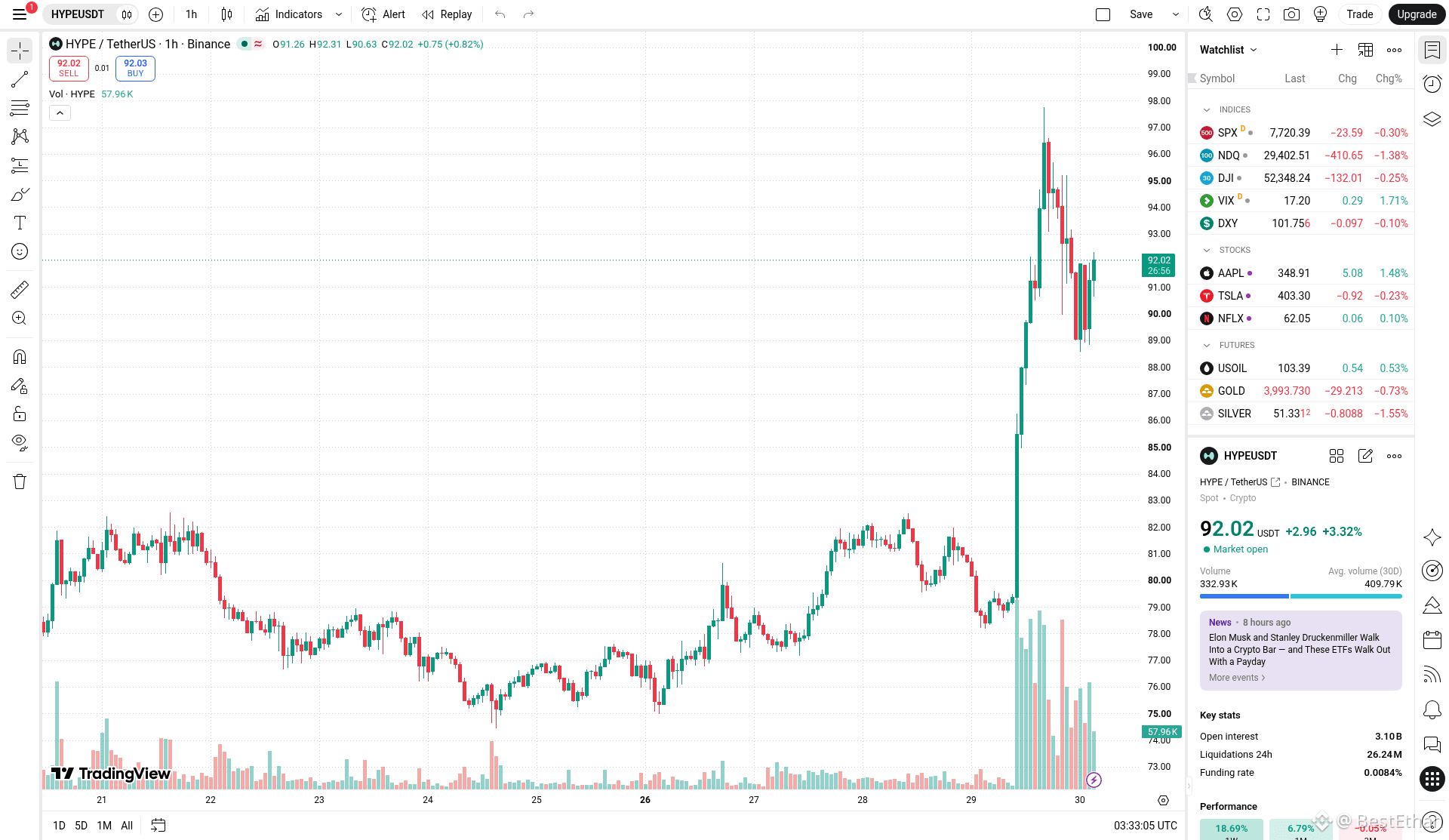
$HYPE 1H: After the surge, it’s entering a “consolidation zone.”
Around 10/29, it climbed almost in a straight line from about 80 to around 97, then fluctuated at elevated levels; it’s now near 92.
Trading volume was concentrated in the breakout phase—a typical narrowing of volatility after a catalyst-driven move.
The news backing it is the access narrative around something like ICE×Trade[XYZ]—“using HL infrastructure to build US-regulated retail perpetuals” (not directly opening HL wallets to Americans).
The short-term view is only about price action: after the rally, will it shift to a higher consolidation range?
Are you more worried about giving back the breakout gains, or about sideways trading wearing down sentiment?
$HYPE
$HYPE 1H: After the surge, it’s entering a “consolidation zone.”
Around 10/29, it climbed almost in a straight line from about 80 to around 97, then fluctuated at elevated levels; it’s now near 92.
Trading volume was concentrated in the breakout phase—a typical narrowing of volatility after a catalyst-driven move.
The news backing it is the access narrative around something like ICE×Trade[XYZ]—“using HL infrastructure to build US-regulated retail perpetuals” (not directly opening HL wallets to Americans).
The short-term view is only about price action: after the rally, will it shift to a higher consolidation range?
Are you more worried about giving back the breakout gains, or about sideways trading wearing down sentiment?
$HYPE
Around 10/29, it climbed almost in a straight line from about 80 to around 97, then fluctuated at elevated levels; it’s now near 92.
Trading volume was concentrated in the breakout phase—a typical narrowing of volatility after a catalyst-driven move.
The news backing it is the access narrative around something like ICE×Trade[XYZ]—“using HL infrastructure to build US-regulated retail perpetuals” (not directly opening HL wallets to Americans).
The short-term view is only about price action: after the rally, will it shift to a higher consolidation range?
Are you more worried about giving back the breakout gains, or about sideways trading wearing down sentiment?
$HYPE
71
·
--
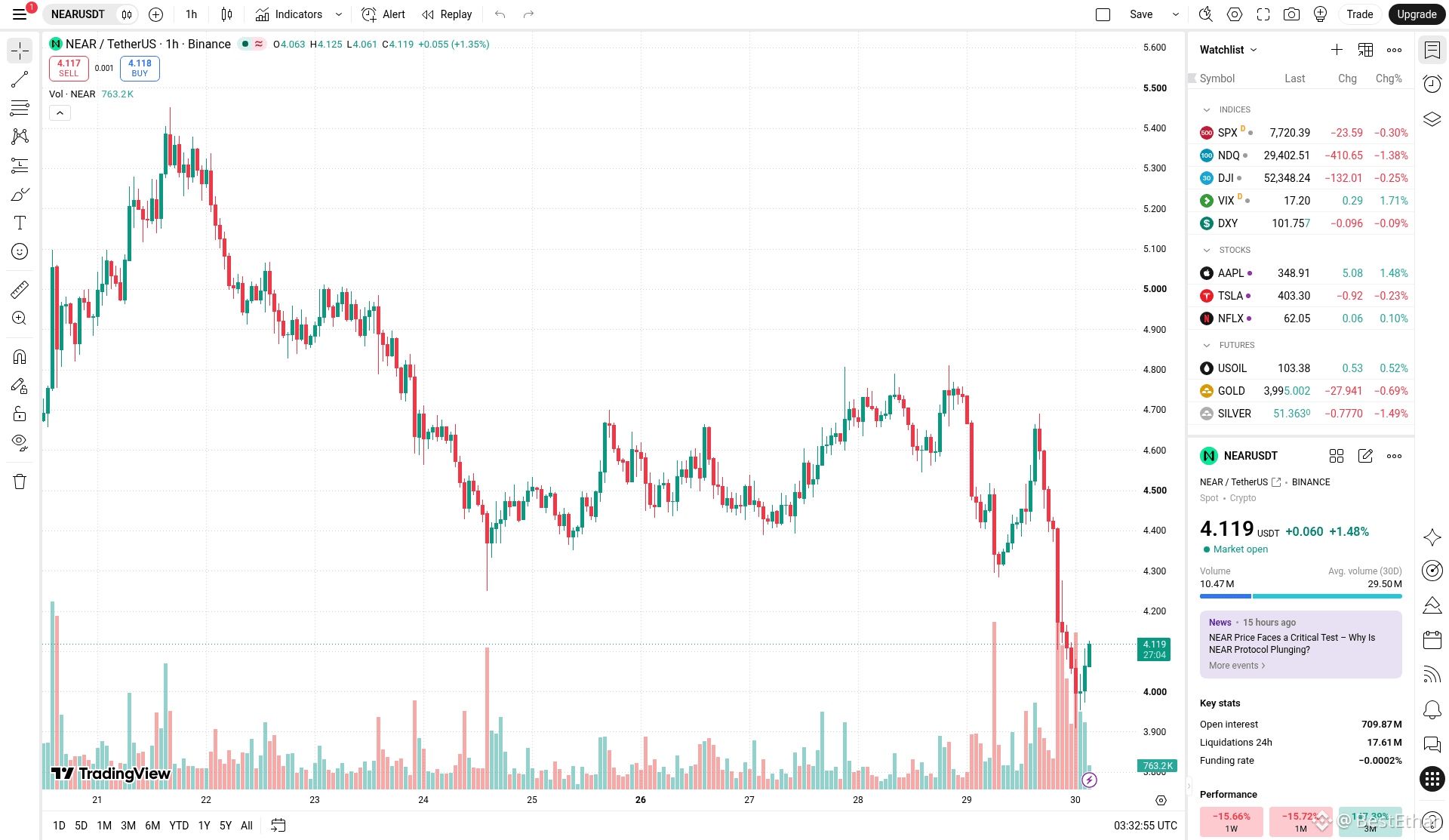
$NEAR 1H: First break below 4, then reclaim it.
The high near 10/29 was around 4.80, followed by a sharp sell-off below 4.00. The current price is around 4.12; the lower wick suggests buyers are willing to step in near 4.
The weekly chart still looks weak, but the key short-term question is whether support has been decisively broken.
High-beta public blockchains tend to swing more widely on risk-off days—structure comes before narrative.
Is 4.00 a support level or a magnet to you?
$NEAR
$NEAR 1H: First break below 4, then reclaim it.
The high near 10/29 was around 4.80, followed by a sharp sell-off below 4.00. The current price is around 4.12; the lower wick suggests buyers are willing to step in near 4.
The weekly chart still looks weak, but the key short-term question is whether support has been decisively broken.
High-beta public blockchains tend to swing more widely on risk-off days—structure comes before narrative.
Is 4.00 a support level or a magnet to you?
$NEAR
The high near 10/29 was around 4.80, followed by a sharp sell-off below 4.00. The current price is around 4.12; the lower wick suggests buyers are willing to step in near 4.
The weekly chart still looks weak, but the key short-term question is whether support has been decisively broken.
High-beta public blockchains tend to swing more widely on risk-off days—structure comes before narrative.
Is 4.00 a support level or a magnet to you?
$NEAR
293
·
--
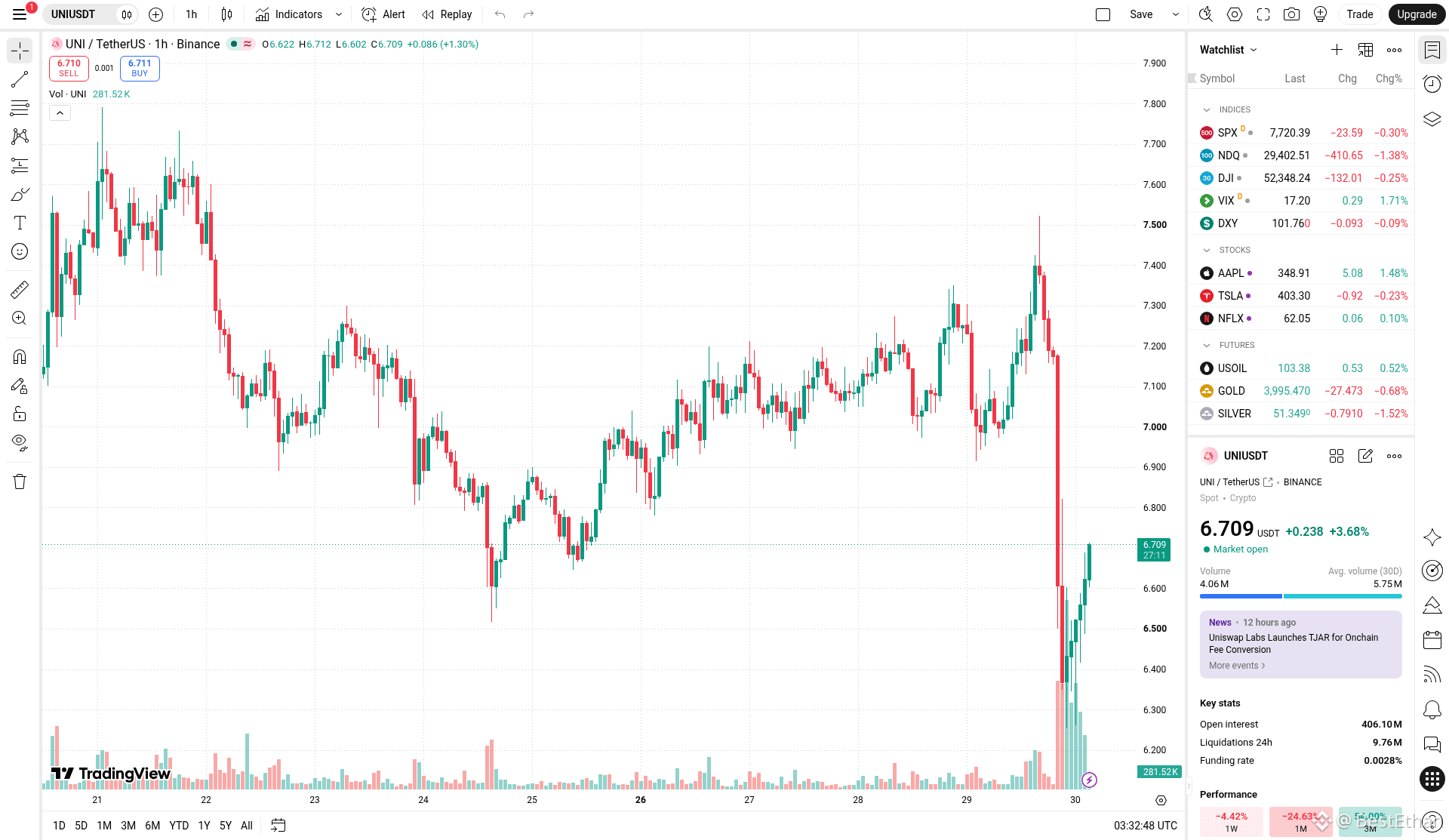
$UNI 1H: Someone stepped in after the flash crash.
The price plunged rapidly to around 6.15, then rebounded on high volume with a long lower wick, returning to around 6.70.
Technically, this looks more like “a liquidity void being half-filled” than a smooth grind lower.
DeFi blue chips are often among the first assets sold off to raise cash on days of systemic risk. Next, the question is whether this rebound can turn into a range—or whether there’ll be a second leg down.
Do you think this long lower wick signals buying, or is it just short covering?
$UNI
$UNI 1H: Someone stepped in after the flash crash.
The price plunged rapidly to around 6.15, then rebounded on high volume with a long lower wick, returning to around 6.70.
Technically, this looks more like “a liquidity void being half-filled” than a smooth grind lower.
DeFi blue chips are often among the first assets sold off to raise cash on days of systemic risk. Next, the question is whether this rebound can turn into a range—or whether there’ll be a second leg down.
Do you think this long lower wick signals buying, or is it just short covering?
$UNI
The price plunged rapidly to around 6.15, then rebounded on high volume with a long lower wick, returning to around 6.70.
Technically, this looks more like “a liquidity void being half-filled” than a smooth grind lower.
DeFi blue chips are often among the first assets sold off to raise cash on days of systemic risk. Next, the question is whether this rebound can turn into a range—or whether there’ll be a second leg down.
Do you think this long lower wick signals buying, or is it just short covering?
$UNI
374
·
--
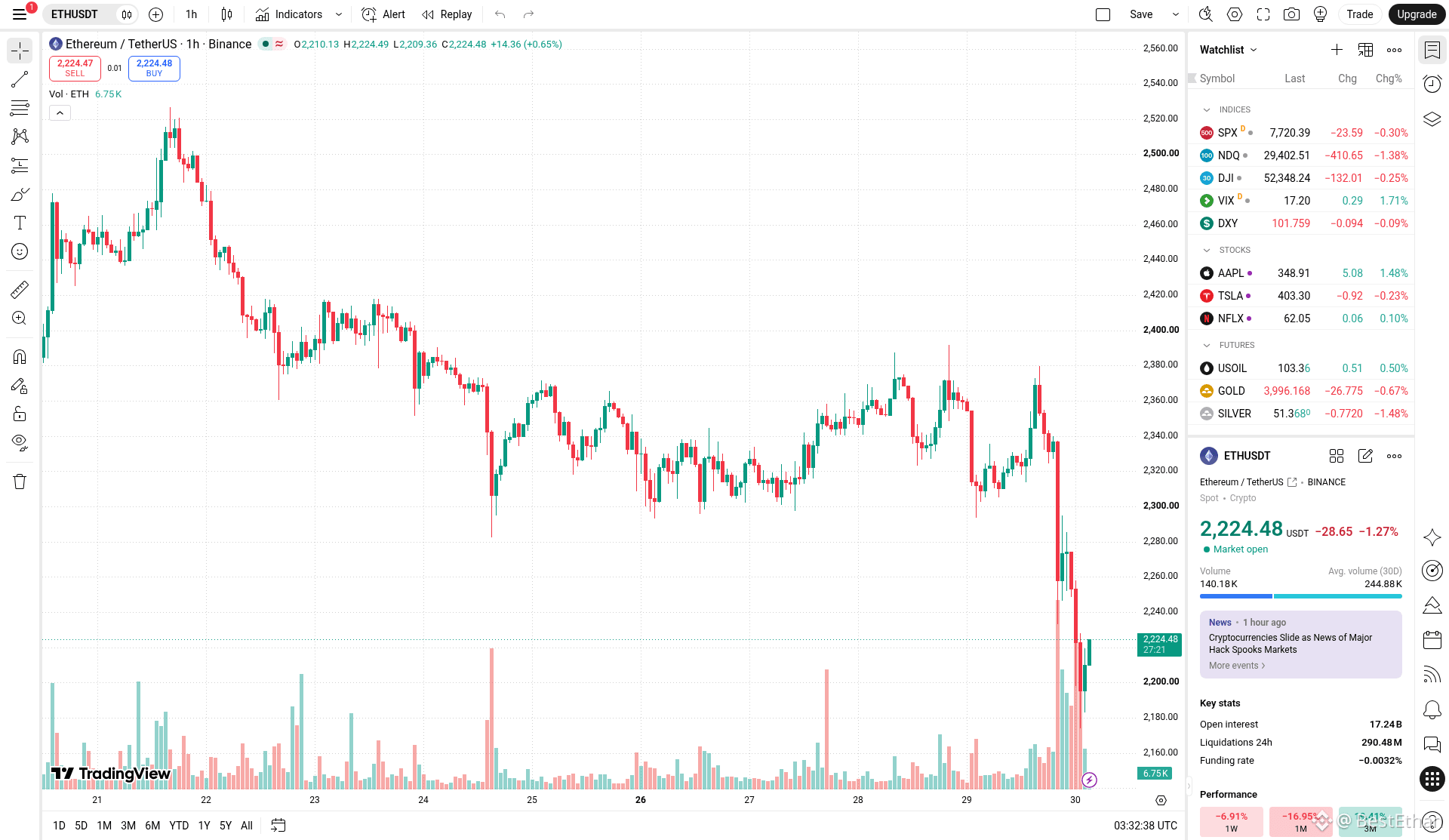
$ETH 1H: It followed the decline, but the rhythm was slightly different.
It quickly dropped from around 2360 to near 2160, then bounced back to around 2224; the volume spike nearly coincided with the sell-off candles.
Funding was slightly negative—the short side was paying the long side, suggesting short-term sentiment wasn’t overwhelmingly tilted toward “chasing longs.”
Under the same security-event disruption, ETH looks more like a high-beta, amplified version of the volatility.
Would you first look for a recovery to the start of the sell-off, or see whether it can hold above the rebound high?
$ETH
$ETH 1H: It followed the decline, but the rhythm was slightly different.
It quickly dropped from around 2360 to near 2160, then bounced back to around 2224; the volume spike nearly coincided with the sell-off candles.
Funding was slightly negative—the short side was paying the long side, suggesting short-term sentiment wasn’t overwhelmingly tilted toward “chasing longs.”
Under the same security-event disruption, ETH looks more like a high-beta, amplified version of the volatility.
Would you first look for a recovery to the start of the sell-off, or see whether it can hold above the rebound high?
$ETH
It quickly dropped from around 2360 to near 2160, then bounced back to around 2224; the volume spike nearly coincided with the sell-off candles.
Funding was slightly negative—the short side was paying the long side, suggesting short-term sentiment wasn’t overwhelmingly tilted toward “chasing longs.”
Under the same security-event disruption, ETH looks more like a high-beta, amplified version of the volatility.
Would you first look for a recovery to the start of the sell-off, or see whether it can hold above the rebound high?
$ETH
208
·
--
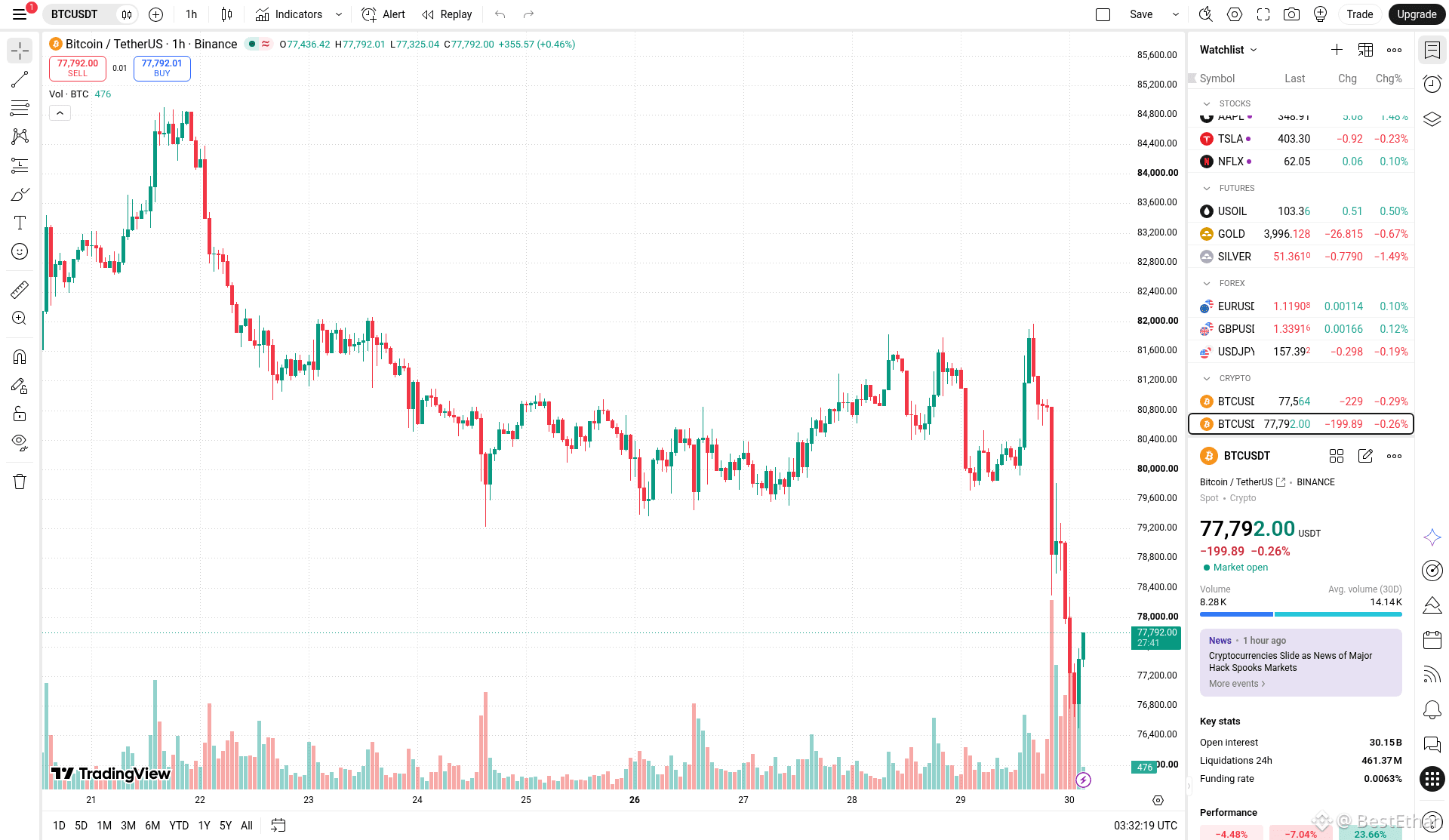
$BTC 1H: This wasn’t a slow bleed—it was a slash.
From around 81K, it plunged toward the 76.8K area, then bounced slightly after volume surged. It’s now around 77.8K.
The chart shows one of the largest volume spikes in nearly a week; the 24-hour liquidation figures in the sidebar have also climbed.
On the news front, an exchange security incident is rattling risk appetite—let’s not assume causation, but “high-volume drop + panic headlines” appearing side by side is a pattern in itself.
What concerns you more: is this the tail end of a liquidity-driven capitulation, or has the narrative not been fully priced in yet?
$BTC
$BTC 1H: This wasn’t a slow bleed—it was a slash.
From around 81K, it plunged toward the 76.8K area, then bounced slightly after volume surged. It’s now around 77.8K.
The chart shows one of the largest volume spikes in nearly a week; the 24-hour liquidation figures in the sidebar have also climbed.
On the news front, an exchange security incident is rattling risk appetite—let’s not assume causation, but “high-volume drop + panic headlines” appearing side by side is a pattern in itself.
What concerns you more: is this the tail end of a liquidity-driven capitulation, or has the narrative not been fully priced in yet?
$BTC
From around 81K, it plunged toward the 76.8K area, then bounced slightly after volume surged. It’s now around 77.8K.
The chart shows one of the largest volume spikes in nearly a week; the 24-hour liquidation figures in the sidebar have also climbed.
On the news front, an exchange security incident is rattling risk appetite—let’s not assume causation, but “high-volume drop + panic headlines” appearing side by side is a pattern in itself.
What concerns you more: is this the tail end of a liquidity-driven capitulation, or has the narrative not been fully priced in yet?
$BTC
211
·
--
Article
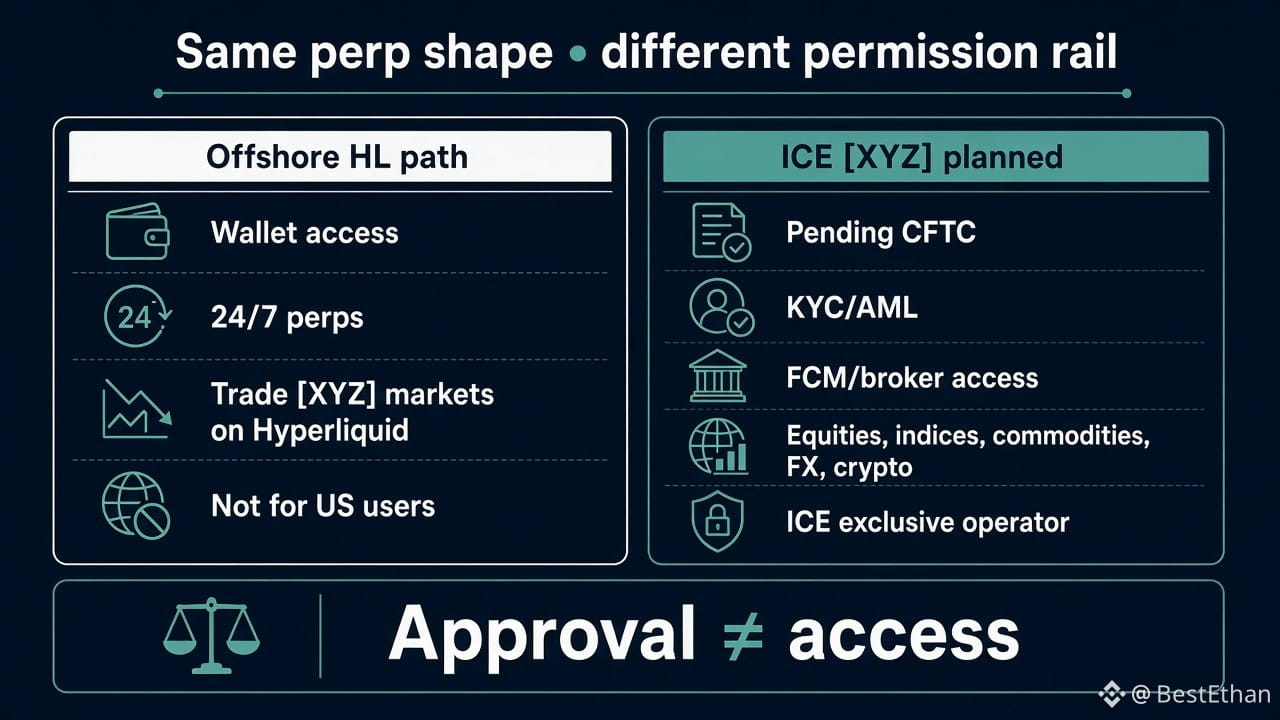
A U.S. clearing entity built on Hyperliquid infrastructure: What exactly did ICE × Trade[XYZ] approve?The parent company of the NYSE isn’t opening Hyperliquid to Americans.
It’s building a **U.S.-regulated retail perpetuals platform + independent clearing entity** on Hyperliquid infrastructure.
The scarce part isn’t “what a 24/7 contract looks like”; it’s **clearing authority that can say no**.
---
On October 29, ICE and Trade[XYZ] announced a **definitive agreement**. It still requires regulatory approval, and **there’s no launch date, no contract list, and the original announcement didn’t name a specific regulator**.
First, let’s distinguish the three clearly instead of lumping them together as “HL has gone mainstream”:
• **Hyperliquid** — the underlying infrastructure. Trade[XYZ] has deployed RWA perpetuals on it (including product parameters, listings, oracles, leverage limits, and more)
A U.S. clearing entity built on Hyperliquid infrastructure: What exactly did ICE × Trade[XYZ] approve?
The parent company of the NYSE isn’t opening Hyperliquid to Americans.
It’s building a **U.S.-regulated retail perpetuals platform + independent clearing entity** on Hyperliquid infrastructure.
The scarce part isn’t “what a 24/7 contract looks like”; it’s **clearing authority that can say no**.
---
On October 29, ICE and Trade[XYZ] announced a **definitive agreement**. It still requires regulatory approval, and **there’s no launch date, no contract list, and the original announcement didn’t name a specific regulator**.
First, let’s distinguish the three clearly instead of lumping them together as “HL has gone mainstream”:
• **Hyperliquid** — the underlying infrastructure. Trade[XYZ] has deployed RWA perpetuals on it (including product parameters, listings, oracles, leverage limits, and more)
It’s building a **U.S.-regulated retail perpetuals platform + independent clearing entity** on Hyperliquid infrastructure.
The scarce part isn’t “what a 24/7 contract looks like”; it’s **clearing authority that can say no**.
---
On October 29, ICE and Trade[XYZ] announced a **definitive agreement**. It still requires regulatory approval, and **there’s no launch date, no contract list, and the original announcement didn’t name a specific regulator**.
First, let’s distinguish the three clearly instead of lumping them together as “HL has gone mainstream”:
• **Hyperliquid** — the underlying infrastructure. Trade[XYZ] has deployed RWA perpetuals on it (including product parameters, listings, oracles, leverage limits, and more)
151
·
--
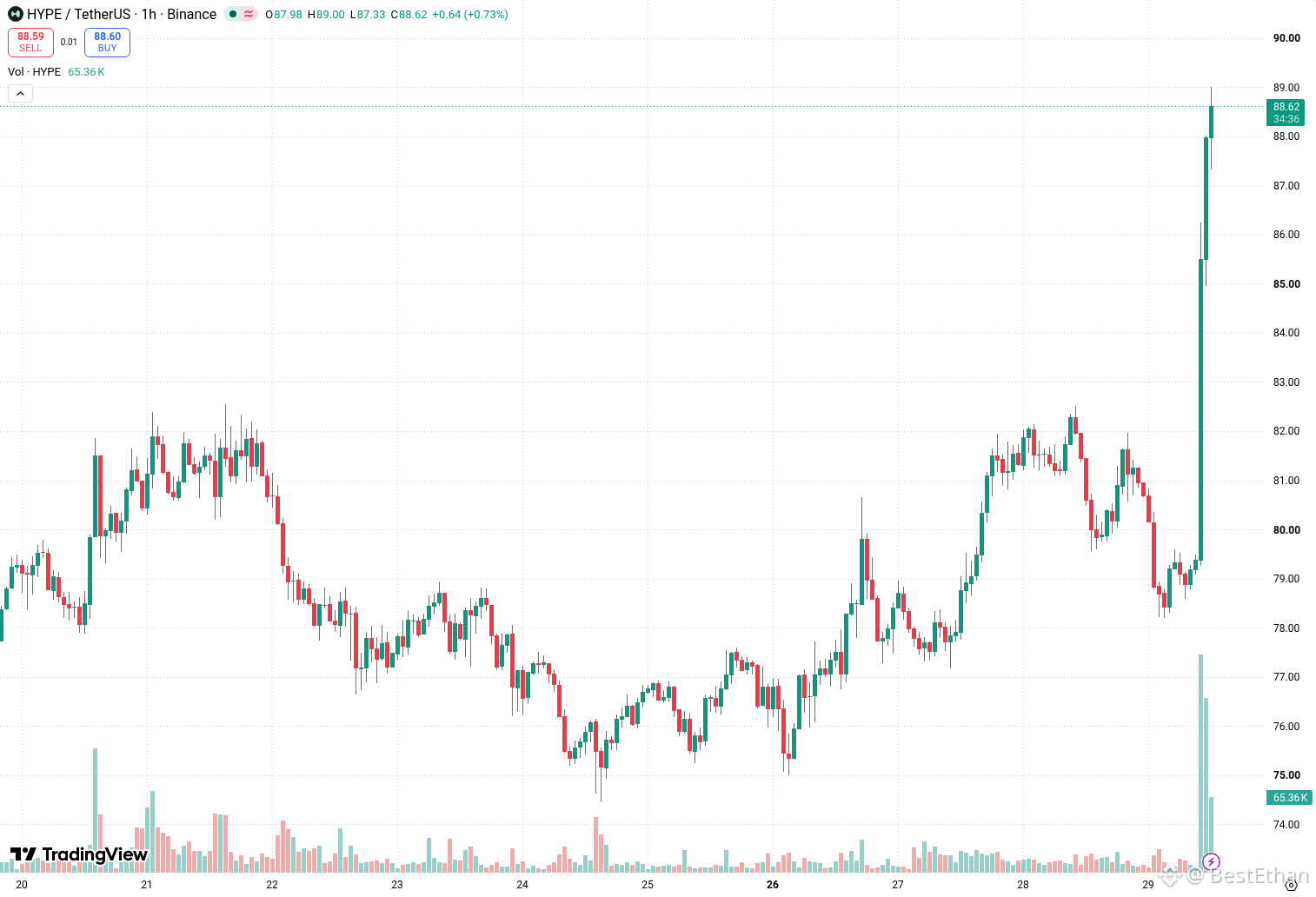
HYPE surged today for a reason—it wasn’t a random spike.
On the 1H chart, it had been chopping sideways around 75–82 for the past few days. After the news broke, volume surged and price shot almost straight up. The structure is simple: consolidation → narrative catalyst → high-volume rally.
A few things you can verify:
1) ICE, the parent company of the NYSE, and Trade[XYZ] announced a partnership to bring 24/7 perpetuals based on Hyperliquid to the U.S., under the ICE[XYZ] brand.
2) The product is still awaiting regulatory approval, including from the CFTC; timing and eligibility have not been determined.
3) ICE made a strategic investment in Trade[XYZ] (amount undisclosed); Stan Druckenmiller and others are also part of the narrative.
4) Trade[XYZ] says its Hyperliquid markets have generated over $650B in trading volume in a little over a year; existing HIP-3 markets will continue to operate alongside them.
5) Planned asset classes include stocks, indices, commodities, forex, and crypto, with access through FCMs and brokerages.
Keep the distinction clear: this does not mean “Hyperliquid is now open to U.S. users.” HL itself remains unavailable in the U.S.; this is a narrative about a new, regulated market structure.
Do you have more faith that regulation will ultimately make this happen, or are you worried the narrative is getting ahead of itself?
$HYPE
HYPE surged today for a reason—it wasn’t a random spike.
On the 1H chart, it had been chopping sideways around 75–82 for the past few days. After the news broke, volume surged and price shot almost straight up. The structure is simple: consolidation → narrative catalyst → high-volume rally.
A few things you can verify:
1) ICE, the parent company of the NYSE, and Trade[XYZ] announced a partnership to bring 24/7 perpetuals based on Hyperliquid to the U.S., under the ICE[XYZ] brand.
2) The product is still awaiting regulatory approval, including from the CFTC; timing and eligibility have not been determined.
3) ICE made a strategic investment in Trade[XYZ] (amount undisclosed); Stan Druckenmiller and others are also part of the narrative.
4) Trade[XYZ] says its Hyperliquid markets have generated over $650B in trading volume in a little over a year; existing HIP-3 markets will continue to operate alongside them.
5) Planned asset classes include stocks, indices, commodities, forex, and crypto, with access through FCMs and brokerages.
Keep the distinction clear: this does not mean “Hyperliquid is now open to U.S. users.” HL itself remains unavailable in the U.S.; this is a narrative about a new, regulated market structure.
Do you have more faith that regulation will ultimately make this happen, or are you worried the narrative is getting ahead of itself?
$HYPE
On the 1H chart, it had been chopping sideways around 75–82 for the past few days. After the news broke, volume surged and price shot almost straight up. The structure is simple: consolidation → narrative catalyst → high-volume rally.
A few things you can verify:
1) ICE, the parent company of the NYSE, and Trade[XYZ] announced a partnership to bring 24/7 perpetuals based on Hyperliquid to the U.S., under the ICE[XYZ] brand.
2) The product is still awaiting regulatory approval, including from the CFTC; timing and eligibility have not been determined.
3) ICE made a strategic investment in Trade[XYZ] (amount undisclosed); Stan Druckenmiller and others are also part of the narrative.
4) Trade[XYZ] says its Hyperliquid markets have generated over $650B in trading volume in a little over a year; existing HIP-3 markets will continue to operate alongside them.
5) Planned asset classes include stocks, indices, commodities, forex, and crypto, with access through FCMs and brokerages.
Keep the distinction clear: this does not mean “Hyperliquid is now open to U.S. users.” HL itself remains unavailable in the U.S.; this is a narrative about a new, regulated market structure.
Do you have more faith that regulation will ultimately make this happen, or are you worried the narrative is getting ahead of itself?
$HYPE
133
·
--
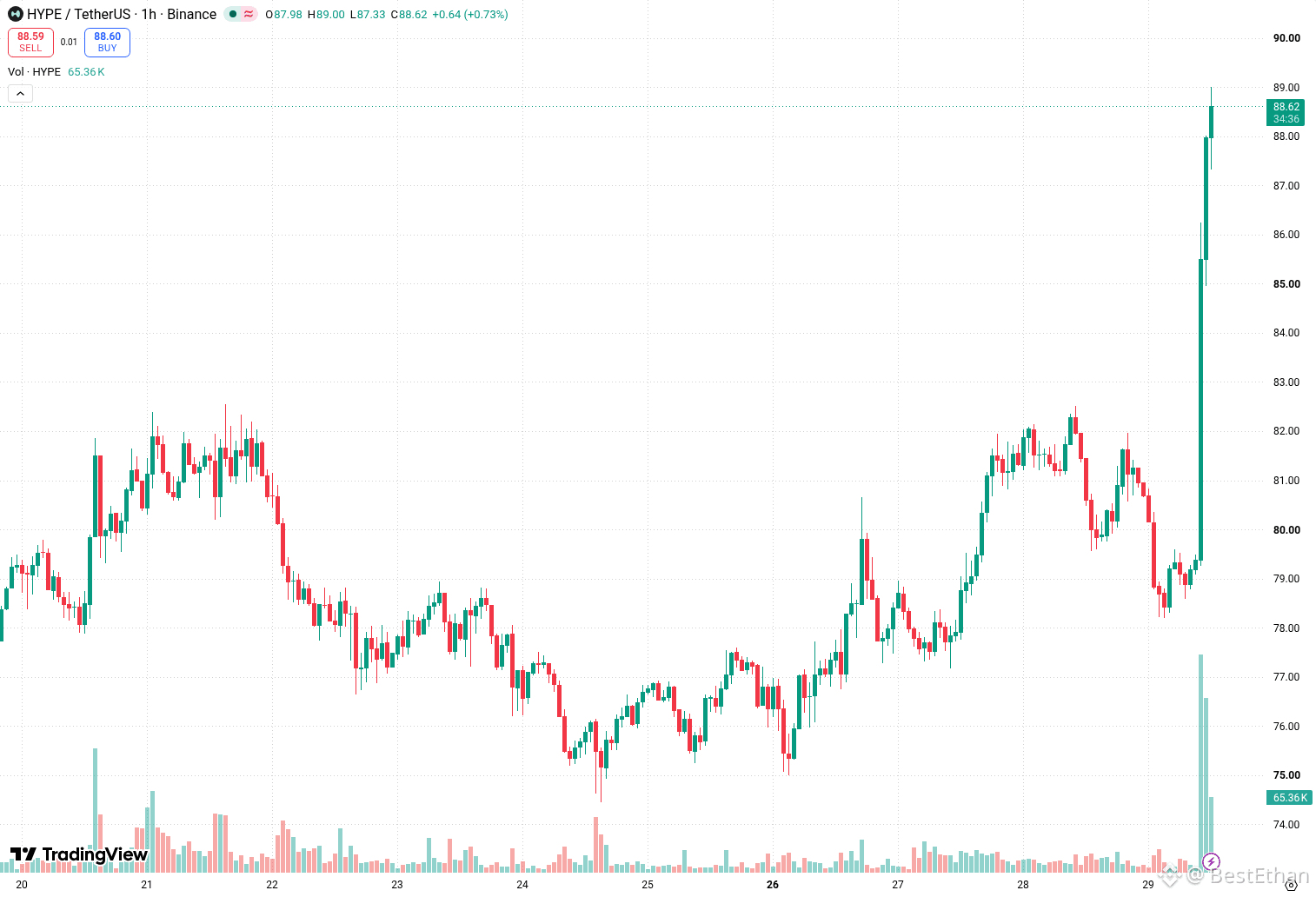
The latest candle shows a clear spike higher.
Just a few days ago, it was still hovering around 75–82. Then on the 29th, it shot almost straight up to around 89, with trading volume rising at the same time.
The news lines up: ICE (the parent company of the NYSE) and Trade[XYZ] plan to bring Hyperliquid-based perpetuals to the U.S., pending regulatory approval. As the narrative heats up, the market reacts first.
Are you more focused on the timing of regulatory approval, or on this high-volume move right now?
$HYPE
The latest candle shows a clear spike higher.
Just a few days ago, it was still hovering around 75–82. Then on the 29th, it shot almost straight up to around 89, with trading volume rising at the same time.
The news lines up: ICE (the parent company of the NYSE) and Trade[XYZ] plan to bring Hyperliquid-based perpetuals to the U.S., pending regulatory approval. As the narrative heats up, the market reacts first.
Are you more focused on the timing of regulatory approval, or on this high-volume move right now?
$HYPE
Just a few days ago, it was still hovering around 75–82. Then on the 29th, it shot almost straight up to around 89, with trading volume rising at the same time.
The news lines up: ICE (the parent company of the NYSE) and Trade[XYZ] plan to bring Hyperliquid-based perpetuals to the U.S., pending regulatory approval. As the narrative heats up, the market reacts first.
Are you more focused on the timing of regulatory approval, or on this high-volume move right now?
$HYPE
130
·
--
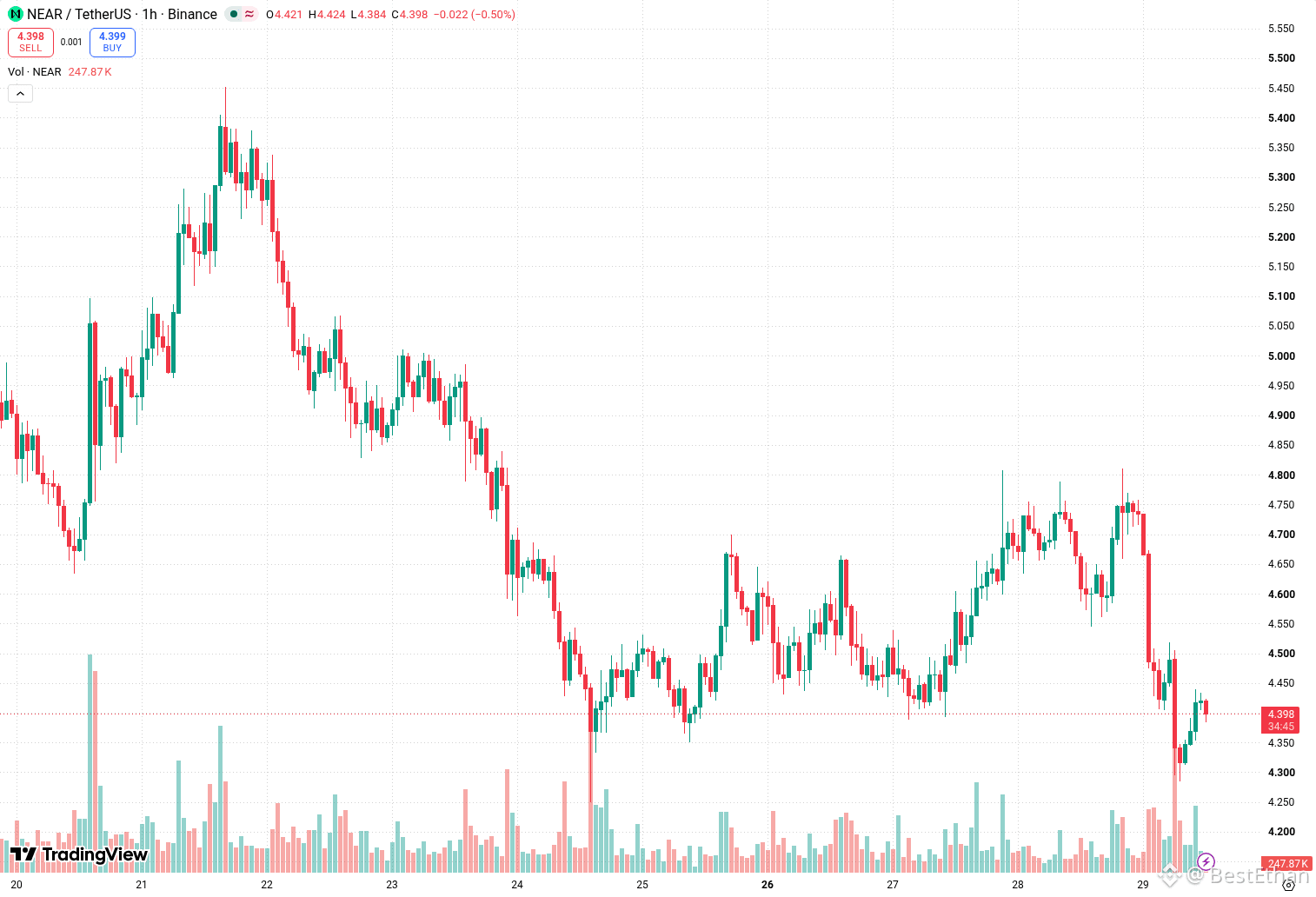
NEAR looks weak on the 1H chart.
It stair-stepped lower from above 5.4, then ground sideways around 4.3–4.75. It just tested the top of the range and got pushed back; price is now around 4.40, near the lower end.
I couldn’t find any solid, independent bearish catalyst—it looks more like relative weakness amid broader market pressure. No need to force a narrative.
Do you think NEAR’s catch-up decline has further to go, or is it already bottoming out?
$NEAR
NEAR looks weak on the 1H chart.
It stair-stepped lower from above 5.4, then ground sideways around 4.3–4.75. It just tested the top of the range and got pushed back; price is now around 4.40, near the lower end.
I couldn’t find any solid, independent bearish catalyst—it looks more like relative weakness amid broader market pressure. No need to force a narrative.
Do you think NEAR’s catch-up decline has further to go, or is it already bottoming out?
$NEAR
It stair-stepped lower from above 5.4, then ground sideways around 4.3–4.75. It just tested the top of the range and got pushed back; price is now around 4.40, near the lower end.
I couldn’t find any solid, independent bearish catalyst—it looks more like relative weakness amid broader market pressure. No need to force a narrative.
Do you think NEAR’s catch-up decline has further to go, or is it already bottoming out?
$NEAR
237
Log in to explore more content
Join global crypto users on Binance Square
⚡️ Get latest and useful information about crypto.
💬 Trusted by the world’s largest crypto exchange.
👍 Discover real insights from verified creators.
Email / Phone number
Trending Topics
BinanceWithdrawalScamWarning
26,863 views
556 Discussing
Binance Warns Users of Withdrawal Scams as Services Resume: It Will Never Charge Fees, Sell Queue Spots or Ask You to Move Funds to a “Vault”
Binance News
·12 Likes
·7.3k views
USMidtermElections
584,681 views
3,133 Discussing
USOctoberNFP-AreRateCutsStillPossible
36,189 views
478 Discussing