
两栖韭菜
206 Posts

两栖韭菜
Report
Block User
两栖韭菜|美股 · 币圈 · 比特币
说白了,不喊单不预测,只拆商业模式、护城河、能力圈。
早·隔夜美股复盘晚·币圈周期
佛系老韭菜一枚,跌了我也绿

U Holder
Occasional Trader
5.5 Years
11 Following
114 Followers
132 Liked
Posts
·
--
A-share semiconductor stocks bounced 4.1% this morning, led by NAURA Technology. Don’t rush to call it a reversal. Put simply, they’re down 55.4% from their peak and fell 28.7% in a month. Today’s gain hasn’t even made up a fraction of that. A bounce after a steep drop is perfectly normal, but a bounce doesn’t mean the trend has reversed. It’s more likely just catching its breath halfway down the mountain. Do you think the decline has stopped, or will it keep grinding lower?
A-share semiconductor stocks bounced 4.1% this morning, led by NAURA Technology. Don’t rush to call it a reversal. Put simply, they’re down 55.4% from their peak and fell 28.7% in a month. Today’s gain hasn’t even made up a fraction of that. A bounce after a steep drop is perfectly normal, but a bounce doesn’t mean the trend has reversed. It’s more likely just catching its breath halfway down the mountain. Do you think the decline has stopped, or will it keep grinding lower?
27
·
--
ETFs saw $1.04 billion in outflows over two days, yet Bitcoin is still hovering around $77,000 👇
There were $643 million in outflows last Friday, followed by another $399 million on Monday. BlackRock alone saw $405 million leave on Monday—the biggest single-day outflow since June. ETH also saw about $140 million in outflows on Monday.
With that much selling, prices haven’t collapsed, which suggests there are buyers on the other side.
I won’t guess how the final vote count will turn out. I’ll focus on one thing: is this institutional rebalancing, or are they really done with crypto? The next ETF data release should give it away.
Let’s not panic—just watch how it unfolds.
$BTC $ETH

38
·
--
U.S. midterm election voting has just wrapped up, but the results are still undecided. Bitcoin is still hovering around $77,000, and the Fear & Greed Index is at 35, still in fear territory.
The bottom line: Don’t bet ahead of the election results. What really matters is whether Bitcoin can hold the $76,000 level. Short-term holders’ average cost is right around here. With the price tracking that cost basis, it suggests recent buyers are basically not in profit. This is the kind of level that wears you down—and makes it easiest to shake people out.
Bitcoin fell about 7% in October, and U.S. spot ETFs saw net outflows of about $643 million on October 30. Money is flowing out—that’s a fact. The election has simply brought uncertainty to the forefront. Once it’s over, the underlying fund-flow dynamics still have to play out, and whoever takes office won’t turn outflows into inflows overnight.
So don’t trade on headlines over the next few days. If you’re heavily invested, ask yourself: If Bitcoin breaks below $76,000 and heads toward $73,000, will you still be able to sleep? If not, the problem isn’t the election—it’s your position size.
The most grueling markets don’t test your judgment as much as your ability to stay put.
$BTC $ETH

527
·
--
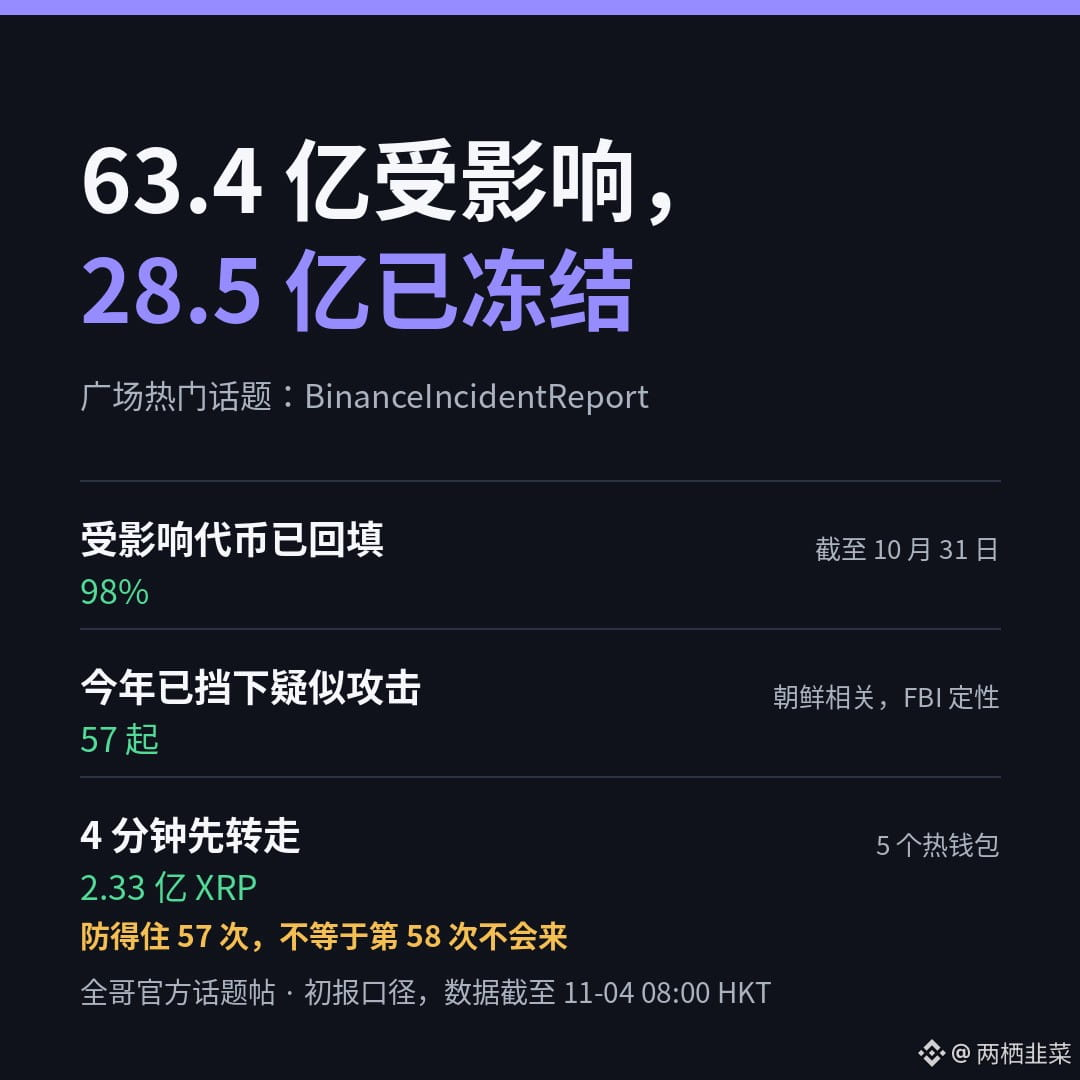
The takeaway first: this theft wasn’t caused by the vault door—it started on employees’ computers. #BinanceIncidentReport
Binance’s preliminary report last night laid out the chain of events: In June, an engineer searched for AI coding tools and installed a tampered Homebrew package; in September, another engineer took a fake job interview, and a zero-day Trojan was hidden in the coding assignment’s repository; on October 20, hackers used an internal AI tool as a stepping stone to obtain a container token belonging to the wallet team; on October 29, within four minutes, five hot wallets first transferred out 233 million XRP, followed by SOL, OP, and BTC.
The numbers: around $6.34 billion was affected; approximately $2.85 billion has been frozen or intercepted; 98% of the affected tokens had been replenished by October 31. Binance will absorb the shortfall; users won’t bear the loss. The FBI attributed the attack to North Korea’s TraderTraitor, and Binance says it has blocked 57 suspected North Korean attacks this year.
Put simply, stopping 57 attacks is an achievement; falling victim to the 58th is a lesson: the most expensive line of defense is often the most ordinary computer in someone’s hands.
Being able to stop 57 attacks doesn’t mean the 58th won’t happen.
$BNB $BTC
369
·
--
Verified
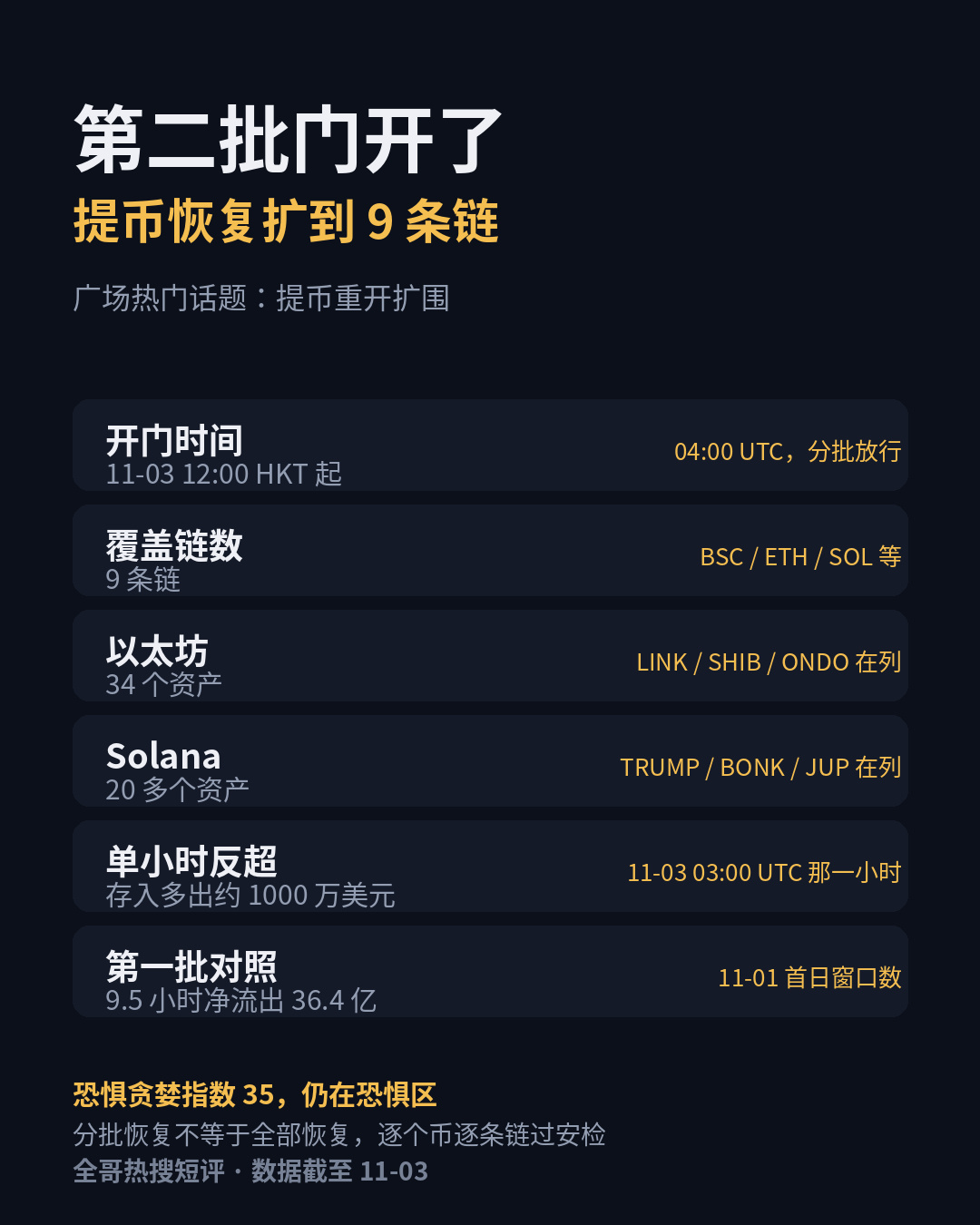
The books for the first batch were just tallied yesterday, and at noon today the gates opened for the second batch. Binance has started processing withdrawals in the second phase, gradually restoring withdrawals for dozens of coins across nine chains. On Ethereum, LINK, SHIB, and ONDO are among them; on Solana, TRUMP, BONK, and JUP are on the list. Note that withdrawals are being restored in batches, not all at once. Which coins can be withdrawn on which chains depends on whether security checks are complete.
Here’s an interesting contrast: during the hour starting at 3 a.m. today, deposits exceeded withdrawals by about $10 million. During the first nine and a half hours after the gates initially opened, there was a net outflow of $3.64 billion. The tide has turned pretty quickly.
But let’s put the figures in perspective: deposits outpacing withdrawals for one hour doesn’t mean things have recovered across the board. The cumulative net outflow is still there, and verification of the full proof of reserves is also due today. It’s good that the gates are opening wider, but don’t mistake “withdrawals restored in batches” for “everything’s fine now.”
With the second batch of withdrawals now open and money starting to flow back in, do you think things have stabilized, or are people simply tired of withdrawing?
$BNB $BTC
1
635
·
--
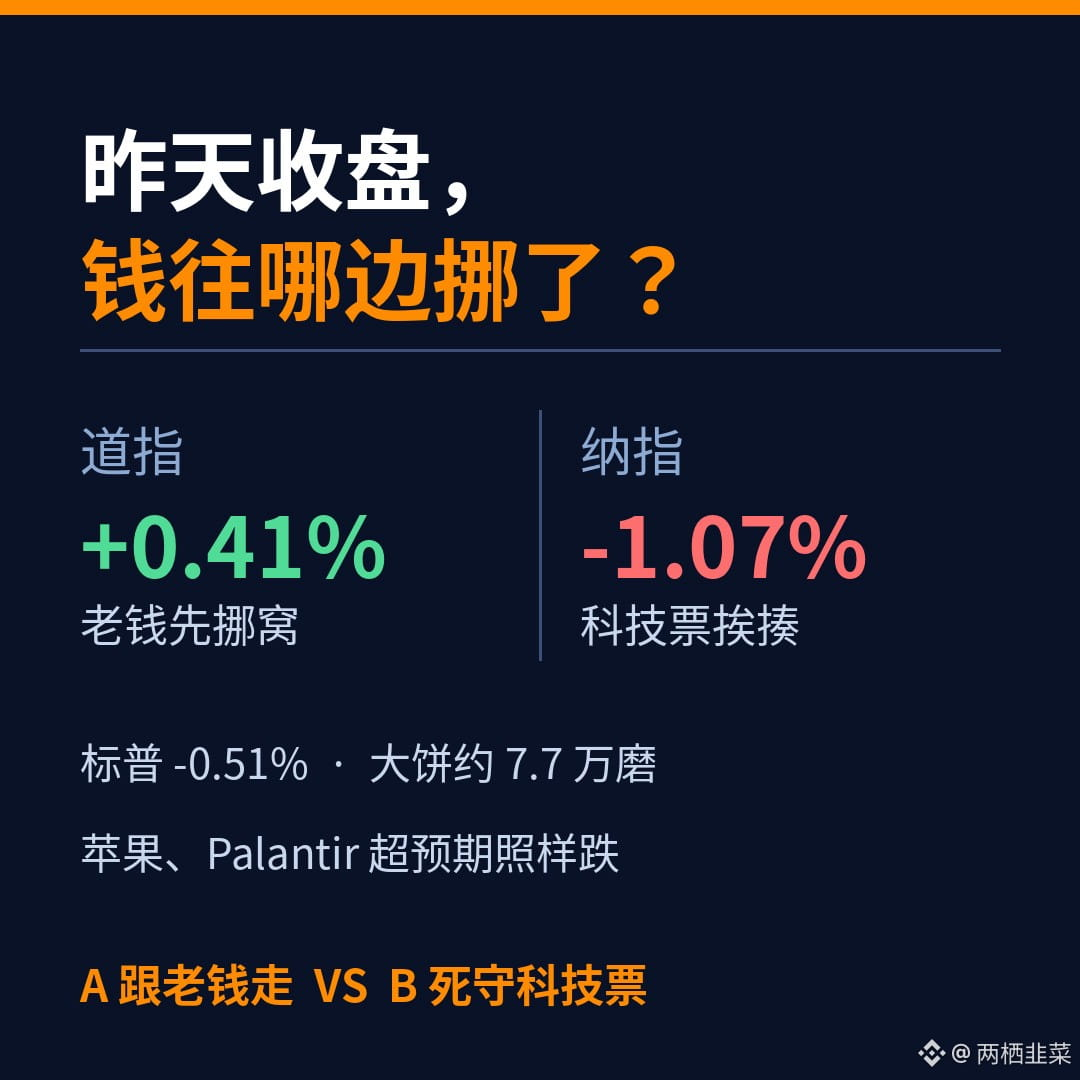
Yesterday's close was interesting: the Dow rose 0.41%, while the Nasdaq fell 1.07% and the S&P dropped 0.51%. Apple and Palantir both beat earnings expectations, but their shares still fell after hours. Old money moved toward the Dow first, while Bitcoin is still hovering around 77,000.
My own view is clear: when the market opens in half an hour, I’m not chasing the Nasdaq hype. First, I want to see how many days this rotation can keep going.
Which side are you on: A, follow the old money and stick with the Dow and value stocks; or B, hold on tight to tech stocks—any dip is an opportunity?
$BTC $AAPL
202
·
--
Shopify got a bit of a raw deal today: GMV rose 29%, and business was clearly heading in the right direction, yet the stock still got hammered 16.2% premarket. Put simply, revenue came in just $100 million below expectations—a $10 million shortfall, and the stock dropped 16%. That’s the market for you: good business doesn’t mean the stock won’t get punished. The higher expectations are, the harder even a small miss gets hit. Don’t let the scary drop distract you—first check whether the business itself has actually gotten worse.
$SHOP
$SHOP
129
·
--

Article
Bitcoin grinds at $77K; three things tonight will set the directionAt noon today, Binance opened the second batch of withdrawals across nine networks, clearing assets one by one through security checks. When the first batch opened on Sunday, net outflows reached $3.64 billion in just nine and a half hours. By Monday, that figure had fallen to $2.57 billion. Today, Binance said deposits per hour have already surpassed withdrawals. The gates are opening wider, and money is no longer flowing out in just one direction. That’s the most tangible change today.
But don’t take this to mean the matter is behind us. The full zero-knowledge proof for the October 31 snapshot was published yesterday, allowing users to verify that 10 coins are backed at least 1:1. That’s good news, but about 95% of the $6.3 billion stolen has been covered, while roughly 5% in smaller coins is still being gathered. A proof is one thing; trust is another. They need to be considered separately. Binance also specifically warned yesterday about scams impersonating officials and charging fees to expedite withdrawals. At times like this, it’s easiest for people to take advantage of the confusion.
Bitcoin grinds at $77K; three things tonight will set the direction
At noon today, Binance opened the second batch of withdrawals across nine networks, clearing assets one by one through security checks. When the first batch opened on Sunday, net outflows reached $3.64 billion in just nine and a half hours. By Monday, that figure had fallen to $2.57 billion. Today, Binance said deposits per hour have already surpassed withdrawals. The gates are opening wider, and money is no longer flowing out in just one direction. That’s the most tangible change today.
But don’t take this to mean the matter is behind us. The full zero-knowledge proof for the October 31 snapshot was published yesterday, allowing users to verify that 10 coins are backed at least 1:1. That’s good news, but about 95% of the $6.3 billion stolen has been covered, while roughly 5% in smaller coins is still being gathered. A proof is one thing; trust is another. They need to be considered separately. Binance also specifically warned yesterday about scams impersonating officials and charging fees to expedite withdrawals. At times like this, it’s easiest for people to take advantage of the confusion.
But don’t take this to mean the matter is behind us. The full zero-knowledge proof for the October 31 snapshot was published yesterday, allowing users to verify that 10 coins are backed at least 1:1. That’s good news, but about 95% of the $6.3 billion stolen has been covered, while roughly 5% in smaller coins is still being gathered. A proof is one thing; trust is another. They need to be considered separately. Binance also specifically warned yesterday about scams impersonating officials and charging fees to expedite withdrawals. At times like this, it’s easiest for people to take advantage of the confusion.
375
·
--
Apple and Palantir both reported better-than-expected earnings last night, yet in after-hours trading one fell more than 2% and the other more than 4%. Even Palantir raising its full-year guidance to $8.5 billion wasn’t enough. Put simply, what’s getting punished now isn’t earnings, but valuations and sentiment. Good earnings are, at best, a ticket to avoid being punished even more. Futures are hovering around flat ahead of the open, and three things are lined up for today: midterm election voting, JOLTS, and AMD’s earnings after the close. Even good companies can still fall; paying too much is the cardinal sin. Don’t rush to buy the dip.
$AAPL $PLTR
$AAPL $PLTR

347
·
--
Oracle has offered a ready-made example of the cash-burning side of AI: it announced a $20 billion financing plan spread over four years just last week, and it was all used up in a single morning. The stock fell 6.4% intraday, to its lowest level since July. Its market cap has shed more than $60 billion since Investor Day. In short, no matter how grand the story, the books have to add up first.
$ORCL
$ORCL
284
·
--
That weekend breather didn’t last 👇
Yesterday, leverage finally took a quiet day. But today, the moment we woke up, longs got liquidated all over again: nearly $300 million in liquidations across the market over the past 12 hours, 90% of them longs. BTC alone accounted for $67.8 million.
Prices slid back too: BTC is around $76,800, down about 2% in 24 hours; ETH is around $2,250, down about 1%. The Fear Index says it all: it fell from 37 to 26. Yesterday we were worried; today, we’re truly panicking.
Simply put, there’s no major new bearish news behind this move. U.S. tech stocks fell first on Monday, the crypto market followed suit, and leveraged positions couldn’t hold up.
Don’t hand over your positions in a panic, and don’t pile on leverage when the market bounces.
$BTC $ETH

208
·
--
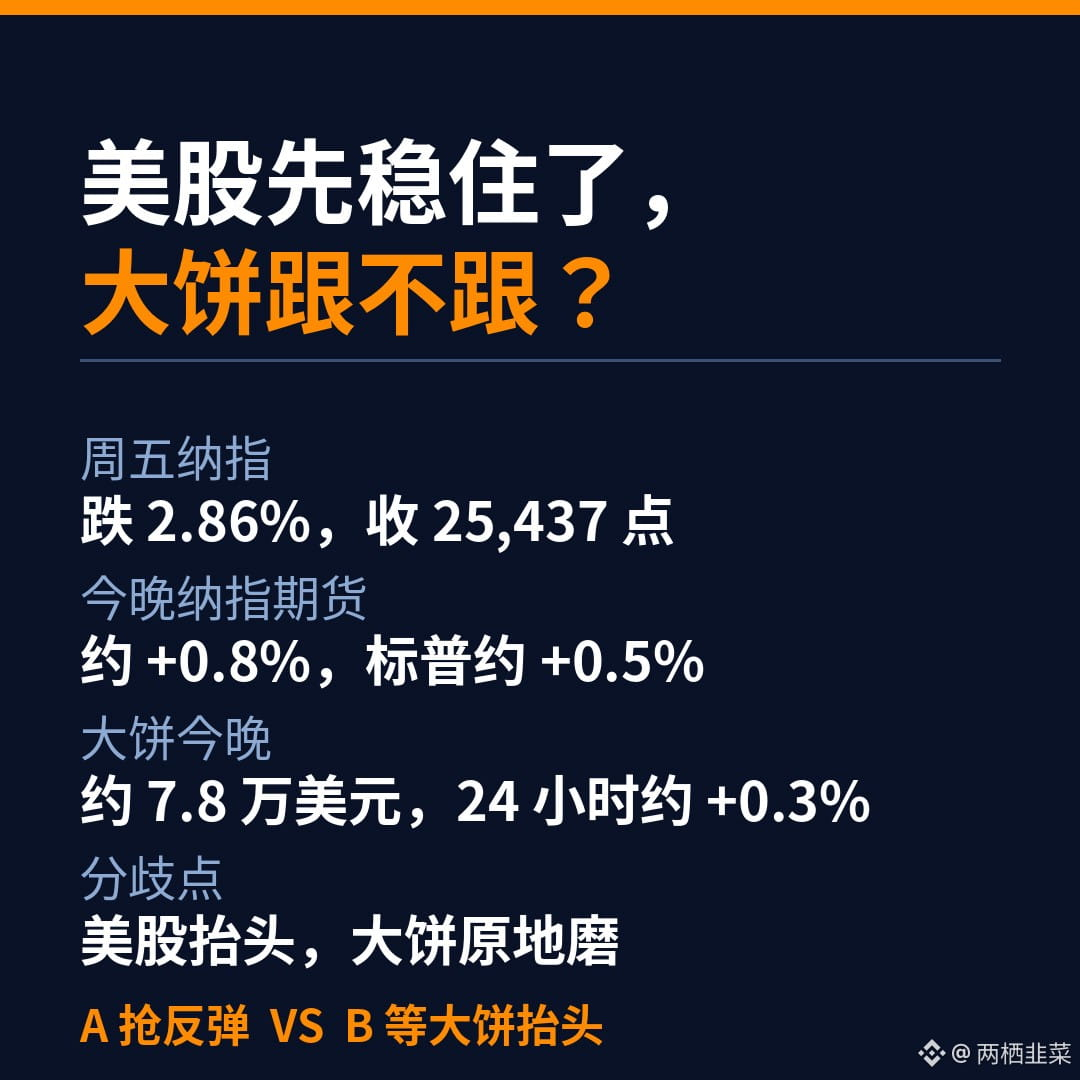
The Nasdaq plunged 2.86% on Friday, but futures have steadied tonight, with the Nasdaq up about 0.8% and the S&P 500 up about 0.5%. Bitcoin is still hovering around $78,000, though, up only about 0.3% in the past 24 hours—it hasn’t followed stocks higher at all.
My stance is clear: if Bitcoin isn’t moving, neither am I. That little bump in futures isn’t enough to make me change course.
Which side are you on? A: Ride the rebound with stocks tonight—get in first and figure it out later; B: If Bitcoin isn’t moving, stay put and wait for it to actually turn higher before following along?
$BTC
121
·
--

Article
Neither Collapsed Nor Recovered—Tonight Is the Real TestLet’s put the conclusion first: today was a day to catch our breath, not a day to turn things around. Bitcoin moved back and forth between $77,700 and $78,800 during the day, and was still just above $78,000 when this was written, with moves of less than 1% either way. ETH briefly touched $2,311 in the morning before returning to around $2,300. The Fear and Greed Index is at 37, still in fear territory. That’s a slight improvement from yesterday’s 34, but nowhere near the point where people can confidently declare victory.
The main story in crypto today is still the fallout from the Binance situation. Withdrawals have opened on the first 15 networks. According to the official figures for the first window: over nine and a half hours, $4.649 billion was withdrawn and $1.01 billion was deposited, for a net outflow of $3.64 billion—2.1% of total assets worth $171 billion. The amount withdrawn looks alarming, but compared with the overall pool, it’s only a drop in the bucket. More importantly, Binance itself said that once the initial rush to withdraw had passed, withdrawal volumes had fallen, while deposits remained substantial. The doors are open and funds can move—that step has gone smoothly.
Neither Collapsed Nor Recovered—Tonight Is the Real Test
Let’s put the conclusion first: today was a day to catch our breath, not a day to turn things around. Bitcoin moved back and forth between $77,700 and $78,800 during the day, and was still just above $78,000 when this was written, with moves of less than 1% either way. ETH briefly touched $2,311 in the morning before returning to around $2,300. The Fear and Greed Index is at 37, still in fear territory. That’s a slight improvement from yesterday’s 34, but nowhere near the point where people can confidently declare victory.
The main story in crypto today is still the fallout from the Binance situation. Withdrawals have opened on the first 15 networks. According to the official figures for the first window: over nine and a half hours, $4.649 billion was withdrawn and $1.01 billion was deposited, for a net outflow of $3.64 billion—2.1% of total assets worth $171 billion. The amount withdrawn looks alarming, but compared with the overall pool, it’s only a drop in the bucket. More importantly, Binance itself said that once the initial rush to withdraw had passed, withdrawal volumes had fallen, while deposits remained substantial. The doors are open and funds can move—that step has gone smoothly.
The main story in crypto today is still the fallout from the Binance situation. Withdrawals have opened on the first 15 networks. According to the official figures for the first window: over nine and a half hours, $4.649 billion was withdrawn and $1.01 billion was deposited, for a net outflow of $3.64 billion—2.1% of total assets worth $171 billion. The amount withdrawn looks alarming, but compared with the overall pool, it’s only a drop in the bucket. More importantly, Binance itself said that once the initial rush to withdraw had passed, withdrawal volumes had fallen, while deposits remained substantial. The doors are open and funds can move—that step has gone smoothly.
204
·
--
Anthropic is really asking for a lot this time: the new shares are being sold only to Japanese investors, with up to $3.5 billion to be raised in one go—more than the $2.2 billion SpaceX previously raised in Japan. The use of proceeds is spelled out plainly: it’s all going toward operating and capital expenditures. In other words, they’ll keep burning cash to secure computing power. The AI race now comes down to who has the deeper pockets. With this much money going up in smoke, will they ever make it back? Which side do you think the market will believe first?
Anthropic is really asking for a lot this time: the new shares are being sold only to Japanese investors, with up to $3.5 billion to be raised in one go—more than the $2.2 billion SpaceX previously raised in Japan. The use of proceeds is spelled out plainly: it’s all going toward operating and capital expenditures. In other words, they’ll keep burning cash to secure computing power. The AI race now comes down to who has the deeper pockets. With this much money going up in smoke, will they ever make it back? Which side do you think the market will believe first?
107
·
--
Verified
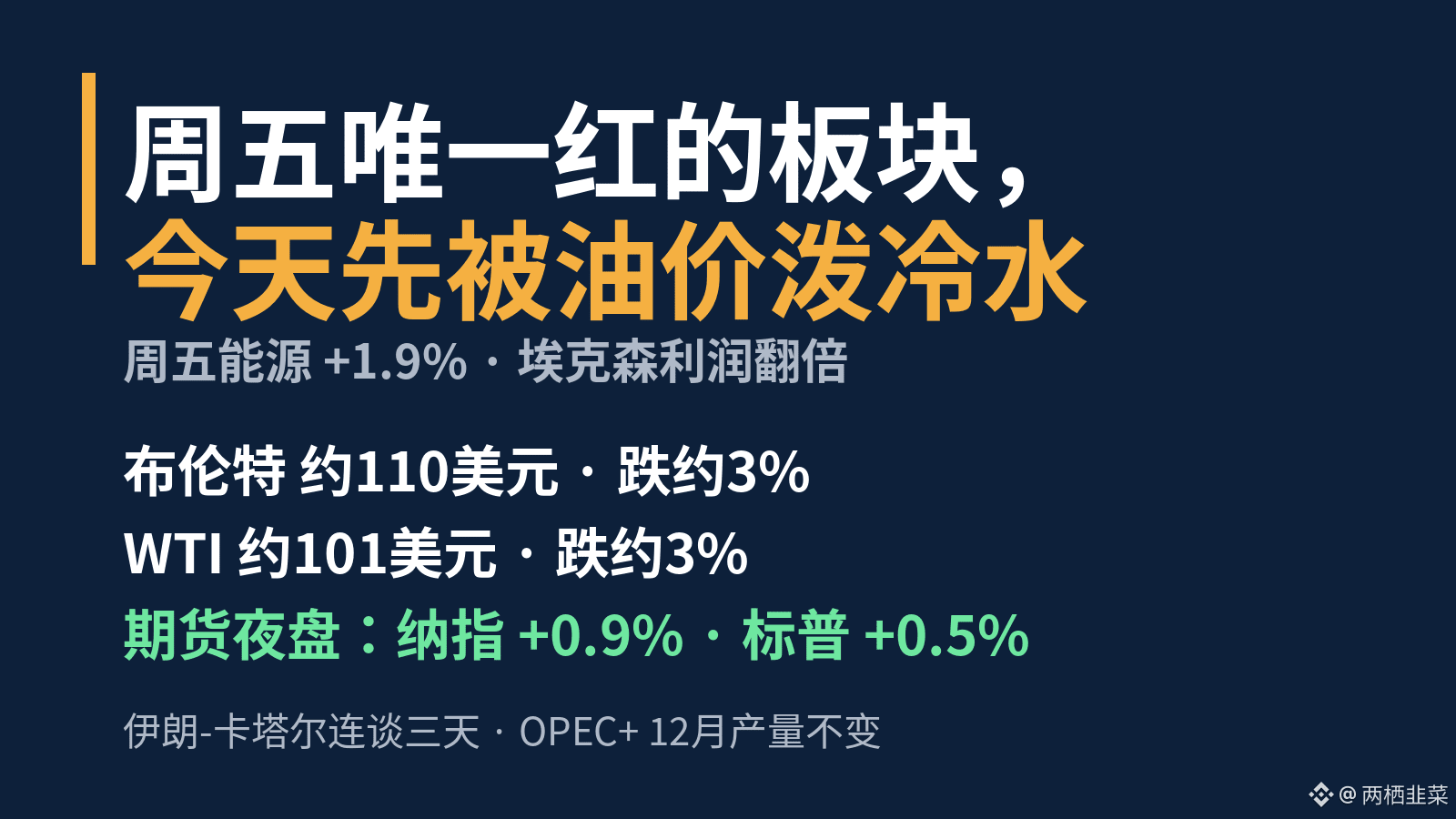
Everything got crushed on Friday; energy was the only sector in the green, up 1.9%, and Exxon’s profit doubled.
I woke up today to oil prices down 3% right off the bat 👇
Brent is back around $110, while WTI has fallen to around $101. Iran and Qatar have been in talks for three days, and the market has already priced out some of the supply disruption premium. OPEC+ also said on Sunday that its December production target would remain unchanged.
Futures did edge up overnight: Nasdaq futures rose about 0.9%, and S&P 500 futures gained around 0.5%. It looks like a reprieve, not a reversal.
Put simply, energy stocks rose on Friday because of refining margins and the war premium, not because of oil prices themselves. Now that oil has pulled back today, that equation needs to be recalculated.
ISM manufacturing data are due tonight at 11 p.m., and Apple and Palantir report after the close. Whether these modest futures gains hold depends on those two events.
When it comes to oil prices, one word at the negotiating table can matter more than an earnings report.
$XOM $CVX
539
·
--
The liveliest action on the plaza today wasn’t in Bitcoin, but in the comments section for Ethereum.
One person said that if it holds this time, we’ll never see ETH below $2,400 again. Someone else immediately pushed back, saying the $2,300–$2,310 range is packed with people who got stuck holding from last time, so breaking through won’t be easy. They’re arguing fiercely, but it all comes down to the same question: has ETH really moved past this level?
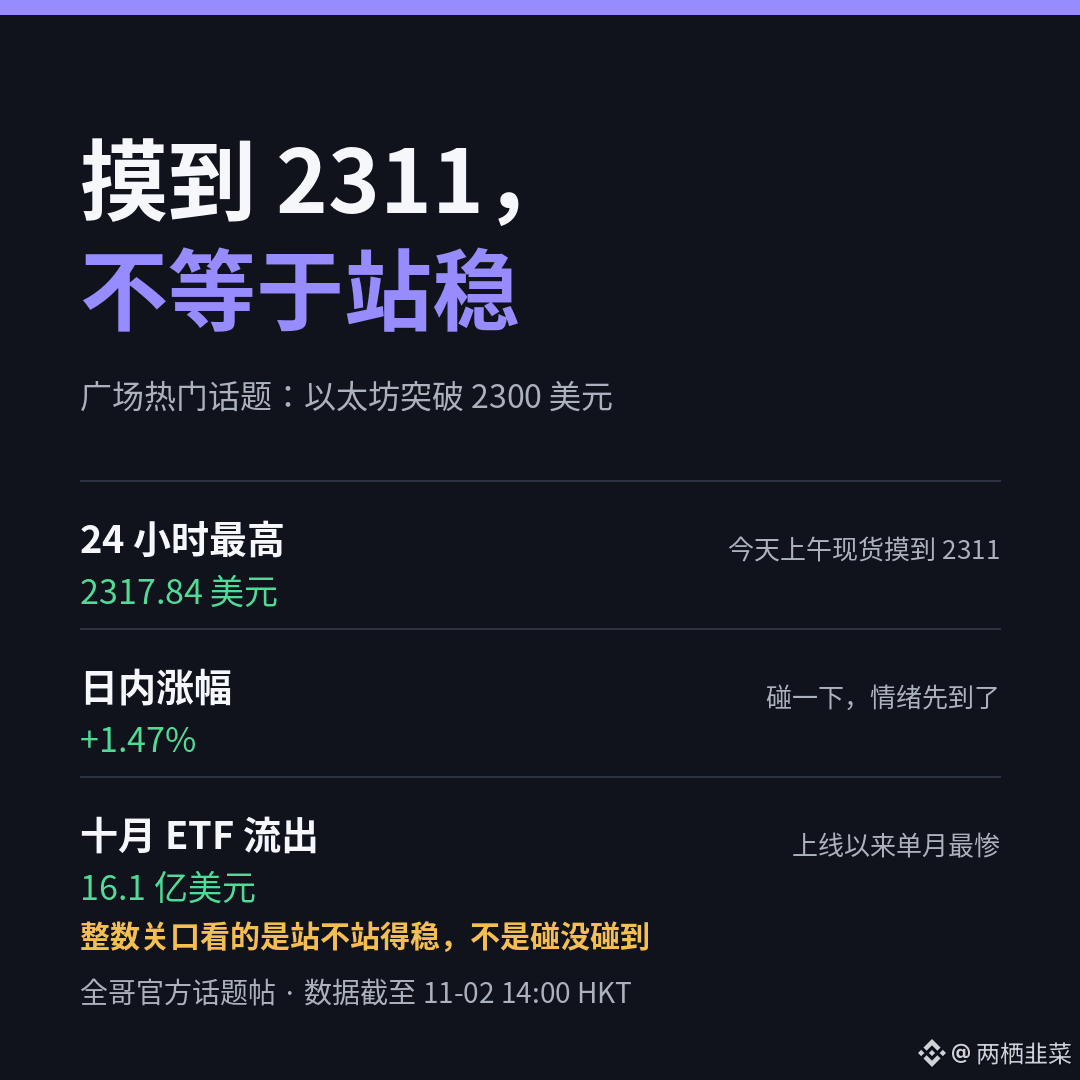
Let’s start with the facts. This morning, ETH touched $2,311 on Binance spot, up 1.47% for the day, with a 24-hour high of $2,317.84. As I write this, the price has slipped back to hover around $2,300. That tells us one thing: touching a level and holding above it are two different things. The former is sentiment; the latter takes time and volume.
I have a simple rule of thumb for these round-number levels: don’t ask whether the price touched them—ask whether it can stay above them for a few days, then ask whether volume is keeping pace as it climbs. Moves higher on declining volume usually don’t go far; when the broader market weakens, these freshly reclaimed levels are the first to go. What’s more, Ethereum ETFs saw $1.61 billion in outflows in October alone—the worst monthly figure since they launched in 2024. Confidence takes much longer to rebuild than it does to destroy.
So I’d rather call this a recovery than a reversal. A recovery can still bring gains, but the biggest risk is chasing it as if it were a reversal.
Do you think ETH can hold above $2,300 this time, or are we in for another wick?
#EthereumBreaksAbove$2300
$ETH $BTC
161
·
--
South Korea is really putting its money where its mouth is this time: 21.3 trillion won is going toward AI and data centers, including 4.6 trillion won earmarked specifically for developing a homegrown, cutting-edge large AI model. It’s also planning to build a semiconductor cluster. Think about it: this isn’t just talk—it’s using public funds as leverage to compete with the U.S. for a say in computing power. The investment may not pay off right away, but the direction is clear: in this AI race, whoever controls the computing power has the louder voice. Whether the semiconductor cluster can keep up depends on how well these plans are implemented.
$EWY
$EWY
1
188
·
--
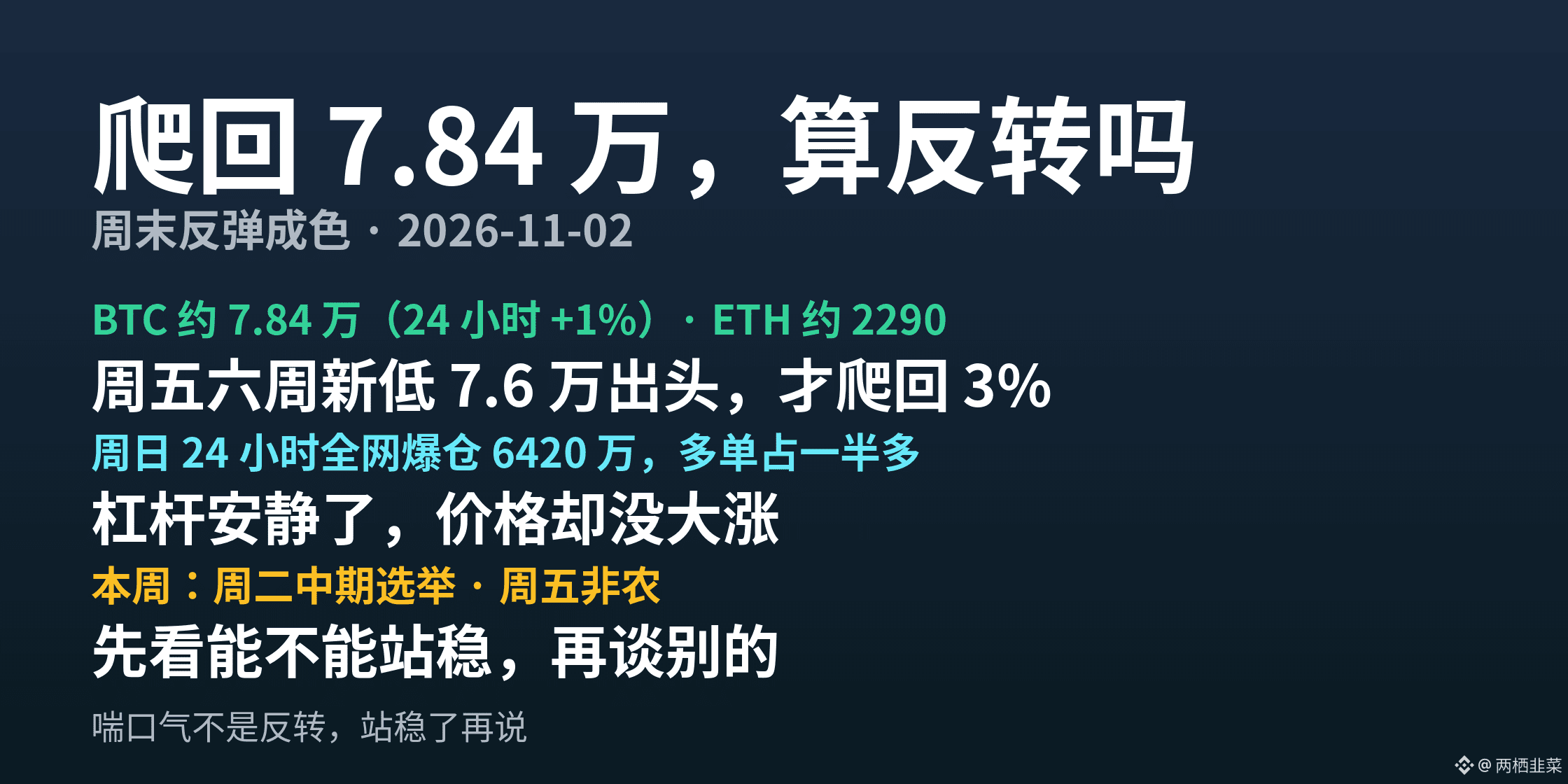
Bitcoin climbed back to around 78,400 over the weekend, up a little over 1% in 24 hours. Ether also returned to around 2,290 👇
But look, a reversal is still a long way off: Friday just saw it hit a six-week low of a little over 76,000, and now it’s only crawled back about 3% from the bottom.
Leverage has gone completely quiet, though. Across the market, 24-hour liquidations on Sunday totaled just $64.2 million, with longs accounting for a little over half—nowhere near Friday’s massive volume.
I used to chase rallies on the very day they happened, and usually got hit with a second drop right after getting in.
There are two hurdles this week: Tuesday’s midterm elections and Friday’s jobs report. Let’s see if it can hold its ground first.
$BTC $ETH
221
·
--
Verified
The doors opened, and the first day’s numbers are in: over nine and a half hours, Binance processed $4.65 billion in withdrawals while taking in $1.01 billion in deposits, for a net outflow of $3.64 billion. Put simply, the numbers look alarming, but against its total assets of $171 billion, that’s just 2.1%. This isn’t a bank run; it’s a queue to withdraw money. Once the doors opened, those who wanted to leave went first, and after peaking, the volume has already started to fall.
What’s interesting is the other side of the equation: $1 billion was deposited that same day. Some withdrew their money, while others put theirs back in. Confidence has never been a one-way street. A third party put the figure at just over $4 billion using a 24-hour window. The windows are different, so don’t compare the figures directly.
One more thing to keep in mind: the denominator for that 2.1% is the proof of reserves from October 28, before the hack. An updated version is due out today, as planned, and the full verification won’t be ready until November 3. The books need to be checked line by line—there’s no need to rush to judgment.
The doors can open, money can move, and the books can be made public. Only when all three are in place have they passed the first test.
$BTC $BNB

565
·
--
Bitcoin spent all weekend hovering around $78,000 with no clear direction. The real action comes after the market closes tomorrow: Apple reports its Q4 earnings, with the market expecting EPS of about $1.99 and revenue of roughly $113.4 billion. It’ll also be the new CEO’s first earnings call. Put simply, meeting the numbers isn’t enough to win—if holiday-quarter guidance comes in low, the stock could still take a hit. I’d rather wait for the guidance before making a move; chasing the stock ahead of earnings is like providing exit liquidity for someone else. Time to pick a side: are you buying in before earnings, or waiting until guidance is out?
$AAPL $BTC
$AAPL $BTC

345
Log in to explore more content
Join global crypto users on Binance Square
⚡️ Get latest and useful information about crypto.
💬 Trusted by the world’s largest crypto exchange.
👍 Discover real insights from verified creators.
Email / Phone number
Trending Topics
USMidterms-WhatAreMarketsExpecting?
34,816 views
428 Discussing
Democratic Congressional Sweep Shakes Trump Trades in AI Stocks and Crypto
Binance News
·3 Likes
·2.1k views
USOctoberNFP-AreRateCutsStillPossible
216,151 views
1,716 Discussing
AMDBeatsExpectations-AINarrativeContinues
5,394 views
167 Discussing