

BlockSavvy 1
77 Posts

BlockSavvy 1
Report
Block User
Crypto research & insights for businesses, investors, and innovators. Focused on trends, project evaluation, and strategic guidance.
0 Following
2 Followers
2 Liked
Posts
·
--
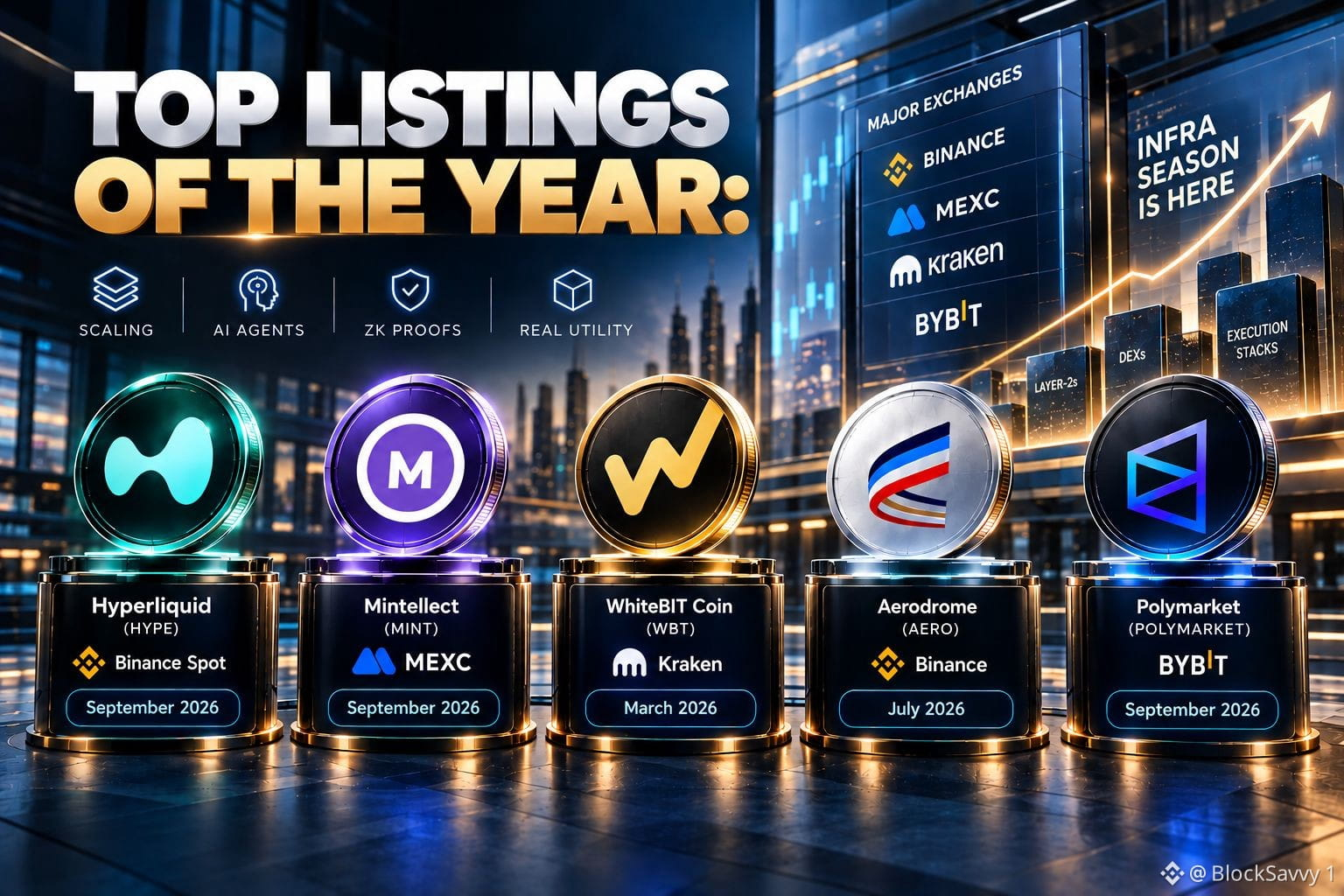
🎯 The Ultimate Top Listings Breakdown: Why Infrastructure Season Has Officially Begun I started digging into the market and noticed something: major exchanges have stopped chasing memecoins and are focusing on more serious stuff. 🤔 This year, infrastructure tokens have been getting access to major exchanges, and that’s not happening for no reason. So, I decided to put together my own list of the best listings of the year (just my two cents). I looked at institutional signals like S&P index inclusion, ICE investments, and protocol mergers. 📊 Put all of that together and you get what I’d call ‘infra season’. Money is actually flowing into projects that have real mechanics, solid protocols, and institutional trust behind them. TOP LISTINGS OF THE YEAR (in my opinion): 🔹 Hyperliquid (HYPE) Binance Spot | September 2026 🔹 Mintellect (MINT) MEXC | September 2026 🔹 WhiteBIT Coin ( $WBT) Kraken | March 2026 🔹 Aerodrome (AERO) Binance | July 2026 🔹 Polymarket (POLYMARKET) Bybit | September 2026 (Pre-market) Exchanges are listing tokens that solve real problems. Scaling, AI agents, ZK proofs - this isn’t just another bunch of $BTC copycats. The BTC-native ecosystem has grown a lot, but growth needs infrastructure. Layer-2s, decentralized exchanges, and new execution stacks - that’s where real money is going. Looks like infra season is here. Whoever controls the tools, controls the power. 🚀 Disclaimer: This is not financial or investment advice. DYOR before making any decisions. Use at your own risk. #BTC Price Analysis# #Bitcoin Price Prediction: What is Bitcoins next move?# #Altcoin Season#
🎯 The Ultimate Top Listings Breakdown: Why Infrastructure Season Has Officially Begun I started digging into the market and noticed something: major exchanges have stopped chasing memecoins and are focusing on more serious stuff. 🤔 This year, infrastructure tokens have been getting access to major exchanges, and that’s not happening for no reason. So, I decided to put together my own list of the best listings of the year (just my two cents). I looked at institutional signals like S&P index inclusion, ICE investments, and protocol mergers. 📊 Put all of that together and you get what I’d call ‘infra season’. Money is actually flowing into projects that have real mechanics, solid protocols, and institutional trust behind them. TOP LISTINGS OF THE YEAR (in my opinion): 🔹 Hyperliquid (HYPE) Binance Spot | September 2026 🔹 Mintellect (MINT) MEXC | September 2026 🔹 WhiteBIT Coin ( $WBT) Kraken | March 2026 🔹 Aerodrome (AERO) Binance | July 2026 🔹 Polymarket (POLYMARKET) Bybit | September 2026 (Pre-market) Exchanges are listing tokens that solve real problems. Scaling, AI agents, ZK proofs - this isn’t just another bunch of $BTC copycats. The BTC-native ecosystem has grown a lot, but growth needs infrastructure. Layer-2s, decentralized exchanges, and new execution stacks - that’s where real money is going. Looks like infra season is here. Whoever controls the tools, controls the power. 🚀 Disclaimer: This is not financial or investment advice. DYOR before making any decisions. Use at your own risk. #BTC Price Analysis# #Bitcoin Price Prediction: What is Bitcoins next move?# #Altcoin Season#
70
·
--
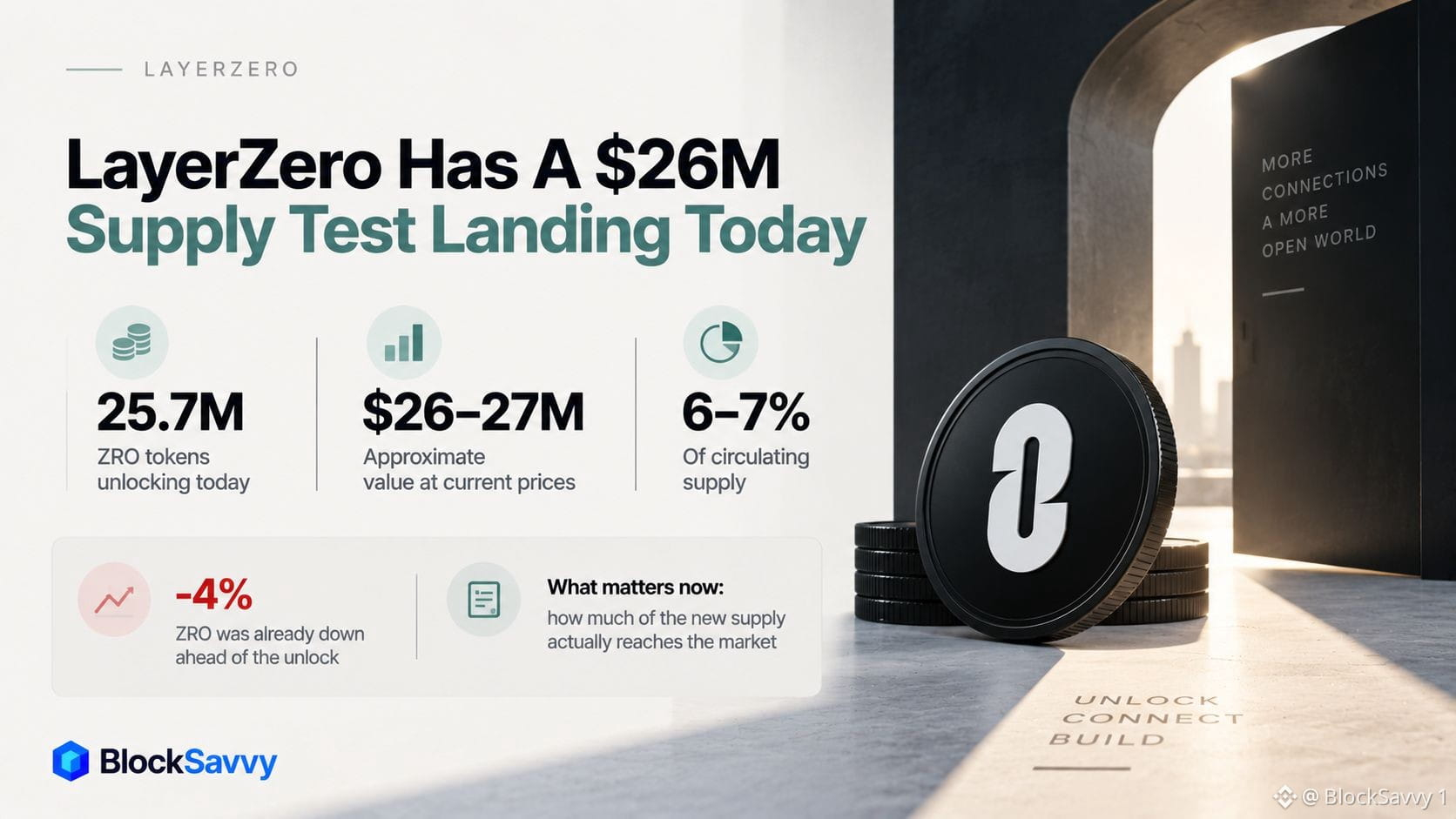
LayerZero Had A $26M Supply Test Landing $ZRO is dealing with a very visible piece of tokenomics: roughly 25.7 million tokens, worth around $26–27 million, were unlocked. Current trackers put the release at roughly 6–7% of circulating supply, making it unusually large relative to the token’s existing float. ZRO was already down roughly 4%, with the upcoming unlock cited as one of the main pieces of supply overhang traders were watching. There wasn’t an accompanying hack, delisting or obvious project-specific shock. What makes unlocks interesting is that the headline number doesn’t tell you how much actually gets sold. These releases were scheduled, everyone could see them coming. Traders could hedge beforehand, holders could decide not to sell, and some of the new supply may have never reach an exchange, so the better thing to watch after wasn't the unlock itself. It’s whether those 25.7M ZRO actually became liquid market supply, and whether exchange balances and selling activity moved with them. #Macro Insights# #Altcoin Season#
LayerZero Had A $26M Supply Test Landing $ZRO is dealing with a very visible piece of tokenomics: roughly 25.7 million tokens, worth around $26–27 million, were unlocked. Current trackers put the release at roughly 6–7% of circulating supply, making it unusually large relative to the token’s existing float. ZRO was already down roughly 4%, with the upcoming unlock cited as one of the main pieces of supply overhang traders were watching. There wasn’t an accompanying hack, delisting or obvious project-specific shock. What makes unlocks interesting is that the headline number doesn’t tell you how much actually gets sold. These releases were scheduled, everyone could see them coming. Traders could hedge beforehand, holders could decide not to sell, and some of the new supply may have never reach an exchange, so the better thing to watch after wasn't the unlock itself. It’s whether those 25.7M ZRO actually became liquid market supply, and whether exchange balances and selling activity moved with them. #Macro Insights# #Altcoin Season#
171
·
--
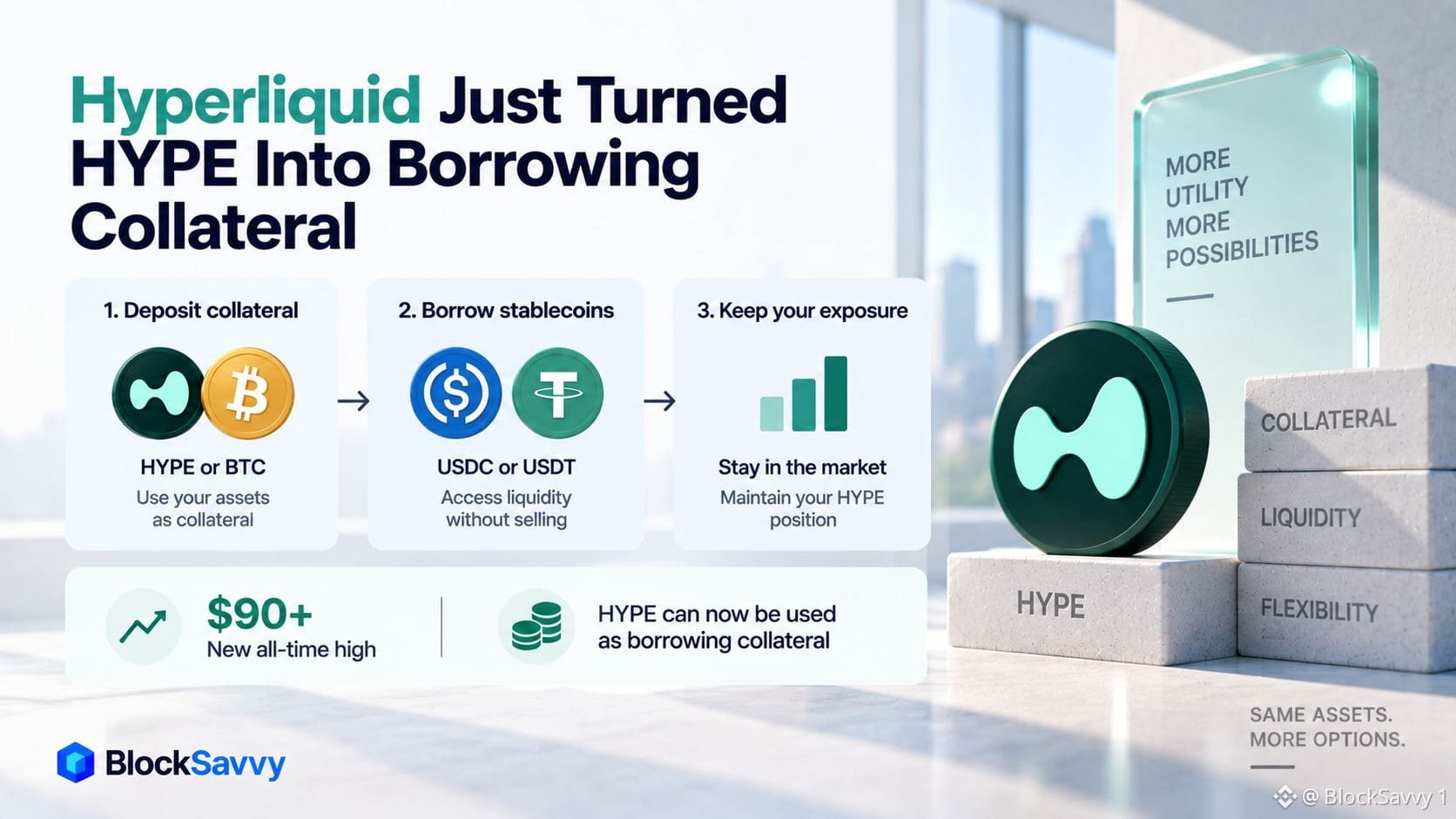
Hyperliquid Just Turned HYPE Into Borrowing Collateral Hyperliquid added manual borrowing, letting users post assets including $HYPE and $BTC as collateral and borrow stablecoins such as USDC and USDT. The launch landed just as HYPE pushed above $90 to a new all-time high. The interesting bit isn’t the new ATH. It’s what happens to HYPE when it becomes productive collateral. A holder no longer necessarily has to sell HYPE to free up dollar liquidity. They can keep the exposure, lock the token as collateral and borrow stablecoins against it instead. That creates another source of demand for the token that has little to do with directional trading. But there’s a second side to that trade. Once an asset becomes widely usable as collateral, its price starts affecting more than portfolios. A sharp HYPE drawdown can now push leveraged borrowers toward liquidation, turning falling collateral values into forced selling. That’s how a token gradually stops being just something people trade and starts becoming part of the plumbing underneath the market. #Macro Insights# #Altcoin Season#
Hyperliquid Just Turned HYPE Into Borrowing Collateral Hyperliquid added manual borrowing, letting users post assets including $HYPE and $BTC as collateral and borrow stablecoins such as USDC and USDT. The launch landed just as HYPE pushed above $90 to a new all-time high. The interesting bit isn’t the new ATH. It’s what happens to HYPE when it becomes productive collateral. A holder no longer necessarily has to sell HYPE to free up dollar liquidity. They can keep the exposure, lock the token as collateral and borrow stablecoins against it instead. That creates another source of demand for the token that has little to do with directional trading. But there’s a second side to that trade. Once an asset becomes widely usable as collateral, its price starts affecting more than portfolios. A sharp HYPE drawdown can now push leveraged borrowers toward liquidation, turning falling collateral values into forced selling. That’s how a token gradually stops being just something people trade and starts becoming part of the plumbing underneath the market. #Macro Insights# #Altcoin Season#
59
·
--
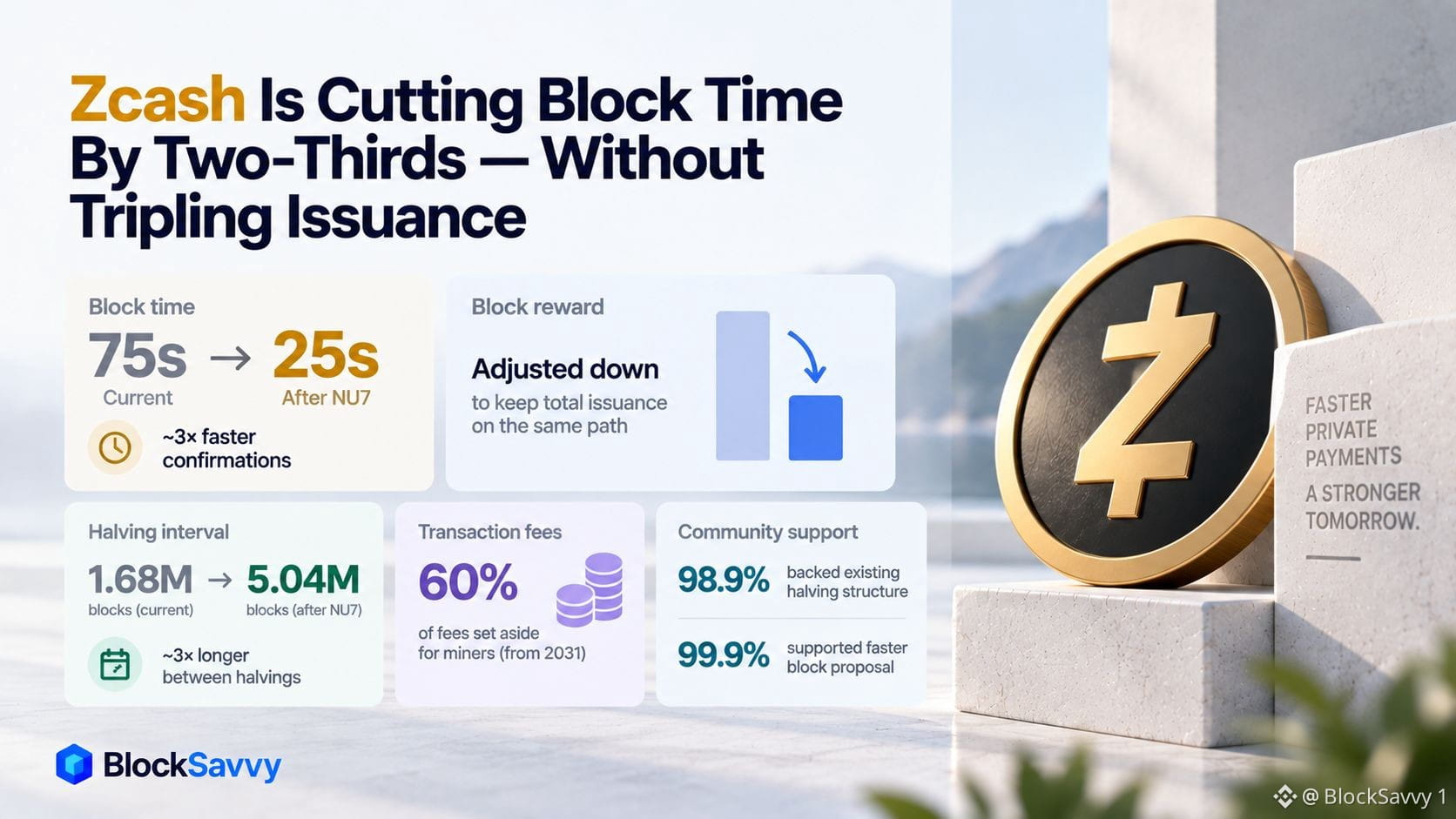
Zcash Is Cutting Block Time By Two-Thirds Without Tripling Issuance $ZEC developers are targeting November 5 for NU7, an upgrade that would cut Zcash’s block time from 75 seconds to 25 seconds. That means confirmations could arrive roughly three times faster. The interesting part is how they’re doing it without changing the long-term issuance schedule. If blocks arrive three times as often, simply keeping the same reward per block would dramatically increase new supply. Instead, NU7 reduces the reward per block by roughly the same factor and extends the halving interval from 1.68M blocks to 5.04M blocks. More blocks, same basic issuance path. There’s also a second piece that matters for miners. Roughly 60% of transaction fees would start being set aside under Zcash’s new sustainability mechanism, with those funds scheduled to flow back into mining rewards from February 2031 as regular issuance keeps declining. The community vote was unusually decisive too: 98.9% backed preserving the existing halving structure, while 99.9% of ZEC-weighted votes supported the faster block proposal. So NU7 is doing two things at once: making private payments feel much faster now, while already adjusting how network security gets paid for years later. #Macro Insights# #Altcoin Season#
Zcash Is Cutting Block Time By Two-Thirds Without Tripling Issuance $ZEC developers are targeting November 5 for NU7, an upgrade that would cut Zcash’s block time from 75 seconds to 25 seconds. That means confirmations could arrive roughly three times faster. The interesting part is how they’re doing it without changing the long-term issuance schedule. If blocks arrive three times as often, simply keeping the same reward per block would dramatically increase new supply. Instead, NU7 reduces the reward per block by roughly the same factor and extends the halving interval from 1.68M blocks to 5.04M blocks. More blocks, same basic issuance path. There’s also a second piece that matters for miners. Roughly 60% of transaction fees would start being set aside under Zcash’s new sustainability mechanism, with those funds scheduled to flow back into mining rewards from February 2031 as regular issuance keeps declining. The community vote was unusually decisive too: 98.9% backed preserving the existing halving structure, while 99.9% of ZEC-weighted votes supported the faster block proposal. So NU7 is doing two things at once: making private payments feel much faster now, while already adjusting how network security gets paid for years later. #Macro Insights# #Altcoin Season#
43
·
--
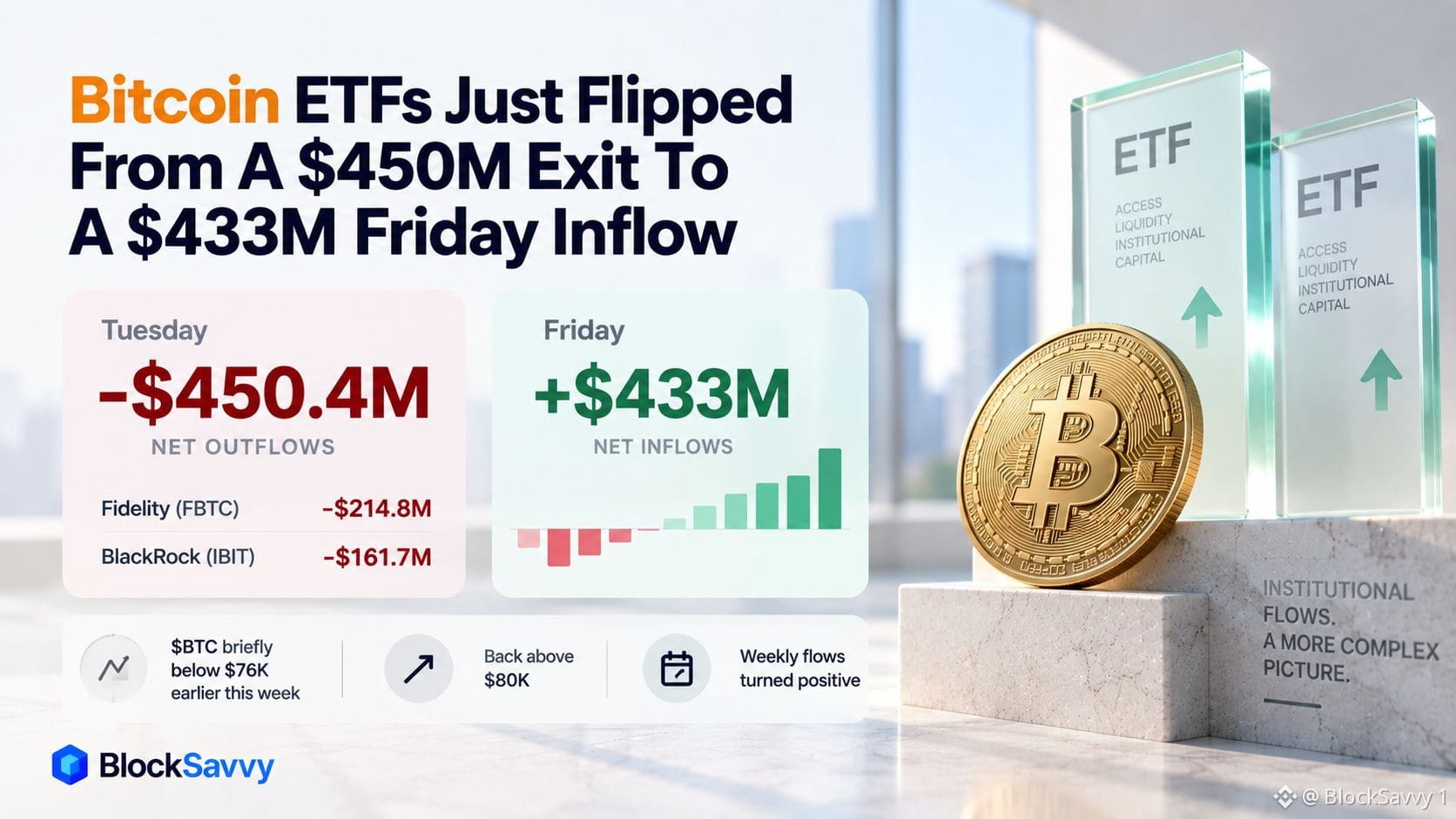
Bitcoin ETFs Just Flipped From A $450M Exit To A $433M Friday Inflow The interesting part of this week’s $BTC ETF data isn’t that money moved in or out. It’s how quickly the direction changed. On Tuesday, U.S. spot Bitcoin ETFs recorded about $450.4M in net outflows, their largest daily withdrawal since late June. Fidelity’s FBTC accounted for roughly $214.8M and BlackRock’s IBIT another $161.7M. By Friday, the picture had reversed. Bitcoin ETFs pulled in roughly $433M in a single day, enough to push the full week back into positive territory. That’s almost a complete round trip in institutional flows within three trading sessions. It also happened while $BTC recovered above $80K after briefly trading below $76K earlier in the week. ETF flows are often treated as a simple demand gauge: green number bullish, red number bearish. This week is a good example of why that can be misleading. The bigger signal may be how quickly ETF capital is now reacting to changes in price, rates and regulatory headlines. A $450M exit no longer necessarily describes the mood even a few sessions later. #BTC Price Analysis# #Bitcoin Price Prediction: What is Bitcoins next move?#
Bitcoin ETFs Just Flipped From A $450M Exit To A $433M Friday Inflow The interesting part of this week’s $BTC ETF data isn’t that money moved in or out. It’s how quickly the direction changed. On Tuesday, U.S. spot Bitcoin ETFs recorded about $450.4M in net outflows, their largest daily withdrawal since late June. Fidelity’s FBTC accounted for roughly $214.8M and BlackRock’s IBIT another $161.7M. By Friday, the picture had reversed. Bitcoin ETFs pulled in roughly $433M in a single day, enough to push the full week back into positive territory. That’s almost a complete round trip in institutional flows within three trading sessions. It also happened while $BTC recovered above $80K after briefly trading below $76K earlier in the week. ETF flows are often treated as a simple demand gauge: green number bullish, red number bearish. This week is a good example of why that can be misleading. The bigger signal may be how quickly ETF capital is now reacting to changes in price, rates and regulatory headlines. A $450M exit no longer necessarily describes the mood even a few sessions later. #BTC Price Analysis# #Bitcoin Price Prediction: What is Bitcoins next move?#
45
·
--
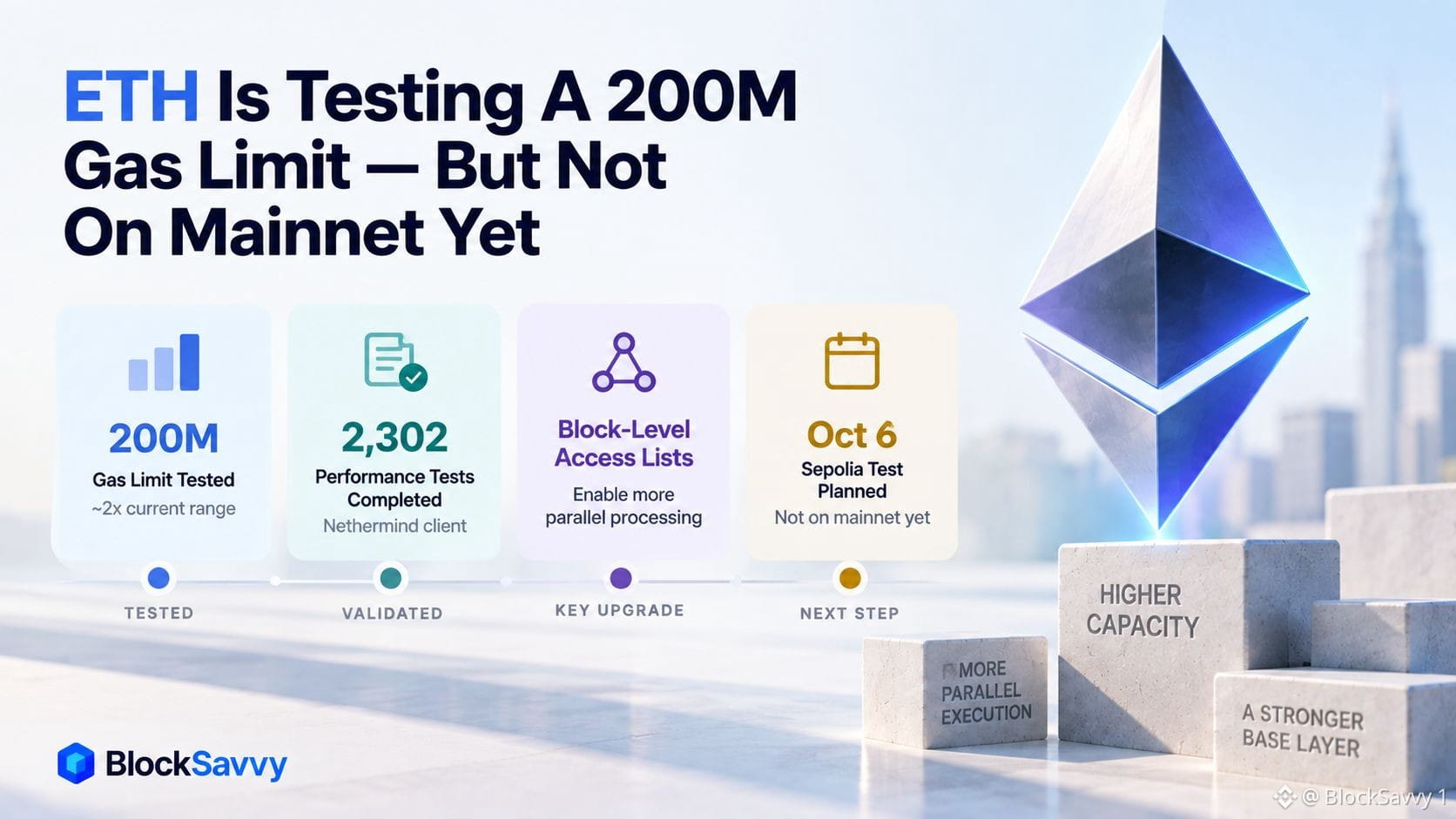
ETH Is Testing A 200M Gas Limit - But Not On Mainnet Yet Ethereum’s next big capacity experiment just cleared an important rehearsal. The upcoming Glamsterdam upgrade has successfully tested blocks at a 200 million gas limit, roughly double the kind of range Ethereum has been operating around recently. The point isn’t simply “more transactions per block.” $ETH developers are testing whether the network can process much heavier blocks without making validation unstable. One of the bigger changes is block-level access lists. Instead of execution staying mostly sequential, transactions can declare which parts of Ethereum’s state they need to touch, making more parallel processing possible. Nethermind says its client completed all 2,302 performance tests for the new setup. That matters because Ethereum’s scaling story has mostly been about pushing activity onto L2s. Glamsterdam is a different kind of scaling: increasing what the base layer itself can safely handle. The 200M setting is still experimental and isn’t currently scheduled to go straight onto mainnet. A proposed Sepolia test is set for October 6 first. So the interesting number here isn’t 200M by itself. It’s how far Ethereum can raise its execution ceiling before validator hardware becomes the bottleneck. #ETHBlockchain #ETHFoundation
ETH Is Testing A 200M Gas Limit - But Not On Mainnet Yet Ethereum’s next big capacity experiment just cleared an important rehearsal. The upcoming Glamsterdam upgrade has successfully tested blocks at a 200 million gas limit, roughly double the kind of range Ethereum has been operating around recently. The point isn’t simply “more transactions per block.” $ETH developers are testing whether the network can process much heavier blocks without making validation unstable. One of the bigger changes is block-level access lists. Instead of execution staying mostly sequential, transactions can declare which parts of Ethereum’s state they need to touch, making more parallel processing possible. Nethermind says its client completed all 2,302 performance tests for the new setup. That matters because Ethereum’s scaling story has mostly been about pushing activity onto L2s. Glamsterdam is a different kind of scaling: increasing what the base layer itself can safely handle. The 200M setting is still experimental and isn’t currently scheduled to go straight onto mainnet. A proposed Sepolia test is set for October 6 first. So the interesting number here isn’t 200M by itself. It’s how far Ethereum can raise its execution ceiling before validator hardware becomes the bottleneck. #ETHBlockchain #ETHFoundation
59
·
--
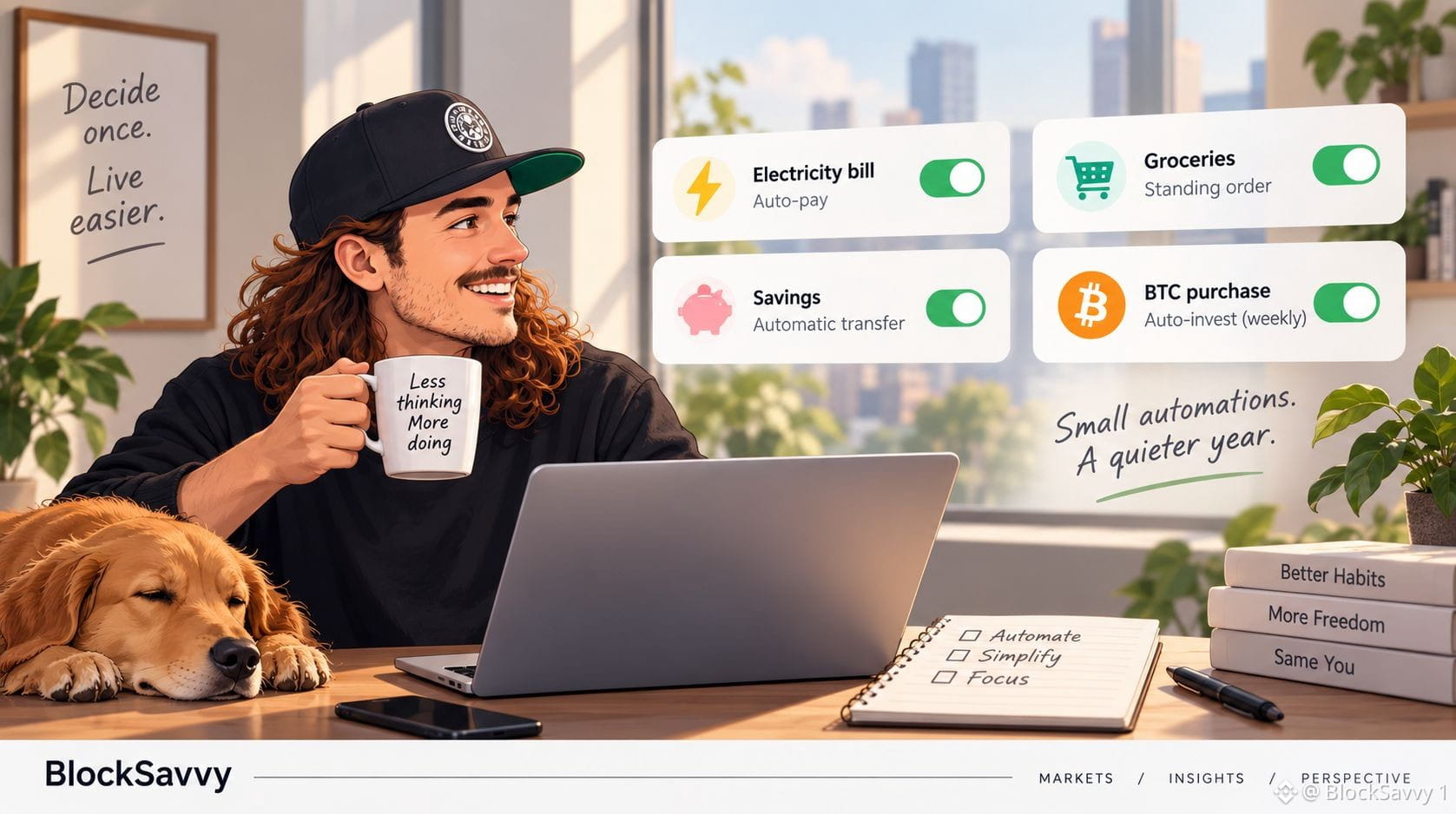
Oat Milk, Savings, and the Same Recurring Question Doing my usual end-of-year list of what actually made this year quieter, and the theme surprised me. You know why? Cause it wasn't the big stuff, it was every small thing I automated, so I'd stop arguing with myself about it on a loop. The electricity bill went on autopay, so I stopped opening the app every month just to grumble and pay it anyway. The grocery staples became a standing order, so I stopped "deciding" to buy oat milk for the fortieth time. A chunk of every paycheck now moves to savings before I can talk myself out of it. And then there was the weekly $BTC buy I kept negotiating with myself over, every single week, should I this week, should I skip it, is now a good entry or a bad one. I set up Auto-Invest on WhiteBIT to just run it weekly with no minimum amount, so I never had to save up before starting. It smooths the buy price out over time through dollar-cost averaging, and I can pause or stop the plan whenever I want, so committing to it never felt like a real decision either. https://bit.ly/3TaCjJT None of these changes saved me much time, but what they actually did was end a recurring internal debate I'd already had a hundred times and kept having again anyway. So that's the theme of my year, apparently: decide once, then stop arguing with myself about it weekly. The crypto buy was just one of the arguments I finally retired. Disclaimer: This is not financial or investment advice. Do your own research before making any decisions. Use at your own risk. #BTC Price Analysis# #Bitcoin Price Prediction: What is Bitcoins next move?#
Oat Milk, Savings, and the Same Recurring Question Doing my usual end-of-year list of what actually made this year quieter, and the theme surprised me. You know why? Cause it wasn't the big stuff, it was every small thing I automated, so I'd stop arguing with myself about it on a loop. The electricity bill went on autopay, so I stopped opening the app every month just to grumble and pay it anyway. The grocery staples became a standing order, so I stopped "deciding" to buy oat milk for the fortieth time. A chunk of every paycheck now moves to savings before I can talk myself out of it. And then there was the weekly $BTC buy I kept negotiating with myself over, every single week, should I this week, should I skip it, is now a good entry or a bad one. I set up Auto-Invest on WhiteBIT to just run it weekly with no minimum amount, so I never had to save up before starting. It smooths the buy price out over time through dollar-cost averaging, and I can pause or stop the plan whenever I want, so committing to it never felt like a real decision either. https://bit.ly/3TaCjJT None of these changes saved me much time, but what they actually did was end a recurring internal debate I'd already had a hundred times and kept having again anyway. So that's the theme of my year, apparently: decide once, then stop arguing with myself about it weekly. The crypto buy was just one of the arguments I finally retired. Disclaimer: This is not financial or investment advice. Do your own research before making any decisions. Use at your own risk. #BTC Price Analysis# #Bitcoin Price Prediction: What is Bitcoins next move?#
·
--
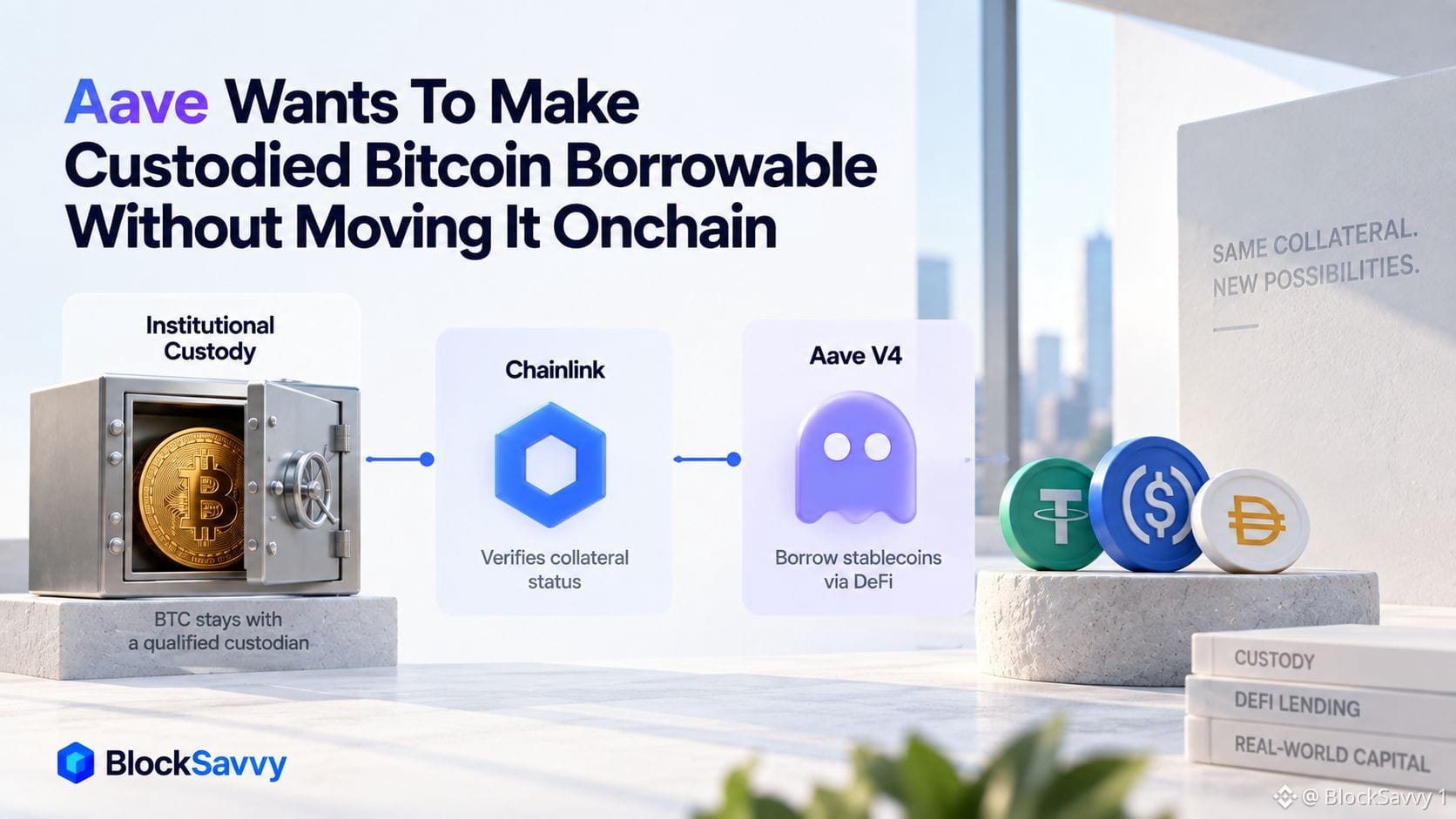
Aave Wants To Make Custodied Bitcoin Borrowable Without Moving It Onchain Aave’s latest V4 proposal is interesting because it attacks one of DeFi lending’s awkward assumptions: collateral usually has to enter DeFi before you can borrow against it. Under the proposed setup, institutions could keep $BTC with a qualified custodian while borrowing stablecoins through Aave V4. Chainlink would act as the coordination layer between the custodian and the lending market, helping verify collateral status rather than requiring the Bitcoin itself to be wrapped and deposited into the protocol. That changes the mechanics quite a bit. An institution holding native BTC may be comfortable with regulated custody but unwilling to introduce wrapped-asset, bridge or smart-contract exposure just to access liquidity. Separating where the collateral sits from where the loan originates potentially removes that step. It also creates a strange hybrid: the loan is DeFi, but an important part of its collateral system remains offchain. For $AAVE , that may be the more interesting direction for V4 than simply competing for another pool of retail deposits. DeFi lending starts looking very different once the collateral doesn't necessarily need to live inside DeFi. #Macro Insights# #Altcoin Season#
Aave Wants To Make Custodied Bitcoin Borrowable Without Moving It Onchain Aave’s latest V4 proposal is interesting because it attacks one of DeFi lending’s awkward assumptions: collateral usually has to enter DeFi before you can borrow against it. Under the proposed setup, institutions could keep $BTC with a qualified custodian while borrowing stablecoins through Aave V4. Chainlink would act as the coordination layer between the custodian and the lending market, helping verify collateral status rather than requiring the Bitcoin itself to be wrapped and deposited into the protocol. That changes the mechanics quite a bit. An institution holding native BTC may be comfortable with regulated custody but unwilling to introduce wrapped-asset, bridge or smart-contract exposure just to access liquidity. Separating where the collateral sits from where the loan originates potentially removes that step. It also creates a strange hybrid: the loan is DeFi, but an important part of its collateral system remains offchain. For $AAVE , that may be the more interesting direction for V4 than simply competing for another pool of retail deposits. DeFi lending starts looking very different once the collateral doesn't necessarily need to live inside DeFi. #Macro Insights# #Altcoin Season#
64
·
--
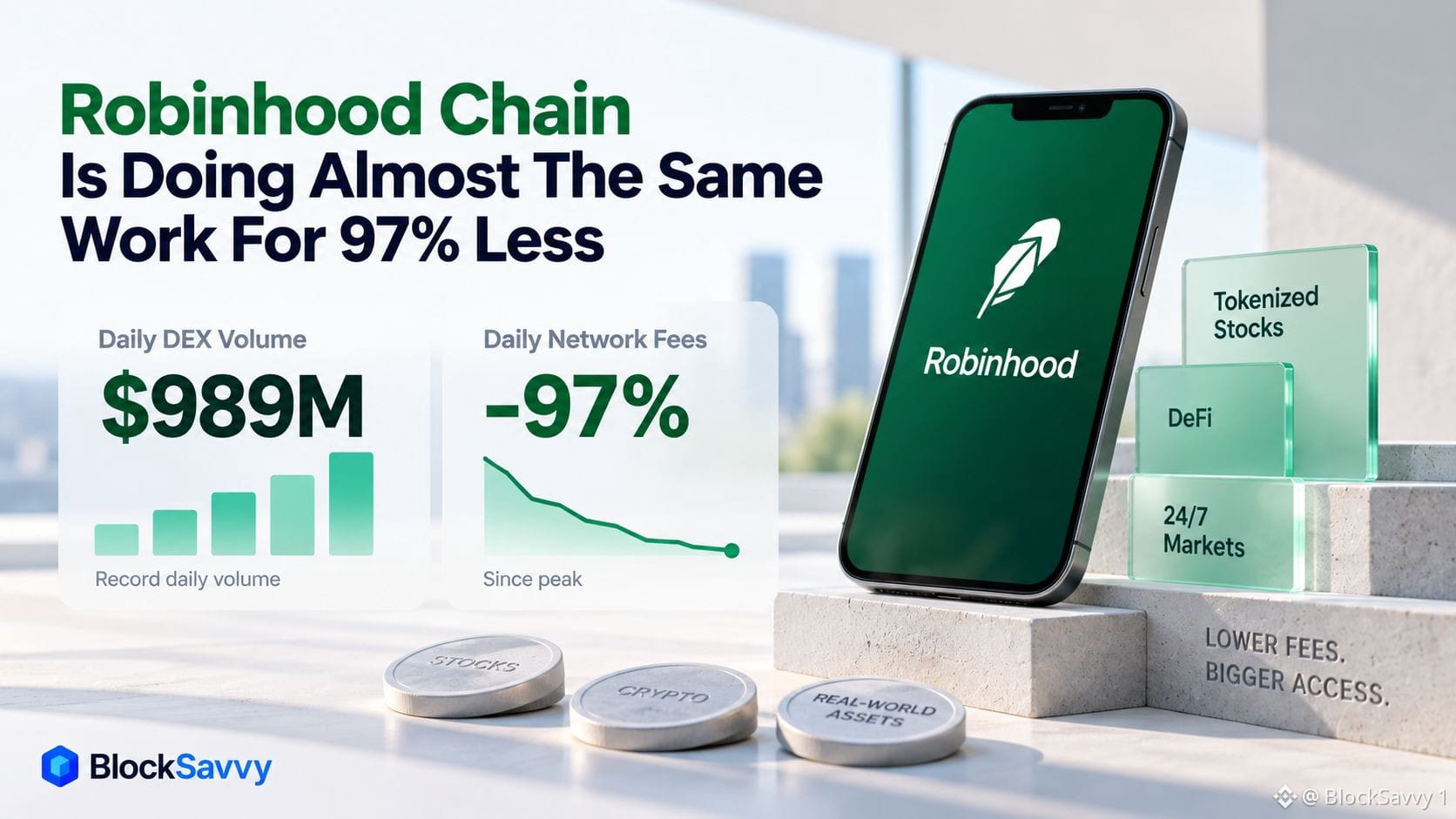
Robinhood Chain Is Doing Almost The Same Work For 97% Less Robinhood Chain is still processing transactions close to its record pace, but the amount users are paying to do it has collapsed. Daily network fees are down roughly 97% from their peak. That makes the $ETH L2 interesting for a reason that has little to do with transaction counts. Blockchains usually look healthier when activity and fees rise together. Here, activity has stayed elevated while the cost of that activity has compressed dramatically. In other words, usage hasn't disappeared — the price of blockspace has. That's good for users, but it creates a different question for the network itself. High transaction counts make a nice activity chart; fees tell you how much economic value the chain is actually capturing from that demand. And Robinhood Chain isn't exactly a quiet network. It recently recorded roughly $989M in daily DEX volume, with tokenized stocks becoming a meaningful part of its onchain activity. Cheap blockspace can scale surprisingly far. The harder part is figuring out how much that blockspace is eventually worth. #Macro Insights# #Altcoin Season#
Robinhood Chain Is Doing Almost The Same Work For 97% Less Robinhood Chain is still processing transactions close to its record pace, but the amount users are paying to do it has collapsed. Daily network fees are down roughly 97% from their peak. That makes the $ETH L2 interesting for a reason that has little to do with transaction counts. Blockchains usually look healthier when activity and fees rise together. Here, activity has stayed elevated while the cost of that activity has compressed dramatically. In other words, usage hasn't disappeared — the price of blockspace has. That's good for users, but it creates a different question for the network itself. High transaction counts make a nice activity chart; fees tell you how much economic value the chain is actually capturing from that demand. And Robinhood Chain isn't exactly a quiet network. It recently recorded roughly $989M in daily DEX volume, with tokenized stocks becoming a meaningful part of its onchain activity. Cheap blockspace can scale surprisingly far. The harder part is figuring out how much that blockspace is eventually worth. #Macro Insights# #Altcoin Season#
41
·
--
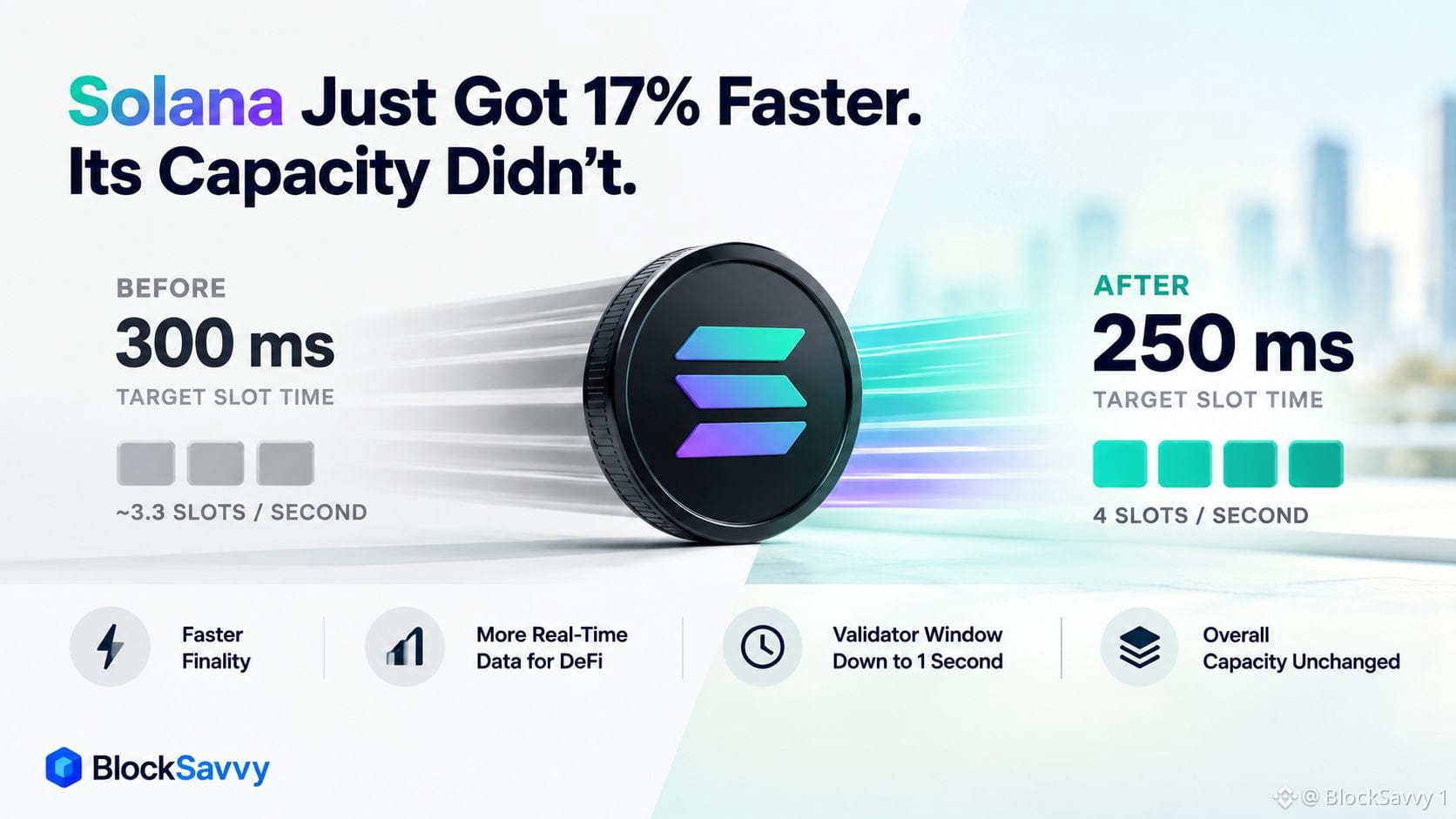
Solana Just Got 17% Faster. Its Capacity Didn't. $SOL quietly had a fairly meaningful network change this week. Solana cut its target slot time from 300ms to 250ms, meaning the chain now targets four slots every second instead of roughly 3.3. The obvious interpretation is “17% faster blocks = 17% more throughput, but that's not actually what happened. Compute and data limits per slot were reduced alongside the shorter slot time, so overall processing capacity stays roughly the same. What improves is freshness: wallets, DEXs, oracles and trading systems get a newer view of the chain more frequently. For DeFi, a 50ms difference isn't as trivial as it sounds. Automated market makers and oracle-driven markets operate in an environment where prices can change between a transaction being constructed and actually reaching the network. Shorter slots shrink that window. There's another interesting side effect: validators still lead for four consecutive slots, but their control window has fallen from 1.2 seconds to 1 second. Solana ultimately wants to push slots down again to 200ms, although that step depends on validator block-skip rates remaining acceptable. So this isn't really a TPS story, it's Solana trying to make the same capacity feel more real-time. #Macro Insights# #Altcoin Season#
Solana Just Got 17% Faster. Its Capacity Didn't. $SOL quietly had a fairly meaningful network change this week. Solana cut its target slot time from 300ms to 250ms, meaning the chain now targets four slots every second instead of roughly 3.3. The obvious interpretation is “17% faster blocks = 17% more throughput, but that's not actually what happened. Compute and data limits per slot were reduced alongside the shorter slot time, so overall processing capacity stays roughly the same. What improves is freshness: wallets, DEXs, oracles and trading systems get a newer view of the chain more frequently. For DeFi, a 50ms difference isn't as trivial as it sounds. Automated market makers and oracle-driven markets operate in an environment where prices can change between a transaction being constructed and actually reaching the network. Shorter slots shrink that window. There's another interesting side effect: validators still lead for four consecutive slots, but their control window has fallen from 1.2 seconds to 1 second. Solana ultimately wants to push slots down again to 200ms, although that step depends on validator block-skip rates remaining acceptable. So this isn't really a TPS story, it's Solana trying to make the same capacity feel more real-time. #Macro Insights# #Altcoin Season#
62
·
--
Oat Milk, Savings, and the Same Recurring Question Doing my usual end-of-year list of what actually made this year quieter, and the theme surprised me. You know why? Cause it wasn't the big stuff, it was every small thing I automated, so I'd stop arguing with myself about it on a loop. The electricity bill went on autopay, so I stopped opening the app every month just to grumble and pay it anyway. The grocery staples became a standing order, so I stopped "deciding" to buy oat milk for the fortieth time. A chunk of every paycheck now moves to savings before I can talk myself out of it. And then there was the weekly $BTC buy I kept negotiating with myself over, every single week, should I this week, should I skip it, is now a good entry or a bad one. I set up Auto-Invest on WhiteBIT to just run it weekly with no minimum amount, so I never had to save up before starting. It smooths the buy price out over time through dollar-cost averaging, and I can pause or stop the plan whenever I want, so committing to it never felt like a real decision either. https://bit.ly/3TaCjJT None of these changes saved me much time, but what they actually did was end a recurring internal debate I'd already had a hundred times and kept having again anyway. So that's the theme of my year, apparently: decide once, then stop arguing with myself about it weekly. The crypto buy was just one of the arguments I finally retired. Disclaimer: This is not financial or investment advice. Do your own research before making any decisions. Use at your own risk. #BTC Price Analysis# #Bitcoin Price Prediction: What is Bitcoins next move?#
Oat Milk, Savings, and the Same Recurring Question Doing my usual end-of-year list of what actually made this year quieter, and the theme surprised me. You know why? Cause it wasn't the big stuff, it was every small thing I automated, so I'd stop arguing with myself about it on a loop. The electricity bill went on autopay, so I stopped opening the app every month just to grumble and pay it anyway. The grocery staples became a standing order, so I stopped "deciding" to buy oat milk for the fortieth time. A chunk of every paycheck now moves to savings before I can talk myself out of it. And then there was the weekly $BTC buy I kept negotiating with myself over, every single week, should I this week, should I skip it, is now a good entry or a bad one. I set up Auto-Invest on WhiteBIT to just run it weekly with no minimum amount, so I never had to save up before starting. It smooths the buy price out over time through dollar-cost averaging, and I can pause or stop the plan whenever I want, so committing to it never felt like a real decision either. https://bit.ly/3TaCjJT None of these changes saved me much time, but what they actually did was end a recurring internal debate I'd already had a hundred times and kept having again anyway. So that's the theme of my year, apparently: decide once, then stop arguing with myself about it weekly. The crypto buy was just one of the arguments I finally retired. Disclaimer: This is not financial or investment advice. Do your own research before making any decisions. Use at your own risk. #BTC Price Analysis# #Bitcoin Price Prediction: What is Bitcoins next move?#

·
--
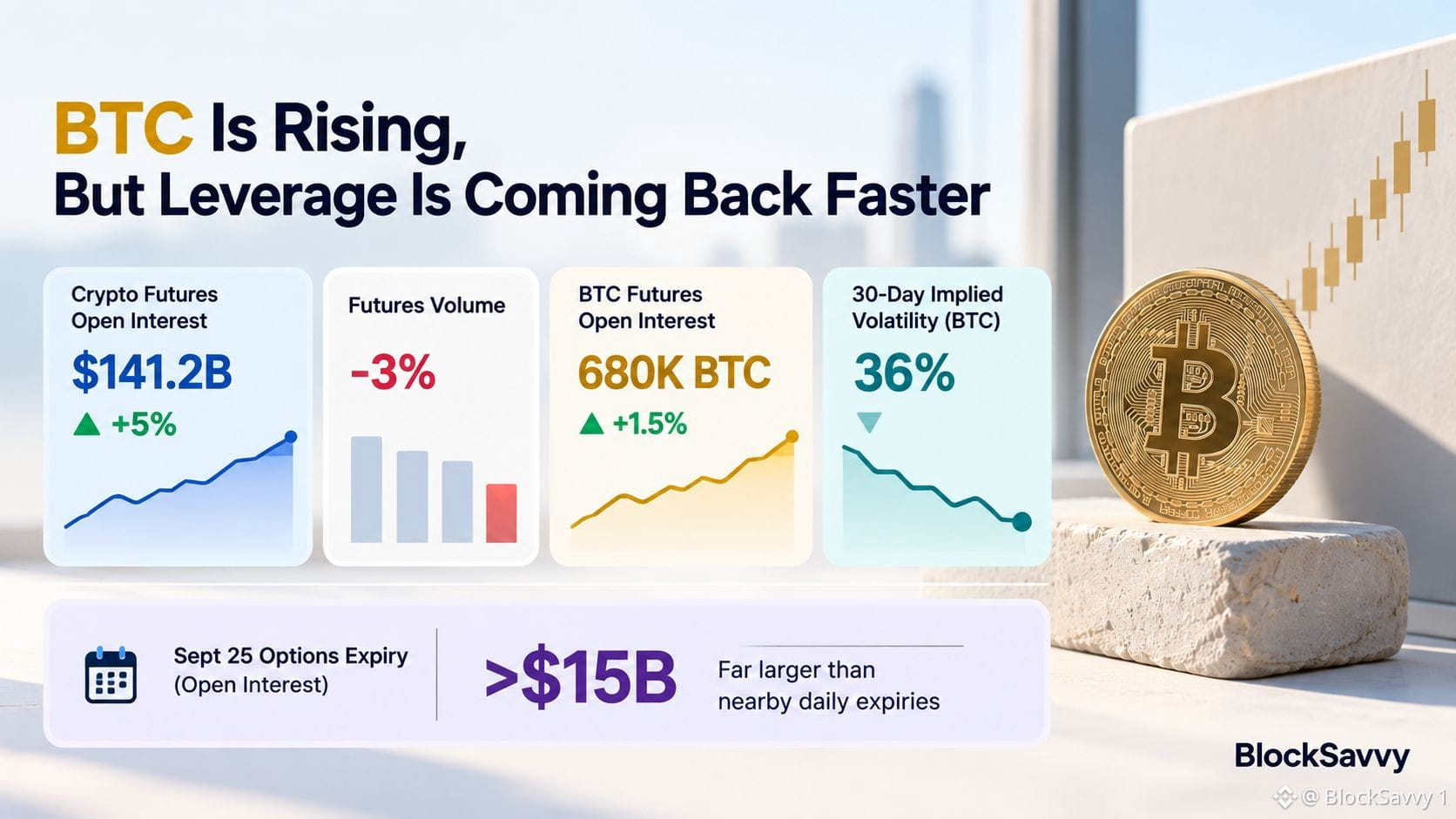
BTC is Rising, But The Leverage Is Coming Back Faster $BTC pushed back above $80K after spending much of the past two weeks stuck in a fairly tight range. The more interesting move is happening underneath the price. Crypto futures open interest expanded by nearly 5% to $141.2B, while daily futures volume actually fell about 3%. That combination matters: more positions are being opened and held, rather than the move simply being driven by a burst of short-term trading. Bitcoin futures OI also climbed from roughly 670K BTC to 680K BTC during the move. At the same time, implied volatility has been getting cheaper - BTC 30-day IV dropped to around 36%, while Deribit data earlier this week had most BTC option tenors sitting around 38–39%. So we're getting a slightly unusual mix: price up, leverage rebuilding, but options aren't pricing in dramatically bigger moves yet. And there's a pretty large positioning event coming up. The September 25 BTC options expiry currently carries more than $15B in open interest on Deribit, far larger than the nearby daily expiries. That's the part I'd pay attention to over the next few sessions. Not just whether $BTC moves higher, but whether open interest keeps expanding while volatility stays this cheap. #BTC Price Analysis# #Bitcoin Price Prediction: What is Bitcoins next move?#
BTC is Rising, But The Leverage Is Coming Back Faster $BTC pushed back above $80K after spending much of the past two weeks stuck in a fairly tight range. The more interesting move is happening underneath the price. Crypto futures open interest expanded by nearly 5% to $141.2B, while daily futures volume actually fell about 3%. That combination matters: more positions are being opened and held, rather than the move simply being driven by a burst of short-term trading. Bitcoin futures OI also climbed from roughly 670K BTC to 680K BTC during the move. At the same time, implied volatility has been getting cheaper - BTC 30-day IV dropped to around 36%, while Deribit data earlier this week had most BTC option tenors sitting around 38–39%. So we're getting a slightly unusual mix: price up, leverage rebuilding, but options aren't pricing in dramatically bigger moves yet. And there's a pretty large positioning event coming up. The September 25 BTC options expiry currently carries more than $15B in open interest on Deribit, far larger than the nearby daily expiries. That's the part I'd pay attention to over the next few sessions. Not just whether $BTC moves higher, but whether open interest keeps expanding while volatility stays this cheap. #BTC Price Analysis# #Bitcoin Price Prediction: What is Bitcoins next move?#
70
·
--
One Bitcoin Miner Finally Chose AI Instead 👀 We've talked plenty about Bitcoin miners experimenting with AI. Now there's a useful example of what that transition actually looks like when a company commits to it. Hyperscale Data has stopped Bitcoin mining at its Michigan facility and is converting the site into AI infrastructure. Its shares, meanwhile, recently hit an all-time low, so the market clearly isn't treating "pivot to AI" as a magic fix. I think that's an important distinction because the miner-to-AI story often gets simplified into: AI pays more for electricity, so miners can just switch. But a Bitcoin mining site isn't automatically an AI data center. $BTC mining can tolerate things that AI workloads often can't. Mining machines can be switched off when power gets expensive. Many AI customers need reliable uptime, different cooling, networking, hardware and considerably more complicated infrastructure. So miners may have something extremely valuable, access to large amounts of power, without necessarily having the finished product AI companies want. That's why I'm watching the companies that actually complete these conversions rather than every miner that puts "HPC" into an investor presentation. The power connection might be the moat. Everything built around it is still a business. #BTC Price Analysis# #Bitcoin Price Prediction: What is Bitcoins next move?#
One Bitcoin Miner Finally Chose AI Instead 👀 We've talked plenty about Bitcoin miners experimenting with AI. Now there's a useful example of what that transition actually looks like when a company commits to it. Hyperscale Data has stopped Bitcoin mining at its Michigan facility and is converting the site into AI infrastructure. Its shares, meanwhile, recently hit an all-time low, so the market clearly isn't treating "pivot to AI" as a magic fix. I think that's an important distinction because the miner-to-AI story often gets simplified into: AI pays more for electricity, so miners can just switch. But a Bitcoin mining site isn't automatically an AI data center. $BTC mining can tolerate things that AI workloads often can't. Mining machines can be switched off when power gets expensive. Many AI customers need reliable uptime, different cooling, networking, hardware and considerably more complicated infrastructure. So miners may have something extremely valuable, access to large amounts of power, without necessarily having the finished product AI companies want. That's why I'm watching the companies that actually complete these conversions rather than every miner that puts "HPC" into an investor presentation. The power connection might be the moat. Everything built around it is still a business. #BTC Price Analysis# #Bitcoin Price Prediction: What is Bitcoins next move?#

45
·
--
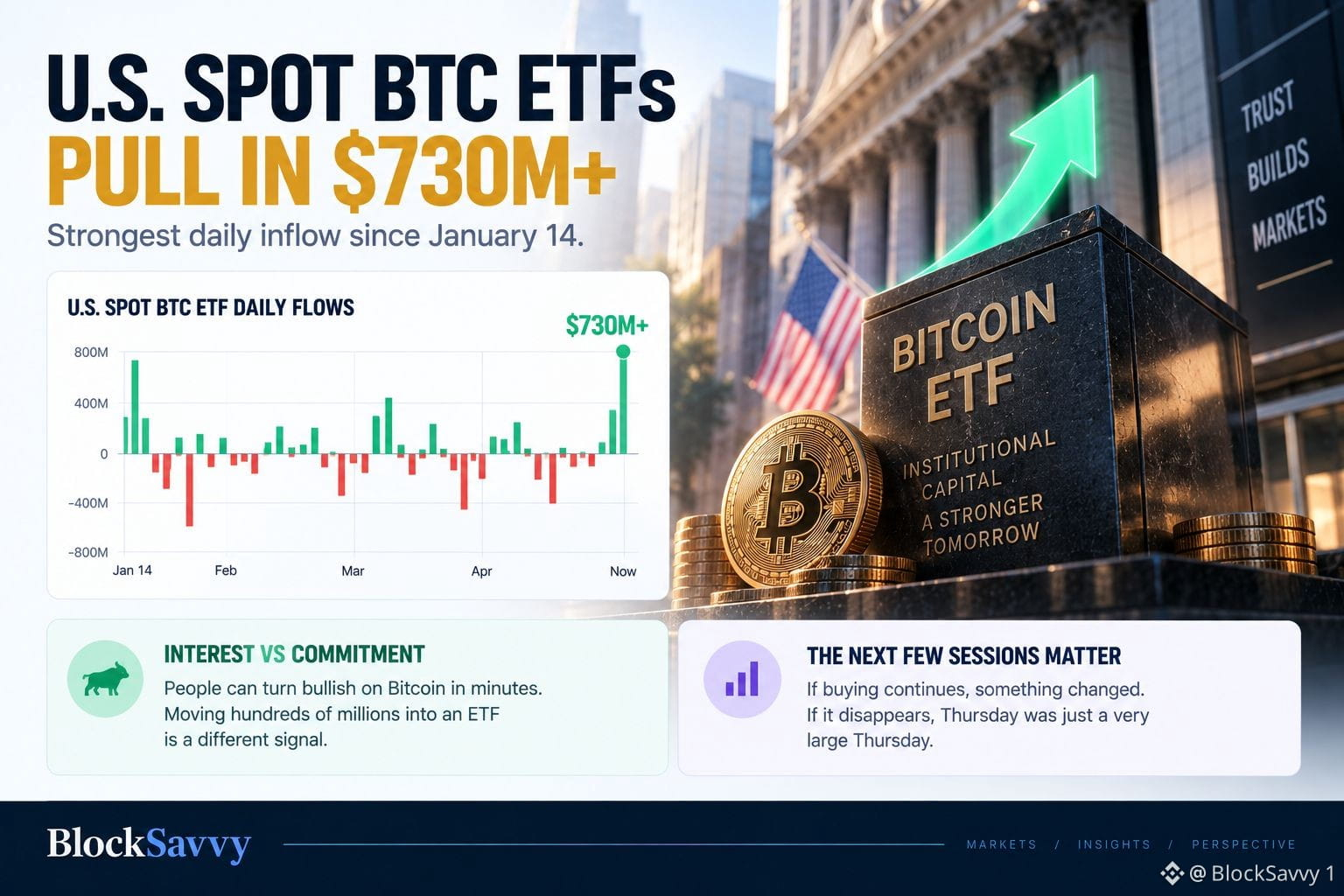
Bitcoin ETFs Just Had Their Biggest Day Since January After several sessions of inconsistent flows, U.S. spot $BTC ETFs pulled in more than $730 million in a single day, their strongest daily inflow since January 14. What I like about ETF flows is how quickly they expose the difference between interest and commitment. People can turn bullish on Bitcoin in minutes. Actually moving hundreds of millions into an ETF is a different signal. But one huge day still isn't a trend. Bitcoin ETF flows have been alternating between inflows and outflows recently, which makes the next few sessions more interesting than the $730M headline itself. If the buying continues, something changed. If it disappears tomorrow, Thursday was just a very large Thursday. 🤷♂️ #BTC Price Analysis# #Bitcoin Price Prediction: What is Bitcoins next move?#
Bitcoin ETFs Just Had Their Biggest Day Since January After several sessions of inconsistent flows, U.S. spot $BTC ETFs pulled in more than $730 million in a single day, their strongest daily inflow since January 14. What I like about ETF flows is how quickly they expose the difference between interest and commitment. People can turn bullish on Bitcoin in minutes. Actually moving hundreds of millions into an ETF is a different signal. But one huge day still isn't a trend. Bitcoin ETF flows have been alternating between inflows and outflows recently, which makes the next few sessions more interesting than the $730M headline itself. If the buying continues, something changed. If it disappears tomorrow, Thursday was just a very large Thursday. 🤷♂️ #BTC Price Analysis# #Bitcoin Price Prediction: What is Bitcoins next move?#
57
·
--
AMC Just Found Out What Happens When Someone Tokenizes Your Stock Without Asking 😅 AMC's CEO isn't particularly happy about Robinhood-linked tokenized shares carrying the company's ticker, arguing that investors could mistake them for actual AMC equity. AMC shares then jumped about 21% in overnight trading as the dispute attracted attention. This exposes a slightly awkward part of the tokenized-stock boom. When you buy a traditional share, there's a fairly well-understood relationship between the investor, broker, clearing system and issuing company. Tokenization can add another wrapper around that relationship, and suddenly the thing trading on-chain may track a stock without necessarily being the stock itself. That's where I think $ETH and other tokenization infrastructure eventually run into a branding problem as much as a technical one. If an app shows me something called "AMC," what exactly do I own? A share? A token backed by a share? A derivative tracking the share? And what legal claim do I actually have if something goes wrong? Tokenizing an asset is easy to explain. Explaining the wrapper might be the harder part. #ETHBlockchain #ETHFoundation
AMC Just Found Out What Happens When Someone Tokenizes Your Stock Without Asking 😅 AMC's CEO isn't particularly happy about Robinhood-linked tokenized shares carrying the company's ticker, arguing that investors could mistake them for actual AMC equity. AMC shares then jumped about 21% in overnight trading as the dispute attracted attention. This exposes a slightly awkward part of the tokenized-stock boom. When you buy a traditional share, there's a fairly well-understood relationship between the investor, broker, clearing system and issuing company. Tokenization can add another wrapper around that relationship, and suddenly the thing trading on-chain may track a stock without necessarily being the stock itself. That's where I think $ETH and other tokenization infrastructure eventually run into a branding problem as much as a technical one. If an app shows me something called "AMC," what exactly do I own? A share? A token backed by a share? A derivative tracking the share? And what legal claim do I actually have if something goes wrong? Tokenizing an asset is easy to explain. Explaining the wrapper might be the harder part. #ETHBlockchain #ETHFoundation

68
·
--
Privacy Coins Suddenly Remembered How to Rally 👀 $ZEC jumped roughly 15% in a day and around 20% over the week, outperforming every major crypto asset as the broader market recovered. I find privacy coins interesting because they've spent years stuck between two completely opposite forces. There is a very obvious use case for financial privacy on public blockchains, but there is also regulatory pressure that makes exchanges and institutions cautious about supporting assets specifically designed around it. And yet Zcash is still here. Maybe the more interesting question isn't whether privacy coins return to their old prominence. It's whether the wider crypto industry eventually builds enough privacy into wallets, stablecoins and smart-contract networks that dedicated privacy assets become less necessary. $ZEC succeeding and crypto becoming more private aren't necessarily the same bet. #Macro Insights# #Altcoin Season#
Privacy Coins Suddenly Remembered How to Rally 👀 $ZEC jumped roughly 15% in a day and around 20% over the week, outperforming every major crypto asset as the broader market recovered. I find privacy coins interesting because they've spent years stuck between two completely opposite forces. There is a very obvious use case for financial privacy on public blockchains, but there is also regulatory pressure that makes exchanges and institutions cautious about supporting assets specifically designed around it. And yet Zcash is still here. Maybe the more interesting question isn't whether privacy coins return to their old prominence. It's whether the wider crypto industry eventually builds enough privacy into wallets, stablecoins and smart-contract networks that dedicated privacy assets become less necessary. $ZEC succeeding and crypto becoming more private aren't necessarily the same bet. #Macro Insights# #Altcoin Season#

78
·
--
📊 Why the Best VIP Level Is Not Always Defined by Trading Volume Alone August has just ended, and at the end of every month I have a small routine where I open my dashboard, go through my $BTC trading activity, balances, volumes. This time I also checked my VIP level on exchange, expecting to see VIP 2 because I had been mentally tying my status to one metric and had not really questioned it. What stood out was that my dashboard was already showing VIP 3. My average balance was ≥ 15,000, which put me at VIP 2, but my Spot Volume had crossed ≥ 500,000, which was enough for VIP 3, so while I had been watching one number, another criterion had already moved me to the next level. 🚀 https://bit.ly/3UyVLAz That is where the structure of WhiteBIT's VIP Program started to make more sense to me, because the level is not based on one fixed formula that every trader has to follow. Meeting just one qualifying criterion can be enough for a specific tier: 🔹 Average Balance - monthly assets held 🔹Spot Volume - spot and margin trading activity 🔹Futures Volume - derivatives activity 🔹Crypto Lending - active fixed plans of 30+ days What I like most is that the system automatically assigns the highest VIP tier. It is surprisingly easy to anchor yourself to one familiar number and completely miss the fact that another part of your activity has already moved further. The broader takeaway is that VIP status should reflect the strongest part of a trader’s activity, not just the metric they happen to watch most closely, and automatic tier assignment helps make sure that better performance is recognized without extra calculation or guesswork. Disclaimer: This is not financial or investment advice. DYOR before making any decisions. Use at your own risk. #BTC Price Analysis# #Bitcoin Price Prediction: What is Bitcoins next move?#
📊 Why the Best VIP Level Is Not Always Defined by Trading Volume Alone August has just ended, and at the end of every month I have a small routine where I open my dashboard, go through my $BTC trading activity, balances, volumes. This time I also checked my VIP level on exchange, expecting to see VIP 2 because I had been mentally tying my status to one metric and had not really questioned it. What stood out was that my dashboard was already showing VIP 3. My average balance was ≥ 15,000, which put me at VIP 2, but my Spot Volume had crossed ≥ 500,000, which was enough for VIP 3, so while I had been watching one number, another criterion had already moved me to the next level. 🚀 https://bit.ly/3UyVLAz That is where the structure of WhiteBIT's VIP Program started to make more sense to me, because the level is not based on one fixed formula that every trader has to follow. Meeting just one qualifying criterion can be enough for a specific tier: 🔹 Average Balance - monthly assets held 🔹Spot Volume - spot and margin trading activity 🔹Futures Volume - derivatives activity 🔹Crypto Lending - active fixed plans of 30+ days What I like most is that the system automatically assigns the highest VIP tier. It is surprisingly easy to anchor yourself to one familiar number and completely miss the fact that another part of your activity has already moved further. The broader takeaway is that VIP status should reflect the strongest part of a trader’s activity, not just the metric they happen to watch most closely, and automatic tier assignment helps make sure that better performance is recognized without extra calculation or guesswork. Disclaimer: This is not financial or investment advice. DYOR before making any decisions. Use at your own risk. #BTC Price Analysis# #Bitcoin Price Prediction: What is Bitcoins next move?#

·
--
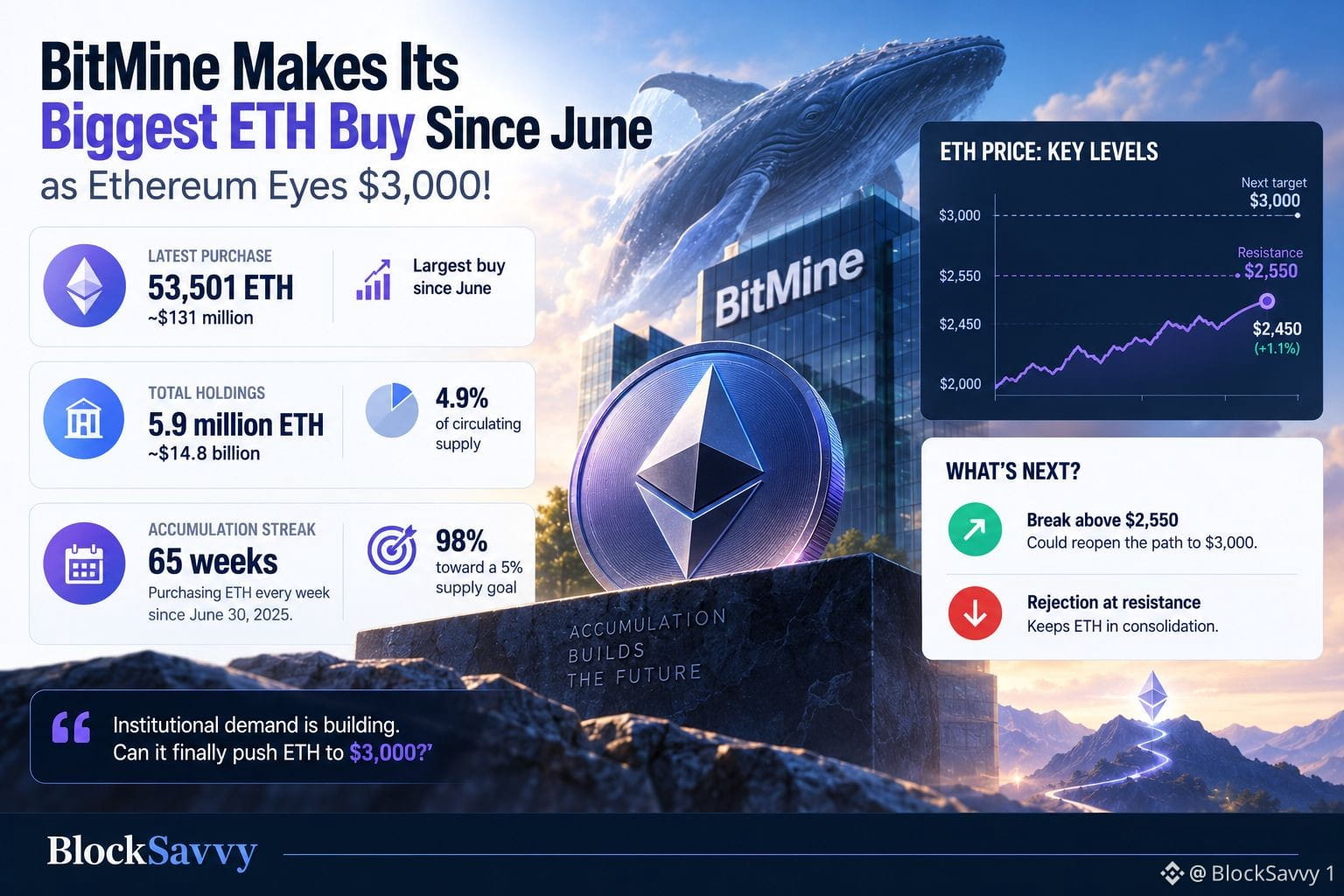
🐋 BitMine Makes Its Biggest $ETH Buy Since June as Ethereum Eyes $3,000! Ethereum is holding near $2,450, but Tom Lee’s BitMine just made a much louder move underneath the surface. The company bought another 53,501 ETH worth roughly $131 million, its largest single purchase since June, pushing total holdings to 5.9 million ETH valued near $14.8 billion. That now represents about 4.9% of Ethereum’s circulating supply. ⚙ Even more striking, BitMine has purchased ETH every single week since June 30, 2025, extending its accumulation streak to 65 weeks. The company is now 98% of the way toward its stated goal of owning 5% of Ethereum’s supply. For $BTC and broader crypto investors, the next test is whether that institutional demand can finally push ETH through $2,550 resistance. A clean breakout could reopen the path toward $3,000, while another rejection would keep Ethereum trapped in consolidation. #ETHBlockchain #ETHFoundation
🐋 BitMine Makes Its Biggest $ETH Buy Since June as Ethereum Eyes $3,000! Ethereum is holding near $2,450, but Tom Lee’s BitMine just made a much louder move underneath the surface. The company bought another 53,501 ETH worth roughly $131 million, its largest single purchase since June, pushing total holdings to 5.9 million ETH valued near $14.8 billion. That now represents about 4.9% of Ethereum’s circulating supply. ⚙ Even more striking, BitMine has purchased ETH every single week since June 30, 2025, extending its accumulation streak to 65 weeks. The company is now 98% of the way toward its stated goal of owning 5% of Ethereum’s supply. For $BTC and broader crypto investors, the next test is whether that institutional demand can finally push ETH through $2,550 resistance. A clean breakout could reopen the path toward $3,000, while another rejection would keep Ethereum trapped in consolidation. #ETHBlockchain #ETHFoundation
74
·
--
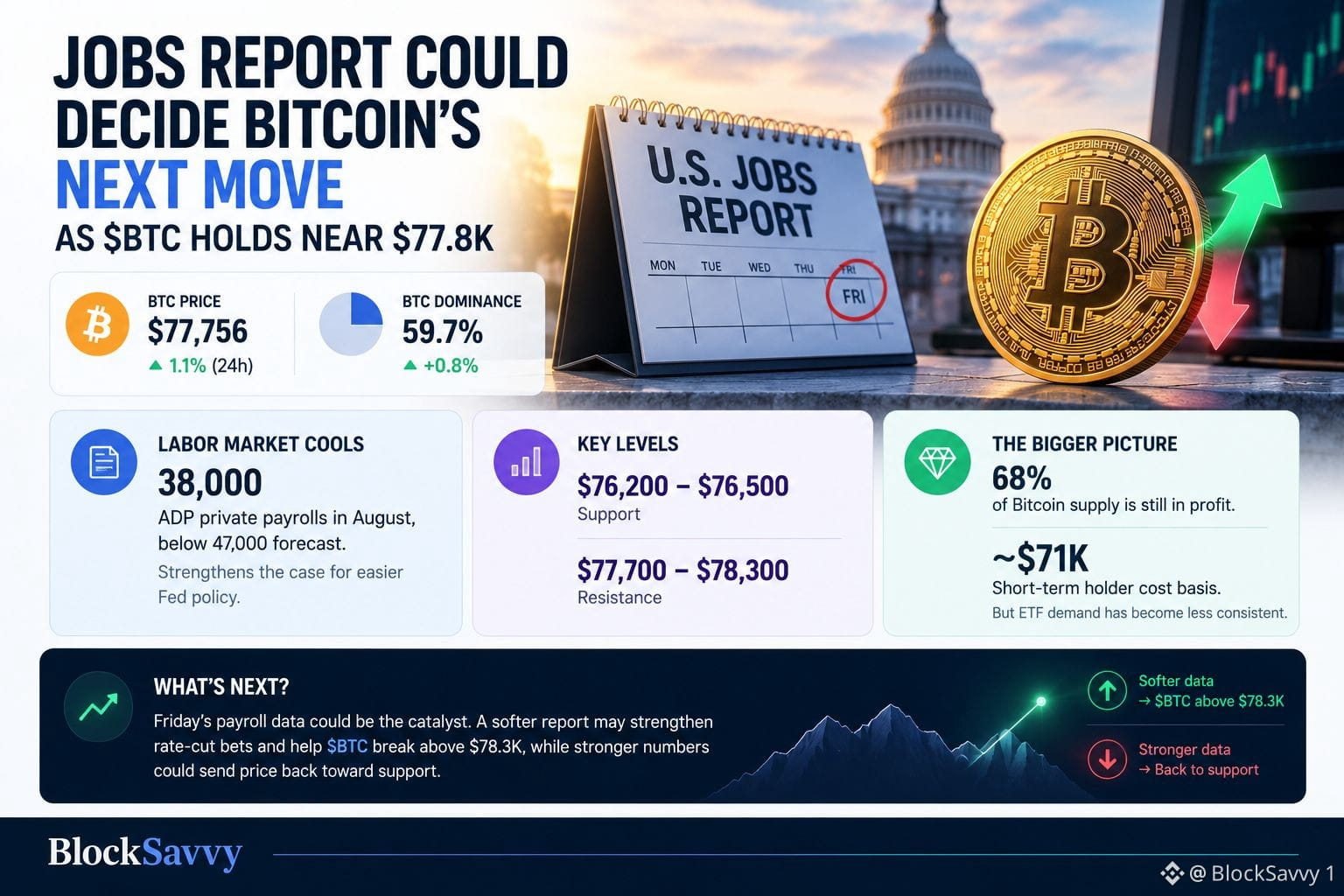
⚡ Jobs Report Could Decide Bitcoin’s Next Move as $BTC Holds Near $77.8K Bitcoin is trading around $77,756, up 1.1% in 24 hours, while BTC dominance has climbed to 59.7%. The market looks calm on the surface, but Friday’s U.S. jobs report could be the catalyst that finally breaks the current range. Here’s the catch: weaker labor data is increasing rate-cut expectations, but Bitcoin is still stuck between clear support and resistance. 🔹 Labor Market Cools: ADP private payrolls rose by just 38,000 in August, below the 47,000 forecast, strengthening the case for easier Fed policy. 🔹 Key Levels: Immediate support sits around $76,200-$76,500, while $77,700-$78,300 remains the resistance zone bulls need to clear. 🔹 The Takeaway: Around 68% of Bitcoin supply is still in profit and the short-term holder cost basis sits near $71K, but ETF demand has become less consistent. Friday’s payroll data now matters more than another quiet day of price action. A softer report could strengthen rate-cut bets and help Bitcoin push above $78.3K, while stronger numbers could pressure risk assets and send price back toward support. 👀 #BTC Price Analysis# #Bitcoin Price Prediction: What is Bitcoins next move?#
⚡ Jobs Report Could Decide Bitcoin’s Next Move as $BTC Holds Near $77.8K Bitcoin is trading around $77,756, up 1.1% in 24 hours, while BTC dominance has climbed to 59.7%. The market looks calm on the surface, but Friday’s U.S. jobs report could be the catalyst that finally breaks the current range. Here’s the catch: weaker labor data is increasing rate-cut expectations, but Bitcoin is still stuck between clear support and resistance. 🔹 Labor Market Cools: ADP private payrolls rose by just 38,000 in August, below the 47,000 forecast, strengthening the case for easier Fed policy. 🔹 Key Levels: Immediate support sits around $76,200-$76,500, while $77,700-$78,300 remains the resistance zone bulls need to clear. 🔹 The Takeaway: Around 68% of Bitcoin supply is still in profit and the short-term holder cost basis sits near $71K, but ETF demand has become less consistent. Friday’s payroll data now matters more than another quiet day of price action. A softer report could strengthen rate-cut bets and help Bitcoin push above $78.3K, while stronger numbers could pressure risk assets and send price back toward support. 👀 #BTC Price Analysis# #Bitcoin Price Prediction: What is Bitcoins next move?#
54
·
--
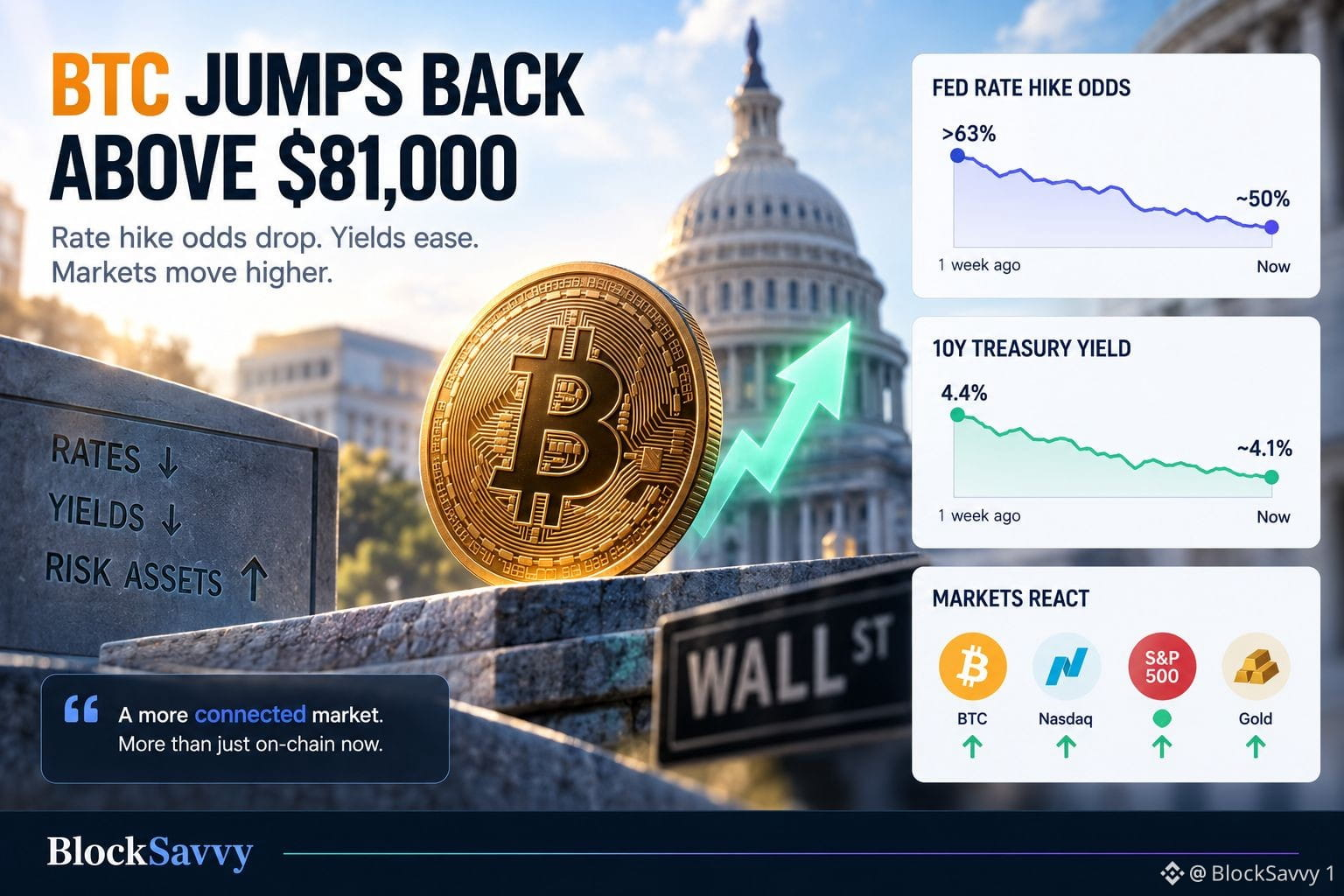
Bitcoin Moved 4% Because One Fed Probability Changed $BTC jumped back above $81,000 after traders reduced their expectations for a September Fed rate hike from above 63% to roughly a coin flip. At the same time, bond yields eased and risk assets broadly moved higher. This is the version of Bitcoin markets we probably have to get used to. A few years ago, you could follow crypto reasonably well by watching exchange flows, leverage, whales and whatever was happening on-chain. Now a comment from a Fed governor can change rate expectations, move Treasuries and immediately show up in Bitcoin. That doesn't make on-chain data irrelevant. It just means $BTC now has two sets of fundamentals to watch: its own and everyone else's. 😅 #BTC Price Analysis# #Bitcoin Price Prediction: What is Bitcoins next move?#
Bitcoin Moved 4% Because One Fed Probability Changed $BTC jumped back above $81,000 after traders reduced their expectations for a September Fed rate hike from above 63% to roughly a coin flip. At the same time, bond yields eased and risk assets broadly moved higher. This is the version of Bitcoin markets we probably have to get used to. A few years ago, you could follow crypto reasonably well by watching exchange flows, leverage, whales and whatever was happening on-chain. Now a comment from a Fed governor can change rate expectations, move Treasuries and immediately show up in Bitcoin. That doesn't make on-chain data irrelevant. It just means $BTC now has two sets of fundamentals to watch: its own and everyone else's. 😅 #BTC Price Analysis# #Bitcoin Price Prediction: What is Bitcoins next move?#
73
Log in to explore more content
Join global crypto users on Binance Square
⚡️ Get latest and useful information about crypto.
💬 Trusted by the world’s largest crypto exchange.
👍 Discover real insights from verified creators.
Email / Phone number
Trending Topics
CircleMints500MUSDCOnSolana
73,220 views
1,714 Discussing
#circlemints500musdconsolana
🚨 $500M USDC MINTED ON SOLANA! 💵🔥
Circle Treasury just minted 500M USDC on Solana, pushing total global supply to $75.2B! 📈✨
💡 Quick Reality Check:
🔹 Minting = Fresh Inventory Creation (Not instant buying power!🛒
🔹 Real Trigger = Capital Deployment into DeFi, Exchanges & Pools! 🌐🚀
🎯 Coins to Watch:
⚡ $SOL — Network activity is booming, and fresh liquidity continues to drive ecosystem growth!
💎 $RARE — A high-volatility altcoin that reacts fast to fresh market liquidity and sentiment!🪐
💥 Are you accumulating now or waiting for full capital deployment? Drop your thoughts below! 👇✨
#CircleMints500MUSDCOnSolana
#PolymarketBankFailureBetsDrawFDICConcern
#BlackRockBuildsTokenizedPortfoliosForOndo
#BitwiseFilesToListNEARETFOnNYSEArca
Hifza Rubab
·4 Likes
·4.3k views
PolymarketBankFailureBetsDrawFDICConcern
81,217 views
1,624 Discussing
BlackRockBuildsTokenizedPortfoliosForOndo
70,470 views
1,151 Discussing