
BTC_Chopsticks
3.9k Posts
BTC_Chopsticks
Report
Block User
🔥 Let's ride the crypto wave together and make those gains! 💸💰

Level 1 Creator
14 Following
6.5K+ Followers
180.7K+ Liked
2 Badges
Posts
All
Quotes
Videos
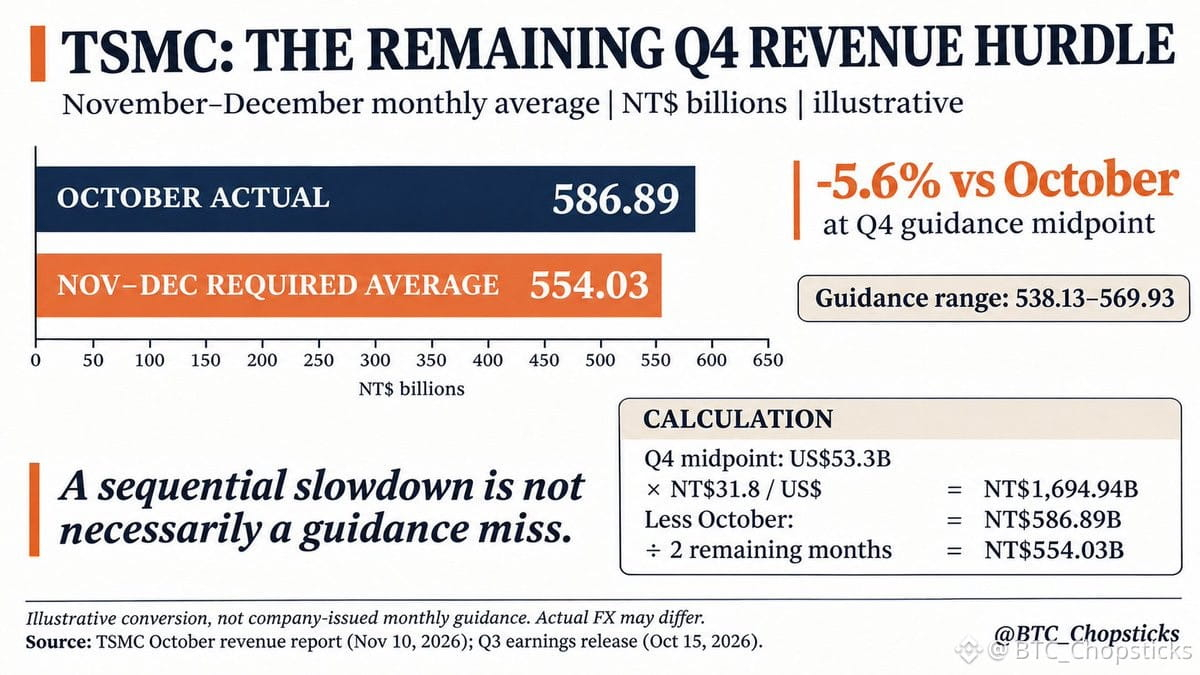
TSMC's October sales were so strong that November and December could average 5.6% lower and still meet the midpoint of Q4 revenue guidance.
October revenue reached NT$586.89B. Management's Q4 outlook is US$52.3B to US$54.3B.
At an illustrative NT$31.8 per US dollar, the US$53.3B midpoint translates to NT$1,694.94B. After October, that leaves an average of NT$554.03B per month for November and December.
This is an analytical conversion, not an official monthly target. Actual currency effects and revenue mix may change the comparison.
A sequential slowdown is not automatically a guidance miss. But meeting guidance is not the same as exceeding investors' expectations.
Sources: TSMC's October revenue report and Q3 earnings release.
TSMC's October sales were so strong that November and December could average 5.6% lower and still meet the midpoint of Q4 revenue guidance.
October revenue reached NT$586.89B. Management's Q4 outlook is US$52.3B to US$54.3B.
At an illustrative NT$31.8 per US dollar, the US$53.3B midpoint translates to NT$1,694.94B. After October, that leaves an average of NT$554.03B per month for November and December.
This is an analytical conversion, not an official monthly target. Actual currency effects and revenue mix may change the comparison.
A sequential slowdown is not automatically a guidance miss. But meeting guidance is not the same as exceeding investors' expectations.
Sources: TSMC's October revenue report and Q3 earnings release.
October revenue reached NT$586.89B. Management's Q4 outlook is US$52.3B to US$54.3B.
At an illustrative NT$31.8 per US dollar, the US$53.3B midpoint translates to NT$1,694.94B. After October, that leaves an average of NT$554.03B per month for November and December.
This is an analytical conversion, not an official monthly target. Actual currency effects and revenue mix may change the comparison.
A sequential slowdown is not automatically a guidance miss. But meeting guidance is not the same as exceeding investors' expectations.
Sources: TSMC's October revenue report and Q3 earnings release.
50
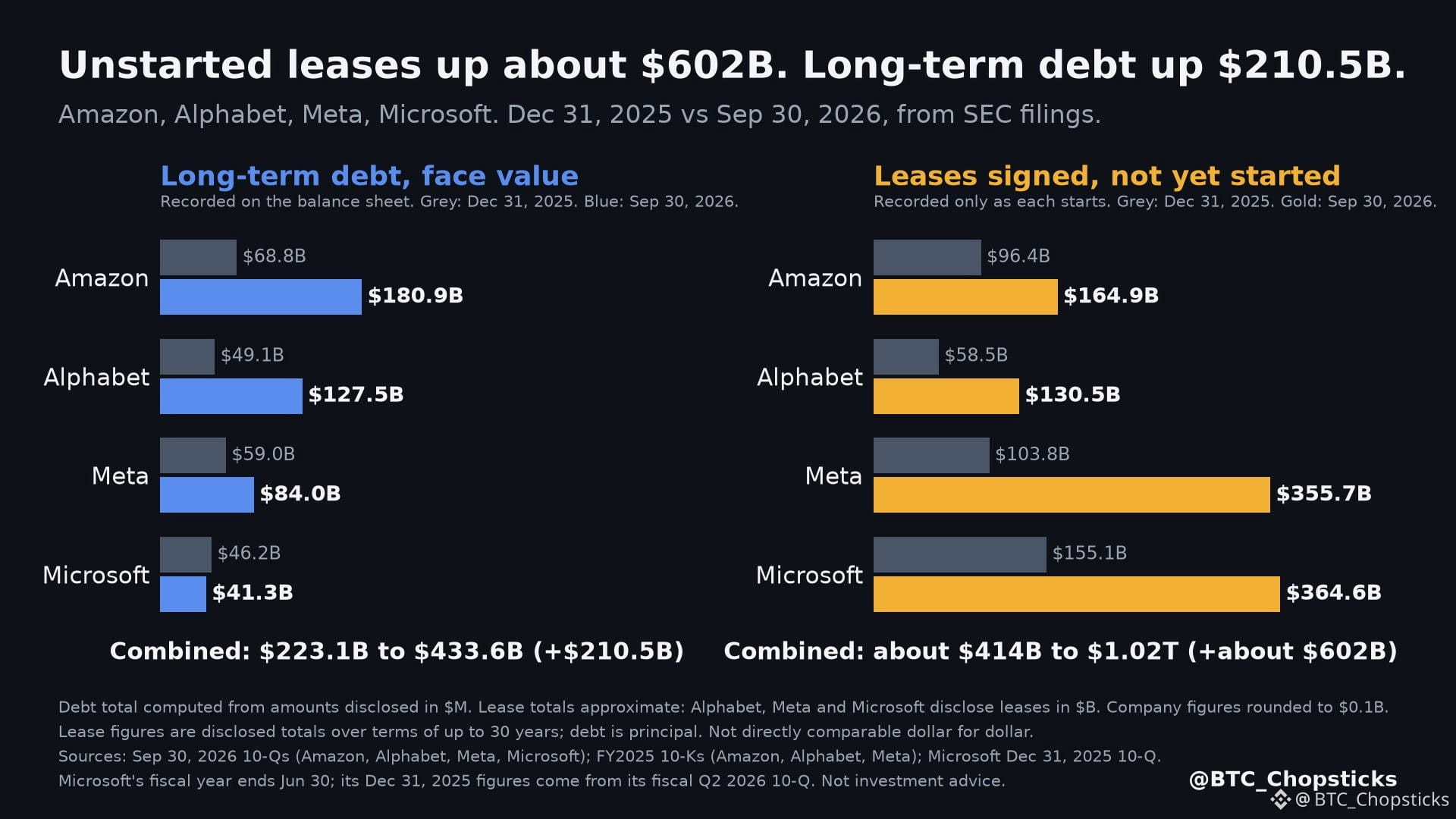
Big Tech's signed-but-not-started leases grew about $602B in nine months. Its long-term debt grew $210.5B.
The debt, and leases that have already started, are on the balance sheet. The unstarted leases aren't yet.
Dec 31, 2025 to Sep 30, 2026, from SEC filings:
Long-term debt, face value:
• Amazon: $68.8B to $180.9B
• Alphabet: $49.1B to $127.5B
• Meta: $59.0B to $84.0B
• Microsoft: $46.2B to $41.3B
Leases signed, not yet started:
• Meta: $103.8B to $355.7B
• Microsoft: $155.1B to $364.6B
• Alphabet: $58.5B to $130.5B
• Amazon: $96.4B to $164.9B
Combined: debt $223.1B to $433.6B (+$210.5B), from amounts disclosed in millions; company figures above are rounded. Unstarted leases about $414B to about $1.02T (+about $602B); approximate, because Alphabet, Meta and Microsoft disclose them in billions.
Each lease is recorded as a liability when it starts, at the present value of its fixed payments. Meta, Microsoft and Alphabet say theirs start between 2026 and 2036.
Lease figures are disclosed totals over terms of up to 30 years, so they don't compare dollar for dollar with debt principal. Some Microsoft leases still depend on contractual conditions.
What I watch next: how quickly these leases begin, and how much of their future payments becomes recognized lease liabilities.
Big Tech's signed-but-not-started leases grew about $602B in nine months. Its long-term debt grew $210.5B.
The debt, and leases that have already started, are on the balance sheet. The unstarted leases aren't yet.
Dec 31, 2025 to Sep 30, 2026, from SEC filings:
Long-term debt, face value:
• Amazon: $68.8B to $180.9B
• Alphabet: $49.1B to $127.5B
• Meta: $59.0B to $84.0B
• Microsoft: $46.2B to $41.3B
Leases signed, not yet started:
• Meta: $103.8B to $355.7B
• Microsoft: $155.1B to $364.6B
• Alphabet: $58.5B to $130.5B
• Amazon: $96.4B to $164.9B
Combined: debt $223.1B to $433.6B (+$210.5B), from amounts disclosed in millions; company figures above are rounded. Unstarted leases about $414B to about $1.02T (+about $602B); approximate, because Alphabet, Meta and Microsoft disclose them in billions.
Each lease is recorded as a liability when it starts, at the present value of its fixed payments. Meta, Microsoft and Alphabet say theirs start between 2026 and 2036.
Lease figures are disclosed totals over terms of up to 30 years, so they don't compare dollar for dollar with debt principal. Some Microsoft leases still depend on contractual conditions.
What I watch next: how quickly these leases begin, and how much of their future payments becomes recognized lease liabilities.
The debt, and leases that have already started, are on the balance sheet. The unstarted leases aren't yet.
Dec 31, 2025 to Sep 30, 2026, from SEC filings:
Long-term debt, face value:
• Amazon: $68.8B to $180.9B
• Alphabet: $49.1B to $127.5B
• Meta: $59.0B to $84.0B
• Microsoft: $46.2B to $41.3B
Leases signed, not yet started:
• Meta: $103.8B to $355.7B
• Microsoft: $155.1B to $364.6B
• Alphabet: $58.5B to $130.5B
• Amazon: $96.4B to $164.9B
Combined: debt $223.1B to $433.6B (+$210.5B), from amounts disclosed in millions; company figures above are rounded. Unstarted leases about $414B to about $1.02T (+about $602B); approximate, because Alphabet, Meta and Microsoft disclose them in billions.
Each lease is recorded as a liability when it starts, at the present value of its fixed payments. Meta, Microsoft and Alphabet say theirs start between 2026 and 2036.
Lease figures are disclosed totals over terms of up to 30 years, so they don't compare dollar for dollar with debt principal. Some Microsoft leases still depend on contractual conditions.
What I watch next: how quickly these leases begin, and how much of their future payments becomes recognized lease liabilities.
234
🎴✨ When Pokémon meets Web3!
Great evening at BINANCE TH Academy's Chase Card Night in Bangkok! 🟡
🎴 Exploring Pokémon cards and collectibles
💡 Discovering connections between blockchain and digital ownership
🤝 Meeting fellow collectors and crypto enthusiasts
🎁 Awesome BINANCE TH goodies!
The best part? Great people, new connections, and a shared passion! 💛
Thanks to BINANCE TH Academy for bringing everyone together! 🙌
#BinanceTH #PokemonTCG #Web3 #CryptoCommunity #BangkokEvents
🎴✨ When Pokémon meets Web3!
Great evening at BINANCE TH Academy's Chase Card Night in Bangkok! 🟡
🎴 Exploring Pokémon cards and collectibles
💡 Discovering connections between blockchain and digital ownership
🤝 Meeting fellow collectors and crypto enthusiasts
🎁 Awesome BINANCE TH goodies!
The best part? Great people, new connections, and a shared passion! 💛
Thanks to BINANCE TH Academy for bringing everyone together! 🙌
#BinanceTH #PokemonTCG #Web3 #CryptoCommunity #BangkokEvents
Great evening at BINANCE TH Academy's Chase Card Night in Bangkok! 🟡
🎴 Exploring Pokémon cards and collectibles
💡 Discovering connections between blockchain and digital ownership
🤝 Meeting fellow collectors and crypto enthusiasts
🎁 Awesome BINANCE TH goodies!
The best part? Great people, new connections, and a shared passion! 💛
Thanks to BINANCE TH Academy for bringing everyone together! 🙌
#BinanceTH #PokemonTCG #Web3 #CryptoCommunity #BangkokEvents
159
Verified
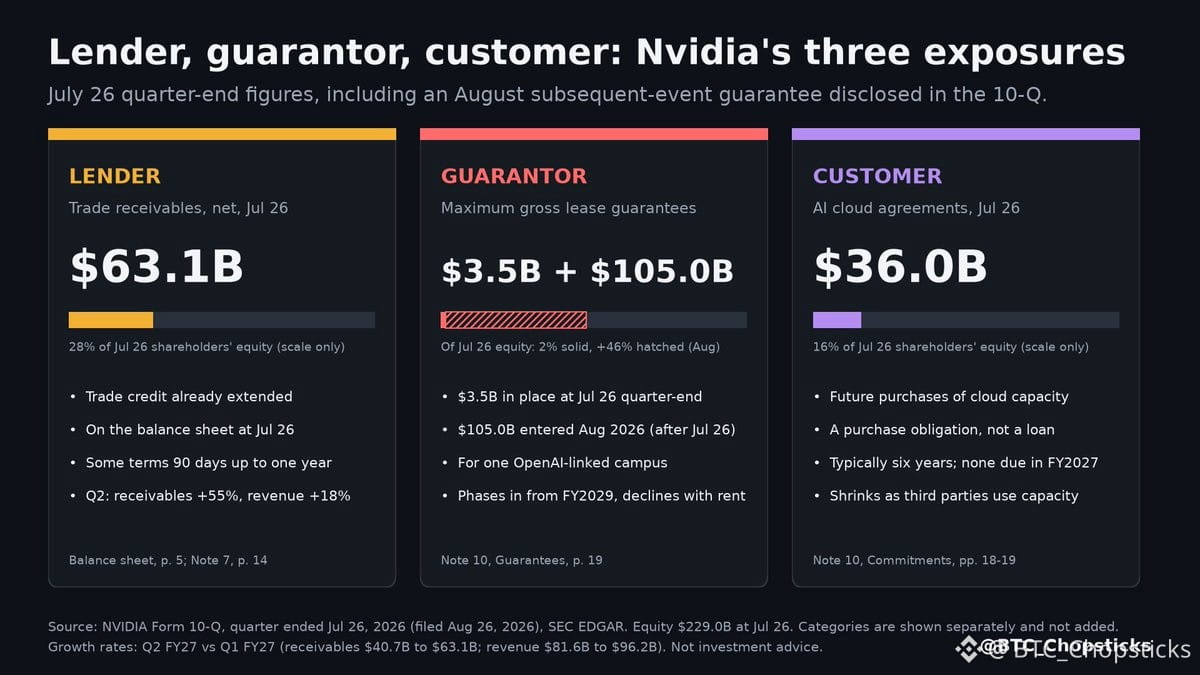
Nvidia's maximum lease guarantees went from $3.5B to $108.5B after an August deal disclosed in its 10-Q.
Read like a banker, Nvidia is now three things to the AI build-out:
• Lender: $63.1B of trade receivables at Jul 26. Trade credit already extended, some on terms of up to one year, on the balance sheet.
• Guarantor: $3.5B of lease guarantees at quarter-end, plus up to $105B entered into in August for one OpenAI-linked campus. Contingent, phasing in from fiscal 2029 and declining as rent is paid.
• Customer: $36B of commitments to buy cloud capacity from AI clouds that buy its chips. A purchase obligation, not a loan.
Customer advances stood at $2.8B at quarter-end.
This isn't a solvency story for a company with $229B of equity. It's a question of how much demand Nvidia is helping to fund.
Nvidia's longtime CFO, Colette Kress, is now interim CEO. That puts these financing commitments directly on her agenda.
On Nov 17 I check receivables against revenue first. Last quarter receivables grew 55%, revenue 18%.
Nvidia's maximum lease guarantees went from $3.5B to $108.5B after an August deal disclosed in its 10-Q.
Read like a banker, Nvidia is now three things to the AI build-out:
• Lender: $63.1B of trade receivables at Jul 26. Trade credit already extended, some on terms of up to one year, on the balance sheet.
• Guarantor: $3.5B of lease guarantees at quarter-end, plus up to $105B entered into in August for one OpenAI-linked campus. Contingent, phasing in from fiscal 2029 and declining as rent is paid.
• Customer: $36B of commitments to buy cloud capacity from AI clouds that buy its chips. A purchase obligation, not a loan.
Customer advances stood at $2.8B at quarter-end.
This isn't a solvency story for a company with $229B of equity. It's a question of how much demand Nvidia is helping to fund.
Nvidia's longtime CFO, Colette Kress, is now interim CEO. That puts these financing commitments directly on her agenda.
On Nov 17 I check receivables against revenue first. Last quarter receivables grew 55%, revenue 18%.
Read like a banker, Nvidia is now three things to the AI build-out:
• Lender: $63.1B of trade receivables at Jul 26. Trade credit already extended, some on terms of up to one year, on the balance sheet.
• Guarantor: $3.5B of lease guarantees at quarter-end, plus up to $105B entered into in August for one OpenAI-linked campus. Contingent, phasing in from fiscal 2029 and declining as rent is paid.
• Customer: $36B of commitments to buy cloud capacity from AI clouds that buy its chips. A purchase obligation, not a loan.
Customer advances stood at $2.8B at quarter-end.
This isn't a solvency story for a company with $229B of equity. It's a question of how much demand Nvidia is helping to fund.
Nvidia's longtime CFO, Colette Kress, is now interim CEO. That puts these financing commitments directly on her agenda.
On Nov 17 I check receivables against revenue first. Last quarter receivables grew 55%, revenue 18%.
367
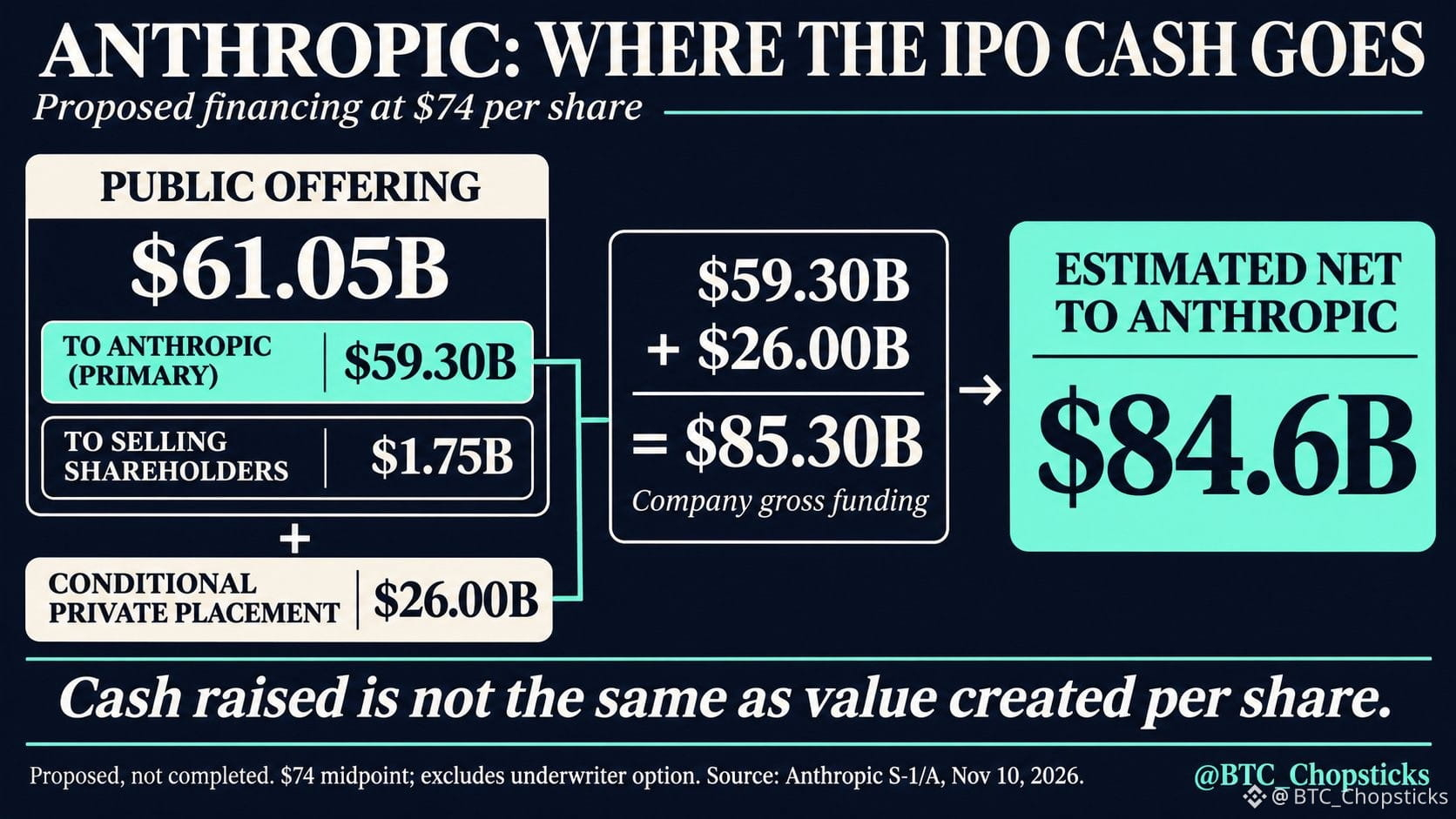
Anthropic's proposed IPO package could bring the company $84.6B net.
The investment question is what that capital earns per share.
At the $74 midpoint, roughly $59.3B of the public offering goes to Anthropic and $1.75B to selling shareholders. A conditional $26B private placement brings company gross proceeds to about $85.3B.
The $84.6B estimate is after offering costs and excludes the underwriter option. These are proposed terms, not completed financing.
More cash can fund compute and expansion. New shares also change the ownership denominator.
I'd watch customer cash conversion, compute obligations and future dilution alongside the valuation headline.
Source: Anthropic's November 10 S-1/A and roadshow announcement.
Anthropic's proposed IPO package could bring the company $84.6B net.
The investment question is what that capital earns per share.
At the $74 midpoint, roughly $59.3B of the public offering goes to Anthropic and $1.75B to selling shareholders. A conditional $26B private placement brings company gross proceeds to about $85.3B.
The $84.6B estimate is after offering costs and excludes the underwriter option. These are proposed terms, not completed financing.
More cash can fund compute and expansion. New shares also change the ownership denominator.
I'd watch customer cash conversion, compute obligations and future dilution alongside the valuation headline.
Source: Anthropic's November 10 S-1/A and roadshow announcement.
The investment question is what that capital earns per share.
At the $74 midpoint, roughly $59.3B of the public offering goes to Anthropic and $1.75B to selling shareholders. A conditional $26B private placement brings company gross proceeds to about $85.3B.
The $84.6B estimate is after offering costs and excludes the underwriter option. These are proposed terms, not completed financing.
More cash can fund compute and expansion. New shares also change the ownership denominator.
I'd watch customer cash conversion, compute obligations and future dilution alongside the valuation headline.
Source: Anthropic's November 10 S-1/A and roadshow announcement.
269
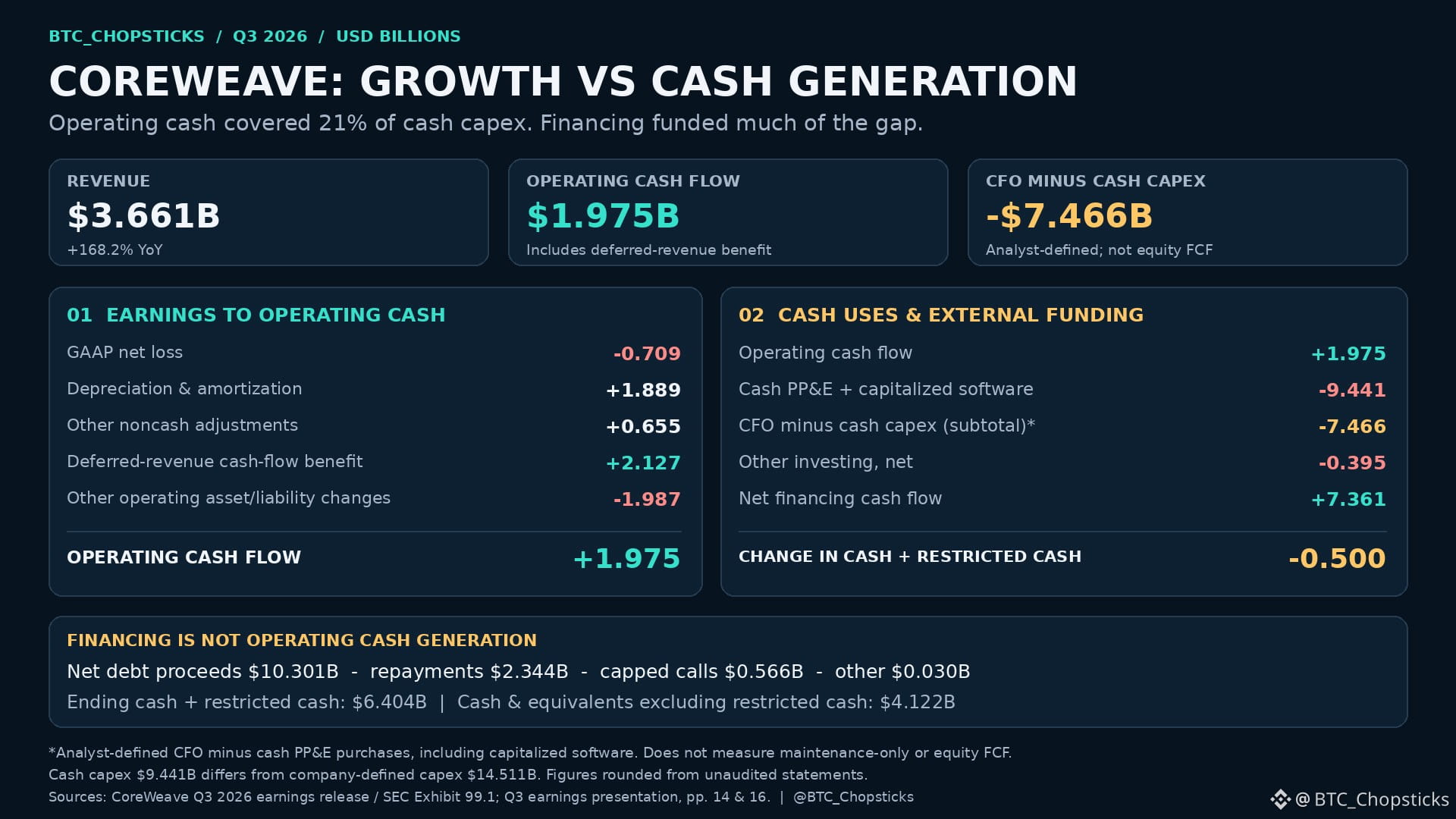
CoreWeave generated $1.98B in operating cash in Q3, then spent $9.44B on cash capex.
The $7.47B gap is the shareholder question behind its growth.
Revenue rose 168% to $3.66B. GAAP operating profit turned positive, but net interest expense of $846M exceeded operating profit of $207M.
Operating cash flow also included a $2.13B deferred-revenue benefit. That supports funding, but comes with future service obligations.
Net financing supplied $7.36B. Cash including restricted balances still fell $500M.
The bullish case is that investment becomes productive capacity with durable cash returns. The test is whether collections and cash generation eventually outrun reinvestment and financing costs.
Growth is real. Whether that investment ultimately produces durable returns for shareholders is a separate question.
Cash capex includes PP&E and capitalized software. CFO minus cash capex is an analyst-defined measure, not equity free cash flow. Source: CoreWeave Q3 2026 official results.
{future}(CRWVUSDT)
CoreWeave generated $1.98B in operating cash in Q3, then spent $9.44B on cash capex.
The $7.47B gap is the shareholder question behind its growth.
Revenue rose 168% to $3.66B. GAAP operating profit turned positive, but net interest expense of $846M exceeded operating profit of $207M.
Operating cash flow also included a $2.13B deferred-revenue benefit. That supports funding, but comes with future service obligations.
Net financing supplied $7.36B. Cash including restricted balances still fell $500M.
The bullish case is that investment becomes productive capacity with durable cash returns. The test is whether collections and cash generation eventually outrun reinvestment and financing costs.
Growth is real. Whether that investment ultimately produces durable returns for shareholders is a separate question.
Cash capex includes PP&E and capitalized software. CFO minus cash capex is an analyst-defined measure, not equity free cash flow. Source: CoreWeave Q3 2026 official results.
The $7.47B gap is the shareholder question behind its growth.
Revenue rose 168% to $3.66B. GAAP operating profit turned positive, but net interest expense of $846M exceeded operating profit of $207M.
Operating cash flow also included a $2.13B deferred-revenue benefit. That supports funding, but comes with future service obligations.
Net financing supplied $7.36B. Cash including restricted balances still fell $500M.
The bullish case is that investment becomes productive capacity with durable cash returns. The test is whether collections and cash generation eventually outrun reinvestment and financing costs.
Growth is real. Whether that investment ultimately produces durable returns for shareholders is a separate question.
Cash capex includes PP&E and capitalized software. CFO minus cash capex is an analyst-defined measure, not equity free cash flow. Source: CoreWeave Q3 2026 official results.
205
🎮🔥 TRON Global Friends Thailand #5: Laser Tag Night!
Who says Web3 community networking has to happen in a conference room?
This time, no talking about candlestick charts—grab a laser tag gun and get ready for battle! 🎯🐂
📅 November 27, 2026
🕖 Starts at 7:00 PM
📍 Bangkok, Thailand
⚡ Event highlights
🎯 Laser tag battles—experience the fun of teamwork
🤝 Meet Web3 KOLs and TRON community members
🍽️ Enjoy dinner together and mingle in a relaxed setting
🐂 TRON Bull might even become the MVP of the night!
❤️ Beyond blockchain, what matters most is making real connections.
Web3 is about more than technology and trading. It’s also about finding like-minded friends and making shared memories worth treasuring.
🎟️ Limited spots available! Register through the official Luma event page. Final attendance is subject to confirmation by the organizers.
See you in Bangkok! 🚀
@justinsuntron @TRONDAO @TronDao_THA
#TRONGlobalFriends #TGF
🎮🔥 TRON Global Friends Thailand #5: Laser Tag Night!
Who says Web3 community networking has to happen in a conference room?
This time, no talking about candlestick charts—grab a laser tag gun and get ready for battle! 🎯🐂
📅 November 27, 2026
🕖 Starts at 7:00 PM
📍 Bangkok, Thailand
⚡ Event highlights
🎯 Laser tag battles—experience the fun of teamwork
🤝 Meet Web3 KOLs and TRON community members
🍽️ Enjoy dinner together and mingle in a relaxed setting
🐂 TRON Bull might even become the MVP of the night!
❤️ Beyond blockchain, what matters most is making real connections.
Web3 is about more than technology and trading. It’s also about finding like-minded friends and making shared memories worth treasuring.
🎟️ Limited spots available! Register through the official Luma event page. Final attendance is subject to confirmation by the organizers.
See you in Bangkok! 🚀
@justinsuntron @TRON DAO @TronDao_THA
#TRONGlobalFriends #TGF
Who says Web3 community networking has to happen in a conference room?
This time, no talking about candlestick charts—grab a laser tag gun and get ready for battle! 🎯🐂
📅 November 27, 2026
🕖 Starts at 7:00 PM
📍 Bangkok, Thailand
⚡ Event highlights
🎯 Laser tag battles—experience the fun of teamwork
🤝 Meet Web3 KOLs and TRON community members
🍽️ Enjoy dinner together and mingle in a relaxed setting
🐂 TRON Bull might even become the MVP of the night!
❤️ Beyond blockchain, what matters most is making real connections.
Web3 is about more than technology and trading. It’s also about finding like-minded friends and making shared memories worth treasuring.
🎟️ Limited spots available! Register through the official Luma event page. Final attendance is subject to confirmation by the organizers.
See you in Bangkok! 🚀
@justinsuntron @TRON DAO @TronDao_THA
#TRONGlobalFriends #TGF
202
🔐 Building a USDT vault on TRON? Watch out for this hidden pitfall!
OpenZeppelin has released a new development guide showing you how to build a USDT vault on TRON using Hardhat and the TRC-4626 standard.
⚙️ Development highlights
🔹 Deposit USDT and receive vault share tokens
🔹 Redeem shares and handle deposit and withdrawal fees
🔹 Address the special issue with USDT transfer return values
🔹 Validate the contract on the Nile testnet
💡 Why does this matter?
On TRON, a USDT transfer may return false even when it succeeds, causing standard transfer checks to produce incorrect results.
OpenZeppelin’s SafeTRC20.safeTransferChecked helps address this issue by checking balance changes.
🚀 Looking ahead
More comprehensive development tools can help advance the TRON DeFi ecosystem. However, thorough testing and security reviews are still needed before deployment.
@justinsuntron @TRONDAO @TronDao_THA
#TRONGlobalFriends #TGF
🔐 Building a USDT vault on TRON? Watch out for this hidden pitfall!
OpenZeppelin has released a new development guide showing you how to build a USDT vault on TRON using Hardhat and the TRC-4626 standard.
⚙️ Development highlights
🔹 Deposit USDT and receive vault share tokens
🔹 Redeem shares and handle deposit and withdrawal fees
🔹 Address the special issue with USDT transfer return values
🔹 Validate the contract on the Nile testnet
💡 Why does this matter?
On TRON, a USDT transfer may return false even when it succeeds, causing standard transfer checks to produce incorrect results.
OpenZeppelin’s SafeTRC20.safeTransferChecked helps address this issue by checking balance changes.
🚀 Looking ahead
More comprehensive development tools can help advance the TRON DeFi ecosystem. However, thorough testing and security reviews are still needed before deployment.
@justinsuntron @TRON DAO @TronDao_THA
#TRONGlobalFriends #TGF
OpenZeppelin has released a new development guide showing you how to build a USDT vault on TRON using Hardhat and the TRC-4626 standard.
⚙️ Development highlights
🔹 Deposit USDT and receive vault share tokens
🔹 Redeem shares and handle deposit and withdrawal fees
🔹 Address the special issue with USDT transfer return values
🔹 Validate the contract on the Nile testnet
💡 Why does this matter?
On TRON, a USDT transfer may return false even when it succeeds, causing standard transfer checks to produce incorrect results.
OpenZeppelin’s SafeTRC20.safeTransferChecked helps address this issue by checking balance changes.
🚀 Looking ahead
More comprehensive development tools can help advance the TRON DeFi ecosystem. However, thorough testing and security reviews are still needed before deployment.
@justinsuntron @TRON DAO @TronDao_THA
#TRONGlobalFriends #TGF
158
Broadcom's $63B AI financing deal raises a better question than whether AI demand is real.
Who carries the risk?
The October 26 announcement describes an SPV buying accelerators and networking equipment to lease to Anthropic. Broadcom provides residual-value support equivalent to the first-lien financing portion.
That is not a guarantee of the entire $63B transaction.
Anthropic's filing describes five-year equipment leases backed by its guarantee and the equipment itself. Default can trigger acceleration.
These protections matter. They do not make future payments certain.
The bullish case is that financing unlocks productive capacity and customer cash flows cover the obligations.
The stress case is that payment capacity, deployment timing or equipment recoveries disappoint.
For shareholders, the question is how much profitable growth the structure enables, and how much downside remains with the supplier.
Capital availability and risk transfer deserve separate analysis.
Broadcom's $63B AI financing deal raises a better question than whether AI demand is real.
Who carries the risk?
The October 26 announcement describes an SPV buying accelerators and networking equipment to lease to Anthropic. Broadcom provides residual-value support equivalent to the first-lien financing portion.
That is not a guarantee of the entire $63B transaction.
Anthropic's filing describes five-year equipment leases backed by its guarantee and the equipment itself. Default can trigger acceleration.
These protections matter. They do not make future payments certain.
The bullish case is that financing unlocks productive capacity and customer cash flows cover the obligations.
The stress case is that payment capacity, deployment timing or equipment recoveries disappoint.
For shareholders, the question is how much profitable growth the structure enables, and how much downside remains with the supplier.
Capital availability and risk transfer deserve separate analysis.
Who carries the risk?
The October 26 announcement describes an SPV buying accelerators and networking equipment to lease to Anthropic. Broadcom provides residual-value support equivalent to the first-lien financing portion.
That is not a guarantee of the entire $63B transaction.
Anthropic's filing describes five-year equipment leases backed by its guarantee and the equipment itself. Default can trigger acceleration.
These protections matter. They do not make future payments certain.
The bullish case is that financing unlocks productive capacity and customer cash flows cover the obligations.
The stress case is that payment capacity, deployment timing or equipment recoveries disappoint.
For shareholders, the question is how much profitable growth the structure enables, and how much downside remains with the supplier.
Capital availability and risk transfer deserve separate analysis.
271
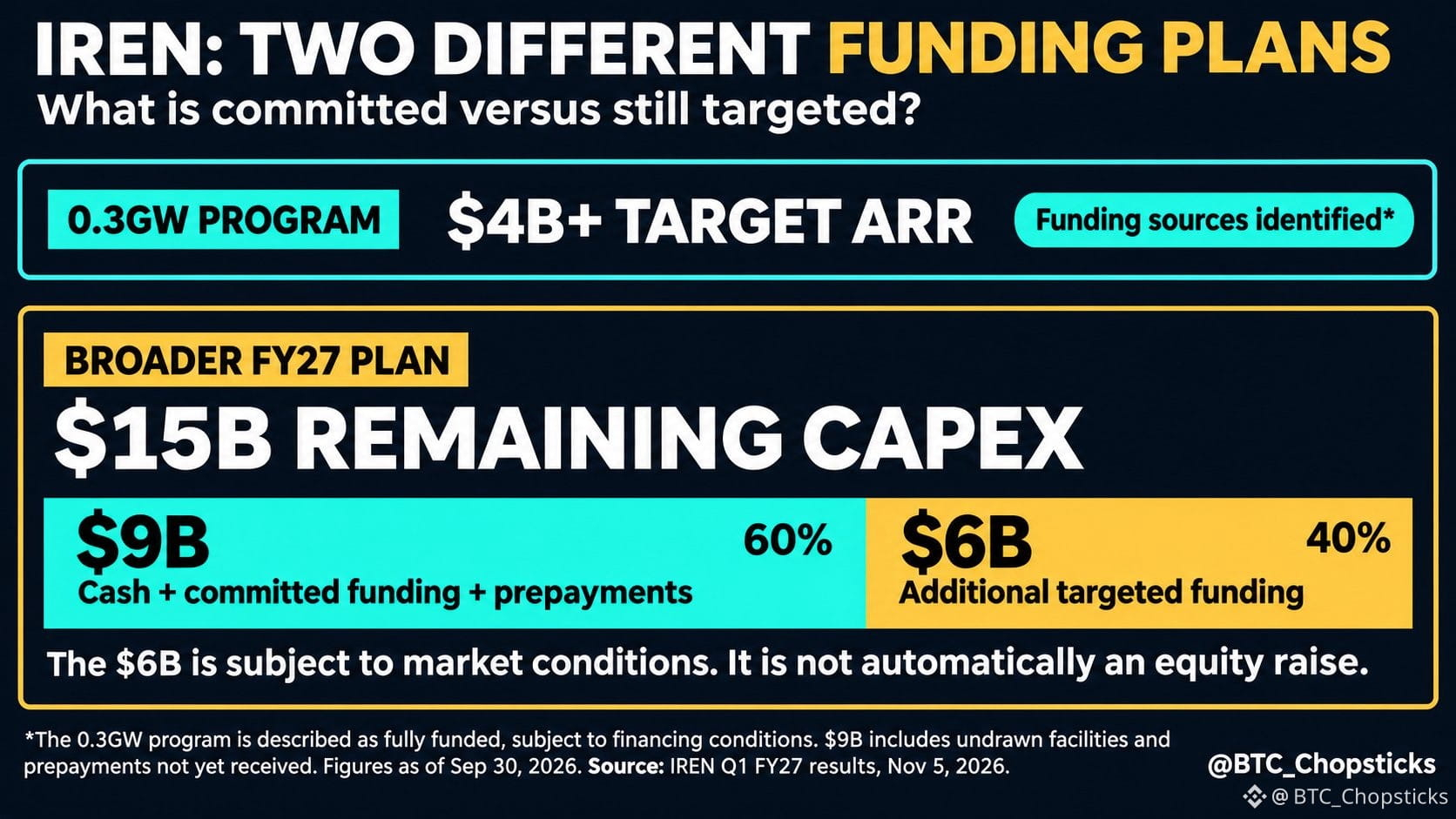
IREN says its $4B+ ARR target is fully funded.
So why is another $6B of financing still being targeted?
The answer is that investors are looking at two different expansion plans.
IREN's contracted $4B+ ARR target is supported by a 0.3GW program the company considers funded, subject to financing conditions.
But its wider FY27 expansion involves approximately $15B in remaining planned capex:
• $9B from cash, committed financing and customer prepayments.
• $6B from additional targeted funding, subject to market conditions.
That $9B isn't all cash sitting in the bank. It includes undrawn financing and customer prepayments not yet received.
And the additional $6B isn't necessarily an equity raise.
This distinction matters.
AI demand can be enormous while the economics for shareholders still depend on financing costs, dilution and how quickly contracted capacity generates cash.
The real question isn't just how much AI infrastructure IREN can build.
It's how much value each share captures after funding that growth.
IREN says its $4B+ ARR target is fully funded.
So why is another $6B of financing still being targeted?
The answer is that investors are looking at two different expansion plans.
IREN's contracted $4B+ ARR target is supported by a 0.3GW program the company considers funded, subject to financing conditions.
But its wider FY27 expansion involves approximately $15B in remaining planned capex:
• $9B from cash, committed financing and customer prepayments.
• $6B from additional targeted funding, subject to market conditions.
That $9B isn't all cash sitting in the bank. It includes undrawn financing and customer prepayments not yet received.
And the additional $6B isn't necessarily an equity raise.
This distinction matters.
AI demand can be enormous while the economics for shareholders still depend on financing costs, dilution and how quickly contracted capacity generates cash.
The real question isn't just how much AI infrastructure IREN can build.
It's how much value each share captures after funding that growth.
So why is another $6B of financing still being targeted?
The answer is that investors are looking at two different expansion plans.
IREN's contracted $4B+ ARR target is supported by a 0.3GW program the company considers funded, subject to financing conditions.
But its wider FY27 expansion involves approximately $15B in remaining planned capex:
• $9B from cash, committed financing and customer prepayments.
• $6B from additional targeted funding, subject to market conditions.
That $9B isn't all cash sitting in the bank. It includes undrawn financing and customer prepayments not yet received.
And the additional $6B isn't necessarily an equity raise.
This distinction matters.
AI demand can be enormous while the economics for shareholders still depend on financing costs, dilution and how quickly contracted capacity generates cash.
The real question isn't just how much AI infrastructure IREN can build.
It's how much value each share captures after funding that growth.
1
429
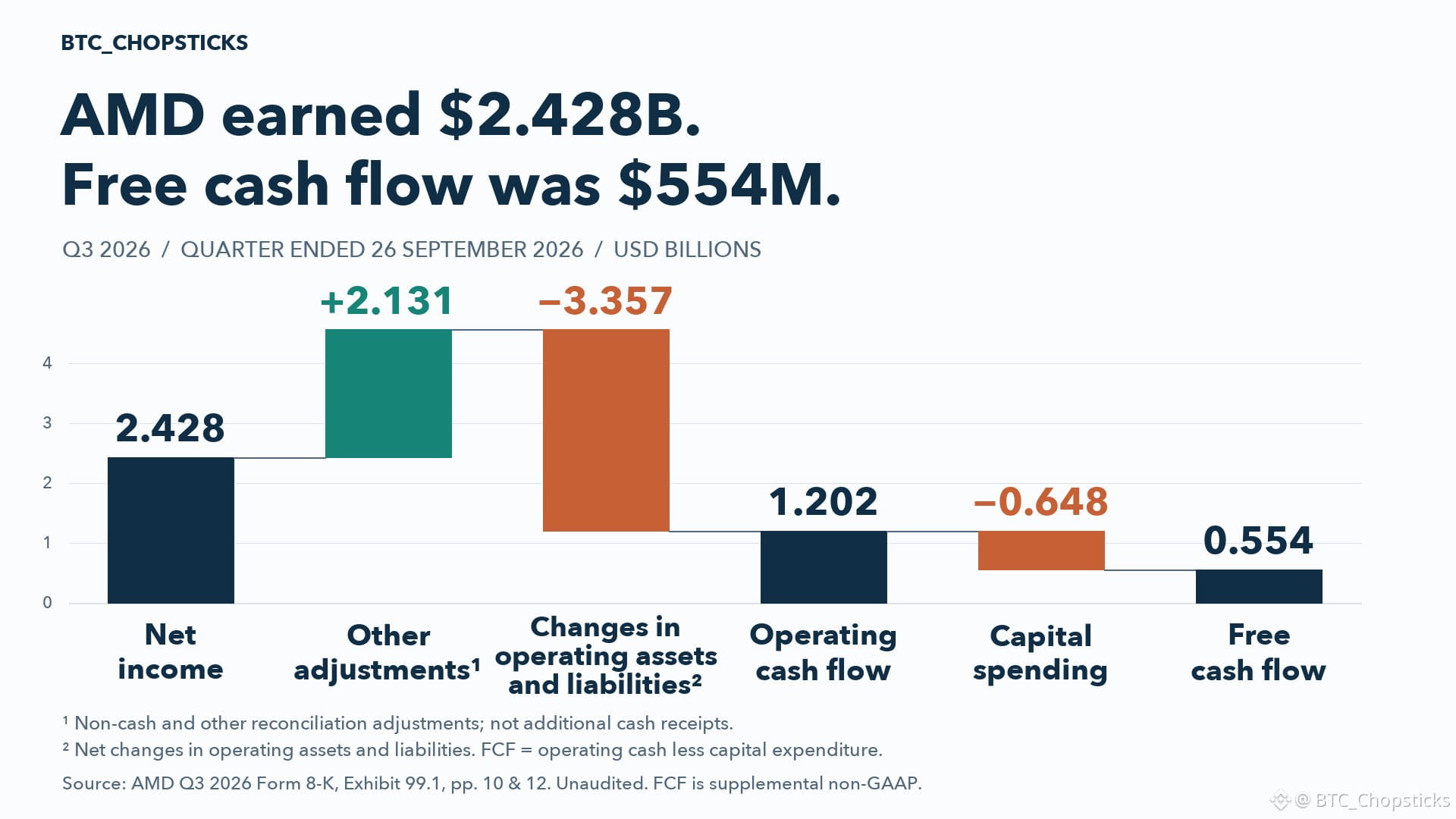
AMD reported $2.428B in quarterly profit.
But free cash flow was just $554M.
Where did the difference go?
Receivables and inventory absorbed $4.923B in cash, partly offset by payables and other liabilities.
After all operating adjustments and $648M of capital spending, AMD generated $554M in free cash flow.
This doesn't mean demand is collapsing. It means growth is consuming significant working capital.
The next test isn't just revenue growth. It's whether collections and inventory conversion catch up.
Q3 2026, unaudited. FCF is a supplemental non-GAAP measure.
AMD reported $2.428B in quarterly profit.
But free cash flow was just $554M.
Where did the difference go?
Receivables and inventory absorbed $4.923B in cash, partly offset by payables and other liabilities.
After all operating adjustments and $648M of capital spending, AMD generated $554M in free cash flow.
This doesn't mean demand is collapsing. It means growth is consuming significant working capital.
The next test isn't just revenue growth. It's whether collections and inventory conversion catch up.
Q3 2026, unaudited. FCF is a supplemental non-GAAP measure.
But free cash flow was just $554M.
Where did the difference go?
Receivables and inventory absorbed $4.923B in cash, partly offset by payables and other liabilities.
After all operating adjustments and $648M of capital spending, AMD generated $554M in free cash flow.
This doesn't mean demand is collapsing. It means growth is consuming significant working capital.
The next test isn't just revenue growth. It's whether collections and inventory conversion catch up.
Q3 2026, unaudited. FCF is a supplemental non-GAAP measure.
294
Visa's payment network is growing. So is the amount it gives back to clients.
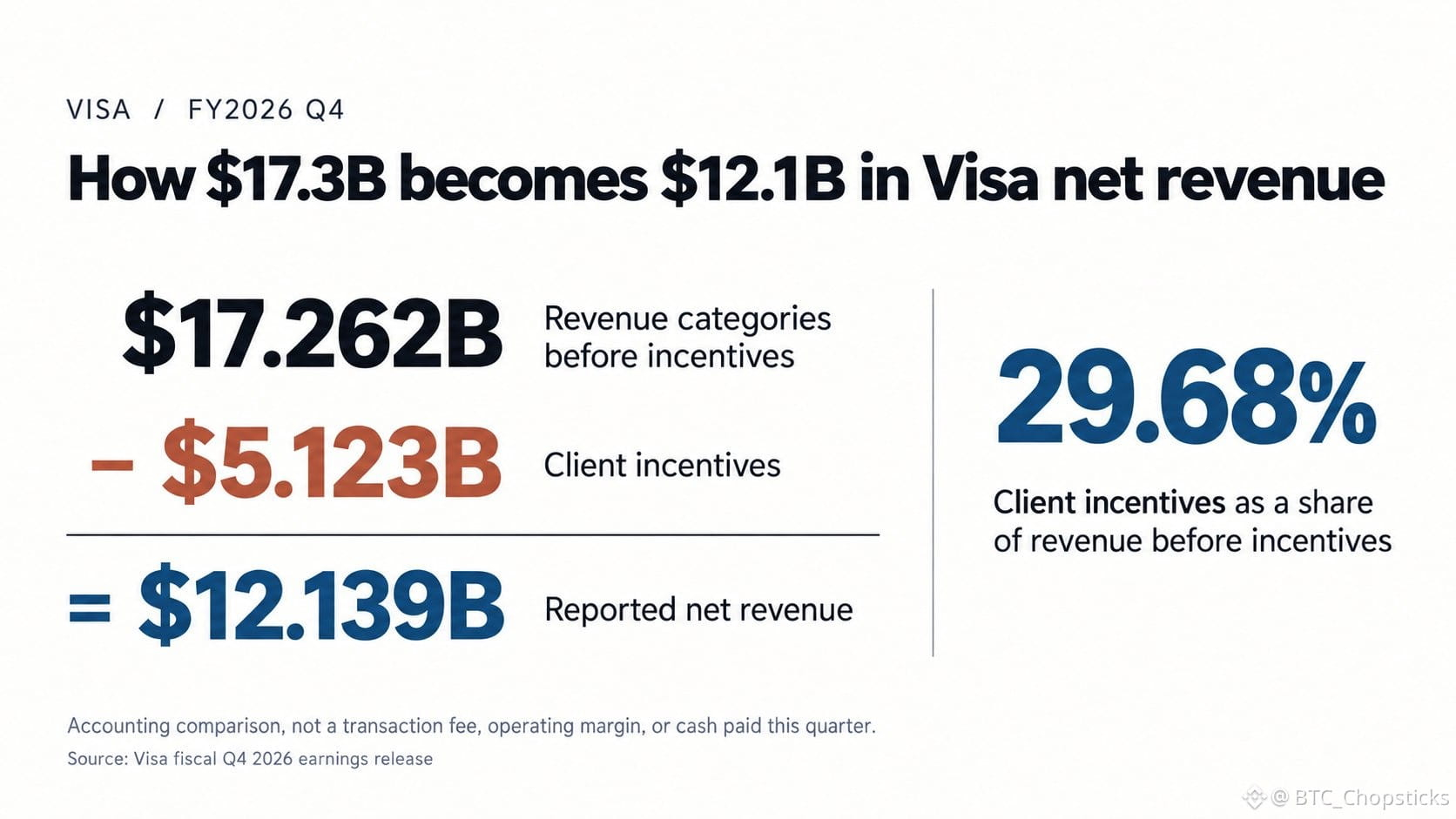
In its September 2026 quarter, Visa reported $12.139B of net revenue, up 13%. Client incentives were $5.123B, up 21%.
Add the four reported revenue categories before incentives and you get $17.262B. Subtract $5.123B and you arrive at reported net revenue.
In that accounting comparison, incentives absorbed about $29.68 of every $100 before incentives. That is not Visa's fee on consumer spending, an operating margin, or a measure of cash paid that quarter.
Incentives can support valuable client relationships. Their growth alone doesn't prove Visa's economics are deteriorating. Payments volume grew 9% in constant dollars, while net revenue grew faster.
But valuing a network requires more than counting the payments it carries. I'd examine whether additional business still produces attractive revenue after the terms offered to clients.
A larger network can strengthen the business. The price of keeping that network matters too.
Visa's payment network is growing. So is the amount it gives back to clients.
In its September 2026 quarter, Visa reported $12.139B of net revenue, up 13%. Client incentives were $5.123B, up 21%.
Add the four reported revenue categories before incentives and you get $17.262B. Subtract $5.123B and you arrive at reported net revenue.
In that accounting comparison, incentives absorbed about $29.68 of every $100 before incentives. That is not Visa's fee on consumer spending, an operating margin, or a measure of cash paid that quarter.
Incentives can support valuable client relationships. Their growth alone doesn't prove Visa's economics are deteriorating. Payments volume grew 9% in constant dollars, while net revenue grew faster.
But valuing a network requires more than counting the payments it carries. I'd examine whether additional business still produces attractive revenue after the terms offered to clients.
A larger network can strengthen the business. The price of keeping that network matters too.
In its September 2026 quarter, Visa reported $12.139B of net revenue, up 13%. Client incentives were $5.123B, up 21%.
Add the four reported revenue categories before incentives and you get $17.262B. Subtract $5.123B and you arrive at reported net revenue.
In that accounting comparison, incentives absorbed about $29.68 of every $100 before incentives. That is not Visa's fee on consumer spending, an operating margin, or a measure of cash paid that quarter.
Incentives can support valuable client relationships. Their growth alone doesn't prove Visa's economics are deteriorating. Payments volume grew 9% in constant dollars, while net revenue grew faster.
But valuing a network requires more than counting the payments it carries. I'd examine whether additional business still produces attractive revenue after the terms offered to clients.
A larger network can strengthen the business. The price of keeping that network matters too.
300
Before valuing a memory contract, ask who carries the downside.
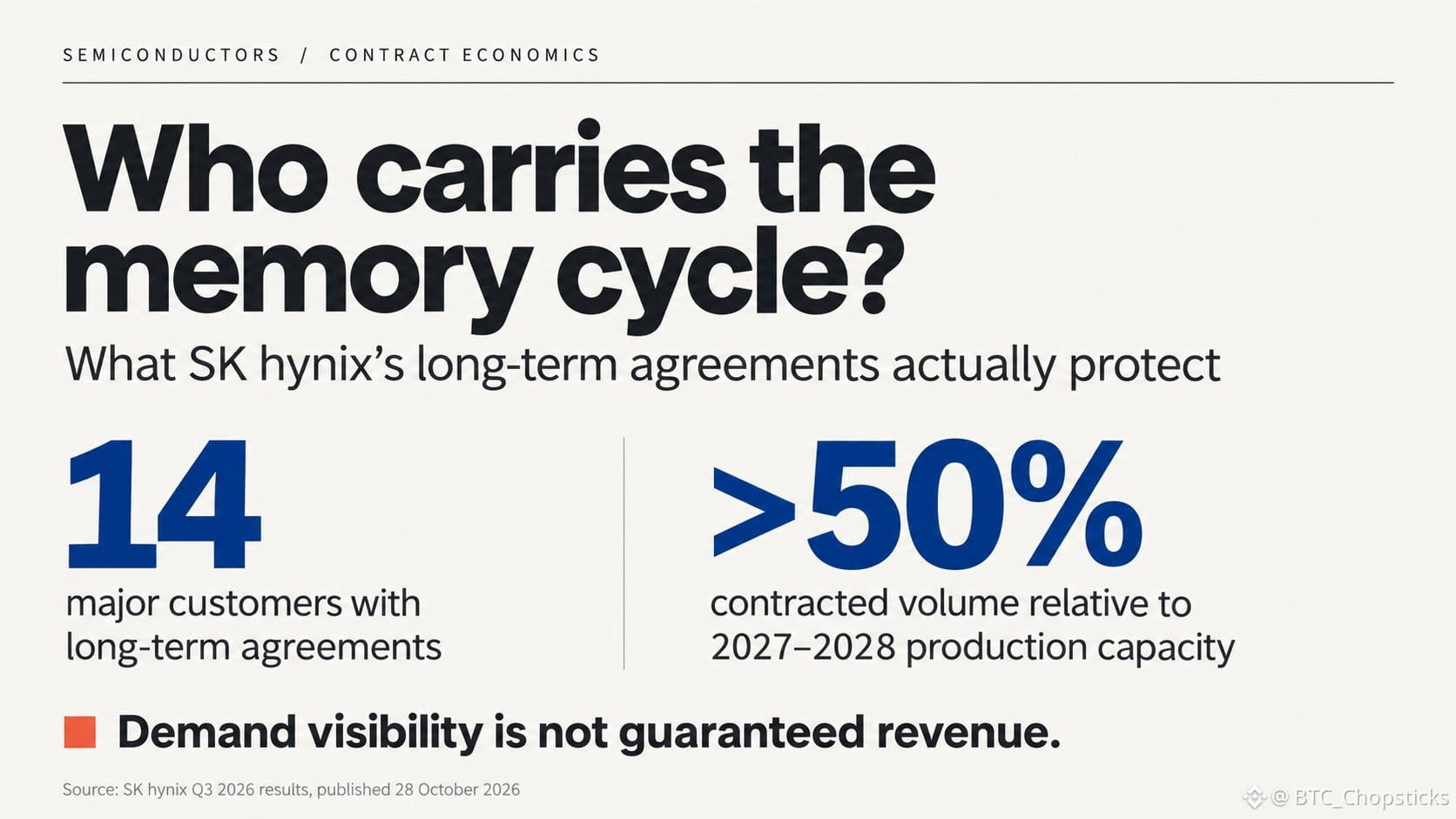
SK hynix says agreements with 14 major customers cover volumes equivalent to more than half its 2027-2028 total production capacity. Prices can respond to market conditions within agreed ranges.
That is not a guarantee of half its future revenue, or an HBM-only figure. The release does not disclose numerical price bands, cancellation penalties or minimum-payment terms.
Micron goes further in its disclosures: its strategic customer agreements have take-or-pay volumes, and many have price floors and ceilings. We should not assume SK hynix has identical protection.
My interpretation: customers are committing earlier to secure supply, giving manufacturers a firmer basis for investment. But greater confidence can also encourage the expansion that eventually weakens pricing.
I would judge the shift by how much earnings and cash remain protected when supply catches up, not by contract length alone. Longer agreements can change who bears the memory cycle without making the cycle disappear.
Before valuing a memory contract, ask who carries the downside.
SK hynix says agreements with 14 major customers cover volumes equivalent to more than half its 2027-2028 total production capacity. Prices can respond to market conditions within agreed ranges.
That is not a guarantee of half its future revenue, or an HBM-only figure. The release does not disclose numerical price bands, cancellation penalties or minimum-payment terms.
Micron goes further in its disclosures: its strategic customer agreements have take-or-pay volumes, and many have price floors and ceilings. We should not assume SK hynix has identical protection.
My interpretation: customers are committing earlier to secure supply, giving manufacturers a firmer basis for investment. But greater confidence can also encourage the expansion that eventually weakens pricing.
I would judge the shift by how much earnings and cash remain protected when supply catches up, not by contract length alone. Longer agreements can change who bears the memory cycle without making the cycle disappear.
SK hynix says agreements with 14 major customers cover volumes equivalent to more than half its 2027-2028 total production capacity. Prices can respond to market conditions within agreed ranges.
That is not a guarantee of half its future revenue, or an HBM-only figure. The release does not disclose numerical price bands, cancellation penalties or minimum-payment terms.
Micron goes further in its disclosures: its strategic customer agreements have take-or-pay volumes, and many have price floors and ceilings. We should not assume SK hynix has identical protection.
My interpretation: customers are committing earlier to secure supply, giving manufacturers a firmer basis for investment. But greater confidence can also encourage the expansion that eventually weakens pricing.
I would judge the shift by how much earnings and cash remain protected when supply catches up, not by contract length alone. Longer agreements can change who bears the memory cycle without making the cycle disappear.
258
🚀 TRX options trading is here! Do you really understand options?
TRX options are now available to eligible $users through a Blockchain.com Trading Account, bringing more trading choices to the TRON ecosystem!
📊 What’s the difference between spot trading and options?
🔴 Spot: Buy and hold TRX directly.
📈 Call option: Generally gives the buyer the right to buy at an agreed price.
📉 Put option: Generally gives the buyer the right to sell at an agreed price.
⚠️ Getting the direction right doesn’t guarantee a profit!
⏳ Expiration date
💰 Premium cost
📊 Strike price
⚡ Contract and settlement rules
All of these affect your final profit or loss. Options buyers may even lose their entire premium.
🌐 $TRX Options give traders more choices, but the more complex the tool, the more important risk management becomes.
🎬 This short video gives you a quick introduction to TRX options!
Please refer to the platform announcement for specific rules and regional restrictions. This is not investment advice.
@justinsuntron @TRONDAO @TronDao_THA
#TRON #TRX #CryptoOptions #TRONGlobalFriends #TGF
🚀 TRX options trading is here! Do you really understand options?
TRX options are now available to eligible $users through a Blockchain.com Trading Account, bringing more trading choices to the TRON ecosystem!
📊 What’s the difference between spot trading and options?
🔴 Spot: Buy and hold TRX directly.
📈 Call option: Generally gives the buyer the right to buy at an agreed price.
📉 Put option: Generally gives the buyer the right to sell at an agreed price.
⚠️ Getting the direction right doesn’t guarantee a profit!
⏳ Expiration date
💰 Premium cost
📊 Strike price
⚡ Contract and settlement rules
All of these affect your final profit or loss. Options buyers may even lose their entire premium.
🌐 $TRX Options give traders more choices, but the more complex the tool, the more important risk management becomes.
🎬 This short video gives you a quick introduction to TRX options!
Please refer to the platform announcement for specific rules and regional restrictions. This is not investment advice.
@justinsuntron @TRON DAO @TronDao_THA
#TRON #TRX #CryptoOptions #TRONGlobalFriends #TGF
TRX options are now available to eligible $users through a Blockchain.com Trading Account, bringing more trading choices to the TRON ecosystem!
📊 What’s the difference between spot trading and options?
🔴 Spot: Buy and hold TRX directly.
📈 Call option: Generally gives the buyer the right to buy at an agreed price.
📉 Put option: Generally gives the buyer the right to sell at an agreed price.
⚠️ Getting the direction right doesn’t guarantee a profit!
⏳ Expiration date
💰 Premium cost
📊 Strike price
⚡ Contract and settlement rules
All of these affect your final profit or loss. Options buyers may even lose their entire premium.
🌐 $TRX Options give traders more choices, but the more complex the tool, the more important risk management becomes.
🎬 This short video gives you a quick introduction to TRX options!
Please refer to the platform announcement for specific rules and regional restrictions. This is not investment advice.
@justinsuntron @TRON DAO @TronDao_THA
#TRON #TRX #CryptoOptions #TRONGlobalFriends #TGF
360
Microsoft's 32% profit growth has a lesson hidden in last year's numbers.
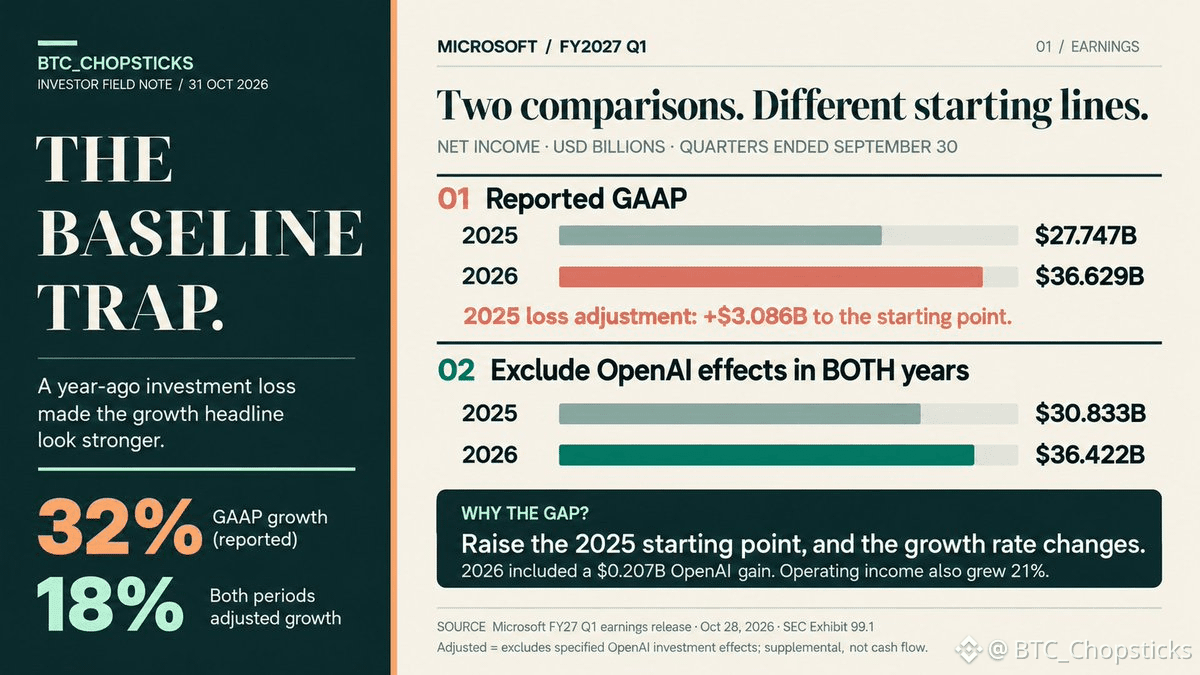
It isn't mainly about a large OpenAI gain this quarter. Microsoft reported only a $207M net-income benefit from its OpenAI investments. The bigger influence on the comparison was a $3.086B loss a year earlier.
For the quarter ended September 30, 2026, reported net income rose from $27.747B to $36.629B.
Remove this year's gain alone and growth still looks like 31.26%. But that leaves last year's investment loss in the starting point.
Adjust both periods instead. Last year's net income becomes $30.833B; this year's becomes $36.422B. Growth is 18.13%, consistent with Microsoft's reported 18% non-GAAP growth.
The change from an investment loss to a gain contributed $3.293B to the $8.882B increase in reported net income. That's a year-over-year earnings swing, not a $3.293B gain earned this quarter.
Microsoft's operating business improved too. Revenue grew 19% and operating income grew 21%. The comparison doesn't erase that progress.
For a valuation, I wouldn't carry the 32% headline straight into a forecast. Nor would I assume 18% will persist. First separate the change in the operating business from the investment effects in both years, then assess what can repeat.
These adjustments do not calculate cash flow or prove the return on Microsoft's AI investments. Microsoft's non-GAAP measure supplements GAAP; it does not replace it.
Before projecting Microsoft's next year, rebuild its last year.
Microsoft's 32% profit growth has a lesson hidden in last year's numbers.
It isn't mainly about a large OpenAI gain this quarter. Microsoft reported only a $207M net-income benefit from its OpenAI investments. The bigger influence on the comparison was a $3.086B loss a year earlier.
For the quarter ended September 30, 2026, reported net income rose from $27.747B to $36.629B.
Remove this year's gain alone and growth still looks like 31.26%. But that leaves last year's investment loss in the starting point.
Adjust both periods instead. Last year's net income becomes $30.833B; this year's becomes $36.422B. Growth is 18.13%, consistent with Microsoft's reported 18% non-GAAP growth.
The change from an investment loss to a gain contributed $3.293B to the $8.882B increase in reported net income. That's a year-over-year earnings swing, not a $3.293B gain earned this quarter.
Microsoft's operating business improved too. Revenue grew 19% and operating income grew 21%. The comparison doesn't erase that progress.
For a valuation, I wouldn't carry the 32% headline straight into a forecast. Nor would I assume 18% will persist. First separate the change in the operating business from the investment effects in both years, then assess what can repeat.
These adjustments do not calculate cash flow or prove the return on Microsoft's AI investments. Microsoft's non-GAAP measure supplements GAAP; it does not replace it.
Before projecting Microsoft's next year, rebuild its last year.
It isn't mainly about a large OpenAI gain this quarter. Microsoft reported only a $207M net-income benefit from its OpenAI investments. The bigger influence on the comparison was a $3.086B loss a year earlier.
For the quarter ended September 30, 2026, reported net income rose from $27.747B to $36.629B.
Remove this year's gain alone and growth still looks like 31.26%. But that leaves last year's investment loss in the starting point.
Adjust both periods instead. Last year's net income becomes $30.833B; this year's becomes $36.422B. Growth is 18.13%, consistent with Microsoft's reported 18% non-GAAP growth.
The change from an investment loss to a gain contributed $3.293B to the $8.882B increase in reported net income. That's a year-over-year earnings swing, not a $3.293B gain earned this quarter.
Microsoft's operating business improved too. Revenue grew 19% and operating income grew 21%. The comparison doesn't erase that progress.
For a valuation, I wouldn't carry the 32% headline straight into a forecast. Nor would I assume 18% will persist. First separate the change in the operating business from the investment effects in both years, then assess what can repeat.
These adjustments do not calculate cash flow or prove the return on Microsoft's AI investments. Microsoft's non-GAAP measure supplements GAAP; it does not replace it.
Before projecting Microsoft's next year, rebuild its last year.
266
An AI data center can have its chips and still be waiting to earn revenue.
Usable power requires more than a grid connection. Supply, controls, cooling and commissioning must work together.
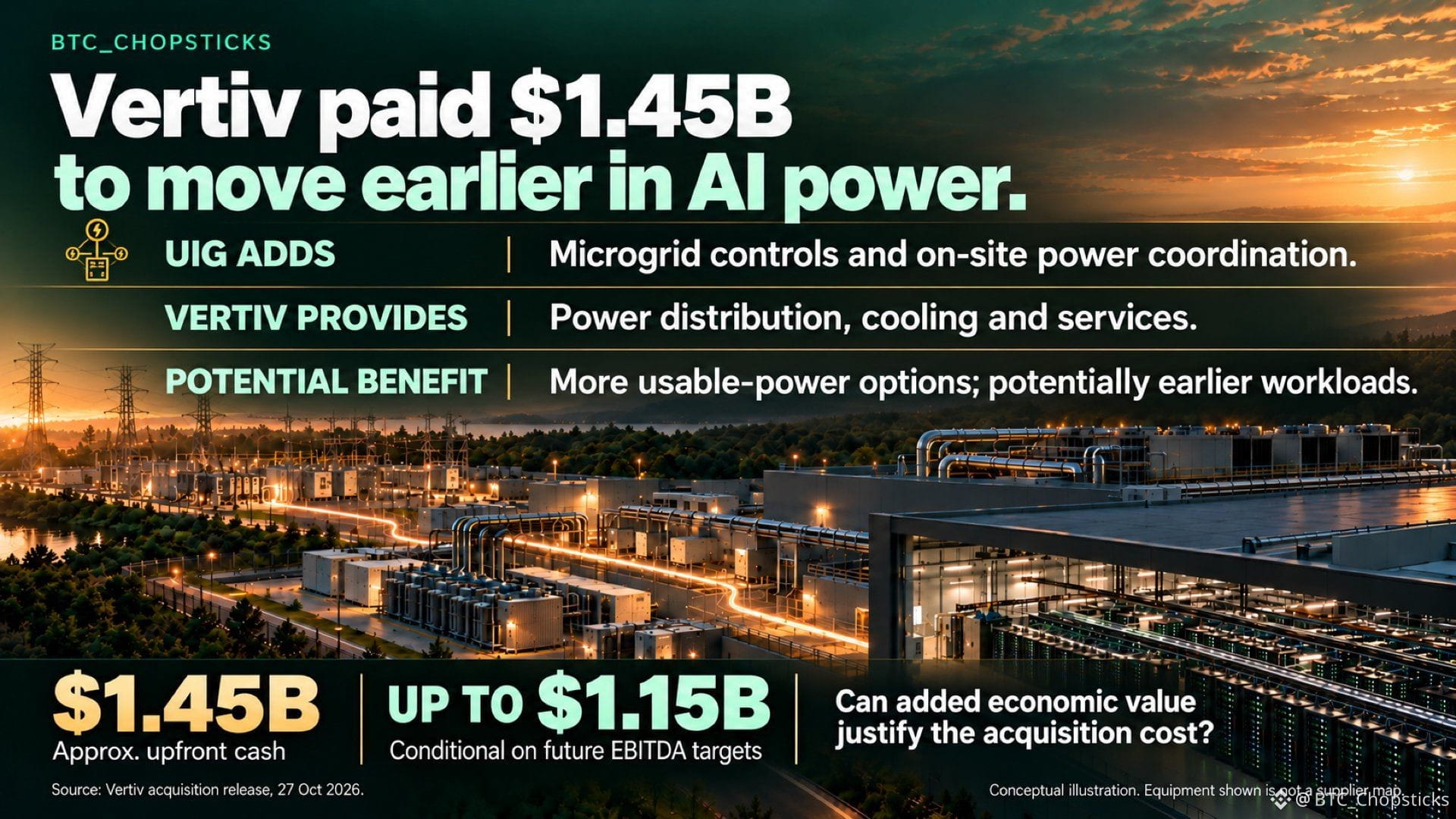
Vertiv's October 27 acquisition of UIG moves it earlier into that planning process. UIG adds microgrid controls and onsite-power orchestration to Vertiv's existing power, cooling and service capabilities.
For customers, earlier operation can bring paid workloads forward. That benefit must exceed the extra generation, financing and operating costs. Faster deployment is an opportunity, not a guarantee.
Vertiv paid about $1.45B upfront, with up to $1.15B more tied to EBITDA targets. The quoted roughly 13x multiple uses the upfront price and expected 2027 UIG EBITDA, not realized cash earnings.
I'd look for completed deployments that lead to repeat equipment and service wins, then cash retained after integration and reinvestment. Customer time saved becomes a good acquisition only if Vertiv captures enough value to justify its cost.
An AI data center can have its chips and still be waiting to earn revenue.
Usable power requires more than a grid connection. Supply, controls, cooling and commissioning must work together.
Vertiv's October 27 acquisition of UIG moves it earlier into that planning process. UIG adds microgrid controls and onsite-power orchestration to Vertiv's existing power, cooling and service capabilities.
For customers, earlier operation can bring paid workloads forward. That benefit must exceed the extra generation, financing and operating costs. Faster deployment is an opportunity, not a guarantee.
Vertiv paid about $1.45B upfront, with up to $1.15B more tied to EBITDA targets. The quoted roughly 13x multiple uses the upfront price and expected 2027 UIG EBITDA, not realized cash earnings.
I'd look for completed deployments that lead to repeat equipment and service wins, then cash retained after integration and reinvestment. Customer time saved becomes a good acquisition only if Vertiv captures enough value to justify its cost.
Usable power requires more than a grid connection. Supply, controls, cooling and commissioning must work together.
Vertiv's October 27 acquisition of UIG moves it earlier into that planning process. UIG adds microgrid controls and onsite-power orchestration to Vertiv's existing power, cooling and service capabilities.
For customers, earlier operation can bring paid workloads forward. That benefit must exceed the extra generation, financing and operating costs. Faster deployment is an opportunity, not a guarantee.
Vertiv paid about $1.45B upfront, with up to $1.15B more tied to EBITDA targets. The quoted roughly 13x multiple uses the upfront price and expected 2027 UIG EBITDA, not realized cash earnings.
I'd look for completed deployments that lead to repeat equipment and service wins, then cash retained after integration and reinvestment. Customer time saved becomes a good acquisition only if Vertiv captures enough value to justify its cost.
2.5k
Verified
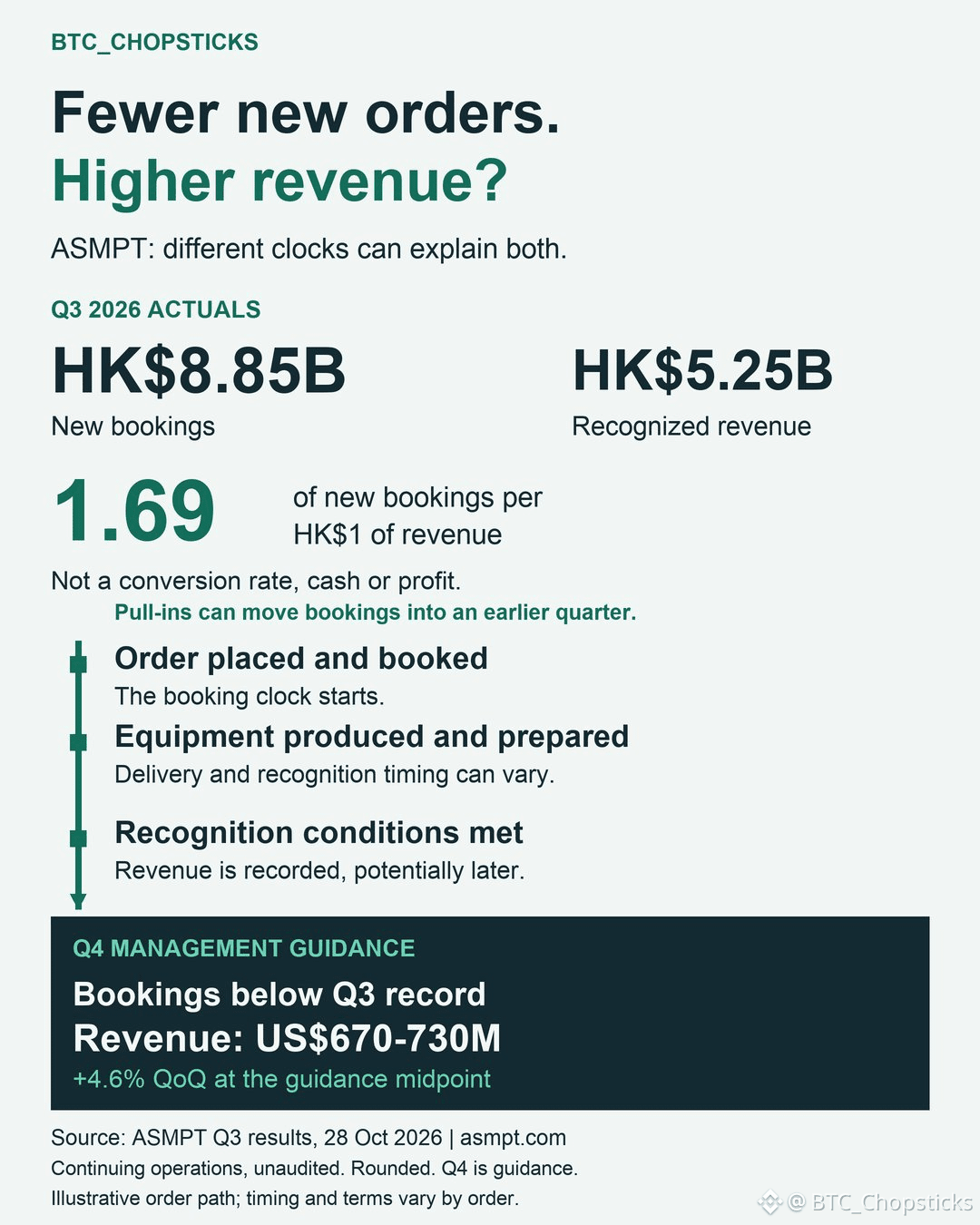
An equipment supplier can guide for fewer orders and higher sales at the same time.
ASMPT's Q3 2026 results explain how.
Its continuing operations booked HK$8,845.1M of new orders and recognized HK$5,247.0M of revenue. Dividing the first by the second gives a book-to-bill ratio of 1.69.
That's HK$1.69 of new orders per HK$1 of reported revenue. It doesn't tell us how much of those orders shipped, how much cash arrived or what profit they will earn.
The timing matters. SMT bookings included more than US$100M of bulk orders and pull-ins combined. The pure pull-in amount wasn't disclosed.
Management expects Q4 bookings below Q3's record, partly because of those one-offs and pull-ins. Yet its Q4 revenue guidance is US$670M to US$730M, up 4.6% at the midpoint from Q3.
An order brought forward strengthens one quarter and weakens the next comparison. Previously ordered equipment can still move toward delivery and revenue recognition.
I'd compare reported revenue with guidance, then check fresh orders after the pull-in window. Orders that keep arriving would support the demand story; weakness that persists beyond that timing effect would deserve more scrutiny.
These are unaudited continuing-operations figures and management forecasts, not evidence that every order becomes cash or profit.
An equipment supplier can guide for fewer orders and higher sales at the same time.
ASMPT's Q3 2026 results explain how.
Its continuing operations booked HK$8,845.1M of new orders and recognized HK$5,247.0M of revenue. Dividing the first by the second gives a book-to-bill ratio of 1.69.
That's HK$1 .69 of new orders per HK$1 of reported revenue. It doesn't tell us how much of those orders shipped, how much cash arrived or what profit they will earn.
The timing matters. SMT bookings included more than US$100M of bulk orders and pull-ins combined. The pure pull-in amount wasn't disclosed.
Management expects Q4 bookings below Q3's record, partly because of those one-offs and pull-ins. Yet its Q4 revenue guidance is US$670M to US$730M, up 4.6% at the midpoint from Q3.
An order brought forward strengthens one quarter and weakens the next comparison. Previously ordered equipment can still move toward delivery and revenue recognition.
I'd compare reported revenue with guidance, then check fresh orders after the pull-in window. Orders that keep arriving would support the demand story; weakness that persists beyond that timing effect would deserve more scrutiny.
These are unaudited continuing-operations figures and management forecasts, not evidence that every order becomes cash or profit.
ASMPT's Q3 2026 results explain how.
Its continuing operations booked HK$8,845.1M of new orders and recognized HK$5,247.0M of revenue. Dividing the first by the second gives a book-to-bill ratio of 1.69.
That's HK$1 .69 of new orders per HK$1 of reported revenue. It doesn't tell us how much of those orders shipped, how much cash arrived or what profit they will earn.
The timing matters. SMT bookings included more than US$100M of bulk orders and pull-ins combined. The pure pull-in amount wasn't disclosed.
Management expects Q4 bookings below Q3's record, partly because of those one-offs and pull-ins. Yet its Q4 revenue guidance is US$670M to US$730M, up 4.6% at the midpoint from Q3.
An order brought forward strengthens one quarter and weakens the next comparison. Previously ordered equipment can still move toward delivery and revenue recognition.
I'd compare reported revenue with guidance, then check fresh orders after the pull-in window. Orders that keep arriving would support the demand story; weakness that persists beyond that timing effect would deserve more scrutiny.
These are unaudited continuing-operations figures and management forecasts, not evidence that every order becomes cash or profit.
2
2.6k
The money backing a stablecoin is not money its shareholders have earned.
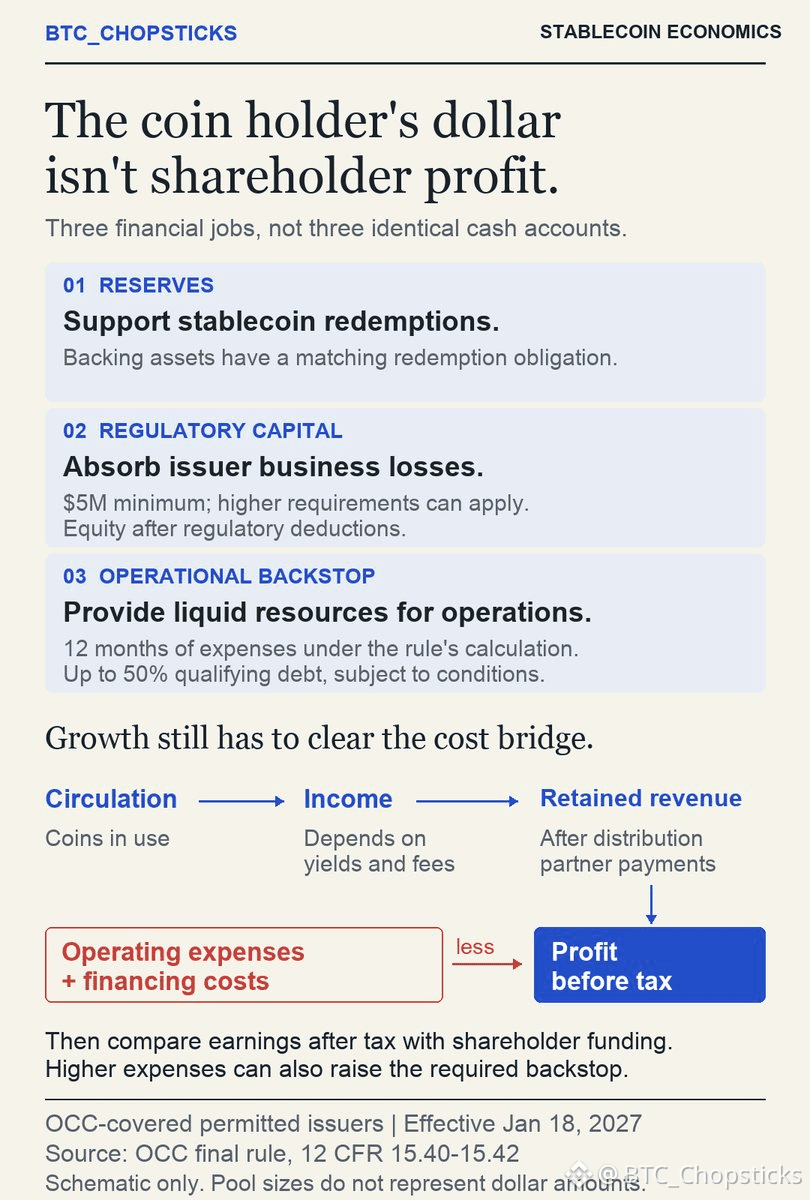
Issuing a coin creates a redemption obligation. Its backing assets help meet that obligation; they are not free capital the owners can spend on growing the business.
The OCC's final rule, effective January 18, 2027, gives three resources different jobs for permitted payment stablecoin issuers subject to its capital and backstop requirements. It does not apply this framework to every issuer worldwide.
Reserves support coin redemptions. Regulatory capital absorbs business losses, with a $5M minimum that can be higher. The operational backstop supplies eligible liquid assets equal to 12 months of expenses under the rule's calculation.
Think about what happens when an issuer hires more staff or expands its systems. Those expenses reduce profit. As they enter the expense calculation, they can also increase the backstop it must fund.
That backstop need not be entirely shareholder-funded. Qualifying debt can fund up to 50%, subject to conditions including subordination and at least five years' maturity. Recognition declines near maturity. Equity funding the backstop cannot also count toward regulatory capital.
More coins can generate more income, but distribution partners may take much of the increase. Operating and financing costs can absorb the rest.
Before valuing an issuer, I'd ask for income retained after distribution payments, recurring operating expenses, financing terms and the equity needed to support growth. Then compare the extra profit with the extra shareholder funding required.
Circulation tells me how much of the product is being used. That comparison tells me whether expanding it is creating a better business for its owners.
The money backing a stablecoin is not money its shareholders have earned.
Issuing a coin creates a redemption obligation. Its backing assets help meet that obligation; they are not free capital the owners can spend on growing the business.
The OCC's final rule, effective January 18, 2027, gives three resources different jobs for permitted payment stablecoin issuers subject to its capital and backstop requirements. It does not apply this framework to every issuer worldwide.
Reserves support coin redemptions. Regulatory capital absorbs business losses, with a $5M minimum that can be higher. The operational backstop supplies eligible liquid assets equal to 12 months of expenses under the rule's calculation.
Think about what happens when an issuer hires more staff or expands its systems. Those expenses reduce profit. As they enter the expense calculation, they can also increase the backstop it must fund.
That backstop need not be entirely shareholder-funded. Qualifying debt can fund up to 50%, subject to conditions including subordination and at least five years' maturity. Recognition declines near maturity. Equity funding the backstop cannot also count toward regulatory capital.
More coins can generate more income, but distribution partners may take much of the increase. Operating and financing costs can absorb the rest.
Before valuing an issuer, I'd ask for income retained after distribution payments, recurring operating expenses, financing terms and the equity needed to support growth. Then compare the extra profit with the extra shareholder funding required.
Circulation tells me how much of the product is being used. That comparison tells me whether expanding it is creating a better business for its owners.
Issuing a coin creates a redemption obligation. Its backing assets help meet that obligation; they are not free capital the owners can spend on growing the business.
The OCC's final rule, effective January 18, 2027, gives three resources different jobs for permitted payment stablecoin issuers subject to its capital and backstop requirements. It does not apply this framework to every issuer worldwide.
Reserves support coin redemptions. Regulatory capital absorbs business losses, with a $5M minimum that can be higher. The operational backstop supplies eligible liquid assets equal to 12 months of expenses under the rule's calculation.
Think about what happens when an issuer hires more staff or expands its systems. Those expenses reduce profit. As they enter the expense calculation, they can also increase the backstop it must fund.
That backstop need not be entirely shareholder-funded. Qualifying debt can fund up to 50%, subject to conditions including subordination and at least five years' maturity. Recognition declines near maturity. Equity funding the backstop cannot also count toward regulatory capital.
More coins can generate more income, but distribution partners may take much of the increase. Operating and financing costs can absorb the rest.
Before valuing an issuer, I'd ask for income retained after distribution payments, recurring operating expenses, financing terms and the equity needed to support growth. Then compare the extra profit with the extra shareholder funding required.
Circulation tells me how much of the product is being used. That comparison tells me whether expanding it is creating a better business for its owners.
91
Two competing AI chipmakers can both pay the same design-tool supplier.
That's what makes Cadence Design Systems (NASDAQ:
$CDNS ) interesting to me. More companies designing AI chips can mean more demand for the software and IP used to build them, regardless of which processor wins.
Cadence's broader design businesses are growing. Core EDA revenue grew 20% and semiconductor IP grew 24% in Q3 2026.
But something else caught my attention.
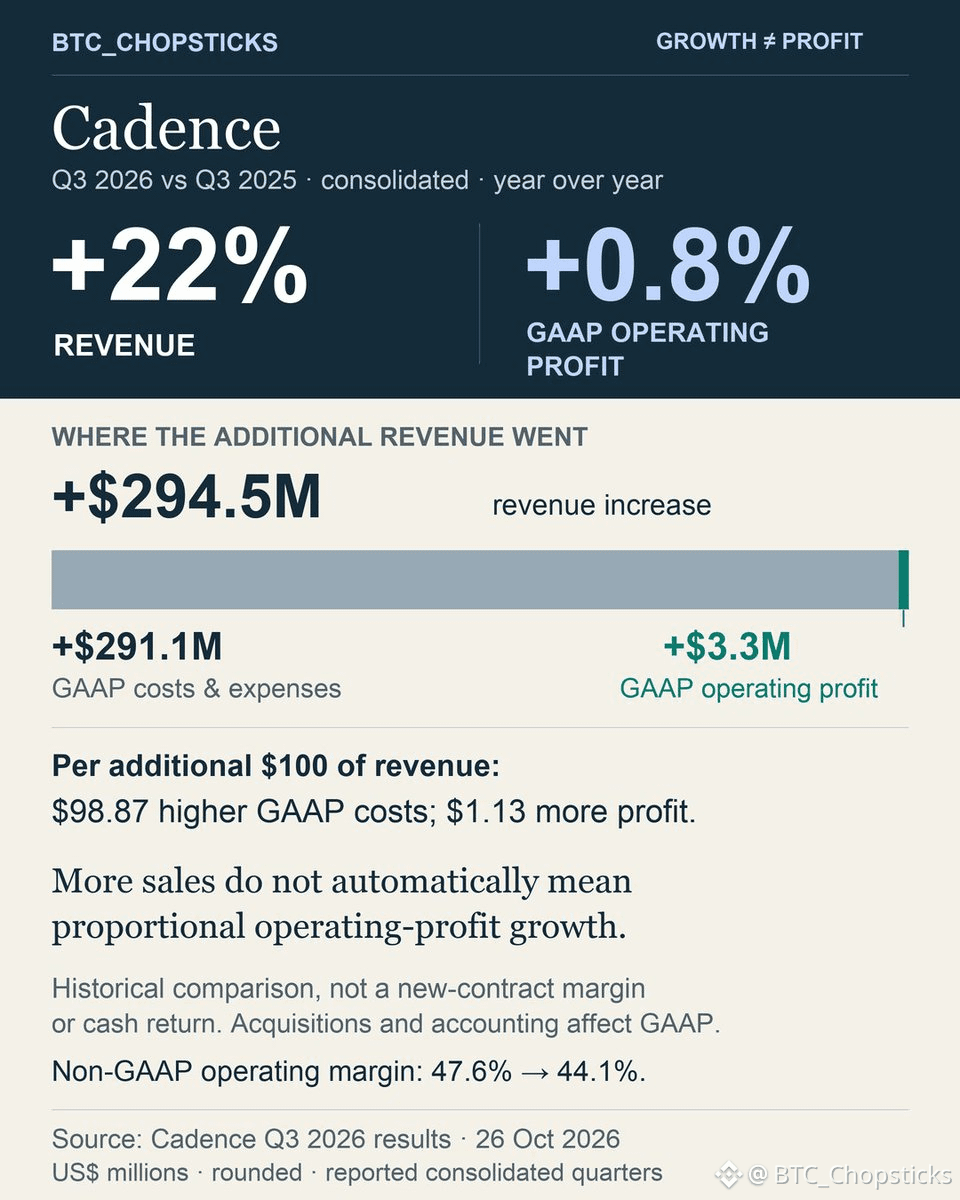
Across the consolidated company, Cadence added $294.5M in quarterly revenue compared with a year earlier. Its GAAP operating profit increased by just $3.3M.
For every additional $100 of reported revenue, roughly $98.87 was matched by higher GAAP costs and expenses. Only $1.13 appeared as additional operating profit.
That isn't the margin on a new contract, and those costs aren't necessarily cash expenses. Acquisitions and accounting adjustments affect the comparison. Even so, non-GAAP operating margin also declined, from 47.6% to 44.1%.
The chart breaks down what happened and shows a calculation you can use when studying other stocks.
Here's the distinction I find important:
Picking a company that benefits from the AI boom is one decision. Figuring out how much profit it can retain from that growth is another.
Two competing AI chipmakers can both pay the same design-tool supplier.
That's what makes Cadence Design Systems (NASDAQ:
$CDNS ) interesting to me. More companies designing AI chips can mean more demand for the software and IP used to build them, regardless of which processor wins.
Cadence's broader design businesses are growing. Core EDA revenue grew 20% and semiconductor IP grew 24% in Q3 2026.
But something else caught my attention.
Across the consolidated company, Cadence added $294.5M in quarterly revenue compared with a year earlier. Its GAAP operating profit increased by just $3.3M.
For every additional $100 of reported revenue, roughly $98.87 was matched by higher GAAP costs and expenses. Only $1.13 appeared as additional operating profit.
That isn't the margin on a new contract, and those costs aren't necessarily cash expenses. Acquisitions and accounting adjustments affect the comparison. Even so, non-GAAP operating margin also declined, from 47.6% to 44.1%.
The chart breaks down what happened and shows a calculation you can use when studying other stocks.
Here's the distinction I find important:
Picking a company that benefits from the AI boom is one decision. Figuring out how much profit it can retain from that growth is another.
That's what makes Cadence Design Systems (NASDAQ:
$CDNS ) interesting to me. More companies designing AI chips can mean more demand for the software and IP used to build them, regardless of which processor wins.
Cadence's broader design businesses are growing. Core EDA revenue grew 20% and semiconductor IP grew 24% in Q3 2026.
But something else caught my attention.
Across the consolidated company, Cadence added $294.5M in quarterly revenue compared with a year earlier. Its GAAP operating profit increased by just $3.3M.
For every additional $100 of reported revenue, roughly $98.87 was matched by higher GAAP costs and expenses. Only $1.13 appeared as additional operating profit.
That isn't the margin on a new contract, and those costs aren't necessarily cash expenses. Acquisitions and accounting adjustments affect the comparison. Even so, non-GAAP operating margin also declined, from 47.6% to 44.1%.
The chart breaks down what happened and shows a calculation you can use when studying other stocks.
Here's the distinction I find important:
Picking a company that benefits from the AI boom is one decision. Figuring out how much profit it can retain from that growth is another.
165
🌉 Tired of switching between multiple platforms to swap across chains? Mercuryo Swaps makes it easier!
Say you hold ETH on the Ethereum network but need USDT on the TRON network. What can you do?
In the past, this might have involved several steps across exchanges, cross-chain bridges, and more, while keeping an eye on fees and network selection.
🔄 Mercuryo Swaps offers a new option!
Mercuryo_io announced that its Swaps service now supports 21 blockchain networks, including TRON. Users can select the asset and destination network in one interface, simplifying the process.
💵 Quote test
✅ Ethereum ETH → TRON USDT
✅ Ethereum ETH → TRX
In testing, both routes successfully displayed quotes and applicable fees, but no trades were actually executed.
🌍 What does this mean for TRON?
TRON is already a major global network for stablecoin settlement. Mercuryo’s support gives users more options for acquiring TRX and TRC-20 USDT.
Of course, cross-chain transactions still require attention to fees, identity verification, regional restrictions, and trading risks.
Web3 should keep getting simpler—but don’t skip security checks! 🔐
@justinsuntron @TRONDAO @TronDao_THA
#TRONGlobalFriends #TGF
🌉 Tired of switching between multiple platforms to swap across chains? Mercuryo Swaps makes it easier!
Say you hold ETH on the Ethereum network but need USDT on the TRON network. What can you do?
In the past, this might have involved several steps across exchanges, cross-chain bridges, and more, while keeping an eye on fees and network selection.
🔄 Mercuryo Swaps offers a new option!
Mercuryo_io announced that its Swaps service now supports 21 blockchain networks, including TRON. Users can select the asset and destination network in one interface, simplifying the process.
💵 Quote test
✅ Ethereum ETH → TRON USDT
✅ Ethereum ETH → TRX
In testing, both routes successfully displayed quotes and applicable fees, but no trades were actually executed.
🌍 What does this mean for TRON?
TRON is already a major global network for stablecoin settlement. Mercuryo’s support gives users more options for acquiring TRX and TRC-20 USDT.
Of course, cross-chain transactions still require attention to fees, identity verification, regional restrictions, and trading risks.
Web3 should keep getting simpler—but don’t skip security checks! 🔐
@justinsuntron @TRON DAO @TronDao_THA
#TRONGlobalFriends #TGF
Say you hold ETH on the Ethereum network but need USDT on the TRON network. What can you do?
In the past, this might have involved several steps across exchanges, cross-chain bridges, and more, while keeping an eye on fees and network selection.
🔄 Mercuryo Swaps offers a new option!
Mercuryo_io announced that its Swaps service now supports 21 blockchain networks, including TRON. Users can select the asset and destination network in one interface, simplifying the process.
💵 Quote test
✅ Ethereum ETH → TRON USDT
✅ Ethereum ETH → TRX
In testing, both routes successfully displayed quotes and applicable fees, but no trades were actually executed.
🌍 What does this mean for TRON?
TRON is already a major global network for stablecoin settlement. Mercuryo’s support gives users more options for acquiring TRX and TRC-20 USDT.
Of course, cross-chain transactions still require attention to fees, identity verification, regional restrictions, and trading risks.
Web3 should keep getting simpler—but don’t skip security checks! 🔐
@justinsuntron @TRON DAO @TronDao_THA
#TRONGlobalFriends #TGF
414
Log in to explore more content
Join global crypto users on Binance Square
⚡️ Get latest and useful information about crypto.
💬 Trusted by the world’s largest crypto exchange.
👍 Discover real insights from verified creators.
Email / Phone number
Trending Topics
A Packed Week of Earnings and Data Tests Markets
54,395 views
363 Discussing
🚨🇺🇸 BIG WEEK AHEAD FOR THE MARKETS!
Markets are pricing in a Fed rate hike in December and $BTC could see some big moves next week.
Here's what's coming:
• Monday: Fed Chair Warsh speaks
• Tuesday: US Retail Sales + $NVDA earnings
• Wednesday: FOMC Minutes
• Thursday: Jobless Claims + Philly Fed Index
• Friday: Consumer Sentiment + Fed speeches
All eyes on $BTC as another important week begins.
#bitcoin
Mookie
·15 Likes
·6.1k views
AnthropicIPOTestsInvestorAppetiteForAI
95,282 views
1,254 Discussing
BitcoinExtendsLosingStreakToSixWeeks
60,605 views
604 Discussing