
#vst
vst
2,687 views
66 Discussing
Hot
Latest

·
--
#vistra #nyse with the symbol #vst is listed on the NYSE
Vistra Corp. (NYSE: VST)
is the largest independent power producer in the U.S., with a capacity of 44 GW. Headquartered in Texas, it combines retail energy sales with a diversified portfolio that includes natural gas, coal, batteries, and nuclear power.
Its key role in supplying AI data centers helped secure a $4.2 billion loan from the Department of Energy to expand its nuclear capacity. With a market capitalization of nearly $56 billion, it trades at around $156.73 USD, establishing itself as a strategically important, high-growth stock on Wall Street.
Stay tuned for this one
90

·
--
$VST rose 154.89, up 1.434% in 24 hours; the funding rate has gone to zero.
This small uptick has no volume. Open interest is only 5,711 lots, and a zero funding rate means neither long nor short has reached a consensus—just existing capital indulging itself. Everyone in the market is waiting for the next Trump tweet or the next U.S. earnings report to provide direction.
The strongest counterpoint is that he suddenly announces tariffs again or talks to the Fed—the $VST could instantly spike. In this stalemate, any bet before a breakout is just a coin toss.
Action: Wait and see.
Trading tag: #TradFi #链上美股 #VST
Where do you think this analysis is most likely to be wrong?
59

·
--
$VST In the past 24 hours, it has risen 4.127%, and the price reached 143.81, but the funding rate is completely unchanged, stuck at zero. That’s a bit unusual in the backdrop of rising “Trump trade” narratives.
My take: the market’s expectations of the benefits for TradFi from Trump may have already been priced in ahead of time. The price is up but the funding rate is zero, which suggests the longs haven’t rushed in at large scale. Sentiment looks cooler than the price action indicates. With an open position of 3614.20 contracts and no obvious fluctuations, that further supports this.
The strongest counter-argument is this: if Trump next truly rolls out major policies targeting securities-class assets, it could instantly flip this cautious stance and push the price up another step. But for now, the market is expressing a wait-and-see attitude with a zero funding rate.
The second-order impact is that if the price can’t keep climbing, these moderate long positions are likely to waver. Once someone starts closing positions, the speed of a pullback could be faster than during the rise, because there’s no support from a negative funding rate below.
The invalidation conditions are clear: if the funding rate turns positive, it would mean the longs have started paying to enter—then my cautious view would be wrong. Also, if the price steadily breaks below 140, that would mean the breakout has failed.
As for actions, I’m not touching it now. I’ll wait until the funding rate shows a clear direction—e.g., turning positive to above 0.0001—before considering going long.
Trading tag: #TradFi #链上美股 #VST
Where do you think this line of judgment is most likely to be wrong?
113

·
--
$VST 24 hours rose by 1.515%, with the quote at 152.81. In the same time window, the perpetual contract funding rate stayed at zero, and open interest was 3,630.17 underlying units. This is a structure where price is moving up, but the derivatives market is making no directional bet.
A funding rate of zero in a volatile market usually means that longs and shorts have reached a fragile balance in financing costs. Longs are not paying extra holding costs just because price has risen, and shorts are not being compensated just because price has fallen. Combined with the 1.515% gain, this move up may not have been driven by strong leveraged long sentiment; it looks more like a slow push from spot buying or low-leverage positioning. Futures traders are either waiting on the sidelines, or their positions are so light that financing costs are negligible.
This is a single-signal judgment, and all conclusions are built on one derivatives datapoint: the zero funding rate. The strongest counterargument is this: if over the next 24 hours price rises with volume and the funding rate turns positive, that would overturn the current view that there is no leveraged upside push, and would indicate new, funded leveraged longs are entering the market. Conversely, if price pulls back but the funding rate remains zero, that would confirm market participation is truly weak, with no interest even in directional positioning.
Next, if price can hold above 152.81, the zero-funding state itself may become a factor attracting capital. For short-term traders, no funding cost means lower friction when holding a contrarian position. But it also means that once the market chooses a direction, the funding rate may change more abruptly than price itself, because it has to reprice from an absolute zero.
Under the current structure, my observation is that the market has neither a euphoric bullish consensus on $VST nor urgent bearish pressure. It is a vacuum of liquidity or interest.
Aggressive traders can try a small long if price stays above 152.81, betting that zero-funding holders will be forced to add exposure later. Conservative traders should wait until funding turns clearly positive or negative before entering, so at least they know who is bearing the cost. Those avoiding risk should stay out for now, because there is no consensus and the risk-reward is unclear.
A falsifiable anti-consensus view: zero funding is not balance, but indifference. When everyone feels it is not worth paying for, volatility compresses to the extreme, which instead means a sharp one-sided move is forming, and the opposing side at launch will be very thin.
Trading tag: #TradFi #链上美股 #VST
Where do you think this whole judgment is most likely to be wrong?
7
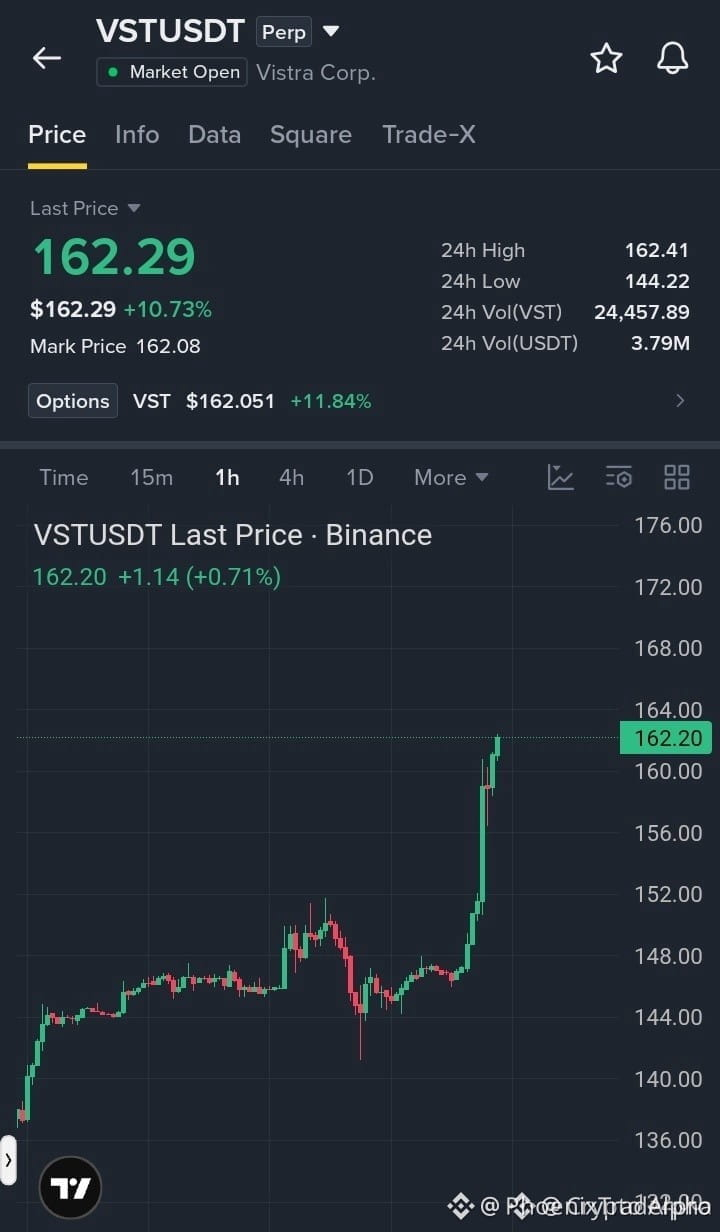
⚡ $VST IGNITES 1H BREAKOUT AFTER CLEARING THE $156 CONSOLIDATION ZONE! 💥
Entry: 162.29 ⚡
Target: 172.00 🚀
Stop Loss: 157.00 ⚠️
$VST just shattered its $152–$156 accumulation ceiling on the hourly timeframe, printing heavy expansion candles that reflect decisive buyer control. 📊 Aggressive market orders are absorbing overhead supply, opening a clean runway toward upper price targets.
⚡ While velocity remains strong, high-conviction execution relies on seeing the $162 level hold firm on any minor retest. 💡 Keep a close eye on momentum spillover into setups like $RLC and $RAD as sector volume expands. 💬 Are you bidding this breakout expansion live or waiting for retest confirmation at support? 👇
⚠️ Not financial advice. Always manage your risk. 🛡️
🏷️ #VST #Breakout #LongSetup #Crypto
🎯 🔥
18
·
--
The current price of $VST is 152.81, up 1.515% in the last 24 hours. Its perpetual contract funding rate is 0, and open interest has remained at 3630.17.
A zero funding rate paired with a moderate price increase is an uncommon combination. Usually, a funding rate of zero means that longs and shorts have reached a brief, fragile balance here, with neither side paying the other. Combined with the 1.515% rise, this does not look like a classic short squeeze or long liquidation cascade. It feels more like a market with relatively thin liquidity, where a small amount of buying is enough to push the price a bit higher, while bearish pressure is neither strong enough to drive it down nor weak enough to require paying longs to maintain positions.
My view is that this is a technical rebound in a wait-and-see state, lacking strong macro or news-driven momentum. The evidence supporting this view is actually quite limited, mainly this zero funding rate. There are no news events, no extreme positive or negative funding rates, and the absolute OI does not look large either. I cannot find a second strong piece of evidence from a different angle to support any explosive directional move.
The strongest counterargument will come from the future. If in the next few settlement cycles the funding rate quickly turns positive and rises while the price starts to stall or even pull back, that would be a clear signal that bullish momentum is fading and funding costs are beginning to build. Conversely, if the rate turns negative while the price keeps rising, it means shorts are being forced to cover losses and there could still be more upside in the short term. What data would invalidate my current directionless judgment? Very simply: the funding rate moving away from zero, significantly in either direction, accompanied by trading volume.
This is a classic single-signal market. The price has risen, but the funding sentiment driving that move is neutral, and open interest has not expanded meaningfully. In this structure, the price lacks fuel for a sustained breakout. Long holders do not have much cost pressure, but they also do not have enough profit cushion to aggressively add; shorts are not being squeezed, but they also do not have a strong reason to build large positions. The market is pausing here to catch its breath, waiting for a clearer signal.
Aggressive scenario: if the price can hold above 153 with volume and funding starts to turn mildly positive, you could try a small long position, targeting the previous high area. Conservative scenario: continue to wait around zero funding and the current price level, and wait for the structure to become clearer, especially the direction of funding changes.
Trading tag: #TradFi #链上美股 #VST
Where do you think this judgment is most likely to be wrong?
3
$VST
{future}(VSTUSDT)
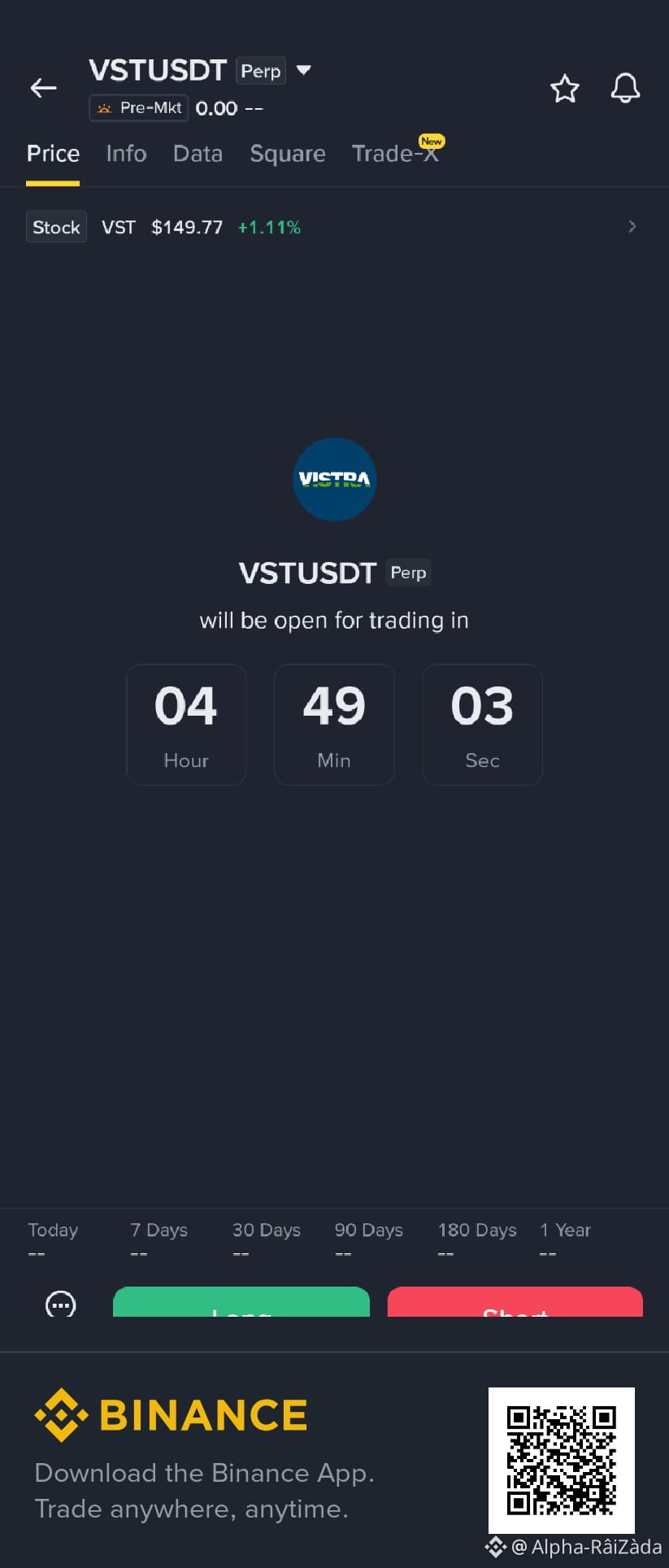
— New Listing Watch 🚨🔥
$VST is approaching its Binance contract launch, with around 4h 49m remaining.
Price is being watched around the $148–$150 area. If $148 holds after launch, buyers may attempt a breakout above $150. A clean loss of $148 would weaken the setup.
⚠️ New listings can be extremely volatile. Don’t chase the first spike — wait for liquidity and price confirmation.
#VST #VSTUSDT #BİNANCE #cryptotrading #altcoins
$VST
— New Listing Watch 🚨🔥
$VST is approaching its Binance contract launch, with around 4h 49m remaining.
Price is being watched around the $148–$150 area. If $148 holds after launch, buyers may attempt a breakout above $150. A clean loss of $148 would weaken the setup.
⚠️ New listings can be extremely volatile. Don’t chase the first spike — wait for liquidity and price confirmation.
#VST #VSTUSDT #BİNANCE #cryptotrading #altcoins
94
·
--
$VST 24 hours rose by 4.127%, the price reached 143.81, and trading volume was $356,000. The funding rate is zero; open interest is 3,614 contracts, with no obvious change. When on-chain U.S. stock futures are pulled up like this without new news, it’s a bit unusual.
The essence of the Trump trade is to front-run expectations of a policy shift. If the market thinks that when he takes office energy prices will rise, an underlying like $VST is likely to be watched by short-term funds. But the zero funding rate value indicates both longs and shorts are waiting, with no leveraged funds stepping in, and open interest is stable. This move looks more like retail sentiment driving it, not a major consensus. The last similar situation was at the end of last year—after the price spiked, it quickly pulled back because there was a lack of open-interest support.
I think chasing after a rally carries too much risk. If the price breaks below the 140 level, I’ll cut half my position, with a stop-loss set at 135. If the funding rate suddenly turns positive and exceeds 0.005—signaling that longs are becoming overcrowded—I’ll close out and exit. Before open interest increases, I’m more inclined to wait and observe, and act only after a pullback or if Trump makes a clear policy statement.
Trading tag: #TradFi #链上美股 #VST
Where do you think this set of judgments is most likely to be wrong?
233
·
--
$VST rose 1.515% over the past 24 hours, quoted at 152.81, but its funding rate is zero. That number itself is more worth pondering than any price increase.
A funding rate of zero means that on Binance, this traditional stock perpetual contract market, longs and shorts are not currently paying each other. This is not normal. Usually, for an asset with price volatility, the funding rate tends to lean toward one side, because long and short sentiment can never be perfectly balanced. A rate stuck at absolute zero is more like a pause button, or rather, the market waiting for an external pricing signal to break the deadlock. Open interest remains at 3630.17, with no obvious increase or decrease, which supports this wait-and-see state. Both longs and shorts are staying put, and the slight rise in price has neither triggered new capital to flow in and open positions nor caused a large-scale wave of liquidations.
This is a typical low-volatility, low-funding-rate wait-and-see structure. The transmission chain is very clear: the market lacks an obvious macro catalyst, so traders are unwilling to pay extra costs for directional views. Whether it is longs chasing the trend or shorts hedging risk, both are choosing to vote with their feet for now, waiting for the next key data point or event. For instruments like $VST, whose price behavior is decoupled from financing costs, that itself reflects macro-level hesitation.
How long can this calm last? The strongest counterargument is that a funding rate of zero may not be balance, but another form of insufficient liquidity. If genuine trading intent is weak, even very small buy or sell orders can move the price without being reflected in the funding rate. Once some macro data, such as employment or inflation figures, is released, it could instantly break through this false equilibrium. My judgment fails when the funding rate deviates from zero, whether positive or negative; that would mean new capital is clearly betting on a direction.
During this period, any strategy based on funding-rate arbitrage or trend following will fail. The cost is zero, but the direction is equally vague. The aggressive move is to take a small long position while the funding rate remains zero, betting on an upward breakout; the prudent move is to wait and do nothing until the funding rate shows a clear bias; the safest is to avoid this instrument altogether and look for opportunities in markets where the funding rate has a clear direction.
The market is always waiting for a clear signal, but the real signal often begins with a divergence between price and cost. The current zero-funding environment in $VST is precisely the starting point of such divergence, and it may foreshadow the next big move even earlier than price itself.
Trading tag: #TradFi #链上美股 #VST
Where do you think this judgment is most likely to be wrong?
$VST rose 1.515% over the past 24 hours, quoted at 152.81, but its funding rate is zero. That number itself is more worth pondering than any price increase.
A funding rate of zero means that on Binance, this traditional stock perpetual contract market, longs and shorts are not currently paying each other. This is not normal. Usually, for an asset with price volatility, the funding rate tends to lean toward one side, because long and short sentiment can never be perfectly balanced. A rate stuck at absolute zero is more like a pause button, or rather, the market waiting for an external pricing signal to break the deadlock. Open interest remains at 3630.17, with no obvious increase or decrease, which supports this wait-and-see state. Both longs and shorts are staying put, and the slight rise in price has neither triggered new capital to flow in and open positions nor caused a large-scale wave of liquidations.
This is a typical low-volatility, low-funding-rate wait-and-see structure. The transmission chain is very clear: the market lacks an obvious macro catalyst, so traders are unwilling to pay extra costs for directional views. Whether it is longs chasing the trend or shorts hedging risk, both are choosing to vote with their feet for now, waiting for the next key data point or event. For instruments like $VST , whose price behavior is decoupled from financing costs, that itself reflects macro-level hesitation.
How long can this calm last? The strongest counterargument is that a funding rate of zero may not be balance, but another form of insufficient liquidity. If genuine trading intent is weak, even very small buy or sell orders can move the price without being reflected in the funding rate. Once some macro data, such as employment or inflation figures, is released, it could instantly break through this false equilibrium. My judgment fails when the funding rate deviates from zero, whether positive or negative; that would mean new capital is clearly betting on a direction.
During this period, any strategy based on funding-rate arbitrage or trend following will fail. The cost is zero, but the direction is equally vague. The aggressive move is to take a small long position while the funding rate remains zero, betting on an upward breakout; the prudent move is to wait and do nothing until the funding rate shows a clear bias; the safest is to avoid this instrument altogether and look for opportunities in markets where the funding rate has a clear direction.
The market is always waiting for a clear signal, but the real signal often begins with a divergence between price and cost. The current zero-funding environment in $VST is precisely the starting point of such divergence, and it may foreshadow the next big move even earlier than price itself.
Trading tag: #TradFi #链上美股 #VST
Where do you think this judgment is most likely to be wrong?
3

·
--
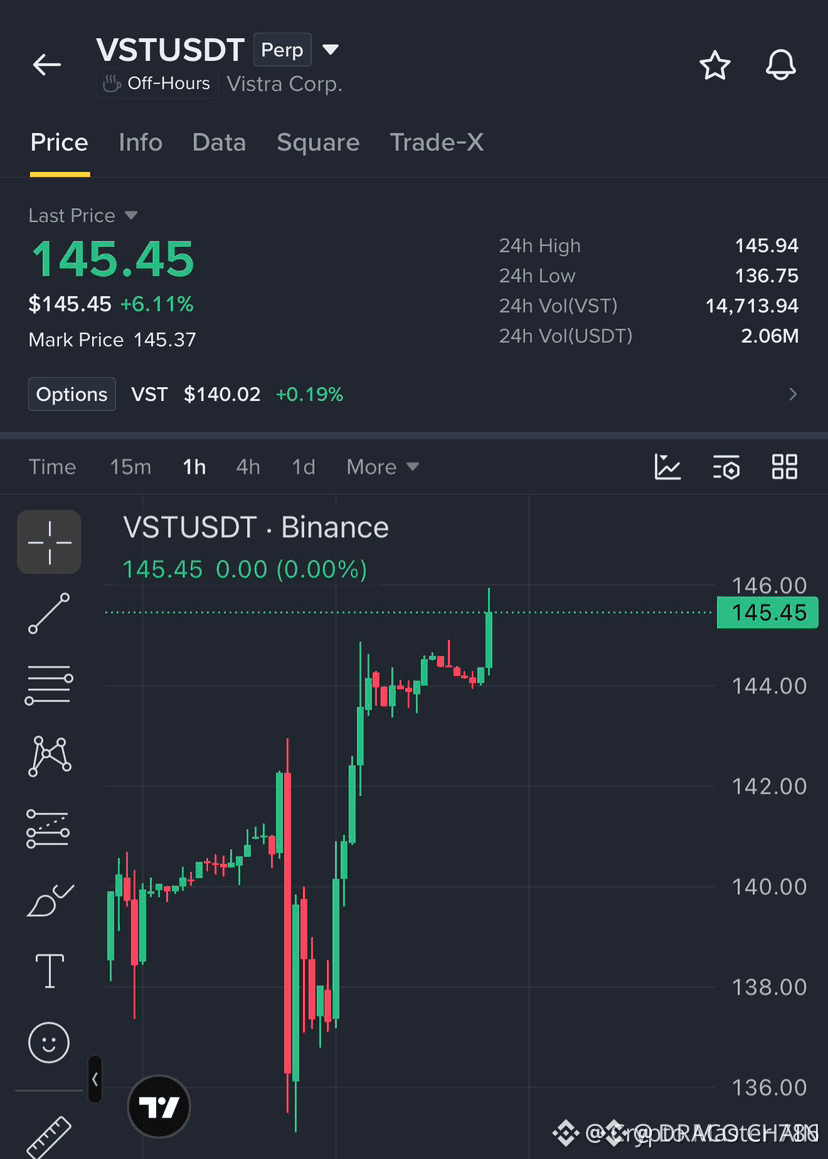
🚨 $VST RECLAIMS KEY STRUCTURE AS SMART MONEY PREPARES FOR CONTINUATION EXPANSION! 💥
Entry: 144.5 - 145.5 ⚡
Target: 147 / 150 / 154 🚀
Stop Loss: 141.8 ⚠️
$VST has printed a textbook V-shaped structural recovery, absorbing sell-side liquidity before aggressively reclaiming the demand zone. 📊 Notice how order flow flipped bullish as buyers locked in higher lows, setting up a clear inefficiency fill toward upper targets once 146 clears.
🔍 Smart money positioning suggests this push is backed by genuine institutional volume rather than low-liquidity noise. 💡 Risk parameters remain neatly defined below structural support at 141.8 to ensure optimal risk-to-reward execution.
💬 Are you entering on this retest or waiting for a confirmed breakout above 146? 👇
⚠️ Not financial advice. Always manage your risk. 🛡️
🏷️ #VST #LongSetup #MarketStructure #Breakout #Crypto
🎯 🦈
8
·
--
$VST 24 hours up 4.127%, the price reaches 143.81, but the funding rate is 0—long and short costs are balanced. The open interest is 3614.20 and it hasn’t really moved.
This is a typical “Trump trade” pulse: price leads, but the derivatives market hasn’t reacted yet. A funding rate of 0 means longs didn’t pay any premium, so this rally likely wasn’t driven by crowded long positions in the contracts. It’s more likely caused by spot buying or shorts passively closing. Given that open interest hasn’t increased, I lean toward the idea that a stop-loss at some level triggered a chain reaction. The market is betting on traditional financial assets; especially if expectations for Trump’s policies heat up, sentiment around stocks mapped to this kind of chain would react more directly.
The strongest counter-evidence is the lack of follow-through: if there isn’t subsequent policy news or macro data support, a move up without derivatives confirmation like this will also fade quickly. Next, watch whether open interest can catch up and expand. If OI continues to stay flat, it’s just an emotion-driven tug-of-war—whoever chases higher is the one that pays.
I’ve set the invalidation condition at the 140 integer level. If the price falls back below 140 again, this short-term bullish structure will be broken. I won’t chase from here. I’ll wait for a pullback into the 140–142 range. If it can hold steady and OI begins to turn up, I’ll consider a small long position; the stop-loss will be at 139.5.
Trading tag: #TradFi #链上美股 #VST
Where do you think this assessment is most likely to be wrong?
56

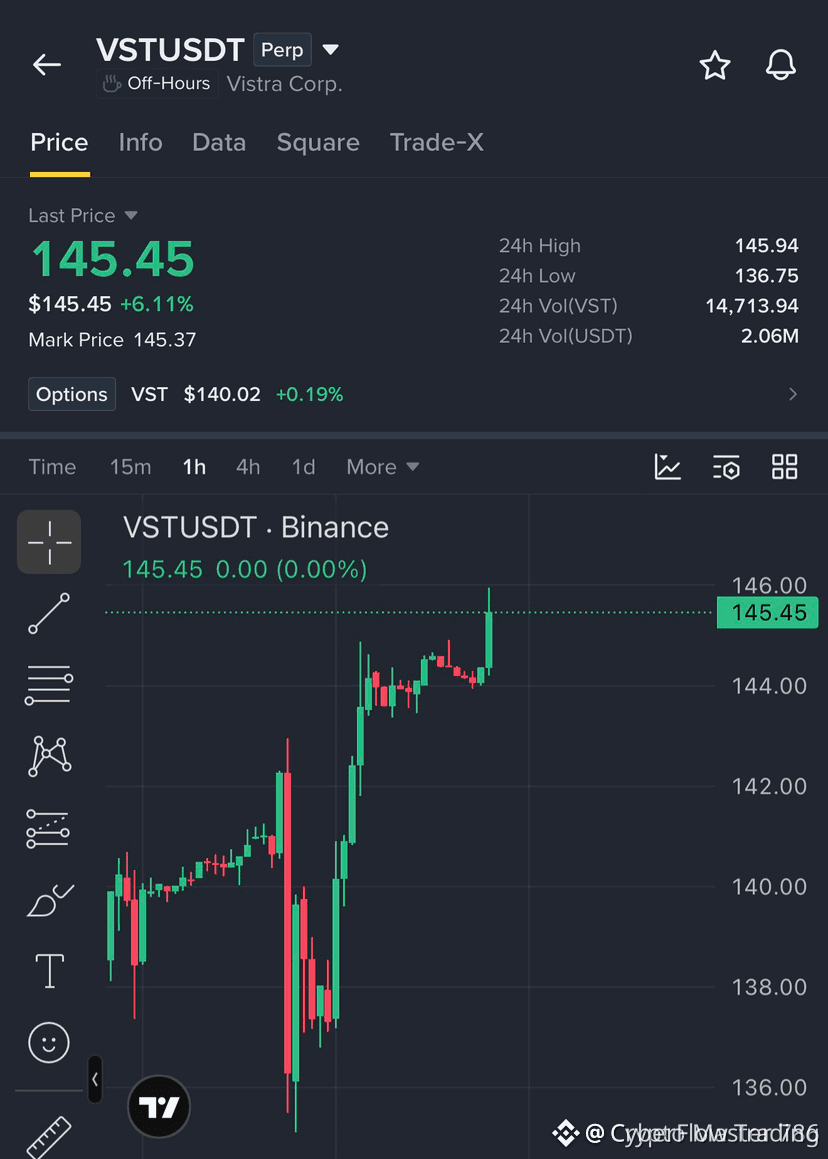
$VST RECLAIMS MOMENTUM AFTER A SHARP RECOVERY TO THREATEN A $154 BREAKOUT! ⚡ 🚀
Entry: 144.5 - 145.5 🟢
Target: 147 - 150 - 154 🎯
Stop Loss: 141.8 ⚠️
$VST has turned the corner following a strong recovery bounce, absorbing overhead supply and coiling right beneath the critical $146 pivot. 📊 A clean push through $146 opens up a clear runway for expansion into higher targets.
Bulls are actively defending the bid on dips, establishing a sharp continuation setup as buyers regain full control. 💡 The order flow favors upside velocity as long as structure holds above support. 💬 Are you riding the momentum break above $146 or waiting for a pull back? 👇
⚠️ Not financial advice. Always manage your risk. 🛡️
🏷️ #VST #LongSetup #Breakout #Crypto #Altcoins
🎯 ⚡
16
·
--
VST is up 4.127% over the past 24 hours, with the price reaching 143.81. This bullish candle appears amid a backdrop of rising Trump trade narrative, as on-chain U.S. stock contract pricing attempts to keep up with volatility seen in traditional finance.
Why is the funding rate 0? As a Binance Chain-based U.S. stock index product, VST’s long/short sentiment is driven more by hedging demand from its underlying constituent stocks rather than pure crypto speculation. The current zero funding rate indicates neither side is willing to pay a premium to take directional bets; positions are more skewed toward hedging or arbitrage. Coupled with relatively steady open interest of 3614.2, this rally lacks the frenzy of new leveraged capital chasing the move—it looks more like a correction in pricing.
If Trump’s policy remarks trigger volatility in U.S. stock indices, that volatility will be transmitted to on-chain contracts through arbitrage channels. The question now is whether on-chain pricing (143.81) has already fully priced in expectations from traditional markets. A zero funding rate is a useful observational window: it suggests on-chain longs and shorts are temporarily balanced, with no one side crowding. Once traditional markets develop a one-sided trend, this balance is likely to be broken quickly.
I’ll watch the 143–145 range. If traditional U.S. stock indices surge on new policy expectations, but VST’s price gains and open interest fail to expand in tandem, I’ll consider initiating a small long position, betting that on-chain pricing is lagging.
Trading tag: #TradFi #链上美股 #VST
Where do you think this thesis is most likely to be wrong?
102
·
--
$VST has risen 1.515% over the past 24 hours, quoted at 152.81.
This price movement is the only currently confirmable market fact. What forms a subtle contrast with the price action is the funding rate of its perpetual contract: 0.00000000. This means that at the current level of positioning, neither longs nor shorts are paying funding fees, and market sentiment is at a rare point of absolute balance. Its contract open interest is 3630.17, and trading volume is 225793.7117 US dollars. Against the backdrop of a mild price increase, a zero funding rate usually suggests that the force behind the rise is not a strong influx of new longs or a concentrated short squeeze, but rather a natural fluctuation of existing capital in a balanced market.
My judgment is that this structure of "price up with zero funding rate" indicates the market lacks a strong one-way consensus on $VST . The upward move did not trigger excessive bullish sentiment (because no fees need to be paid to shorts), nor did it attract large-scale shorting by bears (because shorts also pay nothing). This is a typical state of existing-position game dynamics: price fluctuations are more about internal position adjustments than the start of a new trend. This is fundamentally different from the squeeze rallies commonly seen in highly volatile contracts, where "funding rate surges alongside a sharp price breakout."
The strongest counterevidence would come from simultaneous changes in open interest and funding rate. If $VST continues to rise in subsequent trading while the funding rate turns positive and starts climbing, then the current balance assessment would be overturned, turning into a clear long-chasing signal. Conversely, if the price pulls back and the funding rate turns negative, it would indicate that shorts are beginning to gain strength. The current zero funding rate means any breakout in either direction lacks ready-made fuel.
The implication of this equilibrium for traders is straightforward: before a clear directional signal emerges, chasing long or short offers no edge in terms of risk-reward. Longs do not need to pay funding, but the upward momentum has not been confirmed; shorts are also free, but downside momentum has not emerged either. A breakout by either side will need to be accompanied by a significant expansion in open interest and a clear shift in the direction of the funding rate.
My contrarian view is that, at a time when the mainstream narrative is eager to find symbols of a long-versus-short battle, the zero funding structure of $VST instead points to a vacuum of market attention. The most easily overlooked trading opportunities often emerge during such quiet periods, when no one is paying and no one is crowded.
Trading tag: #TradFi #链上美股 #VST
Where do you think this judgment is most likely to be wrong?
5
·
--
$VST rose 4.127% in the past 24 hours, and the current quote is 143.81. The market is in a tug-of-war over the potential upside from supposed benefits of Trump’s policies, but neither bulls nor bears have truly placed any real bets.
The key is the funding rate returning to zero. The longs haven’t paid the shorts a single cent, which indicates the FOMO (chasing) sentiment hasn’t really caught fire yet. Open interest is 3,614 contracts; compared to this kind of rally, that’s not a heavy positioning level. This doesn’t look like the beginning of a trend move—it looks more like event-driven advance positioning. Any statement Trump makes regarding traditional industries, U.S. stocks, or China-U.S. policies could become the trigger. But for now, the market is merely reserving positions in advance, with very light exposure.
The counterargument is simple: if Trump keeps delaying and doesn’t take any new action, this rally won’t have fuel and the price could quickly drop back below 140, because there are no long-term bulls holding up the funding-rate costs inside. The second-order effect is that short-term traders will watch Trump’s social media, keep positioning light and flexible, and once the news lands they will close quickly rather than maintaining sustained buying pressure.
The invalidation conditions are: the funding rate turns positive and holds above 0.01%, and meanwhile open interest breaks above 5,000 contracts. If that happens, I will revise my view to a trend-long stance. I won’t chase at the current price. Instead, I’ll wait for a pullback to around 140 and enter a light long position there, with a stop-loss at 138 and a target toward the prior high of 150.
Trading tag: #TradFi #链上美股 #VST
Where do you think this thesis is most likely to be wrong?
115

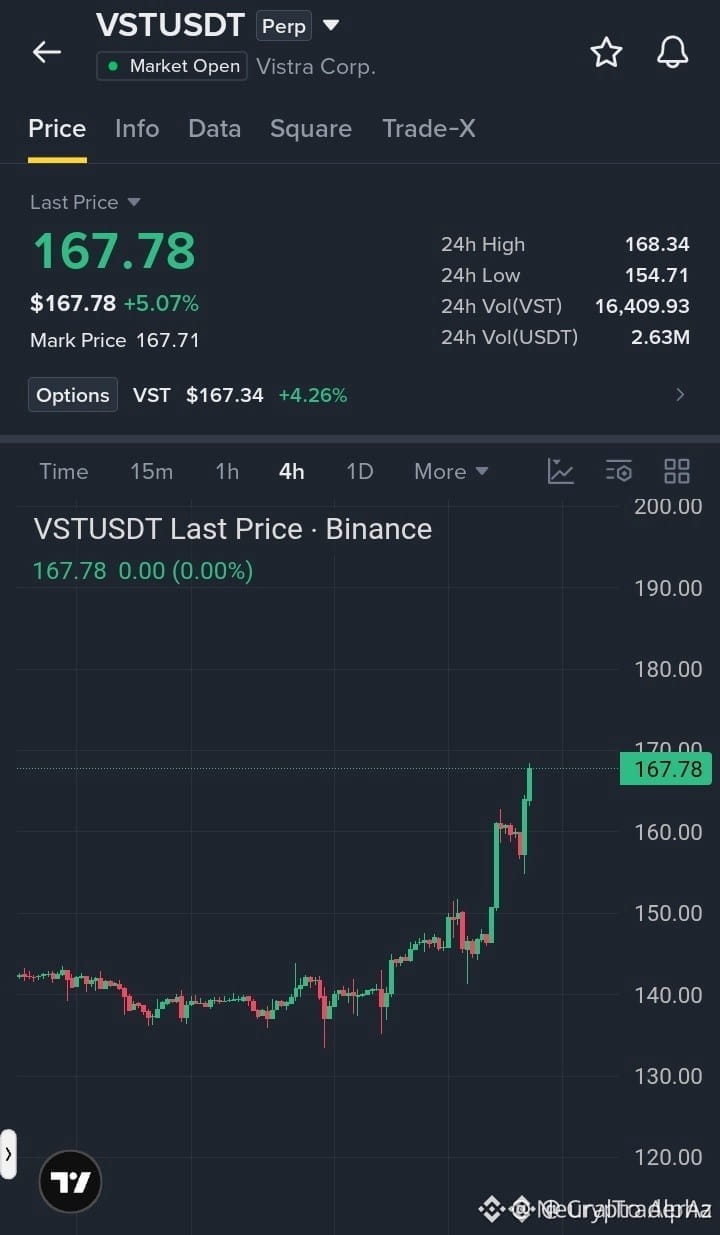
🚨 $VST BREAKS KEY RESISTANCE AS INSTITUTIONAL MOMENTUM EXPANDS TOWARD HIGHER LIQUIDITY TARGETS! 💥
Entry: 167.78 ⚡
Target: 180.00 🚀
Stop Loss: 162.00 ⚠️
📌 Smart money has successfully reclaimed the former $160 resistance zone, flipping previous supply into structural demand on the 4H chart. 🔍 Price action is actively sweeping liquidity into the $168 inefficiency block, signaling strong momentum continuation as long as buyers defend the breakout origin.
💡 A solid daily acceptance above $168 sets the path for expansion toward upper liquidity pools at $171, $175, and $180. ⚡ However, disciplined execution remains key—wait for structural confirmation rather than chasing impulse candles into resistance. 💬 Will $VST maintain this expansion phase or test the order block once more? 👇
⚠️ Not financial advice. Always manage your risk. 🛡️
🏷️ #VST #LongSetup #Breakout #Crypto #Trading
🔥 💎
10

$VST current price 155.74, the past 24 hours rose by 2.051%. This increase isn’t that big in on-chain US stock futures contracts, but the underlying structure is kind of interesting.
The funding rate is 0.00003483, which is positive—longs are paying shorts. As the price is rising and the funding rate is positive, this usually means the chasing longs are accumulating costs; every 8 hours, a funding payment is made. Open interest (OI) is 4876.69. I can’t directly say whether it’s high or low because no dollar-denominated traded volume is provided for comparison. But considering the funding rate, at this level, longs who want to push higher will have to keep paying, so resistance will keep increasing.
On the other hand, if the price goes sideways here or dips slightly, longs will still be paying the funding rate but won’t earn price-spread gains—patience will get worn down. The most dangerous scenario is a sudden downward spike, which easily triggers a chain reaction of stop-losses, squeezing out longs all at once.
I’m not planning to chase longs right now. Here’s a short-side trial position plan.
Direction: Short
Leverage: 10x
Stop loss: 158.50 (above the recent highs in the past few days)
Take profit: 150.00 (a whole-number level, also a prior small support)
Position size: 5% of total capital for a trial
Strong counter-proof: If you get a single big bullish candle breaking above 158.5, it means there is strong buy-side absorption that has covered all funding-rate costs, so the short logic fails—you should admit defeat and exit.
Second-order effect: Once the long stop-loss positions get hit, the price drop can accelerate, because the short-side funding cost becomes lower, and it may even turn negative—attracting more shorts. At that time, shorts get the cheap deal, while longs holding at high levels pay the price.
The invalidation condition for this trade signal judgment (mainly based on the divergence between funding rate and price) is when the price is strong enough to stand above 158.5 and hold.
Aggressive approach: Open a short directly around the current price 155.7, increasing the position to 8%.
Conservative approach: Wait for the price to rebound into the 157–158 range before entering a short, with the position size reduced to 3%.
Avoidance approach: Don’t touch it—wait until the funding rate turns negative or price breaks above 158.5 on increased volume.
The market always feels that if it’s going up, it must be good. But chasing longs at this positive-funding-rate position is basically paying wages to the people who went first. I’m doing the opposite.
Trading tag: #TradFi #链上美股 #VST
Where do you think this set of judgments is most likely to be wrong?
1
·
--
$VST fell 1.581% today, with the price at 138.16. The funding fee is still positive at 0.00052757, which suggests the longs are continuing to pay and hold through this bearish candle without capitulating. OI at 3552.99 isn’t especially heavy, but policy-sensitive equity contracts can easily get pushed into a liquidation-style move during periods of news vacuum. My view is that this selloff hasn’t finished until the longs cut positions. If the price returns above 138.16 and the funding fee turns negative, I’ll consider entering. Otherwise, I won’t touch it.
Trading tag: #TradFi #链上美股 #VST
Where do you think this thesis is most likely to be wrong?
Trading tag: #TradFi #链上美股 #VST
Where do you think this thesis is most likely to be wrong?
17
·
--
$VST 24 hours down 1.581%, reported 138.16, funding rate settles at 0.00052757. The price is down and the fee rate is positive—longs pay shorts. The longs are still holding the position; this structure means chasing longs is just catching the bag. Current volatility of 1.58% is too mild—there’s no squeeze condition, so I won’t touch it. If funding turns negative and the price returns above 138.16, I’ll consider a long position. If it keeps falling below the current price and funding stays positive, I will only wait for liquidation after a blow-up clears it out.
Trading tag: #TradFi #链上美股 #VST
Where do you think this set of judgments is most likely to be wrong?
Trading tag: #TradFi #链上美股 #VST
Where do you think this set of judgments is most likely to be wrong?
28
·
--
$VST 24 hours up 1.434%, price 154.89. This small uptick, in my view, seems to have hitched a ride on the Trump trade—on-chain US stock futures contracts overall have a premium driven by the theme.
Core judgment: the funding rate is 0, which means the rise isn’t being driven by leveraged squeeze; longs and shorts are relatively balanced. As a TradFi perp, it’s the sentiment capital that moves in sync with US stock politics. The strongest counterargument is that this theme is too flimsy—just one remark from Trump could blow the narrative apart.
If the theme keeps going, short covering will become an upward push. But once the hype fades, what you bought into today is the fuel.
Trading tag: #TradFi #链上美股 #VST
Where do you think this line of judgment is most likely to be wrong?
6
Log in to explore more content
Join global crypto users on Binance Square
⚡️ Get latest and useful information about crypto.
💬 Trusted by the world’s largest crypto exchange.
👍 Discover real insights from verified creators.
Email / Phone number
Trending Topics
1
#MoreHikesExpectedIsBTCUnderPressure
11,947 views
148 Discussing
2
#NvidiaBeatsEstimatesWith$130BQ4Outlook
78,660 views
313 Discussing
3
#AnthropicIPOPriceCouldExceed$80
76,078 views
257 Discussing
4
#RussiaCentralBankAddsAlfaBankToCryptoExchangeRegister
5,702 views
67 Discussing
5
#VisaPlansStablecoinPrefundingForAPACCrossBorderPayments
5,889 views
53 Discussing
6
#CanadaAndUSLaunchOperationNiagaraAgainstApprovalPhishing
49,458 views
64 Discussing
7
#BankOfEnglandUnveilsClearingHousePathwayCoveringDLTFirms
4,926 views
69 Discussing
8
#DBSAndCirclePartnerToExpandAsianInstitutionsUSDCAccess
6,332 views
68 Discussing
9
#LedgerHardwareImplantReportsExtendToDubai
113,591 views
957 Discussing
10
#NvidiaBoardNotConsideringHuang’sReturnasCEO
290,714 views
1,731 Discussing