

#pypl
pypl
6,176 views
128 Discussing
Hot
Latest

·
--
$PYPL 24 hours increased 5.39%, but the funding rate remains at zero. The divergence between price and funding rate indicates that the rally lacks a synchronized momentum from long chasing and short covering; it is driven by one-way liquidity. Open interest is only 4616, with no clear increase to support the move. The strongest counterargument is that if open interest rises significantly along with the price, the uptrend could be sustained. But the current data does not support that. In the short term, profits may be taken due to a lack of funding consensus support. If the funding rate turns positive and open interest simultaneously expands, the judgment is invalidated. Take a small-position long, set a stop-loss just above the previous low of 53.5.
Trading tag: #TradFi #链上美股 #PYPL
Where do you think this assessment is most likely to be wrong?
$PYPL 24 hours increased 5.39%, but the funding rate remains at zero. The divergence between price and funding rate indicates that the rally lacks a synchronized momentum from long chasing and short covering; it is driven by one-way liquidity. Open interest is only 4616, with no clear increase to support the move. The strongest counterargument is that if open interest rises significantly along with the price, the uptrend could be sustained. But the current data does not support that. In the short term, profits may be taken due to a lack of funding consensus support. If the funding rate turns positive and open interest simultaneously expands, the judgment is invalidated. Take a small-position long, set a stop-loss just above the previous low of 53.5.
Trading tag: #TradFi #链上美股 #PYPL
Where do you think this assessment is most likely to be wrong?
Trading tag: #TradFi #链上美股 #PYPL
Where do you think this assessment is most likely to be wrong?
73
·
--
$PYPL 24 hours up 5.39%, the funding rate drops to zero. This isn’t long crowds or shorts getting squeezed—it's simply that positioning intent is weak, causing an intraday spike. Open interest is only 4,616 contracts; compared with the $276,000 trading value, it indicates fast in-and-out flows, with nobody holding overnight. This kind of rate-free, low-open-interest surge is usually a brief resonance triggered by news or sentiment, lacking sustained buy pressure. If the price can’t hold above 55 and drive open interest higher, the rebound will quickly fade. Chasing longs will bear the costs directly. If spot pulls back to 50, you can try a small position; if it breaks 48, exit.
Trading tag: #TradFi #链上美股 #PYPL
Where do you think this assessment is most likely to be wrong?
$PYPL 24 hours up 5.39%, the funding rate drops to zero. This isn’t long crowds or shorts getting squeezed—it's simply that positioning intent is weak, causing an intraday spike. Open interest is only 4,616 contracts; compared with the $276,000 trading value, it indicates fast in-and-out flows, with nobody holding overnight. This kind of rate-free, low-open-interest surge is usually a brief resonance triggered by news or sentiment, lacking sustained buy pressure. If the price can’t hold above 55 and drive open interest higher, the rebound will quickly fade. Chasing longs will bear the costs directly. If spot pulls back to 50, you can try a small position; if it breaks 48, exit.
Trading tag: #TradFi #链上美股 #PYPL
Where do you think this assessment is most likely to be wrong?
Trading tag: #TradFi #链上美股 #PYPL
Where do you think this assessment is most likely to be wrong?
88

🚨 $PYPL RIPS TO INTRADAY HIGHS AS META INTEGRATION FUELS REAL-WORLD COMMERCE! ⚡
Smart capital is aggressively absorbing $PYPL as price pushes into new intraday highs following news of their Meta integration. 📊 Pairing traditional payment rails directly with Meta's Muse AI agent creates a seamless settlement highway for digital shopping and immediate checkout.
This isn't just superficial narrative hype; it is institutional money front-running the convergence of conversational AI agents and payment networks. 💡 When tech giants strip away checkout friction, order flow velocity ramps up fast.
Do you see this AI checkout integration triggering a massive structural breakout for tech, or will sellers cap the rally here? 💬 👇
⚠️ Not financial advice. Always manage your risk. 🛡️
🏷️ #PYPL #META #AI #Fintech #Breakout
⚡ 🎯
🚨 $PYPL RIPS TO INTRADAY HIGHS AS META INTEGRATION FUELS REAL-WORLD COMMERCE! ⚡
Smart capital is aggressively absorbing $PYPL as price pushes into new intraday highs following news of their Meta integration. 📊 Pairing traditional payment rails directly with Meta's Muse AI agent creates a seamless settlement highway for digital shopping and immediate checkout.
This isn't just superficial narrative hype; it is institutional money front-running the convergence of conversational AI agents and payment networks. 💡 When tech giants strip away checkout friction, order flow velocity ramps up fast.
Do you see this AI checkout integration triggering a massive structural breakout for tech, or will sellers cap the rally here? 💬 👇
⚠️ Not financial advice. Always manage your risk. 🛡️
🏷️ #PYPL #META #AI #Fintech #Breakout
⚡ 🎯
Smart capital is aggressively absorbing $PYPL as price pushes into new intraday highs following news of their Meta integration. 📊 Pairing traditional payment rails directly with Meta's Muse AI agent creates a seamless settlement highway for digital shopping and immediate checkout.
This isn't just superficial narrative hype; it is institutional money front-running the convergence of conversational AI agents and payment networks. 💡 When tech giants strip away checkout friction, order flow velocity ramps up fast.
Do you see this AI checkout integration triggering a massive structural breakout for tech, or will sellers cap the rally here? 💬 👇
⚠️ Not financial advice. Always manage your risk. 🛡️
🏷️ #PYPL #META #AI #Fintech #Breakout
⚡ 🎯
24

·
--
🚨 $PYPL HITS NEW INTRADAY HIGH FOLLOWING STRATEGIC AI INTEGRATION WITH META! ⚡
Smart money accumulation is visibly accelerating across traditional tech payment rails. PayPal's stock printed a 1.5% intraday surge, reclaiming key technical momentum following confirmation of its checkout collaboration with Meta utilizing the AI Muse agent. 📊
This integration represents a major institutional shift toward automated agentic transaction flow. As order flow absorbs this fundamental catalyst, structure remains strongly constructive for broader liquidity expansion across digital payment corridors. 💡
Is this AI checkout synergy the spark for sustained institutional outperformance across tech and digital assets? 👇
⚠️ Not financial advice. Always manage your risk. 🛡️
🏷️ #PYPL #Meta #Fintech #Institutional #Crypto
🎯 🦈
🚨 $PYPL HITS NEW INTRADAY HIGH FOLLOWING STRATEGIC AI INTEGRATION WITH META! ⚡
Smart money accumulation is visibly accelerating across traditional tech payment rails. PayPal's stock printed a 1.5% intraday surge, reclaiming key technical momentum following confirmation of its checkout collaboration with Meta utilizing the AI Muse agent. 📊
This integration represents a major institutional shift toward automated agentic transaction flow. As order flow absorbs this fundamental catalyst, structure remains strongly constructive for broader liquidity expansion across digital payment corridors. 💡
Is this AI checkout synergy the spark for sustained institutional outperformance across tech and digital assets? 👇
⚠️ Not financial advice. Always manage your risk. 🛡️
🏷️ #PYPL #Meta #Fintech #Institutional #Crypto
🎯 🦈
Smart money accumulation is visibly accelerating across traditional tech payment rails. PayPal's stock printed a 1.5% intraday surge, reclaiming key technical momentum following confirmation of its checkout collaboration with Meta utilizing the AI Muse agent. 📊
This integration represents a major institutional shift toward automated agentic transaction flow. As order flow absorbs this fundamental catalyst, structure remains strongly constructive for broader liquidity expansion across digital payment corridors. 💡
Is this AI checkout synergy the spark for sustained institutional outperformance across tech and digital assets? 👇
⚠️ Not financial advice. Always manage your risk. 🛡️
🏷️ #PYPL #Meta #Fintech #Institutional #Crypto
🎯 🦈
72

·
--
$PYPL in the past 24h fell 2.483%, current price 53.42000. The funding rate has stopped at 0.00000000, and OI is 7006.30. The price is dropping, and neither side at the contract end is paying the other, which means longs and shorts aren’t crowded. By the law of direction, a funding rate going to zero is not a long-squeeze signal; this round of pullback looks more like pressure from the spot side.
But longs aren’t getting any funding subsidy—holding is purely absorbing the downside. If the price continues to stay below 53.42000, liquidation stop orders may end up triggering themselves. OI is only a static 7006.30 value; I can’t see any increase or decrease, so I won’t treat it as support. The strongest counter-evidence is that afterward, OI from 7006.30 clearly declines while price keeps weakening—both sides are withdrawing, and the downtrend becomes smoother, not a shakeout.
Old dog gives the move directly: don’t enter now. If $PYPL recovers above 53.42000 and the fundingRate turns positive, I’ll try a small long position, but I’ll watch the funding rate closely. Once it turns positive, longs pay shorts, crowds accumulate, and any push higher is likely to form a top. If the price continues to linger below 53.42000 and OI doesn’t pick up, I’ll observe and not touch it.
Trading tags: #BinanceFutures #TradFi #USDⓈM #PYPL #PYPLUSDT $PYPL
$PYPL in the past 24h fell 2.483%, current price 53.42000. The funding rate has stopped at 0.00000000, and OI is 7006.30. The price is dropping, and neither side at the contract end is paying the other, which means longs and shorts aren’t crowded. By the law of direction, a funding rate going to zero is not a long-squeeze signal; this round of pullback looks more like pressure from the spot side.
But longs aren’t getting any funding subsidy—holding is purely absorbing the downside. If the price continues to stay below 53.42000, liquidation stop orders may end up triggering themselves. OI is only a static 7006.30 value; I can’t see any increase or decrease, so I won’t treat it as support. The strongest counter-evidence is that afterward, OI from 7006.30 clearly declines while price keeps weakening—both sides are withdrawing, and the downtrend becomes smoother, not a shakeout.
Old dog gives the move directly: don’t enter now. If $PYPL recovers above 53.42000 and the fundingRate turns positive, I’ll try a small long position, but I’ll watch the funding rate closely. Once it turns positive, longs pay shorts, crowds accumulate, and any push higher is likely to form a top. If the price continues to linger below 53.42000 and OI doesn’t pick up, I’ll observe and not touch it.
Trading tags: #BinanceFutures #TradFi #USDⓈM #PYPL #PYPLUSDT $PYPL
But longs aren’t getting any funding subsidy—holding is purely absorbing the downside. If the price continues to stay below 53.42000, liquidation stop orders may end up triggering themselves. OI is only a static 7006.30 value; I can’t see any increase or decrease, so I won’t treat it as support. The strongest counter-evidence is that afterward, OI from 7006.30 clearly declines while price keeps weakening—both sides are withdrawing, and the downtrend becomes smoother, not a shakeout.
Old dog gives the move directly: don’t enter now. If $PYPL recovers above 53.42000 and the fundingRate turns positive, I’ll try a small long position, but I’ll watch the funding rate closely. Once it turns positive, longs pay shorts, crowds accumulate, and any push higher is likely to form a top. If the price continues to linger below 53.42000 and OI doesn’t pick up, I’ll observe and not touch it.
Trading tags: #BinanceFutures #TradFi #USDⓈM #PYPL #PYPLUSDT $PYPL
54

·
--
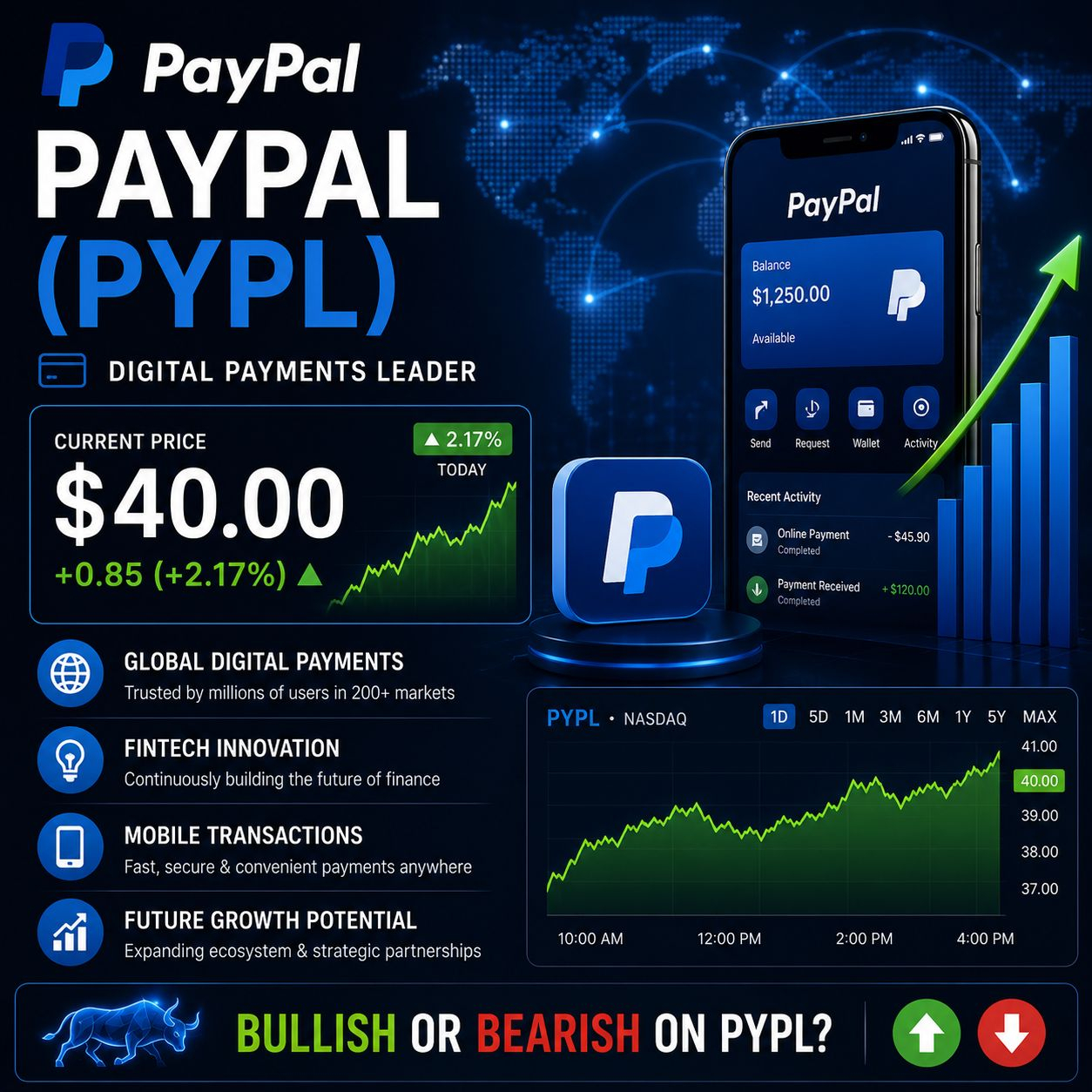
💳📈 PayPal (PYPL) is more than just a payment platform.
From online transactions to digital wallets and global payments, PayPal continues to expand its role in the future of financial technology.
🔹 Global leader in digital payments
🔹 Strong presence in online commerce
🔹 Expanding fintech ecosystem
🔹 Growing opportunities in digital finance
As the world moves toward a cashless economy, PayPal remains a key player in the fintech industry.
The question is no longer "Can PayPal process more payments?"
It's "How big can PayPal's digital ecosystem become?"
Bullish or Bearish on PYPL? 👇
#PYPL #Paypal #Fintech #StockMarket
💳📈 PayPal (PYPL) is more than just a payment platform.
From online transactions to digital wallets and global payments, PayPal continues to expand its role in the future of financial technology.
🔹 Global leader in digital payments
🔹 Strong presence in online commerce
🔹 Expanding fintech ecosystem
🔹 Growing opportunities in digital finance
As the world moves toward a cashless economy, PayPal remains a key player in the fintech industry.
The question is no longer "Can PayPal process more payments?"
It's "How big can PayPal's digital ecosystem become?"
Bullish or Bearish on PYPL? 👇
#PYPL #Paypal #Fintech #StockMarket
From online transactions to digital wallets and global payments, PayPal continues to expand its role in the future of financial technology.
🔹 Global leader in digital payments
🔹 Strong presence in online commerce
🔹 Expanding fintech ecosystem
🔹 Growing opportunities in digital finance
As the world moves toward a cashless economy, PayPal remains a key player in the fintech industry.
The question is no longer "Can PayPal process more payments?"
It's "How big can PayPal's digital ecosystem become?"
Bullish or Bearish on PYPL? 👇
#PYPL #Paypal #Fintech #StockMarket
1
217

·
--
$PYPL On-chain contracts surged 4.326% in 24 hours. The price climbed from around 52.5 to 54.74. Trading volume reached 460,000 units, with open interest at 5,900 units. The funding rate is zero. Just from the order book, it looks like bids are pushing higher, but neither side is actually paying up—there’s a strong sense of the market waiting and watching.
In the past few hours, Trump has again mentioned on the media “revitalizing America’s payment competitiveness.” After-hours, the U.S. stock payment sector showed unusual movement, and PYPL spot followed higher. This on-chain contract move maps directly to that narrative. A funding rate of 0 suggests the longs didn’t chase to the point of going crazy; open interest at 5,900 hasn’t spiked either, meaning it’s probably not yet in a crowded phase. A single-signal read: this rally is driven by the news, not by a fundamental catalyst.
The strongest counter-argument: Trump’s talk is inconsistent and can flip-flop. If tomorrow morning the U.S. stock market opens and PYPL spot falls back, the on-chain contracts could simply swallow this green candle. Also, since open interest hasn’t risen while the price is up, the move feels a bit “hollow.”
Second-order impact: Shorts are currently in an awkward spot. The price is rising and funding is 0, so they don’t have to pay—but their floating losses are expanding. If Trump escalates the rhetoric again, shorts might be forced to close, potentially fueling a short squeeze. For the longs: anyone who chased at 54.74 has their cost basis locked there, and if there’s a pullback, they’ll have to tough it out.
Invalidation conditions: If the PYPL price breaks below 52.5, Trump’s narrative is disproven and I’ll cut my position. Or if funding turns negative, indicating a renewed short attack, I’ll撤.
Action: I’m placing a 3x leveraged long at 54.74, with a stop-loss at 52.5 and a take-profit at 58. Aggressive players can add if it breaks above 56; more cautious ones should only take the first wave—avoid touching this message-driven setup.
Everyone thinks the “Trump trade” is a short-term hype. I’m saying instead that it could be the main theme for H2 on-chain contracts in the U.S. stock market—unless his polling collapses.
Trading tag: #TradFi #链上美股 #PYPL
Where do you think this setup is most likely to be wrong?
$PYPL On-chain contracts surged 4.326% in 24 hours. The price climbed from around 52.5 to 54.74. Trading volume reached 460,000 units, with open interest at 5,900 units. The funding rate is zero. Just from the order book, it looks like bids are pushing higher, but neither side is actually paying up—there’s a strong sense of the market waiting and watching.
In the past few hours, Trump has again mentioned on the media “revitalizing America’s payment competitiveness.” After-hours, the U.S. stock payment sector showed unusual movement, and PYPL spot followed higher. This on-chain contract move maps directly to that narrative. A funding rate of 0 suggests the longs didn’t chase to the point of going crazy; open interest at 5,900 hasn’t spiked either, meaning it’s probably not yet in a crowded phase. A single-signal read: this rally is driven by the news, not by a fundamental catalyst.
The strongest counter-argument: Trump’s talk is inconsistent and can flip-flop. If tomorrow morning the U.S. stock market opens and PYPL spot falls back, the on-chain contracts could simply swallow this green candle. Also, since open interest hasn’t risen while the price is up, the move feels a bit “hollow.”
Second-order impact: Shorts are currently in an awkward spot. The price is rising and funding is 0, so they don’t have to pay—but their floating losses are expanding. If Trump escalates the rhetoric again, shorts might be forced to close, potentially fueling a short squeeze. For the longs: anyone who chased at 54.74 has their cost basis locked there, and if there’s a pullback, they’ll have to tough it out.
Invalidation conditions: If the PYPL price breaks below 52.5, Trump’s narrative is disproven and I’ll cut my position. Or if funding turns negative, indicating a renewed short attack, I’ll撤.
Action: I’m placing a 3x leveraged long at 54.74, with a stop-loss at 52.5 and a take-profit at 58. Aggressive players can add if it breaks above 56; more cautious ones should only take the first wave—avoid touching this message-driven setup.
Everyone thinks the “Trump trade” is a short-term hype. I’m saying instead that it could be the main theme for H2 on-chain contracts in the U.S. stock market—unless his polling collapses.
Trading tag: #TradFi #链上美股 #PYPL
Where do you think this setup is most likely to be wrong?
In the past few hours, Trump has again mentioned on the media “revitalizing America’s payment competitiveness.” After-hours, the U.S. stock payment sector showed unusual movement, and PYPL spot followed higher. This on-chain contract move maps directly to that narrative. A funding rate of 0 suggests the longs didn’t chase to the point of going crazy; open interest at 5,900 hasn’t spiked either, meaning it’s probably not yet in a crowded phase. A single-signal read: this rally is driven by the news, not by a fundamental catalyst.
The strongest counter-argument: Trump’s talk is inconsistent and can flip-flop. If tomorrow morning the U.S. stock market opens and PYPL spot falls back, the on-chain contracts could simply swallow this green candle. Also, since open interest hasn’t risen while the price is up, the move feels a bit “hollow.”
Second-order impact: Shorts are currently in an awkward spot. The price is rising and funding is 0, so they don’t have to pay—but their floating losses are expanding. If Trump escalates the rhetoric again, shorts might be forced to close, potentially fueling a short squeeze. For the longs: anyone who chased at 54.74 has their cost basis locked there, and if there’s a pullback, they’ll have to tough it out.
Invalidation conditions: If the PYPL price breaks below 52.5, Trump’s narrative is disproven and I’ll cut my position. Or if funding turns negative, indicating a renewed short attack, I’ll撤.
Action: I’m placing a 3x leveraged long at 54.74, with a stop-loss at 52.5 and a take-profit at 58. Aggressive players can add if it breaks above 56; more cautious ones should only take the first wave—avoid touching this message-driven setup.
Everyone thinks the “Trump trade” is a short-term hype. I’m saying instead that it could be the main theme for H2 on-chain contracts in the U.S. stock market—unless his polling collapses.
Trading tag: #TradFi #链上美股 #PYPL
Where do you think this setup is most likely to be wrong?
56

·
--
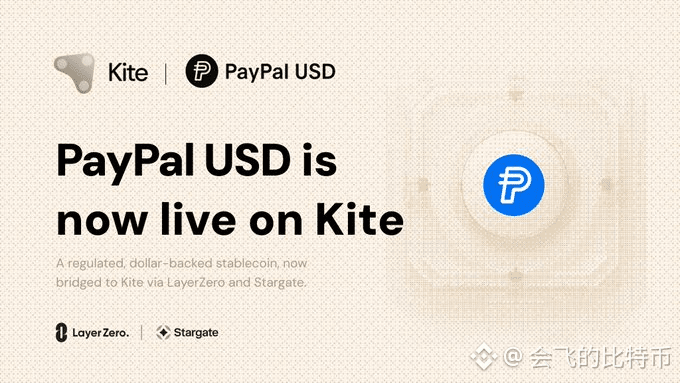
Honestly $PYPL (PayPal) stocks you can trade directly on Binance—the biggest advantage is you don’t need to open a US stock account. But the volatility is just as fierce; don’t think moving venues automatically makes the risk smaller. Have you been on the PayPal train or are you still just watching and not buying? #PYPL #加密 #BTC #US stocks
Honestly $PYPL (PayPal) stocks you can trade directly on Binance—the biggest advantage is you don’t need to open a US stock account. But the volatility is just as fierce; don’t think moving venues automatically makes the risk smaller. Have you been on the PayPal train or are you still just watching and not buying? #PYPL #加密 #BTC #US stocks
34

·
--
$PYPL :In the past 24 hours it rose 4.326%. The price is holding at 54.74, and the funding rate is zero. No one paid anyone—longs and shorts settled their accounts with nothing.
Trump’s “trade this card” strategy is making the market feel increasingly flimsy. As $PYPL is a traditional finance payment instrument, it should be sensitive to tariffs and trade policy. But with the funding rate at zero, the truth is exposed: nobody is seriously betting on direction. This rally is simply a short-term rebound caused by emotional panic-liquidation.
Look at the data. Price is up, funding is zero—this combination is rare. Usually, rising prices come with a positive funding rate, meaning longs have to pay to maintain their positions. A zero funding rate suggests the move isn’t driven by long-side confidence—it’s shorts backing out. It could be that some shorts capitulated and closed positions at key levels, pushing prices higher. But new longs haven’t really rushed in to buy aggressively. With only a single price signal—and without proof from position changes or liquidation data—I can only treat it as a single signal.
OpenInterest is 5907.66 and volume is 463540.7851, but the units differ. One might be contract count and the other might be trading value, so they can’t be directly compared. No need to make up comparisons.
The strongest counterargument: if Trump suddenly makes a major statement in a speech strongly supporting financial technology, $PYPL could be instantly pushed higher. This kind of event shock has no warning. Ironically, a zero funding rate creates room for the spike because there are no crowded long positions at high levels waiting to be liquidated.
What are the second-order effects? If price keeps hovering above 55, traders who shorted early betting on Trump’s negative news would be forced to stop out, and liquidity would flow toward the long side. But the zero-funding-rate structure right now indicates the cost of shorting is extremely low, so they can hold and won’t rush to run. The real cost is borne by people who chase longs later—they may be buying at emotional high points.
My conditions for invalidation: if price breaks below 54. This is a key psychological level below the current quote. Once it breaks, the zero-funding balance could be disrupted, potentially flipping toward a negative funding rate, and shorts could regain control.
Action: I won’t chase. I’ll wait for either condition to happen: either Trump signals a clear policy direction and price breaks out above 55.5 on increased volume—then I’ll open a long position with 2x leverage, stop-loss at 54, and target 57; or price pulls back to 54.2 on reduced volume—then I’ll try a short position with 1.5x leverage, stop-loss at 55.3, take-profit at 53. If there’s no event and no breakout, I’ll just hold back and watch—no moves.
Trading tag: #TradFi #链上美股 #PYPL
Where do you think this set of judgments is most likely to be wrong?
$PYPL :In the past 24 hours it rose 4.326%. The price is holding at 54.74, and the funding rate is zero. No one paid anyone—longs and shorts settled their accounts with nothing.
Trump’s “trade this card” strategy is making the market feel increasingly flimsy. As $PYPL is a traditional finance payment instrument, it should be sensitive to tariffs and trade policy. But with the funding rate at zero, the truth is exposed: nobody is seriously betting on direction. This rally is simply a short-term rebound caused by emotional panic-liquidation.
Look at the data. Price is up, funding is zero—this combination is rare. Usually, rising prices come with a positive funding rate, meaning longs have to pay to maintain their positions. A zero funding rate suggests the move isn’t driven by long-side confidence—it’s shorts backing out. It could be that some shorts capitulated and closed positions at key levels, pushing prices higher. But new longs haven’t really rushed in to buy aggressively. With only a single price signal—and without proof from position changes or liquidation data—I can only treat it as a single signal.
OpenInterest is 5907.66 and volume is 463540.7851, but the units differ. One might be contract count and the other might be trading value, so they can’t be directly compared. No need to make up comparisons.
The strongest counterargument: if Trump suddenly makes a major statement in a speech strongly supporting financial technology, $PYPL could be instantly pushed higher. This kind of event shock has no warning. Ironically, a zero funding rate creates room for the spike because there are no crowded long positions at high levels waiting to be liquidated.
What are the second-order effects? If price keeps hovering above 55, traders who shorted early betting on Trump’s negative news would be forced to stop out, and liquidity would flow toward the long side. But the zero-funding-rate structure right now indicates the cost of shorting is extremely low, so they can hold and won’t rush to run. The real cost is borne by people who chase longs later—they may be buying at emotional high points.
My conditions for invalidation: if price breaks below 54. This is a key psychological level below the current quote. Once it breaks, the zero-funding balance could be disrupted, potentially flipping toward a negative funding rate, and shorts could regain control.
Action: I won’t chase. I’ll wait for either condition to happen: either Trump signals a clear policy direction and price breaks out above 55.5 on increased volume—then I’ll open a long position with 2x leverage, stop-loss at 54, and target 57; or price pulls back to 54.2 on reduced volume—then I’ll try a short position with 1.5x leverage, stop-loss at 55.3, take-profit at 53. If there’s no event and no breakout, I’ll just hold back and watch—no moves.
Trading tag: #TradFi #链上美股 #PYPL
Where do you think this set of judgments is most likely to be wrong?
Trump’s “trade this card” strategy is making the market feel increasingly flimsy. As $PYPL is a traditional finance payment instrument, it should be sensitive to tariffs and trade policy. But with the funding rate at zero, the truth is exposed: nobody is seriously betting on direction. This rally is simply a short-term rebound caused by emotional panic-liquidation.
Look at the data. Price is up, funding is zero—this combination is rare. Usually, rising prices come with a positive funding rate, meaning longs have to pay to maintain their positions. A zero funding rate suggests the move isn’t driven by long-side confidence—it’s shorts backing out. It could be that some shorts capitulated and closed positions at key levels, pushing prices higher. But new longs haven’t really rushed in to buy aggressively. With only a single price signal—and without proof from position changes or liquidation data—I can only treat it as a single signal.
OpenInterest is 5907.66 and volume is 463540.7851, but the units differ. One might be contract count and the other might be trading value, so they can’t be directly compared. No need to make up comparisons.
The strongest counterargument: if Trump suddenly makes a major statement in a speech strongly supporting financial technology, $PYPL could be instantly pushed higher. This kind of event shock has no warning. Ironically, a zero funding rate creates room for the spike because there are no crowded long positions at high levels waiting to be liquidated.
What are the second-order effects? If price keeps hovering above 55, traders who shorted early betting on Trump’s negative news would be forced to stop out, and liquidity would flow toward the long side. But the zero-funding-rate structure right now indicates the cost of shorting is extremely low, so they can hold and won’t rush to run. The real cost is borne by people who chase longs later—they may be buying at emotional high points.
My conditions for invalidation: if price breaks below 54. This is a key psychological level below the current quote. Once it breaks, the zero-funding balance could be disrupted, potentially flipping toward a negative funding rate, and shorts could regain control.
Action: I won’t chase. I’ll wait for either condition to happen: either Trump signals a clear policy direction and price breaks out above 55.5 on increased volume—then I’ll open a long position with 2x leverage, stop-loss at 54, and target 57; or price pulls back to 54.2 on reduced volume—then I’ll try a short position with 1.5x leverage, stop-loss at 55.3, take-profit at 53. If there’s no event and no breakout, I’ll just hold back and watch—no moves.
Trading tag: #TradFi #链上美股 #PYPL
Where do you think this set of judgments is most likely to be wrong?
40


·
--
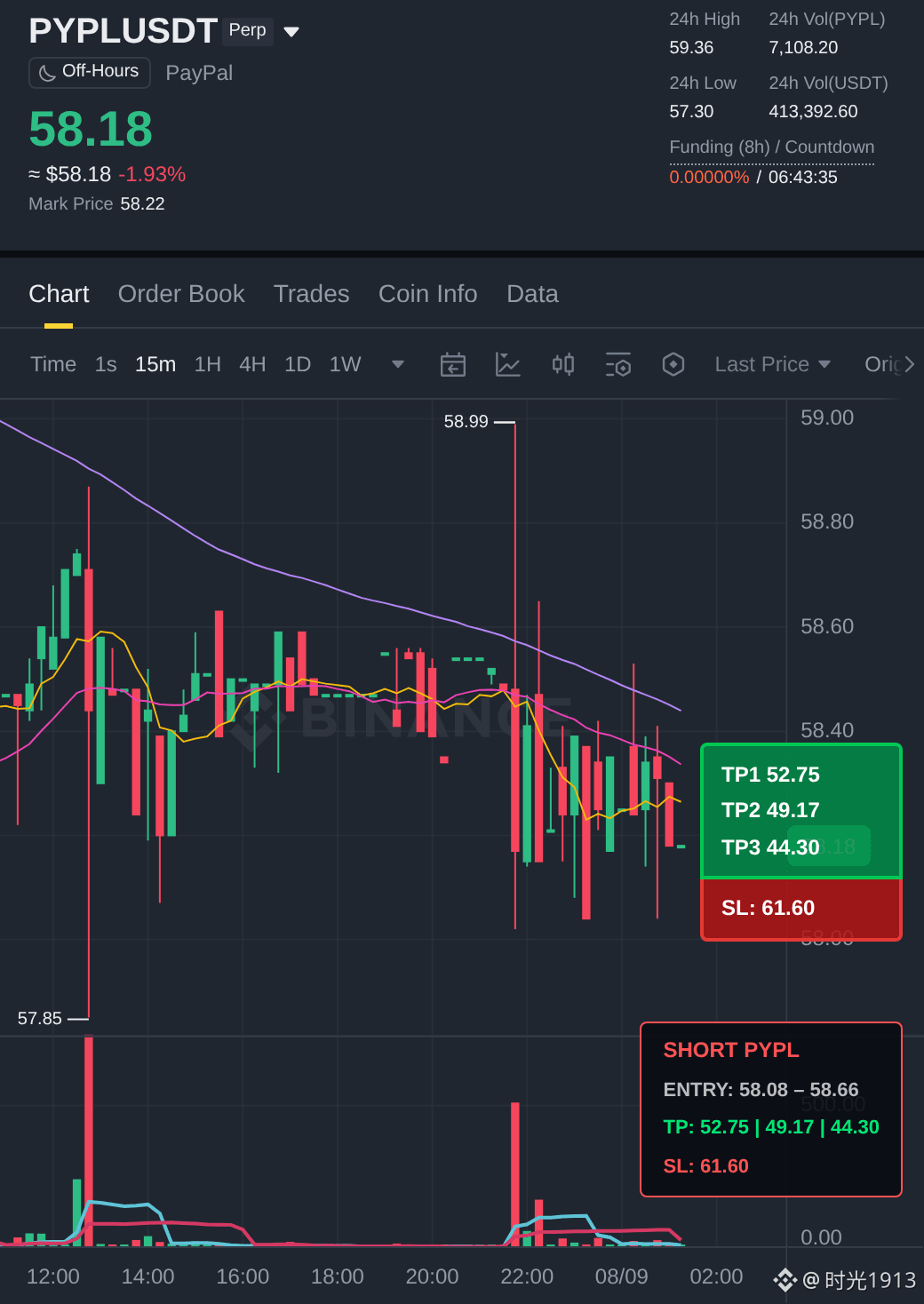
Is $PYPL building a reversal lower? Here's what I'm watching
$PYPL SETUP — 📉 SHORT
58.43 | RSI 45 | Volume $411.6K
EMA20: $58.48 | EMA50: $58.70 ✅ Death Cross
📉 Entry: 58.08 – 58.66
🛑 Stop: 61.60
🎯 TP1: 52.75
🎯 TP2: 49.17
🎯 TP3: 44.30
Every PYPL bounce is a gift — use it to add shorts.
Don't Fade 👉 $PYPL 👈 Join The Move
#PYPL #scalping #shortsignal
Is $PYPL building a reversal lower? Here's what I'm watching
$PYPL SETUP — 📉 SHORT
58.43 | RSI 45 | Volume $411.6K
EMA20: $58.48 | EMA50: $58.70 ✅ Death Cross
📉 Entry: 58.08 – 58.66
🛑 Stop: 61.60
🎯 TP1: 52.75
🎯 TP2: 49.17
🎯 TP3: 44.30
Every PYPL bounce is a gift — use it to add shorts.
Don't Fade 👉 $PYPL 👈 Join The Move
#PYPL #scalping #shortsignal
$PYPL SETUP — 📉 SHORT
58.43 | RSI 45 | Volume $411.6K
EMA20: $58.48 | EMA50: $58.70 ✅ Death Cross
📉 Entry: 58.08 – 58.66
🛑 Stop: 61.60
🎯 TP1: 52.75
🎯 TP2: 49.17
🎯 TP3: 44.30
Every PYPL bounce is a gift — use it to add shorts.
Don't Fade 👉 $PYPL 👈 Join The Move
#PYPL #scalping #shortsignal
523
·
--
$PYPL 24 hours up 4.621%, but funding rates remained completely unchanged, staying at zero. This set of data is very clear: the price rise wasn’t driven by bullish sentiment—it was driven by short covering. Under neutral funding, rebounds are often short-covering moves.
The last time a similar funding structure appeared was in mid-April; after the price rebounded, it quickly fell into a sideways range. This time, if open interest doesn’t increase in sync, it’s a typical technical short-covering scenario, lacking new bullish buyers stepping in. Once the short-covering force fades, the price is likely to stall around $55.
I won’t chase the price.
Trading tag: #TradFi #链上美股 #PYPL
Where do you think this assessment is most likely to be wrong?
$PYPL 24 hours up 4.621%, but funding rates remained completely unchanged, staying at zero. This set of data is very clear: the price rise wasn’t driven by bullish sentiment—it was driven by short covering. Under neutral funding, rebounds are often short-covering moves.
The last time a similar funding structure appeared was in mid-April; after the price rebounded, it quickly fell into a sideways range. This time, if open interest doesn’t increase in sync, it’s a typical technical short-covering scenario, lacking new bullish buyers stepping in. Once the short-covering force fades, the price is likely to stall around $55.
I won’t chase the price.
Trading tag: #TradFi #链上美股 #PYPL
Where do you think this assessment is most likely to be wrong?
The last time a similar funding structure appeared was in mid-April; after the price rebounded, it quickly fell into a sideways range. This time, if open interest doesn’t increase in sync, it’s a typical technical short-covering scenario, lacking new bullish buyers stepping in. Once the short-covering force fades, the price is likely to stall around $55.
I won’t chase the price.
Trading tag: #TradFi #链上美股 #PYPL
Where do you think this assessment is most likely to be wrong?
10

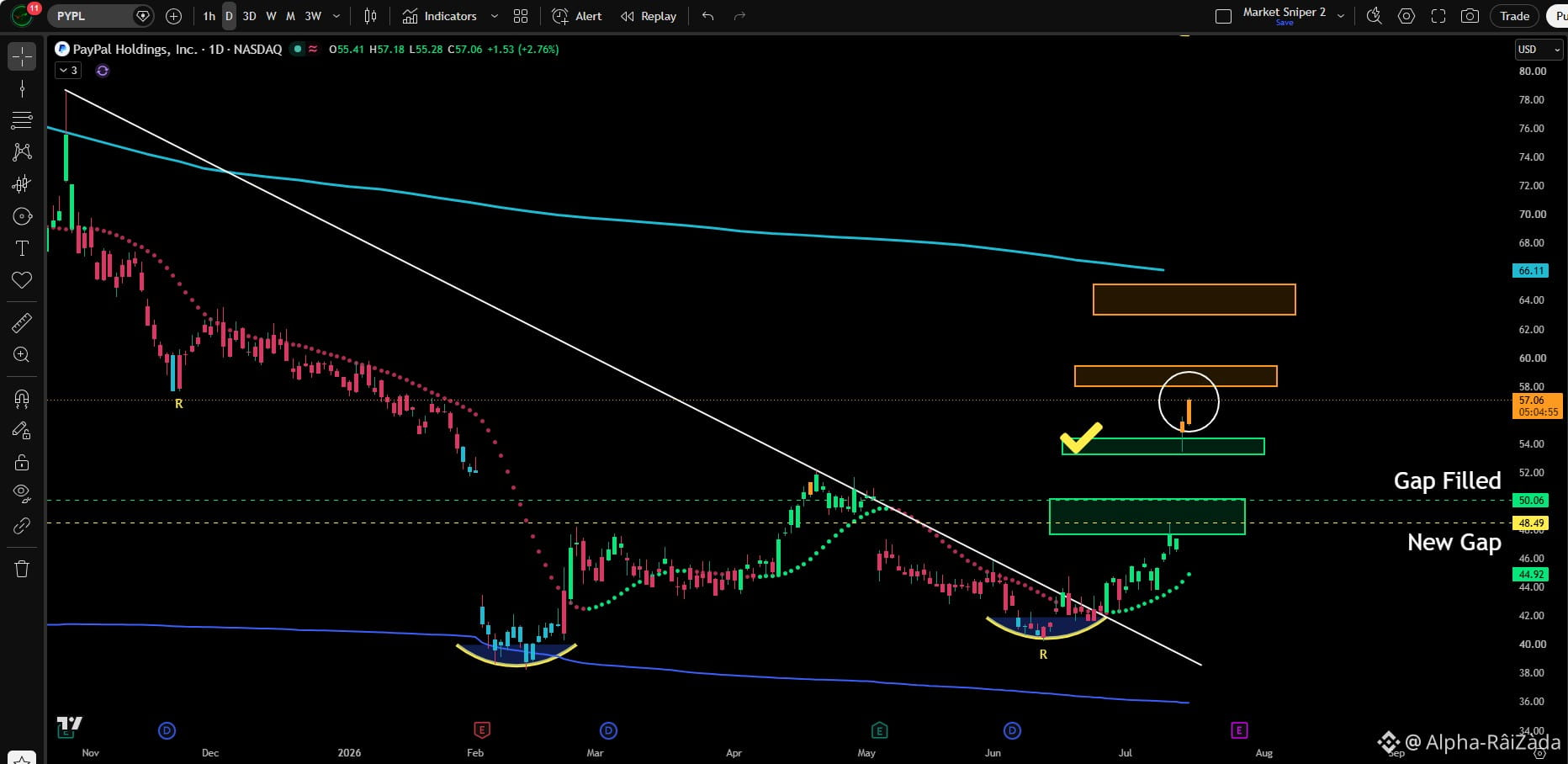
📈 $PYPL.US continues to build momentum, gaining another 3% after its gap-and-go breakout.
With Target 3 now within reach, bulls remain firmly in control. 👀
How many targets do you think PayPal will hit?
#PYPL #PayPal #Stocks #trading #BinanceSquare
📈 $PYPL.US continues to build momentum, gaining another 3% after its gap-and-go breakout.
With Target 3 now within reach, bulls remain firmly in control. 👀
How many targets do you think PayPal will hit?
#PYPL #PayPal #Stocks #trading #BinanceSquare
With Target 3 now within reach, bulls remain firmly in control. 👀
How many targets do you think PayPal will hit?
#PYPL #PayPal #Stocks #trading #BinanceSquare
17

·
--
Bullish
$PYPL
{future}(PYPLUSDT)
Dear fellows as you know we should sacrifice in return of to find out any our favourite thing, than we should have patience for trade .
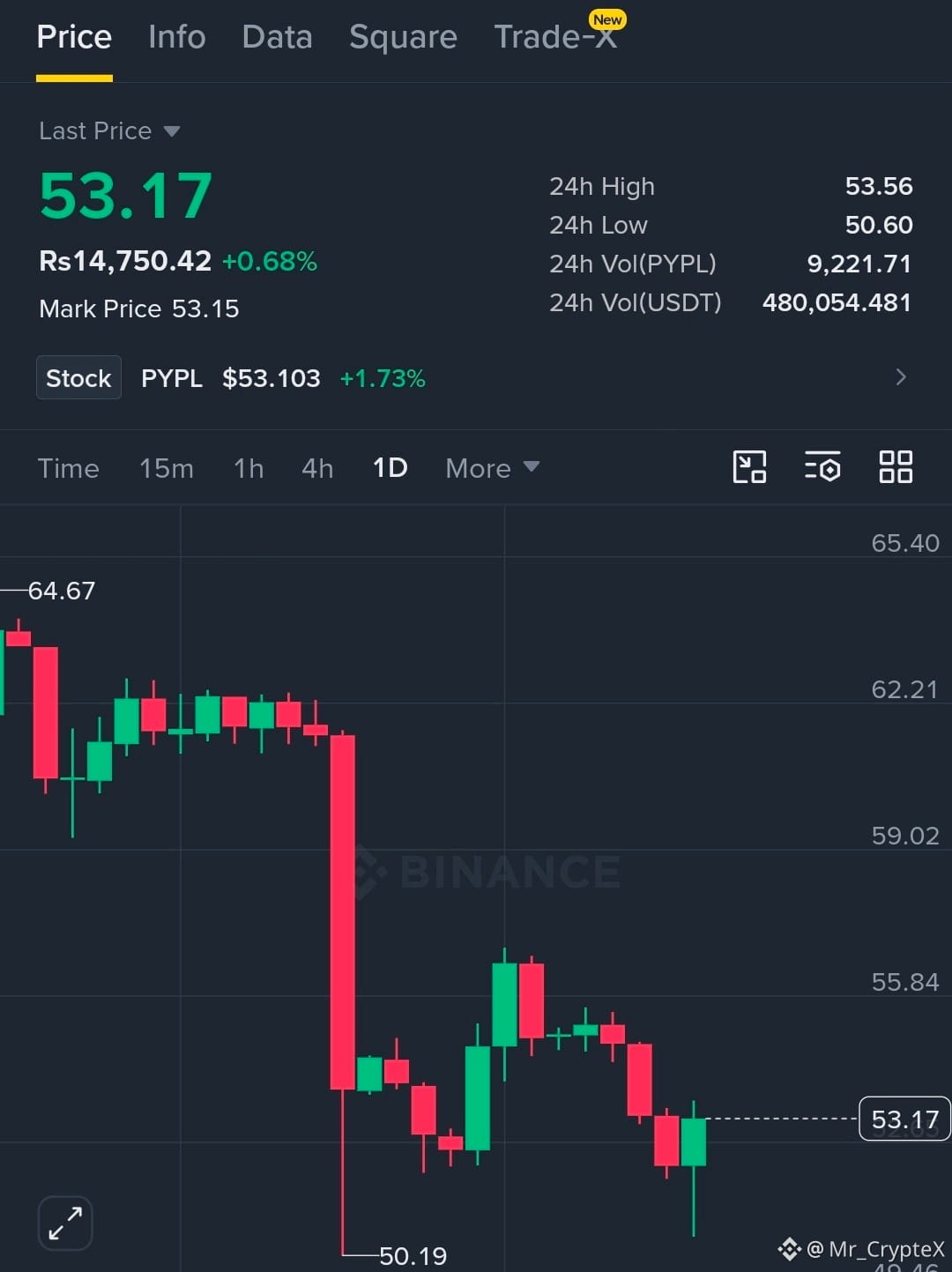
$PYPL is holding nicely after the dip toward $50.60. The recent candles show buyers stepping back in, with price pushing toward the $53.50 resistance zone. If that level breaks and holds, the next move can extend higher.
Entry Zone: $52.80–$53.30
#PYPL #StockTrading
$PYPL
Dear fellows as you know we should sacrifice in return of to find out any our favourite thing, than we should have patience for trade .
$PYPL is holding nicely after the dip toward $50.60. The recent candles show buyers stepping back in, with price pushing toward the $53.50 resistance zone. If that level breaks and holds, the next move can extend higher.
Entry Zone: $52.80–$53.30
#PYPL #StockTrading
Dear fellows as you know we should sacrifice in return of to find out any our favourite thing, than we should have patience for trade .
$PYPL is holding nicely after the dip toward $50.60. The recent candles show buyers stepping back in, with price pushing toward the $53.50 resistance zone. If that level breaks and holds, the next move can extend higher.
Entry Zone: $52.80–$53.30
#PYPL #StockTrading
1
77

·
--
🚨 $PYPL $50B BUYOUT TALKS COLLAPSE AS STRIPE CONSORTIUM PULLS BID! 📉
Institutional sentiment shifts as Advent and Stripe abandon their massive $50 billion leveraged buyout attempt for $PYPL . 🏦 This decision leaves high-level liquidity bids unfulfilled, signaling a massive recalculation of institutional valuation across the traditional payment rail landscape.
When top-tier players step back from historically large deals, smart money typically anticipates broader macroeconomic friction or repricing of key fintech assets. 📊 The immediate market structure impact points to institutional distribution rather than immediate accumulation as smart money re-assesses fair market value.
💡 As traditional payment giants adjust to structural shifts, how do you expect this liquidity reallocation to impact digital asset payment infrastructure? 🤔
⚠️ Not financial advice. Always manage your risk. 🛡️
🏷️ #PYPL #Fintech #MarketStructure #Crypto #M &A
🏦 🔍
🚨 $PYPL $50B BUYOUT TALKS COLLAPSE AS STRIPE CONSORTIUM PULLS BID! 📉
Institutional sentiment shifts as Advent and Stripe abandon their massive $50 billion leveraged buyout attempt for $PYPL . 🏦 This decision leaves high-level liquidity bids unfulfilled, signaling a massive recalculation of institutional valuation across the traditional payment rail landscape.
When top-tier players step back from historically large deals, smart money typically anticipates broader macroeconomic friction or repricing of key fintech assets. 📊 The immediate market structure impact points to institutional distribution rather than immediate accumulation as smart money re-assesses fair market value.
💡 As traditional payment giants adjust to structural shifts, how do you expect this liquidity reallocation to impact digital asset payment infrastructure? 🤔
⚠️ Not financial advice. Always manage your risk. 🛡️
🏷️ #PYPL #Fintech #MarketStructure #Crypto #M &A
🏦 🔍
Institutional sentiment shifts as Advent and Stripe abandon their massive $50 billion leveraged buyout attempt for $PYPL . 🏦 This decision leaves high-level liquidity bids unfulfilled, signaling a massive recalculation of institutional valuation across the traditional payment rail landscape.
When top-tier players step back from historically large deals, smart money typically anticipates broader macroeconomic friction or repricing of key fintech assets. 📊 The immediate market structure impact points to institutional distribution rather than immediate accumulation as smart money re-assesses fair market value.
💡 As traditional payment giants adjust to structural shifts, how do you expect this liquidity reallocation to impact digital asset payment infrastructure? 🤔
⚠️ Not financial advice. Always manage your risk. 🛡️
🏷️ #PYPL #Fintech #MarketStructure #Crypto #M &A
🏦 🔍
33
·
--
$PYPL contract price rose 4.62% over the past 24 hours, but the funding rate remains steady around the zero line, with no sign of a standoff between long and short positions. This suggests the rally may be driven by spot buying, while the futures market is still waiting on the sidelines—long positions have not yet caught up with the price.
When price rises but the funding rate stays neutral, this kind of divergence often means the rally lacks confirmation from the derivatives market. If spot buying continues, it will likely force long positions in the contracts market to step in, pushing up the funding rate; conversely, if spot momentum fades, a rise with neutral funding is likely to be given back easily.
Trading tag: #TradFi #链上美股 #PYPL
Where do you think this assessment is most likely to be wrong?
$PYPL contract price rose 4.62% over the past 24 hours, but the funding rate remains steady around the zero line, with no sign of a standoff between long and short positions. This suggests the rally may be driven by spot buying, while the futures market is still waiting on the sidelines—long positions have not yet caught up with the price.
When price rises but the funding rate stays neutral, this kind of divergence often means the rally lacks confirmation from the derivatives market. If spot buying continues, it will likely force long positions in the contracts market to step in, pushing up the funding rate; conversely, if spot momentum fades, a rise with neutral funding is likely to be given back easily.
Trading tag: #TradFi #链上美股 #PYPL
Where do you think this assessment is most likely to be wrong?
When price rises but the funding rate stays neutral, this kind of divergence often means the rally lacks confirmation from the derivatives market. If spot buying continues, it will likely force long positions in the contracts market to step in, pushing up the funding rate; conversely, if spot momentum fades, a rise with neutral funding is likely to be given back easily.
Trading tag: #TradFi #链上美股 #PYPL
Where do you think this assessment is most likely to be wrong?
17
·
--
$PYPL 24 rose 4.621% to $54.79 in the last 4 hours, with a funding rate of 0.0000 and open interest of 6610.91 contracts. The funding rate is neutral, the rise wasn't fueled by extreme bullish or bearish sentiment, and the stable open interest indicates moderate participation. In this structure, $54 is a short-term watershed; a break below it would lack support for further gains. If it holds, it might test $55. In terms of trading strategy, I prefer to test small contracts in the $54-$55 range, with a stop-loss set at $53.5.
Trading Tags: #TradFi #链上美股 #PYPL
Where do you think this judgment is most likely to be wrong?
$PYPL 24 rose 4.621% to $54.79 in the last 4 hours, with a funding rate of 0.0000 and open interest of 6610.91 contracts. The funding rate is neutral, the rise wasn't fueled by extreme bullish or bearish sentiment, and the stable open interest indicates moderate participation. In this structure, $54 is a short-term watershed; a break below it would lack support for further gains. If it holds, it might test $55. In terms of trading strategy, I prefer to test small contracts in the $54-$55 range, with a stop-loss set at $53.5.
Trading Tags: #TradFi #链上美股 #PYPL
Where do you think this judgment is most likely to be wrong?
Trading Tags: #TradFi #链上美股 #PYPL
Where do you think this judgment is most likely to be wrong?
19
$PYPL BIDDING WAR: $53B OFFER STILL ON THE TABLE — TALKS NEVER DIED! 🦈🔥
Entry: 60.50 ⚡
🦈 Advent and Stripe walked away from the table in July, but the silence was just strategy. Sources say the $60.50 per share bid — roughly $53 billion — is still very much alive, and negotiations are heating up into the final stretch. Smart money doesn't knock twice unless it's ready to close. 💰
⚡ Meanwhile, CEO Enrique Lores is executing a brutal reset: splitting PayPal into three engines including a dedicated crypto business, slashing up to 20% of headcount, and pushing the company back to its technology roots. That's a turnaround story with institutional buyers sniffing around the discount. 📊
💬 The question is simple — are you betting on the premium, or do you think this deal collapses like the first attempt? 👇
⚠️ Not financial advice. Always manage your risk. 🛡️
🏷️ #PYPL #Acquisition #Fintech #Turnaround #Mergers
🦈 💰
$PYPL BIDDING WAR: $53B OFFER STILL ON THE TABLE — TALKS NEVER DIED! 🦈🔥
Entry: 60.50 ⚡
🦈 Advent and Stripe walked away from the table in July, but the silence was just strategy. Sources say the $60.50 per share bid — roughly $53 billion — is still very much alive, and negotiations are heating up into the final stretch. Smart money doesn't knock twice unless it's ready to close. 💰
⚡ Meanwhile, CEO Enrique Lores is executing a brutal reset: splitting PayPal into three engines including a dedicated crypto business, slashing up to 20% of headcount, and pushing the company back to its technology roots. That's a turnaround story with institutional buyers sniffing around the discount. 📊
💬 The question is simple — are you betting on the premium, or do you think this deal collapses like the first attempt? 👇
⚠️ Not financial advice. Always manage your risk. 🛡️
🏷️ #PYPL #Acquisition #Fintech #Turnaround #Mergers
🦈 💰
Entry: 60.50 ⚡
🦈 Advent and Stripe walked away from the table in July, but the silence was just strategy. Sources say the $60.50 per share bid — roughly $53 billion — is still very much alive, and negotiations are heating up into the final stretch. Smart money doesn't knock twice unless it's ready to close. 💰
⚡ Meanwhile, CEO Enrique Lores is executing a brutal reset: splitting PayPal into three engines including a dedicated crypto business, slashing up to 20% of headcount, and pushing the company back to its technology roots. That's a turnaround story with institutional buyers sniffing around the discount. 📊
💬 The question is simple — are you betting on the premium, or do you think this deal collapses like the first attempt? 👇
⚠️ Not financial advice. Always manage your risk. 🛡️
🏷️ #PYPL #Acquisition #Fintech #Turnaround #Mergers
🦈 💰
67

·
--
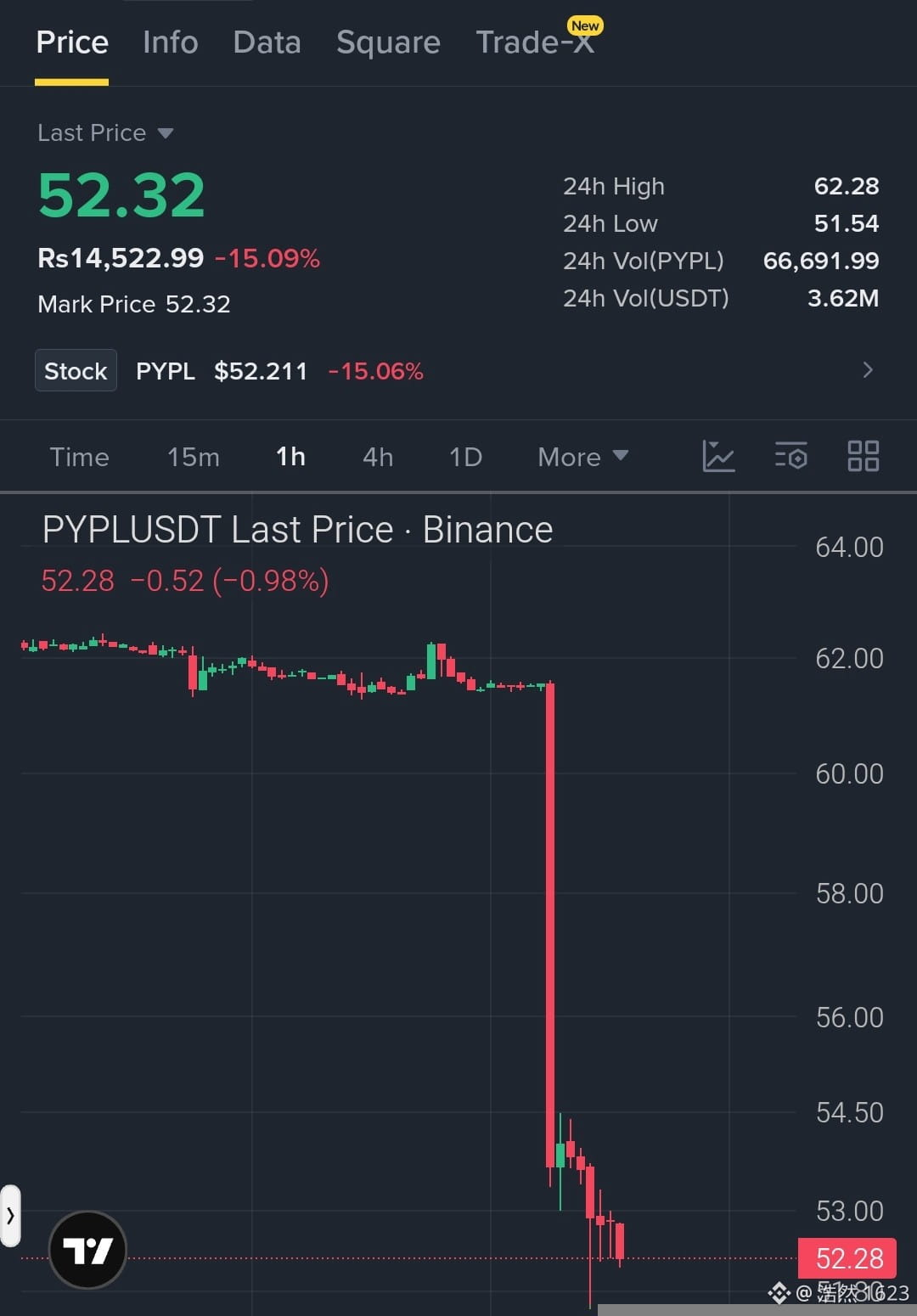
$PYPL is stabilizing near its key support base on the 1h timeframe around 52.32 following a sharp intraday drop down to the 24h low of 51.54. Down -15.09% on the session, selling pressure is slowing down near these lower levels as buyers move in to absorb liquidity. Holding above this immediate demand base sets up the potential for a technical relief bounce back toward upper resistance targets.
Target 1: 54.50 Target 2: 58.00 Target 3: 62.00
#PYPL #CryptoTrading #BinanceSquare
$HEMI
{future}(HEMIUSDT)
$BTR
{alpha}(560xfed13d0c40790220fbde712987079eda1ed75c51)
{future}(PYPLUSDT)
$PYPL is stabilizing near its key support base on the 1h timeframe around 52.32 following a sharp intraday drop down to the 24h low of 51.54. Down -15.09% on the session, selling pressure is slowing down near these lower levels as buyers move in to absorb liquidity. Holding above this immediate demand base sets up the potential for a technical relief bounce back toward upper resistance targets.
Target 1: 54.50 Target 2: 58.00 Target 3: 62.00
#PYPL #CryptoTrading #BinanceSquare
$HEMI
$BTR
Target 1: 54.50 Target 2: 58.00 Target 3: 62.00
#PYPL #CryptoTrading #BinanceSquare
$HEMI
$BTR
1
323
🚨 $PYPL $50 BILLION MEGA-BUYOUT COLLAPSES AS STRIPE AND ADVENT WALK AWAY! 💥
The massive $50 billion buyout attempt for $PYPL just crumbled as Stripe and Advent pulled their bid off the table. 🦈 Institutional smart money is hitting the brakes on record-breaking leveraged deals, signaling high friction in legacy fintech valuations.
When a multi-billion dollar M&A narrative vanishes overnight, liquidity rapidly shifts. 📊 Expect volatility across payment rails as speculative bids evaporate and order blocks get tested. 💡 Legacy payment giants are feeling the heat while capital searches for higher-yield momentum elsewhere.
💬 Will this deal collapse trigger a deeper flush in fintech valuations, or are buyers lying in wait at lower levels? 👇
⚠️ Not financial advice. Always manage your risk. 🛡️
🏷️ #PYPL #Fintech #SmartMoney #Crypto #Markets
🎯 🦈
🚨 $PYPL $50 BILLION MEGA-BUYOUT COLLAPSES AS STRIPE AND ADVENT WALK AWAY! 💥
The massive $50 billion buyout attempt for $PYPL just crumbled as Stripe and Advent pulled their bid off the table. 🦈 Institutional smart money is hitting the brakes on record-breaking leveraged deals, signaling high friction in legacy fintech valuations.
When a multi-billion dollar M&A narrative vanishes overnight, liquidity rapidly shifts. 📊 Expect volatility across payment rails as speculative bids evaporate and order blocks get tested. 💡 Legacy payment giants are feeling the heat while capital searches for higher-yield momentum elsewhere.
💬 Will this deal collapse trigger a deeper flush in fintech valuations, or are buyers lying in wait at lower levels? 👇
⚠️ Not financial advice. Always manage your risk. 🛡️
🏷️ #PYPL #Fintech #SmartMoney #Crypto #Markets
🎯 🦈
The massive $50 billion buyout attempt for $PYPL just crumbled as Stripe and Advent pulled their bid off the table. 🦈 Institutional smart money is hitting the brakes on record-breaking leveraged deals, signaling high friction in legacy fintech valuations.
When a multi-billion dollar M&A narrative vanishes overnight, liquidity rapidly shifts. 📊 Expect volatility across payment rails as speculative bids evaporate and order blocks get tested. 💡 Legacy payment giants are feeling the heat while capital searches for higher-yield momentum elsewhere.
💬 Will this deal collapse trigger a deeper flush in fintech valuations, or are buyers lying in wait at lower levels? 👇
⚠️ Not financial advice. Always manage your risk. 🛡️
🏷️ #PYPL #Fintech #SmartMoney #Crypto #Markets
🎯 🦈
65
Log in to explore more content
Join global crypto users on Binance Square
⚡️ Get latest and useful information about crypto.
💬 Trusted by the world’s largest crypto exchange.
👍 Discover real insights from verified creators.
Email / Phone number
Trending Topics
1
#BinancePick
3.3M views
161,733 Discussing
2
#EarningsSeason
5.4M views
26,572 Discussing
3
#StrategySkipsBitcoinPurchasesSpends$205MOnSTRCBuybacks
86 views
6 Discussing
4
#BitmineAdds10452ETH
4,269 views
111 Discussing
5
#SouthKoreaConsidersEducationTaxOnCryptoExchanges
4,018 views
103 Discussing
6
#OCCUrgesCommunityBanksToEnterStablecoinPayments
3,375 views
64 Discussing
7
#RippleWinsFullApprovalAsNationalTrustBank
3,261 views
67 Discussing
8
#AkashSelectsSolanaAsMigrationTarget
1,348 views
27 Discussing
9
#OndoToOpenSubscriptionsForOpenAIPreIPOTokenizedNotes
120 views
8 Discussing
10
#AnthropicTTMRevenueGrewAbout1200%
51,954 views
541 Discussing