
#cryptoriskmanagement
cryptoriskmanagement
974,816 views
334 Discussing
Hot
Latest

·
--
How Big Holders Raise Cash Without Crashing Their Own Price.
Holders with deeply concentrated token positions face a problem that smaller traders rarely think about. Selling a large amount directly on the open market can push the price down sharply, and the seller ends up receiving far less than the position was worth on paper. The bigger the holding relative to the market’s depth, the worse this effect becomes.
Because of this, large holders often avoid the open market altogether. Instead, they extract capital through decentralized lending markets, where tokens are posted as collateral against borrowed stablecoins. Others generate synthetic assets, or route value through structured redemption pools that act as intermediary buffers. These pathways let them access liquidity while keeping selling pressure off the chart.
On the other hand, none of these tools come without trade-offs. Leverage can trigger liquidation if the collateral price falls, and structured pools carry their own smart contract and liquidity risks. As a result, the real skill lies in balancing slippage minimization with capital efficiency, so that the exit plan does not create a bigger problem than the one it solves.
That is why studying these structured pathways is useful even for everyday investors. They teach patience, position sizing, and respect for market depth, lessons that apply at any portfolio size. If you would rather follow a trader who manages risk with this kind of discipline, join my copy trading account on Binance here: [https://www.binance.com/en/copy-trading/lead-details/5293024773212277505?timeRange=365D](https://www.binance.com/en/copy-trading/lead-details/5293024773212277505?timeRange=365D)
$BTC $ETH $USDT
#CryptoRiskManagement #DeFiLending #liquidity #Copytrading #BinanceSquare
How Big Holders Raise Cash Without Crashing Their Own Price.
Holders with deeply concentrated token positions face a problem that smaller traders rarely think about. Selling a large amount directly on the open market can push the price down sharply, and the seller ends up receiving far less than the position was worth on paper. The bigger the holding relative to the market’s depth, the worse this effect becomes.
Because of this, large holders often avoid the open market altogether. Instead, they extract capital through decentralized lending markets, where tokens are posted as collateral against borrowed stablecoins. Others generate synthetic assets, or route value through structured redemption pools that act as intermediary buffers. These pathways let them access liquidity while keeping selling pressure off the chart.
On the other hand, none of these tools come without trade-offs. Leverage can trigger liquidation if the collateral price falls, and structured pools carry their own smart contract and liquidity risks. As a result, the real skill lies in balancing slippage minimization with capital efficiency, so that the exit plan does not create a bigger problem than the one it solves.
That is why studying these structured pathways is useful even for everyday investors. They teach patience, position sizing, and respect for market depth, lessons that apply at any portfolio size. If you would rather follow a trader who manages risk with this kind of discipline, join my copy trading account on Binance here: https://www.binance.com/en/copy-trading/lead-details/5293024773212277505?timeRange=365D
$BTC $ETH $USDT
#CryptoRiskManagement #DeFiLending #liquidity #Copytrading #BinanceSquare
My Spot Portfolio
0 / 300
Minimum 10USDT
Public
7D PNL
(USDT)
-19.38
7D ROI
-3.38%
AUM
$553.51
Win Rate
27.27%
71

Alhamdulillah! 🎉
Just completed "Crypto Risk Management" from Binance Academy.
Learning never stops! Risk management is the key to survive in crypto. 📈
#BinanceAcademy #CryptoRiskManagement #BinanceSquare #learnAndEarn
Alhamdulillah! 🎉
Just completed "Crypto Risk Management" from Binance Academy.
Learning never stops! Risk management is the key to survive in crypto. 📈
#BinanceAcademy #CryptoRiskManagement #BinanceSquare #learnAndEarn
Just completed "Crypto Risk Management" from Binance Academy.
Learning never stops! Risk management is the key to survive in crypto. 📈
#BinanceAcademy #CryptoRiskManagement #BinanceSquare #learnAndEarn

2
77

·
--
Funding Rates + OI Divergence: The Contrarian Signal Most Traders Ignore
When funding rates are elevated and open interest keeps climbing, the consensus trade feels unbeatable. Everyone’s positioned the same way, and every green candle reinforces the conviction. That’s exactly when risk is highest.
Here’s the dynamic worth watching: when perpetual funding rates push above 0.05–0.1% per 8h and OI is at or near cycle highs, you’re not looking at momentum — you’re looking at a crowded long that’s being charged to hold. The market is essentially taxing conviction. When that tax becomes unsustainable, the unwind isn’t gradual. It’s a cascade.
The contrarian read: high funding + rising OI + spot price stagnation = distribution signal. Smart money doesn’t exit through market sells; it exits into the liquidity provided by late longs.
Practical risk management takeaway:
— Reduce leverage when funding consistently exceeds 0.05%/8h
— Watch for OI divergence: price rising, OI flat or falling = healthy; price flat, OI rising = fragile
— A funding rate reset is often a healthier base for the next leg than continuous positive funding
$BTC $ETH $SOL are all subject to this dynamic in futures markets. Understand the cost of your conviction.
#CryptoRiskManagement #FundingRates #OpenInterest #CryptoTrading #Binance
46

·
--
Bullish
🚨 $PUMP
{spot}(PUMPUSDT)
TRADERS: DON'T CONFUSE HYPE WITH MOMENTUM!
Highly speculative tokens can deliver fast moves in either direction. That makes risk management essential. 📊 Before taking a $PUMP position, look for: • Sustained volume rather than one sudden spike. • A clear breakout level and successful retest. • Adequate liquidity for your trade size. • A predefined exit if the setup fails. 🟢 Bullish case: Buyers maintain momentum above confirmed resistance. 🔴 Bearish case: Momentum fades and price falls back below the breakout. Never assume a trending token must keep rising. Protect your capital first. 💬 Would you trade $PUMP or stay on the sidelines? #pump #pumpfun #memecoins #CryptoRiskManagement
🚨 $PUMP
TRADERS: DON'T CONFUSE HYPE WITH MOMENTUM!
Highly speculative tokens can deliver fast moves in either direction. That makes risk management essential. 📊 Before taking a $PUMP position, look for: • Sustained volume rather than one sudden spike. • A clear breakout level and successful retest. • Adequate liquidity for your trade size. • A predefined exit if the setup fails. 🟢 Bullish case: Buyers maintain momentum above confirmed resistance. 🔴 Bearish case: Momentum fades and price falls back below the breakout. Never assume a trending token must keep rising. Protect your capital first. 💬 Would you trade $PUMP or stay on the sidelines? #pump #pumpfun #memecoins #CryptoRiskManagement
1
272
·
--
Most crypto traders obsess over which token to buy. Far fewer think seriously about how much to buy and that gap is where most portfolios get destroyed.
Position sizing is the single most underrated risk management tool in crypto. The asymmetric nature of this market is a double-edged sword: the same volatility that produces 10x gains can wipe out 80% of a portfolio in weeks.
A practical framework worth considering:
Core positions 50-60 pct: High-conviction, battle-tested assets like $BTC and $ETH. These are your portfolio anchors and you want enough here that a bull market actually moves the needle.
Tactical positions 25-35 pct: Higher-beta, high-growth plays. More upside, more drawdown. Size them so a 70% correction does not break your overall portfolio.
Speculative bets 5-15 pct: Narrative-driven, higher-risk positions. You should be emotionally comfortable losing the entire allocation because sometimes you will.
The math is simple: if a 5% speculative position goes to zero, your portfolio is down 5%. If you sized it at 30%, you are fighting to recover. Survival in crypto is not optional, it is the prerequisite for compounding.
Risk management is not the exciting part. It is just the part that keeps you in the game long enough to win.
#CryptoRiskManagement #PositionSizing #CryptoStrategy #BinanceSquare #CryptoInvesting
Most crypto traders obsess over which token to buy. Far fewer think seriously about how much to buy and that gap is where most portfolios get destroyed.
Position sizing is the single most underrated risk management tool in crypto. The asymmetric nature of this market is a double-edged sword: the same volatility that produces 10x gains can wipe out 80% of a portfolio in weeks.
A practical framework worth considering:
Core positions 50-60 pct: High-conviction, battle-tested assets like $BTC and $ETH . These are your portfolio anchors and you want enough here that a bull market actually moves the needle.
Tactical positions 25-35 pct: Higher-beta, high-growth plays. More upside, more drawdown. Size them so a 70% correction does not break your overall portfolio.
Speculative bets 5-15 pct: Narrative-driven, higher-risk positions. You should be emotionally comfortable losing the entire allocation because sometimes you will.
The math is simple: if a 5% speculative position goes to zero, your portfolio is down 5%. If you sized it at 30%, you are fighting to recover. Survival in crypto is not optional, it is the prerequisite for compounding.
Risk management is not the exciting part. It is just the part that keeps you in the game long enough to win.
#CryptoRiskManagement #PositionSizing #CryptoStrategy #BinanceSquare #CryptoInvesting
55
·
--
Realized Cap as a Risk Management Anchor
Most traders fixate on market cap - total supply times current price. But realized cap is the smarter metric: it values each coin at the price it last moved on-chain, giving a cleaner picture of actual capital invested in a network.
Why does this matter for risk management?
1. When market cap greatly exceeds realized cap, unrealized profit is high across the entire holder base. Historically this signals late-cycle euphoria - not the time to size up.
2. When market cap equals realized cap (MVRV near 1), most coins are near their cost basis. This is where deep conviction buyers accumulate, not panic-sell.
3. The MVRV Z-Score normalizes these extremes across cycles. A score above 7 has historically marked macro tops. Below 0 has marked generational bottoms.
Practical application: use MVRV as a position-sizing dial. High MVRV = trim exposure, reduce leverage, widen stops. Low MVRV = increase core position, extend time horizon.
This is not about timing perfectly. It is about aligning your risk exposure with the structural reality of where capital sits in the cycle.
$BTC $ETH
#CryptoRiskManagement #OnChainMetrics #MVRV #Bitcoin #Crypto2026
35


Article
🛡️ Before You Focus on Profits, Learn to Protect Your Capital! (Risk Management 101) 📉Most people enter the crypto market looking for overnight riches. However, the real secret to surviving in crypto isn’t just about making profits—it’s about knowing how to protect your money from big losses (Capital Preservation).
If you want to survive and thrive in the long run, here are 3 golden rules of Risk Management you must follow:
1 Always Use a Stop-Loss (SL): 🛑 Before entering any trade, decide your maximum pain point. Setting a Stop-Loss ensures that even if the market crashes unexpectedly, your entire account won't get wiped out.
2 Never Invest More Than You Can Afford to Lose: 💰 Never trade with borrowed money, rent money, or emergency funds. The crypto market is highly volatile. Only invest an amount that wouldn't impact your daily life if things go sideways.
3 Diversify Your Portfolio: 🧺 Don't put all your eggs in one basket. Spreading your capital across different assets (like BTC, solid Altcoins, and Stablecoins) reduces your risk significantly if one particular coin drops.
Crypto trading is a marathon, not a sprint! 🏃♂️ Trade smart, manage your risk, and protect your capital.
💡 Do you strictly use a Stop-Loss in your daily trades? Let's discuss in the comments! 👇
#CryptoRiskManagement #BinanceSquare #tradingStrategy #CryptoSafety #SmartTrading
$BTC
{future}(BTCUSDT)
🛡️ Before You Focus on Profits, Learn to Protect Your Capital! (Risk Management 101) 📉
Most people enter the crypto market looking for overnight riches. However, the real secret to surviving in crypto isn’t just about making profits—it’s about knowing how to protect your money from big losses (Capital Preservation).
If you want to survive and thrive in the long run, here are 3 golden rules of Risk Management you must follow:
1 Always Use a Stop-Loss (SL): 🛑 Before entering any trade, decide your maximum pain point. Setting a Stop-Loss ensures that even if the market crashes unexpectedly, your entire account won't get wiped out.
2 Never Invest More Than You Can Afford to Lose: 💰 Never trade with borrowed money, rent money, or emergency funds. The crypto market is highly volatile. Only invest an amount that wouldn't impact your daily life if things go sideways.
3 Diversify Your Portfolio: 🧺 Don't put all your eggs in one basket. Spreading your capital across different assets (like BTC, solid Altcoins, and Stablecoins) reduces your risk significantly if one particular coin drops.
Crypto trading is a marathon, not a sprint! 🏃♂️ Trade smart, manage your risk, and protect your capital.
💡 Do you strictly use a Stop-Loss in your daily trades? Let's discuss in the comments! 👇
#CryptoRiskManagement #BinanceSquare #tradingStrategy #CryptoSafety #SmartTrading
$BTC
74

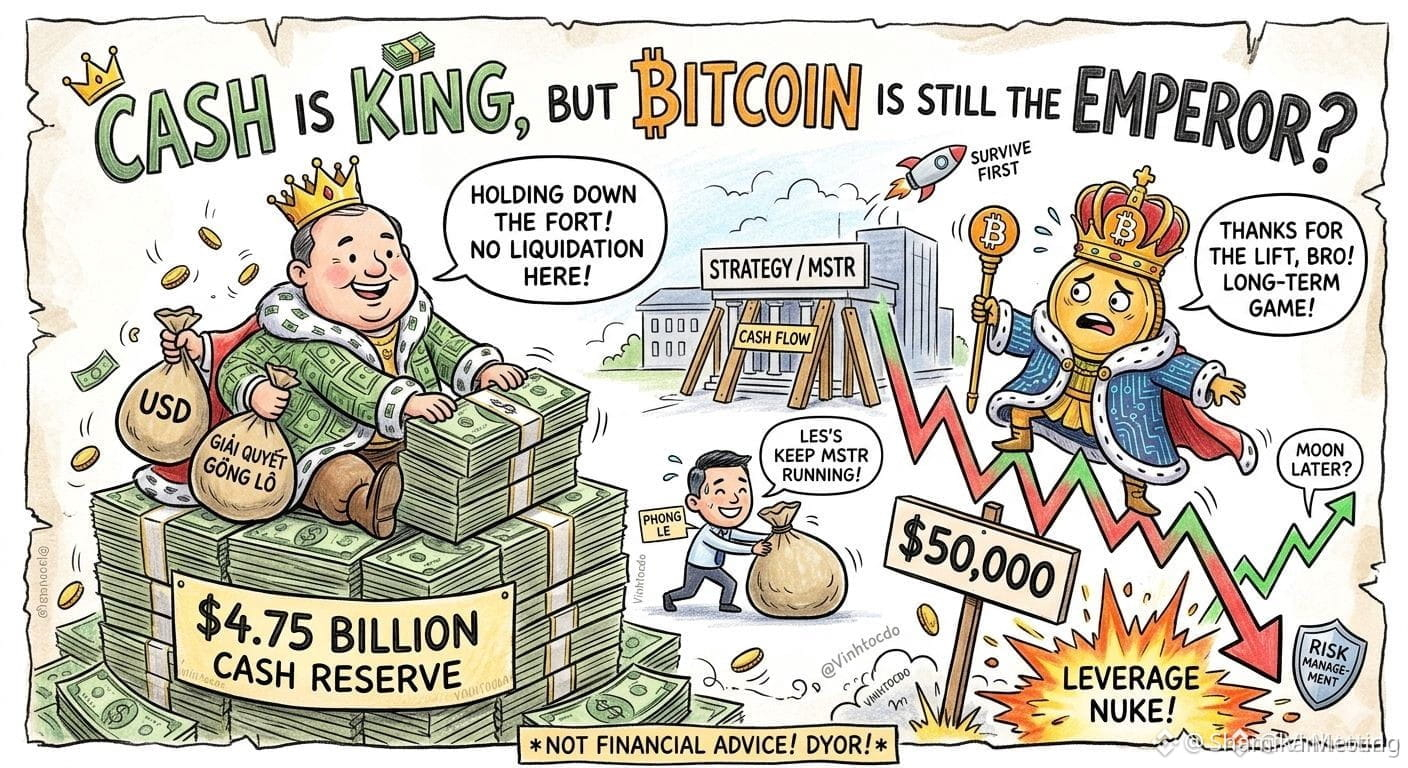
💵 Cash is king, but is Bitcoin still the emperor? 👑
We all know the most important trading strategy: use real, cold cash for averaging down and staying alive during brutal crashes—because if BTC randomly decides to visit $50,000 tomorrow, your leveraged positions will get completely bombarded! 😂 Even the strategy CEO, Phong Le, admitted a big lesson: institutions prefer short-term cash over BTC for just 6 months in a bear market only to survive. The company has nearly $4.75 billion in cash! Why? Because they need to keep the wheels turning so that MSTR and Bitcoin can keep going.
♂️ What should traders do now?
1️⃣ Learn from the whales: keep a healthy cash/stablecoin reserve. Don’t go in 100% all at once on leverage.
2️⃣ Survive now, then to the moon later: protecting capital matters far more than chasing every upswing wave.
3️⃣ Risk management: if a company that’s listed in the billions piles up cash for safety, maybe you should do the same!
This is not financial advice. Always verify everything yourself (DYOR)!
Please follow along
#Strategy #CryptoRiskManagement
$BTC
{future}(BTCUSDT)
$ETH
{future}(ETHUSDT)
$BNB
{future}(BNBUSDT)
💵 Cash is king, but is Bitcoin still the emperor? 👑
We all know the most important trading strategy: use real, cold cash for averaging down and staying alive during brutal crashes—because if BTC randomly decides to visit $50,000 tomorrow, your leveraged positions will get completely bombarded! 😂 Even the strategy CEO, Phong Le, admitted a big lesson: institutions prefer short-term cash over BTC for just 6 months in a bear market only to survive. The company has nearly $4.75 billion in cash! Why? Because they need to keep the wheels turning so that MSTR and Bitcoin can keep going.
♂️ What should traders do now?
1️⃣ Learn from the whales: keep a healthy cash/stablecoin reserve. Don’t go in 100% all at once on leverage.
2️⃣ Survive now, then to the moon later: protecting capital matters far more than chasing every upswing wave.
3️⃣ Risk management: if a company that’s listed in the billions piles up cash for safety, maybe you should do the same!
This is not financial advice. Always verify everything yourself (DYOR)!
Please follow along
#Strategy #CryptoRiskManagement
$BTC
$ETH
$BNB
1
56
·
--
Late-Cycle Portfolio Rebalancing: The Discipline Most Traders Skip
Every crypto bull cycle eventually enters a phase where everything feels obvious — prices are rising, narratives are loud, and risk feels invisible. That is precisely when portfolio rebalancing matters most.
Rebalancing is not just about taking profits. It is about systematically adjusting your exposure so that no single position grows so large it can structurally damage your portfolio on the way down. In late-cycle conditions, $BTC tends to consolidate dominance, $ETH captures fee-yield bids, and $BNB benefits from exchange volume — but the velocity of these moves can inflate individual weights far beyond your original thesis.
A disciplined rebalancing rule is simple: when any asset exceeds 1.5x its target weight, trim back to target and rotate proceeds into cash, stablecoins, or underweight positions. This forces you to sell strength and stay positioned for the next leg — without the emotional cost of trying to call a top.
The underappreciated edge in crypto is not finding the next 10x. It is surviving the 80% drawdown that follows by holding the right size at the right time.
Build the rebalancing rule before you need it. Enforce it mechanically. Conviction on the asset is not the same as conviction on your position size.
#CryptoRiskManagement #PortfolioStrategy #BullCycle #CryptoTrading #Binance
91
·
--
Most crypto traders obsess over entries. Very few obsess over position sizing — and that gap is why most portfolios blow up during corrections.
Here is the framework professional traders use: volatility-adjusted position sizing.
Instead of allocating equal dollar amounts, you allocate based on each asset's historical volatility. A high-volatility altcoin demands a smaller nominal allocation than $BTC, because the risk contribution per dollar is fundamentally different.
The math is simple: Risk Budget ÷ Asset Volatility = Position Size.
Practically, this means:
- $BTC and $ETH can carry heavier portfolio weight because their drawdowns are deeper but more predictable
- $SOL sits in the mid-tier: strong fundamentals, but wider swing ranges demand tighter sizing
- High-beta altcoins deserve smaller positions relative to conviction — not because the thesis is weaker, but because the noise-to-signal ratio is higher
Risk management is not about avoiding losses. It is about ensuring no single bet can end your game.
Crypto rewards conviction — but only if you are still in the market when the thesis plays out. Survival is the prerequisite to compounding.
Size for longevity. Let time do the work.
#CryptoRiskManagement #PositionSizing #CryptoTrading #PortfolioStrategy #BinanceSquare
Most crypto traders obsess over entries. Very few obsess over position sizing — and that gap is why most portfolios blow up during corrections.
Here is the framework professional traders use: volatility-adjusted position sizing.
Instead of allocating equal dollar amounts, you allocate based on each asset's historical volatility. A high-volatility altcoin demands a smaller nominal allocation than $BTC , because the risk contribution per dollar is fundamentally different.
The math is simple: Risk Budget ÷ Asset Volatility = Position Size.
Practically, this means:
- $BTC and $ETH can carry heavier portfolio weight because their drawdowns are deeper but more predictable
- $SOL sits in the mid-tier: strong fundamentals, but wider swing ranges demand tighter sizing
- High-beta altcoins deserve smaller positions relative to conviction — not because the thesis is weaker, but because the noise-to-signal ratio is higher
Risk management is not about avoiding losses. It is about ensuring no single bet can end your game.
Crypto rewards conviction — but only if you are still in the market when the thesis plays out. Survival is the prerequisite to compounding.
Size for longevity. Let time do the work.
#CryptoRiskManagement #PositionSizing #CryptoTrading #PortfolioStrategy #BinanceSquare
78
·
--
One of the most dangerous assumptions in crypto portfolio construction is that diversification works the same way it does in traditional markets. It doesn't — at least not when it matters most.
In calm periods, $BTC and $ETH can show moderate correlation with altcoins. That gives a false sense of safety. But during macro stress events — a Fed surprise, a major protocol exploit, a regulatory shock — correlations collapse toward 1. Everything sells off together. The diversification you thought you had evaporates precisely when you need it.
This is the stress-correlation trap: assets that behave independently in sideways markets move in lockstep during liquidation cascades. Why? Because the marginal seller in a crisis isn't a fundamentals trader. It's a leveraged position getting margin-called, a fund meeting redemptions, or an algo hitting stop-loss triggers. They sell what they can, not what they should.
The practical implication: true crypto risk management isn't just about holding multiple tokens. It's about holding assets with structurally different risk profiles — stablecoins as dry powder, $BTC as the macro anchor, productive DeFi positions with yield offsetting drawdown risk, and genuine cash reserves outside the ecosystem.
Diversification across L1s looks like diversification. Actual risk management includes thinking about what you'll do when everything goes red at once.
Know your stress scenario before it arrives.
#CryptoRiskManagement #PortfolioStrategy #CryptoMarkets #RiskManagement #BTC
35
·
--
Most traders obsess over entries. The professionals obsess over position sizing.
In crypto, this difference is everything. A volatile market can hand you the right thesis and still wipe your account if your sizing is off. Here is a framework worth keeping:
• Never risk more than 1-2% of total capital on a single trade. Markets can be irrational far longer than you can stay solvent.
• Separate your portfolio into three buckets: a high-conviction core (BTC and ETH), a mid-risk rotation layer (SOL, BNB), and a speculative sleeve for high-beta plays.
• Scale into positions, never all at once. Deploying in three tranches across different price levels reduces regret and improves average cost.
• Set stop-losses before entering, not after. Once you are in a trade, emotions distort your judgment. The decision should already be made.
• Rebalance quarterly. Crypto portfolio drift is dramatic. A 5% speculative allocation can become 25% after a bull run, changing your risk profile without you noticing.
Most crypto losses are not bad calls. They are correct calls with terrible risk management. The market rewards discipline more consistently than it rewards prediction.
Protect capital first. Grow it second. $BTC $ETH $SOL
#CryptoRiskManagement #PositionSizing #CryptoStrategy #BinanceSquare
59
·
--
Volatility Is Not Your Enemy — Ignoring It Is
Most traders focus on price direction. The ones who survive long cycles focus on something else: volatility-adjusted exposure.
Here's the framework that separates disciplined traders from those who blow up:
📐 Size by volatility, not conviction
When $BTC 30-day realized vol spikes above 60%, cut position size by 30–40% automatically. When it compresses below 30%, that's your signal to add — not the price action itself.
🪜 Use a three-tier portfolio structure
• Core (50–60%): Bitcoin + Ethereum — your low-volatility anchor
• Tactical (25–30%): Mid-caps — higher beta, defined time horizon
• Speculative (10–15%): High-conviction small caps — size losses in, not out
📉 Define your drawdown tolerance before you enter
A 40% portfolio drawdown requires a 67% gain to recover. A 60% drawdown needs 150%. The math is brutal — which is why pre-defining exit thresholds matters more than entry signals.
🧠 The mental edge: Most traders over-size when excited and under-size when scared. Systematic volatility-based sizing flips this instinct. It forces discipline at exactly the moments emotions are loudest.
$BTC $ETH $BNB — markets reward patience and punish overconfidence. Know your risk before you know your target.
#CryptoRiskManagement #Bitcoin #CryptoTrading #PortfolioStrategy #BinanceSquare
34
·
--
Most crypto portfolios aren't as diversified as investors think.
Here's the uncomfortable truth: in bear markets, correlations across crypto assets converge toward 1.0. Whether you hold $BTC, $ETH, or $SOL — when panic sets in, they tend to fall together. The perceived diversification from spreading across Layer 1s evaporates precisely when you need it most.
This happens because crypto remains a risk-on asset class at the macro level. When global liquidity contracts, institutional desks reduce exposure across the entire category. The narrative differences between $BTC as digital gold and $SOL as high-throughput infrastructure matter less when a fund manager is cutting risk budget.
So what actually works for risk management?
→ True diversification requires leaving the crypto correlation cluster — holding some exposure in assets that are uncorrelated or negatively correlated during drawdowns
→ Within crypto, position sizing discipline matters more than asset selection — no single position should threaten portfolio survival
→ Stablecoin reserves aren't dead weight — they preserve optionality to buy dislocations without forced selling
→ Time-based rebalancing (quarterly or at 20%+ deviation) mechanically enforces buying low and trimming high
The best traders don't just pick good assets. They structure their book to survive the inevitable correlation shock and still have capital to deploy at cycle lows.
Portfolio architecture is an edge most retail investors never develop.
#CryptoRiskManagement #PortfolioStrategy #CryptoTrading #BinanceSquare #Crypto2026
Most crypto portfolios aren't as diversified as investors think.
Here's the uncomfortable truth: in bear markets, correlations across crypto assets converge toward 1.0. Whether you hold $BTC , $ETH , or $SOL — when panic sets in, they tend to fall together. The perceived diversification from spreading across Layer 1s evaporates precisely when you need it most.
This happens because crypto remains a risk-on asset class at the macro level. When global liquidity contracts, institutional desks reduce exposure across the entire category. The narrative differences between $BTC as digital gold and $SOL as high-throughput infrastructure matter less when a fund manager is cutting risk budget.
So what actually works for risk management?
→ True diversification requires leaving the crypto correlation cluster — holding some exposure in assets that are uncorrelated or negatively correlated during drawdowns
→ Within crypto, position sizing discipline matters more than asset selection — no single position should threaten portfolio survival
→ Stablecoin reserves aren't dead weight — they preserve optionality to buy dislocations without forced selling
→ Time-based rebalancing (quarterly or at 20%+ deviation) mechanically enforces buying low and trimming high
The best traders don't just pick good assets. They structure their book to survive the inevitable correlation shock and still have capital to deploy at cycle lows.
Portfolio architecture is an edge most retail investors never develop.
#CryptoRiskManagement #PortfolioStrategy #CryptoTrading #BinanceSquare #Crypto2026
25
·
--
The math behind drawdowns is more brutal than most traders realize.
A 20% loss needs a 25% gain to recover. A 50% loss needs a 100% gain. A 75% loss needs 300%. This asymmetry is why capital preservation matters more than chasing alpha.
Yet most crypto traders build portfolios backwards — they start with upside targets and work backward to risk. The right framework flips that: start with maximum acceptable drawdown, then size every position to fit within that envelope.
Here is what that looks like in practice:
1. Define your max portfolio drawdown before you enter a single trade — not after you are already underwater.
2. Size positions using inverse volatility weighting. $BTC positions can be larger because realized volatility is lower. $ETH and $SOL deserve smaller sizing.
3. Correlation is the hidden risk multiplier. When everything dumps together, diversification fails. Stress-test assuming 0.9 correlation during crashes.
4. Keep dry powder. The best trades happen when liquidity is drying up — but you cannot take them if you are fully deployed.
The traders who survive multiple cycles are not the ones with the best entries. They are the ones whose worst drawdown was survivable.
Risk management is not a hedge against being wrong — it is the framework that lets you be wrong and still be in the game.
#CryptoRiskManagement #DrawdownMath #PositionSizing #TradingPsychology #CryptoStrategy
61
·
--
Most traders lose not because they pick wrong tokens — but because they size positions incorrectly.
Volatility-adjusted position sizing is one of the most powerful and least-used tools in crypto. The concept is simple: the more volatile an asset, the smaller your position. This keeps your dollar risk per trade roughly equal across different holdings.
$BTC might move 4% on a bad day. Higher-beta alts can swing 12–18% in the same window. If you size them equally, you are taking 3–4x more risk on the alt than you think.
A practical framework:
• Anchor 40–50% of your portfolio in $BTC — your volatility baseline
• Size $ETH at roughly 70% of your BTC position weight
• High-beta alts get 25–40% of BTC weight per position
• Rebalance when any single position drifts more than 5% from target weight
This approach does not limit upside — alts still outperform in strong rallies. What it limits is the drawdown when the cycle turns. Surviving drawdowns with capital intact is what allows compounding over multiple cycles.
The traders who build real wealth in crypto are not the ones who find the best tokens — they are the ones who manage risk well enough to stay in the game long enough for compounding to work.
Size smart. Stay in the game.
#CryptoRiskManagement #PositionSizing #CryptoStrategy #BinanceSquare #CryptoTrading
64
·
--
Asymmetric Position Sizing: The Edge Most Crypto Traders Ignore
Most retail traders size every position the same way — a flat percentage of portfolio regardless of conviction. That approach works in equities, but crypto demands something different.
Asymmetric sizing means allocating more capital to high-conviction, high-upside setups while capping exposure on speculative bets. In an asset class where a single position can return 3x–10x, the cost of under-sizing a winner is just as damaging as over-sizing a loser.
A practical framework:
• Core blue-chips: 40–60% of portfolio. Your ballast — volatile, but with deep liquidity and proven demand.
• Tactical mid-caps: 20–30%. Higher beta, sector-driven. Size by cycle phase.
• Speculative/early-stage: 10–20% MAX, spread across multiple names. Expect most to underperform.
The key discipline: never let a speculative position grow into a core weighting via gains without rebalancing. Unrealized profit is still risk capital.
Risk management in crypto is not about avoiding volatility — it is about surviving the drawdowns long enough to benefit from the recoveries. Size for asymmetry, not for comfort.
$BTC $ETH $BNB
#CryptoRiskManagement #PositionSizing #CryptoStrategy #PortfolioConstruction #BinanceSquare
120

·
--
Bearish
🚨 $VELVET
{future}(VELVETUSDT)
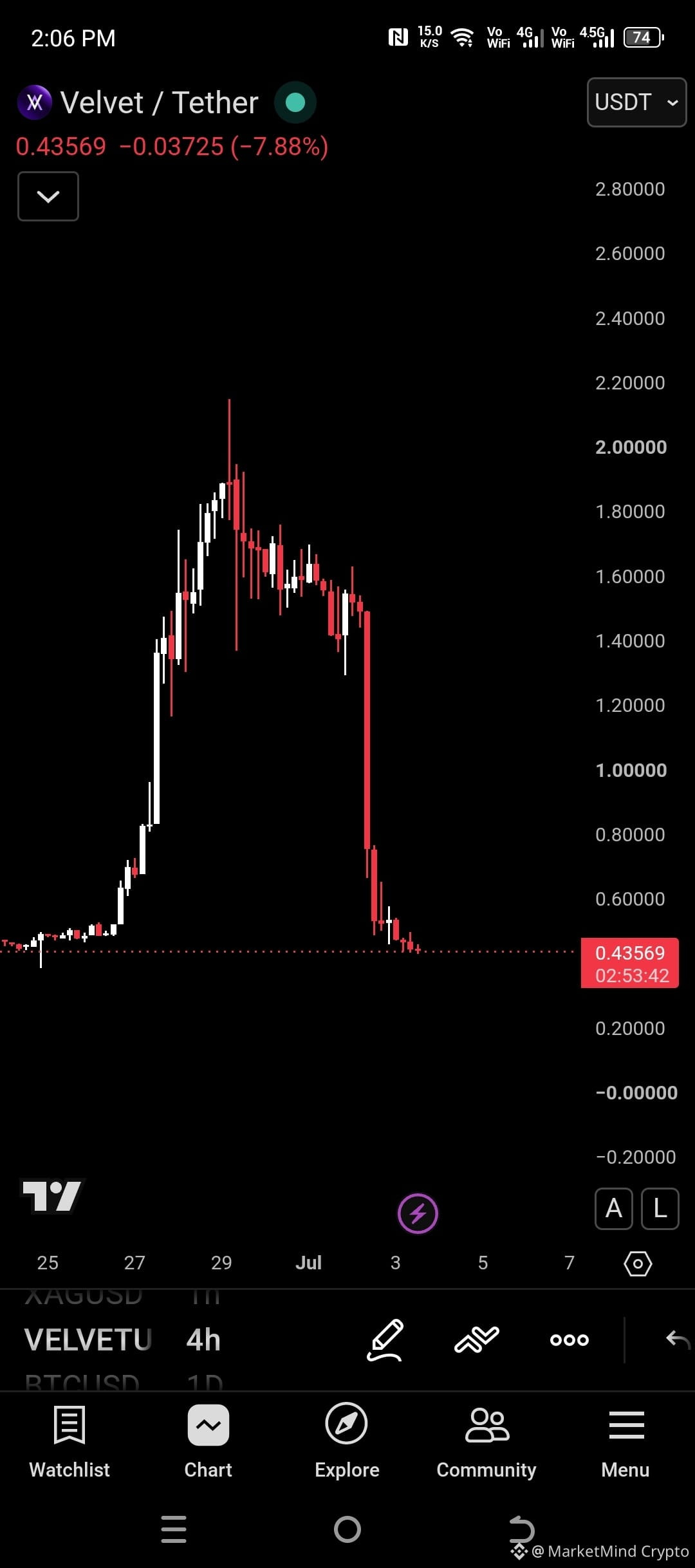
Just Did 1,800% in 11 Days — Here's Why That's a Red Flag, Not a Signal
Parabolic moves like this on low-cap tokens follow a pattern: vertical pump, then a flat top, then liquidations on both sides as leverage unwinds.
This isn't a "get in before it's too late" setup. It's a "know your exit before you enter" setup.
💭 Have you gotten caught in a pump like this before? What did you learn? 👇
#VELVETUSDT #CryptoRiskManagement #BinanceSquare
🚨 $VELVET
Just Did 1,800% in 11 Days — Here's Why That's a Red Flag, Not a Signal
Parabolic moves like this on low-cap tokens follow a pattern: vertical pump, then a flat top, then liquidations on both sides as leverage unwinds.
This isn't a "get in before it's too late" setup. It's a "know your exit before you enter" setup.
💭 Have you gotten caught in a pump like this before? What did you learn? 👇
#VELVETUSDT #CryptoRiskManagement #BinanceSquare

122
·
--
Liquidation Cascades Are Not Bad Luck — They Are Bad Position Sizing
Every major crypto drawdown tells the same story: over-leveraged positions get forced out at the worst price, triggering more liquidations, which trigger more selling. The cascade is not a market anomaly — it is the predictable outcome of poor risk construction.
The discipline most traders lack is the separation between conviction and size. You can be right about $BTC being in a long-term bull cycle and still lose everything by using 10x leverage on a 30-day timeframe. Conviction is a thesis. Size is a risk decision. They are not the same thing.
A resilient portfolio treats crypto allocation in three tiers:
— Core (50-60%): $BTC and $ETH, sized to survive a 70% drawdown without a margin call
— Tactical (25-30%): $SOL and quality L1s, sized for 3-6 month thesis plays
— Speculative (10-15%): higher-beta assets with hard stop losses pre-set before entry
The traders who compound wealth through multiple cycles are not the ones who caught every pump. They are the ones who did not get wiped out during the flush. Survival is the edge.
Asymmetric outcomes require you to still be in the game when the opportunity arrives. Lose everything in cycle one, and cycle two does not matter.
Risk management is not a defensive posture. It is the most aggressive long-term strategy available.
$BTC $ETH $SOL
#CryptoRiskManagement #PositionSizing #CryptoStrategy #BinanceSquare #CryptoTrading
Liquidation Cascades Are Not Bad Luck — They Are Bad Position Sizing
Every major crypto drawdown tells the same story: over-leveraged positions get forced out at the worst price, triggering more liquidations, which trigger more selling. The cascade is not a market anomaly — it is the predictable outcome of poor risk construction.
The discipline most traders lack is the separation between conviction and size. You can be right about $BTC being in a long-term bull cycle and still lose everything by using 10x leverage on a 30-day timeframe. Conviction is a thesis. Size is a risk decision. They are not the same thing.
A resilient portfolio treats crypto allocation in three tiers:
— Core (50-60%): $BTC and $ETH , sized to survive a 70% drawdown without a margin call
— Tactical (25-30%): $SOL and quality L1s, sized for 3-6 month thesis plays
— Speculative (10-15%): higher-beta assets with hard stop losses pre-set before entry
The traders who compound wealth through multiple cycles are not the ones who caught every pump. They are the ones who did not get wiped out during the flush. Survival is the edge.
Asymmetric outcomes require you to still be in the game when the opportunity arrives. Lose everything in cycle one, and cycle two does not matter.
Risk management is not a defensive posture. It is the most aggressive long-term strategy available.
$BTC $ETH $SOL
#CryptoRiskManagement #PositionSizing #CryptoStrategy #BinanceSquare #CryptoTrading
83
·
--
Volatility Regimes: The Risk Framework Crypto Portfolios Actually Need
Most crypto risk management conversations stop at stop-losses. That misses the deeper question: are you sizing your positions to the current volatility regime — or the one you wish existed?
Crypto markets cycle through three distinct volatility states. Low-volatility compression phases — often misread as "safe" — are where overconfidence accumulates and leverage quietly builds. Medium-volatility trending phases are the most forgiving; momentum strategies work, sizing can expand modestly. High-volatility expansion phases punish oversized positions ruthlessly, regardless of directional conviction.
The practical implication: your position size in $BTC shouldn't be static. A 2% portfolio allocation during a calm accumulation week may represent 5x the real risk of the same 2% during a trending breakout. Volatility-adjusted sizing corrects for this.
For $ETH, the regime-shift risk compounds further. Execution-layer narratives attract speculative inflow — meaning volatility spikes tend to be sharper and faster than $BTC. Correlation to $BTC also decays during high-volatility regimes, which destroys naive diversification assumptions.
$SOL and other momentum assets amplify every regime transition. Treat them as regime-sensitive instruments, not set-and-forget holds.
The portfolio that survives every cycle isn't the one with the best entries. It's the one calibrated to survive the regimes it didn't predict.
#CryptoRiskManagement #VolatilityRegimes #PortfolioConstruction #CryptoTrading #BinanceSquare
Volatility Regimes: The Risk Framework Crypto Portfolios Actually Need
Most crypto risk management conversations stop at stop-losses. That misses the deeper question: are you sizing your positions to the current volatility regime — or the one you wish existed?
Crypto markets cycle through three distinct volatility states. Low-volatility compression phases — often misread as "safe" — are where overconfidence accumulates and leverage quietly builds. Medium-volatility trending phases are the most forgiving; momentum strategies work, sizing can expand modestly. High-volatility expansion phases punish oversized positions ruthlessly, regardless of directional conviction.
The practical implication: your position size in $BTC shouldn't be static. A 2% portfolio allocation during a calm accumulation week may represent 5x the real risk of the same 2% during a trending breakout. Volatility-adjusted sizing corrects for this.
For $ETH , the regime-shift risk compounds further. Execution-layer narratives attract speculative inflow — meaning volatility spikes tend to be sharper and faster than $BTC . Correlation to $BTC also decays during high-volatility regimes, which destroys naive diversification assumptions.
$SOL and other momentum assets amplify every regime transition. Treat them as regime-sensitive instruments, not set-and-forget holds.
The portfolio that survives every cycle isn't the one with the best entries. It's the one calibrated to survive the regimes it didn't predict.
#CryptoRiskManagement #VolatilityRegimes #PortfolioConstruction #CryptoTrading #BinanceSquare
55
Log in to explore more content
Join global crypto users on Binance Square
⚡️ Get latest and useful information about crypto.
💬 Trusted by the world’s largest crypto exchange.
👍 Discover real insights from verified creators.
Email / Phone number
Trending Topics
1
#HotCPIDecemberHikePriced
301,679 views
3,151 Discussing
2
#ZcashFallsBelow$1000ForFirstTimeSinceSeptember
6,628 views
48 Discussing
3
#StrategyFaces$2.8BSelloffRiskFromMSCIRemoval
17,988 views
132 Discussing
4
#AnthropicRejectsIPODelayValuationinQuestion
351,535 views
3,156 Discussing
5
#BitcoinETFsLose$1.6BInNovember
5,941 views
34 Discussing
6
#AnthropicDisclosesOver$10BNewComputeDeals
1,517 views
24 Discussing
7
#CoreWeaveJumps10%On168%RevenueGrowth
17,417 views
422 Discussing
8
#CanNvidiaEarningsEaseMarketConcerns?
101,405 views
1,357 Discussing
9
#BarclaysRaisesBlackRockBitcoinETFStake48%
14,975 views
315 Discussing
10
#BitmineReports$6.3BFiscal2026Loss
7,055 views
22 Discussing