

#bdc
bdc
5,262 views
28 Discussing
Hot
Latest

·
--
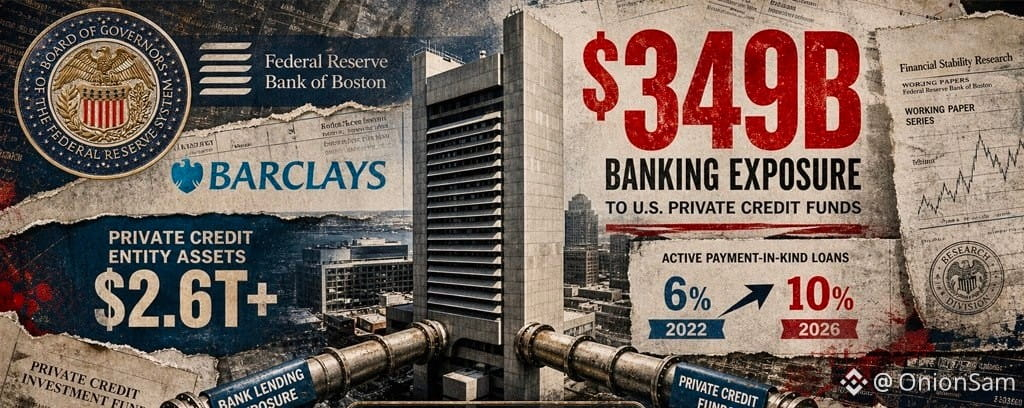
🚨🏦💰 #Fed EXPOSES $349B BANKING RISK IN PRIVATE CREDIT! 📊⚠️
The Federal Reserve’s updated financial accounts have exposed massive U.S. bank exposure to Private Credit funds, reaching a staggering $349 Billion! 📉🔥
A widening gap between "recorded paper profits" and "actual physical liquidity" is triggering severe systemic warnings. The Boston Fed highlights that Payment-in-Kind (PIK) loans—where distressed borrowers delay cash interest and add it to principal—have surged to roughly 10% for Business Development Companies (#BDC s).
Funds are booking these non-cash deferred interests as "revenues," creating an artificial liquidity mismatch while banks demand physical cash settlement.
⚠️ THE CONTAGION RISK:
With real default rates masked under debt extensions, any sudden funding squeeze or capital call will force institutional liquidations. High-liquidity risk assets—specifically Equities and #bitcoin (#BTC )—will be the immediate frontline targets for forced selling to capture fast cash, raising the probability of a systemic market flash crash.
#Market_Update
$BTC
{spot}(BTCUSDT)
$ETH
{spot}(ETHUSDT)
$ETC
{spot}(ETCUSDT)
🚨🏦💰 #Fed EXPOSES $349B BANKING RISK IN PRIVATE CREDIT! 📊⚠️
The Federal Reserve’s updated financial accounts have exposed massive U.S. bank exposure to Private Credit funds, reaching a staggering $349 Billion! 📉🔥
A widening gap between "recorded paper profits" and "actual physical liquidity" is triggering severe systemic warnings. The Boston Fed highlights that Payment-in-Kind (PIK) loans—where distressed borrowers delay cash interest and add it to principal—have surged to roughly 10% for Business Development Companies (#BDC s).
Funds are booking these non-cash deferred interests as "revenues," creating an artificial liquidity mismatch while banks demand physical cash settlement.
⚠️ THE CONTAGION RISK:
With real default rates masked under debt extensions, any sudden funding squeeze or capital call will force institutional liquidations. High-liquidity risk assets—specifically Equities and #bitcoin (#BTC )—will be the immediate frontline targets for forced selling to capture fast cash, raising the probability of a systemic market flash crash.
#Market_Update
$BTC
$ETH
$ETC

Good luck 🍀
From OnionSam
1
143

·
--

Article
Don't rush to call it the holy grail; first, let’s see if OpenLedger's numbers can add up.Lately, the buzz around OpenLedger in the square has really picked up; six out of the ten posts on the homepage are talking about this project. To be honest, in such a fragmented info landscape, when so many folks are zeroing in on one project, it’s either got real substance or the hype is just right. I don’t want to take sides; I just want to share some thoughts after reading the white paper and point out a few areas that make me think we should keep our cool.
Let’s start with what I agree with. The problems OpenLedger aims to tackle definitely exist and have been around for a while. In the AI industry, data providers, annotators, and those fine-tuning models often don’t see ongoing rewards. The data you contribute gets used to train models, but if those models make money, you see none of it. This isn’t just a company issue; it’s a systemic problem with the incentive structures in the whole industry. OpenLedger aims to solve this with on-chain attribution, which makes sense logically—recording the causal relationship between each data contribution and every model inference, then automatically distributing the earnings.
Don't rush to call it the holy grail; first, let’s see if OpenLedger's numbers can add up.
Lately, the buzz around OpenLedger in the square has really picked up; six out of the ten posts on the homepage are talking about this project. To be honest, in such a fragmented info landscape, when so many folks are zeroing in on one project, it’s either got real substance or the hype is just right. I don’t want to take sides; I just want to share some thoughts after reading the white paper and point out a few areas that make me think we should keep our cool.
Let’s start with what I agree with. The problems OpenLedger aims to tackle definitely exist and have been around for a while. In the AI industry, data providers, annotators, and those fine-tuning models often don’t see ongoing rewards. The data you contribute gets used to train models, but if those models make money, you see none of it. This isn’t just a company issue; it’s a systemic problem with the incentive structures in the whole industry. OpenLedger aims to solve this with on-chain attribution, which makes sense logically—recording the causal relationship between each data contribution and every model inference, then automatically distributing the earnings.
Let’s start with what I agree with. The problems OpenLedger aims to tackle definitely exist and have been around for a while. In the AI industry, data providers, annotators, and those fine-tuning models often don’t see ongoing rewards. The data you contribute gets used to train models, but if those models make money, you see none of it. This isn’t just a company issue; it’s a systemic problem with the incentive structures in the whole industry. OpenLedger aims to solve this with on-chain attribution, which makes sense logically—recording the causal relationship between each data contribution and every model inference, then automatically distributing the earnings.
5
1
118

Log in to explore more content
Join global crypto users on Binance Square
⚡️ Get latest and useful information about crypto.
💬 Trusted by the world’s largest crypto exchange.
👍 Discover real insights from verified creators.
Email / Phone number
Trending Topics
1
#BinanceProcesses$4.65BWithdrawals
38,337 views
149 Discussing
2
#WithdrawalsBack: 15 networks live
9,295 views
141 Discussing
3
#BrazilVirtualAssetLicenseDeadlineDrawsAbout40Firms
537 views
54 Discussing
4
#BTCPayServerUrgesOperatorsToShutDownInstances
1,978 views
78 Discussing
5
#BankOfKoreaSurveysFinancialFirmsOnVirtualAssetRisks
110 views
6 Discussing
6
#BinanceUpdatesProofofReservesAddresses
157,221 views
1,751 Discussing
7
#BinanceToResumePhaseOneOfWithdrawals
190,052 views
1,756 Discussing
8
#StudyFindsCircleAIAgentWalletLimitsCanBeBypassed
368 views
48 Discussing
9
#BinanceHadAlreadyCovered$6BofHackLoss
12,387 views
145 Discussing
10
#FBIConfirmsNorthKoreaIsResponsibleForBinanceCryptoHack
58,163 views
163 Discussing