
#nearprotocol
nearprotocol
1.8M views
5,781 Discussing
Hot
Latest

🚨 $NEAR — CAN BUYERS FINALLY TAKE CONTROL?
{future}(NEARUSDT)
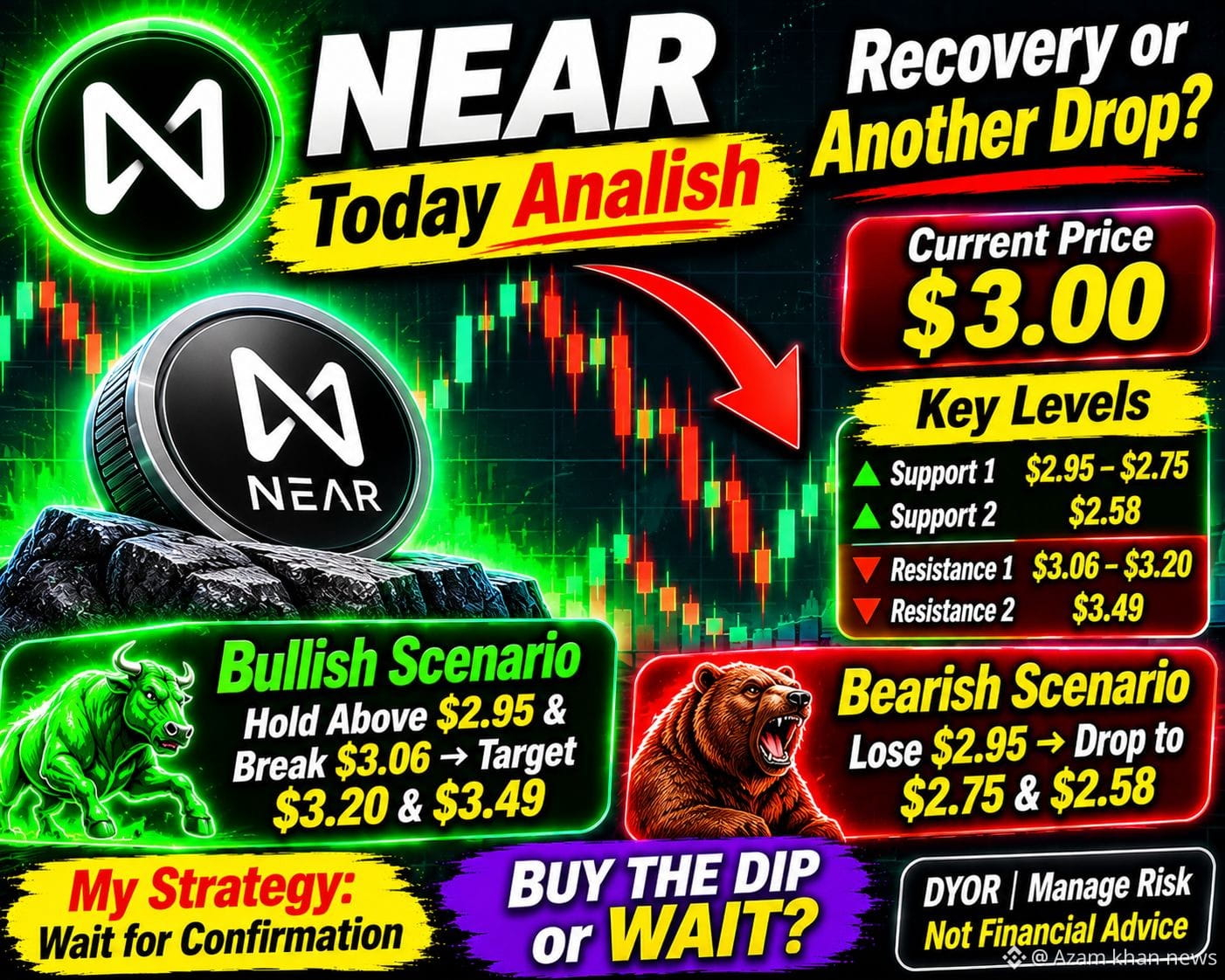
NEAR is trading around $3.00 after a recent decline. Buyers are attempting to stabilize the price, but the daily trend remains bearish. 👀
📊 Key Levels I'm Watching:
🟢 Support: $2.95 – $2.75
🔴 Resistance: $3.06 – $3.20
🎯 Major Resistance: $3.49
Bullish Scenario 🚀
Holding above $2.95 and breaking $3.06 could open the door toward $3.20 and potentially $3.49.
Bearish Scenario 📉
If NEAR loses $2.95, sellers could push the price toward $2.75 and $2.58.
My strategy: I'm watching for a confirmed breakout before considering a bullish entry. No FOMO!
🔥 What's your move on $NEAR — BUY THE DIP or WAIT FOR CONFIRMATION?
DYOR | Manage Risk | Not Financial Advice.
#Near #NEARProtocol #crypto #BinanceSquare
🚨 $NEAR — CAN BUYERS FINALLY TAKE CONTROL?
NEAR is trading around $3.00 after a recent decline. Buyers are attempting to stabilize the price, but the daily trend remains bearish. 👀
📊 Key Levels I'm Watching:
🟢 Support: $2.95 – $2.75
🔴 Resistance: $3.06 – $3.20
🎯 Major Resistance: $3.49
Bullish Scenario 🚀
Holding above $2.95 and breaking $3.06 could open the door toward $3.20 and potentially $3.49.
Bearish Scenario 📉
If NEAR loses $2.95, sellers could push the price toward $2.75 and $2.58.
My strategy: I'm watching for a confirmed breakout before considering a bullish entry. No FOMO!
🔥 What's your move on $NEAR — BUY THE DIP or WAIT FOR CONFIRMATION?
DYOR | Manage Risk | Not Financial Advice.
#Near #NEARProtocol #crypto #BinanceSquare
1
243


·
--

Article
NEAR Is Buying Back Tokens. But Can Its Revenue Keep Up With Supply?NEAR has spent years building technology to make different blockchains work together.
Now there's something more concrete to examine: actual trading revenue.
And the timing is interesting.
NEAR recently approved another reduction in token issuance, while its cross-chain trading product has started generating money that can be used to purchase NEAR.
The question is whether those two developments can meaningfully change the token's economics.
Let's start with NEAR Intents.
The idea is fairly simple. Instead of manually choosing bridges, networks, and trading routes, users specify the asset they want to receive.
Competing solvers handle the execution.
Someone swapping assets between Bitcoin, Ethereum, and Solana doesn't need to manage every step themselves.
That convenience has attracted real trading activity.
According to DeFiLlama-based research, NEAR Intents processed approximately $3.99 billion in volume during October 2026.
Of the fees collected, around $2.19 million was retained by the protocol.
That second number is the one I'd pay closer attention to.
A trading system can process billions in volume while keeping only a small fraction of the fees.
The amount it actually retains is what determines how much value can support token purchases.
In February 2026, NEAR introduced a mechanism directing captured Intents revenue toward open-market NEAR buybacks.
By November 21, approximately 2.38 million NEAR was sitting in the buyback wallet, according to on-chain tracking compiled by BlockPinned.
Those tokens had not been burned.
That distinction matters.
The buybacks create demand, but tokens held in a wallet are still part of total supply. They shouldn't be treated as permanently destroyed.
There's another development worth examining.
On November 16, NEAR announced that governance proposal HSP-029 had been ratified.
The proposal would gradually reduce the maximum annual issuance rate from 2.5% to 1.6% over 24 months.
But it hasn't taken effect yet.
Validators still need to adopt the required protocol upgrade, with the reduction scheduled to begin after a grace period.
Lower issuance could reduce dilution for holders who don't stake.
It also means lower newly issued rewards for validators and stakers over time.
That's a tradeoff worth discussing, especially for a proof-of-stake network that depends on those participants for security.
Here's where the economics get interesting.
NEAR Intents is generating fees that can fund buybacks. Meanwhile, governance is working toward reducing the creation of new tokens.
If both develop as planned, the balance between new supply and recurring demand could improve.
But we're not at the point where Intents revenue consistently offsets the network's entire issuance.
There's still a considerable gap.
And I wouldn't assume trading volume will keep growing every month.
Competition for cross-chain execution is intense. Wallets, aggregators, bridges, and exchanges all want to make trading between networks easier.
NEAR also needs to prove that it can retain a meaningful share of fees without making its service less competitive.
The recent integration with Talos is worth watching here.
Announced on November 9, it allows institutional trading desks using Talos' order management infrastructure to access cross-chain liquidity through NEAR Intents.
That's a useful distribution channel, although an integration alone doesn't tell us how much recurring volume those institutions will generate.
For me, the next numbers to watch are retained Intents fees, actual NEAR purchases, token issuance, and whether institutional integrations bring sustained activity.
NEAR finally has a revenue mechanism investors can measure.
Now it needs to show that revenue can grow enough to matter against the token's supply.
#NEAR #NEARProtocol $NEAR
{future}(NEARUSDT)
NEAR Is Buying Back Tokens. But Can Its Revenue Keep Up With Supply?
NEAR has spent years building technology to make different blockchains work together.
Now there's something more concrete to examine: actual trading revenue.
And the timing is interesting.
NEAR recently approved another reduction in token issuance, while its cross-chain trading product has started generating money that can be used to purchase NEAR.
The question is whether those two developments can meaningfully change the token's economics.
Let's start with NEAR Intents.
The idea is fairly simple. Instead of manually choosing bridges, networks, and trading routes, users specify the asset they want to receive.
Competing solvers handle the execution.
Someone swapping assets between Bitcoin, Ethereum, and Solana doesn't need to manage every step themselves.
That convenience has attracted real trading activity.
According to DeFiLlama-based research, NEAR Intents processed approximately $3.99 billion in volume during October 2026.
Of the fees collected, around $2.19 million was retained by the protocol.
That second number is the one I'd pay closer attention to.
A trading system can process billions in volume while keeping only a small fraction of the fees.
The amount it actually retains is what determines how much value can support token purchases.
In February 2026, NEAR introduced a mechanism directing captured Intents revenue toward open-market NEAR buybacks.
By November 21, approximately 2.38 million NEAR was sitting in the buyback wallet, according to on-chain tracking compiled by BlockPinned.
Those tokens had not been burned.
That distinction matters.
The buybacks create demand, but tokens held in a wallet are still part of total supply. They shouldn't be treated as permanently destroyed.
There's another development worth examining.
On November 16, NEAR announced that governance proposal HSP-029 had been ratified.
The proposal would gradually reduce the maximum annual issuance rate from 2.5% to 1.6% over 24 months.
But it hasn't taken effect yet.
Validators still need to adopt the required protocol upgrade, with the reduction scheduled to begin after a grace period.
Lower issuance could reduce dilution for holders who don't stake.
It also means lower newly issued rewards for validators and stakers over time.
That's a tradeoff worth discussing, especially for a proof-of-stake network that depends on those participants for security.
Here's where the economics get interesting.
NEAR Intents is generating fees that can fund buybacks. Meanwhile, governance is working toward reducing the creation of new tokens.
If both develop as planned, the balance between new supply and recurring demand could improve.
But we're not at the point where Intents revenue consistently offsets the network's entire issuance.
There's still a considerable gap.
And I wouldn't assume trading volume will keep growing every month.
Competition for cross-chain execution is intense. Wallets, aggregators, bridges, and exchanges all want to make trading between networks easier.
NEAR also needs to prove that it can retain a meaningful share of fees without making its service less competitive.
The recent integration with Talos is worth watching here.
Announced on November 9, it allows institutional trading desks using Talos' order management infrastructure to access cross-chain liquidity through NEAR Intents.
That's a useful distribution channel, although an integration alone doesn't tell us how much recurring volume those institutions will generate.
For me, the next numbers to watch are retained Intents fees, actual NEAR purchases, token issuance, and whether institutional integrations bring sustained activity.
NEAR finally has a revenue mechanism investors can measure.
Now it needs to show that revenue can grow enough to matter against the token's supply.
#NEAR #NEARProtocol $NEAR
3
436

·
--
$NEAR
NEAR showed relative strength in the latest daily market snapshot, but its weekly performance remained negative. That contrast is important: one positive session does not confirm a recovery. Traders should watch sustained volume, broader market direction, and ecosystem activity.
#NEAR #NEARProtocol #crypto
87

·
--
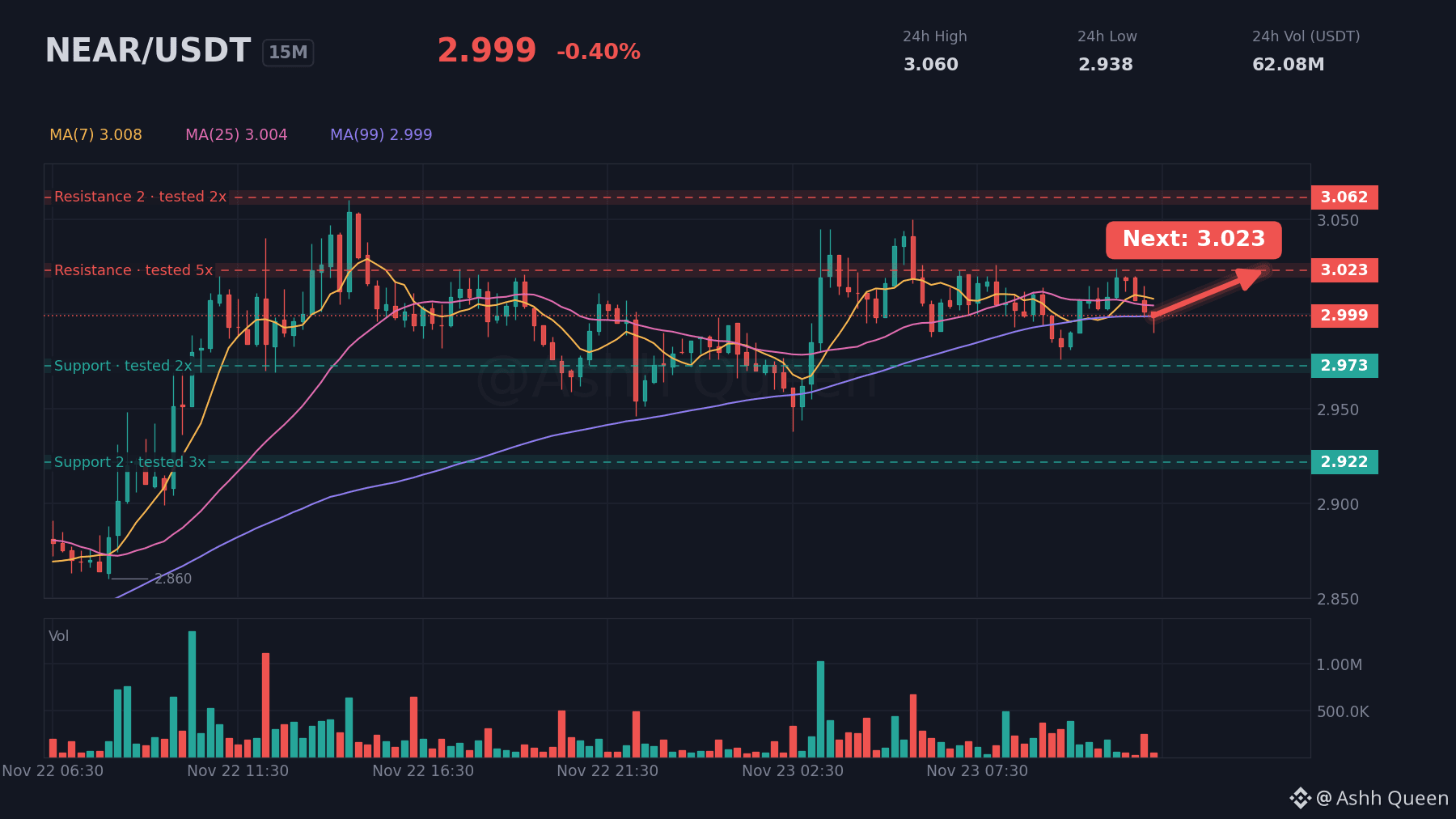
$NEAR is stuck in a tight squeeze 🔍
Does the price hold support at 2.973, or will it finally push through resistance at 3.023? 💡
Which direction are you watching?
#NEAR #NEARProtocol #CryptoAnalysis #Layer1
Risk note: leverage magnifies losses. Plan the exit before the entry.
$NEAR is stuck in a tight squeeze 🔍
Does the price hold support at 2.973, or will it finally push through resistance at 3.023? 💡
Which direction are you watching?
#NEAR #NEARProtocol #CryptoAnalysis #Layer1
Risk note: leverage magnifies losses. Plan the exit before the entry.
Does the price hold support at 2.973, or will it finally push through resistance at 3.023? 💡
Which direction are you watching?
#NEAR #NEARProtocol #CryptoAnalysis #Layer1
Risk note: leverage magnifies losses. Plan the exit before the entry.
4

·
--
$NEAR is pumping into a weak trend. ⚠️
Price is $2.98, up 3.87% in 24h, with $66.26M traded. The 4h move is real, but RSI sits at 48 and volume is only 0.1x the 20-day average. That is not breakout fuel.
Here’s the part that burns traders: NEAR is still below both the 20d and 50d moving averages, 38% below its 30d high, while longs are paying funding. $SOL can rally cleanly in this tape. NEAR still has to prove it can reclaim structure.
At $3.00, I’d be watching, not chasing. A clean hold with volume changes the setup. Without that, this is just a bounce inside a bigger downtrend. 📉
#NEARProtocol #Layer1
58

·
--
NEAR is leading today's relief bounce — and this time the move has a real fundamental driver behind it.
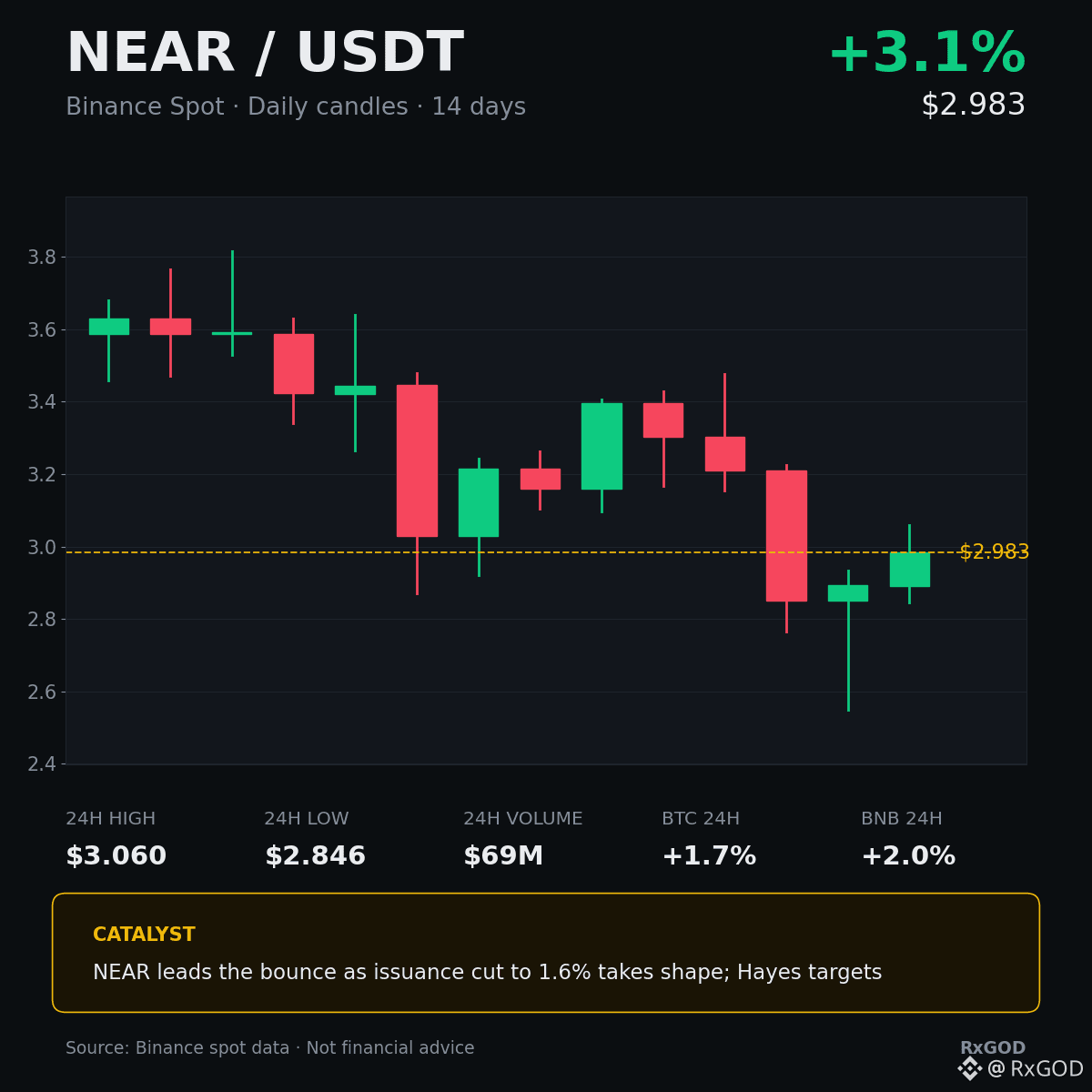
$NEAR is trading at $2.98, up 3.11% in 24 hours on $69.1M of Binance spot volume, the strongest liquid gainer among major coins today. It has reclaimed its 200-day average near $2.74 after briefly slipping below it during the weekend flush, while $BTC holds above $61,000 (+1.56%) and the Fear & Greed Index sits at 8 — still Extreme Fear. $BNB is firm too at $559 (+1.88%).
The catalyst is supply, not hype. NEAR's House of Stake ratified proposal HSP-029 on November 16, cutting maximum annual issuance from 2.5% to 1.6% over 24 months — a change modelled to avoid roughly 11.8 million NEAR of new issuance over two years. The cut takes effect one quarter after ratification, pending a validator upgrade. BitMEX co-founder Arthur Hayes added fuel on November 17 with a $6 price target for NEAR. Meanwhile NEAR Intents keeps growing: its SHIELD security layer blocked 99.7% of laundering flows — over $50 million — after the September Bitget hack, and Intents daily volume averaged about $134 million in November.
Honest check: this is a bounce inside a downtrend, not a breakout. NEAR is still down 17.8% over 14 days and roughly 40% over the past month, sitting at just 34% of its 14-day range, with resistance near $3.50. A failed hold above $2.74 would reopen the lows.
Not financial advice — DYOR.
#NEARProtocol #BTCReboundsAbove$60KAmidWhaleDipBuying #ExtremeFear #CryptoNews
130

·
--
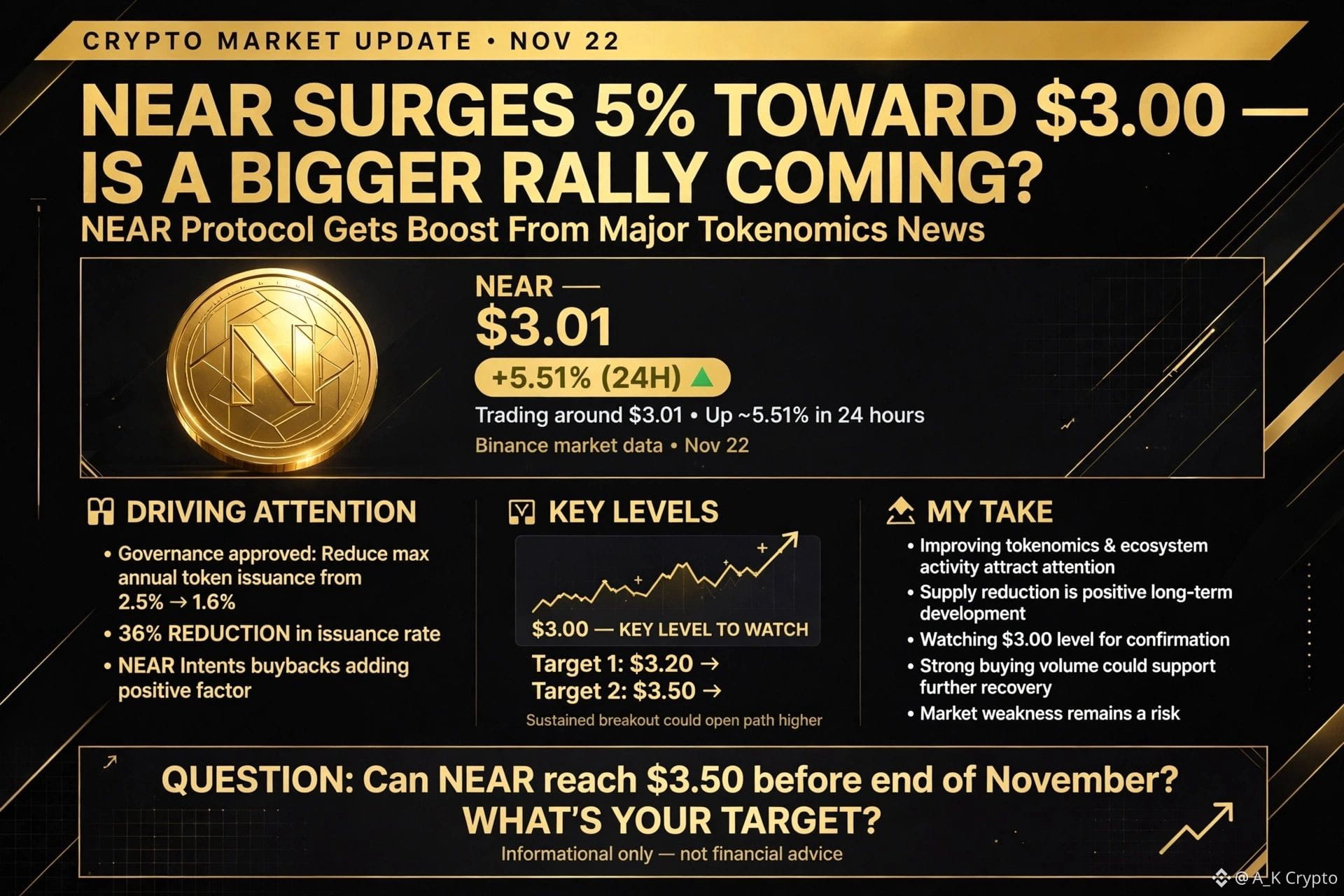
$NEAR SURGES 5% TOWARD $3.00 — IS A BIGGER RALLY COMING? 🚀
$NEAR Protocol Gets a Boost From Major Tokenomics News!
NEAR is showing strong recovery momentum today, trading around $3.01, up approximately 5.51% in 24 hours, according to Binance market data on November 22.
Here's what is driving attention:
🔹 NEAR governance approved a proposal to reduce maximum annual token issuance from 2.5% to 1.6%.
🔹 The change represents a 36% reduction in the issuance rate.
🔹 NEAR Intents buybacks are adding another positive factor.
🔹 $3.00 is an important level to watch.
🔹 A sustained breakout could open the way toward $3.20 and $3.50.
NEAR has an interesting opportunity as improving tokenomics and ecosystem activity attract attention. The proposed supply reduction is a positive long-term development, but price confirmation still matters. I am watching the $3.00 level closely. Strong buying volume could support further recovery, while market weakness remains a risk.
$NEAR
Can NEAR reach $3.50 before the end of November? What's your target?
#NEAR #NEARProtocol #CryptoMarket #BinanceSquare
{spot}(NEARUSDT)
$NEAR SURGES 5% TOWARD $3.00 — IS A BIGGER RALLY COMING? 🚀
$NEAR Protocol Gets a Boost From Major Tokenomics News!
NEAR is showing strong recovery momentum today, trading around $3.01, up approximately 5.51% in 24 hours, according to Binance market data on November 22.
Here's what is driving attention:
🔹 NEAR governance approved a proposal to reduce maximum annual token issuance from 2.5% to 1.6%.
🔹 The change represents a 36% reduction in the issuance rate.
🔹 NEAR Intents buybacks are adding another positive factor.
🔹 $3.00 is an important level to watch.
🔹 A sustained breakout could open the way toward $3.20 and $3.50.
NEAR has an interesting opportunity as improving tokenomics and ecosystem activity attract attention. The proposed supply reduction is a positive long-term development, but price confirmation still matters. I am watching the $3.00 level closely. Strong buying volume could support further recovery, while market weakness remains a risk.
$NEAR
Can NEAR reach $3.50 before the end of November? What's your target?
#NEAR #NEARProtocol #CryptoMarket #BinanceSquare
106

·
--
Bullish
🚀 NEAR Protocol (NEAR) – Trading Setup
📊 Market Outlook: Bullish Momentum
🟢 Long Entry: $2.75 – $2.85
🎯 TP1: $3.00
🎯 TP2: $3.20
🎯 TP3: $3.50
🔴 Short Entry: Below $2.70
🎯 Short TP: $2.55 – $2.40
🛑 Stop Loss: 2%–3% beyond entry invalidation.
Watch volume and confirmation before entering. Never risk more than you can afford to lose.
#NEAR #NEARProtocol #CryptoTrading #BinanceSquare

1
423

·
--
Bullish
Hot Coin #6 + Coin Futures #1 — $NEAR knocking on the $3.00 breakout door! 🔥
Guys, I’m opening a LONG on $NEAR here.
TP: $3.22
SL: $2.86
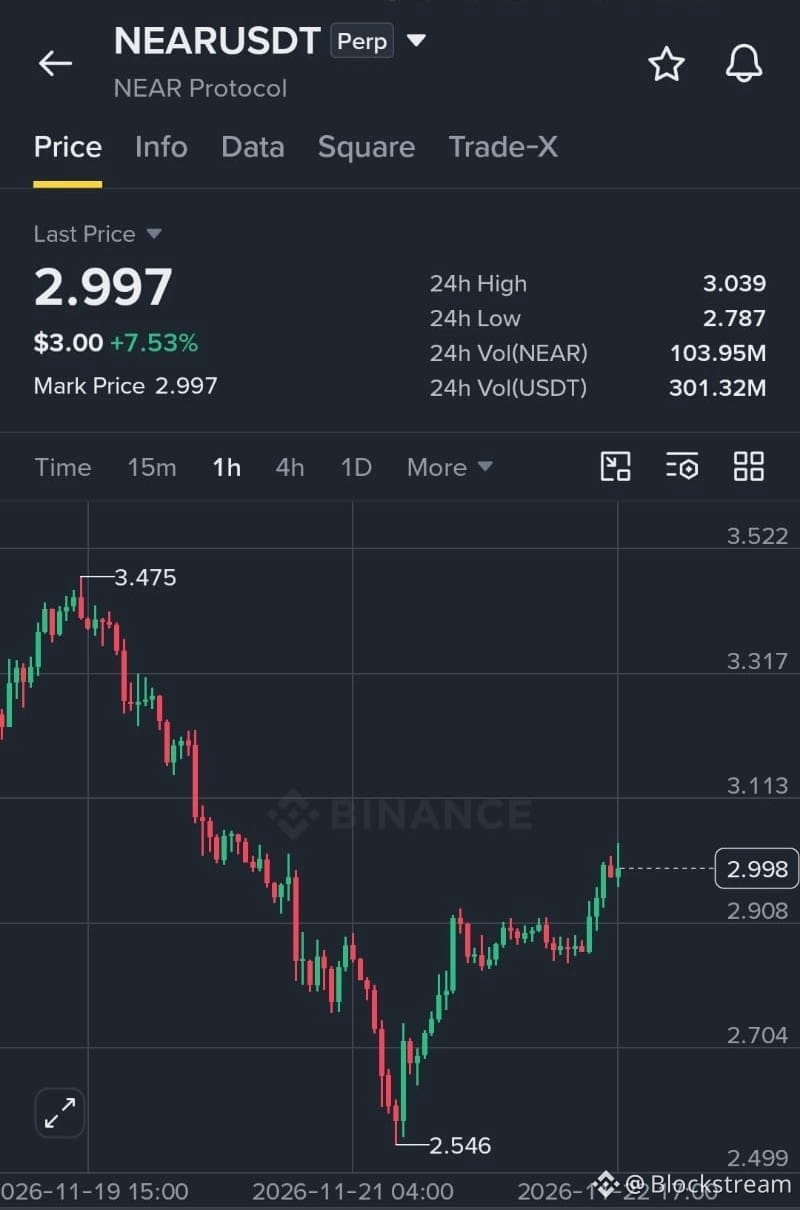
$NEAR bounced cleanly off the $2.546 swing low, built a strong 1H higher-low base around $2.80–$2.90, and is now pressing right against the $3.00 psychological level and $3.039 24h high on $301.32M in 24h volume. A clean 1H hold above $2.95 opens the next leg toward $3.11 and $3.22. Using 5x–10x max leverage with a strict SL below higher-low support at $2.86.
{spot}(NEARUSDT)
#Near #nearprotocol
Hot Coin #6 + Coin Futures #1 — $NEAR knocking on the $3.00 breakout door! 🔥
Guys, I’m opening a LONG on $NEAR here.
TP: $3.22
SL: $2.86
$NEAR bounced cleanly off the $2.546 swing low, built a strong 1H higher-low base around $2.80–$2.90, and is now pressing right against the $3.00 psychological level and $3.039 24h high on $301.32M in 24h volume. A clean 1H hold above $2.95 opens the next leg toward $3.11 and $3.22. Using 5x–10x max leverage with a strict SL below higher-low support at $2.86.
#Near #nearprotocol
Babur Crypto:
Solid entry bro, $2.997 breakout with SL at $2.86 is a clean risk setup. That $3.00-$3.02 retest hold will be the real confirmation. If it holds, $3.22 is definitely in play. Good luck with the trade 🔥
6
3
1.1k

·
--
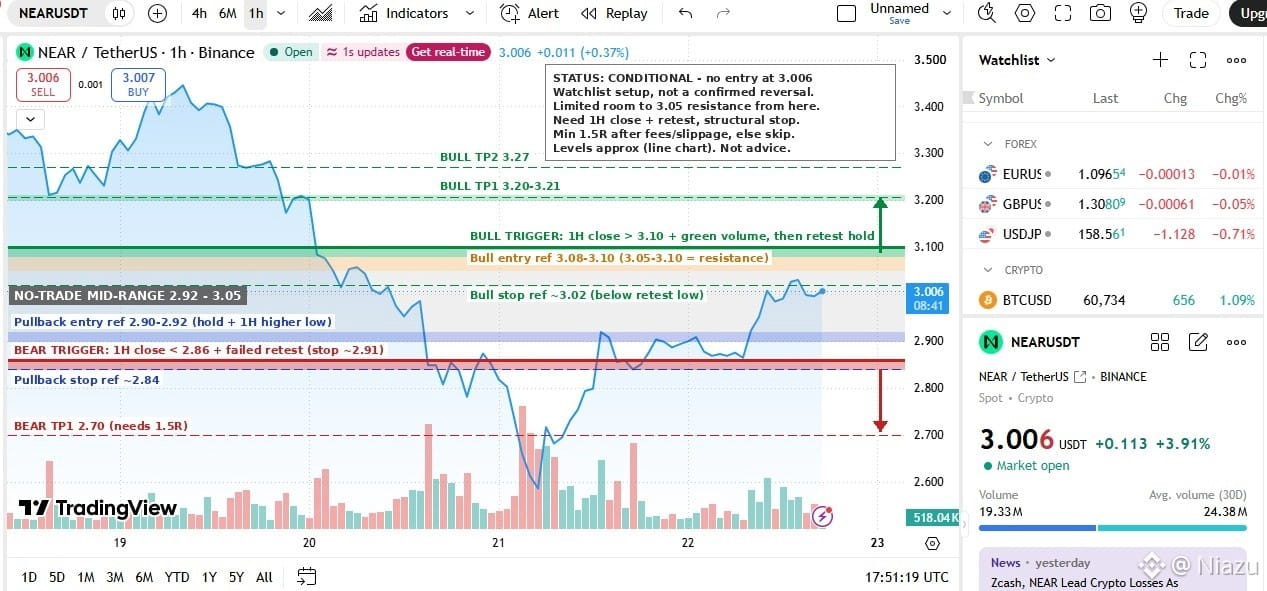
**$NEAR — WILL $3.10 BREAK OR $2.90 HOLD?**
NEAR is around $3.006 after a flush to $2.585 and a recovery into $2.92–$3.05. Higher lows are building, but price is still below broken support at $3.05–$3.10. This is a watchlist setup, not a confirmed reversal.
**Bullish breakout**
- Trigger: 1H close above $3.10, then a retest that holds
- Entry: $3.08–$3.10 | Stop: ~$3.02
- Targets: $3.20–$3.21, then $3.27
**Pullback long**
- Trigger: dip into $2.90–$2.92 with a 1H higher low
- Entry: $2.90–$2.92 | Stop: ~$2.84
- Targets: $3.05–$3.10, then $3.20
**Bearish**
- Trigger: 1H close below $2.86, then a failed retest
- Entry: $2.84–$2.86 | Stop: ~$2.91
- Target: $2.70
Skip any trade that gives under 1.5R after fees and slippage.
**My take:** no entry at $3.006. It's mid-range, with little room to $3.05 resistance. Wait for a confirmed 1H close and retest, use a structural stop, and size down.
Levels are approximate from a line chart. Confirm with candlesticks.
**Status:** conditional
💬 Will NEAR reclaim $3.10 first, or pull back to $2.90? 👇
$NEAR #NEARProtocol #CryptoTrading #BinanceSquare
182

·
--
Article
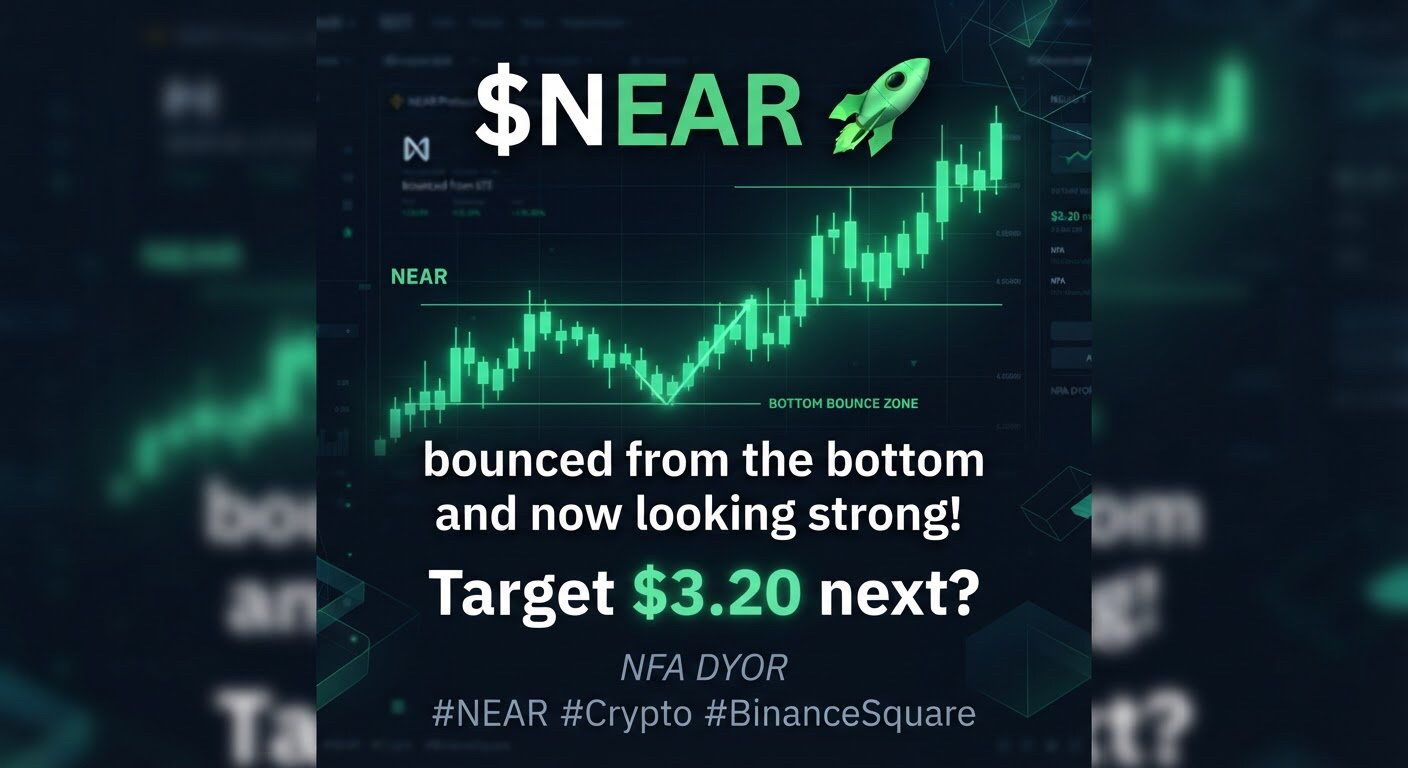
Is $NEAR Gearing Up for a Major Breakout? 🚀After finding solid support at the bottom, $NEAR has staged an impressive bounce and is showing strong bullish momentum on the charts. Buyers stepped in aggressively at the lows, shifting the short-term market structure and sparking renewed interest across the altcoin space.
With volume picking up and market sentiment turning positive, the big question on every trader's mind is: Is $3.20 the next major target?
If $NEAR can hold its current support levels and break through immediate overhead resistance, a push toward the $3.20 zone looks increasingly realistic in the coming sessions. However, as always in crypto, watching how price reacts at key resistance levels will be crucial before jumping in.
What’s your game plan here? Are you holding your bags, adding to your position on dips, or waiting for a confirmed breakout before entering?
Drop your price targets and chart thoughts in the comments below! 👇
Disclaimer: Not Financial Advice (NFA). Always Do Your Own Research (DYOR) and manage your risk accordingly.
#NEAR #nearprotocol #Crypto #Altcoins#Altcoins #TechnicalAnalysis #BinanceSquare #writetoearn
$NEAR
{spot}(NEARUSDT)
$XRP
{spot}(XRPUSDT)
Is $NEAR Gearing Up for a Major Breakout? 🚀
After finding solid support at the bottom, $NEAR has staged an impressive bounce and is showing strong bullish momentum on the charts. Buyers stepped in aggressively at the lows, shifting the short-term market structure and sparking renewed interest across the altcoin space.
With volume picking up and market sentiment turning positive, the big question on every trader's mind is: Is $3.20 the next major target?
If $NEAR can hold its current support levels and break through immediate overhead resistance, a push toward the $3.20 zone looks increasingly realistic in the coming sessions. However, as always in crypto, watching how price reacts at key resistance levels will be crucial before jumping in.
What’s your game plan here? Are you holding your bags, adding to your position on dips, or waiting for a confirmed breakout before entering?
Drop your price targets and chart thoughts in the comments below! 👇
Disclaimer: Not Financial Advice (NFA). Always Do Your Own Research (DYOR) and manage your risk accordingly.
#NEAR #nearprotocol #Crypto #Altcoins#Altcoins #TechnicalAnalysis #BinanceSquare #writetoearn
$NEAR
$XRP
1
2
432
·
--
$NEAR
NEAR Protocol has focused on making blockchain applications easier to build and use. User experience is often overlooked in crypto, yet it can determine whether technology reaches beyond early adopters. Developer tools, application quality, and repeat usage are essential indicators of ecosystem strength.
#NEAR #NEARProtocol #Web3
20

🚀 NEAR/USDT – BULLISH SETUP! 🟢🔥
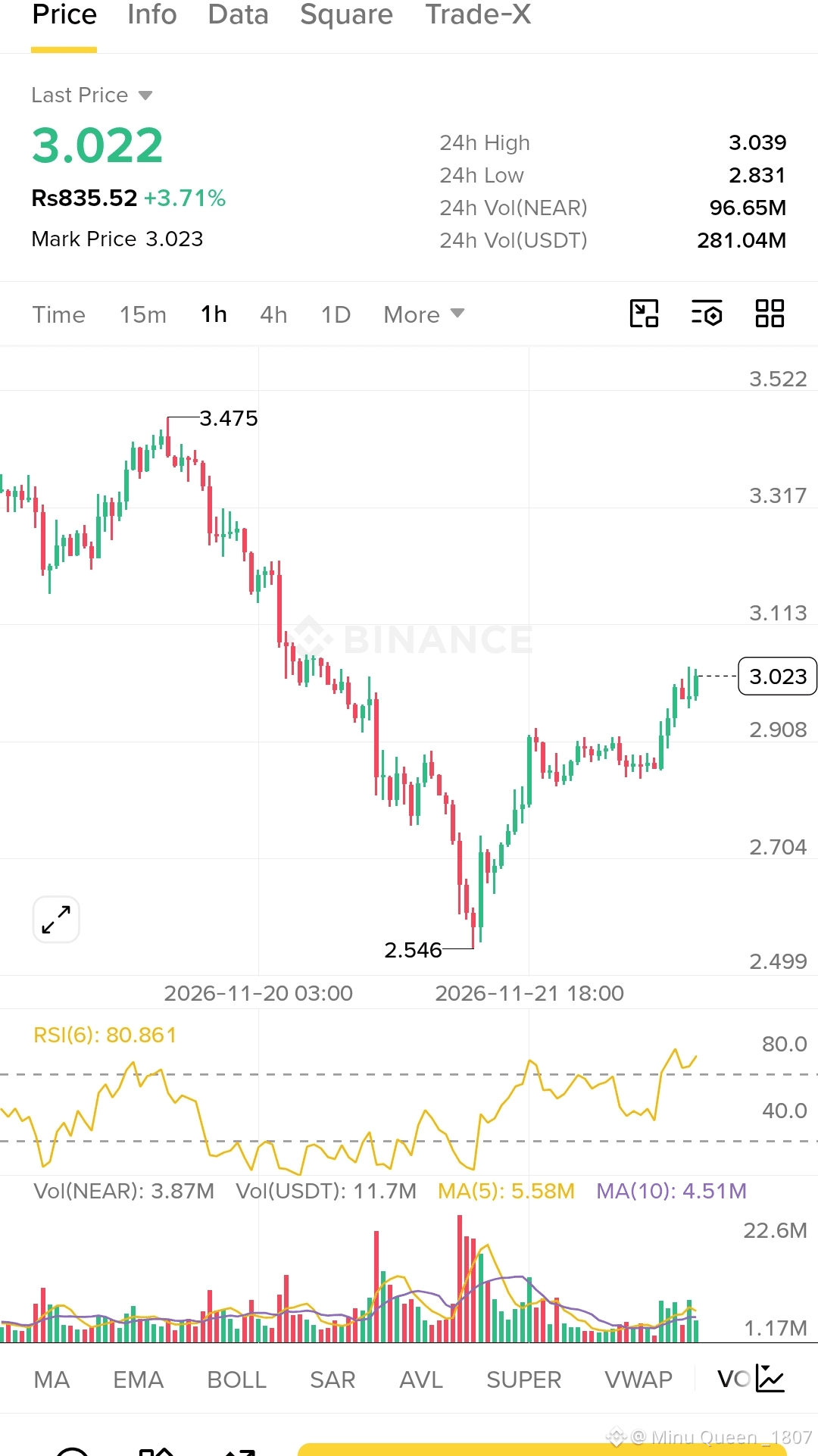
💰 Current Price: $3.022
📊 SPOT LONG SIGNAL
- 🎯 Entry: $2.90 – $2.95
- 🥇 TP1: $3.04
- 🥈 TP2: $3.11
- 🥉 TP3: $3.30
- 🛑 SL: $2.82
🔥 Analysis:
NEAR bounced strongly from $2.546 and reclaimed the $3.00 level. Bulls are gaining momentum, but RSI is near 80, so a pullback is possible. Watch $3.039 resistance for a breakout!
⚠️ Don't FOMO. Wait for confirmation and manage risk!
#NEARProtocol #NEARUSDT #CryptoTrading #AltcoinSeason #BinanceSquare
{future}(NEARUSDT)
🚀 NEAR/USDT – BULLISH SETUP! 🟢🔥
💰 Current Price: $3.022
📊 SPOT LONG SIGNAL
- 🎯 Entry: $2.90 – $2.95
- 🥇 TP1: $3.04
- 🥈 TP2: $3.11
- 🥉 TP3: $3.30
- 🛑 SL: $2.82
🔥 Analysis:
NEAR bounced strongly from $2.546 and reclaimed the $3.00 level. Bulls are gaining momentum, but RSI is near 80, so a pullback is possible. Watch $3.039 resistance for a breakout!
⚠️ Don't FOMO. Wait for confirmation and manage risk!
#NEARProtocol #NEARUSDT #CryptoTrading #AltcoinSeason #BinanceSquare
368

NEAR, UNI and ENA Crypto Market Analysis: A Strong Bounce Meets a Tough Trend TestThe latest crypto market session has brought a welcome rebound across several altcoins, with NEAR Protocol, Uniswap and Ethena all posting notable gains. The green numbers are attracting attention, and rightly so. However, the story beneath the surface is more nuanced than a simple recovery rally.
NEAR, UNI and ENA are all showing renewed buying interest after sharp multi week declines. Their daily momentum has improved, capital flow has turned positive, and prices have moved away from recent lows. Yet each asset remains below key moving averages, while daily MACD and SuperTrend indicators continue to show bearish broader structures. This makes the current move important, but not yet a confirmed market reversal.
NEAR Protocol is trading near $2.991, up +8.13% over the latest 24 hour period. It reached an intraday high of $3.020 after opening near $2.766, showing strong buyer activity through the session. NEAR has also seen a positive daily capital inflow of 2.45M NEAR, with a 9.48% net inflow rate. That suggests market participants are returning as the price moves higher.
The technical picture is improving, but it remains mixed. NEAR’s daily RSI has recovered to 36.02 from 27.81, indicating that recent oversold pressure has eased. At the same time, the asset is still below its 7 day, 25 day and 99 day moving averages, while MACD remains bearish and SuperTrend continues to point down. NEAR is also down 38.76% over the last 30 days, which underlines how much ground remains to be recovered before the market can call this a sustained trend shift.
For NEAR, the key question is whether today’s strength can develop into consecutive higher lows backed by improving volume. Current volume is only 0.43 times its 7 day average, so follow through participation matters as much as the price rebound itself.
Uniswap is trading near $4.746, up +6.89% over 24 hours after touching a high of $4.789. UNI’s recovery is notable because it follows a broader 30 day decline of 32.29%. The asset has bounced from a recent low range, while daily capital flow shows a positive inflow of 417.33K UNI and an 11.32% net inflow rate.
UNI’s daily RSI is currently 30.89, close to oversold territory, suggesting that sellers have been active but may be losing some control. The latest session has helped stabilize price, yet the broader technical setup remains cautious. UNI trades below its 7 day moving average of $4.94, its 25 day moving average of $6.16 and its 99 day moving average of $6.71. MACD remains bearish, and SuperTrend stays in a downward direction.
The current recovery in UNI is therefore best viewed as a test of demand rather than a completed trend reversal. Uniswap remains one of the most closely watched names in decentralized finance, so a sustained recovery in trading activity and market liquidity could support broader attention. Still, volume in the current session is only 0.31 times the 7 day average, meaning stronger market participation would be needed to validate a more durable move.
Ethena is trading near $0.1025, up +7.89% over the latest 24 hours, after reaching an intraday high of $0.1033. ENA is the most volatile asset in this group. It has declined 48.31% over the past 30 days, while its current price remains 52.94% below the 30 day range high. This highlights both the scale of its recent correction and the sensitivity of the asset to changing market sentiment.
ENA’s RSI has improved sharply to 25.69 from 15.60, but it remains in oversold territory. That reflects strong recent selling pressure, while also explaining why the rebound has attracted attention. The asset recorded a positive daily capital inflow of 13.96M ENA, with a 9.21% net inflow rate, showing increased buyer participation during the current recovery.
Even so, ENA remains below its 7 day, 25 day and 99 day moving averages. Daily MACD is bearish, and SuperTrend remains downward. The current session volume is only 0.32 times its 7 day average, so the market will need to see stronger follow through before treating the bounce as a wider structural recovery.
The wider takeaway is clear. NEAR, UNI and ENA are all experiencing a meaningful short term rebound, supported by improving RSI readings and positive capital flow. NEAR is showing the strongest daily percentage move among the three, UNI is attempting to stabilize after its DeFi sector correction, and ENA remains the highest risk and highest volatility setup after its steep drawdown.
For traders following NEAR Protocol, Uniswap and Ethena, the focus should stay on market confirmation. Higher lows, sustained volume, continued capital inflows and price strength relative to key moving averages would strengthen the recovery case. Without those signals, sharp intraday swings and profit taking could remain a defining feature of this market phase.
#NEARProtocol #Uniswap #Ethena #CryptoMarket #CryptoAnalysis
$NEAR
{spot}(NEARUSDT)
$UNI
{spot}(UNIUSDT)
$ENA
{spot}(ENAUSDT)
NEAR, UNI and ENA Crypto Market Analysis: A Strong Bounce Meets a Tough Trend Test
The latest crypto market session has brought a welcome rebound across several altcoins, with NEAR Protocol, Uniswap and Ethena all posting notable gains. The green numbers are attracting attention, and rightly so. However, the story beneath the surface is more nuanced than a simple recovery rally.
NEAR, UNI and ENA are all showing renewed buying interest after sharp multi week declines. Their daily momentum has improved, capital flow has turned positive, and prices have moved away from recent lows. Yet each asset remains below key moving averages, while daily MACD and SuperTrend indicators continue to show bearish broader structures. This makes the current move important, but not yet a confirmed market reversal.
NEAR Protocol is trading near $2.991, up +8.13% over the latest 24 hour period. It reached an intraday high of $3.020 after opening near $2.766, showing strong buyer activity through the session. NEAR has also seen a positive daily capital inflow of 2.45M NEAR, with a 9.48% net inflow rate. That suggests market participants are returning as the price moves higher.
The technical picture is improving, but it remains mixed. NEAR’s daily RSI has recovered to 36.02 from 27.81, indicating that recent oversold pressure has eased. At the same time, the asset is still below its 7 day, 25 day and 99 day moving averages, while MACD remains bearish and SuperTrend continues to point down. NEAR is also down 38.76% over the last 30 days, which underlines how much ground remains to be recovered before the market can call this a sustained trend shift.
For NEAR, the key question is whether today’s strength can develop into consecutive higher lows backed by improving volume. Current volume is only 0.43 times its 7 day average, so follow through participation matters as much as the price rebound itself.
Uniswap is trading near $4.746, up +6.89% over 24 hours after touching a high of $4.789. UNI’s recovery is notable because it follows a broader 30 day decline of 32.29%. The asset has bounced from a recent low range, while daily capital flow shows a positive inflow of 417.33K UNI and an 11.32% net inflow rate.
UNI’s daily RSI is currently 30.89, close to oversold territory, suggesting that sellers have been active but may be losing some control. The latest session has helped stabilize price, yet the broader technical setup remains cautious. UNI trades below its 7 day moving average of $4.94, its 25 day moving average of $6.16 and its 99 day moving average of $6.71. MACD remains bearish, and SuperTrend stays in a downward direction.
The current recovery in UNI is therefore best viewed as a test of demand rather than a completed trend reversal. Uniswap remains one of the most closely watched names in decentralized finance, so a sustained recovery in trading activity and market liquidity could support broader attention. Still, volume in the current session is only 0.31 times the 7 day average, meaning stronger market participation would be needed to validate a more durable move.
Ethena is trading near $0.1025, up +7.89% over the latest 24 hours, after reaching an intraday high of $0.1033. ENA is the most volatile asset in this group. It has declined 48.31% over the past 30 days, while its current price remains 52.94% below the 30 day range high. This highlights both the scale of its recent correction and the sensitivity of the asset to changing market sentiment.
ENA’s RSI has improved sharply to 25.69 from 15.60, but it remains in oversold territory. That reflects strong recent selling pressure, while also explaining why the rebound has attracted attention. The asset recorded a positive daily capital inflow of 13.96M ENA, with a 9.21% net inflow rate, showing increased buyer participation during the current recovery.
Even so, ENA remains below its 7 day, 25 day and 99 day moving averages. Daily MACD is bearish, and SuperTrend remains downward. The current session volume is only 0.32 times its 7 day average, so the market will need to see stronger follow through before treating the bounce as a wider structural recovery.
The wider takeaway is clear. NEAR, UNI and ENA are all experiencing a meaningful short term rebound, supported by improving RSI readings and positive capital flow. NEAR is showing the strongest daily percentage move among the three, UNI is attempting to stabilize after its DeFi sector correction, and ENA remains the highest risk and highest volatility setup after its steep drawdown.
For traders following NEAR Protocol, Uniswap and Ethena, the focus should stay on market confirmation. Higher lows, sustained volume, continued capital inflows and price strength relative to key moving averages would strengthen the recovery case. Without those signals, sharp intraday swings and profit taking could remain a defining feature of this market phase.
#NEARProtocol #Uniswap #Ethena #CryptoMarket #CryptoAnalysis
$NEAR
$UNI
$ENA
1
56

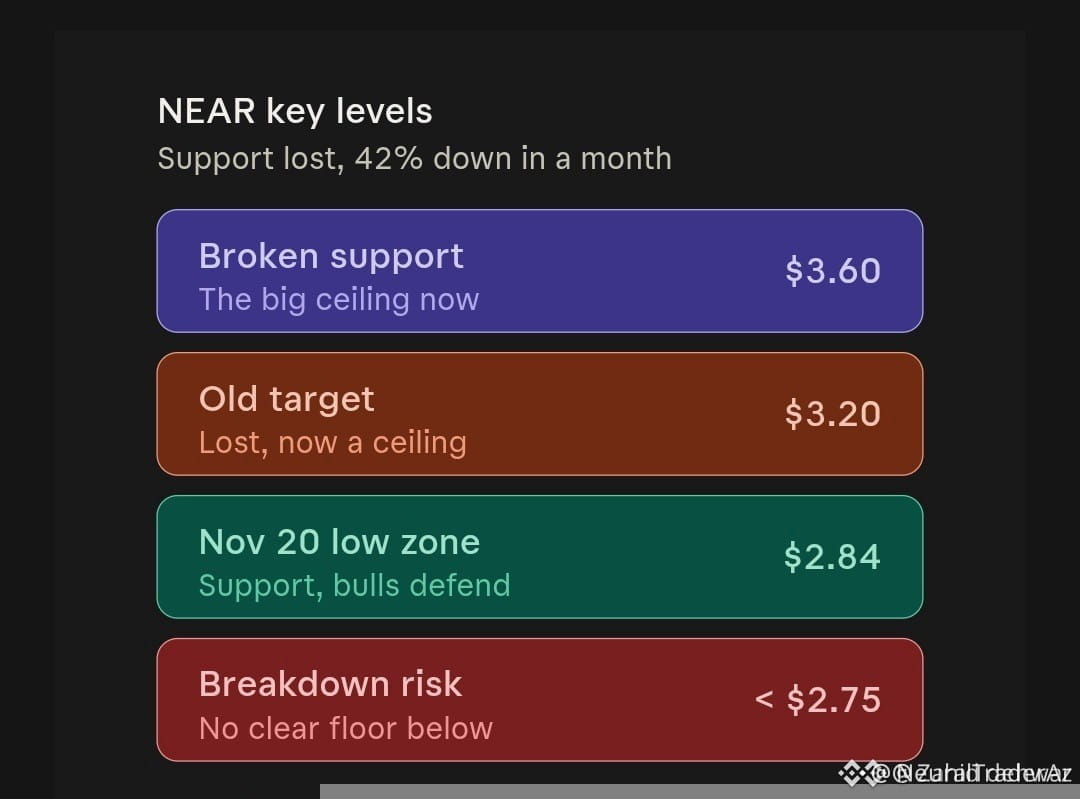
🚨 $NEAR NETWORK METRICS DIVERGE HARD FROM PRICE ACTION AS SMART MONEY WAITS 📉
Entry: 3.20 ⚡
Stop Loss: 2.75 ⚠️
While protocol volume through Intents edges higher to 134 million, structural earnings have compressed and the market is completely ignoring the upcoming supply issuance cut. 📊
Price remains trapped below key overhead resistance as sellers dictate order flow near current lows. ⚡ We refuse to catch falling knives into a vacuum where downside floors are thinning out.
Are you waiting for a confirmed reclaim above resistance or positioning for capitulation? 👇
⚠️ Not financial advice. Always manage your risk. 🛡️
🏷️ #NEAR #NearProtocol #CryptoTrading #MarketStructure
🦈 📊
6

·
--
#NEARUSDT @Square-Creator-fe598de562ef $NEAR
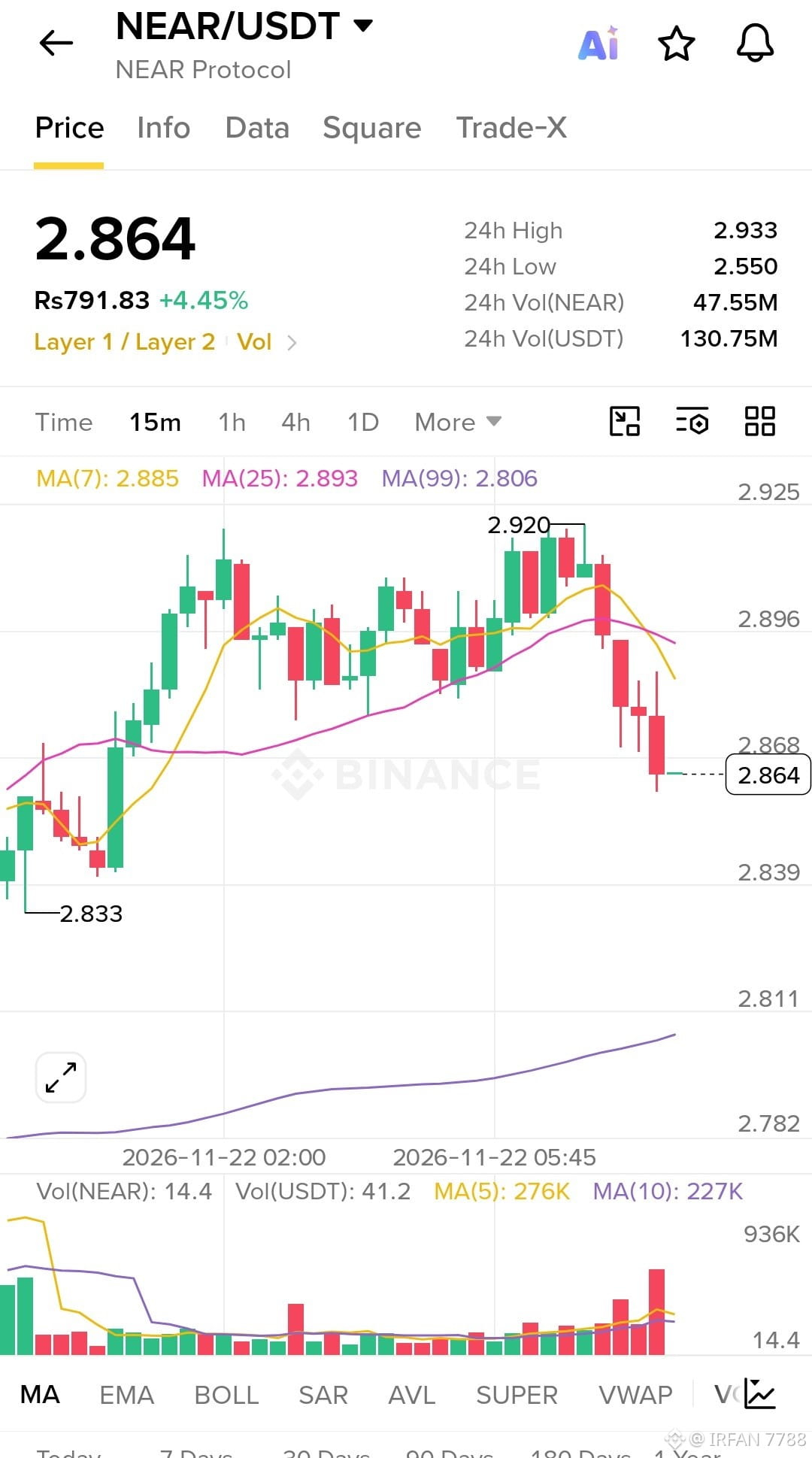
📉 NEAR/USDT – 15M Signal
Signal: SHORT 🔴
Entry: 2.860–2.855
Stop Loss (SL): 2.895
🎯 Take Profit (TP):
TP1: 2.845
TP2: 2.830
TP3: 2.810
Technical Analysis:
Price is below MA7 (2.885).
Price is below MA25 (2.893).
Selling volume is increasing.
Short-term momentum is bearish
#nearprotocol @Square-Creator-2257bb72fe7e5 $NEAR
{future}(NEARUSDT)
#NEARUSDT @Near $NEAR
📉 NEAR/USDT – 15M Signal
Signal: SHORT 🔴
Entry: 2.860–2.855
Stop Loss (SL): 2.895
🎯 Take Profit (TP):
TP1: 2.845
TP2: 2.830
TP3: 2.810
Technical Analysis:
Price is below MA7 (2.885).
Price is below MA25 (2.893).
Selling volume is increasing.
Short-term momentum is bearish
#nearprotocol @_NEAR_ $NEAR
Pa Beaureguard Ltfw:
1
312
16
27
312

·
--
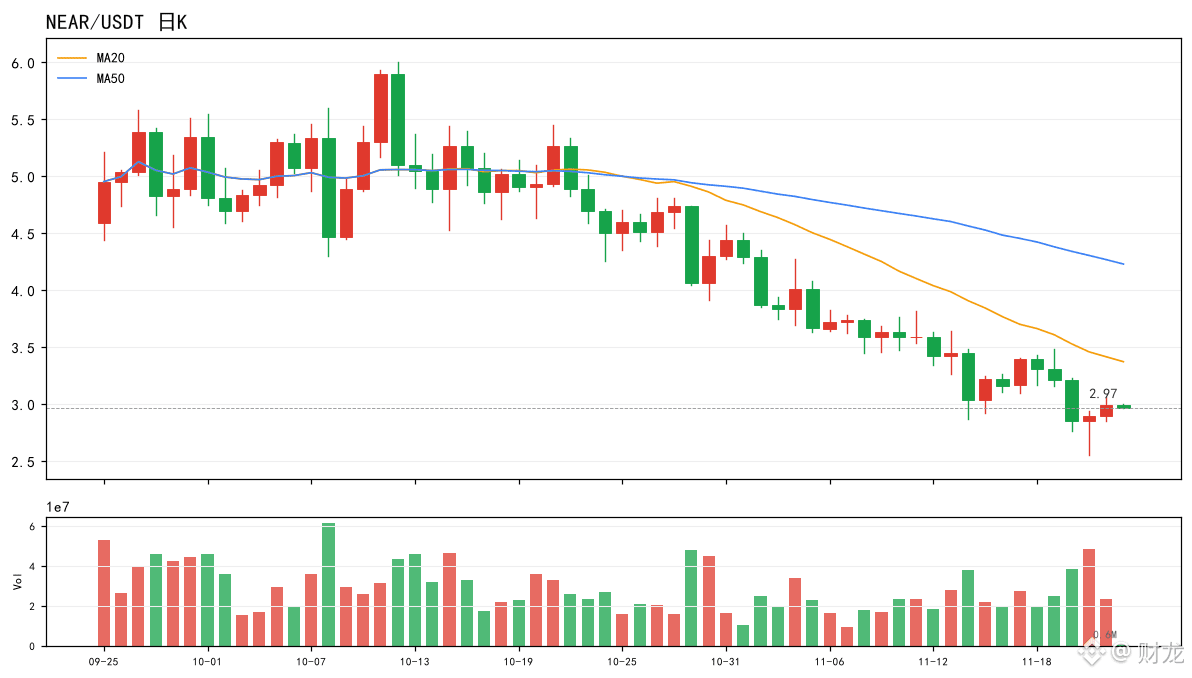
🚨 $NEAR TESTING THE 50-DAY AVERAGE AS SMART MONEY WEIGHS THE NEXT PIVOT! 🦈
Entry: 4.28 ⚡
Target: 4.75 🚀
Price action has successfully compressed into the major 50-day moving average footprint around the 4.28 mark, methodically absorbing excess sell-side pressure from late-stage retail participants. 📊
Institutional order flow requires a decisive structural close above the 4.75 threshold to confirm that the current corrective cycle has fully concluded and trend expansion is unlocked. 💡
💬 Are you positioning ahead of the pivot or waiting for confirmation above resistance? 👇
⚠️ Not financial advice. Always manage your risk. 🛡️
🏷️ #NEAR #NearProtocol #MarketStructure #Crypto
🔥 💎
4

·
--
I just went through the trading volume rankings. NEAR’s trading value today is 69 million, putting it in sixth place. But it’s one of the few in the top ten that had been falling for the past few days and then bounced 2% today. I’m not ready to say it’s turning bullish just yet. I took a look, and it’s slid all the way down from over $3, losing nearly 10%. Set against the whole move, today’s small bullish candle hasn’t even eaten much into the body of the previous bearish candle.
What I care about more, though, is the volume. If volume holds steady and the price stops falling, that usually means selling pressure is easing. But it’s still too early to call a reversal—we’ll have to see whether it can reclaim the highs from the previous few days. I don’t have a position, so I’ll just watch for now.
$NEAR $BTC #nearprotocol
588

·
--
Daily Coin | 022 NEAR Protocol 🧩
How does sharding help public blockchains scale? Learn about NEAR’s use cases, technical features, and changes in supply at a glance 👇
When using on-chain apps, which matters more to you: easy-to-read account names or the transaction experience?
#每日一币 #NEARProtocol $NEAR
For educational purposes only; this is not investment advice.

145

Coin $NEAR posted one of the best rebounds over the weekend (+7–8%), returning to the psychological $3.00 level.
The driver was the final ratification of the annual inflation cut to 1.6% (proposal HSP-029) and active token buybacks from the market using revenue from $NEAR Intents.
Here are the key levels for Monday:
🟢 LONG (holds above $3.00):
• Entry: a firm hold of the $2.85 – $2.92 zone on the 1H/4H timeframes and a high-volume breakout above the daily high of $3.06.
• Targets: $3.20 ➡️ $3.47 ➡️ $3.65 (strong previous resistance zone).
• Stop: a hold below $2.72.
🔴 SHORT (rejection from $3.00+ or loss of support):
• Entry: a false breakout of $3.05 – $3.10 and a return below $2.92 OR an impulsive break below $2.80 followed by a retest from below.
• Targets: $2.56 (recent low) ➡️ $2.45 ➡️ $2.28.
• Stop: a move back above $3.18 and holding there.
⚠️ $NEAR has strong positive fundamentals, but Monday’s open still depends on $BTC price action and spot ETF flows—don’t use excessive leverage.
This is not financial advice (DYOR).
If this analysis helps you start the trading week on the right foot, I’d appreciate a small coffee tip! ☕️👇
#NEAR #NEARProtocol #CryptoTrading #BinanceSquare
{future}(NEARUSDT)
Coin $NEAR posted one of the best rebounds over the weekend (+7–8%), returning to the psychological $3.00 level.
The driver was the final ratification of the annual inflation cut to 1.6% (proposal HSP-029) and active token buybacks from the market using revenue from $NEAR Intents.
Here are the key levels for Monday:
🟢 LONG (holds above $3.00):
• Entry: a firm hold of the $2.85 – $2.92 zone on the 1H/4H timeframes and a high-volume breakout above the daily high of $3.06.
• Targets: $3.20 ➡️ $3.47 ➡️ $3.65 (strong previous resistance zone).
• Stop: a hold below $2.72.
🔴 SHORT (rejection from $3.00+ or loss of support):
• Entry: a false breakout of $3.05 – $3.10 and a return below $2.92 OR an impulsive break below $2.80 followed by a retest from below.
• Targets: $2.56 (recent low) ➡️ $2.45 ➡️ $2.28.
• Stop: a move back above $3.18 and holding there.
⚠️ $NEAR has strong positive fundamentals, but Monday’s open still depends on $BTC price action and spot ETF flows—don’t use excessive leverage.
This is not financial advice (DYOR).
If this analysis helps you start the trading week on the right foot, I’d appreciate a small coffee tip! ☕️👇
#NEAR #NEARProtocol #CryptoTrading #BinanceSquare
7
Log in to explore more content
Join global crypto users on Binance Square
⚡️ Get latest and useful information about crypto.
💬 Trusted by the world’s largest crypto exchange.
👍 Discover real insights from verified creators.
Email / Phone number
Trending Topics
1
#NVIDIAReinstatesJensenHuangasCEO
35,611 views
644 Discussing
2
#WillMarketsStageAThanksgivingReliefRally?
137,691 views
1,722 Discussing
3
#WillOctCorePCEShiftFedHikeExpectations?
52,502 views
725 Discussing
4
#BitcoinEndsRecord17DayStreakOfLowerHighs
8,929 views
218 Discussing
5
#TradersPriceOut50bpDecemberFedHike
6,358 views
130 Discussing
6
#EvolveAtBinanceBlockchainWeek
114,455 views
984 Discussing
7
#TrumpBackedAmericanBitcoinRaisesHoldingsToOver8500BTC
911 views
30 Discussing
8
#MuskWarnsOfAICashCrunch
61,797 views
689 Discussing
9
#TradFiForBeginners
1.1M views
5,984 Discussing
10
#SkyPSMUSDCLiquidityReboundsTo$1.77B
483 views
12 Discussing