
tungtung_bombardiro
71 Posts
tungtung_bombardiro
Frequent Trader
1.3 Years
4 Following
16 Followers
214 Liked
Posts
I read recently that Binance is still fighting for a license in the EU — the transition period is almost over, but there is still no final decision from the regulator. For some, it’s just news, while for others it’s a real question: “what will happen to my account if something goes wrong?”
It seems like this is exactly the moment when it’s worth checking for yourself one more time: am I diversifying platforms, or keeping everything in one place? Not in a panic—just as a risk-management habit.
👇 Do you follow these kinds of regulatory updates at all, or do you trust and not worry?
$BTC #Binance #discussion
It seems like this is exactly the moment when it’s worth checking for yourself one more time: am I diversifying platforms, or keeping everything in one place? Not in a panic—just as a risk-management habit.
👇 Do you follow these kinds of regulatory updates at all, or do you trust and not worry?
$BTC #Binance #discussion
I noticed one more detail while digging into bStocks — the fact that between a regular stock and a bStock you can switch back and forth with no commissions at all. In $SPCXB (and in bStocks in general) there is a free, instant 1:1 conversion both ways — from the stock into the token and back.
For me, this is exactly the nuance that removes the main fear of a beginner: “what if I want to get out of this format.” It turns out it’s not a one-way road — you can enter with a token and exit with a classic stock if you ever need that instead of its on-chain version.
Legally, it’s the same specificity as always: bStocks are not direct ownership of the paper, but a certificate regulated under ADGM/FSRA, with no shareholder rights (voting, etc.), only an economic exposure to the price. This is worth keeping in mind at the decision stage—not afterward.
My PnL on $SPCXB isn’t about pretty numbers right now, but about getting into the habit of understanding exactly how the mechanics of switching between formats work. Right now $SPCXB is holding at 144.06 — and it’s that same conversion flexibility that makes @BinanceCIS a convenient place to test this in practice.
👇 Did you know about the free stock↔bStock conversion in general, or is this also new to you?
#bstockscis
For me, this is exactly the nuance that removes the main fear of a beginner: “what if I want to get out of this format.” It turns out it’s not a one-way road — you can enter with a token and exit with a classic stock if you ever need that instead of its on-chain version.
Legally, it’s the same specificity as always: bStocks are not direct ownership of the paper, but a certificate regulated under ADGM/FSRA, with no shareholder rights (voting, etc.), only an economic exposure to the price. This is worth keeping in mind at the decision stage—not afterward.
My PnL on $SPCXB isn’t about pretty numbers right now, but about getting into the habit of understanding exactly how the mechanics of switching between formats work. Right now $SPCXB is holding at 144.06 — and it’s that same conversion flexibility that makes @BinanceCIS a convenient place to test this in practice.
👇 Did you know about the free stock↔bStock conversion in general, or is this also new to you?
#bstockscis
I dug into bStocks details today and caught a moment that somehow had slipped past me before: to get into $SPCXB , you don’t need to buy the entire asset. The minimum position is 5 USD, and this isn’t some marketing gimmick just for show.
I looked at the statistics for Tesla (TSLAB) — there, almost 99.65% of all trades were in fractional shares, not whole shares. So this isn’t a niche option for experimenters; it’s actually the primary way people enter the product.
For me, this changes how I perceive the instrument: not “accumulating a whole share,” but “getting in with small amounts when it makes sense.” It’s closer to how I’m used to behaving in crypto than to the classic approach with a brokerage account.
Legally, there’s also its own specificity — bStocks don’t grant shareholder rights; they’re a certificate under ADGM/FSRA regulation, not direct ownership of the paper. This is something to keep in mind, not just the convenience of entry.
My $SPCXB is currently 145.95 — and for these small test positions, @BinanceCIS really removes the barrier I previously had with classic shares.
👇 Have you been entering in fractional amounts, or do you take the whole position right away?
#bStocksCIS
I looked at the statistics for Tesla (TSLAB) — there, almost 99.65% of all trades were in fractional shares, not whole shares. So this isn’t a niche option for experimenters; it’s actually the primary way people enter the product.
For me, this changes how I perceive the instrument: not “accumulating a whole share,” but “getting in with small amounts when it makes sense.” It’s closer to how I’m used to behaving in crypto than to the classic approach with a brokerage account.
Legally, there’s also its own specificity — bStocks don’t grant shareholder rights; they’re a certificate under ADGM/FSRA regulation, not direct ownership of the paper. This is something to keep in mind, not just the convenience of entry.
My $SPCXB is currently 145.95 — and for these small test positions, @BinanceCIS really removes the barrier I previously had with classic shares.
👇 Have you been entering in fractional amounts, or do you take the whole position right away?
#bStocksCIS
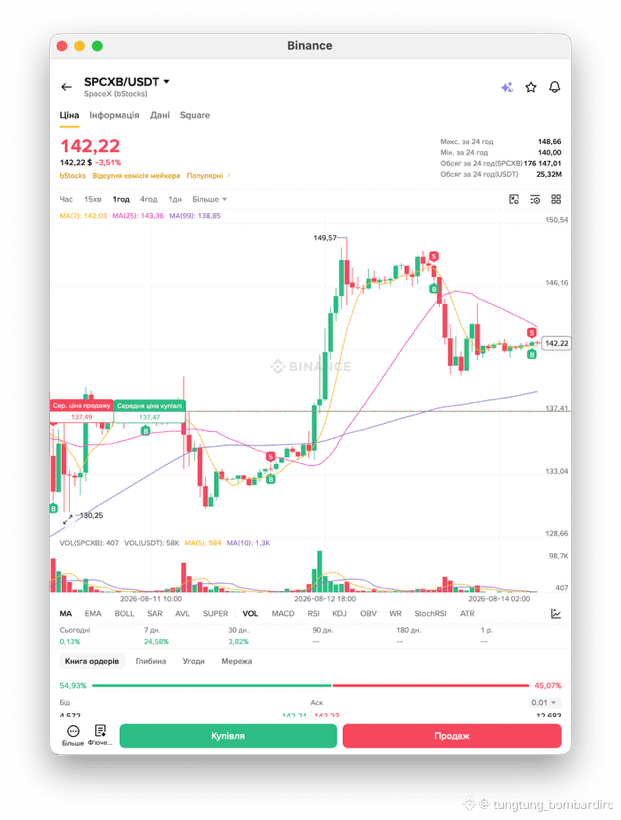
$DUSK today +5.43% — $0.066, and this is already more interesting than the usual intraday noise.
Looking at the 24h volume — 9.05M DUSK / 588K USDT — that’s a noticeable uptick compared with what I’ve seen over the last few weeks (30 days down -10%, 90 days -58%). It looks like the market is finally reacting to the news about the DuskEVM mainnet and Hedger that I wrote about yesterday.
I don’t think this is a one-off candle — more like the first signs that information about the private EVM layer is reaching a wider audience.
I’ll keep following the developments; the mainnet is still ahead.
@Dusk #dusk
Looking at the 24h volume — 9.05M DUSK / 588K USDT — that’s a noticeable uptick compared with what I’ve seen over the last few weeks (30 days down -10%, 90 days -58%). It looks like the market is finally reacting to the news about the DuskEVM mainnet and Hedger that I wrote about yesterday.
I don’t think this is a one-off candle — more like the first signs that information about the private EVM layer is reaching a wider audience.
I’ll keep following the developments; the mainnet is still ahead.
@Dusk #dusk
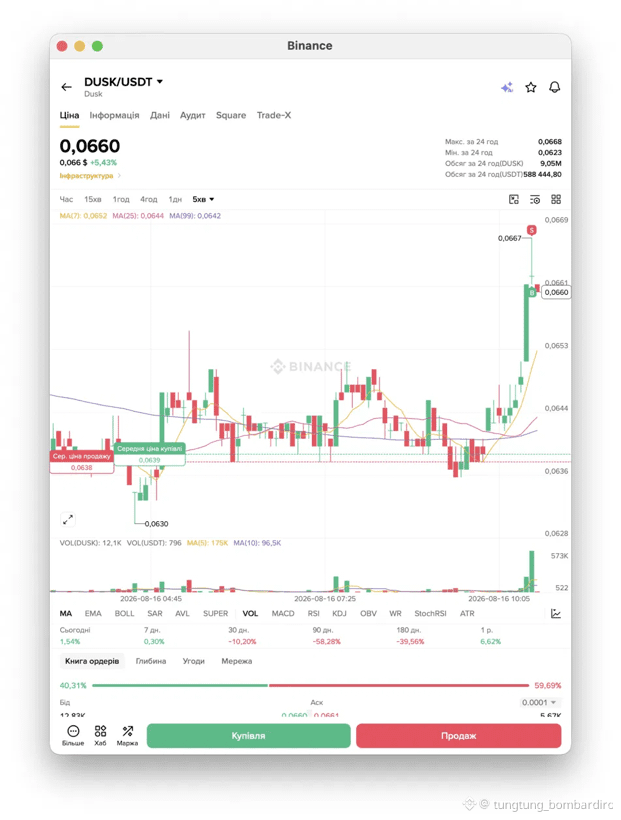
I stopped by today to take a look at $SPCXB — and honestly, I expected to see something more interesting 😅 The price for a day hang out in the range of 139.11–140.35, and right now it’s sitting at 140.21 (+0.78%). No hype, no panic — like the market took a pause to think.
I looked at the chart: in the morning there was a sharp drop to 139.42 — it looked scary for a second — then it calmly climbed back up to 140.35 and now has slightly pulled back. But the most interesting part isn’t that — the three moving averages (7, 25, 99) are now almost stuck together into one cluster: 140.18 / 140.16 / 139.79. I’ve seen this a few times before — and usually it means the market is really pausing and considering where to go next, not preparing another jump.
I checked the order book too — it’s also basically even: 50.57% for buys versus 49.43% for sells, almost exactly half and half. Trading volume has also dropped — 15.76K SPCXB per day, not the kind of madness I saw on peak days.
My takeaway for myself, purely human: when everything gets this quiet, the worst thing you can do is start getting nervous and do something "just to be doing something." So today I’m in observer mode, without any sudden moves.
@BinanceCIS #bStocksCIS
I looked at the chart: in the morning there was a sharp drop to 139.42 — it looked scary for a second — then it calmly climbed back up to 140.35 and now has slightly pulled back. But the most interesting part isn’t that — the three moving averages (7, 25, 99) are now almost stuck together into one cluster: 140.18 / 140.16 / 139.79. I’ve seen this a few times before — and usually it means the market is really pausing and considering where to go next, not preparing another jump.
I checked the order book too — it’s also basically even: 50.57% for buys versus 49.43% for sells, almost exactly half and half. Trading volume has also dropped — 15.76K SPCXB per day, not the kind of madness I saw on peak days.
My takeaway for myself, purely human: when everything gets this quiet, the worst thing you can do is start getting nervous and do something "just to be doing something." So today I’m in observer mode, without any sudden moves.
@BinanceCIS #bStocksCIS
I didn’t pay much attention to DuskEVM for a long time until I figured out what the real point is—and now I understand why people are talking about it.
A classic problem: privacy and EVM compatibility usually exclude each other. If you want the familiar Solidity stack, forget about confidentiality—and vice versa. DuskEVM tries to resolve this dilemma with Hedger, a privacy module built on homomorphic encryption and ZK proofs that runs directly at the EVM level.
What interests me most isn’t “privacy for privacy’s sake,” but the concept of reviewable privacy: data is hidden from outsiders, but available for authorized audits or regulators. That’s closer to what institutions actually need than most “private” networks that simply hide everything from everyone without exception.
Looking forward to the mainnet launch—I'm curious how smooth the transition will be for developers coming from a Solidity background.
@Dusk $DUSK #dusk
A classic problem: privacy and EVM compatibility usually exclude each other. If you want the familiar Solidity stack, forget about confidentiality—and vice versa. DuskEVM tries to resolve this dilemma with Hedger, a privacy module built on homomorphic encryption and ZK proofs that runs directly at the EVM level.
What interests me most isn’t “privacy for privacy’s sake,” but the concept of reviewable privacy: data is hidden from outsiders, but available for authorized audits or regulators. That’s closer to what institutions actually need than most “private” networks that simply hide everything from everyone without exception.
Looking forward to the mainnet launch—I'm curious how smooth the transition will be for developers coming from a Solidity background.
@Dusk $DUSK #dusk
I noticed another detail while looking into bStocks — the fact that dividends here don’t need to be tracked manually. In $SPCXB (and generally in bStocks) there is a built-in Multiplier mechanism that automatically reinvests dividends into the position, without any manual actions from the owner.
For me, this is exactly the nuance that sets bStocks apart from a regular spot token: you hold an economic exposure to the stock, not just a price quote, and at the same time you don’t bother with separate payouts or reinvest requests like you would in a classic brokerage account.
Legally, there’s also some specificity: bStocks is not direct ownership of the stock, but a certificate regulated by ADGM/FSRA rules, so shareholder rights (voting, etc.) don’t exist — there’s only economic exposure. It’s important to understand this before the trade, not after.
My PnL on small positions in $SPCXB right now isn’t about cosmic numbers — it’s more about the habit of testing the instrument’s mechanics in practice. Right now $SPCXB is held at 139.59 — and that’s exactly why @BinanceCIS is convenient for such micro entries: you can enter and exit the spot without unnecessary infrastructure.
👇 Did you know that dividends on bStocks are automatically reinvested, or is this also new information for you?
#bstockscis
For me, this is exactly the nuance that sets bStocks apart from a regular spot token: you hold an economic exposure to the stock, not just a price quote, and at the same time you don’t bother with separate payouts or reinvest requests like you would in a classic brokerage account.
Legally, there’s also some specificity: bStocks is not direct ownership of the stock, but a certificate regulated by ADGM/FSRA rules, so shareholder rights (voting, etc.) don’t exist — there’s only economic exposure. It’s important to understand this before the trade, not after.
My PnL on small positions in $SPCXB right now isn’t about cosmic numbers — it’s more about the habit of testing the instrument’s mechanics in practice. Right now $SPCXB is held at 139.59 — and that’s exactly why @BinanceCIS is convenient for such micro entries: you can enter and exit the spot without unnecessary infrastructure.
👇 Did you know that dividends on bStocks are automatically reinvested, or is this also new information for you?
#bstockscis
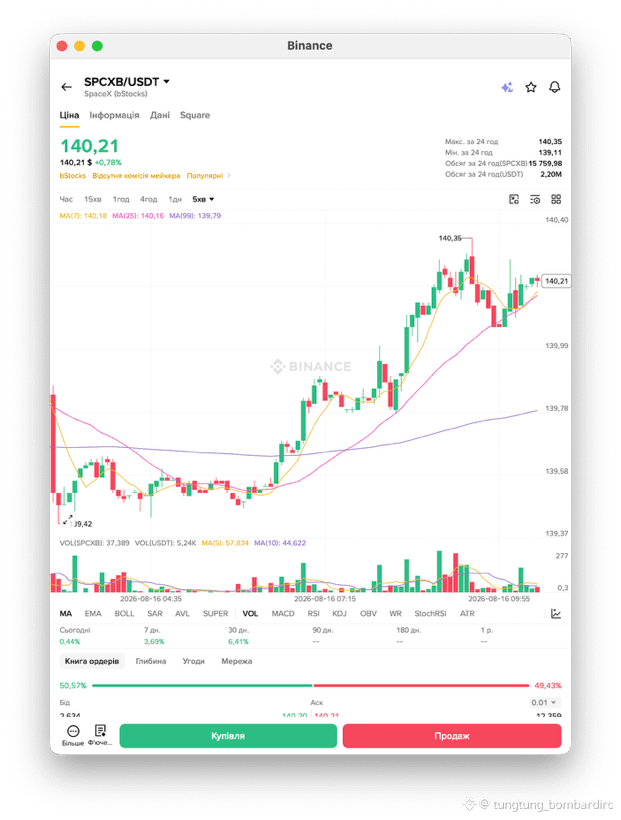
This morning I came by to check on $SPCXB and saw something that surprised me a bit: the price dropped by -3.51% over the day, from a high of 148.66 down to the current 142.22. At the same time, just two days ago the chart showed a sharp surge—from ~130 to peak 149.57 within just a few hours.
I looked at the trading volume under the chart: the biggest spike was exactly at the peak, near the 149.57 mark. For me it looks like the moment when some traders were locking in profit while others were still jumping into positions on the hype—classic “whoever caught it, caught it.”
I checked my own stats: the average buy price was 137.47 and the average sell price was 137.49—basically I entered and exited at almost the same level, with no clear plan. My honest takeaway: next time I’ll wait for confirmation of the direction instead of trying to catch every bounce based on emotions.
@BinanceCIS #bStocksCIS
I looked at the trading volume under the chart: the biggest spike was exactly at the peak, near the 149.57 mark. For me it looks like the moment when some traders were locking in profit while others were still jumping into positions on the hype—classic “whoever caught it, caught it.”
I checked my own stats: the average buy price was 137.47 and the average sell price was 137.49—basically I entered and exited at almost the same level, with no clear plan. My honest takeaway: next time I’ll wait for confirmation of the direction instead of trying to catch every bounce based on emotions.
@BinanceCIS #bStocksCIS
I dug around here at $DUSK and understood why the project is interesting — it’s not another “privacy coin”, but an L1 blockchain with the XSC standard that enables confidential smart contracts specifically for finance. That means transactions can be verified without disclosing the details — this is what most DeFi lacks. @Dusk is building something real for regulatory use cases. #dusk
What matters to you more in blockchain projects for finance?
What matters to you more in blockchain projects for finance?
Конфіденційність транзакцій
100%
Швидкість/масштабованість
0%
Регуляторна відповідність
0%
Низькі комісії
0%
1 votes • Voting closed
Earlier I was constantly running into the same annoying story: I open a position, the coin gives +30% overnight, I sleep peacefully during that time, and in the morning the price has already bounced back to where I entered 😅
Until I discovered a feature on Binance that literally saved my sleep and my profit — Trailing Stop (Trailing stop).
How it works on my example:
Instead of blindly guessing the peak and setting a fixed Take Profit, I set a trailing stop with a deviation (for example, 3%).
— The coin goes up ➔ my stop level automatically follows it at a distance of those 3%.
— The price reverses and drops by 3% ➔ the order instantly closes the trade in profit.
As a result, I stopped catching FOMO from exiting too early, and I no longer sit staring at the charts until 3 a.m. so I don’t miss the reversal.
👇 Do you use trailing stops, or do you prefer regular take-profits?
#BİNANCE #crypto #tradingtips
Until I discovered a feature on Binance that literally saved my sleep and my profit — Trailing Stop (Trailing stop).
How it works on my example:
Instead of blindly guessing the peak and setting a fixed Take Profit, I set a trailing stop with a deviation (for example, 3%).
— The coin goes up ➔ my stop level automatically follows it at a distance of those 3%.
— The price reverses and drops by 3% ➔ the order instantly closes the trade in profit.
As a result, I stopped catching FOMO from exiting too early, and I no longer sit staring at the charts until 3 a.m. so I don’t miss the reversal.
👇 Do you use trailing stops, or do you prefer regular take-profits?
#BİNANCE #crypto #tradingtips
🎯 Постійно юзаю Трейлінг-стоп
0%
📊 Ставлю звичайний Take Profit
20%
⚡️ Торгую по маркету / на око
40%
⚪️ Не тестував,треба спробувати
40%
5 votes • Voting closed
Verified
I follow RWA statistics and caught an interesting fact: turns out over 60% of all trades on bStocks on @BinanceCIS happen exactly when US exchanges (NYSE / Nasdaq) are closed 😂
That is, while Wall Street is asleep or resting on weekends, crypto quietly drives volumes of $SPCXB , $NVDAB , and $TSLAB .
For me, this is the biggest plus of tokenized stocks:
No need to wait until evening or Monday to react to fresh news or reports.
Zero maker fees (up to August 31 is just the icing on the cake).
Dividends are automatically reinvested via Multiplier, with no extra manual steps.
In practice, the stock market has finally become truly 24/7—without weekends and without lunch breaks.
👇 What hours do you usually enter bStocks most often?
#bstockscis
That is, while Wall Street is asleep or resting on weekends, crypto quietly drives volumes of $SPCXB , $NVDAB , and $TSLAB .
For me, this is the biggest plus of tokenized stocks:
No need to wait until evening or Monday to react to fresh news or reports.
Zero maker fees (up to August 31 is just the icing on the cake).
Dividends are automatically reinvested via Multiplier, with no extra manual steps.
In practice, the stock market has finally become truly 24/7—without weekends and without lunch breaks.
👇 What hours do you usually enter bStocks most often?
#bstockscis
🌙 Вночі / на вихідних
34%
☀️Під час сесії США після 16:30
33%
⚡️ Коли виходить гаряча новина
33%
⚪️ Просто тримаю в довгострок
0%
3 votes • Voting closed
I'm just writing from myself here: I share what I personally test, look at new tools like bStocks ($SPCXB ), make quick observations, and try to combine all of this with my life and my work in IT.
But I'm really curious to know who subscribed to me and what content would appeal to you the most?
What would you like to read more often?
Short market breakdowns: analysis of $BTC , $ETH and altcoins clearly and without any extra “fluff.”
Practice and tests: how new features, tokenized bStocks shares, and DeFi protocols really work.
Personal experience: live thoughts on trading, mistakes, and my own observations.
Interactive: quick polls, discussions of the latest news, and hot topics.
Write in the comments a number or your option 👇 It's important for me to make this blog genuinely interesting for you!
#CryptoCommunity
But I'm really curious to know who subscribed to me and what content would appeal to you the most?
What would you like to read more often?
Short market breakdowns: analysis of $BTC , $ETH and altcoins clearly and without any extra “fluff.”
Practice and tests: how new features, tokenized bStocks shares, and DeFi protocols really work.
Personal experience: live thoughts on trading, mistakes, and my own observations.
Interactive: quick polls, discussions of the latest news, and hot topics.
Write in the comments a number or your option 👇 It's important for me to make this blog genuinely interesting for you!
#CryptoCommunity
📊 Короткі розбори ($BTC,$ETH)
33%
🛠 Практика, тести та bStocks
67%
💡 Особистий досвід та IT
0%
💬 Інтерактив та гарячі новини
0%
3 votes • Voting closed
A small Binance life hack that people often forget
If you have any «pennies» of coins stuck in your wallet after trading (for example, $0.20 in $SOL or $0.05 in $ADA ), you can easily save them!
In the Spot Wallet section, there’s a button called «Convert small balances to BNB».
With one click, all of this tiny «crypto dust» is turned into BNB, which you can then conveniently use to cover fees.
Did you know about this feature, or do you also have a bunch of spare change sitting in your wallet?
#crypto
If you have any «pennies» of coins stuck in your wallet after trading (for example, $0.20 in $SOL or $0.05 in $ADA ), you can easily save them!
In the Spot Wallet section, there’s a button called «Convert small balances to BNB».
With one click, all of this tiny «crypto dust» is turned into BNB, which you can then conveniently use to cover fees.
Did you know about this feature, or do you also have a bunch of spare change sitting in your wallet?
#crypto
Звісно знаємо
55%
Цікава фішка
19%
Не знав
18%
Не користуюся
8%
38 votes • Voting closed
I noticed an interesting detail when I went into $SPCXB yesterday. Many still don’t understand how tokenized stocks on bStocks differ from a regular futures contract or spot crypto tokens.
For me, the main advantage is the absence of margin risks and liquidations that exist in futures, but with the ability to enter the whole S&P 500 index directly with your USDT. In other words, you don’t worry about stop-outs or overnight slippage—you just hold the asset on spot without any bank fees.
The only thing you have to get used to after crypto is how the spread behaves during hours when the American market is closed. I came to this conclusion for myself: move large volumes during the New York session, and set strict limits outside of working hours.
My PnL on these micro-trades isn’t out of this world, but for balancing my portfolio, the instrument from @BinanceCIS works like a clock.
#bstockscis
Question: How do you most often enter $SPCXB ?
For me, the main advantage is the absence of margin risks and liquidations that exist in futures, but with the ability to enter the whole S&P 500 index directly with your USDT. In other words, you don’t worry about stop-outs or overnight slippage—you just hold the asset on spot without any bank fees.
The only thing you have to get used to after crypto is how the spread behaves during hours when the American market is closed. I came to this conclusion for myself: move large volumes during the New York session, and set strict limits outside of working hours.
My PnL on these micro-trades isn’t out of this world, but for balancing my portfolio, the instrument from @BinanceCIS works like a clock.
#bstockscis
Question: How do you most often enter $SPCXB ?
📈Лише під час роботи біржі США
0%
⚡️Цілодобово по маркету
100%
🛡Ставлю строго лімітні ордери
0%
🔍Ще вивчаю інструмент
0%
1 votes • Voting closed
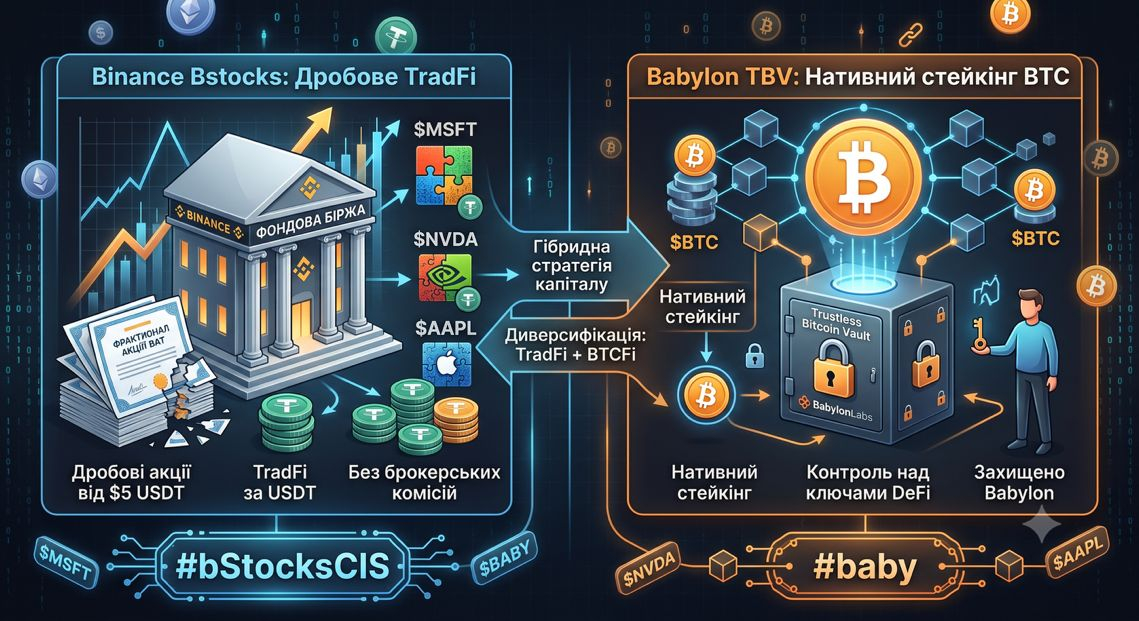
Have you been wondering why tokenized stocks are now so actively making their way into the crypto community? The main killer feature of Binance Bstocks is the possibility of fractional ownership (fractional stocks).
That is, you don’t necessarily need hundreds of dollars to buy a whole share like $MSFTB or another giant: you can purchase even micro-parts worth a couple of USDT right from your usual crypto terminal. No bank bureaucracy or brokerage servicing fees—thanks @BinanceCIS for such flexibility!
At the same time, I continue to keep an eye on BTCFi: the Trustless Bitcoin Vaults (TBV) technology from @BabylonLabs_io solves another important problem—allowing you to use Bitcoin in DeFi while preserving full control over the private keys. It’s great to see how $BABY is building a secure staking ecosystem.
And what’s the most important “hook” in today’s fintech tools for you—mobility or key security? Write in the comments
#baby
#bstockscis
That is, you don’t necessarily need hundreds of dollars to buy a whole share like $MSFTB or another giant: you can purchase even micro-parts worth a couple of USDT right from your usual crypto terminal. No bank bureaucracy or brokerage servicing fees—thanks @BinanceCIS for such flexibility!
At the same time, I continue to keep an eye on BTCFi: the Trustless Bitcoin Vaults (TBV) technology from @BabylonLabs_io solves another important problem—allowing you to use Bitcoin in DeFi while preserving full control over the private keys. It’s great to see how $BABY is building a secure staking ecosystem.
And what’s the most important “hook” in today’s fintech tools for you—mobility or key security? Write in the comments
#baby
#bstockscis
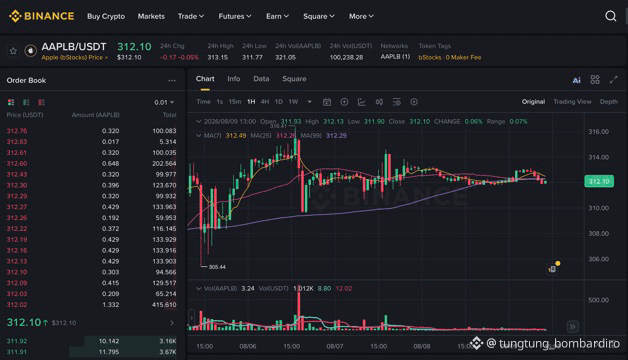
When the market enters a range-bound (sideways) phase, switching attention between different segments really helps you look for good setups and not lose focus.
On the one hand, tokenized stocks like $AAPLB via Binance Bstocks let you trade TradFi right from your familiar crypto wallet—without bureaucracy and without transfers between brokers. Thanks to account @BinanceCIS for such a convenient feature!
On the other hand, it’s very interesting to watch the evolution of BTCFi. Trustless Bitcoin Vaults technology from @BabylonLabs_io provides secure native staking for Bitcoin, where the keys remain only with you. I’m tracking the growth of the ecosystem and keeping $BABY on my radar.
What’s currently dominating in your portfolio—classic tokenized stocks or DeFi instruments? Share in the comments
#baby #bstockscis
On the one hand, tokenized stocks like $AAPLB via Binance Bstocks let you trade TradFi right from your familiar crypto wallet—without bureaucracy and without transfers between brokers. Thanks to account @BinanceCIS for such a convenient feature!
On the other hand, it’s very interesting to watch the evolution of BTCFi. Trustless Bitcoin Vaults technology from @BabylonLabs_io provides secure native staking for Bitcoin, where the keys remain only with you. I’m tracking the growth of the ecosystem and keeping $BABY on my radar.
What’s currently dominating in your portfolio—classic tokenized stocks or DeFi instruments? Share in the comments
#baby #bstockscis
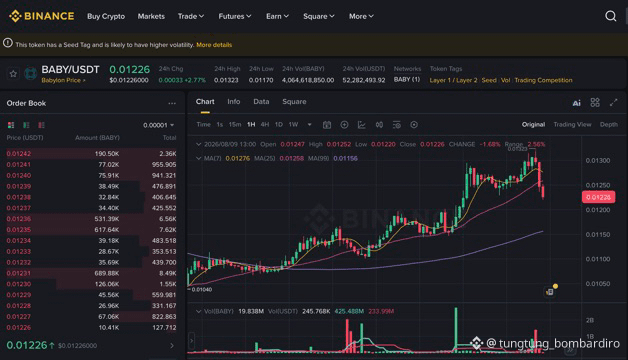
Which technological narratives are you currently following the most?
For me, one of the most interesting areas is BTCFi and the Trustless Bitcoin Vaults architecture by @BabylonLabs_io . Enabling Bitcoin to work in DeFi, but without custody risks and third-party bridges—that’s exactly what restores confidence in staking $BTC . Your private keys stay with you, and your capital works.
I’m watching $BABY and waiting for new ecosystem integrations.
Do you think BTCFi will grow into a separate giant sector, or is it just a temporary hype? Share your thoughts in the comments
#baby
For me, one of the most interesting areas is BTCFi and the Trustless Bitcoin Vaults architecture by @BabylonLabs_io . Enabling Bitcoin to work in DeFi, but without custody risks and third-party bridges—that’s exactly what restores confidence in staking $BTC . Your private keys stay with you, and your capital works.
I’m watching $BABY and waiting for new ecosystem integrations.
Do you think BTCFi will grow into a separate giant sector, or is it just a temporary hype? Share your thoughts in the comments
#baby
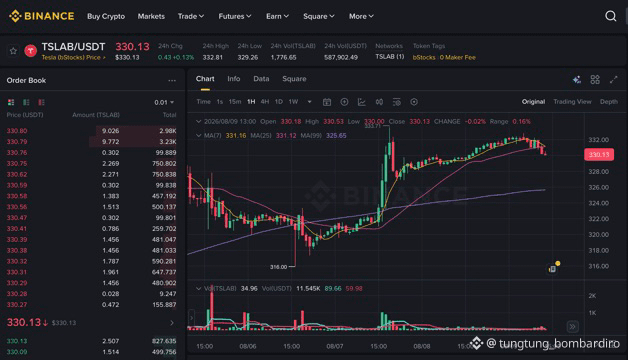
Why does the stock market now grab so much attention from crypto guys?
If you look at the charts, that same $TSLAB sometimes produces impulses that half of the altcoins would be jealous of. And the main advantage is — you no longer need to withdraw cash to the bank or deal with brokers. With Binance Bstocks, you can calmly work through such moves right from stablecoins in the usual terminal.
Thanks @BinanceCIS for a convenient tool for diversification!
And do you use tokenized stocks in your portfolio, or do you stick purely to crypto? Write in the comments
#bstockscis
If you look at the charts, that same $TSLAB sometimes produces impulses that half of the altcoins would be jealous of. And the main advantage is — you no longer need to withdraw cash to the bank or deal with brokers. With Binance Bstocks, you can calmly work through such moves right from stablecoins in the usual terminal.
Thanks @BinanceCIS for a convenient tool for diversification!
And do you use tokenized stocks in your portfolio, or do you stick purely to crypto? Write in the comments
#bstockscis
#bstockscis We in IT always strive for process optimization, so I immediately appreciated how Binance Bstocks makes life easier. Now you can keep an eye on traditional markets right from your familiar crypto interface, without creating a bunch of unnecessary accounts across different brokers. Today I’m watching the chart $NVDAB during breaks between writing code. Thanks @BinanceCIS for such a convenient approach.
Verified
It’s always interesting to watch the evolution of fintech. With Binance Bstocks, you can conveniently monitor $NFLXB and traditional stocks right from your crypto wallet — thanks @BinanceCIS for the flexibility! At the same time, I’m keeping an eye on @BabylonLabs_io , because their Trustless Bitcoin Vaults and token $BABY open up new horizons for staking BTC in DeFi. #bStocksCİS #baby
Log in to explore more content