
Doric Network
720 Posts

Doric Network
Report
Block User
Doric Network is a blockchain platform dedicated to revolutionizing asset tokenization.
Visit https://doric.network/
16 Following
480 Followers
1.0K+ Liked
Posts
All
Videos
PINNED
Elon Musk's newly formed Department of Government Efficiency (D.O.G.E) aims to cut $2 trillion from federal spending, a move that could destabilize the U.S. economy. Critics warn that aggressive layoffs and agency dissolutions could lead to a government shutdown, reminiscent of the costly 2018-2019 shutdown, which cost $11 billion. Moreover, with 75% of the federal budget being mandatory spending, achieving such cuts is deemed unrealistic, potentially worsening the national debt and causing economic turmoil. Musk's influence is already creating market anxiety, as investors fear a "deflationary shock" and reduced consumer spending.
Elon Musk's newly formed Department of Government Efficiency (D.O.G.E) aims to cut $2 trillion from federal spending, a move that could destabilize the U.S. economy. Critics warn that aggressive layoffs and agency dissolutions could lead to a government shutdown, reminiscent of the costly 2018-2019 shutdown, which cost $11 billion. Moreover, with 75% of the federal budget being mandatory spending, achieving such cuts is deemed unrealistic, potentially worsening the national debt and causing economic turmoil. Musk's influence is already creating market anxiety, as investors fear a "deflationary shock" and reduced consumer spending.

14
11
66
69.4k
🚨 BITCOIN COOLS OFF — BUT IS THE RALLY REALLY OVER? ₿📉
Bitcoin is taking a breather after an ETF-driven surge reportedly fueled by roughly $3 billion in inflows. 💰🔥
After a strong run, some cooling is hardly surprising. Traders may be locking in profits, while the market reassesses whether institutional demand has enough momentum to drive the next leg higher.
📊 What matters now?
👉 ETF flows — Continued institutional buying could provide fresh support.
👉 Profit-taking — Rapid rallies often invite short-term selling.
👉 Market sentiment — A healthy consolidation can reset momentum rather than end it.
👉 Macro conditions — Rates, liquidity, and risk appetite remain important catalysts.
💡 Key takeaway: A Bitcoin pullback after a major ETF-driven surge doesn't automatically signal a bearish reversal. The bigger question is whether institutional capital keeps flowing once the initial excitement cools. 👀₿
The next ETF flow numbers could tell us whether this is simply a pause—or the beginning of Bitcoin's next major move. 🚀
Follow for more crypto market insights, trends, and updates. 📈
🔗 Read the full story:
https://cryptonews.net/33366777/?utm_source=CryptoNews&utm_medium=app&utm_campaign=shared
#Bitcoin #BTC #Crypto #BitcoinETF #CryptoNews
🚨 BITCOIN COOLS OFF — BUT IS THE RALLY REALLY OVER? ₿📉
Bitcoin is taking a breather after an ETF-driven surge reportedly fueled by roughly $3 billion in inflows. 💰🔥
After a strong run, some cooling is hardly surprising. Traders may be locking in profits, while the market reassesses whether institutional demand has enough momentum to drive the next leg higher.
📊 What matters now?
👉 ETF flows — Continued institutional buying could provide fresh support.
👉 Profit-taking — Rapid rallies often invite short-term selling.
👉 Market sentiment — A healthy consolidation can reset momentum rather than end it.
👉 Macro conditions — Rates, liquidity, and risk appetite remain important catalysts.
💡 Key takeaway: A Bitcoin pullback after a major ETF-driven surge doesn't automatically signal a bearish reversal. The bigger question is whether institutional capital keeps flowing once the initial excitement cools. 👀₿
The next ETF flow numbers could tell us whether this is simply a pause—or the beginning of Bitcoin's next major move. 🚀
Follow for more crypto market insights, trends, and updates. 📈
🔗 Read the full story:
https://cryptonews.net/33366777/?utm_source=CryptoNews&utm_medium=app&utm_campaign=shared
#Bitcoin #BTC #Crypto #BitcoinETF #CryptoNews
Bitcoin is taking a breather after an ETF-driven surge reportedly fueled by roughly $3 billion in inflows. 💰🔥
After a strong run, some cooling is hardly surprising. Traders may be locking in profits, while the market reassesses whether institutional demand has enough momentum to drive the next leg higher.
📊 What matters now?
👉 ETF flows — Continued institutional buying could provide fresh support.
👉 Profit-taking — Rapid rallies often invite short-term selling.
👉 Market sentiment — A healthy consolidation can reset momentum rather than end it.
👉 Macro conditions — Rates, liquidity, and risk appetite remain important catalysts.
💡 Key takeaway: A Bitcoin pullback after a major ETF-driven surge doesn't automatically signal a bearish reversal. The bigger question is whether institutional capital keeps flowing once the initial excitement cools. 👀₿
The next ETF flow numbers could tell us whether this is simply a pause—or the beginning of Bitcoin's next major move. 🚀
Follow for more crypto market insights, trends, and updates. 📈
🔗 Read the full story:
https://cryptonews.net/33366777/?utm_source=CryptoNews&utm_medium=app&utm_campaign=shared
#Bitcoin #BTC #Crypto #BitcoinETF #CryptoNews
96
🚀 Bitcoin didn’t just break $81K—it exploded past it. Here’s what lit the fuse.
BTC surged from below $65,000 to a three-month high above $81,000, driven by four powerful forces:
🏦 Expanded U.S. Treasury buybacks improved market liquidity
💵 A weaker dollar revived the “debasement trade” into scarce assets
💧 Expectations of greater financial-system liquidity boosted risk appetite
📈 Nearly $2 billion in spot Bitcoin ETF inflows—plus over $4 billion in short liquidations—accelerated the breakout
🔥 The key takeaway: This rally wasn’t powered by hype alone. Macro uncertainty created the spark, institutional demand supplied the fuel, and forced short covering turned it into an explosion.
Now the big question: Can Bitcoin hold above $80K and convert this breakout into a sustained bull-market move? 👀
Follow for timely crypto news, market insights, and trading updates.
🔗 Read and share: https://cryptonews.net/33346082/?utm_source=CryptoNews&utm_medium=app&utm_campaign=shared
#Bitcoin #BTC #CryptoNews #BitcoinETF #CryptoMarket
🚀 Bitcoin didn’t just break $81K—it exploded past it. Here’s what lit the fuse.
BTC surged from below $65,000 to a three-month high above $81,000, driven by four powerful forces:
🏦 Expanded U.S. Treasury buybacks improved market liquidity
💵 A weaker dollar revived the “debasement trade” into scarce assets
💧 Expectations of greater financial-system liquidity boosted risk appetite
📈 Nearly $2 billion in spot Bitcoin ETF inflows—plus over $4 billion in short liquidations—accelerated the breakout
🔥 The key takeaway: This rally wasn’t powered by hype alone. Macro uncertainty created the spark, institutional demand supplied the fuel, and forced short covering turned it into an explosion.
Now the big question: Can Bitcoin hold above $80K and convert this breakout into a sustained bull-market move? 👀
Follow for timely crypto news, market insights, and trading updates.
🔗 Read and share: https://cryptonews.net/33346082/?utm_source=CryptoNews&utm_medium=app&utm_campaign=shared
#Bitcoin #BTC #CryptoNews #BitcoinETF #CryptoMarket
BTC surged from below $65,000 to a three-month high above $81,000, driven by four powerful forces:
🏦 Expanded U.S. Treasury buybacks improved market liquidity
💵 A weaker dollar revived the “debasement trade” into scarce assets
💧 Expectations of greater financial-system liquidity boosted risk appetite
📈 Nearly $2 billion in spot Bitcoin ETF inflows—plus over $4 billion in short liquidations—accelerated the breakout
🔥 The key takeaway: This rally wasn’t powered by hype alone. Macro uncertainty created the spark, institutional demand supplied the fuel, and forced short covering turned it into an explosion.
Now the big question: Can Bitcoin hold above $80K and convert this breakout into a sustained bull-market move? 👀
Follow for timely crypto news, market insights, and trading updates.
🔗 Read and share: https://cryptonews.net/33346082/?utm_source=CryptoNews&utm_medium=app&utm_campaign=shared
#Bitcoin #BTC #CryptoNews #BitcoinETF #CryptoMarket
96

Article
How Do Oracles Keep Real-World Data Honest On-Chain?The rapid expansion of the decentralized digital economy has created an urgent need for seamless communication between public blockchain ledgers and off-chain physical data. Blockchains excel at maintaining an un-alterable, cryptographically secure record of internal transactions, ensuring that digital assets cannot be double-spent or arbitrarily modified. However, public blockchain networks operate as isolated execution sandboxes, completely blind to the world existing beyond their smart contract code. A smart contract deployed on Ethereum or Solana has no native capability to read the temperature in London, check the current price of stock market indices, verify a flight delay, or track a physical shipping container moving across the Pacific Ocean.
This fundamental technological boundary is known in computer science as the “Oracle Problem.” Because smart contracts are deterministic software programs designed to execute financial transfers automatically based on specific inputs, feeding them corrupted or manipulated external data leads directly to catastrophic capital loss. If a decentralized lending protocol receives a manipulated price feed for collateralized real estate tokens, a malicious actor can drain millions of dollars from the system instantly. Decentralized oracle networks solve this vulnerability by functioning as secure, fault-tolerant bridges that fetch, verify, and deliver real-world data to on-chain smart contracts. This guide explores the multi-layered mechanics, economic incentives, and cryptographic protocols that oracles use to keep external data honest on public ledgers.
The Fundamental Anatomy of the Oracle Problem
To understand how oracles keep external data honest, you must first grasp why blockchains are intentionally designed without direct internet access. A public blockchain maintains global consensus through thousands of independent validator nodes that process transactions in parallel. Every node on the network must execute the exact same smart contract code and arrive at the exact same state output to confirm a block. If a smart contract made a direct web request to a traditional server API for a real-time price feed, different validator nodes executing the code at slightly different seconds would receive different data points, destroying network consensus and splitting the blockchain.
+-----------------------------------------------------------------+
| THE ISOLATION DILEMMA |
| |
| ISOLATED BLOCKCHAIN ENVIRONMENT: |
| [Smart Contract] --> Deterministic State Execution Only |
| | |
| X (Cannot make direct Web/API call) |
| v |
| EXTERNAL PHYSICAL WORLD: |
| [Stock Prices] / [Weather Telemetry] / [Real-World Assets] |
+-----------------------------------------------------------------+
Because blockchains must remain strictly deterministic, they cannot initiate external network calls. This isolation requires an external middleware layer — an oracle — to fetch off-chain information, format it into a standardized transaction payload, and write it directly onto the blockchain storage layer. However, introducing a single centralized server to supply this data reintroduces a single point of failure, completely destroying the censorship resistance and security guarantees of the underlying blockchain. The core challenge for oracle architects is designing decentralized node networks that can pull real-world data from unreliable, off-chain environments while guaranteeing that the final data delivered on-chain remains tamper-proof, accurate, and cryptographically verified.
Decentralized Node Architectures and Consensus Aggregation
The primary line of defense against data manipulation is the total elimination of single-point-of-failure node architectures. Rather than relying on a single off-chain server to supply external data, modern decentralized oracle networks, such as Chainlink or Pyth Network, utilize independent groups of node operators to gather data concurrently. When a smart contract requests a real-world data update, multiple independent oracle nodes fetch the requested information from distinct, premium data aggregators simultaneously.
+-----------------------------------------------------------------+
| DECENTRALIZED ORACLE AGGREGATION |
| |
| OFF-CHAIN SOURCES: |
| [API Source A] [API Source B] [API Source C] |
| | | | |
| v v v |
| INDEPENDENT ORACLE NODES: |
| [Node 1 Data] [Node 2 Data] [Node 3 Data] |
| \ | / |
| v v v |
| AGGREGATION LAYER: |
| [Median Value Calculation & Outlier Elimination] |
| | |
| v |
| ON-CHAIN CONSUMPTION: |
| [Validated Data Payload Written to Smart Contract] |
+-----------------------------------------------------------------+
Once the individual oracle nodes fetch their data payloads, the network executes a consensus aggregation algorithm to filter out anomalies and bad actors. Instead of calculating a simple arithmetic mean, which can be distorted by an extreme outlier caused by a corrupted API source, the oracle network typically identifies the median value across all reporting nodes. If five independent nodes report asset prices of $100, $101, $100, $100.5, and $1,500, the aggregation algorithm automatically discards the extreme $1,500 outlier and calculates the validated median value. This decentralized aggregation prevents a single compromised data source or malicious node operator from corrupting the on-chain state, ensuring that smart contracts operate solely on verified market consensus.
Cryptographic Proofs and Source Attestation
Decentralized aggregation protects the network against individual node failure, but ensuring that the raw data was not tampered with at the source requires cryptographic attestation. Modern oracle frameworks incorporate specialized cryptographic primitives that create an unbroken, verifiable chain of custody from the origin server straight to the destination smart contract. One of the most significant technological breakthroughs in this domain is the integration of Transport Layer Security (TLS) cryptographic proofs, famously implemented through protocols like DECO and Town Crier.
+-----------------------------------------------------------------+
| TLS CRYPTOGRAPHIC ATTESTATION |
| |
| [Origin Web Server] --(Private TLS Session)--> [Oracle Node] |
| | |
| v |
| [On-Chain Verification] <-- (Zero-Knowledge Proof) --+ |
| * Proves data originated from exact server without leaking key. |
+-----------------------------------------------------------------+
Using TLS proofs combined with zero-knowledge cryptography, an oracle node can prove to an on-chain smart contract that a specific data point originated directly from a trusted server — such as a major stock exchange, a government weather database, or a bank API — without compromising private session keys or sensitive personal user data. The oracle node acts as an audited courier, signing the incoming data payload with its unique cryptographic private key. When the data arrives on-chain, the smart contract verifies the node’s signature against a registry of approved public keys. This cryptographic attestation ensures that nodes cannot fabricate false data without immediately leaving an un-alterable, cryptographically signed record of their fraud on the public ledger.
Cryptoeconomic Security and Stake Slicing Mechanics
While cryptographic signatures prove who delivered a data payload, economic game theory provides the structural motivation that keeps node operators honest over long periods. Oracle networks rely heavily on cryptoeconomic security, forcing node operators to stake valuable native tokens — such as Chainlink’s LINK or Pyth’s native tokens — into smart contract vaults as a financial performance bond before they are permitted to report data to the network.
+-----------------------------------------------------------------+
| CRYPTOECONOMIC SLASHING MECHANISM |
| |
| [Node Staking Vault] --> $1,000,000 Staked Tokens at Risk |
| | |
| +------------------------+------------------------+ |
| | | |
| v v |
| HONEST REPORTING: MALICIOUS |
| [Earn Transaction Fees] [Trigger Slashing]|
| [Steady Yield Accrual] [100% Vault Burn] |
+-----------------------------------------------------------------+
This cryptoeconomic structure aligns the financial incentives of the node operator with the truth of the data they provide. If a node operator reports accurate data that matches the consensus median, the network rewards them with transaction fees paid by consuming smart contract applications. However, if a node operator attempts to manipulate a data feed by submitting false data, the network’s slashing mechanism fires automatically. The smart contract burns or redistributes the malicious node operator’s staked tokens, inflicting an immediate financial loss that vastly exceeds any potential profit they could make by attempting to trick the network. By ensuring that the cost of corruption is exponentially higher than the financial reward of honesty, cryptoeconomic staking turns self-interest into a powerful security shield.
Multi-Source Data Redundancy and Quality Controls
A common vulnerability in early oracle designs was the reliance on free, public web endpoints that suffered from low update frequencies, poor server uptime, and susceptibility to rate-limiting or malicious domain takeovers. Modern enterprise oracle networks enforce strict data-quality standards, requiring node operators to source information exclusively from premium, institutional-grade data aggregators. These data providers maintain direct, low-latency connections to high-volume trading venues, physical sensors, and institutional clearinghouses, delivering pre-aggregated, volume-weighted average prices (VWAP) that account for liquidity disparities across global markets.
| Feature | Legacy Single-Source Oracles | Modern Multi-Layered Oracle Networks |
| :--- | :--- | :--- |
| **Data Sourcing** | Free Public Web Endpoints | Institutional-Grade Paid Data Aggregators |
| **Node Topology** | Single Centralized Server | Decentralized Multi-Node Mesh Networks |
| **Security Layer** | Basic API Keys | TLS Cryptographic Proofs & Zero-Knowledge |
| **Economic Incentive**| Zero Skin in the Game | Cryptoeconomic Token Staking & Slashing |
| **Update Trigger** | Fixed Periodic Schedule | Hybrid Deviation Thresholds & On-Demand |
Furthermore, advanced oracle networks implement multi-layered redundancy across both the data source layer and the node transport layer. If a primary data aggregator experiences an outage or attempts to feed corrupted data to an oracle node, the node automatically fails over to secondary and tertiary data streams without disrupting the consensus pipeline. This multi-layered redundancy ensures that even if an entire major cryptocurrency exchange or financial data provider goes offline during an unprecedented market crash, the decentralized oracle network continues to function without interruption, delivering uninterrupted, volume-weighted data payloads to on-chain financial applications.
Push versus Pull Architecture Innovations
As decentralized finance and tokenized asset markets have scaled globally, oracle architectures have evolved beyond simple “push” models to introduce highly efficient “pull” frameworks. In a traditional push-based oracle system, the oracle network continuously broadcasts data updates directly onto the blockchain ledger at fixed time intervals or whenever the asset price drifts beyond a specific percentage threshold. While this push design ensures that on-chain data is always fresh, it incurs massive, continuous blockchain transaction fees, limiting the number of assets an oracle can track concurrently.
+-----------------------------------------------------------------+
| PUSH VS. PULL ORACLE MODELS |
| |
| PUSH MODEL (Continuous On-Chain Writes): |
| [Oracle Network] --(Constant Gas Fees)--> [Blockchain Storage] |
| |
| PULL MODEL (On-Demand Execution): |
| [Off-Chain High-Speed Stream] |
| | |
| v (User Pulls Cryptographic Proof on Trade) |
| [Smart Contract Verifies Proof & Settles Atomically] |
+-----------------------------------------------------------------+
Pull-based oracle architectures, pioneered by modern protocols like Pyth Network and Chainlink Data Streams, resolve this economic bottleneck by maintaining high-frequency data streams on specialized, low-latency off-chain networks. Rather than constantly writing every micro-price tick onto expensive blockchain storage, the oracle network continuously signs cryptographic data packets off-chain. When a user initiates an on-chain trade, borrowing request, or liquidation on a decentralized exchange, the user’s transaction automatically “pulls” the latest cryptographically signed data packet from the off-chain stream and submits it to the smart contract in the exact same transaction block. The smart contract verifies the cryptographic signature instantly and executes the trade using real-time data, reducing gas overhead by orders of magnitude while providing sub-second pricing precision.
Hardware Enclaves and Trusted Execution Environments
To complement economic game theory and cryptographic proofs, leading oracle implementations incorporate specialized hardware-based security architectures known as Trusted Execution Environments (TEEs). A TEE is a physically isolated, tamper-resistant enclave embedded directly inside an oracle node’s central processing unit, running alongside the main operating system. Intel SGX (Software Guard Extensions) represents a primary commercial example of this hardware enclave technology.
+-----------------------------------------------------------------+
| TRUSTED EXECUTION ENVIRONMENT (TEE) |
| |
| ORACLE NODE HARDWARE: |
| +-----------------------------------------------------------+ |
| | Main Operating System (Insecure / Potentially Untrusted) | |
| | | |
| | +---------------------------------------------------+ | |
| | | ISOLATED TEE HARDWARE ENCLAVE (Intel SGX) | | |
| | | * Code & Memory Encrypted at Hardware Level | | |
| | | * Fetches API, Signs Data, Generates Proof | | |
| | +---------------------------------------------------+ | |
| +-----------------------------------------------------------+ |
+-----------------------------------------------------------------+
When an oracle node operates inside a TEE, the data fetching, aggregation, and signing processes execute inside an encrypted memory space that cannot be accessed or modified by anyone — not even the rogue system administrator or hacker who maintains physical ownership of the server. The hardware enclave verifies the code integrity before execution and generates an immutable cryptographic attestation proving that the data was processed exactly as instructed by the open-source software. By combining hardware-level isolation with cryptoeconomic incentives, oracle networks create a multi-layered defense matrix where compromising a data feed requires simultaneously breaking hardware encryption, bypassing cryptographic proofs, and sacrificing millions of dollars in staked capital.
Dispute Resolution Protocols and Optimistic Oracles
While high-frequency price feeds rely on automated, mathematical consensus aggregation, certain types of real-world data — such as verifying the winner of a complex political election, auditing the physical resolution of an insurance claim, or confirming a specialized real estate title transfer — cannot be easily scraped from a standardized web API. For these nuanced, human-centric data requirements, the industry utilizes “Optimistic Oracles,” with frameworks like UMA (Universal Market Access) leading the operational design.
Key Takeaway: Optimistic Oracles operate under the assumption that submitted data is honest until proven otherwise. They rely on an open dispute window where economic incentives encourage game-theoretic vigilantes to audit incoming data and challenge fraud.
An Optimistic Oracle operates on a simple principle: “Data is true unless it is challenged.” When an assertion is submitted to the oracle, a proposer posts a financial bond and submits the real-world answer to the smart contract. The system initiates a dispute window — typically lasting several hours or days — during which anyone in the world can inspect the assertion. If no one disputes the data before the timer expires, the smart contract accepts the answer as absolute truth and executes the transaction. However, if a verifier identifies a false claim, they post a counter-bond and challenge the assertion, escalating the dispute to a decentralized voting mechanism where token holders vote on the outcome based on off-chain evidence. The winning party claims the malicious proposer’s bond, creating a self-policing ecosystem where game theory guarantees honesty without requiring continuous on-chain calculations.
Defense Against Flash Loans and Oracle Manipulation Exploits
The history of decentralized finance is littered with stories of sophisticated exploits where attackers drained protocols not by hacking the smart contract code, but by artificially manipulating the external price data fed to the protocol. In a classic “Flash Loan Attack,” a malicious actor borrows tens of millions of dollars in capital within a single transaction block, uses that massive liquidity to artificially pump or crash the price of a illiquid token on a decentralized exchange, and then tricks an ill-prepared oracle into reading that temporary, distorted price as fair market value.
+-----------------------------------------------------------------+
| FLASH LOAN MANIPULATION DEFENSE |
| |
| ATTACKER ATTEMPT: |
| [Flash Loan Attack] --> Manipulates Single DEX Pool Price |
| | |
| v |
| ORACLE DEFENSE MATRIX: |
| [Volume-Weighted Average Price (VWAP) Filter] |
| + [Time-Weighted Average Price (TWAP) Smoothing] |
| + [Global Cross-Venue Consensus Aggregation] |
| | |
| v |
| RESULT: Localized Manipulation Filtered Out Completely |
+-----------------------------------------------------------------+
Modern decentralized oracle networks are engineered specifically to neutralize flash loan manipulation through multi-dimensional mathematical filtering. First, enterprise oracle nodes bypass localized decentralized liquidity pools entirely, pulling data from global, deep-order-book institutional venues. Second, oracle contracts incorporate Time-Weighted Average Price (TWAP) and Volume-Weighted Average Price (VWAP) algorithms that smooth out short-term price spikes across extended time windows. If a flash loan temporarily distorts an asset price for a single transaction block, the oracle’s TWAP filter completely ignores the temporary spike, preventing the malicious price from triggering improper liquidations or protocol drainages.
The Future Horizon of Truth in the Decentralized Economy
As global capitalism migrates toward public blockchain infrastructure, the role of decentralized oracle networks expands far beyond simple price feeds for trading protocols. The emergence of real-world asset (RWA) tokenization, automated decentralized insurance, supply chain tracking, and AI-driven portfolio management requires an increasingly sophisticated, fault-tolerant data bridge. Future oracle generations are integrating advanced machine learning models directly into their node networks, allowing nodes to evaluate data authenticity, detect anomaly patterns, and synthesize multi-variable real-world data autonomously before writing it on-chain.
+-----------------------------------------------------------------+
| THE FUTURE ORACLE ECOSYSTEM |
| |
| [Physical World Telemetry] + [RWA Property Deeds] + [TradFi] |
| | |
| v |
| [AI-Enhanced Decentralized Oracle & Zero-Knowledge Mesh Layer] |
| | |
| v |
| [Interoperable Multi-Chain Smart Contract Execution Stack] |
+-----------------------------------------------------------------+
Furthermore, the expansion of cross-chain communication protocols — such as Chainlink’s Cross-Chain Interoperability Protocol (CCIP) — allows oracles to act as universal translation layers that transfer both verified data and complex computational commands seamlessly across hundreds of distinct public and private blockchain networks. By combining cryptoeconomic staking, zero-knowledge cryptographic proofs, trusted execution environments, and decentralized consensus algorithms, oracles have solved the isolated sandbox problem. They ensure that as billions of dollars in real-world value move onto distributed ledgers, the physical world and the digital world remain bound together by verifiable, mathematical truth.
Decentralized oracle networks serve as the indispensable nervous system of the digital asset economy, providing the critical bridge that allows deterministic smart contracts to interface safely with the messy, unpredictable real world. By overcoming the inherently isolated design of public blockchains through decentralized node architectures, cryptographic attestation, cryptoeconomic slashing, and Trusted Execution Environments, oracles eliminate single points of failure and ensure that external data remains tamper-proof. Whether routing sub-second price streams via high-performance pull architectures, resolving real-world disputes through game-theoretic optimistic models, or filtering out predatory flash loan manipulation, these decentralized data networks provide the un-alterable foundation of truth required to run global finance on open code. As tokenized real-world assets and autonomous AI agents scale across public ledgers, the continued evolution of verifiable, mathematically sound oracle infrastructure will remain the ultimate guarantor of trust, enabling a fully integrated, transparent, and frictionless global economy.
How Do Oracles Keep Real-World Data Honest On-Chain?
The rapid expansion of the decentralized digital economy has created an urgent need for seamless communication between public blockchain ledgers and off-chain physical data. Blockchains excel at maintaining an un-alterable, cryptographically secure record of internal transactions, ensuring that digital assets cannot be double-spent or arbitrarily modified. However, public blockchain networks operate as isolated execution sandboxes, completely blind to the world existing beyond their smart contract code. A smart contract deployed on Ethereum or Solana has no native capability to read the temperature in London, check the current price of stock market indices, verify a flight delay, or track a physical shipping container moving across the Pacific Ocean.
This fundamental technological boundary is known in computer science as the “Oracle Problem.” Because smart contracts are deterministic software programs designed to execute financial transfers automatically based on specific inputs, feeding them corrupted or manipulated external data leads directly to catastrophic capital loss. If a decentralized lending protocol receives a manipulated price feed for collateralized real estate tokens, a malicious actor can drain millions of dollars from the system instantly. Decentralized oracle networks solve this vulnerability by functioning as secure, fault-tolerant bridges that fetch, verify, and deliver real-world data to on-chain smart contracts. This guide explores the multi-layered mechanics, economic incentives, and cryptographic protocols that oracles use to keep external data honest on public ledgers.
The Fundamental Anatomy of the Oracle Problem
To understand how oracles keep external data honest, you must first grasp why blockchains are intentionally designed without direct internet access. A public blockchain maintains global consensus through thousands of independent validator nodes that process transactions in parallel. Every node on the network must execute the exact same smart contract code and arrive at the exact same state output to confirm a block. If a smart contract made a direct web request to a traditional server API for a real-time price feed, different validator nodes executing the code at slightly different seconds would receive different data points, destroying network consensus and splitting the blockchain.
+-----------------------------------------------------------------+
| THE ISOLATION DILEMMA |
| |
| ISOLATED BLOCKCHAIN ENVIRONMENT: |
| [Smart Contract] --> Deterministic State Execution Only |
| | |
| X (Cannot make direct Web/API call) |
| v |
| EXTERNAL PHYSICAL WORLD: |
| [Stock Prices] / [Weather Telemetry] / [Real-World Assets] |
+-----------------------------------------------------------------+
Because blockchains must remain strictly deterministic, they cannot initiate external network calls. This isolation requires an external middleware layer — an oracle — to fetch off-chain information, format it into a standardized transaction payload, and write it directly onto the blockchain storage layer. However, introducing a single centralized server to supply this data reintroduces a single point of failure, completely destroying the censorship resistance and security guarantees of the underlying blockchain. The core challenge for oracle architects is designing decentralized node networks that can pull real-world data from unreliable, off-chain environments while guaranteeing that the final data delivered on-chain remains tamper-proof, accurate, and cryptographically verified.
Decentralized Node Architectures and Consensus Aggregation
The primary line of defense against data manipulation is the total elimination of single-point-of-failure node architectures. Rather than relying on a single off-chain server to supply external data, modern decentralized oracle networks, such as Chainlink or Pyth Network, utilize independent groups of node operators to gather data concurrently. When a smart contract requests a real-world data update, multiple independent oracle nodes fetch the requested information from distinct, premium data aggregators simultaneously.
+-----------------------------------------------------------------+
| DECENTRALIZED ORACLE AGGREGATION |
| |
| OFF-CHAIN SOURCES: |
| [API Source A] [API Source B] [API Source C] |
| | | | |
| v v v |
| INDEPENDENT ORACLE NODES: |
| [Node 1 Data] [Node 2 Data] [Node 3 Data] |
| \ | / |
| v v v |
| AGGREGATION LAYER: |
| [Median Value Calculation & Outlier Elimination] |
| | |
| v |
| ON-CHAIN CONSUMPTION: |
| [Validated Data Payload Written to Smart Contract] |
+-----------------------------------------------------------------+
Once the individual oracle nodes fetch their data payloads, the network executes a consensus aggregation algorithm to filter out anomalies and bad actors. Instead of calculating a simple arithmetic mean, which can be distorted by an extreme outlier caused by a corrupted API source, the oracle network typically identifies the median value across all reporting nodes. If five independent nodes report asset prices of $100, $101, $100, $100.5, and $1,500, the aggregation algorithm automatically discards the extreme $1,500 outlier and calculates the validated median value. This decentralized aggregation prevents a single compromised data source or malicious node operator from corrupting the on-chain state, ensuring that smart contracts operate solely on verified market consensus.
Cryptographic Proofs and Source Attestation
Decentralized aggregation protects the network against individual node failure, but ensuring that the raw data was not tampered with at the source requires cryptographic attestation. Modern oracle frameworks incorporate specialized cryptographic primitives that create an unbroken, verifiable chain of custody from the origin server straight to the destination smart contract. One of the most significant technological breakthroughs in this domain is the integration of Transport Layer Security (TLS) cryptographic proofs, famously implemented through protocols like DECO and Town Crier.
+-----------------------------------------------------------------+
| TLS CRYPTOGRAPHIC ATTESTATION |
| |
| [Origin Web Server] --(Private TLS Session)--> [Oracle Node] |
| | |
| v |
| [On-Chain Verification] <-- (Zero-Knowledge Proof) --+ |
| * Proves data originated from exact server without leaking key. |
+-----------------------------------------------------------------+
Using TLS proofs combined with zero-knowledge cryptography, an oracle node can prove to an on-chain smart contract that a specific data point originated directly from a trusted server — such as a major stock exchange, a government weather database, or a bank API — without compromising private session keys or sensitive personal user data. The oracle node acts as an audited courier, signing the incoming data payload with its unique cryptographic private key. When the data arrives on-chain, the smart contract verifies the node’s signature against a registry of approved public keys. This cryptographic attestation ensures that nodes cannot fabricate false data without immediately leaving an un-alterable, cryptographically signed record of their fraud on the public ledger.
Cryptoeconomic Security and Stake Slicing Mechanics
While cryptographic signatures prove who delivered a data payload, economic game theory provides the structural motivation that keeps node operators honest over long periods. Oracle networks rely heavily on cryptoeconomic security, forcing node operators to stake valuable native tokens — such as Chainlink’s LINK or Pyth’s native tokens — into smart contract vaults as a financial performance bond before they are permitted to report data to the network.
+-----------------------------------------------------------------+
| CRYPTOECONOMIC SLASHING MECHANISM |
| |
| [Node Staking Vault] --> $1,000,000 Staked Tokens at Risk |
| | |
| +------------------------+------------------------+ |
| | | |
| v v |
| HONEST REPORTING: MALICIOUS |
| [Earn Transaction Fees] [Trigger Slashing]|
| [Steady Yield Accrual] [100% Vault Burn] |
+-----------------------------------------------------------------+
This cryptoeconomic structure aligns the financial incentives of the node operator with the truth of the data they provide. If a node operator reports accurate data that matches the consensus median, the network rewards them with transaction fees paid by consuming smart contract applications. However, if a node operator attempts to manipulate a data feed by submitting false data, the network’s slashing mechanism fires automatically. The smart contract burns or redistributes the malicious node operator’s staked tokens, inflicting an immediate financial loss that vastly exceeds any potential profit they could make by attempting to trick the network. By ensuring that the cost of corruption is exponentially higher than the financial reward of honesty, cryptoeconomic staking turns self-interest into a powerful security shield.
Multi-Source Data Redundancy and Quality Controls
A common vulnerability in early oracle designs was the reliance on free, public web endpoints that suffered from low update frequencies, poor server uptime, and susceptibility to rate-limiting or malicious domain takeovers. Modern enterprise oracle networks enforce strict data-quality standards, requiring node operators to source information exclusively from premium, institutional-grade data aggregators. These data providers maintain direct, low-latency connections to high-volume trading venues, physical sensors, and institutional clearinghouses, delivering pre-aggregated, volume-weighted average prices (VWAP) that account for liquidity disparities across global markets.
| Feature | Legacy Single-Source Oracles | Modern Multi-Layered Oracle Networks |
| :--- | :--- | :--- |
| **Data Sourcing** | Free Public Web Endpoints | Institutional-Grade Paid Data Aggregators |
| **Node Topology** | Single Centralized Server | Decentralized Multi-Node Mesh Networks |
| **Security Layer** | Basic API Keys | TLS Cryptographic Proofs & Zero-Knowledge |
| **Economic Incentive**| Zero Skin in the Game | Cryptoeconomic Token Staking & Slashing |
| **Update Trigger** | Fixed Periodic Schedule | Hybrid Deviation Thresholds & On-Demand |
Furthermore, advanced oracle networks implement multi-layered redundancy across both the data source layer and the node transport layer. If a primary data aggregator experiences an outage or attempts to feed corrupted data to an oracle node, the node automatically fails over to secondary and tertiary data streams without disrupting the consensus pipeline. This multi-layered redundancy ensures that even if an entire major cryptocurrency exchange or financial data provider goes offline during an unprecedented market crash, the decentralized oracle network continues to function without interruption, delivering uninterrupted, volume-weighted data payloads to on-chain financial applications.
Push versus Pull Architecture Innovations
As decentralized finance and tokenized asset markets have scaled globally, oracle architectures have evolved beyond simple “push” models to introduce highly efficient “pull” frameworks. In a traditional push-based oracle system, the oracle network continuously broadcasts data updates directly onto the blockchain ledger at fixed time intervals or whenever the asset price drifts beyond a specific percentage threshold. While this push design ensures that on-chain data is always fresh, it incurs massive, continuous blockchain transaction fees, limiting the number of assets an oracle can track concurrently.
+-----------------------------------------------------------------+
| PUSH VS. PULL ORACLE MODELS |
| |
| PUSH MODEL (Continuous On-Chain Writes): |
| [Oracle Network] --(Constant Gas Fees)--> [Blockchain Storage] |
| |
| PULL MODEL (On-Demand Execution): |
| [Off-Chain High-Speed Stream] |
| | |
| v (User Pulls Cryptographic Proof on Trade) |
| [Smart Contract Verifies Proof & Settles Atomically] |
+-----------------------------------------------------------------+
Pull-based oracle architectures, pioneered by modern protocols like Pyth Network and Chainlink Data Streams, resolve this economic bottleneck by maintaining high-frequency data streams on specialized, low-latency off-chain networks. Rather than constantly writing every micro-price tick onto expensive blockchain storage, the oracle network continuously signs cryptographic data packets off-chain. When a user initiates an on-chain trade, borrowing request, or liquidation on a decentralized exchange, the user’s transaction automatically “pulls” the latest cryptographically signed data packet from the off-chain stream and submits it to the smart contract in the exact same transaction block. The smart contract verifies the cryptographic signature instantly and executes the trade using real-time data, reducing gas overhead by orders of magnitude while providing sub-second pricing precision.
Hardware Enclaves and Trusted Execution Environments
To complement economic game theory and cryptographic proofs, leading oracle implementations incorporate specialized hardware-based security architectures known as Trusted Execution Environments (TEEs). A TEE is a physically isolated, tamper-resistant enclave embedded directly inside an oracle node’s central processing unit, running alongside the main operating system. Intel SGX (Software Guard Extensions) represents a primary commercial example of this hardware enclave technology.
+-----------------------------------------------------------------+
| TRUSTED EXECUTION ENVIRONMENT (TEE) |
| |
| ORACLE NODE HARDWARE: |
| +-----------------------------------------------------------+ |
| | Main Operating System (Insecure / Potentially Untrusted) | |
| | | |
| | +---------------------------------------------------+ | |
| | | ISOLATED TEE HARDWARE ENCLAVE (Intel SGX) | | |
| | | * Code & Memory Encrypted at Hardware Level | | |
| | | * Fetches API, Signs Data, Generates Proof | | |
| | +---------------------------------------------------+ | |
| +-----------------------------------------------------------+ |
+-----------------------------------------------------------------+
When an oracle node operates inside a TEE, the data fetching, aggregation, and signing processes execute inside an encrypted memory space that cannot be accessed or modified by anyone — not even the rogue system administrator or hacker who maintains physical ownership of the server. The hardware enclave verifies the code integrity before execution and generates an immutable cryptographic attestation proving that the data was processed exactly as instructed by the open-source software. By combining hardware-level isolation with cryptoeconomic incentives, oracle networks create a multi-layered defense matrix where compromising a data feed requires simultaneously breaking hardware encryption, bypassing cryptographic proofs, and sacrificing millions of dollars in staked capital.
Dispute Resolution Protocols and Optimistic Oracles
While high-frequency price feeds rely on automated, mathematical consensus aggregation, certain types of real-world data — such as verifying the winner of a complex political election, auditing the physical resolution of an insurance claim, or confirming a specialized real estate title transfer — cannot be easily scraped from a standardized web API. For these nuanced, human-centric data requirements, the industry utilizes “Optimistic Oracles,” with frameworks like UMA (Universal Market Access) leading the operational design.
Key Takeaway: Optimistic Oracles operate under the assumption that submitted data is honest until proven otherwise. They rely on an open dispute window where economic incentives encourage game-theoretic vigilantes to audit incoming data and challenge fraud.
An Optimistic Oracle operates on a simple principle: “Data is true unless it is challenged.” When an assertion is submitted to the oracle, a proposer posts a financial bond and submits the real-world answer to the smart contract. The system initiates a dispute window — typically lasting several hours or days — during which anyone in the world can inspect the assertion. If no one disputes the data before the timer expires, the smart contract accepts the answer as absolute truth and executes the transaction. However, if a verifier identifies a false claim, they post a counter-bond and challenge the assertion, escalating the dispute to a decentralized voting mechanism where token holders vote on the outcome based on off-chain evidence. The winning party claims the malicious proposer’s bond, creating a self-policing ecosystem where game theory guarantees honesty without requiring continuous on-chain calculations.
Defense Against Flash Loans and Oracle Manipulation Exploits
The history of decentralized finance is littered with stories of sophisticated exploits where attackers drained protocols not by hacking the smart contract code, but by artificially manipulating the external price data fed to the protocol. In a classic “Flash Loan Attack,” a malicious actor borrows tens of millions of dollars in capital within a single transaction block, uses that massive liquidity to artificially pump or crash the price of a illiquid token on a decentralized exchange, and then tricks an ill-prepared oracle into reading that temporary, distorted price as fair market value.
+-----------------------------------------------------------------+
| FLASH LOAN MANIPULATION DEFENSE |
| |
| ATTACKER ATTEMPT: |
| [Flash Loan Attack] --> Manipulates Single DEX Pool Price |
| | |
| v |
| ORACLE DEFENSE MATRIX: |
| [Volume-Weighted Average Price (VWAP) Filter] |
| + [Time-Weighted Average Price (TWAP) Smoothing] |
| + [Global Cross-Venue Consensus Aggregation] |
| | |
| v |
| RESULT: Localized Manipulation Filtered Out Completely |
+-----------------------------------------------------------------+
Modern decentralized oracle networks are engineered specifically to neutralize flash loan manipulation through multi-dimensional mathematical filtering. First, enterprise oracle nodes bypass localized decentralized liquidity pools entirely, pulling data from global, deep-order-book institutional venues. Second, oracle contracts incorporate Time-Weighted Average Price (TWAP) and Volume-Weighted Average Price (VWAP) algorithms that smooth out short-term price spikes across extended time windows. If a flash loan temporarily distorts an asset price for a single transaction block, the oracle’s TWAP filter completely ignores the temporary spike, preventing the malicious price from triggering improper liquidations or protocol drainages.
The Future Horizon of Truth in the Decentralized Economy
As global capitalism migrates toward public blockchain infrastructure, the role of decentralized oracle networks expands far beyond simple price feeds for trading protocols. The emergence of real-world asset (RWA) tokenization, automated decentralized insurance, supply chain tracking, and AI-driven portfolio management requires an increasingly sophisticated, fault-tolerant data bridge. Future oracle generations are integrating advanced machine learning models directly into their node networks, allowing nodes to evaluate data authenticity, detect anomaly patterns, and synthesize multi-variable real-world data autonomously before writing it on-chain.
+-----------------------------------------------------------------+
| THE FUTURE ORACLE ECOSYSTEM |
| |
| [Physical World Telemetry] + [RWA Property Deeds] + [TradFi] |
| | |
| v |
| [AI-Enhanced Decentralized Oracle & Zero-Knowledge Mesh Layer] |
| | |
| v |
| [Interoperable Multi-Chain Smart Contract Execution Stack] |
+-----------------------------------------------------------------+
Furthermore, the expansion of cross-chain communication protocols — such as Chainlink’s Cross-Chain Interoperability Protocol (CCIP) — allows oracles to act as universal translation layers that transfer both verified data and complex computational commands seamlessly across hundreds of distinct public and private blockchain networks. By combining cryptoeconomic staking, zero-knowledge cryptographic proofs, trusted execution environments, and decentralized consensus algorithms, oracles have solved the isolated sandbox problem. They ensure that as billions of dollars in real-world value move onto distributed ledgers, the physical world and the digital world remain bound together by verifiable, mathematical truth.
Decentralized oracle networks serve as the indispensable nervous system of the digital asset economy, providing the critical bridge that allows deterministic smart contracts to interface safely with the messy, unpredictable real world. By overcoming the inherently isolated design of public blockchains through decentralized node architectures, cryptographic attestation, cryptoeconomic slashing, and Trusted Execution Environments, oracles eliminate single points of failure and ensure that external data remains tamper-proof. Whether routing sub-second price streams via high-performance pull architectures, resolving real-world disputes through game-theoretic optimistic models, or filtering out predatory flash loan manipulation, these decentralized data networks provide the un-alterable foundation of truth required to run global finance on open code. As tokenized real-world assets and autonomous AI agents scale across public ledgers, the continued evolution of verifiable, mathematically sound oracle infrastructure will remain the ultimate guarantor of trust, enabling a fully integrated, transparent, and frictionless global economy.
This fundamental technological boundary is known in computer science as the “Oracle Problem.” Because smart contracts are deterministic software programs designed to execute financial transfers automatically based on specific inputs, feeding them corrupted or manipulated external data leads directly to catastrophic capital loss. If a decentralized lending protocol receives a manipulated price feed for collateralized real estate tokens, a malicious actor can drain millions of dollars from the system instantly. Decentralized oracle networks solve this vulnerability by functioning as secure, fault-tolerant bridges that fetch, verify, and deliver real-world data to on-chain smart contracts. This guide explores the multi-layered mechanics, economic incentives, and cryptographic protocols that oracles use to keep external data honest on public ledgers.
The Fundamental Anatomy of the Oracle Problem
To understand how oracles keep external data honest, you must first grasp why blockchains are intentionally designed without direct internet access. A public blockchain maintains global consensus through thousands of independent validator nodes that process transactions in parallel. Every node on the network must execute the exact same smart contract code and arrive at the exact same state output to confirm a block. If a smart contract made a direct web request to a traditional server API for a real-time price feed, different validator nodes executing the code at slightly different seconds would receive different data points, destroying network consensus and splitting the blockchain.
+-----------------------------------------------------------------+
| THE ISOLATION DILEMMA |
| |
| ISOLATED BLOCKCHAIN ENVIRONMENT: |
| [Smart Contract] --> Deterministic State Execution Only |
| | |
| X (Cannot make direct Web/API call) |
| v |
| EXTERNAL PHYSICAL WORLD: |
| [Stock Prices] / [Weather Telemetry] / [Real-World Assets] |
+-----------------------------------------------------------------+
Because blockchains must remain strictly deterministic, they cannot initiate external network calls. This isolation requires an external middleware layer — an oracle — to fetch off-chain information, format it into a standardized transaction payload, and write it directly onto the blockchain storage layer. However, introducing a single centralized server to supply this data reintroduces a single point of failure, completely destroying the censorship resistance and security guarantees of the underlying blockchain. The core challenge for oracle architects is designing decentralized node networks that can pull real-world data from unreliable, off-chain environments while guaranteeing that the final data delivered on-chain remains tamper-proof, accurate, and cryptographically verified.
Decentralized Node Architectures and Consensus Aggregation
The primary line of defense against data manipulation is the total elimination of single-point-of-failure node architectures. Rather than relying on a single off-chain server to supply external data, modern decentralized oracle networks, such as Chainlink or Pyth Network, utilize independent groups of node operators to gather data concurrently. When a smart contract requests a real-world data update, multiple independent oracle nodes fetch the requested information from distinct, premium data aggregators simultaneously.
+-----------------------------------------------------------------+
| DECENTRALIZED ORACLE AGGREGATION |
| |
| OFF-CHAIN SOURCES: |
| [API Source A] [API Source B] [API Source C] |
| | | | |
| v v v |
| INDEPENDENT ORACLE NODES: |
| [Node 1 Data] [Node 2 Data] [Node 3 Data] |
| \ | / |
| v v v |
| AGGREGATION LAYER: |
| [Median Value Calculation & Outlier Elimination] |
| | |
| v |
| ON-CHAIN CONSUMPTION: |
| [Validated Data Payload Written to Smart Contract] |
+-----------------------------------------------------------------+
Once the individual oracle nodes fetch their data payloads, the network executes a consensus aggregation algorithm to filter out anomalies and bad actors. Instead of calculating a simple arithmetic mean, which can be distorted by an extreme outlier caused by a corrupted API source, the oracle network typically identifies the median value across all reporting nodes. If five independent nodes report asset prices of $100, $101, $100, $100.5, and $1,500, the aggregation algorithm automatically discards the extreme $1,500 outlier and calculates the validated median value. This decentralized aggregation prevents a single compromised data source or malicious node operator from corrupting the on-chain state, ensuring that smart contracts operate solely on verified market consensus.
Cryptographic Proofs and Source Attestation
Decentralized aggregation protects the network against individual node failure, but ensuring that the raw data was not tampered with at the source requires cryptographic attestation. Modern oracle frameworks incorporate specialized cryptographic primitives that create an unbroken, verifiable chain of custody from the origin server straight to the destination smart contract. One of the most significant technological breakthroughs in this domain is the integration of Transport Layer Security (TLS) cryptographic proofs, famously implemented through protocols like DECO and Town Crier.
+-----------------------------------------------------------------+
| TLS CRYPTOGRAPHIC ATTESTATION |
| |
| [Origin Web Server] --(Private TLS Session)--> [Oracle Node] |
| | |
| v |
| [On-Chain Verification] <-- (Zero-Knowledge Proof) --+ |
| * Proves data originated from exact server without leaking key. |
+-----------------------------------------------------------------+
Using TLS proofs combined with zero-knowledge cryptography, an oracle node can prove to an on-chain smart contract that a specific data point originated directly from a trusted server — such as a major stock exchange, a government weather database, or a bank API — without compromising private session keys or sensitive personal user data. The oracle node acts as an audited courier, signing the incoming data payload with its unique cryptographic private key. When the data arrives on-chain, the smart contract verifies the node’s signature against a registry of approved public keys. This cryptographic attestation ensures that nodes cannot fabricate false data without immediately leaving an un-alterable, cryptographically signed record of their fraud on the public ledger.
Cryptoeconomic Security and Stake Slicing Mechanics
While cryptographic signatures prove who delivered a data payload, economic game theory provides the structural motivation that keeps node operators honest over long periods. Oracle networks rely heavily on cryptoeconomic security, forcing node operators to stake valuable native tokens — such as Chainlink’s LINK or Pyth’s native tokens — into smart contract vaults as a financial performance bond before they are permitted to report data to the network.
+-----------------------------------------------------------------+
| CRYPTOECONOMIC SLASHING MECHANISM |
| |
| [Node Staking Vault] --> $1,000,000 Staked Tokens at Risk |
| | |
| +------------------------+------------------------+ |
| | | |
| v v |
| HONEST REPORTING: MALICIOUS |
| [Earn Transaction Fees] [Trigger Slashing]|
| [Steady Yield Accrual] [100% Vault Burn] |
+-----------------------------------------------------------------+
This cryptoeconomic structure aligns the financial incentives of the node operator with the truth of the data they provide. If a node operator reports accurate data that matches the consensus median, the network rewards them with transaction fees paid by consuming smart contract applications. However, if a node operator attempts to manipulate a data feed by submitting false data, the network’s slashing mechanism fires automatically. The smart contract burns or redistributes the malicious node operator’s staked tokens, inflicting an immediate financial loss that vastly exceeds any potential profit they could make by attempting to trick the network. By ensuring that the cost of corruption is exponentially higher than the financial reward of honesty, cryptoeconomic staking turns self-interest into a powerful security shield.
Multi-Source Data Redundancy and Quality Controls
A common vulnerability in early oracle designs was the reliance on free, public web endpoints that suffered from low update frequencies, poor server uptime, and susceptibility to rate-limiting or malicious domain takeovers. Modern enterprise oracle networks enforce strict data-quality standards, requiring node operators to source information exclusively from premium, institutional-grade data aggregators. These data providers maintain direct, low-latency connections to high-volume trading venues, physical sensors, and institutional clearinghouses, delivering pre-aggregated, volume-weighted average prices (VWAP) that account for liquidity disparities across global markets.
| Feature | Legacy Single-Source Oracles | Modern Multi-Layered Oracle Networks |
| :--- | :--- | :--- |
| **Data Sourcing** | Free Public Web Endpoints | Institutional-Grade Paid Data Aggregators |
| **Node Topology** | Single Centralized Server | Decentralized Multi-Node Mesh Networks |
| **Security Layer** | Basic API Keys | TLS Cryptographic Proofs & Zero-Knowledge |
| **Economic Incentive**| Zero Skin in the Game | Cryptoeconomic Token Staking & Slashing |
| **Update Trigger** | Fixed Periodic Schedule | Hybrid Deviation Thresholds & On-Demand |
Furthermore, advanced oracle networks implement multi-layered redundancy across both the data source layer and the node transport layer. If a primary data aggregator experiences an outage or attempts to feed corrupted data to an oracle node, the node automatically fails over to secondary and tertiary data streams without disrupting the consensus pipeline. This multi-layered redundancy ensures that even if an entire major cryptocurrency exchange or financial data provider goes offline during an unprecedented market crash, the decentralized oracle network continues to function without interruption, delivering uninterrupted, volume-weighted data payloads to on-chain financial applications.
Push versus Pull Architecture Innovations
As decentralized finance and tokenized asset markets have scaled globally, oracle architectures have evolved beyond simple “push” models to introduce highly efficient “pull” frameworks. In a traditional push-based oracle system, the oracle network continuously broadcasts data updates directly onto the blockchain ledger at fixed time intervals or whenever the asset price drifts beyond a specific percentage threshold. While this push design ensures that on-chain data is always fresh, it incurs massive, continuous blockchain transaction fees, limiting the number of assets an oracle can track concurrently.
+-----------------------------------------------------------------+
| PUSH VS. PULL ORACLE MODELS |
| |
| PUSH MODEL (Continuous On-Chain Writes): |
| [Oracle Network] --(Constant Gas Fees)--> [Blockchain Storage] |
| |
| PULL MODEL (On-Demand Execution): |
| [Off-Chain High-Speed Stream] |
| | |
| v (User Pulls Cryptographic Proof on Trade) |
| [Smart Contract Verifies Proof & Settles Atomically] |
+-----------------------------------------------------------------+
Pull-based oracle architectures, pioneered by modern protocols like Pyth Network and Chainlink Data Streams, resolve this economic bottleneck by maintaining high-frequency data streams on specialized, low-latency off-chain networks. Rather than constantly writing every micro-price tick onto expensive blockchain storage, the oracle network continuously signs cryptographic data packets off-chain. When a user initiates an on-chain trade, borrowing request, or liquidation on a decentralized exchange, the user’s transaction automatically “pulls” the latest cryptographically signed data packet from the off-chain stream and submits it to the smart contract in the exact same transaction block. The smart contract verifies the cryptographic signature instantly and executes the trade using real-time data, reducing gas overhead by orders of magnitude while providing sub-second pricing precision.
Hardware Enclaves and Trusted Execution Environments
To complement economic game theory and cryptographic proofs, leading oracle implementations incorporate specialized hardware-based security architectures known as Trusted Execution Environments (TEEs). A TEE is a physically isolated, tamper-resistant enclave embedded directly inside an oracle node’s central processing unit, running alongside the main operating system. Intel SGX (Software Guard Extensions) represents a primary commercial example of this hardware enclave technology.
+-----------------------------------------------------------------+
| TRUSTED EXECUTION ENVIRONMENT (TEE) |
| |
| ORACLE NODE HARDWARE: |
| +-----------------------------------------------------------+ |
| | Main Operating System (Insecure / Potentially Untrusted) | |
| | | |
| | +---------------------------------------------------+ | |
| | | ISOLATED TEE HARDWARE ENCLAVE (Intel SGX) | | |
| | | * Code & Memory Encrypted at Hardware Level | | |
| | | * Fetches API, Signs Data, Generates Proof | | |
| | +---------------------------------------------------+ | |
| +-----------------------------------------------------------+ |
+-----------------------------------------------------------------+
When an oracle node operates inside a TEE, the data fetching, aggregation, and signing processes execute inside an encrypted memory space that cannot be accessed or modified by anyone — not even the rogue system administrator or hacker who maintains physical ownership of the server. The hardware enclave verifies the code integrity before execution and generates an immutable cryptographic attestation proving that the data was processed exactly as instructed by the open-source software. By combining hardware-level isolation with cryptoeconomic incentives, oracle networks create a multi-layered defense matrix where compromising a data feed requires simultaneously breaking hardware encryption, bypassing cryptographic proofs, and sacrificing millions of dollars in staked capital.
Dispute Resolution Protocols and Optimistic Oracles
While high-frequency price feeds rely on automated, mathematical consensus aggregation, certain types of real-world data — such as verifying the winner of a complex political election, auditing the physical resolution of an insurance claim, or confirming a specialized real estate title transfer — cannot be easily scraped from a standardized web API. For these nuanced, human-centric data requirements, the industry utilizes “Optimistic Oracles,” with frameworks like UMA (Universal Market Access) leading the operational design.
Key Takeaway: Optimistic Oracles operate under the assumption that submitted data is honest until proven otherwise. They rely on an open dispute window where economic incentives encourage game-theoretic vigilantes to audit incoming data and challenge fraud.
An Optimistic Oracle operates on a simple principle: “Data is true unless it is challenged.” When an assertion is submitted to the oracle, a proposer posts a financial bond and submits the real-world answer to the smart contract. The system initiates a dispute window — typically lasting several hours or days — during which anyone in the world can inspect the assertion. If no one disputes the data before the timer expires, the smart contract accepts the answer as absolute truth and executes the transaction. However, if a verifier identifies a false claim, they post a counter-bond and challenge the assertion, escalating the dispute to a decentralized voting mechanism where token holders vote on the outcome based on off-chain evidence. The winning party claims the malicious proposer’s bond, creating a self-policing ecosystem where game theory guarantees honesty without requiring continuous on-chain calculations.
Defense Against Flash Loans and Oracle Manipulation Exploits
The history of decentralized finance is littered with stories of sophisticated exploits where attackers drained protocols not by hacking the smart contract code, but by artificially manipulating the external price data fed to the protocol. In a classic “Flash Loan Attack,” a malicious actor borrows tens of millions of dollars in capital within a single transaction block, uses that massive liquidity to artificially pump or crash the price of a illiquid token on a decentralized exchange, and then tricks an ill-prepared oracle into reading that temporary, distorted price as fair market value.
+-----------------------------------------------------------------+
| FLASH LOAN MANIPULATION DEFENSE |
| |
| ATTACKER ATTEMPT: |
| [Flash Loan Attack] --> Manipulates Single DEX Pool Price |
| | |
| v |
| ORACLE DEFENSE MATRIX: |
| [Volume-Weighted Average Price (VWAP) Filter] |
| + [Time-Weighted Average Price (TWAP) Smoothing] |
| + [Global Cross-Venue Consensus Aggregation] |
| | |
| v |
| RESULT: Localized Manipulation Filtered Out Completely |
+-----------------------------------------------------------------+
Modern decentralized oracle networks are engineered specifically to neutralize flash loan manipulation through multi-dimensional mathematical filtering. First, enterprise oracle nodes bypass localized decentralized liquidity pools entirely, pulling data from global, deep-order-book institutional venues. Second, oracle contracts incorporate Time-Weighted Average Price (TWAP) and Volume-Weighted Average Price (VWAP) algorithms that smooth out short-term price spikes across extended time windows. If a flash loan temporarily distorts an asset price for a single transaction block, the oracle’s TWAP filter completely ignores the temporary spike, preventing the malicious price from triggering improper liquidations or protocol drainages.
The Future Horizon of Truth in the Decentralized Economy
As global capitalism migrates toward public blockchain infrastructure, the role of decentralized oracle networks expands far beyond simple price feeds for trading protocols. The emergence of real-world asset (RWA) tokenization, automated decentralized insurance, supply chain tracking, and AI-driven portfolio management requires an increasingly sophisticated, fault-tolerant data bridge. Future oracle generations are integrating advanced machine learning models directly into their node networks, allowing nodes to evaluate data authenticity, detect anomaly patterns, and synthesize multi-variable real-world data autonomously before writing it on-chain.
+-----------------------------------------------------------------+
| THE FUTURE ORACLE ECOSYSTEM |
| |
| [Physical World Telemetry] + [RWA Property Deeds] + [TradFi] |
| | |
| v |
| [AI-Enhanced Decentralized Oracle & Zero-Knowledge Mesh Layer] |
| | |
| v |
| [Interoperable Multi-Chain Smart Contract Execution Stack] |
+-----------------------------------------------------------------+
Furthermore, the expansion of cross-chain communication protocols — such as Chainlink’s Cross-Chain Interoperability Protocol (CCIP) — allows oracles to act as universal translation layers that transfer both verified data and complex computational commands seamlessly across hundreds of distinct public and private blockchain networks. By combining cryptoeconomic staking, zero-knowledge cryptographic proofs, trusted execution environments, and decentralized consensus algorithms, oracles have solved the isolated sandbox problem. They ensure that as billions of dollars in real-world value move onto distributed ledgers, the physical world and the digital world remain bound together by verifiable, mathematical truth.
Decentralized oracle networks serve as the indispensable nervous system of the digital asset economy, providing the critical bridge that allows deterministic smart contracts to interface safely with the messy, unpredictable real world. By overcoming the inherently isolated design of public blockchains through decentralized node architectures, cryptographic attestation, cryptoeconomic slashing, and Trusted Execution Environments, oracles eliminate single points of failure and ensure that external data remains tamper-proof. Whether routing sub-second price streams via high-performance pull architectures, resolving real-world disputes through game-theoretic optimistic models, or filtering out predatory flash loan manipulation, these decentralized data networks provide the un-alterable foundation of truth required to run global finance on open code. As tokenized real-world assets and autonomous AI agents scale across public ledgers, the continued evolution of verifiable, mathematically sound oracle infrastructure will remain the ultimate guarantor of trust, enabling a fully integrated, transparent, and frictionless global economy.
1
157
🚀 BITCOIN TO $180K? A MAJOR MACRO HEADWIND MAY FINALLY BE EASING. ₿🔥
Bitcoin is back in the spotlight as the U.S. Treasury expands its bond buyback program — a move that could improve market liquidity and ease some of the pressure from elevated long-term yields. 📉💵
The Treasury recently moved to at least double the size of certain long-duration bond buybacks, helping calm stressed bond markets. Bitcoin reacted strongly, climbing back above $70,000 as investors returned to risk assets.
🎯 So where does the $180K target come from?
Bond-market investor Mark Connors argues that continued Treasury buybacks could improve liquidity conditions and help create the macro backdrop for Bitcoin's next major move — potentially toward $180,000.
There’s another encouraging signal: U.S. spot Bitcoin ETFs recorded roughly $517 million in net inflows during the rebound — their biggest daily inflow in more than three months. 💰📈
But traders shouldn't mistake a catalyst for a guarantee. ⚠️ Treasury buybacks can ease liquidity stress, but concerns around inflation, government debt, interest rates, and fiscal deficits remain. Reuters reports that the latest intervention has not eliminated those underlying pressures.
💡 Key takeaway:
Bitcoin's road to $180K won't depend on hype alone. Watch Treasury yields, global liquidity, ETF flows, and institutional demand. If liquidity keeps improving while demand accelerates, BTC's next major expansion could become much more interesting. 👀🚀
Are we watching the beginning of Bitcoin's next big macro-driven cycle? ₿🔥
👉 Follow for more Bitcoin, crypto market, and macro updates.
🔗 Source: CoinDesk — Bitcoin Eyes $180K as Treasury Buybacks Ease Key Macro Headwind
#Bitcoin #BTC #Crypto #BitcoinNews #CryptoMarket
🚀 BITCOIN TO $180K? A MAJOR MACRO HEADWIND MAY FINALLY BE EASING. ₿🔥
Bitcoin is back in the spotlight as the U.S. Treasury expands its bond buyback program — a move that could improve market liquidity and ease some of the pressure from elevated long-term yields. 📉💵
The Treasury recently moved to at least double the size of certain long-duration bond buybacks, helping calm stressed bond markets. Bitcoin reacted strongly, climbing back above $70,000 as investors returned to risk assets.
🎯 So where does the $180K target come from?
Bond-market investor Mark Connors argues that continued Treasury buybacks could improve liquidity conditions and help create the macro backdrop for Bitcoin's next major move — potentially toward $180,000.
There’s another encouraging signal: U.S. spot Bitcoin ETFs recorded roughly $517 million in net inflows during the rebound — their biggest daily inflow in more than three months. 💰📈
But traders shouldn't mistake a catalyst for a guarantee. ⚠️ Treasury buybacks can ease liquidity stress, but concerns around inflation, government debt, interest rates, and fiscal deficits remain. Reuters reports that the latest intervention has not eliminated those underlying pressures.
💡 Key takeaway:
Bitcoin's road to $180K won't depend on hype alone. Watch Treasury yields, global liquidity, ETF flows, and institutional demand. If liquidity keeps improving while demand accelerates, BTC's next major expansion could become much more interesting. 👀🚀
Are we watching the beginning of Bitcoin's next big macro-driven cycle? ₿🔥
👉 Follow for more Bitcoin, crypto market, and macro updates.
🔗 Source: CoinDesk — Bitcoin Eyes $180K as Treasury Buybacks Ease Key Macro Headwind
#Bitcoin #BTC #Crypto #BitcoinNews #CryptoMarket
Bitcoin is back in the spotlight as the U.S. Treasury expands its bond buyback program — a move that could improve market liquidity and ease some of the pressure from elevated long-term yields. 📉💵
The Treasury recently moved to at least double the size of certain long-duration bond buybacks, helping calm stressed bond markets. Bitcoin reacted strongly, climbing back above $70,000 as investors returned to risk assets.
🎯 So where does the $180K target come from?
Bond-market investor Mark Connors argues that continued Treasury buybacks could improve liquidity conditions and help create the macro backdrop for Bitcoin's next major move — potentially toward $180,000.
There’s another encouraging signal: U.S. spot Bitcoin ETFs recorded roughly $517 million in net inflows during the rebound — their biggest daily inflow in more than three months. 💰📈
But traders shouldn't mistake a catalyst for a guarantee. ⚠️ Treasury buybacks can ease liquidity stress, but concerns around inflation, government debt, interest rates, and fiscal deficits remain. Reuters reports that the latest intervention has not eliminated those underlying pressures.
💡 Key takeaway:
Bitcoin's road to $180K won't depend on hype alone. Watch Treasury yields, global liquidity, ETF flows, and institutional demand. If liquidity keeps improving while demand accelerates, BTC's next major expansion could become much more interesting. 👀🚀
Are we watching the beginning of Bitcoin's next big macro-driven cycle? ₿🔥
👉 Follow for more Bitcoin, crypto market, and macro updates.
🔗 Source: CoinDesk — Bitcoin Eyes $180K as Treasury Buybacks Ease Key Macro Headwind
#Bitcoin #BTC #Crypto #BitcoinNews #CryptoMarket

1
79
🚨 Bitcoin Just Sent a Powerful Market Signal — Here’s Why It Matters
Bitcoin surged 8.7% after the U.S. Treasury announced an expansion of its long-term bond buyback program, pushing yields lower and improving market sentiment.
The bigger story isn’t just the price move — it’s the connection between crypto and global liquidity.
When bond yields fall and financial conditions become easier, investors often look toward risk assets like Bitcoin. This rally shows that BTC is becoming increasingly sensitive to macro changes, not just crypto-specific news.
📈 Key takeaway: Bitcoin traders should watch liquidity, interest rates, and the dollar closely. The next major move may depend less on hype and more on whether this shift in market conditions continues.
The crypto market is entering a phase where understanding macro trends can create a serious edge.
Follow for more crypto insights, market updates, and the signals that matter. 🚀
Source: https://cryptonews.net/33321947/
#Bitcoin #CryptoMarket #BTC #CryptoNews #Altcoins
🚨 Bitcoin Just Sent a Powerful Market Signal — Here’s Why It Matters
Bitcoin surged 8.7% after the U.S. Treasury announced an expansion of its long-term bond buyback program, pushing yields lower and improving market sentiment.
The bigger story isn’t just the price move — it’s the connection between crypto and global liquidity.
When bond yields fall and financial conditions become easier, investors often look toward risk assets like Bitcoin. This rally shows that BTC is becoming increasingly sensitive to macro changes, not just crypto-specific news.
📈 Key takeaway: Bitcoin traders should watch liquidity, interest rates, and the dollar closely. The next major move may depend less on hype and more on whether this shift in market conditions continues.
The crypto market is entering a phase where understanding macro trends can create a serious edge.
Follow for more crypto insights, market updates, and the signals that matter. 🚀
Source: https://cryptonews.net/33321947/
#Bitcoin #CryptoMarket #BTC #CryptoNews #Altcoins
Bitcoin surged 8.7% after the U.S. Treasury announced an expansion of its long-term bond buyback program, pushing yields lower and improving market sentiment.
The bigger story isn’t just the price move — it’s the connection between crypto and global liquidity.
When bond yields fall and financial conditions become easier, investors often look toward risk assets like Bitcoin. This rally shows that BTC is becoming increasingly sensitive to macro changes, not just crypto-specific news.
📈 Key takeaway: Bitcoin traders should watch liquidity, interest rates, and the dollar closely. The next major move may depend less on hype and more on whether this shift in market conditions continues.
The crypto market is entering a phase where understanding macro trends can create a serious edge.
Follow for more crypto insights, market updates, and the signals that matter. 🚀
Source: https://cryptonews.net/33321947/
#Bitcoin #CryptoMarket #BTC #CryptoNews #Altcoins
87
🚨 TikTok could be turning DMs into a payment rail — and crypto traders should pay attention. 💸📱
Code found inside TikTok’s U.S. iPhone app reportedly points to a potential peer-to-peer payment feature, allowing users to send and receive money directly through messages. Recipients could simply “tap to accept” a payment. 👀
TikTok says the feature is not currently being tested, so this is still early — but the bigger trend is hard to ignore.
🔥 Social media + payments are converging fast.
If billions of users become comfortable sending money as easily as sending a message, the next logical battleground could be stablecoins, tokenized assets, and crypto-powered payments. 🌐🪙
💡 Market takeaway: Crypto adoption may not begin with people buying Bitcoin — it may begin when digital money becomes invisible, instant, and built into apps people already use every day.
TikTok today. Stablecoins tomorrow? 👀🚀
Follow for more crypto market trends, adoption signals, and breaking updates. 🔔
🔗 Source / Easy Share: https://cryptonews.net/33317255/?utm_source=CryptoNews&utm_medium=app&utm_campaign=shared
#CryptoNews #Bitcoin #Stablecoins #Web3 #Crypto
🚨 TikTok could be turning DMs into a payment rail — and crypto traders should pay attention. 💸📱
Code found inside TikTok’s U.S. iPhone app reportedly points to a potential peer-to-peer payment feature, allowing users to send and receive money directly through messages. Recipients could simply “tap to accept” a payment. 👀
TikTok says the feature is not currently being tested, so this is still early — but the bigger trend is hard to ignore.
🔥 Social media + payments are converging fast.
If billions of users become comfortable sending money as easily as sending a message, the next logical battleground could be stablecoins, tokenized assets, and crypto-powered payments. 🌐🪙
💡 Market takeaway: Crypto adoption may not begin with people buying Bitcoin — it may begin when digital money becomes invisible, instant, and built into apps people already use every day.
TikTok today. Stablecoins tomorrow? 👀🚀
Follow for more crypto market trends, adoption signals, and breaking updates. 🔔
🔗 Source / Easy Share: https://cryptonews.net/33317255/?utm_source=CryptoNews&utm_medium=app&utm_campaign=shared
#CryptoNews #Bitcoin #Stablecoins #Web3 #Crypto
Code found inside TikTok’s U.S. iPhone app reportedly points to a potential peer-to-peer payment feature, allowing users to send and receive money directly through messages. Recipients could simply “tap to accept” a payment. 👀
TikTok says the feature is not currently being tested, so this is still early — but the bigger trend is hard to ignore.
🔥 Social media + payments are converging fast.
If billions of users become comfortable sending money as easily as sending a message, the next logical battleground could be stablecoins, tokenized assets, and crypto-powered payments. 🌐🪙
💡 Market takeaway: Crypto adoption may not begin with people buying Bitcoin — it may begin when digital money becomes invisible, instant, and built into apps people already use every day.
TikTok today. Stablecoins tomorrow? 👀🚀
Follow for more crypto market trends, adoption signals, and breaking updates. 🔔
🔗 Source / Easy Share: https://cryptonews.net/33317255/?utm_source=CryptoNews&utm_medium=app&utm_campaign=shared
#CryptoNews #Bitcoin #Stablecoins #Web3 #Crypto
1
74
🚨 XRP slipped below $1 — just as Ripple scored another major banking win in South Korea.
Ripple is expanding its institutional footprint, with Jeonbuk Bank becoming South Korea’s first regional bank to adopt Ripple Payments for cross-border business transfers.
But here’s the part traders shouldn’t ignore 👇
The bank hasn’t confirmed whether those payments will actually use $XRP or Ripple’s RLUSD stablecoin.
That creates an important disconnect:
Ripple adoption ≠ automatic XRP demand.
Institutional partnerships are bullish for Ripple’s ecosystem, but for XRP to benefit directly, traders need to watch whether XRP itself becomes part of the settlement flow.
📌 Takeaway: Don’t trade the partnership headline alone. Watch the actual utility behind it.
Follow for more crypto market moves, breaking news, and insights that matter. 🔥
#XRP #Ripple #CryptoNews #Altcoins #CryptoMarket
🚨 XRP slipped below $1 — just as Ripple scored another major banking win in South Korea.
Ripple is expanding its institutional footprint, with Jeonbuk Bank becoming South Korea’s first regional bank to adopt Ripple Payments for cross-border business transfers.
But here’s the part traders shouldn’t ignore 👇
The bank hasn’t confirmed whether those payments will actually use $XRP or Ripple’s RLUSD stablecoin.
That creates an important disconnect:
Ripple adoption ≠ automatic XRP demand.
Institutional partnerships are bullish for Ripple’s ecosystem, but for XRP to benefit directly, traders need to watch whether XRP itself becomes part of the settlement flow.
📌 Takeaway: Don’t trade the partnership headline alone. Watch the actual utility behind it.
Follow for more crypto market moves, breaking news, and insights that matter. 🔥
#XRP #Ripple #CryptoNews #Altcoins #CryptoMarket
Ripple is expanding its institutional footprint, with Jeonbuk Bank becoming South Korea’s first regional bank to adopt Ripple Payments for cross-border business transfers.
But here’s the part traders shouldn’t ignore 👇
The bank hasn’t confirmed whether those payments will actually use $XRP or Ripple’s RLUSD stablecoin.
That creates an important disconnect:
Ripple adoption ≠ automatic XRP demand.
Institutional partnerships are bullish for Ripple’s ecosystem, but for XRP to benefit directly, traders need to watch whether XRP itself becomes part of the settlement flow.
📌 Takeaway: Don’t trade the partnership headline alone. Watch the actual utility behind it.
Follow for more crypto market moves, breaking news, and insights that matter. 🔥
#XRP #Ripple #CryptoNews #Altcoins #CryptoMarket
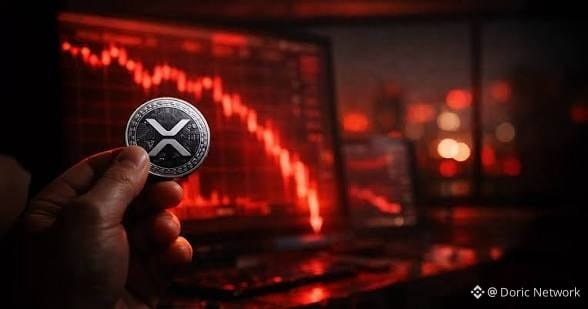
97
Article
What Role Will AI Play in Managing Tokenized Portfolios?The global financial system operates on a digital infrastructure where the boundaries between physical assets and programmatic code have dissolved. The tokenization of real-world assets (RWAs)—converting rights to physical properties, private credit, government debt, corporate equities, and commodities into digital tokens on distributed ledgers—has grown from an experimental technological concept into a multi-billion-dollar market. As these tokenized assets fill public and private blockchains, financial managers face a new challenge: how to efficiently track, value, rebalance, and risk-manage portfolios composed of thousands of fractionalized, continuously trading digital instruments. Human portfolio managers, constrained by manual spreadsheet calculations and traditional market hours, cannot operate effectively at the velocity and scale demanded by this on-chain economy. Enter artificial intelligence (AI), the essential management engine that provides the algorithmic speed, predictive modeling, and real-time execution required to run complex tokenized portfolios.
This comprehensive guide explores the intersection of artificial intelligence and tokenized asset management. AI is not merely a supplementary tool for generating charts or summarizing news; it serves as an active, autonomous operating layer that handles everything from instant valuation and predictive risk modeling to cross-chain liquidity routing and automated regulatory compliance. By fusing the cryptographic transparency of public ledgers with the adaptive computing power of machine learning, financial institutions and individual investors can construct hyper-efficient, self-optimizing portfolios. Understanding the role AI plays in managing these digital assets allows investors to navigate the modern landscape of on-chain wealth management with absolute clarity, leveraging the speed of machine intelligence to maximize yield while safeguarding capital.
The Evolution of Portfolio Management in the Tokenized Asset Era
To understand the necessity of artificial intelligence in managing tokenized portfolios, you must first recognize the structural differences between traditional asset management and the on-chain digital economy. In traditional finance, portfolios consist of a limited number of centralized instruments—such as public stocks, municipal bonds, or mutual funds—that settle within a two-day window and trade exclusively during fixed exchange hours. Portfolio rebalancing is typically a periodic exercise conducted quarterly or annually, relying on delayed financial disclosures and standardized market indices.
Tokenized portfolios completely disrupt this traditional framework by introducing continuous 24/7 global trading, extreme asset fractionalization, and instant atomic settlement. An investor’s portfolio can contain fractional shares of a commercial office building in London, direct slices of private credit loans in Latin America, tokenized U.S. Treasury bills, physical vault-stored gold tokens, and fractionalized venture capital equity—all operating on different blockchain networks simultaneously. Managing this multi-chain web of continuous income streams, fluctuating collateral values, and fragmented liquidity pools manually is mathematically impossible for human operators. AI acts as the primary analytical software layer that converts this chaotic, high-velocity stream of on-chain telemetry into an organized, automated, and hyper-optimized investment strategy.
Real-Time Asset Valuation and Dynamic Pricing Engines
A primary challenge inherent to tokenized real-world assets is establishing accurate, fair market valuations for illiquid or off-chain physical assets in real-time. Traditional real estate or private equity valuation relies on episodic appraisals that occur once or twice a year, resulting in stale data that fails to reflect rapid macroeconomic shifts. When an illiquid asset is tokenized and traded on an open digital secondary market, an accurate, continuous pricing feed is required to prevent predatory arbitrage, calculate net asset values (NAV), and maintain proper collateralization ratios for decentralized lending protocols.
+-----------------------------------------------------------------+ | AI REAL-TIME VALUATION PIPELINE | | | | OFF-CHAIN TELEMETRY: | | [IoT Building Data] + [Local Deed Records] + [Regional Trends] | | | | | v | | AI PREDICTIVE VALUATION MODEL (Machine Learning Processing) | | | | | v | | ON-CHAIN ORACLE FEED: | | [Dynamic Price Updates] --> [Smart Contract Rebalancing Engine]| +-----------------------------------------------------------------+
Artificial intelligence solves this valuation bottleneck by acting as an advanced, continuous appraisal engine. Machine learning models ingest vast streams of off-chain data—including Internet of Things (IoT) sensors installed in physical buildings, local property registry records, satellite imagery, regional foot-traffic metrics, inflation indicators, and comparable transaction prices. The AI processes these variables concurrently to calculate a dynamic, real-time valuation for the tokenized asset, transmitting this price feed straight to on-chain smart contracts via decentralized oracle networks. This continuous valuation engine ensures that a tokenized portfolio reflects true market value at every second of the day, allowing investors to trade, borrow, or rebalance against their hard-asset holdings with absolute precision and pricing confidence.
Automated Portfolio Rebalancing and Algorithmic Execution
In a traditional investment setup, rebalancing a portfolio involves manually selling overperforming assets and buying underperforming ones to restore target percentage allocations. This process incurs significant brokerage commissions, tax events, and clearance friction that eats into net returns. In the tokenized asset space, where assets trade 24/7 across public blockchain ledgers, waiting weeks to rebalance a portfolio introduces severe drift and unhedged market exposure.
Artificial intelligence transforms portfolio rebalancing from a slow, manual task into a continuous, self-executing software loop. AI-driven portfolio management agents continuously monitor target asset weights, liquidity depth across decentralized exchanges, gas fee fluctuations, and slippage parameters. When a portfolio’s asset allocation drifts beyond pre-set tolerance boundaries—for example, if a surge in tokenized gold value over-allocates the portfolio’s commodity exposure—the AI agent automatically constructs, simulates, and routes optimal trade batches across decentralized liquidity pools. The machine executes these atomic transactions instantly using programmatic smart contract routines, locking in target ratios, minimizing price impact, and harvesting compounding yields with zero human administrative delay.
Predictive Risk Management and Stress Testing Simulation
Risk management in traditional portfolios relies heavily on backward-looking metrics like historical volatility and beta coefficients, which often fail during unprecedented macroeconomic panics. Tokenized portfolios face unique, multi-dimensional risk vectors, including smart contract code vulnerabilities, oracle manipulation risks, sudden shifts in secondary market liquidity, underlying real-world credit defaults, and cross-chain bridge exploits. Evaluating these complex, interconnected threat vectors requires a forward-looking, predictive analytical engine.
| Risk Vector | Traditional Management | AI-Powered Tokenized Management | | :--- | :--- | :--- | | **Data Recency** | Delayed (Quarterly/Annual Reports) | Real-Time On-Chain & Off-Chain Telemetry | | **Market Coverage** | Single-Exchange Operating Hours | 24/7 Global Multi-Chain Execution | | **Valuation Model** | Episodic Manual Appraisals | Continuous Machine Learning Pricing | | **Threat Detection** | Reactive (Post-Incident Audits) | Predictive Simulation & Auto-Containment | | **Execution Speed** | Multi-Day Settlement Windows | Instant, Atomic Smart Contract Settlement |
Artificial intelligence elevates risk management by running continuous, real-time stress testing simulations across the entire portfolio. Machine learning algorithms continuously analyze on-chain wallet movements, order book depth, borrower health metrics in private credit pools, and macroeconomic news flows. The AI runs thousands of Monte Carlo simulations per minute, predicting potential liquidity crunches or default risks before they materialize on-chain. If the predictive risk model detects an rising probability of default in a specific tokenized loan pool, the AI system can automatically adjust collateral buffers, initiate partial hedging trades in derivative markets, or route capital into safe-haven tokenized treasuries, insulating the portfolio from catastrophic drawdowns.
Hyper-Personalized Yield Optimization and Capital Routing
Yield optimization in decentralized finance has historically been dominated by basic yield aggregators that route stablecoins to whichever lending protocol offers the highest published interest rate. However, these simplistic tools often ignore critical variables such as protocol risk ratings, smart contract security scores, withdrawal lockup periods, and tax implications. In an ecosystem filled with diverse real-world asset yields—ranging from tokenized US Treasury bills to fractional commercial property rent—maximizing returns requires a far more sophisticated, multi-variable approach.
Artificial intelligence functions as an intelligent, hyper-personalized yield routing engine. AI agents analyze an investor’s specific risk tolerance, target investment horizon, tax jurisdiction, and liquidity preferences, constructing a customized capital allocation map. The machine scans global on-chain markets in real-time, evaluating the risk-adjusted returns of various tokenized asset vaults, private credit originators, and yield-bearing stablecoin products. If an AI agent identifies that a tokenized corporate bond vault offers a superior risk-adjusted yield compared to an existing money market allocation—taking into account network gas costs and withdrawal terms—it can execute an automated portfolio migration. This continuous capital optimization ensures that every unit of capital inside the portfolio works at maximum efficiency, generating productive income tailored to the investor's exact financial profile.
Automated Regulatory Compliance and Sanction Screening
For institutional investors, the primary barrier to adopting tokenized assets has never been the underlying technology, but the complex legal mandate of regulatory compliance. Because public blockchain ledgers are borderless and accessible globally, ensuring that every asset, transaction, and counterparty inside a portfolio satisfies local securities laws, Know Your Customer (KYC) rules, and Anti-Money Laundering (AML) mandates is a massive legal hurdle. Traditional manual compliance monitoring is too slow and expensive to keep pace with continuous on-chain trading.
+-----------------------------------------------------------------+ | AUTOMATED AI COMPLIANCE ENGINE | | | | [Incoming On-Chain Transaction] | | | | | v | | [AI Pattern Detection & Global Regulatory Database Scan] | | | | | v | | PASSED: [Instant Smart Contract Execution & Tax Logging] | | FAILED: [Autonomous Session Freeze & Regulatory Alert] | +-----------------------------------------------------------------+
Artificial intelligence solves this operational challenge by embedding compliance logic directly into the portfolio management workflow. AI compliance engines continuously monitor global regulatory databases, cross-referencing on-chain wallet addresses against international sanction lists, PEP (Politically Exposed Persons) registers, and suspicious transaction pattern databases in real-time. When a tokenized asset trade or collateral transfer is initiated, the AI model checks the compliance status of both counterparties instantly. If a transaction violates local investor accreditation caps or involves an unverified wallet, the AI compliance filter automatically blocks the transaction at the smart contract level, preventing legal breaches before they occur. This automated oversight allows institutional allocators to scale their on-chain portfolios comfortably inside a fully compliant, heavily audited legal perimeter.
Fraud Detection, Anomaly Identification, and Cyber Defense
The digital asset ecosystem operates in a hostile security environment where phishing attacks, smart contract exploits, flash loan attacks, and malicious wallet drainers pose continuous threats to investor capital. In a world where transactions are final and immutable on public ledgers, a single security lapse can lead to irreversible capital loss. Traditional security tools that rely on static virus signatures or delayed post-incident audits are entirely ineffective against machine-speed, zero-day cyber exploits.
Artificial intelligence acts as an active, unyielding cybersecurity defense layer for tokenized portfolios. Machine learning models establish a precise baseline of normal, legitimate network behavior and wallet interaction patterns. The AI continuously monitors incoming smart contract execution calls, transaction payloads, and authorization requests. If a malicious actor attempts to execute an unauthorized transaction, drain a liquidity pool using a flash loan attack, or trick the system into approving a corrupted smart contract upgrade, the AI anomaly detection engine flags the deviation in milliseconds. The AI can trigger emergency protocol circuit breakers, revoke compromised approval keys, and isolate affected vault segments instantly, containing the threat and protecting the broader portfolio from loss.
Cross-Chain Liquidity Orchestration and Intent-Based Execution
As the Web3 ecosystem expands across specialized Layer-1 blockchains, Layer-2 scaling rollups, and application-specific app-chains, capital fragmentation has become a significant hurdle. An investor’s tokenized real estate shares might live on an Ethereum Layer-2, while their private credit allocations operate on an institutional permissioned ledger, and their stablecoin reserves sit on a high-speed execution chain. Manually navigating cross-chain bridges, managing gas tokens across multiple networks, and executing sequential trades introduces massive friction, user error, and security risks.
Key Takeaway: AI transforms multi-chain chaos into a unified interface. Rather than manually bridging assets and swapping tokens across fragmented networks, investors simply state their high-level intent, allowing AI agents to orchestrate complex cross-chain execution behind the scenes.
Artificial intelligence resolves this liquidity fragmentation through the power of intent-based execution architectures. Instead of forcing the investor to manually execute ten different bridging and trading steps across three networks, the investor simply expresses a high-level intent to the AI management agent—for example, "Reallocate 10% of my tokenized treasury yield into fractional industrial real estate." The AI agent parses the request, identifies the optimal cross-chain routing paths, calculates the lowest gas fees, and coordinates specialized solver networks to execute the multi-chain transactions atomically behind the scenes. This cross-chain orchestration turns a complex, multi-network web into a single, unified portfolio interface, allowing capital to move effortlessly to wherever its utility is highest.
Autonomous AI Agents and the Future of Self-Managing Portfolios
The ultimate convergence of artificial intelligence and tokenized asset management lies in the deployment of fully autonomous, on-chain AI agents. These are not mere analytical dashboards or software notifications; they are self-sovereign, code-governed entities equipped with their own smart contract wallets, operating parameters, and risk mandates. An investor can provision an autonomous AI management agent, seed it with initial capital, and grant it restricted authority to execute investment strategies independently on their behalf.
These autonomous agents operate continuously, executing complex strategies like arbitrage capture, dynamic tax-loss harvesting, automated yield compounding, and predictive risk hedging without requiring human intervention. For example, during an unexpected overnight macroeconomic event, an autonomous AI agent can analyze incoming news feeds, evaluate the impact on tokenized corporate credit yields, execute necessary risk-mitigation swaps, and log the detailed rationale behind every trade on-chain before the human manager even wakes up. This shift toward autonomous, self-managing portfolios represents a profound leap in capital efficiency, democratizing access to institutional-grade quantitative trading strategies for retail and institutional allocators alike.
Navigating the Human-AI Hybrid Governance Lifecycle
While the capabilities of artificial intelligence in managing tokenized portfolios are extraordinary, a complete, responsible investment strategy requires establishing proper guardrails and human oversight. Over-relying on fully autonomous algorithmic models introduces unique risks, including algorithmic bias, model hallucinations during black-swan market events, and systemic herd behavior if thousands of independent AI agents execute identical trading strategies simultaneously.
+-----------------------------------------------------------------+ | HUMAN-AI HYBRID GOVERNANCE LIFECYCLE | | | | STRATEGIC LAYER (Human Investor): | | [Defines Risk Parameters] + [Sets Yield Goals] + [Approves Caps]| | | | | v | | EXECUTION LAYER (AI Operating Engine): | | [Continuous Valuation] + [24/7 Monitoring] + [Auto-Rebalance] | | | | | v | | AUDIT LAYER (Blockchain Ledger & Human Review): | | [Un-Alterable On-Chain Logs] --> [Periodic Strategy Adjustments]| +-----------------------------------------------------------------+
The gold standard for modern portfolio administration is a human-in-the-loop, hybrid governance framework. In this collaborative architecture, the human investor or institutional investment committee acts as the strategic architect—setting overarching risk limits, defining acceptable asset classes, selecting legal compliance parameters, and approving maximum position sizes. The artificial intelligence functions as the tireless execution engine, handling continuous data ingestion, real-time risk simulation, fractional trade routing, and automated compliance tracking twenty-four hours a day. Every action executed by the AI is permanently logged on the public blockchain ledger, generating an unalterable audit trail that human managers can inspect, evaluate, and fine-tune over time. This hybrid synergy combines the strategic wisdom and ethical judgment of human managers with the lightning speed and mathematical precision of machine intelligence, creating a resilient, future-proof wealth management engine.
The integration of artificial intelligence into tokenized portfolio management marks a profound architectural shift in global finance, permanently replacing manual spreadsheet management with automated, real-time machine intelligence. As real-world assets continue to migrate onto public ledgers, the sheer velocity, volume, and complexity of continuous 24/7 global markets demand an operational layer capable of executing at scale. Artificial intelligence answers this call by providing continuous real-time asset valuations, dynamic portfolio rebalancing, forward-looking predictive risk modeling, automated regulatory compliance, and cross-chain liquidity orchestration. Rather than replacing human judgment, AI elevates human portfolio architects, giving them the algorithmic tools required to manage multi-asset portfolios with institutional precision. The era of slow, paper-reliant asset management has drawn to a close, replaced by an intelligent, on-chain financial ecosystem where algorithms and distributed ledgers work in tandem to optimize wealth. By mastering the synergistic mechanics of artificial intelligence and asset tokenization today, investors position themselves at the forefront of the modern digital economy, ready to build, protect, and compound their wealth on the solid ground of an elite, automated, and unstoppable financial frontier.
What Role Will AI Play in Managing Tokenized Portfolios?
The global financial system operates on a digital infrastructure where the boundaries between physical assets and programmatic code have dissolved. The tokenization of real-world assets (RWAs)—converting rights to physical properties, private credit, government debt, corporate equities, and commodities into digital tokens on distributed ledgers—has grown from an experimental technological concept into a multi-billion-dollar market. As these tokenized assets fill public and private blockchains, financial managers face a new challenge: how to efficiently track, value, rebalance, and risk-manage portfolios composed of thousands of fractionalized, continuously trading digital instruments. Human portfolio managers, constrained by manual spreadsheet calculations and traditional market hours, cannot operate effectively at the velocity and scale demanded by this on-chain economy. Enter artificial intelligence (AI), the essential management engine that provides the algorithmic speed, predictive modeling, and real-time execution required to run complex tokenized portfolios.
This comprehensive guide explores the intersection of artificial intelligence and tokenized asset management. AI is not merely a supplementary tool for generating charts or summarizing news; it serves as an active, autonomous operating layer that handles everything from instant valuation and predictive risk modeling to cross-chain liquidity routing and automated regulatory compliance. By fusing the cryptographic transparency of public ledgers with the adaptive computing power of machine learning, financial institutions and individual investors can construct hyper-efficient, self-optimizing portfolios. Understanding the role AI plays in managing these digital assets allows investors to navigate the modern landscape of on-chain wealth management with absolute clarity, leveraging the speed of machine intelligence to maximize yield while safeguarding capital.
The Evolution of Portfolio Management in the Tokenized Asset Era
To understand the necessity of artificial intelligence in managing tokenized portfolios, you must first recognize the structural differences between traditional asset management and the on-chain digital economy. In traditional finance, portfolios consist of a limited number of centralized instruments—such as public stocks, municipal bonds, or mutual funds—that settle within a two-day window and trade exclusively during fixed exchange hours. Portfolio rebalancing is typically a periodic exercise conducted quarterly or annually, relying on delayed financial disclosures and standardized market indices.
Tokenized portfolios completely disrupt this traditional framework by introducing continuous 24/7 global trading, extreme asset fractionalization, and instant atomic settlement. An investor’s portfolio can contain fractional shares of a commercial office building in London, direct slices of private credit loans in Latin America, tokenized U.S. Treasury bills, physical vault-stored gold tokens, and fractionalized venture capital equity—all operating on different blockchain networks simultaneously. Managing this multi-chain web of continuous income streams, fluctuating collateral values, and fragmented liquidity pools manually is mathematically impossible for human operators. AI acts as the primary analytical software layer that converts this chaotic, high-velocity stream of on-chain telemetry into an organized, automated, and hyper-optimized investment strategy.
Real-Time Asset Valuation and Dynamic Pricing Engines
A primary challenge inherent to tokenized real-world assets is establishing accurate, fair market valuations for illiquid or off-chain physical assets in real-time. Traditional real estate or private equity valuation relies on episodic appraisals that occur once or twice a year, resulting in stale data that fails to reflect rapid macroeconomic shifts. When an illiquid asset is tokenized and traded on an open digital secondary market, an accurate, continuous pricing feed is required to prevent predatory arbitrage, calculate net asset values (NAV), and maintain proper collateralization ratios for decentralized lending protocols.
+-----------------------------------------------------------------+ | AI REAL-TIME VALUATION PIPELINE | | | | OFF-CHAIN TELEMETRY: | | [IoT Building Data] + [Local Deed Records] + [Regional Trends] | | | | | v | | AI PREDICTIVE VALUATION MODEL (Machine Learning Processing) | | | | | v | | ON-CHAIN ORACLE FEED: | | [Dynamic Price Updates] --> [Smart Contract Rebalancing Engine]| +-----------------------------------------------------------------+
Artificial intelligence solves this valuation bottleneck by acting as an advanced, continuous appraisal engine. Machine learning models ingest vast streams of off-chain data—including Internet of Things (IoT) sensors installed in physical buildings, local property registry records, satellite imagery, regional foot-traffic metrics, inflation indicators, and comparable transaction prices. The AI processes these variables concurrently to calculate a dynamic, real-time valuation for the tokenized asset, transmitting this price feed straight to on-chain smart contracts via decentralized oracle networks. This continuous valuation engine ensures that a tokenized portfolio reflects true market value at every second of the day, allowing investors to trade, borrow, or rebalance against their hard-asset holdings with absolute precision and pricing confidence.
Automated Portfolio Rebalancing and Algorithmic Execution
In a traditional investment setup, rebalancing a portfolio involves manually selling overperforming assets and buying underperforming ones to restore target percentage allocations. This process incurs significant brokerage commissions, tax events, and clearance friction that eats into net returns. In the tokenized asset space, where assets trade 24/7 across public blockchain ledgers, waiting weeks to rebalance a portfolio introduces severe drift and unhedged market exposure.
Artificial intelligence transforms portfolio rebalancing from a slow, manual task into a continuous, self-executing software loop. AI-driven portfolio management agents continuously monitor target asset weights, liquidity depth across decentralized exchanges, gas fee fluctuations, and slippage parameters. When a portfolio’s asset allocation drifts beyond pre-set tolerance boundaries—for example, if a surge in tokenized gold value over-allocates the portfolio’s commodity exposure—the AI agent automatically constructs, simulates, and routes optimal trade batches across decentralized liquidity pools. The machine executes these atomic transactions instantly using programmatic smart contract routines, locking in target ratios, minimizing price impact, and harvesting compounding yields with zero human administrative delay.
Predictive Risk Management and Stress Testing Simulation
Risk management in traditional portfolios relies heavily on backward-looking metrics like historical volatility and beta coefficients, which often fail during unprecedented macroeconomic panics. Tokenized portfolios face unique, multi-dimensional risk vectors, including smart contract code vulnerabilities, oracle manipulation risks, sudden shifts in secondary market liquidity, underlying real-world credit defaults, and cross-chain bridge exploits. Evaluating these complex, interconnected threat vectors requires a forward-looking, predictive analytical engine.
| Risk Vector | Traditional Management | AI-Powered Tokenized Management | | :--- | :--- | :--- | | **Data Recency** | Delayed (Quarterly/Annual Reports) | Real-Time On-Chain & Off-Chain Telemetry | | **Market Coverage** | Single-Exchange Operating Hours | 24/7 Global Multi-Chain Execution | | **Valuation Model** | Episodic Manual Appraisals | Continuous Machine Learning Pricing | | **Threat Detection** | Reactive (Post-Incident Audits) | Predictive Simulation & Auto-Containment | | **Execution Speed** | Multi-Day Settlement Windows | Instant, Atomic Smart Contract Settlement |
Artificial intelligence elevates risk management by running continuous, real-time stress testing simulations across the entire portfolio. Machine learning algorithms continuously analyze on-chain wallet movements, order book depth, borrower health metrics in private credit pools, and macroeconomic news flows. The AI runs thousands of Monte Carlo simulations per minute, predicting potential liquidity crunches or default risks before they materialize on-chain. If the predictive risk model detects an rising probability of default in a specific tokenized loan pool, the AI system can automatically adjust collateral buffers, initiate partial hedging trades in derivative markets, or route capital into safe-haven tokenized treasuries, insulating the portfolio from catastrophic drawdowns.
Hyper-Personalized Yield Optimization and Capital Routing
Yield optimization in decentralized finance has historically been dominated by basic yield aggregators that route stablecoins to whichever lending protocol offers the highest published interest rate. However, these simplistic tools often ignore critical variables such as protocol risk ratings, smart contract security scores, withdrawal lockup periods, and tax implications. In an ecosystem filled with diverse real-world asset yields—ranging from tokenized US Treasury bills to fractional commercial property rent—maximizing returns requires a far more sophisticated, multi-variable approach.
Artificial intelligence functions as an intelligent, hyper-personalized yield routing engine. AI agents analyze an investor’s specific risk tolerance, target investment horizon, tax jurisdiction, and liquidity preferences, constructing a customized capital allocation map. The machine scans global on-chain markets in real-time, evaluating the risk-adjusted returns of various tokenized asset vaults, private credit originators, and yield-bearing stablecoin products. If an AI agent identifies that a tokenized corporate bond vault offers a superior risk-adjusted yield compared to an existing money market allocation—taking into account network gas costs and withdrawal terms—it can execute an automated portfolio migration. This continuous capital optimization ensures that every unit of capital inside the portfolio works at maximum efficiency, generating productive income tailored to the investor's exact financial profile.
Automated Regulatory Compliance and Sanction Screening
For institutional investors, the primary barrier to adopting tokenized assets has never been the underlying technology, but the complex legal mandate of regulatory compliance. Because public blockchain ledgers are borderless and accessible globally, ensuring that every asset, transaction, and counterparty inside a portfolio satisfies local securities laws, Know Your Customer (KYC) rules, and Anti-Money Laundering (AML) mandates is a massive legal hurdle. Traditional manual compliance monitoring is too slow and expensive to keep pace with continuous on-chain trading.
+-----------------------------------------------------------------+ | AUTOMATED AI COMPLIANCE ENGINE | | | | [Incoming On-Chain Transaction] | | | | | v | | [AI Pattern Detection & Global Regulatory Database Scan] | | | | | v | | PASSED: [Instant Smart Contract Execution & Tax Logging] | | FAILED: [Autonomous Session Freeze & Regulatory Alert] | +-----------------------------------------------------------------+
Artificial intelligence solves this operational challenge by embedding compliance logic directly into the portfolio management workflow. AI compliance engines continuously monitor global regulatory databases, cross-referencing on-chain wallet addresses against international sanction lists, PEP (Politically Exposed Persons) registers, and suspicious transaction pattern databases in real-time. When a tokenized asset trade or collateral transfer is initiated, the AI model checks the compliance status of both counterparties instantly. If a transaction violates local investor accreditation caps or involves an unverified wallet, the AI compliance filter automatically blocks the transaction at the smart contract level, preventing legal breaches before they occur. This automated oversight allows institutional allocators to scale their on-chain portfolios comfortably inside a fully compliant, heavily audited legal perimeter.
Fraud Detection, Anomaly Identification, and Cyber Defense
The digital asset ecosystem operates in a hostile security environment where phishing attacks, smart contract exploits, flash loan attacks, and malicious wallet drainers pose continuous threats to investor capital. In a world where transactions are final and immutable on public ledgers, a single security lapse can lead to irreversible capital loss. Traditional security tools that rely on static virus signatures or delayed post-incident audits are entirely ineffective against machine-speed, zero-day cyber exploits.
Artificial intelligence acts as an active, unyielding cybersecurity defense layer for tokenized portfolios. Machine learning models establish a precise baseline of normal, legitimate network behavior and wallet interaction patterns. The AI continuously monitors incoming smart contract execution calls, transaction payloads, and authorization requests. If a malicious actor attempts to execute an unauthorized transaction, drain a liquidity pool using a flash loan attack, or trick the system into approving a corrupted smart contract upgrade, the AI anomaly detection engine flags the deviation in milliseconds. The AI can trigger emergency protocol circuit breakers, revoke compromised approval keys, and isolate affected vault segments instantly, containing the threat and protecting the broader portfolio from loss.
Cross-Chain Liquidity Orchestration and Intent-Based Execution
As the Web3 ecosystem expands across specialized Layer-1 blockchains, Layer-2 scaling rollups, and application-specific app-chains, capital fragmentation has become a significant hurdle. An investor’s tokenized real estate shares might live on an Ethereum Layer-2, while their private credit allocations operate on an institutional permissioned ledger, and their stablecoin reserves sit on a high-speed execution chain. Manually navigating cross-chain bridges, managing gas tokens across multiple networks, and executing sequential trades introduces massive friction, user error, and security risks.
Key Takeaway: AI transforms multi-chain chaos into a unified interface. Rather than manually bridging assets and swapping tokens across fragmented networks, investors simply state their high-level intent, allowing AI agents to orchestrate complex cross-chain execution behind the scenes.
Artificial intelligence resolves this liquidity fragmentation through the power of intent-based execution architectures. Instead of forcing the investor to manually execute ten different bridging and trading steps across three networks, the investor simply expresses a high-level intent to the AI management agent—for example, "Reallocate 10% of my tokenized treasury yield into fractional industrial real estate." The AI agent parses the request, identifies the optimal cross-chain routing paths, calculates the lowest gas fees, and coordinates specialized solver networks to execute the multi-chain transactions atomically behind the scenes. This cross-chain orchestration turns a complex, multi-network web into a single, unified portfolio interface, allowing capital to move effortlessly to wherever its utility is highest.
Autonomous AI Agents and the Future of Self-Managing Portfolios
The ultimate convergence of artificial intelligence and tokenized asset management lies in the deployment of fully autonomous, on-chain AI agents. These are not mere analytical dashboards or software notifications; they are self-sovereign, code-governed entities equipped with their own smart contract wallets, operating parameters, and risk mandates. An investor can provision an autonomous AI management agent, seed it with initial capital, and grant it restricted authority to execute investment strategies independently on their behalf.
These autonomous agents operate continuously, executing complex strategies like arbitrage capture, dynamic tax-loss harvesting, automated yield compounding, and predictive risk hedging without requiring human intervention. For example, during an unexpected overnight macroeconomic event, an autonomous AI agent can analyze incoming news feeds, evaluate the impact on tokenized corporate credit yields, execute necessary risk-mitigation swaps, and log the detailed rationale behind every trade on-chain before the human manager even wakes up. This shift toward autonomous, self-managing portfolios represents a profound leap in capital efficiency, democratizing access to institutional-grade quantitative trading strategies for retail and institutional allocators alike.
Navigating the Human-AI Hybrid Governance Lifecycle
While the capabilities of artificial intelligence in managing tokenized portfolios are extraordinary, a complete, responsible investment strategy requires establishing proper guardrails and human oversight. Over-relying on fully autonomous algorithmic models introduces unique risks, including algorithmic bias, model hallucinations during black-swan market events, and systemic herd behavior if thousands of independent AI agents execute identical trading strategies simultaneously.
+-----------------------------------------------------------------+ | HUMAN-AI HYBRID GOVERNANCE LIFECYCLE | | | | STRATEGIC LAYER (Human Investor): | | [Defines Risk Parameters] + [Sets Yield Goals] + [Approves Caps]| | | | | v | | EXECUTION LAYER (AI Operating Engine): | | [Continuous Valuation] + [24/7 Monitoring] + [Auto-Rebalance] | | | | | v | | AUDIT LAYER (Blockchain Ledger & Human Review): | | [Un-Alterable On-Chain Logs] --> [Periodic Strategy Adjustments]| +-----------------------------------------------------------------+
The gold standard for modern portfolio administration is a human-in-the-loop, hybrid governance framework. In this collaborative architecture, the human investor or institutional investment committee acts as the strategic architect—setting overarching risk limits, defining acceptable asset classes, selecting legal compliance parameters, and approving maximum position sizes. The artificial intelligence functions as the tireless execution engine, handling continuous data ingestion, real-time risk simulation, fractional trade routing, and automated compliance tracking twenty-four hours a day. Every action executed by the AI is permanently logged on the public blockchain ledger, generating an unalterable audit trail that human managers can inspect, evaluate, and fine-tune over time. This hybrid synergy combines the strategic wisdom and ethical judgment of human managers with the lightning speed and mathematical precision of machine intelligence, creating a resilient, future-proof wealth management engine.
The integration of artificial intelligence into tokenized portfolio management marks a profound architectural shift in global finance, permanently replacing manual spreadsheet management with automated, real-time machine intelligence. As real-world assets continue to migrate onto public ledgers, the sheer velocity, volume, and complexity of continuous 24/7 global markets demand an operational layer capable of executing at scale. Artificial intelligence answers this call by providing continuous real-time asset valuations, dynamic portfolio rebalancing, forward-looking predictive risk modeling, automated regulatory compliance, and cross-chain liquidity orchestration. Rather than replacing human judgment, AI elevates human portfolio architects, giving them the algorithmic tools required to manage multi-asset portfolios with institutional precision. The era of slow, paper-reliant asset management has drawn to a close, replaced by an intelligent, on-chain financial ecosystem where algorithms and distributed ledgers work in tandem to optimize wealth. By mastering the synergistic mechanics of artificial intelligence and asset tokenization today, investors position themselves at the forefront of the modern digital economy, ready to build, protect, and compound their wealth on the solid ground of an elite, automated, and unstoppable financial frontier.
This comprehensive guide explores the intersection of artificial intelligence and tokenized asset management. AI is not merely a supplementary tool for generating charts or summarizing news; it serves as an active, autonomous operating layer that handles everything from instant valuation and predictive risk modeling to cross-chain liquidity routing and automated regulatory compliance. By fusing the cryptographic transparency of public ledgers with the adaptive computing power of machine learning, financial institutions and individual investors can construct hyper-efficient, self-optimizing portfolios. Understanding the role AI plays in managing these digital assets allows investors to navigate the modern landscape of on-chain wealth management with absolute clarity, leveraging the speed of machine intelligence to maximize yield while safeguarding capital.
The Evolution of Portfolio Management in the Tokenized Asset Era
To understand the necessity of artificial intelligence in managing tokenized portfolios, you must first recognize the structural differences between traditional asset management and the on-chain digital economy. In traditional finance, portfolios consist of a limited number of centralized instruments—such as public stocks, municipal bonds, or mutual funds—that settle within a two-day window and trade exclusively during fixed exchange hours. Portfolio rebalancing is typically a periodic exercise conducted quarterly or annually, relying on delayed financial disclosures and standardized market indices.
Tokenized portfolios completely disrupt this traditional framework by introducing continuous 24/7 global trading, extreme asset fractionalization, and instant atomic settlement. An investor’s portfolio can contain fractional shares of a commercial office building in London, direct slices of private credit loans in Latin America, tokenized U.S. Treasury bills, physical vault-stored gold tokens, and fractionalized venture capital equity—all operating on different blockchain networks simultaneously. Managing this multi-chain web of continuous income streams, fluctuating collateral values, and fragmented liquidity pools manually is mathematically impossible for human operators. AI acts as the primary analytical software layer that converts this chaotic, high-velocity stream of on-chain telemetry into an organized, automated, and hyper-optimized investment strategy.
Real-Time Asset Valuation and Dynamic Pricing Engines
A primary challenge inherent to tokenized real-world assets is establishing accurate, fair market valuations for illiquid or off-chain physical assets in real-time. Traditional real estate or private equity valuation relies on episodic appraisals that occur once or twice a year, resulting in stale data that fails to reflect rapid macroeconomic shifts. When an illiquid asset is tokenized and traded on an open digital secondary market, an accurate, continuous pricing feed is required to prevent predatory arbitrage, calculate net asset values (NAV), and maintain proper collateralization ratios for decentralized lending protocols.
+-----------------------------------------------------------------+ | AI REAL-TIME VALUATION PIPELINE | | | | OFF-CHAIN TELEMETRY: | | [IoT Building Data] + [Local Deed Records] + [Regional Trends] | | | | | v | | AI PREDICTIVE VALUATION MODEL (Machine Learning Processing) | | | | | v | | ON-CHAIN ORACLE FEED: | | [Dynamic Price Updates] --> [Smart Contract Rebalancing Engine]| +-----------------------------------------------------------------+
Artificial intelligence solves this valuation bottleneck by acting as an advanced, continuous appraisal engine. Machine learning models ingest vast streams of off-chain data—including Internet of Things (IoT) sensors installed in physical buildings, local property registry records, satellite imagery, regional foot-traffic metrics, inflation indicators, and comparable transaction prices. The AI processes these variables concurrently to calculate a dynamic, real-time valuation for the tokenized asset, transmitting this price feed straight to on-chain smart contracts via decentralized oracle networks. This continuous valuation engine ensures that a tokenized portfolio reflects true market value at every second of the day, allowing investors to trade, borrow, or rebalance against their hard-asset holdings with absolute precision and pricing confidence.
Automated Portfolio Rebalancing and Algorithmic Execution
In a traditional investment setup, rebalancing a portfolio involves manually selling overperforming assets and buying underperforming ones to restore target percentage allocations. This process incurs significant brokerage commissions, tax events, and clearance friction that eats into net returns. In the tokenized asset space, where assets trade 24/7 across public blockchain ledgers, waiting weeks to rebalance a portfolio introduces severe drift and unhedged market exposure.
Artificial intelligence transforms portfolio rebalancing from a slow, manual task into a continuous, self-executing software loop. AI-driven portfolio management agents continuously monitor target asset weights, liquidity depth across decentralized exchanges, gas fee fluctuations, and slippage parameters. When a portfolio’s asset allocation drifts beyond pre-set tolerance boundaries—for example, if a surge in tokenized gold value over-allocates the portfolio’s commodity exposure—the AI agent automatically constructs, simulates, and routes optimal trade batches across decentralized liquidity pools. The machine executes these atomic transactions instantly using programmatic smart contract routines, locking in target ratios, minimizing price impact, and harvesting compounding yields with zero human administrative delay.
Predictive Risk Management and Stress Testing Simulation
Risk management in traditional portfolios relies heavily on backward-looking metrics like historical volatility and beta coefficients, which often fail during unprecedented macroeconomic panics. Tokenized portfolios face unique, multi-dimensional risk vectors, including smart contract code vulnerabilities, oracle manipulation risks, sudden shifts in secondary market liquidity, underlying real-world credit defaults, and cross-chain bridge exploits. Evaluating these complex, interconnected threat vectors requires a forward-looking, predictive analytical engine.
| Risk Vector | Traditional Management | AI-Powered Tokenized Management | | :--- | :--- | :--- | | **Data Recency** | Delayed (Quarterly/Annual Reports) | Real-Time On-Chain & Off-Chain Telemetry | | **Market Coverage** | Single-Exchange Operating Hours | 24/7 Global Multi-Chain Execution | | **Valuation Model** | Episodic Manual Appraisals | Continuous Machine Learning Pricing | | **Threat Detection** | Reactive (Post-Incident Audits) | Predictive Simulation & Auto-Containment | | **Execution Speed** | Multi-Day Settlement Windows | Instant, Atomic Smart Contract Settlement |
Artificial intelligence elevates risk management by running continuous, real-time stress testing simulations across the entire portfolio. Machine learning algorithms continuously analyze on-chain wallet movements, order book depth, borrower health metrics in private credit pools, and macroeconomic news flows. The AI runs thousands of Monte Carlo simulations per minute, predicting potential liquidity crunches or default risks before they materialize on-chain. If the predictive risk model detects an rising probability of default in a specific tokenized loan pool, the AI system can automatically adjust collateral buffers, initiate partial hedging trades in derivative markets, or route capital into safe-haven tokenized treasuries, insulating the portfolio from catastrophic drawdowns.
Hyper-Personalized Yield Optimization and Capital Routing
Yield optimization in decentralized finance has historically been dominated by basic yield aggregators that route stablecoins to whichever lending protocol offers the highest published interest rate. However, these simplistic tools often ignore critical variables such as protocol risk ratings, smart contract security scores, withdrawal lockup periods, and tax implications. In an ecosystem filled with diverse real-world asset yields—ranging from tokenized US Treasury bills to fractional commercial property rent—maximizing returns requires a far more sophisticated, multi-variable approach.
Artificial intelligence functions as an intelligent, hyper-personalized yield routing engine. AI agents analyze an investor’s specific risk tolerance, target investment horizon, tax jurisdiction, and liquidity preferences, constructing a customized capital allocation map. The machine scans global on-chain markets in real-time, evaluating the risk-adjusted returns of various tokenized asset vaults, private credit originators, and yield-bearing stablecoin products. If an AI agent identifies that a tokenized corporate bond vault offers a superior risk-adjusted yield compared to an existing money market allocation—taking into account network gas costs and withdrawal terms—it can execute an automated portfolio migration. This continuous capital optimization ensures that every unit of capital inside the portfolio works at maximum efficiency, generating productive income tailored to the investor's exact financial profile.
Automated Regulatory Compliance and Sanction Screening
For institutional investors, the primary barrier to adopting tokenized assets has never been the underlying technology, but the complex legal mandate of regulatory compliance. Because public blockchain ledgers are borderless and accessible globally, ensuring that every asset, transaction, and counterparty inside a portfolio satisfies local securities laws, Know Your Customer (KYC) rules, and Anti-Money Laundering (AML) mandates is a massive legal hurdle. Traditional manual compliance monitoring is too slow and expensive to keep pace with continuous on-chain trading.
+-----------------------------------------------------------------+ | AUTOMATED AI COMPLIANCE ENGINE | | | | [Incoming On-Chain Transaction] | | | | | v | | [AI Pattern Detection & Global Regulatory Database Scan] | | | | | v | | PASSED: [Instant Smart Contract Execution & Tax Logging] | | FAILED: [Autonomous Session Freeze & Regulatory Alert] | +-----------------------------------------------------------------+
Artificial intelligence solves this operational challenge by embedding compliance logic directly into the portfolio management workflow. AI compliance engines continuously monitor global regulatory databases, cross-referencing on-chain wallet addresses against international sanction lists, PEP (Politically Exposed Persons) registers, and suspicious transaction pattern databases in real-time. When a tokenized asset trade or collateral transfer is initiated, the AI model checks the compliance status of both counterparties instantly. If a transaction violates local investor accreditation caps or involves an unverified wallet, the AI compliance filter automatically blocks the transaction at the smart contract level, preventing legal breaches before they occur. This automated oversight allows institutional allocators to scale their on-chain portfolios comfortably inside a fully compliant, heavily audited legal perimeter.
Fraud Detection, Anomaly Identification, and Cyber Defense
The digital asset ecosystem operates in a hostile security environment where phishing attacks, smart contract exploits, flash loan attacks, and malicious wallet drainers pose continuous threats to investor capital. In a world where transactions are final and immutable on public ledgers, a single security lapse can lead to irreversible capital loss. Traditional security tools that rely on static virus signatures or delayed post-incident audits are entirely ineffective against machine-speed, zero-day cyber exploits.
Artificial intelligence acts as an active, unyielding cybersecurity defense layer for tokenized portfolios. Machine learning models establish a precise baseline of normal, legitimate network behavior and wallet interaction patterns. The AI continuously monitors incoming smart contract execution calls, transaction payloads, and authorization requests. If a malicious actor attempts to execute an unauthorized transaction, drain a liquidity pool using a flash loan attack, or trick the system into approving a corrupted smart contract upgrade, the AI anomaly detection engine flags the deviation in milliseconds. The AI can trigger emergency protocol circuit breakers, revoke compromised approval keys, and isolate affected vault segments instantly, containing the threat and protecting the broader portfolio from loss.
Cross-Chain Liquidity Orchestration and Intent-Based Execution
As the Web3 ecosystem expands across specialized Layer-1 blockchains, Layer-2 scaling rollups, and application-specific app-chains, capital fragmentation has become a significant hurdle. An investor’s tokenized real estate shares might live on an Ethereum Layer-2, while their private credit allocations operate on an institutional permissioned ledger, and their stablecoin reserves sit on a high-speed execution chain. Manually navigating cross-chain bridges, managing gas tokens across multiple networks, and executing sequential trades introduces massive friction, user error, and security risks.
Key Takeaway: AI transforms multi-chain chaos into a unified interface. Rather than manually bridging assets and swapping tokens across fragmented networks, investors simply state their high-level intent, allowing AI agents to orchestrate complex cross-chain execution behind the scenes.
Artificial intelligence resolves this liquidity fragmentation through the power of intent-based execution architectures. Instead of forcing the investor to manually execute ten different bridging and trading steps across three networks, the investor simply expresses a high-level intent to the AI management agent—for example, "Reallocate 10% of my tokenized treasury yield into fractional industrial real estate." The AI agent parses the request, identifies the optimal cross-chain routing paths, calculates the lowest gas fees, and coordinates specialized solver networks to execute the multi-chain transactions atomically behind the scenes. This cross-chain orchestration turns a complex, multi-network web into a single, unified portfolio interface, allowing capital to move effortlessly to wherever its utility is highest.
Autonomous AI Agents and the Future of Self-Managing Portfolios
The ultimate convergence of artificial intelligence and tokenized asset management lies in the deployment of fully autonomous, on-chain AI agents. These are not mere analytical dashboards or software notifications; they are self-sovereign, code-governed entities equipped with their own smart contract wallets, operating parameters, and risk mandates. An investor can provision an autonomous AI management agent, seed it with initial capital, and grant it restricted authority to execute investment strategies independently on their behalf.
These autonomous agents operate continuously, executing complex strategies like arbitrage capture, dynamic tax-loss harvesting, automated yield compounding, and predictive risk hedging without requiring human intervention. For example, during an unexpected overnight macroeconomic event, an autonomous AI agent can analyze incoming news feeds, evaluate the impact on tokenized corporate credit yields, execute necessary risk-mitigation swaps, and log the detailed rationale behind every trade on-chain before the human manager even wakes up. This shift toward autonomous, self-managing portfolios represents a profound leap in capital efficiency, democratizing access to institutional-grade quantitative trading strategies for retail and institutional allocators alike.
Navigating the Human-AI Hybrid Governance Lifecycle
While the capabilities of artificial intelligence in managing tokenized portfolios are extraordinary, a complete, responsible investment strategy requires establishing proper guardrails and human oversight. Over-relying on fully autonomous algorithmic models introduces unique risks, including algorithmic bias, model hallucinations during black-swan market events, and systemic herd behavior if thousands of independent AI agents execute identical trading strategies simultaneously.
+-----------------------------------------------------------------+ | HUMAN-AI HYBRID GOVERNANCE LIFECYCLE | | | | STRATEGIC LAYER (Human Investor): | | [Defines Risk Parameters] + [Sets Yield Goals] + [Approves Caps]| | | | | v | | EXECUTION LAYER (AI Operating Engine): | | [Continuous Valuation] + [24/7 Monitoring] + [Auto-Rebalance] | | | | | v | | AUDIT LAYER (Blockchain Ledger & Human Review): | | [Un-Alterable On-Chain Logs] --> [Periodic Strategy Adjustments]| +-----------------------------------------------------------------+
The gold standard for modern portfolio administration is a human-in-the-loop, hybrid governance framework. In this collaborative architecture, the human investor or institutional investment committee acts as the strategic architect—setting overarching risk limits, defining acceptable asset classes, selecting legal compliance parameters, and approving maximum position sizes. The artificial intelligence functions as the tireless execution engine, handling continuous data ingestion, real-time risk simulation, fractional trade routing, and automated compliance tracking twenty-four hours a day. Every action executed by the AI is permanently logged on the public blockchain ledger, generating an unalterable audit trail that human managers can inspect, evaluate, and fine-tune over time. This hybrid synergy combines the strategic wisdom and ethical judgment of human managers with the lightning speed and mathematical precision of machine intelligence, creating a resilient, future-proof wealth management engine.
The integration of artificial intelligence into tokenized portfolio management marks a profound architectural shift in global finance, permanently replacing manual spreadsheet management with automated, real-time machine intelligence. As real-world assets continue to migrate onto public ledgers, the sheer velocity, volume, and complexity of continuous 24/7 global markets demand an operational layer capable of executing at scale. Artificial intelligence answers this call by providing continuous real-time asset valuations, dynamic portfolio rebalancing, forward-looking predictive risk modeling, automated regulatory compliance, and cross-chain liquidity orchestration. Rather than replacing human judgment, AI elevates human portfolio architects, giving them the algorithmic tools required to manage multi-asset portfolios with institutional precision. The era of slow, paper-reliant asset management has drawn to a close, replaced by an intelligent, on-chain financial ecosystem where algorithms and distributed ledgers work in tandem to optimize wealth. By mastering the synergistic mechanics of artificial intelligence and asset tokenization today, investors position themselves at the forefront of the modern digital economy, ready to build, protect, and compound their wealth on the solid ground of an elite, automated, and unstoppable financial frontier.
1
93
🚨 Bitcoin is sitting on a $48 BILLION leverage powder keg — and the next real breakout could force one side to run for the exits.
BTC may look relatively calm, but underneath the surface, derivatives positioning is heavily loaded.
Around $47.88B in Bitcoin open interest is sitting in the futures market, while futures trading volume recently ran at roughly 17× spot volume. That means leverage is playing a huge role in the current market structure.
Here’s where it gets interesting:
📉 BTC breaks lower: leveraged longs could be forced to unwind, adding more selling pressure.
📈 BTC breaks higher: CME leveraged funds are heavily net short, opening the door to aggressive short covering and a potential squeeze.
In other words, the next major move may not stop at the breakout. Forced exits could amplify it.
The key signal I’m watching isn’t just price—it’s whether spot demand, open interest, and funding start moving together. That could reveal which side of the market gets trapped first.
⚡ Takeaway: Don’t assume the $48B leverage pile is automatically bearish or bullish. The real opportunity may come when the current range finally breaks and leverage starts becoming fuel for the move.
Follow for more market-moving crypto setups and data-driven updates.
🔗 Source: https://cryptonews.net/33303483/?utm_source=CryptoNews&utm_medium=app&utm_campaign=shared
#Bitcoin #BTC #Crypto #CryptoTrading #BitcoinETF
🚨 Bitcoin is sitting on a $48 BILLION leverage powder keg — and the next real breakout could force one side to run for the exits.
BTC may look relatively calm, but underneath the surface, derivatives positioning is heavily loaded.
Around $47.88B in Bitcoin open interest is sitting in the futures market, while futures trading volume recently ran at roughly 17× spot volume. That means leverage is playing a huge role in the current market structure.
Here’s where it gets interesting:
📉 BTC breaks lower: leveraged longs could be forced to unwind, adding more selling pressure.
📈 BTC breaks higher: CME leveraged funds are heavily net short, opening the door to aggressive short covering and a potential squeeze.
In other words, the next major move may not stop at the breakout. Forced exits could amplify it.
The key signal I’m watching isn’t just price—it’s whether spot demand, open interest, and funding start moving together. That could reveal which side of the market gets trapped first.
⚡ Takeaway: Don’t assume the $48B leverage pile is automatically bearish or bullish. The real opportunity may come when the current range finally breaks and leverage starts becoming fuel for the move.
Follow for more market-moving crypto setups and data-driven updates.
🔗 Source: https://cryptonews.net/33303483/?utm_source=CryptoNews&utm_medium=app&utm_campaign=shared
#Bitcoin #BTC #Crypto #CryptoTrading #BitcoinETF
BTC may look relatively calm, but underneath the surface, derivatives positioning is heavily loaded.
Around $47.88B in Bitcoin open interest is sitting in the futures market, while futures trading volume recently ran at roughly 17× spot volume. That means leverage is playing a huge role in the current market structure.
Here’s where it gets interesting:
📉 BTC breaks lower: leveraged longs could be forced to unwind, adding more selling pressure.
📈 BTC breaks higher: CME leveraged funds are heavily net short, opening the door to aggressive short covering and a potential squeeze.
In other words, the next major move may not stop at the breakout. Forced exits could amplify it.
The key signal I’m watching isn’t just price—it’s whether spot demand, open interest, and funding start moving together. That could reveal which side of the market gets trapped first.
⚡ Takeaway: Don’t assume the $48B leverage pile is automatically bearish or bullish. The real opportunity may come when the current range finally breaks and leverage starts becoming fuel for the move.
Follow for more market-moving crypto setups and data-driven updates.
🔗 Source: https://cryptonews.net/33303483/?utm_source=CryptoNews&utm_medium=app&utm_campaign=shared
#Bitcoin #BTC #Crypto #CryptoTrading #BitcoinETF
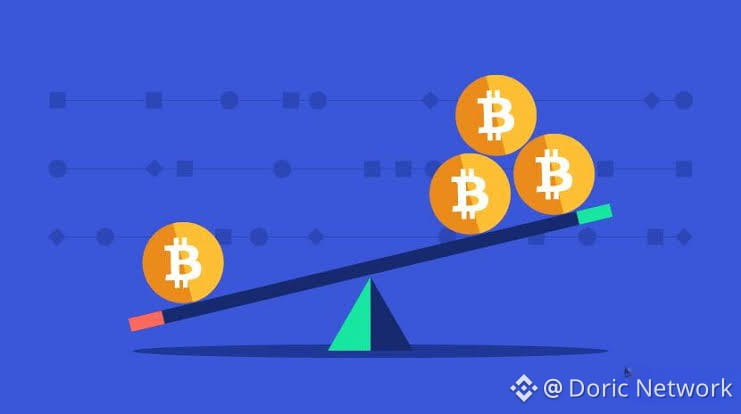
1
78
🚨 Bitcoin whales are buying… but BTC still can’t crack $65K. That’s the part traders shouldn’t ignore.
Wallets holding 100+ BTC have accumulated around 54,000 BTC since mid-June, even as smaller holders have been selling. Yet Bitcoin remains stuck below the key $65K resistance zone.
What does this tell us?
Whale accumulation can be a powerful long-term signal — but big buyers alone don’t guarantee an immediate breakout. On-chain activity is improving, while many holders are still under pressure.
🎯 Key takeaway: $65K is the level to watch. A convincing reclaim, combined with stronger network activity, could shift momentum quickly. Until then, accumulation may be happening quietly beneath the surface.
Are whales positioning early for the next move? 👀
Follow for more market signals, whale activity, and crypto updates.
#Bitcoin #BTC #Crypto #CryptoNews #BinanceSquare
Source: https://cryptonews.net/33299296/
🚨 Bitcoin whales are buying… but BTC still can’t crack $65K. That’s the part traders shouldn’t ignore.
Wallets holding 100+ BTC have accumulated around 54,000 BTC since mid-June, even as smaller holders have been selling. Yet Bitcoin remains stuck below the key $65K resistance zone.
What does this tell us?
Whale accumulation can be a powerful long-term signal — but big buyers alone don’t guarantee an immediate breakout. On-chain activity is improving, while many holders are still under pressure.
🎯 Key takeaway: $65K is the level to watch. A convincing reclaim, combined with stronger network activity, could shift momentum quickly. Until then, accumulation may be happening quietly beneath the surface.
Are whales positioning early for the next move? 👀
Follow for more market signals, whale activity, and crypto updates.
#Bitcoin #BTC #Crypto #CryptoNews #BinanceSquare
Source: https://cryptonews.net/33299296/
Wallets holding 100+ BTC have accumulated around 54,000 BTC since mid-June, even as smaller holders have been selling. Yet Bitcoin remains stuck below the key $65K resistance zone.
What does this tell us?
Whale accumulation can be a powerful long-term signal — but big buyers alone don’t guarantee an immediate breakout. On-chain activity is improving, while many holders are still under pressure.
🎯 Key takeaway: $65K is the level to watch. A convincing reclaim, combined with stronger network activity, could shift momentum quickly. Until then, accumulation may be happening quietly beneath the surface.
Are whales positioning early for the next move? 👀
Follow for more market signals, whale activity, and crypto updates.
#Bitcoin #BTC #Crypto #CryptoNews #BinanceSquare
Source: https://cryptonews.net/33299296/

1
91
🚀 Ethereum Leads Public Token Sales as Crypto Fundraising Hits $1.42B in 2026
Public token sales have raised $1.42 billion so far in 2026, with Ethereum taking the lead at $334 million. BNB Chain follows with $288M, Base with $269M, Solana with $241M, and Sonic with $206M.
What stands out even more? These five ecosystems account for roughly 94% of all public token-sale funding this year, highlighting just how concentrated blockchain fundraising has become.
Ethereum’s position shows that established infrastructure, liquidity, and a strong developer ecosystem continue to matter—but the strong numbers from Base, Solana, BNB Chain, and Sonic also show that the fundraising landscape is increasingly multi-chain.
The big question: Will this concentration continue, or will emerging networks capture a bigger share of public funding in the months ahead?
#Ethereum #Crypto #Blockchain #TokenSales #Web3
🚀 Ethereum Leads Public Token Sales as Crypto Fundraising Hits $1.42B in 2026
Public token sales have raised $1.42 billion so far in 2026, with Ethereum taking the lead at $334 million. BNB Chain follows with $288M, Base with $269M, Solana with $241M, and Sonic with $206M.
What stands out even more? These five ecosystems account for roughly 94% of all public token-sale funding this year, highlighting just how concentrated blockchain fundraising has become.
Ethereum’s position shows that established infrastructure, liquidity, and a strong developer ecosystem continue to matter—but the strong numbers from Base, Solana, BNB Chain, and Sonic also show that the fundraising landscape is increasingly multi-chain.
The big question: Will this concentration continue, or will emerging networks capture a bigger share of public funding in the months ahead?
#Ethereum #Crypto #Blockchain #TokenSales #Web3
Public token sales have raised $1.42 billion so far in 2026, with Ethereum taking the lead at $334 million. BNB Chain follows with $288M, Base with $269M, Solana with $241M, and Sonic with $206M.
What stands out even more? These five ecosystems account for roughly 94% of all public token-sale funding this year, highlighting just how concentrated blockchain fundraising has become.
Ethereum’s position shows that established infrastructure, liquidity, and a strong developer ecosystem continue to matter—but the strong numbers from Base, Solana, BNB Chain, and Sonic also show that the fundraising landscape is increasingly multi-chain.
The big question: Will this concentration continue, or will emerging networks capture a bigger share of public funding in the months ahead?
#Ethereum #Crypto #Blockchain #TokenSales #Web3
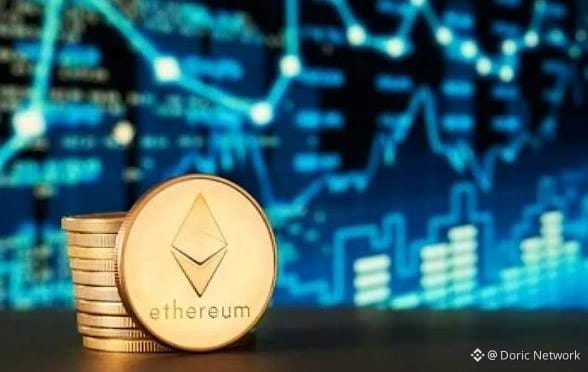
1
85
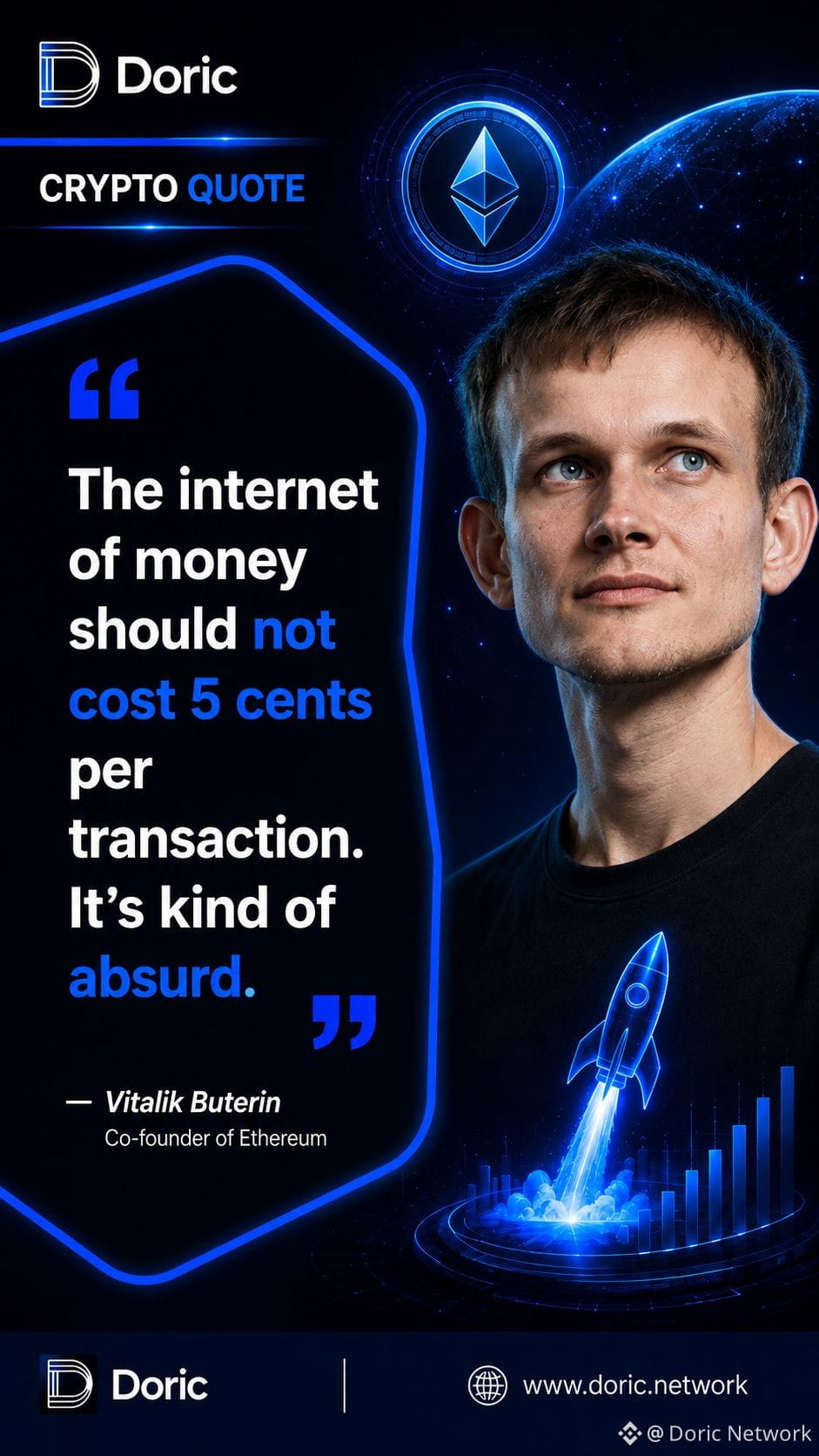
Article
Can You Build a Diversified Portfolio Entirely from RWAs?The global financial ecosystem in 2026 has crossed a defining milestone, shifting decisively away from pure cryptocurrency speculation and toward the integration of real-world value on public blockchain networks. For years, investors navigating the digital asset space were forced to choose between highly volatile crypto tokens or traditional, analog brokerage accounts bound by restrictive trading hours and multi-day settlement delays. The rapid maturation of real-world asset (RWA) tokenization has completely dissolved this artificial boundary. Tokenization refers to the process of converting ownership rights of physical or traditional financial assets into programmable digital tokens on a distributed ledger. Today, the total market value of tokenized real-world assets on-chain has expanded into a multi-billion-dollar powerhouse, spanning short-term government debt, commercial real estate, corporate private credit, physical commodities, and public equities. This transformation raises an intriguing question for modern investors: Can you build a fully diversified, resilient investment portfolio constructed entirely from tokenized real-world assets?
Answering this question requires a comprehensive understanding of portfolio construction, modern portfolio theory, and the current landscape of decentralized finance (DeFi). In traditional wealth management, true diversification requires spreading capital across uncorrelated asset classes — combining fixed-income stability, equity growth potential, hard asset inflation hedges, and liquid cash equivalents. Historically, achieving this multi-asset diversification on-chain was impossible because digital asset platforms offered little beyond volatile cryptocurrencies and basic fiat-pegged stablecoins. In the current 2026 financial ecosystem, institutional asset managers, regulated fintech issuers, and decentralized protocols have tokenized virtually every core building block of traditional finance. By examining the mechanics, quantitative figures, risk structures, and yields of these on-chain instruments, this comprehensive guide demonstrates that constructing a fully diversified, multi-asset portfolio entirely from real-world asset tokens is not only possible, but offers unprecedented operational efficiency, capital velocity, and global accessibility.
The Evolution of On-Chain Capital and the Real-World Asset Revolution
To understand how a portfolio can be constructed entirely from tokenized real-world assets, you must first trace the rapid evolution of digital capital. During the early phases of blockchain adoption, investors used crypto networks primarily to trade volatile digital currencies or participate in high-risk speculative lending pools. While these early experiments proved that decentralized ledgers could settle transactions globally without central clearinghouses, they lacked the fundamental economic backing required for long-term wealth preservation. When global interest rates rose and market volatility spiked, investors demanded stable, cash-flowing, real-economy assets that could deliver reliable yields directly on-chain without requiring them to exit the blockchain ecosystem.
This structural demand sparked the real-world asset revolution, transforming public blockchains from speculative sandboxes into institutional settlement layers for global finance. Financial institutions realized that wrapping traditional assets in smart contracts delivered massive operational advantages, including atomic settlement, 24/7 global liquidity, automated dividend distributions, and programmatically enforced legal compliance. Industry data highlights the incredible scale of this transition, with total on-chain real-world asset value — excluding traditional fiat stablecoins — surpassing thirty billion dollars. Global asset managers project that total tokenized assets will reach trillions of dollars over the coming decade. By bringing offline legal contracts and physical value on-chain, tokenization has provided the digital economy with the exact structural building blocks necessary to construct a classic, institutional-grade diversified portfolio.
The Cash Equivalent and Yield Bearing Liquidity Anchor
Every robust investment portfolio requires a foundational cash-equivalent layer designed to provide absolute capital preservation, instant liquidity, and a steady baseline return. In traditional finance, this role is filled by money market funds, short-term treasury bills, and high-yield savings accounts. In the tokenized economy, this foundational anchor is represented by tokenized government securities and yield-bearing stablecoin alternatives. Historically, holding standard non-yield stablecoins meant leaving substantial revenue on the table; tokenized treasuries solve this problem by passing the risk-free rate of government interest directly to the token holder’s self-custodial wallet in real-time.
+-----------------------------------------------------------------+
| RWA PORTFOLIO CORE FOUNDATION (CASH) |
| |
| [Short-Term US Treasuries] --> [Daily On-Chain Dividend Rebase]|
| * Capital Preservation, High Liquidity, Risk-Free Rate Return |
+-----------------------------------------------------------------+
The scale of this sector demonstrates its role as the primary liquidity engine for on-chain portfolios. Institutional funds like BlackRock’s BUIDL fund and Franklin Templeton’s BENJI fund, alongside decentralized treasury offerings like Ondo’s USDY, manage billions of dollars in total asset value. These tokens hold short-duration government paper and repurchase agreements, targeting a stable value while distributing continuous yield directly to holders through daily rebase mechanisms or steady token appreciation. For an investor building a portfolio entirely from real-world assets, allocating twenty to thirty percent of their total capital to tokenized treasuries creates a pristine liquidity buffer. This cash-equivalent layer generates a reliable base return while ensuring that capital remains completely liquid and ready to be deployed into higher-yielding opportunities as market conditions shift.
Harnessing High-Yield Fixed Income Through Tokenized Private Credit
While short-term government debt provides stability and liquidity, a well-balanced portfolio requires higher-yielding fixed-income instruments to drive compounding growth over time. In traditional capital markets, institutional investors achieve this growth by allocating funds to private credit — direct loans made to middle-market corporations, infrastructure projects, and commercial borrowers outside the public banking system. Tokenized private credit has emerged as one of the most lucrative and rapidly expanding sectors within the real-world asset ecosystem, allowing retail and institutional investors alike to access high-yield corporate debt markets that were historically locked behind institutional doors.
Tokenized private credit protocols like Centrifuge, Maple Finance, and Goldfinch allow specialized credit originators to pool real-world corporate loans into transparent on-chain vaults. Investors deposit stablecoins into these vaults, receiving digital tokens that represent fractional ownership of the underlying loan portfolio. Data from analytical tracking platforms shows that the tokenized private credit sector manages several billion dollars in active loan value, delivering annualized net yields ranging from eight percent to fourteen percent depending on the credit risk profile. Including a fifteen to twenty percent allocation to tokenized private credit injects strong income generation into your portfolio. Because these loan pools are backed by real-world corporate assets, equipment leases, and verified business revenues, their performance remains largely uncorrelated with public equity market swings, providing a stable, high-yield cash flow engine.
Fractional Real Estate as an Inflation Hedge and Cash Flow Engine
Physical real estate represents the world’s largest asset class and forms a critical pillar of traditional portfolio construction, offering a unique combination of rental cash flow, capital appreciation, and built-in inflation protection. However, traditional real estate investing suffers from extreme illiquidity, steep down payments, localized geographical concentration, and high transaction costs. Tokenized real estate resolves these historical barriers by converting ownership deeds, rental revenue streams, and property debt into fractional, liquid digital tokens traded on public ledgers.
| Investment Characteristic | Traditional Real Estate | Tokenized Real Estate |
| :--- | :--- | :--- |
| **Minimum Capital Entry** | $50,000 – $100,000+ Down Payment | As low as $50 per token |
| **Transaction & Settlement** | Weeks to Months (Paper Heavy) | Instant, Atomic On-Chain Clearing |
| **Secondary Liquidity** | Extremely Illiquid / Slow Exit | 24/7 Digital Secondary Markets |
| **Dividend Distribution** | Monthly or Quarterly Checks | Daily or Weekly Automated Rebase |
| **Geographic Diversification**| Highly Localized / Concentrated | Borderless Multi-Region Exposure |
Through leading real-world asset platforms like RealT, Figure, and Lofty, investors can purchase fractional equity in residential apartment complexes, commercial warehouses, and healthcare facilities for as little as fifty dollars per share. The underlying properties are managed by professional property management firms, and tenant rent is collected, converted into stablecoins, and distributed automatically to token holders’ wallets on a daily or weekly basis. Furthermore, major mortgage originators route billions of dollars in residential transition loans directly through blockchain rails, allowing investors to participate in real estate debt as well as equity. Allocating fifteen to twenty percent of an all-RWA portfolio to fractional real estate provides a durable physical anchor. As consumer price inflation rises, property values and rental rates increase proportionally, protecting the portfolio’s purchasing power while generating passive income.
Capturing Global Economic Growth via Tokenized Equities and ETFs
To achieve long-term wealth accumulation, a portfolio must contain growth-oriented assets capable of capturing broader corporate productivity and technological innovation. In classical finance, this expansion engine is provided by public equities and exchange-traded funds (ETFs) tracking major stock indices like the S&P 500 or NASDAQ. Through modern tokenization infrastructure, global investors can access tokenized public equities and corporate stocks directly from self-custodial digital wallets, completely bypassing the geographical restrictions and limited operating hours of traditional brokerage firms.
Tokenized stock infrastructure allows verified investors to trade digital tokens that maintain a strict one-to-one backing with real shares held by regulated custodians like BNY Mellon or specialized trust entities. Platforms like Ondo Global Markets deliver on-chain access to hundreds of tokenized public stocks and broad index ETFs, crossing major total value locked milestones. These digital stock tokens trade with twenty-four-hour transferability, allowing an investor in Asia or Latin America to gain instant exposure to major technology stocks or global market indices without needing a U.S. bank account or traditional broker. Allocating twenty to twenty-five percent of an all-RWA portfolio to tokenized public equities ensures that your digital wealth directly participates in global corporate earnings growth, providing the essential capital appreciation component of a classical multi-asset strategy.
Inflation Defense and Strategic Stability Through Tokenized Commodities
A truly resilient portfolio must contain a dedicated allocation to physical commodities, which serve as a primary store of value and strategic defense during periods of geopolitical instability, currency debasement, and supply chain disruption. Gold, in particular, has functioned as the ultimate sovereign reserve asset for centuries, providing an uncorrelated hedge when paper currencies and financial assets face inflationary erosion. Tokenized physical commodities translate this ancient monetary defense into the digital age, allowing investors to hold fractionally owned, physical vault-stored gold and silver with cryptographic proof of ownership.
+-----------------------------------------------------------------+
| COMMODITY TOKENIZATION LOOP |
| |
| [Physical Gold in Vault] --> [Cryptographic Audit Mapping] |
| | |
| v |
| [1-to-1 Minted Token] <-- [24/7 Peer-to-Peer On-Chain Trade] |
+-----------------------------------------------------------------+
Leading tokenized gold assets — such as Tether Gold (XAUT) and Paxos Gold (PAXG) — represent direct ownership of physical London Good Delivery gold bars stored securely in high-security vaults in Switzerland and London. Each token corresponds strictly to one fine troy ounce of physical gold, and holders can verify the serial numbers and physical attributes of their specific vault-backed gold bars on-chain. Together, the market capitalization of tokenized precious metals has scaled past one billion dollars, offering near-zero tracking error relative to spot gold prices. Allocating five to ten percent of an all-RWA portfolio to tokenized physical gold creates a non-debasable monetary ballast. Unlike paper gold futures contracts, tokenized physical commodities offer fractional self-custody and continuous peer-to-peer transferability, ensuring your portfolio contains a tangible, crisis-proof safe haven.
Designing the Optimal All-RWA Asset Allocation Matrix
Having examined the individual building blocks of the real-world asset landscape, we can synthesize these distinct asset classes into a cohesive, mathematically balanced asset allocation framework. Just as a traditional wealth manager constructs a 60/40 stock-and-bond portfolio customized to an investor’s risk tolerance, an all-RWA portfolio can be configured to achieve specific financial goals, ranging from conservative capital preservation to aggressive income generation. The key advantage of building this portfolio entirely on-chain is that every single component functions within a single interoperable software environment, eliminating the friction of managing multiple disconnected bank accounts, real estate title deeds, and brokerage platforms.
+-----------------------------------------------------------------+
| BALANCED ALL-RWA PORTFOLIO MATRIX |
| |
| [Cash Equivalents: 25%] --> Tokenized Treasuries (4.5% - 5.2%) |
| [Public Equities: 25%] --> Tokenized Stocks & ETFs (Growth) |
| [Private Credit: 20%] --> Corporate Loan Vaults (9% - 12%) |
| [Real Estate: 20%] --> Fractional Residential/Commercial |
| [Commodities: 10%] --> Physical Vault-Backed Gold |
| |
| * Blended Expected Net Yield: 6.5% - 8.5% + Capital Growth |
+-----------------------------------------------------------------+
A balanced all-RWA portfolio allocation allocates twenty-five percent to tokenized short-term government treasuries for liquid cash management, twenty-five percent to tokenized public equity index ETFs for capital growth, twenty percent to tokenized private credit for high-yield income, twenty percent to fractional cash-flowing real estate for inflation-protected dividends, and ten percent to tokenized physical gold for systemic risk defense. This multi-asset structure achieves broad economic diversification across government credit, corporate debt, commercial property, public equities, and hard commodities. The blended portfolio delivers a predictable net annual cash yield of six to eight percent while participating in broader market appreciation, proving that on-chain tools can replicate and enhance traditional institutional portfolio design.
Unlocking Unprecedented Capital Efficiency via On-Chain Collateral
Constructing a diversified portfolio entirely from real-world asset tokens delivers an extraordinary operational advantage that traditional finance cannot match: hyper-efficient capital optimization through secondary collateralization. In the analog financial system, when you purchase a government bond, a commercial building share, or a gold bar, those assets sit dormant in separate accounts. If you want to use those assets as collateral to obtain a short-term liquidity loan, you must undergo a tedious, multi-week underwriting process with a bank, facing high administrative fees and rigid legal delays.
In the integrated real-world asset ecosystem, every tokenized asset is an interoperable digital token that can interface with secure decentralized finance protocols. Through advanced money market architectures like Aave’s Horizon infrastructure, investors can deposit their yield-bearing tokenized treasury bonds or fractional real estate tokens directly into smart contract vaults to borrow liquid stablecoins instantly without a human loan officer. This means you can maintain full ownership of a cash-flowing real estate token, collect daily rental dividends, and simultaneously deploy that asset as pristine collateral to extract short-term liquidity for other investment opportunities. This geometric acceleration of capital velocity turns static physical wealth into dynamic, highly productive capital, providing an operational efficiency edge that makes traditional brokerage accounts feel completely obsolete.
Navigating Compliance, Identity, and Custodial Security Guardrails
While the financial benefits of an all-RWA portfolio are immense, a comprehensive guide must address the legal and technical guardrails that govern this space. Unlike early permissionless crypto tokens, tokenized real-world assets operate within strict, institutionally audited legal frameworks. Because tokenized real-world assets represent real legal titles, securities, and debt obligations, issuers must enforce global Anti-Money Laundering (AML), Know Your Customer (KYC), and investor accreditation rules directly at the smart contract level.
+-----------------------------------------------------------------+
| ON-CHAIN COMPLIANCE & IDENTITY LAYER |
| |
| [User Wallet] --> [Reusable On-Chain Identity / ONCHAINID] |
| | |
| v |
| [Smart Contract] --> [Automated Regulatory Compliance Filter] |
| | |
| v |
| [Approved Trade] --> [Compliant Peer-to-Peer Settlement] |
+-----------------------------------------------------------------+
Leading tokenization standards — such as the institutional ERC-3643 framework — embed compliance directly into the token’s code. Before a user can purchase or transfer a tokenized security, the smart contract automatically verifies that the recipient’s wallet address corresponds to a verified identity record (such as a reusable ONCHAINID credential) that satisfies local legal requirements. If an unverified wallet attempts to receive the token, the smart contract automatically blocks the transfer. Furthermore, investor protection is reinforced by institutional custody models, where underlying physical deeds and securities are held in bankruptcy-remote Special Purpose Vehicles (SPVs) audited by independent firm partners like BNY Mellon or regional trust companies. This embedded compliance ensures that an all-RWA portfolio is fully protected by law, operating within a secure, heavily audited, and institutionally recognized legal perimeter.
Evaluating the Systemic Risks and Liquidity Limitations of All-RWA Portfolios
To maintain a grounded, objective perspective, any serious investor evaluating an all-RWA portfolio strategy must analyze the specific risk factors and technical limitations inherent to the sector. The primary variable that investors must manage is smart contract and oracle risk. Because tokenized assets rely on smart contracts to manage distributions and external data feeds (oracles) to supply physical valuation metrics, a code bug or oracle manipulation event can temporarily disrupt platform operations. Investors mitigate this risk by selecting established protocols that have undergone multiple independent code audits by top-tier security firms.
A secondary challenge is liquidity depth across secondary marketplaces. While tokenized treasuries and major gold tokens enjoy massive daily trading volume, secondary trading for individual fractional real estate properties or specific private credit loan pools can be relatively thin compared to public stock exchanges. If an investor needs to liquidate a massive position in a specific commercial building instantly during a market panic, they may experience price slippage. Finally, investors face physical asset risk; a tokenized building can still suffer physical damage or tenant non-payment in the real world. Managing an all-RWA portfolio requires practicing proper diversification across multiple issuers, conducting thorough due diligence on underlying asset originators, and maintaining realistic expectations regarding secondary market exit timelines.
The Future Horizon: Building Sovereign Wealth on Public Ledgers
As we look toward the future of global asset management, it becomes clear that the migration of real-world assets onto public ledgers is not a temporary trend, but a permanent structural upgrade for global capitalism. The traditional boundaries that separated Wall Street, physical real estate registries, commodity vaults, and decentralized finance have permanently dissolved. An investor in 2026 no longer needs to rely on multiple fragmented intermediaries, expensive management fees, and analog clearing houses to build a sophisticated multi-asset strategy. The tools required to construct an institutional-grade, fully diversified portfolio are available directly on-chain, accessible from a single self-custodial wallet twenty-four hours a day.
Building a diversified portfolio entirely from real-world asset tokens allows you to combine the defensive stability of hard physical assets, the predictable yields of government and corporate debt, the growth potential of global public equities, and the crisis-proof protection of physical gold within a single, highly efficient software interface. By replacing manual paperwork with automated smart contracts, daily dividend distributions, and real-time collateral optimization, an all-RWA portfolio delivers superior capital velocity and complete operational transparency. As regulatory frameworks continue to harmonize globally and secondary market liquidity deepens, the practice of holding a fully tokenized, multi-asset portfolio will transition from an innovative frontier strategy into the default operating standard for modern wealth preservation.
The answer to whether you can build a diversified portfolio entirely from real-world assets is an absolute and resounding yes. The rapid convergence of traditional finance and distributed ledger technology has created a complete, mature ecosystem of tokenized assets that replicates every core building block of classical portfolio theory. By combining tokenized short-term government treasuries for liquid cash management, tokenized private credit for high-yield income, fractional real estate for inflation-protected cash flows, tokenized public equities for growth, and tokenized physical gold for systemic risk defense, you can construct a resilient, multi-asset portfolio entirely on-chain. This fully tokenized approach eliminates expensive middlemen, compresses transaction settlement to milliseconds, delivers daily automated yield distributions, and unlocks hyper-efficient capital optimization through secondary collateralization. While investors must practice proper due diligence regarding smart contract security, issuer reputation, and secondary market liquidity, the structural advantages of on-chain portfolio construction are undeniable. The era of pure crypto speculation has drawn to a close, replaced by an era of real-world utility where global wealth moves fluidly across public ledgers. By mastering the mechanics of real-world asset diversification today, you position your financial knowledge on the solid ground of a fully modernized, highly efficient, and self-sovereign digital economy.
Can You Build a Diversified Portfolio Entirely from RWAs?
The global financial ecosystem in 2026 has crossed a defining milestone, shifting decisively away from pure cryptocurrency speculation and toward the integration of real-world value on public blockchain networks. For years, investors navigating the digital asset space were forced to choose between highly volatile crypto tokens or traditional, analog brokerage accounts bound by restrictive trading hours and multi-day settlement delays. The rapid maturation of real-world asset (RWA) tokenization has completely dissolved this artificial boundary. Tokenization refers to the process of converting ownership rights of physical or traditional financial assets into programmable digital tokens on a distributed ledger. Today, the total market value of tokenized real-world assets on-chain has expanded into a multi-billion-dollar powerhouse, spanning short-term government debt, commercial real estate, corporate private credit, physical commodities, and public equities. This transformation raises an intriguing question for modern investors: Can you build a fully diversified, resilient investment portfolio constructed entirely from tokenized real-world assets?
Answering this question requires a comprehensive understanding of portfolio construction, modern portfolio theory, and the current landscape of decentralized finance (DeFi). In traditional wealth management, true diversification requires spreading capital across uncorrelated asset classes — combining fixed-income stability, equity growth potential, hard asset inflation hedges, and liquid cash equivalents. Historically, achieving this multi-asset diversification on-chain was impossible because digital asset platforms offered little beyond volatile cryptocurrencies and basic fiat-pegged stablecoins. In the current 2026 financial ecosystem, institutional asset managers, regulated fintech issuers, and decentralized protocols have tokenized virtually every core building block of traditional finance. By examining the mechanics, quantitative figures, risk structures, and yields of these on-chain instruments, this comprehensive guide demonstrates that constructing a fully diversified, multi-asset portfolio entirely from real-world asset tokens is not only possible, but offers unprecedented operational efficiency, capital velocity, and global accessibility.
The Evolution of On-Chain Capital and the Real-World Asset Revolution
To understand how a portfolio can be constructed entirely from tokenized real-world assets, you must first trace the rapid evolution of digital capital. During the early phases of blockchain adoption, investors used crypto networks primarily to trade volatile digital currencies or participate in high-risk speculative lending pools. While these early experiments proved that decentralized ledgers could settle transactions globally without central clearinghouses, they lacked the fundamental economic backing required for long-term wealth preservation. When global interest rates rose and market volatility spiked, investors demanded stable, cash-flowing, real-economy assets that could deliver reliable yields directly on-chain without requiring them to exit the blockchain ecosystem.
This structural demand sparked the real-world asset revolution, transforming public blockchains from speculative sandboxes into institutional settlement layers for global finance. Financial institutions realized that wrapping traditional assets in smart contracts delivered massive operational advantages, including atomic settlement, 24/7 global liquidity, automated dividend distributions, and programmatically enforced legal compliance. Industry data highlights the incredible scale of this transition, with total on-chain real-world asset value — excluding traditional fiat stablecoins — surpassing thirty billion dollars. Global asset managers project that total tokenized assets will reach trillions of dollars over the coming decade. By bringing offline legal contracts and physical value on-chain, tokenization has provided the digital economy with the exact structural building blocks necessary to construct a classic, institutional-grade diversified portfolio.
The Cash Equivalent and Yield Bearing Liquidity Anchor
Every robust investment portfolio requires a foundational cash-equivalent layer designed to provide absolute capital preservation, instant liquidity, and a steady baseline return. In traditional finance, this role is filled by money market funds, short-term treasury bills, and high-yield savings accounts. In the tokenized economy, this foundational anchor is represented by tokenized government securities and yield-bearing stablecoin alternatives. Historically, holding standard non-yield stablecoins meant leaving substantial revenue on the table; tokenized treasuries solve this problem by passing the risk-free rate of government interest directly to the token holder’s self-custodial wallet in real-time.
+-----------------------------------------------------------------+
| RWA PORTFOLIO CORE FOUNDATION (CASH) |
| |
| [Short-Term US Treasuries] --> [Daily On-Chain Dividend Rebase]|
| * Capital Preservation, High Liquidity, Risk-Free Rate Return |
+-----------------------------------------------------------------+
The scale of this sector demonstrates its role as the primary liquidity engine for on-chain portfolios. Institutional funds like BlackRock’s BUIDL fund and Franklin Templeton’s BENJI fund, alongside decentralized treasury offerings like Ondo’s USDY, manage billions of dollars in total asset value. These tokens hold short-duration government paper and repurchase agreements, targeting a stable value while distributing continuous yield directly to holders through daily rebase mechanisms or steady token appreciation. For an investor building a portfolio entirely from real-world assets, allocating twenty to thirty percent of their total capital to tokenized treasuries creates a pristine liquidity buffer. This cash-equivalent layer generates a reliable base return while ensuring that capital remains completely liquid and ready to be deployed into higher-yielding opportunities as market conditions shift.
Harnessing High-Yield Fixed Income Through Tokenized Private Credit
While short-term government debt provides stability and liquidity, a well-balanced portfolio requires higher-yielding fixed-income instruments to drive compounding growth over time. In traditional capital markets, institutional investors achieve this growth by allocating funds to private credit — direct loans made to middle-market corporations, infrastructure projects, and commercial borrowers outside the public banking system. Tokenized private credit has emerged as one of the most lucrative and rapidly expanding sectors within the real-world asset ecosystem, allowing retail and institutional investors alike to access high-yield corporate debt markets that were historically locked behind institutional doors.
Tokenized private credit protocols like Centrifuge, Maple Finance, and Goldfinch allow specialized credit originators to pool real-world corporate loans into transparent on-chain vaults. Investors deposit stablecoins into these vaults, receiving digital tokens that represent fractional ownership of the underlying loan portfolio. Data from analytical tracking platforms shows that the tokenized private credit sector manages several billion dollars in active loan value, delivering annualized net yields ranging from eight percent to fourteen percent depending on the credit risk profile. Including a fifteen to twenty percent allocation to tokenized private credit injects strong income generation into your portfolio. Because these loan pools are backed by real-world corporate assets, equipment leases, and verified business revenues, their performance remains largely uncorrelated with public equity market swings, providing a stable, high-yield cash flow engine.
Fractional Real Estate as an Inflation Hedge and Cash Flow Engine
Physical real estate represents the world’s largest asset class and forms a critical pillar of traditional portfolio construction, offering a unique combination of rental cash flow, capital appreciation, and built-in inflation protection. However, traditional real estate investing suffers from extreme illiquidity, steep down payments, localized geographical concentration, and high transaction costs. Tokenized real estate resolves these historical barriers by converting ownership deeds, rental revenue streams, and property debt into fractional, liquid digital tokens traded on public ledgers.
| Investment Characteristic | Traditional Real Estate | Tokenized Real Estate |
| :--- | :--- | :--- |
| **Minimum Capital Entry** | $50,000 – $100,000+ Down Payment | As low as $50 per token |
| **Transaction & Settlement** | Weeks to Months (Paper Heavy) | Instant, Atomic On-Chain Clearing |
| **Secondary Liquidity** | Extremely Illiquid / Slow Exit | 24/7 Digital Secondary Markets |
| **Dividend Distribution** | Monthly or Quarterly Checks | Daily or Weekly Automated Rebase |
| **Geographic Diversification**| Highly Localized / Concentrated | Borderless Multi-Region Exposure |
Through leading real-world asset platforms like RealT, Figure, and Lofty, investors can purchase fractional equity in residential apartment complexes, commercial warehouses, and healthcare facilities for as little as fifty dollars per share. The underlying properties are managed by professional property management firms, and tenant rent is collected, converted into stablecoins, and distributed automatically to token holders’ wallets on a daily or weekly basis. Furthermore, major mortgage originators route billions of dollars in residential transition loans directly through blockchain rails, allowing investors to participate in real estate debt as well as equity. Allocating fifteen to twenty percent of an all-RWA portfolio to fractional real estate provides a durable physical anchor. As consumer price inflation rises, property values and rental rates increase proportionally, protecting the portfolio’s purchasing power while generating passive income.
Capturing Global Economic Growth via Tokenized Equities and ETFs
To achieve long-term wealth accumulation, a portfolio must contain growth-oriented assets capable of capturing broader corporate productivity and technological innovation. In classical finance, this expansion engine is provided by public equities and exchange-traded funds (ETFs) tracking major stock indices like the S&P 500 or NASDAQ. Through modern tokenization infrastructure, global investors can access tokenized public equities and corporate stocks directly from self-custodial digital wallets, completely bypassing the geographical restrictions and limited operating hours of traditional brokerage firms.
Tokenized stock infrastructure allows verified investors to trade digital tokens that maintain a strict one-to-one backing with real shares held by regulated custodians like BNY Mellon or specialized trust entities. Platforms like Ondo Global Markets deliver on-chain access to hundreds of tokenized public stocks and broad index ETFs, crossing major total value locked milestones. These digital stock tokens trade with twenty-four-hour transferability, allowing an investor in Asia or Latin America to gain instant exposure to major technology stocks or global market indices without needing a U.S. bank account or traditional broker. Allocating twenty to twenty-five percent of an all-RWA portfolio to tokenized public equities ensures that your digital wealth directly participates in global corporate earnings growth, providing the essential capital appreciation component of a classical multi-asset strategy.
Inflation Defense and Strategic Stability Through Tokenized Commodities
A truly resilient portfolio must contain a dedicated allocation to physical commodities, which serve as a primary store of value and strategic defense during periods of geopolitical instability, currency debasement, and supply chain disruption. Gold, in particular, has functioned as the ultimate sovereign reserve asset for centuries, providing an uncorrelated hedge when paper currencies and financial assets face inflationary erosion. Tokenized physical commodities translate this ancient monetary defense into the digital age, allowing investors to hold fractionally owned, physical vault-stored gold and silver with cryptographic proof of ownership.
+-----------------------------------------------------------------+
| COMMODITY TOKENIZATION LOOP |
| |
| [Physical Gold in Vault] --> [Cryptographic Audit Mapping] |
| | |
| v |
| [1-to-1 Minted Token] <-- [24/7 Peer-to-Peer On-Chain Trade] |
+-----------------------------------------------------------------+
Leading tokenized gold assets — such as Tether Gold (XAUT) and Paxos Gold (PAXG) — represent direct ownership of physical London Good Delivery gold bars stored securely in high-security vaults in Switzerland and London. Each token corresponds strictly to one fine troy ounce of physical gold, and holders can verify the serial numbers and physical attributes of their specific vault-backed gold bars on-chain. Together, the market capitalization of tokenized precious metals has scaled past one billion dollars, offering near-zero tracking error relative to spot gold prices. Allocating five to ten percent of an all-RWA portfolio to tokenized physical gold creates a non-debasable monetary ballast. Unlike paper gold futures contracts, tokenized physical commodities offer fractional self-custody and continuous peer-to-peer transferability, ensuring your portfolio contains a tangible, crisis-proof safe haven.
Designing the Optimal All-RWA Asset Allocation Matrix
Having examined the individual building blocks of the real-world asset landscape, we can synthesize these distinct asset classes into a cohesive, mathematically balanced asset allocation framework. Just as a traditional wealth manager constructs a 60/40 stock-and-bond portfolio customized to an investor’s risk tolerance, an all-RWA portfolio can be configured to achieve specific financial goals, ranging from conservative capital preservation to aggressive income generation. The key advantage of building this portfolio entirely on-chain is that every single component functions within a single interoperable software environment, eliminating the friction of managing multiple disconnected bank accounts, real estate title deeds, and brokerage platforms.
+-----------------------------------------------------------------+
| BALANCED ALL-RWA PORTFOLIO MATRIX |
| |
| [Cash Equivalents: 25%] --> Tokenized Treasuries (4.5% - 5.2%) |
| [Public Equities: 25%] --> Tokenized Stocks & ETFs (Growth) |
| [Private Credit: 20%] --> Corporate Loan Vaults (9% - 12%) |
| [Real Estate: 20%] --> Fractional Residential/Commercial |
| [Commodities: 10%] --> Physical Vault-Backed Gold |
| |
| * Blended Expected Net Yield: 6.5% - 8.5% + Capital Growth |
+-----------------------------------------------------------------+
A balanced all-RWA portfolio allocation allocates twenty-five percent to tokenized short-term government treasuries for liquid cash management, twenty-five percent to tokenized public equity index ETFs for capital growth, twenty percent to tokenized private credit for high-yield income, twenty percent to fractional cash-flowing real estate for inflation-protected dividends, and ten percent to tokenized physical gold for systemic risk defense. This multi-asset structure achieves broad economic diversification across government credit, corporate debt, commercial property, public equities, and hard commodities. The blended portfolio delivers a predictable net annual cash yield of six to eight percent while participating in broader market appreciation, proving that on-chain tools can replicate and enhance traditional institutional portfolio design.
Unlocking Unprecedented Capital Efficiency via On-Chain Collateral
Constructing a diversified portfolio entirely from real-world asset tokens delivers an extraordinary operational advantage that traditional finance cannot match: hyper-efficient capital optimization through secondary collateralization. In the analog financial system, when you purchase a government bond, a commercial building share, or a gold bar, those assets sit dormant in separate accounts. If you want to use those assets as collateral to obtain a short-term liquidity loan, you must undergo a tedious, multi-week underwriting process with a bank, facing high administrative fees and rigid legal delays.
In the integrated real-world asset ecosystem, every tokenized asset is an interoperable digital token that can interface with secure decentralized finance protocols. Through advanced money market architectures like Aave’s Horizon infrastructure, investors can deposit their yield-bearing tokenized treasury bonds or fractional real estate tokens directly into smart contract vaults to borrow liquid stablecoins instantly without a human loan officer. This means you can maintain full ownership of a cash-flowing real estate token, collect daily rental dividends, and simultaneously deploy that asset as pristine collateral to extract short-term liquidity for other investment opportunities. This geometric acceleration of capital velocity turns static physical wealth into dynamic, highly productive capital, providing an operational efficiency edge that makes traditional brokerage accounts feel completely obsolete.
Navigating Compliance, Identity, and Custodial Security Guardrails
While the financial benefits of an all-RWA portfolio are immense, a comprehensive guide must address the legal and technical guardrails that govern this space. Unlike early permissionless crypto tokens, tokenized real-world assets operate within strict, institutionally audited legal frameworks. Because tokenized real-world assets represent real legal titles, securities, and debt obligations, issuers must enforce global Anti-Money Laundering (AML), Know Your Customer (KYC), and investor accreditation rules directly at the smart contract level.
+-----------------------------------------------------------------+
| ON-CHAIN COMPLIANCE & IDENTITY LAYER |
| |
| [User Wallet] --> [Reusable On-Chain Identity / ONCHAINID] |
| | |
| v |
| [Smart Contract] --> [Automated Regulatory Compliance Filter] |
| | |
| v |
| [Approved Trade] --> [Compliant Peer-to-Peer Settlement] |
+-----------------------------------------------------------------+
Leading tokenization standards — such as the institutional ERC-3643 framework — embed compliance directly into the token’s code. Before a user can purchase or transfer a tokenized security, the smart contract automatically verifies that the recipient’s wallet address corresponds to a verified identity record (such as a reusable ONCHAINID credential) that satisfies local legal requirements. If an unverified wallet attempts to receive the token, the smart contract automatically blocks the transfer. Furthermore, investor protection is reinforced by institutional custody models, where underlying physical deeds and securities are held in bankruptcy-remote Special Purpose Vehicles (SPVs) audited by independent firm partners like BNY Mellon or regional trust companies. This embedded compliance ensures that an all-RWA portfolio is fully protected by law, operating within a secure, heavily audited, and institutionally recognized legal perimeter.
Evaluating the Systemic Risks and Liquidity Limitations of All-RWA Portfolios
To maintain a grounded, objective perspective, any serious investor evaluating an all-RWA portfolio strategy must analyze the specific risk factors and technical limitations inherent to the sector. The primary variable that investors must manage is smart contract and oracle risk. Because tokenized assets rely on smart contracts to manage distributions and external data feeds (oracles) to supply physical valuation metrics, a code bug or oracle manipulation event can temporarily disrupt platform operations. Investors mitigate this risk by selecting established protocols that have undergone multiple independent code audits by top-tier security firms.
A secondary challenge is liquidity depth across secondary marketplaces. While tokenized treasuries and major gold tokens enjoy massive daily trading volume, secondary trading for individual fractional real estate properties or specific private credit loan pools can be relatively thin compared to public stock exchanges. If an investor needs to liquidate a massive position in a specific commercial building instantly during a market panic, they may experience price slippage. Finally, investors face physical asset risk; a tokenized building can still suffer physical damage or tenant non-payment in the real world. Managing an all-RWA portfolio requires practicing proper diversification across multiple issuers, conducting thorough due diligence on underlying asset originators, and maintaining realistic expectations regarding secondary market exit timelines.
The Future Horizon: Building Sovereign Wealth on Public Ledgers
As we look toward the future of global asset management, it becomes clear that the migration of real-world assets onto public ledgers is not a temporary trend, but a permanent structural upgrade for global capitalism. The traditional boundaries that separated Wall Street, physical real estate registries, commodity vaults, and decentralized finance have permanently dissolved. An investor in 2026 no longer needs to rely on multiple fragmented intermediaries, expensive management fees, and analog clearing houses to build a sophisticated multi-asset strategy. The tools required to construct an institutional-grade, fully diversified portfolio are available directly on-chain, accessible from a single self-custodial wallet twenty-four hours a day.
Building a diversified portfolio entirely from real-world asset tokens allows you to combine the defensive stability of hard physical assets, the predictable yields of government and corporate debt, the growth potential of global public equities, and the crisis-proof protection of physical gold within a single, highly efficient software interface. By replacing manual paperwork with automated smart contracts, daily dividend distributions, and real-time collateral optimization, an all-RWA portfolio delivers superior capital velocity and complete operational transparency. As regulatory frameworks continue to harmonize globally and secondary market liquidity deepens, the practice of holding a fully tokenized, multi-asset portfolio will transition from an innovative frontier strategy into the default operating standard for modern wealth preservation.
The answer to whether you can build a diversified portfolio entirely from real-world assets is an absolute and resounding yes. The rapid convergence of traditional finance and distributed ledger technology has created a complete, mature ecosystem of tokenized assets that replicates every core building block of classical portfolio theory. By combining tokenized short-term government treasuries for liquid cash management, tokenized private credit for high-yield income, fractional real estate for inflation-protected cash flows, tokenized public equities for growth, and tokenized physical gold for systemic risk defense, you can construct a resilient, multi-asset portfolio entirely on-chain. This fully tokenized approach eliminates expensive middlemen, compresses transaction settlement to milliseconds, delivers daily automated yield distributions, and unlocks hyper-efficient capital optimization through secondary collateralization. While investors must practice proper due diligence regarding smart contract security, issuer reputation, and secondary market liquidity, the structural advantages of on-chain portfolio construction are undeniable. The era of pure crypto speculation has drawn to a close, replaced by an era of real-world utility where global wealth moves fluidly across public ledgers. By mastering the mechanics of real-world asset diversification today, you position your financial knowledge on the solid ground of a fully modernized, highly efficient, and self-sovereign digital economy.
Answering this question requires a comprehensive understanding of portfolio construction, modern portfolio theory, and the current landscape of decentralized finance (DeFi). In traditional wealth management, true diversification requires spreading capital across uncorrelated asset classes — combining fixed-income stability, equity growth potential, hard asset inflation hedges, and liquid cash equivalents. Historically, achieving this multi-asset diversification on-chain was impossible because digital asset platforms offered little beyond volatile cryptocurrencies and basic fiat-pegged stablecoins. In the current 2026 financial ecosystem, institutional asset managers, regulated fintech issuers, and decentralized protocols have tokenized virtually every core building block of traditional finance. By examining the mechanics, quantitative figures, risk structures, and yields of these on-chain instruments, this comprehensive guide demonstrates that constructing a fully diversified, multi-asset portfolio entirely from real-world asset tokens is not only possible, but offers unprecedented operational efficiency, capital velocity, and global accessibility.
The Evolution of On-Chain Capital and the Real-World Asset Revolution
To understand how a portfolio can be constructed entirely from tokenized real-world assets, you must first trace the rapid evolution of digital capital. During the early phases of blockchain adoption, investors used crypto networks primarily to trade volatile digital currencies or participate in high-risk speculative lending pools. While these early experiments proved that decentralized ledgers could settle transactions globally without central clearinghouses, they lacked the fundamental economic backing required for long-term wealth preservation. When global interest rates rose and market volatility spiked, investors demanded stable, cash-flowing, real-economy assets that could deliver reliable yields directly on-chain without requiring them to exit the blockchain ecosystem.
This structural demand sparked the real-world asset revolution, transforming public blockchains from speculative sandboxes into institutional settlement layers for global finance. Financial institutions realized that wrapping traditional assets in smart contracts delivered massive operational advantages, including atomic settlement, 24/7 global liquidity, automated dividend distributions, and programmatically enforced legal compliance. Industry data highlights the incredible scale of this transition, with total on-chain real-world asset value — excluding traditional fiat stablecoins — surpassing thirty billion dollars. Global asset managers project that total tokenized assets will reach trillions of dollars over the coming decade. By bringing offline legal contracts and physical value on-chain, tokenization has provided the digital economy with the exact structural building blocks necessary to construct a classic, institutional-grade diversified portfolio.
The Cash Equivalent and Yield Bearing Liquidity Anchor
Every robust investment portfolio requires a foundational cash-equivalent layer designed to provide absolute capital preservation, instant liquidity, and a steady baseline return. In traditional finance, this role is filled by money market funds, short-term treasury bills, and high-yield savings accounts. In the tokenized economy, this foundational anchor is represented by tokenized government securities and yield-bearing stablecoin alternatives. Historically, holding standard non-yield stablecoins meant leaving substantial revenue on the table; tokenized treasuries solve this problem by passing the risk-free rate of government interest directly to the token holder’s self-custodial wallet in real-time.
+-----------------------------------------------------------------+
| RWA PORTFOLIO CORE FOUNDATION (CASH) |
| |
| [Short-Term US Treasuries] --> [Daily On-Chain Dividend Rebase]|
| * Capital Preservation, High Liquidity, Risk-Free Rate Return |
+-----------------------------------------------------------------+
The scale of this sector demonstrates its role as the primary liquidity engine for on-chain portfolios. Institutional funds like BlackRock’s BUIDL fund and Franklin Templeton’s BENJI fund, alongside decentralized treasury offerings like Ondo’s USDY, manage billions of dollars in total asset value. These tokens hold short-duration government paper and repurchase agreements, targeting a stable value while distributing continuous yield directly to holders through daily rebase mechanisms or steady token appreciation. For an investor building a portfolio entirely from real-world assets, allocating twenty to thirty percent of their total capital to tokenized treasuries creates a pristine liquidity buffer. This cash-equivalent layer generates a reliable base return while ensuring that capital remains completely liquid and ready to be deployed into higher-yielding opportunities as market conditions shift.
Harnessing High-Yield Fixed Income Through Tokenized Private Credit
While short-term government debt provides stability and liquidity, a well-balanced portfolio requires higher-yielding fixed-income instruments to drive compounding growth over time. In traditional capital markets, institutional investors achieve this growth by allocating funds to private credit — direct loans made to middle-market corporations, infrastructure projects, and commercial borrowers outside the public banking system. Tokenized private credit has emerged as one of the most lucrative and rapidly expanding sectors within the real-world asset ecosystem, allowing retail and institutional investors alike to access high-yield corporate debt markets that were historically locked behind institutional doors.
Tokenized private credit protocols like Centrifuge, Maple Finance, and Goldfinch allow specialized credit originators to pool real-world corporate loans into transparent on-chain vaults. Investors deposit stablecoins into these vaults, receiving digital tokens that represent fractional ownership of the underlying loan portfolio. Data from analytical tracking platforms shows that the tokenized private credit sector manages several billion dollars in active loan value, delivering annualized net yields ranging from eight percent to fourteen percent depending on the credit risk profile. Including a fifteen to twenty percent allocation to tokenized private credit injects strong income generation into your portfolio. Because these loan pools are backed by real-world corporate assets, equipment leases, and verified business revenues, their performance remains largely uncorrelated with public equity market swings, providing a stable, high-yield cash flow engine.
Fractional Real Estate as an Inflation Hedge and Cash Flow Engine
Physical real estate represents the world’s largest asset class and forms a critical pillar of traditional portfolio construction, offering a unique combination of rental cash flow, capital appreciation, and built-in inflation protection. However, traditional real estate investing suffers from extreme illiquidity, steep down payments, localized geographical concentration, and high transaction costs. Tokenized real estate resolves these historical barriers by converting ownership deeds, rental revenue streams, and property debt into fractional, liquid digital tokens traded on public ledgers.
| Investment Characteristic | Traditional Real Estate | Tokenized Real Estate |
| :--- | :--- | :--- |
| **Minimum Capital Entry** | $50,000 – $100,000+ Down Payment | As low as $50 per token |
| **Transaction & Settlement** | Weeks to Months (Paper Heavy) | Instant, Atomic On-Chain Clearing |
| **Secondary Liquidity** | Extremely Illiquid / Slow Exit | 24/7 Digital Secondary Markets |
| **Dividend Distribution** | Monthly or Quarterly Checks | Daily or Weekly Automated Rebase |
| **Geographic Diversification**| Highly Localized / Concentrated | Borderless Multi-Region Exposure |
Through leading real-world asset platforms like RealT, Figure, and Lofty, investors can purchase fractional equity in residential apartment complexes, commercial warehouses, and healthcare facilities for as little as fifty dollars per share. The underlying properties are managed by professional property management firms, and tenant rent is collected, converted into stablecoins, and distributed automatically to token holders’ wallets on a daily or weekly basis. Furthermore, major mortgage originators route billions of dollars in residential transition loans directly through blockchain rails, allowing investors to participate in real estate debt as well as equity. Allocating fifteen to twenty percent of an all-RWA portfolio to fractional real estate provides a durable physical anchor. As consumer price inflation rises, property values and rental rates increase proportionally, protecting the portfolio’s purchasing power while generating passive income.
Capturing Global Economic Growth via Tokenized Equities and ETFs
To achieve long-term wealth accumulation, a portfolio must contain growth-oriented assets capable of capturing broader corporate productivity and technological innovation. In classical finance, this expansion engine is provided by public equities and exchange-traded funds (ETFs) tracking major stock indices like the S&P 500 or NASDAQ. Through modern tokenization infrastructure, global investors can access tokenized public equities and corporate stocks directly from self-custodial digital wallets, completely bypassing the geographical restrictions and limited operating hours of traditional brokerage firms.
Tokenized stock infrastructure allows verified investors to trade digital tokens that maintain a strict one-to-one backing with real shares held by regulated custodians like BNY Mellon or specialized trust entities. Platforms like Ondo Global Markets deliver on-chain access to hundreds of tokenized public stocks and broad index ETFs, crossing major total value locked milestones. These digital stock tokens trade with twenty-four-hour transferability, allowing an investor in Asia or Latin America to gain instant exposure to major technology stocks or global market indices without needing a U.S. bank account or traditional broker. Allocating twenty to twenty-five percent of an all-RWA portfolio to tokenized public equities ensures that your digital wealth directly participates in global corporate earnings growth, providing the essential capital appreciation component of a classical multi-asset strategy.
Inflation Defense and Strategic Stability Through Tokenized Commodities
A truly resilient portfolio must contain a dedicated allocation to physical commodities, which serve as a primary store of value and strategic defense during periods of geopolitical instability, currency debasement, and supply chain disruption. Gold, in particular, has functioned as the ultimate sovereign reserve asset for centuries, providing an uncorrelated hedge when paper currencies and financial assets face inflationary erosion. Tokenized physical commodities translate this ancient monetary defense into the digital age, allowing investors to hold fractionally owned, physical vault-stored gold and silver with cryptographic proof of ownership.
+-----------------------------------------------------------------+
| COMMODITY TOKENIZATION LOOP |
| |
| [Physical Gold in Vault] --> [Cryptographic Audit Mapping] |
| | |
| v |
| [1-to-1 Minted Token] <-- [24/7 Peer-to-Peer On-Chain Trade] |
+-----------------------------------------------------------------+
Leading tokenized gold assets — such as Tether Gold (XAUT) and Paxos Gold (PAXG) — represent direct ownership of physical London Good Delivery gold bars stored securely in high-security vaults in Switzerland and London. Each token corresponds strictly to one fine troy ounce of physical gold, and holders can verify the serial numbers and physical attributes of their specific vault-backed gold bars on-chain. Together, the market capitalization of tokenized precious metals has scaled past one billion dollars, offering near-zero tracking error relative to spot gold prices. Allocating five to ten percent of an all-RWA portfolio to tokenized physical gold creates a non-debasable monetary ballast. Unlike paper gold futures contracts, tokenized physical commodities offer fractional self-custody and continuous peer-to-peer transferability, ensuring your portfolio contains a tangible, crisis-proof safe haven.
Designing the Optimal All-RWA Asset Allocation Matrix
Having examined the individual building blocks of the real-world asset landscape, we can synthesize these distinct asset classes into a cohesive, mathematically balanced asset allocation framework. Just as a traditional wealth manager constructs a 60/40 stock-and-bond portfolio customized to an investor’s risk tolerance, an all-RWA portfolio can be configured to achieve specific financial goals, ranging from conservative capital preservation to aggressive income generation. The key advantage of building this portfolio entirely on-chain is that every single component functions within a single interoperable software environment, eliminating the friction of managing multiple disconnected bank accounts, real estate title deeds, and brokerage platforms.
+-----------------------------------------------------------------+
| BALANCED ALL-RWA PORTFOLIO MATRIX |
| |
| [Cash Equivalents: 25%] --> Tokenized Treasuries (4.5% - 5.2%) |
| [Public Equities: 25%] --> Tokenized Stocks & ETFs (Growth) |
| [Private Credit: 20%] --> Corporate Loan Vaults (9% - 12%) |
| [Real Estate: 20%] --> Fractional Residential/Commercial |
| [Commodities: 10%] --> Physical Vault-Backed Gold |
| |
| * Blended Expected Net Yield: 6.5% - 8.5% + Capital Growth |
+-----------------------------------------------------------------+
A balanced all-RWA portfolio allocation allocates twenty-five percent to tokenized short-term government treasuries for liquid cash management, twenty-five percent to tokenized public equity index ETFs for capital growth, twenty percent to tokenized private credit for high-yield income, twenty percent to fractional cash-flowing real estate for inflation-protected dividends, and ten percent to tokenized physical gold for systemic risk defense. This multi-asset structure achieves broad economic diversification across government credit, corporate debt, commercial property, public equities, and hard commodities. The blended portfolio delivers a predictable net annual cash yield of six to eight percent while participating in broader market appreciation, proving that on-chain tools can replicate and enhance traditional institutional portfolio design.
Unlocking Unprecedented Capital Efficiency via On-Chain Collateral
Constructing a diversified portfolio entirely from real-world asset tokens delivers an extraordinary operational advantage that traditional finance cannot match: hyper-efficient capital optimization through secondary collateralization. In the analog financial system, when you purchase a government bond, a commercial building share, or a gold bar, those assets sit dormant in separate accounts. If you want to use those assets as collateral to obtain a short-term liquidity loan, you must undergo a tedious, multi-week underwriting process with a bank, facing high administrative fees and rigid legal delays.
In the integrated real-world asset ecosystem, every tokenized asset is an interoperable digital token that can interface with secure decentralized finance protocols. Through advanced money market architectures like Aave’s Horizon infrastructure, investors can deposit their yield-bearing tokenized treasury bonds or fractional real estate tokens directly into smart contract vaults to borrow liquid stablecoins instantly without a human loan officer. This means you can maintain full ownership of a cash-flowing real estate token, collect daily rental dividends, and simultaneously deploy that asset as pristine collateral to extract short-term liquidity for other investment opportunities. This geometric acceleration of capital velocity turns static physical wealth into dynamic, highly productive capital, providing an operational efficiency edge that makes traditional brokerage accounts feel completely obsolete.
Navigating Compliance, Identity, and Custodial Security Guardrails
While the financial benefits of an all-RWA portfolio are immense, a comprehensive guide must address the legal and technical guardrails that govern this space. Unlike early permissionless crypto tokens, tokenized real-world assets operate within strict, institutionally audited legal frameworks. Because tokenized real-world assets represent real legal titles, securities, and debt obligations, issuers must enforce global Anti-Money Laundering (AML), Know Your Customer (KYC), and investor accreditation rules directly at the smart contract level.
+-----------------------------------------------------------------+
| ON-CHAIN COMPLIANCE & IDENTITY LAYER |
| |
| [User Wallet] --> [Reusable On-Chain Identity / ONCHAINID] |
| | |
| v |
| [Smart Contract] --> [Automated Regulatory Compliance Filter] |
| | |
| v |
| [Approved Trade] --> [Compliant Peer-to-Peer Settlement] |
+-----------------------------------------------------------------+
Leading tokenization standards — such as the institutional ERC-3643 framework — embed compliance directly into the token’s code. Before a user can purchase or transfer a tokenized security, the smart contract automatically verifies that the recipient’s wallet address corresponds to a verified identity record (such as a reusable ONCHAINID credential) that satisfies local legal requirements. If an unverified wallet attempts to receive the token, the smart contract automatically blocks the transfer. Furthermore, investor protection is reinforced by institutional custody models, where underlying physical deeds and securities are held in bankruptcy-remote Special Purpose Vehicles (SPVs) audited by independent firm partners like BNY Mellon or regional trust companies. This embedded compliance ensures that an all-RWA portfolio is fully protected by law, operating within a secure, heavily audited, and institutionally recognized legal perimeter.
Evaluating the Systemic Risks and Liquidity Limitations of All-RWA Portfolios
To maintain a grounded, objective perspective, any serious investor evaluating an all-RWA portfolio strategy must analyze the specific risk factors and technical limitations inherent to the sector. The primary variable that investors must manage is smart contract and oracle risk. Because tokenized assets rely on smart contracts to manage distributions and external data feeds (oracles) to supply physical valuation metrics, a code bug or oracle manipulation event can temporarily disrupt platform operations. Investors mitigate this risk by selecting established protocols that have undergone multiple independent code audits by top-tier security firms.
A secondary challenge is liquidity depth across secondary marketplaces. While tokenized treasuries and major gold tokens enjoy massive daily trading volume, secondary trading for individual fractional real estate properties or specific private credit loan pools can be relatively thin compared to public stock exchanges. If an investor needs to liquidate a massive position in a specific commercial building instantly during a market panic, they may experience price slippage. Finally, investors face physical asset risk; a tokenized building can still suffer physical damage or tenant non-payment in the real world. Managing an all-RWA portfolio requires practicing proper diversification across multiple issuers, conducting thorough due diligence on underlying asset originators, and maintaining realistic expectations regarding secondary market exit timelines.
The Future Horizon: Building Sovereign Wealth on Public Ledgers
As we look toward the future of global asset management, it becomes clear that the migration of real-world assets onto public ledgers is not a temporary trend, but a permanent structural upgrade for global capitalism. The traditional boundaries that separated Wall Street, physical real estate registries, commodity vaults, and decentralized finance have permanently dissolved. An investor in 2026 no longer needs to rely on multiple fragmented intermediaries, expensive management fees, and analog clearing houses to build a sophisticated multi-asset strategy. The tools required to construct an institutional-grade, fully diversified portfolio are available directly on-chain, accessible from a single self-custodial wallet twenty-four hours a day.
Building a diversified portfolio entirely from real-world asset tokens allows you to combine the defensive stability of hard physical assets, the predictable yields of government and corporate debt, the growth potential of global public equities, and the crisis-proof protection of physical gold within a single, highly efficient software interface. By replacing manual paperwork with automated smart contracts, daily dividend distributions, and real-time collateral optimization, an all-RWA portfolio delivers superior capital velocity and complete operational transparency. As regulatory frameworks continue to harmonize globally and secondary market liquidity deepens, the practice of holding a fully tokenized, multi-asset portfolio will transition from an innovative frontier strategy into the default operating standard for modern wealth preservation.
The answer to whether you can build a diversified portfolio entirely from real-world assets is an absolute and resounding yes. The rapid convergence of traditional finance and distributed ledger technology has created a complete, mature ecosystem of tokenized assets that replicates every core building block of classical portfolio theory. By combining tokenized short-term government treasuries for liquid cash management, tokenized private credit for high-yield income, fractional real estate for inflation-protected cash flows, tokenized public equities for growth, and tokenized physical gold for systemic risk defense, you can construct a resilient, multi-asset portfolio entirely on-chain. This fully tokenized approach eliminates expensive middlemen, compresses transaction settlement to milliseconds, delivers daily automated yield distributions, and unlocks hyper-efficient capital optimization through secondary collateralization. While investors must practice proper due diligence regarding smart contract security, issuer reputation, and secondary market liquidity, the structural advantages of on-chain portfolio construction are undeniable. The era of pure crypto speculation has drawn to a close, replaced by an era of real-world utility where global wealth moves fluidly across public ledgers. By mastering the mechanics of real-world asset diversification today, you position your financial knowledge on the solid ground of a fully modernized, highly efficient, and self-sovereign digital economy.
1
607
Tokenizing a real-world asset isn’t just about putting ownership on-chain. The legal framework behind the token defines what holders actually own, how transfers are handled, and which rules apply.
For RWA projects, key foundations can include legal structuring, regulatory compliance, investor protections, smart-contract enforcement, data privacy, and clear dispute-resolution processes.
Blockchain provides the infrastructure, but the legal layer helps connect the token to enforceable real-world rights.
That’s where RWA tokenization moves from a digital representation toward real-world utility.
#RWA #Tokenization #Blockchain #DoricNetwork #CryptoEducation
Tokenizing a real-world asset isn’t just about putting ownership on-chain. The legal framework behind the token defines what holders actually own, how transfers are handled, and which rules apply.
For RWA projects, key foundations can include legal structuring, regulatory compliance, investor protections, smart-contract enforcement, data privacy, and clear dispute-resolution processes.
Blockchain provides the infrastructure, but the legal layer helps connect the token to enforceable real-world rights.
That’s where RWA tokenization moves from a digital representation toward real-world utility.
#RWA #Tokenization #Blockchain #DoricNetwork #CryptoEducation
For RWA projects, key foundations can include legal structuring, regulatory compliance, investor protections, smart-contract enforcement, data privacy, and clear dispute-resolution processes.
Blockchain provides the infrastructure, but the legal layer helps connect the token to enforceable real-world rights.
That’s where RWA tokenization moves from a digital representation toward real-world utility.
#RWA #Tokenization #Blockchain #DoricNetwork #CryptoEducation
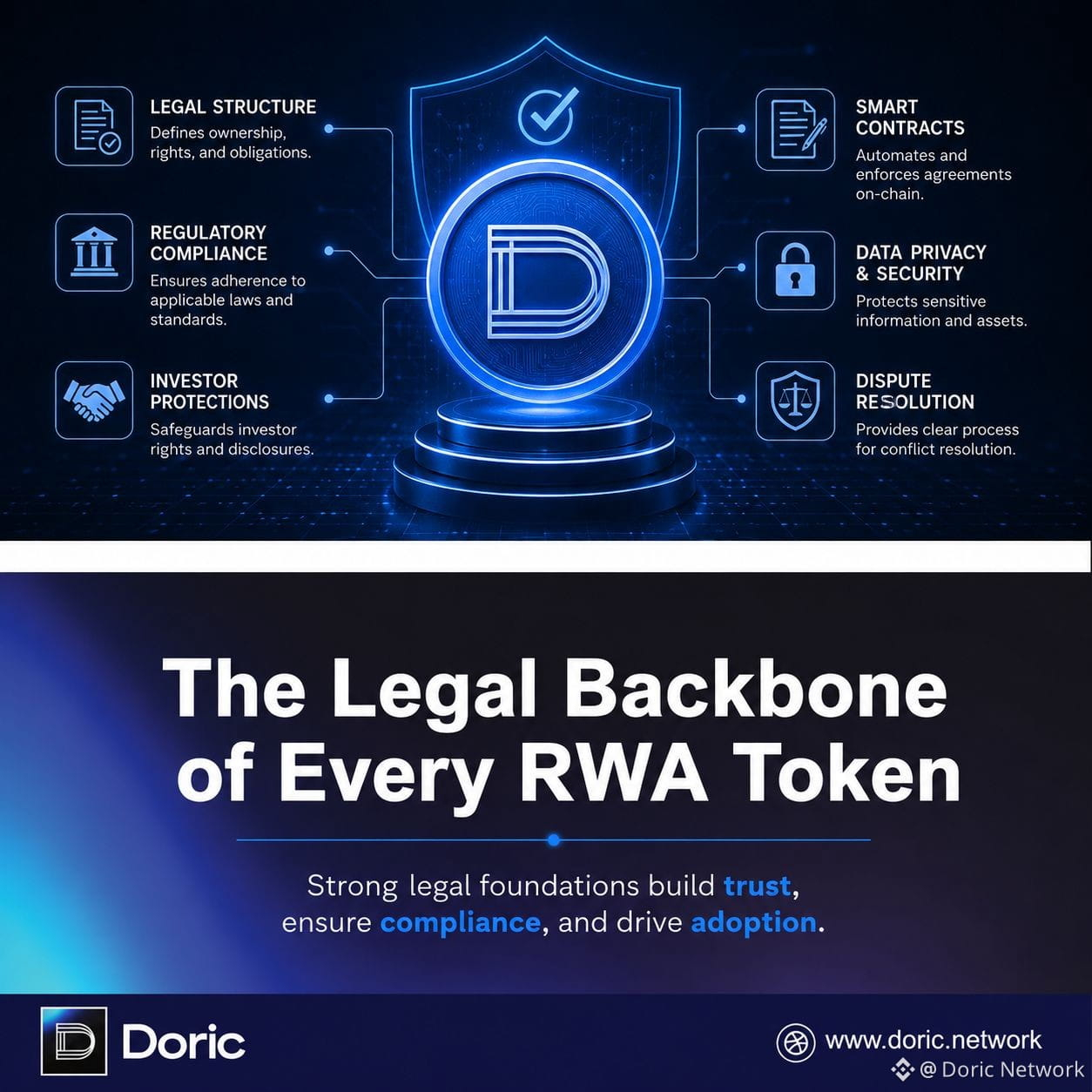
1
84
🐋 Bitcoin Whales Are Buying Big: $1.2 Billion in BTC Accumulated
Large Bitcoin holders are making notable moves in the market.
According to recent on-chain data, Bitcoin whales holding between 10 and 10,000 BTC have accumulated more than 20,000 BTC—worth approximately $1.2 billion—since July 29. This accumulation occurred while Bitcoin was trading around the $65,000 level.
What makes this particularly interesting is the divergence in market behavior: while large holders have been accumulating, smaller investors have reportedly been selling.
Spot Bitcoin ETF flows are also showing renewed institutional demand, adding another factor that market participants are watching closely. Analysts suggest continued whale accumulation could strengthen the possibility of BTC challenging the $70,000 level, although macroeconomic conditions, regulation, and broader market sentiment remain important variables.
📊 The key question: Are Bitcoin whales positioning themselves ahead of the next major move?
As always, whale activity can provide useful signals—but accumulation alone doesn’t guarantee where the market goes next.
#Bitcoin #BTC #Cryptocurrency #Blockchain #CryptoMarket
🐋 Bitcoin Whales Are Buying Big: $1.2 Billion in BTC Accumulated
Large Bitcoin holders are making notable moves in the market.
According to recent on-chain data, Bitcoin whales holding between 10 and 10,000 BTC have accumulated more than 20,000 BTC—worth approximately $1.2 billion—since July 29. This accumulation occurred while Bitcoin was trading around the $65,000 level.
What makes this particularly interesting is the divergence in market behavior: while large holders have been accumulating, smaller investors have reportedly been selling.
Spot Bitcoin ETF flows are also showing renewed institutional demand, adding another factor that market participants are watching closely. Analysts suggest continued whale accumulation could strengthen the possibility of BTC challenging the $70,000 level, although macroeconomic conditions, regulation, and broader market sentiment remain important variables.
📊 The key question: Are Bitcoin whales positioning themselves ahead of the next major move?
As always, whale activity can provide useful signals—but accumulation alone doesn’t guarantee where the market goes next.
#Bitcoin #BTC #Cryptocurrency #Blockchain #CryptoMarket
Large Bitcoin holders are making notable moves in the market.
According to recent on-chain data, Bitcoin whales holding between 10 and 10,000 BTC have accumulated more than 20,000 BTC—worth approximately $1.2 billion—since July 29. This accumulation occurred while Bitcoin was trading around the $65,000 level.
What makes this particularly interesting is the divergence in market behavior: while large holders have been accumulating, smaller investors have reportedly been selling.
Spot Bitcoin ETF flows are also showing renewed institutional demand, adding another factor that market participants are watching closely. Analysts suggest continued whale accumulation could strengthen the possibility of BTC challenging the $70,000 level, although macroeconomic conditions, regulation, and broader market sentiment remain important variables.
📊 The key question: Are Bitcoin whales positioning themselves ahead of the next major move?
As always, whale activity can provide useful signals—but accumulation alone doesn’t guarantee where the market goes next.
#Bitcoin #BTC #Cryptocurrency #Blockchain #CryptoMarket

1
79
Funding Rates: The Hidden Cost Behind Perpetual Futures
Funding rates play a key role in perpetual futures markets by helping keep contract prices close to spot prices. At regular intervals, traders pay or receive funding depending on market positioning.
When funding is positive, long traders pay shorts—often reflecting bullish sentiment. When funding turns negative, shorts pay longs, which may indicate stronger bearish pressure.
For traders, funding rates are more than a market signal. Repeated payments can reduce returns, while extreme rates may warn of overcrowded positions and increased liquidation risk.
#CryptoTrading #FundingRates #PerpetualFutures #Bitcoin #MarketInsights
Funding Rates: The Hidden Cost Behind Perpetual Futures
Funding rates play a key role in perpetual futures markets by helping keep contract prices close to spot prices. At regular intervals, traders pay or receive funding depending on market positioning.
When funding is positive, long traders pay shorts—often reflecting bullish sentiment. When funding turns negative, shorts pay longs, which may indicate stronger bearish pressure.
For traders, funding rates are more than a market signal. Repeated payments can reduce returns, while extreme rates may warn of overcrowded positions and increased liquidation risk.
#CryptoTrading #FundingRates #PerpetualFutures #Bitcoin #MarketInsights
Funding rates play a key role in perpetual futures markets by helping keep contract prices close to spot prices. At regular intervals, traders pay or receive funding depending on market positioning.
When funding is positive, long traders pay shorts—often reflecting bullish sentiment. When funding turns negative, shorts pay longs, which may indicate stronger bearish pressure.
For traders, funding rates are more than a market signal. Repeated payments can reduce returns, while extreme rates may warn of overcrowded positions and increased liquidation risk.
#CryptoTrading #FundingRates #PerpetualFutures #Bitcoin #MarketInsights
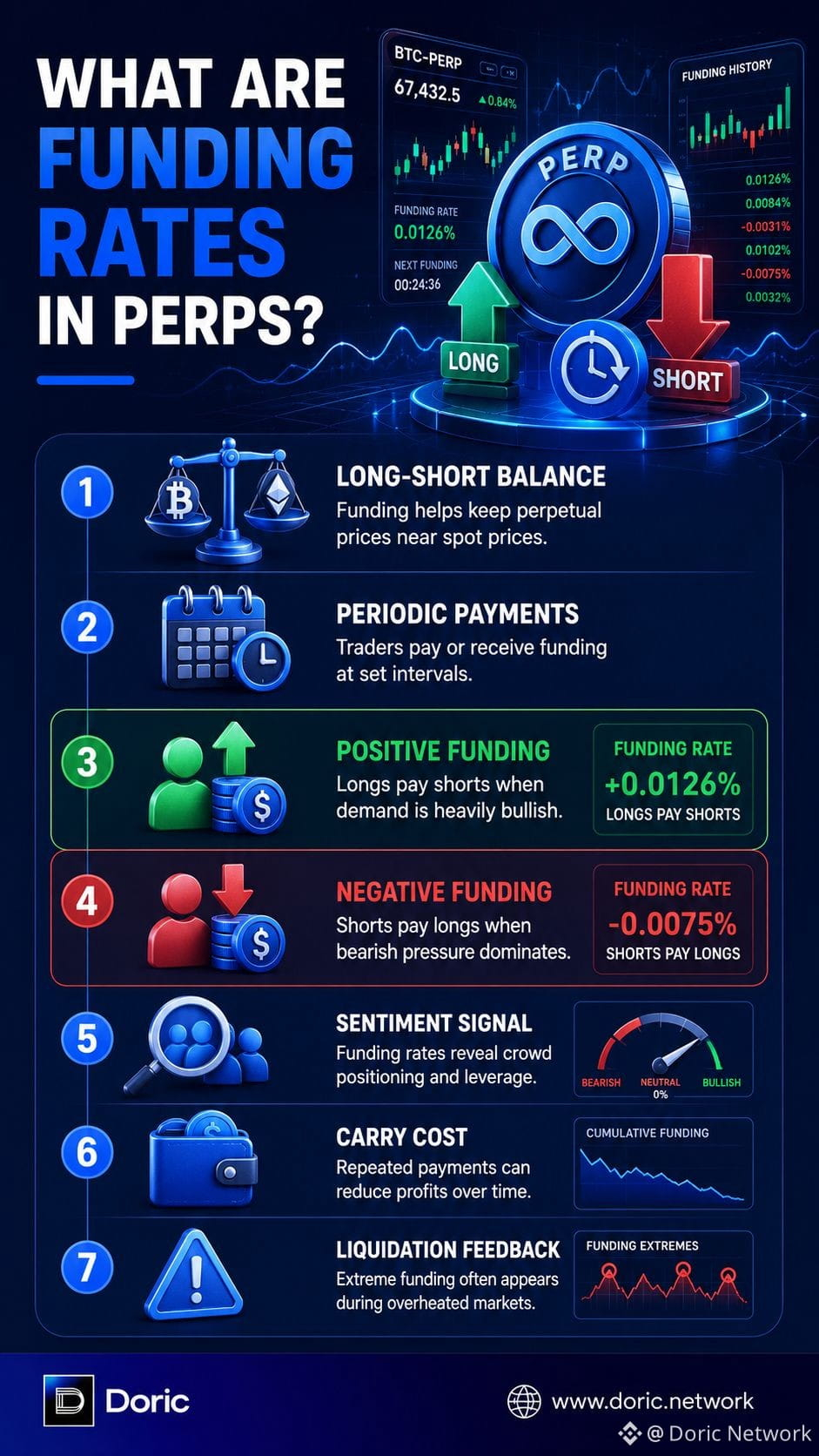
1
11
Jim Cramer Sells Bitcoin Over Quantum Computing Concerns
Jim Cramer says he is selling his Bitcoin after IBM CEO Arvind Krishna warned that advances in quantum computing could pose risks to cryptocurrency security within the next few years.
Crypto investors responded with excitement, reviving the popular “Inverse Cramer” strategy—the running joke that markets often move opposite to his predictions.
While quantum computing represents a legitimate long-term challenge, experts note that today’s systems are still far from being capable of breaking Bitcoin’s cryptography. The debate highlights why blockchain networks must continue preparing for post-quantum security.
#Bitcoin #Cryptocurrency #QuantumComputing #Blockchain #CryptoNews
Jim Cramer Sells Bitcoin Over Quantum Computing Concerns
Jim Cramer says he is selling his Bitcoin after IBM CEO Arvind Krishna warned that advances in quantum computing could pose risks to cryptocurrency security within the next few years.
Crypto investors responded with excitement, reviving the popular “Inverse Cramer” strategy—the running joke that markets often move opposite to his predictions.
While quantum computing represents a legitimate long-term challenge, experts note that today’s systems are still far from being capable of breaking Bitcoin’s cryptography. The debate highlights why blockchain networks must continue preparing for post-quantum security.
#Bitcoin #Cryptocurrency #QuantumComputing #Blockchain #CryptoNews
Jim Cramer says he is selling his Bitcoin after IBM CEO Arvind Krishna warned that advances in quantum computing could pose risks to cryptocurrency security within the next few years.
Crypto investors responded with excitement, reviving the popular “Inverse Cramer” strategy—the running joke that markets often move opposite to his predictions.
While quantum computing represents a legitimate long-term challenge, experts note that today’s systems are still far from being capable of breaking Bitcoin’s cryptography. The debate highlights why blockchain networks must continue preparing for post-quantum security.
#Bitcoin #Cryptocurrency #QuantumComputing #Blockchain #CryptoNews
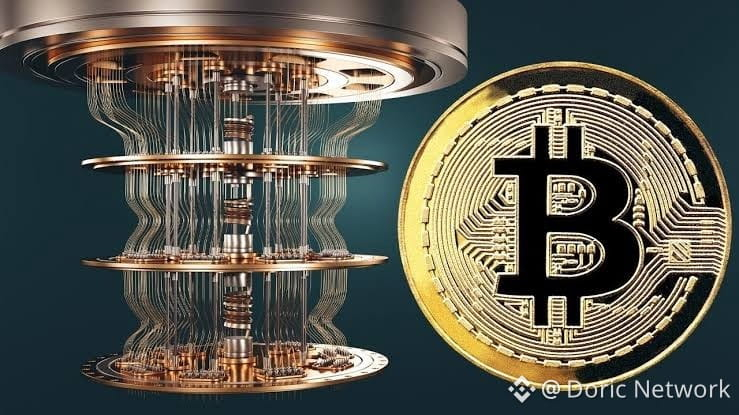
1
20
Building on Web3 has never been smoother! 🚀
Calling all Solidity developers: The Doric Developers platform is an EVM-Compatible Blockchain. This means you can easily migrate your existing Ethereum-compatible applications and smart contracts directly to Doric with minimal friction.
What does this EVM compatibility mean for you?
✅ Familiarity: Keep using the same Ethereum-style development flows you know and love.
✅ Seamless Migration: Bring your existing apps and contracts onto the Doric Mainnet effortlessly.
✅ Developer Ready: Built for quick onboarding to support Web3 builders at every step.
Deploy contracts with confidence, verify source code on-chain, and interact with ease using familiar EVM tools.
Ready to build? Explore the network and get started today:
🌐 www.doric.network
#EVMCompatible #Web3Development #SmartContracts #DoricDevelopers #Solidity
Building on Web3 has never been smoother! 🚀
Calling all Solidity developers: The Doric Developers platform is an EVM-Compatible Blockchain. This means you can easily migrate your existing Ethereum-compatible applications and smart contracts directly to Doric with minimal friction.
What does this EVM compatibility mean for you?
✅ Familiarity: Keep using the same Ethereum-style development flows you know and love.
✅ Seamless Migration: Bring your existing apps and contracts onto the Doric Mainnet effortlessly.
✅ Developer Ready: Built for quick onboarding to support Web3 builders at every step.
Deploy contracts with confidence, verify source code on-chain, and interact with ease using familiar EVM tools.
Ready to build? Explore the network and get started today:
🌐 www.doric.network
#EVMCompatible #Web3Development #SmartContracts #DoricDevelopers #Solidity
Calling all Solidity developers: The Doric Developers platform is an EVM-Compatible Blockchain. This means you can easily migrate your existing Ethereum-compatible applications and smart contracts directly to Doric with minimal friction.
What does this EVM compatibility mean for you?
✅ Familiarity: Keep using the same Ethereum-style development flows you know and love.
✅ Seamless Migration: Bring your existing apps and contracts onto the Doric Mainnet effortlessly.
✅ Developer Ready: Built for quick onboarding to support Web3 builders at every step.
Deploy contracts with confidence, verify source code on-chain, and interact with ease using familiar EVM tools.
Ready to build? Explore the network and get started today:
🌐 www.doric.network
#EVMCompatible #Web3Development #SmartContracts #DoricDevelopers #Solidity
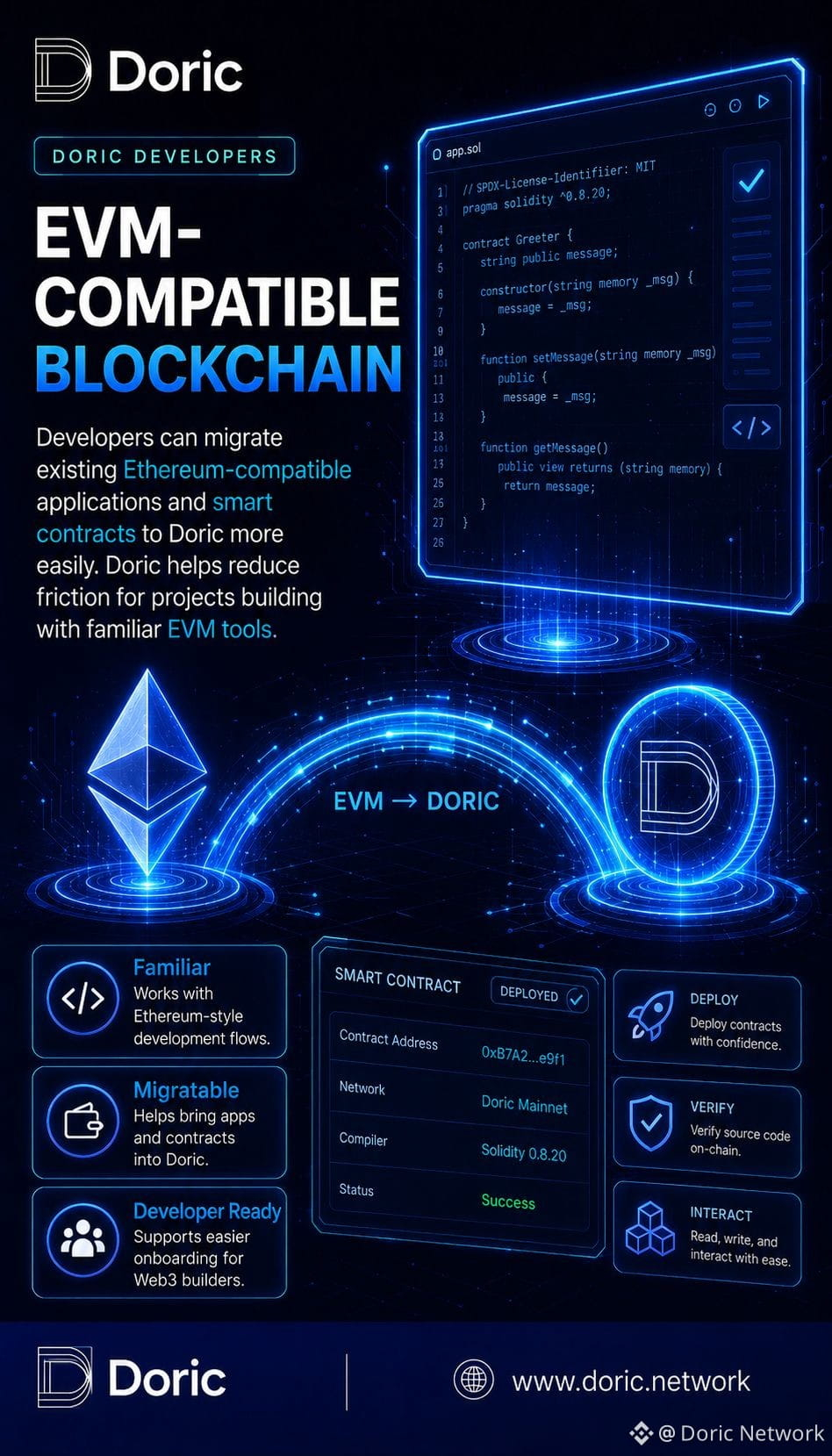
1
6
🛡️ Security First: The Foundation of the Doric Network
In Web3 and Decentralized Finance (DeFi), trust isn't just an asset—it's everything. 🔒
The Doric Blockchain is engineered to deliver a robust, highly dependable, and protected infrastructure built specifically for handling complex blockchain data and modern DeFi activities with confidence.
Key pillars driving the ecosystem:
✨ Reliable: Built from the ground up for dependable, seamless blockchain operations.
🛡️ Protected: Designed with strict, enterprise-grade secure network principles.
🤝 Trusted: Empowering users and developers to participate in DeFi with peace of mind.
Building a modern digital ecosystem requires unwavering security standards—and Doric is delivering just that. 🌐
Learn more at www.doric.network
#DoricNetwork #DeFiSecurity #BlockchainSecurity #CryptoSafety #Web3Infrastructure
🛡️ Security First: The Foundation of the Doric Network
In Web3 and Decentralized Finance (DeFi), trust isn't just an asset—it's everything. 🔒
The Doric Blockchain is engineered to deliver a robust, highly dependable, and protected infrastructure built specifically for handling complex blockchain data and modern DeFi activities with confidence.
Key pillars driving the ecosystem:
✨ Reliable: Built from the ground up for dependable, seamless blockchain operations.
🛡️ Protected: Designed with strict, enterprise-grade secure network principles.
🤝 Trusted: Empowering users and developers to participate in DeFi with peace of mind.
Building a modern digital ecosystem requires unwavering security standards—and Doric is delivering just that. 🌐
Learn more at www.doric.network
#DoricNetwork #DeFiSecurity #BlockchainSecurity #CryptoSafety #Web3Infrastructure
In Web3 and Decentralized Finance (DeFi), trust isn't just an asset—it's everything. 🔒
The Doric Blockchain is engineered to deliver a robust, highly dependable, and protected infrastructure built specifically for handling complex blockchain data and modern DeFi activities with confidence.
Key pillars driving the ecosystem:
✨ Reliable: Built from the ground up for dependable, seamless blockchain operations.
🛡️ Protected: Designed with strict, enterprise-grade secure network principles.
🤝 Trusted: Empowering users and developers to participate in DeFi with peace of mind.
Building a modern digital ecosystem requires unwavering security standards—and Doric is delivering just that. 🌐
Learn more at www.doric.network
#DoricNetwork #DeFiSecurity #BlockchainSecurity #CryptoSafety #Web3Infrastructure
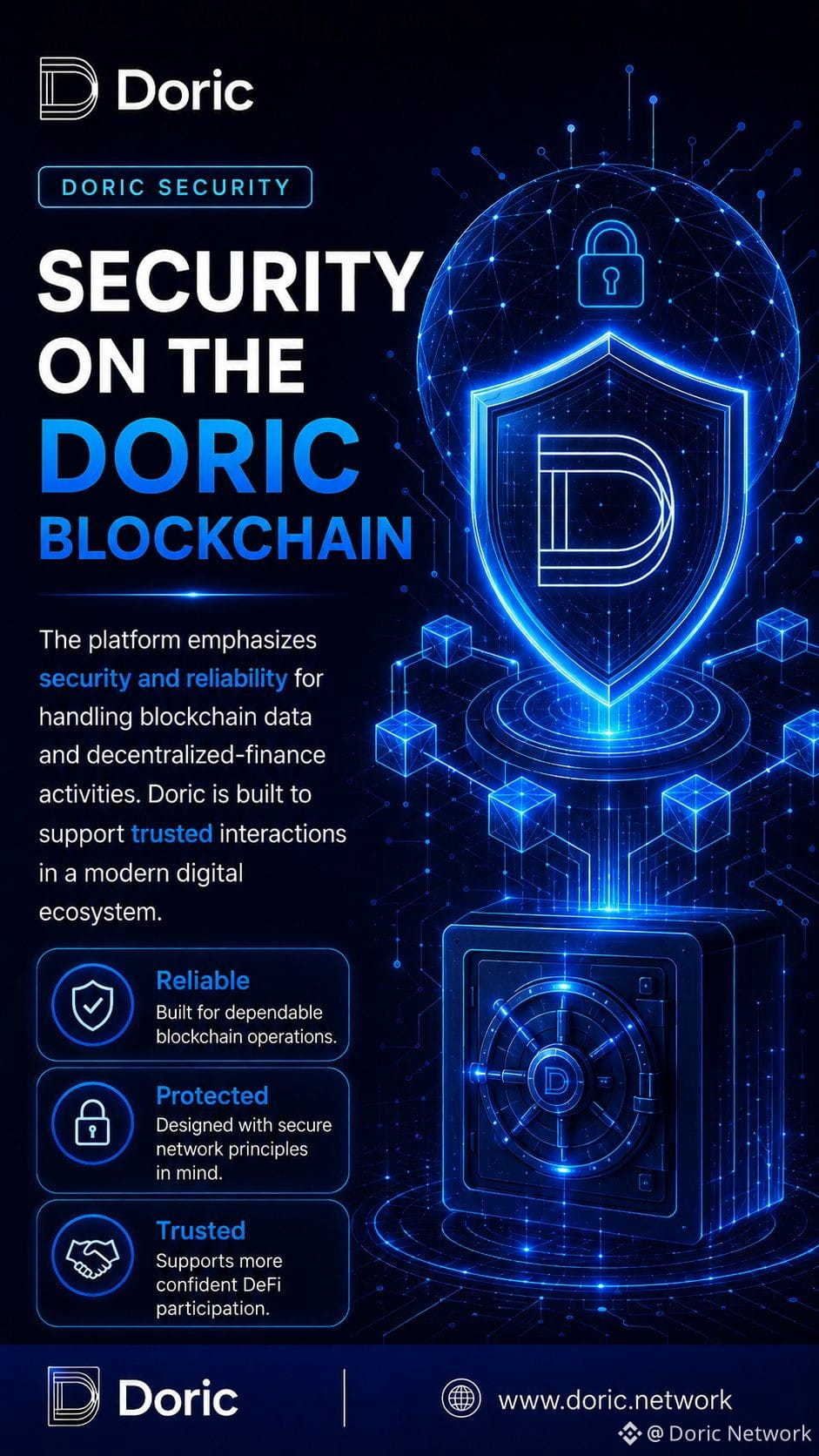
1
78
Log in to explore more content
Join global crypto users on Binance Square
⚡️ Get latest and useful information about crypto.
💬 Trusted by the world’s largest crypto exchange.
👍 Discover real insights from verified creators.
Email / Phone number
Trending Topics
AntiQuantumBitcoinTransactionMinedOnMainnet
20,259 views
510 Discussing
#antiquantumbitcointransactionminedonmainnet
🚨 BITCOIN QUANTUM-RESISTANT TRANSACTION MINED! ₿⚛️
A quantum-resistant Bitcoin transaction has been successfully mined on the Bitcoin mainnet — a notable step toward Bitcoin’s long-term security against future quantum-computing threats.
📊 Trading Setup:
Don’t chase the news. Wait for BTC to confirm the direction with price action + volume before entering.
⏱️ Trade Time: Hold only while the setup remains valid; there is no guaranteed holding period.
🎯 Profit: No fixed profit is guaranteed. Set your entry, stop-loss, and target first, then calculate the potential reward.
⚠️ Trade smart: Use proper risk management and never enter just because of a headline.
What do you think—will BTC react bullishly to this development? ₿📈
#Bitcoin #BTC #QuantumComputing #CryptoNews
https://www.binance.com/en/square/profile/square-creator-4e7984f6aedff
click tobelow trade👇👇
$BTC
$ETH
$BNB
MR TALHA King
·4 Likes
·1.3k views
BitcoinSpotETFEnds9DayInflowStreak
19,879 views
387 Discussing
YenPasses160PerDollarToOneMonthLow
38,575 views
683 Discussing