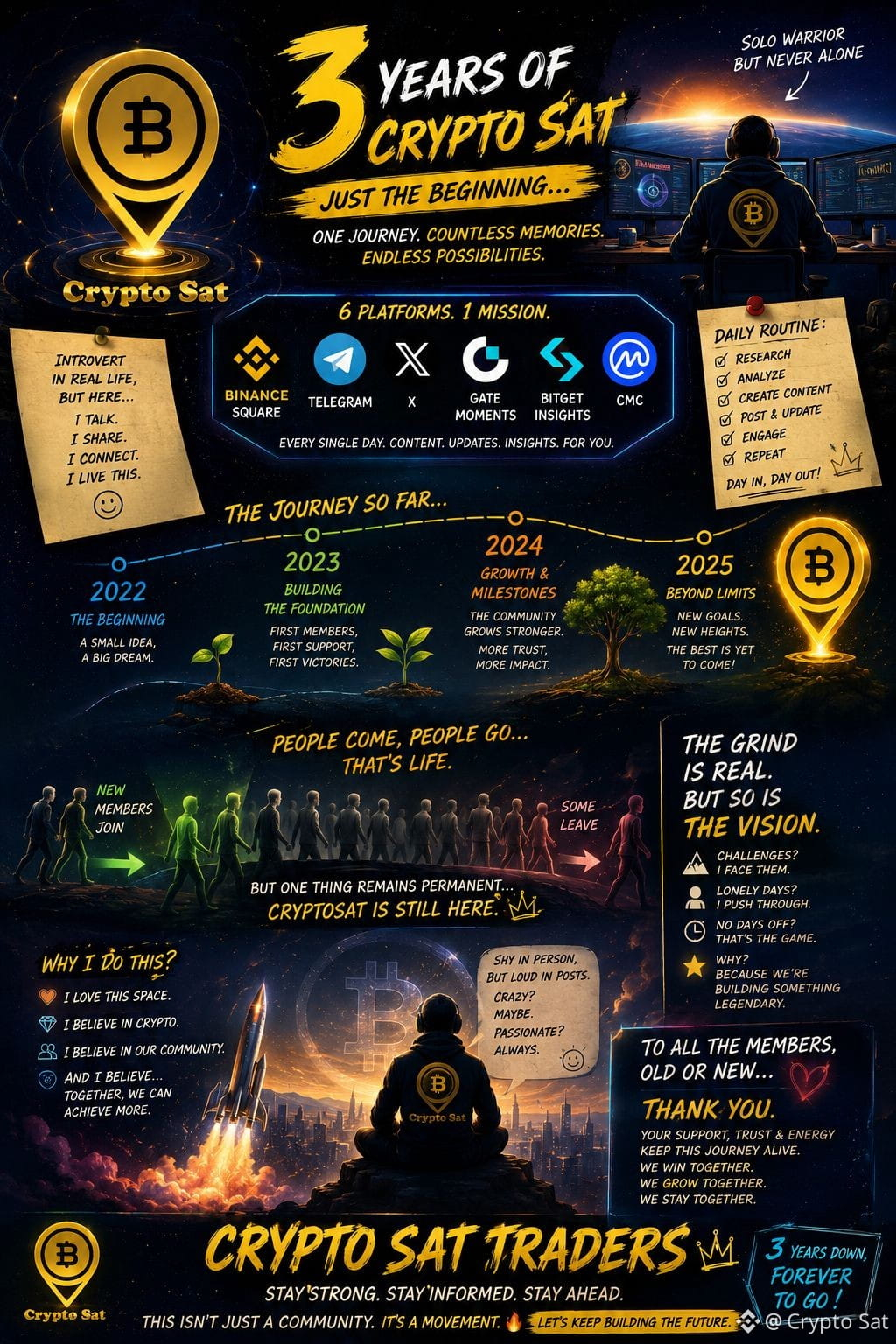
3 years ago we started the CryptoSat community… and honestly, I still feel like this is just the beginning. So much more to achieve, so many more milestones to unlock together. ❤️
At the beginning, a lot of people helped me build this community into something strong and powerful. I still remember every one of them. Some are still with me, some disappeared with time… that’s life. People change, situations change, and days keep moving.
Meanwhile, I’m still here… a solo warrior managing 6 platforms every single day — Binance Square, Telegram, X, Gate Moments, Bitget Insights, and CMC 😅
Sometimes I feel like I’m just posting random content and disturbing all of you daily 😂 But truthfully? I enjoy every second of it.
In real life, I’m actually an introvert. Social media became the only place where I can express myself freely, share thoughts, charts, wins, losses, and connect with people who understand this journey. Sounds kinda crazy, right? 😄
Life isn’t always easy. Fighting real-life situations alone while trying to stay consistent online every single day is challenging… but at the same time, I enjoy the process. That’s what keeps me going.
Every day, some people join the community and some leave. But one thing remains permanent…
1x to 10x Upto 8% 11x to 25x Upto 5% 26x to 50x Upto 3% Morethan 51x Upto 2%
⚠️ Hold 2 to 3 trades , when you're using cross margin and maintain risk ratio less than 5%
Using ISOLATED MARGIN
😀Use leverage 5x to 10x only and invest 5 to 8% funds
ENTRY STRATEGY ✅ Take 2 to 3 entries ( DCA STRATEGY )
RESTRICTING TAKING ENTRIES ✅
Existing users If you took the trade at entry 1 then it achieved tp2 quickly , Don't take further entries.
New users Don't take entries after tp2 hit.
SECURING PROFITS ✅ 🟢 If 2 or 3 Entry Points(EPs) achieved , then you should shift Target points. If entry 2 achieved , then Ep 1 will be 1st TP. 🟢Always exit 20% (tp1) , 30% (tp2) and remaining tps , exit equal portions 🟢Move SL to Entry-Price after tp3 🟢Take profits at every tp , Don't be greedy and hold only for final tp.
Long or Short? Learn How Professional Traders Decide 😉
Imagine two traders looking at the exact same Bitcoin chart. One says, "Bitcoin is about to go much higher" The other says, "I think Bitcoin is going to fall " Surprisingly... Both traders can make money. How? It all comes down to understanding Long and Short positions. 🔹️ What Is a Long Position? A Long position means you expect the price to rise. You buy because you believe the asset will become more valuable in the future. 📈 Bitcoin Example Imagine $BTC is trading at $100,000. Your analysis shows: ▪️ Higher Highs and Higher Lows ▪️ Price above MA25 and MA99 ▪️ Strong buying volume You open a Long position. A few days later, Bitcoin reaches $105,000. Since the price moved in the direction you expected, your trade is profitable. Long traders want prices to go up. 📉 What Is a Short Position? A Short position means you expect the price to fall. Instead of buying first, you profit if the market moves lower. 📉 Bitcoin Example Now imagine BTC is trading at $100,000, but your analysis shows: ▪️ Lower Highs and Lower Lows ▪️ Price below MA99 and MA200 ▪️ Increasing selling pressure You open a Short position. Bitcoin falls to $95,000. Because your prediction was correct, your trade generates a profit. This is why traders can make money even during bear markets. 🎯 When Should You Consider a Long? Professional traders look for Long opportunities when: ▪️ Market structure is bullish ▪️ Price is above key Moving Averages ▪️ Buying volume is increasing ▪️ Momentum supports the trend A Long trade should follow strength—not hope. 🔴 When Should You Consider a Short? Short setups become more attractive when: ▪️ Market structure turns bearish ▪️ Price trades below major Moving Averages ▪️ Selling pressure increases ▪️ Support levels begin breaking A Short trade follows weakness—not emotion. ⚠️ Common Beginner Mistakes Many beginners let personal opinions control their decisions. They buy because they "feel" Bitcoin is cheap... Even though the chart is making Lower Highs and Lower Lows. Or they short a strong uptrend simply because they think the market has gone up too much. The result? They end up fighting the trend instead of following it. 🏆 Trade the Market, Not Your Opinion One of the biggest lessons every trader must learn is this: The market doesn't care what we think. It only responds to buying and selling pressure. Professional traders don't try to prove they're right. They simply follow the direction the market is already moving. 📌 A Long position isn't always the right trade. A Short position isn't always the right trade. The right trade is the one that aligns with the current trend, market structure, and momentum. The goal isn't to predict every move. The goal is to trade with the market—not against it. 💬 Which concept feels easier to understand after reading this—Long or Short ? Share your answer below, and follow this series as we continue building your trading knowledge one lesson at a time. 🚀
• $BTC : -$49.75 Million • $ETH : +$14.53 Million • $XRP : $0 • $SOL : -$18.07 Million • $HYPE : $0
Bitcoin ETF recorded an outflow of $49.75M on July 28. ETH continued to see inflows of $14.53M, while Solana posted an outflow of $18.07M. XRP and HyperLiquid remained flat.
For the first time, after Ethereum and Bitcoin , the next five most-liquidated assets are all TradFi products. This shows how crypto exchanges are rapidly evolving into multi-asset trading platforms, with users increasingly trading stocks and traditional financial products alongside crypto.
24Hr Liquidations: $345.28M, affecting 96,934 traders. The largest single liquidation was a $4.74M #ETH position on Binance.
📈 Market Update • $ETH : Rebounded from $1,855 to $1,928, now trading around $1,911 (+1.5%). • $BTC : Recovered from $62,660 to $64,170, but is still struggling to establish $64K as support.
📉 TradFi Assets Under Pressure • $SNDK : Down 33% in the past 3 days, trading around 1,033. If weakness continues, 980–800 could be the next key support zone. • $SKHYNIX : Down 25% in 3 days, now around 942. The 850–900 range is worth watching. • Micron ( $MU ): Down 17% in 3 days, trading near 788. Major support sits around 720–750. • $KORU : Down 26% this week, trading near 121. Continued selling could push it toward 110, with 100 becoming a critical psychological level.
The message is becoming clear: crypto exchanges are no longer just for crypto. As more stocks, ETFs, commodities, and other TradFi assets are listed, traders are diversifying their exposure—all from a single platform.
Imagine two traders watching Bitcoin at exactly the same price. The first trader buys Bitcoin and actually owns it. The second trader never buys a single Bitcoin... Yet still makes money when the price moves. How? Welcome to the world of Futures Trading. 🧠 It's one of the most popular ways to trade crypto—but it's also one of the riskiest if you don't understand how it works. 🔹️ What Is Futures Trading? Futures Trading allows you to speculate on the future price of an asset without actually owning it. When you open a Futures trade, you're simply making a prediction "I think Bitcoin will go up" Or "I think Bitcoin will go down" Unlike Spot Trading, you never own the actual Bitcoin. You're trading the price movement itself. 📈 Long & Short Positions Futures gives traders two opportunities. 🟢 Long Position You open a Long when you believe $BTC will increase in price. If Bitcoin rises, your trade can make a profit. 🔴 Short Position You open a Short when you believe BTC will fall. If the price drops, your trade can still generate a profit. This is one of the biggest differences between Spot and Futures. In Futures, opportunities exist in both bull and bear markets. ⚡️ What Is Leverage? Leverage allows you to control a larger position using a smaller amount of your own money. Think of it as borrowing extra buying power from the exchange. This can increase potential profits... But it also increases potential losses. The higher the leverage, the faster your trade can move in either direction. That's why leverage should be respected—not chased. ⚠️ The Risk of Liquidation This is where many beginners struggle. If the market moves too far against your leveraged position, the exchange may automatically close your trade. This is called liquidation. In simple terms: Your position is closed because your available margin is no longer enough to support the trade. Many beginners focus only on profit. Professional traders focus on protecting themselves from liquidation. 📊 Spot vs Futures (Bitcoin Example) Imagine Bitcoin is trading at $100,000. Spot Trading: You buy BTC and actually own it. If BTC rises to $110,000, your investment gains value. If BTC falls, you still own your Bitcoin unless you decide to sell. Futures Trading: You don't own any Bitcoin. Instead, you open a Long or Short based on where you think the price will go. If your prediction is correct, you profit from the price movement. If you're wrong—especially with high leverage—losses can grow quickly, and liquidation becomes a risk. 🎯 Why Beginners Should Learn First Futures isn't dangerous because of leverage. It's dangerous when traders use leverage without education. Before trading Futures, learn: ▪️ Market structure ▪️ Trend analysis ▪️ Risk management ▪️ Trading psychology ▪️ Stop-loss placement These skills matter far more than finding the "perfect" entry. 📌 Spot Trading teaches you how markets move. Futures Trading teaches you how important discipline really is. Master the basics before adding leverage. The goal isn't to make money fast. The goal is to stay in the market long enough to become consistently profitable. 💬 After learning the difference... Which would you choose today—Spot 🟢 or Futures ? Share your answer below, and follow this series as we continue building your trading knowledge step by step.
Imagine it's your first day in crypto. You hear everyone talking about Bitcoin. You decide to buy a small amount and watch what happens. A few weeks later, the price increases. You sell and make a profit. Congratulations... You've just completed your first Spot Trade. Spot Trading is where almost every successful trader begins. 🔹️ What Is Spot Trading? Spot Trading is the simplest way to buy and sell cryptocurrencies. When you buy a coin on the Spot market, you actually own it. If you buy $BTC, those coins belong to you until you decide to sell them. There is no borrowing. No leverage. No liquidation. You simply purchase the asset at the current market price. 📈 Bitcoin Example Imagine you buy 0.01 BTC when Bitcoin is trading at $100,000. A few weeks later, BTC rises to $110,000. You decide to sell. The increase in price becomes your profit (before fees and taxes). If Bitcoin falls instead, your investment loses value, but you still own your BTC unless you choose to sell it. That's one of the biggest differences between Spot and leveraged trading. 🔄 Holding vs Trading Many beginners think buying crypto automatically makes them a trader. Not quite. Holding (Investing): ▫️ Buy Bitcoin and keep it for months or years, expecting long-term growth. Trading: ▫️ Buy and sell more actively to profit from shorter-term price movements. Both approaches can work. The difference is your time horizon and strategy. ✅ Advantages of Spot Trading ▪️ You own the cryptocurrency. ▪️ No liquidation risk from leverage. ▪️ Easier for beginners to understand. ▪️ Lower emotional pressure. ▪️ Ideal for learning market behavior and risk management. ⚠️ Disadvantages of Spot Trading ▫️ Profits usually grow more slowly than leveraged trading. ▫️ Your capital is tied up while holding positions. ▫️ Bear markets can reduce portfolio value if you don't manage risk. Even with these disadvantages, Spot remains the safest place to build experience. 🎯 Why Every Beginner Should Start with Spot Many new traders jump straight into Futures because they hear stories of quick profits. Unfortunately, they also discover quick losses. Spot Trading teaches you: ▪️ How price moves. ▪️ How to read market structure. ▪️ How to control emotions. ▪️ How to manage risk. ▪️ How to build confidence before using leverage. Master Spot first. Futures can always come later. ⚠️ Common Beginner Mistakes ▫️ Buying because of hype instead of analysis. ▫️ Chasing green candles. ▫️ Panic selling during normal pullbacks. ▫️ Investing money they can't afford to lose. ▫️ Ignoring risk management because "it's only Spot." These mistakes can still be expensive, even without leverage. 📌 Every professional trader was once a beginner learning how markets move. Spot Trading gives you the opportunity to develop those skills without the added pressure of leverage and liquidation. Think of it as learning to walk before trying to sprint. 💬 Have you ever bought cryptocurrency on the Spot Market, or are you still waiting to make your first purchase?
South Korea's KOSPI index plunged more than 8%, triggering a 20-minute circuit breaker—the seventh trading halt this year. The sharp decline was driven by heavy selling in technology stocks amid broader market weakness.
Ondo Finance has introduced the $ONDO Network, a new execution layer designed for financial markets that combines the speed of centralized exchanges with blockchain-level transparency and verifiability.
The network aims to bridge traditional finance and blockchain by delivering fast trade execution while keeping transactions auditable on-chain, further expanding institutional blockchain adoption.