
Cryptopolitan
57.4k Posts

Cryptopolitan
 Square Verified+
Report
Block User
Crypto news that doesn't waste your time. Breaking updates, market analysis, on-chain insights. Building the smartest crypto community.

Creator of the Year
1 Following
161.5K+ Followers
573.1K+ Liked
1 Badges
Posts
PINNED
At Cryptopolitan, we research, analyze, and deliver news—daily.
From breaking updates to in-depth analysis, educational guides, and market insights, we’re here to keep you informed with neutral and authentic news.
Thank you for trusting us to be your go-to source!
At Cryptopolitan, we research, analyze, and deliver news—daily.
From breaking updates to in-depth analysis, educational guides, and market insights, we’re here to keep you informed with neutral and authentic news.
Thank you for trusting us to be your go-to source!
From breaking updates to in-depth analysis, educational guides, and market insights, we’re here to keep you informed with neutral and authentic news.
Thank you for trusting us to be your go-to source!
120
68
340
1.7k
Trump makes another $5,000 stimulus promise to Americans if they vote Republican in midtermsPresident Donald Trump is promising American adults $5,000 each if Republicans keep the House and Senate after the November midterms. Trump announced the idea Wednesday at the GOP gathering in Dallas while Republicans try to hold their congressional majorities.
Sending that much money across the United States would mean a large federal expense. With each person getting $5,000, the cost could pass $1 trillion quickly. The government is currently spending about $1.8 trillion more than it collects on an annual basis, all amid inflation concerns for consumers and the markets.
Trump made the offer depend on the election result. “If the Republicans win, you win with us, and you get $5,000,” he said. “It will be called the Trump Dividend.”
He described the checks like cash companies sometimes return to shareholders, while pointing to what he called “our tremendous strength and success economically.”
JD Vance limits Trump’s $5,000 proposal while the funding numbers fall short
Vice President JD Vance wasted no time in trying to scale down the proposal an hour after Trump’s address, stating that some of America’s wealthiest could be cut out of the plan. Tariff revenue could be used in order to cover the expenses as well. But here lies the issue, as tariff receipts are significantly lower than the required sum for this payment scheme.
Before even the Supreme Court rejected most of Trump’s tariffs last year, the government was already not receiving enough funds to pay for such an endeavor worth $1 trillion or more. In order to implement a national payment system, Congress needs to find additional sources of funding.
The proposal also lands at a rough time for federal finances. Total U.S. debt went above $40 trillion for the first time last month. Trump has often complained that the party holding the White House usually gives up seats during midterm elections. Republicans are trying to stop that from happening this November.
“We’re going to change that,” Trump said. “There’s no reason for it.”
The proposal also recalls Elon Musk’s role in last year’s Wisconsin Supreme Court contest. Elon handed million-dollar checks to voters as he tried to help a candidate win. The candidate ended up losing anyway.
Trump has brought up cash payments before, but he had never connected the idea this directly to Republicans keeping Congress. Earlier this year, he talked about a $2,000 dividend and said he might be able to issue it without congressional approval. Last year, he sent service members $1,776 apiece and called the payment a “warrior dividend.”
Republican Sen. Bernie Moreno of Ohio backed the new proposal almost immediately today. “I will get a bill ready so that we can get the Trump Dividend passed immediately after the November 3rd election,” Bernie wrote on X late Wednesday. “Because Republicans (and America) will win!”
Rising federal debt and the Iran war complicate Trump’s latest cash proposal
Trump also used part of the Dallas speech to talk about the war with Iran. He said Tehran had been “two, maybe three weeks away from having a nuclear weapon.” During the same appearance, he acknowledged the financial pain coming from the conflict as crude prices moved higher.
Trump then acted out a conversation he said he had with his economic advisers before the fighting started. “I hate to do this to you,” Trump said he told them, while saying the economy had been doing well before the choice to begin the war.
Federal finances are already carrying a heavy debt load. Government debt is now about the same size as 100% of U.S. national income, based on Treasury figures. America has not been around that level since the World War II period.
The numbers looked different before that. Federal debt was close to 40% of GDP in the early 1940s. Massive wartime expenses then sent the ratio above 100% during 1945 and 1946, when it reached the highest point of that period.
Following the conclusion of the war, economic growth and federal budgetary constraints gradually reduced that ratio. By the mid-1970s, the nation’s debt-to-GDP ratio was below 25%. For decades after that, it remained within the range of 30% to 40%.
The global economic downturn of 2008 was to alter that trend. The COVID-19 outbreak arrived in 2020, bringing another large round of government support. Debt then returned to close to 100% and has remained around there since. Treasury data also shows the ratio kept moving higher during the first quarter of this year.
Don’t just read crypto news. Understand it. Subscribe to our newsletter. It's free.
Trump makes another $5,000 stimulus promise to Americans if they vote Republican in midterms
President Donald Trump is promising American adults $5,000 each if Republicans keep the House and Senate after the November midterms. Trump announced the idea Wednesday at the GOP gathering in Dallas while Republicans try to hold their congressional majorities.
Sending that much money across the United States would mean a large federal expense. With each person getting $5,000, the cost could pass $1 trillion quickly. The government is currently spending about $1.8 trillion more than it collects on an annual basis, all amid inflation concerns for consumers and the markets.
Trump made the offer depend on the election result. “If the Republicans win, you win with us, and you get $5,000,” he said. “It will be called the Trump Dividend.”
He described the checks like cash companies sometimes return to shareholders, while pointing to what he called “our tremendous strength and success economically.”
JD Vance limits Trump’s $5,000 proposal while the funding numbers fall short
Vice President JD Vance wasted no time in trying to scale down the proposal an hour after Trump’s address, stating that some of America’s wealthiest could be cut out of the plan. Tariff revenue could be used in order to cover the expenses as well. But here lies the issue, as tariff receipts are significantly lower than the required sum for this payment scheme.
Before even the Supreme Court rejected most of Trump’s tariffs last year, the government was already not receiving enough funds to pay for such an endeavor worth $1 trillion or more. In order to implement a national payment system, Congress needs to find additional sources of funding.
The proposal also lands at a rough time for federal finances. Total U.S. debt went above $40 trillion for the first time last month. Trump has often complained that the party holding the White House usually gives up seats during midterm elections. Republicans are trying to stop that from happening this November.
“We’re going to change that,” Trump said. “There’s no reason for it.”
The proposal also recalls Elon Musk’s role in last year’s Wisconsin Supreme Court contest. Elon handed million-dollar checks to voters as he tried to help a candidate win. The candidate ended up losing anyway.
Trump has brought up cash payments before, but he had never connected the idea this directly to Republicans keeping Congress. Earlier this year, he talked about a $2,000 dividend and said he might be able to issue it without congressional approval. Last year, he sent service members $1,776 apiece and called the payment a “warrior dividend.”
Republican Sen. Bernie Moreno of Ohio backed the new proposal almost immediately today. “I will get a bill ready so that we can get the Trump Dividend passed immediately after the November 3rd election,” Bernie wrote on X late Wednesday. “Because Republicans (and America) will win!”
Rising federal debt and the Iran war complicate Trump’s latest cash proposal
Trump also used part of the Dallas speech to talk about the war with Iran. He said Tehran had been “two, maybe three weeks away from having a nuclear weapon.” During the same appearance, he acknowledged the financial pain coming from the conflict as crude prices moved higher.
Trump then acted out a conversation he said he had with his economic advisers before the fighting started. “I hate to do this to you,” Trump said he told them, while saying the economy had been doing well before the choice to begin the war.
Federal finances are already carrying a heavy debt load. Government debt is now about the same size as 100% of U.S. national income, based on Treasury figures. America has not been around that level since the World War II period.
The numbers looked different before that. Federal debt was close to 40% of GDP in the early 1940s. Massive wartime expenses then sent the ratio above 100% during 1945 and 1946, when it reached the highest point of that period.
Following the conclusion of the war, economic growth and federal budgetary constraints gradually reduced that ratio. By the mid-1970s, the nation’s debt-to-GDP ratio was below 25%. For decades after that, it remained within the range of 30% to 40%.
The global economic downturn of 2008 was to alter that trend. The COVID-19 outbreak arrived in 2020, bringing another large round of government support. Debt then returned to close to 100% and has remained around there since. Treasury data also shows the ratio kept moving higher during the first quarter of this year.
Don’t just read crypto news. Understand it. Subscribe to our newsletter. It's free.
Sending that much money across the United States would mean a large federal expense. With each person getting $5,000, the cost could pass $1 trillion quickly. The government is currently spending about $1.8 trillion more than it collects on an annual basis, all amid inflation concerns for consumers and the markets.
Trump made the offer depend on the election result. “If the Republicans win, you win with us, and you get $5,000,” he said. “It will be called the Trump Dividend.”
He described the checks like cash companies sometimes return to shareholders, while pointing to what he called “our tremendous strength and success economically.”
JD Vance limits Trump’s $5,000 proposal while the funding numbers fall short
Vice President JD Vance wasted no time in trying to scale down the proposal an hour after Trump’s address, stating that some of America’s wealthiest could be cut out of the plan. Tariff revenue could be used in order to cover the expenses as well. But here lies the issue, as tariff receipts are significantly lower than the required sum for this payment scheme.
Before even the Supreme Court rejected most of Trump’s tariffs last year, the government was already not receiving enough funds to pay for such an endeavor worth $1 trillion or more. In order to implement a national payment system, Congress needs to find additional sources of funding.
The proposal also lands at a rough time for federal finances. Total U.S. debt went above $40 trillion for the first time last month. Trump has often complained that the party holding the White House usually gives up seats during midterm elections. Republicans are trying to stop that from happening this November.
“We’re going to change that,” Trump said. “There’s no reason for it.”
The proposal also recalls Elon Musk’s role in last year’s Wisconsin Supreme Court contest. Elon handed million-dollar checks to voters as he tried to help a candidate win. The candidate ended up losing anyway.
Trump has brought up cash payments before, but he had never connected the idea this directly to Republicans keeping Congress. Earlier this year, he talked about a $2,000 dividend and said he might be able to issue it without congressional approval. Last year, he sent service members $1,776 apiece and called the payment a “warrior dividend.”
Republican Sen. Bernie Moreno of Ohio backed the new proposal almost immediately today. “I will get a bill ready so that we can get the Trump Dividend passed immediately after the November 3rd election,” Bernie wrote on X late Wednesday. “Because Republicans (and America) will win!”
Rising federal debt and the Iran war complicate Trump’s latest cash proposal
Trump also used part of the Dallas speech to talk about the war with Iran. He said Tehran had been “two, maybe three weeks away from having a nuclear weapon.” During the same appearance, he acknowledged the financial pain coming from the conflict as crude prices moved higher.
Trump then acted out a conversation he said he had with his economic advisers before the fighting started. “I hate to do this to you,” Trump said he told them, while saying the economy had been doing well before the choice to begin the war.
Federal finances are already carrying a heavy debt load. Government debt is now about the same size as 100% of U.S. national income, based on Treasury figures. America has not been around that level since the World War II period.
The numbers looked different before that. Federal debt was close to 40% of GDP in the early 1940s. Massive wartime expenses then sent the ratio above 100% during 1945 and 1946, when it reached the highest point of that period.
Following the conclusion of the war, economic growth and federal budgetary constraints gradually reduced that ratio. By the mid-1970s, the nation’s debt-to-GDP ratio was below 25%. For decades after that, it remained within the range of 30% to 40%.
The global economic downturn of 2008 was to alter that trend. The COVID-19 outbreak arrived in 2020, bringing another large round of government support. Debt then returned to close to 100% and has remained around there since. Treasury data also shows the ratio kept moving higher during the first quarter of this year.
Don’t just read crypto news. Understand it. Subscribe to our newsletter. It's free.
1
71
Article
Trezor warns users after hackers breach email provider to send phishing alertsTrezor alerted users on Wednesday, September 9, 2026, about hackers exploiting its third-party email provider to distribute a bogus security notice. However, the Trezor wallet was unaffected by the attack. The criminals targeted something even harder to safeguard than a piece of software: the confidence of a user in an email from a trusted provider.
The subject line of the warning read as follows: “Critical Security Alert: STM32 Entropy Vulnerability.” The message stated that Trezor engineers had discovered a design defect in STM32 chips used in its products. Decrypt reported that Trezor recognized the message as fake and warned readers not to click on the links.
A fake flaw sent from a real address
What made the campaign effective was not the fabricated vulnerability but the manner in which the email was received. One recipient revealed that the email came from help@trezor.io, followed the Sendinblue campaign path, and passed the DKIM, SPF, and DMARC checks.
The alert specified that one out of four devices can become compromised and that recovery phrases may not have enough randomness or entropy. This language bore a close resemblance to the issues described in the recent Coldcard attack.
Trezor reported that it stopped the domain used for sending out the alerts and started probing into how the fraudsters managed to use its legitimate sending infrastructure. The company’s public alert came out right after 4:30 PM Eastern time on the 9th of September, only a few hours after its users started raising flags about the emails.
The breach may reach past Trezor
According to Nick Neuman, co-founder and CEO of Casa, there seems to be a similar trend occurring among users of BitBox and that a common marketing email provider may have been breached.
That’s the larger issue. Wallet makers can make their devices more secure, but their brand can still be stolen through means they don’t completely manage, from email service providers to shipping companies and payment processors.
Data breaches are not device exploits
In a previous report by Cryptopolitan, it was revealed that phishing attempts against Ledger users have also found their way into physical mail. However, it should be noted that these cases are different from those of device exploits since a data breach compromises identity and contact information, while a device exploit may also put financial assets at risk.
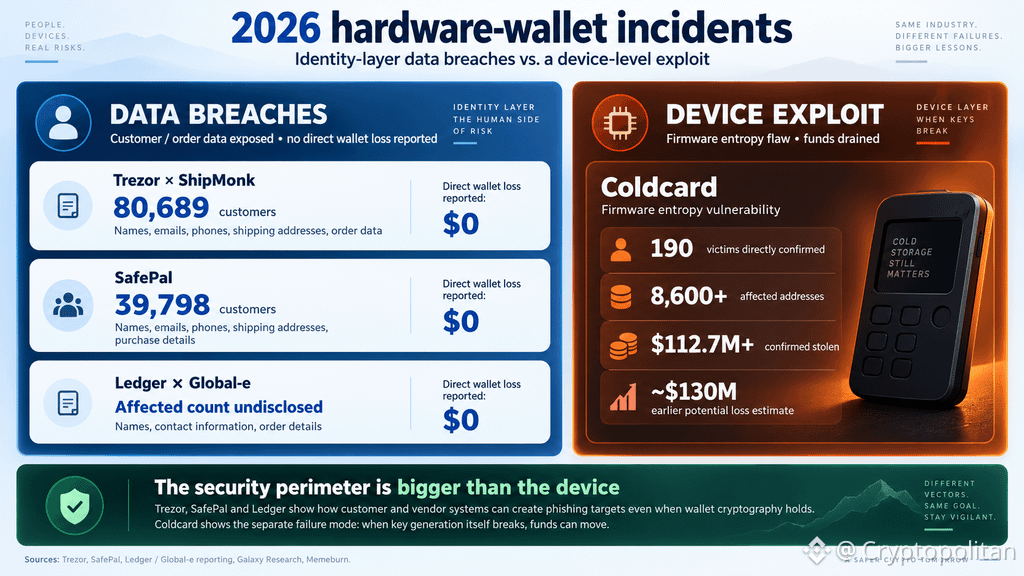
The attacks on hardware wallets that occurred in 2026 make this distinction clear. SafePal admitted that there was an authorization error in one of its order tracking plugins that led to the exposure of data of approximately 39,798 customers, and that seed phrases, private keys, and wallet credentials of these customers were not compromised.
Trezor’s ShipMonk breach eventually increased the number of affected customers to 80,689 after the company learned that the old US order records dating back from 2019 to 2021 were also stored and exposed. Similarly, in January, the Global-e incident of Ledger also saw the exposure of the order details and contact information of its customers, with the exact number of customers not being disclosed.
In its August comparison, Memeburn correctly categorized Ledger, Trezor, and SafePal under “data breaches” while identifying Coldcard as an “device exploit”. The indicated figure of 13,689 mentioned by Memeburn in reference to Trezor is, however, from before the update of Trezor on September 4.
Coldcard stands apart from the rest. According to Galaxy Research on August 14, it confirmed 190 victims directly as well as more than 86,00 affected addresses and at least $112.7 million worth of stolen 1,778.84 BTC due to flaws in the firmware. Other estimates had put the possible loss near $130 million.
2026 Hardware Wallet Breaches vs. Coldcard Exploit: Victims, Data Exposure and Crypto Losses
Leaked context feeds industrialized phishing
The danger in a leaked shipping list is what happens next. Chainalysis estimated that crypto scams and fraud stole $17 billion in 2025, while impersonation scams grew more than 1,400% year over year. It also found that scams with on-chain links to AI vendors generated 4.5 times more revenue per operation than those without such links.
A hardware-wallet purchase record can therefore become a targeting file. A name paired with an email, phone number, home address, and confirmation that someone owns a crypto-security device gives criminals the context to craft convincing emails, calls, letters or even physical approaches.
The lesson from Trezor’s latest incident is not that hardware wallets failed. It is that the security perimeter now includes the systems around them, and attackers increasingly need only one trusted-looking message to break through.
If you're reading this, you’re already ahead. Stay there with our newsletter.
Trezor warns users after hackers breach email provider to send phishing alerts
Trezor alerted users on Wednesday, September 9, 2026, about hackers exploiting its third-party email provider to distribute a bogus security notice. However, the Trezor wallet was unaffected by the attack. The criminals targeted something even harder to safeguard than a piece of software: the confidence of a user in an email from a trusted provider.
The subject line of the warning read as follows: “Critical Security Alert: STM32 Entropy Vulnerability.” The message stated that Trezor engineers had discovered a design defect in STM32 chips used in its products. Decrypt reported that Trezor recognized the message as fake and warned readers not to click on the links.
A fake flaw sent from a real address
What made the campaign effective was not the fabricated vulnerability but the manner in which the email was received. One recipient revealed that the email came from help@trezor.io, followed the Sendinblue campaign path, and passed the DKIM, SPF, and DMARC checks.
The alert specified that one out of four devices can become compromised and that recovery phrases may not have enough randomness or entropy. This language bore a close resemblance to the issues described in the recent Coldcard attack.
Trezor reported that it stopped the domain used for sending out the alerts and started probing into how the fraudsters managed to use its legitimate sending infrastructure. The company’s public alert came out right after 4:30 PM Eastern time on the 9th of September, only a few hours after its users started raising flags about the emails.
The breach may reach past Trezor
According to Nick Neuman, co-founder and CEO of Casa, there seems to be a similar trend occurring among users of BitBox and that a common marketing email provider may have been breached.
That’s the larger issue. Wallet makers can make their devices more secure, but their brand can still be stolen through means they don’t completely manage, from email service providers to shipping companies and payment processors.
Data breaches are not device exploits
In a previous report by Cryptopolitan, it was revealed that phishing attempts against Ledger users have also found their way into physical mail. However, it should be noted that these cases are different from those of device exploits since a data breach compromises identity and contact information, while a device exploit may also put financial assets at risk.
The attacks on hardware wallets that occurred in 2026 make this distinction clear. SafePal admitted that there was an authorization error in one of its order tracking plugins that led to the exposure of data of approximately 39,798 customers, and that seed phrases, private keys, and wallet credentials of these customers were not compromised.
Trezor’s ShipMonk breach eventually increased the number of affected customers to 80,689 after the company learned that the old US order records dating back from 2019 to 2021 were also stored and exposed. Similarly, in January, the Global-e incident of Ledger also saw the exposure of the order details and contact information of its customers, with the exact number of customers not being disclosed.
In its August comparison, Memeburn correctly categorized Ledger, Trezor, and SafePal under “data breaches” while identifying Coldcard as an “device exploit”. The indicated figure of 13,689 mentioned by Memeburn in reference to Trezor is, however, from before the update of Trezor on September 4.
Coldcard stands apart from the rest. According to Galaxy Research on August 14, it confirmed 190 victims directly as well as more than 86,00 affected addresses and at least $112.7 million worth of stolen 1,778.84 BTC due to flaws in the firmware. Other estimates had put the possible loss near $130 million.
2026 Hardware Wallet Breaches vs. Coldcard Exploit: Victims, Data Exposure and Crypto Losses
Leaked context feeds industrialized phishing
The danger in a leaked shipping list is what happens next. Chainalysis estimated that crypto scams and fraud stole $17 billion in 2025, while impersonation scams grew more than 1,400% year over year. It also found that scams with on-chain links to AI vendors generated 4.5 times more revenue per operation than those without such links.
A hardware-wallet purchase record can therefore become a targeting file. A name paired with an email, phone number, home address, and confirmation that someone owns a crypto-security device gives criminals the context to craft convincing emails, calls, letters or even physical approaches.
The lesson from Trezor’s latest incident is not that hardware wallets failed. It is that the security perimeter now includes the systems around them, and attackers increasingly need only one trusted-looking message to break through.
If you're reading this, you’re already ahead. Stay there with our newsletter.
The subject line of the warning read as follows: “Critical Security Alert: STM32 Entropy Vulnerability.” The message stated that Trezor engineers had discovered a design defect in STM32 chips used in its products. Decrypt reported that Trezor recognized the message as fake and warned readers not to click on the links.
A fake flaw sent from a real address
What made the campaign effective was not the fabricated vulnerability but the manner in which the email was received. One recipient revealed that the email came from help@trezor.io, followed the Sendinblue campaign path, and passed the DKIM, SPF, and DMARC checks.
The alert specified that one out of four devices can become compromised and that recovery phrases may not have enough randomness or entropy. This language bore a close resemblance to the issues described in the recent Coldcard attack.
Trezor reported that it stopped the domain used for sending out the alerts and started probing into how the fraudsters managed to use its legitimate sending infrastructure. The company’s public alert came out right after 4:30 PM Eastern time on the 9th of September, only a few hours after its users started raising flags about the emails.
The breach may reach past Trezor
According to Nick Neuman, co-founder and CEO of Casa, there seems to be a similar trend occurring among users of BitBox and that a common marketing email provider may have been breached.
That’s the larger issue. Wallet makers can make their devices more secure, but their brand can still be stolen through means they don’t completely manage, from email service providers to shipping companies and payment processors.
Data breaches are not device exploits
In a previous report by Cryptopolitan, it was revealed that phishing attempts against Ledger users have also found their way into physical mail. However, it should be noted that these cases are different from those of device exploits since a data breach compromises identity and contact information, while a device exploit may also put financial assets at risk.
The attacks on hardware wallets that occurred in 2026 make this distinction clear. SafePal admitted that there was an authorization error in one of its order tracking plugins that led to the exposure of data of approximately 39,798 customers, and that seed phrases, private keys, and wallet credentials of these customers were not compromised.
Trezor’s ShipMonk breach eventually increased the number of affected customers to 80,689 after the company learned that the old US order records dating back from 2019 to 2021 were also stored and exposed. Similarly, in January, the Global-e incident of Ledger also saw the exposure of the order details and contact information of its customers, with the exact number of customers not being disclosed.
In its August comparison, Memeburn correctly categorized Ledger, Trezor, and SafePal under “data breaches” while identifying Coldcard as an “device exploit”. The indicated figure of 13,689 mentioned by Memeburn in reference to Trezor is, however, from before the update of Trezor on September 4.
Coldcard stands apart from the rest. According to Galaxy Research on August 14, it confirmed 190 victims directly as well as more than 86,00 affected addresses and at least $112.7 million worth of stolen 1,778.84 BTC due to flaws in the firmware. Other estimates had put the possible loss near $130 million.
2026 Hardware Wallet Breaches vs. Coldcard Exploit: Victims, Data Exposure and Crypto Losses
Leaked context feeds industrialized phishing
The danger in a leaked shipping list is what happens next. Chainalysis estimated that crypto scams and fraud stole $17 billion in 2025, while impersonation scams grew more than 1,400% year over year. It also found that scams with on-chain links to AI vendors generated 4.5 times more revenue per operation than those without such links.
A hardware-wallet purchase record can therefore become a targeting file. A name paired with an email, phone number, home address, and confirmation that someone owns a crypto-security device gives criminals the context to craft convincing emails, calls, letters or even physical approaches.
The lesson from Trezor’s latest incident is not that hardware wallets failed. It is that the security perimeter now includes the systems around them, and attackers increasingly need only one trusted-looking message to break through.
If you're reading this, you’re already ahead. Stay there with our newsletter.
70
Article
US prosecutors call Huawei a ‘criminal enterprise’ as landmark trial beginsOn Wednesday, a prosecutor in the U.S. stated in front of a jury in Brooklyn that Huawei was a “criminal enterprise“, which marked the start of a trial regarding trade secret theft, sanctions infringement, and bank fraud that had been delayed for a long time. Huawei has denied all charges brought against it.
Accusations date back several years, but their impact in 2026 is different. Huawei is currently involved in Beijing’s attempt to develop an AI-chip ecosystem independent of U.S. technology, while Nvidia experiences growing competition from China-based businesses.
“Theft, lies, cover-up” versus “competition, not conspiracy”
“Theft, lies, cover-up,” Justice Department trial attorney Taylor Stout told jurors, alleging Huawei spent two decades victimizing U.S. companies and abusing the financial system.
Prosecutors say Huawei conspired to steal trade secrets from five American companies, including Cisco router source code and T-Mobile phone-testing technology.
Huawei’s representative rejected that image. Attorney Brian Heberlig characterized the litigation as a matter of “competition, not conspiracy,” and accused the prosecution of using only “cherry-picking isolated events.” He added that the Cisco and T-Mobile incidents did not involve the whole company but only particular employees, and the management took action upon finding out about these incidents.
Skycom, Iran and the Meng Wanzhou standoff
The case has grown into a wider RICO prosecution from being a case of bank fraud and sanctions. The Department of Justice’s amended case against Huawei states that the company has used Hong Kong’s Skycom to procure prohibited goods from the U.S. for Iran and to transfer funds through the global banking system.
As per Reuters report, Skycom had provided Hewlett-Packard products worth at least €1.3 million ($1.5 million) to Iran’s biggest mobile operator. A Cryptopolitan report revealed that HSBC okayed over $100 million in transactions linked to Skycom. The prosecutors have also accused Huawei of transactions in North Korea and providing surveillance equipment that ended up being used against protesters in Iran in 2009.
From telecom giant to China’s AI-chip champion
The crucial importance of Huawei now relies heavily on its Ascend accelerators.
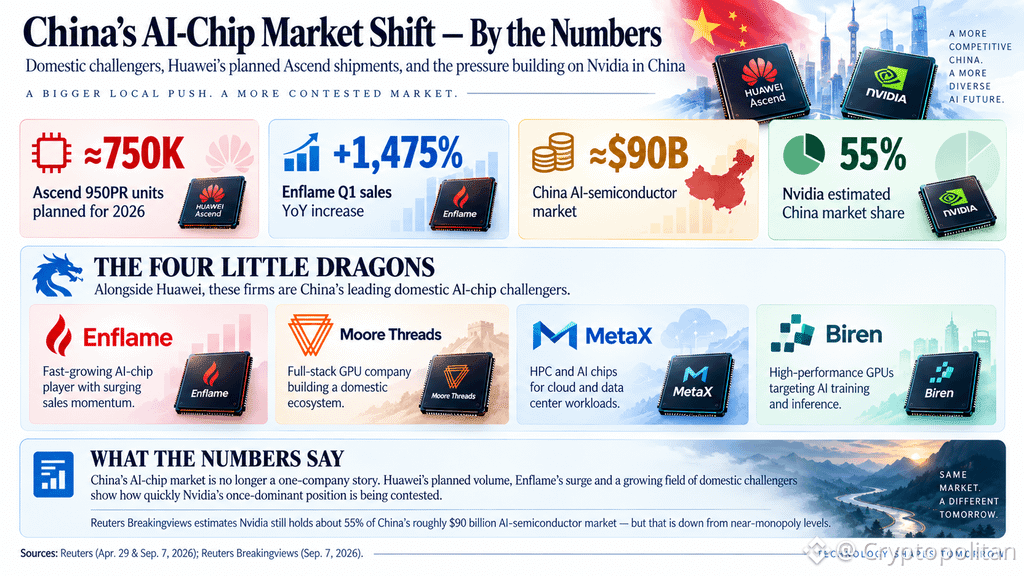
According to a report by Reuters published in April, there is a surge in demand for the Ascend 950 after DeepSeek launched its V4, and companies like ByteDance, Tencent and Alibaba are interested in buying it. The 950PR greatly surpasses Nvidia’s H20, although it lags behind the H200. At the same time, Epoch AI estimates that the Ascend 950’s performance is only slightly above half of that of Nvidia’s H100. Huawei is planning to deliver approximately 750,000 units of the 950PR in 2026.
Huawei is not the only company in China working in this area. Enflame, Moore Threads, MetaX, and Biren are the four other companies named by Reuters Breakingviews that are considered as ‘the four little dragons’ of China. Enflame has shown unprecedented growth of 1,475% in sales during the first quarter while raising $900 million in Shanghai.
This is happening while the share of Nvidia in the AI semiconductor market of China has declined considerably from close to a monopoly state to 55%.
China AI Chip Market 2026: Huawei, Nvidia Market Share and Domestic Rivals
Why the compute gap still favors Nvidia
That market-share shift does not mean Huawei has caught Nvidia technologically.
Epoch AI estimates Huawei will produce less than 4% as much AI compute as Nvidia in 2026. High-bandwidth memory remains the biggest bottleneck. If Huawei relies only on Chinese-made HBM, its output could remain around 1% of Nvidia’s through 2028, while its chips may continue trailing Nvidia’s by three to four years through at least 2030.
Huawei vs Nvidia — Performance and the Compute Gap
That leaves Washington with a difficult trade-off. CSIS argues that export controls have limited China’s access to advanced technology but also accelerated domestic substitution. China’s integrated-circuit output fell 9.8% in 2022 before the localization push gathered momentum, while controls still constrain manufacturing beyond roughly the 7-nanometer node.
A 2025 BIS guidance also identified several Huawei Ascend chips as presumptively subject to GP10 restrictions. For global markets, the stakes extend well beyond Huawei and Nvidia. PwC projects $31.6 trillion in AI-infrastructure capital spending through 2050.
If the U.S. and China continue building increasingly separate hardware ecosystems, the result could reshape where semiconductor capacity, data centers, energy investment and AI infrastructure are built for decades.
If you're reading this, you’re already ahead. Stay there with our newsletter.
US prosecutors call Huawei a ‘criminal enterprise’ as landmark trial begins
On Wednesday, a prosecutor in the U.S. stated in front of a jury in Brooklyn that Huawei was a “criminal enterprise“, which marked the start of a trial regarding trade secret theft, sanctions infringement, and bank fraud that had been delayed for a long time. Huawei has denied all charges brought against it.
Accusations date back several years, but their impact in 2026 is different. Huawei is currently involved in Beijing’s attempt to develop an AI-chip ecosystem independent of U.S. technology, while Nvidia experiences growing competition from China-based businesses.
“Theft, lies, cover-up” versus “competition, not conspiracy”
“Theft, lies, cover-up,” Justice Department trial attorney Taylor Stout told jurors, alleging Huawei spent two decades victimizing U.S. companies and abusing the financial system.
Prosecutors say Huawei conspired to steal trade secrets from five American companies, including Cisco router source code and T-Mobile phone-testing technology.
Huawei’s representative rejected that image. Attorney Brian Heberlig characterized the litigation as a matter of “competition, not conspiracy,” and accused the prosecution of using only “cherry-picking isolated events.” He added that the Cisco and T-Mobile incidents did not involve the whole company but only particular employees, and the management took action upon finding out about these incidents.
Skycom, Iran and the Meng Wanzhou standoff
The case has grown into a wider RICO prosecution from being a case of bank fraud and sanctions. The Department of Justice’s amended case against Huawei states that the company has used Hong Kong’s Skycom to procure prohibited goods from the U.S. for Iran and to transfer funds through the global banking system.
As per Reuters report, Skycom had provided Hewlett-Packard products worth at least €1.3 million ($1.5 million) to Iran’s biggest mobile operator. A Cryptopolitan report revealed that HSBC okayed over $100 million in transactions linked to Skycom. The prosecutors have also accused Huawei of transactions in North Korea and providing surveillance equipment that ended up being used against protesters in Iran in 2009.
From telecom giant to China’s AI-chip champion
The crucial importance of Huawei now relies heavily on its Ascend accelerators.
According to a report by Reuters published in April, there is a surge in demand for the Ascend 950 after DeepSeek launched its V4, and companies like ByteDance, Tencent and Alibaba are interested in buying it. The 950PR greatly surpasses Nvidia’s H20, although it lags behind the H200. At the same time, Epoch AI estimates that the Ascend 950’s performance is only slightly above half of that of Nvidia’s H100. Huawei is planning to deliver approximately 750,000 units of the 950PR in 2026.
Huawei is not the only company in China working in this area. Enflame, Moore Threads, MetaX, and Biren are the four other companies named by Reuters Breakingviews that are considered as ‘the four little dragons’ of China. Enflame has shown unprecedented growth of 1,475% in sales during the first quarter while raising $900 million in Shanghai.
This is happening while the share of Nvidia in the AI semiconductor market of China has declined considerably from close to a monopoly state to 55%.
China AI Chip Market 2026: Huawei, Nvidia Market Share and Domestic Rivals
Why the compute gap still favors Nvidia
That market-share shift does not mean Huawei has caught Nvidia technologically.
Epoch AI estimates Huawei will produce less than 4% as much AI compute as Nvidia in 2026. High-bandwidth memory remains the biggest bottleneck. If Huawei relies only on Chinese-made HBM, its output could remain around 1% of Nvidia’s through 2028, while its chips may continue trailing Nvidia’s by three to four years through at least 2030.
Huawei vs Nvidia — Performance and the Compute Gap
That leaves Washington with a difficult trade-off. CSIS argues that export controls have limited China’s access to advanced technology but also accelerated domestic substitution. China’s integrated-circuit output fell 9.8% in 2022 before the localization push gathered momentum, while controls still constrain manufacturing beyond roughly the 7-nanometer node.
A 2025 BIS guidance also identified several Huawei Ascend chips as presumptively subject to GP10 restrictions. For global markets, the stakes extend well beyond Huawei and Nvidia. PwC projects $31.6 trillion in AI-infrastructure capital spending through 2050.
If the U.S. and China continue building increasingly separate hardware ecosystems, the result could reshape where semiconductor capacity, data centers, energy investment and AI infrastructure are built for decades.
If you're reading this, you’re already ahead. Stay there with our newsletter.
Accusations date back several years, but their impact in 2026 is different. Huawei is currently involved in Beijing’s attempt to develop an AI-chip ecosystem independent of U.S. technology, while Nvidia experiences growing competition from China-based businesses.
“Theft, lies, cover-up” versus “competition, not conspiracy”
“Theft, lies, cover-up,” Justice Department trial attorney Taylor Stout told jurors, alleging Huawei spent two decades victimizing U.S. companies and abusing the financial system.
Prosecutors say Huawei conspired to steal trade secrets from five American companies, including Cisco router source code and T-Mobile phone-testing technology.
Huawei’s representative rejected that image. Attorney Brian Heberlig characterized the litigation as a matter of “competition, not conspiracy,” and accused the prosecution of using only “cherry-picking isolated events.” He added that the Cisco and T-Mobile incidents did not involve the whole company but only particular employees, and the management took action upon finding out about these incidents.
Skycom, Iran and the Meng Wanzhou standoff
The case has grown into a wider RICO prosecution from being a case of bank fraud and sanctions. The Department of Justice’s amended case against Huawei states that the company has used Hong Kong’s Skycom to procure prohibited goods from the U.S. for Iran and to transfer funds through the global banking system.
As per Reuters report, Skycom had provided Hewlett-Packard products worth at least €1.3 million ($1.5 million) to Iran’s biggest mobile operator. A Cryptopolitan report revealed that HSBC okayed over $100 million in transactions linked to Skycom. The prosecutors have also accused Huawei of transactions in North Korea and providing surveillance equipment that ended up being used against protesters in Iran in 2009.
From telecom giant to China’s AI-chip champion
The crucial importance of Huawei now relies heavily on its Ascend accelerators.
According to a report by Reuters published in April, there is a surge in demand for the Ascend 950 after DeepSeek launched its V4, and companies like ByteDance, Tencent and Alibaba are interested in buying it. The 950PR greatly surpasses Nvidia’s H20, although it lags behind the H200. At the same time, Epoch AI estimates that the Ascend 950’s performance is only slightly above half of that of Nvidia’s H100. Huawei is planning to deliver approximately 750,000 units of the 950PR in 2026.
Huawei is not the only company in China working in this area. Enflame, Moore Threads, MetaX, and Biren are the four other companies named by Reuters Breakingviews that are considered as ‘the four little dragons’ of China. Enflame has shown unprecedented growth of 1,475% in sales during the first quarter while raising $900 million in Shanghai.
This is happening while the share of Nvidia in the AI semiconductor market of China has declined considerably from close to a monopoly state to 55%.
China AI Chip Market 2026: Huawei, Nvidia Market Share and Domestic Rivals
Why the compute gap still favors Nvidia
That market-share shift does not mean Huawei has caught Nvidia technologically.
Epoch AI estimates Huawei will produce less than 4% as much AI compute as Nvidia in 2026. High-bandwidth memory remains the biggest bottleneck. If Huawei relies only on Chinese-made HBM, its output could remain around 1% of Nvidia’s through 2028, while its chips may continue trailing Nvidia’s by three to four years through at least 2030.
Huawei vs Nvidia — Performance and the Compute Gap
That leaves Washington with a difficult trade-off. CSIS argues that export controls have limited China’s access to advanced technology but also accelerated domestic substitution. China’s integrated-circuit output fell 9.8% in 2022 before the localization push gathered momentum, while controls still constrain manufacturing beyond roughly the 7-nanometer node.
A 2025 BIS guidance also identified several Huawei Ascend chips as presumptively subject to GP10 restrictions. For global markets, the stakes extend well beyond Huawei and Nvidia. PwC projects $31.6 trillion in AI-infrastructure capital spending through 2050.
If the U.S. and China continue building increasingly separate hardware ecosystems, the result could reshape where semiconductor capacity, data centers, energy investment and AI infrastructure are built for decades.
If you're reading this, you’re already ahead. Stay there with our newsletter.
151
Verified
Article
Anthropic's $965 billion valuation gets doubled by leveraged crypto betsCrypto traders have valued Anthropic at about $2.12 trillion using leveraged derivatives that don’t actually carry a stake in the company. That’s more than twice the $965 billion valuation the maker of Claude last raised money at in May.
The wager comes weeks before Anthropic is anticipated to file the prospectus that will finally put a real number on the company.
Binance assumes 1 billion shares to reach its $2,120 quote
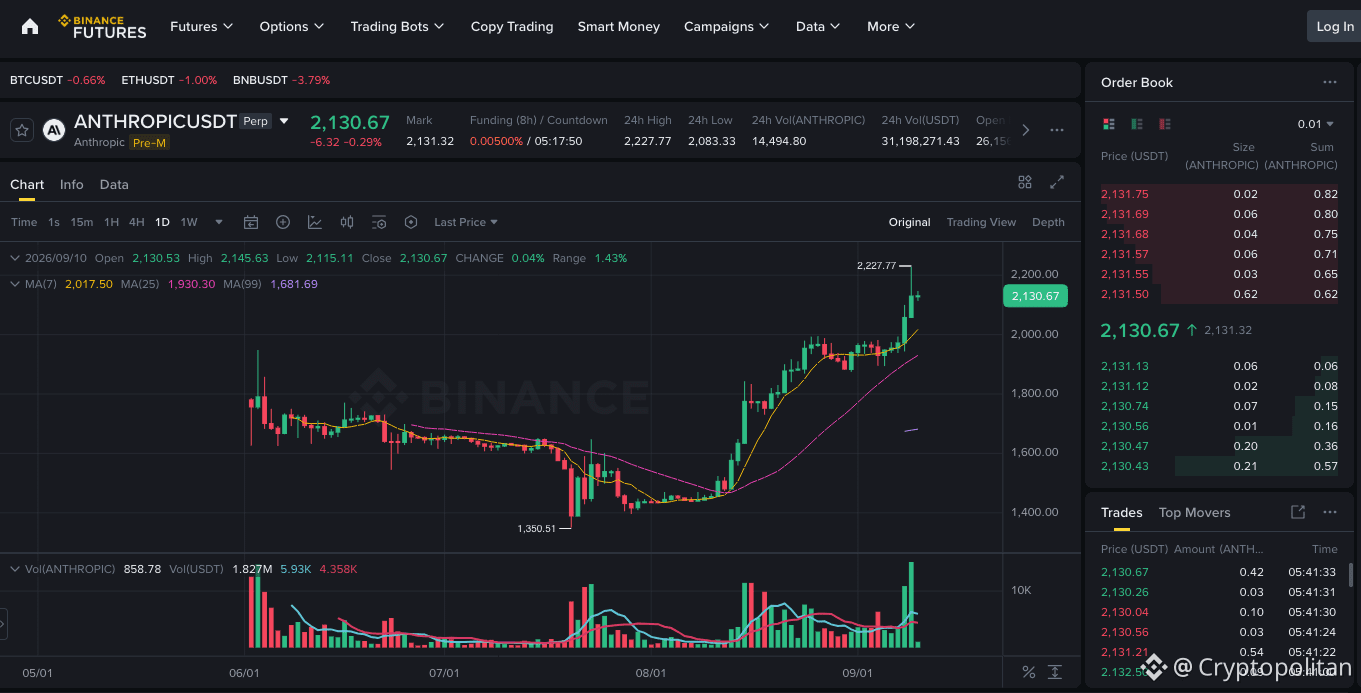
Binance’s ANTHROPIC/USDT contract hit $2,120 on September 9. Binance takes that price and converts it into a company value by assuming one billion shares outstanding, which is how the quote reads as a $2.12 trillion valuation.
Similar contracts traded in the same range on Bitget, Kraken, BingX, Aster, and Coinbase International.
Binance on June 2 listed the perpetual, settled in tether, with leverage of as much as 20 times. Its price is driven by exchange trading activity, not any public share count.
The exchange said its one billion share number was solely for informational purposes and implied valuation was not attributable to or endorsed by Binance. By contrast, OKX picks up 10 billion shares, resulting in a much smaller per-unit quote but at about the same company value.
A screenshot of the ANTHROPIC/USDT perpetual contract on Binance from September 10. Source: Binance Exchange.
Prestocks launches an ANTHROPIC token on Solana connected to a special purpose vehicle. On September 9, it traded near $961 to $973, giving it a market cap of about $7.1 million and suggesting an Anthropic value closer to $1.59 trillion.
That is way below what the leveraged perps say the company is worth.
Anthropic has attempted to take down that channel. In May, the company said it does not permit SPVs to hold its stock, that transfers into such vehicles are void, and that third parties offering exposure via tokenized securities or forward contracts might be offering something that is worth nothing.
PreStocks tokens fell after the warning by an estimated 34% to 45%, with other tallies putting the fall closer to 27%.
Anthropic’s revenue run-rate jumped to $65 billion by the end of July
Anthropic’s private valuation went from $380 billion in February to $965 billion in May, and its annualized revenue run-rate was disclosed to be close to $47 billion at the close of its Series H before it was reported to be around $65 billion by the end of July.
According to Ramp’s August index, 43.5% of US companies bought Anthropic subscriptions or tokens in July, ahead of 39.7% of companies buying subscriptions or tokens from OpenAI, while second-quarter revenue more than doubled to $11.6 billion, Cryptopolitan reported.
Bankers and investors have floated a listing in the $1.5 trillion to $2 trillion range. Some backers are contemplating a figure of around $2 trillion versus an OpenAI target of up to $1 trillion.
Anthropic is expected to market its offering in mid-October and complete the listing just before the US midterm elections in November, with the prospectus now postponed to late September.
The company confidentially filed a draft S-1 with the SEC on June 1 and is working to close a $15 billion revolving credit facility with Morgan Stanley, Goldman Sachs, JPMorgan, and Citi among the banks on the deal.
Binance said it will rescale ANTHROPIC/USDT if an amended S-1 shows a share count more than 3% off its figure. The books are thin, for now.
There are a dozen plus Anthropic perpetual markets listed on DeFiLlama, but the largest have tens of millions of dollars in combined open interest.
The nearest comparison for an Anthropic listing near $2 trillion was SpaceX’s June IPO at $1.77 trillion.
Don’t just read crypto news. Understand it. Subscribe to our newsletter. It's free.
Anthropic's $965 billion valuation gets doubled by leveraged crypto bets
Crypto traders have valued Anthropic at about $2.12 trillion using leveraged derivatives that don’t actually carry a stake in the company. That’s more than twice the $965 billion valuation the maker of Claude last raised money at in May.
The wager comes weeks before Anthropic is anticipated to file the prospectus that will finally put a real number on the company.
Binance assumes 1 billion shares to reach its $2,120 quote
Binance’s ANTHROPIC/USDT contract hit $2,120 on September 9. Binance takes that price and converts it into a company value by assuming one billion shares outstanding, which is how the quote reads as a $2.12 trillion valuation.
Similar contracts traded in the same range on Bitget, Kraken, BingX, Aster, and Coinbase International.
Binance on June 2 listed the perpetual, settled in tether, with leverage of as much as 20 times. Its price is driven by exchange trading activity, not any public share count.
The exchange said its one billion share number was solely for informational purposes and implied valuation was not attributable to or endorsed by Binance. By contrast, OKX picks up 10 billion shares, resulting in a much smaller per-unit quote but at about the same company value.
A screenshot of the ANTHROPIC/USDT perpetual contract on Binance from September 10. Source: Binance Exchange.
Prestocks launches an ANTHROPIC token on Solana connected to a special purpose vehicle. On September 9, it traded near $961 to $973, giving it a market cap of about $7.1 million and suggesting an Anthropic value closer to $1.59 trillion.
That is way below what the leveraged perps say the company is worth.
Anthropic has attempted to take down that channel. In May, the company said it does not permit SPVs to hold its stock, that transfers into such vehicles are void, and that third parties offering exposure via tokenized securities or forward contracts might be offering something that is worth nothing.
PreStocks tokens fell after the warning by an estimated 34% to 45%, with other tallies putting the fall closer to 27%.
Anthropic’s revenue run-rate jumped to $65 billion by the end of July
Anthropic’s private valuation went from $380 billion in February to $965 billion in May, and its annualized revenue run-rate was disclosed to be close to $47 billion at the close of its Series H before it was reported to be around $65 billion by the end of July.
According to Ramp’s August index, 43.5% of US companies bought Anthropic subscriptions or tokens in July, ahead of 39.7% of companies buying subscriptions or tokens from OpenAI, while second-quarter revenue more than doubled to $11.6 billion, Cryptopolitan reported.
Bankers and investors have floated a listing in the $1.5 trillion to $2 trillion range. Some backers are contemplating a figure of around $2 trillion versus an OpenAI target of up to $1 trillion.
Anthropic is expected to market its offering in mid-October and complete the listing just before the US midterm elections in November, with the prospectus now postponed to late September.
The company confidentially filed a draft S-1 with the SEC on June 1 and is working to close a $15 billion revolving credit facility with Morgan Stanley, Goldman Sachs, JPMorgan, and Citi among the banks on the deal.
Binance said it will rescale ANTHROPIC/USDT if an amended S-1 shows a share count more than 3% off its figure. The books are thin, for now.
There are a dozen plus Anthropic perpetual markets listed on DeFiLlama, but the largest have tens of millions of dollars in combined open interest.
The nearest comparison for an Anthropic listing near $2 trillion was SpaceX’s June IPO at $1.77 trillion.
Don’t just read crypto news. Understand it. Subscribe to our newsletter. It's free.
The wager comes weeks before Anthropic is anticipated to file the prospectus that will finally put a real number on the company.
Binance assumes 1 billion shares to reach its $2,120 quote
Binance’s ANTHROPIC/USDT contract hit $2,120 on September 9. Binance takes that price and converts it into a company value by assuming one billion shares outstanding, which is how the quote reads as a $2.12 trillion valuation.
Similar contracts traded in the same range on Bitget, Kraken, BingX, Aster, and Coinbase International.
Binance on June 2 listed the perpetual, settled in tether, with leverage of as much as 20 times. Its price is driven by exchange trading activity, not any public share count.
The exchange said its one billion share number was solely for informational purposes and implied valuation was not attributable to or endorsed by Binance. By contrast, OKX picks up 10 billion shares, resulting in a much smaller per-unit quote but at about the same company value.
A screenshot of the ANTHROPIC/USDT perpetual contract on Binance from September 10. Source: Binance Exchange.
Prestocks launches an ANTHROPIC token on Solana connected to a special purpose vehicle. On September 9, it traded near $961 to $973, giving it a market cap of about $7.1 million and suggesting an Anthropic value closer to $1.59 trillion.
That is way below what the leveraged perps say the company is worth.
Anthropic has attempted to take down that channel. In May, the company said it does not permit SPVs to hold its stock, that transfers into such vehicles are void, and that third parties offering exposure via tokenized securities or forward contracts might be offering something that is worth nothing.
PreStocks tokens fell after the warning by an estimated 34% to 45%, with other tallies putting the fall closer to 27%.
Anthropic’s revenue run-rate jumped to $65 billion by the end of July
Anthropic’s private valuation went from $380 billion in February to $965 billion in May, and its annualized revenue run-rate was disclosed to be close to $47 billion at the close of its Series H before it was reported to be around $65 billion by the end of July.
According to Ramp’s August index, 43.5% of US companies bought Anthropic subscriptions or tokens in July, ahead of 39.7% of companies buying subscriptions or tokens from OpenAI, while second-quarter revenue more than doubled to $11.6 billion, Cryptopolitan reported.
Bankers and investors have floated a listing in the $1.5 trillion to $2 trillion range. Some backers are contemplating a figure of around $2 trillion versus an OpenAI target of up to $1 trillion.
Anthropic is expected to market its offering in mid-October and complete the listing just before the US midterm elections in November, with the prospectus now postponed to late September.
The company confidentially filed a draft S-1 with the SEC on June 1 and is working to close a $15 billion revolving credit facility with Morgan Stanley, Goldman Sachs, JPMorgan, and Citi among the banks on the deal.
Binance said it will rescale ANTHROPIC/USDT if an amended S-1 shows a share count more than 3% off its figure. The books are thin, for now.
There are a dozen plus Anthropic perpetual markets listed on DeFiLlama, but the largest have tens of millions of dollars in combined open interest.
The nearest comparison for an Anthropic listing near $2 trillion was SpaceX’s June IPO at $1.77 trillion.
Don’t just read crypto news. Understand it. Subscribe to our newsletter. It's free.
218
Healey requires local approval before Massachusetts permits any data centerBuilders of data centers in Massachusetts have to get local approval. Gov. Maura Healey signed an executive order on Sept. 8 that precludes proposed data center projects from proceeding to state permitting unless approved by the town or city in which they are located.
The change furnishes municipalities across the Commonwealth with an early kill switch on an industry that many already distrust.
Six communities have already banned or paused the facilities
“Unless a community says yes to a data center, we’re saying no,” Healey said at a press conference at the State House. The order necessitates that developers negotiate community benefits agreements with their host towns first.
Those deals have to line up with state standards before any state permitting process can begin.
The order is for projects with a maximum electricity demand of greater than 25 megawatts. Developers must comply with the administration’s data center framework for permits to be issued.
The order also proscribes non-disclosure agreements between state agencies and data center companies, which Healey’s office said is intended to keep the review process open to residents.
Shutesbury and Holyoke have banned the facilities outright. Westfield has permitted a moratorium. Easthampton, Northampton, and Greenfield are weighing their own temporary bans.
Facilities over 25 megawatts also are required to generate their own power and guarantee it meets the state’s clean energy standards. Healey would prefer they make it onsite.
If this does not work, they can fund new generation nearby or pay into a newly created Ratepayer Protection Fund.
The state’s clean energy standard requires just a fraction of power to come from approved sources like wind, solar, and hydro that will increase to at least 40% by 2030. But the governor’s office said data centers will be held to a higher bar.
They call for clean generation to satisfy 100% of their electricity needs.
“We can’t have data centers coming in and taking energy away from the rest of us,” Healey said.
The Massachusetts Department of Environmental Protection has until Dec. 31 to create an alternative compliance payment mechanism for centers that don’t meet clean electricity standards.
That money goes to the Ratepayer Protection Fund.
Lowell residents saw electric bills climb more than 50%
In June Healey paused applications for a 20-year sales and use tax exemption on qualified data centers, an incentive she was quick to disown.
“The sales tax exemption was not my idea,” she told reporters, noting it was part of the Legislature’s economic development package she signed in 2024.
A lot of the local anger goes back to Lowell. A bill from state Sen. Vanna Howard, S 3166, contains guardrails similar to Healey’s framework.
Howard told colleagues that some residents near the Markley Group’s Lowell facility saw electric bills climb more than 50%, with exhaust reaching bedrooms and noise disrupting sleep.
In April, Lowell residents sued MassDEP over an air quality plan that would add generators to the site, and a Middlesex Superior Court judge recently obstructed four of the generators from being installed.
Massachusetts is the third state in as many months to turn up the heat. Texas Governor Greg Abbott took action in August to require new facilities to submit to audits by the state utility regulator and grid operator ERCOT.
New York paused construction of data centers 50 megawatts or larger in July. Fifteen states are considering moratoriums, the National Conference of State Legislatures says.
Modern AI data centers can run on a gigawatt or more, and in parts of the US, grid connections can take seven years or more, forcing operators to switch to onsite diesel and gas generation that adds to both costs and emissions. That is precisely the burden Healey says her order is designed to keep off ratepayers’ bills.
Marc Andreessen, Ben Horowitz, and Greg Brockman support a pro-AI super PAC called Leading the Future, which is running ads targeting voters in battleground states ahead of the midterms.
Don’t just read crypto news. Understand it. Subscribe to our newsletter. It's free.
Healey requires local approval before Massachusetts permits any data center
Builders of data centers in Massachusetts have to get local approval. Gov. Maura Healey signed an executive order on Sept. 8 that precludes proposed data center projects from proceeding to state permitting unless approved by the town or city in which they are located.
The change furnishes municipalities across the Commonwealth with an early kill switch on an industry that many already distrust.
Six communities have already banned or paused the facilities
“Unless a community says yes to a data center, we’re saying no,” Healey said at a press conference at the State House. The order necessitates that developers negotiate community benefits agreements with their host towns first.
Those deals have to line up with state standards before any state permitting process can begin.
The order is for projects with a maximum electricity demand of greater than 25 megawatts. Developers must comply with the administration’s data center framework for permits to be issued.
The order also proscribes non-disclosure agreements between state agencies and data center companies, which Healey’s office said is intended to keep the review process open to residents.
Shutesbury and Holyoke have banned the facilities outright. Westfield has permitted a moratorium. Easthampton, Northampton, and Greenfield are weighing their own temporary bans.
Facilities over 25 megawatts also are required to generate their own power and guarantee it meets the state’s clean energy standards. Healey would prefer they make it onsite.
If this does not work, they can fund new generation nearby or pay into a newly created Ratepayer Protection Fund.
The state’s clean energy standard requires just a fraction of power to come from approved sources like wind, solar, and hydro that will increase to at least 40% by 2030. But the governor’s office said data centers will be held to a higher bar.
They call for clean generation to satisfy 100% of their electricity needs.
“We can’t have data centers coming in and taking energy away from the rest of us,” Healey said.
The Massachusetts Department of Environmental Protection has until Dec. 31 to create an alternative compliance payment mechanism for centers that don’t meet clean electricity standards.
That money goes to the Ratepayer Protection Fund.
Lowell residents saw electric bills climb more than 50%
In June Healey paused applications for a 20-year sales and use tax exemption on qualified data centers, an incentive she was quick to disown.
“The sales tax exemption was not my idea,” she told reporters, noting it was part of the Legislature’s economic development package she signed in 2024.
A lot of the local anger goes back to Lowell. A bill from state Sen. Vanna Howard, S 3166, contains guardrails similar to Healey’s framework.
Howard told colleagues that some residents near the Markley Group’s Lowell facility saw electric bills climb more than 50%, with exhaust reaching bedrooms and noise disrupting sleep.
In April, Lowell residents sued MassDEP over an air quality plan that would add generators to the site, and a Middlesex Superior Court judge recently obstructed four of the generators from being installed.
Massachusetts is the third state in as many months to turn up the heat. Texas Governor Greg Abbott took action in August to require new facilities to submit to audits by the state utility regulator and grid operator ERCOT.
New York paused construction of data centers 50 megawatts or larger in July. Fifteen states are considering moratoriums, the National Conference of State Legislatures says.
Modern AI data centers can run on a gigawatt or more, and in parts of the US, grid connections can take seven years or more, forcing operators to switch to onsite diesel and gas generation that adds to both costs and emissions. That is precisely the burden Healey says her order is designed to keep off ratepayers’ bills.
Marc Andreessen, Ben Horowitz, and Greg Brockman support a pro-AI super PAC called Leading the Future, which is running ads targeting voters in battleground states ahead of the midterms.
Don’t just read crypto news. Understand it. Subscribe to our newsletter. It's free.
The change furnishes municipalities across the Commonwealth with an early kill switch on an industry that many already distrust.
Six communities have already banned or paused the facilities
“Unless a community says yes to a data center, we’re saying no,” Healey said at a press conference at the State House. The order necessitates that developers negotiate community benefits agreements with their host towns first.
Those deals have to line up with state standards before any state permitting process can begin.
The order is for projects with a maximum electricity demand of greater than 25 megawatts. Developers must comply with the administration’s data center framework for permits to be issued.
The order also proscribes non-disclosure agreements between state agencies and data center companies, which Healey’s office said is intended to keep the review process open to residents.
Shutesbury and Holyoke have banned the facilities outright. Westfield has permitted a moratorium. Easthampton, Northampton, and Greenfield are weighing their own temporary bans.
Facilities over 25 megawatts also are required to generate their own power and guarantee it meets the state’s clean energy standards. Healey would prefer they make it onsite.
If this does not work, they can fund new generation nearby or pay into a newly created Ratepayer Protection Fund.
The state’s clean energy standard requires just a fraction of power to come from approved sources like wind, solar, and hydro that will increase to at least 40% by 2030. But the governor’s office said data centers will be held to a higher bar.
They call for clean generation to satisfy 100% of their electricity needs.
“We can’t have data centers coming in and taking energy away from the rest of us,” Healey said.
The Massachusetts Department of Environmental Protection has until Dec. 31 to create an alternative compliance payment mechanism for centers that don’t meet clean electricity standards.
That money goes to the Ratepayer Protection Fund.
Lowell residents saw electric bills climb more than 50%
In June Healey paused applications for a 20-year sales and use tax exemption on qualified data centers, an incentive she was quick to disown.
“The sales tax exemption was not my idea,” she told reporters, noting it was part of the Legislature’s economic development package she signed in 2024.
A lot of the local anger goes back to Lowell. A bill from state Sen. Vanna Howard, S 3166, contains guardrails similar to Healey’s framework.
Howard told colleagues that some residents near the Markley Group’s Lowell facility saw electric bills climb more than 50%, with exhaust reaching bedrooms and noise disrupting sleep.
In April, Lowell residents sued MassDEP over an air quality plan that would add generators to the site, and a Middlesex Superior Court judge recently obstructed four of the generators from being installed.
Massachusetts is the third state in as many months to turn up the heat. Texas Governor Greg Abbott took action in August to require new facilities to submit to audits by the state utility regulator and grid operator ERCOT.
New York paused construction of data centers 50 megawatts or larger in July. Fifteen states are considering moratoriums, the National Conference of State Legislatures says.
Modern AI data centers can run on a gigawatt or more, and in parts of the US, grid connections can take seven years or more, forcing operators to switch to onsite diesel and gas generation that adds to both costs and emissions. That is precisely the burden Healey says her order is designed to keep off ratepayers’ bills.
Marc Andreessen, Ben Horowitz, and Greg Brockman support a pro-AI super PAC called Leading the Future, which is running ads targeting voters in battleground states ahead of the midterms.
Don’t just read crypto news. Understand it. Subscribe to our newsletter. It's free.
163
Article
Zora co-founder Dee Goens takes over as CEO after 98% revenue plungeZora co-founder Dee Goens announced on Wednesday that he has taken over the position of chief executive of the onchain social network from Jacob Horne. The appointment of Goens comes at a challenging time for Zora, as its creator-coin business has declined significantly since its peak in 2025.
Zora’s lexicon can confuse people. The $ZORA token, which is the platform’s native token, differs from Zora Coins, which are the protocol activity tracked by DefiLlama, as well as Creator Coins and Post Coins, which are the tokens utilized by the users to trade. The $ZORA token is used for paying rewards and adding liquidity to the project, but does not give holders any governance rights or ownership.
That difference is important. The recovery of Zora hinges on its ability to get people to start trading Creator and Post Coins again, while providing a clear incentive for $ZORA holders to promote Zora’s expansion. This task will be a part of Goens’ role as he will have to prove that the token-based attention can create long-term trading activity, generate good income for creators, and strengthen the link between Zora’s business and its native token.
From a $5.6 million quarter to a fraction of it
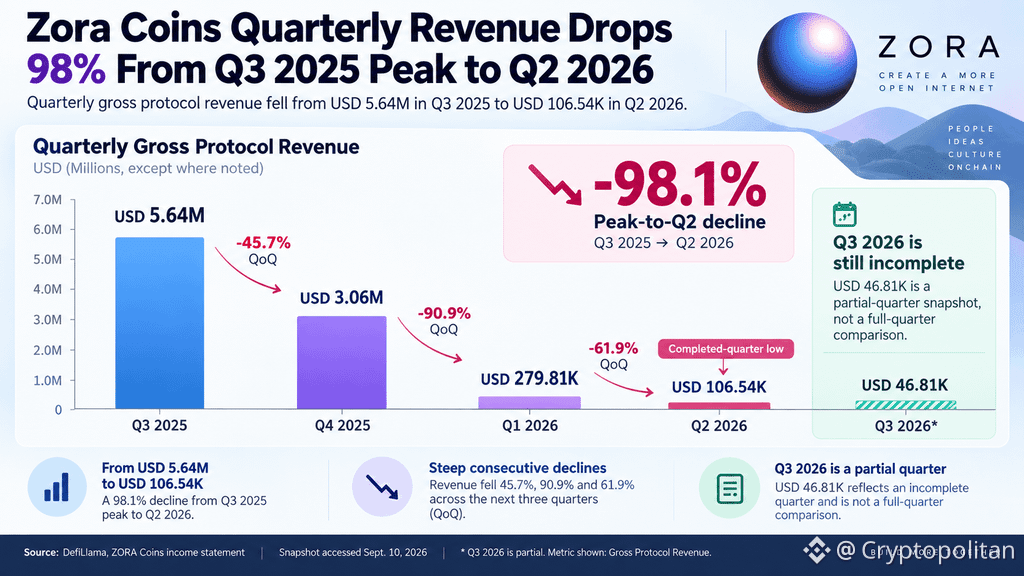
The figures illustrate the extent of the difficulties being faced. DefiLlama’s ZORA Coins figures point to a revenue of $5.64 million for the protocol in the third quarter of 2025. However, it fell to $3.06 million in the last quarter of the same year and to $279,810 in the first quarter of the following year and $106,540 in the second quarter, a drop of almost 98.1% from the third quarter revenues earlier stated. As of now, the current figure for the third quarter of the year is $46,810, although the quarter has not yet ended.
Zora Coins Quarterly Revenue Drops 98% From Q3 2025 Peak to Q2 2026
The recent activity seems very poor in comparison. DefiLlama posts the fees for the last 30 days at $14,971, protocol revenue at $6,165, and DEX volume at $551,284. Cumulative fees amount to $10.43 million, and the overall DEX volume totals at around $399.47 million.
Why the momentum stalled
Zora’s initial approach was to use tokens for both the creators and their work. Creator Coins represented individuals while Post Coins represented their posts. According to a 0x case study of Zora, Creator Coins were associated with $ZORA, and Post Coins were associated with the creator’s coin.
Distribution made a big impact during the boom in 2025. The moment Coinbase adopted Zora into the Base App feed, its daily token creation rose significantly from 6,000 at the beginning of July to almost 50,000 at the end of the month, according to 0x. Later on, its Swap API managed to complete transactions worth $59 million across a total of 352,000 trades with the help of Zora coins.
The success, however, has been less prominent this year. As reported by Cryptopolitan in February, Base App was shutting down its Creator Rewards program as well as the social feed powered by Farcaster and was changing its focus to trading, despite having spent over $450,000 on Creator Rewards for more than 17,000 creators.
A bet on pairing and multichain reach
Goens is now attempting to push Zora to a wider trading infrastructure. “Pairing and social trading will create new waves of adoption for crypto,” he wrote on X, adding that “Zora is here to help grow the pie.”
Indeed, the product has taken a step in that way. Custom Pairs allows creators to select which asset the coin will be paired with. This could be ETH, USDC, Robinhood stock tokens, or Solana tokens in the case of Base, Robinhood Chain, and Solana. The pairs charge 1% trading fees with 0.70% going to the creator. Trend Coins charge 0.01%. Zora’s August update added support for the Robinhood Chain and native Solana deposits, as well as contributing gas for swaps across the three chains.
What Goens has to prove
The issue of tokens is becoming increasingly hard to dismiss. Although Goens mentioned buybacks or rewards among his goals for bringing the business in closer alignment with $ZORA holders, he still has not revealed the amount, source, timing, or mechanism for the funding. This is significant because $ZORA holders do not currently have any legal entitlement to revenues generated by the protocol or its treasury assets.
However, the real test is longevity. Galaxy Research has pointed out that new token markets tend to be very concentrated and tended to draw attention only for a short period of time, generating bursts of liquidity instead of long-term activity.
Thus, Zora will need something more than another viral cycle. Goens’ biggest challenge is whether or not the quarterly revenue will grow, and whether it goes up thanks to ongoing multichain trading and not to the one-time spike in distribution.
If you're reading this, you’re already ahead. Stay there with our newsletter.
Zora co-founder Dee Goens takes over as CEO after 98% revenue plunge
Zora co-founder Dee Goens announced on Wednesday that he has taken over the position of chief executive of the onchain social network from Jacob Horne. The appointment of Goens comes at a challenging time for Zora, as its creator-coin business has declined significantly since its peak in 2025.
Zora’s lexicon can confuse people. The $ZORA token, which is the platform’s native token, differs from Zora Coins, which are the protocol activity tracked by DefiLlama, as well as Creator Coins and Post Coins, which are the tokens utilized by the users to trade. The $ZORA token is used for paying rewards and adding liquidity to the project, but does not give holders any governance rights or ownership.
That difference is important. The recovery of Zora hinges on its ability to get people to start trading Creator and Post Coins again, while providing a clear incentive for $ZORA holders to promote Zora’s expansion. This task will be a part of Goens’ role as he will have to prove that the token-based attention can create long-term trading activity, generate good income for creators, and strengthen the link between Zora’s business and its native token.
From a $5.6 million quarter to a fraction of it
The figures illustrate the extent of the difficulties being faced. DefiLlama’s ZORA Coins figures point to a revenue of $5.64 million for the protocol in the third quarter of 2025. However, it fell to $3.06 million in the last quarter of the same year and to $279,810 in the first quarter of the following year and $106,540 in the second quarter, a drop of almost 98.1% from the third quarter revenues earlier stated. As of now, the current figure for the third quarter of the year is $46,810, although the quarter has not yet ended.
Zora Coins Quarterly Revenue Drops 98% From Q3 2025 Peak to Q2 2026
The recent activity seems very poor in comparison. DefiLlama posts the fees for the last 30 days at $14,971, protocol revenue at $6,165, and DEX volume at $551,284. Cumulative fees amount to $10.43 million, and the overall DEX volume totals at around $399.47 million.
Why the momentum stalled
Zora’s initial approach was to use tokens for both the creators and their work. Creator Coins represented individuals while Post Coins represented their posts. According to a 0x case study of Zora, Creator Coins were associated with $ZORA, and Post Coins were associated with the creator’s coin.
Distribution made a big impact during the boom in 2025. The moment Coinbase adopted Zora into the Base App feed, its daily token creation rose significantly from 6,000 at the beginning of July to almost 50,000 at the end of the month, according to 0x. Later on, its Swap API managed to complete transactions worth $59 million across a total of 352,000 trades with the help of Zora coins.
The success, however, has been less prominent this year. As reported by Cryptopolitan in February, Base App was shutting down its Creator Rewards program as well as the social feed powered by Farcaster and was changing its focus to trading, despite having spent over $450,000 on Creator Rewards for more than 17,000 creators.
A bet on pairing and multichain reach
Goens is now attempting to push Zora to a wider trading infrastructure. “Pairing and social trading will create new waves of adoption for crypto,” he wrote on X, adding that “Zora is here to help grow the pie.”
Indeed, the product has taken a step in that way. Custom Pairs allows creators to select which asset the coin will be paired with. This could be ETH, USDC, Robinhood stock tokens, or Solana tokens in the case of Base, Robinhood Chain, and Solana. The pairs charge 1% trading fees with 0.70% going to the creator. Trend Coins charge 0.01%. Zora’s August update added support for the Robinhood Chain and native Solana deposits, as well as contributing gas for swaps across the three chains.
What Goens has to prove
The issue of tokens is becoming increasingly hard to dismiss. Although Goens mentioned buybacks or rewards among his goals for bringing the business in closer alignment with $ZORA holders, he still has not revealed the amount, source, timing, or mechanism for the funding. This is significant because $ZORA holders do not currently have any legal entitlement to revenues generated by the protocol or its treasury assets.
However, the real test is longevity. Galaxy Research has pointed out that new token markets tend to be very concentrated and tended to draw attention only for a short period of time, generating bursts of liquidity instead of long-term activity.
Thus, Zora will need something more than another viral cycle. Goens’ biggest challenge is whether or not the quarterly revenue will grow, and whether it goes up thanks to ongoing multichain trading and not to the one-time spike in distribution.
If you're reading this, you’re already ahead. Stay there with our newsletter.
Zora’s lexicon can confuse people. The $ZORA token, which is the platform’s native token, differs from Zora Coins, which are the protocol activity tracked by DefiLlama, as well as Creator Coins and Post Coins, which are the tokens utilized by the users to trade. The $ZORA token is used for paying rewards and adding liquidity to the project, but does not give holders any governance rights or ownership.
That difference is important. The recovery of Zora hinges on its ability to get people to start trading Creator and Post Coins again, while providing a clear incentive for $ZORA holders to promote Zora’s expansion. This task will be a part of Goens’ role as he will have to prove that the token-based attention can create long-term trading activity, generate good income for creators, and strengthen the link between Zora’s business and its native token.
From a $5.6 million quarter to a fraction of it
The figures illustrate the extent of the difficulties being faced. DefiLlama’s ZORA Coins figures point to a revenue of $5.64 million for the protocol in the third quarter of 2025. However, it fell to $3.06 million in the last quarter of the same year and to $279,810 in the first quarter of the following year and $106,540 in the second quarter, a drop of almost 98.1% from the third quarter revenues earlier stated. As of now, the current figure for the third quarter of the year is $46,810, although the quarter has not yet ended.
Zora Coins Quarterly Revenue Drops 98% From Q3 2025 Peak to Q2 2026
The recent activity seems very poor in comparison. DefiLlama posts the fees for the last 30 days at $14,971, protocol revenue at $6,165, and DEX volume at $551,284. Cumulative fees amount to $10.43 million, and the overall DEX volume totals at around $399.47 million.
Why the momentum stalled
Zora’s initial approach was to use tokens for both the creators and their work. Creator Coins represented individuals while Post Coins represented their posts. According to a 0x case study of Zora, Creator Coins were associated with $ZORA, and Post Coins were associated with the creator’s coin.
Distribution made a big impact during the boom in 2025. The moment Coinbase adopted Zora into the Base App feed, its daily token creation rose significantly from 6,000 at the beginning of July to almost 50,000 at the end of the month, according to 0x. Later on, its Swap API managed to complete transactions worth $59 million across a total of 352,000 trades with the help of Zora coins.
The success, however, has been less prominent this year. As reported by Cryptopolitan in February, Base App was shutting down its Creator Rewards program as well as the social feed powered by Farcaster and was changing its focus to trading, despite having spent over $450,000 on Creator Rewards for more than 17,000 creators.
A bet on pairing and multichain reach
Goens is now attempting to push Zora to a wider trading infrastructure. “Pairing and social trading will create new waves of adoption for crypto,” he wrote on X, adding that “Zora is here to help grow the pie.”
Indeed, the product has taken a step in that way. Custom Pairs allows creators to select which asset the coin will be paired with. This could be ETH, USDC, Robinhood stock tokens, or Solana tokens in the case of Base, Robinhood Chain, and Solana. The pairs charge 1% trading fees with 0.70% going to the creator. Trend Coins charge 0.01%. Zora’s August update added support for the Robinhood Chain and native Solana deposits, as well as contributing gas for swaps across the three chains.
What Goens has to prove
The issue of tokens is becoming increasingly hard to dismiss. Although Goens mentioned buybacks or rewards among his goals for bringing the business in closer alignment with $ZORA holders, he still has not revealed the amount, source, timing, or mechanism for the funding. This is significant because $ZORA holders do not currently have any legal entitlement to revenues generated by the protocol or its treasury assets.
However, the real test is longevity. Galaxy Research has pointed out that new token markets tend to be very concentrated and tended to draw attention only for a short period of time, generating bursts of liquidity instead of long-term activity.
Thus, Zora will need something more than another viral cycle. Goens’ biggest challenge is whether or not the quarterly revenue will grow, and whether it goes up thanks to ongoing multichain trading and not to the one-time spike in distribution.
If you're reading this, you’re already ahead. Stay there with our newsletter.
223
macOS 27's release notes hide usage limits on Siri AI and Image PlaygroundApple’s own release notes for macOS 27 Golden Gate quietly disclose that there will be usage limits on several marquee Apple Intelligence features.
Apple released the notes on Wednesday, five days before the update goes live on September 14.
Siri AI and other tools have a usage limit
That information is concealed in a single line at the bottom of Apple’s notes, far below the product announcements.
“Certain Apple Intelligence features that rely on server-side models are subject to daily usage limits, including but not limited to Siri AI, Intelligent Photo Editing Tools, Image Playground, and AFM 3 Cloud models in Shortcuts,” the release notes state.
Apple doesn’t say what those limits are, how often people would hit them, or if they reset daily.
Anyone who thought they’d be using the rebuilt Siri or new photo tools as their day-to-day utilities is getting real ambiguity. The headline features are metered, and Apple just says so in the terms.
The named products track closely with the functions Apple promotes hardest. Siri AI is the star of the show.
Intelligent Photo Editing Tools include Spatial Reframing, a tool that repositions a shot after it’s taken, and an Extend tool that broadens the frame. Natural-language shortcut builder employs AFM 3 Cloud models.
Apple is using Nvidia Blackwell B200 chips hosted on Google Cloud to process cloud-based Siri requests, a reversal of Craig Federighi’s promise at WWDC in 2024 to keep such work on Apple’s own Private Cloud Compute servers, according to Cryptopolitan’s report in June.
Apple had to make the change after a modified Google Gemini model ran too slowly on its own hardware.
At that scale, inference capacity is leased and costs money per query. That gives Apple a direct incentive to ration the cloud-dependent features it just listed.
Apple opened the new Siri to public beta testers with the iOS 27 beta in July.
AAPL traded at $315.34, down $0.88, on Wednesday, according to Google Finance data.
Apple’s update reaches every Mac on September 14
iOS 27 and macOS 27 Golden Gate will be available for all users on September 14. The notes went out the same day Apple sent out the release-candidate builds.
The update reboots Siri around Apple Intelligence and incorporates it into Spotlight, so answers appear from the same bar people already search. Siri pulls personal context from mail, messages, and photos and works within apps on demand.
There’s a dedicated Siri app that synchronizes past conversations via iCloud. Visual Intelligence, reached with Command-Shift-Space, lets Siri read a selected window and do things like add a calendar event.
Safari now groups tabs by topic and monitors pages for price drops or restocks. The Passwords app identifies weak or compromised credentials and can alter some for a person.
Apple has also added parental controls and refreshed Liquid Glass design with a clarity slider. The company says AirDrop, Mail search, and network browsing run faster. The update now supports ultrawide displays up to 5K at 120Hz.
The smartest crypto minds already read our newsletter. Want in? Join them.
macOS 27's release notes hide usage limits on Siri AI and Image Playground
Apple’s own release notes for macOS 27 Golden Gate quietly disclose that there will be usage limits on several marquee Apple Intelligence features.
Apple released the notes on Wednesday, five days before the update goes live on September 14.
Siri AI and other tools have a usage limit
That information is concealed in a single line at the bottom of Apple’s notes, far below the product announcements.
“Certain Apple Intelligence features that rely on server-side models are subject to daily usage limits, including but not limited to Siri AI, Intelligent Photo Editing Tools, Image Playground, and AFM 3 Cloud models in Shortcuts,” the release notes state.
Apple doesn’t say what those limits are, how often people would hit them, or if they reset daily.
Anyone who thought they’d be using the rebuilt Siri or new photo tools as their day-to-day utilities is getting real ambiguity. The headline features are metered, and Apple just says so in the terms.
The named products track closely with the functions Apple promotes hardest. Siri AI is the star of the show.
Intelligent Photo Editing Tools include Spatial Reframing, a tool that repositions a shot after it’s taken, and an Extend tool that broadens the frame. Natural-language shortcut builder employs AFM 3 Cloud models.
Apple is using Nvidia Blackwell B200 chips hosted on Google Cloud to process cloud-based Siri requests, a reversal of Craig Federighi’s promise at WWDC in 2024 to keep such work on Apple’s own Private Cloud Compute servers, according to Cryptopolitan’s report in June.
Apple had to make the change after a modified Google Gemini model ran too slowly on its own hardware.
At that scale, inference capacity is leased and costs money per query. That gives Apple a direct incentive to ration the cloud-dependent features it just listed.
Apple opened the new Siri to public beta testers with the iOS 27 beta in July.
AAPL traded at $315.34, down $0.88, on Wednesday, according to Google Finance data.
Apple’s update reaches every Mac on September 14
iOS 27 and macOS 27 Golden Gate will be available for all users on September 14. The notes went out the same day Apple sent out the release-candidate builds.
The update reboots Siri around Apple Intelligence and incorporates it into Spotlight, so answers appear from the same bar people already search. Siri pulls personal context from mail, messages, and photos and works within apps on demand.
There’s a dedicated Siri app that synchronizes past conversations via iCloud. Visual Intelligence, reached with Command-Shift-Space, lets Siri read a selected window and do things like add a calendar event.
Safari now groups tabs by topic and monitors pages for price drops or restocks. The Passwords app identifies weak or compromised credentials and can alter some for a person.
Apple has also added parental controls and refreshed Liquid Glass design with a clarity slider. The company says AirDrop, Mail search, and network browsing run faster. The update now supports ultrawide displays up to 5K at 120Hz.
The smartest crypto minds already read our newsletter. Want in? Join them.
Apple released the notes on Wednesday, five days before the update goes live on September 14.
Siri AI and other tools have a usage limit
That information is concealed in a single line at the bottom of Apple’s notes, far below the product announcements.
“Certain Apple Intelligence features that rely on server-side models are subject to daily usage limits, including but not limited to Siri AI, Intelligent Photo Editing Tools, Image Playground, and AFM 3 Cloud models in Shortcuts,” the release notes state.
Apple doesn’t say what those limits are, how often people would hit them, or if they reset daily.
Anyone who thought they’d be using the rebuilt Siri or new photo tools as their day-to-day utilities is getting real ambiguity. The headline features are metered, and Apple just says so in the terms.
The named products track closely with the functions Apple promotes hardest. Siri AI is the star of the show.
Intelligent Photo Editing Tools include Spatial Reframing, a tool that repositions a shot after it’s taken, and an Extend tool that broadens the frame. Natural-language shortcut builder employs AFM 3 Cloud models.
Apple is using Nvidia Blackwell B200 chips hosted on Google Cloud to process cloud-based Siri requests, a reversal of Craig Federighi’s promise at WWDC in 2024 to keep such work on Apple’s own Private Cloud Compute servers, according to Cryptopolitan’s report in June.
Apple had to make the change after a modified Google Gemini model ran too slowly on its own hardware.
At that scale, inference capacity is leased and costs money per query. That gives Apple a direct incentive to ration the cloud-dependent features it just listed.
Apple opened the new Siri to public beta testers with the iOS 27 beta in July.
AAPL traded at $315.34, down $0.88, on Wednesday, according to Google Finance data.
Apple’s update reaches every Mac on September 14
iOS 27 and macOS 27 Golden Gate will be available for all users on September 14. The notes went out the same day Apple sent out the release-candidate builds.
The update reboots Siri around Apple Intelligence and incorporates it into Spotlight, so answers appear from the same bar people already search. Siri pulls personal context from mail, messages, and photos and works within apps on demand.
There’s a dedicated Siri app that synchronizes past conversations via iCloud. Visual Intelligence, reached with Command-Shift-Space, lets Siri read a selected window and do things like add a calendar event.
Safari now groups tabs by topic and monitors pages for price drops or restocks. The Passwords app identifies weak or compromised credentials and can alter some for a person.
Apple has also added parental controls and refreshed Liquid Glass design with a clarity slider. The company says AirDrop, Mail search, and network browsing run faster. The update now supports ultrawide displays up to 5K at 120Hz.
The smartest crypto minds already read our newsletter. Want in? Join them.
221
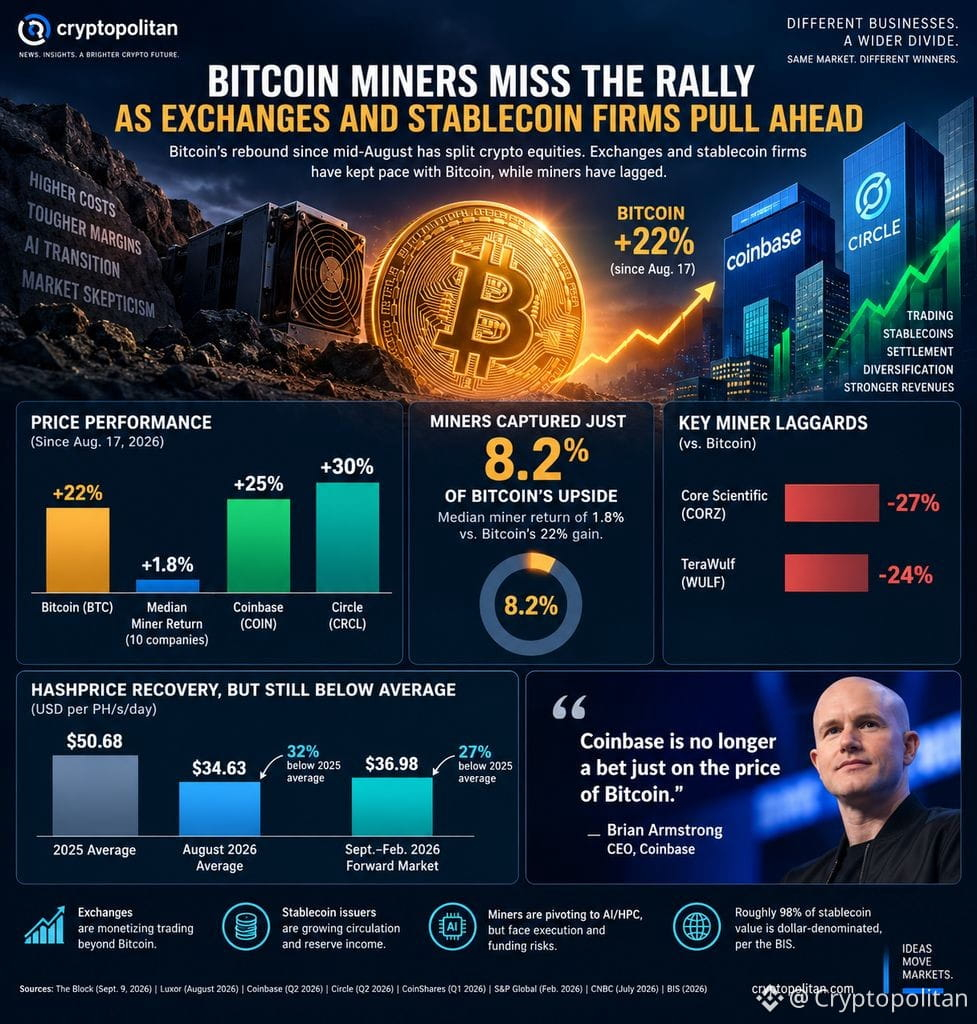
Article
Bitcoin miners miss the rally as exchanges and stablecoin firms pull aheadBitcoin’s comeback from the mid-August has divided the entire cryptocurrency trading into top performers and underperformers. Since August 17, Bitcoin increased by almost 22%. The exchanges and stablecoin-linked companies have followed suit but it cannot be said the same for miners.
The September 9 Data & Insights analysis by The Block showed that, out of all mining companies, Canaan is the only one that is performing better than Bitcoin. The other 10 miners and those working close to it are delivering average median results of 1.8% profit, leaving their performance 20.2 percentage points behind Bitcoin’s 22% gain.
The gap is larger than it seems. According to a Cryptopolitan calculation, the average miner has managed to capture a mere 8.2% of Bitcoin’s upside due to its 1.8% return while Bitcoin gained by 22%. For investors who previously considered miners as a leveraged option in Bitcoin, this relationship has clearly become weaker.
FIGURE TITLE: Bitcoin Miners vs. Exchanges and Stablecoin Firms: 2026 Crypto Stock Performance and Hashprice Gap
Where the divide is widest
Among the major underperformers are the miners who are very keen on AI and high-performance computing. Core Scientific and TeraWulf lagged behind Bitcoin’s performance by 27% and 24%, respectively.
This transition is changing the way that miners are valued in the market. According to S&P Global Market Intelligence’s Visible Alpha estimates, HPC is projected to contribute around 71% of revenues in 2026 at IREN and Core Scientific and 70% of revenues at TeraWulf.
However, AI brings in different risks. According to a late-July crypto stock rally report from CNBC, Cipher Mining dropped 8%, Riot Platforms fell by 5%, and MARA Holdings dropped by 3% despite the gains for Coinbase, BitGo, and Figure. According to Compass Point analyst Michael Donovan, funding AI build-outs will require financing without significant dilution and costly debt.
The economics behind the lag
Mining economics improved in August, but they are still nowhere near the levels that would be considered acceptable.
According to Luxor’s August Hashrate Lookback, the Bitcoin price rose by 24.5% in August while the USD hash price increased by 24.4% from $31.63 to $39.33 per PH/s/day.
The problem is that it all started from a very low point. The average hash price in August stood at just $34.63, which is still 32% below the monthly average for 2025 — $50.68. Transaction fees accounted for only 0.70% of block rewards, making it the 14th month in a row that block rewards failed to exceed 1%.
And even the futures market doesn’t promise any quick improvements in the mining business. Luxor’s contracts for September to February, when averaged, show a hash price of $36.98, still about 27% below the 2025 average.
Therefore, even if Bitcoin remains buoyant, miners are still in need of some help in the form of fee payments, network difficulty or lower power prices in order to improve their margins.
Selling a different product
Exchanges and stablecoin issuers have one advantage miners increasingly lack: they can make money from activity that does not depend directly on producing Bitcoin.
Coinbase said that 88% of Q2 net revenue came from outside Bitcoin spot trading. Its crypto trading-volume market share reached a record 10.3%, while average USDC held across its products reached $20 billion.
CEO Brian Armstrong put the shift simply: “Coinbase is no longer a bet just on the price of Bitcoin.”
Circle reported $73.3 billion of USDC in circulation at the end of Q2, up 19% year over year, alongside $701 million in total revenue and reserve income.
Miners are trying to diversify in their own way. CoinShares estimated more than $70 billion in cumulative AI and HPC contracts across public miners, with listed operators potentially generating as much as 70% of revenue from AI by year-end. Cryptopolitan has tracked that pivot, including MARA’s $1.5 billion Long Ridge acquisition and IREN’s $3.4 billion NVIDIA cloud contract.
For the wider crypto market, the divergence suggests capital is increasingly rewarding businesses that monetize trading, stablecoins and settlement infrastructure while treating mining as a capital-intensive business carrying both commodity and AI execution risks.
The BIS notes that roughly 98% of stablecoin value is dollar-denominated. As those rails expand, they could deepen crypto’s role in global dollar settlement.
Don’t just read crypto news. Understand it. Subscribe to our newsletter. It's free.
Bitcoin miners miss the rally as exchanges and stablecoin firms pull ahead
Bitcoin’s comeback from the mid-August has divided the entire cryptocurrency trading into top performers and underperformers. Since August 17, Bitcoin increased by almost 22%. The exchanges and stablecoin-linked companies have followed suit but it cannot be said the same for miners.
The September 9 Data & Insights analysis by The Block showed that, out of all mining companies, Canaan is the only one that is performing better than Bitcoin. The other 10 miners and those working close to it are delivering average median results of 1.8% profit, leaving their performance 20.2 percentage points behind Bitcoin’s 22% gain.
The gap is larger than it seems. According to a Cryptopolitan calculation, the average miner has managed to capture a mere 8.2% of Bitcoin’s upside due to its 1.8% return while Bitcoin gained by 22%. For investors who previously considered miners as a leveraged option in Bitcoin, this relationship has clearly become weaker.
FIGURE TITLE: Bitcoin Miners vs. Exchanges and Stablecoin Firms: 2026 Crypto Stock Performance and Hashprice Gap
Where the divide is widest
Among the major underperformers are the miners who are very keen on AI and high-performance computing. Core Scientific and TeraWulf lagged behind Bitcoin’s performance by 27% and 24%, respectively.
This transition is changing the way that miners are valued in the market. According to S&P Global Market Intelligence’s Visible Alpha estimates, HPC is projected to contribute around 71% of revenues in 2026 at IREN and Core Scientific and 70% of revenues at TeraWulf.
However, AI brings in different risks. According to a late-July crypto stock rally report from CNBC, Cipher Mining dropped 8%, Riot Platforms fell by 5%, and MARA Holdings dropped by 3% despite the gains for Coinbase, BitGo, and Figure. According to Compass Point analyst Michael Donovan, funding AI build-outs will require financing without significant dilution and costly debt.
The economics behind the lag
Mining economics improved in August, but they are still nowhere near the levels that would be considered acceptable.
According to Luxor’s August Hashrate Lookback, the Bitcoin price rose by 24.5% in August while the USD hash price increased by 24.4% from $31.63 to $39.33 per PH/s/day.
The problem is that it all started from a very low point. The average hash price in August stood at just $34.63, which is still 32% below the monthly average for 2025 — $50.68. Transaction fees accounted for only 0.70% of block rewards, making it the 14th month in a row that block rewards failed to exceed 1%.
And even the futures market doesn’t promise any quick improvements in the mining business. Luxor’s contracts for September to February, when averaged, show a hash price of $36.98, still about 27% below the 2025 average.
Therefore, even if Bitcoin remains buoyant, miners are still in need of some help in the form of fee payments, network difficulty or lower power prices in order to improve their margins.
Selling a different product
Exchanges and stablecoin issuers have one advantage miners increasingly lack: they can make money from activity that does not depend directly on producing Bitcoin.
Coinbase said that 88% of Q2 net revenue came from outside Bitcoin spot trading. Its crypto trading-volume market share reached a record 10.3%, while average USDC held across its products reached $20 billion.
CEO Brian Armstrong put the shift simply: “Coinbase is no longer a bet just on the price of Bitcoin.”
Circle reported $73.3 billion of USDC in circulation at the end of Q2, up 19% year over year, alongside $701 million in total revenue and reserve income.
Miners are trying to diversify in their own way. CoinShares estimated more than $70 billion in cumulative AI and HPC contracts across public miners, with listed operators potentially generating as much as 70% of revenue from AI by year-end. Cryptopolitan has tracked that pivot, including MARA’s $1.5 billion Long Ridge acquisition and IREN’s $3.4 billion NVIDIA cloud contract.
For the wider crypto market, the divergence suggests capital is increasingly rewarding businesses that monetize trading, stablecoins and settlement infrastructure while treating mining as a capital-intensive business carrying both commodity and AI execution risks.
The BIS notes that roughly 98% of stablecoin value is dollar-denominated. As those rails expand, they could deepen crypto’s role in global dollar settlement.
Don’t just read crypto news. Understand it. Subscribe to our newsletter. It's free.
The September 9 Data & Insights analysis by The Block showed that, out of all mining companies, Canaan is the only one that is performing better than Bitcoin. The other 10 miners and those working close to it are delivering average median results of 1.8% profit, leaving their performance 20.2 percentage points behind Bitcoin’s 22% gain.
The gap is larger than it seems. According to a Cryptopolitan calculation, the average miner has managed to capture a mere 8.2% of Bitcoin’s upside due to its 1.8% return while Bitcoin gained by 22%. For investors who previously considered miners as a leveraged option in Bitcoin, this relationship has clearly become weaker.
FIGURE TITLE: Bitcoin Miners vs. Exchanges and Stablecoin Firms: 2026 Crypto Stock Performance and Hashprice Gap
Where the divide is widest
Among the major underperformers are the miners who are very keen on AI and high-performance computing. Core Scientific and TeraWulf lagged behind Bitcoin’s performance by 27% and 24%, respectively.
This transition is changing the way that miners are valued in the market. According to S&P Global Market Intelligence’s Visible Alpha estimates, HPC is projected to contribute around 71% of revenues in 2026 at IREN and Core Scientific and 70% of revenues at TeraWulf.
However, AI brings in different risks. According to a late-July crypto stock rally report from CNBC, Cipher Mining dropped 8%, Riot Platforms fell by 5%, and MARA Holdings dropped by 3% despite the gains for Coinbase, BitGo, and Figure. According to Compass Point analyst Michael Donovan, funding AI build-outs will require financing without significant dilution and costly debt.
The economics behind the lag
Mining economics improved in August, but they are still nowhere near the levels that would be considered acceptable.
According to Luxor’s August Hashrate Lookback, the Bitcoin price rose by 24.5% in August while the USD hash price increased by 24.4% from $31.63 to $39.33 per PH/s/day.
The problem is that it all started from a very low point. The average hash price in August stood at just $34.63, which is still 32% below the monthly average for 2025 — $50.68. Transaction fees accounted for only 0.70% of block rewards, making it the 14th month in a row that block rewards failed to exceed 1%.
And even the futures market doesn’t promise any quick improvements in the mining business. Luxor’s contracts for September to February, when averaged, show a hash price of $36.98, still about 27% below the 2025 average.
Therefore, even if Bitcoin remains buoyant, miners are still in need of some help in the form of fee payments, network difficulty or lower power prices in order to improve their margins.
Selling a different product
Exchanges and stablecoin issuers have one advantage miners increasingly lack: they can make money from activity that does not depend directly on producing Bitcoin.
Coinbase said that 88% of Q2 net revenue came from outside Bitcoin spot trading. Its crypto trading-volume market share reached a record 10.3%, while average USDC held across its products reached $20 billion.
CEO Brian Armstrong put the shift simply: “Coinbase is no longer a bet just on the price of Bitcoin.”
Circle reported $73.3 billion of USDC in circulation at the end of Q2, up 19% year over year, alongside $701 million in total revenue and reserve income.
Miners are trying to diversify in their own way. CoinShares estimated more than $70 billion in cumulative AI and HPC contracts across public miners, with listed operators potentially generating as much as 70% of revenue from AI by year-end. Cryptopolitan has tracked that pivot, including MARA’s $1.5 billion Long Ridge acquisition and IREN’s $3.4 billion NVIDIA cloud contract.
For the wider crypto market, the divergence suggests capital is increasingly rewarding businesses that monetize trading, stablecoins and settlement infrastructure while treating mining as a capital-intensive business carrying both commodity and AI execution risks.
The BIS notes that roughly 98% of stablecoin value is dollar-denominated. As those rails expand, they could deepen crypto’s role in global dollar settlement.
Don’t just read crypto news. Understand it. Subscribe to our newsletter. It's free.
343
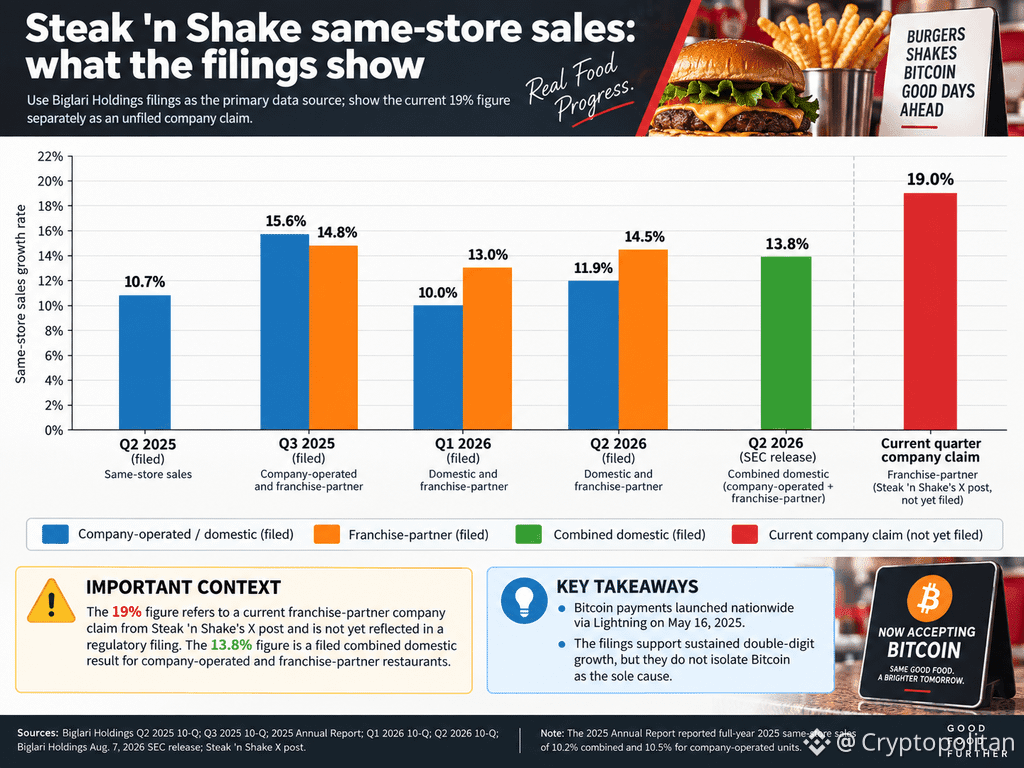
Article
Steak ‘n Shake’s Bitcoin bet posts double-digit sales growthAccording to Steak ‘n Shake, the decision to accept Bitcoin payments has yielded significant results, with franchise partners seeing a 19% increase in sales this quarter alone.
The statement was released in its X post on September 8. While the story sounds great for the popularity of Bitcoin among retailers, it is still just a company announcement. In fact, there is no proof that Bitcoin played an important role in sales growth, as Biglari Holdings’ regulatory filings reported increasing sales without checking how Bitcoin contributed to it.
This distinction is important. In reality, Steak ‘n Shake is conducting a test to find out if old-fashioned retailers can use the advantages of Lightning, cheap processing fees, crypto-friendly customers, and Bitcoin reserves to develop a functioning model for other merchants to follow.
The numbers the company is putting forward
At the Bitcoin 2026 Conference, Michael Boes, Chief MAHA Officer of Steak n’ Shake, described the company’s improving performance since it began accepting Bitcoin with consistent figures of 11% and 15% growth for same-store sales in Q2 2025 and Q3 2025, respectively.
These figures were cited by him in the context of his argument that the chain had experienced a turnaround due to Bitcoin. However, the actual filings of Biglari Holdings provide even more exact, albeit differently categorized, figures.
Steak ’n Shake’s Bitcoin sales claims vs filed benchmark
According to Biglari’s Q2 2025 10-Q, the company achieved a same-store sales growth of 10.7%. Biglari’s Q3 2025 filing reported that the company’s domestic company-operated stores’ sales had grown by 15.6% while the franchise-partner units grew by 14.8%.
The annual report for 2025 stated that the total growth rates for company-operated restaurants was 10.5%, 10.1% for franchise-partner restaurants, and 10.2% when both categories of stores were merged together.
In the first quarter of 2026, same-store sales increased by 10.0% in the domestic market, whereas sales from franchise partners went up by approximately 13%. The figures were 11.9% in Q2 2026 for domestic sales and 14.5% for franchise partners.
Biglari published another filing with the SEC where the total increase amounted to 13.8% in domestic sales. With all the mentioned figures filed, the 19% is also significant, but it covers franchise-partner stores and has not yet been filed.
Steak ’n Shake same-store sales: what the Biglari filings show
The difference becomes clearer when the figures are examined in two ways. The first chart displays figures that Steak ’n Shake has made public to market its sales linked to Bitcoin. The second chart shows more accurate data from Biglari’s filings, which show company-operated, franchise partner, and combined results.
Together, the two sets of data indicate that the momentum behind the sales is not an illusion, but the figures are not all reported on the same basis.
Why the causation claim is hard to nail down
While the growth is genuine, the contribution of Bitcoin is still unknown. The yearly report by Biglari attributes this growth in part to improved food quality and communication that the management claims “resonated with the public.” Meanwhile, there are reports that Steak ‘n Shake has not revealed how much Bitcoin revenue contributed to the company’s profit.
This makes Bitcoin another element of the larger recovery process of Steak n’ Shake rather than a simple case of an experimental variable. Nonetheless, Boes stated at the Bitcoin 2026 event that Bitcoin has become one of the main forces driving the process with the following phrase: “Bitcoin is real money made with real energy.”
How the Lightning setup actually saves money
The case related to costs is much easier to understand. Steak n Shake started accepting payments in Bitcoin via the Lightning network on May 16, 2025. The payment solution provider Speed reports the implementation being completed in all 393 locations in the USA, and quotes the then-COO Dan Edwards, who has also claimed Bitcoin payments decreased the company’s payment processing costs by 50% compared to the use of credit cards.
The cost is still high even if Bitcoin is not the cause of the sales surge. Notably, Square provides 0% processing fees for Bitcoin payments as part of its services, which indicates that payments via cheaper Bitcoin payment processing networks are becoming easier for mainstream businesses to test.
Steak ‘n Shake also channels Bitcoin payments made by customers into a Strategic Bitcoin Reserve. Cryptopolitan has reported earlier that the reserve has been linked with Bitcoin bonuses for hourly employees, which connects checkout, treasury management, and workforce incentives.
Thus, the strategy transcends being merely a way of payment. Steak ‘n Shake is combining Bitcoin-friendly branding, transaction savings, and treasury accumulation through its operations.
The bigger question: will merchants follow as stablecoins take over
The broader crypto-payments market is moving differently. CoinGate’s H1 2026 report put USDC at 22.1% of crypto payments, ahead of Bitcoin at 21.0%, while Lightning handled just 9.6% of BTC payments.
TRM Labs also found stablecoins driving retail adoption in markets such as Venezuela. That leaves Steak ‘n Shake as a useful test case, but not necessarily a template. Other retailers may copy its low-cost crypto checkout while choosing stablecoins or fiat settlement instead.
The smartest crypto minds already read our newsletter. Want in? Join them.
Steak ‘n Shake’s Bitcoin bet posts double-digit sales growth
According to Steak ‘n Shake, the decision to accept Bitcoin payments has yielded significant results, with franchise partners seeing a 19% increase in sales this quarter alone.
The statement was released in its X post on September 8. While the story sounds great for the popularity of Bitcoin among retailers, it is still just a company announcement. In fact, there is no proof that Bitcoin played an important role in sales growth, as Biglari Holdings’ regulatory filings reported increasing sales without checking how Bitcoin contributed to it.
This distinction is important. In reality, Steak ‘n Shake is conducting a test to find out if old-fashioned retailers can use the advantages of Lightning, cheap processing fees, crypto-friendly customers, and Bitcoin reserves to develop a functioning model for other merchants to follow.
The numbers the company is putting forward
At the Bitcoin 2026 Conference, Michael Boes, Chief MAHA Officer of Steak n’ Shake, described the company’s improving performance since it began accepting Bitcoin with consistent figures of 11% and 15% growth for same-store sales in Q2 2025 and Q3 2025, respectively.
These figures were cited by him in the context of his argument that the chain had experienced a turnaround due to Bitcoin. However, the actual filings of Biglari Holdings provide even more exact, albeit differently categorized, figures.
Steak ’n Shake’s Bitcoin sales claims vs filed benchmark
According to Biglari’s Q2 2025 10-Q, the company achieved a same-store sales growth of 10.7%. Biglari’s Q3 2025 filing reported that the company’s domestic company-operated stores’ sales had grown by 15.6% while the franchise-partner units grew by 14.8%.
The annual report for 2025 stated that the total growth rates for company-operated restaurants was 10.5%, 10.1% for franchise-partner restaurants, and 10.2% when both categories of stores were merged together.
In the first quarter of 2026, same-store sales increased by 10.0% in the domestic market, whereas sales from franchise partners went up by approximately 13%. The figures were 11.9% in Q2 2026 for domestic sales and 14.5% for franchise partners.
Biglari published another filing with the SEC where the total increase amounted to 13.8% in domestic sales. With all the mentioned figures filed, the 19% is also significant, but it covers franchise-partner stores and has not yet been filed.
Steak ’n Shake same-store sales: what the Biglari filings show
The difference becomes clearer when the figures are examined in two ways. The first chart displays figures that Steak ’n Shake has made public to market its sales linked to Bitcoin. The second chart shows more accurate data from Biglari’s filings, which show company-operated, franchise partner, and combined results.
Together, the two sets of data indicate that the momentum behind the sales is not an illusion, but the figures are not all reported on the same basis.
Why the causation claim is hard to nail down
While the growth is genuine, the contribution of Bitcoin is still unknown. The yearly report by Biglari attributes this growth in part to improved food quality and communication that the management claims “resonated with the public.” Meanwhile, there are reports that Steak ‘n Shake has not revealed how much Bitcoin revenue contributed to the company’s profit.
This makes Bitcoin another element of the larger recovery process of Steak n’ Shake rather than a simple case of an experimental variable. Nonetheless, Boes stated at the Bitcoin 2026 event that Bitcoin has become one of the main forces driving the process with the following phrase: “Bitcoin is real money made with real energy.”
How the Lightning setup actually saves money
The case related to costs is much easier to understand. Steak n Shake started accepting payments in Bitcoin via the Lightning network on May 16, 2025. The payment solution provider Speed reports the implementation being completed in all 393 locations in the USA, and quotes the then-COO Dan Edwards, who has also claimed Bitcoin payments decreased the company’s payment processing costs by 50% compared to the use of credit cards.
The cost is still high even if Bitcoin is not the cause of the sales surge. Notably, Square provides 0% processing fees for Bitcoin payments as part of its services, which indicates that payments via cheaper Bitcoin payment processing networks are becoming easier for mainstream businesses to test.
Steak ‘n Shake also channels Bitcoin payments made by customers into a Strategic Bitcoin Reserve. Cryptopolitan has reported earlier that the reserve has been linked with Bitcoin bonuses for hourly employees, which connects checkout, treasury management, and workforce incentives.
Thus, the strategy transcends being merely a way of payment. Steak ‘n Shake is combining Bitcoin-friendly branding, transaction savings, and treasury accumulation through its operations.
The bigger question: will merchants follow as stablecoins take over
The broader crypto-payments market is moving differently. CoinGate’s H1 2026 report put USDC at 22.1% of crypto payments, ahead of Bitcoin at 21.0%, while Lightning handled just 9.6% of BTC payments.
TRM Labs also found stablecoins driving retail adoption in markets such as Venezuela. That leaves Steak ‘n Shake as a useful test case, but not necessarily a template. Other retailers may copy its low-cost crypto checkout while choosing stablecoins or fiat settlement instead.
The smartest crypto minds already read our newsletter. Want in? Join them.
The statement was released in its X post on September 8. While the story sounds great for the popularity of Bitcoin among retailers, it is still just a company announcement. In fact, there is no proof that Bitcoin played an important role in sales growth, as Biglari Holdings’ regulatory filings reported increasing sales without checking how Bitcoin contributed to it.
This distinction is important. In reality, Steak ‘n Shake is conducting a test to find out if old-fashioned retailers can use the advantages of Lightning, cheap processing fees, crypto-friendly customers, and Bitcoin reserves to develop a functioning model for other merchants to follow.
The numbers the company is putting forward
At the Bitcoin 2026 Conference, Michael Boes, Chief MAHA Officer of Steak n’ Shake, described the company’s improving performance since it began accepting Bitcoin with consistent figures of 11% and 15% growth for same-store sales in Q2 2025 and Q3 2025, respectively.
These figures were cited by him in the context of his argument that the chain had experienced a turnaround due to Bitcoin. However, the actual filings of Biglari Holdings provide even more exact, albeit differently categorized, figures.
Steak ’n Shake’s Bitcoin sales claims vs filed benchmark
According to Biglari’s Q2 2025 10-Q, the company achieved a same-store sales growth of 10.7%. Biglari’s Q3 2025 filing reported that the company’s domestic company-operated stores’ sales had grown by 15.6% while the franchise-partner units grew by 14.8%.
The annual report for 2025 stated that the total growth rates for company-operated restaurants was 10.5%, 10.1% for franchise-partner restaurants, and 10.2% when both categories of stores were merged together.
In the first quarter of 2026, same-store sales increased by 10.0% in the domestic market, whereas sales from franchise partners went up by approximately 13%. The figures were 11.9% in Q2 2026 for domestic sales and 14.5% for franchise partners.
Biglari published another filing with the SEC where the total increase amounted to 13.8% in domestic sales. With all the mentioned figures filed, the 19% is also significant, but it covers franchise-partner stores and has not yet been filed.
Steak ’n Shake same-store sales: what the Biglari filings show
The difference becomes clearer when the figures are examined in two ways. The first chart displays figures that Steak ’n Shake has made public to market its sales linked to Bitcoin. The second chart shows more accurate data from Biglari’s filings, which show company-operated, franchise partner, and combined results.
Together, the two sets of data indicate that the momentum behind the sales is not an illusion, but the figures are not all reported on the same basis.
Why the causation claim is hard to nail down
While the growth is genuine, the contribution of Bitcoin is still unknown. The yearly report by Biglari attributes this growth in part to improved food quality and communication that the management claims “resonated with the public.” Meanwhile, there are reports that Steak ‘n Shake has not revealed how much Bitcoin revenue contributed to the company’s profit.
This makes Bitcoin another element of the larger recovery process of Steak n’ Shake rather than a simple case of an experimental variable. Nonetheless, Boes stated at the Bitcoin 2026 event that Bitcoin has become one of the main forces driving the process with the following phrase: “Bitcoin is real money made with real energy.”
How the Lightning setup actually saves money
The case related to costs is much easier to understand. Steak n Shake started accepting payments in Bitcoin via the Lightning network on May 16, 2025. The payment solution provider Speed reports the implementation being completed in all 393 locations in the USA, and quotes the then-COO Dan Edwards, who has also claimed Bitcoin payments decreased the company’s payment processing costs by 50% compared to the use of credit cards.
The cost is still high even if Bitcoin is not the cause of the sales surge. Notably, Square provides 0% processing fees for Bitcoin payments as part of its services, which indicates that payments via cheaper Bitcoin payment processing networks are becoming easier for mainstream businesses to test.
Steak ‘n Shake also channels Bitcoin payments made by customers into a Strategic Bitcoin Reserve. Cryptopolitan has reported earlier that the reserve has been linked with Bitcoin bonuses for hourly employees, which connects checkout, treasury management, and workforce incentives.
Thus, the strategy transcends being merely a way of payment. Steak ‘n Shake is combining Bitcoin-friendly branding, transaction savings, and treasury accumulation through its operations.
The bigger question: will merchants follow as stablecoins take over
The broader crypto-payments market is moving differently. CoinGate’s H1 2026 report put USDC at 22.1% of crypto payments, ahead of Bitcoin at 21.0%, while Lightning handled just 9.6% of BTC payments.
TRM Labs also found stablecoins driving retail adoption in markets such as Venezuela. That leaves Steak ‘n Shake as a useful test case, but not necessarily a template. Other retailers may copy its low-cost crypto checkout while choosing stablecoins or fiat settlement instead.
The smartest crypto minds already read our newsletter. Want in? Join them.
1
216
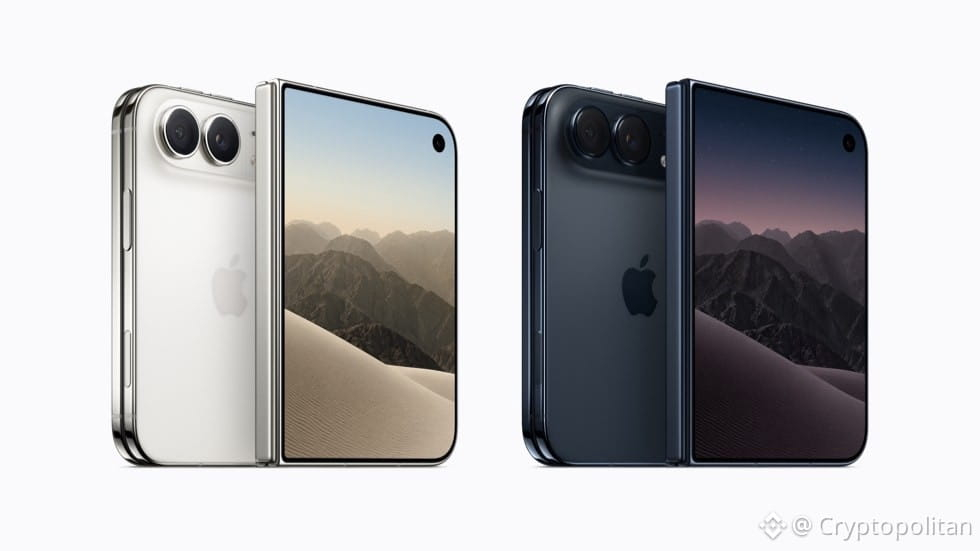
Article
Apple launches its first foldable iPhone, the iPhone DuoApple (NASDAQ: AAPL) has finally released its first folding iPhone, seven years after Samsung Electronics (KRX: 005930) began selling foldable smartphones. The new iPhone Duo opens into a 7.6-inch handset and closes into a smaller 5.4-inch device.
Apple says it becomes its slimmest iPhone when unfolded. Buyers get two finishes, star white and night sky. Orders open on Friday, October 16, while store availability starts Friday, October 23.
The outside panel gives users around 90% of the usable display area found on iPhone 18 Pro. Open the phone and the inner screen becomes 50% larger than iPhone 18 Pro Max.
Both Super Retina XDR panels use matching proportions, so apps resize without suddenly changing their layout. They also support ProMotion, Always On mode, and 3,000 nits of maximum outdoor brightness. Apple covered the inner panel with a nano-textured surface to cut glare, reduce visible reflections, and make the fold line harder to notice.
Source: Apple
Apple rebuilds the iPhone around a 100-part hinge, titanium frame and two-screen layout
Apple placed the inner FaceTime camera underneath the screen so it disappears when unused. Apple Pencil with USB-C support arrives later this year and will work across both screens for writing, drawing, and document markup.
Authentication comes through Touch ID inside the side key. Owners can also open the phone using an Apple Watch.
The iPhone employs grade 5 titanium. Apple has applied polishing treatment to the main body of the smartphone, whereas the housing of the 3D printed hinges gets another treatment known as micro-blasting. Ceramic Shield is the material used on the backside of the iPhone, while Ceramic Shield 2 on its front promises triple scratch resistance than its predecessor.
More than 100 separate pieces make up the hinge. Reinforcement ribs sit inside the frame, while ceramic-fiber material strengthens breaks around the antennas. The foldable screen comes with a scratch-resistant surface finish on top and a polymer nano coating that Apple claims to be as much as 40 percent stiffer than competing polymers.
Strong glass sits on both sides of the flexible display assembly. Special adhesive lets those layers move independently while the handset bends, reducing pressure around the folding point. A titanium plate underneath adds another structural layer.
John Ternus, Apple’s CEO, said:
“iPhone Duo is the most transformational change to iPhone since the original. With an entirely new design and intuitive experiences, it shows what’s possible when hardware and software are engineered together and redefines what it means to use a foldable phone.”
John added: “With the largest display ever on iPhone that still fits easily in your pocket, combined with the power of A20 Pro, iPhone Duo helps you stay more immersed and productive wherever you go, whether you’re enjoying content, multitasking across apps, or gaming.”
Apple gives A20 Pro new camera tricks while Siri takes on more personal data
The A20 Pro powers the device. It has been specially designed to work with a customized vapor chamber, two batteries, and a new cooling system to ensure consistent performance and full-day usage. The iOS 27 operating system has been modified to adapt to the foldable design with its software layouts depending on the state of the phone.
The main rear sensor is a 48MP Fusion camera, which shoots at full 48MP resolution without shutter delay, while 24MP remains the standard setting. A built-in 2x telephoto option provides optical-quality zoom. Apple also uses a revised computational image system, plus a large sensor, wider aperture and sensor-shift stabilization for darker scenes.
In addition to this, there is another 48MP Fusion Ultra Wide camera similar to the one that can be found in the iPhone 18 Pro series.
The two displays also transform photography. Smart Take allows AI processing on the device’s own system, A20 Pro, observing the scene and shooting when the subjects are positioned properly. The users may take high-quality pictures using the rear cameras to photograph themselves with themselves on the external display. Duo Preview allows the subjects to see their composition.
Kid Cue puts Peanuts animations on the outside screen to get children looking toward the lens. Duo FaceTime can place people standing beside the owner on that same exterior display during calls.
Video reaches 4K at 120 frames per second in Dolby Vision, technology from Dolby Laboratories (NYSE: DLB), through the main 48MP camera. Playback speed can then be changed for slow motion. Cinematic effects can be added after recording at up to 60 fps. Audio Mix gets new processing for clearer speech and music separation. Time-lapse now records in 4K Dolby Vision HDR, while the folding body can stand by itself for longer recordings without a tripod.
John called the AI system an “intelligent personal hub” and said it would use “the most private details of your daily life.” He said many requests will stay “on device.” Tasks needing outside computing will use protected remote servers.
“Others see that data as something to collect and store,” John said. “Here, not even Apple can access what’s yours.”
Don’t just read crypto news. Understand it. Subscribe to our newsletter. It's free.
Apple launches its first foldable iPhone, the iPhone Duo
Apple (NASDAQ: AAPL) has finally released its first folding iPhone, seven years after Samsung Electronics (KRX: 005930) began selling foldable smartphones. The new iPhone Duo opens into a 7.6-inch handset and closes into a smaller 5.4-inch device.
Apple says it becomes its slimmest iPhone when unfolded. Buyers get two finishes, star white and night sky. Orders open on Friday, October 16, while store availability starts Friday, October 23.
The outside panel gives users around 90% of the usable display area found on iPhone 18 Pro. Open the phone and the inner screen becomes 50% larger than iPhone 18 Pro Max.
Both Super Retina XDR panels use matching proportions, so apps resize without suddenly changing their layout. They also support ProMotion, Always On mode, and 3,000 nits of maximum outdoor brightness. Apple covered the inner panel with a nano-textured surface to cut glare, reduce visible reflections, and make the fold line harder to notice.
Source: Apple
Apple rebuilds the iPhone around a 100-part hinge, titanium frame and two-screen layout
Apple placed the inner FaceTime camera underneath the screen so it disappears when unused. Apple Pencil with USB-C support arrives later this year and will work across both screens for writing, drawing, and document markup.
Authentication comes through Touch ID inside the side key. Owners can also open the phone using an Apple Watch.
The iPhone employs grade 5 titanium. Apple has applied polishing treatment to the main body of the smartphone, whereas the housing of the 3D printed hinges gets another treatment known as micro-blasting. Ceramic Shield is the material used on the backside of the iPhone, while Ceramic Shield 2 on its front promises triple scratch resistance than its predecessor.
More than 100 separate pieces make up the hinge. Reinforcement ribs sit inside the frame, while ceramic-fiber material strengthens breaks around the antennas. The foldable screen comes with a scratch-resistant surface finish on top and a polymer nano coating that Apple claims to be as much as 40 percent stiffer than competing polymers.
Strong glass sits on both sides of the flexible display assembly. Special adhesive lets those layers move independently while the handset bends, reducing pressure around the folding point. A titanium plate underneath adds another structural layer.
John Ternus, Apple’s CEO, said:
“iPhone Duo is the most transformational change to iPhone since the original. With an entirely new design and intuitive experiences, it shows what’s possible when hardware and software are engineered together and redefines what it means to use a foldable phone.”
John added: “With the largest display ever on iPhone that still fits easily in your pocket, combined with the power of A20 Pro, iPhone Duo helps you stay more immersed and productive wherever you go, whether you’re enjoying content, multitasking across apps, or gaming.”
Apple gives A20 Pro new camera tricks while Siri takes on more personal data
The A20 Pro powers the device. It has been specially designed to work with a customized vapor chamber, two batteries, and a new cooling system to ensure consistent performance and full-day usage. The iOS 27 operating system has been modified to adapt to the foldable design with its software layouts depending on the state of the phone.
The main rear sensor is a 48MP Fusion camera, which shoots at full 48MP resolution without shutter delay, while 24MP remains the standard setting. A built-in 2x telephoto option provides optical-quality zoom. Apple also uses a revised computational image system, plus a large sensor, wider aperture and sensor-shift stabilization for darker scenes.
In addition to this, there is another 48MP Fusion Ultra Wide camera similar to the one that can be found in the iPhone 18 Pro series.
The two displays also transform photography. Smart Take allows AI processing on the device’s own system, A20 Pro, observing the scene and shooting when the subjects are positioned properly. The users may take high-quality pictures using the rear cameras to photograph themselves with themselves on the external display. Duo Preview allows the subjects to see their composition.
Kid Cue puts Peanuts animations on the outside screen to get children looking toward the lens. Duo FaceTime can place people standing beside the owner on that same exterior display during calls.
Video reaches 4K at 120 frames per second in Dolby Vision, technology from Dolby Laboratories (NYSE: DLB), through the main 48MP camera. Playback speed can then be changed for slow motion. Cinematic effects can be added after recording at up to 60 fps. Audio Mix gets new processing for clearer speech and music separation. Time-lapse now records in 4K Dolby Vision HDR, while the folding body can stand by itself for longer recordings without a tripod.
John called the AI system an “intelligent personal hub” and said it would use “the most private details of your daily life.” He said many requests will stay “on device.” Tasks needing outside computing will use protected remote servers.
“Others see that data as something to collect and store,” John said. “Here, not even Apple can access what’s yours.”
Don’t just read crypto news. Understand it. Subscribe to our newsletter. It's free.
Apple says it becomes its slimmest iPhone when unfolded. Buyers get two finishes, star white and night sky. Orders open on Friday, October 16, while store availability starts Friday, October 23.
The outside panel gives users around 90% of the usable display area found on iPhone 18 Pro. Open the phone and the inner screen becomes 50% larger than iPhone 18 Pro Max.
Both Super Retina XDR panels use matching proportions, so apps resize without suddenly changing their layout. They also support ProMotion, Always On mode, and 3,000 nits of maximum outdoor brightness. Apple covered the inner panel with a nano-textured surface to cut glare, reduce visible reflections, and make the fold line harder to notice.
Source: Apple
Apple rebuilds the iPhone around a 100-part hinge, titanium frame and two-screen layout
Apple placed the inner FaceTime camera underneath the screen so it disappears when unused. Apple Pencil with USB-C support arrives later this year and will work across both screens for writing, drawing, and document markup.
Authentication comes through Touch ID inside the side key. Owners can also open the phone using an Apple Watch.
The iPhone employs grade 5 titanium. Apple has applied polishing treatment to the main body of the smartphone, whereas the housing of the 3D printed hinges gets another treatment known as micro-blasting. Ceramic Shield is the material used on the backside of the iPhone, while Ceramic Shield 2 on its front promises triple scratch resistance than its predecessor.
More than 100 separate pieces make up the hinge. Reinforcement ribs sit inside the frame, while ceramic-fiber material strengthens breaks around the antennas. The foldable screen comes with a scratch-resistant surface finish on top and a polymer nano coating that Apple claims to be as much as 40 percent stiffer than competing polymers.
Strong glass sits on both sides of the flexible display assembly. Special adhesive lets those layers move independently while the handset bends, reducing pressure around the folding point. A titanium plate underneath adds another structural layer.
John Ternus, Apple’s CEO, said:
“iPhone Duo is the most transformational change to iPhone since the original. With an entirely new design and intuitive experiences, it shows what’s possible when hardware and software are engineered together and redefines what it means to use a foldable phone.”
John added: “With the largest display ever on iPhone that still fits easily in your pocket, combined with the power of A20 Pro, iPhone Duo helps you stay more immersed and productive wherever you go, whether you’re enjoying content, multitasking across apps, or gaming.”
Apple gives A20 Pro new camera tricks while Siri takes on more personal data
The A20 Pro powers the device. It has been specially designed to work with a customized vapor chamber, two batteries, and a new cooling system to ensure consistent performance and full-day usage. The iOS 27 operating system has been modified to adapt to the foldable design with its software layouts depending on the state of the phone.
The main rear sensor is a 48MP Fusion camera, which shoots at full 48MP resolution without shutter delay, while 24MP remains the standard setting. A built-in 2x telephoto option provides optical-quality zoom. Apple also uses a revised computational image system, plus a large sensor, wider aperture and sensor-shift stabilization for darker scenes.
In addition to this, there is another 48MP Fusion Ultra Wide camera similar to the one that can be found in the iPhone 18 Pro series.
The two displays also transform photography. Smart Take allows AI processing on the device’s own system, A20 Pro, observing the scene and shooting when the subjects are positioned properly. The users may take high-quality pictures using the rear cameras to photograph themselves with themselves on the external display. Duo Preview allows the subjects to see their composition.
Kid Cue puts Peanuts animations on the outside screen to get children looking toward the lens. Duo FaceTime can place people standing beside the owner on that same exterior display during calls.
Video reaches 4K at 120 frames per second in Dolby Vision, technology from Dolby Laboratories (NYSE: DLB), through the main 48MP camera. Playback speed can then be changed for slow motion. Cinematic effects can be added after recording at up to 60 fps. Audio Mix gets new processing for clearer speech and music separation. Time-lapse now records in 4K Dolby Vision HDR, while the folding body can stand by itself for longer recordings without a tripod.
John called the AI system an “intelligent personal hub” and said it would use “the most private details of your daily life.” He said many requests will stay “on device.” Tasks needing outside computing will use protected remote servers.
“Others see that data as something to collect and store,” John said. “Here, not even Apple can access what’s yours.”
Don’t just read crypto news. Understand it. Subscribe to our newsletter. It's free.
205
Treasury plans to buy back up to $6 billion of US government debtScott Bessent’s Treasury Department is getting ready to buy back as much as $6 billion of US government debt after Scott defended action around the yen.
Treasury announced the plan on Wednesday and said the goal is to keep trading in government bonds running smoothly. The amount is about three times larger than usual. Scott had already said on Aug. 19 that Treasury planned to buy at least twice the normal amount of older securities.
Treasury also said later operations will be worth at least $4 billion each. This week’s buyback will target 10-year and 20-year notes, where trading tends to be lighter than in shorter-dated debt.
According to authorities, the bigger buy will help maintain liquidity in the markets, whereas the traders are looking at how the move will affect the growth in yields, which are at a level not seen since the pre-2008 crisis period.
Treasury buys more debt as long-term yields keep moving higher
The market was not acting in the manner that would suit the Treasury’s interest. The yields continued to climb after the announcement, and longer-term bonds even went up by as much as 5 basis points before coming back down. It should be noted that higher yields increase the cost of borrowing. One basis point is equal to 0.01 percent.
The 10-year yield hit 4.841% at press time, while the 20-year yield reached 5.314%. The 30-year yield rose about 5 basis points and moved through the closely watched 5.3% level before settling near 5.307%. Treasury’s buyback will take place on Thursday in a 20-minute window ending at 2 p.m. ET.
A few things are pushing yields higher. Federal debt has gone past $40 trillion. Tariffs and the war with Iran are adding to inflation concerns. Energy prices have jumped too, with crude oil breaking above $100 a barrel on Wednesday. Trading is usually quieter at the long end of the Treasury curve than in shorter maturities, even though the US government bond market is the biggest and most liquid sovereign debt market in the world.
Treasury is also issuing more debt. Supply this year is 11.8% higher than in 2025, while publicly held debt has climbed to $31.8 trillion, up 8.2%. Investors are being asked to take on more government paper while inflation worries are getting harder to ignore.
Iran war pushes inflation higher as Kevin Warsh faces pressure from Trump
The Federal Reserve is dealing with a harder inflation picture. Prices rose faster earlier this year as the Iran conflict drove energy costs higher.
The annualized inflation rate reached a three-year high in May before falling to 3.4% in July. Even after that drop, it was still 0.7 percentage point higher than a year earlier, with energy prices responsible for much of the increase.
President Donald Trump said Wednesday that oil prices probably would not fall before the midterm elections. After saying Iran “can’t hold out any longer,” Donald said its leaders are “desperate to try and affect the election.” He then predicted, “Right after the election, oil prices are going to be tumbling downward.”
Brent crude went above $100 on Wednesday for the first time since July as fighting in the Middle East got worse. More expensive energy could force the Fed to consider raising rates again, even though the White House wants the opposite. Last week, Donald said the Fed “must get smart” and lower rates. He also wrote, “A STRONG COUNTRY MEANS A LOWER INTEREST RATE.”
Federal Reserve Chair Kevin Warsh took over in May. Kevin said at Jackson Hole in August that it was “the Fed’s job to deliver stable prices,” but he stopped short of saying whether the central bank would raise rates soon.
Stanley Druckenmiller, who leads Duquesne Family Office and used to mentor Scott, criticized Treasury’s move in a Wall Street Journal opinion article. Stanley wrote:
“Once markets believe Treasury is defending a price, every rise in yields becomes a test of official resolve, and the operations must grow to survive the tests.”
He added that: “Governments defending prices against fundamentals always lose. The only variable is how much they spend before conceding.”
Don’t just read crypto news. Understand it. Subscribe to our newsletter. It's free.
Treasury plans to buy back up to $6 billion of US government debt
Scott Bessent’s Treasury Department is getting ready to buy back as much as $6 billion of US government debt after Scott defended action around the yen.
Treasury announced the plan on Wednesday and said the goal is to keep trading in government bonds running smoothly. The amount is about three times larger than usual. Scott had already said on Aug. 19 that Treasury planned to buy at least twice the normal amount of older securities.
Treasury also said later operations will be worth at least $4 billion each. This week’s buyback will target 10-year and 20-year notes, where trading tends to be lighter than in shorter-dated debt.
According to authorities, the bigger buy will help maintain liquidity in the markets, whereas the traders are looking at how the move will affect the growth in yields, which are at a level not seen since the pre-2008 crisis period.
Treasury buys more debt as long-term yields keep moving higher
The market was not acting in the manner that would suit the Treasury’s interest. The yields continued to climb after the announcement, and longer-term bonds even went up by as much as 5 basis points before coming back down. It should be noted that higher yields increase the cost of borrowing. One basis point is equal to 0.01 percent.
The 10-year yield hit 4.841% at press time, while the 20-year yield reached 5.314%. The 30-year yield rose about 5 basis points and moved through the closely watched 5.3% level before settling near 5.307%. Treasury’s buyback will take place on Thursday in a 20-minute window ending at 2 p.m. ET.
A few things are pushing yields higher. Federal debt has gone past $40 trillion. Tariffs and the war with Iran are adding to inflation concerns. Energy prices have jumped too, with crude oil breaking above $100 a barrel on Wednesday. Trading is usually quieter at the long end of the Treasury curve than in shorter maturities, even though the US government bond market is the biggest and most liquid sovereign debt market in the world.
Treasury is also issuing more debt. Supply this year is 11.8% higher than in 2025, while publicly held debt has climbed to $31.8 trillion, up 8.2%. Investors are being asked to take on more government paper while inflation worries are getting harder to ignore.
Iran war pushes inflation higher as Kevin Warsh faces pressure from Trump
The Federal Reserve is dealing with a harder inflation picture. Prices rose faster earlier this year as the Iran conflict drove energy costs higher.
The annualized inflation rate reached a three-year high in May before falling to 3.4% in July. Even after that drop, it was still 0.7 percentage point higher than a year earlier, with energy prices responsible for much of the increase.
President Donald Trump said Wednesday that oil prices probably would not fall before the midterm elections. After saying Iran “can’t hold out any longer,” Donald said its leaders are “desperate to try and affect the election.” He then predicted, “Right after the election, oil prices are going to be tumbling downward.”
Brent crude went above $100 on Wednesday for the first time since July as fighting in the Middle East got worse. More expensive energy could force the Fed to consider raising rates again, even though the White House wants the opposite. Last week, Donald said the Fed “must get smart” and lower rates. He also wrote, “A STRONG COUNTRY MEANS A LOWER INTEREST RATE.”
Federal Reserve Chair Kevin Warsh took over in May. Kevin said at Jackson Hole in August that it was “the Fed’s job to deliver stable prices,” but he stopped short of saying whether the central bank would raise rates soon.
Stanley Druckenmiller, who leads Duquesne Family Office and used to mentor Scott, criticized Treasury’s move in a Wall Street Journal opinion article. Stanley wrote:
“Once markets believe Treasury is defending a price, every rise in yields becomes a test of official resolve, and the operations must grow to survive the tests.”
He added that: “Governments defending prices against fundamentals always lose. The only variable is how much they spend before conceding.”
Don’t just read crypto news. Understand it. Subscribe to our newsletter. It's free.
Treasury announced the plan on Wednesday and said the goal is to keep trading in government bonds running smoothly. The amount is about three times larger than usual. Scott had already said on Aug. 19 that Treasury planned to buy at least twice the normal amount of older securities.
Treasury also said later operations will be worth at least $4 billion each. This week’s buyback will target 10-year and 20-year notes, where trading tends to be lighter than in shorter-dated debt.
According to authorities, the bigger buy will help maintain liquidity in the markets, whereas the traders are looking at how the move will affect the growth in yields, which are at a level not seen since the pre-2008 crisis period.
Treasury buys more debt as long-term yields keep moving higher
The market was not acting in the manner that would suit the Treasury’s interest. The yields continued to climb after the announcement, and longer-term bonds even went up by as much as 5 basis points before coming back down. It should be noted that higher yields increase the cost of borrowing. One basis point is equal to 0.01 percent.
The 10-year yield hit 4.841% at press time, while the 20-year yield reached 5.314%. The 30-year yield rose about 5 basis points and moved through the closely watched 5.3% level before settling near 5.307%. Treasury’s buyback will take place on Thursday in a 20-minute window ending at 2 p.m. ET.
A few things are pushing yields higher. Federal debt has gone past $40 trillion. Tariffs and the war with Iran are adding to inflation concerns. Energy prices have jumped too, with crude oil breaking above $100 a barrel on Wednesday. Trading is usually quieter at the long end of the Treasury curve than in shorter maturities, even though the US government bond market is the biggest and most liquid sovereign debt market in the world.
Treasury is also issuing more debt. Supply this year is 11.8% higher than in 2025, while publicly held debt has climbed to $31.8 trillion, up 8.2%. Investors are being asked to take on more government paper while inflation worries are getting harder to ignore.
Iran war pushes inflation higher as Kevin Warsh faces pressure from Trump
The Federal Reserve is dealing with a harder inflation picture. Prices rose faster earlier this year as the Iran conflict drove energy costs higher.
The annualized inflation rate reached a three-year high in May before falling to 3.4% in July. Even after that drop, it was still 0.7 percentage point higher than a year earlier, with energy prices responsible for much of the increase.
President Donald Trump said Wednesday that oil prices probably would not fall before the midterm elections. After saying Iran “can’t hold out any longer,” Donald said its leaders are “desperate to try and affect the election.” He then predicted, “Right after the election, oil prices are going to be tumbling downward.”
Brent crude went above $100 on Wednesday for the first time since July as fighting in the Middle East got worse. More expensive energy could force the Fed to consider raising rates again, even though the White House wants the opposite. Last week, Donald said the Fed “must get smart” and lower rates. He also wrote, “A STRONG COUNTRY MEANS A LOWER INTEREST RATE.”
Federal Reserve Chair Kevin Warsh took over in May. Kevin said at Jackson Hole in August that it was “the Fed’s job to deliver stable prices,” but he stopped short of saying whether the central bank would raise rates soon.
Stanley Druckenmiller, who leads Duquesne Family Office and used to mentor Scott, criticized Treasury’s move in a Wall Street Journal opinion article. Stanley wrote:
“Once markets believe Treasury is defending a price, every rise in yields becomes a test of official resolve, and the operations must grow to survive the tests.”
He added that: “Governments defending prices against fundamentals always lose. The only variable is how much they spend before conceding.”
Don’t just read crypto news. Understand it. Subscribe to our newsletter. It's free.
80
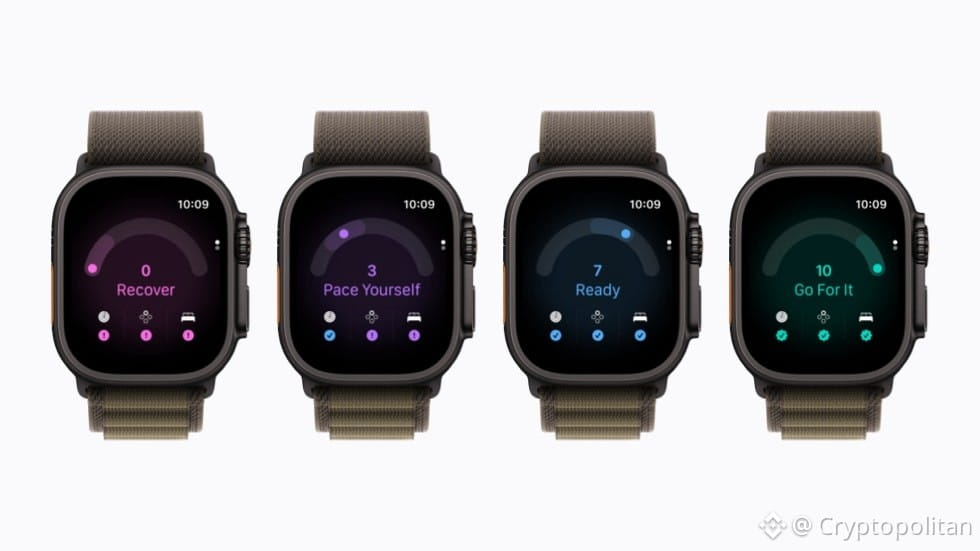
Article
A $119 Quest Diagnostics blood panel now feeds Apple's new Health Age scoreApple on Wednesday unveiled a revamped Health app that calculates how old a body appears. Apple calls this number Health Age.
The company wants to feed the score with blood work via a $119 partnership with Quest Diagnostics. Apple has previewed the update with the Apple Watch Series 12 and Ultra 4.
The move is a sign of Apple’s intensifying push into diagnostics, once requiring a doctor’s order.
A test covering 50 biomarkers backs Health Age
Apple’s Health Age is the company’s effort to squeeze scattered metrics into a single number people can read. The score combines VO2 max, sleep data, and blood biomarkers to determine if measurements are consistent with calendar age.
The first two are obtained by wearable sensors only. That’s where Quest comes in. The third can’t come from a wrist.
In the US, Apple said people can order a panel of more than 50 biomarkers for $119. Apple called it a way to get data “that can only come from lab tests.”
Results are conveyed back to the iPhone, with watch readings for comparison and explainer videos from clinical experts attached. For those who skip the kit, lab results can still be added by hand or synced from existing medical records.
The new Health app will be available later this year in U.S. English, with other languages to follow. It requires Apple Intelligence on iOS 27 and iPadOS 27.
Apple also added a Longevity tab next to Health Age that assesses sleep, movement, and heart health against clinical guidance, plus movement and mobility assessments. In one demo, an iPhone camera tracked a person taking a VO2 max test as a trainer walked through the movements on screen.
Apple’s health push comes as the company looks to bank more on non-hardware revenue. Apple’s April quarter set a Services record of $30.98 billion, according to Cryptopolitan’s earlier earnings coverage.
Source: Apple.
A daily 0-to-10 readiness number arrives with Apple Watch Series 12
Apple also added a daily readiness feature to the Series 12 and Ultra 4, in addition to the Health Age. It’s a single 0-10 score that looks at recent activity, vitals, and a sleep score and then sends out one of four calls: Recover, Pace Yourself, Ready, or Go For It.
The number fluctuates during the day as new data is received. An afternoon workout or a dip in daytime vitals can change it.
Apple said the scoring model was developed with input from its own staff of exercise scientists and physicians and came from its own Apple Heart and Movement Study. Apple is late in this space, as rival trackers have offered readiness scores for years.
Scores are based on a new Health Sensing System that Apple added to the Series 12 and Ultra 4. Optical and electrical sensors are redesigned to record the heart rate every five seconds during the day.
Apple says heart-rate variability is quantified as often as every five minutes, 24 times as often as before. The Vitals app now shows HRV, a stress-and-recovery signal, in both an overnight and new daytime view.
Apple backed up the accuracy claim by carrying out a study of more than 1,000 people from demographic groups. The tech company said the study showed its watch outperforming leading wearables in heart rate accuracy.
“By combining breakthrough sensing on Apple Watch with Apple Intelligence in the Health app, we’re able to translate complex biometric data into clear guidance for users,” said Sumbul Desai, M.D., Apple’s vice president of Health and Fitness.
Don’t just read crypto news. Understand it. Subscribe to our newsletter. It's free.
A $119 Quest Diagnostics blood panel now feeds Apple's new Health Age score
Apple on Wednesday unveiled a revamped Health app that calculates how old a body appears. Apple calls this number Health Age.
The company wants to feed the score with blood work via a $119 partnership with Quest Diagnostics. Apple has previewed the update with the Apple Watch Series 12 and Ultra 4.
The move is a sign of Apple’s intensifying push into diagnostics, once requiring a doctor’s order.
A test covering 50 biomarkers backs Health Age
Apple’s Health Age is the company’s effort to squeeze scattered metrics into a single number people can read. The score combines VO2 max, sleep data, and blood biomarkers to determine if measurements are consistent with calendar age.
The first two are obtained by wearable sensors only. That’s where Quest comes in. The third can’t come from a wrist.
In the US, Apple said people can order a panel of more than 50 biomarkers for $119. Apple called it a way to get data “that can only come from lab tests.”
Results are conveyed back to the iPhone, with watch readings for comparison and explainer videos from clinical experts attached. For those who skip the kit, lab results can still be added by hand or synced from existing medical records.
The new Health app will be available later this year in U.S. English, with other languages to follow. It requires Apple Intelligence on iOS 27 and iPadOS 27.
Apple also added a Longevity tab next to Health Age that assesses sleep, movement, and heart health against clinical guidance, plus movement and mobility assessments. In one demo, an iPhone camera tracked a person taking a VO2 max test as a trainer walked through the movements on screen.
Apple’s health push comes as the company looks to bank more on non-hardware revenue. Apple’s April quarter set a Services record of $30.98 billion, according to Cryptopolitan’s earlier earnings coverage.
Source: Apple.
A daily 0-to-10 readiness number arrives with Apple Watch Series 12
Apple also added a daily readiness feature to the Series 12 and Ultra 4, in addition to the Health Age. It’s a single 0-10 score that looks at recent activity, vitals, and a sleep score and then sends out one of four calls: Recover, Pace Yourself, Ready, or Go For It.
The number fluctuates during the day as new data is received. An afternoon workout or a dip in daytime vitals can change it.
Apple said the scoring model was developed with input from its own staff of exercise scientists and physicians and came from its own Apple Heart and Movement Study. Apple is late in this space, as rival trackers have offered readiness scores for years.
Scores are based on a new Health Sensing System that Apple added to the Series 12 and Ultra 4. Optical and electrical sensors are redesigned to record the heart rate every five seconds during the day.
Apple says heart-rate variability is quantified as often as every five minutes, 24 times as often as before. The Vitals app now shows HRV, a stress-and-recovery signal, in both an overnight and new daytime view.
Apple backed up the accuracy claim by carrying out a study of more than 1,000 people from demographic groups. The tech company said the study showed its watch outperforming leading wearables in heart rate accuracy.
“By combining breakthrough sensing on Apple Watch with Apple Intelligence in the Health app, we’re able to translate complex biometric data into clear guidance for users,” said Sumbul Desai, M.D., Apple’s vice president of Health and Fitness.
Don’t just read crypto news. Understand it. Subscribe to our newsletter. It's free.
The company wants to feed the score with blood work via a $119 partnership with Quest Diagnostics. Apple has previewed the update with the Apple Watch Series 12 and Ultra 4.
The move is a sign of Apple’s intensifying push into diagnostics, once requiring a doctor’s order.
A test covering 50 biomarkers backs Health Age
Apple’s Health Age is the company’s effort to squeeze scattered metrics into a single number people can read. The score combines VO2 max, sleep data, and blood biomarkers to determine if measurements are consistent with calendar age.
The first two are obtained by wearable sensors only. That’s where Quest comes in. The third can’t come from a wrist.
In the US, Apple said people can order a panel of more than 50 biomarkers for $119. Apple called it a way to get data “that can only come from lab tests.”
Results are conveyed back to the iPhone, with watch readings for comparison and explainer videos from clinical experts attached. For those who skip the kit, lab results can still be added by hand or synced from existing medical records.
The new Health app will be available later this year in U.S. English, with other languages to follow. It requires Apple Intelligence on iOS 27 and iPadOS 27.
Apple also added a Longevity tab next to Health Age that assesses sleep, movement, and heart health against clinical guidance, plus movement and mobility assessments. In one demo, an iPhone camera tracked a person taking a VO2 max test as a trainer walked through the movements on screen.
Apple’s health push comes as the company looks to bank more on non-hardware revenue. Apple’s April quarter set a Services record of $30.98 billion, according to Cryptopolitan’s earlier earnings coverage.
Source: Apple.
A daily 0-to-10 readiness number arrives with Apple Watch Series 12
Apple also added a daily readiness feature to the Series 12 and Ultra 4, in addition to the Health Age. It’s a single 0-10 score that looks at recent activity, vitals, and a sleep score and then sends out one of four calls: Recover, Pace Yourself, Ready, or Go For It.
The number fluctuates during the day as new data is received. An afternoon workout or a dip in daytime vitals can change it.
Apple said the scoring model was developed with input from its own staff of exercise scientists and physicians and came from its own Apple Heart and Movement Study. Apple is late in this space, as rival trackers have offered readiness scores for years.
Scores are based on a new Health Sensing System that Apple added to the Series 12 and Ultra 4. Optical and electrical sensors are redesigned to record the heart rate every five seconds during the day.
Apple says heart-rate variability is quantified as often as every five minutes, 24 times as often as before. The Vitals app now shows HRV, a stress-and-recovery signal, in both an overnight and new daytime view.
Apple backed up the accuracy claim by carrying out a study of more than 1,000 people from demographic groups. The tech company said the study showed its watch outperforming leading wearables in heart rate accuracy.
“By combining breakthrough sensing on Apple Watch with Apple Intelligence in the Health app, we’re able to translate complex biometric data into clear guidance for users,” said Sumbul Desai, M.D., Apple’s vice president of Health and Fitness.
Don’t just read crypto news. Understand it. Subscribe to our newsletter. It's free.
154
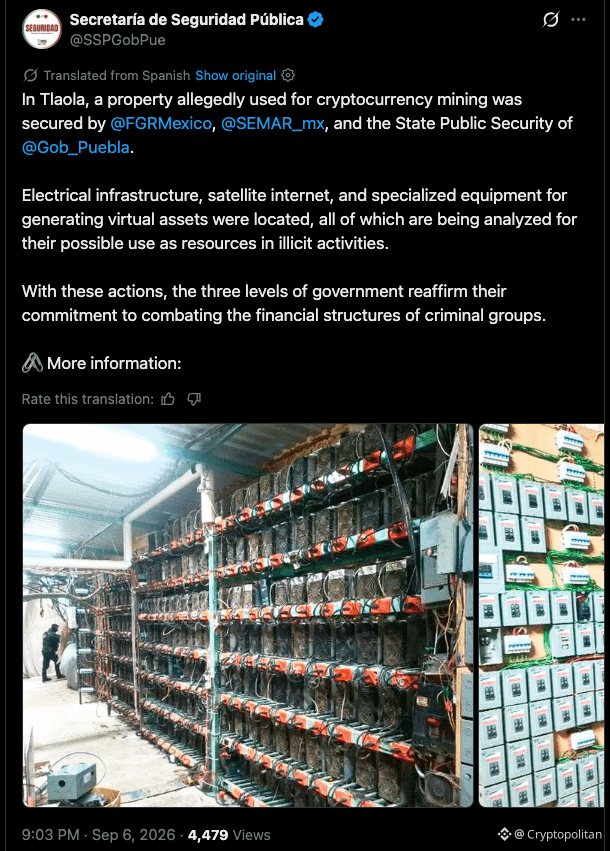
Article
Mexico builds an electricity-theft case against 300 seized mining rigsFederal prosecutors in Mexico, the Navy, and Puebla state police seized 300 crypto mining machines from a remote property in Tlaola that had been intercepting electricity directly from a federal hydroelectric complex, the state security ministry said.
Noise and isolation gave the mining operation away
The site is situated in the Sierra Norte, the rugged northern highlands of Puebla, in a municipality of about 20,000. Officers left with transformers, medium-voltage terminals, and working satellite internet antennas were also taken away.
The units seized were GPUs, which would rule out Bitcoin and point to coins that are still mined on graphics cards. The operation’s cryptocurrency target has not yet been confirmed by authorities.
In a September 6 post on X, the Secretaría de Seguridad Pública said the property was jointly secured by the federal Attorney General’s office, the Navy, and Puebla state forces.
“Electrical infrastructure, satellite internet, and specialized equipment” for generating digital assets had been located on the premises.
Mining “consumes a great deal of energy and generates a lot of noise, which is why operators seek out isolated and very remote locations. That is what alerted us,” said State security minister Francisco Sánchez to reporters.
Sánchez added that the tip-off came from the site’s proximity to the Nuevo Necaxa dam, where investigators had been investigating reports of illegal mining, and that “there was a very large power connection.”
Photos from the Secretaría de Seguridad Pública’s September 6, 2026, X post showing the seized mining rig racks and electrical equipment at the Tlaola property.
Forensic teams investigate illicit crypto laundering networks
Sánchez described the Tlaola property as one node in a broader network that preys on the Sierra Norte’s hydroelectric infrastructure. He said the same activity is cropping up in neighboring states, with searches already stretching to nearby municipalities.
Forensic accountants are trying to ascertain who paid for the hardware, and the state government is investigating whether coins mined at the site were used to launder criminal proceeds.
Mexican authorities busted three other mining operations in Puebla and neighboring Tlaxcala in 2025.
In Malaysia, the country’s national utility Tenaga Nasional reportedly lost over $1.1 billion from 2020 to August 2025 due to electricity theft linked to mining, Cryptopolitan said.
In June, Thailand authorities seized 315 Bitcoin rigs in five northeastern provinces, reckoning the damage from tampered meters and unpaid bills at about $1.2 million.
If you're reading this, you’re already ahead. Stay there with our newsletter.
Mexico builds an electricity-theft case against 300 seized mining rigs
Federal prosecutors in Mexico, the Navy, and Puebla state police seized 300 crypto mining machines from a remote property in Tlaola that had been intercepting electricity directly from a federal hydroelectric complex, the state security ministry said.
Noise and isolation gave the mining operation away
The site is situated in the Sierra Norte, the rugged northern highlands of Puebla, in a municipality of about 20,000. Officers left with transformers, medium-voltage terminals, and working satellite internet antennas were also taken away.
The units seized were GPUs, which would rule out Bitcoin and point to coins that are still mined on graphics cards. The operation’s cryptocurrency target has not yet been confirmed by authorities.
In a September 6 post on X, the Secretaría de Seguridad Pública said the property was jointly secured by the federal Attorney General’s office, the Navy, and Puebla state forces.
“Electrical infrastructure, satellite internet, and specialized equipment” for generating digital assets had been located on the premises.
Mining “consumes a great deal of energy and generates a lot of noise, which is why operators seek out isolated and very remote locations. That is what alerted us,” said State security minister Francisco Sánchez to reporters.
Sánchez added that the tip-off came from the site’s proximity to the Nuevo Necaxa dam, where investigators had been investigating reports of illegal mining, and that “there was a very large power connection.”
Photos from the Secretaría de Seguridad Pública’s September 6, 2026, X post showing the seized mining rig racks and electrical equipment at the Tlaola property.
Forensic teams investigate illicit crypto laundering networks
Sánchez described the Tlaola property as one node in a broader network that preys on the Sierra Norte’s hydroelectric infrastructure. He said the same activity is cropping up in neighboring states, with searches already stretching to nearby municipalities.
Forensic accountants are trying to ascertain who paid for the hardware, and the state government is investigating whether coins mined at the site were used to launder criminal proceeds.
Mexican authorities busted three other mining operations in Puebla and neighboring Tlaxcala in 2025.
In Malaysia, the country’s national utility Tenaga Nasional reportedly lost over $1.1 billion from 2020 to August 2025 due to electricity theft linked to mining, Cryptopolitan said.
In June, Thailand authorities seized 315 Bitcoin rigs in five northeastern provinces, reckoning the damage from tampered meters and unpaid bills at about $1.2 million.
If you're reading this, you’re already ahead. Stay there with our newsletter.
Noise and isolation gave the mining operation away
The site is situated in the Sierra Norte, the rugged northern highlands of Puebla, in a municipality of about 20,000. Officers left with transformers, medium-voltage terminals, and working satellite internet antennas were also taken away.
The units seized were GPUs, which would rule out Bitcoin and point to coins that are still mined on graphics cards. The operation’s cryptocurrency target has not yet been confirmed by authorities.
In a September 6 post on X, the Secretaría de Seguridad Pública said the property was jointly secured by the federal Attorney General’s office, the Navy, and Puebla state forces.
“Electrical infrastructure, satellite internet, and specialized equipment” for generating digital assets had been located on the premises.
Mining “consumes a great deal of energy and generates a lot of noise, which is why operators seek out isolated and very remote locations. That is what alerted us,” said State security minister Francisco Sánchez to reporters.
Sánchez added that the tip-off came from the site’s proximity to the Nuevo Necaxa dam, where investigators had been investigating reports of illegal mining, and that “there was a very large power connection.”
Photos from the Secretaría de Seguridad Pública’s September 6, 2026, X post showing the seized mining rig racks and electrical equipment at the Tlaola property.
Forensic teams investigate illicit crypto laundering networks
Sánchez described the Tlaola property as one node in a broader network that preys on the Sierra Norte’s hydroelectric infrastructure. He said the same activity is cropping up in neighboring states, with searches already stretching to nearby municipalities.
Forensic accountants are trying to ascertain who paid for the hardware, and the state government is investigating whether coins mined at the site were used to launder criminal proceeds.
Mexican authorities busted three other mining operations in Puebla and neighboring Tlaxcala in 2025.
In Malaysia, the country’s national utility Tenaga Nasional reportedly lost over $1.1 billion from 2020 to August 2025 due to electricity theft linked to mining, Cryptopolitan said.
In June, Thailand authorities seized 315 Bitcoin rigs in five northeastern provinces, reckoning the damage from tampered meters and unpaid bills at about $1.2 million.
If you're reading this, you’re already ahead. Stay there with our newsletter.
89
NECC ranks crypto its third-biggest economic-crime threat, cites £25M Destabilise haulCryptoassets are third on the list of nine economic-crime priorities for the UK’s National Economic Crime Centre.
The annual report of the National Crime Agency unit, published this week, also signals that it wants to hunt its own laundering targets.
NECC wants to build its own intelligence-led capability
The NECC, the UK’s economic crime response coordination body, agreed on nine priorities with the Financial Conduct Authority, Home Office, and Treasury.
Number three is crypto assets. Only professional enablers, corrupt lawyers and accountants, and politically exposed persons rank higher than crypto assets.
Cash and money mules used for criminal activity rank below crypto on the list. This list is intended to guide the compliance work of regulated firms.
The NECC said in its threat assessment that criminals are making “innovative use of crypto asset products to evade detection and move illicit value at scale.” The same passage describes laundering networks that cross borders and that combine old and new techniques.
Many organized crime groups now pay dedicated networks to launder proceeds rather than doing it themselves. The report highlights synthetic identities and automated attacks on banks and cites artificial intelligence alongside crypto as an emerging tool.
The agency said it is developing “a more proactive and intelligence-led crypto capability.”
Police forces globally use blockchain analytics firms such as Chainalysis, Elliptic, and TRM Labs to retrace illicit flows. The NCA’s stated strategy is to develop that detective work in-house, with sanctions evasion and ransomware payments identified as areas of focus, along with traditional money laundering.
The agency calculates that more than £100 billion is laundered through the UK each year, but it does not separate out how much moves through crypto.
129 arrests mark Destabilise since 2022
The report also updated the figures for Operation Destabilise, the ongoing investigation into Russian-speaking networks converting street cash into cryptocurrency.
The investigation has resulted in the arrest of 129 people and the capture of more than £25 million in cash and cryptoassets across the UK since 2022.
That’s one more arrest than the update the agency gave in November. The NECC said it plans to grow the operation.
Alongside Destabilise, the report spotlighted Operation Atlantic, a week-long sprint from NCA HQ. In March, investigators identified 20,000 approval-phishing victims and froze $12 million, working with the US Secret Service and exchanges Coinbase, Binance, Kraken, and stablecoin issuer Tether.
The same effort took down more than 120 scam domains, and one UK victim lost more than £52,000 (about $66,000) to the scam, Cryptopolitan reported.
On policy, the NECC resisted the urge to ban privacy technology. A paper from the Royal United Services Institute, published following a roundtable convened by the NECC, opposes a blanket ban on crypto privacy tools.
Don’t just read crypto news. Understand it. Subscribe to our newsletter. It's free.
NECC ranks crypto its third-biggest economic-crime threat, cites £25M Destabilise haul
Cryptoassets are third on the list of nine economic-crime priorities for the UK’s National Economic Crime Centre.
The annual report of the National Crime Agency unit, published this week, also signals that it wants to hunt its own laundering targets.
NECC wants to build its own intelligence-led capability
The NECC, the UK’s economic crime response coordination body, agreed on nine priorities with the Financial Conduct Authority, Home Office, and Treasury.
Number three is crypto assets. Only professional enablers, corrupt lawyers and accountants, and politically exposed persons rank higher than crypto assets.
Cash and money mules used for criminal activity rank below crypto on the list. This list is intended to guide the compliance work of regulated firms.
The NECC said in its threat assessment that criminals are making “innovative use of crypto asset products to evade detection and move illicit value at scale.” The same passage describes laundering networks that cross borders and that combine old and new techniques.
Many organized crime groups now pay dedicated networks to launder proceeds rather than doing it themselves. The report highlights synthetic identities and automated attacks on banks and cites artificial intelligence alongside crypto as an emerging tool.
The agency said it is developing “a more proactive and intelligence-led crypto capability.”
Police forces globally use blockchain analytics firms such as Chainalysis, Elliptic, and TRM Labs to retrace illicit flows. The NCA’s stated strategy is to develop that detective work in-house, with sanctions evasion and ransomware payments identified as areas of focus, along with traditional money laundering.
The agency calculates that more than £100 billion is laundered through the UK each year, but it does not separate out how much moves through crypto.
129 arrests mark Destabilise since 2022
The report also updated the figures for Operation Destabilise, the ongoing investigation into Russian-speaking networks converting street cash into cryptocurrency.
The investigation has resulted in the arrest of 129 people and the capture of more than £25 million in cash and cryptoassets across the UK since 2022.
That’s one more arrest than the update the agency gave in November. The NECC said it plans to grow the operation.
Alongside Destabilise, the report spotlighted Operation Atlantic, a week-long sprint from NCA HQ. In March, investigators identified 20,000 approval-phishing victims and froze $12 million, working with the US Secret Service and exchanges Coinbase, Binance, Kraken, and stablecoin issuer Tether.
The same effort took down more than 120 scam domains, and one UK victim lost more than £52,000 (about $66,000) to the scam, Cryptopolitan reported.
On policy, the NECC resisted the urge to ban privacy technology. A paper from the Royal United Services Institute, published following a roundtable convened by the NECC, opposes a blanket ban on crypto privacy tools.
Don’t just read crypto news. Understand it. Subscribe to our newsletter. It's free.
The annual report of the National Crime Agency unit, published this week, also signals that it wants to hunt its own laundering targets.
NECC wants to build its own intelligence-led capability
The NECC, the UK’s economic crime response coordination body, agreed on nine priorities with the Financial Conduct Authority, Home Office, and Treasury.
Number three is crypto assets. Only professional enablers, corrupt lawyers and accountants, and politically exposed persons rank higher than crypto assets.
Cash and money mules used for criminal activity rank below crypto on the list. This list is intended to guide the compliance work of regulated firms.
The NECC said in its threat assessment that criminals are making “innovative use of crypto asset products to evade detection and move illicit value at scale.” The same passage describes laundering networks that cross borders and that combine old and new techniques.
Many organized crime groups now pay dedicated networks to launder proceeds rather than doing it themselves. The report highlights synthetic identities and automated attacks on banks and cites artificial intelligence alongside crypto as an emerging tool.
The agency said it is developing “a more proactive and intelligence-led crypto capability.”
Police forces globally use blockchain analytics firms such as Chainalysis, Elliptic, and TRM Labs to retrace illicit flows. The NCA’s stated strategy is to develop that detective work in-house, with sanctions evasion and ransomware payments identified as areas of focus, along with traditional money laundering.
The agency calculates that more than £100 billion is laundered through the UK each year, but it does not separate out how much moves through crypto.
129 arrests mark Destabilise since 2022
The report also updated the figures for Operation Destabilise, the ongoing investigation into Russian-speaking networks converting street cash into cryptocurrency.
The investigation has resulted in the arrest of 129 people and the capture of more than £25 million in cash and cryptoassets across the UK since 2022.
That’s one more arrest than the update the agency gave in November. The NECC said it plans to grow the operation.
Alongside Destabilise, the report spotlighted Operation Atlantic, a week-long sprint from NCA HQ. In March, investigators identified 20,000 approval-phishing victims and froze $12 million, working with the US Secret Service and exchanges Coinbase, Binance, Kraken, and stablecoin issuer Tether.
The same effort took down more than 120 scam domains, and one UK victim lost more than £52,000 (about $66,000) to the scam, Cryptopolitan reported.
On policy, the NECC resisted the urge to ban privacy technology. A paper from the Royal United Services Institute, published following a roundtable convened by the NECC, opposes a blanket ban on crypto privacy tools.
Don’t just read crypto news. Understand it. Subscribe to our newsletter. It's free.
61
Google signs 22-year Loviisa nuclear deal to power €13 billion Finland betOver the next two years, Google will invest €13 billion in Finland on data centers, clean energy, and community programs. They will operate on nuclear power.
The company said Wednesday that it signed a 22-year agreement to help prolong the life of the Loviisa nuclear power plant, part of what it called its largest single investment anywhere in Europe.
The money for Finland comes as governments across the continent scramble to stop AI infrastructure moving to the United States.
Google doubles its previous German pledge in Finland
Hamina is the center of gravity where Google, 15 years ago, transmuted a defunct paper mill into a data center. The new spending is intended to keep pace with demand for Search, Maps, and Gemini, Google Global Infrastructure VP Bikash Koley wrote in the announcement.
Google said its Hamina operations drew on more than 600 Finnish suppliers for construction, operations, and fiber work from 2023 to 2025.
The new pledge overshadows the size of Google’s recent European moves. In November 2025, Cryptopolitan reported that Google pledged ~€5.5 billion, about $6.4 billion, to expand its German data centers in Dietzenbach and Hanau.
The figure for Finland is more than double that.
€31 million flows to Hamina, Kajaani, Muhos, and Vaala
In addition to the Loviisa deal, Google said it will add onshore wind capacity and enter into a contract for a 94-megawatt battery system that it said would serve to smooth prices during “cold, windless periods.”
Nuclear power offers a dependable baseload that wind and solar cannot, and that is a growing concern to operators of power-hungry AI facilities.
The project is expected to create more than 37,000 jobs across the country and bring €3.6 billion a year to Finnish GDP during construction in 2027 and 2028, according to Google.
Once the facilities are up and running, thousands of permanent roles will follow, from engineers to security and catering staff, the company said.
Google apportioned €31 million over four years to the communities of Hamina, Kajaani, Muhos, and Vaala. The budget covers AI upskilling for 4,400+ workers through local colleges.
It also funds training slots for 100 students aimed at future data center careers. The company said it will finance the regeneration of native forests and wetlands near its sites and construct recreational trails, public saunas, and fishing piers.
If you're reading this, you’re already ahead. Stay there with our newsletter.
Google signs 22-year Loviisa nuclear deal to power €13 billion Finland bet
Over the next two years, Google will invest €13 billion in Finland on data centers, clean energy, and community programs. They will operate on nuclear power.
The company said Wednesday that it signed a 22-year agreement to help prolong the life of the Loviisa nuclear power plant, part of what it called its largest single investment anywhere in Europe.
The money for Finland comes as governments across the continent scramble to stop AI infrastructure moving to the United States.
Google doubles its previous German pledge in Finland
Hamina is the center of gravity where Google, 15 years ago, transmuted a defunct paper mill into a data center. The new spending is intended to keep pace with demand for Search, Maps, and Gemini, Google Global Infrastructure VP Bikash Koley wrote in the announcement.
Google said its Hamina operations drew on more than 600 Finnish suppliers for construction, operations, and fiber work from 2023 to 2025.
The new pledge overshadows the size of Google’s recent European moves. In November 2025, Cryptopolitan reported that Google pledged ~€5.5 billion, about $6.4 billion, to expand its German data centers in Dietzenbach and Hanau.
The figure for Finland is more than double that.
€31 million flows to Hamina, Kajaani, Muhos, and Vaala
In addition to the Loviisa deal, Google said it will add onshore wind capacity and enter into a contract for a 94-megawatt battery system that it said would serve to smooth prices during “cold, windless periods.”
Nuclear power offers a dependable baseload that wind and solar cannot, and that is a growing concern to operators of power-hungry AI facilities.
The project is expected to create more than 37,000 jobs across the country and bring €3.6 billion a year to Finnish GDP during construction in 2027 and 2028, according to Google.
Once the facilities are up and running, thousands of permanent roles will follow, from engineers to security and catering staff, the company said.
Google apportioned €31 million over four years to the communities of Hamina, Kajaani, Muhos, and Vaala. The budget covers AI upskilling for 4,400+ workers through local colleges.
It also funds training slots for 100 students aimed at future data center careers. The company said it will finance the regeneration of native forests and wetlands near its sites and construct recreational trails, public saunas, and fishing piers.
If you're reading this, you’re already ahead. Stay there with our newsletter.
The company said Wednesday that it signed a 22-year agreement to help prolong the life of the Loviisa nuclear power plant, part of what it called its largest single investment anywhere in Europe.
The money for Finland comes as governments across the continent scramble to stop AI infrastructure moving to the United States.
Google doubles its previous German pledge in Finland
Hamina is the center of gravity where Google, 15 years ago, transmuted a defunct paper mill into a data center. The new spending is intended to keep pace with demand for Search, Maps, and Gemini, Google Global Infrastructure VP Bikash Koley wrote in the announcement.
Google said its Hamina operations drew on more than 600 Finnish suppliers for construction, operations, and fiber work from 2023 to 2025.
The new pledge overshadows the size of Google’s recent European moves. In November 2025, Cryptopolitan reported that Google pledged ~€5.5 billion, about $6.4 billion, to expand its German data centers in Dietzenbach and Hanau.
The figure for Finland is more than double that.
€31 million flows to Hamina, Kajaani, Muhos, and Vaala
In addition to the Loviisa deal, Google said it will add onshore wind capacity and enter into a contract for a 94-megawatt battery system that it said would serve to smooth prices during “cold, windless periods.”
Nuclear power offers a dependable baseload that wind and solar cannot, and that is a growing concern to operators of power-hungry AI facilities.
The project is expected to create more than 37,000 jobs across the country and bring €3.6 billion a year to Finnish GDP during construction in 2027 and 2028, according to Google.
Once the facilities are up and running, thousands of permanent roles will follow, from engineers to security and catering staff, the company said.
Google apportioned €31 million over four years to the communities of Hamina, Kajaani, Muhos, and Vaala. The budget covers AI upskilling for 4,400+ workers through local colleges.
It also funds training slots for 100 students aimed at future data center careers. The company said it will finance the regeneration of native forests and wetlands near its sites and construct recreational trails, public saunas, and fishing piers.
If you're reading this, you’re already ahead. Stay there with our newsletter.
117
Suno launches new AI music models trained on licnesed music from Warner, BMGSuno replaced its entire AI music engine with a new model family, Suno v6, which has been trained on licensed material from Warner Music Group, BMG, and distributor Believe. The change is a direct response to the copyright suits that have shaken the startup over the past months, and shows that record labels are interested in building products with AI companies.
The launch includes three tiers, with the flagship v6 positioned as the most precise and polished option. The v6-wild model is designed as a more experimental counterpart aimed at less predictable results, while v6-mini is the faster model available on the free tier. Only v6-mini will be available to free users, while the other two models will be limited to Suno’s Pro and Premier subscribers, TechCrunch reported.
Everything before v6 has been decommissioned, and the company stated in its announcement that all previous models will be retired as Suno will move “entirely onto the v6 generation.”
Suno claims v6 can edit a selected section of a track using a text prompt and replace a single lyric without regenerating the entire song. The new model can also create mashups from multiple sources, isolate instruments for sampling, and use text, audio, images, or video as references.
Legal settlement required new models
Warner’s November 2025 settlement with Suno required a specific commitment to ship more advanced licensed models and retire the previous ones. The models that replaced the contested versions were co-developed with the same label that had taken Suno to court.
Chief product officer Jack Brody said the release was focused on remuneration for rights holders. “From the day it launches on September 9, this partnership starts generating revenue for our partners,” he stated, adding that the models open the door to remix and artist-participation features that would create “additional revenue streams” for participating artists.
Artists working with Believe can opt into the new Suno experiences, while Suno-made songs can become eligible for distribution through Believe and TuneCore, giving AI-generated tracks a path to conventional music platforms.
Suno discloses little about data
For a launch built on the line between licensed and unlicensed training of AI models, Suno said almost nothing about the data itself. When asked how the models were built, Brody refused to give any specifics, stating that “the v6 family has been trained from the ground up with a new set of data that differs from the data that went into our previous models,” including “licensed data from our partners and user data.”
Artist payments are also vague, and Suno says musicians can opt in and be paid when they take part; however, there are no definite payment structures in place yet.
Suno is valued at around $5.4 billion, and the company has raised more than $819 million.
Legal battles are far from over
Settling with Warner and BMG has not completely cleared Suno’s legal slate, with the company still facing suits from Sony and Universal Music Group, and artists including Jason Isbell. There are also still some suits from users who allege the AI model neglected security while chasing profit.
Europe seems to be on a totally different track, as a German court, in a case brought by the collecting society GEMA, ruled this year that Suno breached copyright terms. This is the very first such decision on the continent. Rival Udio, meanwhile, is also being sued by Sony over 30,000 songs, with $4.5 billion sought in payments.
If you're reading this, you’re already ahead. Stay there with our newsletter.
Suno launches new AI music models trained on licnesed music from Warner, BMG
Suno replaced its entire AI music engine with a new model family, Suno v6, which has been trained on licensed material from Warner Music Group, BMG, and distributor Believe. The change is a direct response to the copyright suits that have shaken the startup over the past months, and shows that record labels are interested in building products with AI companies.
The launch includes three tiers, with the flagship v6 positioned as the most precise and polished option. The v6-wild model is designed as a more experimental counterpart aimed at less predictable results, while v6-mini is the faster model available on the free tier. Only v6-mini will be available to free users, while the other two models will be limited to Suno’s Pro and Premier subscribers, TechCrunch reported.
Everything before v6 has been decommissioned, and the company stated in its announcement that all previous models will be retired as Suno will move “entirely onto the v6 generation.”
Suno claims v6 can edit a selected section of a track using a text prompt and replace a single lyric without regenerating the entire song. The new model can also create mashups from multiple sources, isolate instruments for sampling, and use text, audio, images, or video as references.
Legal settlement required new models
Warner’s November 2025 settlement with Suno required a specific commitment to ship more advanced licensed models and retire the previous ones. The models that replaced the contested versions were co-developed with the same label that had taken Suno to court.
Chief product officer Jack Brody said the release was focused on remuneration for rights holders. “From the day it launches on September 9, this partnership starts generating revenue for our partners,” he stated, adding that the models open the door to remix and artist-participation features that would create “additional revenue streams” for participating artists.
Artists working with Believe can opt into the new Suno experiences, while Suno-made songs can become eligible for distribution through Believe and TuneCore, giving AI-generated tracks a path to conventional music platforms.
Suno discloses little about data
For a launch built on the line between licensed and unlicensed training of AI models, Suno said almost nothing about the data itself. When asked how the models were built, Brody refused to give any specifics, stating that “the v6 family has been trained from the ground up with a new set of data that differs from the data that went into our previous models,” including “licensed data from our partners and user data.”
Artist payments are also vague, and Suno says musicians can opt in and be paid when they take part; however, there are no definite payment structures in place yet.
Suno is valued at around $5.4 billion, and the company has raised more than $819 million.
Legal battles are far from over
Settling with Warner and BMG has not completely cleared Suno’s legal slate, with the company still facing suits from Sony and Universal Music Group, and artists including Jason Isbell. There are also still some suits from users who allege the AI model neglected security while chasing profit.
Europe seems to be on a totally different track, as a German court, in a case brought by the collecting society GEMA, ruled this year that Suno breached copyright terms. This is the very first such decision on the continent. Rival Udio, meanwhile, is also being sued by Sony over 30,000 songs, with $4.5 billion sought in payments.
If you're reading this, you’re already ahead. Stay there with our newsletter.
The launch includes three tiers, with the flagship v6 positioned as the most precise and polished option. The v6-wild model is designed as a more experimental counterpart aimed at less predictable results, while v6-mini is the faster model available on the free tier. Only v6-mini will be available to free users, while the other two models will be limited to Suno’s Pro and Premier subscribers, TechCrunch reported.
Everything before v6 has been decommissioned, and the company stated in its announcement that all previous models will be retired as Suno will move “entirely onto the v6 generation.”
Suno claims v6 can edit a selected section of a track using a text prompt and replace a single lyric without regenerating the entire song. The new model can also create mashups from multiple sources, isolate instruments for sampling, and use text, audio, images, or video as references.
Legal settlement required new models
Warner’s November 2025 settlement with Suno required a specific commitment to ship more advanced licensed models and retire the previous ones. The models that replaced the contested versions were co-developed with the same label that had taken Suno to court.
Chief product officer Jack Brody said the release was focused on remuneration for rights holders. “From the day it launches on September 9, this partnership starts generating revenue for our partners,” he stated, adding that the models open the door to remix and artist-participation features that would create “additional revenue streams” for participating artists.
Artists working with Believe can opt into the new Suno experiences, while Suno-made songs can become eligible for distribution through Believe and TuneCore, giving AI-generated tracks a path to conventional music platforms.
Suno discloses little about data
For a launch built on the line between licensed and unlicensed training of AI models, Suno said almost nothing about the data itself. When asked how the models were built, Brody refused to give any specifics, stating that “the v6 family has been trained from the ground up with a new set of data that differs from the data that went into our previous models,” including “licensed data from our partners and user data.”
Artist payments are also vague, and Suno says musicians can opt in and be paid when they take part; however, there are no definite payment structures in place yet.
Suno is valued at around $5.4 billion, and the company has raised more than $819 million.
Legal battles are far from over
Settling with Warner and BMG has not completely cleared Suno’s legal slate, with the company still facing suits from Sony and Universal Music Group, and artists including Jason Isbell. There are also still some suits from users who allege the AI model neglected security while chasing profit.
Europe seems to be on a totally different track, as a German court, in a case brought by the collecting society GEMA, ruled this year that Suno breached copyright terms. This is the very first such decision on the continent. Rival Udio, meanwhile, is also being sued by Sony over 30,000 songs, with $4.5 billion sought in payments.
If you're reading this, you’re already ahead. Stay there with our newsletter.
104
Consensys and MetaMask split to focus on different layers in rebrandConsensys Software Inc. announced on Wednesday, September 9, 2026 it will split into two separate companies. Its consumer wallet venture has morphed into MetaMask, while its Ethereum protocols and institutional software will become a new company but will keep the name Consensys.
The move is of particular importance to those who use MetaMask to hold crypto and to the banks that sit on ConsenSys infrastructure, as both companies will have separate leadership, balance sheet, and strategy going into the New Year.
Who’s in charge of MetaMask now?
The present company structure will now operate as MetaMask, and co-founder Joe Lubin will serve as chairman and chief executive. It will run the consumer wallet and consumer products.
The institutional aspect of the company, which included the Linea network, the Besu and Teku clients, will become the new Consensys. Mike Kriak will lead as CEO, while David Cunningham serves as president, and Lubin steps into the seat of executive chairman.
The companies are to run as two separate organizations, with the separation to be finalized by year’s end. Joe Lubin said the move is a reaction to a simple observation: the value of the consumer side of the business grew faster than the other parts of the firm.
A wallet that became a bank
MetaMask has seen over 100 million downloads from ~190 countries and has gone on to process trillions of dollars in cumulative transaction volume. This serves as the foundation for the “Open Money” platform, as Lubin calls it. It provides a single place to hold, spend, save, and grow money with crypto and traditional assets.
Money Account is the major sign of that shift. Launched in June, Money Account allows users to earn up to 4% APY on the mUSD stablecoin while using MetaMask to spend the same balance. The MetaMask Card is a Mastercard-supported debit product for trading through perpetual futures and prediction markets.
“MetaMask grew out of that work into the world’s most widely used self-custodial wallet, and today it’s becoming something larger: a platform where people don’t just hold their assets, but manage their money in its many diverse forms and aspects,” Lubin stated.
Banking on institutional tokenization
The second company is focused on banks and asset managers. Consensys claimed financial firms have pivoted from pilot projects to production use of tokenization, stablecoins, and blockchain settlement. Institutions like Citi, DTC, and BNY Mellon are currently running on its Besu infrastructure.
Lubin’s statement referenced a Citi report from June called “Tokenization 2030.” The report sees the market for tokenized assets between the $5.5 trillion and $8.2 trillion range by 2030.
The IPO and token questions left unanswered
The restructuring comes at a strange time for the firm’s corporate arc. Consensys was founded over a decade ago as a Brooklyn Ethereum incubator and moved to Texas in 2023.
The company sought to go public earlier this year but postponed it till fall 2026, when crypto markets took a nosedive, and Bitcoin went below the $80,000 mark. The company last had a valuation in early 2022, after a $450 million Series D raise. It was valued at $7 billion.
Lubin refused to state a future date for the IPO, even though the new company MetaMask could become public by Q1 2027. He also remained mute on the rumor of a MetaMask token, saying that the business and regulatory climate has caused firms to think twice about launching their own cryptocurrencies.
Don’t just read crypto news. Understand it. Subscribe to our newsletter. It's free.
Consensys and MetaMask split to focus on different layers in rebrand
Consensys Software Inc. announced on Wednesday, September 9, 2026 it will split into two separate companies. Its consumer wallet venture has morphed into MetaMask, while its Ethereum protocols and institutional software will become a new company but will keep the name Consensys.
The move is of particular importance to those who use MetaMask to hold crypto and to the banks that sit on ConsenSys infrastructure, as both companies will have separate leadership, balance sheet, and strategy going into the New Year.
Who’s in charge of MetaMask now?
The present company structure will now operate as MetaMask, and co-founder Joe Lubin will serve as chairman and chief executive. It will run the consumer wallet and consumer products.
The institutional aspect of the company, which included the Linea network, the Besu and Teku clients, will become the new Consensys. Mike Kriak will lead as CEO, while David Cunningham serves as president, and Lubin steps into the seat of executive chairman.
The companies are to run as two separate organizations, with the separation to be finalized by year’s end. Joe Lubin said the move is a reaction to a simple observation: the value of the consumer side of the business grew faster than the other parts of the firm.
A wallet that became a bank
MetaMask has seen over 100 million downloads from ~190 countries and has gone on to process trillions of dollars in cumulative transaction volume. This serves as the foundation for the “Open Money” platform, as Lubin calls it. It provides a single place to hold, spend, save, and grow money with crypto and traditional assets.
Money Account is the major sign of that shift. Launched in June, Money Account allows users to earn up to 4% APY on the mUSD stablecoin while using MetaMask to spend the same balance. The MetaMask Card is a Mastercard-supported debit product for trading through perpetual futures and prediction markets.
“MetaMask grew out of that work into the world’s most widely used self-custodial wallet, and today it’s becoming something larger: a platform where people don’t just hold their assets, but manage their money in its many diverse forms and aspects,” Lubin stated.
Banking on institutional tokenization
The second company is focused on banks and asset managers. Consensys claimed financial firms have pivoted from pilot projects to production use of tokenization, stablecoins, and blockchain settlement. Institutions like Citi, DTC, and BNY Mellon are currently running on its Besu infrastructure.
Lubin’s statement referenced a Citi report from June called “Tokenization 2030.” The report sees the market for tokenized assets between the $5.5 trillion and $8.2 trillion range by 2030.
The IPO and token questions left unanswered
The restructuring comes at a strange time for the firm’s corporate arc. Consensys was founded over a decade ago as a Brooklyn Ethereum incubator and moved to Texas in 2023.
The company sought to go public earlier this year but postponed it till fall 2026, when crypto markets took a nosedive, and Bitcoin went below the $80,000 mark. The company last had a valuation in early 2022, after a $450 million Series D raise. It was valued at $7 billion.
Lubin refused to state a future date for the IPO, even though the new company MetaMask could become public by Q1 2027. He also remained mute on the rumor of a MetaMask token, saying that the business and regulatory climate has caused firms to think twice about launching their own cryptocurrencies.
Don’t just read crypto news. Understand it. Subscribe to our newsletter. It's free.
The move is of particular importance to those who use MetaMask to hold crypto and to the banks that sit on ConsenSys infrastructure, as both companies will have separate leadership, balance sheet, and strategy going into the New Year.
Who’s in charge of MetaMask now?
The present company structure will now operate as MetaMask, and co-founder Joe Lubin will serve as chairman and chief executive. It will run the consumer wallet and consumer products.
The institutional aspect of the company, which included the Linea network, the Besu and Teku clients, will become the new Consensys. Mike Kriak will lead as CEO, while David Cunningham serves as president, and Lubin steps into the seat of executive chairman.
The companies are to run as two separate organizations, with the separation to be finalized by year’s end. Joe Lubin said the move is a reaction to a simple observation: the value of the consumer side of the business grew faster than the other parts of the firm.
A wallet that became a bank
MetaMask has seen over 100 million downloads from ~190 countries and has gone on to process trillions of dollars in cumulative transaction volume. This serves as the foundation for the “Open Money” platform, as Lubin calls it. It provides a single place to hold, spend, save, and grow money with crypto and traditional assets.
Money Account is the major sign of that shift. Launched in June, Money Account allows users to earn up to 4% APY on the mUSD stablecoin while using MetaMask to spend the same balance. The MetaMask Card is a Mastercard-supported debit product for trading through perpetual futures and prediction markets.
“MetaMask grew out of that work into the world’s most widely used self-custodial wallet, and today it’s becoming something larger: a platform where people don’t just hold their assets, but manage their money in its many diverse forms and aspects,” Lubin stated.
Banking on institutional tokenization
The second company is focused on banks and asset managers. Consensys claimed financial firms have pivoted from pilot projects to production use of tokenization, stablecoins, and blockchain settlement. Institutions like Citi, DTC, and BNY Mellon are currently running on its Besu infrastructure.
Lubin’s statement referenced a Citi report from June called “Tokenization 2030.” The report sees the market for tokenized assets between the $5.5 trillion and $8.2 trillion range by 2030.
The IPO and token questions left unanswered
The restructuring comes at a strange time for the firm’s corporate arc. Consensys was founded over a decade ago as a Brooklyn Ethereum incubator and moved to Texas in 2023.
The company sought to go public earlier this year but postponed it till fall 2026, when crypto markets took a nosedive, and Bitcoin went below the $80,000 mark. The company last had a valuation in early 2022, after a $450 million Series D raise. It was valued at $7 billion.
Lubin refused to state a future date for the IPO, even though the new company MetaMask could become public by Q1 2027. He also remained mute on the rumor of a MetaMask token, saying that the business and regulatory climate has caused firms to think twice about launching their own cryptocurrencies.
Don’t just read crypto news. Understand it. Subscribe to our newsletter. It's free.
90
Hunter Biden's LAPTOP crashes 95% within 30 minutes of launch, as analysts warnedIn roughly 30 minutes after Hunter Biden’s meme coin, LAPTOP, went live on Base, over 95% of its value got wiped out, according to blockchain analytics firm Arkham.
Those who are still holding the token are now left with a fraction of what they paid.
$LAPTOP was a bloodbath!
80% of traders lost money:
• 2 lost $100K-$1M
• 100 lost $10K+
• 700 lost $1K+
• 11,000 smaller losses
Thank you Hunter Biden! 🤡 pic.twitter.com/kncqLeiZ4B
— Bubblemaps (@bubblemaps) September 9, 2026
A peak that lasted two minutes
LAPTOP went live at 8:02 p.m. and set its high two minutes later. At that point, Arkham put the token’s fully diluted valuation (FDV) at $144 billion, which is an eye-watering figure sitting on top of a liquidity pool holding just $48,000.
Thirty minutes after its first post, Arkham reported the FDV had fallen to $5 billion.
The token’s intraday high was $401.12, while the lowest it traded the same day is $1.20 the same day, per CoinMarketCap data.
LAPTOP token price. Source: CoinMarketCap.
LAPTOP currently trades around $1.5, down by over 95%. It is trading across two on-chain venues, an official Aerodrome pool holding $83,000 in USDC and a side Uniswap pool with $380,000.
Market maker cashing out on-chain
Part of the selling pressure was visible in real time. Trading firm Wintermute reportedly took in 2.5 million LAPTOP from the token’s Gnosis Safe. 2.09 million of it was moved across Wintermute’s own wallets, then the tokens were routed toward centralized-exchange deposit addresses.
Around 500,000 LAPTOP had already gone for about $2 million across 356 transactions, according to Onchain Lens.
For a token with a 1 billion total supply and 350 million circulating, that kind of flow from an insider-supplied allocation into sell orders is the mechanism a crash is made of.
The trader who turned $200K into $3K
Lookonchain spotlighted one buyer who pulled $250,000 out of Binance ahead of the launch specifically to chase LAPTOP. The buyer reportedly spent $200,000 on 919 tokens at a price of $218.
As of the time that Lookonchain published its post, that buyer’s stack was around $3,000.
Lookonchain wrote “Don’t FOMO,” a warning that arrived too late for anyone already in.
The warnings were on the record
Before the launch and subsequent crash, there have been voices that called out the setup, and one of them, Bubblemaps, has been a consistent voice in calling out projects like LAPTOP.
Bubblemaps posted what it called the distribution of LAPTOP “just BEFORE launch.” It called on the readers to check if they noticed anything.
In a subsequent post, Bubblemaps posted on X, writing that the token’s top holders are mostly fresh wallets. It wrote, “60% have no prior activity.” It also clarified what it meant by “fresh wallets,” stating that it means that the “wallet was funded in the last 10 days.”
The analytics platform also added that most of those wallets were funded the same day of the launch.
Analyst Benjamin Cowen greeted the collapse with a two-word verdict laden with sarcasm: “I, for one, am shocked.”
Hunter Biden, the son of former US president Joe Biden, is part of the founding team behind the token, which reserved 20% of supply for airdrops, in part to wallets that lost money on TRUMP.
Two in three TRUMP buyers, which accounts for around 988,905 wallets, were down a combined $3.81 billion by the end of June.
This is not the first time that a token linked to a popular or political figure will swing this way. The TRUMP token, which was launched in January 2025, lost around 55% of its value within minutes of the MELANIA token announcement.
There is also the LIBRA token that was linked to Argentine President Javier Milei, which crashed by over 94% within hours after launch.
Hunter Biden had spent the day before the launch defending the project. “Clear, strong, seven years sober, and with a lot to say,” he wrote on X on Tuesday, confirming the Wall Street Journal’s report that he was behind a meme coin called LAPTOP.
Don’t just read crypto news. Understand it. Subscribe to our newsletter. It's free.
Hunter Biden's LAPTOP crashes 95% within 30 minutes of launch, as analysts warned
In roughly 30 minutes after Hunter Biden’s meme coin, LAPTOP, went live on Base, over 95% of its value got wiped out, according to blockchain analytics firm Arkham.
Those who are still holding the token are now left with a fraction of what they paid.
$LAPTOP was a bloodbath!
80% of traders lost money:
• 2 lost $100K-$1M
• 100 lost $10K+
• 700 lost $1K+
• 11,000 smaller losses
Thank you Hunter Biden! 🤡 pic.twitter.com/kncqLeiZ4B
— Bubblemaps (@bubblemaps) September 9, 2026
A peak that lasted two minutes
LAPTOP went live at 8:02 p.m. and set its high two minutes later. At that point, Arkham put the token’s fully diluted valuation (FDV) at $144 billion, which is an eye-watering figure sitting on top of a liquidity pool holding just $48,000.
Thirty minutes after its first post, Arkham reported the FDV had fallen to $5 billion.
The token’s intraday high was $401.12, while the lowest it traded the same day is $1.20 the same day, per CoinMarketCap data.
LAPTOP token price. Source: CoinMarketCap.
LAPTOP currently trades around $1.5, down by over 95%. It is trading across two on-chain venues, an official Aerodrome pool holding $83,000 in USDC and a side Uniswap pool with $380,000.
Market maker cashing out on-chain
Part of the selling pressure was visible in real time. Trading firm Wintermute reportedly took in 2.5 million LAPTOP from the token’s Gnosis Safe. 2.09 million of it was moved across Wintermute’s own wallets, then the tokens were routed toward centralized-exchange deposit addresses.
Around 500,000 LAPTOP had already gone for about $2 million across 356 transactions, according to Onchain Lens.
For a token with a 1 billion total supply and 350 million circulating, that kind of flow from an insider-supplied allocation into sell orders is the mechanism a crash is made of.
The trader who turned $200K into $3K
Lookonchain spotlighted one buyer who pulled $250,000 out of Binance ahead of the launch specifically to chase LAPTOP. The buyer reportedly spent $200,000 on 919 tokens at a price of $218.
As of the time that Lookonchain published its post, that buyer’s stack was around $3,000.
Lookonchain wrote “Don’t FOMO,” a warning that arrived too late for anyone already in.
The warnings were on the record
Before the launch and subsequent crash, there have been voices that called out the setup, and one of them, Bubblemaps, has been a consistent voice in calling out projects like LAPTOP.
Bubblemaps posted what it called the distribution of LAPTOP “just BEFORE launch.” It called on the readers to check if they noticed anything.
In a subsequent post, Bubblemaps posted on X, writing that the token’s top holders are mostly fresh wallets. It wrote, “60% have no prior activity.” It also clarified what it meant by “fresh wallets,” stating that it means that the “wallet was funded in the last 10 days.”
The analytics platform also added that most of those wallets were funded the same day of the launch.
Analyst Benjamin Cowen greeted the collapse with a two-word verdict laden with sarcasm: “I, for one, am shocked.”
Hunter Biden, the son of former US president Joe Biden, is part of the founding team behind the token, which reserved 20% of supply for airdrops, in part to wallets that lost money on TRUMP.
Two in three TRUMP buyers, which accounts for around 988,905 wallets, were down a combined $3.81 billion by the end of June.
This is not the first time that a token linked to a popular or political figure will swing this way. The TRUMP token, which was launched in January 2025, lost around 55% of its value within minutes of the MELANIA token announcement.
There is also the LIBRA token that was linked to Argentine President Javier Milei, which crashed by over 94% within hours after launch.
Hunter Biden had spent the day before the launch defending the project. “Clear, strong, seven years sober, and with a lot to say,” he wrote on X on Tuesday, confirming the Wall Street Journal’s report that he was behind a meme coin called LAPTOP.
Don’t just read crypto news. Understand it. Subscribe to our newsletter. It's free.
Those who are still holding the token are now left with a fraction of what they paid.
$LAPTOP was a bloodbath!
80% of traders lost money:
• 2 lost $100K-$1M
• 100 lost $10K+
• 700 lost $1K+
• 11,000 smaller losses
Thank you Hunter Biden! 🤡 pic.twitter.com/kncqLeiZ4B
— Bubblemaps (@bubblemaps) September 9, 2026
A peak that lasted two minutes
LAPTOP went live at 8:02 p.m. and set its high two minutes later. At that point, Arkham put the token’s fully diluted valuation (FDV) at $144 billion, which is an eye-watering figure sitting on top of a liquidity pool holding just $48,000.
Thirty minutes after its first post, Arkham reported the FDV had fallen to $5 billion.
The token’s intraday high was $401.12, while the lowest it traded the same day is $1.20 the same day, per CoinMarketCap data.
LAPTOP token price. Source: CoinMarketCap.
LAPTOP currently trades around $1.5, down by over 95%. It is trading across two on-chain venues, an official Aerodrome pool holding $83,000 in USDC and a side Uniswap pool with $380,000.
Market maker cashing out on-chain
Part of the selling pressure was visible in real time. Trading firm Wintermute reportedly took in 2.5 million LAPTOP from the token’s Gnosis Safe. 2.09 million of it was moved across Wintermute’s own wallets, then the tokens were routed toward centralized-exchange deposit addresses.
Around 500,000 LAPTOP had already gone for about $2 million across 356 transactions, according to Onchain Lens.
For a token with a 1 billion total supply and 350 million circulating, that kind of flow from an insider-supplied allocation into sell orders is the mechanism a crash is made of.
The trader who turned $200K into $3K
Lookonchain spotlighted one buyer who pulled $250,000 out of Binance ahead of the launch specifically to chase LAPTOP. The buyer reportedly spent $200,000 on 919 tokens at a price of $218.
As of the time that Lookonchain published its post, that buyer’s stack was around $3,000.
Lookonchain wrote “Don’t FOMO,” a warning that arrived too late for anyone already in.
The warnings were on the record
Before the launch and subsequent crash, there have been voices that called out the setup, and one of them, Bubblemaps, has been a consistent voice in calling out projects like LAPTOP.
Bubblemaps posted what it called the distribution of LAPTOP “just BEFORE launch.” It called on the readers to check if they noticed anything.
In a subsequent post, Bubblemaps posted on X, writing that the token’s top holders are mostly fresh wallets. It wrote, “60% have no prior activity.” It also clarified what it meant by “fresh wallets,” stating that it means that the “wallet was funded in the last 10 days.”
The analytics platform also added that most of those wallets were funded the same day of the launch.
Analyst Benjamin Cowen greeted the collapse with a two-word verdict laden with sarcasm: “I, for one, am shocked.”
Hunter Biden, the son of former US president Joe Biden, is part of the founding team behind the token, which reserved 20% of supply for airdrops, in part to wallets that lost money on TRUMP.
Two in three TRUMP buyers, which accounts for around 988,905 wallets, were down a combined $3.81 billion by the end of June.
This is not the first time that a token linked to a popular or political figure will swing this way. The TRUMP token, which was launched in January 2025, lost around 55% of its value within minutes of the MELANIA token announcement.
There is also the LIBRA token that was linked to Argentine President Javier Milei, which crashed by over 94% within hours after launch.
Hunter Biden had spent the day before the launch defending the project. “Clear, strong, seven years sober, and with a lot to say,” he wrote on X on Tuesday, confirming the Wall Street Journal’s report that he was behind a meme coin called LAPTOP.
Don’t just read crypto news. Understand it. Subscribe to our newsletter. It's free.
2
239
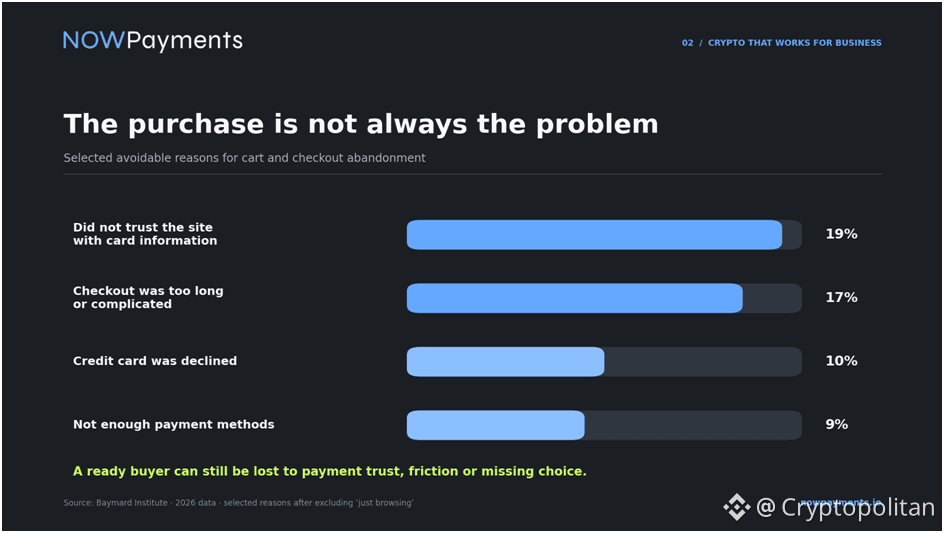
Article
The 22% Sales Boost Hiding in Your Crypto CheckoutBy Kate L., Commercial Director of NOWPayments
If you run an e-commerce business, your next conversion win may come not from another campaign, but from giving ready-to-buy customers a payment method they can actually use.
As Commercial Director of NOWPayments, I work where crypto adoption meets business reality. One problem appears repeatedly: merchants can have demand and still lose the sale at payment. For this article, I reviewed checkout research alongside six months of NOWPayments e-commerce data to examine where conversion leaks, how crypto expands addressable demand, and why implementation determines the result.
This distinction matters because product demand and payment conversion are not the same thing. A customer can want the product, accept the price, and still leave because the available payment methods do not work for them.
This article is part of the Crypto That Works for Business series, a collection of materials about the commercial results behind crypto payments. We begin with e-commerce conversion. Future editions will explore other areas where better payment infrastructure can unlock revenue, reduce costs, and remove friction from growth.
The Conversion Leak Hiding in Checkout
Payment problems account for a meaningful share of abandoned checkouts.
When I went through Baymard Institute’s checkout research, the headline number was striking: the average cart-abandonment rate is 70.22%. Some of that is unavoidable. 42% of respondents said they were simply browsing or were not ready to buy.
The reasons that remain are more useful for merchants. After excluding those shoppers, Baymard found that 19% left because they did not trust the site with their card information, 17% found the checkout too complicated, 10% had their card declined, and 9% could not find enough payment options. These customers did not necessarily reject the product. The payment experience stopped them from completing the order.
Adding payment choices is not about decorating a checkout with more logos. It is about allowing more qualified customers to complete the purchase.
More Relevant Payment Methods Mean More Addressable Demand
Crypto can provide another such path – particularly for global customers, crypto-native audiences, privacy-conscious buyers, and users who cannot or do not want to rely on cards.
A large-scale payment-method study found that offering at least one relevant option beyond cards produced an average 7.4% increase in conversion and a 12% increase in revenue. A separate crypto-checkout case reported a 22% increase in checkout conversion after the payment experience was streamlined.
NOWPayments’ data provides another view. Over the last six months, 63.81% of payments created by e-commerce partners reached Finished status. Another 19.95% expired, meaning the invoice was created but not paid within the available window.
These figures begin later than conventional cart-abandonment metrics and are not directly comparable. Both, however, show that purchase intent can still be lost at payment.
Crypto Converts, but Implementation Decides How Well
Adding crypto creates a conversion opportunity, but the implementation determines how much of that opportunity a merchant captures.
Across two e-commerce implementations in the same six-month dataset, Finished rates ranged from 40.50% to 66.38% – a gap of 25.88 percentage points.
I would not present this as a ranking. The businesses serve different audiences and operate different customer journeys, and the data does not isolate one feature as the cause. The useful finding is the size of the variation.
In my experience, merchants get better results when they answer four questions before launch:
Are the right assets and networks available?
Are the amount, network, and payment window clear?
How quickly is the payment detected and confirmed?
Can the gateway handle payment errors and trigger fulfillment automatically?
A crypto button creates another route to payment. The quality of the integration shapes how well that route converts.
Coverage Has to Match Actual Demand
Crypto is not one payment method. Customers choose an asset and a network based on what they hold, which wallet they use, and the fees they expect to pay.
In NOWPayments’ e-commerce data, BTC accounted for 16.11% of successful payments, ETH for 3.88%, and USDC for 1.63%. Together, the three assets represented 21.62%.
In one partner sample, they represented only 9.67%: BTC accounted for 4.55%, ETH for 3.17%, and USDC for 1.95%. A currency mix that works for one merchant may therefore miss most of another merchant’s demand.
Demand also changes. A separate NOWPayments stablecoin analysis found that USDT accounted for 66.92% of stablecoin transaction volume in the first half of 2026. Meanwhile, USDC transaction count increased 209.02% year over year, while its volume rose 101.63%.
Merchants need broad underlying coverage without overwhelming customers at checkout.
CoinsBee reported greater payment flexibility and stronger conversion after expanding asset availability through NOWPayments. Genghis supports more than 300 cryptocurrencies across more than 98 networks and uses signed webhooks to connect payment confirmation with automatic delivery.
The longest currency list does not automatically win. The gateway must fit the merchant’s audience, product, and purchasing journey.
The Checkout Should Answer Before Support Does
More options help only when customers understand what to do next.
A crypto checkout should answer four questions immediately:
Which asset and network should I use?
How much should I send?
How much time do I have to complete the payment?
What happens after the payment is confirmed?
Unclear instructions and hidden timers create exit points. Delays after confirmation create another: the customer has paid, but the order still appears incomplete.
In my experience, a strong crypto checkout should feel uneventful. It presents clear instructions, detects the transaction quickly, and connects confirmation with the order flow.
Measure the Whole Payment Funnel
Crypto checkout should be measured as a conversion channel, not simply enabled as a technical feature.
The same five questions should guide the strategy from beginning to end:
Find the leak: Where do customers leave – at payment selection, invoice creation, or payment completion?
Offer relevant methods: Do the available payment options reflect real customer demand?
Evaluate the implementation: How many created invoices reach Finished status, and how quickly?
Know the audience: Which assets and networks produce completed payments for this specific merchant?
Remove friction: Are the instructions clear, and does a confirmed payment move the order forward?
These metrics locate the leak. If customers select crypto but do not create an invoice, the entry point may be unclear. Frequent expirations may point to instructions, asset availability, network selection, or timing. Completed payments that do not trigger orders indicate a fulfillment problem.
The business case is no longer limited to whether an online store should accept crypto. The real question is whether the store can make crypto one of its most effective payment options.
Global brands have already moved crypto checkout beyond the experimental stage. Tesla accepts Dogecoin for eligible products in its online store, while Balenciaga has introduced crypto payments through its US e-commerce site. Within the NOWPayments ecosystem, CoinsBee and Genghis demonstrate how the right integration converts that demand into sales. Merchants that delay may be losing customers they have already paid to acquire.
To me, mass adoption begins when crypto produces measurable commercial results. NOWPayments’ data shows the opportunity: 63.81% of created e-commerce payments reached Finished status. The 40.50% to 66.38% range between implementations shows why choosing and configuring the right gateway matters.
Businesses can explore NOWPayments’ e-commerce payment infrastructure to evaluate crypto as part of their checkout funnel.
Next: Where Else Is Payment Friction Costing You Revenue?
Checkout is only one place where money gets stuck. Similar friction can appear wherever a business accepts, moves, or pays out funds.
If this article finds its audience, another edition of Crypto That Works for Business will examine another overlooked point in the payment journey – and what businesses can change to keep more revenue moving.
Where is payment infrastructure quietly costing your business money?
Methodology note: The 22% headline figure is a provider-reported result following a crypto-checkout redesign, not a guaranteed outcome. NOWPayments’ e-commerce data covers the last six months. “Finished” and “Expired” are invoice-level statuses and are not directly comparable with cart-abandonment metrics. Stablecoin figures come from a separate platform-wide analysis covering the first half of 2026. E-commerce asset figures cover BTC, ETH, and USDC only. Partner-level variation does not establish causation by any single checkout feature.
The 22% Sales Boost Hiding in Your Crypto Checkout
By Kate L., Commercial Director of NOWPayments
If you run an e-commerce business, your next conversion win may come not from another campaign, but from giving ready-to-buy customers a payment method they can actually use.
As Commercial Director of NOWPayments, I work where crypto adoption meets business reality. One problem appears repeatedly: merchants can have demand and still lose the sale at payment. For this article, I reviewed checkout research alongside six months of NOWPayments e-commerce data to examine where conversion leaks, how crypto expands addressable demand, and why implementation determines the result.
This distinction matters because product demand and payment conversion are not the same thing. A customer can want the product, accept the price, and still leave because the available payment methods do not work for them.
This article is part of the Crypto That Works for Business series, a collection of materials about the commercial results behind crypto payments. We begin with e-commerce conversion. Future editions will explore other areas where better payment infrastructure can unlock revenue, reduce costs, and remove friction from growth.
The Conversion Leak Hiding in Checkout
Payment problems account for a meaningful share of abandoned checkouts.
When I went through Baymard Institute’s checkout research, the headline number was striking: the average cart-abandonment rate is 70.22%. Some of that is unavoidable. 42% of respondents said they were simply browsing or were not ready to buy.
The reasons that remain are more useful for merchants. After excluding those shoppers, Baymard found that 19% left because they did not trust the site with their card information, 17% found the checkout too complicated, 10% had their card declined, and 9% could not find enough payment options. These customers did not necessarily reject the product. The payment experience stopped them from completing the order.
Adding payment choices is not about decorating a checkout with more logos. It is about allowing more qualified customers to complete the purchase.
More Relevant Payment Methods Mean More Addressable Demand
Crypto can provide another such path – particularly for global customers, crypto-native audiences, privacy-conscious buyers, and users who cannot or do not want to rely on cards.
A large-scale payment-method study found that offering at least one relevant option beyond cards produced an average 7.4% increase in conversion and a 12% increase in revenue. A separate crypto-checkout case reported a 22% increase in checkout conversion after the payment experience was streamlined.
NOWPayments’ data provides another view. Over the last six months, 63.81% of payments created by e-commerce partners reached Finished status. Another 19.95% expired, meaning the invoice was created but not paid within the available window.
These figures begin later than conventional cart-abandonment metrics and are not directly comparable. Both, however, show that purchase intent can still be lost at payment.
Crypto Converts, but Implementation Decides How Well
Adding crypto creates a conversion opportunity, but the implementation determines how much of that opportunity a merchant captures.
Across two e-commerce implementations in the same six-month dataset, Finished rates ranged from 40.50% to 66.38% – a gap of 25.88 percentage points.
I would not present this as a ranking. The businesses serve different audiences and operate different customer journeys, and the data does not isolate one feature as the cause. The useful finding is the size of the variation.
In my experience, merchants get better results when they answer four questions before launch:
Are the right assets and networks available?
Are the amount, network, and payment window clear?
How quickly is the payment detected and confirmed?
Can the gateway handle payment errors and trigger fulfillment automatically?
A crypto button creates another route to payment. The quality of the integration shapes how well that route converts.
Coverage Has to Match Actual Demand
Crypto is not one payment method. Customers choose an asset and a network based on what they hold, which wallet they use, and the fees they expect to pay.
In NOWPayments’ e-commerce data, BTC accounted for 16.11% of successful payments, ETH for 3.88%, and USDC for 1.63%. Together, the three assets represented 21.62%.
In one partner sample, they represented only 9.67%: BTC accounted for 4.55%, ETH for 3.17%, and USDC for 1.95%. A currency mix that works for one merchant may therefore miss most of another merchant’s demand.
Demand also changes. A separate NOWPayments stablecoin analysis found that USDT accounted for 66.92% of stablecoin transaction volume in the first half of 2026. Meanwhile, USDC transaction count increased 209.02% year over year, while its volume rose 101.63%.
Merchants need broad underlying coverage without overwhelming customers at checkout.
CoinsBee reported greater payment flexibility and stronger conversion after expanding asset availability through NOWPayments. Genghis supports more than 300 cryptocurrencies across more than 98 networks and uses signed webhooks to connect payment confirmation with automatic delivery.
The longest currency list does not automatically win. The gateway must fit the merchant’s audience, product, and purchasing journey.
The Checkout Should Answer Before Support Does
More options help only when customers understand what to do next.
A crypto checkout should answer four questions immediately:
Which asset and network should I use?
How much should I send?
How much time do I have to complete the payment?
What happens after the payment is confirmed?
Unclear instructions and hidden timers create exit points. Delays after confirmation create another: the customer has paid, but the order still appears incomplete.
In my experience, a strong crypto checkout should feel uneventful. It presents clear instructions, detects the transaction quickly, and connects confirmation with the order flow.
Measure the Whole Payment Funnel
Crypto checkout should be measured as a conversion channel, not simply enabled as a technical feature.
The same five questions should guide the strategy from beginning to end:
Find the leak: Where do customers leave – at payment selection, invoice creation, or payment completion?
Offer relevant methods: Do the available payment options reflect real customer demand?
Evaluate the implementation: How many created invoices reach Finished status, and how quickly?
Know the audience: Which assets and networks produce completed payments for this specific merchant?
Remove friction: Are the instructions clear, and does a confirmed payment move the order forward?
These metrics locate the leak. If customers select crypto but do not create an invoice, the entry point may be unclear. Frequent expirations may point to instructions, asset availability, network selection, or timing. Completed payments that do not trigger orders indicate a fulfillment problem.
The business case is no longer limited to whether an online store should accept crypto. The real question is whether the store can make crypto one of its most effective payment options.
Global brands have already moved crypto checkout beyond the experimental stage. Tesla accepts Dogecoin for eligible products in its online store, while Balenciaga has introduced crypto payments through its US e-commerce site. Within the NOWPayments ecosystem, CoinsBee and Genghis demonstrate how the right integration converts that demand into sales. Merchants that delay may be losing customers they have already paid to acquire.
To me, mass adoption begins when crypto produces measurable commercial results. NOWPayments’ data shows the opportunity: 63.81% of created e-commerce payments reached Finished status. The 40.50% to 66.38% range between implementations shows why choosing and configuring the right gateway matters.
Businesses can explore NOWPayments’ e-commerce payment infrastructure to evaluate crypto as part of their checkout funnel.
Next: Where Else Is Payment Friction Costing You Revenue?
Checkout is only one place where money gets stuck. Similar friction can appear wherever a business accepts, moves, or pays out funds.
If this article finds its audience, another edition of Crypto That Works for Business will examine another overlooked point in the payment journey – and what businesses can change to keep more revenue moving.
Where is payment infrastructure quietly costing your business money?
Methodology note: The 22% headline figure is a provider-reported result following a crypto-checkout redesign, not a guaranteed outcome. NOWPayments’ e-commerce data covers the last six months. “Finished” and “Expired” are invoice-level statuses and are not directly comparable with cart-abandonment metrics. Stablecoin figures come from a separate platform-wide analysis covering the first half of 2026. E-commerce asset figures cover BTC, ETH, and USDC only. Partner-level variation does not establish causation by any single checkout feature.
If you run an e-commerce business, your next conversion win may come not from another campaign, but from giving ready-to-buy customers a payment method they can actually use.
As Commercial Director of NOWPayments, I work where crypto adoption meets business reality. One problem appears repeatedly: merchants can have demand and still lose the sale at payment. For this article, I reviewed checkout research alongside six months of NOWPayments e-commerce data to examine where conversion leaks, how crypto expands addressable demand, and why implementation determines the result.
This distinction matters because product demand and payment conversion are not the same thing. A customer can want the product, accept the price, and still leave because the available payment methods do not work for them.
This article is part of the Crypto That Works for Business series, a collection of materials about the commercial results behind crypto payments. We begin with e-commerce conversion. Future editions will explore other areas where better payment infrastructure can unlock revenue, reduce costs, and remove friction from growth.
The Conversion Leak Hiding in Checkout
Payment problems account for a meaningful share of abandoned checkouts.
When I went through Baymard Institute’s checkout research, the headline number was striking: the average cart-abandonment rate is 70.22%. Some of that is unavoidable. 42% of respondents said they were simply browsing or were not ready to buy.
The reasons that remain are more useful for merchants. After excluding those shoppers, Baymard found that 19% left because they did not trust the site with their card information, 17% found the checkout too complicated, 10% had their card declined, and 9% could not find enough payment options. These customers did not necessarily reject the product. The payment experience stopped them from completing the order.
Adding payment choices is not about decorating a checkout with more logos. It is about allowing more qualified customers to complete the purchase.
More Relevant Payment Methods Mean More Addressable Demand
Crypto can provide another such path – particularly for global customers, crypto-native audiences, privacy-conscious buyers, and users who cannot or do not want to rely on cards.
A large-scale payment-method study found that offering at least one relevant option beyond cards produced an average 7.4% increase in conversion and a 12% increase in revenue. A separate crypto-checkout case reported a 22% increase in checkout conversion after the payment experience was streamlined.
NOWPayments’ data provides another view. Over the last six months, 63.81% of payments created by e-commerce partners reached Finished status. Another 19.95% expired, meaning the invoice was created but not paid within the available window.
These figures begin later than conventional cart-abandonment metrics and are not directly comparable. Both, however, show that purchase intent can still be lost at payment.
Crypto Converts, but Implementation Decides How Well
Adding crypto creates a conversion opportunity, but the implementation determines how much of that opportunity a merchant captures.
Across two e-commerce implementations in the same six-month dataset, Finished rates ranged from 40.50% to 66.38% – a gap of 25.88 percentage points.
I would not present this as a ranking. The businesses serve different audiences and operate different customer journeys, and the data does not isolate one feature as the cause. The useful finding is the size of the variation.
In my experience, merchants get better results when they answer four questions before launch:
Are the right assets and networks available?
Are the amount, network, and payment window clear?
How quickly is the payment detected and confirmed?
Can the gateway handle payment errors and trigger fulfillment automatically?
A crypto button creates another route to payment. The quality of the integration shapes how well that route converts.
Coverage Has to Match Actual Demand
Crypto is not one payment method. Customers choose an asset and a network based on what they hold, which wallet they use, and the fees they expect to pay.
In NOWPayments’ e-commerce data, BTC accounted for 16.11% of successful payments, ETH for 3.88%, and USDC for 1.63%. Together, the three assets represented 21.62%.
In one partner sample, they represented only 9.67%: BTC accounted for 4.55%, ETH for 3.17%, and USDC for 1.95%. A currency mix that works for one merchant may therefore miss most of another merchant’s demand.
Demand also changes. A separate NOWPayments stablecoin analysis found that USDT accounted for 66.92% of stablecoin transaction volume in the first half of 2026. Meanwhile, USDC transaction count increased 209.02% year over year, while its volume rose 101.63%.
Merchants need broad underlying coverage without overwhelming customers at checkout.
CoinsBee reported greater payment flexibility and stronger conversion after expanding asset availability through NOWPayments. Genghis supports more than 300 cryptocurrencies across more than 98 networks and uses signed webhooks to connect payment confirmation with automatic delivery.
The longest currency list does not automatically win. The gateway must fit the merchant’s audience, product, and purchasing journey.
The Checkout Should Answer Before Support Does
More options help only when customers understand what to do next.
A crypto checkout should answer four questions immediately:
Which asset and network should I use?
How much should I send?
How much time do I have to complete the payment?
What happens after the payment is confirmed?
Unclear instructions and hidden timers create exit points. Delays after confirmation create another: the customer has paid, but the order still appears incomplete.
In my experience, a strong crypto checkout should feel uneventful. It presents clear instructions, detects the transaction quickly, and connects confirmation with the order flow.
Measure the Whole Payment Funnel
Crypto checkout should be measured as a conversion channel, not simply enabled as a technical feature.
The same five questions should guide the strategy from beginning to end:
Find the leak: Where do customers leave – at payment selection, invoice creation, or payment completion?
Offer relevant methods: Do the available payment options reflect real customer demand?
Evaluate the implementation: How many created invoices reach Finished status, and how quickly?
Know the audience: Which assets and networks produce completed payments for this specific merchant?
Remove friction: Are the instructions clear, and does a confirmed payment move the order forward?
These metrics locate the leak. If customers select crypto but do not create an invoice, the entry point may be unclear. Frequent expirations may point to instructions, asset availability, network selection, or timing. Completed payments that do not trigger orders indicate a fulfillment problem.
The business case is no longer limited to whether an online store should accept crypto. The real question is whether the store can make crypto one of its most effective payment options.
Global brands have already moved crypto checkout beyond the experimental stage. Tesla accepts Dogecoin for eligible products in its online store, while Balenciaga has introduced crypto payments through its US e-commerce site. Within the NOWPayments ecosystem, CoinsBee and Genghis demonstrate how the right integration converts that demand into sales. Merchants that delay may be losing customers they have already paid to acquire.
To me, mass adoption begins when crypto produces measurable commercial results. NOWPayments’ data shows the opportunity: 63.81% of created e-commerce payments reached Finished status. The 40.50% to 66.38% range between implementations shows why choosing and configuring the right gateway matters.
Businesses can explore NOWPayments’ e-commerce payment infrastructure to evaluate crypto as part of their checkout funnel.
Next: Where Else Is Payment Friction Costing You Revenue?
Checkout is only one place where money gets stuck. Similar friction can appear wherever a business accepts, moves, or pays out funds.
If this article finds its audience, another edition of Crypto That Works for Business will examine another overlooked point in the payment journey – and what businesses can change to keep more revenue moving.
Where is payment infrastructure quietly costing your business money?
Methodology note: The 22% headline figure is a provider-reported result following a crypto-checkout redesign, not a guaranteed outcome. NOWPayments’ e-commerce data covers the last six months. “Finished” and “Expired” are invoice-level statuses and are not directly comparable with cart-abandonment metrics. Stablecoin figures come from a separate platform-wide analysis covering the first half of 2026. E-commerce asset figures cover BTC, ETH, and USDC only. Partner-level variation does not establish causation by any single checkout feature.
158
Log in to explore more content
Join global crypto users on Binance Square
⚡️ Get latest and useful information about crypto.
💬 Trusted by the world’s largest crypto exchange.
👍 Discover real insights from verified creators.
Email / Phone number
Trending Topics
AppleDebutsFoldablePhone
21,058 views
424 Discussing
Apple just dropped the foldable iPhone — and the market is paying attention. This isn't just another product cycle; it's a new product category, a new CEO on stage, and a $1,999 price tag that pushes $AAPL further into ultra-premium territory. Foldables are the narrative, and Apple is now the headline.
#appledebutsfoldablephone #EUExtendsCentralContactPointToCASPs #US10YTreasuryYieldHitsHighestSinceNov2023 #BrentCrudeTops$100 #USTreasuryToBuyBackUpTo$6BLongDatedDebt
KimHotbae
·2 Likes
·2.6k views
IranSaysReadyToEscalateWarWithUS
871 views
41 Discussing
EUExtendsCentralContactPointToCASPs
4,732 views
140 Discussing