
CryptoFrontNews
17.5k Posts

CryptoFrontNews
 Square Verified+
Report
Block User
CryptoFrontNews (CFN) delivers the latest in cryptocurrency with real-time updates, expert analyses, and in-depth articles on digital currencies and blockchain.
4 Following
12.4K+ Followers
19.0K+ Liked
Posts
Article
XRP Market Gains Attention Amid Gaza CeasefireGaza’s ceasefire agreement creates a calmer geopolitical backdrop while cryptocurrency markets continue monitoring broader risk sentiment.
The $10,000 XRP forecast remains speculative, with no financial model or institutional projection supporting the proposed valuation.
XPUMP’s $200 scenario depends on reaching a $20 billion market value and sustaining sufficient demand and liquidity.
XRP market attention is rising as Gaza ceasefire developments reshape geopolitical sentiment and revive discussion around digital-asset valuations and XRPL growth.
Gaza Ceasefire Sets the Immediate Context
Israel and Hamas agreed to the first phase of Trump’s Gaza peace plan. The agreement followed indirect negotiations held in Egypt. Reuters reported that the deal included ceasefire and hostage-release arrangements.
The agreement also included an Israeli military withdrawal to an agreed line. However, several implementation details remained unresolved after the announcement. Those outstanding issues could still affect the agreement’s longer-term progress.
The deal formed part of Trump’s broader 20-point framework for Gaza. It followed two years of conflict that reshaped regional political and security conditions. The initial phase represented progress toward reducing hostilities between the parties.
The posted video shows Trump signing the agreement in Sharm El-Sheikh. Its presence provides geopolitical context for the cryptocurrency discussion. However, the image does not establish any direct connection with XRP.
XRP Forecasts Drive the Crypto Narrative
The XRP Avengers post offers a very bullish prediction for XRP and XRPL. The report predicts XRP may eventually hit the price of $10,000 per coin. The post attributes that prediction to rumors involving a claimed divine vision.
https://twitter.com/XRP_Avengers/status/2096812112181915738?s=20
That projection remains separate from conventional financial valuation methods. No institutional forecast or detailed valuation model supports the proposed $10,000 target. Therefore, the figure remains a speculative scenario presented within the post.
XRP as of writing trades around $1.41, according to CoinGecko market data. Its recent seven-day range extends between approximately $1.31 and $1.48. The current market level remains far below the $10,000 projection.
A move toward $10,000 would require extraordinary valuation expansion. Such an outcome would require sustained demand across multiple global markets. It would also require substantially deeper liquidity and broader network utilization.
XPUMP Adds Another XRPL Speculative Scenario
The XRP Avengers post also promotes XPUMP as an XRPL-based meme project. It claims Binance and MEXC have provided institutional support for the token. The supplied material does not independently establish direct institutional investment in XPUMP.
The post-projects XPUMP could reach a $20 billion market capitalization. It then suggests the token could rise from $0.40 toward $200. That scenario depends heavily on circulating supply and sustained market demand.
Market capitalization alone does not guarantee a particular token price. Trading liquidity must also support transactions around any proposed valuation. Therefore, the $200 projection remains hypothetical rather than an established market target.
The wider narrative centers on growing activity across the XRP Ledger ecosystem. XRP remains the network’s native asset and supports transactions across its infrastructure. Meanwhile, XPUMP represents a separate speculative asset operating within that ecosystem.
The Gaza agreement and these cryptocurrency forecasts represent separate developments. Reduced geopolitical tensions can influence broader risk sentiment, but they create no direct XRP valuation mechanism. Current market activity, liquidity, adoption, and XRPL usage provide more measurable reference points.
XRP Market Gains Attention Amid Gaza Ceasefire
Gaza’s ceasefire agreement creates a calmer geopolitical backdrop while cryptocurrency markets continue monitoring broader risk sentiment.
The $10,000 XRP forecast remains speculative, with no financial model or institutional projection supporting the proposed valuation.
XPUMP’s $200 scenario depends on reaching a $20 billion market value and sustaining sufficient demand and liquidity.
XRP market attention is rising as Gaza ceasefire developments reshape geopolitical sentiment and revive discussion around digital-asset valuations and XRPL growth.
Gaza Ceasefire Sets the Immediate Context
Israel and Hamas agreed to the first phase of Trump’s Gaza peace plan. The agreement followed indirect negotiations held in Egypt. Reuters reported that the deal included ceasefire and hostage-release arrangements.
The agreement also included an Israeli military withdrawal to an agreed line. However, several implementation details remained unresolved after the announcement. Those outstanding issues could still affect the agreement’s longer-term progress.
The deal formed part of Trump’s broader 20-point framework for Gaza. It followed two years of conflict that reshaped regional political and security conditions. The initial phase represented progress toward reducing hostilities between the parties.
The posted video shows Trump signing the agreement in Sharm El-Sheikh. Its presence provides geopolitical context for the cryptocurrency discussion. However, the image does not establish any direct connection with XRP.
XRP Forecasts Drive the Crypto Narrative
The XRP Avengers post offers a very bullish prediction for XRP and XRPL. The report predicts XRP may eventually hit the price of $10,000 per coin. The post attributes that prediction to rumors involving a claimed divine vision.
https://twitter.com/XRP_Avengers/status/2096812112181915738?s=20
That projection remains separate from conventional financial valuation methods. No institutional forecast or detailed valuation model supports the proposed $10,000 target. Therefore, the figure remains a speculative scenario presented within the post.
XRP as of writing trades around $1.41, according to CoinGecko market data. Its recent seven-day range extends between approximately $1.31 and $1.48. The current market level remains far below the $10,000 projection.
A move toward $10,000 would require extraordinary valuation expansion. Such an outcome would require sustained demand across multiple global markets. It would also require substantially deeper liquidity and broader network utilization.
XPUMP Adds Another XRPL Speculative Scenario
The XRP Avengers post also promotes XPUMP as an XRPL-based meme project. It claims Binance and MEXC have provided institutional support for the token. The supplied material does not independently establish direct institutional investment in XPUMP.
The post-projects XPUMP could reach a $20 billion market capitalization. It then suggests the token could rise from $0.40 toward $200. That scenario depends heavily on circulating supply and sustained market demand.
Market capitalization alone does not guarantee a particular token price. Trading liquidity must also support transactions around any proposed valuation. Therefore, the $200 projection remains hypothetical rather than an established market target.
The wider narrative centers on growing activity across the XRP Ledger ecosystem. XRP remains the network’s native asset and supports transactions across its infrastructure. Meanwhile, XPUMP represents a separate speculative asset operating within that ecosystem.
The Gaza agreement and these cryptocurrency forecasts represent separate developments. Reduced geopolitical tensions can influence broader risk sentiment, but they create no direct XRP valuation mechanism. Current market activity, liquidity, adoption, and XRPL usage provide more measurable reference points.
The $10,000 XRP forecast remains speculative, with no financial model or institutional projection supporting the proposed valuation.
XPUMP’s $200 scenario depends on reaching a $20 billion market value and sustaining sufficient demand and liquidity.
XRP market attention is rising as Gaza ceasefire developments reshape geopolitical sentiment and revive discussion around digital-asset valuations and XRPL growth.
Gaza Ceasefire Sets the Immediate Context
Israel and Hamas agreed to the first phase of Trump’s Gaza peace plan. The agreement followed indirect negotiations held in Egypt. Reuters reported that the deal included ceasefire and hostage-release arrangements.
The agreement also included an Israeli military withdrawal to an agreed line. However, several implementation details remained unresolved after the announcement. Those outstanding issues could still affect the agreement’s longer-term progress.
The deal formed part of Trump’s broader 20-point framework for Gaza. It followed two years of conflict that reshaped regional political and security conditions. The initial phase represented progress toward reducing hostilities between the parties.
The posted video shows Trump signing the agreement in Sharm El-Sheikh. Its presence provides geopolitical context for the cryptocurrency discussion. However, the image does not establish any direct connection with XRP.
XRP Forecasts Drive the Crypto Narrative
The XRP Avengers post offers a very bullish prediction for XRP and XRPL. The report predicts XRP may eventually hit the price of $10,000 per coin. The post attributes that prediction to rumors involving a claimed divine vision.
https://twitter.com/XRP_Avengers/status/2096812112181915738?s=20
That projection remains separate from conventional financial valuation methods. No institutional forecast or detailed valuation model supports the proposed $10,000 target. Therefore, the figure remains a speculative scenario presented within the post.
XRP as of writing trades around $1.41, according to CoinGecko market data. Its recent seven-day range extends between approximately $1.31 and $1.48. The current market level remains far below the $10,000 projection.
A move toward $10,000 would require extraordinary valuation expansion. Such an outcome would require sustained demand across multiple global markets. It would also require substantially deeper liquidity and broader network utilization.
XPUMP Adds Another XRPL Speculative Scenario
The XRP Avengers post also promotes XPUMP as an XRPL-based meme project. It claims Binance and MEXC have provided institutional support for the token. The supplied material does not independently establish direct institutional investment in XPUMP.
The post-projects XPUMP could reach a $20 billion market capitalization. It then suggests the token could rise from $0.40 toward $200. That scenario depends heavily on circulating supply and sustained market demand.
Market capitalization alone does not guarantee a particular token price. Trading liquidity must also support transactions around any proposed valuation. Therefore, the $200 projection remains hypothetical rather than an established market target.
The wider narrative centers on growing activity across the XRP Ledger ecosystem. XRP remains the network’s native asset and supports transactions across its infrastructure. Meanwhile, XPUMP represents a separate speculative asset operating within that ecosystem.
The Gaza agreement and these cryptocurrency forecasts represent separate developments. Reduced geopolitical tensions can influence broader risk sentiment, but they create no direct XRP valuation mechanism. Current market activity, liquidity, adoption, and XRPL usage provide more measurable reference points.
60

Article
Tesla Still Holds 11,500 BTC as Arkham Reveals Bitcoin Selling HistoryTesla bought 43,770 BTC for $1.5 billion in February 2021 before selling 4,670 BTC for $260.2 million later that year for profit.
Tesla moved 30,690 BTC to Coinbase during the 2022 LUNA collapse, sharply reducing its Bitcoin holdings to a near 8,430 BTC level.
Arkham estimates Tesla and SpaceX now hold about $1.3 billion in Bitcoin after Tesla retained remaining BTC through the FTX crash.
Tesla still holds about 11,500 Bitcoin after cutting most of its position during the 2022 market crash. Arkham’s research found Tesla bought $1.5 billion in Bitcoin in February 2021, sold 4,670 BTC later that year, and moved 30,690 BTC to Coinbase during the LUNA collapse.
https://twitter.com/arkham/status/2097249498820964633?s=20
Tesla’s $1.5 Billion Bitcoin Purchase
Tesla bought 43,770 BTC on Feb. 1, 2021, at an average price near $34,270. Elon Musk directed the purchase as Tesla sought greater flexibility for its cash holdings. The position quickly gained value as Bitcoin climbed.
After two weeks, Tesla’s holdings exceeded $2 billion. Three weeks later, they reached about $2.5 billion. Tesla then sold 4,670 BTC across March and April 2021 for roughly $260.2 million. The company generated about $100.2 million in profit from those sales.
However, Tesla continued holding almost 40,000 BTC through the rest of 2021. At Bitcoin’s Nov. 7 peak, the position showed about $1.5 billion in additional profit.
LUNA Collapse Reshapes Tesla’s BTC Holdings
The next major change came during the Terra ecosystem collapse in May 2022. Tesla moved 30,690 BTC to Coinbase as Bitcoin prices fell sharply. Arkham’s research indicates Tesla intended to sell most of that transfer.
The move reduced Tesla’s holdings to about 8,430 BTC, worth roughly $250 million. However, on-chain activity in June suggested Tesla may have reacquired Bitcoin from Coinbase. It also remained possible that some transferred BTC never reached the market.
Following those movements, Tesla appeared to hold roughly 11,500 BTC. That figure has remained largely unchanged since mid-2022.
Tesla Held Bitcoin Through FTX Collapse
Tesla did not sell additional Bitcoin during the FTX collapse later in 2022. Bitcoin fell another 50%, leaving Tesla more than $100 million below its cost basis temporarily. Meanwhile, Tesla had earlier suspended Bitcoin vehicle payments after accepting BTC briefly.
The company cited concerns about Bitcoin mining’s environmental impact. Elon Musk’s public comments also addressed Bitcoin, Dogecoin, payments and renewable-powered mining.
Arkham additionally identified wallet activity associated with SpaceX that resembled Tesla’s transactions. At one point, Tesla and SpaceX together held more than $4.2 billion in Bitcoin. Their combined holdings now carry a value of roughly $1.3 billion.
Tesla Still Holds 11,500 BTC as Arkham Reveals Bitcoin Selling History
Tesla bought 43,770 BTC for $1.5 billion in February 2021 before selling 4,670 BTC for $260.2 million later that year for profit.
Tesla moved 30,690 BTC to Coinbase during the 2022 LUNA collapse, sharply reducing its Bitcoin holdings to a near 8,430 BTC level.
Arkham estimates Tesla and SpaceX now hold about $1.3 billion in Bitcoin after Tesla retained remaining BTC through the FTX crash.
Tesla still holds about 11,500 Bitcoin after cutting most of its position during the 2022 market crash. Arkham’s research found Tesla bought $1.5 billion in Bitcoin in February 2021, sold 4,670 BTC later that year, and moved 30,690 BTC to Coinbase during the LUNA collapse.
https://twitter.com/arkham/status/2097249498820964633?s=20
Tesla’s $1.5 Billion Bitcoin Purchase
Tesla bought 43,770 BTC on Feb. 1, 2021, at an average price near $34,270. Elon Musk directed the purchase as Tesla sought greater flexibility for its cash holdings. The position quickly gained value as Bitcoin climbed.
After two weeks, Tesla’s holdings exceeded $2 billion. Three weeks later, they reached about $2.5 billion. Tesla then sold 4,670 BTC across March and April 2021 for roughly $260.2 million. The company generated about $100.2 million in profit from those sales.
However, Tesla continued holding almost 40,000 BTC through the rest of 2021. At Bitcoin’s Nov. 7 peak, the position showed about $1.5 billion in additional profit.
LUNA Collapse Reshapes Tesla’s BTC Holdings
The next major change came during the Terra ecosystem collapse in May 2022. Tesla moved 30,690 BTC to Coinbase as Bitcoin prices fell sharply. Arkham’s research indicates Tesla intended to sell most of that transfer.
The move reduced Tesla’s holdings to about 8,430 BTC, worth roughly $250 million. However, on-chain activity in June suggested Tesla may have reacquired Bitcoin from Coinbase. It also remained possible that some transferred BTC never reached the market.
Following those movements, Tesla appeared to hold roughly 11,500 BTC. That figure has remained largely unchanged since mid-2022.
Tesla Held Bitcoin Through FTX Collapse
Tesla did not sell additional Bitcoin during the FTX collapse later in 2022. Bitcoin fell another 50%, leaving Tesla more than $100 million below its cost basis temporarily. Meanwhile, Tesla had earlier suspended Bitcoin vehicle payments after accepting BTC briefly.
The company cited concerns about Bitcoin mining’s environmental impact. Elon Musk’s public comments also addressed Bitcoin, Dogecoin, payments and renewable-powered mining.
Arkham additionally identified wallet activity associated with SpaceX that resembled Tesla’s transactions. At one point, Tesla and SpaceX together held more than $4.2 billion in Bitcoin. Their combined holdings now carry a value of roughly $1.3 billion.
Tesla moved 30,690 BTC to Coinbase during the 2022 LUNA collapse, sharply reducing its Bitcoin holdings to a near 8,430 BTC level.
Arkham estimates Tesla and SpaceX now hold about $1.3 billion in Bitcoin after Tesla retained remaining BTC through the FTX crash.
Tesla still holds about 11,500 Bitcoin after cutting most of its position during the 2022 market crash. Arkham’s research found Tesla bought $1.5 billion in Bitcoin in February 2021, sold 4,670 BTC later that year, and moved 30,690 BTC to Coinbase during the LUNA collapse.
https://twitter.com/arkham/status/2097249498820964633?s=20
Tesla’s $1.5 Billion Bitcoin Purchase
Tesla bought 43,770 BTC on Feb. 1, 2021, at an average price near $34,270. Elon Musk directed the purchase as Tesla sought greater flexibility for its cash holdings. The position quickly gained value as Bitcoin climbed.
After two weeks, Tesla’s holdings exceeded $2 billion. Three weeks later, they reached about $2.5 billion. Tesla then sold 4,670 BTC across March and April 2021 for roughly $260.2 million. The company generated about $100.2 million in profit from those sales.
However, Tesla continued holding almost 40,000 BTC through the rest of 2021. At Bitcoin’s Nov. 7 peak, the position showed about $1.5 billion in additional profit.
LUNA Collapse Reshapes Tesla’s BTC Holdings
The next major change came during the Terra ecosystem collapse in May 2022. Tesla moved 30,690 BTC to Coinbase as Bitcoin prices fell sharply. Arkham’s research indicates Tesla intended to sell most of that transfer.
The move reduced Tesla’s holdings to about 8,430 BTC, worth roughly $250 million. However, on-chain activity in June suggested Tesla may have reacquired Bitcoin from Coinbase. It also remained possible that some transferred BTC never reached the market.
Following those movements, Tesla appeared to hold roughly 11,500 BTC. That figure has remained largely unchanged since mid-2022.
Tesla Held Bitcoin Through FTX Collapse
Tesla did not sell additional Bitcoin during the FTX collapse later in 2022. Bitcoin fell another 50%, leaving Tesla more than $100 million below its cost basis temporarily. Meanwhile, Tesla had earlier suspended Bitcoin vehicle payments after accepting BTC briefly.
The company cited concerns about Bitcoin mining’s environmental impact. Elon Musk’s public comments also addressed Bitcoin, Dogecoin, payments and renewable-powered mining.
Arkham additionally identified wallet activity associated with SpaceX that resembled Tesla’s transactions. At one point, Tesla and SpaceX together held more than $4.2 billion in Bitcoin. Their combined holdings now carry a value of roughly $1.3 billion.
136

Article
Best Altcoins to Watch: Apeing Blasts Into Stage 3 After Raising $68K+ in Under 24 Hours – What’s...What happens when yesterday’s crypto giants start flashing new signals? And what if the next opportunity is already climbing through its presale stages? For traders scanning the best altcoins to watch, Chainlink and Tron are delivering two very different stories right now. LINK is facing fresh momentum questions after its powerful rally, while TRON is stepping further into mainstream crypto through its staked TRX ETF. The contrast is putting established altcoins and emerging projects firmly back in the spotlight.
That is where Apeing enters the conversation. The Apeing presale is LIVE in Stage 3, Paper Hand Panic, with the current price at $0.0004 and a limited allocation of 300 million tokens. The next stage moves to $0.0005, while the stated listing price is $0.01, giving the live presale a clear price-progression narrative as Apeing moves through its 33-stage structure.
Best Altcoins to Watch: Why Apeing's Stage 3 Window Is Getting Attention
This is where Apeing stops looking like another token quietly sitting in a presale and starts looking like a clock that is already ticking. Apeing is positioning itself as “The OG Degen Coin,” built around participation, conviction and community. But the immediate attraction is simple: the presale is LIVE, Stage 3 has a limited allocation, and the price is scheduled to rise in subsequent stages. The project has structured its presale across 33 stages, with 40% of the total 16.75 billion $APEING supply allocated to the presale. Early stages therefore give participants access before later stages carry higher prices.
Apeing is currently in Stage 3, Paper Hand Panic, priced at $0.0004. The project has raised $68,175 and has 211 holders, with over 380M $APEING tokens sold. The stated potential ROI is 2,400%, based on the $0.01 listing target. Apeing has a 16.75B total supply, with 40% allocated to the presale across 33 stages. The project is an Ethereum ERC-20 token, with liquidity locked for 18 months.
There is also a scarcity mechanism that adds another layer to the story. When a presale stage closes with tokens left unsold, those tokens are burned. That creates a straightforward dynamic: the available allocation is not simply waiting indefinitely. As stages close, the structure moves forward, while unsold tokens can be removed from supply. For readers scanning the best altcoins to watch, Apeing's appeal is therefore centered on timing, stage progression and scarcity rather than simply chasing an already-established market price.
Best Altcoins to Watch: The Apeing Price Gap That Has Traders Looking Twice
Apeing's stated $0.01 listing price creates an eye-catching theoretical gap from the current $0.0004 Stage 3 price.
MetricApeingCurrent Stage 3 Price$0.0004Stated Listing Price$0.01$1,000 at Stage 32,500,000 $APEINGTheoretical value at $0.01$25,000
At the current presale price of $0.0004, a $1,000 purchase would acquire approximately 2.5 million tokens. At a $0.01 listing price, those tokens would have a theoretical market value of approximately $25,000, before fees and assuming the stated listing price were reached. The calculation is illustrative and shows why the difference between presale stages and the stated listing price is attracting attention.
Apeing is also built on Ethereum as an ERC-20 token, giving the project a familiar technical foundation while its brand leans aggressively into degen culture. The combination of a fixed 16.75 billion supply, stage-based pricing and a live presale gives the project a very different narrative from established altcoins that have already spent years trading in open markets.
How to Buy Apeing Presale
The Apeing presale is already LIVE. To participate, use the official Apeing website and official project channels for the current presale information, including the active stage, price and participation process.
Because the presale advances through defined stages, the current price should always be checked through Apeing's official channels before participating.
Chainlink Rally Hits a Speed Bump as New Signals Put LINK Traders on Alert
Chainlink (LINK) has delivered a powerful rally, climbing roughly 95% in two months from around $7 to a recent high of $13.77. Yet analyst Ali Martinez has highlighted a TD Sequential sell signal on LINK's weekly chart, while transactions worth more than $1 million fell from roughly 59 over two weeks to about 10 on September 7. Around 1.75 million LINK also moved onto exchanges, lifting exchange balances from about 269.25 million to roughly 271 million. The combination has traders watching for a possible cooling period after the sharp advance.
The broader Chainlink story remains active. Charles Schwab announced plans to add LINK, alongside Solana and Avalanche, to Schwab Crypto accounts in the coming months. Wyoming also adopted Chainlink Proof of Reserve for its Frontier Stable Token, enabling near-real-time on-chain verification of reserves. Meanwhile, market watchers remain focused on LINK's ability to maintain higher-timeframe support following its strong run.
TRON Breaks Into a New Market Chapter With Staked TRX ETF
TRON is stepping into a major new chapter as the Canary Staked TRX ETF, trading under the ticker TRXS, is set to debut on Cboe on September 9. The product gives traditional-market participants exposure to TRX while incorporating staking into the fund structure. The prospectus describes a secondary objective of earning additional TRX through the network's proof-of-stake process, with staking rewards reflected in the fund's net asset value. The product carries a 1.10% annual sponsor fee, while staking fees are capped at 20% of generated rewards.
The ETF arrives as TRON continues to command substantial stablecoin activity. During Q2 2026, the network processed approximately $2.1 trillion in USDT transfers, while its stablecoin market capitalization reached $89.2 billion. USDT represented about 98.5% of that total. The new TRXS product adds another bridge between TRON's on-chain activity and traditional financial markets, giving the TRX story another major headline for crypto news today.
Conclusion: Established Giants, One Early-Stage Challenger
Chainlink is dealing with fresh momentum questions after a major rally, even as institutional and public-sector developments continue strengthening its broader story. TRON, meanwhile, is gaining attention through the arrival of a staked TRX ETF and its enormous stablecoin settlement activity. Apeing sits at a very different point in the cycle, with its opportunity centered on an already-live presale and stage-based entry.
The Apeing presale is LIVE now in Stage 3 at $0.0004, with a limited 300 million-token allocation before the next stage price rises to $0.0005. The stated listing price is $0.01, while the 33-stage structure means the current stage will not remain the current stage forever. For those tracking the best altcoins to watch, the question is not simply what is making headlines today. It is what is already moving before the next price step. APE HARD. HOLD STRONG. BUILD WEALTH.
For More Information:
Website: Visit the Official Apeing Website
Telegram: Join the Apeing Telegram Channel
Twitter: Follow Apeing ON X (Formerly Twitter)
FAQs About Best Altcoins to Watch
Is Chainlink a good altcoin to watch right now?
Chainlink remains closely watched following its major rally, particularly as traders assess recent technical and on-chain signals alongside new institutional developments.
What is happening with Tron today?
TRON is receiving major attention as Canary Capital's Staked TRX ETF, ticker TRXS, is set to debut on Cboe, adding another route for traditional-market exposure to TRX.
Why is Chainlink in the crypto news today?
LINK is in focus after a roughly 95% rally was followed by a weekly TD Sequential sell signal, reduced large transactions and increased exchange balances.
Is the Apeing presale live right now?
Yes. Apeing's presale is LIVE in Stage 3, Paper Hand Panic, with the current supplied price at $0.0004 and a limited 300 million-token stage allocation.
What makes Apeing's presale different?
Apeing combines a 33-stage presale, rising stage prices, a fixed 16.75 billion-token supply and an unsold-token burn mechanism, with additional ecosystem features including staking and referrals.
Summary
Chainlink and TRON are generating major headlines, with LINK navigating post-rally momentum signals and TRON entering a new phase through the Canary Staked TRX ETF. Meanwhile, Apeing offers an early-stage story through its LIVE presale. Stage 3 is currently priced at $0.0004 with a 300 million-token allocation, while the next stage rises to $0.0005. With a stated listing price of $0.01 and a 33-stage presale structure, Apeing is built around the idea that timing matters. For crypto followers searching for the best altcoins to watch, Apeing's live stage progression puts it firmly on the radar.
Best Altcoins to Watch: Apeing Blasts Into Stage 3 After Raising $68K+ in Under 24 Hours – What’s...
What happens when yesterday’s crypto giants start flashing new signals? And what if the next opportunity is already climbing through its presale stages? For traders scanning the best altcoins to watch, Chainlink and Tron are delivering two very different stories right now. LINK is facing fresh momentum questions after its powerful rally, while TRON is stepping further into mainstream crypto through its staked TRX ETF. The contrast is putting established altcoins and emerging projects firmly back in the spotlight.
That is where Apeing enters the conversation. The Apeing presale is LIVE in Stage 3, Paper Hand Panic, with the current price at $0.0004 and a limited allocation of 300 million tokens. The next stage moves to $0.0005, while the stated listing price is $0.01, giving the live presale a clear price-progression narrative as Apeing moves through its 33-stage structure.
Best Altcoins to Watch: Why Apeing's Stage 3 Window Is Getting Attention
This is where Apeing stops looking like another token quietly sitting in a presale and starts looking like a clock that is already ticking. Apeing is positioning itself as “The OG Degen Coin,” built around participation, conviction and community. But the immediate attraction is simple: the presale is LIVE, Stage 3 has a limited allocation, and the price is scheduled to rise in subsequent stages. The project has structured its presale across 33 stages, with 40% of the total 16.75 billion $APEING supply allocated to the presale. Early stages therefore give participants access before later stages carry higher prices.
Apeing is currently in Stage 3, Paper Hand Panic, priced at $0.0004. The project has raised $68,175 and has 211 holders, with over 380M $APEING tokens sold. The stated potential ROI is 2,400%, based on the $0.01 listing target. Apeing has a 16.75B total supply, with 40% allocated to the presale across 33 stages. The project is an Ethereum ERC-20 token, with liquidity locked for 18 months.
There is also a scarcity mechanism that adds another layer to the story. When a presale stage closes with tokens left unsold, those tokens are burned. That creates a straightforward dynamic: the available allocation is not simply waiting indefinitely. As stages close, the structure moves forward, while unsold tokens can be removed from supply. For readers scanning the best altcoins to watch, Apeing's appeal is therefore centered on timing, stage progression and scarcity rather than simply chasing an already-established market price.
Best Altcoins to Watch: The Apeing Price Gap That Has Traders Looking Twice
Apeing's stated $0.01 listing price creates an eye-catching theoretical gap from the current $0.0004 Stage 3 price.
MetricApeingCurrent Stage 3 Price$0.0004Stated Listing Price$0.01$1,000 at Stage 32,500,000 $APEINGTheoretical value at $0.01$25,000
At the current presale price of $0.0004, a $1,000 purchase would acquire approximately 2.5 million tokens. At a $0.01 listing price, those tokens would have a theoretical market value of approximately $25,000, before fees and assuming the stated listing price were reached. The calculation is illustrative and shows why the difference between presale stages and the stated listing price is attracting attention.
Apeing is also built on Ethereum as an ERC-20 token, giving the project a familiar technical foundation while its brand leans aggressively into degen culture. The combination of a fixed 16.75 billion supply, stage-based pricing and a live presale gives the project a very different narrative from established altcoins that have already spent years trading in open markets.
How to Buy Apeing Presale
The Apeing presale is already LIVE. To participate, use the official Apeing website and official project channels for the current presale information, including the active stage, price and participation process.
Because the presale advances through defined stages, the current price should always be checked through Apeing's official channels before participating.
Chainlink Rally Hits a Speed Bump as New Signals Put LINK Traders on Alert
Chainlink (LINK) has delivered a powerful rally, climbing roughly 95% in two months from around $7 to a recent high of $13.77. Yet analyst Ali Martinez has highlighted a TD Sequential sell signal on LINK's weekly chart, while transactions worth more than $1 million fell from roughly 59 over two weeks to about 10 on September 7. Around 1.75 million LINK also moved onto exchanges, lifting exchange balances from about 269.25 million to roughly 271 million. The combination has traders watching for a possible cooling period after the sharp advance.
The broader Chainlink story remains active. Charles Schwab announced plans to add LINK, alongside Solana and Avalanche, to Schwab Crypto accounts in the coming months. Wyoming also adopted Chainlink Proof of Reserve for its Frontier Stable Token, enabling near-real-time on-chain verification of reserves. Meanwhile, market watchers remain focused on LINK's ability to maintain higher-timeframe support following its strong run.
TRON Breaks Into a New Market Chapter With Staked TRX ETF
TRON is stepping into a major new chapter as the Canary Staked TRX ETF, trading under the ticker TRXS, is set to debut on Cboe on September 9. The product gives traditional-market participants exposure to TRX while incorporating staking into the fund structure. The prospectus describes a secondary objective of earning additional TRX through the network's proof-of-stake process, with staking rewards reflected in the fund's net asset value. The product carries a 1.10% annual sponsor fee, while staking fees are capped at 20% of generated rewards.
The ETF arrives as TRON continues to command substantial stablecoin activity. During Q2 2026, the network processed approximately $2.1 trillion in USDT transfers, while its stablecoin market capitalization reached $89.2 billion. USDT represented about 98.5% of that total. The new TRXS product adds another bridge between TRON's on-chain activity and traditional financial markets, giving the TRX story another major headline for crypto news today.
Conclusion: Established Giants, One Early-Stage Challenger
Chainlink is dealing with fresh momentum questions after a major rally, even as institutional and public-sector developments continue strengthening its broader story. TRON, meanwhile, is gaining attention through the arrival of a staked TRX ETF and its enormous stablecoin settlement activity. Apeing sits at a very different point in the cycle, with its opportunity centered on an already-live presale and stage-based entry.
The Apeing presale is LIVE now in Stage 3 at $0.0004, with a limited 300 million-token allocation before the next stage price rises to $0.0005. The stated listing price is $0.01, while the 33-stage structure means the current stage will not remain the current stage forever. For those tracking the best altcoins to watch, the question is not simply what is making headlines today. It is what is already moving before the next price step. APE HARD. HOLD STRONG. BUILD WEALTH.
For More Information:
Website: Visit the Official Apeing Website
Telegram: Join the Apeing Telegram Channel
Twitter: Follow Apeing ON X (Formerly Twitter)
FAQs About Best Altcoins to Watch
Is Chainlink a good altcoin to watch right now?
Chainlink remains closely watched following its major rally, particularly as traders assess recent technical and on-chain signals alongside new institutional developments.
What is happening with Tron today?
TRON is receiving major attention as Canary Capital's Staked TRX ETF, ticker TRXS, is set to debut on Cboe, adding another route for traditional-market exposure to TRX.
Why is Chainlink in the crypto news today?
LINK is in focus after a roughly 95% rally was followed by a weekly TD Sequential sell signal, reduced large transactions and increased exchange balances.
Is the Apeing presale live right now?
Yes. Apeing's presale is LIVE in Stage 3, Paper Hand Panic, with the current supplied price at $0.0004 and a limited 300 million-token stage allocation.
What makes Apeing's presale different?
Apeing combines a 33-stage presale, rising stage prices, a fixed 16.75 billion-token supply and an unsold-token burn mechanism, with additional ecosystem features including staking and referrals.
Summary
Chainlink and TRON are generating major headlines, with LINK navigating post-rally momentum signals and TRON entering a new phase through the Canary Staked TRX ETF. Meanwhile, Apeing offers an early-stage story through its LIVE presale. Stage 3 is currently priced at $0.0004 with a 300 million-token allocation, while the next stage rises to $0.0005. With a stated listing price of $0.01 and a 33-stage presale structure, Apeing is built around the idea that timing matters. For crypto followers searching for the best altcoins to watch, Apeing's live stage progression puts it firmly on the radar.
That is where Apeing enters the conversation. The Apeing presale is LIVE in Stage 3, Paper Hand Panic, with the current price at $0.0004 and a limited allocation of 300 million tokens. The next stage moves to $0.0005, while the stated listing price is $0.01, giving the live presale a clear price-progression narrative as Apeing moves through its 33-stage structure.
Best Altcoins to Watch: Why Apeing's Stage 3 Window Is Getting Attention
This is where Apeing stops looking like another token quietly sitting in a presale and starts looking like a clock that is already ticking. Apeing is positioning itself as “The OG Degen Coin,” built around participation, conviction and community. But the immediate attraction is simple: the presale is LIVE, Stage 3 has a limited allocation, and the price is scheduled to rise in subsequent stages. The project has structured its presale across 33 stages, with 40% of the total 16.75 billion $APEING supply allocated to the presale. Early stages therefore give participants access before later stages carry higher prices.
Apeing is currently in Stage 3, Paper Hand Panic, priced at $0.0004. The project has raised $68,175 and has 211 holders, with over 380M $APEING tokens sold. The stated potential ROI is 2,400%, based on the $0.01 listing target. Apeing has a 16.75B total supply, with 40% allocated to the presale across 33 stages. The project is an Ethereum ERC-20 token, with liquidity locked for 18 months.
There is also a scarcity mechanism that adds another layer to the story. When a presale stage closes with tokens left unsold, those tokens are burned. That creates a straightforward dynamic: the available allocation is not simply waiting indefinitely. As stages close, the structure moves forward, while unsold tokens can be removed from supply. For readers scanning the best altcoins to watch, Apeing's appeal is therefore centered on timing, stage progression and scarcity rather than simply chasing an already-established market price.
Best Altcoins to Watch: The Apeing Price Gap That Has Traders Looking Twice
Apeing's stated $0.01 listing price creates an eye-catching theoretical gap from the current $0.0004 Stage 3 price.
MetricApeingCurrent Stage 3 Price$0.0004Stated Listing Price$0.01$1,000 at Stage 32,500,000 $APEINGTheoretical value at $0.01$25,000
At the current presale price of $0.0004, a $1,000 purchase would acquire approximately 2.5 million tokens. At a $0.01 listing price, those tokens would have a theoretical market value of approximately $25,000, before fees and assuming the stated listing price were reached. The calculation is illustrative and shows why the difference between presale stages and the stated listing price is attracting attention.
Apeing is also built on Ethereum as an ERC-20 token, giving the project a familiar technical foundation while its brand leans aggressively into degen culture. The combination of a fixed 16.75 billion supply, stage-based pricing and a live presale gives the project a very different narrative from established altcoins that have already spent years trading in open markets.
How to Buy Apeing Presale
The Apeing presale is already LIVE. To participate, use the official Apeing website and official project channels for the current presale information, including the active stage, price and participation process.
Because the presale advances through defined stages, the current price should always be checked through Apeing's official channels before participating.
Chainlink Rally Hits a Speed Bump as New Signals Put LINK Traders on Alert
Chainlink (LINK) has delivered a powerful rally, climbing roughly 95% in two months from around $7 to a recent high of $13.77. Yet analyst Ali Martinez has highlighted a TD Sequential sell signal on LINK's weekly chart, while transactions worth more than $1 million fell from roughly 59 over two weeks to about 10 on September 7. Around 1.75 million LINK also moved onto exchanges, lifting exchange balances from about 269.25 million to roughly 271 million. The combination has traders watching for a possible cooling period after the sharp advance.
The broader Chainlink story remains active. Charles Schwab announced plans to add LINK, alongside Solana and Avalanche, to Schwab Crypto accounts in the coming months. Wyoming also adopted Chainlink Proof of Reserve for its Frontier Stable Token, enabling near-real-time on-chain verification of reserves. Meanwhile, market watchers remain focused on LINK's ability to maintain higher-timeframe support following its strong run.
TRON Breaks Into a New Market Chapter With Staked TRX ETF
TRON is stepping into a major new chapter as the Canary Staked TRX ETF, trading under the ticker TRXS, is set to debut on Cboe on September 9. The product gives traditional-market participants exposure to TRX while incorporating staking into the fund structure. The prospectus describes a secondary objective of earning additional TRX through the network's proof-of-stake process, with staking rewards reflected in the fund's net asset value. The product carries a 1.10% annual sponsor fee, while staking fees are capped at 20% of generated rewards.
The ETF arrives as TRON continues to command substantial stablecoin activity. During Q2 2026, the network processed approximately $2.1 trillion in USDT transfers, while its stablecoin market capitalization reached $89.2 billion. USDT represented about 98.5% of that total. The new TRXS product adds another bridge between TRON's on-chain activity and traditional financial markets, giving the TRX story another major headline for crypto news today.
Conclusion: Established Giants, One Early-Stage Challenger
Chainlink is dealing with fresh momentum questions after a major rally, even as institutional and public-sector developments continue strengthening its broader story. TRON, meanwhile, is gaining attention through the arrival of a staked TRX ETF and its enormous stablecoin settlement activity. Apeing sits at a very different point in the cycle, with its opportunity centered on an already-live presale and stage-based entry.
The Apeing presale is LIVE now in Stage 3 at $0.0004, with a limited 300 million-token allocation before the next stage price rises to $0.0005. The stated listing price is $0.01, while the 33-stage structure means the current stage will not remain the current stage forever. For those tracking the best altcoins to watch, the question is not simply what is making headlines today. It is what is already moving before the next price step. APE HARD. HOLD STRONG. BUILD WEALTH.
For More Information:
Website: Visit the Official Apeing Website
Telegram: Join the Apeing Telegram Channel
Twitter: Follow Apeing ON X (Formerly Twitter)
FAQs About Best Altcoins to Watch
Is Chainlink a good altcoin to watch right now?
Chainlink remains closely watched following its major rally, particularly as traders assess recent technical and on-chain signals alongside new institutional developments.
What is happening with Tron today?
TRON is receiving major attention as Canary Capital's Staked TRX ETF, ticker TRXS, is set to debut on Cboe, adding another route for traditional-market exposure to TRX.
Why is Chainlink in the crypto news today?
LINK is in focus after a roughly 95% rally was followed by a weekly TD Sequential sell signal, reduced large transactions and increased exchange balances.
Is the Apeing presale live right now?
Yes. Apeing's presale is LIVE in Stage 3, Paper Hand Panic, with the current supplied price at $0.0004 and a limited 300 million-token stage allocation.
What makes Apeing's presale different?
Apeing combines a 33-stage presale, rising stage prices, a fixed 16.75 billion-token supply and an unsold-token burn mechanism, with additional ecosystem features including staking and referrals.
Summary
Chainlink and TRON are generating major headlines, with LINK navigating post-rally momentum signals and TRON entering a new phase through the Canary Staked TRX ETF. Meanwhile, Apeing offers an early-stage story through its LIVE presale. Stage 3 is currently priced at $0.0004 with a 300 million-token allocation, while the next stage rises to $0.0005. With a stated listing price of $0.01 and a 33-stage presale structure, Apeing is built around the idea that timing matters. For crypto followers searching for the best altcoins to watch, Apeing's live stage progression puts it firmly on the radar.
171
Article
Analyst Predicts 4,000% SEI Rally as Price Reclaims Key $0.08 LevelAnalyst identifies $0.045-$0.035 as a major accumulation zone and $0.08 as the key reclaim level.
Patel projects bull-cycle targets of $0.157, $0.35, $0.70, $1.146 and $2 after a confirmed macro breakout.
SEI trades above its 50-day and 200-day moving averages, with $0.048 support and $0.053-$0.055 resistance in focus.
SEI trades near $0.050 after rebounding from its July and early August lows. Crypto Patel outlined a potential 4,000% rally from the current structure. Patel pointed to a multi-year descending channel, a major demand zone, and $0.08 as a key reclaim level, while chart data shows SEI above both major moving averages.
SEI Recovers From Major Demand Zone
Crypto Patel said SEI remains within a multi-year descending channel and has reached its lower boundary. He identified $0.045–$0.035 as the higher-timeframe accumulation zone. According to Patel, SEI is already 35% above that accumulation area.
He also identified about $0.08 as major historical support and resistance. The analyst said a higher low followed by a channel breakout could precede a new macro expansion. His outlined sequence runs from accumulation to a higher low, channel breakout, $0.08 reclaim, retest and continuation.
However, Patel placed weekly invalidation below $0.034. He also listed bull-cycle targets at $0.157, $0.35, $0.70, $1.146 and $2.
Price Clears Key Moving Averages
Chart data shows SEI near $0.050 after a prolonged decline. Price fell from above $0.065 to about $0.052 between March and early April. It later recovered toward $0.063 in late April. A strong move in early May pushed SEI to roughly $0.077 before a sharp reversal followed.
Source: Santiment
SEI then dropped below $0.045 in June. The decline continued through July and early August, when price reached approximately $0.039–$0.040. Since then, SEI has recovered above the 50-day moving average at $0.048. The 200-day moving average sits around $0.044, leaving price above both levels.
Resistance Levels Shape the Next Move
The 50-day moving average has turned upward, while the 200-day average has flattened after its decline. Recent upward movements also came with higher trading volume. Immediate resistance is around $0.053–$0.055. The next resistance zone sits between $0.058 and $0.063.
On the downside, $0.048 provides the first support, followed by $0.044 and $0.040. A sustained move above $0.055 could target $0.063. However, losing $0.048 could expose the $0.044–$0.040 region. Patel's longer-term structure also keeps $0.08 and $0.034 as major levels.
Analyst Predicts 4,000% SEI Rally as Price Reclaims Key $0.08 Level
Analyst identifies $0.045-$0.035 as a major accumulation zone and $0.08 as the key reclaim level.
Patel projects bull-cycle targets of $0.157, $0.35, $0.70, $1.146 and $2 after a confirmed macro breakout.
SEI trades above its 50-day and 200-day moving averages, with $0.048 support and $0.053-$0.055 resistance in focus.
SEI trades near $0.050 after rebounding from its July and early August lows. Crypto Patel outlined a potential 4,000% rally from the current structure. Patel pointed to a multi-year descending channel, a major demand zone, and $0.08 as a key reclaim level, while chart data shows SEI above both major moving averages.
SEI Recovers From Major Demand Zone
Crypto Patel said SEI remains within a multi-year descending channel and has reached its lower boundary. He identified $0.045–$0.035 as the higher-timeframe accumulation zone. According to Patel, SEI is already 35% above that accumulation area.
He also identified about $0.08 as major historical support and resistance. The analyst said a higher low followed by a channel breakout could precede a new macro expansion. His outlined sequence runs from accumulation to a higher low, channel breakout, $0.08 reclaim, retest and continuation.
However, Patel placed weekly invalidation below $0.034. He also listed bull-cycle targets at $0.157, $0.35, $0.70, $1.146 and $2.
Price Clears Key Moving Averages
Chart data shows SEI near $0.050 after a prolonged decline. Price fell from above $0.065 to about $0.052 between March and early April. It later recovered toward $0.063 in late April. A strong move in early May pushed SEI to roughly $0.077 before a sharp reversal followed.
Source: Santiment
SEI then dropped below $0.045 in June. The decline continued through July and early August, when price reached approximately $0.039–$0.040. Since then, SEI has recovered above the 50-day moving average at $0.048. The 200-day moving average sits around $0.044, leaving price above both levels.
Resistance Levels Shape the Next Move
The 50-day moving average has turned upward, while the 200-day average has flattened after its decline. Recent upward movements also came with higher trading volume. Immediate resistance is around $0.053–$0.055. The next resistance zone sits between $0.058 and $0.063.
On the downside, $0.048 provides the first support, followed by $0.044 and $0.040. A sustained move above $0.055 could target $0.063. However, losing $0.048 could expose the $0.044–$0.040 region. Patel's longer-term structure also keeps $0.08 and $0.034 as major levels.
Patel projects bull-cycle targets of $0.157, $0.35, $0.70, $1.146 and $2 after a confirmed macro breakout.
SEI trades above its 50-day and 200-day moving averages, with $0.048 support and $0.053-$0.055 resistance in focus.
SEI trades near $0.050 after rebounding from its July and early August lows. Crypto Patel outlined a potential 4,000% rally from the current structure. Patel pointed to a multi-year descending channel, a major demand zone, and $0.08 as a key reclaim level, while chart data shows SEI above both major moving averages.
SEI Recovers From Major Demand Zone
Crypto Patel said SEI remains within a multi-year descending channel and has reached its lower boundary. He identified $0.045–$0.035 as the higher-timeframe accumulation zone. According to Patel, SEI is already 35% above that accumulation area.
He also identified about $0.08 as major historical support and resistance. The analyst said a higher low followed by a channel breakout could precede a new macro expansion. His outlined sequence runs from accumulation to a higher low, channel breakout, $0.08 reclaim, retest and continuation.
However, Patel placed weekly invalidation below $0.034. He also listed bull-cycle targets at $0.157, $0.35, $0.70, $1.146 and $2.
Price Clears Key Moving Averages
Chart data shows SEI near $0.050 after a prolonged decline. Price fell from above $0.065 to about $0.052 between March and early April. It later recovered toward $0.063 in late April. A strong move in early May pushed SEI to roughly $0.077 before a sharp reversal followed.
Source: Santiment
SEI then dropped below $0.045 in June. The decline continued through July and early August, when price reached approximately $0.039–$0.040. Since then, SEI has recovered above the 50-day moving average at $0.048. The 200-day moving average sits around $0.044, leaving price above both levels.
Resistance Levels Shape the Next Move
The 50-day moving average has turned upward, while the 200-day average has flattened after its decline. Recent upward movements also came with higher trading volume. Immediate resistance is around $0.053–$0.055. The next resistance zone sits between $0.058 and $0.063.
On the downside, $0.048 provides the first support, followed by $0.044 and $0.040. A sustained move above $0.055 could target $0.063. However, losing $0.048 could expose the $0.044–$0.040 region. Patel's longer-term structure also keeps $0.08 and $0.034 as major levels.
177
Article
JASMY Holds $0.00420 as Analysts Set Higher Price TargetsJASMY holds $0.00420 support within a falling wedge, with $0.00450-$0.00460 marking the key breakout zone.
Crypto With Gopal targets $0.006 after a confirmed breakout, while Javon Marks projects a much higher $0.2785 target.
RSI remains below 50 and MACD is neutral-to-bearish, keeping $0.00420 support critical for the current setup.
JASMY is trading near $0.00420 as analysts track a falling-wedge setup and possible price recovery. Analyst Crypto With Gopal identified $0.00420 as key support and $0.00450-$0.00460 as the breakout zone. Meanwhile, Javon Marks set a $0.2785 target, representing a potential move above 6,500% from current levels.
JASMY Tests Falling-Wedge Support
Crypto With Gopal said JASMY has formed a falling wedge as price compresses near $0.00420 support. He said the setup remains valid while that level holds. The analyst identified $0.00450-$0.00460 as the main breakout area.
A move above that range could push JASMY toward his $0.00600 target. The current market data shows price at $0.00421, with the latest candle opening at $0.00422.
https://twitter.com/cryptowithgopal/status/2097296344717337077?s=20
It reached $0.00423 before dipping to $0.00420, while volume stood near 8.52 million JASMY. Price began the period around $0.0048-$0.0050 and briefly moved above $0.0050. It then formed lower highs and lower lows during the broader decline.
September Price Action
The sharpest sell-off came around Sept. 4, when JASMY dropped from about $0.00475 toward $0.00430. However, a recovery attempt on Sept. 7 reached roughly $0.00455-$0.00460 before price returned toward $0.00420-$0.00430.
That zone now provides the immediate support area identified in the market data. Meanwhile, Javon Marks has outlined a much higher target for JASMY. Marks placed $0.2785 as his target and referenced a move above 6,500%. His target differs substantially from Crypto With Gopal's nearer $0.00600 objective.
RSI and MACD Remain Subdued
Momentum readings remain subdued, with RSI at 45.17. The reading is below its 47.85 moving average and the neutral 50 level. A move above 50 would provide the first meaningful improvement in RSI momentum.
Source: TradingView
The MACD also remains neutral-to-bearish, with both MACD and signal near -0.00001. The histogram is around 0.00000, showing that selling momentum has weakened without strong bullish confirmation.
Key support is at $0.00420, followed by $0.00400. Resistance appears around $0.00435-$0.00440, then $0.00455-$0.00460. A decisive move above $0.00460 could open $0.00480, while a break below $0.00420 would expose lower levels.
JASMY Holds $0.00420 as Analysts Set Higher Price Targets
JASMY holds $0.00420 support within a falling wedge, with $0.00450-$0.00460 marking the key breakout zone.
Crypto With Gopal targets $0.006 after a confirmed breakout, while Javon Marks projects a much higher $0.2785 target.
RSI remains below 50 and MACD is neutral-to-bearish, keeping $0.00420 support critical for the current setup.
JASMY is trading near $0.00420 as analysts track a falling-wedge setup and possible price recovery. Analyst Crypto With Gopal identified $0.00420 as key support and $0.00450-$0.00460 as the breakout zone. Meanwhile, Javon Marks set a $0.2785 target, representing a potential move above 6,500% from current levels.
JASMY Tests Falling-Wedge Support
Crypto With Gopal said JASMY has formed a falling wedge as price compresses near $0.00420 support. He said the setup remains valid while that level holds. The analyst identified $0.00450-$0.00460 as the main breakout area.
A move above that range could push JASMY toward his $0.00600 target. The current market data shows price at $0.00421, with the latest candle opening at $0.00422.
https://twitter.com/cryptowithgopal/status/2097296344717337077?s=20
It reached $0.00423 before dipping to $0.00420, while volume stood near 8.52 million JASMY. Price began the period around $0.0048-$0.0050 and briefly moved above $0.0050. It then formed lower highs and lower lows during the broader decline.
September Price Action
The sharpest sell-off came around Sept. 4, when JASMY dropped from about $0.00475 toward $0.00430. However, a recovery attempt on Sept. 7 reached roughly $0.00455-$0.00460 before price returned toward $0.00420-$0.00430.
That zone now provides the immediate support area identified in the market data. Meanwhile, Javon Marks has outlined a much higher target for JASMY. Marks placed $0.2785 as his target and referenced a move above 6,500%. His target differs substantially from Crypto With Gopal's nearer $0.00600 objective.
RSI and MACD Remain Subdued
Momentum readings remain subdued, with RSI at 45.17. The reading is below its 47.85 moving average and the neutral 50 level. A move above 50 would provide the first meaningful improvement in RSI momentum.
Source: TradingView
The MACD also remains neutral-to-bearish, with both MACD and signal near -0.00001. The histogram is around 0.00000, showing that selling momentum has weakened without strong bullish confirmation.
Key support is at $0.00420, followed by $0.00400. Resistance appears around $0.00435-$0.00440, then $0.00455-$0.00460. A decisive move above $0.00460 could open $0.00480, while a break below $0.00420 would expose lower levels.
Crypto With Gopal targets $0.006 after a confirmed breakout, while Javon Marks projects a much higher $0.2785 target.
RSI remains below 50 and MACD is neutral-to-bearish, keeping $0.00420 support critical for the current setup.
JASMY is trading near $0.00420 as analysts track a falling-wedge setup and possible price recovery. Analyst Crypto With Gopal identified $0.00420 as key support and $0.00450-$0.00460 as the breakout zone. Meanwhile, Javon Marks set a $0.2785 target, representing a potential move above 6,500% from current levels.
JASMY Tests Falling-Wedge Support
Crypto With Gopal said JASMY has formed a falling wedge as price compresses near $0.00420 support. He said the setup remains valid while that level holds. The analyst identified $0.00450-$0.00460 as the main breakout area.
A move above that range could push JASMY toward his $0.00600 target. The current market data shows price at $0.00421, with the latest candle opening at $0.00422.
https://twitter.com/cryptowithgopal/status/2097296344717337077?s=20
It reached $0.00423 before dipping to $0.00420, while volume stood near 8.52 million JASMY. Price began the period around $0.0048-$0.0050 and briefly moved above $0.0050. It then formed lower highs and lower lows during the broader decline.
September Price Action
The sharpest sell-off came around Sept. 4, when JASMY dropped from about $0.00475 toward $0.00430. However, a recovery attempt on Sept. 7 reached roughly $0.00455-$0.00460 before price returned toward $0.00420-$0.00430.
That zone now provides the immediate support area identified in the market data. Meanwhile, Javon Marks has outlined a much higher target for JASMY. Marks placed $0.2785 as his target and referenced a move above 6,500%. His target differs substantially from Crypto With Gopal's nearer $0.00600 objective.
RSI and MACD Remain Subdued
Momentum readings remain subdued, with RSI at 45.17. The reading is below its 47.85 moving average and the neutral 50 level. A move above 50 would provide the first meaningful improvement in RSI momentum.
Source: TradingView
The MACD also remains neutral-to-bearish, with both MACD and signal near -0.00001. The histogram is around 0.00000, showing that selling momentum has weakened without strong bullish confirmation.
Key support is at $0.00420, followed by $0.00400. Resistance appears around $0.00435-$0.00440, then $0.00455-$0.00460. A decisive move above $0.00460 could open $0.00480, while a break below $0.00420 would expose lower levels.
393
Article
Solana (SOL) Bulls Eye $111 as Monthly Signals Turn More PositiveSOL printed its first green monthly candle in 10 months as monthly RSI broke a two-year downtrend.
A potential monthly MACD bullish cross adds to improving momentum, while whale HURDw accumulated 285,503 SOL.
SOL faces $105-$107 resistance, with a sustained breakout potentially opening $109-$111, while $102-$103 remains support.
Solana has posted three monthly technical changes as a large whale accumulated $28.82 million worth of SOL. Ash Crypto highlighted a green monthly candle, a potential MACD bullish cross, and a two-year RSI downtrend break. Meanwhile, Lookonchain reported that whale HURDw bought 285,503 SOL on Hyperliquid over three weeks.
Monthly Signals Turn Positive
Ash Crypto said Solana closed its first green monthly candle in 10 months. The analyst also pointed to a monthly MACD that is about to cross bullish. Additionally, monthly RSI has broken a downtrend that lasted two years.
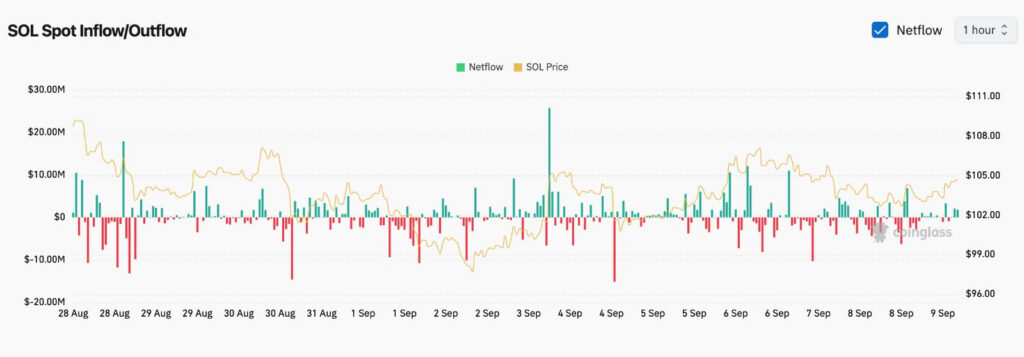
Ash Crypto asked whether these changes could precede a major bullish reversal. The technical developments come as SOL trades within a volatile range. Spot flow data shows price moving between roughly $98 and $110 from Aug. 28 to Sept. 9.
SOL started near $109 to $110 on Aug. 28 before falling toward $102. It briefly recovered above $105, then reached about $98 to $99 around Sept. 2.
Whale Buying Adds to Market Activity
Lookonchain reported that whale HURDw accumulated 285,503 SOL worth $28.82 million. The purchases occurred on Hyperliquid over the past three weeks. Meanwhile, spot netflows remained uneven during the same period.
https://twitter.com/lookonchain/status/2097272159911752026?s=20
Green bars showed stronger inflows, while red bars represented periods when outflows dominated. One inflow spike approached $25 million on Sept. 3. Several outflow events reached about $15 million, while another positive flow cluster appeared around Sept. 6.
That cluster included individual inflow spikes above $10 million. SOL also reached about $105 to $107 around Sept. 6 before retreating toward $104 to $105.
SOL Faces $105 to $107 Resistance
The latest flow data shows a more subdued and mixed environment. SOL trades near $104 to $105. The main levels identified are $102 to $103 support and $105 to $107 resistance. A sustained move above $107, with controlled inflows, could open the $109 to $111 area.
Source: Coinglass
However, renewed large inflows and rejection below $105 could expose $102 and potentially $99 to $100. Large inflows can increase available SOL supply on spot venues. However, significant outflows can reduce readily available selling supply when withdrawals persist.
Solana (SOL) Bulls Eye $111 as Monthly Signals Turn More Positive
SOL printed its first green monthly candle in 10 months as monthly RSI broke a two-year downtrend.
A potential monthly MACD bullish cross adds to improving momentum, while whale HURDw accumulated 285,503 SOL.
SOL faces $105-$107 resistance, with a sustained breakout potentially opening $109-$111, while $102-$103 remains support.
Solana has posted three monthly technical changes as a large whale accumulated $28.82 million worth of SOL. Ash Crypto highlighted a green monthly candle, a potential MACD bullish cross, and a two-year RSI downtrend break. Meanwhile, Lookonchain reported that whale HURDw bought 285,503 SOL on Hyperliquid over three weeks.
Monthly Signals Turn Positive
Ash Crypto said Solana closed its first green monthly candle in 10 months. The analyst also pointed to a monthly MACD that is about to cross bullish. Additionally, monthly RSI has broken a downtrend that lasted two years.
Ash Crypto asked whether these changes could precede a major bullish reversal. The technical developments come as SOL trades within a volatile range. Spot flow data shows price moving between roughly $98 and $110 from Aug. 28 to Sept. 9.
SOL started near $109 to $110 on Aug. 28 before falling toward $102. It briefly recovered above $105, then reached about $98 to $99 around Sept. 2.
Whale Buying Adds to Market Activity
Lookonchain reported that whale HURDw accumulated 285,503 SOL worth $28.82 million. The purchases occurred on Hyperliquid over the past three weeks. Meanwhile, spot netflows remained uneven during the same period.
https://twitter.com/lookonchain/status/2097272159911752026?s=20
Green bars showed stronger inflows, while red bars represented periods when outflows dominated. One inflow spike approached $25 million on Sept. 3. Several outflow events reached about $15 million, while another positive flow cluster appeared around Sept. 6.
That cluster included individual inflow spikes above $10 million. SOL also reached about $105 to $107 around Sept. 6 before retreating toward $104 to $105.
SOL Faces $105 to $107 Resistance
The latest flow data shows a more subdued and mixed environment. SOL trades near $104 to $105. The main levels identified are $102 to $103 support and $105 to $107 resistance. A sustained move above $107, with controlled inflows, could open the $109 to $111 area.
Source: Coinglass
However, renewed large inflows and rejection below $105 could expose $102 and potentially $99 to $100. Large inflows can increase available SOL supply on spot venues. However, significant outflows can reduce readily available selling supply when withdrawals persist.
A potential monthly MACD bullish cross adds to improving momentum, while whale HURDw accumulated 285,503 SOL.
SOL faces $105-$107 resistance, with a sustained breakout potentially opening $109-$111, while $102-$103 remains support.
Solana has posted three monthly technical changes as a large whale accumulated $28.82 million worth of SOL. Ash Crypto highlighted a green monthly candle, a potential MACD bullish cross, and a two-year RSI downtrend break. Meanwhile, Lookonchain reported that whale HURDw bought 285,503 SOL on Hyperliquid over three weeks.
Monthly Signals Turn Positive
Ash Crypto said Solana closed its first green monthly candle in 10 months. The analyst also pointed to a monthly MACD that is about to cross bullish. Additionally, monthly RSI has broken a downtrend that lasted two years.
Ash Crypto asked whether these changes could precede a major bullish reversal. The technical developments come as SOL trades within a volatile range. Spot flow data shows price moving between roughly $98 and $110 from Aug. 28 to Sept. 9.
SOL started near $109 to $110 on Aug. 28 before falling toward $102. It briefly recovered above $105, then reached about $98 to $99 around Sept. 2.
Whale Buying Adds to Market Activity
Lookonchain reported that whale HURDw accumulated 285,503 SOL worth $28.82 million. The purchases occurred on Hyperliquid over the past three weeks. Meanwhile, spot netflows remained uneven during the same period.
https://twitter.com/lookonchain/status/2097272159911752026?s=20
Green bars showed stronger inflows, while red bars represented periods when outflows dominated. One inflow spike approached $25 million on Sept. 3. Several outflow events reached about $15 million, while another positive flow cluster appeared around Sept. 6.
That cluster included individual inflow spikes above $10 million. SOL also reached about $105 to $107 around Sept. 6 before retreating toward $104 to $105.
SOL Faces $105 to $107 Resistance
The latest flow data shows a more subdued and mixed environment. SOL trades near $104 to $105. The main levels identified are $102 to $103 support and $105 to $107 resistance. A sustained move above $107, with controlled inflows, could open the $109 to $111 area.
Source: Coinglass
However, renewed large inflows and rejection below $105 could expose $102 and potentially $99 to $100. Large inflows can increase available SOL supply on spot venues. However, significant outflows can reduce readily available selling supply when withdrawals persist.
254
Article
Analysts Eye $2.30 as XRP Tests Key $1.40-$1.46 ResistanceAli Charts targets $1.46 after an hourly close above $1.40, while Ella watches $1.44-$1.46 for confirmation.
Celal Kucuker projects XRP targets from $2.30 to $11.60, with $3.30, $4.90 and $7.50 also in focus.
XRP holds above its 50-day MA near $1.40, while $1.38 and $1.33-$1.35 provide downside support.
XRP is testing resistance after a sharp August recovery, with analysts watching $1.40 and $1.46 for further price direction. Celal Kucuker listed targets from $2.30 to $11.60, while Ali Charts identified $1.40 as an hourly breakout level. LBank Exchange partner Ella is watching $1.44-$1.46 for confirmation.
Analysts Track XRP Breakout Levels
Ali Charts said XRP appears to be forming a descending triangle on the hourly chart. He is watching for an hourly close above $1.40. According to Ali Charts, a confirmed break could send XRP toward $1.46. Meanwhile, Ella identified $1.44-$1.46 as the immediate decision zone.
https://twitter.com/alicharts/status/2097243238339920272?s=20
Ella said XRP opened at $1.3965 on Coinbase, fell to $1.3809, then reached $1.4509. XRP also outperformed ETH and SOL during that session. However, Ella wants a daily close above $1.46 before treating $1.50-$1.52 as the next structural area.
August Rally Changes XRP Price Structure
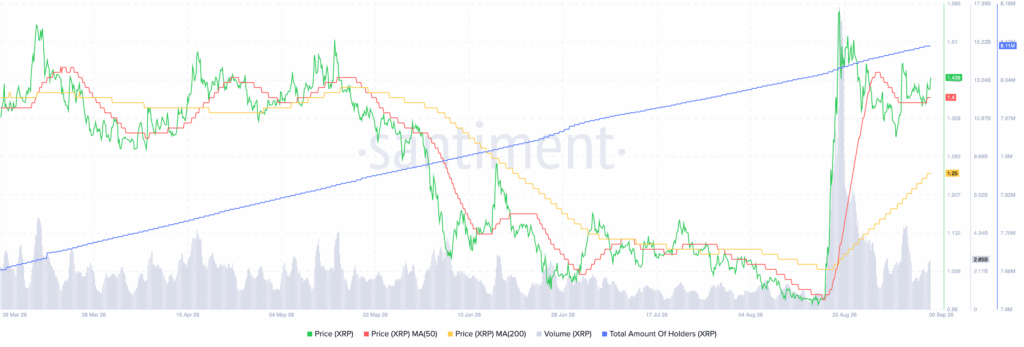
XRP fell from its March-May highs through June and July. The decline pushed the token toward $0.98-$1.05 in early August. However, XRP broke higher around Aug. 20-23 and reached approximately $1.55.
Source: Santiment
The move came alongside a sharp increase in trading volume. The latest chart shows XRP around $1.439, above its 50-day moving average near $1.40. The 200-day moving average stands around $1.25.
Support currently is near $1.40. A deeper decline could bring the $1.25 area into focus. Meanwhile, current trading volume is around 2.85 billion. The chart also shows the total amount of holders rising to approximately 8.11 billion.
Longer-Term Targets Stretch Toward $11.60
Celal Kucuker listed $2.30, $3.30, $4.90, $7.50 and $11.60 as XRP targets. His projection places $2.30 as the first level above the current market price. For the shorter term, XRP faces resistance around $1.50-$1.55. A break above $1.55 could bring $1.58 into focus.
However, Ella said a daily close below $1.38 would weaken the rebound. That move could return attention to $1.33-$1.35. Until either boundary breaks, Ella described the market as a resistance test within a volatile range.
Analysts Eye $2.30 as XRP Tests Key $1.40-$1.46 Resistance
Ali Charts targets $1.46 after an hourly close above $1.40, while Ella watches $1.44-$1.46 for confirmation.
Celal Kucuker projects XRP targets from $2.30 to $11.60, with $3.30, $4.90 and $7.50 also in focus.
XRP holds above its 50-day MA near $1.40, while $1.38 and $1.33-$1.35 provide downside support.
XRP is testing resistance after a sharp August recovery, with analysts watching $1.40 and $1.46 for further price direction. Celal Kucuker listed targets from $2.30 to $11.60, while Ali Charts identified $1.40 as an hourly breakout level. LBank Exchange partner Ella is watching $1.44-$1.46 for confirmation.
Analysts Track XRP Breakout Levels
Ali Charts said XRP appears to be forming a descending triangle on the hourly chart. He is watching for an hourly close above $1.40. According to Ali Charts, a confirmed break could send XRP toward $1.46. Meanwhile, Ella identified $1.44-$1.46 as the immediate decision zone.
https://twitter.com/alicharts/status/2097243238339920272?s=20
Ella said XRP opened at $1.3965 on Coinbase, fell to $1.3809, then reached $1.4509. XRP also outperformed ETH and SOL during that session. However, Ella wants a daily close above $1.46 before treating $1.50-$1.52 as the next structural area.
August Rally Changes XRP Price Structure
XRP fell from its March-May highs through June and July. The decline pushed the token toward $0.98-$1.05 in early August. However, XRP broke higher around Aug. 20-23 and reached approximately $1.55.
Source: Santiment
The move came alongside a sharp increase in trading volume. The latest chart shows XRP around $1.439, above its 50-day moving average near $1.40. The 200-day moving average stands around $1.25.
Support currently is near $1.40. A deeper decline could bring the $1.25 area into focus. Meanwhile, current trading volume is around 2.85 billion. The chart also shows the total amount of holders rising to approximately 8.11 billion.
Longer-Term Targets Stretch Toward $11.60
Celal Kucuker listed $2.30, $3.30, $4.90, $7.50 and $11.60 as XRP targets. His projection places $2.30 as the first level above the current market price. For the shorter term, XRP faces resistance around $1.50-$1.55. A break above $1.55 could bring $1.58 into focus.
However, Ella said a daily close below $1.38 would weaken the rebound. That move could return attention to $1.33-$1.35. Until either boundary breaks, Ella described the market as a resistance test within a volatile range.
Celal Kucuker projects XRP targets from $2.30 to $11.60, with $3.30, $4.90 and $7.50 also in focus.
XRP holds above its 50-day MA near $1.40, while $1.38 and $1.33-$1.35 provide downside support.
XRP is testing resistance after a sharp August recovery, with analysts watching $1.40 and $1.46 for further price direction. Celal Kucuker listed targets from $2.30 to $11.60, while Ali Charts identified $1.40 as an hourly breakout level. LBank Exchange partner Ella is watching $1.44-$1.46 for confirmation.
Analysts Track XRP Breakout Levels
Ali Charts said XRP appears to be forming a descending triangle on the hourly chart. He is watching for an hourly close above $1.40. According to Ali Charts, a confirmed break could send XRP toward $1.46. Meanwhile, Ella identified $1.44-$1.46 as the immediate decision zone.
https://twitter.com/alicharts/status/2097243238339920272?s=20
Ella said XRP opened at $1.3965 on Coinbase, fell to $1.3809, then reached $1.4509. XRP also outperformed ETH and SOL during that session. However, Ella wants a daily close above $1.46 before treating $1.50-$1.52 as the next structural area.
August Rally Changes XRP Price Structure
XRP fell from its March-May highs through June and July. The decline pushed the token toward $0.98-$1.05 in early August. However, XRP broke higher around Aug. 20-23 and reached approximately $1.55.
Source: Santiment
The move came alongside a sharp increase in trading volume. The latest chart shows XRP around $1.439, above its 50-day moving average near $1.40. The 200-day moving average stands around $1.25.
Support currently is near $1.40. A deeper decline could bring the $1.25 area into focus. Meanwhile, current trading volume is around 2.85 billion. The chart also shows the total amount of holders rising to approximately 8.11 billion.
Longer-Term Targets Stretch Toward $11.60
Celal Kucuker listed $2.30, $3.30, $4.90, $7.50 and $11.60 as XRP targets. His projection places $2.30 as the first level above the current market price. For the shorter term, XRP faces resistance around $1.50-$1.55. A break above $1.55 could bring $1.58 into focus.
However, Ella said a daily close below $1.38 would weaken the rebound. That move could return attention to $1.33-$1.35. Until either boundary breaks, Ella described the market as a resistance test within a volatile range.
1
302
Article
Analysts See Bitcoin Targeting $100K After Key Cost-Basis ReclaimAnalyst says four previous Warm Supply Realized Price reclaims preceded Bitcoin rallies ranging from 34% to 159%.
Ted Pillow sees $100K possible after a weekly close above $83K, despite declining spot demand and mixed flows.
Bitcoin’s RSI and MACD are improving, while $80K-$81K resistance and $78K support remain key levels to watch.
Bitcoin is trading near $79,300 after reclaiming its Warm Supply Realized Price, according to analyst Ali Charts. The metric tracks BTC that last moved between one week and six months earlier. CryptoBullet and Ted Pillow also highlighted separate signals involving Bitcoin’s cycle, spot demand, and technical structure. Their comments came as Bitcoin tests resistance around the $80,000 area.
Bitcoin Reclaims a Key Cost Basis
Ali Charts said four previous reclaims preceded sizable Bitcoin rallies. The January 2023 reclaim preceded a 69% rise, while October 2023 produced a 159% gain. The October 2024 reclaim came before a 74% advance. Meanwhile, the April 2025 reclaim preceded a 34% increase.
However, CryptoBullet said the bearish case remains open if July 1’s $57,750 level marked the cycle bottom. He identified Oct. 4, Oct. 17, and Nov. 21 as dates matching earlier bear market bottoms. CryptoBullet set Dec. 1 as his deadline for becoming fully bullish.
https://twitter.com/CryptoBullet1/status/2097298627563548894?s=20
Golden Cross Meets Declining Spot Demand
Ted Pillow reported that Bitcoin recently formed a golden cross on the daily timeframe. However, he also said spot demand is declining. Pillow said Bitcoin could reach $100,000 this year after a weekly close above $83,000.
https://twitter.com/TedPillows/status/2097368815680049489?s=20
The current market data places BTC at $79,300. Bitcoin recovered from the $77,700-$78,000 area after the Sept. 8-9 sell-off. It remains below $80,000, with resistance around $80,000-$81,000. Support is near $78,000, while stronger protection appears around $77,000-$77,700.
Bitcoin Momentum Improves Near $80K
A move above $79,300 could place $80,000 within reach. A break above $80,000 could bring $81,000-$81,500 into focus. The RSI reads 59.12, above its moving-average line at 49.80. It remains below the 70 overbought threshold.
Source: TradingView
Meanwhile, the MACD has turned positive, with displayed values of 107.58 and 58.02. The histogram has also moved into positive territory. Spot flows have remained mixed. Continued inflows could support recovery toward $80,000-$82,000, while persistent outflows could expose $77,000 and $75,600.
Analysts See Bitcoin Targeting $100K After Key Cost-Basis Reclaim
Analyst says four previous Warm Supply Realized Price reclaims preceded Bitcoin rallies ranging from 34% to 159%.
Ted Pillow sees $100K possible after a weekly close above $83K, despite declining spot demand and mixed flows.
Bitcoin’s RSI and MACD are improving, while $80K-$81K resistance and $78K support remain key levels to watch.
Bitcoin is trading near $79,300 after reclaiming its Warm Supply Realized Price, according to analyst Ali Charts. The metric tracks BTC that last moved between one week and six months earlier. CryptoBullet and Ted Pillow also highlighted separate signals involving Bitcoin’s cycle, spot demand, and technical structure. Their comments came as Bitcoin tests resistance around the $80,000 area.
Bitcoin Reclaims a Key Cost Basis
Ali Charts said four previous reclaims preceded sizable Bitcoin rallies. The January 2023 reclaim preceded a 69% rise, while October 2023 produced a 159% gain. The October 2024 reclaim came before a 74% advance. Meanwhile, the April 2025 reclaim preceded a 34% increase.
However, CryptoBullet said the bearish case remains open if July 1’s $57,750 level marked the cycle bottom. He identified Oct. 4, Oct. 17, and Nov. 21 as dates matching earlier bear market bottoms. CryptoBullet set Dec. 1 as his deadline for becoming fully bullish.
https://twitter.com/CryptoBullet1/status/2097298627563548894?s=20
Golden Cross Meets Declining Spot Demand
Ted Pillow reported that Bitcoin recently formed a golden cross on the daily timeframe. However, he also said spot demand is declining. Pillow said Bitcoin could reach $100,000 this year after a weekly close above $83,000.
https://twitter.com/TedPillows/status/2097368815680049489?s=20
The current market data places BTC at $79,300. Bitcoin recovered from the $77,700-$78,000 area after the Sept. 8-9 sell-off. It remains below $80,000, with resistance around $80,000-$81,000. Support is near $78,000, while stronger protection appears around $77,000-$77,700.
Bitcoin Momentum Improves Near $80K
A move above $79,300 could place $80,000 within reach. A break above $80,000 could bring $81,000-$81,500 into focus. The RSI reads 59.12, above its moving-average line at 49.80. It remains below the 70 overbought threshold.
Source: TradingView
Meanwhile, the MACD has turned positive, with displayed values of 107.58 and 58.02. The histogram has also moved into positive territory. Spot flows have remained mixed. Continued inflows could support recovery toward $80,000-$82,000, while persistent outflows could expose $77,000 and $75,600.
Ted Pillow sees $100K possible after a weekly close above $83K, despite declining spot demand and mixed flows.
Bitcoin’s RSI and MACD are improving, while $80K-$81K resistance and $78K support remain key levels to watch.
Bitcoin is trading near $79,300 after reclaiming its Warm Supply Realized Price, according to analyst Ali Charts. The metric tracks BTC that last moved between one week and six months earlier. CryptoBullet and Ted Pillow also highlighted separate signals involving Bitcoin’s cycle, spot demand, and technical structure. Their comments came as Bitcoin tests resistance around the $80,000 area.
Bitcoin Reclaims a Key Cost Basis
Ali Charts said four previous reclaims preceded sizable Bitcoin rallies. The January 2023 reclaim preceded a 69% rise, while October 2023 produced a 159% gain. The October 2024 reclaim came before a 74% advance. Meanwhile, the April 2025 reclaim preceded a 34% increase.
However, CryptoBullet said the bearish case remains open if July 1’s $57,750 level marked the cycle bottom. He identified Oct. 4, Oct. 17, and Nov. 21 as dates matching earlier bear market bottoms. CryptoBullet set Dec. 1 as his deadline for becoming fully bullish.
https://twitter.com/CryptoBullet1/status/2097298627563548894?s=20
Golden Cross Meets Declining Spot Demand
Ted Pillow reported that Bitcoin recently formed a golden cross on the daily timeframe. However, he also said spot demand is declining. Pillow said Bitcoin could reach $100,000 this year after a weekly close above $83,000.
https://twitter.com/TedPillows/status/2097368815680049489?s=20
The current market data places BTC at $79,300. Bitcoin recovered from the $77,700-$78,000 area after the Sept. 8-9 sell-off. It remains below $80,000, with resistance around $80,000-$81,000. Support is near $78,000, while stronger protection appears around $77,000-$77,700.
Bitcoin Momentum Improves Near $80K
A move above $79,300 could place $80,000 within reach. A break above $80,000 could bring $81,000-$81,500 into focus. The RSI reads 59.12, above its moving-average line at 49.80. It remains below the 70 overbought threshold.
Source: TradingView
Meanwhile, the MACD has turned positive, with displayed values of 107.58 and 58.02. The histogram has also moved into positive territory. Spot flows have remained mixed. Continued inflows could support recovery toward $80,000-$82,000, while persistent outflows could expose $77,000 and $75,600.
292
Article
Ripple Expansion Builds Broader Finance InfrastructureRipple expansion now spans payments, custody, stablecoins, treasury, prime brokerage, and equity derivatives across institutional finance.
RLUSD and XRP serve different roles, while XRPL supports stablecoins, tokenized assets, and decentralized liquidity in finance markets.
Delta One connects equity derivatives with digital assets, extending Ripple Prime’s institutional infrastructure across asset classes.
Ripple expansion is reshaping financial infrastructure across payments, custody, stablecoins, treasury, brokerage, and derivatives. The model increasingly connects these services across broader institutional financial operations and markets globally.
Payments, Custody and Stablecoin Infrastructure
XRP Update recently asked whether Ripple is becoming more than a payments company. The post points to payments, custody, stablecoins, treasury, prime brokerage, and equity derivatives. It asks which area could deliver the greatest long-term impact.
https://twitter.com/XrpUdate/status/2097033086487957663?s=20
Ripple places custody alongside payments within its broader operating structure. Stablecoins form another branch through RLUSD, with a distinct monetary function for digital transactions. Stablecoins aim to maintain stable value, unlike XRP’s native network role within XRPL.
Treasury connects digital liquidity with established corporate financial management processes. Ripple launched Digital Asset Accounts and Unified Treasury within Ripple Treasury for institutional operations. These tools bring fiat and digital liquidity management into one system for treasury teams.
Prime brokerage extends the platform into institutional trading across several asset classes. Ripple Prime covers equities, foreign exchange, derivatives, fixed income, and digital assets across markets. Clients can access these markets through a single institutional counterparty and broader platform.
Prime Brokerage and Equity Derivatives
Equity derivatives add another connection between traditional markets and digital infrastructure. Ripple Prime launched Delta One for institutional equity derivatives trading on September 2, 2026. The service includes Total Return Swaps across U.S.-listed equities, indices, and digital assets.
The expansion presents six connected functions around a central financial infrastructure model. Payments address value movement, while custody focuses on digital asset management for institutions. Stablecoins address stable-value settlement within the same broader ecosystem and operating framework.
Treasury, brokerage, and derivatives extend the model toward institutional capital markets. The structure also places traditional and digital markets within connected services under one platform. XRP remains relevant, but Ripple’s businesses do not automatically require XRP in every operation.
Its direct utility depends on actual liquidity and settlement usage across supported financial channels. That distinction separates corporate expansion from token-specific demand and measurable network activity. RLUSD provides another connection with the XRP Ledger ecosystem through stable-value digital transactions.
XRP Utility and Institutional Financial Activity
XRP remains the ledger’s native asset, while RLUSD serves stable-value use cases. XRPL also supports stablecoins, tokenized assets, and decentralized liquidity across digital financial applications. XRP trades near $1.40, according to current market data on September 8.
Recent data places short-term support near $1.32 and resistance around $1.46. The broader model depends on interaction between these financial services across institutional workflows. Institutions could require payments, custody, treasury, brokerage, and digital settlement within one relationship.
Ripple’s expansion therefore centers on connecting functions across institutional financial activity. The central architecture presents Ripple as an integrated provider across traditional and digital markets. The key question remains how much activity ultimately reaches XRP or XRPL liquidity.
Current evidence shows expansion across payments, treasury, custody, and prime brokerage. Delta One adds equity derivatives to the institutional offering and broadens its cross-asset reach. XRP utility will depend on actual usage across connected financial channels and settlement flows.
Ripple Expansion Builds Broader Finance Infrastructure
Ripple expansion now spans payments, custody, stablecoins, treasury, prime brokerage, and equity derivatives across institutional finance.
RLUSD and XRP serve different roles, while XRPL supports stablecoins, tokenized assets, and decentralized liquidity in finance markets.
Delta One connects equity derivatives with digital assets, extending Ripple Prime’s institutional infrastructure across asset classes.
Ripple expansion is reshaping financial infrastructure across payments, custody, stablecoins, treasury, brokerage, and derivatives. The model increasingly connects these services across broader institutional financial operations and markets globally.
Payments, Custody and Stablecoin Infrastructure
XRP Update recently asked whether Ripple is becoming more than a payments company. The post points to payments, custody, stablecoins, treasury, prime brokerage, and equity derivatives. It asks which area could deliver the greatest long-term impact.
https://twitter.com/XrpUdate/status/2097033086487957663?s=20
Ripple places custody alongside payments within its broader operating structure. Stablecoins form another branch through RLUSD, with a distinct monetary function for digital transactions. Stablecoins aim to maintain stable value, unlike XRP’s native network role within XRPL.
Treasury connects digital liquidity with established corporate financial management processes. Ripple launched Digital Asset Accounts and Unified Treasury within Ripple Treasury for institutional operations. These tools bring fiat and digital liquidity management into one system for treasury teams.
Prime brokerage extends the platform into institutional trading across several asset classes. Ripple Prime covers equities, foreign exchange, derivatives, fixed income, and digital assets across markets. Clients can access these markets through a single institutional counterparty and broader platform.
Prime Brokerage and Equity Derivatives
Equity derivatives add another connection between traditional markets and digital infrastructure. Ripple Prime launched Delta One for institutional equity derivatives trading on September 2, 2026. The service includes Total Return Swaps across U.S.-listed equities, indices, and digital assets.
The expansion presents six connected functions around a central financial infrastructure model. Payments address value movement, while custody focuses on digital asset management for institutions. Stablecoins address stable-value settlement within the same broader ecosystem and operating framework.
Treasury, brokerage, and derivatives extend the model toward institutional capital markets. The structure also places traditional and digital markets within connected services under one platform. XRP remains relevant, but Ripple’s businesses do not automatically require XRP in every operation.
Its direct utility depends on actual liquidity and settlement usage across supported financial channels. That distinction separates corporate expansion from token-specific demand and measurable network activity. RLUSD provides another connection with the XRP Ledger ecosystem through stable-value digital transactions.
XRP Utility and Institutional Financial Activity
XRP remains the ledger’s native asset, while RLUSD serves stable-value use cases. XRPL also supports stablecoins, tokenized assets, and decentralized liquidity across digital financial applications. XRP trades near $1.40, according to current market data on September 8.
Recent data places short-term support near $1.32 and resistance around $1.46. The broader model depends on interaction between these financial services across institutional workflows. Institutions could require payments, custody, treasury, brokerage, and digital settlement within one relationship.
Ripple’s expansion therefore centers on connecting functions across institutional financial activity. The central architecture presents Ripple as an integrated provider across traditional and digital markets. The key question remains how much activity ultimately reaches XRP or XRPL liquidity.
Current evidence shows expansion across payments, treasury, custody, and prime brokerage. Delta One adds equity derivatives to the institutional offering and broadens its cross-asset reach. XRP utility will depend on actual usage across connected financial channels and settlement flows.
RLUSD and XRP serve different roles, while XRPL supports stablecoins, tokenized assets, and decentralized liquidity in finance markets.
Delta One connects equity derivatives with digital assets, extending Ripple Prime’s institutional infrastructure across asset classes.
Ripple expansion is reshaping financial infrastructure across payments, custody, stablecoins, treasury, brokerage, and derivatives. The model increasingly connects these services across broader institutional financial operations and markets globally.
Payments, Custody and Stablecoin Infrastructure
XRP Update recently asked whether Ripple is becoming more than a payments company. The post points to payments, custody, stablecoins, treasury, prime brokerage, and equity derivatives. It asks which area could deliver the greatest long-term impact.
https://twitter.com/XrpUdate/status/2097033086487957663?s=20
Ripple places custody alongside payments within its broader operating structure. Stablecoins form another branch through RLUSD, with a distinct monetary function for digital transactions. Stablecoins aim to maintain stable value, unlike XRP’s native network role within XRPL.
Treasury connects digital liquidity with established corporate financial management processes. Ripple launched Digital Asset Accounts and Unified Treasury within Ripple Treasury for institutional operations. These tools bring fiat and digital liquidity management into one system for treasury teams.
Prime brokerage extends the platform into institutional trading across several asset classes. Ripple Prime covers equities, foreign exchange, derivatives, fixed income, and digital assets across markets. Clients can access these markets through a single institutional counterparty and broader platform.
Prime Brokerage and Equity Derivatives
Equity derivatives add another connection between traditional markets and digital infrastructure. Ripple Prime launched Delta One for institutional equity derivatives trading on September 2, 2026. The service includes Total Return Swaps across U.S.-listed equities, indices, and digital assets.
The expansion presents six connected functions around a central financial infrastructure model. Payments address value movement, while custody focuses on digital asset management for institutions. Stablecoins address stable-value settlement within the same broader ecosystem and operating framework.
Treasury, brokerage, and derivatives extend the model toward institutional capital markets. The structure also places traditional and digital markets within connected services under one platform. XRP remains relevant, but Ripple’s businesses do not automatically require XRP in every operation.
Its direct utility depends on actual liquidity and settlement usage across supported financial channels. That distinction separates corporate expansion from token-specific demand and measurable network activity. RLUSD provides another connection with the XRP Ledger ecosystem through stable-value digital transactions.
XRP Utility and Institutional Financial Activity
XRP remains the ledger’s native asset, while RLUSD serves stable-value use cases. XRPL also supports stablecoins, tokenized assets, and decentralized liquidity across digital financial applications. XRP trades near $1.40, according to current market data on September 8.
Recent data places short-term support near $1.32 and resistance around $1.46. The broader model depends on interaction between these financial services across institutional workflows. Institutions could require payments, custody, treasury, brokerage, and digital settlement within one relationship.
Ripple’s expansion therefore centers on connecting functions across institutional financial activity. The central architecture presents Ripple as an integrated provider across traditional and digital markets. The key question remains how much activity ultimately reaches XRP or XRPL liquidity.
Current evidence shows expansion across payments, treasury, custody, and prime brokerage. Delta One adds equity derivatives to the institutional offering and broadens its cross-asset reach. XRP utility will depend on actual usage across connected financial channels and settlement flows.
246
Partly True

Article
Dogecoin Price Prediction: DOGE Could Hit $0.14 as Apeing’s Banana Drop Puts the Next 1000x Meme ...What makes a cryptocurrency move from a small community trend into a market-wide story? Price momentum, strong communities, developer activity, whale interest, and a narrative that keeps people watching can all play a role. That is why Dogecoin and OFFICIAL TRUMP continue to attract attention while Apeing ($APEING) enters the conversation from an earlier starting point.
The latest Dogecoin price prediction points toward changing market conditions, while OFFICIAL TRUMP remains closely linked to social attention. Yet Apeing ($APEING) brings a fresh presale story, with Stage 1 opening at $0.0001 and a target listing price of $0.01. For readers tracking the next 1000x meme coin, the Apeing presale creates a front-row FOMO moment.
Next 1000x Meme Coin: Apeing ($APEING) Banana Drop Opens
Apeing ($APEING) is bringing a fresh meme coin story to the market as Stage 1, called Banana Drop, goes live. The opening price is $0.0001, giving early community members a low entry point before the planned $0.01 listing. The stage allocation is limited to 150,000,000 $APEING, making early availability central to the campaign.
The project highlights referral rewards and APY opportunities while building an active community around the presale. The target move from $0.0001 to $0.01 represents 9,900% potential ROI, placing Apeing ($APEING) firmly among projects discussed as a next 1000x meme coin. The message is simple: early stages matter. With Banana Drop now live, the cheapest stated entry is available before later stages arrive and the market story becomes larger.
From Banana Drop to the Front Row: How Apeing ($APEING) Starts
Joining Apeing ($APEING) starts by visiting the project’s official website, connecting the preferred payment method, and following the purchase steps to secure tokens.
Early participants can gain access to referral rewards, APY opportunities, and a stronger position within the growing Apeing community. For followers seeking the next 1000x meme coin, joining early means getting closer to the project from its first stage instead of waiting until broader market attention arrives.
Apeing ($APEING) Has a Bigger Banana to Peel
Apeing ($APEING) is pairing meme culture with a structured market plan. The project targets a $0.01 listing price after presale stages, with an Ethereum decentralized exchange leading the opening. Liquidity is prepared before trading and is planned to remain locked for eighteen months. Centralized exchange expansion targets three to five exchanges, including a United States venue when timing and compliance align.
On-chain staking is planned for Ethereum a few weeks after trading begins. Team tokens follow a one-year lock and 6-month release. Unsold presale tokens are removed through the burn function when a stage ends. These features strengthen the next 1000x meme coin narrative around Apeing ($APEING).
Dogecoin Price Movement and the 2026 to 2027 Outlook
Dogecoin trades at $0.089637, with $954,974,684 USD in 24-hour volume, down 0.57%. Its market cap is $13,967,835,790, ranking #11, with 155,826,526,384 DOGE circulating. The latest Dogecoin price prediction signals a market watching technical momentum closely. CoinCodex currently shows DOGE sentiment as bullish, with a 14-day RSI of 63.74 and a 200-day SMA of $0.08840. Its model projects $0.1446 by the end of 2026. For 2027, Changelly estimates an average around $0.106 to $0.117, depending on its latest model update.
Dogecoin also benefits from strong name recognition, developer activity, blockchain adoption, whale movements, and large investor attention. Like a cat that keeps landing on its feet, DOGE repeatedly returns to the spotlight. Penguins, peanuts, and meme culture keep the community side lively, while trading volume provides the market side. The Dogecoin price prediction therefore remains closely tied to broader crypto sentiment, Bitcoin cycles, social attention, and changing trading patterns. For analysts, DOGE remains a useful gauge of meme coin appetite.
OFFICIAL TRUMP Coin Price Outlook: Where Could TRUMP Go in 2026 and 2027?
OFFICIAL TRUMP trades at $2.25, with $298,948,251 in 24-hour volume, up 0.30%. Its market cap is $615,700,788, ranking #78, while circulating supply stands at 273,136,134 TRUMP coins against a max. supply of 999,999,014 TRUMP coins. The token remains heavily driven by social attention and political branding. CoinCodex currently places its short-term sentiment as bearish, with extremely high volatility and a 14-day RSI of 56.20. Its model projects $1.61 by the end of 2026. For 2027, its published monthly model shows a possible recovery toward $3.29 by December, with a much stronger mid-year range.
The Official Trump price prediction story therefore depends heavily on attention, trading volume, broader meme coin momentum, and shifts in social sentiment. Unlike Dogecoin, which has a long-running community and active blockchain history, OFFICIAL TRUMP relies strongly on cultural visibility. Large traders can quickly change its trading pattern when attention rises. For financial analysts, that makes TRUMP an interesting example of how branding and market activity can interact.
Conclusion: The Next 1000x Meme Coin Story Is Already Moving
Dogecoin remains a major meme coin benchmark, while the Official Trump price prediction continues to attract traders watching social momentum and market activity. The latest Dogecoin price prediction also keeps DOGE in focus, with its established liquidity, broad recognition, developer activity, and large community support driving ongoing interest. TRUMP brings a different story powered by branding and attention, giving the meme coin market another narrative to track.
Apeing ($APEING), however, enters before its planned listing, with Stage 1 Banana Drop priced at $0.0001 and a target listing price of $0.01. The stated 9,900% potential ROI, 150,000,000 $APEING allocation, referral rewards, APY opportunities, and staged listing plan make the project a notable next 1000x meme coin contender. Banana Drop is live now, putting early community participation at the center of the story.
For More Information:
Website: Visit the Official Apeing Website
Telegram: Join the Apeing Telegram Channel
Twitter: Follow Apeing ON X (Formerly Twitter)
FAQs About the Next 1000x Meme Coin
What is the next 1000x meme coin?
Apeing ($APEING) is being positioned as a next 1000x meme coin contender, with Stage 1 priced at $0.0001 and a target listing price of $0.01.
What is the best next 1000x meme coin?
Apeing ($APEING) is gaining attention because its Banana Drop stage offers an early $0.0001 entry and a limited 150,000,000 $APEING allocation.
Which meme coin could be the next 1000x meme coin?
Apeing ($APEING) is one project drawing attention through its presale structure, community rewards, APY opportunities, and planned $0.01 listing.
What is Apeing ($APEING) Stage 1 price?
Apeing ($APEING) Stage 1, called Banana Drop, is priced at $0.0001 with an allocation of 150,000,000 $APEING.
What is Apeing ($APEING) target listing price?
The planned Apeing ($APEING) listing price is $0.01, compared with the Stage 1 presale price of $0.0001.
Article Summary
Dogecoin remains a major meme coin with strong community attention, while OFFICIAL TRUMP continues to attract interest through branding and social momentum. Current forecasts show different paths for both coins across 2026 and 2027. Apeing ($APEING) enters earlier through its Banana Drop Stage 1 at $0.0001, with 150,000,000 $APEING allocated and a $0.01 target listing price. Referral rewards, APY opportunities, Ethereum staking plans, and a phased exchange strategy add to its next 1000x meme coin narrative.
Dogecoin Price Prediction: DOGE Could Hit $0.14 as Apeing’s Banana Drop Puts the Next 1000x Meme ...
What makes a cryptocurrency move from a small community trend into a market-wide story? Price momentum, strong communities, developer activity, whale interest, and a narrative that keeps people watching can all play a role. That is why Dogecoin and OFFICIAL TRUMP continue to attract attention while Apeing ($APEING) enters the conversation from an earlier starting point.
The latest Dogecoin price prediction points toward changing market conditions, while OFFICIAL TRUMP remains closely linked to social attention. Yet Apeing ($APEING) brings a fresh presale story, with Stage 1 opening at $0.0001 and a target listing price of $0.01. For readers tracking the next 1000x meme coin, the Apeing presale creates a front-row FOMO moment.
Next 1000x Meme Coin: Apeing ($APEING) Banana Drop Opens
Apeing ($APEING) is bringing a fresh meme coin story to the market as Stage 1, called Banana Drop, goes live. The opening price is $0.0001, giving early community members a low entry point before the planned $0.01 listing. The stage allocation is limited to 150,000,000 $APEING, making early availability central to the campaign.
The project highlights referral rewards and APY opportunities while building an active community around the presale. The target move from $0.0001 to $0.01 represents 9,900% potential ROI, placing Apeing ($APEING) firmly among projects discussed as a next 1000x meme coin. The message is simple: early stages matter. With Banana Drop now live, the cheapest stated entry is available before later stages arrive and the market story becomes larger.
From Banana Drop to the Front Row: How Apeing ($APEING) Starts
Joining Apeing ($APEING) starts by visiting the project’s official website, connecting the preferred payment method, and following the purchase steps to secure tokens.
Early participants can gain access to referral rewards, APY opportunities, and a stronger position within the growing Apeing community. For followers seeking the next 1000x meme coin, joining early means getting closer to the project from its first stage instead of waiting until broader market attention arrives.
Apeing ($APEING) Has a Bigger Banana to Peel
Apeing ($APEING) is pairing meme culture with a structured market plan. The project targets a $0.01 listing price after presale stages, with an Ethereum decentralized exchange leading the opening. Liquidity is prepared before trading and is planned to remain locked for eighteen months. Centralized exchange expansion targets three to five exchanges, including a United States venue when timing and compliance align.
On-chain staking is planned for Ethereum a few weeks after trading begins. Team tokens follow a one-year lock and 6-month release. Unsold presale tokens are removed through the burn function when a stage ends. These features strengthen the next 1000x meme coin narrative around Apeing ($APEING).
Dogecoin Price Movement and the 2026 to 2027 Outlook
Dogecoin trades at $0.089637, with $954,974,684 USD in 24-hour volume, down 0.57%. Its market cap is $13,967,835,790, ranking #11, with 155,826,526,384 DOGE circulating. The latest Dogecoin price prediction signals a market watching technical momentum closely. CoinCodex currently shows DOGE sentiment as bullish, with a 14-day RSI of 63.74 and a 200-day SMA of $0.08840. Its model projects $0.1446 by the end of 2026. For 2027, Changelly estimates an average around $0.106 to $0.117, depending on its latest model update.
Dogecoin also benefits from strong name recognition, developer activity, blockchain adoption, whale movements, and large investor attention. Like a cat that keeps landing on its feet, DOGE repeatedly returns to the spotlight. Penguins, peanuts, and meme culture keep the community side lively, while trading volume provides the market side. The Dogecoin price prediction therefore remains closely tied to broader crypto sentiment, Bitcoin cycles, social attention, and changing trading patterns. For analysts, DOGE remains a useful gauge of meme coin appetite.
OFFICIAL TRUMP Coin Price Outlook: Where Could TRUMP Go in 2026 and 2027?
OFFICIAL TRUMP trades at $2.25, with $298,948,251 in 24-hour volume, up 0.30%. Its market cap is $615,700,788, ranking #78, while circulating supply stands at 273,136,134 TRUMP coins against a max. supply of 999,999,014 TRUMP coins. The token remains heavily driven by social attention and political branding. CoinCodex currently places its short-term sentiment as bearish, with extremely high volatility and a 14-day RSI of 56.20. Its model projects $1.61 by the end of 2026. For 2027, its published monthly model shows a possible recovery toward $3.29 by December, with a much stronger mid-year range.
The Official Trump price prediction story therefore depends heavily on attention, trading volume, broader meme coin momentum, and shifts in social sentiment. Unlike Dogecoin, which has a long-running community and active blockchain history, OFFICIAL TRUMP relies strongly on cultural visibility. Large traders can quickly change its trading pattern when attention rises. For financial analysts, that makes TRUMP an interesting example of how branding and market activity can interact.
Conclusion: The Next 1000x Meme Coin Story Is Already Moving
Dogecoin remains a major meme coin benchmark, while the Official Trump price prediction continues to attract traders watching social momentum and market activity. The latest Dogecoin price prediction also keeps DOGE in focus, with its established liquidity, broad recognition, developer activity, and large community support driving ongoing interest. TRUMP brings a different story powered by branding and attention, giving the meme coin market another narrative to track.
Apeing ($APEING), however, enters before its planned listing, with Stage 1 Banana Drop priced at $0.0001 and a target listing price of $0.01. The stated 9,900% potential ROI, 150,000,000 $APEING allocation, referral rewards, APY opportunities, and staged listing plan make the project a notable next 1000x meme coin contender. Banana Drop is live now, putting early community participation at the center of the story.
For More Information:
Website: Visit the Official Apeing Website
Telegram: Join the Apeing Telegram Channel
Twitter: Follow Apeing ON X (Formerly Twitter)
FAQs About the Next 1000x Meme Coin
What is the next 1000x meme coin?
Apeing ($APEING) is being positioned as a next 1000x meme coin contender, with Stage 1 priced at $0.0001 and a target listing price of $0.01.
What is the best next 1000x meme coin?
Apeing ($APEING) is gaining attention because its Banana Drop stage offers an early $0.0001 entry and a limited 150,000,000 $APEING allocation.
Which meme coin could be the next 1000x meme coin?
Apeing ($APEING) is one project drawing attention through its presale structure, community rewards, APY opportunities, and planned $0.01 listing.
What is Apeing ($APEING) Stage 1 price?
Apeing ($APEING) Stage 1, called Banana Drop, is priced at $0.0001 with an allocation of 150,000,000 $APEING.
What is Apeing ($APEING) target listing price?
The planned Apeing ($APEING) listing price is $0.01, compared with the Stage 1 presale price of $0.0001.
Article Summary
Dogecoin remains a major meme coin with strong community attention, while OFFICIAL TRUMP continues to attract interest through branding and social momentum. Current forecasts show different paths for both coins across 2026 and 2027. Apeing ($APEING) enters earlier through its Banana Drop Stage 1 at $0.0001, with 150,000,000 $APEING allocated and a $0.01 target listing price. Referral rewards, APY opportunities, Ethereum staking plans, and a phased exchange strategy add to its next 1000x meme coin narrative.
The latest Dogecoin price prediction points toward changing market conditions, while OFFICIAL TRUMP remains closely linked to social attention. Yet Apeing ($APEING) brings a fresh presale story, with Stage 1 opening at $0.0001 and a target listing price of $0.01. For readers tracking the next 1000x meme coin, the Apeing presale creates a front-row FOMO moment.
Next 1000x Meme Coin: Apeing ($APEING) Banana Drop Opens
Apeing ($APEING) is bringing a fresh meme coin story to the market as Stage 1, called Banana Drop, goes live. The opening price is $0.0001, giving early community members a low entry point before the planned $0.01 listing. The stage allocation is limited to 150,000,000 $APEING, making early availability central to the campaign.
The project highlights referral rewards and APY opportunities while building an active community around the presale. The target move from $0.0001 to $0.01 represents 9,900% potential ROI, placing Apeing ($APEING) firmly among projects discussed as a next 1000x meme coin. The message is simple: early stages matter. With Banana Drop now live, the cheapest stated entry is available before later stages arrive and the market story becomes larger.
From Banana Drop to the Front Row: How Apeing ($APEING) Starts
Joining Apeing ($APEING) starts by visiting the project’s official website, connecting the preferred payment method, and following the purchase steps to secure tokens.
Early participants can gain access to referral rewards, APY opportunities, and a stronger position within the growing Apeing community. For followers seeking the next 1000x meme coin, joining early means getting closer to the project from its first stage instead of waiting until broader market attention arrives.
Apeing ($APEING) Has a Bigger Banana to Peel
Apeing ($APEING) is pairing meme culture with a structured market plan. The project targets a $0.01 listing price after presale stages, with an Ethereum decentralized exchange leading the opening. Liquidity is prepared before trading and is planned to remain locked for eighteen months. Centralized exchange expansion targets three to five exchanges, including a United States venue when timing and compliance align.
On-chain staking is planned for Ethereum a few weeks after trading begins. Team tokens follow a one-year lock and 6-month release. Unsold presale tokens are removed through the burn function when a stage ends. These features strengthen the next 1000x meme coin narrative around Apeing ($APEING).
Dogecoin Price Movement and the 2026 to 2027 Outlook
Dogecoin trades at $0.089637, with $954,974,684 USD in 24-hour volume, down 0.57%. Its market cap is $13,967,835,790, ranking #11, with 155,826,526,384 DOGE circulating. The latest Dogecoin price prediction signals a market watching technical momentum closely. CoinCodex currently shows DOGE sentiment as bullish, with a 14-day RSI of 63.74 and a 200-day SMA of $0.08840. Its model projects $0.1446 by the end of 2026. For 2027, Changelly estimates an average around $0.106 to $0.117, depending on its latest model update.
Dogecoin also benefits from strong name recognition, developer activity, blockchain adoption, whale movements, and large investor attention. Like a cat that keeps landing on its feet, DOGE repeatedly returns to the spotlight. Penguins, peanuts, and meme culture keep the community side lively, while trading volume provides the market side. The Dogecoin price prediction therefore remains closely tied to broader crypto sentiment, Bitcoin cycles, social attention, and changing trading patterns. For analysts, DOGE remains a useful gauge of meme coin appetite.
OFFICIAL TRUMP Coin Price Outlook: Where Could TRUMP Go in 2026 and 2027?
OFFICIAL TRUMP trades at $2.25, with $298,948,251 in 24-hour volume, up 0.30%. Its market cap is $615,700,788, ranking #78, while circulating supply stands at 273,136,134 TRUMP coins against a max. supply of 999,999,014 TRUMP coins. The token remains heavily driven by social attention and political branding. CoinCodex currently places its short-term sentiment as bearish, with extremely high volatility and a 14-day RSI of 56.20. Its model projects $1.61 by the end of 2026. For 2027, its published monthly model shows a possible recovery toward $3.29 by December, with a much stronger mid-year range.
The Official Trump price prediction story therefore depends heavily on attention, trading volume, broader meme coin momentum, and shifts in social sentiment. Unlike Dogecoin, which has a long-running community and active blockchain history, OFFICIAL TRUMP relies strongly on cultural visibility. Large traders can quickly change its trading pattern when attention rises. For financial analysts, that makes TRUMP an interesting example of how branding and market activity can interact.
Conclusion: The Next 1000x Meme Coin Story Is Already Moving
Dogecoin remains a major meme coin benchmark, while the Official Trump price prediction continues to attract traders watching social momentum and market activity. The latest Dogecoin price prediction also keeps DOGE in focus, with its established liquidity, broad recognition, developer activity, and large community support driving ongoing interest. TRUMP brings a different story powered by branding and attention, giving the meme coin market another narrative to track.
Apeing ($APEING), however, enters before its planned listing, with Stage 1 Banana Drop priced at $0.0001 and a target listing price of $0.01. The stated 9,900% potential ROI, 150,000,000 $APEING allocation, referral rewards, APY opportunities, and staged listing plan make the project a notable next 1000x meme coin contender. Banana Drop is live now, putting early community participation at the center of the story.
For More Information:
Website: Visit the Official Apeing Website
Telegram: Join the Apeing Telegram Channel
Twitter: Follow Apeing ON X (Formerly Twitter)
FAQs About the Next 1000x Meme Coin
What is the next 1000x meme coin?
Apeing ($APEING) is being positioned as a next 1000x meme coin contender, with Stage 1 priced at $0.0001 and a target listing price of $0.01.
What is the best next 1000x meme coin?
Apeing ($APEING) is gaining attention because its Banana Drop stage offers an early $0.0001 entry and a limited 150,000,000 $APEING allocation.
Which meme coin could be the next 1000x meme coin?
Apeing ($APEING) is one project drawing attention through its presale structure, community rewards, APY opportunities, and planned $0.01 listing.
What is Apeing ($APEING) Stage 1 price?
Apeing ($APEING) Stage 1, called Banana Drop, is priced at $0.0001 with an allocation of 150,000,000 $APEING.
What is Apeing ($APEING) target listing price?
The planned Apeing ($APEING) listing price is $0.01, compared with the Stage 1 presale price of $0.0001.
Article Summary
Dogecoin remains a major meme coin with strong community attention, while OFFICIAL TRUMP continues to attract interest through branding and social momentum. Current forecasts show different paths for both coins across 2026 and 2027. Apeing ($APEING) enters earlier through its Banana Drop Stage 1 at $0.0001, with 150,000,000 $APEING allocated and a $0.01 target listing price. Referral rewards, APY opportunities, Ethereum staking plans, and a phased exchange strategy add to its next 1000x meme coin narrative.
539
Article
XRP Neutrality Shapes Debate Over Ripple ControlXRP’s structure, governance, and legal framework limit any single company’s ability to redefine its broader monetary identity alone.
XRP is presented as a neutral bridge connecting fiat, stablecoins, and tokenized assets across separate global financial systems.
Contracts, markets, counterparties, and regulation create overlapping constraints around attempts to reshape XRP’s broader ecosystem.
XRP Neutrality remains central to Rob Cunningham’s argument that Ripple cannot transform the digital asset into a CBDC, reserve currency, or centrally controlled financial instrument through declaration alone.
Ripple Cannot Unilaterally Redefine XRP
Cunningham’s argument begins with a direct distinction between Ripple and XRP. He rejects claims that corporate declarations could change XRP’s fundamental monetary character or identity. The infographic similarly states XRP is not a CBDC or banker-issued currency.
https://twitter.com/KuwlShow/status/2096432479271882973?s=20
According to the presentation, XRP carries no claim against a central bank. It is also presented as separate from government-issued legal tender. Therefore, corporate branding changes would not automatically alter its underlying nature.
Cunningham said Ripple can change products, holdings, contracts, and commercial strategies. It can also modify software contributions and its relationship with XRP. However, he argued those decisions cannot independently rewrite the asset’s architecture.
The infographic places this separation near the center of its argument. XRP’s identity depends on broader technical and institutional structures, it says. Those structures extend beyond decisions made by Ripple or any other individual corporate participant.
A Neutral Bridge Across Different Forms of Money
The second part focuses on XRP’s proposed role within global payments infrastructure. Cunningham describes it as a bridge connecting currencies and supplying liquidity. That role differs from becoming a replacement for sovereign money.
His post says Ripple accommodates XRP alongside RLUSD and other stablecoins. Fiat currencies and tokenized assets also fit within that broader architecture. The framework therefore presents interoperability and coexistence rather than monetary dominance as its objective.
The infographic uses a bridge metaphor to explain this proposed neutrality. A bridge facilitates movement without owning the cargo crossing it. Likewise, XRP could connect different assets without replacing those assets or controlling their issuers.
Cunningham argues that everyone’s money can remain their own money. XRP would function between separate monetary systems under this framework. XRP is priced at $1.42 as of writing.
Multiple Constraints Shape XRP’s Broader Ecosystem
The final section moves from theory toward contractual and institutional constraints. Cunningham argues counterparties may possess rights tied to specified XRP functionality. Material changes could therefore trigger remedies or disputes under relevant contractual agreements.
The infographic then lists several independent sources of constraint on participants. These include protocol governance, property rights, and regulatory classifications. Private contracts and independent counterparties add further layers and restraint to that structure.
Market incentives also appear among the listed constraints within Cunningham’s framework. No corporation, the infographic argues, controls every one simultaneously. All these elements put together provide a solid boundary to unilateral efforts to change the wider ecosystem of XRP.
The argument ultimately attacks the oversimplified notion of a centralized control of the ecosystem by the corporation. Ripple remains an important participant, but participation differs from absolute authority within the ecosystem. XRP Neutrality therefore rests on coexistence among technical, legal, and market structures.
XRP Neutrality Shapes Debate Over Ripple Control
XRP’s structure, governance, and legal framework limit any single company’s ability to redefine its broader monetary identity alone.
XRP is presented as a neutral bridge connecting fiat, stablecoins, and tokenized assets across separate global financial systems.
Contracts, markets, counterparties, and regulation create overlapping constraints around attempts to reshape XRP’s broader ecosystem.
XRP Neutrality remains central to Rob Cunningham’s argument that Ripple cannot transform the digital asset into a CBDC, reserve currency, or centrally controlled financial instrument through declaration alone.
Ripple Cannot Unilaterally Redefine XRP
Cunningham’s argument begins with a direct distinction between Ripple and XRP. He rejects claims that corporate declarations could change XRP’s fundamental monetary character or identity. The infographic similarly states XRP is not a CBDC or banker-issued currency.
https://twitter.com/KuwlShow/status/2096432479271882973?s=20
According to the presentation, XRP carries no claim against a central bank. It is also presented as separate from government-issued legal tender. Therefore, corporate branding changes would not automatically alter its underlying nature.
Cunningham said Ripple can change products, holdings, contracts, and commercial strategies. It can also modify software contributions and its relationship with XRP. However, he argued those decisions cannot independently rewrite the asset’s architecture.
The infographic places this separation near the center of its argument. XRP’s identity depends on broader technical and institutional structures, it says. Those structures extend beyond decisions made by Ripple or any other individual corporate participant.
A Neutral Bridge Across Different Forms of Money
The second part focuses on XRP’s proposed role within global payments infrastructure. Cunningham describes it as a bridge connecting currencies and supplying liquidity. That role differs from becoming a replacement for sovereign money.
His post says Ripple accommodates XRP alongside RLUSD and other stablecoins. Fiat currencies and tokenized assets also fit within that broader architecture. The framework therefore presents interoperability and coexistence rather than monetary dominance as its objective.
The infographic uses a bridge metaphor to explain this proposed neutrality. A bridge facilitates movement without owning the cargo crossing it. Likewise, XRP could connect different assets without replacing those assets or controlling their issuers.
Cunningham argues that everyone’s money can remain their own money. XRP would function between separate monetary systems under this framework. XRP is priced at $1.42 as of writing.
Multiple Constraints Shape XRP’s Broader Ecosystem
The final section moves from theory toward contractual and institutional constraints. Cunningham argues counterparties may possess rights tied to specified XRP functionality. Material changes could therefore trigger remedies or disputes under relevant contractual agreements.
The infographic then lists several independent sources of constraint on participants. These include protocol governance, property rights, and regulatory classifications. Private contracts and independent counterparties add further layers and restraint to that structure.
Market incentives also appear among the listed constraints within Cunningham’s framework. No corporation, the infographic argues, controls every one simultaneously. All these elements put together provide a solid boundary to unilateral efforts to change the wider ecosystem of XRP.
The argument ultimately attacks the oversimplified notion of a centralized control of the ecosystem by the corporation. Ripple remains an important participant, but participation differs from absolute authority within the ecosystem. XRP Neutrality therefore rests on coexistence among technical, legal, and market structures.
XRP is presented as a neutral bridge connecting fiat, stablecoins, and tokenized assets across separate global financial systems.
Contracts, markets, counterparties, and regulation create overlapping constraints around attempts to reshape XRP’s broader ecosystem.
XRP Neutrality remains central to Rob Cunningham’s argument that Ripple cannot transform the digital asset into a CBDC, reserve currency, or centrally controlled financial instrument through declaration alone.
Ripple Cannot Unilaterally Redefine XRP
Cunningham’s argument begins with a direct distinction between Ripple and XRP. He rejects claims that corporate declarations could change XRP’s fundamental monetary character or identity. The infographic similarly states XRP is not a CBDC or banker-issued currency.
https://twitter.com/KuwlShow/status/2096432479271882973?s=20
According to the presentation, XRP carries no claim against a central bank. It is also presented as separate from government-issued legal tender. Therefore, corporate branding changes would not automatically alter its underlying nature.
Cunningham said Ripple can change products, holdings, contracts, and commercial strategies. It can also modify software contributions and its relationship with XRP. However, he argued those decisions cannot independently rewrite the asset’s architecture.
The infographic places this separation near the center of its argument. XRP’s identity depends on broader technical and institutional structures, it says. Those structures extend beyond decisions made by Ripple or any other individual corporate participant.
A Neutral Bridge Across Different Forms of Money
The second part focuses on XRP’s proposed role within global payments infrastructure. Cunningham describes it as a bridge connecting currencies and supplying liquidity. That role differs from becoming a replacement for sovereign money.
His post says Ripple accommodates XRP alongside RLUSD and other stablecoins. Fiat currencies and tokenized assets also fit within that broader architecture. The framework therefore presents interoperability and coexistence rather than monetary dominance as its objective.
The infographic uses a bridge metaphor to explain this proposed neutrality. A bridge facilitates movement without owning the cargo crossing it. Likewise, XRP could connect different assets without replacing those assets or controlling their issuers.
Cunningham argues that everyone’s money can remain their own money. XRP would function between separate monetary systems under this framework. XRP is priced at $1.42 as of writing.
Multiple Constraints Shape XRP’s Broader Ecosystem
The final section moves from theory toward contractual and institutional constraints. Cunningham argues counterparties may possess rights tied to specified XRP functionality. Material changes could therefore trigger remedies or disputes under relevant contractual agreements.
The infographic then lists several independent sources of constraint on participants. These include protocol governance, property rights, and regulatory classifications. Private contracts and independent counterparties add further layers and restraint to that structure.
Market incentives also appear among the listed constraints within Cunningham’s framework. No corporation, the infographic argues, controls every one simultaneously. All these elements put together provide a solid boundary to unilateral efforts to change the wider ecosystem of XRP.
The argument ultimately attacks the oversimplified notion of a centralized control of the ecosystem by the corporation. Ripple remains an important participant, but participation differs from absolute authority within the ecosystem. XRP Neutrality therefore rests on coexistence among technical, legal, and market structures.
249
Article
Ethereum Targets Quantum-Safe L1 by 2029 After Hegotá ReviewEthereum Foundation targets quantum resistance across execution, consensus and data layers by December 2029.
The Hegotá review gives EIP-7805 and EIP-8141 S-tier status, marking them as proposals that “must ship.”
Ethereum’s roadmap expands research into privacy, fast finality, state management and zkEVM alongside quantum security.
The Ethereum Foundation has graded 62 proposals for the Hegotá upgrade, putting quantum security at the center of its roadmap. On Sept. 7, the Protocol Cluster ranked EIP-7805 and EIP-8141 in the S tier, while setting December 2029 as the target for quantum resistance across Ethereum’s execution, consensus and data layers. The assessment involved roughly 60 contributors.
https://twitter.com/WuBlockchain/status/2097110302659948557?s=20
Hegotá Ranking Narrows the Upgrade Scope
The Protocol Cluster published its Hegotá ranking alongside its protocol priorities on Sept. 7. Nine Protocol teams and experts produced 397 grades across 62 proposals. EIP-7805, known as FOCIL, and EIP-8141, known as Frame Transactions, received S-tier status.
S means “must ship,” while A means “expected to ship.” Fifteen proposals received A grades, eight received B grades, and seven received C grades. Meanwhile, the cluster declined 28 proposals, while two remained pending until mainnet evidence becomes available.
Quantum Target Runs Through 2029
The Foundation wants Ethereum’s execution, consensus and data layers to reach quantum resistance by December 2029. It plans that work across several upgrades. The Protocol Cluster said Ethereum should prepare for Q-day as early as 2030.
However, it noted that credible estimates place that threat later, and its arrival remains uncertain. Google, Cloudflare and Microsoft have also set 2029 migration targets. The Foundation will keep its deadline until a January 2027 review with outside experts.
Full post-quantum readiness sits at L*, five forks after Glamsterdam. That schedule requires an average fork cadence of 7.2 months. A minimum viable post-quantum milestone could arrive at J* with a 12-month cadence.
Privacy And Research Priorities Expand
The cluster identified five research areas: fast finality, post-quantum security, privacy, state management and zkEVM. It also said Hegotá should begin work on native, trustless and censorship-resistant private transactions.
Vitalik Buterin has discussed replacing vulnerable BLS signatures. The Foundation’s plan also links account abstraction with EIP-8141. Client teams could begin Hegotá implementation in late Q4 2026.
Geth will publish its list, according to the cluster. The Protocol Cluster will hold a Reddit AMA on Sept. 16 at 2 p.m. UTC. Researchers will discuss Hegotá priorities, the tier list and questions.
Ethereum Targets Quantum-Safe L1 by 2029 After Hegotá Review
Ethereum Foundation targets quantum resistance across execution, consensus and data layers by December 2029.
The Hegotá review gives EIP-7805 and EIP-8141 S-tier status, marking them as proposals that “must ship.”
Ethereum’s roadmap expands research into privacy, fast finality, state management and zkEVM alongside quantum security.
The Ethereum Foundation has graded 62 proposals for the Hegotá upgrade, putting quantum security at the center of its roadmap. On Sept. 7, the Protocol Cluster ranked EIP-7805 and EIP-8141 in the S tier, while setting December 2029 as the target for quantum resistance across Ethereum’s execution, consensus and data layers. The assessment involved roughly 60 contributors.
https://twitter.com/WuBlockchain/status/2097110302659948557?s=20
Hegotá Ranking Narrows the Upgrade Scope
The Protocol Cluster published its Hegotá ranking alongside its protocol priorities on Sept. 7. Nine Protocol teams and experts produced 397 grades across 62 proposals. EIP-7805, known as FOCIL, and EIP-8141, known as Frame Transactions, received S-tier status.
S means “must ship,” while A means “expected to ship.” Fifteen proposals received A grades, eight received B grades, and seven received C grades. Meanwhile, the cluster declined 28 proposals, while two remained pending until mainnet evidence becomes available.
Quantum Target Runs Through 2029
The Foundation wants Ethereum’s execution, consensus and data layers to reach quantum resistance by December 2029. It plans that work across several upgrades. The Protocol Cluster said Ethereum should prepare for Q-day as early as 2030.
However, it noted that credible estimates place that threat later, and its arrival remains uncertain. Google, Cloudflare and Microsoft have also set 2029 migration targets. The Foundation will keep its deadline until a January 2027 review with outside experts.
Full post-quantum readiness sits at L*, five forks after Glamsterdam. That schedule requires an average fork cadence of 7.2 months. A minimum viable post-quantum milestone could arrive at J* with a 12-month cadence.
Privacy And Research Priorities Expand
The cluster identified five research areas: fast finality, post-quantum security, privacy, state management and zkEVM. It also said Hegotá should begin work on native, trustless and censorship-resistant private transactions.
Vitalik Buterin has discussed replacing vulnerable BLS signatures. The Foundation’s plan also links account abstraction with EIP-8141. Client teams could begin Hegotá implementation in late Q4 2026.
Geth will publish its list, according to the cluster. The Protocol Cluster will hold a Reddit AMA on Sept. 16 at 2 p.m. UTC. Researchers will discuss Hegotá priorities, the tier list and questions.
The Hegotá review gives EIP-7805 and EIP-8141 S-tier status, marking them as proposals that “must ship.”
Ethereum’s roadmap expands research into privacy, fast finality, state management and zkEVM alongside quantum security.
The Ethereum Foundation has graded 62 proposals for the Hegotá upgrade, putting quantum security at the center of its roadmap. On Sept. 7, the Protocol Cluster ranked EIP-7805 and EIP-8141 in the S tier, while setting December 2029 as the target for quantum resistance across Ethereum’s execution, consensus and data layers. The assessment involved roughly 60 contributors.
https://twitter.com/WuBlockchain/status/2097110302659948557?s=20
Hegotá Ranking Narrows the Upgrade Scope
The Protocol Cluster published its Hegotá ranking alongside its protocol priorities on Sept. 7. Nine Protocol teams and experts produced 397 grades across 62 proposals. EIP-7805, known as FOCIL, and EIP-8141, known as Frame Transactions, received S-tier status.
S means “must ship,” while A means “expected to ship.” Fifteen proposals received A grades, eight received B grades, and seven received C grades. Meanwhile, the cluster declined 28 proposals, while two remained pending until mainnet evidence becomes available.
Quantum Target Runs Through 2029
The Foundation wants Ethereum’s execution, consensus and data layers to reach quantum resistance by December 2029. It plans that work across several upgrades. The Protocol Cluster said Ethereum should prepare for Q-day as early as 2030.
However, it noted that credible estimates place that threat later, and its arrival remains uncertain. Google, Cloudflare and Microsoft have also set 2029 migration targets. The Foundation will keep its deadline until a January 2027 review with outside experts.
Full post-quantum readiness sits at L*, five forks after Glamsterdam. That schedule requires an average fork cadence of 7.2 months. A minimum viable post-quantum milestone could arrive at J* with a 12-month cadence.
Privacy And Research Priorities Expand
The cluster identified five research areas: fast finality, post-quantum security, privacy, state management and zkEVM. It also said Hegotá should begin work on native, trustless and censorship-resistant private transactions.
Vitalik Buterin has discussed replacing vulnerable BLS signatures. The Foundation’s plan also links account abstraction with EIP-8141. Client teams could begin Hegotá implementation in late Q4 2026.
Geth will publish its list, according to the cluster. The Protocol Cluster will hold a Reddit AMA on Sept. 16 at 2 p.m. UTC. Researchers will discuss Hegotá priorities, the tier list and questions.
195
Article
DBS and Citi Complete Weekend USD Payment Through Swift LedgerDBS and Citi complete a cross-border USD payment in minutes, showing weekend transactions can bypass traditional banking-hour delays.
Swift’s Digital Ledger synchronizes payment commitments between banks, while settlement continues through existing banking infrastructure.
DBS says tokenized deposits can support corporate liquidity management across markets, time zones and regular banking hours.
DBS and Citi completed a cross-border U.S. dollar payment between Singapore and the United States on Sept. 5. The weekend transaction used tokenized deposits through Swift’s Digital Ledger and took minutes to complete. It demonstrated cross-border payment processing outside traditional banking hours, with settlement continuing through existing banking infrastructure.
https://twitter.com/WuBlockchain/status/2096942324979040528?s=20
Weekend Payment Cuts Banking Time Gaps
The transaction involved DBS and Citi’s New York office, according to DBS. It showed how institutions can process USD payments across jurisdictions during weekends. Previously, cross-border payments could take up to two business days.
However, the transaction took only minutes, removing delays linked to weekends and different time zones. Swift’s Digital Ledger synchronizes payment commitments between participating banks. Settlement still occurs through existing banking infrastructure rather than directly on the ledger.
The setup targets companies operating across different markets and time zones. It also allows corporate treasurers to move liquidity between entities and markets outside regular banking hours.
Tokenized Deposits Support Always-On Payments
The transaction comes as institutions examine blockchain-based tools for liquidity and foreign exchange management. According to DBS, 50% of finance leaders surveyed are exploring blockchain capabilities for those functions.
Meanwhile, outbound cross-border payments in Asia are projected to reach $24 trillion by 2033. That compares with $13.5 trillion in projected 2025 volumes, according to the DBS information provided.
Rachel Chew, DBS chief operating officer and co-head of Digital Assets, highlighted interoperability between banking systems and digital networks. Mridula Iyer, Citi’s head of Services for Asia South, said the transaction demonstrated weekend cross-border payments using Swift’s ledger.
DBS Expands Its Digital Asset Services
DBS launched DBS Token Services in 2024 as its suite of blockchain-powered banking services. The offering includes DBS Treasury Tokens for treasury and liquidity management. The bank uses a permissioned blockchain for its treasury token solution.
DBS also remains the only Asian-headquartered bank in Swift’s digital ledger core design group. The group includes 12 banks involved in shaping the ledger’s architecture. Meanwhile, the Sept. 5 transaction adds a live weekend payment to DBS and Citi’s work with tokenized deposits.
The transaction connected Singapore and the United States using Swift’s ledger for payment commitments. Settlement continued through existing banking infrastructure after the digital ledger process.
DBS and Citi Complete Weekend USD Payment Through Swift Ledger
DBS and Citi complete a cross-border USD payment in minutes, showing weekend transactions can bypass traditional banking-hour delays.
Swift’s Digital Ledger synchronizes payment commitments between banks, while settlement continues through existing banking infrastructure.
DBS says tokenized deposits can support corporate liquidity management across markets, time zones and regular banking hours.
DBS and Citi completed a cross-border U.S. dollar payment between Singapore and the United States on Sept. 5. The weekend transaction used tokenized deposits through Swift’s Digital Ledger and took minutes to complete. It demonstrated cross-border payment processing outside traditional banking hours, with settlement continuing through existing banking infrastructure.
https://twitter.com/WuBlockchain/status/2096942324979040528?s=20
Weekend Payment Cuts Banking Time Gaps
The transaction involved DBS and Citi’s New York office, according to DBS. It showed how institutions can process USD payments across jurisdictions during weekends. Previously, cross-border payments could take up to two business days.
However, the transaction took only minutes, removing delays linked to weekends and different time zones. Swift’s Digital Ledger synchronizes payment commitments between participating banks. Settlement still occurs through existing banking infrastructure rather than directly on the ledger.
The setup targets companies operating across different markets and time zones. It also allows corporate treasurers to move liquidity between entities and markets outside regular banking hours.
Tokenized Deposits Support Always-On Payments
The transaction comes as institutions examine blockchain-based tools for liquidity and foreign exchange management. According to DBS, 50% of finance leaders surveyed are exploring blockchain capabilities for those functions.
Meanwhile, outbound cross-border payments in Asia are projected to reach $24 trillion by 2033. That compares with $13.5 trillion in projected 2025 volumes, according to the DBS information provided.
Rachel Chew, DBS chief operating officer and co-head of Digital Assets, highlighted interoperability between banking systems and digital networks. Mridula Iyer, Citi’s head of Services for Asia South, said the transaction demonstrated weekend cross-border payments using Swift’s ledger.
DBS Expands Its Digital Asset Services
DBS launched DBS Token Services in 2024 as its suite of blockchain-powered banking services. The offering includes DBS Treasury Tokens for treasury and liquidity management. The bank uses a permissioned blockchain for its treasury token solution.
DBS also remains the only Asian-headquartered bank in Swift’s digital ledger core design group. The group includes 12 banks involved in shaping the ledger’s architecture. Meanwhile, the Sept. 5 transaction adds a live weekend payment to DBS and Citi’s work with tokenized deposits.
The transaction connected Singapore and the United States using Swift’s ledger for payment commitments. Settlement continued through existing banking infrastructure after the digital ledger process.
Swift’s Digital Ledger synchronizes payment commitments between banks, while settlement continues through existing banking infrastructure.
DBS says tokenized deposits can support corporate liquidity management across markets, time zones and regular banking hours.
DBS and Citi completed a cross-border U.S. dollar payment between Singapore and the United States on Sept. 5. The weekend transaction used tokenized deposits through Swift’s Digital Ledger and took minutes to complete. It demonstrated cross-border payment processing outside traditional banking hours, with settlement continuing through existing banking infrastructure.
https://twitter.com/WuBlockchain/status/2096942324979040528?s=20
Weekend Payment Cuts Banking Time Gaps
The transaction involved DBS and Citi’s New York office, according to DBS. It showed how institutions can process USD payments across jurisdictions during weekends. Previously, cross-border payments could take up to two business days.
However, the transaction took only minutes, removing delays linked to weekends and different time zones. Swift’s Digital Ledger synchronizes payment commitments between participating banks. Settlement still occurs through existing banking infrastructure rather than directly on the ledger.
The setup targets companies operating across different markets and time zones. It also allows corporate treasurers to move liquidity between entities and markets outside regular banking hours.
Tokenized Deposits Support Always-On Payments
The transaction comes as institutions examine blockchain-based tools for liquidity and foreign exchange management. According to DBS, 50% of finance leaders surveyed are exploring blockchain capabilities for those functions.
Meanwhile, outbound cross-border payments in Asia are projected to reach $24 trillion by 2033. That compares with $13.5 trillion in projected 2025 volumes, according to the DBS information provided.
Rachel Chew, DBS chief operating officer and co-head of Digital Assets, highlighted interoperability between banking systems and digital networks. Mridula Iyer, Citi’s head of Services for Asia South, said the transaction demonstrated weekend cross-border payments using Swift’s ledger.
DBS Expands Its Digital Asset Services
DBS launched DBS Token Services in 2024 as its suite of blockchain-powered banking services. The offering includes DBS Treasury Tokens for treasury and liquidity management. The bank uses a permissioned blockchain for its treasury token solution.
DBS also remains the only Asian-headquartered bank in Swift’s digital ledger core design group. The group includes 12 banks involved in shaping the ledger’s architecture. Meanwhile, the Sept. 5 transaction adds a live weekend payment to DBS and Citi’s work with tokenized deposits.
The transaction connected Singapore and the United States using Swift’s ledger for payment commitments. Settlement continued through existing banking infrastructure after the digital ledger process.
181
Article
Analyst Warns of Heavy Bitcoin Supply Between $76K and $82KMore than 35% of Bitcoin’s supply was accumulated at prices within or above the $76K-$82K supply zone.
Binance Open Interest fell below its 180-day average during Bitcoin’s sharpest deleveraging phase since 2023.
Mixed exchange flows leave $77K and $75.6K as key downside levels, while $80K-$82K remains the main upside zone.
Bitcoin is facing heavy supply between $76,000 and $82,000 as traders assess its next move, analyst Darkfost reported. More than 35% of Bitcoin’s total supply was accumulated at prices within or above that range. Meanwhile, the market has recorded its sharpest deleveraging phase since 2023.
Bitcoin Supply Meets Heavy Trading Activity
Darkfost identified the $76,000-$82,000 range as one of Bitcoin’s strongest supply distribution clusters. The battle around $80,000 has kept price within a broad area of concentrated supply.
Notably, Bitcoin recently traded around $78,400-$78,500 after falling from the $81,000-$82,000 area. The spot market also recorded large swings in exchange flows during early September.
On Sept. 3, net inflows reached roughly $165 million. Bitcoin then recovered from around $79,000 to above $81,000 during that move. However, the following day brought an outflow near $220 million. Bitcoin then reversed toward the $77,000-$78,000 region.
Binance Open Interest Falls After Deleveraging
The sharp market adjustment also affected Bitcoin futures positions. Binance’s open interest fell below its 180-day average during the deleveraging phase. Darkfost described the move as Bitcoin’s sharpest deleveraging since 2023.
The correction forced traders to close or liquidate positions after leverage had built up. Despite that decline, Binance still held about $9.6 billion in open interest. Its 180-day average stood near $8.3 billion.
https://twitter.com/Darkfost_Coc/status/2096833899837919451?s=20
Binance’s figure represents roughly 37% of Bitcoin’s total open interest. It also exceeds the level recorded during May’s recovery toward $82,000. Meanwhile, Darkfost said traders had already returned to the market following the correction. That return has increased futures activity while leverage remains elevated.
Spot Flows Remain Mixed Around $78K
Spot exchange flows became quieter from Sept. 5 onward. Most hourly readings stayed close to zero, although several negative spikes appeared around Sept. 7-8. Those outflows reached roughly $60 million to $80 million. Bitcoin also declined from around $80,000 toward $78,400 during the period.
Source: Coinglass
The provided levels place $77,000 as the next downside area. A deeper decline could bring $75,600 into focus. Meanwhile, sustained inflows could support a move back toward $80,000-$82,000. The $76,000-$82,000 supply cluster remains the central price range.
Analyst Warns of Heavy Bitcoin Supply Between $76K and $82K
More than 35% of Bitcoin’s supply was accumulated at prices within or above the $76K-$82K supply zone.
Binance Open Interest fell below its 180-day average during Bitcoin’s sharpest deleveraging phase since 2023.
Mixed exchange flows leave $77K and $75.6K as key downside levels, while $80K-$82K remains the main upside zone.
Bitcoin is facing heavy supply between $76,000 and $82,000 as traders assess its next move, analyst Darkfost reported. More than 35% of Bitcoin’s total supply was accumulated at prices within or above that range. Meanwhile, the market has recorded its sharpest deleveraging phase since 2023.
Bitcoin Supply Meets Heavy Trading Activity
Darkfost identified the $76,000-$82,000 range as one of Bitcoin’s strongest supply distribution clusters. The battle around $80,000 has kept price within a broad area of concentrated supply.
Notably, Bitcoin recently traded around $78,400-$78,500 after falling from the $81,000-$82,000 area. The spot market also recorded large swings in exchange flows during early September.
On Sept. 3, net inflows reached roughly $165 million. Bitcoin then recovered from around $79,000 to above $81,000 during that move. However, the following day brought an outflow near $220 million. Bitcoin then reversed toward the $77,000-$78,000 region.
Binance Open Interest Falls After Deleveraging
The sharp market adjustment also affected Bitcoin futures positions. Binance’s open interest fell below its 180-day average during the deleveraging phase. Darkfost described the move as Bitcoin’s sharpest deleveraging since 2023.
The correction forced traders to close or liquidate positions after leverage had built up. Despite that decline, Binance still held about $9.6 billion in open interest. Its 180-day average stood near $8.3 billion.
https://twitter.com/Darkfost_Coc/status/2096833899837919451?s=20
Binance’s figure represents roughly 37% of Bitcoin’s total open interest. It also exceeds the level recorded during May’s recovery toward $82,000. Meanwhile, Darkfost said traders had already returned to the market following the correction. That return has increased futures activity while leverage remains elevated.
Spot Flows Remain Mixed Around $78K
Spot exchange flows became quieter from Sept. 5 onward. Most hourly readings stayed close to zero, although several negative spikes appeared around Sept. 7-8. Those outflows reached roughly $60 million to $80 million. Bitcoin also declined from around $80,000 toward $78,400 during the period.
Source: Coinglass
The provided levels place $77,000 as the next downside area. A deeper decline could bring $75,600 into focus. Meanwhile, sustained inflows could support a move back toward $80,000-$82,000. The $76,000-$82,000 supply cluster remains the central price range.
Binance Open Interest fell below its 180-day average during Bitcoin’s sharpest deleveraging phase since 2023.
Mixed exchange flows leave $77K and $75.6K as key downside levels, while $80K-$82K remains the main upside zone.
Bitcoin is facing heavy supply between $76,000 and $82,000 as traders assess its next move, analyst Darkfost reported. More than 35% of Bitcoin’s total supply was accumulated at prices within or above that range. Meanwhile, the market has recorded its sharpest deleveraging phase since 2023.
Bitcoin Supply Meets Heavy Trading Activity
Darkfost identified the $76,000-$82,000 range as one of Bitcoin’s strongest supply distribution clusters. The battle around $80,000 has kept price within a broad area of concentrated supply.
Notably, Bitcoin recently traded around $78,400-$78,500 after falling from the $81,000-$82,000 area. The spot market also recorded large swings in exchange flows during early September.
On Sept. 3, net inflows reached roughly $165 million. Bitcoin then recovered from around $79,000 to above $81,000 during that move. However, the following day brought an outflow near $220 million. Bitcoin then reversed toward the $77,000-$78,000 region.
Binance Open Interest Falls After Deleveraging
The sharp market adjustment also affected Bitcoin futures positions. Binance’s open interest fell below its 180-day average during the deleveraging phase. Darkfost described the move as Bitcoin’s sharpest deleveraging since 2023.
The correction forced traders to close or liquidate positions after leverage had built up. Despite that decline, Binance still held about $9.6 billion in open interest. Its 180-day average stood near $8.3 billion.
https://twitter.com/Darkfost_Coc/status/2096833899837919451?s=20
Binance’s figure represents roughly 37% of Bitcoin’s total open interest. It also exceeds the level recorded during May’s recovery toward $82,000. Meanwhile, Darkfost said traders had already returned to the market following the correction. That return has increased futures activity while leverage remains elevated.
Spot Flows Remain Mixed Around $78K
Spot exchange flows became quieter from Sept. 5 onward. Most hourly readings stayed close to zero, although several negative spikes appeared around Sept. 7-8. Those outflows reached roughly $60 million to $80 million. Bitcoin also declined from around $80,000 toward $78,400 during the period.
Source: Coinglass
The provided levels place $77,000 as the next downside area. A deeper decline could bring $75,600 into focus. Meanwhile, sustained inflows could support a move back toward $80,000-$82,000. The $76,000-$82,000 supply cluster remains the central price range.
120
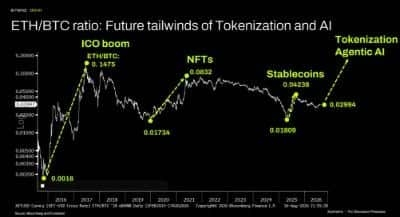
Article
Bitmine Immersion Technologies (BMNR) Announces ETH Holdings Reach 5.93 Million Tokens, and Total...Bitmine owns 4.9% of the total ETH coin supply of 122.0 million
Bitmine is 97% of the way to the 'Alchemy of 5%' in just 15 months
Crypto equities are largest contributor to Russell 1000 quarter to date, representing 4 of the top 21 stocks
Bitmine common stock gain of 99% quarter to date is 4th best of the Russell 1000
ETH is the best performing macro asset in Q3 of 2026 to date, outperforming the S&P 500 by 5,430bp
Bitmine was added to the Russell 1000 Large-cap index on June 26, 2026
Bitmine's Series A Preferred Stock is trading on the NYSE under the symbol BMNP
Bitmine has 5,067,309 staked ETH, representing $12.6 billion at $2,495 per ETH. MAVAN (Made in America VAlidator Network) is a premier Ethereum staking destination for BMNR and institutional investors
Bitmine owns $91 million of Eightco (NASDAQ: ORBS), now one of the only publicly listed equities in the world to provide investors indirect exposure to OpenAI
Bitmine Crypto + Total Cash Holdings & Marketable Securities + "Moonshots" total $15.7 billion, including 5.93 million ETH tokens, total cash & marketable securities of $593 million, and other crypto holdings
Bitmine remains supported by a premier group of institutional investors including ARK's Cathie Wood, MOZAYYX, Founders Fund, Bill Miller III, Pantera, Kraken, DCG, Galaxy Digital and personal investor Thomas "Tom" Lee to support Bitmine's goal of acquiring 5% of ETH
/PRNewswire/ -- (NYSE: BMNR) Bitmine Immersion Technologies, Inc. ("Bitmine" or the "Company") a Bitcoin and Ethereum Network company with a focus on the accumulation of crypto for long term investment, today announced Bitmine crypto + total cash & marketable securities + "moonshots" holdings totaling $15.7 billion.
As of September 7, 2026 at 2:00pm ET, the Company's crypto holdings are comprised of 5,929,198 ETH at $2,495 per ETH (per Coinbase NASDAQ: COIN), 211 Bitcoin (BTC), $180 million stake in Beast Industries, $91 million stake in Eightco Holdings (NASDAQ: ORBS) ("moonshots") and total cash & marketable securities of $593 million. Bitmine's ETH holdings are 4.9% of the ETH supply (of 122.0 million ETH).
"Since June 30th, 4 of the top 21 best performing stocks in the Russell 1000 are crypto-related equities. The outperformance is reflective of the fact that Ethereum is the best performing macro asset in Q3 so far. In our view, fund managers benchmarked to the Russell 1000 need to consider whether they have sufficient exposure to crypto given this group's outsized contribution to Russell 1000 gains this quarter. Notably, Bitmine's common stock is the 4th best performing with a gain of 99% compared to 3% for the Russell 1000 benchmark," stated Thomas "Tom" Lee, Chairman of Bitmine.
Tom DeMark, founder of DeMark Analytics and a capital markets advisor to Bitmine is expecting ETH to make a sharp upward move in coming weeks. According to Tom DeMark, "In August, ETH moved sideways without a downside break and the 12-day metric expired, which implies a renewal of the upside move. We believe this further supports the continuation of the prior uptrend. We expect, last week's sharp one-day rally was a likely preview of the pending advance."
"As we enter the final month of calendar Q3 2026, ETH is the best performing macro asset during the quarter, outperforming the S&P 500 by 5,430bp through last Friday. In fact, the top 3 performing assets since June 30th are ETH, BTC and SOL," stated Lee. "We believe this sets the stage for institutions to add to their crypto holdings given the substantial outperformance of crypto versus other macro assets in calendar Q3 so far."
"We believe there are multiple positive catalysts as we head into the final months of 2026," stated Lee. "These include the upcoming CLARITY Act vote scheduled in mid-September. Additionally, Korean investors have again started buying crypto and rotating away from AI stocks. The 4-year cycle is bottoming within the next few weeks in our view. And this sets the stage for what we expect to be sizable institutional participation in buying crypto in the final months of 2026, especially given the tailwinds of tokenization and Agentic-AI."
"This ETH/BTC ratio has moved up during crypto bull cycles, driven by increasing use of Ethereum relative to Bitcoin. These prior cycles were fueled by ICOs (2017-2018), NFTs (2020-2021), and stablecoins (2025). In this upcoming crypto cycle, we see the ETH/BTC ratio rising, driven by Wall Street tokenizing on the blockchain and by agentic-AI using blockchains," continued Lee.
"Over the past week, we acquired 28,086 ETH. Bitmine's track record of consistent buying of crypto is unmatched by any public company in the world. Bitmine has bought ETH each and every week since the inception of the ETH Treasury Strategy on June 30, 2025," stated Lee.
On July 16, 2026, Bitmine released the latest Chairman's Message (link here) for July 2026. The title of the Message is "ETH is the cure for the Uncanny Valley of Wealth."
Earlier in 2026, Bitmine launched MAVAN (the Made in America VAlidator Network), the institutional-grade staking platform. While MAVAN was originally developed to support Bitmine's own Ethereum treasury, MAVAN has expanded to serve institutional investors, custodians, and ecosystem partners seeking best-in-class staking infrastructure. A portion of Bitmine's ETH is already staked on the MAVAN platform.
As of September 7, 2026, Bitmine total staked ETH stands at 5,067,309 ($12.6 billion at $2,495 per ETH). "Bitmine has staked more ETH than other entities in the world. At scale (when Bitmine's ETH is fully staked by MAVAN and its staking partners), the projected ETH staking reward is $386 million on an annualized basis (using 2.61% 7-day BMNR yield)," stated Lee.
"Annualized staking revenues are now projected at $330 million. And this 5.1 million ETH is 85% of the 5.93 million ETH held by Bitmine. Bitmine's own staking operations generated a 7-day yield of 2.61% (annualized)," continued Lee.
Bitmine is one of the most widely traded stocks in the US. According to data from Fundstrat, the stock has traded average daily dollar volume of $1.10 billion (5-day average, as of September 4, 2026), ranking #81 in the US, behind Intuit Inc. (rank #80) and ahead of TJX Companies, Inc. (rank #82) among 5,704 US-listed stocks (statista.com and Fundstrat research).
Bitmine's crypto holdings reign as the #1 Ethereum treasury and #2 global treasury, behind Strategy Inc., which reportedly owns 840,447 BTC valued at approximately $66 billion. Bitmine remains the largest ETH treasury in the world.
Bitmine management believes the GENIUS Act and the Securities and Exchange Commission's (SEC) Project Crypto are as transformational to financial services in 2026 as the US action on August 15, 1971, which ended the Bretton Woods system and took the U.S. dollar off the gold standard 55 years ago. This 1971 event was the catalyst for the modernization of Wall Street, creating the iconic Wall Street titans and financial and payment rails of today. These proved to be better investments than gold.
The Chairman's message can be found here:
https://www.Bitminetech.io/chairmans-message
The Fiscal Full Year 2025 Earnings presentation and corporate presentation can be found here: https://Bitminetech.io/investor-relations/
To stay informed, please sign up at: https://Bitminetech.io/contact-us/
About Bitmine
Bitmine Immersion Technologies, Inc. (NYSE: BMNR), together with its subsidiaries ("Bitmine" or the "Company"), is a blockchain technology infrastructure company operating across institutional digital asset staking and validation services, bitcoin mining, and strategic digital asset management. As the world's leading Ethereum Treasury company, it implements an innovative digital asset strategy for institutional investors and public market participants. The Company provides institutional-grade staking and validation infrastructure—through which it earns staking rewards and validation income—alongside bitcoin mining activities. Bitmine holds digital assets strategically, generating yield on those holdings to support liquidity and capital formation. Since 2025, the Company has expanded its blockchain infrastructure capabilities, including developing and deploying MAVAN, its institutional staking and validation platform. The Company's activities further include investments in early-stage blockchain opportunities ("moonshot" investments) and ancillary mining, hosting, and consulting services.
For additional details, follow on X:
https://x.com/bitmnr
https://x.com/fundstrat
Forward Looking Statements
This press release contains statements that constitute "forward-looking statements" within the meaning of the Private Securities Litigation Reform Act of 1995, as amended. Forward-looking statements include all statements that are not purely historical and can generally be identified by terms such as "expects," "projects," "intends," "plans," "believes," "anticipates," "estimates," "forecasts," "targets," "goals," "may," "will," "would," "could," "should," "view," "see," or similar expressions, or the negative of such terms, or other comparable terminology. This press release specifically contains forward-looking statements regarding, among other things: (i) the Company's goal of acquiring 5% of the total ETH supply (the "Alchemy of 5%" initiative) and statements that the Company is 97% of the way to achieving this goal in 15 months; (ii) the Company's digital asset accumulation and treasury strategy, including statements regarding continued weekly ETH acquisitions since the inception of the ETH Treasury Strategy on June 30, 2025 and the Company's status as the largest ETH treasury in the world; (iii) the Company's staking operations, including projected annualized ETH staking rewards of approximately $386 million at scale (assuming Bitmine's ETH is fully staked by MAVAN and its staking partners using 2.61% 7-day BMNR yield), currently projected annualized staking revenues of approximately $330 million, and the 7-day yield of 2.61% (annualized); (iv) MAVAN's expansion to serve institutional investors, custodians, and ecosystem partners seeking best-in-class staking infrastructure, and its intended position as a premier Ethereum staking destination for BMNR and institutional investors; (v) expectations regarding future ETH price performance and market movements, including Tom DeMark's expectation that ETH will make a sharp upward move in coming weeks based on technical analysis and the belief that the August sideways movement implies a renewal of the upside move; (vi) statements regarding ETH's performance as the best performing macro asset in Q3 2026 to date, outperforming the S&P 500 by 5,430bp, and that this sets the stage for institutions to add to their crypto holdings; (vii) management's belief that multiple positive catalysts exist heading into the final months of 2026, including the upcoming CLARITY Act vote scheduled for mid-September 2026, renewed buying by Korean investors and rotation away from AI stocks, the view that the four-year crypto cycle is bottoming within the next few weeks, and the expectation of sizable institutional participation in buying crypto in the final months of 2026, especially given the tailwinds of tokenization and agentic-AI; (viii) statements and expectations regarding the ETH/BTC ratio, including that the ratio will rise in the upcoming crypto cycle driven by Wall Street tokenizing on the blockchain and by agentic-AI using blockchains, similar to prior cycles fueled by ICOs (2017-2018), NFTs (2020-2021), and stablecoins (2025); (ix) management's belief that the GENIUS Act and SEC Project Crypto are as transformational to financial services in 2026 as the end of the Bretton Woods system in 1971 and that investments resulting therefrom will prove better than gold; (x) statements that crypto equities are the largest contributor to Russell 1000 quarter to date and that fund managers benchmarked to the Russell 1000 need to consider whether they have sufficient exposure to crypto; (xi) statements regarding the Company's investments, including that its investment in Eightco Holdings (NASDAQ: ORBS) provides investors indirect exposure to OpenAI and its $180 million stake in Beast Industries; and (xii) statements regarding the value of the Company's crypto, cash, marketable securities, and "moonshot" holdings, including aggregate holdings of $15.7 billion and ETH holdings representing 4.9% of the total ETH supply.
These forward-looking statements involve substantial risks and uncertainties that could cause actual results to differ materially from those expressed or implied. Factors that could cause or contribute to such differences include, but are not limited to: the extreme volatility and unpredictability of digital asset prices, including ETH and Bitcoin, and the speculative nature of digital asset investments; the risk that historical ETH price movements, technical analysis indicators, and relative performance versus other macro assets will not recur or are not indicative of future performance; the Company's reliance on third-party pricing sources (including Coinbase) and reported market values in calculating the value of its crypto, cash, marketable securities, and "moonshot" holdings, and the risk that such values fluctuate materially after the date and time referenced in this release; changes in market conditions affecting the trading price and trading volume of the Company's common stock and Series A Preferred Stock, and the risk that the Company's inclusion in the Russell 1000 index does not produce anticipated benefits or that crypto equities' contribution to index performance does not continue; the Company's ability to successfully execute its digital asset acquisition strategy, continue its record of weekly ETH acquisitions, and achieve its ETH accumulation targets, including the "Alchemy of 5%" goal; the Company's ability to finance its business operations, Ethereum treasury operations, and MAVAN expansion; operational, security, and technological risks associated with the Company's staking and validation operations, including network failures, slashing events, cybersecurity breaches, and protocol changes; the risk that actual staking participation, yields, rewards, and revenues differ materially from the projected amounts described in this release, which are based on a 7-day yield and assume ETH is fully staked at scale; competition in the digital asset treasury, staking, and mining industries; the Company's dependence on key personnel, including executive leadership and advisors such as Tom DeMark; regulatory developments affecting digital assets, blockchain technology, and staking activities in the United States and globally, including the timing and outcome of the scheduled CLARITY Act vote and the ultimate enactment, implementation, and interpretation of the GENIUS Act and other pending legislation and regulatory initiatives; actions by the SEC, CFTC, and other regulatory bodies affecting digital assets and related businesses; risks related to the Company's investments in early-stage blockchain opportunities ("moonshot" investments), including the investments in Eightco Holdings (including the nature and extent of any indirect exposure to OpenAI) and Beast Industries; macroeconomic factors, including inflation, interest rates, Federal Reserve monetary policy, labor market conditions, and general economic conditions affecting investor sentiment toward digital assets, including the behavior of Korean and other international investors; the accuracy of technical analysis predictions and management's expectations regarding ETH price movements, the ETH/BTC ratio, and the impact of tokenization and agentic-AI applications on Ethereum; the unpredictability of cryptocurrency market cycles and the accuracy of expectations regarding future crypto cycles, including whether the four-year cycle bottoms as anticipated and whether institutional participation materializes; changes to the Ethereum protocol, including staking mechanics, validator requirements, and reward structures; the performance of third-party service providers, exchanges, custodians, and staking partners; risks related to the concentration of the Company's assets in digital currencies, particularly Ethereum; and the other risk factors described in the Company's filings with the SEC.
The forward-looking statements contained in this press release are based on information available to management as of the date of this release and reflect management's current expectations, estimates, forecasts, projections, views, and beliefs concerning future events and circumstances. Actual results may vary materially from those expressed or implied by forward-looking statements based on a number of factors, including those described above and in the Risk Factors section of the Company's Annual Report on Form 10-K for the fiscal year ended September 30, 2025 filed with the SEC on November 21, 2025, the Company's Quarterly Reports on Form 10-Q, and the Company's other filings with the SEC, as amended or updated from time to time. Copies of these filings are available on the SEC's website at www.sec.gov and on the Company's website at https://Bitminetech.io/investor-relations/. The Company cautions readers not to place undue reliance on any forward-looking statements, which speak only as of the date on which they are made. Bitmine expressly disclaims any obligation or undertaking to update, revise, or supplement any forward-looking statements to reflect any change in its expectations or any change in events, conditions, or circumstances on which any such statements are based, except as required by applicable law or regulation.
Bitmine Immersion Technologies (BMNR) Announces ETH Holdings Reach 5.93 Million Tokens, and Total...
Bitmine owns 4.9% of the total ETH coin supply of 122.0 million
Bitmine is 97% of the way to the 'Alchemy of 5%' in just 15 months
Crypto equities are largest contributor to Russell 1000 quarter to date, representing 4 of the top 21 stocks
Bitmine common stock gain of 99% quarter to date is 4th best of the Russell 1000
ETH is the best performing macro asset in Q3 of 2026 to date, outperforming the S&P 500 by 5,430bp
Bitmine was added to the Russell 1000 Large-cap index on June 26, 2026
Bitmine's Series A Preferred Stock is trading on the NYSE under the symbol BMNP
Bitmine has 5,067,309 staked ETH, representing $12.6 billion at $2,495 per ETH. MAVAN (Made in America VAlidator Network) is a premier Ethereum staking destination for BMNR and institutional investors
Bitmine owns $91 million of Eightco (NASDAQ: ORBS), now one of the only publicly listed equities in the world to provide investors indirect exposure to OpenAI
Bitmine Crypto + Total Cash Holdings & Marketable Securities + "Moonshots" total $15.7 billion, including 5.93 million ETH tokens, total cash & marketable securities of $593 million, and other crypto holdings
Bitmine remains supported by a premier group of institutional investors including ARK's Cathie Wood, MOZAYYX, Founders Fund, Bill Miller III, Pantera, Kraken, DCG, Galaxy Digital and personal investor Thomas "Tom" Lee to support Bitmine's goal of acquiring 5% of ETH
/PRNewswire/ -- (NYSE: BMNR) Bitmine Immersion Technologies, Inc. ("Bitmine" or the "Company") a Bitcoin and Ethereum Network company with a focus on the accumulation of crypto for long term investment, today announced Bitmine crypto + total cash & marketable securities + "moonshots" holdings totaling $15.7 billion.
As of September 7, 2026 at 2:00pm ET, the Company's crypto holdings are comprised of 5,929,198 ETH at $2,495 per ETH (per Coinbase NASDAQ: COIN), 211 Bitcoin (BTC), $180 million stake in Beast Industries, $91 million stake in Eightco Holdings (NASDAQ: ORBS) ("moonshots") and total cash & marketable securities of $593 million. Bitmine's ETH holdings are 4.9% of the ETH supply (of 122.0 million ETH).
"Since June 30th, 4 of the top 21 best performing stocks in the Russell 1000 are crypto-related equities. The outperformance is reflective of the fact that Ethereum is the best performing macro asset in Q3 so far. In our view, fund managers benchmarked to the Russell 1000 need to consider whether they have sufficient exposure to crypto given this group's outsized contribution to Russell 1000 gains this quarter. Notably, Bitmine's common stock is the 4th best performing with a gain of 99% compared to 3% for the Russell 1000 benchmark," stated Thomas "Tom" Lee, Chairman of Bitmine.
Tom DeMark, founder of DeMark Analytics and a capital markets advisor to Bitmine is expecting ETH to make a sharp upward move in coming weeks. According to Tom DeMark, "In August, ETH moved sideways without a downside break and the 12-day metric expired, which implies a renewal of the upside move. We believe this further supports the continuation of the prior uptrend. We expect, last week's sharp one-day rally was a likely preview of the pending advance."
"As we enter the final month of calendar Q3 2026, ETH is the best performing macro asset during the quarter, outperforming the S&P 500 by 5,430bp through last Friday. In fact, the top 3 performing assets since June 30th are ETH, BTC and SOL," stated Lee. "We believe this sets the stage for institutions to add to their crypto holdings given the substantial outperformance of crypto versus other macro assets in calendar Q3 so far."
"We believe there are multiple positive catalysts as we head into the final months of 2026," stated Lee. "These include the upcoming CLARITY Act vote scheduled in mid-September. Additionally, Korean investors have again started buying crypto and rotating away from AI stocks. The 4-year cycle is bottoming within the next few weeks in our view. And this sets the stage for what we expect to be sizable institutional participation in buying crypto in the final months of 2026, especially given the tailwinds of tokenization and Agentic-AI."
"This ETH/BTC ratio has moved up during crypto bull cycles, driven by increasing use of Ethereum relative to Bitcoin. These prior cycles were fueled by ICOs (2017-2018), NFTs (2020-2021), and stablecoins (2025). In this upcoming crypto cycle, we see the ETH/BTC ratio rising, driven by Wall Street tokenizing on the blockchain and by agentic-AI using blockchains," continued Lee.
"Over the past week, we acquired 28,086 ETH. Bitmine's track record of consistent buying of crypto is unmatched by any public company in the world. Bitmine has bought ETH each and every week since the inception of the ETH Treasury Strategy on June 30, 2025," stated Lee.
On July 16, 2026, Bitmine released the latest Chairman's Message (link here) for July 2026. The title of the Message is "ETH is the cure for the Uncanny Valley of Wealth."
Earlier in 2026, Bitmine launched MAVAN (the Made in America VAlidator Network), the institutional-grade staking platform. While MAVAN was originally developed to support Bitmine's own Ethereum treasury, MAVAN has expanded to serve institutional investors, custodians, and ecosystem partners seeking best-in-class staking infrastructure. A portion of Bitmine's ETH is already staked on the MAVAN platform.
As of September 7, 2026, Bitmine total staked ETH stands at 5,067,309 ($12.6 billion at $2,495 per ETH). "Bitmine has staked more ETH than other entities in the world. At scale (when Bitmine's ETH is fully staked by MAVAN and its staking partners), the projected ETH staking reward is $386 million on an annualized basis (using 2.61% 7-day BMNR yield)," stated Lee.
"Annualized staking revenues are now projected at $330 million. And this 5.1 million ETH is 85% of the 5.93 million ETH held by Bitmine. Bitmine's own staking operations generated a 7-day yield of 2.61% (annualized)," continued Lee.
Bitmine is one of the most widely traded stocks in the US. According to data from Fundstrat, the stock has traded average daily dollar volume of $1.10 billion (5-day average, as of September 4, 2026), ranking #81 in the US, behind Intuit Inc. (rank #80) and ahead of TJX Companies, Inc. (rank #82) among 5,704 US-listed stocks (statista.com and Fundstrat research).
Bitmine's crypto holdings reign as the #1 Ethereum treasury and #2 global treasury, behind Strategy Inc., which reportedly owns 840,447 BTC valued at approximately $66 billion. Bitmine remains the largest ETH treasury in the world.
Bitmine management believes the GENIUS Act and the Securities and Exchange Commission's (SEC) Project Crypto are as transformational to financial services in 2026 as the US action on August 15, 1971, which ended the Bretton Woods system and took the U.S. dollar off the gold standard 55 years ago. This 1971 event was the catalyst for the modernization of Wall Street, creating the iconic Wall Street titans and financial and payment rails of today. These proved to be better investments than gold.
The Chairman's message can be found here:
https://www.Bitminetech.io/chairmans-message
The Fiscal Full Year 2025 Earnings presentation and corporate presentation can be found here: https://Bitminetech.io/investor-relations/
To stay informed, please sign up at: https://Bitminetech.io/contact-us/
About Bitmine
Bitmine Immersion Technologies, Inc. (NYSE: BMNR), together with its subsidiaries ("Bitmine" or the "Company"), is a blockchain technology infrastructure company operating across institutional digital asset staking and validation services, bitcoin mining, and strategic digital asset management. As the world's leading Ethereum Treasury company, it implements an innovative digital asset strategy for institutional investors and public market participants. The Company provides institutional-grade staking and validation infrastructure—through which it earns staking rewards and validation income—alongside bitcoin mining activities. Bitmine holds digital assets strategically, generating yield on those holdings to support liquidity and capital formation. Since 2025, the Company has expanded its blockchain infrastructure capabilities, including developing and deploying MAVAN, its institutional staking and validation platform. The Company's activities further include investments in early-stage blockchain opportunities ("moonshot" investments) and ancillary mining, hosting, and consulting services.
For additional details, follow on X:
https://x.com/bitmnr
https://x.com/fundstrat
Forward Looking Statements
This press release contains statements that constitute "forward-looking statements" within the meaning of the Private Securities Litigation Reform Act of 1995, as amended. Forward-looking statements include all statements that are not purely historical and can generally be identified by terms such as "expects," "projects," "intends," "plans," "believes," "anticipates," "estimates," "forecasts," "targets," "goals," "may," "will," "would," "could," "should," "view," "see," or similar expressions, or the negative of such terms, or other comparable terminology. This press release specifically contains forward-looking statements regarding, among other things: (i) the Company's goal of acquiring 5% of the total ETH supply (the "Alchemy of 5%" initiative) and statements that the Company is 97% of the way to achieving this goal in 15 months; (ii) the Company's digital asset accumulation and treasury strategy, including statements regarding continued weekly ETH acquisitions since the inception of the ETH Treasury Strategy on June 30, 2025 and the Company's status as the largest ETH treasury in the world; (iii) the Company's staking operations, including projected annualized ETH staking rewards of approximately $386 million at scale (assuming Bitmine's ETH is fully staked by MAVAN and its staking partners using 2.61% 7-day BMNR yield), currently projected annualized staking revenues of approximately $330 million, and the 7-day yield of 2.61% (annualized); (iv) MAVAN's expansion to serve institutional investors, custodians, and ecosystem partners seeking best-in-class staking infrastructure, and its intended position as a premier Ethereum staking destination for BMNR and institutional investors; (v) expectations regarding future ETH price performance and market movements, including Tom DeMark's expectation that ETH will make a sharp upward move in coming weeks based on technical analysis and the belief that the August sideways movement implies a renewal of the upside move; (vi) statements regarding ETH's performance as the best performing macro asset in Q3 2026 to date, outperforming the S&P 500 by 5,430bp, and that this sets the stage for institutions to add to their crypto holdings; (vii) management's belief that multiple positive catalysts exist heading into the final months of 2026, including the upcoming CLARITY Act vote scheduled for mid-September 2026, renewed buying by Korean investors and rotation away from AI stocks, the view that the four-year crypto cycle is bottoming within the next few weeks, and the expectation of sizable institutional participation in buying crypto in the final months of 2026, especially given the tailwinds of tokenization and agentic-AI; (viii) statements and expectations regarding the ETH/BTC ratio, including that the ratio will rise in the upcoming crypto cycle driven by Wall Street tokenizing on the blockchain and by agentic-AI using blockchains, similar to prior cycles fueled by ICOs (2017-2018), NFTs (2020-2021), and stablecoins (2025); (ix) management's belief that the GENIUS Act and SEC Project Crypto are as transformational to financial services in 2026 as the end of the Bretton Woods system in 1971 and that investments resulting therefrom will prove better than gold; (x) statements that crypto equities are the largest contributor to Russell 1000 quarter to date and that fund managers benchmarked to the Russell 1000 need to consider whether they have sufficient exposure to crypto; (xi) statements regarding the Company's investments, including that its investment in Eightco Holdings (NASDAQ: ORBS) provides investors indirect exposure to OpenAI and its $180 million stake in Beast Industries; and (xii) statements regarding the value of the Company's crypto, cash, marketable securities, and "moonshot" holdings, including aggregate holdings of $15.7 billion and ETH holdings representing 4.9% of the total ETH supply.
These forward-looking statements involve substantial risks and uncertainties that could cause actual results to differ materially from those expressed or implied. Factors that could cause or contribute to such differences include, but are not limited to: the extreme volatility and unpredictability of digital asset prices, including ETH and Bitcoin, and the speculative nature of digital asset investments; the risk that historical ETH price movements, technical analysis indicators, and relative performance versus other macro assets will not recur or are not indicative of future performance; the Company's reliance on third-party pricing sources (including Coinbase) and reported market values in calculating the value of its crypto, cash, marketable securities, and "moonshot" holdings, and the risk that such values fluctuate materially after the date and time referenced in this release; changes in market conditions affecting the trading price and trading volume of the Company's common stock and Series A Preferred Stock, and the risk that the Company's inclusion in the Russell 1000 index does not produce anticipated benefits or that crypto equities' contribution to index performance does not continue; the Company's ability to successfully execute its digital asset acquisition strategy, continue its record of weekly ETH acquisitions, and achieve its ETH accumulation targets, including the "Alchemy of 5%" goal; the Company's ability to finance its business operations, Ethereum treasury operations, and MAVAN expansion; operational, security, and technological risks associated with the Company's staking and validation operations, including network failures, slashing events, cybersecurity breaches, and protocol changes; the risk that actual staking participation, yields, rewards, and revenues differ materially from the projected amounts described in this release, which are based on a 7-day yield and assume ETH is fully staked at scale; competition in the digital asset treasury, staking, and mining industries; the Company's dependence on key personnel, including executive leadership and advisors such as Tom DeMark; regulatory developments affecting digital assets, blockchain technology, and staking activities in the United States and globally, including the timing and outcome of the scheduled CLARITY Act vote and the ultimate enactment, implementation, and interpretation of the GENIUS Act and other pending legislation and regulatory initiatives; actions by the SEC, CFTC, and other regulatory bodies affecting digital assets and related businesses; risks related to the Company's investments in early-stage blockchain opportunities ("moonshot" investments), including the investments in Eightco Holdings (including the nature and extent of any indirect exposure to OpenAI) and Beast Industries; macroeconomic factors, including inflation, interest rates, Federal Reserve monetary policy, labor market conditions, and general economic conditions affecting investor sentiment toward digital assets, including the behavior of Korean and other international investors; the accuracy of technical analysis predictions and management's expectations regarding ETH price movements, the ETH/BTC ratio, and the impact of tokenization and agentic-AI applications on Ethereum; the unpredictability of cryptocurrency market cycles and the accuracy of expectations regarding future crypto cycles, including whether the four-year cycle bottoms as anticipated and whether institutional participation materializes; changes to the Ethereum protocol, including staking mechanics, validator requirements, and reward structures; the performance of third-party service providers, exchanges, custodians, and staking partners; risks related to the concentration of the Company's assets in digital currencies, particularly Ethereum; and the other risk factors described in the Company's filings with the SEC.
The forward-looking statements contained in this press release are based on information available to management as of the date of this release and reflect management's current expectations, estimates, forecasts, projections, views, and beliefs concerning future events and circumstances. Actual results may vary materially from those expressed or implied by forward-looking statements based on a number of factors, including those described above and in the Risk Factors section of the Company's Annual Report on Form 10-K for the fiscal year ended September 30, 2025 filed with the SEC on November 21, 2025, the Company's Quarterly Reports on Form 10-Q, and the Company's other filings with the SEC, as amended or updated from time to time. Copies of these filings are available on the SEC's website at www.sec.gov and on the Company's website at https://Bitminetech.io/investor-relations/. The Company cautions readers not to place undue reliance on any forward-looking statements, which speak only as of the date on which they are made. Bitmine expressly disclaims any obligation or undertaking to update, revise, or supplement any forward-looking statements to reflect any change in its expectations or any change in events, conditions, or circumstances on which any such statements are based, except as required by applicable law or regulation.
Bitmine is 97% of the way to the 'Alchemy of 5%' in just 15 months
Crypto equities are largest contributor to Russell 1000 quarter to date, representing 4 of the top 21 stocks
Bitmine common stock gain of 99% quarter to date is 4th best of the Russell 1000
ETH is the best performing macro asset in Q3 of 2026 to date, outperforming the S&P 500 by 5,430bp
Bitmine was added to the Russell 1000 Large-cap index on June 26, 2026
Bitmine's Series A Preferred Stock is trading on the NYSE under the symbol BMNP
Bitmine has 5,067,309 staked ETH, representing $12.6 billion at $2,495 per ETH. MAVAN (Made in America VAlidator Network) is a premier Ethereum staking destination for BMNR and institutional investors
Bitmine owns $91 million of Eightco (NASDAQ: ORBS), now one of the only publicly listed equities in the world to provide investors indirect exposure to OpenAI
Bitmine Crypto + Total Cash Holdings & Marketable Securities + "Moonshots" total $15.7 billion, including 5.93 million ETH tokens, total cash & marketable securities of $593 million, and other crypto holdings
Bitmine remains supported by a premier group of institutional investors including ARK's Cathie Wood, MOZAYYX, Founders Fund, Bill Miller III, Pantera, Kraken, DCG, Galaxy Digital and personal investor Thomas "Tom" Lee to support Bitmine's goal of acquiring 5% of ETH
/PRNewswire/ -- (NYSE: BMNR) Bitmine Immersion Technologies, Inc. ("Bitmine" or the "Company") a Bitcoin and Ethereum Network company with a focus on the accumulation of crypto for long term investment, today announced Bitmine crypto + total cash & marketable securities + "moonshots" holdings totaling $15.7 billion.
As of September 7, 2026 at 2:00pm ET, the Company's crypto holdings are comprised of 5,929,198 ETH at $2,495 per ETH (per Coinbase NASDAQ: COIN), 211 Bitcoin (BTC), $180 million stake in Beast Industries, $91 million stake in Eightco Holdings (NASDAQ: ORBS) ("moonshots") and total cash & marketable securities of $593 million. Bitmine's ETH holdings are 4.9% of the ETH supply (of 122.0 million ETH).
"Since June 30th, 4 of the top 21 best performing stocks in the Russell 1000 are crypto-related equities. The outperformance is reflective of the fact that Ethereum is the best performing macro asset in Q3 so far. In our view, fund managers benchmarked to the Russell 1000 need to consider whether they have sufficient exposure to crypto given this group's outsized contribution to Russell 1000 gains this quarter. Notably, Bitmine's common stock is the 4th best performing with a gain of 99% compared to 3% for the Russell 1000 benchmark," stated Thomas "Tom" Lee, Chairman of Bitmine.
Tom DeMark, founder of DeMark Analytics and a capital markets advisor to Bitmine is expecting ETH to make a sharp upward move in coming weeks. According to Tom DeMark, "In August, ETH moved sideways without a downside break and the 12-day metric expired, which implies a renewal of the upside move. We believe this further supports the continuation of the prior uptrend. We expect, last week's sharp one-day rally was a likely preview of the pending advance."
"As we enter the final month of calendar Q3 2026, ETH is the best performing macro asset during the quarter, outperforming the S&P 500 by 5,430bp through last Friday. In fact, the top 3 performing assets since June 30th are ETH, BTC and SOL," stated Lee. "We believe this sets the stage for institutions to add to their crypto holdings given the substantial outperformance of crypto versus other macro assets in calendar Q3 so far."
"We believe there are multiple positive catalysts as we head into the final months of 2026," stated Lee. "These include the upcoming CLARITY Act vote scheduled in mid-September. Additionally, Korean investors have again started buying crypto and rotating away from AI stocks. The 4-year cycle is bottoming within the next few weeks in our view. And this sets the stage for what we expect to be sizable institutional participation in buying crypto in the final months of 2026, especially given the tailwinds of tokenization and Agentic-AI."
"This ETH/BTC ratio has moved up during crypto bull cycles, driven by increasing use of Ethereum relative to Bitcoin. These prior cycles were fueled by ICOs (2017-2018), NFTs (2020-2021), and stablecoins (2025). In this upcoming crypto cycle, we see the ETH/BTC ratio rising, driven by Wall Street tokenizing on the blockchain and by agentic-AI using blockchains," continued Lee.
"Over the past week, we acquired 28,086 ETH. Bitmine's track record of consistent buying of crypto is unmatched by any public company in the world. Bitmine has bought ETH each and every week since the inception of the ETH Treasury Strategy on June 30, 2025," stated Lee.
On July 16, 2026, Bitmine released the latest Chairman's Message (link here) for July 2026. The title of the Message is "ETH is the cure for the Uncanny Valley of Wealth."
Earlier in 2026, Bitmine launched MAVAN (the Made in America VAlidator Network), the institutional-grade staking platform. While MAVAN was originally developed to support Bitmine's own Ethereum treasury, MAVAN has expanded to serve institutional investors, custodians, and ecosystem partners seeking best-in-class staking infrastructure. A portion of Bitmine's ETH is already staked on the MAVAN platform.
As of September 7, 2026, Bitmine total staked ETH stands at 5,067,309 ($12.6 billion at $2,495 per ETH). "Bitmine has staked more ETH than other entities in the world. At scale (when Bitmine's ETH is fully staked by MAVAN and its staking partners), the projected ETH staking reward is $386 million on an annualized basis (using 2.61% 7-day BMNR yield)," stated Lee.
"Annualized staking revenues are now projected at $330 million. And this 5.1 million ETH is 85% of the 5.93 million ETH held by Bitmine. Bitmine's own staking operations generated a 7-day yield of 2.61% (annualized)," continued Lee.
Bitmine is one of the most widely traded stocks in the US. According to data from Fundstrat, the stock has traded average daily dollar volume of $1.10 billion (5-day average, as of September 4, 2026), ranking #81 in the US, behind Intuit Inc. (rank #80) and ahead of TJX Companies, Inc. (rank #82) among 5,704 US-listed stocks (statista.com and Fundstrat research).
Bitmine's crypto holdings reign as the #1 Ethereum treasury and #2 global treasury, behind Strategy Inc., which reportedly owns 840,447 BTC valued at approximately $66 billion. Bitmine remains the largest ETH treasury in the world.
Bitmine management believes the GENIUS Act and the Securities and Exchange Commission's (SEC) Project Crypto are as transformational to financial services in 2026 as the US action on August 15, 1971, which ended the Bretton Woods system and took the U.S. dollar off the gold standard 55 years ago. This 1971 event was the catalyst for the modernization of Wall Street, creating the iconic Wall Street titans and financial and payment rails of today. These proved to be better investments than gold.
The Chairman's message can be found here:
https://www.Bitminetech.io/chairmans-message
The Fiscal Full Year 2025 Earnings presentation and corporate presentation can be found here: https://Bitminetech.io/investor-relations/
To stay informed, please sign up at: https://Bitminetech.io/contact-us/
About Bitmine
Bitmine Immersion Technologies, Inc. (NYSE: BMNR), together with its subsidiaries ("Bitmine" or the "Company"), is a blockchain technology infrastructure company operating across institutional digital asset staking and validation services, bitcoin mining, and strategic digital asset management. As the world's leading Ethereum Treasury company, it implements an innovative digital asset strategy for institutional investors and public market participants. The Company provides institutional-grade staking and validation infrastructure—through which it earns staking rewards and validation income—alongside bitcoin mining activities. Bitmine holds digital assets strategically, generating yield on those holdings to support liquidity and capital formation. Since 2025, the Company has expanded its blockchain infrastructure capabilities, including developing and deploying MAVAN, its institutional staking and validation platform. The Company's activities further include investments in early-stage blockchain opportunities ("moonshot" investments) and ancillary mining, hosting, and consulting services.
For additional details, follow on X:
https://x.com/bitmnr
https://x.com/fundstrat
Forward Looking Statements
This press release contains statements that constitute "forward-looking statements" within the meaning of the Private Securities Litigation Reform Act of 1995, as amended. Forward-looking statements include all statements that are not purely historical and can generally be identified by terms such as "expects," "projects," "intends," "plans," "believes," "anticipates," "estimates," "forecasts," "targets," "goals," "may," "will," "would," "could," "should," "view," "see," or similar expressions, or the negative of such terms, or other comparable terminology. This press release specifically contains forward-looking statements regarding, among other things: (i) the Company's goal of acquiring 5% of the total ETH supply (the "Alchemy of 5%" initiative) and statements that the Company is 97% of the way to achieving this goal in 15 months; (ii) the Company's digital asset accumulation and treasury strategy, including statements regarding continued weekly ETH acquisitions since the inception of the ETH Treasury Strategy on June 30, 2025 and the Company's status as the largest ETH treasury in the world; (iii) the Company's staking operations, including projected annualized ETH staking rewards of approximately $386 million at scale (assuming Bitmine's ETH is fully staked by MAVAN and its staking partners using 2.61% 7-day BMNR yield), currently projected annualized staking revenues of approximately $330 million, and the 7-day yield of 2.61% (annualized); (iv) MAVAN's expansion to serve institutional investors, custodians, and ecosystem partners seeking best-in-class staking infrastructure, and its intended position as a premier Ethereum staking destination for BMNR and institutional investors; (v) expectations regarding future ETH price performance and market movements, including Tom DeMark's expectation that ETH will make a sharp upward move in coming weeks based on technical analysis and the belief that the August sideways movement implies a renewal of the upside move; (vi) statements regarding ETH's performance as the best performing macro asset in Q3 2026 to date, outperforming the S&P 500 by 5,430bp, and that this sets the stage for institutions to add to their crypto holdings; (vii) management's belief that multiple positive catalysts exist heading into the final months of 2026, including the upcoming CLARITY Act vote scheduled for mid-September 2026, renewed buying by Korean investors and rotation away from AI stocks, the view that the four-year crypto cycle is bottoming within the next few weeks, and the expectation of sizable institutional participation in buying crypto in the final months of 2026, especially given the tailwinds of tokenization and agentic-AI; (viii) statements and expectations regarding the ETH/BTC ratio, including that the ratio will rise in the upcoming crypto cycle driven by Wall Street tokenizing on the blockchain and by agentic-AI using blockchains, similar to prior cycles fueled by ICOs (2017-2018), NFTs (2020-2021), and stablecoins (2025); (ix) management's belief that the GENIUS Act and SEC Project Crypto are as transformational to financial services in 2026 as the end of the Bretton Woods system in 1971 and that investments resulting therefrom will prove better than gold; (x) statements that crypto equities are the largest contributor to Russell 1000 quarter to date and that fund managers benchmarked to the Russell 1000 need to consider whether they have sufficient exposure to crypto; (xi) statements regarding the Company's investments, including that its investment in Eightco Holdings (NASDAQ: ORBS) provides investors indirect exposure to OpenAI and its $180 million stake in Beast Industries; and (xii) statements regarding the value of the Company's crypto, cash, marketable securities, and "moonshot" holdings, including aggregate holdings of $15.7 billion and ETH holdings representing 4.9% of the total ETH supply.
These forward-looking statements involve substantial risks and uncertainties that could cause actual results to differ materially from those expressed or implied. Factors that could cause or contribute to such differences include, but are not limited to: the extreme volatility and unpredictability of digital asset prices, including ETH and Bitcoin, and the speculative nature of digital asset investments; the risk that historical ETH price movements, technical analysis indicators, and relative performance versus other macro assets will not recur or are not indicative of future performance; the Company's reliance on third-party pricing sources (including Coinbase) and reported market values in calculating the value of its crypto, cash, marketable securities, and "moonshot" holdings, and the risk that such values fluctuate materially after the date and time referenced in this release; changes in market conditions affecting the trading price and trading volume of the Company's common stock and Series A Preferred Stock, and the risk that the Company's inclusion in the Russell 1000 index does not produce anticipated benefits or that crypto equities' contribution to index performance does not continue; the Company's ability to successfully execute its digital asset acquisition strategy, continue its record of weekly ETH acquisitions, and achieve its ETH accumulation targets, including the "Alchemy of 5%" goal; the Company's ability to finance its business operations, Ethereum treasury operations, and MAVAN expansion; operational, security, and technological risks associated with the Company's staking and validation operations, including network failures, slashing events, cybersecurity breaches, and protocol changes; the risk that actual staking participation, yields, rewards, and revenues differ materially from the projected amounts described in this release, which are based on a 7-day yield and assume ETH is fully staked at scale; competition in the digital asset treasury, staking, and mining industries; the Company's dependence on key personnel, including executive leadership and advisors such as Tom DeMark; regulatory developments affecting digital assets, blockchain technology, and staking activities in the United States and globally, including the timing and outcome of the scheduled CLARITY Act vote and the ultimate enactment, implementation, and interpretation of the GENIUS Act and other pending legislation and regulatory initiatives; actions by the SEC, CFTC, and other regulatory bodies affecting digital assets and related businesses; risks related to the Company's investments in early-stage blockchain opportunities ("moonshot" investments), including the investments in Eightco Holdings (including the nature and extent of any indirect exposure to OpenAI) and Beast Industries; macroeconomic factors, including inflation, interest rates, Federal Reserve monetary policy, labor market conditions, and general economic conditions affecting investor sentiment toward digital assets, including the behavior of Korean and other international investors; the accuracy of technical analysis predictions and management's expectations regarding ETH price movements, the ETH/BTC ratio, and the impact of tokenization and agentic-AI applications on Ethereum; the unpredictability of cryptocurrency market cycles and the accuracy of expectations regarding future crypto cycles, including whether the four-year cycle bottoms as anticipated and whether institutional participation materializes; changes to the Ethereum protocol, including staking mechanics, validator requirements, and reward structures; the performance of third-party service providers, exchanges, custodians, and staking partners; risks related to the concentration of the Company's assets in digital currencies, particularly Ethereum; and the other risk factors described in the Company's filings with the SEC.
The forward-looking statements contained in this press release are based on information available to management as of the date of this release and reflect management's current expectations, estimates, forecasts, projections, views, and beliefs concerning future events and circumstances. Actual results may vary materially from those expressed or implied by forward-looking statements based on a number of factors, including those described above and in the Risk Factors section of the Company's Annual Report on Form 10-K for the fiscal year ended September 30, 2025 filed with the SEC on November 21, 2025, the Company's Quarterly Reports on Form 10-Q, and the Company's other filings with the SEC, as amended or updated from time to time. Copies of these filings are available on the SEC's website at www.sec.gov and on the Company's website at https://Bitminetech.io/investor-relations/. The Company cautions readers not to place undue reliance on any forward-looking statements, which speak only as of the date on which they are made. Bitmine expressly disclaims any obligation or undertaking to update, revise, or supplement any forward-looking statements to reflect any change in its expectations or any change in events, conditions, or circumstances on which any such statements are based, except as required by applicable law or regulation.
30
Article
Chainlink Faces Three Warning Signs After 95% Rally, Says AnalystLINK rallied 95% from $7 to $13.77, but the weekly TD Sequential now signals a potential sell setup.
Whale transactions above $1M fell from about 59 to 10, while 1.75M LINK moved onto exchanges.
LINK faces support at $12.50-$12.60, with $13.50-$13.70 resistance and weakening RSI and MACD momentum.
Chainlink is facing three warning signs after a 95% rally, according to analyst Ali Charts, as whale activity declines. LINK rose from nearly $7 to $13.77, while 1.75 million tokens moved onto exchanges. The latest market data shows LINK at $12.626 after rejection near $13.70, with momentum indicators turning weaker.
Whale Activity Drops as Exchange Deposits Rise
Ali Charts said the TD Sequential has flashed a sell signal on LINK’s weekly chart. The signal followed a 95% advance from about $7 to the recent $13.77 high. However, whale participation has also fallen sharply.
Transactions worth more than $1 million dropped from roughly 59 during the past two weeks to about 10 today. At the same time, 1.75 million LINK moved onto exchanges. Exchange balances increased from 269.25 million to roughly 271 million LINK. Ali Charts said the combined data points to a potential cooldown after LINK’s sharp advance.
LINK Pulls Back From September Rally
The latest price data shows LINK trading at $12.626, with the latest candle ranging between $12.617 and $12.682. Earlier, LINK climbed from around $11 to $11.50 before reaching nearly $13.65-$13.70 during the Sept. 6-7 rally.
Source: TradingView
Trading volume increased during the move above $12. However, rejection near $13.50-$13.70 brought profit-taking and pushed LINK toward $12.60. The RSI is at 41.97, below its moving average at 43.69.
It remains above 30, which leaves LINK outside oversold territory. The MACD has also turned bearish. Its line is near -0.067, while the signal line is around -0.041.
Key Support and Resistance Levels
LINK currently faces support around $12.50-$12.60, followed by $12.00 and roughly $11.50. On the upside, $13.00 represents the first level to reclaim. Above that, resistance is around $13.50-$13.70. A sustained move above $13.70 would open the next area higher, based on the provided technical levels.
Meanwhile, the 50-day moving average is near $12.39, while the 200-day moving average is around $11.24 and continues rising. The price remains above the longer-term average despite its latest pullback.
Chainlink Faces Three Warning Signs After 95% Rally, Says Analyst
LINK rallied 95% from $7 to $13.77, but the weekly TD Sequential now signals a potential sell setup.
Whale transactions above $1M fell from about 59 to 10, while 1.75M LINK moved onto exchanges.
LINK faces support at $12.50-$12.60, with $13.50-$13.70 resistance and weakening RSI and MACD momentum.
Chainlink is facing three warning signs after a 95% rally, according to analyst Ali Charts, as whale activity declines. LINK rose from nearly $7 to $13.77, while 1.75 million tokens moved onto exchanges. The latest market data shows LINK at $12.626 after rejection near $13.70, with momentum indicators turning weaker.
Whale Activity Drops as Exchange Deposits Rise
Ali Charts said the TD Sequential has flashed a sell signal on LINK’s weekly chart. The signal followed a 95% advance from about $7 to the recent $13.77 high. However, whale participation has also fallen sharply.
Transactions worth more than $1 million dropped from roughly 59 during the past two weeks to about 10 today. At the same time, 1.75 million LINK moved onto exchanges. Exchange balances increased from 269.25 million to roughly 271 million LINK. Ali Charts said the combined data points to a potential cooldown after LINK’s sharp advance.
LINK Pulls Back From September Rally
The latest price data shows LINK trading at $12.626, with the latest candle ranging between $12.617 and $12.682. Earlier, LINK climbed from around $11 to $11.50 before reaching nearly $13.65-$13.70 during the Sept. 6-7 rally.
Source: TradingView
Trading volume increased during the move above $12. However, rejection near $13.50-$13.70 brought profit-taking and pushed LINK toward $12.60. The RSI is at 41.97, below its moving average at 43.69.
It remains above 30, which leaves LINK outside oversold territory. The MACD has also turned bearish. Its line is near -0.067, while the signal line is around -0.041.
Key Support and Resistance Levels
LINK currently faces support around $12.50-$12.60, followed by $12.00 and roughly $11.50. On the upside, $13.00 represents the first level to reclaim. Above that, resistance is around $13.50-$13.70. A sustained move above $13.70 would open the next area higher, based on the provided technical levels.
Meanwhile, the 50-day moving average is near $12.39, while the 200-day moving average is around $11.24 and continues rising. The price remains above the longer-term average despite its latest pullback.
Whale transactions above $1M fell from about 59 to 10, while 1.75M LINK moved onto exchanges.
LINK faces support at $12.50-$12.60, with $13.50-$13.70 resistance and weakening RSI and MACD momentum.
Chainlink is facing three warning signs after a 95% rally, according to analyst Ali Charts, as whale activity declines. LINK rose from nearly $7 to $13.77, while 1.75 million tokens moved onto exchanges. The latest market data shows LINK at $12.626 after rejection near $13.70, with momentum indicators turning weaker.
Whale Activity Drops as Exchange Deposits Rise
Ali Charts said the TD Sequential has flashed a sell signal on LINK’s weekly chart. The signal followed a 95% advance from about $7 to the recent $13.77 high. However, whale participation has also fallen sharply.
Transactions worth more than $1 million dropped from roughly 59 during the past two weeks to about 10 today. At the same time, 1.75 million LINK moved onto exchanges. Exchange balances increased from 269.25 million to roughly 271 million LINK. Ali Charts said the combined data points to a potential cooldown after LINK’s sharp advance.
LINK Pulls Back From September Rally
The latest price data shows LINK trading at $12.626, with the latest candle ranging between $12.617 and $12.682. Earlier, LINK climbed from around $11 to $11.50 before reaching nearly $13.65-$13.70 during the Sept. 6-7 rally.
Source: TradingView
Trading volume increased during the move above $12. However, rejection near $13.50-$13.70 brought profit-taking and pushed LINK toward $12.60. The RSI is at 41.97, below its moving average at 43.69.
It remains above 30, which leaves LINK outside oversold territory. The MACD has also turned bearish. Its line is near -0.067, while the signal line is around -0.041.
Key Support and Resistance Levels
LINK currently faces support around $12.50-$12.60, followed by $12.00 and roughly $11.50. On the upside, $13.00 represents the first level to reclaim. Above that, resistance is around $13.50-$13.70. A sustained move above $13.70 would open the next area higher, based on the provided technical levels.
Meanwhile, the 50-day moving average is near $12.39, while the 200-day moving average is around $11.24 and continues rising. The price remains above the longer-term average despite its latest pullback.
81
Article
XRP Futures Surge as Trading Volume Reaches Six-Month High, CryptoQuant ReportsBinance led August XRP futures volume with $37B, followed by Bybit at $14.54B and OKX at $12.88B.
XRP rebounded from $1.00-$1.05 to nearly $1.58 before pulling back, with $1.35-$1.39 now key support.
Futures volume alone cannot reveal market direction, making funding rates and open interest crucial for assessing positioning.
XRP futures trading volume reached its highest level in six months during August, according to CryptoQuant. Binance recorded about $37 billion, while Bybit and OKX posted $14.54 billion and $12.88 billion. Combined volume across the three exchanges exceeded $64.6 billion as XRP recovered from about $1.00 to $1.05.
Binance Leads August Futures Activity
The August figures placed Binance first among the exchanges covered by the data. Bybit followed with approximately $14.54 billion in XRP futures volume, while OKX recorded about $12.88 billion. Together, the three exchanges handled more than $64.6 billion during the month.
Source: CryptoQuant
CryptoQuant said the increase followed a period of lower XRP futures trading activity. The rise also came as XRP posted stronger price performance during August. The token climbed from roughly $1.00-$1.05 to a late-August peak near $1.57-$1.58.
However, CryptoQuant noted that higher futures volume does not show whether traders favored long or short positions. Funding rates and open interest remain key measures for assessing the new derivatives activity.
XRP Rebounds While Activity Expands
XRP later pulled back to around $1.386, according to the provided market data. The price now sits slightly below the 50-day moving average, which is near $1.39. Meanwhile, the 200-day moving average is around $1.24 and continues to rise.
Source: Santiment
The $1.35-$1.39 area forms the nearest support range in the provided technical levels. Above the current price, XRP faces resistance around $1.43-$1.45. The larger resistance area extends from approximately $1.51 to $1.58.
The late-August move also coincided with a sharp rise in Daily Active Addresses. Activity reached nearly 938,000 addresses before falling toward approximately 86,900.
Futures Volume Meets Network Activity
The address count has cooled considerably from its August peak. Still, the latest reading accompanies the market data covering the futures increase. CryptoQuant said traders increased futures participation as they sought to trade XRP price movements and volatility.
However, volume alone cannot establish the market’s direction. The provided technical levels place $1.58 above the major resistance zone. A break above it would clear that area, while a move below $1.35 would expose $1.24.
XRP Futures Surge as Trading Volume Reaches Six-Month High, CryptoQuant Reports
Binance led August XRP futures volume with $37B, followed by Bybit at $14.54B and OKX at $12.88B.
XRP rebounded from $1.00-$1.05 to nearly $1.58 before pulling back, with $1.35-$1.39 now key support.
Futures volume alone cannot reveal market direction, making funding rates and open interest crucial for assessing positioning.
XRP futures trading volume reached its highest level in six months during August, according to CryptoQuant. Binance recorded about $37 billion, while Bybit and OKX posted $14.54 billion and $12.88 billion. Combined volume across the three exchanges exceeded $64.6 billion as XRP recovered from about $1.00 to $1.05.
Binance Leads August Futures Activity
The August figures placed Binance first among the exchanges covered by the data. Bybit followed with approximately $14.54 billion in XRP futures volume, while OKX recorded about $12.88 billion. Together, the three exchanges handled more than $64.6 billion during the month.
Source: CryptoQuant
CryptoQuant said the increase followed a period of lower XRP futures trading activity. The rise also came as XRP posted stronger price performance during August. The token climbed from roughly $1.00-$1.05 to a late-August peak near $1.57-$1.58.
However, CryptoQuant noted that higher futures volume does not show whether traders favored long or short positions. Funding rates and open interest remain key measures for assessing the new derivatives activity.
XRP Rebounds While Activity Expands
XRP later pulled back to around $1.386, according to the provided market data. The price now sits slightly below the 50-day moving average, which is near $1.39. Meanwhile, the 200-day moving average is around $1.24 and continues to rise.
Source: Santiment
The $1.35-$1.39 area forms the nearest support range in the provided technical levels. Above the current price, XRP faces resistance around $1.43-$1.45. The larger resistance area extends from approximately $1.51 to $1.58.
The late-August move also coincided with a sharp rise in Daily Active Addresses. Activity reached nearly 938,000 addresses before falling toward approximately 86,900.
Futures Volume Meets Network Activity
The address count has cooled considerably from its August peak. Still, the latest reading accompanies the market data covering the futures increase. CryptoQuant said traders increased futures participation as they sought to trade XRP price movements and volatility.
However, volume alone cannot establish the market’s direction. The provided technical levels place $1.58 above the major resistance zone. A break above it would clear that area, while a move below $1.35 would expose $1.24.
XRP rebounded from $1.00-$1.05 to nearly $1.58 before pulling back, with $1.35-$1.39 now key support.
Futures volume alone cannot reveal market direction, making funding rates and open interest crucial for assessing positioning.
XRP futures trading volume reached its highest level in six months during August, according to CryptoQuant. Binance recorded about $37 billion, while Bybit and OKX posted $14.54 billion and $12.88 billion. Combined volume across the three exchanges exceeded $64.6 billion as XRP recovered from about $1.00 to $1.05.
Binance Leads August Futures Activity
The August figures placed Binance first among the exchanges covered by the data. Bybit followed with approximately $14.54 billion in XRP futures volume, while OKX recorded about $12.88 billion. Together, the three exchanges handled more than $64.6 billion during the month.
Source: CryptoQuant
CryptoQuant said the increase followed a period of lower XRP futures trading activity. The rise also came as XRP posted stronger price performance during August. The token climbed from roughly $1.00-$1.05 to a late-August peak near $1.57-$1.58.
However, CryptoQuant noted that higher futures volume does not show whether traders favored long or short positions. Funding rates and open interest remain key measures for assessing the new derivatives activity.
XRP Rebounds While Activity Expands
XRP later pulled back to around $1.386, according to the provided market data. The price now sits slightly below the 50-day moving average, which is near $1.39. Meanwhile, the 200-day moving average is around $1.24 and continues to rise.
Source: Santiment
The $1.35-$1.39 area forms the nearest support range in the provided technical levels. Above the current price, XRP faces resistance around $1.43-$1.45. The larger resistance area extends from approximately $1.51 to $1.58.
The late-August move also coincided with a sharp rise in Daily Active Addresses. Activity reached nearly 938,000 addresses before falling toward approximately 86,900.
Futures Volume Meets Network Activity
The address count has cooled considerably from its August peak. Still, the latest reading accompanies the market data covering the futures increase. CryptoQuant said traders increased futures participation as they sought to trade XRP price movements and volatility.
However, volume alone cannot establish the market’s direction. The provided technical levels place $1.58 above the major resistance zone. A break above it would clear that area, while a move below $1.35 would expose $1.24.
105
Article
Privacy Coins Lead Crypto Gains as ZEC Jumps 2,496%, Glassnode FindsPrivacy coins are the only crypto sector above October 2025 levels, gaining 213% while Bitcoin remains 36% lower.
ZEC surged 2,496% over the year and now accounts for 62% of the privacy sector’s $33.6B market cap.
Only 25 of the top 200 assets are up year over year, while the median asset remains down 55%.
Privacy assets are the only crypto sector above their October 2025 level, according to Glassnode, while Bitcoin remains 36% lower. The sector has gained 213% since that high, led by ZEC, whose market cap ranking rose from 82nd to seventh. The data covers the top 200 assets across the market.
Privacy Sector Pulls Ahead
Glassnode found that every other sector remains below its October 2025 level. DeFi is 27% lower, while Gaming is 74% lower. However, all 10 sectors gained during the past 30 days. Privacy led that period with a 90% increase, keeping it above the October level.
The sector has also expanded in size. Privacy coins among the top 200 were worth $7.1 billion a year ago. They now hold a combined value of $33.6 billion, roughly Tron’s market capitalization. Nearly half of that increase came during the past 30 days.
ZEC Leads Privacy Gains
ZEC rose 2,496% over the year and now represents 62% of the privacy sector’s capitalization. Still, the gains extend beyond ZEC. All eight privacy coins with one year of history have gained.
Excluding ZEC, the cap-weighted privacy basket is up 85% over the year. It has also gained 56% since Bitcoin reached its October high. Over 90 days, DASH, XMR and ZEN each outpaced Bitcoin. XMR doubled during the same period that ZEC recorded its sharp rise.
Wider Market Remains Lower
Among the 25 largest assets, only ZEC, HYPE, XMR and WBT remain above their Oct. 6 prices. Two of those four assets are privacy coins. HYPE is a single-name result within DeFi. Without HYPE, DeFi is 46% lower on the year.
Meanwhile, major assets including ETH and DOGE remain below their October levels. Across the top 200, only 25 assets are higher on the year. The median asset is down 55%, while 91.5% gained during the past 30 days.
Glassnode said that was the broadest 30-day gain in its history. The 30-day return spread across the 10 sector indices also reached its widest level since Nov. 20, 2025.
Privacy Coins Lead Crypto Gains as ZEC Jumps 2,496%, Glassnode Finds
Privacy coins are the only crypto sector above October 2025 levels, gaining 213% while Bitcoin remains 36% lower.
ZEC surged 2,496% over the year and now accounts for 62% of the privacy sector’s $33.6B market cap.
Only 25 of the top 200 assets are up year over year, while the median asset remains down 55%.
Privacy assets are the only crypto sector above their October 2025 level, according to Glassnode, while Bitcoin remains 36% lower. The sector has gained 213% since that high, led by ZEC, whose market cap ranking rose from 82nd to seventh. The data covers the top 200 assets across the market.
Privacy Sector Pulls Ahead
Glassnode found that every other sector remains below its October 2025 level. DeFi is 27% lower, while Gaming is 74% lower. However, all 10 sectors gained during the past 30 days. Privacy led that period with a 90% increase, keeping it above the October level.
The sector has also expanded in size. Privacy coins among the top 200 were worth $7.1 billion a year ago. They now hold a combined value of $33.6 billion, roughly Tron’s market capitalization. Nearly half of that increase came during the past 30 days.
ZEC Leads Privacy Gains
ZEC rose 2,496% over the year and now represents 62% of the privacy sector’s capitalization. Still, the gains extend beyond ZEC. All eight privacy coins with one year of history have gained.
Excluding ZEC, the cap-weighted privacy basket is up 85% over the year. It has also gained 56% since Bitcoin reached its October high. Over 90 days, DASH, XMR and ZEN each outpaced Bitcoin. XMR doubled during the same period that ZEC recorded its sharp rise.
Wider Market Remains Lower
Among the 25 largest assets, only ZEC, HYPE, XMR and WBT remain above their Oct. 6 prices. Two of those four assets are privacy coins. HYPE is a single-name result within DeFi. Without HYPE, DeFi is 46% lower on the year.
Meanwhile, major assets including ETH and DOGE remain below their October levels. Across the top 200, only 25 assets are higher on the year. The median asset is down 55%, while 91.5% gained during the past 30 days.
Glassnode said that was the broadest 30-day gain in its history. The 30-day return spread across the 10 sector indices also reached its widest level since Nov. 20, 2025.
ZEC surged 2,496% over the year and now accounts for 62% of the privacy sector’s $33.6B market cap.
Only 25 of the top 200 assets are up year over year, while the median asset remains down 55%.
Privacy assets are the only crypto sector above their October 2025 level, according to Glassnode, while Bitcoin remains 36% lower. The sector has gained 213% since that high, led by ZEC, whose market cap ranking rose from 82nd to seventh. The data covers the top 200 assets across the market.
Privacy Sector Pulls Ahead
Glassnode found that every other sector remains below its October 2025 level. DeFi is 27% lower, while Gaming is 74% lower. However, all 10 sectors gained during the past 30 days. Privacy led that period with a 90% increase, keeping it above the October level.
The sector has also expanded in size. Privacy coins among the top 200 were worth $7.1 billion a year ago. They now hold a combined value of $33.6 billion, roughly Tron’s market capitalization. Nearly half of that increase came during the past 30 days.
ZEC Leads Privacy Gains
ZEC rose 2,496% over the year and now represents 62% of the privacy sector’s capitalization. Still, the gains extend beyond ZEC. All eight privacy coins with one year of history have gained.
Excluding ZEC, the cap-weighted privacy basket is up 85% over the year. It has also gained 56% since Bitcoin reached its October high. Over 90 days, DASH, XMR and ZEN each outpaced Bitcoin. XMR doubled during the same period that ZEC recorded its sharp rise.
Wider Market Remains Lower
Among the 25 largest assets, only ZEC, HYPE, XMR and WBT remain above their Oct. 6 prices. Two of those four assets are privacy coins. HYPE is a single-name result within DeFi. Without HYPE, DeFi is 46% lower on the year.
Meanwhile, major assets including ETH and DOGE remain below their October levels. Across the top 200, only 25 assets are higher on the year. The median asset is down 55%, while 91.5% gained during the past 30 days.
Glassnode said that was the broadest 30-day gain in its history. The 30-day return spread across the 10 sector indices also reached its widest level since Nov. 20, 2025.
81
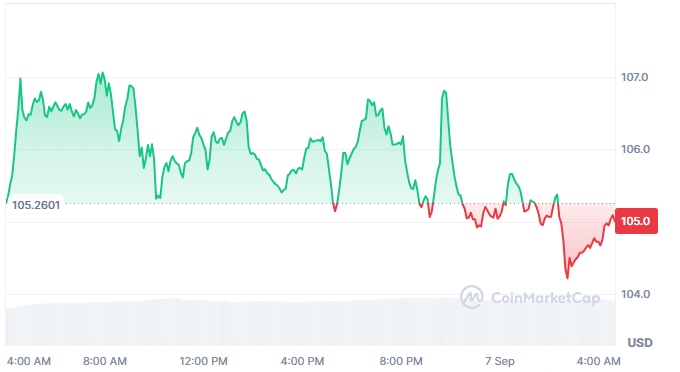
Article
Solana Price Outlook Tracks Revenue and Market Flows Solana led August app revenue while transaction growth and AI payment infrastructure strengthened its broader network activity outlook.
SOL faced intraday pressure near $105 as exchange flows increased, leaving traders focused on support and nearby resistance levels.
Late-August netflow spikes accompanied SOL's recovery, though exchange transfers alone remain unreliable as short-term price predictors.
Solana price outlook remains balanced between strong ecosystem growth, short-term technical weakness, and increasingly active exchange flows shaping market conditions during early September.
Solana Leads August's Onchain Revenue Race
Solana Stream reported $143 million in August application revenue across the network. The figure represented approximately 38% of tracked cross-chain application revenue. Total revenue across the measured ecosystem reached roughly $375.5 million.
Source: X
Hyperliquid followed with approximately $55.66 million, while Ethereum generated $47.1 million. BSC recorded roughly $34.7 million during the same period. Solana therefore exceeded the combined application revenue of those three networks.
The August performance followed a comparatively quieter July for Solana's application economy. Revenue reportedly increased from approximately $82.9 million to more than $143 million. Meanwhile, non-vote transactions reached 5.2 billion during the month.
The growth extended beyond a single application category or protocol. Trading, DeFi, consumer applications, token launches, stablecoins, and tokenized assets contributed. Tokenized equity activity also reached new highs during the reported period.
SOL Price Faces Short-Term Technical Pressure
Despite ecosystem growth, SOL's intraday chart showed weaker immediate price momentum. The token's price was around $104.96 and has dropped around 0.92% in the past 24 hours. There was significant market activity with daily trading volume close to $3.62 billion.
Source: Coinmarketcap
Price initially moved above $106 and repeatedly approached the $107 area. However, sellers emerged during attempts to sustain higher intraday levels. The $105.5 region gradually shifted from an equilibrium area into resistance.
A late-session decline pushed SOL toward approximately $104.2 before buyers responded. The rebound brought prices closer to $104.9, preventing an immediate continuation lower. Still, the recovery remained incomplete without reclaiming the previous $105.5 area.
Near-term chart levels now provide a clearer framework for market participants. Support sits around $104.0-$104.3, based on the recent reaction. Resistance appears near $106, with $106.8-$107 forming a higher ceiling.
Exchange Flows Show Active Capital Rotation
Exchange netflow data added another layer to the developing market picture. Binance showed the largest negative reading at approximately $9.12 million. Gate, OKX, Bitget, Coinbase, and Bybit also recorded notable negative flows.
Source: Coinglass
Positive flows appeared across several exchanges during the same measurement period. OKX led that group near $810,000, followed by Bitget and Gate. Kraken, Bitstamp, and Binance also registered smaller positive readings.
The broader chart showed volatile flows between November and January. SOL subsequently declined from earlier levels near $120 to $150. Price later stabilized around $60 before beginning a gradual recovery.
Late August produced several unusually large positive netflow bars alongside SOL's advance. Prices recovered from roughly $80–$90 toward the $120–$130 region before retreating. Exchange movements therefore showed expanding liquidity activity, while remaining insufficient as standalone price predictors.
Solana Price Outlook Tracks Revenue and Market Flows
Solana led August app revenue while transaction growth and AI payment infrastructure strengthened its broader network activity outlook.
SOL faced intraday pressure near $105 as exchange flows increased, leaving traders focused on support and nearby resistance levels.
Late-August netflow spikes accompanied SOL's recovery, though exchange transfers alone remain unreliable as short-term price predictors.
Solana price outlook remains balanced between strong ecosystem growth, short-term technical weakness, and increasingly active exchange flows shaping market conditions during early September.
Solana Leads August's Onchain Revenue Race
Solana Stream reported $143 million in August application revenue across the network. The figure represented approximately 38% of tracked cross-chain application revenue. Total revenue across the measured ecosystem reached roughly $375.5 million.
Source: X
Hyperliquid followed with approximately $55.66 million, while Ethereum generated $47.1 million. BSC recorded roughly $34.7 million during the same period. Solana therefore exceeded the combined application revenue of those three networks.
The August performance followed a comparatively quieter July for Solana's application economy. Revenue reportedly increased from approximately $82.9 million to more than $143 million. Meanwhile, non-vote transactions reached 5.2 billion during the month.
The growth extended beyond a single application category or protocol. Trading, DeFi, consumer applications, token launches, stablecoins, and tokenized assets contributed. Tokenized equity activity also reached new highs during the reported period.
SOL Price Faces Short-Term Technical Pressure
Despite ecosystem growth, SOL's intraday chart showed weaker immediate price momentum. The token's price was around $104.96 and has dropped around 0.92% in the past 24 hours. There was significant market activity with daily trading volume close to $3.62 billion.
Source: Coinmarketcap
Price initially moved above $106 and repeatedly approached the $107 area. However, sellers emerged during attempts to sustain higher intraday levels. The $105.5 region gradually shifted from an equilibrium area into resistance.
A late-session decline pushed SOL toward approximately $104.2 before buyers responded. The rebound brought prices closer to $104.9, preventing an immediate continuation lower. Still, the recovery remained incomplete without reclaiming the previous $105.5 area.
Near-term chart levels now provide a clearer framework for market participants. Support sits around $104.0-$104.3, based on the recent reaction. Resistance appears near $106, with $106.8-$107 forming a higher ceiling.
Exchange Flows Show Active Capital Rotation
Exchange netflow data added another layer to the developing market picture. Binance showed the largest negative reading at approximately $9.12 million. Gate, OKX, Bitget, Coinbase, and Bybit also recorded notable negative flows.
Source: Coinglass
Positive flows appeared across several exchanges during the same measurement period. OKX led that group near $810,000, followed by Bitget and Gate. Kraken, Bitstamp, and Binance also registered smaller positive readings.
The broader chart showed volatile flows between November and January. SOL subsequently declined from earlier levels near $120 to $150. Price later stabilized around $60 before beginning a gradual recovery.
Late August produced several unusually large positive netflow bars alongside SOL's advance. Prices recovered from roughly $80–$90 toward the $120–$130 region before retreating. Exchange movements therefore showed expanding liquidity activity, while remaining insufficient as standalone price predictors.
SOL faced intraday pressure near $105 as exchange flows increased, leaving traders focused on support and nearby resistance levels.
Late-August netflow spikes accompanied SOL's recovery, though exchange transfers alone remain unreliable as short-term price predictors.
Solana price outlook remains balanced between strong ecosystem growth, short-term technical weakness, and increasingly active exchange flows shaping market conditions during early September.
Solana Leads August's Onchain Revenue Race
Solana Stream reported $143 million in August application revenue across the network. The figure represented approximately 38% of tracked cross-chain application revenue. Total revenue across the measured ecosystem reached roughly $375.5 million.
Source: X
Hyperliquid followed with approximately $55.66 million, while Ethereum generated $47.1 million. BSC recorded roughly $34.7 million during the same period. Solana therefore exceeded the combined application revenue of those three networks.
The August performance followed a comparatively quieter July for Solana's application economy. Revenue reportedly increased from approximately $82.9 million to more than $143 million. Meanwhile, non-vote transactions reached 5.2 billion during the month.
The growth extended beyond a single application category or protocol. Trading, DeFi, consumer applications, token launches, stablecoins, and tokenized assets contributed. Tokenized equity activity also reached new highs during the reported period.
SOL Price Faces Short-Term Technical Pressure
Despite ecosystem growth, SOL's intraday chart showed weaker immediate price momentum. The token's price was around $104.96 and has dropped around 0.92% in the past 24 hours. There was significant market activity with daily trading volume close to $3.62 billion.
Source: Coinmarketcap
Price initially moved above $106 and repeatedly approached the $107 area. However, sellers emerged during attempts to sustain higher intraday levels. The $105.5 region gradually shifted from an equilibrium area into resistance.
A late-session decline pushed SOL toward approximately $104.2 before buyers responded. The rebound brought prices closer to $104.9, preventing an immediate continuation lower. Still, the recovery remained incomplete without reclaiming the previous $105.5 area.
Near-term chart levels now provide a clearer framework for market participants. Support sits around $104.0-$104.3, based on the recent reaction. Resistance appears near $106, with $106.8-$107 forming a higher ceiling.
Exchange Flows Show Active Capital Rotation
Exchange netflow data added another layer to the developing market picture. Binance showed the largest negative reading at approximately $9.12 million. Gate, OKX, Bitget, Coinbase, and Bybit also recorded notable negative flows.
Source: Coinglass
Positive flows appeared across several exchanges during the same measurement period. OKX led that group near $810,000, followed by Bitget and Gate. Kraken, Bitstamp, and Binance also registered smaller positive readings.
The broader chart showed volatile flows between November and January. SOL subsequently declined from earlier levels near $120 to $150. Price later stabilized around $60 before beginning a gradual recovery.
Late August produced several unusually large positive netflow bars alongside SOL's advance. Prices recovered from roughly $80–$90 toward the $120–$130 region before retreating. Exchange movements therefore showed expanding liquidity activity, while remaining insufficient as standalone price predictors.
84

Article
7 Top 100x Meme Coins: 18K+ Whitelist Members Watching Apeing’s 24-Hour CountdownCould the next major meme coin move begin before the wider market realizes where attention is shifting? Crypto rotations rarely give every project the spotlight at the same time. When capital and attention move through established assets, altcoins, and meme coins, newer projects can suddenly become part of the conversation. That makes the current meme coin cycle particularly interesting for traders searching for early-stage opportunities, especially as Apeing enters a crucial moment ahead of its upcoming token sale.
Spring brings a familiar theme of fresh starts, and the meme coin market is showing a similar appetite for something new. For anyone tracking the top 100x meme coins, the focus is increasingly shifting toward projects with strong communities, distinctive narratives, and room to build momentum. The Apeing countdown adds another layer to that story, creating a time-sensitive opportunity for those watching the next market rotation closely.
Apeing: A Top 100x Meme Coin With Stage 1 in Sight
Apeing ($APEING) is a meme coin brand built around culture, energy, community, engagement, and real utility. The project states that putting the community first is central to its identity, while its utility is being designed to combine the fun of meme culture with practical usefulness. That approach gives https://www.apeing.com/ a broader narrative than a token built purely around viral attention. With more than 18,000 whitelist members, the project has already attracted a sizeable early audience ahead of its next major milestone.
The Apeing token sale will be live at 8 Sep 15:00 UTC, while Stage 1 is not active yet. The whitelist is the stated route into Stage 1, which is planned to offer the project's lowest projected entry price of $0.0001 and a limited token allocation. The planned listing target is $0.01, meaning the move from the projected Stage 1 price to that target represents 100x upside, or a 9,900% increase. For readers hunting for top 100x meme coins, that combination of early access and limited allocation explains why the Stage 1 countdown is receiving attention.
How to Join the Apeing Whitelist Before Stage 1
Early access starts with getting onto the whitelist before Stage 1 opens. The process is designed to take only a few straightforward actions:
Visit the official https://www.apeing.com/ website and find the whitelist registration page.
Enter an email address and complete the signup.
Confirm the registration through the email received.
Keep an eye on official Apeing communications for access instructions and launch updates.
Whitelist members receive email updates and instructions for accessing the official sale. With Stage 1 built around a limited allocation, securing whitelist access puts interested participants closer to the earliest entry window. Anyone following the top 100x meme coins can check the official Apeing website and join the whitelist before Stage 1 opens.
Bonk: The Solana Meme Coin That Built Serious Momentum
Bonk ($BONK) is one of the most recognizable meme coins in the Solana ecosystem. Its identity grew around the BONK meme brand and a highly active community, giving it a clear position within Solana's broader crypto culture.
The project has also developed beyond a simple meme concept through ecosystem integrations and community-focused initiatives. Its Solana connection remains a major part of its market identity, keeping BONK relevant when traders turn their attention toward established meme assets.
Pepe: The Frog Meme With Major Crypto Recognition
Pepe ($PEPE) turned one of the internet's most recognizable frog memes into a major cryptocurrency brand. Its appeal is closely connected to the simplicity of its identity and the enormous cultural recognition attached to the Pepe character.
PEPE demonstrates how quickly meme culture can translate into crypto market attention. Its strong brand recognition and established community presence have made it one of the names frequently associated with the meme coin category.
Cheems: A Meme Coin Built Around Internet Culture
Cheems ($CHEEMS) takes inspiration from the widely recognized Cheems internet meme and carries that identity into the cryptocurrency market. The project's appeal comes largely from its connection to an established online character and the community surrounding the meme.
That cultural foundation gives Cheems a distinctive place among meme-focused cryptocurrencies. Its story reflects the continuing connection between internet communities and blockchain-based tokens, particularly when recognizable characters become part of crypto culture.
Baby Doge Coin: A Dog-Themed Meme Brand With an Ecosystem Focus
Baby Doge Coin ($BABYDOGE) developed from the wider Doge meme culture while establishing its own community and brand identity. The project has maintained visibility by combining familiar meme appeal with continued ecosystem development.
Its broader focus gives the token a presence beyond its original meme association. Baby Doge Coin remains a notable project for market watchers interested in community-led cryptocurrencies that continue building around a recognizable theme.
Snek: Cardano's Standout Meme Coin
Snek ($SNEK) is a meme coin associated with the Cardano ecosystem, where it has developed a recognizable community identity. Its branding and community-first culture have helped distinguish it within Cardano's expanding token ecosystem.
Snek also illustrates how meme coin communities can develop around blockchain networks outside the most commonly discussed ecosystems. Its Cardano roots give it a specific niche while its meme identity keeps the project accessible to the wider crypto audience.
Dogecoin: The Meme Coin That Started the Category
Dogecoin ($DOGE) remains the most established name in the meme coin category. Originally created around the Doge internet meme, it evolved into a widely recognized cryptocurrency with a large and enduring community.
Its longevity is one of its defining characteristics. Dogecoin helped establish the meme coin concept in mainstream crypto culture and continues to serve as one of the sector's most recognizable assets.
Conclusion
Apeing, Bonk, Pepe, Cheems, Baby Doge Coin, Snek, and Dogecoin represent different stages and styles within the meme coin market. Some are established cultural names, while others have carved out identities through specific blockchain communities. Together, they highlight why market rotations can bring renewed attention to different parts of the sector.
For those searching for top 100x meme coins, https://www.apeing.com/ has a particularly timely catalyst ahead. Its token sale will be live at 8 Sep 15:00 UTC, with Stage 1 positioned as the early-access phase for whitelist members. The projected $0.0001 Stage 1 price, limited allocation, and planned $0.01 listing target create a clear early-stage narrative. Checking official Apeing channels and joining the whitelist gives interested participants a route toward Stage 1 access before the allocation opens.
For More Information:
Website: Visit the Official Apeing Website
Telegram: Join the Apeing Telegram Channel
Twitter: Follow Apeing ON X (Formerly Twitter)
Frequently Asked Questions About the Top 100x Meme Coins
What are the top 100x meme coins?
The term top 100x meme coins generally refers to meme coin projects attracting attention for their potential to achieve substantial price growth from an early valuation. Community strength, market attention, utility, and project structure can all influence these narratives.
Which meme coin has the potential to 100x?
Projects associated with strong communities, growing attention, and early-stage market positioning are often discussed when traders search for potential 100x meme coins. Apeing is attracting attention because of its upcoming Stage 1 opportunity and early-access structure.
What is the best meme coin to buy right now?
There is no single answer for every market participant. Meme coin interest can shift quickly as market narratives change, making projects with distinctive communities, clear milestones, and strong market attention especially relevant to current searches.
When does the Apeing token sale begin?
The Apeing token sale will be live at 8 Sep 15:00 UTC. Stage 1 is the planned early-access phase and is not active yet.
How does the Apeing whitelist provide Stage 1 access?
The Apeing whitelist is the stated route into Stage 1. Whitelisted members receive email updates and instructions for accessing the official sale when the relevant access window opens.
Summary
The meme coin market continues to attract attention as crypto capital rotates between established assets, altcoins, and emerging projects. Apeing is approaching its September 8 token sale, with Stage 1 planned as a limited early-access phase for whitelist members. Bonk, Pepe, Cheems, Baby Doge Coin, Snek, and Dogecoin add established community and cultural narratives across the sector. The combination of early access and a defined Stage 1 structure puts Apeing firmly on the radar of readers searching for top 100x meme coins.
7 Top 100x Meme Coins: 18K+ Whitelist Members Watching Apeing’s 24-Hour Countdown
Could the next major meme coin move begin before the wider market realizes where attention is shifting? Crypto rotations rarely give every project the spotlight at the same time. When capital and attention move through established assets, altcoins, and meme coins, newer projects can suddenly become part of the conversation. That makes the current meme coin cycle particularly interesting for traders searching for early-stage opportunities, especially as Apeing enters a crucial moment ahead of its upcoming token sale.
Spring brings a familiar theme of fresh starts, and the meme coin market is showing a similar appetite for something new. For anyone tracking the top 100x meme coins, the focus is increasingly shifting toward projects with strong communities, distinctive narratives, and room to build momentum. The Apeing countdown adds another layer to that story, creating a time-sensitive opportunity for those watching the next market rotation closely.
Apeing: A Top 100x Meme Coin With Stage 1 in Sight
Apeing ($APEING) is a meme coin brand built around culture, energy, community, engagement, and real utility. The project states that putting the community first is central to its identity, while its utility is being designed to combine the fun of meme culture with practical usefulness. That approach gives https://www.apeing.com/ a broader narrative than a token built purely around viral attention. With more than 18,000 whitelist members, the project has already attracted a sizeable early audience ahead of its next major milestone.
The Apeing token sale will be live at 8 Sep 15:00 UTC, while Stage 1 is not active yet. The whitelist is the stated route into Stage 1, which is planned to offer the project's lowest projected entry price of $0.0001 and a limited token allocation. The planned listing target is $0.01, meaning the move from the projected Stage 1 price to that target represents 100x upside, or a 9,900% increase. For readers hunting for top 100x meme coins, that combination of early access and limited allocation explains why the Stage 1 countdown is receiving attention.
How to Join the Apeing Whitelist Before Stage 1
Early access starts with getting onto the whitelist before Stage 1 opens. The process is designed to take only a few straightforward actions:
Visit the official https://www.apeing.com/ website and find the whitelist registration page.
Enter an email address and complete the signup.
Confirm the registration through the email received.
Keep an eye on official Apeing communications for access instructions and launch updates.
Whitelist members receive email updates and instructions for accessing the official sale. With Stage 1 built around a limited allocation, securing whitelist access puts interested participants closer to the earliest entry window. Anyone following the top 100x meme coins can check the official Apeing website and join the whitelist before Stage 1 opens.
Bonk: The Solana Meme Coin That Built Serious Momentum
Bonk ($BONK) is one of the most recognizable meme coins in the Solana ecosystem. Its identity grew around the BONK meme brand and a highly active community, giving it a clear position within Solana's broader crypto culture.
The project has also developed beyond a simple meme concept through ecosystem integrations and community-focused initiatives. Its Solana connection remains a major part of its market identity, keeping BONK relevant when traders turn their attention toward established meme assets.
Pepe: The Frog Meme With Major Crypto Recognition
Pepe ($PEPE) turned one of the internet's most recognizable frog memes into a major cryptocurrency brand. Its appeal is closely connected to the simplicity of its identity and the enormous cultural recognition attached to the Pepe character.
PEPE demonstrates how quickly meme culture can translate into crypto market attention. Its strong brand recognition and established community presence have made it one of the names frequently associated with the meme coin category.
Cheems: A Meme Coin Built Around Internet Culture
Cheems ($CHEEMS) takes inspiration from the widely recognized Cheems internet meme and carries that identity into the cryptocurrency market. The project's appeal comes largely from its connection to an established online character and the community surrounding the meme.
That cultural foundation gives Cheems a distinctive place among meme-focused cryptocurrencies. Its story reflects the continuing connection between internet communities and blockchain-based tokens, particularly when recognizable characters become part of crypto culture.
Baby Doge Coin: A Dog-Themed Meme Brand With an Ecosystem Focus
Baby Doge Coin ($BABYDOGE) developed from the wider Doge meme culture while establishing its own community and brand identity. The project has maintained visibility by combining familiar meme appeal with continued ecosystem development.
Its broader focus gives the token a presence beyond its original meme association. Baby Doge Coin remains a notable project for market watchers interested in community-led cryptocurrencies that continue building around a recognizable theme.
Snek: Cardano's Standout Meme Coin
Snek ($SNEK) is a meme coin associated with the Cardano ecosystem, where it has developed a recognizable community identity. Its branding and community-first culture have helped distinguish it within Cardano's expanding token ecosystem.
Snek also illustrates how meme coin communities can develop around blockchain networks outside the most commonly discussed ecosystems. Its Cardano roots give it a specific niche while its meme identity keeps the project accessible to the wider crypto audience.
Dogecoin: The Meme Coin That Started the Category
Dogecoin ($DOGE) remains the most established name in the meme coin category. Originally created around the Doge internet meme, it evolved into a widely recognized cryptocurrency with a large and enduring community.
Its longevity is one of its defining characteristics. Dogecoin helped establish the meme coin concept in mainstream crypto culture and continues to serve as one of the sector's most recognizable assets.
Conclusion
Apeing, Bonk, Pepe, Cheems, Baby Doge Coin, Snek, and Dogecoin represent different stages and styles within the meme coin market. Some are established cultural names, while others have carved out identities through specific blockchain communities. Together, they highlight why market rotations can bring renewed attention to different parts of the sector.
For those searching for top 100x meme coins, https://www.apeing.com/ has a particularly timely catalyst ahead. Its token sale will be live at 8 Sep 15:00 UTC, with Stage 1 positioned as the early-access phase for whitelist members. The projected $0.0001 Stage 1 price, limited allocation, and planned $0.01 listing target create a clear early-stage narrative. Checking official Apeing channels and joining the whitelist gives interested participants a route toward Stage 1 access before the allocation opens.
For More Information:
Website: Visit the Official Apeing Website
Telegram: Join the Apeing Telegram Channel
Twitter: Follow Apeing ON X (Formerly Twitter)
Frequently Asked Questions About the Top 100x Meme Coins
What are the top 100x meme coins?
The term top 100x meme coins generally refers to meme coin projects attracting attention for their potential to achieve substantial price growth from an early valuation. Community strength, market attention, utility, and project structure can all influence these narratives.
Which meme coin has the potential to 100x?
Projects associated with strong communities, growing attention, and early-stage market positioning are often discussed when traders search for potential 100x meme coins. Apeing is attracting attention because of its upcoming Stage 1 opportunity and early-access structure.
What is the best meme coin to buy right now?
There is no single answer for every market participant. Meme coin interest can shift quickly as market narratives change, making projects with distinctive communities, clear milestones, and strong market attention especially relevant to current searches.
When does the Apeing token sale begin?
The Apeing token sale will be live at 8 Sep 15:00 UTC. Stage 1 is the planned early-access phase and is not active yet.
How does the Apeing whitelist provide Stage 1 access?
The Apeing whitelist is the stated route into Stage 1. Whitelisted members receive email updates and instructions for accessing the official sale when the relevant access window opens.
Summary
The meme coin market continues to attract attention as crypto capital rotates between established assets, altcoins, and emerging projects. Apeing is approaching its September 8 token sale, with Stage 1 planned as a limited early-access phase for whitelist members. Bonk, Pepe, Cheems, Baby Doge Coin, Snek, and Dogecoin add established community and cultural narratives across the sector. The combination of early access and a defined Stage 1 structure puts Apeing firmly on the radar of readers searching for top 100x meme coins.
Spring brings a familiar theme of fresh starts, and the meme coin market is showing a similar appetite for something new. For anyone tracking the top 100x meme coins, the focus is increasingly shifting toward projects with strong communities, distinctive narratives, and room to build momentum. The Apeing countdown adds another layer to that story, creating a time-sensitive opportunity for those watching the next market rotation closely.
Apeing: A Top 100x Meme Coin With Stage 1 in Sight
Apeing ($APEING) is a meme coin brand built around culture, energy, community, engagement, and real utility. The project states that putting the community first is central to its identity, while its utility is being designed to combine the fun of meme culture with practical usefulness. That approach gives https://www.apeing.com/ a broader narrative than a token built purely around viral attention. With more than 18,000 whitelist members, the project has already attracted a sizeable early audience ahead of its next major milestone.
The Apeing token sale will be live at 8 Sep 15:00 UTC, while Stage 1 is not active yet. The whitelist is the stated route into Stage 1, which is planned to offer the project's lowest projected entry price of $0.0001 and a limited token allocation. The planned listing target is $0.01, meaning the move from the projected Stage 1 price to that target represents 100x upside, or a 9,900% increase. For readers hunting for top 100x meme coins, that combination of early access and limited allocation explains why the Stage 1 countdown is receiving attention.
How to Join the Apeing Whitelist Before Stage 1
Early access starts with getting onto the whitelist before Stage 1 opens. The process is designed to take only a few straightforward actions:
Visit the official https://www.apeing.com/ website and find the whitelist registration page.
Enter an email address and complete the signup.
Confirm the registration through the email received.
Keep an eye on official Apeing communications for access instructions and launch updates.
Whitelist members receive email updates and instructions for accessing the official sale. With Stage 1 built around a limited allocation, securing whitelist access puts interested participants closer to the earliest entry window. Anyone following the top 100x meme coins can check the official Apeing website and join the whitelist before Stage 1 opens.
Bonk: The Solana Meme Coin That Built Serious Momentum
Bonk ($BONK) is one of the most recognizable meme coins in the Solana ecosystem. Its identity grew around the BONK meme brand and a highly active community, giving it a clear position within Solana's broader crypto culture.
The project has also developed beyond a simple meme concept through ecosystem integrations and community-focused initiatives. Its Solana connection remains a major part of its market identity, keeping BONK relevant when traders turn their attention toward established meme assets.
Pepe: The Frog Meme With Major Crypto Recognition
Pepe ($PEPE) turned one of the internet's most recognizable frog memes into a major cryptocurrency brand. Its appeal is closely connected to the simplicity of its identity and the enormous cultural recognition attached to the Pepe character.
PEPE demonstrates how quickly meme culture can translate into crypto market attention. Its strong brand recognition and established community presence have made it one of the names frequently associated with the meme coin category.
Cheems: A Meme Coin Built Around Internet Culture
Cheems ($CHEEMS) takes inspiration from the widely recognized Cheems internet meme and carries that identity into the cryptocurrency market. The project's appeal comes largely from its connection to an established online character and the community surrounding the meme.
That cultural foundation gives Cheems a distinctive place among meme-focused cryptocurrencies. Its story reflects the continuing connection between internet communities and blockchain-based tokens, particularly when recognizable characters become part of crypto culture.
Baby Doge Coin: A Dog-Themed Meme Brand With an Ecosystem Focus
Baby Doge Coin ($BABYDOGE) developed from the wider Doge meme culture while establishing its own community and brand identity. The project has maintained visibility by combining familiar meme appeal with continued ecosystem development.
Its broader focus gives the token a presence beyond its original meme association. Baby Doge Coin remains a notable project for market watchers interested in community-led cryptocurrencies that continue building around a recognizable theme.
Snek: Cardano's Standout Meme Coin
Snek ($SNEK) is a meme coin associated with the Cardano ecosystem, where it has developed a recognizable community identity. Its branding and community-first culture have helped distinguish it within Cardano's expanding token ecosystem.
Snek also illustrates how meme coin communities can develop around blockchain networks outside the most commonly discussed ecosystems. Its Cardano roots give it a specific niche while its meme identity keeps the project accessible to the wider crypto audience.
Dogecoin: The Meme Coin That Started the Category
Dogecoin ($DOGE) remains the most established name in the meme coin category. Originally created around the Doge internet meme, it evolved into a widely recognized cryptocurrency with a large and enduring community.
Its longevity is one of its defining characteristics. Dogecoin helped establish the meme coin concept in mainstream crypto culture and continues to serve as one of the sector's most recognizable assets.
Conclusion
Apeing, Bonk, Pepe, Cheems, Baby Doge Coin, Snek, and Dogecoin represent different stages and styles within the meme coin market. Some are established cultural names, while others have carved out identities through specific blockchain communities. Together, they highlight why market rotations can bring renewed attention to different parts of the sector.
For those searching for top 100x meme coins, https://www.apeing.com/ has a particularly timely catalyst ahead. Its token sale will be live at 8 Sep 15:00 UTC, with Stage 1 positioned as the early-access phase for whitelist members. The projected $0.0001 Stage 1 price, limited allocation, and planned $0.01 listing target create a clear early-stage narrative. Checking official Apeing channels and joining the whitelist gives interested participants a route toward Stage 1 access before the allocation opens.
For More Information:
Website: Visit the Official Apeing Website
Telegram: Join the Apeing Telegram Channel
Twitter: Follow Apeing ON X (Formerly Twitter)
Frequently Asked Questions About the Top 100x Meme Coins
What are the top 100x meme coins?
The term top 100x meme coins generally refers to meme coin projects attracting attention for their potential to achieve substantial price growth from an early valuation. Community strength, market attention, utility, and project structure can all influence these narratives.
Which meme coin has the potential to 100x?
Projects associated with strong communities, growing attention, and early-stage market positioning are often discussed when traders search for potential 100x meme coins. Apeing is attracting attention because of its upcoming Stage 1 opportunity and early-access structure.
What is the best meme coin to buy right now?
There is no single answer for every market participant. Meme coin interest can shift quickly as market narratives change, making projects with distinctive communities, clear milestones, and strong market attention especially relevant to current searches.
When does the Apeing token sale begin?
The Apeing token sale will be live at 8 Sep 15:00 UTC. Stage 1 is the planned early-access phase and is not active yet.
How does the Apeing whitelist provide Stage 1 access?
The Apeing whitelist is the stated route into Stage 1. Whitelisted members receive email updates and instructions for accessing the official sale when the relevant access window opens.
Summary
The meme coin market continues to attract attention as crypto capital rotates between established assets, altcoins, and emerging projects. Apeing is approaching its September 8 token sale, with Stage 1 planned as a limited early-access phase for whitelist members. Bonk, Pepe, Cheems, Baby Doge Coin, Snek, and Dogecoin add established community and cultural narratives across the sector. The combination of early access and a defined Stage 1 structure puts Apeing firmly on the radar of readers searching for top 100x meme coins.
469
Log in to explore more content
Join global crypto users on Binance Square
⚡️ Get latest and useful information about crypto.
💬 Trusted by the world’s largest crypto exchange.
👍 Discover real insights from verified creators.
Email / Phone number
Trending Topics
AppleDebutsFoldablePhone
0 views
9 Discussing
#AppleDebutsFoldablePhone
🍎 Apple just unfolded a new chapter. 📱🔥
Foldable phones aren’t new…
But when Apple enters the game, the entire market starts watching. 👀
This isn’t just another iPhone launch —
it’s a signal that foldables could be the next major smartphone battleground. ⚡
Now I’m curious…
Will Apple redefine foldables, or simply join the race? 🤔
$AAPL.US $ZEC $BULLA
#Apple #iPhone #Tech #Innovation
Shourov Saha-01
·1 Likes
·26 views
US10YTreasuryYieldHitsHighestSinceNov2023
2,292 views
93 Discussing
USTreasuryToBuyBackUpTo$6BLongDatedDebt
8,205 views
124 Discussing