
B策略
1k Posts

B策略
Report
Block User
复利之旅

USD1 Holder
High-Frequency Trader
1.1 Years
2 Following
127 Followers
1.2K+ Liked
Posts
PINNED
·
--
[AI Market Outlook Update] 2.0
Time: 2026-09-01 04:21 UTC
Asset/Period: BTCUSDT | 4h
AI Market Stage
- Current View: Bull market resumes
- Direction Bias: Long
- AI Position Signal: +0.88
Structure Interpretation
On-chain capital and the market structure are recovering; signals for the bulls are strengthening.
Execution Principles
Even though the trend is favorable, you still need to guard against false breakouts and pullbacks.
Note: The AI stage assessment based on on-chain data is only for observing the market within a strategy framework and does not constitute investment advice.
#B策略 #BTC #市场结构 #AI分析
[AI Market Outlook Update] 2.0
Time: 2026-09-01 04:21 UTC
Asset/Period: BTCUSDT | 4h
AI Market Stage
- Current View: Bull market resumes
- Direction Bias: Long
- AI Position Signal: +0.88
Structure Interpretation
On-chain capital and the market structure are recovering; signals for the bulls are strengthening.
Execution Principles
Even though the trend is favorable, you still need to guard against false breakouts and pullbacks.
Note: The AI stage assessment based on on-chain data is only for observing the market within a strategy framework and does not constitute investment advice.
#B策略 #BTC #市场结构 #AI分析
Time: 2026-09-01 04:21 UTC
Asset/Period: BTCUSDT | 4h
AI Market Stage
- Current View: Bull market resumes
- Direction Bias: Long
- AI Position Signal: +0.88
Structure Interpretation
On-chain capital and the market structure are recovering; signals for the bulls are strengthening.
Execution Principles
Even though the trend is favorable, you still need to guard against false breakouts and pullbacks.
Note: The AI stage assessment based on on-chain data is only for observing the market within a strategy framework and does not constitute investment advice.
#B策略 #BTC #市场结构 #AI分析
3
106
·
--
No.13 | Cycle: RECOVERY (Confidence: high) | Alpha: +0.9100
In August, capital flows: 7D net inflow $1.3B/day, the highest since Nov 2025; 90%+ of STH supply is profitable. ETF inflows have returned, but daily trading volume is only $2B vs. earlier $4–5B, and price is stuck above $80K under a thick resistance band.
Key signals:
1. [onchain] Net capital inflow: Monthly capital turnover is positive; the 7D-SMA net inflow of $1.3B/day is the highest since Nov 2025
2. [profitability] STH profitability and realized profits: Within 7 days, 90%+ STH supply is profitable; 50–75% of on-chain transferred volume is profitable. Net capital for the month is +0.6%, the highest since Oct–Nov 2025
3. [institutional] ETF fund flows: ETF inflows have returned with the rebound, but daily trading volume is $2B vs. earlier $4–5B—capital is present, yet activity hasn’t caught up
4. [derivatives] Options expiry positioning: $5B IBIT + $14B Deribit expires this month, mostly call positions above $80K; spot is still $79K
5. [onchain] Overhead resistance band: A confluence resistance zone where cost basis / liquidation map / institutional breakevens overlap has not been broken; only a breakout would change the long-term structure
$BTC
No.13 | Cycle: RECOVERY (Confidence: high) | Alpha: +0.9100
In August, capital flows: 7D net inflow $1.3B/day, the highest since Nov 2025; 90%+ of STH supply is profitable. ETF inflows have returned, but daily trading volume is only $2B vs. earlier $4–5B, and price is stuck above $80K under a thick resistance band.
Key signals:
1. [onchain] Net capital inflow: Monthly capital turnover is positive; the 7D-SMA net inflow of $1.3B/day is the highest since Nov 2025
2. [profitability] STH profitability and realized profits: Within 7 days, 90%+ STH supply is profitable; 50–75% of on-chain transferred volume is profitable. Net capital for the month is +0.6%, the highest since Oct–Nov 2025
3. [institutional] ETF fund flows: ETF inflows have returned with the rebound, but daily trading volume is $2B vs. earlier $4–5B—capital is present, yet activity hasn’t caught up
4. [derivatives] Options expiry positioning: $5B IBIT + $14B Deribit expires this month, mostly call positions above $80K; spot is still $79K
5. [onchain] Overhead resistance band: A confluence resistance zone where cost basis / liquidation map / institutional breakevens overlap has not been broken; only a breakout would change the long-term structure
$BTC
In August, capital flows: 7D net inflow $1.3B/day, the highest since Nov 2025; 90%+ of STH supply is profitable. ETF inflows have returned, but daily trading volume is only $2B vs. earlier $4–5B, and price is stuck above $80K under a thick resistance band.
Key signals:
1. [onchain] Net capital inflow: Monthly capital turnover is positive; the 7D-SMA net inflow of $1.3B/day is the highest since Nov 2025
2. [profitability] STH profitability and realized profits: Within 7 days, 90%+ STH supply is profitable; 50–75% of on-chain transferred volume is profitable. Net capital for the month is +0.6%, the highest since Oct–Nov 2025
3. [institutional] ETF fund flows: ETF inflows have returned with the rebound, but daily trading volume is $2B vs. earlier $4–5B—capital is present, yet activity hasn’t caught up
4. [derivatives] Options expiry positioning: $5B IBIT + $14B Deribit expires this month, mostly call positions above $80K; spot is still $79K
5. [onchain] Overhead resistance band: A confluence resistance zone where cost basis / liquidation map / institutional breakevens overlap has not been broken; only a breakout would change the long-term structure
$BTC
1
93
·
--
No.12 | Cycle: RECOVERY (Confidence: high) | Alpha: +0.8950
On Thursday last week, net inflows into the $BTC BTC ETF were $643M—the largest since early last month—closely following August’s strongest month of the year. Correlation to the NDX has fallen to 0.22, and correlation to gold has risen to 0.57, but the price has been flat over the past week around $79.1K and spot momentum has cooled. Hold the RECOVERY longs until a breakout.
Key signals:
1. [institutional] BTC ETF flows: Net inflows of $643M on Thursday last week were the largest since early last month, and continued to build on the year’s strongest month in August
2. [macro] Asset correlation regime shift: 90-day BTC-NDX correlation fell from 0.57 to 0.22; correlation with gold rose from 0.21 to 0.57
3. [onchain] LTH supply leads low volatility: LTH supply explains realized volatility better than market cap/OI/trading volume
4. [derivatives] Volatility term spread: A deep negative volatility spread indicates the market continues to price downside risk
5. [onchain] Spot momentum: BTC has been flat around $79.1K over the week—spot momentum is cooling, and ETF inflows have not yet translated into a spot breakout
No.12 | Cycle: RECOVERY (Confidence: high) | Alpha: +0.8950
On Thursday last week, net inflows into the $BTC BTC ETF were $643M—the largest since early last month—closely following August’s strongest month of the year. Correlation to the NDX has fallen to 0.22, and correlation to gold has risen to 0.57, but the price has been flat over the past week around $79.1K and spot momentum has cooled. Hold the RECOVERY longs until a breakout.
Key signals:
1. [institutional] BTC ETF flows: Net inflows of $643M on Thursday last week were the largest since early last month, and continued to build on the year’s strongest month in August
2. [macro] Asset correlation regime shift: 90-day BTC-NDX correlation fell from 0.57 to 0.22; correlation with gold rose from 0.21 to 0.57
3. [onchain] LTH supply leads low volatility: LTH supply explains realized volatility better than market cap/OI/trading volume
4. [derivatives] Volatility term spread: A deep negative volatility spread indicates the market continues to price downside risk
5. [onchain] Spot momentum: BTC has been flat around $79.1K over the week—spot momentum is cooling, and ETF inflows have not yet translated into a spot breakout
On Thursday last week, net inflows into the $BTC BTC ETF were $643M—the largest since early last month—closely following August’s strongest month of the year. Correlation to the NDX has fallen to 0.22, and correlation to gold has risen to 0.57, but the price has been flat over the past week around $79.1K and spot momentum has cooled. Hold the RECOVERY longs until a breakout.
Key signals:
1. [institutional] BTC ETF flows: Net inflows of $643M on Thursday last week were the largest since early last month, and continued to build on the year’s strongest month in August
2. [macro] Asset correlation regime shift: 90-day BTC-NDX correlation fell from 0.57 to 0.22; correlation with gold rose from 0.21 to 0.57
3. [onchain] LTH supply leads low volatility: LTH supply explains realized volatility better than market cap/OI/trading volume
4. [derivatives] Volatility term spread: A deep negative volatility spread indicates the market continues to price downside risk
5. [onchain] Spot momentum: BTC has been flat around $79.1K over the week—spot momentum is cooling, and ETF inflows have not yet translated into a spot breakout
1
101
·
--
【B Strategy Weekly Report】2026-08-31 ~ 2026-09-07
Weekly Conclusion
Losses are still within a controllable range; the key is not to magnify subjective errors.
Execution Overview
- This week's pace: There were not many trades this week, with a focus on screening opportunities.
- Return status: Returns were in a recovery phase this week.
- Market stage: RECOVERY
- Capital curve: Basically stable
Review Focus
This week, we continued to focus on signal quality, position sizing rhythm, and drawdown control, and did not use the result of a single trade to replace the overall strategy judgment.
Note: This weekly report is a record of live trading activities and does not constitute a promise of returns or investment advice.
#B策略 #BTC #量化策略 #实盘周报 #风控
【B Strategy Weekly Report】2026-08-31 ~ 2026-09-07
Weekly Conclusion
Losses are still within a controllable range; the key is not to magnify subjective errors.
Execution Overview
- This week's pace: There were not many trades this week, with a focus on screening opportunities.
- Return status: Returns were in a recovery phase this week.
- Market stage: RECOVERY
- Capital curve: Basically stable
Review Focus
This week, we continued to focus on signal quality, position sizing rhythm, and drawdown control, and did not use the result of a single trade to replace the overall strategy judgment.
Note: This weekly report is a record of live trading activities and does not constitute a promise of returns or investment advice.
#B策略 #BTC #量化策略 #实盘周报 #风控
Weekly Conclusion
Losses are still within a controllable range; the key is not to magnify subjective errors.
Execution Overview
- This week's pace: There were not many trades this week, with a focus on screening opportunities.
- Return status: Returns were in a recovery phase this week.
- Market stage: RECOVERY
- Capital curve: Basically stable
Review Focus
This week, we continued to focus on signal quality, position sizing rhythm, and drawdown control, and did not use the result of a single trade to replace the overall strategy judgment.
Note: This weekly report is a record of live trading activities and does not constitute a promise of returns or investment advice.
#B策略 #BTC #量化策略 #实盘周报 #风控
1
66
·
--
No.11 | Cycle: RECOVERY (Confidence: high) | Alpha: +0.8750
In August, spot ETF net inflows of $3.5B—an all-time high for the past year—boosted buyer momentum as Vector Signal strengthened a Risk-On stance. However, BTC remains constrained by long-term cost basis bands and the dense liquidation cluster area; it has not yet broken through the key range needed to enter BULL recovery.
Key signals:
1. [institutional] Spot ETF monthly inflow: Net inflows of about $3.5B in August, the strongest monthly inflow since July 2025
2. [macro] BTC Vector Signal: This signal previously precisely marked the $126K top and warned of Risk-Off; BTC then pulled back 54%. After BTC broke above $70K, it flipped bullish and is currently Risk-On again.
3. [onchain] Overhead cost-basis band constraints: BTC is stalled between the lower band and the nearby overhead supply; two distinct cost-basis bands clearly define the current trading range.
4. [derivatives] Liquidation clusters converge with the breakeven band: The cost-basis band aligns closely with liquidation pain points, and the range boundaries form strong resonance support/resistance
No.11 | Cycle: RECOVERY (Confidence: high) | Alpha: +0.8750
In August, spot ETF net inflows of $3.5B—an all-time high for the past year—boosted buyer momentum as Vector Signal strengthened a Risk-On stance. However, BTC remains constrained by long-term cost basis bands and the dense liquidation cluster area; it has not yet broken through the key range needed to enter BULL recovery.
Key signals:
1. [institutional] Spot ETF monthly inflow: Net inflows of about $3.5B in August, the strongest monthly inflow since July 2025
2. [macro] BTC Vector Signal: This signal previously precisely marked the $126K top and warned of Risk-Off; BTC then pulled back 54%. After BTC broke above $70K, it flipped bullish and is currently Risk-On again.
3. [onchain] Overhead cost-basis band constraints: BTC is stalled between the lower band and the nearby overhead supply; two distinct cost-basis bands clearly define the current trading range.
4. [derivatives] Liquidation clusters converge with the breakeven band: The cost-basis band aligns closely with liquidation pain points, and the range boundaries form strong resonance support/resistance
In August, spot ETF net inflows of $3.5B—an all-time high for the past year—boosted buyer momentum as Vector Signal strengthened a Risk-On stance. However, BTC remains constrained by long-term cost basis bands and the dense liquidation cluster area; it has not yet broken through the key range needed to enter BULL recovery.
Key signals:
1. [institutional] Spot ETF monthly inflow: Net inflows of about $3.5B in August, the strongest monthly inflow since July 2025
2. [macro] BTC Vector Signal: This signal previously precisely marked the $126K top and warned of Risk-Off; BTC then pulled back 54%. After BTC broke above $70K, it flipped bullish and is currently Risk-On again.
3. [onchain] Overhead cost-basis band constraints: BTC is stalled between the lower band and the nearby overhead supply; two distinct cost-basis bands clearly define the current trading range.
4. [derivatives] Liquidation clusters converge with the breakeven band: The cost-basis band aligns closely with liquidation pain points, and the range boundaries form strong resonance support/resistance
1
165
·
--
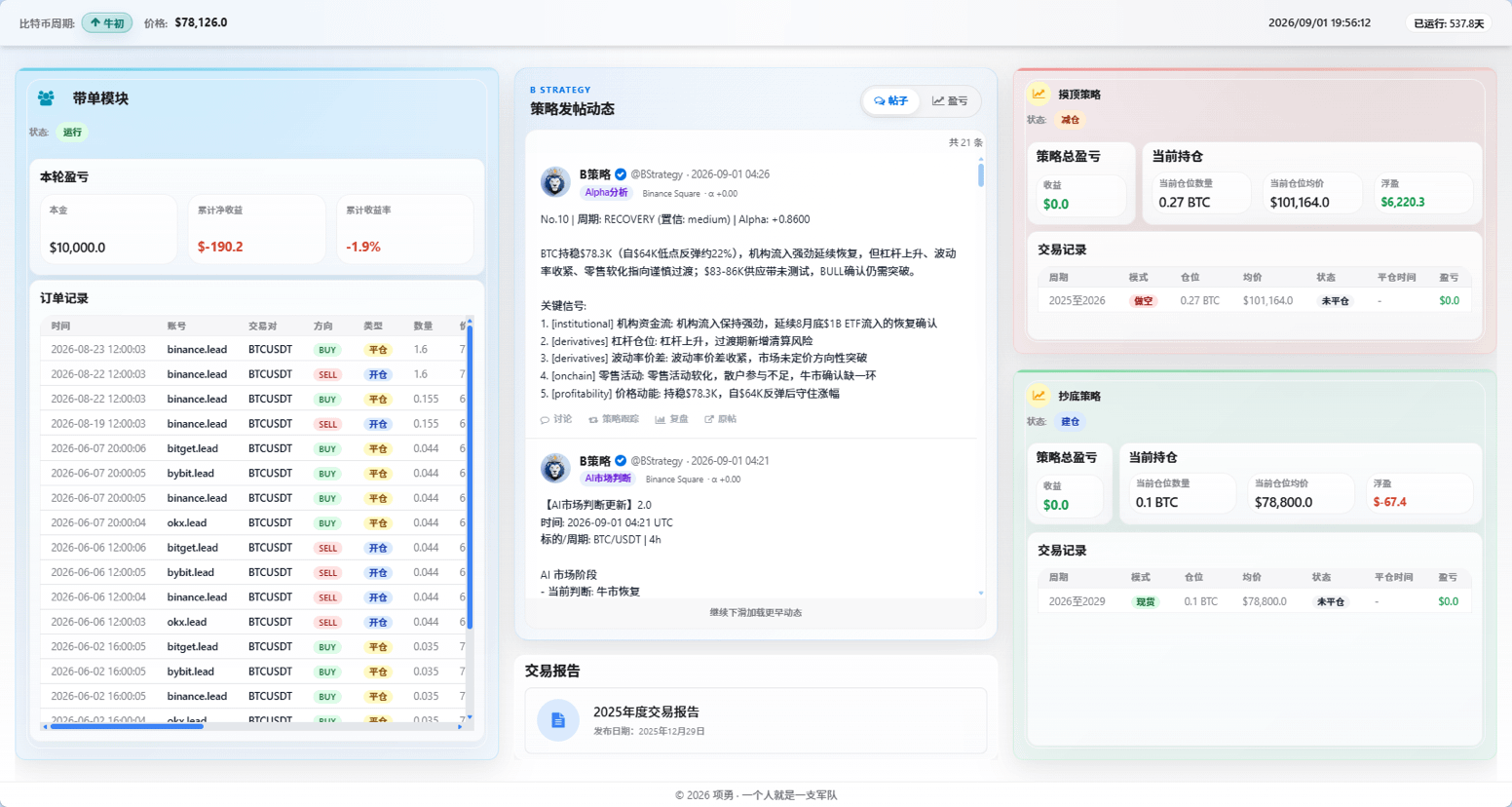
No.10 | Cycle: RECOVERY (Confidence: medium) | Alpha: +0.8600
BTC holds steady at $78.3K (rebounds about 22% from the $64K low). Institutional inflows remain strong and recovery continues, but rising leverage, tightening volatility, and softening retail sentiment suggest a cautious transition; the $83–86K supply zone remains untested, and BULL confirmation still requires a breakout.
Key signals:
1. [institutional] Institutional fund flow: Inflows stay strong, continuing the recovery confirmed by the late-August $1B ETF inflow
2. [derivatives] Leverage positioning: Leverage rises, creating incremental liquidation-risk during the transition
3. [derivatives] Volatility spread: Volatility spread tightens; the market has not priced in a decisive directional breakout
4. [onchain] Retail activity: Retail activity softens; retail participation is insufficient—one link missing for full bull confirmation
5. [profitability] Price momentum: Holds $78.3K; after rebounding from $64K, it maintains the gains
No.10 | Cycle: RECOVERY (Confidence: medium) | Alpha: +0.8600
BTC holds steady at $78.3K (rebounds about 22% from the $64K low). Institutional inflows remain strong and recovery continues, but rising leverage, tightening volatility, and softening retail sentiment suggest a cautious transition; the $83–86K supply zone remains untested, and BULL confirmation still requires a breakout.
Key signals:
1. [institutional] Institutional fund flow: Inflows stay strong, continuing the recovery confirmed by the late-August $1B ETF inflow
2. [derivatives] Leverage positioning: Leverage rises, creating incremental liquidation-risk during the transition
3. [derivatives] Volatility spread: Volatility spread tightens; the market has not priced in a decisive directional breakout
4. [onchain] Retail activity: Retail activity softens; retail participation is insufficient—one link missing for full bull confirmation
5. [profitability] Price momentum: Holds $78.3K; after rebounding from $64K, it maintains the gains
BTC holds steady at $78.3K (rebounds about 22% from the $64K low). Institutional inflows remain strong and recovery continues, but rising leverage, tightening volatility, and softening retail sentiment suggest a cautious transition; the $83–86K supply zone remains untested, and BULL confirmation still requires a breakout.
Key signals:
1. [institutional] Institutional fund flow: Inflows stay strong, continuing the recovery confirmed by the late-August $1B ETF inflow
2. [derivatives] Leverage positioning: Leverage rises, creating incremental liquidation-risk during the transition
3. [derivatives] Volatility spread: Volatility spread tightens; the market has not priced in a decisive directional breakout
4. [onchain] Retail activity: Retail activity softens; retail participation is insufficient—one link missing for full bull confirmation
5. [profitability] Price momentum: Holds $78.3K; after rebounding from $64K, it maintains the gains
2
140
·
--
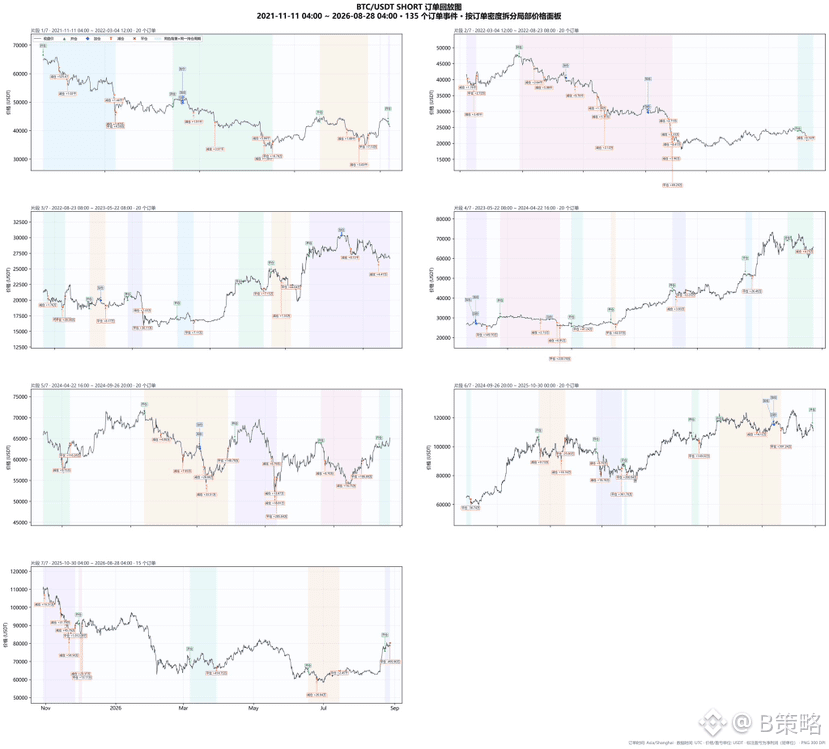
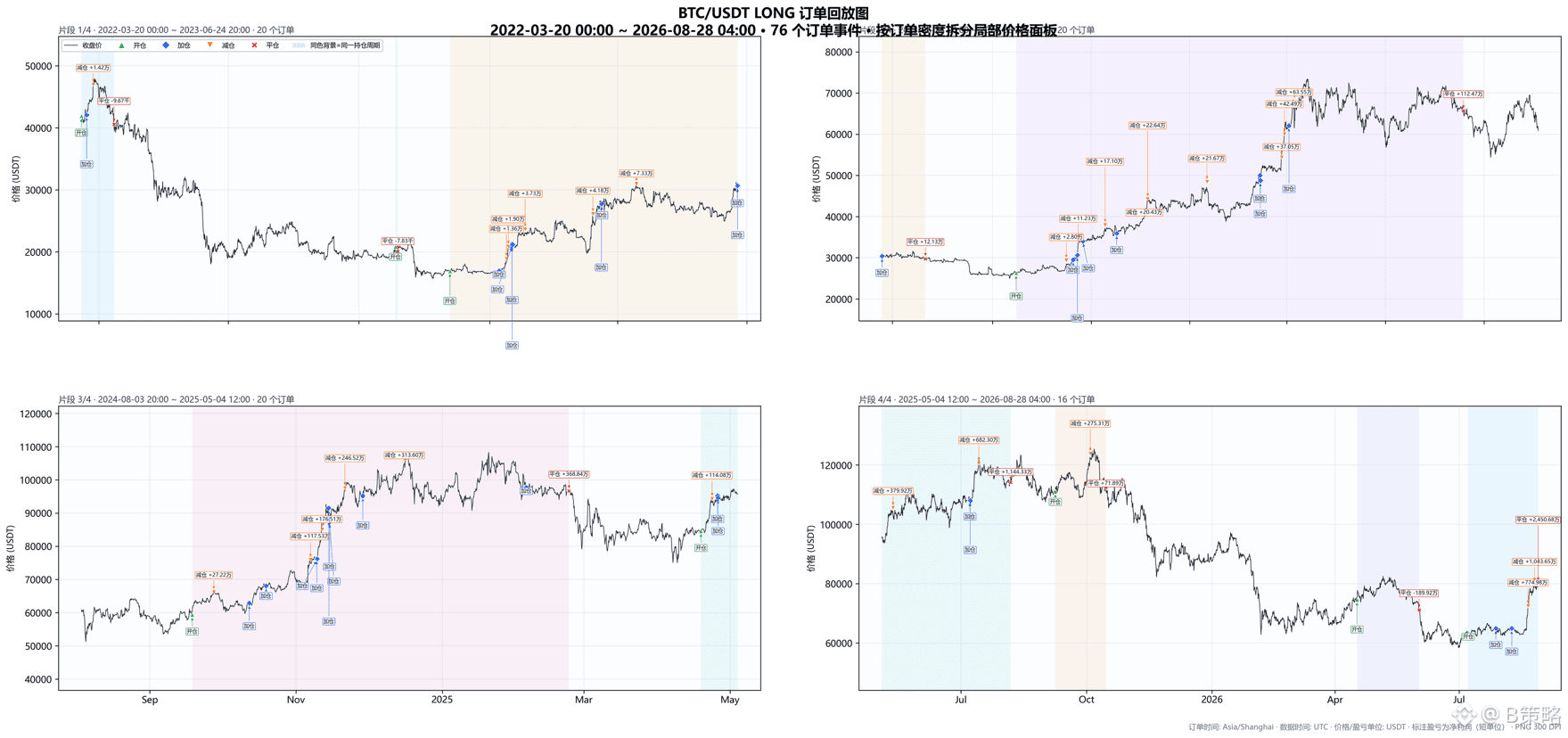
Trapped in the wonderful fantasy of backtest data from $BTC and unable to extricate myself 😂
Trapped in the wonderful fantasy of backtest data from $BTC and unable to extricate myself 😂
3
146
·
--
No.9 | Cycle: RECOVERY (confidence: medium) | Alpha: +0.8800
LTH hold 1.05M BTC in the $83K-$86K range, presenting a key test. Options OI has rebounded to 550K, yet it releases a participation signal; price is approaching the $80K area, entering a phase where continuation and selling pressure battle.
Key signals:
1. [onchain] LTH supply band: 1.05M BTC has experienced a drawdown in the $83K-$86K range without selling, showing strong conviction, but also potential breakeven sell pressure
2. [derivatives] Options OI rebuild: OI quickly rebounds to 550K BTC; volatility awakens, and derivatives participation rises
3. [institutional] SOL ETF sets a record: SOL ETF 10-day net inflow of $138M, BSOL AUM surpassing $1B—evidence of institutional capital moving in
4. [derivatives] Options positioning is constructive: Volatility has awakened and positioning tilts constructively, reflecting a shift in momentum
No.9 | Cycle: RECOVERY (confidence: medium) | Alpha: +0.8800
LTH hold 1.05M BTC in the $83K-$86K range, presenting a key test. Options OI has rebounded to 550K, yet it releases a participation signal; price is approaching the $80K area, entering a phase where continuation and selling pressure battle.
Key signals:
1. [onchain] LTH supply band: 1.05M BTC has experienced a drawdown in the $83K-$86K range without selling, showing strong conviction, but also potential breakeven sell pressure
2. [derivatives] Options OI rebuild: OI quickly rebounds to 550K BTC; volatility awakens, and derivatives participation rises
3. [institutional] SOL ETF sets a record: SOL ETF 10-day net inflow of $138M, BSOL AUM surpassing $1B—evidence of institutional capital moving in
4. [derivatives] Options positioning is constructive: Volatility has awakened and positioning tilts constructively, reflecting a shift in momentum
LTH hold 1.05M BTC in the $83K-$86K range, presenting a key test. Options OI has rebounded to 550K, yet it releases a participation signal; price is approaching the $80K area, entering a phase where continuation and selling pressure battle.
Key signals:
1. [onchain] LTH supply band: 1.05M BTC has experienced a drawdown in the $83K-$86K range without selling, showing strong conviction, but also potential breakeven sell pressure
2. [derivatives] Options OI rebuild: OI quickly rebounds to 550K BTC; volatility awakens, and derivatives participation rises
3. [institutional] SOL ETF sets a record: SOL ETF 10-day net inflow of $138M, BSOL AUM surpassing $1B—evidence of institutional capital moving in
4. [derivatives] Options positioning is constructive: Volatility has awakened and positioning tilts constructively, reflecting a shift in momentum
2
136
·
--
No.7 | Cycle: RECOVERY (Confidence: high) | Alpha: -0.1500
BTC 3-day inflows of $1B ETF, 72 hours erasing three months of underperformance vs. U.S. equities; the dollar-devaluation narrative drove a +21% surge. Altcoin funding rates are at 85% above the average, entering an optimistic zone; buyers are back to confirm, but there is a short-term overheating risk.
Key signals:
1. [institutional] ETF fund flows: Nearly $1B inflow into BTC ETFs; in the past 3 days, the strongest inflow since BTC moved above $80k
2. [macro] Relative performance vs. U.S. stocks: BTC erased three months of underperformance vs. the S&P 500 over the last 72 hours; when it outperforms, the excess return is significant
3. [macro] Dollar-devaluation narrative: After the Treasury buyback announcement, BTC rose by about 21%; gold rose, stocks were nearly flat—risk-hedging narratives returned
4. [derivatives] Breadth of altcoin funding rates: 85% of altcoin funding rates are higher than average; the highest since BTC ATH—overheating risk in the short term
No.7 | Cycle: RECOVERY (Confidence: high) | Alpha: -0.1500
BTC 3-day inflows of $1B ETF, 72 hours erasing three months of underperformance vs. U.S. equities; the dollar-devaluation narrative drove a +21% surge. Altcoin funding rates are at 85% above the average, entering an optimistic zone; buyers are back to confirm, but there is a short-term overheating risk.
Key signals:
1. [institutional] ETF fund flows: Nearly $1B inflow into BTC ETFs; in the past 3 days, the strongest inflow since BTC moved above $80k
2. [macro] Relative performance vs. U.S. stocks: BTC erased three months of underperformance vs. the S&P 500 over the last 72 hours; when it outperforms, the excess return is significant
3. [macro] Dollar-devaluation narrative: After the Treasury buyback announcement, BTC rose by about 21%; gold rose, stocks were nearly flat—risk-hedging narratives returned
4. [derivatives] Breadth of altcoin funding rates: 85% of altcoin funding rates are higher than average; the highest since BTC ATH—overheating risk in the short term
BTC 3-day inflows of $1B ETF, 72 hours erasing three months of underperformance vs. U.S. equities; the dollar-devaluation narrative drove a +21% surge. Altcoin funding rates are at 85% above the average, entering an optimistic zone; buyers are back to confirm, but there is a short-term overheating risk.
Key signals:
1. [institutional] ETF fund flows: Nearly $1B inflow into BTC ETFs; in the past 3 days, the strongest inflow since BTC moved above $80k
2. [macro] Relative performance vs. U.S. stocks: BTC erased three months of underperformance vs. the S&P 500 over the last 72 hours; when it outperforms, the excess return is significant
3. [macro] Dollar-devaluation narrative: After the Treasury buyback announcement, BTC rose by about 21%; gold rose, stocks were nearly flat—risk-hedging narratives returned
4. [derivatives] Breadth of altcoin funding rates: 85% of altcoin funding rates are higher than average; the highest since BTC ATH—overheating risk in the short term
2
112
·
--
No.6 | Cycle: BEAR_BOTTOM (confidence: medium) | Alpha: -0.1500
BTC triggered a $500M short liquidation squeeze at $69k, but the bottoming process is still ongoing: high yields are suppressing prices, U.S. equities remain relatively weak, and spot trading is lagging. Shallow capitulation has not finished, and bids have not fully returned.
Key signals:
1. [derivatives] Short squeeze: BTC surged above $69k, and $500M shorts were liquidated within minutes. OI fell due to forced liquidation; the market had previously been largely short-positioned, improving demand for perpetual contracts.
2. [macro] Relative weakness vs. U.S. equities: Over 3 trading days, BTC underperformed the S&P 500 on 2 of them, and excess returns have been declining slowly year by year. High yields anchor BTC to the cycle low, with capital flowing into gold and crude oil.
3. [onchain] Corporate treasury unrealized losses: About 80% of public BTC treasury companies are in unrealized loss. The price is below their average cost basis, reflecting a deep discount and potential late-stage capitulation characteristics.
4. [onchain] Shallow capitulation: Price is below two key cost-bases, showing a shallow capitulation pattern. The bottoming process is underway, but spot trading volume/turnover is lagging, and buyers have not fully taken control yet.
5. [institutional] U.S. spot lag: While perpetual contract demand is improving, U.S. spot demand is lagging with insufficient participation. Net capital inflows have not yet become sustained, limiting confirmation of recovery.
No.6 | Cycle: BEAR_BOTTOM (confidence: medium) | Alpha: -0.1500
BTC triggered a $500M short liquidation squeeze at $69k, but the bottoming process is still ongoing: high yields are suppressing prices, U.S. equities remain relatively weak, and spot trading is lagging. Shallow capitulation has not finished, and bids have not fully returned.
Key signals:
1. [derivatives] Short squeeze: BTC surged above $69k, and $500M shorts were liquidated within minutes. OI fell due to forced liquidation; the market had previously been largely short-positioned, improving demand for perpetual contracts.
2. [macro] Relative weakness vs. U.S. equities: Over 3 trading days, BTC underperformed the S&P 500 on 2 of them, and excess returns have been declining slowly year by year. High yields anchor BTC to the cycle low, with capital flowing into gold and crude oil.
3. [onchain] Corporate treasury unrealized losses: About 80% of public BTC treasury companies are in unrealized loss. The price is below their average cost basis, reflecting a deep discount and potential late-stage capitulation characteristics.
4. [onchain] Shallow capitulation: Price is below two key cost-bases, showing a shallow capitulation pattern. The bottoming process is underway, but spot trading volume/turnover is lagging, and buyers have not fully taken control yet.
5. [institutional] U.S. spot lag: While perpetual contract demand is improving, U.S. spot demand is lagging with insufficient participation. Net capital inflows have not yet become sustained, limiting confirmation of recovery.
BTC triggered a $500M short liquidation squeeze at $69k, but the bottoming process is still ongoing: high yields are suppressing prices, U.S. equities remain relatively weak, and spot trading is lagging. Shallow capitulation has not finished, and bids have not fully returned.
Key signals:
1. [derivatives] Short squeeze: BTC surged above $69k, and $500M shorts were liquidated within minutes. OI fell due to forced liquidation; the market had previously been largely short-positioned, improving demand for perpetual contracts.
2. [macro] Relative weakness vs. U.S. equities: Over 3 trading days, BTC underperformed the S&P 500 on 2 of them, and excess returns have been declining slowly year by year. High yields anchor BTC to the cycle low, with capital flowing into gold and crude oil.
3. [onchain] Corporate treasury unrealized losses: About 80% of public BTC treasury companies are in unrealized loss. The price is below their average cost basis, reflecting a deep discount and potential late-stage capitulation characteristics.
4. [onchain] Shallow capitulation: Price is below two key cost-bases, showing a shallow capitulation pattern. The bottoming process is underway, but spot trading volume/turnover is lagging, and buyers have not fully taken control yet.
5. [institutional] U.S. spot lag: While perpetual contract demand is improving, U.S. spot demand is lagging with insufficient participation. Net capital inflows have not yet become sustained, limiting confirmation of recovery.
2
183
·
--
Recover the losses from the single-account that led to the loss
Recover the losses from the single-account that led to the loss
2
150
·
--
【B Strategy Live Tracking】1.7
Time: 2026-08-23 04:00 UTC
Asset/Period: BTC/USDT | 4h
Execution Direction: Short
Execution Summary
- Reference Zone: around 76.9k
- Signal Status: high-confirmation signal / structure is relatively clear
- Positioning Pace: slightly high risk exposure
Strategy Assessment
- Structure: A downward structure has already formed with a high level of consistency, and the weight of trend continuation is increasing.
- Risk Control: Do not fully exhaust risk exposure; leave room to maneuver to avoid any single trade unduly affecting the equity curve.
- Rhythm: The current location is worth tracking, but it is not suitable for chasing trades impulsively.
Intraday Plan
The chart conditions are fairly clear; the strategy selection is to participate in the short direction.
The execution pace is higher—this round focuses on locking in the existing results.
Equity Curve: a clear, phased uplift
Note: Public records only retain the direction, rhythm, and risk-control framework; complete execution parameters are not disclosed. The content is for strategy review and does not constitute investment advice.
#B策略 #BTC #实盘记录 #量化策略 #Risk Control
【B Strategy Live Tracking】1.7
Time: 2026-08-23 04:00 UTC
Asset/Period: BTC/USDT | 4h
Execution Direction: Short
Execution Summary
- Reference Zone: around 76.9k
- Signal Status: high-confirmation signal / structure is relatively clear
- Positioning Pace: slightly high risk exposure
Strategy Assessment
- Structure: A downward structure has already formed with a high level of consistency, and the weight of trend continuation is increasing.
- Risk Control: Do not fully exhaust risk exposure; leave room to maneuver to avoid any single trade unduly affecting the equity curve.
- Rhythm: The current location is worth tracking, but it is not suitable for chasing trades impulsively.
Intraday Plan
The chart conditions are fairly clear; the strategy selection is to participate in the short direction.
The execution pace is higher—this round focuses on locking in the existing results.
Equity Curve: a clear, phased uplift
Note: Public records only retain the direction, rhythm, and risk-control framework; complete execution parameters are not disclosed. The content is for strategy review and does not constitute investment advice.
#B策略 #BTC #实盘记录 #量化策略 #Risk Control
Time: 2026-08-23 04:00 UTC
Asset/Period: BTC/USDT | 4h
Execution Direction: Short
Execution Summary
- Reference Zone: around 76.9k
- Signal Status: high-confirmation signal / structure is relatively clear
- Positioning Pace: slightly high risk exposure
Strategy Assessment
- Structure: A downward structure has already formed with a high level of consistency, and the weight of trend continuation is increasing.
- Risk Control: Do not fully exhaust risk exposure; leave room to maneuver to avoid any single trade unduly affecting the equity curve.
- Rhythm: The current location is worth tracking, but it is not suitable for chasing trades impulsively.
Intraday Plan
The chart conditions are fairly clear; the strategy selection is to participate in the short direction.
The execution pace is higher—this round focuses on locking in the existing results.
Equity Curve: a clear, phased uplift
Note: Public records only retain the direction, rhythm, and risk-control framework; complete execution parameters are not disclosed. The content is for strategy review and does not constitute investment advice.
#B策略 #BTC #实盘记录 #量化策略 #Risk Control
2
142
·
--
No.5 | Cycle: BEAR_BOTTOM (Confidence: medium) | Alpha: -0.1500
BTC holds steady around $63.6k. LTH capitulation momentum is fading; belief buyers have been aggressively accumulating near $60k. Valuation at the 16/100 level sits in the cycle discount end. However, ETF outflows and weak money flow (30/100) mean the final piece needed to confirm a recovery is still missing.
Key signals:
1. [onchain] LTH capitulation exhaustion: LTH capitulation is running out of steam, loss momentum has faded, showing behavior typical of the late stage of a bear market
2. [onchain] Belief buyer accumulation: strong hands are buying; the pattern resembles 2022. When BTC dropped to $60k in January, belief buyers saw their largest increase in holdings
3. [profitability] Valuation percentile: valuation is in the cycle discount zone, percentile 16/100 — Cheap and improving
4. [institutional] ETF flows: ETF outflows and thin spot liquidity are suppressing the market; the money flow score is only 30/100
5. [macro] Macro momentum: the macro score is +24 this month; crypto has begun gradually catching up with stocks over the past two months
No.5 | Cycle: BEAR_BOTTOM (Confidence: medium) | Alpha: -0.1500
BTC holds steady around $63.6k. LTH capitulation momentum is fading; belief buyers have been aggressively accumulating near $60k. Valuation at the 16/100 level sits in the cycle discount end. However, ETF outflows and weak money flow (30/100) mean the final piece needed to confirm a recovery is still missing.
Key signals:
1. [onchain] LTH capitulation exhaustion: LTH capitulation is running out of steam, loss momentum has faded, showing behavior typical of the late stage of a bear market
2. [onchain] Belief buyer accumulation: strong hands are buying; the pattern resembles 2022. When BTC dropped to $60k in January, belief buyers saw their largest increase in holdings
3. [profitability] Valuation percentile: valuation is in the cycle discount zone, percentile 16/100 — Cheap and improving
4. [institutional] ETF flows: ETF outflows and thin spot liquidity are suppressing the market; the money flow score is only 30/100
5. [macro] Macro momentum: the macro score is +24 this month; crypto has begun gradually catching up with stocks over the past two months
BTC holds steady around $63.6k. LTH capitulation momentum is fading; belief buyers have been aggressively accumulating near $60k. Valuation at the 16/100 level sits in the cycle discount end. However, ETF outflows and weak money flow (30/100) mean the final piece needed to confirm a recovery is still missing.
Key signals:
1. [onchain] LTH capitulation exhaustion: LTH capitulation is running out of steam, loss momentum has faded, showing behavior typical of the late stage of a bear market
2. [onchain] Belief buyer accumulation: strong hands are buying; the pattern resembles 2022. When BTC dropped to $60k in January, belief buyers saw their largest increase in holdings
3. [profitability] Valuation percentile: valuation is in the cycle discount zone, percentile 16/100 — Cheap and improving
4. [institutional] ETF flows: ETF outflows and thin spot liquidity are suppressing the market; the money flow score is only 30/100
5. [macro] Macro momentum: the macro score is +24 this month; crypto has begun gradually catching up with stocks over the past two months
2
89
·
--
【B Strategy Live Tracking】1.6
Time: 2026-08-19 04:00 UTC
Asset/Interval: BTC/USDT | 4h
Execution Direction: Short
Execution Summary
- Reference Zone: Around 64.3k
- Signal Status: High-confirmation signal / Clearer structure
- Positioning Pace: Relatively high-risk exposure
Strategy Assessment
- Structure: A downward structure has already formed with relatively high consistency, increasing the weight of trend continuation.
- Risk Control: Do not max out the risk exposure; keep room to maneuver to avoid any single trade overly impacting the equity curve.
- Pace: The current location is worth tracking, but it is not suitable for emotion-driven add-on trades.
Intraday Plan
With both signal quality and structure in place, this round will focus mainly on the short direction.
After executing continuously, it becomes even more important to control the pace and avoid emotion-fueled acceleration.
Equity Curve: Noticeable staged uplift
Note: Public records only retain the directional, pacing, and risk-control framework; full execution parameters are not disclosed. The content is for strategy review and does not constitute investment advice.
#B策略 #BTC #实盘记录 #量化策略 #Risk Control
【B Strategy Live Tracking】1.6
Time: 2026-08-19 04:00 UTC
Asset/Interval: BTC/USDT | 4h
Execution Direction: Short
Execution Summary
- Reference Zone: Around 64.3k
- Signal Status: High-confirmation signal / Clearer structure
- Positioning Pace: Relatively high-risk exposure
Strategy Assessment
- Structure: A downward structure has already formed with relatively high consistency, increasing the weight of trend continuation.
- Risk Control: Do not max out the risk exposure; keep room to maneuver to avoid any single trade overly impacting the equity curve.
- Pace: The current location is worth tracking, but it is not suitable for emotion-driven add-on trades.
Intraday Plan
With both signal quality and structure in place, this round will focus mainly on the short direction.
After executing continuously, it becomes even more important to control the pace and avoid emotion-fueled acceleration.
Equity Curve: Noticeable staged uplift
Note: Public records only retain the directional, pacing, and risk-control framework; full execution parameters are not disclosed. The content is for strategy review and does not constitute investment advice.
#B策略 #BTC #实盘记录 #量化策略 #Risk Control
Time: 2026-08-19 04:00 UTC
Asset/Interval: BTC/USDT | 4h
Execution Direction: Short
Execution Summary
- Reference Zone: Around 64.3k
- Signal Status: High-confirmation signal / Clearer structure
- Positioning Pace: Relatively high-risk exposure
Strategy Assessment
- Structure: A downward structure has already formed with relatively high consistency, increasing the weight of trend continuation.
- Risk Control: Do not max out the risk exposure; keep room to maneuver to avoid any single trade overly impacting the equity curve.
- Pace: The current location is worth tracking, but it is not suitable for emotion-driven add-on trades.
Intraday Plan
With both signal quality and structure in place, this round will focus mainly on the short direction.
After executing continuously, it becomes even more important to control the pace and avoid emotion-fueled acceleration.
Equity Curve: Noticeable staged uplift
Note: Public records only retain the directional, pacing, and risk-control framework; full execution parameters are not disclosed. The content is for strategy review and does not constitute investment advice.
#B策略 #BTC #实盘记录 #量化策略 #Risk Control
3
109
·
--
No.4 | Cycle: BEAR_BOTTOM (Confidence: medium) | Alpha: -0.0900
BTC trading volume across the entire market contracts by 21-47%. Realized Cap 30D shows a net outflow of -0.3%. Consumer confidence hits a new low without benefiting BTC. The bottom area continues to wait for direction.
Key signals:
1. [onchain] Change in realized market cap over 30D: 30D Realized Cap change -0.3%, with monthly net capital outflow; the macro capital environment remains in contraction
2. [institutional] ETF trading volume contraction: Total market trading volume including ETFs falls 21-47% compared to last month, indicating reduced institutional participation
3. [derivatives] Futures/options trading volume shrinking: Futures and options trading volumes are down 21-47% from last month, with subdued leverage activity
4. [macro] Capital rotation ignores BTC: Consumer confidence hits a new low; funds rotate toward stocks/AI/commodities, leaving BTC clearly neglected
5. [onchain] Spot trading volume: Spot trading volume declines 21-47% from last month; price remains flat, indicating pure activity deprecation
No.4 | Cycle: BEAR_BOTTOM (Confidence: medium) | Alpha: -0.0900
BTC trading volume across the entire market contracts by 21-47%. Realized Cap 30D shows a net outflow of -0.3%. Consumer confidence hits a new low without benefiting BTC. The bottom area continues to wait for direction.
Key signals:
1. [onchain] Change in realized market cap over 30D: 30D Realized Cap change -0.3%, with monthly net capital outflow; the macro capital environment remains in contraction
2. [institutional] ETF trading volume contraction: Total market trading volume including ETFs falls 21-47% compared to last month, indicating reduced institutional participation
3. [derivatives] Futures/options trading volume shrinking: Futures and options trading volumes are down 21-47% from last month, with subdued leverage activity
4. [macro] Capital rotation ignores BTC: Consumer confidence hits a new low; funds rotate toward stocks/AI/commodities, leaving BTC clearly neglected
5. [onchain] Spot trading volume: Spot trading volume declines 21-47% from last month; price remains flat, indicating pure activity deprecation
BTC trading volume across the entire market contracts by 21-47%. Realized Cap 30D shows a net outflow of -0.3%. Consumer confidence hits a new low without benefiting BTC. The bottom area continues to wait for direction.
Key signals:
1. [onchain] Change in realized market cap over 30D: 30D Realized Cap change -0.3%, with monthly net capital outflow; the macro capital environment remains in contraction
2. [institutional] ETF trading volume contraction: Total market trading volume including ETFs falls 21-47% compared to last month, indicating reduced institutional participation
3. [derivatives] Futures/options trading volume shrinking: Futures and options trading volumes are down 21-47% from last month, with subdued leverage activity
4. [macro] Capital rotation ignores BTC: Consumer confidence hits a new low; funds rotate toward stocks/AI/commodities, leaving BTC clearly neglected
5. [onchain] Spot trading volume: Spot trading volume declines 21-47% from last month; price remains flat, indicating pure activity deprecation
2
175
·
--
No.3 | Cycle: BEAR_BOTTOM (Confidence: medium) | Alpha: -0.1100
Belief buyers, crossing through a -49% drawdown, accumulated to ~4M BTC; meanwhile ETH sellers were exhausted down to the lowest level in ten years. Realized volatility is at a historical bottom of 3%, and the bottoming signals are notably strengthened. However, buyers are absent. Options GEX shows the $60K–$70K area as the key showdown range: negative gamma amplifies downside moves below the low $60K, while positive gamma buffers upside near $70K.
Key signals:
1. [onchain] LTH/Belief buyer accumulation: Belief buyers have continued to absorb during the -49% drawdown, now holding ~4M BTC, reflecting long-term holders’ conviction to stock coins in the bottom zone
2. [onchain] Seller exhaustion (ETH): ETH sellers are exhausted to a ten-year low; realized volatility is at the historical bottom of 3%, and over 60% of supply is underwater. Sellers are flushing liquidity, but buyers must show up
3. [derivatives] GEX/Gamma distribution: Negative gamma clusters in the low $60K region, making BTC below that level more fragile. Positive gamma near ~ $70K provides upside hedging and stability. $60K–$70K is the battleground for directional choice
4. [derivatives] Options IV and Skew: IV and skew continue to compress; near-term panic fades. The options market’s defensiveness decreases, but it is not complacent
No.3 | Cycle: BEAR_BOTTOM (Confidence: medium) | Alpha: -0.1100
Belief buyers, crossing through a -49% drawdown, accumulated to ~4M BTC; meanwhile ETH sellers were exhausted down to the lowest level in ten years. Realized volatility is at a historical bottom of 3%, and the bottoming signals are notably strengthened. However, buyers are absent. Options GEX shows the $60K–$70K area as the key showdown range: negative gamma amplifies downside moves below the low $60K, while positive gamma buffers upside near $70K.
Key signals:
1. [onchain] LTH/Belief buyer accumulation: Belief buyers have continued to absorb during the -49% drawdown, now holding ~4M BTC, reflecting long-term holders’ conviction to stock coins in the bottom zone
2. [onchain] Seller exhaustion (ETH): ETH sellers are exhausted to a ten-year low; realized volatility is at the historical bottom of 3%, and over 60% of supply is underwater. Sellers are flushing liquidity, but buyers must show up
3. [derivatives] GEX/Gamma distribution: Negative gamma clusters in the low $60K region, making BTC below that level more fragile. Positive gamma near ~ $70K provides upside hedging and stability. $60K–$70K is the battleground for directional choice
4. [derivatives] Options IV and Skew: IV and skew continue to compress; near-term panic fades. The options market’s defensiveness decreases, but it is not complacent
Belief buyers, crossing through a -49% drawdown, accumulated to ~4M BTC; meanwhile ETH sellers were exhausted down to the lowest level in ten years. Realized volatility is at a historical bottom of 3%, and the bottoming signals are notably strengthened. However, buyers are absent. Options GEX shows the $60K–$70K area as the key showdown range: negative gamma amplifies downside moves below the low $60K, while positive gamma buffers upside near $70K.
Key signals:
1. [onchain] LTH/Belief buyer accumulation: Belief buyers have continued to absorb during the -49% drawdown, now holding ~4M BTC, reflecting long-term holders’ conviction to stock coins in the bottom zone
2. [onchain] Seller exhaustion (ETH): ETH sellers are exhausted to a ten-year low; realized volatility is at the historical bottom of 3%, and over 60% of supply is underwater. Sellers are flushing liquidity, but buyers must show up
3. [derivatives] GEX/Gamma distribution: Negative gamma clusters in the low $60K region, making BTC below that level more fragile. Positive gamma near ~ $70K provides upside hedging and stability. $60K–$70K is the battleground for directional choice
4. [derivatives] Options IV and Skew: IV and skew continue to compress; near-term panic fades. The options market’s defensiveness decreases, but it is not complacent
2
143
·
--
No.2 | Cycle: BEAR_BOTTOM (Confidence: medium) | Alpha: -0.1300
BTC is compressed between converging cost lines; on-chain activity is the quietest since 2019. Sellers are worn out but buyers are absent. Leverage has run ahead of the recovery, but the data does not support it.
Key signals:
1. [profitability] Cost-line convergence: Price trades around converging cost bases, with long/short costs coming closer together—turning point is near
2. [onchain] On-chain activity: On-chain transaction volume is the lowest since 2019; sell pressure is exhausted, but buyers are missing
3. [derivatives] Leverage positions: Leveraged traders are pricing in a recovery early, but on-chain data has yet to confirm it—there is a risk of squeeze
No.2 | Cycle: BEAR_BOTTOM (Confidence: medium) | Alpha: -0.1300
BTC is compressed between converging cost lines; on-chain activity is the quietest since 2019. Sellers are worn out but buyers are absent. Leverage has run ahead of the recovery, but the data does not support it.
Key signals:
1. [profitability] Cost-line convergence: Price trades around converging cost bases, with long/short costs coming closer together—turning point is near
2. [onchain] On-chain activity: On-chain transaction volume is the lowest since 2019; sell pressure is exhausted, but buyers are missing
3. [derivatives] Leverage positions: Leveraged traders are pricing in a recovery early, but on-chain data has yet to confirm it—there is a risk of squeeze
BTC is compressed between converging cost lines; on-chain activity is the quietest since 2019. Sellers are worn out but buyers are absent. Leverage has run ahead of the recovery, but the data does not support it.
Key signals:
1. [profitability] Cost-line convergence: Price trades around converging cost bases, with long/short costs coming closer together—turning point is near
2. [onchain] On-chain activity: On-chain transaction volume is the lowest since 2019; sell pressure is exhausted, but buyers are missing
3. [derivatives] Leverage positions: Leveraged traders are pricing in a recovery early, but on-chain data has yet to confirm it—there is a risk of squeeze
2
117
·
--
No.1 | Period: BEAR_BOTTOM (confidence: medium) | Alpha: +0.0000
BTC remains stable at $65k: strong institutional inflows + downside hedging helps ease pressure, but on-chain activity is sluggish and spot liquidity remains lackluster—any recovery still feels tentative.
Key signals:
1. [institutional] Institutional inflows: strong institutional inflows (robust institutional inflows), improved new capital flows (fresh flow improving)
2. [derivatives] Taker demand: taker demand is strengthening (stronger taker demand)
3. [derivatives] 1M 25-delta skew: 1M skew has been positive for nearly a year, but the downside protection premium is slowly easing
4. [derivatives] Long-term hedging demand: longer-dated hedging demand remains elevated
5. [onchain] On-chain activity / participation: weak on-chain activity; participation and demand are thin (weak on-chain activity, participation and demand thin)
No.1 | Period: BEAR_BOTTOM (confidence: medium) | Alpha: +0.0000
BTC remains stable at $65k: strong institutional inflows + downside hedging helps ease pressure, but on-chain activity is sluggish and spot liquidity remains lackluster—any recovery still feels tentative.
Key signals:
1. [institutional] Institutional inflows: strong institutional inflows (robust institutional inflows), improved new capital flows (fresh flow improving)
2. [derivatives] Taker demand: taker demand is strengthening (stronger taker demand)
3. [derivatives] 1M 25-delta skew: 1M skew has been positive for nearly a year, but the downside protection premium is slowly easing
4. [derivatives] Long-term hedging demand: longer-dated hedging demand remains elevated
5. [onchain] On-chain activity / participation: weak on-chain activity; participation and demand are thin (weak on-chain activity, participation and demand thin)
BTC remains stable at $65k: strong institutional inflows + downside hedging helps ease pressure, but on-chain activity is sluggish and spot liquidity remains lackluster—any recovery still feels tentative.
Key signals:
1. [institutional] Institutional inflows: strong institutional inflows (robust institutional inflows), improved new capital flows (fresh flow improving)
2. [derivatives] Taker demand: taker demand is strengthening (stronger taker demand)
3. [derivatives] 1M 25-delta skew: 1M skew has been positive for nearly a year, but the downside protection premium is slowly easing
4. [derivatives] Long-term hedging demand: longer-dated hedging demand remains elevated
5. [onchain] On-chain activity / participation: weak on-chain activity; participation and demand are thin (weak on-chain activity, participation and demand thin)
2
68
·
--
🔥 Wall Street Morning News: Hawkish voices before Non-Farm Payrolls weigh heavily on the market; storage and AI software stocks come under pressure, with copper prices nearing record highs
On SpaceX’s day of a release worth one hundred billion, shares surged by over 6%; the Dow fell to end a five-day winning streak. Michael Burry disclosed short positions in Oracle and NEBIUS. Microsoft hit a new intra-year high, and Google’s latest bond issuance was oversubscribed by more than 4 times.
As the earnings season draws to a close, the market is starting to focus more on future earnings guidance, rather than the performance already priced in
Between ups and downs, the hardest part has never been judging—it’s execution.
#Bitcoin #Crypto #行情分析 #quant strategy
🔥 Wall Street Morning News: Hawkish voices before Non-Farm Payrolls weigh heavily on the market; storage and AI software stocks come under pressure, with copper prices nearing record highs
On SpaceX’s day of a release worth one hundred billion, shares surged by over 6%; the Dow fell to end a five-day winning streak. Michael Burry disclosed short positions in Oracle and NEBIUS. Microsoft hit a new intra-year high, and Google’s latest bond issuance was oversubscribed by more than 4 times.
As the earnings season draws to a close, the market is starting to focus more on future earnings guidance, rather than the performance already priced in
Between ups and downs, the hardest part has never been judging—it’s execution.
#Bitcoin #Crypto #行情分析 #quant strategy
On SpaceX’s day of a release worth one hundred billion, shares surged by over 6%; the Dow fell to end a five-day winning streak. Michael Burry disclosed short positions in Oracle and NEBIUS. Microsoft hit a new intra-year high, and Google’s latest bond issuance was oversubscribed by more than 4 times.
As the earnings season draws to a close, the market is starting to focus more on future earnings guidance, rather than the performance already priced in
Between ups and downs, the hardest part has never been judging—it’s execution.
#Bitcoin #Crypto #行情分析 #quant strategy
2
298
·
--
⚡ Musk’s AI encyclopedia Grokipedia reportedly hasn’t been updated for months, with edit requests left unhandled
xAI’s AI-generated encyclopedia Grokipedia stopped processing any edit requests as of April 24. More than three months have passed. Previously, edits were handled quickly, but since then all pending edits have remained in the “under review” status— the system no longer approves or rejects any changes.
Grokipedia’s automated back-end system stopped submitting model-generated edits in stages between March and mid-April. After that, all edit requests came exclusively from human users, entering an unending loop with no one handling them.
Fact corrections submitted by users account for 97% of all submissions. Previously, the system approved or adopted 76.5% of them. Archive snapshots from about 480 pages show that the main text had no changes around April 24. It is still unclear whether xAI is preparing major revisions or has abandoned the project
What falls is the price; what remains is understanding.
#BTC #加密货币 #热点速递 #Market analysis
⚡ Musk’s AI encyclopedia Grokipedia reportedly hasn’t been updated for months, with edit requests left unhandled
xAI’s AI-generated encyclopedia Grokipedia stopped processing any edit requests as of April 24. More than three months have passed. Previously, edits were handled quickly, but since then all pending edits have remained in the “under review” status— the system no longer approves or rejects any changes.
Grokipedia’s automated back-end system stopped submitting model-generated edits in stages between March and mid-April. After that, all edit requests came exclusively from human users, entering an unending loop with no one handling them.
Fact corrections submitted by users account for 97% of all submissions. Previously, the system approved or adopted 76.5% of them. Archive snapshots from about 480 pages show that the main text had no changes around April 24. It is still unclear whether xAI is preparing major revisions or has abandoned the project
What falls is the price; what remains is understanding.
#BTC #加密货币 #热点速递 #Market analysis
xAI’s AI-generated encyclopedia Grokipedia stopped processing any edit requests as of April 24. More than three months have passed. Previously, edits were handled quickly, but since then all pending edits have remained in the “under review” status— the system no longer approves or rejects any changes.
Grokipedia’s automated back-end system stopped submitting model-generated edits in stages between March and mid-April. After that, all edit requests came exclusively from human users, entering an unending loop with no one handling them.
Fact corrections submitted by users account for 97% of all submissions. Previously, the system approved or adopted 76.5% of them. Archive snapshots from about 480 pages show that the main text had no changes around April 24. It is still unclear whether xAI is preparing major revisions or has abandoned the project
What falls is the price; what remains is understanding.
#BTC #加密货币 #热点速递 #Market analysis
113
Log in to explore more content
Join global crypto users on Binance Square
⚡️ Get latest and useful information about crypto.
💬 Trusted by the world’s largest crypto exchange.
👍 Discover real insights from verified creators.
Email / Phone number
Trending Topics
USAugustPPIRisesLessThanExpected
5,156 views
209 Discussing
🚨 US AUG PPI: Rises LESS Than Expected! Bullish for Crypto? 🚀
PPI +0.4% MoM as expected, but CORE PPI only +0.2% vs +0.3% expected - cooling!
What it means:
• Wholesale inflation softer than feared
• Fed rate hike chance now 62% - but dovish signals coming
• Core PCE revisions expected downward - bullish
• BTC usually pumps on softer PPI
Fed meeting Sep 15-16 - Market now expects pause, not hike?
Is this the green light for Q4 rally?
#Bitcoin #PPI #Fed #CryptoNews #BTC#usaugustppiriseslessthanexpected
True News
·1 Likes
·1.1k views
SECApprovesNasdaqTexasCommodityTrustRule
5,171 views
233 Discussing
ECBRaisesRatesSecondTimeTo2.5%
2,759 views
164 Discussing