
#pixels
pixels
4.7M views
4,363 Discussing
Hot
Latest

·
--
Recently, market attention for $PIXEL has suddenly surged, but discussions mixing different concepts have also caused a lot of confusion. This could lead to short-term price volatility.
In current community discussions, content about GameFi project Pixels’ native token, NFT projects, and even Google Pixel phones and Android system development are all mixed together. The market lacks a clear, unified focus, and investors may make wrong judgments due to information being mixed up.
The current price of $PIXEL is $0.00497, with a 24-hour trading volume of $4.42 million and a market cap of $17.23 million. Before participating, be sure to distinguish concepts and understand exactly which project you are investing in.
$PIXEL #Pixels #cryptocurrency
Recently, market attention for $PIXEL has suddenly surged, but discussions mixing different concepts have also caused a lot of confusion. This could lead to short-term price volatility.
In current community discussions, content about GameFi project Pixels’ native token, NFT projects, and even Google Pixel phones and Android system development are all mixed together. The market lacks a clear, unified focus, and investors may make wrong judgments due to information being mixed up.
The current price of $PIXEL is $0.00497, with a 24-hour trading volume of $4.42 million and a market cap of $17.23 million. Before participating, be sure to distinguish concepts and understand exactly which project you are investing in.
$PIXEL #Pixels #cryptocurrency
In current community discussions, content about GameFi project Pixels’ native token, NFT projects, and even Google Pixel phones and Android system development are all mixed together. The market lacks a clear, unified focus, and investors may make wrong judgments due to information being mixed up.
The current price of $PIXEL is $0.00497, with a 24-hour trading volume of $4.42 million and a market cap of $17.23 million. Before participating, be sure to distinguish concepts and understand exactly which project you are investing in.
$PIXEL #Pixels #cryptocurrency
98

·
--
Pixels ($PIXEL) In the past 24 hours, the price increase has exceeded 21%. Trading volume over the past 24 hours has reached around $27.06 million, and the market cap is approximately $15.98 million.
At first glance, the launch of Google’s Pixel 11 series and the upgrade of AI features have brought the "pixel" concept back into market focus. Associated trading sentiment has warmed up: PIXELUSDT’s trading volume has increased in tandem, with a clear influx of short-term funds.
However, it’s important to be cautious: this kind of rally driven by external consumer-electronics hotspots often lacks sustained support from underlying on-chain fundamentals. Google has no direct connection to this Pixels project; more often, it’s attention spillover caused by the shared name. Once the launch hype for Pixel 11 cools down, the "riding the concept" logic for funds is likely to reverse.
In the short term, sentiment may continue to support the price, but volatility will also intensify. In the medium to long run, it still comes down to evaluating the project’s own user growth, on-chain activity, and ecosystem progress. For trading, it’s recommended to control position size, avoid chasing after rallies, and be wary of pullbacks when the hotspot shifts.
#Pixels#AI#GameFi
Pixels ($PIXEL ) In the past 24 hours, the price increase has exceeded 21%. Trading volume over the past 24 hours has reached around $27.06 million, and the market cap is approximately $15.98 million.
At first glance, the launch of Google’s Pixel 11 series and the upgrade of AI features have brought the "pixel" concept back into market focus. Associated trading sentiment has warmed up: PIXELUSDT’s trading volume has increased in tandem, with a clear influx of short-term funds.
However, it’s important to be cautious: this kind of rally driven by external consumer-electronics hotspots often lacks sustained support from underlying on-chain fundamentals. Google has no direct connection to this Pixels project; more often, it’s attention spillover caused by the shared name. Once the launch hype for Pixel 11 cools down, the "riding the concept" logic for funds is likely to reverse.
In the short term, sentiment may continue to support the price, but volatility will also intensify. In the medium to long run, it still comes down to evaluating the project’s own user growth, on-chain activity, and ecosystem progress. For trading, it’s recommended to control position size, avoid chasing after rallies, and be wary of pullbacks when the hotspot shifts.
#Pixels#AI#GameFi
At first glance, the launch of Google’s Pixel 11 series and the upgrade of AI features have brought the "pixel" concept back into market focus. Associated trading sentiment has warmed up: PIXELUSDT’s trading volume has increased in tandem, with a clear influx of short-term funds.
However, it’s important to be cautious: this kind of rally driven by external consumer-electronics hotspots often lacks sustained support from underlying on-chain fundamentals. Google has no direct connection to this Pixels project; more often, it’s attention spillover caused by the shared name. Once the launch hype for Pixel 11 cools down, the "riding the concept" logic for funds is likely to reverse.
In the short term, sentiment may continue to support the price, but volatility will also intensify. In the medium to long run, it still comes down to evaluating the project’s own user growth, on-chain activity, and ecosystem progress. For trading, it’s recommended to control position size, avoid chasing after rallies, and be wary of pullbacks when the hotspot shifts.
#Pixels#AI#GameFi
9

Over the past 24 hours, the price increase of Pixels ($PIXEL) has exceeded 21%, while trading volume has risen in tandem to the tens of millions of dollars. The market cap is temporarily around $16 million.
This surge in heat isn’t driven solely by on-chain sentiment; external catalysts are also important— the launch of the Google Pixel 11 series and upgrades to its AI features have brought the “Pixel” concept back into mainstream view, leading related tokens to be actively rotated into by capital.
It’s worth noting that $PIXEL ’s current circulating market cap is still relatively low. The price has high elasticity and experiences sharp swings, so a short-term, capital-driven rally can easily see a rapid pullback. When news and technical signals are in sync, it’s more suitable to observe whether volume can remain sustained, rather than chasing price.
Two points to focus on: first, changes in on-chain active addresses and token-holding addresses; second, the order-book depth (bid/ask liquidity) of the main PIXELUSDT trading pairs. If the hype remains only at the narrative level and isn’t backed by real usage demand, the premium will be absorbed quickly.
Take a rational view of market hotspots. Opportunities often build amid disagreement, not when everyone is in agreement and going all-in.
#Pixels #AI概念 #Altcoin opportunities
Over the past 24 hours, the price increase of Pixels ($PIXEL ) has exceeded 21%, while trading volume has risen in tandem to the tens of millions of dollars. The market cap is temporarily around $16 million.
This surge in heat isn’t driven solely by on-chain sentiment; external catalysts are also important— the launch of the Google Pixel 11 series and upgrades to its AI features have brought the “Pixel” concept back into mainstream view, leading related tokens to be actively rotated into by capital.
It’s worth noting that $PIXEL ’s current circulating market cap is still relatively low. The price has high elasticity and experiences sharp swings, so a short-term, capital-driven rally can easily see a rapid pullback. When news and technical signals are in sync, it’s more suitable to observe whether volume can remain sustained, rather than chasing price.
Two points to focus on: first, changes in on-chain active addresses and token-holding addresses; second, the order-book depth (bid/ask liquidity) of the main PIXELUSDT trading pairs. If the hype remains only at the narrative level and isn’t backed by real usage demand, the premium will be absorbed quickly.
Take a rational view of market hotspots. Opportunities often build amid disagreement, not when everyone is in agreement and going all-in.
#Pixels #AI概念 #Altcoin opportunities
This surge in heat isn’t driven solely by on-chain sentiment; external catalysts are also important— the launch of the Google Pixel 11 series and upgrades to its AI features have brought the “Pixel” concept back into mainstream view, leading related tokens to be actively rotated into by capital.
It’s worth noting that $PIXEL ’s current circulating market cap is still relatively low. The price has high elasticity and experiences sharp swings, so a short-term, capital-driven rally can easily see a rapid pullback. When news and technical signals are in sync, it’s more suitable to observe whether volume can remain sustained, rather than chasing price.
Two points to focus on: first, changes in on-chain active addresses and token-holding addresses; second, the order-book depth (bid/ask liquidity) of the main PIXELUSDT trading pairs. If the hype remains only at the narrative level and isn’t backed by real usage demand, the premium will be absorbed quickly.
Take a rational view of market hotspots. Opportunities often build amid disagreement, not when everyone is in agreement and going all-in.
#Pixels #AI概念 #Altcoin opportunities
18
·
--
Pixels ($PIXEL) 24-hour growth rate exceeds 21%, and trading volume surges to more than $27 million. Behind the activity on-chain, there’s also a catalyst that’s easy to overlook—the release of the Google Pixel 11 series and upgrades to its AI features, once again bringing the "pixel" concept back into mainstream view.
It’s worth noting that there are two different narratives overlapping here: one is the ecosystem progress of Pixels itself, a Web3 game; the other is the attention spillover brought by Pixel 11 in the consumer electronics space. Short-term price fluctuations are more of a resonance of market sentiment than the result of a single fundamental driver.
Consider focusing on two dimensions:
- On-chain data: whether the PIXELUSDT trading volume can continue to stay at high levels, and how the number of wallet addresses holding the position changes
- Narrative timing: how long the consumer-electronics "pixel" hype lasts—typically, the effect of the launch event fades within 1–2 weeks
Don’t just chase the % gain; make sure you distinguish the true source of the move before deciding. #Pixels
Pixels ($PIXEL ) 24-hour growth rate exceeds 21%, and trading volume surges to more than $27 million. Behind the activity on-chain, there’s also a catalyst that’s easy to overlook—the release of the Google Pixel 11 series and upgrades to its AI features, once again bringing the "pixel" concept back into mainstream view.
It’s worth noting that there are two different narratives overlapping here: one is the ecosystem progress of Pixels itself, a Web3 game; the other is the attention spillover brought by Pixel 11 in the consumer electronics space. Short-term price fluctuations are more of a resonance of market sentiment than the result of a single fundamental driver.
Consider focusing on two dimensions:
- On-chain data: whether the PIXELUSDT trading volume can continue to stay at high levels, and how the number of wallet addresses holding the position changes
- Narrative timing: how long the consumer-electronics "pixel" hype lasts—typically, the effect of the launch event fades within 1–2 weeks
Don’t just chase the % gain; make sure you distinguish the true source of the move before deciding. #Pixels
It’s worth noting that there are two different narratives overlapping here: one is the ecosystem progress of Pixels itself, a Web3 game; the other is the attention spillover brought by Pixel 11 in the consumer electronics space. Short-term price fluctuations are more of a resonance of market sentiment than the result of a single fundamental driver.
Consider focusing on two dimensions:
- On-chain data: whether the PIXELUSDT trading volume can continue to stay at high levels, and how the number of wallet addresses holding the position changes
- Narrative timing: how long the consumer-electronics "pixel" hype lasts—typically, the effect of the launch event fades within 1–2 weeks
Don’t just chase the % gain; make sure you distinguish the true source of the move before deciding. #Pixels
112

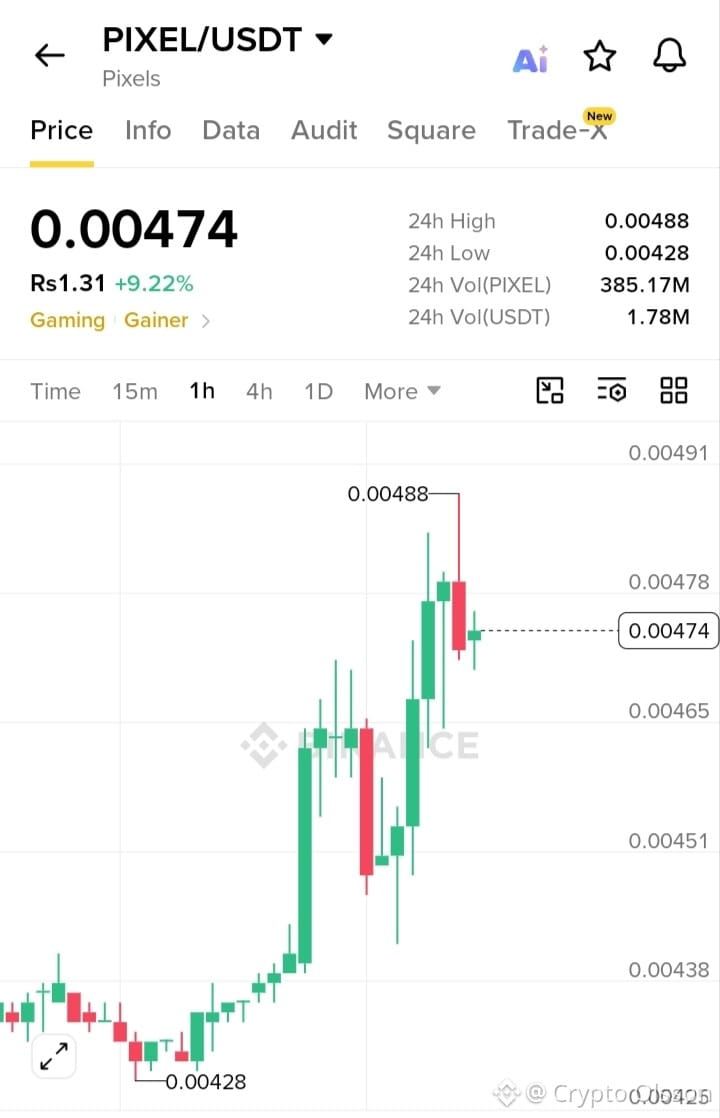

·
--
📊 Market Overview: Portfolio Breakdown of SOL, XLM, and PIXEL
🔵 SOL (Solana) – The Mega-Cap Titan
$SOL
{future}(SOLUSDT)
Rank: 7
Market Cap: 42.45B USD
24h Volume: 1.51B USD
Market Dominance: 1.97%
Expert Take: Solana continues to hold its ground as a top-tier Layer 1. With a healthy Volume-to-Market-Cap ratio of 3.55%, it shows stable, sustained interest from both retail and institutional traders. It remains a foundational asset for large portfolios.
🟢 XLM (Stellar Lumens) – The Fully Diluted Veteran
$XLM
{future}(XLMUSDT)
Rank: 10
Market Cap: 8.65B USD
Circulating Supply: 50B (100% Circulating)
Expert Take: Sitting comfortably in the top 10, Stellar is a legacy player with a major fundamental advantage: its Fully Diluted Market Cap (8.65B USD) exactly matches its current Market Cap. With all 50 billion tokens already in circulation, investors don't have to worry about future token unlock inflation or supply shocks.
🟣 PIXEL (Pixels) – The High-Volatility Micro-Cap
$PIXEL
{future}(PIXELUSDT)
Rank: 768
Market Cap: 14.11M USD
Vol/Market Cap Ratio: 43.04%
Expert Take: PIXEL is presenting extreme trading activity relative to its small size. A 43%+ volume ratio means it is highly liquid and highly volatile. Crucial Note: It just tested its All-Time Low of 0.0038 USD on July 30, 2026. This is strictly a high-risk, high-reward play for experienced scalpers and day traders.
💡 The Bottom Line:
Manage your allocations wisely. Use SOL for foundational growth, look to XLM for predictable supply economics, and only use a small fraction of your capital to trade highly volatile tokens like PIXEL.
Trade smart and manage your risk! 📉📈
#stellar #Pixels #cryptotrading #marketanalysis. #Write2Earn
📊 Market Overview: Portfolio Breakdown of SOL, XLM, and PIXEL
🔵 SOL (Solana) – The Mega-Cap Titan
$SOL
Rank: 7
Market Cap: 42.45B USD
24h Volume: 1.51B USD
Market Dominance: 1.97%
Expert Take: Solana continues to hold its ground as a top-tier Layer 1. With a healthy Volume-to-Market-Cap ratio of 3.55%, it shows stable, sustained interest from both retail and institutional traders. It remains a foundational asset for large portfolios.
🟢 XLM (Stellar Lumens) – The Fully Diluted Veteran
$XLM
Rank: 10
Market Cap: 8.65B USD
Circulating Supply: 50B (100% Circulating)
Expert Take: Sitting comfortably in the top 10, Stellar is a legacy player with a major fundamental advantage: its Fully Diluted Market Cap (8.65B USD) exactly matches its current Market Cap. With all 50 billion tokens already in circulation, investors don't have to worry about future token unlock inflation or supply shocks.
🟣 PIXEL (Pixels) – The High-Volatility Micro-Cap
$PIXEL
Rank: 768
Market Cap: 14.11M USD
Vol/Market Cap Ratio: 43.04%
Expert Take: PIXEL is presenting extreme trading activity relative to its small size. A 43%+ volume ratio means it is highly liquid and highly volatile. Crucial Note: It just tested its All-Time Low of 0.0038 USD on July 30, 2026. This is strictly a high-risk, high-reward play for experienced scalpers and day traders.
💡 The Bottom Line:
Manage your allocations wisely. Use SOL for foundational growth, look to XLM for predictable supply economics, and only use a small fraction of your capital to trade highly volatile tokens like PIXEL.
Trade smart and manage your risk! 📉📈
#stellar #Pixels #cryptotrading #marketanalysis. #Write2Earn
🔵 SOL (Solana) – The Mega-Cap Titan
$SOL
Rank: 7
Market Cap: 42.45B USD
24h Volume: 1.51B USD
Market Dominance: 1.97%
Expert Take: Solana continues to hold its ground as a top-tier Layer 1. With a healthy Volume-to-Market-Cap ratio of 3.55%, it shows stable, sustained interest from both retail and institutional traders. It remains a foundational asset for large portfolios.
🟢 XLM (Stellar Lumens) – The Fully Diluted Veteran
$XLM
Rank: 10
Market Cap: 8.65B USD
Circulating Supply: 50B (100% Circulating)
Expert Take: Sitting comfortably in the top 10, Stellar is a legacy player with a major fundamental advantage: its Fully Diluted Market Cap (8.65B USD) exactly matches its current Market Cap. With all 50 billion tokens already in circulation, investors don't have to worry about future token unlock inflation or supply shocks.
🟣 PIXEL (Pixels) – The High-Volatility Micro-Cap
$PIXEL
Rank: 768
Market Cap: 14.11M USD
Vol/Market Cap Ratio: 43.04%
Expert Take: PIXEL is presenting extreme trading activity relative to its small size. A 43%+ volume ratio means it is highly liquid and highly volatile. Crucial Note: It just tested its All-Time Low of 0.0038 USD on July 30, 2026. This is strictly a high-risk, high-reward play for experienced scalpers and day traders.
💡 The Bottom Line:
Manage your allocations wisely. Use SOL for foundational growth, look to XLM for predictable supply economics, and only use a small fraction of your capital to trade highly volatile tokens like PIXEL.
Trade smart and manage your risk! 📉📈
#stellar #Pixels #cryptotrading #marketanalysis. #Write2Earn

2
174

·
--
On-Chain Signal Observation: $PIXEL Current Price is $0.00526, with 24h Trading Volume of $7.41 million. Its market cap is only $18.23 million, which is a typical low–market-cap, high–turnover structure.
Recently, public discussions have generally been diluted by same-name topics such as Google Pixel phones, pixel art, and NFT history. Information specifically centered on the fundamentals of the Pixels game is relatively thin—this is one of the core reasons the price narrative is unclear. In other words, what the market lacks isn’t liquidity, but a consensus anchor.
Watch three clues:
1. DAU and land-system retention data—key to judging the token’s demand side;
2. The cadence of Ronin ecosystem cross-linkages—determines whether short-term capital can flow back;
3. If the turnover rate stays above 40%, it suggests the chips are still rapidly rotating and the trend direction is not yet determined.
Low market cap + information asymmetry means volatility will be amplified. Don’t let narratives replace data—calibrate your position with data.
#Pixels #GameFi #On-chain data
On-Chain Signal Observation: $PIXEL Current Price is $0.00526, with 24h Trading Volume of $7.41 million. Its market cap is only $18.23 million, which is a typical low–market-cap, high–turnover structure.
Recently, public discussions have generally been diluted by same-name topics such as Google Pixel phones, pixel art, and NFT history. Information specifically centered on the fundamentals of the Pixels game is relatively thin—this is one of the core reasons the price narrative is unclear. In other words, what the market lacks isn’t liquidity, but a consensus anchor.
Watch three clues:
1. DAU and land-system retention data—key to judging the token’s demand side;
2. The cadence of Ronin ecosystem cross-linkages—determines whether short-term capital can flow back;
3. If the turnover rate stays above 40%, it suggests the chips are still rapidly rotating and the trend direction is not yet determined.
Low market cap + information asymmetry means volatility will be amplified. Don’t let narratives replace data—calibrate your position with data.
#Pixels #GameFi #On-chain data
Recently, public discussions have generally been diluted by same-name topics such as Google Pixel phones, pixel art, and NFT history. Information specifically centered on the fundamentals of the Pixels game is relatively thin—this is one of the core reasons the price narrative is unclear. In other words, what the market lacks isn’t liquidity, but a consensus anchor.
Watch three clues:
1. DAU and land-system retention data—key to judging the token’s demand side;
2. The cadence of Ronin ecosystem cross-linkages—determines whether short-term capital can flow back;
3. If the turnover rate stays above 40%, it suggests the chips are still rapidly rotating and the trend direction is not yet determined.
Low market cap + information asymmetry means volatility will be amplified. Don’t let narratives replace data—calibrate your position with data.
#Pixels #GameFi #On-chain data
28
·
--
$PIXEL current price $0.00526, 24h volume $7.41M, market cap $18.23M — the data isn’t impressive, but at least it fills in the "information vacuum".
If you’ve recently tried to look up the fundamentals of Pixels, you probably feel the same way: search results are cluttered with Google Pixel phones, pixel art, and early NFT history, while real discussion about this on-chain game token is drowned out. Information noise itself is a kind of risk—retail investors can’t get clean data, so their emotions are more likely to swing with the price action.
A small market cap combined with low liquidity means that any concentrated buy/sell activity could amplify volatility. In the short term, you need to see whether volume can hold around the $7M level; in the medium term, it still comes down to the project team’s progress on the land gameplay and user retention.
Before new narrative catalysts show up, I’m more inclined to treat it as an observation position rather than a heavy bet.
#Pixels #GameFi #chain game token
$PIXEL current price $0.00526, 24h volume $7.41M, market cap $18.23M — the data isn’t impressive, but at least it fills in the "information vacuum".
If you’ve recently tried to look up the fundamentals of Pixels, you probably feel the same way: search results are cluttered with Google Pixel phones, pixel art, and early NFT history, while real discussion about this on-chain game token is drowned out. Information noise itself is a kind of risk—retail investors can’t get clean data, so their emotions are more likely to swing with the price action.
A small market cap combined with low liquidity means that any concentrated buy/sell activity could amplify volatility. In the short term, you need to see whether volume can hold around the $7M level; in the medium term, it still comes down to the project team’s progress on the land gameplay and user retention.
Before new narrative catalysts show up, I’m more inclined to treat it as an observation position rather than a heavy bet.
#Pixels #GameFi #chain game token
If you’ve recently tried to look up the fundamentals of Pixels, you probably feel the same way: search results are cluttered with Google Pixel phones, pixel art, and early NFT history, while real discussion about this on-chain game token is drowned out. Information noise itself is a kind of risk—retail investors can’t get clean data, so their emotions are more likely to swing with the price action.
A small market cap combined with low liquidity means that any concentrated buy/sell activity could amplify volatility. In the short term, you need to see whether volume can hold around the $7M level; in the medium term, it still comes down to the project team’s progress on the land gameplay and user retention.
Before new narrative catalysts show up, I’m more inclined to treat it as an observation position rather than a heavy bet.
#Pixels #GameFi #chain game token
102


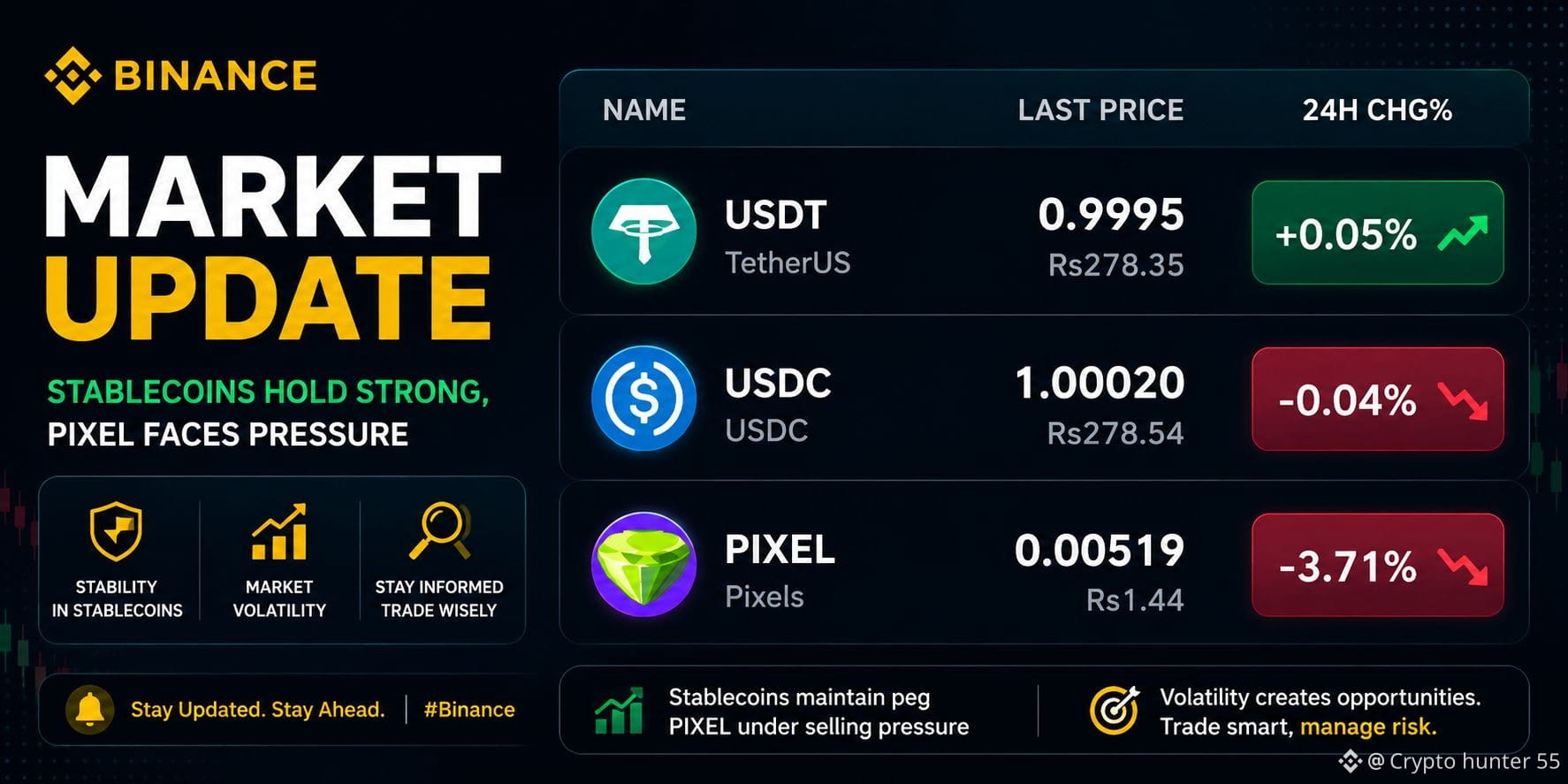
📊 Stablecoins Hold Strong While PIXEL Faces Pressure
Today's market snapshot shows stablecoins maintaining their peg, while gaming tokens continue to experience volatility.
🟢 $USDT (TetherUS)
💰 Price: $0.9995
🇵🇰 PKR Value: Rs278.35
📈 24H Change: +0.05%
🔵 $USDC
💰 Price: $1.00020
🇵🇰 PKR Value: Rs278.54
📉 24H Change: -0.04%
🟣 $PIXEL (Pixels)
💰 Price: $0.00519
🇵🇰 PKR Value: Rs1.44
📉 24H Change: -3.71%
📌 Stablecoins continue to provide price stability for traders, while PIXEL remains under short-term selling pressure. As always, market volatility creates both risks and opportunities for informed investors.
#Crypto #USDT #USDC #Pixels #USDTMarketCapOvertakesEthereum
📊 Stablecoins Hold Strong While PIXEL Faces Pressure
Today's market snapshot shows stablecoins maintaining their peg, while gaming tokens continue to experience volatility.
🟢 $USDT (TetherUS)
💰 Price: $0.9995
🇵🇰 PKR Value: Rs278.35
📈 24H Change: +0.05%
🔵 $USDC
💰 Price: $1.00020
🇵🇰 PKR Value: Rs278.54
📉 24H Change: -0.04%
🟣 $PIXEL (Pixels)
💰 Price: $0.00519
🇵🇰 PKR Value: Rs1.44
📉 24H Change: -3.71%
📌 Stablecoins continue to provide price stability for traders, while PIXEL remains under short-term selling pressure. As always, market volatility creates both risks and opportunities for informed investors.
#Crypto #USDT #USDC #Pixels #USDTMarketCapOvertakesEthereum
Today's market snapshot shows stablecoins maintaining their peg, while gaming tokens continue to experience volatility.
🟢 $USDT (TetherUS)
💰 Price: $0.9995
🇵🇰 PKR Value: Rs278.35
📈 24H Change: +0.05%
🔵 $USDC
💰 Price: $1.00020
🇵🇰 PKR Value: Rs278.54
📉 24H Change: -0.04%
🟣 $PIXEL (Pixels)
💰 Price: $0.00519
🇵🇰 PKR Value: Rs1.44
📉 24H Change: -3.71%
📌 Stablecoins continue to provide price stability for traders, while PIXEL remains under short-term selling pressure. As always, market volatility creates both risks and opportunities for informed investors.
#Crypto #USDT #USDC #Pixels #USDTMarketCapOvertakesEthereum
140

·
--

Article
🎉🏆 REWARDS, NFT COMMUNITIES & FOOTBALL COLLIDE IN PIXELS 🏆🎉The Pixels Community Cup isn't just about competition — it's about bringing the entire community together.
Players can create teams around:
🌎 Countries
🎨 NFT Collections
👥 Communities
⚔️ Guilds
🏴 Regions
Special country jerseys representing the 48 nations participating in the real-world football tournament will be available in-game, with more countries being added based on community requests.
And of course... there are rewards waiting for the winners 👀
🥇 Top Teams receive exclusive trophies
🎁 Special UGC rewards
🍷 Wines and additional prizes
⭐ Community recognition
This event is shaping up to be one of the biggest community-driven tournaments Pixels has ever hosted.
A huge shoutout goes to Nyna Mary & Lalle for organizing the event and bringing the community together through competition, teamwork, and fun.
Gather your friends, choose your colors, and get ready to represent your community on the biggest football stage in Pixels.
⚽ May the best team win!
#Pixels $PIXEL @pixels
🎉🏆 REWARDS, NFT COMMUNITIES & FOOTBALL COLLIDE IN PIXELS 🏆🎉
The Pixels Community Cup isn't just about competition — it's about bringing the entire community together.
Players can create teams around:
🌎 Countries
🎨 NFT Collections
👥 Communities
⚔️ Guilds
🏴 Regions
Special country jerseys representing the 48 nations participating in the real-world football tournament will be available in-game, with more countries being added based on community requests.
And of course... there are rewards waiting for the winners 👀
🥇 Top Teams receive exclusive trophies
🎁 Special UGC rewards
🍷 Wines and additional prizes
⭐ Community recognition
This event is shaping up to be one of the biggest community-driven tournaments Pixels has ever hosted.
A huge shoutout goes to Nyna Mary & Lalle for organizing the event and bringing the community together through competition, teamwork, and fun.
Gather your friends, choose your colors, and get ready to represent your community on the biggest football stage in Pixels.
⚽ May the best team win!
#Pixels $PIXEL @pixels
Players can create teams around:
🌎 Countries
🎨 NFT Collections
👥 Communities
⚔️ Guilds
🏴 Regions
Special country jerseys representing the 48 nations participating in the real-world football tournament will be available in-game, with more countries being added based on community requests.
And of course... there are rewards waiting for the winners 👀
🥇 Top Teams receive exclusive trophies
🎁 Special UGC rewards
🍷 Wines and additional prizes
⭐ Community recognition
This event is shaping up to be one of the biggest community-driven tournaments Pixels has ever hosted.
A huge shoutout goes to Nyna Mary & Lalle for organizing the event and bringing the community together through competition, teamwork, and fun.
Gather your friends, choose your colors, and get ready to represent your community on the biggest football stage in Pixels.
⚽ May the best team win!
#Pixels $PIXEL @pixels
574
·
--
When the attention of $PIXEL is diluted by Google Pixel phones, pixel art, and old NFT stories, the narrative that truly belongs to the project itself becomes blurred.
Current price is $0.00526, with $7.41 million in 24h trades, and a market cap of only $18.23 million—this is a small-cap example that’s been smothered by "information noise."
I care about three things:
1. On the chain-gaming side, whether daily active users and the land/asset circulation loop are still running
2. Whether the team has recent, verifiable roadmap updates—not just relying on community memories
3. In small caps, the trade volume-to-market-cap ratio is relatively active, suggesting that the rotation of holders isn’t dead, but also meaning volatility is amplified
In the absence of clear fundamental disclosures, rather than betting on direction, treat it as an "information-repair" asset: once the official narrative takes back the top search results again, the valuation anchor will return. Until then, your position sizing and stop-loss/risk-reward views matter more.
#Pixels #GameFi #小市值观察
When the attention of $PIXEL is diluted by Google Pixel phones, pixel art, and old NFT stories, the narrative that truly belongs to the project itself becomes blurred.
Current price is $0.00526, with $7.41 million in 24h trades, and a market cap of only $18.23 million—this is a small-cap example that’s been smothered by "information noise."
I care about three things:
1. On the chain-gaming side, whether daily active users and the land/asset circulation loop are still running
2. Whether the team has recent, verifiable roadmap updates—not just relying on community memories
3. In small caps, the trade volume-to-market-cap ratio is relatively active, suggesting that the rotation of holders isn’t dead, but also meaning volatility is amplified
In the absence of clear fundamental disclosures, rather than betting on direction, treat it as an "information-repair" asset: once the official narrative takes back the top search results again, the valuation anchor will return. Until then, your position sizing and stop-loss/risk-reward views matter more.
#Pixels #GameFi #小市值观察
Current price is $0.00526, with $7.41 million in 24h trades, and a market cap of only $18.23 million—this is a small-cap example that’s been smothered by "information noise."
I care about three things:
1. On the chain-gaming side, whether daily active users and the land/asset circulation loop are still running
2. Whether the team has recent, verifiable roadmap updates—not just relying on community memories
3. In small caps, the trade volume-to-market-cap ratio is relatively active, suggesting that the rotation of holders isn’t dead, but also meaning volatility is amplified
In the absence of clear fundamental disclosures, rather than betting on direction, treat it as an "information-repair" asset: once the official narrative takes back the top search results again, the valuation anchor will return. Until then, your position sizing and stop-loss/risk-reward views matter more.
#Pixels #GameFi #小市值观察
102

·
--
💥🚀🎮 $PIXEL Momentum Watch
PIXEL is around $0.0042–$0.0048, with 24H volume around $5M–$6M. Recent data shows the token remains near its July lows, while liquidity is still active.
📊 Key levels:
• Support: $0.0040
• Resistance: $0.0050
• Break above $0.0050 + rising volume = stronger momentum signal
• Loss of $0.0040 = downside risk
My take: PIXEL is a high-volatility gaming token where volume confirmation matters more than price alone. Watch the $0.0050 zone closely. 👀
#PIXEL #Pixels #Crypto #gaming #BinanceSquareFamily 💥🚀
{spot}(PIXELUSDT)
💥🚀🎮 $PIXEL Momentum Watch
PIXEL is around $0.0042–$0.0048, with 24H volume around $5M–$6M. Recent data shows the token remains near its July lows, while liquidity is still active.
📊 Key levels:
• Support: $0.0040
• Resistance: $0.0050
• Break above $0.0050 + rising volume = stronger momentum signal
• Loss of $0.0040 = downside risk
My take: PIXEL is a high-volatility gaming token where volume confirmation matters more than price alone. Watch the $0.0050 zone closely. 👀
#PIXEL #Pixels #Crypto #gaming #BinanceSquareFamily 💥🚀
PIXEL is around $0.0042–$0.0048, with 24H volume around $5M–$6M. Recent data shows the token remains near its July lows, while liquidity is still active.
📊 Key levels:
• Support: $0.0040
• Resistance: $0.0050
• Break above $0.0050 + rising volume = stronger momentum signal
• Loss of $0.0040 = downside risk
My take: PIXEL is a high-volatility gaming token where volume confirmation matters more than price alone. Watch the $0.0050 zone closely. 👀
#PIXEL #Pixels #Crypto #gaming #BinanceSquareFamily 💥🚀
1
119

·
--
🚀 PIXELS GAMEFI: The Farming that Conquers Real GameFi! 🌾 $PIXEL
Hey, Pixels enthusiasts!
If you love a fun, addictive game with real blockchain economics, Pixels is that project that keeps delivering. An open pixelated world where you plant, explore, build your farm, do quests, create pets, and interact with the community—all while truly earning with $PIXEL .
This isn’t just another Play-to-Earn that dies fast. Pixels brought innovation to GameFi: accessible free-to-play, strong integration with Ronin, staking of #PIXELS with exclusive perks, community governance, and an ecosystem that keeps evolving.
Why does $PIXEL deserve your attention right now?
• Real in-game utility (crafting, VIP, guilds, NFT pets)
• Sustainable economy under construction
• Active and passionate community
• Growth potential in the next GameFi cycle
Who’s already farming in Pixels—raise your hand! 🌱 What’s your favorite strategy in the game? Berry farming, trading on the marketplace, or heavy staking of $PIXEL?
Comment below, tag your farmer friends, and let’s grow this universe together!
#Pixels #PIXEL #GameFi #PlayToEarn
{spot}(PIXELUSDT)
{spot}(RONINUSDT)
🚀 PIXELS GAMEFI: The Farming that Conquers Real GameFi! 🌾 $PIXEL
Hey, Pixels enthusiasts!
If you love a fun, addictive game with real blockchain economics, Pixels is that project that keeps delivering. An open pixelated world where you plant, explore, build your farm, do quests, create pets, and interact with the community—all while truly earning with $PIXEL .
This isn’t just another Play-to-Earn that dies fast. Pixels brought innovation to GameFi: accessible free-to-play, strong integration with Ronin, staking of #PIXELS with exclusive perks, community governance, and an ecosystem that keeps evolving.
Why does $PIXEL deserve your attention right now?
• Real in-game utility (crafting, VIP, guilds, NFT pets)
• Sustainable economy under construction
• Active and passionate community
• Growth potential in the next GameFi cycle
Who’s already farming in Pixels—raise your hand! 🌱 What’s your favorite strategy in the game? Berry farming, trading on the marketplace, or heavy staking of $PIXEL ?
Comment below, tag your farmer friends, and let’s grow this universe together!
#Pixels #PIXEL #GameFi #PlayToEarn
Hey, Pixels enthusiasts!
If you love a fun, addictive game with real blockchain economics, Pixels is that project that keeps delivering. An open pixelated world where you plant, explore, build your farm, do quests, create pets, and interact with the community—all while truly earning with $PIXEL .
This isn’t just another Play-to-Earn that dies fast. Pixels brought innovation to GameFi: accessible free-to-play, strong integration with Ronin, staking of #PIXELS with exclusive perks, community governance, and an ecosystem that keeps evolving.
Why does $PIXEL deserve your attention right now?
• Real in-game utility (crafting, VIP, guilds, NFT pets)
• Sustainable economy under construction
• Active and passionate community
• Growth potential in the next GameFi cycle
Who’s already farming in Pixels—raise your hand! 🌱 What’s your favorite strategy in the game? Berry farming, trading on the marketplace, or heavy staking of $PIXEL ?
Comment below, tag your farmer friends, and let’s grow this universe together!
#Pixels #PIXEL #GameFi #PlayToEarn
389
·
--

Article
🏆⚽ PIXELS COMMUNITY CUP FORMAT & SCHEDULE ⚽🏆Think your squad has what it takes to become champions?
Here's how the tournament works:
📅 June 15-19
Team registrations open.
📅 June 20-22
Squads are verified and placed into groups.
🎲 June 22
Official Group Draw goes live.
Every team will discover their opponents and begin preparing for battle.
📅 June 23-26
Group Stage Begins
⚽ Round Robin Format
⏱️ 25 Minute Matches
• Two 10-minute halves
• 5-minute halftime
The top-performing teams will advance to the knockout stage where only the strongest squads survive.
🔥 Every match will be streamed live by Pixels content creators.
🔥 Results will be shared across social media.
🔥 The entire Pixels community will be watching.
One missed player could change everything.
Once registration closes, rosters are locked. If teammates don't show up, your team plays short.
Choose your squad wisely.
#Pixels $PIXEL @pixels
🏆⚽ PIXELS COMMUNITY CUP FORMAT & SCHEDULE ⚽🏆
Think your squad has what it takes to become champions?
Here's how the tournament works:
📅 June 15-19
Team registrations open.
📅 June 20-22
Squads are verified and placed into groups.
🎲 June 22
Official Group Draw goes live.
Every team will discover their opponents and begin preparing for battle.
📅 June 23-26
Group Stage Begins
⚽ Round Robin Format
⏱️ 25 Minute Matches
• Two 10-minute halves
• 5-minute halftime
The top-performing teams will advance to the knockout stage where only the strongest squads survive.
🔥 Every match will be streamed live by Pixels content creators.
🔥 Results will be shared across social media.
🔥 The entire Pixels community will be watching.
One missed player could change everything.
Once registration closes, rosters are locked. If teammates don't show up, your team plays short.
Choose your squad wisely.
#Pixels $PIXEL @pixels
Here's how the tournament works:
📅 June 15-19
Team registrations open.
📅 June 20-22
Squads are verified and placed into groups.
🎲 June 22
Official Group Draw goes live.
Every team will discover their opponents and begin preparing for battle.
📅 June 23-26
Group Stage Begins
⚽ Round Robin Format
⏱️ 25 Minute Matches
• Two 10-minute halves
• 5-minute halftime
The top-performing teams will advance to the knockout stage where only the strongest squads survive.
🔥 Every match will be streamed live by Pixels content creators.
🔥 Results will be shared across social media.
🔥 The entire Pixels community will be watching.
One missed player could change everything.
Once registration closes, rosters are locked. If teammates don't show up, your team plays short.
Choose your squad wisely.
#Pixels $PIXEL @pixels
1
5
297

$PIXEL current price $0.00526, 24h trading volume $7.41 million, market cap only $18.23 million. Liquidity is relatively thin, but turnover isn’t particularly low.
Recently, public discussion about Pixels has mostly been diverted by Google Pixel phones, pixel art, and early NFT history; there are few voices that truly focus on the token’s fundamentals and on-chain game progress. This is also one of the reasons the price lacks direction—if the market isn’t talking about it, nobody is giving it a valuation.
For me, there are only two lines of thinking when assessing small-cap GameFi: first, whether on-chain active addresses and retention from daily quests can stay stable; second, the team’s upcoming update cadence. If either is missing, any rebound is merely emotion-driven.
Before seeing fundamentals improve, I’d lean toward watching from the sidelines, not chasing highs. Consider a small position only after a pullback to key support.
#Pixels #GameFi #small-cap token
$PIXEL current price $0.00526, 24h trading volume $7.41 million, market cap only $18.23 million. Liquidity is relatively thin, but turnover isn’t particularly low.
Recently, public discussion about Pixels has mostly been diverted by Google Pixel phones, pixel art, and early NFT history; there are few voices that truly focus on the token’s fundamentals and on-chain game progress. This is also one of the reasons the price lacks direction—if the market isn’t talking about it, nobody is giving it a valuation.
For me, there are only two lines of thinking when assessing small-cap GameFi: first, whether on-chain active addresses and retention from daily quests can stay stable; second, the team’s upcoming update cadence. If either is missing, any rebound is merely emotion-driven.
Before seeing fundamentals improve, I’d lean toward watching from the sidelines, not chasing highs. Consider a small position only after a pullback to key support.
#Pixels #GameFi #small-cap token
Recently, public discussion about Pixels has mostly been diverted by Google Pixel phones, pixel art, and early NFT history; there are few voices that truly focus on the token’s fundamentals and on-chain game progress. This is also one of the reasons the price lacks direction—if the market isn’t talking about it, nobody is giving it a valuation.
For me, there are only two lines of thinking when assessing small-cap GameFi: first, whether on-chain active addresses and retention from daily quests can stay stable; second, the team’s upcoming update cadence. If either is missing, any rebound is merely emotion-driven.
Before seeing fundamentals improve, I’d lean toward watching from the sidelines, not chasing highs. Consider a small position only after a pullback to key support.
#Pixels #GameFi #small-cap token
111
·
--

Article
⚽🔥 PIXELS COMMUNITY CUP IS HERE! 🔥⚽Your favorite farming game is about to get a whole lot more competitive.
The Pixels Community Cup is officially kicking off, bringing football (soccer) directly into the world of Pixels. Players from across the community will form teams, battle through group stages, climb the rankings, and fight for championship glory.
Whether you're representing your:
🌎 Country
🏴 Region
🎨 NFT Collection
👥 Community
🔥 Guild
The choice is yours.
Teams will compete in round-robin group stages before advancing into intense knockout rounds where every match matters.
📅 Registration: June 15 - June 19
To register, you'll need:
✅ Team Name
✅ Team Captain (Discord ID)
✅ Full Roster of 5 Players
✅ In-game Usernames
Only one player needs to register the entire team.
The road to becoming Pixels Community Cup Champions starts now. Gather your squad and prepare for battle!
#Pixels $PIXEL @pixels
⚽🔥 PIXELS COMMUNITY CUP IS HERE! 🔥⚽
Your favorite farming game is about to get a whole lot more competitive.
The Pixels Community Cup is officially kicking off, bringing football (soccer) directly into the world of Pixels. Players from across the community will form teams, battle through group stages, climb the rankings, and fight for championship glory.
Whether you're representing your:
🌎 Country
🏴 Region
🎨 NFT Collection
👥 Community
🔥 Guild
The choice is yours.
Teams will compete in round-robin group stages before advancing into intense knockout rounds where every match matters.
📅 Registration: June 15 - June 19
To register, you'll need:
✅ Team Name
✅ Team Captain (Discord ID)
✅ Full Roster of 5 Players
✅ In-game Usernames
Only one player needs to register the entire team.
The road to becoming Pixels Community Cup Champions starts now. Gather your squad and prepare for battle!
#Pixels $PIXEL @pixels
The Pixels Community Cup is officially kicking off, bringing football (soccer) directly into the world of Pixels. Players from across the community will form teams, battle through group stages, climb the rankings, and fight for championship glory.
Whether you're representing your:
🌎 Country
🏴 Region
🎨 NFT Collection
👥 Community
🔥 Guild
The choice is yours.
Teams will compete in round-robin group stages before advancing into intense knockout rounds where every match matters.
📅 Registration: June 15 - June 19
To register, you'll need:
✅ Team Name
✅ Team Captain (Discord ID)
✅ Full Roster of 5 Players
✅ In-game Usernames
Only one player needs to register the entire team.
The road to becoming Pixels Community Cup Champions starts now. Gather your squad and prepare for battle!
#Pixels $PIXEL @pixels
140

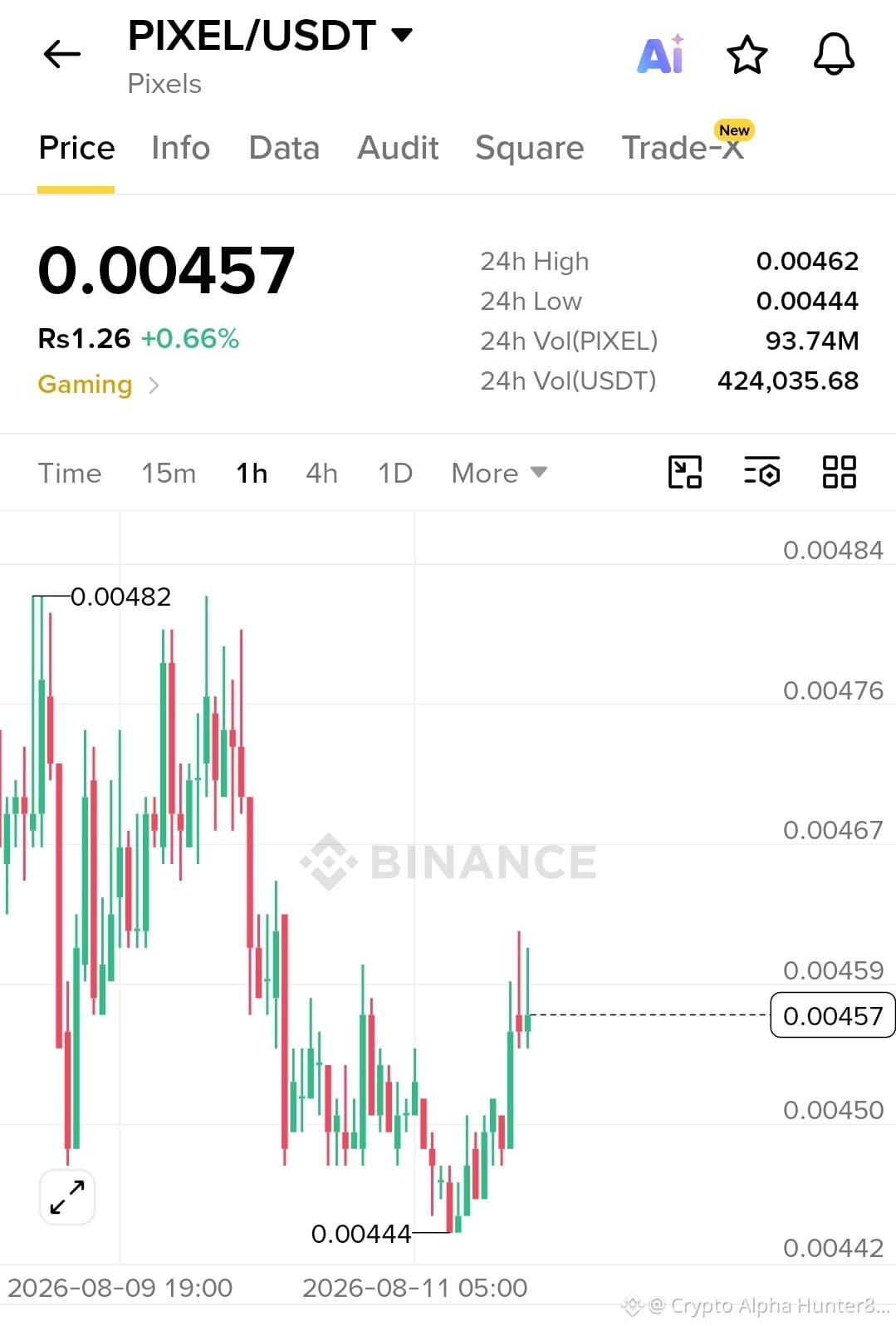
🚨🎮 $PIXEL — THIS ONE COULD WAKE UP! 🔥🚀
Guys, I’m keeping $PIXEL on my radar! 👀 Price is holding around $0.00457 and is pressing right under the $0.00462 24H high.
The setup is getting tight. 🔥 If buyers finally push above $0.00462 and hold it, I’m watching for a quick move toward the next levels! 📈💥
🟢 Entry: $0.00455–$0.00462
🎯 TP1: $0.00476
🎯 TP2: $0.00482
🎯 TP3: $0.00495
🔴 SL: $0.00450
⚡ Break $0.00462 → $PIXEL could start moving FAST! 🚀🎮
I’m watching this one closely. 👀🔥
Follow me for more setups before the move! ❤️🔥
#PIXEL #Pixels #Gaming #Crypto #BinanceSquare #Trading
{future}(PIXELUSDT)
🚨🎮 $PIXEL — THIS ONE COULD WAKE UP! 🔥🚀
Guys, I’m keeping $PIXEL on my radar! 👀 Price is holding around $0.00457 and is pressing right under the $0.00462 24H high.
The setup is getting tight. 🔥 If buyers finally push above $0.00462 and hold it, I’m watching for a quick move toward the next levels! 📈💥
🟢 Entry: $0.00455–$0.00462
🎯 TP1: $0.00476
🎯 TP2: $0.00482
🎯 TP3: $0.00495
🔴 SL: $0.00450
⚡ Break $0.00462 → $PIXEL could start moving FAST! 🚀🎮
I’m watching this one closely. 👀🔥
Follow me for more setups before the move! ❤️🔥
#PIXEL #Pixels #Gaming #Crypto #BinanceSquare #Trading
Guys, I’m keeping $PIXEL on my radar! 👀 Price is holding around $0.00457 and is pressing right under the $0.00462 24H high.
The setup is getting tight. 🔥 If buyers finally push above $0.00462 and hold it, I’m watching for a quick move toward the next levels! 📈💥
🟢 Entry: $0.00455–$0.00462
🎯 TP1: $0.00476
🎯 TP2: $0.00482
🎯 TP3: $0.00495
🔴 SL: $0.00450
⚡ Break $0.00462 → $PIXEL could start moving FAST! 🚀🎮
I’m watching this one closely. 👀🔥
Follow me for more setups before the move! ❤️🔥
#PIXEL #Pixels #Gaming #Crypto #BinanceSquare #Trading
2
261
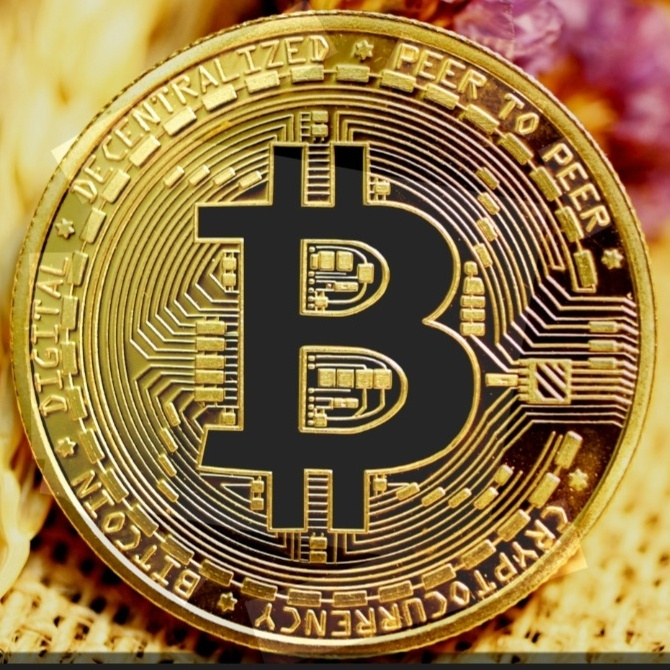
From Banker To Traders $BTC $ETH
Sounds like you’ve made a big shift—from a structured banking role to something more independent and flexible. Trading can definitely feel more rewarding day-to-day, especially if you like having control over your decisions and seeing direct results from your work.
That said, it’s worth staying a bit grounded about the trade-offs. Banking usually offers stability, predictable income, and long-term security, while trading income can fluctuate a lot depending on markets and risk management. Feeling happy with the change is important—but making sure it’s sustainable is just as important.
A couple of things you might want to keep in mind:
Are you consistently profitable over time, not just in short bursts?
Do you have a safety net or savings in case of a bad trading period?
Are you managing risk carefully (position sizing, stop losses, etc.)?
If you’ve got those bases covered, then you’re in a strong position to enjoy the freedom trading gives you.
#Pixels
$PIXEL
From Banker To Traders $BTC $ETH
Sounds like you’ve made a big shift—from a structured banking role to something more independent and flexible. Trading can definitely feel more rewarding day-to-day, especially if you like having control over your decisions and seeing direct results from your work.
That said, it’s worth staying a bit grounded about the trade-offs. Banking usually offers stability, predictable income, and long-term security, while trading income can fluctuate a lot depending on markets and risk management. Feeling happy with the change is important—but making sure it’s sustainable is just as important.
A couple of things you might want to keep in mind:
Are you consistently profitable over time, not just in short bursts?
Do you have a safety net or savings in case of a bad trading period?
Are you managing risk carefully (position sizing, stop losses, etc.)?
If you’ve got those bases covered, then you’re in a strong position to enjoy the freedom trading gives you.
#Pixels
$PIXEL
Sounds like you’ve made a big shift—from a structured banking role to something more independent and flexible. Trading can definitely feel more rewarding day-to-day, especially if you like having control over your decisions and seeing direct results from your work.
That said, it’s worth staying a bit grounded about the trade-offs. Banking usually offers stability, predictable income, and long-term security, while trading income can fluctuate a lot depending on markets and risk management. Feeling happy with the change is important—but making sure it’s sustainable is just as important.
A couple of things you might want to keep in mind:
Are you consistently profitable over time, not just in short bursts?
Do you have a safety net or savings in case of a bad trading period?
Are you managing risk carefully (position sizing, stop losses, etc.)?
If you’ve got those bases covered, then you’re in a strong position to enjoy the freedom trading gives you.
#Pixels
$PIXEL


1
1
55

·
--
@pixelsIn 2026, the PIXEL digital currency performs many vital functions that support the internal economy of the game. It is a premium currency, meaning it is not used for basic transactions like buying seeds, but is instead dedicated to high-value actions. This includes purchasing VIP memberships, which provide players with an increase in energy regeneration and access to exclusive areas. Furthermore, PIXEL is required to create "Pet" NFT tokens and participate in the "Guild" system, which has become the backbone of the game's social and competitive structure.
@pixels
In 2026, the PIXEL digital currency performs many vital functions that support the internal economy of the game. It is a premium currency, meaning it is not used for basic transactions like buying seeds, but is instead dedicated to high-value actions. This includes purchasing VIP memberships, which provide players with an increase in energy regeneration and access to exclusive areas. Furthermore, PIXEL is required to create "Pet" NFT tokens and participate in the "Guild" system, which has become the backbone of the game's social and competitive structure.
68

·
--
Pixels is quietly upgrading GameFi economics for $PIXEL 🔥
This matters because Stacked’s AI economist can separate real players from extractors, spot churn early, and reprice rewards by cohort instead of dumping the same emissions on everyone. If that loop works, the market stops leaking value and starts using incentives like precision capital, which is exactly how whale behavior and retention metrics get aligned.
Not financial advice. Manage your risk and protect your capital.
#GameFi #Aİ #Crypto #Pixels #Web3 ✦
{future}(PIXELUSDT)
Pixels is quietly upgrading GameFi economics for $PIXEL 🔥
This matters because Stacked’s AI economist can separate real players from extractors, spot churn early, and reprice rewards by cohort instead of dumping the same emissions on everyone. If that loop works, the market stops leaking value and starts using incentives like precision capital, which is exactly how whale behavior and retention metrics get aligned.
Not financial advice. Manage your risk and protect your capital.
#GameFi #Aİ #Crypto #Pixels #Web3 ✦
This matters because Stacked’s AI economist can separate real players from extractors, spot churn early, and reprice rewards by cohort instead of dumping the same emissions on everyone. If that loop works, the market stops leaking value and starts using incentives like precision capital, which is exactly how whale behavior and retention metrics get aligned.
Not financial advice. Manage your risk and protect your capital.
#GameFi #Aİ #Crypto #Pixels #Web3 ✦

16
Log in to explore more content
Join global crypto users on Binance Square
⚡️ Get latest and useful information about crypto.
💬 Trusted by the world’s largest crypto exchange.
👍 Discover real insights from verified creators.
Email / Phone number
Trending Topics
1
#CPIWatch
86M views
498,728 Discussing
2
#TrumpDeclinesSaudiRequestToStrikeHouthis
1,449 views
84 Discussing
3
#CryptoSectorsFallSecondDay
6,774 views
333 Discussing
4
#BitcoinGoldenCrossConfirms
8,518 views
346 Discussing
5
#AppleRises3.56%AfterIPhoneDuoLaunch
3,208 views
148 Discussing
6
#US10YTreasuryYieldHitsHighestSinceOct2023
3,809 views
115 Discussing
7
#Top7AssetsHold92.1%OfCryptoTop100
4,766 views
125 Discussing
8
#SaudiCrudeOutputHitsLowestSince1990
4,658 views
100 Discussing
9
#IranBlocksStraitOfHormuz
7,069 views
139 Discussing
10
#USAugustPPIRisesLessThanExpected
101,448 views
1,192 Discussing