
火星之路
226 Posts
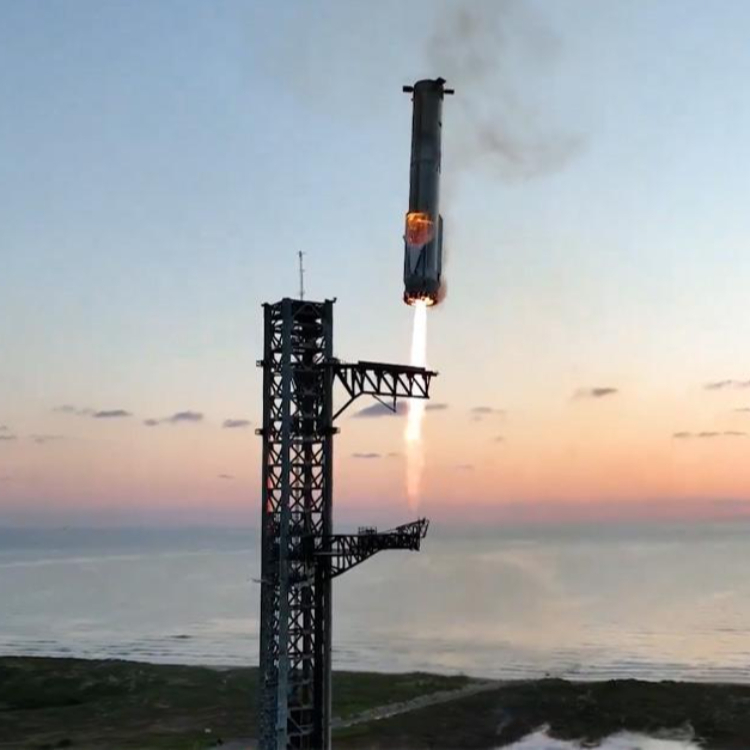
火星之路
Report
Block User
坚定看好spacex
16 Following
30 Followers
31 Liked
Posts
All
Quotes
Videos
·
--
$SPCX
During SpaceX’s transition process from Falcon to Starship, some interesting things happen. For a period of time, both SpaceX’s launch rate and payload delivery rate will drop, and they will drop in a cliff-like fashion.
Actually, there are already signs of this now. As recovery ships are retired and the East Coast no longer carries out Starlink launches, this month SpaceX has only launched 6 times. In the coming months, this situation will become even more obvious.
This will be a very useful indicator, because it’s a very typical “trap data.” If you don’t understand the technical iteration process and just talk generally based on surface-level numbers, you might interpret it as negative while overlooking the performance leap brought by the technological transition—allowing you to quickly tell which accounts are not worth关注.
$SPCX
During SpaceX’s transition process from Falcon to Starship, some interesting things happen. For a period of time, both SpaceX’s launch rate and payload delivery rate will drop, and they will drop in a cliff-like fashion.
Actually, there are already signs of this now. As recovery ships are retired and the East Coast no longer carries out Starlink launches, this month SpaceX has only launched 6 times. In the coming months, this situation will become even more obvious.
This will be a very useful indicator, because it’s a very typical “trap data.” If you don’t understand the technical iteration process and just talk generally based on surface-level numbers, you might interpret it as negative while overlooking the performance leap brought by the technological transition—allowing you to quickly tell which accounts are not worth关注.
During SpaceX’s transition process from Falcon to Starship, some interesting things happen. For a period of time, both SpaceX’s launch rate and payload delivery rate will drop, and they will drop in a cliff-like fashion.
Actually, there are already signs of this now. As recovery ships are retired and the East Coast no longer carries out Starlink launches, this month SpaceX has only launched 6 times. In the coming months, this situation will become even more obvious.
This will be a very useful indicator, because it’s a very typical “trap data.” If you don’t understand the technical iteration process and just talk generally based on surface-level numbers, you might interpret it as negative while overlooking the performance leap brought by the technological transition—allowing you to quickly tell which accounts are not worth关注.
396
·
--
$SPCX
【Broadcast Department Competitor Developments】
At 12:03 Beijing Time on September 20, 2026, the launch of the Long March? (CASC?)? The? (Actually: “CASC”?) (Not specified in source) — specifically, the “Lingke Space” Lijian? “Force Rocket One” Yihai? (Unclear). The “I-Lijian-1” Yiqi? (Confusing). The Long March? rocket? — “Lijian”??
Correction based strictly on source: At 12:03 Beijing Time on September 20, 2026, the “Yijian-1” launch vehicle of iSpace? (Not given)??
I must translate accurately from provided Chinese:
“中科宇航力箭一号遥十八运载火箭·超智算号在东风商业航天创新试验区发射,采用‘一箭9星’方式,将‘超智算一号’等9颗卫星送入预定轨道,发射任务成功。”
Translation:
On September 20, 2026 at 12:03 Beijing Time, the Zhongke Aerospace “Lijian-1” (Ray-1) Remote 18 carrier rocket · “Chaosuanhao” was launched from the Dongfeng commercial spaceflight innovation test area. Using the “one rocket, nine satellites” approach, it successfully delivered nine satellites, including “Chaosuan-1”, into their planned orbits, and the launch mission was a success.
$SPCX
【Broadcast Department Competitor Developments】
At 12:03 Beijing Time on September 20, 2026, the launch of the Long March? (CASC?)? The? (Actually: “CASC”?) (Not specified in source) — specifically, the “Lingke Space” Lijian? “Force Rocket One” Yihai? (Unclear). The “I-Lijian-1” Yiqi? (Confusing). The Long March? rocket? — “Lijian”??
Correction based strictly on source: At 12:03 Beijing Time on September 20, 2026, the “Yijian-1” launch vehicle of iSpace? (Not given)??
I must translate accurately from provided Chinese:
“中科宇航力箭一号遥十八运载火箭·超智算号在东风商业航天创新试验区发射,采用‘一箭9星’方式,将‘超智算一号’等9颗卫星送入预定轨道,发射任务成功。”
Translation:
On September 20, 2026 at 12:03 Beijing Time, the Zhongke Aerospace “Lijian-1” (Ray-1) Remote 18 carrier rocket · “Chaosuanhao” was launched from the Dongfeng commercial spaceflight innovation test area. Using the “one rocket, nine satellites” approach, it successfully delivered nine satellites, including “Chaosuan-1”, into their planned orbits, and the launch mission was a success.
【Broadcast Department Competitor Developments】
At 12:03 Beijing Time on September 20, 2026, the launch of the Long March? (CASC?)? The? (Actually: “CASC”?) (Not specified in source) — specifically, the “Lingke Space” Lijian? “Force Rocket One” Yihai? (Unclear). The “I-Lijian-1” Yiqi? (Confusing). The Long March? rocket? — “Lijian”??
Correction based strictly on source: At 12:03 Beijing Time on September 20, 2026, the “Yijian-1” launch vehicle of iSpace? (Not given)??
I must translate accurately from provided Chinese:
“中科宇航力箭一号遥十八运载火箭·超智算号在东风商业航天创新试验区发射,采用‘一箭9星’方式,将‘超智算一号’等9颗卫星送入预定轨道,发射任务成功。”
Translation:
On September 20, 2026 at 12:03 Beijing Time, the Zhongke Aerospace “Lijian-1” (Ray-1) Remote 18 carrier rocket · “Chaosuanhao” was launched from the Dongfeng commercial spaceflight innovation test area. Using the “one rocket, nine satellites” approach, it successfully delivered nine satellites, including “Chaosuan-1”, into their planned orbits, and the launch mission was a success.
320
·
--
$SPCX
【Launch Department Updates】
At 09:47 on September 20, 2026 (Beijing Time), SpaceX will use a Falcon 9 rocket to carry out the Starlink Group 15-27 mission from SLC-4E at Vandenberg Air Force Base. Booster B1093.17 previously flew SDA-T1TL-B, SDA-T1TL-C, Transporter-16, and 13 Starlink missions. After stage separation, the first stage will land on the unmanned recovery ship “Of Course I Still Love You” stationed in the Pacific
$SPCX
【Launch Department Updates】
At 09:47 on September 20, 2026 (Beijing Time), SpaceX will use a Falcon 9 rocket to carry out the Starlink Group 15-27 mission from SLC-4E at Vandenberg Air Force Base. Booster B1093.17 previously flew SDA-T1TL-B, SDA-T1TL-C, Transporter-16, and 13 Starlink missions. After stage separation, the first stage will land on the unmanned recovery ship “Of Course I Still Love You” stationed in the Pacific
【Launch Department Updates】
At 09:47 on September 20, 2026 (Beijing Time), SpaceX will use a Falcon 9 rocket to carry out the Starlink Group 15-27 mission from SLC-4E at Vandenberg Air Force Base. Booster B1093.17 previously flew SDA-T1TL-B, SDA-T1TL-C, Transporter-16, and 13 Starlink missions. After stage separation, the first stage will land on the unmanned recovery ship “Of Course I Still Love You” stationed in the Pacific
354
·
--
$SPCX
【Broadcasting Department Competitor Updates】
At 18:50 Beijing Time on September 19, 2026, the Long March 2D launch vehicle ignited and lifted off from the Taiyuan Satellite Launch Center. It then successfully inserted the Zhuzhou Space Interstellar PIESAT-2 13~16 satellites into their planned orbit, and the launch mission was a complete success.
$SPCX
【Broadcasting Department Competitor Updates】
At 18:50 Beijing Time on September 19, 2026, the Long March 2D launch vehicle ignited and lifted off from the Taiyuan Satellite Launch Center. It then successfully inserted the Zhuzhou Space Interstellar PIESAT-2 13~16 satellites into their planned orbit, and the launch mission was a complete success.
【Broadcasting Department Competitor Updates】
At 18:50 Beijing Time on September 19, 2026, the Long March 2D launch vehicle ignited and lifted off from the Taiyuan Satellite Launch Center. It then successfully inserted the Zhuzhou Space Interstellar PIESAT-2 13~16 satellites into their planned orbit, and the launch mission was a complete success.
302
·
--
$SPCX
【Launch Department Competitor Updates】
On September 19, 2026 at 11:22 Beijing Time, Rocket Lab $RKLB used an Electron to carry out the Owl By The Dozen mission with the StriX satellite to LEO from LC-1B at Mahia Peninsula, New Zealand.
$SPCX
【Launch Department Competitor Updates】
On September 19, 2026 at 11:22 Beijing Time, Rocket Lab $RKLB used an Electron to carry out the Owl By The Dozen mission with the StriX satellite to LEO from LC-1B at Mahia Peninsula, New Zealand.
【Launch Department Competitor Updates】
On September 19, 2026 at 11:22 Beijing Time, Rocket Lab $RKLB used an Electron to carry out the Owl By The Dozen mission with the StriX satellite to LEO from LC-1B at Mahia Peninsula, New Zealand.
1
302
·
--
$SPCX
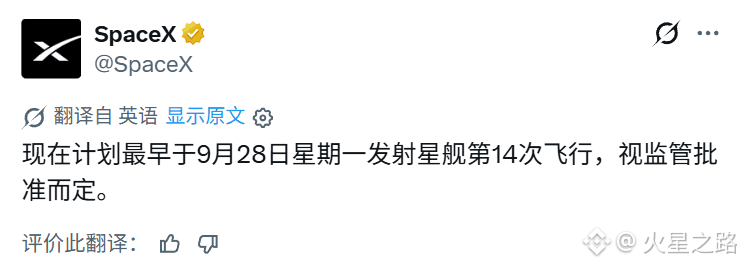
The schedule for the 14th flight test of the Starship has been changed to no earlier than the 28th; the exact time will be subject to approval by the regulatory authorities
$SPCX
The schedule for the 14th flight test of the Starship has been changed to no earlier than the 28th; the exact time will be subject to approval by the regulatory authorities
The schedule for the 14th flight test of the Starship has been changed to no earlier than the 28th; the exact time will be subject to approval by the regulatory authorities
237
·
--
$SPCX
【Broadcasting Department Competitor Updates】
At 10:40 on September 17, 2026 Beijing Time, the KuaiZhou-11 solid-fueled launch vehicle ignited and lifted off from the Jiuquan Satellite Launch Center, successfully delivering TianYi-51 and TianYi-52 satellites into their planned orbits.
TianYi-51 (Cloudy SAR01) and TianYi-52 (the Star Constellation TianYuan YG01) are the world’s first pair of InSAR remote-sensing satellites designed for large-scale commercial operations. They were developed by TianYi Space Technology Co., Ltd. The twin satellites use TianYi Space’s second-generation C-band SAR technology system, with major performance indicators such as resolution and observation swath width comprehensively upgraded, significantly improving in-orbit stability. They are also equipped with an on-board AI processing payload and a high-speed laser space-to-ground link, enabling real-time image processing in orbit and rapid data return. This provides end-to-end Earth observation capabilities characterized by high resolution, wide coverage, intelligent processing, and high-speed transmission.
$SPCX
【Broadcasting Department Competitor Updates】
At 10:40 on September 17, 2026 Beijing Time, the KuaiZhou-11 solid-fueled launch vehicle ignited and lifted off from the Jiuquan Satellite Launch Center, successfully delivering TianYi-51 and TianYi-52 satellites into their planned orbits.
TianYi-51 (Cloudy SAR01) and TianYi-52 (the Star Constellation TianYuan YG01) are the world’s first pair of InSAR remote-sensing satellites designed for large-scale commercial operations. They were developed by TianYi Space Technology Co., Ltd. The twin satellites use TianYi Space’s second-generation C-band SAR technology system, with major performance indicators such as resolution and observation swath width comprehensively upgraded, significantly improving in-orbit stability. They are also equipped with an on-board AI processing payload and a high-speed laser space-to-ground link, enabling real-time image processing in orbit and rapid data return. This provides end-to-end Earth observation capabilities characterized by high resolution, wide coverage, intelligent processing, and high-speed transmission.
【Broadcasting Department Competitor Updates】
At 10:40 on September 17, 2026 Beijing Time, the KuaiZhou-11 solid-fueled launch vehicle ignited and lifted off from the Jiuquan Satellite Launch Center, successfully delivering TianYi-51 and TianYi-52 satellites into their planned orbits.
TianYi-51 (Cloudy SAR01) and TianYi-52 (the Star Constellation TianYuan YG01) are the world’s first pair of InSAR remote-sensing satellites designed for large-scale commercial operations. They were developed by TianYi Space Technology Co., Ltd. The twin satellites use TianYi Space’s second-generation C-band SAR technology system, with major performance indicators such as resolution and observation swath width comprehensively upgraded, significantly improving in-orbit stability. They are also equipped with an on-board AI processing payload and a high-speed laser space-to-ground link, enabling real-time image processing in orbit and rapid data return. This provides end-to-end Earth observation capabilities characterized by high resolution, wide coverage, intelligent processing, and high-speed transmission.
54
·
--
$SPCX
【Launch Department Competitor Update】
At 08:32 on September 17, 2026, China used the Long March 12 launch vehicle at its commercial space launch site in Hainan to successfully launch the 25-satellite low-Earth-orbit satellite internet constellation. The satellites entered their planned orbits successfully, and the launch mission was a complete success.
$SPCX
【Launch Department Competitor Update】
At 08:32 on September 17, 2026, China used the Long March 12 launch vehicle at its commercial space launch site in Hainan to successfully launch the 25-satellite low-Earth-orbit satellite internet constellation. The satellites entered their planned orbits successfully, and the launch mission was a complete success.
【Launch Department Competitor Update】
At 08:32 on September 17, 2026, China used the Long March 12 launch vehicle at its commercial space launch site in Hainan to successfully launch the 25-satellite low-Earth-orbit satellite internet constellation. The satellites entered their planned orbits successfully, and the launch mission was a complete success.
180
·
--
$SPCX
【Launch Department News】
At 9:07 Beijing time on September 17, 2026, SpaceX used a Falcon 9 rocket to carry out the USSF-259 mission from SLC-4E at Vandenberg Space Force Base. The mission’s first-stage serial number was B1097.13. This booster had previously flown Sentinel-6B, Twilight, NROL-172, Transporter-17, and eight Starlink missions. After completing the mission, it returned to the OCISLY unmanned recovery ship, attempting to recover the rocket.
$SPCX
【Launch Department News】
At 9:07 Beijing time on September 17, 2026, SpaceX used a Falcon 9 rocket to carry out the USSF-259 mission from SLC-4E at Vandenberg Space Force Base. The mission’s first-stage serial number was B1097.13. This booster had previously flown Sentinel-6B, Twilight, NROL-172, Transporter-17, and eight Starlink missions. After completing the mission, it returned to the OCISLY unmanned recovery ship, attempting to recover the rocket.
【Launch Department News】
At 9:07 Beijing time on September 17, 2026, SpaceX used a Falcon 9 rocket to carry out the USSF-259 mission from SLC-4E at Vandenberg Space Force Base. The mission’s first-stage serial number was B1097.13. This booster had previously flown Sentinel-6B, Twilight, NROL-172, Transporter-17, and eight Starlink missions. After completing the mission, it returned to the OCISLY unmanned recovery ship, attempting to recover the rocket.
248
·
--
$SPCX
【Broadcast Department Competitor Updates】
At 21:33 (Beijing Time) on September 16, 2026, the Russian space agency will launch from the 31/6 pad at the Baikonur Cosmodrome, using the Soyuz 2.1b launch vehicle to send the Progress MS-35 cargo spacecraft to the International Space Station.
$SPCX
【Broadcast Department Competitor Updates】
At 21:33 (Beijing Time) on September 16, 2026, the Russian space agency will launch from the 31/6 pad at the Baikonur Cosmodrome, using the Soyuz 2.1b launch vehicle to send the Progress MS-35 cargo spacecraft to the International Space Station.
【Broadcast Department Competitor Updates】
At 21:33 (Beijing Time) on September 16, 2026, the Russian space agency will launch from the 31/6 pad at the Baikonur Cosmodrome, using the Soyuz 2.1b launch vehicle to send the Progress MS-35 cargo spacecraft to the International Space Station.
87
·
--
$SPCX
【Launch Department Competitor Updates】
At 6:00 AM Beijing Time on September 16, 2026, the Taiyuan Satellite Launch Center used the Gravity One Yao-3 launch vehicle in the eastern waters of Shanghai to successfully place a total of 9 satellites—Qianfan polar-orbit constellation 26 group satellites and the EUHT technical experimental satellite—into their planned orbit. The flight test mission was a complete success.
$SPCX
【Launch Department Competitor Updates】
At 6:00 AM Beijing Time on September 16, 2026, the Taiyuan Satellite Launch Center used the Gravity One Yao-3 launch vehicle in the eastern waters of Shanghai to successfully place a total of 9 satellites—Qianfan polar-orbit constellation 26 group satellites and the EUHT technical experimental satellite—into their planned orbit. The flight test mission was a complete success.
【Launch Department Competitor Updates】
At 6:00 AM Beijing Time on September 16, 2026, the Taiyuan Satellite Launch Center used the Gravity One Yao-3 launch vehicle in the eastern waters of Shanghai to successfully place a total of 9 satellites—Qianfan polar-orbit constellation 26 group satellites and the EUHT technical experimental satellite—into their planned orbit. The flight test mission was a complete success.
87
·
--
$SPCX
Even if you use the starship as a disposable rocket—even if this time you only carry 26 V3 Starlink satellites
For the sake of increasing bandwidth calculations, it’s roughly equivalent to launching V2 mini satellites on ten separate Falcon 9 launches. Based on the most optimistic internal cost of Falcon 9—an estimated $15 million—ten Falcon 9 launches would cost $150 million
Whereas even if the Starship is used just once, its cost is still within $100 million
That’s the technological gap
$SPCX
Even if you use the starship as a disposable rocket—even if this time you only carry 26 V3 Starlink satellites
For the sake of increasing bandwidth calculations, it’s roughly equivalent to launching V2 mini satellites on ten separate Falcon 9 launches. Based on the most optimistic internal cost of Falcon 9—an estimated $15 million—ten Falcon 9 launches would cost $150 million
Whereas even if the Starship is used just once, its cost is still within $100 million
That’s the technological gap
Even if you use the starship as a disposable rocket—even if this time you only carry 26 V3 Starlink satellites
For the sake of increasing bandwidth calculations, it’s roughly equivalent to launching V2 mini satellites on ten separate Falcon 9 launches. Based on the most optimistic internal cost of Falcon 9—an estimated $15 million—ten Falcon 9 launches would cost $150 million
Whereas even if the Starship is used just once, its cost is still within $100 million
That’s the technological gap
383
·
--
$SPCX
There is another huge advantage of V3 Starlink that hasn’t been mentioned in the Fourteenth Flight announcement.
That is: improving connection quality in hotspot areas.
The architecture of a satellite constellation inherently determines that for the same communication “block,” the total amount of regional connectivity is determined by the satellites passing overhead at the same time—i.e., the satellite’s own communication capacity and the number of satellites.
At this stage, for Starlink, in some hotspot regions, it is very difficult to increase regional capacity by increasing the number of satellites passing overhead over the region at the same time. Since satellites fly in shell-like orbits around Earth, trying to increase the number of overhead satellites at a specific location at a specific time is equivalent to increasing the overall number of satellites across multiple orbital shells. As a result, the efficiency of improving the number of communication connections for that specific location is very slow.
In this situation, V3’s performance has made a massive leap forward. It can support connection capacity that is more than ten times that of V2 mini. Therefore, improvements to communication quality in hotspot regions will be very noticeable—especially in regions where current capacity is already exhausted, which are typically concentrated in low- to mid-latitude areas such as Africa and Southeast Asia. V3 can prioritize deployment of these regions’ orbital shells.
$SPCX
There is another huge advantage of V3 Starlink that hasn’t been mentioned in the Fourteenth Flight announcement.
That is: improving connection quality in hotspot areas.
The architecture of a satellite constellation inherently determines that for the same communication “block,” the total amount of regional connectivity is determined by the satellites passing overhead at the same time—i.e., the satellite’s own communication capacity and the number of satellites.
At this stage, for Starlink, in some hotspot regions, it is very difficult to increase regional capacity by increasing the number of satellites passing overhead over the region at the same time. Since satellites fly in shell-like orbits around Earth, trying to increase the number of overhead satellites at a specific location at a specific time is equivalent to increasing the overall number of satellites across multiple orbital shells. As a result, the efficiency of improving the number of communication connections for that specific location is very slow.
In this situation, V3’s performance has made a massive leap forward. It can support connection capacity that is more than ten times that of V2 mini. Therefore, improvements to communication quality in hotspot regions will be very noticeable—especially in regions where current capacity is already exhausted, which are typically concentrated in low- to mid-latitude areas such as Africa and Southeast Asia. V3 can prioritize deployment of these regions’ orbital shells.
There is another huge advantage of V3 Starlink that hasn’t been mentioned in the Fourteenth Flight announcement.
That is: improving connection quality in hotspot areas.
The architecture of a satellite constellation inherently determines that for the same communication “block,” the total amount of regional connectivity is determined by the satellites passing overhead at the same time—i.e., the satellite’s own communication capacity and the number of satellites.
At this stage, for Starlink, in some hotspot regions, it is very difficult to increase regional capacity by increasing the number of satellites passing overhead over the region at the same time. Since satellites fly in shell-like orbits around Earth, trying to increase the number of overhead satellites at a specific location at a specific time is equivalent to increasing the overall number of satellites across multiple orbital shells. As a result, the efficiency of improving the number of communication connections for that specific location is very slow.
In this situation, V3’s performance has made a massive leap forward. It can support connection capacity that is more than ten times that of V2 mini. Therefore, improvements to communication quality in hotspot regions will be very noticeable—especially in regions where current capacity is already exhausted, which are typically concentrated in low- to mid-latitude areas such as Africa and Southeast Asia. V3 can prioritize deployment of these regions’ orbital shells.
205
·
--
The Starship 14 launch time is set! Local time on September 22nd at 7:15 AM, this mission will deploy 26 V3 Starlink satellites into orbit
The Starship 14 launch time is set! Local time on September 22nd at 7:15 AM, this mission will deploy 26 V3 Starlink satellites into orbit
4
·
--
$SPCX
【Launch Department Competitor Updates】
At 14:26 on September 15, 2026, Beijing time, the upgraded Zhaque-2 Yao-7 launch vehicle lifted off from the Dongfeng Commercial Aerospace Innovation Test Area. It carried a total of 10 satellites from the Qianfan polar-orbit 19-group, and successfully placed them into their designated orbits. The mission was a complete success.
$SPCX
【Launch Department Competitor Updates】
At 14:26 on September 15, 2026, Beijing time, the upgraded Zhaque-2 Yao-7 launch vehicle lifted off from the Dongfeng Commercial Aerospace Innovation Test Area. It carried a total of 10 satellites from the Qianfan polar-orbit 19-group, and successfully placed them into their designated orbits. The mission was a complete success.
【Launch Department Competitor Updates】
At 14:26 on September 15, 2026, Beijing time, the upgraded Zhaque-2 Yao-7 launch vehicle lifted off from the Dongfeng Commercial Aerospace Innovation Test Area. It carried a total of 10 satellites from the Qianfan polar-orbit 19-group, and successfully placed them into their designated orbits. The mission was a complete success.
196
·
--
$SPCX
【Launch Department Competitor Updates】
At 09:21 Beijing time on September 15, 2026, Avio will use a Vega-C rocket at the ELV launch facility at the Spaceport in French Guiana to carry out the VV30 mission, delivering the Sentinel-3C and FLEX satellites to the SSO.
Sentinel-3C is an Earth observation satellite constellation developed by the European Space Agency in response to the Copernicus programme. The Copernicus programme (formerly known as “Global Monitoring for Environment and Security”) is aimed at establishing Europe’s Earth observation capability, providing accurate and timely information to European policymakers and public institutions to better manage the environment and understand and mitigate the impacts of climate change.
The European Space Agency’s fluorescence detector (FLEX) will provide information on the health status of global vegetation. FLEX will carry a fluorescence imaging spectrometer named Floris to map global vegetation fluorescence and quantify photosynthetic activity and plant stress conditions. It will detect and measure the light emitted by plants when they convert sunlight and carbon dioxide from the atmosphere into energy. Although this photosynthetic activity is not visible to the naked eye, the instrument will observe vegetation fluorescence, thereby providing important information about plant health. The collected data will be used to deepen our understanding of how carbon transfers between plants and the atmosphere, and how photosynthesis affects the carbon cycle and the water cycle.
$SPCX
【Launch Department Competitor Updates】
At 09:21 Beijing time on September 15, 2026, Avio will use a Vega-C rocket at the ELV launch facility at the Spaceport in French Guiana to carry out the VV30 mission, delivering the Sentinel-3C and FLEX satellites to the SSO.
Sentinel-3C is an Earth observation satellite constellation developed by the European Space Agency in response to the Copernicus programme. The Copernicus programme (formerly known as “Global Monitoring for Environment and Security”) is aimed at establishing Europe’s Earth observation capability, providing accurate and timely information to European policymakers and public institutions to better manage the environment and understand and mitigate the impacts of climate change.
The European Space Agency’s fluorescence detector (FLEX) will provide information on the health status of global vegetation. FLEX will carry a fluorescence imaging spectrometer named Floris to map global vegetation fluorescence and quantify photosynthetic activity and plant stress conditions. It will detect and measure the light emitted by plants when they convert sunlight and carbon dioxide from the atmosphere into energy. Although this photosynthetic activity is not visible to the naked eye, the instrument will observe vegetation fluorescence, thereby providing important information about plant health. The collected data will be used to deepen our understanding of how carbon transfers between plants and the atmosphere, and how photosynthesis affects the carbon cycle and the water cycle.
【Launch Department Competitor Updates】
At 09:21 Beijing time on September 15, 2026, Avio will use a Vega-C rocket at the ELV launch facility at the Spaceport in French Guiana to carry out the VV30 mission, delivering the Sentinel-3C and FLEX satellites to the SSO.
Sentinel-3C is an Earth observation satellite constellation developed by the European Space Agency in response to the Copernicus programme. The Copernicus programme (formerly known as “Global Monitoring for Environment and Security”) is aimed at establishing Europe’s Earth observation capability, providing accurate and timely information to European policymakers and public institutions to better manage the environment and understand and mitigate the impacts of climate change.
The European Space Agency’s fluorescence detector (FLEX) will provide information on the health status of global vegetation. FLEX will carry a fluorescence imaging spectrometer named Floris to map global vegetation fluorescence and quantify photosynthetic activity and plant stress conditions. It will detect and measure the light emitted by plants when they convert sunlight and carbon dioxide from the atmosphere into energy. Although this photosynthetic activity is not visible to the naked eye, the instrument will observe vegetation fluorescence, thereby providing important information about plant health. The collected data will be used to deepen our understanding of how carbon transfers between plants and the atmosphere, and how photosynthesis affects the carbon cycle and the water cycle.
3
·
--
$SPCX
【Launch Department Updates】
At 02:49 Beijing Time on September 14, 2026, SpaceX launched the SES O3b mPOWER mission from Space Launch Complex 40 (SLC-40) at the Cape Canaveral Space Force Station in Florida, placing it into medium Earth orbit.
The first-stage booster used for this mission is B1080, marking the 29th flight of this booster. Previously, it has flown on the Ax-2, Euclid, Ax-3, CRS-30, SES ASTRA 1P, NG-21 and NG-22 Starlink missions.
After stage separation, the first-stage booster landed on the “Of Course I Still Love You” unmanned drone ship located in the Atlantic Ocean.
$SPCX
【Launch Department Updates】
At 02:49 Beijing Time on September 14, 2026, SpaceX launched the SES O3b mPOWER mission from Space Launch Complex 40 (SLC-40) at the Cape Canaveral Space Force Station in Florida, placing it into medium Earth orbit.
The first-stage booster used for this mission is B1080, marking the 29th flight of this booster. Previously, it has flown on the Ax-2, Euclid, Ax-3, CRS-30, SES ASTRA 1P, NG-21 and NG-22 Starlink missions.
After stage separation, the first-stage booster landed on the “Of Course I Still Love You” unmanned drone ship located in the Atlantic Ocean.
【Launch Department Updates】
At 02:49 Beijing Time on September 14, 2026, SpaceX launched the SES O3b mPOWER mission from Space Launch Complex 40 (SLC-40) at the Cape Canaveral Space Force Station in Florida, placing it into medium Earth orbit.
The first-stage booster used for this mission is B1080, marking the 29th flight of this booster. Previously, it has flown on the Ax-2, Euclid, Ax-3, CRS-30, SES ASTRA 1P, NG-21 and NG-22 Starlink missions.
After stage separation, the first-stage booster landed on the “Of Course I Still Love You” unmanned drone ship located in the Atlantic Ocean.
247
·
--
$RKLB
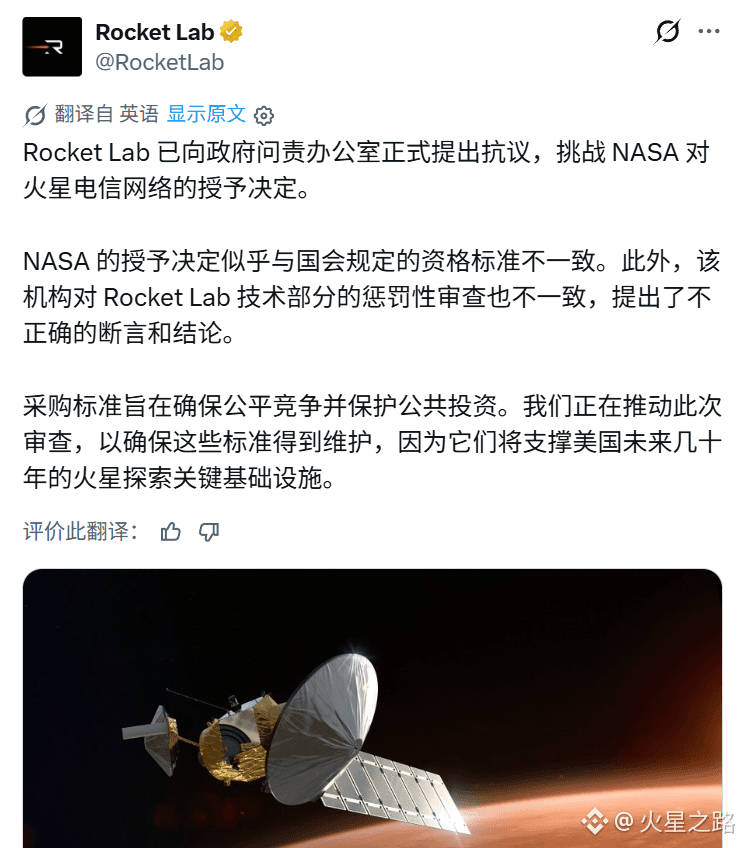
Rocket Lab has submitted a protest to the GAO regarding the previous contract of the Mars network.
I support Rocket Lab filing a protest, but I don’t think Rocket Lab will be able to get what it wants.
My support is based on the principle that, as the contractor, the company is able to raise an objection to the client on equal terms—possibly even to take the matter to court. This is precisely one of the important reasons why American commercial spaceflight has been able to develop. This is also why, in regions outside the United States, compared with the U.S., it will be much more difficult in this regard.
Because the establishment of this kind of “precedent” in the U.S. commercial space industry also has a certain element of happenstance. If, at the time, the Obama administration hadn’t pushed commercial spaceflight, if, at the time, Elon Musk hadn’t been stubborn enough to take the dispute with the military to court, and if NASA hadn’t internally had an idea—at the time—of supporting small businesses, the U.S. would likely have been unable to build the industry consensus that exists today.
Of course, supporting the filing of a protest doesn’t mean I believe Rocket Lab can get back the contract or secure another one with similar requirements. Even if Blue Origin is currently still rebuilding its launch capability, Rocket Lab would still be hard-pressed to form comprehensive competitiveness under the conditions of this contract.
$RKLB
Rocket Lab has submitted a protest to the GAO regarding the previous contract of the Mars network.
I support Rocket Lab filing a protest, but I don’t think Rocket Lab will be able to get what it wants.
My support is based on the principle that, as the contractor, the company is able to raise an objection to the client on equal terms—possibly even to take the matter to court. This is precisely one of the important reasons why American commercial spaceflight has been able to develop. This is also why, in regions outside the United States, compared with the U.S., it will be much more difficult in this regard.
Because the establishment of this kind of “precedent” in the U.S. commercial space industry also has a certain element of happenstance. If, at the time, the Obama administration hadn’t pushed commercial spaceflight, if, at the time, Elon Musk hadn’t been stubborn enough to take the dispute with the military to court, and if NASA hadn’t internally had an idea—at the time—of supporting small businesses, the U.S. would likely have been unable to build the industry consensus that exists today.
Of course, supporting the filing of a protest doesn’t mean I believe Rocket Lab can get back the contract or secure another one with similar requirements. Even if Blue Origin is currently still rebuilding its launch capability, Rocket Lab would still be hard-pressed to form comprehensive competitiveness under the conditions of this contract.
Rocket Lab has submitted a protest to the GAO regarding the previous contract of the Mars network.
I support Rocket Lab filing a protest, but I don’t think Rocket Lab will be able to get what it wants.
My support is based on the principle that, as the contractor, the company is able to raise an objection to the client on equal terms—possibly even to take the matter to court. This is precisely one of the important reasons why American commercial spaceflight has been able to develop. This is also why, in regions outside the United States, compared with the U.S., it will be much more difficult in this regard.
Because the establishment of this kind of “precedent” in the U.S. commercial space industry also has a certain element of happenstance. If, at the time, the Obama administration hadn’t pushed commercial spaceflight, if, at the time, Elon Musk hadn’t been stubborn enough to take the dispute with the military to court, and if NASA hadn’t internally had an idea—at the time—of supporting small businesses, the U.S. would likely have been unable to build the industry consensus that exists today.
Of course, supporting the filing of a protest doesn’t mean I believe Rocket Lab can get back the contract or secure another one with similar requirements. Even if Blue Origin is currently still rebuilding its launch capability, Rocket Lab would still be hard-pressed to form comprehensive competitiveness under the conditions of this contract.
395
·
--
$SPCX
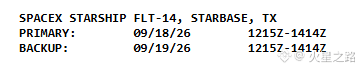
The FAA officially released it, and Starship’s 14th test flight will take place on September 18 local time!
In this flight, Starship will deploy Starlink V3 satellites to form a network
$SPCX
The FAA officially released it, and Starship’s 14th test flight will take place on September 18 local time!
In this flight, Starship will deploy Starlink V3 satellites to form a network
The FAA officially released it, and Starship’s 14th test flight will take place on September 18 local time!
In this flight, Starship will deploy Starlink V3 satellites to form a network
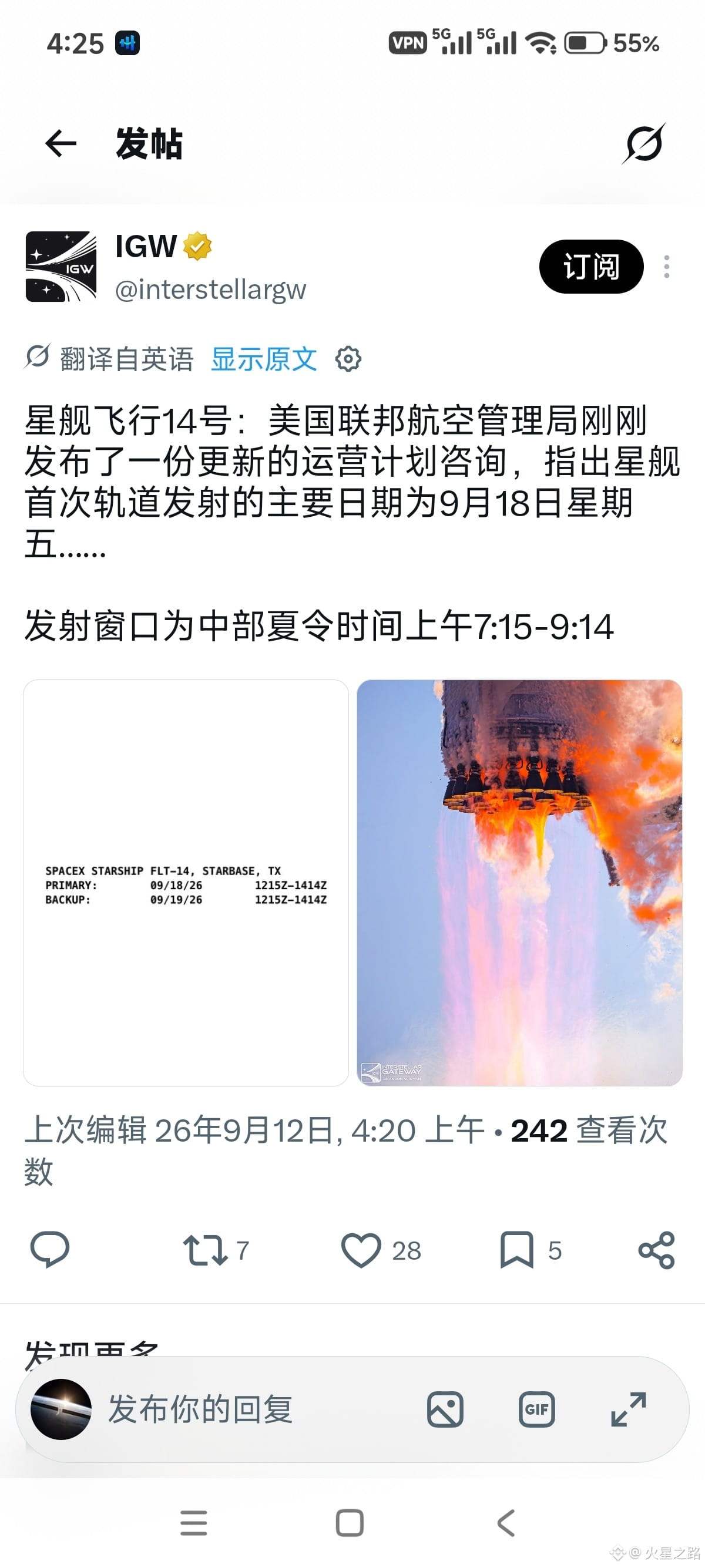
372
·
--
$SPCX $RKLB
【Launch Department Competitor Updates】
At 11:28 Beijing time on September 11, 2026, Rocket Lab launched from the LC-1A launch pad in New Zealand using its Electron rocket, successfully placing BlackSky’s BlackSky Gen-3 Mission 5 satellites into their planned orbit.
$SPCX $RKLB
【Launch Department Competitor Updates】
At 11:28 Beijing time on September 11, 2026, Rocket Lab launched from the LC-1A launch pad in New Zealand using its Electron rocket, successfully placing BlackSky’s BlackSky Gen-3 Mission 5 satellites into their planned orbit.
【Launch Department Competitor Updates】
At 11:28 Beijing time on September 11, 2026, Rocket Lab launched from the LC-1A launch pad in New Zealand using its Electron rocket, successfully placing BlackSky’s BlackSky Gen-3 Mission 5 satellites into their planned orbit.
253
Log in to explore more content
Join global crypto users on Binance Square
⚡️ Get latest and useful information about crypto.
💬 Trusted by the world’s largest crypto exchange.
👍 Discover real insights from verified creators.
Email / Phone number
Trending Topics
BitcoinHits$85K
1,810 views
101 Discussing
Roughly $5B in visible $BTC short liquidations stacked between $83K–$85K. In an uptrend, that's fuel.
When shorts liquidate, they're forced to market-buy. That buying pressure drives price higher, triggering the next layer of liquidations above — a cascade of demand feeding itself.
We saw this exact dynamic on the run from $67K to $80K. The setup looks identical now. Expect the next leg to follow the same playbook: liquidation-driven momentum, systematic buying pressure, and continuation until the fuel runs out.
This is how bull markets accelerate. The chart is setting up clean, and the mechanics are in place. Watch for the break above $83K — that's where the cascade starts.
QuantFreedom
·4 Likes
·2.6k views
ECBStartsBlockchainEuroSettlement
2,136 views
215 Discussing
SouthAfricaProposesCryptoExchangeControls
12,133 views
430 Discussing