

Juna G
2.9k Posts

Juna G
 Square Verified
Report
Block User
【Gold Standard Club】the Founding Co-builder of Binance's Top Guild!Trading & DeFi notes, Charts, data, sharp alpha—daily. X: juna_g_
Open Trade
Occasional Trader
1.9 Years
672 Following
42.1K+ Followers
24.4K+ Liked
Posts
Portfolio
All
Quotes
Videos
Live
·
--
Eid Mubarak to the entire Binance family! 🐐✨
On this blessed occasion of Eid ul Adha, may your spirit of sacrifice bring you peace, prosperity and countless blessings.
May this Eid bring us Barakah, innovation, resilience and shared growth for us. May your blocks stay secure, your trades be fruitful, and your journey continue to inspire millions.
Eid Saeed! 🌙🐏
#Binance #EidUlAdha #EidSaeed
Eid Mubarak to the entire Binance family! 🐐✨
On this blessed occasion of Eid ul Adha, may your spirit of sacrifice bring you peace, prosperity and countless blessings.
May this Eid bring us Barakah, innovation, resilience and shared growth for us. May your blocks stay secure, your trades be fruitful, and your journey continue to inspire millions.
Eid Saeed! 🌙🐏
#Binance #EidUlAdha #EidSaeed
On this blessed occasion of Eid ul Adha, may your spirit of sacrifice bring you peace, prosperity and countless blessings.
May this Eid bring us Barakah, innovation, resilience and shared growth for us. May your blocks stay secure, your trades be fruitful, and your journey continue to inspire millions.
Eid Saeed! 🌙🐏
#Binance #EidUlAdha #EidSaeed

7
8
403
·
--
Clarity Act
Members of the US Senate Banking Committee have submitted 100+ amendments ahead of the Clarity Act markup vote.
The vote is set for tomorrow, May 14
Clarity Act
Members of the US Senate Banking Committee have submitted 100+ amendments ahead of the Clarity Act markup vote.
The vote is set for tomorrow, May 14
Members of the US Senate Banking Committee have submitted 100+ amendments ahead of the Clarity Act markup vote.
The vote is set for tomorrow, May 14
1
171
·
--
STRATEGY BUYS 535 MORE BTC
Strategy has acquired another 535 BTC for approximately $43 million, at an average purchase price of $80,340 per bitcoin
The company now holds a whooping 818,869 BTC, acquired for around $61.86 billion at an average price of $75,540 per BTC
STRATEGY BUYS 535 MORE BTC
Strategy has acquired another 535 BTC for approximately $43 million, at an average purchase price of $80,340 per bitcoin
The company now holds a whooping 818,869 BTC, acquired for around $61.86 billion at an average price of $75,540 per BTC
Strategy has acquired another 535 BTC for approximately $43 million, at an average purchase price of $80,340 per bitcoin
The company now holds a whooping 818,869 BTC, acquired for around $61.86 billion at an average price of $75,540 per BTC
1
3
251
·
--
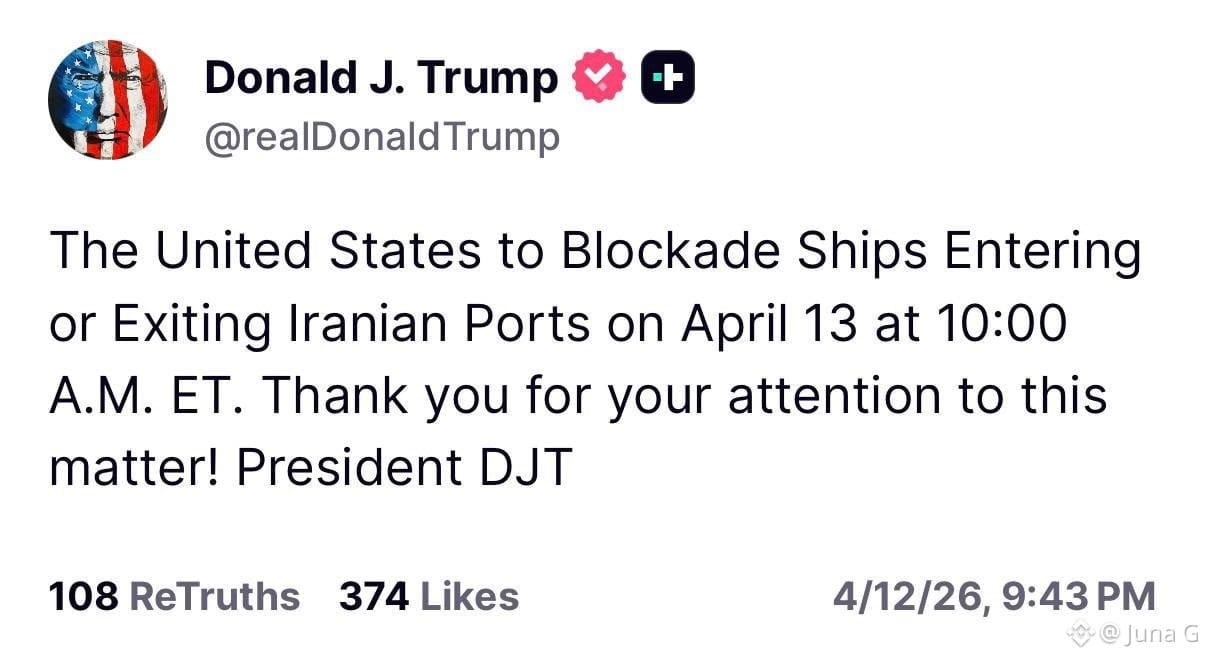
Trump announces a plan to blockade ships entering and exiting Iran, posted April 13 at 10:00 AM ET
Brace for a highly volatile week ahead
$BTC
{spot}(BTCUSDT)
Trump announces a plan to blockade ships entering and exiting Iran, posted April 13 at 10:00 AM ET
Brace for a highly volatile week ahead
$BTC
Brace for a highly volatile week ahead
$BTC
3
7
137
·
--
🇮🇷🇵🇰 Iran grants Pakistan passage through Hormuz
As a goodwill gesture following the Islamabad talks, Iran allowed two Pakistani vessels to safely transit the Strait of Hormuz
🇮🇷🇵🇰 Iran grants Pakistan passage through Hormuz
As a goodwill gesture following the Islamabad talks, Iran allowed two Pakistani vessels to safely transit the Strait of Hormuz
As a goodwill gesture following the Islamabad talks, Iran allowed two Pakistani vessels to safely transit the Strait of Hormuz
7
226
·
--
Sign Powers Sovereign Growth in the Middle EastWhen I think about what the Middle East needs for long term digital growth, I do not think only about apps, trading, or short bursts of hype. I think about infrastructure that institutions can actually rely on. That is why @SignOfficial stands out to me.
Sign is working on something deeper than surface level attention. It is building the trust layer for identity, capital, and verifiable digital coordination, which feels especially important for a region that is pushing hard on modernization, cross border business, and technology led economic expansion.
What makes this interesting is that real digital growth needs proof, accountability, and systems that can scale without losing control. That is where the Sign vision feels timely. If governments, enterprises, and national scale platforms want stronger rails for trusted records and programmable coordination, then $SIGN starts to look less like a passing narrative and more like part of the infrastructure conversation. I see #SignDigitalSovereignInfra as a serious idea tied to real economic direction, and that is why I believe Sign deserves close attention.
Sign Powers Sovereign Growth in the Middle East
When I think about what the Middle East needs for long term digital growth, I do not think only about apps, trading, or short bursts of hype. I think about infrastructure that institutions can actually rely on. That is why @SignOfficial stands out to me.
Sign is working on something deeper than surface level attention. It is building the trust layer for identity, capital, and verifiable digital coordination, which feels especially important for a region that is pushing hard on modernization, cross border business, and technology led economic expansion.
What makes this interesting is that real digital growth needs proof, accountability, and systems that can scale without losing control. That is where the Sign vision feels timely. If governments, enterprises, and national scale platforms want stronger rails for trusted records and programmable coordination, then $SIGN starts to look less like a passing narrative and more like part of the infrastructure conversation. I see #SignDigitalSovereignInfra as a serious idea tied to real economic direction, and that is why I believe Sign deserves close attention.
Sign is working on something deeper than surface level attention. It is building the trust layer for identity, capital, and verifiable digital coordination, which feels especially important for a region that is pushing hard on modernization, cross border business, and technology led economic expansion.
What makes this interesting is that real digital growth needs proof, accountability, and systems that can scale without losing control. That is where the Sign vision feels timely. If governments, enterprises, and national scale platforms want stronger rails for trusted records and programmable coordination, then $SIGN starts to look less like a passing narrative and more like part of the infrastructure conversation. I see #SignDigitalSovereignInfra as a serious idea tied to real economic direction, and that is why I believe Sign deserves close attention.
1
20
244
·
--
I keep coming back to one idea: real economic growth in the Middle East needs digital infrastructure that institutions can actually trust. That’s why @SignOfficial feels important to watch. Sign is building sovereign-grade systems around identity, capital, and verifiable records, which gives $SIGN a much stronger long-term story than short-term hype. #SignDigitalSovereignInfra
I keep coming back to one idea: real economic growth in the Middle East needs digital infrastructure that institutions can actually trust. That’s why @SignOfficial feels important to watch. Sign is building sovereign-grade systems around identity, capital, and verifiable records, which gives $SIGN a much stronger long-term story than short-term hype. #SignDigitalSovereignInfra
1
14
137
·
--
Eid Mubarak, everyone. I know I have been away this Ramadan, focusing on this blessed month, but now that I am back, I would like you all to fill me in on what's been going around. Did I miss anything? Do tell me the timings of your live sessions so that I can join you. I do want to know how everyone have you been doing both in trading and rewards, what's your progress..... Well there is so much I want to ask all of you 🤗
Eid Mubarak, everyone. I know I have been away this Ramadan, focusing on this blessed month, but now that I am back, I would like you all to fill me in on what's been going around. Did I miss anything? Do tell me the timings of your live sessions so that I can join you. I do want to know how everyone have you been doing both in trading and rewards, what's your progress..... Well there is so much I want to ask all of you 🤗
1
13
193
·
--
Article
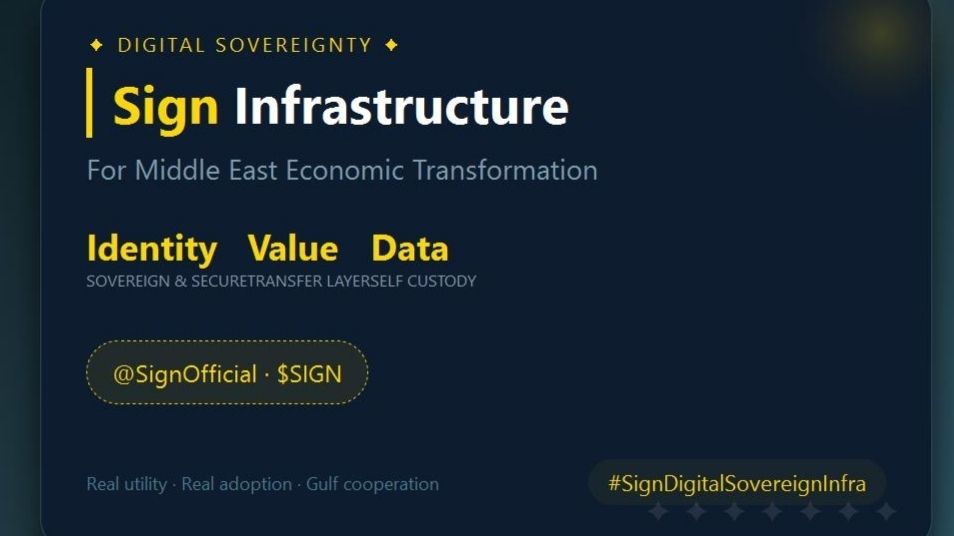
Sign and the Middle Easts Digital FoundationBeen spending time looking at infrastructure projects that actually have a shot at real world adoption and Sign keeps coming up in my feeds for good reason. The Middle East right now is moving fast on digital transformation and the focus is shifting from just talking about blockchain to needing something that can handle the scale of what governments and enterprises are building.
What makes Sign stand out to me is the focus on digital sovereign infrastructure which sounds like a buzzword until you see what it means in practice. Countries in the Gulf are diversifying economies and they need systems that give them control over identity and data while still connecting globally. You cant build the next generation of financial services or government services without a layer that handles who people are securely.
The region has capital and ambition but the missing piece has often been infrastructure that matches both. Watching @SignOfficial move here feels less like another project announcement and more like they are laying rails for something bigger. If digital identity becomes as fundamental as electricity for the next phase of growth then projects focused on sovereignty and security are the ones that matter.
Not financial advice just interesting to watch where the pieces are being put in place before the next wave hits. $SIGN #SignDigitalSovereignInfra
Sign and the Middle Easts Digital Foundation
Been spending time looking at infrastructure projects that actually have a shot at real world adoption and Sign keeps coming up in my feeds for good reason. The Middle East right now is moving fast on digital transformation and the focus is shifting from just talking about blockchain to needing something that can handle the scale of what governments and enterprises are building.
What makes Sign stand out to me is the focus on digital sovereign infrastructure which sounds like a buzzword until you see what it means in practice. Countries in the Gulf are diversifying economies and they need systems that give them control over identity and data while still connecting globally. You cant build the next generation of financial services or government services without a layer that handles who people are securely.
The region has capital and ambition but the missing piece has often been infrastructure that matches both. Watching @SignOfficial move here feels less like another project announcement and more like they are laying rails for something bigger. If digital identity becomes as fundamental as electricity for the next phase of growth then projects focused on sovereignty and security are the ones that matter.
Not financial advice just interesting to watch where the pieces are being put in place before the next wave hits. $SIGN #SignDigitalSovereignInfra
What makes Sign stand out to me is the focus on digital sovereign infrastructure which sounds like a buzzword until you see what it means in practice. Countries in the Gulf are diversifying economies and they need systems that give them control over identity and data while still connecting globally. You cant build the next generation of financial services or government services without a layer that handles who people are securely.
The region has capital and ambition but the missing piece has often been infrastructure that matches both. Watching @SignOfficial move here feels less like another project announcement and more like they are laying rails for something bigger. If digital identity becomes as fundamental as electricity for the next phase of growth then projects focused on sovereignty and security are the ones that matter.
Not financial advice just interesting to watch where the pieces are being put in place before the next wave hits. $SIGN #SignDigitalSovereignInfra
5
26
230
·
--
Have been following the infra plays in the UAE and KSA closely. One project I'm keeping an eye on is @SignOfficial
The speed at which they are moving to secure digital identity and data sovereignty in the Middle East is impressive. While others are stuck in pilot phases, they are building the actual rails for the next wave of economic diversification. From Abu Dhabi to Riyadh, the demand for digital sovereignty is real, and it looks like $SIGN is positioning itself as the backbone for that transition.
Real utility isn't just about token price; it's about having the infrastructure ready before the mass adoption wave hits. If you look at the push for digitalization across the Gulf, having a sovereign layer for identity and value transfer isn't just a nice-to-have anymore—it's a requirement for the next 10 years of growth. For me, that makes this ecosystem worth watching.
$SIGN #SignDigitalSovereignInfra
Have been following the infra plays in the UAE and KSA closely. One project I'm keeping an eye on is @SignOfficial
The speed at which they are moving to secure digital identity and data sovereignty in the Middle East is impressive. While others are stuck in pilot phases, they are building the actual rails for the next wave of economic diversification. From Abu Dhabi to Riyadh, the demand for digital sovereignty is real, and it looks like $SIGN is positioning itself as the backbone for that transition.
Real utility isn't just about token price; it's about having the infrastructure ready before the mass adoption wave hits. If you look at the push for digitalization across the Gulf, having a sovereign layer for identity and value transfer isn't just a nice-to-have anymore—it's a requirement for the next 10 years of growth. For me, that makes this ecosystem worth watching.
$SIGN #SignDigitalSovereignInfra
The speed at which they are moving to secure digital identity and data sovereignty in the Middle East is impressive. While others are stuck in pilot phases, they are building the actual rails for the next wave of economic diversification. From Abu Dhabi to Riyadh, the demand for digital sovereignty is real, and it looks like $SIGN is positioning itself as the backbone for that transition.
Real utility isn't just about token price; it's about having the infrastructure ready before the mass adoption wave hits. If you look at the push for digitalization across the Gulf, having a sovereign layer for identity and value transfer isn't just a nice-to-have anymore—it's a requirement for the next 10 years of growth. For me, that makes this ecosystem worth watching.
$SIGN #SignDigitalSovereignInfra
3
20
208
·
--
I listened to the Binance AMA on March 17th and the first thing they made clear is that you do not need to be a programmer to use these. The skills mentioned is designed for Binance Square creators, it lets you publish content programmatically without sitting there manually posting every time. It breaks down holdings, tracks value changes over time and shows concentration insights.
The technical side for people who do want to run their own stuff about OpenClaw, it is self-hosted. That means if you use it, you install and run it yourself instead of relying on a website or external service. That distinction matters because it puts control (and responsibility) on you.
On the limits front, Binance Square Skill has a maximum number of successful posts allowed per API key per day.
One of the more important clarifications came when they pushed back on a common misunderstanding. The AMA addressed whether AI for crypto trading means using computer programs that follow only fixed rules and cannot learn from data. These agents do learn from data, it adapts and that is the whole point.
But they also spent time on what these tools are not. A fallacy that AI agents will completely replace humans in making strategic decisions was also discussed.They emphasized the opposite. The agents monitor markets 24/7, they analyze based on your criteria, but they do not replace your judgment.
Security came up repeatedly. The clear red flag is installing unverified third-party skills without checking the source and protecting your API keys.
Speaking of API keys, they clarified that the Square posting API key is only for publishing content. It does not touch your assets or trading functions. That separation matters for people worried about giving an AI access to their funds.
So the overall picture from the AMA was pretty balanced. These tools are for creators and traders. None of them replace you. They backtest, they monitor, they execute, but the strategic decisions stay in human hands. And if you are going to use them, you lock down your security first. #BuildWithBinanaceAI
I listened to the Binance AMA on March 17th and the first thing they made clear is that you do not need to be a programmer to use these. The skills mentioned is designed for Binance Square creators, it lets you publish content programmatically without sitting there manually posting every time. It breaks down holdings, tracks value changes over time and shows concentration insights.
The technical side for people who do want to run their own stuff about OpenClaw, it is self-hosted. That means if you use it, you install and run it yourself instead of relying on a website or external service. That distinction matters because it puts control (and responsibility) on you.
On the limits front, Binance Square Skill has a maximum number of successful posts allowed per API key per day.
One of the more important clarifications came when they pushed back on a common misunderstanding. The AMA addressed whether AI for crypto trading means using computer programs that follow only fixed rules and cannot learn from data. These agents do learn from data, it adapts and that is the whole point.
But they also spent time on what these tools are not. A fallacy that AI agents will completely replace humans in making strategic decisions was also discussed.They emphasized the opposite. The agents monitor markets 24/7, they analyze based on your criteria, but they do not replace your judgment.
Security came up repeatedly. The clear red flag is installing unverified third-party skills without checking the source and protecting your API keys.
Speaking of API keys, they clarified that the Square posting API key is only for publishing content. It does not touch your assets or trading functions. That separation matters for people worried about giving an AI access to their funds.
So the overall picture from the AMA was pretty balanced. These tools are for creators and traders. None of them replace you. They backtest, they monitor, they execute, but the strategic decisions stay in human hands. And if you are going to use them, you lock down your security first. #BuildWithBinanaceAI
The technical side for people who do want to run their own stuff about OpenClaw, it is self-hosted. That means if you use it, you install and run it yourself instead of relying on a website or external service. That distinction matters because it puts control (and responsibility) on you.
On the limits front, Binance Square Skill has a maximum number of successful posts allowed per API key per day.
One of the more important clarifications came when they pushed back on a common misunderstanding. The AMA addressed whether AI for crypto trading means using computer programs that follow only fixed rules and cannot learn from data. These agents do learn from data, it adapts and that is the whole point.
But they also spent time on what these tools are not. A fallacy that AI agents will completely replace humans in making strategic decisions was also discussed.They emphasized the opposite. The agents monitor markets 24/7, they analyze based on your criteria, but they do not replace your judgment.
Security came up repeatedly. The clear red flag is installing unverified third-party skills without checking the source and protecting your API keys.
Speaking of API keys, they clarified that the Square posting API key is only for publishing content. It does not touch your assets or trading functions. That separation matters for people worried about giving an AI access to their funds.
So the overall picture from the AMA was pretty balanced. These tools are for creators and traders. None of them replace you. They backtest, they monitor, they execute, but the strategic decisions stay in human hands. And if you are going to use them, you lock down your security first. #BuildWithBinanaceAI
18
114
·
--
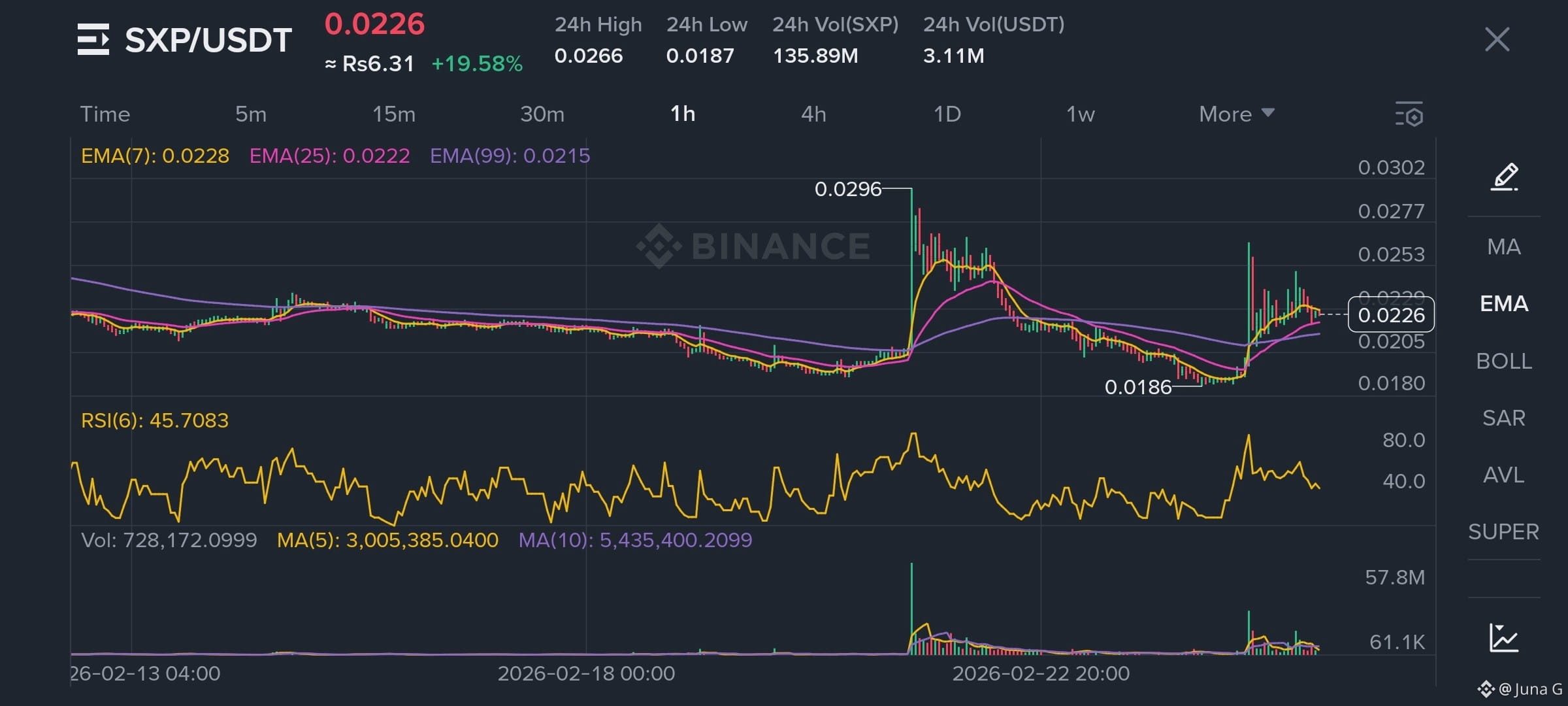
$SXP USDT
Timeframe 1H
SXP is trading around 0.0226 after a volatile move. The chart shows a recent bounce from the 0.0186 area and price is now holding near the short moving averages. This is not a clean trend breakout yet, so the better plan is to trade key levels and avoid chasing random candles.
Chart bias
Neutral to bullish above 0.0220
Bullish confirmation gets stronger above 0.0233
Weakness returns below 0.0216
EMA 7 around 0.0228
EMA 25 around 0.0222
EMA 99 around 0.0215
Price is sitting between the fast and mid trend zone, so this is a decision area.
Scalp setup
Scalp long
Entry zone 0.0221 to 0.0226
SL 0.0215
TP1 0.0233
TP2 0.0242
TP3 0.0253
This setup works if buyers keep defending the EMA 25 area and volume picks up on the next push.
Scalp short
Only if price loses 0.0215 on a clean 1H close
Entry zone 0.0213 to 0.0215
SL 0.0222
TP1 0.0206
TP2 0.0198
TP3 0.0189
This is only for breakdown confirmation. Do not force shorts while price is holding above the mid support zone.
Swing setup
Swing long
Entry zone 0.0216 to 0.0223
SL 0.0204
TP1 0.0238
TP2 0.0253
TP3 0.0270
This is the safer swing idea if price keeps building higher lows and reclaims 0.0233 with strength. If momentum returns, SXP can revisit the upper range.
Key levels
Support zone 0.0220 then 0.0215
Resistance zone 0.0233 then 0.0253
Trade note
This chart is choppy compared to the stronger momentum names, so position size should stay small. Best entries come from support reactions or confirmed breakouts, not from mid candle chasing.
If price closes below 0.0215 and fails to recover, long setup weakens.
If price breaks 0.0233 and holds, upside opens faster toward 0.0242 and 0.0253.
$SXP USDT
Timeframe 1H
SXP is trading around 0.0226 after a volatile move. The chart shows a recent bounce from the 0.0186 area and price is now holding near the short moving averages. This is not a clean trend breakout yet, so the better plan is to trade key levels and avoid chasing random candles.
Chart bias
Neutral to bullish above 0.0220
Bullish confirmation gets stronger above 0.0233
Weakness returns below 0.0216
EMA 7 around 0.0228
EMA 25 around 0.0222
EMA 99 around 0.0215
Price is sitting between the fast and mid trend zone, so this is a decision area.
Scalp setup
Scalp long
Entry zone 0.0221 to 0.0226
SL 0.0215
TP1 0.0233
TP2 0.0242
TP3 0.0253
This setup works if buyers keep defending the EMA 25 area and volume picks up on the next push.
Scalp short
Only if price loses 0.0215 on a clean 1H close
Entry zone 0.0213 to 0.0215
SL 0.0222
TP1 0.0206
TP2 0.0198
TP3 0.0189
This is only for breakdown confirmation. Do not force shorts while price is holding above the mid support zone.
Swing setup
Swing long
Entry zone 0.0216 to 0.0223
SL 0.0204
TP1 0.0238
TP2 0.0253
TP3 0.0270
This is the safer swing idea if price keeps building higher lows and reclaims 0.0233 with strength. If momentum returns, SXP can revisit the upper range.
Key levels
Support zone 0.0220 then 0.0215
Resistance zone 0.0233 then 0.0253
Trade note
This chart is choppy compared to the stronger momentum names, so position size should stay small. Best entries come from support reactions or confirmed breakouts, not from mid candle chasing.
If price closes below 0.0215 and fails to recover, long setup weakens.
If price breaks 0.0233 and holds, upside opens faster toward 0.0242 and 0.0253.
Timeframe 1H
SXP is trading around 0.0226 after a volatile move. The chart shows a recent bounce from the 0.0186 area and price is now holding near the short moving averages. This is not a clean trend breakout yet, so the better plan is to trade key levels and avoid chasing random candles.
Chart bias
Neutral to bullish above 0.0220
Bullish confirmation gets stronger above 0.0233
Weakness returns below 0.0216
EMA 7 around 0.0228
EMA 25 around 0.0222
EMA 99 around 0.0215
Price is sitting between the fast and mid trend zone, so this is a decision area.
Scalp setup
Scalp long
Entry zone 0.0221 to 0.0226
SL 0.0215
TP1 0.0233
TP2 0.0242
TP3 0.0253
This setup works if buyers keep defending the EMA 25 area and volume picks up on the next push.
Scalp short
Only if price loses 0.0215 on a clean 1H close
Entry zone 0.0213 to 0.0215
SL 0.0222
TP1 0.0206
TP2 0.0198
TP3 0.0189
This is only for breakdown confirmation. Do not force shorts while price is holding above the mid support zone.
Swing setup
Swing long
Entry zone 0.0216 to 0.0223
SL 0.0204
TP1 0.0238
TP2 0.0253
TP3 0.0270
This is the safer swing idea if price keeps building higher lows and reclaims 0.0233 with strength. If momentum returns, SXP can revisit the upper range.
Key levels
Support zone 0.0220 then 0.0215
Resistance zone 0.0233 then 0.0253
Trade note
This chart is choppy compared to the stronger momentum names, so position size should stay small. Best entries come from support reactions or confirmed breakouts, not from mid candle chasing.
If price closes below 0.0215 and fails to recover, long setup weakens.
If price breaks 0.0233 and holds, upside opens faster toward 0.0242 and 0.0253.
7
111
·
--
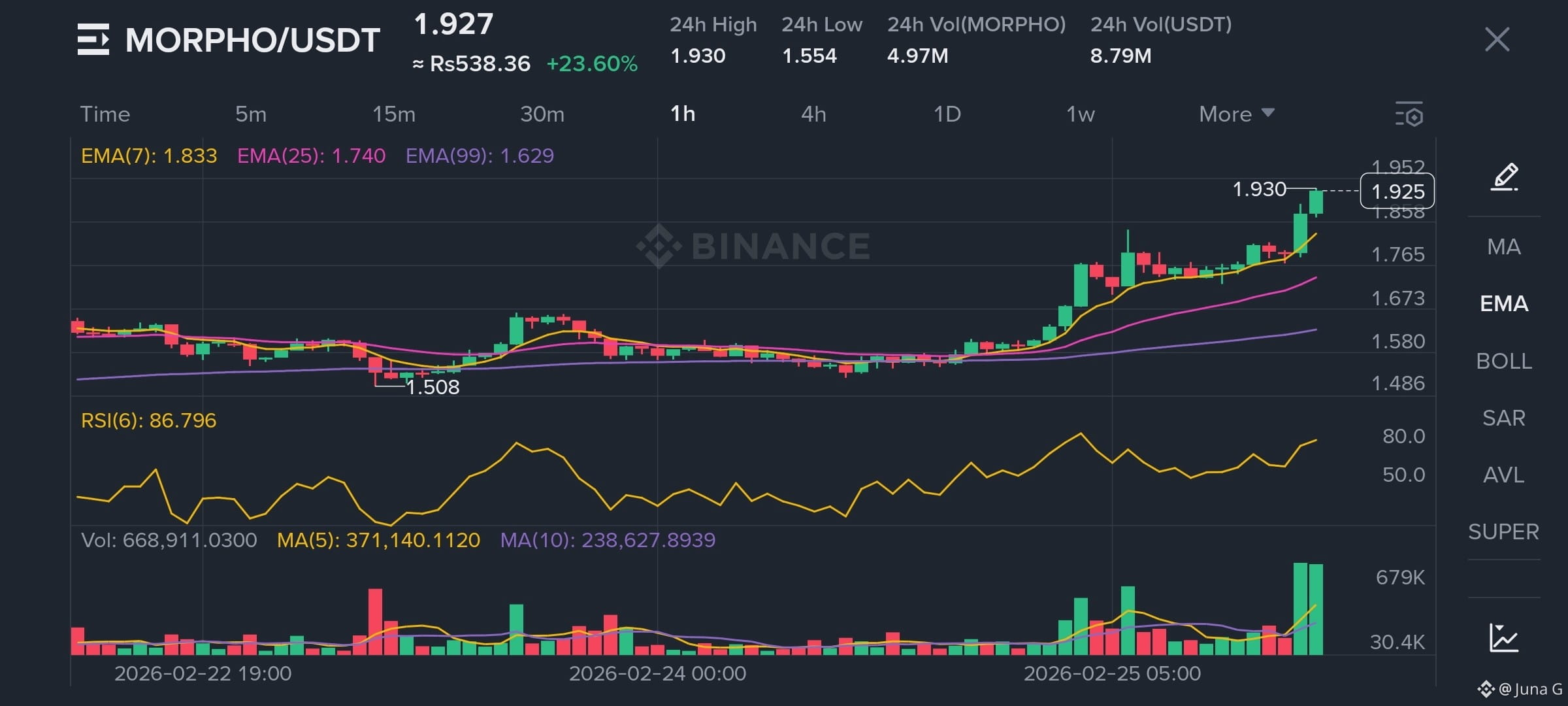
$MORPHO USDT
Timeframe 1H
MORPHO is showing strong momentum and just pushed into the 1.93 area after a steady climb. Trend is bullish on this chart, but RSI is already high, so chasing the top is risky. Better entries are on pullback or breakout retest.
Chart bias
Bullish while price stays above 1.83 and especially above 1.74
EMA 7 around 1.833
EMA 25 around 1.740
EMA 99 around 1.629
That tells us the move is strong and trend structure is still healthy.
Scalp setup
Scalp long on pullback
Entry zone 1.84 to 1.88
SL 1.79
TP1 1.93
TP2 1.98
TP3 2.04
This is the cleaner scalp if price pulls back a little and buyers defend near EMA 7 zone.
Scalp breakout setup
Take only if 1H candle closes above 1.93 with volume
Entry 1.94 to 1.96
SL 1.88
TP1 2.00
TP2 2.08
TP3 2.15
This is for momentum continuation traders. If breakout is weak, skip and wait for retest.
Swing setup
Swing long
Entry zone 1.76 to 1.84
SL 1.68
TP1 1.93
TP2 2.08
TP3 2.25
This gives better risk reward because entry is closer to support and still follows the bullish trend.
Key levels
Support zone 1.83 then 1.74
Resistance zone 1.93 then 2.00
Trade note
RSI is hot, so avoid full size entry at current top. Better to enter in parts and take profit in parts.
If price loses 1.79 on a strong candle, scalp long setup weakens.
If price loses 1.68, swing setup is invalid for now.
$MORPHO USDT
Timeframe 1H
MORPHO is showing strong momentum and just pushed into the 1.93 area after a steady climb. Trend is bullish on this chart, but RSI is already high, so chasing the top is risky. Better entries are on pullback or breakout retest.
Chart bias
Bullish while price stays above 1.83 and especially above 1.74
EMA 7 around 1.833
EMA 25 around 1.740
EMA 99 around 1.629
That tells us the move is strong and trend structure is still healthy.
Scalp setup
Scalp long on pullback
Entry zone 1.84 to 1.88
SL 1.79
TP1 1.93
TP2 1.98
TP3 2.04
This is the cleaner scalp if price pulls back a little and buyers defend near EMA 7 zone.
Scalp breakout setup
Take only if 1H candle closes above 1.93 with volume
Entry 1.94 to 1.96
SL 1.88
TP1 2.00
TP2 2.08
TP3 2.15
This is for momentum continuation traders. If breakout is weak, skip and wait for retest.
Swing setup
Swing long
Entry zone 1.76 to 1.84
SL 1.68
TP1 1.93
TP2 2.08
TP3 2.25
This gives better risk reward because entry is closer to support and still follows the bullish trend.
Key levels
Support zone 1.83 then 1.74
Resistance zone 1.93 then 2.00
Trade note
RSI is hot, so avoid full size entry at current top. Better to enter in parts and take profit in parts.
If price loses 1.79 on a strong candle, scalp long setup weakens.
If price loses 1.68, swing setup is invalid for now.
Timeframe 1H
MORPHO is showing strong momentum and just pushed into the 1.93 area after a steady climb. Trend is bullish on this chart, but RSI is already high, so chasing the top is risky. Better entries are on pullback or breakout retest.
Chart bias
Bullish while price stays above 1.83 and especially above 1.74
EMA 7 around 1.833
EMA 25 around 1.740
EMA 99 around 1.629
That tells us the move is strong and trend structure is still healthy.
Scalp setup
Scalp long on pullback
Entry zone 1.84 to 1.88
SL 1.79
TP1 1.93
TP2 1.98
TP3 2.04
This is the cleaner scalp if price pulls back a little and buyers defend near EMA 7 zone.
Scalp breakout setup
Take only if 1H candle closes above 1.93 with volume
Entry 1.94 to 1.96
SL 1.88
TP1 2.00
TP2 2.08
TP3 2.15
This is for momentum continuation traders. If breakout is weak, skip and wait for retest.
Swing setup
Swing long
Entry zone 1.76 to 1.84
SL 1.68
TP1 1.93
TP2 2.08
TP3 2.25
This gives better risk reward because entry is closer to support and still follows the bullish trend.
Key levels
Support zone 1.83 then 1.74
Resistance zone 1.93 then 2.00
Trade note
RSI is hot, so avoid full size entry at current top. Better to enter in parts and take profit in parts.
If price loses 1.79 on a strong candle, scalp long setup weakens.
If price loses 1.68, swing setup is invalid for now.
5
127
·
--
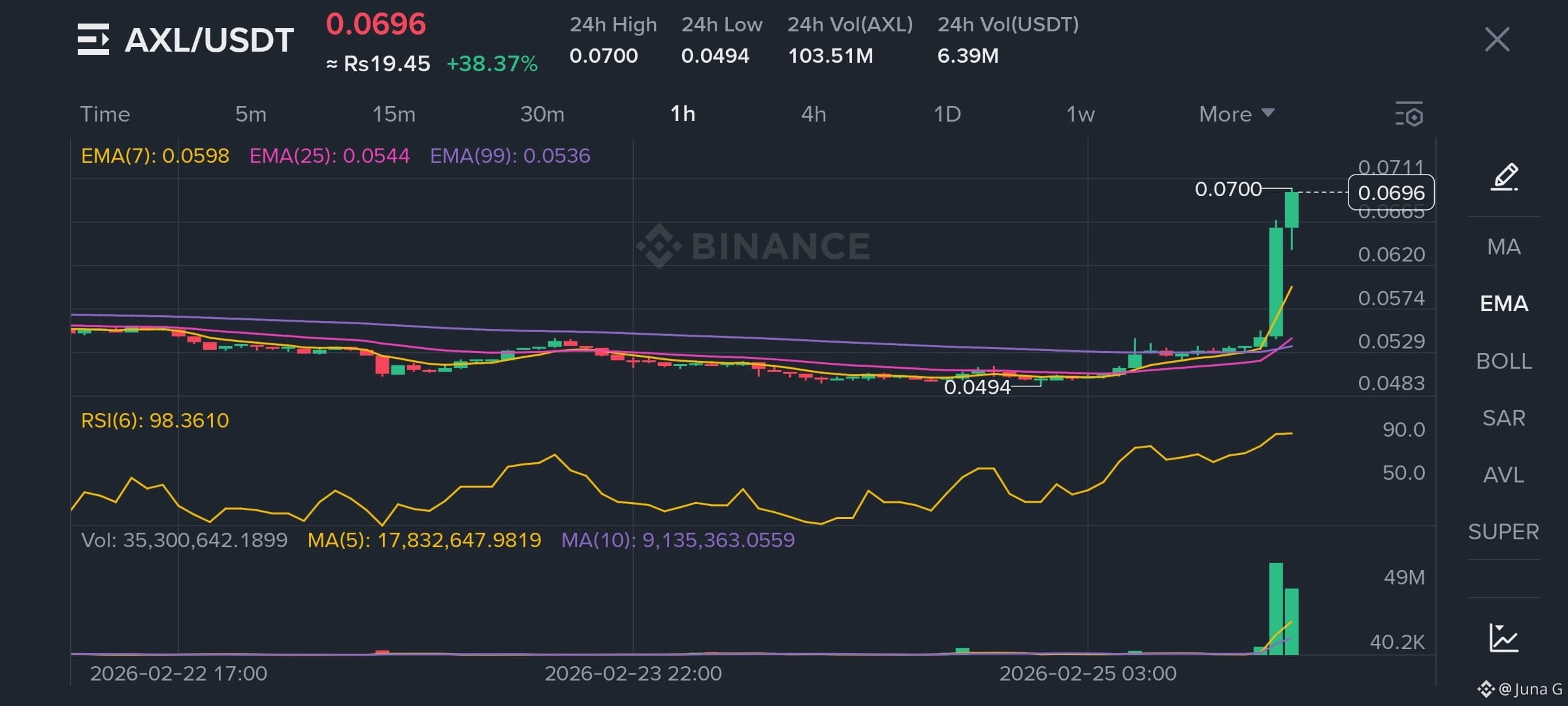
$AXL USDT on 1H looks very strong right now, but it is also hot after a vertical move. Price is sitting near the day high around 0.0700 and RSI is extremely high, so chasing this exact candle is risky. Best move is to trade the pullback or a clean breakout retest.
Quick chart read
Price is far above the moving averages
EMA 7 around 0.0598
EMA 25 around 0.0544
EMA 99 around 0.0536
That means trend is bullish, but price is stretched. RSI is near 98, so short term it can cool down before another leg.
Scalp setup
Scalp long
Best entry area is on a pullback, not at the top
Entry zone 0.0658 to 0.0675
SL 0.0639
TP1 0.0698
TP2 0.0710
TP3 0.0735
This works if price pulls back and buyers defend the zone above the recent breakout area.
Scalp breakout long
If price breaks and holds above 0.0710 on a strong 1H close
Entry 0.0712 to 0.0720
SL 0.0688
TP1 0.0745
TP2 0.0770
TP3 0.0800
Only take this if volume stays strong. If breakout comes with weak volume, skip it.
Swing setup
Swing long
Entry zone 0.0600 to 0.0640
This is a better swing area because it is closer to the fast EMA and gives better risk reward
SL 0.0568
TP1 0.0700
TP2 0.0760
TP3 0.0840
If price dips deeper and still holds above the mid trend zone, this setup stays valid. The coin has momentum, so swings can extend if market sentiment remains strong.
Risk note
Right now the chart is in a pumped state
Safer traders wait for either
a pullback into support and a bounce
or
a breakout above 0.0710 and successful retest
If price loses 0.0639 with strong selling pressure, scalp longs become weak and it may retrace more before the next move.
$AXL USDT on 1H looks very strong right now, but it is also hot after a vertical move. Price is sitting near the day high around 0.0700 and RSI is extremely high, so chasing this exact candle is risky. Best move is to trade the pullback or a clean breakout retest.
Quick chart read
Price is far above the moving averages
EMA 7 around 0.0598
EMA 25 around 0.0544
EMA 99 around 0.0536
That means trend is bullish, but price is stretched. RSI is near 98, so short term it can cool down before another leg.
Scalp setup
Scalp long
Best entry area is on a pullback, not at the top
Entry zone 0.0658 to 0.0675
SL 0.0639
TP1 0.0698
TP2 0.0710
TP3 0.0735
This works if price pulls back and buyers defend the zone above the recent breakout area.
Scalp breakout long
If price breaks and holds above 0.0710 on a strong 1H close
Entry 0.0712 to 0.0720
SL 0.0688
TP1 0.0745
TP2 0.0770
TP3 0.0800
Only take this if volume stays strong. If breakout comes with weak volume, skip it.
Swing setup
Swing long
Entry zone 0.0600 to 0.0640
This is a better swing area because it is closer to the fast EMA and gives better risk reward
SL 0.0568
TP1 0.0700
TP2 0.0760
TP3 0.0840
If price dips deeper and still holds above the mid trend zone, this setup stays valid. The coin has momentum, so swings can extend if market sentiment remains strong.
Risk note
Right now the chart is in a pumped state
Safer traders wait for either
a pullback into support and a bounce
or
a breakout above 0.0710 and successful retest
If price loses 0.0639 with strong selling pressure, scalp longs become weak and it may retrace more before the next move.
Quick chart read
Price is far above the moving averages
EMA 7 around 0.0598
EMA 25 around 0.0544
EMA 99 around 0.0536
That means trend is bullish, but price is stretched. RSI is near 98, so short term it can cool down before another leg.
Scalp setup
Scalp long
Best entry area is on a pullback, not at the top
Entry zone 0.0658 to 0.0675
SL 0.0639
TP1 0.0698
TP2 0.0710
TP3 0.0735
This works if price pulls back and buyers defend the zone above the recent breakout area.
Scalp breakout long
If price breaks and holds above 0.0710 on a strong 1H close
Entry 0.0712 to 0.0720
SL 0.0688
TP1 0.0745
TP2 0.0770
TP3 0.0800
Only take this if volume stays strong. If breakout comes with weak volume, skip it.
Swing setup
Swing long
Entry zone 0.0600 to 0.0640
This is a better swing area because it is closer to the fast EMA and gives better risk reward
SL 0.0568
TP1 0.0700
TP2 0.0760
TP3 0.0840
If price dips deeper and still holds above the mid trend zone, this setup stays valid. The coin has momentum, so swings can extend if market sentiment remains strong.
Risk note
Right now the chart is in a pumped state
Safer traders wait for either
a pullback into support and a bounce
or
a breakout above 0.0710 and successful retest
If price loses 0.0639 with strong selling pressure, scalp longs become weak and it may retrace more before the next move.
6
127
·
--
Token Unlocks to Watch
· Humanity Protocol ($H ): Unlocking 105.36M tokens (worth ~$16.7M) today, primarily for ecosystem rewards and identity verification .
· Jupiter ($JUP ) & Grass ($GRASS ): Major unlocks scheduled for Feb 28 .
Token Unlocks to Watch
· Humanity Protocol ($H ): Unlocking 105.36M tokens (worth ~$16.7M) today, primarily for ecosystem rewards and identity verification .
· Jupiter ($JUP ) & Grass ($GRASS ): Major unlocks scheduled for Feb 28 .
· Humanity Protocol ($H ): Unlocking 105.36M tokens (worth ~$16.7M) today, primarily for ecosystem rewards and identity verification .
· Jupiter ($JUP ) & Grass ($GRASS ): Major unlocks scheduled for Feb 28 .
12
682
·
--
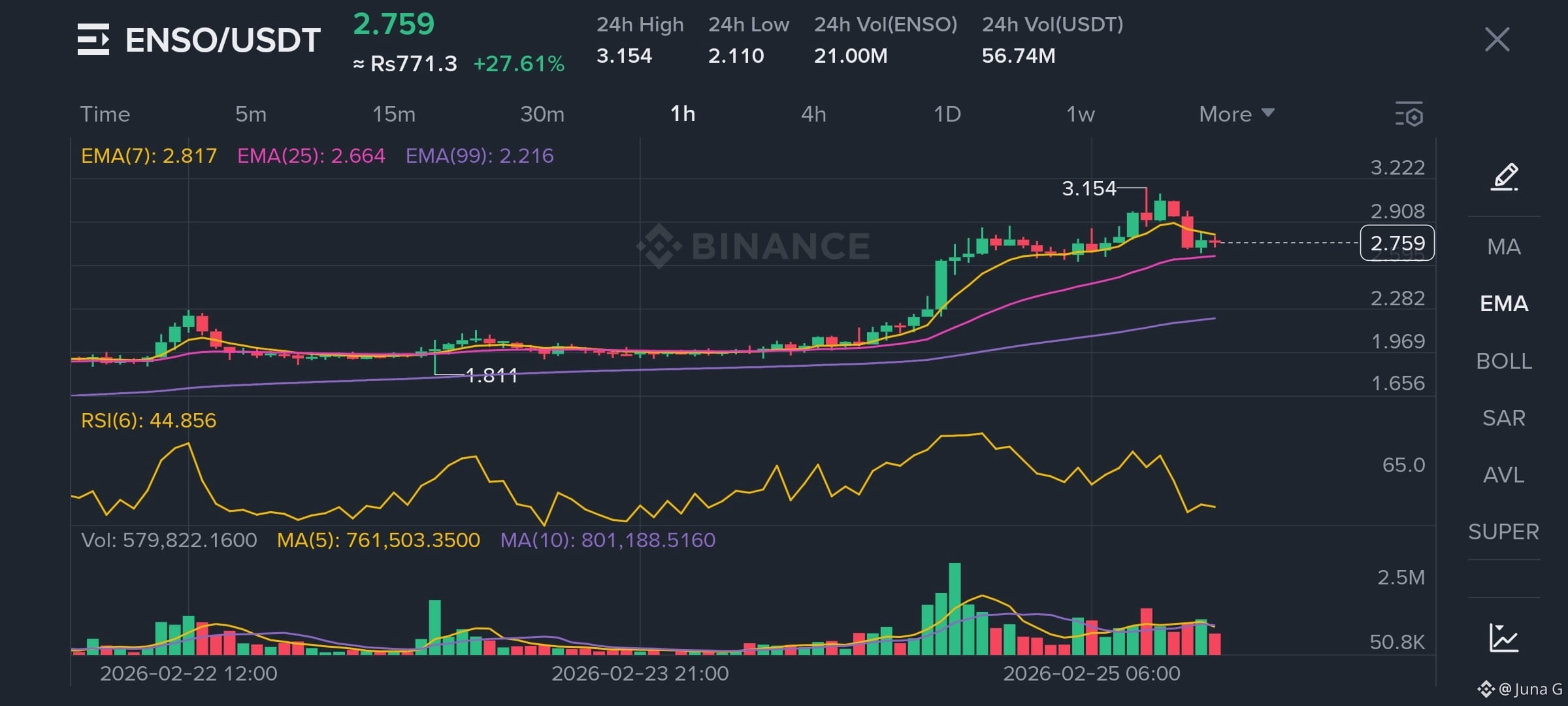
$ENSO /USDT (1H) Signal
Price is 2.759, after a sharp push to 3.154 and a pullback. Structure is still bullish overall, but short term momentum is cooling.
Read on the chart
. Price is still above EMA25 (2.664) and EMA99 (2.216) → trend bias stays bullish
. Price is a bit below EMA7 (2.817) → short-term weakness / pullback
. RSI around 45 → neutral to slightly weak, not overheated
. This looks like a retest zone, not a clean breakout chase.
1) Scalp Setup (1H / quick trade)...
Scalp Long (preferred if support holds)
Entry: 2.70 – 2.76
SL: 2.63
TP1: 2.84
TP2: 2.92
TP3: 3.00
Pullback into EMA25 zone after a strong impulse. If buyers defend this area, price can bounce back to the recent intraday resistance.
Scalp Short only if support breaks
Trigger - 1H candle closes below 2.63
Entry: 2.60 – 2.63 (on weak retest)
SL - 2.72
TP1 - 2.48
TP2 - 2.35
A break below EMA25 support usually means the pump is cooling more than expected and price can slide to the next support pocket.
2) Swing Setup (safer, wider targets)
Swing Long
Entry Zone - 2.62 – 2.74 (best if price stabilizes and prints a strong green candle)
SL - 2.42 (below local support / invalidation area)
TP1 - 2.95
TP2 - 3.15 (previous high)
TP3 - 3.35 (if breakout continuation happens)
The chart still has bullish structure as long as it holds above the mid-zone support. A clean reclaim of 2.82+ increases the chance of retesting the high.
Key Levels to watch
• Support: 2.70, 2.63, 2.42
• Resistance: 2.84, 2.92, 3.15
Best way to trade this (practical)
• Don’t full-size entry at once
• Enter in parts (example: 50% near 2.74, 50% near 2.68)
• Take profit in parts too (TP1/TP2/TP3)
• If price loses 2.63 with volume, stop forcing longs
$ENSO /USDT (1H) Signal
Price is 2.759, after a sharp push to 3.154 and a pullback. Structure is still bullish overall, but short term momentum is cooling.
Read on the chart
. Price is still above EMA25 (2.664) and EMA99 (2.216) → trend bias stays bullish
. Price is a bit below EMA7 (2.817) → short-term weakness / pullback
. RSI around 45 → neutral to slightly weak, not overheated
. This looks like a retest zone, not a clean breakout chase.
1) Scalp Setup (1H / quick trade)...
Scalp Long (preferred if support holds)
Entry: 2.70 – 2.76
SL: 2.63
TP1: 2.84
TP2: 2.92
TP3: 3.00
Pullback into EMA25 zone after a strong impulse. If buyers defend this area, price can bounce back to the recent intraday resistance.
Scalp Short only if support breaks
Trigger - 1H candle closes below 2.63
Entry: 2.60 – 2.63 (on weak retest)
SL - 2.72
TP1 - 2.48
TP2 - 2.35
A break below EMA25 support usually means the pump is cooling more than expected and price can slide to the next support pocket.
2) Swing Setup (safer, wider targets)
Swing Long
Entry Zone - 2.62 – 2.74 (best if price stabilizes and prints a strong green candle)
SL - 2.42 (below local support / invalidation area)
TP1 - 2.95
TP2 - 3.15 (previous high)
TP3 - 3.35 (if breakout continuation happens)
The chart still has bullish structure as long as it holds above the mid-zone support. A clean reclaim of 2.82+ increases the chance of retesting the high.
Key Levels to watch
• Support: 2.70, 2.63, 2.42
• Resistance: 2.84, 2.92, 3.15
Best way to trade this (practical)
• Don’t full-size entry at once
• Enter in parts (example: 50% near 2.74, 50% near 2.68)
• Take profit in parts too (TP1/TP2/TP3)
• If price loses 2.63 with volume, stop forcing longs
Price is 2.759, after a sharp push to 3.154 and a pullback. Structure is still bullish overall, but short term momentum is cooling.
Read on the chart
. Price is still above EMA25 (2.664) and EMA99 (2.216) → trend bias stays bullish
. Price is a bit below EMA7 (2.817) → short-term weakness / pullback
. RSI around 45 → neutral to slightly weak, not overheated
. This looks like a retest zone, not a clean breakout chase.
1) Scalp Setup (1H / quick trade)...
Scalp Long (preferred if support holds)
Entry: 2.70 – 2.76
SL: 2.63
TP1: 2.84
TP2: 2.92
TP3: 3.00
Pullback into EMA25 zone after a strong impulse. If buyers defend this area, price can bounce back to the recent intraday resistance.
Scalp Short only if support breaks
Trigger - 1H candle closes below 2.63
Entry: 2.60 – 2.63 (on weak retest)
SL - 2.72
TP1 - 2.48
TP2 - 2.35
A break below EMA25 support usually means the pump is cooling more than expected and price can slide to the next support pocket.
2) Swing Setup (safer, wider targets)
Swing Long
Entry Zone - 2.62 – 2.74 (best if price stabilizes and prints a strong green candle)
SL - 2.42 (below local support / invalidation area)
TP1 - 2.95
TP2 - 3.15 (previous high)
TP3 - 3.35 (if breakout continuation happens)
The chart still has bullish structure as long as it holds above the mid-zone support. A clean reclaim of 2.82+ increases the chance of retesting the high.
Key Levels to watch
• Support: 2.70, 2.63, 2.42
• Resistance: 2.84, 2.92, 3.15
Best way to trade this (practical)
• Don’t full-size entry at once
• Enter in parts (example: 50% near 2.74, 50% near 2.68)
• Take profit in parts too (TP1/TP2/TP3)
• If price loses 2.63 with volume, stop forcing longs
6
194
·
--
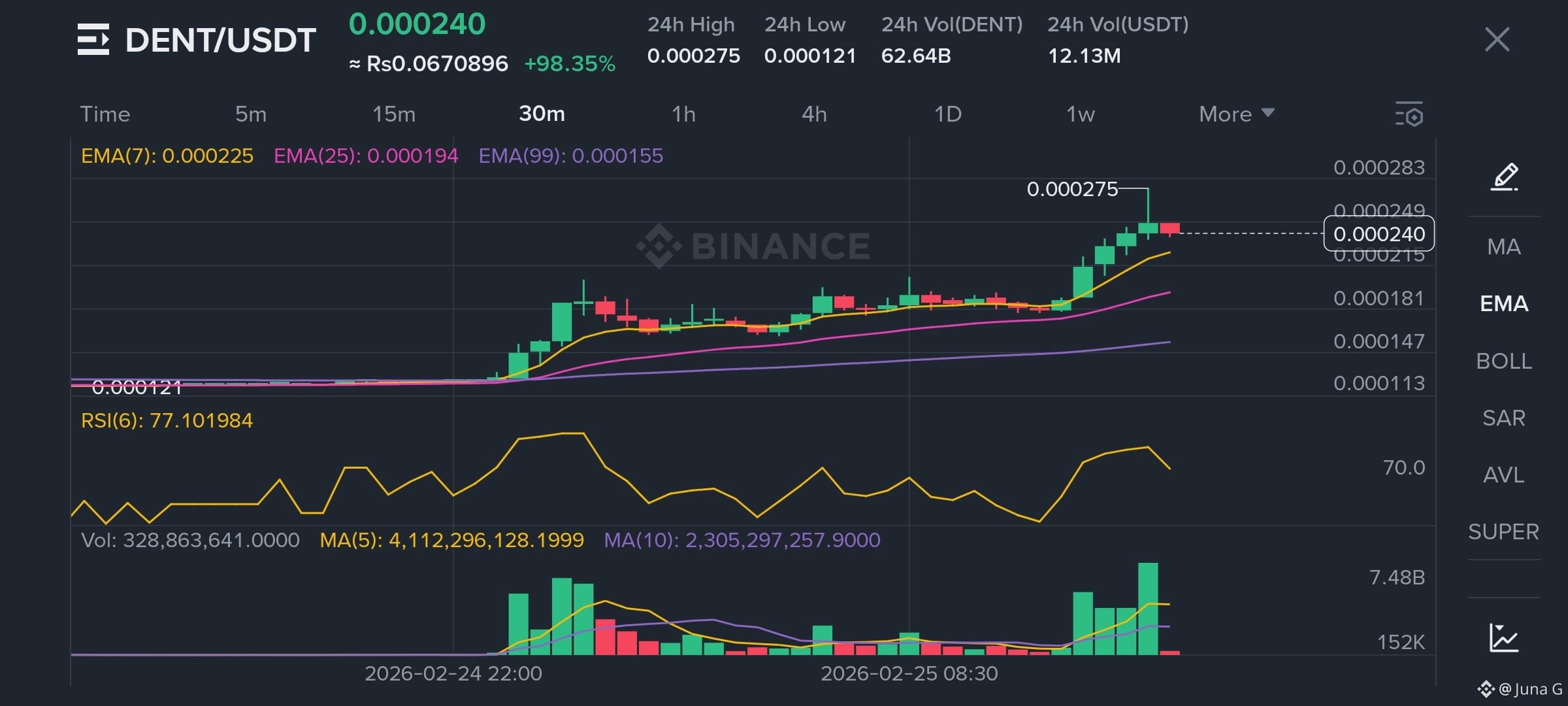
$DENT /USDT Signal (30m)
Bias: Bullish, but a bit overheated (RSI is high)...
Price is still above all EMAs (7/25/99)...
Momentum is strong...
RSI ~77 = overbought zone, so a pullback can happen before next move...
Setup 1: Safer Entry (pullback buy)
Entry: 0.000228 – 0.000235 (near EMA7 / support zone)
Stop Loss (SL): 0.000214
TP1: 0.000249
TP2: 0.000275 (recent high)
TP3: 0.000290 (breakout extension)
Setup 2: Breakout Entry (if price pushes up)
Entry: Buy on strong candle close above 0.000250
SL: 0.000232
TP1: 0.000275
TP2: 0.000295
TP3: 0.000310
What to watch
If price loses 0.000225 and stays below it, momentum may weaken.
If volume increases on a breakout above 0.000250, upside continuation is more likely.
$DENT /USDT Signal (30m)
Bias: Bullish, but a bit overheated (RSI is high)...
Price is still above all EMAs (7/25/99)...
Momentum is strong...
RSI ~77 = overbought zone, so a pullback can happen before next move...
Setup 1: Safer Entry (pullback buy)
Entry: 0.000228 – 0.000235 (near EMA7 / support zone)
Stop Loss (SL): 0.000214
TP1: 0.000249
TP2: 0.000275 (recent high)
TP3: 0.000290 (breakout extension)
Setup 2: Breakout Entry (if price pushes up)
Entry: Buy on strong candle close above 0.000250
SL: 0.000232
TP1: 0.000275
TP2: 0.000295
TP3: 0.000310
What to watch
If price loses 0.000225 and stays below it, momentum may weaken.
If volume increases on a breakout above 0.000250, upside continuation is more likely.
Bias: Bullish, but a bit overheated (RSI is high)...
Price is still above all EMAs (7/25/99)...
Momentum is strong...
RSI ~77 = overbought zone, so a pullback can happen before next move...
Setup 1: Safer Entry (pullback buy)
Entry: 0.000228 – 0.000235 (near EMA7 / support zone)
Stop Loss (SL): 0.000214
TP1: 0.000249
TP2: 0.000275 (recent high)
TP3: 0.000290 (breakout extension)
Setup 2: Breakout Entry (if price pushes up)
Entry: Buy on strong candle close above 0.000250
SL: 0.000232
TP1: 0.000275
TP2: 0.000295
TP3: 0.000310
What to watch
If price loses 0.000225 and stays below it, momentum may weaken.
If volume increases on a breakout above 0.000250, upside continuation is more likely.
6
174
·
--
Institutional Adoption Heats Up
· Dubai Bank Flips on Bitcoin: Emirates NBD, a major Middle Eastern bank, has opened the door to allocating Bitcoin in its investment process, calling it "digital gold." Their internal model suggests a fair value for BTC near $100,000 within 12 months .
· SEC Greenlights Tokenized Funds: The SEC issued an exemption to WisdomTree for a tokenized money market fund, allowing continuous trading of shares with dealers during hours, a massive step for RWA liquidity.
Institutional Adoption Heats Up
· Dubai Bank Flips on Bitcoin: Emirates NBD, a major Middle Eastern bank, has opened the door to allocating Bitcoin in its investment process, calling it "digital gold." Their internal model suggests a fair value for BTC near $100,000 within 12 months .
· SEC Greenlights Tokenized Funds: The SEC issued an exemption to WisdomTree for a tokenized money market fund, allowing continuous trading of shares with dealers during hours, a massive step for RWA liquidity.
· Dubai Bank Flips on Bitcoin: Emirates NBD, a major Middle Eastern bank, has opened the door to allocating Bitcoin in its investment process, calling it "digital gold." Their internal model suggests a fair value for BTC near $100,000 within 12 months .
· SEC Greenlights Tokenized Funds: The SEC issued an exemption to WisdomTree for a tokenized money market fund, allowing continuous trading of shares with dealers during hours, a massive step for RWA liquidity.
4
158
·
--
Meta & AMD Drop a $60B AI Bombshell
Meta announced a massive expansion of its partnership with AMD. They are deploying 6 gigawatts of AMD Instinct GPU capacity to run their AI models .
· AMD CEO Lisa Su indicated that every gigawatt represents tens of billions in spending. As part of the deal, Meta was granted performance-based warrants for up to 160 million AMD shares .
· Market Impact: AMD stock jumped nearly 9%, leading a tech rebound after weeks of AI-fueled selloffs.
Meta & AMD Drop a $60B AI Bombshell
Meta announced a massive expansion of its partnership with AMD. They are deploying 6 gigawatts of AMD Instinct GPU capacity to run their AI models .
· AMD CEO Lisa Su indicated that every gigawatt represents tens of billions in spending. As part of the deal, Meta was granted performance-based warrants for up to 160 million AMD shares .
· Market Impact: AMD stock jumped nearly 9%, leading a tech rebound after weeks of AI-fueled selloffs.
Meta announced a massive expansion of its partnership with AMD. They are deploying 6 gigawatts of AMD Instinct GPU capacity to run their AI models .
· AMD CEO Lisa Su indicated that every gigawatt represents tens of billions in spending. As part of the deal, Meta was granted performance-based warrants for up to 160 million AMD shares .
· Market Impact: AMD stock jumped nearly 9%, leading a tech rebound after weeks of AI-fueled selloffs.
4
149
·
--
Bitcoin surged 3% in 15 minutes this morning, briefly breaking $66,000. Ethereum reclaimed $1,900, and $SOL climbed back above $80 .
· The Catch: Despite the pump, funding rates remain negative for most altcoins. Analysts at Coinbase Institutional note strong resistance above $82,000, with support at $60,000 .
· Context: The market liquidated $129 million** in the last 4 hours, with short sellers bearing the brunt ($125M wiped out).
{spot}(BTCUSDT)
Bitcoin surged 3% in 15 minutes this morning, briefly breaking $66,000. Ethereum reclaimed $1,900, and $SOL climbed back above $80 .
· The Catch: Despite the pump, funding rates remain negative for most altcoins. Analysts at Coinbase Institutional note strong resistance above $82,000, with support at $60,000 .
· Context: The market liquidated $129 million** in the last 4 hours, with short sellers bearing the brunt ($125M wiped out).
· The Catch: Despite the pump, funding rates remain negative for most altcoins. Analysts at Coinbase Institutional note strong resistance above $82,000, with support at $60,000 .
· Context: The market liquidated $129 million** in the last 4 hours, with short sellers bearing the brunt ($125M wiped out).
6
210
Log in to explore more content
Join global crypto users on Binance Square
⚡️ Get latest and useful information about crypto.
💬 Trusted by the world’s largest crypto exchange.
👍 Discover real insights from verified creators.
Email / Phone number