
套利达人
29 Posts

套利达人
Report
Block User
40 Following
52 Followers
33 Liked
Posts
All
Quotes
·
--
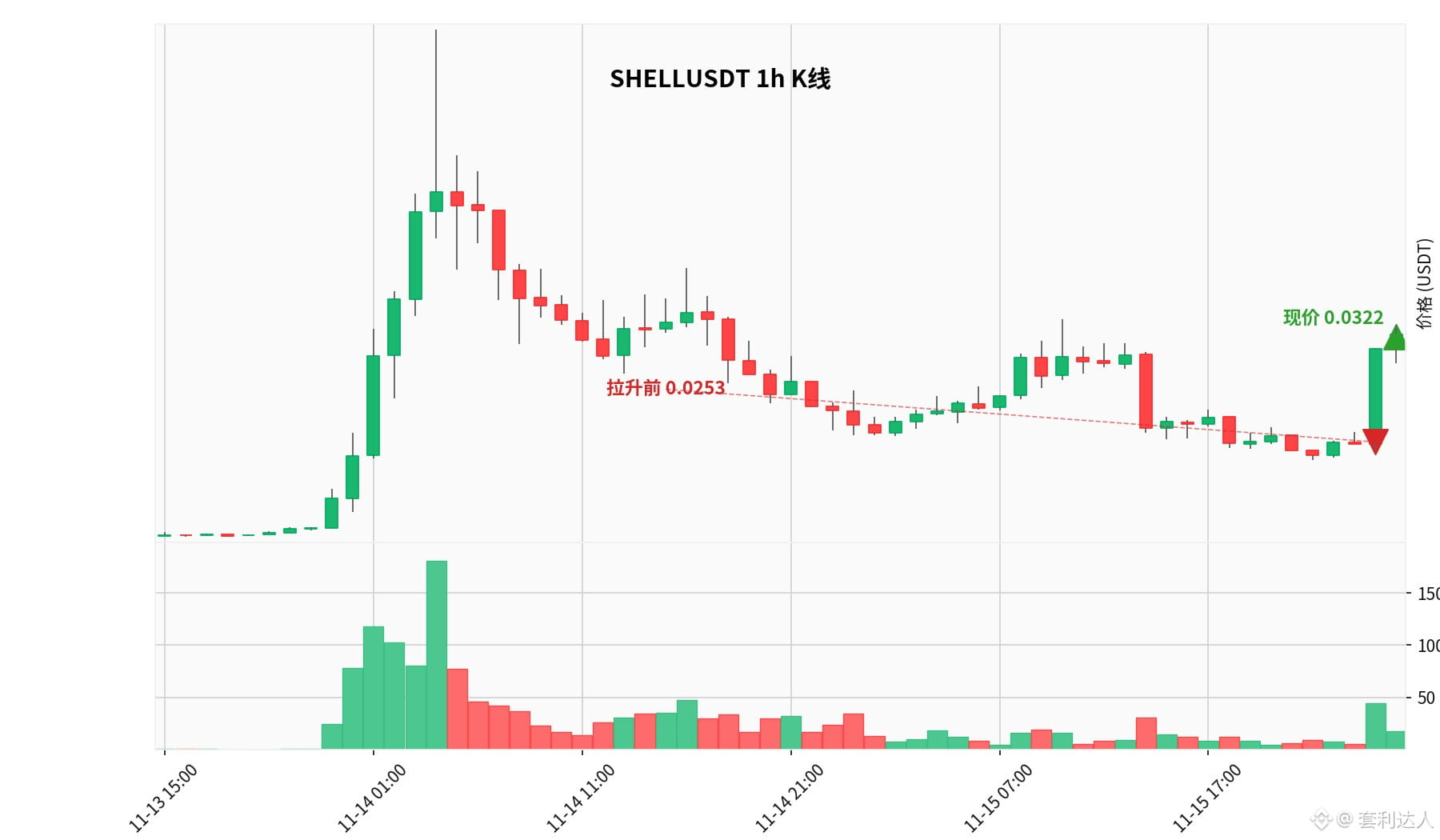
At 1 a.m., $SHELL suddenly went haywire.
In just one hour, it shot straight from 0.0253 to 0.0313, gaining nearly 24% in an hour.
The volume was staggering too: 44.3 million tokens traded in a single hour, several times the usual amount.
I looked everywhere for good news behind this move, but couldn’t find any. The team has been quiet.
$SHELL is MyShell’s token. The project focuses on AI agents, and its market cap is small with a thin order book, so even a little money coming in can push the price up.
What’s interesting is that the broader market isn’t doing well tonight. $BTC is down 2.3%, hovering around 64,500, yet this token is surging against the trend.
Veteran traders know that a sudden, news-free spike in volume like this is most likely a case of money coming in to spark a rally. Chasing the price can easily mean catching a falling knife.
It’s now around 0.0322, up 24% in the past 24 hours, with the 24-hour high of 0.0332 just overhead.
Binance spot trading volume over the past 24 hours is $8.7 million. Volume has definitely picked up; now we’ll see how long this momentum lasts.
If you’re thinking of getting in, take a moment to cool off. There’s no harm in waiting to see if it pulls back and holds steady first.
#SHELL #MyShell #AI #加密货币 #Bitcoin
576
·
--
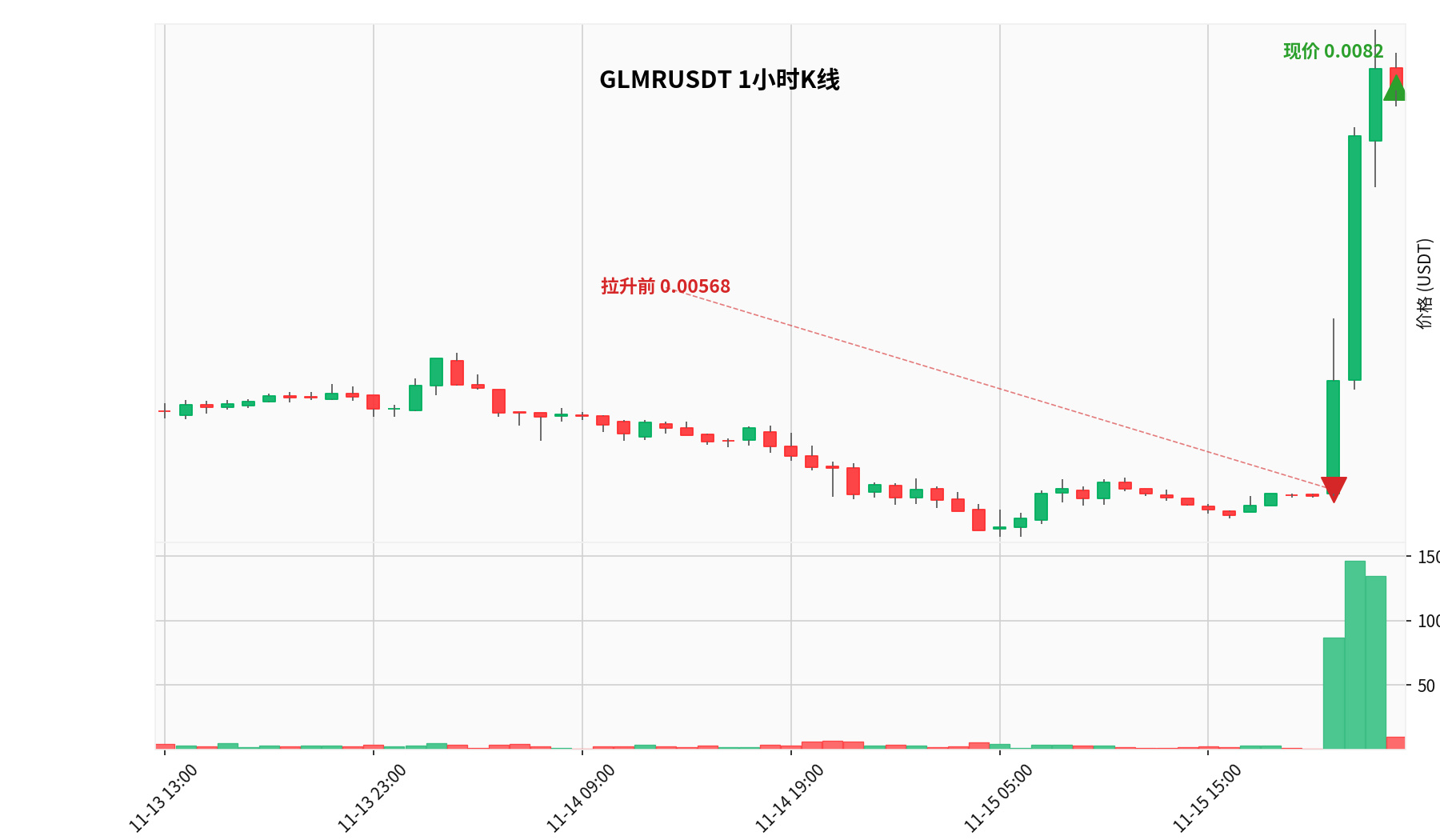
$GLMR suddenly went wild tonight, climbing from 0.0057 to a high of 0.0085 in just three hours. It’s up over 42% in 24 hours, with $3 million in 24-hour spot trading volume on Binance and over $13 million across the market. Volume is dozens of times higher than usual, and in that 15-minute stretch at 9 p.m., 44 million tokens were traded.
This coin’s market cap is only a little over $9 million, so its market is tiny. It doesn’t take much money coming in to push it up like this. There’s no major news tonight; it’s the same old story about moving to Base in July for AI agent settlements. The white paper came out in September, and Binance added a monitoring tag in August.
The broader market is still down tonight, and $BTC has fallen back to around 64,700. This one is surging against the trend, so think carefully before chasing it—don’t dive in headfirst and try to catch a falling knife.
#GLMR #Moonbeam #Surge
291
·
--
This price action is really interesting.
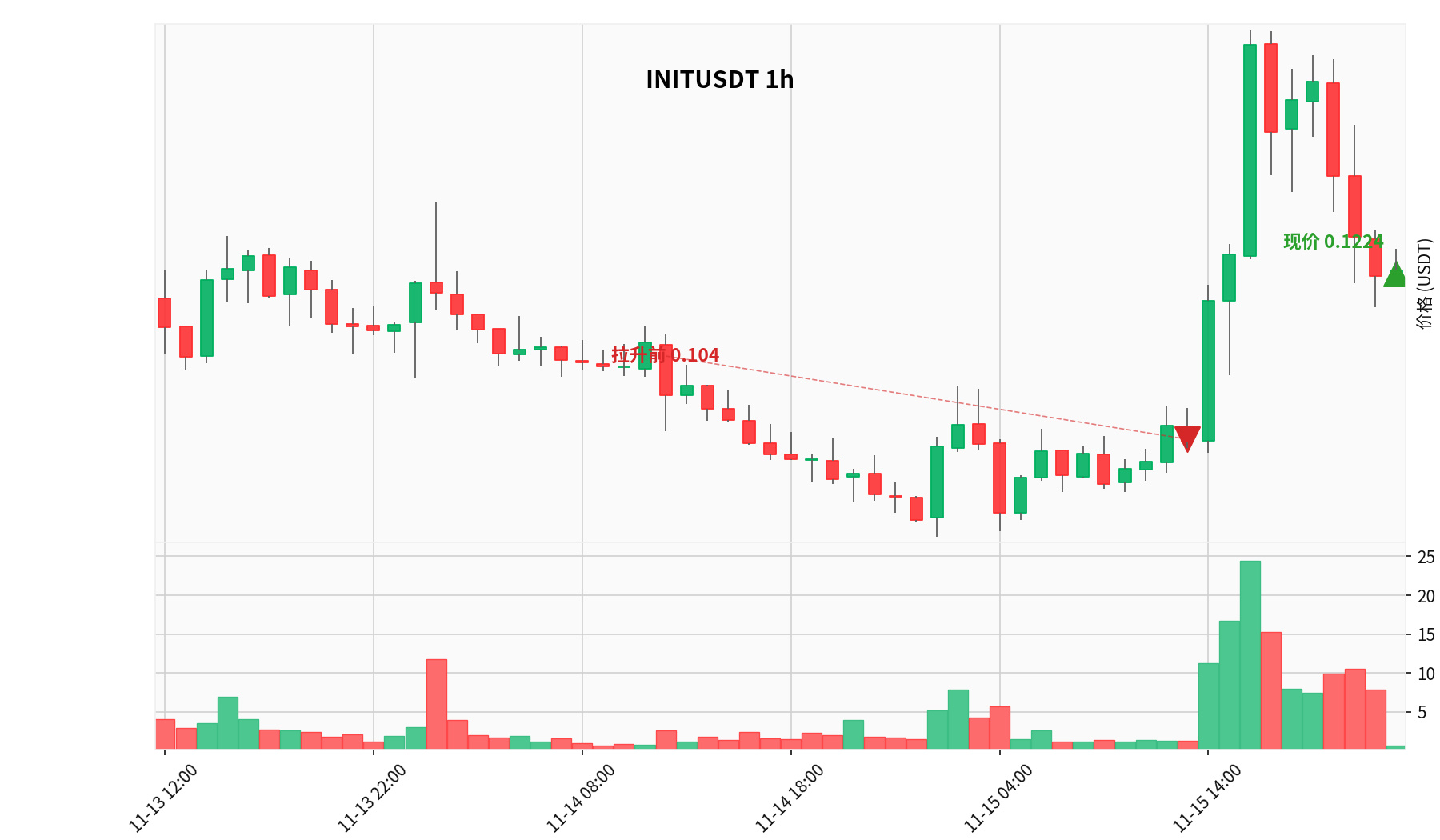
$INIT suddenly saw a huge surge in trading volume and price starting at 2 p.m. today.
It shot from 0.104 all the way up to 0.1477, gaining nearly 50% at its peak.
It has now pulled back to around 0.1224, but is still up 23% over the past 24 hours.
What’s interesting is that this coin was hacked just a few days ago.
On November 9, hackers obtained cloud keys and forged withdrawal requests to make off with $3.27 million. The chain was halted.
The team said all affected assets would be fully reimbursed and that the infrastructure would be rebuilt from scratch.
The chain still hasn’t restarted, and there’s no firm timeline for when it will.
But the market isn’t worried about any of that—traders are betting on reimbursement and a restart.
Put simply, people are putting real money on the line based on the news.
The fact that it can still rise after being hacked shows that some people really believe it can bounce back.
That said, the chain is still down. If reimbursement gets delayed, the price could fall just as quickly.
If you’re chasing the rally, take it easy—don’t get carried away.
#INIT #Initia #加密货币 #Binance Square
283
·
--
Attention everyone: $SOPH This time, something really went wrong—it’s not a technical pullback.
Sophon made it official: its own L2 mainnet will shut down permanently on November 30. You must withdraw all your on-chain assets before November 25, or you may not be able to get them back. Just maintaining this chain costs over $3 million a year, and even the $70 million it raised wasn’t enough. This time, they’ve admitted defeat and are moving to Base to build applications instead, saying they’ll use future app revenue to buy back and burn $SOPH.
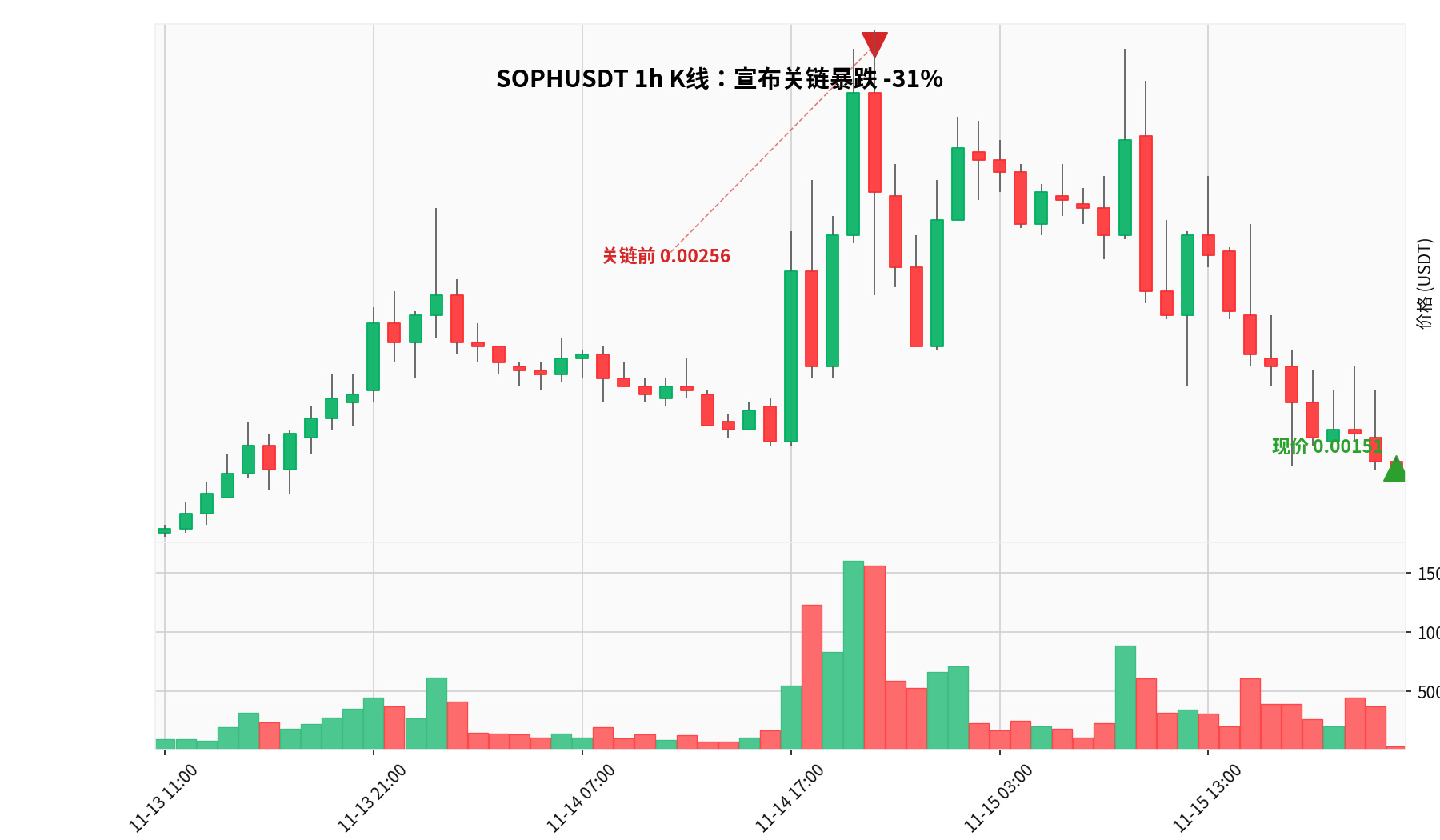
The token price was hammered: down 31% in 24 hours, sliding from 0.00219 to 0.00151, with a low of 0.0015—a new all-time low. It’s now down more than 98% from last May’s peak of 0.11. Twenty-four-hour trading volume hit $18.5 million, all from people scrambling to get out.
If you still have funds on-chain, don’t dawdle—withdraw them now. Don’t wait until the last day, when everyone’s rushing to get out. And if you’re not holding any, don’t get itchy fingers and buy the dip. The project is giving up on its own chain, so this isn’t an easy bottom to catch.
#SOPH #Sophon #关链 #Crash
Attention everyone: $SOPH This time, something really went wrong—it’s not a technical pullback.
Sophon made it official: its own L2 mainnet will shut down permanently on November 30. You must withdraw all your on-chain assets before November 25, or you may not be able to get them back. Just maintaining this chain costs over $3 million a year, and even the $70 million it raised wasn’t enough. This time, they’ve admitted defeat and are moving to Base to build applications instead, saying they’ll use future app revenue to buy back and burn $SOPH .
The token price was hammered: down 31% in 24 hours, sliding from 0.00219 to 0.00151, with a low of 0.0015—a new all-time low. It’s now down more than 98% from last May’s peak of 0.11. Twenty-four-hour trading volume hit $18.5 million, all from people scrambling to get out.
If you still have funds on-chain, don’t dawdle—withdraw them now. Don’t wait until the last day, when everyone’s rushing to get out. And if you’re not holding any, don’t get itchy fingers and buy the dip. The project is giving up on its own chain, so this isn’t an easy bottom to catch.
#SOPH #Sophon #关链 #Crash
325
·
--
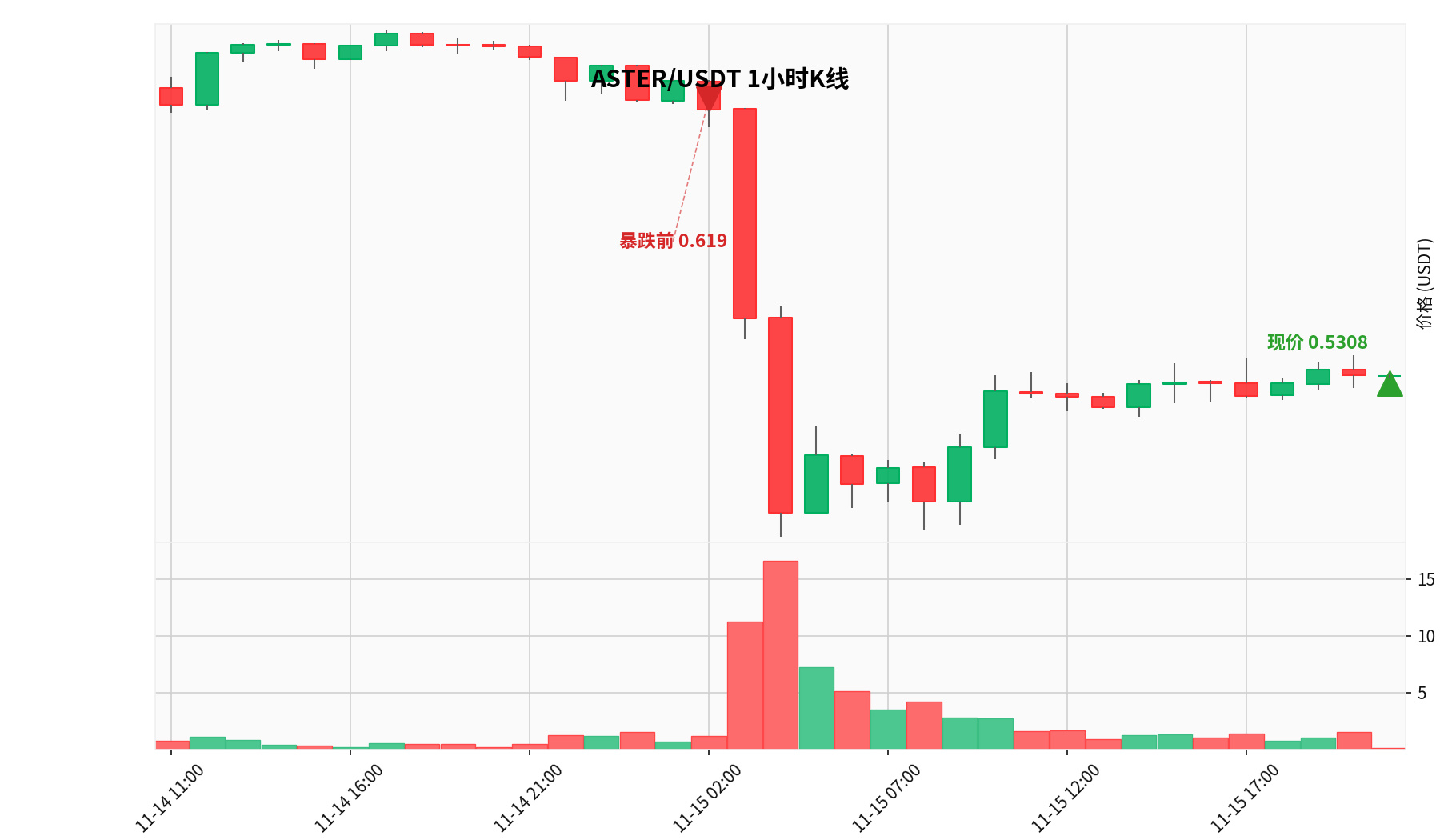
Attention everyone: $ASTER took a pretty hard hit today!
It fell 16.8% in 24 hours, plunging from 0.619 to a low of 0.4784. It’s now at 0.5308, down 22% over the past seven days.
This wasn’t caused by a problem with the project—it was purely the broader market dragging it down, compounded by long liquidations.
Saturday afternoon was the worst: it first dropped 9% in an hour, then fell another 14.6% the following hour. Long positions worth $7.76 million were liquidated in 24 hours—almost all the bulls got wiped out.
On top of that, claims for the sixth airdrop are underway, and 63.38 million new tokens have entered circulation. Quite a few people are selling as soon as they claim, adding even more selling pressure.
The broader market isn’t looking good either: $BTC fell 2.2%, and $ETH dropped 3.3%. As soon as news came out of the Middle East, panic surged, and altcoins couldn’t hold up.
The chart shows the two biggest volume bars came during the drop. It has started to stabilize and recover a little since the low, but airdrop selling pressure won’t end until December 4, so in the short term, it still depends on how the broader market performs.
If you’re holding, don’t panic-sell at the bottom. If you’re sitting on the sidelines, don’t rush to buy the dip either—wait until volume stabilizes.
#ASTER #Aster #暴跌 #爆仓 #Airdrop
1
37
·
--
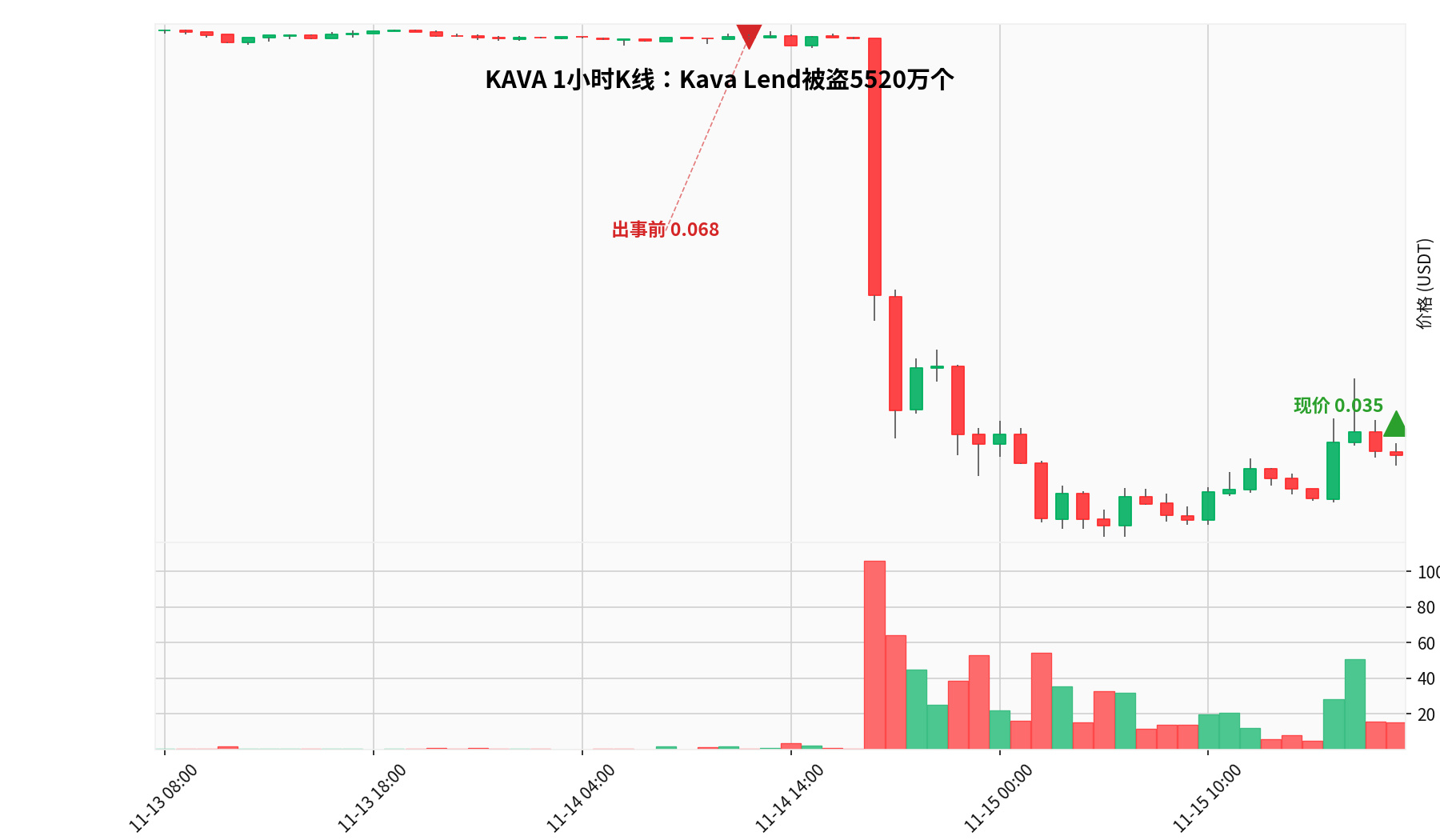
KAVA has really been hit hard this time.
Yesterday, Kava Lend got drained. Someone exploited an old BUSD market that nobody was using and messed up the accounting, borrowing 55.2 million $KAVA in one go, worth $3.8 million.
The hacker then bridged 49.2 million $KAVA to the BNB Chain and sold it for $2.1 million. Buyers on the $BNB Chain were left stunned.
The price was cut in half in a single day, crashing from 0.068 to 0.035—nearly a 50% drop.
Major exchanges like Upbit and Bithumb quickly suspended $KAVA deposits and withdrawals.
The team says there was no unlimited minting; the issue was confined to Kava Lend. The bridge has also been halted while they prepare an incident report.
Be cautious about buying the dip on a coin with this kind of vulnerability. Wait for the official report before deciding.
#KAVA #HackerAttack
4
1.3k
·
--
Aoying nailed this ZEC short: opened above 880 and closed at 836, making over 14,000 USDT on a single trade. Even with 10x leverage, he stayed calm—no greed, no stubbornly holding on; he took profit when the time was right and withdrew it to lock in the gains. That’s how a seasoned trader should operate. He shorted ZEC twice during this run, and made money both times. That’s how he trades: waiting 90% of the time and striking the other 10%—and when he strikes, he makes it count. That kind of vision isn’t luck; it’s built through patience. $ZEC
Aoying nailed this ZEC short: opened above 880 and closed at 836, making over 14,000 USDT on a single trade. Even with 10x leverage, he stayed calm—no greed, no stubbornly holding on; he took profit when the time was right and withdrew it to lock in the gains. That’s how a seasoned trader should operate. He shorted ZEC twice during this run, and made money both times. That’s how he trades: waiting 90% of the time and striking the other 10%—and when he strikes, he makes it count. That kind of vision isn’t luck; it’s built through patience. $ZEC
2.1k
·
--
The airdrop is here! With BN Agentic Wallet, you can mint a POA card for free.
ptah.trade/poa
You can enter the $PTAH giveaway: from October 26 to November 9, up to 500 cards will be drawn each round.
The daily prize pool comes from mining proceeds generated by 500 Looms owned by the Ptah team.
#ProofOfAgent Agent #2493
ptah.trade/poa
You can enter the $PTAH giveaway: from October 26 to November 9, up to 500 cards will be drawn each round.
The daily prize pool comes from mining proceeds generated by 500 Looms owned by the Ptah team.
#ProofOfAgent Agent #2493
78
·
--
Rewards continue—participate in the daily quiz during the football challenge, complete simple tasks, unlock reward gift boxes, and share a prize pool with a USD 4,000,000 equivalent value.
Rewards include vouchers, exclusive Binance merchandise, football match tickets, Binance blind box sets, and more.
Event period: from 2026-06-10 16:00 to 2026-07-20 07:59 (UTC+8). #BinancePickAndWin
Rewards include vouchers, exclusive Binance merchandise, football match tickets, Binance blind box sets, and more.
Event period: from 2026-06-10 16:00 to 2026-07-20 07:59 (UTC+8). #BinancePickAndWin
61
·
--
The World Cup is here!
Binance Football Challenge. Participate in daily quiz questions, complete simple tasks, unlock reward gift boxes, and share a $4,000,000 equivalent prize pool.
Rewards include vouchers, exclusive Binance merchandise, football match tickets, Binance mystery box sets, and more.
Event period: 16:00 on June 10, 2026 to 07:59 on July 20, 2026 (UTC+8)
#BinancePickAndWin
77
·
--
Wool is here!! Binance has now launched the 2026 Binance Football Challenge. Participate in daily quiz questions, complete simple tasks, unlock reward gift boxes, and share a prize pool of an equivalent value of US$4,000,000.
Rewards include vouchers, exclusive Binance merchandise, football match tickets, Binance mystery box sets, and more.
Event period: 2026-06-10 16:00 to 2026-07-20 07:59 (East Eight Zone time)
#BinancePickAndWin
Rewards include vouchers, exclusive Binance merchandise, football match tickets, Binance mystery box sets, and more.
Event period: 2026-06-10 16:00 to 2026-07-20 07:59 (East Eight Zone time)
#BinancePickAndWin
70
·
--
The Binance Football Season Is Here—Every Matchday Has Rewards! Binance now presents the 2026 Binance Football Challenge. Participate in daily quiz questions, complete simple tasks, unlock reward gift boxes, and share a prize pool of up to the USD equivalent of $4,000,000.
Rewards include vouchers, exclusive Binance merchandise, football match tickets, Binance blind box sets, and more.
Event period: 2026-06-10 16:00 to 2026-07-20 07:59 (UTC+8)
#BinancePickAndWin
Rewards include vouchers, exclusive Binance merchandise, football match tickets, Binance blind box sets, and more.
Event period: 2026-06-10 16:00 to 2026-07-20 07:59 (UTC+8)
#BinancePickAndWin
73
·
--
Bullish
Pure no-stress grinding is here!
With the football season kicking off, there's a reward for every match day! Binance has launched the 2026 Binance Football Challenge. Join daily predictions, complete simple tasks, unlock reward boxes, and share in a prize pool equivalent to $4,000,000.
Event Duration: From June 10, 2026, 16:00 to July 20, 2026, 07:59 (UTC+8)
#BinancePickAndWin
$BNB
{spot}(BNBUSDT)
Pure no-stress grinding is here!
With the football season kicking off, there's a reward for every match day! Binance has launched the 2026 Binance Football Challenge. Join daily predictions, complete simple tasks, unlock reward boxes, and share in a prize pool equivalent to $4,000,000.
Event Duration: From June 10, 2026, 16:00 to July 20, 2026, 07:59 (UTC+8)
#BinancePickAndWin
$BNB
7
·
--
Kava AI is powered by a model called DeepSeek R1, designed to simplify on-chain transactions and DeFi management. Unlike many centralized AI models, Kava AI emphasizes decentralization, transparency, and user data sovereignty, with its models and computational capabilities running in a decentralized environment, decision-making processes being auditable, and users having the option to use it anonymously. Kava AI's vision is to be the user's DeFi smart assistant, ultimately capable of understanding user commands and automatically executing complex on-chain operations, such as asset allocation, cross-chain conversions, and finding high-yield opportunities, etc.
@kava #KavaBNBChainSummer #KavaBNBChainSummer and $KAVA
{spot}(KAVAUSDT)
Kava AI is powered by a model called DeepSeek R1, designed to simplify on-chain transactions and DeFi management. Unlike many centralized AI models, Kava AI emphasizes decentralization, transparency, and user data sovereignty, with its models and computational capabilities running in a decentralized environment, decision-making processes being auditable, and users having the option to use it anonymously. Kava AI's vision is to be the user's DeFi smart assistant, ultimately capable of understanding user commands and automatically executing complex on-chain operations, such as asset allocation, cross-chain conversions, and finding high-yield opportunities, etc.
@kava #KavaBNBChainSummer #KavaBNBChainSummer and $KAVA
@kava #KavaBNBChainSummer #KavaBNBChainSummer and $KAVA
103
·
--
In the Web3 world, security is the top priority. The core design of WalletConnect is "non-custodial" and user sovereignty. It does not hold user funds, nor does it store private keys or personal information. Connections are protected by symmetric encryption technology, and each message can only be decrypted by the user's wallet and the DApp. Private keys are always securely isolated on the user's own device, eliminating the risk of asset loss due to DApp vulnerabilities, and building a solid trust layer for user interaction with DApps.
#WalletConnect $WCT
{future}(WCTUSDT)
#WalletConnect $WCT , @WalletConnect
In the Web3 world, security is the top priority. The core design of WalletConnect is "non-custodial" and user sovereignty. It does not hold user funds, nor does it store private keys or personal information. Connections are protected by symmetric encryption technology, and each message can only be decrypted by the user's wallet and the DApp. Private keys are always securely isolated on the user's own device, eliminating the risk of asset loss due to DApp vulnerabilities, and building a solid trust layer for user interaction with DApps.
#WalletConnect $WCT
#WalletConnect $WCT , @WalletConnect
#WalletConnect $WCT
#WalletConnect $WCT , @WalletConnect
7
·
--
The token economy and ecological applications of BounceBit
BB is the native token of BounceBit, with a maximum supply of 2.1 billion, in homage to Bitcoin's limit of 21 million. BB is used to pay gas fees, network security staking, governance voting, and as a medium of exchange within the ecosystem.
The BounceBit ecosystem includes components like BounceClub, providing DEX, IDO platforms, and GameFi applications. Its cross-chain compatibility and AI-driven aggregator aim to simplify user operations and optimize returns. @bounce_bit #BounceBitPrime bounce_bit #BounceBitPrime and $BB
{spot}(BBUSDT)
The token economy and ecological applications of BounceBit
BB is the native token of BounceBit, with a maximum supply of 2.1 billion, in homage to Bitcoin's limit of 21 million. BB is used to pay gas fees, network security staking, governance voting, and as a medium of exchange within the ecosystem.
The BounceBit ecosystem includes components like BounceClub, providing DEX, IDO platforms, and GameFi applications. Its cross-chain compatibility and AI-driven aggregator aim to simplify user operations and optimize returns. @BounceBit #BounceBitPrime bounce_bit #BounceBitPrime and $BB
47
·
--
DOLO Token Economics and Ecosystem
Dolomite's governance token DOLO is the core of the ecosystem, with a total supply of 1 billion. Its token economic model includes three complementary forms: DOLO (basic functionality), veDOLO (governance and profit sharing), and oDOLO (incentive discounts).
The token distribution balances research and community vitality: 20% is allocated for future liquidity mining, 20% for airdrops, the core team and investors hold 20.2% and 16.2% respectively, with the remainder allocated to foundations, partners, etc.
DOLO was initially issued on Berachain and achieves cross-chain interoperability through Chainlink CCIP. Holders can participate in governance and share profits by locking their tokens, promoting long-term ecological development.
@Dolomite_io #Dolomite
@Dolomite_io and includes topic tags #Dolomite and $DOLO
{spot}(DOLOUSDT)
DOLO Token Economics and Ecosystem
Dolomite's governance token DOLO is the core of the ecosystem, with a total supply of 1 billion. Its token economic model includes three complementary forms: DOLO (basic functionality), veDOLO (governance and profit sharing), and oDOLO (incentive discounts).
The token distribution balances research and community vitality: 20% is allocated for future liquidity mining, 20% for airdrops, the core team and investors hold 20.2% and 16.2% respectively, with the remainder allocated to foundations, partners, etc.
DOLO was initially issued on Berachain and achieves cross-chain interoperability through Chainlink CCIP. Holders can participate in governance and share profits by locking their tokens, promoting long-term ecological development.
@Dolomite #Dolomite
@Dolomite and includes topic tags #Dolomite and $DOLO
26
·
--
The Vision and Future Outlook of Mitosis
The vision of Mitosis goes far beyond an ordinary DeFi protocol; it aims to become the global liquidity underlying infrastructure of Web3, just as the TCP/IP protocol is fundamental and indispensable for the internet. Its ultimate goal is to allow end users to enjoy a smooth and unobstructed cross-chain experience, seamless yield farming, and default privacy protection without perceiving the complexity of the technology.
Mitosis draws inspiration from one of nature's most sustainable principles—cell mitosis (Mitosis)—and attempts to build a system that can self-expand, self-adapt, and organically develop. This marks the inevitable evolution of DeFi from isolated “islands” to a unified, efficient, and private global financial system.
In the future, Mitosis plans to continuously expand its cross-chain capabilities, deeply connecting with all major Layer-1 and Layer-2 blockchains, and continually expanding its list of miAssets and maAssets. By attracting institutional investors and nurturing a native DeFi ecosystem based on miAssets, Mitosis is expected to lay a solid foundation for the future of digital finance. @MitosisOrg #Mitosis
@MitosisOrg #Mitosis and $MITO
{spot}(MITOUSDT)
The Vision and Future Outlook of Mitosis
The vision of Mitosis goes far beyond an ordinary DeFi protocol; it aims to become the global liquidity underlying infrastructure of Web3, just as the TCP/IP protocol is fundamental and indispensable for the internet. Its ultimate goal is to allow end users to enjoy a smooth and unobstructed cross-chain experience, seamless yield farming, and default privacy protection without perceiving the complexity of the technology.
Mitosis draws inspiration from one of nature's most sustainable principles—cell mitosis (Mitosis)—and attempts to build a system that can self-expand, self-adapt, and organically develop. This marks the inevitable evolution of DeFi from isolated “islands” to a unified, efficient, and private global financial system.
In the future, Mitosis plans to continuously expand its cross-chain capabilities, deeply connecting with all major Layer-1 and Layer-2 blockchains, and continually expanding its list of miAssets and maAssets. By attracting institutional investors and nurturing a native DeFi ecosystem based on miAssets, Mitosis is expected to lay a solid foundation for the future of digital finance. @Mitosis Official #Mitosis
@Mitosis Official #Mitosis and $MITO
13
·
--
The cross-chain capabilities and technological advantages of Pyth Network
Pyth Network has achieved unprecedented multi-chain data service capabilities through the integration of the Wormhole cross-chain protocol. This architecture allows Pyth to provide real-time price information for over 30 blockchains simultaneously after a single data update, including major public chains such as Solana, Ethereum, Aptos, and Sui.
Its core technological advantages lie in high throughput and low latency - the Pythnet dedicated chain can process thousands of transactions per second, ensuring that price updates are almost completed in real-time. The unique "pull model" allows dApps to fetch the latest data only when needed, significantly reducing on-chain costs.
These technological innovations make Pyth the most scalable and cost-effective oracle solution, particularly suitable for high-frequency trading and DeFi applications that require high capital efficiency.
@PythNetwork Pythnetwork #PythRoadmap PythRoadmap $PYTH
{spot}(PYTHUSDT)
The cross-chain capabilities and technological advantages of Pyth Network
Pyth Network has achieved unprecedented multi-chain data service capabilities through the integration of the Wormhole cross-chain protocol. This architecture allows Pyth to provide real-time price information for over 30 blockchains simultaneously after a single data update, including major public chains such as Solana, Ethereum, Aptos, and Sui.
Its core technological advantages lie in high throughput and low latency - the Pythnet dedicated chain can process thousands of transactions per second, ensuring that price updates are almost completed in real-time. The unique "pull model" allows dApps to fetch the latest data only when needed, significantly reducing on-chain costs.
These technological innovations make Pyth the most scalable and cost-effective oracle solution, particularly suitable for high-frequency trading and DeFi applications that require high capital efficiency.
@PythNetwork Pythnetwork #PythRoadmap PythRoadmap $PYTH
6
·
--
Pyth Network's cross-chain capabilities and technological advantages
Pyth Network has achieved unprecedented multi-chain data service capabilities by integrating the Wormhole cross-chain protocol. This architecture allows Pyth to provide real-time price information for over 30 blockchains simultaneously after a single data update, including major public chains such as Solana, Ethereum, Aptos, and Sui.
Its core technological advantages lie in high throughput and low latency - the Pythnet dedicated chain can process thousands of transactions per second, ensuring that price updates are completed almost in real-time. The unique "pull model" allows dApps to retrieve the latest data only when needed, significantly reducing on-chain costs.
These technological innovations make Pyth the most scalable and cost-effective oracle solution, particularly suitable for high-frequency trading and DeFi applications that require high capital efficiency.
@PythNetwork #PythNetwork Pythnetwork #PythRoadmap $PYTH
5
Log in to explore more content
Join global crypto users on Binance Square
⚡️ Get latest and useful information about crypto.
💬 Trusted by the world’s largest crypto exchange.
👍 Discover real insights from verified creators.
Email / Phone number
Trending Topics
CryptoSelloffTriggersMultipleWhaleLiquidations
148,400 views
1,606 Discussing
Crypto Liquidations Top $2B in 24 Hours as 329,000 Traders Are Wiped Out
Binance News
·39 Likes
·46.7k views
USSpotXRPETFsSeeLargestWeeklyOutflowIn8Months
138,251 views
1,465 Discussing
WillFOMCMinutesReinforceRateHikeExpectations?
38,203 views
672 Discussing