
Swing Strategy Trader
1.1k Posts
Posts
All
Quotes
Live

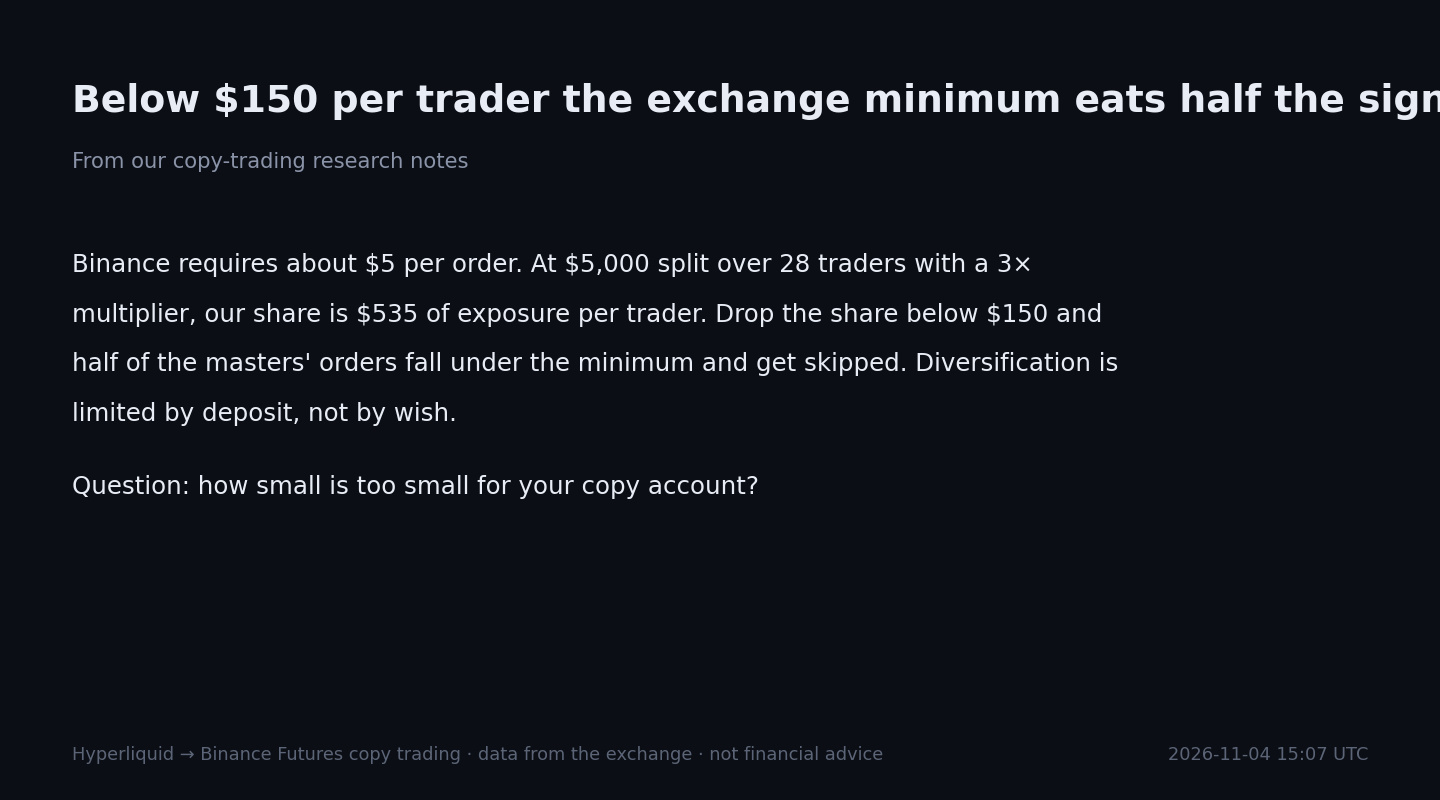
Below $150 per trader the exchange minimum eats half the signals.
Binance requires about $5 per order. At $5,000 split over 28 traders with a 3× multiplier, our share is $535 of exposure per trader. Drop the share below $150 and half of the masters' orders fall under the minimum and get skipped. Diversification is limited by deposit, not by wish.
Question: how small is too small for your copy account?
#copytrading #hyperliquid #tradingjournal
Same trades, same rules, in a Binance group for people who copy by API or trade them by hand: https://app.binance.com/uni-qr/DpuA7yYD
54
Stop-loss on the copy, or trust the master's exit?
Our numbers are in the daily snapshot. #copytrading #hyperliquid
For anyone copying via API, trading their own account or on Binance Copy Trading, the same trades go to our group: https://app.binance.com/uni-qr/DpuA7yYD
Stop-loss on the copy, or trust the master's exit?
Our numbers are in the daily snapshot. #copytrading #hyperliquid
For anyone copying via API, trading their own account or on Binance Copy Trading, the same trades go to our group: https://app.binance.com/uni-qr/DpuA7yYD
Our numbers are in the daily snapshot. #copytrading #hyperliquid
For anyone copying via API, trading their own account or on Binance Copy Trading, the same trades go to our group: https://app.binance.com/uni-qr/DpuA7yYD
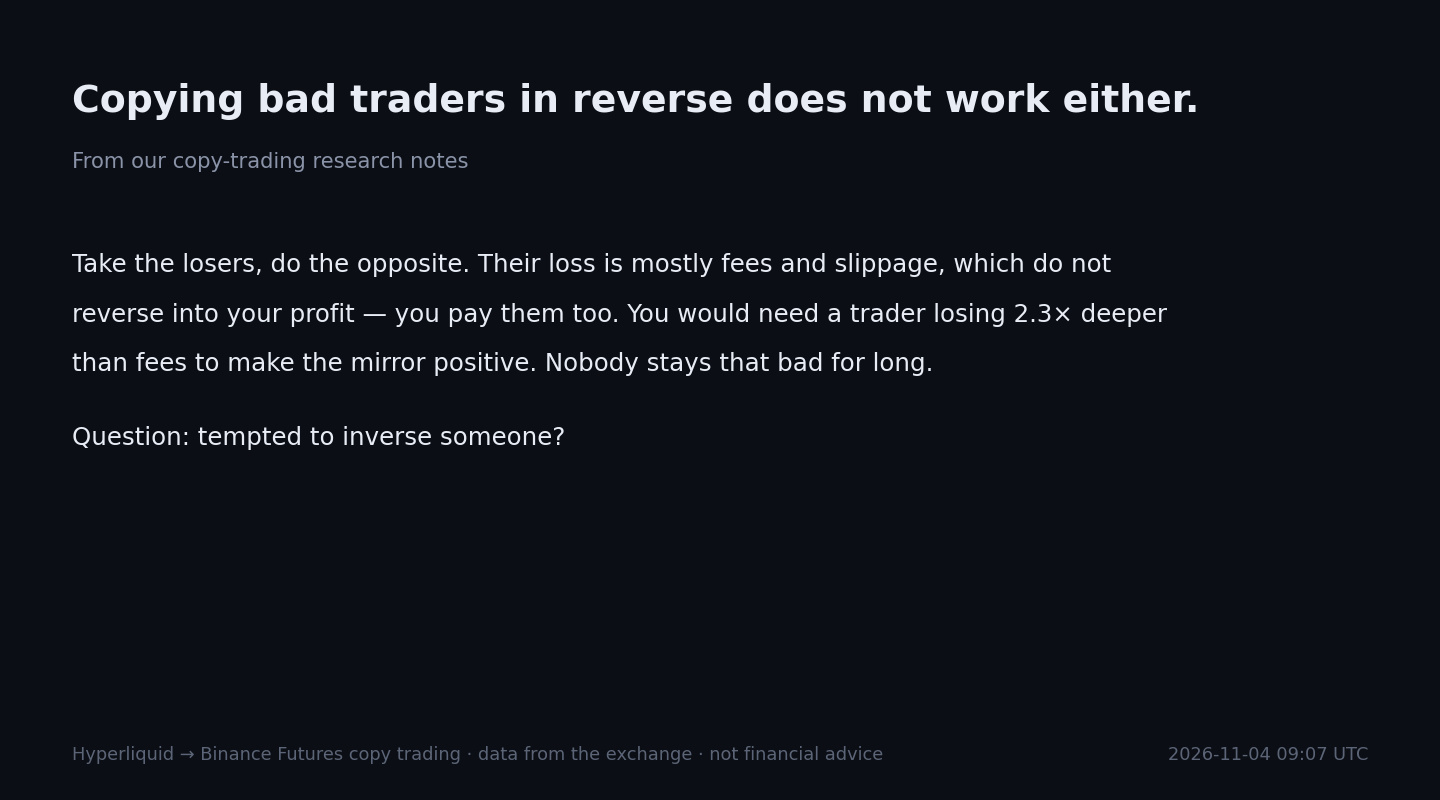
Copying bad traders in reverse does not work either.
Take the losers, do the opposite. Their loss is mostly fees and slippage, which do not reverse into your profit — you pay them too. You would need a trader losing 2.3× deeper than fees to make the mirror positive. Nobody stays that bad for long.
Question: tempted to inverse someone?
#copytrading #hyperliquid #tradingjournal
If you copy by API like we do, or just want these entries and exits as they happen, we keep a small group on Binance: https://app.binance.com/uni-qr/DpuA7yYD
63
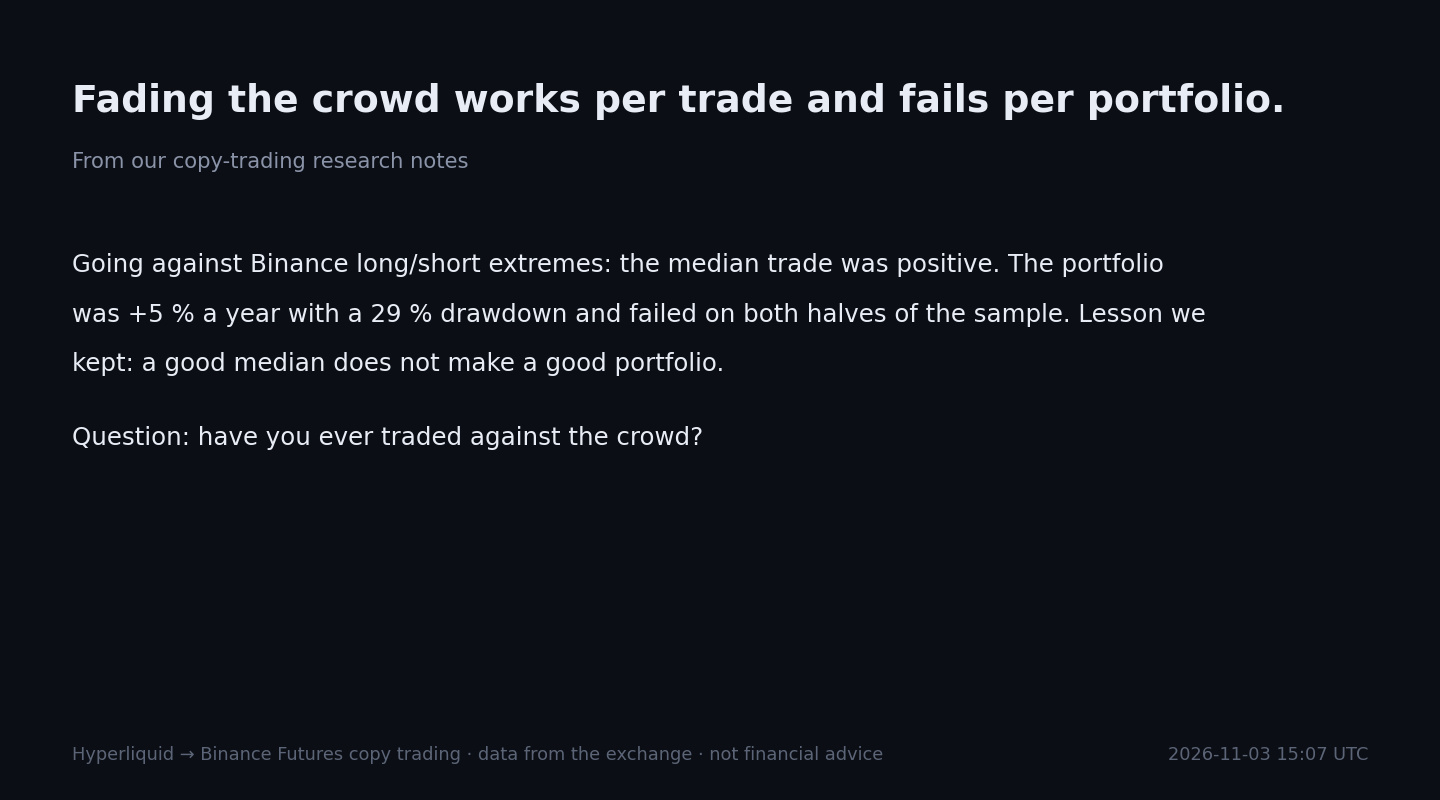
Fading the crowd works per trade and fails per portfolio.
Going against Binance long/short extremes: the median trade was positive. The portfolio was +5 % a year with a 29 % drawdown and failed on both halves of the sample. Lesson we kept: a good median does not make a good portfolio.
Question: have you ever traded against the crowd?
#copytrading #hyperliquid #tradingjournal
We run this on a Binance copy-trading account. The group where the trades land first: https://app.binance.com/uni-qr/DpuA7yYD
128
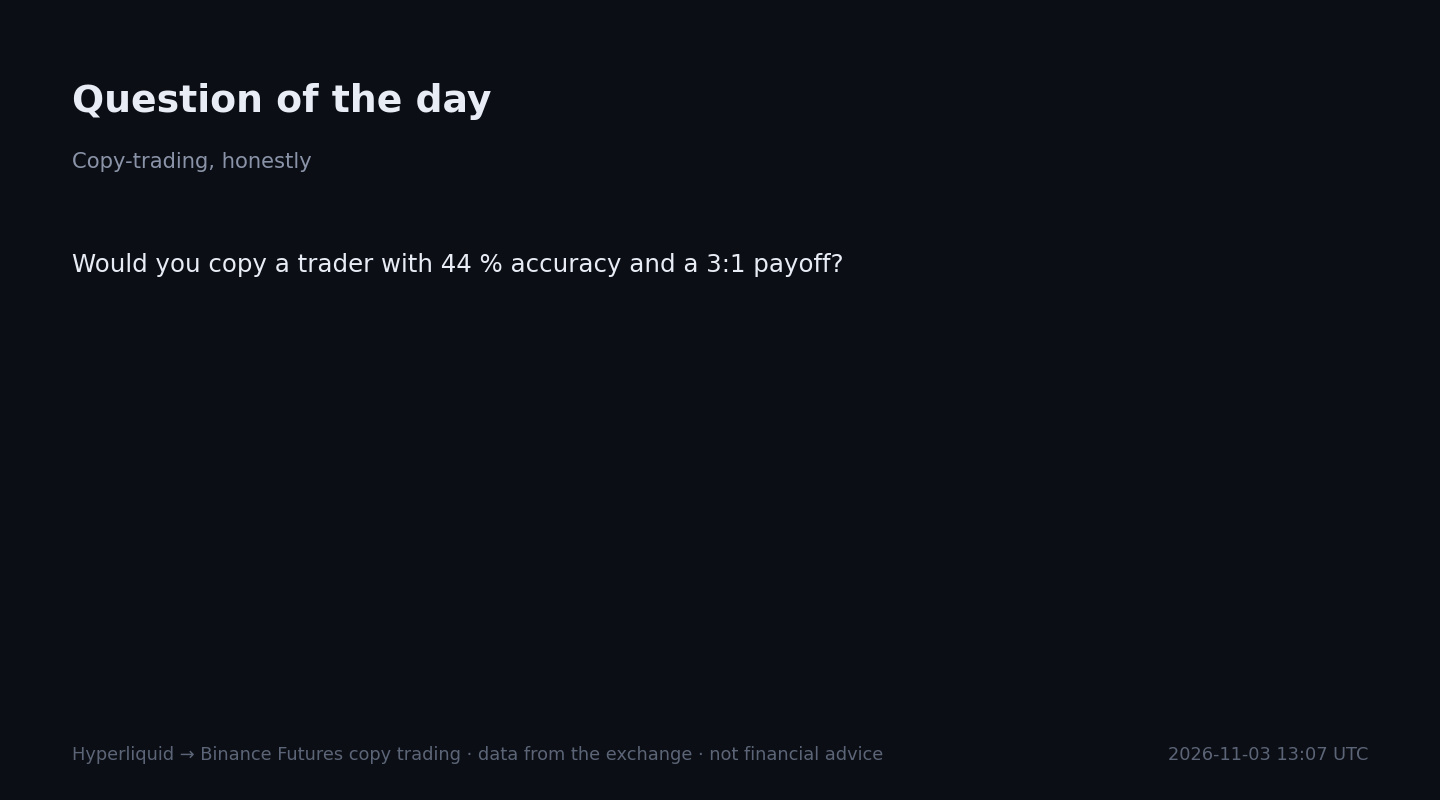
Would you copy a trader with 44 % accuracy and a 3:1 payoff?
Our numbers are in the daily snapshot. #copytrading #hyperliquid
If you copy by API like we do, or just want these entries and exits as they happen, we keep a small group on Binance: https://app.binance.com/uni-qr/DpuA7yYD
Would you copy a trader with 44 % accuracy and a 3:1 payoff?
Our numbers are in the daily snapshot. #copytrading #hyperliquid
If you copy by API like we do, or just want these entries and exits as they happen, we keep a small group on Binance: https://app.binance.com/uni-qr/DpuA7yYD
Our numbers are in the daily snapshot. #copytrading #hyperliquid
If you copy by API like we do, or just want these entries and exits as they happen, we keep a small group on Binance: https://app.binance.com/uni-qr/DpuA7yYD
1
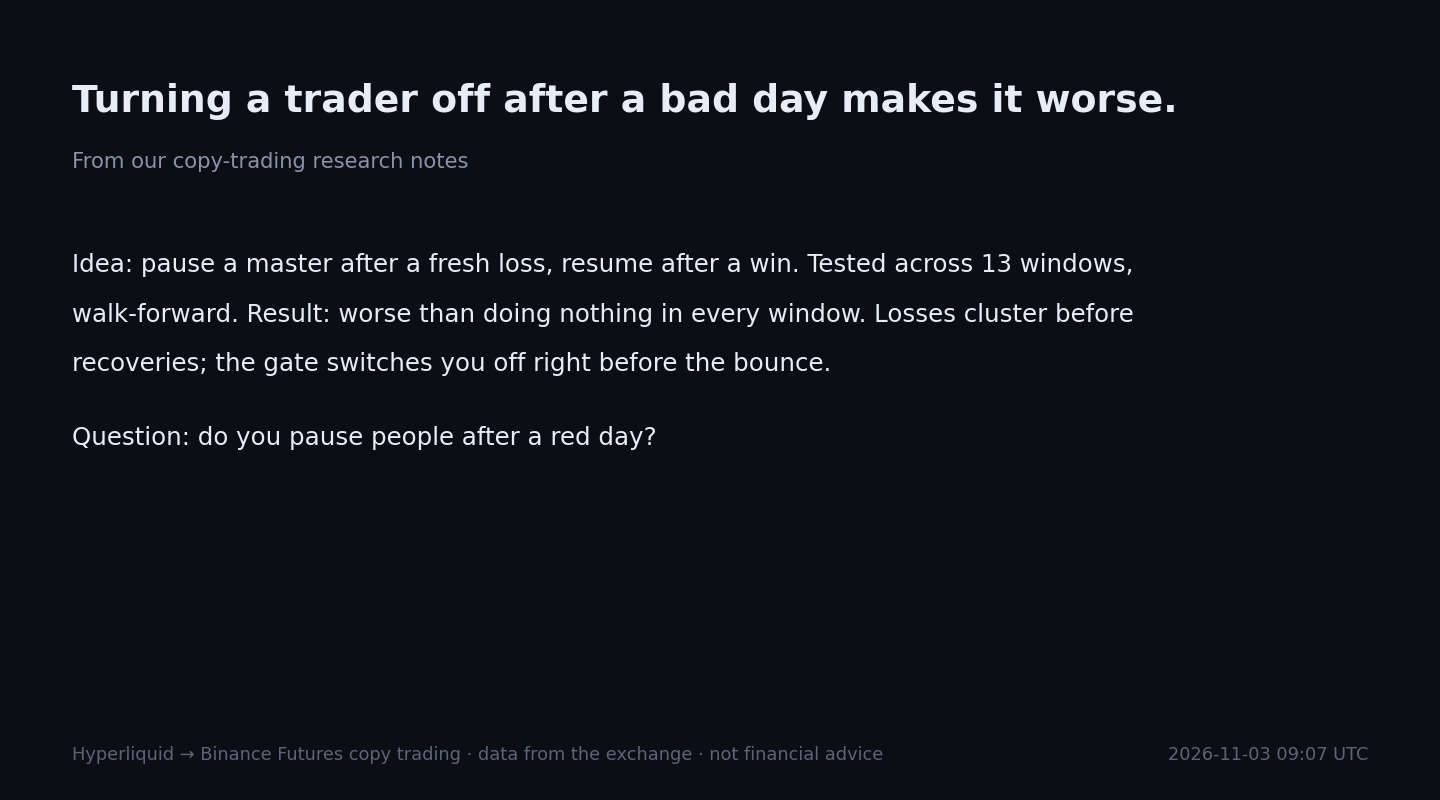
Turning a trader off after a bad day makes it worse.
Idea: pause a master after a fresh loss, resume after a win. Tested across 13 windows, walk-forward. Result: worse than doing nothing in every window. Losses cluster before recoveries; the gate switches you off right before the bounce.
Question: do you pause people after a red day?
#copytrading #hyperliquid #tradingjournal
Same trades, same rules, in a Binance group for people who copy by API or trade them by hand: https://app.binance.com/uni-qr/DpuA7yYD
1
85
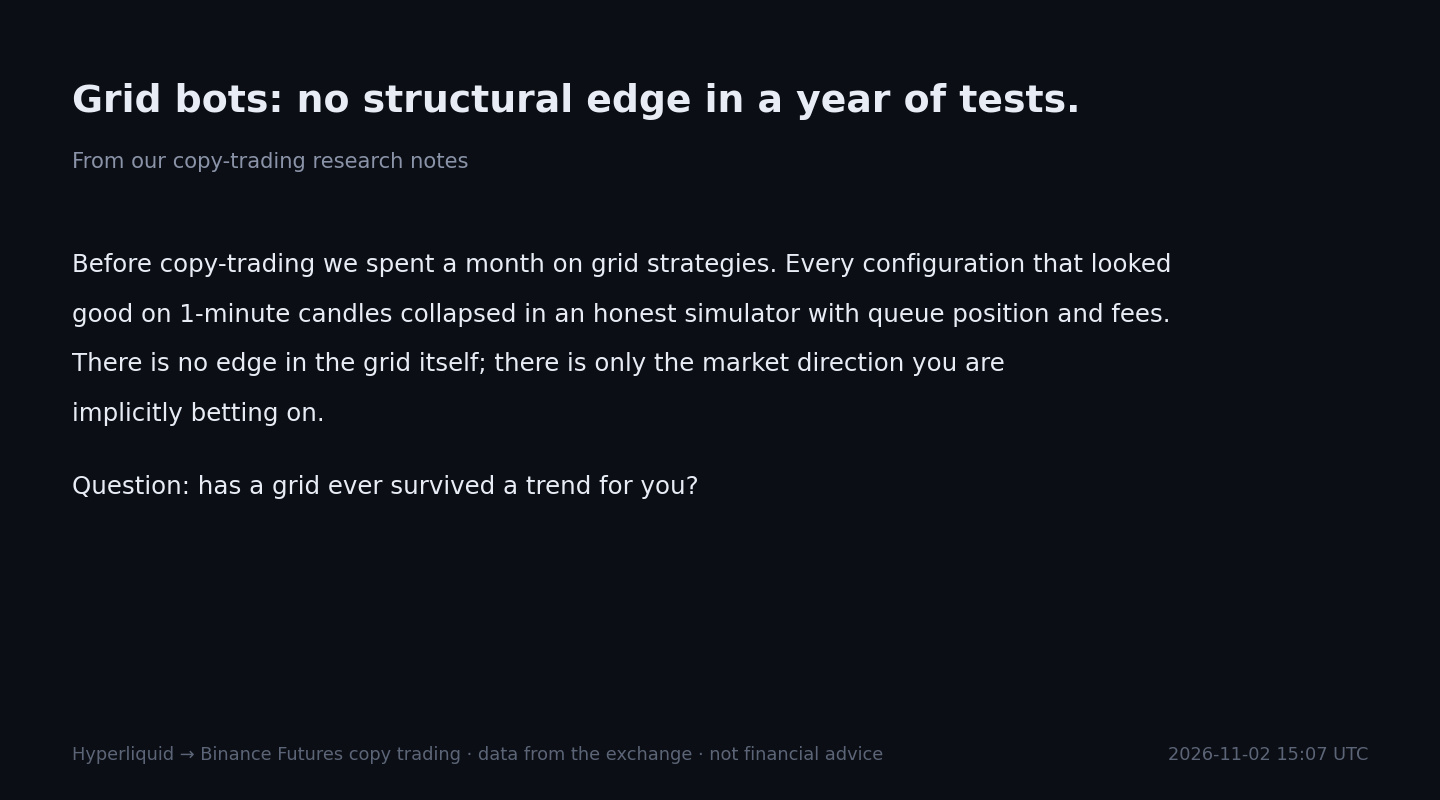
Grid bots: no structural edge in a year of tests.
Before copy-trading we spent a month on grid strategies. Every configuration that looked good on 1-minute candles collapsed in an honest simulator with queue position and fees. There is no edge in the grid itself; there is only the market direction you are implicitly betting on.
Question: has a grid ever survived a trend for you?
#copytrading #hyperliquid #tradingjournal
If you would rather get these as they happen than scroll for them, the group is here: https://app.binance.com/uni-qr/DpuA7yYD
72
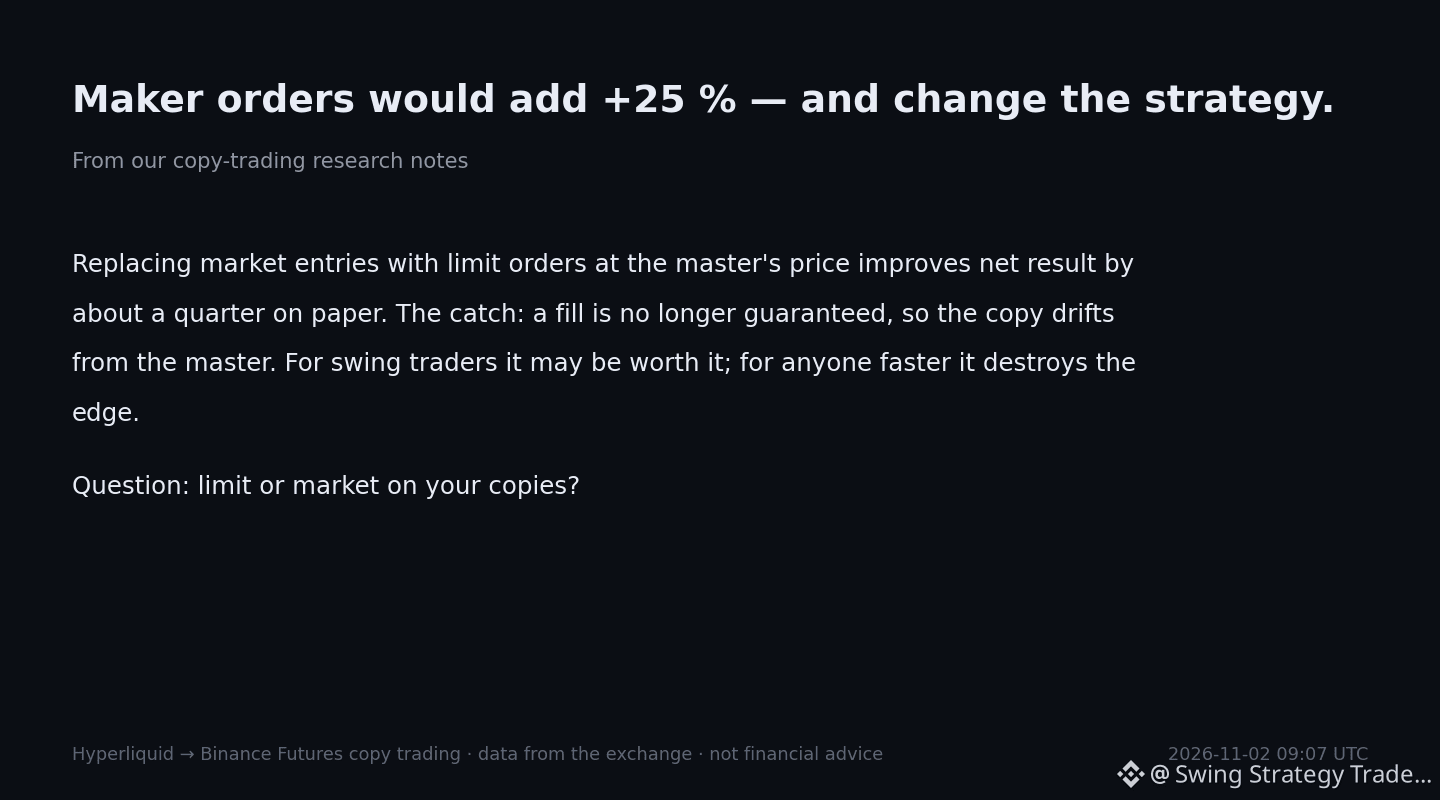
Maker orders would add +25 % — and change the strategy.
Replacing market entries with limit orders at the master's price improves net result by about a quarter on paper. The catch: a fill is no longer guaranteed, so the copy drifts from the master. For swing traders it may be worth it; for anyone faster it destroys the edge.
Question: limit or market on your copies?
#copytrading #hyperliquid #tradingjournal
We run this on a Binance copy-trading account. The group where the trades land first: https://app.binance.com/uni-qr/DpuA7yYD
76
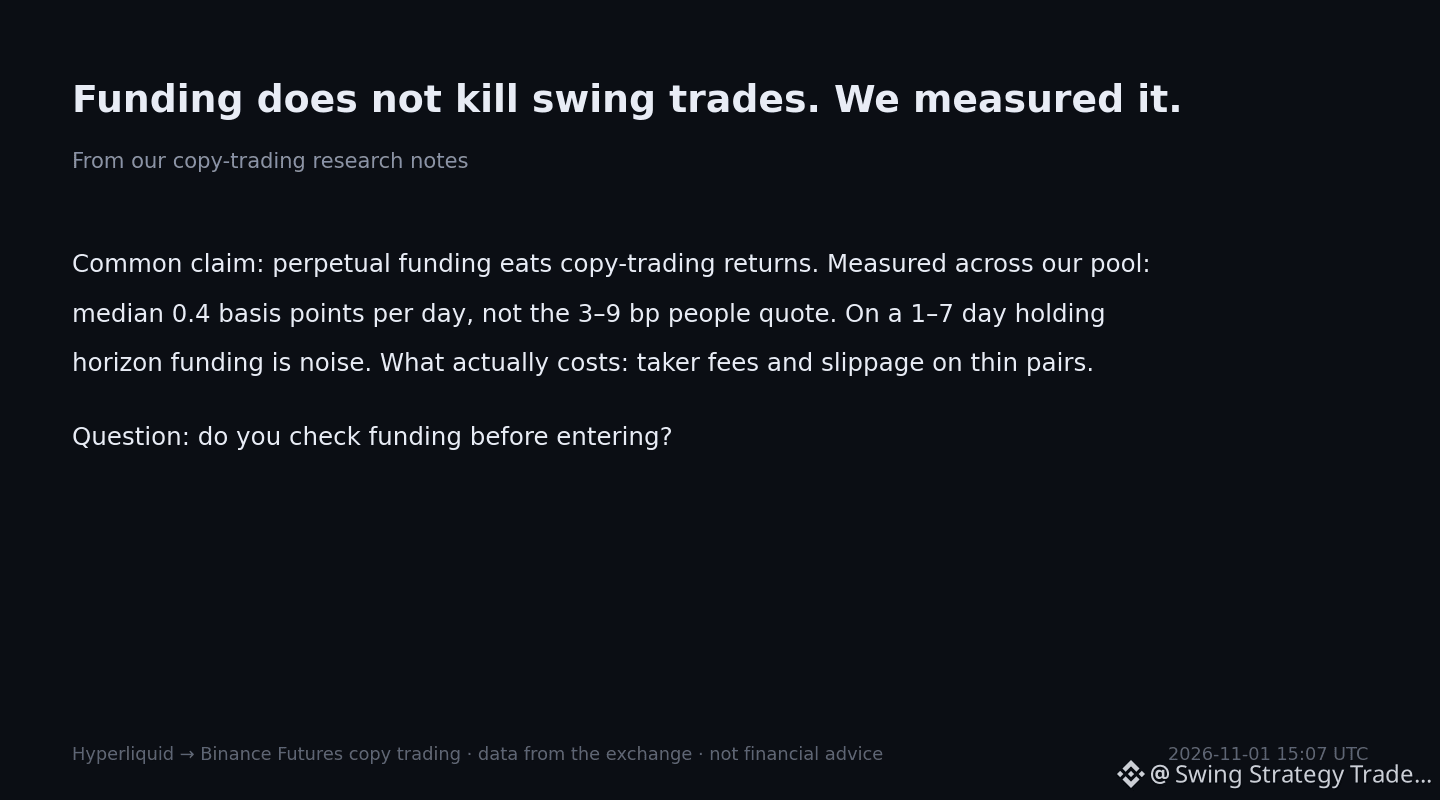
Funding does not kill swing trades. We measured it.
Common claim: perpetual funding eats copy-trading returns. Measured across our pool: median 0.4 basis points per day, not the 3–9 bp people quote. On a 1–7 day holding horizon funding is noise. What actually costs: taker fees and slippage on thin pairs.
Question: do you check funding before entering?
#copytrading #hyperliquid #tradingjournal
For anyone copying via API, trading their own account or on Binance Copy Trading, the same trades go to our group: https://app.binance.com/uni-qr/DpuA7yYD
59
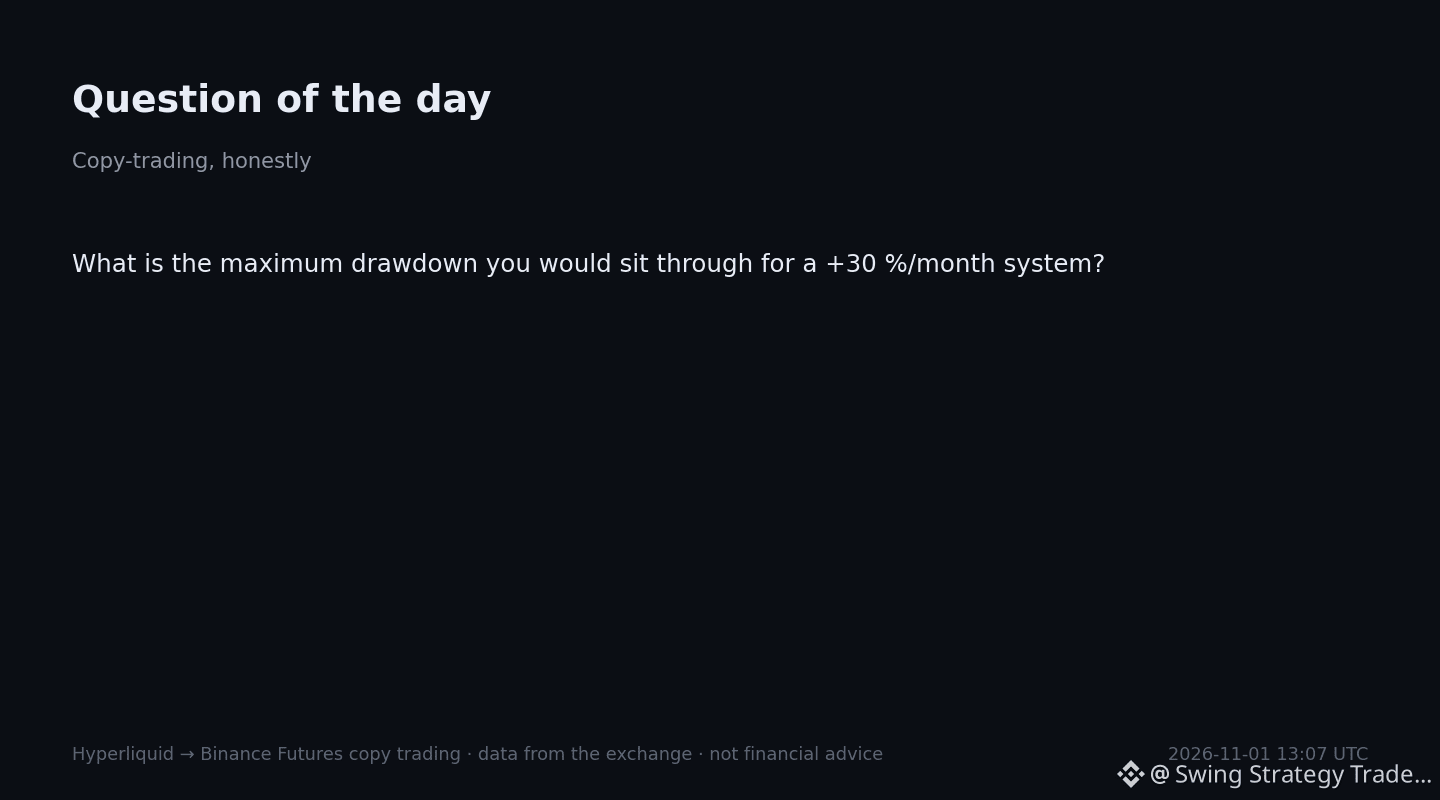
What is the maximum drawdown you would sit through for a +30 %/month system?
Our numbers are in the daily snapshot. #copytrading #hyperliquid
We run this on a Binance copy-trading account. The group where the trades land first: https://app.binance.com/uni-qr/DpuA7yYD
What is the maximum drawdown you would sit through for a +30 %/month system?
Our numbers are in the daily snapshot. #copytrading #hyperliquid
We run this on a Binance copy-trading account. The group where the trades land first: https://app.binance.com/uni-qr/DpuA7yYD
Our numbers are in the daily snapshot. #copytrading #hyperliquid
We run this on a Binance copy-trading account. The group where the trades land first: https://app.binance.com/uni-qr/DpuA7yYD
1
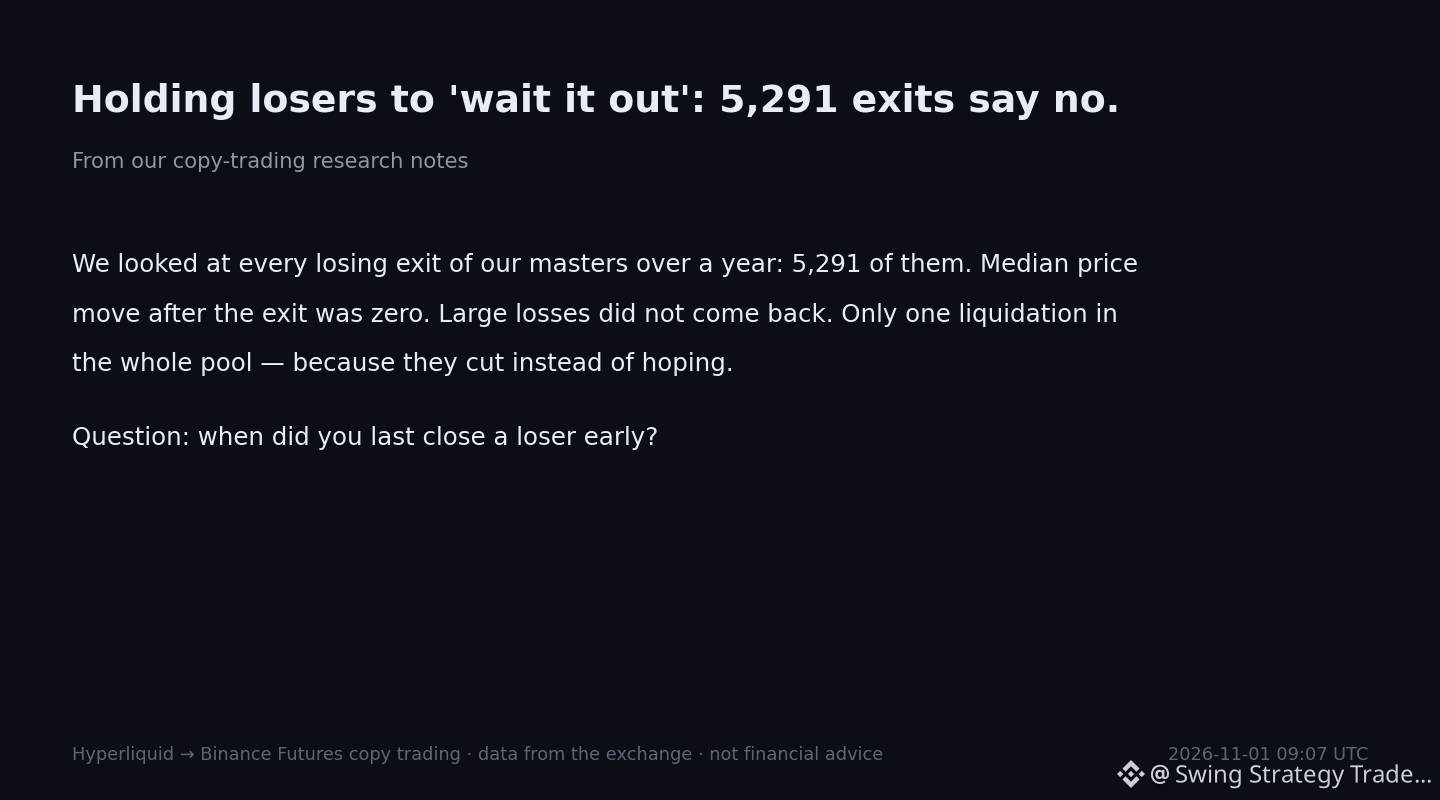
Holding losers to 'wait it out': 5,291 exits say no.
We looked at every losing exit of our masters over a year: 5,291 of them. Median price move after the exit was zero. Large losses did not come back. Only one liquidation in the whole pool — because they cut instead of hoping.
Question: when did you last close a loser early?
#copytrading #hyperliquid #tradingjournal
If you would rather get these as they happen than scroll for them, the group is here: https://app.binance.com/uni-qr/DpuA7yYD
104
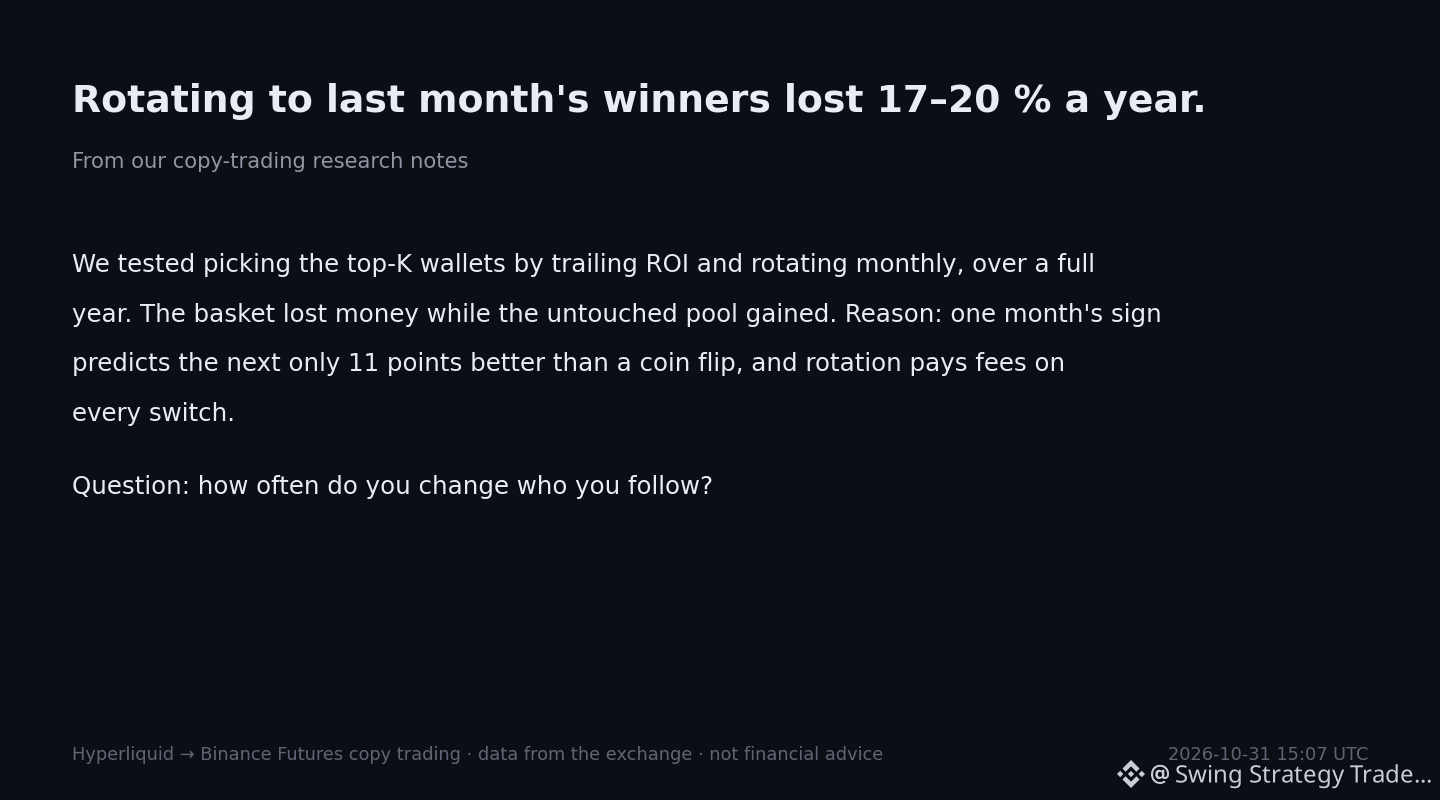
Rotating to last month's winners lost 17–20 % a year.
We tested picking the top-K wallets by trailing ROI and rotating monthly, over a full year. The basket lost money while the untouched pool gained. Reason: one month's sign predicts the next only 11 points better than a coin flip, and rotation pays fees on every switch.
Question: how often do you change who you follow?
#copytrading #hyperliquid #tradingjournal
If you copy by API like we do, or just want these entries and exits as they happen, we keep a small group on Binance: https://app.binance.com/uni-qr/DpuA7yYD
73
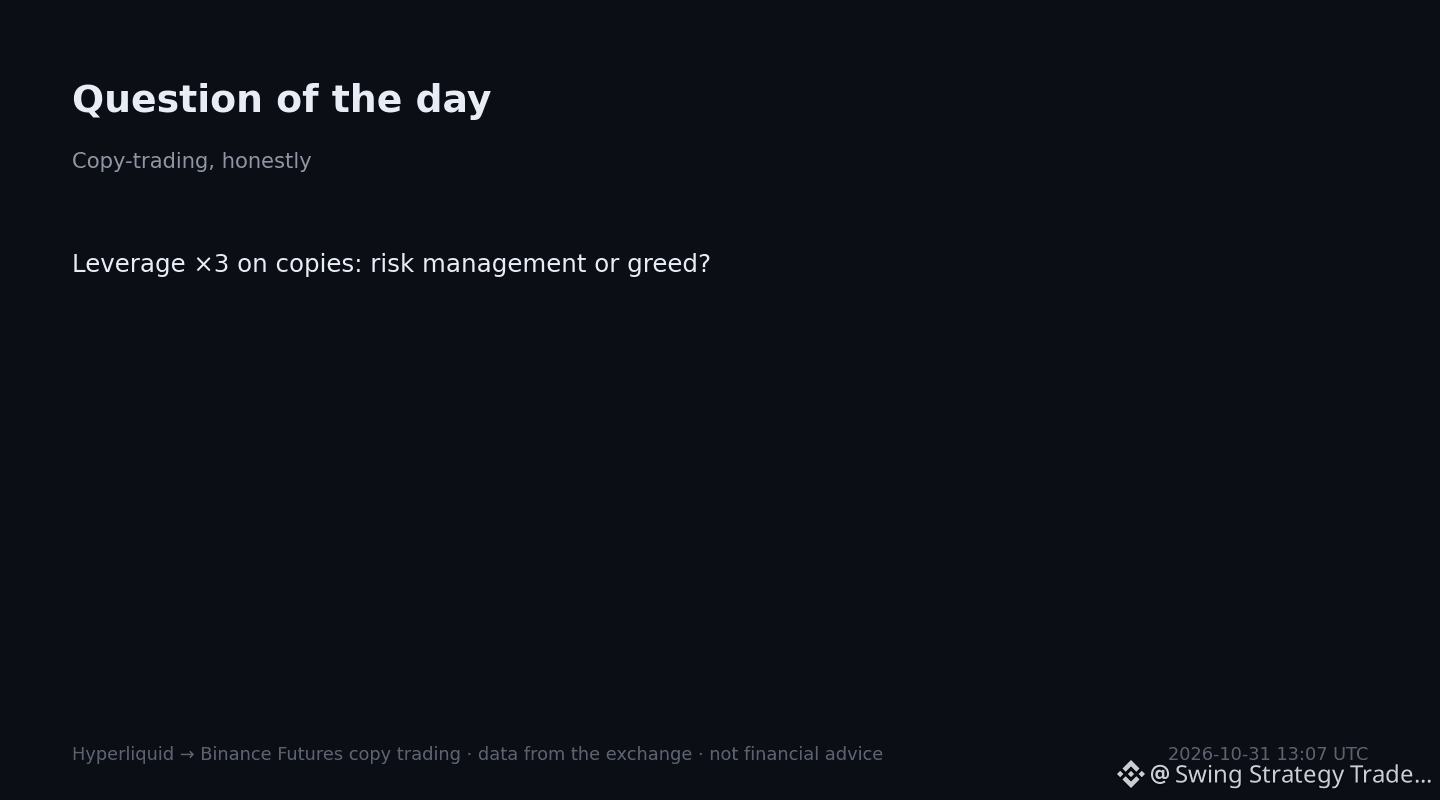
Leverage ×3 on copies: risk management or greed?
Our numbers are in the daily snapshot. #copytrading #hyperliquid
If you would rather get these as they happen than scroll for them, the group is here: https://app.binance.com/uni-qr/DpuA7yYD
Leverage ×3 on copies: risk management or greed?
Our numbers are in the daily snapshot. #copytrading #hyperliquid
If you would rather get these as they happen than scroll for them, the group is here: https://app.binance.com/uni-qr/DpuA7yYD
Our numbers are in the daily snapshot. #copytrading #hyperliquid
If you would rather get these as they happen than scroll for them, the group is here: https://app.binance.com/uni-qr/DpuA7yYD
74
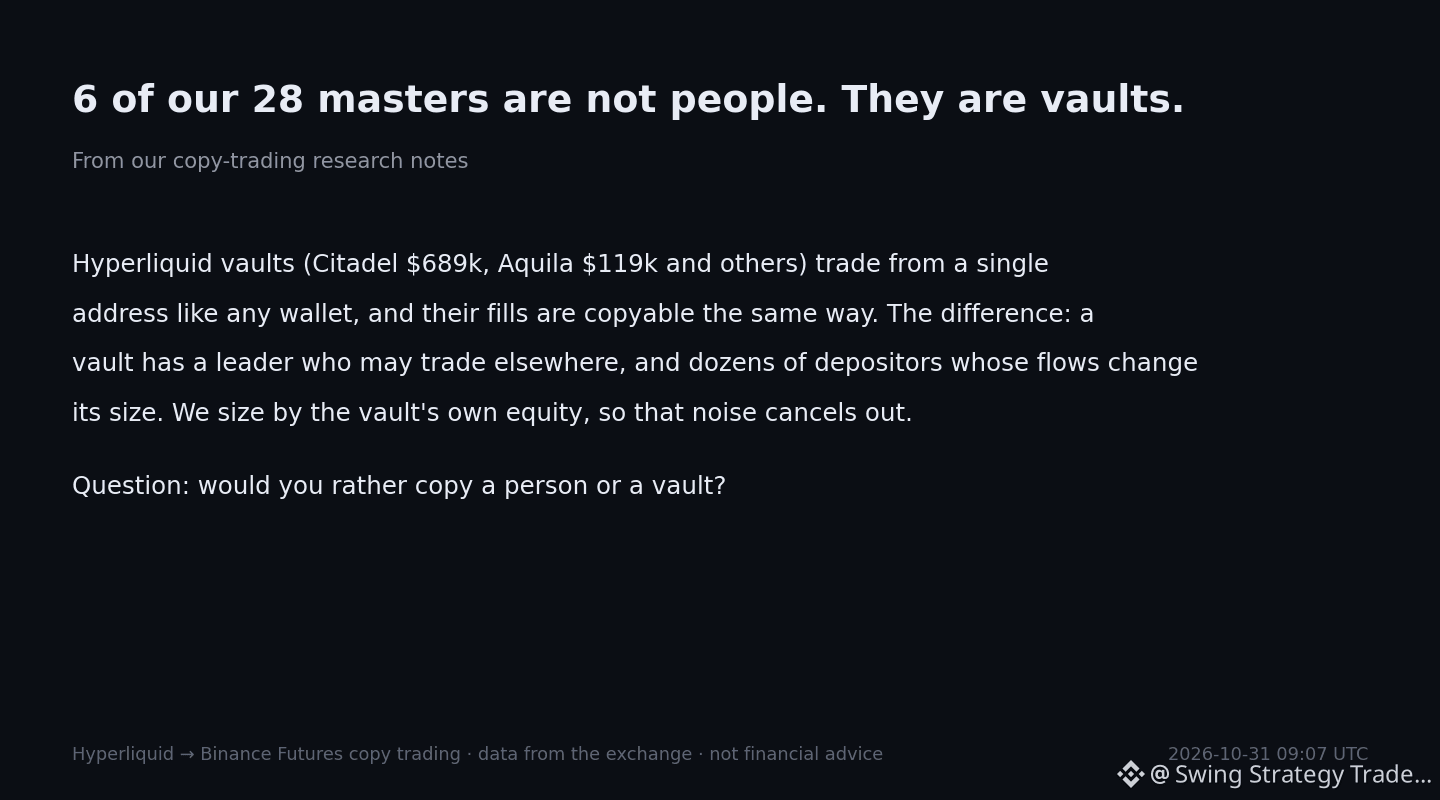
6 of our 28 masters are not people. They are vaults.
Hyperliquid vaults (Citadel $689k, Aquila $119k and others) trade from a single address like any wallet, and their fills are copyable the same way. The difference: a vault has a leader who may trade elsewhere, and dozens of depositors whose flows change its size. We size by the vault's own equity, so that noise cancels out.
Question: would you rather copy a person or a vault?
#copytrading #hyperliquid #tradingjournal
For anyone copying via API, trading their own account or on Binance Copy Trading, the same trades go to our group: https://app.binance.com/uni-qr/DpuA7yYD
145
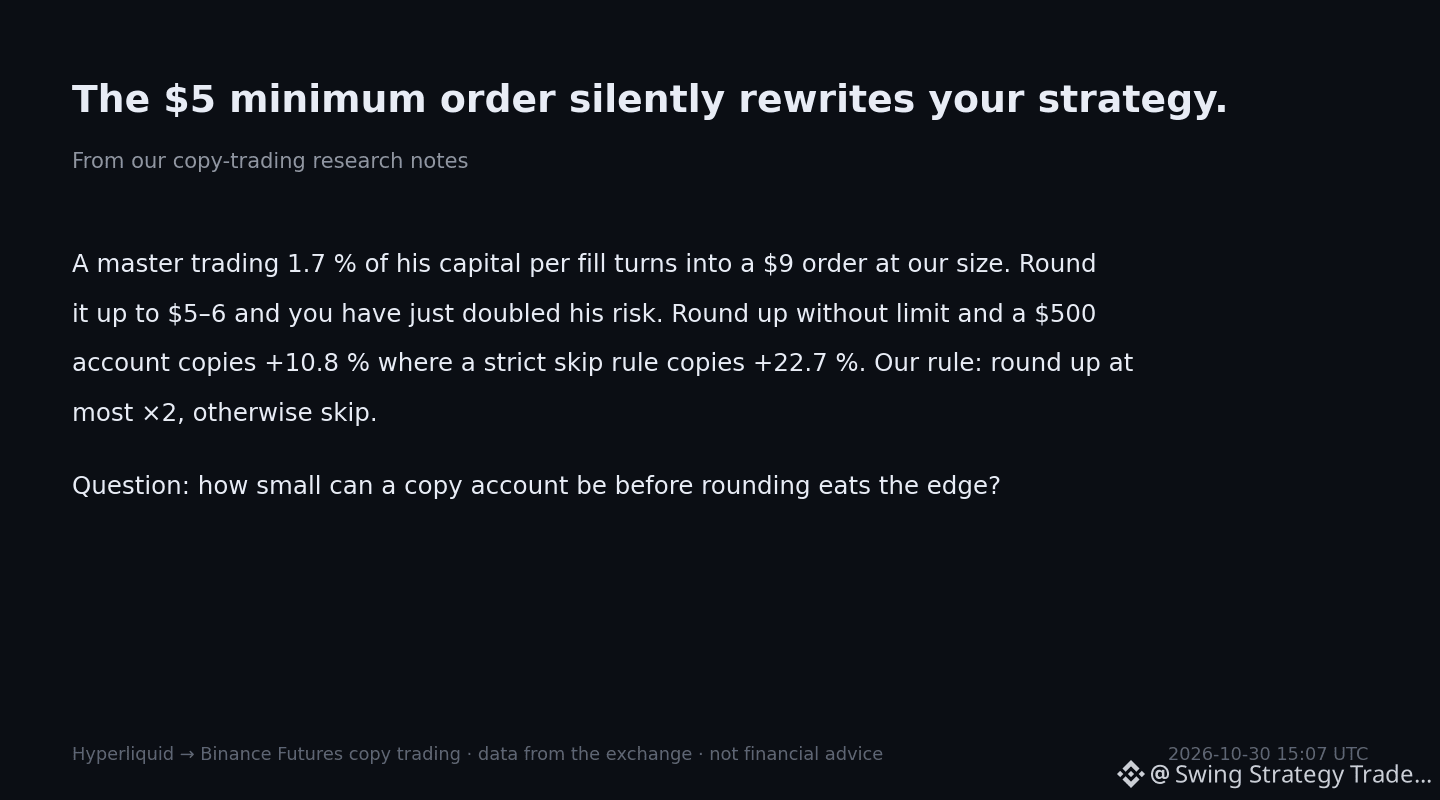
The $5 minimum order silently rewrites your strategy.
A master trading 1.7 % of his capital per fill turns into a $9 order at our size. Round it up to $5–6 and you have just doubled his risk. Round up without limit and a $500 account copies +10.8 % where a strict skip rule copies +22.7 %. Our rule: round up at most ×2, otherwise skip.
Question: how small can a copy account be before rounding eats the edge?
#copytrading #hyperliquid #tradingjournal
Same trades, same rules, in a Binance group for people who copy by API or trade them by hand: https://app.binance.com/uni-qr/DpuA7yYD
63
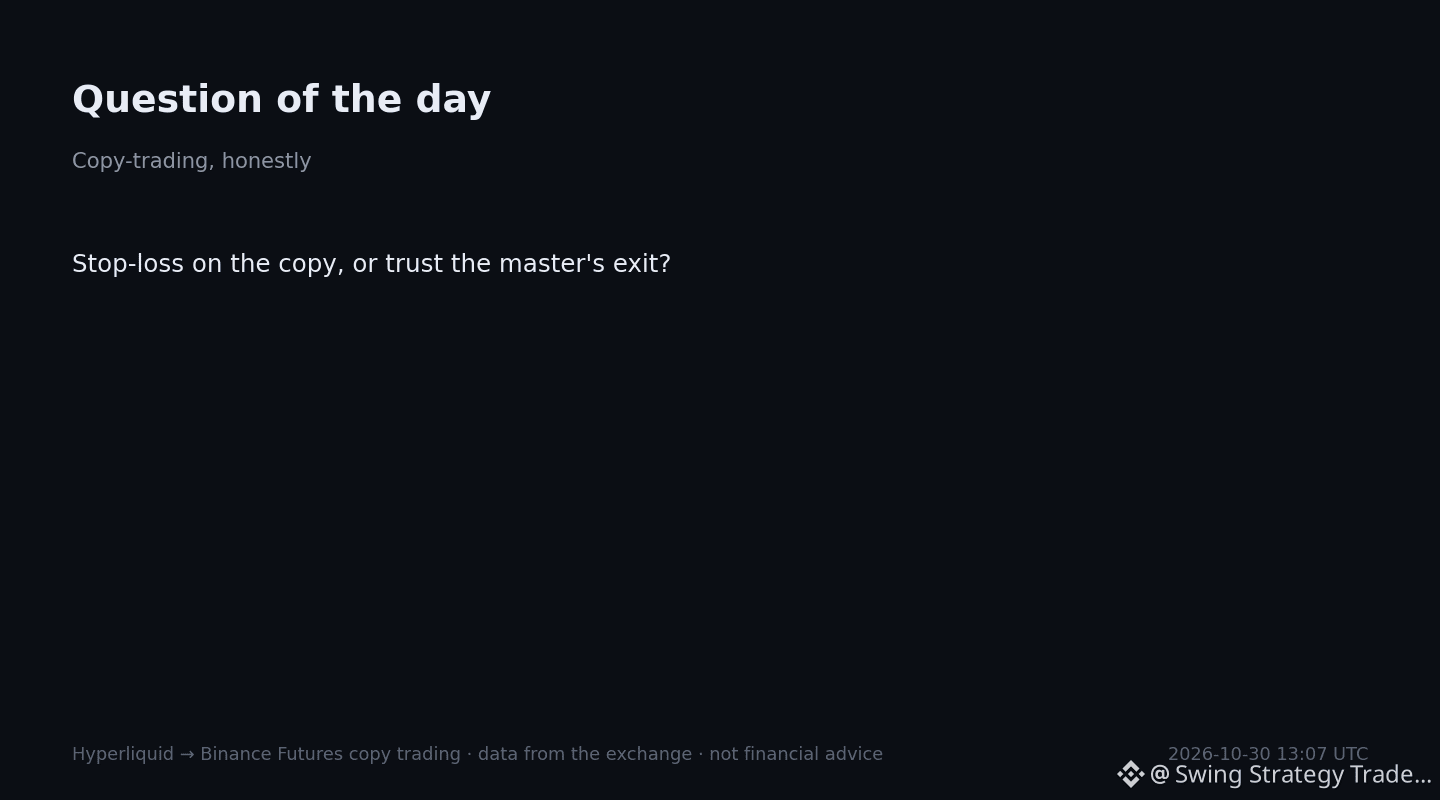
Stop-loss on the copy, or trust the master's exit?
Our numbers are in the daily snapshot. #copytrading #hyperliquid
For anyone copying via API, trading their own account or on Binance Copy Trading, the same trades go to our group: https://app.binance.com/uni-qr/DpuA7yYD
Stop-loss on the copy, or trust the master's exit?
Our numbers are in the daily snapshot. #copytrading #hyperliquid
For anyone copying via API, trading their own account or on Binance Copy Trading, the same trades go to our group: https://app.binance.com/uni-qr/DpuA7yYD
Our numbers are in the daily snapshot. #copytrading #hyperliquid
For anyone copying via API, trading their own account or on Binance Copy Trading, the same trades go to our group: https://app.binance.com/uni-qr/DpuA7yYD
9
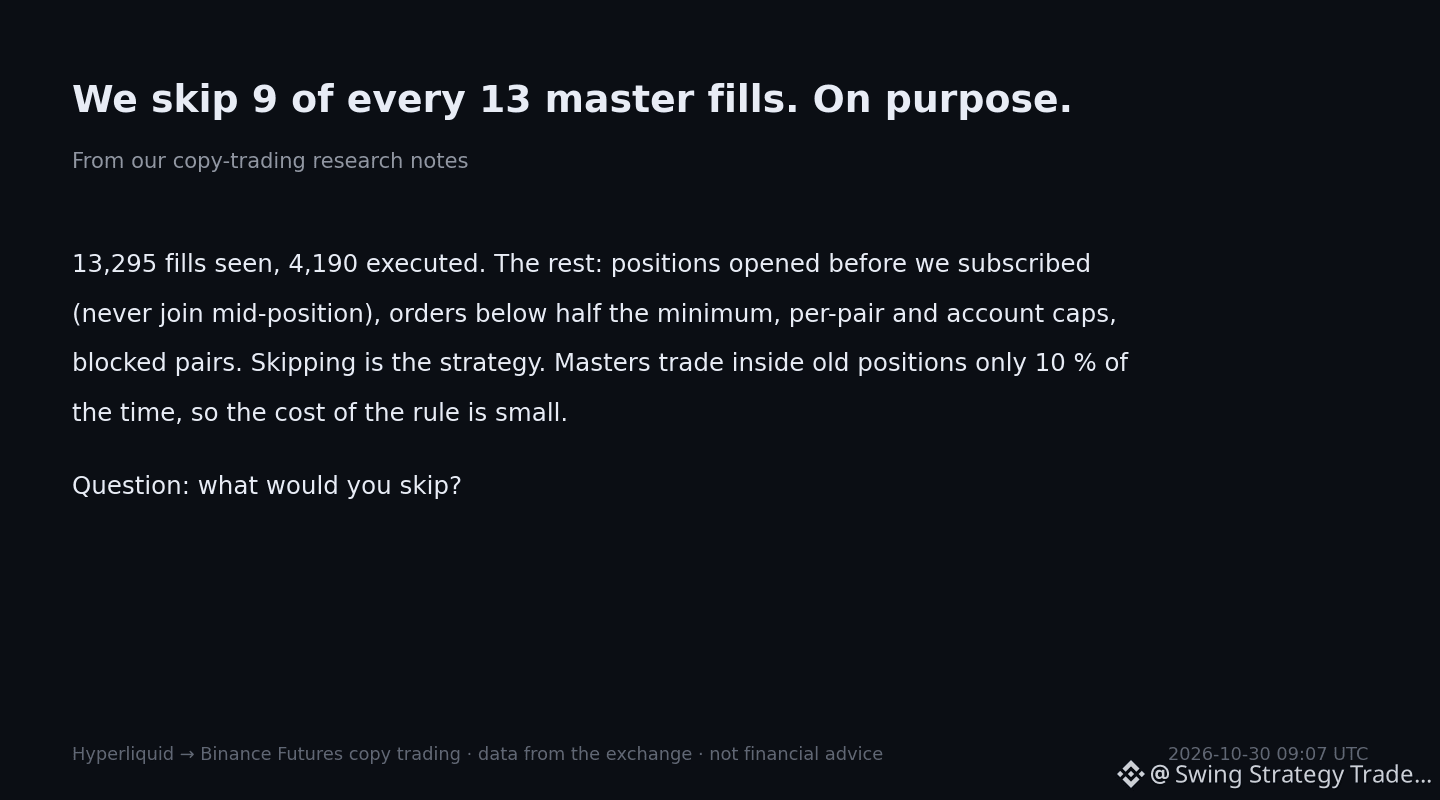
We skip 9 of every 13 master fills. On purpose.
13,295 fills seen, 4,190 executed. The rest: positions opened before we subscribed (never join mid-position), orders below half the minimum, per-pair and account caps, blocked pairs. Skipping is the strategy. Masters trade inside old positions only 10 % of the time, so the cost of the rule is small.
Question: what would you skip?
#copytrading #hyperliquid #tradingjournal
If you copy by API like we do, or just want these entries and exits as they happen, we keep a small group on Binance: https://app.binance.com/uni-qr/DpuA7yYD
71
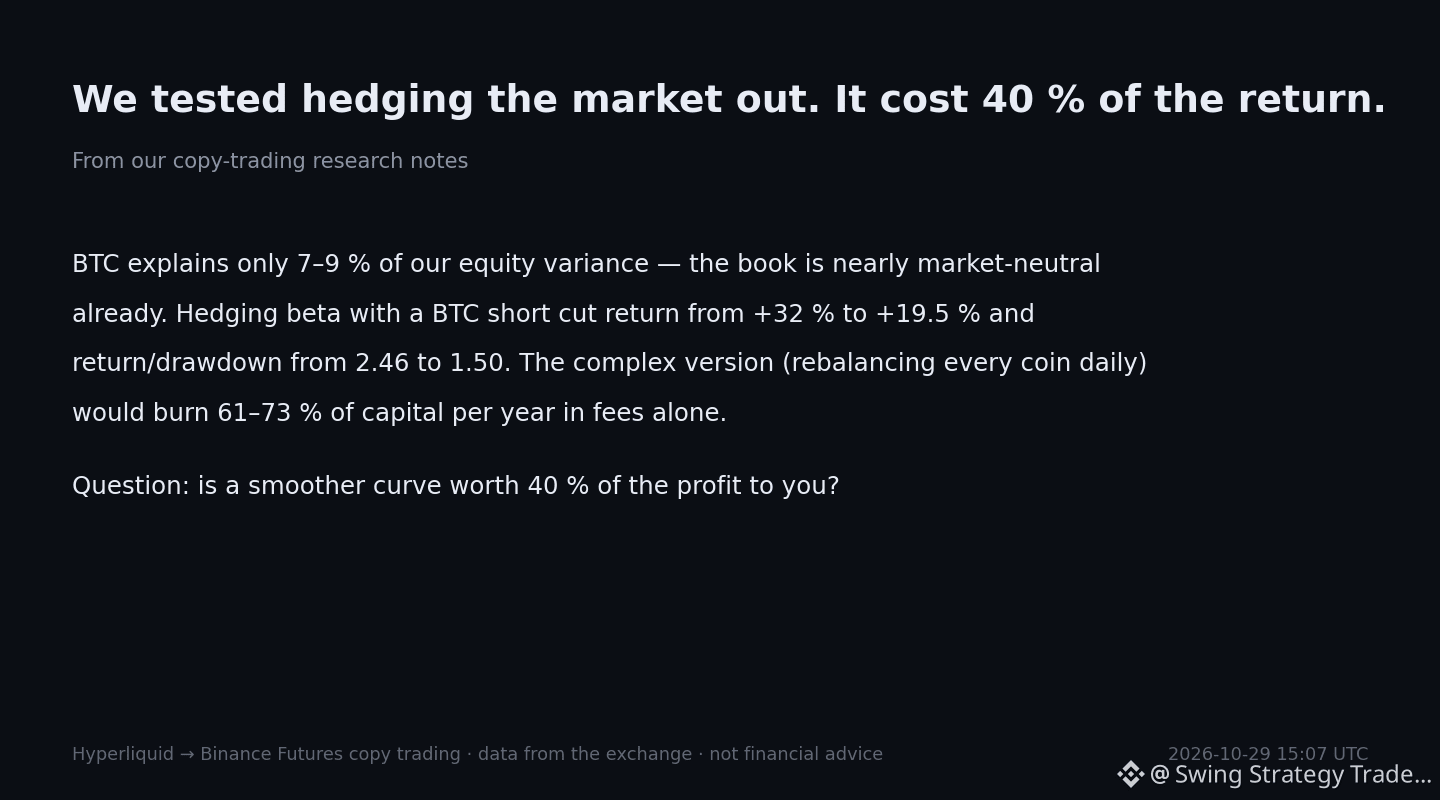
We tested hedging the market out. It cost 40 % of the return.
BTC explains only 7–9 % of our equity variance — the book is nearly market-neutral already. Hedging beta with a BTC short cut return from +32 % to +19.5 % and return/drawdown from 2.46 to 1.50. The complex version (rebalancing every coin daily) would burn 61–73 % of capital per year in fees alone.
Question: is a smoother curve worth 40 % of the profit to you?
#copytrading #hyperliquid #tradingjournal
We run this on a Binance copy-trading account. The group where the trades land first: https://app.binance.com/uni-qr/DpuA7yYD
73
Would you copy a trader with 44 % accuracy and a 3:1 payoff?
Our numbers are in the daily snapshot. #copytrading #hyperliquid
If you copy by API like we do, or just want these entries and exits as they happen, we keep a small group on Binance: https://app.binance.com/uni-qr/DpuA7yYD
Would you copy a trader with 44 % accuracy and a 3:1 payoff?
Our numbers are in the daily snapshot. #copytrading #hyperliquid
If you copy by API like we do, or just want these entries and exits as they happen, we keep a small group on Binance: https://app.binance.com/uni-qr/DpuA7yYD
Our numbers are in the daily snapshot. #copytrading #hyperliquid
If you copy by API like we do, or just want these entries and exits as they happen, we keep a small group on Binance: https://app.binance.com/uni-qr/DpuA7yYD
4
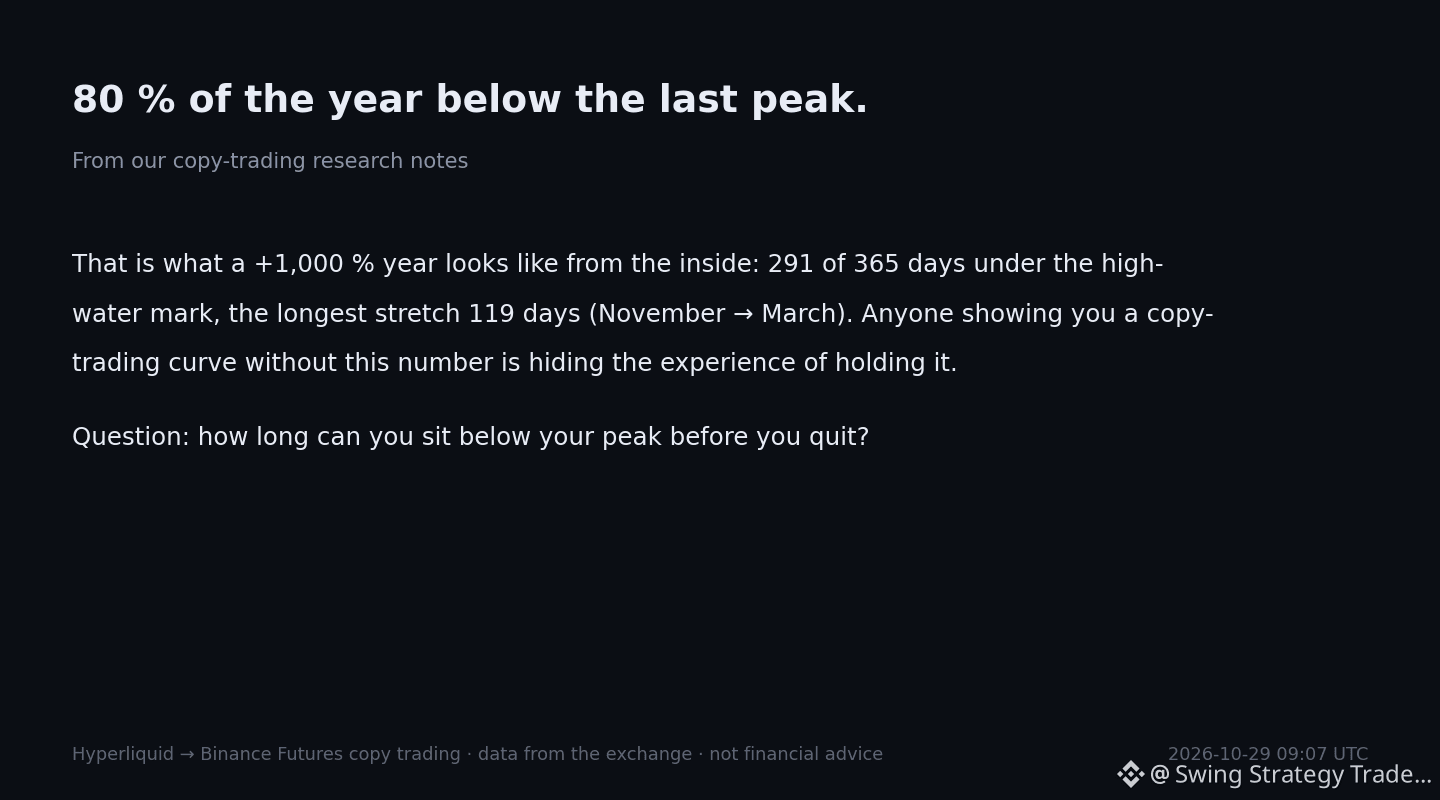
80 % of the year below the last peak.
That is what a +1,000 % year looks like from the inside: 291 of 365 days under the high-water mark, the longest stretch 119 days (November → March). Anyone showing you a copy-trading curve without this number is hiding the experience of holding it.
Question: how long can you sit below your peak before you quit?
#copytrading #hyperliquid #tradingjournal
Same trades, same rules, in a Binance group for people who copy by API or trade them by hand: https://app.binance.com/uni-qr/DpuA7yYD
104
Log in to explore more content
Join global crypto users on Binance Square
⚡️ Get latest and useful information about crypto.
💬 Trusted by the world’s largest crypto exchange.
👍 Discover real insights from verified creators.
Email / Phone number
Trending Topics
BTCRebounds80K
24,350 views
509 Discussing
$BTC LONG SETUP ... NEXT TARGET 81,923.14
Upper Range Breakout Observed Alongside Balanced Momentum Signals
Entry: 78,610.70 - 78,959.38 (Long)
TP1: 79,831.07
TP2: 80,877.11
Final TP: 81,923.14
SL: 77,739.01
Price expanded upward over the past twenty-four hours to trade above the peak of the last twenty four-hour candles. As the relative strength index remains neutral on the four-hour chart, traders monitor whether this level transitions into support.
As long as 78,610.70 holds, structure stays constructive
Must use stop loss while trading
Trade $BTC
Not financial advice. Always DYOR.
Like & Follow for Daily Trade Analytics & Insider News. @SarwatAK
#HotTrends #TechnicalAnalysis #BTCRebounds80K
SarwatAK
·0 Likes
·246 views
Binance98PercentReplenished
22,082 views
458 Discussing
USMidterms-WhatAreMarketsExpecting?
287,234 views
1,932 Discussing