
KK聊币圈
610 Posts

KK聊币圈
Report
Block User
币圈一天,人间一年。
下手要快,梭哈要猛。
26 Following
188 Followers
176 Liked
Posts
·
--
#Anthropic’s record-breaking IPO: Is a $1.5 trillion market cap justified?
It peaked at the open and closed at $97.17. Those who chased it at the opening are sitting on losses of more than 10%.
But Cathie Wood snapped up 935,000 shares on day one, worth about $90.85 million.
IPO allocations are also out: Bitget received shares worth $12.76 million, while Binance Wallet got just $245,000. A total of 500 million USDC was subscribed, with 44,045 addresses sharing 2,957 shares.
37
·
--
#13F机构比特币现货ETP持仓创纪录
Institutions were buying the dip in Q3: 13F filings show they net bought 49,229 bitcoins, while spot ETP holdings hit a record 356,491, worth about $29.8 billion.
Wealth management platforms led the way, holding 144,307 bitcoins, or 40.5% of the total, and recording net purchases for nine consecutive quarters. Wells Fargo took the top spot as the largest holder for the first time, with 30,553 bitcoins—nearly doubling its holdings in a single quarter.
But this snapshot is from September 30. Since then, BTC has fallen from $83,580 to around $62,000, a drop of more than 20%. The 49,229 bitcoins institutions bought in Q3 are now all underwater.
Institutions bought the dip halfway down. I know this script all too well.
·
--
#Strategy旗下STRC优先股跌破100美元面值
Three bad headlines from the overnight session.
BTC fell below 62,000, now at 61,784, with a 24-hour low of 61,375. Market breadth: 173 advancers versus 584 decliners; the Fear & Greed Index is at 10.
The AI trade is crumbling even harder: AMD perpetuals down 11.6%, SOXL perpetuals down 15.4%. That short-selling report from Hunterbrook is still making waves.
STRC is at $94.63, still below its $100 par value. The funding rate hit its cap, and settlement has been changed to once every hour.
On a night like this, sleeping beats staring at the charts.
924
·
--
#Anthropic’s record-breaking IPO: Is a $1.5 trillion valuation justified?
Anthropic’s first day ended with shares opening at $111.50 and closing at $97.17. That’s still 17% above the offering price, but 13% below the opening price.
Anyone who bought in at the open was down 13% on day one. Binance’s ANT perpetual contract is now at $93.45 and still falling.
On the wallet side: a $500 million subscription got just 2,957 shares, with the rest fully refunded, plus a $1 million ANTB airdrop. Those who missed out got it for free.
The most painful part is FTX: the Anthropic stake it bought for $500 million was sold by the bankruptcy estate for $1.3 billion in 2024. At the $83 offering price, that stake would be worth $37 billion.
The big winners in this IPO are the people who missed out on the subscription.
6
·
--
#Anthropic's record-breaking IPO: Is a $1.5 trillion market cap justified?
Anthropic began trading: $111.5, opening 34% higher, with a market cap of $1.47 trillion. It hit $114.99 and then reversed, falling below $100. It's now at $99.25.
How are the people who chased it at the open feeling now?
Meanwhile, Binance will list ANTB spot at 02:00. The wallet is fully refunding subscription payments, giving away 2,957 share allocations for free, and airdropping another $1 million worth of ANTB. Those who subscribed through the wallet got it all for free.
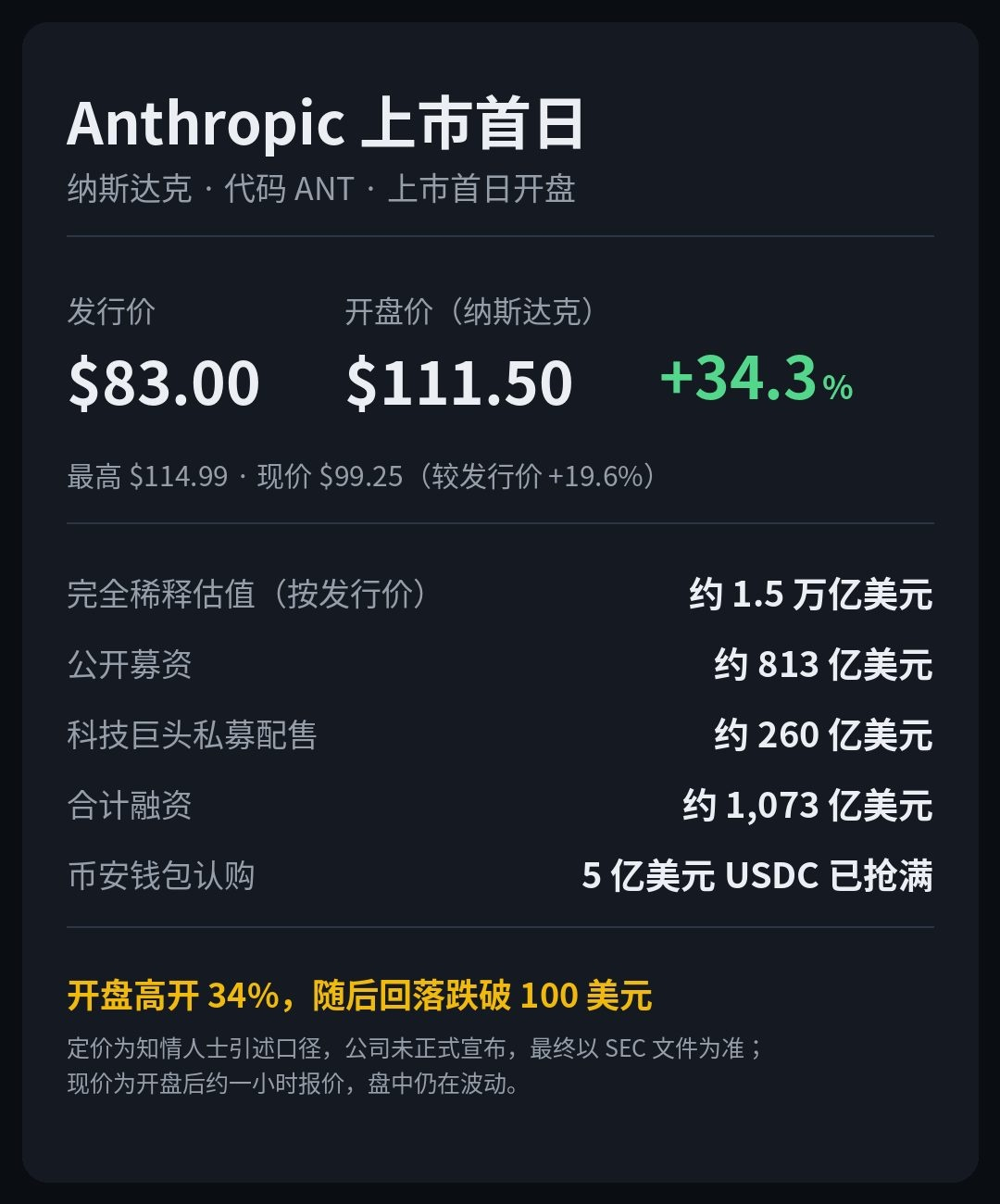
241
·
--
Even hackers play the market better than retail traders.
On-chain analyst Ember spotted a wallet linked to a hacker receiving 5,270 ETH from Tornado Cash, selling it at an average price of about $1,805 for roughly 9.51 million USDC, then transferring the funds to Hyperliquid and placing a long order for about 13,800 ETH in the $1,551–$1,568 range, with a notional value of around $21.51 million.
In other words: sell high, then place orders to buy back at a lower price. Even hackers are swing trading, waiting for ETH to drop to around $1,550 before buying.
Two things to note: this is an “address linked to a hacker”—there’s no evidence that it belongs to the person from Binance; and the order amount hasn’t necessarily been filled, so don’t assume the ETH has already been bought.
14
·
--
Hong Kong’s SFC has named Hyperliquid.
On November 18, the SFC added Hyperliquid to its alert list of “suspicious virtual asset trading platforms,” citing that it does not hold a Hong Kong licence and is suspected of operating in Hong Kong or promoting its services to the Hong Kong public. The platform’s trading URL was listed, but the address field was blank—not even a street number could be filled in.
To be clear: this is a warning, not a conviction, and certainly not an order to shut down. No website was blocked, no assets were frozen, and trading was not halted. The UK’s FCA issued a similar warning in May this year, and Singapore’s MAS did so on June 26. Hyperliquid kept operating as usual. HYPE also saw no obvious sell-off that day.
But for people in Hong Kong using Hyperliquid, the message behind this yellow card is clear: if something goes wrong, it will be very difficult to get help from Hong Kong law to recover your funds.
16
·
--
Sky is in serious trouble now.
CoinDesk’s investigation today found that North Korean hackers and other illicit wallets moved $518 million through Sky’s PSM (Peg Stability Module), including $102 million directly linked to North Korea and funds from the Bybit hack. The PSM’s role is to swap freezeable USDC for USDS and DAI, which can’t be frozen—hackers are using it as a money-laundering channel.
Even more alarming is what’s on the other side: $2.7 billion in USDC reserves sits in a single PSM wallet, backing DAI and USDS. If Circle blacklists that address at a court’s request, not a cent of that $2.7 billion will be accessible, locking up legitimate users’ funds too.
The $518 million is the transaction volume of high-risk wallets, not funds officially determined to be stolen; no freeze has happened yet, so this is a risk, not a fact. But this is the weak spot in DeFi stablecoins, plain to see: they claim to be decentralized, yet their reserves sit in a wallet that can be frozen by a centralized entity.
1
2k
·
--
#蚂蚁国际推出Whale协议并完成试点
Ant International made a major announcement today: the Whale protocol.
In plain English, it enables real-time settlement between tokenized deposits and tokenized money market funds, with delivery-versus-payment and atomic settlement. It cuts out the delays of T+ several days that are typical of traditional funds. DBS Bank and Franklin Templeton have completed a pilot: DBS brought Treasury Tokens into the system, while Franklin Templeton brought in tokenized money market funds.
This is the first time Singapore has achieved cross-asset interoperability between these two types of tokenized assets, under the Monetary Authority of Singapore's BLOOM initiative.
There's no token to speculate on, but this is serious infrastructure: money from major institutions is starting to flow on-chain in real time. When this system is connected to stablecoins one day, things will get even bigger.
29
·
--
Alibaba’s Q2 results are out, and profits have really bounced back.
Revenue was 271.5 billion, up 10% year over year, slightly above expectations but nothing too surprising. The highlight was profit: adjusted net income was 19.9 billion, up 92% year over year. AI spending dug a hole in profits in the same period last year, and this year they’re starting to fill it back in.
Of course, they’re still burning cash on AI, and free cash flow remains negative. Profits are recovering while cash is bleeding out—that’s what all the AI giants look like right now.
BABA TradFi perpetuals are available on Binance, currently around $84.70, and the stock hasn’t moved much since the earnings report. The real action starts when the US market opens tonight, so keep an eye on it.
209
·
--
Jensen Huang isn’t coming back. The board has made its decision final.
At Wednesday’s all-hands meeting, Chair Jones explained for the first time why the resignation was accepted: it wasn’t just a matter of personal conduct; more importantly, it was a “lack of candor.” The board unanimously accepted the resignation, won’t change its mind, and won’t look for a “Jensen Huang clone.”
Interim CEO Kress is trying to reassure employees: raises and additional stock awards will be paid out early, this December, a few months ahead of schedule. Employees submitted around 700 questions in advance, and their biggest concern was money.
The possibility of a return is now completely off the table. The only question now is who the new CEO will be.
8
·
--
The Alpha airdrop opens for claims tonight at 18:00, with a 250-point threshold.
The token hasn't been announced yet. Claims open promptly at 18:00, first come, first served. If you have enough points, don't forget to set an alarm.
The Alpha airdrop opens for claims tonight at 18:00, with a 250-point threshold.
The token hasn't been announced yet. Claims open promptly at 18:00, first come, first served. If you have enough points, don't forget to set an alarm.
The token hasn't been announced yet. Claims open promptly at 18:00, first come, first served. If you have enough points, don't forget to set an alarm.
44
·
--
The hacker has moved again.
Today’s batch was 108,000 ETH, worth about $195 million, split into 9 transactions of 12,000 ETH each and sent to 9 newly created addresses. Beosin’s monitoring shows that the attacker’s address is still the same old address.
This is separate from yesterday’s batch: yesterday it was 60,000 ETH across 5 transactions; today it’s 108,000 ETH across 9 transactions. Don’t mix the two up.
Moving the funds doesn’t mean they’ve been sold. There’s currently no evidence of a sell-off, and the receiving addresses haven’t been identified. Frozen doesn’t mean recovered—the funds are still sitting on-chain.
7
·
--
This market is wearing everyone down and making us nervous.
BTC has been bouncing between 62,000 and 63,500. It held above the low of 62,030, but it doesn’t have the strength to move higher either. The Fear & Greed Index is at 10—extreme fear has practically become a permanent fixture.
Everyone online is watching two things: the APEC meeting this afternoon and Anthropic’s listing tonight. Same here—I’ve got my eyes on ANT’s pre-market price, swinging between $98 and $100, about 20% above the offering price. We’ll see what happens when the market opens tonight.
On days like this, there isn’t much a trader can do: wait. Wait for a direction, wait for a reason to make a move.
513
·
--
#Anthropic今日开始交易,IPO定价每股83美元
Anthropic is going public tonight, and Binance has already paved the way.
CZ made the announcement: Anthropic-related tokens will launch on BNB Chain on the first day of trading, and can be traded through three channels: bStocks, Ondo, and xStocks. ANT has also been added to Binance Stock Trading. Nasdaq’s ANT opens tonight, while its tokenized on-chain version launches the same day—a live test for blockchain-based stocks.
To be clear: these tokens provide price exposure only; they are not Anthropic shares and carry no voting, dividend, or shareholder rights. Binance also says it does not independently verify reserves or guarantee a 1:1 peg. The 500 million USDC ANTx subscription on the wallet side was snapped up long ago, and tokens may be credited as soon as two hours after Nasdaq opens.
An after-hours signal: ANT is trading at around $100 on Trade.xyz, roughly 20% above its $83 offering price.
1
520
·
--
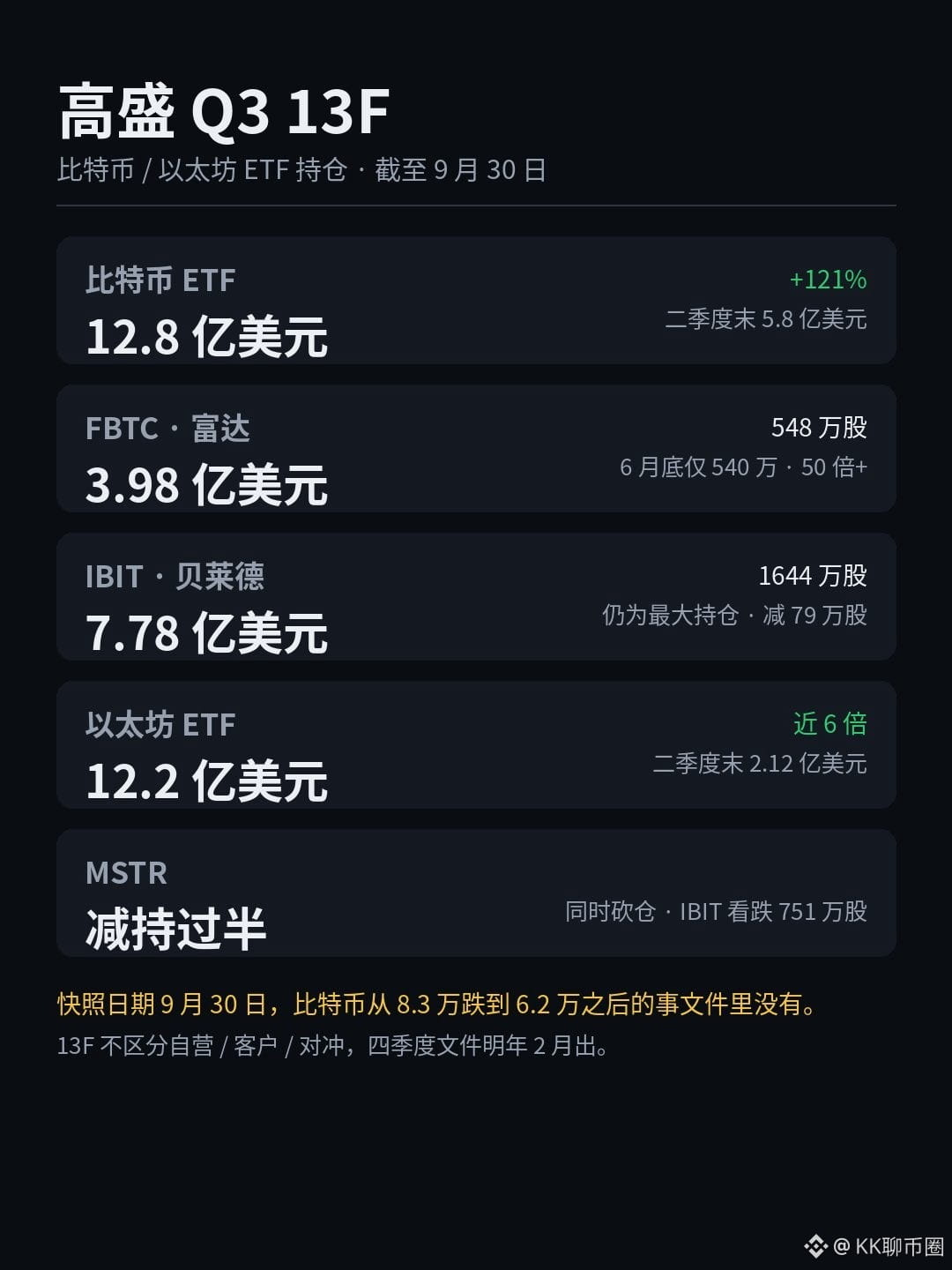
Goldman Sachs more than doubled its Bitcoin ETF holdings in the third quarter; the chart shows the 13F figures.
But don’t rush to conclude that Goldman is bullish: this is a snapshot from September 30, after Bitcoin fell from $83,000 to $62,000. The filing says nothing about what happened after that. Goldman also cut its Strategy shares by half, and it had 7.51 million shares’ worth of put options and 4.9 million shares’ worth of call options on IBIT—positions on both sides. 13F filings also don’t say whether holdings are proprietary, held for clients, or used for hedging.
So what this filing really tells us is that institutions increased their Bitcoin ETF holdings in the third quarter, and Goldman was one of them. ETFs are seeing outflows now. Whether Goldman has changed its position won’t be clear until its fourth-quarter filing comes out in February.
MSTR-6.15%
IBITETF-0.65%
116
·
--
#韩国拟允许3500家上市公司投资比特币
South Korea is also going to let publicly listed companies enter the market and buy crypto.
According to South Korean media outlet News1, the Financial Services Commission (FSC) plans to issue guidelines next week allowing around 3,500 listed companies and registered professional investors to buy crypto assets such as Bitcoin. A draft of the accompanying Digital Asset Basic Act is also expected to be submitted to the National Assembly next week.
Let’s be clear about what this means: these are planned guidelines; the gates have not yet opened. The FSC has not officially announced a timeline, and issuing the guidelines won’t mean trading can begin immediately—we still have to wait for the FSC to say when the first order can be placed. Key terms, such as the investment cap, have also not been finalized. The claim circulating in January that investments would be capped at 5% of equity capital per year and limited to the top 20 cryptocurrencies was just a draft proposal rumor; the FSC said at the time that nothing had been decided.
But the direction is real: South Korea’s second phase of its 2025 roadmap, which would bring listed companies into the market, was originally due to take effect in the second half of last year, but never materialized. This time, they’re pushing it forward alongside the draft of the Basic Act—so they really are getting moving.
2
5
1.9k
·
--
#Anthropic今日开始交易,IPO定价每股83美元
$83 is just the price. The scale is what’s truly staggering about this IPO.
The final figures cited by BlockBeats: about 980 million shares issued, with roughly $81.3 billion raised in the public offering. Add around $26 billion in private subscriptions from major companies like Google, Nvidia, Microsoft, and AMD, and the total comes to about $107.3 billion—one of the largest IPOs in history.
With annualized revenue of about $81 billion, the company behind Claude will be a behemoth from day one as a public company.
As always, the company hasn’t officially announced anything yet; the final figures will be in the SEC filing. See you at the opening today.
88
·
--
Verified
#Strong demand for AnthropicIPO, offering price may exceed $80
Anthropic’s pricing is in: $83.
Bloomberg, CNBC, and Reuters all cited sources familiar with the matter and reported the same figure—$83, $5 above the top of the $70–$78 range. The company is listing on Nasdaq today under the ticker ANT, at a fully diluted valuation of about $1.5 trillion.
A note on the source: This figure comes from media reports citing people familiar with the matter. The company has not officially announced it, and the final prospectus has not yet been filed with the SEC. Official documents from the SEC will take precedence. Three major news outlets have reported the same price, so the uncertainty isn’t about pricing—it’s about where the stock opens today.
On Binance, the ANT perpetual is currently trading at $98.1, well above the offering price; subscriptions for 500 million USDC through the wallet were snapped up long ago. For now, let’s see which way it goes at the open today.
580
·
--
#预期继续加息比特币承压吗
The FOMC minutes came in hawkish.
Almost all officials thought that if the economy develops as expected, further rate hikes could be appropriate. Two put it more bluntly—if inflation data are unfavorable, a hike of more than 25 basis points in December is also worth considering. At the October meeting, the vote was 10–2 to hold rates at 3.75%–4%; Cook and Hammack had argued for an immediate 25-basis-point hike.
Waller said the same day that a 50-basis-point hike might be needed in December to “shock the market.” CME pricing now puts a December hike almost as a sure thing: about a 95% chance of 25 basis points and about 5% for 50.
One detail to note: these minutes are from the October 27–28 meeting, and October CPI wasn’t released until November 10—so the hotter-than-expected CPI report wasn’t factored into the minutes. In other words, the hawkish tilt may be understated.
BTC is hovering around 62,400, and the Fear & Greed Index is at 11. We’ll see how the rate-hike call plays out on December 8–9.
411
Log in to explore more content
Join global crypto users on Binance Square
⚡️ Get latest and useful information about crypto.
💬 Trusted by the world’s largest crypto exchange.
👍 Discover real insights from verified creators.
Email / Phone number
Trending Topics
IsAnthropic’s$1.5TMarketCapJustified?
27,869 views
156 Discussing
Anthropic Set to Open at $105 in Record Nasdaq Debut
Binance News
·13 Likes
·17.3k views
BTCBelow$62KAmidHikeFearsAndShiftToAnthropic
442 views
7 Discussing
NvidiaBoardReportedlySplitOverHuang’sReturn
156,036 views
1,304 Discussing