
股惑仔
246 Posts

股惑仔
Report
Block User
黄金美股数据专家
14 Following
82 Followers
609 Liked
Posts
All
Quotes
·
--
Critical Metals Corp. (CRML): A Potential Game Changer for Western Heavy Rare Earth Supply ChainsThe global rare earth market is being shaped by the dual forces of geopolitics and industrial demand. China currently accounts for approximately 70% of global rare earth mining and around 90% of processing, while Western economies are almost entirely dependent on imports for heavy rare earths. Rare earth permanent-magnet materials are indispensable in critical sectors such as defense, electric vehicles, and wind power. This structural imbalance has created urgent demand for non-Chinese rare earth supply chains, and Critical Metals Corp. (Nasdaq: CRML) is one of the companies now in the spotlight against this backdrop.
CRML’s flagship asset is the Tanbreez rare earth project in southern Greenland—one of the world’s largest heavy rare earth deposits. In October 2026, the Greenland government formally approved the project’s mining and mine-closure plans, valid through 2050. The approval covers extraction permits for 19 key elements, including heavy rare earths such as terbium, dysprosium, and yttrium, as well as magnet metals such as neodymium and praseodymium. This marks a decisive step in the project’s transition from exploration to development.
Critical Metals Corp. (CRML): A Potential Game Changer for Western Heavy Rare Earth Supply Chains
The global rare earth market is being shaped by the dual forces of geopolitics and industrial demand. China currently accounts for approximately 70% of global rare earth mining and around 90% of processing, while Western economies are almost entirely dependent on imports for heavy rare earths. Rare earth permanent-magnet materials are indispensable in critical sectors such as defense, electric vehicles, and wind power. This structural imbalance has created urgent demand for non-Chinese rare earth supply chains, and Critical Metals Corp. (Nasdaq: CRML) is one of the companies now in the spotlight against this backdrop.
CRML’s flagship asset is the Tanbreez rare earth project in southern Greenland—one of the world’s largest heavy rare earth deposits. In October 2026, the Greenland government formally approved the project’s mining and mine-closure plans, valid through 2050. The approval covers extraction permits for 19 key elements, including heavy rare earths such as terbium, dysprosium, and yttrium, as well as magnet metals such as neodymium and praseodymium. This marks a decisive step in the project’s transition from exploration to development.
CRML’s flagship asset is the Tanbreez rare earth project in southern Greenland—one of the world’s largest heavy rare earth deposits. In October 2026, the Greenland government formally approved the project’s mining and mine-closure plans, valid through 2050. The approval covers extraction permits for 19 key elements, including heavy rare earths such as terbium, dysprosium, and yttrium, as well as magnet metals such as neodymium and praseodymium. This marks a decisive step in the project’s transition from exploration to development.
2
271
·
--
$ONDS 2026年October 12, 2026, Ondas and Palantir established Regna AI, focused on “sovereign AI.” Ondas reported Q2 revenue of $83.8 million, up 67% quarter over quarter and more than 13-fold year over year; new orders totaled $175 million, backlog stood at $613 million, cash was approximately $1.4 billion, and financing exceeded $1.8 billion. Regna AI is based on open-weight models and combines customer data with Palantir AIP to deploy fine-tuned models in customers’ sovereign environments. Sovereign entities control the technology stack, without needing to build frontier models themselves. Ondas is its first customer and is also relying on its SkyWeaver C4I partnership. The company’s strategy is shifting from hardware sales to a high-margin, high-retention AI platform, while acquisitions such as DZYNE are helping it build a “system of systems”; pro forma backlog is approximately $757 million. Analysts’ consensus is “Strong Buy,” with a price target of $18.88 versus the current price of $6.73, implying roughly 180% upside. The sovereign AI market is projected to grow from $15.6 billion in 2025 to $54.4 billion by 2033. Risks include reliance on financing for acquisitions, shareholder dilution, long sales cycles, and execution uncertainty. Ondas is evolving from a drone defense company into a potential creator of sovereign AI infrastructure. It merits research, but is not risk-free. This is not investment advice.
$ONDS 2026年October 12, 2026, Ondas and Palantir established Regna AI, focused on “sovereign AI.” Ondas reported Q2 revenue of $83.8 million, up 67% quarter over quarter and more than 13-fold year over year; new orders totaled $175 million, backlog stood at $613 million, cash was approximately $1.4 billion, and financing exceeded $1.8 billion. Regna AI is based on open-weight models and combines customer data with Palantir AIP to deploy fine-tuned models in customers’ sovereign environments. Sovereign entities control the technology stack, without needing to build frontier models themselves. Ondas is its first customer and is also relying on its SkyWeaver C4I partnership. The company’s strategy is shifting from hardware sales to a high-margin, high-retention AI platform, while acquisitions such as DZYNE are helping it build a “system of systems”; pro forma backlog is approximately $757 million. Analysts’ consensus is “Strong Buy,” with a price target of $18.88 versus the current price of $6.73, implying roughly 180% upside. The sovereign AI market is projected to grow from $15.6 billion in 2025 to $54.4 billion by 2033. Risks include reliance on financing for acquisitions, shareholder dilution, long sales cycles, and execution uncertainty. Ondas is evolving from a drone defense company into a potential creator of sovereign AI infrastructure. It merits research, but is not risk-free. This is not investment advice.
1
178
·
--
Partly True

Article
Buying the Dip in TLT: The Darkest Hour for Long-Term Treasuries—or a Golden Opportunity?The 10-year Treasury yield has surged to 5.35%, and the 30-year yield has broken 5.7%—levels not seen in more than two decades. TLT (the iShares 20+ Year Treasury Bond ETF) has turned into the “growth stock of the bond world.” So should you get out now, or quietly scoop up battered bargains?
1. First, understand what you’re actually buying when you buy TLT
Many people have a muddled understanding of U.S. Treasuries. Short-, intermediate-, and long-term Treasuries affect the market in completely different ways. Apply the wrong logic, and you could end up buying while prices are still falling.
- Short-term Treasuries (under 1 year): They move with the Fed and reflect monetary policy and liquidity. Over the past 20 years, the 3-month Treasury yield has averaged just 16 basis points below the upper bound of the federal funds rate.
Buying the Dip in TLT: The Darkest Hour for Long-Term Treasuries—or a Golden Opportunity?
The 10-year Treasury yield has surged to 5.35%, and the 30-year yield has broken 5.7%—levels not seen in more than two decades. TLT (the iShares 20+ Year Treasury Bond ETF) has turned into the “growth stock of the bond world.” So should you get out now, or quietly scoop up battered bargains?
1. First, understand what you’re actually buying when you buy TLT
Many people have a muddled understanding of U.S. Treasuries. Short-, intermediate-, and long-term Treasuries affect the market in completely different ways. Apply the wrong logic, and you could end up buying while prices are still falling.
- Short-term Treasuries (under 1 year): They move with the Fed and reflect monetary policy and liquidity. Over the past 20 years, the 3-month Treasury yield has averaged just 16 basis points below the upper bound of the federal funds rate.
1. First, understand what you’re actually buying when you buy TLT
Many people have a muddled understanding of U.S. Treasuries. Short-, intermediate-, and long-term Treasuries affect the market in completely different ways. Apply the wrong logic, and you could end up buying while prices are still falling.
- Short-term Treasuries (under 1 year): They move with the Fed and reflect monetary policy and liquidity. Over the past 20 years, the 3-month Treasury yield has averaged just 16 basis points below the upper bound of the federal funds rate.
TLTETF+0.00%
1
17
·
--
$UNITREE From a structural perspective, the current asset is in a sustained downtrend, with short-term resistance at 66 and a longer-term target of 50. Overall, the primary downtrend is expected to continue. It is not advisable to chase the decline by opening short positions at new lows. After a string of declines, the asset is oversold in the short term, and a corrective B-wave rebound could occur at any time. Shorting at low levels risks being stopped out by a sharp rebound. A more prudent approach would be to wait for the price to rebound into the 66.03 resistance zone, then look for bearish signals such as a failure to gain further ground or long upper shadows before positioning short in the direction of the trend.
For risk management, if the price establishes itself above 66, the original interpretation of the downtrend wave structure is invalidated, and the B-wave rebound may develop into an upward impulsive wave. In that case, you must exit promptly and cut your losses. Fundamentally, the company has yet to deliver sufficient near-term results, putting its valuation under pressure. However, news related to the humanoid robotics sector could spark sharp rallies and disrupt technical patterns. Elliott Wave analysis involves subjective wave-counting and should be used for technical reference only; this is not investment advice. Short selling carries extremely high risk.
$UNITREE From a structural perspective, the current asset is in a sustained downtrend, with short-term resistance at 66 and a longer-term target of 50. Overall, the primary downtrend is expected to continue. It is not advisable to chase the decline by opening short positions at new lows. After a string of declines, the asset is oversold in the short term, and a corrective B-wave rebound could occur at any time. Shorting at low levels risks being stopped out by a sharp rebound. A more prudent approach would be to wait for the price to rebound into the 66.03 resistance zone, then look for bearish signals such as a failure to gain further ground or long upper shadows before positioning short in the direction of the trend.
For risk management, if the price establishes itself above 66, the original interpretation of the downtrend wave structure is invalidated, and the B-wave rebound may develop into an upward impulsive wave. In that case, you must exit promptly and cut your losses. Fundamentally, the company has yet to deliver sufficient near-term results, putting its valuation under pressure. However, news related to the humanoid robotics sector could spark sharp rallies and disrupt technical patterns. Elliott Wave analysis involves subjective wave-counting and should be used for technical reference only; this is not investment advice. Short selling carries extremely high risk.
For risk management, if the price establishes itself above 66, the original interpretation of the downtrend wave structure is invalidated, and the B-wave rebound may develop into an upward impulsive wave. In that case, you must exit promptly and cut your losses. Fundamentally, the company has yet to deliver sufficient near-term results, putting its valuation under pressure. However, news related to the humanoid robotics sector could spark sharp rallies and disrupt technical patterns. Elliott Wave analysis involves subjective wave-counting and should be used for technical reference only; this is not investment advice. Short selling carries extremely high risk.
511
·
--

Article
GDX Analysis: Why Do Gold Mining Stocks React “Ahead of” Gold Prices?A noteworthy trend has emerged in the gold market recently: while spot gold prices have been consolidating around $4,100, gold mining stocks have already begun to rally. The VanEck Gold Miners ETF (GDX) formed a “golden cross” in early October, with its 50-day moving average crossing above its 200-day moving average for the first time since February 2025. After the previous occurrence of this signal, GDX surged 150% to 170% over the following eight months. Mining stocks are reflecting the portfolio-allocation value of gold assets with a steeper trajectory.
I. Operating leverage: the core source of mining stocks’ upside sensitivity
The fundamental reason gold mining stocks can react “ahead of” gold prices lies in their unique operating leverage.
GDX Analysis: Why Do Gold Mining Stocks React “Ahead of” Gold Prices?
A noteworthy trend has emerged in the gold market recently: while spot gold prices have been consolidating around $4,100, gold mining stocks have already begun to rally. The VanEck Gold Miners ETF (GDX) formed a “golden cross” in early October, with its 50-day moving average crossing above its 200-day moving average for the first time since February 2025. After the previous occurrence of this signal, GDX surged 150% to 170% over the following eight months. Mining stocks are reflecting the portfolio-allocation value of gold assets with a steeper trajectory.
I. Operating leverage: the core source of mining stocks’ upside sensitivity
The fundamental reason gold mining stocks can react “ahead of” gold prices lies in their unique operating leverage.
I. Operating leverage: the core source of mining stocks’ upside sensitivity
The fundamental reason gold mining stocks can react “ahead of” gold prices lies in their unique operating leverage.
XAU-0.50%
GDXETF+0.65%
2
294
·
--
$CRML.US CRML (Critical Metals Corp)'s equity incentives are primarily governed by the 2024 Incentive Award Plan, which was substantially amended in October 2025. The plan added 15 million shares; together with automatic increases, the total reserve is approximately 21.17 million shares. Incentive instruments include performance stock options granted to executives and consultants, which vest in tranches only after the share price reaches $16.25, $20.31, and $25.39 and remains at each level for 20 trading days, with an exercise price capped at $25.39; and restricted stock units, which vest in equal annual installments over three years for executives, all at once on November 1, 2026 for non-executive directors, and on January 1, 2026 for advisory committee members. In October 2025, approximately 15.52 million shares in compensatory awards were approved. Earlier, in April, directors received annual equity awards vesting after one year, and CEO Tony Sage received 500,000 common shares. The plan aligns management's interests with market-capitalization growth, but the additional shares put pressure on shareholders through dilution. Given the high exercise price, the market has raised concerns that the targets may be difficult to achieve, and the share price fluctuated and declined after the announcement.
$CRML.US CRML (Critical Metals Corp)'s equity incentives are primarily governed by the 2024 Incentive Award Plan, which was substantially amended in October 2025. The plan added 15 million shares; together with automatic increases, the total reserve is approximately 21.17 million shares. Incentive instruments include performance stock options granted to executives and consultants, which vest in tranches only after the share price reaches $16.25, $20.31, and $25.39 and remains at each level for 20 trading days, with an exercise price capped at $25.39; and restricted stock units, which vest in equal annual installments over three years for executives, all at once on November 1, 2026 for non-executive directors, and on January 1, 2026 for advisory committee members. In October 2025, approximately 15.52 million shares in compensatory awards were approved. Earlier, in April, directors received annual equity awards vesting after one year, and CEO Tony Sage received 500,000 common shares. The plan aligns management's interests with market-capitalization growth, but the additional shares put pressure on shareholders through dilution. Given the high exercise price, the market has raised concerns that the targets may be difficult to achieve, and the share price fluctuated and declined after the announcement.
CRMLUS+1.58%
CRML-7.03%
53
·
--
$CRML CRML (Critical Metals Corp)’s equity incentives are primarily governed by the 2024 Incentive Award Plan, which was substantially amended in October 2025. The plan added 15 million shares, bringing the total reserve to approximately 21.17 million shares after automatic increases. Incentive instruments include performance stock options granted to executives and consultants, which vest in tranches only if the share price reaches $16.25, $20.31, and $25.39 and remains at each level for 20 trading days; the exercise price is capped at $25.39. Restricted stock units vest in equal annual installments over three years for executives; in a single installment on November 1, 2026, for non-executive directors; and on January 1, 2026, for advisory committee members. Approximately 15.52 million compensatory awards were approved in October 2025. Previously, in April, directors received annual equity awards vesting one year later, and CEO Tony Sage received 500,000 common shares. The plan aligns management’s interests with growth in market capitalization, but the additional shares create dilution pressure for shareholders. Given the high exercise price, the market is concerned that the targets may be difficult to achieve, and the share price fluctuated downward after the announcement.
$CRML CRML (Critical Metals Corp)’s equity incentives are primarily governed by the 2024 Incentive Award Plan, which was substantially amended in October 2025. The plan added 15 million shares, bringing the total reserve to approximately 21.17 million shares after automatic increases. Incentive instruments include performance stock options granted to executives and consultants, which vest in tranches only if the share price reaches $16.25, $20.31, and $25.39 and remains at each level for 20 trading days; the exercise price is capped at $25.39. Restricted stock units vest in equal annual installments over three years for executives; in a single installment on November 1, 2026, for non-executive directors; and on January 1, 2026, for advisory committee members. Approximately 15.52 million compensatory awards were approved in October 2025. Previously, in April, directors received annual equity awards vesting one year later, and CEO Tony Sage received 500,000 common shares. The plan aligns management’s interests with growth in market capitalization, but the additional shares create dilution pressure for shareholders. Given the high exercise price, the market is concerned that the targets may be difficult to achieve, and the share price fluctuated downward after the announcement.
1
3
399
·
--
Hold On Tight to NVIDIA: CRWV Secures Nearly $130 Billion in Orders—The “Compute Oversupply” Argument Can Be Put to RestCoreWeave (CRWV) delivers another explosive earnings report, proving that it is an AI compute wave standout server newcomer that cannot be overlooked.
In the second quarter of 2026, the company’s revenue reached $2.58 billion, up 112% year over year, exceeding analysts’ expectations of $2.56 billion and landing at the high end of the guidance range. What truly shook the market, however, was that the backlog surged to approximately $104 billion—up 246% year over year—and continued to rise from $99.4 billion at the end of the prior quarter. And this $104 billion figure does not yet include the additional net-signed customer orders of over $25 billion at the beginning of the third quarter—contracts with customers already signed but not yet recognized as revenue$AAPLB , bringing the actual total to nearly $130 billion.
Hold On Tight to NVIDIA: CRWV Secures Nearly $130 Billion in Orders—The “Compute Oversupply” Argument Can Be Put to Rest
CoreWeave (CRWV) delivers another explosive earnings report, proving that it is an AI compute wave standout server newcomer that cannot be overlooked.
In the second quarter of 2026, the company’s revenue reached $2.58 billion, up 112% year over year, exceeding analysts’ expectations of $2.56 billion and landing at the high end of the guidance range. What truly shook the market, however, was that the backlog surged to approximately $104 billion—up 246% year over year—and continued to rise from $99.4 billion at the end of the prior quarter. And this $104 billion figure does not yet include the additional net-signed customer orders of over $25 billion at the beginning of the third quarter—contracts with customers already signed but not yet recognized as revenue$AAPLB , bringing the actual total to nearly $130 billion.
In the second quarter of 2026, the company’s revenue reached $2.58 billion, up 112% year over year, exceeding analysts’ expectations of $2.56 billion and landing at the high end of the guidance range. What truly shook the market, however, was that the backlog surged to approximately $104 billion—up 246% year over year—and continued to rise from $99.4 billion at the end of the prior quarter. And this $104 billion figure does not yet include the additional net-signed customer orders of over $25 billion at the beginning of the third quarter—contracts with customers already signed but not yet recognized as revenue$AAPLB , bringing the actual total to nearly $130 billion.
1
358
·
--
30D trade $ONDS 356.2 USDT
$ONDS Four-Star Command Headquarters and $74 Billion: ONDS’ Strategic Moment
On September 30, the U.S. Secretary of Defense announced the establishment of a four-star “Autonomous Operations Command” to oversee drones, AI, and command systems, and requested $74 billion to support drones and counter-drone efforts. This means autonomous warfare has moved from a lab exercise to a standing line item in the defense budget.
The logic isn’t complicated: on the Russia-Ukraine battlefield, $500 FPV drones have been used to knock down air-defense missiles worth millions of dollars—bringing the war back to an “arithmetic of unit kill cost.” And after the DJI ban, the Pentagon’s self-developed substitutes cost 8–14 times more; the Green UAS list has become the only domestic replacement window.
ONDS is perfectly positioned in this window. Its Optimus is a hangar-style drone certified by the FAA in the U.S., and it just secured a $14.3 million defense contract in Q2. Iron Drone Raider focuses on countermeasures and has already completed government pilot programs across Europe and Asia. In Q3, revenue surged roughly 6x year over year, setting a record as it expands U.S. domestic production capacity and hires to attract retired officers and tap defense-sector connections.
The risks are equally clear: small-cap high volatility; the $74 billion is a budget request rather than an allocated funding amount; the Green List is still under application; and Anduril is eyeing the space. This article does not constitute investment advice.
$ONDS Four-Star Command Headquarters and $74 Billion: ONDS’ Strategic Moment
On September 30, the U.S. Secretary of Defense announced the establishment of a four-star “Autonomous Operations Command” to oversee drones, AI, and command systems, and requested $74 billion to support drones and counter-drone efforts. This means autonomous warfare has moved from a lab exercise to a standing line item in the defense budget.
The logic isn’t complicated: on the Russia-Ukraine battlefield, $500 FPV drones have been used to knock down air-defense missiles worth millions of dollars—bringing the war back to an “arithmetic of unit kill cost.” And after the DJI ban, the Pentagon’s self-developed substitutes cost 8–14 times more; the Green UAS list has become the only domestic replacement window.
ONDS is perfectly positioned in this window. Its Optimus is a hangar-style drone certified by the FAA in the U.S., and it just secured a $14.3 million defense contract in Q2. Iron Drone Raider focuses on countermeasures and has already completed government pilot programs across Europe and Asia. In Q3, revenue surged roughly 6x year over year, setting a record as it expands U.S. domestic production capacity and hires to attract retired officers and tap defense-sector connections.
The risks are equally clear: small-cap high volatility; the $74 billion is a budget request rather than an allocated funding amount; the Green List is still under application; and Anduril is eyeing the space. This article does not constitute investment advice.
On September 30, the U.S. Secretary of Defense announced the establishment of a four-star “Autonomous Operations Command” to oversee drones, AI, and command systems, and requested $74 billion to support drones and counter-drone efforts. This means autonomous warfare has moved from a lab exercise to a standing line item in the defense budget.
The logic isn’t complicated: on the Russia-Ukraine battlefield, $500 FPV drones have been used to knock down air-defense missiles worth millions of dollars—bringing the war back to an “arithmetic of unit kill cost.” And after the DJI ban, the Pentagon’s self-developed substitutes cost 8–14 times more; the Green UAS list has become the only domestic replacement window.
ONDS is perfectly positioned in this window. Its Optimus is a hangar-style drone certified by the FAA in the U.S., and it just secured a $14.3 million defense contract in Q2. Iron Drone Raider focuses on countermeasures and has already completed government pilot programs across Europe and Asia. In Q3, revenue surged roughly 6x year over year, setting a record as it expands U.S. domestic production capacity and hires to attract retired officers and tap defense-sector connections.
The risks are equally clear: small-cap high volatility; the $74 billion is a budget request rather than an allocated funding amount; the Green List is still under application; and Anduril is eyeing the space. This article does not constitute investment advice.
1
3
180
·
--
Verified

Article
Four-Star Command and $74 Billion: Why ONDS Is Positioned at the Starting Line of Autonomous OperationsSeptember 30, 2026, in Quantico, Virginia, U.S. Secretary of Defense Hegseth announced the establishment of a new four-star joint operations command—the “Autonomous Operations Command”—at the Marine Corps base. The scope of jurisdiction is clearly spelled out in three areas: drones, artificial intelligence, and command-and-control systems. (Wall Street Journal) puts it more directly: this is about “completely reforming the way the Pentagon procures, tests, and deploys drones and other cutting-edge technologies.”
The supporting numbers are equally striking: the Pentagon is seeking to double spending in the autonomous operations domain and invest $74.0 billion in drone and counter-drone technologies in its budget request.
Four-Star Command and $74 Billion: Why ONDS Is Positioned at the Starting Line of Autonomous Operations
September 30, 2026, in Quantico, Virginia, U.S. Secretary of Defense Hegseth announced the establishment of a new four-star joint operations command—the “Autonomous Operations Command”—at the Marine Corps base. The scope of jurisdiction is clearly spelled out in three areas: drones, artificial intelligence, and command-and-control systems. (Wall Street Journal) puts it more directly: this is about “completely reforming the way the Pentagon procures, tests, and deploys drones and other cutting-edge technologies.”
The supporting numbers are equally striking: the Pentagon is seeking to double spending in the autonomous operations domain and invest $74.0 billion in drone and counter-drone technologies in its budget request.
The supporting numbers are equally striking: the Pentagon is seeking to double spending in the autonomous operations domain and invest $74.0 billion in drone and counter-drone technologies in its budget request.
1
2
268
·
--

Article
Gold correction moves into value positioning: the 3899–4033 range offers mid-term dip-buying valueIn the near-term spot gold market, the ongoing consolidation and adjustment continues. Under pressure from the 10-year U.S. Treasury yield breaking above 5.2% and expectations for a Fed rate hike in October continuing to heat up, prices have gradually pulled back from this year’s high. Meanwhile, disagreement over the location of the bottom has been growing in the market. Some believe that in a rate-hike cycle, gold prices still have room for a deep decline, while others think that after short-term oversold conditions, a rebound repair could arrive at any moment. Judging from macro pricing logic, Elliott wave structure projections, and patterns of fund behavior, the 3899–4033 USD/oz range is the key confluence support zone for this round of large-scale correction and also a high-value window for mid-term funds to position for buying the dip.
Gold correction moves into value positioning: the 3899–4033 range offers mid-term dip-buying value
In the near-term spot gold market, the ongoing consolidation and adjustment continues. Under pressure from the 10-year U.S. Treasury yield breaking above 5.2% and expectations for a Fed rate hike in October continuing to heat up, prices have gradually pulled back from this year’s high. Meanwhile, disagreement over the location of the bottom has been growing in the market. Some believe that in a rate-hike cycle, gold prices still have room for a deep decline, while others think that after short-term oversold conditions, a rebound repair could arrive at any moment. Judging from macro pricing logic, Elliott wave structure projections, and patterns of fund behavior, the 3899–4033 USD/oz range is the key confluence support zone for this round of large-scale correction and also a high-value window for mid-term funds to position for buying the dip.
1
62
·
--

Article
Silver (XAG) Monitoring ChecklistRisk first: This analysis is only based on the abc adjustment wave projection in this set, and does not constitute investment advice. Leveraged trading is extremely risky. Once the daily chart validly breaks below 58.056, this strategy is immediately invalidated and the bottom-fishing idea must be stopped.
Core logic: Extreme support at 58.056. Prefer to wait for confirmation of the bottom; do not start a heavy long position prematurely on the left side. Silver has greater elasticity than gold, so take-profit should allow a larger margin.
I. Key price thresholds (2H + daily dual validation)
Support zone (observe in batches)
1. First observation point: 59.56
◦ Long-entry trigger conditions: After a 2H close, a bottom divergence appears around 59.56 (MACD/RSI); the candlestick closes with a long lower shadow and a bearish engulfing pattern. Coinglass silver long/short ratio > 1.8 (shorts crowded).
Silver (XAG) Monitoring Checklist
Risk first: This analysis is only based on the abc adjustment wave projection in this set, and does not constitute investment advice. Leveraged trading is extremely risky. Once the daily chart validly breaks below 58.056, this strategy is immediately invalidated and the bottom-fishing idea must be stopped.
Core logic: Extreme support at 58.056. Prefer to wait for confirmation of the bottom; do not start a heavy long position prematurely on the left side. Silver has greater elasticity than gold, so take-profit should allow a larger margin.
I. Key price thresholds (2H + daily dual validation)
Support zone (observe in batches)
1. First observation point: 59.56
◦ Long-entry trigger conditions: After a 2H close, a bottom divergence appears around 59.56 (MACD/RSI); the candlestick closes with a long lower shadow and a bearish engulfing pattern. Coinglass silver long/short ratio > 1.8 (shorts crowded).
Core logic: Extreme support at 58.056. Prefer to wait for confirmation of the bottom; do not start a heavy long position prematurely on the left side. Silver has greater elasticity than gold, so take-profit should allow a larger margin.
I. Key price thresholds (2H + daily dual validation)
Support zone (observe in batches)
1. First observation point: 59.56
◦ Long-entry trigger conditions: After a 2H close, a bottom divergence appears around 59.56 (MACD/RSI); the candlestick closes with a long lower shadow and a bearish engulfing pattern. Coinglass silver long/short ratio > 1.8 (shorts crowded).
3
564
·
--
$BTC 怎么走到 90,123(红色虚线)
Current positioning
Your teacher (Waves Theory Study) 9/29 latest assessment:
• The purple line adjustment has progressed to the third segment (c wave end)
• As long as the green line is not broken: 80,026 → only a blue 5-2 pullback → then blue 5-3/5-4/5-5
• If the red dashed line at 90,123 is broken: the purple line can’t form a pushing wave → limited downside space → further confirms it’s (1) the path
Three-step path
Step 1: Blue 5-2 wrapping up (now ~84,400)
• The purple line’s c wave completes; stabilization in the 84,000–85,000 area is enough
• Absolute limit: it must not break 80,026; once broken, it would invalidate the entire Blue 5 structure
• Signal: 2H MACD red histogram contracting (currently DIF 7.18 / DEA -146.83 has just formed a golden cross), and KDJ is low
Step 2: Blue 5-3 main rise (84,400 → 88,000–89,000)
• Break above the prior high 87,395 is the confirmation signal
• Blue 5-1 rises from 74,968 to 87,395 = 12,427 points; Blue 5-3 is usually not shorter than that
• Counting from 84,000, the first target is 88,000–89,000; the interim liquidation zone at 87,904 (3.63600e8 short positions) will be absorbed
Step 3: Blue 5-4 pullback + Blue 5-5 sprint (→ 90,123)
• Blue 5-4 is a normal retracement of Blue 5-3’s 0.382 (about 86,000–86,500)
• Blue 5-5 rallies on exhaustion, ultimately topping out near the red dashed line at 90,123
Key confirmation / invalidation
Status | Meaning | Action
Hold 84,000–85,000 | Continue rising | Blue 5-2 ends; hold longs
Break 87,395 | Confirm Blue 5-3 | Add more; target 90,123
Rise above 90,123 | The purple line can’t form a pushing wave; downside is limited | Take profit/trim, but there’s no need to panic
Break below 80,026 | Blue 5 ends; enter a major correction (0.2–0.618) | Set a stop-loss and wait to re-enter at 78,500/75,000
One sentence
Hold 80,026 → purple c wave finishes → Blue 5-3 breaks 87,395 → Blue 5-5 surges to 90,123. Breaking above 90,123 is actually good (the purple line fails to form a pushing wave, so the subsequent drop won’t be deep); only if 80,026 is broken should you run. The above is a wave projection and does not constitute investment advice.
$BTC 怎么走到 90,123(红色虚线)
Current positioning
Your teacher (Waves Theory Study) 9/29 latest assessment:
• The purple line adjustment has progressed to the third segment (c wave end)
• As long as the green line is not broken: 80,026 → only a blue 5-2 pullback → then blue 5-3/5-4/5-5
• If the red dashed line at 90,123 is broken: the purple line can’t form a pushing wave → limited downside space → further confirms it’s (1) the path
Three-step path
Step 1: Blue 5-2 wrapping up (now ~84,400)
• The purple line’s c wave completes; stabilization in the 84,000–85,000 area is enough
• Absolute limit: it must not break 80,026; once broken, it would invalidate the entire Blue 5 structure
• Signal: 2H MACD red histogram contracting (currently DIF 7.18 / DEA -146.83 has just formed a golden cross), and KDJ is low
Step 2: Blue 5-3 main rise (84,400 → 88,000–89,000)
• Break above the prior high 87,395 is the confirmation signal
• Blue 5-1 rises from 74,968 to 87,395 = 12,427 points; Blue 5-3 is usually not shorter than that
• Counting from 84,000, the first target is 88,000–89,000; the interim liquidation zone at 87,904 (3.63600e8 short positions) will be absorbed
Step 3: Blue 5-4 pullback + Blue 5-5 sprint (→ 90,123)
• Blue 5-4 is a normal retracement of Blue 5-3’s 0.382 (about 86,000–86,500)
• Blue 5-5 rallies on exhaustion, ultimately topping out near the red dashed line at 90,123
Key confirmation / invalidation
Status | Meaning | Action
Hold 84,000–85,000 | Continue rising | Blue 5-2 ends; hold longs
Break 87,395 | Confirm Blue 5-3 | Add more; target 90,123
Rise above 90,123 | The purple line can’t form a pushing wave; downside is limited | Take profit/trim, but there’s no need to panic
Break below 80,026 | Blue 5 ends; enter a major correction (0.2–0.618) | Set a stop-loss and wait to re-enter at 78,500/75,000
One sentence
Hold 80,026 → purple c wave finishes → Blue 5-3 breaks 87,395 → Blue 5-5 surges to 90,123. Breaking above 90,123 is actually good (the purple line fails to form a pushing wave, so the subsequent drop won’t be deep); only if 80,026 is broken should you run. The above is a wave projection and does not constitute investment advice.
Current positioning
Your teacher (Waves Theory Study) 9/29 latest assessment:
• The purple line adjustment has progressed to the third segment (c wave end)
• As long as the green line is not broken: 80,026 → only a blue 5-2 pullback → then blue 5-3/5-4/5-5
• If the red dashed line at 90,123 is broken: the purple line can’t form a pushing wave → limited downside space → further confirms it’s (1) the path
Three-step path
Step 1: Blue 5-2 wrapping up (now ~84,400)
• The purple line’s c wave completes; stabilization in the 84,000–85,000 area is enough
• Absolute limit: it must not break 80,026; once broken, it would invalidate the entire Blue 5 structure
• Signal: 2H MACD red histogram contracting (currently DIF 7.18 / DEA -146.83 has just formed a golden cross), and KDJ is low
Step 2: Blue 5-3 main rise (84,400 → 88,000–89,000)
• Break above the prior high 87,395 is the confirmation signal
• Blue 5-1 rises from 74,968 to 87,395 = 12,427 points; Blue 5-3 is usually not shorter than that
• Counting from 84,000, the first target is 88,000–89,000; the interim liquidation zone at 87,904 (3.63600e8 short positions) will be absorbed
Step 3: Blue 5-4 pullback + Blue 5-5 sprint (→ 90,123)
• Blue 5-4 is a normal retracement of Blue 5-3’s 0.382 (about 86,000–86,500)
• Blue 5-5 rallies on exhaustion, ultimately topping out near the red dashed line at 90,123
Key confirmation / invalidation
Status | Meaning | Action
Hold 84,000–85,000 | Continue rising | Blue 5-2 ends; hold longs
Break 87,395 | Confirm Blue 5-3 | Add more; target 90,123
Rise above 90,123 | The purple line can’t form a pushing wave; downside is limited | Take profit/trim, but there’s no need to panic
Break below 80,026 | Blue 5 ends; enter a major correction (0.2–0.618) | Set a stop-loss and wait to re-enter at 78,500/75,000
One sentence
Hold 80,026 → purple c wave finishes → Blue 5-3 breaks 87,395 → Blue 5-5 surges to 90,123. Breaking above 90,123 is actually good (the purple line fails to form a pushing wave, so the subsequent drop won’t be deep); only if 80,026 is broken should you run. The above is a wave projection and does not constitute investment advice.
148
·
--
$USAR USA Rare Earth (USAR): The strategic core carrier of the full rare-earth industry chain in the United States
USA Rare Earth (NASDAQ ticker: USAR) is the only vertically integrated rare-earth company in the United States, covering the entire chain from mining, to separation and refining, to magnet manufacturing. It serves as a core strategic platform for the U.S. to advance autonomous and controllable rare-earth supply chains. At the beginning of 2025, it entered the NASDAQ after a reverse merger.
The company is deeply tied to U.S. industrial policy. In 2026, it received up to $1.6 billion in funding support under the CHIPS and Science Act, and the U.S. government holds a 10% stake. That same year, it completed the acquisition of the Brazilian Serra Verde rare-earth project, directly securing established operating capacity and cash flow, while also adjusting its management to fit global business integration. In terms of capacity, it has formed a “global raw-material security + domestic deep processing” setup: upstream includes operating mines in Brazil, the Round Top reserve mine in the U.S., and a joint venture project in Australia; midstream advances domestic refining and rare-earth metal capacity development to fill gaps in the domestic industry; downstream magnet operations will begin production starting in 2026, with plans to reach a domestic magnet capacity at the ten-thousand-ton scale by 2028.
The company is still in the capacity construction phase. In Q2 2026, revenue scale is relatively small and it continues to incur losses. However, cash reserves can support medium-term construction. Its total market capitalization is approximately $5.4 billion. Its core value lies in policy endorsement and the scarcity of end-to-end integration across the full industry chain. Over the long term, it is set to benefit from the trend of Western rare-earth capacity shifting. Key risks are concentrated in project implementation progress, the profitability cycle, and volatility in rare-earth prices.
$USAR USA Rare Earth (USAR): The strategic core carrier of the full rare-earth industry chain in the United States
USA Rare Earth (NASDAQ ticker: USAR) is the only vertically integrated rare-earth company in the United States, covering the entire chain from mining, to separation and refining, to magnet manufacturing. It serves as a core strategic platform for the U.S. to advance autonomous and controllable rare-earth supply chains. At the beginning of 2025, it entered the NASDAQ after a reverse merger.
The company is deeply tied to U.S. industrial policy. In 2026, it received up to $1.6 billion in funding support under the CHIPS and Science Act, and the U.S. government holds a 10% stake. That same year, it completed the acquisition of the Brazilian Serra Verde rare-earth project, directly securing established operating capacity and cash flow, while also adjusting its management to fit global business integration. In terms of capacity, it has formed a “global raw-material security + domestic deep processing” setup: upstream includes operating mines in Brazil, the Round Top reserve mine in the U.S., and a joint venture project in Australia; midstream advances domestic refining and rare-earth metal capacity development to fill gaps in the domestic industry; downstream magnet operations will begin production starting in 2026, with plans to reach a domestic magnet capacity at the ten-thousand-ton scale by 2028.
The company is still in the capacity construction phase. In Q2 2026, revenue scale is relatively small and it continues to incur losses. However, cash reserves can support medium-term construction. Its total market capitalization is approximately $5.4 billion. Its core value lies in policy endorsement and the scarcity of end-to-end integration across the full industry chain. Over the long term, it is set to benefit from the trend of Western rare-earth capacity shifting. Key risks are concentrated in project implementation progress, the profitability cycle, and volatility in rare-earth prices.
USA Rare Earth (NASDAQ ticker: USAR) is the only vertically integrated rare-earth company in the United States, covering the entire chain from mining, to separation and refining, to magnet manufacturing. It serves as a core strategic platform for the U.S. to advance autonomous and controllable rare-earth supply chains. At the beginning of 2025, it entered the NASDAQ after a reverse merger.
The company is deeply tied to U.S. industrial policy. In 2026, it received up to $1.6 billion in funding support under the CHIPS and Science Act, and the U.S. government holds a 10% stake. That same year, it completed the acquisition of the Brazilian Serra Verde rare-earth project, directly securing established operating capacity and cash flow, while also adjusting its management to fit global business integration. In terms of capacity, it has formed a “global raw-material security + domestic deep processing” setup: upstream includes operating mines in Brazil, the Round Top reserve mine in the U.S., and a joint venture project in Australia; midstream advances domestic refining and rare-earth metal capacity development to fill gaps in the domestic industry; downstream magnet operations will begin production starting in 2026, with plans to reach a domestic magnet capacity at the ten-thousand-ton scale by 2028.
The company is still in the capacity construction phase. In Q2 2026, revenue scale is relatively small and it continues to incur losses. However, cash reserves can support medium-term construction. Its total market capitalization is approximately $5.4 billion. Its core value lies in policy endorsement and the scarcity of end-to-end integration across the full industry chain. Over the long term, it is set to benefit from the trend of Western rare-earth capacity shifting. Key risks are concentrated in project implementation progress, the profitability cycle, and volatility in rare-earth prices.
1
69
·
--
Verified
Article
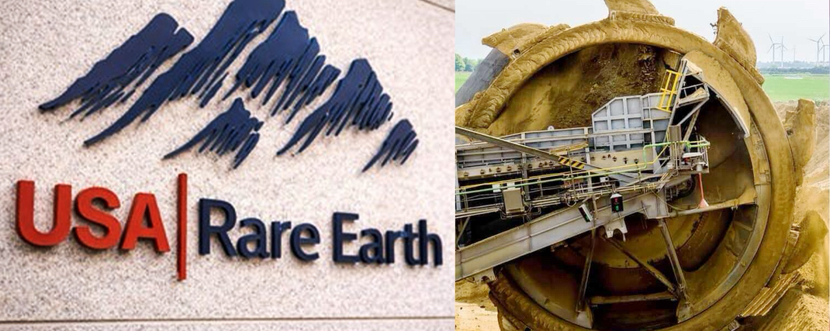
USA Rare Earth: the Core Pillar of the U.S. Rare-Earth Independent Supply ChainUSA Rare Earth, Inc. (Nasdaq ticker: USAR) is the only vertically integrated U.S. rare-earth company that covers the entire industrial chain from mine mining, to refining and separation, to magnet manufacturing. It is also a key implementation platform for the U.S. strategy to ensure independent and controllable rare-earth supply chains, providing core services to national strategic security areas such as defense, semiconductors, and new energy.
USAR entered the capital markets through a backdoor listing. In August 2024, it signed a definitive business combination agreement with the SPAC company Infection Point Acquisition Corp. II. The merger was completed in early 2025 and it was listed on Nasdaq, officially named USA Rare Earth, Inc. Its development is deeply tied to U.S. industrial policies. In January 2026, it reached a final agreement with the U.S. Department of Commerce, securing up to $1.6 billion in total funding support under the (CHIPS and Science Act), including $277 million in federal non-reimbursable grants and $1.3 billion in senior guaranteed loans. At the same time, the U.S. government holds 10% of the company at $17.17 per share. In 2026, the company accelerated its global expansion. In April, it announced a $2.8 billion acquisition of the Brazilian Serra Verde rare earth project; in September, the merger was completed, directly gaining mature, operating production capacity and cash flow. That same year, it announced a management change in July. The former CEO, Barbara Hampton, will retire in October, and will be succeeded by Thras Moraitis, CEO of Serra Verde in Brazil, to align with the needs of global business integration.
USA Rare Earth: the Core Pillar of the U.S. Rare-Earth Independent Supply Chain
USA Rare Earth, Inc. (Nasdaq ticker: USAR) is the only vertically integrated U.S. rare-earth company that covers the entire industrial chain from mine mining, to refining and separation, to magnet manufacturing. It is also a key implementation platform for the U.S. strategy to ensure independent and controllable rare-earth supply chains, providing core services to national strategic security areas such as defense, semiconductors, and new energy.
USAR entered the capital markets through a backdoor listing. In August 2024, it signed a definitive business combination agreement with the SPAC company Infection Point Acquisition Corp. II. The merger was completed in early 2025 and it was listed on Nasdaq, officially named USA Rare Earth, Inc. Its development is deeply tied to U.S. industrial policies. In January 2026, it reached a final agreement with the U.S. Department of Commerce, securing up to $1.6 billion in total funding support under the (CHIPS and Science Act), including $277 million in federal non-reimbursable grants and $1.3 billion in senior guaranteed loans. At the same time, the U.S. government holds 10% of the company at $17.17 per share. In 2026, the company accelerated its global expansion. In April, it announced a $2.8 billion acquisition of the Brazilian Serra Verde rare earth project; in September, the merger was completed, directly gaining mature, operating production capacity and cash flow. That same year, it announced a management change in July. The former CEO, Barbara Hampton, will retire in October, and will be succeeded by Thras Moraitis, CEO of Serra Verde in Brazil, to align with the needs of global business integration.
USAR entered the capital markets through a backdoor listing. In August 2024, it signed a definitive business combination agreement with the SPAC company Infection Point Acquisition Corp. II. The merger was completed in early 2025 and it was listed on Nasdaq, officially named USA Rare Earth, Inc. Its development is deeply tied to U.S. industrial policies. In January 2026, it reached a final agreement with the U.S. Department of Commerce, securing up to $1.6 billion in total funding support under the (CHIPS and Science Act), including $277 million in federal non-reimbursable grants and $1.3 billion in senior guaranteed loans. At the same time, the U.S. government holds 10% of the company at $17.17 per share. In 2026, the company accelerated its global expansion. In April, it announced a $2.8 billion acquisition of the Brazilian Serra Verde rare earth project; in September, the merger was completed, directly gaining mature, operating production capacity and cash flow. That same year, it announced a management change in July. The former CEO, Barbara Hampton, will retire in October, and will be succeeded by Thras Moraitis, CEO of Serra Verde in Brazil, to align with the needs of global business integration.
1
238
·
--

Article
The Night Before Starship Ignition: Billions of Earthly Businesses, but Only One Road to SpaceOn September 28, Starship will conduct its 14th test flight, and this time it aims to achieve the first true orbital insertion in the real sense. What the capital markets are holding their breath for is the company that only listed on Nasdaq in June, with the ticker SPCX—SpaceX.
There are countless publicly listed companies on Earth: coffee sellers, phone makers, pipeline builders, code writers, and so on—so many industries it’s impossible to count. But if you look for companies whose core business is genuinely space, and that have already made real, cash-in-hand money from space, there is only one: SPCX. This scarcity is worth breaking down.
It’s not a concept stock—it is the space industry itself. The first layer of SpaceX’s business is launches; that is its moat. As of this past March, Falcon 9 and Falcon Heavy have together completed about 650 orbital launches, with a success rate above 99%. A single Falcon 9 can be reused 34 times, and the combined launch cadence of other countries and companies around the world still doesn’t come close to it. The second layer is Starlink, its cash cow: in Q2, revenue was $4.29 billion, up 66% year over year; operating profit was $1.66 billion; the number of users doubled to 12 million; and net adds reached 1.7 million in the quarter—this is the first truly profitable space business in human history. The third layer is Starship, its future option: 100 tons of payload capacity to low Earth orbit, with launch costs another 10x lower than on the Falcon 9 baseline, and an insertion cost that is more than 99% below the historical average. While others are still telling space stories, SpaceX has already been collecting money from space and paving the way to space.
The Night Before Starship Ignition: Billions of Earthly Businesses, but Only One Road to Space
On September 28, Starship will conduct its 14th test flight, and this time it aims to achieve the first true orbital insertion in the real sense. What the capital markets are holding their breath for is the company that only listed on Nasdaq in June, with the ticker SPCX—SpaceX.
There are countless publicly listed companies on Earth: coffee sellers, phone makers, pipeline builders, code writers, and so on—so many industries it’s impossible to count. But if you look for companies whose core business is genuinely space, and that have already made real, cash-in-hand money from space, there is only one: SPCX. This scarcity is worth breaking down.
It’s not a concept stock—it is the space industry itself. The first layer of SpaceX’s business is launches; that is its moat. As of this past March, Falcon 9 and Falcon Heavy have together completed about 650 orbital launches, with a success rate above 99%. A single Falcon 9 can be reused 34 times, and the combined launch cadence of other countries and companies around the world still doesn’t come close to it. The second layer is Starlink, its cash cow: in Q2, revenue was $4.29 billion, up 66% year over year; operating profit was $1.66 billion; the number of users doubled to 12 million; and net adds reached 1.7 million in the quarter—this is the first truly profitable space business in human history. The third layer is Starship, its future option: 100 tons of payload capacity to low Earth orbit, with launch costs another 10x lower than on the Falcon 9 baseline, and an insertion cost that is more than 99% below the historical average. While others are still telling space stories, SpaceX has already been collecting money from space and paving the way to space.
There are countless publicly listed companies on Earth: coffee sellers, phone makers, pipeline builders, code writers, and so on—so many industries it’s impossible to count. But if you look for companies whose core business is genuinely space, and that have already made real, cash-in-hand money from space, there is only one: SPCX. This scarcity is worth breaking down.
It’s not a concept stock—it is the space industry itself. The first layer of SpaceX’s business is launches; that is its moat. As of this past March, Falcon 9 and Falcon Heavy have together completed about 650 orbital launches, with a success rate above 99%. A single Falcon 9 can be reused 34 times, and the combined launch cadence of other countries and companies around the world still doesn’t come close to it. The second layer is Starlink, its cash cow: in Q2, revenue was $4.29 billion, up 66% year over year; operating profit was $1.66 billion; the number of users doubled to 12 million; and net adds reached 1.7 million in the quarter—this is the first truly profitable space business in human history. The third layer is Starship, its future option: 100 tons of payload capacity to low Earth orbit, with launch costs another 10x lower than on the Falcon 9 baseline, and an insertion cost that is more than 99% below the historical average. While others are still telling space stories, SpaceX has already been collecting money from space and paving the way to space.
1
112
·
--
Article
On Earth, there are countless companies—only it is really in the space business
—Written on the eve of Starship’s 14th test flightTomorrow (September 28, Monday in US Eastern time), Starship will conduct its 14th test flight—its first attempt to reach orbit. All weekend, Wall Street has been talking about the same stock: SpaceX, ticker SPCX.
There are countless publicly listed companies on Earth—selling coffee, making phones, laying pipelines, writing code. But the only one that has truly made “space” its main business—and has already made money from it—is SPCX.
1. It’s not a “concept stock”—it’s the space industry itself.
To understand SPCX’s scarcity, you only need to look at its three layers of business:
On Earth, there are countless companies—only it is really in the space business —Written on the eve of Starship’s 14th test flight
Tomorrow (September 28, Monday in US Eastern time), Starship will conduct its 14th test flight—its first attempt to reach orbit. All weekend, Wall Street has been talking about the same stock: SpaceX, ticker SPCX.
There are countless publicly listed companies on Earth—selling coffee, making phones, laying pipelines, writing code. But the only one that has truly made “space” its main business—and has already made money from it—is SPCX.
1. It’s not a “concept stock”—it’s the space industry itself.
To understand SPCX’s scarcity, you only need to look at its three layers of business:
There are countless publicly listed companies on Earth—selling coffee, making phones, laying pipelines, writing code. But the only one that has truly made “space” its main business—and has already made money from it—is SPCX.
1. It’s not a “concept stock”—it’s the space industry itself.
To understand SPCX’s scarcity, you only need to look at its three layers of business:
2
173
·
--
$TSLA 【US to lower vehicle fuel efficiency standards; fuel consumption and emissions may rise】US officials said on Saturday that the US Department of Transportation will finalize regulations on Monday that significantly lower vehicle fuel economy standards, applicable through 2031. This means the US will reverse the policy pursued during the Biden administration to push automakers to produce more electric vehicles. President Donald Trump said he has approved new fuel economy standards for cars and trucks and said the new rules will lower the price of new vehicles. US Transportation Secretary Duffy said, “American auto workers will see a major victory on Monday.” According to the Department of Transportation’s own estimates, the new standards will reduce the cost of new cars, but fuel consumption and carbon dioxide emissions over the coming decades will increase.
$TSLA 【US to lower vehicle fuel efficiency standards; fuel consumption and emissions may rise】US officials said on Saturday that the US Department of Transportation will finalize regulations on Monday that significantly lower vehicle fuel economy standards, applicable through 2031. This means the US will reverse the policy pursued during the Biden administration to push automakers to produce more electric vehicles. President Donald Trump said he has approved new fuel economy standards for cars and trucks and said the new rules will lower the price of new vehicles. US Transportation Secretary Duffy said, “American auto workers will see a major victory on Monday.” According to the Department of Transportation’s own estimates, the new standards will reduce the cost of new cars, but fuel consumption and carbon dioxide emissions over the coming decades will increase.
184
·
--
$SAMSUNG Samsung Electronics wave-based accumulation analysis (about 250 words)
From a structural perspective, Samsung Electronics completed a five-wave advance earlier, followed by a two-wave correction, forming a W-X-Y composite corrective pattern. Projections suggest that the current rebound phase is most likely wave B, with an upside target around $230.
In terms of execution, a phased accumulation plan is used. You can initiate a small trial position when the pullback stabilizes, then add more once the price holds above a key resistance level. The rebound in wave B has a clear ceiling; in essence, it is a corrective-repair rebound rather than the start of a new primary uptrend. Set a strict stop-loss: if there is a valid breakdown below the low of wave Y, the wave B assumption is invalidated—exit immediately to avoid a larger decline at a higher level.
Samsung Electronics benefits from the AI memory cycle, but the semiconductor sector is extremely volatile. Wave analysis is purely a technical projection, and there is a risk of deviation across multiple waves. Trade carefully, control position size, and manage gains and losses properly.
Risk warning: The above is only a theoretical technical discussion and does not constitute any investment advice. Market volatility involves uncertainty.
$SAMSUNG Samsung Electronics wave-based accumulation analysis (about 250 words)
From a structural perspective, Samsung Electronics completed a five-wave advance earlier, followed by a two-wave correction, forming a W-X-Y composite corrective pattern. Projections suggest that the current rebound phase is most likely wave B, with an upside target around $230.
In terms of execution, a phased accumulation plan is used. You can initiate a small trial position when the pullback stabilizes, then add more once the price holds above a key resistance level. The rebound in wave B has a clear ceiling; in essence, it is a corrective-repair rebound rather than the start of a new primary uptrend. Set a strict stop-loss: if there is a valid breakdown below the low of wave Y, the wave B assumption is invalidated—exit immediately to avoid a larger decline at a higher level.
Samsung Electronics benefits from the AI memory cycle, but the semiconductor sector is extremely volatile. Wave analysis is purely a technical projection, and there is a risk of deviation across multiple waves. Trade carefully, control position size, and manage gains and losses properly.
Risk warning: The above is only a theoretical technical discussion and does not constitute any investment advice. Market volatility involves uncertainty.
From a structural perspective, Samsung Electronics completed a five-wave advance earlier, followed by a two-wave correction, forming a W-X-Y composite corrective pattern. Projections suggest that the current rebound phase is most likely wave B, with an upside target around $230.
In terms of execution, a phased accumulation plan is used. You can initiate a small trial position when the pullback stabilizes, then add more once the price holds above a key resistance level. The rebound in wave B has a clear ceiling; in essence, it is a corrective-repair rebound rather than the start of a new primary uptrend. Set a strict stop-loss: if there is a valid breakdown below the low of wave Y, the wave B assumption is invalidated—exit immediately to avoid a larger decline at a higher level.
Samsung Electronics benefits from the AI memory cycle, but the semiconductor sector is extremely volatile. Wave analysis is purely a technical projection, and there is a risk of deviation across multiple waves. Trade carefully, control position size, and manage gains and losses properly.
Risk warning: The above is only a theoretical technical discussion and does not constitute any investment advice. Market volatility involves uncertainty.
821
Log in to explore more content
Join global crypto users on Binance Square
⚡️ Get latest and useful information about crypto.
💬 Trusted by the world’s largest crypto exchange.
👍 Discover real insights from verified creators.
Email / Phone number
Trending Topics
BinanceIncidentReport
61,093 views
699 Discussing
29 October 2026 Binance Security Incident: Initial Findings and Response Update
Binance Blog
·345 Likes
·1.1M views
BinanceReopensWithdrawalsForMoreAssets
182,780 views
1,857 Discussing
BinanceHourlyDepositsExceedWithdrawals
85,955 views
873 Discussing