

CR Insights
11.5k Posts

CR Insights
Report
Block User
Crypto trader & Web3 researcher | Crypto explorer sharing market insights, airdrops, ecosystem updates & opportunities
483 Following
15.0K+ Followers
10.4K+ Liked
Posts
All
Quotes
Videos
Live
PINNED
·
--
Verified
Article
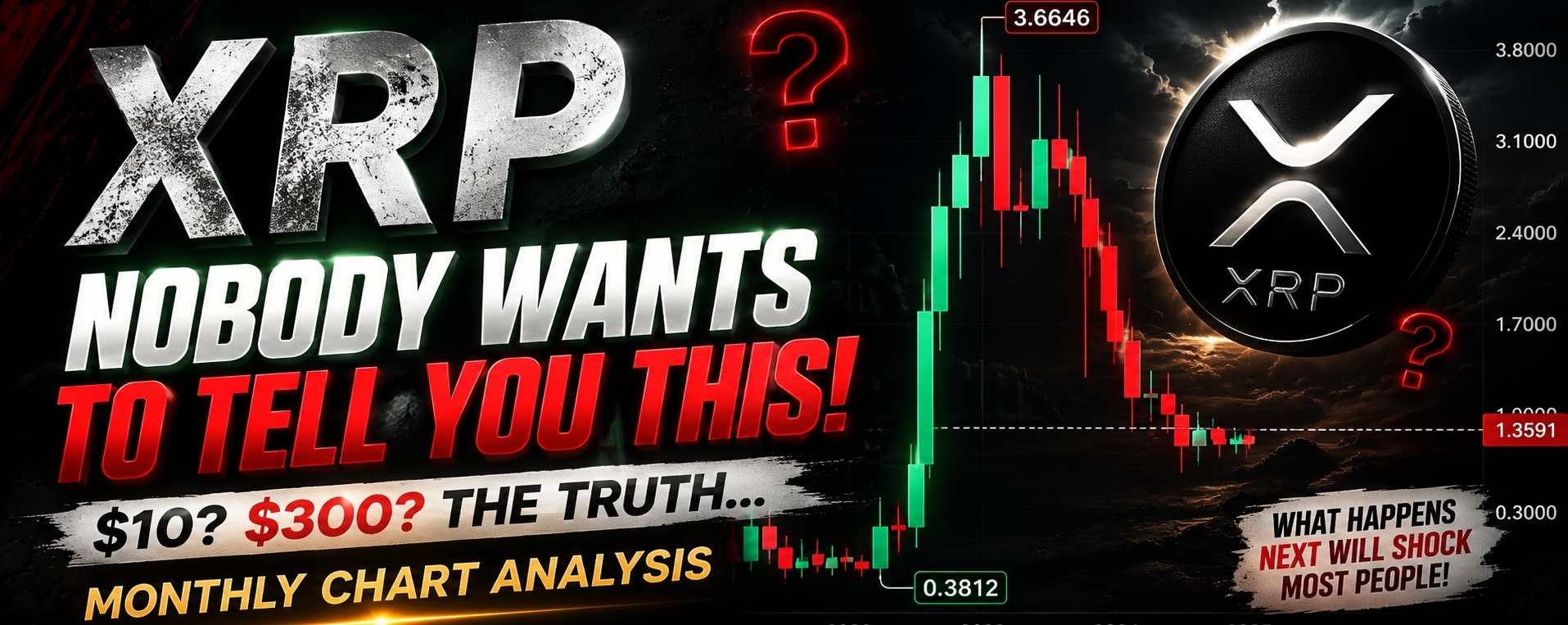
Nobody Wants To Tell You This About XRP Monthly StructurePeople are fighting over $10 $XRP and $300 XRP while the monthly chart is literally showing momentum exhaustion in real time.
Look carefully at the structure.
Huge expansion candle from the $0.38 areaViolent push toward $3.66Then multiple monthly rejection candlesLower closes after the peakMomentum fading instead of accelerating
That usually tells me one thing: the market is entering a cooling or distribution phase, not a clean price discovery phase.
If $XRP was truly preparing for an instant move toward extreme targets, monthly candles would normally show:
stronger follow-through
aggressive reclaim behavior
expanding volume continuation
less rejection near highs
Instead, what I see is sellers repeatedly stepping in after every attempt higher.
Realistically? A move toward previous highs again is possible if the broader alt market stays strong.
But people throwing out $100–$300 targets from this current monthly structure are mostly farming emotions and engagement.
Because the higher price goes, the more liquidity and market cap expansion is required.
That part usually disappears from social media posts.
Real-world example: Retail traders often buy after giant green monthly candles because it “feels safe.” Meanwhile experienced traders usually become more cautious exactly when the crowd becomes most confident.
From this monthly chart alone, I see slowing momentum after an explosive expansion, not evidence of an easy straight-line move toward fantasy targets.
#X #Xrp🔥🔥 #TrendingTopic #BitcoinBreaksBelow75KAsWarshTakesFedHelm
Nobody Wants To Tell You This About XRP Monthly Structure
People are fighting over $10 $XRP and $300 XRP while the monthly chart is literally showing momentum exhaustion in real time.
Look carefully at the structure.
Huge expansion candle from the $0.38 areaViolent push toward $3.66Then multiple monthly rejection candlesLower closes after the peakMomentum fading instead of accelerating
That usually tells me one thing: the market is entering a cooling or distribution phase, not a clean price discovery phase.
If $XRP was truly preparing for an instant move toward extreme targets, monthly candles would normally show:
stronger follow-through
aggressive reclaim behavior
expanding volume continuation
less rejection near highs
Instead, what I see is sellers repeatedly stepping in after every attempt higher.
Realistically? A move toward previous highs again is possible if the broader alt market stays strong.
But people throwing out $100–$300 targets from this current monthly structure are mostly farming emotions and engagement.
Because the higher price goes, the more liquidity and market cap expansion is required.
That part usually disappears from social media posts.
Real-world example: Retail traders often buy after giant green monthly candles because it “feels safe.” Meanwhile experienced traders usually become more cautious exactly when the crowd becomes most confident.
From this monthly chart alone, I see slowing momentum after an explosive expansion, not evidence of an easy straight-line move toward fantasy targets.
#X #Xrp🔥🔥 #TrendingTopic #BitcoinBreaksBelow75KAsWarshTakesFedHelm
Look carefully at the structure.
Huge expansion candle from the $0.38 areaViolent push toward $3.66Then multiple monthly rejection candlesLower closes after the peakMomentum fading instead of accelerating
That usually tells me one thing: the market is entering a cooling or distribution phase, not a clean price discovery phase.
If $XRP was truly preparing for an instant move toward extreme targets, monthly candles would normally show:
stronger follow-through
aggressive reclaim behavior
expanding volume continuation
less rejection near highs
Instead, what I see is sellers repeatedly stepping in after every attempt higher.
Realistically? A move toward previous highs again is possible if the broader alt market stays strong.
But people throwing out $100–$300 targets from this current monthly structure are mostly farming emotions and engagement.
Because the higher price goes, the more liquidity and market cap expansion is required.
That part usually disappears from social media posts.
Real-world example: Retail traders often buy after giant green monthly candles because it “feels safe.” Meanwhile experienced traders usually become more cautious exactly when the crowd becomes most confident.
From this monthly chart alone, I see slowing momentum after an explosive expansion, not evidence of an easy straight-line move toward fantasy targets.
#X #Xrp🔥🔥 #TrendingTopic #BitcoinBreaksBelow75KAsWarshTakesFedHelm
28
6
154
113.4k
PINNED
·
--
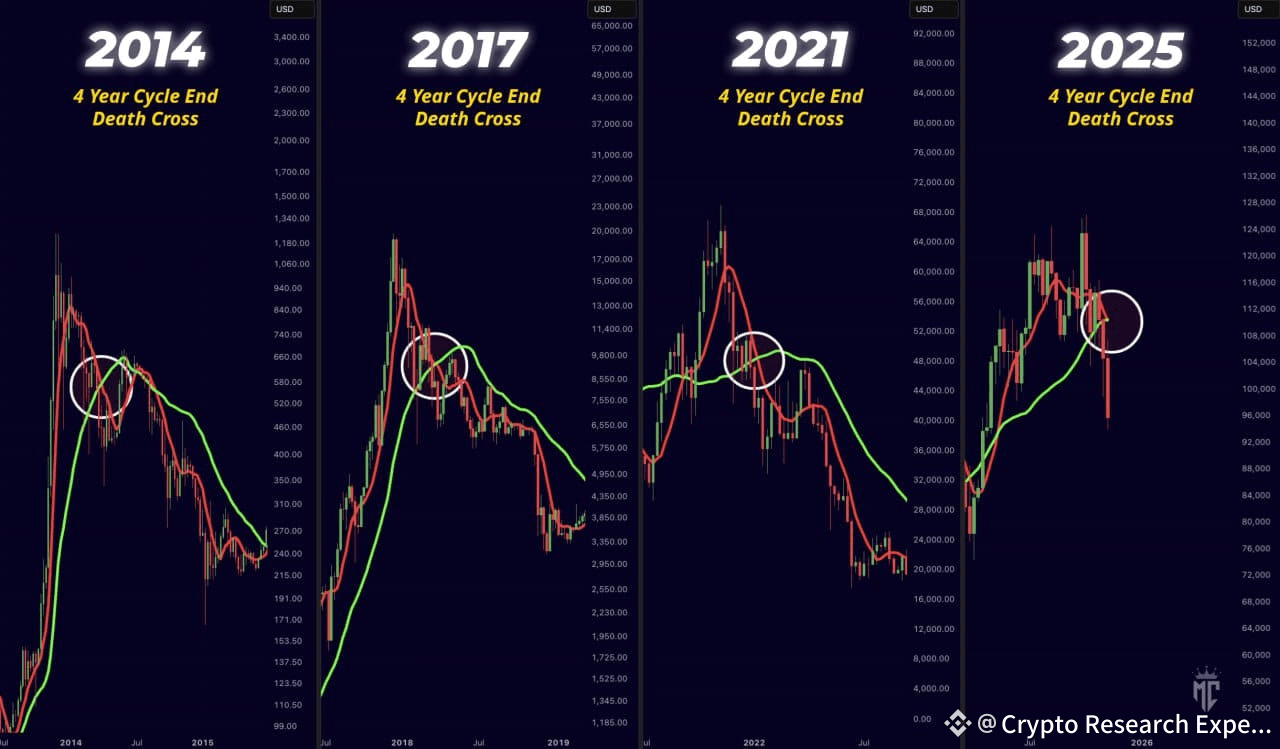
🔥 EVERY BITCOIN CYCLE ENDED WITH A DEATH CROSS… SO WHY WOULD THIS TIME BE DIFFERENT? ⚠️💀📉$BTC
📊 Every major BTC bull cycle we’ve seen — 2013, 2017, 2021 — eventually ended with the legendary Death Cross on higher timeframes.
🤯 Yet right now, Bitcoin is pushing into extreme fear faster than 2021, liquidity is thinning, and volatility is exploding.
🧩 History tells us the same signal returns every cycle… the question is WHEN, not IF.
⚡ Anyone ignoring this is dreaming — cycles don’t change, only emotions do.
🚨 Stay sharp. Stay risk-managed. The market doesn’t care about hope.
🔥 EVERY BITCOIN CYCLE ENDED WITH A DEATH CROSS… SO WHY WOULD THIS TIME BE DIFFERENT? ⚠️💀📉$BTC
📊 Every major BTC bull cycle we’ve seen — 2013, 2017, 2021 — eventually ended with the legendary Death Cross on higher timeframes.
🤯 Yet right now, Bitcoin is pushing into extreme fear faster than 2021, liquidity is thinning, and volatility is exploding.
🧩 History tells us the same signal returns every cycle… the question is WHEN, not IF.
⚡ Anyone ignoring this is dreaming — cycles don’t change, only emotions do.
🚨 Stay sharp. Stay risk-managed. The market doesn’t care about hope.
📊 Every major BTC bull cycle we’ve seen — 2013, 2017, 2021 — eventually ended with the legendary Death Cross on higher timeframes.
🤯 Yet right now, Bitcoin is pushing into extreme fear faster than 2021, liquidity is thinning, and volatility is exploding.
🧩 History tells us the same signal returns every cycle… the question is WHEN, not IF.
⚡ Anyone ignoring this is dreaming — cycles don’t change, only emotions do.
🚨 Stay sharp. Stay risk-managed. The market doesn’t care about hope.
100
60
175
399.1k
·
--
Imagine placing a bid onchain, knowing someone could use your offer to their advantage if they see it before the auction ends.
Public blockchains let everyone verify activity, but that same visibility can expose a bidder's intentions before the auction is over.
Nillion Covenants addresses this through encrypted, condition-based instructions. DUSK brings this approach to Ethereum, with Blacklight nodes holding shares that are used to reconstruct an instruction when its specified condition is met.
This means an instruction can exist onchain without its contents being revealed immediately. For sealed auctions and conditional trades, that could help keep a decision private while the system waits for the right condition.
It won't guarantee a fair outcome, but it could reduce the advantage of seeing another participant's move too early.
$NIL #NIL
#nil $NIL @nillionnetwork
Imagine placing a bid onchain, knowing someone could use your offer to their advantage if they see it before the auction ends.
Public blockchains let everyone verify activity, but that same visibility can expose a bidder's intentions before the auction is over.
Nillion Covenants addresses this through encrypted, condition-based instructions. DUSK brings this approach to Ethereum, with Blacklight nodes holding shares that are used to reconstruct an instruction when its specified condition is met.
This means an instruction can exist onchain without its contents being revealed immediately. For sealed auctions and conditional trades, that could help keep a decision private while the system waits for the right condition.
It won't guarantee a fair outcome, but it could reduce the advantage of seeing another participant's move too early.
$NIL #NIL
#nil $NIL @Nillion
Public blockchains let everyone verify activity, but that same visibility can expose a bidder's intentions before the auction is over.
Nillion Covenants addresses this through encrypted, condition-based instructions. DUSK brings this approach to Ethereum, with Blacklight nodes holding shares that are used to reconstruct an instruction when its specified condition is met.
This means an instruction can exist onchain without its contents being revealed immediately. For sealed auctions and conditional trades, that could help keep a decision private while the system waits for the right condition.
It won't guarantee a fair outcome, but it could reduce the advantage of seeing another participant's move too early.
$NIL #NIL
#nil $NIL @Nillion
2
472
·
--
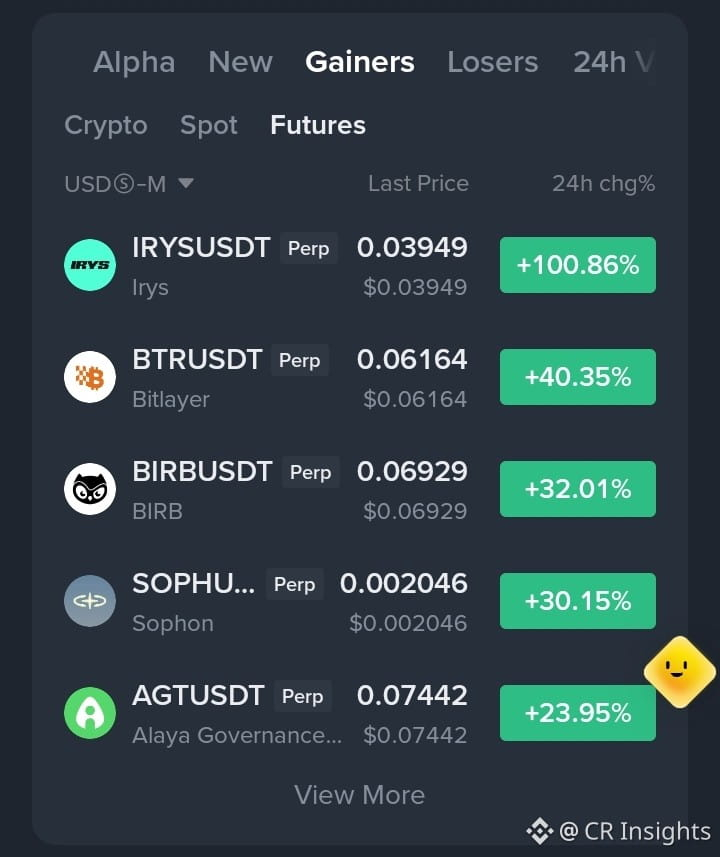
$IRYS just gained 100.86% in 24 hours.
But the interesting part isn't the green candle. It's what happens after a move this large.
When a coin doubles in a day, two things matter:
• Is fresh buying still entering, or are early holders taking profits?
• Can price hold its breakout, or will late buyers become exit liquidity?
The same question applies to $BTR (+40.35%), $BIRB (+32.01%), SOPH (+30.15%), and AGT (+23.95%).
These numbers show where volatility is concentrated, not where the next opportunity is guaranteed to be.
My takeaway: Don't chase the biggest candle. Watch how price behaves after the excitement fades. That's where momentum becomes more informative.
Which of these coins can hold its gains?
$IRYS just gained 100.86% in 24 hours.
But the interesting part isn't the green candle. It's what happens after a move this large.
When a coin doubles in a day, two things matter:
• Is fresh buying still entering, or are early holders taking profits?
• Can price hold its breakout, or will late buyers become exit liquidity?
The same question applies to $BTR (+40.35%), $BIRB (+32.01%), SOPH (+30.15%), and AGT (+23.95%).
These numbers show where volatility is concentrated, not where the next opportunity is guaranteed to be.
My takeaway: Don't chase the biggest candle. Watch how price behaves after the excitement fades. That's where momentum becomes more informative.
Which of these coins can hold its gains?
But the interesting part isn't the green candle. It's what happens after a move this large.
When a coin doubles in a day, two things matter:
• Is fresh buying still entering, or are early holders taking profits?
• Can price hold its breakout, or will late buyers become exit liquidity?
The same question applies to $BTR (+40.35%), $BIRB (+32.01%), SOPH (+30.15%), and AGT (+23.95%).
These numbers show where volatility is concentrated, not where the next opportunity is guaranteed to be.
My takeaway: Don't chase the biggest candle. Watch how price behaves after the excitement fades. That's where momentum becomes more informative.
Which of these coins can hold its gains?
1
895
·
--
An AI agent doesn’t need unlimited freedom to be useful. It needs room to act without losing the boundaries set by its owner.
A spending session sets the budget, per-payment limit and expiry. The agent can discover services and pay through protocols like x402 or MPP without asking for approval at every step.
The bigger shift is where human control sits: instead of approving every payment, the owner defines the rules the agent must operate within.
That’s what makes autonomous commerce more practical — not removing oversight, but making it possible to scale.
#KiteBBW $KITE @GoKiteAI
An AI agent doesn’t need unlimited freedom to be useful. It needs room to act without losing the boundaries set by its owner.
A spending session sets the budget, per-payment limit and expiry. The agent can discover services and pay through protocols like x402 or MPP without asking for approval at every step.
The bigger shift is where human control sits: instead of approving every payment, the owner defines the rules the agent must operate within.
That’s what makes autonomous commerce more practical — not removing oversight, but making it possible to scale.
#KiteBBW $KITE @KITE AI 中文
A spending session sets the budget, per-payment limit and expiry. The agent can discover services and pay through protocols like x402 or MPP without asking for approval at every step.
The bigger shift is where human control sits: instead of approving every payment, the owner defines the rules the agent must operate within.
That’s what makes autonomous commerce more practical — not removing oversight, but making it possible to scale.
#KiteBBW $KITE @KITE AI 中文
7
8
425
·
--
What happens when multiple AI agents compete for the same budget? 🪁
Kite Passport addresses a critical challenge: tracking both spent and reserved funds so concurrent payments don’t claim the same budget twice.
But buyer protection is only half the equation. Sellers also define which deals their agents can accept.
The real challenge isn’t making agents autonomous. It’s making their boundaries enforceable.
That’s the design choice I explore in my video—and why it matters for agent commerce.
@GoKiteAI $KITE #KiteBBW
What happens when multiple AI agents compete for the same budget? 🪁
Kite Passport addresses a critical challenge: tracking both spent and reserved funds so concurrent payments don’t claim the same budget twice.
But buyer protection is only half the equation. Sellers also define which deals their agents can accept.
The real challenge isn’t making agents autonomous. It’s making their boundaries enforceable.
That’s the design choice I explore in my video—and why it matters for agent commerce.
@KITE AI 中文 $KITE #KiteBBW
Kite Passport addresses a critical challenge: tracking both spent and reserved funds so concurrent payments don’t claim the same budget twice.
But buyer protection is only half the equation. Sellers also define which deals their agents can accept.
The real challenge isn’t making agents autonomous. It’s making their boundaries enforceable.
That’s the design choice I explore in my video—and why it matters for agent commerce.
@KITE AI 中文 $KITE #KiteBBW
337
·
--
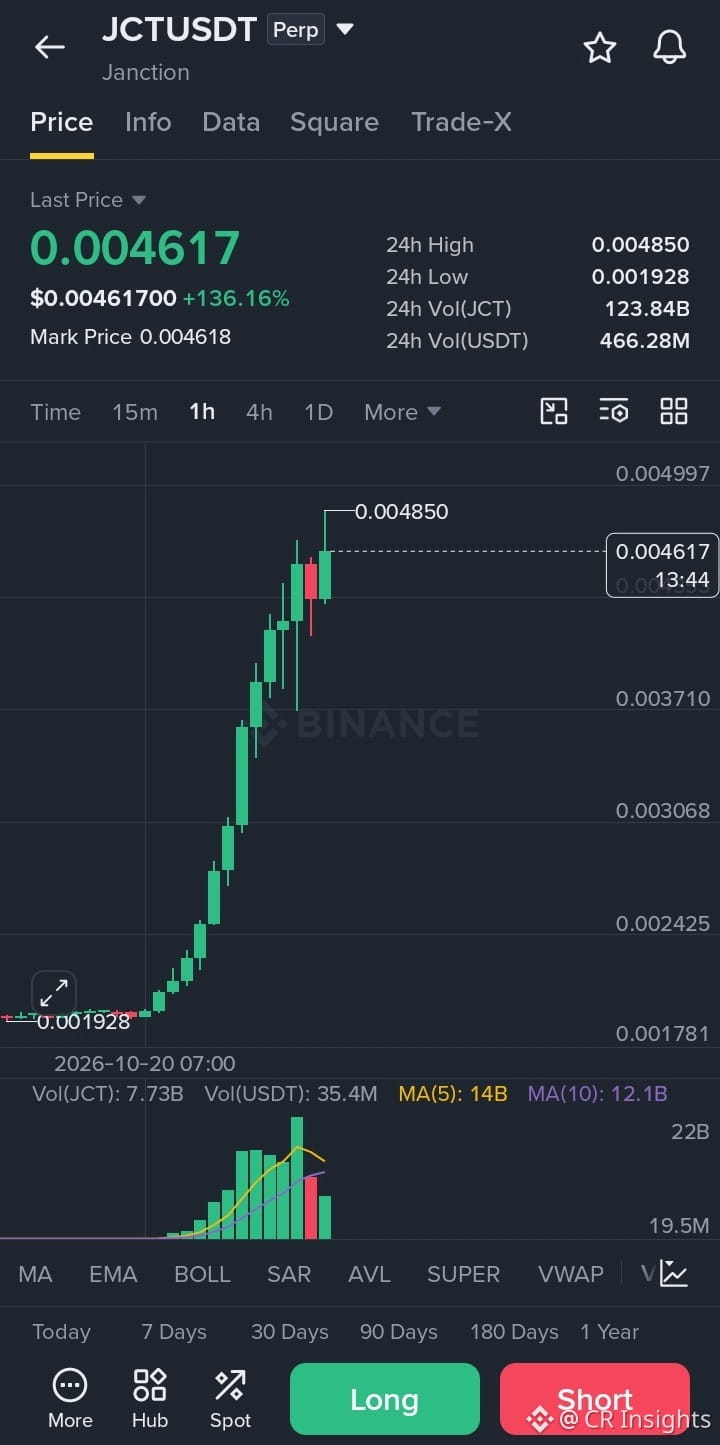
$JCT — LONG Setup
{future}(JCTUSDT)
Bias: Bullish | Wait for pullback
JCT is up 136% and approaching resistance at 0.004850. The trend is strong, but buying directly into resistance is risky.
* Entry: 0.00420–0.00435
* TP1: 0.00460
* TP2: 0.00482
* TP3: 0.00500
* Stop-loss: 0.00405
Confirmation: Enter only after a bullish reversal in the entry zone on the 15m chart.
Invalidation: A sustained break below 0.00405.
Plan: Don't chase the pump. If price never pulls back, wait for a breakout above 0.004850 and a successful retest.
$JCT — LONG Setup
Bias: Bullish | Wait for pullback
JCT is up 136% and approaching resistance at 0.004850. The trend is strong, but buying directly into resistance is risky.
* Entry: 0.00420–0.00435
* TP1: 0.00460
* TP2: 0.00482
* TP3: 0.00500
* Stop-loss: 0.00405
Confirmation: Enter only after a bullish reversal in the entry zone on the 15m chart.
Invalidation: A sustained break below 0.00405.
Plan: Don't chase the pump. If price never pulls back, wait for a breakout above 0.004850 and a successful retest.
Bias: Bullish | Wait for pullback
JCT is up 136% and approaching resistance at 0.004850. The trend is strong, but buying directly into resistance is risky.
* Entry: 0.00420–0.00435
* TP1: 0.00460
* TP2: 0.00482
* TP3: 0.00500
* Stop-loss: 0.00405
Confirmation: Enter only after a bullish reversal in the entry zone on the 15m chart.
Invalidation: A sustained break below 0.00405.
Plan: Don't chase the pump. If price never pulls back, wait for a breakout above 0.004850 and a successful retest.
1
448
·
--
Some chains add RWAs later. Injective started there. 🥷
From the 2018 aim (every market, onchain) to Meridian in 2026, here is how $INJ was built for RWA, upgrade by upgrade:
▪️ Mainnet · Nov 2021: native onchain orderbook
▪️ Volan · Jan 2024: the RWA module
▪️ Nivara · Feb 2025: RWA oracle + access control
▪️ Native EVM · Nov 2025: EVM + WASM on one chain
▪️ Mint · Jul 2026: tokenized equities & bonds
▪️ SEC transfer agent · Aug 2026
▪️ Meridian · Sep 2026: regulated RWA issuance
not financial advice
do your own research
@Injective
Some chains add RWAs later. Injective started there. 🥷
From the 2018 aim (every market, onchain) to Meridian in 2026, here is how $INJ was built for RWA, upgrade by upgrade:
▪️ Mainnet · Nov 2021: native onchain orderbook
▪️ Volan · Jan 2024: the RWA module
▪️ Nivara · Feb 2025: RWA oracle + access control
▪️ Native EVM · Nov 2025: EVM + WASM on one chain
▪️ Mint · Jul 2026: tokenized equities & bonds
▪️ SEC transfer agent · Aug 2026
▪️ Meridian · Sep 2026: regulated RWA issuance
not financial advice
do your own research
@Injective
From the 2018 aim (every market, onchain) to Meridian in 2026, here is how $INJ was built for RWA, upgrade by upgrade:
▪️ Mainnet · Nov 2021: native onchain orderbook
▪️ Volan · Jan 2024: the RWA module
▪️ Nivara · Feb 2025: RWA oracle + access control
▪️ Native EVM · Nov 2025: EVM + WASM on one chain
▪️ Mint · Jul 2026: tokenized equities & bonds
▪️ SEC transfer agent · Aug 2026
▪️ Meridian · Sep 2026: regulated RWA issuance
not financial advice
do your own research
@Injective
1
187
·
--
Good morning, everyone.
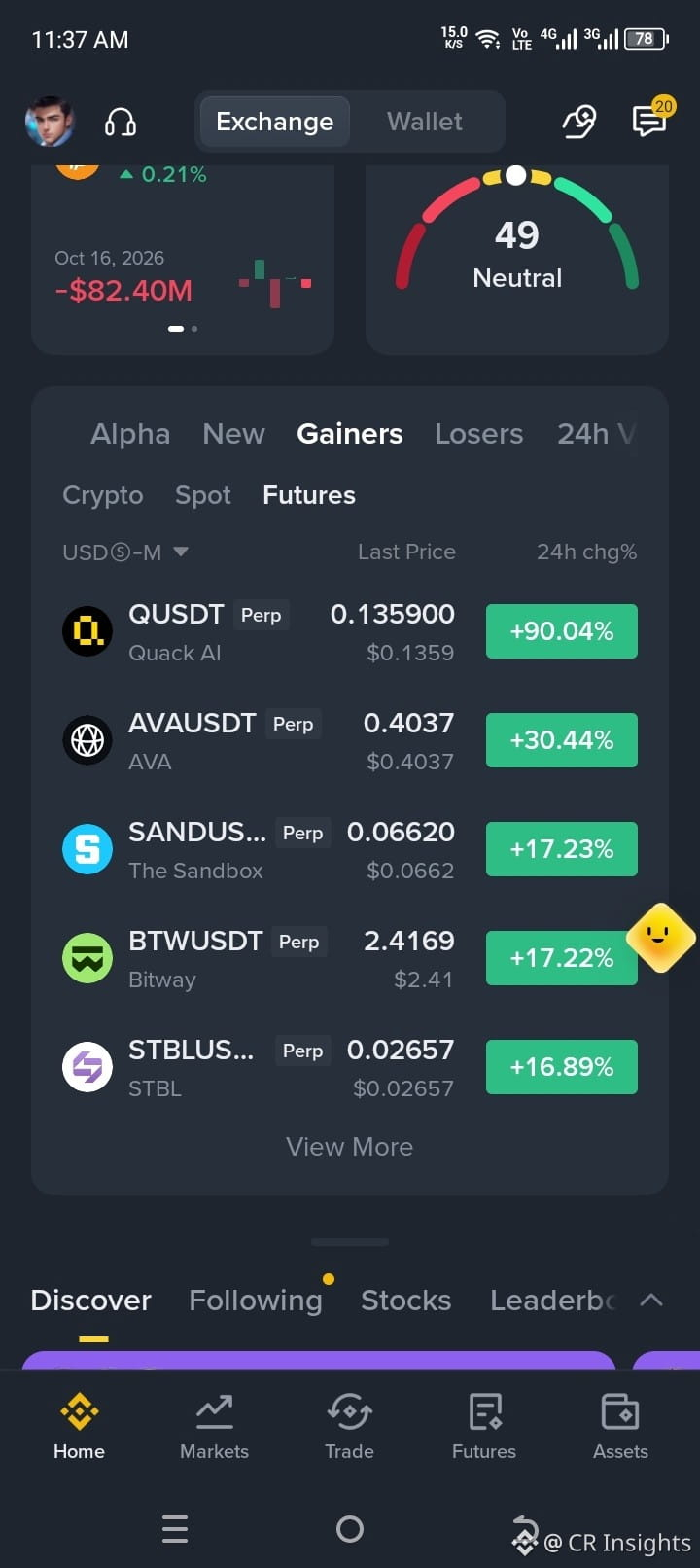
Sunday begins with strong momentum across the crypto futures market.
Q is leading the gainers with a 90.04% increase, followed by $AVA at 30.44%. $SAND is up 17.23%, $BTW has gained 17.22%, and STBLUSDT is showing a 16.89% rise.
The market is moving, but momentum alone is never a complete trading strategy. Stay disciplined, monitor price action, and manage risk carefully.
Wishing everyone a productive Sunday and a successful week ahead.
Good morning, everyone.
Sunday begins with strong momentum across the crypto futures market.
Q is leading the gainers with a 90.04% increase, followed by $AVA at 30.44%. $SAND is up 17.23%, $BTW has gained 17.22%, and STBLUSDT is showing a 16.89% rise.
The market is moving, but momentum alone is never a complete trading strategy. Stay disciplined, monitor price action, and manage risk carefully.
Wishing everyone a productive Sunday and a successful week ahead.
Sunday begins with strong momentum across the crypto futures market.
Q is leading the gainers with a 90.04% increase, followed by $AVA at 30.44%. $SAND is up 17.23%, $BTW has gained 17.22%, and STBLUSDT is showing a 16.89% rise.
The market is moving, but momentum alone is never a complete trading strategy. Stay disciplined, monitor price action, and manage risk carefully.
Wishing everyone a productive Sunday and a successful week ahead.
1
919
·
--
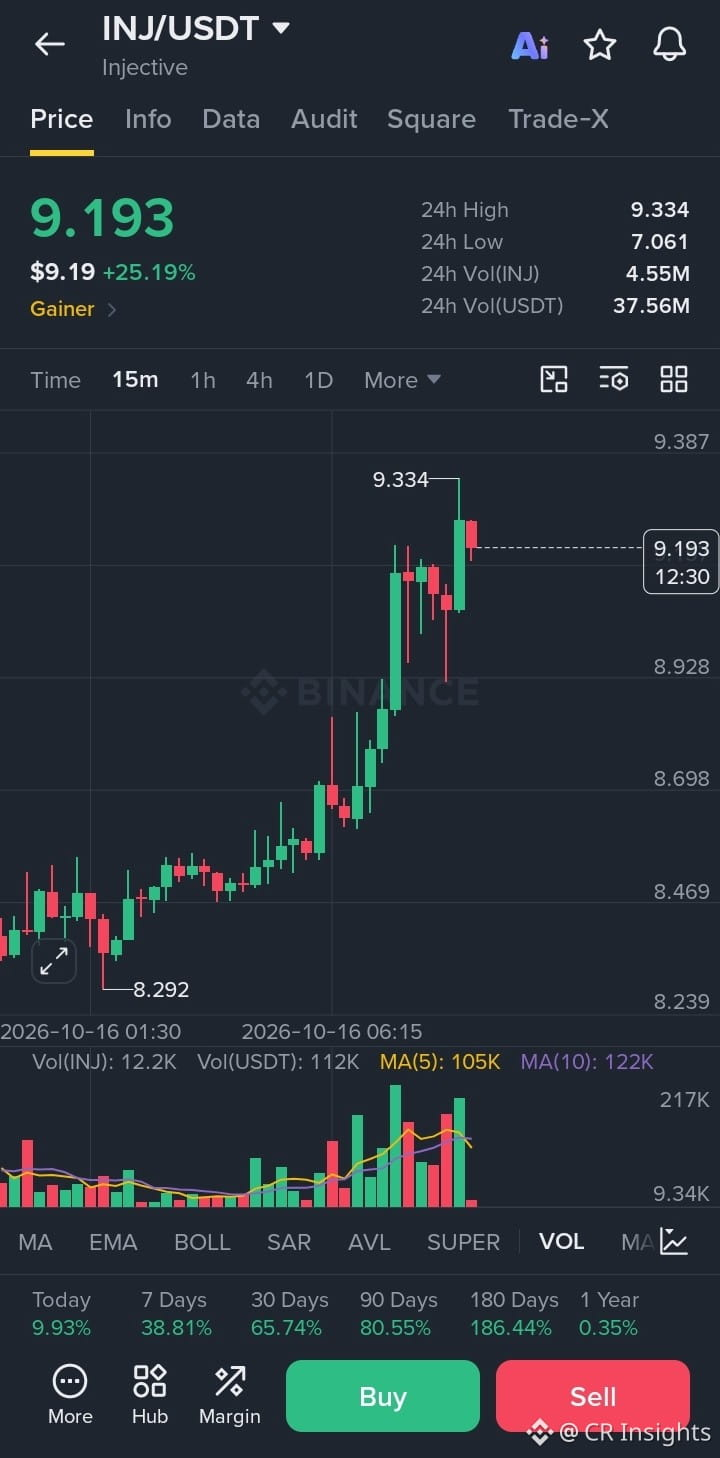
$INJ /USDT — 15M Scalp
{future}(INJUSDT)
Bias: LONG on pullback
INJ is making higher highs after a strong breakout, but price is near resistance at $9.33. Avoid chasing the pump.
* Entry: $9.00–$9.08 after a bounce
* TP1: $9.25
* TP2: $9.33
* SL: $8.88
Reason: Buyers are in control, and breakout volume has increased. A pullback that holds near $9.00 could offer another push higher.
Invalidation: 15M close below $8.88
$INJ /USDT — 15M Scalp
Bias: LONG on pullback
INJ is making higher highs after a strong breakout, but price is near resistance at $9.33. Avoid chasing the pump.
* Entry: $9.00–$9.08 after a bounce
* TP1: $9.25
* TP2: $9.33
* SL: $8.88
Reason: Buyers are in control, and breakout volume has increased. A pullback that holds near $9.00 could offer another push higher.
Invalidation: 15M close below $8.88
Bias: LONG on pullback
INJ is making higher highs after a strong breakout, but price is near resistance at $9.33. Avoid chasing the pump.
* Entry: $9.00–$9.08 after a bounce
* TP1: $9.25
* TP2: $9.33
* SL: $8.88
Reason: Buyers are in control, and breakout volume has increased. A pullback that holds near $9.00 could offer another push higher.
Invalidation: 15M close below $8.88
2
374
·
--
Crypto futures traders woke up and chose VIOLENCE today 😭
$STRK +55%
$CFX +35%
$LUMIA +26%
ERA +25%
TIA +23%
And these are just the top gainers on the futures board.
The dangerous part? Seeing a coin already up 30–50% and thinking you’re late to the party… only to become exit liquidity for someone who got in earlier. 💀
Green candles look amazing until you’re the one buying the top.
Enjoy the volatility. Respect the entry.
Crypto futures traders woke up and chose VIOLENCE today 😭
$STRK +55%
$CFX +35%
$LUMIA +26%
ERA +25%
TIA +23%
And these are just the top gainers on the futures board.
The dangerous part? Seeing a coin already up 30–50% and thinking you’re late to the party… only to become exit liquidity for someone who got in earlier. 💀
Green candles look amazing until you’re the one buying the top.
Enjoy the volatility. Respect the entry.
$STRK +55%
$CFX +35%
$LUMIA +26%
ERA +25%
TIA +23%
And these are just the top gainers on the futures board.
The dangerous part? Seeing a coin already up 30–50% and thinking you’re late to the party… only to become exit liquidity for someone who got in earlier. 💀
Green candles look amazing until you’re the one buying the top.
Enjoy the volatility. Respect the entry.
did you buy
62%
just seeing
38%
13 votes • Voting closed
1
2.2k
·
--
BNB really said: “You’re welcome, here’s your 23 cents.” 😭
Average cost: $439.51
Current price: $747.85
Portfolio PNL: +$0.23 💀
BNB is up over 70% from my average, and my portfolio is celebrating like it found spare change under the sofa.
We’re not here for the money. We’re here for the character development. 😂
$BNB I love u $BNB
BNB really said: “You’re welcome, here’s your 23 cents.” 😭
Average cost: $439.51
Current price: $747.85
Portfolio PNL: +$0.23 💀
BNB is up over 70% from my average, and my portfolio is celebrating like it found spare change under the sofa.
We’re not here for the money. We’re here for the character development. 😂
$BNB I love u $BNB
Average cost: $439.51
Current price: $747.85
Portfolio PNL: +$0.23 💀
BNB is up over 70% from my average, and my portfolio is celebrating like it found spare change under the sofa.
We’re not here for the money. We’re here for the character development. 😂
$BNB I love u $BNB
1
496
·
--
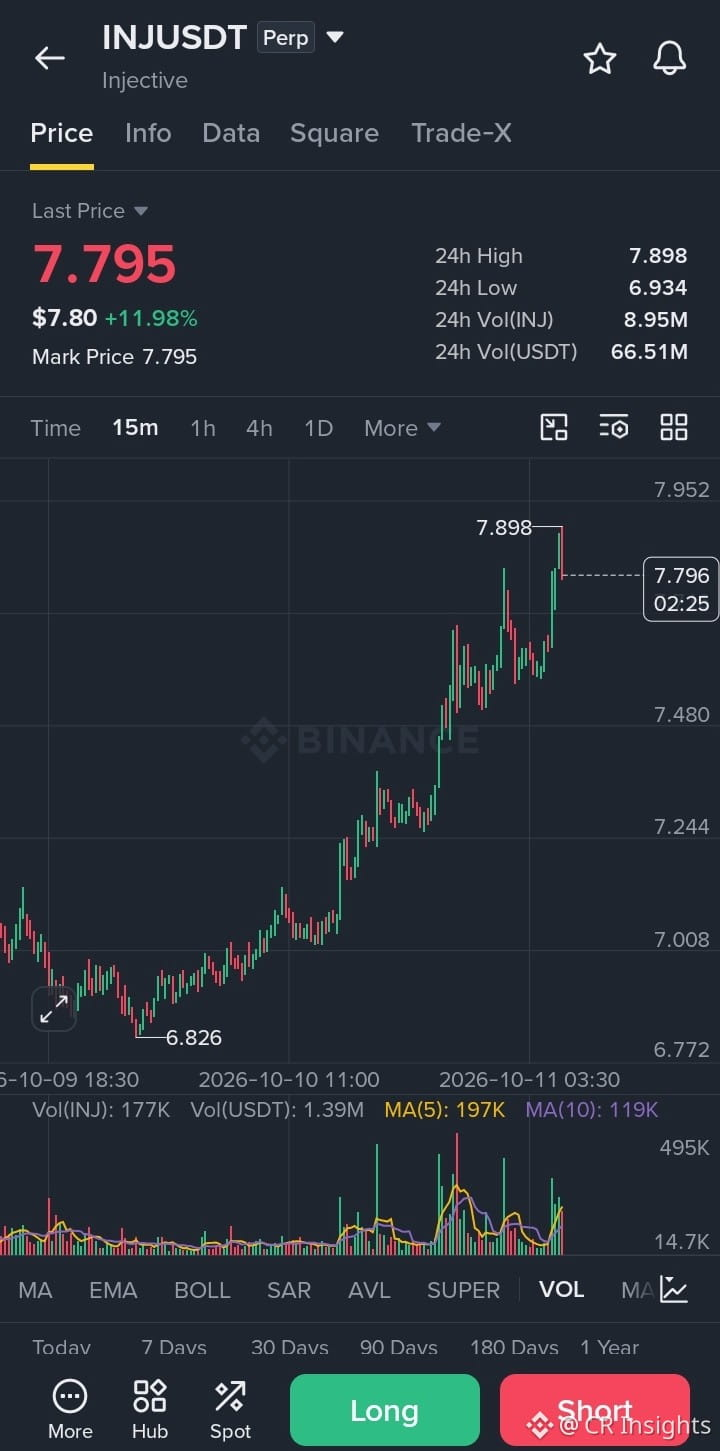
$INJ — 15M Scalp
Bias: LONG on pullback
INJ is making higher highs and higher lows after climbing from $6.83. But price is near the $7.898 resistance, so chasing here is risky.
* Entry: $7.65–$7.72 after a bounce
* TP1: 7.82
* TP2: $7.89
* SL: $7.56
* Invalidation: 15M close below $7.56
Reason: The uptrend is strong, but a pullback toward $7.65–$7.72 offers a better entry than buying near resistance. If price doesn’t pull back, don’t chase.
$INJ — 15M Scalp
Bias: LONG on pullback
INJ is making higher highs and higher lows after climbing from $6.83. But price is near the $7.898 resistance, so chasing here is risky.
* Entry: $7.65–$7.72 after a bounce
* TP1: 7.82
* TP2: $7.89
* SL: $7.56
* Invalidation: 15M close below $7.56
Reason: The uptrend is strong, but a pullback toward $7.65–$7.72 offers a better entry than buying near resistance. If price doesn’t pull back, don’t chase.
Bias: LONG on pullback
INJ is making higher highs and higher lows after climbing from $6.83. But price is near the $7.898 resistance, so chasing here is risky.
* Entry: $7.65–$7.72 after a bounce
* TP1: 7.82
* TP2: $7.89
* SL: $7.56
* Invalidation: 15M close below $7.56
Reason: The uptrend is strong, but a pullback toward $7.65–$7.72 offers a better entry than buying near resistance. If price doesn’t pull back, don’t chase.
345
·
--
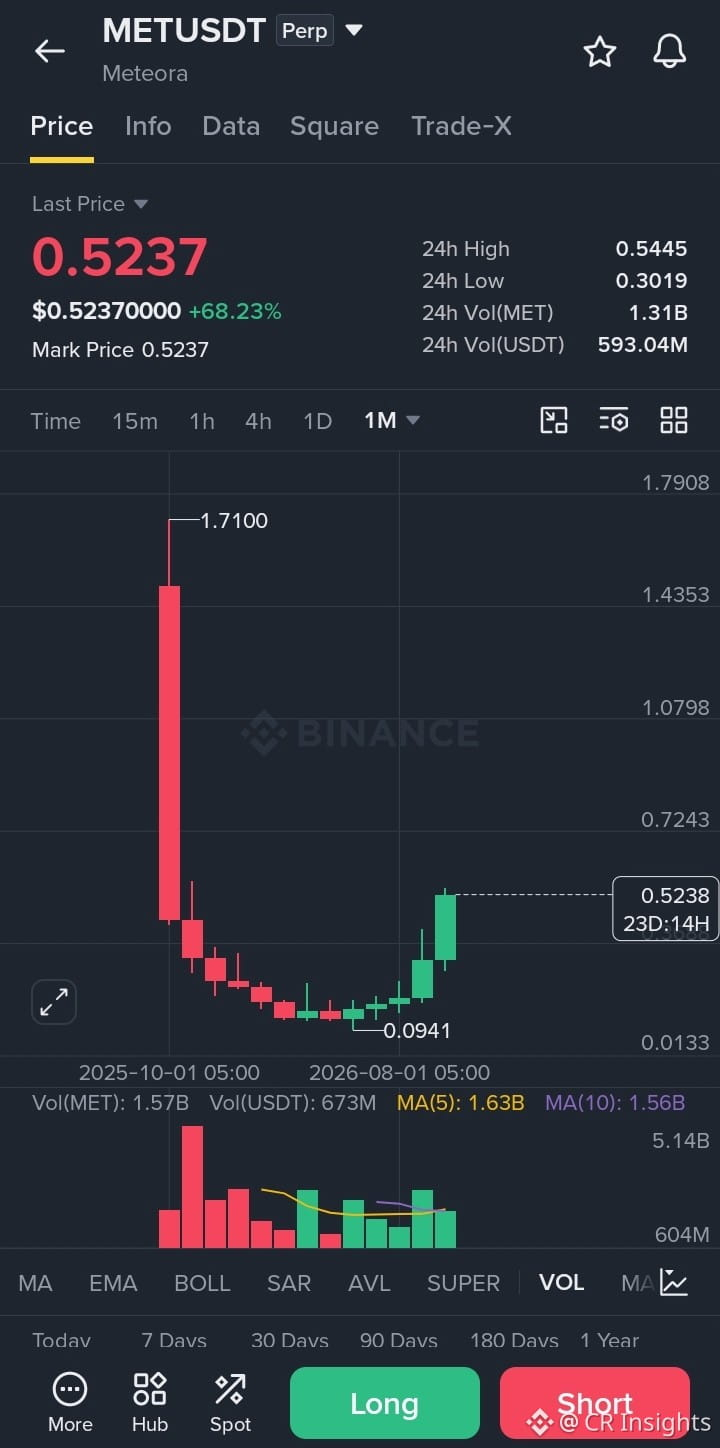
MET MONTHLY CHART JUST CHANGED CHARACTER
MET spent months falling from the $1.71 area and eventually bottomed around $0.0941. Since then, the monthly structure has started turning up, and the latest candles are pushing hard into $0.5238 with a major volume expansion.
Now the chart gives a very clear map.
$0.5238 is the immediate level. If MET gets a monthly breakout and holds above it, the next chart levels are $0.7243 → $1.0798 → $1.4353 → $1.7100.
For the trade, a clean break above $0.5238 followed by a retest holding that level is the confirmation. The invalidation is a move back below the breakout structure.
But if $0.5238 rejects and price loses the recent breakout area, the important lower chart levels are $0.30 and then the much bigger $0.0941 base.
This is what makes the chart interesting: MET has gone from a $0.0941 monthly bottom to testing $0.5238, while the next major resistance levels are already sitting clearly above it.
$0.5238 breakout → $0.7243 → $1.0798 → $1.4353 → $1.7100
That is the chart map. $MET
MET MONTHLY CHART JUST CHANGED CHARACTER
MET spent months falling from the $1.71 area and eventually bottomed around $0.0941. Since then, the monthly structure has started turning up, and the latest candles are pushing hard into $0.5238 with a major volume expansion.
Now the chart gives a very clear map.
$0.5238 is the immediate level. If MET gets a monthly breakout and holds above it, the next chart levels are $0.7243 → $1.0798 → $1.4353 → $1.7100.
For the trade, a clean break above $0.5238 followed by a retest holding that level is the confirmation. The invalidation is a move back below the breakout structure.
But if $0.5238 rejects and price loses the recent breakout area, the important lower chart levels are $0.30 and then the much bigger $0.0941 base.
This is what makes the chart interesting: MET has gone from a $0.0941 monthly bottom to testing $0.5238, while the next major resistance levels are already sitting clearly above it.
$0.5238 breakout → $0.7243 → $1.0798 → $1.4353 → $1.7100
That is the chart map. $MET
MET spent months falling from the $1.71 area and eventually bottomed around $0.0941. Since then, the monthly structure has started turning up, and the latest candles are pushing hard into $0.5238 with a major volume expansion.
Now the chart gives a very clear map.
$0.5238 is the immediate level. If MET gets a monthly breakout and holds above it, the next chart levels are $0.7243 → $1.0798 → $1.4353 → $1.7100.
For the trade, a clean break above $0.5238 followed by a retest holding that level is the confirmation. The invalidation is a move back below the breakout structure.
But if $0.5238 rejects and price loses the recent breakout area, the important lower chart levels are $0.30 and then the much bigger $0.0941 base.
This is what makes the chart interesting: MET has gone from a $0.0941 monthly bottom to testing $0.5238, while the next major resistance levels are already sitting clearly above it.
$0.5238 breakout → $0.7243 → $1.0798 → $1.4353 → $1.7100
That is the chart map. $MET
313
·
--
XRP SWEPT $1.40 — NOW THE $1.428 BREAKOUT MATTERS
XRP just swept the $1.40 support and is sitting around that area again. The chart is still weak after the drop, but buyers are trying to defend the same level.
If XRP reclaims $1.415 and then breaks $1.428 with a clean hourly close, that gives the long confirmation. The breakout target is $1.45, then $1.48. SL around $1.389.
But if $1.40 breaks and XRP closes below it, I’d wait for the retest. If $1.40 turns into resistance, the short setup opens toward $1.389 first, then the next downside area.
DYOR
XRP SWEPT $1.40 — NOW THE $1.428 BREAKOUT MATTERS
XRP just swept the $1.40 support and is sitting around that area again. The chart is still weak after the drop, but buyers are trying to defend the same level.
If XRP reclaims $1.415 and then breaks $1.428 with a clean hourly close, that gives the long confirmation. The breakout target is $1.45, then $1.48. SL around $1.389.
But if $1.40 breaks and XRP closes below it, I’d wait for the retest. If $1.40 turns into resistance, the short setup opens toward $1.389 first, then the next downside area.
DYOR
XRP just swept the $1.40 support and is sitting around that area again. The chart is still weak after the drop, but buyers are trying to defend the same level.
If XRP reclaims $1.415 and then breaks $1.428 with a clean hourly close, that gives the long confirmation. The breakout target is $1.45, then $1.48. SL around $1.389.
But if $1.40 breaks and XRP closes below it, I’d wait for the retest. If $1.40 turns into resistance, the short setup opens toward $1.389 first, then the next downside area.
DYOR
1
598
·
--
GOLD IS TESTING $4,103 AGAIN — BREAKDOWN OR BOUNCE
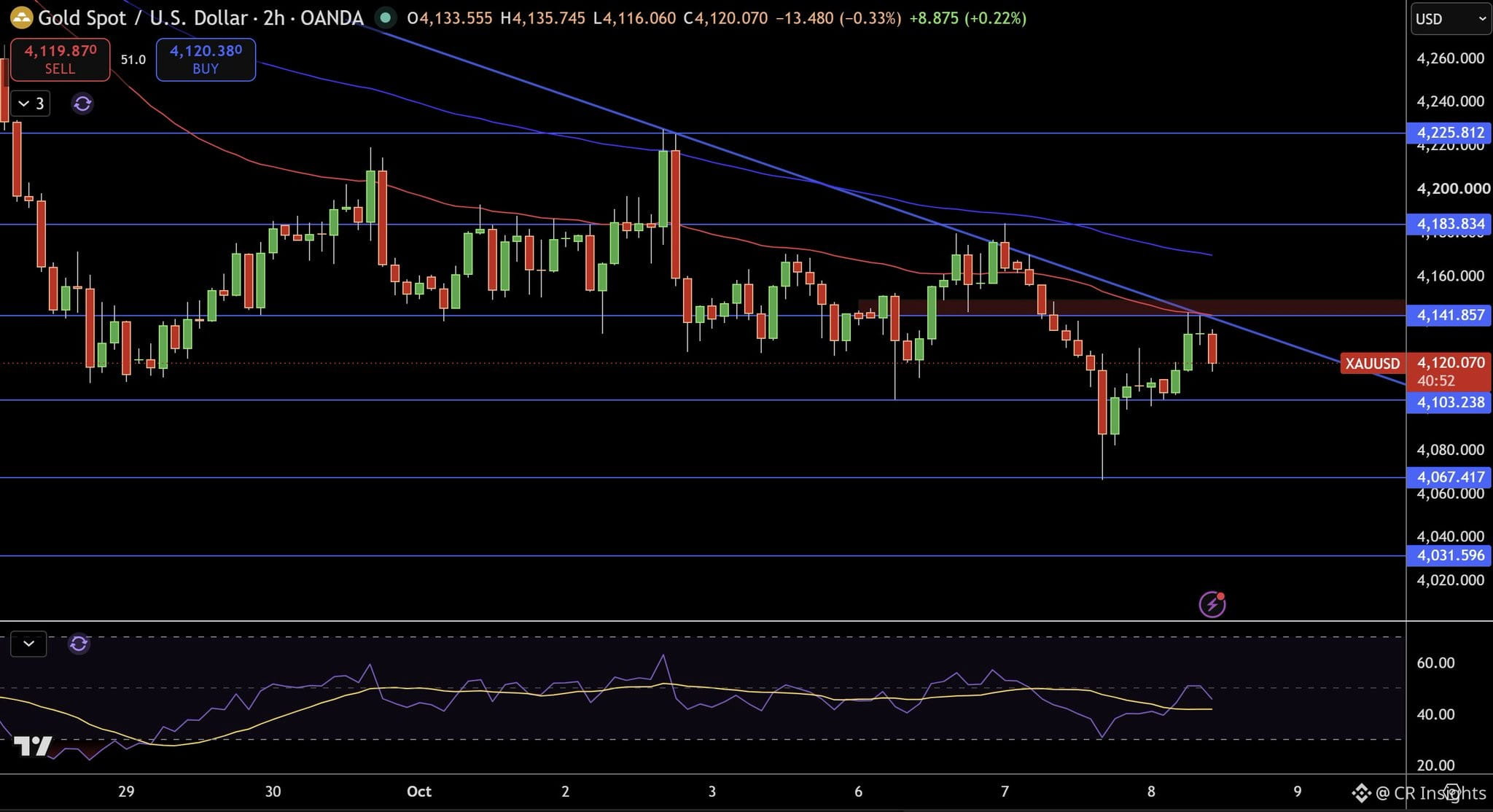
Gold is around $4,120 on the 2H chart after bouncing from the $4,067 low. The structure is still bearish, with lower highs and the descending trendline sitting above price. $4,142 is the first resistance and $4,103 is the key support. Gold is also still facing pressure from elevated yields and expectations of another Fed hike later this year.
The short setup is only there if $4,103 actually breaks. I want a 2H close below $4,103, then a retest of $4,103 from underneath and rejection.
Short entry: $4,095–$4,103
SL: $4,142
TP1: $4,067
TP2: $4,032
TP3: $4,000
If $4,103 breaks but price immediately reclaims it, no short. That would be a failed breakdown.
On the other side, if gold reclaims $4,142 and holds the retest, the short setup is off. That opens $4,184 first and then $4,225.
So the trade map is simple:
$4,103 break + failed retest → SHORT → $4,067 / $4,032 / $4,000
$4,142 reclaim + retest → bearish setup invalid → $4,184 / $4,225
At $4,120, there is no reason to chase either side. The trade comes after confirmation.
$GOLD.US $XAUT
{future}(XAUTUSDT)
#XAU
GOLD IS TESTING $4,103 AGAIN — BREAKDOWN OR BOUNCE
Gold is around $4,120 on the 2H chart after bouncing from the $4,067 low. The structure is still bearish, with lower highs and the descending trendline sitting above price. $4,142 is the first resistance and $4,103 is the key support. Gold is also still facing pressure from elevated yields and expectations of another Fed hike later this year.
The short setup is only there if $4,103 actually breaks. I want a 2H close below $4,103, then a retest of $4,103 from underneath and rejection.
Short entry: $4,095–$4,103
SL: $4,142
TP1: $4,067
TP2: $4,032
TP3: $4,000
If $4,103 breaks but price immediately reclaims it, no short. That would be a failed breakdown.
On the other side, if gold reclaims $4,142 and holds the retest, the short setup is off. That opens $4,184 first and then $4,225.
So the trade map is simple:
$4,103 break + failed retest → SHORT → $4,067 / $4,032 / $4,000
$4,142 reclaim + retest → bearish setup invalid → $4,184 / $4,225
At $4,120, there is no reason to chase either side. The trade comes after confirmation.
$GOLD.US $XAUT
#XAU
Gold is around $4,120 on the 2H chart after bouncing from the $4,067 low. The structure is still bearish, with lower highs and the descending trendline sitting above price. $4,142 is the first resistance and $4,103 is the key support. Gold is also still facing pressure from elevated yields and expectations of another Fed hike later this year.
The short setup is only there if $4,103 actually breaks. I want a 2H close below $4,103, then a retest of $4,103 from underneath and rejection.
Short entry: $4,095–$4,103
SL: $4,142
TP1: $4,067
TP2: $4,032
TP3: $4,000
If $4,103 breaks but price immediately reclaims it, no short. That would be a failed breakdown.
On the other side, if gold reclaims $4,142 and holds the retest, the short setup is off. That opens $4,184 first and then $4,225.
So the trade map is simple:
$4,103 break + failed retest → SHORT → $4,067 / $4,032 / $4,000
$4,142 reclaim + retest → bearish setup invalid → $4,184 / $4,225
At $4,120, there is no reason to chase either side. The trade comes after confirmation.
$GOLD.US $XAUT
#XAU
462
·
--
$BTC is sitting right where the 4H setup gets interesting.
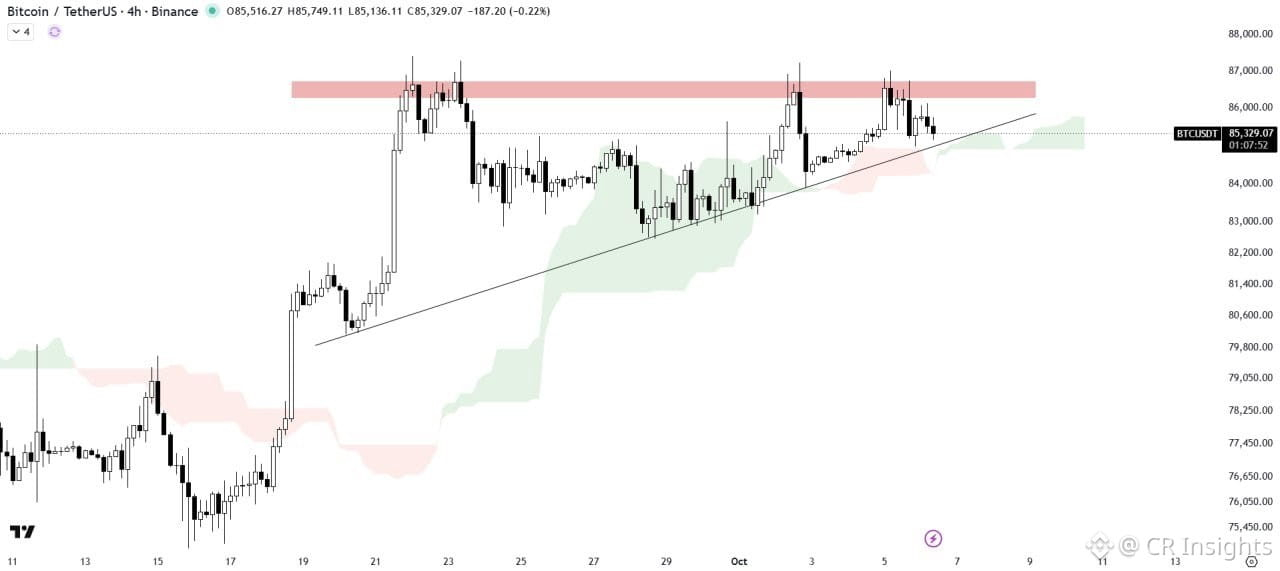
The chart is an ascending triangle, with higher lows pushing into the same $86.3K–$86.7K resistance. Price is now back around $84K–$85K, so the rising support is being tested.
If BTC gets back above $86.7K, I want a 4H close above the resistance and then a retest that holds. That confirms the breakout. Long entry $86.7K–$87K, SL $85.8K, TP1 $87.6K, TP2 $90K, TP3 $92K. If BTC breaks back below the retest, the breakout setup is invalid.
If BTC loses $84.2K, I want a 4H close below it and then a failed retest from underneath. That confirms the breakdown. Short entry $83.9K–$84.2K, SL $85.2K, TP1 $83.3K, TP2 $82.5K, TP3 $81.5K. Reclaiming $85.2K invalidates the short setup.
So the trade map is simple.
Break $86.7K + retest → Long → $87.6K / $90K / $92K
Break $84.2K + failed retest → Short → $83.3K / $82.5K / $81.5K
Until one side confirms, there’s no clean trade in the middle
$BTC is sitting right where the 4H setup gets interesting.
The chart is an ascending triangle, with higher lows pushing into the same $86.3K–$86.7K resistance. Price is now back around $84K–$85K, so the rising support is being tested.
If BTC gets back above $86.7K, I want a 4H close above the resistance and then a retest that holds. That confirms the breakout. Long entry $86.7K–$87K, SL $85.8K, TP1 $87.6K, TP2 $90K, TP3 $92K. If BTC breaks back below the retest, the breakout setup is invalid.
If BTC loses $84.2K, I want a 4H close below it and then a failed retest from underneath. That confirms the breakdown. Short entry $83.9K–$84.2K, SL $85.2K, TP1 $83.3K, TP2 $82.5K, TP3 $81.5K. Reclaiming $85.2K invalidates the short setup.
So the trade map is simple.
Break $86.7K + retest → Long → $87.6K / $90K / $92K
Break $84.2K + failed retest → Short → $83.3K / $82.5K / $81.5K
Until one side confirms, there’s no clean trade in the middle
The chart is an ascending triangle, with higher lows pushing into the same $86.3K–$86.7K resistance. Price is now back around $84K–$85K, so the rising support is being tested.
If BTC gets back above $86.7K, I want a 4H close above the resistance and then a retest that holds. That confirms the breakout. Long entry $86.7K–$87K, SL $85.8K, TP1 $87.6K, TP2 $90K, TP3 $92K. If BTC breaks back below the retest, the breakout setup is invalid.
If BTC loses $84.2K, I want a 4H close below it and then a failed retest from underneath. That confirms the breakdown. Short entry $83.9K–$84.2K, SL $85.2K, TP1 $83.3K, TP2 $82.5K, TP3 $81.5K. Reclaiming $85.2K invalidates the short setup.
So the trade map is simple.
Break $86.7K + retest → Long → $87.6K / $90K / $92K
Break $84.2K + failed retest → Short → $83.3K / $82.5K / $81.5K
Until one side confirms, there’s no clean trade in the middle
176
·
--
$BR JUST BROKE $0.52 — NOW THE NEXT LEVELS ARE CLEAR
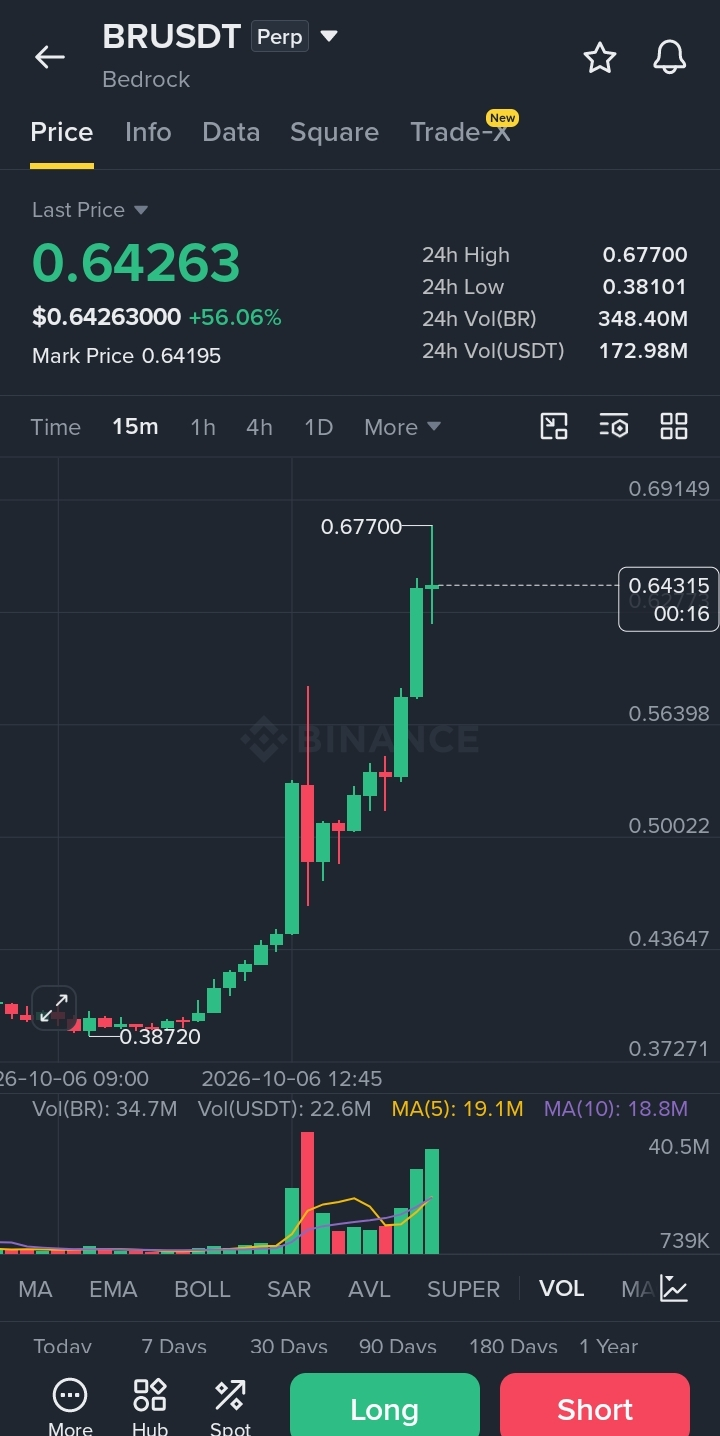
BR based around $0.3886, broke $0.52, and then accelerated to $0.6577 with $5.66M turnover.
Now there are three levels I care about:
$0.60–$0.62 holds: the breakout is being defended. A move back through $0.6577 puts $0.70 in play, then $0.75 if momentum stays strong.
$0.60 breaks: the first breakout support is gone. $0.52 becomes the next test. That's the level that decides whether this was a real expansion or just a spike.
$0.52 breaks: I wouldn't keep treating dips as bullish. The next meaningful area is $0.41–$0.39, where the move actually started.
So from here:
Hold $0.60 → $0.6577 → $0.70/$0.75
Lose $0.60 → $0.52
Lose $0.52 → $0.41/$0.39
At $0.65, the question isn't whether BR can go higher.
It's which of these levels gets taken next.
$BR JUST BROKE $0.52 — NOW THE NEXT LEVELS ARE CLEAR
BR based around $0.3886, broke $0.52, and then accelerated to $0.6577 with $5.66M turnover.
Now there are three levels I care about:
$0.60–$0.62 holds: the breakout is being defended. A move back through $0.6577 puts $0.70 in play, then $0.75 if momentum stays strong.
$0.60 breaks: the first breakout support is gone. $0.52 becomes the next test. That's the level that decides whether this was a real expansion or just a spike.
$0.52 breaks: I wouldn't keep treating dips as bullish. The next meaningful area is $0.41–$0.39, where the move actually started.
So from here:
Hold $0.60 → $0.6577 → $0.70/$0.75
Lose $0.60 → $0.52
Lose $0.52 → $0.41/$0.39
At $0.65, the question isn't whether BR can go higher.
It's which of these levels gets taken next.
BR based around $0.3886, broke $0.52, and then accelerated to $0.6577 with $5.66M turnover.
Now there are three levels I care about:
$0.60–$0.62 holds: the breakout is being defended. A move back through $0.6577 puts $0.70 in play, then $0.75 if momentum stays strong.
$0.60 breaks: the first breakout support is gone. $0.52 becomes the next test. That's the level that decides whether this was a real expansion or just a spike.
$0.52 breaks: I wouldn't keep treating dips as bullish. The next meaningful area is $0.41–$0.39, where the move actually started.
So from here:
Hold $0.60 → $0.6577 → $0.70/$0.75
Lose $0.60 → $0.52
Lose $0.52 → $0.41/$0.39
At $0.65, the question isn't whether BR can go higher.
It's which of these levels gets taken next.
603
·
--
ADA JUST HIT $0.273 — AND THE SHORTS ARE ABOVE IT
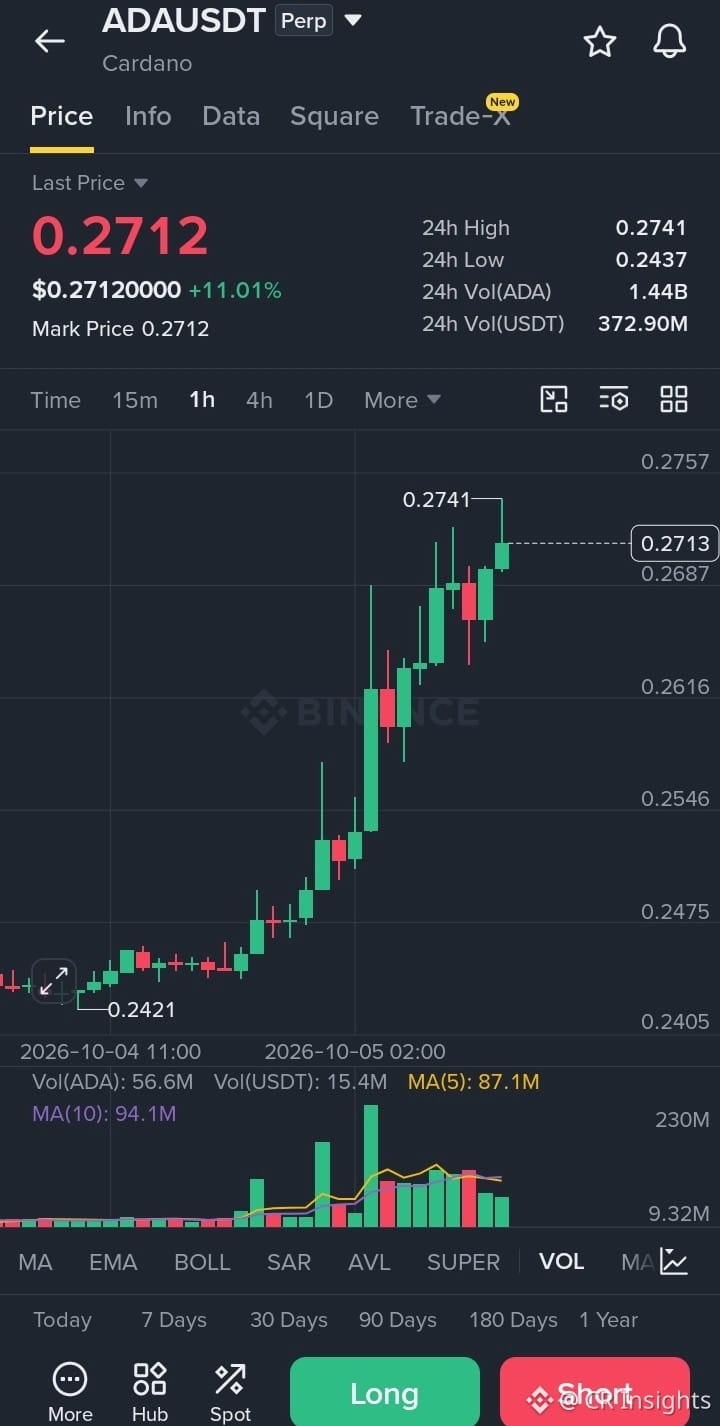
$ADA has climbed from $0.2438 to $0.2731 in roughly two days. Today's volume is already strong, with futures volume around $1.04B and open interest around $624M.
But the useful part is sitting right above price.
A current liquidation map estimates about $441K of shorts around $0.2723. ADA is already trading around that zone, so another push higher can force those shorts to close into the move.
That's why $0.2731 matters more than the 11% green candle.
A clean break and hold above it can squeeze the nearby shorts and put $0.28 in play.
If ADA gets rejected and falls back below $0.267, the squeeze setup is gone.
Break $0.2731 → look for continuation.
Lose $0.267 → don't chase the long.
#SECHaltsCryptoETFReviewsAmidFundingLapse
ADA JUST HIT $0.273 — AND THE SHORTS ARE ABOVE IT
$ADA has climbed from $0.2438 to $0.2731 in roughly two days. Today's volume is already strong, with futures volume around $1.04B and open interest around $624M.
But the useful part is sitting right above price.
A current liquidation map estimates about $441K of shorts around $0.2723. ADA is already trading around that zone, so another push higher can force those shorts to close into the move.
That's why $0.2731 matters more than the 11% green candle.
A clean break and hold above it can squeeze the nearby shorts and put $0.28 in play.
If ADA gets rejected and falls back below $0.267, the squeeze setup is gone.
Break $0.2731 → look for continuation.
Lose $0.267 → don't chase the long.
#SECHaltsCryptoETFReviewsAmidFundingLapse
$ADA has climbed from $0.2438 to $0.2731 in roughly two days. Today's volume is already strong, with futures volume around $1.04B and open interest around $624M.
But the useful part is sitting right above price.
A current liquidation map estimates about $441K of shorts around $0.2723. ADA is already trading around that zone, so another push higher can force those shorts to close into the move.
That's why $0.2731 matters more than the 11% green candle.
A clean break and hold above it can squeeze the nearby shorts and put $0.28 in play.
If ADA gets rejected and falls back below $0.267, the squeeze setup is gone.
Break $0.2731 → look for continuation.
Lose $0.267 → don't chase the long.
#SECHaltsCryptoETFReviewsAmidFundingLapse
315
Log in to explore more content
Join global crypto users on Binance Square
⚡️ Get latest and useful information about crypto.
💬 Trusted by the world’s largest crypto exchange.
👍 Discover real insights from verified creators.
Email / Phone number