
老腊肉-kevin
5.9k Posts

老腊肉-kevin
 Square Verified+
Report
Block User
美股交易,加密货币|红薯🍠和X:@cryptokevin1688|找到学习和可落地的路径,比拼执行力,千万别欺负正在努力和弱小时的你
Open Trade
High-Frequency Trader
1 Years
174 Following
46.7K+ Followers
26.5K+ Liked
Posts
Portfolio
All
Quotes
Videos
Live
PINNED
·
--
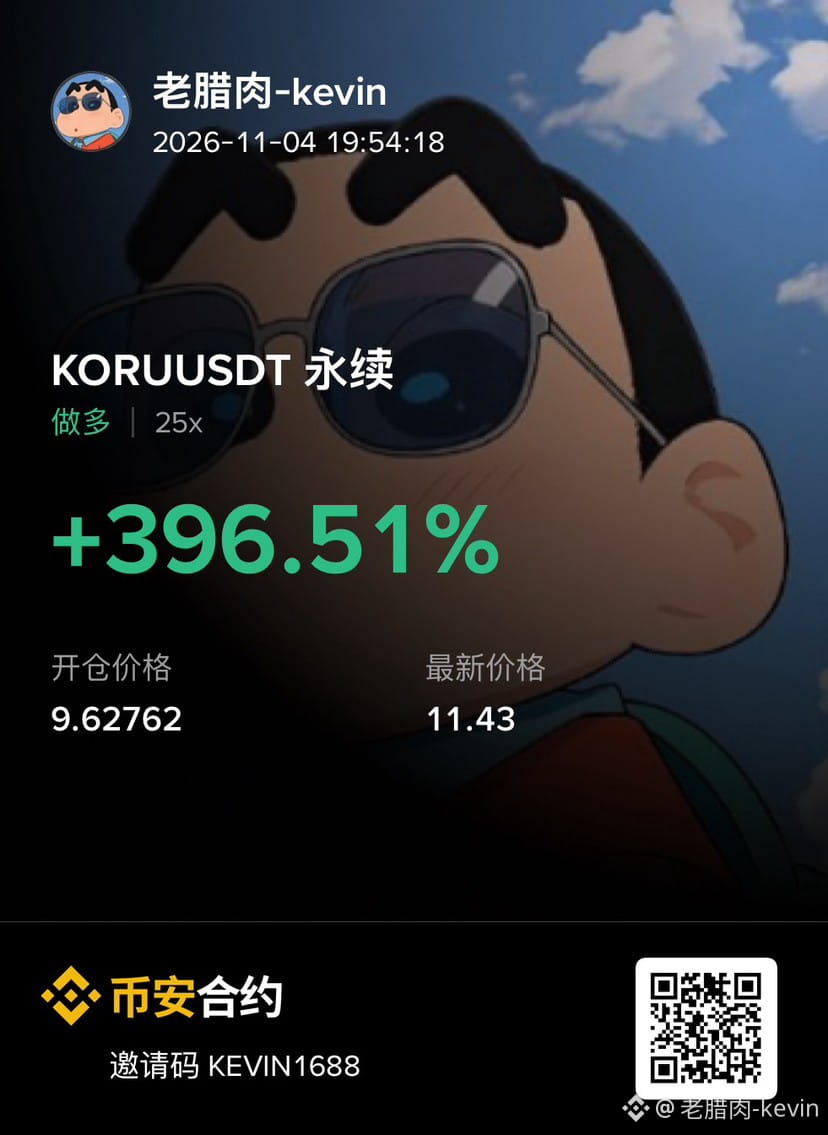
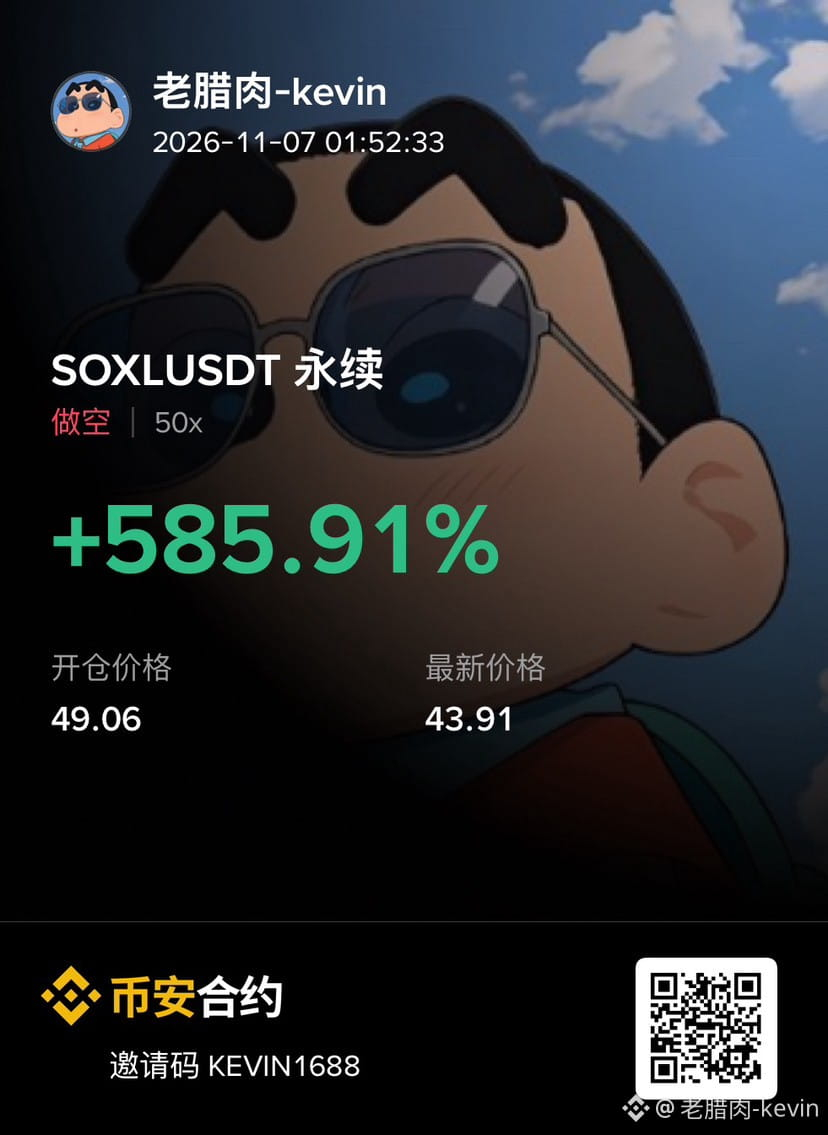
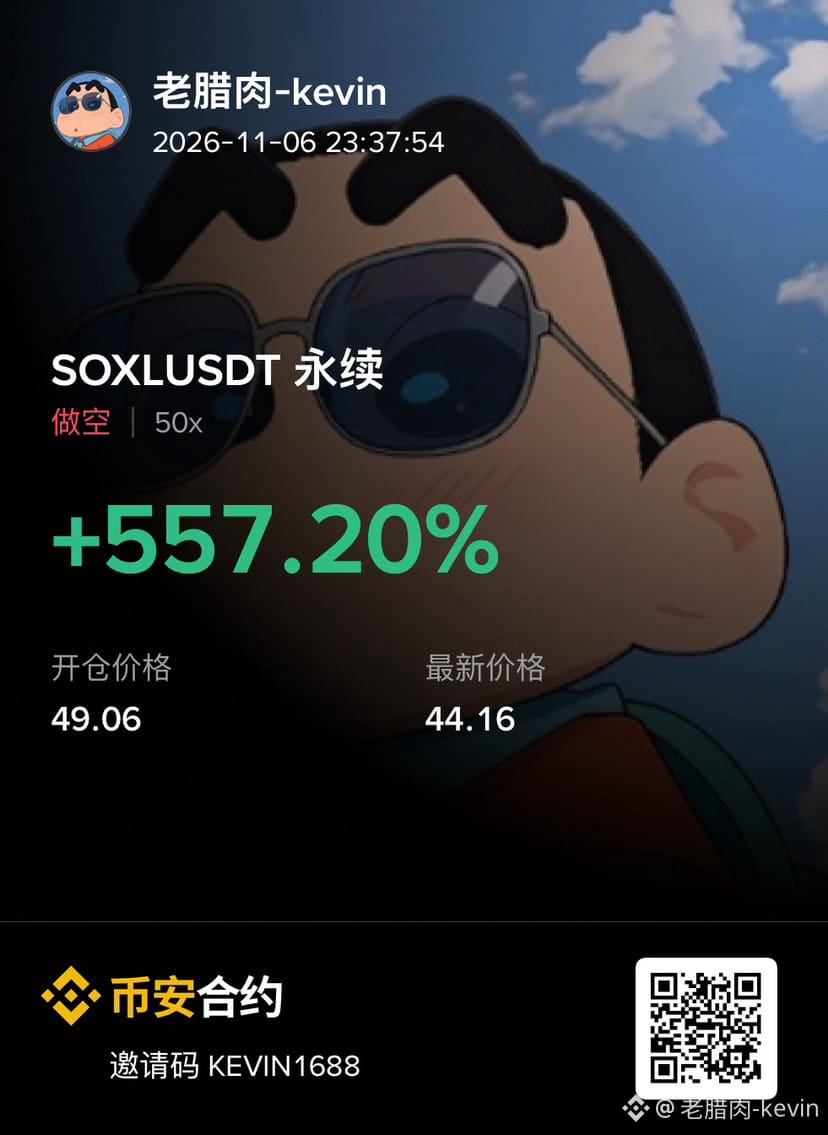
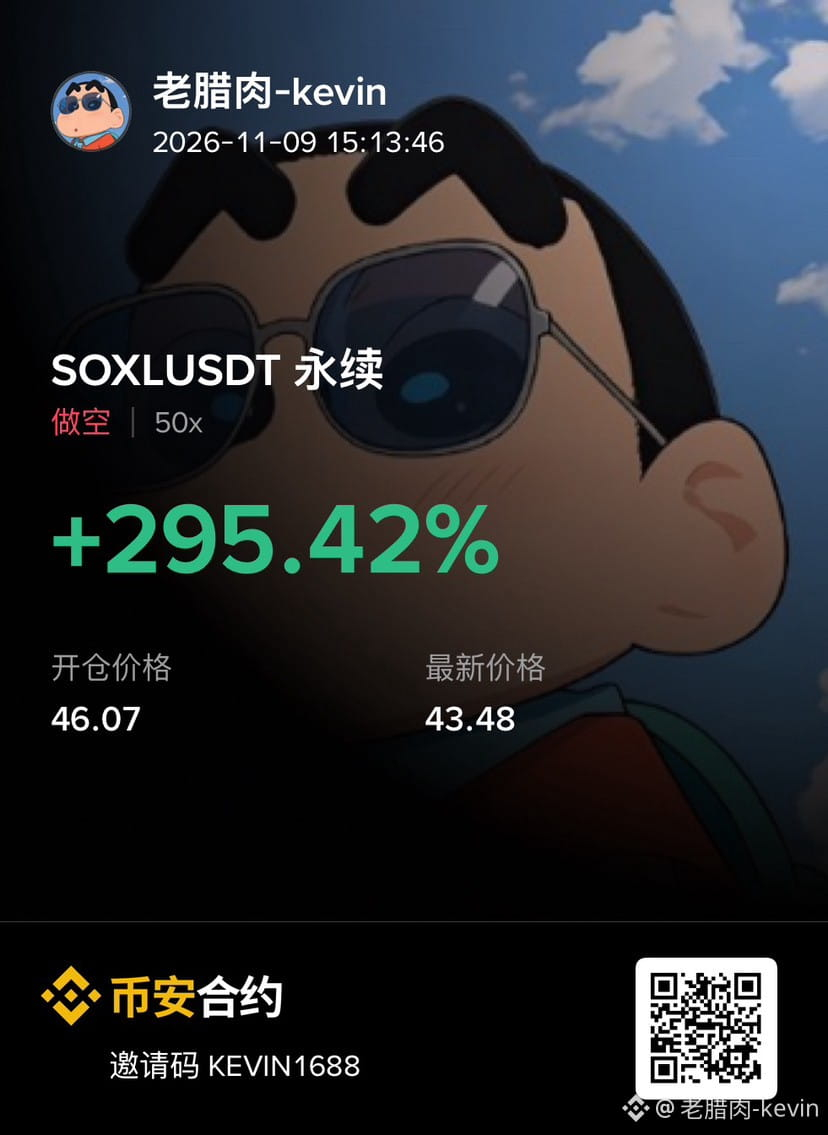
Recently, U.S. stocks have been highly volatile
unlike Bitcoin, which has recently been in a one-way downward trend
Stocks like Nvidia, SOXL, and KORU have all been fluctuating sharply
Some are high-confidence opportunities
while others are traps or attempts to lure traders into short positions
Remember to follow me, and let's trade high-confidence opportunities in U.S. stocks together #英伟达正物色新CEO,谁会接替黄仁勋?
1
1
1.2k
PINNED
·
--
Binance Wb3 Wallet Benefits
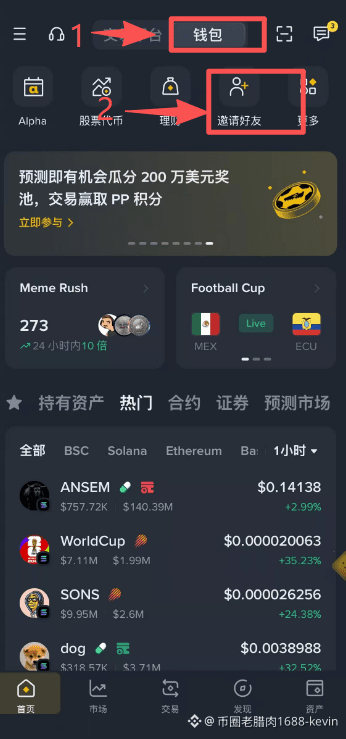
Brothers, let me tell you a great way to save 30% on trading fees (operate as shown in the picture)
In the Binance app, go to the home page. At the top, you’ll see two options: Trading Platform and Wallet.
Step 1: Select Wallet to switch to the wallet;
Step 2: Select Invite Friends;
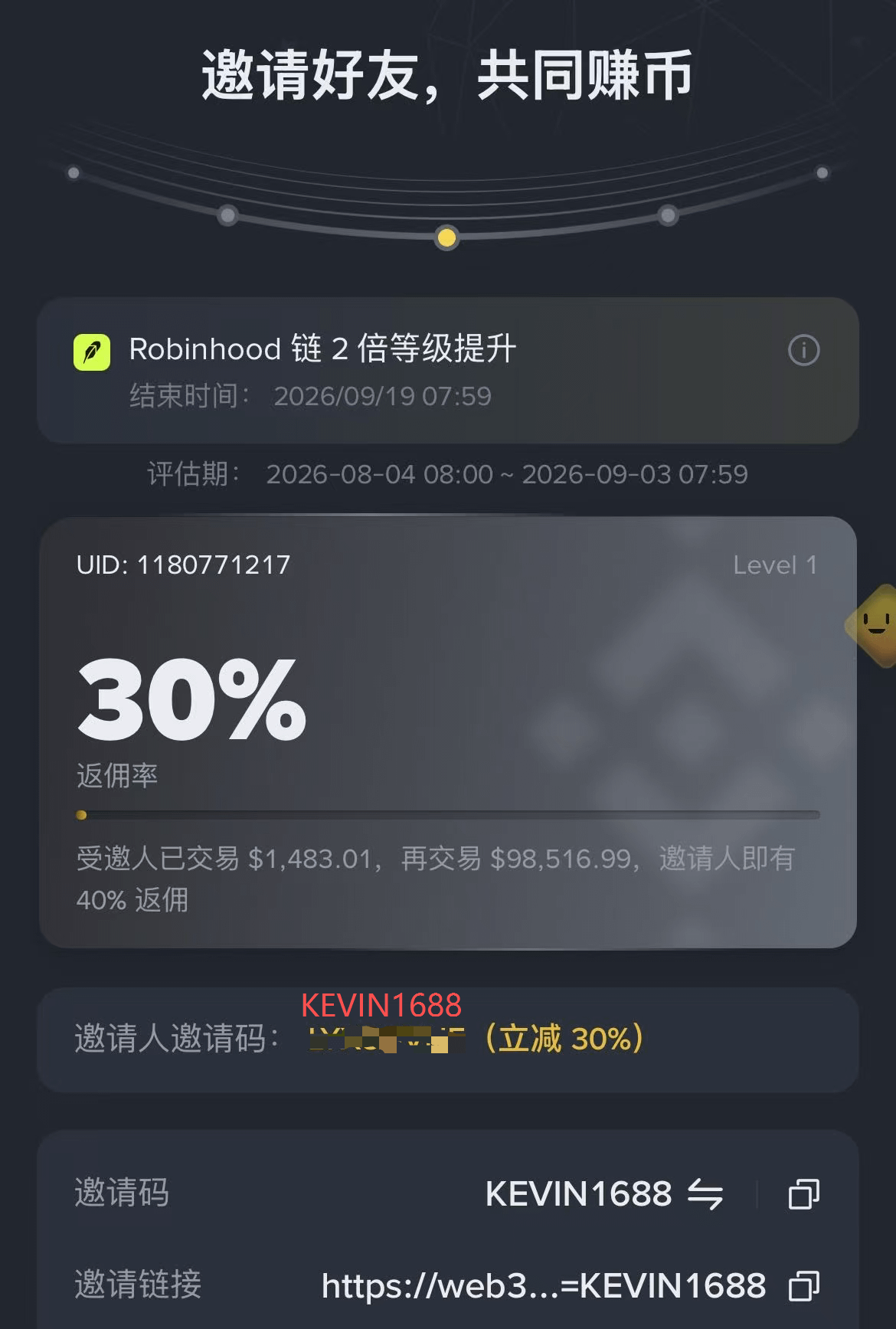
Step 3: Enter the invitation code: KEVIN1688 (copy it to the position shown in the picture);
Step 4: Claim the reward below.
Especially for brothers who like to farm on-chain low-cap “scam/dog” coins and do high-frequency trading—remember to bind the invitation code: KEVIN1688 to get a 30% reward. If you trade less, you can receive 5U or 10U; if you trade more, you can receive dozens of U, or even 100U.
[点击钱包,赶紧去绑定邀请码:KEVIN1688 ,领取奖励吧!](https://web3.binance.com/referral?ref=EHJSNS5W)
Binance Wb3 Wallet Benefits
Brothers, let me tell you a great way to save 30% on trading fees (operate as shown in the picture)
In the Binance app, go to the home page. At the top, you’ll see two options: Trading Platform and Wallet.
Step 1: Select Wallet to switch to the wallet;
Step 2: Select Invite Friends;
Step 3: Enter the invitation code: KEVIN1688 (copy it to the position shown in the picture);
Step 4: Claim the reward below.
Especially for brothers who like to farm on-chain low-cap “scam/dog” coins and do high-frequency trading—remember to bind the invitation code: KEVIN1688 to get a 30% reward. If you trade less, you can receive 5U or 10U; if you trade more, you can receive dozens of U, or even 100U.
点击钱包,赶紧去绑定邀请码:KEVIN1688 ,领取奖励吧!
6
4
27
935
·
--
Verified
#anthropic上市倒计时,ai投资热度迎来检验 A major opportunity for Hong Kong-listed LLM leaders Zhipu and MINIMAX— is Anthropic’s IPO giving them a boost?
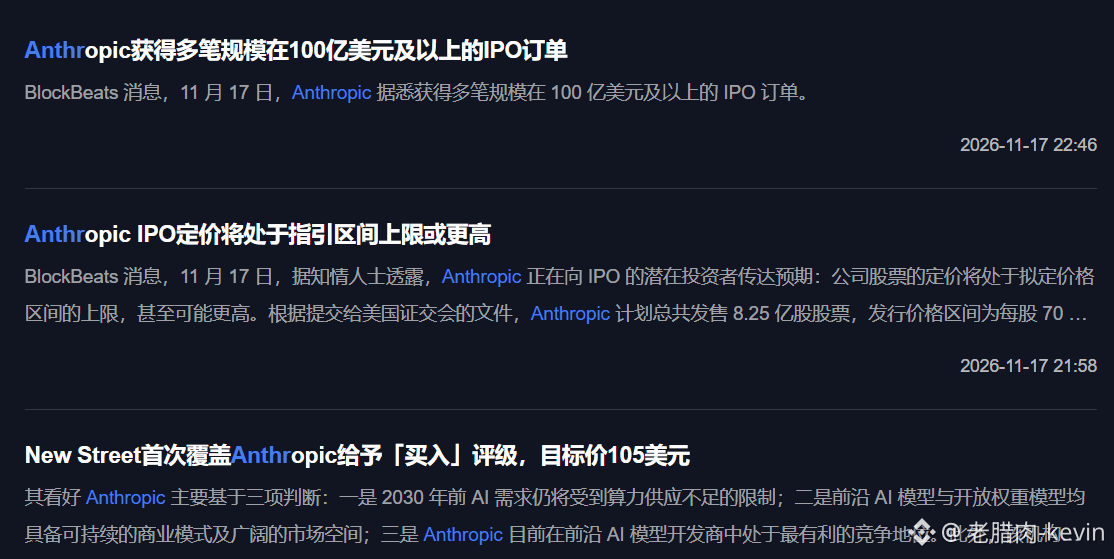
Zhipu and MiniMax plunged hard over the past couple of days. MiniMax tumbled from HK$1,330 to around HK$110, wiping out more than 90% of its peak market value. Then Anthropic turned around and told the market: My IPO is priced at the HK$78 ceiling or even higher, raising $90.4 billion—the biggest IPO in history.
In plain English: The primary market’s appetite for “large models” hasn’t faded at all; the secondary market just hadn’t found an anchor before.
Here’s how the chain reaction works:
· Anthropic’s listing at a valuation of $1.4 trillion effectively reprices large-model assets worldwide.
· Zhipu and MiniMax are the only two pure-play large-model stocks listed in Hong Kong. Once the valuation anchor rises, a sentiment rebound is only a matter of time.
· More importantly, Zhipu has already fallen by half from its all-time high, while MiniMax has even dropped below its HK$165 IPO price. Most of the bad news has already been priced in.$ZHIPU $MINIMAX $ANTHROPIC
{future}(MINIMAXUSDT)
{future}(ZHIPUUSDT)
#anthropic上市倒计时,ai投资热度迎来检验 A major opportunity for Hong Kong-listed LLM leaders Zhipu and MINIMAX— is Anthropic’s IPO giving them a boost?
Zhipu and MiniMax plunged hard over the past couple of days. MiniMax tumbled from HK$1,330 to around HK$110, wiping out more than 90% of its peak market value. Then Anthropic turned around and told the market: My IPO is priced at the HK$78 ceiling or even higher, raising $90.4 billion—the biggest IPO in history.
In plain English: The primary market’s appetite for “large models” hasn’t faded at all; the secondary market just hadn’t found an anchor before.
Here’s how the chain reaction works:
· Anthropic’s listing at a valuation of $1.4 trillion effectively reprices large-model assets worldwide.
· Zhipu and MiniMax are the only two pure-play large-model stocks listed in Hong Kong. Once the valuation anchor rises, a sentiment rebound is only a matter of time.
· More importantly, Zhipu has already fallen by half from its all-time high, while MiniMax has even dropped below its HK$165 IPO price. Most of the bad news has already been priced in.$ZHIPU $MINIMAX $ANTHROPIC
1
557
·
--
🎙️ The semiconductor short position is up 10x—keep holding
End
03 h 22 m 46 s
500
0
0
·
--
Verified
#anthropic上市倒计时,ai投资热度迎来检验 Intraday U.S. stock market update: Anthropic IPO is wildly oversubscribed, but is that money coming back to bail out NVIDIA?
The Philadelphia Semiconductor Index fell 5.28% last night, and not one of its 30 chip stocks ended higher. NVIDIA closed at 156, down 4.12%; Micron fell 7.62%, and TSMC dropped 6%. Nasdaq futures briefly rose more than 0.5% before the market opened today. It looked like a rebound was taking shape, but don’t rush to call it a “reversal.”
What’s really setting things off is Anthropic: its IPO is 10 to 20 times oversubscribed, and the price guidance has gone straight to the $78 upper limit—or even higher. Orders close at 4 p.m. Tuesday.
Put simply: investors are scrambling in the primary market for “the next AI anchor,” while chip stocks are getting hammered in the secondary market. Money hasn’t left AI; it’s just jumped from “buying the shovels” to “buying the next big story.”
The money flows aren’t hiding it, either: consumer staples, healthcare, and utilities have significantly outperformed over the past month, while tech has gone from the strongest sector to the weakest in the second half of the year. NVIDIA reports earnings tonight, and the options market is pricing in a market-cap swing of ±$335 billion. Who would dare go into earnings completely exposed?
I’m not chasing this rebound during today’s session. IPO enthusiasm can save Anthropic itself, but it can’t save the Philadelphia Semiconductor Index’s trend. Let’s wait for NVIDIA’s earnings and see whether the index can close above 9600 on lower volume. If it can’t hold, today’s gains are just setting people up to get trapped tomorrow.$ANTHROPIC $SOXL $SNDK
{future}(SNDKUSDT)
{future}(SOXLUSDT)
#anthropic上市倒计时,ai投资热度迎来检验 Intraday U.S. stock market update: Anthropic IPO is wildly oversubscribed, but is that money coming back to bail out NVIDIA?
The Philadelphia Semiconductor Index fell 5.28% last night, and not one of its 30 chip stocks ended higher. NVIDIA closed at 156, down 4.12%; Micron fell 7.62%, and TSMC dropped 6%. Nasdaq futures briefly rose more than 0.5% before the market opened today. It looked like a rebound was taking shape, but don’t rush to call it a “reversal.”
What’s really setting things off is Anthropic: its IPO is 10 to 20 times oversubscribed, and the price guidance has gone straight to the $78 upper limit—or even higher. Orders close at 4 p.m. Tuesday.
Put simply: investors are scrambling in the primary market for “the next AI anchor,” while chip stocks are getting hammered in the secondary market. Money hasn’t left AI; it’s just jumped from “buying the shovels” to “buying the next big story.”
The money flows aren’t hiding it, either: consumer staples, healthcare, and utilities have significantly outperformed over the past month, while tech has gone from the strongest sector to the weakest in the second half of the year. NVIDIA reports earnings tonight, and the options market is pricing in a market-cap swing of ±$335 billion. Who would dare go into earnings completely exposed?
I’m not chasing this rebound during today’s session. IPO enthusiasm can save Anthropic itself, but it can’t save the Philadelphia Semiconductor Index’s trend. Let’s wait for NVIDIA’s earnings and see whether the index can close above 9600 on lower volume. If it can’t hold, today’s gains are just setting people up to get trapped tomorrow.$ANTHROPIC $SOXL $SNDK

2
1
1.8k
·
--
Nvidia's earnings report will affect overall market sentiment
Nvidia's earnings report will affect overall market sentiment
老腊肉-kevin
·
--
Nvidia reports earnings tonight—long or short?
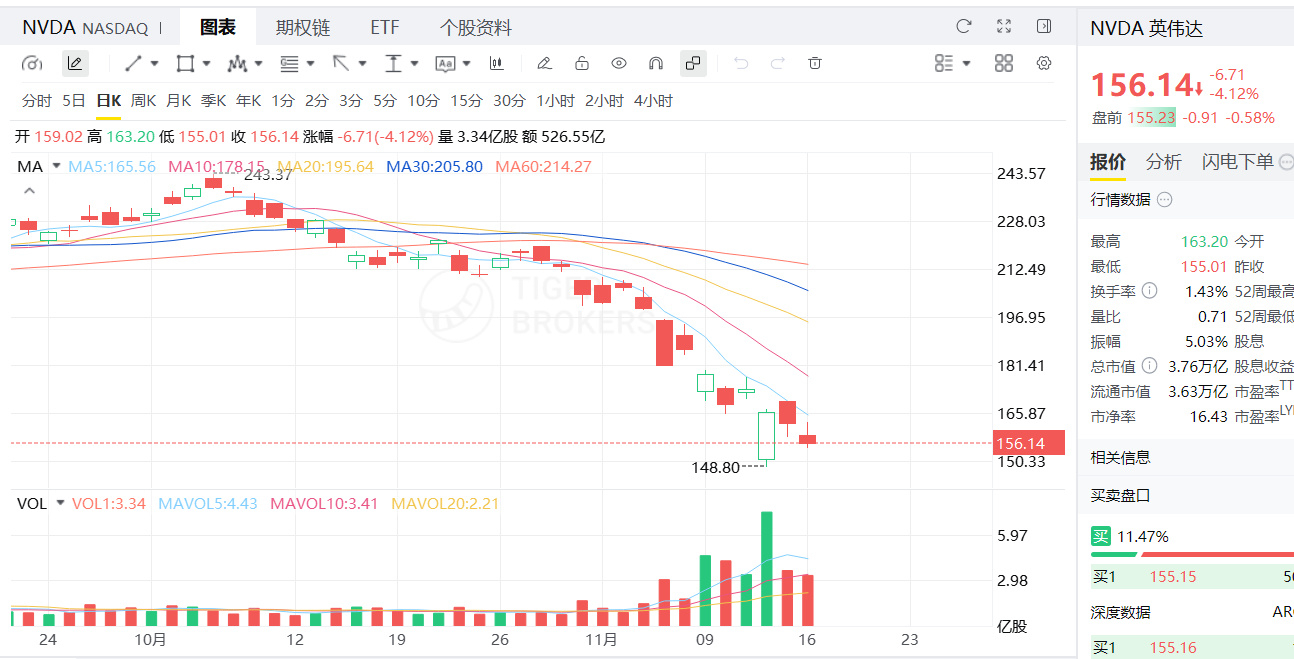
NVDA closed at 156.14 yesterday, down another 4.12%. It’s now 35% below its October high, with its market cap shrinking from $5.76 trillion to $3.76 trillion.
The board has said it currently has no intention of bringing Jensen Huang back. After the market closes tonight (around 5:20 a.m. tomorrow), interim CEO Kress will take the stage to announce the numbers.
The options market is pricing in an 8% to 9% move on earnings. Retail traders have collectively turned bearish this week, piling put options around $150.
Burry is still clinging to his puts expiring in February 2027, but he also said one thing: implied volatility is too expensive—even short sellers think there’s not much meat left on the bone.
Morgan Stanley’s price target is $267, saying the business remains strong. On the other hand, analysts predict this is likely Nvidia’s peak for near-term growth, with growth set to slow from here. The disagreement is so stark that nobody really knows what will happen tonight.
Sell a wide strangle ahead of earnings and pocket the drop in implied volatility. Don’t bet on what Kress will say; bet that once he’s done, the market will realize it’s “nothing special,” and half the fear premium will evaporate first. #英伟达财报夜!预期营收超千亿,AI股或迎大变盘 #黄仁勋能否复任CEO?英伟达董事会:暂不考虑 $NVDA $SOXL $KORU
1
440
·
--
Verified
Nvidia reports earnings tonight—long or short?
NVDA closed at 156.14 yesterday, down another 4.12%. It’s now 35% below its October high, with its market cap shrinking from $5.76 trillion to $3.76 trillion.
The board has said it currently has no intention of bringing Jensen Huang back. After the market closes tonight (around 5:20 a.m. tomorrow), interim CEO Kress will take the stage to announce the numbers.
The options market is pricing in an 8% to 9% move on earnings. Retail traders have collectively turned bearish this week, piling put options around $150.
Burry is still clinging to his puts expiring in February 2027, but he also said one thing: implied volatility is too expensive—even short sellers think there’s not much meat left on the bone.
Morgan Stanley’s price target is $267, saying the business remains strong. On the other hand, analysts predict this is likely Nvidia’s peak for near-term growth, with growth set to slow from here. The disagreement is so stark that nobody really knows what will happen tonight.
Sell a wide strangle ahead of earnings and pocket the drop in implied volatility. Don’t bet on what Kress will say; bet that once he’s done, the market will realize it’s “nothing special,” and half the fear premium will evaporate first. #英伟达财报夜!预期营收超千亿,AI股或迎大变盘 #黄仁勋能否复任CEO?英伟达董事会:暂不考虑 $NVDA $SOXL $KORU
{future}(KORUUSDT)
{future}(SOXLUSDT)
{future}(NVDAUSDT)
Nvidia reports earnings tonight—long or short?
NVDA closed at 156.14 yesterday, down another 4.12%. It’s now 35% below its October high, with its market cap shrinking from $5.76 trillion to $3.76 trillion.
The board has said it currently has no intention of bringing Jensen Huang back. After the market closes tonight (around 5:20 a.m. tomorrow), interim CEO Kress will take the stage to announce the numbers.
The options market is pricing in an 8% to 9% move on earnings. Retail traders have collectively turned bearish this week, piling put options around $150.
Burry is still clinging to his puts expiring in February 2027, but he also said one thing: implied volatility is too expensive—even short sellers think there’s not much meat left on the bone.
Morgan Stanley’s price target is $267, saying the business remains strong. On the other hand, analysts predict this is likely Nvidia’s peak for near-term growth, with growth set to slow from here. The disagreement is so stark that nobody really knows what will happen tonight.
Sell a wide strangle ahead of earnings and pocket the drop in implied volatility. Don’t bet on what Kress will say; bet that once he’s done, the market will realize it’s “nothing special,” and half the fear premium will evaporate first. #英伟达财报夜!预期营收超千亿,AI股或迎大变盘 #黄仁勋能否复任CEO?英伟达董事会:暂不考虑 $NVDA $SOXL $KORU
2
1
1
2k
·
--
Verified
The CPI sword hasn’t fallen, but AI hardware has already taken a knee?
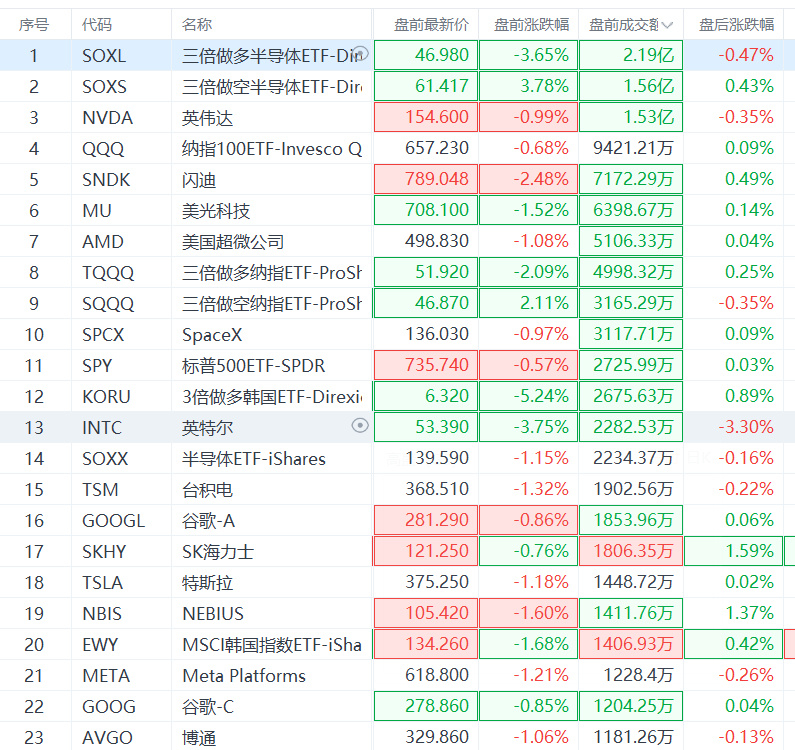
A quick look at premarket: SOXL down 3.65%, NVDA down 0.99%, MU down 1.52%, AMD down 1.08%—not a single name in the entire AI hardware chain is willing to stick its neck out.
What is the market really afraid of? It’s not the CPI itself. It’s that the CPI could activate the “nuclear option” of a 50-basis-point hike in December.
Waller made his position crystal clear earlier: if core CPI comes in at 0.3% or higher month over month, then in December they shouldn’t just raise rates by 25 basis points—they should discuss 50. And October core CPI really did land right at 0.3%, for the third month in a row.
But look at interest rate futures, and the market is still mostly betting on 25 basis points. The odds of 50 basis points have only climbed from “almost zero” to a little over 10%. In plain English: the bond market is buying insurance against a 50-basis-point hike, while the stock market is still pretending 25 basis points is the end of the story.
AI hardware isn’t falling solely because of the CPI. Nvidia reports after the bell tonight, Anthropic is going public this week, and the Commerce Department has tightened restrictions on remote access to AI chips—all three threats are hanging over the market at once. Investors aren’t trading on “rate hikes”; they’re trading on the idea that “uncertainty is too expensive, so get out first and ask questions later.”
Once the first wave of CPI-related jitters passes, watch to see whether SOXL can consolidate on lighter volume around 46.5. If volume doesn’t dry up, there’s no support below; if it does, that only leaves a bit of suspense ahead of earnings. #13F集中披露,机构调仓释放哪些投资信号? $SOXL $SNDK $MUU
{future}(MUUUSDT)
{future}(SNDKUSDT)
{future}(SOXLUSDT)
The CPI sword hasn’t fallen, but AI hardware has already taken a knee?
A quick look at premarket: SOXL down 3.65%, NVDA down 0.99%, MU down 1.52%, AMD down 1.08%—not a single name in the entire AI hardware chain is willing to stick its neck out.
What is the market really afraid of? It’s not the CPI itself. It’s that the CPI could activate the “nuclear option” of a 50-basis-point hike in December.
Waller made his position crystal clear earlier: if core CPI comes in at 0.3% or higher month over month, then in December they shouldn’t just raise rates by 25 basis points—they should discuss 50. And October core CPI really did land right at 0.3%, for the third month in a row.
But look at interest rate futures, and the market is still mostly betting on 25 basis points. The odds of 50 basis points have only climbed from “almost zero” to a little over 10%. In plain English: the bond market is buying insurance against a 50-basis-point hike, while the stock market is still pretending 25 basis points is the end of the story.
AI hardware isn’t falling solely because of the CPI. Nvidia reports after the bell tonight, Anthropic is going public this week, and the Commerce Department has tightened restrictions on remote access to AI chips—all three threats are hanging over the market at once. Investors aren’t trading on “rate hikes”; they’re trading on the idea that “uncertainty is too expensive, so get out first and ask questions later.”
Once the first wave of CPI-related jitters passes, watch to see whether SOXL can consolidate on lighter volume around 46.5. If volume doesn’t dry up, there’s no support below; if it does, that only leaves a bit of suspense ahead of earnings. #13F集中披露,机构调仓释放哪些投资信号? $SOXL $SNDK $MUU
1
1
1.5k
·
--
#本周财报与宏观事件密集,市场再迎波动考验 Has faith in the AI trade on U.S. stocks collapsed?
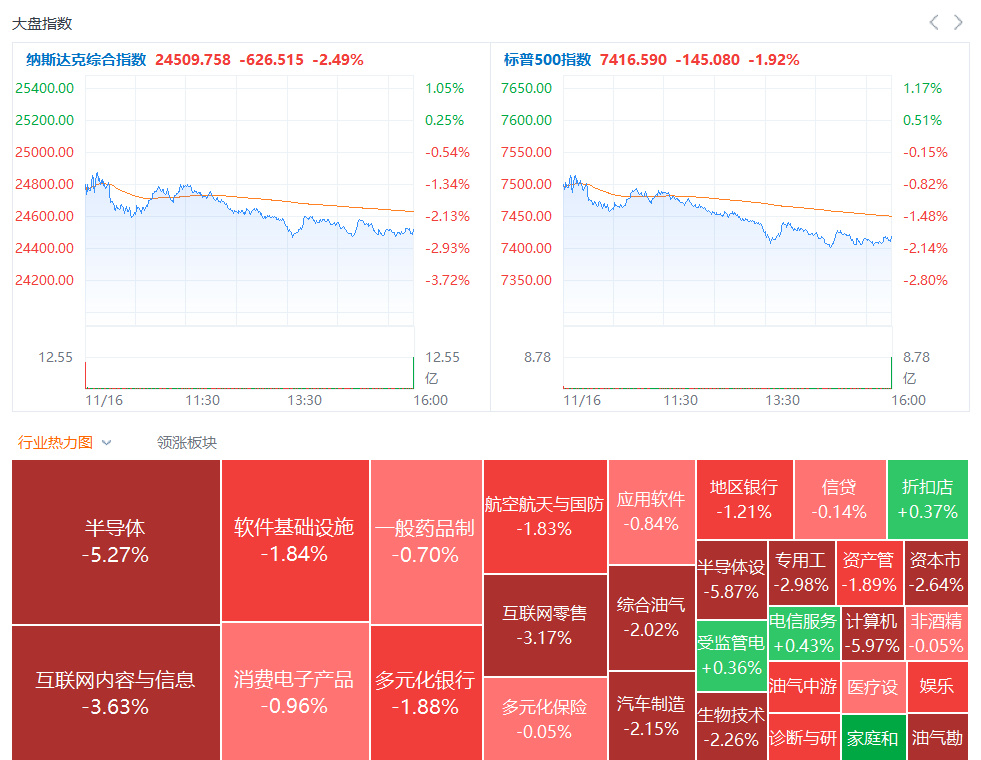
At yesterday’s close, the Nasdaq fell 2.49%, while the Philadelphia Semiconductor Index plunged 5.28%. All 30 chip stocks finished in the red—not a single one was up. Micron dropped 7.62%, Arm fell 8.12%, and Nvidia closed at its lowest level since July 2025. It has now fallen for six straight weeks, shedding a third of its market value from its peak.
But at the same time, Coca-Cola, Procter & Gamble, and Costco all hit record highs. Strange, right? The money hasn’t left the market—it’s scrambling out of the “AI computing power” trade and piling into old-school defensive stocks that sell paper towels and soda.
In plain English: Nvidia reports earnings tonight, and Anthropic is going public this week. With two potential shocks looming, big investors are getting out first.
The 10-year Treasury yield is still at 5.13%. When you can earn more than 5% a year on a risk-free asset, who wants to bet on whether AI will still be in favor tomorrow? Fed governor Warsh added to the worries, saying they’re already drafting contingency plans for an “AI bubble bursting.”
Chasing a rally on the first day of this kind of rotation is, eight times out of ten, just buying into someone else’s portfolio reshuffle. Wait for Nvidia’s earnings, then see whether the Philadelphia Semiconductor Index can stop falling on lower volume. If it can’t, there’s no meaningful support below. If it can, then we can talk about whether it’s worth dipping a toe in.$SOXL $KORU $SNDK
{future}(SNDKUSDT)
{future}(KORUUSDT)
{future}(SOXLUSDT)
#本周财报与宏观事件密集,市场再迎波动考验 Has faith in the AI trade on U.S. stocks collapsed?
At yesterday’s close, the Nasdaq fell 2.49%, while the Philadelphia Semiconductor Index plunged 5.28%. All 30 chip stocks finished in the red—not a single one was up. Micron dropped 7.62%, Arm fell 8.12%, and Nvidia closed at its lowest level since July 2025. It has now fallen for six straight weeks, shedding a third of its market value from its peak.
But at the same time, Coca-Cola, Procter & Gamble, and Costco all hit record highs. Strange, right? The money hasn’t left the market—it’s scrambling out of the “AI computing power” trade and piling into old-school defensive stocks that sell paper towels and soda.
In plain English: Nvidia reports earnings tonight, and Anthropic is going public this week. With two potential shocks looming, big investors are getting out first.
The 10-year Treasury yield is still at 5.13%. When you can earn more than 5% a year on a risk-free asset, who wants to bet on whether AI will still be in favor tomorrow? Fed governor Warsh added to the worries, saying they’re already drafting contingency plans for an “AI bubble bursting.”
Chasing a rally on the first day of this kind of rotation is, eight times out of ten, just buying into someone else’s portfolio reshuffle. Wait for Nvidia’s earnings, then see whether the Philadelphia Semiconductor Index can stop falling on lower volume. If it can’t, there’s no meaningful support below. If it can, then we can talk about whether it’s worth dipping a toe in.$SOXL $KORU $SNDK
1
375
·
--
U.S. Stock Market News Analysis: If Jensen Huang Isn’t Coming Back, Does That Mean Nvidia Hasn’t Hit Bottom Yet?
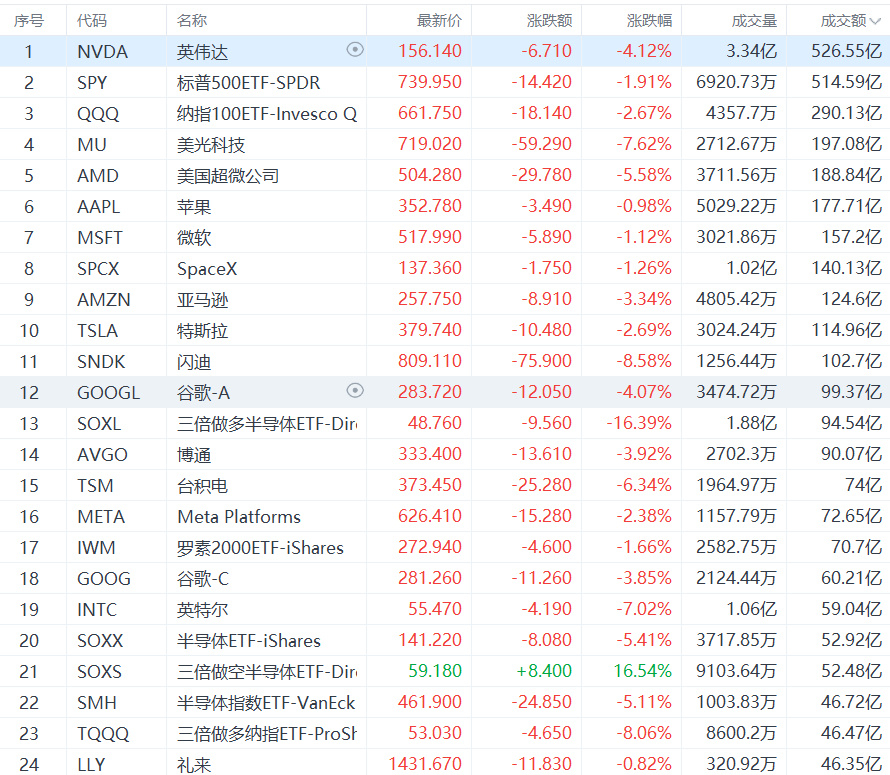
U.S. stocks were dragged down by AI hardware again on Monday. The Nasdaq fell 2.49%, while the Philadelphia Semiconductor Index plunged nearly 5% at one point and still closed down 4.73%. Nvidia once again topped the charts for trading volume, closing down 4.12%. The immediate trigger was simple: the board currently has no intention of reinstating Jensen Huang as CEO, and is focused on advancing an independent investigation.
The stock was already down 13% last week, marking six consecutive weeks of losses. This isn’t “profit-taking ahead of earnings”—the narrative is starting to unravel.
The hardest-hit stocks weren’t Nvidia’s, but memory makers. Micron fell 7.62%, SK Hynix dropped more than 7%, and SanDisk sank 8.58%, leaving the entire memory sector pinned to the floor. Tesla fell 2.69%, as rumors of a SpaceX merger left investors unsettled. Palantir dropped 4.52%, with $2.841 billion in trading volume, ranking 22nd; ARK is still trimming its position. Apple was the only stock that looked halfway decent, down just 0.98% after even rallying against the trend in premarket trading.
In the background, Warsh outlined three possible outcomes for AI on the same day: a boom, mass unemployment, or a burst bubble. He called them “illustrative scenarios, not predictions,” but the market took note.
Before earnings are out, every claim that a stock is “cheap” is bogus. Wait until Kress reads out the numbers tomorrow and volatility subsides, then decide whether to dip in. The relative resilience of cash-flow stocks like Apple is a lot more comfortable than betting on an AI hardware rebound. $NVDA $KORU $SOXL #黄仁勋能否复任CEO?英伟达董事会:暂不考虑
{future}(SOXLUSDT)
{future}(KORUUSDT)
{future}(NVDAUSDT)
U.S. Stock Market News Analysis: If Jensen Huang Isn’t Coming Back, Does That Mean Nvidia Hasn’t Hit Bottom Yet?
U.S. stocks were dragged down by AI hardware again on Monday. The Nasdaq fell 2.49%, while the Philadelphia Semiconductor Index plunged nearly 5% at one point and still closed down 4.73%. Nvidia once again topped the charts for trading volume, closing down 4.12%. The immediate trigger was simple: the board currently has no intention of reinstating Jensen Huang as CEO, and is focused on advancing an independent investigation.
The stock was already down 13% last week, marking six consecutive weeks of losses. This isn’t “profit-taking ahead of earnings”—the narrative is starting to unravel.
The hardest-hit stocks weren’t Nvidia’s, but memory makers. Micron fell 7.62%, SK Hynix dropped more than 7%, and SanDisk sank 8.58%, leaving the entire memory sector pinned to the floor. Tesla fell 2.69%, as rumors of a SpaceX merger left investors unsettled. Palantir dropped 4.52%, with $2.841 billion in trading volume, ranking 22nd; ARK is still trimming its position. Apple was the only stock that looked halfway decent, down just 0.98% after even rallying against the trend in premarket trading.
In the background, Warsh outlined three possible outcomes for AI on the same day: a boom, mass unemployment, or a burst bubble. He called them “illustrative scenarios, not predictions,” but the market took note.
Before earnings are out, every claim that a stock is “cheap” is bogus. Wait until Kress reads out the numbers tomorrow and volatility subsides, then decide whether to dip in. The relative resilience of cash-flow stocks like Apple is a lot more comfortable than betting on an AI hardware rebound. $NVDA $KORU $SOXL #黄仁勋能否复任CEO?英伟达董事会:暂不考虑
2
1.4k
·
--
Verified
Is the Fed writing the script for an “AI bubble burst”?
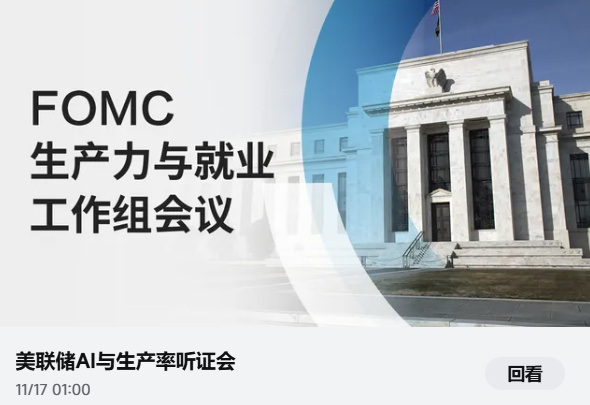
Fed Chair Warsh admitted that they’ve started gaming out three possible outcomes for AI: a productivity boom, mass unemployment, and a bubble bursting. Translation: even the central bank is drawing up contingency plans for an “AI crash,” and you’re still asking me whether it’s time to buy the dip?
Let me break down just how absurd this is:
Warsh went into the most detail about the bubble-burst scenario: money gets poured in, returns fail to materialize, stocks fall first, then the economy slows and unemployment rises.
In 2026, several major cloud providers are pouring more than $700 billion into AI capital spending. It contributes to GDP, but the cost is ballooning debt and credit risk.
The numbers don’t lie: Nvidia’s price-to-earnings ratio has been slashed from 40 to 11, while CoreWeave’s CDS spread has surged to 12.89%. Financing costs have already made their move.
The funniest part? The Philly Semiconductor Index rose 8% last week, but hedge funds turned around and posted net selling for the second week in a row, mainly by opening new short positions. Talking bullish, trading bearish—an old tradition.
The Fed itself has said this is scenario analysis, not a forecast. So the real trading opportunity isn’t in picking a direction; it’s in volatility. Buy put spreads on SOXS, or just short a basket of highly leveraged AI hardware stocks, with a stop-loss if the Philly Semiconductor Index reclaims its previous high. Betting that “someone will bolt first” is a lot cheaper than betting on an “AI perpetual motion machine.” $SOXL $KORU $SNDK
{future}(SNDKUSDT)
{future}(KORUUSDT)
{future}(SOXLUSDT)
Is the Fed writing the script for an “AI bubble burst”?
Fed Chair Warsh admitted that they’ve started gaming out three possible outcomes for AI: a productivity boom, mass unemployment, and a bubble bursting. Translation: even the central bank is drawing up contingency plans for an “AI crash,” and you’re still asking me whether it’s time to buy the dip?
Let me break down just how absurd this is:
Warsh went into the most detail about the bubble-burst scenario: money gets poured in, returns fail to materialize, stocks fall first, then the economy slows and unemployment rises.
In 2026, several major cloud providers are pouring more than $700 billion into AI capital spending. It contributes to GDP, but the cost is ballooning debt and credit risk.
The numbers don’t lie: Nvidia’s price-to-earnings ratio has been slashed from 40 to 11, while CoreWeave’s CDS spread has surged to 12.89%. Financing costs have already made their move.
The funniest part? The Philly Semiconductor Index rose 8% last week, but hedge funds turned around and posted net selling for the second week in a row, mainly by opening new short positions. Talking bullish, trading bearish—an old tradition.
The Fed itself has said this is scenario analysis, not a forecast. So the real trading opportunity isn’t in picking a direction; it’s in volatility. Buy put spreads on SOXS, or just short a basket of highly leveraged AI hardware stocks, with a stop-loss if the Philly Semiconductor Index reclaims its previous high. Betting that “someone will bolt first” is a lot cheaper than betting on an “AI perpetual motion machine.” $SOXL $KORU $SNDK
1
687
·
--
Trump: Huang has learned his lesson; I wouldn’t mind seeing him take the helm at Nvidia again
Trump: Huang has learned his lesson; I wouldn’t mind seeing him take the helm at Nvidia again
老腊肉-kevin
·
--
#标普500与纳指期货创季度新低 Faith in AI stocks has been shattered—has all the money run off to “old-man stocks”?
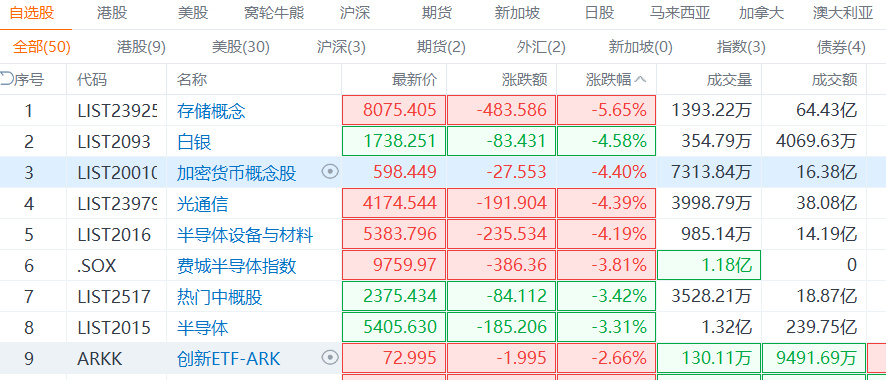
I just finished watching the market. The Philadelphia Semiconductor Index plunged more than 5% at one point today, but has since narrowed its loss to around 3.8%. Micron is down 5.6%, AMD 5.7%, Broadcom 4%, and TSMC 4.4%.
NVDA, by contrast, is down only a little over 2%, looking like “the least-wounded patient.”
Where did the money go? It didn’t leave—it just moved somewhere else to hunker down. Energy and consumer staples are leading the gains, with “old-man stocks” like Coca-Cola hitting an all-time high.
Over the past month, consumer staples have outperformed tech by 33 percentage points—the biggest monthly gap in 25 years. Put simply: people haven’t stopped investing in stocks; they just don’t want to pay for “dreams” right now. They’re taking a breather in “cash flow” instead.
The macro pressure hasn’t eased either. The 10-year Treasury yield is sitting at 5.15%. When risk-free assets are paying over 5% a year, who has the patience to wait around for AI’s next big story?
I shorted chip stocks before the market opened, and didn’t chase consumer stocks during the session. Chasing gains on the first day of this kind of rotation is, eight times out of ten, just catching someone else’s rebalancing trades. Let’s see at the close whether the SOX can hold 9,600. If it can’t, we may see even lower levels tomorrow.$SOXL $SNDK $MUU
539
·
--
Verified
#标普500与纳指期货创季度新低 Faith in AI stocks has been shattered—has all the money run off to “old-man stocks”?
I just finished watching the market. The Philadelphia Semiconductor Index plunged more than 5% at one point today, but has since narrowed its loss to around 3.8%. Micron is down 5.6%, AMD 5.7%, Broadcom 4%, and TSMC 4.4%.
NVDA, by contrast, is down only a little over 2%, looking like “the least-wounded patient.”
Where did the money go? It didn’t leave—it just moved somewhere else to hunker down. Energy and consumer staples are leading the gains, with “old-man stocks” like Coca-Cola hitting an all-time high.
Over the past month, consumer staples have outperformed tech by 33 percentage points—the biggest monthly gap in 25 years. Put simply: people haven’t stopped investing in stocks; they just don’t want to pay for “dreams” right now. They’re taking a breather in “cash flow” instead.
The macro pressure hasn’t eased either. The 10-year Treasury yield is sitting at 5.15%. When risk-free assets are paying over 5% a year, who has the patience to wait around for AI’s next big story?
I shorted chip stocks before the market opened, and didn’t chase consumer stocks during the session. Chasing gains on the first day of this kind of rotation is, eight times out of ten, just catching someone else’s rebalancing trades. Let’s see at the close whether the SOX can hold 9,600. If it can’t, we may see even lower levels tomorrow.$SOXL $SNDK $MUU
{future}(MUUUSDT)
{future}(SNDKUSDT)
{future}(SOXLUSDT)
#标普500与纳指期货创季度新低 Faith in AI stocks has been shattered—has all the money run off to “old-man stocks”?
I just finished watching the market. The Philadelphia Semiconductor Index plunged more than 5% at one point today, but has since narrowed its loss to around 3.8%. Micron is down 5.6%, AMD 5.7%, Broadcom 4%, and TSMC 4.4%.
NVDA, by contrast, is down only a little over 2%, looking like “the least-wounded patient.”
Where did the money go? It didn’t leave—it just moved somewhere else to hunker down. Energy and consumer staples are leading the gains, with “old-man stocks” like Coca-Cola hitting an all-time high.
Over the past month, consumer staples have outperformed tech by 33 percentage points—the biggest monthly gap in 25 years. Put simply: people haven’t stopped investing in stocks; they just don’t want to pay for “dreams” right now. They’re taking a breather in “cash flow” instead.
The macro pressure hasn’t eased either. The 10-year Treasury yield is sitting at 5.15%. When risk-free assets are paying over 5% a year, who has the patience to wait around for AI’s next big story?
I shorted chip stocks before the market opened, and didn’t chase consumer stocks during the session. Chasing gains on the first day of this kind of rotation is, eight times out of ten, just catching someone else’s rebalancing trades. Let’s see at the close whether the SOX can hold 9,600. If it can’t, we may see even lower levels tomorrow.$SOXL $SNDK $MUU
1
1
1
1.9k
·
--
Verified
The market has corrected so sharply recently.
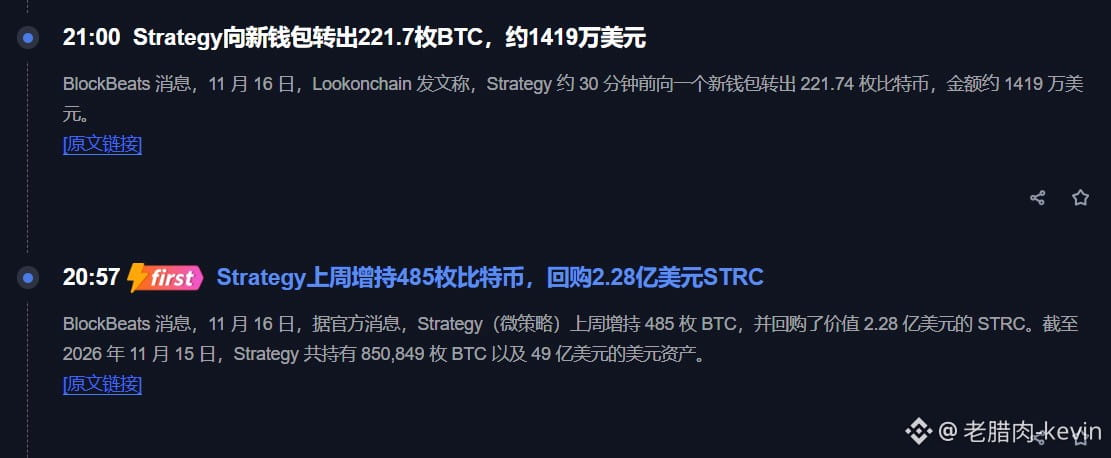
I didn't expect MicroStrategy still hadn't sold; at least sentiment-wise, there hasn't been any more bearish news.
But the BTC price hasn't surged quickly either.
Looks like the market is still trading according to the original expectations and logic.$BTC $MSTR
{future}(MSTRUSDT)
{future}(BTCUSDT)
The market has corrected so sharply recently.
I didn't expect MicroStrategy still hadn't sold; at least sentiment-wise, there hasn't been any more bearish news.
But the BTC price hasn't surged quickly either.
Looks like the market is still trading according to the original expectations and logic.$BTC $MSTR
I didn't expect MicroStrategy still hadn't sold; at least sentiment-wise, there hasn't been any more bearish news.
But the BTC price hasn't surged quickly either.
Looks like the market is still trading according to the original expectations and logic.$BTC $MSTR
2
664
·
--
Partly True
Storage stocks broadly fell in premarket trading, with SanDisk and SK Hynix down more than 4%, and Micron Technology, Western Digital, and Seagate Technology down more than 3%.
U.S. optical communications stocks also broadly fell in premarket trading. Lumentum dropped 4.15%, Corning fell 3.20%, Coherent dropped 4.70%, Applied Optoelectronics fell 4.22%, Ciena dropped 4.79%, Broadcom fell 2.82%, and Marvell Technology dropped 4.24%.
U.S. optical communications stocks also broadly fell in premarket trading. Lumentum dropped 4.15%, Corning fell 3.20%, Coherent dropped 4.70%, Applied Optoelectronics fell 4.22%, Ciena dropped 4.79%, Broadcom fell 2.82%, and Marvell Technology dropped 4.24%.
老腊肉-kevin
·
--
My U.S. Stock Premarket Diary (November 16, 2026)
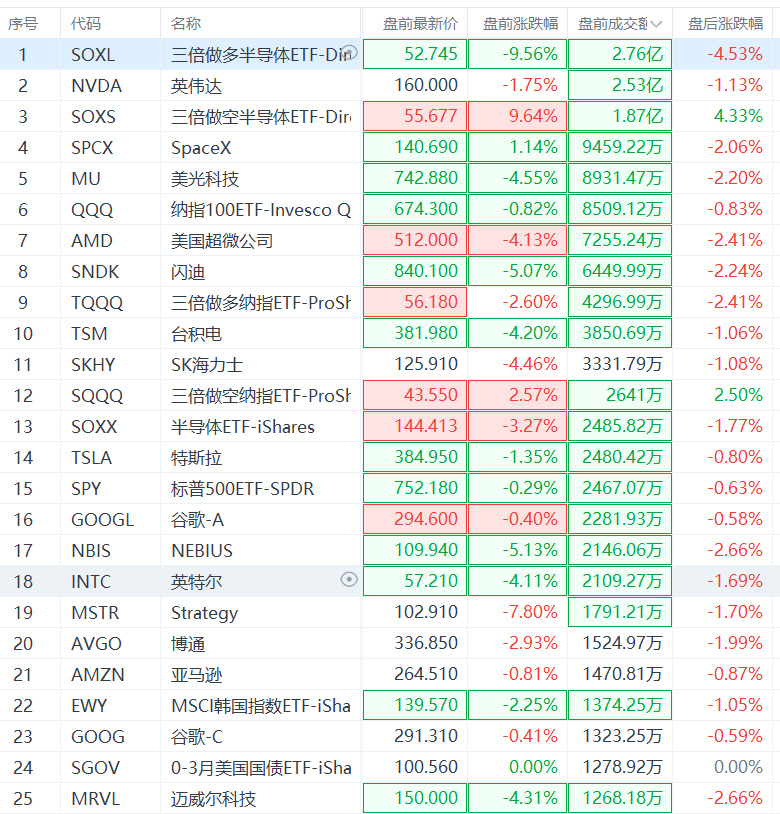
I just took a quick look at premarket trading: SOXL plunged 9.53%, NVDA fell 1.75%, MU dropped 4.44%, AMD fell 4.07%, TSM dropped 4.26%, and SK Hynix fell 4.25%. Not a single stock in the entire AI hardware chain is holding up. It got even worse after hours: SOXL slid another 4.53%, while SOXS climbed 4.33%—a sign that the selling pressure hasn’t been fully absorbed.
What’s the market trading on? Put simply, it’s one thing: Jensen Huang is gone, and people are starting to question whether the chain of borrowing money to buy chips could break. He resigned last Thursday; NVDA fell another 2% on Friday, and the Philadelphia Semiconductor Index plunged 3.4%.
More troubling, there are reports that at least one institution involved in the $500 billion syndicated loan led by NVDA is discussing pulling out. In plain English: before, it was “the chips arrive, and the money follows.” Now it’s “let’s wait and see about the money; the chips can wait, too.”
Meanwhile, the 10-year Treasury yield has surged to 5.17%. With a risk-free return of over 5%, who would want to bet their life on AI hardware?
Last week, NVDA fell 12.75%, AMD rose 18.93%, Broadcom gained 18.16%, and Micron climbed 12.8%. That’s what you call “staying in semiconductors, but leaving NVDA.” The options market is even crazier: implied volatility for NVDA’s earnings is 93.7%, with the market pricing in a ±12% move and a 52% probability of a decline.
I’m not touching any AI hardware before the open, and I’m not buying the dip in SOXL either. I’ll wait for the first wave of selling to end, then see whether NVDA can hold around 160. If it can’t, there’s no meaningful support below. If it does, that only leaves a suspenseful setup for tomorrow’s earnings.#英媒报道黄仁勋正考虑重返英伟达 $SOXL $NVDA $SNDK
607
·
--
Verified
My U.S. Stock Premarket Diary (November 16, 2026)
I just took a quick look at premarket trading: SOXL plunged 9.53%, NVDA fell 1.75%, MU dropped 4.44%, AMD fell 4.07%, TSM dropped 4.26%, and SK Hynix fell 4.25%. Not a single stock in the entire AI hardware chain is holding up. It got even worse after hours: SOXL slid another 4.53%, while SOXS climbed 4.33%—a sign that the selling pressure hasn’t been fully absorbed.
What’s the market trading on? Put simply, it’s one thing: Jensen Huang is gone, and people are starting to question whether the chain of borrowing money to buy chips could break. He resigned last Thursday; NVDA fell another 2% on Friday, and the Philadelphia Semiconductor Index plunged 3.4%.
More troubling, there are reports that at least one institution involved in the $500 billion syndicated loan led by NVDA is discussing pulling out. In plain English: before, it was “the chips arrive, and the money follows.” Now it’s “let’s wait and see about the money; the chips can wait, too.”
Meanwhile, the 10-year Treasury yield has surged to 5.17%. With a risk-free return of over 5%, who would want to bet their life on AI hardware?
Last week, NVDA fell 12.75%, AMD rose 18.93%, Broadcom gained 18.16%, and Micron climbed 12.8%. That’s what you call “staying in semiconductors, but leaving NVDA.” The options market is even crazier: implied volatility for NVDA’s earnings is 93.7%, with the market pricing in a ±12% move and a 52% probability of a decline.
I’m not touching any AI hardware before the open, and I’m not buying the dip in SOXL either. I’ll wait for the first wave of selling to end, then see whether NVDA can hold around 160. If it can’t, there’s no meaningful support below. If it does, that only leaves a suspenseful setup for tomorrow’s earnings.#英媒报道黄仁勋正考虑重返英伟达 $SOXL $NVDA $SNDK
{future}(SNDKUSDT)
{future}(NVDAUSDT)
{future}(SOXLUSDT)
My U.S. Stock Premarket Diary (November 16, 2026)
I just took a quick look at premarket trading: SOXL plunged 9.53%, NVDA fell 1.75%, MU dropped 4.44%, AMD fell 4.07%, TSM dropped 4.26%, and SK Hynix fell 4.25%. Not a single stock in the entire AI hardware chain is holding up. It got even worse after hours: SOXL slid another 4.53%, while SOXS climbed 4.33%—a sign that the selling pressure hasn’t been fully absorbed.
What’s the market trading on? Put simply, it’s one thing: Jensen Huang is gone, and people are starting to question whether the chain of borrowing money to buy chips could break. He resigned last Thursday; NVDA fell another 2% on Friday, and the Philadelphia Semiconductor Index plunged 3.4%.
More troubling, there are reports that at least one institution involved in the $500 billion syndicated loan led by NVDA is discussing pulling out. In plain English: before, it was “the chips arrive, and the money follows.” Now it’s “let’s wait and see about the money; the chips can wait, too.”
Meanwhile, the 10-year Treasury yield has surged to 5.17%. With a risk-free return of over 5%, who would want to bet their life on AI hardware?
Last week, NVDA fell 12.75%, AMD rose 18.93%, Broadcom gained 18.16%, and Micron climbed 12.8%. That’s what you call “staying in semiconductors, but leaving NVDA.” The options market is even crazier: implied volatility for NVDA’s earnings is 93.7%, with the market pricing in a ±12% move and a 52% probability of a decline.
I’m not touching any AI hardware before the open, and I’m not buying the dip in SOXL either. I’ll wait for the first wave of selling to end, then see whether NVDA can hold around 160. If it can’t, there’s no meaningful support below. If it does, that only leaves a suspenseful setup for tomorrow’s earnings.#英媒报道黄仁勋正考虑重返英伟达 $SOXL $NVDA $SNDK
3
1
2
2.3k
·
--
Verified
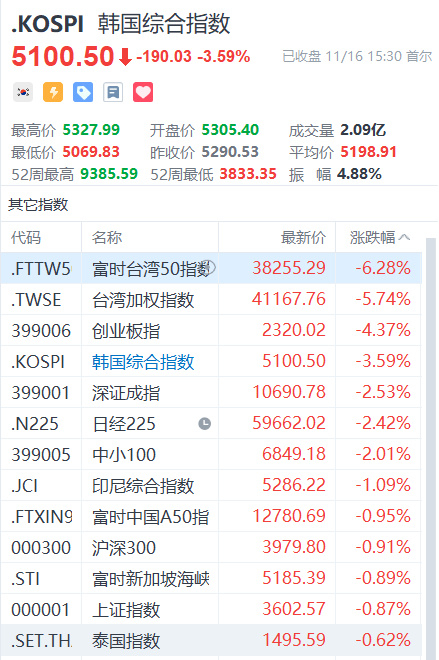
#加息预期仍强,fomc纪要会否再添鹰派信号? Korean stocks crashed, then A-shares crashed, while Hong Kong stocks somehow ended in the green—but not chip stocks?
Today’s Asia-Pacific misery contest: Korea went down first, with the KOSPI plunging 3.59%. SK Hynix took a massive bearish hit, tumbling 7.89%, while foreign investors net sold 1.37 trillion won.
A-shares followed suit: the ChiNext plunged 4.37%, semiconductor stocks saw net outflows of 12.67 billion yuan, and more than 4,300 stocks sank. Meanwhile, banks and insurers hit record highs.
Surreal, right? Even more surreal: Hong Kong’s Hang Seng Index somehow closed up 0.47%. But the stocks propping it up were Meituan, NetEase, and JD.com. SMIC was still pushed down nearly 5%, and southbound funds were net sellers of 4 billion HKD for the day.
In plain English: the money never actually left the market. It just scrambled out of the “faith in computing power” trade and piled into boring, cash-flow-generating old-timers.
NVDA fell another 2% after hours, taking its market cap below $4 trillion. Whether Jensen Huang returns or not no longer matters—the market is voting with its feet.
Don’t try to catch the falling knife in semiconductors. You can ride the short-term bullish momentum in Hong Kong-listed platform stocks, with a stop-loss at today’s Hang Seng low; if it breaks, get out. A-share banks are a safe haven, not a direction for offense.
There’s only one real signal: wait for semiconductor stocks to stop falling on lower volume before talking about buying the dip. Before NVDA’s earnings are out, every rebound in “Nvidia-related stocks” is for people too stubborn to admit they’re wrong.$KORU $SOXL $NVDA
{future}(NVDAUSDT)
{future}(SOXLUSDT)
{future}(KORUUSDT)
#加息预期仍强,fomc纪要会否再添鹰派信号? Korean stocks crashed, then A-shares crashed, while Hong Kong stocks somehow ended in the green—but not chip stocks?
Today’s Asia-Pacific misery contest: Korea went down first, with the KOSPI plunging 3.59%. SK Hynix took a massive bearish hit, tumbling 7.89%, while foreign investors net sold 1.37 trillion won.
A-shares followed suit: the ChiNext plunged 4.37%, semiconductor stocks saw net outflows of 12.67 billion yuan, and more than 4,300 stocks sank. Meanwhile, banks and insurers hit record highs.
Surreal, right? Even more surreal: Hong Kong’s Hang Seng Index somehow closed up 0.47%. But the stocks propping it up were Meituan, NetEase, and JD.com. SMIC was still pushed down nearly 5%, and southbound funds were net sellers of 4 billion HKD for the day.
In plain English: the money never actually left the market. It just scrambled out of the “faith in computing power” trade and piled into boring, cash-flow-generating old-timers.
NVDA fell another 2% after hours, taking its market cap below $4 trillion. Whether Jensen Huang returns or not no longer matters—the market is voting with its feet.
Don’t try to catch the falling knife in semiconductors. You can ride the short-term bullish momentum in Hong Kong-listed platform stocks, with a stop-loss at today’s Hang Seng low; if it breaks, get out. A-share banks are a safe haven, not a direction for offense.
There’s only one real signal: wait for semiconductor stocks to stop falling on lower volume before talking about buying the dip. Before NVDA’s earnings are out, every rebound in “Nvidia-related stocks” is for people too stubborn to admit they’re wrong.$KORU $SOXL $NVDA
2
2.2k
·
--
Binance has launched another new feature!
I'm currently ranked fourth on the Binance Square Live Trading Leaderboard
and third on the Livestream Trading Experts Leaderboard.
Thanks to all my longtime and new followers,
and thanks to everyone for your support and encouragement!
Binance has launched another new feature!
I'm currently ranked fourth on the Binance Square Live Trading Leaderboard
and third on the Livestream Trading Experts Leaderboard.
Thanks to all my longtime and new followers,
and thanks to everyone for your support and encouragement!
I'm currently ranked fourth on the Binance Square Live Trading Leaderboard
and third on the Livestream Trading Experts Leaderboard.
Thanks to all my longtime and new followers,
and thanks to everyone for your support and encouragement!


1
477
·
--
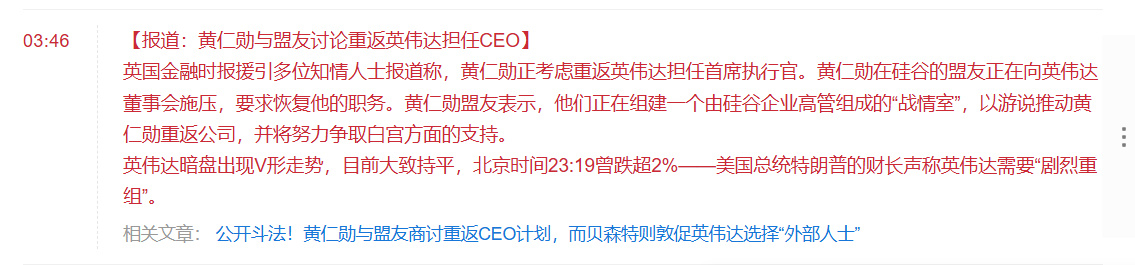
#英媒报道黄仁勋正考虑重返英伟达 Jensen Huang’s return? Who will be NVIDIA’s next CEO?
NVIDIA’s CEO chair is probably the hottest revolving seat in Silicon Valley.
Jensen Huang resigned over a scandal involving an extramarital affair. Just days later, Elon Musk led a petition calling for him to come back. Surreal, right? Even more surreal: some people are cursing, “What kind of lousy script is this?” while staring at NVDA’s stock chart with trembling hands.
Here’s the situation on the ground:
The potential successors are one more outlandish than the next.
Interim CFO Colette Kress has the market’s trust, but analysts say NVIDIA needs an engineer, not a bean counter. Ian Buck, the father of CUDA, is leading the odds on Polymarket, but his weak spot is whether he can handle geopolitics.
The board has sounded out Arm CEO Rene Haas, but it’s still unclear whether he’d take the job. The most ridiculous suggestion is Tim Cook—Apple’s market cap just topped $5 trillion. He’d have to be crazy to take on this mess.
The stock has already hit its knees. Six straight weeks of declines, with a 12.75% plunge this week alone. $573 billion in market value has evaporated, and the $4 trillion threshold was breached in a flash. Retail investors are buying the dip, institutions are cutting positions, and the order book is littered with bloodied chips.
Don’t bet on who’ll sit in that chair; bet on how violently the chair will wobble. Whether Jensen Huang comes back is still up in the air as the White House and board keep arguing. There’s no way to settle on a successor in the short term. But one thing is certain: NVDA’s implied volatility has been driven through the roof by this “CEO mystery drama.”$NVDA $SOXL $NVDAB
{spot}(NVDABUSDT)
{future}(SOXLUSDT)
{future}(NVDAUSDT)
#英媒报道黄仁勋正考虑重返英伟达 Jensen Huang’s return? Who will be NVIDIA’s next CEO?
NVIDIA’s CEO chair is probably the hottest revolving seat in Silicon Valley.
Jensen Huang resigned over a scandal involving an extramarital affair. Just days later, Elon Musk led a petition calling for him to come back. Surreal, right? Even more surreal: some people are cursing, “What kind of lousy script is this?” while staring at NVDA’s stock chart with trembling hands.
Here’s the situation on the ground:
The potential successors are one more outlandish than the next.
Interim CFO Colette Kress has the market’s trust, but analysts say NVIDIA needs an engineer, not a bean counter. Ian Buck, the father of CUDA, is leading the odds on Polymarket, but his weak spot is whether he can handle geopolitics.
The board has sounded out Arm CEO Rene Haas, but it’s still unclear whether he’d take the job. The most ridiculous suggestion is Tim Cook—Apple’s market cap just topped $5 trillion. He’d have to be crazy to take on this mess.
The stock has already hit its knees. Six straight weeks of declines, with a 12.75% plunge this week alone. $573 billion in market value has evaporated, and the $4 trillion threshold was breached in a flash. Retail investors are buying the dip, institutions are cutting positions, and the order book is littered with bloodied chips.
Don’t bet on who’ll sit in that chair; bet on how violently the chair will wobble. Whether Jensen Huang comes back is still up in the air as the White House and board keep arguing. There’s no way to settle on a successor in the short term. But one thing is certain: NVDA’s implied volatility has been driven through the roof by this “CEO mystery drama.”$NVDA $SOXL $NVDAB
7
1
386
·
--
Verified
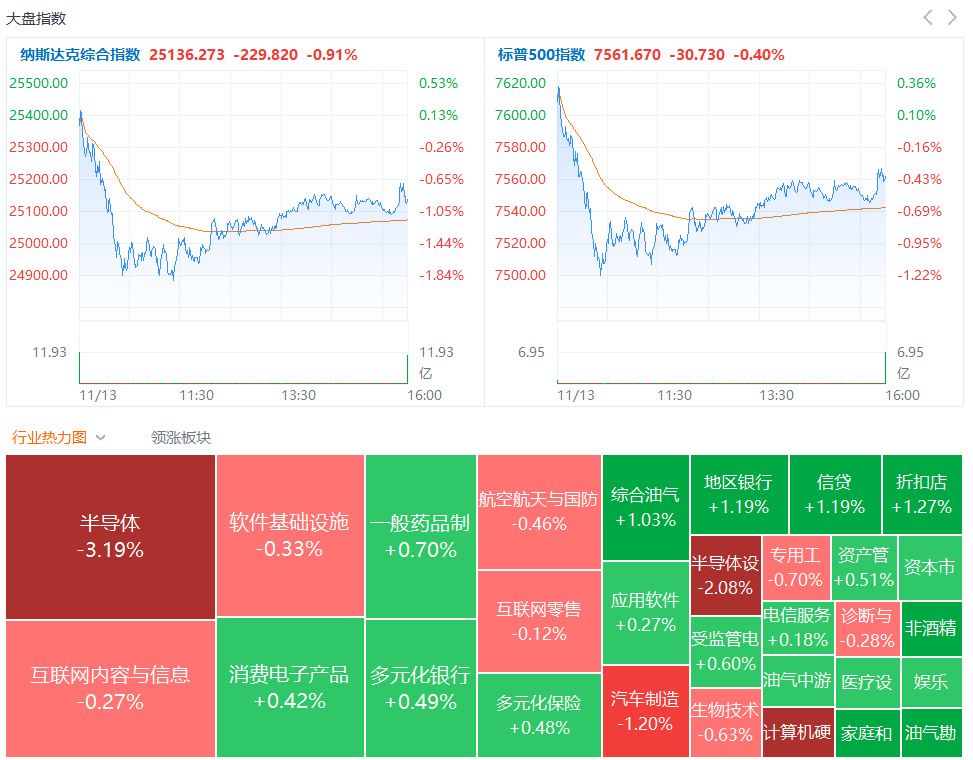
How should investors in Korean memory stocks, Hong Kong stocks, and A-shares handle the open?
On Friday, the Nasdaq—not the Dow—took the hardest hit among U.S. indexes. The Dow even gained 0.10%, while the Nasdaq slumped 0.91%, with tech stocks leading the declines, down 1.70%.
What does this tell us? The market isn’t simply “falling”—it’s “changing tables”: money is getting up from the AI table and shifting over to consumer staples and energy.
The aftershocks of Nvidia’s CEO resignation haven’t died down, and HSBC has gone straight to a “Hold” rating. Memory chip stocks are caught in the fallout.
It’s even livelier across Asia-Pacific: South Korea’s KOSPI rose 4.56% for the week, but SK Hynix dragged it down 3% on Friday alone. The Hang Seng Index fell 3.45% for the week, with the Hang Seng Tech Index squeezed by volatility in international tech stocks and U.S. interest rates. The Shanghai Composite was down 0.41% for the week, making it look the most resilient, but the correlation between the ChiNext and Korean and Japanese chip stocks is as high as 0.91. Don’t assume it can escape unscathed.
The real weekend risk isn’t the stock market—it’s interest rates.
On Friday morning, Boston Fed President Collins was still saying that “the direction of monetary policy is higher, and additional tightening will come soon.” Waller had already put a “50-basis-point rate hike in December” on the table, and the market-implied probability of a 25-basis-point hike in December has climbed to 87%.
Next week brings a triple whammy: Fed meeting minutes, retail sales data, and Nvidia earnings. If any of them surprise, Korean, Hong Kong, and A-share markets will have to digest U.S. market sentiment first when they open.
As for what to do: Don’t chase a tech rebound at Monday’s open. Lean defensive, and first see how Korean stocks open.
If the KOSPI opens down more than 1% and SK Hynix continues to lead the declines, the Hang Seng Tech Index will likely follow. Don’t rush to buy the dip in A-share tech stocks either; wait for the first wave of panic selling to ease before looking for signs of support.
What’s really worth watching, instead, are low-level defensive plays in A-shares that are decoupled from the AI narrative, along with the direction of northbound funds during the first half hour of trading. If northbound funds don’t sell heavily, A-shares may “open lower and form a base” rather than “open lower and see a panic sell-off.”$KORU $ZHONGJI $UNITREE
{future}(UNITREEUSDT)
{future}(ZHONGJIUSDT)
{future}(KORUUSDT)
How should investors in Korean memory stocks, Hong Kong stocks, and A-shares handle the open?
On Friday, the Nasdaq—not the Dow—took the hardest hit among U.S. indexes. The Dow even gained 0.10%, while the Nasdaq slumped 0.91%, with tech stocks leading the declines, down 1.70%.
What does this tell us? The market isn’t simply “falling”—it’s “changing tables”: money is getting up from the AI table and shifting over to consumer staples and energy.
The aftershocks of Nvidia’s CEO resignation haven’t died down, and HSBC has gone straight to a “Hold” rating. Memory chip stocks are caught in the fallout.
It’s even livelier across Asia-Pacific: South Korea’s KOSPI rose 4.56% for the week, but SK Hynix dragged it down 3% on Friday alone. The Hang Seng Index fell 3.45% for the week, with the Hang Seng Tech Index squeezed by volatility in international tech stocks and U.S. interest rates. The Shanghai Composite was down 0.41% for the week, making it look the most resilient, but the correlation between the ChiNext and Korean and Japanese chip stocks is as high as 0.91. Don’t assume it can escape unscathed.
The real weekend risk isn’t the stock market—it’s interest rates.
On Friday morning, Boston Fed President Collins was still saying that “the direction of monetary policy is higher, and additional tightening will come soon.” Waller had already put a “50-basis-point rate hike in December” on the table, and the market-implied probability of a 25-basis-point hike in December has climbed to 87%.
Next week brings a triple whammy: Fed meeting minutes, retail sales data, and Nvidia earnings. If any of them surprise, Korean, Hong Kong, and A-share markets will have to digest U.S. market sentiment first when they open.
As for what to do: Don’t chase a tech rebound at Monday’s open. Lean defensive, and first see how Korean stocks open.
If the KOSPI opens down more than 1% and SK Hynix continues to lead the declines, the Hang Seng Tech Index will likely follow. Don’t rush to buy the dip in A-share tech stocks either; wait for the first wave of panic selling to ease before looking for signs of support.
What’s really worth watching, instead, are low-level defensive plays in A-shares that are decoupled from the AI narrative, along with the direction of northbound funds during the first half hour of trading. If northbound funds don’t sell heavily, A-shares may “open lower and form a base” rather than “open lower and see a panic sell-off.”$KORU $ZHONGJI $UNITREE
2
2.4k
Log in to explore more content
Join global crypto users on Binance Square
⚡️ Get latest and useful information about crypto.
💬 Trusted by the world’s largest crypto exchange.
👍 Discover real insights from verified creators.
Email / Phone number
Trending Topics
NvidiaEarningsTonight:AIStocks’NextMove?
112,973 views
1,237 Discussing
Nvidia Earnings Day: Interim CEO's First Appearance — Can the AI Story Hold?
Binance News
·18 Likes
·8.1k views
A Packed Week of Earnings and Data Tests Markets
143,540 views
652 Discussing
AnthropicIPOTestsInvestorAppetiteForAI
317,533 views
2,851 Discussing