

许峰说财经
2.3k Posts

许峰说财经
Report
Block User
446 Following
839 Followers
2.7K+ Liked
Posts
All
Videos
·
--
See translation
老师们纷纷避之不及,暴露教师岗位现实困境 #班主任#岗位#就业#看懂中国#真财实学计划
老师们纷纷避之不及,暴露教师岗位现实困境 #班主任#岗位#就业#看懂中国#真财实学计划
3
3.9k
·
--
Modi invests 240 billion to boost manufacturing—yet the more he supports it, the more he ends up relying on China? Data reveals the truth #MadeInIndia#MadeInChina#PLIplan#Semiconductors#Finance
Modi invests 240 billion to boost manufacturing—yet the more he supports it, the more he ends up relying on China? Data reveals the truth #MadeInIndia#MadeInChina#PLIplan#Semiconductors#Finance
431
·
--
I used to always complain that Apple was expensive, but now it has turned into that person with clear features. #AI#Storage#Let’s talk together#Real money, real learning plan
I used to always complain that Apple was expensive, but now it has turned into that person with clear features. #AI#Storage#Let’s talk together#Real money, real learning plan
445
·
--
Developers taking buyers’ money to build houses—this has to end. #RealEstateMarket#Pre-saleSystem#Ready-to-MoveSales#HousingPrices#TruePracticalPlans
Developers taking buyers’ money to build houses—this has to end. #RealEstateMarket#Pre-saleSystem#Ready-to-MoveSales#HousingPrices#TruePracticalPlans
662
·
--
Is the U.S. debt crisis something to worry about? JPMorgan: U.S. stocks could see rotation-driven gains into year-end; bullish on quality growth and semiconductorsCaixin Leasts (Cailian She) August 25 News (Edited by Liu Rui): On Monday, Eastern Time in the United States, JPMorgan Chase said in a research report that it remains optimistic about the stock market for the rest of this year. However, it believes that any rise will come from sector rotation rather than a fierce broad-based rally.
Bullish on the U.S. stock market’s performance this year
In a report, a strategist at JPMorgan, Fabio Bassi, wrote: “For the stock market, we hold a constructive view of the market through year-end. We expect the market to grind higher steadily, with the main theme being sector rotation rather than a full-scale, across-the-board rally.”
The firm said that the recent rebound in the semiconductor sector signals a tactical repair in market risk appetite. Meanwhile, with the Federal Reserve policy remaining patient and curbing market volatility, the market’s positioning levels and the degree of divergence among sectors will drive the outlook for the next phase of the market.
Is the U.S. debt crisis something to worry about? JPMorgan: U.S. stocks could see rotation-driven gains into year-end; bullish on quality growth and semiconductors
Caixin Leasts (Cailian She) August 25 News (Edited by Liu Rui): On Monday, Eastern Time in the United States, JPMorgan Chase said in a research report that it remains optimistic about the stock market for the rest of this year. However, it believes that any rise will come from sector rotation rather than a fierce broad-based rally.
Bullish on the U.S. stock market’s performance this year
In a report, a strategist at JPMorgan, Fabio Bassi, wrote: “For the stock market, we hold a constructive view of the market through year-end. We expect the market to grind higher steadily, with the main theme being sector rotation rather than a full-scale, across-the-board rally.”
The firm said that the recent rebound in the semiconductor sector signals a tactical repair in market risk appetite. Meanwhile, with the Federal Reserve policy remaining patient and curbing market volatility, the market’s positioning levels and the degree of divergence among sectors will drive the outlook for the next phase of the market.
Bullish on the U.S. stock market’s performance this year
In a report, a strategist at JPMorgan, Fabio Bassi, wrote: “For the stock market, we hold a constructive view of the market through year-end. We expect the market to grind higher steadily, with the main theme being sector rotation rather than a full-scale, across-the-board rally.”
The firm said that the recent rebound in the semiconductor sector signals a tactical repair in market risk appetite. Meanwhile, with the Federal Reserve policy remaining patient and curbing market volatility, the market’s positioning levels and the degree of divergence among sectors will drive the outlook for the next phase of the market.
1
150
·
--
Samsung Electronics plunges more than 7% intraday; the 1100 trillion won shareholder return plan falls short of expectations; JPMorgan’s assessment leaves investors disappointed(Source: Financial News)
Samsung Electronics’ share price fell by more than 7% at one point. The reason was that its new shareholder return plan focuses on dividends, disappointing investors.
August 24, Samsung Electronics’ share price fell by more than 7% at one point. The reason was that its new shareholder return plan focuses on dividends, disappointing investors.
The market’s negative reaction stems from two factors: first, it only finalized a total cash dividend of about 300 trillion won for implementation in the third quarter, while the remaining 600–800 trillion won in capital-return measures was postponed until the board meeting in January next year; second, the actual announced ceiling was lower than the market’s rumor of 1500 trillion won.
Samsung Electronics plunges more than 7% intraday; the 1100 trillion won shareholder return plan falls short of expectations; JPMorgan’s assessment leaves investors disappointed
(Source: Financial News)
Samsung Electronics’ share price fell by more than 7% at one point. The reason was that its new shareholder return plan focuses on dividends, disappointing investors.
August 24, Samsung Electronics’ share price fell by more than 7% at one point. The reason was that its new shareholder return plan focuses on dividends, disappointing investors.
The market’s negative reaction stems from two factors: first, it only finalized a total cash dividend of about 300 trillion won for implementation in the third quarter, while the remaining 600–800 trillion won in capital-return measures was postponed until the board meeting in January next year; second, the actual announced ceiling was lower than the market’s rumor of 1500 trillion won.
Samsung Electronics’ share price fell by more than 7% at one point. The reason was that its new shareholder return plan focuses on dividends, disappointing investors.
August 24, Samsung Electronics’ share price fell by more than 7% at one point. The reason was that its new shareholder return plan focuses on dividends, disappointing investors.
The market’s negative reaction stems from two factors: first, it only finalized a total cash dividend of about 300 trillion won for implementation in the third quarter, while the remaining 600–800 trillion won in capital-return measures was postponed until the board meeting in January next year; second, the actual announced ceiling was lower than the market’s rumor of 1500 trillion won.
125
·
--

Article
Tesla intends to slow down the addition of the Model Y to its Robotaxi fleet, betting on the CybercabIT Home reported on August 23 that earlier this month Tesla invited JPMorgan analysts to visit one of its factories. The Wall Street bank later disclosed the findings from the visit in its latest published investor report. One notable piece of information is that Tesla admitted it is slowing down the pace of adding the Model Y to its Robotaxi fleet, but the company says it has ample reasons.
JPMorgan analyst recently visited Tesla's Fremont factory and met with the company's investor relations team. Through this inspection, the analyst gained a clearer understanding of Tesla's Robotaxi strategy.
Tesla intends to slow down the addition of the Model Y to its Robotaxi fleet, betting on the Cybercab
IT Home reported on August 23 that earlier this month Tesla invited JPMorgan analysts to visit one of its factories. The Wall Street bank later disclosed the findings from the visit in its latest published investor report. One notable piece of information is that Tesla admitted it is slowing down the pace of adding the Model Y to its Robotaxi fleet, but the company says it has ample reasons.
JPMorgan analyst recently visited Tesla's Fremont factory and met with the company's investor relations team. Through this inspection, the analyst gained a clearer understanding of Tesla's Robotaxi strategy.
JPMorgan analyst recently visited Tesla's Fremont factory and met with the company's investor relations team. Through this inspection, the analyst gained a clearer understanding of Tesla's Robotaxi strategy.
123
·
--
Article
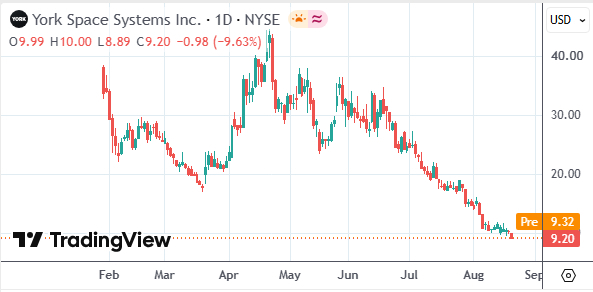
Wall Street’s bearish sentiment is intensifying: the U.S. “Gemstar” star stock is down 73% from its offering priceCaixin press August 21 News (Editor Zhao Hao) Wall Street analysts are纷纷 lowering the target prices for spacecraft and satellite manufacturer York Space Systems.
Analysts said that against the backdrop of ongoing supply-chain issues and a slowdown in the pace of government contract signings, the company’s future growth path has become increasingly unclear.
According to the compiled data, since August 14, at least 6 analysts—about half of the total number covering the company—have lowered their average target price by 54%.
Among them, Canaccord Genuity and JPMorgan also cut their stock ratings. Currently, the stock has five “buy” ratings and five “hold” ratings, with no “sell” ratings.
Wall Street’s bearish sentiment is intensifying: the U.S. “Gemstar” star stock is down 73% from its offering price
Caixin press August 21 News (Editor Zhao Hao) Wall Street analysts are纷纷 lowering the target prices for spacecraft and satellite manufacturer York Space Systems.
Analysts said that against the backdrop of ongoing supply-chain issues and a slowdown in the pace of government contract signings, the company’s future growth path has become increasingly unclear.
According to the compiled data, since August 14, at least 6 analysts—about half of the total number covering the company—have lowered their average target price by 54%.
Among them, Canaccord Genuity and JPMorgan also cut their stock ratings. Currently, the stock has five “buy” ratings and five “hold” ratings, with no “sell” ratings.
Analysts said that against the backdrop of ongoing supply-chain issues and a slowdown in the pace of government contract signings, the company’s future growth path has become increasingly unclear.
According to the compiled data, since August 14, at least 6 analysts—about half of the total number covering the company—have lowered their average target price by 54%.
Among them, Canaccord Genuity and JPMorgan also cut their stock ratings. Currently, the stock has five “buy” ratings and five “hold” ratings, with no “sell” ratings.
YSSUS-1.10%
144
·
--
JPMorgan: Aliyun’s 12% profit margin is systematically underestimated; mature-state ROIC should be close to 20% When trading stocks, rely on the Golden Qilin analyst research reports—authoritative, professional, timely, and comprehensive—helping you uncover potential thematic opportunities!
(Source: Leifeng.com)
On August 21, JPMorgan in its latest research report said that Aliyun’s current 12% profit margin is systematically underestimated, and its mature-state ROIC should be close to 20%. The reason is that, over the past few quarters, Capex has ramped up quickly: a large number of GPUs and data center assets have just been commissioned and are still in a ramp-up stage with utilization at about 60%. In the first year, ROIC for a single batch is only about 6%, far below the mature-state 20%. JPMorgan uses a stacked vintage model to extrapolate: even if Capex remains stable and unit economics no longer improve, as older assets become more dominant quarter by quarter and new assets’ utilization ramps up, the overall weighted ROIC will naturally rise from the current ~6% to nearly 16%. Net free cash flow for AI infrastructure is expected to cross the break-even line around the third year.
JPMorgan: Aliyun’s 12% profit margin is systematically underestimated; mature-state ROIC should be close to 20%
When trading stocks, rely on the Golden Qilin analyst research reports—authoritative, professional, timely, and comprehensive—helping you uncover potential thematic opportunities!
(Source: Leifeng.com)
On August 21, JPMorgan in its latest research report said that Aliyun’s current 12% profit margin is systematically underestimated, and its mature-state ROIC should be close to 20%. The reason is that, over the past few quarters, Capex has ramped up quickly: a large number of GPUs and data center assets have just been commissioned and are still in a ramp-up stage with utilization at about 60%. In the first year, ROIC for a single batch is only about 6%, far below the mature-state 20%. JPMorgan uses a stacked vintage model to extrapolate: even if Capex remains stable and unit economics no longer improve, as older assets become more dominant quarter by quarter and new assets’ utilization ramps up, the overall weighted ROIC will naturally rise from the current ~6% to nearly 16%. Net free cash flow for AI infrastructure is expected to cross the break-even line around the third year.
(Source: Leifeng.com)
On August 21, JPMorgan in its latest research report said that Aliyun’s current 12% profit margin is systematically underestimated, and its mature-state ROIC should be close to 20%. The reason is that, over the past few quarters, Capex has ramped up quickly: a large number of GPUs and data center assets have just been commissioned and are still in a ramp-up stage with utilization at about 60%. In the first year, ROIC for a single batch is only about 6%, far below the mature-state 20%. JPMorgan uses a stacked vintage model to extrapolate: even if Capex remains stable and unit economics no longer improve, as older assets become more dominant quarter by quarter and new assets’ utilization ramps up, the overall weighted ROIC will naturally rise from the current ~6% to nearly 16%. Net free cash flow for AI infrastructure is expected to cross the break-even line around the third year.
74
·
--
International financial institutions say the global food crisis may break out next yearSource: Securities Times
(Original headline: International financial institutions say the global food crisis may break out next year—will there not be enough food to eat?)
People’s Finance and News reported on August 21: Recently, international financial institutions including Goldman Sachs, HSBC, Bank of America, and JPMorgan have issued warnings one after another, saying that with multiple risks compounding, a new round of food inflation may be triggered. The capital markets responded instantly: China A-share markets saw a surge in the planting industry sector; several stocks including Nongfa Seed Industry hit the daily limit; and the Food ETF rose across the board.
JPMorgan’s latest report says that due to continued impacts from five major factors—war, weather, storage, water resources, and waste—the global food crisis may erupt next year.
International financial institutions say the global food crisis may break out next year
Source: Securities Times
(Original headline: International financial institutions say the global food crisis may break out next year—will there not be enough food to eat?)
People’s Finance and News reported on August 21: Recently, international financial institutions including Goldman Sachs, HSBC, Bank of America, and JPMorgan have issued warnings one after another, saying that with multiple risks compounding, a new round of food inflation may be triggered. The capital markets responded instantly: China A-share markets saw a surge in the planting industry sector; several stocks including Nongfa Seed Industry hit the daily limit; and the Food ETF rose across the board.
JPMorgan’s latest report says that due to continued impacts from five major factors—war, weather, storage, water resources, and waste—the global food crisis may erupt next year.
(Original headline: International financial institutions say the global food crisis may break out next year—will there not be enough food to eat?)
People’s Finance and News reported on August 21: Recently, international financial institutions including Goldman Sachs, HSBC, Bank of America, and JPMorgan have issued warnings one after another, saying that with multiple risks compounding, a new round of food inflation may be triggered. The capital markets responded instantly: China A-share markets saw a surge in the planting industry sector; several stocks including Nongfa Seed Industry hit the daily limit; and the Food ETF rose across the board.
JPMorgan’s latest report says that due to continued impacts from five major factors—war, weather, storage, water resources, and waste—the global food crisis may erupt next year.
67
·
--
Article
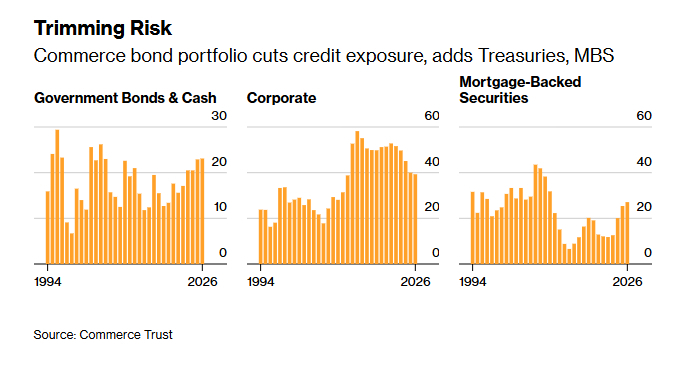
The “AI bubble” hasn’t burst, but this bond veteran has quietly cut credit exposure to the lowest level since 2012: “Don’t be too greedy—it’s time to stop.”During Scott Colbert’s four-decade career in bond investing, he has rarely felt the need to make major strategic adjustments. But he says that this is precisely the critical moment when such a shift is warranted. Colbert serves as fixed-income director at the Clayton, Missouri-based commercial bank, where he manages assets of $28 billion. He does not foresee economic clouds gathering—quite the opposite: he expects economic growth to accelerate over the coming months. The issue is that corporate bond prices are currently too high, leaving very little room for error, so the potential returns no longer justify the risks being taken.
The “AI bubble” hasn’t burst, but this bond veteran has quietly cut credit exposure to the lowest level since 2012: “Don’t be too greedy—it’s time to stop.”
During Scott Colbert’s four-decade career in bond investing, he has rarely felt the need to make major strategic adjustments. But he says that this is precisely the critical moment when such a shift is warranted. Colbert serves as fixed-income director at the Clayton, Missouri-based commercial bank, where he manages assets of $28 billion. He does not foresee economic clouds gathering—quite the opposite: he expects economic growth to accelerate over the coming months. The issue is that corporate bond prices are currently too high, leaving very little room for error, so the potential returns no longer justify the risks being taken.
AMZNUS-0.95%
TUS+0.70%
JPMUS-1.17%
309
·
--
Article
With subscription funds safely cashed in, Unitree Technology falls by more than 18% the next day; Wang Xingxing admits that “deployment still takes time”On its debut, Unitree Technology set a record for first-day gains in new-share subscriptions under the comprehensive registration-based system; yet on the next day it plunged 18.7%, with its market value shrinking by more than 160 billion yuan from the peak. On the same day, founder Wang Xingxing admitted that the biggest bottleneck for embodied intelligence is still its generalization capability, and deployment in home and production scenarios still requires two to five years. JPMorgan believed that the sector’s valuation would shift from a “scarcity premium” to delivery capability, while Nomura was bullish on growth but emphasized that repeat industrial orders are key. The market is moving from “buying the story” to “seeing delivery.”
The frenzy of Unitree Technology’s debut quickly cooled down.
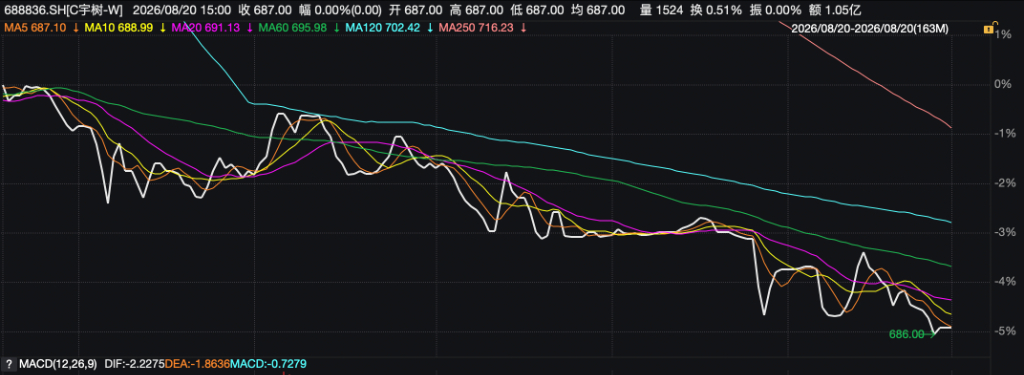
On August 20, the next day after this company—dubbed the “first humanoid robotics stock”—went public, it closed at 687 yuan per share, down 18.7%, with its market value falling to 277.9 billion yuan. The day before, the company opened with a surge of 629.44%, and the share price briefly touched 1,100 yuan, with its market value jumping to 444.9 billion yuan. In just one day, its market value shrank by more than 160 billion yuan from the intraday high.
With subscription funds safely cashed in, Unitree Technology falls by more than 18% the next day; Wang Xingxing admits that “deployment still takes time”
On its debut, Unitree Technology set a record for first-day gains in new-share subscriptions under the comprehensive registration-based system; yet on the next day it plunged 18.7%, with its market value shrinking by more than 160 billion yuan from the peak. On the same day, founder Wang Xingxing admitted that the biggest bottleneck for embodied intelligence is still its generalization capability, and deployment in home and production scenarios still requires two to five years. JPMorgan believed that the sector’s valuation would shift from a “scarcity premium” to delivery capability, while Nomura was bullish on growth but emphasized that repeat industrial orders are key. The market is moving from “buying the story” to “seeing delivery.”
The frenzy of Unitree Technology’s debut quickly cooled down.
On August 20, the next day after this company—dubbed the “first humanoid robotics stock”—went public, it closed at 687 yuan per share, down 18.7%, with its market value falling to 277.9 billion yuan. The day before, the company opened with a surge of 629.44%, and the share price briefly touched 1,100 yuan, with its market value jumping to 444.9 billion yuan. In just one day, its market value shrank by more than 160 billion yuan from the intraday high.
The frenzy of Unitree Technology’s debut quickly cooled down.
On August 20, the next day after this company—dubbed the “first humanoid robotics stock”—went public, it closed at 687 yuan per share, down 18.7%, with its market value falling to 277.9 billion yuan. The day before, the company opened with a surge of 629.44%, and the share price briefly touched 1,100 yuan, with its market value jumping to 444.9 billion yuan. In just one day, its market value shrank by more than 160 billion yuan from the intraday high.
15
·
--
Xiao Mo increases holdings of Luxshare Precision by 459,200 shares; about HK$62.97 per share(Source: Financial News)
HK$62.9651 per share, totaling HK$28.9136 million. After the increase, the latest number of shares held is 318.9253 million, and the latest shareholding ratio is 8.05%.
Hong Kong Exchanges and Clearing latest information shows that on August 17, JPMorgan increased its holdings of Luxshare Precision (02475.HK) by 459,200 shares at HK$62.9651 per share, totaling HK$28.9136 million. After the increase, the latest number of shares held is 318.9253 million, and the latest shareholding ratio is 8.05%.
Xiao Mo increases holdings of Luxshare Precision by 459,200 shares; about HK$62.97 per share
(Source: Financial News)
HK$62.9651 per share, totaling HK$28.9136 million. After the increase, the latest number of shares held is 318.9253 million, and the latest shareholding ratio is 8.05%.
Hong Kong Exchanges and Clearing latest information shows that on August 17, JPMorgan increased its holdings of Luxshare Precision (02475.HK) by 459,200 shares at HK$62.9651 per share, totaling HK$28.9136 million. After the increase, the latest number of shares held is 318.9253 million, and the latest shareholding ratio is 8.05%.
HK$62.9651 per share, totaling HK$28.9136 million. After the increase, the latest number of shares held is 318.9253 million, and the latest shareholding ratio is 8.05%.
Hong Kong Exchanges and Clearing latest information shows that on August 17, JPMorgan increased its holdings of Luxshare Precision (02475.HK) by 459,200 shares at HK$62.9651 per share, totaling HK$28.9136 million. After the increase, the latest number of shares held is 318.9253 million, and the latest shareholding ratio is 8.05%.
23
·
--
Article
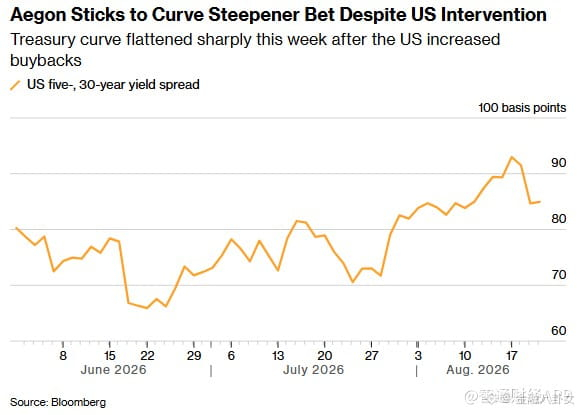
Aegon “hardline” against the U.S. Treasury: boosted repo support for long bonds “makes little difference,” the steepening logic remains unchangedDespite U.S. Treasury Secretary Scott Bessent’s efforts to curb long-term bond yields, Aegon Asset Management remains firmly convinced that the spread between U.S. short-term and long-term borrowing costs will continue to widen.
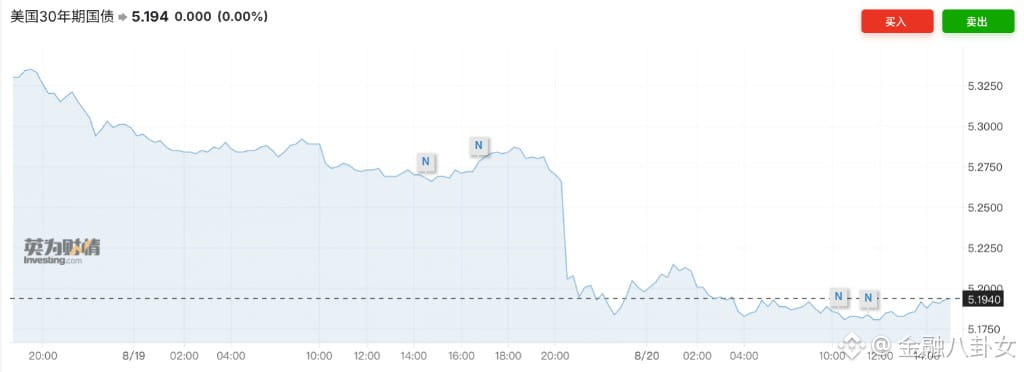
The U.S. Department of the Treasury announced on Wednesday that it would at least double the size of its liquidity-support repurchase (repo) operations for 10- to 30-year Treasury bonds, raising the single-repo cap from $2.0 billion to at least $4.0 billion. After the news was released, the bond market reacted positively: the yield on the 10-year U.S. Treasury fell 6 basis points to 4.65%, and the 30-year yield dropped nearly 10 basis points to 5.18%. In the prior trading session, the 30-year U.S. Treasury yield had at one point risen above 5.33%, the highest level since 2007.
Aegon “hardline” against the U.S. Treasury: boosted repo support for long bonds “makes little difference,” the steepening logic remains unchanged
Despite U.S. Treasury Secretary Scott Bessent’s efforts to curb long-term bond yields, Aegon Asset Management remains firmly convinced that the spread between U.S. short-term and long-term borrowing costs will continue to widen.
The U.S. Department of the Treasury announced on Wednesday that it would at least double the size of its liquidity-support repurchase (repo) operations for 10- to 30-year Treasury bonds, raising the single-repo cap from $2.0 billion to at least $4.0 billion. After the news was released, the bond market reacted positively: the yield on the 10-year U.S. Treasury fell 6 basis points to 4.65%, and the 30-year yield dropped nearly 10 basis points to 5.18%. In the prior trading session, the 30-year U.S. Treasury yield had at one point risen above 5.33%, the highest level since 2007.
The U.S. Department of the Treasury announced on Wednesday that it would at least double the size of its liquidity-support repurchase (repo) operations for 10- to 30-year Treasury bonds, raising the single-repo cap from $2.0 billion to at least $4.0 billion. After the news was released, the bond market reacted positively: the yield on the 10-year U.S. Treasury fell 6 basis points to 4.65%, and the 30-year yield dropped nearly 10 basis points to 5.18%. In the prior trading session, the 30-year U.S. Treasury yield had at one point risen above 5.33%, the highest level since 2007.
10
·
--
Article
JPMorgan Chase: Treasury buybacks treat symptoms, not the root cause; long-end rates may keep rising Source: Wall Street Insights
JPMorgan Chase believes that the U.S. Treasury’s expansion of buybacks can only bring short-term benefits and is unlikely to change the long-term pressure on long-term yields. The real constraint lies in a fiscal deficit of as high as 6% of GDP and more than $3.5 trillion in future financing needs, rather than market liquidity. If the Treasury frequently times its operations, it will further weaken the credibility of “routine and predictable” policy, ultimately pushing up the term premium and long-term yields.
The U.S. Treasury has significantly increased the scale of U.S. Treasury buybacks, seeking to provide more liquidity to long-dated Treasuries and ease upward pressure on yields. However, JPMorgan Chase warns that, amid persistently high U.S. fiscal deficits, this move is more like treating symptoms and cannot change the long-term pressure on long-dated Treasury yields.
JPMorgan Chase: Treasury buybacks treat symptoms, not the root cause; long-end rates may keep rising
Source: Wall Street Insights
JPMorgan Chase believes that the U.S. Treasury’s expansion of buybacks can only bring short-term benefits and is unlikely to change the long-term pressure on long-term yields. The real constraint lies in a fiscal deficit of as high as 6% of GDP and more than $3.5 trillion in future financing needs, rather than market liquidity. If the Treasury frequently times its operations, it will further weaken the credibility of “routine and predictable” policy, ultimately pushing up the term premium and long-term yields.
The U.S. Treasury has significantly increased the scale of U.S. Treasury buybacks, seeking to provide more liquidity to long-dated Treasuries and ease upward pressure on yields. However, JPMorgan Chase warns that, amid persistently high U.S. fiscal deficits, this move is more like treating symptoms and cannot change the long-term pressure on long-dated Treasury yields.
JPMorgan Chase believes that the U.S. Treasury’s expansion of buybacks can only bring short-term benefits and is unlikely to change the long-term pressure on long-term yields. The real constraint lies in a fiscal deficit of as high as 6% of GDP and more than $3.5 trillion in future financing needs, rather than market liquidity. If the Treasury frequently times its operations, it will further weaken the credibility of “routine and predictable” policy, ultimately pushing up the term premium and long-term yields.
The U.S. Treasury has significantly increased the scale of U.S. Treasury buybacks, seeking to provide more liquidity to long-dated Treasuries and ease upward pressure on yields. However, JPMorgan Chase warns that, amid persistently high U.S. fiscal deficits, this move is more like treating symptoms and cannot change the long-term pressure on long-dated Treasury yields.
1
439
·
--
Verified
SK hynix (SKHY.US) 40 trillion-won buyback “shock” — JPM: Another $130 billion “gift” in 2027After SK hynix (SKHY.US) implemented its latest large-scale stock buyback program on Wednesday, JPMorgan said the company is poised to provide shareholders with an additional at least $130 billion (about 180 trillion won) in returns before next year.
On Wednesday, South Korean storage giant SK hynix said it will buy back and cancel shares worth 40 trillion won (about $28.61 billion) and plans to use at least 50% of its cumulative free cash flow for shareholder returns by next year. The company believes the current stock price does not yet fully reflect the company’s value, and therefore decided to fully launch its shareholder return program.
SK hynix (SKHY.US) 40 trillion-won buyback “shock” — JPM: Another $130 billion “gift” in 2027
After SK hynix (SKHY.US) implemented its latest large-scale stock buyback program on Wednesday, JPMorgan said the company is poised to provide shareholders with an additional at least $130 billion (about 180 trillion won) in returns before next year.
On Wednesday, South Korean storage giant SK hynix said it will buy back and cancel shares worth 40 trillion won (about $28.61 billion) and plans to use at least 50% of its cumulative free cash flow for shareholder returns by next year. The company believes the current stock price does not yet fully reflect the company’s value, and therefore decided to fully launch its shareholder return program.
On Wednesday, South Korean storage giant SK hynix said it will buy back and cancel shares worth 40 trillion won (about $28.61 billion) and plans to use at least 50% of its cumulative free cash flow for shareholder returns by next year. The company believes the current stock price does not yet fully reflect the company’s value, and therefore decided to fully launch its shareholder return program.
1
640
·
--
Xiao Mo cuts China Resources Beer’s target price to HK$28Sina Finance’s “Wine Price Insider” launches in a big way — real market prices of well-known liquor brands are now at your fingertips
(Source: Caixin)
The firm cut its target P/E multiple from 15x to 14x (based on the estimated P/E for 2027), aligning with the global beer peer level. The target price was lowered from HK$34 to HK$28, while maintaining a “Buy” rating.
On August 20, JPMorgan released a research report saying that China Resources Beer (00291.HK) has an attractive risk-reward profile, as its current trading price implies an estimated P/E ratio of about 10x for 2027 and a dividend yield of 5.5%. The firm cut its target P/E multiple from 15x to 14x (based on the estimated P/E for 2027), aligning with the global beer peer level. The target price was lowered from HK$34 to HK$28, while maintaining a “Buy” rating.
Xiao Mo cuts China Resources Beer’s target price to HK$28
Sina Finance’s “Wine Price Insider” launches in a big way — real market prices of well-known liquor brands are now at your fingertips
(Source: Caixin)
The firm cut its target P/E multiple from 15x to 14x (based on the estimated P/E for 2027), aligning with the global beer peer level. The target price was lowered from HK$34 to HK$28, while maintaining a “Buy” rating.
On August 20, JPMorgan released a research report saying that China Resources Beer (00291.HK) has an attractive risk-reward profile, as its current trading price implies an estimated P/E ratio of about 10x for 2027 and a dividend yield of 5.5%. The firm cut its target P/E multiple from 15x to 14x (based on the estimated P/E for 2027), aligning with the global beer peer level. The target price was lowered from HK$34 to HK$28, while maintaining a “Buy” rating.
(Source: Caixin)
The firm cut its target P/E multiple from 15x to 14x (based on the estimated P/E for 2027), aligning with the global beer peer level. The target price was lowered from HK$34 to HK$28, while maintaining a “Buy” rating.
On August 20, JPMorgan released a research report saying that China Resources Beer (00291.HK) has an attractive risk-reward profile, as its current trading price implies an estimated P/E ratio of about 10x for 2027 and a dividend yield of 5.5%. The firm cut its target P/E multiple from 15x to 14x (based on the estimated P/E for 2027), aligning with the global beer peer level. The target price was lowered from HK$34 to HK$28, while maintaining a “Buy” rating.
33
·
--
Verified
Gold and silver take intraday hits! JPMorgan: Treasury bond repos are only a temporary fix, not a cure(Source: Financial News)
JPMorgan said this is only a temporary fix rather than a cure: the U.S. economy is close to full employment, yet there is still a 6% fiscal deficit.
On August 20, the spot gold price fell by 0.98% to $4,478.68 per ounce; the spot silver price fell by 0.51% to $66.64 per ounce.
On August 19, the U.S. Department of the Treasury announced that it would expand the scale of repurchase operations for longer-dated Treasury securities. The liquidity-support repo operation size for U.S. Treasuries with maturities of 10 to 30 years would be increased by at least one-fold. This led to a decline in yields on U.S. long-term Treasuries, and the U.S. dollar index fell in tandem, providing direct price support for gold denominated in U.S. dollars. As a result, international gold prices surged on August 19, breaking above $4,500 per ounce, which in turn lifted stocks in the gold sector.
Gold and silver take intraday hits! JPMorgan: Treasury bond repos are only a temporary fix, not a cure
(Source: Financial News)
JPMorgan said this is only a temporary fix rather than a cure: the U.S. economy is close to full employment, yet there is still a 6% fiscal deficit.
On August 20, the spot gold price fell by 0.98% to $4,478.68 per ounce; the spot silver price fell by 0.51% to $66.64 per ounce.
On August 19, the U.S. Department of the Treasury announced that it would expand the scale of repurchase operations for longer-dated Treasury securities. The liquidity-support repo operation size for U.S. Treasuries with maturities of 10 to 30 years would be increased by at least one-fold. This led to a decline in yields on U.S. long-term Treasuries, and the U.S. dollar index fell in tandem, providing direct price support for gold denominated in U.S. dollars. As a result, international gold prices surged on August 19, breaking above $4,500 per ounce, which in turn lifted stocks in the gold sector.
JPMorgan said this is only a temporary fix rather than a cure: the U.S. economy is close to full employment, yet there is still a 6% fiscal deficit.
On August 20, the spot gold price fell by 0.98% to $4,478.68 per ounce; the spot silver price fell by 0.51% to $66.64 per ounce.
On August 19, the U.S. Department of the Treasury announced that it would expand the scale of repurchase operations for longer-dated Treasury securities. The liquidity-support repo operation size for U.S. Treasuries with maturities of 10 to 30 years would be increased by at least one-fold. This led to a decline in yields on U.S. long-term Treasuries, and the U.S. dollar index fell in tandem, providing direct price support for gold denominated in U.S. dollars. As a result, international gold prices surged on August 19, breaking above $4,500 per ounce, which in turn lifted stocks in the gold sector.
2k
·
--
JPMorgan: Maintains “Overweight/Buy” rating on HKEX, target price HKD 520(Source: Caixin Finance)
Earnings per share were RMB 4.26, up 4% quarter-on-quarter and 21% year-on-year, which can support an upgrade to forecasts and revaluation. The bank maintained its “Overweight/Buy” rating for HKEX and set a target price of HKD 520.
On August 20, JPMorgan released a research report stating that the Hong Kong Exchanges and Clearing (00388.HK) second-quarter net profit was RMB 5.4 billion, up 4% quarter-on-quarter and 21% year-on-year. It was 4% above the bank’s previous estimate, mainly because revenue was supported by an increase in transaction fees. Listing fees also maintained momentum, up 24% year-on-year. Net investment income rose quarter-on-quarter, partly due to one-off valuation changes for unlisted equity investments. Costs met expectations, and operating expenses rose 4% quarter-on-quarter. During the period, the overall operating profit margin was maintained at a high level of around 75%. Earnings per share were RMB 4.26, up 4% quarter-on-quarter and 21% year-on-year, which can support an upgrade to forecasts and revaluation. The bank maintained its “Overweight/Buy” rating for HKEX and set a target price of HKD 520.
JPMorgan: Maintains “Overweight/Buy” rating on HKEX, target price HKD 520
(Source: Caixin Finance)
Earnings per share were RMB 4.26, up 4% quarter-on-quarter and 21% year-on-year, which can support an upgrade to forecasts and revaluation. The bank maintained its “Overweight/Buy” rating for HKEX and set a target price of HKD 520.
On August 20, JPMorgan released a research report stating that the Hong Kong Exchanges and Clearing (00388.HK) second-quarter net profit was RMB 5.4 billion, up 4% quarter-on-quarter and 21% year-on-year. It was 4% above the bank’s previous estimate, mainly because revenue was supported by an increase in transaction fees. Listing fees also maintained momentum, up 24% year-on-year. Net investment income rose quarter-on-quarter, partly due to one-off valuation changes for unlisted equity investments. Costs met expectations, and operating expenses rose 4% quarter-on-quarter. During the period, the overall operating profit margin was maintained at a high level of around 75%. Earnings per share were RMB 4.26, up 4% quarter-on-quarter and 21% year-on-year, which can support an upgrade to forecasts and revaluation. The bank maintained its “Overweight/Buy” rating for HKEX and set a target price of HKD 520.
Earnings per share were RMB 4.26, up 4% quarter-on-quarter and 21% year-on-year, which can support an upgrade to forecasts and revaluation. The bank maintained its “Overweight/Buy” rating for HKEX and set a target price of HKD 520.
On August 20, JPMorgan released a research report stating that the Hong Kong Exchanges and Clearing (00388.HK) second-quarter net profit was RMB 5.4 billion, up 4% quarter-on-quarter and 21% year-on-year. It was 4% above the bank’s previous estimate, mainly because revenue was supported by an increase in transaction fees. Listing fees also maintained momentum, up 24% year-on-year. Net investment income rose quarter-on-quarter, partly due to one-off valuation changes for unlisted equity investments. Costs met expectations, and operating expenses rose 4% quarter-on-quarter. During the period, the overall operating profit margin was maintained at a high level of around 75%. Earnings per share were RMB 4.26, up 4% quarter-on-quarter and 21% year-on-year, which can support an upgrade to forecasts and revaluation. The bank maintained its “Overweight/Buy” rating for HKEX and set a target price of HKD 520.
252
·
--
Strong earnings growth to support a valuation re-rating; JPMorgan: raises GoWeij Electronics’ target price to HK$48(Source: Financial News)
The bank believes that supported by resilient demand, ongoing market-share gains, and a valuation that is not expensive, the risk-reward profile is attractive.
On August 20, JPMorgan released a report saying that GoWeij Electronics (01415.HK) saw its net profit for the first half rise 33% year-on-year, which was 17% higher than the bank’s forecast. The outperformance was driven by Apple product orders coming in better than expected and improvements in yield and efficiency. The bank believes market concerns about weak potential demand and price pressure have already been sufficiently reflected. Given that the company’s market-share gains and efficiency improvements are the key drivers of earnings, it expects net profit to grow year-on-year by 28% in 2026 and 15% in 2027. At present, the share price only implies a forward P/E ratio of 10 times for 2026, which is 40% below the historical average. The bank expects strong earnings growth to support a valuation re-rating and maintains a “Buy/Overweight” rating. It has raised its target price from HK$44 to HK$48. The bank believes that supported by resilient demand, ongoing market-share gains, and a valuation that is not expensive, the risk-reward profile is attractive.
Strong earnings growth to support a valuation re-rating; JPMorgan: raises GoWeij Electronics’ target price to HK$48
(Source: Financial News)
The bank believes that supported by resilient demand, ongoing market-share gains, and a valuation that is not expensive, the risk-reward profile is attractive.
On August 20, JPMorgan released a report saying that GoWeij Electronics (01415.HK) saw its net profit for the first half rise 33% year-on-year, which was 17% higher than the bank’s forecast. The outperformance was driven by Apple product orders coming in better than expected and improvements in yield and efficiency. The bank believes market concerns about weak potential demand and price pressure have already been sufficiently reflected. Given that the company’s market-share gains and efficiency improvements are the key drivers of earnings, it expects net profit to grow year-on-year by 28% in 2026 and 15% in 2027. At present, the share price only implies a forward P/E ratio of 10 times for 2026, which is 40% below the historical average. The bank expects strong earnings growth to support a valuation re-rating and maintains a “Buy/Overweight” rating. It has raised its target price from HK$44 to HK$48. The bank believes that supported by resilient demand, ongoing market-share gains, and a valuation that is not expensive, the risk-reward profile is attractive.
The bank believes that supported by resilient demand, ongoing market-share gains, and a valuation that is not expensive, the risk-reward profile is attractive.
On August 20, JPMorgan released a report saying that GoWeij Electronics (01415.HK) saw its net profit for the first half rise 33% year-on-year, which was 17% higher than the bank’s forecast. The outperformance was driven by Apple product orders coming in better than expected and improvements in yield and efficiency. The bank believes market concerns about weak potential demand and price pressure have already been sufficiently reflected. Given that the company’s market-share gains and efficiency improvements are the key drivers of earnings, it expects net profit to grow year-on-year by 28% in 2026 and 15% in 2027. At present, the share price only implies a forward P/E ratio of 10 times for 2026, which is 40% below the historical average. The bank expects strong earnings growth to support a valuation re-rating and maintains a “Buy/Overweight” rating. It has raised its target price from HK$44 to HK$48. The bank believes that supported by resilient demand, ongoing market-share gains, and a valuation that is not expensive, the risk-reward profile is attractive.
166
Log in to explore more content
Join global crypto users on Binance Square
⚡️ Get latest and useful information about crypto.
💬 Trusted by the world’s largest crypto exchange.
👍 Discover real insights from verified creators.
Email / Phone number
Trending Topics
FedMinutesFocusOnOctoberPause
797 views
80 Discussing
#fedminutesfocusonoctoberpause
🚨 FED MINUTES PUT OCTOBER PAUSE IN FOCUS! 🇺🇸
The latest Federal Reserve minutes are putting fresh attention on the possibility of an October rate pause. 👀
Markets are now watching closely for clues about what the Fed could do next.
Why crypto traders care:
🔹 A rate pause could support risk assets
🔹 Lower rate expectations can boost liquidity sentiment
🔹 Bitcoin and altcoins could react sharply to Fed signals
🔹 The dollar and Treasury yields remain key factors
🔥 If the Fed signals a pause while inflation continues cooling, could this become another catalyst for crypto?
WHAT DO YOU THINK HAPPENS NEXT? 👇
🟢 Fed pauses → BTC rallies 🚀
🟡 Fed stays cautious
🔴 Hawkish Fed → crypto dumps
#Fed #bitcoin #crypto
Faizan Crypto Learner
·1 Likes
·378 views
BinanceLaunchesBinanceIntelligence
865,979 views
5,337 Discussing
RobinhoodAdds$25MInBitcoinToBalanceSheet
76 views
9 Discussing