
CryptoGlow
713 Posts

CryptoGlow
Report
Block User
Open trade || Binance Kol || Web 3.0 || Charts and Setups
Frequent Trader
1.9 Years
126 Following
1.0K+ Followers
248 Liked
Posts
All
Quotes
Live
·
--
#dusk $DUSK @Dusk_Foundation
$DUSK Privacy Isn’t Just About Hiding Data
The more I look at Dusk, the more I think the interesting part isn’t simply that transactions can be private.
It’s what happens when privacy becomes something institutions actually have to work with.
A public blockchain makes transparency the default. That’s useful, but it can also expose transaction details that businesses may not want sitting in plain sight.
Dusk takes a different approach with its privacy-focused architecture, where users can have more control over what transaction information is revealed.
But that creates a more interesting question:
How much privacy is actually useful for an institution?
Too little privacy creates unnecessary exposure. Too much privacy can make auditing and compliance harder.
That balance is where Dusk becomes interesting to me.
The real test probably won’t be whether the technology can hide transaction data.
It will be whether institutions can use privacy without losing the ability to prove what actually happened.
That’s a much harder problem than simply saying “private blockchain.”
And if Dusk can get that balance right, the bigger story may not be privacy itself.
It may be making privacy usable at institutional scale.
Would institutions prefer maximum privacy, or controllable transparency?
#dusk $DUSK @Dusk
$DUSK Privacy Isn’t Just About Hiding Data
The more I look at Dusk, the more I think the interesting part isn’t simply that transactions can be private.
It’s what happens when privacy becomes something institutions actually have to work with.
A public blockchain makes transparency the default. That’s useful, but it can also expose transaction details that businesses may not want sitting in plain sight.
Dusk takes a different approach with its privacy-focused architecture, where users can have more control over what transaction information is revealed.
But that creates a more interesting question:
How much privacy is actually useful for an institution?
Too little privacy creates unnecessary exposure. Too much privacy can make auditing and compliance harder.
That balance is where Dusk becomes interesting to me.
The real test probably won’t be whether the technology can hide transaction data.
It will be whether institutions can use privacy without losing the ability to prove what actually happened.
That’s a much harder problem than simply saying “private blockchain.”
And if Dusk can get that balance right, the bigger story may not be privacy itself.
It may be making privacy usable at institutional scale.
Would institutions prefer maximum privacy, or controllable transparency?
$DUSK Privacy Isn’t Just About Hiding Data
The more I look at Dusk, the more I think the interesting part isn’t simply that transactions can be private.
It’s what happens when privacy becomes something institutions actually have to work with.
A public blockchain makes transparency the default. That’s useful, but it can also expose transaction details that businesses may not want sitting in plain sight.
Dusk takes a different approach with its privacy-focused architecture, where users can have more control over what transaction information is revealed.
But that creates a more interesting question:
How much privacy is actually useful for an institution?
Too little privacy creates unnecessary exposure. Too much privacy can make auditing and compliance harder.
That balance is where Dusk becomes interesting to me.
The real test probably won’t be whether the technology can hide transaction data.
It will be whether institutions can use privacy without losing the ability to prove what actually happened.
That’s a much harder problem than simply saying “private blockchain.”
And if Dusk can get that balance right, the bigger story may not be privacy itself.
It may be making privacy usable at institutional scale.
Would institutions prefer maximum privacy, or controllable transparency?
76
·
--
#dusk $DUSK @Dusk_Foundation
I used to think that bringing real-world assets on-chain was mostly a technical problem. If a bond, fund, or other financial asset could be represented as a token and transferred efficiently, I assumed most of the difficult work was already solved.
The more I looked into Dusk, the less complete that assumption started to feel.
A financial asset does not become easier to use simply because it has a token. There still needs to be a way to determine who is allowed to access it, how ownership can be transferred, what information different participants should be able to see, and how compliance fits into the process.
That is what makes Dusk’s approach interesting to me.
Its focus on regulated digital assets connects privacy, compliance and transaction control instead of treating them as separate problems. Selective disclosure can allow relevant information to be verified without making every underlying detail public, which seems much closer to how regulated finance actually works.
What I find particularly important is that this creates a different question around RWA adoption.
The challenge may not be putting assets on a blockchain. The harder part could be making the entire lifecycle of those assets work smoothly while different participants have different rights, responsibilities and information requirements.
I also think this is where Dusk still has something to prove. A well-designed architecture does not automatically mean institutions will use it at scale.
For me, the interesting metric is whether Dusk can turn these privacy and compliance concepts into real financial workflows that people actually depend on.
That is the part I’ll be watching as the network develops.
#dusk $DUSK @Dusk
I used to think that bringing real-world assets on-chain was mostly a technical problem. If a bond, fund, or other financial asset could be represented as a token and transferred efficiently, I assumed most of the difficult work was already solved.
The more I looked into Dusk, the less complete that assumption started to feel.
A financial asset does not become easier to use simply because it has a token. There still needs to be a way to determine who is allowed to access it, how ownership can be transferred, what information different participants should be able to see, and how compliance fits into the process.
That is what makes Dusk’s approach interesting to me.
Its focus on regulated digital assets connects privacy, compliance and transaction control instead of treating them as separate problems. Selective disclosure can allow relevant information to be verified without making every underlying detail public, which seems much closer to how regulated finance actually works.
What I find particularly important is that this creates a different question around RWA adoption.
The challenge may not be putting assets on a blockchain. The harder part could be making the entire lifecycle of those assets work smoothly while different participants have different rights, responsibilities and information requirements.
I also think this is where Dusk still has something to prove. A well-designed architecture does not automatically mean institutions will use it at scale.
For me, the interesting metric is whether Dusk can turn these privacy and compliance concepts into real financial workflows that people actually depend on.
That is the part I’ll be watching as the network develops.
I used to think that bringing real-world assets on-chain was mostly a technical problem. If a bond, fund, or other financial asset could be represented as a token and transferred efficiently, I assumed most of the difficult work was already solved.
The more I looked into Dusk, the less complete that assumption started to feel.
A financial asset does not become easier to use simply because it has a token. There still needs to be a way to determine who is allowed to access it, how ownership can be transferred, what information different participants should be able to see, and how compliance fits into the process.
That is what makes Dusk’s approach interesting to me.
Its focus on regulated digital assets connects privacy, compliance and transaction control instead of treating them as separate problems. Selective disclosure can allow relevant information to be verified without making every underlying detail public, which seems much closer to how regulated finance actually works.
What I find particularly important is that this creates a different question around RWA adoption.
The challenge may not be putting assets on a blockchain. The harder part could be making the entire lifecycle of those assets work smoothly while different participants have different rights, responsibilities and information requirements.
I also think this is where Dusk still has something to prove. A well-designed architecture does not automatically mean institutions will use it at scale.
For me, the interesting metric is whether Dusk can turn these privacy and compliance concepts into real financial workflows that people actually depend on.
That is the part I’ll be watching as the network develops.
65
·
--
@Dusk_Foundation #dusk $DUSK
I went into Dusk expecting the privacy story to be the main thing worth watching. Instead, I kept coming back to a different question: what happens when privacy actually has to work inside regulated financial markets?
Dusk is positioned as a Layer-1 for confidential finance, with zero-knowledge technology, selective disclosure and infrastructure aimed at regulated digital assets. On paper, that combination makes sense. Institutions need to verify things like eligibility, ownership and compliance without necessarily exposing every piece of information behind the transaction.
But the interesting part is what happens between that design and real usage.
The more I looked at the architecture, the less I thought of privacy as simply hiding transaction data. The harder problem is deciding exactly what should remain confidential and what needs to be provable to another party.
That distinction matters.
A bank doesn't necessarily need to see everything about a counterparty. It may only need reliable proof that certain conditions have been satisfied. If blockchain can provide that proof while keeping unrelated information private, the use case becomes much more practical than simply putting financial assets on a transparent ledger.
That is also why DuskEVM caught my attention. If the ecosystem can make this type of infrastructure easier for developers to build on, the privacy narrative eventually has to become measurable through applications and actual transactions.
So I’m less interested in whether Dusk has a good privacy pitch now.
I’m more interested in which real financial workflows eventually prove that programmable privacy is useful.
That’s the part I’ll be watching as adoption develops.
@Dusk #dusk $DUSK
I went into Dusk expecting the privacy story to be the main thing worth watching. Instead, I kept coming back to a different question: what happens when privacy actually has to work inside regulated financial markets?
Dusk is positioned as a Layer-1 for confidential finance, with zero-knowledge technology, selective disclosure and infrastructure aimed at regulated digital assets. On paper, that combination makes sense. Institutions need to verify things like eligibility, ownership and compliance without necessarily exposing every piece of information behind the transaction.
But the interesting part is what happens between that design and real usage.
The more I looked at the architecture, the less I thought of privacy as simply hiding transaction data. The harder problem is deciding exactly what should remain confidential and what needs to be provable to another party.
That distinction matters.
A bank doesn't necessarily need to see everything about a counterparty. It may only need reliable proof that certain conditions have been satisfied. If blockchain can provide that proof while keeping unrelated information private, the use case becomes much more practical than simply putting financial assets on a transparent ledger.
That is also why DuskEVM caught my attention. If the ecosystem can make this type of infrastructure easier for developers to build on, the privacy narrative eventually has to become measurable through applications and actual transactions.
So I’m less interested in whether Dusk has a good privacy pitch now.
I’m more interested in which real financial workflows eventually prove that programmable privacy is useful.
That’s the part I’ll be watching as adoption develops.
I went into Dusk expecting the privacy story to be the main thing worth watching. Instead, I kept coming back to a different question: what happens when privacy actually has to work inside regulated financial markets?
Dusk is positioned as a Layer-1 for confidential finance, with zero-knowledge technology, selective disclosure and infrastructure aimed at regulated digital assets. On paper, that combination makes sense. Institutions need to verify things like eligibility, ownership and compliance without necessarily exposing every piece of information behind the transaction.
But the interesting part is what happens between that design and real usage.
The more I looked at the architecture, the less I thought of privacy as simply hiding transaction data. The harder problem is deciding exactly what should remain confidential and what needs to be provable to another party.
That distinction matters.
A bank doesn't necessarily need to see everything about a counterparty. It may only need reliable proof that certain conditions have been satisfied. If blockchain can provide that proof while keeping unrelated information private, the use case becomes much more practical than simply putting financial assets on a transparent ledger.
That is also why DuskEVM caught my attention. If the ecosystem can make this type of infrastructure easier for developers to build on, the privacy narrative eventually has to become measurable through applications and actual transactions.
So I’m less interested in whether Dusk has a good privacy pitch now.
I’m more interested in which real financial workflows eventually prove that programmable privacy is useful.
That’s the part I’ll be watching as adoption develops.
73
·
--
@Dusk_Foundation is taking an interesting approach to the future of blockchain-based finance. What stands out to me is the focus on bringing real financial assets on-chain while addressing challenges such as privacy, compliance, identity, and predictable settlement.
Tokenization is not simply about creating a digital version of an asset. Real financial markets require secure ownership, investor eligibility, controlled transfers, transparent settlement, and privacy for sensitive information. Dusk is building infrastructure with these practical requirements in mind.
Privacy is especially important. Not every financial detail should be visible to everyone, while regulators and authorized participants may still need access to specific information. Dusk’s privacy-preserving technology and selective disclosure approach can help create a better balance between confidentiality and compliance.
Another area I find interesting is deterministic settlement. Financial markets need predictable finality and reliable transaction processing, particularly when assets and payments are connected. This could make blockchain infrastructure more suitable for regulated digital securities and real-world assets.
Dusk also provides an EVM-compatible environment, giving developers familiar tools while allowing them to explore the network’s capabilities. Meanwhile,$DUSK has utility within the ecosystem through network fees and staking.
For me, the bigger opportunity is not just putting more assets on-chain. It is building infrastructure that can actually support the complexity of real-world finance.
If blockchain adoption is going to move beyond speculation and into mainstream financial markets, privacy, compliance, settlement, and usability will all matter.
That is why Dusk is a project I’m keeping an eye on as the tokenization sector continues to develop. #dusk
@Dusk is taking an interesting approach to the future of blockchain-based finance. What stands out to me is the focus on bringing real financial assets on-chain while addressing challenges such as privacy, compliance, identity, and predictable settlement.
Tokenization is not simply about creating a digital version of an asset. Real financial markets require secure ownership, investor eligibility, controlled transfers, transparent settlement, and privacy for sensitive information. Dusk is building infrastructure with these practical requirements in mind.
Privacy is especially important. Not every financial detail should be visible to everyone, while regulators and authorized participants may still need access to specific information. Dusk’s privacy-preserving technology and selective disclosure approach can help create a better balance between confidentiality and compliance.
Another area I find interesting is deterministic settlement. Financial markets need predictable finality and reliable transaction processing, particularly when assets and payments are connected. This could make blockchain infrastructure more suitable for regulated digital securities and real-world assets.
Dusk also provides an EVM-compatible environment, giving developers familiar tools while allowing them to explore the network’s capabilities. Meanwhile,$DUSK has utility within the ecosystem through network fees and staking.
For me, the bigger opportunity is not just putting more assets on-chain. It is building infrastructure that can actually support the complexity of real-world finance.
If blockchain adoption is going to move beyond speculation and into mainstream financial markets, privacy, compliance, settlement, and usability will all matter.
That is why Dusk is a project I’m keeping an eye on as the tokenization sector continues to develop. #dusk
Tokenization is not simply about creating a digital version of an asset. Real financial markets require secure ownership, investor eligibility, controlled transfers, transparent settlement, and privacy for sensitive information. Dusk is building infrastructure with these practical requirements in mind.
Privacy is especially important. Not every financial detail should be visible to everyone, while regulators and authorized participants may still need access to specific information. Dusk’s privacy-preserving technology and selective disclosure approach can help create a better balance between confidentiality and compliance.
Another area I find interesting is deterministic settlement. Financial markets need predictable finality and reliable transaction processing, particularly when assets and payments are connected. This could make blockchain infrastructure more suitable for regulated digital securities and real-world assets.
Dusk also provides an EVM-compatible environment, giving developers familiar tools while allowing them to explore the network’s capabilities. Meanwhile,$DUSK has utility within the ecosystem through network fees and staking.
For me, the bigger opportunity is not just putting more assets on-chain. It is building infrastructure that can actually support the complexity of real-world finance.
If blockchain adoption is going to move beyond speculation and into mainstream financial markets, privacy, compliance, settlement, and usability will all matter.
That is why Dusk is a project I’m keeping an eye on as the tokenization sector continues to develop. #dusk
2
1
62
·
--
@Dusk_Foundation is building blockchain infrastructure with a strong focus on privacy, compliance, and real-world financial applications. What makes Dusk interesting is its attempt to solve a key challenge for blockchain adoption: how can sensitive financial information remain private while businesses and institutions still meet regulatory requirements?
Dusk is designed around confidential transactions and regulated digital assets, creating a potential bridge between traditional finance and blockchain technology. This approach could be especially valuable as more financial markets explore tokenization and on-chain settlement.
The $DUSK ecosystem is focused on making blockchain more practical for businesses that need both transparency where required and privacy where necessary. Rather than focusing only on short-term market hype, Dusk is working toward infrastructure that can support real financial use cases.
I believe privacy will become increasingly important as blockchain adoption expands. Institutions cannot always put sensitive financial data into fully transparent systems, which makes privacy-preserving technology an important part of the future.
Dusk’s focus on regulated finance, confidential transactions, and institutional use cases makes the project worth watching. If blockchain technology is going to become a larger part of global finance, solutions that combine privacy, compliance, and efficiency could have a major role to play.
For me, that is one of the most interesting parts of the Dusk ecosystem. It is not just about building another blockchain; it is about creating infrastructure for financial applications where privacy and regulation both matter.
$DUSK #dusk
@Dusk is building blockchain infrastructure with a strong focus on privacy, compliance, and real-world financial applications. What makes Dusk interesting is its attempt to solve a key challenge for blockchain adoption: how can sensitive financial information remain private while businesses and institutions still meet regulatory requirements?
Dusk is designed around confidential transactions and regulated digital assets, creating a potential bridge between traditional finance and blockchain technology. This approach could be especially valuable as more financial markets explore tokenization and on-chain settlement.
The $DUSK ecosystem is focused on making blockchain more practical for businesses that need both transparency where required and privacy where necessary. Rather than focusing only on short-term market hype, Dusk is working toward infrastructure that can support real financial use cases.
I believe privacy will become increasingly important as blockchain adoption expands. Institutions cannot always put sensitive financial data into fully transparent systems, which makes privacy-preserving technology an important part of the future.
Dusk’s focus on regulated finance, confidential transactions, and institutional use cases makes the project worth watching. If blockchain technology is going to become a larger part of global finance, solutions that combine privacy, compliance, and efficiency could have a major role to play.
For me, that is one of the most interesting parts of the Dusk ecosystem. It is not just about building another blockchain; it is about creating infrastructure for financial applications where privacy and regulation both matter.
$DUSK #dusk
Dusk is designed around confidential transactions and regulated digital assets, creating a potential bridge between traditional finance and blockchain technology. This approach could be especially valuable as more financial markets explore tokenization and on-chain settlement.
The $DUSK ecosystem is focused on making blockchain more practical for businesses that need both transparency where required and privacy where necessary. Rather than focusing only on short-term market hype, Dusk is working toward infrastructure that can support real financial use cases.
I believe privacy will become increasingly important as blockchain adoption expands. Institutions cannot always put sensitive financial data into fully transparent systems, which makes privacy-preserving technology an important part of the future.
Dusk’s focus on regulated finance, confidential transactions, and institutional use cases makes the project worth watching. If blockchain technology is going to become a larger part of global finance, solutions that combine privacy, compliance, and efficiency could have a major role to play.
For me, that is one of the most interesting parts of the Dusk ecosystem. It is not just about building another blockchain; it is about creating infrastructure for financial applications where privacy and regulation both matter.
$DUSK #dusk
51
·
--
Dusk: Building Privacy-Preserving Infrastructure for Regulated FinanceThe next phase of blockchain adoption may not be about speculation alone. It could be about bringing real financial markets on-chain in a way that institutions can actually use. This is where @Dusk_Foundation and $DUSK stand out.
Dusk is building blockchain infrastructure for regulated digital assets and financial applications, with a strong focus on three important areas: privacy, compliance, and real-world assets (RWAs).
Why Privacy Matters for Financial Markets
Public blockchains are powerful because transactions can be transparent and independently verified. But complete transparency can also become a problem for financial institutions.
Imagine an institution moving a large position or settling a trade while competitors can see sensitive balances, counterparties, or transaction details on a public ledger. That level of exposure may not be practical for regulated financial markets.
Dusk takes a different approach.
Its infrastructure is designed to support confidential transactions while still allowing authorized parties to obtain the information required for compliance and auditing. Dusk uses zero-knowledge technology and selective disclosure so privacy does not have to mean sacrificing accountability.
This combination is important because institutional adoption requires more than simply hiding transactions. Financial markets need privacy, identity controls, compliance rules, and reliable settlement to work together.
Bringing Real-World Assets On-Chain
Another major focus for Dusk is the growing real-world asset market.
Real-world assets can include securities, real estate, commodities, intellectual property and other traditional assets. Putting these assets on-chain can potentially improve accessibility, programmability and settlement efficiency, but regulated assets require much more than simply creating a token.
The asset lifecycle also needs to consider ownership, eligibility, transfers, reporting, compliance and settlement.
Dusk is designed around these requirements. Its infrastructure supports regulated asset workflows where access controls, disclosure requirements and settlement rules can be incorporated into the on-chain process.
This is why Dusk's approach to RWA infrastructure is particularly interesting: the goal is not just to represent traditional assets digitally, but to build infrastructure that can support the financial processes surrounding those assets.
Compliance as a Core Feature
For blockchain to move deeper into traditional finance, compliance cannot be treated as an afterthought.
Dusk is designed with regulated markets in mind, including workflows involving eligibility, transfer restrictions, disclosure and settlement. Its architecture aims to give institutions the tools needed to operate financial assets on-chain while maintaining appropriate controls.
That creates a different vision for blockchain adoption.
Instead of choosing between decentralization and regulation, Dusk is working toward infrastructure where regulated financial activity can operate on a public blockchain while preserving privacy and controlled disclosure.
The Role of $DUSK
The $DUSK token is part of the Dusk network's ecosystem and is used within the network for activities such as transactions and execution.
As the infrastructure develops around regulated on-chain finance, the underlying network becomes increasingly important. A blockchain designed for financial applications needs reliable settlement, secure infrastructure, developer tooling and an environment where privacy and compliance can work together.
Dusk is building toward that broader infrastructure layer.
Why Dusk Is Worth Watching
The RWA narrative continues to attract attention, but the difficult part is not simply putting an asset on a blockchain. The bigger challenge is creating infrastructure that can support the entire lifecycle of regulated assets.
This is where Dusk's focus becomes interesting.
Privacy protects sensitive financial information. Compliance creates the framework institutions need. Deterministic settlement helps financial transactions complete reliably. Smart-contract infrastructure makes financial workflows programmable.
Together, these pieces create a foundation for bringing more of traditional finance on-chain.
For me, the most interesting part of Dusk is that it is not treating privacy and compliance as obstacles to blockchain adoption. Instead, it is making them part of the infrastructure itself.
If blockchain is going to become a serious layer for global financial markets, solutions that combine privacy, compliance, RWAs and efficient settlement could become increasingly important.
That is the direction Dusk is building toward, and it makes $DUSK a project worth keeping on the radar.
#dusk
Dusk: Building Privacy-Preserving Infrastructure for Regulated Finance
The next phase of blockchain adoption may not be about speculation alone. It could be about bringing real financial markets on-chain in a way that institutions can actually use. This is where @Dusk and $DUSK stand out.
Dusk is building blockchain infrastructure for regulated digital assets and financial applications, with a strong focus on three important areas: privacy, compliance, and real-world assets (RWAs).
Why Privacy Matters for Financial Markets
Public blockchains are powerful because transactions can be transparent and independently verified. But complete transparency can also become a problem for financial institutions.
Imagine an institution moving a large position or settling a trade while competitors can see sensitive balances, counterparties, or transaction details on a public ledger. That level of exposure may not be practical for regulated financial markets.
Dusk takes a different approach.
Its infrastructure is designed to support confidential transactions while still allowing authorized parties to obtain the information required for compliance and auditing. Dusk uses zero-knowledge technology and selective disclosure so privacy does not have to mean sacrificing accountability.
This combination is important because institutional adoption requires more than simply hiding transactions. Financial markets need privacy, identity controls, compliance rules, and reliable settlement to work together.
Bringing Real-World Assets On-Chain
Another major focus for Dusk is the growing real-world asset market.
Real-world assets can include securities, real estate, commodities, intellectual property and other traditional assets. Putting these assets on-chain can potentially improve accessibility, programmability and settlement efficiency, but regulated assets require much more than simply creating a token.
The asset lifecycle also needs to consider ownership, eligibility, transfers, reporting, compliance and settlement.
Dusk is designed around these requirements. Its infrastructure supports regulated asset workflows where access controls, disclosure requirements and settlement rules can be incorporated into the on-chain process.
This is why Dusk's approach to RWA infrastructure is particularly interesting: the goal is not just to represent traditional assets digitally, but to build infrastructure that can support the financial processes surrounding those assets.
Compliance as a Core Feature
For blockchain to move deeper into traditional finance, compliance cannot be treated as an afterthought.
Dusk is designed with regulated markets in mind, including workflows involving eligibility, transfer restrictions, disclosure and settlement. Its architecture aims to give institutions the tools needed to operate financial assets on-chain while maintaining appropriate controls.
That creates a different vision for blockchain adoption.
Instead of choosing between decentralization and regulation, Dusk is working toward infrastructure where regulated financial activity can operate on a public blockchain while preserving privacy and controlled disclosure.
The Role of $DUSK
The $DUSK token is part of the Dusk network's ecosystem and is used within the network for activities such as transactions and execution.
As the infrastructure develops around regulated on-chain finance, the underlying network becomes increasingly important. A blockchain designed for financial applications needs reliable settlement, secure infrastructure, developer tooling and an environment where privacy and compliance can work together.
Dusk is building toward that broader infrastructure layer.
Why Dusk Is Worth Watching
The RWA narrative continues to attract attention, but the difficult part is not simply putting an asset on a blockchain. The bigger challenge is creating infrastructure that can support the entire lifecycle of regulated assets.
This is where Dusk's focus becomes interesting.
Privacy protects sensitive financial information. Compliance creates the framework institutions need. Deterministic settlement helps financial transactions complete reliably. Smart-contract infrastructure makes financial workflows programmable.
Together, these pieces create a foundation for bringing more of traditional finance on-chain.
For me, the most interesting part of Dusk is that it is not treating privacy and compliance as obstacles to blockchain adoption. Instead, it is making them part of the infrastructure itself.
If blockchain is going to become a serious layer for global financial markets, solutions that combine privacy, compliance, RWAs and efficient settlement could become increasingly important.
That is the direction Dusk is building toward, and it makes $DUSK a project worth keeping on the radar.
#dusk
Dusk is building blockchain infrastructure for regulated digital assets and financial applications, with a strong focus on three important areas: privacy, compliance, and real-world assets (RWAs).
Why Privacy Matters for Financial Markets
Public blockchains are powerful because transactions can be transparent and independently verified. But complete transparency can also become a problem for financial institutions.
Imagine an institution moving a large position or settling a trade while competitors can see sensitive balances, counterparties, or transaction details on a public ledger. That level of exposure may not be practical for regulated financial markets.
Dusk takes a different approach.
Its infrastructure is designed to support confidential transactions while still allowing authorized parties to obtain the information required for compliance and auditing. Dusk uses zero-knowledge technology and selective disclosure so privacy does not have to mean sacrificing accountability.
This combination is important because institutional adoption requires more than simply hiding transactions. Financial markets need privacy, identity controls, compliance rules, and reliable settlement to work together.
Bringing Real-World Assets On-Chain
Another major focus for Dusk is the growing real-world asset market.
Real-world assets can include securities, real estate, commodities, intellectual property and other traditional assets. Putting these assets on-chain can potentially improve accessibility, programmability and settlement efficiency, but regulated assets require much more than simply creating a token.
The asset lifecycle also needs to consider ownership, eligibility, transfers, reporting, compliance and settlement.
Dusk is designed around these requirements. Its infrastructure supports regulated asset workflows where access controls, disclosure requirements and settlement rules can be incorporated into the on-chain process.
This is why Dusk's approach to RWA infrastructure is particularly interesting: the goal is not just to represent traditional assets digitally, but to build infrastructure that can support the financial processes surrounding those assets.
Compliance as a Core Feature
For blockchain to move deeper into traditional finance, compliance cannot be treated as an afterthought.
Dusk is designed with regulated markets in mind, including workflows involving eligibility, transfer restrictions, disclosure and settlement. Its architecture aims to give institutions the tools needed to operate financial assets on-chain while maintaining appropriate controls.
That creates a different vision for blockchain adoption.
Instead of choosing between decentralization and regulation, Dusk is working toward infrastructure where regulated financial activity can operate on a public blockchain while preserving privacy and controlled disclosure.
The Role of $DUSK
The $DUSK token is part of the Dusk network's ecosystem and is used within the network for activities such as transactions and execution.
As the infrastructure develops around regulated on-chain finance, the underlying network becomes increasingly important. A blockchain designed for financial applications needs reliable settlement, secure infrastructure, developer tooling and an environment where privacy and compliance can work together.
Dusk is building toward that broader infrastructure layer.
Why Dusk Is Worth Watching
The RWA narrative continues to attract attention, but the difficult part is not simply putting an asset on a blockchain. The bigger challenge is creating infrastructure that can support the entire lifecycle of regulated assets.
This is where Dusk's focus becomes interesting.
Privacy protects sensitive financial information. Compliance creates the framework institutions need. Deterministic settlement helps financial transactions complete reliably. Smart-contract infrastructure makes financial workflows programmable.
Together, these pieces create a foundation for bringing more of traditional finance on-chain.
For me, the most interesting part of Dusk is that it is not treating privacy and compliance as obstacles to blockchain adoption. Instead, it is making them part of the infrastructure itself.
If blockchain is going to become a serious layer for global financial markets, solutions that combine privacy, compliance, RWAs and efficient settlement could become increasingly important.
That is the direction Dusk is building toward, and it makes $DUSK a project worth keeping on the radar.
#dusk
65
·
--
While checking Dusk activity, I treated a private transfer like a confirmed transaction: once it looked settled, I assumed the job was finished. That changed when I traced the flow.
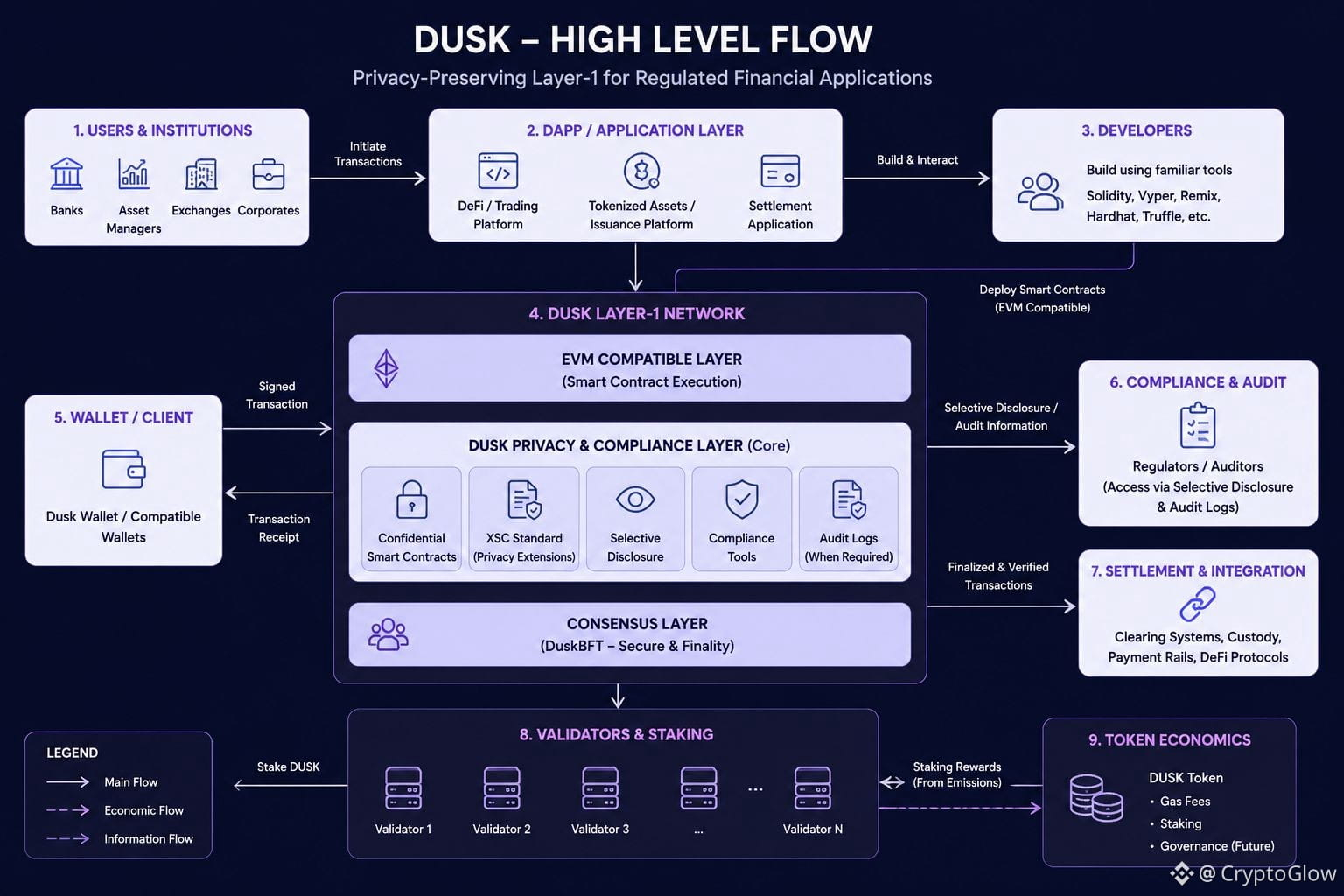
I kept returning to Dusk’s XSC standard and private contracts. The key detail was not simply hiding data. The network still needs evidence to verify state without exposing all details.
That made me separate privacy and completion. A transfer can pass consensus while send, accept, and settle still create coordination.
The trade-off interests me. Confidentiality reduces exposure, but authorization and acknowledgement can add friction. I’m not sure where that becomes uncomfortable.
I would watch settlement timing, acceptance behavior, contract usage, failed transitions, and operator activity. I’d track recurring confidential activity to see whether it helps.
My takeaway is unresolved: Dusk is trying to keep financial information private while preserving verifiable execution. I’m wondering whether users will experience that as protection, or added coordination.
@Dusk_Foundation #dusk $DUSK
{spot}(DUSKUSDT)
While checking Dusk activity, I treated a private transfer like a confirmed transaction: once it looked settled, I assumed the job was finished. That changed when I traced the flow.
I kept returning to Dusk’s XSC standard and private contracts. The key detail was not simply hiding data. The network still needs evidence to verify state without exposing all details.
That made me separate privacy and completion. A transfer can pass consensus while send, accept, and settle still create coordination.
The trade-off interests me. Confidentiality reduces exposure, but authorization and acknowledgement can add friction. I’m not sure where that becomes uncomfortable.
I would watch settlement timing, acceptance behavior, contract usage, failed transitions, and operator activity. I’d track recurring confidential activity to see whether it helps.
My takeaway is unresolved: Dusk is trying to keep financial information private while preserving verifiable execution. I’m wondering whether users will experience that as protection, or added coordination.
@Dusk #dusk $DUSK
I kept returning to Dusk’s XSC standard and private contracts. The key detail was not simply hiding data. The network still needs evidence to verify state without exposing all details.
That made me separate privacy and completion. A transfer can pass consensus while send, accept, and settle still create coordination.
The trade-off interests me. Confidentiality reduces exposure, but authorization and acknowledgement can add friction. I’m not sure where that becomes uncomfortable.
I would watch settlement timing, acceptance behavior, contract usage, failed transitions, and operator activity. I’d track recurring confidential activity to see whether it helps.
My takeaway is unresolved: Dusk is trying to keep financial information private while preserving verifiable execution. I’m wondering whether users will experience that as protection, or added coordination.
@Dusk #dusk $DUSK
1
73
·
--
I noticed something while scrolling through recent rounds on the @Dusk_Foundation Dusk explorer that I initially dismissed as random. The same provisioner address would appear as a block proposer in one round, then show up only as a validator two rounds later, doing nothing but confirming someone else's work. I assumed this was just noise in how the interface displayed activity.
Digging further, I realized it wasn't noise at all. Selection genuinely rotates responsibility — proposing, validating, and ratifying are separate duties assigned per round, not fixed roles tied to a provisioner's identity. What looked like inconsistency was actually the protocol deliberately preventing any single participant from both creating and approving the same block.
That distinction reframed something I had been treating as one idea. "Creating a block" and "finalizing a block" are not the same authority, and conflating them hides a subtler effect: as Dusk layers in EVM compatibility, proposal traffic from generic contracts can rise quickly, while the validators checking that traffic still carry the same fixed responsibility regardless of how complex the underlying logic is.
That leaves me uncertain about one thing. Confidential XSC contracts likely demand more careful scrutiny than plain EVM calls, yet if reward structures treat a validation round uniformly, does incentive alignment quietly erode as generic activity scales faster than confidential activity does.
I'll be watching the ratio of XSC to standard EVM transactions per block, whether the same provisioner addresses keep reappearing across epochs, and how ratification timing shifts as proposal volume grows. Consistency there would tell me more than raw transaction counts ever could.
I'm left wondering whether growth in developer activity strengthens this rotation model, or just adds weight to one side of it.#dusk $DUSK
I noticed something while scrolling through recent rounds on the @Dusk Dusk explorer that I initially dismissed as random. The same provisioner address would appear as a block proposer in one round, then show up only as a validator two rounds later, doing nothing but confirming someone else's work. I assumed this was just noise in how the interface displayed activity.
Digging further, I realized it wasn't noise at all. Selection genuinely rotates responsibility — proposing, validating, and ratifying are separate duties assigned per round, not fixed roles tied to a provisioner's identity. What looked like inconsistency was actually the protocol deliberately preventing any single participant from both creating and approving the same block.
That distinction reframed something I had been treating as one idea. "Creating a block" and "finalizing a block" are not the same authority, and conflating them hides a subtler effect: as Dusk layers in EVM compatibility, proposal traffic from generic contracts can rise quickly, while the validators checking that traffic still carry the same fixed responsibility regardless of how complex the underlying logic is.
That leaves me uncertain about one thing. Confidential XSC contracts likely demand more careful scrutiny than plain EVM calls, yet if reward structures treat a validation round uniformly, does incentive alignment quietly erode as generic activity scales faster than confidential activity does.
I'll be watching the ratio of XSC to standard EVM transactions per block, whether the same provisioner addresses keep reappearing across epochs, and how ratification timing shifts as proposal volume grows. Consistency there would tell me more than raw transaction counts ever could.
I'm left wondering whether growth in developer activity strengthens this rotation model, or just adds weight to one side of it.#dusk $DUSK
Digging further, I realized it wasn't noise at all. Selection genuinely rotates responsibility — proposing, validating, and ratifying are separate duties assigned per round, not fixed roles tied to a provisioner's identity. What looked like inconsistency was actually the protocol deliberately preventing any single participant from both creating and approving the same block.
That distinction reframed something I had been treating as one idea. "Creating a block" and "finalizing a block" are not the same authority, and conflating them hides a subtler effect: as Dusk layers in EVM compatibility, proposal traffic from generic contracts can rise quickly, while the validators checking that traffic still carry the same fixed responsibility regardless of how complex the underlying logic is.
That leaves me uncertain about one thing. Confidential XSC contracts likely demand more careful scrutiny than plain EVM calls, yet if reward structures treat a validation round uniformly, does incentive alignment quietly erode as generic activity scales faster than confidential activity does.
I'll be watching the ratio of XSC to standard EVM transactions per block, whether the same provisioner addresses keep reappearing across epochs, and how ratification timing shifts as proposal volume grows. Consistency there would tell me more than raw transaction counts ever could.
I'm left wondering whether growth in developer activity strengthens this rotation model, or just adds weight to one side of it.#dusk $DUSK
86
·
--
I have seeing odd while tracing a batch of transfer attempts on @Dusk_Foundation Trade last week: several submissions kept failing at what looked like the same checkpoint. My first assumption was network congestion, something ordinary, nothing worth a second look.
Digging further, I saw the failures weren't random at all. They clustered around eligibility verification, the step where a wallet's permission to hold a specific security gets confirmed before any transfer executes. That's when I actually understood how central this authorization layer is. It isn't a formality sitting beside the transaction, it's a gate the transaction has to pass through every single time.
This reframed how I think about activity here. Most people treat "transfer" and "authorization" as the same event, but they're not. A transfer is intent. Authorization is permission. When permission fails silently or lags, volume numbers hide friction that never shows up in a block explorer.
$DUSK
What I can't resolve yet is where that verification logic actually lives day to day. If it leans heavily on off-chain compliance decisions feeding on-chain outcomes, then network-level metrics only tell half the story, and I don't know how much of the process stays genuinely decentralized versus operationally centralized.
Going forward I want to track failed-versus-successful authorization ratios over time, not just raw transfer counts, alongside how often the same wallets get re-verified for new instruments.
I'm left wondering whether repeated authorization checks become their own form of demand, separate from the transfers they gate. #dusk
I have seeing odd while tracing a batch of transfer attempts on @Dusk Trade last week: several submissions kept failing at what looked like the same checkpoint. My first assumption was network congestion, something ordinary, nothing worth a second look.
Digging further, I saw the failures weren't random at all. They clustered around eligibility verification, the step where a wallet's permission to hold a specific security gets confirmed before any transfer executes. That's when I actually understood how central this authorization layer is. It isn't a formality sitting beside the transaction, it's a gate the transaction has to pass through every single time.
This reframed how I think about activity here. Most people treat "transfer" and "authorization" as the same event, but they're not. A transfer is intent. Authorization is permission. When permission fails silently or lags, volume numbers hide friction that never shows up in a block explorer.
$DUSK
What I can't resolve yet is where that verification logic actually lives day to day. If it leans heavily on off-chain compliance decisions feeding on-chain outcomes, then network-level metrics only tell half the story, and I don't know how much of the process stays genuinely decentralized versus operationally centralized.
Going forward I want to track failed-versus-successful authorization ratios over time, not just raw transfer counts, alongside how often the same wallets get re-verified for new instruments.
I'm left wondering whether repeated authorization checks become their own form of demand, separate from the transfers they gate. #dusk
Digging further, I saw the failures weren't random at all. They clustered around eligibility verification, the step where a wallet's permission to hold a specific security gets confirmed before any transfer executes. That's when I actually understood how central this authorization layer is. It isn't a formality sitting beside the transaction, it's a gate the transaction has to pass through every single time.
This reframed how I think about activity here. Most people treat "transfer" and "authorization" as the same event, but they're not. A transfer is intent. Authorization is permission. When permission fails silently or lags, volume numbers hide friction that never shows up in a block explorer.
$DUSK
What I can't resolve yet is where that verification logic actually lives day to day. If it leans heavily on off-chain compliance decisions feeding on-chain outcomes, then network-level metrics only tell half the story, and I don't know how much of the process stays genuinely decentralized versus operationally centralized.
Going forward I want to track failed-versus-successful authorization ratios over time, not just raw transfer counts, alongside how often the same wallets get re-verified for new instruments.
I'm left wondering whether repeated authorization checks become their own form of demand, separate from the transfers they gate. #dusk
1
86
·
--
#dusk $DUSK I noticed something while scrolling through recent block producers on the @Dusk_Foundation explorer. A handful of provisioner addresses kept showing up far more often than others over a short window, and I assumed it was just latency or an uneven peer connection skewing the sample I happened to catch.
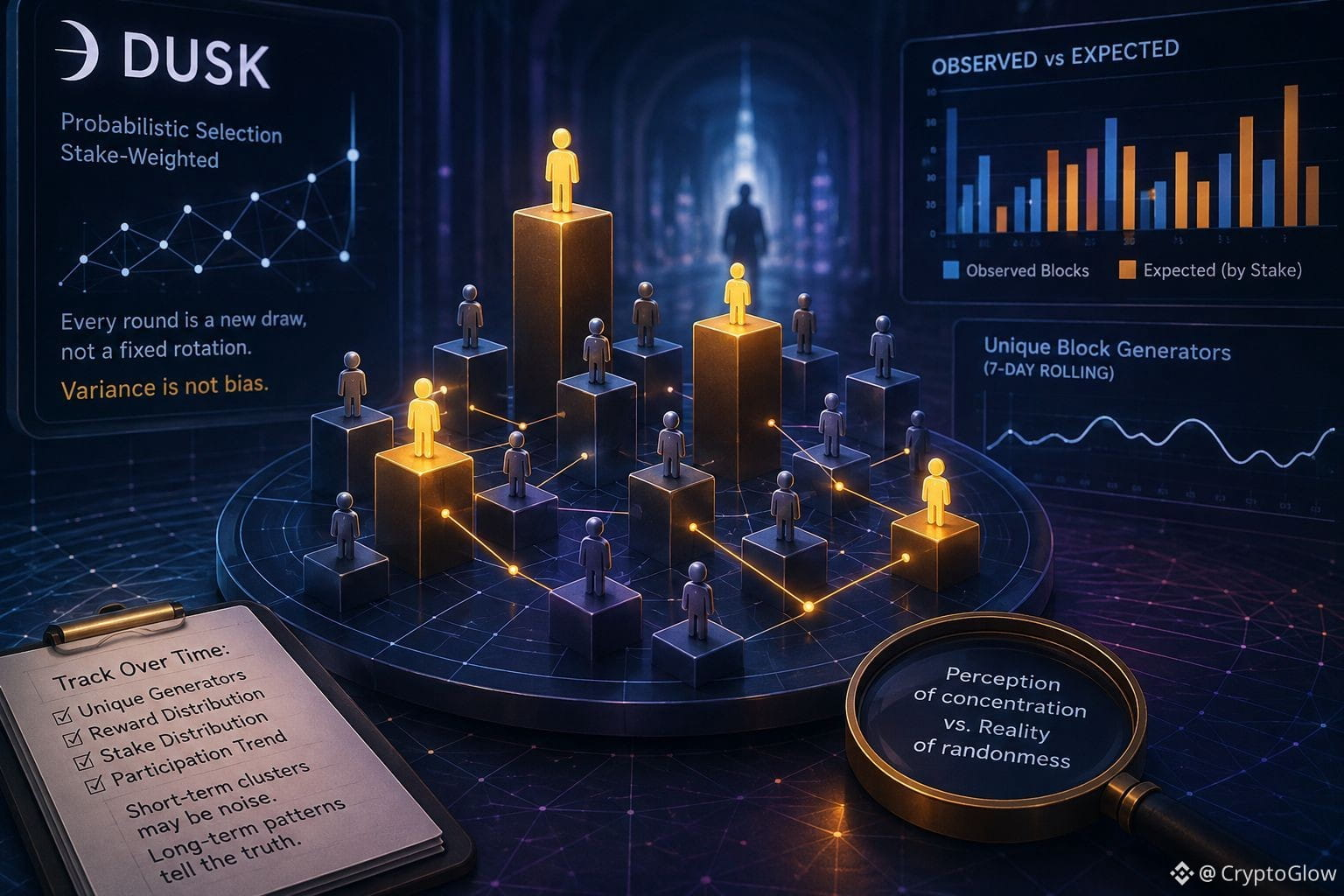
Widening the window changed that read. Dusk selects its block generator and voting committee each round through a probabilistic process weighted by stake, not a fixed rotation schedule. Larger stakes get selected more often on average, but "on average" is doing real work there. Over any short stretch, selection can cluster hard around a few addresses purely from the math of the draw, not from any advantage being exploited.
That distinction rewired how I was thinking about it. I'd been treating stake weight and actual visibility as the same thing, like proportional stake guarantees proportional appearance. It doesn't, not in small samples. A provisioner can hold a modest stake and still vanish from block production for stretches, while a mid-sized one runs hot for a while. The gap between statistical entitlement and observed participation is where perception of concentration quietly forms.
What I haven't settled is whether that variance actually discourages smaller provisioners from staying active, or whether they understand it's noise and hold steady. If uneven short-term rewards push smaller stakers toward pooling or exiting, the committee composition drifts even though the underlying selection math stayed neutral.
I'm going to track unique block generator counts across rolling weekly windows, not just single snapshots, alongside how reward distribution compares to stake distribution over the same periods. That tells me whether clustering evens out or compounds.
Still unclear to me whether what I'm seeing is just the natural texture of probabilistic selection or an early signal of something structural pulling participation toward fewer hands.
#dusk $DUSK I noticed something while scrolling through recent block producers on the @Dusk explorer. A handful of provisioner addresses kept showing up far more often than others over a short window, and I assumed it was just latency or an uneven peer connection skewing the sample I happened to catch.
Widening the window changed that read. Dusk selects its block generator and voting committee each round through a probabilistic process weighted by stake, not a fixed rotation schedule. Larger stakes get selected more often on average, but "on average" is doing real work there. Over any short stretch, selection can cluster hard around a few addresses purely from the math of the draw, not from any advantage being exploited.
That distinction rewired how I was thinking about it. I'd been treating stake weight and actual visibility as the same thing, like proportional stake guarantees proportional appearance. It doesn't, not in small samples. A provisioner can hold a modest stake and still vanish from block production for stretches, while a mid-sized one runs hot for a while. The gap between statistical entitlement and observed participation is where perception of concentration quietly forms.
What I haven't settled is whether that variance actually discourages smaller provisioners from staying active, or whether they understand it's noise and hold steady. If uneven short-term rewards push smaller stakers toward pooling or exiting, the committee composition drifts even though the underlying selection math stayed neutral.
I'm going to track unique block generator counts across rolling weekly windows, not just single snapshots, alongside how reward distribution compares to stake distribution over the same periods. That tells me whether clustering evens out or compounds.
Still unclear to me whether what I'm seeing is just the natural texture of probabilistic selection or an early signal of something structural pulling participation toward fewer hands.
Widening the window changed that read. Dusk selects its block generator and voting committee each round through a probabilistic process weighted by stake, not a fixed rotation schedule. Larger stakes get selected more often on average, but "on average" is doing real work there. Over any short stretch, selection can cluster hard around a few addresses purely from the math of the draw, not from any advantage being exploited.
That distinction rewired how I was thinking about it. I'd been treating stake weight and actual visibility as the same thing, like proportional stake guarantees proportional appearance. It doesn't, not in small samples. A provisioner can hold a modest stake and still vanish from block production for stretches, while a mid-sized one runs hot for a while. The gap between statistical entitlement and observed participation is where perception of concentration quietly forms.
What I haven't settled is whether that variance actually discourages smaller provisioners from staying active, or whether they understand it's noise and hold steady. If uneven short-term rewards push smaller stakers toward pooling or exiting, the committee composition drifts even though the underlying selection math stayed neutral.
I'm going to track unique block generator counts across rolling weekly windows, not just single snapshots, alongside how reward distribution compares to stake distribution over the same periods. That tells me whether clustering evens out or compounds.
Still unclear to me whether what I'm seeing is just the natural texture of probabilistic selection or an early signal of something structural pulling participation toward fewer hands.
1
57
·
--
I noticed something while scrolling through recent block producers on the @Dusk explorer. A handful of provisioner addresses kept showing up far more often than others over a short window, and I assumed it was just latency or an uneven peer connection skewing the sample I happened to catch.
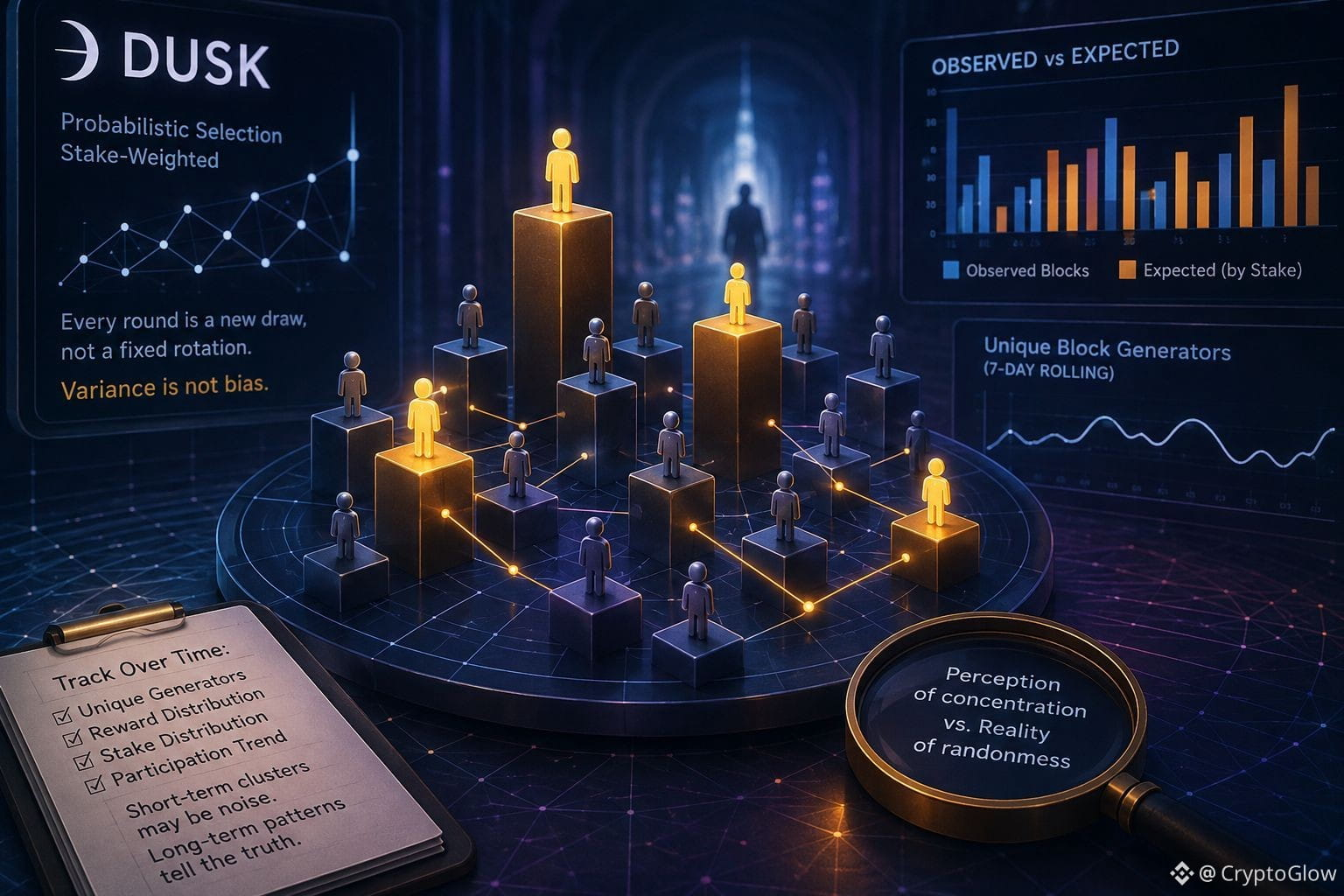
Widening the window changed that read. $DUSK selects its block generator and voting committee each round through a probabilistic process weighted by stake, not a fixed rotation schedule. Larger stakes get selected more often on average, but "on average" is doing real work there. Over any short stretch, selection can cluster hard around a few addresses purely from the math of the draw, not from any advantage being exploited.
That distinction rewired how I was thinking about it. I'd been treating stake weight and actual visibility as the same thing, like proportional stake guarantees proportional appearance. It doesn't, not in small samples. A provisioner can hold a modest stake and still vanish from block production for stretches, while a mid-sized one runs hot for a while. The gap between statistical entitlement and observed participation is where perception of concentration quietly forms.
What I haven't settled is whether that variance actually discourages smaller provisioners from staying active, or whether they understand it's noise and hold steady. If uneven short-term rewards push smaller stakers toward pooling or exiting, the committee composition drifts even though the underlying selection math stayed neutral.
I'm going to track unique block generator counts across rolling weekly windows, not just single snapshots, alongside how reward distribution compares to stake distribution over the same periods. That tells me whether clustering evens out or compounds.#dusk
Still unclear to me whether what I'm seeing is just the natural texture of probabilistic selection or an early signal of something structural pulling participation toward fewer hands.
I noticed something while scrolling through recent block producers on the @Dusk explorer. A handful of provisioner addresses kept showing up far more often than others over a short window, and I assumed it was just latency or an uneven peer connection skewing the sample I happened to catch.
Widening the window changed that read. $DUSK selects its block generator and voting committee each round through a probabilistic process weighted by stake, not a fixed rotation schedule. Larger stakes get selected more often on average, but "on average" is doing real work there. Over any short stretch, selection can cluster hard around a few addresses purely from the math of the draw, not from any advantage being exploited.
That distinction rewired how I was thinking about it. I'd been treating stake weight and actual visibility as the same thing, like proportional stake guarantees proportional appearance. It doesn't, not in small samples. A provisioner can hold a modest stake and still vanish from block production for stretches, while a mid-sized one runs hot for a while. The gap between statistical entitlement and observed participation is where perception of concentration quietly forms.
What I haven't settled is whether that variance actually discourages smaller provisioners from staying active, or whether they understand it's noise and hold steady. If uneven short-term rewards push smaller stakers toward pooling or exiting, the committee composition drifts even though the underlying selection math stayed neutral.
I'm going to track unique block generator counts across rolling weekly windows, not just single snapshots, alongside how reward distribution compares to stake distribution over the same periods. That tells me whether clustering evens out or compounds.#dusk
Still unclear to me whether what I'm seeing is just the natural texture of probabilistic selection or an early signal of something structural pulling participation toward fewer hands.
Widening the window changed that read. $DUSK selects its block generator and voting committee each round through a probabilistic process weighted by stake, not a fixed rotation schedule. Larger stakes get selected more often on average, but "on average" is doing real work there. Over any short stretch, selection can cluster hard around a few addresses purely from the math of the draw, not from any advantage being exploited.
That distinction rewired how I was thinking about it. I'd been treating stake weight and actual visibility as the same thing, like proportional stake guarantees proportional appearance. It doesn't, not in small samples. A provisioner can hold a modest stake and still vanish from block production for stretches, while a mid-sized one runs hot for a while. The gap between statistical entitlement and observed participation is where perception of concentration quietly forms.
What I haven't settled is whether that variance actually discourages smaller provisioners from staying active, or whether they understand it's noise and hold steady. If uneven short-term rewards push smaller stakers toward pooling or exiting, the committee composition drifts even though the underlying selection math stayed neutral.
I'm going to track unique block generator counts across rolling weekly windows, not just single snapshots, alongside how reward distribution compares to stake distribution over the same periods. That tells me whether clustering evens out or compounds.#dusk
Still unclear to me whether what I'm seeing is just the natural texture of probabilistic selection or an early signal of something structural pulling participation toward fewer hands.
1
77
·
--
I'm trying to improve my trading skills. I'd really appreciate it if experienced traders could share one lesson that helped them become consistently profitable.
I'm trying to improve my trading skills. I'd really appreciate it if experienced traders could share one lesson that helped them become consistently profitable.
69
·
--
Just checking the market and staying patient. 👀
Sometimes the best trade is no trade at all.
Watching $BTC closely today.
#Bitcoin #Crypto #BinanceSquare
Just checking the market and staying patient. 👀
Sometimes the best trade is no trade at all.
Watching $BTC closely today.
#Bitcoin #Crypto #BinanceSquare
Sometimes the best trade is no trade at all.
Watching $BTC closely today.
#Bitcoin #Crypto #BinanceSquare
105
·
--
I’m not rushing into anything today… just waiting for clean confirmation before entry. Earlier I used to overtrade, but now I’ve learned patience is everything in this game.
$BTC is still the main focus, but altcoins are also showing some small movements worth watching.
Let’s see how the market reacts in the next few hours 🚀
#BinanceSquare #Crypto #BTC #TradingView #WriteToEarn
I’m not rushing into anything today… just waiting for clean confirmation before entry. Earlier I used to overtrade, but now I’ve learned patience is everything in this game.
$BTC is still the main focus, but altcoins are also showing some small movements worth watching.
Let’s see how the market reacts in the next few hours 🚀
#BinanceSquare #Crypto #BTC #TradingView #WriteToEarn
$BTC is still the main focus, but altcoins are also showing some small movements worth watching.
Let’s see how the market reacts in the next few hours 🚀
#BinanceSquare #Crypto #BTC #TradingView #WriteToEarn
58
·
--
Just added another position today after spending hours analyzing the charts. 📊
The market is showing interesting signals, but risk management always comes first. No trade is guaranteed, so I always stick to my plan and avoid emotional decisions.
For now, I'm closely watching $BTC , $ETH , and a few altcoins for potential moves. 👀
What's on your watchlist today? 🚀
#Crypto #Trading #BinanceSquare #BTC #ETH
Just added another position today after spending hours analyzing the charts. 📊
The market is showing interesting signals, but risk management always comes first. No trade is guaranteed, so I always stick to my plan and avoid emotional decisions.
For now, I'm closely watching $BTC , $ETH , and a few altcoins for potential moves. 👀
What's on your watchlist today? 🚀
#Crypto #Trading #BinanceSquare #BTC #ETH
The market is showing interesting signals, but risk management always comes first. No trade is guaranteed, so I always stick to my plan and avoid emotional decisions.
For now, I'm closely watching $BTC , $ETH , and a few altcoins for potential moves. 👀
What's on your watchlist today? 🚀
#Crypto #Trading #BinanceSquare #BTC #ETH
66
·
--
🔥 Today's Market Watch
$BTC remains the key market mover. Traders are watching for the next breakout level.
📊 Keep an eye on: • $BTC • $ETH • $BNB
What's your prediction for today? Bullish 🐂 or Bearish 🐻?
#Bitcoin #CryptoTrading #BinanceSquare
🔥 Today's Market Watch
$BTC remains the key market mover. Traders are watching for the next breakout level.
📊 Keep an eye on: • $BTC • $ETH • $BNB
What's your prediction for today? Bullish 🐂 or Bearish 🐻?
#Bitcoin #CryptoTrading #BinanceSquare
$BTC remains the key market mover. Traders are watching for the next breakout level.
📊 Keep an eye on: • $BTC • $ETH • $BNB
What's your prediction for today? Bullish 🐂 or Bearish 🐻?
#Bitcoin #CryptoTrading #BinanceSquare
95
·
--
🚀 $BTC Update
Bitcoin is showing strong momentum today! 📈
✅ Current Trend: Bullish 🎯 Next Resistance: $110,000 ⚠️ Watch for volatility before entering.
Are you bullish or bearish on $BTC this week? 👇
#BTC #Bitcoin #Crypto #BinanceSquare
🚀 $BTC Update
Bitcoin is showing strong momentum today! 📈
✅ Current Trend: Bullish 🎯 Next Resistance: $110,000 ⚠️ Watch for volatility before entering.
Are you bullish or bearish on $BTC this week? 👇
#BTC #Bitcoin #Crypto #BinanceSquare
Bitcoin is showing strong momentum today! 📈
✅ Current Trend: Bullish 🎯 Next Resistance: $110,000 ⚠️ Watch for volatility before entering.
Are you bullish or bearish on $BTC this week? 👇
#BTC #Bitcoin #Crypto #BinanceSquare
98
·
--
🚀 BTC Update!
Bitcoin is showing strong movement again, but market is still uncertain.
Some traders are saying “bull run is starting” 📈
while others are waiting for correction 📉
Right now the big question is:
👉 Are you buying BTC here or waiting for a dip?
Drop your opinion below 💬
Let’s see what majority thinks 👇
#Bitcoin #BTC #Crypto #Trading #BinanceSquare #WriteToEarn
🚀 BTC Update!
Bitcoin is showing strong movement again, but market is still uncertain.
Some traders are saying “bull run is starting” 📈
while others are waiting for correction 📉
Right now the big question is:
👉 Are you buying BTC here or waiting for a dip?
Drop your opinion below 💬
Let’s see what majority thinks 👇
#Bitcoin #BTC #Crypto #Trading #BinanceSquare #WriteToEarn
Bitcoin is showing strong movement again, but market is still uncertain.
Some traders are saying “bull run is starting” 📈
while others are waiting for correction 📉
Right now the big question is:
👉 Are you buying BTC here or waiting for a dip?
Drop your opinion below 💬
Let’s see what majority thinks 👇
#Bitcoin #BTC #Crypto #Trading #BinanceSquare #WriteToEarn
72
Log in to explore more content
Join global crypto users on Binance Square
⚡️ Get latest and useful information about crypto.
💬 Trusted by the world’s largest crypto exchange.
👍 Discover real insights from verified creators.
Email / Phone number
Trending Topics
USAugustPPIRisesLessThanExpected
62,695 views
899 Discussing
🚨 US AUG PPI: Rises LESS Than Expected! Bullish for Crypto? 🚀
PPI +0.4% MoM as expected, but CORE PPI only +0.2% vs +0.3% expected - cooling!
What it means:
• Wholesale inflation softer than feared
• Fed rate hike chance now 62% - but dovish signals coming
• Core PCE revisions expected downward - bullish
• BTC usually pumps on softer PPI
Fed meeting Sep 15-16 - Market now expects pause, not hike?
Is this the green light for Q4 rally?
#Bitcoin #PPI #Fed #CryptoNews #BTC#usaugustppiriseslessthanexpected
True News
·1 Likes
·1.4k views
SECApprovesNasdaqTexasCommodityTrustRule
33,465 views
630 Discussing
ECBRaisesRatesSecondTimeTo2.5%
29,713 views
451 Discussing