
Ali Abbas514
3.9k Posts

Ali Abbas514
Report
Block User
crypto been my rabbit hole since 20XX.Still falling let's go
166 Following
20.8K+ Followers
10.1K+ Liked
Posts
All
Quotes
Live
·
--
Bullish
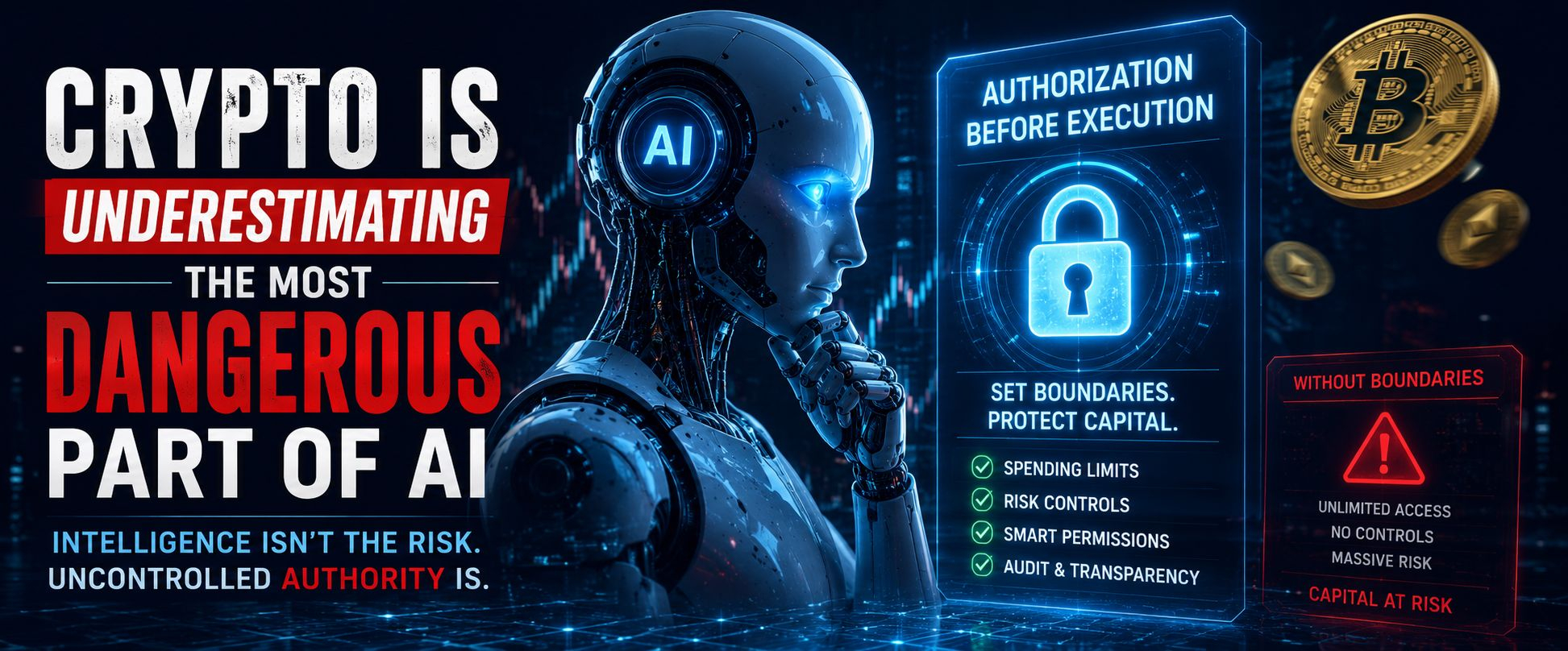
I Think Crypto Is Underestimating the Most Dangerous Part of AI
The more I watch AI evolve inside crypto, the more I feel like the industry is focusing on the wrong thing. Everyone is obsessed with building smarter models, faster agents, and fully autonomous trading systems. But I honestly think intelligence is not the biggest risk anymore. Authority is.
A few years ago AI was mostly helping people analyze markets or summarize information. Now it is slowly becoming a direct financial participant. AI can already optimize portfolios, monitor liquidity, execute trades, and react to market conditions faster than humans ever could. And soon, I think AI will move billions on-chain without waiting for constant human approval.
That’s where things become dangerous.
Because blockchain does not understand judgment. It only executes instructions exactly as they are signed. If an AI system has permission, the transaction happens. No questions asked.
This is why Newton Protocol caught my attention. Instead of blindly trusting AI, the idea of “Authorization Before Execution” feels much smarter to me. Giving AI programmable boundaries before capital moves could become one of the most important security layers in autonomous finance.
I honestly believe the future won’t belong to the smartest AI.
It will belong to the AI that understands its limits.
@NewtonProtocol #Newt $NEWT
{spot}(NEWTUSDT)
I Think Crypto Is Underestimating the Most Dangerous Part of AI
The more I watch AI evolve inside crypto, the more I feel like the industry is focusing on the wrong thing. Everyone is obsessed with building smarter models, faster agents, and fully autonomous trading systems. But I honestly think intelligence is not the biggest risk anymore. Authority is.
A few years ago AI was mostly helping people analyze markets or summarize information. Now it is slowly becoming a direct financial participant. AI can already optimize portfolios, monitor liquidity, execute trades, and react to market conditions faster than humans ever could. And soon, I think AI will move billions on-chain without waiting for constant human approval.
That’s where things become dangerous.
Because blockchain does not understand judgment. It only executes instructions exactly as they are signed. If an AI system has permission, the transaction happens. No questions asked.
This is why Newton Protocol caught my attention. Instead of blindly trusting AI, the idea of “Authorization Before Execution” feels much smarter to me. Giving AI programmable boundaries before capital moves could become one of the most important security layers in autonomous finance.
I honestly believe the future won’t belong to the smartest AI.
It will belong to the AI that understands its limits.
@NewtonProtocol #Newt $NEWT
The more I watch AI evolve inside crypto, the more I feel like the industry is focusing on the wrong thing. Everyone is obsessed with building smarter models, faster agents, and fully autonomous trading systems. But I honestly think intelligence is not the biggest risk anymore. Authority is.
A few years ago AI was mostly helping people analyze markets or summarize information. Now it is slowly becoming a direct financial participant. AI can already optimize portfolios, monitor liquidity, execute trades, and react to market conditions faster than humans ever could. And soon, I think AI will move billions on-chain without waiting for constant human approval.
That’s where things become dangerous.
Because blockchain does not understand judgment. It only executes instructions exactly as they are signed. If an AI system has permission, the transaction happens. No questions asked.
This is why Newton Protocol caught my attention. Instead of blindly trusting AI, the idea of “Authorization Before Execution” feels much smarter to me. Giving AI programmable boundaries before capital moves could become one of the most important security layers in autonomous finance.
I honestly believe the future won’t belong to the smartest AI.
It will belong to the AI that understands its limits.
@NewtonProtocol #Newt $NEWT
5
2
75
·
--

Article
The Real Risk Isn’t AI Intelligence — It’s Who Gives AI Permission to Move CapitalEveryone in crypto keeps talking about how powerful AI is becoming. Every week there’s a new discussion about smarter trading models, autonomous agents, AI-driven portfolios, and automated financial systems that can supposedly outperform humans. But the more I watch this space evolve, the more I feel like the industry is asking the wrong question entirely. The real issue is no longer whether AI can manage money. The scary part is whether AI should be trusted with unlimited authority once billions of dollars are already moving on-chain.
That’s what made Binance’s recent discussion around tokenized assets and on-chain capital feel so important to me. The numbers coming from RWA.xyz show that this market is no longer some experimental niche inside crypto. Hundreds of thousands of holders are already involved with tokenized assets, while billions in monthly volume continue flowing through blockchain-based systems. At this point, capital has already migrated on-chain faster than most people expected. The infrastructure is growing rapidly, but the rules around authority, accountability, and execution still feel unfinished. And honestly, that gap could become one of the biggest financial risks of the next decade.
A few years ago AI mostly existed as an assistant. It answered questions, summarized data, and helped traders analyze markets. But now the role of AI is changing completely. AI is slowly becoming an active participant inside financial systems. It can optimize portfolios, rebalance positions, monitor liquidity, execute trades, and react to market conditions faster than humans ever could. Eventually AI won’t just recommend actions. It will directly move capital by itself. And that completely changes the conversation because blockchain networks don’t actually judge decisions. They simply execute instructions exactly as they are given. If the authorization exists, the transaction goes through. The blockchain doesn’t ask whether the action was intelligent, dangerous, manipulated, or reckless. It only follows instructions.
That’s why I think many people misunderstand what “trust” really means in crypto. Blockchain never solved the problem of judgment. It solved the problem of execution. Even tokenized assets today still depend on trust layers outside pure technology. Investors still care about governance, transparency, asset backing, compliance, and accountability. Once AI agents begin interacting directly with financial infrastructure, the challenge becomes even bigger because machine-speed execution combined with unlimited permissions can create risks that scale globally within seconds.
This is exactly why Newton Protocol feels different from most AI projects entering crypto right now. While many projects are racing to build smarter AI systems, Newton seems focused on something much deeper — programmable authorization before execution. Instead of giving autonomous agents unlimited freedom, the system can verify whether specific actions are allowed before capital actually moves. That may sound simple at first, but it completely changes the security model behind autonomous finance. Execution becomes conditional instead of automatic. AI doesn’t operate through blind trust. It operates inside verifiable boundaries.
And honestly, I think that idea could become far more important than people realize today. The future of finance probably won’t be defined by whichever AI is the smartest or fastest. It will be defined by whichever systems create the safest balance between automation and control. As more real-world assets move on-chain and autonomous financial systems continue growing, permissions may eventually become just as important as private keys themselves. Because in the end, the real challenge was never about teaching AI how to act. The real challenge is deciding who gives AI the authority to act in the first place. And that’s the future Newton Protocol appears to be trying to build.
@NewtonProtocol #NEWT $NEWT
{spot}(NEWTUSDT)
The Real Risk Isn’t AI Intelligence — It’s Who Gives AI Permission to Move Capital
Everyone in crypto keeps talking about how powerful AI is becoming. Every week there’s a new discussion about smarter trading models, autonomous agents, AI-driven portfolios, and automated financial systems that can supposedly outperform humans. But the more I watch this space evolve, the more I feel like the industry is asking the wrong question entirely. The real issue is no longer whether AI can manage money. The scary part is whether AI should be trusted with unlimited authority once billions of dollars are already moving on-chain.
That’s what made Binance’s recent discussion around tokenized assets and on-chain capital feel so important to me. The numbers coming from RWA.xyz show that this market is no longer some experimental niche inside crypto. Hundreds of thousands of holders are already involved with tokenized assets, while billions in monthly volume continue flowing through blockchain-based systems. At this point, capital has already migrated on-chain faster than most people expected. The infrastructure is growing rapidly, but the rules around authority, accountability, and execution still feel unfinished. And honestly, that gap could become one of the biggest financial risks of the next decade.
A few years ago AI mostly existed as an assistant. It answered questions, summarized data, and helped traders analyze markets. But now the role of AI is changing completely. AI is slowly becoming an active participant inside financial systems. It can optimize portfolios, rebalance positions, monitor liquidity, execute trades, and react to market conditions faster than humans ever could. Eventually AI won’t just recommend actions. It will directly move capital by itself. And that completely changes the conversation because blockchain networks don’t actually judge decisions. They simply execute instructions exactly as they are given. If the authorization exists, the transaction goes through. The blockchain doesn’t ask whether the action was intelligent, dangerous, manipulated, or reckless. It only follows instructions.
That’s why I think many people misunderstand what “trust” really means in crypto. Blockchain never solved the problem of judgment. It solved the problem of execution. Even tokenized assets today still depend on trust layers outside pure technology. Investors still care about governance, transparency, asset backing, compliance, and accountability. Once AI agents begin interacting directly with financial infrastructure, the challenge becomes even bigger because machine-speed execution combined with unlimited permissions can create risks that scale globally within seconds.
This is exactly why Newton Protocol feels different from most AI projects entering crypto right now. While many projects are racing to build smarter AI systems, Newton seems focused on something much deeper — programmable authorization before execution. Instead of giving autonomous agents unlimited freedom, the system can verify whether specific actions are allowed before capital actually moves. That may sound simple at first, but it completely changes the security model behind autonomous finance. Execution becomes conditional instead of automatic. AI doesn’t operate through blind trust. It operates inside verifiable boundaries.
And honestly, I think that idea could become far more important than people realize today. The future of finance probably won’t be defined by whichever AI is the smartest or fastest. It will be defined by whichever systems create the safest balance between automation and control. As more real-world assets move on-chain and autonomous financial systems continue growing, permissions may eventually become just as important as private keys themselves. Because in the end, the real challenge was never about teaching AI how to act. The real challenge is deciding who gives AI the authority to act in the first place. And that’s the future Newton Protocol appears to be trying to build.
@NewtonProtocol #NEWT $NEWT
That’s what made Binance’s recent discussion around tokenized assets and on-chain capital feel so important to me. The numbers coming from RWA.xyz show that this market is no longer some experimental niche inside crypto. Hundreds of thousands of holders are already involved with tokenized assets, while billions in monthly volume continue flowing through blockchain-based systems. At this point, capital has already migrated on-chain faster than most people expected. The infrastructure is growing rapidly, but the rules around authority, accountability, and execution still feel unfinished. And honestly, that gap could become one of the biggest financial risks of the next decade.
A few years ago AI mostly existed as an assistant. It answered questions, summarized data, and helped traders analyze markets. But now the role of AI is changing completely. AI is slowly becoming an active participant inside financial systems. It can optimize portfolios, rebalance positions, monitor liquidity, execute trades, and react to market conditions faster than humans ever could. Eventually AI won’t just recommend actions. It will directly move capital by itself. And that completely changes the conversation because blockchain networks don’t actually judge decisions. They simply execute instructions exactly as they are given. If the authorization exists, the transaction goes through. The blockchain doesn’t ask whether the action was intelligent, dangerous, manipulated, or reckless. It only follows instructions.
That’s why I think many people misunderstand what “trust” really means in crypto. Blockchain never solved the problem of judgment. It solved the problem of execution. Even tokenized assets today still depend on trust layers outside pure technology. Investors still care about governance, transparency, asset backing, compliance, and accountability. Once AI agents begin interacting directly with financial infrastructure, the challenge becomes even bigger because machine-speed execution combined with unlimited permissions can create risks that scale globally within seconds.
This is exactly why Newton Protocol feels different from most AI projects entering crypto right now. While many projects are racing to build smarter AI systems, Newton seems focused on something much deeper — programmable authorization before execution. Instead of giving autonomous agents unlimited freedom, the system can verify whether specific actions are allowed before capital actually moves. That may sound simple at first, but it completely changes the security model behind autonomous finance. Execution becomes conditional instead of automatic. AI doesn’t operate through blind trust. It operates inside verifiable boundaries.
And honestly, I think that idea could become far more important than people realize today. The future of finance probably won’t be defined by whichever AI is the smartest or fastest. It will be defined by whichever systems create the safest balance between automation and control. As more real-world assets move on-chain and autonomous financial systems continue growing, permissions may eventually become just as important as private keys themselves. Because in the end, the real challenge was never about teaching AI how to act. The real challenge is deciding who gives AI the authority to act in the first place. And that’s the future Newton Protocol appears to be trying to build.
@NewtonProtocol #NEWT $NEWT
2
2
62
·
--
Bullish
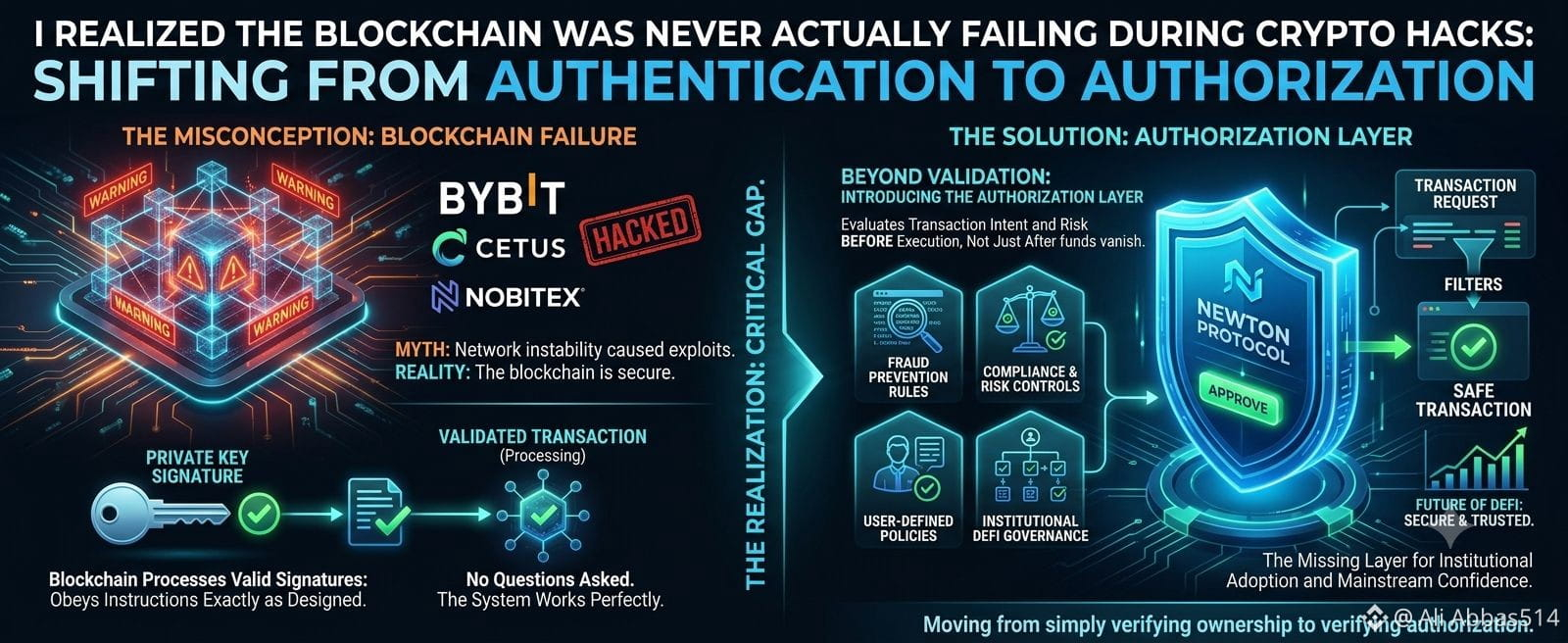
I Realized the Blockchain Was Never Actually Failing During Crypto Hacks
For a long time, I used to think major crypto hacks happened because blockchains were insecure. Every time platforms like Bybit, Cetus, or Nobitex got exploited, I assumed the network itself somehow failed. But the deeper I looked into these incidents, the more I realized something uncomfortable — the blockchain usually works exactly as designed during the attack.
If a valid private key signs a transaction, the network processes it. No emotions. No hesitation. No questions asked. The system simply obeys instructions. That made me realize the real problem may not be authentication anymore. Crypto is already extremely good at verifying signatures and ownership. The bigger issue is authorization.
I started comparing this to traditional finance. When I use my Visa card, payments are constantly checked against fraud systems, spending patterns, compliance rules, and risk controls before approval happens. In crypto, most transactions still move purely because the signature is valid.
That’s why I find Newton Protocol interesting. Instead of only tracking attacks after funds disappear, it introduces an Authorization Layer that evaluates whether a transaction should happen before execution itself.
Honestly, I think this could become one of the most important missing layers for institutional DeFi in the future.
@NewtonProtocol $NEWT #NEWT
{future}(NEWTUSDT)
$NVDAB
{spot}(NVDABUSDT)
$MSFTB
{spot}(MSFTBUSDT)
I Realized the Blockchain Was Never Actually Failing During Crypto Hacks
For a long time, I used to think major crypto hacks happened because blockchains were insecure. Every time platforms like Bybit, Cetus, or Nobitex got exploited, I assumed the network itself somehow failed. But the deeper I looked into these incidents, the more I realized something uncomfortable — the blockchain usually works exactly as designed during the attack.
If a valid private key signs a transaction, the network processes it. No emotions. No hesitation. No questions asked. The system simply obeys instructions. That made me realize the real problem may not be authentication anymore. Crypto is already extremely good at verifying signatures and ownership. The bigger issue is authorization.
I started comparing this to traditional finance. When I use my Visa card, payments are constantly checked against fraud systems, spending patterns, compliance rules, and risk controls before approval happens. In crypto, most transactions still move purely because the signature is valid.
That’s why I find Newton Protocol interesting. Instead of only tracking attacks after funds disappear, it introduces an Authorization Layer that evaluates whether a transaction should happen before execution itself.
Honestly, I think this could become one of the most important missing layers for institutional DeFi in the future.
@NewtonProtocol $NEWT #NEWT
$NVDAB
$MSFTB
For a long time, I used to think major crypto hacks happened because blockchains were insecure. Every time platforms like Bybit, Cetus, or Nobitex got exploited, I assumed the network itself somehow failed. But the deeper I looked into these incidents, the more I realized something uncomfortable — the blockchain usually works exactly as designed during the attack.
If a valid private key signs a transaction, the network processes it. No emotions. No hesitation. No questions asked. The system simply obeys instructions. That made me realize the real problem may not be authentication anymore. Crypto is already extremely good at verifying signatures and ownership. The bigger issue is authorization.
I started comparing this to traditional finance. When I use my Visa card, payments are constantly checked against fraud systems, spending patterns, compliance rules, and risk controls before approval happens. In crypto, most transactions still move purely because the signature is valid.
That’s why I find Newton Protocol interesting. Instead of only tracking attacks after funds disappear, it introduces an Authorization Layer that evaluates whether a transaction should happen before execution itself.
Honestly, I think this could become one of the most important missing layers for institutional DeFi in the future.
@NewtonProtocol $NEWT #NEWT
$NVDAB
$MSFTB
2
3
137
·
--
Article
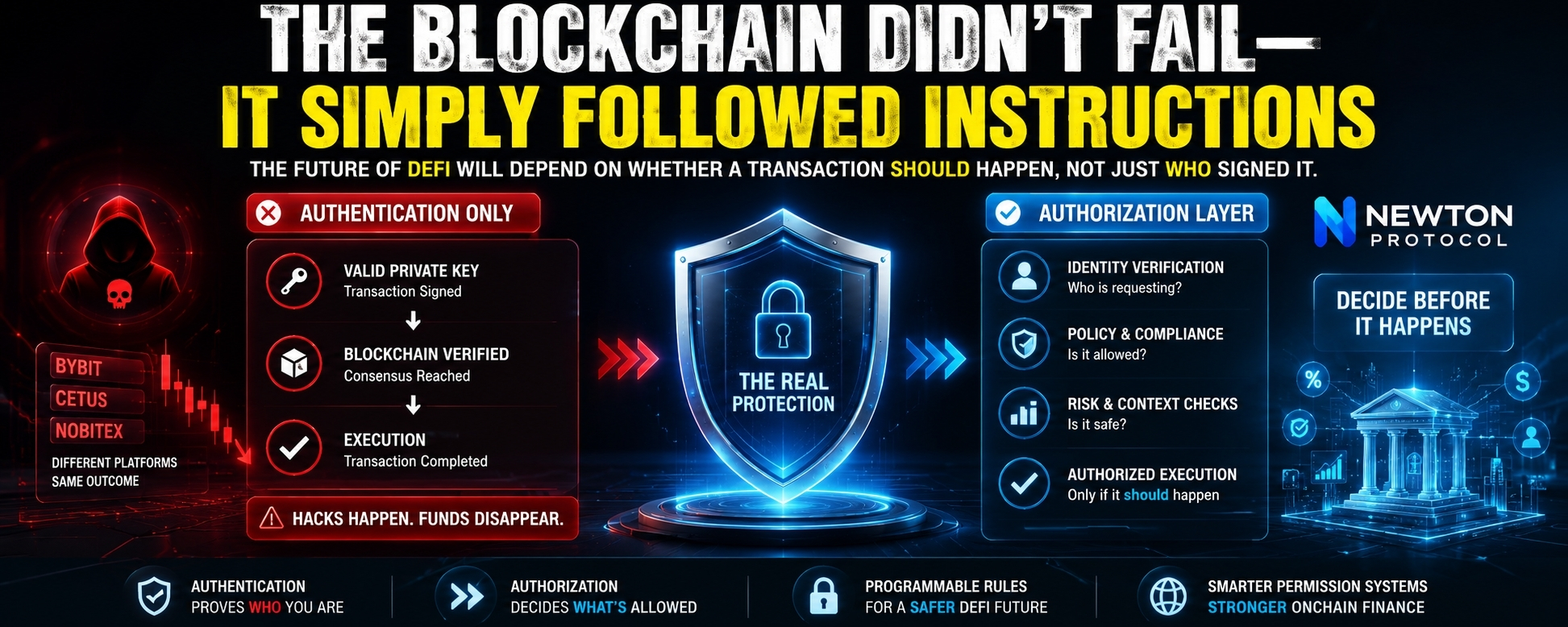
The Blockchain Didn’t Fail — It Simply Followed Instructions@NewtonProtocol Every time a major crypto hack happens, the conversation usually follows the same pattern. People rush to investigate wallets, trace transactions, and figure out who signed the transfer. We saw it happen after incidents involving Bybit, Cetus, and Nobitex. Different platforms, different exploits, same reaction from the industry. Everyone focuses on the identity behind the transaction as if finding the signer automatically explains the real problem. But lately I’ve started thinking that crypto might be asking the wrong question entirely.
The uncomfortable truth is that most blockchains are not actually failing during these hacks. In fact, they are working exactly as designed. If a valid private key signs a transaction, the network verifies it, reaches consensus, and executes the instruction without hesitation. From the blockchain’s perspective, everything is functioning perfectly. The system is doing what it was built to do. It does not understand human intent, emotional context, or financial consequences. It only understands whether an instruction is valid. Once the signature checks out, execution becomes automatic.
That is why blaming the blockchain itself sometimes misses the deeper issue. Authentication alone cannot protect billions of dollars. Knowing who initiated a transaction is important, but it does not answer the question that actually matters when capital is at risk: should this transaction even be allowed to happen? Those are two completely different layers of security. One confirms identity. The other evaluates permission and risk. Crypto has become incredibly advanced at authentication over the last decade, but authorization is still surprisingly underdeveloped across most of the ecosystem.
Traditional finance figured this out years ago. When someone taps a Visa card at a store, the payment is not approved simply because the card is real. Behind the scenes, there are countless checks happening in milliseconds. Banks analyze spending patterns, transaction size, merchant reputation, fraud signals, location anomalies, and compliance rules before settlement ever takes place. The system is constantly evaluating whether the transaction itself looks safe enough to approve. In other words, execution only happens after authorization decides it should.
Onchain finance is now reaching the stage where it probably needs a similar layer. DeFi is no longer a small experimental corner of the internet. Today, billions of dollars move through protocols securing stablecoins, lending markets, treasury systems, and tokenized real-world assets. In the future, autonomous AI agents could also begin managing assets directly onchain. As this ecosystem grows larger, signatures alone are not enough to protect capital anymore. Finance needs programmable rules, not just programmable money.
That is why the idea behind Newton Protocol stands out to me. Instead of focusing only on tracking activity after something goes wrong, Newton is building an authorization layer that evaluates transactions before settlement happens. Rather than reacting after funds disappear, the system checks whether transactions satisfy predefined policies in real time. Those policies can involve identity verification, compliance screening, sanctions checks, leverage controls, oracle conditions, and broader risk management logic. The important part is that the decision happens before execution, not after damage is already done.
What makes this approach interesting is the shift in philosophy. Most monitoring systems only tell users what already happened. Authorization systems determine what is allowed to happen in the first place. That difference sounds small at first, but it completely changes the security model of onchain finance. One records history after the fact. The other actively shapes outcomes before irreversible transactions occur.
The more I think about recent hacks across crypto, the more I feel the industry may be entering a new phase. For years, the focus was entirely on making finance permissionless and accessible without intermediaries. That innovation changed the internet forever. But the next stage may be about building smarter permission systems around transactions themselves. Not to remove decentralization, but to make risk management programmable at the protocol level.
Maybe the future of DeFi will not depend only on proving who signed a transaction. Maybe the real breakthrough will come from systems capable of deciding whether the transaction should happen at all. And if that shift becomes mainstream, it could end up being one of the most important infrastructure upgrades the crypto industry has ever seen.
#NEWT $NEWT
{future}(NEWTUSDT)
$LAB
{future}(LABUSDT)
$PORTAL
{future}(PORTALUSDT)
The Blockchain Didn’t Fail — It Simply Followed Instructions
@NewtonProtocol Every time a major crypto hack happens, the conversation usually follows the same pattern. People rush to investigate wallets, trace transactions, and figure out who signed the transfer. We saw it happen after incidents involving Bybit, Cetus, and Nobitex. Different platforms, different exploits, same reaction from the industry. Everyone focuses on the identity behind the transaction as if finding the signer automatically explains the real problem. But lately I’ve started thinking that crypto might be asking the wrong question entirely.
The uncomfortable truth is that most blockchains are not actually failing during these hacks. In fact, they are working exactly as designed. If a valid private key signs a transaction, the network verifies it, reaches consensus, and executes the instruction without hesitation. From the blockchain’s perspective, everything is functioning perfectly. The system is doing what it was built to do. It does not understand human intent, emotional context, or financial consequences. It only understands whether an instruction is valid. Once the signature checks out, execution becomes automatic.
That is why blaming the blockchain itself sometimes misses the deeper issue. Authentication alone cannot protect billions of dollars. Knowing who initiated a transaction is important, but it does not answer the question that actually matters when capital is at risk: should this transaction even be allowed to happen? Those are two completely different layers of security. One confirms identity. The other evaluates permission and risk. Crypto has become incredibly advanced at authentication over the last decade, but authorization is still surprisingly underdeveloped across most of the ecosystem.
Traditional finance figured this out years ago. When someone taps a Visa card at a store, the payment is not approved simply because the card is real. Behind the scenes, there are countless checks happening in milliseconds. Banks analyze spending patterns, transaction size, merchant reputation, fraud signals, location anomalies, and compliance rules before settlement ever takes place. The system is constantly evaluating whether the transaction itself looks safe enough to approve. In other words, execution only happens after authorization decides it should.
Onchain finance is now reaching the stage where it probably needs a similar layer. DeFi is no longer a small experimental corner of the internet. Today, billions of dollars move through protocols securing stablecoins, lending markets, treasury systems, and tokenized real-world assets. In the future, autonomous AI agents could also begin managing assets directly onchain. As this ecosystem grows larger, signatures alone are not enough to protect capital anymore. Finance needs programmable rules, not just programmable money.
That is why the idea behind Newton Protocol stands out to me. Instead of focusing only on tracking activity after something goes wrong, Newton is building an authorization layer that evaluates transactions before settlement happens. Rather than reacting after funds disappear, the system checks whether transactions satisfy predefined policies in real time. Those policies can involve identity verification, compliance screening, sanctions checks, leverage controls, oracle conditions, and broader risk management logic. The important part is that the decision happens before execution, not after damage is already done.
What makes this approach interesting is the shift in philosophy. Most monitoring systems only tell users what already happened. Authorization systems determine what is allowed to happen in the first place. That difference sounds small at first, but it completely changes the security model of onchain finance. One records history after the fact. The other actively shapes outcomes before irreversible transactions occur.
The more I think about recent hacks across crypto, the more I feel the industry may be entering a new phase. For years, the focus was entirely on making finance permissionless and accessible without intermediaries. That innovation changed the internet forever. But the next stage may be about building smarter permission systems around transactions themselves. Not to remove decentralization, but to make risk management programmable at the protocol level.
Maybe the future of DeFi will not depend only on proving who signed a transaction. Maybe the real breakthrough will come from systems capable of deciding whether the transaction should happen at all. And if that shift becomes mainstream, it could end up being one of the most important infrastructure upgrades the crypto industry has ever seen.
#NEWT $NEWT
$LAB
$PORTAL
The uncomfortable truth is that most blockchains are not actually failing during these hacks. In fact, they are working exactly as designed. If a valid private key signs a transaction, the network verifies it, reaches consensus, and executes the instruction without hesitation. From the blockchain’s perspective, everything is functioning perfectly. The system is doing what it was built to do. It does not understand human intent, emotional context, or financial consequences. It only understands whether an instruction is valid. Once the signature checks out, execution becomes automatic.
That is why blaming the blockchain itself sometimes misses the deeper issue. Authentication alone cannot protect billions of dollars. Knowing who initiated a transaction is important, but it does not answer the question that actually matters when capital is at risk: should this transaction even be allowed to happen? Those are two completely different layers of security. One confirms identity. The other evaluates permission and risk. Crypto has become incredibly advanced at authentication over the last decade, but authorization is still surprisingly underdeveloped across most of the ecosystem.
Traditional finance figured this out years ago. When someone taps a Visa card at a store, the payment is not approved simply because the card is real. Behind the scenes, there are countless checks happening in milliseconds. Banks analyze spending patterns, transaction size, merchant reputation, fraud signals, location anomalies, and compliance rules before settlement ever takes place. The system is constantly evaluating whether the transaction itself looks safe enough to approve. In other words, execution only happens after authorization decides it should.
Onchain finance is now reaching the stage where it probably needs a similar layer. DeFi is no longer a small experimental corner of the internet. Today, billions of dollars move through protocols securing stablecoins, lending markets, treasury systems, and tokenized real-world assets. In the future, autonomous AI agents could also begin managing assets directly onchain. As this ecosystem grows larger, signatures alone are not enough to protect capital anymore. Finance needs programmable rules, not just programmable money.
That is why the idea behind Newton Protocol stands out to me. Instead of focusing only on tracking activity after something goes wrong, Newton is building an authorization layer that evaluates transactions before settlement happens. Rather than reacting after funds disappear, the system checks whether transactions satisfy predefined policies in real time. Those policies can involve identity verification, compliance screening, sanctions checks, leverage controls, oracle conditions, and broader risk management logic. The important part is that the decision happens before execution, not after damage is already done.
What makes this approach interesting is the shift in philosophy. Most monitoring systems only tell users what already happened. Authorization systems determine what is allowed to happen in the first place. That difference sounds small at first, but it completely changes the security model of onchain finance. One records history after the fact. The other actively shapes outcomes before irreversible transactions occur.
The more I think about recent hacks across crypto, the more I feel the industry may be entering a new phase. For years, the focus was entirely on making finance permissionless and accessible without intermediaries. That innovation changed the internet forever. But the next stage may be about building smarter permission systems around transactions themselves. Not to remove decentralization, but to make risk management programmable at the protocol level.
Maybe the future of DeFi will not depend only on proving who signed a transaction. Maybe the real breakthrough will come from systems capable of deciding whether the transaction should happen at all. And if that shift becomes mainstream, it could end up being one of the most important infrastructure upgrades the crypto industry has ever seen.
#NEWT $NEWT
$LAB
$PORTAL
3
3
281
·
--
Bullish
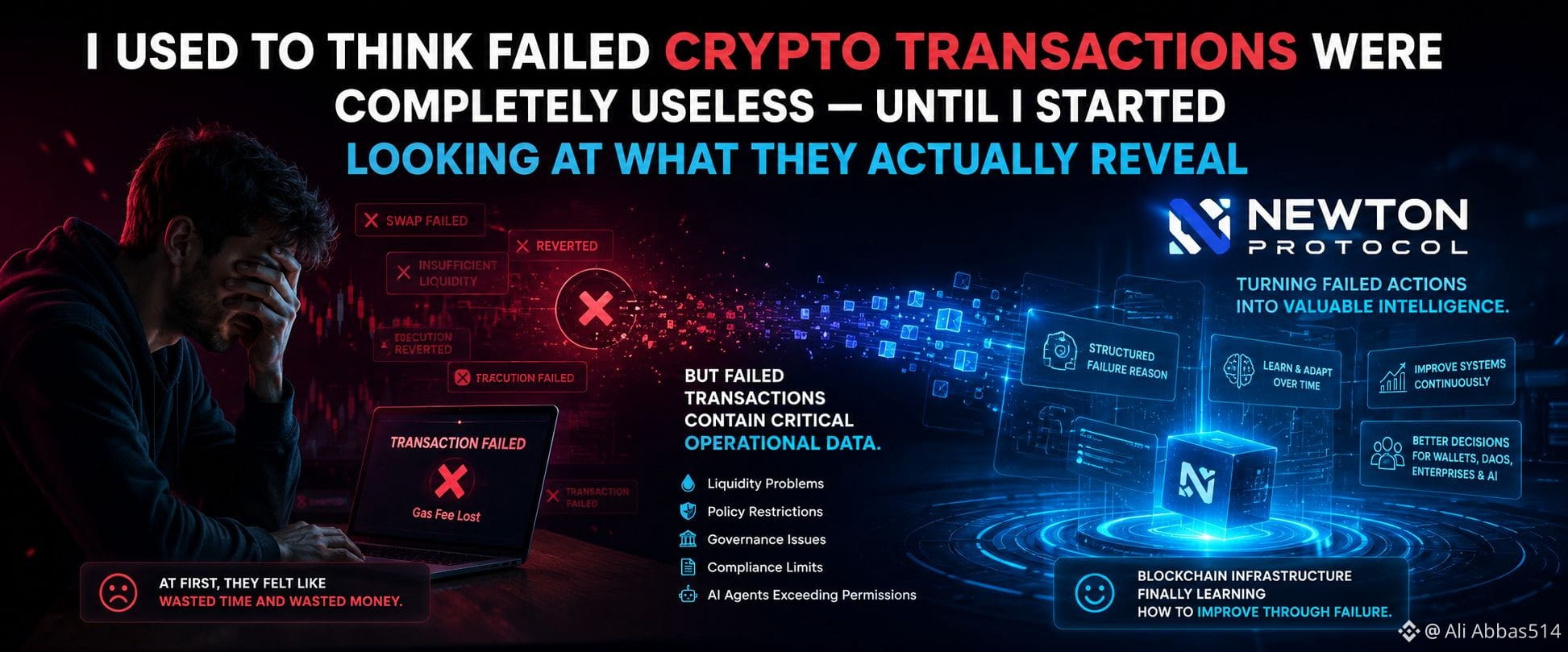
I Used to Think Failed Crypto Transactions Were Completely Useless — Until I Started Looking at What They Actually Reveal
@NewtonProtocol For the longest time, I saw failed crypto transactions the same way most users do. A swap fails, gas fees disappear, frustration kicks in, and everyone moves on. Nobody celebrates rejected transactions because they usually feel like wasted time and wasted money.
But recently I started realizing something important: failed transactions may actually contain some of the most valuable operational data in crypto.
Outside blockchain, major industries learn from failure constantly. Banks analyze rejected payments. Airlines investigate near misses. Businesses study failed customer actions because friction often reveals more than success does.
Crypto still ignores most of that intelligence.
When an onchain action fails today, the system usually throws out a generic error message and forgets the deeper context behind it. But that failure could reveal liquidity problems, policy restrictions, governance issues, compliance limits, or even AI agents attempting actions outside their permissions.
That’s why Newton Protocol caught my attention.
What makes it interesting to me is the idea that failed execution should not become dead data. If blockchain systems can preserve structured reasons behind rejected actions, wallets, DAOs, enterprises, and even AI agents could gradually learn from repeated mistakes instead of endlessly repeating them.
Honestly, that feels bigger than transaction speed.
It feels like blockchain infrastructure finally learning how to improve through failure instead of pretending failure has no value.
$BASED
{future}(BASEDUSDT)
$LAB
{future}(LABUSDT)
$TAIKO
{future}(TAIKOUSDT)
#OilPriceFalls
#SolanaGains7%InSevenDays
#ShutterstockFallsAfterGettyEndsMerger
#Aİ #ShutterstockFallsAfterGettyEndsMerger
I Used to Think Failed Crypto Transactions Were Completely Useless — Until I Started Looking at What They Actually Reveal
@NewtonProtocol For the longest time, I saw failed crypto transactions the same way most users do. A swap fails, gas fees disappear, frustration kicks in, and everyone moves on. Nobody celebrates rejected transactions because they usually feel like wasted time and wasted money.
But recently I started realizing something important: failed transactions may actually contain some of the most valuable operational data in crypto.
Outside blockchain, major industries learn from failure constantly. Banks analyze rejected payments. Airlines investigate near misses. Businesses study failed customer actions because friction often reveals more than success does.
Crypto still ignores most of that intelligence.
When an onchain action fails today, the system usually throws out a generic error message and forgets the deeper context behind it. But that failure could reveal liquidity problems, policy restrictions, governance issues, compliance limits, or even AI agents attempting actions outside their permissions.
That’s why Newton Protocol caught my attention.
What makes it interesting to me is the idea that failed execution should not become dead data. If blockchain systems can preserve structured reasons behind rejected actions, wallets, DAOs, enterprises, and even AI agents could gradually learn from repeated mistakes instead of endlessly repeating them.
Honestly, that feels bigger than transaction speed.
It feels like blockchain infrastructure finally learning how to improve through failure instead of pretending failure has no value.
$BASED
$LAB
$TAIKO
#OilPriceFalls
#SolanaGains7%InSevenDays
#ShutterstockFallsAfterGettyEndsMerger
#Aİ #ShutterstockFallsAfterGettyEndsMerger
@NewtonProtocol For the longest time, I saw failed crypto transactions the same way most users do. A swap fails, gas fees disappear, frustration kicks in, and everyone moves on. Nobody celebrates rejected transactions because they usually feel like wasted time and wasted money.
But recently I started realizing something important: failed transactions may actually contain some of the most valuable operational data in crypto.
Outside blockchain, major industries learn from failure constantly. Banks analyze rejected payments. Airlines investigate near misses. Businesses study failed customer actions because friction often reveals more than success does.
Crypto still ignores most of that intelligence.
When an onchain action fails today, the system usually throws out a generic error message and forgets the deeper context behind it. But that failure could reveal liquidity problems, policy restrictions, governance issues, compliance limits, or even AI agents attempting actions outside their permissions.
That’s why Newton Protocol caught my attention.
What makes it interesting to me is the idea that failed execution should not become dead data. If blockchain systems can preserve structured reasons behind rejected actions, wallets, DAOs, enterprises, and even AI agents could gradually learn from repeated mistakes instead of endlessly repeating them.
Honestly, that feels bigger than transaction speed.
It feels like blockchain infrastructure finally learning how to improve through failure instead of pretending failure has no value.
$BASED
$LAB
$TAIKO
#OilPriceFalls
#SolanaGains7%InSevenDays
#ShutterstockFallsAfterGettyEndsMerger
#Aİ #ShutterstockFallsAfterGettyEndsMerger
1
2
347
·
--
Article
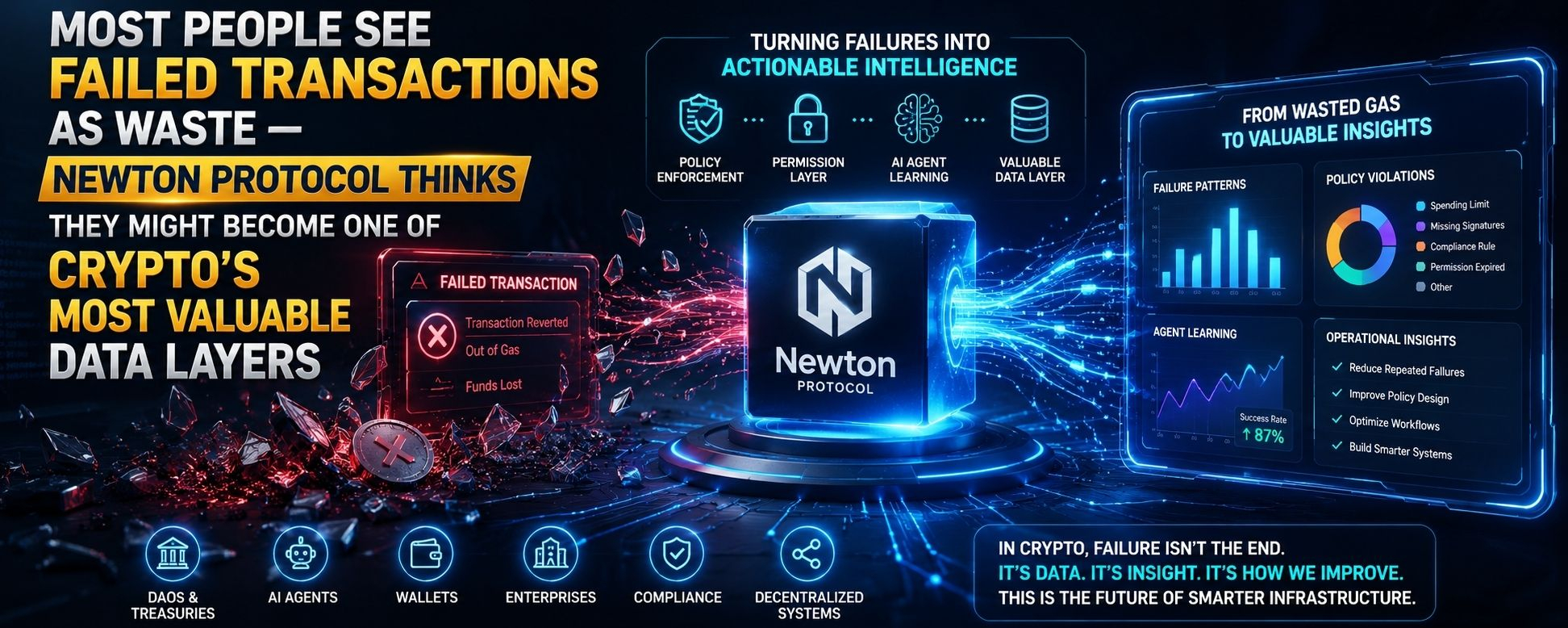
Most People See Failed Transactions as Waste — Newton Protocol Thinks They Might Become One of Crypt@NewtonProtocol For a long time, I looked at failed crypto transactions the same way almost everyone else does. A transaction fails, gas gets burned, frustration follows, and people move on. Nobody celebrates a rejected swap or a blocked payment. In most cases, users treat those moments like useless mistakes that only exist to waste money and time. But lately I have started thinking that crypto may actually be ignoring something important hidden inside those failures.
Outside blockchain, the world already understands that failed actions can carry valuable information. Airlines investigate near misses. Banks spend billions studying rejected payments and suspicious activity. Online stores analyze abandoned carts because they reveal customer behavior better than completed purchases sometimes do. Mature systems improve because they learn from friction, not because everything works perfectly all the time.
Crypto still feels early in this area.
Right now, when a transaction fails onchain, most of the discussion immediately becomes about gas fees. People understandably get angry because they paid for something that never happened. But the failed transaction itself often contains useful operational context that simply disappears afterward. Maybe liquidity vanished before execution. Maybe a permission expired seconds earlier. Maybe an AI agent tried to perform an action outside its assigned rules. Maybe a treasury policy blocked a payment because it exceeded spending limits. All of those failures mean completely different things, yet most blockchain systems reduce them into the same generic error message.
That is what made Newton Protocol interesting to me.
Not because it promises a world where failures disappear completely. Honestly, decentralized systems will probably always have friction. Markets move too fast, automation creates unpredictable situations, and users themselves are inconsistent. Failure is part of every complex system. The real question is whether failed actions can leave behind something useful instead of becoming dead ends that nobody learns from.
Newton seems to approach this from a policy-driven perspective rather than focusing only on raw transaction execution. At first that sounds technical, but the idea is actually familiar to almost every industry. Banks rely on internal rules before approving transactions. Companies use layered authorization systems. Governments operate through policy enforcement and procedural validation. Decisions usually pass through conditions before approval happens.
Blockchain infrastructure is slowly evolving toward the same reality.
As wallets become programmable and AI agents begin handling financial tasks automatically, policy systems become more important than people realize. Once transactions start operating through permissions, delegated access, treasury restrictions, compliance checks, and automated workflows, failures stop being random errors. They become signals that explain where coordination broke down.
That changes everything.
Imagine a DAO treasury where three separate payments fail on the same day. One exceeds the approved spending cap. Another lacks enough signatures from governance members. The third violates compliance restrictions connected to a sanctioned wallet. Technically all three transactions failed. But operationally they tell completely different stories about how the system is functioning.
Most infrastructure today throws those stories away.
That feels shortsighted because organizations rarely improve by studying successful actions alone. They improve by identifying recurring friction points. If the same rule repeatedly blocks legitimate payments every week, maybe the policy itself needs adjustment. If one team constantly triggers failed approvals while another rarely does, maybe the workflow is confusing rather than secure. Those patterns become visible only when failed activity is treated as meaningful data instead of useless noise.
The AI side of this becomes even more important.
Everyone talks about intelligent agents managing wallets, executing DeFi strategies, and automating financial decisions. But intelligence without memory does not create improvement. If an autonomous agent keeps repeating the same failed request over and over again, it is not learning anything. It is just burning resources faster.
However, if systems preserve structured explanations behind failed actions, AI agents can gradually recognize patterns and avoid repeating identical mistakes. Over time the quality of execution improves naturally because the system remembers what previously caused rejection. That kind of operational memory may eventually become more valuable than simply making blockchains faster.
And honestly, this entire conversation feels bigger than transaction efficiency.
Crypto has spent years obsessing over speed, scalability, lower fees, and higher throughput. Those things matter, but resilience matters too. Mature financial systems are not powerful because everything succeeds instantly. They are powerful because they understand failure deeply enough to reduce repeated mistakes over time.
That is where Newton Protocol feels different to me. It is not only asking how transactions can succeed. It is asking whether failed execution itself can become reusable intelligence for wallets, DAOs, AI agents, enterprises, and permission systems.
Of course, there are still challenges. Privacy matters. Not every rejected transaction deserves permanent storage. Enterprises will want confidentiality. Developers need shared standards. Regulators will demand transparency without exposing sensitive operational data. Building systems that balance all of those pressures will not be easy.
But the core idea still feels important.
Maybe crypto has been measuring the wrong thing this entire time. Successful transactions are easy to count, so they dominate dashboards, analytics, and headlines. Failed transactions usually disappear the moment people complain about gas fees.
Yet in almost every mature industry, long-term improvement comes from understanding failure in uncomfortable detail.
If Newton Protocol can transform failed transactions into reusable permission intelligence while keeping policy enforcement transparent and privacy-aware, then it may be solving something far deeper than simple transaction optimization. It may be helping blockchain systems evolve from networks that only process actions into systems capable of learning from their own mistakes.
$NEWT #NEWT
{future}(NEWTUSDT)
$LAB
{future}(LABUSDT)
Most People See Failed Transactions as Waste — Newton Protocol Thinks They Might Become One of Crypt
@NewtonProtocol For a long time, I looked at failed crypto transactions the same way almost everyone else does. A transaction fails, gas gets burned, frustration follows, and people move on. Nobody celebrates a rejected swap or a blocked payment. In most cases, users treat those moments like useless mistakes that only exist to waste money and time. But lately I have started thinking that crypto may actually be ignoring something important hidden inside those failures.
Outside blockchain, the world already understands that failed actions can carry valuable information. Airlines investigate near misses. Banks spend billions studying rejected payments and suspicious activity. Online stores analyze abandoned carts because they reveal customer behavior better than completed purchases sometimes do. Mature systems improve because they learn from friction, not because everything works perfectly all the time.
Crypto still feels early in this area.
Right now, when a transaction fails onchain, most of the discussion immediately becomes about gas fees. People understandably get angry because they paid for something that never happened. But the failed transaction itself often contains useful operational context that simply disappears afterward. Maybe liquidity vanished before execution. Maybe a permission expired seconds earlier. Maybe an AI agent tried to perform an action outside its assigned rules. Maybe a treasury policy blocked a payment because it exceeded spending limits. All of those failures mean completely different things, yet most blockchain systems reduce them into the same generic error message.
That is what made Newton Protocol interesting to me.
Not because it promises a world where failures disappear completely. Honestly, decentralized systems will probably always have friction. Markets move too fast, automation creates unpredictable situations, and users themselves are inconsistent. Failure is part of every complex system. The real question is whether failed actions can leave behind something useful instead of becoming dead ends that nobody learns from.
Newton seems to approach this from a policy-driven perspective rather than focusing only on raw transaction execution. At first that sounds technical, but the idea is actually familiar to almost every industry. Banks rely on internal rules before approving transactions. Companies use layered authorization systems. Governments operate through policy enforcement and procedural validation. Decisions usually pass through conditions before approval happens.
Blockchain infrastructure is slowly evolving toward the same reality.
As wallets become programmable and AI agents begin handling financial tasks automatically, policy systems become more important than people realize. Once transactions start operating through permissions, delegated access, treasury restrictions, compliance checks, and automated workflows, failures stop being random errors. They become signals that explain where coordination broke down.
That changes everything.
Imagine a DAO treasury where three separate payments fail on the same day. One exceeds the approved spending cap. Another lacks enough signatures from governance members. The third violates compliance restrictions connected to a sanctioned wallet. Technically all three transactions failed. But operationally they tell completely different stories about how the system is functioning.
Most infrastructure today throws those stories away.
That feels shortsighted because organizations rarely improve by studying successful actions alone. They improve by identifying recurring friction points. If the same rule repeatedly blocks legitimate payments every week, maybe the policy itself needs adjustment. If one team constantly triggers failed approvals while another rarely does, maybe the workflow is confusing rather than secure. Those patterns become visible only when failed activity is treated as meaningful data instead of useless noise.
The AI side of this becomes even more important.
Everyone talks about intelligent agents managing wallets, executing DeFi strategies, and automating financial decisions. But intelligence without memory does not create improvement. If an autonomous agent keeps repeating the same failed request over and over again, it is not learning anything. It is just burning resources faster.
However, if systems preserve structured explanations behind failed actions, AI agents can gradually recognize patterns and avoid repeating identical mistakes. Over time the quality of execution improves naturally because the system remembers what previously caused rejection. That kind of operational memory may eventually become more valuable than simply making blockchains faster.
And honestly, this entire conversation feels bigger than transaction efficiency.
Crypto has spent years obsessing over speed, scalability, lower fees, and higher throughput. Those things matter, but resilience matters too. Mature financial systems are not powerful because everything succeeds instantly. They are powerful because they understand failure deeply enough to reduce repeated mistakes over time.
That is where Newton Protocol feels different to me. It is not only asking how transactions can succeed. It is asking whether failed execution itself can become reusable intelligence for wallets, DAOs, AI agents, enterprises, and permission systems.
Of course, there are still challenges. Privacy matters. Not every rejected transaction deserves permanent storage. Enterprises will want confidentiality. Developers need shared standards. Regulators will demand transparency without exposing sensitive operational data. Building systems that balance all of those pressures will not be easy.
But the core idea still feels important.
Maybe crypto has been measuring the wrong thing this entire time. Successful transactions are easy to count, so they dominate dashboards, analytics, and headlines. Failed transactions usually disappear the moment people complain about gas fees.
Yet in almost every mature industry, long-term improvement comes from understanding failure in uncomfortable detail.
If Newton Protocol can transform failed transactions into reusable permission intelligence while keeping policy enforcement transparent and privacy-aware, then it may be solving something far deeper than simple transaction optimization. It may be helping blockchain systems evolve from networks that only process actions into systems capable of learning from their own mistakes.
$NEWT #NEWT
$LAB
Outside blockchain, the world already understands that failed actions can carry valuable information. Airlines investigate near misses. Banks spend billions studying rejected payments and suspicious activity. Online stores analyze abandoned carts because they reveal customer behavior better than completed purchases sometimes do. Mature systems improve because they learn from friction, not because everything works perfectly all the time.
Crypto still feels early in this area.
Right now, when a transaction fails onchain, most of the discussion immediately becomes about gas fees. People understandably get angry because they paid for something that never happened. But the failed transaction itself often contains useful operational context that simply disappears afterward. Maybe liquidity vanished before execution. Maybe a permission expired seconds earlier. Maybe an AI agent tried to perform an action outside its assigned rules. Maybe a treasury policy blocked a payment because it exceeded spending limits. All of those failures mean completely different things, yet most blockchain systems reduce them into the same generic error message.
That is what made Newton Protocol interesting to me.
Not because it promises a world where failures disappear completely. Honestly, decentralized systems will probably always have friction. Markets move too fast, automation creates unpredictable situations, and users themselves are inconsistent. Failure is part of every complex system. The real question is whether failed actions can leave behind something useful instead of becoming dead ends that nobody learns from.
Newton seems to approach this from a policy-driven perspective rather than focusing only on raw transaction execution. At first that sounds technical, but the idea is actually familiar to almost every industry. Banks rely on internal rules before approving transactions. Companies use layered authorization systems. Governments operate through policy enforcement and procedural validation. Decisions usually pass through conditions before approval happens.
Blockchain infrastructure is slowly evolving toward the same reality.
As wallets become programmable and AI agents begin handling financial tasks automatically, policy systems become more important than people realize. Once transactions start operating through permissions, delegated access, treasury restrictions, compliance checks, and automated workflows, failures stop being random errors. They become signals that explain where coordination broke down.
That changes everything.
Imagine a DAO treasury where three separate payments fail on the same day. One exceeds the approved spending cap. Another lacks enough signatures from governance members. The third violates compliance restrictions connected to a sanctioned wallet. Technically all three transactions failed. But operationally they tell completely different stories about how the system is functioning.
Most infrastructure today throws those stories away.
That feels shortsighted because organizations rarely improve by studying successful actions alone. They improve by identifying recurring friction points. If the same rule repeatedly blocks legitimate payments every week, maybe the policy itself needs adjustment. If one team constantly triggers failed approvals while another rarely does, maybe the workflow is confusing rather than secure. Those patterns become visible only when failed activity is treated as meaningful data instead of useless noise.
The AI side of this becomes even more important.
Everyone talks about intelligent agents managing wallets, executing DeFi strategies, and automating financial decisions. But intelligence without memory does not create improvement. If an autonomous agent keeps repeating the same failed request over and over again, it is not learning anything. It is just burning resources faster.
However, if systems preserve structured explanations behind failed actions, AI agents can gradually recognize patterns and avoid repeating identical mistakes. Over time the quality of execution improves naturally because the system remembers what previously caused rejection. That kind of operational memory may eventually become more valuable than simply making blockchains faster.
And honestly, this entire conversation feels bigger than transaction efficiency.
Crypto has spent years obsessing over speed, scalability, lower fees, and higher throughput. Those things matter, but resilience matters too. Mature financial systems are not powerful because everything succeeds instantly. They are powerful because they understand failure deeply enough to reduce repeated mistakes over time.
That is where Newton Protocol feels different to me. It is not only asking how transactions can succeed. It is asking whether failed execution itself can become reusable intelligence for wallets, DAOs, AI agents, enterprises, and permission systems.
Of course, there are still challenges. Privacy matters. Not every rejected transaction deserves permanent storage. Enterprises will want confidentiality. Developers need shared standards. Regulators will demand transparency without exposing sensitive operational data. Building systems that balance all of those pressures will not be easy.
But the core idea still feels important.
Maybe crypto has been measuring the wrong thing this entire time. Successful transactions are easy to count, so they dominate dashboards, analytics, and headlines. Failed transactions usually disappear the moment people complain about gas fees.
Yet in almost every mature industry, long-term improvement comes from understanding failure in uncomfortable detail.
If Newton Protocol can transform failed transactions into reusable permission intelligence while keeping policy enforcement transparent and privacy-aware, then it may be solving something far deeper than simple transaction optimization. It may be helping blockchain systems evolve from networks that only process actions into systems capable of learning from their own mistakes.
$NEWT #NEWT
$LAB
3
2
310
·
--
Bullish
Why Newton Protocol Could Become DeFi’s Invisible Safety Layer
Crypto has already mastered execution. If a wallet signs a transaction, the blockchain processes it instantly. But as DeFi grows into a system managing institutional money, AI-driven treasuries, and tokenized real-world assets, one major issue is becoming impossible to ignore: blockchains can verify signatures, but they still cannot judge whether a transaction should actually happen.
That is where Newton Protocol enters with a different vision.
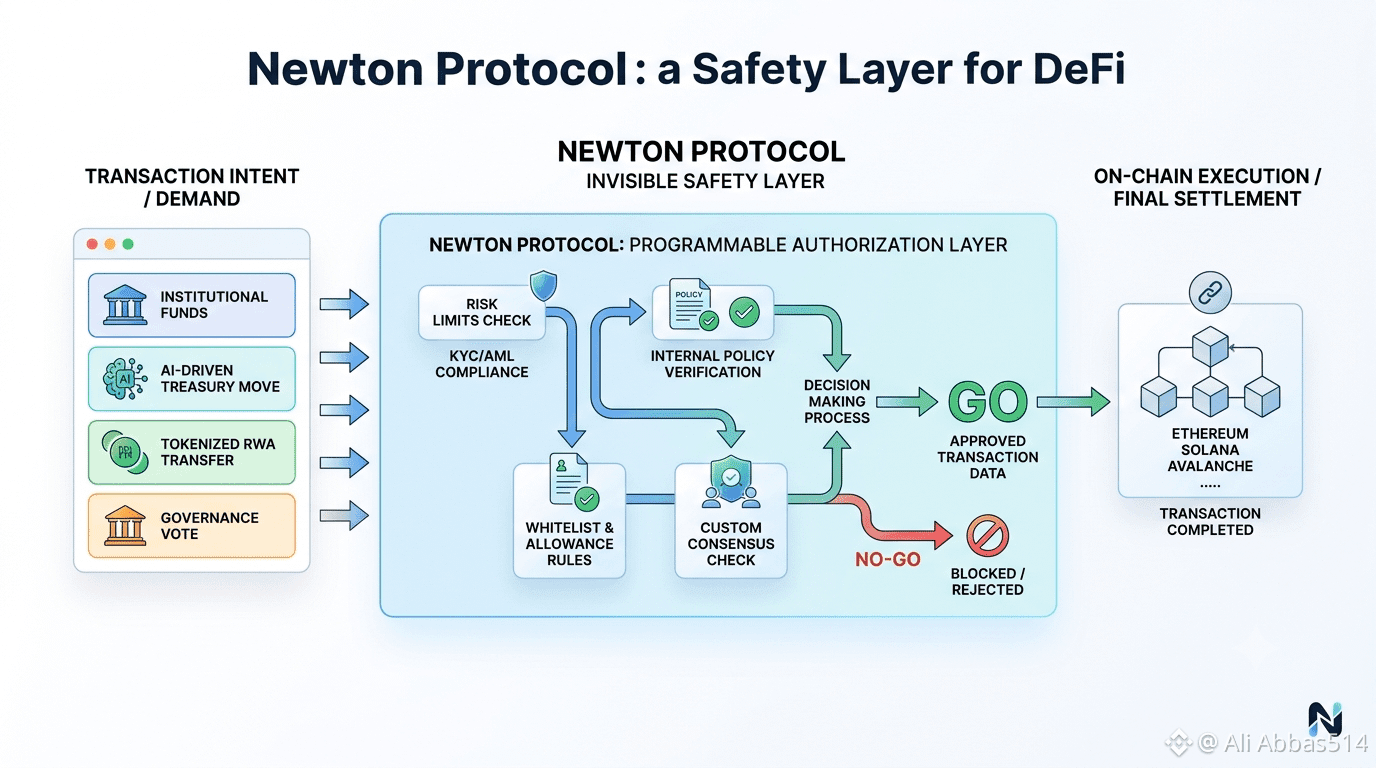
Instead of competing as another high-speed blockchain, Newton focuses on programmable authorization — a system that checks policies, risk limits, permissions, and compliance rules before a transaction reaches final settlement. In simple terms, it acts like a smart decision layer between transaction intent and execution.
Traditional finance has relied on these hidden control systems for decades. Banks never move capital based only on account access. Every large transaction passes through internal safeguards first. DeFi, however, still operates mostly on automatic execution.
As crypto evolves toward institutional-scale infrastructure, that model may no longer be enough.
Newton Protocol could quietly become the missing coordination layer DeFi never realized it needed — not by replacing blockchains, but by helping them decide which transactions deserve approval before they go through.
@NewtonProtocol $NEWT #Newt
Why Newton Protocol Could Become DeFi’s Invisible Safety Layer
Crypto has already mastered execution. If a wallet signs a transaction, the blockchain processes it instantly. But as DeFi grows into a system managing institutional money, AI-driven treasuries, and tokenized real-world assets, one major issue is becoming impossible to ignore: blockchains can verify signatures, but they still cannot judge whether a transaction should actually happen.
That is where Newton Protocol enters with a different vision.
Instead of competing as another high-speed blockchain, Newton focuses on programmable authorization — a system that checks policies, risk limits, permissions, and compliance rules before a transaction reaches final settlement. In simple terms, it acts like a smart decision layer between transaction intent and execution.
Traditional finance has relied on these hidden control systems for decades. Banks never move capital based only on account access. Every large transaction passes through internal safeguards first. DeFi, however, still operates mostly on automatic execution.
As crypto evolves toward institutional-scale infrastructure, that model may no longer be enough.
Newton Protocol could quietly become the missing coordination layer DeFi never realized it needed — not by replacing blockchains, but by helping them decide which transactions deserve approval before they go through.
@NewtonProtocol $NEWT #Newt
Crypto has already mastered execution. If a wallet signs a transaction, the blockchain processes it instantly. But as DeFi grows into a system managing institutional money, AI-driven treasuries, and tokenized real-world assets, one major issue is becoming impossible to ignore: blockchains can verify signatures, but they still cannot judge whether a transaction should actually happen.
That is where Newton Protocol enters with a different vision.
Instead of competing as another high-speed blockchain, Newton focuses on programmable authorization — a system that checks policies, risk limits, permissions, and compliance rules before a transaction reaches final settlement. In simple terms, it acts like a smart decision layer between transaction intent and execution.
Traditional finance has relied on these hidden control systems for decades. Banks never move capital based only on account access. Every large transaction passes through internal safeguards first. DeFi, however, still operates mostly on automatic execution.
As crypto evolves toward institutional-scale infrastructure, that model may no longer be enough.
Newton Protocol could quietly become the missing coordination layer DeFi never realized it needed — not by replacing blockchains, but by helping them decide which transactions deserve approval before they go through.
@NewtonProtocol $NEWT #Newt
1
1
92
·
--
Article
Why Newton Protocol Might Become the Quiet Infrastructure Layer DeFi Didn’t Realize It Needed@NewtonProtocol Most blockchains are incredibly good at one thing: execution. If a wallet signs a transaction correctly, the network processes it without hesitation. That design helped crypto create a permissionless financial system where value can move globally without relying on banks, intermediaries, or centralized approval systems. But as the industry matures, a deeper problem is starting to emerge beneath the surface — blockchains can verify who signed a transaction, but they still struggle to determine whether that transaction should actually happen in the first place.
That distinction may sound small today, but it becomes massive once serious capital enters the system.
Traditional finance understood this problem decades ago. Banks never allow money to move simply because someone has access to an account. Before settlement happens, transactions quietly pass through layers of authorization, risk analysis, policy checks, compliance systems, and internal controls. Most users never see those systems working in the background, but they are the reason large-scale finance can operate without collapsing into constant operational risk. The system is not only built to move money. It is built to decide when money should move.
Crypto changed finance by removing many of those centralized layers. That created speed, openness, and permissionless innovation. But it also created an environment where a valid signature became almost the only requirement for execution. For smaller retail transactions, that model works well. But the landscape is changing rapidly. DeFi vaults are now managing hundreds of millions. Stablecoins are handling cross-border settlement. Real-world assets are beginning to move onchain. Autonomous AI agents are slowly entering financial infrastructure. In that world, relying only on signatures starts looking dangerously incomplete.
A transaction can be technically valid while still violating risk policies, treasury rules, compliance boundaries, or operational safeguards. A fund manager could accidentally exceed exposure limits. An automated system could trigger behavior outside predefined strategy parameters. An AI-driven treasury agent could move capital in ways that create systemic risk faster than humans can react. The blockchain itself would still process those transactions because execution engines do not understand context. They only understand signatures.
That is where "Newton Protocol" (https://reference-url-citation.invalid/0) begins to stand out in a very different category from most infrastructure projects.
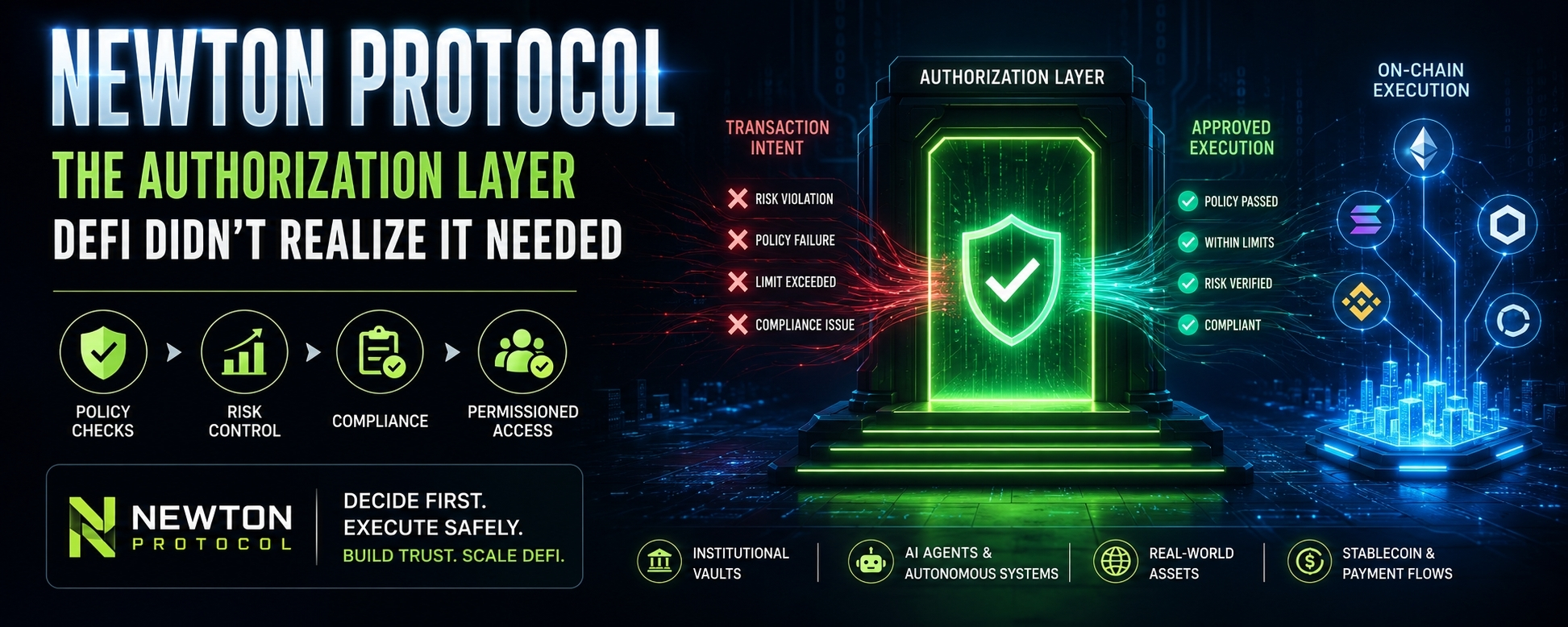
Instead of competing to become another faster chain or another scaling narrative, Newton is focused on building an authorization layer that evaluates programmable policies before transactions reach settlement. In simple terms, the protocol acts like a decision framework sitting between transaction intent and final execution. Rather than assuming every valid signature deserves automatic approval, Newton allows systems to evaluate whether a transaction aligns with predefined rules before the blockchain processes it.
The easiest way to think about it is through a traffic system. Cars already know how to move. Traffic lights were never invented because vehicles lacked engines. They were introduced because intersections become dangerous once too many independent actors move simultaneously without coordination. The green light does not slow the system down — it allows the system to scale safely. Finance operates the same way. As capital flows grow larger and more complex, decision infrastructure becomes just as important as execution infrastructure.
That idea becomes especially important as institutional-grade finance moves deeper into crypto. Large financial entities are not simply looking for faster transactions. They need programmable controls, risk boundaries, delegated permissions, compliance structures, and authorization systems capable of operating at scale. The next phase of DeFi may not be defined only by how fast transactions execute, but by how intelligently financial systems determine which transactions deserve execution in the first place.
What makes Newton’s positioning interesting is that authorization is one of the most overlooked infrastructure categories in crypto today. It is not flashy. It does not create hype cycles the same way meme coins or high-speed chains do. But historically, the most important financial infrastructure often becomes invisible once it works correctly. People rarely notice the systems preventing catastrophic mistakes. They only notice after those systems fail to exist.
As AI agents, automated treasuries, tokenized assets, and institutional vaults continue expanding across onchain markets, the need for programmable authorization layers will likely grow alongside them. Crypto solved permissionless execution years ago. The next challenge may be building systems intelligent enough to understand when execution itself becomes unsafe, unauthorized, or outside acceptable boundaries.
That shift could quietly become one of the biggest structural evolutions in decentralized finance over the coming years.
Because eventually the industry may stop asking only whether transactions can happen.
And start asking whether every valid transaction should receive a green light at all.
@NewtonProtocol $NEWT #Newt
Why Newton Protocol Might Become the Quiet Infrastructure Layer DeFi Didn’t Realize It Needed
@NewtonProtocol Most blockchains are incredibly good at one thing: execution. If a wallet signs a transaction correctly, the network processes it without hesitation. That design helped crypto create a permissionless financial system where value can move globally without relying on banks, intermediaries, or centralized approval systems. But as the industry matures, a deeper problem is starting to emerge beneath the surface — blockchains can verify who signed a transaction, but they still struggle to determine whether that transaction should actually happen in the first place.
That distinction may sound small today, but it becomes massive once serious capital enters the system.
Traditional finance understood this problem decades ago. Banks never allow money to move simply because someone has access to an account. Before settlement happens, transactions quietly pass through layers of authorization, risk analysis, policy checks, compliance systems, and internal controls. Most users never see those systems working in the background, but they are the reason large-scale finance can operate without collapsing into constant operational risk. The system is not only built to move money. It is built to decide when money should move.
Crypto changed finance by removing many of those centralized layers. That created speed, openness, and permissionless innovation. But it also created an environment where a valid signature became almost the only requirement for execution. For smaller retail transactions, that model works well. But the landscape is changing rapidly. DeFi vaults are now managing hundreds of millions. Stablecoins are handling cross-border settlement. Real-world assets are beginning to move onchain. Autonomous AI agents are slowly entering financial infrastructure. In that world, relying only on signatures starts looking dangerously incomplete.
A transaction can be technically valid while still violating risk policies, treasury rules, compliance boundaries, or operational safeguards. A fund manager could accidentally exceed exposure limits. An automated system could trigger behavior outside predefined strategy parameters. An AI-driven treasury agent could move capital in ways that create systemic risk faster than humans can react. The blockchain itself would still process those transactions because execution engines do not understand context. They only understand signatures.
That is where "Newton Protocol" (https://reference-url-citation.invalid/0) begins to stand out in a very different category from most infrastructure projects.
Instead of competing to become another faster chain or another scaling narrative, Newton is focused on building an authorization layer that evaluates programmable policies before transactions reach settlement. In simple terms, the protocol acts like a decision framework sitting between transaction intent and final execution. Rather than assuming every valid signature deserves automatic approval, Newton allows systems to evaluate whether a transaction aligns with predefined rules before the blockchain processes it.
The easiest way to think about it is through a traffic system. Cars already know how to move. Traffic lights were never invented because vehicles lacked engines. They were introduced because intersections become dangerous once too many independent actors move simultaneously without coordination. The green light does not slow the system down — it allows the system to scale safely. Finance operates the same way. As capital flows grow larger and more complex, decision infrastructure becomes just as important as execution infrastructure.
That idea becomes especially important as institutional-grade finance moves deeper into crypto. Large financial entities are not simply looking for faster transactions. They need programmable controls, risk boundaries, delegated permissions, compliance structures, and authorization systems capable of operating at scale. The next phase of DeFi may not be defined only by how fast transactions execute, but by how intelligently financial systems determine which transactions deserve execution in the first place.
What makes Newton’s positioning interesting is that authorization is one of the most overlooked infrastructure categories in crypto today. It is not flashy. It does not create hype cycles the same way meme coins or high-speed chains do. But historically, the most important financial infrastructure often becomes invisible once it works correctly. People rarely notice the systems preventing catastrophic mistakes. They only notice after those systems fail to exist.
As AI agents, automated treasuries, tokenized assets, and institutional vaults continue expanding across onchain markets, the need for programmable authorization layers will likely grow alongside them. Crypto solved permissionless execution years ago. The next challenge may be building systems intelligent enough to understand when execution itself becomes unsafe, unauthorized, or outside acceptable boundaries.
That shift could quietly become one of the biggest structural evolutions in decentralized finance over the coming years.
Because eventually the industry may stop asking only whether transactions can happen.
And start asking whether every valid transaction should receive a green light at all.
@NewtonProtocol $NEWT #Newt
That distinction may sound small today, but it becomes massive once serious capital enters the system.
Traditional finance understood this problem decades ago. Banks never allow money to move simply because someone has access to an account. Before settlement happens, transactions quietly pass through layers of authorization, risk analysis, policy checks, compliance systems, and internal controls. Most users never see those systems working in the background, but they are the reason large-scale finance can operate without collapsing into constant operational risk. The system is not only built to move money. It is built to decide when money should move.
Crypto changed finance by removing many of those centralized layers. That created speed, openness, and permissionless innovation. But it also created an environment where a valid signature became almost the only requirement for execution. For smaller retail transactions, that model works well. But the landscape is changing rapidly. DeFi vaults are now managing hundreds of millions. Stablecoins are handling cross-border settlement. Real-world assets are beginning to move onchain. Autonomous AI agents are slowly entering financial infrastructure. In that world, relying only on signatures starts looking dangerously incomplete.
A transaction can be technically valid while still violating risk policies, treasury rules, compliance boundaries, or operational safeguards. A fund manager could accidentally exceed exposure limits. An automated system could trigger behavior outside predefined strategy parameters. An AI-driven treasury agent could move capital in ways that create systemic risk faster than humans can react. The blockchain itself would still process those transactions because execution engines do not understand context. They only understand signatures.
That is where "Newton Protocol" (https://reference-url-citation.invalid/0) begins to stand out in a very different category from most infrastructure projects.
Instead of competing to become another faster chain or another scaling narrative, Newton is focused on building an authorization layer that evaluates programmable policies before transactions reach settlement. In simple terms, the protocol acts like a decision framework sitting between transaction intent and final execution. Rather than assuming every valid signature deserves automatic approval, Newton allows systems to evaluate whether a transaction aligns with predefined rules before the blockchain processes it.
The easiest way to think about it is through a traffic system. Cars already know how to move. Traffic lights were never invented because vehicles lacked engines. They were introduced because intersections become dangerous once too many independent actors move simultaneously without coordination. The green light does not slow the system down — it allows the system to scale safely. Finance operates the same way. As capital flows grow larger and more complex, decision infrastructure becomes just as important as execution infrastructure.
That idea becomes especially important as institutional-grade finance moves deeper into crypto. Large financial entities are not simply looking for faster transactions. They need programmable controls, risk boundaries, delegated permissions, compliance structures, and authorization systems capable of operating at scale. The next phase of DeFi may not be defined only by how fast transactions execute, but by how intelligently financial systems determine which transactions deserve execution in the first place.
What makes Newton’s positioning interesting is that authorization is one of the most overlooked infrastructure categories in crypto today. It is not flashy. It does not create hype cycles the same way meme coins or high-speed chains do. But historically, the most important financial infrastructure often becomes invisible once it works correctly. People rarely notice the systems preventing catastrophic mistakes. They only notice after those systems fail to exist.
As AI agents, automated treasuries, tokenized assets, and institutional vaults continue expanding across onchain markets, the need for programmable authorization layers will likely grow alongside them. Crypto solved permissionless execution years ago. The next challenge may be building systems intelligent enough to understand when execution itself becomes unsafe, unauthorized, or outside acceptable boundaries.
That shift could quietly become one of the biggest structural evolutions in decentralized finance over the coming years.
Because eventually the industry may stop asking only whether transactions can happen.
And start asking whether every valid transaction should receive a green light at all.
@NewtonProtocol $NEWT #Newt
1
1
96
·
--
$BNB Just Flushed Weak Hands — Now Traders Are Watching This Zone Closely
BNB took a sharp hit after rejecting near the $664 area, dropping fast into the $634 support zone before buyers stepped back in. The bounce was quick, but the market still looks cautious here.
At the moment, price is hovering around $643 and trying to rebuild momentum. The key area bulls need to recover sits around $650–$652. If BNB manages to push back above that range with strength, the chart could shift bullish again and open room for another move toward $660+.
What makes this setup interesting is the reaction around $634. That level acted like a strong defense zone during the pullback. As long as buyers continue protecting it, this dip may end up being nothing more than a liquidity sweep before continuation higher on the 4H structure 📈
But if $634 breaks cleanly, sentiment could flip fast and invite another wave of selling pressure.
Right now, BNB is entering one of those high-volatility zones where the next breakout could decide the short-term trend.
$BNB Just Flushed Weak Hands — Now Traders Are Watching This Zone Closely
BNB took a sharp hit after rejecting near the $664 area, dropping fast into the $634 support zone before buyers stepped back in. The bounce was quick, but the market still looks cautious here.
At the moment, price is hovering around $643 and trying to rebuild momentum. The key area bulls need to recover sits around $650–$652. If BNB manages to push back above that range with strength, the chart could shift bullish again and open room for another move toward $660+.
What makes this setup interesting is the reaction around $634. That level acted like a strong defense zone during the pullback. As long as buyers continue protecting it, this dip may end up being nothing more than a liquidity sweep before continuation higher on the 4H structure 📈
But if $634 breaks cleanly, sentiment could flip fast and invite another wave of selling pressure.
Right now, BNB is entering one of those high-volatility zones where the next breakout could decide the short-term trend.
BNB took a sharp hit after rejecting near the $664 area, dropping fast into the $634 support zone before buyers stepped back in. The bounce was quick, but the market still looks cautious here.
At the moment, price is hovering around $643 and trying to rebuild momentum. The key area bulls need to recover sits around $650–$652. If BNB manages to push back above that range with strength, the chart could shift bullish again and open room for another move toward $660+.
What makes this setup interesting is the reaction around $634. That level acted like a strong defense zone during the pullback. As long as buyers continue protecting it, this dip may end up being nothing more than a liquidity sweep before continuation higher on the 4H structure 📈
But if $634 breaks cleanly, sentiment could flip fast and invite another wave of selling pressure.
Right now, BNB is entering one of those high-volatility zones where the next breakout could decide the short-term trend.
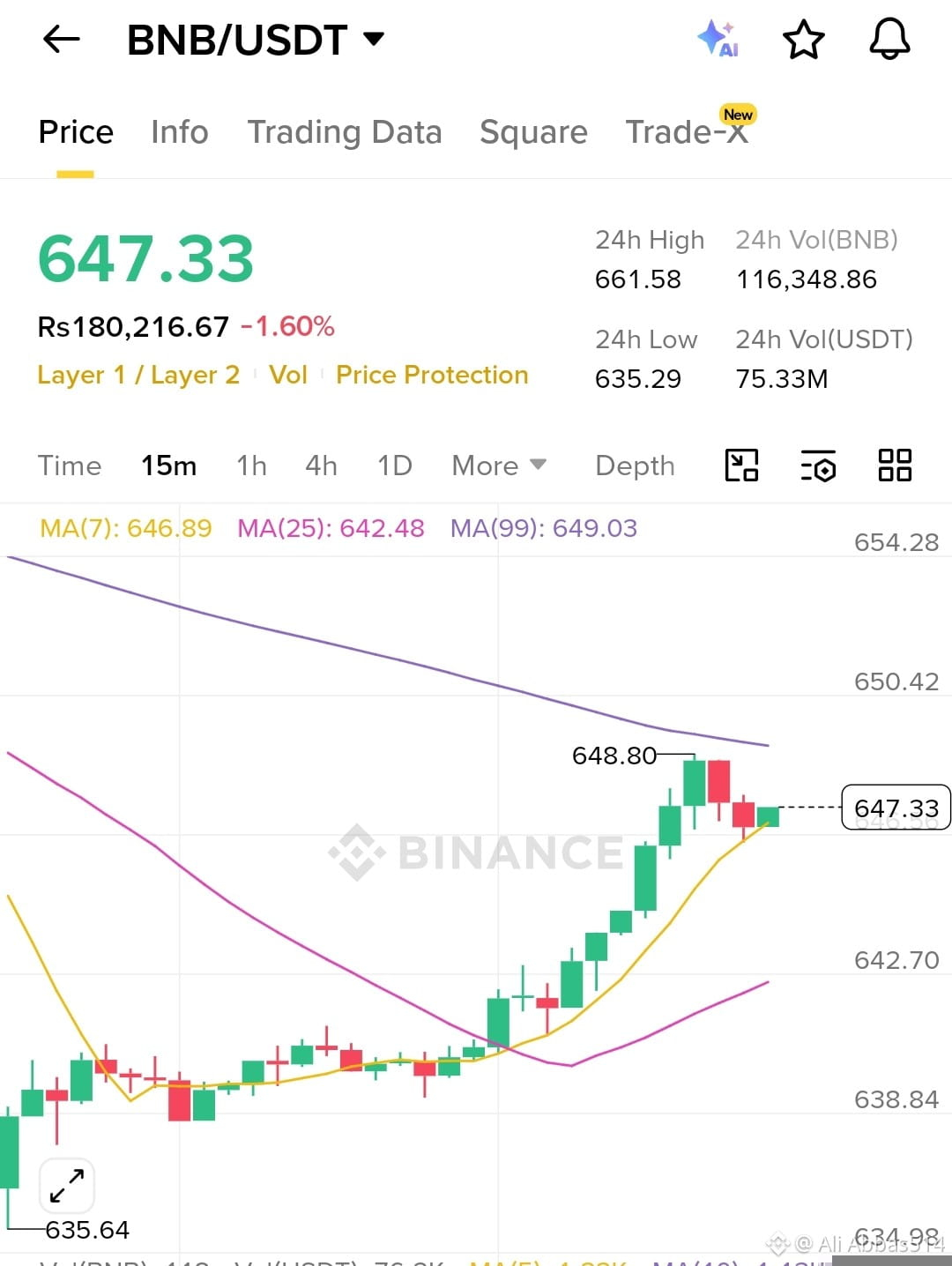
3
95
·
--
Tensions between the US and Iran may be moving toward a dangerous new phase.
Reports suggest Washington is growing impatient behind closed doors. Negotiations have dragged on for months, draft after draft, meeting after meeting, yet no real breakthrough seems close. According to officials familiar with the situation, frustration is building at the highest levels.
There’s now growing speculation that the US could consider one final major military move before attempting to shift the narrative toward “stability” and closure.
But global conflicts rarely end with a speech.
A government can declare success publicly, yet the reality on the ground is far more complicated when the opposing side still holds military influence, regional alliances, and strategic leverage. That’s where markets begin paying attention.
The bigger question now isn’t just whether a deal gets done — it’s whether both sides still have enough room left to avoid a deeper confrontation.
If tensions rise further, the impact could spread quickly across global markets. Oil could spike hard, crypto volatility could explode overnight, and risk assets may react sharply to every new headline coming out of Washington or Tehran.
Right now, investors aren’t only watching charts anymore. They’re watching geopolitics in real time.
Because in global politics, announcing victory is simple. Creating lasting stability is the part no one can guarantee.
Tensions between the US and Iran may be moving toward a dangerous new phase.
Reports suggest Washington is growing impatient behind closed doors. Negotiations have dragged on for months, draft after draft, meeting after meeting, yet no real breakthrough seems close. According to officials familiar with the situation, frustration is building at the highest levels.
There’s now growing speculation that the US could consider one final major military move before attempting to shift the narrative toward “stability” and closure.
But global conflicts rarely end with a speech.
A government can declare success publicly, yet the reality on the ground is far more complicated when the opposing side still holds military influence, regional alliances, and strategic leverage. That’s where markets begin paying attention.
The bigger question now isn’t just whether a deal gets done — it’s whether both sides still have enough room left to avoid a deeper confrontation.
If tensions rise further, the impact could spread quickly across global markets. Oil could spike hard, crypto volatility could explode overnight, and risk assets may react sharply to every new headline coming out of Washington or Tehran.
Right now, investors aren’t only watching charts anymore. They’re watching geopolitics in real time.
Because in global politics, announcing victory is simple. Creating lasting stability is the part no one can guarantee.
Reports suggest Washington is growing impatient behind closed doors. Negotiations have dragged on for months, draft after draft, meeting after meeting, yet no real breakthrough seems close. According to officials familiar with the situation, frustration is building at the highest levels.
There’s now growing speculation that the US could consider one final major military move before attempting to shift the narrative toward “stability” and closure.
But global conflicts rarely end with a speech.
A government can declare success publicly, yet the reality on the ground is far more complicated when the opposing side still holds military influence, regional alliances, and strategic leverage. That’s where markets begin paying attention.
The bigger question now isn’t just whether a deal gets done — it’s whether both sides still have enough room left to avoid a deeper confrontation.
If tensions rise further, the impact could spread quickly across global markets. Oil could spike hard, crypto volatility could explode overnight, and risk assets may react sharply to every new headline coming out of Washington or Tehran.
Right now, investors aren’t only watching charts anymore. They’re watching geopolitics in real time.
Because in global politics, announcing victory is simple. Creating lasting stability is the part no one can guarantee.

2
142
·
--
$XRP spent years fighting through lawsuits, fear, market crashes, and endless doubt — but the structure never fully broke. Now the chart is starting to look different.
Price continues holding above major support while buyers slowly reclaim momentum. What makes this move interesting is that XRP isn’t pumping off pure hype alone anymore. Confidence is returning gradually, and long-term holders still haven’t left the market.
If bulls keep control above the current breakout zone, XRP could be setting up for a much larger expansion move in the sessions ahead. The market has rejected XRP multiple times over the years, but every cycle it somehow finds its way back into the spotlight.
📈 Bullish Trade Setup
🔹 Entry Zone: $2.15 – $2.25
🎯 Target 1: $2.50
🎯 Target 2: $2.85
🎯 Target 3: $3.20
🛑 Invalidation Zone: $1.95
Right now momentum still favors the upside, especially if the broader crypto market stays risk-on. Volatility will remain aggressive, but XRP is beginning to show the kind of strength traders usually watch closely before a larger breakout phase starts.
The pressure lasted years.
Now the market is waiting to see if XRP finally turns that pressure into fuel.
$XRP spent years fighting through lawsuits, fear, market crashes, and endless doubt — but the structure never fully broke. Now the chart is starting to look different.
Price continues holding above major support while buyers slowly reclaim momentum. What makes this move interesting is that XRP isn’t pumping off pure hype alone anymore. Confidence is returning gradually, and long-term holders still haven’t left the market.
If bulls keep control above the current breakout zone, XRP could be setting up for a much larger expansion move in the sessions ahead. The market has rejected XRP multiple times over the years, but every cycle it somehow finds its way back into the spotlight.
📈 Bullish Trade Setup
🔹 Entry Zone: $2.15 – $2.25
🎯 Target 1: $2.50
🎯 Target 2: $2.85
🎯 Target 3: $3.20
🛑 Invalidation Zone: $1.95
Right now momentum still favors the upside, especially if the broader crypto market stays risk-on. Volatility will remain aggressive, but XRP is beginning to show the kind of strength traders usually watch closely before a larger breakout phase starts.
The pressure lasted years.
Now the market is waiting to see if XRP finally turns that pressure into fuel.
Price continues holding above major support while buyers slowly reclaim momentum. What makes this move interesting is that XRP isn’t pumping off pure hype alone anymore. Confidence is returning gradually, and long-term holders still haven’t left the market.
If bulls keep control above the current breakout zone, XRP could be setting up for a much larger expansion move in the sessions ahead. The market has rejected XRP multiple times over the years, but every cycle it somehow finds its way back into the spotlight.
📈 Bullish Trade Setup
🔹 Entry Zone: $2.15 – $2.25
🎯 Target 1: $2.50
🎯 Target 2: $2.85
🎯 Target 3: $3.20
🛑 Invalidation Zone: $1.95
Right now momentum still favors the upside, especially if the broader crypto market stays risk-on. Volatility will remain aggressive, but XRP is beginning to show the kind of strength traders usually watch closely before a larger breakout phase starts.
The pressure lasted years.
Now the market is waiting to see if XRP finally turns that pressure into fuel.
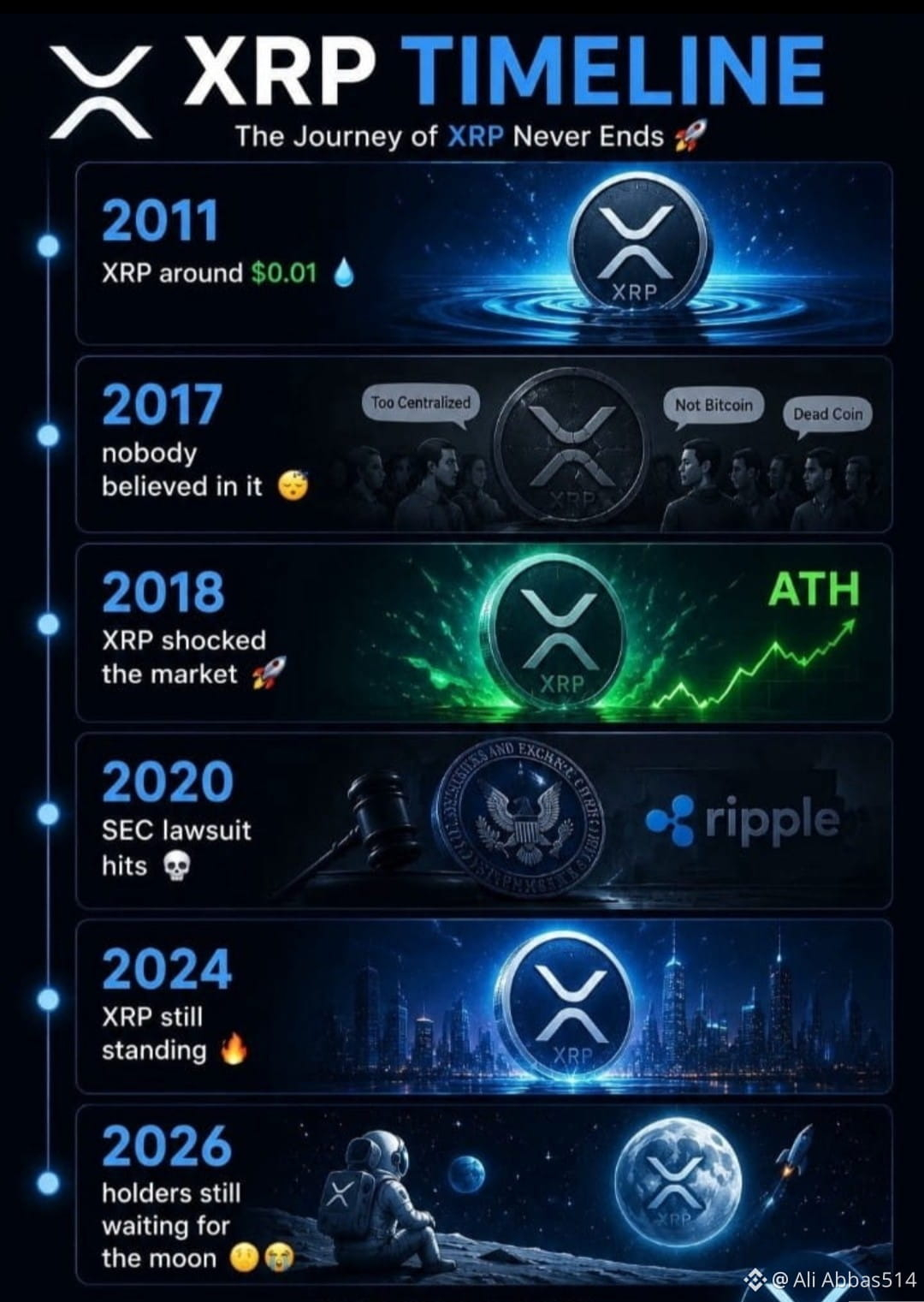
3
165
·
--
Bullish
This week felt different.
While most traders were busy watching candles, nearly $1B quietly flowed out of BlackRock’s Bitcoin ETF — the largest withdrawal seen in months. That kind of movement does not look like emotional retail selling. It feels more like big capital adjusting exposure before the next major shift.
What caught my attention is that Bitcoin still hasn’t fully broken structure despite the pressure. That usually tells you one of two things: either liquidity is getting weaker beneath the surface… or smart money is testing how much the market can absorb before momentum flips again.
ETF flow data is becoming more important than social sentiment now. Price can be noisy, but institutional movement usually leaves the cleaner signal.
If these outflows continue, volatility across crypto could expand very quickly. But if BTC stabilizes and pushes higher from here, this entire move may end up trapping late bears instead.
Right now, the market feels less emotional and more strategic. That’s why this moment matters.
This week felt different.
While most traders were busy watching candles, nearly $1B quietly flowed out of BlackRock’s Bitcoin ETF — the largest withdrawal seen in months. That kind of movement does not look like emotional retail selling. It feels more like big capital adjusting exposure before the next major shift.
What caught my attention is that Bitcoin still hasn’t fully broken structure despite the pressure. That usually tells you one of two things: either liquidity is getting weaker beneath the surface… or smart money is testing how much the market can absorb before momentum flips again.
ETF flow data is becoming more important than social sentiment now. Price can be noisy, but institutional movement usually leaves the cleaner signal.
If these outflows continue, volatility across crypto could expand very quickly. But if BTC stabilizes and pushes higher from here, this entire move may end up trapping late bears instead.
Right now, the market feels less emotional and more strategic. That’s why this moment matters.
While most traders were busy watching candles, nearly $1B quietly flowed out of BlackRock’s Bitcoin ETF — the largest withdrawal seen in months. That kind of movement does not look like emotional retail selling. It feels more like big capital adjusting exposure before the next major shift.
What caught my attention is that Bitcoin still hasn’t fully broken structure despite the pressure. That usually tells you one of two things: either liquidity is getting weaker beneath the surface… or smart money is testing how much the market can absorb before momentum flips again.
ETF flow data is becoming more important than social sentiment now. Price can be noisy, but institutional movement usually leaves the cleaner signal.
If these outflows continue, volatility across crypto could expand very quickly. But if BTC stabilizes and pushes higher from here, this entire move may end up trapping late bears instead.
Right now, the market feels less emotional and more strategic. That’s why this moment matters.

2
86
·
--
The more I watch OpenLedger, the more I feel DeFi’s biggest problem is not lack of alpha… it’s failed execution.
People already know where yields are. The real issue is reacting fast enough before conditions change. APYs move, liquidity rotates, rewards sit idle, and collateral risks build while humans are offline.
OpenLedger seems to be betting on one idea: automated execution may matter more than manual strategy.
Recent integrations around AI agents and automated vault infrastructure make that direction even more interesting. But the real test is simple — can automation actually reduce “yield leak” without adding new complexity or risks?
That’s the part I’m watching closely.
Because in DeFi, knowing what to do is no longer the edge. Executing it at the right moment might be.
@Openledger $OPEN #OpenLedger
The more I watch OpenLedger, the more I feel DeFi’s biggest problem is not lack of alpha… it’s failed execution.
People already know where yields are. The real issue is reacting fast enough before conditions change. APYs move, liquidity rotates, rewards sit idle, and collateral risks build while humans are offline.
OpenLedger seems to be betting on one idea: automated execution may matter more than manual strategy.
Recent integrations around AI agents and automated vault infrastructure make that direction even more interesting. But the real test is simple — can automation actually reduce “yield leak” without adding new complexity or risks?
That’s the part I’m watching closely.
Because in DeFi, knowing what to do is no longer the edge. Executing it at the right moment might be.
@OpenLedger $OPEN #OpenLedger
People already know where yields are. The real issue is reacting fast enough before conditions change. APYs move, liquidity rotates, rewards sit idle, and collateral risks build while humans are offline.
OpenLedger seems to be betting on one idea: automated execution may matter more than manual strategy.
Recent integrations around AI agents and automated vault infrastructure make that direction even more interesting. But the real test is simple — can automation actually reduce “yield leak” without adding new complexity or risks?
That’s the part I’m watching closely.
Because in DeFi, knowing what to do is no longer the edge. Executing it at the right moment might be.
@OpenLedger $OPEN #OpenLedger
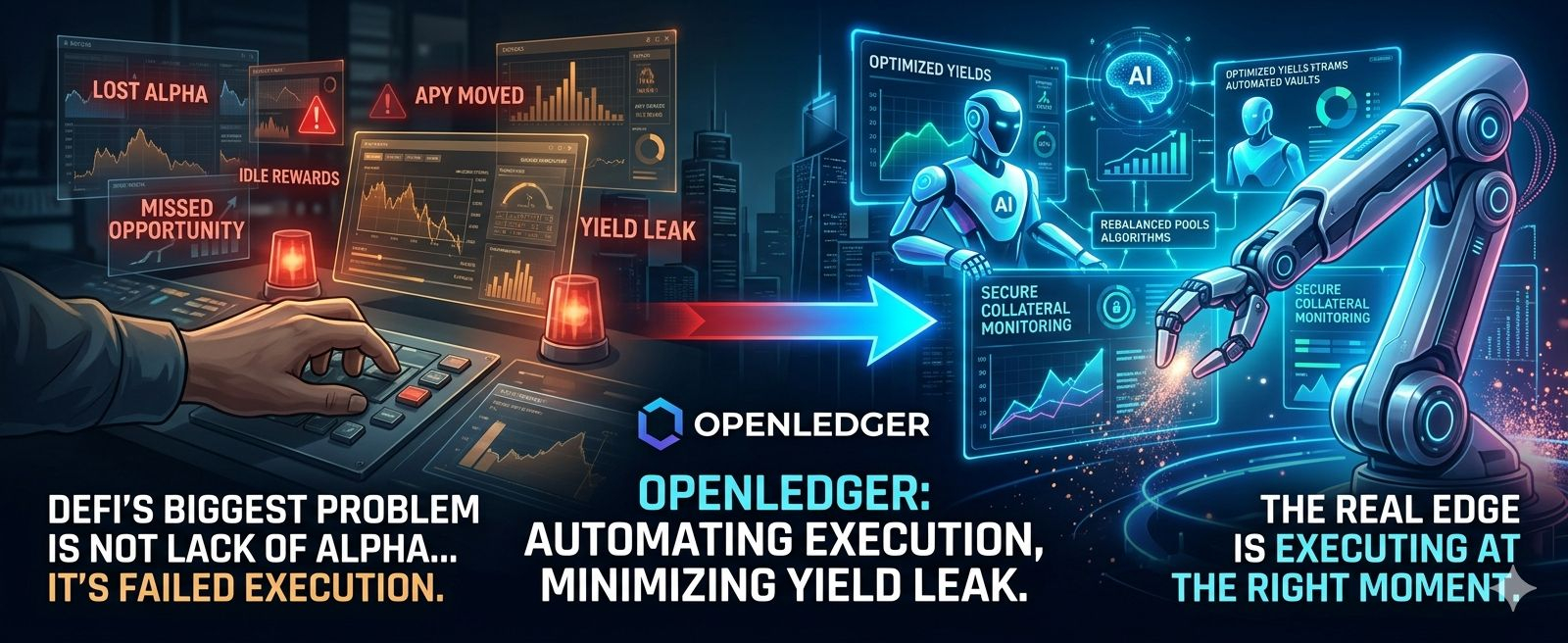
2
2
174
·
--
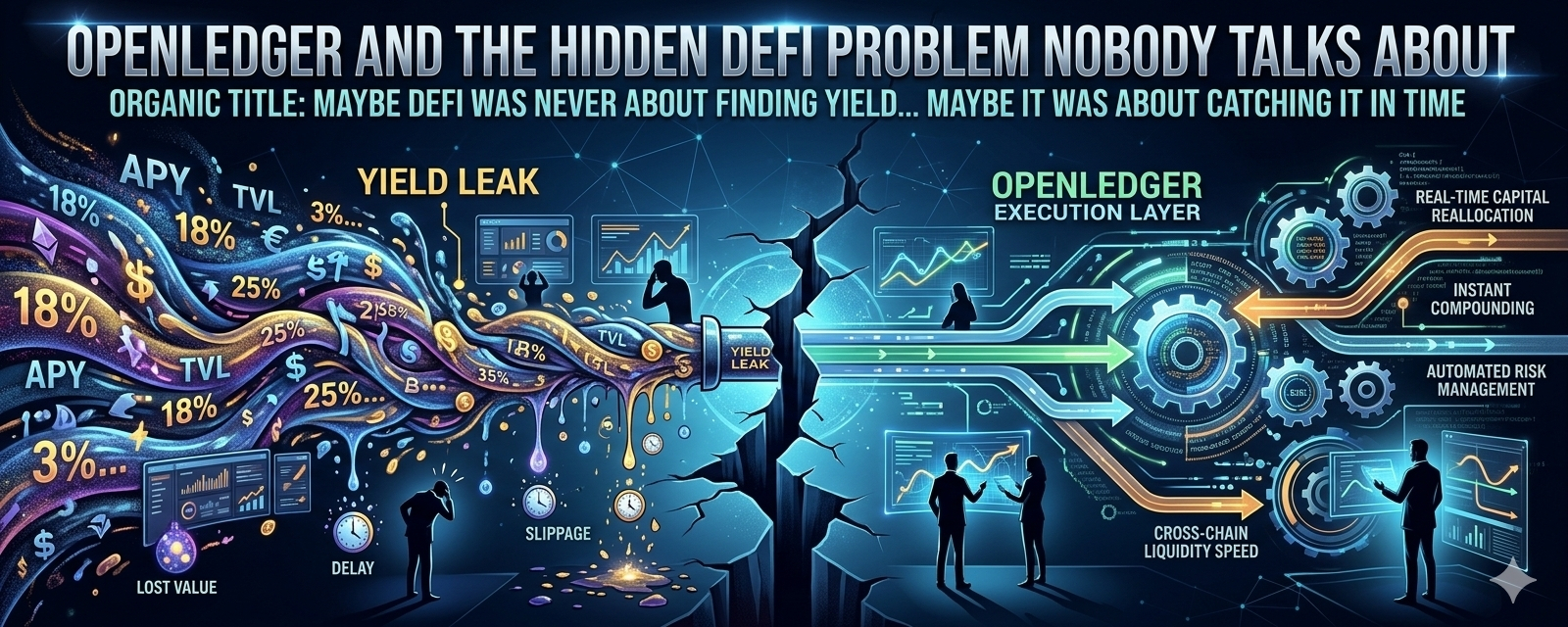
Article
OpenLedger and the Hidden DeFi Problem Nobody Talks AboutEvery time I spend more time studying OpenLedger, I end up thinking about one uncomfortable reality inside DeFi that most people quietly ignore. The industry keeps talking about “high APY”, “better pools”, “smarter strategies”, and “alpha opportunities”, but the deeper issue feels completely different. Most users already know where opportunities exist. Information is everywhere now. Dashboards track yields, influencers post strategies every hour, analytics platforms expose liquidity flows in real time. Knowledge itself is no longer rare. Yet somehow, people still keep underperforming. That contradiction is where this entire idea becomes interesting to me.
The more I think about it, the more it feels like DeFi’s biggest weakness is not lack of intelligence but lack of execution speed. Markets inside crypto move continuously. Yields shift, incentives rotate, collateral risks change, liquidity migrates, and opportunities disappear before most people even notice them. Humans simply cannot operate at the same speed as the environment they are participating in. And that gap between knowing and acting is where value silently leaks away every single day.
This is why the term “yield leak” actually started making sense in my head. It is not about losing because someone picked the wrong protocol. It is about losing because execution was too slow. Someone finds a better yield too late. Someone misses the right rebalance timing. Someone delays compounding rewards because gas fees are high or because they are asleep when conditions change. Someone notices liquidation danger after the market already moved. These small inefficiencies may look harmless individually, but together they create a massive invisible drain on capital efficiency across DeFi.
What OpenLedger seems to be hinting at is something much larger than simple yield optimization. They appear to be pushing the idea that manual interaction itself is becoming outdated for modern DeFi environments. Because realistically, no human can monitor APY volatility twenty-four hours a day. No one can perfectly manage collateral positions across multiple protocols without eventually falling behind. Cross-chain liquidity movement is still fragmented and slow. Reward compounding requires constant attention. Capital rotation demands timing that humans naturally struggle to maintain. Even experienced users eventually miss opportunities because DeFi never stops moving.
That is where the idea of an intelligent execution layer starts entering the conversation. Not just automation for convenience, but automation as infrastructure. A system operating in the background that continuously watches market conditions, reacts faster than humans can, reallocates capital, protects positions, compounds rewards, and manages risk in real time. If that model actually works at scale, then the structure of DeFi could quietly shift in a major way. The advantage would no longer belong only to the people with knowledge. It would belong to the systems capable of executing decisions instantly and consistently.
And honestly, this is where I become both interested and cautious at the same time. Because the concept is undeniably strong. The problem is real. Everyone in DeFi has experienced moments where they knew what should be done but failed to do it quickly enough. That frustration already exists across the market. OpenLedger is simply trying to position itself around solving that exact friction point. Instead of promising magical new yield, they are framing themselves around recovering lost efficiency. Psychologically, that is a very smart narrative because people react strongly when they realize how much value they have been leaking without noticing it.
At the same time, crypto has always been full of ideas that sounded brilliant on paper but struggled in reality once scale, volatility, gas costs, latency, and user behavior entered the equation. That is why I am not fully convinced yet, but I also do not think this should be ignored. If the execution layer becomes truly seamless, then OpenLedger could end up addressing one of the most overlooked structural weaknesses in DeFi. But if the system introduces friction, delays, complexity, or dependency issues of its own, then the entire thesis weakens very quickly.
Right now, I see OpenLedger less as a simple yield story and more as an attempt to redefine how DeFi participation itself works. The shift they are implying is subtle but important. Maybe the future edge in DeFi will not come from discovering opportunities first. Maybe it will come from executing them faster than everyone else. And if that becomes true, then the quietest part of DeFi today could eventually become its most important battleground tomorrow.
@Openledger $OPEN #OpenLedger
OpenLedger and the Hidden DeFi Problem Nobody Talks About
Every time I spend more time studying OpenLedger, I end up thinking about one uncomfortable reality inside DeFi that most people quietly ignore. The industry keeps talking about “high APY”, “better pools”, “smarter strategies”, and “alpha opportunities”, but the deeper issue feels completely different. Most users already know where opportunities exist. Information is everywhere now. Dashboards track yields, influencers post strategies every hour, analytics platforms expose liquidity flows in real time. Knowledge itself is no longer rare. Yet somehow, people still keep underperforming. That contradiction is where this entire idea becomes interesting to me.
The more I think about it, the more it feels like DeFi’s biggest weakness is not lack of intelligence but lack of execution speed. Markets inside crypto move continuously. Yields shift, incentives rotate, collateral risks change, liquidity migrates, and opportunities disappear before most people even notice them. Humans simply cannot operate at the same speed as the environment they are participating in. And that gap between knowing and acting is where value silently leaks away every single day.
This is why the term “yield leak” actually started making sense in my head. It is not about losing because someone picked the wrong protocol. It is about losing because execution was too slow. Someone finds a better yield too late. Someone misses the right rebalance timing. Someone delays compounding rewards because gas fees are high or because they are asleep when conditions change. Someone notices liquidation danger after the market already moved. These small inefficiencies may look harmless individually, but together they create a massive invisible drain on capital efficiency across DeFi.
What OpenLedger seems to be hinting at is something much larger than simple yield optimization. They appear to be pushing the idea that manual interaction itself is becoming outdated for modern DeFi environments. Because realistically, no human can monitor APY volatility twenty-four hours a day. No one can perfectly manage collateral positions across multiple protocols without eventually falling behind. Cross-chain liquidity movement is still fragmented and slow. Reward compounding requires constant attention. Capital rotation demands timing that humans naturally struggle to maintain. Even experienced users eventually miss opportunities because DeFi never stops moving.
That is where the idea of an intelligent execution layer starts entering the conversation. Not just automation for convenience, but automation as infrastructure. A system operating in the background that continuously watches market conditions, reacts faster than humans can, reallocates capital, protects positions, compounds rewards, and manages risk in real time. If that model actually works at scale, then the structure of DeFi could quietly shift in a major way. The advantage would no longer belong only to the people with knowledge. It would belong to the systems capable of executing decisions instantly and consistently.
And honestly, this is where I become both interested and cautious at the same time. Because the concept is undeniably strong. The problem is real. Everyone in DeFi has experienced moments where they knew what should be done but failed to do it quickly enough. That frustration already exists across the market. OpenLedger is simply trying to position itself around solving that exact friction point. Instead of promising magical new yield, they are framing themselves around recovering lost efficiency. Psychologically, that is a very smart narrative because people react strongly when they realize how much value they have been leaking without noticing it.
At the same time, crypto has always been full of ideas that sounded brilliant on paper but struggled in reality once scale, volatility, gas costs, latency, and user behavior entered the equation. That is why I am not fully convinced yet, but I also do not think this should be ignored. If the execution layer becomes truly seamless, then OpenLedger could end up addressing one of the most overlooked structural weaknesses in DeFi. But if the system introduces friction, delays, complexity, or dependency issues of its own, then the entire thesis weakens very quickly.
Right now, I see OpenLedger less as a simple yield story and more as an attempt to redefine how DeFi participation itself works. The shift they are implying is subtle but important. Maybe the future edge in DeFi will not come from discovering opportunities first. Maybe it will come from executing them faster than everyone else. And if that becomes true, then the quietest part of DeFi today could eventually become its most important battleground tomorrow.
@OpenLedger $OPEN #OpenLedger
The more I think about it, the more it feels like DeFi’s biggest weakness is not lack of intelligence but lack of execution speed. Markets inside crypto move continuously. Yields shift, incentives rotate, collateral risks change, liquidity migrates, and opportunities disappear before most people even notice them. Humans simply cannot operate at the same speed as the environment they are participating in. And that gap between knowing and acting is where value silently leaks away every single day.
This is why the term “yield leak” actually started making sense in my head. It is not about losing because someone picked the wrong protocol. It is about losing because execution was too slow. Someone finds a better yield too late. Someone misses the right rebalance timing. Someone delays compounding rewards because gas fees are high or because they are asleep when conditions change. Someone notices liquidation danger after the market already moved. These small inefficiencies may look harmless individually, but together they create a massive invisible drain on capital efficiency across DeFi.
What OpenLedger seems to be hinting at is something much larger than simple yield optimization. They appear to be pushing the idea that manual interaction itself is becoming outdated for modern DeFi environments. Because realistically, no human can monitor APY volatility twenty-four hours a day. No one can perfectly manage collateral positions across multiple protocols without eventually falling behind. Cross-chain liquidity movement is still fragmented and slow. Reward compounding requires constant attention. Capital rotation demands timing that humans naturally struggle to maintain. Even experienced users eventually miss opportunities because DeFi never stops moving.
That is where the idea of an intelligent execution layer starts entering the conversation. Not just automation for convenience, but automation as infrastructure. A system operating in the background that continuously watches market conditions, reacts faster than humans can, reallocates capital, protects positions, compounds rewards, and manages risk in real time. If that model actually works at scale, then the structure of DeFi could quietly shift in a major way. The advantage would no longer belong only to the people with knowledge. It would belong to the systems capable of executing decisions instantly and consistently.
And honestly, this is where I become both interested and cautious at the same time. Because the concept is undeniably strong. The problem is real. Everyone in DeFi has experienced moments where they knew what should be done but failed to do it quickly enough. That frustration already exists across the market. OpenLedger is simply trying to position itself around solving that exact friction point. Instead of promising magical new yield, they are framing themselves around recovering lost efficiency. Psychologically, that is a very smart narrative because people react strongly when they realize how much value they have been leaking without noticing it.
At the same time, crypto has always been full of ideas that sounded brilliant on paper but struggled in reality once scale, volatility, gas costs, latency, and user behavior entered the equation. That is why I am not fully convinced yet, but I also do not think this should be ignored. If the execution layer becomes truly seamless, then OpenLedger could end up addressing one of the most overlooked structural weaknesses in DeFi. But if the system introduces friction, delays, complexity, or dependency issues of its own, then the entire thesis weakens very quickly.
Right now, I see OpenLedger less as a simple yield story and more as an attempt to redefine how DeFi participation itself works. The shift they are implying is subtle but important. Maybe the future edge in DeFi will not come from discovering opportunities first. Maybe it will come from executing them faster than everyone else. And if that becomes true, then the quietest part of DeFi today could eventually become its most important battleground tomorrow.
@OpenLedger $OPEN #OpenLedger
1
2
165
·
--
Bullish
$SOL is starting to show the kind of price action that usually appears right before sentiment flips completely 👀
For the first time in a while, the structure is trying to shift instead of breaking lower.
And if this low holds, the next move could catch a lot of people off guard.
Most traders are still expecting weakness…
but the chart is quietly building pressure underneath.
The $90 zone is the first major target on my radar.
Not because hype says so — because momentum is slowly starting to return candle by candle.
What makes this setup dangerous is the positioning.
Too many people are leaning bearish while SOL keeps refusing to fully collapse.
If buyers defend this level and volume keeps rising, the recovery could move much faster than the market expects 🚨
{spot}(SOLUSDT)
$SOL is starting to show the kind of price action that usually appears right before sentiment flips completely 👀
For the first time in a while, the structure is trying to shift instead of breaking lower.
And if this low holds, the next move could catch a lot of people off guard.
Most traders are still expecting weakness…
but the chart is quietly building pressure underneath.
The $90 zone is the first major target on my radar.
Not because hype says so — because momentum is slowly starting to return candle by candle.
What makes this setup dangerous is the positioning.
Too many people are leaning bearish while SOL keeps refusing to fully collapse.
If buyers defend this level and volume keeps rising, the recovery could move much faster than the market expects 🚨
For the first time in a while, the structure is trying to shift instead of breaking lower.
And if this low holds, the next move could catch a lot of people off guard.
Most traders are still expecting weakness…
but the chart is quietly building pressure underneath.
The $90 zone is the first major target on my radar.
Not because hype says so — because momentum is slowly starting to return candle by candle.
What makes this setup dangerous is the positioning.
Too many people are leaning bearish while SOL keeps refusing to fully collapse.
If buyers defend this level and volume keeps rising, the recovery could move much faster than the market expects 🚨
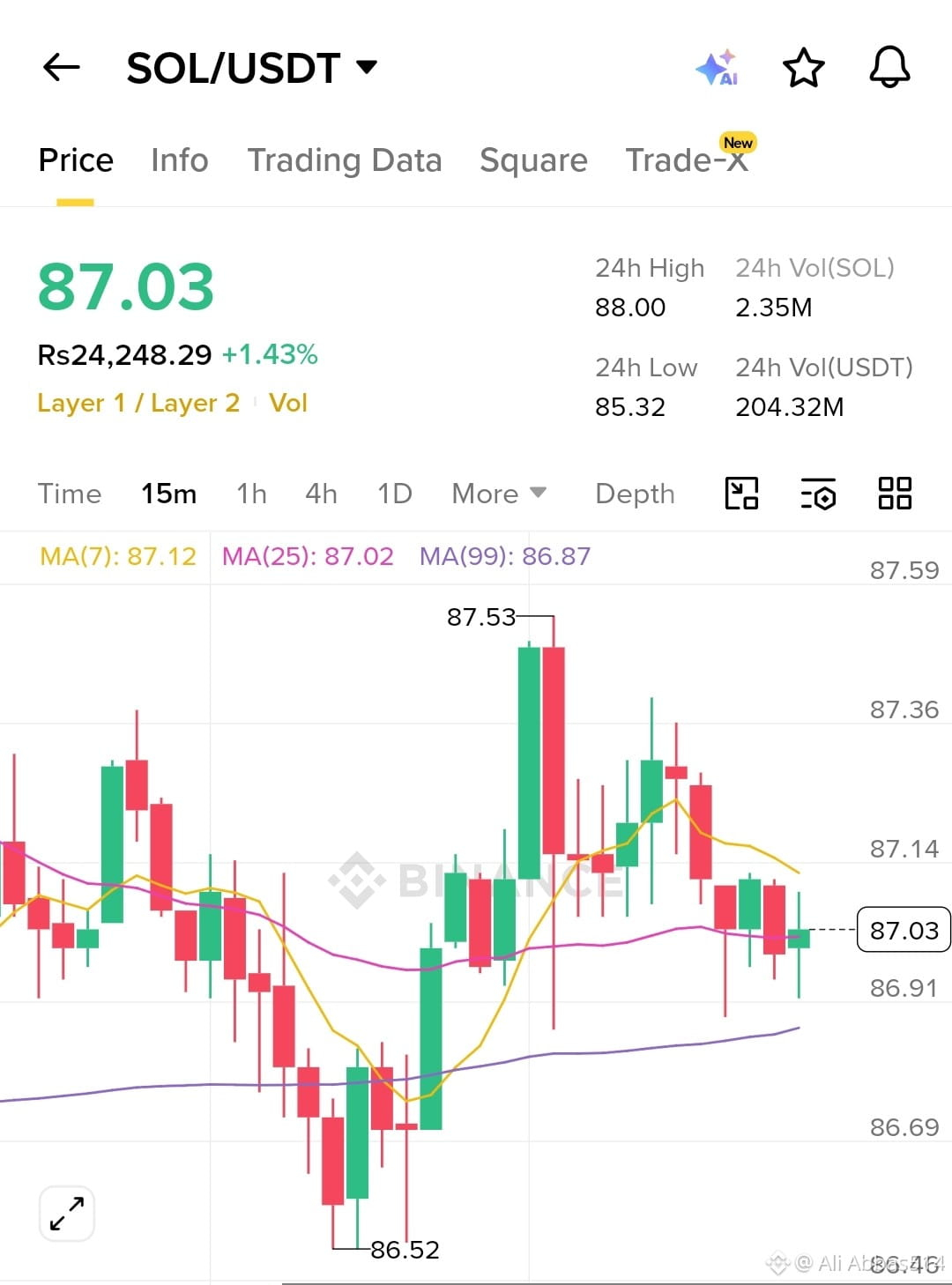
142
·
--
BREAKING — Oil traders just got hit with the headline nobody expected this fast 🚨
Reports claim a final US-Iran agreement draft has been reached, including a ceasefire, safe passage through the Strait of Hormuz, and gradual sanctions relief.
If this deal survives… the entire oil narrative changes overnight.
For weeks, markets were pricing in fear: ❌ supply disruption
❌ military escalation
❌ chaos in global shipping lanes
Now suddenly the market is being forced to price in de-escalation instead.
And that is dangerous.
Because when one headline can erase weeks of panic in minutes, volatility becomes brutal. One side gets trapped instantly.
Oil bears are celebrating right now.
Oil bulls are staring at the screen in disbelief.
But the craziest part?
The market still does not fully trust the situation.
One failed clause…
One missile…
One political rejection…
And crude could violently reverse before traders even have time to react.
This is no longer just an oil story.
This is geopolitical roulette with billions moving every second 🌍🔥
BREAKING — Oil traders just got hit with the headline nobody expected this fast 🚨
Reports claim a final US-Iran agreement draft has been reached, including a ceasefire, safe passage through the Strait of Hormuz, and gradual sanctions relief.
If this deal survives… the entire oil narrative changes overnight.
For weeks, markets were pricing in fear: ❌ supply disruption
❌ military escalation
❌ chaos in global shipping lanes
Now suddenly the market is being forced to price in de-escalation instead.
And that is dangerous.
Because when one headline can erase weeks of panic in minutes, volatility becomes brutal. One side gets trapped instantly.
Oil bears are celebrating right now.
Oil bulls are staring at the screen in disbelief.
But the craziest part?
The market still does not fully trust the situation.
One failed clause…
One missile…
One political rejection…
And crude could violently reverse before traders even have time to react.
This is no longer just an oil story.
This is geopolitical roulette with billions moving every second 🌍🔥
Reports claim a final US-Iran agreement draft has been reached, including a ceasefire, safe passage through the Strait of Hormuz, and gradual sanctions relief.
If this deal survives… the entire oil narrative changes overnight.
For weeks, markets were pricing in fear: ❌ supply disruption
❌ military escalation
❌ chaos in global shipping lanes
Now suddenly the market is being forced to price in de-escalation instead.
And that is dangerous.
Because when one headline can erase weeks of panic in minutes, volatility becomes brutal. One side gets trapped instantly.
Oil bears are celebrating right now.
Oil bulls are staring at the screen in disbelief.
But the craziest part?
The market still does not fully trust the situation.
One failed clause…
One missile…
One political rejection…
And crude could violently reverse before traders even have time to react.
This is no longer just an oil story.
This is geopolitical roulette with billions moving every second 🌍🔥

51
·
--
$XRP just flipped the entire mood of the chart in a matter of hours 🚨
The moment price defended the 1.3477 zone, buyers attacked hard and never looked back.
Now XRP is pressing against the daily high while momentum keeps accelerating candle after candle.
This does not look like random movement anymore.
This looks like bulls taking control.
My focus zones: 📍 Buy Area: 1.3500 – 1.3700
🎯 Target 1: 1.4500
🎯 Target 2: 1.5000
🛑 Risk Level: 1.3000
The strongest signal right now is not the 2% pump…
It is the speed of the recovery after support held perfectly.
When XRP starts reclaiming levels this aggressively, the market usually reacts fast.
Now the question is simple:
Are buyers preparing for continuation… or is this the start of a much larger breakout move? 👀
$XRP just flipped the entire mood of the chart in a matter of hours 🚨
The moment price defended the 1.3477 zone, buyers attacked hard and never looked back.
Now XRP is pressing against the daily high while momentum keeps accelerating candle after candle.
This does not look like random movement anymore.
This looks like bulls taking control.
My focus zones: 📍 Buy Area: 1.3500 – 1.3700
🎯 Target 1: 1.4500
🎯 Target 2: 1.5000
🛑 Risk Level: 1.3000
The strongest signal right now is not the 2% pump…
It is the speed of the recovery after support held perfectly.
When XRP starts reclaiming levels this aggressively, the market usually reacts fast.
Now the question is simple:
Are buyers preparing for continuation… or is this the start of a much larger breakout move? 👀
The moment price defended the 1.3477 zone, buyers attacked hard and never looked back.
Now XRP is pressing against the daily high while momentum keeps accelerating candle after candle.
This does not look like random movement anymore.
This looks like bulls taking control.
My focus zones: 📍 Buy Area: 1.3500 – 1.3700
🎯 Target 1: 1.4500
🎯 Target 2: 1.5000
🛑 Risk Level: 1.3000
The strongest signal right now is not the 2% pump…
It is the speed of the recovery after support held perfectly.
When XRP starts reclaiming levels this aggressively, the market usually reacts fast.
Now the question is simple:
Are buyers preparing for continuation… or is this the start of a much larger breakout move? 👀
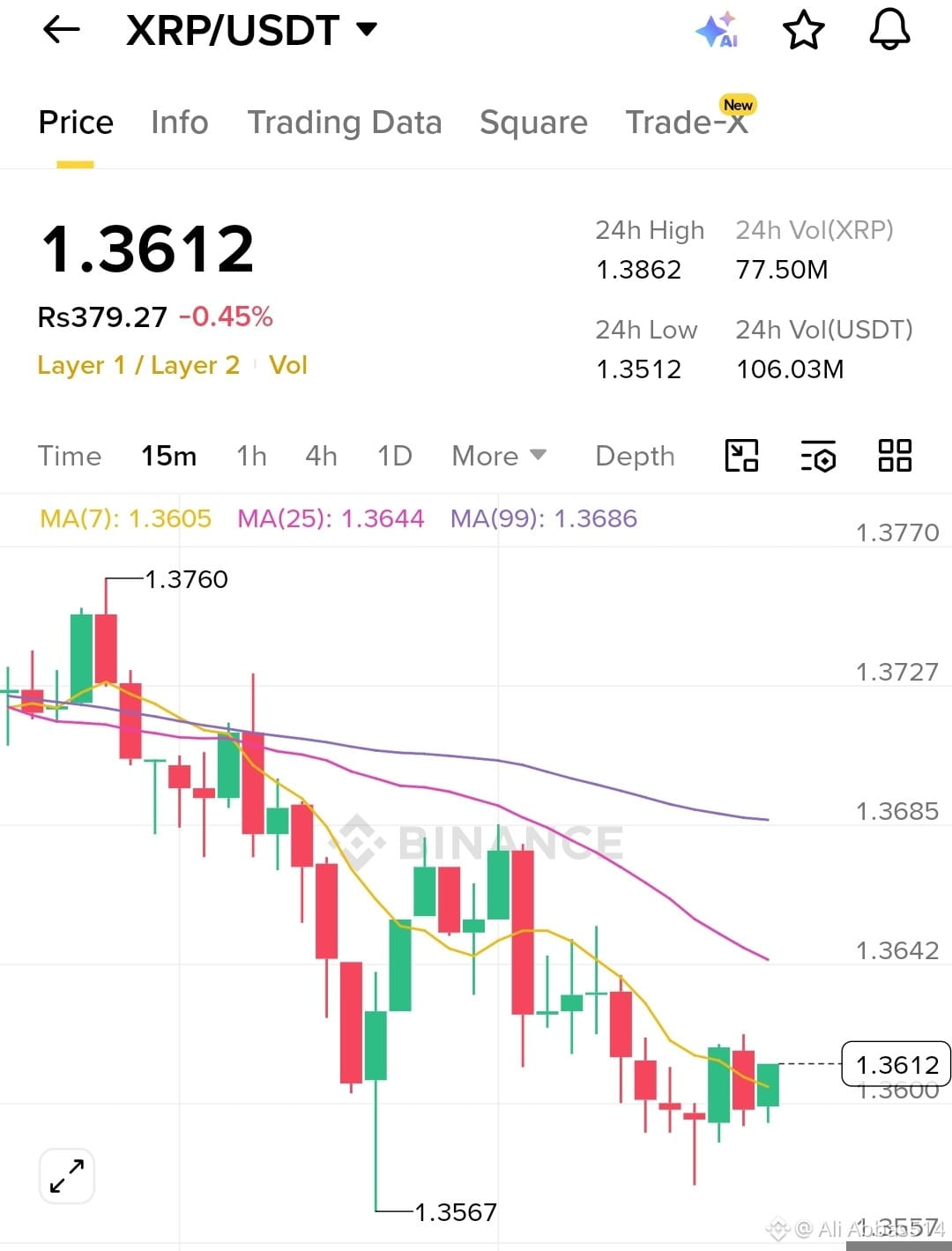
151
·
--
BREAKING — The financial system just crossed a line that may never be reversed.
President Trump signed a major executive order pushing the U.S. government toward deeper integration of crypto, blockchain, digital assets, and fintech into the core of American finance.
This is not another “crypto-friendly” headline.
This feels bigger.
Washington is now openly talking about modernization, settlement infrastructure, tokenized finance, stablecoins, and blockchain-powered payment rails inside the financial system itself.
That changes the conversation completely.
For years, crypto lived outside traditional finance fighting for legitimacy.
Now the walls between Wall Street and blockchain are starting to disappear in real time.
Banks are watching.
Institutions are watching.
Governments are watching.
The next decade may not be about whether crypto survives.
It may be about how deeply blockchain becomes embedded into the global financial system before most people even realize the transition already started. 🚨
BREAKING — The financial system just crossed a line that may never be reversed.
President Trump signed a major executive order pushing the U.S. government toward deeper integration of crypto, blockchain, digital assets, and fintech into the core of American finance.
This is not another “crypto-friendly” headline.
This feels bigger.
Washington is now openly talking about modernization, settlement infrastructure, tokenized finance, stablecoins, and blockchain-powered payment rails inside the financial system itself.
That changes the conversation completely.
For years, crypto lived outside traditional finance fighting for legitimacy.
Now the walls between Wall Street and blockchain are starting to disappear in real time.
Banks are watching.
Institutions are watching.
Governments are watching.
The next decade may not be about whether crypto survives.
It may be about how deeply blockchain becomes embedded into the global financial system before most people even realize the transition already started. 🚨
President Trump signed a major executive order pushing the U.S. government toward deeper integration of crypto, blockchain, digital assets, and fintech into the core of American finance.
This is not another “crypto-friendly” headline.
This feels bigger.
Washington is now openly talking about modernization, settlement infrastructure, tokenized finance, stablecoins, and blockchain-powered payment rails inside the financial system itself.
That changes the conversation completely.
For years, crypto lived outside traditional finance fighting for legitimacy.
Now the walls between Wall Street and blockchain are starting to disappear in real time.
Banks are watching.
Institutions are watching.
Governments are watching.
The next decade may not be about whether crypto survives.
It may be about how deeply blockchain becomes embedded into the global financial system before most people even realize the transition already started. 🚨
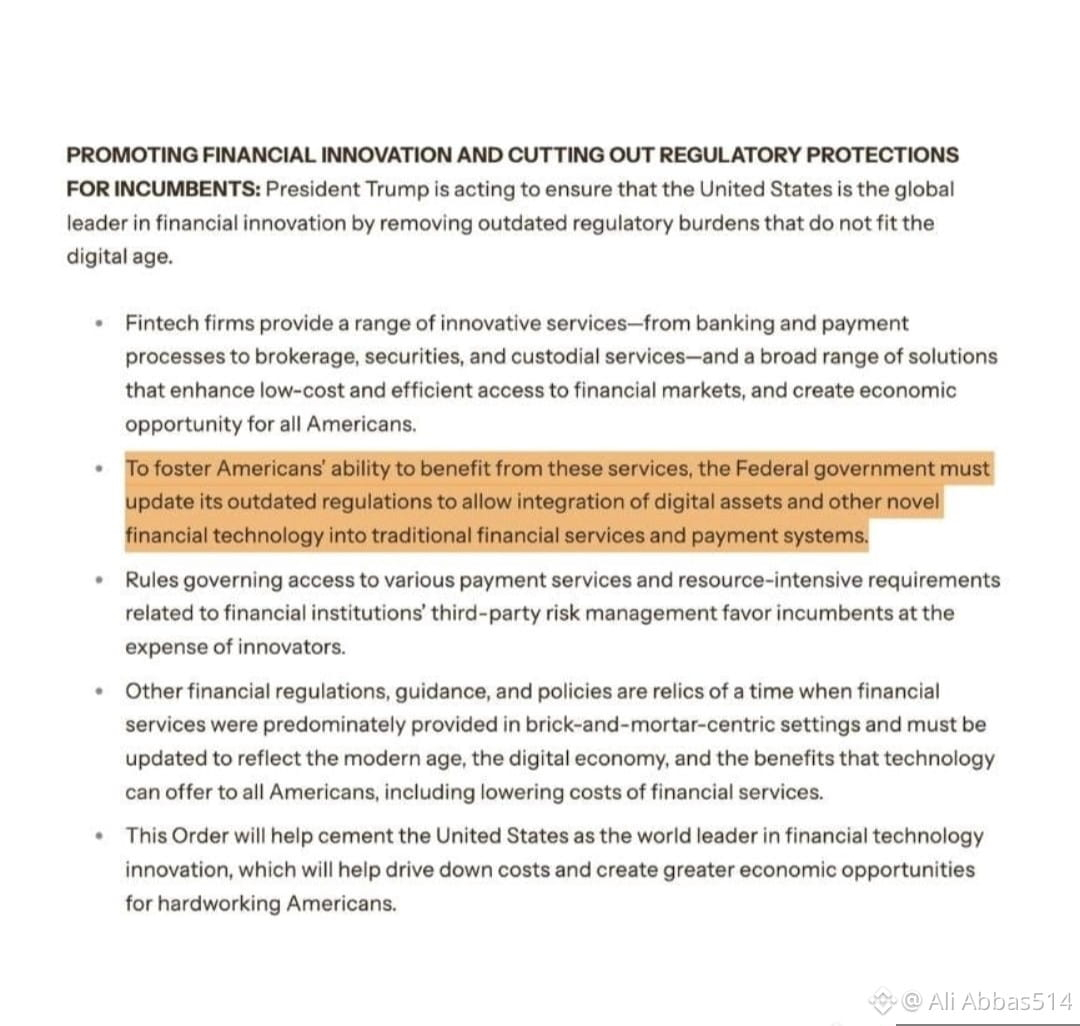
384
·
--
$EDEN pumping before a 54M token unlock is exactly the kind of setup that traps retail every cycle 😮💨
May 26 = 5.4% of total supply hitting the market.
Then more unlocks every single month after that.
People see green candles… I see incoming sell pressure.
This is why I never ignore tokenomics.
The chart can look bullish while the unlock schedule quietly prepares the dump 😡
{spot}(EDENUSDT)
$EDEN pumping before a 54M token unlock is exactly the kind of setup that traps retail every cycle 😮💨
May 26 = 5.4% of total supply hitting the market.
Then more unlocks every single month after that.
People see green candles… I see incoming sell pressure.
This is why I never ignore tokenomics.
The chart can look bullish while the unlock schedule quietly prepares the dump 😡
May 26 = 5.4% of total supply hitting the market.
Then more unlocks every single month after that.
People see green candles… I see incoming sell pressure.
This is why I never ignore tokenomics.
The chart can look bullish while the unlock schedule quietly prepares the dump 😡
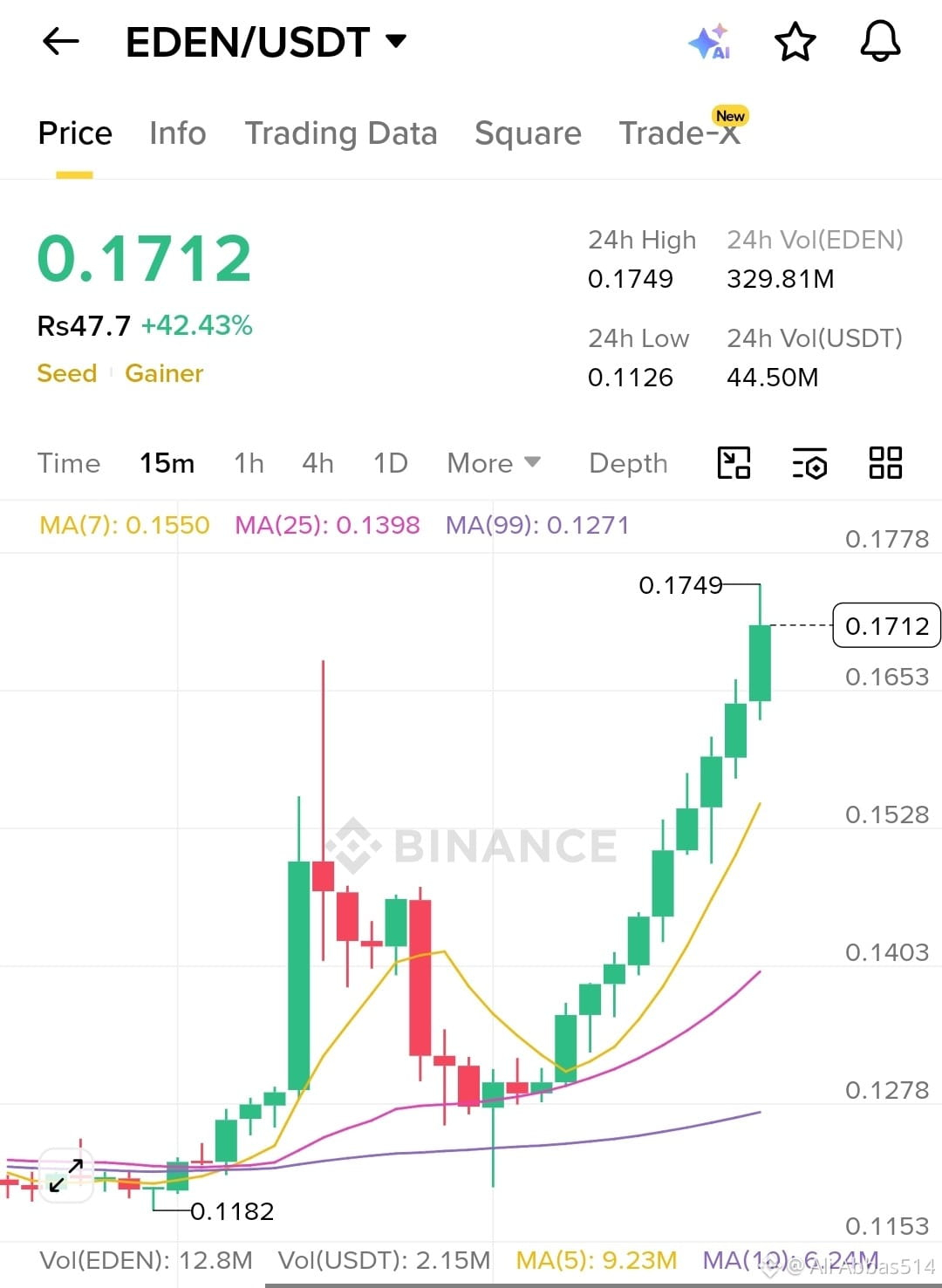
1
302
·
--
Everyone keeps talking about AI getting smarter, but very few projects are asking who actually owns the value behind that intelligence. That’s why @OpenLedger caught my attention recently.
Instead of treating AI like a closed black box, the network is building around real-time attribution — tracking how data contributes to AI outputs and rewarding contributors through the ecosystem itself. With recent progress around its OPEN mainnet and growing focus on transparent AI infrastructure, the conversation feels bigger than just another blockchain narrative.
What interests me most is the direction behind it. AI is slowly shifting from a simple tool into an economic environment where data, ownership, and intelligence are connected together. We may still be early, but the way people think about AI could change faster than expected.
#OpenLedger @Openledger $OPEN
Everyone keeps talking about AI getting smarter, but very few projects are asking who actually owns the value behind that intelligence. That’s why @OpenLedger caught my attention recently.
Instead of treating AI like a closed black box, the network is building around real-time attribution — tracking how data contributes to AI outputs and rewarding contributors through the ecosystem itself. With recent progress around its OPEN mainnet and growing focus on transparent AI infrastructure, the conversation feels bigger than just another blockchain narrative.
What interests me most is the direction behind it. AI is slowly shifting from a simple tool into an economic environment where data, ownership, and intelligence are connected together. We may still be early, but the way people think about AI could change faster than expected.
#OpenLedger @OpenLedger $OPEN
Instead of treating AI like a closed black box, the network is building around real-time attribution — tracking how data contributes to AI outputs and rewarding contributors through the ecosystem itself. With recent progress around its OPEN mainnet and growing focus on transparent AI infrastructure, the conversation feels bigger than just another blockchain narrative.
What interests me most is the direction behind it. AI is slowly shifting from a simple tool into an economic environment where data, ownership, and intelligence are connected together. We may still be early, but the way people think about AI could change faster than expected.
#OpenLedger @OpenLedger $OPEN
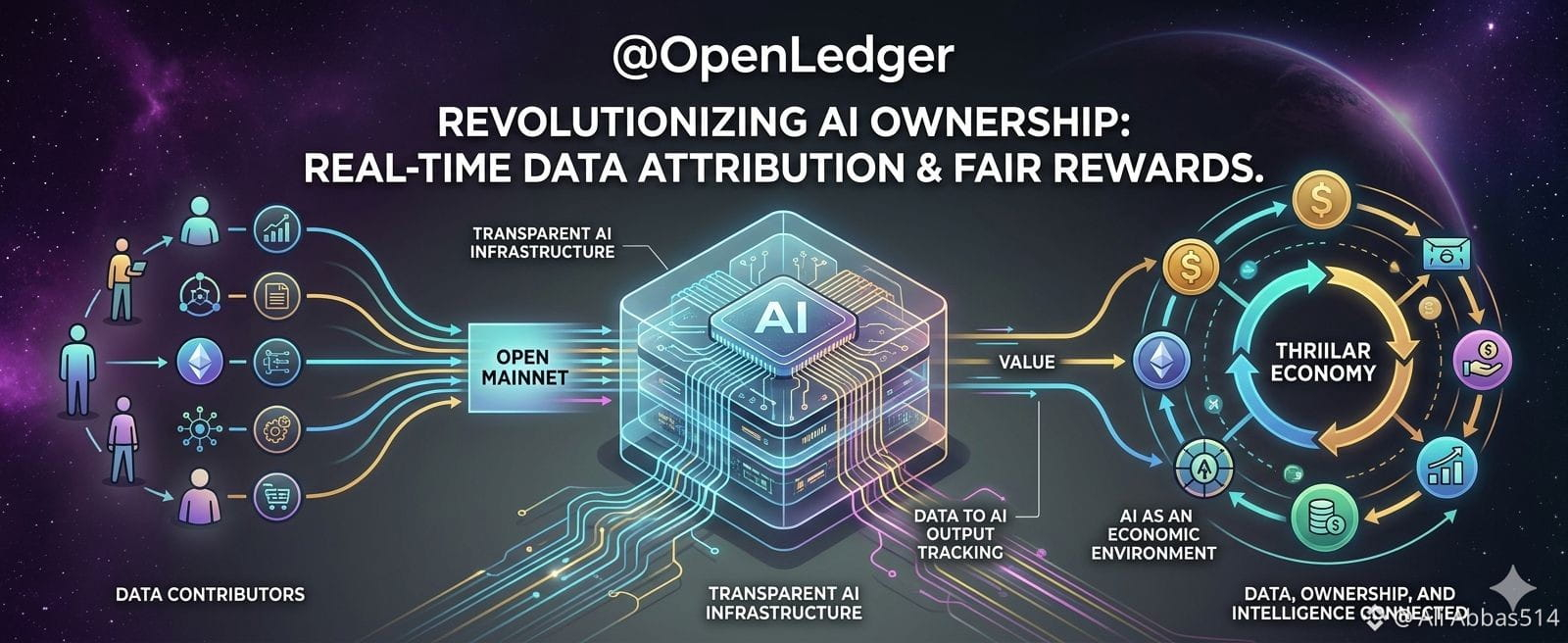
113
Log in to explore more content
Join global crypto users on Binance Square
⚡️ Get latest and useful information about crypto.
💬 Trusted by the world’s largest crypto exchange.
👍 Discover real insights from verified creators.
Email / Phone number
Trending Topics
US2YearYieldRisesTo4.61%
3,437 views
130 Discussing
#us2yearyieldrisesto4.61% 📊 Macro Watch: US 2-Year Treasury Yield Climbs to 4.61% – What It Means for Crypto
The traditional finance landscape is shifting. A rise in the US 2-year Treasury yield to 4.61% is sending ripples across global markets, and the crypto ecosystem is paying close attention. 🌐
📰 Core News
• The US 2-year Treasury yield has recently moved up to 4.61%, reflecting market adjustments to recent economic data and evolving Federal Reserve interest rate expectations [[1]].
• As a key benchmark for short-term interest rates, the 2-year yield is a vital indicator of macroeconomic liquidity, borrowing costs, and overall market sentiment.
📈 Market Impact
• 📉 Risk Assets & Liquidity Higher traditional yields generally increase the opportunity cost of holding non-yielding assets. This can temporarily tighten financial conditions, acting as a macroeconomic headwind for speculative risk assets like Bitcoin and Ethereum in the short term [[9]].
• 🏛️ RWA & On-Chain Yield On the flip side, elevated traditional yields continue to fuel interest in Real-World Asset (RWA) tokenization. On-chain Treasury products are becoming increasingly attractive as users seek transparent, yield-generating opportunities within the digital asset ecosystem [[12]].
• ⚖️ Market Sensitivity Expect crypto markets to remain highly responsive to upcoming macroeconomic data releases (such as CPI or employment reports) as traders continuously reassess the timeline for future monetary policy shifts.
💬 Join the Discussion
How do you think sustained higher traditional yields will shape the growth of on-chain RWA protocols versus broader crypto market liquidity? Share your analysis in the comments below! 👇
#MacroEconomics #CryptoMarket #RealWorldAssets #Bitcoin #BinanceSquare
This is for educational purposes only. Not Financial Advice (NFA). Always Do Your Own Research (DYOR).
$LSK $MITO $VTHO
ZoyaQueen16
·0 Likes
·207 views
US10YearTreasuryYieldNears5%
2,466 views
77 Discussing
CryptoLiquidations$674MIn24H
4,284 views
53 Discussing