

一航交易笔记
51 Posts

一航交易笔记
Report
Block User
波段交易记录者|关注 BTC / ETH / LINK
记录真实交易、技术观察与复盘思考
不喊单,不梭哈,只做有计划的交易
Open Trade

GOOGLB Holder
High-Frequency Trader
2.6 Years
50 Following
165 Followers
160 Liked
Posts
Portfolio
All
Videos
PINNED
·
--
Article
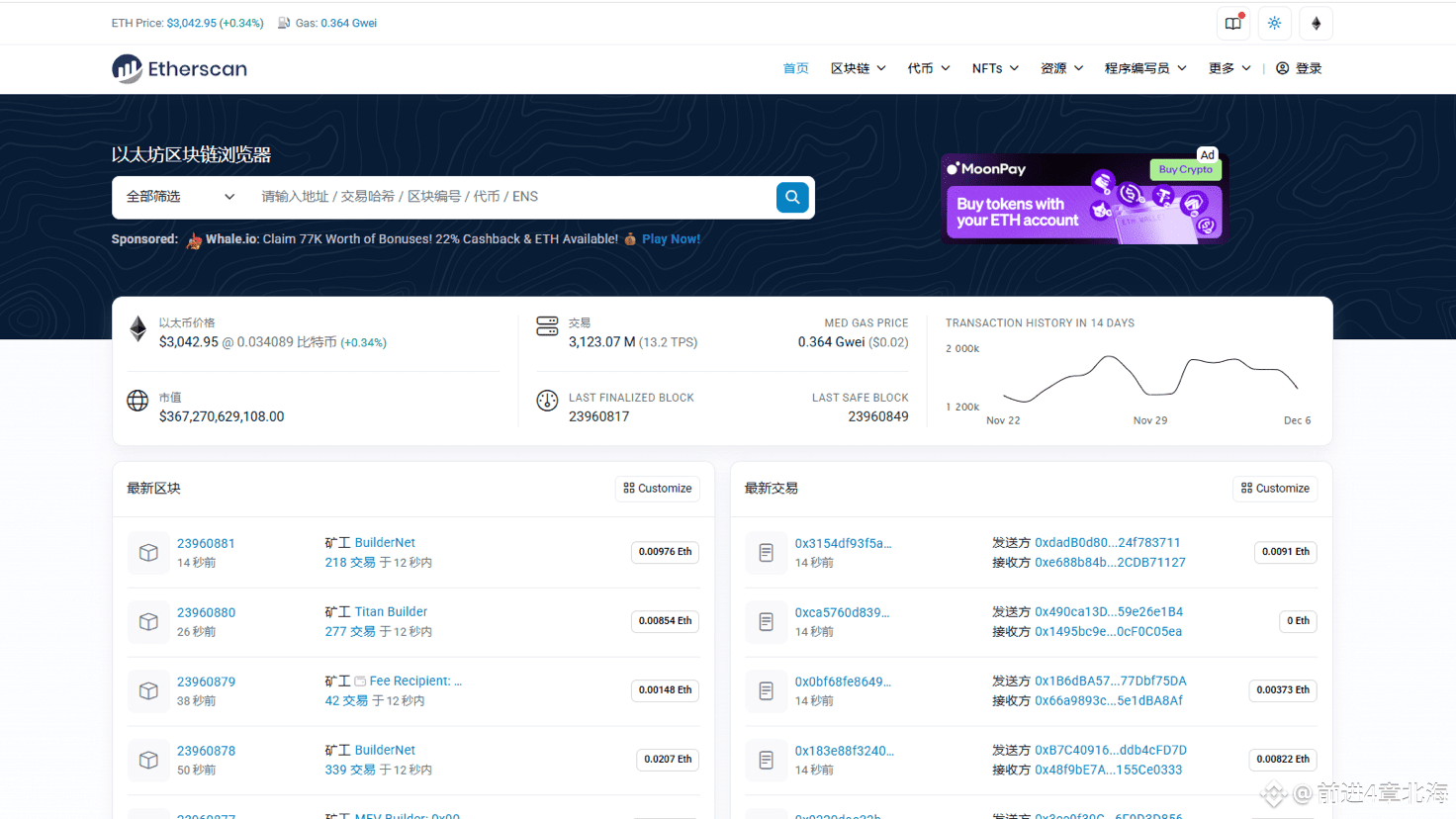
How many people have never even visited the ETH official website, yet have heavily invested in ETH?First, he has never even visited the official ETH website, yet he has heavily invested in ETH.
A few days ago, I talked to a friend offline about the recent market trends. He just entered the crypto space this year, and he mentioned that he chased the ETH rebound a few days ago, buying spot at over 3200, and now it has dropped back to 3000, resulting in another loss.
He also explained why he wanted to buy; he said he saw news that many people were holding, including institutions, and he wanted to hold as well to make a quick profit and then sell immediately.
I curiously asked him if he had ever clicked on ETH, and he said of course he had; how could he buy it without looking?
I mentioned the ETH website, Etherscan, and he looked at me curiously. He said that doesn't matter; he's seen many big influencers not mention these things and still make money.
How many people have never even visited the ETH official website, yet have heavily invested in ETH?
First, he has never even visited the official ETH website, yet he has heavily invested in ETH.
A few days ago, I talked to a friend offline about the recent market trends. He just entered the crypto space this year, and he mentioned that he chased the ETH rebound a few days ago, buying spot at over 3200, and now it has dropped back to 3000, resulting in another loss.
He also explained why he wanted to buy; he said he saw news that many people were holding, including institutions, and he wanted to hold as well to make a quick profit and then sell immediately.
I curiously asked him if he had ever clicked on ETH, and he said of course he had; how could he buy it without looking?
I mentioned the ETH website, Etherscan, and he looked at me curiously. He said that doesn't matter; he's seen many big influencers not mention these things and still make money.
A few days ago, I talked to a friend offline about the recent market trends. He just entered the crypto space this year, and he mentioned that he chased the ETH rebound a few days ago, buying spot at over 3200, and now it has dropped back to 3000, resulting in another loss.
He also explained why he wanted to buy; he said he saw news that many people were holding, including institutions, and he wanted to hold as well to make a quick profit and then sell immediately.
I curiously asked him if he had ever clicked on ETH, and he said of course he had; how could he buy it without looking?
I mentioned the ETH website, Etherscan, and he looked at me curiously. He said that doesn't matter; he's seen many big influencers not mention these things and still make money.
28
10
42
24.6k
·
--
Verified
#币安推出binanceintelligence
I watched yesterday’s livestream (even though the video was really blurry for a while).
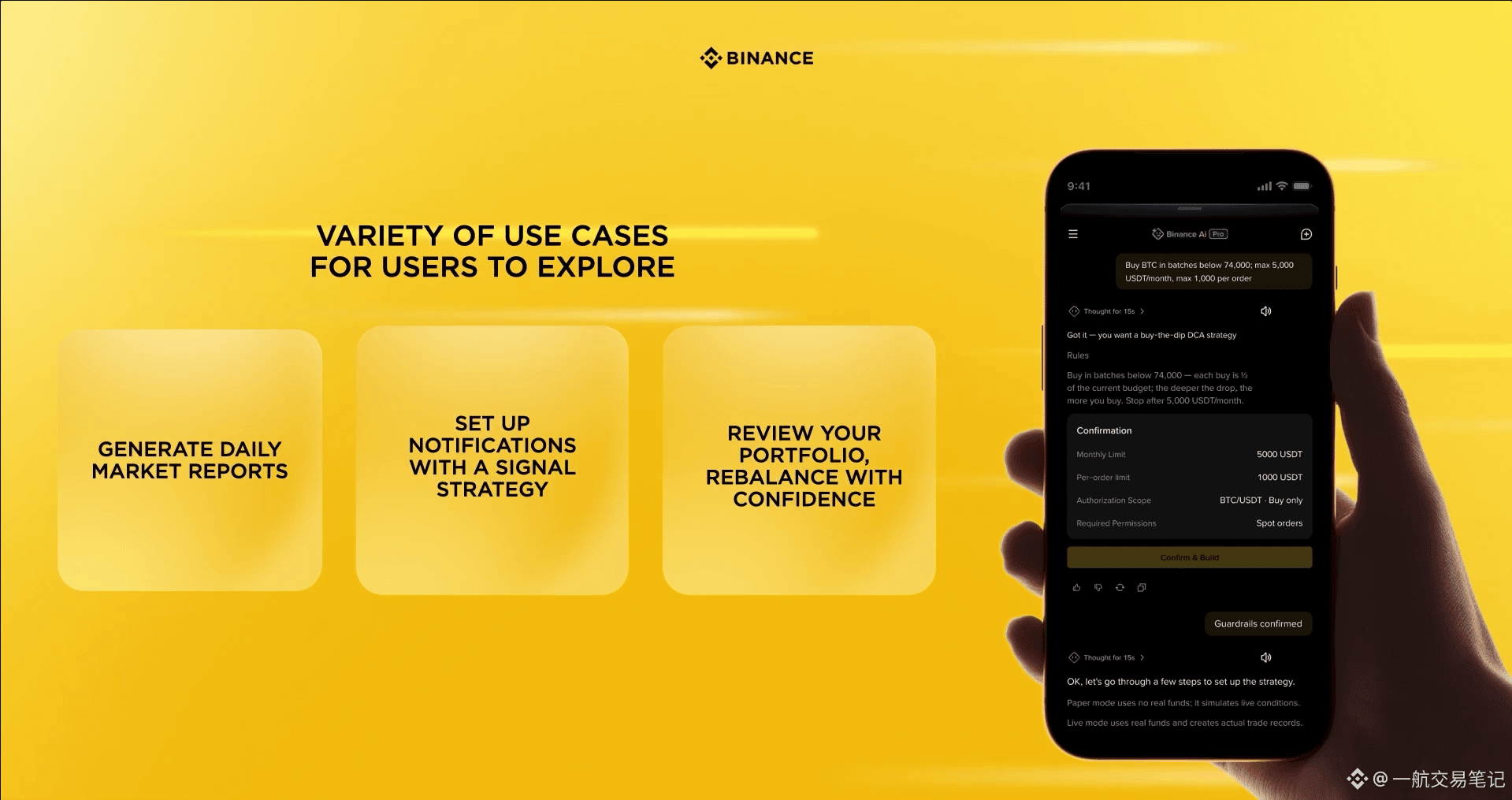
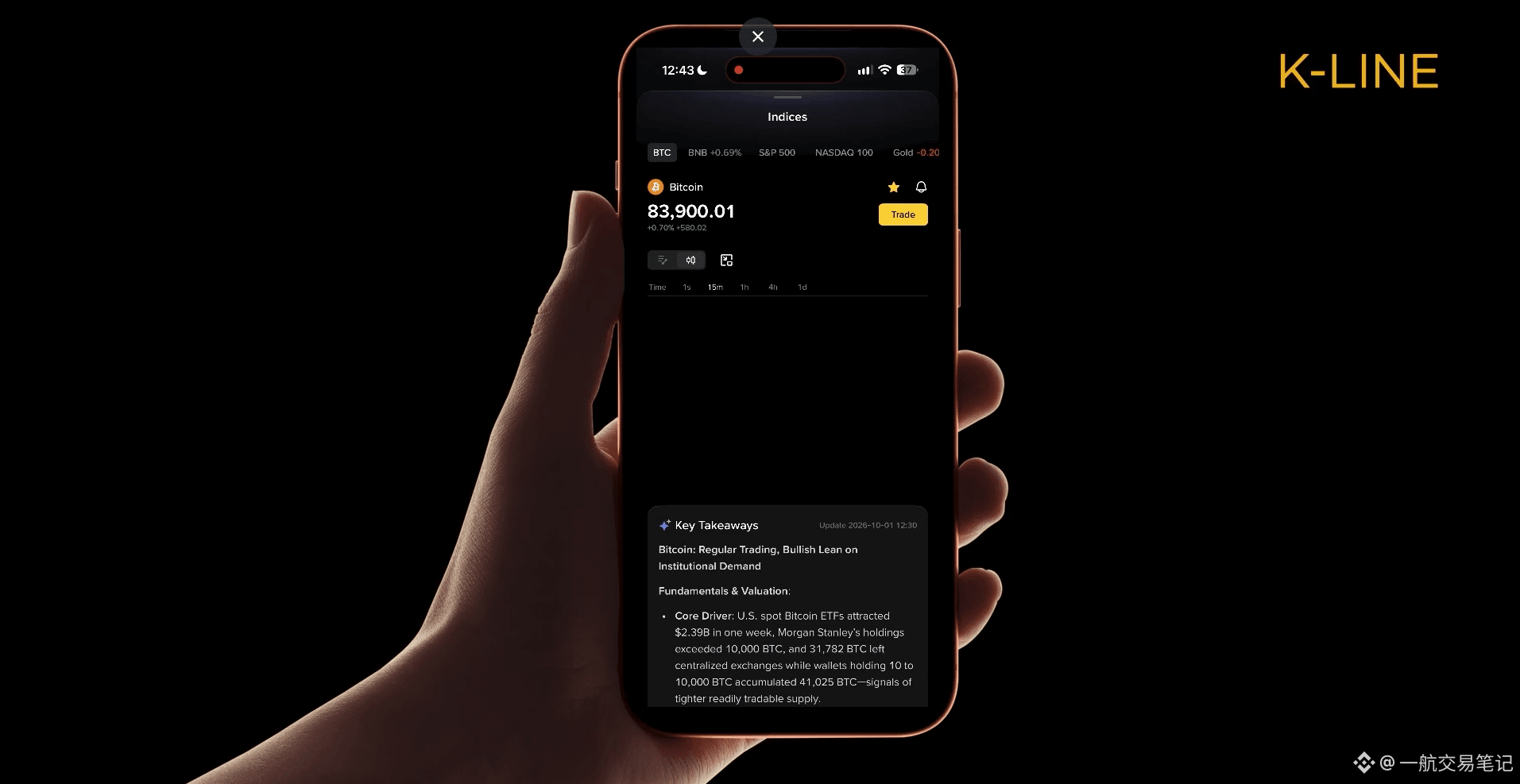
In Binance Intelligence, AI Pro is a direction worth exploring: describe a trading idea in natural language, generate an editable workflow, test it with simulated trades, and authorize it to run once you’re satisfied. The official plan is to roll it out gradually over the next few weeks, so for now we’ll have to wait and see how it works in practice.
[官方介绍](https://www.binance.com/en/blog/ecosystem/2231059782060061449)
This feature could turn a simple “I think this coin is going up” into a clear set of trading rules.
When chatting about the market, saying “buy on a breakout” sounds easy. But when you actually hand it over to a program, the questions come right away:
Which price level counts as a breakout? Does an intraday move above it count, or should you wait for confirmation at the close? What’s the maximum amount to invest? What if the price drops back down after you buy?
These details determine whether the same bullish view ends up producing completely different returns.
In the past, if you couldn’t code, many ideas had to stay in your head. With tools like this, everyday users may also be able to build out their rules and see what trades they would actually make.
But automation can also expose a problem: the original strategy may not have been fully thought through.
When you’re watching the market yourself, if the conditions aren’t met, you can always come up with an explanation on the fly. A program follows the rules, and every time it chases a price, every stop-loss, and every transaction fee gets recorded.
If the losses come from the rules themselves, a smarter AI won’t save you.
So what I’m personally hoping for is solid simulation testing, so users can see how their ideas would hold up against choppy markets, false breakouts, and a string of losses before putting real money on the line.
If it can help me avoid a few trades I haven’t thought through, that’s already genuinely useful.
#币安推出BinanceIntelligence #BinanceAI $BNB
{spot}(BNBUSDT)
#币安推出binanceintelligence
I watched yesterday’s livestream (even though the video was really blurry for a while).
In Binance Intelligence, AI Pro is a direction worth exploring: describe a trading idea in natural language, generate an editable workflow, test it with simulated trades, and authorize it to run once you’re satisfied. The official plan is to roll it out gradually over the next few weeks, so for now we’ll have to wait and see how it works in practice.
官方介绍
This feature could turn a simple “I think this coin is going up” into a clear set of trading rules.
When chatting about the market, saying “buy on a breakout” sounds easy. But when you actually hand it over to a program, the questions come right away:
Which price level counts as a breakout? Does an intraday move above it count, or should you wait for confirmation at the close? What’s the maximum amount to invest? What if the price drops back down after you buy?
These details determine whether the same bullish view ends up producing completely different returns.
In the past, if you couldn’t code, many ideas had to stay in your head. With tools like this, everyday users may also be able to build out their rules and see what trades they would actually make.
But automation can also expose a problem: the original strategy may not have been fully thought through.
When you’re watching the market yourself, if the conditions aren’t met, you can always come up with an explanation on the fly. A program follows the rules, and every time it chases a price, every stop-loss, and every transaction fee gets recorded.
If the losses come from the rules themselves, a smarter AI won’t save you.
So what I’m personally hoping for is solid simulation testing, so users can see how their ideas would hold up against choppy markets, false breakouts, and a string of losses before putting real money on the line.
If it can help me avoid a few trades I haven’t thought through, that’s already genuinely useful.
#币安推出BinanceIntelligence #BinanceAI $BNB
I watched yesterday’s livestream (even though the video was really blurry for a while).
In Binance Intelligence, AI Pro is a direction worth exploring: describe a trading idea in natural language, generate an editable workflow, test it with simulated trades, and authorize it to run once you’re satisfied. The official plan is to roll it out gradually over the next few weeks, so for now we’ll have to wait and see how it works in practice.
官方介绍
This feature could turn a simple “I think this coin is going up” into a clear set of trading rules.
When chatting about the market, saying “buy on a breakout” sounds easy. But when you actually hand it over to a program, the questions come right away:
Which price level counts as a breakout? Does an intraday move above it count, or should you wait for confirmation at the close? What’s the maximum amount to invest? What if the price drops back down after you buy?
These details determine whether the same bullish view ends up producing completely different returns.
In the past, if you couldn’t code, many ideas had to stay in your head. With tools like this, everyday users may also be able to build out their rules and see what trades they would actually make.
But automation can also expose a problem: the original strategy may not have been fully thought through.
When you’re watching the market yourself, if the conditions aren’t met, you can always come up with an explanation on the fly. A program follows the rules, and every time it chases a price, every stop-loss, and every transaction fee gets recorded.
If the losses come from the rules themselves, a smarter AI won’t save you.
So what I’m personally hoping for is solid simulation testing, so users can see how their ideas would hold up against choppy markets, false breakouts, and a string of losses before putting real money on the line.
If it can help me avoid a few trades I haven’t thought through, that’s already genuinely useful.
#币安推出BinanceIntelligence #BinanceAI $BNB
7
1
15
20.9k
·
--
Google and AVGO—the sleeping dragon and young phoenix of my portfolio.
They just keep grinding sideways. I’ve held them so long they’ve practically developed a patina. I bought them for the AI story; while holding them, I’ve been working on my mindset.
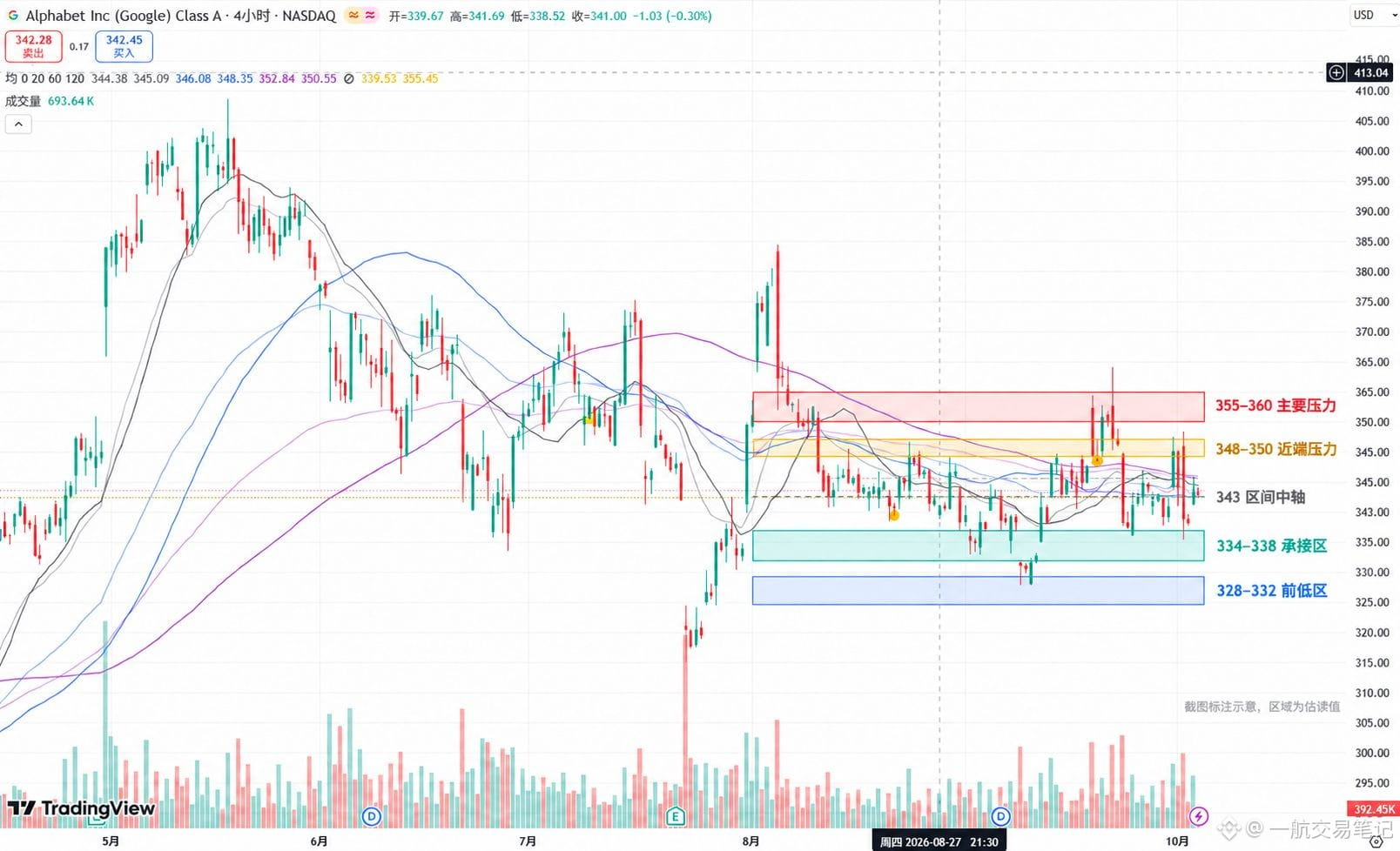
That said, Google’s 4-hour chart is starting to look worth watching.
In the screenshot from October 5, several moving averages are clustered around $343, with the price repeatedly crossing above and below them. The direction hasn’t emerged yet, but the next move out of this zone could be more interesting than these little ups and downs.
The first level I’m watching is $348–350.
On a few previous pushes higher, volume picked up, but the price then fell back into the range. So even if we get another pop, I won’t be quick to call it a breakout. The key is whether a 4-hour candle can close above $350, and whether buyers step in on a pullback.
If it holds above that level, there’s another hurdle at $355–360. Getting through that would lend more support to the idea that this consolidation is starting to improve.
To the downside, I’m watching $334–338. If it breaks below that and can’t reclaim the range, we should be wary of another test of the previous lows at $328–332.
A long grind could mean selling pressure is being absorbed; lower rebound highs could also mean buyers still aren’t strong enough. If you see the moving averages tangled together and decide in advance that an upside breakout is coming, it’s easy to draw your hopes for your holdings onto the chart.
What Google needs most right now is a move higher that actually holds.
One of these two prodigies has to emerge from hiding first. Google, try getting through that $350 door.
#GOOGLB #AVGOB #美股
Google and AVGO—the sleeping dragon and young phoenix of my portfolio.
They just keep grinding sideways. I’ve held them so long they’ve practically developed a patina. I bought them for the AI story; while holding them, I’ve been working on my mindset.
That said, Google’s 4-hour chart is starting to look worth watching.
In the screenshot from October 5, several moving averages are clustered around $343, with the price repeatedly crossing above and below them. The direction hasn’t emerged yet, but the next move out of this zone could be more interesting than these little ups and downs.
The first level I’m watching is $348–350.
On a few previous pushes higher, volume picked up, but the price then fell back into the range. So even if we get another pop, I won’t be quick to call it a breakout. The key is whether a 4-hour candle can close above $350, and whether buyers step in on a pullback.
If it holds above that level, there’s another hurdle at $355–360. Getting through that would lend more support to the idea that this consolidation is starting to improve.
To the downside, I’m watching $334–338. If it breaks below that and can’t reclaim the range, we should be wary of another test of the previous lows at $328–332.
A long grind could mean selling pressure is being absorbed; lower rebound highs could also mean buyers still aren’t strong enough. If you see the moving averages tangled together and decide in advance that an upside breakout is coming, it’s easy to draw your hopes for your holdings onto the chart.
What Google needs most right now is a move higher that actually holds.
One of these two prodigies has to emerge from hiding first. Google, try getting through that $350 door.
#GOOGLB #AVGOB #美股
They just keep grinding sideways. I’ve held them so long they’ve practically developed a patina. I bought them for the AI story; while holding them, I’ve been working on my mindset.
That said, Google’s 4-hour chart is starting to look worth watching.
In the screenshot from October 5, several moving averages are clustered around $343, with the price repeatedly crossing above and below them. The direction hasn’t emerged yet, but the next move out of this zone could be more interesting than these little ups and downs.
The first level I’m watching is $348–350.
On a few previous pushes higher, volume picked up, but the price then fell back into the range. So even if we get another pop, I won’t be quick to call it a breakout. The key is whether a 4-hour candle can close above $350, and whether buyers step in on a pullback.
If it holds above that level, there’s another hurdle at $355–360. Getting through that would lend more support to the idea that this consolidation is starting to improve.
To the downside, I’m watching $334–338. If it breaks below that and can’t reclaim the range, we should be wary of another test of the previous lows at $328–332.
A long grind could mean selling pressure is being absorbed; lower rebound highs could also mean buyers still aren’t strong enough. If you see the moving averages tangled together and decide in advance that an upside breakout is coming, it’s easy to draw your hopes for your holdings onto the chart.
What Google needs most right now is a move higher that actually holds.
One of these two prodigies has to emerge from hiding first. Google, try getting through that $350 door.
#GOOGLB #AVGOB #美股
1
127
·
--
#以太坊质押退出队列创2026年新高 When people calculate the returns on ETH staking, they rarely put a price on how long it takes to exit.
Ethereum’s staking exit queue has hit a new high for 2026. As of October 5, around 786,000 ETH were waiting to exit, with a wait of nearly 14 days, followed by withdrawal processing.
This surge is related to preventive exits by MetaMask validators. Lido expects the ETH involved to be gradually restaked, so there isn’t enough evidence to treat the entire queue as ETH poised to be dumped on the market.
But there’s a more consequential question for returns: what if you need the money today?
People holding staking tokens such as stETH can exchange them for ETH on the secondary market. However, the price they get depends on market supply and demand, as well as trading depth.
If many people are rushing to exit and few are willing to buy, they may have to accept a lower price. The wait for protocol redemptions also depends on factors such as available buffer funds, so you can’t simply apply the validators’ 14-day queue time.
Assume an annual yield of 3%. If an urgent exchange costs you 1%, that’s equivalent to losing about four months of yield.
This is an illustrative calculation; it doesn’t mean that stETH is currently trading at a 1% discount.
So the key things to watch next are the price of stETH-to-ETH exchanges, actual redemption times, and slippage on large trades. If these indicators deteriorate significantly, that would provide more direct evidence of liquidity pressure.
Staking yields are presented on an annual basis, while liquidity costs may all come due on the day you urgently need your money.
Putting money you’ll need in the short term into long-term staking for yield creates a maturity mismatch—and that’s more concerning than earning a slightly lower APR.
#以太坊质押退出队列创2026年新高 #ETH
#以太坊质押退出队列创2026年新高 When people calculate the returns on ETH staking, they rarely put a price on how long it takes to exit.
Ethereum’s staking exit queue has hit a new high for 2026. As of October 5, around 786,000 ETH were waiting to exit, with a wait of nearly 14 days, followed by withdrawal processing.
This surge is related to preventive exits by MetaMask validators. Lido expects the ETH involved to be gradually restaked, so there isn’t enough evidence to treat the entire queue as ETH poised to be dumped on the market.
But there’s a more consequential question for returns: what if you need the money today?
People holding staking tokens such as stETH can exchange them for ETH on the secondary market. However, the price they get depends on market supply and demand, as well as trading depth.
If many people are rushing to exit and few are willing to buy, they may have to accept a lower price. The wait for protocol redemptions also depends on factors such as available buffer funds, so you can’t simply apply the validators’ 14-day queue time.
Assume an annual yield of 3%. If an urgent exchange costs you 1%, that’s equivalent to losing about four months of yield.
This is an illustrative calculation; it doesn’t mean that stETH is currently trading at a 1% discount.
So the key things to watch next are the price of stETH-to-ETH exchanges, actual redemption times, and slippage on large trades. If these indicators deteriorate significantly, that would provide more direct evidence of liquidity pressure.
Staking yields are presented on an annual basis, while liquidity costs may all come due on the day you urgently need your money.
Putting money you’ll need in the short term into long-term staking for yield creates a maturity mismatch—and that’s more concerning than earning a slightly lower APR.
#以太坊质押退出队列创2026年新高 #ETH
Ethereum’s staking exit queue has hit a new high for 2026. As of October 5, around 786,000 ETH were waiting to exit, with a wait of nearly 14 days, followed by withdrawal processing.
This surge is related to preventive exits by MetaMask validators. Lido expects the ETH involved to be gradually restaked, so there isn’t enough evidence to treat the entire queue as ETH poised to be dumped on the market.
But there’s a more consequential question for returns: what if you need the money today?
People holding staking tokens such as stETH can exchange them for ETH on the secondary market. However, the price they get depends on market supply and demand, as well as trading depth.
If many people are rushing to exit and few are willing to buy, they may have to accept a lower price. The wait for protocol redemptions also depends on factors such as available buffer funds, so you can’t simply apply the validators’ 14-day queue time.
Assume an annual yield of 3%. If an urgent exchange costs you 1%, that’s equivalent to losing about four months of yield.
This is an illustrative calculation; it doesn’t mean that stETH is currently trading at a 1% discount.
So the key things to watch next are the price of stETH-to-ETH exchanges, actual redemption times, and slippage on large trades. If these indicators deteriorate significantly, that would provide more direct evidence of liquidity pressure.
Staking yields are presented on an annual basis, while liquidity costs may all come due on the day you urgently need your money.
Putting money you’ll need in the short term into long-term staking for yield creates a maturity mismatch—and that’s more concerning than earning a slightly lower APR.
#以太坊质押退出队列创2026年新高 #ETH
5
1
10
26.6k
·
--
BTC is up—why is my altcoin still falling?
Let’s recap.
The most painful kind of market: when BTC is rising, you open your own account and it’s still all green.
At this point, it’s easy to console yourself: once the capital rotation comes around, my coin will catch up too.
Around 14:30 on October 2, BTC was up about 2%, AAVE up about 9.2%, and SKY up about 6.1%; ENA was down about 10.6%, and NEAR down about 8.7%.
You don’t even need to cross sectors. Within DeFi alone, AAVE and ENA had a difference of nearly 20 percentage points in their moves.
BTC’s rise can improve overall market sentiment, but every altcoin has its own ledger to settle.
Can new buy orders hold up and absorb unlocks? Can protocol revenue flow through to the tokens? If the project has issues, how much loss do token holders have to bear?
These questions can’t be solved just because the overall market is up.
“Great project development” and “the token is worth buying” are separated by a lot of things in between. If the product has users, revenue may stay within the protocol; if the business keeps growing, token supply may also increase faster.
So, having fallen more and being far from the previous high are not sufficient reasons for a catch-up rally. The market has no obligation to send every coin back to its prior high.
Of course, one day of divergence isn’t enough to judge the entire altcoin season. But today at least reminds us of one thing: BTC’s rise has not yet turned into profits for all altcoin holders.
If you’re holding a weak coin and all you have left is the reason that “BTC has already gone up, so it’s finally due,” then you need to revisit the logic you used to buy it in the first place.
Why would the next batch of buyers come in and buy?
That question is closer to your own account than “when will altcoin season arrive?”
$BTC $AAVE $ENA #山寨币热点 #行情分析
BTC is up—why is my altcoin still falling?
Let’s recap.
The most painful kind of market: when BTC is rising, you open your own account and it’s still all green.
At this point, it’s easy to console yourself: once the capital rotation comes around, my coin will catch up too.
Around 14:30 on October 2, BTC was up about 2%, AAVE up about 9.2%, and SKY up about 6.1%; ENA was down about 10.6%, and NEAR down about 8.7%.
You don’t even need to cross sectors. Within DeFi alone, AAVE and ENA had a difference of nearly 20 percentage points in their moves.
BTC’s rise can improve overall market sentiment, but every altcoin has its own ledger to settle.
Can new buy orders hold up and absorb unlocks? Can protocol revenue flow through to the tokens? If the project has issues, how much loss do token holders have to bear?
These questions can’t be solved just because the overall market is up.
“Great project development” and “the token is worth buying” are separated by a lot of things in between. If the product has users, revenue may stay within the protocol; if the business keeps growing, token supply may also increase faster.
So, having fallen more and being far from the previous high are not sufficient reasons for a catch-up rally. The market has no obligation to send every coin back to its prior high.
Of course, one day of divergence isn’t enough to judge the entire altcoin season. But today at least reminds us of one thing: BTC’s rise has not yet turned into profits for all altcoin holders.
If you’re holding a weak coin and all you have left is the reason that “BTC has already gone up, so it’s finally due,” then you need to revisit the logic you used to buy it in the first place.
Why would the next batch of buyers come in and buy?
That question is closer to your own account than “when will altcoin season arrive?”
$BTC $AAVE $ENA #山寨币热点 #行情分析
Let’s recap.
The most painful kind of market: when BTC is rising, you open your own account and it’s still all green.
At this point, it’s easy to console yourself: once the capital rotation comes around, my coin will catch up too.
Around 14:30 on October 2, BTC was up about 2%, AAVE up about 9.2%, and SKY up about 6.1%; ENA was down about 10.6%, and NEAR down about 8.7%.
You don’t even need to cross sectors. Within DeFi alone, AAVE and ENA had a difference of nearly 20 percentage points in their moves.
BTC’s rise can improve overall market sentiment, but every altcoin has its own ledger to settle.
Can new buy orders hold up and absorb unlocks? Can protocol revenue flow through to the tokens? If the project has issues, how much loss do token holders have to bear?
These questions can’t be solved just because the overall market is up.
“Great project development” and “the token is worth buying” are separated by a lot of things in between. If the product has users, revenue may stay within the protocol; if the business keeps growing, token supply may also increase faster.
So, having fallen more and being far from the previous high are not sufficient reasons for a catch-up rally. The market has no obligation to send every coin back to its prior high.
Of course, one day of divergence isn’t enough to judge the entire altcoin season. But today at least reminds us of one thing: BTC’s rise has not yet turned into profits for all altcoin holders.
If you’re holding a weak coin and all you have left is the reason that “BTC has already gone up, so it’s finally due,” then you need to revisit the logic you used to buy it in the first place.
Why would the next batch of buyers come in and buy?
That question is closer to your own account than “when will altcoin season arrive?”
$BTC $AAVE $ENA #山寨币热点 #行情分析
2
1.2k
·
--
The trading competition over in South Korea is absolutely crazy—it's basically turned “traders” into celebrities.
In the video, this female trader’s heart rate skyrockets, and it even looks like she’s starting to trade with her feet.
The trading competition over in South Korea is absolutely crazy—it's basically turned “traders” into celebrities.
In the video, this female trader’s heart rate skyrockets, and it even looks like she’s starting to trade with her feet.
In the video, this female trader’s heart rate skyrockets, and it even looks like she’s starting to trade with her feet.
2
435
·
--
SEC eases stance on token buybacks; altcoins may need a new way to be valued
In the SEC’s latest FAQ, there’s one key line:
An already-functioning crypto network, even if the project team announces a token buyback, won’t create a new investment contract by that action alone.
Of course, the boundaries still exist. If the network hasn’t actually launched yet, but the project takes back buyback-related promotion proceeds, regulatory risk remains high. This FAQ is also only the views of SEC staff, not legally binding.
But the direction is already very clear: regulators are starting to distinguish between “buybacks generated by real business activity” and “buybacks used to manufacture price expectations.”
This likely means altcoin valuation logic needs to change.
When researching altcoins, people like to look at narrative, TVL, user numbers, and unlock progress. Next, you’ll also need to watch one more factor: whether the money earned by the protocol can be continuously passed through to the token.
HYPE is a typical example.
Hyperliquid’s trading fees go into the Assistance Fund, where the system automatically buys HYPE and then permanently removes those tokens from circulation. As long as trading volume and fees keep coming in, this mechanism can form a long-term buy demand.
However, seeing the words “buyback” and giving the project points easily leads to traps.
Some buyback funds come from the team’s reserves and run out once spent; some rules can be paused at any time; and some tokens bought back are merely placed into a treasury, which may still re-enter the market later.
To judge whether a buyback has real value, there are three points to think about:
Where does the buyback money come from?
Can the rules be modified freely by the team?
Where do the bought-back tokens ultimately end up?
A buyback won’t turn an income-less project into a good project. It can only pass existing cash flows through to tokens.
In the future, when you see the four words “buyback and burn,” set the marketing page aside first and directly review protocol revenue and on-chain buyback records.
If the numbers add up, the buyback matters.
$HYPE #SEC #山寨币热点 #代币回购
SEC eases stance on token buybacks; altcoins may need a new way to be valued
In the SEC’s latest FAQ, there’s one key line:
An already-functioning crypto network, even if the project team announces a token buyback, won’t create a new investment contract by that action alone.
Of course, the boundaries still exist. If the network hasn’t actually launched yet, but the project takes back buyback-related promotion proceeds, regulatory risk remains high. This FAQ is also only the views of SEC staff, not legally binding.
But the direction is already very clear: regulators are starting to distinguish between “buybacks generated by real business activity” and “buybacks used to manufacture price expectations.”
This likely means altcoin valuation logic needs to change.
When researching altcoins, people like to look at narrative, TVL, user numbers, and unlock progress. Next, you’ll also need to watch one more factor: whether the money earned by the protocol can be continuously passed through to the token.
HYPE is a typical example.
Hyperliquid’s trading fees go into the Assistance Fund, where the system automatically buys HYPE and then permanently removes those tokens from circulation. As long as trading volume and fees keep coming in, this mechanism can form a long-term buy demand.
However, seeing the words “buyback” and giving the project points easily leads to traps.
Some buyback funds come from the team’s reserves and run out once spent; some rules can be paused at any time; and some tokens bought back are merely placed into a treasury, which may still re-enter the market later.
To judge whether a buyback has real value, there are three points to think about:
Where does the buyback money come from?
Can the rules be modified freely by the team?
Where do the bought-back tokens ultimately end up?
A buyback won’t turn an income-less project into a good project. It can only pass existing cash flows through to tokens.
In the future, when you see the four words “buyback and burn,” set the marketing page aside first and directly review protocol revenue and on-chain buyback records.
If the numbers add up, the buyback matters.
$HYPE #SEC #山寨币热点 #代币回购
In the SEC’s latest FAQ, there’s one key line:
An already-functioning crypto network, even if the project team announces a token buyback, won’t create a new investment contract by that action alone.
Of course, the boundaries still exist. If the network hasn’t actually launched yet, but the project takes back buyback-related promotion proceeds, regulatory risk remains high. This FAQ is also only the views of SEC staff, not legally binding.
But the direction is already very clear: regulators are starting to distinguish between “buybacks generated by real business activity” and “buybacks used to manufacture price expectations.”
This likely means altcoin valuation logic needs to change.
When researching altcoins, people like to look at narrative, TVL, user numbers, and unlock progress. Next, you’ll also need to watch one more factor: whether the money earned by the protocol can be continuously passed through to the token.
HYPE is a typical example.
Hyperliquid’s trading fees go into the Assistance Fund, where the system automatically buys HYPE and then permanently removes those tokens from circulation. As long as trading volume and fees keep coming in, this mechanism can form a long-term buy demand.
However, seeing the words “buyback” and giving the project points easily leads to traps.
Some buyback funds come from the team’s reserves and run out once spent; some rules can be paused at any time; and some tokens bought back are merely placed into a treasury, which may still re-enter the market later.
To judge whether a buyback has real value, there are three points to think about:
Where does the buyback money come from?
Can the rules be modified freely by the team?
Where do the bought-back tokens ultimately end up?
A buyback won’t turn an income-less project into a good project. It can only pass existing cash flows through to tokens.
In the future, when you see the four words “buyback and burn,” set the marketing page aside first and directly review protocol revenue and on-chain buyback records.
If the numbers add up, the buyback matters.
$HYPE #SEC #山寨币热点 #代币回购

1
139
·
--
Bitget was hacked for $351.6 million; this is more serious than you might think.
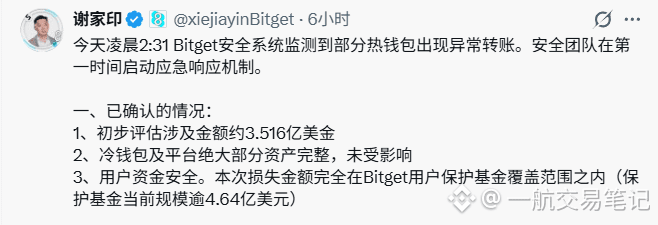
Early this morning, some of Bitget’s hot wallets and warm wallets showed abnormal transfers, and withdrawals were subsequently paused. Deposits and trading are still normal. The official statement says cold wallets were not affected, and user losses will be covered by a protection fund of over $464 million.
According to the CEO’s initial disclosure, the attackers may have gained access to the wallet service backend, forged transfer data, and invoked the signing process. The possibility of direct private key leakage has been preliminarily ruled out.
In other words, the signing system may still be functioning normally, while the attackers managed to fool the backend that initiates the transaction.
Bitget should next (1) first make up the affected wallets, then (2) resume withdrawals by asset and by chain. It should also work with exchanges and stablecoin issuers to track the stolen funds and freeze the proceeds.
How much can be frozen is difficult to judge for now.
You can look at these three points:
When withdrawals will resume;
Whether the protection fund has actually been used;
And whether the full report can clearly explain how the backend was breached.
This incident also reminds me again that there are real gaps in security capabilities between exchanges.
For my own core trading capital, I still prefer to keep it with Binance. No exchange is absolutely secure. Considering overall scale, liquidity, security investment, and the ability to handle extreme events, Binance still puts me more at ease.
For assets that you don’t plan to move for a long time, keep them in a cold wallet, and leave the capital needed for trading on a large platform. Where you put your funds is itself part of your trading strategy.
$BNB #币安 #交易所安全
Bitget was hacked for $351.6 million; this is more serious than you might think.
Early this morning, some of Bitget’s hot wallets and warm wallets showed abnormal transfers, and withdrawals were subsequently paused. Deposits and trading are still normal. The official statement says cold wallets were not affected, and user losses will be covered by a protection fund of over $464 million.
According to the CEO’s initial disclosure, the attackers may have gained access to the wallet service backend, forged transfer data, and invoked the signing process. The possibility of direct private key leakage has been preliminarily ruled out.
In other words, the signing system may still be functioning normally, while the attackers managed to fool the backend that initiates the transaction.
Bitget should next (1) first make up the affected wallets, then (2) resume withdrawals by asset and by chain. It should also work with exchanges and stablecoin issuers to track the stolen funds and freeze the proceeds.
How much can be frozen is difficult to judge for now.
You can look at these three points:
When withdrawals will resume;
Whether the protection fund has actually been used;
And whether the full report can clearly explain how the backend was breached.
This incident also reminds me again that there are real gaps in security capabilities between exchanges.
For my own core trading capital, I still prefer to keep it with Binance. No exchange is absolutely secure. Considering overall scale, liquidity, security investment, and the ability to handle extreme events, Binance still puts me more at ease.
For assets that you don’t plan to move for a long time, keep them in a cold wallet, and leave the capital needed for trading on a large platform. Where you put your funds is itself part of your trading strategy.
$BNB #币安 #交易所安全
Early this morning, some of Bitget’s hot wallets and warm wallets showed abnormal transfers, and withdrawals were subsequently paused. Deposits and trading are still normal. The official statement says cold wallets were not affected, and user losses will be covered by a protection fund of over $464 million.
According to the CEO’s initial disclosure, the attackers may have gained access to the wallet service backend, forged transfer data, and invoked the signing process. The possibility of direct private key leakage has been preliminarily ruled out.
In other words, the signing system may still be functioning normally, while the attackers managed to fool the backend that initiates the transaction.
Bitget should next (1) first make up the affected wallets, then (2) resume withdrawals by asset and by chain. It should also work with exchanges and stablecoin issuers to track the stolen funds and freeze the proceeds.
How much can be frozen is difficult to judge for now.
You can look at these three points:
When withdrawals will resume;
Whether the protection fund has actually been used;
And whether the full report can clearly explain how the backend was breached.
This incident also reminds me again that there are real gaps in security capabilities between exchanges.
For my own core trading capital, I still prefer to keep it with Binance. No exchange is absolutely secure. Considering overall scale, liquidity, security investment, and the ability to handle extreme events, Binance still puts me more at ease.
For assets that you don’t plan to move for a long time, keep them in a cold wallet, and leave the capital needed for trading on a large platform. Where you put your funds is itself part of your trading strategy.
$BNB #币安 #交易所安全
1
2
179
·
--
Article
Quantum Computing Is Here—What Should Be Done With Satoshi Nakamoto’s Wallet?If one day quantum computers can derive Bitcoin private keys from public information, the first thing to spark market panic may be those old wallets that have been dormant for decades and have never moved.
This includes many early miner addresses, as well as Bitcoins that the market believes might be related to Satoshi Nakamoto.
As long as the private key is cracked, these coins could be transferred away without the holders even realizing it. A large number of long-dormant coins suddenly entering the market creates an impact that’s hard to gauge.
Back then, quantum computing’s threat to Bitcoin felt like something far away. Two recent developments have suddenly made this issue feel real.
Quantum Computing Is Here—What Should Be Done With Satoshi Nakamoto’s Wallet?
If one day quantum computers can derive Bitcoin private keys from public information, the first thing to spark market panic may be those old wallets that have been dormant for decades and have never moved.
This includes many early miner addresses, as well as Bitcoins that the market believes might be related to Satoshi Nakamoto.
As long as the private key is cracked, these coins could be transferred away without the holders even realizing it. A large number of long-dormant coins suddenly entering the market creates an impact that’s hard to gauge.
Back then, quantum computing’s threat to Bitcoin felt like something far away. Two recent developments have suddenly made this issue feel real.
This includes many early miner addresses, as well as Bitcoins that the market believes might be related to Satoshi Nakamoto.
As long as the private key is cracked, these coins could be transferred away without the holders even realizing it. A large number of long-dormant coins suddenly entering the market creates an impact that’s hard to gauge.
Back then, quantum computing’s threat to Bitcoin felt like something far away. Two recent developments have suddenly made this issue feel real.
2
261
·
--
Binance has just listed $HYPE spot.
Binance is, in a way, like “making up for missed tickets.”
Most smaller altcoins need to piggyback on listings from major exchanges to gain liquidity and attention. HYPE took a rarely seen route—first it built its product, revenue, users, and market cap to the top, and only then did it land on Binance.
HYPE’s market cap is already over $20 billion. And the Hyperliquid behind it is also one of the most influential platforms in the on-chain derivatives contract market.
A top-tier centralized exchange, ultimately onboarding a token from the strongest on-chain derivatives contracts platform—that in itself is pretty interesting.
This listing adds a new entry point for buy-side demand for HYPE, making short-term trading and speculation even more complex.
The prior run-up has already been substantial. The price volatility right after the opening is very likely to be extremely intense.
First, watch whether Binance spot can hold steady in terms of trading volume and price, and whether the funds from the original platform have been transferred to Binance.
HYPE has already proven itself through its product. This Binance “ticket” is more like a belated stamp of approval.
After HYPE gets listed on Binance, do you think it will keep pushing higher—or will it see a round of profit-taking? $HYPE #Hyperliquid #币安上币 #山寨币观察
Binance has just listed $HYPE spot.
Binance is, in a way, like “making up for missed tickets.”
Most smaller altcoins need to piggyback on listings from major exchanges to gain liquidity and attention. HYPE took a rarely seen route—first it built its product, revenue, users, and market cap to the top, and only then did it land on Binance.
HYPE’s market cap is already over $20 billion. And the Hyperliquid behind it is also one of the most influential platforms in the on-chain derivatives contract market.
A top-tier centralized exchange, ultimately onboarding a token from the strongest on-chain derivatives contracts platform—that in itself is pretty interesting.
This listing adds a new entry point for buy-side demand for HYPE, making short-term trading and speculation even more complex.
The prior run-up has already been substantial. The price volatility right after the opening is very likely to be extremely intense.
First, watch whether Binance spot can hold steady in terms of trading volume and price, and whether the funds from the original platform have been transferred to Binance.
HYPE has already proven itself through its product. This Binance “ticket” is more like a belated stamp of approval.
After HYPE gets listed on Binance, do you think it will keep pushing higher—or will it see a round of profit-taking? $HYPE #Hyperliquid #币安上币 #山寨币观察
Binance is, in a way, like “making up for missed tickets.”
Most smaller altcoins need to piggyback on listings from major exchanges to gain liquidity and attention. HYPE took a rarely seen route—first it built its product, revenue, users, and market cap to the top, and only then did it land on Binance.
HYPE’s market cap is already over $20 billion. And the Hyperliquid behind it is also one of the most influential platforms in the on-chain derivatives contract market.
A top-tier centralized exchange, ultimately onboarding a token from the strongest on-chain derivatives contracts platform—that in itself is pretty interesting.
This listing adds a new entry point for buy-side demand for HYPE, making short-term trading and speculation even more complex.
The prior run-up has already been substantial. The price volatility right after the opening is very likely to be extremely intense.
First, watch whether Binance spot can hold steady in terms of trading volume and price, and whether the funds from the original platform have been transferred to Binance.
HYPE has already proven itself through its product. This Binance “ticket” is more like a belated stamp of approval.
After HYPE gets listed on Binance, do you think it will keep pushing higher—or will it see a round of profit-taking? $HYPE #Hyperliquid #币安上币 #山寨币观察
2
382
·
--
Verified
#ai股持续上涨还有哪些投资机会
AI stocks keep rising, and I haven’t sold my Google holdings for now.
My reason for holding Google is simple: model capabilities are getting closer and closer, while user entry points are much harder to replicate.
Google has Search, YouTube, Android, Chrome, Workspace, and Cloud. Gemini doesn’t need to start from zero to find users—it can plug directly into products that billions of people use every day.
According to Alphabet’s Q2 earnings report, Google Search revenue grew 17% year over year, while Cloud revenue grew 82%; Gemini’s monthly active users have already reached 950 million, and the model processes about 22 billion API tokens per minute.
These numbers at least suggest that AI has not yet crushed Google’s existing business; instead, it has started to create new demand for Search and Cloud.
My thesis for Google’s position is divided into three layers:
The first layer is Search and YouTube, which continuously generates cash flow.
The second layer is Cloud, TPU, and enterprise AI—serving the compute and model needs of technology companies.
The third layer is Gemini, Android, and Workspace—bringing AI to everyday users.
Compared with companies that focus on building models alone, Google has chips, cloud, and models, and it also controls user entry points and ad monetization. Once AI truly moves into the consumer side, this closed loop will become increasingly important.
Of course, I’m watching two risks: whether AI answers will reduce click-through rates for search ads, and whether the ongoing growth in data center investment can translate into sufficient profits.
AI stocks overall are already at relatively high levels, so I won’t keep chasing after a short-term rally. I’ll hold the current position and wait for new earnings reports to validate the growth.
I’d rather view Google as an AI platform stock with mature cash flow. As long as Search doesn’t show clear slowdown, and Cloud and Gemini continue growing, this thesis still holds.
Do you think Google will become the biggest entry point in the AI era, or will it gradually lose Search market share to new generations of AI products?
$GOOGLB #Google #AI股 #美股 #币安bStocks
#ai股持续上涨还有哪些投资机会
AI stocks keep rising, and I haven’t sold my Google holdings for now.
My reason for holding Google is simple: model capabilities are getting closer and closer, while user entry points are much harder to replicate.
Google has Search, YouTube, Android, Chrome, Workspace, and Cloud. Gemini doesn’t need to start from zero to find users—it can plug directly into products that billions of people use every day.
According to Alphabet’s Q2 earnings report, Google Search revenue grew 17% year over year, while Cloud revenue grew 82%; Gemini’s monthly active users have already reached 950 million, and the model processes about 22 billion API tokens per minute.
These numbers at least suggest that AI has not yet crushed Google’s existing business; instead, it has started to create new demand for Search and Cloud.
My thesis for Google’s position is divided into three layers:
The first layer is Search and YouTube, which continuously generates cash flow.
The second layer is Cloud, TPU, and enterprise AI—serving the compute and model needs of technology companies.
The third layer is Gemini, Android, and Workspace—bringing AI to everyday users.
Compared with companies that focus on building models alone, Google has chips, cloud, and models, and it also controls user entry points and ad monetization. Once AI truly moves into the consumer side, this closed loop will become increasingly important.
Of course, I’m watching two risks: whether AI answers will reduce click-through rates for search ads, and whether the ongoing growth in data center investment can translate into sufficient profits.
AI stocks overall are already at relatively high levels, so I won’t keep chasing after a short-term rally. I’ll hold the current position and wait for new earnings reports to validate the growth.
I’d rather view Google as an AI platform stock with mature cash flow. As long as Search doesn’t show clear slowdown, and Cloud and Gemini continue growing, this thesis still holds.
Do you think Google will become the biggest entry point in the AI era, or will it gradually lose Search market share to new generations of AI products?
$GOOGLB #Google #AI股 #美股 #币安bStocks
AI stocks keep rising, and I haven’t sold my Google holdings for now.
My reason for holding Google is simple: model capabilities are getting closer and closer, while user entry points are much harder to replicate.
Google has Search, YouTube, Android, Chrome, Workspace, and Cloud. Gemini doesn’t need to start from zero to find users—it can plug directly into products that billions of people use every day.
According to Alphabet’s Q2 earnings report, Google Search revenue grew 17% year over year, while Cloud revenue grew 82%; Gemini’s monthly active users have already reached 950 million, and the model processes about 22 billion API tokens per minute.
These numbers at least suggest that AI has not yet crushed Google’s existing business; instead, it has started to create new demand for Search and Cloud.
My thesis for Google’s position is divided into three layers:
The first layer is Search and YouTube, which continuously generates cash flow.
The second layer is Cloud, TPU, and enterprise AI—serving the compute and model needs of technology companies.
The third layer is Gemini, Android, and Workspace—bringing AI to everyday users.
Compared with companies that focus on building models alone, Google has chips, cloud, and models, and it also controls user entry points and ad monetization. Once AI truly moves into the consumer side, this closed loop will become increasingly important.
Of course, I’m watching two risks: whether AI answers will reduce click-through rates for search ads, and whether the ongoing growth in data center investment can translate into sufficient profits.
AI stocks overall are already at relatively high levels, so I won’t keep chasing after a short-term rally. I’ll hold the current position and wait for new earnings reports to validate the growth.
I’d rather view Google as an AI platform stock with mature cash flow. As long as Search doesn’t show clear slowdown, and Cloud and Gemini continue growing, this thesis still holds.
Do you think Google will become the biggest entry point in the AI era, or will it gradually lose Search market share to new generations of AI products?
$GOOGLB #Google #AI股 #美股 #币安bStocks
1
4
8.7k
·
--
First, let’s admit something: I sold Meta at the wrong time.
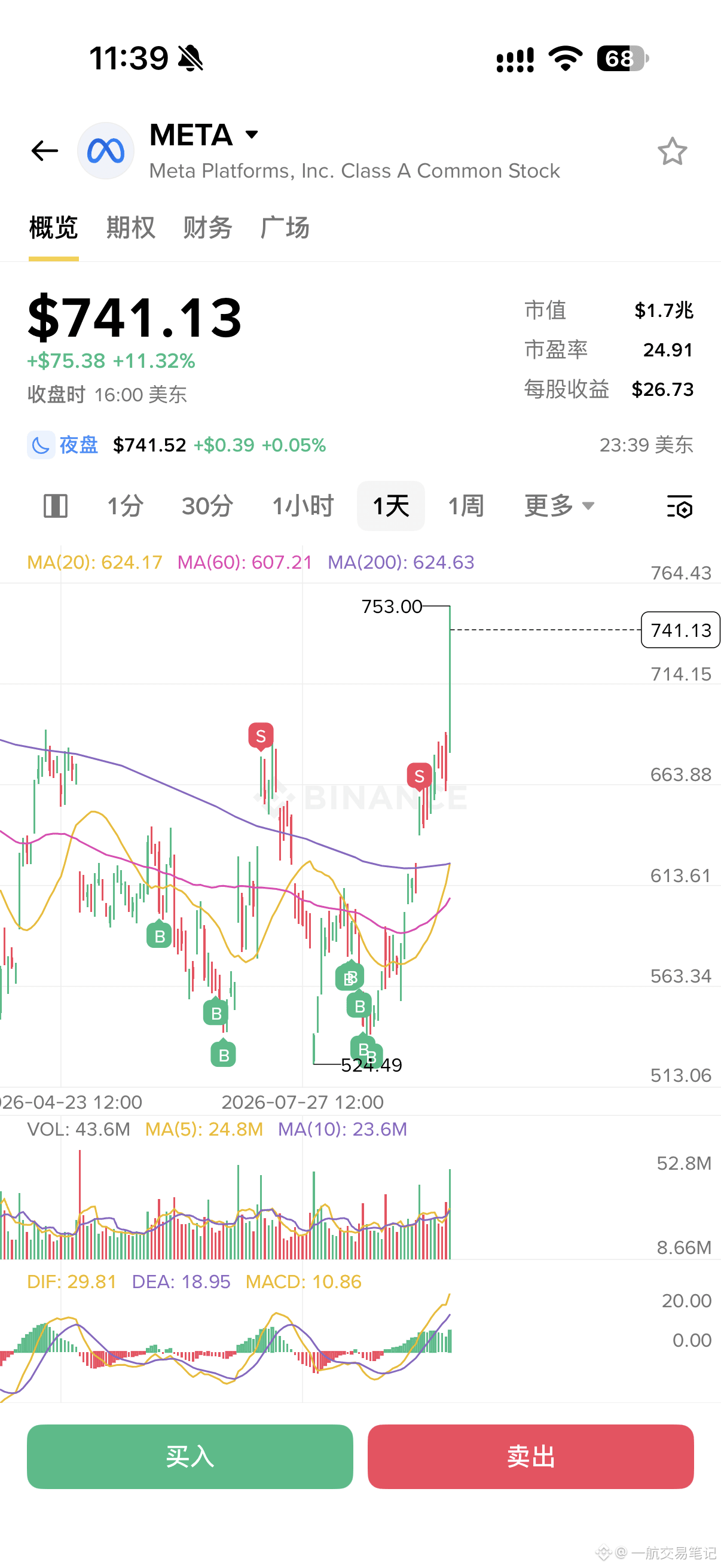
A while back, I traded META on a swing and made a little profit before exiting. At the time, I thought the upside was already significant, but I didn’t expect it to surge another 11% yesterday. Looking back, my sell point feels a bit awkward.
The catalyst for this round of gains came from Meta’s newly launched personal AI agent, Muse. After going live for about ten days, Muse has already climbed to No. 1 on the U.S. App Store’s free chart. It can help users shop, make calls, cancel subscriptions, and even handle some long-term tasks.
What’s even more interesting is that Amazon has already banned Muse from entering its own platform to let users shop.
Amazon’s reaction, ironically, suggests that Muse has run into something truly valuable: the transaction gateway.
As the gap between AI models gradually shrinks, the one who can reach ordinary users fastest will be the one most likely to secure data, ads, and transactions. Meta has WhatsApp, Instagram, and Facebook in its hands. It doesn’t need to find users again—it just needs to plug AI into products users use every day.
The market is now starting to reassess Meta’s distribution capabilities. Previously, people saw it as an advertising company. In the future, it could become an AI gateway for billions of people.
From a trading perspective, after a single-day jump of 11%, I won’t chase it back for now. The chance to sell has already happened. If I chase higher out of emotion, it’s easy to make two mistakes in a row.
But this “sold-too-soon” moment has also made me re-evaluate Meta: in AI competition reaching the consumer side, distribution channels may be more valuable than model parameters.
Do you think Meta’s current rally is just beginning, or has it already priced in the full expectations for Muse?
$METAB #META #美股 #AI
First, let’s admit something: I sold Meta at the wrong time.
A while back, I traded META on a swing and made a little profit before exiting. At the time, I thought the upside was already significant, but I didn’t expect it to surge another 11% yesterday. Looking back, my sell point feels a bit awkward.
The catalyst for this round of gains came from Meta’s newly launched personal AI agent, Muse. After going live for about ten days, Muse has already climbed to No. 1 on the U.S. App Store’s free chart. It can help users shop, make calls, cancel subscriptions, and even handle some long-term tasks.
What’s even more interesting is that Amazon has already banned Muse from entering its own platform to let users shop.
Amazon’s reaction, ironically, suggests that Muse has run into something truly valuable: the transaction gateway.
As the gap between AI models gradually shrinks, the one who can reach ordinary users fastest will be the one most likely to secure data, ads, and transactions. Meta has WhatsApp, Instagram, and Facebook in its hands. It doesn’t need to find users again—it just needs to plug AI into products users use every day.
The market is now starting to reassess Meta’s distribution capabilities. Previously, people saw it as an advertising company. In the future, it could become an AI gateway for billions of people.
From a trading perspective, after a single-day jump of 11%, I won’t chase it back for now. The chance to sell has already happened. If I chase higher out of emotion, it’s easy to make two mistakes in a row.
But this “sold-too-soon” moment has also made me re-evaluate Meta: in AI competition reaching the consumer side, distribution channels may be more valuable than model parameters.
Do you think Meta’s current rally is just beginning, or has it already priced in the full expectations for Muse?
$METAB #META #美股 #AI
A while back, I traded META on a swing and made a little profit before exiting. At the time, I thought the upside was already significant, but I didn’t expect it to surge another 11% yesterday. Looking back, my sell point feels a bit awkward.
The catalyst for this round of gains came from Meta’s newly launched personal AI agent, Muse. After going live for about ten days, Muse has already climbed to No. 1 on the U.S. App Store’s free chart. It can help users shop, make calls, cancel subscriptions, and even handle some long-term tasks.
What’s even more interesting is that Amazon has already banned Muse from entering its own platform to let users shop.
Amazon’s reaction, ironically, suggests that Muse has run into something truly valuable: the transaction gateway.
As the gap between AI models gradually shrinks, the one who can reach ordinary users fastest will be the one most likely to secure data, ads, and transactions. Meta has WhatsApp, Instagram, and Facebook in its hands. It doesn’t need to find users again—it just needs to plug AI into products users use every day.
The market is now starting to reassess Meta’s distribution capabilities. Previously, people saw it as an advertising company. In the future, it could become an AI gateway for billions of people.
From a trading perspective, after a single-day jump of 11%, I won’t chase it back for now. The chance to sell has already happened. If I chase higher out of emotion, it’s easy to make two mistakes in a row.
But this “sold-too-soon” moment has also made me re-evaluate Meta: in AI competition reaching the consumer side, distribution channels may be more valuable than model parameters.
Do you think Meta’s current rally is just beginning, or has it already priced in the full expectations for Muse?
$METAB #META #美股 #AI
1
176
·
--
SEC has opened a door for tokenizing stocks on-chain, and the RWA sector now has another reason for speculation.
If we look only at the relevant altcoins right now, I’m focusing on three:
First, ONDO.
The theme is the most direct. Ondo has already launched more than 450 tokenized stocks and ETFs, spanning Ethereum, BNB Chain, and Solana. Today it also introduced a physical conversion between stocks and on-chain tokens—institutions can mint the corresponding tokens directly using their existing shares.
For short-term capital looking to hype “stocks on-chain,” ONDO is likely the easiest target to think of.
Its downside is also very clear: ONDO currently mainly plays a governance role. Growth in the Ondo platform’s scale doesn’t automatically mean revenue will flow to token holders. Whether the project being executed well can translate into long-term benefits for the token price depends on the subsequent value-capture mechanisms.
Second, LINK.
For stocks to move on-chain, you need reliable pricing, proof of reserves, and cross-chain data. Chainlink has become the official oracle for Ondo tokenized stocks, and it also provides on-chain real-time market data for U.S. stocks and ETFs. LINK’s theme potential may be a bit weaker, but the infrastructure story is more solid.
Third, ETH.
Once tokenized stocks start entering lending, collateralization, and liquidity pools, Ethereum can benefit from settlement and DeFi liquidity demand. However, ETH is already large in market size, so the short-term price stimulation from tokenizing stocks may be less obvious than for small-cap RWA coins.
My ranking:
Short-term upside: ONDO > LINK > ETH
Business certainty: LINK > ETH > ONDO
In this narrative, I care most about ONDO—and I’m also the most cautious about ONDO.
$ONDO
$LINK
$ETH
{spot}(ETHUSDT)
Tokenizing stocks can drive Ondo’s business, but the ONDO token still needs to prove it can capture and hold onto that value.
If you can only pick one, would you buy ONDO, LINK, or keep watching from the sidelines?
#ONDO #LINK #ETH #RWA #代币化股票
SEC has opened a door for tokenizing stocks on-chain, and the RWA sector now has another reason for speculation.
If we look only at the relevant altcoins right now, I’m focusing on three:
First, ONDO.
The theme is the most direct. Ondo has already launched more than 450 tokenized stocks and ETFs, spanning Ethereum, BNB Chain, and Solana. Today it also introduced a physical conversion between stocks and on-chain tokens—institutions can mint the corresponding tokens directly using their existing shares.
For short-term capital looking to hype “stocks on-chain,” ONDO is likely the easiest target to think of.
Its downside is also very clear: ONDO currently mainly plays a governance role. Growth in the Ondo platform’s scale doesn’t automatically mean revenue will flow to token holders. Whether the project being executed well can translate into long-term benefits for the token price depends on the subsequent value-capture mechanisms.
Second, LINK.
For stocks to move on-chain, you need reliable pricing, proof of reserves, and cross-chain data. Chainlink has become the official oracle for Ondo tokenized stocks, and it also provides on-chain real-time market data for U.S. stocks and ETFs. LINK’s theme potential may be a bit weaker, but the infrastructure story is more solid.
Third, ETH.
Once tokenized stocks start entering lending, collateralization, and liquidity pools, Ethereum can benefit from settlement and DeFi liquidity demand. However, ETH is already large in market size, so the short-term price stimulation from tokenizing stocks may be less obvious than for small-cap RWA coins.
My ranking:
Short-term upside: ONDO > LINK > ETH
Business certainty: LINK > ETH > ONDO
In this narrative, I care most about ONDO—and I’m also the most cautious about ONDO.
$ONDO
$LINK
$ETH
Tokenizing stocks can drive Ondo’s business, but the ONDO token still needs to prove it can capture and hold onto that value.
If you can only pick one, would you buy ONDO, LINK, or keep watching from the sidelines?
#ONDO #LINK #ETH #RWA #代币化股票
If we look only at the relevant altcoins right now, I’m focusing on three:
First, ONDO.
The theme is the most direct. Ondo has already launched more than 450 tokenized stocks and ETFs, spanning Ethereum, BNB Chain, and Solana. Today it also introduced a physical conversion between stocks and on-chain tokens—institutions can mint the corresponding tokens directly using their existing shares.
For short-term capital looking to hype “stocks on-chain,” ONDO is likely the easiest target to think of.
Its downside is also very clear: ONDO currently mainly plays a governance role. Growth in the Ondo platform’s scale doesn’t automatically mean revenue will flow to token holders. Whether the project being executed well can translate into long-term benefits for the token price depends on the subsequent value-capture mechanisms.
Second, LINK.
For stocks to move on-chain, you need reliable pricing, proof of reserves, and cross-chain data. Chainlink has become the official oracle for Ondo tokenized stocks, and it also provides on-chain real-time market data for U.S. stocks and ETFs. LINK’s theme potential may be a bit weaker, but the infrastructure story is more solid.
Third, ETH.
Once tokenized stocks start entering lending, collateralization, and liquidity pools, Ethereum can benefit from settlement and DeFi liquidity demand. However, ETH is already large in market size, so the short-term price stimulation from tokenizing stocks may be less obvious than for small-cap RWA coins.
My ranking:
Short-term upside: ONDO > LINK > ETH
Business certainty: LINK > ETH > ONDO
In this narrative, I care most about ONDO—and I’m also the most cautious about ONDO.
$ONDO
$LINK
$ETH
Tokenizing stocks can drive Ondo’s business, but the ONDO token still needs to prove it can capture and hold onto that value.
If you can only pick one, would you buy ONDO, LINK, or keep watching from the sidelines?
#ONDO #LINK #ETH #RWA #代币化股票
1
1.8k
·
--
If you bought 100,000 U when BNB first launched, how much would you have today? $BNB $BNCB
If you bought 100,000 U when BNB first launched, how much would you have today? $BNB $BNCB
1
155
·
--

Article
This cycle is called the “copycat qualification round”: who is the money leaving behind?This cycle is called the “copycat qualification round”: who is the money leaving behind?
After BTC reclaimed $80,000, market sentiment clearly changed.
In Binance Square’s trending leaderboard, BTC broke above 80,000, SOL surged more than 60% in a single day, ETH is back above $2,600, and XRP exchange balances have dropped to their lowest level in years—several popular storylines appear almost simultaneously.
Open your watchlist, but the screen looks fragmented.
SOL is surging; some RWA and privacy coins are rotating in and out in bursts. Many old copycat coins are still just sitting there, as if they never even received the notification that the market is starting.
I’m personally not in a hurry to label this cycle as a “copycat season.”
This cycle is called the “copycat qualification round”: who is the money leaving behind?
This cycle is called the “copycat qualification round”: who is the money leaving behind?
After BTC reclaimed $80,000, market sentiment clearly changed.
In Binance Square’s trending leaderboard, BTC broke above 80,000, SOL surged more than 60% in a single day, ETH is back above $2,600, and XRP exchange balances have dropped to their lowest level in years—several popular storylines appear almost simultaneously.
Open your watchlist, but the screen looks fragmented.
SOL is surging; some RWA and privacy coins are rotating in and out in bursts. Many old copycat coins are still just sitting there, as if they never even received the notification that the market is starting.
I’m personally not in a hurry to label this cycle as a “copycat season.”
After BTC reclaimed $80,000, market sentiment clearly changed.
In Binance Square’s trending leaderboard, BTC broke above 80,000, SOL surged more than 60% in a single day, ETH is back above $2,600, and XRP exchange balances have dropped to their lowest level in years—several popular storylines appear almost simultaneously.
Open your watchlist, but the screen looks fragmented.
SOL is surging; some RWA and privacy coins are rotating in and out in bursts. Many old copycat coins are still just sitting there, as if they never even received the notification that the market is starting.
I’m personally not in a hurry to label this cycle as a “copycat season.”
2
1k
·
--
BTC reclaims $80,000; in the plaza, people have already started shouting, “The altcoin season is here.”
This market move can actually be given a name: “the altcoin qualifier.”
The coins that have been able to run recently mostly have clear catalysts. SOL has ecosystem heat, AVAX is riding the RWA narrative, and zec is driving the privacy sector. Many older “legacy” altcoins are still lying low, and even catching up is proving difficult.
The most common mistake right now is to see a few long bullish candles and mistake local rotation for a broad-based rally.
Keep an eye on three signals:
Whether BTC dominance can continue to decline
Whether ETH/BTC can truly strengthen
Whether the leading sector can hold for more than a week
Only when these three signals resonate can the altcoin rally further spread. Until then, focus on coins with catalysts, trading volume, and sustained momentum—and don’t go fishing for those “old projects” that have already fallen enough.
In this qualifier, some have already advanced, while others have quietly been eliminated.
Do you think altcoin season has already started?
#altcoinseason [ ](https://www.binance.com/square/hashtag/altcoinseason)#山寨币热点
BTC reclaims $80,000; in the plaza, people have already started shouting, “The altcoin season is here.”
This market move can actually be given a name: “the altcoin qualifier.”
The coins that have been able to run recently mostly have clear catalysts. SOL has ecosystem heat, AVAX is riding the RWA narrative, and zec is driving the privacy sector. Many older “legacy” altcoins are still lying low, and even catching up is proving difficult.
The most common mistake right now is to see a few long bullish candles and mistake local rotation for a broad-based rally.
Keep an eye on three signals:
Whether BTC dominance can continue to decline
Whether ETH/BTC can truly strengthen
Whether the leading sector can hold for more than a week
Only when these three signals resonate can the altcoin rally further spread. Until then, focus on coins with catalysts, trading volume, and sustained momentum—and don’t go fishing for those “old projects” that have already fallen enough.
In this qualifier, some have already advanced, while others have quietly been eliminated.
Do you think altcoin season has already started?
#altcoinseason [ ](https://www.binance.com/square/hashtag/altcoinseason)#山寨币热点
This market move can actually be given a name: “the altcoin qualifier.”
The coins that have been able to run recently mostly have clear catalysts. SOL has ecosystem heat, AVAX is riding the RWA narrative, and zec is driving the privacy sector. Many older “legacy” altcoins are still lying low, and even catching up is proving difficult.
The most common mistake right now is to see a few long bullish candles and mistake local rotation for a broad-based rally.
Keep an eye on three signals:
Whether BTC dominance can continue to decline
Whether ETH/BTC can truly strengthen
Whether the leading sector can hold for more than a week
Only when these three signals resonate can the altcoin rally further spread. Until then, focus on coins with catalysts, trading volume, and sustained momentum—and don’t go fishing for those “old projects” that have already fallen enough.
In this qualifier, some have already advanced, while others have quietly been eliminated.
Do you think altcoin season has already started?
#altcoinseason [ ](https://www.binance.com/square/hashtag/altcoinseason)#山寨币热点

1
1.4k
·
--
Partly True
BNC=buy BNB at a 60% discount?
I recently took a look at BNC, and my first impression was that it really seems a bit outrageous.
It holds 515,544 BNB. At the current price, that’s worth about $378 million. BNC’s own market cap is only $223 million.
It’s like paying sixty cents to buy a one-dollar BNB asset.
After going through the financial reports, my takeaway is: the 40% price gap has a name—it’s called a “governance tax.”
If you hold BNB yourself, you bear the price volatility. But when you buy BNC, you’re separated from the BNB by the manager, the board of directors, warrants, debt, and the custodian. If anything goes wrong at any layer, shareholders have to pay.
Most striking is the 10X management contract.
It takes 1.4% of the treasury assets every year, and the contract runs continuously until 2045. BNC wants to get rid of this contract, and both sides have already ended up in court. Based on the current BNB holdings, the management fee alone is more than $5 million per year.
Dilution is unavoidable too.
BNC currently has about 41.17 million shares outstanding, and there are also 11.31 million warrants next to them that are almost cost-free. The coin-per-share figure you calculate today may be diluted tomorrow.
The impact of CZ and YZi is also significant.
YZi has designated 3 of the 6 directors, and its own partner also serves as the interim CEO. From public information for now, you can’t clearly see that Binance directly controls BNC, but it’s not hard to categorize BNC under the “CZ camp.”
So don’t rush to buy BNC just for the line “buy BNB at a 60% discount.”
Look at two things first: whether the 10X contract can be resolved, and whether warrant dilution can be controlled.
Only if there’s progress on these issues is there a reason for the discount to narrow. Without progress, the discount will likely persist long-term, and may even widen further.
Buy BNB—bet on the coin price.
Buy BNC—and you’re also betting that the management can straighten out this company’s structure.
The second bet is clearly much harder.
#bnb $BNB
{spot}(BNBUSDT)
#BNC #Binance
BNC=buy BNB at a 60% discount?
I recently took a look at BNC, and my first impression was that it really seems a bit outrageous.
It holds 515,544 BNB. At the current price, that’s worth about $378 million. BNC’s own market cap is only $223 million.
It’s like paying sixty cents to buy a one-dollar BNB asset.
After going through the financial reports, my takeaway is: the 40% price gap has a name—it’s called a “governance tax.”
If you hold BNB yourself, you bear the price volatility. But when you buy BNC, you’re separated from the BNB by the manager, the board of directors, warrants, debt, and the custodian. If anything goes wrong at any layer, shareholders have to pay.
Most striking is the 10X management contract.
It takes 1.4% of the treasury assets every year, and the contract runs continuously until 2045. BNC wants to get rid of this contract, and both sides have already ended up in court. Based on the current BNB holdings, the management fee alone is more than $5 million per year.
Dilution is unavoidable too.
BNC currently has about 41.17 million shares outstanding, and there are also 11.31 million warrants next to them that are almost cost-free. The coin-per-share figure you calculate today may be diluted tomorrow.
The impact of CZ and YZi is also significant.
YZi has designated 3 of the 6 directors, and its own partner also serves as the interim CEO. From public information for now, you can’t clearly see that Binance directly controls BNC, but it’s not hard to categorize BNC under the “CZ camp.”
So don’t rush to buy BNC just for the line “buy BNB at a 60% discount.”
Look at two things first: whether the 10X contract can be resolved, and whether warrant dilution can be controlled.
Only if there’s progress on these issues is there a reason for the discount to narrow. Without progress, the discount will likely persist long-term, and may even widen further.
Buy BNB—bet on the coin price.
Buy BNC—and you’re also betting that the management can straighten out this company’s structure.
The second bet is clearly much harder.
#bnb $BNB
#BNC #Binance
I recently took a look at BNC, and my first impression was that it really seems a bit outrageous.
It holds 515,544 BNB. At the current price, that’s worth about $378 million. BNC’s own market cap is only $223 million.
It’s like paying sixty cents to buy a one-dollar BNB asset.
After going through the financial reports, my takeaway is: the 40% price gap has a name—it’s called a “governance tax.”
If you hold BNB yourself, you bear the price volatility. But when you buy BNC, you’re separated from the BNB by the manager, the board of directors, warrants, debt, and the custodian. If anything goes wrong at any layer, shareholders have to pay.
Most striking is the 10X management contract.
It takes 1.4% of the treasury assets every year, and the contract runs continuously until 2045. BNC wants to get rid of this contract, and both sides have already ended up in court. Based on the current BNB holdings, the management fee alone is more than $5 million per year.
Dilution is unavoidable too.
BNC currently has about 41.17 million shares outstanding, and there are also 11.31 million warrants next to them that are almost cost-free. The coin-per-share figure you calculate today may be diluted tomorrow.
The impact of CZ and YZi is also significant.
YZi has designated 3 of the 6 directors, and its own partner also serves as the interim CEO. From public information for now, you can’t clearly see that Binance directly controls BNC, but it’s not hard to categorize BNC under the “CZ camp.”
So don’t rush to buy BNC just for the line “buy BNB at a 60% discount.”
Look at two things first: whether the 10X contract can be resolved, and whether warrant dilution can be controlled.
Only if there’s progress on these issues is there a reason for the discount to narrow. Without progress, the discount will likely persist long-term, and may even widen further.
Buy BNB—bet on the coin price.
Buy BNC—and you’re also betting that the management can straighten out this company’s structure.
The second bet is clearly much harder.
#bnb $BNB
#BNC #Binance
6
2
2.2k
·
--
Bullish
SEC has officially opened a formal entry point for U.S. stocks to be put on-chain.
This five-year innovation exemption allows qualifying platforms to tokenize U.S. stocks and trade the tokens via a permissioned AMM structure. The core requirement is that the on-chain tokens must carry the same rights as ordinary shares—dividend rights, voting rights, and proxy/representation rights.
Many “stock tokens” in the market only offer price exposure; the legal rights don’t get carried onto the blockchain.
Binance’s bStocks also uses a certificate structure and is regulated under the ADGM framework, so holders do not directly appear on the underlying company’s shareholder register.
Therefore, this news cannot be interpreted directly as “bStocks received SEC approval.”
The most interesting part of this development is that regulators are beginning to grade stock tokens.
Going forward, when assessing a stock token, it’s no longer enough to just check whether there is a 1:1 reserve. You also need to determine who holds the dividend, voting, shareholder registration, and bankruptcy recourse rights.
Even if they move in sync with the share price, some represent real equity while others are merely a numeric certificate. The price may look the same, but the rights you actually hold can be very different.
$SPCXB
{spot}(SPCXBUSDT)
$CRCLB
{spot}(CRCLBUSDT)
$NVDAB
{spot}(NVDABUSDT)
#RWA #代币化股票 #SEC #bStocks
SEC has officially opened a formal entry point for U.S. stocks to be put on-chain.
This five-year innovation exemption allows qualifying platforms to tokenize U.S. stocks and trade the tokens via a permissioned AMM structure. The core requirement is that the on-chain tokens must carry the same rights as ordinary shares—dividend rights, voting rights, and proxy/representation rights.
Many “stock tokens” in the market only offer price exposure; the legal rights don’t get carried onto the blockchain.
Binance’s bStocks also uses a certificate structure and is regulated under the ADGM framework, so holders do not directly appear on the underlying company’s shareholder register.
Therefore, this news cannot be interpreted directly as “bStocks received SEC approval.”
The most interesting part of this development is that regulators are beginning to grade stock tokens.
Going forward, when assessing a stock token, it’s no longer enough to just check whether there is a 1:1 reserve. You also need to determine who holds the dividend, voting, shareholder registration, and bankruptcy recourse rights.
Even if they move in sync with the share price, some represent real equity while others are merely a numeric certificate. The price may look the same, but the rights you actually hold can be very different.
$SPCXB
$CRCLB
$NVDAB
#RWA #代币化股票 #SEC #bStocks
This five-year innovation exemption allows qualifying platforms to tokenize U.S. stocks and trade the tokens via a permissioned AMM structure. The core requirement is that the on-chain tokens must carry the same rights as ordinary shares—dividend rights, voting rights, and proxy/representation rights.
Many “stock tokens” in the market only offer price exposure; the legal rights don’t get carried onto the blockchain.
Binance’s bStocks also uses a certificate structure and is regulated under the ADGM framework, so holders do not directly appear on the underlying company’s shareholder register.
Therefore, this news cannot be interpreted directly as “bStocks received SEC approval.”
The most interesting part of this development is that regulators are beginning to grade stock tokens.
Going forward, when assessing a stock token, it’s no longer enough to just check whether there is a 1:1 reserve. You also need to determine who holds the dividend, voting, shareholder registration, and bankruptcy recourse rights.
Even if they move in sync with the share price, some represent real equity while others are merely a numeric certificate. The price may look the same, but the rights you actually hold can be very different.
$SPCXB
$CRCLB
$NVDAB
#RWA #代币化股票 #SEC #bStocks

1
199
·
--
Verified
Article
Circle already has USDC—why does it need to build another chain?Circle already has USDC—why does it need to build another chain?
USDC has already entered 38 blockchains.
Ethereum, Solana, Base, Avalanche—almost all major networks are helping Circle distribute USDC.
In principle, Circle doesn’t really lack a chain.
But on September 16, Circle still officially launched its own Layer 1 public blockchain—Arc.
Why?
I think the reason isn’t just that existing public chains aren’t fast enough. It’s that Circle gradually realized: when USDC runs on someone else’s network, although it controls the money, it doesn’t control the routes through which the money flows.
USDC is very successful, but Circle only controls one layer of it.
Circle already has USDC—why does it need to build another chain?
Circle already has USDC—why does it need to build another chain?
USDC has already entered 38 blockchains.
Ethereum, Solana, Base, Avalanche—almost all major networks are helping Circle distribute USDC.
In principle, Circle doesn’t really lack a chain.
But on September 16, Circle still officially launched its own Layer 1 public blockchain—Arc.
Why?
I think the reason isn’t just that existing public chains aren’t fast enough. It’s that Circle gradually realized: when USDC runs on someone else’s network, although it controls the money, it doesn’t control the routes through which the money flows.
USDC is very successful, but Circle only controls one layer of it.
USDC has already entered 38 blockchains.
Ethereum, Solana, Base, Avalanche—almost all major networks are helping Circle distribute USDC.
In principle, Circle doesn’t really lack a chain.
But on September 16, Circle still officially launched its own Layer 1 public blockchain—Arc.
Why?
I think the reason isn’t just that existing public chains aren’t fast enough. It’s that Circle gradually realized: when USDC runs on someone else’s network, although it controls the money, it doesn’t control the routes through which the money flows.
USDC is very successful, but Circle only controls one layer of it.
2
1.3k
·
--
The most dangerous trading mistake is interpreting “it hasn’t dipped” as “it’s about to surge.”
After the Fed raised rates by 25 basis points, BTC didn’t crash, and many people started chanting “the bad news is fully priced in”—a bit too optimistic.😀
This rate hike was already widely expected by the market before it was announced, so BTC holding up isn’t surprising. But the dot plot suggests there may be another rate hike this year, and the liquidity environment hasn’t improved as a result.
Current situation: sellers can’t push prices down for the moment, and buyers don’t have enough reason to push the price up.
What’s really worth watching next isn’t whether BTC can keep ranging, but whether it can take the initiative to break out after the bad news.
Holding sideways only means sell pressure has weakened;
breaking out is what proves that real money has returned.
I’ve kept some spot positions myself, but for now I won’t chase longs just because “it didn’t drop after the rate hike.” The bad news being settled only answers whether it will fall—it doesn’t provide logical support for why it should rise.
(To be steadier, you can buy Google in batches.)
Personal opinion only; not investment advice.
#加息 #BTC
$BTC$GOOGLB
The most dangerous trading mistake is interpreting “it hasn’t dipped” as “it’s about to surge.”
After the Fed raised rates by 25 basis points, BTC didn’t crash, and many people started chanting “the bad news is fully priced in”—a bit too optimistic.😀
This rate hike was already widely expected by the market before it was announced, so BTC holding up isn’t surprising. But the dot plot suggests there may be another rate hike this year, and the liquidity environment hasn’t improved as a result.
Current situation: sellers can’t push prices down for the moment, and buyers don’t have enough reason to push the price up.
What’s really worth watching next isn’t whether BTC can keep ranging, but whether it can take the initiative to break out after the bad news.
Holding sideways only means sell pressure has weakened;
breaking out is what proves that real money has returned.
I’ve kept some spot positions myself, but for now I won’t chase longs just because “it didn’t drop after the rate hike.” The bad news being settled only answers whether it will fall—it doesn’t provide logical support for why it should rise.
(To be steadier, you can buy Google in batches.)
Personal opinion only; not investment advice.
#加息 #BTC
$BTC $GOOGLB
After the Fed raised rates by 25 basis points, BTC didn’t crash, and many people started chanting “the bad news is fully priced in”—a bit too optimistic.😀
This rate hike was already widely expected by the market before it was announced, so BTC holding up isn’t surprising. But the dot plot suggests there may be another rate hike this year, and the liquidity environment hasn’t improved as a result.
Current situation: sellers can’t push prices down for the moment, and buyers don’t have enough reason to push the price up.
What’s really worth watching next isn’t whether BTC can keep ranging, but whether it can take the initiative to break out after the bad news.
Holding sideways only means sell pressure has weakened;
breaking out is what proves that real money has returned.
I’ve kept some spot positions myself, but for now I won’t chase longs just because “it didn’t drop after the rate hike.” The bad news being settled only answers whether it will fall—it doesn’t provide logical support for why it should rise.
(To be steadier, you can buy Google in batches.)
Personal opinion only; not investment advice.
#加息 #BTC
$BTC $GOOGLB

1
314
Log in to explore more content
Join global crypto users on Binance Square
⚡️ Get latest and useful information about crypto.
💬 Trusted by the world’s largest crypto exchange.
👍 Discover real insights from verified creators.
Email / Phone number