

PhyrexNi
987 Posts

PhyrexNi
 Square Verified
Report
Block User
数据搬运工

Macro KOL

2025 Blockchain 100 — Independent Researcher

Creator Awards 2024
23 Following
54.0K+ Followers
14.1K+ Liked
6 Badges
Posts
Portfolio
All
Quotes
Videos
·
--
Partly True
Before Nvidia’s earnings, selling pressure had already spread from the semiconductor ETFs to hedge funds
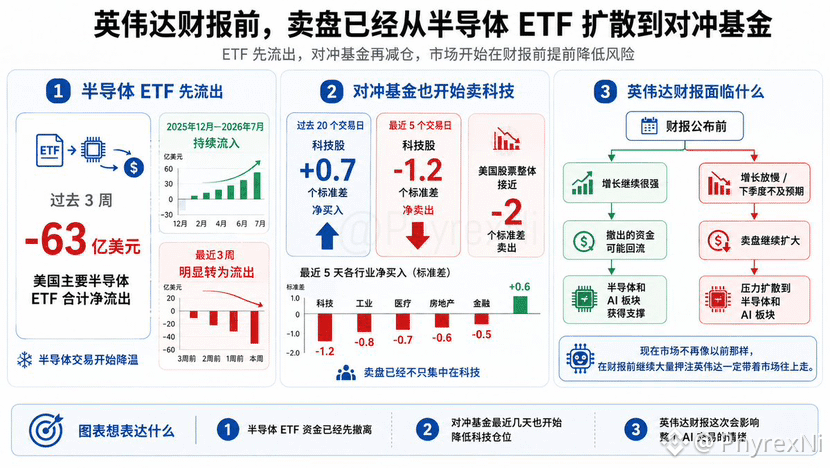
Just a moment ago, I wrote that before Nvidia’s earnings, major U.S. semiconductor ETFs saw net outflows of about $6.3 billion over the prior three weeks. Compared with the prior period—when they had been in a steady inflow from December last year through July this year—semiconductor trading has started to cool noticeably.
Now Goldman Sachs’ data offers another perspective.
Over the past 20 trading days, Goldman’s clients have still been net buyers of U.S. stocks overall, and tech stocks have also remained net buyers by roughly 0.7 standard deviations. But over the most recent five trading days, the direction suddenly flipped. Net selling of U.S. stocks has moved to nearly -2 standard deviations over the past year, and tech stocks have also shifted from prior net buying to net selling of around -1.2 standard deviations.
Prime Book mainly reflects trading activity by hedge funds and large institutions, so this isn’t the same pot of money as the ETF flows seen earlier. Earlier, ETF capital began withdrawing from semiconductors; now, hedge funds are also starting to cut their tech positions.
What’s more, this sell-off hasn’t been confined to tech. Industrials, healthcare, real estate, and financials have all been selling over the past five days. Overall, U.S. stocks have already shown signs of a clear risk contraction, while only a few sectors—such as energy—are still attracting buying flows.
So the market environment facing Nvidia this time is no longer quite the same as in the past few instances. Previously, many funds added to positions in AI and semiconductors ahead of earnings, betting that Nvidia would once again beat expectations. Now, with earnings not yet released, ETFs have already been posting consecutive outflows, and hedge funds are starting to sell tech as well—suggesting that some capital is reducing risk ahead of time.
The biggest question is whether investors will be willing to bring the money back after the earnings are released.
In the past, as long as Nvidia’s revenue beat expectations and it continued to grow in the next quarter, the market was often willing to keep pushing stocks higher. But now, with many funds having already exited early, investors’ expectations are naturally higher. Simply beating expectations by a bit may no longer be enough to satisfy the market.
So if Nvidia continues to deliver strong growth this time, the money that exited earlier still has a chance to return. But if growth starts to slow, or if next quarter’s data isn’t as good as people are hoping, the impact could easily spill over from Nvidia to the entire semiconductor and AI sector.
Before Nvidia’s earnings, selling pressure had already spread from the semiconductor ETFs to hedge funds
Just a moment ago, I wrote that before Nvidia’s earnings, major U.S. semiconductor ETFs saw net outflows of about $6.3 billion over the prior three weeks. Compared with the prior period—when they had been in a steady inflow from December last year through July this year—semiconductor trading has started to cool noticeably.
Now Goldman Sachs’ data offers another perspective.
Over the past 20 trading days, Goldman’s clients have still been net buyers of U.S. stocks overall, and tech stocks have also remained net buyers by roughly 0.7 standard deviations. But over the most recent five trading days, the direction suddenly flipped. Net selling of U.S. stocks has moved to nearly -2 standard deviations over the past year, and tech stocks have also shifted from prior net buying to net selling of around -1.2 standard deviations.
Prime Book mainly reflects trading activity by hedge funds and large institutions, so this isn’t the same pot of money as the ETF flows seen earlier. Earlier, ETF capital began withdrawing from semiconductors; now, hedge funds are also starting to cut their tech positions.
What’s more, this sell-off hasn’t been confined to tech. Industrials, healthcare, real estate, and financials have all been selling over the past five days. Overall, U.S. stocks have already shown signs of a clear risk contraction, while only a few sectors—such as energy—are still attracting buying flows.
So the market environment facing Nvidia this time is no longer quite the same as in the past few instances. Previously, many funds added to positions in AI and semiconductors ahead of earnings, betting that Nvidia would once again beat expectations. Now, with earnings not yet released, ETFs have already been posting consecutive outflows, and hedge funds are starting to sell tech as well—suggesting that some capital is reducing risk ahead of time.
The biggest question is whether investors will be willing to bring the money back after the earnings are released.
In the past, as long as Nvidia’s revenue beat expectations and it continued to grow in the next quarter, the market was often willing to keep pushing stocks higher. But now, with many funds having already exited early, investors’ expectations are naturally higher. Simply beating expectations by a bit may no longer be enough to satisfy the market.
So if Nvidia continues to deliver strong growth this time, the money that exited earlier still has a chance to return. But if growth starts to slow, or if next quarter’s data isn’t as good as people are hoping, the impact could easily spill over from Nvidia to the entire semiconductor and AI sector.
Just a moment ago, I wrote that before Nvidia’s earnings, major U.S. semiconductor ETFs saw net outflows of about $6.3 billion over the prior three weeks. Compared with the prior period—when they had been in a steady inflow from December last year through July this year—semiconductor trading has started to cool noticeably.
Now Goldman Sachs’ data offers another perspective.
Over the past 20 trading days, Goldman’s clients have still been net buyers of U.S. stocks overall, and tech stocks have also remained net buyers by roughly 0.7 standard deviations. But over the most recent five trading days, the direction suddenly flipped. Net selling of U.S. stocks has moved to nearly -2 standard deviations over the past year, and tech stocks have also shifted from prior net buying to net selling of around -1.2 standard deviations.
Prime Book mainly reflects trading activity by hedge funds and large institutions, so this isn’t the same pot of money as the ETF flows seen earlier. Earlier, ETF capital began withdrawing from semiconductors; now, hedge funds are also starting to cut their tech positions.
What’s more, this sell-off hasn’t been confined to tech. Industrials, healthcare, real estate, and financials have all been selling over the past five days. Overall, U.S. stocks have already shown signs of a clear risk contraction, while only a few sectors—such as energy—are still attracting buying flows.
So the market environment facing Nvidia this time is no longer quite the same as in the past few instances. Previously, many funds added to positions in AI and semiconductors ahead of earnings, betting that Nvidia would once again beat expectations. Now, with earnings not yet released, ETFs have already been posting consecutive outflows, and hedge funds are starting to sell tech as well—suggesting that some capital is reducing risk ahead of time.
The biggest question is whether investors will be willing to bring the money back after the earnings are released.
In the past, as long as Nvidia’s revenue beat expectations and it continued to grow in the next quarter, the market was often willing to keep pushing stocks higher. But now, with many funds having already exited early, investors’ expectations are naturally higher. Simply beating expectations by a bit may no longer be enough to satisfy the market.
So if Nvidia continues to deliver strong growth this time, the money that exited earlier still has a chance to return. But if growth starts to slow, or if next quarter’s data isn’t as good as people are hoping, the impact could easily spill over from Nvidia to the entire semiconductor and AI sector.
1
5
4
11.9k
·
--
Verified
Article
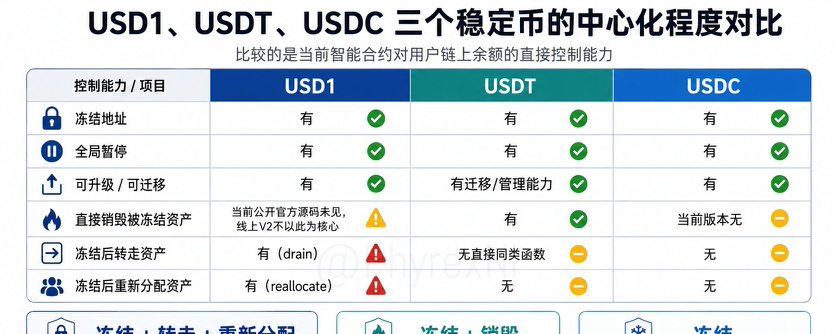
A Comparison of the Centralization of Three Stablecoins — USDC Can Freeze, USDT Can Destroy, and USD1 Can Be Transferred DirectlyThis morning I read Justin’s tweet. I’m not very interested in their lawsuit, but there’s one sentence in Justin’s piece that really caught my attention. It says $USD1 there might be a backdoor.
Actually, if it’s referring to freezing assets, it’s not just USD1 that has this feature—USDT and USDC have it too. Although it’s not decentralized enough, it’s still a good thing for the often chaotic crypto circles like Black Forest.
So I became interested and did a comparison: I put the smart contracts for USD1, USDT, and USDC side by side to see how far the three stablecoin issuers can go in terms of “risk control” over users’ assets.
A Comparison of the Centralization of Three Stablecoins — USDC Can Freeze, USDT Can Destroy, and USD1 Can Be Transferred Directly
This morning I read Justin’s tweet. I’m not very interested in their lawsuit, but there’s one sentence in Justin’s piece that really caught my attention. It says $USD1 there might be a backdoor.
Actually, if it’s referring to freezing assets, it’s not just USD1 that has this feature—USDT and USDC have it too. Although it’s not decentralized enough, it’s still a good thing for the often chaotic crypto circles like Black Forest.
So I became interested and did a comparison: I put the smart contracts for USD1, USDT, and USDC side by side to see how far the three stablecoin issuers can go in terms of “risk control” over users’ assets.
Actually, if it’s referring to freezing assets, it’s not just USD1 that has this feature—USDT and USDC have it too. Although it’s not decentralized enough, it’s still a good thing for the often chaotic crypto circles like Black Forest.
So I became interested and did a comparison: I put the smart contracts for USD1, USDT, and USDC side by side to see how far the three stablecoin issuers can go in terms of “risk control” over users’ assets.
3
2
13
10.3k
·
--
Article
BlackRock re-evaluates Bitcoin—after a 50% drop, it actually believes the investment logic has not changedBlackRock released a 14-page Bitcoin report the day before yesterday, specifically re-evaluating whether, after the drop from last year's all-time high,
it is still worth being included as part of an investment portfolio.
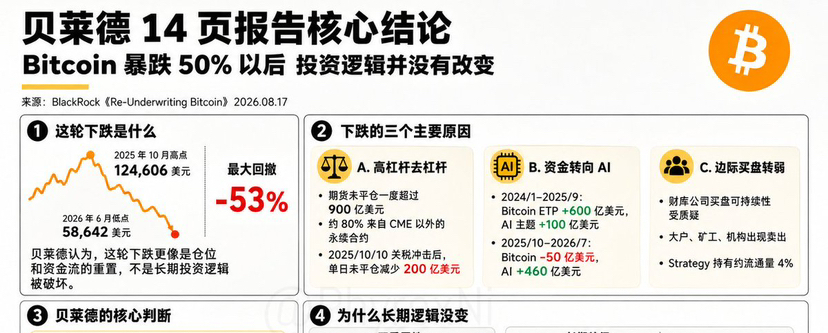
The conclusion of the report is that although Bitcoin fell from its October 2025 peak of $124,606 to a low of $58,642 this June—representing a drawdown of more than 50%—this was mainly a deleveraging and positioning purge driven by fund flows, and not a change in Bitcoin’s long-term investment thesis.
When Bitcoin rose above $120,000 last October, the total crypto market futures open interest had already exceeded $90 billion, about 80% of which came from perpetual contracts outside the CME.
BlackRock re-evaluates Bitcoin—after a 50% drop, it actually believes the investment logic has not changed
BlackRock released a 14-page Bitcoin report the day before yesterday, specifically re-evaluating whether, after the drop from last year's all-time high,
it is still worth being included as part of an investment portfolio.
The conclusion of the report is that although Bitcoin fell from its October 2025 peak of $124,606 to a low of $58,642 this June—representing a drawdown of more than 50%—this was mainly a deleveraging and positioning purge driven by fund flows, and not a change in Bitcoin’s long-term investment thesis.
When Bitcoin rose above $120,000 last October, the total crypto market futures open interest had already exceeded $90 billion, about 80% of which came from perpetual contracts outside the CME.
it is still worth being included as part of an investment portfolio.
The conclusion of the report is that although Bitcoin fell from its October 2025 peak of $124,606 to a low of $58,642 this June—representing a drawdown of more than 50%—this was mainly a deleveraging and positioning purge driven by fund flows, and not a change in Bitcoin’s long-term investment thesis.
When Bitcoin rose above $120,000 last October, the total crypto market futures open interest had already exceeded $90 billion, about 80% of which came from perpetual contracts outside the CME.
2
1
8
7.9k
·
--
Verified
Article
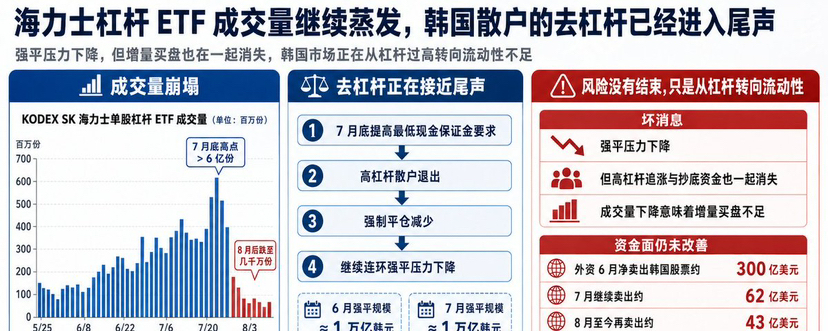
Hynix leveraged ETF trading volume continues to evaporate, and South Korean retail investors' deleveraging is nearing its endA few days ago, I wrote about the ebb of leverage in South Korea's retail investor leveraged ETFs for SK Hynix. At that time, according to Bloomberg, among the seven SK Hynix leveraged ETFs, trading volume had fallen from a peak of nearly 800 million shares at the end of July to below 100 million shares.
Now the latest data further confirms this trend. Specifically, the KODEX SK Hynix single-stock leveraged ETF saw its daily trading volume exceed 600 million units at the end of July, but quickly dropped to just a few tens of millions after August. Compared with the peak, it has shrunk by more than 90%.
This indicates that the most aggressive round of deleveraging in the South Korean market is indeed nearing its end.
Hynix leveraged ETF trading volume continues to evaporate, and South Korean retail investors' deleveraging is nearing its end
A few days ago, I wrote about the ebb of leverage in South Korea's retail investor leveraged ETFs for SK Hynix. At that time, according to Bloomberg, among the seven SK Hynix leveraged ETFs, trading volume had fallen from a peak of nearly 800 million shares at the end of July to below 100 million shares.
Now the latest data further confirms this trend. Specifically, the KODEX SK Hynix single-stock leveraged ETF saw its daily trading volume exceed 600 million units at the end of July, but quickly dropped to just a few tens of millions after August. Compared with the peak, it has shrunk by more than 90%.
This indicates that the most aggressive round of deleveraging in the South Korean market is indeed nearing its end.
Now the latest data further confirms this trend. Specifically, the KODEX SK Hynix single-stock leveraged ETF saw its daily trading volume exceed 600 million units at the end of July, but quickly dropped to just a few tens of millions after August. Compared with the peak, it has shrunk by more than 90%.
This indicates that the most aggressive round of deleveraging in the South Korean market is indeed nearing its end.
4.6k
·
--
Partly True
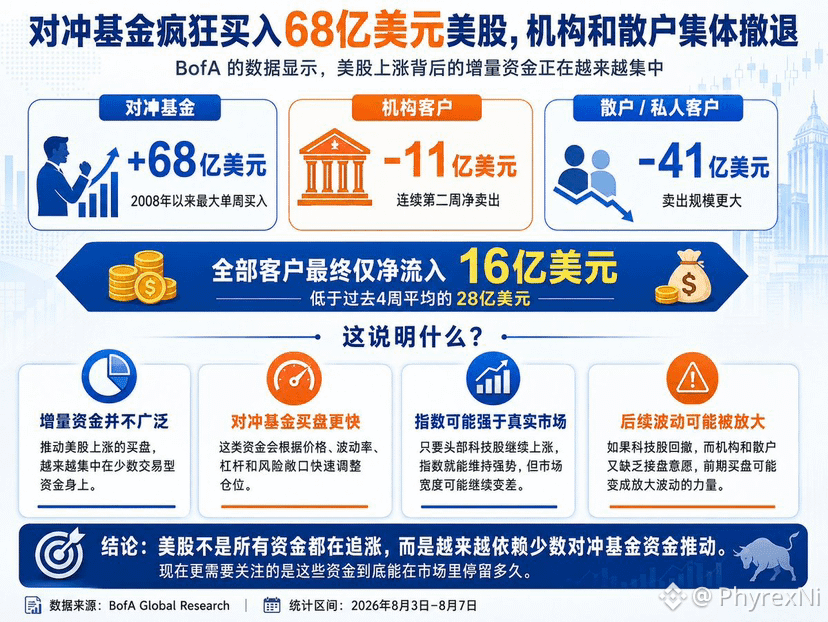
Hedge funds疯狂买入$6.8 billion worth of U.S. stocks; institutions and retail investors collectively retreat
According to data from BofA, during the week of August 3 to 7, hedge fund clients net bought about $6.8 billion worth of U.S. stocks and stock ETFs— the largest single-week buying volume since BofA began tracking in 2008.
However, in the same period, institutional clients net sold about $1.1 billion, marking the second consecutive week of net selling. Private clients’ net selling was even larger, reaching $4.1 billion.
So even though hedge funds’ buying that week set a historical record, BofA’s total customer flow ended up net inflowing only $1.6 billion—still below the average of $2.8 billion over the past four weeks.
This suggests that the incremental capital driving U.S. equities has not become broader; instead, it is increasingly concentrated in a small number of trading-oriented funds, and the market has not developed a situation where all investors are chasing the rally together.
The biggest difference between hedge funds and institutional funds is that position adjustments typically happen faster for the former. Institutions are often willing to hold positions longer, while hedge funds more frequently need to adjust based on price, volatility, leverage, and risk exposure. As a result, while hedge funds’ short-term buying can push prices higher, that kind of buying pressure is not necessarily stable.
Especially now, when U.S. equity capital is highly concentrated in technology stocks. When the index rises, the stronger the price action, the more willing money is to keep concentrating—leading to even higher weights in top stocks. In the end, the index may look stronger than the broader market’s actual condition.
But if tech stocks begin to show a more noticeable pullback, hedge funds may cut positions much faster than institutions. And since neither institutions nor retail investors are showing strong willingness to step in as buyers right now, the same funds that pushed the index up earlier could later become amplifiers of volatility.
Therefore, the key issue for U.S. equities now is how long these funds can actually stay in the market.
Hedge funds疯狂买入$6.8 billion worth of U.S. stocks; institutions and retail investors collectively retreat
According to data from BofA, during the week of August 3 to 7, hedge fund clients net bought about $6.8 billion worth of U.S. stocks and stock ETFs— the largest single-week buying volume since BofA began tracking in 2008.
However, in the same period, institutional clients net sold about $1.1 billion, marking the second consecutive week of net selling. Private clients’ net selling was even larger, reaching $4.1 billion.
So even though hedge funds’ buying that week set a historical record, BofA’s total customer flow ended up net inflowing only $1.6 billion—still below the average of $2.8 billion over the past four weeks.
This suggests that the incremental capital driving U.S. equities has not become broader; instead, it is increasingly concentrated in a small number of trading-oriented funds, and the market has not developed a situation where all investors are chasing the rally together.
The biggest difference between hedge funds and institutional funds is that position adjustments typically happen faster for the former. Institutions are often willing to hold positions longer, while hedge funds more frequently need to adjust based on price, volatility, leverage, and risk exposure. As a result, while hedge funds’ short-term buying can push prices higher, that kind of buying pressure is not necessarily stable.
Especially now, when U.S. equity capital is highly concentrated in technology stocks. When the index rises, the stronger the price action, the more willing money is to keep concentrating—leading to even higher weights in top stocks. In the end, the index may look stronger than the broader market’s actual condition.
But if tech stocks begin to show a more noticeable pullback, hedge funds may cut positions much faster than institutions. And since neither institutions nor retail investors are showing strong willingness to step in as buyers right now, the same funds that pushed the index up earlier could later become amplifiers of volatility.
Therefore, the key issue for U.S. equities now is how long these funds can actually stay in the market.
According to data from BofA, during the week of August 3 to 7, hedge fund clients net bought about $6.8 billion worth of U.S. stocks and stock ETFs— the largest single-week buying volume since BofA began tracking in 2008.
However, in the same period, institutional clients net sold about $1.1 billion, marking the second consecutive week of net selling. Private clients’ net selling was even larger, reaching $4.1 billion.
So even though hedge funds’ buying that week set a historical record, BofA’s total customer flow ended up net inflowing only $1.6 billion—still below the average of $2.8 billion over the past four weeks.
This suggests that the incremental capital driving U.S. equities has not become broader; instead, it is increasingly concentrated in a small number of trading-oriented funds, and the market has not developed a situation where all investors are chasing the rally together.
The biggest difference between hedge funds and institutional funds is that position adjustments typically happen faster for the former. Institutions are often willing to hold positions longer, while hedge funds more frequently need to adjust based on price, volatility, leverage, and risk exposure. As a result, while hedge funds’ short-term buying can push prices higher, that kind of buying pressure is not necessarily stable.
Especially now, when U.S. equity capital is highly concentrated in technology stocks. When the index rises, the stronger the price action, the more willing money is to keep concentrating—leading to even higher weights in top stocks. In the end, the index may look stronger than the broader market’s actual condition.
But if tech stocks begin to show a more noticeable pullback, hedge funds may cut positions much faster than institutions. And since neither institutions nor retail investors are showing strong willingness to step in as buyers right now, the same funds that pushed the index up earlier could later become amplifiers of volatility.
Therefore, the key issue for U.S. equities now is how long these funds can actually stay in the market.
1
2.9k
·
--

Article
The biggest problem with AI + Crypto is that most projects don’t actually need CryptoToday I happened to talk with some friends from @BNB_Chain about the topic of AI + Crypto. My personal view is that most of the AI + Crypto in the market right now is essentially pseudo-demand.
Even in traditional industries, AI itself is still in the stage of rapid deployment and continuous exploration of business models. There aren’t nearly as many scenarios where it can reliably generate revenue, significantly reduce costs, and improve efficiency as people imagine. After adding Crypto, this problem will only become even more obvious.
I think the AI we have right now is mainly still used for auxiliary education, auxiliary research, auxiliary trading, and auxiliary decision-making—such as organizing on-chain data, reading news, analyzing projects, explaining contracts, finding trading opportunities, and so on. But in practice, these functions truly depend on model capability, data quality, compute power, engineering ability, and inference cost. In many cases, blockchain doesn't really play a uniquely irreplaceable role.
The biggest problem with AI + Crypto is that most projects don’t actually need Crypto
Today I happened to talk with some friends from @BNB_Chain about the topic of AI + Crypto. My personal view is that most of the AI + Crypto in the market right now is essentially pseudo-demand.
Even in traditional industries, AI itself is still in the stage of rapid deployment and continuous exploration of business models. There aren’t nearly as many scenarios where it can reliably generate revenue, significantly reduce costs, and improve efficiency as people imagine. After adding Crypto, this problem will only become even more obvious.
I think the AI we have right now is mainly still used for auxiliary education, auxiliary research, auxiliary trading, and auxiliary decision-making—such as organizing on-chain data, reading news, analyzing projects, explaining contracts, finding trading opportunities, and so on. But in practice, these functions truly depend on model capability, data quality, compute power, engineering ability, and inference cost. In many cases, blockchain doesn't really play a uniquely irreplaceable role.
Even in traditional industries, AI itself is still in the stage of rapid deployment and continuous exploration of business models. There aren’t nearly as many scenarios where it can reliably generate revenue, significantly reduce costs, and improve efficiency as people imagine. After adding Crypto, this problem will only become even more obvious.
I think the AI we have right now is mainly still used for auxiliary education, auxiliary research, auxiliary trading, and auxiliary decision-making—such as organizing on-chain data, reading news, analyzing projects, explaining contracts, finding trading opportunities, and so on. But in practice, these functions truly depend on model capability, data quality, compute power, engineering ability, and inference cost. In many cases, blockchain doesn't really play a uniquely irreplaceable role.
1.8k
·
--
Partly True
Article
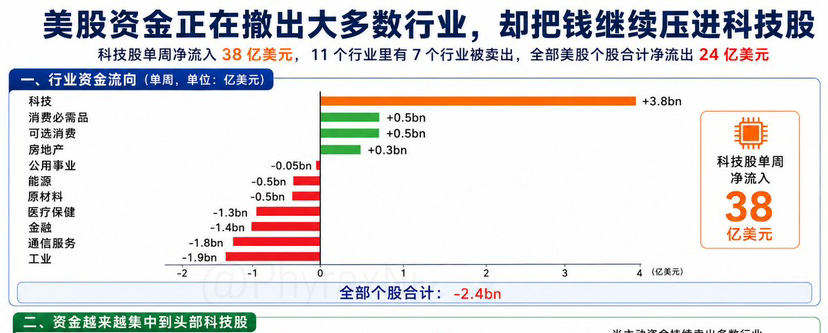
U.S. stock funds are withdrawing from most industries, yet continuing to pile money into technology stocksI previously wrote an article noting that retail investors in the U.S. have recently started reducing their purchases of individual stocks, with some even turning to net selling, while remaining relatively stable in their net purchases of ETFs. At the time, my judgment was that retail investors had not truly left the U.S. stock market; instead, they were lowering their risk—shifting from trying to outperform the market with a particular stock to betting that the whole U.S. stock market can continue to rise.
Recent data from BofA once again supports this view. In the past week, BofA clients made net purchases of U.S. technology stock individual names totaling about $3.8 billion, the second-largest single-week buying volume in history. However, at the same time, among 11 industries, 7 saw net selling, and the combined net result for all individual U.S. stocks was actually net selling of $2.4 billion.
U.S. stock funds are withdrawing from most industries, yet continuing to pile money into technology stocks
I previously wrote an article noting that retail investors in the U.S. have recently started reducing their purchases of individual stocks, with some even turning to net selling, while remaining relatively stable in their net purchases of ETFs. At the time, my judgment was that retail investors had not truly left the U.S. stock market; instead, they were lowering their risk—shifting from trying to outperform the market with a particular stock to betting that the whole U.S. stock market can continue to rise.
Recent data from BofA once again supports this view. In the past week, BofA clients made net purchases of U.S. technology stock individual names totaling about $3.8 billion, the second-largest single-week buying volume in history. However, at the same time, among 11 industries, 7 saw net selling, and the combined net result for all individual U.S. stocks was actually net selling of $2.4 billion.
Recent data from BofA once again supports this view. In the past week, BofA clients made net purchases of U.S. technology stock individual names totaling about $3.8 billion, the second-largest single-week buying volume in history. However, at the same time, among 11 industries, 7 saw net selling, and the combined net result for all individual U.S. stocks was actually net selling of $2.4 billion.
1
1
2.7k
·
--
Verified
Article
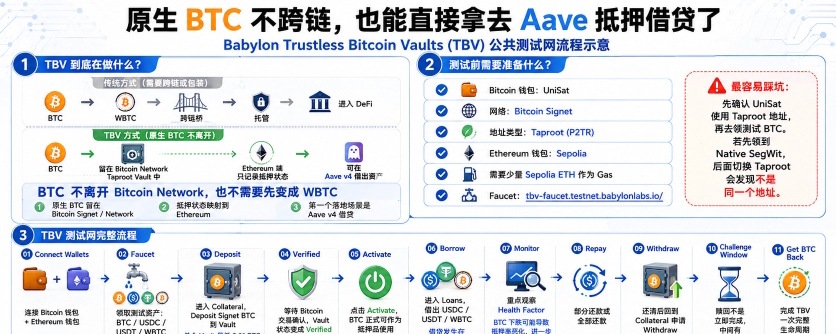
Native BTC doesn’t need to be bridged cross-chain—it's directly usable for Aave collateral/borrowingBabylon recently launched a public testnet for Trustless Bitcoin Vaults (TBV), and I ran through the process myself. The most essential part of TBV is actually easy to understand: in the past, to get BTC into DeFi, most of the time you had to first convert it into a wrapped/mapped asset like WBTC, or go through cross-chain bridges and custodians. What TBV aims to do is to keep BTC on the Bitcoin Network, while directly turning it into collateral that other applications on other chains can use. The first deployment scenario is Aave v4. That means you can use native BTC as collateral and then borrow assets on Ethereum, such as USDC and USDT.
Native BTC doesn’t need to be bridged cross-chain—it's directly usable for Aave collateral/borrowing
Babylon recently launched a public testnet for Trustless Bitcoin Vaults (TBV), and I ran through the process myself. The most essential part of TBV is actually easy to understand: in the past, to get BTC into DeFi, most of the time you had to first convert it into a wrapped/mapped asset like WBTC, or go through cross-chain bridges and custodians. What TBV aims to do is to keep BTC on the Bitcoin Network, while directly turning it into collateral that other applications on other chains can use. The first deployment scenario is Aave v4. That means you can use native BTC as collateral and then borrow assets on Ethereum, such as USDC and USDT.
5
7
6.3k
·
--
Article
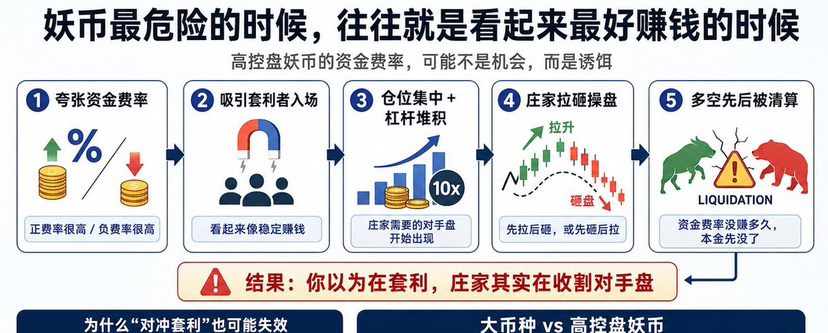
When meme coins are at their most dangerous, it’s often when they look like they’re making the most moneyI saw a friend say that “meme coins” can be used to do funding-rate arbitrage. But from my own understanding, it doesn’t seem worth it to try to farm funding rates from projects that are clearly heavily controlled/managed. In the past, I wrote that for heavily controlled projects, what the market maker/big player needs is counter-parties. Only with enough counter-parties can the maker make money.
And to some extent, funding rates can also be influenced, even deliberately manufactured. For example, the simplest case is when the spot price is clearly higher than the perpetual contract price. Once the perpetual contracts fall into a discount (i.e., a negative basis), it often leads to negative funding rates. Conversely, if perpetual contracts remain higher than spot for a long time, it also becomes more likely to see relatively high positive funding rates.
When meme coins are at their most dangerous, it’s often when they look like they’re making the most money
I saw a friend say that “meme coins” can be used to do funding-rate arbitrage. But from my own understanding, it doesn’t seem worth it to try to farm funding rates from projects that are clearly heavily controlled/managed. In the past, I wrote that for heavily controlled projects, what the market maker/big player needs is counter-parties. Only with enough counter-parties can the maker make money.
And to some extent, funding rates can also be influenced, even deliberately manufactured. For example, the simplest case is when the spot price is clearly higher than the perpetual contract price. Once the perpetual contracts fall into a discount (i.e., a negative basis), it often leads to negative funding rates. Conversely, if perpetual contracts remain higher than spot for a long time, it also becomes more likely to see relatively high positive funding rates.
And to some extent, funding rates can also be influenced, even deliberately manufactured. For example, the simplest case is when the spot price is clearly higher than the perpetual contract price. Once the perpetual contracts fall into a discount (i.e., a negative basis), it often leads to negative funding rates. Conversely, if perpetual contracts remain higher than spot for a long time, it also becomes more likely to see relatively high positive funding rates.
2
2
4.5k
·
--
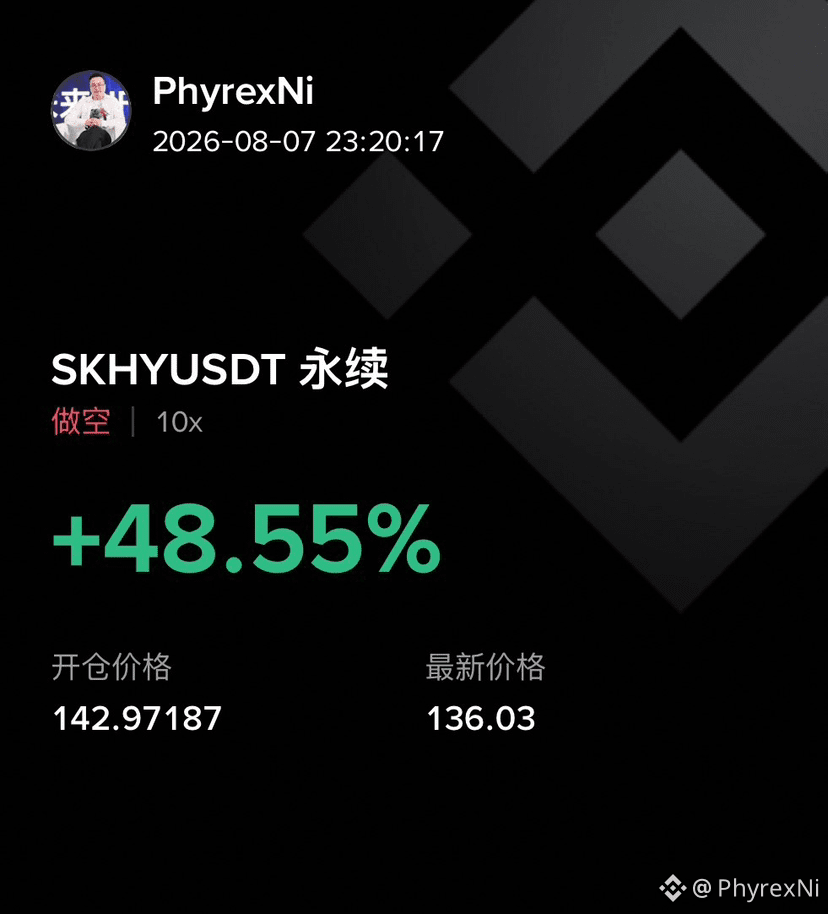
Pure luck. Before I shorted the chipmunk in the afternoon, I was shorting ADR—still lost nearly 20%. At the time I basically just decided to bet blindly. Then by afternoon, the short at $145 got eaten, and while I was still considering whether to stop-loss, the ADR kept dropping.
I’m happy to keep holding. Turned out I held it until just now, and then I noticed the ADR shows signs of bouncing back from 134. After getting burned this morning, it’s already nearly up 50%. I’ve covered my meals for the next two days—what more do I need? I closed it straight at 136.
What happens next—whether it rises or falls—has nothing to do with me anymore. The rest is just about what happens tomorrow morning. Every day, my $SKHY won’t be carried overnight. Closing early today means I can rest earlier too.
{future}(SKHYUSDT)
Pure luck. Before I shorted the chipmunk in the afternoon, I was shorting ADR—still lost nearly 20%. At the time I basically just decided to bet blindly. Then by afternoon, the short at $145 got eaten, and while I was still considering whether to stop-loss, the ADR kept dropping.
I’m happy to keep holding. Turned out I held it until just now, and then I noticed the ADR shows signs of bouncing back from 134. After getting burned this morning, it’s already nearly up 50%. I’ve covered my meals for the next two days—what more do I need? I closed it straight at 136.
What happens next—whether it rises or falls—has nothing to do with me anymore. The rest is just about what happens tomorrow morning. Every day, my $SKHY won’t be carried overnight. Closing early today means I can rest earlier too.
I’m happy to keep holding. Turned out I held it until just now, and then I noticed the ADR shows signs of bouncing back from 134. After getting burned this morning, it’s already nearly up 50%. I’ve covered my meals for the next two days—what more do I need? I closed it straight at 136.
What happens next—whether it rises or falls—has nothing to do with me anymore. The rest is just about what happens tomorrow morning. Every day, my $SKHY won’t be carried overnight. Closing early today means I can rest earlier too.
PhyrexNi
·
--
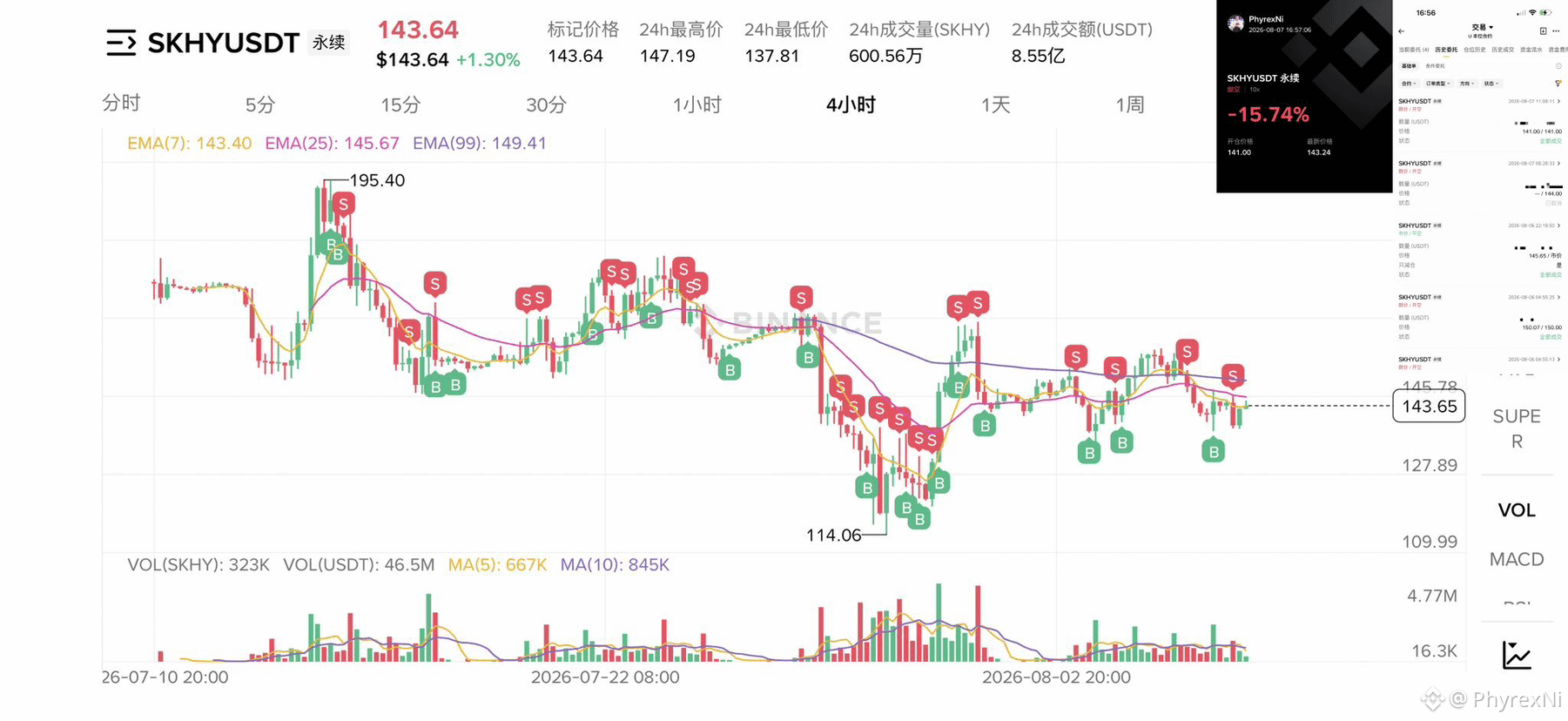
😂I’m really annoyed today. At around 8 a.m. when I got up, I saw that SK in the Korean stock market was falling. At that time it hadn’t dropped much—only about 0.5%—but $SKHY had already fallen more than 1%. My judgment was that SK would probably keep dropping, but I wasn’t sure whether it might bounce a bit before dropping again. Back then, SKHYUSDT was around $142, so I placed an order at $144, then went to sleep.
When I woke up at just after 11, I found my order at $144 didn’t get filled. At that time SK had already dropped 4%. I felt it might be another circuit breaker situation, so I opened a short position at $141, then went out to take care of things.
Sometime just before 3 p.m., I checked and saw I was up about 30%. In situations like this, I usually set a stop-loss (take-profit) level to lock in at least 20% of the gains. But I was in a meeting, so I forgot 😂.
After the meeting, I checked again and it was actually down more than 20%. I was so frustrated. Right in front of me there were only two options: either stop-loss immediately, or wait until the evening market open. I hesitated, then placed another order at $145 and planned to wait until the evening. If that night $145 got filled and I was still in the red, then I’d stop-loss. If there was still a possibility of further downside, then I’d hold on a bit longer.
Originally I didn’t have to gamble tonight. Having a 20% profit already would be enough for today’s meal expenses. But because of one careless mistake, I was forced to gamble on the evening. Mainly it was because I had too many things to deal with today—it’s only now that I just turned on the computer. Then I have to go to the airport to pick up Hazel/Flower Rabbit (the “花栗鼠”), bring him home, cook dinner for him, and open the computer again… it’ll probably be late tonight. I’ll just write a bit at the airport. Feeling awful.
When I woke up at just after 11, I found my order at $144 didn’t get filled. At that time SK had already dropped 4%. I felt it might be another circuit breaker situation, so I opened a short position at $141, then went out to take care of things.
Sometime just before 3 p.m., I checked and saw I was up about 30%. In situations like this, I usually set a stop-loss (take-profit) level to lock in at least 20% of the gains. But I was in a meeting, so I forgot 😂.
After the meeting, I checked again and it was actually down more than 20%. I was so frustrated. Right in front of me there were only two options: either stop-loss immediately, or wait until the evening market open. I hesitated, then placed another order at $145 and planned to wait until the evening. If that night $145 got filled and I was still in the red, then I’d stop-loss. If there was still a possibility of further downside, then I’d hold on a bit longer.
Originally I didn’t have to gamble tonight. Having a 20% profit already would be enough for today’s meal expenses. But because of one careless mistake, I was forced to gamble on the evening. Mainly it was because I had too many things to deal with today—it’s only now that I just turned on the computer. Then I have to go to the airport to pick up Hazel/Flower Rabbit (the “花栗鼠”), bring him home, cook dinner for him, and open the computer again… it’ll probably be late tonight. I’ll just write a bit at the airport. Feeling awful.
1
4
7.4k
·
--
😂I’m really annoyed today. At around 8 a.m. when I got up, I saw that SK in the Korean stock market was falling. At that time it hadn’t dropped much—only about 0.5%—but $SKHY had already fallen more than 1%. My judgment was that SK would probably keep dropping, but I wasn’t sure whether it might bounce a bit before dropping again. Back then, SKHYUSDT was around $142, so I placed an order at $144, then went to sleep.
When I woke up at just after 11, I found my order at $144 didn’t get filled. At that time SK had already dropped 4%. I felt it might be another circuit breaker situation, so I opened a short position at $141, then went out to take care of things.
Sometime just before 3 p.m., I checked and saw I was up about 30%. In situations like this, I usually set a stop-loss (take-profit) level to lock in at least 20% of the gains. But I was in a meeting, so I forgot 😂.
After the meeting, I checked again and it was actually down more than 20%. I was so frustrated. Right in front of me there were only two options: either stop-loss immediately, or wait until the evening market open. I hesitated, then placed another order at $145 and planned to wait until the evening. If that night $145 got filled and I was still in the red, then I’d stop-loss. If there was still a possibility of further downside, then I’d hold on a bit longer.
Originally I didn’t have to gamble tonight. Having a 20% profit already would be enough for today’s meal expenses. But because of one careless mistake, I was forced to gamble on the evening. Mainly it was because I had too many things to deal with today—it’s only now that I just turned on the computer. Then I have to go to the airport to pick up Hazel/Flower Rabbit (the “花栗鼠”), bring him home, cook dinner for him, and open the computer again… it’ll probably be late tonight. I’ll just write a bit at the airport. Feeling awful.
{future}(SKHYUSDT)
😂I’m really annoyed today. At around 8 a.m. when I got up, I saw that SK in the Korean stock market was falling. At that time it hadn’t dropped much—only about 0.5%—but $SKHY had already fallen more than 1%. My judgment was that SK would probably keep dropping, but I wasn’t sure whether it might bounce a bit before dropping again. Back then, SKHYUSDT was around $142, so I placed an order at $144, then went to sleep.
When I woke up at just after 11, I found my order at $144 didn’t get filled. At that time SK had already dropped 4%. I felt it might be another circuit breaker situation, so I opened a short position at $141, then went out to take care of things.
Sometime just before 3 p.m., I checked and saw I was up about 30%. In situations like this, I usually set a stop-loss (take-profit) level to lock in at least 20% of the gains. But I was in a meeting, so I forgot 😂.
After the meeting, I checked again and it was actually down more than 20%. I was so frustrated. Right in front of me there were only two options: either stop-loss immediately, or wait until the evening market open. I hesitated, then placed another order at $145 and planned to wait until the evening. If that night $145 got filled and I was still in the red, then I’d stop-loss. If there was still a possibility of further downside, then I’d hold on a bit longer.
Originally I didn’t have to gamble tonight. Having a 20% profit already would be enough for today’s meal expenses. But because of one careless mistake, I was forced to gamble on the evening. Mainly it was because I had too many things to deal with today—it’s only now that I just turned on the computer. Then I have to go to the airport to pick up Hazel/Flower Rabbit (the “花栗鼠”), bring him home, cook dinner for him, and open the computer again… it’ll probably be late tonight. I’ll just write a bit at the airport. Feeling awful.
When I woke up at just after 11, I found my order at $144 didn’t get filled. At that time SK had already dropped 4%. I felt it might be another circuit breaker situation, so I opened a short position at $141, then went out to take care of things.
Sometime just before 3 p.m., I checked and saw I was up about 30%. In situations like this, I usually set a stop-loss (take-profit) level to lock in at least 20% of the gains. But I was in a meeting, so I forgot 😂.
After the meeting, I checked again and it was actually down more than 20%. I was so frustrated. Right in front of me there were only two options: either stop-loss immediately, or wait until the evening market open. I hesitated, then placed another order at $145 and planned to wait until the evening. If that night $145 got filled and I was still in the red, then I’d stop-loss. If there was still a possibility of further downside, then I’d hold on a bit longer.
Originally I didn’t have to gamble tonight. Having a 20% profit already would be enough for today’s meal expenses. But because of one careless mistake, I was forced to gamble on the evening. Mainly it was because I had too many things to deal with today—it’s only now that I just turned on the computer. Then I have to go to the airport to pick up Hazel/Flower Rabbit (the “花栗鼠”), bring him home, cook dinner for him, and open the computer again… it’ll probably be late tonight. I’ll just write a bit at the airport. Feeling awful.
4
1
6
23.9k
·
--
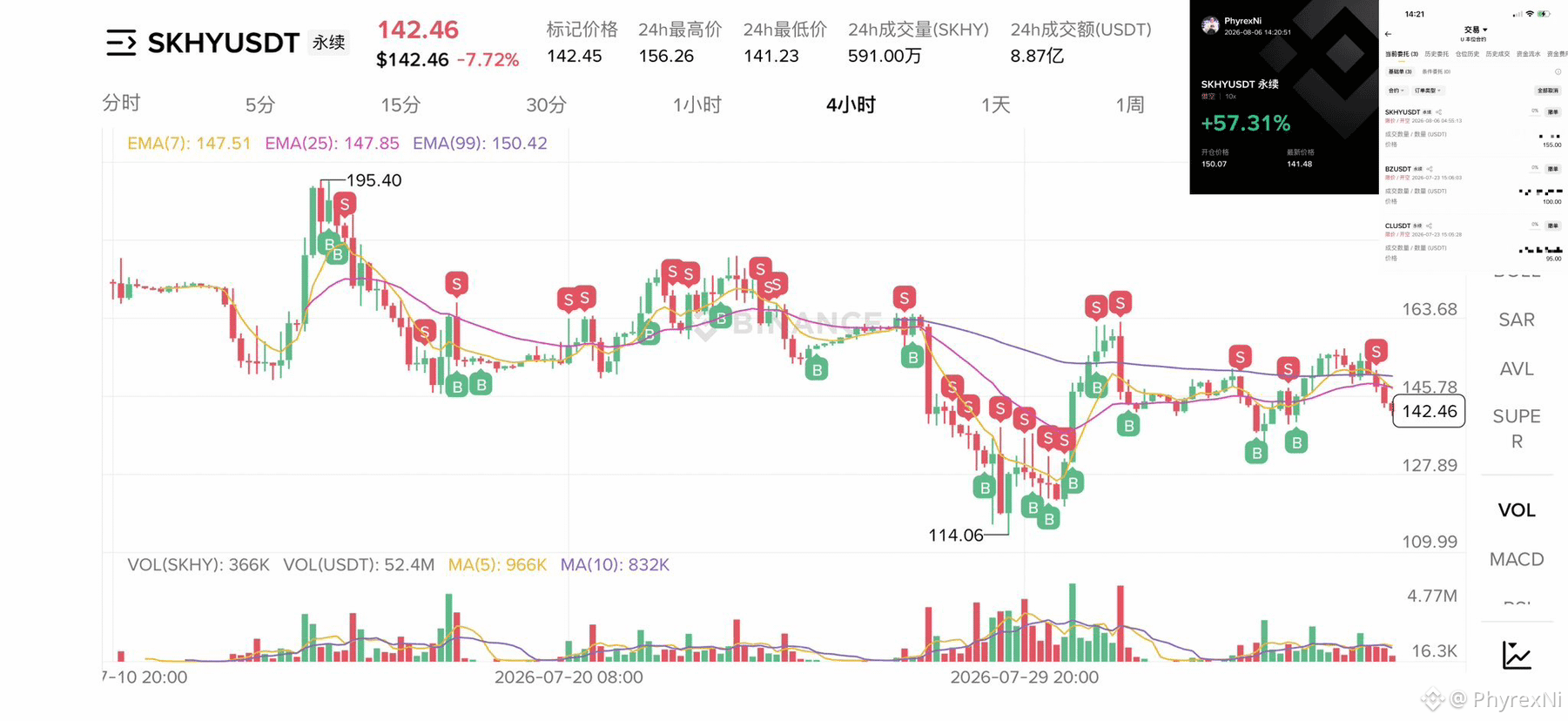
Didn’t short for two straight days. After that, Hai Kise ADR finally gave me an opportunity today in the early hours. The past two days, I watched both SK and the ADRs rising, but the rebound felt extremely forced. I’ve also been keeping an eye on the data for Korean stocks and found that leverage is still quite high, and overseas funds don’t seem very proactive about bottom-fishing. Most importantly, leverage in U.S. semiconductors is also very high, and even retail investors in the U.S. have started to flee.
So in the early hours, I noticed that although SK was up during the day, the ADRs were consistently down throughout the night. This situation is something I’ve never seen before. Either the ADRs are starting to kill the high premium, or semiconductors are being dumped by users. If it’s the former, shorting could be risky; but if it’s the latter, shorting is essentially a sure thing.
At the time, my plan was to short at $150, then add another short at $155. That way, if it turns out to be that SK rises during the day and the ADRs also go up, I could still try to gauge whether the ADRs would continue to compress their premium at night. But if it’s retail investors selling off, then SK would likely fall during the day and the ADRs would probably follow suit. In the end, everyone knows how that worked out.
I woke up a bit after 8 in the morning and saw that SK had already dropped more than 5%, so I didn’t pay attention further and went back to sleep. Currently, my stop-loss (take-profit) at $SKHY is set at $147 to prevent a rebound in the afternoon or evening.
{future}(SKHYUSDT)
Didn’t short for two straight days. After that, Hai Kise ADR finally gave me an opportunity today in the early hours. The past two days, I watched both SK and the ADRs rising, but the rebound felt extremely forced. I’ve also been keeping an eye on the data for Korean stocks and found that leverage is still quite high, and overseas funds don’t seem very proactive about bottom-fishing. Most importantly, leverage in U.S. semiconductors is also very high, and even retail investors in the U.S. have started to flee.
So in the early hours, I noticed that although SK was up during the day, the ADRs were consistently down throughout the night. This situation is something I’ve never seen before. Either the ADRs are starting to kill the high premium, or semiconductors are being dumped by users. If it’s the former, shorting could be risky; but if it’s the latter, shorting is essentially a sure thing.
At the time, my plan was to short at $150, then add another short at $155. That way, if it turns out to be that SK rises during the day and the ADRs also go up, I could still try to gauge whether the ADRs would continue to compress their premium at night. But if it’s retail investors selling off, then SK would likely fall during the day and the ADRs would probably follow suit. In the end, everyone knows how that worked out.
I woke up a bit after 8 in the morning and saw that SK had already dropped more than 5%, so I didn’t pay attention further and went back to sleep. Currently, my stop-loss (take-profit) at $SKHY is set at $147 to prevent a rebound in the afternoon or evening.
So in the early hours, I noticed that although SK was up during the day, the ADRs were consistently down throughout the night. This situation is something I’ve never seen before. Either the ADRs are starting to kill the high premium, or semiconductors are being dumped by users. If it’s the former, shorting could be risky; but if it’s the latter, shorting is essentially a sure thing.
At the time, my plan was to short at $150, then add another short at $155. That way, if it turns out to be that SK rises during the day and the ADRs also go up, I could still try to gauge whether the ADRs would continue to compress their premium at night. But if it’s retail investors selling off, then SK would likely fall during the day and the ADRs would probably follow suit. In the end, everyone knows how that worked out.
I woke up a bit after 8 in the morning and saw that SK had already dropped more than 5%, so I didn’t pay attention further and went back to sleep. Currently, my stop-loss (take-profit) at $SKHY is set at $147 to prevent a rebound in the afternoon or evening.
2
7
16.6k
·
--
Partly True
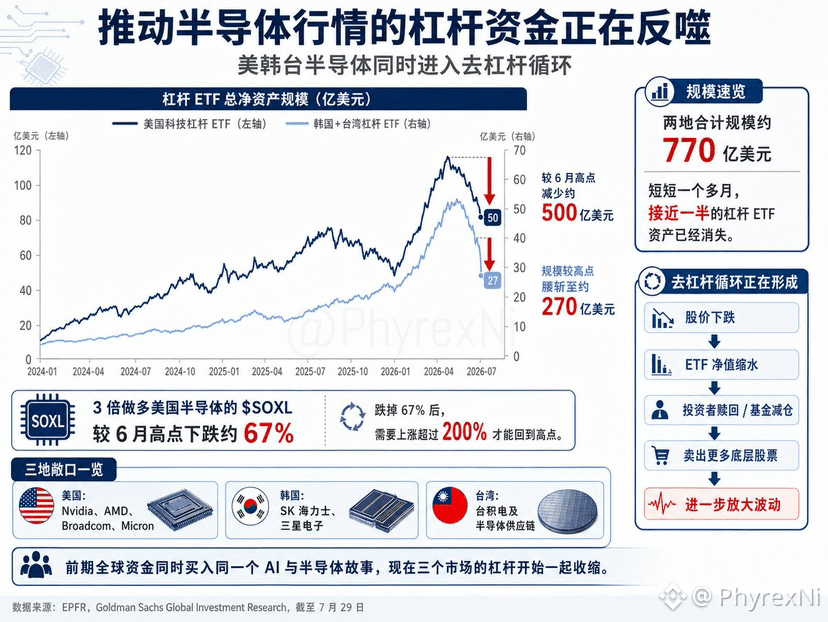
The leveraged funds driving the semiconductor market are starting to turn on themselves. The U.S., South Korea, and Taiwan all enter a deleveraging cycle at the same time.
In June, more leveraged ETFs kept adding fuel to the AI and semiconductor rally. By July, they began rapidly reversing and deleveraging. The assets of U.S. technology leveraged ETFs have fallen by about $50 billion from their June peak, and now stand at just under $50 billion—back to the lowest level since April.
The leveraged ETFs related to South Korea and Taiwan have also declined by more than half from their peaks, leaving about $27 billion. Combined, the two markets still have roughly $77 billion. In just a little over a month, nearly half of the leveraged ETF assets have disappeared.
The shrinkage in leveraged ETF size comes from several sources: part is net asset value losses caused by declines in the underlying stocks, part is investors’ active redemptions, and part is the daily rebalancing funds perform to maintain 2x or 3x leverage. After investors redeem, the funds must sell stocks. Once the underlying stocks fall, to maintain the target leverage, the funds also need to reduce their positions.
When markets are rising, this mechanism continually creates mechanical buy pressure. As share prices rise, the ETF’s net asset value increases. To keep maintaining a fixed leverage ratio, the fund has to keep buying the underlying stocks. The higher the stock price goes, the more shares it buys, and the larger the fund size becomes.
After the trend reverses, the whole process goes the other way. Stock declines cause the ETF’s net asset value to shrink; the fund starts cutting exposure. As investors see losses widen, they continue redeeming, which in turn forces the fund to sell even more underlying stocks.
The 3x long U.S. semiconductor ETF, $SOXL, is already down about 67% from its June peak. After falling 67%, it would need to rise more than 200% just to return to its original level.
U.S. technology products are betting on Nvidia, AMD, Broadcom, and Micron. South Korean capital is concentrated in SK Hynix and Samsung Electronics. Taiwan’s bets are concentrated in TSMC and the semiconductor supply chain. Ultimately, all these bets are on AI computing power, advanced manufacturing processes, and memory chips.
Earlier on, global funds were buying the same story at the same time. Leveraged ETFs further amplified that trade. Now that U.S. tech stocks and South Korean semiconductors are falling at the same time, leverage in all three markets has started contracting together.
Of course, with leveraged ETF assets already nearing a half cut, that also indicates that the exposure created by leverage is being cleared.
The leveraged funds driving the semiconductor market are starting to turn on themselves. The U.S., South Korea, and Taiwan all enter a deleveraging cycle at the same time.
In June, more leveraged ETFs kept adding fuel to the AI and semiconductor rally. By July, they began rapidly reversing and deleveraging. The assets of U.S. technology leveraged ETFs have fallen by about $50 billion from their June peak, and now stand at just under $50 billion—back to the lowest level since April.
The leveraged ETFs related to South Korea and Taiwan have also declined by more than half from their peaks, leaving about $27 billion. Combined, the two markets still have roughly $77 billion. In just a little over a month, nearly half of the leveraged ETF assets have disappeared.
The shrinkage in leveraged ETF size comes from several sources: part is net asset value losses caused by declines in the underlying stocks, part is investors’ active redemptions, and part is the daily rebalancing funds perform to maintain 2x or 3x leverage. After investors redeem, the funds must sell stocks. Once the underlying stocks fall, to maintain the target leverage, the funds also need to reduce their positions.
When markets are rising, this mechanism continually creates mechanical buy pressure. As share prices rise, the ETF’s net asset value increases. To keep maintaining a fixed leverage ratio, the fund has to keep buying the underlying stocks. The higher the stock price goes, the more shares it buys, and the larger the fund size becomes.
After the trend reverses, the whole process goes the other way. Stock declines cause the ETF’s net asset value to shrink; the fund starts cutting exposure. As investors see losses widen, they continue redeeming, which in turn forces the fund to sell even more underlying stocks.
The 3x long U.S. semiconductor ETF, $SOXL, is already down about 67% from its June peak. After falling 67%, it would need to rise more than 200% just to return to its original level.
U.S. technology products are betting on Nvidia, AMD, Broadcom, and Micron. South Korean capital is concentrated in SK Hynix and Samsung Electronics. Taiwan’s bets are concentrated in TSMC and the semiconductor supply chain. Ultimately, all these bets are on AI computing power, advanced manufacturing processes, and memory chips.
Earlier on, global funds were buying the same story at the same time. Leveraged ETFs further amplified that trade. Now that U.S. tech stocks and South Korean semiconductors are falling at the same time, leverage in all three markets has started contracting together.
Of course, with leveraged ETF assets already nearing a half cut, that also indicates that the exposure created by leverage is being cleared.
In June, more leveraged ETFs kept adding fuel to the AI and semiconductor rally. By July, they began rapidly reversing and deleveraging. The assets of U.S. technology leveraged ETFs have fallen by about $50 billion from their June peak, and now stand at just under $50 billion—back to the lowest level since April.
The leveraged ETFs related to South Korea and Taiwan have also declined by more than half from their peaks, leaving about $27 billion. Combined, the two markets still have roughly $77 billion. In just a little over a month, nearly half of the leveraged ETF assets have disappeared.
The shrinkage in leveraged ETF size comes from several sources: part is net asset value losses caused by declines in the underlying stocks, part is investors’ active redemptions, and part is the daily rebalancing funds perform to maintain 2x or 3x leverage. After investors redeem, the funds must sell stocks. Once the underlying stocks fall, to maintain the target leverage, the funds also need to reduce their positions.
When markets are rising, this mechanism continually creates mechanical buy pressure. As share prices rise, the ETF’s net asset value increases. To keep maintaining a fixed leverage ratio, the fund has to keep buying the underlying stocks. The higher the stock price goes, the more shares it buys, and the larger the fund size becomes.
After the trend reverses, the whole process goes the other way. Stock declines cause the ETF’s net asset value to shrink; the fund starts cutting exposure. As investors see losses widen, they continue redeeming, which in turn forces the fund to sell even more underlying stocks.
The 3x long U.S. semiconductor ETF, $SOXL, is already down about 67% from its June peak. After falling 67%, it would need to rise more than 200% just to return to its original level.
U.S. technology products are betting on Nvidia, AMD, Broadcom, and Micron. South Korean capital is concentrated in SK Hynix and Samsung Electronics. Taiwan’s bets are concentrated in TSMC and the semiconductor supply chain. Ultimately, all these bets are on AI computing power, advanced manufacturing processes, and memory chips.
Earlier on, global funds were buying the same story at the same time. Leveraged ETFs further amplified that trade. Now that U.S. tech stocks and South Korean semiconductors are falling at the same time, leverage in all three markets has started contracting together.
Of course, with leveraged ETF assets already nearing a half cut, that also indicates that the exposure created by leverage is being cleared.
1
4
6.3k
·
--
Partly True
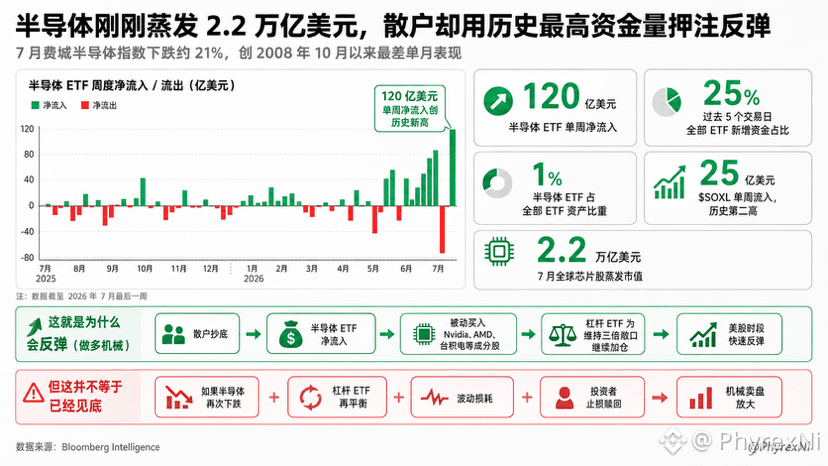
Semiconductors have just wiped out $2.2 trillion—yet retail investors are using record-high inflows to bet on a rebound
In July, the Philadelphia Semiconductor Index fell about 21%, posting the worst single-month performance since October 2008. In just one month, global chip stocks have lost roughly $2.2 trillion in market value.
But this drop hasn’t scared retail investors away. Instead, it has sparked even larger retail “bottom-fishing.”
Over the past week, semiconductor ETFs attracted about $12 billion in net inflows, setting a record high. Semiconductor ETFs account for only about 1% of all ETF assets, yet they pulled in roughly 25% of the new money entering the ETF market over the past five trading days.
In plain terms: for every $4 that flows into the ETF market recently, close to $1 goes into semiconductors.
More importantly, the money isn’t going entirely into standard semiconductor ETFs. It’s going into triple-leveraged semiconductor exposure. $SOXL saw about $2.5 billion in inflows over the week—its second-highest all-time level.
Many retail investors are no longer satisfied with simply buying the dip in chip stocks. They’re using triple leverage to bet that the plunge in July has ended—and that semiconductors will then rebound quickly.
That’s also why we saw a rapid rebound in semiconductors over the weekend—but during U.S. trading hours, not in Korea.
Last week, we all knew the Korean stock market was performing poorly. But the situation where price action during the U.S. session directly reverses it is mainly because after ETFs receive new capital, they have to buy their constituent stocks. For example, for $SOXL to maintain its daily three-times exposure, when the market rises, it still needs to keep adding risk positions.
Between rising stock prices, ETF inflows, and rebalancing of leveraged products, it’s easy to form a continuous pattern of mechanical buying. But even $12 billion in inflows is hard to prove that semiconductors are already at the bottom.
All it really shows is that retail investors have placed a large amount of capital on the idea that July’s decline has already bottomed out. Going forward, semiconductors may rebound quickly—of course, these are retail investors’ bets, and whether that turns out to be true is something nobody can say for sure.
But if semiconductors fall again, the leveraged ETFs’ daily rebalancing, volatility drag, and investor stop-losses would all amplify selling pressure at the same time. The mechanical buying that drives prices higher could quickly turn into mechanical selling.
Semiconductors have just wiped out $2.2 trillion—yet retail investors are using record-high inflows to bet on a rebound
In July, the Philadelphia Semiconductor Index fell about 21%, posting the worst single-month performance since October 2008. In just one month, global chip stocks have lost roughly $2.2 trillion in market value.
But this drop hasn’t scared retail investors away. Instead, it has sparked even larger retail “bottom-fishing.”
Over the past week, semiconductor ETFs attracted about $12 billion in net inflows, setting a record high. Semiconductor ETFs account for only about 1% of all ETF assets, yet they pulled in roughly 25% of the new money entering the ETF market over the past five trading days.
In plain terms: for every $4 that flows into the ETF market recently, close to $1 goes into semiconductors.
More importantly, the money isn’t going entirely into standard semiconductor ETFs. It’s going into triple-leveraged semiconductor exposure. $SOXL saw about $2.5 billion in inflows over the week—its second-highest all-time level.
Many retail investors are no longer satisfied with simply buying the dip in chip stocks. They’re using triple leverage to bet that the plunge in July has ended—and that semiconductors will then rebound quickly.
That’s also why we saw a rapid rebound in semiconductors over the weekend—but during U.S. trading hours, not in Korea.
Last week, we all knew the Korean stock market was performing poorly. But the situation where price action during the U.S. session directly reverses it is mainly because after ETFs receive new capital, they have to buy their constituent stocks. For example, for $SOXL to maintain its daily three-times exposure, when the market rises, it still needs to keep adding risk positions.
Between rising stock prices, ETF inflows, and rebalancing of leveraged products, it’s easy to form a continuous pattern of mechanical buying. But even $12 billion in inflows is hard to prove that semiconductors are already at the bottom.
All it really shows is that retail investors have placed a large amount of capital on the idea that July’s decline has already bottomed out. Going forward, semiconductors may rebound quickly—of course, these are retail investors’ bets, and whether that turns out to be true is something nobody can say for sure.
But if semiconductors fall again, the leveraged ETFs’ daily rebalancing, volatility drag, and investor stop-losses would all amplify selling pressure at the same time. The mechanical buying that drives prices higher could quickly turn into mechanical selling.
In July, the Philadelphia Semiconductor Index fell about 21%, posting the worst single-month performance since October 2008. In just one month, global chip stocks have lost roughly $2.2 trillion in market value.
But this drop hasn’t scared retail investors away. Instead, it has sparked even larger retail “bottom-fishing.”
Over the past week, semiconductor ETFs attracted about $12 billion in net inflows, setting a record high. Semiconductor ETFs account for only about 1% of all ETF assets, yet they pulled in roughly 25% of the new money entering the ETF market over the past five trading days.
In plain terms: for every $4 that flows into the ETF market recently, close to $1 goes into semiconductors.
More importantly, the money isn’t going entirely into standard semiconductor ETFs. It’s going into triple-leveraged semiconductor exposure. $SOXL saw about $2.5 billion in inflows over the week—its second-highest all-time level.
Many retail investors are no longer satisfied with simply buying the dip in chip stocks. They’re using triple leverage to bet that the plunge in July has ended—and that semiconductors will then rebound quickly.
That’s also why we saw a rapid rebound in semiconductors over the weekend—but during U.S. trading hours, not in Korea.
Last week, we all knew the Korean stock market was performing poorly. But the situation where price action during the U.S. session directly reverses it is mainly because after ETFs receive new capital, they have to buy their constituent stocks. For example, for $SOXL to maintain its daily three-times exposure, when the market rises, it still needs to keep adding risk positions.
Between rising stock prices, ETF inflows, and rebalancing of leveraged products, it’s easy to form a continuous pattern of mechanical buying. But even $12 billion in inflows is hard to prove that semiconductors are already at the bottom.
All it really shows is that retail investors have placed a large amount of capital on the idea that July’s decline has already bottomed out. Going forward, semiconductors may rebound quickly—of course, these are retail investors’ bets, and whether that turns out to be true is something nobody can say for sure.
But if semiconductors fall again, the leveraged ETFs’ daily rebalancing, volatility drag, and investor stop-losses would all amplify selling pressure at the same time. The mechanical buying that drives prices higher could quickly turn into mechanical selling.
12
19.5k
·
--
Partly True
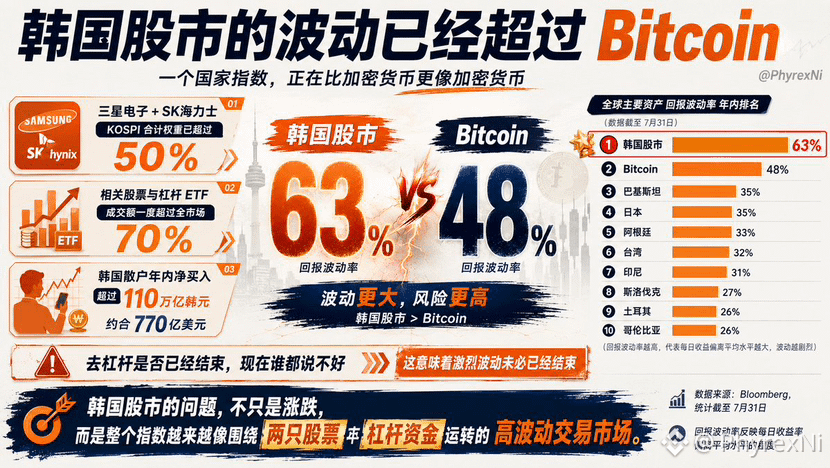
Volatility in the Korean stock market has surpassed Bitcoin—one country’s index is starting to behave more like cryptocurrency
According to Bloomberg data as of July 31, the KOSPI index’s return volatility this year has reached 63%, the highest among the major global country stock benchmarks tracked in its statistics.
Over the same period, Bitcoin’s volatility is only 48%. That means this year the Korean stock market is not only more volatile than Asian markets like Japan and Taiwan, but it’s even more volatile than $BTC.
A country’s stock index volatility exceeding Bitcoin is, in itself, a highly unusual phenomenon.
Bitcoin is a single asset, with its price mainly driven by capital flows, leverage, and market sentiment. The Korean stock market, by contrast, includes hundreds of listed companies. In normal circumstances, gains and losses across different industries and companies tend to offset each other, so index volatility should be far lower than that of a single high-risk asset.
But the problem with the Korean stock market right now is that the index is becoming increasingly concentrated in a handful of stocks. In particular, Samsung and SK Hynix—together their combined weighting in the KOSPI is already over 50%. When sentiment in the semiconductor sector shifts, it can almost directly determine the direction of the entire Korean stock market.
This concentration is further amplified by single-stock leveraged ETFs.
At the height of the most frenzied trading, Samsung Electronics, SK Hynix, and their related leveraged ETFs together at one point accounted for more than 70% of South Korea’s daily trading value.
In plain terms: this stock market in Korea—currently worth about $3.4 trillion, and once above $4 trillion at its peak—sees most trading revolve around just two companies and their leveraged products.
This year, Korean retail investors have net bought more than 110 trillion won of KOSPI stocks, roughly $7.7 billion. Retail flows often chase in after prices rise, and when the market falls they cut exposure, redeem, or are forced to close positions all at the same time.
So the Korean stock market currently often shows a pattern: a sharp sell-off one day, followed by a strong rebound, and then another drop.
Whether the Korean stock market has already finished de-leveraging is something nobody can say for sure right now—suggesting that this bout of intense volatility may not be over yet.
Volatility in the Korean stock market has surpassed Bitcoin—one country’s index is starting to behave more like cryptocurrency
According to Bloomberg data as of July 31, the KOSPI index’s return volatility this year has reached 63%, the highest among the major global country stock benchmarks tracked in its statistics.
Over the same period, Bitcoin’s volatility is only 48%. That means this year the Korean stock market is not only more volatile than Asian markets like Japan and Taiwan, but it’s even more volatile than $BTC.
A country’s stock index volatility exceeding Bitcoin is, in itself, a highly unusual phenomenon.
Bitcoin is a single asset, with its price mainly driven by capital flows, leverage, and market sentiment. The Korean stock market, by contrast, includes hundreds of listed companies. In normal circumstances, gains and losses across different industries and companies tend to offset each other, so index volatility should be far lower than that of a single high-risk asset.
But the problem with the Korean stock market right now is that the index is becoming increasingly concentrated in a handful of stocks. In particular, Samsung and SK Hynix—together their combined weighting in the KOSPI is already over 50%. When sentiment in the semiconductor sector shifts, it can almost directly determine the direction of the entire Korean stock market.
This concentration is further amplified by single-stock leveraged ETFs.
At the height of the most frenzied trading, Samsung Electronics, SK Hynix, and their related leveraged ETFs together at one point accounted for more than 70% of South Korea’s daily trading value.
In plain terms: this stock market in Korea—currently worth about $3.4 trillion, and once above $4 trillion at its peak—sees most trading revolve around just two companies and their leveraged products.
This year, Korean retail investors have net bought more than 110 trillion won of KOSPI stocks, roughly $7.7 billion. Retail flows often chase in after prices rise, and when the market falls they cut exposure, redeem, or are forced to close positions all at the same time.
So the Korean stock market currently often shows a pattern: a sharp sell-off one day, followed by a strong rebound, and then another drop.
Whether the Korean stock market has already finished de-leveraging is something nobody can say for sure right now—suggesting that this bout of intense volatility may not be over yet.
According to Bloomberg data as of July 31, the KOSPI index’s return volatility this year has reached 63%, the highest among the major global country stock benchmarks tracked in its statistics.
Over the same period, Bitcoin’s volatility is only 48%. That means this year the Korean stock market is not only more volatile than Asian markets like Japan and Taiwan, but it’s even more volatile than $BTC.
A country’s stock index volatility exceeding Bitcoin is, in itself, a highly unusual phenomenon.
Bitcoin is a single asset, with its price mainly driven by capital flows, leverage, and market sentiment. The Korean stock market, by contrast, includes hundreds of listed companies. In normal circumstances, gains and losses across different industries and companies tend to offset each other, so index volatility should be far lower than that of a single high-risk asset.
But the problem with the Korean stock market right now is that the index is becoming increasingly concentrated in a handful of stocks. In particular, Samsung and SK Hynix—together their combined weighting in the KOSPI is already over 50%. When sentiment in the semiconductor sector shifts, it can almost directly determine the direction of the entire Korean stock market.
This concentration is further amplified by single-stock leveraged ETFs.
At the height of the most frenzied trading, Samsung Electronics, SK Hynix, and their related leveraged ETFs together at one point accounted for more than 70% of South Korea’s daily trading value.
In plain terms: this stock market in Korea—currently worth about $3.4 trillion, and once above $4 trillion at its peak—sees most trading revolve around just two companies and their leveraged products.
This year, Korean retail investors have net bought more than 110 trillion won of KOSPI stocks, roughly $7.7 billion. Retail flows often chase in after prices rise, and when the market falls they cut exposure, redeem, or are forced to close positions all at the same time.
So the Korean stock market currently often shows a pattern: a sharp sell-off one day, followed by a strong rebound, and then another drop.
Whether the Korean stock market has already finished de-leveraging is something nobody can say for sure right now—suggesting that this bout of intense volatility may not be over yet.
5
11
16.8k
·
--
Partly True
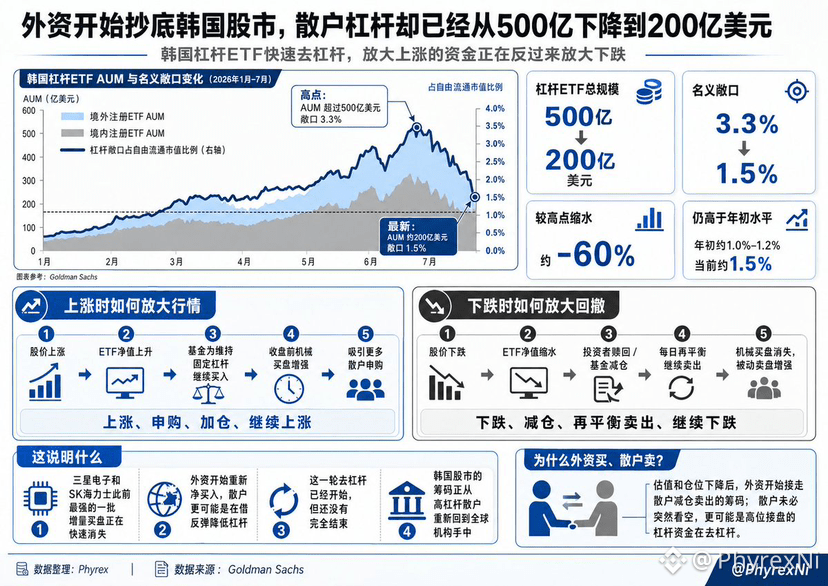
Foreign investors begin to bottom-fish in the Korean stock market, while retail margin leverage has already fallen from 50 billion yuan to $20 billion
The pace of de-leveraging for Korea’s leveraged ETFs is even faster than when I last wrote these figures.
At the time of my last update, the total assets under Korea’s leveraged ETFs were still around $26.5 billion. After leverage amplification, the total exposure accounted for about 2.1% of the free-float market cap of the Korean stock market. In the latest data, total assets have fallen further to roughly $20 billion, and leveraged exposure has also dropped to about 1.5%.
Compared with the late-June peak, the total size of Korea’s leveraged ETFs has shrunk by about 60% from over $50 billion. The nominal exposure-to-free-float market-cap ratio has also fallen from 3.3% to 1.5%, essentially returning to the levels seen from late February to early March.
As the stock exposure maintained by funds continues to shrink, the mechanical buy pressure on Samsung Electronics and SK hynix is also quickly disappearing.
When Korean semiconductors rose earlier this year, as leveraged ETFs’ net asset values increased, the funds had to keep buying to maintain a fixed leverage. The larger the fund size, the stronger the rebalancing buys before the close. Rising stock prices also attracted more retail money to enter, creating a loop of gains, subscriptions, adding positions, and then further gains.
But when stock prices fall, the funds’ net asset values shrink. Retail investors’ redemptions force the funds to cut positions again. Daily rebalancing then adds more selling in down markets. The capital that previously amplified gains in Samsung Electronics and SK hynix is now steadily weakening the market’s ability to absorb trades.
This also helps explain why, in the latest fund flows, foreign investors have begun to make large-scale net purchases, while Korean retail investors are selling in concentrated fashion. Retail investors may not have suddenly turned collectively bearish; more likely, the leveraged funds that picked up shares at the high point earlier finally used the rebound to reduce their positions. Then, after valuations and leverage have both fallen sharply, foreign investors start picking up the shares being sold by retail investors.
However, this round of de-leveraging is not yet over.
At present, the scale of Korea’s leveraged ETFs is still close to three times the level at the beginning of the year, and the leveraged exposure as a share of free-float market cap is also still noticeably higher than at the beginning of the year. Leverage has come down from extreme levels, but it has not fully returned to normal.
Foreign investors begin to bottom-fish in the Korean stock market, while retail margin leverage has already fallen from 50 billion yuan to $20 billion
The pace of de-leveraging for Korea’s leveraged ETFs is even faster than when I last wrote these figures.
At the time of my last update, the total assets under Korea’s leveraged ETFs were still around $26.5 billion. After leverage amplification, the total exposure accounted for about 2.1% of the free-float market cap of the Korean stock market. In the latest data, total assets have fallen further to roughly $20 billion, and leveraged exposure has also dropped to about 1.5%.
Compared with the late-June peak, the total size of Korea’s leveraged ETFs has shrunk by about 60% from over $50 billion. The nominal exposure-to-free-float market-cap ratio has also fallen from 3.3% to 1.5%, essentially returning to the levels seen from late February to early March.
As the stock exposure maintained by funds continues to shrink, the mechanical buy pressure on Samsung Electronics and SK hynix is also quickly disappearing.
When Korean semiconductors rose earlier this year, as leveraged ETFs’ net asset values increased, the funds had to keep buying to maintain a fixed leverage. The larger the fund size, the stronger the rebalancing buys before the close. Rising stock prices also attracted more retail money to enter, creating a loop of gains, subscriptions, adding positions, and then further gains.
But when stock prices fall, the funds’ net asset values shrink. Retail investors’ redemptions force the funds to cut positions again. Daily rebalancing then adds more selling in down markets. The capital that previously amplified gains in Samsung Electronics and SK hynix is now steadily weakening the market’s ability to absorb trades.
This also helps explain why, in the latest fund flows, foreign investors have begun to make large-scale net purchases, while Korean retail investors are selling in concentrated fashion. Retail investors may not have suddenly turned collectively bearish; more likely, the leveraged funds that picked up shares at the high point earlier finally used the rebound to reduce their positions. Then, after valuations and leverage have both fallen sharply, foreign investors start picking up the shares being sold by retail investors.
However, this round of de-leveraging is not yet over.
At present, the scale of Korea’s leveraged ETFs is still close to three times the level at the beginning of the year, and the leveraged exposure as a share of free-float market cap is also still noticeably higher than at the beginning of the year. Leverage has come down from extreme levels, but it has not fully returned to normal.
The pace of de-leveraging for Korea’s leveraged ETFs is even faster than when I last wrote these figures.
At the time of my last update, the total assets under Korea’s leveraged ETFs were still around $26.5 billion. After leverage amplification, the total exposure accounted for about 2.1% of the free-float market cap of the Korean stock market. In the latest data, total assets have fallen further to roughly $20 billion, and leveraged exposure has also dropped to about 1.5%.
Compared with the late-June peak, the total size of Korea’s leveraged ETFs has shrunk by about 60% from over $50 billion. The nominal exposure-to-free-float market-cap ratio has also fallen from 3.3% to 1.5%, essentially returning to the levels seen from late February to early March.
As the stock exposure maintained by funds continues to shrink, the mechanical buy pressure on Samsung Electronics and SK hynix is also quickly disappearing.
When Korean semiconductors rose earlier this year, as leveraged ETFs’ net asset values increased, the funds had to keep buying to maintain a fixed leverage. The larger the fund size, the stronger the rebalancing buys before the close. Rising stock prices also attracted more retail money to enter, creating a loop of gains, subscriptions, adding positions, and then further gains.
But when stock prices fall, the funds’ net asset values shrink. Retail investors’ redemptions force the funds to cut positions again. Daily rebalancing then adds more selling in down markets. The capital that previously amplified gains in Samsung Electronics and SK hynix is now steadily weakening the market’s ability to absorb trades.
This also helps explain why, in the latest fund flows, foreign investors have begun to make large-scale net purchases, while Korean retail investors are selling in concentrated fashion. Retail investors may not have suddenly turned collectively bearish; more likely, the leveraged funds that picked up shares at the high point earlier finally used the rebound to reduce their positions. Then, after valuations and leverage have both fallen sharply, foreign investors start picking up the shares being sold by retail investors.
However, this round of de-leveraging is not yet over.
At present, the scale of Korea’s leveraged ETFs is still close to three times the level at the beginning of the year, and the leveraged exposure as a share of free-float market cap is also still noticeably higher than at the beginning of the year. Leverage has come down from extreme levels, but it has not fully returned to normal.
4
9
14.1k
·
--
Verified
Foreign investors resume large-scale buying in the Korean stock market, while retail investors concentrate on selling
Korea’s market funding structure saw a very clear reversal at the end of July.
For most of this year, foreign investors have continued to reduce their holdings of Korean stocks, while Korean retail investors have kept adding positions. The capital has been mainly concentrated in Samsung Electronics, SK Hynix, and related leveraged ETFs. The lower the share price falls, the more retail investors buy—almost all the shares foreign investors sold off were taken up by domestic individual investors in the form of increased leverage.
But in the latest trading day, foreign investors’ net purchases of Korean stocks were nearly 60 trillion won in a single day, while Korean individual investors posted net sales of nearly 100 trillion won, marking the most extreme round-trip of share transfers this year.
This suggests that Korean retail investors who had been catching falling prices are now starting to cut back on positions on rebounds.
Some of this could be money returning to their cost basis and then exiting; some could be financing accounts voluntarily reducing leverage; and some could come from leveraged ETF redemptions. After consecutive declines, margin calls, and forced liquidations, the amount of cash that retail investors can continue to put into the market has clearly decreased, and risk appetite has also begun to fall.
Foreign investors, meanwhile, buy back Korean stocks when retail investors are selling in a concentrated manner. After the earlier sharp adjustments, the valuations, position crowding, and leverage risks of Samsung Electronics and SK Hynix have all declined. Global capital has started to reassess the value of allocating to Korean semiconductors.
Previously, the trading structure was foreign investors exiting while retail investors increased leverage to take the other side. Now it is gradually turning into retail investors de-leveraging while foreign investors refill at lower levels.
Single-day capital flows are not yet enough to confirm that the Korean stock market has completed its reversal, but the shares are moving from highly leveraged retail investors back to global institutions. For a market that has already undergone a deep drawdown, this is very likely a mutual probing between buyers and sellers.
Foreign investors resume large-scale buying in the Korean stock market, while retail investors concentrate on selling
Korea’s market funding structure saw a very clear reversal at the end of July.
For most of this year, foreign investors have continued to reduce their holdings of Korean stocks, while Korean retail investors have kept adding positions. The capital has been mainly concentrated in Samsung Electronics, SK Hynix, and related leveraged ETFs. The lower the share price falls, the more retail investors buy—almost all the shares foreign investors sold off were taken up by domestic individual investors in the form of increased leverage.
But in the latest trading day, foreign investors’ net purchases of Korean stocks were nearly 60 trillion won in a single day, while Korean individual investors posted net sales of nearly 100 trillion won, marking the most extreme round-trip of share transfers this year.
This suggests that Korean retail investors who had been catching falling prices are now starting to cut back on positions on rebounds.
Some of this could be money returning to their cost basis and then exiting; some could be financing accounts voluntarily reducing leverage; and some could come from leveraged ETF redemptions. After consecutive declines, margin calls, and forced liquidations, the amount of cash that retail investors can continue to put into the market has clearly decreased, and risk appetite has also begun to fall.
Foreign investors, meanwhile, buy back Korean stocks when retail investors are selling in a concentrated manner. After the earlier sharp adjustments, the valuations, position crowding, and leverage risks of Samsung Electronics and SK Hynix have all declined. Global capital has started to reassess the value of allocating to Korean semiconductors.
Previously, the trading structure was foreign investors exiting while retail investors increased leverage to take the other side. Now it is gradually turning into retail investors de-leveraging while foreign investors refill at lower levels.
Single-day capital flows are not yet enough to confirm that the Korean stock market has completed its reversal, but the shares are moving from highly leveraged retail investors back to global institutions. For a market that has already undergone a deep drawdown, this is very likely a mutual probing between buyers and sellers.
Korea’s market funding structure saw a very clear reversal at the end of July.
For most of this year, foreign investors have continued to reduce their holdings of Korean stocks, while Korean retail investors have kept adding positions. The capital has been mainly concentrated in Samsung Electronics, SK Hynix, and related leveraged ETFs. The lower the share price falls, the more retail investors buy—almost all the shares foreign investors sold off were taken up by domestic individual investors in the form of increased leverage.
But in the latest trading day, foreign investors’ net purchases of Korean stocks were nearly 60 trillion won in a single day, while Korean individual investors posted net sales of nearly 100 trillion won, marking the most extreme round-trip of share transfers this year.
This suggests that Korean retail investors who had been catching falling prices are now starting to cut back on positions on rebounds.
Some of this could be money returning to their cost basis and then exiting; some could be financing accounts voluntarily reducing leverage; and some could come from leveraged ETF redemptions. After consecutive declines, margin calls, and forced liquidations, the amount of cash that retail investors can continue to put into the market has clearly decreased, and risk appetite has also begun to fall.
Foreign investors, meanwhile, buy back Korean stocks when retail investors are selling in a concentrated manner. After the earlier sharp adjustments, the valuations, position crowding, and leverage risks of Samsung Electronics and SK Hynix have all declined. Global capital has started to reassess the value of allocating to Korean semiconductors.
Previously, the trading structure was foreign investors exiting while retail investors increased leverage to take the other side. Now it is gradually turning into retail investors de-leveraging while foreign investors refill at lower levels.
Single-day capital flows are not yet enough to confirm that the Korean stock market has completed its reversal, but the shares are moving from highly leveraged retail investors back to global institutions. For a market that has already undergone a deep drawdown, this is very likely a mutual probing between buyers and sellers.
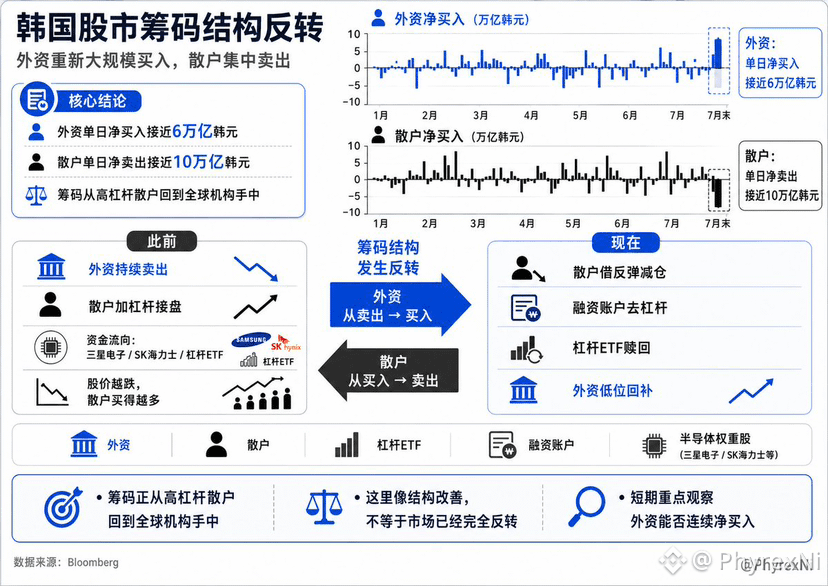
4
6
20.3k
·
--
Partly True
Market leverage hits a record high, and the stocks U.S. retail investors like most fall 13%
Among a basket of stocks tracked by Goldman Sachs that U.S. retail investors prefer, the group is down about 13% so far this month. If the decline holds through month-end, it would mark the worst single-month performance since 2022.
But just two months ago, these stocks were up roughly 17% and 16%, respectively—bringing the two-month cumulative gain to nearly 36%. In a matter of just one month, a batch of stocks U.S. retail investors favor has swung from one of the market’s strongest directions to the worst-performing set in terms of declines.
These stocks are mainly concentrated in high-volatility technology sectors such as artificial intelligence, semiconductors, memory chips, cybersecurity, and other similar areas. Representative names mentioned in public reports include AMD, Micron, and CrowdStrike. More broadly, retail-favored popular stocks also include Nvidia, Tesla, Palantir, and IonQ, among others.
The common traits are obvious: these are stocks that had surged earlier, carry high valuations, and are highly volatile—driving retail investors’ FOMO (fear of missing out) sentiment.
In my previous post, I mentioned that U.S. margin and securities lending debt has reached a record $1.53 trillion, while brokers’ net credit balances have fallen to negative $1.061 trillion. This suggests that when retail-favorite stocks begin to drop, the market’s leveraged positions and margin don’t fall in sync—instead, they remain at historic highs.
During the uptrend, the more the stock price rises, the higher the investors’ account equity becomes, and the more money they can borrow. New margin financing then keeps buying the best-performing stocks from earlier. But once the market weakens, the logic reverses: falling prices drag down account equity, margin pressure rises, and investors have no choice but to inject cash or cut positions.
Plainly put: whatever retail investors piled on leverage to chase in the first two months kept rising even faster. Now that the market is starting to pull back, the stocks retail holdings are most concentrated in—and that had risen the most earlier—have become the earliest to see double-digit declines.
The faster they rose early on, the more crowded the positions became, and the higher the financing ratio—after the downturn, the number of shares that must be sold to reduce risk will also be larger.
Market leverage hits a record high, and the stocks U.S. retail investors like most fall 13%
Among a basket of stocks tracked by Goldman Sachs that U.S. retail investors prefer, the group is down about 13% so far this month. If the decline holds through month-end, it would mark the worst single-month performance since 2022.
But just two months ago, these stocks were up roughly 17% and 16%, respectively—bringing the two-month cumulative gain to nearly 36%. In a matter of just one month, a batch of stocks U.S. retail investors favor has swung from one of the market’s strongest directions to the worst-performing set in terms of declines.
These stocks are mainly concentrated in high-volatility technology sectors such as artificial intelligence, semiconductors, memory chips, cybersecurity, and other similar areas. Representative names mentioned in public reports include AMD, Micron, and CrowdStrike. More broadly, retail-favored popular stocks also include Nvidia, Tesla, Palantir, and IonQ, among others.
The common traits are obvious: these are stocks that had surged earlier, carry high valuations, and are highly volatile—driving retail investors’ FOMO (fear of missing out) sentiment.
In my previous post, I mentioned that U.S. margin and securities lending debt has reached a record $1.53 trillion, while brokers’ net credit balances have fallen to negative $1.061 trillion. This suggests that when retail-favorite stocks begin to drop, the market’s leveraged positions and margin don’t fall in sync—instead, they remain at historic highs.
During the uptrend, the more the stock price rises, the higher the investors’ account equity becomes, and the more money they can borrow. New margin financing then keeps buying the best-performing stocks from earlier. But once the market weakens, the logic reverses: falling prices drag down account equity, margin pressure rises, and investors have no choice but to inject cash or cut positions.
Plainly put: whatever retail investors piled on leverage to chase in the first two months kept rising even faster. Now that the market is starting to pull back, the stocks retail holdings are most concentrated in—and that had risen the most earlier—have become the earliest to see double-digit declines.
The faster they rose early on, the more crowded the positions became, and the higher the financing ratio—after the downturn, the number of shares that must be sold to reduce risk will also be larger.
Among a basket of stocks tracked by Goldman Sachs that U.S. retail investors prefer, the group is down about 13% so far this month. If the decline holds through month-end, it would mark the worst single-month performance since 2022.
But just two months ago, these stocks were up roughly 17% and 16%, respectively—bringing the two-month cumulative gain to nearly 36%. In a matter of just one month, a batch of stocks U.S. retail investors favor has swung from one of the market’s strongest directions to the worst-performing set in terms of declines.
These stocks are mainly concentrated in high-volatility technology sectors such as artificial intelligence, semiconductors, memory chips, cybersecurity, and other similar areas. Representative names mentioned in public reports include AMD, Micron, and CrowdStrike. More broadly, retail-favored popular stocks also include Nvidia, Tesla, Palantir, and IonQ, among others.
The common traits are obvious: these are stocks that had surged earlier, carry high valuations, and are highly volatile—driving retail investors’ FOMO (fear of missing out) sentiment.
In my previous post, I mentioned that U.S. margin and securities lending debt has reached a record $1.53 trillion, while brokers’ net credit balances have fallen to negative $1.061 trillion. This suggests that when retail-favorite stocks begin to drop, the market’s leveraged positions and margin don’t fall in sync—instead, they remain at historic highs.
During the uptrend, the more the stock price rises, the higher the investors’ account equity becomes, and the more money they can borrow. New margin financing then keeps buying the best-performing stocks from earlier. But once the market weakens, the logic reverses: falling prices drag down account equity, margin pressure rises, and investors have no choice but to inject cash or cut positions.
Plainly put: whatever retail investors piled on leverage to chase in the first two months kept rising even faster. Now that the market is starting to pull back, the stocks retail holdings are most concentrated in—and that had risen the most earlier—have become the earliest to see double-digit declines.
The faster they rose early on, the more crowded the positions became, and the higher the financing ratio—after the downturn, the number of shares that must be sold to reduce risk will also be larger.
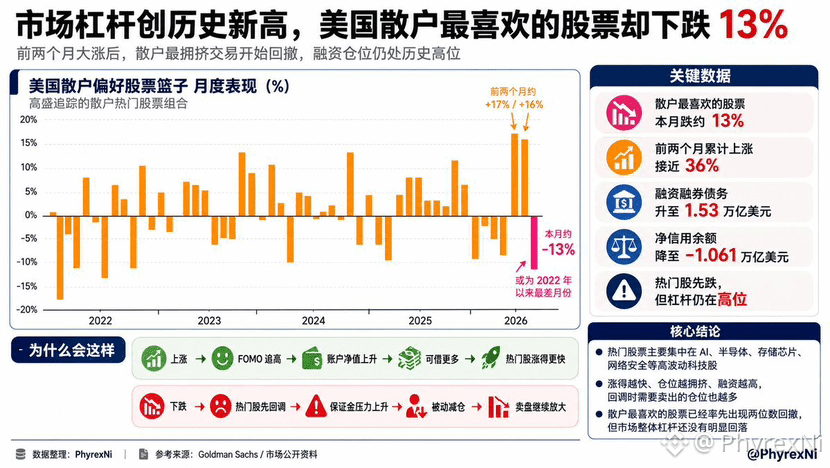
AMDUS-0.29%
TSLAUS+0.35%
NVDAUS+0.60%
3
1
15.4k
·
--
Verified
BTCFi has entered the second half, and the significance of chasing short-term high yields is diminishing.
Starting from mid-2024, staking yields will begin to experience structural compression, and points, subsidies, and short-term incentives will become increasingly difficult to support long-term returns. Bitcoin holders are now more concerned with whether BTC can maintain its long-term asset properties while transitioning into a more efficient yield structure.
This is also the core change in Bedrock 2.0. In the past, Bedrock was more easily understood as a BTC restaking protocol, but Bedrock 2.0 has upgraded to become a smart yield engine for Bitcoin capital. Users can access different strategies through uniBTC, while Bedrock is responsible for allocating BTC into various vaults that are more suitable for yield.
In the future, Bedrock's yield structure will cover market-neutral quant strategies, on-chain liquidity, lending credit, and real asset returns.
Among them, the Selini vault is a typical example, where Bedrock provides an entry point for BTC investments, Cap offers a credit framework, Symbiotic provides a shared security layer, and Selini Capital is responsible for market-neutral arbitrage and quantitative execution. Strategies that were previously closer to institutional funding are now being productized for ordinary BTC holders.
The most important change here is that BTCFi is transitioning from a crude mining, points, and subsidies model to a phase that resembles asset management. Yields must be traced back to their sources, risks should be examined in terms of structure, funds need to be followed in their paths, and exits should be evaluated based on liquidity. Furthermore, if BRclaw can clearly explain the source of the vault's yields, risk exposures, and strategy differences, it will become the on-chain analyst within BTCFi.
Finally, let's talk about $BR. After Bedrock 2.0, the value of BR will be more tied to vault access privileges, priority entry, yield enhancement, and AI analytical capabilities. Especially since institutional-grade vaults often have capacity limits, if high-level $BR holders can gain priority access, then $BR will start to bind with real protocol demand.
Thus, what Bedrock 2.0 truly aims to do is transition BTCFi from high-yield competition into the BTC asset management phase. Using uniBTC as the entry point, yield vaults as the strategy layer, BRclaw as the analysis layer, and $BR for access and incentives, this is how Bedrock 2.0 will make Bitcoin more productive.
BTCFi has entered the second half, and the significance of chasing short-term high yields is diminishing.
Starting from mid-2024, staking yields will begin to experience structural compression, and points, subsidies, and short-term incentives will become increasingly difficult to support long-term returns. Bitcoin holders are now more concerned with whether BTC can maintain its long-term asset properties while transitioning into a more efficient yield structure.
This is also the core change in Bedrock 2.0. In the past, Bedrock was more easily understood as a BTC restaking protocol, but Bedrock 2.0 has upgraded to become a smart yield engine for Bitcoin capital. Users can access different strategies through uniBTC, while Bedrock is responsible for allocating BTC into various vaults that are more suitable for yield.
In the future, Bedrock's yield structure will cover market-neutral quant strategies, on-chain liquidity, lending credit, and real asset returns.
Among them, the Selini vault is a typical example, where Bedrock provides an entry point for BTC investments, Cap offers a credit framework, Symbiotic provides a shared security layer, and Selini Capital is responsible for market-neutral arbitrage and quantitative execution. Strategies that were previously closer to institutional funding are now being productized for ordinary BTC holders.
The most important change here is that BTCFi is transitioning from a crude mining, points, and subsidies model to a phase that resembles asset management. Yields must be traced back to their sources, risks should be examined in terms of structure, funds need to be followed in their paths, and exits should be evaluated based on liquidity. Furthermore, if BRclaw can clearly explain the source of the vault's yields, risk exposures, and strategy differences, it will become the on-chain analyst within BTCFi.
Finally, let's talk about $BR . After Bedrock 2.0, the value of BR will be more tied to vault access privileges, priority entry, yield enhancement, and AI analytical capabilities. Especially since institutional-grade vaults often have capacity limits, if high-level $BR holders can gain priority access, then $BR will start to bind with real protocol demand.
Thus, what Bedrock 2.0 truly aims to do is transition BTCFi from high-yield competition into the BTC asset management phase. Using uniBTC as the entry point, yield vaults as the strategy layer, BRclaw as the analysis layer, and $BR for access and incentives, this is how Bedrock 2.0 will make Bitcoin more productive.
Starting from mid-2024, staking yields will begin to experience structural compression, and points, subsidies, and short-term incentives will become increasingly difficult to support long-term returns. Bitcoin holders are now more concerned with whether BTC can maintain its long-term asset properties while transitioning into a more efficient yield structure.
This is also the core change in Bedrock 2.0. In the past, Bedrock was more easily understood as a BTC restaking protocol, but Bedrock 2.0 has upgraded to become a smart yield engine for Bitcoin capital. Users can access different strategies through uniBTC, while Bedrock is responsible for allocating BTC into various vaults that are more suitable for yield.
In the future, Bedrock's yield structure will cover market-neutral quant strategies, on-chain liquidity, lending credit, and real asset returns.
Among them, the Selini vault is a typical example, where Bedrock provides an entry point for BTC investments, Cap offers a credit framework, Symbiotic provides a shared security layer, and Selini Capital is responsible for market-neutral arbitrage and quantitative execution. Strategies that were previously closer to institutional funding are now being productized for ordinary BTC holders.
The most important change here is that BTCFi is transitioning from a crude mining, points, and subsidies model to a phase that resembles asset management. Yields must be traced back to their sources, risks should be examined in terms of structure, funds need to be followed in their paths, and exits should be evaluated based on liquidity. Furthermore, if BRclaw can clearly explain the source of the vault's yields, risk exposures, and strategy differences, it will become the on-chain analyst within BTCFi.
Finally, let's talk about $BR . After Bedrock 2.0, the value of BR will be more tied to vault access privileges, priority entry, yield enhancement, and AI analytical capabilities. Especially since institutional-grade vaults often have capacity limits, if high-level $BR holders can gain priority access, then $BR will start to bind with real protocol demand.
Thus, what Bedrock 2.0 truly aims to do is transition BTCFi from high-yield competition into the BTC asset management phase. Using uniBTC as the entry point, yield vaults as the strategy layer, BRclaw as the analysis layer, and $BR for access and incentives, this is how Bedrock 2.0 will make Bitcoin more productive.
4
11
30.5k
·
--
The main reasons why a project party with a contract cannot pump the price are:
1. The project party has not configured an active market maker, but only set up some robots.
2. The project party does not have enough funds or does not want to use its own funds for market making.
3. There are too many external chips for the project party, resulting in the project party and market makers not being able to gather enough chips yet.
4. The main reason for the failure of market maker financing is the lack of chip concentration.
5. External selling or short-term unlocking by the project party has not yet ended.
6. The project party is still in the process of accumulating chips.
So when the project party says 'the car is too heavy,' it often corresponds to the six points above, and indeed many new coins do not pump, most likely because of (4).
From my personal perspective, especially for projects listed on #Binance spot + futures, as well as those on other first and second-tier exchanges, or grand slam projects, if it is a new coin, the probability of not pumping is very low, especially for projects that cannot print money themselves; even OTC needs to pump to sell.
Of course, some new coins have enough reserve funds and can temporarily ignore the price; at this point, it’s a test of endurance. Let me give an example: $ZAMA . When I bought it, everyone thought it was going to be abandoned, but now it has almost doubled, although I bought relatively little just for testing purposes.
Some projects actually pressure the other party every day or wait for the project party, which in turn will not pump the price. ZAMA has lost its heat, and no one is discussing it; it just started now.
Additionally, if the chips are not consistently gathered enough, it is indeed possible that this project will not move, after all, they have sufficient cash flow. It could be dragged until everything is fully unlocked.
The main reasons why a project party with a contract cannot pump the price are:
1. The project party has not configured an active market maker, but only set up some robots.
2. The project party does not have enough funds or does not want to use its own funds for market making.
3. There are too many external chips for the project party, resulting in the project party and market makers not being able to gather enough chips yet.
4. The main reason for the failure of market maker financing is the lack of chip concentration.
5. External selling or short-term unlocking by the project party has not yet ended.
6. The project party is still in the process of accumulating chips.
So when the project party says 'the car is too heavy,' it often corresponds to the six points above, and indeed many new coins do not pump, most likely because of (4).
From my personal perspective, especially for projects listed on #Binance spot + futures, as well as those on other first and second-tier exchanges, or grand slam projects, if it is a new coin, the probability of not pumping is very low, especially for projects that cannot print money themselves; even OTC needs to pump to sell.
Of course, some new coins have enough reserve funds and can temporarily ignore the price; at this point, it’s a test of endurance. Let me give an example: $ZAMA . When I bought it, everyone thought it was going to be abandoned, but now it has almost doubled, although I bought relatively little just for testing purposes.
Some projects actually pressure the other party every day or wait for the project party, which in turn will not pump the price. ZAMA has lost its heat, and no one is discussing it; it just started now.
Additionally, if the chips are not consistently gathered enough, it is indeed possible that this project will not move, after all, they have sufficient cash flow. It could be dragged until everything is fully unlocked.
1. The project party has not configured an active market maker, but only set up some robots.
2. The project party does not have enough funds or does not want to use its own funds for market making.
3. There are too many external chips for the project party, resulting in the project party and market makers not being able to gather enough chips yet.
4. The main reason for the failure of market maker financing is the lack of chip concentration.
5. External selling or short-term unlocking by the project party has not yet ended.
6. The project party is still in the process of accumulating chips.
So when the project party says 'the car is too heavy,' it often corresponds to the six points above, and indeed many new coins do not pump, most likely because of (4).
From my personal perspective, especially for projects listed on #Binance spot + futures, as well as those on other first and second-tier exchanges, or grand slam projects, if it is a new coin, the probability of not pumping is very low, especially for projects that cannot print money themselves; even OTC needs to pump to sell.
Of course, some new coins have enough reserve funds and can temporarily ignore the price; at this point, it’s a test of endurance. Let me give an example: $ZAMA . When I bought it, everyone thought it was going to be abandoned, but now it has almost doubled, although I bought relatively little just for testing purposes.
Some projects actually pressure the other party every day or wait for the project party, which in turn will not pump the price. ZAMA has lost its heat, and no one is discussing it; it just started now.
Additionally, if the chips are not consistently gathered enough, it is indeed possible that this project will not move, after all, they have sufficient cash flow. It could be dragged until everything is fully unlocked.
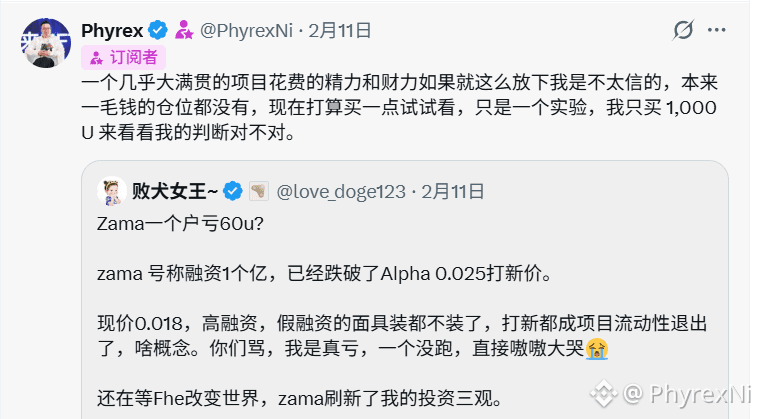
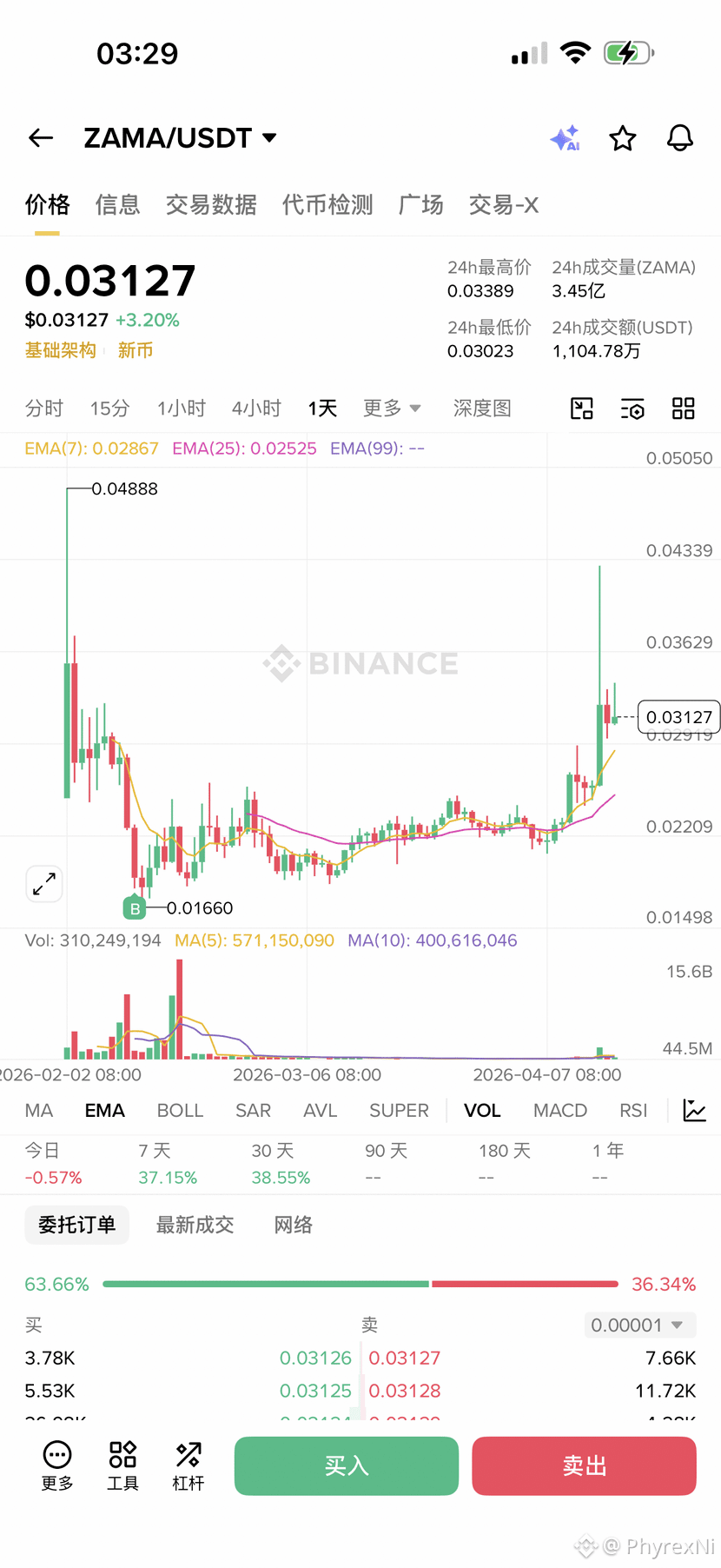
5
3
23
17.8k
Log in to explore more content
Join global crypto users on Binance Square
⚡️ Get latest and useful information about crypto.
💬 Trusted by the world’s largest crypto exchange.
👍 Discover real insights from verified creators.
Email / Phone number
Trending Topics
DriftHackVictimsBeginClaims
52,481 views
622 Discussing
Drift hack victims can now start claiming DFX recovery tokens for their losses from the April 2026 exploit.
Around $295.4M in losses were verified.
The recovery pool initially had only about $3.11M.
So, at launch, 1 DFX represented $1 of loss, but the first redemption was worth only about $0.0104 — roughly 1 cent for every $1 lost.
Victims can redeem, sell, or hold their DFX.
The big catch: redeeming burns the DFX, so you give up that token’s potential share of future recovery funds.
👉 The key question: If Drift adds much more money to the recovery pool, could DFX eventually help victims recover a much larger percentage of what they lost
#DriftHackVictimsBeginClaims
$NVDAB
Irfanba
·0 Likes
·63 views
SolanaTokenizedStockVolumeTops$4.4BInSeptember
6,716 views
71 Discussing
BitcoinSpotETFsDraw$6.34BInflowsInQ3
21,706 views
184 Discussing