

Orion Trading Lab
0 Following
0 Followers
9 Liked
Posts
All
Quotes

Orion Trading Lab
·
--
🔐 Do you have funds on Binance and has the HACK left you paranoid?
That’s understandable.
Reading “hack,” “US$6.3B,” and “compromised hot wallets” in the same sentence isn’t reassuring to anyone.
But before panicking, let’s look at what we actually know.
Binance confirmed the incident.
And it also confirmed something even more important:
THE LOSSES WILL NOT BE PASSED ON TO USERS.
The company announced that it will use SAFU + corporate funds to absorb the impact.
Additionally:
✅ approximately US$3 billion has already been frozen on-chain
✅ there is no evidence so far of private key leaks
✅ the compromised infrastructure has been contained
✅ security controls are being strengthened
✅ Binance will publish a new Proof of Reserves
✅ there will be a full technical report on the incident
Should you keep following the updates?
Of course.
Should you panic and assume your funds have disappeared?
Based on the official information available so far, NO.
And this also says a lot about a platform:
security isn’t measured solely by preventing attacks.
It’s also measured by the financial, technical, and operational ability to respond when something goes wrong.
An incident of this magnitude could put many companies on the ropes.
Binance, on the other hand, is saying:
“WE’LL ABSORB THE LOSS,
NOT OUR USERS.”
That doesn’t undo what happened.
But it does change the question a lot:
Should I be worried?
Stay alert: yes.
Panic: not justified so far.
At times like these, fewer rumors and more official information.
$BNB $BTC $USDC
#Binance #CryptoSecurity #Bitcoin #SAFU #BinanceSquare
General information. This does not constitute financial advice.


Orion Trading Lab
·
--
🚨 Yes, BINANCE WAS HACKED.
And when you read news like this, the first question comes naturally:
Should I be worried about my funds?
For now, my answer is:
THERE IS NO REASON TO PANIC.
Binance confirmed a security incident that affected its hot wallets, involving approximately US$6.3B.
That is an enormous amount, and the incident is serious.
But there is an important difference:
👉 Binance says users will not bear those losses.
The company announced that it will use SAFU and corporate funds to cover the impact, while continuing to work with blockchain analytics firms, issuers, and authorities to track and freeze the stolen assets.
In addition, Binance reported that so far it has found no evidence that the wallets’ private keys were compromised.
Withdrawals were temporarily paused while security reviews are completed.
Is this a situation to keep a close eye on?
Yes.
Is it a reason to panic?
Based on the official information available so far, NO.
And there’s something else that deserves recognition:
when a platform of this size faces an incident like this, what matters is not pretending it could never happen.
What matters is how it responds when it does:
Taking responsibility for the losses, protecting users, freezing assets, strengthening infrastructure, and publicly communicating what happened is exactly the kind of response one expects from a leading exchange.
Now we wait for the full technical report.
🔐 Security doesn’t mean an attack will never happen. It also means being prepared to respond when it does.
$BTC $USDT $ETH
#Binance #Crypto #Security #Bitcoin #BinanceSquare


Orion Trading Lab
·
--
🚨 We discovered something unexpected in Orion.
For days, we tried to understand why a bot capable of detecting momentum kept entering some terrible trades.
The answer was in the ranking.
Orion was rewarding signals with:
⚡ extreme acceleration
📈 rapid moves
📊 an apparently bullish order book
🔥 very high scores
They looked like perfect opportunities.
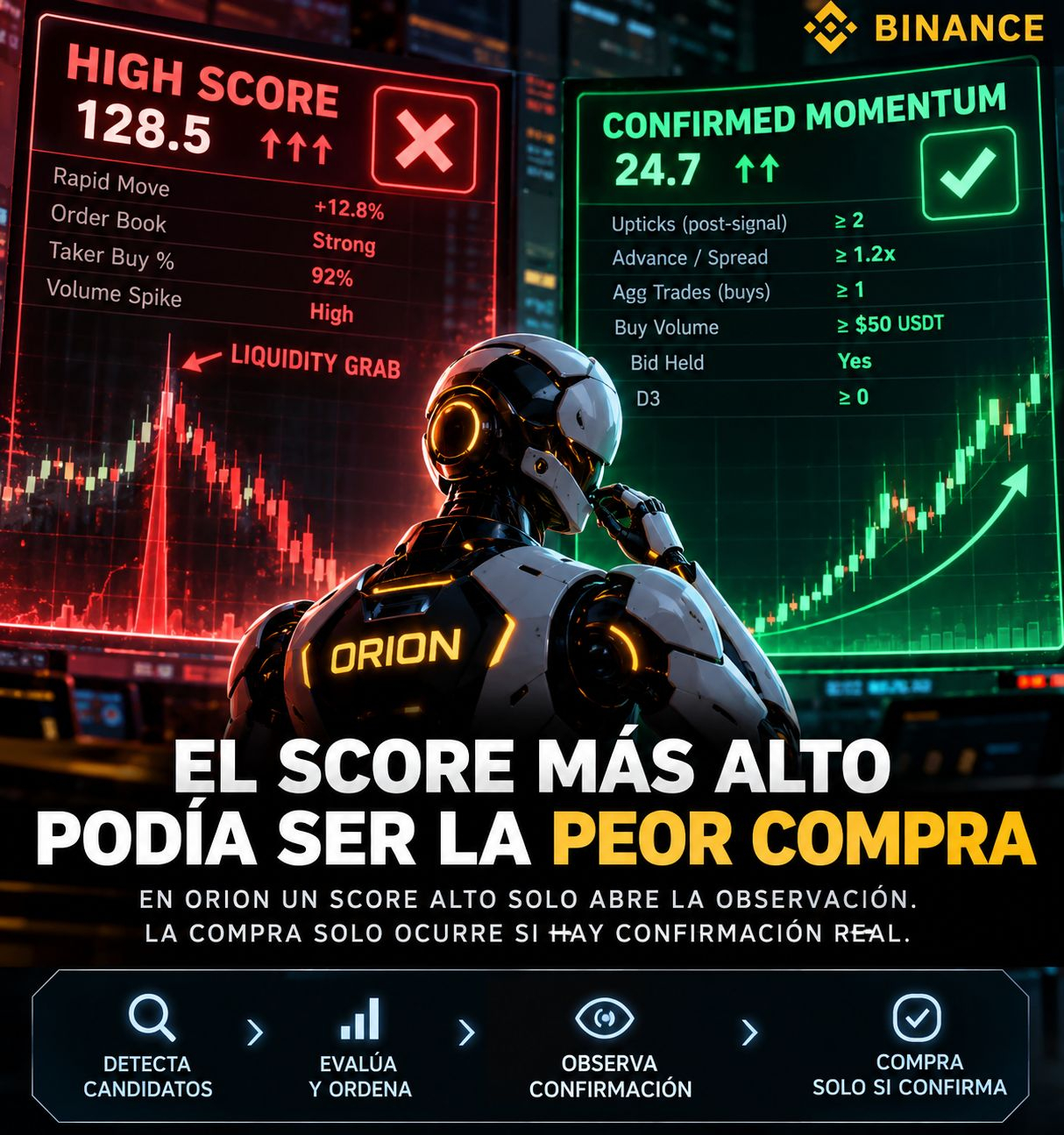
But when we studied what happened after the signal, a paradox emerged: the highest scores were leading to some of the worst entries.
Why?
Because a price explosion doesn’t always mean the move will continue.
Sometimes, what you’re seeing is:
the last push before a reversal.
A wick.
A liquidity grab.
The end of the move, not the beginning.
That’s why we changed a fundamental rule:
The score NO longer authorizes a buy.
Now it only says:
“this candidate is worth watching.”
After that, Orion requires real confirmation:
→ the bid must hold
→ new upticks must appear
→ fresh buying volume must come in
→ the price must move beyond the spread
→ aggressive buying must appear after the signal
If it happens:
CONFIRM → BUY
If not:
NO TRADE
One of the project’s most important lessons:
Detecting that something is going up doesn’t mean there’s still room to buy into the rise.
I’ll keep showing both Orion’s successes and its mistakes.
If you find this series valuable and have Tips enabled, you can voluntarily support the content using the tip button. 🤖
$BTC $BNB $SOL
#AlgoTrading #TradingBots #CryptoTrading
Educational content. Not financial advice.

Log in to explore more content