
老青蛙BNB
2.7k Posts

老青蛙BNB
Report
Block User
熊市撸毛,牛市卖毛
Frequent Trader
4.1 Years
259 Following
9.1K+ Followers
5.4K+ Liked
Posts
All
Quotes
Live
·
--
Where can I find the US stock options entry? I only see gold, silver, and crude oil.
Where can I find the US stock options entry? I only see gold, silver, and crude oil.
95
·
--
I recently flipped the entire security tokenization track upside down, and the more I look, the more interesting this batch of projects feels. Almost all of them are running along just two routes. One route is heavily focused on compliance—Ondo is the representative: its licensing and relationships with institutions are solid, but unfortunately it runs on a transparent chain, where both holdings and fund flows are completely public. The other route is obsessed with privacy—Zcash and Aleo push hidden transactions to the extreme. Unfortunately, there’s no licensing narrative, and compliant capital doesn’t even dare to touch it.
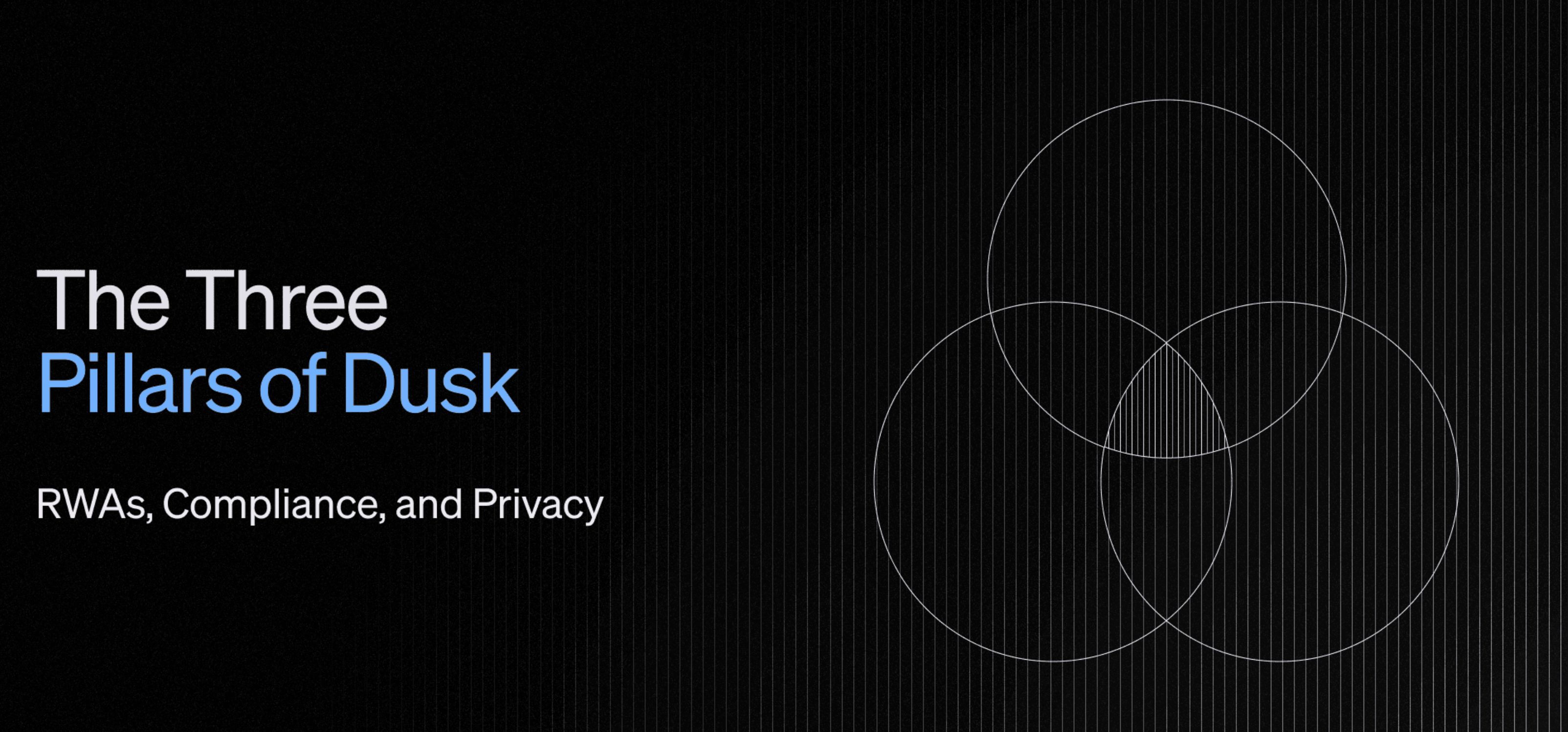
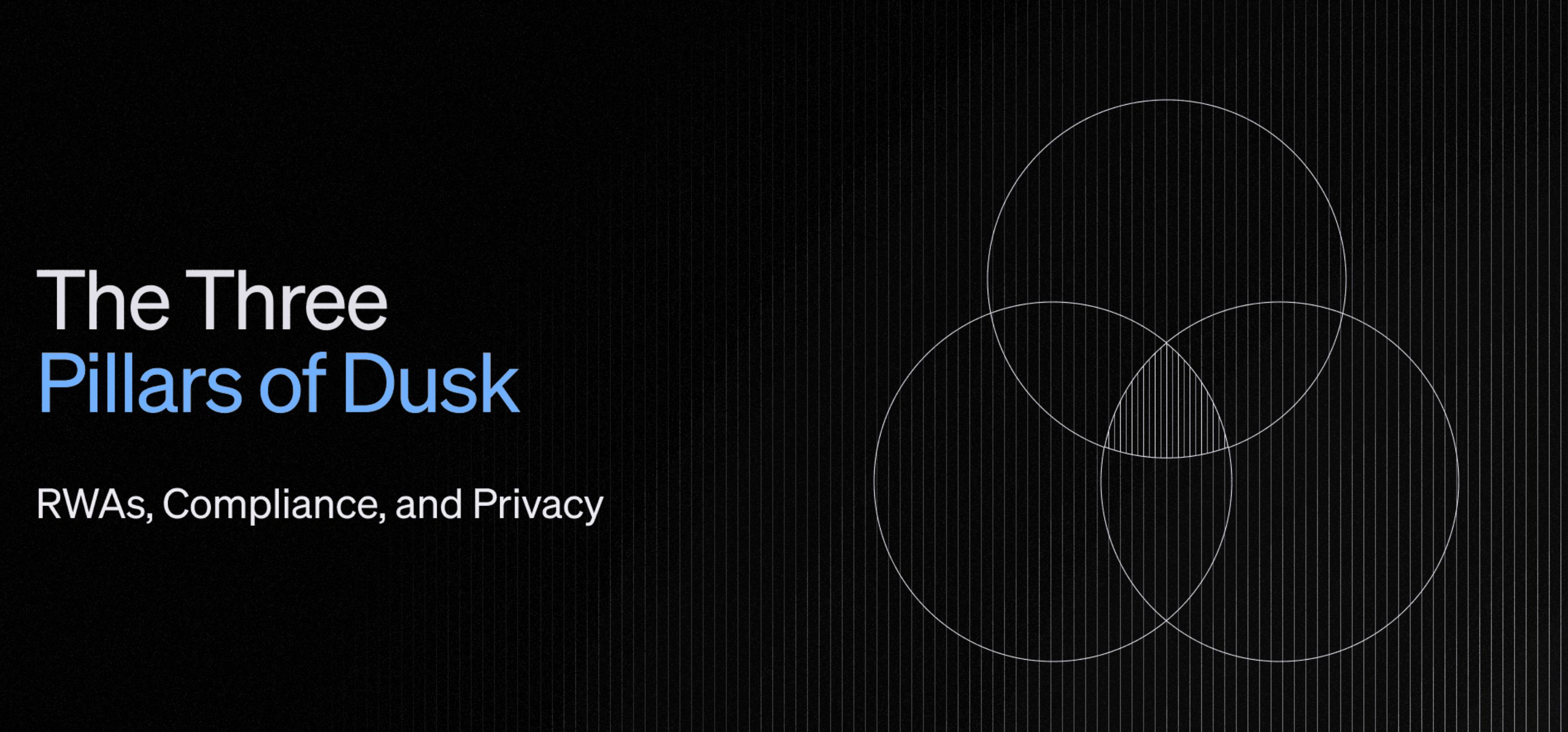
Privately, I once drew a coordinate chart. The horizontal axis is compliance, the vertical axis is privacy. After finishing it, I found that the vast majority of projects are huddled along those two axes. Dusk is one of the very few that stands in that corner of empty space. That empty space is exactly where security tokenization most needs to be. This asset class is inherently awkward: issuers must explain everything to regulators, while holders don’t want to disclose to the entire market. A transparent chain can only satisfy the first half; a privacy chain can only satisfy the second half. Only the grid square that covers both can hold institutional capital.
Think about real securities business and you’ll understand why. Large block trades are especially afraid of exposing the intention to build a position—before the action is even complete, the order book has already moved. Once the positions in stock lending are public, both the long and short sides can calculate your cards. In these scenarios, transparency isn’t a virtue—it’s laying your cards on the table for your opponent to see. If institutions dare to move government bonds onto a transparent chain, it doesn’t mean they’re willing to move trading strategies there too. Dusk’s confidential trading plus verifiable disclosures is precisely aimed at that gap.
But the “best spot” on the coordinate chart is public knowledge—everyone can see it. Whether a position can turn into a moat depends on two things. First is the window period: a transparent chain can add privacy, and a privacy chain can add compliance—at least in theory, neither is a dead end, but both require time and reconstruction costs. Once the window closes, the empty space that the early movers occupied will eventually be filled. Second is demand density: institutions all say they want privacy, but when it really comes time to pay for deployment, where does it rank in their priority list? No one in the industry has provided a benchmark yet.
Being at both ends is a good starting point, but a starting point isn’t the finish line. Next time you evaluate an RWA project, why not draw this chart as well—first see which square it lands in, then see whether there are opponents in that square. Where does the position you hold land? #dusk $DUSK @Dusk_Foundation
I recently flipped the entire security tokenization track upside down, and the more I look, the more interesting this batch of projects feels. Almost all of them are running along just two routes. One route is heavily focused on compliance—Ondo is the representative: its licensing and relationships with institutions are solid, but unfortunately it runs on a transparent chain, where both holdings and fund flows are completely public. The other route is obsessed with privacy—Zcash and Aleo push hidden transactions to the extreme. Unfortunately, there’s no licensing narrative, and compliant capital doesn’t even dare to touch it.
Privately, I once drew a coordinate chart. The horizontal axis is compliance, the vertical axis is privacy. After finishing it, I found that the vast majority of projects are huddled along those two axes. Dusk is one of the very few that stands in that corner of empty space. That empty space is exactly where security tokenization most needs to be. This asset class is inherently awkward: issuers must explain everything to regulators, while holders don’t want to disclose to the entire market. A transparent chain can only satisfy the first half; a privacy chain can only satisfy the second half. Only the grid square that covers both can hold institutional capital.
Think about real securities business and you’ll understand why. Large block trades are especially afraid of exposing the intention to build a position—before the action is even complete, the order book has already moved. Once the positions in stock lending are public, both the long and short sides can calculate your cards. In these scenarios, transparency isn’t a virtue—it’s laying your cards on the table for your opponent to see. If institutions dare to move government bonds onto a transparent chain, it doesn’t mean they’re willing to move trading strategies there too. Dusk’s confidential trading plus verifiable disclosures is precisely aimed at that gap.
But the “best spot” on the coordinate chart is public knowledge—everyone can see it. Whether a position can turn into a moat depends on two things. First is the window period: a transparent chain can add privacy, and a privacy chain can add compliance—at least in theory, neither is a dead end, but both require time and reconstruction costs. Once the window closes, the empty space that the early movers occupied will eventually be filled. Second is demand density: institutions all say they want privacy, but when it really comes time to pay for deployment, where does it rank in their priority list? No one in the industry has provided a benchmark yet.
Being at both ends is a good starting point, but a starting point isn’t the finish line. Next time you evaluate an RWA project, why not draw this chart as well—first see which square it lands in, then see whether there are opponents in that square. Where does the position you hold land? #dusk $DUSK @Dusk
Privately, I once drew a coordinate chart. The horizontal axis is compliance, the vertical axis is privacy. After finishing it, I found that the vast majority of projects are huddled along those two axes. Dusk is one of the very few that stands in that corner of empty space. That empty space is exactly where security tokenization most needs to be. This asset class is inherently awkward: issuers must explain everything to regulators, while holders don’t want to disclose to the entire market. A transparent chain can only satisfy the first half; a privacy chain can only satisfy the second half. Only the grid square that covers both can hold institutional capital.
Think about real securities business and you’ll understand why. Large block trades are especially afraid of exposing the intention to build a position—before the action is even complete, the order book has already moved. Once the positions in stock lending are public, both the long and short sides can calculate your cards. In these scenarios, transparency isn’t a virtue—it’s laying your cards on the table for your opponent to see. If institutions dare to move government bonds onto a transparent chain, it doesn’t mean they’re willing to move trading strategies there too. Dusk’s confidential trading plus verifiable disclosures is precisely aimed at that gap.
But the “best spot” on the coordinate chart is public knowledge—everyone can see it. Whether a position can turn into a moat depends on two things. First is the window period: a transparent chain can add privacy, and a privacy chain can add compliance—at least in theory, neither is a dead end, but both require time and reconstruction costs. Once the window closes, the empty space that the early movers occupied will eventually be filled. Second is demand density: institutions all say they want privacy, but when it really comes time to pay for deployment, where does it rank in their priority list? No one in the industry has provided a benchmark yet.
Being at both ends is a good starting point, but a starting point isn’t the finish line. Next time you evaluate an RWA project, why not draw this chart as well—first see which square it lands in, then see whether there are opponents in that square. Where does the position you hold land? #dusk $DUSK @Dusk
2
2
148
·
--
I looked into several platforms’ security token contract terms and found something interesting. Who can buy, and for how long you have to lock their tokens—everything is written clearly in the contract. But how does the contract know whether the counterparty is a qualified investor? Following this loophole led me to understand just how precisely DUSK’s Citadel identity layer is built.
First, why is the identity layer so critical? Compliance for security tokens isn’t something you check only once at issuance and then forget—it has to be managed throughout the entire lifecycle. Today someone is eligible to buy; tomorrow they might no longer be eligible. If the rules allow you to touch a country today but not later, then accessing another jurisdiction can become non-compliant. For rules to be enforceable, the blockchain must recognize each holder. Without an identity layer, a whitelist is just a list of addresses—on-chain you can’t know who the people behind them are, or whether their eligibility still holds. Even a vault door can be thick, but if there’s no access control, trouble will come eventually.
The common industry approach is an off-chain compliance server: before each transaction, the system sends the request to a central server to verify it, and only after passing checks and certificates does the contract allow it. This works, but identity data is fully stored on the platform. If that system is hacked, it’s a massive leak. Switching platforms would also require redoing KYC—sending passport copies all over the world.
Citadel took a different approach. It verifies identity once, stores credentials on-chain using zero-knowledge proofs, and afterward, when accessing any service, you only need to prove that “I’m eligible,” without handing over the original data. It’s like entering a bar: the bouncer just confirms you’re over 18—you don’t have to hand over your entire passport. Whether the credential issuer is valid and whether it’s been revoked can be verified on the spot by the contract.
Put the value of this layer into the full DUSK ecosystem view. For NPEX issuing securities, eligibility must be verified. For DuskPay onboarding merchants, identity must be checked. Citadel is the closed-loop access control. Even if assets and payments are top-notch, without this access control layer, compliance becomes meaningless.
Of course, user habits will take time to adjust. But Europe’s official EUDI digital identity wallets are also moving toward selective disclosure. DUSK is essentially paving the way in advance.
I’ll keep watching Citadel’s credential issuance volume and usage scenarios—do you think on-chain identity will become the real gatekeeping asset for compliance?#dusk $DUSK @Dusk_Foundation
I looked into several platforms’ security token contract terms and found something interesting. Who can buy, and for how long you have to lock their tokens—everything is written clearly in the contract. But how does the contract know whether the counterparty is a qualified investor? Following this loophole led me to understand just how precisely DUSK’s Citadel identity layer is built.
First, why is the identity layer so critical? Compliance for security tokens isn’t something you check only once at issuance and then forget—it has to be managed throughout the entire lifecycle. Today someone is eligible to buy; tomorrow they might no longer be eligible. If the rules allow you to touch a country today but not later, then accessing another jurisdiction can become non-compliant. For rules to be enforceable, the blockchain must recognize each holder. Without an identity layer, a whitelist is just a list of addresses—on-chain you can’t know who the people behind them are, or whether their eligibility still holds. Even a vault door can be thick, but if there’s no access control, trouble will come eventually.
The common industry approach is an off-chain compliance server: before each transaction, the system sends the request to a central server to verify it, and only after passing checks and certificates does the contract allow it. This works, but identity data is fully stored on the platform. If that system is hacked, it’s a massive leak. Switching platforms would also require redoing KYC—sending passport copies all over the world.
Citadel took a different approach. It verifies identity once, stores credentials on-chain using zero-knowledge proofs, and afterward, when accessing any service, you only need to prove that “I’m eligible,” without handing over the original data. It’s like entering a bar: the bouncer just confirms you’re over 18—you don’t have to hand over your entire passport. Whether the credential issuer is valid and whether it’s been revoked can be verified on the spot by the contract.
Put the value of this layer into the full DUSK ecosystem view. For NPEX issuing securities, eligibility must be verified. For DuskPay onboarding merchants, identity must be checked. Citadel is the closed-loop access control. Even if assets and payments are top-notch, without this access control layer, compliance becomes meaningless.
Of course, user habits will take time to adjust. But Europe’s official EUDI digital identity wallets are also moving toward selective disclosure. DUSK is essentially paving the way in advance.
I’ll keep watching Citadel’s credential issuance volume and usage scenarios—do you think on-chain identity will become the real gatekeeping asset for compliance?#dusk $DUSK @Dusk
First, why is the identity layer so critical? Compliance for security tokens isn’t something you check only once at issuance and then forget—it has to be managed throughout the entire lifecycle. Today someone is eligible to buy; tomorrow they might no longer be eligible. If the rules allow you to touch a country today but not later, then accessing another jurisdiction can become non-compliant. For rules to be enforceable, the blockchain must recognize each holder. Without an identity layer, a whitelist is just a list of addresses—on-chain you can’t know who the people behind them are, or whether their eligibility still holds. Even a vault door can be thick, but if there’s no access control, trouble will come eventually.
The common industry approach is an off-chain compliance server: before each transaction, the system sends the request to a central server to verify it, and only after passing checks and certificates does the contract allow it. This works, but identity data is fully stored on the platform. If that system is hacked, it’s a massive leak. Switching platforms would also require redoing KYC—sending passport copies all over the world.
Citadel took a different approach. It verifies identity once, stores credentials on-chain using zero-knowledge proofs, and afterward, when accessing any service, you only need to prove that “I’m eligible,” without handing over the original data. It’s like entering a bar: the bouncer just confirms you’re over 18—you don’t have to hand over your entire passport. Whether the credential issuer is valid and whether it’s been revoked can be verified on the spot by the contract.
Put the value of this layer into the full DUSK ecosystem view. For NPEX issuing securities, eligibility must be verified. For DuskPay onboarding merchants, identity must be checked. Citadel is the closed-loop access control. Even if assets and payments are top-notch, without this access control layer, compliance becomes meaningless.
Of course, user habits will take time to adjust. But Europe’s official EUDI digital identity wallets are also moving toward selective disclosure. DUSK is essentially paving the way in advance.
I’ll keep watching Citadel’s credential issuance volume and usage scenarios—do you think on-chain identity will become the real gatekeeping asset for compliance?#dusk $DUSK @Dusk
128
·
--
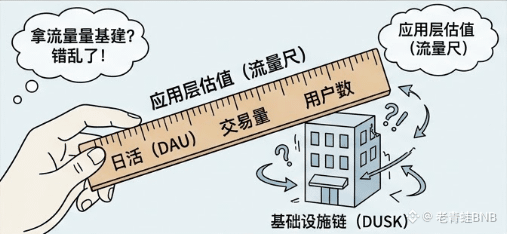
Regarding valuing Dusk, I’ve seen too many people use the wrong measuring stick. Trying to gauge an infrastructure chain using application-layer daily active users and transaction volume will inevitably lead to nonsense conclusions, because you’re mixing two entirely different valuation logics.
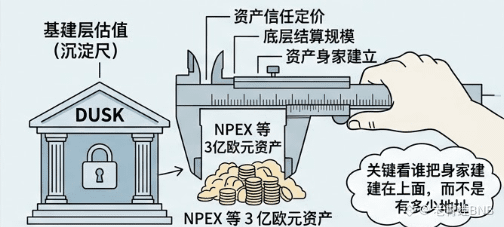
First, lay out the two “rulers.” For application valuation, you look at user volume. For a DEX or a lending product, user numbers, retention rates, and transaction volume directly determine revenue—the logic chain is short and the data looks nice. Infrastructure is a different game. Its value isn’t determined by how many users it has, but by whether people are willing to build their livelihoods on top of it. On a chain where there’s a compliant exchange managing hundreds of millions of assets, even if only a few thousand addresses exist on-chain, its fundamentals are still sturdier than a meme chain with a million addresses. The former is direct pricing of trust in assets; the latter is merely an instant quote from a traffic bubble.
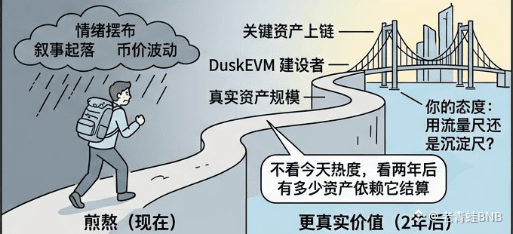
So which ruler should you use to size up Dusk? The answer is clear. Its valuation “anchor” should focus on three things: when NPEX’s €300 million in assets are actually issued and deposited on-chain; whether, on DuskEVM, a second NPEX-level builder has entered; and the real asset scale used for underlying settlement—not just the number of transactions. If you use the wrong ruler, you might end up discounting it because on-chain address growth is slow, or you might impulsively chase after a big issuance and overshoot due to blind optimism. Both kinds of misjudgment stem from the same wrong measuring stick.
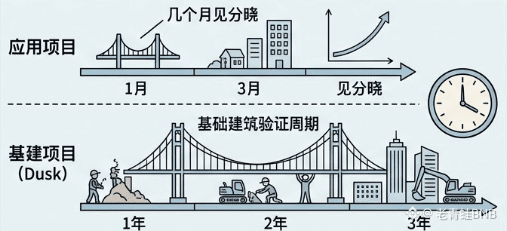
But infrastructure valuation has a pain point you can’t avoid: the feedback cycle is too long. The quality of applications can be judged in a few months, while the value of infrastructure can only be verified after the “buildings” above it are erected—this cycle is measured in years. During that time, the token price is entirely at the mercy of market sentiment, making it difficult for fundamentals research to withstand the ups and downs of narrative. This is the agony every holder of infrastructure projects has to endure.
My view is to acknowledge that this ruler measures slowly, but what it measures is more real. How much DUSK is worth shouldn’t be based on today’s on-chain hype; it should be based on how much asset base must rely on it for settlement two years from now. What ruler do you usually use to value projects—the traffic ruler or the value/settlement-accumulation ruler?
#dusk $DUSK @Dusk_Foundation
Regarding valuing Dusk, I’ve seen too many people use the wrong measuring stick. Trying to gauge an infrastructure chain using application-layer daily active users and transaction volume will inevitably lead to nonsense conclusions, because you’re mixing two entirely different valuation logics.
First, lay out the two “rulers.” For application valuation, you look at user volume. For a DEX or a lending product, user numbers, retention rates, and transaction volume directly determine revenue—the logic chain is short and the data looks nice. Infrastructure is a different game. Its value isn’t determined by how many users it has, but by whether people are willing to build their livelihoods on top of it. On a chain where there’s a compliant exchange managing hundreds of millions of assets, even if only a few thousand addresses exist on-chain, its fundamentals are still sturdier than a meme chain with a million addresses. The former is direct pricing of trust in assets; the latter is merely an instant quote from a traffic bubble.
So which ruler should you use to size up Dusk? The answer is clear. Its valuation “anchor” should focus on three things: when NPEX’s €300 million in assets are actually issued and deposited on-chain; whether, on DuskEVM, a second NPEX-level builder has entered; and the real asset scale used for underlying settlement—not just the number of transactions. If you use the wrong ruler, you might end up discounting it because on-chain address growth is slow, or you might impulsively chase after a big issuance and overshoot due to blind optimism. Both kinds of misjudgment stem from the same wrong measuring stick.
But infrastructure valuation has a pain point you can’t avoid: the feedback cycle is too long. The quality of applications can be judged in a few months, while the value of infrastructure can only be verified after the “buildings” above it are erected—this cycle is measured in years. During that time, the token price is entirely at the mercy of market sentiment, making it difficult for fundamentals research to withstand the ups and downs of narrative. This is the agony every holder of infrastructure projects has to endure.
My view is to acknowledge that this ruler measures slowly, but what it measures is more real. How much DUSK is worth shouldn’t be based on today’s on-chain hype; it should be based on how much asset base must rely on it for settlement two years from now. What ruler do you usually use to value projects—the traffic ruler or the value/settlement-accumulation ruler?
#dusk $DUSK @Dusk
First, lay out the two “rulers.” For application valuation, you look at user volume. For a DEX or a lending product, user numbers, retention rates, and transaction volume directly determine revenue—the logic chain is short and the data looks nice. Infrastructure is a different game. Its value isn’t determined by how many users it has, but by whether people are willing to build their livelihoods on top of it. On a chain where there’s a compliant exchange managing hundreds of millions of assets, even if only a few thousand addresses exist on-chain, its fundamentals are still sturdier than a meme chain with a million addresses. The former is direct pricing of trust in assets; the latter is merely an instant quote from a traffic bubble.
So which ruler should you use to size up Dusk? The answer is clear. Its valuation “anchor” should focus on three things: when NPEX’s €300 million in assets are actually issued and deposited on-chain; whether, on DuskEVM, a second NPEX-level builder has entered; and the real asset scale used for underlying settlement—not just the number of transactions. If you use the wrong ruler, you might end up discounting it because on-chain address growth is slow, or you might impulsively chase after a big issuance and overshoot due to blind optimism. Both kinds of misjudgment stem from the same wrong measuring stick.
But infrastructure valuation has a pain point you can’t avoid: the feedback cycle is too long. The quality of applications can be judged in a few months, while the value of infrastructure can only be verified after the “buildings” above it are erected—this cycle is measured in years. During that time, the token price is entirely at the mercy of market sentiment, making it difficult for fundamentals research to withstand the ups and downs of narrative. This is the agony every holder of infrastructure projects has to endure.
My view is to acknowledge that this ruler measures slowly, but what it measures is more real. How much DUSK is worth shouldn’t be based on today’s on-chain hype; it should be based on how much asset base must rely on it for settlement two years from now. What ruler do you usually use to value projects—the traffic ruler or the value/settlement-accumulation ruler?
#dusk $DUSK @Dusk
124
·
--
After years of arguing in the crypto world, there’s one so-called “opposition” that turns out to be a false premise from start to finish: privacy versus transparency. Dusk’s selective disclosure design shows me just how ridiculous this debate really is.
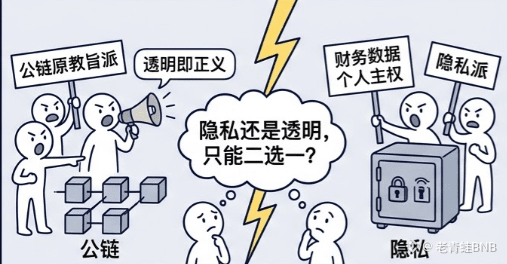
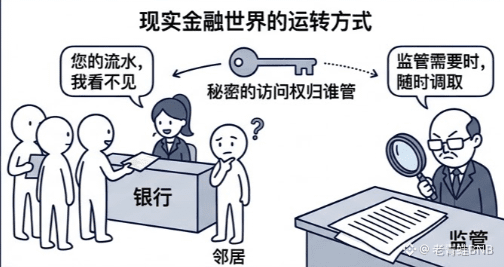
First, let’s look at how this false dilemma is created. The pro–public-chain fundamentalists believe everything should be laid out on-chain; transparency is justice. The privacy camp argues that financial data is a matter of personal sovereignty—no one should be able to see it. The two sides shout at each other, but they both assume one thing: privacy and transparency can only be an either-or choice. But the real financial world has never worked that way. Your bank transaction history is not visible to the tellers, nor to your neighbors—yet when regulators need it, they can retrieve it at any time. No one thinks this system is wrong, because it has never been about preserving secrets themselves; it’s about who controls access to those secrets.
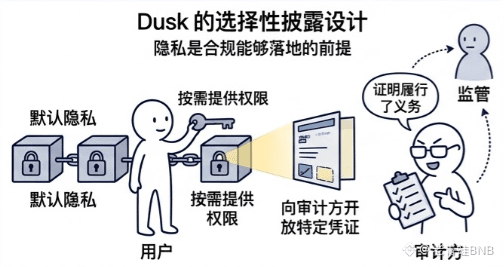
Dusk brings this logic onto the blockchain—that’s selective disclosure. By default, your transactions are not visible to the outside world, but you can choose to open specific credentials to auditors to prove that you’ve fulfilled your obligations, without having to hand over all your cards. Transparency hasn’t disappeared—it’s just moved from mass onlookers to being provided on a need-to basis. So privacy is not the enemy of transparency; it’s precisely the prerequisite for compliance to actually work. Without this layer of protection, institutions would never dare to put real business operations on-chain, and regulators would always face a no-man’s-land.
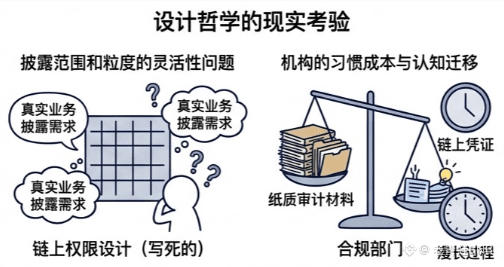
But no matter how elegant the design philosophy is, it still has to pass real-world tests. The premise of selective disclosure is that the scope and granularity of disclosure must be flexible enough. Yet on-chain permission design is often hardcoded—once the disclosure needs of real business exceed the preset templates, is there still enough flexibility? Nobody has verified that yet. Another concern is adoption cost. Compliance teams have spent decades building their workflow systems. Asking them to treat on-chain credentials as equivalent to paper audit materials isn’t a technical issue—it’s a long process of cognitive transition.
Setting aside these unverified steps, I recognize this direction itself. Privacy and transparency should never be enemies. The real disagreement is simply over who has the right to see. Next, I’ll watch the real-world deployment cases of $DUSK selective disclosure in actual audit scenarios. Which side are you on—full transparency, or viewing based on authority? #dusk $DUSK @Dusk_Foundation
After years of arguing in the crypto world, there’s one so-called “opposition” that turns out to be a false premise from start to finish: privacy versus transparency. Dusk’s selective disclosure design shows me just how ridiculous this debate really is.
First, let’s look at how this false dilemma is created. The pro–public-chain fundamentalists believe everything should be laid out on-chain; transparency is justice. The privacy camp argues that financial data is a matter of personal sovereignty—no one should be able to see it. The two sides shout at each other, but they both assume one thing: privacy and transparency can only be an either-or choice. But the real financial world has never worked that way. Your bank transaction history is not visible to the tellers, nor to your neighbors—yet when regulators need it, they can retrieve it at any time. No one thinks this system is wrong, because it has never been about preserving secrets themselves; it’s about who controls access to those secrets.
Dusk brings this logic onto the blockchain—that’s selective disclosure. By default, your transactions are not visible to the outside world, but you can choose to open specific credentials to auditors to prove that you’ve fulfilled your obligations, without having to hand over all your cards. Transparency hasn’t disappeared—it’s just moved from mass onlookers to being provided on a need-to basis. So privacy is not the enemy of transparency; it’s precisely the prerequisite for compliance to actually work. Without this layer of protection, institutions would never dare to put real business operations on-chain, and regulators would always face a no-man’s-land.
But no matter how elegant the design philosophy is, it still has to pass real-world tests. The premise of selective disclosure is that the scope and granularity of disclosure must be flexible enough. Yet on-chain permission design is often hardcoded—once the disclosure needs of real business exceed the preset templates, is there still enough flexibility? Nobody has verified that yet. Another concern is adoption cost. Compliance teams have spent decades building their workflow systems. Asking them to treat on-chain credentials as equivalent to paper audit materials isn’t a technical issue—it’s a long process of cognitive transition.
Setting aside these unverified steps, I recognize this direction itself. Privacy and transparency should never be enemies. The real disagreement is simply over who has the right to see. Next, I’ll watch the real-world deployment cases of $DUSK selective disclosure in actual audit scenarios. Which side are you on—full transparency, or viewing based on authority? #dusk $DUSK @Dusk
First, let’s look at how this false dilemma is created. The pro–public-chain fundamentalists believe everything should be laid out on-chain; transparency is justice. The privacy camp argues that financial data is a matter of personal sovereignty—no one should be able to see it. The two sides shout at each other, but they both assume one thing: privacy and transparency can only be an either-or choice. But the real financial world has never worked that way. Your bank transaction history is not visible to the tellers, nor to your neighbors—yet when regulators need it, they can retrieve it at any time. No one thinks this system is wrong, because it has never been about preserving secrets themselves; it’s about who controls access to those secrets.
Dusk brings this logic onto the blockchain—that’s selective disclosure. By default, your transactions are not visible to the outside world, but you can choose to open specific credentials to auditors to prove that you’ve fulfilled your obligations, without having to hand over all your cards. Transparency hasn’t disappeared—it’s just moved from mass onlookers to being provided on a need-to basis. So privacy is not the enemy of transparency; it’s precisely the prerequisite for compliance to actually work. Without this layer of protection, institutions would never dare to put real business operations on-chain, and regulators would always face a no-man’s-land.
But no matter how elegant the design philosophy is, it still has to pass real-world tests. The premise of selective disclosure is that the scope and granularity of disclosure must be flexible enough. Yet on-chain permission design is often hardcoded—once the disclosure needs of real business exceed the preset templates, is there still enough flexibility? Nobody has verified that yet. Another concern is adoption cost. Compliance teams have spent decades building their workflow systems. Asking them to treat on-chain credentials as equivalent to paper audit materials isn’t a technical issue—it’s a long process of cognitive transition.
Setting aside these unverified steps, I recognize this direction itself. Privacy and transparency should never be enemies. The real disagreement is simply over who has the right to see. Next, I’ll watch the real-world deployment cases of $DUSK selective disclosure in actual audit scenarios. Which side are you on—full transparency, or viewing based on authority? #dusk $DUSK @Dusk
7
2
235
·
--
When I was researching Dusk’s architecture recently, one design choice surprised me. For a project, why would it need to maintain two separate sets of virtual machines at the same time?
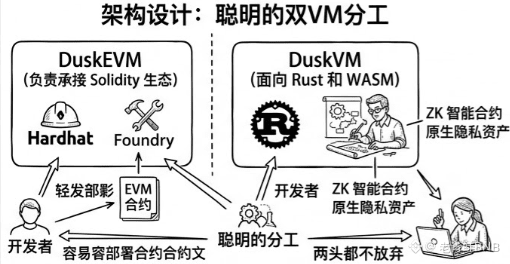
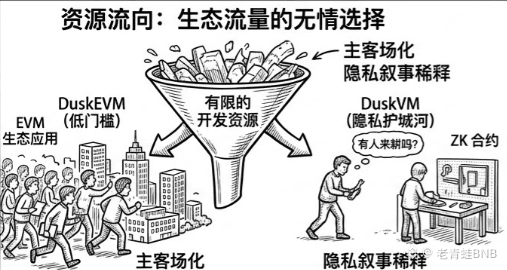
DuskEVM inherits the Solidity ecosystem—developers can deploy directly using familiar tools like Hardhat and Foundry. DuskVM is built for the Rust and WASM technology stack, and it carries ZK smart contracts and native privacy-preserving asset flows. In the short term, this division of labor looks smart. EVM solves the problem of onboarding for developers; DuskVM preserves the moat of privacy finance—both sides are kept.
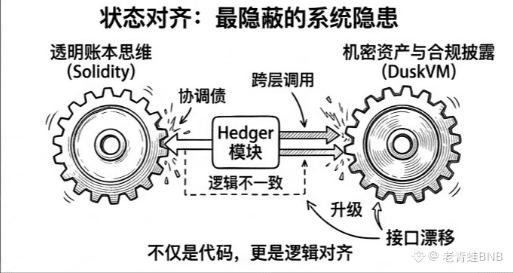
But the deeper I look, the more I realize the cost behind it isn’t small. The real issue isn’t whether the two VMs can run; it’s how to keep their states aligned over the long term. Solidity developers are used to thinking in terms of transparent ledgers, whereas DuskVM’s core scenarios involve confidential assets and compliance disclosures. When an application on DuskEVM needs to call underlying privacy capabilities through modules like a Hedger, two completely different execution logics sit in between. Once either side upgrades, the interface assumptions on the other side may quietly drift. This isn’t a code-quality problem—it’s the most hidden coordination debt in a modular system. It doesn’t show up early, but the more prosperous the ecosystem gets, the more expensive it becomes.
A more practical layer is that developer resources are limited. The most common outcome for a dual-stack project is that all ecosystem traffic flows to the side with the lower entry barrier. Everyone writes Solidity on DuskEVM, and the deepest moat on the DuskVM side ends up being left untilled. Then the dual-VM setup degrades from “division of labor” into a host-and-guest arrangement, and the privacy narrative is diluted into a regular add-on feature for a standard EVM chain.
Of course, I’m not saying this choice is wrong. In the compliance finance track, you can’t build without both a sufficient developer base and strong underlying privacy capabilities. If you want to hold both at once, going dual-VM is nearly unavoidable.
But the metrics worth watching next are clear. Of the applications deployed on DuskEVM, how many truly call DuskVM-side privacy and ZK capabilities? If people only treat it as a regular EVM chain with multiple privacy selling points, then the strategic significance of the dual-stack architecture should be questioned.
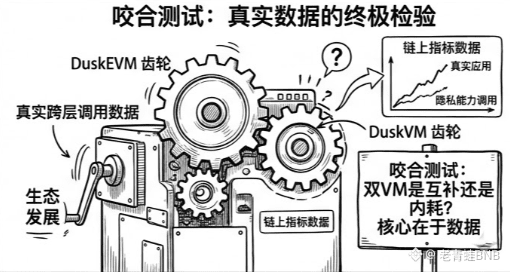
A great architecture doesn’t guarantee the ecosystem will follow the script. Whether the two VMs can truly “mesh” ultimately depends on real data from cross-layer calls. Going forward, I’ll continue tracking DUSK’s on-chain performance. Do you think the dual VM setup will be complementary, or will it evolve into resource contention? #dusk $DUSK @Dusk_Foundation
When I was researching Dusk’s architecture recently, one design choice surprised me. For a project, why would it need to maintain two separate sets of virtual machines at the same time?
DuskEVM inherits the Solidity ecosystem—developers can deploy directly using familiar tools like Hardhat and Foundry. DuskVM is built for the Rust and WASM technology stack, and it carries ZK smart contracts and native privacy-preserving asset flows. In the short term, this division of labor looks smart. EVM solves the problem of onboarding for developers; DuskVM preserves the moat of privacy finance—both sides are kept.
But the deeper I look, the more I realize the cost behind it isn’t small. The real issue isn’t whether the two VMs can run; it’s how to keep their states aligned over the long term. Solidity developers are used to thinking in terms of transparent ledgers, whereas DuskVM’s core scenarios involve confidential assets and compliance disclosures. When an application on DuskEVM needs to call underlying privacy capabilities through modules like a Hedger, two completely different execution logics sit in between. Once either side upgrades, the interface assumptions on the other side may quietly drift. This isn’t a code-quality problem—it’s the most hidden coordination debt in a modular system. It doesn’t show up early, but the more prosperous the ecosystem gets, the more expensive it becomes.
A more practical layer is that developer resources are limited. The most common outcome for a dual-stack project is that all ecosystem traffic flows to the side with the lower entry barrier. Everyone writes Solidity on DuskEVM, and the deepest moat on the DuskVM side ends up being left untilled. Then the dual-VM setup degrades from “division of labor” into a host-and-guest arrangement, and the privacy narrative is diluted into a regular add-on feature for a standard EVM chain.
Of course, I’m not saying this choice is wrong. In the compliance finance track, you can’t build without both a sufficient developer base and strong underlying privacy capabilities. If you want to hold both at once, going dual-VM is nearly unavoidable.
But the metrics worth watching next are clear. Of the applications deployed on DuskEVM, how many truly call DuskVM-side privacy and ZK capabilities? If people only treat it as a regular EVM chain with multiple privacy selling points, then the strategic significance of the dual-stack architecture should be questioned.
A great architecture doesn’t guarantee the ecosystem will follow the script. Whether the two VMs can truly “mesh” ultimately depends on real data from cross-layer calls. Going forward, I’ll continue tracking DUSK’s on-chain performance. Do you think the dual VM setup will be complementary, or will it evolve into resource contention? #dusk $DUSK @Dusk
DuskEVM inherits the Solidity ecosystem—developers can deploy directly using familiar tools like Hardhat and Foundry. DuskVM is built for the Rust and WASM technology stack, and it carries ZK smart contracts and native privacy-preserving asset flows. In the short term, this division of labor looks smart. EVM solves the problem of onboarding for developers; DuskVM preserves the moat of privacy finance—both sides are kept.
But the deeper I look, the more I realize the cost behind it isn’t small. The real issue isn’t whether the two VMs can run; it’s how to keep their states aligned over the long term. Solidity developers are used to thinking in terms of transparent ledgers, whereas DuskVM’s core scenarios involve confidential assets and compliance disclosures. When an application on DuskEVM needs to call underlying privacy capabilities through modules like a Hedger, two completely different execution logics sit in between. Once either side upgrades, the interface assumptions on the other side may quietly drift. This isn’t a code-quality problem—it’s the most hidden coordination debt in a modular system. It doesn’t show up early, but the more prosperous the ecosystem gets, the more expensive it becomes.
A more practical layer is that developer resources are limited. The most common outcome for a dual-stack project is that all ecosystem traffic flows to the side with the lower entry barrier. Everyone writes Solidity on DuskEVM, and the deepest moat on the DuskVM side ends up being left untilled. Then the dual-VM setup degrades from “division of labor” into a host-and-guest arrangement, and the privacy narrative is diluted into a regular add-on feature for a standard EVM chain.
Of course, I’m not saying this choice is wrong. In the compliance finance track, you can’t build without both a sufficient developer base and strong underlying privacy capabilities. If you want to hold both at once, going dual-VM is nearly unavoidable.
But the metrics worth watching next are clear. Of the applications deployed on DuskEVM, how many truly call DuskVM-side privacy and ZK capabilities? If people only treat it as a regular EVM chain with multiple privacy selling points, then the strategic significance of the dual-stack architecture should be questioned.
A great architecture doesn’t guarantee the ecosystem will follow the script. Whether the two VMs can truly “mesh” ultimately depends on real data from cross-layer calls. Going forward, I’ll continue tracking DUSK’s on-chain performance. Do you think the dual VM setup will be complementary, or will it evolve into resource contention? #dusk $DUSK @Dusk
154
·
--
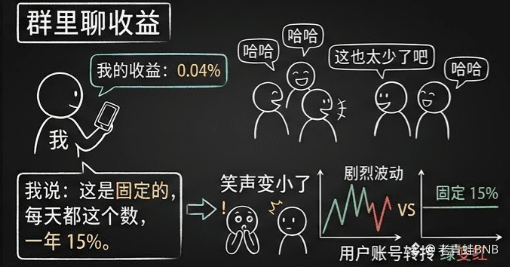
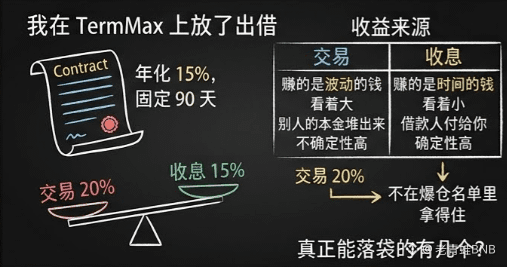
BTC is still hovering around 78,000. When I talked about my earnings in the group, I said my profit today was 0.04%, and the whole group burst into laughter. Then I said this is fixed—every day it’s this number. Over a year, that would be 15%, and the laughter would fade. But after these past two days of wild swings—rising from 64,000 to 79,500 and then dropping back—more than half the people in the group now have accounts that turned from green to red.
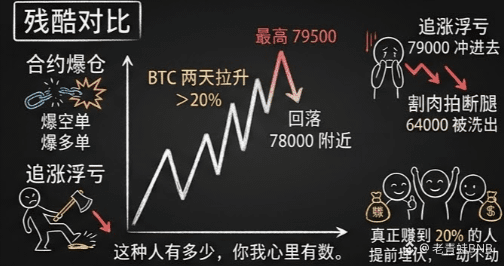
The comparison is pretty brutal, but it has to be laid out. From yesterday to today, BTC surged more than 20% in two days. Intraday, it even touched 79,500—just a breath away from 80,000. If you were trading contracts: yesterday a bunch of short positions got liquidated, and today when it spiked again, another batch of long positions got wiped out. If you chased the price and went in around 79,000, you’re currently sitting on losses. If you cut losses and got stopped out around 64,000 after getting swept away, you’re now kicking yourself. The only ones who truly made that 20% are the people who positioned themselves days in advance and didn’t move a muscle. How many of them are there? You and I both know.
I put a loan on TermMax—an annualized 15%, with a fixed term of 90 days. Compared to a two-day 20% jump, that number does look meager. But using a different algorithm makes it different. The 15% accrues every day for 90 days—no matter whether the market is up or down, no matter whether I’m asleep, and no matter how many people in the group get liquidated. And for those who profit from this 20% move, they first have to make sure they aren’t on yesterday’s list of 3.2 billion in liquidations, and they also have to ensure they can actually hold at the 78,000 level right now. Multiply these two layers of probability together, and you can figure out how many truly manage to take it all the way to realized gains.
In plain terms, trading profits from other people’s money moved by volatility; income from lending profits from time. The money from volatility looks big, but it’s stacked from other people’s principal—if you win, someone else loses. The time-based money looks smaller, but it’s real: paid by the borrowers, and it doesn’t depend on anyone misjudging the direction.
Of course, I’m not saying lending income is invincible. A 15% annualized return will underperform in a bull market. When BTC jumps 20% in two days, earning 15% in a year is basically a joke. Also, lending income is about stability, while losses from trading come with stimulation—crossing that “human nature” test isn’t something everyone can manage.
So my strategy hasn’t changed: the bulk is earning interest to secure the baseline, and a small portion is for trading the thrill. Earning interest lets me sleep well; when I’m itching to trade, I get to enjoy the rush.
Have you calculated your actual profit from your trading account this month—did it beat 15% annualized??
#termmax @termmax
BTC is still hovering around 78,000. When I talked about my earnings in the group, I said my profit today was 0.04%, and the whole group burst into laughter. Then I said this is fixed—every day it’s this number. Over a year, that would be 15%, and the laughter would fade. But after these past two days of wild swings—rising from 64,000 to 79,500 and then dropping back—more than half the people in the group now have accounts that turned from green to red.
The comparison is pretty brutal, but it has to be laid out. From yesterday to today, BTC surged more than 20% in two days. Intraday, it even touched 79,500—just a breath away from 80,000. If you were trading contracts: yesterday a bunch of short positions got liquidated, and today when it spiked again, another batch of long positions got wiped out. If you chased the price and went in around 79,000, you’re currently sitting on losses. If you cut losses and got stopped out around 64,000 after getting swept away, you’re now kicking yourself. The only ones who truly made that 20% are the people who positioned themselves days in advance and didn’t move a muscle. How many of them are there? You and I both know.
I put a loan on TermMax—an annualized 15%, with a fixed term of 90 days. Compared to a two-day 20% jump, that number does look meager. But using a different algorithm makes it different. The 15% accrues every day for 90 days—no matter whether the market is up or down, no matter whether I’m asleep, and no matter how many people in the group get liquidated. And for those who profit from this 20% move, they first have to make sure they aren’t on yesterday’s list of 3.2 billion in liquidations, and they also have to ensure they can actually hold at the 78,000 level right now. Multiply these two layers of probability together, and you can figure out how many truly manage to take it all the way to realized gains.
In plain terms, trading profits from other people’s money moved by volatility; income from lending profits from time. The money from volatility looks big, but it’s stacked from other people’s principal—if you win, someone else loses. The time-based money looks smaller, but it’s real: paid by the borrowers, and it doesn’t depend on anyone misjudging the direction.
Of course, I’m not saying lending income is invincible. A 15% annualized return will underperform in a bull market. When BTC jumps 20% in two days, earning 15% in a year is basically a joke. Also, lending income is about stability, while losses from trading come with stimulation—crossing that “human nature” test isn’t something everyone can manage.
So my strategy hasn’t changed: the bulk is earning interest to secure the baseline, and a small portion is for trading the thrill. Earning interest lets me sleep well; when I’m itching to trade, I get to enjoy the rush.
Have you calculated your actual profit from your trading account this month—did it beat 15% annualized??
#termmax @TermMax
The comparison is pretty brutal, but it has to be laid out. From yesterday to today, BTC surged more than 20% in two days. Intraday, it even touched 79,500—just a breath away from 80,000. If you were trading contracts: yesterday a bunch of short positions got liquidated, and today when it spiked again, another batch of long positions got wiped out. If you chased the price and went in around 79,000, you’re currently sitting on losses. If you cut losses and got stopped out around 64,000 after getting swept away, you’re now kicking yourself. The only ones who truly made that 20% are the people who positioned themselves days in advance and didn’t move a muscle. How many of them are there? You and I both know.
I put a loan on TermMax—an annualized 15%, with a fixed term of 90 days. Compared to a two-day 20% jump, that number does look meager. But using a different algorithm makes it different. The 15% accrues every day for 90 days—no matter whether the market is up or down, no matter whether I’m asleep, and no matter how many people in the group get liquidated. And for those who profit from this 20% move, they first have to make sure they aren’t on yesterday’s list of 3.2 billion in liquidations, and they also have to ensure they can actually hold at the 78,000 level right now. Multiply these two layers of probability together, and you can figure out how many truly manage to take it all the way to realized gains.
In plain terms, trading profits from other people’s money moved by volatility; income from lending profits from time. The money from volatility looks big, but it’s stacked from other people’s principal—if you win, someone else loses. The time-based money looks smaller, but it’s real: paid by the borrowers, and it doesn’t depend on anyone misjudging the direction.
Of course, I’m not saying lending income is invincible. A 15% annualized return will underperform in a bull market. When BTC jumps 20% in two days, earning 15% in a year is basically a joke. Also, lending income is about stability, while losses from trading come with stimulation—crossing that “human nature” test isn’t something everyone can manage.
So my strategy hasn’t changed: the bulk is earning interest to secure the baseline, and a small portion is for trading the thrill. Earning interest lets me sleep well; when I’m itching to trade, I get to enjoy the rush.
Have you calculated your actual profit from your trading account this month—did it beat 15% annualized??
#termmax @TermMax

5
1
387
·
--
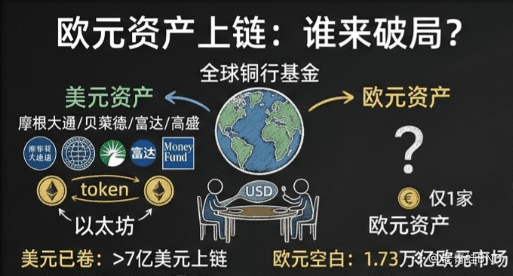
I just read the ECB’s 2024 April macroprudential report for Europe, and a set of data made me stare for a few seconds. Among tokenized money market funds registered in the EU, there’s only one that is denominated in euros. My first reaction was, no way—why isn’t anyone putting euro assets on-chain? Digging further, I found that DUSK has already laid most of the groundwork.
First, let’s look at what’s happening with USD. Ondo’s USDY plus OUSG has over $700 million in on-chain assets, and it has secured collateral by integrating more than 12 DeFi protocols. JPMorgan has moved the MONY fund onto Ethereum. BNY is working with Goldman on mirrored tokenization. BlackRock and Fidelity are all on the first batch of lists. Tokenizing dollar money market funds is no longer a new concept.
Now, Europe. Global money market funds total $8.8 trillion. Under European MMFR regulation, that’s €1.73 trillion in Europe alone. Yet for tokenized money market funds denominated in euros on-chain, you can count them on one hand. With such a big piece of meat, nobody’s reached for chopsticks.
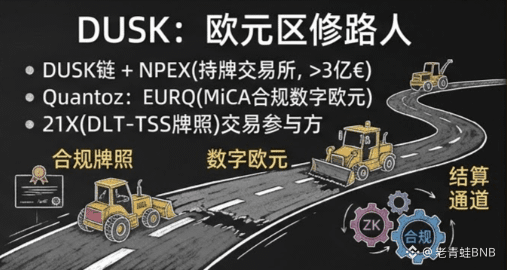
It’s not that there’s no demand—it’s that the road hasn’t been built. What DUSK does is exactly road construction. NPEX is a licensed exchange in the Netherlands, overseeing more than €300 million in assets, and it works with DUSK on security tokenization. Quantoz has issued a MiCA-compliant digital euro, EURQ, running on the DUSK chain. 21X obtained Europe’s first DLT-TSS license, and DUSK is its trading participant. From compliance licenses to settlement rails to the digital euro—everything that should be prepared has basically been prepared. Now it just depends on when euro fund products can truly be brought onto the table.
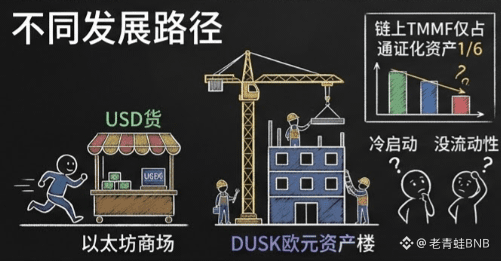
For example, Ondo is like renting storefronts in the Ethereum market to sell dollars. DUSK wants to build its own building—a place dedicated to housing euro assets.
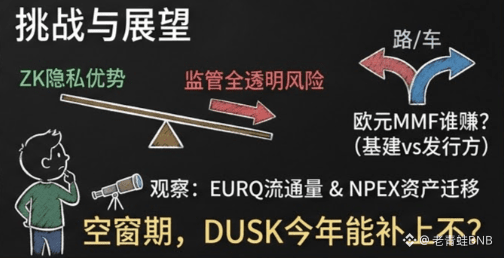
But the pitfalls aren’t few. The total market cap of on-chain TMMFs is only about one-sixth of tokenized assets on public chains. Without liquidity institutions, no one comes; without institutions, there’s no liquidity. DUSK differentiates with ZK privacy, and if European regulators suddenly say, “No, everything must be transparent,” the advantage is basically wiped out. There’s another point: DUSK is in the business of building roads, not driving. Once euro MMFs actually start running, who earns the money—does infrastructure get paid, or does the issuer? Nobody can say for sure.
The dollar funds are already on the table. Who will serve the euro assets onto the plate? I’ll keep watching the circulating supply of EURQ and the progress of asset migration by NPEX. Do you think this gap period—can DUSK fill it this year? #dusk $DUSK @Dusk_Foundation
I just read the ECB’s 2024 April macroprudential report for Europe, and a set of data made me stare for a few seconds. Among tokenized money market funds registered in the EU, there’s only one that is denominated in euros. My first reaction was, no way—why isn’t anyone putting euro assets on-chain? Digging further, I found that DUSK has already laid most of the groundwork.
First, let’s look at what’s happening with USD. Ondo’s USDY plus OUSG has over $700 million in on-chain assets, and it has secured collateral by integrating more than 12 DeFi protocols. JPMorgan has moved the MONY fund onto Ethereum. BNY is working with Goldman on mirrored tokenization. BlackRock and Fidelity are all on the first batch of lists. Tokenizing dollar money market funds is no longer a new concept.
Now, Europe. Global money market funds total $8.8 trillion. Under European MMFR regulation, that’s €1.73 trillion in Europe alone. Yet for tokenized money market funds denominated in euros on-chain, you can count them on one hand. With such a big piece of meat, nobody’s reached for chopsticks.
It’s not that there’s no demand—it’s that the road hasn’t been built. What DUSK does is exactly road construction. NPEX is a licensed exchange in the Netherlands, overseeing more than €300 million in assets, and it works with DUSK on security tokenization. Quantoz has issued a MiCA-compliant digital euro, EURQ, running on the DUSK chain. 21X obtained Europe’s first DLT-TSS license, and DUSK is its trading participant. From compliance licenses to settlement rails to the digital euro—everything that should be prepared has basically been prepared. Now it just depends on when euro fund products can truly be brought onto the table.
For example, Ondo is like renting storefronts in the Ethereum market to sell dollars. DUSK wants to build its own building—a place dedicated to housing euro assets.
But the pitfalls aren’t few. The total market cap of on-chain TMMFs is only about one-sixth of tokenized assets on public chains. Without liquidity institutions, no one comes; without institutions, there’s no liquidity. DUSK differentiates with ZK privacy, and if European regulators suddenly say, “No, everything must be transparent,” the advantage is basically wiped out. There’s another point: DUSK is in the business of building roads, not driving. Once euro MMFs actually start running, who earns the money—does infrastructure get paid, or does the issuer? Nobody can say for sure.
The dollar funds are already on the table. Who will serve the euro assets onto the plate? I’ll keep watching the circulating supply of EURQ and the progress of asset migration by NPEX. Do you think this gap period—can DUSK fill it this year? #dusk $DUSK @Dusk
First, let’s look at what’s happening with USD. Ondo’s USDY plus OUSG has over $700 million in on-chain assets, and it has secured collateral by integrating more than 12 DeFi protocols. JPMorgan has moved the MONY fund onto Ethereum. BNY is working with Goldman on mirrored tokenization. BlackRock and Fidelity are all on the first batch of lists. Tokenizing dollar money market funds is no longer a new concept.
Now, Europe. Global money market funds total $8.8 trillion. Under European MMFR regulation, that’s €1.73 trillion in Europe alone. Yet for tokenized money market funds denominated in euros on-chain, you can count them on one hand. With such a big piece of meat, nobody’s reached for chopsticks.
It’s not that there’s no demand—it’s that the road hasn’t been built. What DUSK does is exactly road construction. NPEX is a licensed exchange in the Netherlands, overseeing more than €300 million in assets, and it works with DUSK on security tokenization. Quantoz has issued a MiCA-compliant digital euro, EURQ, running on the DUSK chain. 21X obtained Europe’s first DLT-TSS license, and DUSK is its trading participant. From compliance licenses to settlement rails to the digital euro—everything that should be prepared has basically been prepared. Now it just depends on when euro fund products can truly be brought onto the table.
For example, Ondo is like renting storefronts in the Ethereum market to sell dollars. DUSK wants to build its own building—a place dedicated to housing euro assets.
But the pitfalls aren’t few. The total market cap of on-chain TMMFs is only about one-sixth of tokenized assets on public chains. Without liquidity institutions, no one comes; without institutions, there’s no liquidity. DUSK differentiates with ZK privacy, and if European regulators suddenly say, “No, everything must be transparent,” the advantage is basically wiped out. There’s another point: DUSK is in the business of building roads, not driving. Once euro MMFs actually start running, who earns the money—does infrastructure get paid, or does the issuer? Nobody can say for sure.
The dollar funds are already on the table. Who will serve the euro assets onto the plate? I’ll keep watching the circulating supply of EURQ and the progress of asset migration by NPEX. Do you think this gap period—can DUSK fill it this year? #dusk $DUSK @Dusk
3
2
157
·
--
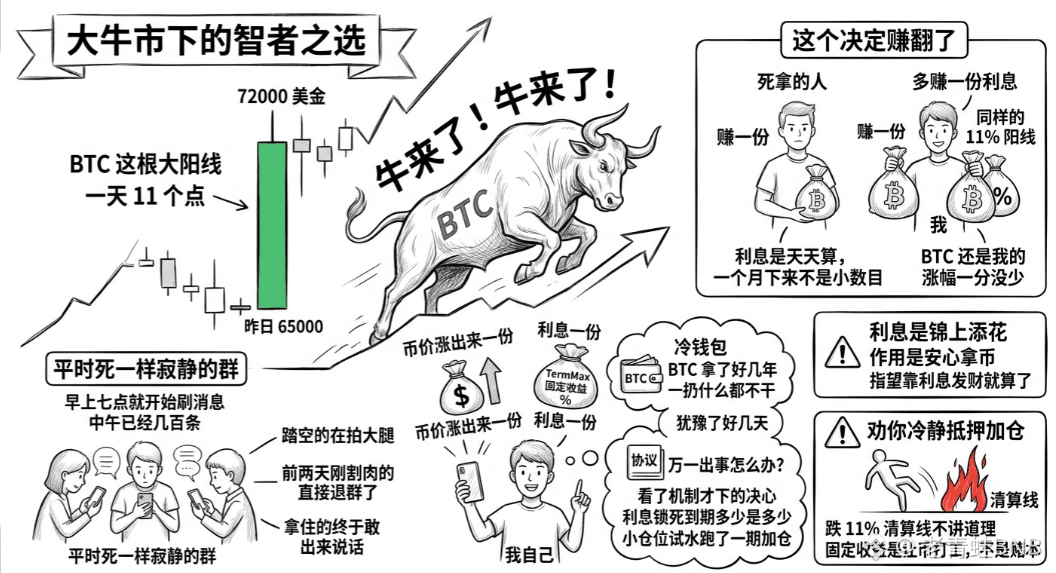
Bull time! Bull time! Today’s BTC has printed a big bullish candle—shouldn’t nobody have missed it? Up 11 points in a day, straight to $72,000. The group that’s usually as dead and silent as anything started churning messages at 7 a.m.; by noon there were already a few hundred. Those who missed the move are slapping their thighs, and the ones who just cut their losses a couple of days ago already left the group. Only the ones who held on finally dared to speak up.
I’m also part of the batch that’s been holding. But today I’m in a good mood—not entirely because it went up. Last month, I did something: I put a portion of my BTC into TermMax to earn fixed yield. So today I received two payments: one because the coin price rose, and one from the interest.
When I deposited it back then, I hesitated for several days. I’ve held BTC for years, and my usual habit is: cold wallet, toss it in, and do nothing besides watch the price. Putting my coins into a protocol—earning even just the interest—makes me uneasy. What if something goes wrong with the protocol? Later I made the decision after looking at how it works. The day interest was deposited, it was locked in; at maturity it’s whatever the amount is. No need to manage it in the middle. I took a small position to test the waters, and after running one cycle without issues, I gradually added more.
Looking back today, that decision paid off massively. Same 11% bullish candle—people who held got one profit, but I earned another from interest. It doesn’t look like much on a day-to-day basis, but this interest is calculated every day. By the end of a month, it’s not a small amount. Most importantly, it didn’t delay me from catching today’s bullish candle. BTC is still my BTC—no percentage gained was missed.
Of course, it’s all good that it went up, but I’ve got two things to say. First: interest is just icing on the cake. BTC fluctuates by more than ten points in a single day, and the interest money really isn’t much compared with that volatility. Don’t count on making a fortune from interest. Second: today, someone definitely thought about adding to their position by borrowing against collateral—“the market’s here, why not borrow?” I advise you to stay calm. If BTC goes up 11%, you call it a launch; if it drops 11% one day, the liquidation line won’t care to explain anything to you. Fixed yield should be used correctly—to have your coins work for you while you hold them, not to turn them into gambling capital.
Alright, that’s enough. While I’m in a good mood, let me ask one question: how much of this move did you guys see, and how is your BTC doing—just sitting there, or also working for you? #termmax @termmax
Bull time! Bull time! Today’s BTC has printed a big bullish candle—shouldn’t nobody have missed it? Up 11 points in a day, straight to $72,000. The group that’s usually as dead and silent as anything started churning messages at 7 a.m.; by noon there were already a few hundred. Those who missed the move are slapping their thighs, and the ones who just cut their losses a couple of days ago already left the group. Only the ones who held on finally dared to speak up.
I’m also part of the batch that’s been holding. But today I’m in a good mood—not entirely because it went up. Last month, I did something: I put a portion of my BTC into TermMax to earn fixed yield. So today I received two payments: one because the coin price rose, and one from the interest.
When I deposited it back then, I hesitated for several days. I’ve held BTC for years, and my usual habit is: cold wallet, toss it in, and do nothing besides watch the price. Putting my coins into a protocol—earning even just the interest—makes me uneasy. What if something goes wrong with the protocol? Later I made the decision after looking at how it works. The day interest was deposited, it was locked in; at maturity it’s whatever the amount is. No need to manage it in the middle. I took a small position to test the waters, and after running one cycle without issues, I gradually added more.
Looking back today, that decision paid off massively. Same 11% bullish candle—people who held got one profit, but I earned another from interest. It doesn’t look like much on a day-to-day basis, but this interest is calculated every day. By the end of a month, it’s not a small amount. Most importantly, it didn’t delay me from catching today’s bullish candle. BTC is still my BTC—no percentage gained was missed.
Of course, it’s all good that it went up, but I’ve got two things to say. First: interest is just icing on the cake. BTC fluctuates by more than ten points in a single day, and the interest money really isn’t much compared with that volatility. Don’t count on making a fortune from interest. Second: today, someone definitely thought about adding to their position by borrowing against collateral—“the market’s here, why not borrow?” I advise you to stay calm. If BTC goes up 11%, you call it a launch; if it drops 11% one day, the liquidation line won’t care to explain anything to you. Fixed yield should be used correctly—to have your coins work for you while you hold them, not to turn them into gambling capital.
Alright, that’s enough. While I’m in a good mood, let me ask one question: how much of this move did you guys see, and how is your BTC doing—just sitting there, or also working for you? #termmax @TermMax
I’m also part of the batch that’s been holding. But today I’m in a good mood—not entirely because it went up. Last month, I did something: I put a portion of my BTC into TermMax to earn fixed yield. So today I received two payments: one because the coin price rose, and one from the interest.
When I deposited it back then, I hesitated for several days. I’ve held BTC for years, and my usual habit is: cold wallet, toss it in, and do nothing besides watch the price. Putting my coins into a protocol—earning even just the interest—makes me uneasy. What if something goes wrong with the protocol? Later I made the decision after looking at how it works. The day interest was deposited, it was locked in; at maturity it’s whatever the amount is. No need to manage it in the middle. I took a small position to test the waters, and after running one cycle without issues, I gradually added more.
Looking back today, that decision paid off massively. Same 11% bullish candle—people who held got one profit, but I earned another from interest. It doesn’t look like much on a day-to-day basis, but this interest is calculated every day. By the end of a month, it’s not a small amount. Most importantly, it didn’t delay me from catching today’s bullish candle. BTC is still my BTC—no percentage gained was missed.
Of course, it’s all good that it went up, but I’ve got two things to say. First: interest is just icing on the cake. BTC fluctuates by more than ten points in a single day, and the interest money really isn’t much compared with that volatility. Don’t count on making a fortune from interest. Second: today, someone definitely thought about adding to their position by borrowing against collateral—“the market’s here, why not borrow?” I advise you to stay calm. If BTC goes up 11%, you call it a launch; if it drops 11% one day, the liquidation line won’t care to explain anything to you. Fixed yield should be used correctly—to have your coins work for you while you hold them, not to turn them into gambling capital.
Alright, that’s enough. While I’m in a good mood, let me ask one question: how much of this move did you guys see, and how is your BTC doing—just sitting there, or also working for you? #termmax @TermMax

5
3
285
·
--
In this group, people talk about compliant assets—whether the talk is all about how compliant they are, how advanced the tech is, and there really are news about “breakthroughs” every day. But there’s one view from Dusk I’ve always remembered: the first-order problem with compliant assets isn’t technology; it’s permissions. If you can’t settle who is authorized to hold the asset and who is authorized to transfer it, then no matter how high the technical “walls” are, it’s just an empty house.
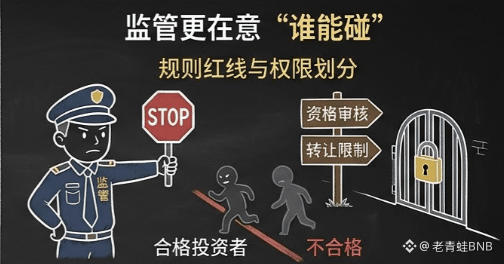
First, we have to admit the excitement around technology isn’t fake. But that excitement solves the question of how assets interact, while what regulators truly care about is who gets to touch them. Compliant assets are meant for qualified investors, so you must keep unqualified people out of the door. If an asset has a lock-up period written into it, you can’t just trade it around before it matures. To regulators, these rules are red lines; when they land on the asset, they become permissions. If the permissions are drawn wrong, then the more advanced the technology is, the bigger the hole it can poke.
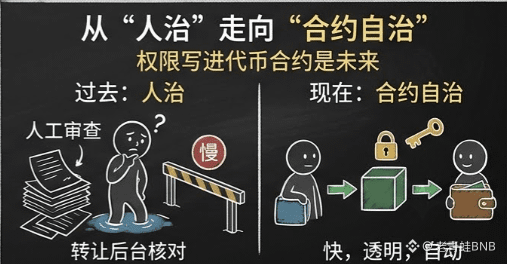
Getting this done used to rely on manual oversight. What you buy must be reviewed for eligibility; transferring to whom must be repeatedly checked in the backend. It’s slow and not transparent, and approval depends on the mood of the person handling it. On-chain, you can easily swing to the other extreme: once tokens are issued, anyone can buy and sell—like an open courtyard without a lock. One approach grinds you down with slowness; the other runs wild without bounds; neither can support compliant assets.
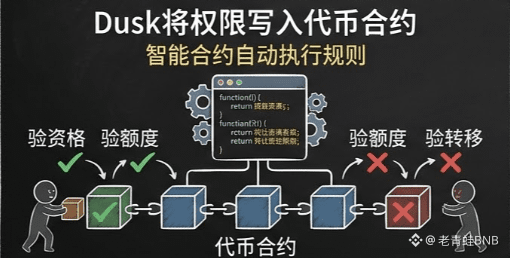
Dusk’s approach is to encode permissions into the token contract. Before you buy, the contract first verifies whether you’re eligible; if you fail, you’re blocked at the door. How much you hold is tightly enforced by the contract—exceed your limit and it returns an error. If you try to transfer to an ineligible address, the contract rejects it on the spot, with no room for negotiation. Some assets are even bound to specific wallets, so you can’t transfer them even if you want to. Permissions shift from human governance to contract autonomy—this is what it should look like to put assets on-chain.
So the first-order problem of compliant assets has never been technology bottlenecking you; it’s that permissions aren’t properly managed. Dusk turns that “door” into a switch written into the contract. That’s more concrete than stacking up any number of technical buzzwords.
But these switches are still being tested right now. As long as the mainnet doesn’t go live—down to the day—they can’t start working.
If you buy a compliant asset, do you habitually ask first how advanced the technology is, or do you first make sure you understand who is eligible to hold it and whether it can be transferred? Chat about it in the comments. #dusk $DUSK @Dusk_Foundation
In this group, people talk about compliant assets—whether the talk is all about how compliant they are, how advanced the tech is, and there really are news about “breakthroughs” every day. But there’s one view from Dusk I’ve always remembered: the first-order problem with compliant assets isn’t technology; it’s permissions. If you can’t settle who is authorized to hold the asset and who is authorized to transfer it, then no matter how high the technical “walls” are, it’s just an empty house.
First, we have to admit the excitement around technology isn’t fake. But that excitement solves the question of how assets interact, while what regulators truly care about is who gets to touch them. Compliant assets are meant for qualified investors, so you must keep unqualified people out of the door. If an asset has a lock-up period written into it, you can’t just trade it around before it matures. To regulators, these rules are red lines; when they land on the asset, they become permissions. If the permissions are drawn wrong, then the more advanced the technology is, the bigger the hole it can poke.
Getting this done used to rely on manual oversight. What you buy must be reviewed for eligibility; transferring to whom must be repeatedly checked in the backend. It’s slow and not transparent, and approval depends on the mood of the person handling it. On-chain, you can easily swing to the other extreme: once tokens are issued, anyone can buy and sell—like an open courtyard without a lock. One approach grinds you down with slowness; the other runs wild without bounds; neither can support compliant assets.
Dusk’s approach is to encode permissions into the token contract. Before you buy, the contract first verifies whether you’re eligible; if you fail, you’re blocked at the door. How much you hold is tightly enforced by the contract—exceed your limit and it returns an error. If you try to transfer to an ineligible address, the contract rejects it on the spot, with no room for negotiation. Some assets are even bound to specific wallets, so you can’t transfer them even if you want to. Permissions shift from human governance to contract autonomy—this is what it should look like to put assets on-chain.
So the first-order problem of compliant assets has never been technology bottlenecking you; it’s that permissions aren’t properly managed. Dusk turns that “door” into a switch written into the contract. That’s more concrete than stacking up any number of technical buzzwords.
But these switches are still being tested right now. As long as the mainnet doesn’t go live—down to the day—they can’t start working.
If you buy a compliant asset, do you habitually ask first how advanced the technology is, or do you first make sure you understand who is eligible to hold it and whether it can be transferred? Chat about it in the comments. #dusk $DUSK @Dusk
First, we have to admit the excitement around technology isn’t fake. But that excitement solves the question of how assets interact, while what regulators truly care about is who gets to touch them. Compliant assets are meant for qualified investors, so you must keep unqualified people out of the door. If an asset has a lock-up period written into it, you can’t just trade it around before it matures. To regulators, these rules are red lines; when they land on the asset, they become permissions. If the permissions are drawn wrong, then the more advanced the technology is, the bigger the hole it can poke.
Getting this done used to rely on manual oversight. What you buy must be reviewed for eligibility; transferring to whom must be repeatedly checked in the backend. It’s slow and not transparent, and approval depends on the mood of the person handling it. On-chain, you can easily swing to the other extreme: once tokens are issued, anyone can buy and sell—like an open courtyard without a lock. One approach grinds you down with slowness; the other runs wild without bounds; neither can support compliant assets.
Dusk’s approach is to encode permissions into the token contract. Before you buy, the contract first verifies whether you’re eligible; if you fail, you’re blocked at the door. How much you hold is tightly enforced by the contract—exceed your limit and it returns an error. If you try to transfer to an ineligible address, the contract rejects it on the spot, with no room for negotiation. Some assets are even bound to specific wallets, so you can’t transfer them even if you want to. Permissions shift from human governance to contract autonomy—this is what it should look like to put assets on-chain.
So the first-order problem of compliant assets has never been technology bottlenecking you; it’s that permissions aren’t properly managed. Dusk turns that “door” into a switch written into the contract. That’s more concrete than stacking up any number of technical buzzwords.
But these switches are still being tested right now. As long as the mainnet doesn’t go live—down to the day—they can’t start working.
If you buy a compliant asset, do you habitually ask first how advanced the technology is, or do you first make sure you understand who is eligible to hold it and whether it can be transferred? Chat about it in the comments. #dusk $DUSK @Dusk

7
4
453
·
--
A few years ago, I stepped into a pit that still makes me feel awful when I think about it. Back then, I deposited stablecoins on a lending platform. I chose the safest market across the whole platform—low interest, nothing fancy, just for peace of mind. But then another high-risk market on the same platform blew up with a bad loan. The gap couldn’t be filled, and the final solution was to have all depositors under the agreement share the loss proportionally. When I saw the announcement, I was stunned. I hadn’t earned even a single cent of high interest—so why was I being forced to cover someone else’s gambling?
So the first time I saw TermMax’s physical delivery mechanism, my eyes lit up. Its rules are strict: if a borrower defaults and the collateral can’t be liquidated, those collateral assets are directly delivered in proportion to the lenders of that specific market. There’s no public insurance fund stepping in to backstop it, and it isn’t allocated to other markets. Whose fault is it, whose responsibility is it—the books are balanced clearly.
This mechanism fixes the most unfair part of the pooled-fund model. In a big communal pot, the most conservative depositors always end up bearing the tail risk from the most aggressive borrowers. Returns are shared across the pool, but the risk is spread to everyone. Physical delivery breaks this unwritten rule: the maximum risk you take on is only the collateral in the market you chose.
Once I understood that, the logic of choosing markets changed completely. Before, I only cared whether the interest was higher. Now I ask myself just one question: if liquidation fails tomorrow, and this batch of collateral lands in my hands, am I willing to hold it? Once that question is on the table, those markets offering tempting interest but where the collateral is basically air automatically get filtered out.
But we should also speak plainly. Getting collateral doesn’t mean getting cash. Scenarios where liquidation fails often happen during a crash. The coins you receive may still be dropping, and to cash out you have to sell—at a time when more than just you wants to sell. The more unpopular the collateral is, the more this “compensation” feels like a consolation prize. The bad debt hasn’t disappeared—it’s just sitting in your wallet in a different form.
So the real purpose of this mechanism is to push the risk-management pressure forward to the depositors. Choosing a market means choosing what you’re willing to hold under the worst-case scenario. If you don’t make that choice, the high-interest markets will still harvest you.
If liquidation is in front of you with two choices—an 10% discount ETH, and a counterfeit coin with the same nominal value—what would you choose? #termmax @termmax
A few years ago, I stepped into a pit that still makes me feel awful when I think about it. Back then, I deposited stablecoins on a lending platform. I chose the safest market across the whole platform—low interest, nothing fancy, just for peace of mind. But then another high-risk market on the same platform blew up with a bad loan. The gap couldn’t be filled, and the final solution was to have all depositors under the agreement share the loss proportionally. When I saw the announcement, I was stunned. I hadn’t earned even a single cent of high interest—so why was I being forced to cover someone else’s gambling?
So the first time I saw TermMax’s physical delivery mechanism, my eyes lit up. Its rules are strict: if a borrower defaults and the collateral can’t be liquidated, those collateral assets are directly delivered in proportion to the lenders of that specific market. There’s no public insurance fund stepping in to backstop it, and it isn’t allocated to other markets. Whose fault is it, whose responsibility is it—the books are balanced clearly.
This mechanism fixes the most unfair part of the pooled-fund model. In a big communal pot, the most conservative depositors always end up bearing the tail risk from the most aggressive borrowers. Returns are shared across the pool, but the risk is spread to everyone. Physical delivery breaks this unwritten rule: the maximum risk you take on is only the collateral in the market you chose.
Once I understood that, the logic of choosing markets changed completely. Before, I only cared whether the interest was higher. Now I ask myself just one question: if liquidation fails tomorrow, and this batch of collateral lands in my hands, am I willing to hold it? Once that question is on the table, those markets offering tempting interest but where the collateral is basically air automatically get filtered out.
But we should also speak plainly. Getting collateral doesn’t mean getting cash. Scenarios where liquidation fails often happen during a crash. The coins you receive may still be dropping, and to cash out you have to sell—at a time when more than just you wants to sell. The more unpopular the collateral is, the more this “compensation” feels like a consolation prize. The bad debt hasn’t disappeared—it’s just sitting in your wallet in a different form.
So the real purpose of this mechanism is to push the risk-management pressure forward to the depositors. Choosing a market means choosing what you’re willing to hold under the worst-case scenario. If you don’t make that choice, the high-interest markets will still harvest you.
If liquidation is in front of you with two choices—an 10% discount ETH, and a counterfeit coin with the same nominal value—what would you choose? #termmax @TermMax
So the first time I saw TermMax’s physical delivery mechanism, my eyes lit up. Its rules are strict: if a borrower defaults and the collateral can’t be liquidated, those collateral assets are directly delivered in proportion to the lenders of that specific market. There’s no public insurance fund stepping in to backstop it, and it isn’t allocated to other markets. Whose fault is it, whose responsibility is it—the books are balanced clearly.
This mechanism fixes the most unfair part of the pooled-fund model. In a big communal pot, the most conservative depositors always end up bearing the tail risk from the most aggressive borrowers. Returns are shared across the pool, but the risk is spread to everyone. Physical delivery breaks this unwritten rule: the maximum risk you take on is only the collateral in the market you chose.
Once I understood that, the logic of choosing markets changed completely. Before, I only cared whether the interest was higher. Now I ask myself just one question: if liquidation fails tomorrow, and this batch of collateral lands in my hands, am I willing to hold it? Once that question is on the table, those markets offering tempting interest but where the collateral is basically air automatically get filtered out.
But we should also speak plainly. Getting collateral doesn’t mean getting cash. Scenarios where liquidation fails often happen during a crash. The coins you receive may still be dropping, and to cash out you have to sell—at a time when more than just you wants to sell. The more unpopular the collateral is, the more this “compensation” feels like a consolation prize. The bad debt hasn’t disappeared—it’s just sitting in your wallet in a different form.
So the real purpose of this mechanism is to push the risk-management pressure forward to the depositors. Choosing a market means choosing what you’re willing to hold under the worst-case scenario. If you don’t make that choice, the high-interest markets will still harvest you.
If liquidation is in front of you with two choices—an 10% discount ETH, and a counterfeit coin with the same nominal value—what would you choose? #termmax @TermMax
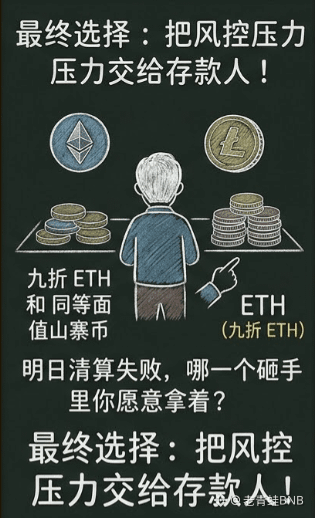
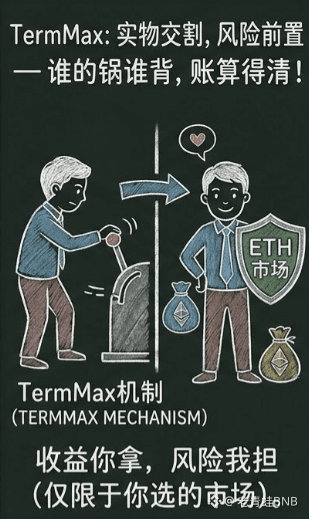
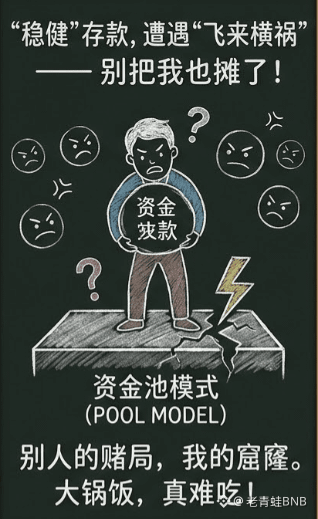
2
2
191
·
--
DuskPay, Dusk’s payment product, has recently entered a place that many people wouldn’t have expected: Italy’s online gaming market. Two licensed gaming operators, PlayMatika and Betpassion, have integrated DuskPay into their platforms. Italy’s gaming market has an annual transaction volume of €150 billion—an already staggering number—but what I care about even more is this: compliant payments have finally gone mainstream, moving from financial use cases into gaming, one of the most everyday consumer scenarios.
When we used to discuss compliant stablecoins and compliant payments, the conversation always revolved around securities settlement and institutional custody, as well as exchange clearing. The audience was banks and funds. That narrative is fine, but it’s simply too far removed from ordinary people. Game payments are a completely different world: players make frequent, small top-ups, aimed at everyday players who care about whether funds arrive fast, whether the fees are low, and whether the process is smooth. If compliant payments can take root here, it means they’re no longer exclusive tools for financial institutions—they’re starting to become an option for ordinary people’s day-to-day spending.
The gaming environment is especially demanding for payments. Operators need to be licensed, the flow of funds must be clean, and players’ deposits can’t be frozen at the drop of a hat. The two operators that DuskPay is connected with are both regulated, licensed operators, which means they’re conducting business properly within Italy’s regulatory framework. This is where the value of compliance becomes visible: players’ top-up money finally has a clean, smooth channel to go through, and operators no longer have to worry about finding themselves in gray areas.
The most important part, in my view, is the phrase “going mainstream.” Dusk’s past stories have all revolved around real-world assets and securities trading, plus institutional finance. With game payments, it’s like that compliance capability has been brought right up to the wallet of ordinary people. Compliant payments are moving from being an institution-only tool to something that everyone can use—this is the market it truly wants to open. Gaming is just the first stop.
Don’t let the €150 billion figure distract you. DuskPay has just been rolled out, and these two operators are only the starting point—coverage is still small. Whether this path can keep widening depends on how many real scenarios it can handle next.
Have you ever topped up in a game? Have you ever wondered whether the top-up channel is clean?
#dusk $DUSK @Dusk_Foundation
DuskPay, Dusk’s payment product, has recently entered a place that many people wouldn’t have expected: Italy’s online gaming market. Two licensed gaming operators, PlayMatika and Betpassion, have integrated DuskPay into their platforms. Italy’s gaming market has an annual transaction volume of €150 billion—an already staggering number—but what I care about even more is this: compliant payments have finally gone mainstream, moving from financial use cases into gaming, one of the most everyday consumer scenarios.
When we used to discuss compliant stablecoins and compliant payments, the conversation always revolved around securities settlement and institutional custody, as well as exchange clearing. The audience was banks and funds. That narrative is fine, but it’s simply too far removed from ordinary people. Game payments are a completely different world: players make frequent, small top-ups, aimed at everyday players who care about whether funds arrive fast, whether the fees are low, and whether the process is smooth. If compliant payments can take root here, it means they’re no longer exclusive tools for financial institutions—they’re starting to become an option for ordinary people’s day-to-day spending.
The gaming environment is especially demanding for payments. Operators need to be licensed, the flow of funds must be clean, and players’ deposits can’t be frozen at the drop of a hat. The two operators that DuskPay is connected with are both regulated, licensed operators, which means they’re conducting business properly within Italy’s regulatory framework. This is where the value of compliance becomes visible: players’ top-up money finally has a clean, smooth channel to go through, and operators no longer have to worry about finding themselves in gray areas.
The most important part, in my view, is the phrase “going mainstream.” Dusk’s past stories have all revolved around real-world assets and securities trading, plus institutional finance. With game payments, it’s like that compliance capability has been brought right up to the wallet of ordinary people. Compliant payments are moving from being an institution-only tool to something that everyone can use—this is the market it truly wants to open. Gaming is just the first stop.
Don’t let the €150 billion figure distract you. DuskPay has just been rolled out, and these two operators are only the starting point—coverage is still small. Whether this path can keep widening depends on how many real scenarios it can handle next.
Have you ever topped up in a game? Have you ever wondered whether the top-up channel is clean?
#dusk $DUSK @Dusk
When we used to discuss compliant stablecoins and compliant payments, the conversation always revolved around securities settlement and institutional custody, as well as exchange clearing. The audience was banks and funds. That narrative is fine, but it’s simply too far removed from ordinary people. Game payments are a completely different world: players make frequent, small top-ups, aimed at everyday players who care about whether funds arrive fast, whether the fees are low, and whether the process is smooth. If compliant payments can take root here, it means they’re no longer exclusive tools for financial institutions—they’re starting to become an option for ordinary people’s day-to-day spending.
The gaming environment is especially demanding for payments. Operators need to be licensed, the flow of funds must be clean, and players’ deposits can’t be frozen at the drop of a hat. The two operators that DuskPay is connected with are both regulated, licensed operators, which means they’re conducting business properly within Italy’s regulatory framework. This is where the value of compliance becomes visible: players’ top-up money finally has a clean, smooth channel to go through, and operators no longer have to worry about finding themselves in gray areas.
The most important part, in my view, is the phrase “going mainstream.” Dusk’s past stories have all revolved around real-world assets and securities trading, plus institutional finance. With game payments, it’s like that compliance capability has been brought right up to the wallet of ordinary people. Compliant payments are moving from being an institution-only tool to something that everyone can use—this is the market it truly wants to open. Gaming is just the first stop.
Don’t let the €150 billion figure distract you. DuskPay has just been rolled out, and these two operators are only the starting point—coverage is still small. Whether this path can keep widening depends on how many real scenarios it can handle next.
Have you ever topped up in a game? Have you ever wondered whether the top-up channel is clean?
#dusk $DUSK @Dusk

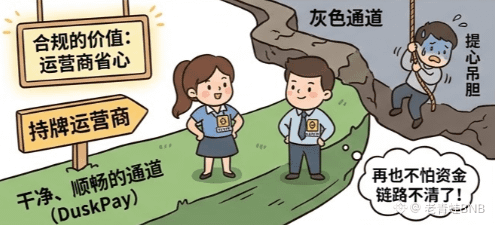
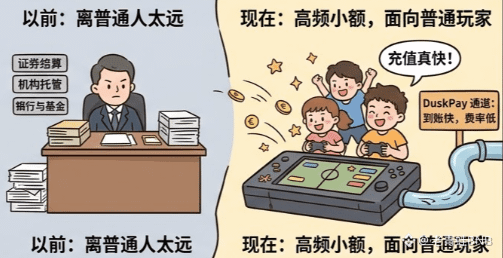
3
2
121
·
--
Every arbitrage strategy I use, before entering, I calculate it once in a spreadsheet. How much principal, what leverage multiple, what the return on the asset side is, what the cost on the liability side is—one calculation turns into a complete profit-and-loss statement. But over these years, I’ve found that in all the models, there’s one cell that’s always blank: the future borrowing interest rate. No one knows what the next month’s funding pool utilization rate will be. That cell can only be filled by guesswork, and then the conclusion of the entire table is based on assumptions.
Recently, when I set up leveraged positions on TermMax, it was the first time I fixed that cell. The borrowing rate is locked in immediately upon execution, and the liability-side cost stays a flat line from day one to the maturity date—it won’t jump higher. Subtract the fixed cost from the asset-side return, and the spread in the middle is the only variable; on the day you build the position, it’s already clear. The strategy shifts from gambling to arithmetic.
Don’t underestimate this change. There are a thousand ways for leveraged strategies to die, but the most common one is the same: the spread inverts. You’re betting that the asset return will be higher than the borrowing cost. Then, as you keep doing it, the interest rises, the spread turns negative, and your position goes from a money-printing machine to a shredder for cash. In a floating-rate era, there’s no solution—you can only pray the market doesn’t go haywire. Fixed interest rates are like deleting the biggest variable from the equation.
Of course, a flat cost curve doesn’t mean the收益 curve is flat too. The asset-side returns can still fluctuate—collateral ratio, APR, coin price, and none of those variables are missing. And leverage is still leverage. Fixed interest doesn’t mean the principal is safe. When your position drawdowns happen, the interest that’s due at maturity will not be reduced by a single cent.
So the true user profile for this setup is very clear: strategies where you can lock both ends. For example, an asset-side fixed-income spread arbitrage where the liability side is locked, and the return side is locked—the gap in the middle is the real profit. If you use it to bet on direction, locking the costs will make you lose in an even more obvious way.
When you do arbitrage, do you build models in advance, or do you enter based on instinct?
#termmax @termmax
Every arbitrage strategy I use, before entering, I calculate it once in a spreadsheet. How much principal, what leverage multiple, what the return on the asset side is, what the cost on the liability side is—one calculation turns into a complete profit-and-loss statement. But over these years, I’ve found that in all the models, there’s one cell that’s always blank: the future borrowing interest rate. No one knows what the next month’s funding pool utilization rate will be. That cell can only be filled by guesswork, and then the conclusion of the entire table is based on assumptions.
Recently, when I set up leveraged positions on TermMax, it was the first time I fixed that cell. The borrowing rate is locked in immediately upon execution, and the liability-side cost stays a flat line from day one to the maturity date—it won’t jump higher. Subtract the fixed cost from the asset-side return, and the spread in the middle is the only variable; on the day you build the position, it’s already clear. The strategy shifts from gambling to arithmetic.
Don’t underestimate this change. There are a thousand ways for leveraged strategies to die, but the most common one is the same: the spread inverts. You’re betting that the asset return will be higher than the borrowing cost. Then, as you keep doing it, the interest rises, the spread turns negative, and your position goes from a money-printing machine to a shredder for cash. In a floating-rate era, there’s no solution—you can only pray the market doesn’t go haywire. Fixed interest rates are like deleting the biggest variable from the equation.
Of course, a flat cost curve doesn’t mean the收益 curve is flat too. The asset-side returns can still fluctuate—collateral ratio, APR, coin price, and none of those variables are missing. And leverage is still leverage. Fixed interest doesn’t mean the principal is safe. When your position drawdowns happen, the interest that’s due at maturity will not be reduced by a single cent.
So the true user profile for this setup is very clear: strategies where you can lock both ends. For example, an asset-side fixed-income spread arbitrage where the liability side is locked, and the return side is locked—the gap in the middle is the real profit. If you use it to bet on direction, locking the costs will make you lose in an even more obvious way.
When you do arbitrage, do you build models in advance, or do you enter based on instinct?
#termmax @TermMax
Recently, when I set up leveraged positions on TermMax, it was the first time I fixed that cell. The borrowing rate is locked in immediately upon execution, and the liability-side cost stays a flat line from day one to the maturity date—it won’t jump higher. Subtract the fixed cost from the asset-side return, and the spread in the middle is the only variable; on the day you build the position, it’s already clear. The strategy shifts from gambling to arithmetic.
Don’t underestimate this change. There are a thousand ways for leveraged strategies to die, but the most common one is the same: the spread inverts. You’re betting that the asset return will be higher than the borrowing cost. Then, as you keep doing it, the interest rises, the spread turns negative, and your position goes from a money-printing machine to a shredder for cash. In a floating-rate era, there’s no solution—you can only pray the market doesn’t go haywire. Fixed interest rates are like deleting the biggest variable from the equation.
Of course, a flat cost curve doesn’t mean the收益 curve is flat too. The asset-side returns can still fluctuate—collateral ratio, APR, coin price, and none of those variables are missing. And leverage is still leverage. Fixed interest doesn’t mean the principal is safe. When your position drawdowns happen, the interest that’s due at maturity will not be reduced by a single cent.
So the true user profile for this setup is very clear: strategies where you can lock both ends. For example, an asset-side fixed-income spread arbitrage where the liability side is locked, and the return side is locked—the gap in the middle is the real profit. If you use it to bet on direction, locking the costs will make you lose in an even more obvious way.
When you do arbitrage, do you build models in advance, or do you enter based on instinct?
#termmax @TermMax
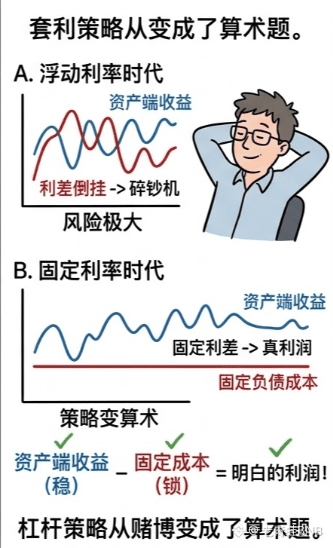
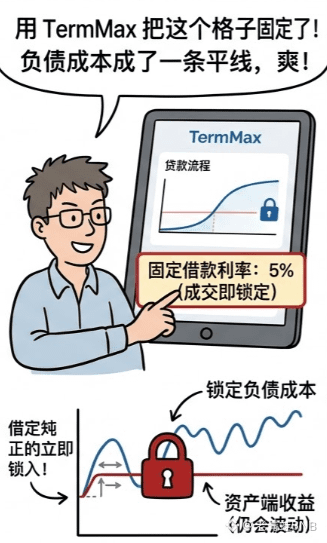

2
4
139
·
--
On the market, 90% of the so-called RWA is, to put it bluntly, just putting a new skin over old systems. That may sound a bit harsh, but after Dusk did some research, I’m increasingly convinced that “true assets being on-chain” isn’t how it’s supposed to work.
Let’s peel back that skin and see what’s underneath. If you buy back a bond token and think the asset has been put on-chain, think again—the chain itself hasn’t really moved. The bond is still sitting in the custodian’s hands. The token is just a paper-thin representation of it. What you can touch on-chain is basically a “certificate of a certificate.” When a transaction happens, the chain records it, but the custodian has to record it again on their side. If the two don’t match, you have to reconcile manually. Only after reconciliation do you settle. After you go through the whole loop, the process is exactly the same as in the old world.
Here, blockchain is doing the job of a bookkeeper—not a clearinghouse. It saves no costs, adds no trust. It simply swaps out the original ledger for a new-looking one.
That’s what I mean by “a skin.” How assets live and operate off-chain stays exactly the same. On-chain, there’s just an extra shadow layer—looks lively, but nothing real is happening.
Dusk wants to do the opposite. It isn’t aiming to map existing off-chain assets to tokens. Instead, it wants to move the asset itself onto the chain for native issuance. The off-chain custodial step gets cut out. If the asset is on-chain, it’s on-chain. Ownership follows the wallet rather than the ledger. This path is hard because it requires dealing with regulators—licenses, compliance, audits, and all that. But it’s precisely these headaches that turn RWA from “skin” into something real.
A bond isn’t a mapping; it’s natively issued on-chain. Settlement isn’t reconciling between two sides; it’s done once and done on-chain.
That said, Dusk’s native on-chain path still isn’t fully finished either—the mainnet hasn’t gone live yet, so this whole playbook is still on paper. Ninety percent is skin on the current state of things. The remaining ten percent will only count once it actually builds the building.
If you have RWA, dare to peel back the curtain and take a look: is it truly the underlying asset down there, or just a shadow layer? Be honest—say it in the comments. #dusk $DUSK @Dusk_Foundation
On the market, 90% of the so-called RWA is, to put it bluntly, just putting a new skin over old systems. That may sound a bit harsh, but after Dusk did some research, I’m increasingly convinced that “true assets being on-chain” isn’t how it’s supposed to work.
Let’s peel back that skin and see what’s underneath. If you buy back a bond token and think the asset has been put on-chain, think again—the chain itself hasn’t really moved. The bond is still sitting in the custodian’s hands. The token is just a paper-thin representation of it. What you can touch on-chain is basically a “certificate of a certificate.” When a transaction happens, the chain records it, but the custodian has to record it again on their side. If the two don’t match, you have to reconcile manually. Only after reconciliation do you settle. After you go through the whole loop, the process is exactly the same as in the old world.
Here, blockchain is doing the job of a bookkeeper—not a clearinghouse. It saves no costs, adds no trust. It simply swaps out the original ledger for a new-looking one.
That’s what I mean by “a skin.” How assets live and operate off-chain stays exactly the same. On-chain, there’s just an extra shadow layer—looks lively, but nothing real is happening.
Dusk wants to do the opposite. It isn’t aiming to map existing off-chain assets to tokens. Instead, it wants to move the asset itself onto the chain for native issuance. The off-chain custodial step gets cut out. If the asset is on-chain, it’s on-chain. Ownership follows the wallet rather than the ledger. This path is hard because it requires dealing with regulators—licenses, compliance, audits, and all that. But it’s precisely these headaches that turn RWA from “skin” into something real.
A bond isn’t a mapping; it’s natively issued on-chain. Settlement isn’t reconciling between two sides; it’s done once and done on-chain.
That said, Dusk’s native on-chain path still isn’t fully finished either—the mainnet hasn’t gone live yet, so this whole playbook is still on paper. Ninety percent is skin on the current state of things. The remaining ten percent will only count once it actually builds the building.
If you have RWA, dare to peel back the curtain and take a look: is it truly the underlying asset down there, or just a shadow layer? Be honest—say it in the comments. #dusk $DUSK @Dusk
Let’s peel back that skin and see what’s underneath. If you buy back a bond token and think the asset has been put on-chain, think again—the chain itself hasn’t really moved. The bond is still sitting in the custodian’s hands. The token is just a paper-thin representation of it. What you can touch on-chain is basically a “certificate of a certificate.” When a transaction happens, the chain records it, but the custodian has to record it again on their side. If the two don’t match, you have to reconcile manually. Only after reconciliation do you settle. After you go through the whole loop, the process is exactly the same as in the old world.
Here, blockchain is doing the job of a bookkeeper—not a clearinghouse. It saves no costs, adds no trust. It simply swaps out the original ledger for a new-looking one.
That’s what I mean by “a skin.” How assets live and operate off-chain stays exactly the same. On-chain, there’s just an extra shadow layer—looks lively, but nothing real is happening.
Dusk wants to do the opposite. It isn’t aiming to map existing off-chain assets to tokens. Instead, it wants to move the asset itself onto the chain for native issuance. The off-chain custodial step gets cut out. If the asset is on-chain, it’s on-chain. Ownership follows the wallet rather than the ledger. This path is hard because it requires dealing with regulators—licenses, compliance, audits, and all that. But it’s precisely these headaches that turn RWA from “skin” into something real.
A bond isn’t a mapping; it’s natively issued on-chain. Settlement isn’t reconciling between two sides; it’s done once and done on-chain.
That said, Dusk’s native on-chain path still isn’t fully finished either—the mainnet hasn’t gone live yet, so this whole playbook is still on paper. Ninety percent is skin on the current state of things. The remaining ten percent will only count once it actually builds the building.
If you have RWA, dare to peel back the curtain and take a look: is it truly the underlying asset down there, or just a shadow layer? Be honest—say it in the comments. #dusk $DUSK @Dusk
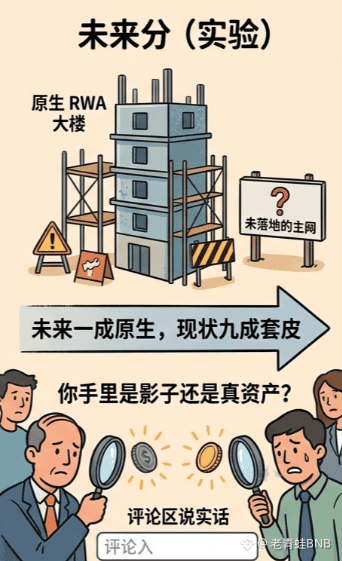
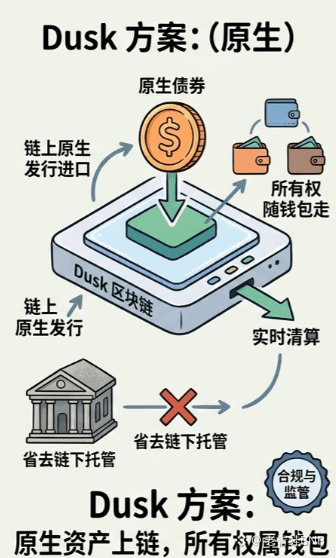
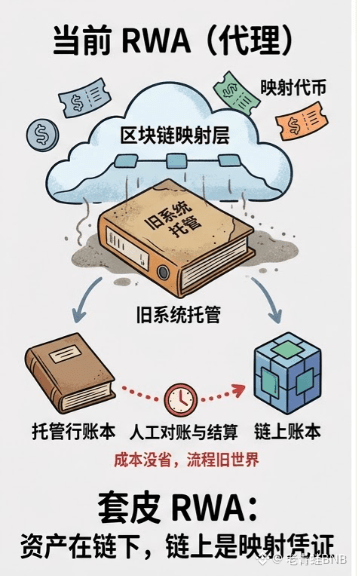
4
2
103
·
--
Hello, foreign friends outside of China. Recently, friends in the China region haven’t dared to reply to you, because replies from the China region were reported! We’re truly sorry. Many people in the China region were reported—not because Chinese people aren’t trustworthy. Sorry@Square-Creator-c291780d27fa @aftabshaon @saif_ronak @Square-Creator-2159e38c01495
We can only include a part of them. Really, I’m so sorry.
Hello, foreign friends outside of China. Recently, friends in the China region haven’t dared to reply to you, because replies from the China region were reported! We’re truly sorry. Many people in the China region were reported—not because Chinese people aren’t trustworthy. Sorry@BlueDolphinX @Aftabshaon @White_Shark007 @Stasia Kry Hvuj
We can only include a part of them. Really, I’m so sorry.
We can only include a part of them. Really, I’m so sorry.
1
2
120
·
--
SafePal—this leak, the fiercest discussion in the Moments isn’t whether assets were stolen; it’s that personal information was all exposed. About 39,798 buyers: their names, emails, shipping addresses—and even what devices they purchased—were dug up completely. The official statement says that private keys, seed phrases, and passwords were not affected. But these people will most likely suffer harassment from phishing emails and phone calls afterward. While I was watching, I kept thinking about the privacy design Dusk has been working on—this incident is a reminder for us.
Don’t rush to blame SafePal yet. When you take it apart, you’ll find that what’s exposed isn’t a single company’s mistake, but the fatal weakness of the entire centralized storage model. When your information is placed on someone else’s servers and is managed by them, once any part opens a loophole, the data is gone. This time it’s order information—but who knows what will be dragged away next. If you need a wallet, you have to leave your personal profile in someone else’s system. You can’t dodge this risk. Centralized storage is like piling all users’ information into a warehouse room—no matter how strong the lock is, a single vulnerability can break it.
Dusk’s privacy philosophy points to another path. The core is minimization: if it doesn’t need to leak, it doesn’t leak. Assets stay on-chain, controlled by your own private key. There’s no step where a company keeps the full set of your data for you. You don’t need to hand over your name, phone, and address to a centralized entity. The binding between identity and assets won’t be left sitting in some server that can be bulk dragged away. Privacy isn’t something you fight for after the fact; it’s something the design prevents from ever happening.
And Dusk even hides the transactions themselves. This “auditable privacy” approach means transaction details are hidden from the public, so adversaries can’t see your actions—yet when regulators need it, it’s disclosed according to the rules. One layer blocks a company from leaking your data, another blocks anyone on-chain from watching your accounts. That’s far more reassuring than entrusting your information to a company’s server.
So the takeaway from this is very straightforward: instead of gambling that your personal information in someone else’s warehouse won’t blow up, switch to a design that doesn’t collect it in the first place. Asset security comes from private keys; privacy security comes from not leaking. Dusk tries to cover both sides for you.
But if we stay calm and look closer—Dusk’s mainnet hasn’t launched yet. No matter how beautiful the design philosophy is, it has to wait for the chain to truly run before it can deliver.
What’s the deepest lesson this leak taught you? Tell us in the comments.
#dusk $DUSK @Dusk_Foundation
SafePal—this leak, the fiercest discussion in the Moments isn’t whether assets were stolen; it’s that personal information was all exposed. About 39,798 buyers: their names, emails, shipping addresses—and even what devices they purchased—were dug up completely. The official statement says that private keys, seed phrases, and passwords were not affected. But these people will most likely suffer harassment from phishing emails and phone calls afterward. While I was watching, I kept thinking about the privacy design Dusk has been working on—this incident is a reminder for us.
Don’t rush to blame SafePal yet. When you take it apart, you’ll find that what’s exposed isn’t a single company’s mistake, but the fatal weakness of the entire centralized storage model. When your information is placed on someone else’s servers and is managed by them, once any part opens a loophole, the data is gone. This time it’s order information—but who knows what will be dragged away next. If you need a wallet, you have to leave your personal profile in someone else’s system. You can’t dodge this risk. Centralized storage is like piling all users’ information into a warehouse room—no matter how strong the lock is, a single vulnerability can break it.
Dusk’s privacy philosophy points to another path. The core is minimization: if it doesn’t need to leak, it doesn’t leak. Assets stay on-chain, controlled by your own private key. There’s no step where a company keeps the full set of your data for you. You don’t need to hand over your name, phone, and address to a centralized entity. The binding between identity and assets won’t be left sitting in some server that can be bulk dragged away. Privacy isn’t something you fight for after the fact; it’s something the design prevents from ever happening.
And Dusk even hides the transactions themselves. This “auditable privacy” approach means transaction details are hidden from the public, so adversaries can’t see your actions—yet when regulators need it, it’s disclosed according to the rules. One layer blocks a company from leaking your data, another blocks anyone on-chain from watching your accounts. That’s far more reassuring than entrusting your information to a company’s server.
So the takeaway from this is very straightforward: instead of gambling that your personal information in someone else’s warehouse won’t blow up, switch to a design that doesn’t collect it in the first place. Asset security comes from private keys; privacy security comes from not leaking. Dusk tries to cover both sides for you.
But if we stay calm and look closer—Dusk’s mainnet hasn’t launched yet. No matter how beautiful the design philosophy is, it has to wait for the chain to truly run before it can deliver.
What’s the deepest lesson this leak taught you? Tell us in the comments.
#dusk $DUSK @Dusk
Don’t rush to blame SafePal yet. When you take it apart, you’ll find that what’s exposed isn’t a single company’s mistake, but the fatal weakness of the entire centralized storage model. When your information is placed on someone else’s servers and is managed by them, once any part opens a loophole, the data is gone. This time it’s order information—but who knows what will be dragged away next. If you need a wallet, you have to leave your personal profile in someone else’s system. You can’t dodge this risk. Centralized storage is like piling all users’ information into a warehouse room—no matter how strong the lock is, a single vulnerability can break it.
Dusk’s privacy philosophy points to another path. The core is minimization: if it doesn’t need to leak, it doesn’t leak. Assets stay on-chain, controlled by your own private key. There’s no step where a company keeps the full set of your data for you. You don’t need to hand over your name, phone, and address to a centralized entity. The binding between identity and assets won’t be left sitting in some server that can be bulk dragged away. Privacy isn’t something you fight for after the fact; it’s something the design prevents from ever happening.
And Dusk even hides the transactions themselves. This “auditable privacy” approach means transaction details are hidden from the public, so adversaries can’t see your actions—yet when regulators need it, it’s disclosed according to the rules. One layer blocks a company from leaking your data, another blocks anyone on-chain from watching your accounts. That’s far more reassuring than entrusting your information to a company’s server.
So the takeaway from this is very straightforward: instead of gambling that your personal information in someone else’s warehouse won’t blow up, switch to a design that doesn’t collect it in the first place. Asset security comes from private keys; privacy security comes from not leaking. Dusk tries to cover both sides for you.
But if we stay calm and look closer—Dusk’s mainnet hasn’t launched yet. No matter how beautiful the design philosophy is, it has to wait for the chain to truly run before it can deliver.
What’s the deepest lesson this leak taught you? Tell us in the comments.
#dusk $DUSK @Dusk
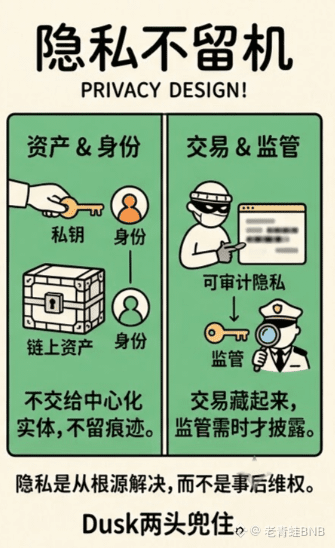
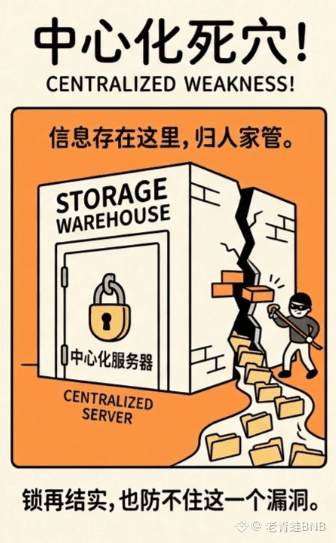
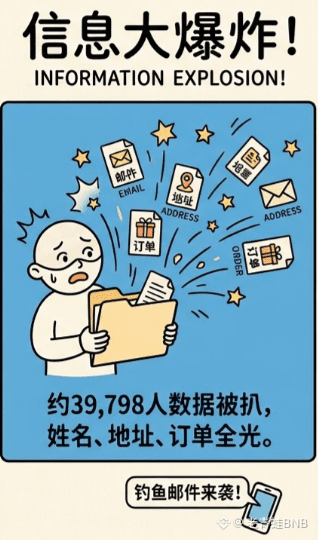
6
3
169
·
--
Verified
When researching Dusk’s ecosystem, I noticed that most people miss a crucial piece of the puzzle: having only assets and trading platforms isn’t enough. To complete the on-chain exchange story, you still need compliant money. Recently, Quantoz moved the digital euro EURQ onto Dusk—only then does the final piece truly fall into place.
First, a question: what do on-chain exchanges use for settlement? In most cases today, USDT is used. But USDT is ultimately a company-issued business credential, not legal tender. Regulators don’t accept it, and institutional funds definitely don’t dare touch it. This is awkward: the assets are compliant, and the platform is compliant—yet at the payment stage, the settlement relies on something nobody officially stands behind. It’s like complying with everything up to the point of payment, only to have it all be wasted. Without compliant funds, an on-chain exchange is always half-finished.
EURQ fills exactly this gap. It’s an e-money token issued by Quantoz. It’s not a regular stablecoin; it’s a digital euro regulated under MiCA, recognized as capable of being used as legal tender. The issuer is directly supervised by the Dutch Central Bank, and its reserves are held in tier-one banks. This isn’t a company’s IOU—it is, in a legal sense, a real euro, just carried on a different medium. Dusk is one of the first chains integrated with EURQ, and it’s also the only chain designed from day one for issuing compliant assets.
Putting this piece back into Dusk’s map makes the loop complete. NPEX handles asset issuance, bringing regulated securities onto-chain. DuskTrade manages trading, enabling investors to buy and sell. EURQ handles settlement, so both parties deliver real euros. DuskPay then connects these payment scenarios. From asset tokenization to order matching and then to fund clearing, every link sits on the compliance line—an end-to-end chain that very few projects in the market can assemble. In the past, people said they wanted to build exchanges for tokenized securities. Now, they’ve even lined up the money the exchange uses.
At bottom, it’s one sentence: with compliant euros, an on-chain exchange can truly be a complete closed loop. The assets are compliant, the trading is compliant, and finally, even the money is compliant.
But if we cool down and look at it objectively, EURQ isn’t exclusive to Dusk. Other chains can integrate it too. The mainnet hasn’t even fully rolled out yet, so whether the loop runs smoothly is another question.
When you trade on-chain in your day-to-day life, do you care whether the stablecoin used for settlement is compliant? Or do you just think, as long as you can use it, that’s enough—honestly.
#dusk $DUSK @Dusk_Foundation
When researching Dusk’s ecosystem, I noticed that most people miss a crucial piece of the puzzle: having only assets and trading platforms isn’t enough. To complete the on-chain exchange story, you still need compliant money. Recently, Quantoz moved the digital euro EURQ onto Dusk—only then does the final piece truly fall into place.
First, a question: what do on-chain exchanges use for settlement? In most cases today, USDT is used. But USDT is ultimately a company-issued business credential, not legal tender. Regulators don’t accept it, and institutional funds definitely don’t dare touch it. This is awkward: the assets are compliant, and the platform is compliant—yet at the payment stage, the settlement relies on something nobody officially stands behind. It’s like complying with everything up to the point of payment, only to have it all be wasted. Without compliant funds, an on-chain exchange is always half-finished.
EURQ fills exactly this gap. It’s an e-money token issued by Quantoz. It’s not a regular stablecoin; it’s a digital euro regulated under MiCA, recognized as capable of being used as legal tender. The issuer is directly supervised by the Dutch Central Bank, and its reserves are held in tier-one banks. This isn’t a company’s IOU—it is, in a legal sense, a real euro, just carried on a different medium. Dusk is one of the first chains integrated with EURQ, and it’s also the only chain designed from day one for issuing compliant assets.
Putting this piece back into Dusk’s map makes the loop complete. NPEX handles asset issuance, bringing regulated securities onto-chain. DuskTrade manages trading, enabling investors to buy and sell. EURQ handles settlement, so both parties deliver real euros. DuskPay then connects these payment scenarios. From asset tokenization to order matching and then to fund clearing, every link sits on the compliance line—an end-to-end chain that very few projects in the market can assemble. In the past, people said they wanted to build exchanges for tokenized securities. Now, they’ve even lined up the money the exchange uses.
At bottom, it’s one sentence: with compliant euros, an on-chain exchange can truly be a complete closed loop. The assets are compliant, the trading is compliant, and finally, even the money is compliant.
But if we cool down and look at it objectively, EURQ isn’t exclusive to Dusk. Other chains can integrate it too. The mainnet hasn’t even fully rolled out yet, so whether the loop runs smoothly is another question.
When you trade on-chain in your day-to-day life, do you care whether the stablecoin used for settlement is compliant? Or do you just think, as long as you can use it, that’s enough—honestly.
#dusk $DUSK @Dusk
First, a question: what do on-chain exchanges use for settlement? In most cases today, USDT is used. But USDT is ultimately a company-issued business credential, not legal tender. Regulators don’t accept it, and institutional funds definitely don’t dare touch it. This is awkward: the assets are compliant, and the platform is compliant—yet at the payment stage, the settlement relies on something nobody officially stands behind. It’s like complying with everything up to the point of payment, only to have it all be wasted. Without compliant funds, an on-chain exchange is always half-finished.
EURQ fills exactly this gap. It’s an e-money token issued by Quantoz. It’s not a regular stablecoin; it’s a digital euro regulated under MiCA, recognized as capable of being used as legal tender. The issuer is directly supervised by the Dutch Central Bank, and its reserves are held in tier-one banks. This isn’t a company’s IOU—it is, in a legal sense, a real euro, just carried on a different medium. Dusk is one of the first chains integrated with EURQ, and it’s also the only chain designed from day one for issuing compliant assets.
Putting this piece back into Dusk’s map makes the loop complete. NPEX handles asset issuance, bringing regulated securities onto-chain. DuskTrade manages trading, enabling investors to buy and sell. EURQ handles settlement, so both parties deliver real euros. DuskPay then connects these payment scenarios. From asset tokenization to order matching and then to fund clearing, every link sits on the compliance line—an end-to-end chain that very few projects in the market can assemble. In the past, people said they wanted to build exchanges for tokenized securities. Now, they’ve even lined up the money the exchange uses.
At bottom, it’s one sentence: with compliant euros, an on-chain exchange can truly be a complete closed loop. The assets are compliant, the trading is compliant, and finally, even the money is compliant.
But if we cool down and look at it objectively, EURQ isn’t exclusive to Dusk. Other chains can integrate it too. The mainnet hasn’t even fully rolled out yet, so whether the loop runs smoothly is another question.
When you trade on-chain in your day-to-day life, do you care whether the stablecoin used for settlement is compliant? Or do you just think, as long as you can use it, that’s enough—honestly.
#dusk $DUSK @Dusk
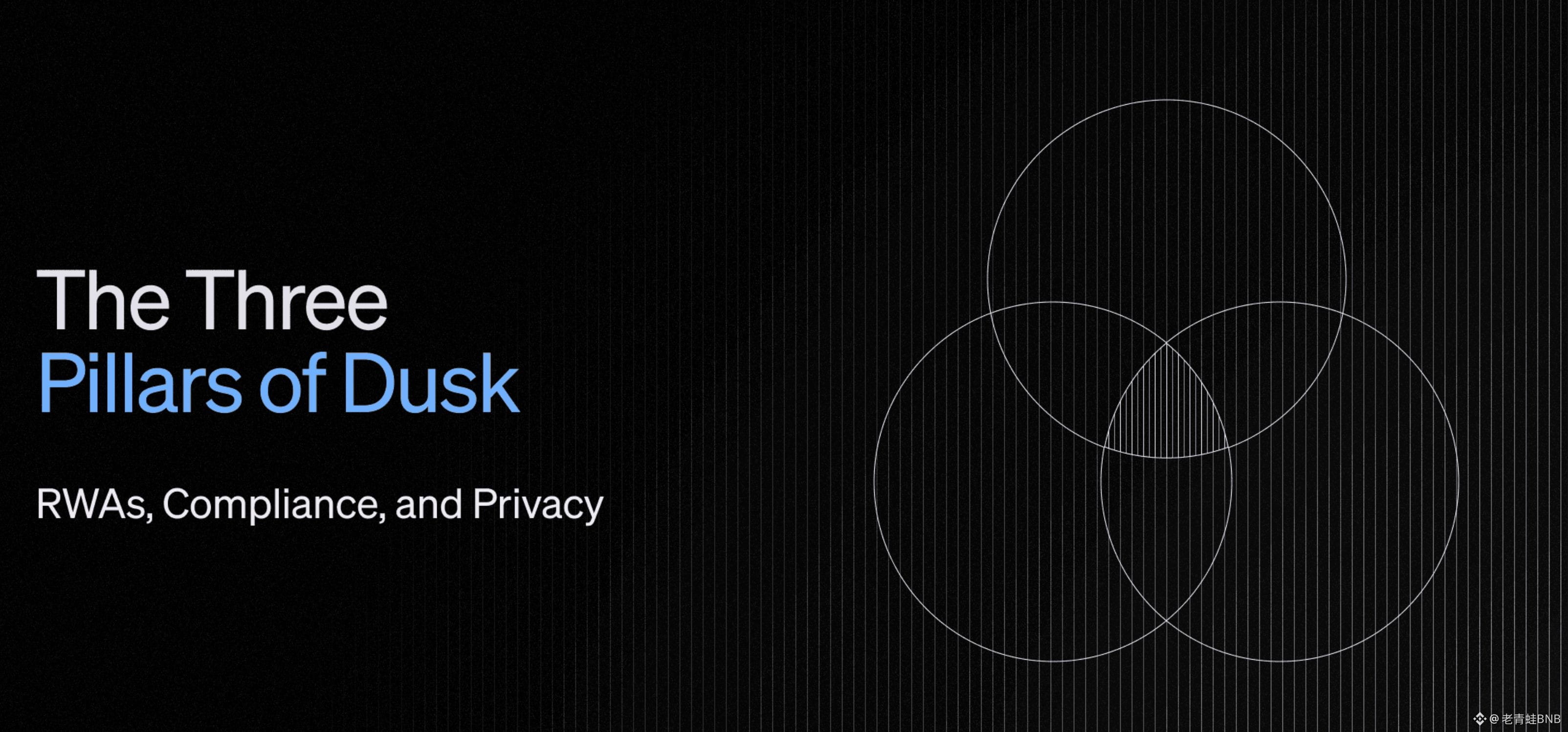
57
17
475
·
--
Last night I read Binance’s announcement twice over and over. The gist is that, as regulatory requirements change, starting from a specified date, they must stop handling transactions related to certain crypto service providers and platforms. On the surface, it looks like a business adjustment. But following this announcement, I researched Dusk—and I suddenly figured something out: this industry isn’t short on platforms that follow regulations; what’s missing is the underlying layer that makes compliance into infrastructure. And these two things are exactly what Binance and Dusk are doing at different levels.
First, let me give Binance its due credit. Under regulatory pressure, they proactively tightened the scope and cut ties—sacrificing convenience in exchange for holding the line. What an exchange must do first is security. Carefully draw the boundaries on the list, keep users’ assets safe—that decisive practicality is what gives confidence when serving hundreds of millions of users. This kind of pragmatism that doesn’t collide head-on with regulators is the backbone of platform service.
But front-stage compliance has a ceiling. It follows the regulators’ lead: today you strike out one batch, tomorrow another appears. A platform can only keep chasing—merely marking lists makes it hard to truly let the whole ecosystem settle down and mature.
Dusk fills this gap. It rewrites compliance from being an exchange responsibility into the capability of the protocol itself. By cooperating with a licensed exchange like the Netherlands’ NPEX, it embeds the compliance logic for issuance directly into the blockchain’s underlying layer. The audit rules regulators want are built into the protocol from day one. How the front-end cuts and segments doesn’t affect the foundation of the chain, because the chain itself is designed according to the regulatory script. It’s not just running with regulators—it’s having the pieces regulators will require ready in advance.
Now look at the privacy layer. Binance cuts channels using rules to buy security—clean in a sense, but it may also inadvertently harm some users. Dusk’s auditable privacy offers another approach: hide transaction details from the public, but when regulators come, disclose on demand. You get both privacy and compliance. This isn’t achieved by “cutting” with rules; it’s driven by cryptography—something institutions and securities-asset use cases almost certainly require.
Seen this way, it all clicks. Binance has pushed front-end compliance to the extreme, while Dusk is aiming to complete the rules behind it as well. One focuses on the door—whether user assets are safe. The other targets the foundation of the entire building—how high the building can be built.
Of course, the regulatory pressure behind the announcement hasn’t eased at all. Before Dusk’s mainnet is live, all of this is still compliance on paper.
It’s easy to draw up lists on paper, but it’s not that simple to change rules that are embedded into the chain. #dusk $DUSK @Dusk_Foundation
Last night I read Binance’s announcement twice over and over. The gist is that, as regulatory requirements change, starting from a specified date, they must stop handling transactions related to certain crypto service providers and platforms. On the surface, it looks like a business adjustment. But following this announcement, I researched Dusk—and I suddenly figured something out: this industry isn’t short on platforms that follow regulations; what’s missing is the underlying layer that makes compliance into infrastructure. And these two things are exactly what Binance and Dusk are doing at different levels.
First, let me give Binance its due credit. Under regulatory pressure, they proactively tightened the scope and cut ties—sacrificing convenience in exchange for holding the line. What an exchange must do first is security. Carefully draw the boundaries on the list, keep users’ assets safe—that decisive practicality is what gives confidence when serving hundreds of millions of users. This kind of pragmatism that doesn’t collide head-on with regulators is the backbone of platform service.
But front-stage compliance has a ceiling. It follows the regulators’ lead: today you strike out one batch, tomorrow another appears. A platform can only keep chasing—merely marking lists makes it hard to truly let the whole ecosystem settle down and mature.
Dusk fills this gap. It rewrites compliance from being an exchange responsibility into the capability of the protocol itself. By cooperating with a licensed exchange like the Netherlands’ NPEX, it embeds the compliance logic for issuance directly into the blockchain’s underlying layer. The audit rules regulators want are built into the protocol from day one. How the front-end cuts and segments doesn’t affect the foundation of the chain, because the chain itself is designed according to the regulatory script. It’s not just running with regulators—it’s having the pieces regulators will require ready in advance.
Now look at the privacy layer. Binance cuts channels using rules to buy security—clean in a sense, but it may also inadvertently harm some users. Dusk’s auditable privacy offers another approach: hide transaction details from the public, but when regulators come, disclose on demand. You get both privacy and compliance. This isn’t achieved by “cutting” with rules; it’s driven by cryptography—something institutions and securities-asset use cases almost certainly require.
Seen this way, it all clicks. Binance has pushed front-end compliance to the extreme, while Dusk is aiming to complete the rules behind it as well. One focuses on the door—whether user assets are safe. The other targets the foundation of the entire building—how high the building can be built.
Of course, the regulatory pressure behind the announcement hasn’t eased at all. Before Dusk’s mainnet is live, all of this is still compliance on paper.
It’s easy to draw up lists on paper, but it’s not that simple to change rules that are embedded into the chain. #dusk $DUSK @Dusk
First, let me give Binance its due credit. Under regulatory pressure, they proactively tightened the scope and cut ties—sacrificing convenience in exchange for holding the line. What an exchange must do first is security. Carefully draw the boundaries on the list, keep users’ assets safe—that decisive practicality is what gives confidence when serving hundreds of millions of users. This kind of pragmatism that doesn’t collide head-on with regulators is the backbone of platform service.
But front-stage compliance has a ceiling. It follows the regulators’ lead: today you strike out one batch, tomorrow another appears. A platform can only keep chasing—merely marking lists makes it hard to truly let the whole ecosystem settle down and mature.
Dusk fills this gap. It rewrites compliance from being an exchange responsibility into the capability of the protocol itself. By cooperating with a licensed exchange like the Netherlands’ NPEX, it embeds the compliance logic for issuance directly into the blockchain’s underlying layer. The audit rules regulators want are built into the protocol from day one. How the front-end cuts and segments doesn’t affect the foundation of the chain, because the chain itself is designed according to the regulatory script. It’s not just running with regulators—it’s having the pieces regulators will require ready in advance.
Now look at the privacy layer. Binance cuts channels using rules to buy security—clean in a sense, but it may also inadvertently harm some users. Dusk’s auditable privacy offers another approach: hide transaction details from the public, but when regulators come, disclose on demand. You get both privacy and compliance. This isn’t achieved by “cutting” with rules; it’s driven by cryptography—something institutions and securities-asset use cases almost certainly require.
Seen this way, it all clicks. Binance has pushed front-end compliance to the extreme, while Dusk is aiming to complete the rules behind it as well. One focuses on the door—whether user assets are safe. The other targets the foundation of the entire building—how high the building can be built.
Of course, the regulatory pressure behind the announcement hasn’t eased at all. Before Dusk’s mainnet is live, all of this is still compliance on paper.
It’s easy to draw up lists on paper, but it’s not that simple to change rules that are embedded into the chain. #dusk $DUSK @Dusk
55
18
563
·
--
The hottest crypto gossip on Twitter yesterday: a mouse posted a tweet saying he earned a profit-sharing bonus of 120,000 U in a month. The comments section erupted instantly. While I was munching on the gossip, I thought of that verifiable logic Dusk has been talking about. Turns out this rumor and this project can actually be connected.
The gossip, in short. 120,000 U in a month—about what ordinary people might earn in several years. The key is that from start to finish it’s just one tweet and one sentence: no screenshots, no images. Some people shouted “legend, awesome!” while more people went straight into attack mode, saying “anyone could do that.” The people hyping it and the people bashing it both have nothing concrete to prove.
This kind of play happens every so often—people post earnings, show positions, share trade records, and in the end it’s always a deadlock where only one side has the best story. Believers treat it as the wealth password; skeptics treat it as marketing theater.
But rather than tearing apart what’s true or false, I care more about the underlying issue: the trust system across the entire crypto industry is still stuck at the stage of “listening to what someone says.” If KOLs claim how much they made, whether you believe them is entirely a matter of instinct. If a project says their data looks great, whether you verify it is down to your willingness. Everything is unverifiable—everything relies on personal credibility, and personal credibility is precisely the scarcest resource in this industry.
That’s where Dusk’s approach matters. Its ZK route: the core capability is to prove without revealing. I can prove that the income range is real without exposing the exact transaction details; I can prove that trades are compliant without disclosing specific position information. This is completely different from traditional auditing. Auditing means laying the books open to a third party—trust is built by trading privacy for credibility. Dusk generates trust directly using cryptography; you don’t even have to flip through a single page of the ledger. Privacy and verifiable trust never have to fight each other.
And the real battlefield for this capability is RWA. On-chain institutions fear two things above all: positions getting exposed, and compliance being too hard to explain. Dusk’s auditable privacy covers both ends—transaction details are hidden from the outside, and when regulators come, disclosures can be made according to rules. With Hedger’s layer of homomorphic encryption, data remains ciphertext end-to-end from computation to storage. For heavily regulated assets like securities to run on-chain, what they need is exactly this kind of “locked safe” with the key.
Of course, using public-chain technology just to let KOLs show their orders is like using a sledgehammer to kill a chicken. Dusk’s main arena is securities and institutional finance. Before the mainnet is live, all of this is still a vision.
Back to this gossip: if an income statement could be backed up with cryptographic proofs, this “mouse” thing would never become a rumor in the first place. Truth or falsehood would be verifiable at a glance—so how could there be hundreds of comment threads tearing each other apart?
#dusk $DUSK @Dusk_Foundation
The hottest crypto gossip on Twitter yesterday: a mouse posted a tweet saying he earned a profit-sharing bonus of 120,000 U in a month. The comments section erupted instantly. While I was munching on the gossip, I thought of that verifiable logic Dusk has been talking about. Turns out this rumor and this project can actually be connected.
The gossip, in short. 120,000 U in a month—about what ordinary people might earn in several years. The key is that from start to finish it’s just one tweet and one sentence: no screenshots, no images. Some people shouted “legend, awesome!” while more people went straight into attack mode, saying “anyone could do that.” The people hyping it and the people bashing it both have nothing concrete to prove.
This kind of play happens every so often—people post earnings, show positions, share trade records, and in the end it’s always a deadlock where only one side has the best story. Believers treat it as the wealth password; skeptics treat it as marketing theater.
But rather than tearing apart what’s true or false, I care more about the underlying issue: the trust system across the entire crypto industry is still stuck at the stage of “listening to what someone says.” If KOLs claim how much they made, whether you believe them is entirely a matter of instinct. If a project says their data looks great, whether you verify it is down to your willingness. Everything is unverifiable—everything relies on personal credibility, and personal credibility is precisely the scarcest resource in this industry.
That’s where Dusk’s approach matters. Its ZK route: the core capability is to prove without revealing. I can prove that the income range is real without exposing the exact transaction details; I can prove that trades are compliant without disclosing specific position information. This is completely different from traditional auditing. Auditing means laying the books open to a third party—trust is built by trading privacy for credibility. Dusk generates trust directly using cryptography; you don’t even have to flip through a single page of the ledger. Privacy and verifiable trust never have to fight each other.
And the real battlefield for this capability is RWA. On-chain institutions fear two things above all: positions getting exposed, and compliance being too hard to explain. Dusk’s auditable privacy covers both ends—transaction details are hidden from the outside, and when regulators come, disclosures can be made according to rules. With Hedger’s layer of homomorphic encryption, data remains ciphertext end-to-end from computation to storage. For heavily regulated assets like securities to run on-chain, what they need is exactly this kind of “locked safe” with the key.
Of course, using public-chain technology just to let KOLs show their orders is like using a sledgehammer to kill a chicken. Dusk’s main arena is securities and institutional finance. Before the mainnet is live, all of this is still a vision.
Back to this gossip: if an income statement could be backed up with cryptographic proofs, this “mouse” thing would never become a rumor in the first place. Truth or falsehood would be verifiable at a glance—so how could there be hundreds of comment threads tearing each other apart?
#dusk $DUSK @Dusk
The gossip, in short. 120,000 U in a month—about what ordinary people might earn in several years. The key is that from start to finish it’s just one tweet and one sentence: no screenshots, no images. Some people shouted “legend, awesome!” while more people went straight into attack mode, saying “anyone could do that.” The people hyping it and the people bashing it both have nothing concrete to prove.
This kind of play happens every so often—people post earnings, show positions, share trade records, and in the end it’s always a deadlock where only one side has the best story. Believers treat it as the wealth password; skeptics treat it as marketing theater.
But rather than tearing apart what’s true or false, I care more about the underlying issue: the trust system across the entire crypto industry is still stuck at the stage of “listening to what someone says.” If KOLs claim how much they made, whether you believe them is entirely a matter of instinct. If a project says their data looks great, whether you verify it is down to your willingness. Everything is unverifiable—everything relies on personal credibility, and personal credibility is precisely the scarcest resource in this industry.
That’s where Dusk’s approach matters. Its ZK route: the core capability is to prove without revealing. I can prove that the income range is real without exposing the exact transaction details; I can prove that trades are compliant without disclosing specific position information. This is completely different from traditional auditing. Auditing means laying the books open to a third party—trust is built by trading privacy for credibility. Dusk generates trust directly using cryptography; you don’t even have to flip through a single page of the ledger. Privacy and verifiable trust never have to fight each other.
And the real battlefield for this capability is RWA. On-chain institutions fear two things above all: positions getting exposed, and compliance being too hard to explain. Dusk’s auditable privacy covers both ends—transaction details are hidden from the outside, and when regulators come, disclosures can be made according to rules. With Hedger’s layer of homomorphic encryption, data remains ciphertext end-to-end from computation to storage. For heavily regulated assets like securities to run on-chain, what they need is exactly this kind of “locked safe” with the key.
Of course, using public-chain technology just to let KOLs show their orders is like using a sledgehammer to kill a chicken. Dusk’s main arena is securities and institutional finance. Before the mainnet is live, all of this is still a vision.
Back to this gossip: if an income statement could be backed up with cryptographic proofs, this “mouse” thing would never become a rumor in the first place. Truth or falsehood would be verifiable at a glance—so how could there be hundreds of comment threads tearing each other apart?
#dusk $DUSK @Dusk
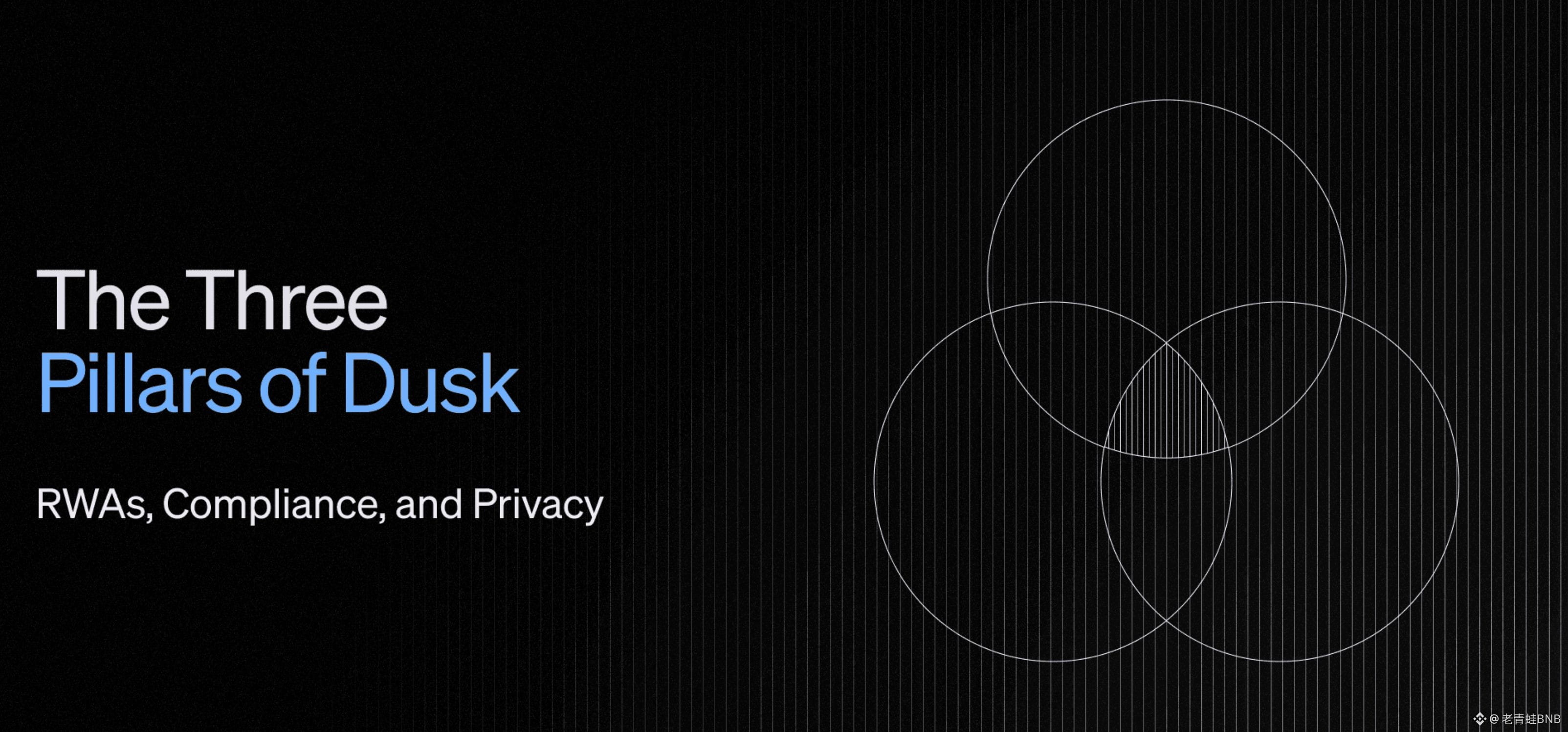
35
7
620
·
--
Verified
Binance has recently made big moves on bStocks—new listings have been coming one after another. Even Apple, Amazon, and SpaceX can be traded 24 hours a day. While keeping an eye on the Dusk mainnet, I also took a look at this product. Putting them side by side, the more I see, the more it’s interesting.
First, let’s be clear: Binance really did this one well. Real U.S. stocks are backed 1:1, reserve proofs are publicly verifiable, settlement is instant and not T+1, dividends are automatically reinvested, and after-hours earnings reports can reflect prices immediately. Traditional brokers clock out at market close, but bStocks are still posting quotes. You can buy fractional shares of Nvidia starting from as low as $5, and you can also withdraw to your own custody. It’s obvious that Binance is truly treating tokenized stocks as a strategic direction—not just slapping together a few trading pairs and calling it done.
But after watching the order book for a few days, I figured out one thing. Once stocks are put on-chain, trading feels great—but everything on the chain is transparent. You buy how much, at what cost, everyone can see it. Retail traders don’t really care. But for institutions? Let Wall Street show their positions openly on the record? No way.
That’s what I think is interesting about Dusk.
It focuses on auditable privacy: your holdings and trading information are kept confidential from the outside, but when regulators require it, it can make compliant disclosures. This isn’t the kind of “wild” privacy you’d get from a mixer. It’s privacy with compliance baked in—so neither side gets offended. The ZK technology behind it is something I’ve already broken down before; math has you covered, no need to trust anyone.
And Dusk isn’t just chasing the RWA buzzword. It has a real partnership with the licensed Dutch trading venue NPEX, bringing the issuance and trading of compliant securities into the protocol layer. With the DuskEVM mainnet getting close, Solidity developers can use the familiar Foundry toolkit to build privacy-focused financial applications with almost zero migration cost.
Put it all together, it gets interesting. Binance moved stocks on-chain to solve the “is it possible?” problem. Dusk solves the “are institutions willing?” problem—whether big players dare to get on-chain. One is a traffic entry point, and the other is a foundational infrastructure layer. The missing puzzle piece for RWA is getting clearer and clearer.
Of course, I’ll say this upfront: the mainnet hasn’t launched yet. Until on-chain data runs and proves it, all of this is just logical reasoning. But for RWA infrastructure that combines privacy and compliance, I think it’s one of the most worth watching tracks next.
What do you think is the biggest concern for institutions when it comes to going on-chain—privacy or compliance? Let’s discuss in the comments. Keep tracking the @Dusk_Foundation mainnet progress—DYOR.
#dusk $DUSK
Binance has recently made big moves on bStocks—new listings have been coming one after another. Even Apple, Amazon, and SpaceX can be traded 24 hours a day. While keeping an eye on the Dusk mainnet, I also took a look at this product. Putting them side by side, the more I see, the more it’s interesting.
First, let’s be clear: Binance really did this one well. Real U.S. stocks are backed 1:1, reserve proofs are publicly verifiable, settlement is instant and not T+1, dividends are automatically reinvested, and after-hours earnings reports can reflect prices immediately. Traditional brokers clock out at market close, but bStocks are still posting quotes. You can buy fractional shares of Nvidia starting from as low as $5, and you can also withdraw to your own custody. It’s obvious that Binance is truly treating tokenized stocks as a strategic direction—not just slapping together a few trading pairs and calling it done.
But after watching the order book for a few days, I figured out one thing. Once stocks are put on-chain, trading feels great—but everything on the chain is transparent. You buy how much, at what cost, everyone can see it. Retail traders don’t really care. But for institutions? Let Wall Street show their positions openly on the record? No way.
That’s what I think is interesting about Dusk.
It focuses on auditable privacy: your holdings and trading information are kept confidential from the outside, but when regulators require it, it can make compliant disclosures. This isn’t the kind of “wild” privacy you’d get from a mixer. It’s privacy with compliance baked in—so neither side gets offended. The ZK technology behind it is something I’ve already broken down before; math has you covered, no need to trust anyone.
And Dusk isn’t just chasing the RWA buzzword. It has a real partnership with the licensed Dutch trading venue NPEX, bringing the issuance and trading of compliant securities into the protocol layer. With the DuskEVM mainnet getting close, Solidity developers can use the familiar Foundry toolkit to build privacy-focused financial applications with almost zero migration cost.
Put it all together, it gets interesting. Binance moved stocks on-chain to solve the “is it possible?” problem. Dusk solves the “are institutions willing?” problem—whether big players dare to get on-chain. One is a traffic entry point, and the other is a foundational infrastructure layer. The missing puzzle piece for RWA is getting clearer and clearer.
Of course, I’ll say this upfront: the mainnet hasn’t launched yet. Until on-chain data runs and proves it, all of this is just logical reasoning. But for RWA infrastructure that combines privacy and compliance, I think it’s one of the most worth watching tracks next.
What do you think is the biggest concern for institutions when it comes to going on-chain—privacy or compliance? Let’s discuss in the comments. Keep tracking the @Dusk mainnet progress—DYOR.
#dusk $DUSK
First, let’s be clear: Binance really did this one well. Real U.S. stocks are backed 1:1, reserve proofs are publicly verifiable, settlement is instant and not T+1, dividends are automatically reinvested, and after-hours earnings reports can reflect prices immediately. Traditional brokers clock out at market close, but bStocks are still posting quotes. You can buy fractional shares of Nvidia starting from as low as $5, and you can also withdraw to your own custody. It’s obvious that Binance is truly treating tokenized stocks as a strategic direction—not just slapping together a few trading pairs and calling it done.
But after watching the order book for a few days, I figured out one thing. Once stocks are put on-chain, trading feels great—but everything on the chain is transparent. You buy how much, at what cost, everyone can see it. Retail traders don’t really care. But for institutions? Let Wall Street show their positions openly on the record? No way.
That’s what I think is interesting about Dusk.
It focuses on auditable privacy: your holdings and trading information are kept confidential from the outside, but when regulators require it, it can make compliant disclosures. This isn’t the kind of “wild” privacy you’d get from a mixer. It’s privacy with compliance baked in—so neither side gets offended. The ZK technology behind it is something I’ve already broken down before; math has you covered, no need to trust anyone.
And Dusk isn’t just chasing the RWA buzzword. It has a real partnership with the licensed Dutch trading venue NPEX, bringing the issuance and trading of compliant securities into the protocol layer. With the DuskEVM mainnet getting close, Solidity developers can use the familiar Foundry toolkit to build privacy-focused financial applications with almost zero migration cost.
Put it all together, it gets interesting. Binance moved stocks on-chain to solve the “is it possible?” problem. Dusk solves the “are institutions willing?” problem—whether big players dare to get on-chain. One is a traffic entry point, and the other is a foundational infrastructure layer. The missing puzzle piece for RWA is getting clearer and clearer.
Of course, I’ll say this upfront: the mainnet hasn’t launched yet. Until on-chain data runs and proves it, all of this is just logical reasoning. But for RWA infrastructure that combines privacy and compliance, I think it’s one of the most worth watching tracks next.
What do you think is the biggest concern for institutions when it comes to going on-chain—privacy or compliance? Let’s discuss in the comments. Keep tracking the @Dusk mainnet progress—DYOR.
#dusk $DUSK
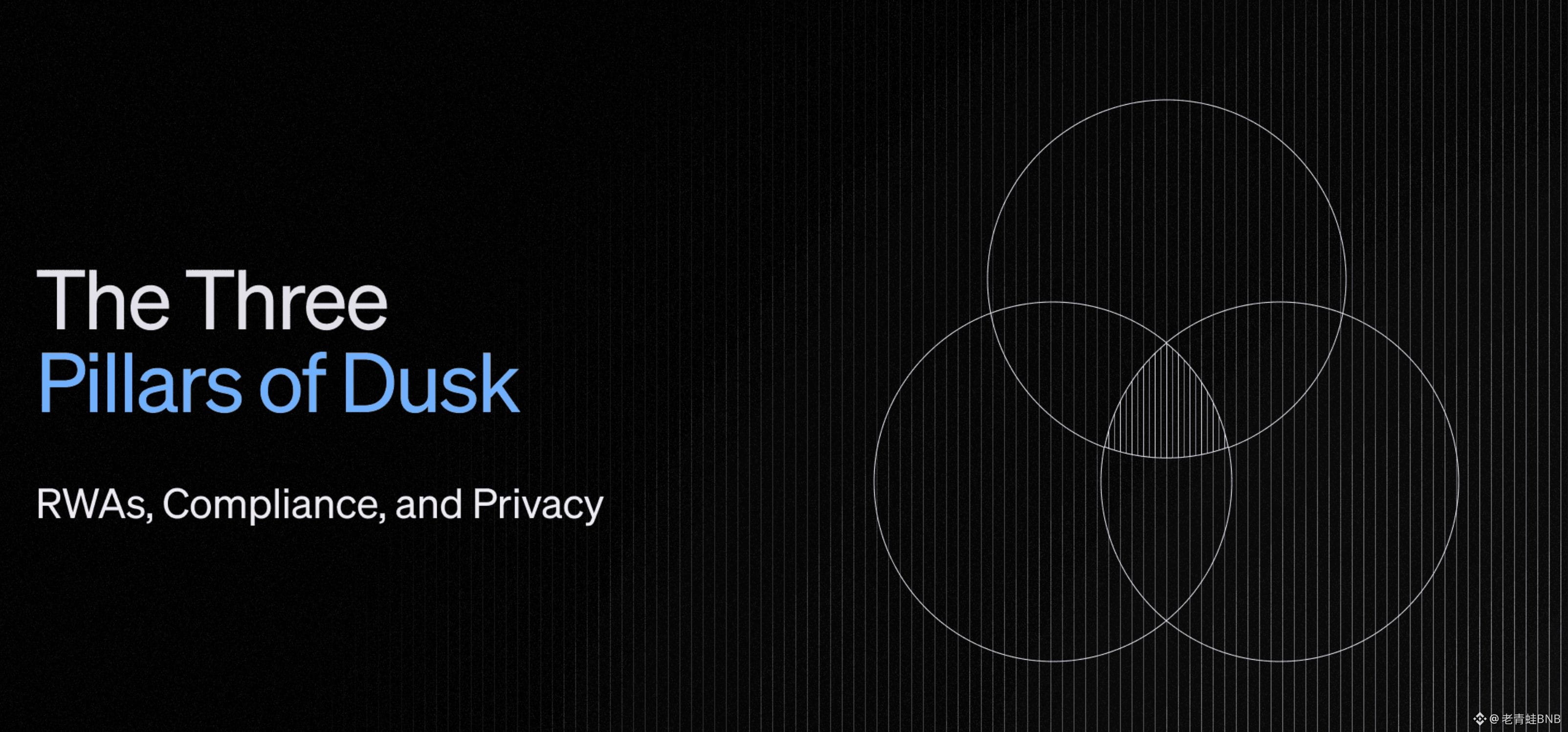
51
18
15.4k
Log in to explore more content
Join global crypto users on Binance Square
⚡️ Get latest and useful information about crypto.
💬 Trusted by the world’s largest crypto exchange.
👍 Discover real insights from verified creators.
Email / Phone number
Trending Topics
AppleDebutsFoldablePhone
29,615 views
623 Discussing
Apple just dropped the foldable iPhone — and the market is paying attention. This isn't just another product cycle; it's a new product category, a new CEO on stage, and a $1,999 price tag that pushes $AAPL further into ultra-premium territory. Foldables are the narrative, and Apple is now the headline.
#appledebutsfoldablephone #EUExtendsCentralContactPointToCASPs #US10YTreasuryYieldHitsHighestSinceNov2023 #BrentCrudeTops$100 #USTreasuryToBuyBackUpTo$6BLongDatedDebt
KimHotbae
·2 Likes
·2.8k views
TSMCAugustRevenueUp53.3%YoY
1,800 views
112 Discussing
IranSaysReadyToEscalateWarWithUS
5,394 views
157 Discussing