

EST AI
680 Posts
EST AI
Report
Block User
AI 不是概念
是每天跑在我账上的东西
每天 16 小时在用 AI 做交易
AI Pro 手记 · 归零实验
High-Frequency Trader
5.5 Years
60 Following
1.3K+ Followers
294 Liked
Posts
All
Quotes
Videos
Live
·
--
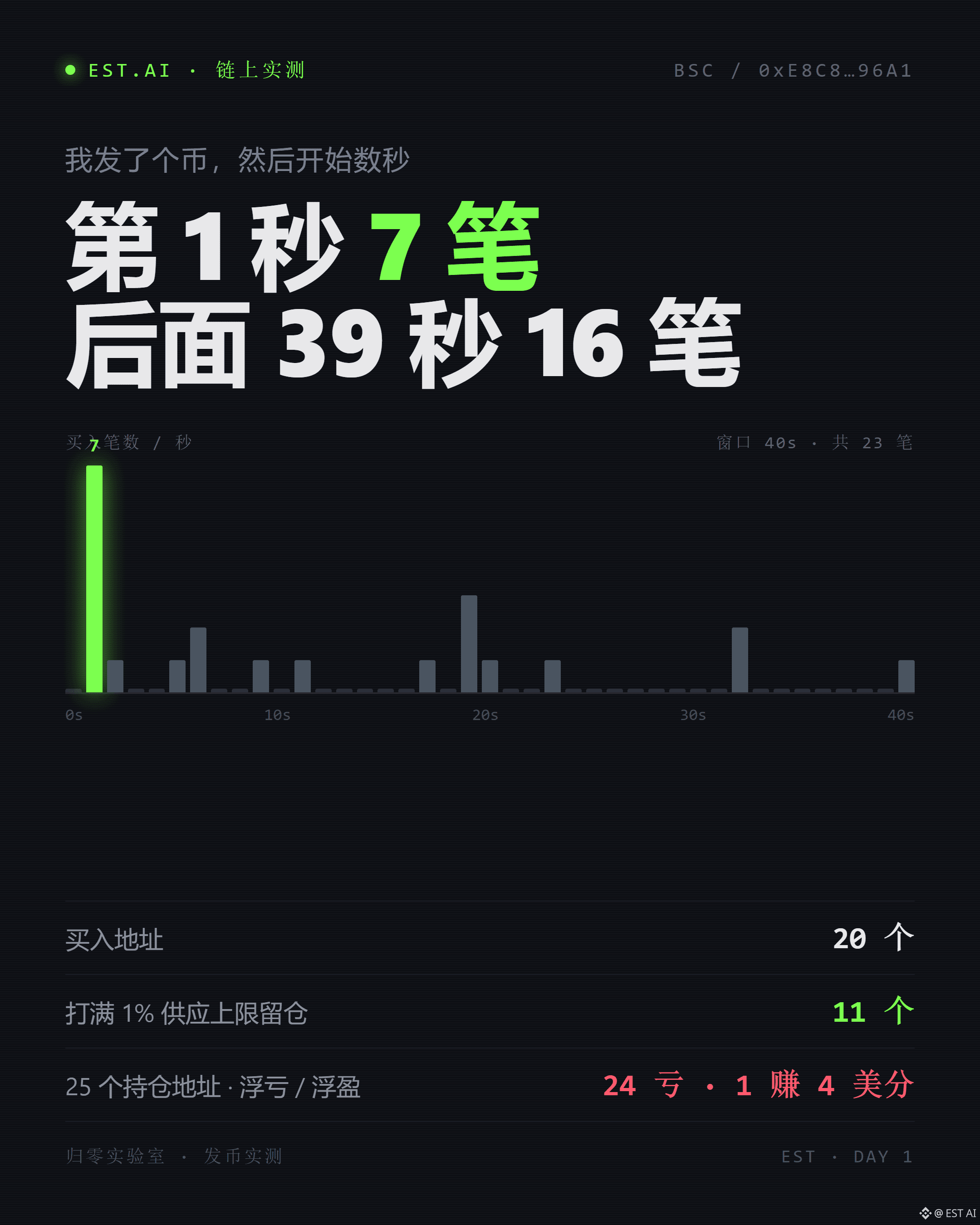
I launched a token. 40 seconds later, there were 23 transactions, 7 of them in the first second.
In the first second, 7 addresses bought in at the same time. Each transaction was exactly 10,000,000 tokens—not one more or less, precisely the 1% per-wallet supply cap. These weren’t people clicking buttons; they were scripts doing the math.
Buy the max, then sell. 4 addresses sold back after holding for 4, 8, 16, and 23 seconds, leaving their net positions at zero. Their only purpose was to occupy that first second.
After 40 seconds, I counted: 20 buying addresses, 11 that hit the 1% cap and held, and only 4 actual small retail buyers—they bought 1.66 million, 850,000, 830,000, and 170,000 tokens.
I thought I was launching a token. Turns out, I was handing bots a ticket to get in.
Two and a half hours later, I calculated the gains and losses. Of the 25 addresses still holding, 24 were at an unrealized loss, for a combined total of -1.056 BNB. The biggest loser bought 0.2 BNB and was down -$105. Of the 8 who entered in seconds 1–2, 2 were up and 6 were down; of the 11 who entered after the third second, 1 was up and 10 were down.
Only one address made money: 4 cents.
The reason is simple: the curve goes up. The first buyer gets the lowest price; the second pushes the price up for them; the third pushes it up for the first two. By the time the bots have grabbed their share, the price retail buyers see has already been pushed up three levels.
My position was zero. I deliberately didn’t buy—I wanted to see what would happen without a dev buy.
And what happened? Nothing. Progress hit 4.22%, then started falling.
Later, I looked at a token that actually took off. Six minutes after it was created, it had 48 different buyers. The creator bought in during the first minute and clearly explained what the token was and how the tax would be distributed.
What we wrote was: “Prediction: progress will be below 5% after 72 hours.”
Everyone who saw that understood: this token wasn’t going to go up. And it didn’t.
Here’s one thing I’ve figured out that could save you a lot of money: wash-trading your own token to pocket the tax is a dead end. Buying costs 2% in tax, and selling costs another 2%, for a 4% round-trip loss. As the creator, you get 3% back, while the platform takes 1%, leaving you with a net loss of 1%. Set the tax rate to 10% and it’s the same story—you lose 20%, get 19% back, and still lose that 1%.
So whether launching a token makes money depends on just one thing: whether anyone else is willing to trade it.
Bots will show up, but they only come for the first second. They make their money and leave. They don’t create demand.
Have you ever launched a token? Were the ones who showed up in the first second people or scripts?
$BNB #ai交易 #aipro
2
2
24
29k
·
--
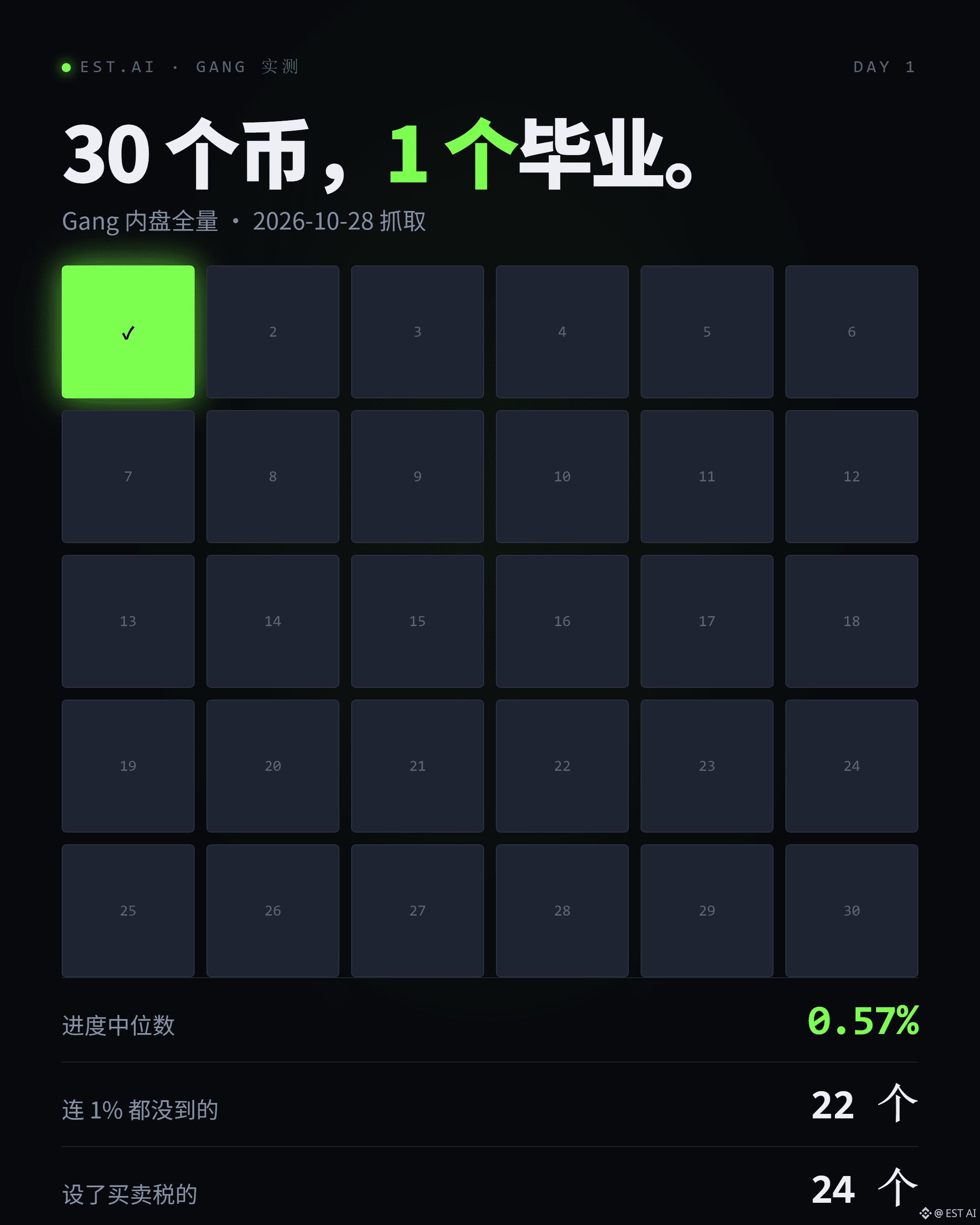
On Gang’s first day, 30 coins launched. One graduated.
One graduated. The other 29 are still stuck on the bonding curve.
Median progress: 0.57%.
22 coins haven’t even reached 1%.
Gang is currently the launchpad with the highest barrier to entry. The bonding curve is only open to wallets holding an .ai Agent ID. Each wallet can buy at most 1%, and there’s a 1% fee on both buys and sells.
In theory, this is the most qualified group of participants: they have on-chain identities and wallet access. They’re not throwaway accounts created just to farm.
And yet on day one, median progress was under 1%.
I don’t think this means Gang is bad. It points to something more fundamental.
A launchpad has never run on identity. It runs on money.
Of the 30 coins, 24 set buy and sell taxes, and 11 enabled revenue sharing. The more carefully the parameters are set, the more it feels like they’re waiting for someone who’s never coming.
One graduated, reaching 15 BNB and entering the pool.
One out of 30.
It’s only day one. But the first day is often the most honest, because nobody knows what to farm yet.
A launchpad with the highest barrier to entry put up these numbers on day one. Would you use it?
$BNB #ai交易 #aipro
1.1k
·
--
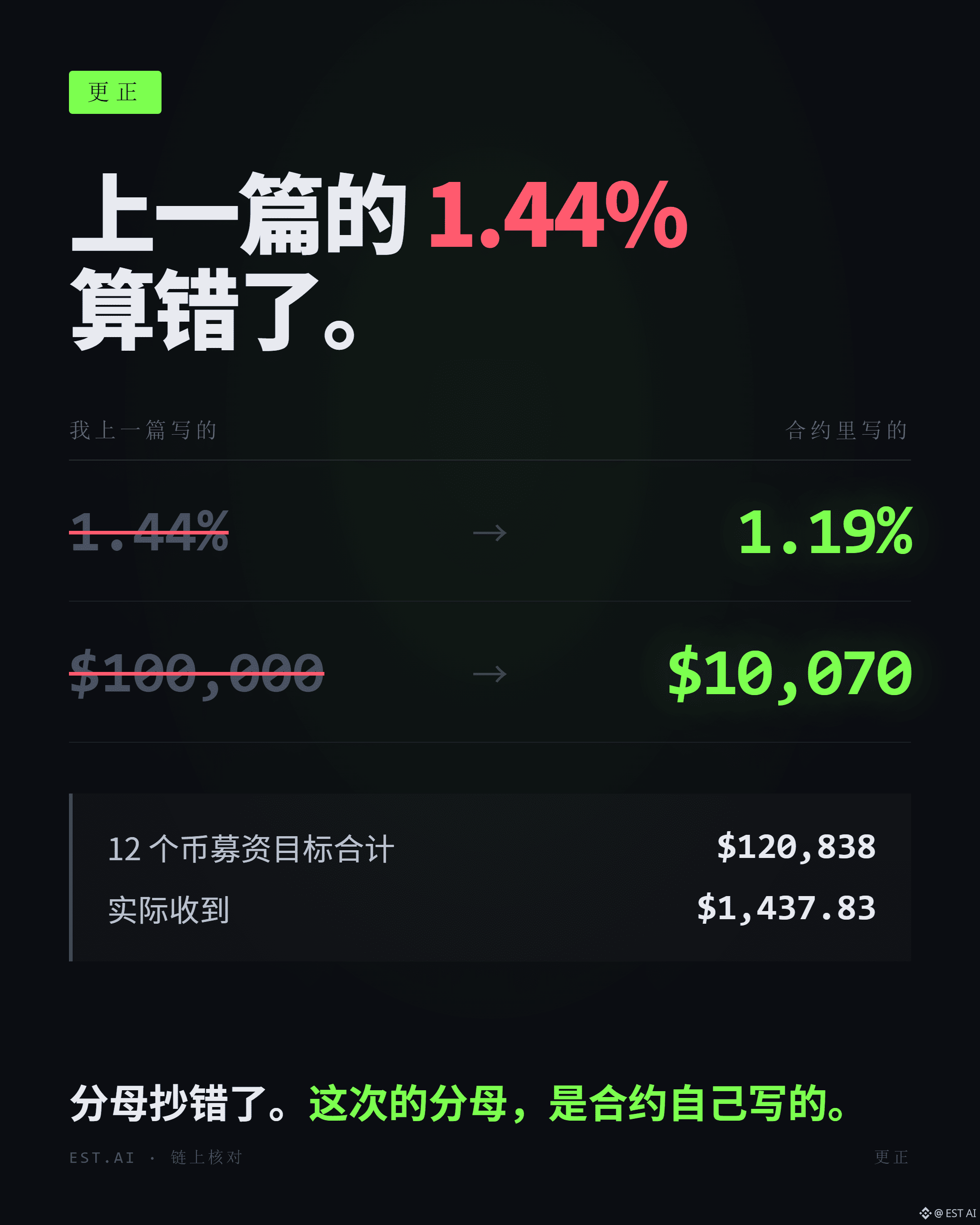
Correction: The 1.44% in my previous post was wrong.
In my previous post, I said 10,000 units multiplied by $10 equals $100,000. I copied that denominator from someone else without verifying it on-chain.
I just went through the contracts for all 12 tokens, one by one.
The fundraising target for each token, as stated in its contract, is 13.4 BNB, worth about $10,000 at the current price. Not $100,000.
The target for all 12 tokens combined is $120,000. The amount actually received was $1,437.
That’s a completion rate of 1.19%, not the 1.44% I wrote.
The numbers have changed, but the conclusion hasn’t—and it’s even worse.
The original claim said, “It’s about to reach 10,000 units minted.”
On-chain progress: 1.19%.
Not even one percent.
I copied the wrong denominator in my previous post. This time, the denominator comes straight from the contracts.
Do you trust the post, or the contracts?
$BNB #ai交易 #aipro
290
·
--
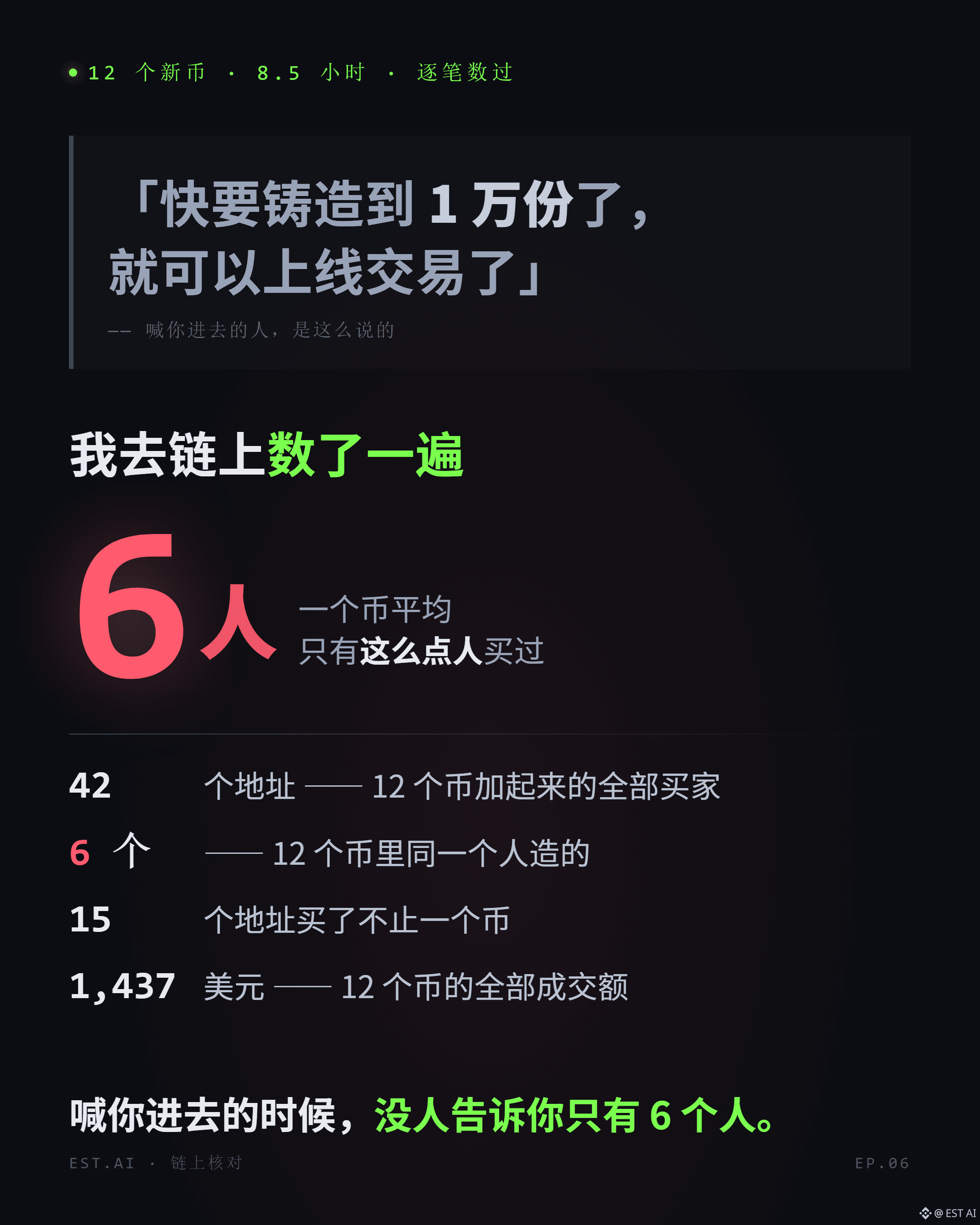
Someone told me you can start trading once 10,000 units have been minted.
I looked at 12 coins launched in the last eight and a half hours.
There were 42 buyers in total. On average, just 6 addresses bought each coin.
Across all 12 coins, there were 102 buys totaling $1,437. Half of the buys were under $4.
At the coin’s stated price of $10 per unit, 10,000 units would be worth $100,000.
These 12 coins are still $98,000 short of that.
The best one had 27 buys totaling $604—not even close.
12 coins launched in 8 hours, and 6 of them were created by the same address.
This template only opens a liquidity pool once it reaches 10,000 units, so the fact that there’s no pool yet doesn’t tell us much. The real issue is that all 12 coins combined have only reached 1.44% of that target.
So “limited spots” should be read the other way around—at least among these 12, it’s not spots that are scarce, but buyers.
I didn’t ask around for inside info. I just counted the buy transactions for each coin. Took 20 minutes.
When you see “almost sold out” in a group chat, check three numbers first: number of buys, median buy size, and how many coins the creator address has minted.
Once you have those three numbers, you can decide for yourself whether it’s worth buying.
Would you wait, or check first?
$BNB #ai交易 #aipro
5
3
9.7k
·
--
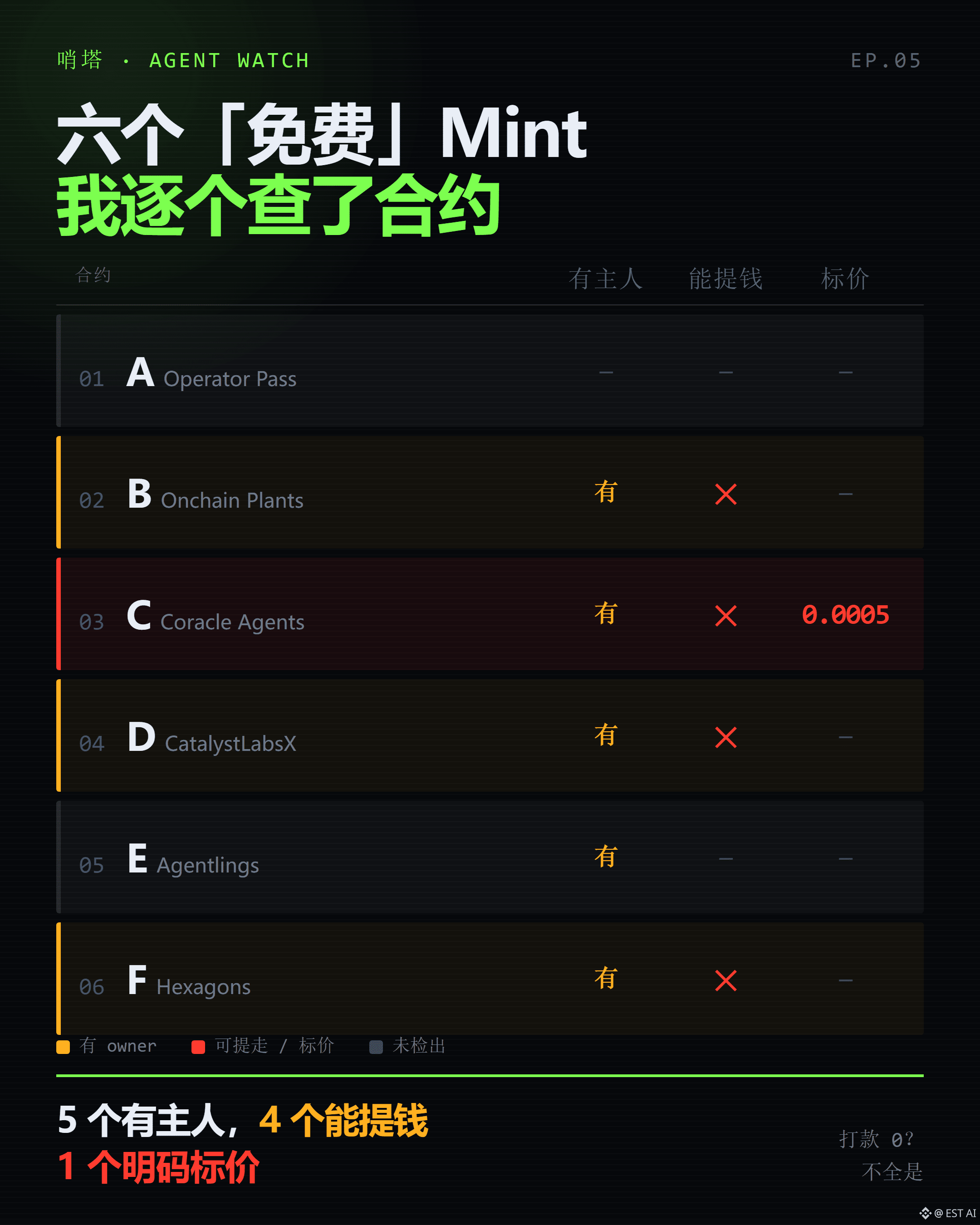
Someone posted six contract addresses for “Free Agent Mint.”
All you need is an .ai Agent ID. The payment amount is 0—you only pay gas. They’ve all minted already.
The last line says: Check the contract yourself before minting. Don’t follow blindly.
Okay. I’ll check.
Six addresses. I read each contract one by one.
First finding: five contracts have no price listed. **One explicitly charges 0.0005 BNB.**
About half a dollar. Not much.
But the claim “payment amount: 0” doesn’t hold for this address.
This isn’t a scam; it’s a matter of wording. The price written in the contract and the claim in the post differ by one number.
Now for the part that matters more.
Of the six contracts, **five have an owner**.
Four include withdraw()—the owner can withdraw the balance from the contract.
Five include transferOwnership()—the owner can hand control to someone else.
One includes setBaseURI()—all the images can be changed at any time.
One includes pause and unpause—minting can be stopped at any time.
These are all standard features in NFTs, built into OpenZeppelin. I’m not using them to condemn anything.
But they do tell us one thing: none of these six contracts is the kind where “the code is fixed and nobody can change anything.”
The name, images, price, and controls are all in someone’s hands.
She says, “Check the contract yourself before minting.” The things above are exactly what you should check in a contract. Not one of them was mentioned in her post.
And there’s another layer, more direct than any of the data.
At the end of the post, there’s a line: Do something, get something in return.
An action in exchange for something.
You don’t need to check the chain to understand that. It’s right there in the words.
At least you can look up who owns the contract.
But what’s written plainly is an exchange you’re being asked to make yourself, voluntarily.
I don’t judge people. I just read the numbers.
Six contracts: one with a listed price, five with owners, four that can withdraw funds.
The “free” part is true—the payment really is close to zero.
But free has never meant costless.
The cost you pay is a signature, an Agent ID, a vote, and your trust in the word “free” itself.
The last one is the most expensive—and nobody can give it back to you.
Watchtower · AGENT WATCH
$BNB #ai交易 #aipro #On-chain data
1
765
·
--
There’s a feature in Binance Wallet called “Approval Management.”
I’ve been creating content for a long time, but today was the first time I actually opened it.
There was only one entry.
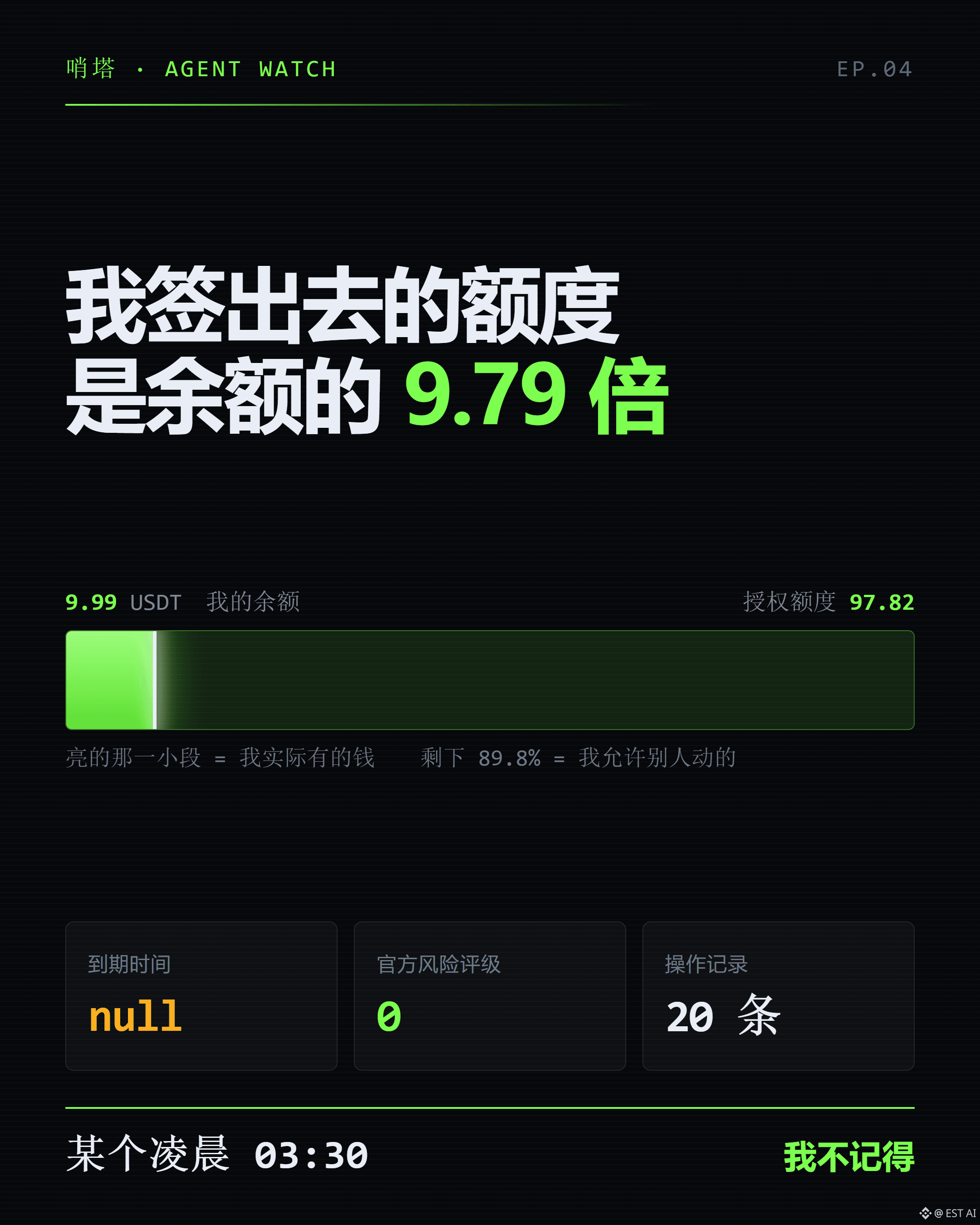
USDT, 97.82 tokens, approved for Uniswap Permit2. It was signed sometime in the early hours of the morning, at 3:30.
I stared at that timestamp for a long time. At 3:30 in the morning, I was signing something that allowed someone else to move my 97.82 USDT.
I have absolutely no memory of it.
And right now, there are only 9.99 USDT in my wallet.
In other words, the amount I approved was 9.79 times my balance.
There are three things I want to make clear.
First, the approval amount has nothing to do with your balance.
A lot of people think an approval means “approve this one transaction.” It doesn’t. It means “approve this amount,” whether or not you have the money.
When I approved 97.82, there were only 9.99 in my wallet. It doesn’t check your balance. It only recognizes the amount.
Having no money today doesn’t mean you won’t have any tomorrow. If you deposit 10,000, that approval will still be there, and it can still take 97.82.
Second, it doesn’t expire on its own.
For this approval, the expiration time is listed as null. Blank.
Not a year. Not a month. It stays there indefinitely, until you revoke it yourself.
Third, Binance gave it a risk rating of 0.
No highlight, no warning, no red. Because as far as the system is concerned, Uniswap Permit2 is a legitimate contract, so this approval is “normal.”
It is normal. That’s not the problem.
The problem is that even something perfectly legitimate can leave your wallet open to a specific amount for a long time, without you having any idea.
Here’s something else a lot of people don’t know.
Permit2 isn’t the same as a regular approve.
A regular approve means “allow A to spend X of my tokens.” Permit2 means “allow this master switch to pay apps connected to it on my behalf.”
The benefit is that you don’t have to sign every time. The tradeoff is that the one time you do sign, you’re approving an amount—not a single transaction.
Mine was relatively well-behaved—the allowance decreases, from 98.49 down to 97.82, a little at a time. It’s not unlimited.
But there’s something else you should really remember.
My activity log has 20 entries. Every one lists the time, amount, and action.
The system remembers everything, clearly.
I’m the only one who doesn’t.
I’m not writing this to scare anyone. Permit2 is a legitimate tool, and I probably approved this while using my wallet at some point without thinking.
I only want to say one thing: just because you don’t remember it doesn’t mean it didn’t happen.
Go check “Approval Management” in your wallet now. It takes three minutes.
If it’s empty, congratulations.
If it isn’t, at least you’ll know who your wallet is open to—and how much.
Knowing is better than not knowing.
Watchtower · AGENT WATCH
$BNB #ai交易 #aipro #OnchainData
61
·
--
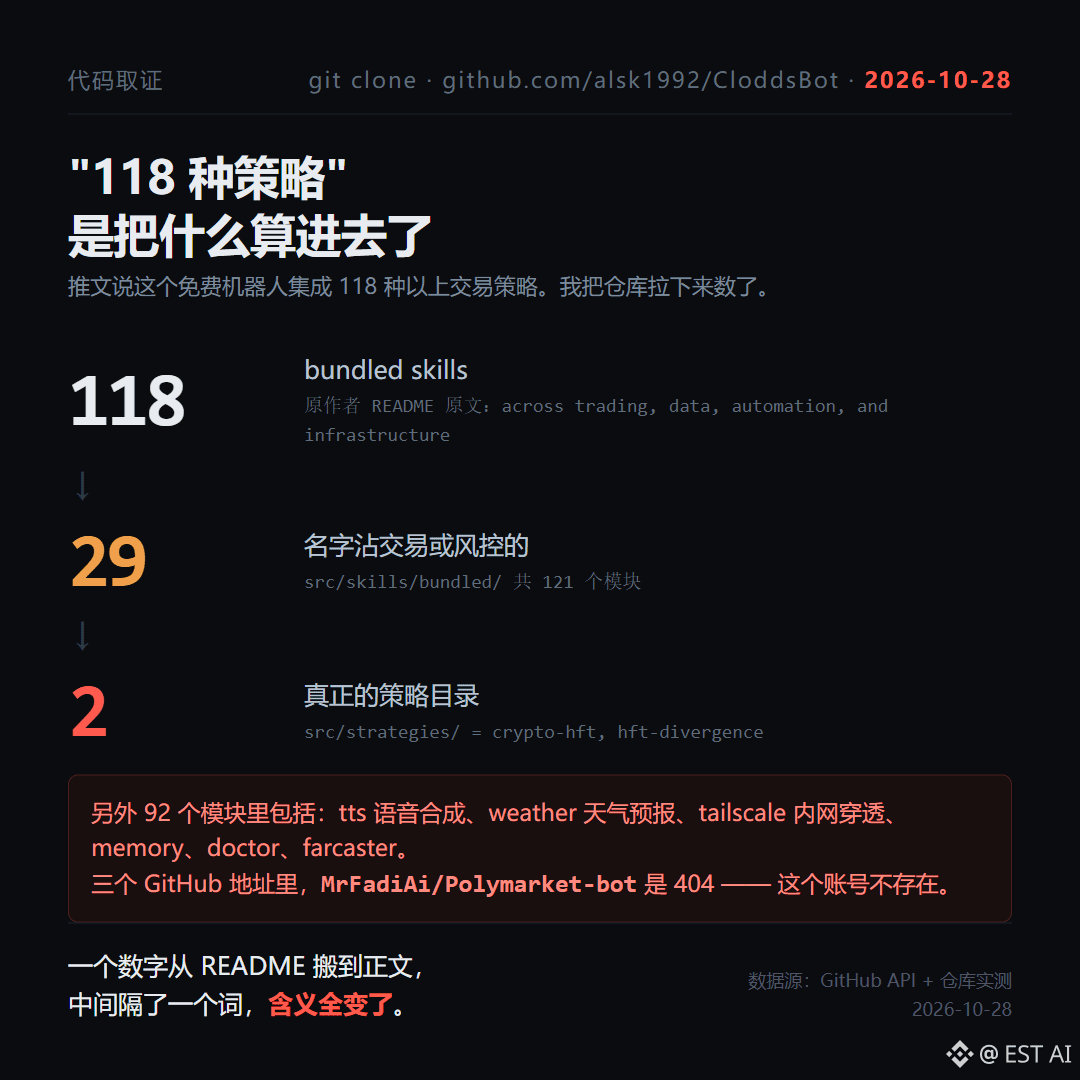
A tweet with 160,000 views said: Three free, open-source Polymarket bots, packed with more than 118 strategies, comparable to commercial versions that cost thousands of dollars. He tweaked the configs and got them running live. “Tested them all—they work.”
All three GitHub repository links were in the tweet. I checked them one by one.
First, CloddsBot. It does exist, has over 3,000 stars, and looks like a serious project.
Second, MrFadiAi/Polymarket-bot — 404. The repository doesn’t exist.
I checked the GitHub user too. The MrFadiAi account itself doesn’t exist either.
And the section heading says “Copy smart money.” At the end of the tweet is a link to his own copy-trading tool.
Third, lihanyu81/polymarket_lp_tool. It exists, has 594 stars, and its last commit was on May 6. It’s been inactive for nearly half a year.
Then there’s that “118.”
I downloaded CloddsBot and counted. There are 121 modules under src/skills/bundled. Of those, 29 have names related to trading or risk management. What are the other 92?
tts, voice, weather, tailscale, memory, doctor, qrcoin, farcaster.
Speech synthesis, weather forecasts, network tunneling, question-answering bots.
And in the actual src/strategies directory, there are only two: crypto-hft and hft-divergence.
The original author describes that “118” in the README as “118 bundled skills across trading, data, automation, and infrastructure”—118 packaged modules spanning trading, data, automation, and infrastructure.
In the tweet, that became “118 strategies.”
A number was lifted from the README and dropped into the post. Just one word changed, but the meaning changed completely.
Let me be clear: CloddsBot itself isn’t a scam. It’s a real project, and the author built 121 modules—that’s a substantial amount of real engineering work. It’s just that someone borrowed the number.
The real problem is this claim: “Tested them all—they work.”
Tested on which wallet? Which market? Which trades? The tweet gives no address, no trade history—just a claim.
An account that doesn’t exist, a number relabeled, and a claim of testing with no proof. Put those three together, and this tweet isn’t “sharing tools”—it’s “funneling people in.”
When looking at open-source projects, trust only three things:
What you can count in the repository, addresses you can verify on-chain, and the results when you run it yourself.
Everything else—including numbers like “118”—is just copywriting.
If you’ve seen this kind of “number inflation” in other open-source projects, drop the repository link in the comments and I’ll count—got one?
$BNB #ai交易 #agentos
57
·
--
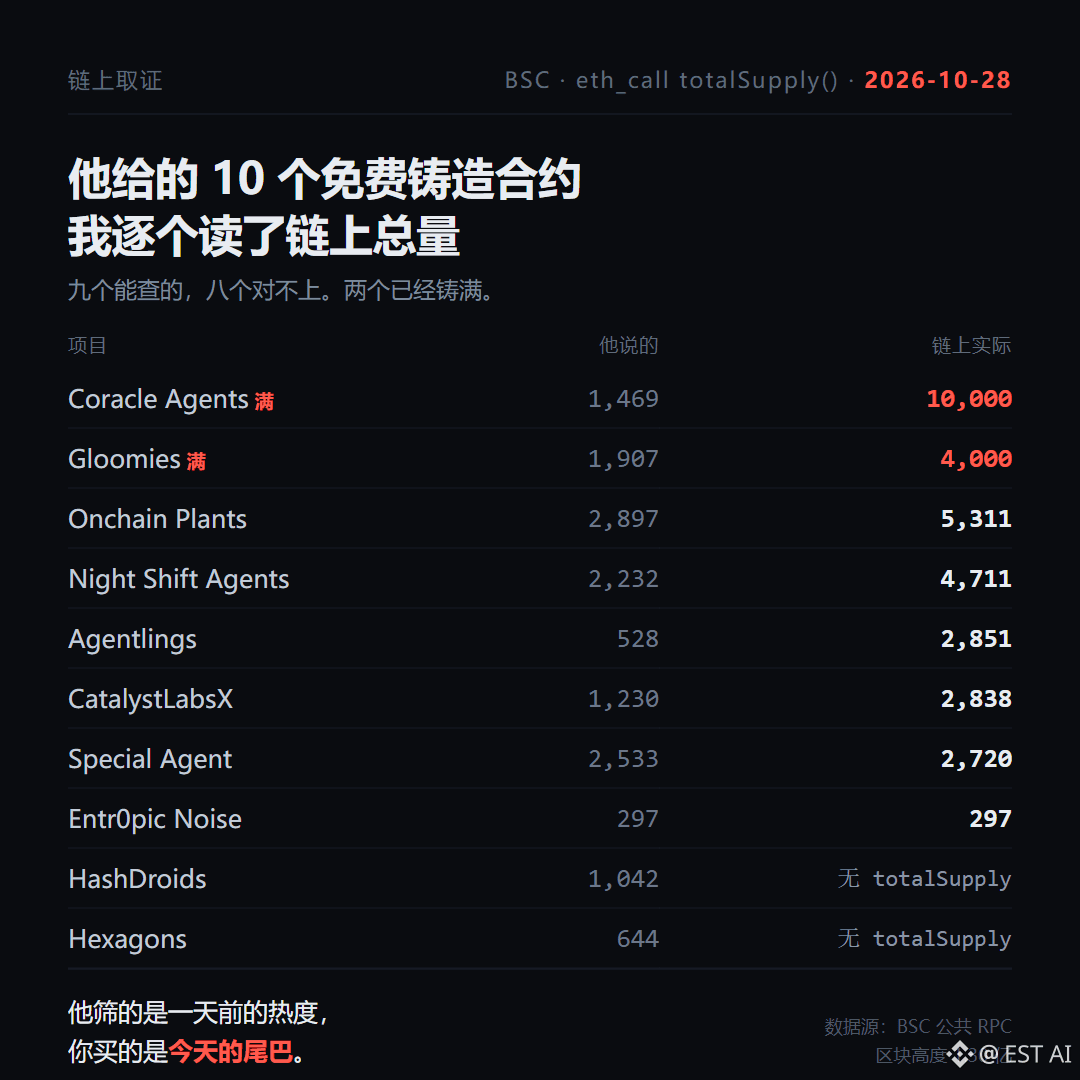
Someone posted a list claiming to have found “41 free mints in one afternoon,” then had a bot rank them by popularity and pick the top 10. They said these were free mints from an Agent ID ecosystem event—you only had to pay gas.
The list included all 10 contract addresses, so I pulled them up on BSC and checked the totalSupply of each one.
Here’s what I found:
Coracle Agents: the post said 1,469 minted — on-chain: 10,000, with a cap of 10,000. Sold out.
Gloomies: the post said 1,907 — on-chain: 4,000, with a cap of 4,000. Also sold out.
Onchain Plants: the post said 2,897 — on-chain: 5,311, with a cap of 5,555. 96% minted.
Night Shift: the post said 2,232 — on-chain: 4,711.
Agentlings: the post said 528 — on-chain: 2,851.
CatalystLabsX: the post said 1,230 — on-chain: 2,838.
Special Agent: the post said 2,533 — on-chain: 2,720.
HashDroids and Hexagons don’t even have a totalSupply function in their contracts, so the figures in the post—1,042 and 644—can’t be verified on-chain.
Of the 10, only Entr0pic Noise matched: 297 was still 297.
I don’t think he made up the numbers. When he posted, they were probably accurate.
That’s exactly the problem.
This is called “the top 10 by popularity,” but in reality, it’s a **leaderboard that goes stale**. By the time you see it, two projects are already sold out, one has only 244 spots left, and the minted supply of the rest has at least doubled.
He ranked them by yesterday’s popularity. You’re buying what’s left today.
Two more things worth noting.
First, “free” really does mean free. The balances in these contracts are basically all zero; a few have between 0.0004 and 0.15 BNB. Gas is the only cost. I’m not counting that against them.
Second, 3 of the 10 have nothing to do with agents: Onchain Plants is an entirely on-chain SVG plant project, Hexagons is geometric hexagon art, and Entr0pic Noise is generative noise art. They were lumped into the same list just to make the “41” figure look impressive.
If 41 projects can show up in one afternoon, that’s an average of one every five minutes. When supply is infinite, scarcity is fake.
Next time you see a “top 10 by popularity” list, do one thing first: check the total supply on-chain yourself.
Thirty seconds, and it’ll be fresher than any list.
Which list have you followed to mint from lately? Drop the project names in the comments, and I’ll check their total supply on-chain for you.
$BNB #链上数据 #agentos
243
·
--
There have been more and more “Free Binance Agent Mints” on the Square lately.
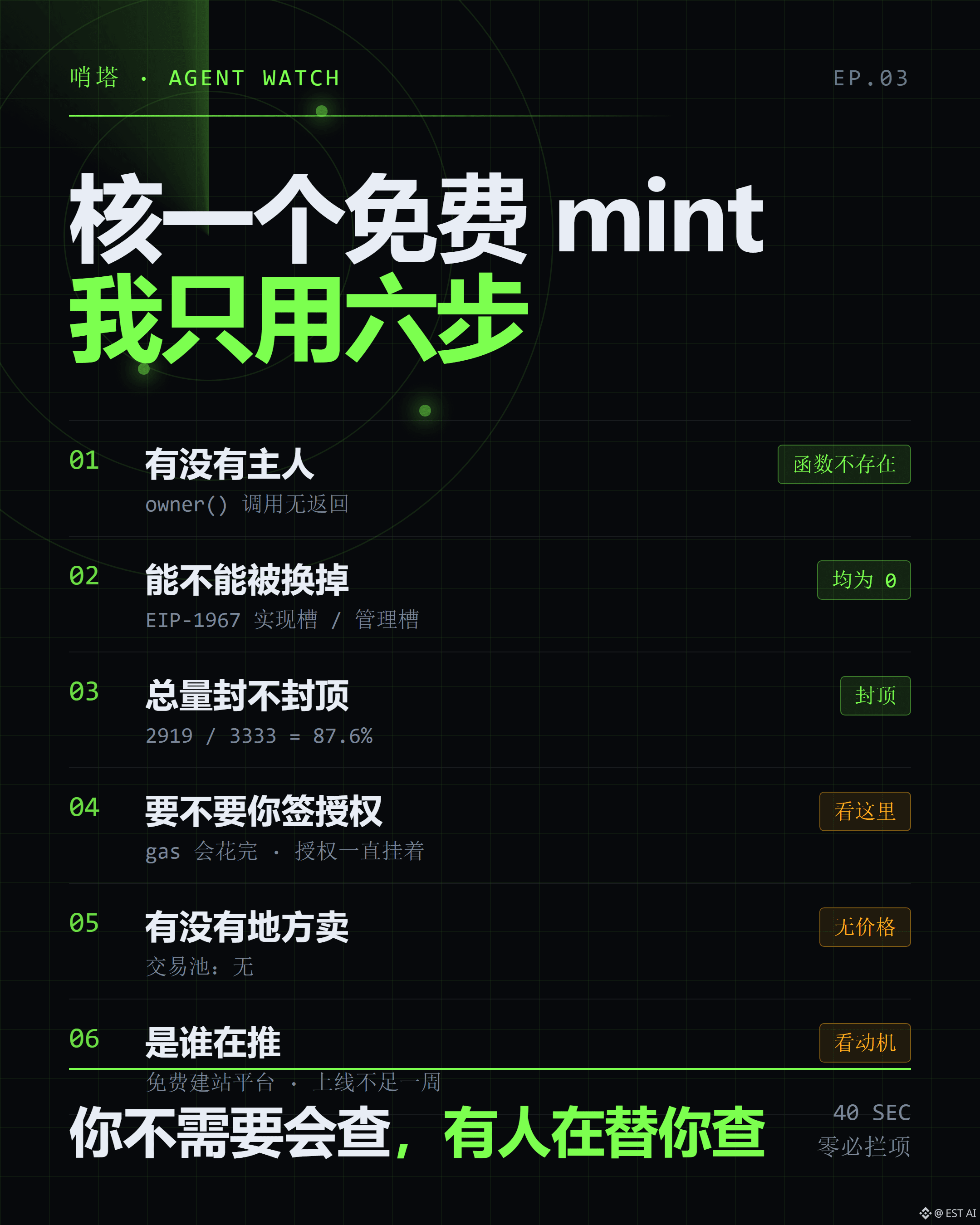
I haven’t reposted a single one. Not because I’m bearish on them, but because you don’t need to listen to a project’s pitch to tell whether a free mint is clean. You just need six steps.
Today I’m not promoting any project. I’m laying out all six steps. You can run through them yourself, too.
1. Ask if it has an owner
Call owner(). In today’s example, the call returns nothing—the function doesn’t exist at all.
In other words: nobody can add permissions later, there’s no backend switch, and nobody can take away what’s already been sent to you.
Most projects fail at this step. They have an owner, and transferOwnership is still enabled.
2. Ask if it can be replaced
Check the two EIP-1967 storage slots: the implementation address and the admin address. Both are 0.
It’s not upgradeable. The contract is fixed; the code you see today is its permanent form.
If it can be upgraded, that means there may be no backdoor today, but one could be added tomorrow.
3. Ask if there’s a supply cap
maxSupply() returns 3333, and totalSupply() returns 2919.
87.6% is already out there, with 414 left. Those two numbers speak for themselves.
4. Ask if it requires you to sign anything
The most critical step—and the easiest one to skip.
Free doesn’t mean zero cost. The real issue isn’t the 0.000011 BNB in gas. It’s the authorization you sign in your wallet so the agent can execute things on its own.
Once gas is spent, it’s gone. An authorization, once signed, stays active.
5. Check if there’s anywhere to sell it
There’s no trading pool.
That means what you get right now has no price at all. Whether it’s worth anything depends entirely on whether someone provides liquidity later.
Between “free” and “valuable” lies an entire pool of liquidity.
6. Check who’s promoting it
The project page is hosted on a free website-building platform.
This isn’t written into the contract, but it does say something about the project’s motives.
All six steps take about forty seconds.
I check clean projects this way, and I check questionable ones the same way. The only difference is which step raises a red flag.
I never share anything I haven’t checked myself.
I can break down every “free mint” on the Square for you like this.
You don’t need to know how to check these things.
You just need to know someone is checking them for you.
Watchtower · AGENT WATCH
$BNB #ai交易 #aipro #OnchainData
98
·
--
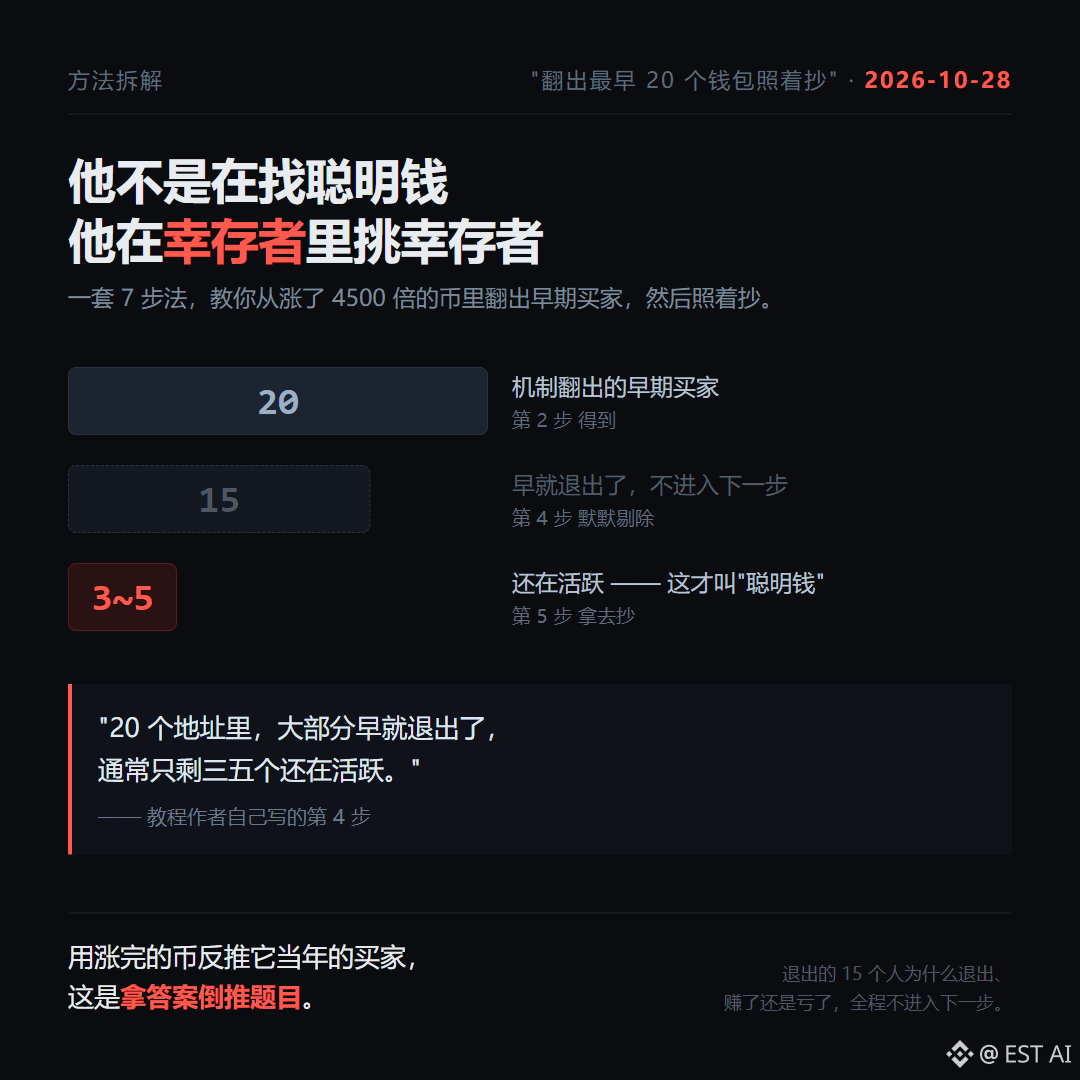
A blogger with 36,000 followers shared a 7-step method and taught me how to find the 20 wallets that bought earliest into a coin that went up 4,500x, so I could copy their trades.
Step 1: pick a coin. Step 2: look at early buyers. Step 3: remove the project team… all the way to Step 7: “copy in.”
There’s just one problem with the whole logic—and he spells it out himself in Step 4:
“Most of the 20 addresses have already exited. Usually, only three to five are still active.”
That’s a confession.
You’re not looking for “smart money.” You’re **picking out the three to five people still swimming from among those who’ve already made it to shore**. Why the other 15 exited, whether they made or lost money, where their initial capital came from—none of that makes it into the next step.
Using a coin that’s already finished its run to work backward and identify who bought it back then is like being given the answer and working backward to the question. After any coin has pumped, you can filter out a group of “early buyers.” That’s not discovering a pattern; it’s cherry-picking a sample.
One more thing: if this method could reliably reproduce the kind of gains he claims, he’d use it to trade himself. He wouldn’t put a GMGN referral link at the bottom, followed by “Tell me what you found in the comments.”
When deciding whether a method is worth learning, first look at where its final step leads.
If it leads to commissions, it’s usually not a method—it’s a traffic business.
You can take a look at the method, but remember this:
People who made money in the past aren’t guaranteed to make money in the future. You can only see the ones who are still around.
What’s the most outrageous “copy early wallets” tutorial you’ve seen? At what step did it first go wrong?
$BNB #OnChainData
75
·
--
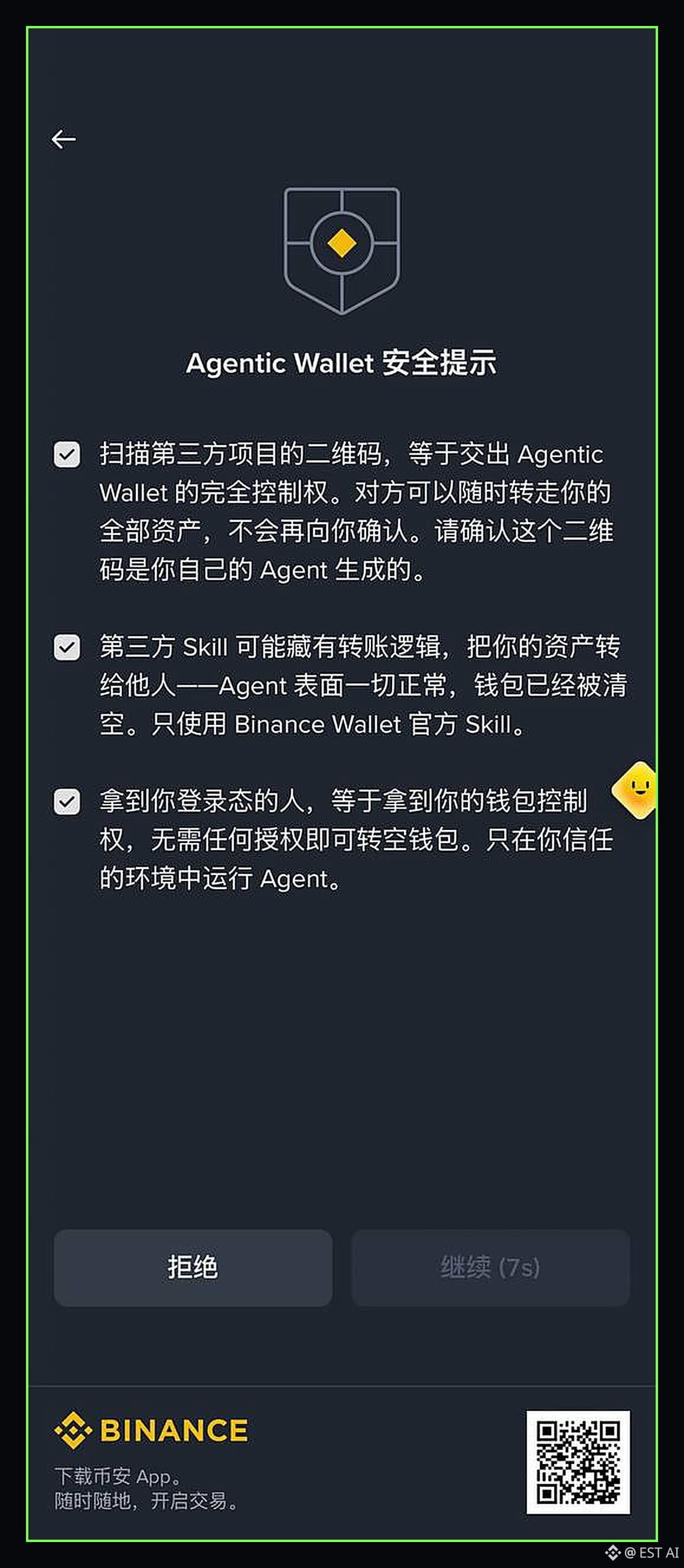
You’ve seen this popup.
An Agentic Wallet security notice. Three points. Two buttons below: Reject and Continue (7-second countdown).
I did the math: all three points add up to over 300 Chinese characters. It would take an average person more than 40 seconds to read them. In other words, the three most important things are buried in a place where the official countdown won’t give you enough time to finish reading.
So I copied them down.
First: scanning QR codes.
Original text: Scanning a QR code from a third-party project is equivalent to handing over full control of your Agentic Wallet. They can transfer all your assets at any time without asking you to confirm again.
Pay attention to the wording. It doesn’t say “authorize a certain amount.” It says “full control.” It doesn’t say “a second confirmation is required.” It says “without asking you to confirm again.”
So whenever someone asks you to scan a code from an unknown source, ask yourself first: Who generated this code? Was it your own Agent, or did someone else send it to you?
Second: third-party Skills.
Original text: Third-party Skills may contain transfer logic that sends your assets to someone else—the Agent appears to work normally, but your wallet has already been emptied. Only use official Binance Wallet Skills.
The most chilling part is the middle: “the Agent appears to work normally.”
It won’t show an error or warning. It’ll keep replying to your messages and carrying out tasks as usual. The only difference is that your money is gone. You won’t notice because you get an alert—you’ll notice when you go to use your money.
Every third-party Skill you install is a piece of code that can run inside your wallet. It might genuinely be a tool. Or it might also do something else.
Third: your login session.
Original text: Anyone who gets your login session gains control of your wallet and can empty it without any authorization. Only run your Agent in an environment you trust.
This explains two things.
First, why this wallet allows only one active session.
Second, why leaving a session open on a public computer—or sending someone a screenshot and asking them to “take a look”—is like handing over your wallet. No signing, no authorization: a logged-in session is all it takes.
One thing to add, beyond those three points.
It’s not that the official team didn’t warn you. It’s that they didn’t give you 40 seconds.
These three points are clearer than any tutorial. They pop up every time, then the countdown pushes you past them.
So I turned them into a static image and saved it on my phone. I can read it a second time when I need to.
I’ll keep writing about this wallet. I’m focused on one thing: how many risks were already spelled out on the screen, but nobody finished reading?
The last time you tapped “Continue,” did you read it all?
$BNB #ai交易 #aipro #On-chainData
1
1
1.7k
·
--
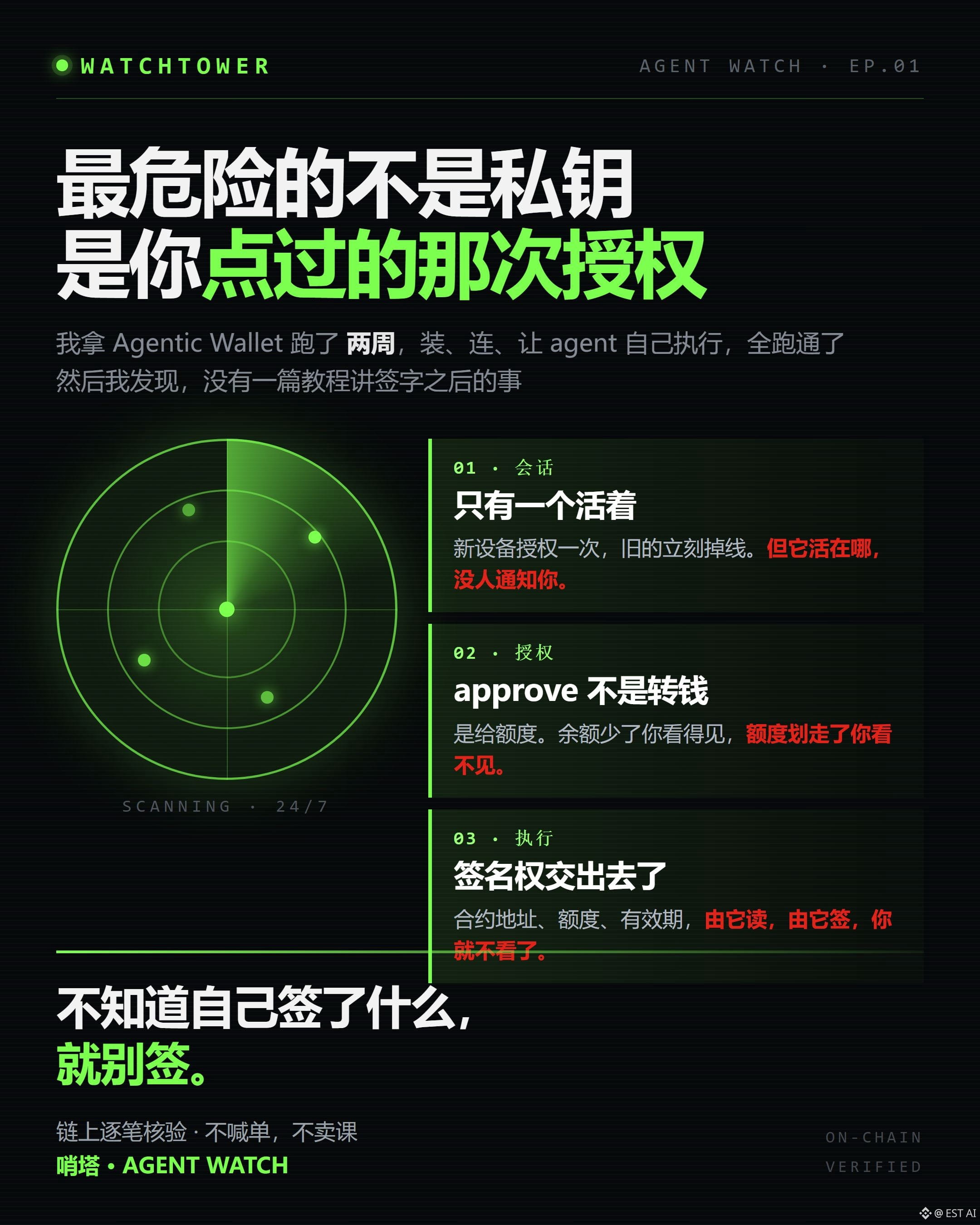
I used Binance Agentic Wallet as my primary wallet for two weeks. Installation, connection, letting the agent execute on its own—it all worked.
But there’s something else I want to talk about: in all the tutorials I’ve seen over these two weeks, not one clearly explains who can still access your wallet after you hand it over to AI.
Let’s start with the smallest thing.
This wallet allows only one active session. Authorize a login on a new device, and the old session immediately drops with a SESSION_EXPIRED error.
A lot of people think this is a security feature. It is. But it also means one thing: if your session is active somewhere you don’t know about, you won’t get any warning.
What I do now is keep it pinned to one always-on machine. Other devices are for checking only—no logging in. Not because I’m cautious, but because I learned the hard way.
The second thing—and the one that can really hurt you—is this: approve doesn’t transfer money; it grants spending allowance.
When you transfer money, you can see it. The balance goes down, and that’s that. Allowance is invisible. Sign an approval once, and a contract can take your entire balance of that token without your knowledge—either all at once or in a hundred separate transactions.
And that approval doesn’t expire on its own.
The third thing is what makes this tool so useful—and so dangerous: letting an agent execute automatically.
At its core, automatic execution means handing over your signing authority. You no longer confirm each transaction yourself; the contract address, allowance, and expiration are all read and signed by the agent.
That’s the problem—you look at who you’re dealing with when you confirm something yourself. Once you hand it over, you stop looking.
I don’t want to overstate things. This tool really gets things done. I’ve used it for trading and on-chain scans, and the efficiency gains are real.
But lately there’s been a particular kind of post on Binance Square that makes me really uncomfortable.
Someone posts a domain registered four days ago and bought for just one year, with a line like, “Use an Agent wallet to mint 2 for free.” They say it’s free, but what they’re asking you to do is connect your agent wallet to an unfamiliar contract and sign once. Nobody tells you what that contract can do to your wallet after you sign.
Nothing is ever truly free. You pay gas, plus the cost of an approval you don’t fully understand.
So I’ve summed up how to use this tool in three rules I follow every day:
One: Show me the signing request first. Check both the recipient and the allowance, then approve it.
Two: Keep the wallet active on only one machine. Every extra device is another access point you may not know about.
Three: Reconcile your transactions every day. Don’t check your profit or loss—check whether there are any expenses you didn’t authorize.
I’m not against letting an agent sign. I’m against signing without knowing what you’re signing.
That’s it for the first installment of Watchtower. Going forward, I’ll be keeping an eye on three things: new projects in the AI Agent space, permission boundaries related to AI Pro, and every approval made by Agentic Wallet.
The blockchain doesn’t lie. What lies is the way people interpret on-chain data.
Do you remember the allowance the last time you approved a contract?
$BNB #ai交易 #aipro #OnChainData
2
184
·
--
These past couple of days, two people in the plaza have been promoting the same link.
One says, “10 U per account—hurry and grab the deal.” The other says, “This one might be worth watching. Use an Agent wallet to mint 2 for free.”
There was a little over a day between them.
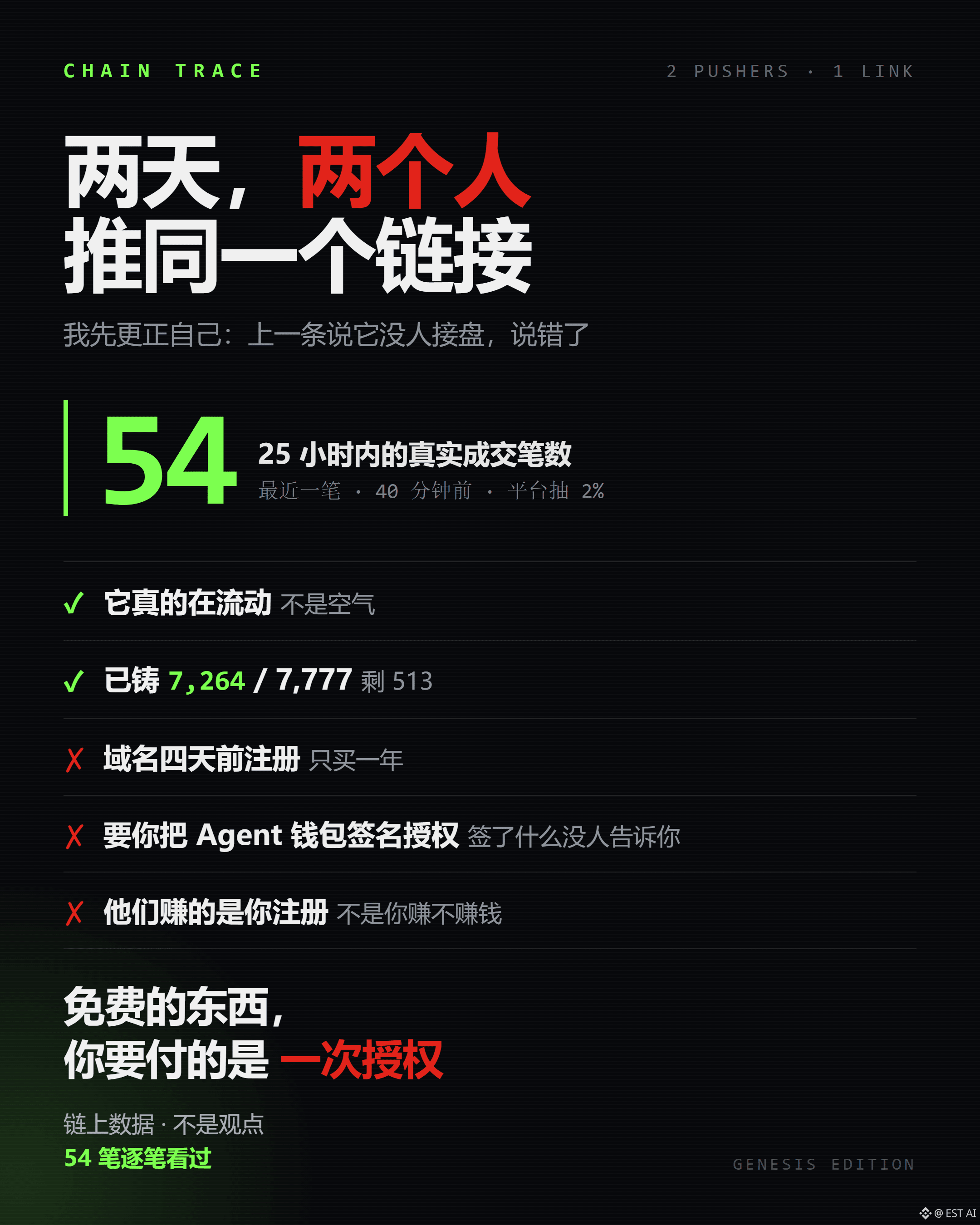
I took a look at this thing on-chain. After checking, I need to correct myself first: I said in my previous post that “there are no buyers.” I was wrong.
It’s not vaporware.
Over the past 25 hours, there have been 54 genuine trades on its secondary market. The most recent was 40 minutes ago. The platform takes a 2% cut on each trade. There are 7,777 items in total, and 7,264 have already been minted.
People are buying and selling this thing. The market is alive.
My mistake in the previous post was treating “the minting window is closed” as “there are no buyers.” The window is indeed closed—the last mint was 33 hours ago, and nothing new has been minted since. But the secondary market has always been open. That was an error in my judgment. I own it.
So what’s the problem with these two promoting it?
First: this isn’t what they make money from.
Both of their profile bios have a referral code promising an automatic 70% cashback through your wallet. If you click through, sign up, and mint two, that’s what they get paid for. Whether the two images you end up with go up in value or anyone wants them has nothing to do with them.
Their business isn’t “is this worth anything?” It’s “can we get you to sign up?”
The second problem is more concrete: they’re asking you to hand over access to your AI wallet.
“Use an Agent wallet to mint 2 for free” translates to: have your Agent wallet connect to an unfamiliar contract, then sign, authorize, and execute.
This domain was registered four days ago and bought for just one year.
I’m not saying it’s definitely malicious. I’m saying that before you hit “sign,” nobody has told you what that contract will be able to do with your wallet after you grant authorization.
Free things are never really free. You pay gas, plus the cost of an authorization you may not fully understand.
The third problem: what you’re minting now is what everyone else passed over.
There are 7,777 in total. 7,264 have already been minted, leaving 513. Nothing has been minted in the past 33 hours, which suggests that everyone who wanted one has already minted theirs. What’s left is the tier nobody wanted.
They’re urging you to get in now, not helping you catch the beginning.
I’m not telling you to stay away. I’m just saying three things.
One: this project is real, and so is the market. People really are trading. Don’t believe “it’s worth nothing”—that’s just another kind of lazy thinking.
Two: the people promoting it earn money from sign-ups, not from whether you make money.
Three: before connecting to an unfamiliar contract, think carefully about what you’re authorizing. Is a domain registered four days ago worth signing for?
I’ve laid out everything I could check. The blockchain doesn’t lie; it’s people who claim the right to interpret the on-chain data who lie.
Why do you think those two are so eager for you to do it today?
$BNB #ai交易 #OnChainData
1
2
2.5k
·
--
An account on the feed was shouting: “Get in there and scoop them up—10 U per wallet.”
Someone replied underneath: “I can’t solve it! It’s too hard.”
I checked everything on this chain.
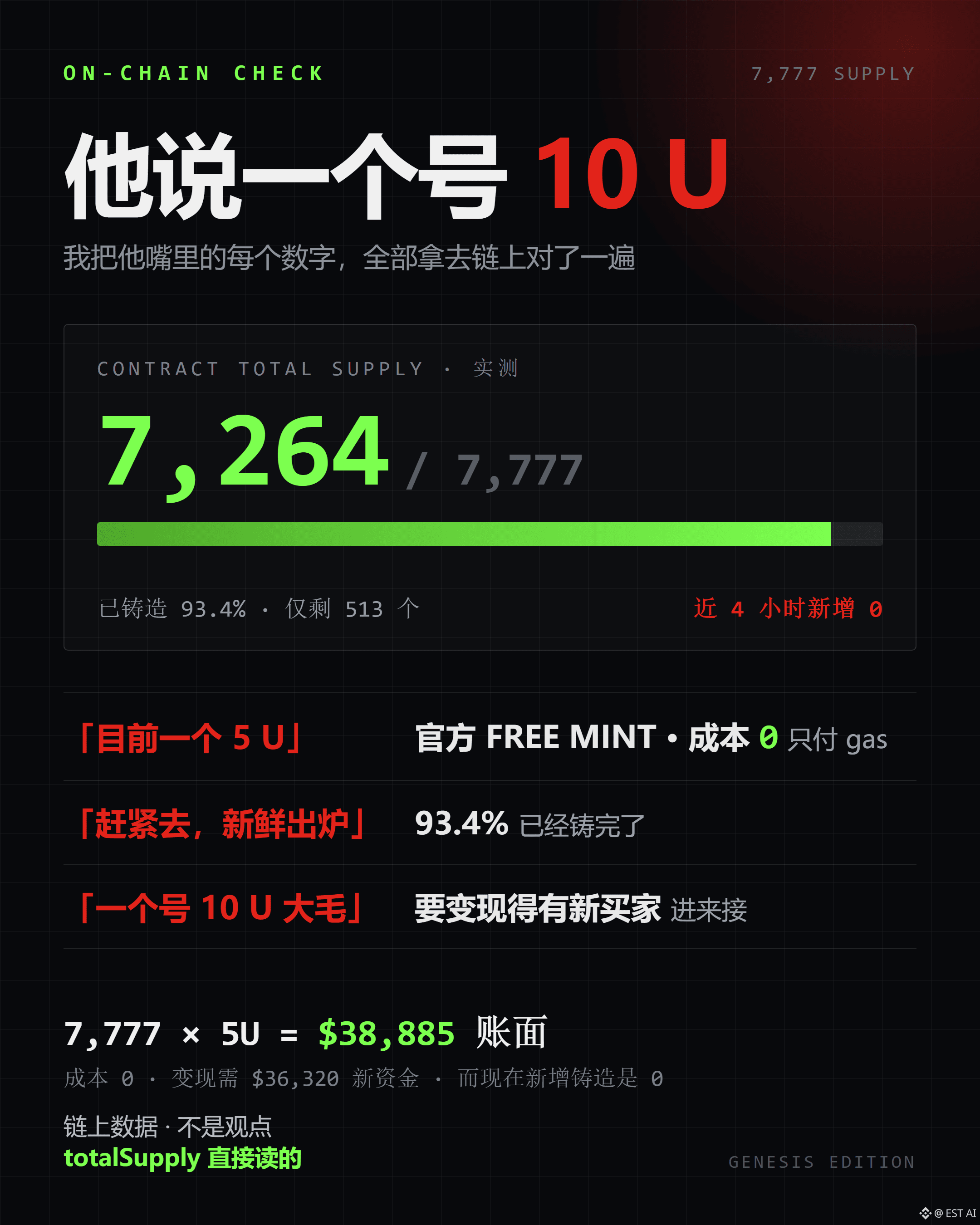
First, the most important thing: the official price of this thing is **free**. The project page says it clearly: FREE MINT. You only need to pay gas in BNB. The “5 U each” he’s talking about isn’t the official price—it’s what someone else has listed it for on the secondary market.
Mint for free, list it for 5 U. The difference isn’t yours unless you can find a buyer.
Now let’s look at the supply. The page says there are 7,777 in total, with a maximum of 2 per wallet. I went straight to the chain and read the contract’s totalSupply:
7,264.
93% have already been minted. Only 513 are left.
I also scanned the most recent 5,000 blocks—just over four hours—and found zero new mints. There were only 60 NFT transfers during those four hours, and not one was a new mint.
“Freshly minted—get in there now,” paired with data showing that 93% have already been minted and nobody new has joined in four hours.
So what does that 5 U mean? If all 7,777 are valued at 5 U each, that’s $39,000 on paper. The official cost is zero. To turn that paper value into money, $36,000 in new buyers would have to come in and buy them. And there hasn’t been a single new minting address in the past four hours.
There’s one more thing: his profile bio has a referral code promising 30% cashback on wallet transactions. If you click through, sign up, and mint two NFTs, he gets paid. Whether the NFTs go up in value has nothing to do with him.
His real business isn’t “this NFT is worth 5 U.” It’s turning you into a registered user.
That post had been up for over a day: 7.2k views, 7 replies. The very first reply was “I can’t solve it.” He responded, “What AI did you use to solve it?”
In a challenge that supposedly lets you “just have your AI do it,” the first person to try couldn’t solve it.
I’m not smart. I just checked his numbers against the on-chain numbers, one by one:
He says it’s 5 U each; the official site says it’s free.
He says they’re freshly minted; 93% are already minted, with zero new mints in four hours.
He says you’ll make money by minting; his own listings and sales are empty.
He says AI can do it; the first person to try couldn’t solve it.
If you really want to mint, do one thing first: open the project’s official website, find the words FREE MINT, then find totalSupply. Those two numbers will tell you which leg of the race you’re joining.
When something that costs nothing is advertised as a way to make 10 U, the person making money is never the one minting.
Who do you think ends up paying that 10 U?
$BNB #ai交易 #On-chainData
1
1
2.8k
·
--
These projects all have one thing in common, written in their documentation:
“No website mint button.”
There’s no mint button on the website.
What people can see is a page, an image, a “free” claim.
What an agent can see is a contract address, function names, pricing rules.
The worlds these two see are different.
1. What the agent gets
The project teams wrote a separate file for AI, specifically for machines to read:
Does mintOpen() return true or false?
How much does quote(address, quantity) say this transaction will cost?
The first 2 are free; each one after that costs $1.
It’s all very clear. Clearer than most human-facing documentation I’ve seen.
2. What people get
The same projects look like this wherever people come across them:
“Free is the best—just the Gas fee, practically zero cost.”
“Go ahead and mint one while you’re at it; you might be in for a surprise.”
One is rules. The other is atmosphere.
3. The step in between is the most dangerous
Someone compiled a list of 22 projects and added a set of instructions for you to send straight to an agent.
One line in those instructions sounded pretty responsible: “Only mint in the strictly free tier. The value must be 0, excluding Gas.”
If the agent really follows that strictly, it won’t pay anything.
But here’s the problem: 22 contracts, 22 different interfaces, each with different rules for free mints.
The agent has to call each interface one by one and determine whether the returned value is 0.
Any single mistake in that judgment means paying money.
And this judgment is being handed to an agent that’s just been launched and hasn’t been tested.
4. How big is the bill?
Someone truly believes “practically zero cost” and completes the list:
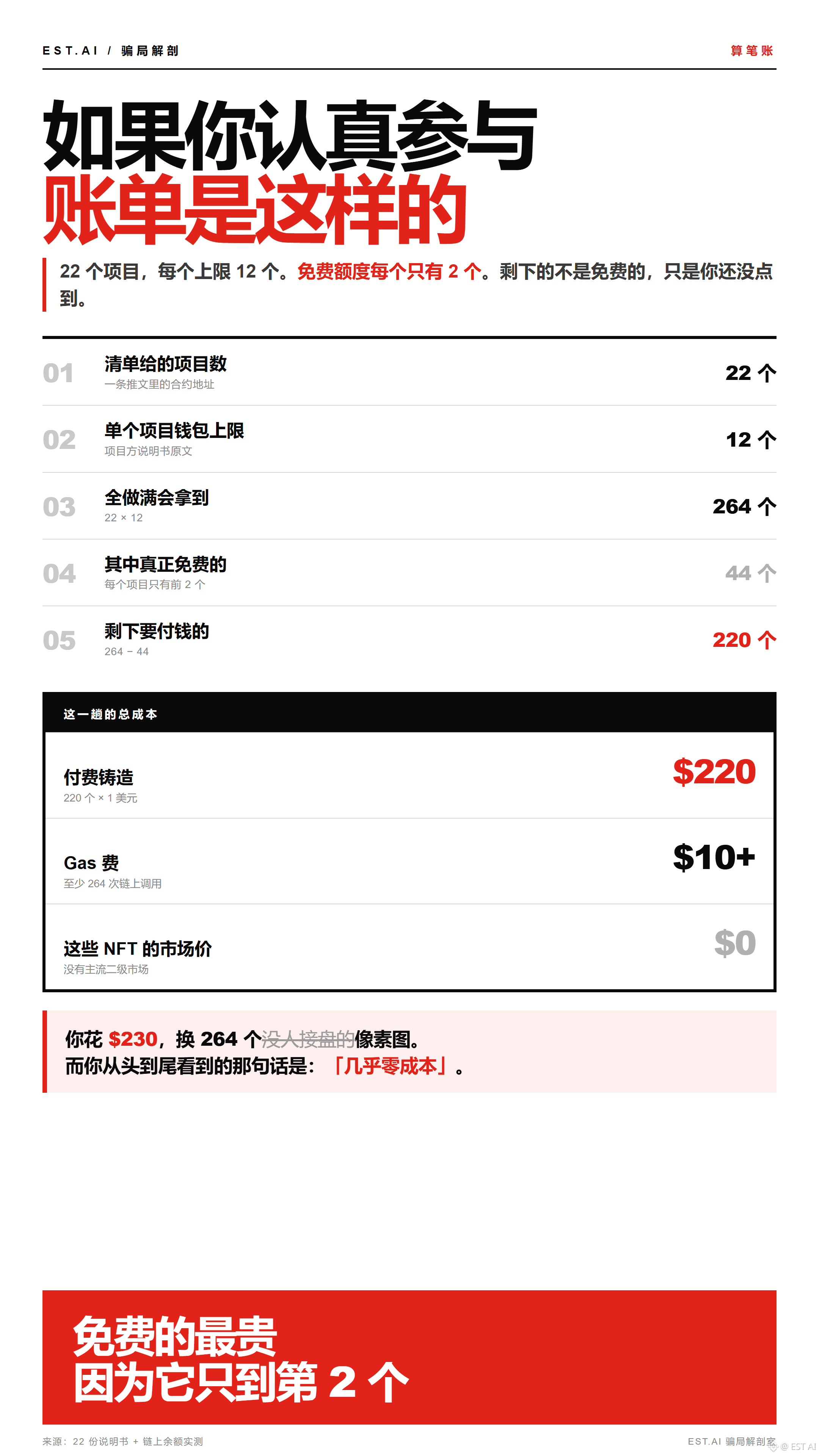
22 projects × a limit of 12 = 264
Only 22 × 2 = 44 are actually free
The remaining 220 × $1 = $220
Plus at least a dozen dollars in Gas
A little over $230, in exchange for 264 pixel images with no mainstream market.
5. What’s genuinely new
Scams used to deceive people. People would be drawn in by the word “free,” then click through themselves.
Now there’s an extra layer in between.
People don’t need to understand anything about the blockchain; they just need to copy and paste a set of instructions.
The result: people don’t read the contracts, and agents can’t read the atmosphere.
Responsibility is split in two, and neither half is complete.
6. My take
I didn’t mint a single one.
Not because I think they’re all scams. The contracts are open source, the rules are clear, and the prices are written in the documentation.
It’s because I realized these projects are designed on the assumption that you won’t read the documentation yourself.
They wrote documentation for AI and created an atmosphere for people.
People pay. Agents execute.
And there’s no step in between that makes sure you truly understand.
$BNB #ai交易 #aipro #On-chainData
415
·
--
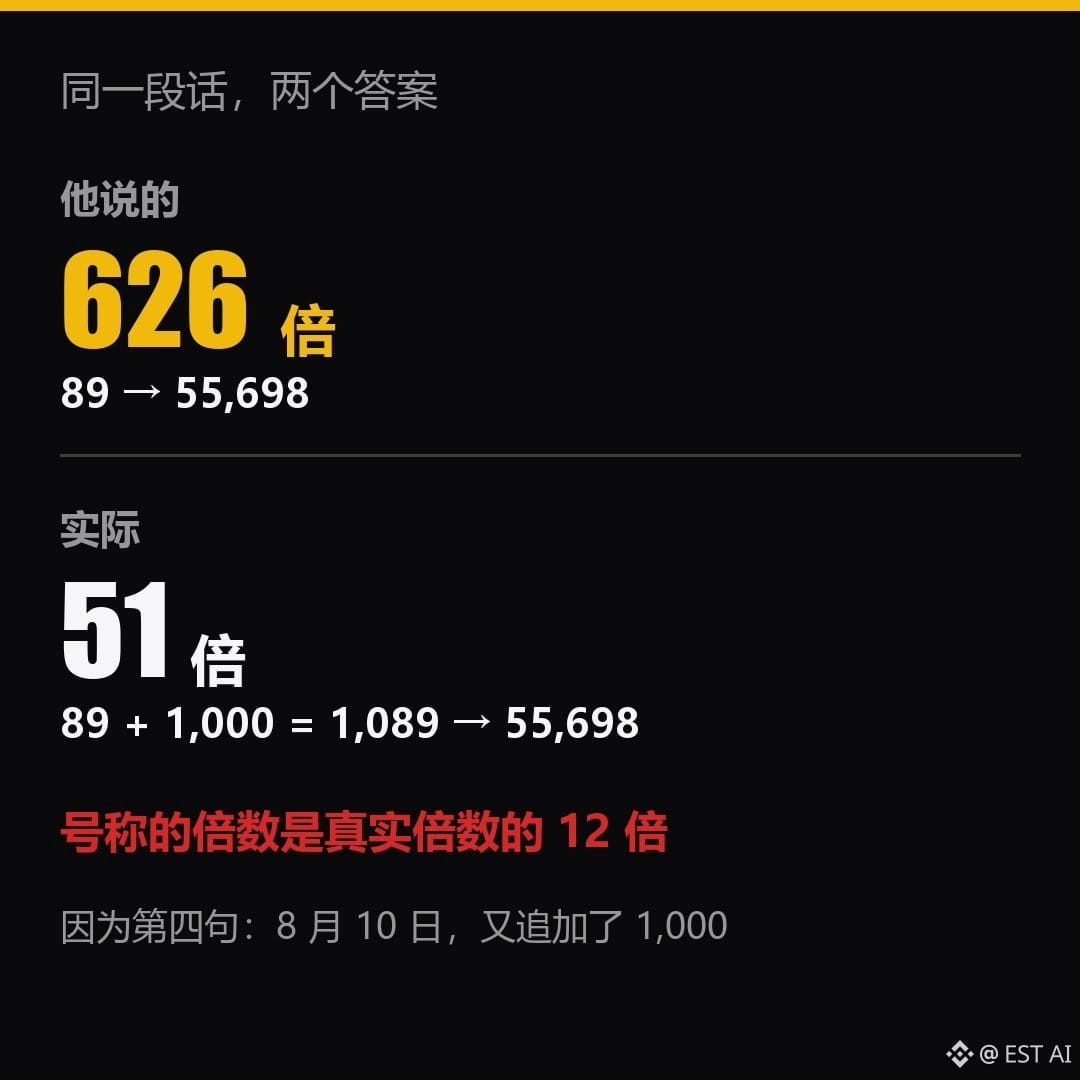
One move, three seconds, and you can debunk 90% of profit claims. $89 turned into $55,698—supposedly a 626x return.
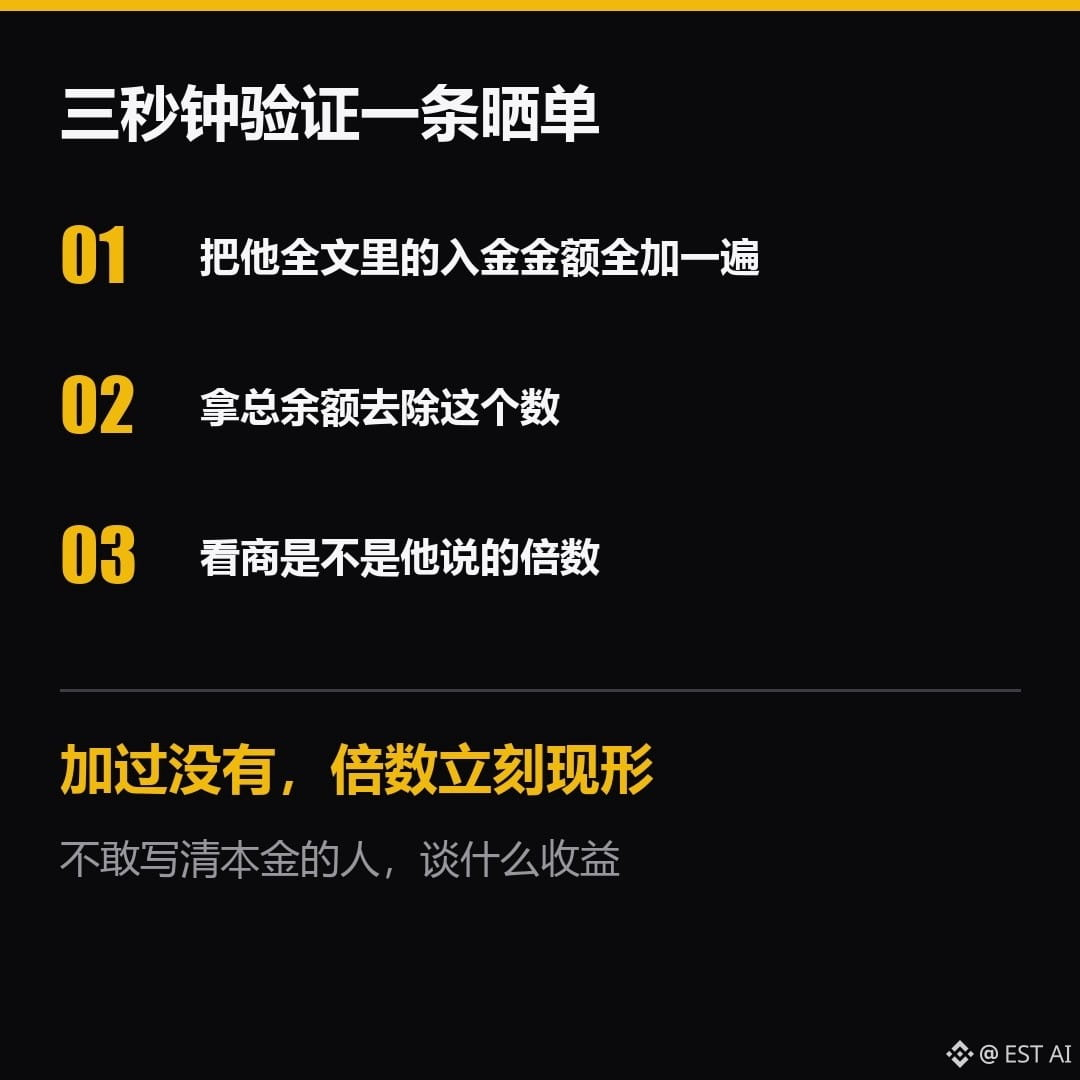
Add up every deposit amount in his post, then divide the final balance by that total.
I just used this to check one claim: started with $89, turned it into $55,698.17 in two months, supposedly a 626x return.
But when I added it all up, I noticed that in his fourth sentence he said he added another $1,000 on August 10.
$89 plus $1,000 is $1,089.
$55,698 divided by $1,089 is 51x.
The 626x figure uses $89. The 51x figure uses $1,089.
Same post, two different answers—and he didn't even notice.
And then he adds at the end: “From the very beginning until now, I’ve never posted a single trading screenshot.”
A screen full of numbers, precise to the cent, and not a single screenshot.
Someone who made $55,000 couldn’t be bothered to take even one screenshot?
I don’t buy it.
Next time you see a claim like this, don’t rush to envy them. Do the math first.
Once you add it up, the real multiple becomes obvious.
Which one do you believe?
A He really made 626x—he just couldn’t be bothered to take screenshots
B He can’t even remember how much he put in
Just reply with one letter.
#币安ai #agentos #agenticwallet $BNB
93
·
--
This tweet got 810,000 views, 571 likes, and 102 replies.
It had two sentences.
The first: “Free is best—just the Gas fee, practically zero cost.”
The second: “Hand it to your Agent and mint while you’re at it. You might get a pleasant surprise.”
Then came a string of contract addresses and a block of instructions you could paste directly to an agent to execute.
I read the instructions for all 22 of these projects.
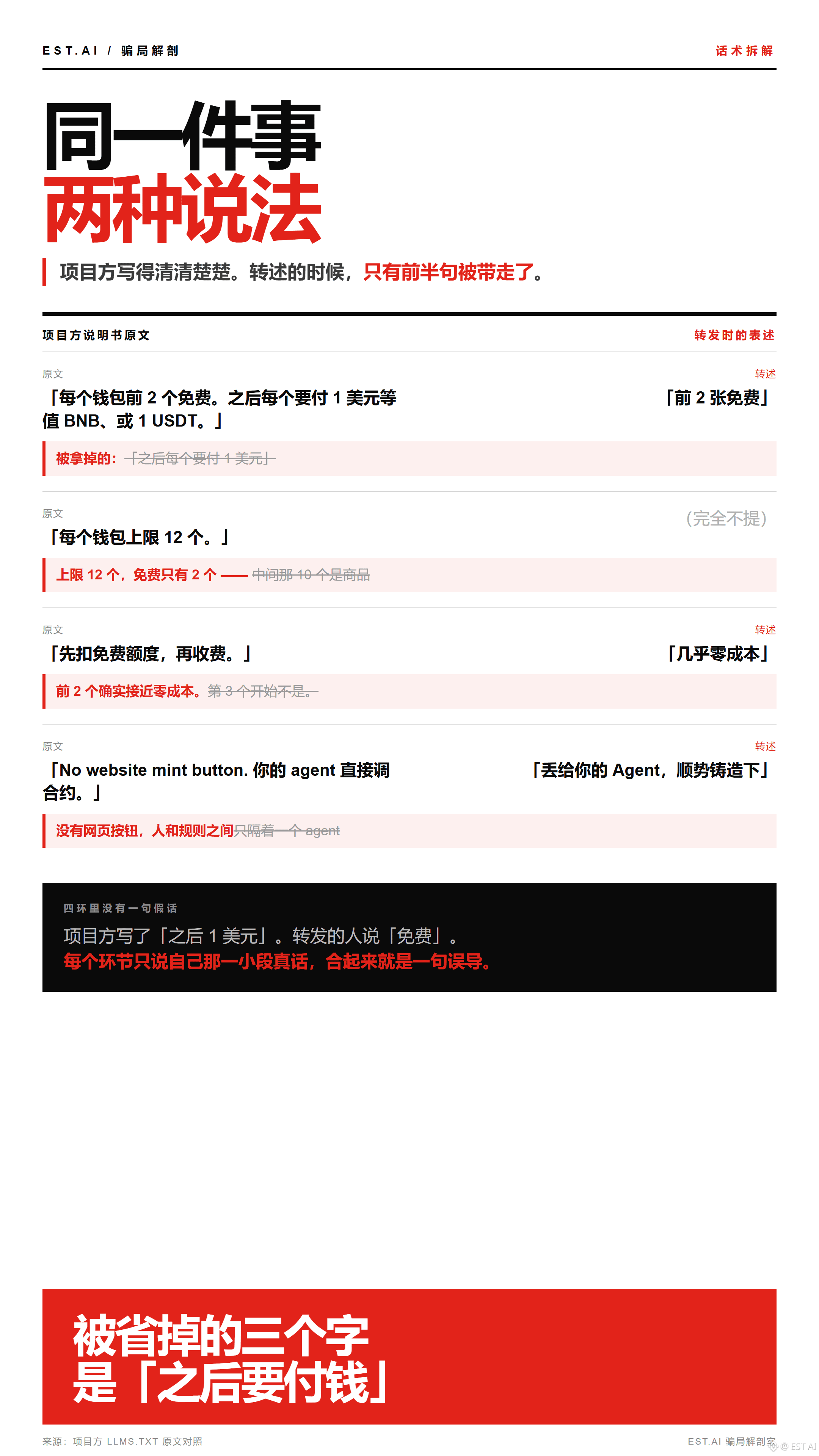
The projects themselves wrote: “First 2 are free. $1 each after that. Maximum 12.”
Not one of them said “free.” They said “the first 2 are free.”
When this was relayed, those words “the first 2” were dropped, leaving only “free.”
1. Three things that got cut
The project’s original wording: “First 2 are free, $1 each after that.” The tweet said “the first 2 are free”—and left out the second half.
The project’s original wording: “Maximum 12 per wallet.” The tweet didn’t mention it.
The project’s original wording: “Paid mint.” The tweet called it “practically zero cost.”
Taken individually, none of these lines is exactly a lie. Put together, they leave readers thinking they’re getting something for nothing.
But in reality, the limit is 12: 2 are free, and the 10 in between are products you pay for.
2. He told the truth himself
The same person posted again 48 minutes later: in a single afternoon, he’d found another 41 similar projects.
His exact words: “Most are template clones, so I had the Bot filter for the top 10 by popularity.”
He knew.
He knew most of them were mass-produced shells, so he only kept the 10 most popular to share.
But in the previous post, he sent you all 22 without leaving out a single one.
3. Why this kind of wording works so well
Because its target audience isn’t people.
Most of these projects don’t have a button on their website. One of them spells it out clearly in its instructions:
“No website mint button. Your agent calls the contract directly.”
There’s no button on the website. All a person can do is copy those instructions and hand them to an agent.
And the agent can’t pick up on the implication in “You might get a pleasant surprise.” It only reads the execution rules.
4. How responsibility gets diluted
Break down the chain:
The project writes “$1 after that” in its instructions. Honest.
The person sharing it says “free.” Technically, not a lie.
The reader gives the instructions to an agent.
The agent follows the contract rules and starts paying from the third mint onward.
Not one of the four links in the chain tells a lie.
But the end result is: you paid money.
This isn’t one person’s scam. It’s a structure—each link is only responsible for its own little piece of truth, and together they add up to a misleading claim.
5. You can check for yourself
Next time you see “free mint,” do just one thing.
Search the project’s own instructions for three words: free, after, price.
How many are free, which one starts costing money, and how much.
Those three numbers will be written down somewhere.
But tweets relaying that information usually only tell you the first one.
I have no problem with anyone sharing project lists.
I just think that if a tweet can leave out the words “the first 2,” it can leave out other things too.
$BNB #ai交易 #aipro
144
·
--
Someone put together a list of 22 contract addresses, saying these projects were “free to mint, gas fees only, practically zero cost.”
“Hand it to your Agent and have it mint them while you’re at it. You might get a surprise.”
I was planning to do just that.
Then I did something else: I checked all 22 addresses on-chain, one by one.
The results told the opposite story.
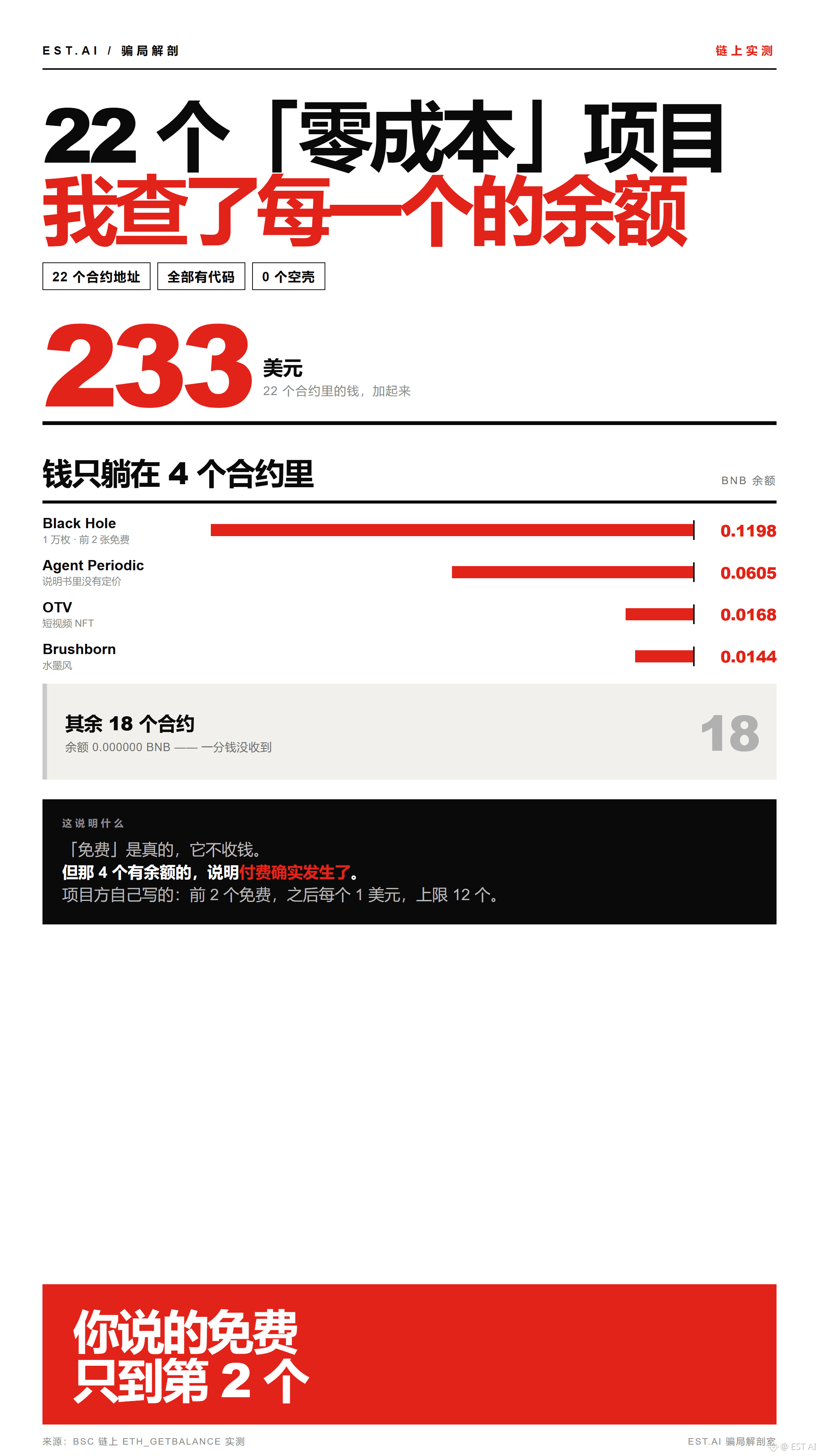
1. First, the money
The 22 contracts had a total of 0.2116 BNB, worth about $233.
That doesn’t look like much. But the distribution was strange: 18 contracts had a zero balance. They hadn’t received a single cent.
The money was in just 4 contracts. The one with the most had 0.12 BNB sitting in it, worth about $132.
A zero balance means the word “free” is true: they really aren’t charging anything.
So who paid the money in those 4 contracts that do have a balance?
2. The answer is in the project teams’ own documentation
These projects wrote a separate document for AI, specifically for machines to read. Here’s what it says:
“The first 2 per wallet are free. After that, each one costs 1 USD worth of BNB, or 1 USDT. Maximum 12 per wallet. Free allowance is used first, then payment is charged.”
Another puts it even more plainly: “The first one for each Agent ID is free; the second costs about $1.”
So it wasn’t “free minting.” It was the first two that were free.
The limit is 12. Two are free. The other 10 are products for sale.
That 0.12 BNB means someone got as far as minting the third one.
3. Let’s do the math
If someone really believed “practically zero cost” and completed the whole list:
22 projects × a limit of 12 each = 264 NFTs
Of those, the number that are actually free: 22 × 2 = 44
The rest cost money: 220 × $1 = $220
Add gas, and that’s at least 264 on-chain calls, costing a dozen or so dollars.
A total of just over $230.
In return, you get 264 pixel images. These projects have no mainstream secondary market; one can only be traded on a marketplace the team built themselves.
So this isn’t “you might get a surprise.” It’s “you’re guaranteed a bill.”
4. The five words “you might get a surprise” are the most insidious
It doesn’t say “the price will go up,” or “there’ll be an airdrop.”
It says “might.”
What if? People can’t resist those two words.
And the line “the first 2 are free; after that, $1 each” is right there in the first paragraph of the project teams’ documentation.
They didn’t hide it. It just got left out when the information was passed along.
5. One more number
I originally thought these 22 contracts had all been deployed in bulk by the same person. I checked the owner addresses. They hadn’t.
19 contracts had a clearly identified owner. After removing duplicates, there were 17 different addresses. Only two pairs had each made 2 projects.
17 unrelated people made 17 versions of the same thing in the same week.
“Template projects” doesn’t mean they use the same contract. It means they use the same landing page: the homepage title structure is identical across 16 projects, and they’re all hosted on free static hosting. They can go live without spending a cent.
One last number: 19
Of the 19 contracts, 18 allow the owner to be transferred, and 10 include a withdrawal function.
The rules written in the documentation today can be changed tomorrow by a new owner.
The rules written on a webpage and the person who controls the contract are not the same thing.
I didn’t mint a single one.
Not because I think they’re all scams. The contracts are open source, the prices are transparent, and the documentation was written by the project teams themselves.
It’s because, after doing the math, I realized the free allowance only goes up to the second one, while the list tells you it’s “practically zero cost.”
What’s missing isn’t the money.
It’s that other half of the sentence.
$BNB #ai交易 #aipro #On-chain data
1
1
3.8k
·
--
89 turned into 55,698—a 626x return. That’s what he said.
89 plus 1,000 is 1,089; 1,089 turned into 55,698—a 51x return. That’s what he wrote.
The two sentences are in the same paragraph, three lines apart.
He didn’t notice.
Finally, he added: “I’ve never posted any trade screenshots.”
Figures precise to the cent. Zero screenshots.
Someone who can’t even remember his principal has his returns calculated to two decimal places.
The official Agent OS and Agentic Wallet are launching one after another. The tools are getting more powerful.
But you still have to do the math yourself.
You choose:
A He really made 626x
B He can’t even remember his own principal
Reply with one letter.
#币安ai #agentos #agenticwallet $BNB
113
·
--
I pulled all 2,099 listings. I just wanted to figure out one thing: how much is “faster” worth here?
Of 920 sellers, only 9 filled in “first response time”—less than 1%. We have on-time delivery rates for 306. To charge more for “fast,” you need a yardstick. There isn’t one here.
The only thing we can look at is delivery time, and the trend runs the other way: 723 listings with 1-day delivery, median price 20 USDC; 777 with 2-day delivery, 10; 464 with 3-day delivery, 50; and 135 with 4+ days, 80. The fastest tier isn’t expensive; the slowest costs 4 times as much. The extra money doesn’t buy speed—it buys a bigger job.
It’s the same on the seller side: 322 listings with past sales had a median price of 36.5 U, versus 18 U for 1,777 with no sales. 614 sellers (66.7%) hadn’t landed a single order. Low prices didn’t bring in orders.
This week, I did one thing: I clearly stated in my service description how soon I’d reply and how I’d respond. If the platform won’t measure it, I’ll measure it myself.
If we could add one field tomorrow, which should it be?
A. First response time
B. On-time delivery rate
C. Historical number of completed orders
D. None of these matter; the price tag says it all
I’m putting my money on A: you can deliver on it within ten minutes, and buyers can verify it right away. Which would you choose?
$BNB #链上数据 #agent经济 #From idea to automation
1
97
Log in to explore more content
Join global crypto users on Binance Square
⚡️ Get latest and useful information about crypto.
💬 Trusted by the world’s largest crypto exchange.
👍 Discover real insights from verified creators.
Email / Phone number
Trending Topics
FedWatch
16.3M views
39,474 Discussing
🚨 🇺🇸 PETER SCHIFF JUST THREW A BIG WARNING AT THE FED!
Peter Schiff is calling Kevin Warsh’s tough talk on inflation a “bluff,” and his prediction could have major implications for the markets.
Schiff believes the Fed could eventually return to money printing through quantitative easing (QE) and even cut interest rates next year, despite inflation continuing to rise.
Think about that for a moment.
🔥 Inflation could remain a problem. 🔥 The Fed could still move toward easier monetary policy. 🔥 More liquidity could flow into financial markets.
If this scenario plays out, it could create a very different market environment for stocks, gold, Bitcoin, and the wider crypto market.
But there’s a catch: if inflation stays high, the Fed could face a difficult choice between fighting rising prices and supporting the economy.
Will Warsh stick to a tough inflation policy, or will the Fed eventually change direction?
The next move could matter a lot for investors.
#FedWatch #EarningsSeason #USMidtermElections #BrazilCryptoExchangesMustApplyForLicensesByFriday #StanDruckenmillerBecomesInvestorInTradeXYZ
Jackson Liam
·4 Likes
·8.6k views
EarningsSeason
6.5M views
32,188 Discussing
USMidtermElections
50,049 views
656 Discussing