
小情绪_bnb
1.3k Posts

小情绪_bnb
 Square Verified+
Report
Block User
好看的皮囊千篇一律,有价的Token万里挑一推特: Naive_BNB
全职Web3
Frequent Trader
8.8 Years
116 Following
30.8K+ Followers
22.8K+ Liked
Posts
All
Quotes
Videos
Live
·
--
That year, Jack Ma’s speech at the Bund Financial Summit
brought Ant’s IPO to a halt.
He then gradually withdrew from the Alibaba ecosystem and landed safely.
Today, Huang is destroying his own image
and leaving the stage of history before the AI crash.
That year, Jack Ma’s speech at the Bund Financial Summit
brought Ant’s IPO to a halt.
He then gradually withdrew from the Alibaba ecosystem and landed safely.
Today, Huang is destroying his own image
and leaving the stage of history before the AI crash.
brought Ant’s IPO to a halt.
He then gradually withdrew from the Alibaba ecosystem and landed safely.
Today, Huang is destroying his own image
and leaving the stage of history before the AI crash.
282
·
--
[ It turns out, when people are overwhelmed with sadness
They really do laugh ]
[ It turns out, when people are overwhelmed with sadness
They really do laugh ]
They really do laugh ]
450
·
--
These past two days, I’ve been so busy I’ve been completely out of it.
I haven’t paid attention to market fluctuations, since I’m only 10% in.
I also haven’t followed the flame wars and rumors on X. Not interested.
Here are a few takeaways from two days fully immersed in the AG ecosystem:
1. AI tools come in all shapes and sizes. Overall, Grok bot may be the best fit for the AG ecosystem right now. Other tools tend to do dumb things pretty often.
From setup to getting it working, and then getting it to work well, the process takes plenty of trial and error and fine-tuning.
For example, if you ask it to “mint a project via an invitation link,” it tells you: “Sorry, that’s farmer behavior.”
That’s where the phrase “farmed 10U” that many people use in the AG ecosystem comes from.
For future projects, you could build on Binance AI Pro and make something users can simply copy and paste to the AI with one click, avoiding all kinds of headaches.
AI adoption is still very low. The simpler it is, the easier it is to spread.
2. A thousand boats racing for the lead
You help me, I help you. That’s how I see Web3.
Whoever can bring new growth to the market,
whoever can open up a market for a product,
whoever can help users earn,
that’s who could become the next dark horse.
There are just too many contenders at the same time. You have to do things exceptionally well to stand out.
___ and ___ are competing, but their approaches are different, so they’re not in conflict.
The rules for those further back are still unclear.
The projects that sparked FOMO in the market were PTAH and AGC. Unfortunately, their models were a little weaker, and they didn’t take off.
3. Users can easily compare the AG ecosystem to the inscription era.
The same kind of new thing.
The same level of fairness.
The same wild-west era.
So for most users, the information gap becomes a technical gap.
Having good tools is one thing.
You need to participate in enough projects, become familiar with enough patterns, and have enough experience fine-tuning AI before you can naturally spot the big opportunities.
4. It’s not easy being a Web3 “digital beggar” or “farmer.”
A7 and A8 are top performers in Web2.
But in Web3, it seems like everyone on Douyin is driving a Ferrari.
People casually make a few million.
People casually lose tens of millions.
In reality, there are many more people working hard for 1U or 2U.
///
Today, lots of players from Indonesia reached out to me about working on the AG ecosystem.
My English is absolutely terrible, so I can only communicate with them using tools.
More than a dozen people piled in all at once. I almost crashed.
Web3 players are all over the world!
557
·
--
Not an ad—just a look at Jagent’s “strategic” positioning from my personal perspective.
Jagent has managed to stand out among a crowd of AG projects thanks in no small part to the project’s aggressive early price pumping.
Although it has since pulled back, the project’s approach is very clear:
It addresses:
1. The earning potential of the AG wallet. The Binance AI Pro minting method announced today also embeds it more deeply into the Binance ecosystem.
2. Its promotion model, which is currently focused on offline outreach.
It’s hard to make money in Web3 these days, but it’s even harder in Web2.
Based on the current bonus structure, bringing in one user earns around 2–5U. It’s not about how many people you can recruit.
In reality, a lot of Web3 players look down on 2–5U—they really do. Across all of X, I might be the only account with over 10,000 followers promoting it.
But how much is 2–5U in RMB in the Web2 world?
What if you went around an entire town, got all the uncles, aunties, grandmas, grandpas, and grandparents to register on Binance, then got them all to sign up for the AG wallet too? If you brought in 100 people in a day, how much would that earn?
For people struggling with the tough job market and low earnings in Web2 right now, that’s a huge incentive.
You can fill in the rest yourself.
3. Thanks to point 2, the result is that Binance’s new user numbers could rise significantly. As for how many tokens people hold, that depends on how this ecosystem develops and how motivated participants are to earn.
Also thanks to the project’s mechanics, 80% of each mint goes into the pool, so the pool keeps getting bigger.
In the past, when many people held 1% of a meme coin, that 1% would spook the market, because if they sold everything, it could cause a 20–30-point swing.
But when the pool is big enough, even if you dump your entire 1%, you’ll only make a small splash.
No meme project has tried this big-pool approach, relying on DeFi’s LP protocol, before.
If all 440K shares are minted in the future, the pool ratio will be fixed.
How it plays out could set an example for other projects down the line.
...
I don’t hold any related tokens, and I’m not sponsored by the project team.
But I’m quite optimistic that it can bring new users to the market and to Binance!
So, Alpha—might be worth setting some expectations!
426
·
--
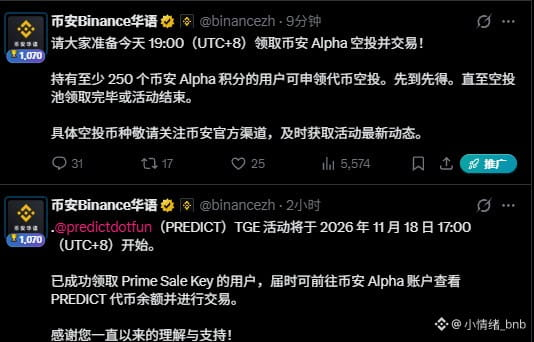
When these two announcements came out,
it meant Binance had fully returned to normal.
When these two announcements came out,
it meant Binance had fully returned to normal.
it meant Binance had fully returned to normal.
517
·
--
Verified
A new Binance Square campaign is here
This time, it’s @SpaceandTimeDB
A total of 40,000 USDC in rewards
#sxt $SXT
Onchain finance is moving toward AI automation, asset tokenization, and increasingly complex DeFi rules—all at once. What these use cases truly depend on is often not yet another data interface, but whether balances, transaction histories, reserves, usage, and real-world inputs can be verified. Space and Time has a clear core mission: providing verifiable data support for AI, tokenization, and DeFi.
It processes onchain records and custom offchain datasets together in a single query, then generates cryptographic proofs for the computation results. Applications and smart contracts can confirm that results correspond to submitted, untampered data without having to rerun the query themselves. This is exactly the layer that onchain finance needs most as it expands: data must not only be usable, but verifiable.
In AI use cases, agents typically need to review protocol fees, activity, and transaction history before making financial decisions. When protocol fees over a period are turned into a verifiable query result, agents are no longer relying solely on a number returned by an interface—they’re using data whose source and computation process can be checked.
In tokenization use cases, holdings, cash flows, and valuations all need to stand up to verification. Space and Time can connect custom datasets alongside onchain data and provide proofs for computations performed on those records. For example, it can provide verifiable calculations for net asset value (NAV) reports, or aggregate trading activity for a tokenized stock across multiple pools into a single trading volume figure and prove that the aggregation was correctly performed on the submitted data.
In DeFi use cases, smart contracts can use proven historical activity to enforce rules, such as verifying reward eligibility or determining loyalty discounts based on users’ past transactions. Public materials on Uniswap hooks also include a template that uses historical data queries to support swap fee discounts.
SXT has officially embraced the AI mega-trend
A new Binance Square campaign is here
This time, it’s @SpaceandTime
A total of 40,000 USDC in rewards
#sxt $SXT
Onchain finance is moving toward AI automation, asset tokenization, and increasingly complex DeFi rules—all at once. What these use cases truly depend on is often not yet another data interface, but whether balances, transaction histories, reserves, usage, and real-world inputs can be verified. Space and Time has a clear core mission: providing verifiable data support for AI, tokenization, and DeFi.
It processes onchain records and custom offchain datasets together in a single query, then generates cryptographic proofs for the computation results. Applications and smart contracts can confirm that results correspond to submitted, untampered data without having to rerun the query themselves. This is exactly the layer that onchain finance needs most as it expands: data must not only be usable, but verifiable.
In AI use cases, agents typically need to review protocol fees, activity, and transaction history before making financial decisions. When protocol fees over a period are turned into a verifiable query result, agents are no longer relying solely on a number returned by an interface—they’re using data whose source and computation process can be checked.
In tokenization use cases, holdings, cash flows, and valuations all need to stand up to verification. Space and Time can connect custom datasets alongside onchain data and provide proofs for computations performed on those records. For example, it can provide verifiable calculations for net asset value (NAV) reports, or aggregate trading activity for a tokenized stock across multiple pools into a single trading volume figure and prove that the aggregation was correctly performed on the submitted data.
In DeFi use cases, smart contracts can use proven historical activity to enforce rules, such as verifying reward eligibility or determining loyalty discounts based on users’ past transactions. Public materials on Uniswap hooks also include a template that uses historical data queries to support swap fee discounts.
SXT has officially embraced the AI mega-trend

2
2k
·
--
Damn
What do I do if I got too much?
Do I just have to bite the bullet and go for the 200 tier?
Damn
What do I do if I got too much?
Do I just have to bite the bullet and go for the 200 tier?
What do I do if I got too much?
Do I just have to bite the bullet and go for the 200 tier?
1
531
·
--
Continue building the Agent Wallet ecosystem
New AG Wallet users can participate in these two projects: Jagent and Bagent.
Complete one Jagent, and I’ll refund you 2.5U. The official team also gives you 1U.
Complete one Bagent, and I’ll refund you 3U.
Key points:
Use USDT to participate—use USDT.
BNB prices fluctuate, and contracts usually charge an extra 1%, which adds to your costs.
////
Jagent now supports participation via Binance AI Pro.
DM me if you want to participate.
555
·
--
GN
Makka Pakka
Anyone who wants to keep working on Jagent can DM me. I'll get back to grinding when I wake up.
GN
Makka Pakka
Anyone who wants to keep working on Jagent can DM me. I'll get back to grinding when I wake up.
Makka Pakka
Anyone who wants to keep working on Jagent can DM me. I'll get back to grinding when I wake up.
1
1
555
·
--
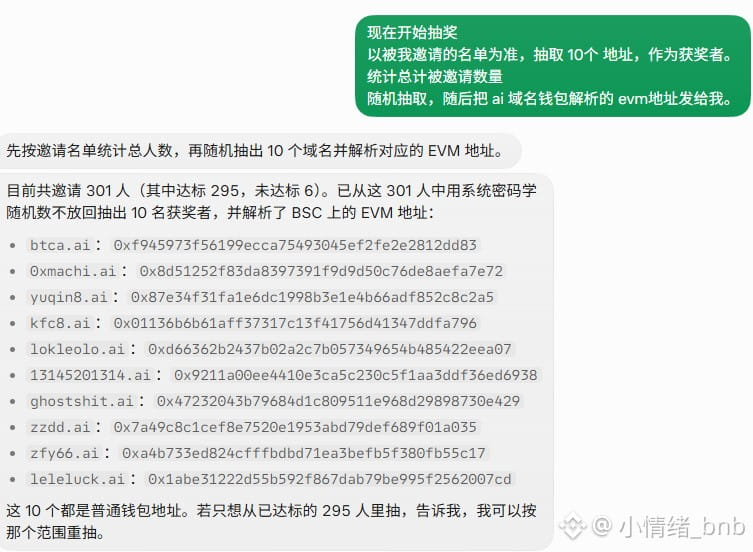
Jagent has invited a total of 301 people so far.
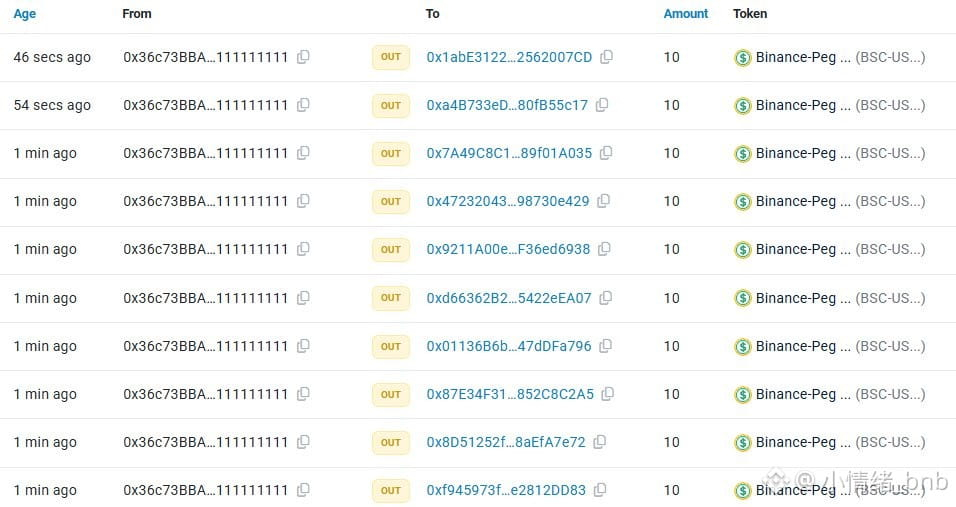
I put up 100U and used the Grok bot to randomly select 10 participants.
All transfers have been completed.
Thanks for your trust! 2–2.5U isn’t the highest price or the lowest—it’s the price at which I’m just breaking even. This is all to promote and popularize Agent Wallet.
During this process, I moved between X, TG, WeChat, and Binance Square.
People on TG are the most proficient at using AG Wallet.
Some people on WeChat and X know how to use it, while others don’t.
Surprisingly, the lowest adoption rate was on Binance Square.
For those who didn’t know how to use AG Wallet, I guided them step by step, and they ultimately completed their transactions successfully.
I hope Binance can organize more targeted activities related to AG Wallet on Binance Square.
///
Whenever the market is in a slump and Web3 players don’t know where to turn, Binance always manages to open up new sectors for the market to explore.
The AG ecosystem officially launches on Binance Wallet today.
It’s easy to see that the Agent Wallet ecosystem will span the entire Web3 space.
1
951
·
--
Perhaps, the bigger the pool, the stronger the ability to withstand pressure after going public?
Perhaps, the bigger the pool, the stronger the ability to withstand pressure after going public?
1
553
·
--
Still accepting new user registrations for Jagent
Mint 10, then sell immediately. The loss is around 0.1–0.3U.
Official reward: 1U
I’ll give you another 2.5U
If you’ve just registered an AG Wallet, go for it!
Still accepting new user registrations for Jagent
Mint 10, then sell immediately. The loss is around 0.1–0.3U.
Official reward: 1U
I’ll give you another 2.5U
If you’ve just registered an AG Wallet, go for it!
Mint 10, then sell immediately. The loss is around 0.1–0.3U.
Official reward: 1U
I’ll give you another 2.5U
If you’ve just registered an AG Wallet, go for it!
2
583
·
--
Seeing Jagent technology recognized by Binance and integrated into the AG Wallet system
The token price surged 20%
That 20% actually reflects the drawbacks of the Jagent model
Users keep minting. In the early stages, this helps tokens change hands, and a sufficiently deep liquidity pool makes the price less likely to crash. But once a project reaches a certain stage, an overly deep pool becomes a drawback instead.
GM’s market cap is 2.85M, with a 370K pool
Jagent’s market cap is 1.8M, with a 1.16M pool
The pool is almost catching up with the market cap!!
The bigger the pool, the less effective the price pump!
This is an aspect of the model that needs to be reconsidered and improved.
367
·
--
The more time you spend on the Agent Wallet project,
the more you’ll see AI do stupid things
The most typical example:
You tell it to buy/mint, and it just spins in circles
By the time it stops, the allocation is gone
You tell it to sell/liquidate, and it spins in circles again
By the time it stops, the price has been cut in half
Everyone involved in the AG project has definitely run into this problem
And in the end, AI tells you: Sorry, I was wrong
---
AI may be smart,
but it still needs training!!
When it does something stupid like this, you have to keep getting it to improve itself
A little faster, even faster
2
582
·
--
Today is 11-11
I counted on my fingers, and in 25 days
I’ll be able to work from home in a short-sleeved shirt and shorts!!!
Today is 11-11
I counted on my fingers, and in 25 days
I’ll be able to work from home in a short-sleeved shirt and shorts!!!
I counted on my fingers, and in 25 days
I’ll be able to work from home in a short-sleeved shirt and shorts!!!
1
523
·
--
Keep collecting Jagent registrations
If you have a Binance AG wallet, you can participate
If not, hurry up and register for one
Profit of 1+2.5U per wallet
Keep collecting Jagent registrations
If you have a Binance AG wallet, you can participate
If not, hurry up and register for one
Profit of 1+2.5U per wallet
If you have a Binance AG wallet, you can participate
If not, hurry up and register for one
Profit of 1+2.5U per wallet
小情绪_bnb
·
--
If you don’t have an AG Wallet yet, I recommend signing up for one.
All the action on-chain right now is happening in Agent Wallet.
If you’ve just signed up for an AG Wallet, hit me up to try Jagent—you can make 3U in profit.
You can join my Square group or add me as a Binance friend.
All the action on-chain right now is happening in Agent Wallet.
If you’ve just signed up for an AG Wallet, hit me up to try Jagent—you can make 3U in profit.
You can join my Square group or add me as a Binance friend.
474
·
--
The L-shaped economy is the defining theme of the downturn cycle
The L-shaped economy is the defining theme of the downturn cycle
579
·
--
Whether you trade stocks or crypto,
most people’s profits actually come from the times—
in other words, from the trend.
Put another way, when a bull market comes, you’re a genius; when a bear market comes, you’re an idiot.
Know your place.
Take only your share of the gains the times bring. In a market that swings wildly up and down, not everyone can—or should try to—participate.
Without putting real money on the line, any analysis after the fact is just fantasy.
Because the pain of suffering huge losses is the hardest thing to bear.
2
1k
Log in to explore more content
Join global crypto users on Binance Square
⚡️ Get latest and useful information about crypto.
💬 Trusted by the world’s largest crypto exchange.
👍 Discover real insights from verified creators.
Email / Phone number
Trending Topics
HuangExitNvidiaStrategyInFocus
47,846 views
716 Discussing
STOCKS | Nvidia’s Jensen Huang Resigns, Colette Kress Named as Interim CEO
Binance News
·20 Likes
·24.1k views
AnthropicRejectsIPODelayValuationinQuestion
628,233 views
5,018 Discussing
BitMineReports$6.3BNetLossForFiscal2026
5,533 views
88 Discussing