
Messianh
199 Posts

Messianh
Report
Block User
Web3 Community Manager | Content Creator | Crypto Project Ambassador
3 Following
79 Followers
252 Liked
Posts
All
Quotes
·
--
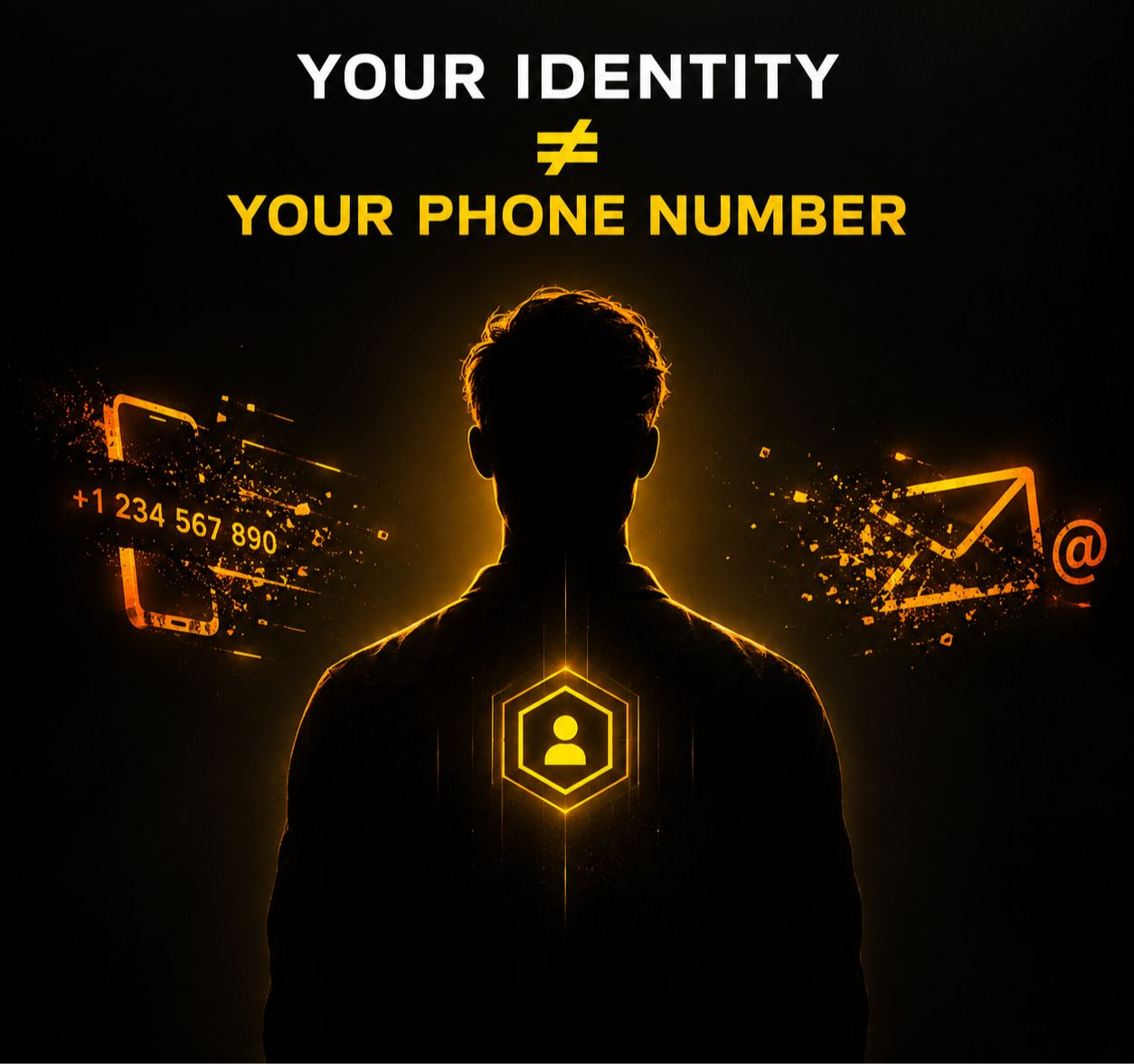
Understand that your phone number isn't your identity.
Your phone number isn't your identity. Yet most digital services treat it like one. You give them a number, they give you an account. But there's a deeper question:
Who actually controls that identity?
Think about what happens when you create a typical online account.
Email
Phone number
Password
Sometimes even government-issued ID
Your identity becomes tied to identifiers controlled outside the platform.
That's convenient, but convenience and ownership aren't the same thing. If your account depends on an identifier you don't control, losing access to that identifier can become a problem.
Web3 approaches identity differently.
Instead of making an email address or phone number the foundation of your account, you can use cryptographic keys and wallet-based identities.
The important shift is identity → something you can control cryptographically.
Liberdus takes this approach for its accounts. According to its current documentation, you can create an account by choosing a username without providing a phone number or email. The username is mapped to your Liberdus wallet address.
That doesn't magically solve digital identity. It simply changes the architecture.
Instead of asking:
Which phone number belongs to this user?
the system can ask:
Which cryptographic account controls this identity?
That's a very different model.
And that's where things get interesting.
Because digital identity isn't just about logging in. It's about control, portability, privacy and ownership.
The real question isn't can I create an account?
It's xhat actually belongs to me when I create one?
#Liberdus #ETH🔥🔥🔥🔥🔥🔥 $ETH #TSMCAugustRevenueUp53.3%YoY
{spot}(ETHUSDT)
Understand that your phone number isn't your identity.
Your phone number isn't your identity. Yet most digital services treat it like one. You give them a number, they give you an account. But there's a deeper question:
Who actually controls that identity?
Think about what happens when you create a typical online account.
Email
Phone number
Password
Sometimes even government-issued ID
Your identity becomes tied to identifiers controlled outside the platform.
That's convenient, but convenience and ownership aren't the same thing. If your account depends on an identifier you don't control, losing access to that identifier can become a problem.
Web3 approaches identity differently.
Instead of making an email address or phone number the foundation of your account, you can use cryptographic keys and wallet-based identities.
The important shift is identity → something you can control cryptographically.
Liberdus takes this approach for its accounts. According to its current documentation, you can create an account by choosing a username without providing a phone number or email. The username is mapped to your Liberdus wallet address.
That doesn't magically solve digital identity. It simply changes the architecture.
Instead of asking:
Which phone number belongs to this user?
the system can ask:
Which cryptographic account controls this identity?
That's a very different model.
And that's where things get interesting.
Because digital identity isn't just about logging in. It's about control, portability, privacy and ownership.
The real question isn't can I create an account?
It's xhat actually belongs to me when I create one?
#Liberdus #ETH🔥🔥🔥🔥🔥🔥 $ETH #TSMCAugustRevenueUp53.3%YoY
Your phone number isn't your identity. Yet most digital services treat it like one. You give them a number, they give you an account. But there's a deeper question:
Who actually controls that identity?
Think about what happens when you create a typical online account.
Phone number
Password
Sometimes even government-issued ID
Your identity becomes tied to identifiers controlled outside the platform.
That's convenient, but convenience and ownership aren't the same thing. If your account depends on an identifier you don't control, losing access to that identifier can become a problem.
Web3 approaches identity differently.
Instead of making an email address or phone number the foundation of your account, you can use cryptographic keys and wallet-based identities.
The important shift is identity → something you can control cryptographically.
Liberdus takes this approach for its accounts. According to its current documentation, you can create an account by choosing a username without providing a phone number or email. The username is mapped to your Liberdus wallet address.
That doesn't magically solve digital identity. It simply changes the architecture.
Instead of asking:
Which phone number belongs to this user?
the system can ask:
Which cryptographic account controls this identity?
That's a very different model.
And that's where things get interesting.
Because digital identity isn't just about logging in. It's about control, portability, privacy and ownership.
The real question isn't can I create an account?
It's xhat actually belongs to me when I create one?
#Liberdus #ETH🔥🔥🔥🔥🔥🔥 $ETH #TSMCAugustRevenueUp53.3%YoY
1
55
·
--
What Twelve Days Add Up To
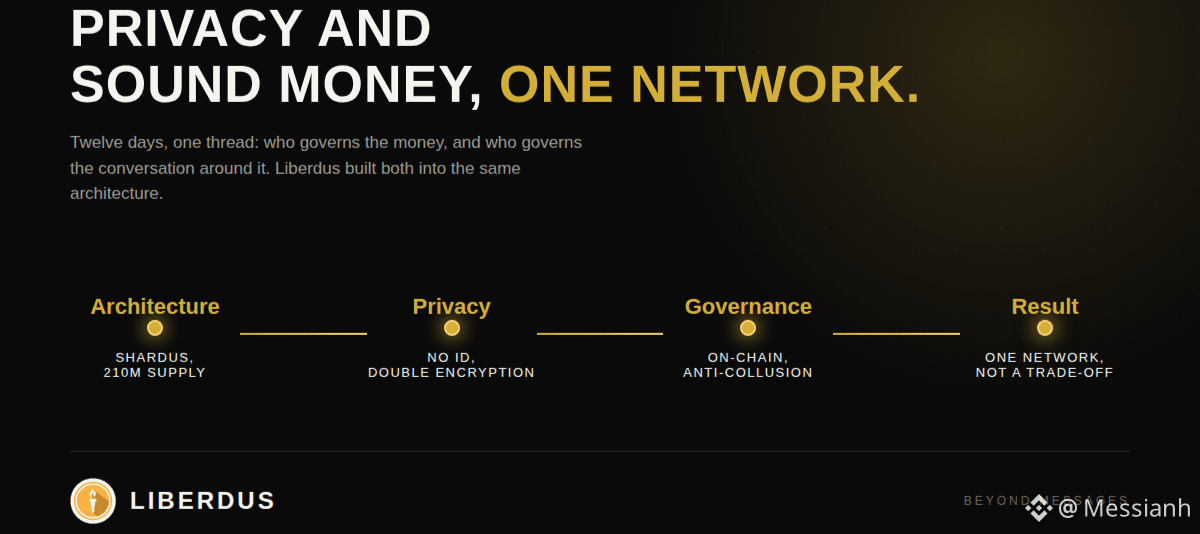
Twelve articles, one thread running through all of them: every design choice in Liberdus traces back to a single founding question from Day 14: who governs the money, and who governs the conversation around it.
The architecture answers the first half. Shardus sharding lets the network scale without concentrating power in fewer, larger validators. A fixed 210 million supply, distributed only to the people building and securing the network, keeps the "sound money" half of the name more than a marketing line. On-chain governance, with proposal margins that scale against collusion, puts changes to those rules in the hands of the network rather than a company board.
The privacy layer answers the second half. Accounts with no phone number, no email, and no persistent identifier remove the single thread that ties most digital lives to a real name. Double encryption, classical and post-quantum, protects what gets said against both today's attackers and tomorrow's. And the toll system turns spam from a filtering problem into a pricing problem, charging unknown senders instead of asking recipients to tolerate them for free.
None of these pieces work in isolation, which is the actual point of building them together. A messenger with strong encryption but centralized identity still knows who's talking to whom. A payment network with sound tokenomics but no privacy layer still exposes every transaction to the same surveillance crypto was supposed to escape. Liberdus's bet is that privacy and sound money solve the same underlying problem, so it built both into one network instead of choosing one.
That's the whole arc, from the name's Latin roots to the chains LIB now trades on. What Liberdus does next isn't something this series can confirm in advance. What it's built so far is on the record, and now, after twelve days, so is the reasoning behind it.
#Liberdus #XRP $XRP #AppleDebutsFoldablePhone
{spot}(XRPUSDT)
What Twelve Days Add Up To
Twelve articles, one thread running through all of them: every design choice in Liberdus traces back to a single founding question from Day 14: who governs the money, and who governs the conversation around it.
The architecture answers the first half. Shardus sharding lets the network scale without concentrating power in fewer, larger validators. A fixed 210 million supply, distributed only to the people building and securing the network, keeps the "sound money" half of the name more than a marketing line. On-chain governance, with proposal margins that scale against collusion, puts changes to those rules in the hands of the network rather than a company board.
The privacy layer answers the second half. Accounts with no phone number, no email, and no persistent identifier remove the single thread that ties most digital lives to a real name. Double encryption, classical and post-quantum, protects what gets said against both today's attackers and tomorrow's. And the toll system turns spam from a filtering problem into a pricing problem, charging unknown senders instead of asking recipients to tolerate them for free.
None of these pieces work in isolation, which is the actual point of building them together. A messenger with strong encryption but centralized identity still knows who's talking to whom. A payment network with sound tokenomics but no privacy layer still exposes every transaction to the same surveillance crypto was supposed to escape. Liberdus's bet is that privacy and sound money solve the same underlying problem, so it built both into one network instead of choosing one.
That's the whole arc, from the name's Latin roots to the chains LIB now trades on. What Liberdus does next isn't something this series can confirm in advance. What it's built so far is on the record, and now, after twelve days, so is the reasoning behind it.
#Liberdus #XRP $XRP #AppleDebutsFoldablePhone
Twelve articles, one thread running through all of them: every design choice in Liberdus traces back to a single founding question from Day 14: who governs the money, and who governs the conversation around it.
The architecture answers the first half. Shardus sharding lets the network scale without concentrating power in fewer, larger validators. A fixed 210 million supply, distributed only to the people building and securing the network, keeps the "sound money" half of the name more than a marketing line. On-chain governance, with proposal margins that scale against collusion, puts changes to those rules in the hands of the network rather than a company board.
The privacy layer answers the second half. Accounts with no phone number, no email, and no persistent identifier remove the single thread that ties most digital lives to a real name. Double encryption, classical and post-quantum, protects what gets said against both today's attackers and tomorrow's. And the toll system turns spam from a filtering problem into a pricing problem, charging unknown senders instead of asking recipients to tolerate them for free.
None of these pieces work in isolation, which is the actual point of building them together. A messenger with strong encryption but centralized identity still knows who's talking to whom. A payment network with sound tokenomics but no privacy layer still exposes every transaction to the same surveillance crypto was supposed to escape. Liberdus's bet is that privacy and sound money solve the same underlying problem, so it built both into one network instead of choosing one.
That's the whole arc, from the name's Latin roots to the chains LIB now trades on. What Liberdus does next isn't something this series can confirm in advance. What it's built so far is on the record, and now, after twelve days, so is the reasoning behind it.
#Liberdus #XRP $XRP #AppleDebutsFoldablePhone
1
2
69
·
--
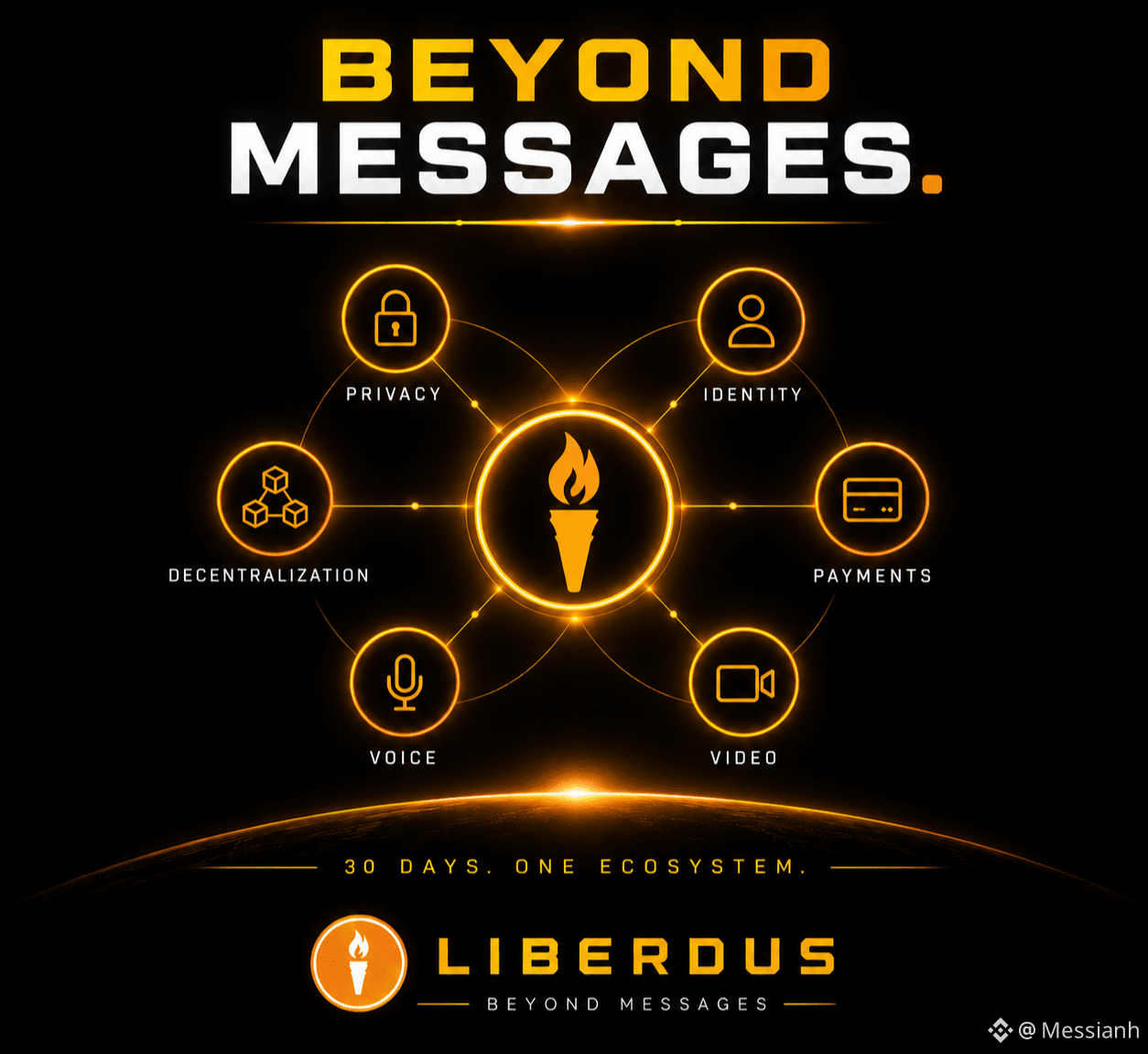
Liberdus was never just about messaging.
Privacy
Decentralization
Payments
Digital identity
Voice & video
Open source
User participation
All inside one ecosystem
That's what Beyond Messages means. The future of communication shouldn't just be about sending a message.
It should be about owning the way you communicate.
@liberdus #Liberdus $BNB #BNB金鏟子
{spot}(BNBUSDT)
Liberdus was never just about messaging.
Privacy
Decentralization
Payments
Digital identity
Voice & video
Open source
User participation
All inside one ecosystem
That's what Beyond Messages means. The future of communication shouldn't just be about sending a message.
It should be about owning the way you communicate.
@liberdus #Liberdus $BNB #BNB金鏟子
Privacy
Decentralization
Payments
Digital identity
Voice & video
Open source
User participation
All inside one ecosystem
That's what Beyond Messages means. The future of communication shouldn't just be about sending a message.
It should be about owning the way you communicate.
@liberdus #Liberdus $BNB #BNB金鏟子
1
211
·
--
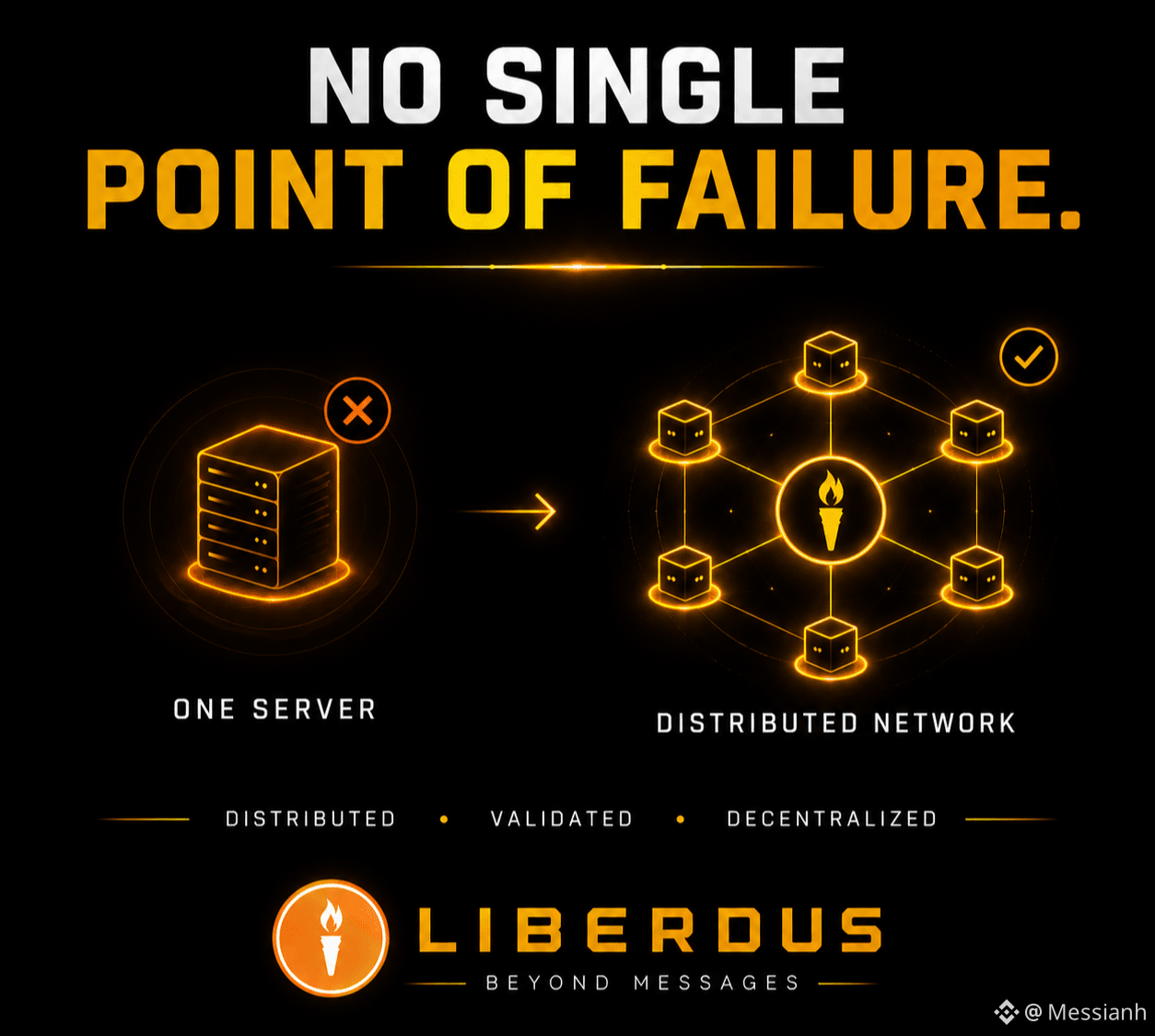
One server, one failure point.
Liberdus takes a different approach.
Its network runs across distributed validator nodes instead of relying on a centralized server. Nodes collectively keep the network online and participate in validation.
No single server at the center just a network of participants.
#Liberdus #IranSaysItHit3USShips3Tankers $BTC
{spot}(BTCUSDT)
One server, one failure point.
Liberdus takes a different approach.
Its network runs across distributed validator nodes instead of relying on a centralized server. Nodes collectively keep the network online and participate in validation.
No single server at the center just a network of participants.
#Liberdus #IranSaysItHit3USShips3Tankers $BTC
Liberdus takes a different approach.
Its network runs across distributed validator nodes instead of relying on a centralized server. Nodes collectively keep the network online and participate in validation.
No single server at the center just a network of participants.
#Liberdus #IranSaysItHit3USShips3Tankers $BTC
1
83
·
--
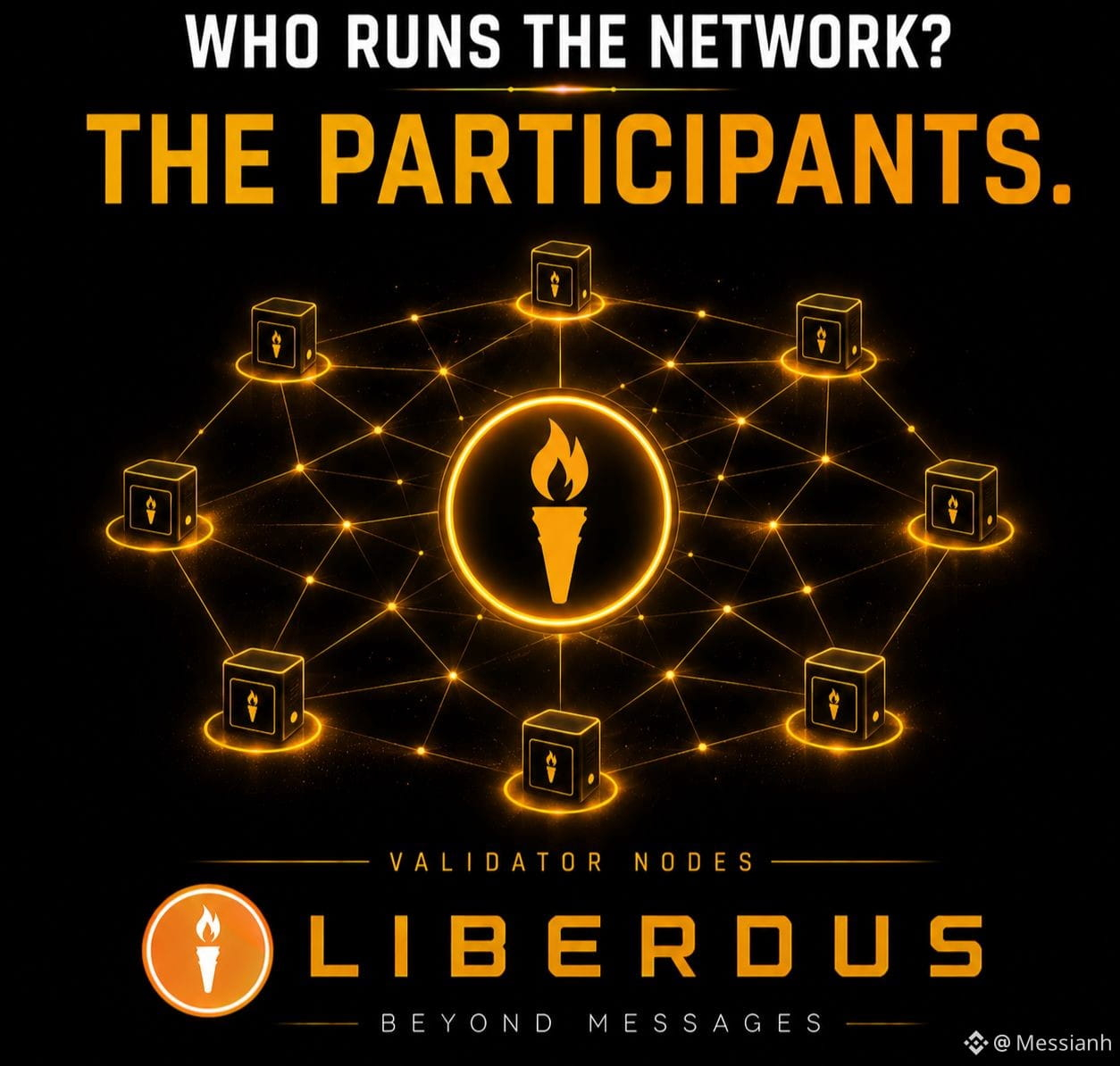
Who keeps a decentralized network alive?
Not one company, not one server but nodes.
@liberdus uses a distributed network of validator nodes to process transactions and maintain the network.
And participation is permissionless. You don't need a central authority to approve you.
Run a node, stake LIB and help secure the network.
Decentralization needs participants.
#Liberdus #Privacy #XRP’ $XRP
{spot}(XRPUSDT)
Who keeps a decentralized network alive?
Not one company, not one server but nodes.
@liberdus uses a distributed network of validator nodes to process transactions and maintain the network.
And participation is permissionless. You don't need a central authority to approve you.
Run a node, stake LIB and help secure the network.
Decentralization needs participants.
#Liberdus #Privacy #XRP’ $XRP
Not one company, not one server but nodes.
@liberdus uses a distributed network of validator nodes to process transactions and maintain the network.
And participation is permissionless. You don't need a central authority to approve you.
Run a node, stake LIB and help secure the network.
Decentralization needs participants.
#Liberdus #Privacy #XRP’ $XRP
119
·
--
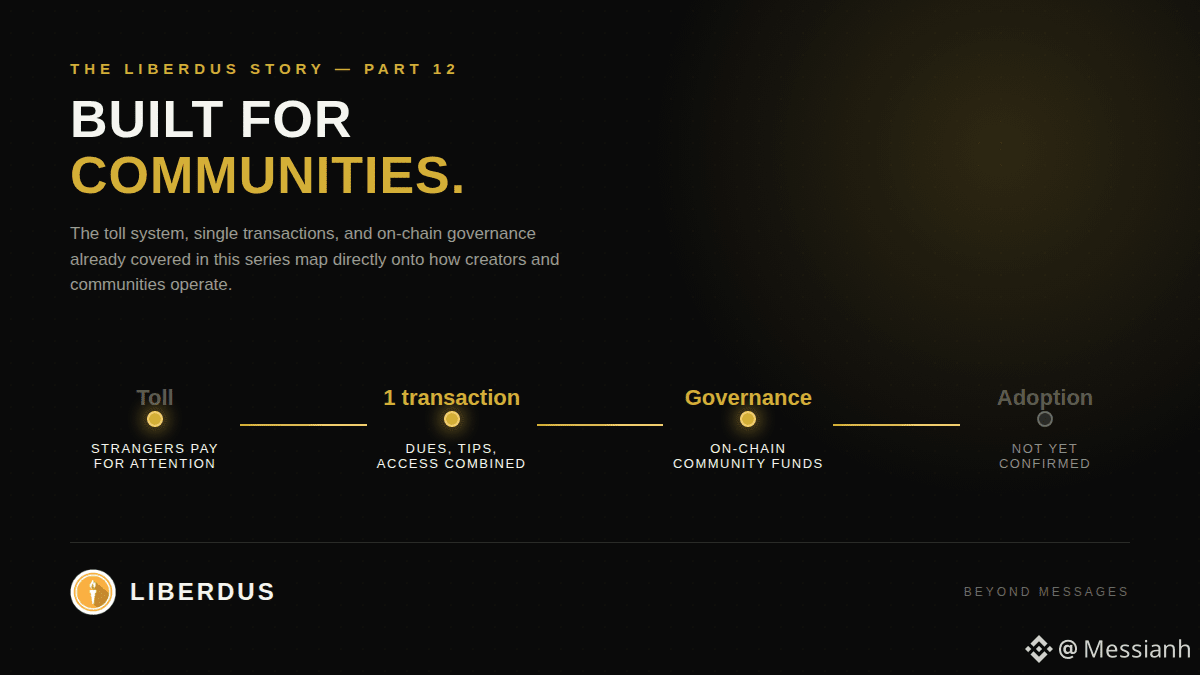
What this actually means for a community
Every mechanic covered so far in this series has a natural home in the same place: a creator or community running on tips, memberships, and constant unsolicited contact from strangers.
Start with the toll system from Day 18. A creator with any public presence gets flooded with messages from people they've never met, most of them low-value, some of them spam. Configuring a toll for unknown senders means that traffic either stops, or it starts paying the creator for the attention it demands. That's a direct answer to a problem most creators currently solve by simply not reading their DMs.
Then there's the single transaction from yesterday's article. A community collecting dues, a patron sending a tip, a member paying for access: each of those becomes one action instead of a message plus a separate wallet transfer. For a community treasurer juggling both a group chat and a payment tool, that's one less system to reconcile.
DAO governance layer from Day 21 applies at the community level too, at least structurally. On-chain proposals with scaled voting margins are the same mechanism whether the "network" being governed is Liberdus itself or a community pool built on top of it, assuming a group chooses to structure its funding that way.
#liberdus #GoldFalls3.24%ThisWeek $ASTER
What this actually means for a community
Every mechanic covered so far in this series has a natural home in the same place: a creator or community running on tips, memberships, and constant unsolicited contact from strangers.
Start with the toll system from Day 18. A creator with any public presence gets flooded with messages from people they've never met, most of them low-value, some of them spam. Configuring a toll for unknown senders means that traffic either stops, or it starts paying the creator for the attention it demands. That's a direct answer to a problem most creators currently solve by simply not reading their DMs.
Then there's the single transaction from yesterday's article. A community collecting dues, a patron sending a tip, a member paying for access: each of those becomes one action instead of a message plus a separate wallet transfer. For a community treasurer juggling both a group chat and a payment tool, that's one less system to reconcile.
DAO governance layer from Day 21 applies at the community level too, at least structurally. On-chain proposals with scaled voting margins are the same mechanism whether the "network" being governed is Liberdus itself or a community pool built on top of it, assuming a group chooses to structure its funding that way.
#liberdus #GoldFalls3.24%ThisWeek $ASTER
Every mechanic covered so far in this series has a natural home in the same place: a creator or community running on tips, memberships, and constant unsolicited contact from strangers.
Start with the toll system from Day 18. A creator with any public presence gets flooded with messages from people they've never met, most of them low-value, some of them spam. Configuring a toll for unknown senders means that traffic either stops, or it starts paying the creator for the attention it demands. That's a direct answer to a problem most creators currently solve by simply not reading their DMs.
Then there's the single transaction from yesterday's article. A community collecting dues, a patron sending a tip, a member paying for access: each of those becomes one action instead of a message plus a separate wallet transfer. For a community treasurer juggling both a group chat and a payment tool, that's one less system to reconcile.
DAO governance layer from Day 21 applies at the community level too, at least structurally. On-chain proposals with scaled voting margins are the same mechanism whether the "network" being governed is Liberdus itself or a community pool built on top of it, assuming a group chooses to structure its funding that way.
#liberdus #GoldFalls3.24%ThisWeek $ASTER
1
42
·
--
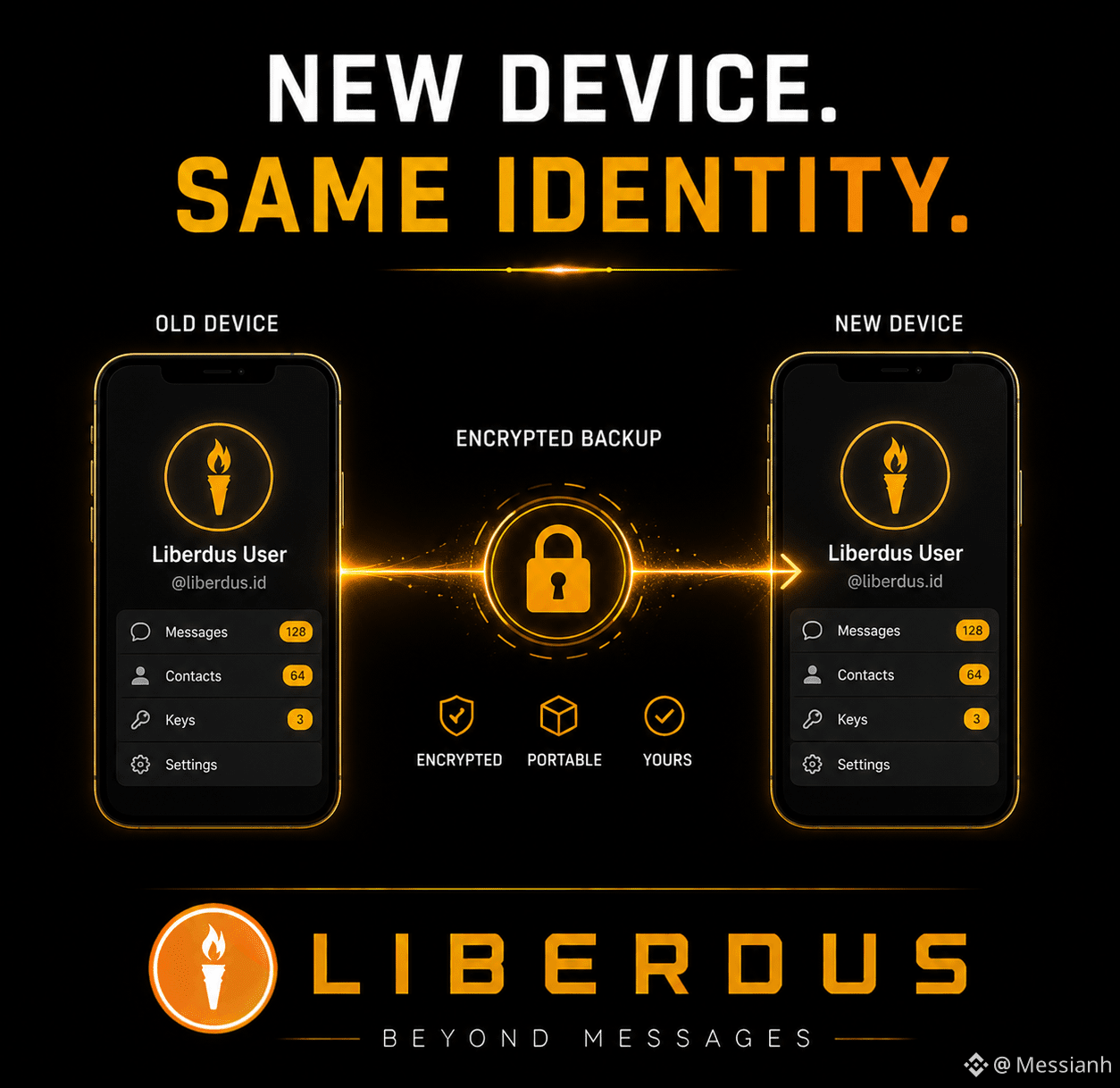
New phone, same identity
What happens to your digital identity when you change devices?
With Liberdus, you can export an encrypted backup of your account and restore it on another device.
Your account isn't simply tied to the phone in your hand.
Back it up, move it, restore it.
That's what digital ownership should feel like.
@liberdus #liberdus #KoreaSingleStockLeveragedETFTradingFalls
$LINK
{spot}(LINKUSDT)
New phone, same identity
What happens to your digital identity when you change devices?
With Liberdus, you can export an encrypted backup of your account and restore it on another device.
Your account isn't simply tied to the phone in your hand.
Back it up, move it, restore it.
That's what digital ownership should feel like.
@liberdus #liberdus #KoreaSingleStockLeveragedETFTradingFalls
$LINK
What happens to your digital identity when you change devices?
With Liberdus, you can export an encrypted backup of your account and restore it on another device.
Your account isn't simply tied to the phone in your hand.
Back it up, move it, restore it.
That's what digital ownership should feel like.
@liberdus #liberdus #KoreaSingleStockLeveragedETFTradingFalls
$LINK
1
108
·
--
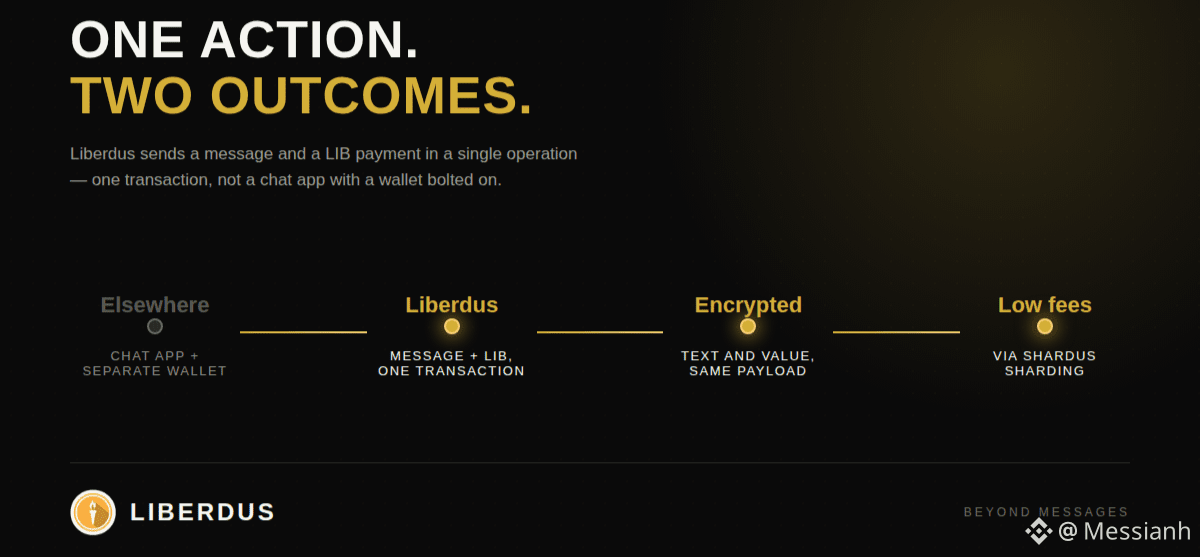
One Action, Two Outcomes
Send someone money on most platforms and you're doing two separate things: opening a chat app to say why, then opening a wallet or a banking app to actually move the funds. Two apps, two logins, two systems that don't know about each other.
@Liberdus combines secure communication with cryptocurrency transactions, allowing users to send messages and LIB tokens in a single operation. Not a chat app with a payment button bolted on. The message and the payment are one transaction, processed together on the same network described.
That single-transaction design is what the earlier articles in this series were quietly building toward. The Shardus sharding underneath keeps fees low enough that pairing a payment with every message is practical rather than expensive.
The anonymous, phone-number-free accounts from Day 16 mean that transaction carries no identity beyond the wallet itself. The double encryption from Day 17 protects both the text and the value moving alongside it, since both are part of the same encrypted payload. And the toll mechanism from Day 18 already treats a payment as something that can travel inside a message, just aimed at deterring spam instead of settling a bill.
A message and a payment sharing one transaction sounds like a small technical detail. In practice it removes an entire category of friction: no separate wallet to open, no separate app to trust with your payment history, no gap between saying something and backing it with value.
#liberdus #bnb $BNB
{spot}(BNBUSDT)
One Action, Two Outcomes
Send someone money on most platforms and you're doing two separate things: opening a chat app to say why, then opening a wallet or a banking app to actually move the funds. Two apps, two logins, two systems that don't know about each other.
@Liberdus combines secure communication with cryptocurrency transactions, allowing users to send messages and LIB tokens in a single operation. Not a chat app with a payment button bolted on. The message and the payment are one transaction, processed together on the same network described.
That single-transaction design is what the earlier articles in this series were quietly building toward. The Shardus sharding underneath keeps fees low enough that pairing a payment with every message is practical rather than expensive.
The anonymous, phone-number-free accounts from Day 16 mean that transaction carries no identity beyond the wallet itself. The double encryption from Day 17 protects both the text and the value moving alongside it, since both are part of the same encrypted payload. And the toll mechanism from Day 18 already treats a payment as something that can travel inside a message, just aimed at deterring spam instead of settling a bill.
A message and a payment sharing one transaction sounds like a small technical detail. In practice it removes an entire category of friction: no separate wallet to open, no separate app to trust with your payment history, no gap between saying something and backing it with value.
#liberdus #bnb $BNB
Send someone money on most platforms and you're doing two separate things: opening a chat app to say why, then opening a wallet or a banking app to actually move the funds. Two apps, two logins, two systems that don't know about each other.
@Liberdus combines secure communication with cryptocurrency transactions, allowing users to send messages and LIB tokens in a single operation. Not a chat app with a payment button bolted on. The message and the payment are one transaction, processed together on the same network described.
That single-transaction design is what the earlier articles in this series were quietly building toward. The Shardus sharding underneath keeps fees low enough that pairing a payment with every message is practical rather than expensive.
The anonymous, phone-number-free accounts from Day 16 mean that transaction carries no identity beyond the wallet itself. The double encryption from Day 17 protects both the text and the value moving alongside it, since both are part of the same encrypted payload. And the toll mechanism from Day 18 already treats a payment as something that can travel inside a message, just aimed at deterring spam instead of settling a bill.
A message and a payment sharing one transaction sounds like a small technical detail. In practice it removes an entire category of friction: no separate wallet to open, no separate app to trust with your payment history, no gap between saying something and backing it with value.
#liberdus #bnb $BNB
1
80
·
--
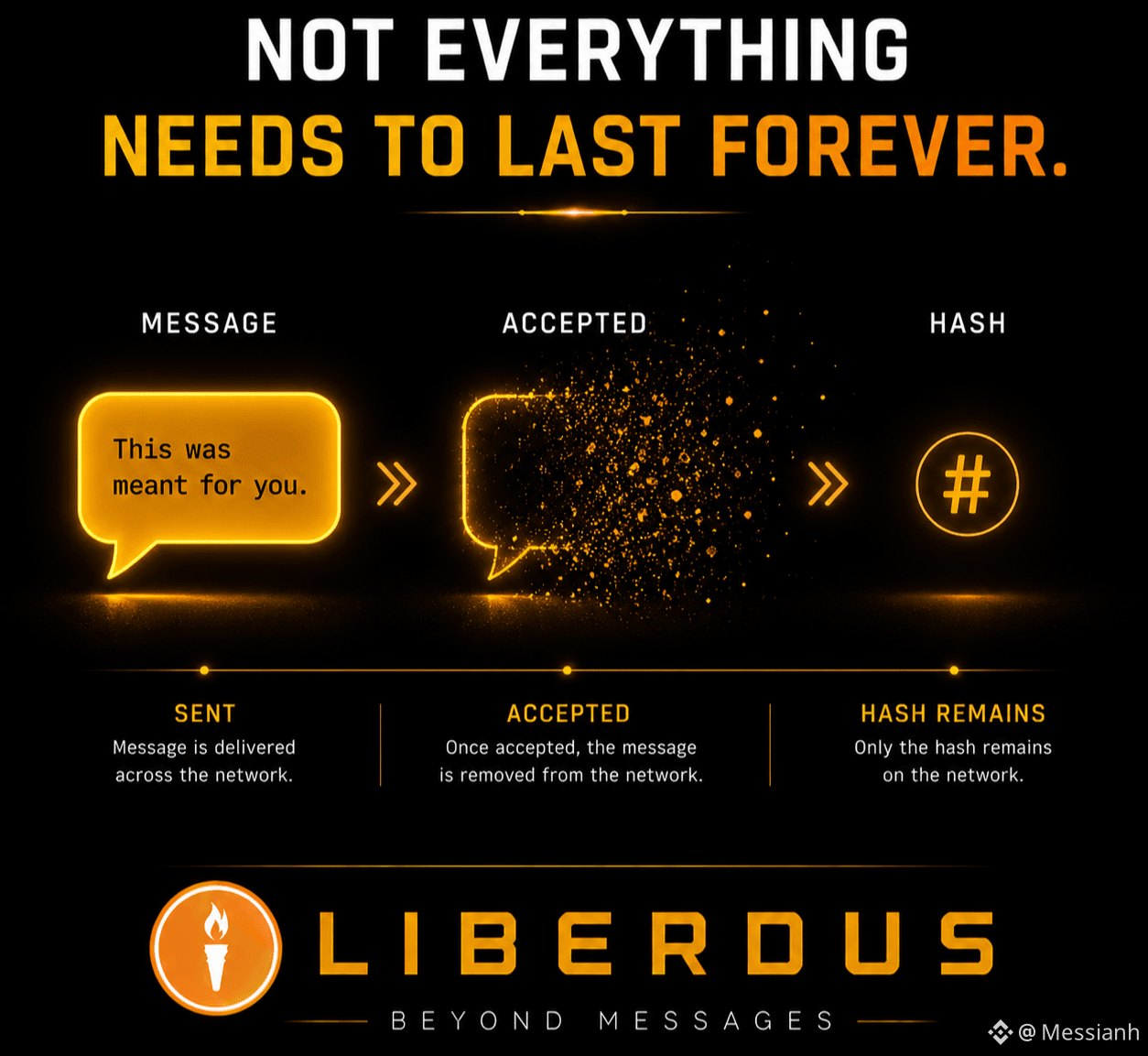
Your messages don't have to live forever.
Most people rarely think about what happens to a message after it's delivered. With @liberdus, messages aren't designed to remain permanently on the network.
Once a message is accepted, it's removed from the network.
What remains is the hash, not the message itself.
Less permanent data, less unnecessary exposure.
That's a very different approach to messaging.
#Liberdus #BTC $BTC
{spot}(BTCUSDT)
Your messages don't have to live forever.
Most people rarely think about what happens to a message after it's delivered. With @liberdus, messages aren't designed to remain permanently on the network.
Once a message is accepted, it's removed from the network.
What remains is the hash, not the message itself.
Less permanent data, less unnecessary exposure.
That's a very different approach to messaging.
#Liberdus #BTC $BTC
Most people rarely think about what happens to a message after it's delivered. With @liberdus, messages aren't designed to remain permanently on the network.
Once a message is accepted, it's removed from the network.
What remains is the hash, not the message itself.
Less permanent data, less unnecessary exposure.
That's a very different approach to messaging.
#Liberdus #BTC $BTC
1
111
·
--
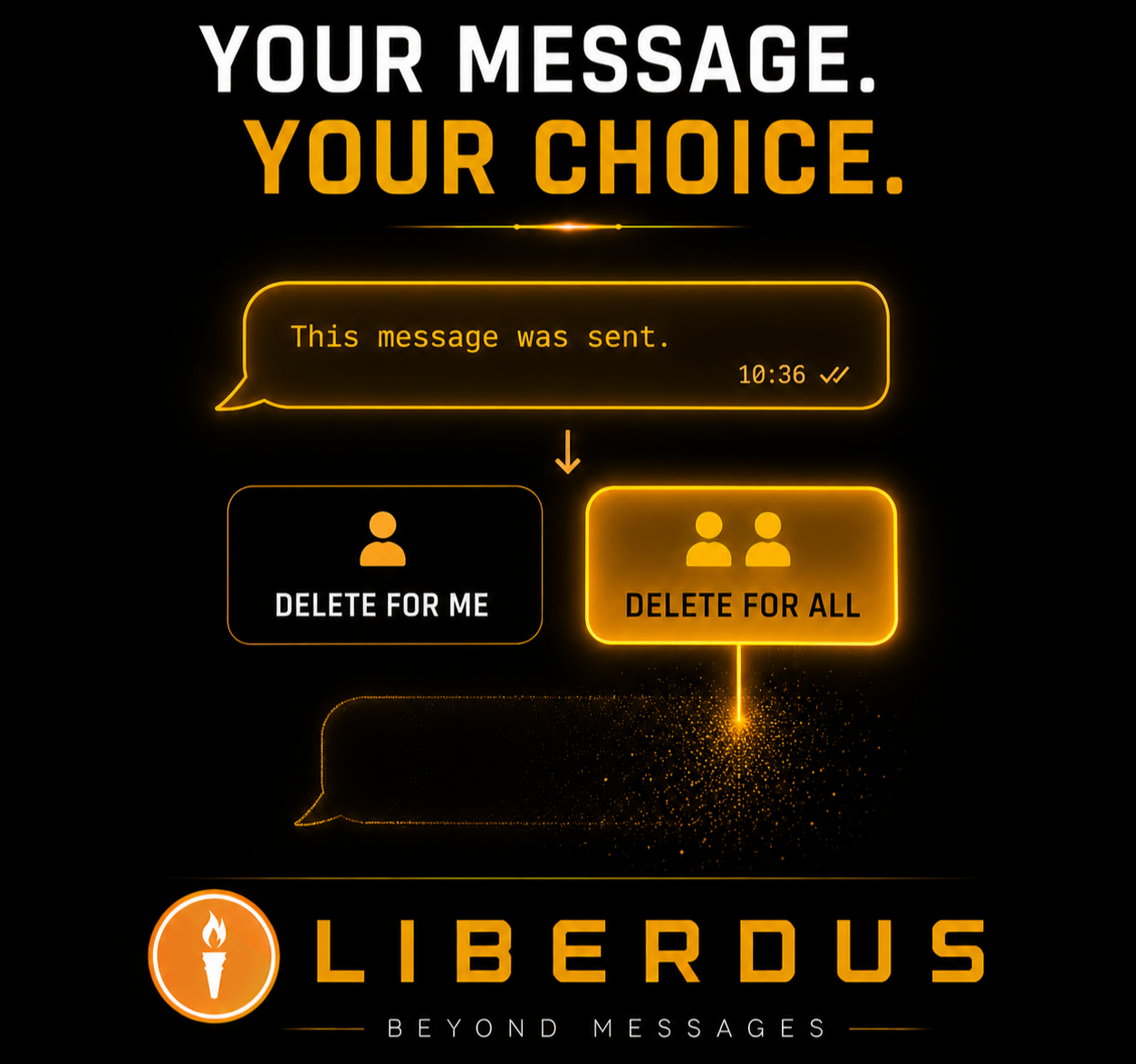
What happens when you want a message gone?
On Liberdus, you have two options:
Delete for me → removes it from your device.
Delete for all → removes your own message from both sides of the conversation.
No complicated process
Just control over what you sent
Your conversation. Your choice
@liberdus #xrp $XRP
{spot}(XRPUSDT)
What happens when you want a message gone?
On Liberdus, you have two options:
Delete for me → removes it from your device.
Delete for all → removes your own message from both sides of the conversation.
No complicated process
Just control over what you sent
Your conversation. Your choice
@liberdus #xrp $XRP
On Liberdus, you have two options:
Delete for me → removes it from your device.
Delete for all → removes your own message from both sides of the conversation.
No complicated process
Just control over what you sent
Your conversation. Your choice
@liberdus #xrp $XRP
1
88
·
--
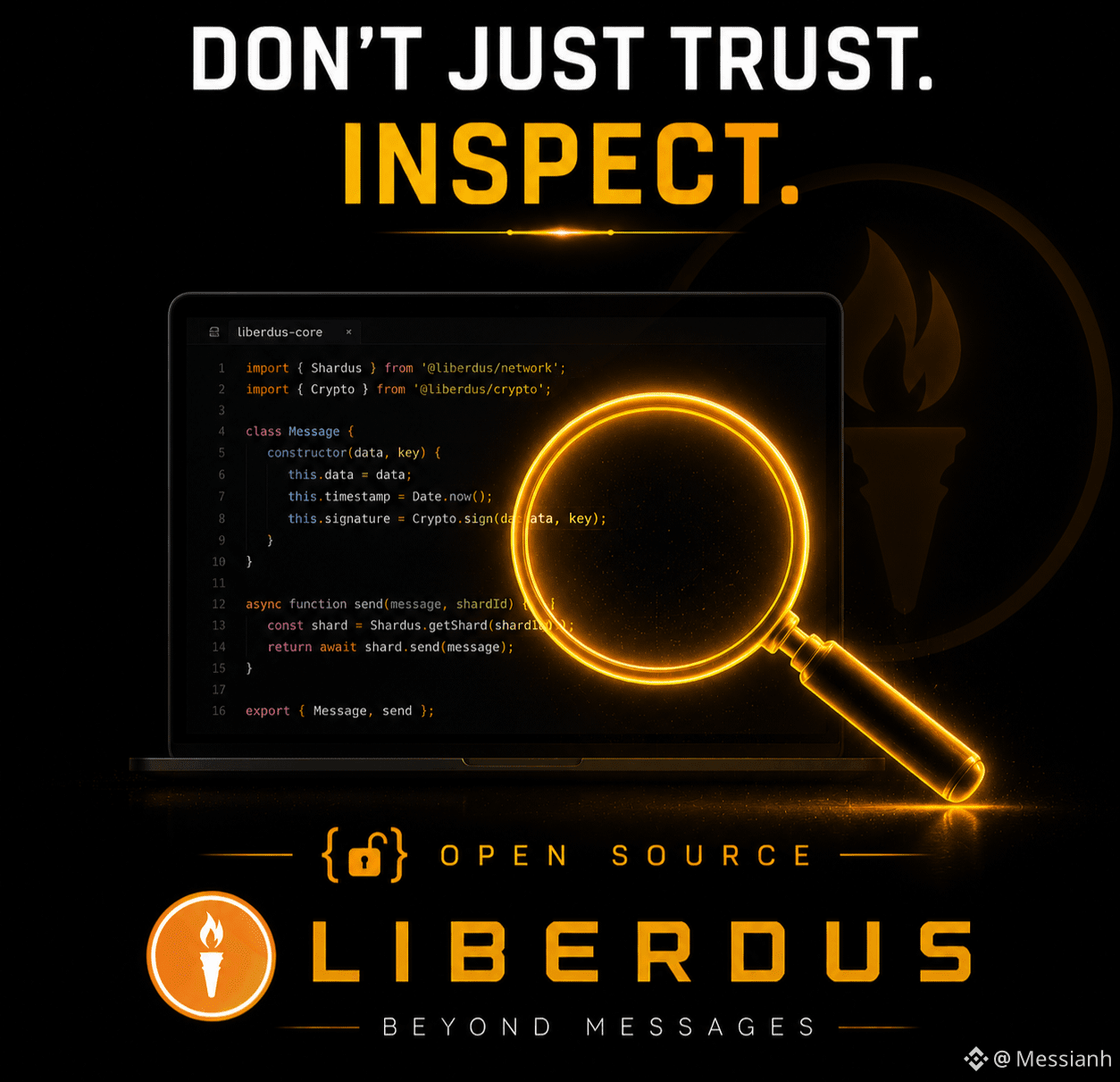
Don't just trust the app, inspect it.
When you use a messaging platform, you're trusting software you can't necessarily see.
Liberdus takes a different approach.
Its major components are open source.
The code is public. Anyone can inspect it, audit it, or contribute to it.
Trust shouldn't have to come from a logo.
Sometimes, it should come from the code.
@liberdus #Liberdus #XRPLeadsCryptoPullbackDropsNearly7% $ONG
{spot}(ONGUSDT)
Don't just trust the app, inspect it.
When you use a messaging platform, you're trusting software you can't necessarily see.
Liberdus takes a different approach.
Its major components are open source.
The code is public. Anyone can inspect it, audit it, or contribute to it.
Trust shouldn't have to come from a logo.
Sometimes, it should come from the code.
@liberdus #Liberdus #XRPLeadsCryptoPullbackDropsNearly7% $ONG
When you use a messaging platform, you're trusting software you can't necessarily see.
Liberdus takes a different approach.
Its major components are open source.
The code is public. Anyone can inspect it, audit it, or contribute to it.
Trust shouldn't have to come from a logo.
Sometimes, it should come from the code.
@liberdus #Liberdus #XRPLeadsCryptoPullbackDropsNearly7% $ONG
1
72
·
--
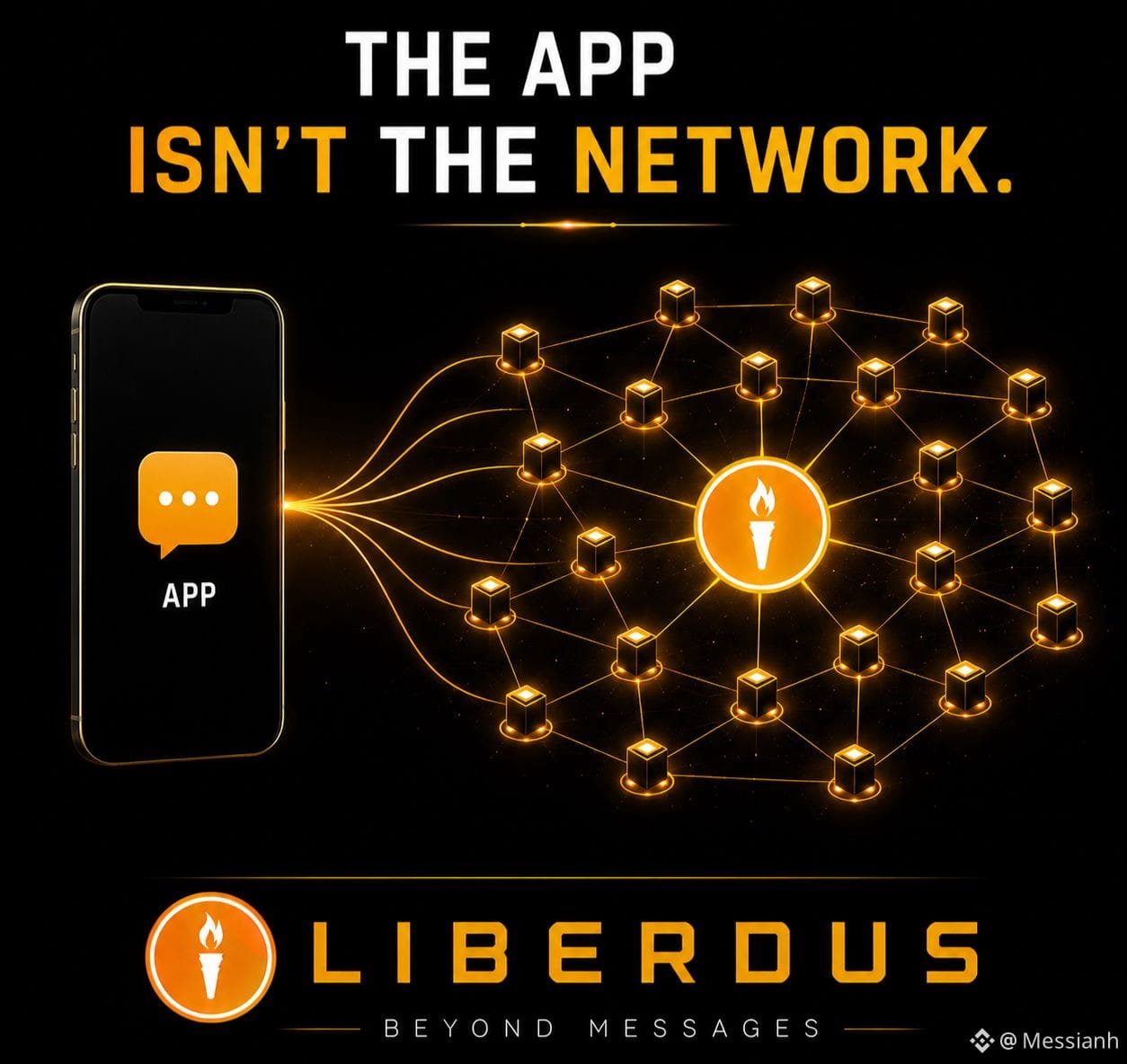
The app isn't the network
That's an easy distinction to miss.
With a traditional messaging platform, the app and the company behind it are closely tied to the infrastructure you depend on.
@liberdus is designed differently.
The network runs through distributed validator nodes rather than a central messaging server. The app is how you interact with the network.
The network doesn't depend on one app server being alive. That's what decentralization actually starts to mean.
#Liberdus #xrp $XRP
{spot}(XRPUSDT)
The app isn't the network
That's an easy distinction to miss.
With a traditional messaging platform, the app and the company behind it are closely tied to the infrastructure you depend on.
@liberdus is designed differently.
The network runs through distributed validator nodes rather than a central messaging server. The app is how you interact with the network.
The network doesn't depend on one app server being alive. That's what decentralization actually starts to mean.
#Liberdus #xrp $XRP
That's an easy distinction to miss.
With a traditional messaging platform, the app and the company behind it are closely tied to the infrastructure you depend on.
@liberdus is designed differently.
The network runs through distributed validator nodes rather than a central messaging server. The app is how you interact with the network.
The network doesn't depend on one app server being alive. That's what decentralization actually starts to mean.
#Liberdus #xrp $XRP
1
46
·
--
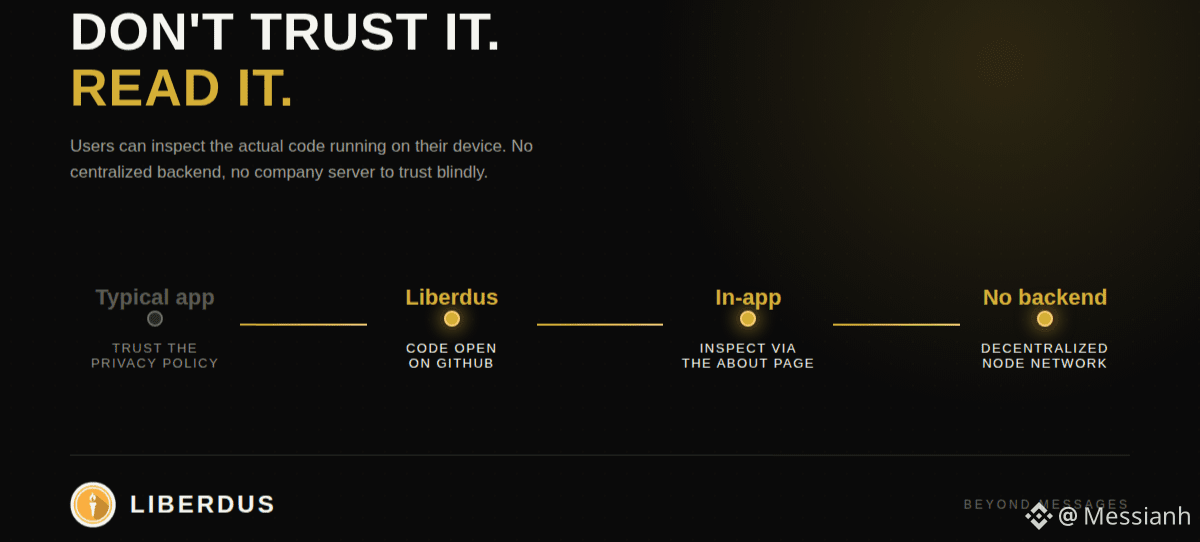
Code You Can Actually Check
Trust in most messaging apps rests on a promise you can't verify: we don't read your messages. No way to check the claim yourself, just a privacy policy and a brand reputation to take on faith.
Liberdus takes a different approach: unlike many messaging platforms, it's fully transparent, and users can inspect the actual code running on their device through the About page in the app. Not a whitepaper summary of what the code supposedly does. The code itself, sitting where anyone can read it.
The project's GitHub organization hosts the full framework as a decentralized chat system with native coin transfer built in, horizontally scalable and built on top of the Shardus protocol, alongside the proxy infrastructure that routes traffic to validator nodes and the bridge contracts connecting LIB across chains. Every core component sits in the open, not just the parts convenient to show off.
That transparency connects directly to the architecture covered earlier in this series. Instead of a centralized backend run by a company, Liberdus uses a blockchain operated by a network of decentralized nodes which anyone can join using a standard computer. There's no company server to trust blindly, because there's no company server running the core network in the first place.
Open code doesn't replace the need for encryption or careful architecture, it backs those design choices with something a privacy policy can't offer: the ability for anyone technical enough to verify the claim instead of taking it on faith.
#Liberdus @Liberdus #BNB $BNB
{spot}(BNBUSDT)
Code You Can Actually Check
Trust in most messaging apps rests on a promise you can't verify: we don't read your messages. No way to check the claim yourself, just a privacy policy and a brand reputation to take on faith.
Liberdus takes a different approach: unlike many messaging platforms, it's fully transparent, and users can inspect the actual code running on their device through the About page in the app. Not a whitepaper summary of what the code supposedly does. The code itself, sitting where anyone can read it.
The project's GitHub organization hosts the full framework as a decentralized chat system with native coin transfer built in, horizontally scalable and built on top of the Shardus protocol, alongside the proxy infrastructure that routes traffic to validator nodes and the bridge contracts connecting LIB across chains. Every core component sits in the open, not just the parts convenient to show off.
That transparency connects directly to the architecture covered earlier in this series. Instead of a centralized backend run by a company, Liberdus uses a blockchain operated by a network of decentralized nodes which anyone can join using a standard computer. There's no company server to trust blindly, because there's no company server running the core network in the first place.
Open code doesn't replace the need for encryption or careful architecture, it backs those design choices with something a privacy policy can't offer: the ability for anyone technical enough to verify the claim instead of taking it on faith.
#Liberdus @Liberdus #BNB $BNB
Trust in most messaging apps rests on a promise you can't verify: we don't read your messages. No way to check the claim yourself, just a privacy policy and a brand reputation to take on faith.
Liberdus takes a different approach: unlike many messaging platforms, it's fully transparent, and users can inspect the actual code running on their device through the About page in the app. Not a whitepaper summary of what the code supposedly does. The code itself, sitting where anyone can read it.
The project's GitHub organization hosts the full framework as a decentralized chat system with native coin transfer built in, horizontally scalable and built on top of the Shardus protocol, alongside the proxy infrastructure that routes traffic to validator nodes and the bridge contracts connecting LIB across chains. Every core component sits in the open, not just the parts convenient to show off.
That transparency connects directly to the architecture covered earlier in this series. Instead of a centralized backend run by a company, Liberdus uses a blockchain operated by a network of decentralized nodes which anyone can join using a standard computer. There's no company server to trust blindly, because there's no company server running the core network in the first place.
Open code doesn't replace the need for encryption or careful architecture, it backs those design choices with something a privacy policy can't offer: the ability for anyone technical enough to verify the claim instead of taking it on faith.
#Liberdus @Liberdus #BNB $BNB
1
64
·
--
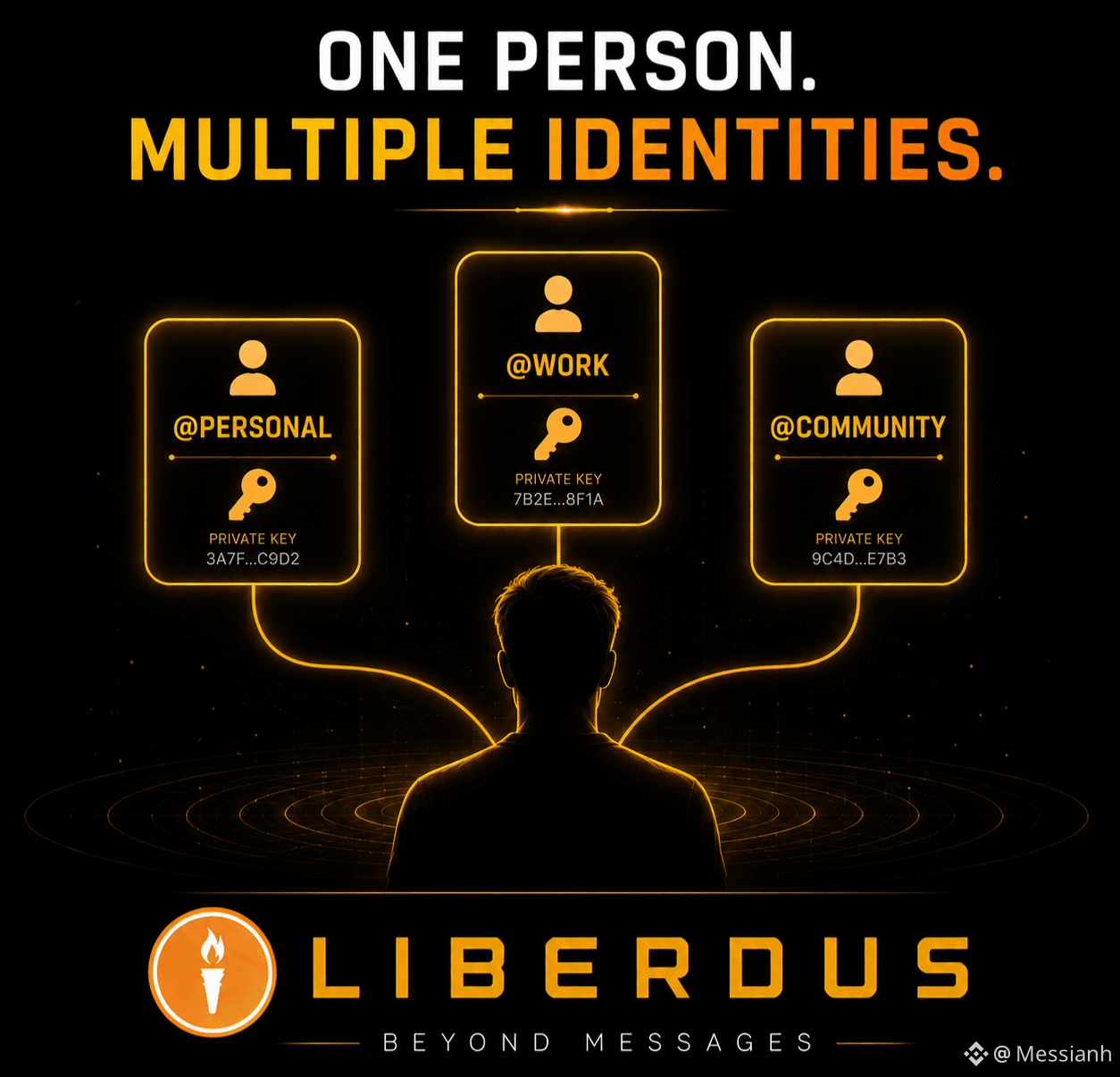
Why should one person have only one digital identity?
Your personal life is different from your work
Your work is different from your community.
Yet most platforms push everything through one account
Liberdus lets you create multiple independent accounts on the same device
Different username
Different keys
Different wallet address
One person
Multiple identities
Maybe digital identity should be more flexible.
#Liberdus #BrentDrops1.87% $ETH
{spot}(ETHUSDT)
Why should one person have only one digital identity?
Your personal life is different from your work
Your work is different from your community.
Yet most platforms push everything through one account
Liberdus lets you create multiple independent accounts on the same device
Different username
Different keys
Different wallet address
One person
Multiple identities
Maybe digital identity should be more flexible.
#Liberdus #BrentDrops1.87% $ETH
Your personal life is different from your work
Your work is different from your community.
Yet most platforms push everything through one account
Liberdus lets you create multiple independent accounts on the same device
Different username
Different keys
Different wallet address
One person
Multiple identities
Maybe digital identity should be more flexible.
#Liberdus #BrentDrops1.87% $ETH
1
102
·
--
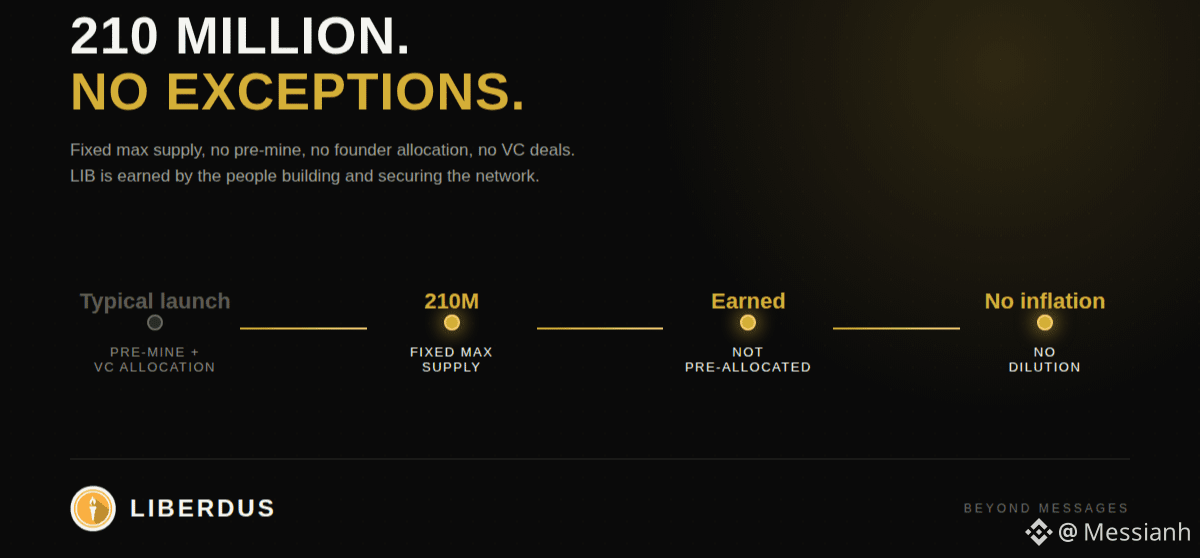
210 Million, No Exceptions
Most tokens launch with a number attached to a story that changes later. A cap gets raised. A community allocation turns out to include the founding team. Inflation gets introduced quietly to fund a treasury nobody voted on. The number on day one rarely survives contact with the roadmap.
LIB has a fixed supply of 210 million tokens with 18 digits after the decimal, inspired by Bitcoin's fixed supply economic model, with no inflation and no dilution. That ceiling isn't a target or a soft cap. It's the entire supply that will ever exist.
What makes that number credible is how it got distributed in the first place. The max supply carries no pre-mine, no founder allocation, and no VC deals. No early investor round sitting on a discounted stack, waiting to sell into retail demand. LIB tokens are earned instead, through roles like code development, testing, and building applications on Liberdus.
That earn-don't-allocate model connects directly to what the token actually does. LIB functions as a coin on the Liberdus network itself and as a bridged token on smart contract platforms including BNB Chain and Polygon, used for network fees, governance, and incentivizing the people running the network. Node operators, liquidity providers, developers: the same people securing and building the network are the ones earning the supply, rather than a separate class of early backers extracting value from users later.
Fixed supply is a design decision that only means something if nothing behind the scenes can quietly change it. Liberdus built the distribution to match the promise: sound money, as the name intended, right down to how the 210 million actually reached people's hands.
#Liberdus @Liberdus #AvalancheAVAX $AVAX
{spot}(AVAXUSDT)
210 Million, No Exceptions
Most tokens launch with a number attached to a story that changes later. A cap gets raised. A community allocation turns out to include the founding team. Inflation gets introduced quietly to fund a treasury nobody voted on. The number on day one rarely survives contact with the roadmap.
LIB has a fixed supply of 210 million tokens with 18 digits after the decimal, inspired by Bitcoin's fixed supply economic model, with no inflation and no dilution. That ceiling isn't a target or a soft cap. It's the entire supply that will ever exist.
What makes that number credible is how it got distributed in the first place. The max supply carries no pre-mine, no founder allocation, and no VC deals. No early investor round sitting on a discounted stack, waiting to sell into retail demand. LIB tokens are earned instead, through roles like code development, testing, and building applications on Liberdus.
That earn-don't-allocate model connects directly to what the token actually does. LIB functions as a coin on the Liberdus network itself and as a bridged token on smart contract platforms including BNB Chain and Polygon, used for network fees, governance, and incentivizing the people running the network. Node operators, liquidity providers, developers: the same people securing and building the network are the ones earning the supply, rather than a separate class of early backers extracting value from users later.
Fixed supply is a design decision that only means something if nothing behind the scenes can quietly change it. Liberdus built the distribution to match the promise: sound money, as the name intended, right down to how the 210 million actually reached people's hands.
#Liberdus @Liberdus #AvalancheAVAX $AVAX
Most tokens launch with a number attached to a story that changes later. A cap gets raised. A community allocation turns out to include the founding team. Inflation gets introduced quietly to fund a treasury nobody voted on. The number on day one rarely survives contact with the roadmap.
LIB has a fixed supply of 210 million tokens with 18 digits after the decimal, inspired by Bitcoin's fixed supply economic model, with no inflation and no dilution. That ceiling isn't a target or a soft cap. It's the entire supply that will ever exist.
What makes that number credible is how it got distributed in the first place. The max supply carries no pre-mine, no founder allocation, and no VC deals. No early investor round sitting on a discounted stack, waiting to sell into retail demand. LIB tokens are earned instead, through roles like code development, testing, and building applications on Liberdus.
That earn-don't-allocate model connects directly to what the token actually does. LIB functions as a coin on the Liberdus network itself and as a bridged token on smart contract platforms including BNB Chain and Polygon, used for network fees, governance, and incentivizing the people running the network. Node operators, liquidity providers, developers: the same people securing and building the network are the ones earning the supply, rather than a separate class of early backers extracting value from users later.
Fixed supply is a design decision that only means something if nothing behind the scenes can quietly change it. Liberdus built the distribution to match the promise: sound money, as the name intended, right down to how the 210 million actually reached people's hands.
#Liberdus @Liberdus #AvalancheAVAX $AVAX
1
78
·
--
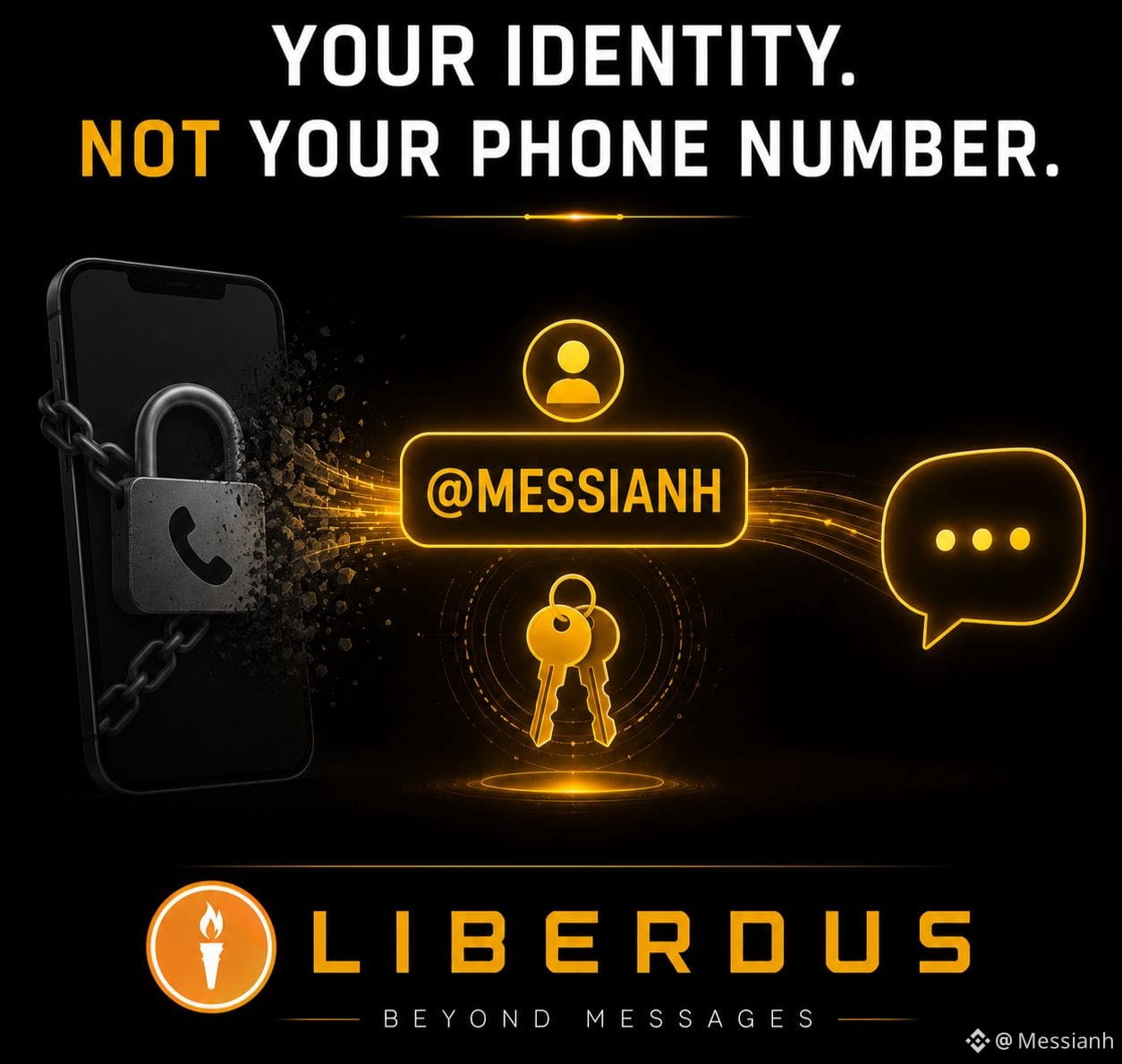
Why does a messaging app need your phone number?
Think about it
You want to talk to someone
So you give a platform:
Your phone number
Your email
Your personal details
Liberdus takes a different approach
Choose a username
Generate your account keys
Start communicating
Your identity doesn't have to begin with a phone number.
#Liberdus #BitcoinStrongestWeekSinceMarch2023 $BTC
{spot}(BTCUSDT)
Why does a messaging app need your phone number?
Think about it
You want to talk to someone
So you give a platform:
Your phone number
Your email
Your personal details
Liberdus takes a different approach
Choose a username
Generate your account keys
Start communicating
Your identity doesn't have to begin with a phone number.
#Liberdus #BitcoinStrongestWeekSinceMarch2023 $BTC
Think about it
You want to talk to someone
So you give a platform:
Your phone number
Your email
Your personal details
Liberdus takes a different approach
Choose a username
Generate your account keys
Start communicating
Your identity doesn't have to begin with a phone number.
#Liberdus #BitcoinStrongestWeekSinceMarch2023 $BTC
1
39
·
--
Spam That Pays You
Every spam filter in existence is playing defense. It scans, flags, and deletes after the message already arrived, after it already cost you the two seconds it took to notice and dismiss it. The economics of spam never change: sending a message is nearly free, so nothing stops anyone from sending a billion of them.
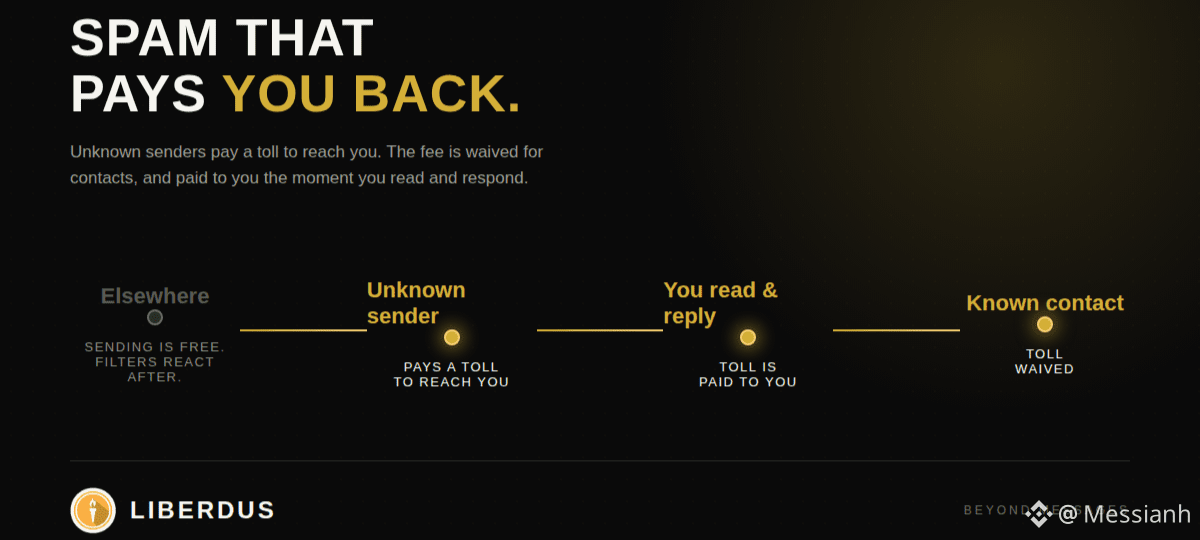
@liberdus attacks that economics directly instead of filtering the output. Users can configure fees for incoming messages from unknown senders, with payments triggered upon message read and response, creating a built-in spam deterrent and incentive mechanism. The feature has a name inside the app: a toll. A toll is a payment included with a message, meant to make it worthwhile for the recipient to read and reply, and it's waived automatically once the toll line shows the sender doesn't need to pay.
Flip the usual relationship and the incentive flips with it. Unsolicited messages from unknown parties pay the recipient to read and respond, rather than the recipient absorbing the cost of every stranger's message for free. A mass-spam campaign that costs nothing on other platforms suddenly has to pay per message on Liberdus, at scale, to every recipient. The math that makes spam profitable everywhere else stops working here.
It's a deceptively simple mechanism drawn from real economics, not just a technical patch. Filters treat spam as a detection problem. Liberdus treats it as a pricing problem, and prices unwanted attention accordingly. Tomorrow: the fixed 210 million supply that gives the LIB token its own version of sound money.
#Liberdus #USDollarFallsToThreeMonthLow $XRP
{spot}(XRPUSDT)
Spam That Pays You
Every spam filter in existence is playing defense. It scans, flags, and deletes after the message already arrived, after it already cost you the two seconds it took to notice and dismiss it. The economics of spam never change: sending a message is nearly free, so nothing stops anyone from sending a billion of them.
@liberdus attacks that economics directly instead of filtering the output. Users can configure fees for incoming messages from unknown senders, with payments triggered upon message read and response, creating a built-in spam deterrent and incentive mechanism. The feature has a name inside the app: a toll. A toll is a payment included with a message, meant to make it worthwhile for the recipient to read and reply, and it's waived automatically once the toll line shows the sender doesn't need to pay.
Flip the usual relationship and the incentive flips with it. Unsolicited messages from unknown parties pay the recipient to read and respond, rather than the recipient absorbing the cost of every stranger's message for free. A mass-spam campaign that costs nothing on other platforms suddenly has to pay per message on Liberdus, at scale, to every recipient. The math that makes spam profitable everywhere else stops working here.
It's a deceptively simple mechanism drawn from real economics, not just a technical patch. Filters treat spam as a detection problem. Liberdus treats it as a pricing problem, and prices unwanted attention accordingly. Tomorrow: the fixed 210 million supply that gives the LIB token its own version of sound money.
#Liberdus #USDollarFallsToThreeMonthLow $XRP
Every spam filter in existence is playing defense. It scans, flags, and deletes after the message already arrived, after it already cost you the two seconds it took to notice and dismiss it. The economics of spam never change: sending a message is nearly free, so nothing stops anyone from sending a billion of them.
@liberdus attacks that economics directly instead of filtering the output. Users can configure fees for incoming messages from unknown senders, with payments triggered upon message read and response, creating a built-in spam deterrent and incentive mechanism. The feature has a name inside the app: a toll. A toll is a payment included with a message, meant to make it worthwhile for the recipient to read and reply, and it's waived automatically once the toll line shows the sender doesn't need to pay.
Flip the usual relationship and the incentive flips with it. Unsolicited messages from unknown parties pay the recipient to read and respond, rather than the recipient absorbing the cost of every stranger's message for free. A mass-spam campaign that costs nothing on other platforms suddenly has to pay per message on Liberdus, at scale, to every recipient. The math that makes spam profitable everywhere else stops working here.
It's a deceptively simple mechanism drawn from real economics, not just a technical patch. Filters treat spam as a detection problem. Liberdus treats it as a pricing problem, and prices unwanted attention accordingly. Tomorrow: the fixed 210 million supply that gives the LIB token its own version of sound money.
#Liberdus #USDollarFallsToThreeMonthLow $XRP
1
86
·
--
Why switch apps just to send money?
You're already talking to someone. So why open another wallet, copy an address, switch apps, send the payment, then come back to the conversation?
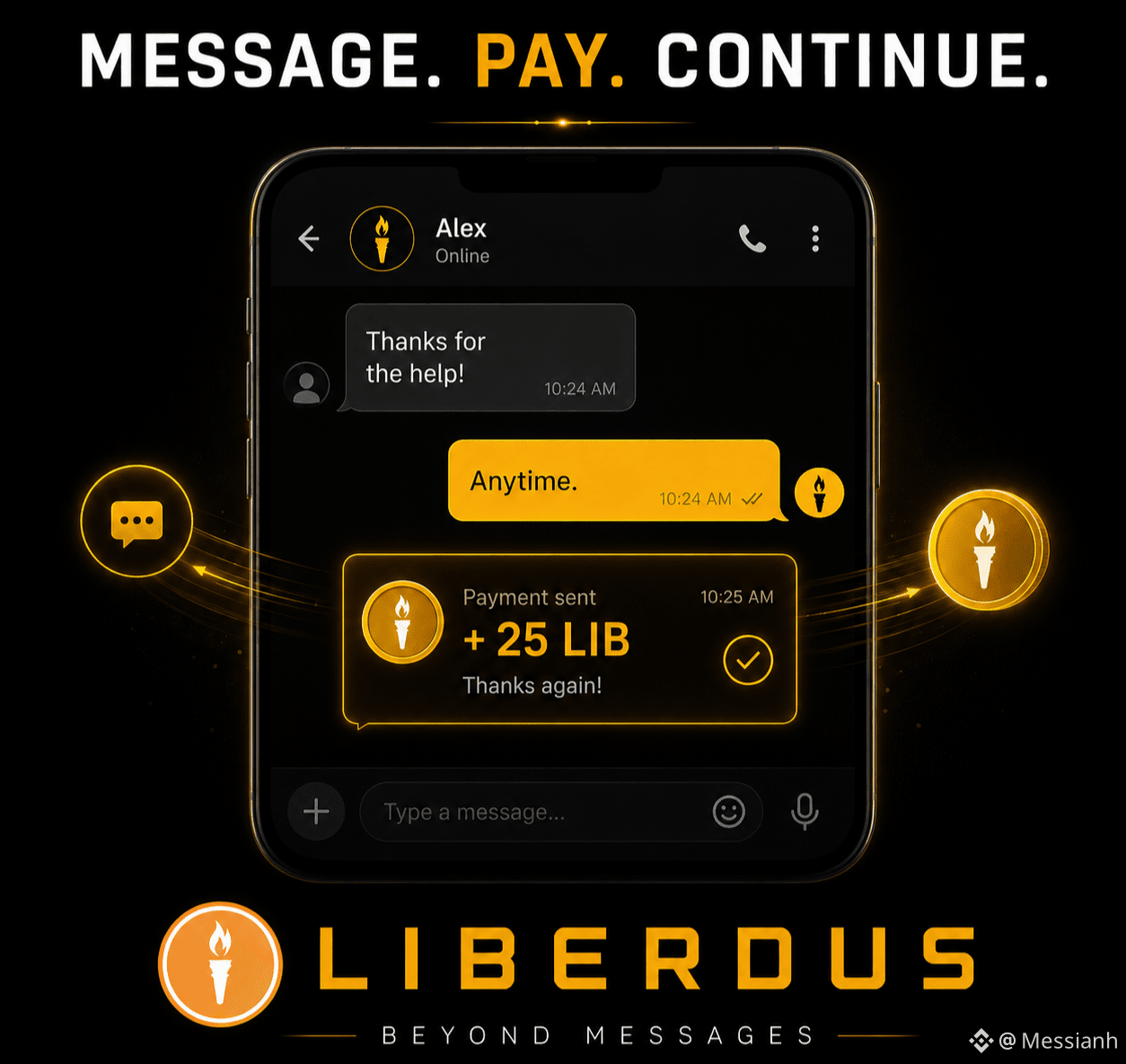
Liberdus puts messaging and payments in the same place.
You can send LIB directly from a chat, add a memo, and see the transaction in the conversation.
Message, pay, continue the conversation.
One interaction shouldn't need five apps.
#Liberdus $BTC
{spot}(BTCUSDT)
Why switch apps just to send money?
You're already talking to someone. So why open another wallet, copy an address, switch apps, send the payment, then come back to the conversation?
Liberdus puts messaging and payments in the same place.
You can send LIB directly from a chat, add a memo, and see the transaction in the conversation.
Message, pay, continue the conversation.
One interaction shouldn't need five apps.
#Liberdus $BTC
You're already talking to someone. So why open another wallet, copy an address, switch apps, send the payment, then come back to the conversation?
Liberdus puts messaging and payments in the same place.
You can send LIB directly from a chat, add a memo, and see the transaction in the conversation.
Message, pay, continue the conversation.
One interaction shouldn't need five apps.
#Liberdus $BTC
1
20
·
--
Your attention has value.
Yet most messaging platforms treat it like it's free. Someone can interrupt you. Send you a pitch. Send you spam. Ask for your time.
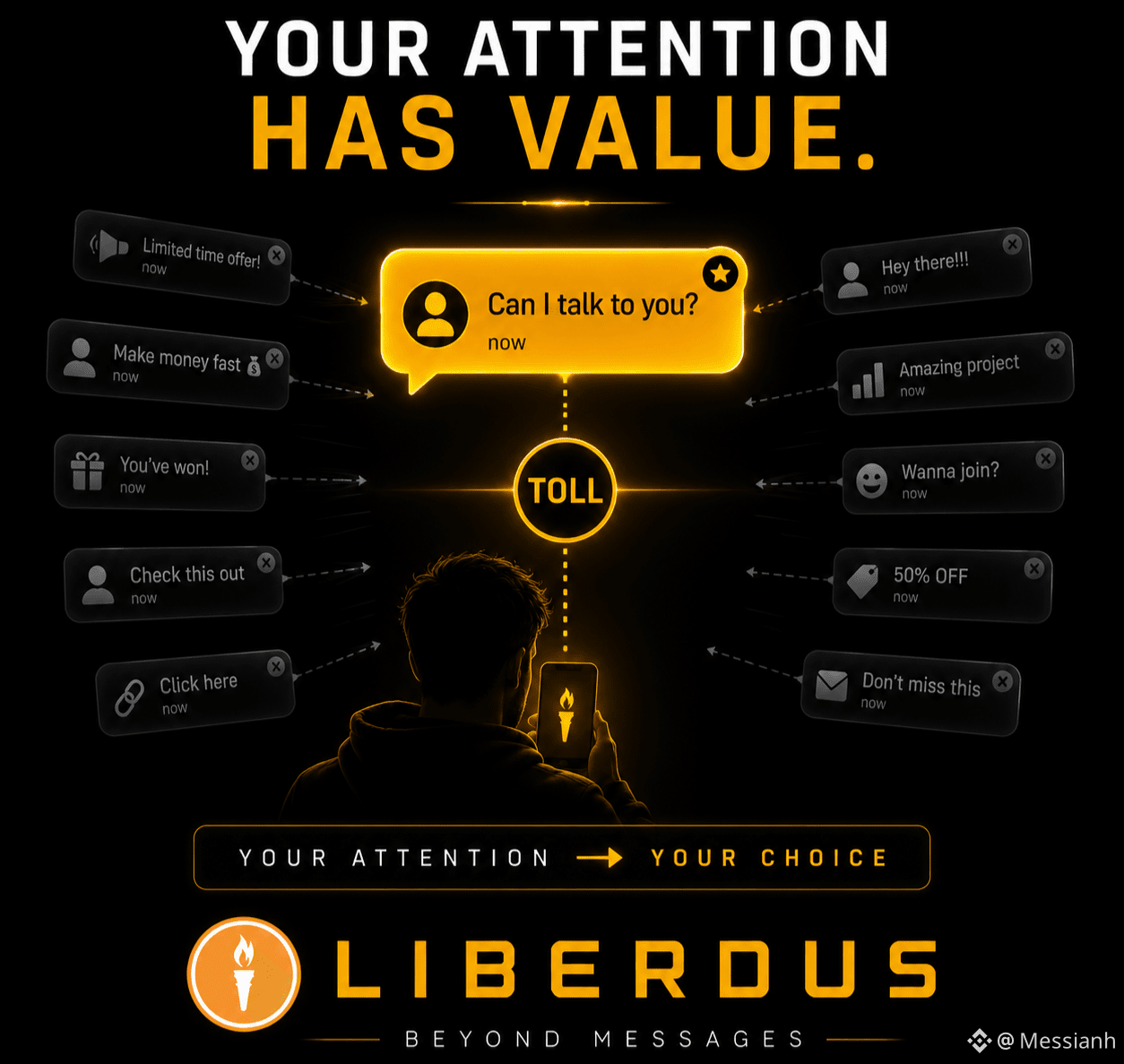
Liberdus introduces a different model:
You can set a toll for unsolicited messages.
If someone wants your attention, there can be an economic cost attached to that request.
And when the conversation actually happens, you can earn from it.
Maybe your attention shouldn't be free by default.
#ETH🔥🔥🔥🔥🔥🔥 $ETH #WalmartFalls7%
{spot}(ETHUSDT)
Your attention has value.
Yet most messaging platforms treat it like it's free. Someone can interrupt you. Send you a pitch. Send you spam. Ask for your time.
Liberdus introduces a different model:
You can set a toll for unsolicited messages.
If someone wants your attention, there can be an economic cost attached to that request.
And when the conversation actually happens, you can earn from it.
Maybe your attention shouldn't be free by default.
#ETH🔥🔥🔥🔥🔥🔥 $ETH #WalmartFalls7%
Yet most messaging platforms treat it like it's free. Someone can interrupt you. Send you a pitch. Send you spam. Ask for your time.
Liberdus introduces a different model:
You can set a toll for unsolicited messages.
If someone wants your attention, there can be an economic cost attached to that request.
And when the conversation actually happens, you can earn from it.
Maybe your attention shouldn't be free by default.
#ETH🔥🔥🔥🔥🔥🔥 $ETH #WalmartFalls7%
1
43
Log in to explore more content
Join global crypto users on Binance Square
⚡️ Get latest and useful information about crypto.
💬 Trusted by the world’s largest crypto exchange.
👍 Discover real insights from verified creators.
Email / Phone number
Trending Topics
USAugustPPIRisesLessThanExpected
12,975 views
351 Discussing
🚨 US AUG PPI: Rises LESS Than Expected! Bullish for Crypto? 🚀
PPI +0.4% MoM as expected, but CORE PPI only +0.2% vs +0.3% expected - cooling!
What it means:
• Wholesale inflation softer than feared
• Fed rate hike chance now 62% - but dovish signals coming
• Core PCE revisions expected downward - bullish
• BTC usually pumps on softer PPI
Fed meeting Sep 15-16 - Market now expects pause, not hike?
Is this the green light for Q4 rally?
#Bitcoin #PPI #Fed #CryptoNews #BTC#usaugustppiriseslessthanexpected
True News
·1 Likes
·1.1k views
SECApprovesNasdaqTexasCommodityTrustRule
9,541 views
321 Discussing
ECBRaisesRatesSecondTimeTo2.5%
6,221 views
229 Discussing