
Mashiga
45 Posts

Mashiga
15 Following
6 Followers
23 Liked
Posts
After the bStocks test, I realized: it’s an interesting bridge between crypto and TradFi. Convenient for portfolio diversification, but risks remain. #bStocks
I tested bStocks and liked that TradFi assets can be used in the crypto ecosystem. Convenient for diversification, but it’s important to consider risks. #bStocks
A new activity has appeared from Binance. The gist is that you complete tasks for which we receive XP, which can later be exchanged for crypto. Are you doing it?
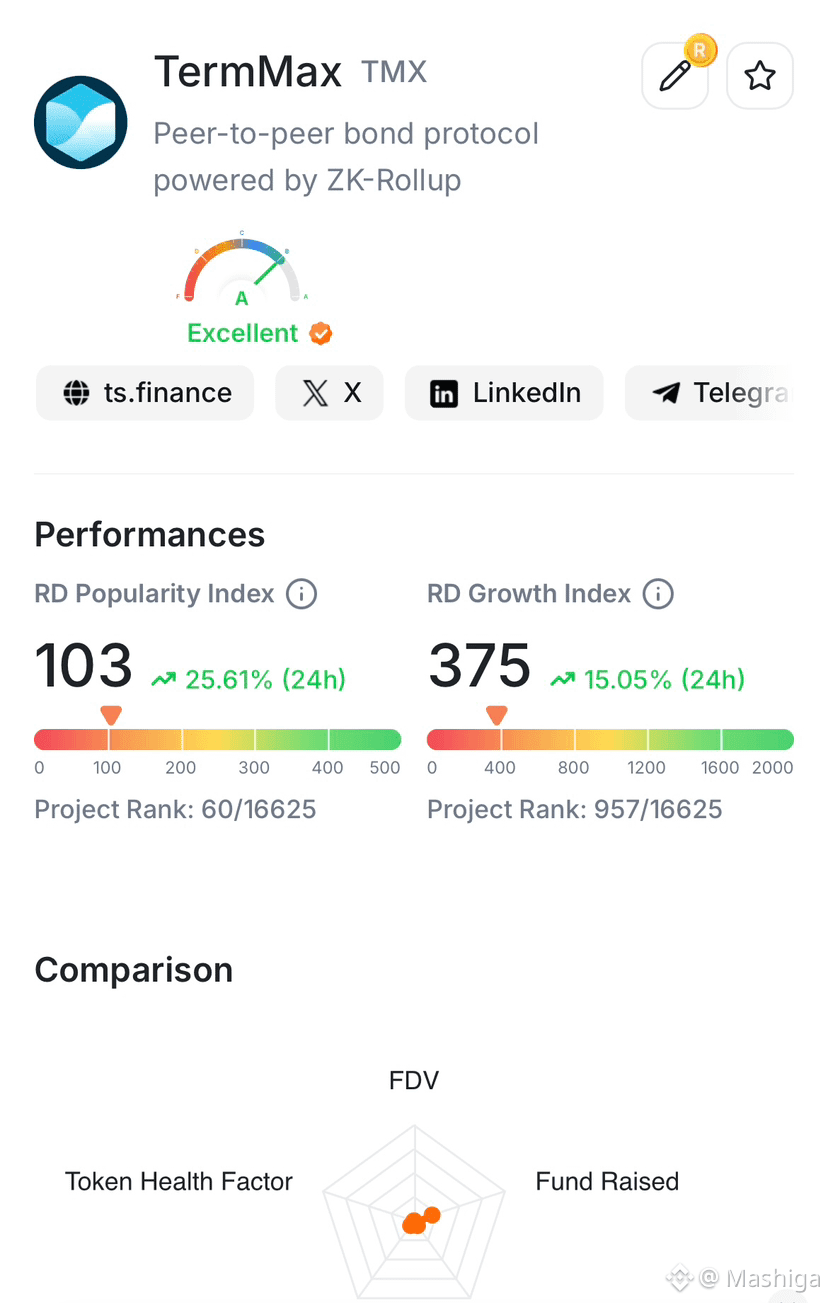
#termmax The more I delve into @TermMax , the more I understand that its appeal isn’t about another “high APY.”
For me, the core idea behind TermMax is to turn time, rate, and yield into controllable DeFi parameters. A fixed term, the ability to work with an interest rate, and splitting exposure into Principal and Yield—all of this changes the usual model where a user simply deposits an asset and hopes for the current yield.
I like this approach specifically: not trying to guess every market move, but building your own scenario in advance and working with specific conditions.
If DeFi is moving from simply “earning interest” to “constructing the conditions under which I want to earn,” then TermMax is a very interesting example of that shift.
That’s why I keep following the project—not because of hype, but because of the mechanics.
For me, the core idea behind TermMax is to turn time, rate, and yield into controllable DeFi parameters. A fixed term, the ability to work with an interest rate, and splitting exposure into Principal and Yield—all of this changes the usual model where a user simply deposits an asset and hopes for the current yield.
I like this approach specifically: not trying to guess every market move, but building your own scenario in advance and working with specific conditions.
If DeFi is moving from simply “earning interest” to “constructing the conditions under which I want to earn,” then TermMax is a very interesting example of that shift.
That’s why I keep following the project—not because of hype, but because of the mechanics.

#termmax I thought for a long time about what exactly seems unusual to me in @TermMax , and I realized: here, time effectively becomes a trading parameter.
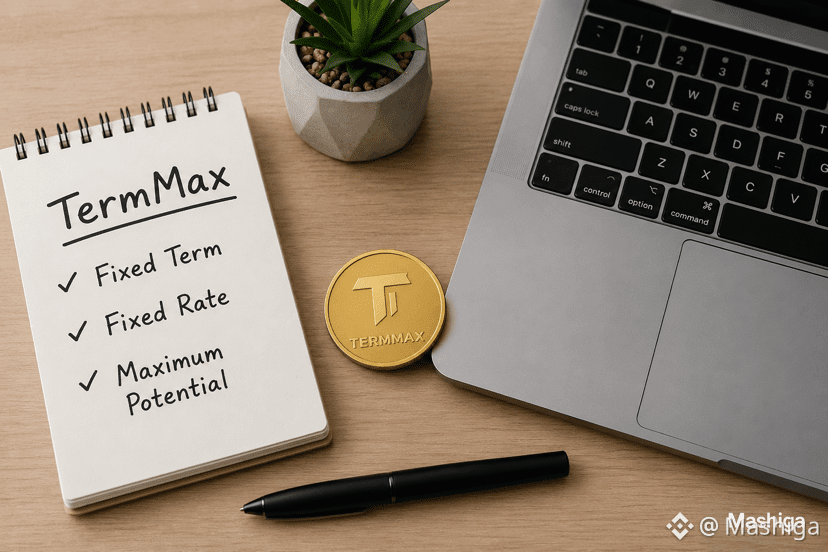
In most DeFi, I’m used to looking at the asset price, APY, or APR. And in TermMax, there’s one more thing added to that—a date when the position is meant to end. A fixed rate + a fixed term mean I can know the deal terms in advance, instead of constantly depending on where tomorrow’s variable rate will go. (TermMax)
And here’s what’s most interesting to me: if rates and terms can be combined as separate parameters, then DeFi gradually stops being just a place where you “deposit an asset and wait for APY.” It turns into a space for building specific scenarios.
That’s why I’m currently looking at TermMax not through the lens of pretty numbers, but through the financial mechanism itself. I’m curious how far you can go if you learn to trade not only assets, but also time.
In most DeFi, I’m used to looking at the asset price, APY, or APR. And in TermMax, there’s one more thing added to that—a date when the position is meant to end. A fixed rate + a fixed term mean I can know the deal terms in advance, instead of constantly depending on where tomorrow’s variable rate will go. (TermMax)
And here’s what’s most interesting to me: if rates and terms can be combined as separate parameters, then DeFi gradually stops being just a place where you “deposit an asset and wait for APY.” It turns into a space for building specific scenarios.
That’s why I’m currently looking at TermMax not through the lens of pretty numbers, but through the financial mechanism itself. I’m curious how far you can go if you learn to trade not only assets, but also time.
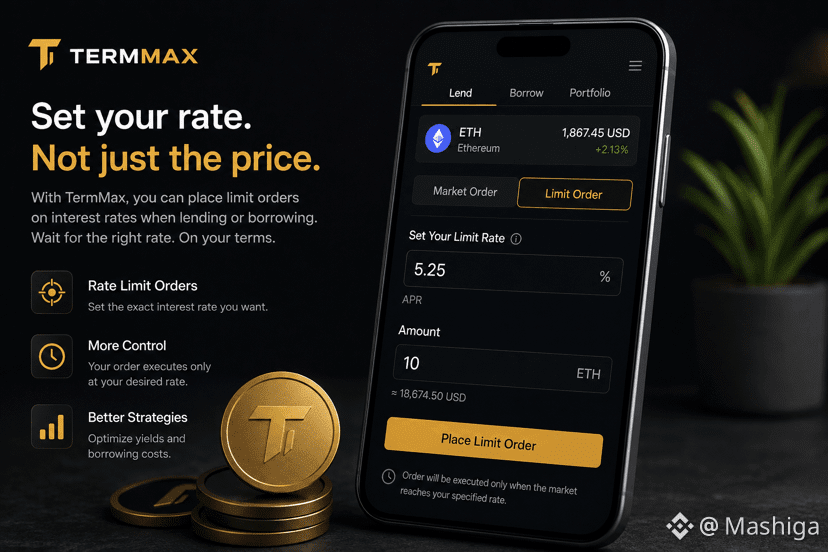
#termmax I found one feature in @TermMax that really sets it apart from many DeFi protocols—limit orders can be used not only for price, but for the interest rate itself.
In other words, instead of simply taking the current market rate, I can set the level that suits me and wait until the market reaches it. For me, this is an interesting shift in logic: in DeFi, you can actually “hunt” not for the token’s price, but for the needed loan value or yield.
It’s these kinds of details that make me look at #TermMax not as just another lending protocol, but as an attempt to make interest rates a fully-fledged trading parameter.
In other words, instead of simply taking the current market rate, I can set the level that suits me and wait until the market reaches it. For me, this is an interesting shift in logic: in DeFi, you can actually “hunt” not for the token’s price, but for the needed loan value or yield.
It’s these kinds of details that make me look at #TermMax not as just another lending protocol, but as an attempt to make interest rates a fully-fledged trading parameter.
#bstockscis @BinanceCIS #bstockscis 💡 A promo that earns not only from what we see
When people talk about Visa, most immediately think of bank cards. But what’s more interesting is what the company actually earns from.
Visa is not a bank and does not issue most cards itself. Its main business is a payment network through which huge volumes of transactions pass.
That means when you pay for coffee, clothes, or an online purchase with a Visa card, the company can earn from processing the payment—even if the store, the bank, and the seller are completely different companies.
I like this model because Visa basically benefits from the growth in the number of cashless payments around the world. 🌎💳
And here’s an interesting question: if cash gradually loses popularity, how big could the electronic payments market become in 10 years? 📈
#Stocks #Visa #Investing
When people talk about Visa, most immediately think of bank cards. But what’s more interesting is what the company actually earns from.
Visa is not a bank and does not issue most cards itself. Its main business is a payment network through which huge volumes of transactions pass.
That means when you pay for coffee, clothes, or an online purchase with a Visa card, the company can earn from processing the payment—even if the store, the bank, and the seller are completely different companies.
I like this model because Visa basically benefits from the growth in the number of cashless payments around the world. 🌎💳
And here’s an interesting question: if cash gradually loses popularity, how big could the electronic payments market become in 10 years? 📈
#Stocks #Visa #Investing
#termmax @TermMax There is one concept in TermMax that I’m particularly interested in: time here can be perceived almost as a separate financial parameter. In regular DeFi, you often look at the APY and think about how much you’ll earn if the rate stays roughly the same. In TermMax, the logic is more interesting—not just how much an asset can bring, but also when exactly this yield is realized.
That’s why I like the idea of term markets: future yield can be treated as a separate object for a strategy, rather than just a bonus to a deposit. It’s more like a builder, where rate, asset, and time can be combined in different ways. I believe these kinds of non-standard mechanics could become one of the directions for DeFi’s development.
That’s why I like the idea of term markets: future yield can be treated as a separate object for a strategy, rather than just a bonus to a deposit. It’s more like a builder, where rate, asset, and time can be combined in different ways. I believe these kinds of non-standard mechanics could become one of the directions for DeFi’s development.
#bstockscis @BinanceCIS A little-known fact about NVIDIA that surprised me
Most people know NVIDIA today as a company associated with artificial intelligence and powerful GPUs. But few remember that at first NVIDIA was far from an undisputed leader.
In 1999, the company held an IPO at a price of $12 per share. At the time, NVIDIA was known mostly among gamers and computer graphics enthusiasts.
And today, its chips have become one of the key technologies for the development of generative AI.
What’s especially interesting is how the purpose of GPUs has changed: what was originally created primarily for processing graphics in games has become the foundation for training massive artificial intelligence models.
This is a good example of how hard it is to predict the future of a technology company.
And what technology do you think today might seem secondary, but 10 years from now could become indispensable?
Most people know NVIDIA today as a company associated with artificial intelligence and powerful GPUs. But few remember that at first NVIDIA was far from an undisputed leader.
In 1999, the company held an IPO at a price of $12 per share. At the time, NVIDIA was known mostly among gamers and computer graphics enthusiasts.
And today, its chips have become one of the key technologies for the development of generative AI.
What’s especially interesting is how the purpose of GPUs has changed: what was originally created primarily for processing graphics in games has become the foundation for training massive artificial intelligence models.
This is a good example of how hard it is to predict the future of a technology company.
And what technology do you think today might seem secondary, but 10 years from now could become indispensable?
#termmax Few people pay attention to one interesting feature @TermMax —the separation of a position into Principal Token (PT) and Yield Token (YT). This makes it possible to effectively separate the underlying asset’s base value from its future yield. In other words, a user can obtain exposure specifically to yield without necessarily buying the entire underlying asset.
I like this concept because it turns future yield into a separate instrument that you can work with and build various DeFi strategies around. In my opinion, it is exactly these kinds of mechanisms that make TermMax more interesting than a typical lending protocol.
I like this concept because it turns future yield into a separate instrument that you can work with and build various DeFi strategies around. In my opinion, it is exactly these kinds of mechanisms that make TermMax more interesting than a typical lending protocol.
#bstockscis @BinanceCIS A little-known fact about one of the biggest companies in the world
In 2004, Google held an IPO at a price of $85 per share. But what’s even more interesting isn’t that.
Before going public, Google deliberately chose an IPO format unusual for that time—the Dutch auction. The company wanted to let investors determine the share price themselves, rather than having it set in the traditional way together with major banks.
This decision sparked plenty of debate on Wall Street.
Today, Google is one of the main players in the global technology market, and its parent company, Alphabet, has a huge impact on Search, advertising, YouTube, and artificial intelligence.
I find it interesting to follow stories like these, because they show: behind every major company there’s a moment when the future was still far from obvious.
And which company do you think is still underestimated today?
In 2004, Google held an IPO at a price of $85 per share. But what’s even more interesting isn’t that.
Before going public, Google deliberately chose an IPO format unusual for that time—the Dutch auction. The company wanted to let investors determine the share price themselves, rather than having it set in the traditional way together with major banks.
This decision sparked plenty of debate on Wall Street.
Today, Google is one of the main players in the global technology market, and its parent company, Alphabet, has a huge impact on Search, advertising, YouTube, and artificial intelligence.
I find it interesting to follow stories like these, because they show: behind every major company there’s a moment when the future was still far from obvious.
And which company do you think is still underestimated today?
#bstockscis @BinanceCIS #bstockscis Interesting fact about Apple that not many know
Many people think that Apple shares have always been worth hundreds of dollars per share. But if you look at the history, the situation is quite different.
When Apple went public in 1980, the IPO price was $22 per share. However, since then the company has carried out 5 stock splits—the last one was in 2020, in a 4:1 ratio. (Investor Relations)
And here’s the most interesting part: taking all those splits into account, the original IPO price would be only $0.10 per share.
That means that one Apple share bought at the IPO, after all the splits, would become 224 shares.
For me, this is a good example of why, when valuing a company, you shouldn’t look only at the current price of one share. It’s much more interesting to see how the company has developed over the decades.
Now a question: what will Apple be like 10 years from now?
Many people think that Apple shares have always been worth hundreds of dollars per share. But if you look at the history, the situation is quite different.
When Apple went public in 1980, the IPO price was $22 per share. However, since then the company has carried out 5 stock splits—the last one was in 2020, in a 4:1 ratio. (Investor Relations)
And here’s the most interesting part: taking all those splits into account, the original IPO price would be only $0.10 per share.
That means that one Apple share bought at the IPO, after all the splits, would become 224 shares.
For me, this is a good example of why, when valuing a company, you shouldn’t look only at the current price of one share. It’s much more interesting to see how the company has developed over the decades.
Now a question: what will Apple be like 10 years from now?
Акція стрімко зросте вгору
100%
Ціна знизиться
0%
1 votes • Voting closed
#bstockscis #bstockscis Day 8 of my challenge observing the Apple token
Today I continue to track the token’s dynamics. After a few days of decline, it’s interesting to see whether the price can stabilize and move into recovery.
In my opinion, it’s important not to jump to conclusions yet, because there may be many interesting events ahead. I’ll especially watch the Apple news and how the token reacts to it.
For now, I keep monitoring and waiting to see whether we’ll see a trend reversal.
#Apple @BinanceCIS
Today I continue to track the token’s dynamics. After a few days of decline, it’s interesting to see whether the price can stabilize and move into recovery.
In my opinion, it’s important not to jump to conclusions yet, because there may be many interesting events ahead. I’ll especially watch the Apple news and how the token reacts to it.
For now, I keep monitoring and waiting to see whether we’ll see a trend reversal.
#Apple @BinanceCIS
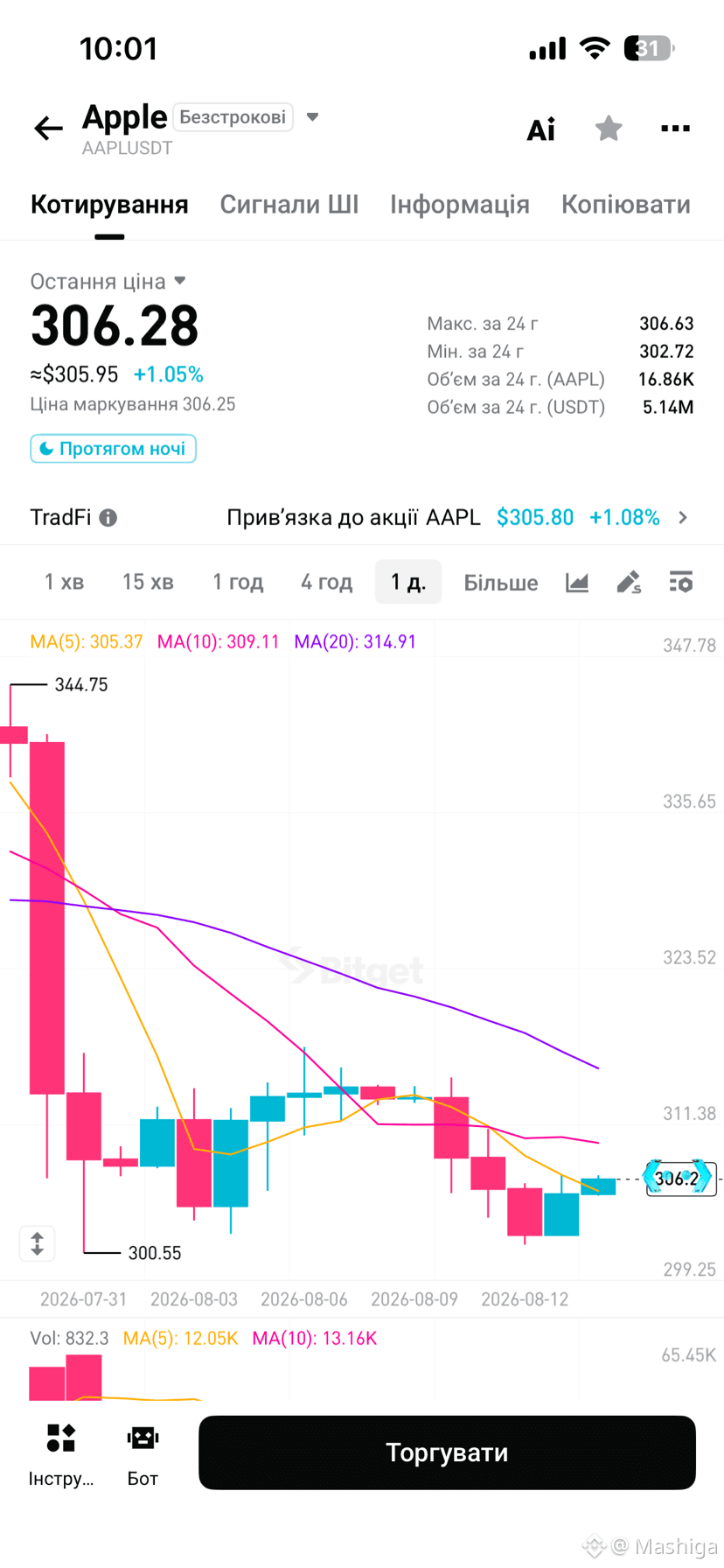
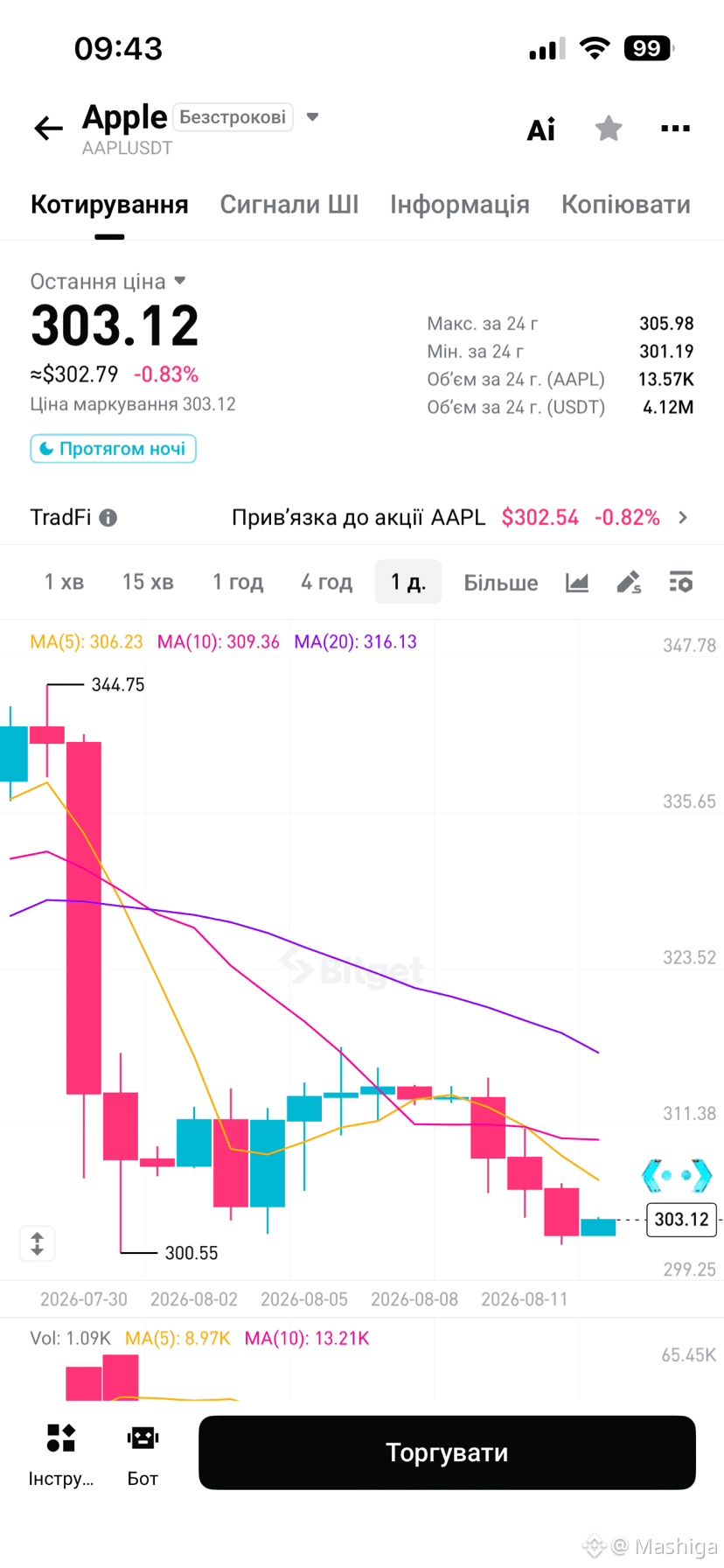
#bstockscis Today is the 7th day of my observation of the Apple token. I noticed that the token is currently at its minimum, but, in my opinion, this may be a correction before further growth.
If we compare the price to yesterday, it has decreased by 0.83%. I expect a large-scale rise in September, because that is when the company is expected to unveil a new product—a new iPhone.
So I continue to monitor the dynamics and wait for interesting changes.
@BinanceCIS
If we compare the price to yesterday, it has decreased by 0.83%. I expect a large-scale rise in September, because that is when the company is expected to unveil a new product—a new iPhone.
So I continue to monitor the dynamics and wait for interesting changes.
@BinanceCIS
#bstockscis
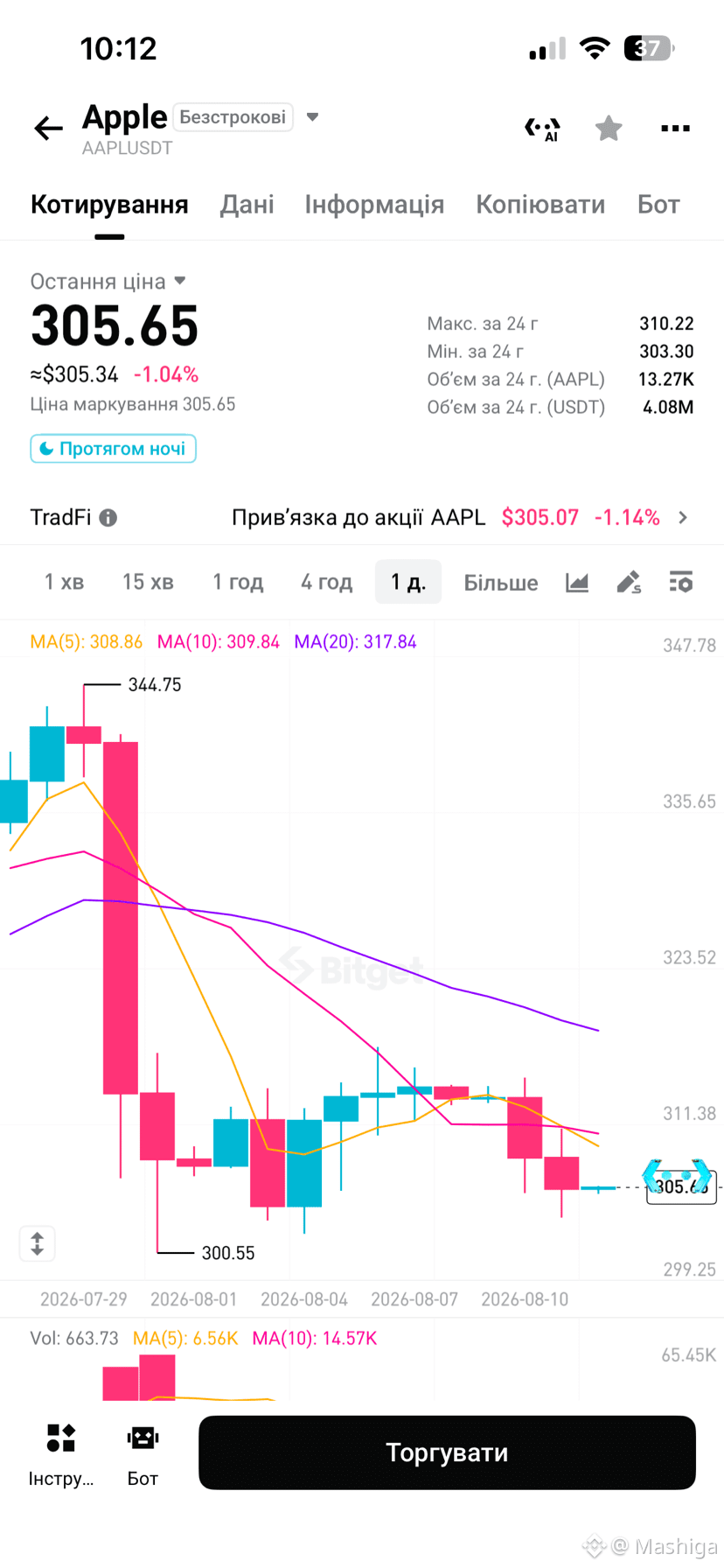
Today is the 6th day of my challenge—watching the Apple token. As we can see, the price is still moving downward—compared to yesterday, it has dropped by more than 1%.
I still expect positive news from the company, which could become a catalyst for further price growth. So I continue to monitor the situation and wait for positive momentum.
@BinanceCIS
Today is the 6th day of my challenge—watching the Apple token. As we can see, the price is still moving downward—compared to yesterday, it has dropped by more than 1%.
I still expect positive news from the company, which could become a catalyst for further price growth. So I continue to monitor the situation and wait for positive momentum.
@BinanceCIS
#bstockscis Today is the 5th day of my Apple token observation challenge.
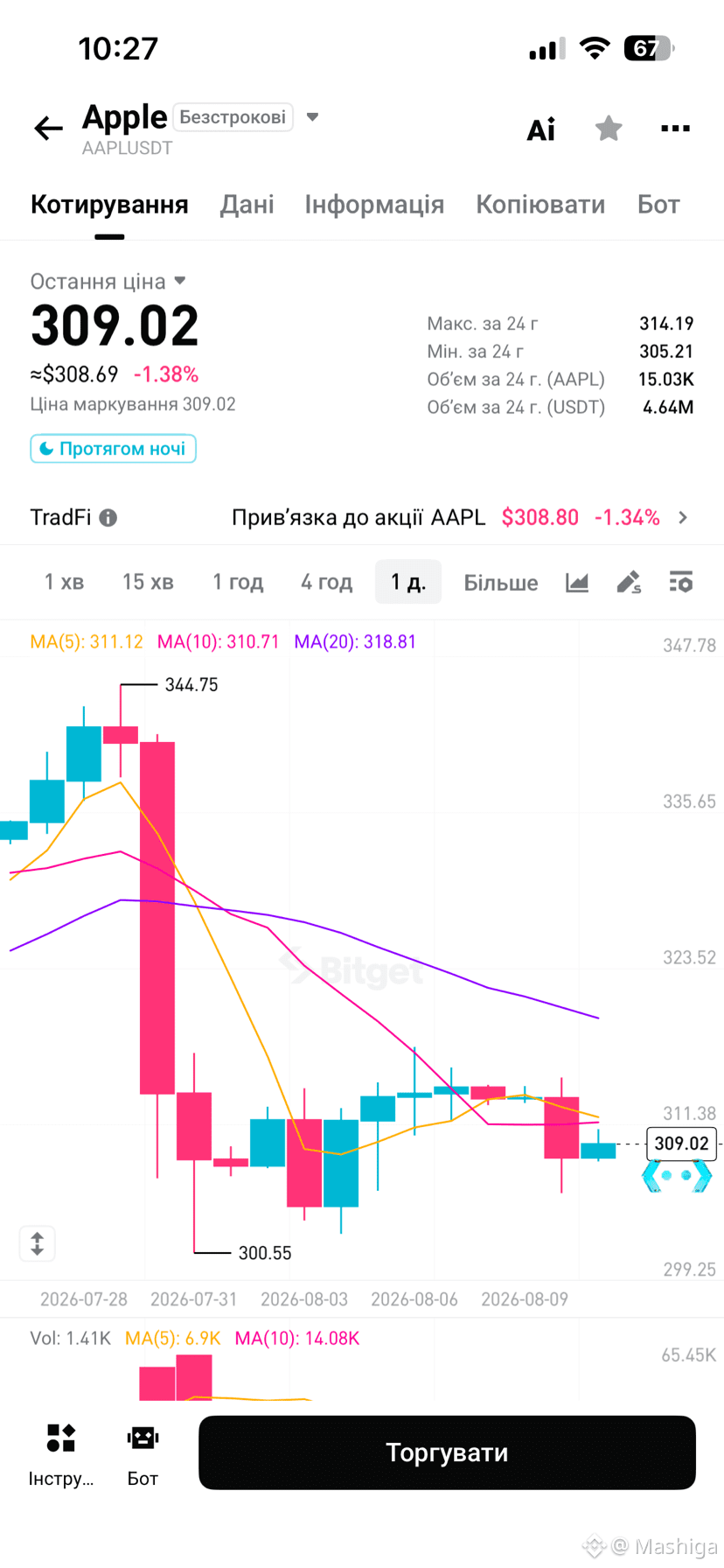
Today we already see a difference compared to the previous days—the price has dropped by about 1.4%. Of course, this is not a very significant decline, but the token has finally started moving and is no longer staying in place.
In my opinion, this could be a small rebound before the price continues to rise. I’ll keep monitoring.
@BinanceCIS
Today we already see a difference compared to the previous days—the price has dropped by about 1.4%. Of course, this is not a very significant decline, but the token has finally started moving and is no longer staying in place.
In my opinion, this could be a small rebound before the price continues to rise. I’ll keep monitoring.
@BinanceCIS
#bstockscis Today is the 4th day of my challenge to monitor the Apple token.
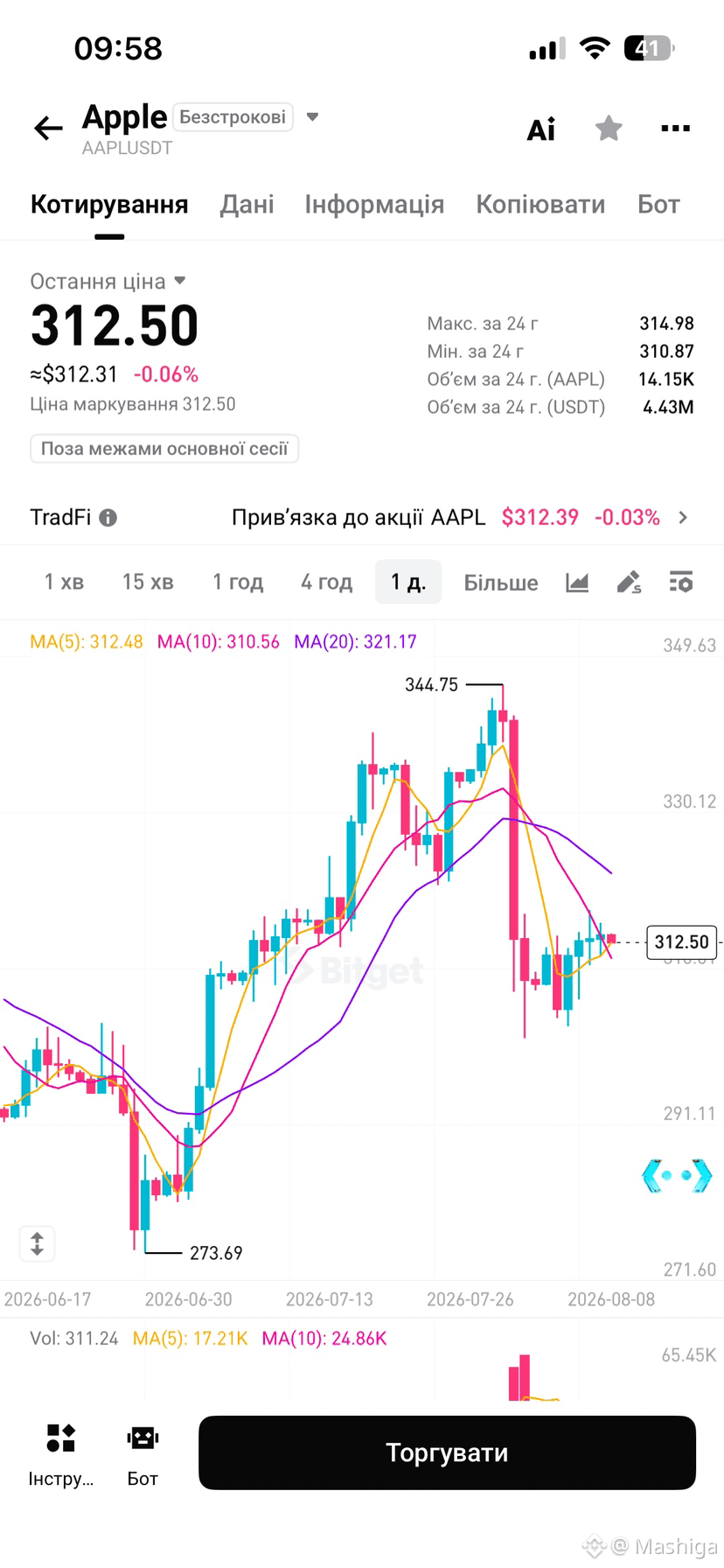
If we compare the price with yesterday, it has risen a little, but the changes are still quite insignificant—it's practically unnoticeable.
In my opinion, it’s worth waiting for interesting announcements from the company. Positive news can become a catalyst for further price growth. I hope Apple will still show a good upward move.@BinanceCIS #Apple
If we compare the price with yesterday, it has risen a little, but the changes are still quite insignificant—it's practically unnoticeable.
In my opinion, it’s worth waiting for interesting announcements from the company. Positive news can become a catalyst for further price growth. I hope Apple will still show a good upward move.@BinanceCIS #Apple
Варто купляти
0%
Не варто купляти
0%
Поки очікую новин від кампанії
100%
1 votes • Voting closed
#bstockscis Today is the 3rd day of my challenge: monitoring the Apple token. If we compare the price to yesterday, it hasn’t changed, but I think that’s normal because I’m considering this token specifically from a long-term perspective. So I decided to buy more shares with my available funds. I hope this will bring me profit.
@BinanceCIS
@BinanceCIS
#bStocksCIS
Today is the 2nd day of my challenge to monitor the Apple token. If we compare the price to yesterday, it has increased a little. Overall, I like this kind of scenario, so I’ve already started buying shares of this well-known token. I hope this will help me make some money.
@BinanceCIS
Today is the 2nd day of my challenge to monitor the Apple token. If we compare the price to yesterday, it has increased a little. Overall, I like this kind of scenario, so I’ve already started buying shares of this well-known token. I hope this will help me make some money.
@BinanceCIS
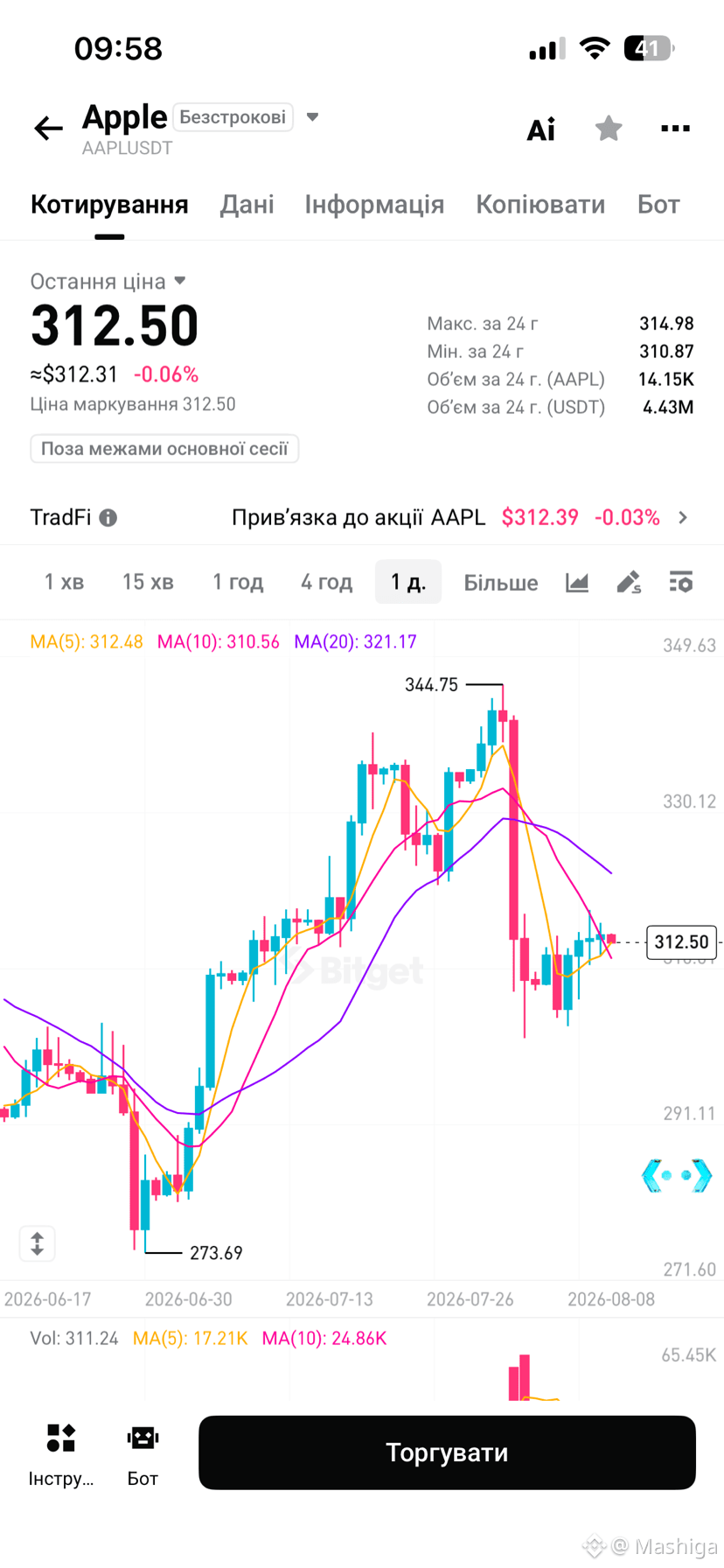
#bstockscis I decided to start a challenge for myself. I want to observe stocks for a certain period of time so that in the future I can invest in some of the shares. Today I looked at an Apple token and will keep watching it for about another month, because in my opinion the price should rise in September due to the release of a new product from the company.
@BinanceCIS
@BinanceCIS
Log in to explore more content