
kiri亏麻了
1k Posts

kiri亏麻了
Report
Block User
合约韭菜,现役亏钱选手 💸
分享踩过的坑,一起挖掘更多Gem💎

原创之星

Level 1 Creator
Open Trade
Frequent Trader
5.6 Years
75 Following
8.8K+ Followers
20.4K+ Liked
2 Badges
Posts
Portfolio
All
Quotes
Videos


·
--
Bearish
Bitcoin ETFs see record $4.94 billion in net outflows in November
The latest outflow figures for U.S. spot Bitcoin ETFs have left many people stunned. As of around November 24, cumulative net outflows for November had reached approximately $4.94 billion, surpassing the previous record of $4.51 billion set during the wave of outflows in June this year. That makes it the worst month for these ETFs since they launched in January 2024.
Put simply, institutional investors withdrew nearly $5 billion net in a single month. Even more striking, BlackRock’s IBIT accounted for almost all of the outflows: the fund alone saw more than $4 billion withdrawn, and had net inflows on just one day this month. After several consecutive trading days of net outflows, the market’s takeaway is clear: money is heading for the exit.
Why is this happening? The broader environment isn’t helping. Interest rate expectations remain elevated, the Fed is taking a hawkish stance, technology and AI-related stocks have performed lacklusterly, and macroeconomic headlines have added to the uncertainty—all contributing to a broad sell-off in risk assets. Bitcoin may be called “digital gold,” but when investors seek real safety, institutional money often pulls out of liquid products like ETFs first. As for prices, Bitcoin briefly fell below the $60,000 level, and ongoing ETF redemptions have been one of the major forces weighing on its price.
This doesn’t mean Bitcoin is “finished.” Since their launch, these ETFs have still seen positive cumulative net inflows overall. Institutional adoption is a long-term trend, not something that can reverse overnight. But the short term has exposed a reality: institutional money is pragmatic. It chases rallies and runs during downturns, reacting to the slightest uncertainty more readily than many retail investors might expect. The market weathered the major outflows in June, too. Whether this time will be similar depends on whether funds start flowing back in.
Here are a few simple things to watch next: the Fed’s actions in December, whether Bitcoin can hold at key levels, and whether daily ETF outflows shift from “large and persistent” to “small and intermittent,” or even turn positive. A slowdown in outflows often signals a change before a price rebound does.
That’s how markets work: crowded when things are hot, deserted when they’re cold. The record $4.94 billion in outflows is a reminder that institutional money can come and go quickly—don’t mistake it for a permanent floor that only goes up.
{spot}(BTCUSDT)
#比特币etf11月净流出49.4亿美元创纪录
Bitcoin ETFs see record $4.94 billion in net outflows in November
The latest outflow figures for U.S. spot Bitcoin ETFs have left many people stunned. As of around November 24, cumulative net outflows for November had reached approximately $4.94 billion, surpassing the previous record of $4.51 billion set during the wave of outflows in June this year. That makes it the worst month for these ETFs since they launched in January 2024.
Put simply, institutional investors withdrew nearly $5 billion net in a single month. Even more striking, BlackRock’s IBIT accounted for almost all of the outflows: the fund alone saw more than $4 billion withdrawn, and had net inflows on just one day this month. After several consecutive trading days of net outflows, the market’s takeaway is clear: money is heading for the exit.
Why is this happening? The broader environment isn’t helping. Interest rate expectations remain elevated, the Fed is taking a hawkish stance, technology and AI-related stocks have performed lacklusterly, and macroeconomic headlines have added to the uncertainty—all contributing to a broad sell-off in risk assets. Bitcoin may be called “digital gold,” but when investors seek real safety, institutional money often pulls out of liquid products like ETFs first. As for prices, Bitcoin briefly fell below the $60,000 level, and ongoing ETF redemptions have been one of the major forces weighing on its price.
This doesn’t mean Bitcoin is “finished.” Since their launch, these ETFs have still seen positive cumulative net inflows overall. Institutional adoption is a long-term trend, not something that can reverse overnight. But the short term has exposed a reality: institutional money is pragmatic. It chases rallies and runs during downturns, reacting to the slightest uncertainty more readily than many retail investors might expect. The market weathered the major outflows in June, too. Whether this time will be similar depends on whether funds start flowing back in.
Here are a few simple things to watch next: the Fed’s actions in December, whether Bitcoin can hold at key levels, and whether daily ETF outflows shift from “large and persistent” to “small and intermittent,” or even turn positive. A slowdown in outflows often signals a change before a price rebound does.
That’s how markets work: crowded when things are hot, deserted when they’re cold. The record $4.94 billion in outflows is a reminder that institutional money can come and go quickly—don’t mistake it for a permanent floor that only goes up.
#比特币etf11月净流出49.4亿美元创纪录
BTC+3.40%
BLKUS-0.07%
1
705
·
--
Bearish
Verified
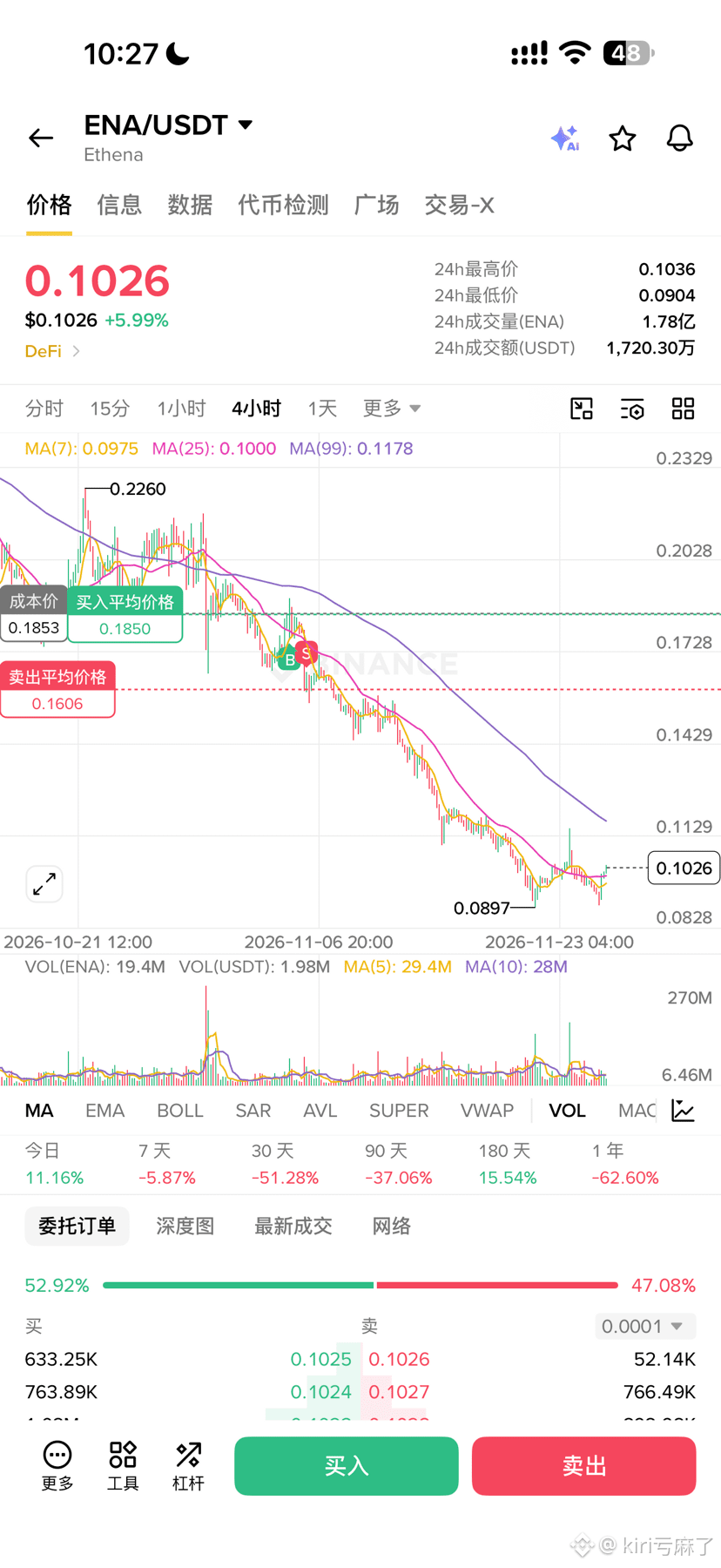
Guys, ENA has been having a really rough time lately. The price is hovering around 10 cents (about $0.10). It occasionally manages a 3–4% gain over 24 hours, but don’t get too excited—the overall trend is still downward.
The Ethena project itself is doing reasonably well. Its synthetic dollar, USDe, continues to expand: it has surpassed $100 million on Avalanche, launched on Stellar, and struck a $100 million liquidity partnership involving BlackRock’s BUIDL. Ethena Pay is also running a cashback campaign to attract users. The buyback mechanism has been approved too: once USDe’s supply reaches $7.5 billion, protocol revenue will be used to buy ENA. But supply is only around $500 million right now, so there’s still a long way to go. For now, that catalyst is more promise than reality.
Meanwhile, the publicly listed company StablecoinX holds nearly 20% of ENA, and its tokens have also been unlocked. The value of its treasury has shrunk along with the token price, and the market is quite sensitive to this.
The chart has been sliding since its summer high. It’s fallen nearly half over the past month or two, and the price is now firmly below all the moving averages—a classic downtrend. The daily RSI is oversold, which suggests there could be a short-term bounce, but those rallies have mostly been fleeting, with selling pressure always ready to return. Support is around $0.09; if that breaks, the price could head lower. Resistance is in the $0.11–$0.12 range. If it can’t get above that, a turnaround is unlikely.
Honestly, the overall crypto market is pretty fearful right now, and altcoins are faring even worse. ENA’s product is growing, but the token isn’t reflecting that—a classic case of “fundamentals are holding up, but the price has already collapsed.” Oversold conditions could offer a chance to trade a short-term bounce, but there’s no clear sign of a medium-term bottom yet. If you’re looking to buy the dip, set a stop-loss first, and don’t go all in.
{spot}(ENAUSDT)
#特朗普拟重启关税攻势,比特币和美股再度走弱
Guys, ENA has been having a really rough time lately. The price is hovering around 10 cents (about $0.10). It occasionally manages a 3–4% gain over 24 hours, but don’t get too excited—the overall trend is still downward.
The Ethena project itself is doing reasonably well. Its synthetic dollar, USDe, continues to expand: it has surpassed $100 million on Avalanche, launched on Stellar, and struck a $100 million liquidity partnership involving BlackRock’s BUIDL. Ethena Pay is also running a cashback campaign to attract users. The buyback mechanism has been approved too: once USDe’s supply reaches $7.5 billion, protocol revenue will be used to buy ENA. But supply is only around $500 million right now, so there’s still a long way to go. For now, that catalyst is more promise than reality.
Meanwhile, the publicly listed company StablecoinX holds nearly 20% of ENA, and its tokens have also been unlocked. The value of its treasury has shrunk along with the token price, and the market is quite sensitive to this.
The chart has been sliding since its summer high. It’s fallen nearly half over the past month or two, and the price is now firmly below all the moving averages—a classic downtrend. The daily RSI is oversold, which suggests there could be a short-term bounce, but those rallies have mostly been fleeting, with selling pressure always ready to return. Support is around $0.09; if that breaks, the price could head lower. Resistance is in the $0.11–$0.12 range. If it can’t get above that, a turnaround is unlikely.
Honestly, the overall crypto market is pretty fearful right now, and altcoins are faring even worse. ENA’s product is growing, but the token isn’t reflecting that—a classic case of “fundamentals are holding up, but the price has already collapsed.” Oversold conditions could offer a chance to trade a short-term bounce, but there’s no clear sign of a medium-term bottom yet. If you’re looking to buy the dip, set a stop-loss first, and don’t go all in.
#特朗普拟重启关税攻势,比特币和美股再度走弱
ENA+8.67%
BLKUS-0.07%
1.5k
·
--
Bearish
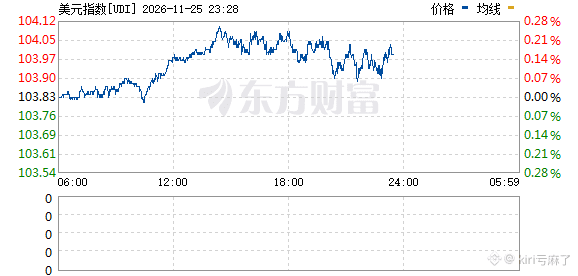
Another sleepless night as prices plunge 😭 BTC has fallen to around $58,000, while ETH is hovering around $1,640. The biggest macro news today was the US October PCE data: the headline annual rate rose to 3.8%, and core inflation reached 3.3%, locking in expectations of a Fed rate hike in December. Stocks fell in response, with the Nasdaq dragged down by AI stocks, and crypto naturally took a hit too. Tariff concerns and high oil prices have further dampened risk appetite across the board.
BTC is getting hit even harder. After briefly climbing to $64,000 on Monday, the price quickly gave back its gains and is now back around $58,000. It has fallen nearly 25% in November. ETFs continue to see significant outflows, selling pressure on exchanges remains strong, and the Fear & Greed Index has plunged into extreme fear. Technically, BTC is also oversold—but being oversold doesn't mean it has bottomed. Many people are still watching the $55,000 area as the next key level.
ETH is following BTC, but its losses are slightly larger. The price is still below all the major moving averages, with $1,500–$1,600 serving as key support. ETFs are also seeing outflows, and on-chain activity hasn't been enough to support the price for now. Ethereum's long-term narrative—security upgrades and real-world use cases—remains intact, but right now the market is focused only on capital flows and macro conditions. It isn't paying attention to those things at all. In the short term, macro factors are weighing on both assets. Hotter inflation reinforces rate-hike expectations, and as expectations for liquidity tighten, high-risk assets are the first to fall. Sentiment across the entire crypto market is terrible today. Many people are either trying to buy the dip or waiting for prices to go even lower.
Anyone in crypto knows this feeling well: the long-term story hasn't changed, but in the short term, macro conditions and sentiment are in control. BTC and ETH now look like the positions many people are holding—they're still there, but for now, the direction isn't in their hands. You can keep holding and trust that the rate-hiking cycle will eventually end; or you can admit that you can't stomach this volatility and move to a safer place for now. There's no one right answer—only whether you can sleep at night.
Markets are never linear. When prices fall, it feels like they'll never stop; when they rise, it feels like they should have gone up long ago. The truly difficult part isn't figuring out where the bottom is, but whether you can stay clear-headed while macro pressures are still mounting.
#美国核心PCE超预期,美联储加息预期增强
{spot}(ETHUSDT)
Another sleepless night as prices plunge 😭 BTC has fallen to around $58,000, while ETH is hovering around $1,640. The biggest macro news today was the US October PCE data: the headline annual rate rose to 3.8%, and core inflation reached 3.3%, locking in expectations of a Fed rate hike in December. Stocks fell in response, with the Nasdaq dragged down by AI stocks, and crypto naturally took a hit too. Tariff concerns and high oil prices have further dampened risk appetite across the board.
BTC is getting hit even harder. After briefly climbing to $64,000 on Monday, the price quickly gave back its gains and is now back around $58,000. It has fallen nearly 25% in November. ETFs continue to see significant outflows, selling pressure on exchanges remains strong, and the Fear & Greed Index has plunged into extreme fear. Technically, BTC is also oversold—but being oversold doesn't mean it has bottomed. Many people are still watching the $55,000 area as the next key level.
ETH is following BTC, but its losses are slightly larger. The price is still below all the major moving averages, with $1,500–$1,600 serving as key support. ETFs are also seeing outflows, and on-chain activity hasn't been enough to support the price for now. Ethereum's long-term narrative—security upgrades and real-world use cases—remains intact, but right now the market is focused only on capital flows and macro conditions. It isn't paying attention to those things at all. In the short term, macro factors are weighing on both assets. Hotter inflation reinforces rate-hike expectations, and as expectations for liquidity tighten, high-risk assets are the first to fall. Sentiment across the entire crypto market is terrible today. Many people are either trying to buy the dip or waiting for prices to go even lower.
Anyone in crypto knows this feeling well: the long-term story hasn't changed, but in the short term, macro conditions and sentiment are in control. BTC and ETH now look like the positions many people are holding—they're still there, but for now, the direction isn't in their hands. You can keep holding and trust that the rate-hiking cycle will eventually end; or you can admit that you can't stomach this volatility and move to a safer place for now. There's no one right answer—only whether you can sleep at night.
Markets are never linear. When prices fall, it feels like they'll never stop; when they rise, it feels like they should have gone up long ago. The truly difficult part isn't figuring out where the bottom is, but whether you can stay clear-headed while macro pressures are still mounting.
#美国核心PCE超预期,美联储加息预期增强
1
1.6k
·
--
Bearish
Verified
Guys, let's talk about Bitcoin again today. Honestly, since Huang came back, liquidity has been siphoned into U.S. stocks, which have been putting on a show. I tried trading Nvidia last night and got liquidated too—the market has been pretty painful to watch.
On the macro front, the Fed is still very likely to raise rates by 25 basis points in December. The market is now pricing in odds of over 90%. Inflation hasn't been fully tamed, liquidity is continuing to tighten, and risk assets like the Nasdaq are taking a hit too. Bitcoin is now highly correlated with U.S. tech stocks, so when macro conditions tighten, it doesn't fare well. Even worse, spot ETFs saw outflows of more than $4 billion in November, a new record. BlackRock's IBIT led the withdrawals, and institutional money is heading for the exits. The Fear & Greed Index has fallen to 11, deep in extreme fear territory, showing that market sentiment has hit rock bottom.
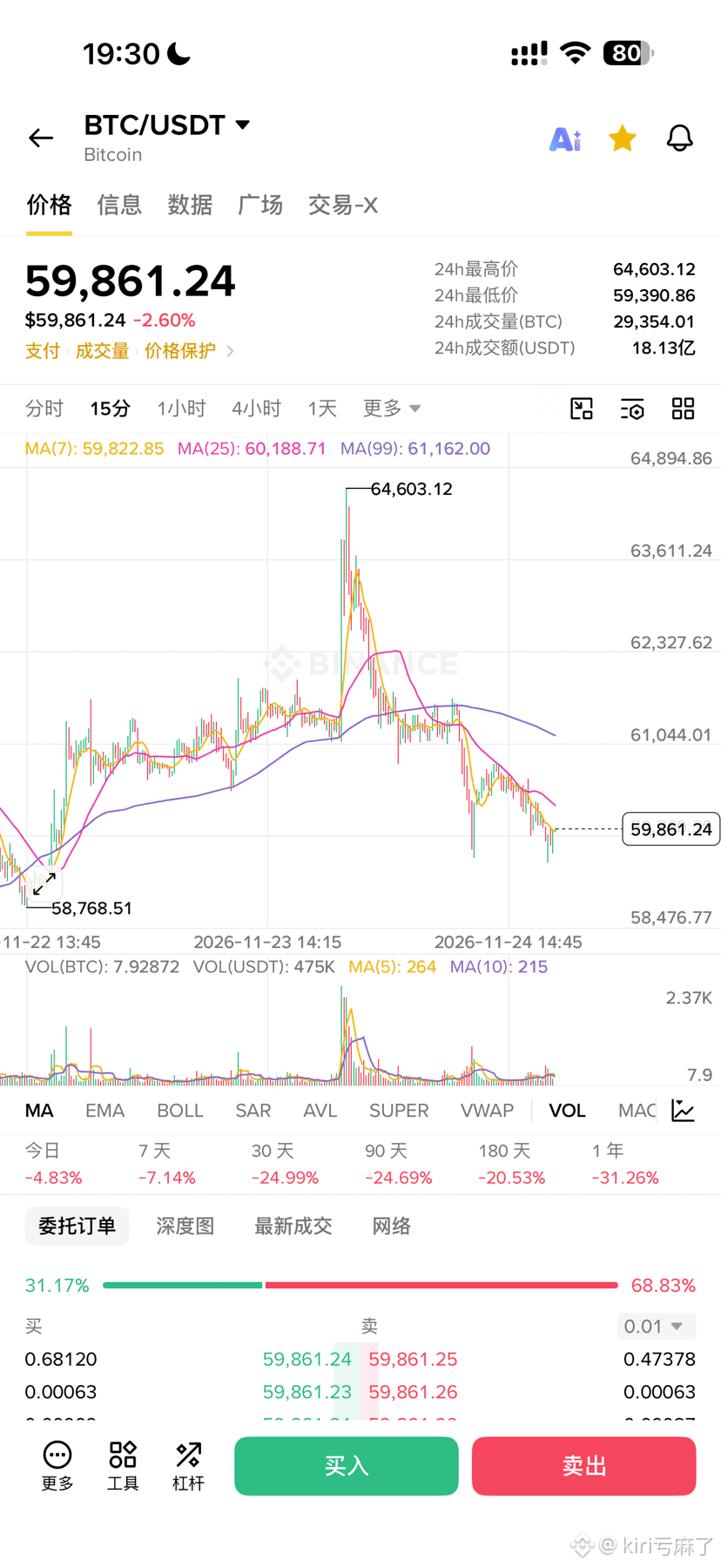
Now let's look at the charts. Since last October's peak of $126,000, the price has been sliding all the way down and is now around $59,600—down by more than half. Last week it plunged to this cycle's low of around $55,500, then rebounded to around $64,000 before getting knocked back. Today it has fallen below $60,000 again. The daily RSI is already oversold, while the MACD is still below zero. The overall trend is bearish, with all the moving averages hanging overhead. Near-term support is around $58,000–$59,000. If that doesn't hold, the next level is the $55,500 low; if that breaks, the market could test the key $50,000 level. Resistance is quite clear around $61,000–$62,000, but any rebound to that area will probably be met with selling.
My personal view is that the short-term outlook remains bearish. Although oversold conditions could trigger a technical rebound, the bounce will probably be limited until the macro environment changes. The biggest risk right now is trying to catch the bottom halfway down the mountain, especially for leveraged traders—the liquidations from a few days ago are still fresh in our minds. Keep your positions light, don't go all in, and it's safer to wait for a clear macro turning point or sustained net inflows into ETFs before considering adding to your position.
Market conditions can change at any time. This is just my current view and doesn't constitute investment advice. Manage your own risk.
592
·
--
Bullish
Today's plot is laugh-cry worthy
• A spy and workplace malfeasant are forced out as NVIDIA CEO
• The leather-clad demon leads Silicon Valley's war room toward Santa Clara
• The restorationist openly tries to oust the board on the night of trillion-dollar earnings
• Jensen Huang wins White House backing and gets the Treasury Secretary to change his tune
• Founder Mr. Jensen Huang approaches headquarters on the back of a premarket surge
• His Supreme Highness Lord Jensen Huang descends today upon his loyal NVIDIA
#英伟达盘前涨超9%

414
·
--
You two lovebirds are having a tiff?
You two made up, but my position is gone.
Good thing I opened a long position on $SXT yesterday to complete a task.
#英伟达恢复黄仁勋CEO职务,市场吹响反攻号角
{spot}(NVDABUSDT)
You two lovebirds are having a tiff?
You two made up, but my position is gone.
Good thing I opened a long position on $SXT yesterday to complete a task.
#英伟达恢复黄仁勋CEO职务,市场吹响反攻号角
You two made up, but my position is gone.
Good thing I opened a long position on $SXT yesterday to complete a task.
#英伟达恢复黄仁勋CEO职务,市场吹响反攻号角
kiri亏麻了
·
--
BullishIntel’s share of the discrete GPU market is 0–1%, while NVIDIA accounts for about 80% of data-center AI accelerators.
Based on these numbers, Wall Street has recently been betting on a scenario: Jensen Huang joins Intel to lead its AI chip business—or even takes over as CEO.
This isn’t baseless speculation. Three things line up at once:
1. Intel is missing a product-focused leader
Lip-Bu Tan took over in March 2025. His strengths are restructuring, cutting management layers, and advancing the 18A/14A processes. His background is in EDA and investing—not product development or AI vision. Some Wall Street investors believe he never intended to stay in the role long-term, and that if the right person stepped forward, it wouldn’t be impossible for Tan to move into the background and support them.
2. Intel’s position in AI chips is awkward
NVIDIA still holds around 80% of the data-center accelerator market. AMD is closing in with Instinct and EPYC, while Intel’s share of the discrete GPU market is practically nonexistent. What Intel needs most right now is someone who can lead a team to build its next-generation, high-performance GPU.
3. The money has already started moving
At the end of 2025, NVIDIA invested $5 billion in Intel for an approximately 4% stake. The two companies are also working together on custom data-center and PC chips. Jensen Huang and Lip-Bu Tan have also been friends for 30 years.
Put those three things together, and of course the market will write the rest of the story itself.
Put simply, the reason this rumor has gained traction isn’t that one person wants to poach another. It’s that the market is looking for someone who can deliver a product breakthrough, bring in talent, and reinforce the U.S. chip industry narrative—all three wishes at once, with plenty of drama to boot.
Of course, for now, this is just Wall Street speculation. There’s no sign that any talks have actually taken place.
But then again, it’s precisely because the idea makes sense that this rumor won’t go away.
Do you think this scenario could happen? If it does, what will Intel look like next year?
#贝森特对黄仁勋态度反转,回归英伟达预期升温

441
·
--
Bullish
Intel’s share of the discrete GPU market is 0–1%, while NVIDIA accounts for about 80% of data-center AI accelerators.
Based on these numbers, Wall Street has recently been betting on a scenario: Jensen Huang joins Intel to lead its AI chip business—or even takes over as CEO.
This isn’t baseless speculation. Three things line up at once:
1. Intel is missing a product-focused leader
Lip-Bu Tan took over in March 2025. His strengths are restructuring, cutting management layers, and advancing the 18A/14A processes. His background is in EDA and investing—not product development or AI vision. Some Wall Street investors believe he never intended to stay in the role long-term, and that if the right person stepped forward, it wouldn’t be impossible for Tan to move into the background and support them.
2. Intel’s position in AI chips is awkward
NVIDIA still holds around 80% of the data-center accelerator market. AMD is closing in with Instinct and EPYC, while Intel’s share of the discrete GPU market is practically nonexistent. What Intel needs most right now is someone who can lead a team to build its next-generation, high-performance GPU.
3. The money has already started moving
At the end of 2025, NVIDIA invested $5 billion in Intel for an approximately 4% stake. The two companies are also working together on custom data-center and PC chips. Jensen Huang and Lip-Bu Tan have also been friends for 30 years.
Put those three things together, and of course the market will write the rest of the story itself.
Put simply, the reason this rumor has gained traction isn’t that one person wants to poach another. It’s that the market is looking for someone who can deliver a product breakthrough, bring in talent, and reinforce the U.S. chip industry narrative—all three wishes at once, with plenty of drama to boot.
Of course, for now, this is just Wall Street speculation. There’s no sign that any talks have actually taken place.
But then again, it’s precisely because the idea makes sense that this rumor won’t go away.
Do you think this scenario could happen? If it does, what will Intel look like next year?
#贝森特对黄仁勋态度反转,回归英伟达预期升温
{spot}(NVDABUSDT)
Intel’s share of the discrete GPU market is 0–1%, while NVIDIA accounts for about 80% of data-center AI accelerators.
Based on these numbers, Wall Street has recently been betting on a scenario: Jensen Huang joins Intel to lead its AI chip business—or even takes over as CEO.
This isn’t baseless speculation. Three things line up at once:
1. Intel is missing a product-focused leader
Lip-Bu Tan took over in March 2025. His strengths are restructuring, cutting management layers, and advancing the 18A/14A processes. His background is in EDA and investing—not product development or AI vision. Some Wall Street investors believe he never intended to stay in the role long-term, and that if the right person stepped forward, it wouldn’t be impossible for Tan to move into the background and support them.
2. Intel’s position in AI chips is awkward
NVIDIA still holds around 80% of the data-center accelerator market. AMD is closing in with Instinct and EPYC, while Intel’s share of the discrete GPU market is practically nonexistent. What Intel needs most right now is someone who can lead a team to build its next-generation, high-performance GPU.
3. The money has already started moving
At the end of 2025, NVIDIA invested $5 billion in Intel for an approximately 4% stake. The two companies are also working together on custom data-center and PC chips. Jensen Huang and Lip-Bu Tan have also been friends for 30 years.
Put those three things together, and of course the market will write the rest of the story itself.
Put simply, the reason this rumor has gained traction isn’t that one person wants to poach another. It’s that the market is looking for someone who can deliver a product breakthrough, bring in talent, and reinforce the U.S. chip industry narrative—all three wishes at once, with plenty of drama to boot.
Of course, for now, this is just Wall Street speculation. There’s no sign that any talks have actually taken place.
But then again, it’s precisely because the idea makes sense that this rumor won’t go away.
Do you think this scenario could happen? If it does, what will Intel look like next year?
#贝森特对黄仁勋态度反转,回归英伟达预期升温

1
1
210
·
--
Bullish
Space and Time: Can you trust the data? It helps you “check the goods”
As AI starts making its own decisions, stocks and funds are turned into on-chain tokens, and DeFi looks for smarter ways to operate, data is the biggest headache. If someone secretly alters the data, or it simply can’t be trusted, no one can explain what went wrong.
Space and Time ($SXT ) is designed to solve this problem. Think of it as a database that can prove “I didn’t fake anything.” Its core feature is called Proof of SQL. You query data as usual with SQL, and it also gives you a mathematical proof: the results were calculated honestly, no one tampered with them along the way, and it all happens pretty quickly.
This is quite useful for AI. If an AI agent trades crypto on-chain, manages money, or handles a company’s finances, how do you know the numbers it uses are real? SXT lets it get the results while also proving “these numbers check out,” without exposing all the original sensitive data.
Tokenization works the same way. When you put real-world assets on-chain, complicated calculations involving net asset value, cash flow, reserves, and more used to rely on institutions simply vouching for them. Now smart contracts can verify these results directly, making the tokens feel more like the real thing.
On the DeFi side, protocols can look up a user’s complete history—not just how much money they have right now—enabling more precise lending and risk pricing, with less reliance on oracles that could be manipulated.
As for the token price (late November 2026): it’s currently around $0.0077 per token. Since reaching a high of $0.16-0.19 when it was listed in May 2025, it has fallen by more than 95%. Its low was around $0.0062 in July 2026, and it has now rebounded by about 20% from that low. Its market cap is still in the tens of millions, and the short-term outlook looks weak, mainly because its earlier valuation was too high and tokens keep unlocking. Whether it can recover will still depend on whether people actually use its data services.
Put simply: the technology is an interesting idea—it turns “trust me” into “you can verify it yourself.” But the token price has been cut in half again and again; what happens next depends entirely on whether it gets real-world use.
#sxt $SXT @SpaceandTime
1
655
·
--
Bearish
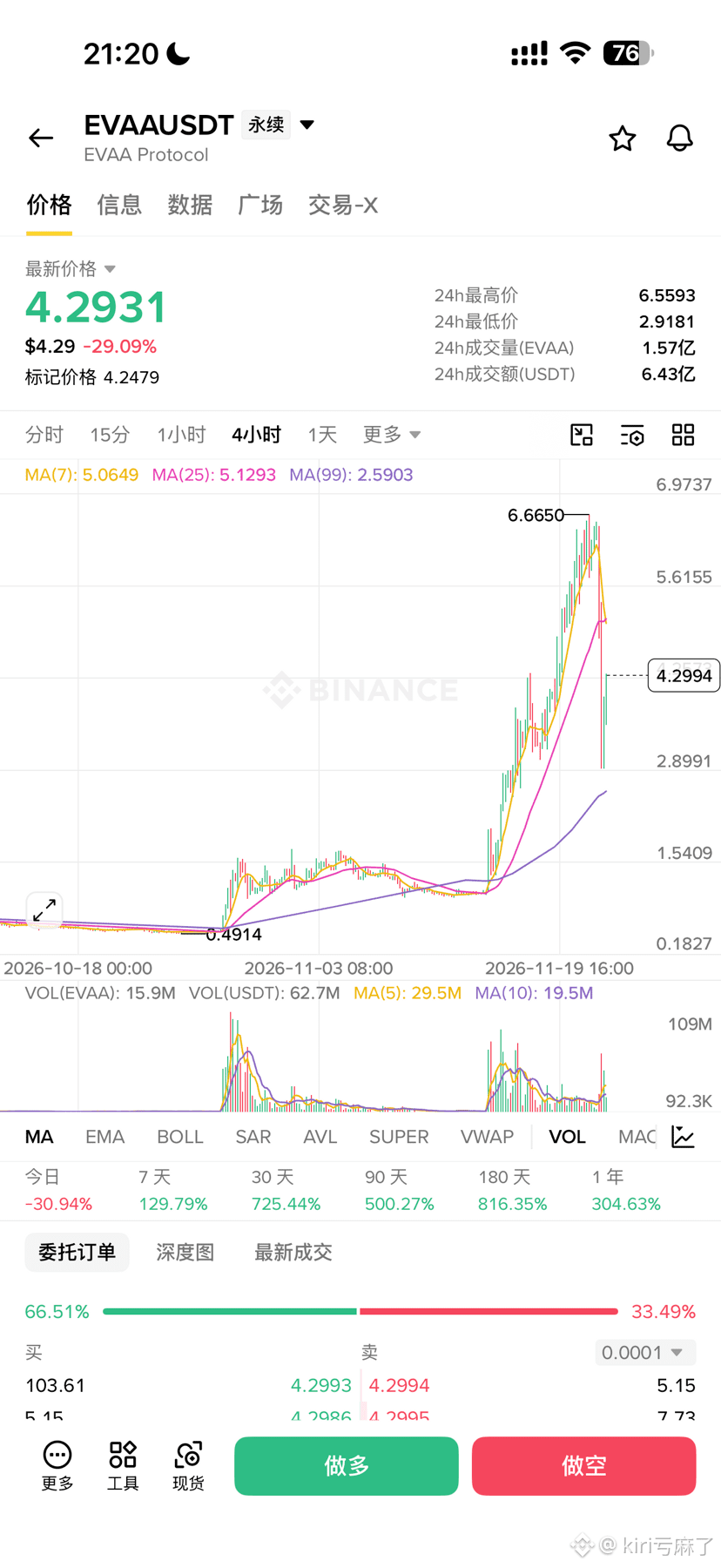
This move in $EVAA is honestly pretty shocking.
Just a few days ago, it was surging like crazy, climbing from a few cents to over six dollars as if it were riding a rocket. Then today came a massive pullback: it dropped nearly 40% in a single day, tumbling from over six dollars to around three. Plenty of people are still saying “the whales are pushing it up,” but the fund flows suggest this looks more like a leveraged trade gone wrong.
This coin’s rally wasn’t really driven by the protocol being especially profitable or by users going wild. TVL has been falling, and there isn’t much money actually locked in it, yet the price has multiplied several times over. What really drove it was derivatives. Spot trading volume looks substantial, but derivatives volume dwarfs it—sometimes by dozens of times. Open interest (OI) surged alongside the price, while funding rates stayed elevated, suggesting longs were crowded and many traders were chasing the rally with leverage.
The easiest thing to happen in this kind of market is a short squeeze. As the price surges, short sellers are forced to close their positions, pushing the price even higher. That creates the kind of parabolic rally we saw. It looks powerful, but it’s really just leverage spinning in a circle.
But here’s the question: what were the whales (or, to put it another way, the smart money) doing at the top? Fund flows don’t show sustained accumulation in the spot market. On the contrary, there were clear signs of distribution at higher prices: some traders started moving coins out, while some large holders switched to short positions. When today’s sell-off hit, OI fell sharply, suggesting many longs were closing out and getting out. Spot inflows were also weak, and even tilted toward outflows. This is a classic pattern of “leverage pushes it up on the way up, and leverage hammers it down on the way down.”
On top of that, there’s another token unlock around November 27. The amount isn’t especially large, but it’s still significant relative to the current circulating supply. The market was already absorbing tokens accumulated at higher prices; adding more supply will only increase the pressure.
This looks more like a speculative game fueled by low circulating supply and high leverage than any long-term price discovery. The whales (especially large derivatives traders and early holders) were probably selling into the rally at the top, or at least reducing their positions. If regular traders bought in around six dollars, they’re basically carrying someone else’s bags now.
#多名巨鲸逢低买入,比特币回升突破6万美元
{future}(EVAAUSDT)
This move in $EVAA is honestly pretty shocking.
Just a few days ago, it was surging like crazy, climbing from a few cents to over six dollars as if it were riding a rocket. Then today came a massive pullback: it dropped nearly 40% in a single day, tumbling from over six dollars to around three. Plenty of people are still saying “the whales are pushing it up,” but the fund flows suggest this looks more like a leveraged trade gone wrong.
This coin’s rally wasn’t really driven by the protocol being especially profitable or by users going wild. TVL has been falling, and there isn’t much money actually locked in it, yet the price has multiplied several times over. What really drove it was derivatives. Spot trading volume looks substantial, but derivatives volume dwarfs it—sometimes by dozens of times. Open interest (OI) surged alongside the price, while funding rates stayed elevated, suggesting longs were crowded and many traders were chasing the rally with leverage.
The easiest thing to happen in this kind of market is a short squeeze. As the price surges, short sellers are forced to close their positions, pushing the price even higher. That creates the kind of parabolic rally we saw. It looks powerful, but it’s really just leverage spinning in a circle.
But here’s the question: what were the whales (or, to put it another way, the smart money) doing at the top? Fund flows don’t show sustained accumulation in the spot market. On the contrary, there were clear signs of distribution at higher prices: some traders started moving coins out, while some large holders switched to short positions. When today’s sell-off hit, OI fell sharply, suggesting many longs were closing out and getting out. Spot inflows were also weak, and even tilted toward outflows. This is a classic pattern of “leverage pushes it up on the way up, and leverage hammers it down on the way down.”
On top of that, there’s another token unlock around November 27. The amount isn’t especially large, but it’s still significant relative to the current circulating supply. The market was already absorbing tokens accumulated at higher prices; adding more supply will only increase the pressure.
This looks more like a speculative game fueled by low circulating supply and high leverage than any long-term price discovery. The whales (especially large derivatives traders and early holders) were probably selling into the rally at the top, or at least reducing their positions. If regular traders bought in around six dollars, they’re basically carrying someone else’s bags now.
#多名巨鲸逢低买入,比特币回升突破6万美元
1
173
·
--
Look, just as expected—no surprises
$AKE The bookmaker has pulled the market 😂
#全球股市创三年来最长连跌,投资者避险情绪升温
{future}(AKEUSDT)
Look, just as expected—no surprises
$AKE The bookmaker has pulled the market 😂
#全球股市创三年来最长连跌,投资者避险情绪升温
$AKE The bookmaker has pulled the market 😂
#全球股市创三年来最长连跌,投资者避险情绪升温
kiri亏麻了
·
--
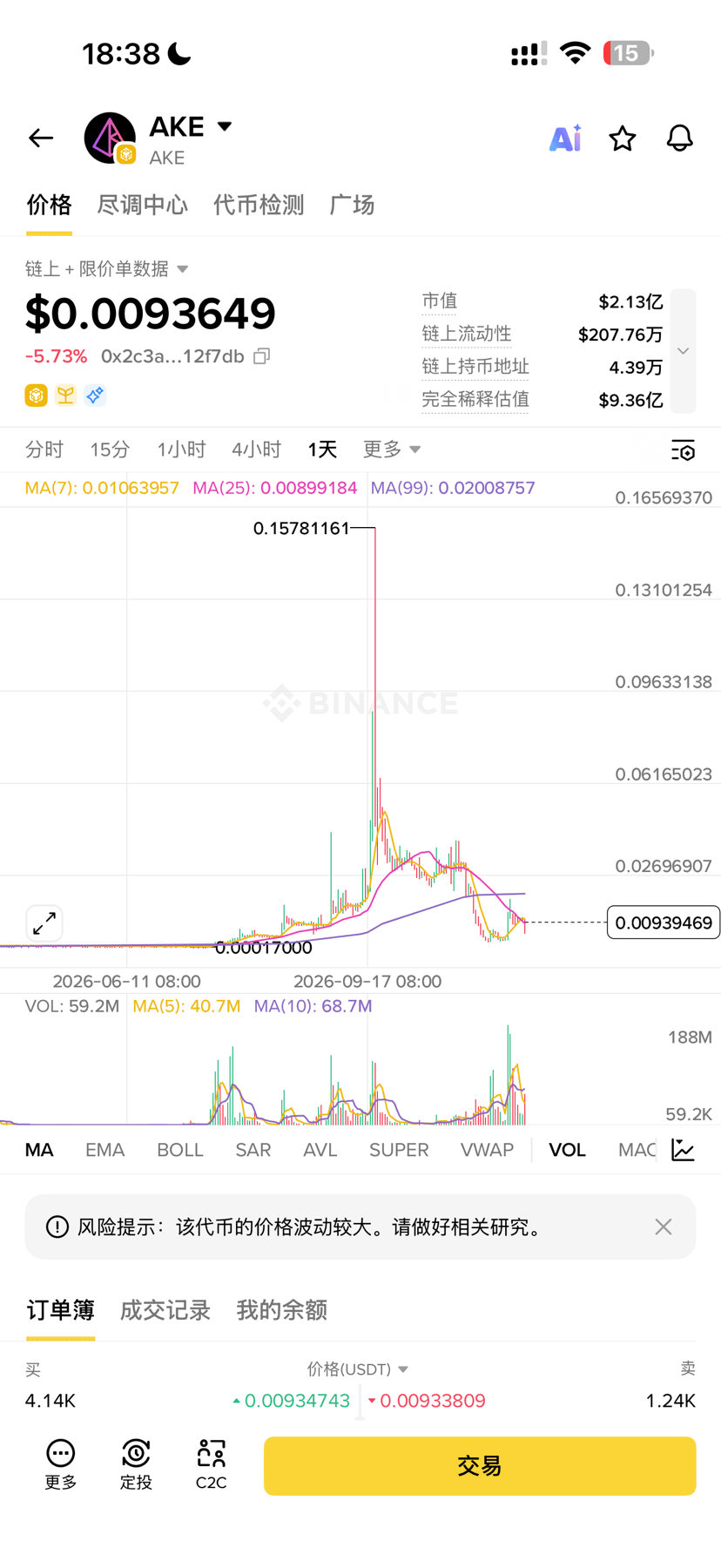
Bearish$AKE This cursed coin killed people again today
I checked at market open and it was down another ten-odd percent, to somewhere around 0.008-something to 0.009—felt pretty familiar. I’ve been watching this coin for a while. It’s Akedo, the AI game-making project on the BNB Chain that turns natural language directly into playable games. Its market cap is just over $200 million, with 22.8 billion in circulation and a total supply of 100 billion. Futures trading is far wilder than spot, and the price can swing all over the place in a single day.
The major holders are a pretty typical concentrated small-cap crowd. The top ten wallets hold nearly half the supply, and the top 100 hold almost 90%. The largest wallet alone has over 100 billion tokens. Recently, most on-chain activity has been wallet-to-wallet transfers. One address has also been adding to its position over the past two days, which feels more like insiders adjusting their holdings than a large-scale dump onto exchanges. There hasn’t been any obvious large spot selling, and exchange inflows and outflows are fairly balanced. But with holdings this concentrated, if anyone makes a move, the price can easily be sent soaring or tumbling.
I think the main reason for today’s drop is that the unlock scheduled for tomorrow (the 21st) is being priced in early. About 2.1 billion tokens are due to be released, nearly 10% of the circulating supply, mainly to investors and insiders. They have the greatest incentive to sell, so the market is already getting nervous. This is a regular monthly event, and previous unlocks have also sent the price down several times. Add in the wild leverage in futures lately—there was even a day when the price surged severalfold before giving it all back—and the generally lukewarm sentiment around altcoins, and it’s easy for things to snowball into a sharp drop like this.
Personally, I’m leaning cautious from here. The price will probably remain choppy and weak around the unlock. The key thing to watch is whether a large amount of the unlocked tokens flows onto exchanges. If there’s a concentrated sell-off, the price could test lower levels again.
Over the medium to long term, it depends more on whether the fundamentals can keep up. Monthly unlocks are a long-term headwind. For now, the project is still being supported mostly by capital speculation and the AI narrative. Whether people actually use the games, and whether fees and token burns can gain traction, will determine whether it can hold up going forward. Small-cap coins with highly concentrated ownership and futures-driven prices carry real risks. Personally, I only dare to take a small position and set a stop-loss; I wouldn’t go in heavily or chase the price.
In short, tomorrow’s unlock is the biggest near-term variable. Watching on-chain flows and changes in holdings is more useful than listening to stories. This is just my personal opinion, not investment advice.
#加息预期叠加美股分流,比特币跌破6.2万美元
1
295
·
--
Us right now:
😭It's over
🟥
🟥
🟥
🟥😭It's over
🟥😭It's over
🟥😭It's over
🟥
🟥
🟥
🟥
🟥😭It's over 🟩🥳We're so back!
🟥😭It's over
#比特币跌破6万美元,短期能否企稳反弹?
{spot}(BTCUSDT)
Us right now:
😭It's over
🟥
🟥
🟥
🟥😭It's over
🟥😭It's over
🟥😭It's over
🟥
🟥
🟥
🟥
🟥😭It's over 🟩🥳We're so back!
🟥😭It's over
#比特币跌破6万美元,短期能否企稳反弹?
😭It's over
🟥
🟥
🟥
🟥😭It's over
🟥😭It's over
🟥😭It's over
🟥
🟥
🟥
🟥
🟥😭It's over 🟩🥳We're so back!
🟥😭It's over
#比特币跌破6万美元,短期能否企稳反弹?
5
1
1.5k
·
--
Bearish
It’s only been a few days, and several support levels have already been broken one after another. Before the rate hike is officially announced, this is really painful 😭
Bitcoin has been trending down lately, hovering around $60,000. In my view, there aren’t that many support levels worth watching—the key ones are just a few.
The first is the psychological $60,000 level. The price is testing this area back and forth right now, and if it breaks below it, short-term sentiment will likely get worse. Further down, the $59,000–$58,000 range has been tested repeatedly over the past few days, and many people see it as short-term support. If it doesn’t hold, the $55,000–$57,000 range will be important to watch. That area lines up with some moving averages and a previous high-volume zone, so there will probably be buyers stepping in if the price falls that far.
This looks more like the market is trying to find a bottom after falling a lot, rather than a complete collapse. The RSI is already leaning toward oversold, but that doesn’t mean an immediate rebound—especially while broader market sentiment hasn’t turned around. If Bitcoin can hold around $60,000, there may be a technical rebound. But if it breaks below $58,000 on heavy volume, I’d be more cautious and wait for it to reach a lower level before considering my next move.
In short, in the near term, it’s all about whether $60,000 and $58,000 can hold. If they do, we may see a choppy recovery; if they break, the price will keep searching for stronger support levels below.
These are purely my personal views. Markets move quickly, so it’s more reliable to keep an eye on them yourself.
#比特币跌破6万美元,短期能否企稳反弹?
{spot}(BTCUSDT)
It’s only been a few days, and several support levels have already been broken one after another. Before the rate hike is officially announced, this is really painful 😭
Bitcoin has been trending down lately, hovering around $60,000. In my view, there aren’t that many support levels worth watching—the key ones are just a few.
The first is the psychological $60,000 level. The price is testing this area back and forth right now, and if it breaks below it, short-term sentiment will likely get worse. Further down, the $59,000–$58,000 range has been tested repeatedly over the past few days, and many people see it as short-term support. If it doesn’t hold, the $55,000–$57,000 range will be important to watch. That area lines up with some moving averages and a previous high-volume zone, so there will probably be buyers stepping in if the price falls that far.
This looks more like the market is trying to find a bottom after falling a lot, rather than a complete collapse. The RSI is already leaning toward oversold, but that doesn’t mean an immediate rebound—especially while broader market sentiment hasn’t turned around. If Bitcoin can hold around $60,000, there may be a technical rebound. But if it breaks below $58,000 on heavy volume, I’d be more cautious and wait for it to reach a lower level before considering my next move.
In short, in the near term, it’s all about whether $60,000 and $58,000 can hold. If they do, we may see a choppy recovery; if they break, the price will keep searching for stronger support levels below.
These are purely my personal views. Markets move quickly, so it’s more reliable to keep an eye on them yourself.
#比特币跌破6万美元,短期能否企稳反弹?
kiri亏麻了
·
--
BearishAfter the rate-hike hammer fell, Bitcoin’s “sell the rumor, buy the news” rebound looked more like a brief respite than a trend reversal.
The Fed’s October meeting minutes were clear: almost all officials thought further rate hikes were needed, and a few even suggested that if inflation data looked bad in December, a hike of more than 25 basis points could be considered. Markets had already priced in roughly a 97% chance of a 25-basis-point hike on December 9, so risk assets actually bounced a little after the news came out—a classic case of “selling the rumor, buying the news.”
But historically, Bitcoin has not reacted well to actual rate hikes. After many of the hikes since 2018, the probability of a decline within 30 days has been high, with median returns often negative. This time is no exception: after the minutes were released, BTC retested the area around $62,000, having fallen sharply from its previous high. Higher interest rates mean tighter dollar liquidity and rising risk-free yields, which are naturally unfavorable for high-risk assets like crypto.
Prices are currently fluctuating around $62,000–$63,000. Technically, the daily RSI has fallen to around 20, deep in oversold territory; the MACD remains below the zero line with a bearish crossover; and the price is far below the 20-day and 50-day moving averages and still cannot reclaim the 200-day moving average (roughly $67,000–$73,000). These indicators all suggest that short-term momentum remains bearish, and the rebound is more likely an oversold recovery than a trend reversal.
Key support levels:
First level: $62,000 (the weekend low and a level tested several times recently). This overlaps with an on-chain area of heavy coin turnover (around $62,000–$65,000). If it holds, there may first be room for a rebound to $64,000–$65,000.
Second level: the psychological threshold of $60,000. A break below it could easily trigger stop-losses and liquidations of leveraged positions.
Further down: $58,000–$59,000 (the July low area), followed by the medium-term value zone around $55,000 or even $50,000.
On-chain data shows a clear concentration of short-term holder cost bases in the $62,000–$65,000 range, making it a “value zone.” However, CryptoQuant also notes that the price has now fallen below the 200-day and 365-day moving averages. Overall, the market remains in a bear phase, with demand growth contracting.
My view: Oversold conditions can bring a short-term rebound, but with the Fed still on a rate-hiking path and ETF funds continuing to flow out, if $62,000 gives way, the price is more likely to head toward $60,000 or lower in search of genuine support.
#美联储纪要放鹰,比特币继续承压

1
3.2k
·
--
Bearish
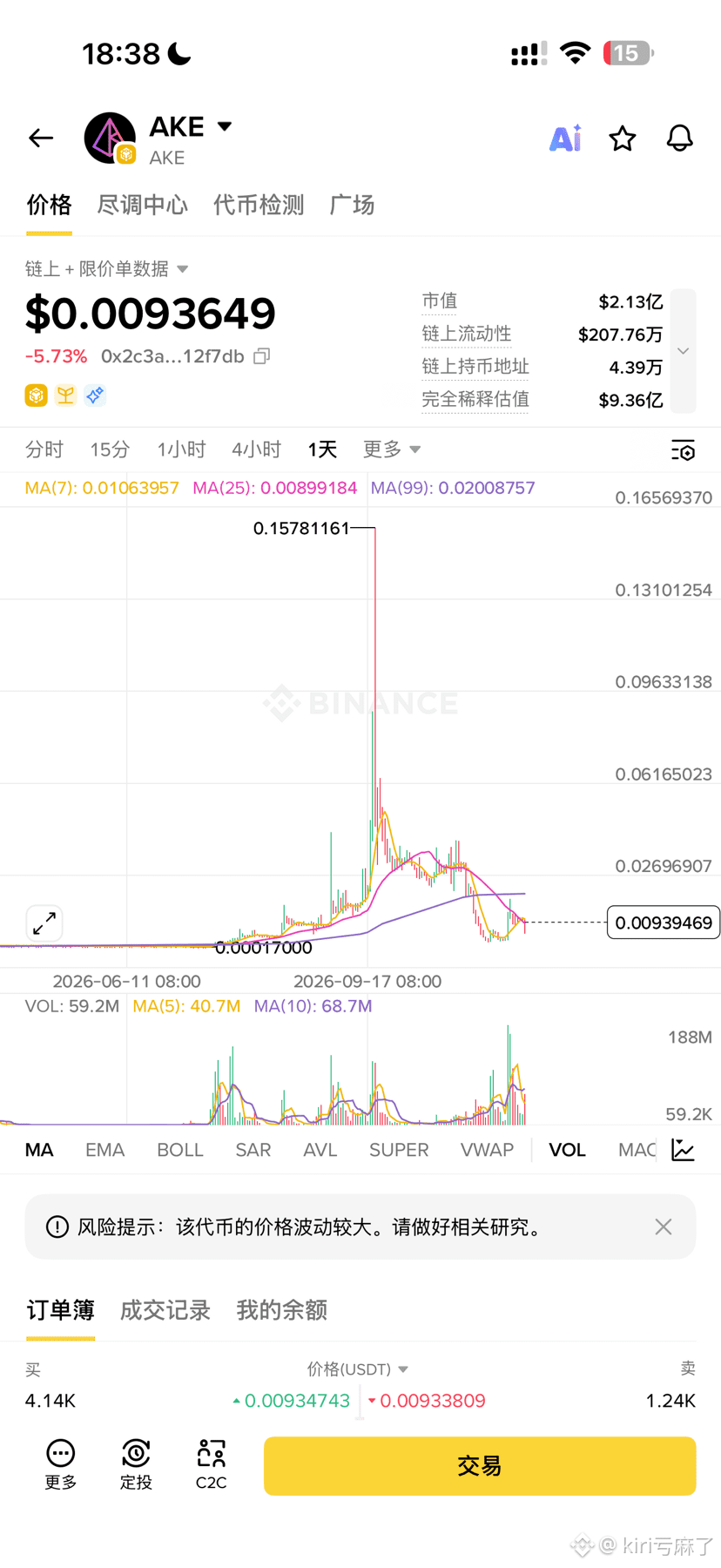
$AKE This cursed coin killed people again today
I checked at market open and it was down another ten-odd percent, to somewhere around 0.008-something to 0.009—felt pretty familiar. I’ve been watching this coin for a while. It’s Akedo, the AI game-making project on the BNB Chain that turns natural language directly into playable games. Its market cap is just over $200 million, with 22.8 billion in circulation and a total supply of 100 billion. Futures trading is far wilder than spot, and the price can swing all over the place in a single day.
The major holders are a pretty typical concentrated small-cap crowd. The top ten wallets hold nearly half the supply, and the top 100 hold almost 90%. The largest wallet alone has over 100 billion tokens. Recently, most on-chain activity has been wallet-to-wallet transfers. One address has also been adding to its position over the past two days, which feels more like insiders adjusting their holdings than a large-scale dump onto exchanges. There hasn’t been any obvious large spot selling, and exchange inflows and outflows are fairly balanced. But with holdings this concentrated, if anyone makes a move, the price can easily be sent soaring or tumbling.
I think the main reason for today’s drop is that the unlock scheduled for tomorrow (the 21st) is being priced in early. About 2.1 billion tokens are due to be released, nearly 10% of the circulating supply, mainly to investors and insiders. They have the greatest incentive to sell, so the market is already getting nervous. This is a regular monthly event, and previous unlocks have also sent the price down several times. Add in the wild leverage in futures lately—there was even a day when the price surged severalfold before giving it all back—and the generally lukewarm sentiment around altcoins, and it’s easy for things to snowball into a sharp drop like this.
Personally, I’m leaning cautious from here. The price will probably remain choppy and weak around the unlock. The key thing to watch is whether a large amount of the unlocked tokens flows onto exchanges. If there’s a concentrated sell-off, the price could test lower levels again.
Over the medium to long term, it depends more on whether the fundamentals can keep up. Monthly unlocks are a long-term headwind. For now, the project is still being supported mostly by capital speculation and the AI narrative. Whether people actually use the games, and whether fees and token burns can gain traction, will determine whether it can hold up going forward. Small-cap coins with highly concentrated ownership and futures-driven prices carry real risks. Personally, I only dare to take a small position and set a stop-loss; I wouldn’t go in heavily or chase the price.
In short, tomorrow’s unlock is the biggest near-term variable. Watching on-chain flows and changes in holdings is more useful than listening to stories. This is just my personal opinion, not investment advice.
#加息预期叠加美股分流,比特币跌破6.2万美元
{future}(AKEUSDT)
$AKE This cursed coin killed people again today
I checked at market open and it was down another ten-odd percent, to somewhere around 0.008-something to 0.009—felt pretty familiar. I’ve been watching this coin for a while. It’s Akedo, the AI game-making project on the BNB Chain that turns natural language directly into playable games. Its market cap is just over $200 million, with 22.8 billion in circulation and a total supply of 100 billion. Futures trading is far wilder than spot, and the price can swing all over the place in a single day.
The major holders are a pretty typical concentrated small-cap crowd. The top ten wallets hold nearly half the supply, and the top 100 hold almost 90%. The largest wallet alone has over 100 billion tokens. Recently, most on-chain activity has been wallet-to-wallet transfers. One address has also been adding to its position over the past two days, which feels more like insiders adjusting their holdings than a large-scale dump onto exchanges. There hasn’t been any obvious large spot selling, and exchange inflows and outflows are fairly balanced. But with holdings this concentrated, if anyone makes a move, the price can easily be sent soaring or tumbling.
I think the main reason for today’s drop is that the unlock scheduled for tomorrow (the 21st) is being priced in early. About 2.1 billion tokens are due to be released, nearly 10% of the circulating supply, mainly to investors and insiders. They have the greatest incentive to sell, so the market is already getting nervous. This is a regular monthly event, and previous unlocks have also sent the price down several times. Add in the wild leverage in futures lately—there was even a day when the price surged severalfold before giving it all back—and the generally lukewarm sentiment around altcoins, and it’s easy for things to snowball into a sharp drop like this.
Personally, I’m leaning cautious from here. The price will probably remain choppy and weak around the unlock. The key thing to watch is whether a large amount of the unlocked tokens flows onto exchanges. If there’s a concentrated sell-off, the price could test lower levels again.
Over the medium to long term, it depends more on whether the fundamentals can keep up. Monthly unlocks are a long-term headwind. For now, the project is still being supported mostly by capital speculation and the AI narrative. Whether people actually use the games, and whether fees and token burns can gain traction, will determine whether it can hold up going forward. Small-cap coins with highly concentrated ownership and futures-driven prices carry real risks. Personally, I only dare to take a small position and set a stop-loss; I wouldn’t go in heavily or chase the price.
In short, tomorrow’s unlock is the biggest near-term variable. Watching on-chain flows and changes in holdings is more useful than listening to stories. This is just my personal opinion, not investment advice.
#加息预期叠加美股分流,比特币跌破6.2万美元
1
7
9.5k
·
--
Bearish
Verified
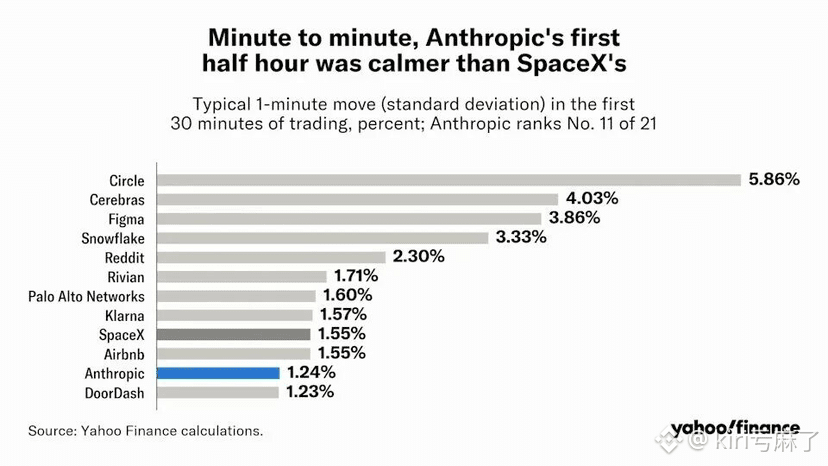
Anthropic’s opening was a frenzy: its first trade came in at around $12 billion, then surged to $15 billion within a minute—outpacing SpaceX and Alibaba at the time. But a comparison by Yahoo Finance showed that its first half-hour was the worst for a major U.S. IPO since 2008, with buyers quickly turning into sellers.
The fundamentals are certainly impressive. By the end of October, annualized revenue had reached $81 billion, with nearly $17 billion in the third quarter alone, up 47% from the previous quarter. Enterprise customers are growing rapidly too: the number spending over $100,000 jumped from 1,500 at the end of last year to 11,900, while those spending over $1 million surpassed 1,900.
But the company still hasn’t settled into profitability. It posted an operating loss of $567 million in the third quarter, after earning nearly $1 billion the previous quarter. The swing was mainly driven by $5 billion in short-term compute commitments and $2 billion in non-cash donation matching. Compute is essential, and the donations were a special item, but investors aren’t very receptive right now to this “burn first, earn later” approach.
My feeling is that the opening surge was driven more by sentiment and investors looking for an exit. Revenue of $81 billion looks great, but to truly support its valuation, the company will need to show that it can turn growth into more sustainable profits and that customers will keep paying at a deep level. Going public is just the beginning; what happens next will most likely depend on earnings reports and competition. For ordinary investors, either be prepared to hold for the long term or just watch the spectacle—don’t let the trading volume cloud your judgment.
#Anthropic创纪录上市,1.5万亿美元市值合理吗?
{spot}(ANTBUSDT)
Anthropic’s opening was a frenzy: its first trade came in at around $12 billion, then surged to $15 billion within a minute—outpacing SpaceX and Alibaba at the time. But a comparison by Yahoo Finance showed that its first half-hour was the worst for a major U.S. IPO since 2008, with buyers quickly turning into sellers.
The fundamentals are certainly impressive. By the end of October, annualized revenue had reached $81 billion, with nearly $17 billion in the third quarter alone, up 47% from the previous quarter. Enterprise customers are growing rapidly too: the number spending over $100,000 jumped from 1,500 at the end of last year to 11,900, while those spending over $1 million surpassed 1,900.
But the company still hasn’t settled into profitability. It posted an operating loss of $567 million in the third quarter, after earning nearly $1 billion the previous quarter. The swing was mainly driven by $5 billion in short-term compute commitments and $2 billion in non-cash donation matching. Compute is essential, and the donations were a special item, but investors aren’t very receptive right now to this “burn first, earn later” approach.
My feeling is that the opening surge was driven more by sentiment and investors looking for an exit. Revenue of $81 billion looks great, but to truly support its valuation, the company will need to show that it can turn growth into more sustainable profits and that customers will keep paying at a deep level. Going public is just the beginning; what happens next will most likely depend on earnings reports and competition. For ordinary investors, either be prepared to hold for the long term or just watch the spectacle—don’t let the trading volume cloud your judgment.
#Anthropic创纪录上市,1.5万亿美元市值合理吗?
1
3.2k
·
--
Bearish
Verified
After the rate-hike hammer fell, Bitcoin’s “sell the rumor, buy the news” rebound looked more like a brief respite than a trend reversal.
The Fed’s October meeting minutes were clear: almost all officials thought further rate hikes were needed, and a few even suggested that if inflation data looked bad in December, a hike of more than 25 basis points could be considered. Markets had already priced in roughly a 97% chance of a 25-basis-point hike on December 9, so risk assets actually bounced a little after the news came out—a classic case of “selling the rumor, buying the news.”
But historically, Bitcoin has not reacted well to actual rate hikes. After many of the hikes since 2018, the probability of a decline within 30 days has been high, with median returns often negative. This time is no exception: after the minutes were released, BTC retested the area around $62,000, having fallen sharply from its previous high. Higher interest rates mean tighter dollar liquidity and rising risk-free yields, which are naturally unfavorable for high-risk assets like crypto.
Prices are currently fluctuating around $62,000–$63,000. Technically, the daily RSI has fallen to around 20, deep in oversold territory; the MACD remains below the zero line with a bearish crossover; and the price is far below the 20-day and 50-day moving averages and still cannot reclaim the 200-day moving average (roughly $67,000–$73,000). These indicators all suggest that short-term momentum remains bearish, and the rebound is more likely an oversold recovery than a trend reversal.
Key support levels:
First level: $62,000 (the weekend low and a level tested several times recently). This overlaps with an on-chain area of heavy coin turnover (around $62,000–$65,000). If it holds, there may first be room for a rebound to $64,000–$65,000.
Second level: the psychological threshold of $60,000. A break below it could easily trigger stop-losses and liquidations of leveraged positions.
Further down: $58,000–$59,000 (the July low area), followed by the medium-term value zone around $55,000 or even $50,000.
On-chain data shows a clear concentration of short-term holder cost bases in the $62,000–$65,000 range, making it a “value zone.” However, CryptoQuant also notes that the price has now fallen below the 200-day and 365-day moving averages. Overall, the market remains in a bear phase, with demand growth contracting.
My view: Oversold conditions can bring a short-term rebound, but with the Fed still on a rate-hiking path and ETF funds continuing to flow out, if $62,000 gives way, the price is more likely to head toward $60,000 or lower in search of genuine support.
{spot}(BTCUSDT)
#美联储纪要放鹰,比特币继续承压
After the rate-hike hammer fell, Bitcoin’s “sell the rumor, buy the news” rebound looked more like a brief respite than a trend reversal.
The Fed’s October meeting minutes were clear: almost all officials thought further rate hikes were needed, and a few even suggested that if inflation data looked bad in December, a hike of more than 25 basis points could be considered. Markets had already priced in roughly a 97% chance of a 25-basis-point hike on December 9, so risk assets actually bounced a little after the news came out—a classic case of “selling the rumor, buying the news.”
But historically, Bitcoin has not reacted well to actual rate hikes. After many of the hikes since 2018, the probability of a decline within 30 days has been high, with median returns often negative. This time is no exception: after the minutes were released, BTC retested the area around $62,000, having fallen sharply from its previous high. Higher interest rates mean tighter dollar liquidity and rising risk-free yields, which are naturally unfavorable for high-risk assets like crypto.
Prices are currently fluctuating around $62,000–$63,000. Technically, the daily RSI has fallen to around 20, deep in oversold territory; the MACD remains below the zero line with a bearish crossover; and the price is far below the 20-day and 50-day moving averages and still cannot reclaim the 200-day moving average (roughly $67,000–$73,000). These indicators all suggest that short-term momentum remains bearish, and the rebound is more likely an oversold recovery than a trend reversal.
Key support levels:
First level: $62,000 (the weekend low and a level tested several times recently). This overlaps with an on-chain area of heavy coin turnover (around $62,000–$65,000). If it holds, there may first be room for a rebound to $64,000–$65,000.
Second level: the psychological threshold of $60,000. A break below it could easily trigger stop-losses and liquidations of leveraged positions.
Further down: $58,000–$59,000 (the July low area), followed by the medium-term value zone around $55,000 or even $50,000.
On-chain data shows a clear concentration of short-term holder cost bases in the $62,000–$65,000 range, making it a “value zone.” However, CryptoQuant also notes that the price has now fallen below the 200-day and 365-day moving averages. Overall, the market remains in a bear phase, with demand growth contracting.
My view: Oversold conditions can bring a short-term rebound, but with the Fed still on a rate-hiking path and ETF funds continuing to flow out, if $62,000 gives way, the price is more likely to head toward $60,000 or lower in search of genuine support.
#美联储纪要放鹰,比特币继续承压

1
2
2.3k
·
--
Bullish
Verified
Nvidia has delivered its first earnings report without Jensen Huang, and it has underlined once again that “AI hasn’t peaked yet.”
Revenue came in at $115.8 billion, nearly $6 billion above Wall Street expectations. Data center revenue reached $107.6 billion, accounting for almost 93% of total revenue and more than doubling year over year. Around this time last year, people were still wondering whether growth would drop below 50%. Now it’s still running at around 100%. The Q4 forecast of $130 billion continues to beat analyst expectations, showing that order visibility remains very strong.
More interestingly, this is the first earnings report since Colette Kress temporarily took over as CEO. The market might have had some concerns about the “transition period,” but the numbers and buyback are speaking for themselves: $150 billion in authorized buybacks is management putting its money where its mouth is and saying, “We don’t think the current share price has priced in the future yet.”
The stock rose only around 2% after hours, with CoreWeave and Nebius moving along with it. That suggests the market already treats “beating expectations” as the norm. What it’s really pricing in is how long that norm can last. My view is that the near-term outlook remains positive. The exceptionally high share of data center revenue is precisely a sign that demand is concentrated in the most profitable, highest-barrier segment. As long as cloud providers and sovereign AI orders remain in the queue, Nvidia should do just fine.
Of course, that’s also where the risk lies. With 93% of revenue tied to data centers, any slowdown in demand will be magnified. But at least based on this earnings report, AI capital spending remains strong through the end of 2026, with no clear signs of a turning point yet.
As someone who has followed the company for a long time, for now I still see it as a “winner in a cycle,” rather than a story that has already peaked.
{future}(NVDAUSDT)
#英伟达财报大超预期,q4营收展望1300亿美元
Nvidia has delivered its first earnings report without Jensen Huang, and it has underlined once again that “AI hasn’t peaked yet.”
Revenue came in at $115.8 billion, nearly $6 billion above Wall Street expectations. Data center revenue reached $107.6 billion, accounting for almost 93% of total revenue and more than doubling year over year. Around this time last year, people were still wondering whether growth would drop below 50%. Now it’s still running at around 100%. The Q4 forecast of $130 billion continues to beat analyst expectations, showing that order visibility remains very strong.
More interestingly, this is the first earnings report since Colette Kress temporarily took over as CEO. The market might have had some concerns about the “transition period,” but the numbers and buyback are speaking for themselves: $150 billion in authorized buybacks is management putting its money where its mouth is and saying, “We don’t think the current share price has priced in the future yet.”
The stock rose only around 2% after hours, with CoreWeave and Nebius moving along with it. That suggests the market already treats “beating expectations” as the norm. What it’s really pricing in is how long that norm can last. My view is that the near-term outlook remains positive. The exceptionally high share of data center revenue is precisely a sign that demand is concentrated in the most profitable, highest-barrier segment. As long as cloud providers and sovereign AI orders remain in the queue, Nvidia should do just fine.
Of course, that’s also where the risk lies. With 93% of revenue tied to data centers, any slowdown in demand will be magnified. But at least based on this earnings report, AI capital spending remains strong through the end of 2026, with no clear signs of a turning point yet.
As someone who has followed the company for a long time, for now I still see it as a “winner in a cycle,” rather than a story that has already peaked.
#英伟达财报大超预期,q4营收展望1300亿美元
15
6
16.1k
·
--
Bearish
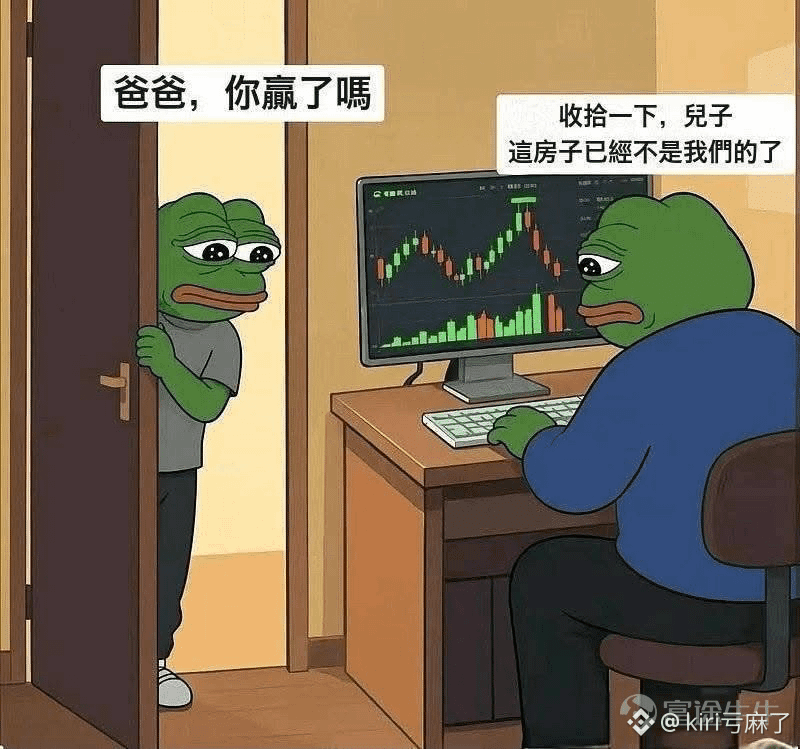
Trump just arrived in Shenzhen, and his home was robbed?
According to six people familiar with the matter, the highly classified network used by the U.S. National Security Agency (NSA) for internal communications is currently down. Known as “NSA Net,” the network is used by employees to exchange classified information internally. Sources said there is currently no evidence of a cyberattack. While assessing the extent of the problem, the agency has taken steps to stagger employees’ arrival times.
CNN has asked the National Security Agency for comment.
{spot}(BTCUSDT)
Trump just arrived in Shenzhen, and his home was robbed?
According to six people familiar with the matter, the highly classified network used by the U.S. National Security Agency (NSA) for internal communications is currently down. Known as “NSA Net,” the network is used by employees to exchange classified information internally. Sources said there is currently no evidence of a cyberattack. While assessing the extent of the problem, the agency has taken steps to stagger employees’ arrival times.
CNN has asked the National Security Agency for comment.
2
2
2.1k
·
--
This morning, $ASTER —heaven-and-earth needle. I just saw that Lighter may have been hacked. Is this never going to end?❓
A suspicious address withdrew about $10.39 million in USDC from Lighter, then immediately swapped it for roughly 5,400 ETH. The move was pretty decisive, and $LIT got dumped by around 10%. The person who posted about it said they weren’t 100% sure yet, but judging by the on-chain activity, it does look a lot like the classic cross-chain bridge or withdrawal vulnerability playbook.
So far, the team hasn’t responded. The hardest part in situations like this is the lack of complete information: the on-chain data is right there, while the team remains silent. Some people are already shouting “get out now,” while others think it could be FUD.
Lighter has faced a few risk incidents before. Some were contained by the system, while others caused panic. Whether this time it was really hacked, or someone is exploiting the panic to dump, won’t be clear until the team speaks up.
If you hold LIT, keep a close eye on the team’s response over the next few hours. Whether they’re going to let people use this as a chance to exit, or come out with a clarification or recovery plan, it’s too early to say. Don’t rush into making a move before the information is confirmed.
#本周财报与宏观事件密集,市场再迎波动考验
{future}(LITUSDT)
This morning, $ASTER —heaven-and-earth needle. I just saw that Lighter may have been hacked. Is this never going to end?❓
A suspicious address withdrew about $10.39 million in USDC from Lighter, then immediately swapped it for roughly 5,400 ETH. The move was pretty decisive, and $LIT got dumped by around 10%. The person who posted about it said they weren’t 100% sure yet, but judging by the on-chain activity, it does look a lot like the classic cross-chain bridge or withdrawal vulnerability playbook.
So far, the team hasn’t responded. The hardest part in situations like this is the lack of complete information: the on-chain data is right there, while the team remains silent. Some people are already shouting “get out now,” while others think it could be FUD.
Lighter has faced a few risk incidents before. Some were contained by the system, while others caused panic. Whether this time it was really hacked, or someone is exploiting the panic to dump, won’t be clear until the team speaks up.
If you hold LIT, keep a close eye on the team’s response over the next few hours. Whether they’re going to let people use this as a chance to exit, or come out with a clarification or recovery plan, it’s too early to say. Don’t rush into making a move before the information is confirmed.
#本周财报与宏观事件密集,市场再迎波动考验

2
2.1k
·
--
Bearish
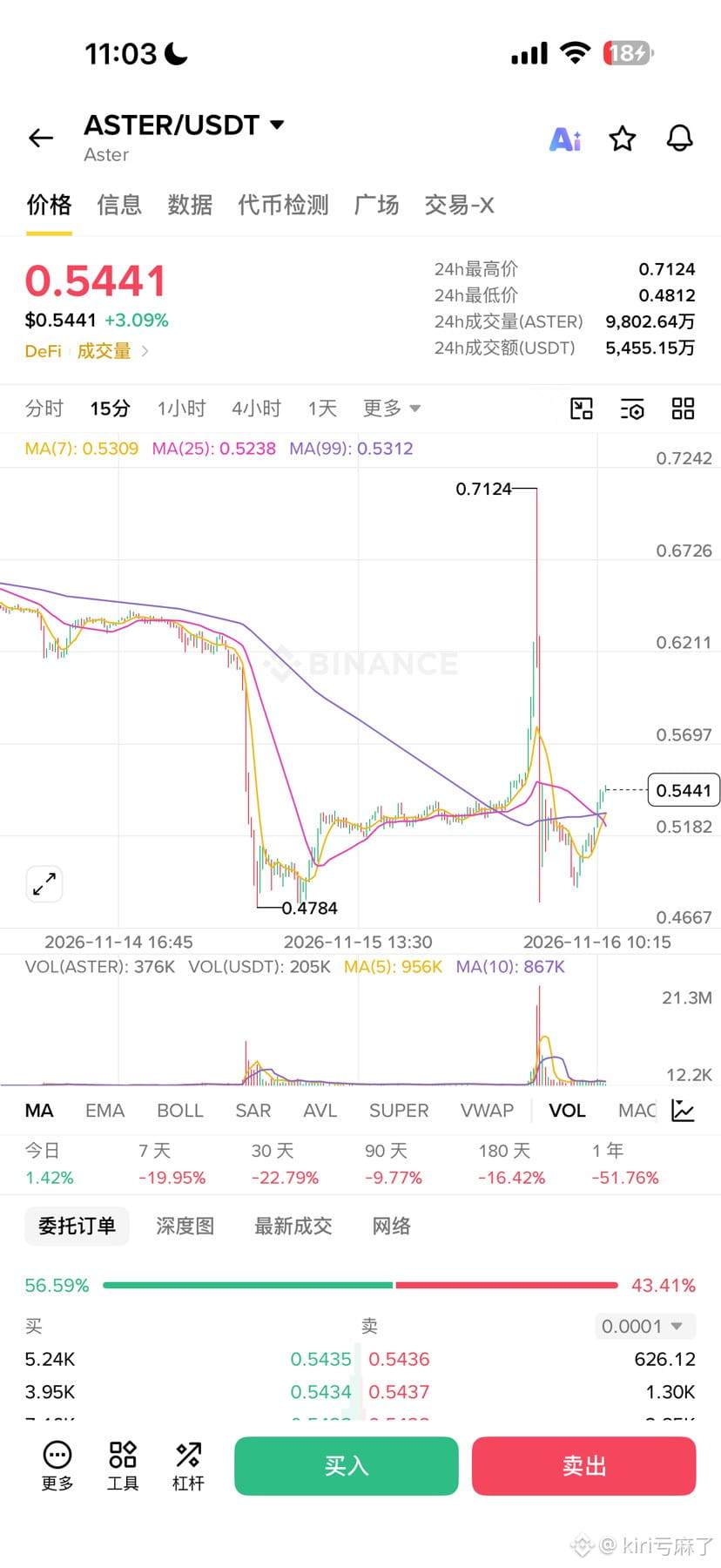
The biggest pitfall I fell into this year was $ASTER .
Stay away from $ASTER and you’ll stay away from misfortune.
#加密市场大幅回调,多名巨鲸遭遇清算
{spot}(ASTERUSDT)
The biggest pitfall I fell into this year was $ASTER .
Stay away from $ASTER and you’ll stay away from misfortune.
#加密市场大幅回调,多名巨鲸遭遇清算
Stay away from $ASTER and you’ll stay away from misfortune.
#加密市场大幅回调,多名巨鲸遭遇清算
2
1
1k
Log in to explore more content
Join global crypto users on Binance Square
⚡️ Get latest and useful information about crypto.
💬 Trusted by the world’s largest crypto exchange.
👍 Discover real insights from verified creators.
Email / Phone number
Trending Topics
CanMarketsReboundAfterThanksgiving?
48,030 views
868 Discussing
Rate-Hike Bets Linger as US Markets Head Into Thanksgiving Closure
Binance News
·2 Likes
·2.3k views
CouldSpaceX’sOrbitalDataCentersBoostAIChipDemand?
27,496 views
532 Discussing
EvolveAtBinanceBlockchainWeek
697,889 views
8,044 Discussing