
隔壁老七
16 Posts

隔壁老七
Report
Block User
平时看看行情,聊聊热点,偶尔分享点自己的想法。不一定都对,欢迎一起交流。
43 Following
108 Followers
24 Liked
Posts
·
--
$SAMSUNG
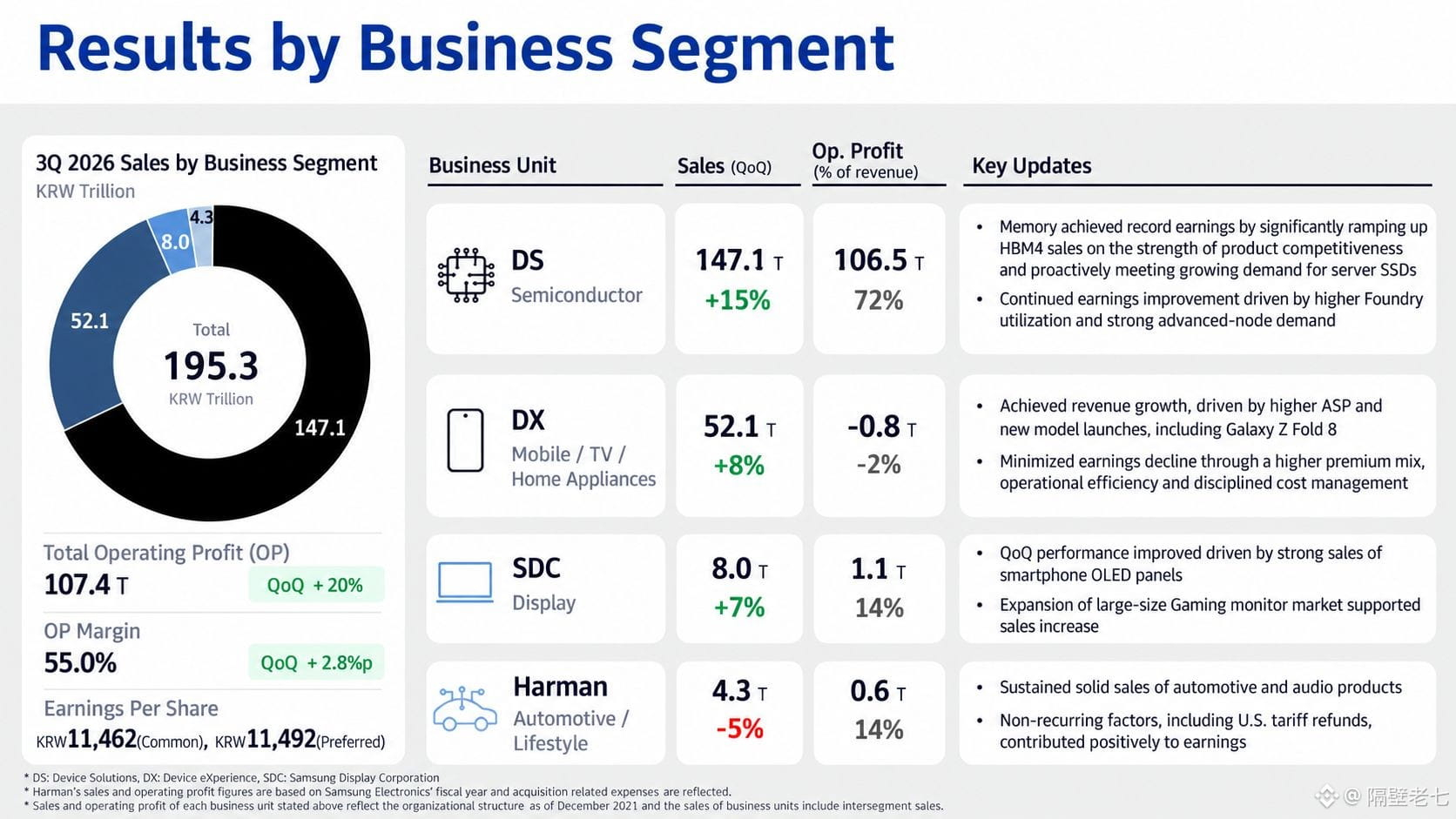
Samsung has just announced its Q3 2026 financial results:
Revenue: 195.3 trillion won, up 127% year over year
Operating profit: 107.4 trillion won, up 783% year over year
Even more remarkable, its operating margin reached 55%, setting new revenue and profit records for the fourth consecutive quarter!
The memory business is what really deserves attention.
Samsung's memory revenue in Q3 reached 140.7 trillion won, up a further 16.5% from 120.8 trillion won in Q2. Operating profit at its semiconductor division soared to 106.5 trillion won.
The biggest driver behind this is still AI.
HBM4 shipments have ramped up significantly, demand for server DRAM and enterprise SSDs continues to grow, and memory chip prices are strengthening across the board.
But more worth watching than Q3 profits is Samsung's outlook for 2027.
Samsung expects the supply-demand gap for memory chips in 2027 could be even more severe than in 2026, as investment in AI infrastructure continues to accelerate!
What does this mean?
AI is not only continuously consuming computing power, but also using up memory capacity. As long as demand continues to grow faster than supply, memory makers' pricing power could keep increasing.
However, there is one thing the market should be wary of: Samsung had already given an advance forecast for Q3 profits, so some of the positive news may already be reflected in its share price.
These results are clearly positive for the global memory supply chain, and the medium-term outlook remains strong. But in the short term, investors should be prepared for a pullback once the good news is priced in.
What will really determine how far this rally can go is not just how much Samsung earns, but how long DRAM and NAND prices can keep rising, and whether new capacity coming online in 2027 can keep up with AI demand.
Is this supercycle in memory chips now halfway up the mountain, or already nearing its peak?
#三星电子 $
{future}(SAMSUNGEMUSDT)
#存储
$SAMSUNG
Samsung has just announced its Q3 2026 financial results:
Revenue: 195.3 trillion won, up 127% year over year
Operating profit: 107.4 trillion won, up 783% year over year
Even more remarkable, its operating margin reached 55%, setting new revenue and profit records for the fourth consecutive quarter!
The memory business is what really deserves attention.
Samsung's memory revenue in Q3 reached 140.7 trillion won, up a further 16.5% from 120.8 trillion won in Q2. Operating profit at its semiconductor division soared to 106.5 trillion won.
The biggest driver behind this is still AI.
HBM4 shipments have ramped up significantly, demand for server DRAM and enterprise SSDs continues to grow, and memory chip prices are strengthening across the board.
But more worth watching than Q3 profits is Samsung's outlook for 2027.
Samsung expects the supply-demand gap for memory chips in 2027 could be even more severe than in 2026, as investment in AI infrastructure continues to accelerate!
What does this mean?
AI is not only continuously consuming computing power, but also using up memory capacity. As long as demand continues to grow faster than supply, memory makers' pricing power could keep increasing.
However, there is one thing the market should be wary of: Samsung had already given an advance forecast for Q3 profits, so some of the positive news may already be reflected in its share price.
These results are clearly positive for the global memory supply chain, and the medium-term outlook remains strong. But in the short term, investors should be prepared for a pullback once the good news is priced in.
What will really determine how far this rally can go is not just how much Samsung earns, but how long DRAM and NAND prices can keep rising, and whether new capacity coming online in 2027 can keep up with AI demand.
Is this supercycle in memory chips now halfway up the mountain, or already nearing its peak?
#三星电子 $
#存储
716
·
--
South Korea’s two memory chip giants are set to report earnings this week.
$SKHYNIX reports on Wednesday, followed by $SAMSUNG on Thursday.
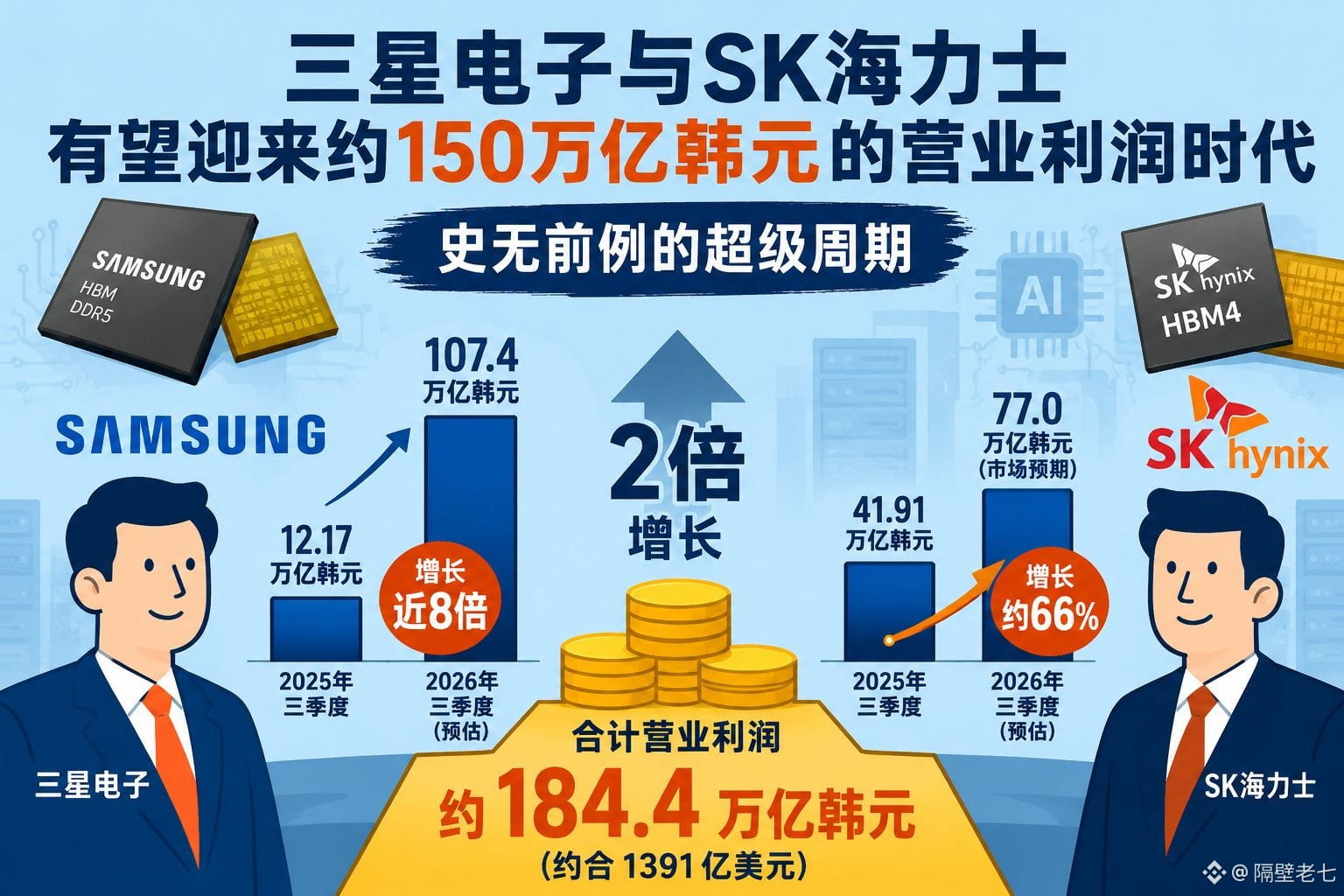
The market expects the two companies to post combined operating profits of 184.4 trillion won in the third quarter, up from just 90.8 trillion won in the same period last year—more than double. Samsung’s results are even more staggering: its profit is expected to be nearly nine times what it was a year ago.
In this AI boom, Nvidia sells computing power, while Samsung and SK Hynix sell memory. Demand for HBM in particular is soaring, driving up memory chip prices—and profits are taking off as a result.
Despite such strong results, their share prices are falling. Since early September, Samsung is down about 18%, and SK Hynix about 25%.
Put simply, the market already knows they’re making money. Now it wants to know whether they can keep making money next year.
The key things to watch in this week’s earnings reports aren’t just profits, but also HBM4 orders, how much further memory prices can rise, and AI giants’ purchasing plans for next year.
152
·
--
There are 9 days until the midterm elections, and the Democrats have already laid out their agenda for taking back power.
They’ve planned what they’ll do in their first 100 hours in office.
Restoring healthcare subsidies, reversing some healthcare cuts, reclaiming control over tariff decisions, and revisiting the Iran war are all back on the table.
If they also win the Senate, Trump’s room to govern over the next two years will be squeezed even further.
The Democrats are also prepared to use Congress’s investigative powers to scrutinize presidential pardons, government contracts, and the business ties between the Trump family and government officials.
CZ received a presidential pardon from Trump last year. If the Democrats retake Congress, the process behind the pardon and any related financial ties could once again come under scrutiny.
The Trump family’s cryptocurrency business is no different. Until now, people have discussed how much these projects might benefit from their connection to the president. Going forward, the question may be whether those ties could trigger a congressional investigation.
Cryptocurrency is becoming increasingly entangled with U.S. politics. Trump’s political troubles could gradually become trouble for the crypto industry, too. #Trump #美国中期选举 #CZ #BTC走势分析 #WLFI #美股
3
2.7k
·
--
With this much trading, you’d think Trump had opened a brokerage office in the White House.
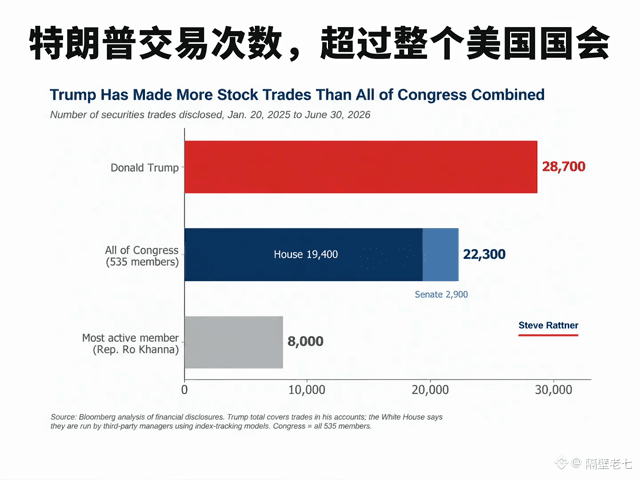
Bloomberg counted 28,700 securities transactions disclosed in accounts under Trump’s name from January 2025 through the end of June 2026. All 535 members of the U.S. Congress combined made just 22,300.
One person racked up more trades than the entire Congress.
So how much did he make? A third-party estimate puts the portfolio’s return at 35.87% in 2025, while the S&P 500 rose just 18.01% over the same period. Impressive, indeed.
But 2026 was less spectacular: the portfolio gained 13.98%, while the S&P 500 rose 14.25%—a slight underperformance.
The White House says the accounts are managed by third-party asset managers, and that Trump and his family don’t take part in trading decisions. As for how much was actually made, the disclosures don’t include exact transaction prices, so outsiders can’t calculate it precisely.
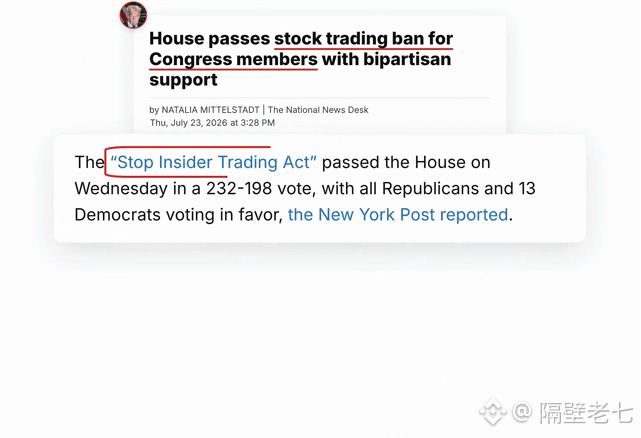
More interestingly, Trump has publicly supported restricting stock trading by members of Congress. Yet the related bill passed by the House in July did not include the president in its restrictions.
Members of Congress face rules on stock trading, but 28,700 transactions in the president’s accounts aren’t covered by this ban.
The rules certainly draw a clear line. #USStocks #StockInvesting #SP500 #WallStreet #Trump #StockTrading $SPY $QQQ $NVDA
1
285
·
--
Three straight days of gains on the S&P 500—and then a single down day wiped them out. That’s how quickly sentiment can turn.
Since 2010, this pattern has occurred 16 times. There’s no clear short-term trend, but the index was higher two months later in 14 cases, with an average gain of 3%.
Still, don’t focus only on the upside. The average maximum drawdown over those two months was 3.6%, and in the worst case the index fell 11.6% along the way. Even if you get the direction right, it can be hard to stay invested.
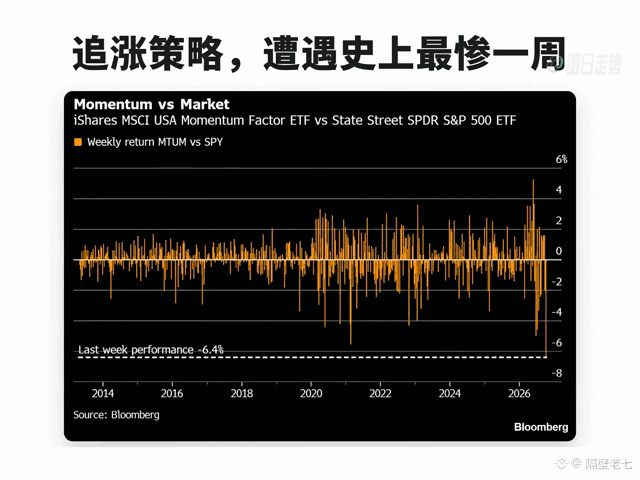
One striking data point: momentum strategies, which had been outperforming, underperformed the S&P 500 by a full 6.4% last week—their worst week since the related ETF launched in 2013. In other words, the stocks that had surged the most took a serious hit.
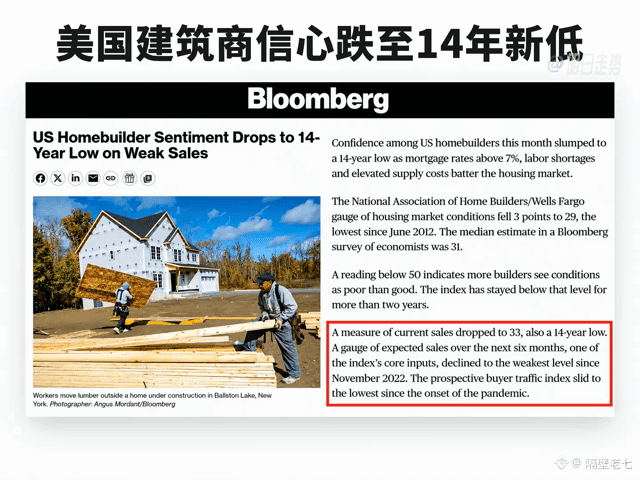
The U.S. housing market is also deeply sluggish. The homebuilder confidence index fell to 29, while the current sales index hit 33—both 14-year lows. Mortgage rates remain high, and construction costs aren’t coming down, making homes harder to sell.
My take: I wouldn’t count on a rebound just because history points that way. With leading stocks suddenly reversing and housing still this weak, the market ahead could be difficult to navigate.
$QQQ $BTC
638
·
--
Partly True
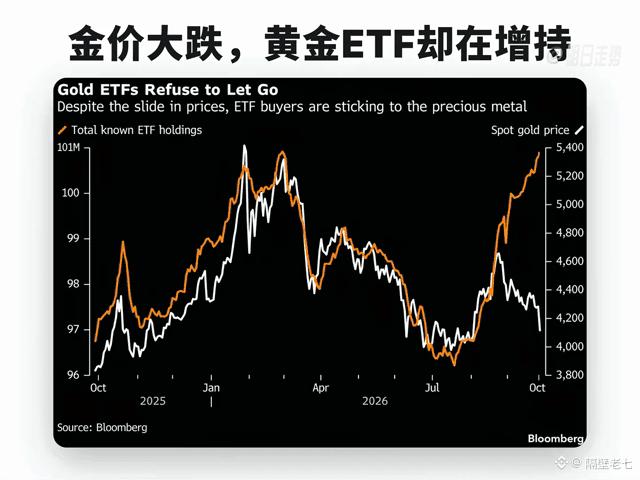
Gold has taken quite a hit in this downturn, but what’s interesting is that holdings in gold ETFs have actually climbed back up.
Global gold ETF holdings were close to 101 million ounces in March, then fell to around 96.3 million ounces by the end of July. But starting in August, investors began adding holdings again, and by October they were nearly back to their previous high. Gold prices, however, didn’t keep pace, falling from above $4,600 back to around $4,100.
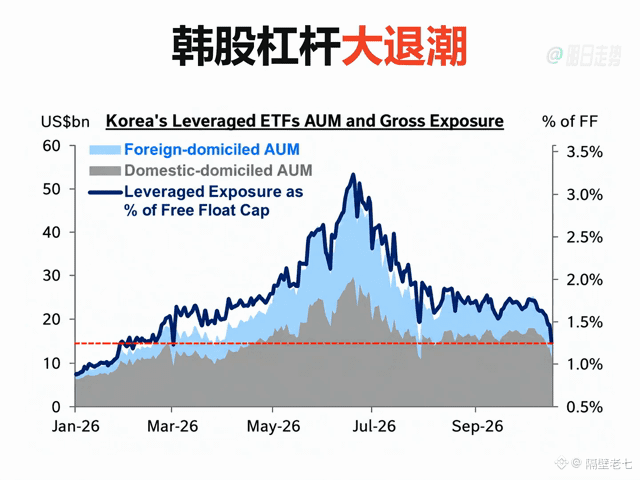
The Korean stock market hasn’t been nearly as upbeat. The size of leveraged ETFs shrank from a peak of over $50 billion in June to around $15 billion in October—a drop of about 70%. Leveraged exposure also fell from over 3% to 1.2%, as much of the leveraged money that had piled in earlier pulled out.
U.S. stocks, on the other hand, have shown a fairly rare signal. The S&P 500 fell more than 1% in a single day, and for the next two days, it stayed within that day’s range.
According to the historical statistics shown in the video, all 10 previous instances of a similar pattern were followed by gains three months later, with an average return of 8.4%. But the ride in between wasn’t easy: the average maximum drawdown was 3.8%.
So I think this historical data on U.S. stocks is worth watching, but don’t focus only on the gains after three months—the drawdown along the way matters too. #Gold #GoldETF #USStocks #SP500 #$XAU
{future}(XAUUSDT)
Gold has taken quite a hit in this downturn, but what’s interesting is that holdings in gold ETFs have actually climbed back up.
Global gold ETF holdings were close to 101 million ounces in March, then fell to around 96.3 million ounces by the end of July. But starting in August, investors began adding holdings again, and by October they were nearly back to their previous high. Gold prices, however, didn’t keep pace, falling from above $4,600 back to around $4,100.
The Korean stock market hasn’t been nearly as upbeat. The size of leveraged ETFs shrank from a peak of over $50 billion in June to around $15 billion in October—a drop of about 70%. Leveraged exposure also fell from over 3% to 1.2%, as much of the leveraged money that had piled in earlier pulled out.
U.S. stocks, on the other hand, have shown a fairly rare signal. The S&P 500 fell more than 1% in a single day, and for the next two days, it stayed within that day’s range.
According to the historical statistics shown in the video, all 10 previous instances of a similar pattern were followed by gains three months later, with an average return of 8.4%. But the ride in between wasn’t easy: the average maximum drawdown was 3.8%.
So I think this historical data on U.S. stocks is worth watching, but don’t focus only on the gains after three months—the drawdown along the way matters too. #Gold #GoldETF #USStocks #SP500 #$XAU
616
Log in to explore more content
Join global crypto users on Binance Square
⚡️ Get latest and useful information about crypto.
💬 Trusted by the world’s largest crypto exchange.
👍 Discover real insights from verified creators.
Email / Phone number
Trending Topics
CanBTCReboundAfterFallingBelow60K?
365,279 views
1,540 Discussing
Bitcoin News | Bitcoin Falls Below $60,000 for the First Time Since July as IBIT Posts Record $541 Million Outflow
Binance News
·52 Likes
·99.7k views
GlobalStocksFaceLongestLosingStreakSince2023
122,357 views
1,092 Discussing
BlackRockIBITPostsRecord$541MSingleDayOutflow
692 views
17 Discussing