
thezx
8k Posts

thezx
Report
Block User
Don't blame yourself for yesterday. X:@oldmanzx
Open Trade
High-Frequency Trader
3.6 Years
5 Following
591 Followers
2.1K+ Liked
Posts
Portfolio
All
Quotes
Live
·
--
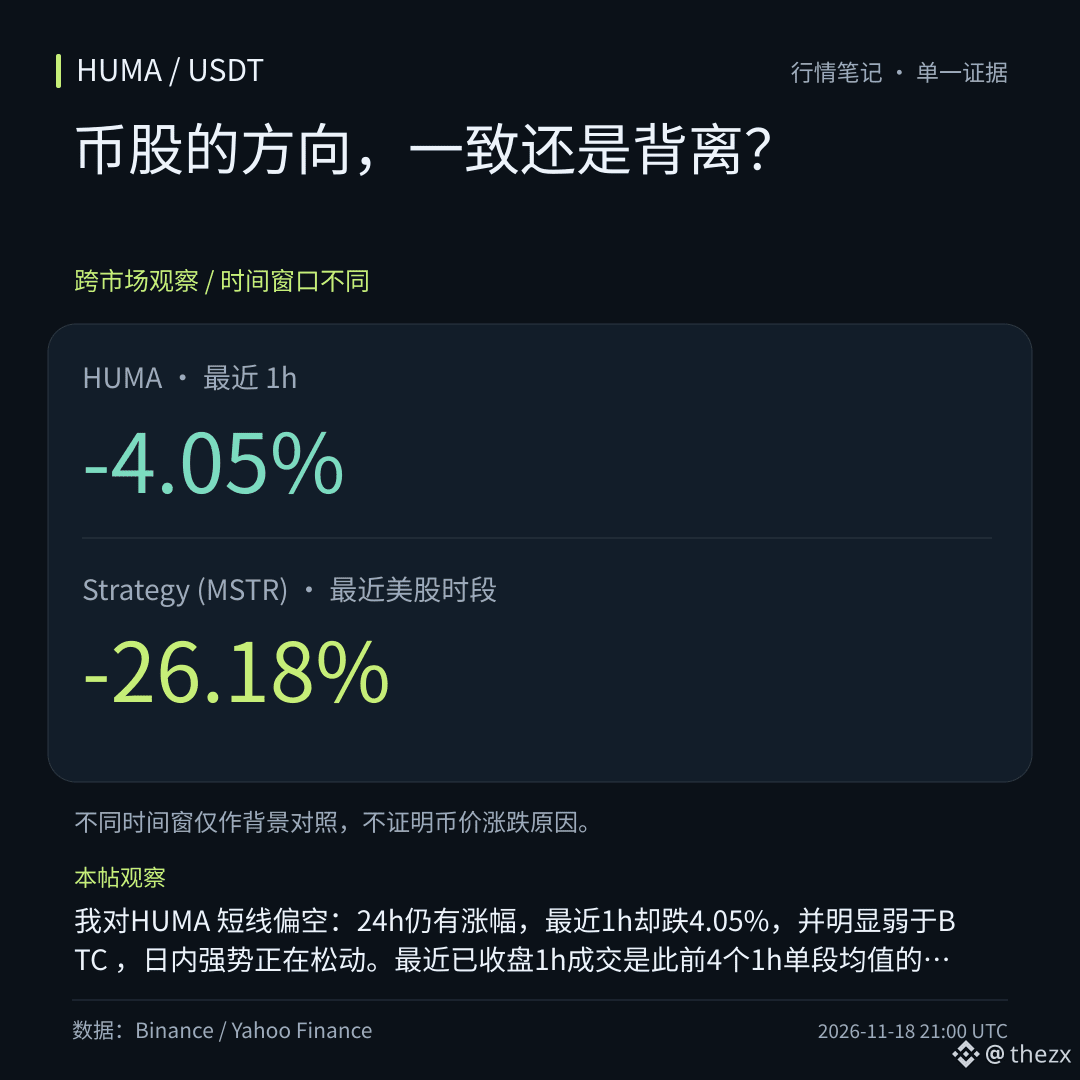
I am short-term bearish on $HUMA : it still has a 24h gain, but it has dropped 4.05% in the last 1h and is clearly weaker than $BTC , with intraday strength now easing. The most recently closed 1h trading volume was 1.45 times the average of the prior four 1h intervals; the pullback has come with expanding activity, but volume does not equal net inflow. 🌐 Coinbase(COIN) also weakened in the most recent U.S. stock trading session; the time windows differ, so this can only serve as corroborating evidence and not support causal inference. If future closes reclaim the upper band of the most recently closed 1h range, the assessment should be reevaluated.
I am short-term bearish on $HUMA : it still has a 24h gain, but it has dropped 4.05% in the last 1h and is clearly weaker than $BTC , with intraday strength now easing. The most recently closed 1h trading volume was 1.45 times the average of the prior four 1h intervals; the pullback has come with expanding activity, but volume does not equal net inflow. 🌐 Coinbase(COIN) also weakened in the most recent U.S. stock trading session; the time windows differ, so this can only serve as corroborating evidence and not support causal inference. If future closes reclaim the upper band of the most recently closed 1h range, the assessment should be reevaluated.
204
·
--
$ZEC 1 hours rose 1.26%, but my assessment of this performance remains neutral to moderately bullish: it outperformed by $BTC 0.66 percentage points. The anomaly is that the price strengthened first, while trading volume did not rise in tandem. 🟢
The key contradiction is that trading volume in the most recently closed hour was only 0.99 times the average hourly volume over the previous 4 hours, while sellers accounted for 51.7% of the top 20 order-book levels. This indicates relative short-term strength, but insufficient evidence that buying pressure will persist. If trading volume remains close to average going forward, the current gain is better viewed as localized strength rather than a confirmed trend signal.
The key contradiction is that trading volume in the most recently closed hour was only 0.99 times the average hourly volume over the previous 4 hours, while sellers accounted for 51.7% of the top 20 order-book levels. This indicates relative short-term strength, but insufficient evidence that buying pressure will persist. If trading volume remains close to average going forward, the current gain is better viewed as localized strength rather than a confirmed trend signal.
162
·
--
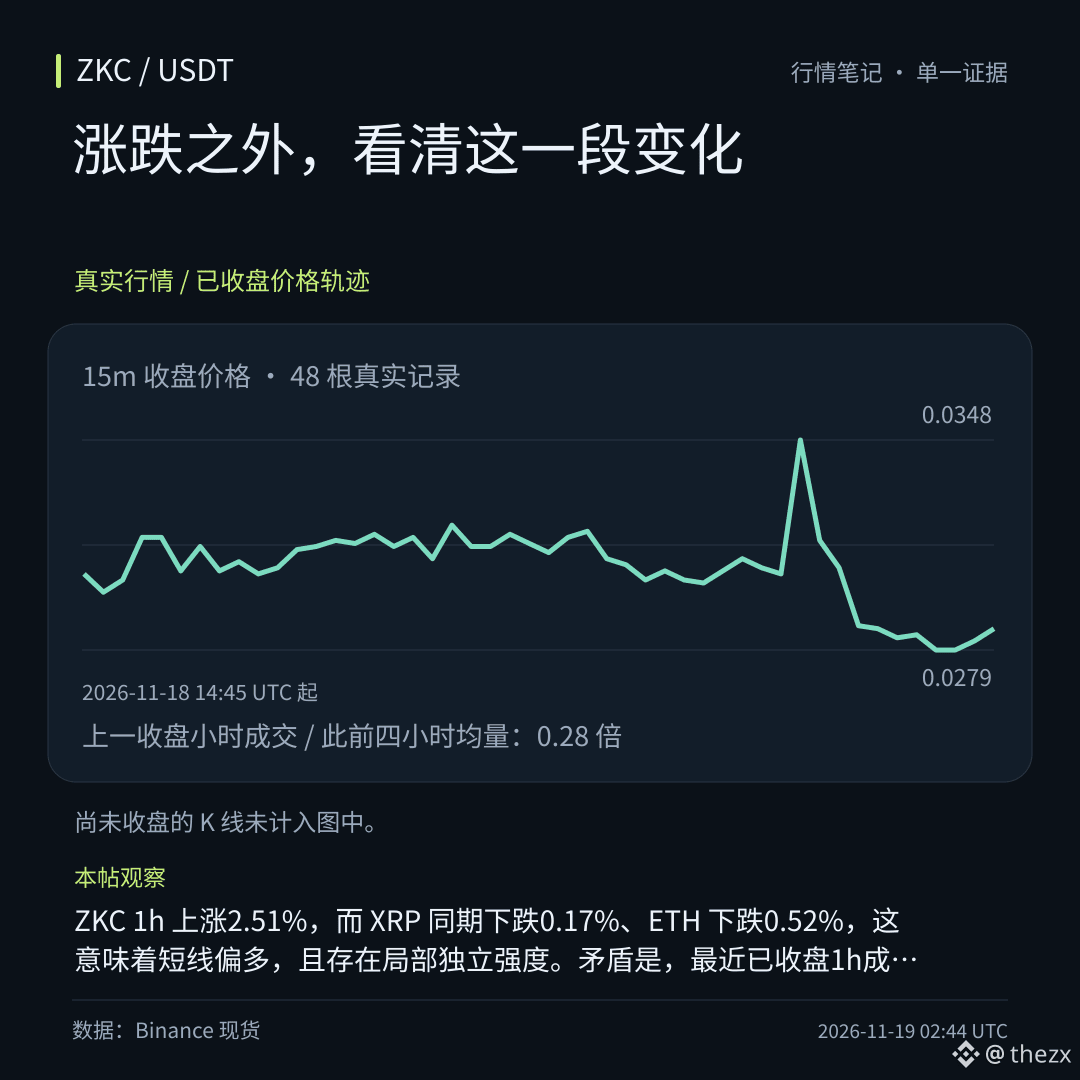
$ZKC 1h rose 2.51%, while $XRP fell 0.17% and $ETH fell 0.52% over the same period, indicating a short-term bullish bias and some localized relative strength. The caveat is that the most recently closed 1h trading volume was only 0.28 times the average hourly volume of the previous four 1h periods, so the price strength has not been confirmed by corresponding volume.
Therefore, the bullish view is plausible, but its strength remains constrained by volume. The 4h period is still down 5.92%, indicating that the short-term shift has not yet reversed the weakness on the larger time frame. Continued gains will be more credible if volume expands and the price holds its advance. If the price keeps rising on declining volume, the move is more likely a high-volatility spike, and the 1h performance should not be extrapolated directly.
Therefore, the bullish view is plausible, but its strength remains constrained by volume. The 4h period is still down 5.92%, indicating that the short-term shift has not yet reversed the weakness on the larger time frame. Continued gains will be more credible if volume expands and the price holds its advance. If the price keeps rising on declining volume, the move is more likely a high-volatility spike, and the 1h performance should not be extrapolated directly.
175
·
--
What is easiest to misread about $MMT is treating its 24h gain of 50.77% as the start of a new directional move. The most recent 1h period actually saw a 0.18% pullback, and the short-term difference versus $ETH is almost negligible, so there’s no need to chase this move for now.
Volume in the most recently closed 1h period was only slightly above the average for the previous four periods of the same length. This only shows that trading remains active; it’s not enough to prove that momentum is continuing to build. Reassess if the price moves out of its current trading range and volume continues to rise; otherwise, it remains difficult to tell whether this is turnover or a fading trend.
Volume in the most recently closed 1h period was only slightly above the average for the previous four periods of the same length. This only shows that trading remains active; it’s not enough to prove that momentum is continuing to build. Reassess if the price moves out of its current trading range and volume continues to rise; otherwise, it remains difficult to tell whether this is turnover or a fading trend.
249
·
--
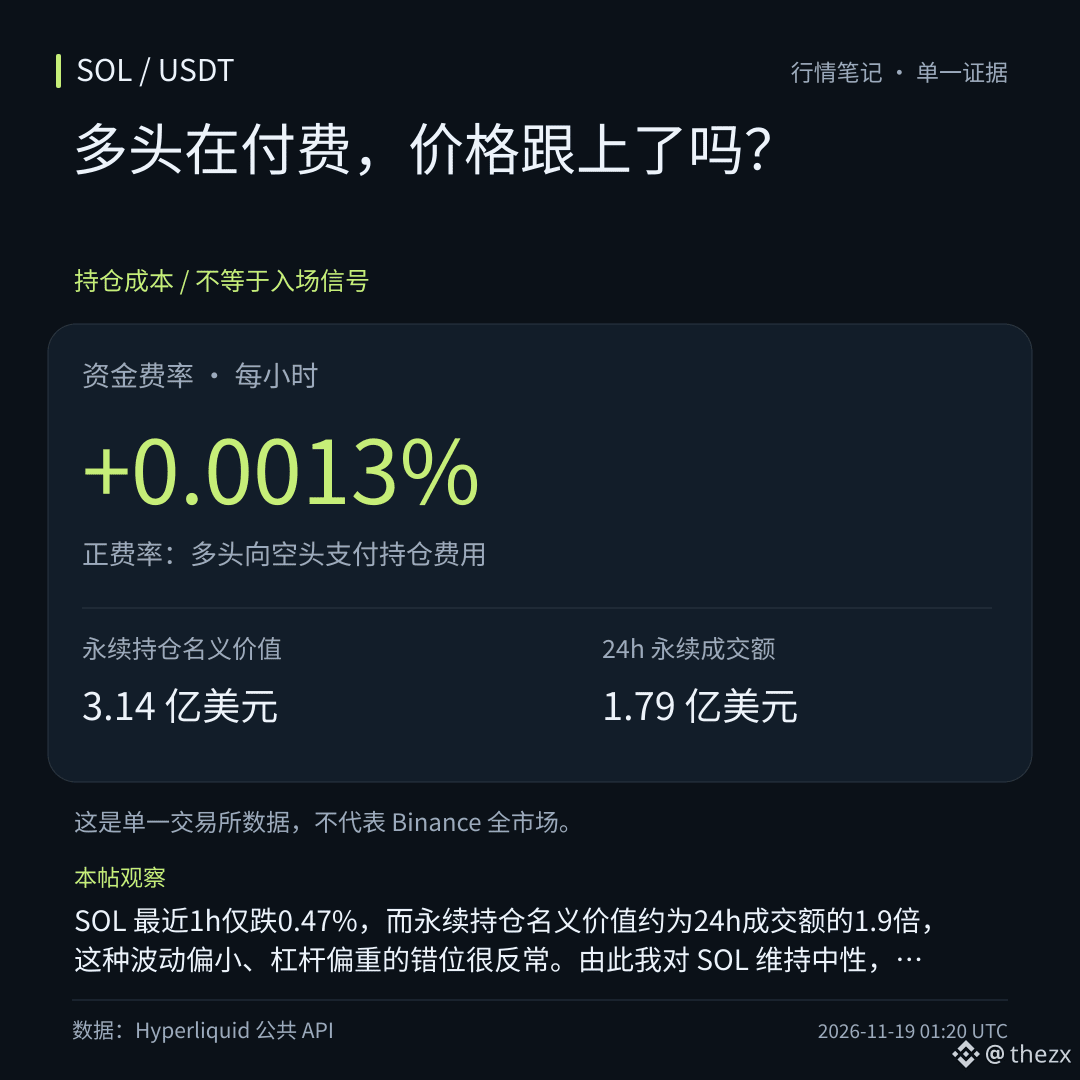
$SOL has fallen just 0.47% over the past 1h, while the notional value of perpetual positions is about 1.9 times the 24h trading volume. This unusually small move alongside heavy leverage is an abnormal divergence. I therefore maintain a neutral view on $SOL and will not chase a direction for now.
The reason is that positioning is already substantial, yet it has not pushed the short-term trend in either direction, suggesting possible crowding or hedging. The volume in the most recently closed 1h candle was 1.3 times the average hourly volume over the preceding 4h. Activity has increased, but this alone does not prove the direction of capital flows. The perpetual data comes from Hyperliquid's public API and does not represent the entire Binance market. I may reassess if price moves outside the 73.21–73.88 range of the most recently closed 1h candle, or if current relative strength persists even after open interest declines.
The reason is that positioning is already substantial, yet it has not pushed the short-term trend in either direction, suggesting possible crowding or hedging. The volume in the most recently closed 1h candle was 1.3 times the average hourly volume over the preceding 4h. Activity has increased, but this alone does not prove the direction of capital flows. The perpetual data comes from Hyperliquid's public API and does not represent the entire Binance market. I may reassess if price moves outside the 73.21–73.88 range of the most recently closed 1h candle, or if current relative strength persists even after open interest declines.
174
·
--
I'm still bullish on $BREV in the short term, but I wouldn't treat this rebound as a reversal just yet: it's still down 23.45% over 24h, though it's up 6.84% in the past 1h and clearly outperforming $SOL and $ETH in the short term. Volume in the most recently closed 1h candle was above the average of the previous 4 1h candles, with price and volume moving in the same direction 📈 But MSTR and COIN are weakening; this divergence means the evidence for a trend is still incomplete. If the short-term rally can't continue, I'll have to revise my view. $BREV
I'm still bullish on $BREV in the short term, but I wouldn't treat this rebound as a reversal just yet: it's still down 23.45% over 24h, though it's up 6.84% in the past 1h and clearly outperforming $SOL and $ETH in the short term. Volume in the most recently closed 1h candle was above the average of the previous 4 1h candles, with price and volume moving in the same direction 📈 But MSTR and COIN are weakening; this divergence means the evidence for a trend is still incomplete. If the short-term rally can't continue, I'll have to revise my view. $BREV
1
335
·
--
$NEAR is slightly bullish in the short term: it rose 3.22% over the most recent 1h, significantly outperforming $BTC , which suggests this move was not simply following the broader market. Trading volume over the past 24h was substantial, but that only reflects intraday activity; volume in the most recently closed 1h was 2.63 times the average hourly volume over the previous 4h. Trading activity has indeed expanded, but this cannot be directly attributed to new capital inflows.
Therefore, the current evidence only supports a short-term strength assessment. If the most recent U.S. trading session is weak and the crypto market's strength fails to continue, the bullish conclusion will need to be tempered.
Therefore, the current evidence only supports a short-term strength assessment. If the most recent U.S. trading session is weak and the crypto market's strength fails to continue, the bullish conclusion will need to be tempered.
281
·
--
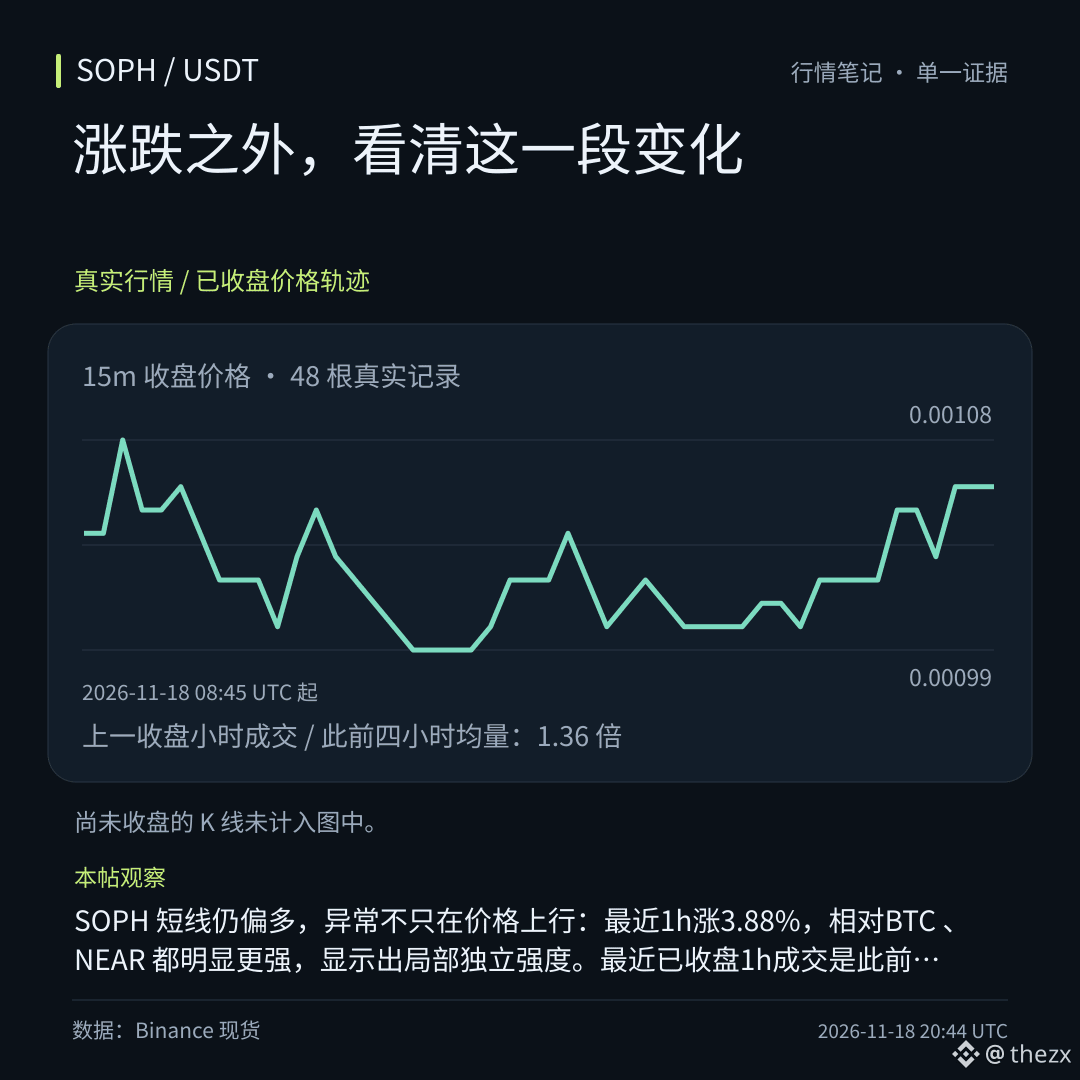
$SOPH remains biased bullish in the short term, and the anomaly is not limited to the price rise: it gained 3.88% over the past 1h, clearly outperforming $BTC and $NEAR , indicating localized independent strength. Volume in the most recently closed 1h period was 1.36 times the average of the previous four 1h periods, with price and volume moving in sync, but this is not enough to prove that new funds are flowing in. The counterpoint is that MSTR and COIN weakened during the latest U.S. trading session, so cross-market signals are not aligned; if this divergence widens, the outlook for continued gains should be more cautious.
$SOPH remains biased bullish in the short term, and the anomaly is not limited to the price rise: it gained 3.88% over the past 1h, clearly outperforming $BTC and $NEAR , indicating localized independent strength. Volume in the most recently closed 1h period was 1.36 times the average of the previous four 1h periods, with price and volume moving in sync, but this is not enough to prove that new funds are flowing in. The counterpoint is that MSTR and COIN weakened during the latest U.S. trading session, so cross-market signals are not aligned; if this divergence widens, the outlook for continued gains should be more cautious.
222
·
--
$ZEC fell 0.67% over the past hour, indicating a short-term bearish bias. Over the same period, $SOL rose 0.22%, leaving $ZEC underperforming by 0.88 percentage points. This suggests the weakness was not simply due to a broader market pullback.
The contradiction is that the notional value of open positions in Hyperliquid perpetuals is around $332 million, meaning positioning is already substantial, yet the decline remains limited. This suggests that leverage-related pressure has not yet fully translated into a deeper downturn. This positioning data comes from a single platform and cannot represent the entire Binance market. So there is a basis for a bearish view, but its strength will depend on whether price action and trading volume continue to confirm it.
The contradiction is that the notional value of open positions in Hyperliquid perpetuals is around $332 million, meaning positioning is already substantial, yet the decline remains limited. This suggests that leverage-related pressure has not yet fully translated into a deeper downturn. This positioning data comes from a single platform and cannot represent the entire Binance market. So there is a basis for a bearish view, but its strength will depend on whether price action and trading volume continue to confirm it.
367
·
--
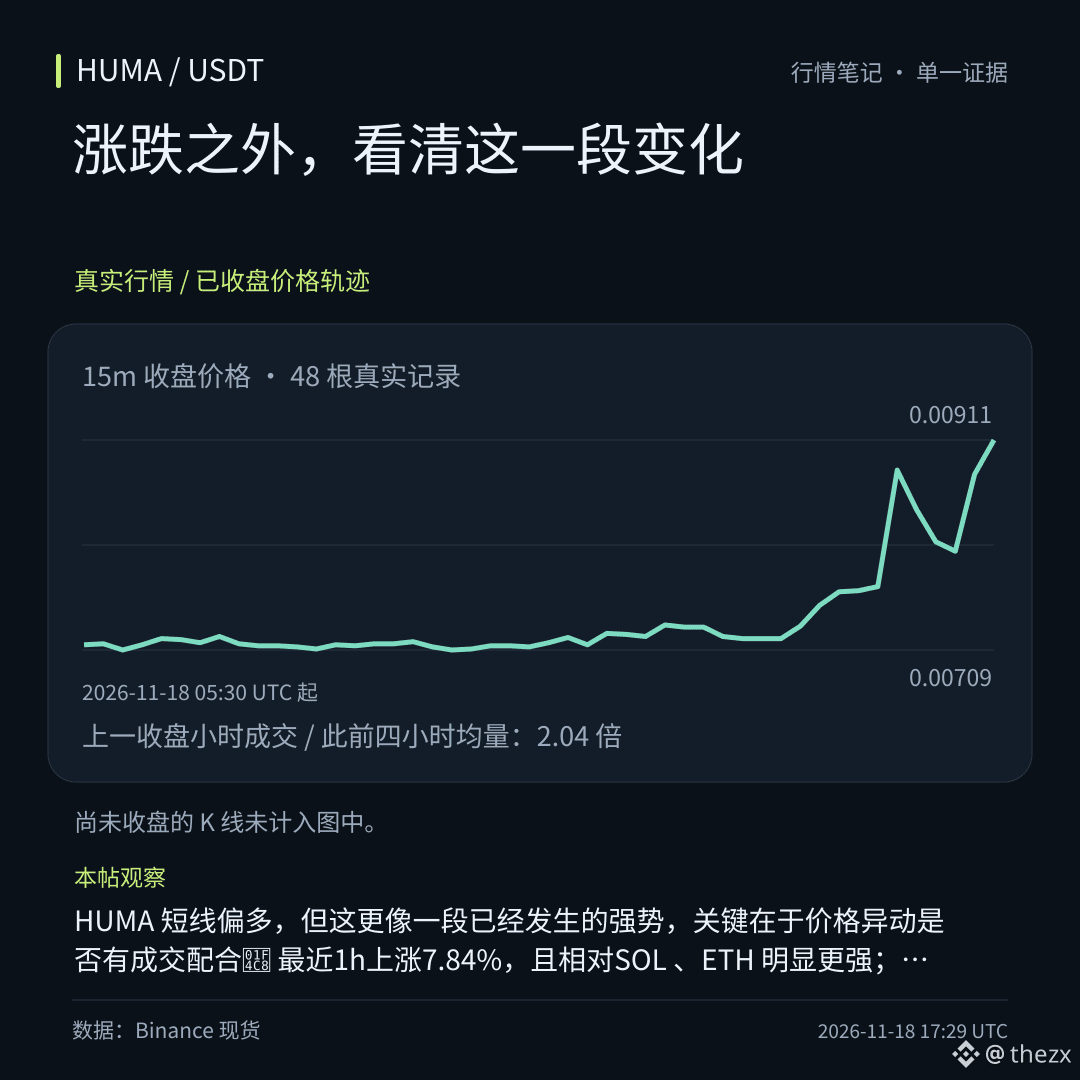
$HUMA is leaning bullish in the short term, but this looks more like strength that has already played out. The key question is whether the price move is backed by trading volume 📈 It rose 7.84% over the past 1h and significantly outperformed $SOL and $ETH . Volume in the most recently closed 1h period was 2.04 times the average hourly volume of the previous four 1h periods. Price and volume moved in the same direction, but that does not necessarily mean there was a net inflow. One counterpoint: during the most recent U.S. trading session, Strategy (MSTR) and Coinbase (COIN) weakened, diverging from $HUMA . If that weakness spreads to the crypto market, the bullish outlook should be tempered.
$HUMA is leaning bullish in the short term, but this looks more like strength that has already played out. The key question is whether the price move is backed by trading volume 📈 It rose 7.84% over the past 1h and significantly outperformed $SOL and $ETH . Volume in the most recently closed 1h period was 2.04 times the average hourly volume of the previous four 1h periods. Price and volume moved in the same direction, but that does not necessarily mean there was a net inflow. One counterpoint: during the most recent U.S. trading session, Strategy (MSTR) and Coinbase (COIN) weakened, diverging from $HUMA . If that weakness spreads to the crypto market, the bullish outlook should be tempered.
252
·
--
$SOXLB is bearish, with the anomaly being that it is still up 1.98% over 24 hours, while both the most recent 1-hour and 4-hour periods are down 3.70%. This indicates a clear divergence between the intraday rise and the short-term decline, with earlier gains being rapidly given back.
Cross-market evidence is also weak: during the most recent U.S. trading session, MSTR fell 25.26%, COIN fell 18.75%, and QQQ fell 5.07%. Their direction is consistent with $SOXLB , but this only shows that their performance moved in tandem; it does not imply causation and is not a real-time signal. The current assessment is based mainly on price changes. If short-term momentum strengthens again, the bearish conclusion should be reassessed.
Cross-market evidence is also weak: during the most recent U.S. trading session, MSTR fell 25.26%, COIN fell 18.75%, and QQQ fell 5.07%. Their direction is consistent with $SOXLB , but this only shows that their performance moved in tandem; it does not imply causation and is not a real-time signal. The current assessment is based mainly on price changes. If short-term momentum strengthens again, the bearish conclusion should be reassessed.
187
·
--
$MMT rose 97.89% over 24 hours, but trading volume in the most recently closed 1h period was only 0.76 times the average per hour across the previous four 1h periods. Price moved rapidly without a corresponding increase in volume, so the current assessment is neutral, with no edge for now. 🌊
A common misreading is to treat a one-day gain as evidence that the trend will continue. Outperforming $BTC by 0.72% only indicates stronger short-term performance; it does not by itself prove that a trend is established. The range in the most recently closed 1h period was 0.2314–0.249. Reassess only if the close breaks above the upper bound and volume in the most recently closed 1h period recovers. If volume remains below the average of the previous four hours, there is still insufficient evidence to support a bullish interpretation.
A common misreading is to treat a one-day gain as evidence that the trend will continue. Outperforming $BTC by 0.72% only indicates stronger short-term performance; it does not by itself prove that a trend is established. The range in the most recently closed 1h period was 0.2314–0.249. Reassess only if the close breaks above the upper bound and volume in the most recently closed 1h period recovers. If volume remains below the average of the previous four hours, there is still insufficient evidence to support a bullish interpretation.
7
·
--
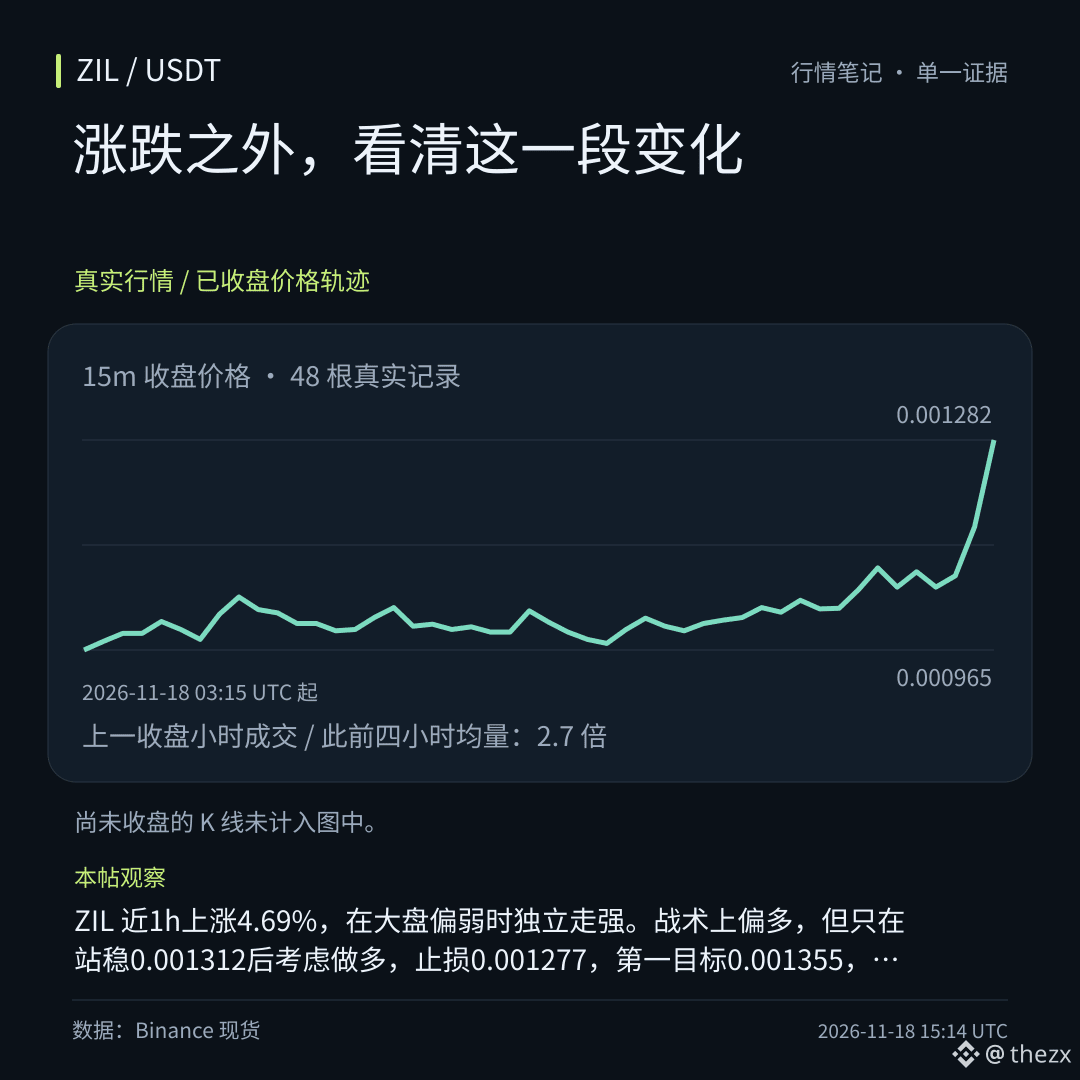
$ZIL rose 4.69% over the past 1h, showing independent strength while the broader market was weak. The tactical bias is bullish, but consider going long only after it holds above 0.001312; set a stop-loss at 0.001277 and a first target at 0.001355. Don’t chase at the current price.
The most recently closed 1h volume was 2.7 times the average volume of each 4h period before it, with price and volume expanding in tandem. During the same period, $BNB and $ETH both fell, making the relative strength in this segment clear. However, expanding volume does not by itself prove net capital inflows.
On the other hand, crypto-related stocks fell sharply during the most recent U.S. trading session, diverging from $ZIL . If it quickly falls below the support level after holding above it, the continuation thesis should be abandoned.
274
·
--
$SOXLB fell 7.04% over the past 1h, markedly underperforming $ETH and indicating a rapid deterioration in short-term relative strength. The current outlook is bearish.
The first piece of evidence comes from volume and price: trading volume in the most recently closed 1h period was 1.38 times the average hourly volume over the previous 4 hours. The price fell as volume expanded, but this does not necessarily mean net outflows. The second piece of evidence comes from cross-market data: during the most recent U.S. stock market session, MSTR fell 24.47%, weakening in the same direction as the asset in focus. This is independent corroborating evidence, not real-time correlation.
A specific counter-signal would be a recovery above the range of the previous closed 1h period, together with a marked narrowing of the underperformance relative to the aforementioned benchmark. If both occur, the bearish outlook should be downgraded.
17
·
--
$MU keeps falling every day—it has to fall every day. I'm not happy unless it falls. I'm so fed up.
$MU keeps falling every day—it has to fall every day. I'm not happy unless it falls. I'm so fed up.
400
·
--
What does $PIPPIN mean? Is the Shenzhen Bay tycoon's driver short of money again?
What does $PIPPIN mean? Is the Shenzhen Bay tycoon's driver short of money again?
150
·
--
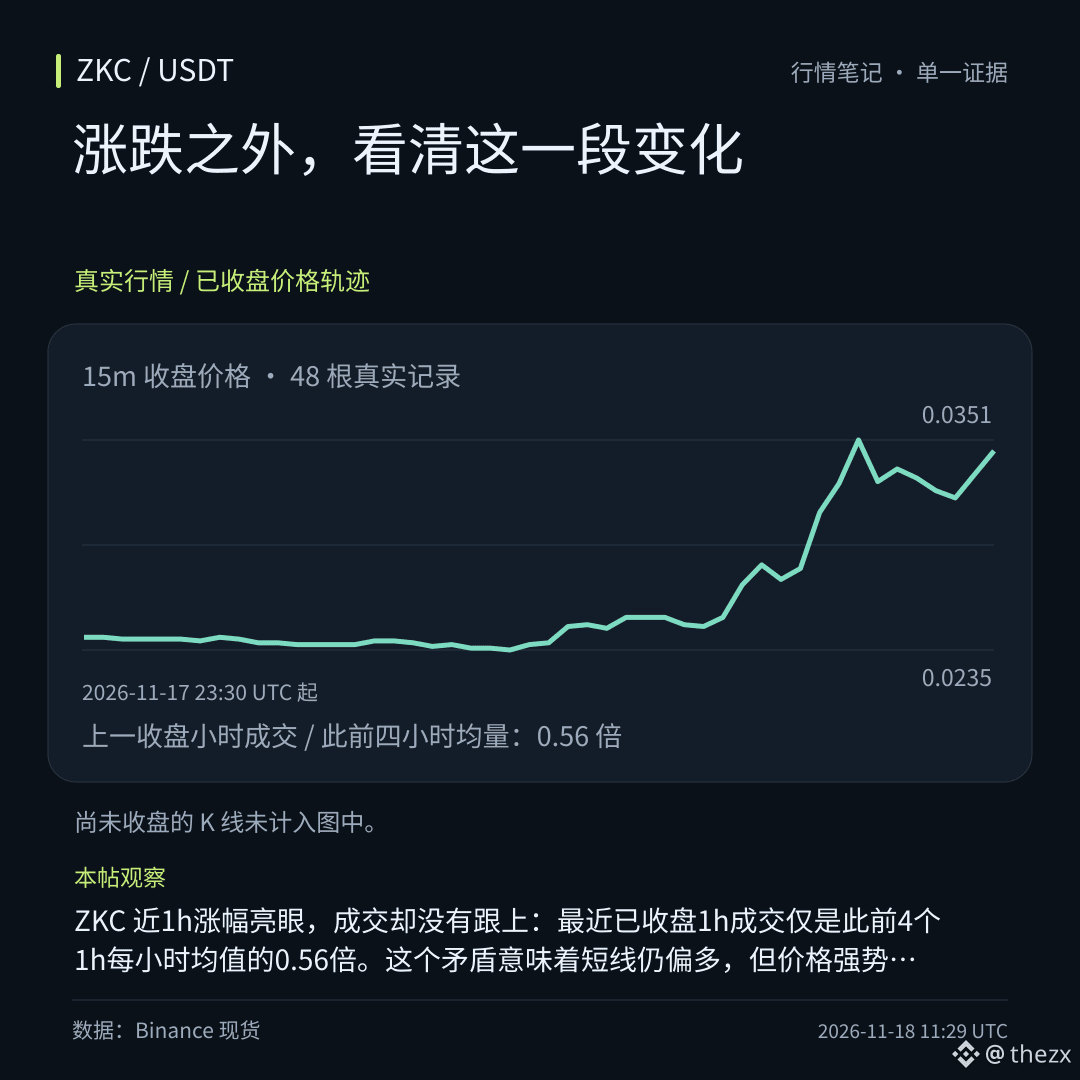
$ZKC posted an impressive gain over the past 1h, but trading volume failed to keep pace: volume in the most recently closed 1h period was only 0.56 times the average hourly volume of the previous four 1h periods. This contradiction suggests the short-term bias remains bullish, but the price strength has yet to be confirmed by volume 👀
Two facts support this view: its 1h performance was clearly stronger than that of $BNB and $ETH , suggesting its local strength is relatively independent; and bids in the top 20 levels accounted for 23.8%, with the order book structure also aligning with a bullish bias. The counterpoint is that MSTR fell 20.29% during the most recent US trading session. If external weakness persists and trading volume for $ZKC still fails to recover, the bullish view should be withdrawn.
Two facts support this view: its 1h performance was clearly stronger than that of $BNB and $ETH , suggesting its local strength is relatively independent; and bids in the top 20 levels accounted for 23.8%, with the order book structure also aligning with a bullish bias. The counterpoint is that MSTR fell 20.29% during the most recent US trading session. If external weakness persists and trading volume for $ZKC still fails to recover, the bullish view should be withdrawn.
179
·
--
$MMT is up 8.01% over the past 1h, significantly outperforming both $BTC and $BNB . This is not a broad-based rally. The short-term outlook is bullish, but don’t chase the price higher. The anomaly is that the price moved quickly while volume failed to keep up: volume in the most recently closed 1h period was only 0.44 times the average hourly volume of the preceding four 1h periods. The price move is confirmed, but there isn’t enough evidence that it will continue, and we can’t infer that new funds have entered. If the next closed 1h candle falls back into the previous closing range, the bullish outlook should be withdrawn.
$MMT is up 8.01% over the past 1h, significantly outperforming both $BTC and $BNB . This is not a broad-based rally. The short-term outlook is bullish, but don’t chase the price higher. The anomaly is that the price moved quickly while volume failed to keep up: volume in the most recently closed 1h period was only 0.44 times the average hourly volume of the preceding four 1h periods. The price move is confirmed, but there isn’t enough evidence that it will continue, and we can’t infer that new funds have entered. If the next closed 1h candle falls back into the previous closing range, the bullish outlook should be withdrawn.
332
·
--
$ZKP : Bearish outlook. It is still up 27.82% over 24h, but fell 6.75% in the most recent 1h. The strong performance today diverges markedly from the short-term trend, and it is also weaker than $BTC . During the latest U.S. trading session, Strategy (MSTR) also weakened, offering independent corroboration, but this is not a real-time signal and does not imply causation. One caveat: volume in the most recently closed 1h was lower than the average for the previous four 1h periods. If the price recovers alongside a pickup in volume, this assessment should be revisited.
$ZKP : Bearish outlook. It is still up 27.82% over 24h, but fell 6.75% in the most recent 1h. The strong performance today diverges markedly from the short-term trend, and it is also weaker than $BTC . During the latest U.S. trading session, Strategy (MSTR) also weakened, offering independent corroboration, but this is not a real-time signal and does not imply causation. One caveat: volume in the most recently closed 1h was lower than the average for the previous four 1h periods. If the price recovers alongside a pickup in volume, this assessment should be revisited.
223
·
--
Within $SOL , it is still up 3.30%, but over the most recent 1h it has fallen 0.44%. The short-term cycle has already weakened, so the bias is bearish, but this is only a tactical observation 👀 In the most recent U.S. stock trading session, Strategy (MSTR) also weakened in sync, which can serve as independent corroboration, but cannot be turned into causality. The easiest misread is to treat the intraday rise as a continuation of the trend; contract and order-book evidence are still insufficient to confirm that the decline will expand. Do not chase. Only if $SOL becomes stronger than $ETH again, and trading volume returns above the previous 4 one-hour averages, will the judgment change.
Within $SOL , it is still up 3.30%, but over the most recent 1h it has fallen 0.44%. The short-term cycle has already weakened, so the bias is bearish, but this is only a tactical observation 👀 In the most recent U.S. stock trading session, Strategy (MSTR) also weakened in sync, which can serve as independent corroboration, but cannot be turned into causality. The easiest misread is to treat the intraday rise as a continuation of the trend; contract and order-book evidence are still insufficient to confirm that the decline will expand. Do not chase. Only if $SOL becomes stronger than $ETH again, and trading volume returns above the previous 4 one-hour averages, will the judgment change.
136
Log in to explore more content
Join global crypto users on Binance Square
⚡️ Get latest and useful information about crypto.
💬 Trusted by the world’s largest crypto exchange.
👍 Discover real insights from verified creators.
Email / Phone number
Trending Topics
BTCRemainsUnderPressureAfterHawkishFOMCMinutes
24,923 views
358 Discussing
FOMC Minutes | Fed Minutes Show Almost All Officials Expect More Rate Hikes, With Some Open to a Larger December Move
Binance News
·39 Likes
·51.3k views
AnthropicToDebutAfter$83IPOPricing
8,072 views
42 Discussing
NvidiaBoardReportedlySplitOverHuang’sReturn
4,809 views
95 Discussing