

BlueTokenCapital
15.4k Posts
 LIVE
LIVEBlueTokenCapital
Report
Block User
Less hype. More research. Hunting alpha through data, narratives, and on-chain signals.
Open Trade

BTC Holder
High-Frequency Trader
5.5 Years
513 Following
6.6K+ Followers
31.0K+ Liked
Posts
Portfolio
All
Quotes
Videos
Live
PINNED
Verified
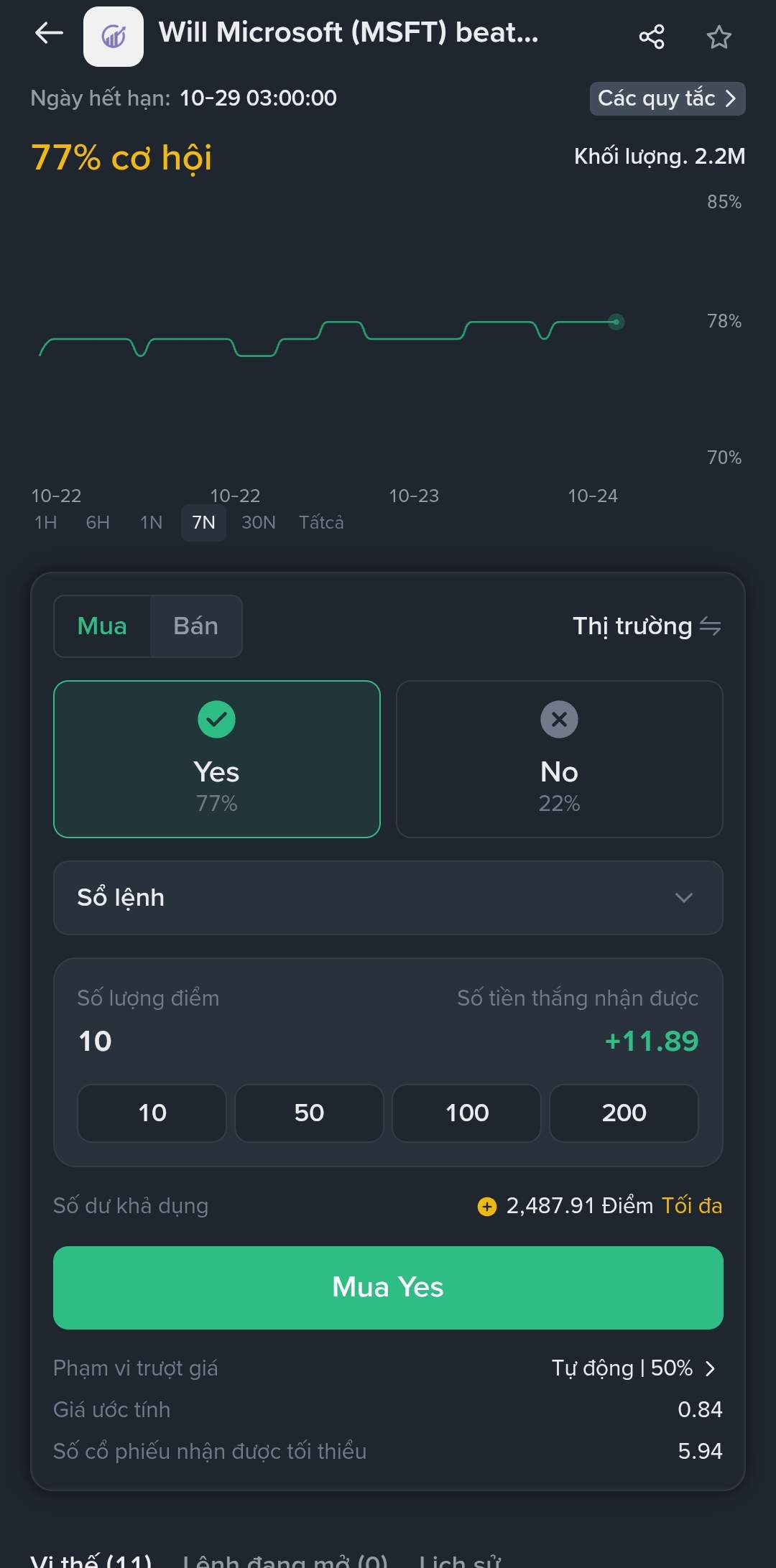
$MSFT : Is AI printing money or burning it? 🔥
On October 28, Microsoft will announce its FY2027 Q1 earnings. This could be one of the most important tests of the AI narrative next week.
📊 Key figures to watch:
- Forecast revenue: $90.63 billion, up 16.7% YoY.
- Forecast EPS: $4.71, up 14% YoY.
- Microsoft expects Azure to grow by around 45%.
- Quarterly capital spending is expected to exceed $50 billion.
Sources: "Microsoft Investor Relations" (https://www.microsoft.com/en-us/investor/events/fy-2026/earnings-fy-2026-q4), "FactSet estimates via Investors.com" (https://www.investors.com/news/technology/microsoft-stock-fiscal-q1-2027-earnings-preview/).
🔎 My view: LEANING BULLISH.
I lean toward Microsoft beating expectations if Azure continues to grow strongly. But don't confuse rising AI revenue with a corresponding increase in AI profits.
The market will be watching three things closely: Will Azure hit its 45% target? Will Copilot continue to generate real revenue? And can cash flow sustain the massive AI investment race?
My prediction: MSFT could rise after the report if cloud growth and next-quarter guidance are strong enough to offset concerns about capital spending. If it only beats on EPS but gives weak guidance, the stock could still fall.
Which scenario do you choose: MSFT rallies 📈 or sell the news 📉?
#EarningsSeason
Today's roll call: Sunday, October 25. Get 40 free points to join the prediction and share the 1M pool from the Binane exchange. FCFS. Hurry up, guys!
#BinancePick $XAU
$MSFT : Is AI printing money or burning it? 🔥
On October 28, Microsoft will announce its FY2027 Q1 earnings. This could be one of the most important tests of the AI narrative next week.
📊 Key figures to watch:
- Forecast revenue: $90.63 billion, up 16.7% YoY.
- Forecast EPS: $4.71, up 14% YoY.
- Microsoft expects Azure to grow by around 45%.
- Quarterly capital spending is expected to exceed $50 billion.
Sources: "Microsoft Investor Relations" (https://www.microsoft.com/en-us/investor/events/fy-2026/earnings-fy-2026-q4), "FactSet estimates via Investors.com" (https://www.investors.com/news/technology/microsoft-stock-fiscal-q1-2027-earnings-preview/).
🔎 My view: LEANING BULLISH.
I lean toward Microsoft beating expectations if Azure continues to grow strongly. But don't confuse rising AI revenue with a corresponding increase in AI profits.
The market will be watching three things closely: Will Azure hit its 45% target? Will Copilot continue to generate real revenue? And can cash flow sustain the massive AI investment race?
My prediction: MSFT could rise after the report if cloud growth and next-quarter guidance are strong enough to offset concerns about capital spending. If it only beats on EPS but gives weak guidance, the stock could still fall.
Which scenario do you choose: MSFT rallies 📈 or sell the news 📉?
#EarningsSeason
Today's roll call: Sunday, October 25. Get 40 free points to join the prediction and share the 1M pool from the Binane exchange. FCFS. Hurry up, guys!
#BinancePick $XAU
On October 28, Microsoft will announce its FY2027 Q1 earnings. This could be one of the most important tests of the AI narrative next week.
📊 Key figures to watch:
- Forecast revenue: $90.63 billion, up 16.7% YoY.
- Forecast EPS: $4.71, up 14% YoY.
- Microsoft expects Azure to grow by around 45%.
- Quarterly capital spending is expected to exceed $50 billion.
Sources: "Microsoft Investor Relations" (https://www.microsoft.com/en-us/investor/events/fy-2026/earnings-fy-2026-q4), "FactSet estimates via Investors.com" (https://www.investors.com/news/technology/microsoft-stock-fiscal-q1-2027-earnings-preview/).
🔎 My view: LEANING BULLISH.
I lean toward Microsoft beating expectations if Azure continues to grow strongly. But don't confuse rising AI revenue with a corresponding increase in AI profits.
The market will be watching three things closely: Will Azure hit its 45% target? Will Copilot continue to generate real revenue? And can cash flow sustain the massive AI investment race?
My prediction: MSFT could rise after the report if cloud growth and next-quarter guidance are strong enough to offset concerns about capital spending. If it only beats on EPS but gives weak guidance, the stock could still fall.
Which scenario do you choose: MSFT rallies 📈 or sell the news 📉?
#EarningsSeason
Today's roll call: Sunday, October 25. Get 40 free points to join the prediction and share the 1M pool from the Binane exchange. FCFS. Hurry up, guys!
#BinancePick $XAU

2
552
PINNED
Article
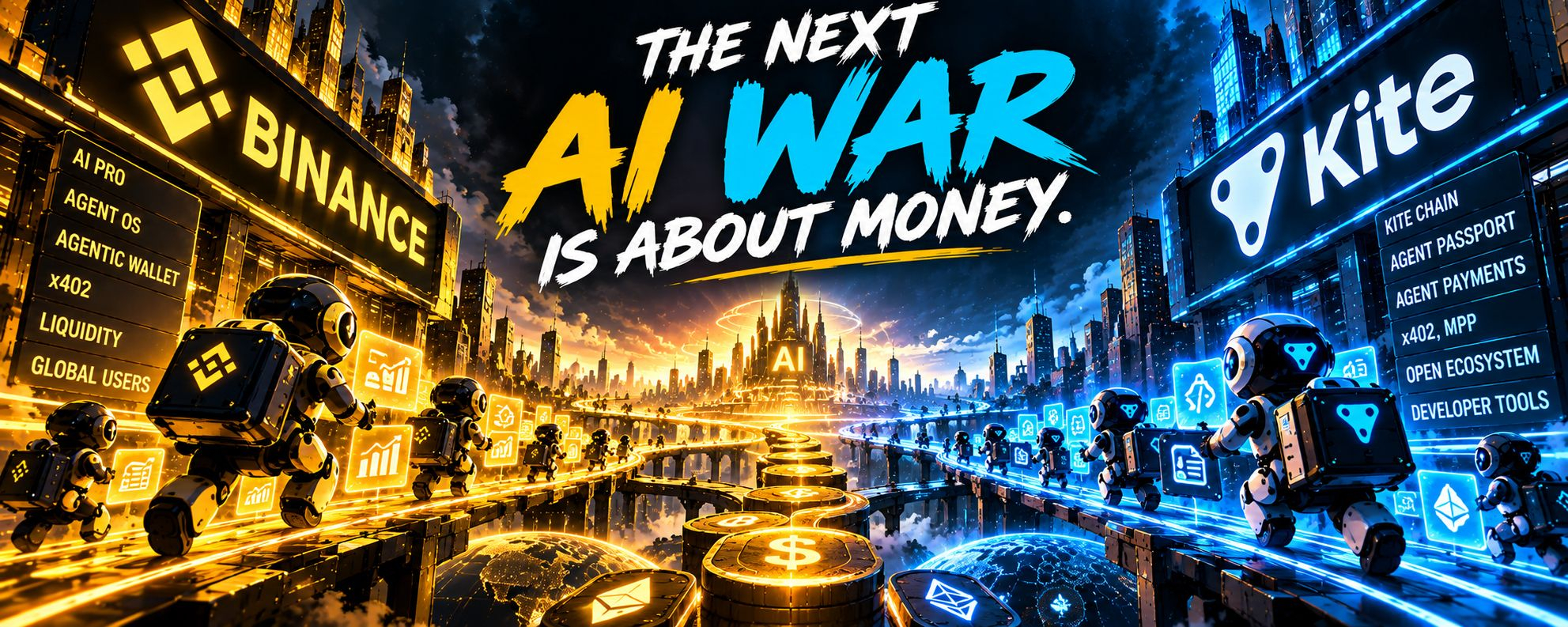
BINANCE AND KITE ARE PLAYING A BIGGER AI GAMETHE NEXT AI WAR IS ABOUT MONEY.
Binance, Kite, and the battle to control the agent economy.
I think the market is asking the wrong question about AI.
Everyone wants to know which model is smarter, which agent works faster, and which company will dominate the next generation of AI.
But imagine a different internet.
Millions of AI agents are buying data, renting computing power, paying for APIs, hiring other agents, and completing entire workflows without waiting for a human to approve every transaction.
In that world, intelligence is only one part of the equation.
The real bottleneck is economic permission: who can transact, under what conditions, and who captures the value?
This is why I find the developments around Binance and @GoKiteAI particularly interesting.
1. Binance is preparing for an internet where agents can act, not just answer.
Binance Agent OS brings together Binance APIs, Agentic Wallet capabilities, Binance x402, Skill Hub, and MCP into a developer platform with user-controlled permissions.
This matters because an AI agent is only as useful as the tools it can access and the actions it is authorized to perform.
Market data alone does not execute a strategy. A recommendation alone does not complete a transaction. Agents need a controlled path from decision to action.
Binance already has an established financial ecosystem, trading infrastructure, and liquidity. Extending these capabilities to compatible AI agents creates a potential distribution advantage that a new infrastructure network cannot easily reproduce overnight.
But there is a second problem that becomes more important as agents become autonomous.
What happens when one agent needs to pay another agent that operates outside its own platform?
That is where the infrastructure question becomes much bigger than trading.
2. Kite is building for the economic relationship between agents.
Kite Chain and Kite Agent Passport address a different but overlapping part of this problem.
The key idea is not simply giving an AI a wallet.
It is giving an agent an identity, a defined spending authority, and a verifiable record of its transactions.
Consider a practical example.
I authorize an agent to spend $50 on a research task. It can purchase data or services within the approved scope, but it cannot turn that authorization into unlimited access to my funds.
Kite's spending sessions define enforceable payment policies, including maximum spending per transaction, total spending limits, and permitted scopes. Its Passport infrastructure checks authorization at the funding stage. On the seller side, acceptance policies can determine which incoming proposals are allowed automatically.
This is a meaningful distinction.
An agent economy needs more than the ability to move money. It needs rules governing which economic actions are permitted before money moves.
And these rules must work even when the buyer, seller, and payment infrastructure belong to different systems.
Kite is positioning itself around this problem through agent identity, programmable authorization, stablecoin settlement, and support for payment standards such as x402 and MPP.
The opportunity is to make services consumable by agents without requiring developers to build a new payment integration for every interaction.
3. The interesting part: Binance and Kite are not simply two sides of the same trade.
Binance has an advantage in financial distribution, existing users, liquidity, and access to crypto capabilities.
Kite is pursuing specialized infrastructure for agent identity, spending authorization, and payments between autonomous services.
Their approaches overlap. Binance's Agent OS and Agentic Wallet also address agent payments and user-controlled permissions. Kite therefore cannot win merely by claiming that agents need wallets or that payments must be automated.
It must demonstrate that its infrastructure provides enough additional value for developers and service providers to adopt it.
That could come from easier integration, portable agent identity, more expressive spending policies, reliable cross-platform execution, or an ecosystem that attracts both buyers and sellers.
This is the competition I would watch.
Not which project uses the word "AI" more often, but which one becomes difficult for developers to replace once their agents depend on it.
4. The $KITE investment thesis has a critical condition.
Here is where I think investors need to look beyond the narrative.
Suppose agent-to-agent payments grow tenfold.
Does that automatically mean $KITE demand grows tenfold?
No.
Kite's published tokenomics describe several mechanisms intended to connect ecosystem activity with KITE demand. These include KITE requirements for ecosystem participation, liquidity commitments for modules with their own tokens, staking, and a Phase 2 mechanism under which protocol commissions from AI service transactions can be converted into KITE for distribution to the network and modules.
If implemented at meaningful scale, these mechanisms could create an economic feedback loop:
More real service usage generates revenue. Revenue-linked mechanisms create demand for KITE. Successful modules attract more developers and users. Greater participation can strengthen the ecosystem.
But every link in that chain needs evidence.
The important distinction is between a mechanism designed to capture value and value capture demonstrated by actual usage.
I would monitor four things:
• Real agent activity and paid service transactions, rather than registrations alone.
• Protocol revenue generated by genuine demand, rather than incentive-driven activity.
• The proportion of revenue that actually translates into KITE demand.
• Token emissions, unlocks, and circulating supply relative to that demand.
A growing agent economy can benefit applications, payment providers, infrastructure networks, and token holders very differently.
The growth of AI is not, by itself, an investment thesis for every AI token.
5. My conclusion: the next competitive advantage may be permission, not payment speed.
I believe the agent economy will force the financial industry to rethink how transactions are authorized.
When a human makes a payment, identity, intent, and approval are usually tied to a person performing an action.
When an agent makes thousands of decisions on someone's behalf, those controls must become programmable, enforceable, and auditable.
Binance has a potential advantage in connecting AI agents to an established financial ecosystem.
Kite is betting that the emerging agent economy needs dedicated infrastructure for identity, authorization, and service-level payments.
Neither advantage guarantees a winner. Both must prove that developers will use their products, that the systems remain reliable and secure, and that the resulting economic activity creates durable value.
But the strategic question is clear.
If AI agents eventually become major buyers and sellers on the internet, the most valuable infrastructure may not be the system that processes the most transactions.
It may be the system that determines which transactions are trusted, authorized, and worth executing.
One question for the community: if agent-to-agent payments become a massive market, would you rather invest in the platform that already controls financial distribution, or the specialized infrastructure trying to become the trust layer for autonomous agents?
And more importantly, what evidence would convince you that $KITE captures that value instead of merely benefiting from the AI narrative?
#KiteBBW $KITE
BINANCE AND KITE ARE PLAYING A BIGGER AI GAME
THE NEXT AI WAR IS ABOUT MONEY.
Binance, Kite, and the battle to control the agent economy.
I think the market is asking the wrong question about AI.
Everyone wants to know which model is smarter, which agent works faster, and which company will dominate the next generation of AI.
But imagine a different internet.
Millions of AI agents are buying data, renting computing power, paying for APIs, hiring other agents, and completing entire workflows without waiting for a human to approve every transaction.
In that world, intelligence is only one part of the equation.
The real bottleneck is economic permission: who can transact, under what conditions, and who captures the value?
This is why I find the developments around Binance and @KITE AI 中文 particularly interesting.
1. Binance is preparing for an internet where agents can act, not just answer.
Binance Agent OS brings together Binance APIs, Agentic Wallet capabilities, Binance x402, Skill Hub, and MCP into a developer platform with user-controlled permissions.
This matters because an AI agent is only as useful as the tools it can access and the actions it is authorized to perform.
Market data alone does not execute a strategy. A recommendation alone does not complete a transaction. Agents need a controlled path from decision to action.
Binance already has an established financial ecosystem, trading infrastructure, and liquidity. Extending these capabilities to compatible AI agents creates a potential distribution advantage that a new infrastructure network cannot easily reproduce overnight.
But there is a second problem that becomes more important as agents become autonomous.
What happens when one agent needs to pay another agent that operates outside its own platform?
That is where the infrastructure question becomes much bigger than trading.
2. Kite is building for the economic relationship between agents.
Kite Chain and Kite Agent Passport address a different but overlapping part of this problem.
The key idea is not simply giving an AI a wallet.
It is giving an agent an identity, a defined spending authority, and a verifiable record of its transactions.
Consider a practical example.
I authorize an agent to spend $50 on a research task. It can purchase data or services within the approved scope, but it cannot turn that authorization into unlimited access to my funds.
Kite's spending sessions define enforceable payment policies, including maximum spending per transaction, total spending limits, and permitted scopes. Its Passport infrastructure checks authorization at the funding stage. On the seller side, acceptance policies can determine which incoming proposals are allowed automatically.
This is a meaningful distinction.
An agent economy needs more than the ability to move money. It needs rules governing which economic actions are permitted before money moves.
And these rules must work even when the buyer, seller, and payment infrastructure belong to different systems.
Kite is positioning itself around this problem through agent identity, programmable authorization, stablecoin settlement, and support for payment standards such as x402 and MPP.
The opportunity is to make services consumable by agents without requiring developers to build a new payment integration for every interaction.
3. The interesting part: Binance and Kite are not simply two sides of the same trade.
Binance has an advantage in financial distribution, existing users, liquidity, and access to crypto capabilities.
Kite is pursuing specialized infrastructure for agent identity, spending authorization, and payments between autonomous services.
Their approaches overlap. Binance's Agent OS and Agentic Wallet also address agent payments and user-controlled permissions. Kite therefore cannot win merely by claiming that agents need wallets or that payments must be automated.
It must demonstrate that its infrastructure provides enough additional value for developers and service providers to adopt it.
That could come from easier integration, portable agent identity, more expressive spending policies, reliable cross-platform execution, or an ecosystem that attracts both buyers and sellers.
This is the competition I would watch.
Not which project uses the word "AI" more often, but which one becomes difficult for developers to replace once their agents depend on it.
4. The $KITE investment thesis has a critical condition.
Here is where I think investors need to look beyond the narrative.
Suppose agent-to-agent payments grow tenfold.
Does that automatically mean $KITE demand grows tenfold?
No.
Kite's published tokenomics describe several mechanisms intended to connect ecosystem activity with KITE demand. These include KITE requirements for ecosystem participation, liquidity commitments for modules with their own tokens, staking, and a Phase 2 mechanism under which protocol commissions from AI service transactions can be converted into KITE for distribution to the network and modules.
If implemented at meaningful scale, these mechanisms could create an economic feedback loop:
More real service usage generates revenue. Revenue-linked mechanisms create demand for KITE. Successful modules attract more developers and users. Greater participation can strengthen the ecosystem.
But every link in that chain needs evidence.
The important distinction is between a mechanism designed to capture value and value capture demonstrated by actual usage.
I would monitor four things:
• Real agent activity and paid service transactions, rather than registrations alone.
• Protocol revenue generated by genuine demand, rather than incentive-driven activity.
• The proportion of revenue that actually translates into KITE demand.
• Token emissions, unlocks, and circulating supply relative to that demand.
A growing agent economy can benefit applications, payment providers, infrastructure networks, and token holders very differently.
The growth of AI is not, by itself, an investment thesis for every AI token.
5. My conclusion: the next competitive advantage may be permission, not payment speed.
I believe the agent economy will force the financial industry to rethink how transactions are authorized.
When a human makes a payment, identity, intent, and approval are usually tied to a person performing an action.
When an agent makes thousands of decisions on someone's behalf, those controls must become programmable, enforceable, and auditable.
Binance has a potential advantage in connecting AI agents to an established financial ecosystem.
Kite is betting that the emerging agent economy needs dedicated infrastructure for identity, authorization, and service-level payments.
Neither advantage guarantees a winner. Both must prove that developers will use their products, that the systems remain reliable and secure, and that the resulting economic activity creates durable value.
But the strategic question is clear.
If AI agents eventually become major buyers and sellers on the internet, the most valuable infrastructure may not be the system that processes the most transactions.
It may be the system that determines which transactions are trusted, authorized, and worth executing.
One question for the community: if agent-to-agent payments become a massive market, would you rather invest in the platform that already controls financial distribution, or the specialized infrastructure trying to become the trust layer for autonomous agents?
And more importantly, what evidence would convince you that $KITE captures that value instead of merely benefiting from the AI narrative?
#KiteBBW $KITE
Binance, Kite, and the battle to control the agent economy.
I think the market is asking the wrong question about AI.
Everyone wants to know which model is smarter, which agent works faster, and which company will dominate the next generation of AI.
But imagine a different internet.
Millions of AI agents are buying data, renting computing power, paying for APIs, hiring other agents, and completing entire workflows without waiting for a human to approve every transaction.
In that world, intelligence is only one part of the equation.
The real bottleneck is economic permission: who can transact, under what conditions, and who captures the value?
This is why I find the developments around Binance and @KITE AI 中文 particularly interesting.
1. Binance is preparing for an internet where agents can act, not just answer.
Binance Agent OS brings together Binance APIs, Agentic Wallet capabilities, Binance x402, Skill Hub, and MCP into a developer platform with user-controlled permissions.
This matters because an AI agent is only as useful as the tools it can access and the actions it is authorized to perform.
Market data alone does not execute a strategy. A recommendation alone does not complete a transaction. Agents need a controlled path from decision to action.
Binance already has an established financial ecosystem, trading infrastructure, and liquidity. Extending these capabilities to compatible AI agents creates a potential distribution advantage that a new infrastructure network cannot easily reproduce overnight.
But there is a second problem that becomes more important as agents become autonomous.
What happens when one agent needs to pay another agent that operates outside its own platform?
That is where the infrastructure question becomes much bigger than trading.
2. Kite is building for the economic relationship between agents.
Kite Chain and Kite Agent Passport address a different but overlapping part of this problem.
The key idea is not simply giving an AI a wallet.
It is giving an agent an identity, a defined spending authority, and a verifiable record of its transactions.
Consider a practical example.
I authorize an agent to spend $50 on a research task. It can purchase data or services within the approved scope, but it cannot turn that authorization into unlimited access to my funds.
Kite's spending sessions define enforceable payment policies, including maximum spending per transaction, total spending limits, and permitted scopes. Its Passport infrastructure checks authorization at the funding stage. On the seller side, acceptance policies can determine which incoming proposals are allowed automatically.
This is a meaningful distinction.
An agent economy needs more than the ability to move money. It needs rules governing which economic actions are permitted before money moves.
And these rules must work even when the buyer, seller, and payment infrastructure belong to different systems.
Kite is positioning itself around this problem through agent identity, programmable authorization, stablecoin settlement, and support for payment standards such as x402 and MPP.
The opportunity is to make services consumable by agents without requiring developers to build a new payment integration for every interaction.
3. The interesting part: Binance and Kite are not simply two sides of the same trade.
Binance has an advantage in financial distribution, existing users, liquidity, and access to crypto capabilities.
Kite is pursuing specialized infrastructure for agent identity, spending authorization, and payments between autonomous services.
Their approaches overlap. Binance's Agent OS and Agentic Wallet also address agent payments and user-controlled permissions. Kite therefore cannot win merely by claiming that agents need wallets or that payments must be automated.
It must demonstrate that its infrastructure provides enough additional value for developers and service providers to adopt it.
That could come from easier integration, portable agent identity, more expressive spending policies, reliable cross-platform execution, or an ecosystem that attracts both buyers and sellers.
This is the competition I would watch.
Not which project uses the word "AI" more often, but which one becomes difficult for developers to replace once their agents depend on it.
4. The $KITE investment thesis has a critical condition.
Here is where I think investors need to look beyond the narrative.
Suppose agent-to-agent payments grow tenfold.
Does that automatically mean $KITE demand grows tenfold?
No.
Kite's published tokenomics describe several mechanisms intended to connect ecosystem activity with KITE demand. These include KITE requirements for ecosystem participation, liquidity commitments for modules with their own tokens, staking, and a Phase 2 mechanism under which protocol commissions from AI service transactions can be converted into KITE for distribution to the network and modules.
If implemented at meaningful scale, these mechanisms could create an economic feedback loop:
More real service usage generates revenue. Revenue-linked mechanisms create demand for KITE. Successful modules attract more developers and users. Greater participation can strengthen the ecosystem.
But every link in that chain needs evidence.
The important distinction is between a mechanism designed to capture value and value capture demonstrated by actual usage.
I would monitor four things:
• Real agent activity and paid service transactions, rather than registrations alone.
• Protocol revenue generated by genuine demand, rather than incentive-driven activity.
• The proportion of revenue that actually translates into KITE demand.
• Token emissions, unlocks, and circulating supply relative to that demand.
A growing agent economy can benefit applications, payment providers, infrastructure networks, and token holders very differently.
The growth of AI is not, by itself, an investment thesis for every AI token.
5. My conclusion: the next competitive advantage may be permission, not payment speed.
I believe the agent economy will force the financial industry to rethink how transactions are authorized.
When a human makes a payment, identity, intent, and approval are usually tied to a person performing an action.
When an agent makes thousands of decisions on someone's behalf, those controls must become programmable, enforceable, and auditable.
Binance has a potential advantage in connecting AI agents to an established financial ecosystem.
Kite is betting that the emerging agent economy needs dedicated infrastructure for identity, authorization, and service-level payments.
Neither advantage guarantees a winner. Both must prove that developers will use their products, that the systems remain reliable and secure, and that the resulting economic activity creates durable value.
But the strategic question is clear.
If AI agents eventually become major buyers and sellers on the internet, the most valuable infrastructure may not be the system that processes the most transactions.
It may be the system that determines which transactions are trusted, authorized, and worth executing.
One question for the community: if agent-to-agent payments become a massive market, would you rather invest in the platform that already controls financial distribution, or the specialized infrastructure trying to become the trust layer for autonomous agents?
And more importantly, what evidence would convince you that $KITE captures that value instead of merely benefiting from the AI narrative?
#KiteBBW $KITE
16
16
3k
·
--
Bullish
Good morning, everyone! Wishing you a productive start to the workweek ❤️🔥
Check in --》 earn points --》 share the 1M pool
#BinancePick
$BNB
Good morning, everyone! Wishing you a productive start to the workweek ❤️🔥
Check in --》 earn points --》 share the 1M pool
#BinancePick
$BNB
Check in --》 earn points --》 share the 1M pool
#BinancePick
$BNB

69
🎙️ GOLDEN DRAGON CONTINUES

 LIVE
LIVE145 listens · 1 in Live Trading
BNB/USDT
Market/Sell
Filled
0
0
NEAR/USDT — ARE SELLERS STILL IN CONTROL? 🔻
I’m leaning toward a SHORT if NEAR rebounds to resistance but fails to break through. Favor the bearish structure on the 4H timeframe; don’t chase sells near support.
📍 Entry: $4.50–4.53
🎯 TP1: $4.40 | TP2: $4.30
🛑 SL: $4.60
Condition: Wait for a 15M/1H candle to confirm rejection at the Entry zone. If the price moves above $4.60, the setup is invalidated.
No confirmation, no trade. These price levels are for reference; check the Binance chart before trading.
#NEAR #NEARProtocol #CryptoTrading
NEAR/USDT — ARE SELLERS STILL IN CONTROL? 🔻
I’m leaning toward a SHORT if NEAR rebounds to resistance but fails to break through. Favor the bearish structure on the 4H timeframe; don’t chase sells near support.
📍 Entry: $4.50–4.53
🎯 TP1: $4.40 | TP2: $4.30
🛑 SL: $4.60
Condition: Wait for a 15M/1H candle to confirm rejection at the Entry zone. If the price moves above $4.60, the setup is invalidated.
No confirmation, no trade. These price levels are for reference; check the Binance chart before trading.
#NEAR #NEARProtocol #CryptoTrading
I’m leaning toward a SHORT if NEAR rebounds to resistance but fails to break through. Favor the bearish structure on the 4H timeframe; don’t chase sells near support.
📍 Entry: $4.50–4.53
🎯 TP1: $4.40 | TP2: $4.30
🛑 SL: $4.60
Condition: Wait for a 15M/1H candle to confirm rejection at the Entry zone. If the price moves above $4.60, the setup is invalidated.
No confirmation, no trade. These price levels are for reference; check the Binance chart before trading.
#NEAR #NEARProtocol #CryptoTrading
2
340
BNB is approaching the $750 breakout zone. ⚡
I’m leaning LONG if the 4H candle closes above $752 and the retest is successful.
🎯 Entry: $750–752
TP1: $760 | TP2: $777
🛑 SL: $735
No breakout, no trade. Don’t let FOMO make the decision for you.
#BNB #Binance #CryptoTrading
BNB is approaching the $750 breakout zone. ⚡
I’m leaning LONG if the 4H candle closes above $752 and the retest is successful.
🎯 Entry: $750–752
TP1: $760 | TP2: $777
🛑 SL: $735
No breakout, no trade. Don’t let FOMO make the decision for you.
#BNB #Binance #CryptoTrading
I’m leaning LONG if the 4H candle closes above $752 and the retest is successful.
🎯 Entry: $750–752
TP1: $760 | TP2: $777
🛑 SL: $735
No breakout, no trade. Don’t let FOMO make the decision for you.
#BNB #Binance #CryptoTrading
2
260
ZEC is approaching a decisive zone. ⚡
I’m leaning LONG, but only if the breakout above $1,247 is confirmed on the 4H timeframe.
🎯 TP1: $1,288 | TP2: $1,335
🛑 SL: $1,205
Don’t chase the price. Wait for confirmation, then take action.
#ZEC #Zcash #CryptoTrading
ZEC is approaching a decisive zone. ⚡
I’m leaning LONG, but only if the breakout above $1,247 is confirmed on the 4H timeframe.
🎯 TP1: $1,288 | TP2: $1,335
🛑 SL: $1,205
Don’t chase the price. Wait for confirmation, then take action.
#ZEC #Zcash #CryptoTrading
I’m leaning LONG, but only if the breakout above $1,247 is confirmed on the 4H timeframe.
🎯 TP1: $1,288 | TP2: $1,335
🛑 SL: $1,205
Don’t chase the price. Wait for confirmation, then take action.
#ZEC #Zcash #CryptoTrading
4
2k


👀 Which of these 7 coins are you holding?
ZEC is up, while IRYS is down nearly 50% — the market’s classic “some people party, others foot the bill” situation. 💀
Comment the ticker you’re holding, and drop a like if your portfolio is still alive! 🔥
#Crypto #Altcoins #BinanceSquare
👀 Which of these 7 coins are you holding?
ZEC is up, while IRYS is down nearly 50% — the market’s classic “some people party, others foot the bill” situation. 💀
Comment the ticker you’re holding, and drop a like if your portfolio is still alive! 🔥
#Crypto #Altcoins #BinanceSquare
ZEC is up, while IRYS is down nearly 50% — the market’s classic “some people party, others foot the bill” situation. 💀
Comment the ticker you’re holding, and drop a like if your portfolio is still alive! 🔥
#Crypto #Altcoins #BinanceSquare
1
1.2k
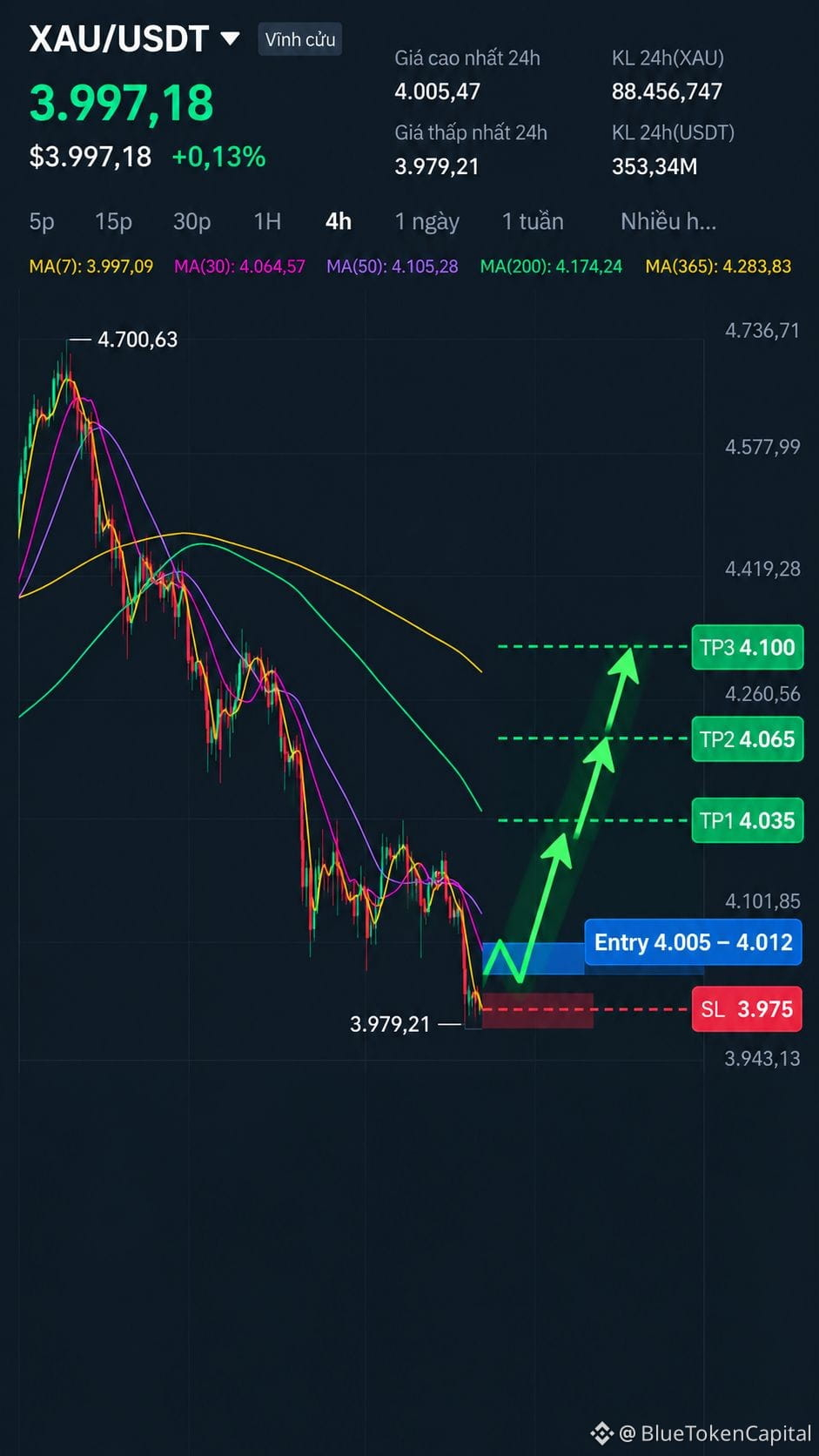
🥇 XAU/USDT — LONG SETUP (H4)
Gold has fallen sharply, but trying to catch the bottom now is still a risky play.
📍 Entry: 4.005–4.012
🎯 TP1: 4.035 | TP2: 4.065 | TP3: 4.100
🛑 SL: 3.975
Wait for reversal confirmation on M15/H1; don’t FOMO. If price breaks below 3.979, cancel the LONG scenario.
This is a reference scenario, not a confirmed signal.
#XAUUSD #Gold #Trading
🥇 XAU/USDT — LONG SETUP (H4)
Gold has fallen sharply, but trying to catch the bottom now is still a risky play.
📍 Entry: 4.005–4.012
🎯 TP1: 4.035 | TP2: 4.065 | TP3: 4.100
🛑 SL: 3.975
Wait for reversal confirmation on M15/H1; don’t FOMO. If price breaks below 3.979, cancel the LONG scenario.
This is a reference scenario, not a confirmed signal.
#XAUUSD #Gold #Trading
Gold has fallen sharply, but trying to catch the bottom now is still a risky play.
📍 Entry: 4.005–4.012
🎯 TP1: 4.035 | TP2: 4.065 | TP3: 4.100
🛑 SL: 3.975
Wait for reversal confirmation on M15/H1; don’t FOMO. If price breaks below 3.979, cancel the LONG scenario.
This is a reference scenario, not a confirmed signal.
#XAUUSD #Gold #Trading
1
436

·
--
Bearish
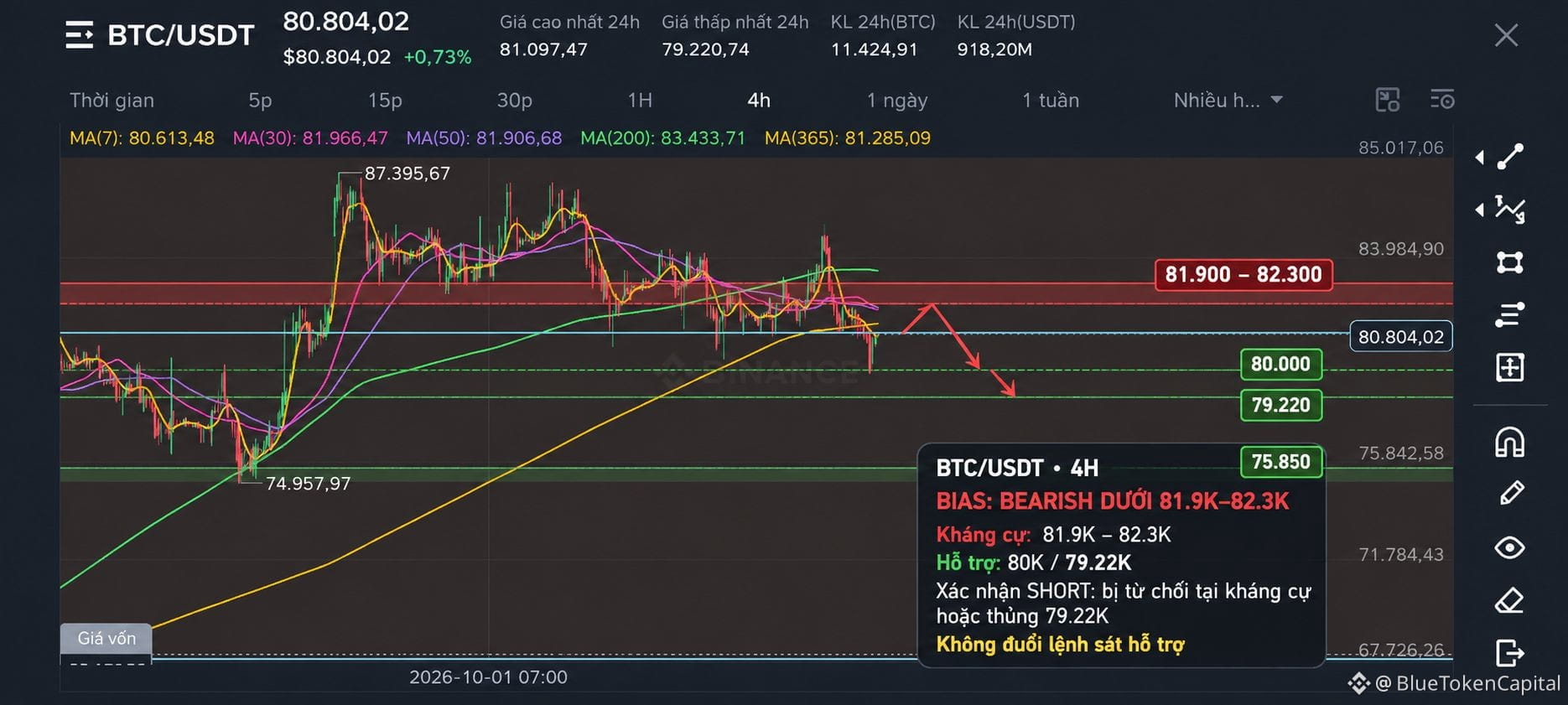
BTC/USDT: BULLS MUST RECLAIM $82.3K!
BTC is at $80,804 on the 4H chart. Price is below the MA30 ($81,966), MA50 ($81,906), and MA365 ($81,285). The short-term structure still favors sellers.
🔴 BIAS: BEARISH — Favor SHORTs on a bounce
Entry: $81,200–81,800
TP1: $80,000
📌 Confirmation scenario:
BTC bounces into the resistance zone but gets rejected, or breaks below $79,220 with a confirming candle. Don’t chase SHORTs when price has already dropped close to support.
$BTC
{future}(BTCUSDT)
BTC/USDT: BULLS MUST RECLAIM $82.3K!
BTC is at $80,804 on the 4H chart. Price is below the MA30 ($81,966), MA50 ($81,906), and MA365 ($81,285). The short-term structure still favors sellers.
🔴 BIAS: BEARISH — Favor SHORTs on a bounce
Entry: $81,200–81,800
TP1: $80,000
📌 Confirmation scenario:
BTC bounces into the resistance zone but gets rejected, or breaks below $79,220 with a confirming candle. Don’t chase SHORTs when price has already dropped close to support.
$BTC
BTC is at $80,804 on the 4H chart. Price is below the MA30 ($81,966), MA50 ($81,906), and MA365 ($81,285). The short-term structure still favors sellers.
🔴 BIAS: BEARISH — Favor SHORTs on a bounce
Entry: $81,200–81,800
TP1: $80,000
📌 Confirmation scenario:
BTC bounces into the resistance zone but gets rejected, or breaks below $79,220 with a confirming candle. Don’t chase SHORTs when price has already dropped close to support.
$BTC
2
423
·
--
Bullish
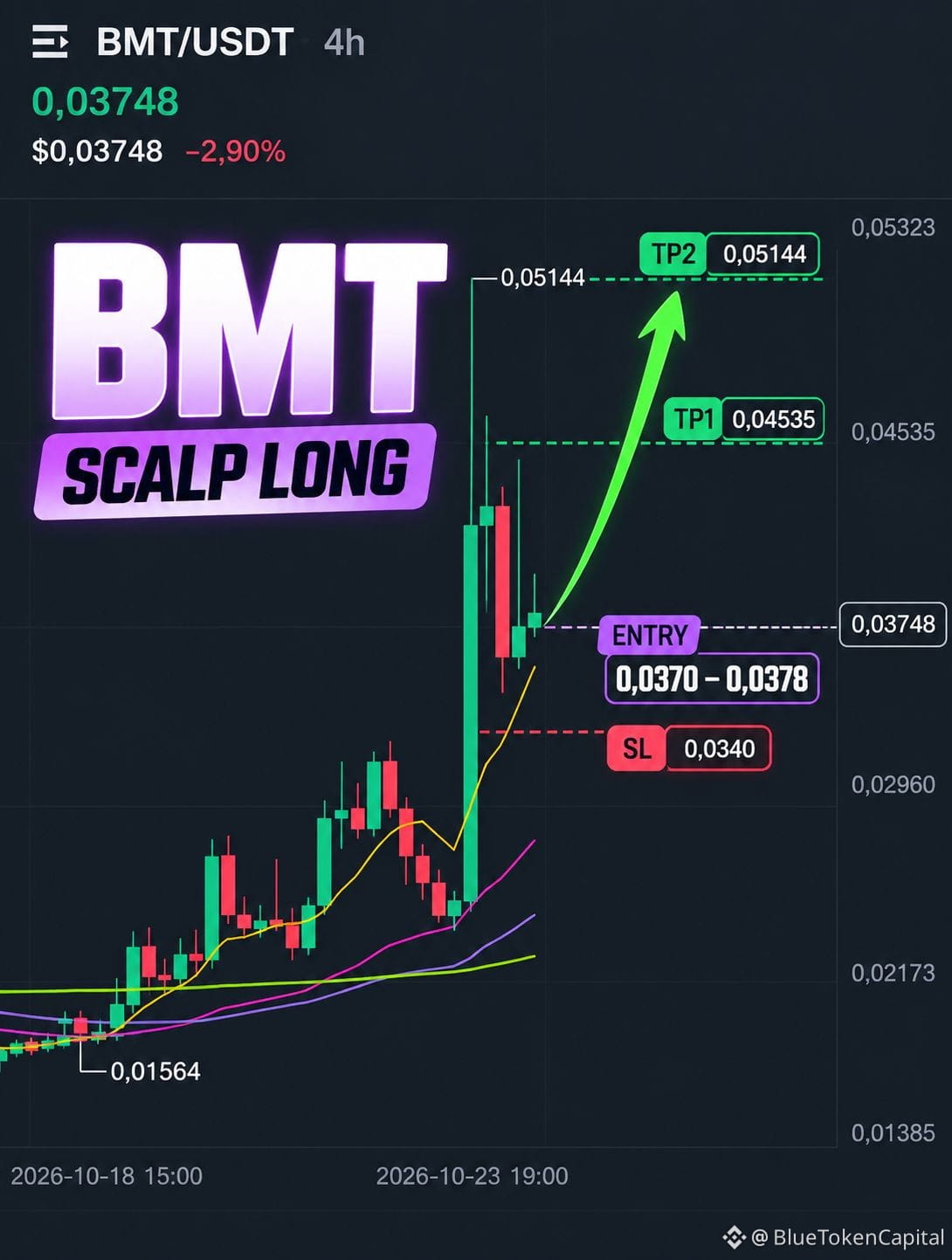
🔥 BMT — The narrative is heating up; trade the 4H trend
🧩 Narrative: Bubblemaps helps analyze on-chain data and identify connections between wallets and token supply concentration.
📈 Trend-following LONG setup
- Entry: $0,0227–$0,0230 — wait for a breakout and successful retest.
- TP1: $0,0240
- TP2: $0,0250
- SL: $0,0218
⚠️ Activate only after the bullish structure is confirmed on the 4H timeframe. If the price fails to hold the breakout zone, abandon the setup; don’t FOMO and chase the price.
My take: The narrative may attract attention, but capital flows and price structure are what determine whether the trend continues.
#BMT #Crypto $BMT
{future}(BMTUSDT)
🔥 BMT — The narrative is heating up; trade the 4H trend
🧩 Narrative: Bubblemaps helps analyze on-chain data and identify connections between wallets and token supply concentration.
📈 Trend-following LONG setup
- Entry: $0,0227–$0,0230 — wait for a breakout and successful retest.
- TP1: $0,0240
- TP2: $0,0250
- SL: $0,0218
⚠️ Activate only after the bullish structure is confirmed on the 4H timeframe. If the price fails to hold the breakout zone, abandon the setup; don’t FOMO and chase the price.
My take: The narrative may attract attention, but capital flows and price structure are what determine whether the trend continues.
#BMT #Crypto $BMT
🧩 Narrative: Bubblemaps helps analyze on-chain data and identify connections between wallets and token supply concentration.
📈 Trend-following LONG setup
- Entry: $0,0227–$0,0230 — wait for a breakout and successful retest.
- TP1: $0,0240
- TP2: $0,0250
- SL: $0,0218
⚠️ Activate only after the bullish structure is confirmed on the 4H timeframe. If the price fails to hold the breakout zone, abandon the setup; don’t FOMO and chase the price.
My take: The narrative may attract attention, but capital flows and price structure are what determine whether the trend continues.
#BMT #Crypto $BMT
1
441
🚨 ETH ETF: What are the flows warning us about?
Over the past 30 days, ETH ETF flows have mostly been in the red. One session of +$4.4M in inflows isn’t enough to confirm a reversal.
📉 Trend-following setup — 4H timeframe
* 🔴 Favor SHORT if price breaks support, fails to reclaim it on a retest, and the downtrend continues.
* 🟢 Consider LONG when price breaks resistance, holds a bullish structure, and confirms a reversal.
* ⚠️ If there’s no clear signal, stay on the sidelines—don’t try to catch a falling knife.
Do you think ETH will keep falling, or are flows about to reverse? 👀
#ETH #Ethereum #ETF
🚨 ETH ETF: What are the flows warning us about?
Over the past 30 days, ETH ETF flows have mostly been in the red. One session of +$4.4M in inflows isn’t enough to confirm a reversal.
📉 Trend-following setup — 4H timeframe
* 🔴 Favor SHORT if price breaks support, fails to reclaim it on a retest, and the downtrend continues.
* 🟢 Consider LONG when price breaks resistance, holds a bullish structure, and confirms a reversal.
* ⚠️ If there’s no clear signal, stay on the sidelines—don’t try to catch a falling knife.
Do you think ETH will keep falling, or are flows about to reverse? 👀
#ETH #Ethereum #ETF
Over the past 30 days, ETH ETF flows have mostly been in the red. One session of +$4.4M in inflows isn’t enough to confirm a reversal.
📉 Trend-following setup — 4H timeframe
* 🔴 Favor SHORT if price breaks support, fails to reclaim it on a retest, and the downtrend continues.
* 🟢 Consider LONG when price breaks resistance, holds a bullish structure, and confirms a reversal.
* ⚠️ If there’s no clear signal, stay on the sidelines—don’t try to catch a falling knife.
Do you think ETH will keep falling, or are flows about to reverse? 👀
#ETH #Ethereum #ETF
2
3
377
·
--
Bearish
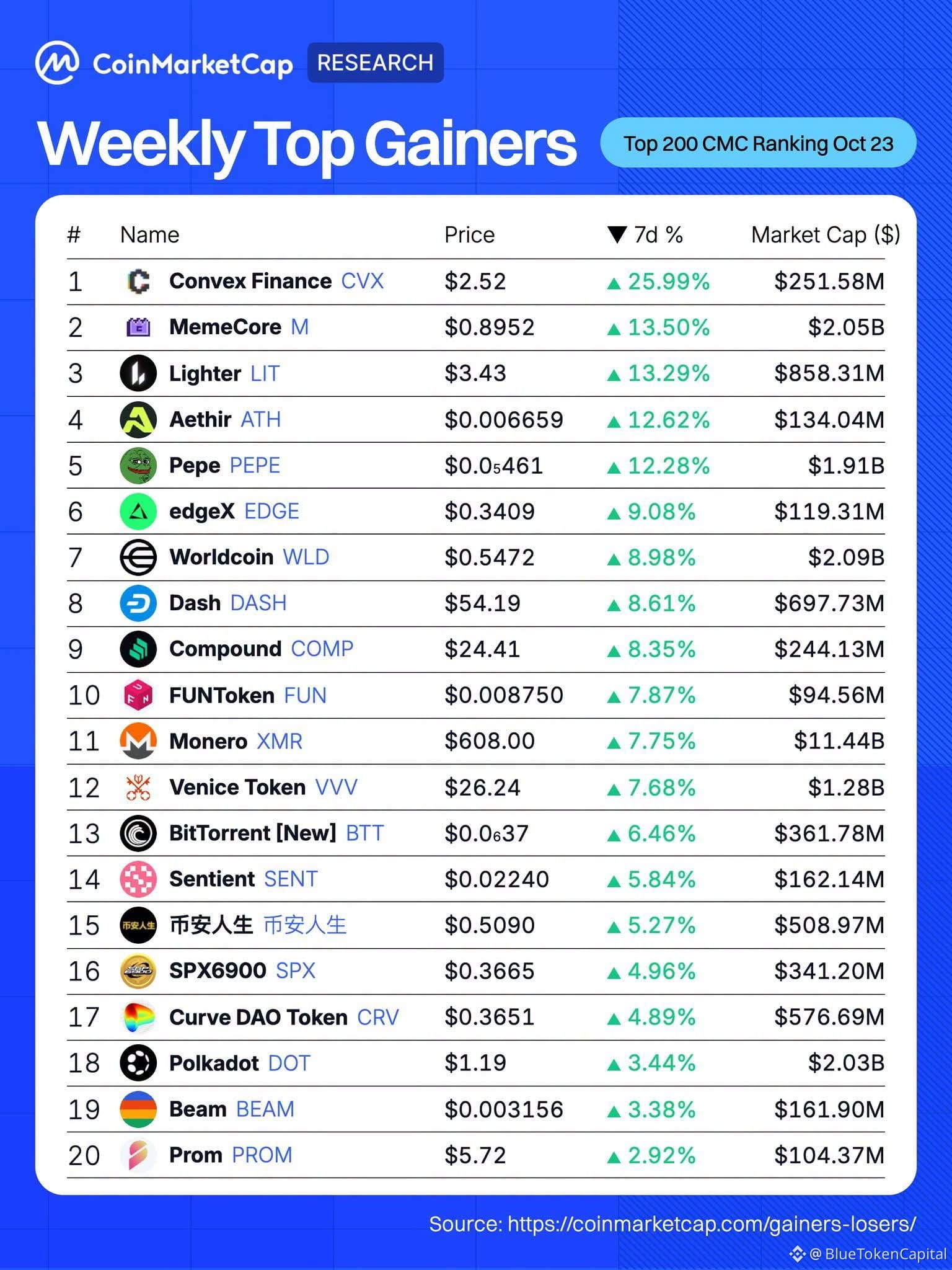
🚀 Altcoins are coming back to life, but that doesn’t necessarily mean Altseason is back!
CVX tops the weekly gainers with +25.99%, followed by MemeCore at +13.50% and Lighter at +13.29%.
Notably, XMR, DASH, the ZEC narrative, and DeFi coins are attracting attention again. But one week of gains isn’t enough to prove that money is flowing across the entire market.
My take: Don’t rush to call this Altseason. If money is concentrated in just a few individual coins, these could simply be localized rebounds. 👀
#Altseason #Altcoins #CryptoMarket
🚀 Altcoins are coming back to life, but that doesn’t necessarily mean Altseason is back!
CVX tops the weekly gainers with +25.99%, followed by MemeCore at +13.50% and Lighter at +13.29%.
Notably, XMR, DASH, the ZEC narrative, and DeFi coins are attracting attention again. But one week of gains isn’t enough to prove that money is flowing across the entire market.
My take: Don’t rush to call this Altseason. If money is concentrated in just a few individual coins, these could simply be localized rebounds. 👀
#Altseason #Altcoins #CryptoMarket
CVX tops the weekly gainers with +25.99%, followed by MemeCore at +13.50% and Lighter at +13.29%.
Notably, XMR, DASH, the ZEC narrative, and DeFi coins are attracting attention again. But one week of gains isn’t enough to prove that money is flowing across the entire market.
My take: Don’t rush to call this Altseason. If money is concentrated in just a few individual coins, these could simply be localized rebounds. 👀
#Altseason #Altcoins #CryptoMarket
1
605

🐕 Have you ever bought any of these dog meme coins?
Some coins changed people’s lives, while others left holders crying as they clutched their bags. 💀
Which one did you go all-in on? Still holding, or have you sold it all? 👀
#Memecoin #DogCoins #CryptoVietnam
🐕 Have you ever bought any of these dog meme coins?
Some coins changed people’s lives, while others left holders crying as they clutched their bags. 💀
Which one did you go all-in on? Still holding, or have you sold it all? 👀
#Memecoin #DogCoins #CryptoVietnam
Some coins changed people’s lives, while others left holders crying as they clutched their bags. 💀
Which one did you go all-in on? Still holding, or have you sold it all? 👀
#Memecoin #DogCoins #CryptoVietnam
2
3
492
⚡ $ZEC — PRIVACY + QUANTUM NARRATIVE
Zcash has 3 catalysts: privacy, quantum resistance, and the NU7 upgrade expected in November.
📊 Bias: Bullish in the medium term, cautious in the short term.
🎯 Entry: $1,170–1,185 if support holds. Backup buy zone: $1,120–1,140. Consider a breakout only after a 4H candle closes above $1,250 and a successful retest.
🛑 If $1,140 is lost: reassess the bullish scenario.
A strong narrative doesn’t guarantee a price increase. Would you accumulate or wait for a deeper pullback?
#ZEC #Zcash #Crypto
⚡ $ZEC — PRIVACY + QUANTUM NARRATIVE
Zcash has 3 catalysts: privacy, quantum resistance, and the NU7 upgrade expected in November.
📊 Bias: Bullish in the medium term, cautious in the short term.
🎯 Entry: $1,170–1,185 if support holds. Backup buy zone: $1,120–1,140. Consider a breakout only after a 4H candle closes above $1,250 and a successful retest.
🛑 If $1,140 is lost: reassess the bullish scenario.
A strong narrative doesn’t guarantee a price increase. Would you accumulate or wait for a deeper pullback?
#ZEC #Zcash #Crypto
Zcash has 3 catalysts: privacy, quantum resistance, and the NU7 upgrade expected in November.
📊 Bias: Bullish in the medium term, cautious in the short term.
🎯 Entry: $1,170–1,185 if support holds. Backup buy zone: $1,120–1,140. Consider a breakout only after a 4H candle closes above $1,250 and a successful retest.
🛑 If $1,140 is lost: reassess the bullish scenario.
A strong narrative doesn’t guarantee a price increase. Would you accumulate or wait for a deeper pullback?
#ZEC #Zcash #Crypto
3
1.2k
Where’s altseason? 💀
When BTC rises, everyone starts shouting “altseason.” But when the money flows out, altcoins lose 20–30% in just 24 hours.
Has altseason not arrived yet, or are we just trying to dump our bags on each other?
Narratives don’t save prices. Hype doesn’t create liquidity. And bagholders are always the ones left with the bill.
🔻 Maybe altseason hasn’t disappeared — most altcoins just won’t ever get to enjoy it.
Where’s altseason? 💀
When BTC rises, everyone starts shouting “altseason.” But when the money flows out, altcoins lose 20–30% in just 24 hours.
Has altseason not arrived yet, or are we just trying to dump our bags on each other?
Narratives don’t save prices. Hype doesn’t create liquidity. And bagholders are always the ones left with the bill.
🔻 Maybe altseason hasn’t disappeared — most altcoins just won’t ever get to enjoy it.
When BTC rises, everyone starts shouting “altseason.” But when the money flows out, altcoins lose 20–30% in just 24 hours.
Has altseason not arrived yet, or are we just trying to dump our bags on each other?
Narratives don’t save prices. Hype doesn’t create liquidity. And bagholders are always the ones left with the bill.
🔻 Maybe altseason hasn’t disappeared — most altcoins just won’t ever get to enjoy it.
3
1.2k
Log in to explore more content
Join global crypto users on Binance Square
⚡️ Get latest and useful information about crypto.
💬 Trusted by the world’s largest crypto exchange.
👍 Discover real insights from verified creators.
Email / Phone number
Trending Topics
BinancePick
2.6M views
140,024 Discussing
Join #EarningsSeason: Predict Earnings on Binance Pick, Share Your Take on Binance Square!
Binance Square Official
·400 Likes
·337.8k views
EarningsSeason
5M views
24,167 Discussing
FranklinTempletonFilesForTwoDividendToBitcoinETFs
0 views
3 Discussing