

Rossi90
18 Posts

Rossi90
Report
Block User
O mercado esconde padrões. O Projeto IA tenta decifrá-los: de 100 a 1.000 USDT em criptos de IA, com capital real e decisões públicas.
1 Following
16 Followers
8 Liked
Posts
·
--
#anthropicceocallsforaislowdown Meanwhile, physical investments in AI continue to grow.... 💩
#anthropicceocallsforaislowdown Meanwhile, physical investments in AI continue to grow.... 💩
79
·
--
Bullish
AI, YOUR MOONDRAWS, THE SECOND PIECE WAS CONFIRMED!
After the purchase of $NIL , these are the official positions of the AI Project:
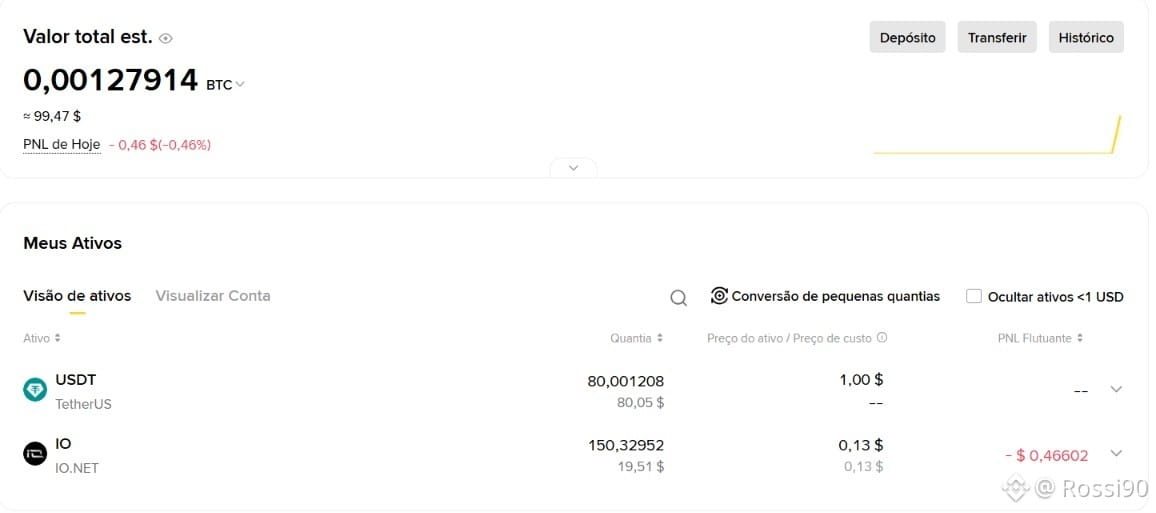
150,32952 $IO — initial capital of 20 USDT.
357,642 $NIL — initial capital of 15 USDT.
65,004588 USDT kept in cash.
I also published an article about the choice of NIL—take your time and go read your damn selves, give it a lot of work, damn it!
{spot}(NILUSDT)
{spot}(IOUSDT)
#ProjetoIA1000 #CriptoIA #IONET #Nillion
AI, YOUR MOONDRAWS, THE SECOND PIECE WAS CONFIRMED!
After the purchase of $NIL , these are the official positions of the AI Project:
150,32952 $IO — initial capital of 20 USDT.
357,642 $NIL — initial capital of 15 USDT.
65,004588 USDT kept in cash.
I also published an article about the choice of NIL—take your time and go read your damn selves, give it a lot of work, damn it!
#ProjetoIA1000 #CriptoIA #IONET #Nillion
After the purchase of $NIL , these are the official positions of the AI Project:
150,32952 $IO — initial capital of 20 USDT.
357,642 $NIL — initial capital of 15 USDT.
65,004588 USDT kept in cash.
I also published an article about the choice of NIL—take your time and go read your damn selves, give it a lot of work, damn it!
#ProjetoIA1000 #CriptoIA #IONET #Nillion
518
·
--
Article
THE SECOND RISK OF THE IA PROJECT IS ABOUT TO BE TAKEN — BUT WHAT COULD HAPPEN?Buying after everything has been delivered seems safer.
The problem is that when certainty arrives, some of the appreciation may already have happened.
That was the dilemma I came across when looking for the IA Project’s second cryptocurrency.
On the one hand, there is an important delivery scheduled for the next few days. On the other hand, there are still doubts about execution, adoption, and dilution.
I decided to take the risk.
My second entry will be 15 $USDT in $NIL , the token of Nillion.
The planned operation is:
Capital: 15 USDT.
THE SECOND RISK OF THE IA PROJECT IS ABOUT TO BE TAKEN — BUT WHAT COULD HAPPEN?
Buying after everything has been delivered seems safer.
The problem is that when certainty arrives, some of the appreciation may already have happened.
That was the dilemma I came across when looking for the IA Project’s second cryptocurrency.
On the one hand, there is an important delivery scheduled for the next few days. On the other hand, there are still doubts about execution, adoption, and dilution.
I decided to take the risk.
My second entry will be 15 $USDT in $NIL , the token of Nillion.
The planned operation is:
Capital: 15 USDT.
The problem is that when certainty arrives, some of the appreciation may already have happened.
That was the dilemma I came across when looking for the IA Project’s second cryptocurrency.
On the one hand, there is an important delivery scheduled for the next few days. On the other hand, there are still doubts about execution, adoption, and dilution.
I decided to take the risk.
My second entry will be 15 $USDT in $NIL , the token of Nillion.
The planned operation is:
Capital: 15 USDT.
493
·
--
Bearish
THE MARKET IS ONLY ELIMINATING EXCESSES — OR SOMETHING BIGGER IS STARTING?
About US$674 million in leveraged positions were liquidated in the crypto market over the last 24 hours. Most of it hit those who were betting on the upside.
But that doesn’t mean that US$674 million simply disappeared from the crypto market’s capitalization.
Liquidation happens when an exchange forcibly closes a leveraged position because the trader no longer has enough margin to maintain it.
That’s exactly why I set a rule from the very beginning of my AI Project: operate only in the spot market, with no margin, futures, or leverage.
My goal is still aggressive: turning 100 USDT into 1,000 USDT by seeking imbalances.
But taking risk in a small coin is different from artificially multiplying my exposure and allowing a fluctuation to end my position.
Right now, I keep approximately 20% of the portfolio in $IO and 80% in USDT.
For now, I won’t sell or increase the position just because of this volatility. First I want to figure out whether we’re dealing with a simple leverage cleanup or a deeper deterioration of the market.
Seeking imbalances is part of the strategy.
Getting liquidated before the thesis can play out, no.
#CryptoLiquidations$674MIn24H #ProjetoIA1000 #CriptoIA
THE MARKET IS ONLY ELIMINATING EXCESSES — OR SOMETHING BIGGER IS STARTING?
About US$674 million in leveraged positions were liquidated in the crypto market over the last 24 hours. Most of it hit those who were betting on the upside.
But that doesn’t mean that US$674 million simply disappeared from the crypto market’s capitalization.
Liquidation happens when an exchange forcibly closes a leveraged position because the trader no longer has enough margin to maintain it.
That’s exactly why I set a rule from the very beginning of my AI Project: operate only in the spot market, with no margin, futures, or leverage.
My goal is still aggressive: turning 100 USDT into 1,000 USDT by seeking imbalances.
But taking risk in a small coin is different from artificially multiplying my exposure and allowing a fluctuation to end my position.
Right now, I keep approximately 20% of the portfolio in $IO and 80% in USDT.
For now, I won’t sell or increase the position just because of this volatility. First I want to figure out whether we’re dealing with a simple leverage cleanup or a deeper deterioration of the market.
Seeking imbalances is part of the strategy.
Getting liquidated before the thesis can play out, no.
#CryptoLiquidations$674MIn24H #ProjetoIA1000 #CriptoIA
About US$674 million in leveraged positions were liquidated in the crypto market over the last 24 hours. Most of it hit those who were betting on the upside.
But that doesn’t mean that US$674 million simply disappeared from the crypto market’s capitalization.
Liquidation happens when an exchange forcibly closes a leveraged position because the trader no longer has enough margin to maintain it.
That’s exactly why I set a rule from the very beginning of my AI Project: operate only in the spot market, with no margin, futures, or leverage.
My goal is still aggressive: turning 100 USDT into 1,000 USDT by seeking imbalances.
But taking risk in a small coin is different from artificially multiplying my exposure and allowing a fluctuation to end my position.
Right now, I keep approximately 20% of the portfolio in $IO and 80% in USDT.
For now, I won’t sell or increase the position just because of this volatility. First I want to figure out whether we’re dealing with a simple leverage cleanup or a deeper deterioration of the market.
Seeking imbalances is part of the strategy.
Getting liquidated before the thesis can play out, no.
#CryptoLiquidations$674MIn24H #ProjetoIA1000 #CriptoIA
205
·
--
Bullish
THE EVENT THAT COULD HAVE TOPPLED OUR FIRST POSITION HAS ALREADY HAPPENED
Around 14 million $IO were unlocked on September 11.
Did the price collapse?
So far, no.
We bought 150,32952 $IO for 20 $USDT , with an approximate average price of US$0.133. Now, around US$0.130, our unrealized loss is about 2.4%.
Basically noise for a crypto of this size.
But unlocking doesn’t mean immediate selling. The pressure may show up gradually.
Our decision:
- Not to sell;
- Not to increase the position;
- Keep approximately 80 USDT in cash.
Has the market absorbed the new tokens, or just postponed the selling pressure?
{future}(IOUSDT)
#ProjetoIA1000 #criptoIA #ionet 👍👍👍
THE EVENT THAT COULD HAVE TOPPLED OUR FIRST POSITION HAS ALREADY HAPPENED
Around 14 million $IO were unlocked on September 11.
Did the price collapse?
So far, no.
We bought 150,32952 $IO for 20 $USDT , with an approximate average price of US$0.133. Now, around US$0.130, our unrealized loss is about 2.4%.
Basically noise for a crypto of this size.
But unlocking doesn’t mean immediate selling. The pressure may show up gradually.
Our decision:
- Not to sell;
- Not to increase the position;
- Keep approximately 80 USDT in cash.
Has the market absorbed the new tokens, or just postponed the selling pressure?
#ProjetoIA1000 #criptoIA #ionet 👍👍👍
Around 14 million $IO were unlocked on September 11.
Did the price collapse?
So far, no.
We bought 150,32952 $IO for 20 $USDT , with an approximate average price of US$0.133. Now, around US$0.130, our unrealized loss is about 2.4%.
Basically noise for a crypto of this size.
But unlocking doesn’t mean immediate selling. The pressure may show up gradually.
Our decision:
- Not to sell;
- Not to increase the position;
- Keep approximately 80 USDT in cash.
Has the market absorbed the new tokens, or just postponed the selling pressure?
#ProjetoIA1000 #criptoIA #ionet 👍👍👍
1
495
·
--

Article
COULD THIS BE THE SECOND COIN OF THE AI PROJECT — OR A TRAP?We found an AI cryptocurrency valued at a little over $53 million.
It has a working network, usefulness for the token, and it operates in a layer of the market that’s still not well explored.
It looks exactly like the asymmetry we’re looking for.
But there’s an uncomfortable question:
Why is approximately 75% of its maximum supply still not circulating?
The coin is the $ALLO , the Allora Network token.
The short answer is this: ALLO has asymmetry potential, but we still can’t prove that all the risk involved can be calculated.
COULD THIS BE THE SECOND COIN OF THE AI PROJECT — OR A TRAP?
We found an AI cryptocurrency valued at a little over $53 million.
It has a working network, usefulness for the token, and it operates in a layer of the market that’s still not well explored.
It looks exactly like the asymmetry we’re looking for.
But there’s an uncomfortable question:
Why is approximately 75% of its maximum supply still not circulating?
The coin is the $ALLO , the Allora Network token.
The short answer is this: ALLO has asymmetry potential, but we still can’t prove that all the risk involved can be calculated.
It has a working network, usefulness for the token, and it operates in a layer of the market that’s still not well explored.
It looks exactly like the asymmetry we’re looking for.
But there’s an uncomfortable question:
Why is approximately 75% of its maximum supply still not circulating?
The coin is the $ALLO , the Allora Network token.
The short answer is this: ALLO has asymmetry potential, but we still can’t prove that all the risk involved can be calculated.
ALLO+1.90%
KLICUS-0.05%
1
453
·
--

Article
AI PROJECT: WE MADE THE FIRST PURCHASE — BUT IT WASN’T THE OBVIOUS CHOICELast night, we made the first real decision of the AI Project.
The 100 USDT were already separated. The rules were defined. What remained was to find which cryptocurrency deserved to receive the first part of the capital.
Anyone who followed the previous posts probably expected a choice between $RENDER , $FET and $TAO .
It would be a natural conclusion.
These are well-known projects, they have interesting proposals, and they represent different areas of artificial intelligence.
But there was a problem.
Our goal is not simply to choose the safest project or buy the most well-known coin in the industry.
AI PROJECT: WE MADE THE FIRST PURCHASE — BUT IT WASN’T THE OBVIOUS CHOICE
Last night, we made the first real decision of the AI Project.
The 100 USDT were already separated. The rules were defined. What remained was to find which cryptocurrency deserved to receive the first part of the capital.
Anyone who followed the previous posts probably expected a choice between $RENDER , $FET and $TAO .
It would be a natural conclusion.
These are well-known projects, they have interesting proposals, and they represent different areas of artificial intelligence.
But there was a problem.
Our goal is not simply to choose the safest project or buy the most well-known coin in the industry.
The 100 USDT were already separated. The rules were defined. What remained was to find which cryptocurrency deserved to receive the first part of the capital.
Anyone who followed the previous posts probably expected a choice between $RENDER , $FET and $TAO .
It would be a natural conclusion.
These are well-known projects, they have interesting proposals, and they represent different areas of artificial intelligence.
But there was a problem.
Our goal is not simply to choose the safest project or buy the most well-known coin in the industry.
2
1
409
·
--
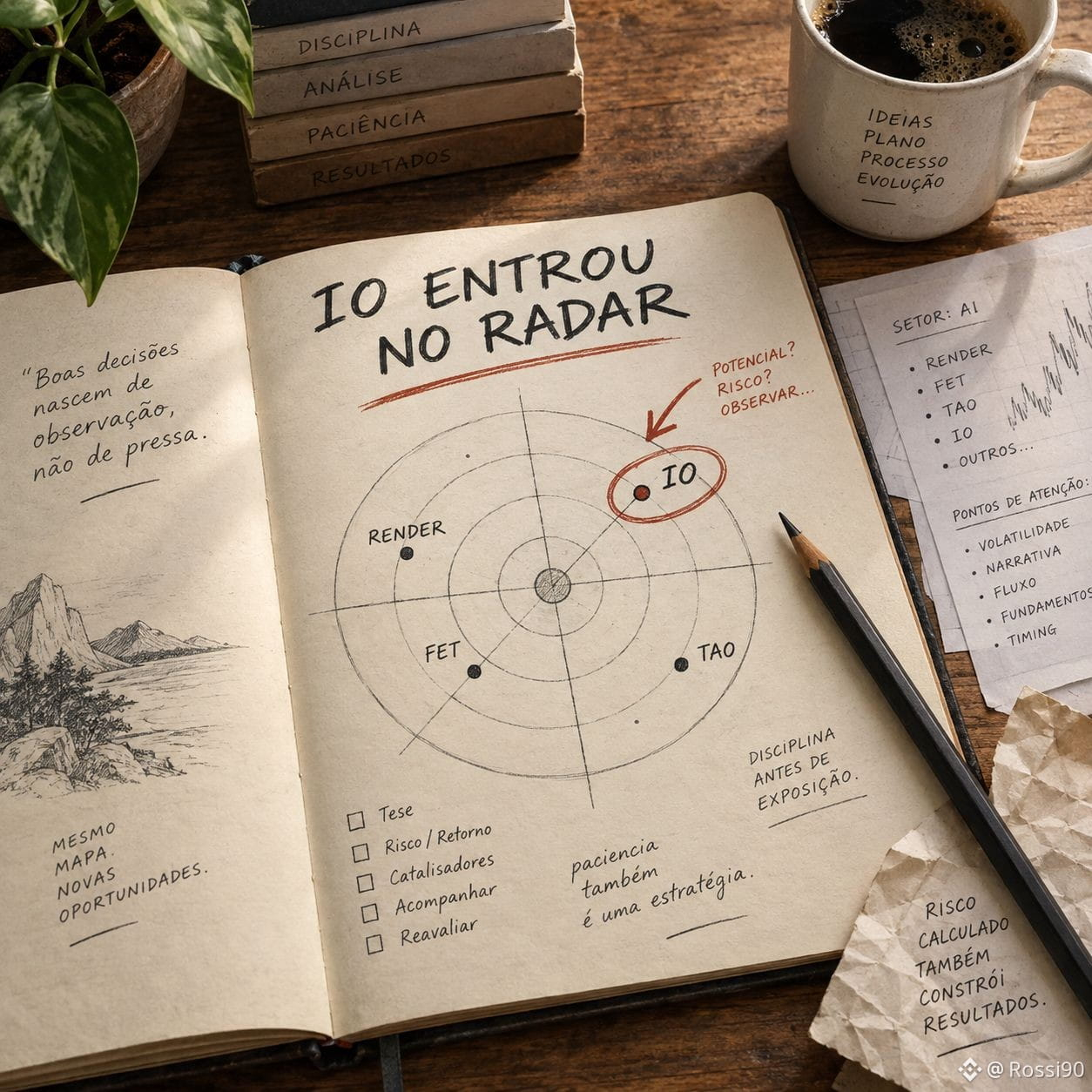
A NEW AI CRYPTOCURRENCY HAS HIT OUR RADAR
We started the project by analyzing $RENDER , $FET and $TAO.
All three are still on our list, but we decided to broaden the search.
After all, our goal is not simply to pick the safest project.
We’re looking for a large asymmetry with calculated risk.
That’s how we found $IO , the token of io.net.
The project offers decentralized GPU infrastructure for training, processing, and other artificial intelligence applications.
What caught our attention was the combination of a functional product and a market value much lower than that of the first candidates.
This could represent greater upside potential.
But it also means higher risk.
For now, IO has only entered the radar and passed the initial analysis. Before any purchase, we still need to analyze price, tokenomics, dilution, network demand, and everything that could prove this thesis wrong.
Tomorrow early, I’ll publish our decision: to buy or not to buy.
Did you already know about io.net?
{spot}(IOUSDT)
#ProjetoIA1000 #CriptoIA #ionet
A NEW AI CRYPTOCURRENCY HAS HIT OUR RADAR
We started the project by analyzing $RENDER , $FET and $TAO.
All three are still on our list, but we decided to broaden the search.
After all, our goal is not simply to pick the safest project.
We’re looking for a large asymmetry with calculated risk.
That’s how we found $IO , the token of io.net.
The project offers decentralized GPU infrastructure for training, processing, and other artificial intelligence applications.
What caught our attention was the combination of a functional product and a market value much lower than that of the first candidates.
This could represent greater upside potential.
But it also means higher risk.
For now, IO has only entered the radar and passed the initial analysis. Before any purchase, we still need to analyze price, tokenomics, dilution, network demand, and everything that could prove this thesis wrong.
Tomorrow early, I’ll publish our decision: to buy or not to buy.
Did you already know about io.net?
#ProjetoIA1000 #CriptoIA #ionet
We started the project by analyzing $RENDER , $FET and $TAO.
All three are still on our list, but we decided to broaden the search.
After all, our goal is not simply to pick the safest project.
We’re looking for a large asymmetry with calculated risk.
That’s how we found $IO , the token of io.net.
The project offers decentralized GPU infrastructure for training, processing, and other artificial intelligence applications.
What caught our attention was the combination of a functional product and a market value much lower than that of the first candidates.
This could represent greater upside potential.
But it also means higher risk.
For now, IO has only entered the radar and passed the initial analysis. Before any purchase, we still need to analyze price, tokenomics, dilution, network demand, and everything that could prove this thesis wrong.
Tomorrow early, I’ll publish our decision: to buy or not to buy.
Did you already know about io.net?
#ProjetoIA1000 #CriptoIA #ionet
2
1.6k
·
--
OS 100 USDT CONTINUES PARADOX.
And this is also a decision.
We have three AI cryptocurrencies on the table: $RENDER , $FET and $TAO .
But finding a good project doesn’t mean finding a good buy.
Tomorrow we’ll compare the three and answer two questions:
- Which one has the best thesis?
- And which one offers the best entry point?
Meanwhile, I want to know: would you pick the best project first, or wait for the best price? 🤔
#BitcoinSurpasses$79K #ProjetoIA1000 #criptoIA
OS 100 USDT CONTINUES PARADOX.
And this is also a decision.
We have three AI cryptocurrencies on the table: $RENDER , $FET and $TAO .
But finding a good project doesn’t mean finding a good buy.
Tomorrow we’ll compare the three and answer two questions:
- Which one has the best thesis?
- And which one offers the best entry point?
Meanwhile, I want to know: would you pick the best project first, or wait for the best price? 🤔
#BitcoinSurpasses$79K #ProjetoIA1000 #criptoIA
And this is also a decision.
We have three AI cryptocurrencies on the table: $RENDER , $FET and $TAO .
But finding a good project doesn’t mean finding a good buy.
Tomorrow we’ll compare the three and answer two questions:
- Which one has the best thesis?
- And which one offers the best entry point?
Meanwhile, I want to know: would you pick the best project first, or wait for the best price? 🤔
#BitcoinSurpasses$79K #ProjetoIA1000 #criptoIA
1
528
·
--
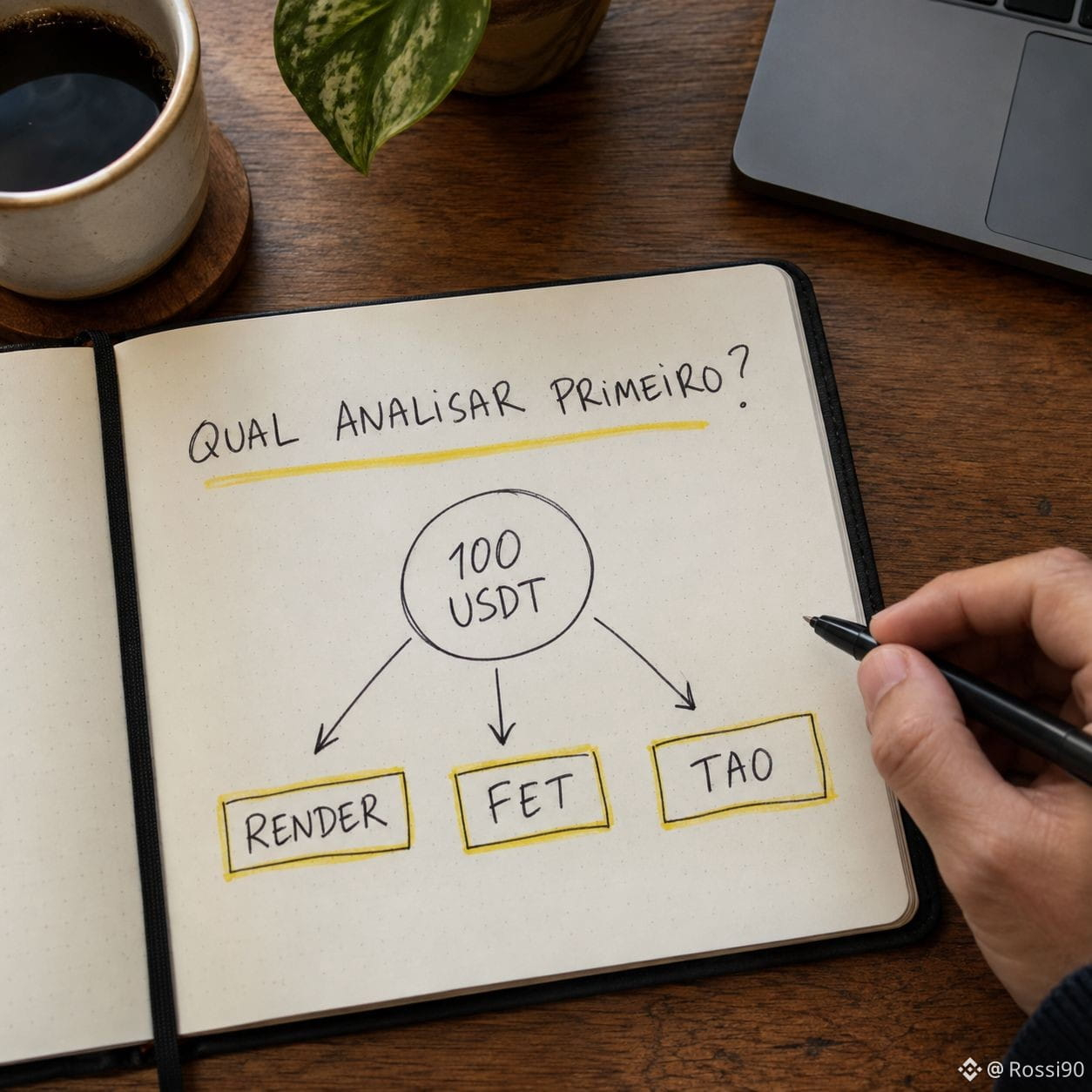
100 USDT. THREE AI CRYPTOS ON THE TABLE.
With $BTC above $79k, the urge to enter the market grows. But I haven’t bought any coin for this project yet.
The first candidates are:
$RENDER — GPU processing.
$FET — autonomous agents.
$TAO — decentralized intelligence.
If the 100 USDT were yours, which one would you analyze first?
Don’t just answer the name. I want to understand the reason behind the choice.
#ProjetoIA1000 #criptoIA
#BitcoinSurpasses$79K
{spot}(TAOUSDT)
{spot}(FETUSDT)
{spot}(RENDERUSDT)
100 USDT. THREE AI CRYPTOS ON THE TABLE.
With $BTC above $79k, the urge to enter the market grows. But I haven’t bought any coin for this project yet.
The first candidates are:
$RENDER — GPU processing.
$FET — autonomous agents.
$TAO — decentralized intelligence.
If the 100 USDT were yours, which one would you analyze first?
Don’t just answer the name. I want to understand the reason behind the choice.
#ProjetoIA1000 #criptoIA
#BitcoinSurpasses$79K
With $BTC above $79k, the urge to enter the market grows. But I haven’t bought any coin for this project yet.
The first candidates are:
$RENDER — GPU processing.
$FET — autonomous agents.
$TAO — decentralized intelligence.
If the 100 USDT were yours, which one would you analyze first?
Don’t just answer the name. I want to understand the reason behind the choice.
#ProjetoIA1000 #criptoIA
#BitcoinSurpasses$79K
1
3.2k
·
--
Article
AI PROJECT: FROM $100 TO $1,000 — A PUBLIC ARTIFICIAL INTELLIGENCE CRYPTOCURRENCY PORTFOLIOREAL PROJECT
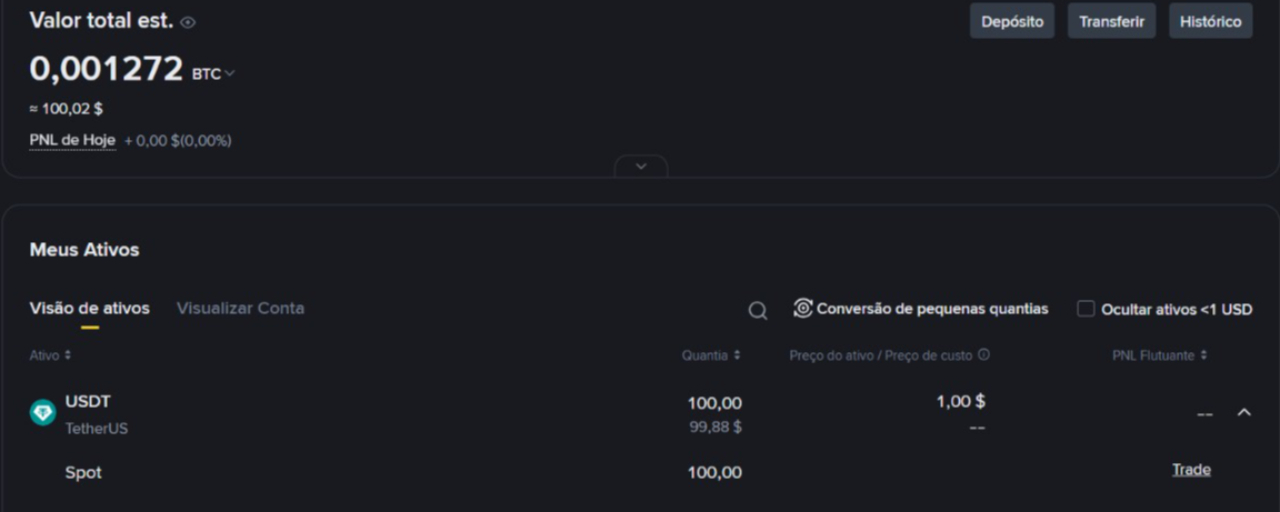
I separated 100 USDT from my own money to invest in cryptocurrencies linked to artificial intelligence. The initial goal is to try to turn those 100 USDT into 1,000 USDT.
Is that an ambitious goal? Definitely.
Can it happen in the crypto market? It can.
Is it easy or guaranteed? By no means.
To go from $100 to $1,000, the portfolio needs to increase tenfold. The issue is that, when someone sets this goal above all else, they start taking exaggerated risks, making unnecessary trades, and buying any project that promises multiplication.
AI PROJECT: FROM $100 TO $1,000 — A PUBLIC ARTIFICIAL INTELLIGENCE CRYPTOCURRENCY PORTFOLIO
REAL PROJECT
I separated 100 USDT from my own money to invest in cryptocurrencies linked to artificial intelligence. The initial goal is to try to turn those 100 USDT into 1,000 USDT.
Is that an ambitious goal? Definitely.
Can it happen in the crypto market? It can.
Is it easy or guaranteed? By no means.
To go from $100 to $1,000, the portfolio needs to increase tenfold. The issue is that, when someone sets this goal above all else, they start taking exaggerated risks, making unnecessary trades, and buying any project that promises multiplication.
I separated 100 USDT from my own money to invest in cryptocurrencies linked to artificial intelligence. The initial goal is to try to turn those 100 USDT into 1,000 USDT.
Is that an ambitious goal? Definitely.
Can it happen in the crypto market? It can.
Is it easy or guaranteed? By no means.
To go from $100 to $1,000, the portfolio needs to increase tenfold. The issue is that, when someone sets this goal above all else, they start taking exaggerated risks, making unnecessary trades, and buying any project that promises multiplication.
1
765
·
--
Bullish
RENDER A US$ 1,52: OPPORTUNITY OR TRAP?
I’ve been following $RENDER and the question is this: the price is approximately 89% below its all-time high. Does that mean it’s cheap?
Not necessarily.
A big drop doesn’t automatically turn an asset into an opportunity. First we need to look for fundamentals, and in this regard, Render has something interesting: a decentralized GPU network focused on rendering, 3D creation, and related applications for artificial intelligence.
In other words, it’s not just another cryptocurrency trying to ride the AI narrative. There’s real utility behind the token.
Now let’s look at the weekly chart:
• Current price: US$ 1,52
• 7-period average: US$ 1,42
• 25-period average: US$ 1,66
• 99-period average: US$ 3,29
The price has managed to stay above the short-term average, which suggests an attempt at recovery. On the other hand, it’s still below the longer averages. So, talking about a trend reversal right now would be premature.
The region between US$ 1,47 and US$ 1,42 deserves attention. If that support is lost, we could see another leg down. For me, a more interesting confirmation would only come with a breakout above US$ 1,65 accompanied by increased volume.
My take: it’s a good project to keep on your radar, and maybe start a small, staged entry. But I still don’t see enough confirmation for an aggressive position.
I like risk, but risk needs to come with a thesis. Buying just because it’s down 89% isn’t a thesis.
And you—do you believe this sideways movement is accumulation or just a pause before another drop?
#RENDER #RenderNetwork #Criptomoedas #IA #Altcoins
{spot}(RENDERUSDT)
RENDER A US$ 1,52: OPPORTUNITY OR TRAP?
I’ve been following $RENDER and the question is this: the price is approximately 89% below its all-time high. Does that mean it’s cheap?
Not necessarily.
A big drop doesn’t automatically turn an asset into an opportunity. First we need to look for fundamentals, and in this regard, Render has something interesting: a decentralized GPU network focused on rendering, 3D creation, and related applications for artificial intelligence.
In other words, it’s not just another cryptocurrency trying to ride the AI narrative. There’s real utility behind the token.
Now let’s look at the weekly chart:
• Current price: US$ 1,52
• 7-period average: US$ 1,42
• 25-period average: US$ 1,66
• 99-period average: US$ 3,29
The price has managed to stay above the short-term average, which suggests an attempt at recovery. On the other hand, it’s still below the longer averages. So, talking about a trend reversal right now would be premature.
The region between US$ 1,47 and US$ 1,42 deserves attention. If that support is lost, we could see another leg down. For me, a more interesting confirmation would only come with a breakout above US$ 1,65 accompanied by increased volume.
My take: it’s a good project to keep on your radar, and maybe start a small, staged entry. But I still don’t see enough confirmation for an aggressive position.
I like risk, but risk needs to come with a thesis. Buying just because it’s down 89% isn’t a thesis.
And you—do you believe this sideways movement is accumulation or just a pause before another drop?
#RENDER #RenderNetwork #Criptomoedas #IA #Altcoins
I’ve been following $RENDER and the question is this: the price is approximately 89% below its all-time high. Does that mean it’s cheap?
Not necessarily.
A big drop doesn’t automatically turn an asset into an opportunity. First we need to look for fundamentals, and in this regard, Render has something interesting: a decentralized GPU network focused on rendering, 3D creation, and related applications for artificial intelligence.
In other words, it’s not just another cryptocurrency trying to ride the AI narrative. There’s real utility behind the token.
Now let’s look at the weekly chart:
• Current price: US$ 1,52
• 7-period average: US$ 1,42
• 25-period average: US$ 1,66
• 99-period average: US$ 3,29
The price has managed to stay above the short-term average, which suggests an attempt at recovery. On the other hand, it’s still below the longer averages. So, talking about a trend reversal right now would be premature.
The region between US$ 1,47 and US$ 1,42 deserves attention. If that support is lost, we could see another leg down. For me, a more interesting confirmation would only come with a breakout above US$ 1,65 accompanied by increased volume.
My take: it’s a good project to keep on your radar, and maybe start a small, staged entry. But I still don’t see enough confirmation for an aggressive position.
I like risk, but risk needs to come with a thesis. Buying just because it’s down 89% isn’t a thesis.
And you—do you believe this sideways movement is accumulation or just a pause before another drop?
#RENDER #RenderNetwork #Criptomoedas #IA #Altcoins
2
1
1.1k
Log in to explore more content
Join global crypto users on Binance Square
⚡️ Get latest and useful information about crypto.
💬 Trusted by the world’s largest crypto exchange.
👍 Discover real insights from verified creators.
Email / Phone number