
不念
198 Posts

不念
Report
Block User
入圈两年多,拉新2300,交易成绩一般。经历过行情起伏,也见过币圈的人情冷暖。聊市场、聊交易、聊真实经历,不装高手。
关注Bitcoin、RWA、稳定币与链上资产。
分享行业观察、使用体验和个人思考。
Open Trade

BNB Holder
Frequent Trader
2.4 Years
33 Following
292 Followers
487 Liked
Posts
Portfolio
All
Quotes
Videos
·
--
#Anthropic今日开始交易,IPO定价每股83美元 ANT lists tonight at a $1.5 trillion valuation. Wall Street is going even harder on AI than the crypto market.
Tonight, November 19, Anthropic, the company behind Claude, officially goes public on Nasdaq.
The IPO is priced at $83 per share, putting its valuation at a whopping $1.5 trillion and raising around $81.3 billion.
At 18:05 Beijing time, Binance opened limit orders for ANT shares. Regular US stock trading starts at 22:30, but ANT is expected to open late. The actual trading time will depend on Nasdaq.
More interestingly, Binance’s ANTUSDT pre-market perpetual contract has already started trading.
The stock hasn’t even opened, but the futures market has already started pricing it in.
Honestly, I don’t doubt Anthropic’s technical capabilities. Claude Code really has shown me how AI is changing the way we work.
But what does a $1.5 trillion valuation actually mean?
The market has practically priced it as the next-generation tech giant.
Crypto projects used to sell the future with white papers, and everyone called it a bubble.
Now Wall Street is pricing in AI’s next ten years, and everyone thinks it’s reasonable.
Of course, Anthropic has real business operations and revenue, so the two situations aren’t directly comparable.
*I think the thing to be most wary of isn’t whether AI is in a bubble, but whether AI needs to be repriced.
Tonight, I’ll be watching the price gap between Binance’s ANT contract and the Nasdaq-listed stock after it opens.
If the stock opens 50% higher, would you chase it?
#Anthropic今日开始交易,IPO定价每股83美元 ANT lists tonight at a $1.5 trillion valuation. Wall Street is going even harder on AI than the crypto market.
Tonight, November 19, Anthropic, the company behind Claude, officially goes public on Nasdaq.
The IPO is priced at $83 per share, putting its valuation at a whopping $1.5 trillion and raising around $81.3 billion.
At 18:05 Beijing time, Binance opened limit orders for ANT shares. Regular US stock trading starts at 22:30, but ANT is expected to open late. The actual trading time will depend on Nasdaq.
More interestingly, Binance’s ANTUSDT pre-market perpetual contract has already started trading.
The stock hasn’t even opened, but the futures market has already started pricing it in.
Honestly, I don’t doubt Anthropic’s technical capabilities. Claude Code really has shown me how AI is changing the way we work.
But what does a $1.5 trillion valuation actually mean?
The market has practically priced it as the next-generation tech giant.
Crypto projects used to sell the future with white papers, and everyone called it a bubble.
Now Wall Street is pricing in AI’s next ten years, and everyone thinks it’s reasonable.
Of course, Anthropic has real business operations and revenue, so the two situations aren’t directly comparable.
*I think the thing to be most wary of isn’t whether AI is in a bubble, but whether AI needs to be repriced.
Tonight, I’ll be watching the price gap between Binance’s ANT contract and the Nasdaq-listed stock after it opens.
If the stock opens 50% higher, would you chase it?
Tonight, November 19, Anthropic, the company behind Claude, officially goes public on Nasdaq.
The IPO is priced at $83 per share, putting its valuation at a whopping $1.5 trillion and raising around $81.3 billion.
At 18:05 Beijing time, Binance opened limit orders for ANT shares. Regular US stock trading starts at 22:30, but ANT is expected to open late. The actual trading time will depend on Nasdaq.
More interestingly, Binance’s ANTUSDT pre-market perpetual contract has already started trading.
The stock hasn’t even opened, but the futures market has already started pricing it in.
Honestly, I don’t doubt Anthropic’s technical capabilities. Claude Code really has shown me how AI is changing the way we work.
But what does a $1.5 trillion valuation actually mean?
The market has practically priced it as the next-generation tech giant.
Crypto projects used to sell the future with white papers, and everyone called it a bubble.
Now Wall Street is pricing in AI’s next ten years, and everyone thinks it’s reasonable.
Of course, Anthropic has real business operations and revenue, so the two situations aren’t directly comparable.
*I think the thing to be most wary of isn’t whether AI is in a bubble, but whether AI needs to be repriced.
Tonight, I’ll be watching the price gap between Binance’s ANT contract and the Nasdaq-listed stock after it opens.
If the stock opens 50% higher, would you chase it?
187
·
--
Verified
#英伟达财报夜!预期营收超千亿,AI股或迎大变盘
Nvidia’s biggest risk this time may not be an earnings blowup, but strong earnings that still fail to lift the stock.
What’s happened over the past few days is interesting when you look at it all together.
On November 16, the U.S. BIS introduced new rules bringing Singapore, Malaysia, Thailand, Indonesia, and Brazil under certain advanced-chip export licensing requirements.
Then, on November 18, the U.S. Congress called on Jensen Huang to attend a closed-door briefing to investigate Nvidia’s security measures and related chip exports to China.
And Nvidia is set to report earnings tonight.
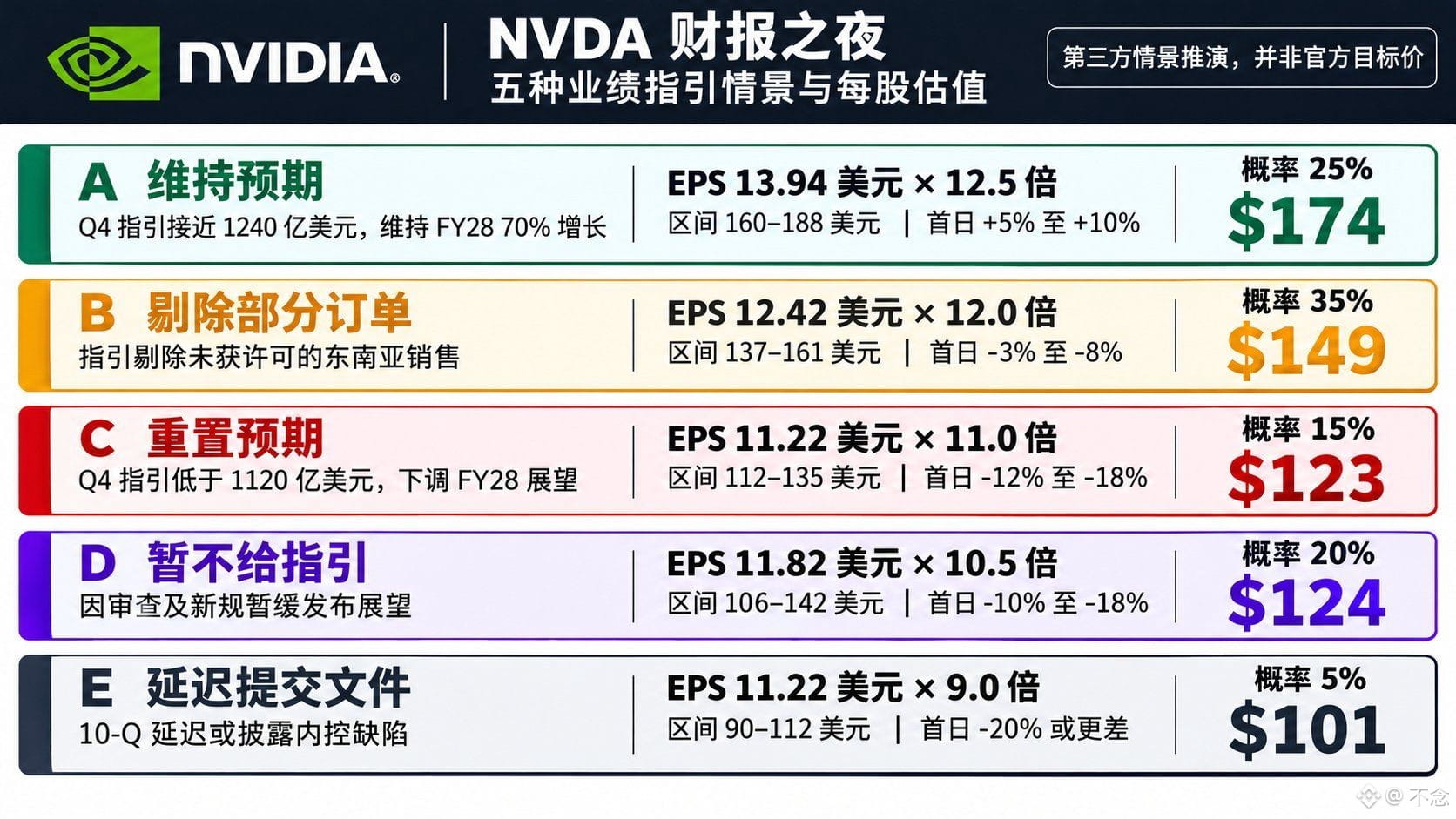
I looked at that valuation chart: five scenarios, ranging from $101 to $174.
The prices may not be accurate, but I think the market is overlooking a bigger issue.
The U.S. wants Nvidia to make money around the world, but it doesn’t want the whole world to have access to the most advanced American computing power.
That’s a contradiction in itself.
In the past, Nvidia only had to prove that demand for AI was strong enough, and the market was willing to assign it a higher valuation.
Things are different now.
Having customers with money, a full order book, and sufficient production capacity may not be enough.
How many chips can be exported? How much overseas revenue can actually be realized? How many more restrictions will Congress impose?
These issues, once treated as peripheral risks, are now becoming part of Nvidia’s core valuation logic.
I don’t think AI demand has peaked, and I don’t think Nvidia will suddenly lose its competitive edge.
But one thing is worth watching out for:
The market may pay a premium for growth, but it’s much harder to pay a premium for unpredictable policy risks.
Tonight’s earnings are about growth; tomorrow, Congress will be looking at the limits.
If earnings beat expectations but the stock still can’t gain ground, I don’t think that necessarily means the market is bearish on AI.
It may simply be that investors are starting to realize:
How much computing power Nvidia can produce is one thing; how much the U.S. is willing to let it sell is another.
$NVDA
#英伟达财报夜!预期营收超千亿,AI股或迎大变盘
Nvidia’s biggest risk this time may not be an earnings blowup, but strong earnings that still fail to lift the stock.
What’s happened over the past few days is interesting when you look at it all together.
On November 16, the U.S. BIS introduced new rules bringing Singapore, Malaysia, Thailand, Indonesia, and Brazil under certain advanced-chip export licensing requirements.
Then, on November 18, the U.S. Congress called on Jensen Huang to attend a closed-door briefing to investigate Nvidia’s security measures and related chip exports to China.
And Nvidia is set to report earnings tonight.
I looked at that valuation chart: five scenarios, ranging from $101 to $174.
The prices may not be accurate, but I think the market is overlooking a bigger issue.
The U.S. wants Nvidia to make money around the world, but it doesn’t want the whole world to have access to the most advanced American computing power.
That’s a contradiction in itself.
In the past, Nvidia only had to prove that demand for AI was strong enough, and the market was willing to assign it a higher valuation.
Things are different now.
Having customers with money, a full order book, and sufficient production capacity may not be enough.
How many chips can be exported? How much overseas revenue can actually be realized? How many more restrictions will Congress impose?
These issues, once treated as peripheral risks, are now becoming part of Nvidia’s core valuation logic.
I don’t think AI demand has peaked, and I don’t think Nvidia will suddenly lose its competitive edge.
But one thing is worth watching out for:
The market may pay a premium for growth, but it’s much harder to pay a premium for unpredictable policy risks.
Tonight’s earnings are about growth; tomorrow, Congress will be looking at the limits.
If earnings beat expectations but the stock still can’t gain ground, I don’t think that necessarily means the market is bearish on AI.
It may simply be that investors are starting to realize:
How much computing power Nvidia can produce is one thing; how much the U.S. is willing to let it sell is another.
$NVDA
Nvidia’s biggest risk this time may not be an earnings blowup, but strong earnings that still fail to lift the stock.
What’s happened over the past few days is interesting when you look at it all together.
On November 16, the U.S. BIS introduced new rules bringing Singapore, Malaysia, Thailand, Indonesia, and Brazil under certain advanced-chip export licensing requirements.
Then, on November 18, the U.S. Congress called on Jensen Huang to attend a closed-door briefing to investigate Nvidia’s security measures and related chip exports to China.
And Nvidia is set to report earnings tonight.
I looked at that valuation chart: five scenarios, ranging from $101 to $174.
The prices may not be accurate, but I think the market is overlooking a bigger issue.
The U.S. wants Nvidia to make money around the world, but it doesn’t want the whole world to have access to the most advanced American computing power.
That’s a contradiction in itself.
In the past, Nvidia only had to prove that demand for AI was strong enough, and the market was willing to assign it a higher valuation.
Things are different now.
Having customers with money, a full order book, and sufficient production capacity may not be enough.
How many chips can be exported? How much overseas revenue can actually be realized? How many more restrictions will Congress impose?
These issues, once treated as peripheral risks, are now becoming part of Nvidia’s core valuation logic.
I don’t think AI demand has peaked, and I don’t think Nvidia will suddenly lose its competitive edge.
But one thing is worth watching out for:
The market may pay a premium for growth, but it’s much harder to pay a premium for unpredictable policy risks.
Tonight’s earnings are about growth; tomorrow, Congress will be looking at the limits.
If earnings beat expectations but the stock still can’t gain ground, I don’t think that necessarily means the market is bearish on AI.
It may simply be that investors are starting to realize:
How much computing power Nvidia can produce is one thing; how much the U.S. is willing to let it sell is another.
$NVDA
1
1.2k
·
--
Verified
#英伟达 Nvidia reports earnings tonight, and I actually think people who are bullish on Nvidia should be more cautious.
Not because I'm bearish on Nvidia.
It's because a good company, good earnings, and a good stock price are completely different things.
Nvidia's earnings may continue to grow, but if the market has already priced in several years of future growth, the stock may not rise even if earnings beat expectations.
I think there's a question worth discussing.
Being equally bullish on Nvidia, buying the stock and opening a 10x perpetual contract are actually two completely different trades.
When you buy the stock, you own a beneficial interest in the company. As long as the company is still around and you don't actively sell, you can keep waiting for the fundamentals to play out—though of course, you also bear the risk of the stock price falling.
When you buy a stock perpetual contract, you don't own the stock or have any right to shareholder dividends.
What you're buying is exposure to its price.
10x leverage means that if the stock moves 5% against you, you theoretically lose half your margin.
At close to 10%, you may be liquidated before the price even falls that far.
On top of that, there are a few easily overlooked things about stock perpetual contracts:
① They trade 24/7, so prices can keep moving even when the U.S. stock market is closed.
② Funding fees are usually settled every 8 hours, so with a long-term position, it's not just about whether the stock price rises or falls.
③ Gaps after earnings, liquidity, and changes in mark price may make your actual liquidation risk greater than you expect.
I'm increasingly convinced that many people don't lose because they picked the wrong stock, but because they turned a long-term view into a short-term leveraged trade.
You believe Nvidia's AI business will do well over the next three years, yet you use 10x leverage to bet on its share price at 1 a.m. tomorrow.
That doesn't amplify your conviction 10 times; it just shrinks the room you have to be wrong.
I've lost quite a bit of money trading myself, so these days I'm especially wary of going all in on a directional bet before earnings.
Earnings can determine how the market reprices a stock in the short term, but they don't necessarily determine a company's long-term value.
Tonight, I'm paying closer attention to two things:
First, whether Nvidia's results and guidance for next quarter can continue to support the market's high expectations for AI.
Second, if the earnings are good but the stock falls, is the market worried about slowing growth, or has the valuation already run too far ahead?
Before the earnings come out, make sure you know whether you're buying a stock or a contract that could be liquidated at any moment.
#英伟达 Nvidia reports earnings tonight, and I actually think people who are bullish on Nvidia should be more cautious.
Not because I'm bearish on Nvidia.
It's because a good company, good earnings, and a good stock price are completely different things.
Nvidia's earnings may continue to grow, but if the market has already priced in several years of future growth, the stock may not rise even if earnings beat expectations.
I think there's a question worth discussing.
Being equally bullish on Nvidia, buying the stock and opening a 10x perpetual contract are actually two completely different trades.
When you buy the stock, you own a beneficial interest in the company. As long as the company is still around and you don't actively sell, you can keep waiting for the fundamentals to play out—though of course, you also bear the risk of the stock price falling.
When you buy a stock perpetual contract, you don't own the stock or have any right to shareholder dividends.
What you're buying is exposure to its price.
10x leverage means that if the stock moves 5% against you, you theoretically lose half your margin.
At close to 10%, you may be liquidated before the price even falls that far.
On top of that, there are a few easily overlooked things about stock perpetual contracts:
① They trade 24/7, so prices can keep moving even when the U.S. stock market is closed.
② Funding fees are usually settled every 8 hours, so with a long-term position, it's not just about whether the stock price rises or falls.
③ Gaps after earnings, liquidity, and changes in mark price may make your actual liquidation risk greater than you expect.
I'm increasingly convinced that many people don't lose because they picked the wrong stock, but because they turned a long-term view into a short-term leveraged trade.
You believe Nvidia's AI business will do well over the next three years, yet you use 10x leverage to bet on its share price at 1 a.m. tomorrow.
That doesn't amplify your conviction 10 times; it just shrinks the room you have to be wrong.
I've lost quite a bit of money trading myself, so these days I'm especially wary of going all in on a directional bet before earnings.
Earnings can determine how the market reprices a stock in the short term, but they don't necessarily determine a company's long-term value.
Tonight, I'm paying closer attention to two things:
First, whether Nvidia's results and guidance for next quarter can continue to support the market's high expectations for AI.
Second, if the earnings are good but the stock falls, is the market worried about slowing growth, or has the valuation already run too far ahead?
Before the earnings come out, make sure you know whether you're buying a stock or a contract that could be liquidated at any moment.
Not because I'm bearish on Nvidia.
It's because a good company, good earnings, and a good stock price are completely different things.
Nvidia's earnings may continue to grow, but if the market has already priced in several years of future growth, the stock may not rise even if earnings beat expectations.
I think there's a question worth discussing.
Being equally bullish on Nvidia, buying the stock and opening a 10x perpetual contract are actually two completely different trades.
When you buy the stock, you own a beneficial interest in the company. As long as the company is still around and you don't actively sell, you can keep waiting for the fundamentals to play out—though of course, you also bear the risk of the stock price falling.
When you buy a stock perpetual contract, you don't own the stock or have any right to shareholder dividends.
What you're buying is exposure to its price.
10x leverage means that if the stock moves 5% against you, you theoretically lose half your margin.
At close to 10%, you may be liquidated before the price even falls that far.
On top of that, there are a few easily overlooked things about stock perpetual contracts:
① They trade 24/7, so prices can keep moving even when the U.S. stock market is closed.
② Funding fees are usually settled every 8 hours, so with a long-term position, it's not just about whether the stock price rises or falls.
③ Gaps after earnings, liquidity, and changes in mark price may make your actual liquidation risk greater than you expect.
I'm increasingly convinced that many people don't lose because they picked the wrong stock, but because they turned a long-term view into a short-term leveraged trade.
You believe Nvidia's AI business will do well over the next three years, yet you use 10x leverage to bet on its share price at 1 a.m. tomorrow.
That doesn't amplify your conviction 10 times; it just shrinks the room you have to be wrong.
I've lost quite a bit of money trading myself, so these days I'm especially wary of going all in on a directional bet before earnings.
Earnings can determine how the market reprices a stock in the short term, but they don't necessarily determine a company's long-term value.
Tonight, I'm paying closer attention to two things:
First, whether Nvidia's results and guidance for next quarter can continue to support the market's high expectations for AI.
Second, if the earnings are good but the stock falls, is the market worried about slowing growth, or has the valuation already run too far ahead?
Before the earnings come out, make sure you know whether you're buying a stock or a contract that could be liquidated at any moment.
5
7
10.2k
·
--
#何一 A $100 million drawdown in a month—the crypto world really needs to be demystified.
Today I saw the account screenshot He Yi posted: her assets had shrunk by $101 million over 30 days.
I looked back at her previously disclosed holdings, and BNB had long made up around 90% of her portfolio. This time, the main issue was that her holdings lost value; it doesn’t mean she lost that much from short-term trading.
Bull markets make legends; bear markets bring people back down to earth.
He Yi is at the heart of the industry, with access to resources, information, and connections that ordinary people simply can’t match. And yet she still can’t escape market drawdowns.
So what makes us ordinary people think we can make steady profits just by following a few crypto influencers and looking at a few candlestick charts?
The biggest problem in crypto over the years is that people are far too eager to turn others into legends.
Whoever makes money is assumed to have superior insight; whoever calls the market right becomes a guru.
In a favorable market, luck can masquerade as skill. In a bad one, leverage magnifies every mistake.
My own trading has been a complete mess, and I’m increasingly convinced that trading isn’t just about demystifying others—it’s about demystifying yourself, too.
Someone else’s $100 million drawdown may be just one stretch on their asset curve. Your 50% drawdown could wipe out years of savings.
Someone else’s confidence in a concentrated position is their own—not a reason for you to go all in alongside them.
The market never runs out of overnight-riches stories. What’s rare are the people who are still at the table after several bull and bear cycles.
A truly skilled trader isn’t someone who gets it right every time, but someone who can survive being wrong.
#bnb
#何一 A $100 million drawdown in a month—the crypto world really needs to be demystified.
Today I saw the account screenshot He Yi posted: her assets had shrunk by $101 million over 30 days.
I looked back at her previously disclosed holdings, and BNB had long made up around 90% of her portfolio. This time, the main issue was that her holdings lost value; it doesn’t mean she lost that much from short-term trading.
Bull markets make legends; bear markets bring people back down to earth.
He Yi is at the heart of the industry, with access to resources, information, and connections that ordinary people simply can’t match. And yet she still can’t escape market drawdowns.
So what makes us ordinary people think we can make steady profits just by following a few crypto influencers and looking at a few candlestick charts?
The biggest problem in crypto over the years is that people are far too eager to turn others into legends.
Whoever makes money is assumed to have superior insight; whoever calls the market right becomes a guru.
In a favorable market, luck can masquerade as skill. In a bad one, leverage magnifies every mistake.
My own trading has been a complete mess, and I’m increasingly convinced that trading isn’t just about demystifying others—it’s about demystifying yourself, too.
Someone else’s $100 million drawdown may be just one stretch on their asset curve. Your 50% drawdown could wipe out years of savings.
Someone else’s confidence in a concentrated position is their own—not a reason for you to go all in alongside them.
The market never runs out of overnight-riches stories. What’s rare are the people who are still at the table after several bull and bear cycles.
A truly skilled trader isn’t someone who gets it right every time, but someone who can survive being wrong.
#bnb
Today I saw the account screenshot He Yi posted: her assets had shrunk by $101 million over 30 days.
I looked back at her previously disclosed holdings, and BNB had long made up around 90% of her portfolio. This time, the main issue was that her holdings lost value; it doesn’t mean she lost that much from short-term trading.
Bull markets make legends; bear markets bring people back down to earth.
He Yi is at the heart of the industry, with access to resources, information, and connections that ordinary people simply can’t match. And yet she still can’t escape market drawdowns.
So what makes us ordinary people think we can make steady profits just by following a few crypto influencers and looking at a few candlestick charts?
The biggest problem in crypto over the years is that people are far too eager to turn others into legends.
Whoever makes money is assumed to have superior insight; whoever calls the market right becomes a guru.
In a favorable market, luck can masquerade as skill. In a bad one, leverage magnifies every mistake.
My own trading has been a complete mess, and I’m increasingly convinced that trading isn’t just about demystifying others—it’s about demystifying yourself, too.
Someone else’s $100 million drawdown may be just one stretch on their asset curve. Your 50% drawdown could wipe out years of savings.
Someone else’s confidence in a concentrated position is their own—not a reason for you to go all in alongside them.
The market never runs out of overnight-riches stories. What’s rare are the people who are still at the table after several bull and bear cycles.
A truly skilled trader isn’t someone who gets it right every time, but someone who can survive being wrong.
#bnb

2
5
5k
·
--
#BTC Bitcoin fell to $63,000 over the weekend. Trump has given the crypto world so much good news—so why has the market still fallen this hard?
Honestly, watching the market over the past two days has been disheartening.
, large numbers of leveraged longs were liquidated, and market sentiment plunged back to rock bottom.
Since taking office, Trump has pushed for a strategic Bitcoin reserve, stablecoin legislation, and crypto regulatory reform. One piece of positive policy news after another.
But what about the market? It keeps falling anyway.
Then there are the U.S. midterm elections, where the Democrats won both the House and the Senate.
Many people see this as a major negative, but I’m not that pessimistic.
Trump’s approach is more market-oriented: easing some regulatory restrictions, encouraging crypto companies to innovate, and hoping to make the U.S. a global crypto hub.
The regulatory wing of the Democratic Party, by contrast, puts more emphasis on rules: exchange compliance, anti-money laundering, investor protection, and setting boundaries for banks’ involvement in digital asset businesses.
The difference between the two parties isn’t that one supports blockchain while the other wants to destroy it; it’s that they have different approaches to development.
Trump wants to give the crypto industry more room to grow, while Democratic regulators want to establish stricter financial rules.
Stablecoin payments, the tokenization of U.S. Treasuries and stocks, and banks’ participation in on-chain settlement won’t automatically stop just because the Democrats won Congress.
Of course, the legislative process for some of Trump’s crypto policies may face obstacles, and the market will need to adjust its expectations.
In my view, the crypto industry has come so far that its future is no longer determined simply by what a particular president says.
I’m not that pessimistic about this downturn.
I’m certain we’re basically at the bottom now.
More than short-term price fluctuations, I care about whether the two parties can reach a compromise on crypto legislation.
Policy can improve the industry’s environment, but what ultimately drives the market is real money flowing in as buyers.
After going through several cycles of rises and falls, I’ve increasingly come to feel that the easiest mistake to make in crypto is thinking everything is right when prices are rising, then thinking everything is over when they’re falling.
Trump isn’t a guarantee of a bull market, and the Democrats aren’t a sentence of doom to a bear market.
In the short term, I respect the market; in the long term, I remain optimistic about the crypto industry’s development.
As for when the next bull market will arrive, I don’t know.
But I believe opportunities often emerge when not everyone is feeling excited.
#BTC Bitcoin fell to $63,000 over the weekend. Trump has given the crypto world so much good news—so why has the market still fallen this hard?
Honestly, watching the market over the past two days has been disheartening.
, large numbers of leveraged longs were liquidated, and market sentiment plunged back to rock bottom.
Since taking office, Trump has pushed for a strategic Bitcoin reserve, stablecoin legislation, and crypto regulatory reform. One piece of positive policy news after another.
But what about the market? It keeps falling anyway.
Then there are the U.S. midterm elections, where the Democrats won both the House and the Senate.
Many people see this as a major negative, but I’m not that pessimistic.
Trump’s approach is more market-oriented: easing some regulatory restrictions, encouraging crypto companies to innovate, and hoping to make the U.S. a global crypto hub.
The regulatory wing of the Democratic Party, by contrast, puts more emphasis on rules: exchange compliance, anti-money laundering, investor protection, and setting boundaries for banks’ involvement in digital asset businesses.
The difference between the two parties isn’t that one supports blockchain while the other wants to destroy it; it’s that they have different approaches to development.
Trump wants to give the crypto industry more room to grow, while Democratic regulators want to establish stricter financial rules.
Stablecoin payments, the tokenization of U.S. Treasuries and stocks, and banks’ participation in on-chain settlement won’t automatically stop just because the Democrats won Congress.
Of course, the legislative process for some of Trump’s crypto policies may face obstacles, and the market will need to adjust its expectations.
In my view, the crypto industry has come so far that its future is no longer determined simply by what a particular president says.
I’m not that pessimistic about this downturn.
I’m certain we’re basically at the bottom now.
More than short-term price fluctuations, I care about whether the two parties can reach a compromise on crypto legislation.
Policy can improve the industry’s environment, but what ultimately drives the market is real money flowing in as buyers.
After going through several cycles of rises and falls, I’ve increasingly come to feel that the easiest mistake to make in crypto is thinking everything is right when prices are rising, then thinking everything is over when they’re falling.
Trump isn’t a guarantee of a bull market, and the Democrats aren’t a sentence of doom to a bear market.
In the short term, I respect the market; in the long term, I remain optimistic about the crypto industry’s development.
As for when the next bull market will arrive, I don’t know.
But I believe opportunities often emerge when not everyone is feeling excited.
Honestly, watching the market over the past two days has been disheartening.
, large numbers of leveraged longs were liquidated, and market sentiment plunged back to rock bottom.
Since taking office, Trump has pushed for a strategic Bitcoin reserve, stablecoin legislation, and crypto regulatory reform. One piece of positive policy news after another.
But what about the market? It keeps falling anyway.
Then there are the U.S. midterm elections, where the Democrats won both the House and the Senate.
Many people see this as a major negative, but I’m not that pessimistic.
Trump’s approach is more market-oriented: easing some regulatory restrictions, encouraging crypto companies to innovate, and hoping to make the U.S. a global crypto hub.
The regulatory wing of the Democratic Party, by contrast, puts more emphasis on rules: exchange compliance, anti-money laundering, investor protection, and setting boundaries for banks’ involvement in digital asset businesses.
The difference between the two parties isn’t that one supports blockchain while the other wants to destroy it; it’s that they have different approaches to development.
Trump wants to give the crypto industry more room to grow, while Democratic regulators want to establish stricter financial rules.
Stablecoin payments, the tokenization of U.S. Treasuries and stocks, and banks’ participation in on-chain settlement won’t automatically stop just because the Democrats won Congress.
Of course, the legislative process for some of Trump’s crypto policies may face obstacles, and the market will need to adjust its expectations.
In my view, the crypto industry has come so far that its future is no longer determined simply by what a particular president says.
I’m not that pessimistic about this downturn.
I’m certain we’re basically at the bottom now.
More than short-term price fluctuations, I care about whether the two parties can reach a compromise on crypto legislation.
Policy can improve the industry’s environment, but what ultimately drives the market is real money flowing in as buyers.
After going through several cycles of rises and falls, I’ve increasingly come to feel that the easiest mistake to make in crypto is thinking everything is right when prices are rising, then thinking everything is over when they’re falling.
Trump isn’t a guarantee of a bull market, and the Democrats aren’t a sentence of doom to a bear market.
In the short term, I respect the market; in the long term, I remain optimistic about the crypto industry’s development.
As for when the next bull market will arrive, I don’t know.
But I believe opportunities often emerge when not everyone is feeling excited.
304
·
--
#xrp The biggest opportunity in the next cycle may not be a tenfold rise, but a genuine revaluation of its market cap.
At this point, I’d like to explain why I’m willing to spend time researching XRP during a bear market.
In 2022, XRP fell to around $0.29.
Back then, the market was mostly discussing the SEC lawsuit, regulatory risks, and whether XRP had any future.
Three years later, XRP rose to $3.65, and its market cap briefly approached $210 billion.
Now, XRP is back around $1.
Market sentiment has turned bearish again.
But unlike last cycle:
Ripple is no longer telling only the story of cross-border payments.
ETFs, institutional custody, banking licenses, RLUSD, asset tokenization…
It is trying to become part of more areas of the traditional financial system.
In this bear market, prices have fallen, but the institutional infrastructure continues to be built.
Of course, Ripple’s success does not mean XRP will necessarily appreciate.
That is precisely the biggest question mark for the next cycle.
If these institutional businesses eventually translate into sustained demand for XRP, and the broader crypto market enters another period of expansion, XRP could command a higher valuation than it did last cycle.
Conversely, if Ripple continues to thrive while XRP fails to attract more genuine demand, a $600 billion market cap may remain nothing more than a pleasant fantasy.
So I won’t say XRP is certain to reach $8, or that $0.8 is definitely the bottom.
My view is clear:
In this bear market, I’m keeping a close eye on the $0.7–0.9 range.
In the next bull market, I’ll continue tracking the optimistic market-cap scenario of $500–600 billion.
What I’m betting on isn’t a sudden spike on a price chart.
It’s whether the market as a whole will reassess XRP’s value within the financial system over the coming years.
If my thesis is right, the opportunity could be significant.
If I’m wrong, I’m willing to revise my view based on real data.
The most valuable thing in investing isn’t predicting a top or a bottom. It’s finding a thesis worth validating over the long term before the market reaches a consensus.
Lastly, I’d like to hear what you think:
In the next cycle, which XRP market cap do you favor: $300 billion or $600 billion?
Where do you think the bottom will be this cycle: $0.8, or will it fall to $0.5?
Let’s discuss this rationally—and revisit our predictions in a few years.
#xrp The biggest opportunity in the next cycle may not be a tenfold rise, but a genuine revaluation of its market cap.
At this point, I’d like to explain why I’m willing to spend time researching XRP during a bear market.
In 2022, XRP fell to around $0.29.
Back then, the market was mostly discussing the SEC lawsuit, regulatory risks, and whether XRP had any future.
Three years later, XRP rose to $3.65, and its market cap briefly approached $210 billion.
Now, XRP is back around $1.
Market sentiment has turned bearish again.
But unlike last cycle:
Ripple is no longer telling only the story of cross-border payments.
ETFs, institutional custody, banking licenses, RLUSD, asset tokenization…
It is trying to become part of more areas of the traditional financial system.
In this bear market, prices have fallen, but the institutional infrastructure continues to be built.
Of course, Ripple’s success does not mean XRP will necessarily appreciate.
That is precisely the biggest question mark for the next cycle.
If these institutional businesses eventually translate into sustained demand for XRP, and the broader crypto market enters another period of expansion, XRP could command a higher valuation than it did last cycle.
Conversely, if Ripple continues to thrive while XRP fails to attract more genuine demand, a $600 billion market cap may remain nothing more than a pleasant fantasy.
So I won’t say XRP is certain to reach $8, or that $0.8 is definitely the bottom.
My view is clear:
In this bear market, I’m keeping a close eye on the $0.7–0.9 range.
In the next bull market, I’ll continue tracking the optimistic market-cap scenario of $500–600 billion.
What I’m betting on isn’t a sudden spike on a price chart.
It’s whether the market as a whole will reassess XRP’s value within the financial system over the coming years.
If my thesis is right, the opportunity could be significant.
If I’m wrong, I’m willing to revise my view based on real data.
The most valuable thing in investing isn’t predicting a top or a bottom. It’s finding a thesis worth validating over the long term before the market reaches a consensus.
Lastly, I’d like to hear what you think:
In the next cycle, which XRP market cap do you favor: $300 billion or $600 billion?
Where do you think the bottom will be this cycle: $0.8, or will it fall to $0.5?
Let’s discuss this rationally—and revisit our predictions in a few years.
At this point, I’d like to explain why I’m willing to spend time researching XRP during a bear market.
In 2022, XRP fell to around $0.29.
Back then, the market was mostly discussing the SEC lawsuit, regulatory risks, and whether XRP had any future.
Three years later, XRP rose to $3.65, and its market cap briefly approached $210 billion.
Now, XRP is back around $1.
Market sentiment has turned bearish again.
But unlike last cycle:
Ripple is no longer telling only the story of cross-border payments.
ETFs, institutional custody, banking licenses, RLUSD, asset tokenization…
It is trying to become part of more areas of the traditional financial system.
In this bear market, prices have fallen, but the institutional infrastructure continues to be built.
Of course, Ripple’s success does not mean XRP will necessarily appreciate.
That is precisely the biggest question mark for the next cycle.
If these institutional businesses eventually translate into sustained demand for XRP, and the broader crypto market enters another period of expansion, XRP could command a higher valuation than it did last cycle.
Conversely, if Ripple continues to thrive while XRP fails to attract more genuine demand, a $600 billion market cap may remain nothing more than a pleasant fantasy.
So I won’t say XRP is certain to reach $8, or that $0.8 is definitely the bottom.
My view is clear:
In this bear market, I’m keeping a close eye on the $0.7–0.9 range.
In the next bull market, I’ll continue tracking the optimistic market-cap scenario of $500–600 billion.
What I’m betting on isn’t a sudden spike on a price chart.
It’s whether the market as a whole will reassess XRP’s value within the financial system over the coming years.
If my thesis is right, the opportunity could be significant.
If I’m wrong, I’m willing to revise my view based on real data.
The most valuable thing in investing isn’t predicting a top or a bottom. It’s finding a thesis worth validating over the long term before the market reaches a consensus.
Lastly, I’d like to hear what you think:
In the next cycle, which XRP market cap do you favor: $300 billion or $600 billion?
Where do you think the bottom will be this cycle: $0.8, or will it fall to $0.5?
Let’s discuss this rationally—and revisit our predictions in a few years.
9
3
13.5k
·
--
If #xrp falls below $0.7, will I admit I was wrong?
Yes.
I believe the most dangerous thing in investing isn’t getting the direction wrong—it’s treating your own predictions as articles of faith.
I currently have two core views on XRP:
① The key range to watch for this bear market bottom is $0.7–0.9.
② In the next bull market, its market cap could reach $500–600 billion in an optimistic scenario.
But both views need to be validated by future data.
First, here’s what would make me reassess my $0.8 bottom estimate.
If the following happens:
▪ XRP breaks below $0.7 decisively and fails to reclaim it after rebounding.
▪ BTC continues to fall, and the broader crypto market remains in a deleveraging phase.
▪ XRP ETFs see net outflows for several consecutive weeks, with spot buying failing to recover.
▪ XRP/BTC keeps weakening, suggesting that capital is leaving XRP.
Then this cycle’s bottom could be lower than I expect.
Based on the high of around $3.65 in 2025, an 85% retracement would put XRP at about $0.55.
That risk can’t be ignored.
Next, here’s what would make me lower my long-term target of $600 billion.
If, over the next few years:
Ripple’s institutional business continues to expand and RLUSD grows in scale, while XRP’s share of the overall crypto market keeps declining.
Then we’d have to rethink this question:
How much of Ripple’s success is actually captured in value by the XRP token?
Because a company’s success doesn’t necessarily mean its associated token will rise.
Conversely, if XRP ETFs continue to see net inflows, XRP/BTC strengthens, and real-world applications on the XRPL generate more demand for XRP, I’d also grow more confident in its long-term valuation.
Markets are always changing, and our views should change with the evidence.
I can be bullish on XRP, but I won’t ignore signals to the contrary from the market just to prove myself right.
One last thing I want to discuss:
Why I believe what’s truly worth betting on in XRP’s next cycle isn’t a particular price, but a potential revaluation of assets.
If #xrp falls below $0.7, will I admit I was wrong?
Yes.
I believe the most dangerous thing in investing isn’t getting the direction wrong—it’s treating your own predictions as articles of faith.
I currently have two core views on XRP:
① The key range to watch for this bear market bottom is $0.7–0.9.
② In the next bull market, its market cap could reach $500–600 billion in an optimistic scenario.
But both views need to be validated by future data.
First, here’s what would make me reassess my $0.8 bottom estimate.
If the following happens:
▪ XRP breaks below $0.7 decisively and fails to reclaim it after rebounding.
▪ BTC continues to fall, and the broader crypto market remains in a deleveraging phase.
▪ XRP ETFs see net outflows for several consecutive weeks, with spot buying failing to recover.
▪ XRP/BTC keeps weakening, suggesting that capital is leaving XRP.
Then this cycle’s bottom could be lower than I expect.
Based on the high of around $3.65 in 2025, an 85% retracement would put XRP at about $0.55.
That risk can’t be ignored.
Next, here’s what would make me lower my long-term target of $600 billion.
If, over the next few years:
Ripple’s institutional business continues to expand and RLUSD grows in scale, while XRP’s share of the overall crypto market keeps declining.
Then we’d have to rethink this question:
How much of Ripple’s success is actually captured in value by the XRP token?
Because a company’s success doesn’t necessarily mean its associated token will rise.
Conversely, if XRP ETFs continue to see net inflows, XRP/BTC strengthens, and real-world applications on the XRPL generate more demand for XRP, I’d also grow more confident in its long-term valuation.
Markets are always changing, and our views should change with the evidence.
I can be bullish on XRP, but I won’t ignore signals to the contrary from the market just to prove myself right.
One last thing I want to discuss:
Why I believe what’s truly worth betting on in XRP’s next cycle isn’t a particular price, but a potential revaluation of assets.
Yes.
I believe the most dangerous thing in investing isn’t getting the direction wrong—it’s treating your own predictions as articles of faith.
I currently have two core views on XRP:
① The key range to watch for this bear market bottom is $0.7–0.9.
② In the next bull market, its market cap could reach $500–600 billion in an optimistic scenario.
But both views need to be validated by future data.
First, here’s what would make me reassess my $0.8 bottom estimate.
If the following happens:
▪ XRP breaks below $0.7 decisively and fails to reclaim it after rebounding.
▪ BTC continues to fall, and the broader crypto market remains in a deleveraging phase.
▪ XRP ETFs see net outflows for several consecutive weeks, with spot buying failing to recover.
▪ XRP/BTC keeps weakening, suggesting that capital is leaving XRP.
Then this cycle’s bottom could be lower than I expect.
Based on the high of around $3.65 in 2025, an 85% retracement would put XRP at about $0.55.
That risk can’t be ignored.
Next, here’s what would make me lower my long-term target of $600 billion.
If, over the next few years:
Ripple’s institutional business continues to expand and RLUSD grows in scale, while XRP’s share of the overall crypto market keeps declining.
Then we’d have to rethink this question:
How much of Ripple’s success is actually captured in value by the XRP token?
Because a company’s success doesn’t necessarily mean its associated token will rise.
Conversely, if XRP ETFs continue to see net inflows, XRP/BTC strengthens, and real-world applications on the XRPL generate more demand for XRP, I’d also grow more confident in its long-term valuation.
Markets are always changing, and our views should change with the evidence.
I can be bullish on XRP, but I won’t ignore signals to the contrary from the market just to prove myself right.
One last thing I want to discuss:
Why I believe what’s truly worth betting on in XRP’s next cycle isn’t a particular price, but a potential revaluation of assets.
1
2
229
·
--
#xrp Will the next bull market arrive in 2028–2029?
If the crypto market’s four-year cycle still holds, the downturn in 2026 may simply be the bear market phase before the next major rally.
Looking back at the past few Bitcoin halvings:
▪ 2016 halving → 2017 crypto bull market
▪ 2020 halving → 2021 crypto bull market
▪ 2024 halving → XRP surged to around $3.65 in 2025
Following a similar pattern, the period after the next Bitcoin halving in 2028 could make 2028–2029 a window to watch for a new bull market.
But I believe the next market cycle may not simply repeat the past four-year pattern.
That’s because the flow of capital in the crypto market has changed.
In the past, the market was driven mainly by retail investors, exchange capital, and highly leveraged speculation.
Today, assets such as BTC, ETH, and XRP have ETF products, and traditional financial institutions are participating in the market through new channels.
Macroeconomic interest rates, global liquidity, ETF inflows and outflows, and institutional asset allocation may matter more than the halving date alone.
So I wouldn’t assume that XRP must peak in 2029.
I’m paying closer attention to three signals:
① Whether BTC has ended its bear market and returned to a sustained uptrend.
② Whether XRP/BTC starts strengthening, rather than simply following a BTC rebound.
③ Whether XRP ETFs see net inflows for several consecutive months and gain market share at the same time.
If these conditions emerge early, in 2027, there’s no need to wait mechanically until 2028.
If XRP still hasn’t seen genuine demand and capital flows move in tandem by 2029, then the so-called four-year cycle can’t guarantee a bull market either.
Timing is only a guide; capital flows and market structure are what drive the trend.
In my next post, I want to lay out both the bullish and bearish cases for XRP this cycle:
What signals would prove my assessment of a $0.8 bottom and a $600 billion market cap wrong?
#xrp Will the next bull market arrive in 2028–2029?
If the crypto market’s four-year cycle still holds, the downturn in 2026 may simply be the bear market phase before the next major rally.
Looking back at the past few Bitcoin halvings:
▪ 2016 halving → 2017 crypto bull market
▪ 2020 halving → 2021 crypto bull market
▪ 2024 halving → XRP surged to around $3.65 in 2025
Following a similar pattern, the period after the next Bitcoin halving in 2028 could make 2028–2029 a window to watch for a new bull market.
But I believe the next market cycle may not simply repeat the past four-year pattern.
That’s because the flow of capital in the crypto market has changed.
In the past, the market was driven mainly by retail investors, exchange capital, and highly leveraged speculation.
Today, assets such as BTC, ETH, and XRP have ETF products, and traditional financial institutions are participating in the market through new channels.
Macroeconomic interest rates, global liquidity, ETF inflows and outflows, and institutional asset allocation may matter more than the halving date alone.
So I wouldn’t assume that XRP must peak in 2029.
I’m paying closer attention to three signals:
① Whether BTC has ended its bear market and returned to a sustained uptrend.
② Whether XRP/BTC starts strengthening, rather than simply following a BTC rebound.
③ Whether XRP ETFs see net inflows for several consecutive months and gain market share at the same time.
If these conditions emerge early, in 2027, there’s no need to wait mechanically until 2028.
If XRP still hasn’t seen genuine demand and capital flows move in tandem by 2029, then the so-called four-year cycle can’t guarantee a bull market either.
Timing is only a guide; capital flows and market structure are what drive the trend.
In my next post, I want to lay out both the bullish and bearish cases for XRP this cycle:
What signals would prove my assessment of a $0.8 bottom and a $600 billion market cap wrong?
If the crypto market’s four-year cycle still holds, the downturn in 2026 may simply be the bear market phase before the next major rally.
Looking back at the past few Bitcoin halvings:
▪ 2016 halving → 2017 crypto bull market
▪ 2020 halving → 2021 crypto bull market
▪ 2024 halving → XRP surged to around $3.65 in 2025
Following a similar pattern, the period after the next Bitcoin halving in 2028 could make 2028–2029 a window to watch for a new bull market.
But I believe the next market cycle may not simply repeat the past four-year pattern.
That’s because the flow of capital in the crypto market has changed.
In the past, the market was driven mainly by retail investors, exchange capital, and highly leveraged speculation.
Today, assets such as BTC, ETH, and XRP have ETF products, and traditional financial institutions are participating in the market through new channels.
Macroeconomic interest rates, global liquidity, ETF inflows and outflows, and institutional asset allocation may matter more than the halving date alone.
So I wouldn’t assume that XRP must peak in 2029.
I’m paying closer attention to three signals:
① Whether BTC has ended its bear market and returned to a sustained uptrend.
② Whether XRP/BTC starts strengthening, rather than simply following a BTC rebound.
③ Whether XRP ETFs see net inflows for several consecutive months and gain market share at the same time.
If these conditions emerge early, in 2027, there’s no need to wait mechanically until 2028.
If XRP still hasn’t seen genuine demand and capital flows move in tandem by 2029, then the so-called four-year cycle can’t guarantee a bull market either.
Timing is only a guide; capital flows and market structure are what drive the trend.
In my next post, I want to lay out both the bullish and bearish cases for XRP this cycle:
What signals would prove my assessment of a $0.8 bottom and a $600 billion market cap wrong?
11
2
589
·
--
If #xrp bottoms at $0.8, can it really rise to $8 in the next cycle?
Let’s run the numbers.
Suppose you invest $10,000 in XRP at $0.8. You could get 12,500 XRP.
If XRP rises to these prices in the next cycle:
▪ $2 → $25,000
▪ $3 → $37,500
▪ $5 → $62,500
▪ $8 → $100,000
Going from $0.8 to $8 is exactly a 10x increase.
But there’s one question many people overlook:
What market cap would XRP need to reach $8?
XRP’s current circulating supply is around 63.5 billion.
As escrowed assets are released in the future, the circulating supply could continue to grow.
Suppose the circulating supply reaches 70 billion in the next bull market:
$5 would mean a market cap of $350 billion.
$7 would mean a market cap of $490 billion.
$8 would mean a market cap of $560 billion.
$8.57 would mean a market cap of about $600 billion.
So, I think $7–8.5 is an optimistic price range to watch for XRP in the next cycle—but that would require the overall crypto market to grow significantly and XRP to increase its market share.
Also, don’t forget:
If you buy at $0.8 and XRP keeps falling to $0.5, you’d still be down 37.5%.
A low price doesn’t mean low risk, and the potential for a 10x gain doesn’t mean it’s guaranteed to happen.
I’d rather wait for genuine signs of accumulation to emerge in the bear market than blindly buy the dip just because the price has fallen a lot.
In my next post, I want to discuss a more important question:
Will XRP’s next bull market really arrive in 2028–2029, or has the crypto market’s four-year cycle changed?
If #xrp bottoms at $0.8, can it really rise to $8 in the next cycle?
Let’s run the numbers.
Suppose you invest $10,000 in XRP at $0.8. You could get 12,500 XRP.
If XRP rises to these prices in the next cycle:
▪ $2 → $25,000
▪ $3 → $37,500
▪ $5 → $62,500
▪ $8 → $100,000
Going from $0.8 to $8 is exactly a 10x increase.
But there’s one question many people overlook:
What market cap would XRP need to reach $8?
XRP’s current circulating supply is around 63.5 billion.
As escrowed assets are released in the future, the circulating supply could continue to grow.
Suppose the circulating supply reaches 70 billion in the next bull market:
$5 would mean a market cap of $350 billion.
$7 would mean a market cap of $490 billion.
$8 would mean a market cap of $560 billion.
$8.57 would mean a market cap of about $600 billion.
So, I think $7–8.5 is an optimistic price range to watch for XRP in the next cycle—but that would require the overall crypto market to grow significantly and XRP to increase its market share.
Also, don’t forget:
If you buy at $0.8 and XRP keeps falling to $0.5, you’d still be down 37.5%.
A low price doesn’t mean low risk, and the potential for a 10x gain doesn’t mean it’s guaranteed to happen.
I’d rather wait for genuine signs of accumulation to emerge in the bear market than blindly buy the dip just because the price has fallen a lot.
In my next post, I want to discuss a more important question:
Will XRP’s next bull market really arrive in 2028–2029, or has the crypto market’s four-year cycle changed?
Let’s run the numbers.
Suppose you invest $10,000 in XRP at $0.8. You could get 12,500 XRP.
If XRP rises to these prices in the next cycle:
▪ $2 → $25,000
▪ $3 → $37,500
▪ $5 → $62,500
▪ $8 → $100,000
Going from $0.8 to $8 is exactly a 10x increase.
But there’s one question many people overlook:
What market cap would XRP need to reach $8?
XRP’s current circulating supply is around 63.5 billion.
As escrowed assets are released in the future, the circulating supply could continue to grow.
Suppose the circulating supply reaches 70 billion in the next bull market:
$5 would mean a market cap of $350 billion.
$7 would mean a market cap of $490 billion.
$8 would mean a market cap of $560 billion.
$8.57 would mean a market cap of about $600 billion.
So, I think $7–8.5 is an optimistic price range to watch for XRP in the next cycle—but that would require the overall crypto market to grow significantly and XRP to increase its market share.
Also, don’t forget:
If you buy at $0.8 and XRP keeps falling to $0.5, you’d still be down 37.5%.
A low price doesn’t mean low risk, and the potential for a 10x gain doesn’t mean it’s guaranteed to happen.
I’d rather wait for genuine signs of accumulation to emerge in the bear market than blindly buy the dip just because the price has fallen a lot.
In my next post, I want to discuss a more important question:
Will XRP’s next bull market really arrive in 2028–2029, or has the crypto market’s four-year cycle changed?
7
1
7
14.4k
·
--
#xrp How big of a bull market would it take for XRP to reach a $600 billion market cap next cycle?
Many people predict XRP will rise to $10, $20, or even $100.
But few have seriously calculated whether the crypto market as a whole can support a valuation like that.
In 2025, XRP’s circulating market cap peaked at around $210 billion.
Now it’s down to around $65 billion.
My optimistic target for the next cycle is $500–600 billion.
Compared with the previous cycle’s peak, $600 billion would mean a market cap roughly 2.86 times higher.
But that’s not the real challenge.
It’s how much of the overall crypto market XRP can capture.
Assuming XRP reaches a market cap of $600 billion next cycle:
▪ 3% market share → the crypto market would need to reach $20 trillion
▪ 4% market share → it would need to reach $15 trillion
▪ 5% market share → it would need to reach $12 trillion
▪ 6% market share → it would need to reach $10 trillion
XRP’s current market share is around 2.8%.
That means if XRP merely rises along with BTC next cycle, without significantly increasing its market share, the $600 billion target will be very difficult to reach.
I’m not really betting on XRP simply going up tenfold. I’m betting on two things happening at once:
① The crypto market as a whole enters a bigger expansion cycle.
② ETFs, institutional adoption, and real demand help XRP gain a larger market share.
If the overall crypto market reaches $12 trillion and XRP’s market share rises to 5%, then a $600 billion valuation would be within reach.
Of course, being mathematically possible doesn’t mean the market will make it happen.
Whether XRP can reach $8 next cycle won’t depend on how many people hype it up, but on whether the market is willing to value it more highly.
Next, I’ll calculate:
Assuming XRP really bottoms out around $0.8 and reaches a market cap of $600 billion next cycle, how much could $10,000 eventually turn into?
#xrp How big of a bull market would it take for XRP to reach a $600 billion market cap next cycle?
Many people predict XRP will rise to $10, $20, or even $100.
But few have seriously calculated whether the crypto market as a whole can support a valuation like that.
In 2025, XRP’s circulating market cap peaked at around $210 billion.
Now it’s down to around $65 billion.
My optimistic target for the next cycle is $500–600 billion.
Compared with the previous cycle’s peak, $600 billion would mean a market cap roughly 2.86 times higher.
But that’s not the real challenge.
It’s how much of the overall crypto market XRP can capture.
Assuming XRP reaches a market cap of $600 billion next cycle:
▪ 3% market share → the crypto market would need to reach $20 trillion
▪ 4% market share → it would need to reach $15 trillion
▪ 5% market share → it would need to reach $12 trillion
▪ 6% market share → it would need to reach $10 trillion
XRP’s current market share is around 2.8%.
That means if XRP merely rises along with BTC next cycle, without significantly increasing its market share, the $600 billion target will be very difficult to reach.
I’m not really betting on XRP simply going up tenfold. I’m betting on two things happening at once:
① The crypto market as a whole enters a bigger expansion cycle.
② ETFs, institutional adoption, and real demand help XRP gain a larger market share.
If the overall crypto market reaches $12 trillion and XRP’s market share rises to 5%, then a $600 billion valuation would be within reach.
Of course, being mathematically possible doesn’t mean the market will make it happen.
Whether XRP can reach $8 next cycle won’t depend on how many people hype it up, but on whether the market is willing to value it more highly.
Next, I’ll calculate:
Assuming XRP really bottoms out around $0.8 and reaches a market cap of $600 billion next cycle, how much could $10,000 eventually turn into?
Many people predict XRP will rise to $10, $20, or even $100.
But few have seriously calculated whether the crypto market as a whole can support a valuation like that.
In 2025, XRP’s circulating market cap peaked at around $210 billion.
Now it’s down to around $65 billion.
My optimistic target for the next cycle is $500–600 billion.
Compared with the previous cycle’s peak, $600 billion would mean a market cap roughly 2.86 times higher.
But that’s not the real challenge.
It’s how much of the overall crypto market XRP can capture.
Assuming XRP reaches a market cap of $600 billion next cycle:
▪ 3% market share → the crypto market would need to reach $20 trillion
▪ 4% market share → it would need to reach $15 trillion
▪ 5% market share → it would need to reach $12 trillion
▪ 6% market share → it would need to reach $10 trillion
XRP’s current market share is around 2.8%.
That means if XRP merely rises along with BTC next cycle, without significantly increasing its market share, the $600 billion target will be very difficult to reach.
I’m not really betting on XRP simply going up tenfold. I’m betting on two things happening at once:
① The crypto market as a whole enters a bigger expansion cycle.
② ETFs, institutional adoption, and real demand help XRP gain a larger market share.
If the overall crypto market reaches $12 trillion and XRP’s market share rises to 5%, then a $600 billion valuation would be within reach.
Of course, being mathematically possible doesn’t mean the market will make it happen.
Whether XRP can reach $8 next cycle won’t depend on how many people hype it up, but on whether the market is willing to value it more highly.
Next, I’ll calculate:
Assuming XRP really bottoms out around $0.8 and reaches a market cap of $600 billion next cycle, how much could $10,000 eventually turn into?
2
1
1.6k
·
--
Ripple keeps getting stronger, so why is #xrp getting cheaper?
This is what I believe to be the most important narrative for XRP’s next bull run—and also the part the market is most likely to misunderstand.
If we go back to 2022, most discussions about XRP centered on the SEC lawsuit and cross-border payments.
But by 2026, Ripple’s business footprint has changed significantly.
Here are a few developments worth watching:
① Institutional finance
Ripple continues to expand its partnerships with traditional financial institutions. BNY has added XRP and RLUSD to the digital assets supported by its custody services.
② Banking and compliance infrastructure
In October 2026, Ripple announced that it had received final approval for a national trust bank charter from the U.S. Office of the Comptroller of the Currency (OCC).
③ RLUSD stablecoin
RLUSD has reached a scale of several billion dollars. Ripple is working to bring stablecoins, payments, and institutional settlement together in a unified financial services ecosystem.
④ Tokenization of assets
Ripple is advancing trade finance and on-chain settlement initiatives with organizations such as C2FO. XRPL’s use cases are no longer limited to ordinary cryptocurrency transfers.
But the most important question to consider is this:
Does Ripple’s growing success really mean XRP holders are guaranteed to make money?
Not necessarily.
Ripple is a company, XRPL is a blockchain network, and XRP is its native token.
Institutions using XRPL to transfer RLUSD does not mean they have to buy an equivalent amount of XRP.
So, whether XRP can achieve a higher valuation in the next bull run depends on more than how many partnerships Ripple secures.
It depends on whether these financial businesses ultimately translate into sustained, real demand for XRP.
That, in my view, is the key factor in determining whether XRP can grow from a $210 billion market cap to $600 billion.
In the next post, we’ll do the math directly:
How large would the overall crypto market need to be for XRP to reach a $600 billion market cap?
Ripple keeps getting stronger, so why is #xrp getting cheaper?
This is what I believe to be the most important narrative for XRP’s next bull run—and also the part the market is most likely to misunderstand.
If we go back to 2022, most discussions about XRP centered on the SEC lawsuit and cross-border payments.
But by 2026, Ripple’s business footprint has changed significantly.
Here are a few developments worth watching:
① Institutional finance
Ripple continues to expand its partnerships with traditional financial institutions. BNY has added XRP and RLUSD to the digital assets supported by its custody services.
② Banking and compliance infrastructure
In October 2026, Ripple announced that it had received final approval for a national trust bank charter from the U.S. Office of the Comptroller of the Currency (OCC).
③ RLUSD stablecoin
RLUSD has reached a scale of several billion dollars. Ripple is working to bring stablecoins, payments, and institutional settlement together in a unified financial services ecosystem.
④ Tokenization of assets
Ripple is advancing trade finance and on-chain settlement initiatives with organizations such as C2FO. XRPL’s use cases are no longer limited to ordinary cryptocurrency transfers.
But the most important question to consider is this:
Does Ripple’s growing success really mean XRP holders are guaranteed to make money?
Not necessarily.
Ripple is a company, XRPL is a blockchain network, and XRP is its native token.
Institutions using XRPL to transfer RLUSD does not mean they have to buy an equivalent amount of XRP.
So, whether XRP can achieve a higher valuation in the next bull run depends on more than how many partnerships Ripple secures.
It depends on whether these financial businesses ultimately translate into sustained, real demand for XRP.
That, in my view, is the key factor in determining whether XRP can grow from a $210 billion market cap to $600 billion.
In the next post, we’ll do the math directly:
How large would the overall crypto market need to be for XRP to reach a $600 billion market cap?
This is what I believe to be the most important narrative for XRP’s next bull run—and also the part the market is most likely to misunderstand.
If we go back to 2022, most discussions about XRP centered on the SEC lawsuit and cross-border payments.
But by 2026, Ripple’s business footprint has changed significantly.
Here are a few developments worth watching:
① Institutional finance
Ripple continues to expand its partnerships with traditional financial institutions. BNY has added XRP and RLUSD to the digital assets supported by its custody services.
② Banking and compliance infrastructure
In October 2026, Ripple announced that it had received final approval for a national trust bank charter from the U.S. Office of the Comptroller of the Currency (OCC).
③ RLUSD stablecoin
RLUSD has reached a scale of several billion dollars. Ripple is working to bring stablecoins, payments, and institutional settlement together in a unified financial services ecosystem.
④ Tokenization of assets
Ripple is advancing trade finance and on-chain settlement initiatives with organizations such as C2FO. XRPL’s use cases are no longer limited to ordinary cryptocurrency transfers.
But the most important question to consider is this:
Does Ripple’s growing success really mean XRP holders are guaranteed to make money?
Not necessarily.
Ripple is a company, XRPL is a blockchain network, and XRP is its native token.
Institutions using XRPL to transfer RLUSD does not mean they have to buy an equivalent amount of XRP.
So, whether XRP can achieve a higher valuation in the next bull run depends on more than how many partnerships Ripple secures.
It depends on whether these financial businesses ultimately translate into sustained, real demand for XRP.
That, in my view, is the key factor in determining whether XRP can grow from a $210 billion market cap to $600 billion.
In the next post, we’ll do the math directly:
How large would the overall crypto market need to be for XRP to reach a $600 billion market cap?
1
189
·
--
#xrp ETF has already attracted a lot of capital, so why has the price still fallen 70%?
This is one of the most intriguing contradictions I’ve found while researching XRP.
In 2025, the U.S. market welcomed spot XRP ETFs.
As of mid-November 2026, data from some ETF platforms showed:
• Cumulative net inflows of about $1.8 billion
• Net fund assets of about $1.16 billion
• An estimated average entry price of about $1.72, according to third parties
But XRP is now trading at only about $1.
Institutional money has come in, so why has the price fallen instead?
Because many people misunderstand ETFs.
ETFs can provide additional buying demand, but that doesn’t mean selling across the entire market will disappear.
Profit-taking by early holders, liquidations of leveraged positions, and shrinking market liquidity can all offset ETF demand.
And cumulative net inflows don’t mean buying happens every day.
But I think what’s really worth watching isn’t how much was bought when the ETFs launched, but this:
If XRP keeps falling to $0.7–0.9, will institutional investors exit, or continue accumulating?
If the price makes new lows while ETF funds start flowing in steadily and spot selling pressure gradually eases, the conditions for the next rally may be taking shape.
Of course, inflows alone can’t confirm a bottom.
In a bear market, what matters most isn’t what institutions say they’re bullish on, but what they actually do when prices fall.
In the next video, I want to discuss a bigger shift:
Ripple is expanding into institutional financial infrastructure, but does that really mean XRP will become more valuable?
#xrp ETF has already attracted a lot of capital, so why has the price still fallen 70%?
This is one of the most intriguing contradictions I’ve found while researching XRP.
In 2025, the U.S. market welcomed spot XRP ETFs.
As of mid-November 2026, data from some ETF platforms showed:
• Cumulative net inflows of about $1.8 billion
• Net fund assets of about $1.16 billion
• An estimated average entry price of about $1.72, according to third parties
But XRP is now trading at only about $1.
Institutional money has come in, so why has the price fallen instead?
Because many people misunderstand ETFs.
ETFs can provide additional buying demand, but that doesn’t mean selling across the entire market will disappear.
Profit-taking by early holders, liquidations of leveraged positions, and shrinking market liquidity can all offset ETF demand.
And cumulative net inflows don’t mean buying happens every day.
But I think what’s really worth watching isn’t how much was bought when the ETFs launched, but this:
If XRP keeps falling to $0.7–0.9, will institutional investors exit, or continue accumulating?
If the price makes new lows while ETF funds start flowing in steadily and spot selling pressure gradually eases, the conditions for the next rally may be taking shape.
Of course, inflows alone can’t confirm a bottom.
In a bear market, what matters most isn’t what institutions say they’re bullish on, but what they actually do when prices fall.
In the next video, I want to discuss a bigger shift:
Ripple is expanding into institutional financial infrastructure, but does that really mean XRP will become more valuable?
This is one of the most intriguing contradictions I’ve found while researching XRP.
In 2025, the U.S. market welcomed spot XRP ETFs.
As of mid-November 2026, data from some ETF platforms showed:
• Cumulative net inflows of about $1.8 billion
• Net fund assets of about $1.16 billion
• An estimated average entry price of about $1.72, according to third parties
But XRP is now trading at only about $1.
Institutional money has come in, so why has the price fallen instead?
Because many people misunderstand ETFs.
ETFs can provide additional buying demand, but that doesn’t mean selling across the entire market will disappear.
Profit-taking by early holders, liquidations of leveraged positions, and shrinking market liquidity can all offset ETF demand.
And cumulative net inflows don’t mean buying happens every day.
But I think what’s really worth watching isn’t how much was bought when the ETFs launched, but this:
If XRP keeps falling to $0.7–0.9, will institutional investors exit, or continue accumulating?
If the price makes new lows while ETF funds start flowing in steadily and spot selling pressure gradually eases, the conditions for the next rally may be taking shape.
Of course, inflows alone can’t confirm a bottom.
In a bear market, what matters most isn’t what institutions say they’re bullish on, but what they actually do when prices fall.
In the next video, I want to discuss a bigger shift:
Ripple is expanding into institutional financial infrastructure, but does that really mean XRP will become more valuable?
1
374
·
--
#xrp rose 12-fold in the previous cycle. Where will the bottom be this time?
First, let’s look at a few historical data points:
2020 bear-market low: about $0.12
2021 interim high: about $1.96
2022 bear-market low: about $0.29
2025 bull-market high: about $3.65
From $0.29 in 2022 to $3.65 in 2025, XRP rose about 12.6-fold.
But there’s another trend I’m more focused on:
XRP’s bear-market bottoms have been getting higher with each cycle.
If this cycle follows a similar pattern, could the bottom rise to $0.7–0.9?
Based on a high of $3.65:
75% retracement → $0.91
78% retracement → $0.80
81% retracement → $0.69
85% retracement → $0.55
So my focus on $0.7–0.9 isn’t just a random guess. It’s a hypothesis based on historical retracement levels and long-term changes in market bottoms.
Of course, history doesn’t simply repeat itself. If a more severe liquidity crisis occurs, $0.55 isn’t out of the question either.
The real question worth considering is this: if XRP’s bear-market bottoms keep rising in the future, is its long-term valuation also changing?
In my next post, I want to discuss a more interesting contradiction:
Why has the price still fallen by 70% even though XRP ETFs have already absorbed a large amount of money?
#xrp rose 12-fold in the previous cycle. Where will the bottom be this time?
First, let’s look at a few historical data points:
2020 bear-market low: about $0.12
2021 interim high: about $1.96
2022 bear-market low: about $0.29
2025 bull-market high: about $3.65
From $0.29 in 2022 to $3.65 in 2025, XRP rose about 12.6-fold.
But there’s another trend I’m more focused on:
XRP’s bear-market bottoms have been getting higher with each cycle.
If this cycle follows a similar pattern, could the bottom rise to $0.7–0.9?
Based on a high of $3.65:
75% retracement → $0.91
78% retracement → $0.80
81% retracement → $0.69
85% retracement → $0.55
So my focus on $0.7–0.9 isn’t just a random guess. It’s a hypothesis based on historical retracement levels and long-term changes in market bottoms.
Of course, history doesn’t simply repeat itself. If a more severe liquidity crisis occurs, $0.55 isn’t out of the question either.
The real question worth considering is this: if XRP’s bear-market bottoms keep rising in the future, is its long-term valuation also changing?
In my next post, I want to discuss a more interesting contradiction:
Why has the price still fallen by 70% even though XRP ETFs have already absorbed a large amount of money?
First, let’s look at a few historical data points:
2020 bear-market low: about $0.12
2021 interim high: about $1.96
2022 bear-market low: about $0.29
2025 bull-market high: about $3.65
From $0.29 in 2022 to $3.65 in 2025, XRP rose about 12.6-fold.
But there’s another trend I’m more focused on:
XRP’s bear-market bottoms have been getting higher with each cycle.
If this cycle follows a similar pattern, could the bottom rise to $0.7–0.9?
Based on a high of $3.65:
75% retracement → $0.91
78% retracement → $0.80
81% retracement → $0.69
85% retracement → $0.55
So my focus on $0.7–0.9 isn’t just a random guess. It’s a hypothesis based on historical retracement levels and long-term changes in market bottoms.
Of course, history doesn’t simply repeat itself. If a more severe liquidity crisis occurs, $0.55 isn’t out of the question either.
The real question worth considering is this: if XRP’s bear-market bottoms keep rising in the future, is its long-term valuation also changing?
In my next post, I want to discuss a more interesting contradiction:
Why has the price still fallen by 70% even though XRP ETFs have already absorbed a large amount of money?
6
2
2.4k
·
--
XRP’s market cap fell from $210 billion to $65 billion. Why am I targeting $600 billion next cycle?
In 2025, XRP’s market cap briefly approached $210 billion.
Now it has fallen back to around $65 billion, with the price returning to around $1.
Many people in the market have already begun to doubt XRP’s future.
But I’ve been exploring another possibility:
Could XRP bottom out at $0.70–$0.90 in this bear market? And could its market cap reach $500–$600 billion in the next bull market?
It’s not because I believe XRP is certain to rise tenfold.
It’s because I’ve noticed a contradiction worth examining:
XRP’s price has returned to bear-market levels, but Ripple’s institutional finance strategy no longer looks like it did last cycle.
ETFs, bank charters, institutional custody, stablecoins, asset tokenization…
How much real value could these changes bring to XRP?
Let’s take a closer look.
#XR
XRP’s market cap fell from $210 billion to $65 billion. Why am I targeting $600 billion next cycle?
In 2025, XRP’s market cap briefly approached $210 billion.
Now it has fallen back to around $65 billion, with the price returning to around $1.
Many people in the market have already begun to doubt XRP’s future.
But I’ve been exploring another possibility:
Could XRP bottom out at $0.70–$0.90 in this bear market? And could its market cap reach $500–$600 billion in the next bull market?
It’s not because I believe XRP is certain to rise tenfold.
It’s because I’ve noticed a contradiction worth examining:
XRP’s price has returned to bear-market levels, but Ripple’s institutional finance strategy no longer looks like it did last cycle.
ETFs, bank charters, institutional custody, stablecoins, asset tokenization…
How much real value could these changes bring to XRP?
Let’s take a closer look.
#XR
In 2025, XRP’s market cap briefly approached $210 billion.
Now it has fallen back to around $65 billion, with the price returning to around $1.
Many people in the market have already begun to doubt XRP’s future.
But I’ve been exploring another possibility:
Could XRP bottom out at $0.70–$0.90 in this bear market? And could its market cap reach $500–$600 billion in the next bull market?
It’s not because I believe XRP is certain to rise tenfold.
It’s because I’ve noticed a contradiction worth examining:
XRP’s price has returned to bear-market levels, but Ripple’s institutional finance strategy no longer looks like it did last cycle.
ETFs, bank charters, institutional custody, stablecoins, asset tokenization…
How much real value could these changes bring to XRP?
Let’s take a closer look.
#XR
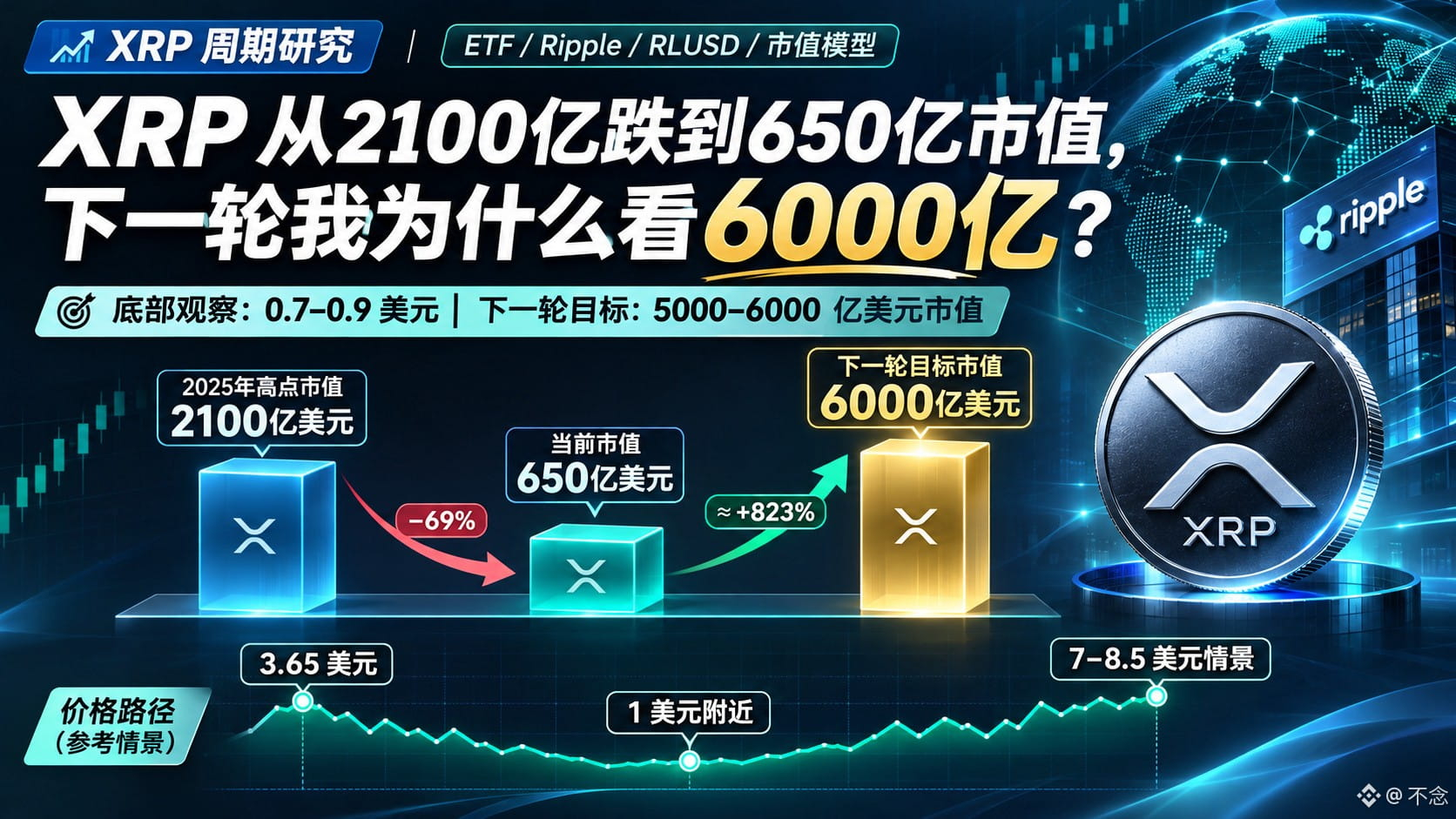
2
2.6k
·
--
MSTR was removed from U.S. stock indices,
#BTC fell today.
The lowest wick was 674999.
Anything below 65000 this year is the bottom.
There’s no need to obsess over whether you can buy at the true bottom.
Buy the dip every time it drops 3000 points. Buying the dip takes courage; selling near the top is the real test of your judgment.
MSTR was removed from U.S. stock indices,
#BTC fell today.
The lowest wick was 674999.
Anything below 65000 this year is the bottom.
There’s no need to obsess over whether you can buy at the true bottom.
Buy the dip every time it drops 3000 points. Buying the dip takes courage; selling near the top is the real test of your judgment.
#BTC fell today.
The lowest wick was 674999.
Anything below 65000 this year is the bottom.
There’s no need to obsess over whether you can buy at the true bottom.
Buy the dip every time it drops 3000 points. Buying the dip takes courage; selling near the top is the real test of your judgment.
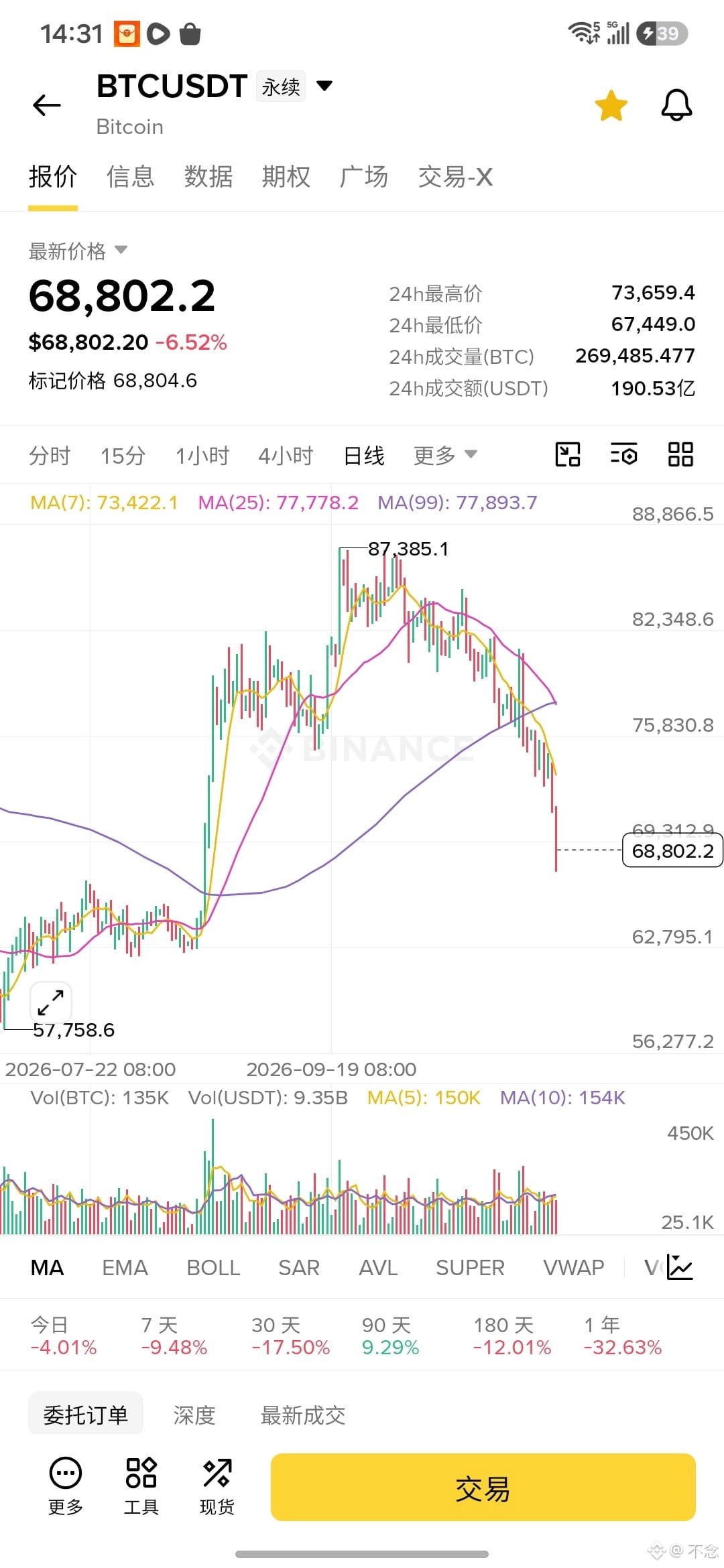

294
·
--
#黄仁勋辞任CEO,英伟达战略走向受关注 What NVIDIA may truly lose is more than just a CEO.
Many people are discussing how much NVIDIA’s stock price might fall after Jensen Huang leaves.
But I believe what the market really needs to reprice is the trust premium that Jensen Huang personally brings.
Over the past few years, NVIDIA has sold more than just GPUs—it has sold certainty.
Jensen Huang has brought TSMC, HBM suppliers, cloud computing giants, and AI developers together into a complete ecosystem, making technology companies around the world willing to invest hundreds of billions of dollars in NVIDIA’s technological roadmap.
That kind of ability is an asset you can’t see on a financial statement.
CUDA won’t disappear just because Jensen Huang leaves, and orders won’t drop to zero overnight.
But here’s the question:
Will Microsoft, Google, and Amazon speed up their in-house chip development? Will AMD and Broadcom get new opportunities? Can the new management team maintain the pace of technological progress we’ve seen in the past?
Long-term demand for AI doesn’t mean NVIDIA can enjoy the same valuation it has in the past forever.
Wall Street has long believed that Jensen Huang could keep creating miracles.
Going forward, the market may demand that the new management team prove everything through performance.
What makes Jensen Huang exceptional isn’t how much he can charge for GPUs, but that he’s made the entire tech industry willing to bet on his vision of the future.
Chips can keep being produced, and technology can keep being developed.
But can the new management team fully inherit the industry’s trust—built by one person over 33 years?
That is the real test facing NVIDIA.
$NVDA #NVIDIA #JensenHuang #USStocks #AI
#黄仁勋辞任CEO,英伟达战略走向受关注 What NVIDIA may truly lose is more than just a CEO.
Many people are discussing how much NVIDIA’s stock price might fall after Jensen Huang leaves.
But I believe what the market really needs to reprice is the trust premium that Jensen Huang personally brings.
Over the past few years, NVIDIA has sold more than just GPUs—it has sold certainty.
Jensen Huang has brought TSMC, HBM suppliers, cloud computing giants, and AI developers together into a complete ecosystem, making technology companies around the world willing to invest hundreds of billions of dollars in NVIDIA’s technological roadmap.
That kind of ability is an asset you can’t see on a financial statement.
CUDA won’t disappear just because Jensen Huang leaves, and orders won’t drop to zero overnight.
But here’s the question:
Will Microsoft, Google, and Amazon speed up their in-house chip development? Will AMD and Broadcom get new opportunities? Can the new management team maintain the pace of technological progress we’ve seen in the past?
Long-term demand for AI doesn’t mean NVIDIA can enjoy the same valuation it has in the past forever.
Wall Street has long believed that Jensen Huang could keep creating miracles.
Going forward, the market may demand that the new management team prove everything through performance.
What makes Jensen Huang exceptional isn’t how much he can charge for GPUs, but that he’s made the entire tech industry willing to bet on his vision of the future.
Chips can keep being produced, and technology can keep being developed.
But can the new management team fully inherit the industry’s trust—built by one person over 33 years?
That is the real test facing NVIDIA.
$NVDA #NVIDIA #JensenHuang #USStocks #AI
Many people are discussing how much NVIDIA’s stock price might fall after Jensen Huang leaves.
But I believe what the market really needs to reprice is the trust premium that Jensen Huang personally brings.
Over the past few years, NVIDIA has sold more than just GPUs—it has sold certainty.
Jensen Huang has brought TSMC, HBM suppliers, cloud computing giants, and AI developers together into a complete ecosystem, making technology companies around the world willing to invest hundreds of billions of dollars in NVIDIA’s technological roadmap.
That kind of ability is an asset you can’t see on a financial statement.
CUDA won’t disappear just because Jensen Huang leaves, and orders won’t drop to zero overnight.
But here’s the question:
Will Microsoft, Google, and Amazon speed up their in-house chip development? Will AMD and Broadcom get new opportunities? Can the new management team maintain the pace of technological progress we’ve seen in the past?
Long-term demand for AI doesn’t mean NVIDIA can enjoy the same valuation it has in the past forever.
Wall Street has long believed that Jensen Huang could keep creating miracles.
Going forward, the market may demand that the new management team prove everything through performance.
What makes Jensen Huang exceptional isn’t how much he can charge for GPUs, but that he’s made the entire tech industry willing to bet on his vision of the future.
Chips can keep being produced, and technology can keep being developed.
But can the new management team fully inherit the industry’s trust—built by one person over 33 years?
That is the real test facing NVIDIA.
$NVDA #NVIDIA #JensenHuang #USStocks #AI
222
·
--
Time always slips away quietly when you least expect it.
Looking back, it’s been exactly two years since I entered the crypto world.
These past two years have brought some gains, but also plenty of regrets.
I’ve seen the market go wild and weathered the quiet times.
I came in full of hope, and now I’m slowly learning to accept reality.
Over these two years, I’ve truly stuck with only two things: bringing in new users and trading.
The road to bringing in new users has been bumpy, but I’ve brought in more than 2,300 new users in total. At least that gives me something to show for all my effort over the past two years.
But trading? I’ve made a complete mess of it.
I’ve made money and lost money, paid plenty in tuition, yet still haven’t managed to turn in an answer I’m satisfied with.
Sometimes I wonder what I’ve gained over these two years, and what I’ve missed.
Only later did I realize that in this world, making money takes skill, and simply sticking around is no small feat either.
Two years isn’t a long time, but it’s long enough to take someone from being full of hope to slowly coming to their senses.
I hope the next two years bring fewer regrets and more gains.
And I hope that when I look back then, I’ll be able to say to the person I am today:
This journey wasn’t for nothing.#币圈现状
Time always slips away quietly when you least expect it.
Looking back, it’s been exactly two years since I entered the crypto world.
These past two years have brought some gains, but also plenty of regrets.
I’ve seen the market go wild and weathered the quiet times.
I came in full of hope, and now I’m slowly learning to accept reality.
Over these two years, I’ve truly stuck with only two things: bringing in new users and trading.
The road to bringing in new users has been bumpy, but I’ve brought in more than 2,300 new users in total. At least that gives me something to show for all my effort over the past two years.
But trading? I’ve made a complete mess of it.
I’ve made money and lost money, paid plenty in tuition, yet still haven’t managed to turn in an answer I’m satisfied with.
Sometimes I wonder what I’ve gained over these two years, and what I’ve missed.
Only later did I realize that in this world, making money takes skill, and simply sticking around is no small feat either.
Two years isn’t a long time, but it’s long enough to take someone from being full of hope to slowly coming to their senses.
I hope the next two years bring fewer regrets and more gains.
And I hope that when I look back then, I’ll be able to say to the person I am today:
This journey wasn’t for nothing.#币圈现状
Looking back, it’s been exactly two years since I entered the crypto world.
These past two years have brought some gains, but also plenty of regrets.
I’ve seen the market go wild and weathered the quiet times.
I came in full of hope, and now I’m slowly learning to accept reality.
Over these two years, I’ve truly stuck with only two things: bringing in new users and trading.
The road to bringing in new users has been bumpy, but I’ve brought in more than 2,300 new users in total. At least that gives me something to show for all my effort over the past two years.
But trading? I’ve made a complete mess of it.
I’ve made money and lost money, paid plenty in tuition, yet still haven’t managed to turn in an answer I’m satisfied with.
Sometimes I wonder what I’ve gained over these two years, and what I’ve missed.
Only later did I realize that in this world, making money takes skill, and simply sticking around is no small feat either.
Two years isn’t a long time, but it’s long enough to take someone from being full of hope to slowly coming to their senses.
I hope the next two years bring fewer regrets and more gains.
And I hope that when I look back then, I’ll be able to say to the person I am today:
This journey wasn’t for nothing.#币圈现状


412
·
--
#闪迪 #I lean toward shorting at higher levels.
Prices have risen so quickly,
rallying from around $828 to test the $1,000–$1,016 range, with a rebound of nearly $200 in a short time.
After such a sharp rise, short-term profit-taking has built up considerably, but support below has not yet been thoroughly tested.
On the 4-hour chart:
The price has moved back above the MA7 and MA25, indicating strong short-term rebound momentum. However, the MA99 is still near $1,073, so medium-term resistance has not been fully cleared.
If prices continue to climb tonight, I’d be more inclined to wait for an opportunity to short after the price encounters resistance at higher levels. The plan is to position for a technical pullback tomorrow, Thursday.
Pay particular attention from 4 p.m. Thursday through the U.S. trading session to see whether profit-taking and a catch-up decline emerge.
The initial target is around $950. If that level is decisively broken, then we can assess the support below.
Of course, a short position also needs a clearly defined invalidation point. If the price breaks above $1,016 on strong volume and holds there, the bearish thesis needs to be reassessed; don’t stubbornly hold on.
The biggest issue with this rebound is how quickly prices have risen. Short-term support still needs time to be confirmed.
#闪迪 #I lean toward shorting at higher levels.
Prices have risen so quickly,
rallying from around $828 to test the $1,000–$1,016 range, with a rebound of nearly $200 in a short time.
After such a sharp rise, short-term profit-taking has built up considerably, but support below has not yet been thoroughly tested.
On the 4-hour chart:
The price has moved back above the MA7 and MA25, indicating strong short-term rebound momentum. However, the MA99 is still near $1,073, so medium-term resistance has not been fully cleared.
If prices continue to climb tonight, I’d be more inclined to wait for an opportunity to short after the price encounters resistance at higher levels. The plan is to position for a technical pullback tomorrow, Thursday.
Pay particular attention from 4 p.m. Thursday through the U.S. trading session to see whether profit-taking and a catch-up decline emerge.
The initial target is around $950. If that level is decisively broken, then we can assess the support below.
Of course, a short position also needs a clearly defined invalidation point. If the price breaks above $1,016 on strong volume and holds there, the bearish thesis needs to be reassessed; don’t stubbornly hold on.
The biggest issue with this rebound is how quickly prices have risen. Short-term support still needs time to be confirmed.
Prices have risen so quickly,
rallying from around $828 to test the $1,000–$1,016 range, with a rebound of nearly $200 in a short time.
After such a sharp rise, short-term profit-taking has built up considerably, but support below has not yet been thoroughly tested.
On the 4-hour chart:
The price has moved back above the MA7 and MA25, indicating strong short-term rebound momentum. However, the MA99 is still near $1,073, so medium-term resistance has not been fully cleared.
If prices continue to climb tonight, I’d be more inclined to wait for an opportunity to short after the price encounters resistance at higher levels. The plan is to position for a technical pullback tomorrow, Thursday.
Pay particular attention from 4 p.m. Thursday through the U.S. trading session to see whether profit-taking and a catch-up decline emerge.
The initial target is around $950. If that level is decisively broken, then we can assess the support below.
Of course, a short position also needs a clearly defined invalidation point. If the price breaks above $1,016 on strong volume and holds there, the bearish thesis needs to be reassessed; don’t stubbornly hold on.
The biggest issue with this rebound is how quickly prices have risen. Short-term support still needs time to be confirmed.
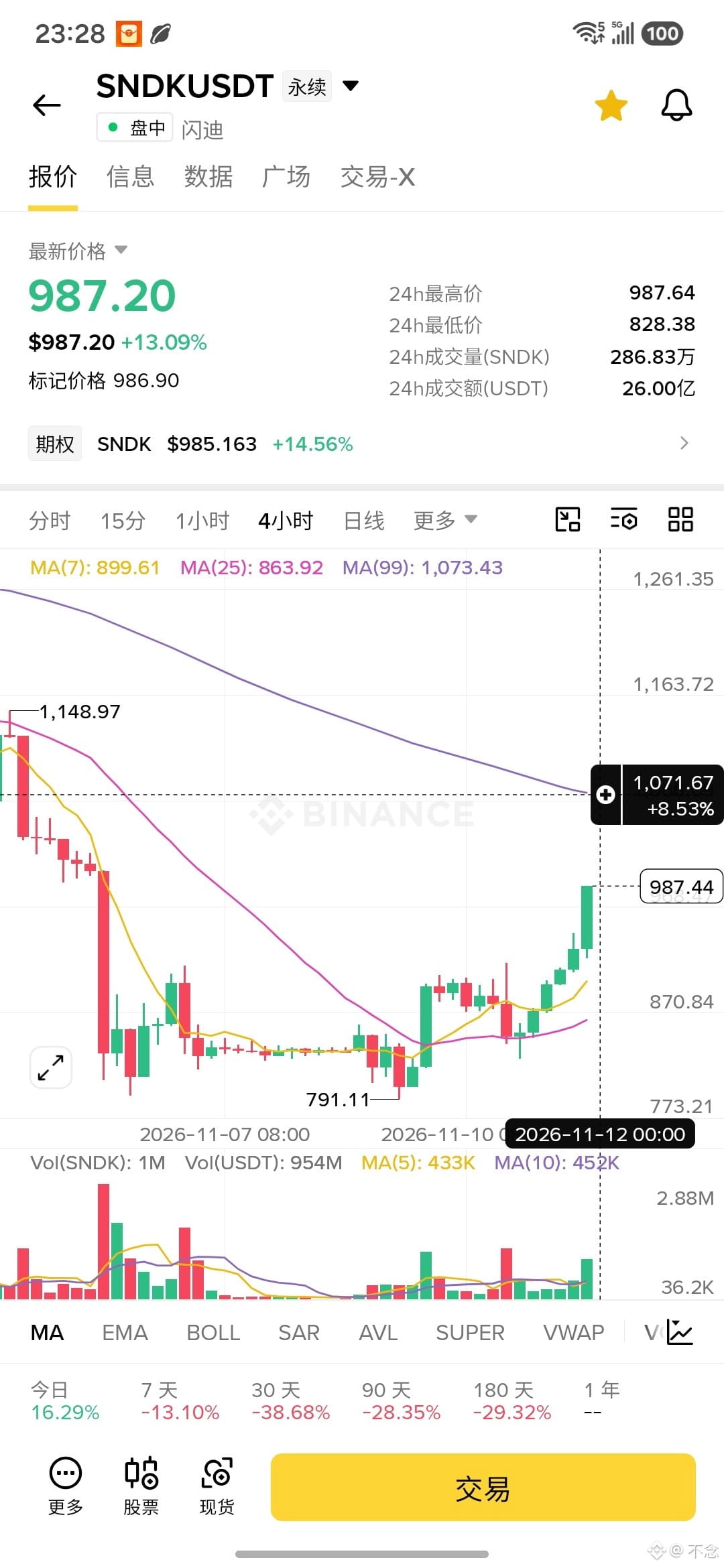

1
2.3k
·
--
#股票财报季 #美债 Interest rates dipped a bit again today.
Recently, U.S. stocks and gold have been hit too hard.
Several major U.S. tech companies report earnings this week,
and the Fed will speak too. A speech that's too 🦅 hawkish would be bad.
There won't be a rate hike this month; Americans couldn't take another one anyway.
Prices are high, tech companies' financing costs are too high, and crude oil is expensive too.
I think there'll be at most one rate hike this year, in December, or one in the first quarter of next year. Also, the U.S. midterm elections are next week. Based on historical data, the market should fall by around 10%. This is just a reference, so don't take it as a certainty.
#股票财报季 #美债 Interest rates dipped a bit again today.
Recently, U.S. stocks and gold have been hit too hard.
Several major U.S. tech companies report earnings this week,
and the Fed will speak too. A speech that's too 🦅 hawkish would be bad.
There won't be a rate hike this month; Americans couldn't take another one anyway.
Prices are high, tech companies' financing costs are too high, and crude oil is expensive too.
I think there'll be at most one rate hike this year, in December, or one in the first quarter of next year. Also, the U.S. midterm elections are next week. Based on historical data, the market should fall by around 10%. This is just a reference, so don't take it as a certainty.
Recently, U.S. stocks and gold have been hit too hard.
Several major U.S. tech companies report earnings this week,
and the Fed will speak too. A speech that's too 🦅 hawkish would be bad.
There won't be a rate hike this month; Americans couldn't take another one anyway.
Prices are high, tech companies' financing costs are too high, and crude oil is expensive too.
I think there'll be at most one rate hike this year, in December, or one in the first quarter of next year. Also, the U.S. midterm elections are next week. Based on historical data, the market should fall by around 10%. This is just a reference, so don't take it as a certainty.
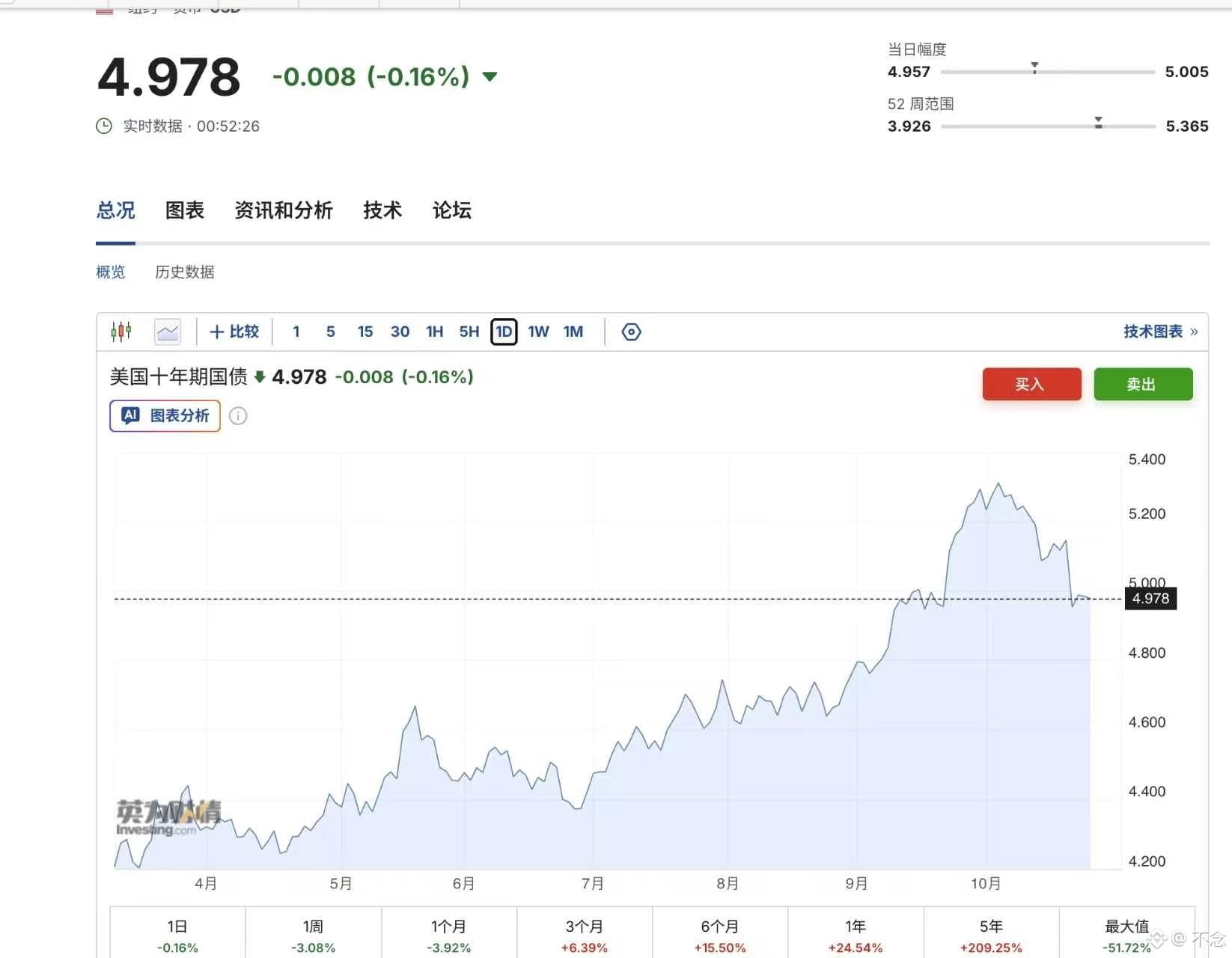
3
1
9.5k
·
--
Wishing #币安 all the best! I'm just a small promoter in the crypto community. Compared with some other platforms, Binance is relatively fair and inclusive. I believe at least 1 billion users will choose Binance in the future!
Wishing #币安 all the best! I'm just a small promoter in the crypto community. Compared with some other platforms, Binance is relatively fair and inclusive. I believe at least 1 billion users will choose Binance in the future!


1
529
Log in to explore more content
Join global crypto users on Binance Square
⚡️ Get latest and useful information about crypto.
💬 Trusted by the world’s largest crypto exchange.
👍 Discover real insights from verified creators.
Email / Phone number
Trending Topics
IsAnthropic’s$1.5TMarketCapJustified?
60,489 views
306 Discussing
Anthropic Set to Open at $105 in Record Nasdaq Debut
Binance News
·16 Likes
·18.7k views
BTCBelow$62KAmidHikeFearsAndShiftToAnthropic
17,542 views
112 Discussing
NvidiaBoardReportedlySplitOverHuang’sReturn
251,080 views
2,008 Discussing